Connections
R 2012
WINTE
Wal t Whi tman Bridge REHABILITATION Philadelphia, PA
Connections CONTENTS
Wal t Whi tman Bridge W IN
4
Bill Batzel Bill Felker Mike Flowers Michael Hartranft Mark Sharin Jim Thornton
2012
highlight
Walt Whitman Bridge Rehabilitation
New Hires Dick Foster Current Contracts Human Resources /Wellness Interview with CEO Flashbacks AB Published Safety Committee
t h a n k y o u Much appreciation to the followingg individuals for their contribution to this issue:
T ER
3
13 14 18 19 22
retires after 44 years AB KS City District’s first contract grand prize raffle winner after Mike Flowers's first year 1913 lift bridge still in use today SAS in the past and present updates for the new year
To receive ve AB Conn Connections electronically or view archived issues vvisit: http://www.americanbridge.net/Media/newsletters.php mericanbridge.net/Media/newslette
Connections WINTER
2012
Wal t Whi tman Bridge REHABILITATION Philadelphia, PA
C
O
V
E
R
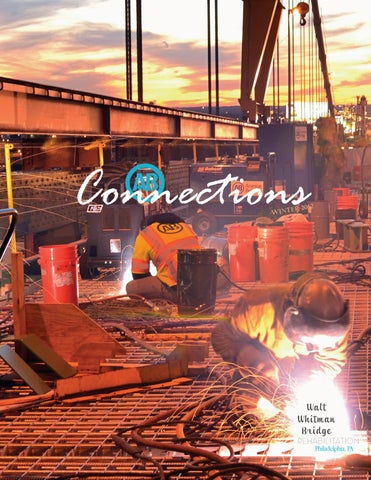
Ironworkers weld the new steel grid deck panels together on the Walt Whitman Bridge, Philadelphia, PA; flip the page to read about this AB project which is full of unique and challenging aspects.
by Kadi Camardese
Please contact the Communications and Marketing Department with news and inquiries: kcamardese@americanbridge.net
abpublished
C The San Francisco/Oakland Bay Bridge, copyright 1936, by American Bridge Company
Fans of the San Francisco/Oakland Bay Bridge could buy a copy of the erection schematics published by American Bridge Company for one dollar per copy when the structure opened in 1936. Worth a lot more (nostalgia) 75 years later, we recently found a copy tucked away in the company archives. This bridge has been the subject of AB Connections Published section more than once before - can one fault the many authors who have dedicated their research and writings to this engineering marvel? In 1856, for most, it was impossible to imagine a bridge with a 22,720’ main structure length connecting the west portion of the bay, San Francisco, and Yerba Buena Island. However, this is when gold rush pioneers first envisioned expansion of mobility and economic opportunity in the area. The book delves into more historical and geographical information as well as technical construction procedures for the substructure, towers and trusses, but the cable spinning is arguably the most fascinating aspect to be highlighted ... next page
“
”
cu r r e nt pr oj e ct up d ate Electric lights on footwalks made it
1936 possible to spin cables
The American Bridge/ Fluor Joint Venture
2013
began stringing
at night. Weather Weath
cables ables on the new
permitting, work
Self-AnchoredAnchored-
was undertaken 24
Suspension uspension Span of
hours per day with a
the he San Francisco/
break from Saturday
Oakland Bay Bridge
afternoon through
on December 20, 2011
Monday morning
AB Connections, Winter 2012 www.americanbridge.net
19
newhires w Mark Hines, Estimator, American Bridge Manufacturing, Reedsport Mathias Schramer, Chief Administrator Officer to the Board Roger Northern, Survey Manager, Forth Replacement Crossing, Scotland Glen Stratmann, Crane Operator, Container Yard Shoreline Protection Works, Bahamas Brent Puller, Senior Accountant, Headquarters Accounting Department
dickfoster As a tribute to his 44 years of service at American Bridge, a luncheon was held in Dick Foster’s honor upon his retirement on December, 31 2011. Dick started with the American Bridge Division of United States Steel Corporation in 1967 as a time keeper, traveling across the country working in the field on projects such as the New Orleans Super Dome, the Inner Harbor Vertical Lift Bridge and the Pittsburgh PNC Office Building. Except for a stint as office manager on the Florida Avenue Bridge project in New Orleans from 2003-2005, Dickie has worked in the corporate accounting department since 1980. Dick was emblematic of the AB culture, always undertaking his work with competence, pride, and a can-do attitude. His ready smile and cheerful disposition will be missed along with his contributions to the efficiency of the AB accounting operation. Dick plans to spend his retirement years with his wife and family in South Carolina. American Bridge would like to thank Dick for his loyalty to the company and wish him a most enjoyable retirement.
currentcontracts NEW Y0RK
WESTERN Throgs Neck Bridge Structural Retrofits, New York City ABFJV San Francisco/Oakland Bay Bridge, CA Bronx Whitestone Bridge Structural Retrofits, New York City Ogdensburg-Prescott International Bridge Main Span Rehabilitation, Ogdensburg, NY KANSAS CITY Walt Whitman Deck Replacement, Philadelphia, PA Hurricane Deck Bridge, Camdenton, MO George Washington Bridge Rehabilitation, New York City MANUFACTURING Robert F. Kennedy Bridge Structural Improvements, New York City Walt Whitman Bridge, Philadelphia, PA PJ McArdle Viaduct, Pittsburgh, PA PITTSBURGH Clearfi eld County Plate Girder Bridge, Kylertown, PA Charleroi-Monessen Bridge Replacement, Charleroi, PA Shore Parkway, Queens, NY Columbus Road Lift Bridge, Cleveland, OH Cochran Mills Bridge, Armstrong County, PA SPECIAL AND INTERNATI0NAL PR0JECTS Sun Valley Bridge Widening, Los Angeles, CA Forth Replacement Crossing, Scotland, United Kingdom th 4 Avenue Bridge, Johnstown, PA Las Vegas High Roller Observation Wheel, NV Wilson Creek Bridge, Marshall, AK RICHM0ND George Washington Bridge Deck Replacement, New York, NY Chincoteague Bridge, Chincoteague, VA Ch Dickey Prairie Road Bridge, Clackamas County, OR Pier R3 Repa Repairs, Yorktown, VA I-80 Bridges, Clarion County, PA Pier 31, Groton, CT Route 65 Bridge Rehabilitation, Pittsburgh, PA Bulkhead at NOAA Marine Oper Operations Center, Norfolk, VA Montour Trail Bridges, Washington County, PA Wrightsville Beach Bridge, Wright Wrightsville, NC Trinity County Bridges, Trinity County, CA OPT Cofferdams, Reedsport, OR TAMPA Flamingo Loading Docks, Las Vegas, NV Platt Street Bridge Major Repair Repairs, Tampa, FL Mansfi eld Bridge Rehabilitation, Allegheny County, PA Red Bug Lake Road Pedestrian Overpass, Oviedo, FL Ambridge/Aliquippa Bridge Rehabilitation, Beaver County, PA Arawak Cay Port Development Phase II, Nassau, Bahamas Blacklegs Creek Bridge, Indiana County, PA Castaway Cay Hurricane Iren Irene Emergency Repairs, Castaway Cay, Bahamas Columbus Road Lift Bridge, Cleveland, OH Container Yard Shoreline Protection Pro Works, Freeport, Bahamas East Pine Street Bridge, Snyder County, PA Cherry Tree Bridge, Indiana County, PA
AB Connections, Winter 2012
3
C
waltwhitman w walt whitman w ch or ag e Span on Span an d An
wwb
Su spen si
pl ac em en t
De ck Re eer Jim Thornton phy by Project Engin Article and photogra
In early January 2012, Ame American merican erican Bridge wil er eric will complete c Stage One of the Suspension Span Spa and Anchorage Span Deck De Replacement Repla placement on the pla th he Walt Whitman tman Bridge. The $128M contract was awarded in Julyy of 2010, 2010 0, and wil will be the largest capital improveme improvement wner Delaware are River Rive Port Authority (DRPA). (DRPA) project ever undertaken by owner
The Walt Whitman Bridge, originally built by American Bridge in 1957 and designed by renowned engineer Othmar Ammann, carries 120,000 vehicles daily between Philadelphia, Pennsylvania and Southern New Jersey on Interstate-76. The bridge serves as the primary route for daily city commuters coming in and out of the city, sports fans traveling to the Sports Complex in South Philadelphia, and vacationers heading to the Jersey Shore throughout the summer months. After 50 years of heavy use, the 3,540’ suspension bridge was badly in need of repairs. To minimize impact to the traveling public, the project is being conducted over the course of seven long-term stages, replacing one lane of the bridge at a time.
4
AB Connections, Winter 2012 www.americanbridge.net
AB’s scope of work includes removing and replacing 271,000SF of existing grid deck and stringers, as well as replacing the top lateral bracing, installing new movable barrier, floor truss strengthening, new elastomeric bearings, new expansion joints, sidewalks, drainage grating, steel barriers and concrete parapets, temporary stringer installation, ladder relocations, modification to under deck maintenance walkways and the main cable saddle enclosures. Subcontract work includes replacing existing light poles, power, lighting and high-voltage lines, modifying fire department dry standpipes, partial cleaning and painting of the stiffening truss and top chords, and sawcutting the existing deck sections.
PROJECT TEAM Kwadwo Osei-Akoto, Vice President New York District Dan Bell, Operations Manager Dan Murphy, Project Manager George Terrance, Superintendant Dave Geesaman, Civil Superintendant Jim Thornton, Project Engineer Zach Rosswog, Field Engineer Michael Hartranft, Field Engineer Drew Merritts, Field Engineer Bill Batzel, Field Engineer Joe Stilson, Field Engineer Kara Mullin, Field Engineer Zach Osei, Field Engineer Pete Bereza, Safety Manager New York District Mark Sharin, Safety Manager Mike Rambus, Ironworker General Foreman
t
Temporary Work Platform Tem
Access es to the underside of the bridge was achieved throu the installation of a temporary work platform. through AB employed an innovative cable-suspended platform designed and erected specifically for this project, consisting of 20 gauge steel deck pans fastened to and supported by a wire rope suspension system installed the length of the bridge, and incrementally supported with tie-up cables at every floor truss. AB strategically placed the platform 5’- 6” below the existing deck allowing employees to comfortably perform their work tasks and minimize the need for fall protection. Designed in accordance with AASHTO and ASCE-7-02 standards, the temporary work platform not only serves as a debris shield to the marine traffic and the shipping terminals located below the bridge, but has also been designed to support the loads of the various structural members being replaced. AB Project Manager Dan Murphy acknowledges that “the Safespan system has been a valuable commodity for us, providing better access to the underside of the bridge, thereby increasing our productivity and virtually eliminating fall protection and falling object concerns.” Workers access the platform via two 130’ stair towers located at either anchorage, and are not dependent on lane closures to begin their shift.
Erection of the gantry crane legs with the 15-ton Tadano crane
Ironworkers installing new top lateral bracing members during the advanced work stage from the temporary work platform
AB Connections, Winter 2012 www.americanbridge.net
5
According g to the Graham Company, p y y, AB has the best compliance p of PPE on any y DRPA p project …higher level than expected. SAFETY S
by Safety Manager Mark Sharin
The Walt Whitman Project is being also supplied by New York District Safety operated under an Owner Controlled Manager Pete Bereza. When a safety Insurance Program (OCIP), with specific culture is presented and encouraged by safety requirements that in many cases a unified management team it is more exceed current federal, state and local readily accepted and embraced by the safety standards. The DRPA utilizes a foremen and their crews. multi-level safety team comprised The potential hazards associated “The of their own in-house safety with working on suspension Safespan system has been a valuable personnel as well as bridge rehabilitation projects commodity for us, providing utilizing the services of are abundant. Our crews better access to the underside of the bridge, thereby increasing their insurance broker’s are equipped with and well our productivity and virtually safety consultants. The trained in the use of any eliminating fall protection DRPA’s insurance broker, necessary personal protective and falling object concerns.” The Graham Company, equipment (PPE). Many Project Manager Dan Murphy has representatives on-site work operations involve a minimum of twice a rivet busting, grinding, week for inspections that can last several mag-drilling and torch cutting inside the hours. These site inspections are always steel floor truss box beams, increasing accompanied by American Bridge’s safety the likelihood for injury from shavings, representative and often by one of AB’s dirt and debris. The AB team reviewed field engineers. Having the field engineers the issue of debris in employee’s eyes, and involved in the site inspections helps decided to replace conventional safety ensure that both operations and safety glasses with foam lined hybrid style – are carefully considered in each assigned just one example of how AB is working task. The Graham Company reports their to reduce worker exposure to injuries. findings in writing to the DRPA weekly American Bridge has received praise to which American Bridge is required to and even been used as a model of good respond in writing. AB has welcomed this safety practice on other DRPA projects scrutiny and uses it as a tool to reinforce in the region. In a recent bi-weekly American Bridge’s in-house safety program safety meeting, Jeff Spatz of the Graham both on this jobsite and corporately. Company commented on AB’s level of This is a high profi le job by virtue of its safety compliance as “the best compliance location and that it is the largest project of PPE on any DRPA project…higher level contracted by the DRPA. AB is under than expected.” very close observation, however, this This praise is largely due to the strong alone is not the driving force of our site and unwavering support of the AB project safety program. The true focus on safety team, making safety compliance the comes from the management team led by normal way of working. All members of Project Manager Dan Murphy, Operations the management team continually enforce Manager Dan Bell, Superintendents all applicable OSHA standards along George Terrance and Dave Geesaman with AB and DRPA safety policies, first by along with the efforts of all the field example and then by direction. engineers. Invaluable input and support is
6
AB Connections, Winter 2012 www.americanbridge.net
Pre-stage construction: single daily lane closures AutoCAD by Field Engineer Bill Batzel
i
Innovative Inn Inno n Erection Procedures under Live Traffic The replacement of the existing top lateral bracing members had to be performed as part of the advanced work stage (prior to any demolition of existing deck). Advanced work was performed during normal work hours under live traffic conditions, utilizing temporary single lane closures. Daily lane closures are only permitted during off-peak hours, between 9:30 a.m. and 2:30 p.m., to minimize impact to the traveling public. With extensive experience working for American Bridge in New York, Superintendant George Terrance worked with the project team to develop innovative erection procedures utilizing special equipment such as 15 ton Tadano cranes, tow behind trailers and specific rigging schemes to work efficiently within single lane closures adjacent to live traffic. Use of the 15 ton Tadano crane has become common practice on AB-NY projects, as it has a small footprint (6’-7”) ideal for working in tight quarters.
American Bridge Manufacturing (ABM) fabricated 377 tons of structural steel for the new top lateral bracing system. ABM Project Manager Dave Partazana worked closely with the project team to ensure fabrication and delivery schedules were met and all truck loads were stacked according to AB’s field erection procedures. Using the 15 ton Tadano, all After several iterations of the new 27’ long HP12 x 53 laterals we came up with a were quickly off-loaded within the design that allowed overhang brackets to simply hook to the confines of a single lane closure. stiffening truss top chord. This Laterals were picked directly off streamlined the entire erection process. flatbed trailers and flown over the Field Eng ineer Bill Batzel side of the stiffening truss, where workers waiting on the work platform below re-hooked the piece and pulled it into position with chainfalls supported on Hillman roller conveyors. The existing laterals were removed in the same fashion under live traffic conditions. AB Connections, Winter 2012 www.americanbridge.net
7
The Graham Company p y hailed AB’s operation p as one of the very y best or the best {{ever}witnessed } from a p planning, g, coordination,, and execution standpoint; it was orchestrated with military-like precision.”
o
Overhead O Over verhead Gantry Cranes To overcome lane closure and work zone restrictions imposed by the DRPA, American Bridge is utilizing three overhead gantry cranes, one in each span (Pennsylvania side span, mainspan; and New Jersey side span). These versatile cranes are not only capable of traveling the full length of their span, but can also trolley the full width of the deck, making them invaluable to AB throughout each of the seven construction stages. Utilizing overhead gantry cranes on redecking projects is not a new concept to American Bridge; the Triborough Bridge Deck Replacement (2001-2005) was the first time an overhead gantry crane was used to replace suspension bridge sections in the United States, and then AB again incorporated overhead gantry cranes for the Ogdensburg-Prescott Bridge Deck Replacement (2010-2011). However, unlike those two bridges where the top chord of the stiffening truss is significantly above the deck, the Walt Whitman top chord is only a few feet above the deck, necessitating the design of additional 15’ crane legs to keep the overhead box girders well above minimum vertical clearances. In addition to crane legs, the gantry cranes are supported by temporary runway beams and overhang brackets, a system entirely George Terrance and Mike Rambus oversee gantry load test engineered in-house by American Bridge. Field Engineer Bill Batzel explains, “Before Stanley Walker retired, he and I worked One of the most closely together to design a gantry crane challenging operations runway system that was both simple to to date was the erection of the six 86’- 8” long gantry fabricate and practical to install. Over crane box girders, which 300 brackets were needed along the American Bridge completed stiffening truss to simply support the within a single four-hour night time full-bridge 22’ long runway beams; thus rivet busting shutdown. or mag-drilling holes at each location Project Engineer Jim Thornton would have been too time consuming and costly. After several iterations we came up with a design that allowed overhang brackets to simply hook to the stiffening truss top chord. This streamlined the entire erection process.” All material for the crane runway was fabricated by ABM and shop assembled so that the brackets and beams could be Superintendant George Terrance and General Foreman Mike Rambus oversee erection of the 86’-8” gantry crane box girders; AB set the six girders during one, four-hour, full-bridge shutdown
8
AB Connections, Winter 2012 www.americanbridge.net
American Bridge g Manufacturing g fabricated 400 tons of temporary material for the g gantry y crane runway y system, y , including 338 overhang bracket assemblies, and 6,838LF of built-up runway beams.
directly offloaded on the bridge and set in place with the 15 ton Tadano, avoiding costly double handling and onsite assembly. One of the most challenging operations to date was the erection of the six 86’- 8” long gantry crane box girders, which American Bridge completed within a single four-hour night time full-bridge shutdown. The four-hour time frame was coordinated with the DRPA, and was the first time in the 54 year history of the bridge that a full traffic closure was made. The Authority allowed this special request for a full bridge closure based on American Bridge’s detailed crane erection plan and past MPT performance on the project. George Terrance and Bill Batzel worked with the AB Engineering Department to design a temporary support system to hold the crane legs upright, until the girders could be placed. The operation was an entire team effort, from developing the hoist plans, to surveying the crane rails, Stage 1 construction: permanent lane closure and single day lane closures AutoCAD by Field Engineer Bill Batzel coordinating the complex MPT arrangement, directing the oversized trailer loads, crane setup and special rigging configurations. George and AB Ironworker General Foreman, Mike Rambus, orchestrated the massive crane picks utilizing 100 ton hydraulic truck cranes at each gantry location. The operation was completed without any disruptions and easily within the time frame. The DRPA received zero complaints from the traveling public of the shutdown and American Bridge received high praise from the Authority for the successful completion of the girder erection. Jeff Spatz of the Graham Company hailed the operation as “one of the very best or the best that I have witnessed from a planning, coordination, and execution standpoint; it was orchestrated with military-like precision.”
AB Connections, Winter 2012 www.americanbridge.net
9
f
Floating D Fl Deck eck Design AECOM, this is the first floating deck One of the unique aspects of this to be installed on a suspension bridge. project is the “floating deck” concept At each floor truss the new stringers sit being b i utilized til for the new deck. The on unique custom molded elastomeric existing grid deck is being bearings. The concept of the “Completing replaced with a modern floating deck relies on varying the concrete pours and steel grid deck fi lled with laying asphalt before the plants the stiffness of the bearings, lightweight concrete. shut down for winter was the allowing for thermal expansion key to meeting our project In addition to being milestones.” and contraction in the suspended lighter, the new bridge deck through deformation of Op e r a ti ons Ma n a g e r Da n Be ll deck will not have relief the bearing. The expansion joints (except at the towers and contraction is controlled by and anchorages); thus eliminating 26 strategically placing laminated (bonded) existing joints currently spaced every bearings near the center of each span, 120’ of the suspended span. Removing and low-friction sliding type bearings the relief joints will prevent runnear the ends of each span. Each bearing off from reaching the sub-framing assembly stands 5-3/4” tall, and is and corroding the floor trusses and comprised of a composite of natural stringers, which was one of the rubber and primary reasons internal steel the existing deck shim plates, needed to be vulcanized replaced. between a 1” To accommodate top sole plate the differential that bolts to the longitudinal bottom flange movements of the new between the deck stringer, and a 1” and the stiffening base plate that trusses; the new bolts to the top design calls for the of the existing installation of over floor truss. The 3,100 elastomeric internal steel bearings shim plates underneath the increase both new stringers, the vertical which allow the bearing capacity deck to “float” and the amount independently. of horizontal According to View of the new deck (Stage 1), as seen from the top of the NJ tower
10
AB Connections, Winter 2012 www.americanbridge.net
According g to AECOM,, this is the first floating g deck to be installed on a suspension bridge.
deflection the bearing can withstand. impromptu adjustments to stringer The sliding bearings are a two piece splice plate dimensions. Field assembly, where the top sole plate is Engineer Zach Rosswog and I worked fi xed to the stringer, and elastomer and very closely with the ironworker One of base plate are fi xed to the floor truss. crews as they set and aligned the the challenging A low-friction sliding surface new 60’ stringers through: aspects for American Bridge during Stage 1 has been comprised of a stainless steel carefully monitoring aligning the new stringer system plate on top, and a PTFE dimple any deformations in and accommodating movement in lubricated plate on bottom, allow the bridge due to the new floating the bearings during the design. horizontal displacements up to erection process, expediting 1� at each sliding bearing assembly. the fabrication of new Temporary keeper plates are Project Engineer Jim Thornton stringer splice plates as used to lock the sliding bearings needed, avoiding costly delays in place until all 3,100 bearings have been to trailing work activities such as installed and ready to uniformly displace installation, and alignment and field under the new deck loading. According welding of the grid deck panels. to AECOM, the new floating deck The new steel grid deck is system is expected to have at least 75 comprised of over 2,800 segmental years of continued service, with minimal panels, which sit flush on the top maintenance flange of the required on the new stringers, sliding bearings and bolt into every 25 years. each of the One of the sidewalk challenging aspects diaphragms. for American Bridge Field Engineer during Stage 1 has Michael been aligning the Hartranft new stringer system coordinated the Field Engineer Kara Mullin watches as AB Ironworkers and accommodating fabrication and set new fi nger joint section at the NJ tower, using a 15 movement in the delivery the 400 ton Tadano crane bridge due to the new grid panels that floating design. In were offloaded order to minimize directly from bearing deformation the delivery and stay within tight trucks during erection tolerances temporary lane of 1/8�, AB had to closures. continually make
Field Engineers Michael Hartranft and Drew Merritts examine the new deck as workers pave Rosphalt overlay
AB Connections, Winter 2012 www.americanbridge.net
11
ALIGNMENT AND WELDING OF GRID PANELS A
by Field Engineer Mike Hartranft
The alignment of the grid panels in the beginning stage was extremely important to the subsequent stage work; especially Stage 4 (where panels have a transverse vertical curve) and Stage 7 (the final stage). To properly set the longitudinal edge of the Stage 1 panels AB field engineers set a survey line based off the project survey baseline. This survey line was then used by the crews in the field to install and align the panels. It was important to use the project base line to set the panels instead of just matching the panels to the centerline of stringer due to any warping or other tolerance issues between the existing bridge and the new bearings and stringers. While the panel alignment crew completed panel installation, a second crew worked on completing the over 30,000 welds that tie each stage of grid deck together. AB elected to use a welding electrode that can be utilized on galvanized material without the need to remove the galvanizing and clean the metal, significantly reducing the labor needs and schedule impact of the operation.
Once final alignment and welding was completed, AB carpenters and laborers formed and poured the deck in 120’ segments. The new wearing surface was placed in early December using a high performance asphalt mix, a unique product that includes a concentrated thermoplastic additive creating a waterproof wearing surface which is resistant to both rutting and shoving. According to AECOM this is the first time this material has been used on a suspended span of this size; the DRPA is eager to see how the new surface holds up to the heavy traffic experienced on the Walt Whitman Bridge.
c
CURRENT CURREN URRE R NT A American Bridge crews are currently underway with Stage 2 demolition. With substantial completion of Stage 1 being granted in late January, the entire AB project team is to be commended on their efforts at bringing Stage 1 in ahead of schedule.
12
AB Connections, Winter 2012 www.americanbridge.net
Ironworkers weld the new grid deck for Stage 1
C
humanresources Grand d Prize Raffle, 2011 2 The he 2011 11 Wellness Program has come to an end. end W We had great eat at participation for this year. Great job to all that participated! ipated! The grand prize rize raffl flee was held on Wedn Wednesday, January 11, 2012. Anne ne Royster, oyster, from the R Richmond office, was the big winner. er. Congratulat Congratulati Congratulations Anne! The 2012 Wellness Program am has be been launched. Overview, wellness certificate, and points checklist can all be found on the Access site or by contacting the HR (Human Resources) Department. Coming Months Here is what you can look forward to over the next couple of months with the wellness program: FEBRUARY – The HR Department will send out correspondence regarding the first newsletter campaign of 2012 in early February, called Eat Well for Life. It lasts eight weeks and is designed to help raise awareness of your current eating behaviors. You will receive 10 wellness points for signing up for this newsletter campaign. Also in February, sign up for any or all of the four Health on the Menu Video Workshops: What’s on Your Plate, Suspending Stress, Keys to Ergonomics, and Eating for Health: Five Must Do’s. They are approximately 30 minutes in length. To obtain points, you must complete a feedback survey regarding the video. If you would like any of these videos, please contact the HR Department. February is not the only month to view the videos. You can do this any time during the year. MARCH – Our focus for March is the HealthMedia SUCCEED Wellness Profile through Highmark. This assessment will help you understand what steps you can take to improve or maintain your health by creating a personal healthy lifestyle plan customized to your individual needs. It also provides valuable information that you can share with your personal physician. Your privacy is very important and this assessment is completely confidential and adheres to all HIPAA regulations. If at any time you are uncomfortable completing a
401k Program All salaried and hourly non-union employees can enroll in the American Bridge Company 401k program at any time. You can also change the percentage you are deferring at any time throughout the year. If you would like an enrollment packet or you need a savings form to update your contribution percentage, please contact the HR department at 412-631-1000. Preventive Care Please keep in mind that when you go to get a physical and/or blood work at the doctor, only certain procedures will be covered. Highmark has a preventive schedule which shows all routine covered services. A complete preventive schedule is located on the Access site or by contacting the HR Department. You can always check this schedule to see if the services you are going to receive are covered. If you are ever unsure, please call the member services number located on the back of your Highmark medical insurance card. Dental Provider As of January 1, 2012, the company’s dental provider has changed to Delta Dental. The new plan is very similar to what the old plan offered, but it has several more enhanced benefits. Salaried and non-union hourly employees should have received their new dental cards in mid-December. If you did not receive your cards, please contact the HR Department. If you need to locate a providing dentist, go to www.deltadentalins.com.
question, you may skip over to the next. It can be completed easily on-line and found at www.highmarkbcbs.com. If you completed this assessment last year, you can do it again for 2012. Please note: if you do not have medical insurance through American Bridge Company or you do not have any means of accessing a computer, please let the HR Department know and we can arrange for you to complete a paper version of the wellness profi le. APRIL – The incentive for April will be a 10,000 Steps Challenge. This is a 12-week program with the goal of working up to taking 10,000 steps a day. Kits, that include a pedometer, will be provided for you if you choose to participate in the program. Information will be sent in mid-March.
AB Connections, Winter 2012 www.americanbridge.net
13
C
interview th e C EO wit h
BIG SHOES FILLED In December of 2010, AB Connections covered Michael Flowers’ career as he stepped in as American Bridge President and CEO. One year later, we revisit with Michael to bring readers a summary of the progress made on the tactical goals he expressed to us last year including issues of rather controversial topics such as economics, domestic and foreign markets, and fabrication debates.
14
AB Connections, Winter 2012 www.americanbridge.net
AUTUM
N 201 0
future
thought s on Bob Luffy
MIKE FLOWERS'
BIG SHOES TO FILL THE NEW AMERICAN BRIDGE CEO
TACTICALGOALS MIKE FL0WERS, AB CHIEF 0PERATING 0FFICER
continued from previous page
When I think of Bob Luffy, two attributes come to mind above all else, his vision and his drive. Most people within the company today don’t realize how shallow the talent pool at AB had become back in the early 90s when Bob returned to the company. Nor do most realize how very close the company had come to fading away into a non-union construction orm in the southeast. Righting the ship during the 90s had nearly everybody in the company stretched to the limit as we struggled to return to prootability and execute work that was way more our history than it was our experience. Enter Bob and pursuit of the Tagus River Bridge in Lisbon, Portugal. Winning and successfully executing the air spinning of the new cables for the long-span suspension bridge we had built in the 60s not only served notice to the business world that we were on our way back but was also a huge boost in conodence to our people that their efforts to grow the company were in fact working. The next thing you know we move our storehouse from an obscure location in Point Pleasant, West Virginia, to Coraopolis, Pennsylvania (current location), and a qedging fabrication business emerged in rental space in Carnegie, Pennsylvania. Shortly thereafter master plans emerge and we move forward with a modest fabrication facility and an ofoce building of our own at the Coraopolis property. Development of a new marine segment of our business is undertaken in the southeast, and we successfully execute work in the Caribbean including development of the Castaway Cay cruise ship stop in the Bahamas. continued next page
MIKE FLOWERS
“
TELLS US THE STORY OF HIS CAREER
AUTUMN ’10 . AB Connections . PAGE 10
“
... it was Bob’s vision and drive that led the charge back from near obscurity and for that we owe him a debt of gratitude! MIKE FL0WERS, AB CHIEF 0PERATING 0FFICER
Mike will take over the CEO position in January 2011
”
AUTUMN ’10 .
AB Connections . PAGE 13
After Tagus we successfully complete the rehabilitation of the oldest suspension bridge in the USA (the Wheeling Bridge) in Wheeling, West Virginia and go on to execute one the toughest bridge retroots ever undertaken when we take on the Lions Gate Bridge project in Vancouver, British Columbia, Canada. Many new structures later, including the largest bascule in the world at the Woodrow Wilson Bridge in Washington, DC and we ond ourselves executing the largest self-anchored suspension bridge in the world. At the original bid of $1.4 billion the SanFrancisco-Oakland Bay Self-Anchored Suspension Bridge is the largest public works contract in California history and AB being a key part of its construction is a tribute to Bob’s drive in pursuit of the project through a failed bid, budget problems, and the loss of a joint venture partner. Yet we now prevail in executing one of the toughest bridges ever built. As CEO for over 17 years, Bob bas seen about a tenfold growth in AB’s permanent party staff and has taken the company from little net worth to a formidable company with a book worth well in excess of $100 million and a market value many times that. Along the way, many hands and necks have made the work of growing AB ever lighter, but it was Bob’s vision and drive that led the charge back from near obscurity. For that we owe him a debt of gratitude! From one who has thoroughly enjoyed the ride, my personal thanks for the opportunity.
AUTUMN ’10 .
• Careful strategic growth building from our strengths • Putting experienced key skilled people in place on our projects and supporting them with senior management oversight • More consistent business unit performance other than start up operations - no sacred cows, everyone must produce • Strategic goal - grow the company and preserve the brand
We need to put down a strong foundation in the United States and anchor it. We need to be able to successfully pursue work in all regions of the country with detailed knowledge of the markets. We will continue to look at international opportunities when they are unique enough to draw strong returns, and when they do not weaken our domestic operations. Given the difocult economic climate and extremely competitive nature of our business we need to stay true to our philosophies. We must be very selective, pursuing high value
complex jobs that bring strong return. We will work with our board team and our sureties to dramatically increase our single job limits where our strategic strengths and advantages don’t warrant partnerships. We must guard against the pitfalls of bidding against too many competitors and loading up with cheap work. Also to be successful in the current business climate I believe that we will have to be very diligent in identifying project risks, both pre bid and post bid, and develop detailed strategies to mitigate and manage those risks.
AB Connections . PAGE 14
During my time on the Bay Bridge project there is one question that nobody was ever able to answer ...
“
AB Connections: When we met last year you stated: ‘Given the difficult economic climate and extremely competitive nature of our business we need to stay true to our philosophies. We must be very selective, pursuing high value complex jobs that bring strong return.’ – Can you give the readers some examples of steps being taken by the company to continue growth and a strong workforce? Michael: Our Board of Directors has set forth their expectations for sustained growth of ABHC (American Bridge Holding Company) in these tough times. For the last few months, AB’s senior management team has undertaken a detailed, introspective review of our strengths and weaknesses with both a parochial and a holistic view towards a complete update of our strategic plan. Our new plan will take into account overall market analysis including project funding trends,
governmental spending and economic growth, opportunities for partnerships, and geographic expansion as we chart a course for growth over the next three to four years. With respect to our people, we will continue to handpick the best and brightest engineers from the country’s top-notch universities and empower them with opportunities on our jobs supplementing that “on-the-job” experience with our corporate training program.
AB Connections: A topic of great debate for some time has been U.S. companies hiring international entities for fabricated steel. AB Connections (Spring 2011 issue) covered the opinion of Senior Vice President of the Special and International Projects District, Michael Cegelis, in his counterstatement to the front page New York Times article about the sourcing of the fabricated steel from China for the Bay Bridge’s new SAS span. How have you dealt with questioning such as this over the five years you spent at the project before taking over as President and CEO? Michael: During my time on the Bay Bridge project there is one question that no one was ever able to effectively answer: “Tell me who was going to supply the steel for the San Francisco/Oakland Bay Bridge domestically? – Just give me the name of the company, because nobody here [in the U.S.] ever even bid it!” It is my belief that if the project was rebid tomorrow, in the presence of all criticisms, an identical situation would be in place. Given the same project scope, a requirement of a low price to win the bid, and the required timeframe for completion of the project, the same outcome would occur. The United States simply no longer has the capacity to produce enough fabricated steel in a short amount of time that is needed for a job of this scale. The U.S. fabrication industry has transitioned in response to
changes in the U.S. economy and marketplace, and continues to be responsive in providing competitive, high quality fabricated product for most of the normal needs of the construction sector. This transition has naturally resulted in the reduction of domestic capacity for high tonnage, fast delivery orders, and the result is the need to go offshore in some instances. When procurement is unrestricted, we have and will continue to buy fabricated steel from the global source that best responds to the needs of the project and the client, whether it be from the United States, Asia, Europe, or South America. Lacking reauthorization of a long term Federal Transportation and Infrastructure Strategy promises to only make this capacity shortfall worse. AB Connections, Winter 2012 www.americanbridge.net
15
AB Connections: On this same subject, let me throw in another factor – If time was not an issue, then would the American Bridge/Fluor Joint Venture have called upon U.S. based steel companies for the product? Michael: In this case it would have to be the combined efforts of four or five companies to execute the job in sections. However what cannot be ignored is public safety. Contract time requirements didn’t spawn from wants of an iconic bridge for the bay area, but rather, were required due to the known fact that in the event of an earthquake the San Andreas and/or Hayward Faults could cause the old bridge to collapse. If by employing foreign sources of supply we were able to shorten the time to it took to execute
the job by one day, and that one day happened to be the day of a major earthquake, it is my belief that it would clearly be in the best interests of the public to choose foreign supply and a faster schedule. With 280,000 vehicles crossing the old bridge every day there is great potential for significant loss of life and dramatic impact on the economy of the San Francisco/Oakland area. That is a fact known to every one of our employees on the SAS project and we are driven to complete the new signature span ahead of the next major temblor.
AB Connections: When we spoke last year you expressed – ‘We need to put down a strong foundation in the United States and anchor it. We need to be able to successfully pursue work in all regions of the country with detailed knowledge of the markets.’ – How has this developed in 2011? Michael: A house built on a weak foundation will not stand and domestic strength remains a key part of American Bridge’s strategy. Our regional work has expanded further in 2011 with many new contracts including the Hurricane Deck Bridge in Missouri, our first job awarded to the Kansas City District. Our domestic market, impacted by reductions in funding, is naturally layered with small to medium sized projects along with an increasing number of jobs that are of monumental size, like the Tappan Zee and Bayonne bridges. We will continue to pursue the small and medium sized projects out of our district offices while looking at the larger projects in joint venture partnerships with other high quality contractors. Our small projects will enable us to maintain the detailed knowledge of our geographic markets while offering great developmental
opportunities for our young people. The viability of many of the mega projects being considered may hinge on the use of private funds through Public/Private Partnerships or PPP’s. It is hoped that PPP’s will enable larger projects to proceed by providing access to more diverse financial sources and new methods of project packaging and management. Success of the development of PPP’s for infrastructure development will likely hinge on changes in laws and development of new means of public procurement. Those challenges have proven difficult as our states our not so “united” in embracing change and developing uniformity. However “necessity is the mother of invention” and the lacking Federal investment strategy is creating a clear necessity that should drive dramatic growth in PPP’s.
AB Connections: ‘We will continue to look at international opportunities when they are unique enough to draw strong returns, and when they do not weaken our domestic operations.’ – Do you feel this is the case with the Forth Road Replacement Crossing project recently won by the SIP (Special and International Projects) district? Michael: In order for AB to grow effectively, our past experience tells us we need to carefully blend a core group of “AB Bluebloods” familiar with our company and culture with new hires, both recent graduates as well as experienced folks looking to join our team. Over time the new hires become “AB Bluebloods” and the cycle repeats itself. This served as the template on the Self-Anchored-Suspension-Span of the Bay Bridge in California which began in 2006, and is being repeated with the Forth Replacement Crossing in Scotland. New hires on SAS have become key members of the AB team and are now leading our
16
AB Connections, Winter 2012 www.americanbridge.net
efforts on not only Forth Road but other work as well. I have absolute confidence that through this process of blending of our talent that we will again be successful in meeting the staffing needs for Forth Road. Not only will this not weaken our domestic base, I fully expect Forth Road to broaden our reach internationally and strengthen our brand overseas. Forth Road, like SAS before it, is simply the next in what I believe will be a series of larger scale mega projects, both national and international, that repeats themselves periodically and serve to strengthen AB well into the future.
“
If by employing foreign sources of supply we were able to shorten the time to it took to execute the job by one day ... it is my belief that it would be in the best interests of the public to choose foreign supply and a faster schedule.
“
AB Connections: One clear item of emphasis in 2011 has been safety. Are you pleased with the progress in this area so far and what initiatives do you foresee for the future? Michael: Safety is critical to our success. Less than a month after stepping in as President and CEO of American Bridge I sent a company-wide message stating that changes in our safety program were imperative. For many years we out-performed our safety goals; however these targets were set above a national averages, resulting in a below par EMR (Experience Modification Rate). This ratio directly affects insurance premiums and how the company is judged by our customers. These controlling factors of cost and reputation can be the difference between
winning and losing new contracts and can impact whether owners will even allow us to bid work. Change is the message I sent out to AB employees last January and immediately senior management engaged in bringing safety to the forefront, at the highest level of the company where it needs to be. Establishment of the new senior management safety committee was announced at the annual meeting this fall, and that group has set about an aggressive review of our entire safety program intent on changing behavior.
AB Connections: How do you see the markets that AB participates in and what are your near-term expectations? Michael: Internationally I would expect that the most significant infrastructure growth will be in South America and Asia, and we will carefully monitor those markets and opportunities. There continues to be guarded optimism with select opportunities to participate in major bridge projects in Europe where investments in infrastructure have been made irrespective of the economic problems in countries like Greece, Ireland and Portugal. The U.S. Congress is so embedded in partisan political debate over control of our national debt that they are missing the boat by growing our economy through transportation and infrastructure investments. Now an election looms in November of 2012 and I hope I’m wrong, but I don’t expect reauthorization of SAFETEA-LU until after the election. As a result I expect continued weakness in
our market driving a lot of competition at the low end and lacking funds at the high end. As a result of the tight market the Tampa District continues to push the limits of their normal geographic boundaries, expanding pursuit into Central America with a recent tender in Panama. Unfortunately we were in the latter stages of negotiations on a project valued well over $250 million when it was shelved for economic reasons. The Richmond District is also pushing its normal boundaries by its participation in a three party venture for a large Navy project outside Seattle. Modest economic growth is likely to manifest itself in available projects in our marine sector and the expansion of the Panama Canal will sooner or later have an impact in nearly all Caribbean and east coast ports.
Senior management team in the Bahamas for Robert Luffy’s retirement party – from top row, left to right: Michael Cegelis, Amr El Nokali, Richard Kermode, David Simmons, Kwadwo Osei-Akoto, Jake Bidosky, Scott Gammon, Michael Flowers, Robert Luffy. Not pictured: Mark Bell, Pamela Bena and Lanny Frisco.
AB Connections, Winter 2012 www.americanbridge.net
17
C
flashbacks h s
10 25 50 75 100 ye a r s a go
10
Lions Gate Bridge Reh Rehabilitation, habilitation, Vancouver, BC, Canada Canad
American Bridge won eight awards for its role as design-builder Amer and general g contractor for this suspension bridge reconstruction. The b bridge remained fully operational throughout construction, work undertaken during limited nighttime and certain weekend closures. The project included the removal of the entire 40’ wide by 2,778’; long stiffening through truss, replacement with a 53’ by 2,778’ deck truss with orthotropic deck, new expansion dams, replacement of 162 hangers, replacement of cable band bolts, the design/build seismic upgrade of north approach viaduct including ground improvement, pile supported spread footer encasement, steel bent strengthening, new deck girder diaphragms, restrainer installation and abutment bearing replacement; and AB Order No.: 790110
the upgra upgrade pgra and widening of the 1.25 mile Stanley Park Causeway, including new utility installation, retaining wall C Cause construction, new sidewalk/bike path construction and con roadway resurfacing. Work also included addition of three new maintenance travelers, each 9’ by 62’ by 4’ tall. Each traveler is powered by a diesel generator and electric motors, and contains a scissor lift. There were numerous major innovations in the methodology of implementing this difficult project. AB engineers developed a lifting gantry for lowering existing 40’ by 65.5’ stiffening truss sections to the water and raising the new 53’ by 65.5’, 100 ton sections. The gantry spanned the section of old truss to be removed, riding on the sidewalk of the adjacent old bridge section and on the deck of the adjacent new section. The gantry was equipped with six strand jacks, four of which were used to lift the old and new trusses from the water or land below and two were spares. The lifts were accomplished during 10-hour, nighttime bridge closures.
Field Engineer Kevin Buddie, Project Engineer Mark Bulmer , Project Manager Ronald Crockett, Assistant Project Manager Carson Carney, General Superintendent Ugo Del Costello, Pile Driving Project Manager Donald Jones, Field Engineer Bill Kick, Field Engineer Dragan Majkic, Office Administrator Miguel Lo, Area Superintendent Harry Noble, Design Engineer Kevin Smith, Project Engineer Scott Tudor, Superintendent Jim Waldbauer, Assistant Project Manager Lou Wehar
Glade Creek Bridge, Beckley, West Virginia As a subcontractor to PCL Civil, American Bridge erected a 1,904’, three-span continuous Pratt truss over a deep gorge, with a simply supported plate girder approach span at each end. The interior supports for the truss are two main piers of monumental proportion. The taller of the two rises 350’ above its foundation on the west slope of the gorge; each of the main pier shafts is shaped to meet the geometric requirements of the truss and to maximize efficiency throughout its height; transverse and longitudinal pier faces have curves that blend to produce an hourglass shape when viewed from an oblique angle; truss ends are supported on 20’ tall steel rocker bents and beyond each bent, the superstructure extends to a stub abutment by means of a simply supported, multi-girder steel span. The entire bridge is founded on 3’ diameter AB Order No.: T-5134-38
18
AB Connections, Winter 2012 www.americanbridge.net
25
reinforced concrete caissons drilled into rock. The steel ste truss carries the floor system and consists of a center span of 784’ and side spans of 560’. The truss provides a maximum depth of 110’ at the main piers and 40’ and 45’ at the ends of the side spans and the center of the main span, respectively. Construction of the bridge was accomplished using a 2,879’ span (tower to tower) cableway with backspans of 640’ and 546’. Cableway towers were 270’ high, which allowed for a vertical clearance (load cable) at center span of approximately 50’ under a 50 ton load. The cableway would luff 37’ right or left to accomplish steel erection across the roadway width. The load cable consisted of 2” by 3” cables carrying a trolley that was moved horizontally using a 1-1/8” wire rope inhaul/ outhaul line. The load falls was rigged to handle a 50 ton load using a 7/8” wire rope loadline. The cableway was anchored into the soil using large concrete anchor tiebacks secured into the rock with 55’ long rock anchors. AB Employees: Field Engineer Calvin Boring, Field Engineer Randy Davis, Foreman Bob Langston, Project Manager Tom Owens, Iron Worker Mike Wade, Superintendent Jack White, Office Manager Ralph Whitney
continued on page 21
“
in
From June to October, 1935 American Bridge spun 10,200 tons ons of wire on the west suspension bridge, an average of 85 tons per day in just 120 calendar days. This and all other cable spinning records were ere surpassed three months later when AB completed ompleted spinning 8,800 tons Cab le s for the east suspension bridge in just 69 pi nn days, setting a new world record of 128 tons of wire per day. gw
he e
l a t Ye r b a B u e
It was January of 1936, and all spinning was complete - time for AB to convert the shape of the cr cross-section from a hexagonal shape pe to a circle. To execute this work, American Am Bridge Company Ca signed and built two special b le desig sp mac achines, which not only i com ompacted the cables in a very v efficient manne ner, but also applied th the temporary seizing wire re.
na
la
nd
nn
in
gm
ac h i ne
Of the 167,100 tons ns of structural steel AB B erected for the project, 19,100 tons were airspun main Co cables. The cables were airspun in mp a 37 strands of 472 wires each, pulled in two loops. There is a total of 21,465’ of main cable, and 1,192 bridge rope suspenders. ct
in
or t h sp a n c ab gn
le
To follow, the 1,192 suspender ropes were erected and the cables were wrapped with No. 9 soft annealed galvanized wire to protect so against mechanical injury and corrosion. While [the cable] calculations were being made in New York, another squad of American Bridge Company experts was designing spinning equipment and material bought from all over the United States. s
AB was the prime contractor for all bridge superstructure in both the east and west portions of the bay. This included two suspension bridges that have a suspended length of 9,271’ and four steel towers rising to a height of 515’, as well as the cantilevered truss and approach spans spanning from Yerba Buena Island to Oakland. This section consists of a threespan cantilevered truss of 508’+1400’+512’, five-spans of 509’ trusses, 14-spans of 288’ trusses, plus a four-span curved truss at Yerba Buena Island. Both bridges are double deck from start to finish, enabling the transit of 12 lanes of traffic – six on the upper deck and six on the lower.
Is
or i g i n a l pr oj e ct s cop e
”
AB Connections, Winter 2012 www.americanbridge.net
20
fl ashbacks continued from page 18 Robert D. Fleming Bridge, Pittsburgh, Pennsylvania
50
The Robert D. Fle Fleming Bridge is a 16-span bridge over the Allegheny gheny River ghen River, named after the former Republican Rep Pennsylvania State Senator. The crossing includes a fourspan truss channel uni unit of 1,054’ with a 400’ center span, and a three-span girder unit of 494’ with a 227’ center span over an active railroad right of way. American Bridge complete completed the fabrication and erection of this 2,100’ bridge that still connects Pittsburgh with iits suburb of Sharpsburg today. The road carries car Pennsylvania Route 8 and is the third crossing in this location - the first was the wooden Allegheny Bridge, 1856, and the second was the narrow Sharpsburg Bridge, 1901. The latter still stands just upstream from the existing structure, its replacement, built in 1962.
75
AB Order No.: V-4201-25
Blue Bl ue Water Waatter Bridge, Port Huron, Michigan
Built in 1938 to han handle ndl d e vehicular and pedestrian traffic, Americ American Bridge fabricated ated d and erected this 6,178’, 6,1788’, twin-span, cantilevered truss bridge spann spanning the St. Clair air Connecting Interstate River between Port Huron, Huroon, Michigan, and Sarnia, Ontario. Connect atee 94 and Highway 402, it is thee second busiest crossing between the United States and Canada today. The third lane, built onto tthe he original maintain bridge in 1980, was able to ma aintain traffic volume until 1992 when planss for an additional crossing began. Five Fivve years later the second, 6,109’, three-lane,, continuous tied-arch bridge was erected d just south of the first bridge.
AB Order No.: G-7060
Snowden Lift Bridge, Briidge, dg Snowden, Montana Mont ontana American Bridge cconstructed onstructed this 1,12 1,121’, vertical lift bridge over the Missouri River connectingg Roosevelt Roo oosevelt and Richland Richla counties in Snowden, Montana. The piers were we re sunk by pneumatic pro process, founded on rock 50’ below the water. The bridge is comprised of three 275 275’ trusses and a 296’ long movable Parker Pa truss which was modified in 1926 to carry vehicular traffic in addition to rail. This crossing remained shared until a vehicular replacement bridge wa was built in 1977. The lifting mechanism was las last used in 1935 and machinery was remove removed in 1943, however, this bridge constru constructed for Great Northern Railroad (now now B BNSF), is still used for rail today.
100
AB Connections, Winter 2012 www.americanbridge.net
21
PRSRT STD US POSTAGE PAID CORAOPOLIS, PA PERMIT NO. 7
by Kadi Camardese
1000 American Bridge Way Coraopolis, PA 15108 United States of America
Please contact the Communications and Marketing Department with news and inquiries: kcamardese@americanbridge.net
safetycommittee Ye ar te s for th e Ne w lker Upda ger William Fe by Project Mana
commit tee
MEMBERS Dan Bell Barry Bender Jake Bidosky Jack Chenneville Ugo DelCostello Ken Farrelly Bill Felker Nate Flowers Chairman Scott Gammon Henry Mykich Brian Petersen Jody Porterfield
Best wishes from the Safety Committee to all We are currently drafting the last sections for a safe, healthy and prosperous rous new yea year. of the program and have targeted February First, a word of thanks to site personnel nn 13 as the date when we will publish a draft at the Pier 31, the Kentucky Dam, the Walt document. This draft document will be Whitman Bridge and the Platt Street Bridge distributed to all committee members and projects. Committee members visited these to all the safety professionals through the sites in December to solicit input from the company for a detailed review and critique. folks on the front lines. At each site, we were We plan to assemble that group for several very encouraged by the level of interest in days at the headquarters for a final review, our efforts and we came away with many revision and ratification of the new program. helpful comments and suggestions that will We expect this will take place in the last certainly help us as we move forward in week of February. the process of improving American Bridge’s Once the updated safety program is safety culture. Thank you so much to all for finalized, committee members, along with carving time out of your very busy work days district safety professionals, will visit all our to sit with us and for sharing your thoughts project sites to review with key site personnel and suggestions. the highlights and nuances in the new The committee’s work program. We expect these site Our employees have responded updating and revising the visits will occur during the with overwhelming support safety program continues. month of March. Once again, of these new initiatives ... Among other changes, for the work of the safety working diligently and successfully committee to be successful we the updated program will include sections on near need input from all. to improve safety performance miss reporting, root cause Should you have any in our diverse working environments analysis, updated training suggestions or comments, this past year. requirements and revised please feel free to contact any President and CEO Michael Flowers Stated in his interview with AB Connections, PPE (Personal Protective member of the committee. starting on page 14 of this issue Equipment) requirements.
“
“