C
onnections American Bridge
Summer ’09
All photos by Tom Paiva
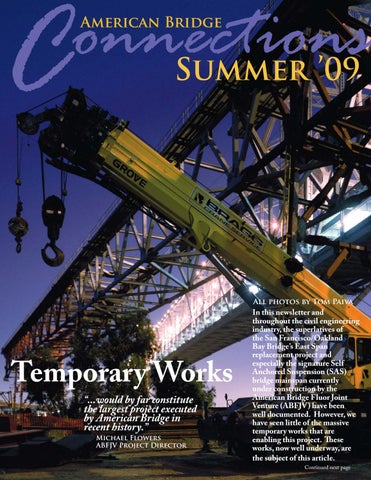
Temporary Works “...would by far constitute the largest project executed by American Bridge in recent history.” Michael Flowers ABFJV Project Director
In this newsletter and throughout the civil engineering industry, the superlatives of the San Francisco/Oakland Bay Bridge’s East Span replacement project and especially the signature Self Anchored Suspension (SAS) bridge mainspan currently under construction by the American Bridge Fluor Joint Venture (ABFJV) have been well documented. However, we have seen little of the massive temporary works that are enabling this project. These works, now well underway, are the subject of this article.
Summer ’09 .
Continued next page . Page 1 Connections
continued from cover
assisted by a team of 13 ABF If the temporary works were a stand design engineers at the site alone project, it would be a large one. and 13 engineering consulting The ABFJV is the design builder for this firms spread out from Europe ‘project within a project’, which includes to British Columbia and the the design and construction of twin US. Ron states: “We had a full 607.5m eight-span truss bridges and a plate to prepare the means and 160m erection tower. The temporary methods of erection in time bridges will be used to receive, launch, for shipments when they start align, and support the permanent arriving. This included not twin orthotropic box girder (OBG) only the temporary structures superstructure so that the main bridge but also all specialized rigging, cable can be anchored in its deck. Once lifting, marine plant and the main and suspender cables are “E” line temporary bridge with original bridge on right floating equipment. To get completed, ABFJV will transfer the load it done in time, we organized of the permanent superstructure from four teams that focused on the Temporary Bridge, Box Girder the temporary bridge to the new bridge’s cable suspension system. The 160m erection tower will be used as a gantry to lift Erection, Tower Erection and Cable Erection. Each team coordinates several consultants as well as self-performs the DE the permanent steel tower segments weighing up to 1,100mt, sheets (AB parlance for Details of Erection) for its portion of then translate them to their final position. All told, these temporary works have a value of about $325 million (including the work. I focused on the Left Coast Lifter while the teams carried on with everything else.” removal) and utilize some 25,000mt of Everything else includes the erection system and equipment fabricated structural design for the 28 permanent OBG segments with individual steel. ABFJV Project weights up to 1,500mt, the erection system and equipment Director Michael design for the 160m erection tower that will be used to lift Flowers, P.E., the the permanent bridge tower (some sections weigh as much as Executive VP of 1,100mt, the erection system and equipment design for the American Bridge installation of the 1,400m long main cable and 200 suspender Company, says “As a ropes, and the system to transfer the load of the OBG from the stand alone project, the falsework towers to the main cable. temporary works would Scott Tudor, P.E., Senior Design Engineer for ABFJV, led by far constitute the largest project executed the design effort for and is currently leading the erection engineering for the Temporary Bridge team. The twin 607m by American Bridge Temporary bridge towers fabricated by AB manufacturing temporary bridges begin at the SAS’s west end, utilizing the in recent history. Underlining that sense permanent W2 Piers as abutments. The W2 Piers are located at the western end of the bridge on Yerba Buena Island in the of achievement is the fact that the work is being completed on middle of San Francisco Bay. They are designated W2W and a Design-Build basis”. W2E for the westbound (W-Line) and eastbound (E-Line) The designs for the temporary structures for the project are permanent bridges, respectively. Each of the piers has four, six under the overall direction of Ron Crockett, P.E., a Vice sided architectural concrete columns. Working with Vancouver President of American Bridge and ABFJV’s Technical based Klohn Crippen Berger Ltd. (KCBL) as its main design Director. Ron’s charge has also included overseeing the design, engineering subcontractor for temporary works, ABFJV construction, shipping and mobilization of the 1700mt Left utilizes one of these four columns on each of the W2W and Coast Lifter shearleg crane which will be used to lift many of W2E Piers as the abutment by building a structural steel collar the heavy bridge and temporary works components. He is ably continued page 12
Summer ’09 .
Connections . Page 2
ab green Green-Collar Future by Kadi Camardese
It is our future effort at American Bridge to encompass a profound interest for world concerns. Currently one of the ways AB demonstrates attentiveness to global affairs is through a responsible recycling program at its headquarters near Pittsburgh, PA. These efforts to improve the environmental quality of its operations began in 2007, and demonstrate that AB employees are committed to the continual implementation of sustainable principles in the company’s daily operations. Among many environmentally purposed efforts to come, the company has implemented a “Buy Fresh, Buy Local” program at the Pittsburgh office. Employees order produce, meats, seafood and organic goods through the Good Apple Markets website and fresh products are delivered from Pittsburgh’s Strip District directly to the office weekly. This provides a convenient way to shop and encourages local farmers simultaneously.
“I hoped that starting the (recycling) program in the corporate office would not only set an example to the rest of our company, but also to the many people that AB employees interact with everyday.” Ben Reeve AB Field Engineer and recycling coordinator
At AB we will continue to develop a companywide strategy for an environmentally sustainable future. While we develop the important but smaller scale initiatives described above, we are also measuring our company carbon footprint, and will develop long term goals and a strategy to reduce it. Check out these sites: http://constructionjunction.org/ http://www.fossilfreefuel.com/fossilfreefuel_nonflash.html https://www.goodapples.org/index.html http://usmayors.org/recycle/
Next Issue Look For: AB’s Carbon Footprint
Office Green: Keep a ceramic mug from home at your desk instead of drinking your coffee from styrofoam. Did you know? It takes styrofoam over 400 years to START decomposing.
Summer ’09 .
Connections . Page 3
American Bridge Active
“We envision BPPC as the go-to source for lawmakers and policy developers about bridge issues, especially focusing on the funding, inspection and delivery system aspects of bridge projects.” Robert Luffy CEO of American Bridge
in ARTBA’s
Bridge Policy & Promotion Council American Bridge has leadership roles in ARTBA’s (American Road & Transportation Builders Association) Bridge Policy and Promotion Council (BPPC), the nation’s only association dedicated exclusively to growing the bridge market in the United States. Bob Luffy, CEO of American Bridge, is the charter Chairman of the Council. Charter members (in no particular order) include construction companies Walsh, Corman, Granite, Skanska, Flatiron, Zachry, Swank, Lane, PKF Mark III, Balfour Beatty, Osmos, and Vecillio Group in addition to American Bridge. Charter engineering companies include HNTB, Figg, Parsons Brinckerhoff, AECOM, Amman & Whitney, HDR, Modjeski & Masters, Gannett Fleming, Hatch Mott McDonald, Transystems, and CH2MHill. Other charter members include suppliers High Steel Structures and Emseal; The University of Washington and Florida State University; and the National Steel Bridge Alliance. The Council is focused on a six part agenda: 1. growing the funding available to reduce the deficient bridge count in the USA, 2. shaping federal and state bridge inspection programs and project delivery methods, 3. creating a strong private sector voice in the development of bridge project financing, 4. streamlining acceptance of new technologies and products in the bridge market,
BPPC is utilizing the strong governmental relations of ARTBA to stand as a unified voice for the bridge industry to communicate with the federal and state governments that are the primary sponsors of bridge projects in the USA. “What’s needed is a communications link with the government to advocate specifically for bridges” says Luffy. “We envision BPPC as the go-to source for lawmakers and policy developers about bridge issues, especially focusing on the funding, inspection and delivery system aspects of bridge projects.” The group has already met with House Transportation and Infrastructure Committee Chairman Jim Oberstar (D-Minn) and his top staff, and is assisting in the overhaul of the bridge inspection system in the USA. BPPC is also serving as a conduit for bridge issues in the developing debate over the Highway Re-authorization bill. The current one expires October 1, 2009. In addition to Bob Luffy, AB’s Michael Cegelis is chairing the BPPC Project Delivery Committee. Other committees and chairs include Market Promotion (Linda Figg, Figg Engineering), Inspection Issues (Ray McCabe, HNTB), New Technology (Vijay Chandra Parsons Brinckerhoff ), and Financing Issues (Sonny Brown, Zachry American Infrastructure). Membership in BPPC is open to all ARTBA Members. Membership in both ARTBA and BPPC can be arranged through Executive Director Allison Wenograd at awenograd@artba.org, phone 202/289-4434. AB
5. building bridges faster and safer, 6. ensuring that federal and state regulations that impact the bridge market are fair and reasonable.
Summer ’09 .
Connections . Page 4
Tra
inin g by B All p ob Cha hoto nce s by Bob
Tra i
nin gP
erm e
ate s
Man
y Fa
cet
s of
A me ric an
Bri d
ge
Fiel dE Cha n nce Four teen ginee rs new begin fie impr their for ld engin ee m e brigh ssed with al traini rs came n to t posit and eag this gro g as “Cla Pittsbu rg u er iv s p week e impact to get o ,” said B s of 2009 h in June .” u . c o Ame ourses o The eng t into th b Chan ” “I am v to ve in e c r e the f ican Brid r a span eers will ir project e. “ They r y orma of se s a b ge en r e put and ver lr were g mak e ea hired otation p ineers. Th al years t through inclu 10 o rog o de ey f rom d vario ram. The will also velop th neUniv ing: Uni em us eng be ve e is th rsity of B rsity of P universit ineers in included as e ie u c prog third gro ffalo, Vir ittsburgh s around lass of 2 in 0 ram u whic p to ent ginia Tec , Penn St the cou 09 er in h and h no ntr y ate U t w to Con tals 4 o the Fie Cal Ber niversity s tr k , l 2 en The gine d Engine eley. Thi Ame uction e s e r s. r trai ri desig ning ned can Brid Super v f is als ge C or C i s or o o o held off to a nstructio nstructio s in n n g atten Mobile reat star Superin Super v i , AL t. Th ding t with e firs endents sor Train A se f rom 7T in tw an c Mob the V ond wee ile, Ja ampa D eekend d Forem g, k i t an succe irginia d end trai cksonvill strict Sup raining w istric ning e, Ta ss,” s e a r s inten mpa t up a a was dent a nd a id Bob. with 26 r n e d s c ent Ba “ The p d train ing.” ded to distr articipan ly comp hamas. i t l are s t ched Training he posit ct leader s. “It wa eted in s i uled s v h f o to be r New e impac ip really a great Y t of com Gen stepp plete ork and era Pitts the wee ed d bef Corp l Ad k b ore t o he en urgh dis end Adm rate and minist tr d of i P r 2009 i c t s parti nistrative ittsburg ation . h ci e Micr pate in a mployee Manufa c n o s t analy soft Offi assessm were rec uring ent r ce Pr entl y sis, it egard oduc train asked was ts in in d cont g to incr etermine . Based o g their s to ra ki e n d tha and cted to c ase skill t we the outc lls in O utl l ondu evels ome need oo . c over e o a thr k. Six on t the trai ContactP d targete f ee n d parti e o cipat week p -day ses ing in W int was er iod sions ing i ord, n po E rtion with a to were con xcel s of t duct tal o e f he tr ainin 48 empl d oyee g. AB s Left to right: Kara Mullin, Michael Comstock, Benjamin Berardino, Paul Fikse, Chris Deklewa, Benjamin Crowder, Daniel Sheehan, Eric Blue, Zachary Lauria, Zachariah Osei, Troy Bodenschatz, Joseph Stilson, Scott Swamback, (Matthew Boos not pictured.)
Summer ’09 .
Connections . Page 5
The Project Team Allen Dronko, Project Manager Tom Fritz and Marc Wooten, Superintendents Paul Vitucci, P.E., Quality Control Manager Dan Byrne and Jim Hall, Safety Managers Chris Bergquist, Sr. Project Engineer Brian Binder, Field Engineer Catherine Swain, Project Administrator
Soil Anchor Technology Eases Wharf Reconstruction Work to be completed by February 2011
The Tampa District of American Bridge is underway with a $19.3M design build contract to reconstruct Wharf Delta at the US Navy’s Mayport Base near Jacksonville, Florida. The contract calls for the replacement of 2,100 LF of wharf. The difficulty in the project is the maintenance of a myriad of existing shore-to-ship utility services located just behind the existing bulkhead, that must remain in service throughout construction. This requirement would have made excavation for the installation of a conventional tie-back system for the new wall difficult and expensive. Therefore AB and its design partner Halcrow decided to utilize soil anchor technology for the tieback system. These tiebacks are drilled in place below the existing utilities, avoiding the necessity of disturbing the ground surface. The procedure is as follows: AB crews engineer and construct all access systems for the wharf. Drilling subcontractor Commercial Construction Group (DBE) drills access ports through the existing concrete bulkhead, located 5.5’ on center. Using AB supplied barges and cranes, specialty subcontractor Hayward Baker drills a 7” casing to a depth of 60’, at a 75° angle to vertical. The drilling is assisted by water jetting, which also removes all material from inside the casing. The high strength anchor rod, fitted with spacers to keep it centered, is then inserted inside the casing to its full 60’ depth. Grout is injected and pressurized while simultaneously extracting the casing by reverse rotation. The pressurized grout expands to fill spaces between soil particles and any voids, creating a bond between the soil and the anchor rod that enables the anchor to resist forces of at least 170 Kips. Following immediately behind the soil anchor installation, AB piledriving crews drive a continuous HZ combiwall to a depth of -50’. A horizontal waler is installed between the H-Piles, and the high strength soil anchor rods are connected to it. The soil anchors are then tensioned securing the new HZ wall. The old concrete bulkhead cap is partially removed, and AB carpenter crews then form, reinforce, and place a 15’ high concrete encapsulation of the HZ wall. This forms a high quality seawall to service the Navy’s mission. AB
Summer ’09 .
Connections . Page 6
S
s
M
Something fun, something healthy and something for a good cause – that’s why dedicated AB employees (along with their family and friends) volunteered their time off one Sunday morning this May. And their efforts paid off in the end. May 27th, 2009 was the 2nd annual Multiple Sclerosis Miles of Smiles race held at North Park, PA boathouse. Of the 7 participating teams, AB placed first with 27 members raising $540. (Congratulations!) Ellen Stewart, race coordinator, is passionate about this event as she explains, “With the help of supporters such as you, we can continue to make an impact in the life of Denise (Stewart’s friend) and others who are afflicted with this neurological, debilitating disease.” Since 2008, this event has collectively raised over $37, 000 for the National Multiple Sclerosis Society research efforts.
ile
by Sp Ka ec di ial Ca ‘T ma ha rd nk ese s’ to El len
s of S e l i m M
It seems the 380 participants and over 200 volunteers affiliated with Miles of Smiles share the same goal – to help others in need. “Your support has helped us continue to raise public awareness about MS and helped improve the quality of life of those whose daily reality is Multiple Sclerosis” says Stewart. Stewart forecasts an upwards of 500 runners at the 3rd annual Miles of Smiles race to be held on May 16th, 2010. Mark your calendars. The pre-registered cost is only $20 per person - and dogs? Well, this is how Stewart put it, “There is no cost for dogs. We just enjoyed seeing them out there walking!!! This year, we had a last minute donation of dog treats, so every dog received a prize.” Bring your families, your friends and your dogs to be part of AB’s Miles of Smiles 2010 winning team. AB
Top Row: Eamonn Clements, Anthony Deramo (AB), Trevor Kennedy, Andy Graff (AB), Carson Carney (AB), Liam Carney, Henry Mykich (AB) Middle Row: Amanda McCrum, Eric Lansberry (AB), Shawn Roman, Karen Roman (AB), Erin Mitchell (AB), Jennifer Pelligrene (AB), Kelly Carney, Janet Cordero (AB), Dickie Foster (AB), Saunie Kosar, Dave Kosar (AB) Bottom Row: Bryn Carney, Eva Carney, Andrea Ward, Denise Mykich Not Pictured: Bob Chance (AB), Amr El Nokali (AB), Nermeen El Nokali, Tony Noxon, Debbie Schoenbeck The Dogs: Sophie Clements (left), Keesha Mykich (right)
Summer ’09 .
Connections . Page 7
Human Resources
... what is Blues on Call?
by Erin Mitchell
Blues on Call is provided by our medical provider, Highmark Blue Cross Blue Shield. It is a comprehensive health information and support program. This program offers a variety of up to date and easy to understand health care resources. Contacting Blues on Call connects you to a Health Coach, who is a specially trained medical nurse. Your personal health coach is available to discuss questions about any health topic that concerns you – from a rash to a recent diagnosis. You do not have to be ill to contact a Health Coach. You can learn about valuable programs and resources that address stress management, personal nutrition and more. Once you have established a relationship with your Health Coach, he or she is then familiar with your concerns or conditions, and will be your personal health coach.
a b
WELLNESS PROGRAM American Bridge is committed to employee wellness and would like to begin implementing wellness programs throughout the company. You will soon be receiving a survey regarding wellness incentives and ideas. This survey is anonymous and it is your opportunity to express your suggestions on the wellness program. AB
Health Coaches are available 24 hours a day and you can call as often as you want. With Blues on Call, you speak directly to a live person – not an automated system. A nurse can be reached at 1-888-BLUE-428. AB
Summer ’09 .
Connections . Page 8
LifeSolutions EAP Program
Frequently Asked Q uestions 1. Who can use LifeSolutions services? es? Employees and their household members. bers. Household means family members living with the employees, yees children in school school, children away from home and unrelated people living in the home. 2. Why would a person use LifeSolutions? People use LifeSolutions for many reasons. Many of our callers contact us to obtain professional help for stressful or challenging situations. Other employees contact us seeking personalized work/life consultations and referrals from our WorkLife services for matters such as legal or financial issues. Others are looking for information on how to choose a god child care service. Please check with our call center to obtain American Bridge’s level of legal and financial referral services. 3. Will my supervisor know I came to LifeSolutions? LifeSolutions services are completely confidential. The only way that any information is released is: If you have signed a release for your LifeSolutions counselor to talk with your employer based on a mandatory referral. Under legal requirements as stated by the law (such as a person being dangerous to himself or herself and/or others). Your LifeSolutions counselor will review confidentiality with you and will clarify any questions you have at that time. 4. Is there a co-pay for LifeSolutions services? No, LifeSolutions is a workplace benefit – independent from your health insurance. In fact, many employees use LifeSolutions services in place of their behavioral health insurance to avoid having a co-pay. A visit to one of our LifeSolutions counselors does not cost you anything nor is it reflected on your health record. American Bridge has purchased this confidential service for all of its employees and has chosen to offer an excellent benefit which enhances both your own and your family’s well being. 5. Do you offer marital counseling? Yes. Marital and family issues are one of the major reasons employees use LifeSolutions’ services. Our providers are highly skilled in working with couples and families. 6. What are WorkLife services? WorkLife services provide employees with personalized consultation, research, and referrals to help them address a wide range of everyday challenges. WorkLife services include resources for: • Child care • Elder care • Legal referrals • Financial information and debt management
Daily living needs such as home repair, consumer information, health and wellness services, and transportation information. Our members use LifeSolutions WorkLife services for information on these and many other services. LifeSolutions can help make members’ lives a bit easier by doing the initial work for them. 7. How do the legal referral services work? When one of our members calls LifeSolutions with a legal question, our legal specialist reviews the request with the caller and then provides the name of a local attorney near their home or work who can provide a 30 minute in-person or by-phone consultation regarding that specific issue. If you need additional services, the attorney can provide consultation for most services at a 25% discount. Please check with our call center to obtain American Bridge’s level of legal referral services. Please note that we do not handle any legal issues related to your employment or employer. 8. Can LifeSolutions help find housing options for an employee’s aging loved one? Yes. LifeSolutions elder care experts can help you identify the kinds of resources your family needs. We can help you research housing options and alternatives for you and your family to consider. 9. Is my friend who lives with me eligible for LifeSolutions services? Yes. Anyone who lives with you is eligible for LifeSolutions services. 10. Will my LifeSolutions records be part of my HR file? No. LifeSolutions records are only accessible by our staff. 11. Can I talk with a LifeSolutions counselor over the phone? Yes. If you prefer telephone counseling, an appointment will be scheduled with a LifeSolutions counselor if appropriate. There are some concerns that are more appropriate for an in-person appointment. 12. My child is having problems at school. Can I use my LifeSolutions benefit for him? Yes. The LifeSolutions benefit id for you and anyone who lives in your household. Your LifeSolutions counselor will meet with the child and a parent to discuss the issues and to make recommendations, which may include referrals to local resources. AB
Summer ’09 .
Connections . Page 9
“People will often ask, ‘Where are the magnets in your shoes?’ They think nothing is real anymore, that everything is modern technology, so they don’t believe that people really risk their lives for entertainment.” Nik Wallenda High Wire Professional
Pittsburgh Regatta
by Kadi Camardese All photos and ads by Kadi Camardese
R
egatta, in a traditional sense, is a boat race or a series of boat races ... Pittsburgh’s was a party. The entire weekend of July 3-5 activities for all ages were scheduled in a section of the Tribune Review newspaper in which American Bridge advertised (left bottom). As a sponsor of this event, AB enjoyed the VIP party at PNC Park Home Run Club where guests had a perfect view of the tightrope act positioned adjacent to the AB built Roberto Clemente Bridge (left). Afterwards the high wire record holder, Nik Wallenda, was interviewed as he told about his third-generation risky entertainment career (bottom right).
J
ust a short walk away is Pittsburgh’s North Shore where a stage is built each year atop a barge in the water. The AB Marketing Department designed a banner that focused on the company’s long history of connecting Pittsburghers to their city - placed center stage. AB
Summer ’09 .
Connections . Page 10
a rs
Ago
The 10th Street Bridge has been connecting Pittsburgh natives and visitors to its historical South Side and students to Duquesne University for over 75 years. Erected by prime contractor American Bridge in 1932, this yellow suspension bridge crosses 1,275ft over the Monongahela River. The bridge has a stiffening girder and possesses parallel wire strands for the main cables. AB Order # G-4180-99. American Bridge was the prime contractor for fabrication and erection of this nine-span bridge on the Chicago Skyway over the Calumet River. The bridge includes 3 x 208' deck truss spans for the north approach, 3 x 178' deck truss spans for the south approach, and a 3 span 1,300' cantilevered truss with a 650' main span and 325' anchor arms. The bridge was erected using an American Bridge S-2 traveler derrick as well as falsework bents to construct the anchor arms and cantilevering the main span from two fronts. It took a total of 8,777 tons of fabricated steel to complete what is known in Chicago as the “High Bridge.” AB Order # Q-9334-40.
5
ars A e Y 0
go
Flashbacks
100 Ye
In 1908, American Bridge completed the Hakonstadir 90’ pony truss bridge in Eastern Iceland for the Icelandic Roads Commission. The bridge was completely (and beautifully) restored by the Government of Iceland in 2008, and it still serves drivers crossing over the Jökulsá River. The picture was provided to AB courtesy of the Government of Iceland. AB Order Number – C-1151.
If you had a deserted island it would cost about 35 million dollars to turn it into a fairy tale adventure, at least that’s what the price tag read ten years ago. In 1998 American Bridge transformed an uninhabited island in Abaco, Bahamas where no services or docking facilities had previously existed into Castaway Cay Out an out island Adventure. and it has been ‘making dreams come true’ ever since.
10 Y
ea r s Ag o
This $34,671,000 contract included, a 1.3 Mw power plant (three 455kva units with load sharing) and electrical distribution system, RO water treatment plants (two 20,000 GPD/ each) and water distribution system, wastewater treatment plant and gray water distribution system, incinerator, 550,000 CY of dredging to 35 ft., 1,200 LF of pipe Z piling ship berth with cast-in-place concrete cap, RO-RO berth, small craft marina, beach construction, 2,500’ of chip seal roadway, 1,500’ of stamped concrete roadway, construction of 25 themed buildings for food and beverage, retail, aquatics, post office, massage huts, cast housing, etc., landscaping, graphics and signage. AB Order #450910. Post-contracts specific to Castaway Cay: 1999 – Hurricane Floyd Emergency Repairs - AB Order #400310. 2000 – Hurricane Floyd Repairs - AB Order #491410. 2003 – Miscellaneous Rehab - AB Order #430810. 2005 – Hurricane Francis Restoration - AB Order #445810. 2010 – Expected Completion of Enhancement Project - AB Order #486710. AB Summer ’09 .
Connections . Page 11
continued from page 2
cap for supporting the towers. They were each designed to resist 7,600kN of vessel impact. The pile sleeves enable the efficient and accurate positioning of the piles, over 75% of which are battered. In addition to serving as a piledriving template, the driving frame contains structural steel framing that evenly distributes the temporary tower loads. Each driving frame for the F & G towers has a weight of about 3,100mt, including the piles. The piles are 10671220mm, with 32mm wall thickness. In all, Towers D, F, & G have a structural steel weight of 7,750mt, including piles. Tower H is located at (permanent) Pier E2, which was constructed in another contract. No temporary pilings are necessary at this location, since the permanent pilecap provides sufficient Mating of the OBG in working surface to erect temporary columns to fabricators yard support the temporary trusses.
around the column at about elevation +45m. According to Bruce Hamersley, P.Eng., Senior Project Engineer at KCBL: “The Owner’s proposed temporary tower configuration in the tender documents included individual towers with bracing in both transverse and longitudinal directions. During the development of the design we determined it would be much better from an access and operations standpoint to provide continuous trusses and walkways for the entire bridge length. The continuous truss could then be connected at each end to the suspension bridge end piers using collars to provide longitudinal stability for the trusses. The longitudinal bracing between the temporary towers could then be eliminated.”
Foundations
The temporary bridges use a variety of foundation systems. Their seven bents are labeled A through H (there is no “E” in order to avoid confusion with the E-line) starting on Yerba Buena and progressing eastward toward Oakland. Towers A, B, & C each have four columns; two for the east bent and two for the west. The foundations for Towers A and B on the W-Line (westbound bridge) sit in a sharply sloping terrain of weathered sedimentary rock. Since access for normal pile foundations was impossible, micro piles were utilized at three of the four tower legs. These piles utilize a 194mm steel casing that also serves as a rotating bit, and they are installed in short sections by small machines. The casings are rotated to the rock layer, and then excavated with sockets up to 10m deep. A total of 28 micro piles were installed, including six on an 80° batter. The fourth (south) tower leg of AW and all four legs of Towers AE and BE were more easily accessible by traditional drilling equipment, and are founded on single 1574mm diameter drilled shafts reaching depths of about 10m including a 6m rock socket. The four legs of the two C towers (W-Line & E-Line) are also founded on concrete pilecaps on 1574mm diameter drilled shafts, two per tower leg. One of these legs is in water and the other three are located on land. Towers D, F, & G are complex deep open water foundations with pile depths to -65m. Tower D is located at the main suspension bridge tower location, adjacent to the navigational channel. All water foundations consist of a steel frame with pipe sleeves that double as a pile driving template and a steel
Truss Superstructure The temporary bridge superstructure consists of twin sevenspan, 607.5m trusses, with the easterly span cantilevered. The trusses are each ten meters wide, and range from 6.5 to 12.5m deep. They are being erected in 35 stages by a variety of methods. The over-land trusses were assembled in planes, and erected with crawler cranes in single pieces ranging from 13-35m, and weighing up to 65mt. While both the E and W Line erection began simultaneously, the east generally proceeded ahead after the first couple panels. Scott Tudor noted that “the progression of the temporary tower and truss erection was based on several limiting factors. One factor was the steep slope on the north side of YBI that limited the reach of land-based cranes in the level area between the E-Line and W-Line. Another factor was the shallow bay water and the environmentally sensitive area (ESA) adjacent to the W-Line truss between Towers BW and CW that limited reach and access for water-based cranes. Additionally, progressing on the E-Line towers and truss allowed time for fabrication to complete on the W-Line and for engineering to develop a plan to erect the 128m long, 700mt large span truss lift between Towers BW and DW.” As a result, E-Line erection proceeded into the over-water spans well ahead of the W-Line. The truss plane erection method continued nearly through Tower D on the E-Line. One 40m segment over Tower D was erected in a double crane pick, with a weight about 240mt. By contrast, the
Summer ’09 .
Connections . Page 12
designed to support the vertical loads from the box girders as W-Line trusses and the E-Line trusses east of Tower D were well as lateral loads from wind and seismic. “As part of the fully assembled in the Zhenhua Port Machinery Company design build process for the temporary trusses, ABFJV’s Box (ZPMC) fabrication shops, and were erected by the 1700mt Girder Erection Team provided input to KCBL to incorporate capacity Left Coast Lifter that the ABFJV designed and built features into the temporary trusses that will simplify erection specifically for the needs of this project. These lifts ranged to and final positioning of the box girders”, 125m segments weighing 1,000mt. “The says Kevin. “One of the key temporary work field work has been “Without these individuals the features is the sliding pedestals a success due to the leadership dreams of engineers would never get built.” which are built into the truss of general superintendent Jerry John Callaghan at several panel points. At key Kent, ironworker superintendent Project Manager locations these pedestals are Danny Dunn, and field engineer designed to accommodate a vertical Katherine Quillin in addition to the jacking system. The jacking pedestals are ironworkers working out of Local 377 and Local 378,” said John Callaghan, Project Manager-Temporary capable of adjusting the elevation of the box girders between 250mm and 475mm. All pedestals are topped with Teflon Works, for the ABFJV. “Without these individuals the lined bearing pads which interface with stainless steel cover dreams of engineers would never get built.” plates on the underside of the cradles to reduce friction during The trusses have a depth of 6.5m from Pier W2 through Tower sliding operations.” D, then increase to 8m through the vicinity of Tower H. At The location of some of the box girders over Yerba Buena temporary tower H (located at permanent Pier E2) the truss Island are such that they can not be reached with the Left must pass under the E2 transverse concrete cap beam. This Coast Lifter. These lifts will be placed on the temporary trusses requires complex truss geometry. Says KCBL’s Hamersley: over the water and slid to the west, up to 200m, to their final “The Owners proposed temporary tower configuration in the locations. A custom built pushing frame, designed by Allnorth tender documents included additional temporary towers on both the west and east sides of pier E2. By founding the tower Consultants, Ltd. of Vancouver, Canada, will be used to slide the OBG lifts on the on the piercap and cantilevering the truss to the east to support truss. This pushing frame Lifts 13 and 14, these additional marine foundations could be is equipped with a pair of eliminated, achieving significant savings. The truss geometry 150mt capacity jacks with a is very complex as the top chord has to drop under the pier cap stroke of 3.2m each. With beam, and the truss must be deepened to handle the enormous the pushing frame secured forces from the cantilever. to the truss, the jacks will be extended thereby moving the New bridge box girder forward. At the tower section Kevin Smith, P.E., Deputy Technical Director for the ABFJV, end of the jack stroke the leads Team Box Girder Erection. In this role he is concerned pushing frame restraints are disconnected from the truss and with the means and methods of erection, including the special the jacks are retracted, pulling the pushing frame forward. This rigging and transport systems required for the large orthotropic process is repeated until the box girder has been slid to its final box girders. The OBG segments are 5 meters high, 27 meters location. wide and range from 25 meters to 70 meters in length and 520 Other devices used to manipulate the OBG lifts into their final to 1,500mt in weight. The box girders are erected upon cradles locations are the vertical and lateral jacking systems. Eight to distribute their massive weight into several support points. 350mt capacity jacks will be located under each OBG lift to Each cradle is designed with a pair of rocker beams to equalize adjust its position and align the box girder splice for bolting the loads imparted into the box girder floorbeams. and welding. Likewise, eight 50mt jacks will be used per lift to To fulfill its ultimate purpose, the temporary trusses are make lateral adjustments.
How the Temporary Bridge Will Be Used
continued page 14
Summer ’09 .
Connections . Page 13
continued from page 13
T1 Temporary Erection Tower Nick Greco, P.E., Design Engineer for ABFJV, leads the means and methods portion of Team Tower. In his role, Nick leads the design effort for the T1 Temporary Erection Tower design, and the means and methods for building both the T1 Temporary Erection Tower and the Permanent Bridge Tower. Team Tower worked closely with KCBL to design the 160m tall T1 Temporary Erection Tower and it’s 1,455mt capacity gantry system, which will be used to hoist the Permanent Tower shaft lifts into place. The T1 Erection Tower will also provide the workers access to the Permanent Tower.
located at the 4 field splices of the Tower shafts and accessed via the South face stairs and personnel hoist.
In order to achieve significant material savings (roughly 50%), KCBL used the Permanent Tower as the primary means of lateral load resistance for the T1 Diaphragm at fuse Erection Tower against lateral location loads induced by lifting operations, wind, and most notably, seismic events. Elastomeric bracing pads The T1 Erection Tower is four sided with a base footprint were incorporated into the design of each of the 4 main work of 20 x 16m. It tapers to 14 x 16m at elevation 47m platforms, which created a direct lateral load path from in order to pass between the north and south the T1 Erection Tower to the platform framing box girder sections. Temporary Tower D “We cut down a and eventually to the robust Permanent Driving frame will provide the erection considerable amount Tower. The Favco bracing locations were tower its base foundation and surrounds of material in the erection also strategically placed to coincide with tower by bracing off of the the Permanent Tower footprint on Pier the work platform bracing so as to direct Permanent Tower with our T1. The erection tower consists of box bearing pads and letting it do the tower crane’s lateral loads into the shaped members using a chevron brace Permanent Tower as well. the majority of the work.” configuration. The east face is opened Nick Greco, P.E., “The Permanent Tower might be the by eliminating the chevron braces and American Bridge biggest cantilever beam you’ll ever see so Design Engineer using two pairs of latticed columns, why not take advantage of it. We cut down a which allows the gantry system to lift the considerable amount of material in the erection permanent tower segments from a barge and tower by bracing off of the Permanent Tower with translate them into place. our bearing pads and letting it do the majority of the work. The erection tower will be erected to elevation 70m from the This took a lot of time and expense up front with the analysis water using one of two of the project’s pontoon mounted and design but the fabrication cost savings proved to be 4100W Ringer cranes. Once the T1 Erection Tower is erected worthwhile,” says Greco. to 70m, the 4100W Ringer will erect a self climbing, 65mt capacity Favco tower crane on the North side of the erection tower. The base of the tower crane will be supported from a platform at 59m, which will cantilever above OBG Lift The main function of the Temporary Erection Tower T1 is to 6W. This crane will be used to erect the remainder of the T1 support the gantry that will lift the permanent tower sections Erection Tower, the personnel hoist and stairs located on the into place. The gantry consists of two main runway girders and South face of the erection tower, miscellaneous components of a three tiered gantry system. This system allows translation in the Permanent Tower (i.e. shear links, shear link facades, etc), both east-west and north-south directions via “gripper” jacks and be used as a general support crane for the work. The Favco connected to Hilman rollers. The jacks grip the top flange tower crane will reach a height of 100m from its platform and of the beams using a fulcrum-jack mechanism and a separate will be braced into the T1 Erection Tower in 4 locations along push-pull jack connected to the Hilman rollers to push and its height. The T1 Erection Tower will be erected in 4 major pull the gantry. The Hilman rollers range from 400 to 800mt stages corresponding to the 4 stages of the Permanent Tower, capacity. The two main runway girders cap the erection tower always built higher in order to hoist the Tower lifts into place and are 2.5m deep, 33m long, sit on 3 pot-bearings, and are with the gantry system. Four major work platforms will be
How the T1 Temporary Erection Tower will be Used
Summer ’09 .
Connections . Page 14
truss superstructure from Towers C through H, and the T1 Temporary Erection Tower are being fabricated by Shanghai Zhenhua Heavy Industries (ZPMC) of Shanghai, China. These items total in excess of 8500mt. The towers and truss delivery is by three dedicated ships with some cradles and parts of the T1 erection tower to be shipped with permanent work shipments.
supported on a propped cantilevered platform east of the main erection tower columns. Two 660mt strand jacks will sit on the top tier of the gantry and will be used to lift the Permanent Tower sections. The gantry will hoist into place a total of 18 major lifts ranging from 450-1,100mt. The 18 major lifts include 16 permanent tower shaft lifts, 1 permanent tower saddle grillage, and 1 tower saddle. The tower saddle caps the permanent tower and will be hoisted by the gantry system a total height of approximately 156m. The tower saddle lifting operation is projected to last approximately 10 hours.
ABFJV’s 150 person fabrication management & inspection staff
Temporary Works Fabrication The temporary work has been manufactured by fabricators in the US and elsewhere. The pipe piles were fabricated by Twin Brothers Marine of Port St. Mary, Louisiana, and the 9200mt of pile were delivered by barges to the site. The temporary towers AE, AW, BE, BW, CE, and CW and the truss superstructure through Tower C were fabricated by American Bridge Manufacturing in its Reedsport, OR, and Coraopolis, PA shops. This work totaled 1,727mt and was delivered to the job by truck. Walkways for ABM’s trusses were supplied by GO Supply of Vallejo, California. The D driving frame was fabricated by Jesse Engineering of Tacoma, Washington. This work totaled 941mt and was delivered by barge. Jesse also fabricated the erection tower gantry, which totals 183mt. The transfer girders which attach the D driving frame to the T1 foundation were fabricated by Lortz Manufacturing of Bakersfield, California. These four 98mt weldments were delivered by multi-axle heavy haul trailers. The F and G driving frames were fabricated by XKT Engineering of Vallejo, California. This fabrication totaled 2,130mt and was delivered by barge.
ZPMC crane operators
In order to accelerate the temporary works fabrication, ABFJV also purchased welded box sections from Tung Kang Steel Structures of Taiwan. These sections were assigned to various fabricators for their use. The remainder of the temporary works, including Towers D, F, G, & H, the
“We split up the fabrication in order to optimize delivery time and price. Twin Brothers is a first class operation, both ABM and ZPMC have done an excellent job with the trusses and towers, Jesse and XKT have done a great job with the driving frames, and Tung Kang was extremely helpful with the welded box sections”, says Callaghan. “American Bridge Manufacturing had a particularly difficult contract to fulfill with only a short time to fabricate and deliver to the hook due to lack of storage space at the jobsite. In spite of that, ABM’s material fit up great and the iron was delivered when we needed it. In my book, that’s a successful job”. Which part of this large-scale temporary works project is most vital? Perhaps it is the 1,700mt Left Coast Lifter, which was designed and Skilled workers from constructed for this project alone. Perhaps ZPMC’s fabrication shop it was the 25,000mt temporary bridge and tower that was designed, fabricated and constructed to support the permanent construction. Or maybe it’s the 1,455mt gantry that will lift permanent tower sections to their 150m height, or the ingeniousness of the launching system mounted on the temporary truss. Each of these as well as a variety of temporary foundations used during the project are cardinal in enabling the construction of the seismically competent signature span of the new San Francisco Oakland Bay Bridge Eastern crossing. And the temporary works would not be possible without the experience, hard work and expertise of the design and engineering teams. This is truly a ‘project within a project.’ As John Callaghan put it – “without these individuals the dreams of engineers would never get built.”AB
Summer ’09 .
Connections . Page 15
We would love to hear from you. If you would like to contribute: Feedback Suggestions Events Comments Please contact Kadi Camardese at: kcamardese@americanbridge.net (412) 631-1026
Connections Newsletter designed and published by:
Current Contracts by District
New York
Pittsburgh
Marine Parkway Rehabilitation, NYC Throgs Neck Bridge Strengthening, NYC Bronx Whitestone Bridge Strengthening, NYC South Grand Inland Bridge Redecking, Niagara River, NY RFK (Triborough) Bridge Strengthening, NYC
Kentucky Lakes Bridges, Paducah, KY Point Marion Bridge, PA Williams Gas Pipeline Bridges Recabling, Houston, TX
Richmond
145th Street Swingspan Truss Fab, NYC Wm Preston Lane Mem. Bridge (Re-Decking & Rehab) Fab, MD Huey P. Long Bridge (Widening) Fab, New Orleans, LA Point Marion Bridge (Truss), PA CSX Ohio River Bridge (Rehab) Fab, PA Harold Structures Fab, Queens NYC Bronx Whitestone Bridge (Strengthening) Fab, NYC East River Park, NYC NSRR Conway Yard Bridge Fab, PA RFK Bridge (Strengthening), PA Irvin Mills Road Bridge (Plate Girders) Fab, NY Hoover Dam Bridge (Box Girder) Fab, AZ-NV MDOT CPR Overpass Fab, MI SAS Temporary Works (Truss) Fab, CA
Pier 31 Groton, CT Vehicular Bridge Replacement, Kittery, ME Repair Dry Dock, Berth 11, Kittery, ME M-140 #2 Complex, Kittery, ME Pier R3-Repairs Yorktown, VA Chesapeake Bay Bridge Redecking, Annapolis, MD Chincoteague Bridge, VA Radio Island Pier, Morehead City, NC
Tampa Marine Improvements (Bakers Bay), Abaco Bahamas Ritz Carlton Rose Island, Nassau, Bahamas Pinto Island Terminal, Mobile, AL Mayport Warf Delta, Jacksonville, FL Albany House Marina, Nassau, Bahamas Castaway Cay Enhancements, Abaco, Bahamas Roatan Cruise Terminal, Honduras
Western AB/Fluor-Oakland Bay Bridge
American Bridge Manufacturing
company news
Kadi Camardese Marketing Specialist American Bridge Company
Summer ’09 .
New Hires Accounting Supervisor Michael Macakanja Pittsburgh
Marketing Specialist Kadi Camardese
Field Engineers: Paul Fiske SAS Joseph Stilson Buffalo Eric Blue SAS Benjamin Crowder Bahamas Troy Bodenschatz SAS Kara Mullin Chincoteague Christopher Deklewa ABM
Connections . Page 16