Fall 2016 – Issue #1005
BORN A BUILDER: President and CEO Michael Flowers is retiring after a career of engineering, constructing, and leading
HISTORY IN THE MAKING (AGAIN) The Big Lift Brings Big Changes to Macdonald Bridge
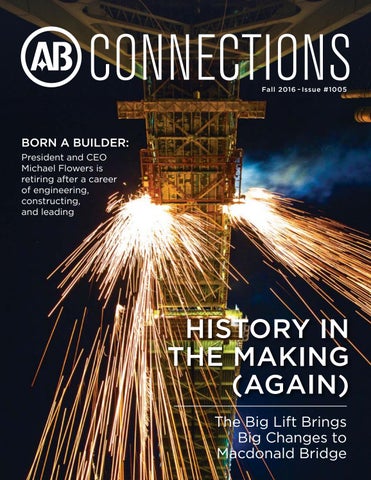
Cover: Angus L. Macdonald Bridge | Halifax, Nova Scotia
www.AmericanBridge.net
CONTENTS
AMERICAN BRIDGE CONNECTIONS Fall 2016 – Issue #1005
History in the Making (Again) The Big Lift Brings Big Changes to Macdonald Bridge FEATURE - 4 Born a Builder: President and CEO Michael Flowers is retiring after a career of engineering, constructing, and leading FEATURE - 16 Kevin Smith FEATURED EMPLOYEE - 22 Frank Mydlinski and Don Ulemek IN MEMORIAM - 24 NEW EMPLOYEES - 26 EVENTS + NEWS - 26 CURRENT CONTRACTS + PROJECT WINS - 27 Waldo-Hancock Bridge, Duarte Bridge, and more FLASHBACKS - 28 Three Sisters Stand Out in the City of Bridges EXTENDED FLASHBACK - 30 History of the Hard Hat BRIDGE TO SAFETY - 32
FEATURE
HISTORY IN THE MAKING (AGAIN) The Big Lift Brings Big Changes to Macdonald Bridge
Photo credit: Lynn Fergusson
4
American Bridge Canada Company (ABCC) is well underway with the Angus L. Macdonald Bridge Suspended Spans Deck Replacement project in Halifax, Nova Scotia, known locally as “The Big Lift.” Continuing the tradition of challenging and unique projects, ABCC is performing a complete replacement of the bridge’s suspended spans—while keeping it operational. The only other time this type of project has been completed was nearly 15 years ago on the Lions Gate Bridge in Vancouver, British Columbia—also by ABCC. Lessons learned from ABCC’s success on the Lions Gate Bridge Project provided valuable insight and aided ABCC’s engineering and design efforts for the Angus L. Macdonald Project.
he work for this 762 meter suspension
addition of new main cable handstrands and a
bridge involves the replacement of
cable dehumidification system are also work items
the superstructure in 46 segments;
included in the project scope.
eight on the Dartmouth Side Span, 22 in the Main Span, and 16 on the
Following a best value competition for the design-
Halifax Side Span. In addition to the superstructure
bid-build project, ABCC began construction
replacement, the work also involves the
engineering work in April 2014 and signed the
replacement of many other components of the
contract with The Halifax-Dartmouth Bridge
bridge including cable band bolts (also known as
Commission, doing business as Halifax Harbour
waisted rods due to the reduced diameter ‘waist’
Bridges (HHB), in September 2014. Today, ABCC
between the threaded zones), traction rods, certain
continues to work closely with HHB, COWI (the
cable bands, all joints and bearings including
owner’s lead engineer), and the owner’s project
pendulum and rocker link truss end supports,
management consultant, Colliers Project Leaders,
and all 148 suspender ropes. Modifications to the
to deliver a successful project.
main towers and the cable bents, as well as the
5
PLANNING AND
Strand Jack
ENGINEERING Replacing existing through truss bridge segments with new orthotropic deck segments and restoring the structure for traffic after every replacement closure requires sophisticated temporary works designs and detailed procedures. The contractual structure of this project is different than most. HHB’s team not only designed the permanent structure, but also performed the construction analysis for each of the 46 segments to be replaced and HHB’s team also designed a significant portion of the temporary works. This analysis was completed during the pre-bid phase and was based on assumed weights of equipment. From this analysis, HHB provided the design criteria for ABCC to design some of the temporary works and HHB prescribed some of the construction means and methods. The construction analysis also revealed the existing bridge’s
Klohn Crippen Berger provided independent check
sensitivity to weight increases. Therefore, the temporary
engineering as well as other design support.
works designed by ABCC needed to meet the specified strength requirements without exceeding the weight
The strand jack system used by ABCC for lifting and
limits assumed during the pre-bid analysis.
lowering deck segments 50 meters to the water included tandem motive units (TMU) developed by
Designs for most of the temporary works that affect the
Vorspann Systems Limited (VSL). Each TMU strand jack
structure when in use by the public were provided by
consists of two, 84-ton capacity strand jacks stacked
HHB. These included the Temporary Deck Connection
one on top of the other to allow continuous movement
(TDC), a specialized piece of equipment that connects
of the lift. As one strand jack is lifting, the other is
the newly erected deck segment and the existing bridge
retracting. Compared to a traditional single strand
deck, the Erection Gantry which lowers and lifts the
jack system, the tandem arrangement yields faster lift
deck segments, and the Temporary Hanger Extension,
speeds, reduced impact loads, lower hydraulic fluid flow
an adjustable link between the sockets on the existing
rate, and built-in redundancy. This unique equipment
hanger ropes and the new bridge deck. ABCC
was successfully used for all of the Dartmouth Side
performed constructability reviews on this equipment
Span and Main Span segments over water.
and completed the designs by adding access and other necessary features. ABCC also had design responsibility
Because the Halifax Side Span is over land, ABCC
for lifting hitches, stringer support beams, access
designed a lifting system to perform the replacement.
travelers, temporary wind bracing, temporary traffic
This system utilizes two, 50-ton chainfalls with a lifting
plates, transition barrier rail, span jacking equipment,
frame and 120-ton swivel. The lifting frame is designed
strand jack lifting equipment, marine equipment, and
to be adjustable using a series of linear actuators to
all erection procedures. These designs and procedures
account for variations in the center of gravity of the
were prepared by ABCC’s in-house engineering staff
new and existing segments in the span. The lifting
and engineering sub-consultant, Zieman Engineering.
frame is also capable of tilting the segments to facilitate
6
Barge Arrangement
alignment of the new deck segment splice. The
During a typical segment replacement, the Timberland
Halifax Side Span lifting equipment is supported
is secured to the Abys and positioned below the
from the typical 20 meter long erection gantry,
erection gantry for receiving existing segments and
which allows two segments to be replaced from one
delivering new ones. Marine support including tugs
erection gantry location—significantly accelerating
is provided by a local RMI Marine. The fabricator,
the work.
Cherubini Metal Works located in Dartmouth, Nova Scotia a few miles from the bridge, loads the new
Another critical design for the completion of this
segments on the supply barge at their wharf.
work is the marine fleet used to transport segments across Halifax Harbour from the fabricator’s facility
After all of the temporary works were designed, the
to the bridge. The Abys positioning barge is a 12.2
final equipment weights were provided to COWI
meter by 42.1 meter deck barge and includes two
and the global staged construction analysis was
spuds and four anchor lines to locate and hold the
confirmed. From this, ABCC prepared the segment
barge steady. The Timberland is a 24.9 meter by
replacement erection procedures. During and
44.2 meter catamaran barge consisting of twin deck
immediately after segment replacement, ABCC
barges welded side by side. The Timberland barge
surveyed the geometry of the bridge and measured
has been outfitted with two ABCC-designed barge
hanger forces near the erection front. This real-
support frames to carry both new and existing deck
time data was provided to COWI for calibration of
segments. The barge support frames are elevated
their global bridge model. Any differences from
structures with support beams cantilevered six
the previously calculated values were provided and
meters over the port side. The starboard side of the
incorporated into the hanger jacking adjustments for
Timberland is ballasted to minimize list of the barge.
the next segment replacement.
7
8
To provide safe access for work on the main
cable band, the end reactions are transferred
cables, ABCC also designed a Cable Access
from the fixed supports to the sliding supports.
Crawler. The Cable Access Crawler is a steel
Then, using the traction winch, the crawler
framed two-sided pony truss, long enough to
can be moved uphill or downhill in increments
span the distance between two cable bands.
of up to 1.7 meters. When the movement
The double trusses provide access to each side
step is complete, the fixed supports are then
of the main cable. The crawler is supported
extended and the sliding supports retracted
by the main cable on either fixed or sliding
and repositioned. The process is repeated until
supports at each end. Each support can be
the crawler has been advanced approximately
raised or lowered using hydraulic jacks. To
10 meters to the next cable band. The Cable
traverse up or down the main cable, the crawler
Access Crawler has been designed for waisted
has been equipped with a traction winch
rod installation, new main cable hand strand
mounted at the downhill end of the crawler.
installation, hanger rope replacement, and main
After the winch line is secured to the uphill
cable dehumidification.
Cable Access Crawler
PREPARATORY STRENGTHENING WORK In March of 2015, when the planning was
less than the 34 ton TDC. Therefore, suspension
complete, engineers were on site, ready to
rods and support lugs were added to the
start construction. The first task to tackle was
traveler rail to support the TDC by transferring
strengthening work which is separated into two
the loading into the stiffening truss.
categories— temporary or permanent—both ongoing activities throughout the duration of
The permanent preparatory strengthening
the Project.
is installed to support the new loads of the permanent structure and to improve the design
Temporary preparatory strengthening is
life of the completed support structure. This
required on the existing suspended structure
reinforcing also remediates deteriorated steel
to support the increased demands of the
from the past 60 years of service. Strengthening
construction process. Additional strengthening
work involves replacing diagonal members
is incorporated into the diagonals of the
and reinforcing horizontals in the cable bents
suspended stiffening truss. Doubler plates
to support the weights of the new suspended
(cheek plates) are welded onto the bottom
structure. Splices in the tower legs are also
chord to support the transferred demands
reinforced to support the new weights and
from the TDC. As construction advances, the
improve the design life of the components.
TDC rolls along the underside of the existing
Lastly, bolts in the cable bands are replaced with
structure utilizing the bridge maintenance
new waisted rods to increase the clamping force
traveler rails to move to the next splice location.
of the cable bands on the main cable and to
The existing bridge maintenance traveler rails
support the new loads that are suspended both
were designed to support a much lighter load
permanently and during construction.
as the maintenance travelers weigh significantly
9
Erection gantry with tandem strand jack system connected to hangers and ready for public traffic
MAINSPAN AND SIDESPANS (DARTMOUTH & HALIFAX) The main objective, and the reason for all of the
deck and truss segment. An erection gantry, which
preparatory strengthening work, is the replacement
sits above the traffic envelope and remains on
of the three suspended spans on the bridge—the
the bridge when open to the public, is connected
Dartmouth Side Span, the Main Span, and the Halifax
to the hangers and is used to lower the existing
Side Span. The bridge deck is supported by an
segments and lift the new ones. The process for
above-deck pony truss supported by hangers from
replacement is the same for the Dartmouth Side
the main cable, which is in turn supported by two
Span and the Main Span, as both are above water,
cable bents and two main towers. Each of the existing
and are replaced in 20 meter segments. At the
spans are three lanes wide, with the Dartmouth Side
beginning of each bridge closure, the existing deck
Span and Main Span passing over Halifax Harbour,
is connected to the erection gantry with TMU strand
and the Halifax Side Span above the Canadian
jack assemblies. Once the 125-ton existing segment is
Department of National Defense’s naval base.
supported by the erection gantry, it is disconnected from the previously erected new segment and
10
During weekend full-bridge traffic closures, 10 and
hangers, and cut with a thermal oxylance. After the
20 meter sections of the existing deck and truss
existing segment is cut free, it is lowered with the
are removed and replaced with a new orthotropic
TMU’s to a waiting barge. The strand jacks are then
disconnected and hitched to the new 145-ton segment, which is lifted into place. The new segment is then bolted to the previously-erected segment on one end and a temporary connection between the new deck and the bottom chord of the existing truss on the other to carry traffic loads. A threaded rod jacking assembly is installed between the new deck and the hangers to allow the hanger loads to be adjusted to accommodate traffic. Between segment replacements, the erection gantry is disconnected from the hangers, driven ahead
Cutting of existing truss top chord with thermal oxylance
to the next location, and reconnected to the hangers. The replacement of the first segment took over sixty hours to complete, and the replacement of the second segment took over forty. But with the hard work and dedication of the project team, ABCC, HHB, and COWI came together to improve the segment replacement process. Innovations included advances to the strand jack connections to the existing deck, modifications to the temporary deck segment connections, refinement of the hanger adjustment process, and improved efficiency of the steps in the replacement sequence. As a result,
Existing 20 meter deck segment being lowered to barge
segments are now regularly replaced in under ten hours and in groups of two during a single weekend closure. Beginning in the late fall of 2016, segment replacement on the Halifax Side Span will commence. Because this span is over land and not water, the process used for the Dartmouth Side Span and the Main Span must be altered to accommodate the different surroundings. Since the segments cannot be lowered to the ground, the existing deck and truss will be removed in 10 meter segments. These segments will be lifted and rotated 90 degrees before being transported off the
New 20 meter deck segment being lifted from barge
bridge. The new 10 meter segments will be transported onto the bridge and turned 90 degrees before being lowered to their final position. The erection gantry will be modified to accommodate the shorter and lighter segments. As previously noted, pneumatic chain-falls and a 120 ton swivel will provide the lifting, lowering, and rotating required, and will be able to replace two, 10 meter segments from the same location in a single weekend closure. Adjusting loads in hangers with threaded rod jacking assembly
11
Cable crawler in place on main cable
Using extensometer to measure waisted rod elongation
12
Hanger jacking assembly marked for span raising
CABLE WORKS To provide this additional clearance, each hanger is During the construction, the loads in the hanger cables
jacked in increments of no more than 125 millimeters, for
are significantly higher than the loads seen under normal
nearly 200 meters of total jacking. Leaning on lessons
conditions. To accommodate these loads, portions of the
learned during the “Load Transfer� of the San Francisco-
cable system are replaced throughout construction.
Oakland Bay Bridge Self-Anchored Suspension Span, the project team developed a simple color-coded
In each of the three suspended spans, two existing
system for implementing the required jacking sequence.
cable bands are removed and replaced with larger cast
This allows crews to quickly and efficiently perform the
and machined cable bands. While these cable bands
more than 1,500 individual jacking steps. Following span
are replaced, the existing traction rods, which restrain
raising, each of the existing hangers are removed and
the spans longitudinally, are also replaced. The existing
replaced with a new hanger.
cable bands are clamped to the main cable with six 41.3 millimeter diameter bolts, while the new cable bands
In addition to the Suspended Spans Deck Replacement
use twenty-eight to forty-eight 31.8 millimeter diameter
contract, HHB awarded ABCC an optional bid item for
waisted rods. The additional clamping force between
the delivery of a complete main cable dehumidification
the new cable bands and the main cable is required
system. In the years prior to design and contract
to resist the longitudinal forces imparted by the new
tender, HHB had identified a cable dehumidification
traction rods. Waisted rods in each new cable band are
system as having potential significant value for the
tensioned simultaneously with custom hydraulic bolt
lifespan of the bridge. As part of the original contract
tensioners. Each rod is then measured with a custom
tender, HHB requested pricing for an optional cable
extensometer to ensure the proper elongation and the
dehumidification system.
proper load has been reached. Cable dehumidification is a means of corrosion Other existing cable bands are able to remain in
protection for both new and old suspension bridge
place, but still require additional clamping force to
cables, regardless of whether the cables are stranded or
prevent slipping under the higher hanger loads during
aerial spun. Corrosion protection is ensured by creating
construction. In these locations the existing cable band
a sealed cable system into which dry air is forced until
bolts are replaced one at a time with waisted rods,
40 percent or less relative humidity is achieved. The
which are tensioned with the hydraulic bolt tensioner
system then operates continuously for the lifetime of
and checked with the extensometer. The change in
the bridge. On the Angus L. Macdonald Bridge, ABCC
length of the existing cable band bolts is also measured
will seal and dehumidify all 958 meters of main cable,
to determine the original tension in the bolts. Based
including back spans and both east and west cable
on these measurements, nearly 600 cable band bolts
anchorage chambers.
must be replaced with waisted rods. The cable bands are accessed from the two, 17-meter long cable crawlers
ABCC selected suppliers to assist in delivery of the
with a self-contained winching system, which allows
system, including Munters Corporation, supplier of
each crawler to move up and down the cable without
mechanical plant, and D.S. Brown, supplier of cable
the need for an external anchorage.
wrap. Thus far, ABCC has successfully worked with HHB and COWI to optimize the location of the
Following segment replacement, a threaded jacking
dehumidification plant. Main cable wrapping, by means
assembly at each hanger is used to sequentially shorten
of the ABCC custom-designed cable access crawlers,
each hanger and raise the bridge deck. This raising
will begin in winter 2016 and will be complete and
of the suspended spans provides an additional three
operational by September 2017.
meters of clearance to the water at the center of the Main Span, accommodating larger shipping vessels.
13
WORKING WITH
Vessel traffic during construction is controlled by HPA
STAKEHOLDERS
The construction has also affected the traveling public,
through their separate agreement with HHB.
including cyclists and pedestrians, as the bridge is one
There are many stakeholders involved with this
of only two crossings of the harbor. The construction
project from both land and sea. HHB’s customer base,
process required ABCC to remove both the sidewalk
the traveling public, is the major stakeholder. Land-
and bikeway on the bridge, the only ones to span the
based stakeholders include nearby neighbors, Halifax
harbor, prior to replacing deck segments to reduce
Transit (public transportation operator), Emergency
weight on the bridge. During this period, HHB runs an
Health Services, Halifax Regional Police Department,
around the clock free shuttle bus service to transport
Halifax Regional Fire Department, and the Canadian
pedestrians and cyclists from one side of the harbor to
Department of National Defense (DND). On the water
the other. The new sidewalk and bikeway is scheduled to
ABCC has interfaced with Halifax Port Authority (HPA),
open at the end of December 2016.
Atlantic Pilotage Authority, Halifax Transit, Canadian Coast Guard, DND, offshore energy projects, and local mariners. Because every stakeholder relies on the bridge in one way or another, coordinating work with them has been a very important component of the job.
SAFETY
The DND has a strong presence in the Halifax region. On
Safety is always the number one priority on any
the Halifax side of the bridge there is an Army base, on
American Bridge project, and the Angus L. Macdonald
the Dartmouth shore there is a Naval repair facility, and
Bridge is no exception. The philosophy of “See
most impacted by the project is the active naval base
Something, Say Something” (see AB Connections Issue
directly below and surrounding the Halifax Side Span.
#1003) has helped to focus the local safety culture on
The DND was engaged prior to the onset of the project
correcting unsafe behaviors before they become an
and coordination has been ongoing since construction
incident. Reporting of unsafe conditions and unsafe
began. Meetings are held to coordinate critical work
acts has been key in reducing the possibility of job-
that has the potential to impact either construction or
related injuries. Safety observations as required by the
base operations and plans were established to allow
Site Health & Safety Program have been conducted by
construction to continue with limited disruptions.
management, field specialists, site supervisors and the
The DND also has a concurrent construction project
safety department throughout the project construction.
to install a new Jetty on the Halifax shore directly below and to the north of the bridge. Marine activities,
Fall protection requirements have been a main focus
specifically the positioning of barges to replace deck
to ensuring worker safety. With the combination
segments, were coordinated to mitigate delays and
of safety, engineering, and participation from the
costs to either project.
field, numerous steps have been taken to provide safe access to work areas. Training on fall protection
The HPA operates the commercial dockyards, wharfs,
equipment including the use of rescue devices and the
and anchorages in the Halifax Harbour and schedules
establishing of best practices for fall protection has
commercial vessel traffic under the bridge through a
been another key focus area.
section known as “The Narrows”. The water under the bridge is shallower than either the mouth of the harbor
ABCC has been working with the Nova Scotia
or the basin, limiting the navigation zone through which
Occupational Health and Safety (NS OHS) Provincial
commercial vessels with high air drafts can safely pass.
Regulator in establishing an open-door policy.
14
Photo credit: Dale Wilson Photography
The Regulator has been on the project site on
implemented that incorporates the use of high alert
different occasions to familiarize themselves with the
awareness, tool tethers, self-closing bolt bags, and
construction activities and to view the best practices
daily site-observations. The development of these
and safety procedures ABCC is following. There
programs is informed by numerous other American
have been several site visits and no health and safety
Bridge experiences working over live traffic and
compliance issues on the project.
occupied buildings (Tagus River Bridge, Lions Gate Bridge, Severn Crossing, Queensferry Crossing,
The team at the Angus L. Macdonald Bridge pride
Tappan Zee Bridge) and ensures the safety of the
themselves on the implementation of safety on this
public, the workforce, and other active assets that
project. Assistant Project Manager Adam Reeve’s
may be below ABCC’s worksite.
field engineer team, along with input from the Site Superintendent Robert Fitz, and American Bridge’s
With the top equipment, training, and
engineering staff in California, work diligently
implementation of best practices and engineering
to ensure that sound engineering practices are
procedures, the team at the Angus L. Macdonald
followed allowing the highest level of safety. Daily
Bridge project will continue to reduce risk, lower
safety huddles, weekly tool box meetings, and the
incident rates, and work to ensure the safety of
review of job hazard analysis have also contributed
everyone, including the public.
to improving communications between all parties. On-going in-house training on hydraulics, jacking
As the deck replacement portion of this project
systems, and safety practices have increased the level
comes to an end in December 2016, the cable
of expertise and confidence within the workforce.
dehumidification will be ongoing for the next year. All work will wrap up in September 2017, marking
Now that the installation of new deck segments will
the close of yet another unique project. As a feat
be directly over public facilities, ABCC has developed
that has only been done once prior, it is no surprise
programs and procedures to help protect the public.
that American Bridge has been at the forefront both
A Dropped Object Prevention Program has been
times, living up to expectations.
15
16
FEATURE
BORN A BUILDER President and CEO Michael Flowers is retiring after a career of engineering, constructing, and leading
Great leaders are rarely flashy.
parent company of American
This fascination led to Mike
They don’t seek the spotlight,
Bridge at the time. They got to
enrolling in the Aerospace
or feign modesty. They are
talking about Mike’s interest in civil
Engineering program at West
leaders because they have
engineering, and the New River
Virginia University. The prospects
built relationships based on
Gorge Bridge (AB order # K-5867-
were fantastic: the space program
mutual respect, honesty, and
81) that was under construction
was booming, and the concept
unquestionable integrity. He would
just down the road from Mike’s
of supersonic transports was at
never be comfortable shouldering
summer job. It wasn’t long after
its peak. Two years into college
the title of a great leader, but
that day that Mike received
however, NASA cratered, and the
anyone who has met Michael
an invitation to interview with
possibility of finding a job was as
Flowers will undoubtedly tell you
American Bridge, the company he
distant as the outer reaches of the
he is. After over 40 years in the
would eventually lead.
Milky Way. Mike took one class in
construction industry, the majority
mechanical engineering and hated
of them with American Bridge,
The funny thing is, if Mike’s
it. He ended up in civil, and spent
Mike is retiring as President and
original plans for a career panned
summers surveying along US-19,
CEO of the company.
out, he’d be working on some
which led up to the New River
out-of-this-world projects—
Gorge jobsite. “I used to drive
Mike’s start at American Bridge
literally. “I was really a child of the
down in the evening and look
was almost by chance. While
space program,” explains Mike. “I
at what AB was doing erecting
sitting in the career office of West
remember when they made an
the bridge,” recalls Mike. After
Virginia University, waiting for an
announcement that Sputnik was
graduation, Mike was cooling his
interview with another company,
launched by the Russians, and I
heels in the University’s placement
Mike struck up a conversation
had no idea what Sputnik was, or
office when he struck up that
with someone sitting next to him.
a satellite, or anything else. I had
fateful conversation with the
As fate would have it, he was a
to go home and have my parents
gentleman from US Steel. He
representative from US Steel,
try to explain what it was.”
attributes his start with American
17
Bridge to New River Gorge and
And when the engineering was
without ever closing the bridge—
being in the right place at the
done, they put their coveralls on
an idea that Mike and the team
right time.
and went out and helped build it.”
fought with the engineer over. In
Mike always maintained the direct
the end, circumstances didn’t allow
Mike makes no bones about
relationship between in-house
them to move forward with what he
the fact that he is, and always
engineering and construction, a
admits was a “crazy” scheme, but
will be, a field guy. “Frankly, I’m
key aspect of the American Bridge
he never gave up on pushing the
a builder. That’s what I enjoy
way. Through his leadership and
perception of possible.
doing. Everything that epitomizes
mentoring, countless engineers
American Bridge’s culture are the
have adopted this outlook on
That push for innovation followed
things that I enjoy: coming up with
projects—something quite unique
Mike throughout his career, and
new ways of doing things, being
to American Bridge.
was a key characteristic of his
innovative, daring to do things
leadership. He’d consider any
differently, and doing things well
Mike’s resume includes a number
idea, no matter how impossible it
as a result.” It was quite late in his
of never before seen projects,
seemed, if there was a chance it
career that he was sent out on his
including the Lions Gate Bridge
could do the job better, faster, and
favorite project, the San Francisco-
Rehabilitation in Vancouver, British
safer. “Sometimes it’s hard not to
Oakland Bay Self-Anchored
Columbia. American Bridge was
say, ‘that’s the craziest idea I’ve ever
Suspension Span (SAS). It was
awarded a contract to replace the
heard’ but you have to be open-
a perfect fit: a unique, highly-
entire suspended spans of the
minded,” says Mike. “I remember
challenging job, and a Project
2,778-foot bridge. Mike calls it the
when Tommy Melvin, Lanny Frisco,
Director determined to build it.
most difficult job of his career.
and Kwadwo Osei-Akoto and I were
“Getting to do it late in my career,
“It was just a myriad of tough
getting ready to do the Triborough
one-of-a-kind bridge, working with
challenges. Maintaining traffic
Bridge job, which was changing out
a lot of unbelievably talented young
on the bridge, changing out the
the existing bridge deck a lane at a
people—it was an incredible thrill
segments overnight. The means
time, and there were eight different
and a lot of fun to go to work every
and methods were really all our
lanes. Conventionally, you’d put a
day. I’d do it again in a heartbeat,”
responsibility.” There was even a
small crane in a lane and you would
he says with a wide smile.
scheme to replace the segments
open it up and work sequentially.
It wasn’t always the case that American Bridge jobs. When Mike started in January 1975, there was a wall between the engineering and construction departments. It was extraordinarily difficult to move between the two. It took more than six years for Mike to penetrate the construction side. Now, he notes, the connection is seamless. “Our folks would be at the computers doing calculations, developing means and methods, and the engineering that supported it.
18
“
It was an incredible thrill and a lot of fun to go to work every day. I’d do it again in a heartbeat.
“
engineers were placed onsite at
“
Everything that epitomizes American Bridge’s culture are the things that I enjoy: coming up with new ways of doing things, being innovative, daring to do things differently, and doing things well as a result.
“
Tommy Melvin finally said ‘why
through good times and hard
he’s said about previous retirees.
don’t we put an overhead crane on
times. He gave me a lot of morals—
“We’ve got an unbelievable legacy
the existing stiffening truss on the
honesty, that your word is your
and frankly, I look upon it as a real
bridge?’ Tommy would give you ten
bond, strength of character, and to
burden for people to uphold. I feel
ideas, nine of them were probably
treat people fairly.”
really good about the young people
harebrained, but one would be a
that have come into the company
real gem.” By the time Mike and
As a young engineer, Mike
and the capabilities that exist. We
Lanny got back to Pittsburgh from
worked for Bill Gibson, who he
have to be vigilant and be aware
New York City, they had started to
still considers a mentor. Other
of the challenges and risks, but it’s
buy into the idea, and eventually
influential people in Mike’s life
a dramatically different company
embraced it. “We developed the
include Dave Rees, who was
than it was 20 years ago.”
concept and now everybody
instrumental in getting American
does it,” recalls Mike. The culture
Bridge back into the suspension
Mike’s term as CEO began in
of innovation, perpetuated by
bridge business with the Tagus
January of 2011, marking a major
leaders like Mike, allowed for a
River Bridge, and Bob Luffy, who
shift in responsibilities—and offices.
seemingly crazy idea to become
was CEO before Mike. “I have great
He admits it was hard to transition
an industry standard.
admiration for the vision that Bob
out of the field, and there was no
had and what he was able to do. He
roadmap to success as the head
Besides relentless improvement,
didn’t do it alone, but he had the
of the company. He has a fleeting
another hallmark of Mike’s career
vision to bring the company back
regret that perhaps an MBA would
has been his reputation as a tireless
into what it is today,” he notes.
have been more beneficial to a CEO
worker. He attributes much of that
Vern Decker is another name Mike
than his masters in engineering. But
to his father, a man with a military
brings up. Despite Vern’s notorious
no—an MBA would not have helped
background who worked hard
tendencies, they got along well.
to shape him into the engineer
every day. “I grew up in a very
It’s clearly a struggle to single out
he became. “Understanding that
simple home. My dad was never
so few names when looking back
American Bridge has an incredible
too proud to do anything to try and
over a 40 year career. Now among
culture of complex engineering, I
support the family. He brought that
a group that includes his role
think it was important to me at the
out in me to the best of his ability,
models, Mike thinks back over what
point in time I was CEO that I was
19
“
" I can't tell you how much I have learned from Mike in the short time I have spent with him since my arrival at AB. I will miss his calm demeanor and expert knowledge in all kinds of subject matter, as Mike just had a way of getting a point across that could break down even the most complicated matters into a practical, workable solution. All the best in your new phase of life Mike. FISH ON!” — Terry Poole, Chief Operating Officer
“ We’ve been very fortunate to have the enlightened leadership of such an eminent engineer and operator as Mike Flowers, and we look forward to his continued guidance and wisdom in a new role.” — Mike Cegelis, Senior Vice President
20
“ Mike is a person who could give you either a soft pat on the back or a hard kick in the butt, all during which you never lost sight of the great man he was and someone you will always be proud to call a mentor and more importantly a friend.” — Brian Petersen, Vice President “ I’ve had the privilege of working for Mike for the last 9+ years. Mike led by example. He worked as hard as anyone and always made his people —the AB Family—a top priority. I’ll always be thankful for what I’ve learned from him.” — Robert Landers, Risk Manager
“ My career started when Mike interviewed me 21 years ago. Not a bad starting point. When I first heard of Mike’s impending retirement it was hard to imagine AB without him. But then I looked back over the last 21 years and thought of all the things Mike has done for me, AB, and the industry in general and realized that it’s not about the fact that he is leaving. It’s about what he is leaving behind. A legacy of how to succeed in this industry, or any for that matter. Work hard. Work smart. Act with integrity. Be a mentor. And above all lead by example. Mike built a solid foundation for the future. Thanks to him we are prepared to lead AB into the future.” — Bob Kick, Construction Manager, Tappan Zee Hudson River Crossing “ Mike embodied the core of American Bridge; he was an engineer, manager, and leader second to none in each aspect. There was always an aura of confidence with Mike steering the ship. It was an honor to work for one our industry’s giants.” — Nick Greco, Chief Engineer – East
an engineer,” he confirms. When
wheel, there were rumblings across
asked if he may pop up on a job
the industry. No way can they
site from time to time, Mike just
build that thing. But build it we did.
smiles, and one gets the feeling
Challenges, to people like Mike, are
that he likely won’t be a stranger.
not impossibilities—they are simply
IN THE NEXT AB CONNECTIONS...
something to set your sights on, It’s clear that retirement is
and conquer.
bittersweet for a man that has spent most of his life constantly
In the near future, Mike plans on
moving, engineering, and leading.
permanently moving to his house
On one hand, the prospect of
in West Virginia. He’ll spend more
slowing down a little is appealing.
time with his wife, and watch his
On the other, the idea is
grandchildren’s sporting events and
dissatisfying. Mike likens it to when
recitals. He plans on traveling for
a football player, worn from years
pleasure, not for a job, and taking
on the field, is asked what he’ll miss
his wife, Debrah, to Europe and Asia.
most when he retires. It’s never the
And plenty of trips to California
game, though that’s surely part of
when cold weather hits the east
it. It’s the people. “I look around
coast—there’s better wine there,
As Mike Flowers steps down,
at a lot of the folks I’ve hired and
after all. But it’s easy to see that a
Paul Boechler has stepped
gotten to know so well, I’ll really
part of him will stay with American
in as American Bridge’s new
miss them,” says Mike. He is most
Bridge, as it does for every great in
President and CEO. In the
proud of simply playing a role in
the company’s legendary history.
next issue of AB Connections,
transforming American Bridge into
Mike stands out not because he
we’ll get to know Paul, get
what it is today—not leading it, just
speaks louder, or demands to, but
his thoughts on his first six
playing a role. “There’s no doubt
because he has earned the respect
months on the job, and his
in my mind that some of these
of an entire industry through hard
outlook for 2017.
young folks are going to continue
work and integrity. Paul has large shoes to fill, but
to grow into positions of authority. That’s really where the future of the
It’s perhaps fitting that his parting
there is no doubt that he will
company is brightest. We have to
words are those of progress. “Don’t
rise to the occasion. With his
maintain the culture of American
be afraid to try new things and be
experience, Paul has big plans
Bridge so that these people are
innovative. It’s a great place to work.
for American Bridge, and he
happy—damned happy—to be
It’s been a heck of a ride for the
is someone who is well-suited
coming to work here every day. If
30-something years I spent here.
to take on the challenges
we lose that, we’ll lose everything in
Have a lot of pride and continue to
that lie ahead. Stay tuned
my mind.”
do what we’ve always done.”
for our Winter 2016 issue of AB Connections where you’ll
The culture that Mike so strongly
Mike, thank you for your service,
learn more about Paul and his
embodies is the reason American
your leadership, and your countless
passion for driving American
Bridge has sustained for 116 years.
contributions. The entire American
Bridge down a path of
Mike chuckles when he recalls
Bridge family wishes you the
continued excellence.
that when American Bridge was
absolute best. Cheers.
awarded the Las Vegas High Roller, the world’s tallest observation
21
FEATURED EMPLOYEE
KEVIN SMITH CHIEF ENGINEER WEST
What brought you to American Bridge?
and recent AB retirees, Ron Crockett and Ugo del
I was hired by American Bridge as a field engineer
Costello shared their knowledge with me, as I am
for the construction of the Walt Disney Concert Hall in Los Angeles, preparing connection designs for the fabricated steel structure, reviewing shop
doing now with AB’s younger engineers. What is the most challenging project you have
drawings, and developing erection procedures. One
worked on thus far? Your favorite?
of the most intriguing elements of the project were
While the challenges of the Walt Disney Concert
the curved and inclined walls of the structure, which
Hall were new to me, it quickly became clear that
I developed detailed erection procedures for, but
complex construction is not new to American
unfortunately, the project was stalled due to lack of
Bridge, which actively pursues these types of
funding and eventually built by another contractor.
projects. Each project that I have worked on has been unique and challenging in its own way. On the
You started at AB as a Field Engineer in 1994, and
Tagus River Bridge, the first time a second main
have worked your way up since then. How have all
cable was installed on a suspension bridge while
of your past experiences helped you achieve such
keeping it open for public use. The reconstruction
success in the industry?
of the Lions Gate and Angus L. Macdonald bridges
I have been fortunate to be a part of some
were the first and second times where aging
very complex projects that required innovative construction methods. American Bridge has a long history of constructing these types of projects
22
suspension bridge stiffening trusses were replaced with new orthotropic bridge decks in short duration closures. The beautiful San Francisco-Oakland Bay
Bridge, which I also worked on, is the largest selfanchored suspension bridge in the world. You’ve worked on projects in the states and internationally for AB. What were the biggest differences and similarities you noticed? On large structures like these, whether domestic or international, the bridges are more than just a means of getting from one place to another. These iconic structures are part of the fabric of the city, and the communities take enormous pride in their bridges and have great interest in the progress of these projects. Working in Portugal on the Tagus River Bridge was obviously the most different of the locations that I have worked. The language differences, training of craft labor, and mass holidays in August were some of the cultural challenges that were overcome.
" I have been fortunate to be a part of some very complex projects that required innovative construction methods. American Bridge has a long history of constructing these types of projects and recent AB retirees, Ron Crockett and Ugo del Costello shared their knowledge with me, as I am doing now with AB’s younger engineers."
How did your previous experiences prepare you for your role as Technical Director on the San FranciscoOakland Bay Bridge Self-Anchored Suspension Superstructure? Many of the projects that I have worked on have been suspension bridges that required innovative construction methods and coordination with the designer and engineering consultants. The San Francisco-Oakland Bay Bridge Self-Anchored Suspension Superstructure required implementation of traditional suspension bridge construction methods as well as extensive engineering and modeling to address the unique aspects of the project. These included the temporary support of the box girders, three-dimensional main cable, load transfer into the inclined suspenders and analysis of the resulting main cable rotation. What is a typical day like for you? My days are typically filled with means and methods engineering in one form or another. This can include
What is the best part about working for AB? American Bridge builds “once in a lifetime” projects all the time; I have been on five. To construct these complex, one-of-a-kind, never-been-done-before structures all over the world, American Bridge relies upon its strong in-house engineering services. Every day I work alongside some of the best engineers, project managers, and superintendents in the industry. Working for AB is particularly rewarding when erection procedures or temporary equipment designs that I have contributed to are executed on site, and the benefits of all that hard work is realized in the success of the project. What do you do in your free time? Do you have any hobbies or interests? I enjoy hiking, fishing and camping with my wife Ellen, son Jacob, daughter Jessica, and two dogs.
structure modeling and analysis, design of temporary works equipment, preparation and checking of erection procedures, writing RFIs, coordinating with the site superintendent and project engineer, or meeting with the owner and their subconsultants to find solutions to construction issues.
23
IN MEMORIAM
Remembering
FRANK MYDLINSKI Dedicated is a word used often to describe Frank
up until his very last days. His wife, Carol, said he loved to
Mydlinski. Dedicated employee. Dedicated family man.
talk shop. Frank was even lining up a visit to the Tappan
When American Bridge learned of the passing of Frank on
Zee Bridge just a week before his passing—and that was
June 19 , the news hit hard.
just the kind of employee Frank was. His devotion to the
th
Company was admirable and the commitment he had Frank had 36 years of experience in the construction
to his job was truly one of a kind. He stayed devoted to
industry, working throughout the country in various
the job even in his illness, and insisted on working until he
positions. After graduating from Clarkson College of
absolutely couldn’t partake in any field work. Many of his
Technology, he entered the construction industry and
emails during this time ended with the phrase “Later, have
quickly gained multiple certifications and licenses in the
a bridge to build…” exemplifying his passion for what he did.
Quality Control/Quality Assurance field. Most of his career was spent with other heavy/civil construction companies.
While Frank was extremely dedicated to his profession,
However, American Bridge lucked out in 2014 when Frank
nothing came before his family. But he even wove his
was named Quality Manager at the Tappan Zee Hudson
family time in with his coworkers. He was known for
River Crossing project. He joined American Bridge as a
hosting various picnics and banquets, and was even
seasoned and experienced QA/QC Manager and had
notorious for his Fourth of July fireworks display. The
already successfully managed many large design-build
image of his fellow colleagues’ children running around
projects across North America.
with sparklers is something that won’t soon be forgotten by those who were lucky to be there.
Frank was especially talented in his field. He possessed skilled dialogue and in-depth expertise, earning a mutual
Frank also had other passions. As an avid outdoorsman,
respect with coworkers, partners, and owners. His ability
his coworkers always knew that Frank would be taking his
to foster a trusted relationship with the client on the
time off in November so that he could get his bow out
Tappan Zee Hudson River Crossing project cannot be
and sit in a tree stand, no matter where in the country he
understated. His contributions made us all proud to call
was at the time.
him a part of the American Bridge family. He was dedicated to his family, his hobbies, and his Although Frank was only with us for just under two years,
profession—and American Bridge was lucky to be on
that does not limit the many great things he did while
Frank’s list of high ranking priorities. We will forever be
with the company. He showed dedication to his work right
thankful for his contributions.
24
“
“I only had the opportunity to work with Frank for 18 months, not much less than his time with American Bridge. Frank was the perfect
Remembering
example of not being able to judge a book by its cover. You could never be sure what was going to come out of his mouth, but inside that rugged exterior was a guy that was able to build a positive relationship with the Owner
DON ULEMEK
and instill a sense of confidence that we were delivering a high quality bridge. Despite a short
Don Ulemek was a seasoned safety professional who
tenure with American Bridge, Frank was deeply
was well-liked by everyone who knew him. When he
dedicated to the company and his impact,
passed away on August 16th, AB lost a friend and a
influence, and integrity will be sorely missed.” —Bob Kick Construction Manager, Tappan Zee Hudson River Crossing
“
“I had the pleasure of working with Frank for over 20 years. He was the salt-of-theearth and really exemplified the work that we do with his devotion, expertise, and professionalism. Rest in peace Bowhunter.”
wealth of knowledge. Don joined AB in March 2015 bringing over 20 years of safety experience to the Explosives Handling Wharf #2 project in Silverdale, Washington. As the Alternate Site Safety and Health Advisor, he performed new hire orientation, oversaw crane operation during steel erection of the wharf cover, and trained employees in fall protection. He also held full SSHO duties on the night shift of this job. The unwavering dedication Don had to safety was very evident. As a Certified Safety Manager within the World Safety Organization, he built a career around successfully
—Terry Poole Chief Operating Officer
reducing work-related injuries and illnesses, mitigating
“
compliance within a diversity of business sectors. And
occupational hazards, and improving regulatory although he was only with AB for under two years, his background and the countless years he spent in the safety industry is proof that he was 100 percent
“Don was well-liked and respected by
dedicated to his craft. To aid in Don’s successes, he held
everyone on the project and was always
a Bachelor of Science in Occupational Safety and Health
willing to help out where needed. He was very enthusiastic about working for AB and had
from Fresno State University and also served in the U.S. Navy as a Medical Field Service Technician.
looked forward to future projects. For those of us who worked with Don, he will be missed.” —Wes Grandmont Operations Manager
The loss of an AB employee is always a great impact to the Company and Don is no exception. He will be greatly missed.
25
NEW EMPLOYEES
NEW EMPLOYEES Kevin Anderson Senior Estimator, Detroit, MI Joseph Bennett Facilities Manager Adam Celmo Senior Field Engineer, St. Thomas, US Virgin Islands Christopher Filek Field Specialist, Ft. Erie, Ontario
Barrett Luciak Field Specialist, Edmonton, Alberta Dominick Mattucci Network Administrator Tadas Mazeika Superintendent, Delaware
Jacqueline Gerlach Health and Safety Advisor, Edmonton, Alberta
Padraig McGinn Project Manager, Edmonton, Alberta
Ali Hosseini Project Engineer, Edmonton, Alberta
Xiaoxi Song Estimator
Brian Jouflas Field Engineer, Tappan Zee Michael Kroner ECM Manager
EVENTS + NEWS
Steven Levesque Superintendent, Ft. Erie, Ontario
Jeffrey Stauber Document Imaging Specialist Cory Sutherland Field Specialist, Ft. Erie, Ontario
EVENTS + NEWS Carson Carney, Senior Project Manager, presented a paper at the 33rd annual International Bridge Conference (IBC) in June. The presentation was titled “Design and Construction of the Queensferry Crossing”. Kevin Smith, Chief Engineer – West, and Carson Carney, Senior Project Manager, presented papers at the International Cable Supported Bridge Operators’ Conference (ICSBOC) in June in Halifax, Nova Scotia. Carson’s paper was titled “Structural Health Monitoring System installation and use on the Queensferry Crossing” and Kevin’s was called “Macdonald Bridge Suspended Spans Deck Replacement: Engineering Challenges and Solutions”. American Bridge held its annual company meeting from September 30th to October 1st at the Nemacolin Woodlands Resort in Farmington, Pennsylvania. Employees from all over the world gathered at the resort not only to hear updates on the company’s past year, as well as the year ahead, but for some fun and relaxation too!
26
CONTRACTS + WINS
CURRENT CONTRACTS Explosives Handling Wharf #2 Silverdale, Washington Horseshoe Arch Pedestrian Bridges Dallas, Texas U.S. 69 Missouri River Bridge Riverside, Missouri Blount Island Marine Terminal Wharf Reconstruction Jacksonville, Florida Friendship Trail Demolition Tampa, Florida Portageville Bridge Replacement Portageville, New York Queensferry Crossing Edinburgh, Scotland Angus L. Macdonald Bridge Suspended Spans Deck Replacement Halifax, Nova Scotia M48 Severn Bridge Main Cable Inspection United Kingdom The New NY Bridge (Tappan Zee) Tarrytown, New York Delaware Memorial Bridge First and Second Structures – Dehumidification of Main Cables and Anchorages Wilmington, Delaware Inner Berth Bulkhead Improvements and Bollard Replacement St. Thomas, US Virgin Islands BNSF RR Truss Bridge Over I-235 Oklahoma City, Oklahoma WV Corridor H – Kerens to U.S. 219 Tucker/Randolph Counties, West Virginia Peace Bridge Rehabilitation Buffalo, New York Edmonton Valley Light Rail Tawatina Bridge Edmonton, Alberta
PROJECT WINS TACONY-PALMYRA BRIDGE BASCULE SPAN MECHANICAL SYSTEMS REHABILITATION Philadelphia, Pennsylvania and Palmyra, New Jersey
27
FLASHBACKS
FLASHBACKS
WALDO-HANCOCK BRIDGE
DUARTE BRIDGE
Location: Verona, Maine
Location: Santo Domingo, Dominican Republic
Completion Date: 7/1/1931
Completion Date: 7/1/1955
AB Order #: G-3691-8
AB Order #: A-18
85 years ago, American Bridge fabricated and
American Bridge was the general
erected all superstructure and approaches,
contractor for the Duarte Bridge
including towers, cables, and roadway decks
completed 61 years ago in 1955.
for the Waldo-Hancock Bridge. The name of
The Duarte Bridge, also known as
the bridge is derived from the two counties in
the Rhadames Bridge, is a highway
Maine that it connects. This 2,040 foot bridge
suspension bridge with helical structural
had an 800 foot long mainspan and was
wire strand main cables. It crosses the
a gravity anchored, deck truss suspension
Ozama River in the capital city of the
bridge that crossed the Penobscot River in
Dominican Republic, Santo Domingo.
Verona, Maine. It was demolished in 2013.
28
BNSF – GALVESTON CAUSEWAY BRIDGE
E.E. WILLIAMSON ROAD PEDESTRIAN BRIDGE
Location: Galveston Bay, Texas
Location: Sanford, Florida
Completion Date: 3/17/1989
Completion Date: 7/29/2005
AB Order #: C604NB
AB Order #: 455110
27 years ago, American Bridge self-performed
11 years ago in 2005, American Bridge constructed
all design and engineering, structural steel work,
a new pedestrian bridge north of Orlando, Florida
and machinery installation for the replacement of
for Seminole County. The E.E. Williamson Road
the double track, single-leaf rolling bascule with
Pedestrian Bridge is a four-span, 285 foot by 9 foot
a new track. To accommodate rail traffic, phased
bridge that crosses Interstate 4. American Bridge was
construction was utilized. One track of the existing
responsible for constructing two concrete piers and
bridge remained in place while the new 110 foot
two abutments, erecting eight steel girders, placing
long, 15 foot wide bascule was constructed on the
and finishing the concrete deck, and installing a new
opposite pier. Rail traffic continued with minimal
railing. During construction, American Bridge also
interruption throughout the construction. Once the
provided maintenance of traffic and demolished the
new bridge was completed, traffic was restored to
barriers and sidewalks on the existing bridge.
the first track and the old bridge was demolished.
29
EXTENDED FLASHBACK
THREE SISTERS STAND OUT IN THE CITY OF BRIDGES Pittsburgh—the City of Bridges and home to
These three bridges are collectively called the Three
American Bridge Company. Coincidence or not,
Sister Bridges because of their almost identical
it seems as though American Bridge found an
nature and because they sit directly next to each
appropriate place to call home over 116 years ago.
other, mirroring one another, with less than half a mile
Since then, AB has had a hand in building many of
between the three. However, each has its own identity
the bridges in Pittsburgh and the surrounding areas.
and are also known as the 6th, 7th, and 9th Street
But in downtown Pittsburgh, there are a few iconic
Bridges. Many years after construction, the bridges
ones—bridges that are a prevalent part of the city’s
were renamed to honor famous Pittsburghers: an
famous skyline.
artist, Andy Warhol; an athlete, Roberto Clemente; and an environmentalist, Rachel Carson.
Painted the symbolic yellow-gold that is indicative of Pittsburgh and a dominant color for all Pittsburgh
Roberto Clemente was an exceptional player for
major league sports teams, the Three Sister Bridges
the Pittsburgh Pirates Baseball team in the 1950’s,
are important thruways across the Allegheny River
60’s, and 70’s. Fittingly, the Roberto Clemente
since the 1920’s. Because the city is surrounded by
Bridge sits directly next to PNC Park, the major
three rivers, bridges are a very necessary part of the
league baseball stadium home to the Pirates. On
city’s architecture.
the same note, directly on the North Side of the Andy Warhol Bridge is where the Andy Warhol
30
Museum calls home. The only bridge of the three that
These unique bridges have received many awards
does not have a direct connection in the immediate
throughout the years that prove just how iconic they
area is the Rachel Carson Bridge. However, the Rachel
are. In 1929 the Roberto Clemente won the American
Carson Homestead, now a National Register of Historic
Institute of Steel Construction (AISC) Beautiful Bridge
Places, is just up the Allegheny River in Springdale,
award and in 2001 the Rachel Carson Bridge won the
Pennsylvania.
2001 AISC Prize Bridge. In 1988, the three bridges were collectively named a Pittsburgh Historical Landmark.
During a time of great economic growth in America, also known as the “Roaring Twenties”, AB fabricated
The placement of the three bridges puts them at
and erected these famous bridges during a four year
the very center of activity in downtown Pittsburgh.
period from 1924 to 1928. The Andy Warhol Bridge
It has been 92 years since construction began
was first to be built. It was completed in 1926 and later
on these important connectors, but they are still
in the same year, the Rachel Carson was completed.
standing and in use by vehicles and pedestrians
Two years later, in 1928, the third and final “sister”, the
today, helping the Pittsburgh community move
Roberto Clemente, was completed.
throughout the thriving city.
These bridges are one—or three—of a kind. As the only trio of almost identical side-by-side bridges in the world, and the first self-anchored suspension spans built in the U.S., their uniqueness is unrivaled. These bridges are identified as self-anchored, eyebar suspension type bridges because the horizontal pull of the top chords is resisted by the steel girders
ROBERTO CLEMENTE (SIXTH STREET BRIDGE) Location: Pittsburgh, Pennsylvania Completion Date: 9/29/1928 AB Order #: E-6214-20
along each side of the roadway. The suspension system on each bridge consists of 14 inch eye-bars extending from end to end with two pins on the top of each tower. The roadway is carried by four inch eye-bar suspenders at the panel points. The stiffening system consists of triple web plate girders placed parallel to the road grade. The girders are thus subjected to stresses due to bending combined
ANDY WARHOL (SEVENTH STREET BRIDGE) Location: Pittsburgh, Pennsylvania Completion Date: 5/29/1926 AB Order #: E-6200-6
with direct compression. In an innovative approach, AB temporarily turned the eye-bar catenary/deck girder system into a truss by adding a diagonal to enable erection by balance cantilever—avoiding falsework in the river. Each bridge has a mainspan length of 442 feet, an overall length of 995 feet, and a width of 66 feet.
RACHEL CARSON (NINTH STREET BRIDGE) Location: Pittsburgh, Pennsylvania Completion Date: 10/26/1926 AB Order #: E-6207-13
31
BRIDGE TO SAFETY
Mid Hudson Bridge - Poughkeepsie, New York
HISTORY OF THE HARD HAT One of the most distinctive pieces of personal
The mining hats were then transformed into an
protective equipment (PPE) and symbolic of
industrial hard hat, with the Hoover Dam project
construction is the hard hat. While the hard hat is
in the early 1930s becoming the first in the United
representative of an entire industry, its use does
States to require its use. In 1933, when construction
not date back as far as one may think. Many years
started at the Golden Gate Bridge, they followed
ago, people worked on construction projects with
suit. Although neither of these were American
no head protection at all. So when and how did
Bridge projects, the trend began to catch on with
it become arguably the most important thing a
others, and hard hats started to become much more
construction worker wears? Read on as we delve
common at our jobs sites.
into the history of the iconic hard hat. When American Bridge was founded, hard hats The evolution of the hard hat began with miners
hadn’t even been created. Much has changed
around the turn of the 20 century. The mining
since 1900, including the use of PPE. During
industry was faced with numerous fatalities as a
the construction of the Mid Hudson Bridge in
result of falling objects, creating a major concern.
Poughkeepsie, New York, built by American Bridge
Therefore hats were developed to protect the heads
from 1929-1930, there is record of workers not using
of the workers. At the time, only two companies
any sort of head protection on site. But just a few
made hard hats, MSA (Mine Safety Appliances) and
years later when the San Francisco Oakland Bay
Bullard, both of which are still in the business today.
Bridge East and West spans were being built by AB,
The Bullard hard hat was initially made of layers
hard hats seem quite prevalent.
th
of steamed canvas and glue. The hats served their purpose of protection at the time—they were sturdy,
Throughout the years, the hard hats have evolved
lightweight, and non-conducting—but the hard
to make them more durable and dependable. They
hat was refined over the following years as better
started as aluminum, then Bakelite in the 1940s.
materials and better technologies became available.
In the 1950s, they were made from fiberglass and polyethylene plastic in the 1960s.
Years later, it became apparent that hard hats could be used as a protective measure in other industries.
32
San Francisco Oakland Bay Bridge East and West - San Francisco, California
San Francisco Oakland Bay Bridge East and West - San Francisco, California
33
Today, the majority of hard hats are made from
that rule,” said Robbie Fitz, a veteran American Bridge
polyethylene plastic, but the traditional bridgeman’s
Superintendent.
hat is made from resin. American Bridge has used the MSA hard hat for decades. The formal name for this
Throughout the industry, different colored hats have
hat is the Skull Guard, but it is more commonly known
signified different things. During the 1960s and the
as the “bridge hat”. Call any reputable safety supply
1970s, from San Diego to the Bay Area in California, the
store and ask for an MSA bridge hat, and they’ll know
color of the Bullard hard hat you wore represented the
exactly what you’re talking about. The bridge hats with
company you worked for. These days, it is common for
a painted AB logo on them have become a collector’s
the color of a person’s hat to indicate a job title—white,
item among ironworkers. They can change hands for
brown, green, yellow, blue, grey—each one can signify a
hundreds of dollars—much more than a brand new
ranking, or even industry. However, the traditional MSA
hat would cost. The connection to AB, the nostalgia
bridge hat, which is made of resin, is always brown. The
these hats represent, and the symbolism of American
hue of the brown is what differs. When new, the MSA
Bridge’s legacy, is what makes these hats so coveted in
bridge hats come out of the box a light shade of brown.
the industry.
Years of exposure to the sun causes the fiber-reinforced resin to darken. The older the hat, the darker the color, a
Early on, AB made their hats even more significant with
signifier of years of proud work in the industry. Some of
the distinctive “AB” painted on the front in plain letters.
the extremely old hats with the hand-painted AB logo
These letters appeared to be nothing more than an
are nearly black from years of service.
intent to identify workers as AB employees. But these plain letters did have significance to their owners— they were a symbol to the ironworkers that they worked for the leading bridge builder of the time. Ironworkers take particular pride in their hard hats, covering them in stickers
When the Occupational Safety and Health Act of 1970 was signed, the Occupational Safety and Health Administration (OSHA) was established. OSHA continues to drive advancements in working conditions and jobsite safety,
that tell a story of where they’ve been
including the use of hard hats. But to
and what they’ve built. “It seems silly
many, these symbolic hats are much
to a lot of people but it is very difficult
more than a safety measure. They are a
for most ironworkers to wear
coveted piece of history, and those
a ‘company’ hard hat. It’s like
who work for AB are proud to
giving up a piece of yourself. The
practice safety—with hard hats
AB bridge hat is the exception to
34
on, of course.
CONNECTIONS
CONTRIBUTORS EDITOR Heather Nicholson ASSISTANT EDITOR Kelsey Gooding CONTRIBUTORS Jeremiah Beiter John Callaghan Mike Cegelis Robert Fitz Mike Flowers Tyler Luffy Derek Nickerson Adam Reeve Kevin Smith SPECIAL THANKS Halifax Harbour Bridges GRAPHIC DESIGN www.TaraHoover.com
32 - BRIDGE TO SAFETY History of the Hard Hat
30 - EXTENDED FLASHBACK Three Sisters Stand Out in the City of Bridges
28 - FLASHBACKS Waldo-Hancock Bridge, Duarte Bridge, and more
27 - CURRENT CONTRACTS + PROJECT WINS
26 - EVENTS + NEWS
26 - NEW EMPLOYEES
24 - IN MEMORIAM Frank Mydlinski and Don Ulemek
22 - FEATURED EMPLOYEE Kevin Smith
info@americanbridge.net 412-631-1000
- FEATURE History in the Making (Again) The Big Lift Brings Big Changes to Macdonald Bridge
Fall 2016 – Issue #1005
16 - FEATURE Born a Builder: President and CEO Michael Flowers is retiring after a career of engineering, constructing, and leading
4
INSIDE THIS ISSUE
CORAOPOLIS, PA PERMIT NO. 7
www.AmericanBridge.net
1000 American Bridge Way Coraopolis, PA 15108 United States of America
CONNECTIONS U.S. POSTAGE PAID
PRSRT STD