Ontario • Québec • New York
AB Connections, Autumn 2011 www.americanbridge.net
1
cable phase
1,402m continuous main cable
The American Bridge/Fluor Joint Venture is entering the cable erection on the north side, and then phase of the San Francisco Oakland Bay Self Anchored Suspension from the west loop area on Bridge. Tower work is complete, including erection of the 456mt the south side back to the tower tower saddle. The west loop saddles, including two deviation top and back to the south east side saddles each weighing 300mt and a jacking saddle weighing deck anchorages. A special west loop 96mt, have been installed and aligned. Preparation works hauling system has been designed and for cable installation have also been advanced. Footwalks installed to restrain the strand while it to support the cable installation were designed, can be transferred to a trolley system. The manufactured, installed, and fitted with lights. The trolley system will then pull the strand across tower has been pulled back towards the backspan the west loop, through the north deviation 518mm using tieback strands (tensioned to saddle, jacking saddle, and south deviation saddle. 1200kN), to compensate for the forces imposed These preparation works will enable the installation on the tower from the heavier mainspan of the 784mm diameter, 1,402m long continuous main cable weights. A tramway system has been cable with a mass of 5,200,000kg. designed and installed. This system will AMERICAN BRIDGE COMPANY is a 110 year old bridge and pull the 137 prefabricated parallel wire marine contractor dedicated to imagining, engineering, and strands (PPWS) from the northeast safely executing the methods to competitively deliver the world’s side of the bridge to the tower top most complex structures. and down to the west loop area
www.americanbridge.net
(412) 631-1000 • Pittsburgh, PA
One of the primary topics of the 2011 American Bridge annual meeting (page 25) was the new company-wide safety improvement initiative:
Vision
To maintain a culture that values the safety of our employees above all else
Mission
Working together we pledge to protect the health, safety and welfare of each other through the achievement of a zero incident workplace
Values
• Employees are our most valuable resource and we will never compromise their safety and health • Every decision made and action taken will be consistent with the achievement of a zero incident workplace • Safety, production and quality are not mutually exclusive • Together, we will foster an environment of trust and empowerment through the concept that safety has no hierarchy • Every employee has the right to a safe workplace and the responsibility to commit and contribute to the achievement of our mission
Committee Members: Scott Gammon (Chair), Kansas City, vice president Barry Bender, Pittsburgh, estimating department Dan Bell, New York, operations manager Bill Felker, Pittsburgh, senior project manager Ken Farrelly, Virginia, operations manager Jake Bidosky, ABM, senior vice president Jack Chenneville, Tampa, operations manager Ugo DelCostello, Special & International Projects, general superintendent Brian Petersen, San Francisco/Oakland Bay Bridge, operations manager Safety Support: Henry Mykich, Pittsburgh, safety director Jody Porterfield, Pittsburgh, safety manager Nathan Flowers, ABM, health and safety assistant
supports Brockport Country Club
3rd
in the
annual Chris Emerick Memorial Golf Tournament
Proceeds B enef it
The Ronald McDonald House
July 2011
AB Connections, Autumn 2011 www.americanbridge.net
3
Connections CONTENTS
Three Nations1 Bridge M SU M
6
01 ER 2
highlight Ontario • Québec • New York
Ontario • Québec • New York
AB Connections, Autumn 2011 www.americanbridge.net
C
O
V
E
1
R
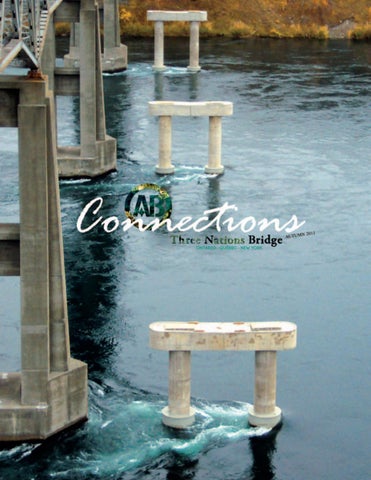
Read about how AB’s experience and innovations overcame the abundant challenges brought on by the natural landscape characteristics at Three Nations Bridge project site in Ontario, Canada. With a current of 3.6 meters per second, the St. Lawrence River demands unconventional and alternative methods when undergoing any marine works within its waters.
company info. Kentucky Lakes Platt Street training wellness program AB published human resources updates flashbacks annual meeting
5 15 16 18 19 20 21 22 23 25
current contracts / new hires / grand prize winner final update of six year project historical bascule bridge major refurbishment first graduating class since the start of the program activities to finish 2011 Tagus River Bridge, Portugal notifications ABM benefits students / SAS cable works 10, 26, 51, 81, 89 year ago... Standing ovation for service to the military and AB
t h a n k y o u Much appreciation to the following individuals for their contribution to this issue:
John Robison, of American Bridge Manufacturing, Coraopolis, Pennsylvania was the 2010 Wellness Program Grand Prize winner. In July, he and his wife Betty travelled to California’s wine country and took some time to do some sight-seeing in San Francisco. Congratulations again to John for winning the grand prize.
Rob Conroy Bill Felker Andy Kerr Neil Napolitano Joe Rynn Jon Weaver
by Kadi Camardese
4
Please contact the AB Communications & Marketing Department with news and inquiries: AB Connections, Autumn kcamardese@americanbridge.net 2011
www.americanbridge.net
Wellness Program Winner Takes on Wine Country
To receive AB Connections electronically or view archived issues visit: http://www.americanbridge.net/Media/newsletters.php
CURRENT CONTRACTS Manufacturing Walt Whitman Bridge, Philadelphia, PA P.J. McArdle Viaduct, Pittsburgh, PA Bedford County Turnpike Girders, Bedford, PA Clearfield County Plate Girder Bridge, Kylertown, PA Shore Parkway, Queens, NY Cochran Mills Bridge, Armstrong County, PA Sun Valley Bridge Widening, Los Angeles, CA LDH Energy Railroad Bridge, Shelibana, KY 4th Avenue Bridge, Johnstown, PA Wilson Creek Bridge, Marshall, AK George Washington Bridge, New York, NY Dickey Prairie Road Bridge, Clackamas County, OR I-80 Bridges, Clarion County, PA Route 65 Bridge, Pittsburgh PA Montour Trail Bridges, Washington County, PA Western ABFJV San Francisco/Oakland Bay Bridge, CA
New York Throgs Neck Bridge Structural Retrofits, New York City Bronx Whitestone Bridge Structural Retrofits, New York City Ogdensburg-Prescott International Bridge Main Span, Ogdensburg, NY Walt Whitman Deck Replacement, Philadelphia, PA George Washington Bridge Rehabilitation, New York City Robert F. Kennedy Bridge Structural Improvements, New York City
Tampa Platt Street Bridge Major Repairs, Tampa, FA Port Fourchon Bulkhead, Galliano, LA Red Bug Lake Road Pedestrian Overpass, Oviedo, FL Arawak Cay Port Development Phase II, Nassau, Bahamas Container Yard Shoreline Protection Works, Freeport, Bahamas Castaway Cay Hurricane Irene Emergency Repairs, Castaway Cay, Bahamas
Richmond Chincoteague Bridge, Chincoteague, VA Pier R3, Yorktown, VA Pier 31, Groton, CT Bulkhead at NOAA Marine Operations Center, Norfolk, VA Three Nations Bridge, Cornwall Ontario, Canada
Pittsburgh Kentucky Lakes Bridges, Grand Rivers, KY Charleroi-Monessen Bridge Replacement, Charleroi, PA I-64 Main Span Girder Repair, New Albany, IN Pending - Columbus Road Lift Bridge, Cleveland, OH
Special and International Projects Forth Replacement Crossing, Scotland, United Kingdom Las Vegas High Roller Observation Wheel, NV
NEW HIRES Melissa Soranno, project administrator, Red Bug Lake Pedestrian Overpass, Oviedo, FL Dan Schwarz, project engineer, Headquarters, Pittsburgh, PA Matthew Cameron, regional sales manager, American Bridge Manufacturing, Reedsport, OR 2011 CORNHOLE LEAGUE PARTICIPANTS: PANTS ON FIRE TIGERS HATE CINNAMON ANDY GRAFF, JANET CORDERO ERIC LANSBERY, KADI CAMARDESE THE RIVER CROWS W. TEAM 2 BRIAN SILVERS, TODD YUHAS ANDY KALAS, DANIELLE DAVISON THE SHEENS CLUELESS ASHLEY ROBERTS, BRENT VANARSDALE LARRY SMITH, PAT SKINGER THE CORN DAWGS CORNHOOLIGANS JARED CARLSON, SIMON LAMING AMR EL NOKALI, DAVE PARTAZANA CORN STALKERS THE ROMAN GLADIATORS MAUDEE PARKINSON, RICHEY PEFFERMAN DAN EDWARDS, KAREN BOZZA THE BAG BOYS BLEEP MISSED AGAIN BRAD SAVER, DICKIE FOSTER CARL SCHWARZ, JAMES DIPASQUALE THE EERPLUGS TEAM HARLEY HENRY MYKICH, TERRI URICK JEFF GREENE, MATT MURPHEY SAND BAGGERS E. TEAM 5 DEBBIE EASTON, RALPH WHITNEY JEN PELLIGRENE, KEITH BASSANO THE CORN FRITTERS CORNFLAKES BEN CROWDER, JODY PORTERFIELD DAVE KOSAR, KATHY BONETTI AB Connections, Autumn 2011 www.americanbridge.net
5
Ontario • Québec • New York
With a current of seven knots (3.6 meters per second), the St. Lawrence demands construction innovations and alternative methods when undergoing any marine works within its waters. A highly experienced contractor specializing in unconventional methods and equipment designs is an absolute must for a project of this type. There are a few factors causing the strong current specifically in the location of the bridge, one of which is the Moses Saunders Power Dam to the west. Additionally, two natural landscape characteristics at the jobsite cause stronger currents through the North Channel: deeper water to the east and west as well as narrower passage due to the way Cornwall Island separates the channel. The extreme current adds further complexity related to the design of the new foundations, since the riverbed contains essentially no mud, soil or other materials to reliably hold an anchor or seat a spud pile. In fact, in some areas the river’s bottom is simply a sheet of limestone. In others, there are rocks and boulders mixed in with glacial till which can also be unpredictable. This creates abundant challenges for this bridge foundation contract. In this first of four phases for the construction of a new four-span, two-lane tub girder bridge, AB has developed innovative methods to save time and drive
6
AB Connections, Autumn 2011 www.americanbridge.net
down cost for owner, Federal Bridge Corporation, Ltd. Once complete in September 2013, the new North Channel Bridge will span 342m (1,122’) connecting the city of Cornwall with Cornwall Island. The scope of AB’s contract includes the construction of three new in-river piers, founded on large diameter caissons and topped off with a conventional pier cap with two bridge seats in each. The bridge substructure consists of 2.4m (8’) diameter drilled shaft caissons socketed 6m (20’) into bedrock. There are two caissons and two 1.8m (6’) diameter columns per pier. Pier 1 columns are approximately 11.5m (38’) in height, Pier 2 columns are approximately 9.6m (31’) in height, and Pier 3 columns are approximately 9.7m (31’) in height. The pier caps are 12.2m (40’) long by 2.4m (8’) wide by 1.6m (5’) tall with rounded ends on a 1.2m (4’) radius. The top surfaces of the caps are sloped at a two percent grade from the edges towards the center of the pier.
New North Channel Bridge Once complete in September 2013, the bridge will span 342m connecting the city of Cornwall with Cornwall Island
Moses-Saunders Hydroelectric Dam One of many factors strengthening the river’s current
Existing Piers Set of old stone bridge piers from a railroad bridge built in 1900 filled with concrete 762m west of the AB’s current job site; the Ottawa and New York Railroad Company bought this land in 1898 from the Akwesasne Indians
Rare challenges on the St. Lawrence require unconventional solutions: High current speeds, narrow channels, exposed bedrock, shallow waters and seasonal constraints – there are conventional ways to handle each of these challenges individually; however, the combination of them is rare and present on the St. Lawrence River posing significant challenges for the project.
Existing North Channel Bridge Completed in 1962, designed at a height tall enough to accommodate large shipping traffic
Cornwall Harbor AB’s equipment storage location about 2.4km south of the project
Cornwall Island Separates the river making this area narrow; water to the east and west are deeper causing the quickened river flow
South Channel Bridge AB fabricated and erected all of superstructure and approaches, including towers, cables (fabricated from 5.8 x 0.7m galvanized helical strands; erected by cableway), suspended decks and concrete roadway surface of this three-span, 1,060m suspension bridge, crossing the south navigational channel between Cornwall Island and Rooseveltown, New York. Completion date: 1959, AB order no.: V-106676
AB Connections, Autumn 2011 www.americanbridge.net
7
History
T
Railroad bridge built in 1900 - the piers used by AB for the anchoring system that are about 2.4km upstream
he St. Lawrence Seaway comprises navigable channels traversing ships between the North Atlantic Ocean and the Great Lakes. The Seaway bypasses the un-navigable portions of the St. Lawrence River, and includes locks and canals.
The
north American Bridge finished the South Channel Bridge (AB order no.: V-1066-76) in 1959, the same year crossing is also the Montreal/Lake Ontario section of the St. referred to as the Lawrence Seaway opened to navigation. This ‘Three Nations Bridge’ area of the seaway is 189 miles long and contains due to the St. Regis seven locks, five Canadian and two U.S., in Akwesasne Indian Reserve order to lift vessels to 75m (246’) above sea that spans portions of the level. The original South Channel Canadian Provinces of Bridge project included the Ontario and Quebec, fabrication and erection of and New York State the entire superstructure and in the USA. all approaches, including towers, cables, suspended decks and concrete roadway surface of this three-span, 1,060m (3,479’) suspension bridge, crossing the main navigational channel (South Channel) between Cornwall Island, Ontario, Canada and Rooseveltown, New York. The cables were fabricated from 0.7m (21/8”) galvanized helical structural strands and erected by cableway.
8
AB Connections, Autumn 2011 www.americanbridge.net
The old North Channel (Three Nations) Bridge that was demolished in 1962 and replaced by the existing high level bridge
The North Channel Bridge was open to traffic in 1962, 1,625m (5,331’) long and 8.2m (27’) wide it was designed at a height tall enough 35m (115’) to accommodate large shipping traffic through a parallel canal on the Cornwall, ON waterfront; however, alternate areas on the Seaway were used for this purpose instead. The existing bridge has a high level of deterioration and does not meet current safety standards, making rehabilitation non-economical in this case. As the new bridge will have a much lower 9m (30’) clearance, Cornwall residents will see quite a change in landscape once the new bridge is complete. The north crossing is also referred to as the ‘Three Nations Bridge’ due to the St. Regis Akwesasne Indian Reserve that spans portions of the Canadian Provinces of Ontario and Quebec, and New York State in the USA. It also straddles Cornwall Island. Large portions of the workforce for the Three Nations Bridge foundation contract are members of this Nation. Akwesasne Indian deed of sale April 21, 1898 for land bought by Ottawa and New York Railroad Company
The Roosevelt International Bridge was a truss bridge about 0.8 kilometers (km) (0.5 miles) upstream of the Three Nations Bridge, which was demolished after the North Channel Bridge opened to traffic. However, AB is using its existing piers as part of a marine anchoring system.
AB Connections, Autumn 2011 www.americanbridge.net
9
WORK OVERALL
1 p
2 i
T
e
3 r
s
he sequence of work for Piers 1 - 3:
10
AB Connections, Autumn 2011 www.americanbridge.net
1. Install temporary works and pile templates 2. Install the permanent casing for the caissons, drill and tremie pour the caisson, then test to ensure compliance with specifications 3. Clean tremie pour, install a splice cage and pour the rest of the caisson to complete 4. Install column cages, column forms, and pour the columns 5. Strip the columns, install the pier cap forms and rebar, pour the pier caps 6. Cut off the caisson casing to grade and install a caisson cap to protect the opening between caisson and column 7. Remove falsework and perform any necessary punch list items
H MAJOR PROJECT CHALLENGES
igh currents, narrow channels, exposed bedrock, shallow waters and seasonal constraints – there are conventional ways to handle each of these challenges individually; however, the combination of them is rare and present on the St. Lawrence River, posing significant challenges for work in the water.
Rare Alternate work methods required challenges when compared to other rivers on the St. Flowing at an average rate Lawrence require of 12 cubic feet per second unconventional (0.34 cubic meters per solutions second), the strength of the
St. Lawrence changes the way all marine work and procedures are carried out on this job - requiring unconventional marine construction means and methods.
Natural landscape causes high current Ninety percent of the river freezes during the harsh winter months. As the snow and ice starts to melt in early spring, the water elevation raises at a quick rate dramatically increasing the current speed. Another factor adding to the river speed is that the bridge is located on a narrow channel of the river where the water is relatively shallow (depth ranges from 4’ to 25’ [1.2m to 7.6m]). Bedrock and falsework piles The current strips the St. Lawrence of typical overburden including silt, sand, and glacial till materials that are normally used to hold an anchor or seat a spud pile. Therefore American Bridge needed to devise an alternate plan to maintain budget and schedule.
Cables holding barges in place are anchored piers from a railroad bridge demolished in 1962
Work from Piers 1, 2 and 3, early September; on this day all cassions were installed and Pier 2 columns completed; in the afternoon the cap form was set on Pier 2 and the rebar cages on Pier 1
Cap form sits on the column seats; after all reinforcements were installed the concrete was poured, early September
AB Connections, Autumn 2011 www.americanbridge.net
11
I Alternate plan: anchoring system
n the absence of normal anchoring material, AB needed to find a way to adapt to the large loads the current inflicts on the barges and any structure to which they are moored. After considering a variety of options to anchor and move the barges on site, AB Superintendent Andy Kerr and General Superintendent Ugo DelCostello, established that the most reliable solution was to anchor to an existing set of old stone bridge piers filled with concrete 762m (2500’) west of the site (piers are from a railroad bridge built in 1900). The system was designed to transfer the current load back into the same piers and proved less risky than building and installing new anchors of any type. The anchor system was designed around a single 38mm (1.25”) cable holding the two crane barges to which all other material barges would be moored. The cables were carried by Conmaco 385 double drum deck winches. Only one drum was necessary, but as an insurance policy AB used double drums in case there was ever a need for another cable. The deck winches pulled the barges upstream and lowered down into position as the tugboat provided lateral movement. A sling, made of three wraps of 19mm (0.75’) cable, was draped over the old stone bridge piers and connected to the 38mm (1.25”) cable with a shackle. The sequence of work was set up to maintain a navigation channel.
Andy explains, “In the case of the St. Lawrence, our unconventional “In anchoring system saved time and money when compared to building and the case of placing anchors in the river, plus anchoring to the existing piers 2500’ the St. Lawrence, our upstream allowed for better maneuverability.” unconventional anchoring system saved time and money Budget and innovation when compared to building and AD&T (American Dock & Transfer, one of AB’s sister companies) placing anchors in the river, plus fabricated the falsework collars that held up the F1 falsework (used as the caisson template) and transferred the current load into the anchoring to the existing piers existing bridge piers. Utilization of this company owned equipment 2500’ upstream allowed for coupled with anchoring to the existing piers drove down cost and better maneuverability.” enabled AB to be the competitive bidder for the project.
Andy Kerr
General Superintendent
The project schedule revolved around fish window restrictions at Piers 1 and 2 from March 15 through May 1, and at Pier 3 from March 15 through July 15. The scope of the Pier 3 work combined with the fish window
Pier one, all caissons were installed mid-August
12
AB Connections, Autumn 2011 www.americanbridge.net
Columns at Pier 2, cap poured mid-September
Current loads are transferred to the collar then into the concrete piers; the steel frame guide controls the location of the caissons within the template
restriction resulted in the critical path traveling through the work at that pier. The key was to finish the caissons at Piers 1 and 2 to enable sequential movement to Pier 3. However, completing too early would put our equipment on standby which would have been costly. The AB team was able to stay exactly on schedule avoiding any such case. Falsework Unlike other water bodies on which a floating template can be utilized, the St. Lawrence requires a fixed template due to the strong load on anything that touches the current. AB’s Andy Kerr, along with AD&T personnel Mike McCoy, Mike Wade, “The Jimmy Hall and John best boat we Gerace, came up with found was a 1000 horse a solution.
power tug that drafts about 6’ so it operates safely in about 7’-8’ of water. Even then, it could not operate in about 15 percent of the work zone.” Neil Napolitano Project Manager
A falsework collar was designed and erected on the existing bridge piers by crane to serve as a connection between the existing piers and the caisson template. The current load from the river was transferred through the collar to the concrete piers. A steel frame guide was utilized to control the location of the caissons within the template.
Project Manager Neil Napolitano and General Superintendent Andy Kerr as the team loads equipment at Cornwall Harbor site
Maneuvering in shallow waters The shallow waters present in much of the work area greatly limit equipment maneuverability. Large tugboats are necessary to move equipment in the fast current, yet draft too much water to be used in shallow areas. AB hired a unique 1000hp tug that drafts about 1.8m (6’) and operates safely in as little as 2.1m (7’) of water, providing more flexibility compared to other tugs.
Setting the cap form at Pier 2, August 31
First rebar cage set at Pier 1
Pier 1 left and Pier 2 on right; Pier 3 was the last to complete, mid-October
AB Connections, Autumn 2011 www.americanbridge.net
13
The main challenge was the marine equipment and anchoring system. Canadian marine equipment on the St. Lawrence is very expensive because the industry operates seasonally; about 90 percent of the river is frozen by Christmas and not navigateable again until mid-March.
A close up look at the St. Lawrence River’s unusually strong current seven knots (3.6 meters per second)
With depths as shallow as 1.2m (4’), even with this specialized equipment AB could operate in only about 85 percent of the work zone. Project Manager Neil Napolitano explains the solution to this problem, “Large tugboats are needed to move equipment in the current, but they can’t draft too much water or they will not be useful in the shallower areas. The best boat we found was a 1000 horse power tug that drafts about 6’ so it operates safely in about 7’-8’ of water. Even then, it could not operate in about 15 percent of the work zone. Additional winches were relied upon to pull barges into areas where the tug could not go.” So the anchor system was relied upon to move the barges. AB mobilizes all equipment and delivers all material from Cornwall Harbor, a five minute taxi by crew boat and 20 minutes by barge.
AB employees: Operations Manager Wes Grandmont Project Manager Neil Napolitano Superintendent Andy Kerr Project Engineer Jonathan Weaver Field Engineer Joe Rynn Equipment list: 30’ by 50’ pontoons (2) Pier column forms Pier cap forms 22T boom truck 40T hydraulic crane on barge 1,000HP tugboat Manitowoc 3900 WS2 on barge 600T jack-up barge
14
AB Connections, Autumn 2011 www.americanbridge.net
When completed in early 2013, the replacement bridge will be 26m (115’) lower than the existing, creating a more aesthetically pleasing landscape for Cornwall residents. Despite the challenging St. Lawrence conditions, American Bridge completed the foundation project in mid-November, 2011, ahead of its contractual completion date of December 16. Project Manager Neil Napolitano explains, “Of the many challenges within this project’s scope the greatest was installation of the caissons. However, our long history with challenging marine construction environments, the use of company-designed erection equipment, and the skills of our long-term employees are enabling us to profitably complete this project ahead of schedule.”
Six Year Project Comes to an End with $14.2M in Additional Work 2005 to 2006 steel erection underway
2007 to 2008 girder erection
2009 traffic on new alignment
AB’s six-year-long Kentucky Lakes Bridges project, Grand Rivers, Kentucky is coming to an end with an expected, on-time final completion date at the end of 2011. The Nashville District of the Army Corps of Engineers awarded American Bridge this contract in September 2005 with an original amount of $88.6M. The allocation dependent contract is currently valued at $102.8M to account for delays in annual funding. This diverse and challenging project afforded American Bridge the opportunity to showcase many varied talents and innovations. The scope included the construction of a 3,100LF railroad bridge with girder spans and a 500’ long by 27’ wide 2,200 ton truss which was floated into position; weekend replacement of a 120’ railroad overpass and nearly 11,000LF of new track for the P&L Railroad; a highway bridge with 3,100LF of girder spans for the Kentucky Transportation Cabinet; rehabilitation and retrofitting of the existing structures across the TVA’s (Tennessee Valley Authority) Kentucky Lakes Dam as well as construction of a concrete access bridge and two precast, cast-in-place concrete fishing piers for the TVA. American Bridge self-performed the steel erection, forming and placing of the concrete and the rehabilitation and retrofitting of the existing structures utilizing forces from Ironworkers Local 782, Laborers Local 1214 and Operating Engineers Local 181.
2009 float-in
2010 to 2011 fence rehabilitation on existing dam/spillway
At press time, work is ongoing for the two concrete fishing piers and a punch list is being developed by the Corps for American Bridge to apply the finishing touches to the job as the end of this project approaches. American Bridge staff remaining on site includes: Project Manager Peter Balwant General Superintendent Tom Melvin Quality Control Manager Joe Tumas Safety Manager Steve Rogers Ironworker Superintendent Ken Edleblute Carpenter Superintendent Scott Brother Field Engineer Kevin Lynch Office Administrator Debbie Crockett
2011 powerhouse island access bridge
2011 setting precast for fishing piers
Rob Conroy, AB project manager
Platt Street Bridge, a gateway to the Tampa, FL area
AB Refurbishes 86-Year-Old Landmark Bascule Bridge
The Platt Street Bridge is a double leaf bascule bridge with a Strauss design and unique swinging counterweight that spans the Hillsboro River in Tampa. Considered the gateway to this Florida downtown area, its 86-year existence has seen many changes to the city and is currently a part of the city-wide revitalization to beautify the river sections and adjacent properties. The bridge is considered one of Tampa’s landmarks, and will undoubtedly share the world stage as reports from Tampa covering the Republican National Convention 2012 will most likely be shot from the base of the bridge. As part of its refurbishment, the Platt Street Bridge will undergo a major face-lift. Each of its cantilevered 8’ wide concrete sidewalks will be completely demolished and re-cast to the original dimensions but upgraded for current FL DOT (Florida Department of Transportation) loading requirements.
16
AB Connections, Autumn 2011 www.americanbridge.net
This entails additional structural upgrades in the reinforcing design and the use of 5,500psi (pounds per square inch) of concrete. One of the engineer’s requirements was that the sidewalk and its cantilever supports be placed monolithically. This made a much more complex form design since each of the 22 spans, measuring 36’ long, had to be fully supported by it’s adjacent span supports. The end result was a substantial hanging form system that had to be stout enough to resist deflection, but also be mobile enough to be stripped and set up again within the very close confines of an Looking east active bridge. Concrete demolition of the sidewalks started while the in January 2011 and September marked the completion of westspan is the last span placement. in the air In addition to the sidewalk, the designer had to appease the preservationists and the concrete handrail had to be replicated. The main concern was to mimic the current aged look, which over the 86 years gave it an exposed aggregate patina. To accomplish this, river rock was used as the aggregate and later sand blasted to expose it. Ornate 3’ by 3’ concrete panels run along the center of the railing. These were pre-set into place and the bottom curb, posts and top railing were cast around the architectural panels. Like the sidewalk, these railings were upgraded for impact loading. You can imagine in 1926, impact loadings were not as big a concern. Currently over half of the bridge railing is complete and the remainder completed in mid-November. Although the bridge’s original machinery still functioned, it was tired and needed to be upgraded to current standards. The original movement mechanism was an open gearing driven by a centralized motor. Its replacement is similar in concept, but the reduction is covered in a gearbox for the final drive. With limited room to demolish and install the machinery, it is being accessed through the roadway deck. At this point the machinery has been removed on one side and the AB team has begun to jack up the other side of the bridge to remove the main trunnion bearings. To comply with USCG (United States Coast Guard) requirements to maintain boat traffic, as each leaf is refurbished in the flat position, the other leaf will be raised. As of mid-October the bridge was closed to vehicular traffic and the machinery replacement began. The machinery started to arrive on the job site on November 1, to begin installation. The bridge must be mechanically operational within a 105-day window once it is closed to traffic. Other work on the project includes complete replacement of the sub-cable and electrical components, cathodic protection for the foundation, rebuilding of the control house and storage structure and the installation of the bridge lighting to give it an original look with replicated fixtures.
having the machinery removed and the counter weight trunnions replaced
Each span had to be fully supported by its adjacent span supports resulting in a complex form design
Looking east at the east span while the structural steel substructure and grid deck are being replaced and the main trunnions are being refurbished
AB Connections, Autumn 2011 www.americanbridge.net
17
Five Year Training Program Completes for the First Group of Field Engineers From left to right: Katherine Quillin, Kevin Lynch, Robert Yahng, James DiPasquale, Ben Reeve, Levi Gastos
Training Session 8 was held at the SAS jobsite on August 1, and adjourned on August 3 after a tour of the San Francisco/ Oakland Bay Bridge. For many, this session represented the completion of the five year field engineer training program. This session was very exciting and served as a commencement for these young engineers after years of hard work and dedication in the AB program. On August 1, the engineers were asked to prepare a presentation explaining the unique details and highlights of their current project. Some worked in groups and others alone, but each project was equally beneficial to the other engineers. Tuesday morning’s session began with a round-table discussion involving some of American Bridge’s core leaders. The presenters were as follows:
Everyone at American Bridge would like to congratulate the following professionals on their accomplishment: Forth Replacement Crossing, Scotland, UK Ben Reeve Three Nations Bridge, Cornwall, Ontario Joseph Rynn Jonathon Weaver SF/Oakland Bay Bridge, CA Katherine Quillin Adam Roebuck Levi Gatsos Andre Markarian Daniel Hester Kelvin Chen Daniel McNichol Adam Reeve
George Washington Bridge, Fort Lee, NJ Chad Ford Bruce Phillips Walt Whitman Bridge, Gloucester City, NJ Michael Hartranft NOAA Marine Operations, Norfolk, VA Brian Binder Walt Whitman Bridge, Gloucester City, NJ Drew Merritts Zach Rosswog Kentucky Lock Addition-Bridges Superstructure, Grand Rivers, KY Kevin Lynch Las Vegas High Roller, NV James DiPasquale Simon Laming
Brian Petersen, vice president Kwadwo Osei-Akoto, vice president Henry Mykich, safety director Scott Gammon, vice president Each of the presenters had a unique story about their personal experiences as an engineer as well as their American Bridge story. Tuesday afternoon consisted of President and CEO Mike Flowers and Chairman Robert Yahng giving their background stories and insight to their timeline of success. The engineers found this session extremely intriguing and motivating. On Wednesday, the engineers were given the option to join the group on a tour of the bridge.
Training Session 7 was held in conjunction with the annual meeting. On September 29, field engineers utilized the training facility at the American Bridge headquarters where they reviewed a variety of topics. The material and presenters are as follows: Round table discussion at the SAS office
Use of crane capacity charts/rigging - John Schober OSHA crane standards- John Schober and Henry Mykich Site work and excavation - Joe Hoepp, estimating manager Construction environmental presentation - Zurich Insurance Continued next page
18
AB Connections, Autumn 2011 www.americanbridge.net
On September 30, the field engineers in this session joined the rest of the AB family at Nemacolin Woodlands for the annual meeting. After the meeting on October 1, Mike Flowers gathered the field engineers around the fireplace at the AB pavilion. During this roundtable discussion, he gave insight to his career from conception and answered questions the group had for him. George Washington Bridge, Fort Lee, NJ Scott Swamback Triborough Bridge Rehabilitation, Manhattan, NY Mike Comstock San Francisco Oakland Bay Bridge, CA Zach Lauria Paul Fikse Ben Jones
Bronx-Whitestone Bridge Structural Improvements, NY Joe Stilson Dan Sheehan Zach Osei Bill Batzel Kara Mullin Ogdensburg-Prescott International Bridge, NY Chris Deklewa Forth Replacement Crossing, Scotland, UK Ben Reeve
Clockwise from fire: Mike Flowers, Bill Batzel, Dan Sheehan, Zach Lauria, Paul Fikse, Scott Swamback, Kara Mullin, Zach Osei
WELLNESS PROGRAM The Wellness Program for 2011 is coming close to the end. So far we have two individuals that have met or exceeded the 250 goal to be placed in the grand prize raffle. Please have all 2011 wellness goal completion certificates turned into the HR Department no later than January 10, 2012. The grand prize raffle will be held on Friday, January 13, 2012. Not sure how many wellness points you have? Call HR! There are still a couple of months left to get into the grand prize raffle and win a $2,500 vacation! Congratulations to Debbie Crockett of the Kentucky Lock project. She was the winner of the $50.00 Target gift card for participating in the Maintain Your Mind Newsletter Campaign. Her name was randomly drawn from all that participated in the campaign. Here is what you can look forward to over the next couple of months with the Wellness Program: October – In addition to the Daily Steps to Less Stress Newsletter Campaign, flu shots were an initiative for October. We all need to stay healthy. American Bridge will reimburse the employee for receiving a flu shot. You must get your wellness certificate signed and turned in the HR Department in order to receive points. We will also need a copy of the receipt for reimbursement. November – The initiative for November is hunting/gun safety. To receive points for gun safety, you can submit a copy of one of the following items along with a completed wellness goal certificate: Valid hunting license, regular military, national guard, or reserves photo ID, valid license to carry firearms, military discharge papers (DD-214), certificate of completion from accredited gun safety course, or certificate of completion from accredited hunter safety course. Also in November, the Smoking Cessation Program began. The program began November 1 and will run through January 31, 2012. Any employee with at least one year of consecutive service is eligible to participate in the program as well as spouses of the qualifying employees. You can be reimbursed up to a total of $120 per person (typical cost for three months of cessation products) by simply sending your name, original receipt and UPC symbol from your smoking/tobacco cessation product to the HR Department. Upon receipt, we will reimburse you for your cost up to $120 per person. The employee will also receive 15 wellness points. December – In December you can receive points when you reach out to a local organization and volunteer your time over the holiday season. Make sure to take your wellness certificate to be signed. You can also get points in December by completing a Home Safety Inspection Checklist. Once you have completed the items on the list, sign it, and send it to the HR Department. We will be sending out the checklist in the beginning of December.
AB Connections, Autumn 2011 www.americanbridge.net
19
AB’s Long History of the Tagus River Bridge Captured by Author
In 1966, American Bridge completed the contract for the original construction of the Tagus River Bridge (AB order no.: V-7600-79) that included the financing, design and construction of this 10,573’ (3,223m) crossing of the Tagus River located about 7.5 miles (12km) from its mouth at the Atlantic Ocean. The work included a 14-span, 3,100’ (945m) segmentally cast in place concrete viaduct over the Alcantara District of Lisbon and a six-span, 7,474’ (2,278m) steel truss bridge over the river - one of the longest in the world. This includes a three-span suspended structure of 6,495’ (1,980m), with a mainspan of 3,323’ (1,013m). The two fabricated structural steel suspension bridge towers were 588’ (179m) tall. The two 23¼” (590mm) diameter main cables are made from 37 strands of airspun parallel wires. There is 230’ (70m) of vertical navigational clearance below the bridge. The total weight of structural steel for the project was 52,422 tons (47,556mt). The structural steel was fabricated both in the United States and in Portugal, and was erected on site by American Bridge. The total schedule for the project from notice to proceed to bridge opening was 651/2 months including 45 months of field construction. Thirty years later, from 1996 to 1998, American Bridge was a member of the consortium that held the $263M main contract for the addition of a rail deck and the widening of the roadway deck of the existing suspension bridge. The work included the addition of new main and suspender cables, the increase of the tower height, the reinforcement of the towers and cable bents, new anchorages, the launching of the steel girder railroad structure through the approach structure, the modification of the truss to accommodate the rail track, and the installation of the track. AB was responsible for the first ever air spinning on a loaded, fully operational bridge
20
It was on this project that AB was responsible for the first ever air spinning on a loaded, fully operational bridge. Carlos M. Lemos, photographer and author of Tagus River Bridge 1997-1999: Records of a Change, wanted to capture it. Lemos explains, “It took months of patient efforts for the great dream to come alive: obtaining permission to photograph the work on the platforms.”
AB Connections, Autumn 2011 www.americanbridge.net
Some of the most interesting excerpts from the book are of AB’s cable spinning performance: ‘On April 10, 1997, the first ascent was made to the top of the south tower platform three of the American Bridge Company, responsible for the cable works. The two catwalks and the spinning engine were ready for starting the construction of the two secondary cables, which would support the additional loads due to the railway deck. During the two months that followed, the spinning of the secondary cables proceeded at a great pace, in a kind of race against time. The catwalks then turned into ways of intense human traffic. The center of the operations was located behind the anchorage of the main cables in the north bank, where the sheave tower, the driving engine for the spinning wheels, and the control station of the spinning equipment were mounted. On the sheave tower, a working team exchanged the empty reels with full reels, and put splices on the ends of the wire, to maintain continuity of the wire supply during the spinning. Inside the new anchorages, other working teams fixed the wires carried by the spinning wheels on their respective strand shoes of the anchor blocks, after which the spinning wheels were sent back to the other bank. Along the catwalks, near the cable former supports for the cables being spun, other workers maintained a sharp lookout for the approaching wheels. As the wheels passed overhead, the workers quickly guided the placement of the wires into their correct positions on the cable formers. Near the saddles on the towers and on the cable bents, the working teams performed several operations, to guarantee the correct placement of the wires at the upper geometry of the strands after each passage of the wheels.
Flag of United States and Portugal on the cable spinning wheel in celebration of the last cable spinning trip; the set-up and dismantling of tower-top cranes and of the spinning equipment were by themselves challenging engineering works Controlled tension airspinning; still holds the efficiency record of 73 percent
In the long run, the presence of the photographer was so frequent among the workers that it passed almost unnoticed. The adventure usually started at dawn, sliding the ‘Eagle Eye’ on the surface of the river and climbing to the platforms and catwalks with the Bridgemen. After the end of the spinning, other operations followed: the compacting of the cables, the erection of the cable bands which would take the suspender ropes, the erection of the suspender ropes, the load transfer to the new cables and finally the cable wrapping.”
HUMAN RESOURCES Annual Open Enrollment The time to make any changes to your benefits without a qualifying event is during annual open enrollment. This year’s open enrollment period will begin mid November and end mid-December. Changes during open enrollment will go into effect for January 1, 2012. Look for notices from HR over the next month for more details. Employee Assistance Program The Employee Assistance Program (EAP) is provided to the employees at no cost. It is affiliated with the life insurance policy. The EAP program can assist employees in many different areas such as, stress and anxiety management, depression, financial and legal concerns, identify theft, and fraud resolution among other items. EAP also has a WorkLife Services Program where Horizon Health can perform research and provide referrals for such areas as locating a reputable child care or elder care service, education, adoption, travel, daily living, etc. To utilize the services you can contact Horizon Health at 888-293-6948. The phone answers 24 hours a day, 365 days a year. You can also visit their website at www.horizoncarelink. com. Enter “standard” as the login ID, then enter “eap4u” as the password. Please contact the Human Resources Department with any questions regarding the EAP service. AB Connections, Autumn 2011 www.americanbridge.net
21
Cable Works
Recycles Bridge Parts to Benefit Students
Field erection; ABM supplied the fabrication at cost, as did most of the suppliers
There were so many volunteers that the truss was erected on-site in two days
The new ABM-donated bike rack in use; the students locked their bikes to the fence behind it in the past
22
AB Connections, Autumn 2011 www.americanbridge.net
Plate steel leftover from the bridge has been used for a good cause – to construct a 16-spot, 700-pound bike rack for George Washington Elementary student’s commuting to school. There were many contributors from ABM’s welding and paint shops in Coraopolis, PA including Plant Superintendent Phil Gerace who coordinated the project and Supervisor Chuck Weber who provided the end design.
On August 29, 2011 florescent necklace lights strung on the Bay Bridge’s selfanchored-suspension span (SAS) catwalks were illuminated. To be used in heavy fog and at night, the lights signify the initiation of the cable work phase on the signature span. The self-anchored bridge will be suspended from a single 784mm diameter, 1,402m long continuous main cable, running continuously from the north east deck anchorage to tower top saddle around the west loop deviation and jacking saddles, back to tower top and terminating at the south east deck anchorage. The cable will be built up from 137 prefabricated parallel wire strands (PPWS) with 127 wires per strand. The strands have already been delivered to the site and are stored in a warehouse. A variety of winching and transfer systems have been designed by AB site engineers and are currently being erected to enable the PPWS erection procedure. The cable has a weight of 5,200,000kg (5,720 tons), and the hanger ropes weigh an additional 650,000kg (715 tons).
ABM has made many similar community donations. In this particular area, the company has given steel to schools training future welders and has provided the steel fabrication of the J.R. Memorial Bridge at cost. ABM completed work on the J.R. Memorial Bridge in June of this year and a ribbon cutting ceremony celebrating the new span over the Montour Trail was held in September.
Photo: Tom Paiva, 2011
Truss fabrication at ABM’s Coraopolis, PA shop
In November 2010, American Bridge Manufacturing (ABM) began the J.R. Memorial Bridge project, which involved preparation of detail drawings and supply of materials and labor to fabricate a new 200’ long by 14’ wide pedestrian truss bridge and its components for the Montour Trail, Bethel Park, Pennsylvania.
Lakeshore Drive Bascule Bridge Reconstruction This project included the complete reconstruction of this iconic double-leaf, double deck trunnion roadway bascule bridge. The overall length of main span is 262’-6” (center-to-center of trunnions). The work included the replacement of structural members and entire floor system, and repair and replacement of operating machinery.
Location: Chicago, IL Completion date: 1985 AB order no.: T-3114-28 AB employees: Superintendent Jack Kingsbury, Field Engineers Glen Steffen and Ralph Eppehimer, Timekeepers Bill Little and David Brabson
26 years ago
Ogdensburg-Prescott International Bridge
51
years ago
Location: Ogdensburg, NY Completion date: 1960 AB order no.: V-2200-11
81 years ago
American Bridge was general contractor for the superstructure of this two-lane suspension bridge over the St. Lawrence River between New York and Canada. The bridge has a 2,150’ suspended span and a 1,150’ mainspan, two 243’ steel towers, and two 106’ steel cable bents. The superstructure is a steel truss 15’ deep by 36’ wide. The suspension system consists of two 11 3/4” cables made from 37 prefabricated bridge rope strands - 31 of 1 3/4” and six of 1 1/4”. There were also three backstay ropes of 1 3/4”. The cables were made round with aluminum filler and wrapped with number nine wire. AB is currently replacing about 70,000SF of open steel grid deck with new steel grid deck, plus replacement of all bridge handrails, roadway lights, and other miscellaneous repairs on the Ogdensburg-Prescott International Bridge during one-lane closures (AB order no.: 405110).
Suisun Bay Railroad Bridge
This bridge was erected in 1929-30 for the Southern pacific Railway Company, crossing San Francisco Bay about 35 miles upstream from San Francisco. The main one 560’ structure, beginning at the west end, consists of one 264’ deck truss span, truss through 560’ six span, life vertical truss through through truss span, one 320’ span. spans and one 504’ deck truss erected All steel work for these spans was yarded at the west end and the spans towers span lift the that except cranes, tive locomo by consecutively from this end spans were erected with 30 ton stiffleg derricks mounted on top cords of the tower place. into floated was and the 504’ deck truss span omical; The depth of water and soft silt bottom made the use of falsework unecon as utilized was bents steel on piers the between placed therefore, the 504’deck span bridge the of chord bottom The spans. truss through falsework for erection of the 2’ higher to structure was about 80’ above water; the spans were temporarily erected spans. rk falsewo the for space ering provide additional maneuv the west There is a plate girder viaduct approach at each end of the bridge. After ary tempor and built was turnout ary tempor a , erected viaduct approach had been position ent perman the of south d installe were span rk bents to support the falsewo of the 264’ span and rolled sideways into its final position. first 560’ The falsework span was next floated into place between the piers of the rk span falsewo the ing support for bents steel The barges. span, using two 40’ x 130’ pier These shaft. pier the with footing the of junction the rested on the pier ledges at were they that ces assuran no were there as and water ledges were about 20’ under joints to level, the bent shoes were joined to the bent columns with ball and socket s. column the in avoid possible eccentric stresses the ends, After the first 560’ span had been erected and swung by jacking it up at erection the for support as serve to position into floated the falsework span was then spans. 560’ six ng remaini the for utilized was it this of the 320’ span. Following
10 New York Radio Central Station
Location: Rocky Point, NY Completion date: 1922 AB order no.: E-3519-20 AB employee: Foreman J. Kennedy
AB constructed eight light and four heavy radio towers 410’ high with crossbeams for the Radio Corporation of America in 1922. The lower 250’ of each tower was riveted and painted with Detroit Graphite 501 paint and the upper 160’ was galvanized and bolted. Total structural steel on the project was 1,625 tons.
Remote at the time of construction, the Rocky Point area of Long Island has changed drastically to the populous area we know today.
89 years ago
The falsework span, as floated, weighed approximately 1600 tons. The load distributing girders, equipment, etc. amounted to about 200 tons and the was span rk falsewo the of chord bottom per barge was about 900 tons. The about 18’ above water when it was floated. The current was about five knots per hour and the tidal amplitude was about that 10’. The blocking and jacking equipment on the barges was so arranged between bents steel the from d remove or on the falsework span could be landed span the piers at any tide stage. The barge draft varied from 2’9” without the The d. provide was g blockin of 8’6” of m to 8’6” under full load, and a maximu was bents steel the off and on span the transfer amount of jacking necessary to of extent the to barges the of out and into water somewhat reduced by pumping about 2’ variation of barge draft. All floating movements of the falsework spans were control led by two parts These of ¾” wire rope from ship anchors to two hoisting engines on each barge. for ent adjustm Close piers. the to lines al lines were supplemented by addition steel the over it g centerin and piers the entering the falsework span between on bents was control led by two parts of ¾” wire rope running from hand crabs The piers. the of ends the to lly diagona span rk the bottom chords of the falsewo span the hold would current tidal the that so movement of the span was timed away from the pier, making it necessary to pull it into place with the hoisting the engines. Tugs were used only to place and remove the barges from under span rk falsewo the tow to used not were but span, run out anchor lines, etc., itself. ed All of the 21,000 tons of structural steelwork for the bridge were fabricat more g handlin of capable was which lvania, at AB’s Ambridge plant in Pennsy large tonnage than this in one month and was equipped to handle any kind of carried was spans various the on work Shop and difficult structural steelwork. and out on a carefully prearranged schedule requiring considerable forethought other on work at neously simulta was Bridge an study due to the fact that Americ York, large and important structures such as the Empire State Building in New Kull van Kill the and gton Washin in g Buildin the Department of Commerce Arch Bridge from Bayonne, New Jersey, to Staten Island, New York. Location: Suisun Bay, CA Completion date: 1930 AB order no.: F-5820 through F-5834 AB employees: Foreman W.A. Glencross, Chief Consulting Engineer C. G. E. Larsson
New Lots Line Elevated Transit Line
years ago
Location: Brooklyn, NY Completion date: 10-11-2001 AB order no.: 481010 AB employees: Superintendent Project Manager Kwadwo Osei-Akoto, Angus Adams, Field Engineers Jonathon Hart and Daniel Murphy, General Foreman George Terrance
This project consisted of the structural rehabilitation of 12,672LF of elevated transit line in Brooklyn. The work required daily coordination and meeting with hundreds of affected businesses, utility owners, train operations, traffic signalization departments, and NYPD for traffic control. There are seven stations on the line, with the station mezzanines suspended below the track girders. The line terminates in an elevated yard, which is supported on a steel structure similar to the main line. Trains running on the line are powered by a 600V DC third rail. Major types of work in the contract included: inspection and replacement of girder flange angles, diagonal bracing, and other steel; rehabilitation of rockerpin expansion joints and replacement of seat brackets; strengthening of steel columns; replacement of track and concrete roadbed in station thru-spans; replacement of stairs and windows in stations; demolition and re-construction of concrete column fenders; containment and removal of lead-based paint; and miscellaneous station and electrical work. American Bridge won the 2001 NEA Craftsman Award for Ingenuity and Innovation in Construction and the Allied Building Metal Industries, Inc., 2001 Safety Award for this project. The work followed on a previous contract completed in 1989, when AB replaced the track girder top flange angles on this transit line (AB order no.: P905BR).
Dana Helman Recognized for Service and New Company Safety Initiative
American Bridge employees from project sites and office locations worldwide traveled for company’s annual meeting, held September 30 through October 1. A tradition for over 20 years, participants met at the AB owned pavilion/bunk/ catering facility near the Nemacolin Woodlands Resort, Farmington, PA for lunch and then broke into groups participating in activities such as golfing, skeet shooting, bowling, pheasant hunting, or the spa. Later Friday evening attendees reunited at the pavilion for dinner. Saturday morning after breakfast, Mike Flowers greeted the 170 in attendance and welcomed Chairman Robert Yahng as he offered encouraging words and reflections of 2011. Employees also heard updates from district vice presidents and departmental leaders regarding financial, legal, safety, training and current projects. Another informative annual meeting ended over lunch at the facility. The primary topics of the 2011 meeting were the new company-wide safety improvement initiative (see page three) and the Honorable Dana Helman’s (American Dock & Transfer Machine Operator) contribution to American Bridge. After the following speech given by President and CEO, Mike Flowers there was a standing ovation for Dana for his service in the military and to American Bridge:
On November 11, 1998, nearly thirteen years ago, a young man started to work for us at the Coraopolis storehouse. This November will mark his 13th year of service to American Bridge Company, but far more noteworthy it will also mark his 25th year of combined active duty and reserve service to our country. While employed at AB, he has been mobilized twice and completed four foreign deployments. In June of 2006, he was mobilized with the 26th Naval Mobile Construction Battalion to Kuwait for seven months after two months of training in Gulfport, Mississippi. In March of 2007 he was deployed to Iraq with the 28th Naval Construction Battalion for four months. In June of 2009, he was once again mobilized with the 22nd Naval Mobile Construction Battalion, this time to Afghanistan for seven and a half months after three months of training in Gulfport, Mississippi. And finally in April of 2010, he was deployed to Kuwait with the 25th Naval Construction Regiment for 12 months. Please join me in recognizing Dana Helman for his service to us and our country and in thanking his wife, Mandy, for her sacrifices.
25
AB Connections, Autumn 2011 www.americanbridge.net
1000 American Bridge Way Coraopolis, PA 15108 United States of America
by Kadi Camardese
Please contact the AB Communications & Marketing Department with news and inquiries: kcamardese@americanbridge.net
American Bridge Company’s Special and International Projects District (SIP) is currently working on what will be the world’s largest observation wheel when the project completes in late 2013.
PRSRT STD US POSTAGE PAID CORAOPOLIS, PA PERMIT NO. 7