AUTU
MN 2 010
Connections CONTENTS ONTENTS
succession
4
MN 20 10
O
V
E
MN 2 010
HIGHLIGHT
AUTU
C
AUTU
R
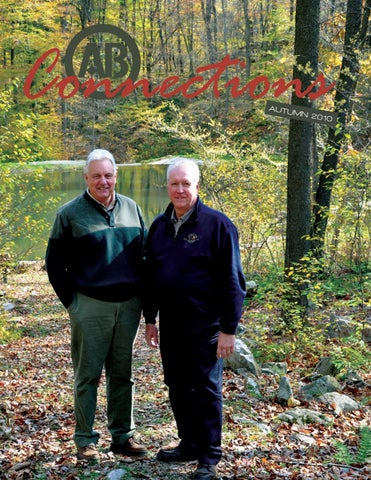
Bob Luffy, president/CEO and Mike Flowers, chief operating officer, pictured at AB's annual meeting at it's compound in the Western PA mountains
Much appreciation to the following individuals for their contribution to this issue: Mike Cegelis Wayne Davis Ken Farrelly Alex Fattaleh Mike Flowers Fred Jaquot Don Jones Henry Mykich Thomas Nilsson Steve Norton Chavis Lunceford Bob Luffy Steve Jackson Dave Partazana Stanley Walker Robert Yahng
SUCCESSI0N AND EV0LUTI0N AT AMERICAN BRIDGE
the new ceo evolution moving forward interview with bob luffy big shoes to fill mike flowers’ thoughts on bob luffy tactical goals stanley walker alex fattaleh donald jones as four key players retire, they leave behind deep imprints on the next AB generation
COMPANY 03
CURRENT C0NTRACTS AND NEW HIRES
27
AWARDS
45
ANN0UNCEMENTS
48
TRAINING
Session 5: this class is well on its way, having completed five of the eight sessions of their training program
NEWS 30
A TRIBUTE T0 B0B LUFFY
Chairman, Robert Yahng, expresses appreciation for retiring CEO Bob Luffy at the company’s annual meeting
50 52
FLASHBACKS AB PUBLISHED
The engineers who shaped our industry are prominent in the lineage of present day AB
PROJECTS 28
PR0JECT UPDATES
Arawak Cay Port Development, Pier R3 and Pier 31
32
BAY BRIDGE STEEL FABRICATI0N
Get the story behind AB’s decision to choose ZPMC for the SAS fabrication, which is not without controversy
by Kadi Camardese
newsletter Please contact the AB Communications & Marketing Department with news and inquiries: kcamardese@americanbridge.net
AUTUMN ’10 .
AB Connections . PAGE 2
53
ABM C0NNECT 0REG0N
$7.8 million grant enables ABM to expand sales from the Pacific to the Mississippi
NEW HIRES
Western District Michael Netcott, safety representative New York District Dan Bell, operations manager Benjamin Jones, field engineer Leigh Weissman, safety engineer Tampa District Charles Klemme, welder Guy Quinley, crane operator Pittsburgh District Seth Tuthill, system coordinator
CURRENT C0NTRACTS MANUFACTURING
Huey P. Long Bridge Widening Fabrication, New Orleans, LA Unicorn Bridges, New York, NY Bronx River Greenway Replacement, Bronx, NY Motor Parkway Bridge, Islip, NY Alexander Hamilton Brigde, New York, NY US 23 Grant Bridge, Portsmouth, OH Walt Whitman Bridge, Philadelphia, PA WESTERN
ABFJV Oakland Bay Bridge, Oakland, CA NEW Y0RK
Throgs Neck Bridge Structural Retrofits, New York, NY Bronx Whitestone Bridge Structural Retrofits, New York, NY RFK (Triborough) Structural Improvements, New York, NY South Grand Island Bridges Rehabilitation, Niagara River, NY Ogdensburg-Prescott Bridge Main Span Rehabilitation, Ogdensburg, NY Walt Whitman Deck Replacement, Philadelphia, PA TAMPA
Mayport Wharf Delta, Mayport, FL Castaway Cay Enhancements, Abaco, Bahamas Tampa Port Authority Phase 2B, Tampa, FL Estelle Pump Station Work Platform, New Orleans, LA Waskey Bridges, New Orleans, LA Arawak Port Development, Nassau, Bahamas Platt Street Bascule Bridge Rehabilitation, Tampa, FL PITTSBURGH
Kentucky Lakes Bridges, Grand Rivers, KY Emsworth Back Channel Dam Repairs, Emsworth, PA RICHM0ND
Chesapeake Bay Bridge Redecking, Annapolis, MD Chincoteague Bridge, Chincoteague, VA Pier R3 Repairs, Yorktown, VA Pier 31, Groton, CT Bulkhead at NOAA Marine Operations Center, Norfolk, VA
AUTUMN ’10 .
AB Connections . PAGE 3
THE
NEW C E0
OF AMERICAN BRIDGE
succession American Bridge is evolving, just as it has many times
throughout its 110 year history and just as large companies consistently do. We look forward to the continuation of growth and culture as CEO Bob Luffy retires after his 17 year legacy, relinquishing his responsibilities to current chief operating officer Mike Flowers. Although Bob will certainly be missed, Mike brings stability, leadership and extraordinary experience to the executive suite.
Bob Luffy, P.E.
Mike Flowers, P.E.
Stanley Walker, P.E.
Don Jones, P.E.
Alex Fatteleh, P.E.
evolution
Stanley Walker, AB chief engineer, Donald Jones, vice president, and Alex Fattelleh, AB west coast senior vice president, have also played a major part in the company’s culture and history. As we wish these three senior management figures well in their retirement, we know that what they have taught our current engineers will surely continue the American Bridge Way for decades to come.
Stanley Walker has taken many field engineers under his wing, bestowing upon them practical engineering skills that could never have been found at any university. This mentorship, coupled with the opportunity to apply it on the most technologically challenging projects, have consistently given AB the leading position in the complex bridge and marine construction industry. (Read about what Stanley’s students have to say about him on page 15.) Alex Fattelleh traveled from Jerusalem in 1957 to obtain his bachelor and master’s degrees and worked with AB for the next four decades. Over his career he has gained experience on a great variety of projects ranging from missile bases, pressure vessels and some of the most magnificent bridges. (Read his full story on page 18.) Don Jones has over 48 years of experience in the heavy civil construction industry and has been employed with AB for 15 years. He has worked on major steel and concrete bridges, dams, heavy foundations, and marine construction projects throughout the United States. Don’s career path has included stints as a field engineer, project engineer, superintendent, project manager, estimator, project executive and vice president overseeing a single large project or multiple smaller projects from which he has gained a plethora of knowledge in the field. (Read about his variety of industry experiences and stories on page 23.) Throughout the following pages you will find the history of Bob Luffy and Mike Flowers’ careers and how they have overlapped along the way, as well the impacts of Stanley, Don, and Alex. Although it is sad to see such influential members leave, the company as a whole is excited about the positive changes to come and the continued success of the American Bridge Company.
AUTUMN ’10 .
AB Connections . PAGE 5
moving forward
Chief executive officer, Robert H. Luffy, P.E. has announced his retirement from American Bridge Company effective December 31, 2010. He has been chief executive officer since 1993. The succession plan in place will result in Michael Flowers, P.E., currently chief operating officer of the company, assuming the role of CEO upon Luffy’s retirement.
AUTUMN AUT UMN ’1 ’10 0.
PAGE AGE 6 AB A B Connections Conn nections . PA
“
LUFFY’S LEGACY IS THE DEVEL0PMENT 0F THE AMERICAN BRIDGE WAY.
”
Luffy began his career at the legendary bridge company in 1972 as a field engineer on the Stephen Foster Memorial Suspension Bridge in Mayo, Florida. Early in his career he also worked on the New River Gorge Bridge, West Virginia, the Louisiana Superdome, New Orleans, the Hollywood Dog Track, Hallandale Beach, Florida and a truss bridge across the Ohio River at Cincinnati, Ohio and Brady’s Bend, Pennsylvania as well as several high-rise office buildings. Since becoming CEO during a troubled time in the company’s history 17 years ago, Luffy engineered a resurgence of the firm followed by sustained growth and operating success. During his tenure the company has constructed numerous internationally recognized bridge projects, including the reconstruction of the Williamsburg Bridge in New York City, the 25th of April Bridge in Lisbon, Portugal, the Lions Gate Bridge in Vancouver, British Columbia, the new Woodrow Wilson Bridge in Washington, DC, the currently in-process Self Anchored Suspension Span of the San Francisco Oakland Bay Bridge in California, and many others (pictured right from top to bottom). He also began the successful foray into heavy marine construction that has seen the company become one of the largest in that field in the United States, completing major port and naval projects along the eastern and western seaboards, the Caribbean, and the inland waterway system. Luffy’s legacy is the development of the American Bridge Way. This system incorporates strategic, operating, and developmental features that make American Bridge a uniquely differentiatable and sustainable company, and the leader in the field of complex, structural and marine construction. During Luffy’s tenure, this management process has been institutionalized, and has resulted in a 15-fold increase in revenues, a 20-fold increase in profits, a 10-fold increase in shareholder’s equity, and a many-fold increase in the market value of the company. Moreover, through an industry leading training program that focuses on recruiting promising civil engineering graduates and developing them for the special operations of American Bridge, the company is positioned to maintain and build upon its leadership in its important branches of the civil infrastructure industry. The company today is powered by a strong culture of can-do, which has it uniquely positioned within a small field of competitors who are able to competently and profitably deliver the world’s most challenging bridge and marine construction and reconstruction projects.
AUTUMN ’10 .
AB Connections . PAGE 7
While Luffy’s handpicked successor Flowers has large shoes to fill, he has been impeccably prepared through his 35 year career in the business and proven within AB’s system. Mike joined American Bridge in 1975 as a design engineer In the Pittsburgh Regional Engineering Office, working on various industrial, bridge and highrise projects all over the United States. Flowers received his BS and MS in Civil Engineering from West Virginia University and the University of Pittsburgh, respectively. In 1994 he was appointed senior vice president of operations, and in 2000 executive vice president of operations and manager of the Structures Group of the company. In 2006 he was appointed project director for the $1.6 billion San Francisco Oakland Bay Bridge Self Anchored Suspension Bridge (SAS) project being constructed by the American Bridge/Fluor Joint Venture.
In addition to the SAS, Mike’s extensive project experience includes the $100 million Kentucky Lakes Bridges, the $400 million Woodrow Wilson replacement bridges in Washington DC, the Florida Avenue lift bridge in New Orleans, the Gateway Boulevard arch bridge in Nashville, the $112 million Lions Gate Bridge reconstruction in Vancouver, Canada, the $264 million 25th of April Bridge rail deck addition in Lisbon, Portugal, the $152 million RFK Triborough Bridge rehabilitation in New York City, and many other projects. Flowers will be supported by the strong senior management team already in place at the company, consisting of Lanny Frisco (Pittsburgh District, Estimating), Pamela Bena (Finance), Jake Bidosky (American Bridge Manufacturing), Michael Cegelis (Special & International Projects District, Business Development), Amr El-Nokali (Administration and Legal), Scott Gammon (Kansas City District), Richard Kermode (Tampa District), Kwadwo Osei-Akoto (New York District), Brian Petersen (SAS, Western District), and David Simmons (Richmond District).
interview with BOB LUFFY
KD: What are your thoughts on the successions new CEO, Mike Flowers? BL: First and foremost, I hired Mike when I was away from AB in a senior vice presidential position at Mellon Stuart Company, and then I asked him to come on board after becoming president of American Bridge. I consider him a key to all we’ve accomplished over the past 17 years. Mike bridges tremendous knowledge of AB’s mission with its history and traditions; he has a clear sense of what is required to make this company successful. As a strong leader he will have no problem communicating these requirements to the company at large. He brings an exceptionally strong work ethic and ability to focus on a problem until it is resolved. Additionally, Mike is a top-notch engineer, the epitome of what we want our young engineers to aspire to become.
KD: Who has impacted your career to the most? BL: We are all products of our own environments. Everyone we come in contact with over the course of our lives - our parents, teachers, friends and coworkers - have an affect on us. We pick and choose qualities we would like to emulate about them. I have been blessed to have many terrific role models through the years, but above anyone else my father has had the greatest influence on my life regarding character and integrity.
KD: The training program has been a part of the AB culture for about three and a half years now, and the first class graduates this December. What were you thinking when you decided to formalize the program and how does it continue the AB way? BL: At the time I graduated, new graduate engineers were assigned to a job and they either sank or swam. It was always clear to me that process could be conducted in a more efficient Mike is solid and has integrity, the two key ingredients an indi- manner. I decided to formalize our in-house training to provide vidual needs in this position, in my opinion. We should remem- young field engineers a direct and constant relationship with ber that often, how a company is perceived is determined by a mentor. This preserves the AB Way and extends this body of the reputation and representation of its CEO. I have no doubt knowledge to every district. that AB will continue to be one of the most admired companies KD: From a mentor’s perspective, what advice do you in our industry because of Mike’s leadership. have for the trainees? BL: Attitude is everything. With the right attitude almost anyKD: Looking back, what are your fondest memories of thing is possible; with the wrong attitude not much is possible. working in the field? BL: My fondest memories have been working with truly unique If you arrive at work with a can-do attitude and excited to start characters, specifically early in my career. Superintendents such your day you know you are in the right business. as Algie Vaughn, Vern Borad, Perry Whitaker, Benny McClain You have to be able to be confrontational to succeed in our and many others. We had great times on and off of the job business. This doesn’t mean to be disrespectful in your dealtraveling all over the US. ings with people, but rather to confront issues as they occur. KD: What general steps were taken to develop the AB Way? BL: The single biggest leap we made was in 1993 when we transitioned from a subcontractor/steel erector to a vertically integrated construction, manufacturing and engineering company. Compared to the average construction company AB was more technologically advanced, and we took advantage of this distinguishing factor. To make this change we focused on a very limited segment of the overall heavy civil construction industry, which was the complex and technologically challenging structures market. With limited competition in this arena, we demanded higher profits. In turn, this enabled us to recruit and hire the finest and brightest engineers, therefore, further establishing our in-house means and methods erection engineering department. For a more diversified market, we included marine construction in the master plan, which has proved to be quite a success.
KD: Kadi Camardese, BL: Bob Luffy
Make a commitment to continuing your education through a graduate degree or further field training. In conversation with future associates and peers, your input will carry more weight as you gain industry experience and earn formal qualifications. Question everything. Never assume that anyone, by virtue of position or level of authority, is automatically correct. The person who always responds to requests with, “that’s not a problem, I’ll handle it", will always be a key part in an organization. You have to become known as a person who possesses integrity. The classic definition is doing the right thing even when nobody else is watching. Integrity is a characteristic that is developed over time and is measured on your life’s work at particular stages. One missed step is not fatal as long as you keep your focus on a long term perspective because life challenges will test your integrity daily.
AUTUMN ’10 .
AB Connections . PAGE 9
BIG SHOES TO FILL THE NEW AMERICAN BRIDGE CEO
MIKE FLOWERS TELLS US THE STORY OF HIS CAREER
AUTUMN ’10 .
AB Connections . PAGE 10
I received my Bachelor of Science in Civil Engineering from West Virginia University in December of 1974; my first day of work at American Bridge Division of United States Steel (USS) was January 13th of 1975. Of note is that on January 12th, 1975 the Pittsburgh Steelers won their first world championship. Coming from a small town in West Virginia with a total population of about 3,000, I was blown away by the celebration that ensued that night and into the next day. AB’s big project at the time was the New River Gorge Arch Bridge outside of Beckley, West Virginia. As I recall, Bob Luffy, Dan Radu, and Barry Bender were field engineer’s on the on the job and, at the time, Dennis Martin was a time keeper. I started in the Pittsburgh Regional Engineering Office of the American Bridge Division located in the US Steel building off of Grant Street in downtown Pittsburgh as a design engineer. As part of an industrial inspection group, which was responsible for structural inspection and repairs to USS owned facilities; I was principally involved in steel mill work. In those days, a great deal of the corporation’s income came from mill work and AB often used it as a training ground for both engineers and craft. I spent an abundance of time on the road in the Ohio cities of Lorain, Cleveland and Youngstown and later a stint at the Clairton Works in Pennsylvania’s Monongahela Valley. I met a young fellow working in a similar role in the Philadelphia, Pennsylvania area steel mills by the name of Lanny Frisco. I also spent a fair amount of time working out of AB’s Ambridge, Pennsylvania plant, working with the drawing room to coordinate projects in the fabrication shop. From 1975 through 1978 I went to the University of Pittsburgh’s graduate school in the evening to receive my Masters of Civil Engineering.
At some point in 1978, I was transferred from the industrial to the commercial group, working exclusively on high rise buildings, arenas and the like. As a project coordinator I worked extensively on high rise projects in Atlanta, Detroit, Denver, Houston, Boston and Pittsburgh. In 1981 I bumped into one of AB’s top bridge engineers who helped me out with a bit of falsework design for a high rise in Pittsburgh (Dravo Building later to become One Mellon Bank Center) - that guy was Stanley Walker! Not too long after that I was working in support of construction manager, Tom Owens on the PPG headquarters building in Pittsburgh, amongst other jobs. It was at this time that I first met a Blount Brothers engineer by the name of Brian Petersen. Our first meeting was a more than a little rough having something to do with the placement of steel for window washing equipment - of course in those days AB was never wrong! About a year or so later I was working in support of construction manager, Leo Kupiec on the rehabilitation of the Riverside Drive viaduct in New York City, which was my first meeting with superintendent, Tom Melvin and field engineer, Jake Bidosky. Some ironworker (whom I still know today) by the name of Delcostello was living on the shores of the Hudson River in a small, on-site trailer. A few building projects and bridge or two later, I found myself in charge of the steel construction on the Fifth Avenue Place high rise building in Pittsburgh working with a superintendent with a tougher than hell reputation by the name of Vern Deckard. And who of all people was his walking boss? It was this same Delcostello guy.
AUTUMN ’10 .
AB Connections . PAGE 11
ge erican Brid m A of t en presid 3 to become 9 19 1994, of ll fa the in April of s. r te la s th Bob left in t of operation en id es r p and six mon e c enior vi to become s it G 0FFICER u s ed ow F 0PERATIN I foll S, AB CHIE
“
ER MIKE FL0W
”
, parture from AB months of my de in ith W ck and wley and Chu t in my career, AB sold it to Brock Ro SS U , At about that poin es years of conA few successful fallen on hard tim r. ly ne al re ck d Be ha l ee St d myself in US the glor y days of ildings later, I foun of bu e g m in so ct r ru te st af ly ay Unit of especial laries were being Heavy and Highw e Sa th s. of 70 y ge rl ar ea ch d the the 60s an was undoubtedly as tr ying to is w Th . SS rt U d ua St an n t, lo cu Mel y career. The frozen, if not pretty bleak for to this point of m b ed jo ok t lo es gs gg in bi Th . as being sell AB ing in Chicago w discouraging to a en as id w w ch ay hi w w ll ny to y comthe compa rful and extremel mily. Then lo fa co g ry un ve yo a a by ith n w ru guy like me s. I bumped ty named Don Jone at guy ght in from the ou gu ou br nt e te er pe w ys gu two Cegelis and th ican Bridge. into a guy named king in side to run Amer ed up again wor d re pp te po en en ffy rs te Lu b Pe oyee Bo Next, ex-AB empl Florida. rrent position was times the picture. His cu rt ua Mellon St Stuart fell on hard n of t lo el en M id es en pr Th ce was a senior vi ironically, there to be the gend ed an en n, pp ow r ha ei ch th hi of Company w ought that AB oject, here I actually th my current AB pr w on od ri or ct pe ra nt co t low and eral of the blue one well buy them, bu ut O ry e. ve ac ht Pl ig m ue en hael Fifth Av as made with Mic who wanted to w b, al Bo de a om ld fr ll ho ca be day I got a elvania. Bob Luffy portunity was pr in Beaver, Pennsy op r ke An Ba h. nc lu ve lon Stuart, ha e of the hardest e President of Mel m on e co ad be m d I ha d an to Baker sented when I choose to estrating the sale er ch re or ca y y el m rg la of s h time decision still rememIt was a very toug n . ca ity I . ss ge ce id ne Br of t an ou leave Americ n. Nonetheploy Betty Back to career, I am certai s em b’ er Bo re ca in ng ki as e company ber e tearfully accom went through, th Sh le sa n. e io th at ss gn si le re y d things type m r I started work d dramatically an te ge la an ks ch ee w re w ltu fe cu A modated. the fall of 1993 neer on as a project engi orated. Bob left in rt ri ua te St de n lo el M r ican Bridge fo lpresident of Amer g greatly in know e in m ow co gr be b, to jo e m 1994, I the sa s later in April of racting business. th nt on co l m ra x si ne d ge an e ce presiedge of th ellon Stuart become senior vi M to r it fo k su or ed w w to llo t fo into my new When I wen , erations. I moved e there was a very ac op Pl of ue nt en de Av fth on Fi help from etar y on the job, ood Friday, with cr G se on or ce ni fi ju of g un xes very yo headed but While carr ying bo b. rd ha Bo a d d an an y , nn on La Laura Jamis dent by y old friend Betty enter superinten I bumped into m rp de ca si e in bl pa ca ry ve the same greeted me with ar. eh ho W w , u ck Lo Ba of e m n I left the na I had gotten whe tearful reception ars ago r. That was 16 ye ie rl ea s ar ye t gh ei the rest is histor y. and as they say -
AUTUMN ’10 .
AB Connections . PAGE 12
thought s on Bob Luffy
MIKE FLOWERS'
When I think of Bob Luffy, two attributes come to mind above all else, his vision and his drive. Most people within the company today don’t realize how shallow the talent pool at AB had become back in the early 90s when Bob returned to the company. Nor do most realize how very close the company had come to fading away into a non-union construction firm in the southeast. Righting the ship during the 90s had nearly everybody in the company stretched to the limit as we struggled to return to profitability and execute work that was way more our history than it was our experience. Enter Bob and pursuit of the Tagus River Bridge in Lisbon, Portugal. Winning and successfully executing the air spinning of the new cables for the long-span suspension bridge we had built in the 60s not only served notice to the business world that we were on our way back but was also a huge boost in confidence to our people that their efforts to grow the company were in fact working. The next thing you know we move our storehouse from an obscure location in Point Pleasant, West Virginia, to Coraopolis, Pennsylvania (current location), and a fledging fabrication business emerged in rental space in Carnegie, Pennsylvania. Shortly thereafter master plans emerge and we move forward with a modest fabrication facility and an office building of our own at the Coraopolis property. Development of a new marine segment of our business is undertaken in the southeast, and we successfully execute work in the Caribbean including development of the Castaway Cay cruise ship stop in the Bahamas. continued next page
“
... it was Bob’s vision and drive that led the charge back from near obscurity and for that we owe him a debt of gratitude! MIKE FL0WERS, AB CHIEF 0PERATING 0FFICER
Mike will take over the CEO position in January 2011
”
AUTUMN ’10 .
AB Connections . PAGE 13
future
TACTICALGOA L S MIKE FL0WERS, AB CHIEF 0PERATING 0FFICER
continued from previous page
After Tagus we successfully complete the rehabilitation of the oldest suspension bridge in the USA (the Wheeling Bridge) in Wheeling, West Virginia and go on to execute one the toughest bridge retrofits ever undertaken when we take on the Lions Gate Bridge project in Vancouver, British Columbia, Canada. Many new structures later, including the largest bascule in the world at the Woodrow Wilson Bridge in Washington, DC and we find ourselves executing the largest self-anchored suspension bridge in the world. At the original bid of $1.4 billion the SanFrancisco-Oakland Bay Self-Anchored Suspension Bridge is the largest public works contract in California history and AB being a key part of its construction is a tribute to Bob’s drive in pursuit of the project through a failed bid, budget problems, and the loss of a joint venture partner. Yet we now prevail in executing one of the toughest bridges ever built. As CEO for over 17 years, Bob bas seen about a tenfold growth in AB’s permanent party staff and has taken the company from little net worth to a formidable company with a book worth well in excess of $100 million and a market value many times that. Along the way, many hands and necks have made the work of growing AB ever lighter, but it was Bob’s vision and drive that led the charge back from near obscurity. For that we owe him a debt of gratitude! From one who has thoroughly enjoyed the ride, my personal thanks for the opportunity.
AUTUMN ’10 .
AB Connections . PAGE 14
• Careful strategic growth building from our strengths • Putting experienced key skilled people in place on our projects and supporting them with senior management oversight • More consistent business unit performance other than start up operations - no sacred cows, everyone must produce • Strategic goal - grow the company and preserve the brand
We need to put down a strong foundation in the United States and anchor it. We need to be able to successfully pursue work in all regions of the country with detailed knowledge of the markets. We will continue to look at international opportunities when they are unique enough to draw strong returns, and when they do not weaken our domestic operations. Given the difficult economic climate and extremely competitive nature of our business we need to stay true to our philosophies. We must be very selective, pursuing high value
complex jobs that bring strong return. We will work with our board team and our sureties to dramatically increase our single job limits where our strategic strengths and advantages don’t warrant partnerships. We must guard against the pitfalls of bidding against too many competitors and loading up with cheap work. Also to be successful in the current business climate I believe that we will have to be very diligent in identifying project risks, both pre bid and post bid, and develop detailed strategies to mitigate and manage those risks.
walker
STANLEY
NOTABLE PROJECTS
Woodrow Wilson Bascule Spans, Alexandria, Virginia Chicago Skyway Calumet River Bridge Rehab, Chicago, Illinois Gateway Boulevard Bridge over the Cumberland River, Nashville, Tennessee Triborough Bridge Rehabilitation, New York City Lehigh River Bridge, Allentown, Pennsylvania Bayonne Bridge Strengthening, Bayonne, New Jersey Florida Avenue Bridge, New Orleans, Louisiana Mackinac Bridge Traveler Replacement, St. Ignace, Michigan George Washington Bridge Hanger Replacement, New York Wheeling Bridge, Ohio River, Wheeling, West Virginia Williamsburg Bridge Reconstruction, New York Tappan Zee Bridge Deck Replacement, Nyack, New York Lions Gate Bridge Reconstruction, Vancouver, British Columbia, Canada Bronx-Whitestone Bridge, Long Island Sound, New York City Anthony Wayne Suspension Bridge, Lucas County, Toledo, Ohio East Street Bridge, Parkersburg, West Virginia Peoria Pekin Railroad Bridge, Peoria, Illinois Thames River Bascule Bridge, New London, Connecticut Pennington Avenue Bascule, Baltimore, Maryland Norwalk Bridge, Norwalk, Connecticut
QUICK FACTS Bachelor of Science in Civil Engineering, North Carolina State University Registered Professional Engineer: PA, NJ, NY, OH, WV and RI
OVERVIEW Mr. Walker has been employed with American Bridge Company since 1969 and has been in the construction industry since 1956. As head of AB’s engineering department, he was responsible for means and methods engineering including analysis of permanent structures during construction; lift and erection methods; crane capacity chart pick analysis and temporary structure design. Stan has extensive experience in the design, fabrication, and construction of steel bridges – especially movable, suspension, truss and arch structures. He is expert at analyzing bridge design for constructability, and guiding the design process towards the most efficiently buildable solution. Gateway Boulevard Bridge over the Cumberland River, Nashville, Tennessee
AUTUMN A AUT UMN ’10 .
AB Connections Connections . PAGE 15
Nicola (Nick) Greco, P.E., AB senior design engineer, San Francisco-Oakland Bay Self-Anchored Suspension Span Stanley Walker has made the largest impact on my career by far. While I was interning with American Bridge, Stanley laid the foundation for my entire engineering thought process. He directly and indirectly taught me how to approach a problem, strategize a plan, execute a design, and interact with my peers whether they are colleagues, students, or ironworkers. In my eyes Stanley embodies the true definition of an American Bridge engineer tackling a problem using his technical expertise and turning it into construction practicality. He never failed to demonstrate how to approach a challenging problem and come up with an efficient, cost-effective, and safe solution for the field, backed by the highest level of calculations. Stanley taught me to do all this and to also keep a tight interaction with the project superintendent throughout a design. I strive to incorporate Stanley’s thought process model in everything I do and hope to one day be able to have and pass on half of the structural engineering and equipment knowledge Stanley possesses.
Mike Flowers, P.E., AB chief operating officer When I started to work at American Bridge in the 1975 we had a group of elite bridge engineers in Pittsburgh regional office that were well known as the best in the business in developing erection means and methods on very complex structures. Stanley Walker was one of those elite bridge engineers. I can’t tell you how in many times in the early days in my career that I went to meetings with owners and their design engineers looking for direction only to have them ask how AB would solve a complex problem. That kind of respect is a direct result of our culture and our reputation for being able to pull off what no one else can. We owe guys like Stan Walker our respect and our gratitude for keeping that legacy alive! The next time you pick up one of our strategic plans or any of our marketing materials and see the common theme that a key part of our central company strategy is the pursuit of complex, high value work, think of Stanley and what he has meant to our ability to execute the work that is so seminal to our culture. Stan you have my personal respect and gratitude for your dedication and your key role in helping AB grow back into its reputation.
AUTUMN ’10 .
AB Connections . PAGE 16
“
Mike Cegelis, AB senior vice presid ent of special & national projects inter-
Stanley is a terrifi c role model for American Bridge highly competent engineers. He is , innovative, prac tic al an d de cis ive. He is a mento not only for our r young people, bu t also for our mor managers and ex e senior project ecutives. For them he represents a so fidence that a pa urce of conrticular design or pr ocedure will be su has a conviction, ccessful. He born out of dilig ent study, trainin that enable this co g and experience nfidence. Moreo ver, he’s a straight people where th up guy that tells ey stand, and is a re al cr ed it to Am pany and the engin erican Bridge Co meering profession. Stanley ’s a consta for me, and I alrea nt inspiration dy miss working with him.
Adam Reeve, E.I.T ., AB field engine er, San FranciscoOakland Bay SelfAnchored Suspen sion Span Stanley and the co -op
program he has developed were instrumental t as an engineer. Un de r his guidance, an wealth of knowled d with his ge and experienc e in the industr y I was given the op to dr aw from, portunity to work on a wide variety reinforcing my ac of pr ojects, ademic training wi th practical work a young enginee ex pe rie nce. As r, this exposure to technically difficu solutions and the lt pr ob lems and American Bridge culture of innova lence has proven tio n an d excelto be very valuab le. in my developmen
Adam R. Roebuc k, P.E., AB design engineer, San Fran cisco- Oakland Ba y Self-Anchored Su spension Span I came into my fi rst co-op rota
tion only knowin g the most basic ciples. Over the course of three ro exposed me the tations, Stanley numerous aspects of co ns tru ction, design and engineering behi the nd both. Those of us fortunate enou co-oped under St gh to ha ve anley are aware of the vast depth of he contains. Mor knowledge that e importantly, ho we ver, is his unique along that knowled ability to pass ge and help guid e and motivate yo Working under St un g engineers. anley has helped mold me into th am today. e engineer that I engineering prin
Carl Schwarz, P. E., AB constructi on engineer, Pitt District sburgh
Stanley has alway
s been willing to take the time to share his knowlnce with me and th e other engineers This has helped he supervises. us all to grow th rough our career s, and this know edge is what allow ls us to continue to undertake chall enging jobs. edge and experie
Ben Reeve, P.E., AB Forth Road Replac ement Crossing, Means & Methods
Stan of course is a wealth of engin eering knowledge but one of the m and experience, ost important qu alities of a man in ability to relate an his position is hi d communicate we s ll with ever yone interns to superin fro m fi rs t ye ar tendents to high -level engineers. unending patienc Stan always has e (No matter how many times he ha something to me! d to re-explain ) and would alw ays drop whatever figure a solution he was doing to out with anyone . A big part of reco younger brother m mending my to AB, is that I kn ew th e be gin ning of his matur with the company ation would be overse en by Stanley Wa retirement, Stan lker. After his will surely be miss ed!
Sara Hansel, E.I.T ., AB field engine er, San FranciscoOakland Bay SelfAnchored Suspen sion Span Stanley was the fi rst en
gineer I worked with at AB and fo rever left an e. He had the am azing ability to lo and instantly see ok at a situation any problems wi th it. To this day an engineering ch when faced with allenge I always think, “What woul Few people I’ve d Stanley do?” known have half of the natural talen t that he has. impression on m
Ugo Delcostello,
If there was ever
AB project superi
an engineer that
Stanley - he is a sp
ntendent
I would trust with
my life it was ecial breed of en gin ee r; eq ua l pa inventor, and en rts dreamer, trepreneur. Over the years he has my rough sketch taken several of es and wildest sc hemes and turned working concept. them into a He may not be as well known as; Am Steinman but he mann, Eads or is of no less impo rtance in shaping our country.
AUTUMN UMN ’10 .
AB Connections . PAGE 17
fatt aleh
ALEX
OVERVIEW Alex Fattaleh, P.E., S.E., long time manager of AB’s Long Beach office and a mentor and friend to many senior officers of the company, is retiring. Alex has had a remarkable 46 year career in the civil engineering and steel construction industries, 41 of which he spent with American Bridge. Beyond his outstanding career, his personal story is the American dream. After a difficult childhood in Amman, Jordan, he managed to relocate to the United States where despite severe financial constraints he used intelligence, motivation, and hard work personality traits to earn a degree in Civil Engineering from the University of California at Berkley. As a successful engineer and senior manager with American Bridge Company, Alex completed hundreds of challenging projects throughout the American west and in other parts of the globe.
QUICK FACTS • part-time structural steel design professor for 20 years at CA State University, Long Beach • wrote and published two books as review for the California professional exams • guest speaker for the AISC in cities across the nation • gave two days lectures in Taiwan on constructing, estimating and managing high rise buildings for Continental Engineering Corporation and their colleagues • licensed professional engineer and structural engineer in California and Arizona • licensed as a general contractor by CA, AZ, NV, UT, WA and OR • member of the following professional engineering associations: AISC, ASCE, IASE, ACI, SEAOSC, The Council on Tall Buildings, The Beavers, Tau Beta Pi
Coro
nado
Brid
ge ,
AUTUMN ’10 .
San
Dieg
o, Ca
liforn
ia
AB Connections . PAGE 18
HIS STORY I was born in Jerusalem in 1937 where my family resided until we emigrated to Amman, Jordan due to the unrest from the Arab-Israeli conflict during 1948. In Amman, my uncle’s house was overcrowded, so my three brothers and sister stayed in a cave near his home. We didn’t have any toys or electricity or any modern conveniences that we enjoy today. I remember collecting the bullets that hit our stone house. In the late hours of the night I studied by gasoline lamp, determined to be successful in life in order to later assist my family. I underwent my high school studies at Terra Sancta College in Amman, a San Franciscan Catholic brotherhood school. Upon graduation in 1957, I convinced my parents to send me to the United States to study engineering. With no extra money on hand, my dad borrowed enough to get me on an Egyptian freighter called Cleopatra. The passage from Beirut, Lebanon to New Jersey took 21 days, stopping at every major sea port in southern Europe.
I arrived in New Jersey with $85 in my pocket, just enough to buy an airline ticket from New York to Los Angeles on TWA (Trans World Airlines). It took 10 hours to fly nonstop with four propeller engines - there were no jet planes then. I stepped off the plane into the Los Angeles airport without a single penny in my pocket and asked someone there to help me to contact my uncle in Los Angeles. My uncle picked me up and I stayed at his home for one week; he found me a job the second day after I arrived as a bus-boy.
Mike Cegelis, AB senior vice president of special & international projects
For the next two years, I attended Los Angeles City College when I wasn’t working. I saved every penny earned from my wages of $1.25 per hour plus $1.00 tips each day. Maintaining a high grade point average enabled me to be admitted into the University of California at Berkeley where I obtained my Bachelor of Science in Civil Engineering in 1961. When I completed my studies, Bethlehem Steel hired and transferred me to Minot, North Dakota to work on the Minuteman Missile Program as a field engineer.
“It would be hard to find anyone more enjoyable to work with than Alex. He has a love of life and meeting new people of different cultures, a curiosity to explore new places and new ways of doing things, and he’s a great engineer. Traveling with him is always good for some riotous laughter. I’ll really miss working with him and wish him the very best in his retirement.”
In 1962, I left Bethlehem Steel and headed back to California with plans to complete my master’s degree in engineering. My plans were waylaid when I stopped to visit American Bridge’s office in Cheyenne, Wyoming, who held a contract for a Minuteman Missile Program too. The manager of AB, Mr. Harold Johnston, liked me and hired me on the spot. He gave me the title ‘top surveyor’. (In 1979, I finally did earn my Master of Science in Civil Engineering).
AUTUMN ’10 .
AB Connections . PAGE 19
Mike Flowers, P.E., AB chief operating officer
Co ld San Spr ta B ing arb Can y ra, CA on Br idg e,
“When I came back to work at AB in 1994, one of the very first trips I took was to the west coast to meet with AB’s regional manager in Los Angeles, Mr. Alex Fattaleh. Over the years, I grew to know and respect Alex as a consummate structural engineer and a professional very capable of executing complex construction projects anywhere! In recent years, in addition to projects of note in California, Alex successfully managed projects for AB from the remote areas of St.John’s and Page Arizona to an urban locale in beautiful San Juan Puerto Rico to a third world setting in Montevideo, Uruguay. Always very attentive to details and a good planner his jobs were a pleasure to visit and I always left with renewed confidence in our ability to go anywhere and do anything. A perfect gentleman, Alex was always open to receiving guests, and welcoming them to ‘his district’, no matter where in the world we were! He would go out of his way to share his pride in performance for his beloved American Bridge Company and very few have as much fun doing their job as Alex did. Alex I congratulate you on your noteworthy career and offer my personal thanks for your support, your loyalty, and the fun we had together over the past many years.”
Today American Bridge is known as an advanced civil engineering contractor with specialties in bridge and marine construction. This has been an evolution, since when I joined AB in 1962 it was almost exclusively a steel contractor. The engineering competence has not changed, but the project focus has shifted from all manner of steel construction to bridges and marine, and from steel-only to a much broader range of civil construction. I gained experience working with the US Army Corps of Engineers and the Air Force Civil Engineers at night, establishing the north target by bringing the North Star line on the ground. Later, I was in charge of setting the 19’ extension of the 90’ missile silos, the silo blast doors, the access hatches and was finally a member of the validation team to turn them over to the government. I worked on 600 missile sites located in the states of North Dakota, South Dakota, Wyoming, Missouri and Montana. The Minuteman Missile Program was initiated during the cold war between the Soviet block of countries and the west. The United States was prepared to defend itself by building and deploying an Intercontinental Ballistic Missile system that could launch a nuclear weapon in the United States and detonate it at a target over 5000 miles away. In an open farm country we located the north point on the ground to establish the silo’s location. The missile was further adjusted inside the silos to its exact location for firing. Our job as a surveyor was to locate the north direction on the ground, and from that point, we were able to establish all four coordinates (N, S, E and W ) for construction use. The US Army Corps of Engineers established the longitude and made the final adjustments, as the North Star rotates and is not exactly north. After the Minuteman Missile Program was completed, American Bridge assigned me to the plate department in Los Angeles. The work involved many projects with the purpose to bring water from northern to southern California. We built large diameter discharge lines, penstocks, power houses, siphons, surge tanks, pumping stations, dam gates and the twin Tehachapi tunnel liners (five miles long underground). In addition to water related projects, we built water tanks, oil storage tanks, float roof tanks, pressure vessels, refineries, and conducted hydro-testing and stress relieving of the heavy welded plates.
AUTUMN ’10 .
AB Connections . PAGE 20
The mid 1970s brought the boom in high rise buildings throughout San Francisco and Los Angeles. I was transferred to the structural department to build bridges, high rise buildings, convention centers, arenas, ball parks, museums, and to maintain some structural elements of the Geneva Works steel mill in Provo, Utah, such as coal blast furnaces, coal handling facilities and soaking pits. I had the opportunity to work on the tallest buildings of that time in Los Angeles, San Francisco and Seattle. My involvement with American Bridge extended to build the Seattle airport expansion and changing some suspenders on the Golden Gate Bridge. Being young at that time of my life, I enjoyed the challenge to work on complex projects and did not mind to travel and put my heart in the various type of work to which I was assigned. I had never dreamed of working on such momentous projects, and I relished the variety. In late 1978, the Japanese entered the west coast market with their fabricated structural steel material at very low prices. Because of that, the major steel fabricators on the west coast went out of business, namely USS, Kaiser and Bethlehem Steel. When the American Bridge Division of USS closed their fabricating facilities in 1980, I decided to resign from American Bridge and work independently. For the next five years, I was successful in importing fabricated steel from Korea to build high rise buildings in all of the major cities on the west coast. In 1986, American Bridge requested I come back to work for them as senior vice president, west coast project executive. I happily complied and remained working with the company until this day. In these last 25 years my work has included the major coal fired power plants
at St. John and Page in Arizona, the erection of the structural steel for the Pacific Design Center in Los Angeles, the Walt Disney Company Headquarters in Burbank, the Manulife Tower in Los Angles, the Space Launch Complexes 2W and 4W at the Vandenberg Air Force Base in California, the Los Angeles Convention Center, the San Diego Convention Center, the San Diego Ballpark, the Puerto Rico Convention Center, the Boeing 747 Puerto Rico Convention Center Assembly Plant in Everett Washington, the Antel Tower in Montevideo, Uruguay, the Cold Springs Canyon Bridge seismic retrofit in Santa Barbara, California, the Long Beach Freeway seismic retrofit, the Coronado Bridge seismic retrofit, Navy Piers 1&2 rehabilitation in San Diego, Navy Pier 3 rehabilitation in Bremerton, Washington and others. Recently I have been active in helping the International Division in bidding major bridge projects, including the Port Mann Bridge in British Columbia, the Deh Cho Bridge in Canada’s Northwest Territories, the A-25 Bridge in Montreal and the Simon Fraser Bridge in British Columbia. I have also been actively involved with the American Institute of Steel Construction (AISC), writing papers and giving lectures on numerous occasions. In my field of Civil Engineering, I have written the Structural Steel Design Review book as a study guide for candidates sitting for the California Professional Engineer and Structural Engineer exams. I taught a structural steel design course at California State University at Long Beach for over 20 years. It’s hard to leave this terrific work behind, but at the same time I am looking forward to my retirement. My wife of 29 years, Nancy, and I look forward to many fun years with our daughter and three grandsons (whom we will spoil).
AUTUMN ’10 .
AB Connections . PAGE 21
Interview wit h ALEX
KD: What were some of the most noteworthy projects you worked on with AB? AF: Looking back, every project was a great project throughout my career with American Bridge. From every job small or large, I learned a lot and gained much experience.
Columbia Seafirst Tower, Seattle
When I was working independently, I had the chance to target the jobs I wanted, estimate them, negotiate contracts and then build them. The most exciting structures I built were the Los Angeles Convention Center and the land mark Puerto Rico Convention Center. KD: What was the most fascinating job you had with the company? AF: The Minuteman Missiles Program was one of the largest contracts held by American Bridge during the cold war era. Our government prepared to defend the country by planting missiles every ten miles in the mid-western states, for which AB built control centers and connected them to the Cheyenne Mountain in Colorado Springs. There were a total of 1050 missiles in North and South Dakota, Wyoming, Montana and Missouri. Today, most of these missiles are obsolete and the silos are filled with grains. KD: Will you give us an example of a challenging project? AF: A Almost every project we built was w challenging. The San Diego Baseball Stadium project was the most difficult to manage because there were many shop fabrication errors made by the Korean steel company. We never lost a penny on any of our projects on the west coast and we met every schedule on every project we had, because every job was managed efficiently and professionally.
KD: What are your fondest memories of AB? AF: My fondest memories of AB are its people. Everyone I knew within AB had a friendly and welcoming disposition. I love the company and its management. The vision of its leaders is to constantly make any necessary changes to remain current with the most recent technological advances of our industry. Of course if it were not for president and CEO Bob Luffy, AB would not be as successful as it’s been in recent years. I have great respect for his leadership and knowledge. Bob’s persistence in building AB has been successful and consistent as he is continually advancing the company. KD: What is your advice to those who are young in the company? AF: My advice young engineers joining our company is to always work hard and appreciate the rewards as your efforts pay off. You will not find the unique and diverse opportunities working on as many projects worldwide at any other company or from a university. Take great pride in being an AB employee. Remember that many companies today are offspring of American Bridge’s work. Never believe that the grass is greener on the other side. American Bridge has been the leader in civil engineering for over 100 years, building a plethora of large, complex structures in the building, bridge and marine work arenas – many of which are civil engineering feats that cannot be challenged by other companies. We take educated risks based on our accumulation of experience, resources and knowledge by the best of engineers in the industry. Do your work faithfully and the company will take care of you. Remember, I came from a small country and was penniless; now, I am retiring comfortably with great pride. Learn from your foremen, your superintendents and your managers. Know that the cost of always performing thoroughly and safely is small when compared to the return from your efforts. Always keep your credentials high and be constantly acquainted with the most cutting-edge technological breakthroughs in the engineering discipline. Be proud of your company - the American Bridge Company.
DONALDjones After 48 years in the heavy civil construction industry, Donald Jones is retiring from American Bridge to travel and spend time with his family. This is what most retirees aspire to do after so many years of working, but Don is anything but typical. He is always telling a story, a good story … about all of the trips he has taken thus far. He truly makes you feel like you were sitting right there at the dinner table in China. Furthermore, his stories incorporate the abundance of knowledge he has gained from years of experience. In the paragraphs to follow, enjoy reading about the life of this extraordinary engineer and leader.
When Don was asked his most memorable career project he answered with identical response as the most challenging job. …”Being project manager and building the Steel Creek Dam which had a strict eight month time frame and faced liquidated damages of $100,000 per day.”
loading. The DOE then assigned the Corps of Engineers to administer the construction contract. Due to this liquefiable sand my company received changed orders to remove an additional ten foot depth of material from the dam footprint and to perform all known ground modifications at that time.
One of the saddest days of my life was a Monday morning when the vice president came down from the senior management meeting and stopped by my office to ask me to come to his.
The Steel Creek Dam is located on the US Department of Energy’s (DOE) Savannah River plant in Aiken, South Carolina. This site has multiple nuclear reactors to produce tritium gas that is used in building plutonium bombs. All the reactors except for the ‘K-reactor’ were shut down due to environmental contamination. The K-reactor was shut down one week after I arrived on the site because it was dumping 200 plus degree Fahrenheit water directly into Steel Creek that flowed into the Savannah River. This dam was built to cool the water from the K-reactor before passing onto the river. The reason for the high liquidated damages was President Regan’s requirement to have the K-reactor up and running before he met with the Russians. DuPont, who was the DOE’s Savannah River plant administrator and operator, choose the dam location and designed it. The DOE had the Corps of Engineers check these specifications only to find DuPont picked the absolute worst location on the whole plant. It was underlain with liquefiable sands that would cause the dam to fail under earthquake
It was quite an experience! We did deep soil grout compaction, built vibratory stone columns for both compaction and ground water pressure relief, dropped 15 ton heavy weights from a height of 100’ to consolidate the soil and then used five ton weights dropped from a height of 50’ to iron the dam footprint before constructing the initial earth-fill dam. At one time we had 11 crawler cranes on the project when there should have only been one to build the reinforced concrete operations tower and place the prestressed outlet pipe. The project bid before the Corps of Engineers determined what ground modifications would have to be undertaken - original low bid was $18 plus million with a fee of $1.8 million. The final contract value was $34.6 million and the fee was increased to $9.5 million. With all of the change orders we had time extensions to 18 months, but we completed the
AUTUMN ’10 .
AB Connections . PAGE 23
n Tappa
Zee
rk ew Yo
ack, N
e, Ny Bridg
, Ohio
ledo ge, To
ny
Antho ida
i, Flor
au
thur C
MacAr
, Miam seway
project in 13. The Corps of Engineers awarded us with Contractor of the Year. It was an ‘easy ‘(facetious) project to manage. We worked two shifts per day seven days a week, which included Thanksgiving, Christmas and News Years day. It was the most gratifying job because the previous job was Lock and Dam One on the Red River. When I took over that project it was under an interim of unsatisfactory performance from the Corps of Engineers. We took the same management team to Steel Creek Dam – receiving the Contractor of the Year award and increased fees sure helped sooth some of the pain from Lock and Dam One. One of the saddest days of my life was a Monday morning when the vice president came down from the senior management meeting and stopped by my office to ask me to come to his. His personality was nothing short of easy, even jovial any other time, but I knew this was serious when he told me to close the door. He never shut the door to that office. A million things went through my mind; mainly
AUTUMN ’10 .
AB Connections . PAGE 24
Brid Wayne
what did I mess up? He pulled a letter out of his pocket and as I read of my predecessor’s resignation I simultaneously produced about a thousand excuses of why I shouldn’t go to the Lock and Dam One project. I had already been promised to be stationed in the Charlotte office for the next two years, since we didn’t want to move while my daughter was a high school junior or senior. The vice president then said, “I figure there are only two people in this company that have the ability to take over this project.” Oh, I thought, maybe he is just giving me first dibs! Who are they? He said “You and I.” This was the point I knew my preferences and excuses meant nothing because he sure wasn’t going to take over the dam project. Shortly thereafter I was assigned project manager of Lock and Dam number One on the Red River in Vic, Louisiana. This dam consisted of constructing eleven 50’ tainter gate bays with a lock that was 83’ wide by 600’ long including the approach walls and the construction of the cut-off flood walls. This was a significant project for 1980, about $145 million. Prior to the 15 years he has spent with American Bridge, Don has worked for more than
traveling forms filling the voids. Last we back filled the excavation then pulled the steel solider piles and rebuilt the street.
ten different construction companies. Over this time he has gained a plethora of knowledge of practices within the heavy engineering construction business and advises field engineers to obtain as much experience as possible. “I have been fortunate to have a very diverse career which enabled me to experience all facets of work. I advise young engineers to do the same. This exposure will make you a valuable asset to the company and to yourself,” encourages Don. Some of the projects consisted of the West Virginia University People Mover, the Bulk Mail Center in Atlanta, Georgia, the Elevated Guideway System for the Baltimore Rapid Transit System, Aquilla Dam in Hills Borough, Texas, the Baldwin Bridge in Connecticut, the Lock and Dam number 26 on the Mississippi river in Alton, Illinois, and the Interstate 295 Tollway Bridge in Illinois. With 48 years experience, there wasn’t enough room in the newsletter to hear all of Don’s stories, so I asked him to share some of those that are most significant. One of the more significant jobs was the MARTA (Metro Atlanta Rapid Transit Association) Section CE 340, in Decatur, Georgia which was a cut and cover project. We drilled the shoring piles to the bottom of the tunnel, set them and poured lean grout around them. The piles were then driven with a diesel hammer to seat the toes. Next we excavated and placed timber lagging. When bottom was reached we graded and poured the reinforced concrete section of the tunnel. Then the reinforced concrete side walls mid-wall and lid were placed in one operation with two
Florida Avenue Bridge, New Orleans, Louisiana
The Cooper River Bridge in Charleston, South Carolina was also significant. It is approximately two miles long with pre-stressed concrete I-beam back spans. The mainspan is a three-span thru truss about 90’ high and 90’ wide consisting of fabricated steel box sections. The project also included steel sheet pile cofferdams in the river with steel H-pile and pipe piles driven inside. Tremmies were placed in the cofferdams and the footing and piers were constructed of reinforced concrete. About a half mile section of the bridge crossed an old dredge spoil island. This area required caissons of reinforced concrete to be drilled into the underlying marl clay and the pier columns consisted of pre-stressed reinforced spun piles 54” in diameter. Reinforced concrete caps were then placed on the piers and the conventional pre-cast I-beam deck was positioned on top. When all of the pier foundation work was complete and the steel truss erection underway, I was transferred to the James River Cable Stayed Bridge in Richmond, Virginia. The James River Bridge was approximately one mile in length and was constructed of all segmental components. The piers rested on reinforced pre-stressed concrete piles and conventional reinforced concrete footings. The piers were pre-cast, posttensioned segmental box section stacked on the footings. The back spans consisted of pre-cast, pre-stressed, post-tensioned roadway segments that were erected using a truss launching gantry spanning from pier to pier. The mainspan consisted of pre-cast, pre-stressed, post-tensioned roadway sections tied together with delta frames and supported by stay cables that draped over the pre-cast, post-tensioned concrete pile-on sections. The pre-cast delta frames tied the two adjacent roadway deck sections together and also served as anchorages for the cable stays The stays
AUTUMN ’10 .
AB Connections . PAGE 25
continued from previous page
were 9.5” in diameter and had 90 high strength, pre-stressed 0.6” steel strands that were stressed with two one million pound capacity jacks. I was working on the West Virginia University People Mover Phase One when Mike Flowers was a ‘young pup’. Years (many years) later while I was working in Chicago he came into my office. Naturally, as he waited for me to finish a phone conversation he looked at photos, awards and paraphernalia lying around. The picture of the people mover station on Walnut Street was of particular interest to him. Mike had just taken over as head of the heavy construction division of Mellon Stuart and was in the area visiting the Bentonville Station Tollway project. ‘Where did you get the picture of the WVU people mover?’ asked Mike. I explained that I was a general superintendant on the job and he admitted to watching the entire process from his apartment at school. I said I knew you were a young pup! Mike resigned from the heavy construction division and went to work for American Bridge. I took over his position only to leave it for AB a year later. During his time with AB, Don has worked on the Woodrow Wilson Bascule and Maryland approach contracts in Washington, DC, the Cumberland Lake Bridge in Burnside, Kentucky, the Florida Avenue Bridge, New Orleans, Louisiana, the Lions Gate Bridge in Vancouver, British Columbia, the Tappan Zee Bridge precast concrete manufacture, Nyack, New York, the Anthony Wayne Bridge in Toledo, Ohio, the Williamsburg Bridge Rehabilitation New York City and the MacArthur Causeway in Miami, Florida. Moreover, Don was part of the foundation construction for the original American Bridge Manufacturing (ABM) facility and paint shop at Coraopolis location. He also took part in the initial planning and start of construction of the ABM Reedsport building. After 48 years in the heavy civil construction industry, Don has expertise in every aspect of the business, including multiple bridge types and other specialized engineering projects, estimating, and operations. His influential characteristics have proven to be an asset to American Bridge especially since he has taken a leadership role in strengthening the concrete construction capabilities of the company. Perhaps more than anyone, Don has given the company confidence in its ability to take on the type of complex concrete works that are now routine in our operations. We wish Don well and thank him for the imprint he has left on so many of our next generation of engineers.
annual open enrollment The time to make any changes to your benefits without a qualifying event is during annual open enrollment. This year’s open enrollment period will begin mid November and end mid December. Changes during open enrollment will
go into effect January 1, 2011. Look for notices from the Human Resources Department (HR) over the next month for more details.
important changes with your
flexible spending account In March President Obama signed the Patient Protection and Affordable Care Act and the Health Care and Education Reconciliation Act of 2010. This new law changes the way participants can use their flexible spending account. Effective January 1, 2011, over-the-counter medicines will only be reimbursed if submitted with a doctor’s prescription. Exam-
AUTUMN ’10 .
AB Connections . PAGE 26
ples include pain medication (aspirin, ibuprofen and acetaminophen), anti-acids, laxatives, first-aid creams, anti-itch creams and anti-biotic ointments. Examples of medicines that will not require a doctor’s prescription include Band Aids, contact lens supplies, and diabetic supplies. Please contact the HR for a complete list.
awards ab's mike cegelis recipient of paul f. phelan memorial award Mike Cegelis, AB senior vice president of special and international projects, was recipient of the Paul F. Phelan Memorial Award in October from ARTBA (American Road & Transportation Builders Association). For the past two years Mike has served as chair of the ARTBA’s Bridge Policy & Promotion Council Project Delivery Committee. The committee consists of contractors, consulting
engineers, owners, and academia, and has developed a code of industry practice for design/build projects. The code is now in review by the Divisions and full membership of ARTBA, and is expected to be fully adopted by 2011. Upon adoption, the code will serve as the industry’s reference point for accepted practice of design build.
point marion bridge recipient of ashe award The Gallatin Memorial Bridge (Point Marion Bridge) was recipient of the 2010 ASHE (American Society of Highway Engineers) Pittsburgh Section Outstanding Highway Engineering Awards, for which, American Bridge Manufacturing (ABM) received recognition for the fabrication and erection portion of the project. The Point Marion Bridge is a 48’ wide by 412’6” long through-truss bridge completed in 2009. As a subcontractor to sister company ABM, American Bridge erected the new parker truss over the main channel for this 746’, new four-span bridge over the Monongahela River. The truss was trial assembled in ABM’s shops on the Ohio River, disassembled, loaded on AB barges, and floated about 95 miles upstream to the Point Marion site. It was erected on one falsework bent with cantilevered erection to the other pier. Structural steel weight is 1,250 tons and the bridge width is 48’ center to center.
t Marion
New Poin
Poin t
Mari
on tr
uss i
n AB
M Pi
ttsbu
Bridge
rgh y
ard
AUTUMN ’10 .
AB Connections . PAGE 27
Project Updates Pier R3
by: Steve Jackson, AB project manager
Arawak Cay Port Development by: Chavis Lunceford, AB project manager
Overview of pier R3
Working under a $31 million design build contract, American Overview of Arawak Cay Bridge Bahamas, Ltd. (ABB) commenced construction of the Arawak Cay Port in Nassau, Bahamas during the summer of 2010. The Arawak Cay Port Development Project is a private-public partnership between the government of the Bahamas and private local investors. The purpose of the project is to relocate shipping operations from downtown Nassau to the less congested Arawak Cay, west of downtown. The scope of work consists of 2,500LF (linear feet) of sheet pile bulkhead and concrete encapsulation, 1,800LF of concrete apron, a RORO (roll on, roll off ) dock supported by 36” steel pipe piles and approximately 150,000 cubic yards of dredging. Work is progressing well with the RORO dock piles complete and 25 percent of the sheet pile bulkhead installed. Project completion is scheduled for September 2011. ABB’s design subcontractor is Halcrow.
AUTUMN ’10 .
AB Connections . PAGE 28
The $6.4 million Pier R3 project in Yorktown, Virginia was awarded to American Bridge under an ongoing MACC (Multiple Award Construction Contract) with the US Navy. The project involves the rehabilitation of an existing U-shaped concrete pier used for loading and unloading supply ships with major weaponry. A new fire protection system on the inside edge of the concrete pier and new fire pump equipment has been successfully installed. After positioning the insulation jackets at the pipe joints, this section of the project will be complete. This new protection system is designed to protect the Navy and public works personnel in the event of a fire while handling the ordnance on the fleet of ships entering the Yorktown Naval Weapons Station on the York River. All of the work took place without interfering with the Navy’s operation. The project will meet its contractual completion date of November 1st. At the present time the work is substantially complete and includes the removal of train and crane rails and the pouring of concrete in its place; removal and replacement of door frames; installation of doors and hardware in the office buildings; removal and replacement of overhead lights; removal of bollards and installation of air mast poles with new grounding system; removal of all sewage pump house equipment, piping and the installation of replacement; removal and replacement of fire pump house equipment, pipe and valves; and removal and replacement of fire alarm system.
Project Updates
Pier 31
by: Ken Farrelly, AB operations manager
Pile driving operation from trestle and support crane
Airlift pipes
American Bridge is general contractor for the US Navy’s new $35 million Pier 31, located at the Naval Submarine Base New London in Groton, Connecticut. The scope of work includes the demolition of an existing pier and the construction of a new 550’ long x 67’ wide naval submarine pier with associated utilities, fender system and other amenities. The pier is supported by 116 concrete filled steel pipe piles of 36” diameter, 75 of which will be driven and secured with drilled rock sockets. The remaining piles are friction supported. The pier is constructed of a complex honeycombed cast-in-place concrete substructure of pile caps, duct banks and mechanical chases which will be topped with a cast-in-place concrete deck. American Bridge is self-performing the demolition, piling, precast erection, castin-place concrete and fender system, along with other miscellaneous items. Major subcontract work includes: site utilities, mechanical and electrical systems. MEANS AND METH0DS
The Pier 31 project was awarded based on best value, with a major factor being the American Bridge’s successful completion of Pier 6 at the same location in 2008. Based on the experiences from Pier 6 (a similar pier completed by AB in 2008), revised construction methods have been incorporated to enable overlap of work activitiesformerly on the critical path.
Concrete falsework deck
Having recognized the challenges of complex concrete work early-on, American Bridge engineered, designed and fabricated a structural falsework deck system that is sufficient to support the live loads to install the cast-in-place concrete substructure monolithically. AB has procured falsework materials to construct a platform for more than half of the pier, which provides the ability to form and pour large sections simultaneously. Moreover, the platform enables much of the structure to be gangformed, reducing installation time and therefore labor costs. As portions of the work are finished, the falsework will be lowered onto floats and reused to complete the remainder of the pier.
The site’s soil contains large rock formations, previously dumped debris and unknown buried remnants of previous structures, conditions which could potentially cause costly delays to the owner. To combat these circumstances AB designed and installed a temporary work trestle west of the new, pier giving cranes and other equipment access during pile driving, air lifting, rock drilling and concrete placement operations. The trestle also allows a continuation of productive work despite the possible consequences of obstructions or other unforeseen conditions. The trestle has already proven to be mutually beneficial for both the Navy and AB, minimizing the contract adjustments.
CURRENT PR0JECT STATUS
Seventy of the 116 piles are installed, 212LF of the pier is decked with false-work, structural cast-in-place concrete work began October 4th, 2010, scheduled completion date is November 4, 2011 (four weeks ahead of schedule).
AUTUMN ’10 .
AB Connections . PAGE 29
A
Bob Luffy tribute to
by Robert T. Yahng, chairman, American Bridge Company
The 2010 American Bridge annual meeting took place at AB’s pavilion near the Nemacolin Woodlands Resort in the Laurel Highlands of southwestern, Pennsylvania on October 22nd and 23rd. Approximately 180 employees attended Friday’s activities and reception. The Saturday morning meeting provided company and project updates from district vice presidents as well as the CEO, Robert Luffy. Chairman, Robert Yahng, used the opportunity to make a special tribute to retiring CEO Bob Luffy. As many of you know, Bob Luffy will retire at the end of this calendar year. During his 17 years as our president and chief executive officer, the number of permanent staff and personnel increased from less than 50 people to more than 250, while our gross income increased from $50 million to substantially greater than $500 million. The American Bridge name has been restored to a position of prominence within the civil engineering industry. We are once again the leaders in the construction of technically sophisticated modern structures, like the Woodrow Wilson Bascule Bridge and the San Francisco Oakland Bay Bridge. This morning I wish to commend him on his characteristics of loyalty, defiance, vision and ability – these are the aspects of Bob’s personality that in my opinion have made him and, in turn, American Bridge successful. L0YALTY As a young man, Bob was called by our country to serve in Vietnam. He answered the call and served honorably. That same sense of loyalty was again evident during his entire term with AB starting in 1972 when he joined American Bridge as a young field engineer. Although he left after several years, in 1993, when we were in dire striates, we called on Bob to return. He answered the call by complying and leading us to our current success.
AUTUMN ’10 .
AB Connections . PAGE 30
DEFIANCE Michael Cegelis, AB senior vice president of special and international projects, recalls a time when he and Bob were in the United Arab Emirate (UAE) to meet a prince for a potential business venture. Before the meeting they were told by a member of the UAE staff that they must bow when they greet the prince. Bob told Mike, “I ain’t bowing to anybody!” And he did not. That defiance is an integral part of Bob’s character and has led him to continually defy convention and challenge those who say something cannot be done. VISI0N When I was younger, I use to hear a lot of Texas jokes based on the premise that everything is bigger there. I recall one joke about a Texan who was visiting Australia. Everything his Aussie friends showed him, he would say, “We have the same thing in Texas, but bigger.” This went on until a kangaroo hopped by and the Texan was slacked jawed in astonishment. When he recovered his wits a bit, he drawled in a concessionary tone, “I must admit your jackrabbits here are just a little bit bigger.” If Bob had been there, he would have acknowledged that the ‘jackrabbits’ in Australia are bigger than the ones in Texas, but he would have added, “they were built by AB.” Mike Cegelis tells me that everywhere he has gone with Bob throughout the world, whenever they saw anything longer than 1000 feet or taller than 40 stories, Bob would assume and would declare, “AB built it.” The point is not whether Bob was right in every instance. Rather, it is his vision of AB’s past engineering feats and the company’s proven potential for the future that has inspired his leadership. ABILITY Perhaps Bob’s greatest attribute is his talent to identify and recruit competent people of good character. As mentioned earlier, he improved the company’s financial and employee standing leaps and bounds. One can readily deduce that more than 80 percent of you at the annual meeting today joined AB during Bob’s term in office. His ability to build an organization staffed with people that possess considerable talent and ability which may be the single most important key to AB’s success. Thank you, Bob, for all your years of faithful service and for your great achievements.
Editor’s note: After this address, the employees spontaneously gave Bob a long and sustained standing ovation.
AUTUMN ’10 .
AB Connections . PAGE 31
San Francisco/Oakland Bay Bridge
STEEL FABRICATION
Tower lift 2 being taken down from tower lift 1 after the vertical assembly - this is the heaviest lift of the enitre project, the load cells showing a total weight of 2,740mt
AUTUMN ’10 .
AB Connections . PAGE 32
The San Francisco Oakland Bay Bridge (SFOBB) Self Anchored Suspension (SAS) Span has over 50,000mt (metric tons) of fabricated structural steel and some 25,000mt of temporary steel. The steel comes in the form of twin orthotropic box girder (OBG) superstructure elements (31,000mt), tower elements (13,600mt), temporary support truss and bents (22,000mt) and a variety of other components. There are several domestic and overseas fabricators supplying the steel for the SFOBB under the overall direction and management of the American Bridge Fluor Joint Venture (ABFJV ) that is serving as general contractor for the project. The largest of the fabrication packages, however, is being undertaken by Shanghai Zhenhua Port Heavy Industries, Ltd. (ZPMC).
The story behind AB’s decision to choose ZPMC for the fabrication of the major portion of the SAS is long and not without controversy. It all started with the 1989 Loma Prieta earthquake when the 6.9 temblor did significant damage to the SFOBB including a collapse of an eastern span. After several investigations by different California agencies, the decision was made to retrofit the western spans and to completely replace the existing eastern spans to the bridge. Extensive debate and a public referendum resulted in a single tower self-anchored suspension bridge design, and in May 2004, the team of AB, Nippon Bridge and Fluor submitted what turned out to be the only price received by Caltrans. Unfortunately, the bid was double the amount of the engineer’s estimate and California simply didn’t have adequate money allocated in their budget to be able to accept the bid. The failed bid resulted in extensive political debate, including controversy over the self-anchored nature of the design. The result was that little changed other than a significant increase in the state’s budget and a waiver of the Buy American requirements due to the removal of federal funding, and nearly two years later in March of 2006 the project bid again. This time two bids were received, and AB’s persistence paid off as the low bid was submitted by the team of American Bridge and Fluor (ABF).
For the initial bid in 2004, a portion of the project was to be funded from US federal highway sources, and as such was subject to Buy America provisions for the structural steel. This created a difficult situation as there is no longer the capacity in the USA for such a large amount of structural bridge fabrication within a reasonable project schedule and without separating the work into a large number of packages. Domestic supply would then be further limited by a need for access to large areas for lay-down assembly of roadway sections in close proximity to sea lanes for shipping of the massive pieces to the site. Moreover, California’s access to Pacific Rim shipping made Asian fabrication a viable solution but for the Buy America provisions. These provisions have a waiver, however, that allow the use of foreign steel if the project is at least 25 percent less costly than if domestic source is utilized. For this initial bid, AB presented both domestic and foreign supply options, and the proposal with the foreign supply was in fact more than 25 percent lower than the domestic price. In recognition of the limited domestic capacity to supply the SAS and the waiver of the Buy American clause, the ABF team traveled to Asia early in 2006. The team met with and extensively evaluated the capability of numerous suppliers in China, Korea and Japan. Further, as part of its bid strategy, ABF began developing risk mitigation plans to manage offshore risks with particular attention to the continued next page
AUTUMN ’10 .
AB Connections . PAGE 33
CA Governor Schwarzenegger recognized the Buy American waiver and developed interest in SAS by foreign suppliers
risks of doing business in China. AB had worked extensively with Asian fabricators since the 1970s, first from Japan and later Korea. But had never worked with Chinese supply, and on several previous projects in California there had been quality issues with steel fabricated in China. Fluor had worked with Chinese supply but never on a major bridge project. In recognition of the Buy American waiver, California Governor Schwarzenegger had traveled to Asia in an effort to develop interest in the SAS bid by foreign suppliers. A combination of factors lead up to the selection of ZPMC as our key structural steel supplier; competitive pricing, extensive export experience, knowledge of and experience in international business, the overwhelming capacity of their facilities,
AUTUMN ’10 .
AB Connections . PAGE 34
the general can-do attitude of their people and the leadership of their founder and then President Mr. Guan Tongxian. While the manufacturing of port cranes is quite a bit different than fabricating a complex bridge in an active seismic zone, ABF was comfortable that ZPMC understood western commercial practice and the quality expectations of the contract. On the heels of the meetings with ZPMC leading up to the bid, one final trip was made in April of 2006 to discuss the overall fabrication plans and reaffirm price and terms and conditions of the proposed supply agreement. In May of 2006 ABF entered into a contract with ZMPC, embracing them as a partner and embarking on the first of its kind venture to have a major steel bridge in the US supplied by a Chinese fabricator.
facts about ZPMC FABRICATION FACILITIES ZPMC is most famous for its container cranes that one can be seen in ports all around the world, including many American ports. They dominate the market, selling the noted container cranes to 73 different countries and having sales and maintenance organizations in six countries. At peak production four years ago ZPMC was averaging completion of one container crane every day. What brought them to our doorstep was a change in general strategy to broaden their product line to including complex structures like bridges, heavy lift marine cranes and jack-up barges. By 2009, ZPMC had succeeded with their diversification to such an extent that 50 percent of their revenue was coming from businesses other than port machinery equipment. In recognition of the change in business, they changed their name to Zhenhua Heavy Industries but kept the brand identity of ZPMC. In the international bridge fabrication market, ZPMC has built the orthotropic boxes for the main span of the cable-stayed Incheon Bridge in South Korea, a temporary structure for the Alexander Hamilton Bridge in New York, and is currently fabricating the orthotropic boxes for the Hardanger Suspension Bridge in Norway, in addition to its work on the SFOBB. ZPMC’s business diversification into the heavy lift crane marine market also benefited ABFJV as we contracted with them to manufacture and install a 1,700mt crane on our barge the Left Coast Lifter shearleg crane. ZPMC has eight manufacturing facilities with a total area of 16,481 acres. The SFOBB is being fabricated at the Changxing Island facility in the mouth of the Yangtze River outside of Shanghai. Access to the island facility for the first three years of the project was about a half hour ride by ferry boat. Now we are happy to travel through twin 15.5m bored tunnels under the Yangtze. This is ZPMC’s largest facility with a land area of 3.1 million M² (33,550,000sf ) including 797,000 M² (8,580,000sf ) of workshops, and nearly 5km (2.9 miles) of heavy duty dock along the southern coastline of the island. As shown in the picture below, ZPMC has doubled the size of the Changxing Island facility in the last four years, creating one of the largest steel fabrication plants in the world.
ZPMC Expansion since 2007 - red is the original base that was built in 2000 and the white is the expansion since 2007
Changxing Base current facility - yellow outline is tow tower fabrication, white is OBG fabrication, orange is temp temporary works fabrication and green is the painting facil facility
AUTUMN ’10 .
AB Connections . PAGE 35
Photo: Tom Paiva, 2009
temporary works FABRICATION Aerial view of twin temporary trusses under construction
Trusses that currently carry the OBG and will continue to do so for the duration of the erection before bridge load is transfered onto the cable
The SAS is being fabricated at multiple workshops and assembly areas. Workshops 1-4 and 6-9 have been used for OBG parts fabrication, tower diaphragms, temporary works, bikepaths and barriers. They are each 140m (460’) long and 30m (100’) wide, with the exception of workshop four that is 40m (130’) wide. Each are equipped with overhead cranes with a 200mt capacity. Workshops 10-12 Were built for the tower fabrication and consist of two work areas 300m x 40m (1000’ x 130’) and one shop of 137m x 30m (450’ x 100’) - these workshops have a lifting capacity of 1,600mt each.
The full length of the trusses being vertically assembled was 800’ and the dimension of the truss is 20’ tall by 32’ wide
Workshops 13-14 Utilizing half of workshop 13 and the whole of workshop 14 for the segment assembly of the OBG. They are 381m x 40m (1250’x 130’) with a lifting capacity of 400mt each. Workshop 19 Using a 137m x 40m (450’ x 130’) portion of this workshop for bike path and suspender bracket fabrication. Paint shop The two paint shops are 305m x 24m (1000’ x 80’) each and are fully climate controlled. Machining areas All of the tower diaphragms as well as the base plates for the OBG were machined in a portion of workshop 13, and the tower lifts were machined outside of bay 13. Temporary works assembly area Utilized an area of 198m x 76m (650’ x 250’) for the trial assembly of the temporary works such as the trusses for the OBG’s and the erection of the T1 tower.
Cradles being fabricated ABFJV puts the OBG lifts onto the cradles so they can be adjusted and welded together in Oakland
OBG assembly area The OBG trail assembly area used was 183m x 91m (600’ x 300’). Tower heavy duty dock Dock built for the tower vertical assembly and has a capacity of 10,000mt.
In total, the SFOBB project is using around 93,000 M² (1,000,000sf ) of facilities to supply approximately 65,000mt of high quality structural steel over a time frame of three years. By comparison, American Bridge Manufacturing’s fabricating facilities in the USA total 16,000 M² (175,000sf ). The erection tower being assembled AUTUMN ’10 .
AB Connections . PAGE 36
Mobilizing and ABFJV organization The supply agreement with ZPMC was signed on May 18, 2006, and ABFJV was faced with the planning and execution of the supervision of the fabrication in China. To ensure that Caltrans’ exacting quality requirements were met, and to manage the schedule and proper sequence of the fabrication, ABFJV developed a substantial presence. At its peak, ABFJV’s organization consisted of 199 persons including 33 expatriates, 20 Chinese locals from Fluor Shanghai and 146 locally hired Chinese inspectors. The buildup and development of efficient operating procedures of this organization was an enormous task, and one that has been crucial to the success of the project. The fabrication works is a very large project in and of itself, and the processing of shop drawings, sequencing of fabrication, geometry control, quality control and assurance, and organizing and sequencing of shipments would not have met requirements without the ABFJV shop presence.
Start-up of the project As part of the contract requirements for the project, ZPMC was required to prepare four full scale steel mockups of different key components of the project. These complicated replicas were intended to troubleshoot any fabrication problems, refine procedures and demonstrate to the Department that ABFJV and ZPMC understood the contractual requirements for the project.
Guanxi - face and organizational issues in China The mastering of Guanxi, loosely translated as ‘relationship’ has been a major developmental process for ABFJV. ZPMC’s organization is large, complex, and compartmentalized and it took a long time to understand who the decision makers were so that relationships could be forged. Due to their large size and cultural makeup, different departments within ZPMC often struggled with proper communications. ABFJV often found itself facilitating needed communications between functional units through painful discussions from the top of their organization down. Initially we found that the role of the project manager in ZPMC organization was to largely be a liaison with the ABFJV. The project manager communicated well with us, but at times struggled with the authority internally to communicate concerns and make things happen. It took ABFJV a while to indentify the key decision makers and create the Guanxi needed for the successful execution of this project. Language presented another challenge. The ZPMC personnel that ABFJV typically met in the beginning communicated well in English, but again were not necessarily the decision makers. It is important to recognize the difference between translators and decision makers, a task that is complicated by the fact that the persons with language skills are put in the front of the organization when dealing with foreign companies. In the Chinese culture the term ‘face’, or ones image of persona in public, is greatly valued. It is an important part of the Chinese culture to cultivate your ‘face’, whereas in western organizations decision are largely made based upon facts and logic, with the goal of improving the company’s standing. The Chinese business person will heavily weigh his ‘face’ into decision making. The ‘face’ becomes more important the higher and the more public the position. ‘Face’ has an important impact on the overall management process. In particular it is very important to criticize only in private and to telegraph controversy in advance. It is also advisable to give criticism to subordinates and not directly to the decision maker, because this protects their public ‘face’. The importance of Guanxi and ‘face’ cannot be underestimated in dealing with the Chinese, and it takes a long time to fully understand all the nuances and good business practices in Asia.
AUTUMN ’10 .
AB Connections . PAGE 37
Shop drawings g Shop drawing development and management was an enormous effort. In total, 24,254 shop drawings have been produced, including 14,102 for the OBG’s, 6,983 for the tower, 1,169 for miscellaneous structures and 2,000 for temporary works. As a result of extensive experience with Caltrans as well as recent experience in developing shop drawings for orthotropic box girders, ABFJV opted to sublet the drawing development for the permanent works to the joint venture of Candraft and Tensor. ZPMC had strong capacity for shop drawing production, and when ABFJV faced extensive design revisions to the tower, it chose to shift tower lifts three, four and five to ZPMC for completion. Finalization of shop drawings has taken nearly four years.
The importance of labor practice in ZPMC In order to avoid lifetime employment requirements, often hires labor subcontractors to perform the work. In this arrangement, ZPMC provides the facility and major equipment, and undertakes a procurement process for the labor provider on a project by project basis. This has several implications:
• There are quite significant differences between the tools and workmanship in the individual workshops • With multiple shops come multiple subcontractors • It takes a long time to start up an operation due to the procurement process • If there is a significant change in work scope, ZPMC must negotiate with, and issue change orders to the subcontractors, therefore very resistant to change • ZPMC typically bids the subcontract labor off of shop drawings not design drawings - the availability of complex packages of shop drawings can be problematic both in bidding and in execution
Cere
ent
G shipm
g first OB
lebratin mony ce
ORTHOTROPIC BOX GIRDER
segment and trial assembly
Segment assembly workshop before the plate layout has started showing the steel frame, called a jig - before any side or bottom plates can be put onto the jig, ABFJV surveys it and gives ZPMC the approval to start the segment assembly
The OBG fabrication was divided into five distinct components of work and work locations as follows: 1. Parts fabrication plates and stiffeners into individual sub-segments (images next page) 2. Super panel assembly welding several individual sub-segments into larger components before segment assembly 3. Segment assembly assembles the OBG into a section of up to 20m in length
Painting the OBG - after painted they are moved to the trial assembly yard and welded together to lifts which consist of 2 to 5 segments and can be up to 210’ long
4. Trial/lay-down assembly fits up to five segments together into a single lift or shipping piece, and in turn assembles crossbeams between the east and west lines replicating the final cambered bridge geometry before shipment 5. Blasting and painting
Segment assembly completed and all the deck plates welded to the floorbeams - OBG segment is now ready to be painted
Side view of the trial assembly - full length is 525’
Next step in the segment assembly, installing floorbeams
Trial assembly of OBG lifts 5 and 6 with the crossbeams connecting the east and west line of the bridge
AUTUMN ’10 .
AB Connections . PAGE 39
ORTHOTROPIC BOX GIRDER
parts fabrication
Side plate fabrication
Fabricating super panels which consist of an average of three side or deck plates welded together
OBG handrails
Lifting superpanel to segment assembly
U-RIB
welding
The welding of U-rib’s to top deck plate of the OBG is vital considering that it is the weld on the bridge that experiences the most traffic load and exposing it to the greatest potential fatigue concerns. Additionally, it is a partial penetration weld (PJP) of a U-shaped rib to the deck plate which has very strict performance specifications. By virtue of the closed nature of the rib, the weld must be inspected solely from the outside. Other than visual inspection, PJP U-rib welding is difficult to inspect with any normal industry NDT (non destructive testing) practice. ABFJV and ZPMC developed a special UT (ultrasonic testing) method with a limited intent to UT the noted PJP’s for depth of penetration. ZPMC was also required to provide a mock-up of this weld to ensure that they could perform it in accordance with the contract requirements. Moreover, approximately 150 macroetches, (a piece of the weld that is viewed under magnification), were taken from this mock-up. Once Caltrans was satisfied with profile and depth of penetration of the mock-up welding, we proceeded with production welding. Prior to the start of every U-rib welding production shift, a trial was required to troubleshoot any problems and demonstrate the proper function of the equipment and capability of production personnel. ZPMC completed all production welding and repairs of U-ribs in September of 2010.
AUTUMN ’10 .
AB Connections . PAGE 40
U-rib welding on the deck plate (for vehicular traffic) - U-ribs are set down onto the plate to a tolerance of 1/64” before welding to avoid a blowout (weld melts through steel) - since this is a closed rib and there is no access to the backside a blowout would cost ZPMC the whole deck plate
Saddle grillage - the point where the cable wraps around the OBG before it is anchored into the bridge
EAST END
fabrication
The east end is the terminology used for the part of the bridge that rests on pier E2 and serves as the unique anchorage for the cable. The anchorages are about one-fifth the area of the anchorage of a traditional suspension bridge and serve to connect each of the 137 parallel prefabricated wire strands (PPWS) to the structure. It is arguably the most complicated fabrication ever performed in steel bridge construction. This portion of the bridge weighs around 6,000mt for 40 meters of bridge and required 5,000 shop drawings to build. The geometry is extreme! The east end of the bridge is in horizontal curve, vertical curve, super elevation transition. It is also cambered in three directions, and the support of the bridge at the east end occurs in this area. This part of the project required extensive iterative design clarification, which caused considerable delay in the completion of shop drawings and in turn fabrication. ABFJV and Caltrans again embraced the mock up concept to demonstrate that the planned means and methods of fabrication resulted in an acceptable final product. Three new mock ups of 475mt each were built to demonstrate fabrication techniques and constructability, and ZPMC is now well into fabrication of the east end.
The east end mock-up of the OBG over pier E2 (400mt) which was completed to verify this section of the bridge could be fabricated
View from the inside of the mock-up - these manholes are located 12’ above the bottom of the OBG
AUTUMN ’10 .
AB Connections . PAGE 41
After the tower is painted it is erected to ensure the four shafts meet the vertical tolerances which must be within 1/32” in every 6’-5” and then disassembled for delivery to CA - to date, ZPMC has used only 1/3 of this tolerance
tower fabrication process: 1. Parts fabrication of tower skin plates, diaphragms and struts 2. Assembly and welding of component pieces and parts into shafts 3. Horizontal milling and lay down assembly of shafts 4. Vertical assembly of lifts 5. Blasting and painting
AUTUMN ’10 .
AB Connections . PAGE 42
TOWER fabrication
1
2
3
1 - Tower part fabrication included welding the skin plate to stiffener which occurred in two stages, first ZPCM did a partial penetration weld by a welding gantry - second the skin plate was put on a tilted jig for a manual complete penetration weld (to accomplish the weld without standing on the preheated to 400 F skin plate) 2 - Completed skin plate (34m long) for tower lift 1 3 - After the five skin plates are put onto the diaphragms, the tower is lifted onto a rotating jig and longitudinal welds between the skin plates are secured - to control distortion, the welds are made in 20- 25 steps, requiring 360 degree F tower rotation 4 to 5 times
4
4 - Tilted jig for complete penetration welding 5 - Each plate is preheated to 400 degrees F by welders working in 30 minute rotating shifts
10
6 - Top of the the tower shaft assembly, called the tower grillage 7 - This template was made to ensure that the tower fit over the anchor rods and dowels at the thower foundation 8 - Parts fabrication of double tower diaphragms and cross braces - diaphragms are milled around the perimeter within 2mm to control the tower’s geometry, taking an average of four days to complete 9 - Base of tower lift 1 being milled - after the shaft assembly is complete, the tower is milled at its ends 10 - Tower lift 2 being remived from lift 1 after vertical assembly - heaviest lift of the enitre project, load cells showing a total weight of 2,740mt
9
8
5
7
6 AUTUMN ’10 .
AB Connections . PAGE 43
current STATUS At the time of this writing, fabrication is approximately 80 percent complete. All temporary works fabrication performed by ZPMC as well as the Left Coast Lifter shearleg crane have been completed and delivered. Eighteen of the 28 OBG segments and eight of the 17 tower segments have been delivered to the job site. The last piece of fabrication will leave Changxing Island by mid 2011. The large and extremely complicated fabrication process has been demonstrably successful, and the combined ZPMC/ABFJV fabrication team is to be commended for successful delivery. Within economic proximity to the American west coast, there are few fabricators with facilities positioned to be as successful with major tonnage (in excess of 20,000mt) orders as ZPMC. The company has also steadily advanced in its ability to control quality, and certainly has demonstrated a commitment to do so. However, a large scale effort is necessary by the purchaser of fabricated structural steel from China to assure that the supply will meet the end requirements, and the ABFJV’s commitment to this effort has ensured the successful delivery of the this major complex bridge project. Left Coast Lifter
AUTUMN ’10 .
AB Connections . PAGE 44
Announcements IR0NW0RKERS J0INT APPRENTICESHIP AND TRAINING C0MMITTEE D0NATI0N
American Bridge’s director of safety, Henry Mykich, made a donation of hard hats and stickers to the Ironworkers Joint Apprenticeship and Training Committee this August. American Bridge has utilized the skilled workers of the International Association of Bridge, Structural, Ornamental and Reinforcing Iron Workers since 1903. WELLNESS PR0GRAM
As of September 30th, we have had 261 employees participate in at least one of the wellness initiatives in 2010, 62 of which have earned a $50 Visa gift card and 20 who have earned an extra vacation day to use in 2010. Here is what you can look forward to over the next few months with the Wellness Program: November 2010
Home Safety Inspection
We will post the home safety inspection checklist on the Access site on November 1st. Just simply take the checklist home, thoroughly complete it and send it to the Human Resources Department (HR) to receive five wellness points. If you do not have a user name and password for the Access site, please contact HR to obtain a checklist.
Smoking Cessation Program
Each year American Bridge sponsors a smoking cessation program that begins November 1st and lasts until January 31st of the following year. Any employee with at least one year of consecutive service is eligible. Spouses of the qualifying employees may also participate in the program. You can be reimbursed up to $120 per person (typical cost for three months of cessation products) by sending your name, original receipt and UPC symbol from your smoking/tobacco cessation product to HR. Upon receipt, we will reimburse you on your next paycheck. If now is the right time for you to kick the habit and you choose to use a smoking/tobacco cessation product, you will receive 15 wellness points. December 2010
Community Service
You will receive 10 wellness points when you reach out to a local organization volunteering your time over the holiday season. Be sure to take your wellness program goal completion certificate with you to have signed by one of the event organizers. 2011 WELLNESS PR0GRAM
We have had a great first year with the wellness program. HR will be rolling out the 2011 Wellness Program in the beginning of December this year. There are a few new and exciting changes and we hope to get even more employees to participate. Please have all 2010 wellness goal completion certificates turned into HR no later than January 10, 2011. The grand prize raffle will be held on Friday, January 14, 2011 at noon Eastern Standard Time. Not sure how many wellness points you have? Call HR! There are still a couple of months left to get into the grand prize raffle and win a $2,500 vacation!
AUTUMN ’10 .
AB Connections . PAGE 45
Mackinac Bridge Named National Historic Civil Engineering Landmark
Mackinac Bridge on it’s first birthday
The Mackinac Bridge was designated a National Historic Civil Engineering Landmark on August 12, 2010, by the American Society of Civil Engineers. The award recognizes and encourages preservation of landmarks, and promotes historical awareness of civil engineering. American Bridge fabricated and erected the entire 52-span bridge that stretches 18,343’ across the Straits of Mackinac connecting the upper and lower peninsulas of Michigan. With a structural steel weight of 66,000 tons the bridge contains 35 deck truss spans, 14 steel plate girder spans, and a 7,400’ three span suspension bridge with a 3,800’ main span. The main cables are 24.5” in diameter, made from 37 airspun parallel wire strands of 340 wires each and draped over two 552’ tall towers. The cable weight is 11,800 tons. AB is known for its
innovative cable spinning abilities displayed on over 50 other bridges. In 2002, AB was contracted for the removal of six existing maintenance travelers, removal and replacement of 14,800 linear feet of traveler rail in the suspended spans, replacement of expansion joints in existing truss span traveler rail in 10 locations, and furnishing and erection of eight new maintenance travelers. American Bridge also self-fabricated all traveler rails. The Mackinac Bridge was the longest suspension bridge in the world (by total suspended span) when completed in 1957. Today it remains the longest suspension bridge domestically and the third longest suspended span in the world. For more information please visit: http://www.americanbridge.net/Media/news.php
AUTUMN ’10 .
AB Connections . PAGE 46
American Bridge Supports Employees in
Great Achievements Lindsey Norton, a high school sophomore age 15, has been chosen to join the USA Dance Team, representing the nation as a modern dance soloist, competing for the Modern Dance World Cup, in Mikolajki, Poland this December. She has been practicing modern dance since the age of three and has already won several regional and national titles in this arena. Her father, Steve Norton, AB assistant project manager, and her mother Judy are very proud of their daughter and stated, “Lindsey is truly blessed with the ability to express herself through dance and this, thus far, is the pinnacle of all of her dance achievements.” Lindsey trains and exercises over 21 hours per week, while remaining on the East Lake High School dean’s list throughout the school year. Steve has worked for American Bridge for four years in total, on projects such as: Disney’s Grand Floridian Spa and Health Club, the Tampa Castaway Cay in the Bahamas in 1997 and 2010 and now on the Phase 2B Crane Rail in Tampa, Florida. American Bridge promotes healthy living for its employees and their families through its company wellness program and support of great achievements, such as Lindsey Norton. Good Luck Lindsey!
AUTUMN ’10 .
AB Connections . PAGE 47
Training
by Wayne Davis, AB training manager
0PERATI0N LEADERSHIP SESSI0N
An operational leadership session was conducted by our partners from AON Risk Services at the corporate training center in Coraopolis, Pennsylvania on September 10th to cover Insurance and Surety issues that we face on our projects. There were 16 operations personnel in attendance. The session was also broadcast via Adobe Connect to a number of outlying AB districts and job sites viewing through the internet. Another operational leadership session was held in November of 2009 which covered Trends in Segmental Concrete Bridge Technology and Deep Marine Foundations. FIELD ENGINEER TRAINING
Field Engineer training session 5 was held on October 19 – 21 at the AB training center in Coraopolis, Pennsylvania. This class is well on its way, having completed five of the eight sessions of their training program.
AUTUMN UTUMN ’10 .
AB Connections . PAGE 48
PR0GRAM 0VERVIEW
Tuesday, October 19 Storehouse Vehicles and Equipment and tour of storehouse/yard - Joe Grygiel, American Dock & Transfer superintendent Cranes and charts - John Schober, P.E., AB project manager Recognizing Safety Hazards (interactive) - Henry Mykich, AB safety director Safety on AB Access – Jody Porterfield, AB safety and health manager
Wednesday, October 20 Joint Ventures - Mike Cegelis, senior vice president of special and international projects and Mike Flowers, P.E., executive vice president Engineer Ethics – Bob Luffy, president and CEO and Wayne Davis, AB training manager President & CEO Round Table Discussion – Bob Luffy, president and CEO Major Equipment, Field Operations - John Schober, P.E., AB project manager
Thursday, October 21 Engineer Design Specifications - Carl Schwarz, AB construction engineer Feedback and action planning - Wayne Davis, AB training manager
FIELD ENGINEER TRAINING SESSI0N 5 ATTENDEES
Pictured top left to bottom right: Scott Swamback – South Grand Island Bridges, New York Ben Jones, SAS, California Bill Batzel – South Grand Island Bridges, New York Zach Osei – South Grand Island Bridges, New York Ben Berardino – Navy Pier 31, Connecticut Mike Comstock – RFK Triborough Bridge, New York Ben Crowder –Engineering Department, AB headquarters Eric Blue – SAS, California Not pictured: Troy Bodenschatz – Kentucky Locks P&L Railway Bridges, Kentucky Matt Boos – Estimating Department, AB Tampa District Chris Deklewa – South Grand Island Bridges, New York Ben Jones - SAS, California Zach Lauria – SAS, California Tyler Luffy – Special and International Projects, AB headquarters Kara Mullin – South Grand Island Bridges, New York Dan Sheehan – Bronx Whitestone Bridge, New York Joe Stilson – South Grand Island Bridges, New York
Mike Flowers Henry Mykich Bob Luffy
AUTUMN ’10 .
AB Connections . PAGE 49
10 Freep hi ort S pcare Facili ty Location:
Freeport, Bahamas AB Order # : 59 0 2 10 Completio n date: Ja n u a ry 21, 200 Thomas Me 1 lvin, supe r i ntendent James Cor nell, proje ct engine Kenneth W er o o t e n , surveyor Paul Vitu cci, quali ty contro l manager Cloyd, Rea vis, proje c t m a nager Mark Bell , project e ngineer
This design/build contract was for the construction of a new ship repair yard in Freeport, Bahamas, under a lump sum contract. The marine work included construction of one 496’ x 65’7” pier and associated bulkhead, four drydock mooring dolphins, four ship mooring dolphins, six 100 ton bollards, ten 65 ton bollards, one 496’ x 36 ¾” dolphin access catwalk and 22 ship fenders. The pier is an 11-span structure consisting of 12 lines of AASHTO type-3 girders resting on pier caps supported by 500 x 48”, ¾” thick A252 grade-3 pipe pile driven to elevation minus 95’. The eight mooring dolphins are constructed from 20 drilled shafts, each 66” in diameter, cased to 70’ deep with an additional 30 for rock sockets - a total of 100’. The deck is cast-in-place concrete with four rails supporting two gantries. The bulkhead is 1,247LF (linear feet) of tied back steel sheet ‘Z’ wall and ‘Pipe Z’ wall with a concrete cap. The bulkhead includes a reinforced pier abutment 79’2 ½” wide with two wing walls each 48’6”. The 79LF face and first 27’ of the wing walls are ‘Pipe Z’ walls with 48” pipe; the remaining 24’ of each wing wall and the 1,071LF of bulkhead are straight ‘Z’ walls. The bulkhead is secured with tie rods to deadmen. The drydock mooring dolphins are steel framed, resting on five steel pipe piles. The ship mooring dolphins are also steel framed, resting on three steel pipe piles. The catwalk extends longitudinally from the end of the pier, and consists of eight spans of walkway resting on a longitudinal steel pipe supported by transverse pipe struts. Landside construction consisted of site development for an 18.3 acre site, a 110’ x 750’ paved storage area, 1,325LF of roadways, 1,400LF of utility bank, one workshop building, an office building and several smaller structures. The office building is 13,000SF and the workshop is 106’ x 327’ x 42’ high, containing a total of 70,000SF of space. The workshop contains a 20 ton barge crane spanning over 100’.
Flash-
25 e ridg
B ver
d Ri
n berla Cum Location: Dover, Tennessee AB Order #: T-4040-42 Completion date: July 1, 1985 AB employees: Paul Lazar, field engineer Calvin Boring, field engineer Jim Edwards, draftsperson
American Bridge erected a 1,716’ bridge including 983’ of steel plate girder and 733’ of precast concrete box beam approaches for the Tennessee Department of Transportation. The steel portion of the bridge is 983’ comprised of a 440’ mainspan and two 270’ flanking spans. There are four lines of girders up to 12’6” deep. Total weight of structural steel is 2,275 tons. The girder picks were up to 65 tons. The concrete portion of this bridge is seven spans of prestressed concrete box girders aggregating 733’, 4”. There are six lines of 6’ x 4’ hollow girders resting on a precast pile foundation and cast-in-place pier caps.
b
e
Bridg e t a t s r e t or In
peri
u Duluth S
ge er brid crossv e l i t can se, rough 82’ arch ri rtation h t s i h t po an pleted 270’, with nt of Trans m o c rtme 600’ridge can B span, 270’- onsin Depa i r e m in 0A isc In 196 ied arch ma r for the W partment. e t e v with a St. Louis Ri Highway D e te ing th consin Sta s i W and
75
Location: Duluth, Wisconsin AB Order #: V-3244-50 Completion date: December 16, 1960 AB employees: R.G. Carter, project manager F.G. Sedlacek, erecting engineer J.C. Murray, superintendent L. Laun and B.L. Landfair, field engineers
50 EJ& E Bridg es In 1933 and 1934 AB constructed two new vertical lift bridges under separate contract near Bridge #710 Chicago, Illinois. The first was EJ&E Bridge #435 vertical lift railroad bridge with 85” towers and a main span of 306’ for which AB was also the designer. Just one year later the construction of the new vertical lift bridge over the Des Plaines River in Joliet, Illinois, EJ&E Bridge #198, was completed.
Location: Chicago, Illinois AB Order #’s: F-8925, F-8930, K-5100-06, K-7133 Completion dates: 1933, 1934, 1974, 1978
backs
Brid dive Glen
10
0
1933 - #435, F-8925: vertical lift railroad bridge with 85” towers and a main span of 306” for which AB was also the designer 1934 - #198, F-8930: new vertical lift bridge over the Des Plaines River 1974 - #710 - K-5100-06: new two-track, vertical lift bridge with a main span of 242’ 1978 - #631 - K-7133: replace counterweight on rolling bascule
ge
Additional work completed by AB to the Elgin, Joliet & Eastern Railway Company includes the construction of Bridge #710, a new two-track, vertical lift bridge with a mainspan of 242’ in 1974 and the replacement of counterweight on a rolling bascule for EJ&E Bridge #631 in 1978.
Loca tion : Gle ndiv AB O e, Mo Comp rder ntan leti # : a on d A-762 ate: 5 Janu ary 2, 19 02
This project involved the construction of a three span, 925’ bridge over the Yellowstone River in Glendive, Montana. The work included placing two cofferdams in the river, placing and sawing 72 timber piles, erecting forms for two concrete piers, hand mixing and placing of 1,020CY (cubic yards) of concrete (at approximately $3.30 per CY ), and erecting three 308’ x 18’ wide steel through truss spans. The 281 tons of steel were erected for about $15 per ton. AB forces also placed the 3” pine timber deck and put two coats of paint on the truss. AUTUMN ’10 .
AB Connections . PAGE 51
AB Published
The engineer engineers who shaped our industry are prominent in the lineage of present day AB
Henry Petroski’s book Engineers of Dreams is full of biographies of a number of engineers who were largely responsible for designing and building notable North American bridges. The book also provides a framework of the affect bridges have on us; making us aware of the gaps that would exist in our cities and lives without them. The author concentrates on the period 1870-1930, the first great period of bridge building in the United States. This was when bridge building evolved into a modern engineering discipline and the drive to build these structures took off, especially with the rise of our country’s first railroads. Successful entrepreneurs had to be aware of and involved with all aspects of bridge building, that is, if they were to have any hope of getting their ‘dream’ bridges off the ground. The lineage of what is today the American Bridge Company was prominent in the early industry reflected in Petroski’s work.
For example, l Petroski k covers the h bbuilding ld off the h Eads Bridge, the first steel bridge to cross the Mississippi River, which was the creation and development of James Eads. When Eads awarded the contract to build the superstructure to Andrew Carnegie’s Keystone Bridge Company, one of the 28 companies merged to create American Bridge Company in 1900, the two became collaborators in the great venture. These two strong characters, both self educated and developed men, found ample room to disagree. Carnegie, heavily influenced by one of his engineers Jacob Linville, pressed Eads to drop his arch design in favor of a truss. On recalling Eads disapproval, Carnegie lamented: he “was seemingly one of those who wished to have everything done according to his own original plans. That a thing had been done in one way before was sufficient to cause its rejection.” Eads had a different view: “Must we admit that because a thing never has been done, it never can be, when our knowledge and judgment assure us that it is entirely practical?”* In spite of 1 this disagreement however, the two needed each other. Eads company had the charter to build the bridge, yet Eads needed Carnegie’s financial connections to help finance the project. For his part, Carnegie was anxious to show a market for steel, so the two found a way to work together. This early experience helped the Keystone Company gain credibility, and set it on a path to develop the methods of building with steel. That seed of knowledge was one of many that created the great American Bridge Company which grew in the next century and is still a leader in the industry today.
In another example, Charles Alton Ellis, who had a great effect on defining aspects of the engineering curriculum as we know it today, was trained by American Bridge. As stated on page 277: “His formal education consisted of a BA in mathematics and Greek from Wesleyan University, and he learned engineering on the job at the American Bridge Company. He learned it so well that in 1908 he became an instructor in civil engineering at the University of Illinois when Strauss hired him in 1922 to work on the Golden Gate Bridge.” * In Engineers of Dreams, Petroski covers the great engineers who shaped the industry: Eads, Cooper, Lindenthal, Amman, Steinman and others. American Bridge Company’s history is interwoven with these engineers. Cooper was assistant general manager for a time at Keystone. American Bridge constructed Lindenthal’s crowning achievement; the Hell Gate Railroad Bridge in New York City. AB’s collaboration with Amman and Steinman continued throughout their careers and even today with the great firms they left behind. With Amman, AB constructed the Bayonne, Bronx Whitestone, Throgs Neck and Verrazano Bridges. More recently, AB worked with Amman & Whitney in the re-decking and recabling of the Triborough Bridge. With Steinman, AB constructed the Florianopolis Bridge in Brazil, the Straits of Mackinac Bridge in Michigan, and the 25th of April Bridge in Lisbon, among many others. Collaboration continues today with the Parsons Company, who purchased the Steinman firm and maintains its industry leading technology, on numerous projects around the world.
*Henry, Petroski. Engineers of Dreams: Great Bridge Builders and the Spanning of America. AUTUMN ’10 .
AB Connections . PAGE 52
New York: Alfred A. Knopf, Inc., 1995. Print.
A
e n c t n o Orego C M B
n
$7.8 million grant for rail line repairs enables ABM Reedsport to expand sales from the Pacific to the Mississippi by: Fred Jacquot, ABM Reedsport plant manager
On August 25th, 2010, American Bridge Manufacturing (ABM) hosted a press conference and reception for Governor Ted Kulongoski in the Reedsport, Oregon fabrication shop. The Governor announced a $7.8 million grant to the Oregon International Port of Coos Bay for repairs, upgrades and enhancements to the Coos Bay Rail Link. These funds will enable restoration of service on the rail link, and a resumption in ABM’s ability to receive incoming materiel and ship outgoing fabricated product by rail. The grant is the result of three lengthy years of effort from the Port of Coos Bay, the State of Oregon and the shippers along the Coos bay line.
Coos Bay swingbridge, constructed by American Bridge in 1914, is part of the 111 mile Coos Bay Line closed in 2007. With funds from ARRA and a new grant, the line will be rehabilitated, restoring competitive advantage to ABM’s Reedsport, Oregon plant.
AUTUMN ’10 .
AB Connections . PAGE 53
American Bridge has been in business for 110 years and we have weathered other economic downturns, and we will weather this one. Jake Bidosky, ABM senior vice president
The Coos Bay Rail Link connects the Orewhich was to be delivered by rail to Chigon cities of Coquille, Coos Bay, Reedsport cago, resulted in 16 truckloads dispatched and Florence to Eugene, where there is a to Portland to be transferred to rail cars. The expense of transloading and trucking link to the national rail system. Access to Left to right: Fred Jacquot, ABM Reedsport plant manraw materials increased the cost of incomthis rail line was one of the deciding factors ager, Jake Bidosky, senior vice president of ABM Ted ing transportation by 50 percent, precludin establishing ABM’s west coast fabricaKulongoski , governor of Oregon (left) and Caddy McKeown, Vice President of the Oregon International ing the ability to compete in the middle tion plant on Bolon Island in Reedsport. Port of Coos Bay Board of Commissioners United States market, and therefore, limitABM utilized rail service on this line to ing the plant’s effective geographic market deliver approximately 90 percent of all raw to the northwest. This, coupled with the materials directly to the plant and to ship economic downturn in 2008, resulted in a out finished bridge components to projects bad situation becoming worse. throughout the middle and western United States, including projects in Wisconsin, Missouri and Illinois. The Negotiations with CORP to restore service on the line fell first shipments of raw steel were received in 2004 and use was through in 2008. The Oregon International Port of Coos Bay continued until the line shut down abruptly in 2007. began efforts to acquire the line in a forced sale procedure called a feederline application. Later that year, the Federal Prior to 2002 when ABM located facilities in Reedsport, the Coos Surface Transportation Board approved the Port’s applicaBay Rail link was owned and operated by Southern Pacific Railroad. In the mid 1990s. Southern Pacific spun off many of their branch tion and ordered CORP to sell the line for its salvage value. lines and Central Oregon and Pacific Railroad (CORP) acquired the The Port acquired the 111 mile line from CORP for $16 milCoos Bay Rail Link as well as the Siskiyou lines. CORP continued lion in March of 2009. Upon acquiring the line, the Port to own and operate the Coos Bay line until it shut down with a 24 immediately began repair on the tunnels with American st hour notice on September 21 , 2007. Maintenance on the line had Recovery and Reinvestment Act funds and searched for additional endowments, which would be necessary to bring been disregarded by Southern Pacific since the mid 1970s, a neglect the line back to a service ready condition. The $7.8 million continued by CORP. Many of the tunnels had been built in the grant announced at this event was the most significant and 1890s and in late 2006 a tunnel collapse discontinued service for vital piece of funding necessary to the Port’s efforts. approximately three months. CORP noted safety concerns related to the degraded condition of this, and other tunnels, as the reason for Governor Kulongoski began his speech by thanking ABM for the unexpected closure. hosting the event, and acknowledging the employees in attendance, “It’s for the employees and their families that we The shutdown had various and immediate impacts to ABM’s operamake the effort to keep them employed…” he said. The tions in Reedsport. At the time service was ended, en route grant presented was awarded as part of Oregon’s Connect material had to be shipped back to Portland, Oregon where it was Oregon III, the third iteration of a non-highway transportatransloaded to trucks causing additional costs. Another shipment,
e AUTUMN ’10 .
AB Connections . PAGE 54
tion funding program originally started in 2005. On the day of the event, the Oregon Transportation Commission announced over $100 million in grants to 41 projects. The Governor stated, “One project, the reason I am here, and am especially pleased to see funded, is the $7.8 million for the Port of Coos Bay to continue their repair and restoration of the railroad.” Governor Kulongoski closed by thanking American Bridge again, “..not only for hosting this event, but for all you do for Oregon. Your company made a commitment to the south coast in 2002 to bring your manufacturing facility to Reedsport. The state made a commitment to do everything in our power to make sure that you were successful, and today we kept that commitment.” Oregon International Port of Coos Bay president, Dave Kronsteiner thanked the Governor, American Bridge and all the other supporters who helped acquire the line and supported the Port’s efforts in restoring service. He described the arduous process the Port underwent and thanked the staff for their vision, service and dedication to making the return of rail service a top priority. At the conclusion of his speech, Mr. Kronsteiner presented Governor Kulongoski with a Coos Bay Rail Link cap and a photo of the recently dedicated ‘Kulongoski Crossing’. Other speakers continued the Governor’s theme. Congressman DeFazio commended the Connect Oregon III and spoke of the need for a similar federal program for transportation infrastructure investments nationwide. “It’s rebuilding America and we’re starting right here on the south coast,” said the Congressman. Senator Verger and Representative Roblan discussed the importance of transportation for economic development, speaking specifically of the importance of the rail link to the vitality of the southern Oregon coast.
Coos Bay Rail Quick Facts Original American Bridge nameplates are still attached to many of its water crossings, including the swing span bridge in Reedsport and several crossings on Tahkenitch Lake Opened for rail traffic in 1916; most water crossings were built between 1914 ‐1916 Fabrication of steel for phase one rehabilitation on the swing span was one of ABM’s first contracts in Reedsport ABM shipped or received over 10,000 tons of steel and fin‐ ished bridge components prior to the rail shut down in 2007 Original American Bridge nameplates are still attached to many of its water crossings, including the swing span bridge in Reedsport and several crossings on Tahkenitch Lake Possesses the longest operating swing span in the United States, built by American Bridge in 1914 Carried between 7000 and 8000 carloads of freight per year
American Bridge Manufacturing senior vice president, Jake Bidosky, concluded the press conference by thanking the Governor, the speakers and the attendees for their efforts to restore rail service, and their continued support of ABM. “This service is critical to American Bridge’s ability to compete in a market where we’re seeing steel fabrication prices at or below cost. American Bridge has been in business for 110 years and we have weathered other economic downturns, and we will weather this one.” In closure Jake firmly stated, “When the sun shines again on our economy, American Bridge will still be here.”
e AUTUMN ’10 .
AB Connections . PAGE 55
Connections newsletter
Designed & published by Kadi Camardese Communications Manager American Bridge Company
American Bridge
PRSRT STD US POSTAGE PAID CORAOPOLIS, PA PERMIT NO. 7
1000 American Bridge Way Coraopolis, PA 15108 United States of America
When the speeches concluded the guests enjoyed a plant tour and a lunch reception. There were approximately 125 attendees, including ABM employees and dignitaries from the region. The Port of Coos Bay member attendees: board vice president, Caddy McKeown; board members Brady Scott and Dan Smith; executive staff director, Jeff Bishop; chief operational officer, Martin Callery. Also in attendance were: Reedsport City mayor, Keith Tymchuk; former mayor, Tom Tymchuk; Douglas County commissioner, Susan Morgan; Oregon state senator, Wayne Kreiger. Although he was not present, Doug Robertson, Douglas County commissioner, played a key role in establishing ABM facilities in Reedsport and has continued as an active supporter. The $7.8 million fund will be utilized in repairing the tunnel and water crossing as well as improving track conditions from the Oregon cities of Eugene to Coquille. Efforts are currently under way to select an operator and complete contract negotiations for the grant. The line is expected to be in full service by April or May of 2011. Access to the nation’s rail network will return competitive transportation costs on incoming raw materials, paving the way for ABM to expand sales and estimating efforts from the Pacific coast east to the Mississippi River. Restoration of direct rail service to the Reedsport facility will enable to again be a leader in fabrication of complex structures in the western United States.
Ted Kulongoski , governor of Oregon (left) and Jake Bidosky, senior vice president of ABM