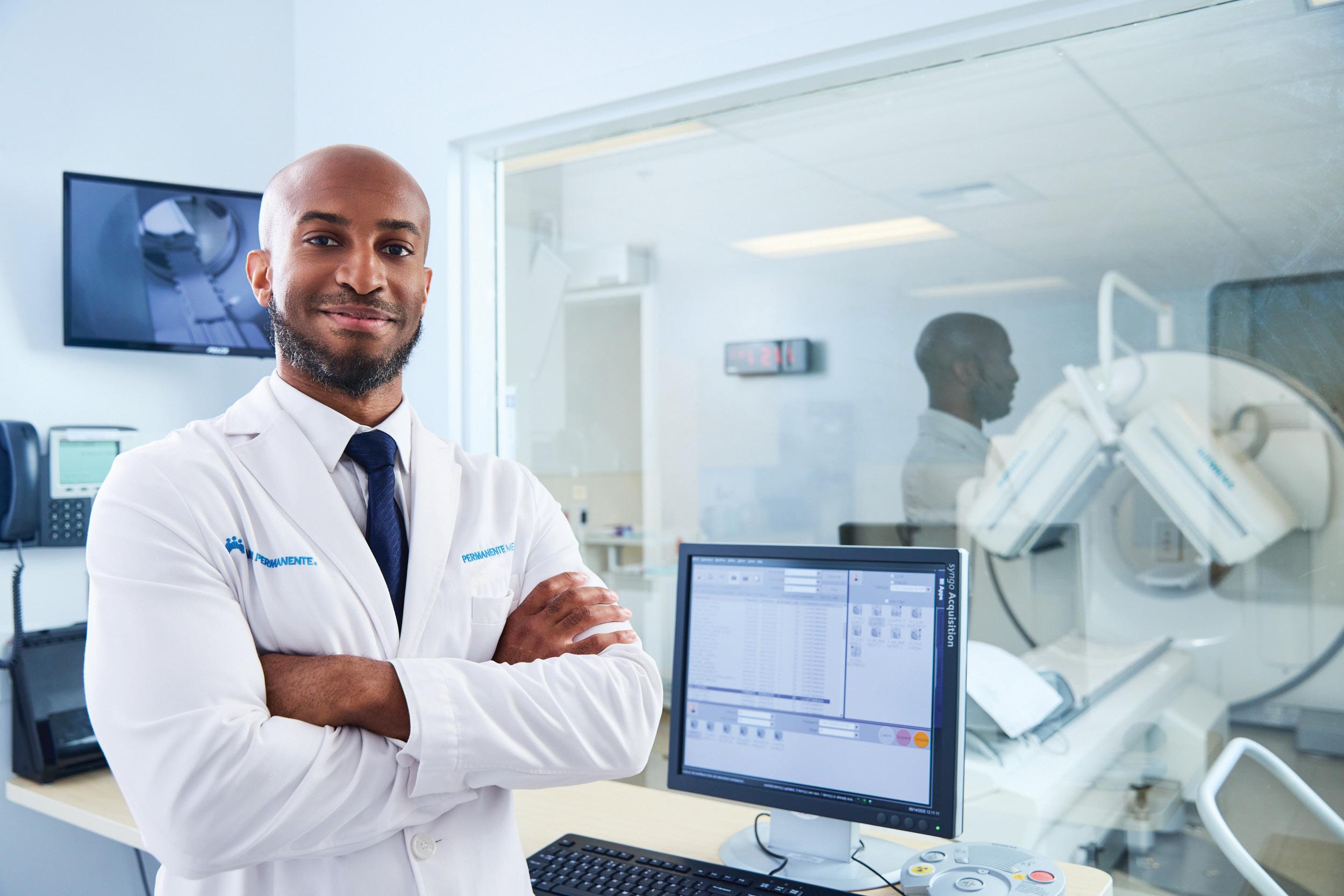
•Family-friendly communities with top-rated schools
•Perfect balance of major urban centers and laid-back coastal living charm
For consideration or to apply, please visit: southerncalifornia.permanente.org/jobs/type/neurology
We are an AAP/EEO employer.
Caring for communities, together.
CommonSpirit Health® is a nonprofit Catholic health system dedicated to advancing health for all people.
160,000 Team Members
25,000 Physicians and APPs
138 Hospitals
2,300 Care Centers
24 States
For additional information, please contact Michelle Johnson at: 877-608-0044 or Michelle.S1.Johnson@kp.org.
Southern California Permanente Medical Group
Physician and Advanced Practice
Provider opportunities available across our affiliated medical groups in the following states:
To apply, scan below or visit us at: providers.commonspirit.careers
The physician onboarding experience— gateway to your new job
Starting a new job can be exciting, challenging, and nerve-wracking all at the same time—and even more so if it’s your first job out of training. Luckily, there’s a process called “onboarding” to help you through the transition into the new position. Not so luckily, not every employer has organized a good plan for that process. But that’s changing, with more employers understanding the link between a good start and a happy employee.
Doctors responding to AAN Neurology Career Center questions about being onboarded report a variety of experiences, ranging from not feeling very supported as a new physician to being helpfully guided through a week or more of structured activities by on-staff onboarding specialists. While most experiences were positive, it’s clear that physicians who know what to expect or which questions to ask will have an advantage.
Third time is the charm
Amtul Farheen, MD, FAAN, gained her knowledge about onboarding the hard way, through personal experience. In her first two positions, Farheen says, the process was not well-designed. Unfortunately, she wasn’t aware of what should be happening, and ended up struggling to adjust in her new roles. She attributes some of that struggle to being fresh out of training. “In fellowship, you are being babied and looked over,” she says, “but once you step into the real world, it’s like coming out of the eggshell. You’re leaving that protected zone and you have to find your own way.”
When she joined the Veterans Administration a year ago, Farheen says she had a good onboarding experience, with a week devoted to an orientation that included everything from the electronic health system to the buildings she would work in. And even so, she could have benefited from more. Farheen explains ruefully how she needed
instruction from a resident to find shortcuts to the kitchen and to learn which keys would open which doors. “Now I can laugh at those things but at the time it was hard. I’m glad I could ask my juniors instead of bothering my supervisor with those little details.”
Onboarding + relocation = stress
Daniel Schachter, MD, had a more recent onboarding experience when he joined Emory University Hospital, on the heels of completing his fellowship. Because he was moving across the country with his wife (also in training) while also finishing his stroke training, Schachter was feeling strained as he prepared for his new job. “It was like every facet of my life was stressful,” he recalls. “Stroke fellowship is stressful in itself because it’s always emergent and that had to be a priority. So, if I had to get something done for onboarding that required a few hours in a row, that was hard to organize. Closing on a house a thousand miles away just added more stress.”
In describing the onboarding itself, Schachter is empathetic toward the Emory staff. “The onboarding staff are dealing with massive quantities of people and details,” he notes. “I learned that things would go more smoothly if I could help them work around situations where I might not be entered in the system yet, or when something else was held up.”
Because Schachter was actually being onboarded to two organizations—Emory University Hospital where he is an assistant professor, and Grady Memorial Hospital where he will provide vascular neurology care—he needed to be extra organized to fulfill the needs for each process. Saving email threads in their own folders, printing online manuals for easier reference, and storing information in a partitioned three-ring binder were just a few of the steps he took to keep things straight.
Being organized was especially important since his onboarding process evolved over several months, with much of it happening through online portals. Getting licensed in Georgia also demanded his attention, as did the physical he needed to take. Then, as a new employee, Schachter could look forward to the last phase of settling in: meeting his colleagues and trying to keep their names straight as he learned his job and moved between the two hospitals.
Onboarding from the other side of the desk
Jennifer Goodwin is on the other side of the desk when it comes to onboarding. As the manager of physician recruitment and relations at Morris Hospital and Health Care Centers in Illinois, she’s the one arranging the onboarding experience for newly hired physicians. Since the health system encompasses a variety of care services, including 26 clinics, Level 2 trauma and perinatal centers, and 38 specialties, and is primary stroke certified, she finds herself managing multiple orientations for new physicians every year. To be sure every doctor receives the appropriate support and information, she uses a continuum concept that includes medical credentialing, community introductions, meetings with department heads, and facility tours. In addition, the doctors are brought in for a full day of
events about two months prior to their start date. Into this packed agenda Goodwin has included meetings with the medical executives, lunch, a physical, and sessions with the marketing department to take photos and discuss possible promotions to help the doctor build a patient stream.
From her perspective, one of the most important aspects of the onboarding process is establishing relationships the doctors can rely on after starting the job. “We create this very personal onboarding schedule so they’re meeting with all the right people,” Goodwin says. Since the average onboarding will include 20–30 different contacts, the scheduling is no small feat. Having learned from surveys taken three months after providers start their jobs, Goodwin is particularly intentional about introducing them to the executive team. “I think the providers appreciate being able to talk to the people who make the decisions,” she notes. “It’s a nice personal touch. When I book an executive to meet with a new physician, I always say ‘Thank you, this helps with our retention process.’”
Tips for physicians being onboarded
Although every situation is unique, there are some tips which can be applied by nearly every doctor who is starting with a new organization. While some of these
WE ARE HIRING!
The Baylor College of Medicine Department of Neurology has a long-standing tradition of excellence in patient care, education, and neuroscience research Located within the Texas Medical Center, the department offers physicians the opportunity to work in one of the nation’s leading academic medical environments while contributing to a legacy of innovation in neurology
For decades, Baylor Neurology has been recognized for pioneering discoveries and nationally respected programs across epilepsy, movement disorders, dementia, multiple sclerosis, neurocritical care, and neuromuscular disease Faculty collaborate across Baylor Medicine, Harris Health System, the Michael E DeBakey Veterans Affairs Medical Center, Baylor St Luke’s Hospital and other premier institutions throughout the TMC, creating exceptional opportunities for clinical care, research, and professional growth
Physicians who join Baylor Neurology become part of a collaborative and mission-driven department dedicated to advancing neurological care, mentoring future leaders, and shaping the future of neuroscience through innovation and discovery
General
Scan QR Code for more openings
may be covered in an organization’s standard onboarding process, doctors who encounter a less-structured hiring process will be glad to have ideas of their own to make the transition go more smoothly.
As a starting point, Schachter advises understanding the names and roles of each person early in the onboarding system, particularly if there’s more than one organization involved. This will reduce confusion later when requests for information seem to be duplicative.
Schachter also advises asking for help when needed and tending to each piece of paperwork as quickly as possible. On the other hand, he notes that the data entry system may not move so quickly, which could also result in delays. He says he learned to ask frequently, “Am I in the system for this step yet?”
she says, when you need to understand how to solve a computer problem or master the parking system.
Farheen would advise doctors to seek a mentor and especially to pair with neurologists when possible, to provide an opportunity to talk through difficult cases. Making inroads with someone else on staff is also helpful,
Jennifer Goodwin also has a list of things she advises new hires to pay attention to in their onboarding process, including: learning where they can go to chart, where to pick up supplies such as lab coats and parking stickers, what their duties and schedule will be for the first week, who to talk to about computer issues, etc. Meeting the coder is another strategy she suggests, to help build a relationship that will come in handy later. And, if the organization has a software trainer on board, that’s a good person to ask about templates, dictation, and other issues related to entering information into the electronic health record.
As a final suggestion, Goodwin advises new hires to ask a lot of questions and not to downplay the onboarding process in the rush to start practicing.
“People love when you ask questions,” she says. “They want you to talk to them. So, don’t just focus on wanting to see the patients. Be prepared for meeting people and getting cards and setting up those contacts. Just be open to the onboarding experience.”
21 interview mistakes to avoid
Sometimes we learn from someone’s advice... but more often, we learn from their mistakes. With that in mind, here are 21 mistakes candidates commonly make in their interviews. It’s not a comprehensive list, but if you can avoid these errors, then the ones you do make can seem a little less egregious.
Mistake
1: Doing any of the things you’ve seen on television sit-coms
Just to get these out of the way: Don’t spill coffee on anyone. Don’t call interviewers by the wrong name. Don’t push past someone in the elevator only to discover that’s the person interviewing you. Don’t wear clothes that are prone to “wardrobe malfunctions”… you get the idea. These are the low-hanging fruit of interview mistakes, so they should be easy to avoid by being patient and keeping calm as you head into your interview.
Now read on for the subtler mistakes, which you might not even know you’re committing.
Mistake 2: Not asking for details when the interview is scheduled
It can be exciting to land an interview, but excitement can lead to dropped details. While the basics are likely to be covered in the invitation (when and where), there are many other details to consider. For example, the length of the interview lets you estimate how many questions they’ll ask (anticipate five per 30 minutes). Likewise, knowing who will be there and their titles can help you anticipate the questions themselves.
To get these details, just ask at the time the interview is scheduled. Too late for that? You can also contact the person making the arrangements at a later point. If that person is helpful, try for a little more information. For example, are multiple interviews planned in the process? How many candidates are scheduled? Be polite and gracious and you may learn a surprising amount to help you prepare.
Mistake 3: Scheduling too tightly around the interview
This won’t be a problem if you’re spending the day with the physician group at a clinic or hospital since your schedule will be in their hands. But now that many interviews are conducted online, you might be tempted to squeeze a meeting into an already tight day. That’s a bad idea, but it’s even worse if you do it with an inperson meeting. To understand why, consider that a one-hour interview could easily become two if you’re invited to talk with another work group or take a tour. These are opportunities you’d have to decline if you were overbooked.
Mistake 4: Not researching the organization (and local competitors) before the meeting
The more you know, the better your answers will be. For example, if you were asked about the possibility of helping to start a headache clinic, knowing this group already had experience with specialized clinics would make your answer richer—and more so if you knew about
other headache clinics already operating in the same geographic area.
Mistake 5: Not preparing a strategy
Most people wouldn’t go into a meeting without knowing what they plan to say. And yet, candidates often head into interviews with a wait-and-see attitude. (As in, “I’ll wait to see what questions they ask.”) That’s not very strategic. To ensure that employers learn what they need to know about you, plan to include two or three key messages and examples of previous successes. If you take the time to identify your best skills for this job and then practice getting that information across, your chances of success will increase exponentially.
Mistake 6: Not bringing anything along to in-person interviews
At a minimum, bring note paper, a pen, and extra resumes, all tucked neatly into a professional-looking portfolio or briefcase. For extra credit, include something to leave behind, such as letters of recommendation or perhaps a publication or research abstract.
Mistake 7: Seeming disorganized
For in-person meetings, disorganization looks like this: Carrying too many things to shake hands, shuffling through papers, reaching into your bag or pocket continuously for things you need, or looking rumpled like a television detective. For online meetings, disorganization looks like not having your camera aligned with your face, not knowing where the microphone or mute buttons are, using bad lighting, having kids or pets in the background, or looking down while you shuffle papers.
To avoid looking disorganized, trim away as many “extras” as you can. That means leaving your coat in the car or lobby for in-person meetings and carrying one simple case that you pull things out of immediately after sitting at the interview table. Trimming things down for online meetings means practicing in advance and choosing a closed-door space without distractions.
Mistake 8: Not greeting everyone
For an in-person meeting, giving a warm, professional handshake traditionally indicates confidence and reliability. You’ll need your judgment on whether physical contact would be welcome, but everyone should be greeted in some way. This is trickier in online meetings, where eye contact can be especially challenging. One option is to make a short statement at your first opportunity, such as: “I’m so glad to talk with you as a group today, and I’m looking forward to individual conversations as well. You have an exciting team at ABC Hospital.”
Mistake 9: Not managing your cell phone
If there’s a reason you need to be reachable, such as being on call during an online meeting (this should mostly be avoidable!), tell interviewers when the meeting starts so they understand why you’ve placed your phone where you can see it. Otherwise, whether the meeting is inperson or remote, your ringer should be turned off and your phone should be out of visual range to ensure you don’t glance at it out of habit.
Mistake 10: Not listening to the question before answering
Nerves can lead to fast answers. But it’s essential to truly hear the question before giving your response. Otherwise, you risk providing a partial answer or the wrong information altogether.
That’s not a great look for an aspiring physician. In the same light, it’s better to ask for clarification than to blunder forward if you’re not sure you understood the question.
Mistake 11: Not tying your answers to the job at hand
Skip the one-size-fits-all response and strive instead to provide the details most pertinent to this job. For example, if the practice is in a densely populated urban area and they ask how you build trust with patients, consider that they may be encountering multiple cultures or languages on a daily basis. How could your answer best reflect this reality?
Mistake 12: Not reading the interviewer’s body language
Plowing ahead with a long answer while your interviewer slides under the table is never good. Watch for signs that you’re still being heard or alter your presentation accordingly. As an advanced strategy, if you sense the interviewer isn’t listening for some other reason, such as being distracted, try ending your answer with a question to bring them back. For example, “…which covers what I’ve learned so far about diagnosing patients with Parkinson’s. Since you asked me about that, can you explain more about your Parkinson’s caseload?”
Mistake 13: Talking down a former employer, boss, or colleague
You already know this is wrong, but what if the interviewer tries to bait you with a question like, “Describe a conflict you’ve had with colleagues”? Your strategy is easy: Don’t do it! Instead of describing a conflict explicitly, try a more general answer. For example: “Conflict is a strong word for professional differences. When my approach differs from my colleague’s, I’ll focus on understanding why and whether it’s something I can learn from.”
Mistake 14: Presenting solutions instead of options
You don’t know what has already been tried at this organization, so avoid giving firm answers to hypothetical questions. Instead of “To improve the records process, I would first…,” practice starting answers with, “Depending on what’s already been tried, one thing I might do…”
Mistake 15: Not asking questions of your own
A few well-considered questions will demonstrate your engagement and overall awareness of the employer’s situation, while keeping the conversational ball in play. You can save your questions until the end, but there’s a risk that time could run out before you can ask them. Instead, consider adding questions to the back of some of your answers (as demonstrated in #12 above).
Mistake 16: Not playing to win
Or, put in non-sports terms, not going into every interview as if you want the job badly. If you’re just taking the interview for practice, then really practice by preparing well and performing your best. If you only think you want the job (but you’re not sure), then do your best so you can have the opportunity to consider an offer. Doing anything less than your best robs both you and the employer of knowing about the future you could have together. Not to mention, after all these years of training and striving for excellence, it’s just not you.
Mistake 17: Not stating your interest in the job
Even if you think that participating in an interview makes it obvious you want the job, remember that interviewers aren’t mind readers. They may have experienced candidates who were only practicing (see above), which means they can’t be certain who is truly excited about the opportunity. When you clearly say, “I’d like to work here,” you make it more difficult for them to choose someone else.
Mistake 18: Not immediately sending snail mail thank you notes to each interviewer
Since medicine is a physical profession, it’s nearly always conducted in a physical place, which means you can
usually send a thank you card with confidence that you have the right address. It may seem unnecessary or quaint in these days of email, but so what? You certainly won’t lose any points by sending a handwritten “I really enjoyed meeting you” note. The reason to mail off your cards immediately is so that they arrive within a week or two, serving as a pleasant reminder of your meeting.
Mistake 19: Not sending a more formal email or letter within a few days of the interview
This letter, usually sent in the body of an email, generally consists of two or three short paragraphs. You might start with a thank you, then reiterate your strengths for the position and your thoughts from the meeting, closing with an expression of your ongoing interest in the job. This follow-up letter is an essential tool for helping busy interviewers remember you. It’s fine to send one letter cc’d to the group. If you don’t have all the email addresses, you can also send to just one person and ask that they share it with the others.
Mistake 20: Not staying in contact, even when it seems fruitless
A few weeks without communication from the interviewers could mean you didn’t get the job, but it could also mean they got bogged down. Stay in contact until you are told the job has been filled. To do that, it’s fine to send an email every 7-10 days, expressing your ongoing interest and then asking, “Is there anything else I can provide for this process?”
Mistake 21: Putting too many eggs in one basket
Even if an interview goes wonderfully and you’re invited to second meetings, it’s best to press forward with other employers as well. This will keep you sharp for the negotiating stage, while also hedging your bets in case an offer doesn’t appear. Worst case scenario? You will have multiple offers at the same time.
That’s confusing but make no mistake: It’s a good problem to have!
An interview guide for first-time candidates
If you’ve never interviewed for a job, or if it’s been quite a while, you’re probably feeling a little nervous about the prospect of facing a potential employer or panel of future colleagues. That’s a good sign—not feeling nervous means you’re not paying attention.
Now that we’ve established that interviews are worthy of at least a low level of anxiety, the question is how to convert those feelings into strategy. The answer is simple: One step at a time. Here’s a guide to help you prepare for each interview as if it were your first—as indeed, it might be.
1. Gather all the details possible
When a recruiter contacts you out of the blue to schedule an interview, it’s common to “go blank.” The recruiter is going to be very business-like and confident and say things like, “We’re hoping you can fly out on Wednesday next week. You can? Oh, good. We’ll email you the travel information. See you then.” Wait, what just happened? Here are a few of the questions you want to ask, whether you get them out in that initial call or in a follow-up email:
y Who will I be interviewing with; what are their positions?
y What is the schedule of interviews; how long will each meeting be?
y Are you meeting with other candidates, or am I the only person being considered at this point?
y Will a decision be made from this set of interviews, or are there more steps to the process?
y What materials do you need from me?
y What other information can you share? For instance, what can you tell me about the practice (or department or research program, etc.)?
2. Conduct pre-interview research
Now that you know who you’ll be interviewing with, you can look up each person on the internet, while also asking your colleagues or mentors what they know about them. Your goal is to use what you learn to guide your interview answers, as well as your later decision making. For example, if you discover that the department chair has been vocal about legislation governing research programs, you can surmise that he or she feels strongly about those issues—wouldn’t you like to know that before answering a question on the subject during your interview?
Besides the general research you conduct on the people you’ll be meeting, here are some other things you should look for:
y Size and reputation of the organization, as well as any specialty they practice
y Articles about or written by the principles in the organization
y Competing organizations, particularly if it’s a private practice, so you can understand their pressures better y Community information, to help you understand their practice environment
3. Identify your key strengths for the position
While it’s true that your strengths are your strengths regardless of the context, the context still pertains to how you frame your answers. For example, if you’re talking with the partners of a small practice, your creative and innovative approach will be important for streamlining processes and attracting new patients. But if it’s an academic position you’re after, the same strength will be better described in terms of your ability to present the curriculum from a variety of teaching methodologies or your ability to frame research questions from a fresh perspective.
To help you describe your strengths in ways that are relevant to the position, ask yourself these questions:
y What are the primary tasks of the position, and which of these am I especially good at?
y What examples can I give to demonstrate those strengths?
y Do I have any metrics that will help me “prove” the strength?
4. Anticipate and practice questions
There are numerous articles available to help you with this step, including several in the AAN’s Neurology Career Center. Here are a few tips to guide you:
y Wherever possible, relate your answers to the employer’s needs and interests
y Use examples or metrics to help your answers come alive
y Don’t be afraid to ask questions of your own
5. Find a way to relax
Here’s a cardinal rule of interviewing: People hire people they like. Since it’s much easier to be likable when you’re relaxed and well rested, your task is to protect your time
and mental well-being in the days before your meeting so you can present your best self to your future employer. Now that you know the steps needed to prepare for your interview, the following overview information will help you keep things in perspective. Interviews count for most of the hiring decision. Your academic and work records are important guides for employers, but they’ll base their decision to hire on less measurable points, including your personality, your approach, your fit with the patients and the rest of the team, and their perception of your potential to succeed. None of these elements can be derived from documentation, but only from in-person impressions— which is what makes interviews so critical to the overall hiring process.
Interviews come in different shapes. As you may have already discovered when interviewing for medical school or a residency, you could find yourself meeting one-on-one with the decision maker, or in a series of consecutive one-on-ones with potential colleagues, or in a panel setting with a half dozen interviewers around a board table. You could also be interviewed by phone or Skype, or even asked to videorecord answers for interviewers to review later. While each of these situations differs in format, your actual approach will not vary much at all: Find out from the recruiter what type of interview to expect, follow the steps noted above to prepare, then find a way to relax so you can be at your best in the meeting.
Interviews are progressive in nature. In a competitive scenario where more than one candidate is being considered for a position, interviews will be used to narrow the field. That means that the winning candidate may have experienced multiple rounds of interviews before being selected. Even when you’re the only candidate for the position, you can expect multiple meetings as the conversation deepens between you and your future employer. With this in mind, don’t worry about getting everything done in one meeting. Instead, follow the flow and pace set by the interviewer while you concentrate on using every question as an opportunity to present another of your strengths.
A final word
Now you know the basics for succeeding at your first interview. All that’s left is to cover the logistics so that you’re really ready to roll. Here’s a quick checklist to keep you organized:
y Inspect your interview outfit to be sure it’s clean and fits well
y Get a haircut, manicure, or any other personal grooming assists needed
y Print CV copies for the meeting
y Notify references that they may be called
y If it’s an out-of-town interview, pack and double check your bags; confirm travel details
y For a local interview, take a dry run the day before to ensure you don’t get lost
y Purchase thank-you notes to send after the interview
Still nervous? Breathe deep and enjoy the edge. You’re well-prepared, so the nerves are a good thing—they remind you that you’re taking an important step in your career. Good luck. You’re going to do great.
Your job search and artificial intelligence
By now, you’ve probably heard a lot about artificial intelligence, ranging from the fantastic to the terrifying. For physicians, potential impacts for this world-changing technology can hardly be overstated. Artificial intelligence in different forms is poised to be integrated (or already has been) into such disparate areas of medicine as research assistance, patient scheduling and interaction, testing and diagnosis, documentation, and billing.
Whether you’re excited or alarmed by this evolution—or a little of both—it’s already underway. The best thing to do now is to learn how to harness artificial intelligence so you can benefit from its power.
How are employers using AI?
If you’ve applied for jobs recently, you may already have experienced some aspect of artificial intelligence at play. For example, some applicant tracking systems (ATS) are now augmented with artificial intelligence tools. ATS programs are used by large employers to sort incoming job applications. By adding AI features, some recruiters can manipulate the systems to work more efficiently to find appropriate candidates.
Another way employers use AI is by creating semi-interactive interviews where candidates answer
questions on-screen for later review by the recruiter. Whether this will catch on in medicine is hard to say, given the intensely personal nature of the doctor’s role both as a colleague and with patients. At this stage, it’s still difficult for AI tools to accurately evaluate such “human” characteristics while reviewing applicants.
Perhaps the most subtle use of AI by recruiters is in the process of seeking candidates in the first place. Depending on the tools they’re using, recruiters can identify potential applicants for current jobs by programming AI-driven software to review LinkedIn or other candidatefocused boards in search of matches
for specific keywords. The software can then send a “personalized” invitation to the candidate to apply for a position. These invitations may not be obvious as AI products, since they often include a real person’s name and contact information for response.
There are undoubtedly more ways that recruiters are using artificial intelligence to find or vet candidates for open positions. Or, if not, there will be soon. In the meantime, the development of AI tools available for candidate use has been increasing exponentially in just a short time.
How can job seekers use AI?
There are dozens of AI-driven software tools available for job seekers now; in the near future that number could climb into the hundreds. For the moment, they fall loosely into the following categories:
Resume / CV tools.
Some programs provide interactive processes to help you build a CV, while others recommend changes to word choice or sentence structure that will give your document more impact. Perhaps the most popular
programs are those, such as Jobscan, that check your document against specific job postings and then suggest or make revisions to ensure your information matches the requirements. At this stage, most user reviews describe the end product of these tools as being pretty good, but not excellent—which means the job seeker still needs to be involved before sending an AIrevised CV to employers.
Writing tools.
One of the most well-known tools currently available for multiple purposes, including job searching, is ChatGPT. This is actually one of several in the same class of software, made by different companies. Using a process known as generative AI, these applications generate writing based on prompts provided by the user. For example, if your prompt said, “Write a cover letter for a general neurology position in a hospital, describing my strengths in providing patient care and interpreting diagnostic tests,” that’s exactly what the software would do. Likewise, you could “prompt” the system to write you a thank-you letter post-interview, or a letter of self-introduction to help with your networking. Users of this technology
describe the end product as a good starting point for them to edit, but not usually as a finished product ready to send.
Interview practice.
Programs in this category are designed to provide an instant feedback loop on candidate answers to specific interview questions. In general, the program will generate the questions—usually based on input regarding specific jobs—and then review the candidate’s answer. The more complex programs will delve into non-verbals as well, providing feedback on candidate posture and clothing, for example. As a rule, the more features offered, the more the process will cost. One option, Google Interview Warmup, is relatively simple but also completely free, making it a good starting place to learn about this kind of tool.
Additional.
As you might guess, this short list doesn’t cover all the AI job search tools currently or soon to be on the market. You can also find AI-driven programs to organize your job search, such as Notion; or to help you identify networking contacts, such as LoopCV; as well as programs
such as Massive that will create and automatically send applications for jobs without you being involved at all.
Best practices and cautions
Are you thinking about using artificial intelligence to assist with your job search? If so, the following tips will help ensure your experience is a good one.
Check for product reviews
Before signing up or paying for an AI tool online, check for user reviews or comments. This can help you choose between multiple programs that seem to do the same thing.
Protect your data
AI tools designed to review your resume don’t need your contact information or medical license numbers to perform that function. Clearing out personal data is sometimes called “anonymizing” the
DEP: YY(Project Name) Ad—Half Page Horizontal> NJ, NCP Placed in Neurology Journal, or Neurology Clinical Practice 8.25 x 5.4375 +0.125 bleed, 4C
document. While somewhat tedious, the practice is a good precaution.
Review the results carefully
You may have heard the term “AI hallucination.” That’s when an AI tool makes up data or produces incorrect or misleading results. If you rely on artificial intelligence to write something for you, review carefully to ensure there are no “hallucinations” in your document.
Personalize the results
Speaking of AI-generated cover letters—does yours sound like a computer wrote it? That can happen easily, so be sure to add personal touches as you edit for accuracy.
Ask the AAN for help
It’s fine to build your CV with AI, as long as you review it carefully for complete and accurate information. But don’t stop there—your CV should also be reviewed for the intangibles, such as tone, strategy, and visual
appeal. That’s where the AAN and the CV review process come in. Once you’ve created your job seeker profile, you’ll find information for accessing the CV review service. And don’t forget that your job seeker profile also makes you eligible for job matching with current employers and openings.
Jumping In
Whether you start with a job search process or something related to your medical training and practice, this is a good time to jump into the AI waters. Learning to use the tools can give you a head start for future employers who are bound to start asking: “Have you used artificial intelligence yet?” You’re going to love being able to say, “Yes, and here’s what I’ve learned…”
AAN Online Learning
Leading the future of health care
Adult & Child Neurologists
Openings in Northern & Central California
A FEW REASONS TO CONSIDER A PRACTICE WITH TPMG:
• Our Telestroke program provides comprehensive coverage for all stroke alerts 24/7, and also immediate and urgent consultations during nighttime hours.
• AI-Based Charting and an outstanding electronic medical record system that allows flexibility in patient management.
• Work-life balance focused practice, including flexible schedules and unmatched practice support.
• We can focus on providing excellent patient care without managing overhead and billing. No RVUs!
• We demonstrate our commitment to a culture of equity and inclusion by hiring physicians who reflect the people we serve.
• We are Physician-led and develop our own leaders.
For more information on our career opportunities, wage ranges or to apply, please visit: northerncalifornia.permanente.org
FOR ADULT OPPORTUNITIES, you may contact Ramona Boyd at: Ramona.J.Boyd@kp.org or call: (510) 458-5197.
FOR CHILD OPPORTUNITIES, you may contact Bo Chau at: Bo.Chau@kp.org or call: (510) 418-9952.
EXTRAORDINARY BENEFITS:
• Competitive compensation and benefits package, including comprehensive medical, dental, and vision
• Northern California Home Loan Programup to $250,000 available for down payment, interest free for 10 years, AND NO PAYMENTS until end of 10 year period
• Moving Allowance paid directly by TPMG - up to $10,000
• Public Service Loan Forgiveness (PSLF) Eligible Employer
• Malpractice and Tail Insurance
• Paid holidays, sick leave, and education leave, including paid time o for Board Certification exam
• Annual education stipend, along with reimbursed board examination fees and new CA Medical License fees
• Shareholder track
• Life Insurance
• Three retirement plans, including a pension plan and 401(k)