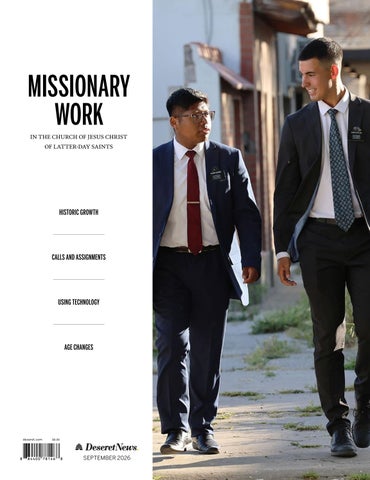
MISSIONARY WORK IN THE CHURCH OF JESUS CHRIST OF LATTER-DAY SAINTS
HISTORIC GROWTH
CALLS AND ASSIGNMENTS
USING TECHNOLOGY
AGE CHANGES
deseret.com
$9.99
SEPTEMBER 2026
MISSIONARY SAVINGS Saving for their future starts earlier than you think. SAVE UP TO
GROW SAVINGS UP TO $12,000
AUTOMATIC TRANSFERS MAKE SAVING EASY
See our current rate at Beehive.org/missionary
Serving members of The Church of Jesus Christ of Latter-day Saints for over 65 years Beehive.org | (208) 656-1000 | Insured by NCUA
Are You Financially Prepared to Serve? A Free Financial Guide for Senior Missionaries ✓ Cost of a senior mission
✓ Social Security timing
✓ Health insurance while you serve
✓ Estate documents to prepare
✓ Investing while you’re away
✓ Tax strategies while serving
Your mission deserves your full attention. SCAN TO DOWNLOAD YOUR FREE GUIDE
PetersonWealth.com/seniormissionguide Peterson Wealth Advisors works exclusively with retirees, helping them turn a lifetime of savings into income that lasts throughout retirement, including those getting ready to serve a senior mission.
360 West 920 North, Orem, UT 84057 · 801.225.0000 · PetersonWealth.com Peterson Wealth Advisors is a registered investment adviser. Information presented is for educational purposes only and does not intend to make an offer or solicitation for the sale or purchase of any specific securities, investments, or investment strategies. Be sure to first consult with a qualified financial adviser and/or tax professional before implementing any strategy discussed herein.
TABLE OF CONTENTS Two missionaries walk past a large map of the world in a hallway at the Provo Missionary Training Center in Provo, Utah, on Thursday, Jan. 31, 2008. | Associated Press About the cover: Elder Jose Lujano and Elder Carson Castillon, serving in the Argentina Bahía Blanca Mission, walk in Bahía Blanca, Argentina, on Saturday, Nov. 22, 2025. | Jeffrey D. Allred, for the Deseret News
04
To Our Readers
22
Service Missionaries
06 Historic Growth
26 Senior Missionaries
10
30
Missionary Training Centers
14 Age Changes
38
‘Home MTC’
18 Digital, Online Developments
42
506 Missions Worldwide
Calls and Assignments
PUBLISHED BY
EXECUTIVE EDITOR
PUBLISHER
CONTRIBUTORS
Doug Wilks
Burke Olsen
Trent Toone
EDITOR
CHIEF FINANCIAL OFFICER
Sarah Jane Weaver
Eric Teel
MANAGING EDITOR
SENIOR VICE PRESIDENT SALES
Scott Taylor
Trent Eyre
Aimee Cobabe Christine Rappleye Sydney Walker Mary Richards Rachel Sterzer Gibson
ART DIRECTOR
VICE PRESIDENT MARKETING
Joel Randall
Serina Nielson
Emily Hellewell
Kaitlyn Bancroft
GRAPHIC DESIGNER
VICE PRESIDENT SALES
Valerie Walton
Allen Muy
Sally Steed
*Images provided by the Deseret News and The Church of Jesus Christ of Latter-day Saints, unless otherwise stated. Copyright ©2026 by the Deseret News. All rights reserved. No part of this publication may be reproduced in any format without consent of Deseret News.
2
$1,000
SCHOLARSHIP
for returned missionaries
A group of missionaries poses for a photo outside the Salt Lake Mission Home in Salt Lake City on June 7, 1927. | Church History Biographical Database
TO OUR READERS The Church of Jesus Christ of Latter-day Saints is experiencing historic growth — including record numbers of full-time missionaries, missions and convert baptisms.
This special publication of the Deseret News, created as a service to our readers, examines missionary work in the Church of Jesus Christ.
“Missionary work is soaring to new heights,” said Church President Dallin H. Oaks, addressing participants at the June 2026 Seminar for New Mission Leaders in Provo, Utah.
It provides an informative look at missionary work today, with an appreciative glance back at the recent past and an anticipating eye to the future.
“These missionaries’ first responsibility is to testify of Jesus Christ to a world that suffers without knowledge of His divine mission. They invite people across the globe to become part of His true and living Church.”
For additional coverage of the missionary work of The Church of Jesus Christ of Latter-day Saints, please visit Deseret. com and TheChurchNews.com. Scott Taylor Managing editor, Missionary Work magazine
Elders walk near the Mexico City Mexico Temple in Mexico City , Mexico, on Saturday, Aug. 23, 2025. | Jeffrey D. Allred, for the Deseret News
4
Will we wait for you? Yes! Scholarships are available for those who are returning from service opportunities.
There’s
No Place Like
SNOW.EDU
Snow EST. 1888
‘THE MAJESTY OF THIS MOMENT’ How the Lord is hastening His work with members, missionaries and temples By Trent Toone
I
n Doctrine and Covenants 88:73, the Lord promises: “Behold, I will hasten my work in its time.”
The scripture and phrase has been quoted or cited many times by prophets and apostles in recent years as The Church of Jesus Christ of Latter-day Saints has witnessed historic growth and extraordinary advancements. “My dear brothers and sisters, do you see what is happening right before our eyes?” the late President Russell M. Nelson said after announcing the locations of 17 new temples in October 2024 general conference. “I pray that we will not miss the majesty of this moment. The Lord is indeed hastening His work.” Six months later, at April 2025 general conference, Elder Ronald A. Rasband of the Quorum of the Twelve Apostles repeated President Nelson’s words, adding: “Hastening His work. ‘Hastening’ is a word that matters. It suggests moving quickly, accelerating, and even urgency. In the growth of the Church and the plan of Christ, hastening is happening. And we are all a part of it.” Elder Rasband said the “hastening” is being fulfilled "right before our eyes," as evidenced by the unprecedented pace of increase in missions and missionaries, growth in membership and convert numbers, building temples, and the rising enrollment in Church education programs worldwide.
Sister Marlis Grow and her husband, Elder Von Grow, listen to Elder David A. Bednar of the Quorum of the Twelve Apostles as he speaks during an early morning devotional in the Sacred Grove in Palmyra, New York, on Sunday, Sept. 21, 2025. | Scott G Winterton, Deseret News
6
“We are grateful to be on the earth when the Church is increasing in numbers and influence, but more importantly in the hearts and lives of its members,” he said. “I marvel at what President Nelson calls the ‘majesty of this moment’ and express profound gratitude to the Lord for His work. I encourage us to stand tall as His disciples, eyewitnesses to the fulfillment of prophecy.”
Sister missionaries walk together at the Provo Missionary Training Center on Thursday, June 18, 2026. | Leslie Nilsson, The Church of Jesus Christ of Latter-day Saints
MORE MISSIONARIES AND MISSIONS Nearly 15 years ago, in 2012, the Church had a full-time missionary force of 58,000 serving in 347 missions globally. At that time, male missionaries were eligible to apply for missionary service at age 19, and female missionaries could serve at age 21. A significant surge was triggered on Oct. 6, 2012, when Church President Thomas S. Monson announced an age change for missionaries, permitting young men to begin service at age 18 and young women at age 19. Over the next decade, the number of full-time missionaries increased from 58,000 to 65,000 in 2022, and up to nearly 72,000 by the end of 2023. More than a decade later, on Nov. 21, 2025, the First Presidency announced that young women could choose to serve at age 18. During the 2026 Seminar for New Mission Leaders, President Dallin H. Oaks highlighted the continuing growth of the missionary force, noting that more than
87,000 full-time missionaries are serving with an incoming wave of 18-year-old sisters beginning their service. These missionaries serve in over 150 countries and teach in more than 60 languages. With more missionaries came more missions. In 2023, the Church created 36 new missions, increasing the total number of missions to 450. The Church added 55 more in October 2025, bringing the total number of missions worldwide to 506 — the most ever in Church history. On that occasion, President Oaks said: “It is inspiring to see the number of young Church members who continue to answer the call to share the good news of the gospel of Jesus Christ around the world. These missionaries are helping to bless the lives of hundreds of thousands of people every year who are choosing to be baptized into the Lord’s Church.” The Church News reported 193 couples from 26 countries at the 2026 Seminar for New Mission Leaders, who were preparing
to serve in 64 nations worldwide. Thirteen of the couples participated in the seminar remotely from Brazil and Ghana MTCs. Elder Rasband, who serves as chair of the Missionary Executive Council, testified of the Lord hastening His work during a devotional at the Provo Missionary Training Center on Jan. 27, 2026. “It is a remarkable time to serve,” he said, adding that the increase in the number of missionaries has contributed to the highest number of convert baptisms recorded in any 12-month period of this dispensation. Elder Rasband said that no matter where a missionary is called, “you can have faith that the Lord is hastening His work in your area. His miracles are filling the whole earth.” In a May 2026 social media post, Elder Dale G. Renlund of the Quorum of the Twelve Apostles addressed the increase of missionary applications and the creation of new missions worldwide, which contrasts trends that suggest the rising generation is less engaged in religiosity.
7
Missionaries walk to lunch at the Mexico Missionary Training Center in Mexico City, Mexico, on Friday, Dec. 9, 2022. | Jeffrey D. Allred, Deseret News
Elder Renlund, one of three Apostles currently serving on the Missionary Executive Council, outlined several factors, including: • Bishoprics focusing more intensively on the rising generation. • The availability of youth to attend For the Strength of Youth conferences, which has increased interest in sharing the joy of the gospel. • More families are engaging in earlier scripture study, especially with the aid of “Come, Follow Me” curriculum, which has enhanced Sunday worship practices. • An increase of young women serving missions. • Young men and young women learning to work in counsel with one another. “What we are witnessing today is more than growth in numbers. Across the world, missionaries are demonstrating a deep devotion to the Savior and a sincere consecration to His work,” Elder Renlund wrote. “An increasing number express that their fundamental reason for serving is their love for Jesus Christ and their desire to join Him in His work — an inspiring reflection of the faith and commitment that characterize today’s missionary force.”
8
MEMBERSHIP GROWTH During the April 2026 general conference, the Church reported 385,490 convert baptisms for the year 2025, a historic number increasing total membership to 17,887,212, according to the annual statistical report. The last time the Church experienced such growth was in 1990, with 330,877 convert baptisms. The next closest year was 1996 when the Church recorded 321,385 convert baptisms. At the 2025 Seminar for New Mission Leaders held at the Provo Missionary Training Center in June, Elder Quentin L. Cook of the Quorum of the Twelve Apostles — then chairing the Missionary Executive Council — said that in 2024, the Church witnessed over 308,000 baptisms. This represents an increase of about 50,000 convert baptisms compared to 2023, marking the highest number in nearly 25 years. Comparing the first quarter of 2025 with the first quarter of 2024, Elder Cook said every region of the world had seen at least a 20% increase in convert baptisms.
“This is remarkable,” he told new mission leaders. “And as exciting as this increase in baptisms was in 2024, we were delighted to learn that the rate of increase for new members attending sacrament meeting was even higher. We thank the Lord for allowing us to witness His hand in these remarkable outcomes — He is the reason for the hastening.” Elder Cook also spoke about the growth of the Church in his October 2025 general conference address, “The Lord Is Hastening His Work.” “In the last 36 months, nearly 900,000 converts have joined the Church. These converts constitute approximately 5% of the total Church membership,” he said. “In the first six months of this year, conversions have risen by more than 20% over the previous year in Europe, Africa, Asia, the Pacific and Latin America. In North America, we have seen a 17% increase.” Accounts of large baptismal services have been reported globally in 2025, including Papua New Guinea, Sierra Leone, Democratic Republic of the Congo, Nigeria and others. “These rising numbers are clear witness that the gospel is touching hearts and changing lives everywhere,” Elder Cook said.
BUILDING TEMPLES The current total number of temples — operating, under construction or announced worldwide — is 385. Of those 385 houses of the Lord, 326 — approximately 85% — have been announced by the last four Church presidents dating back to 2008. The late President Gordon B. Hinckley announced a total 78 new temples between 1995 and 2008. President Monson announced a total of 45 new temples between 2008 and 2018. In his seven-plus years as President of the Church (20182025), President Nelson announced 200 temples — more than 50% of the Church’s 382 houses of the Lord at the time of his death in September 2025. “Why are we building temples at such an unprecedented pace? Why? Because the Lord has instructed us to do so,” President Nelson said in October 2024. “The blessings of the temple help gather Israel on both sides of the veil. These blessings also help to prepare a people who will help prepare the world for the Second Coming of the Lord.” Since President Oaks became the prophet in October 2025, three temples have been announced in Portland, Maine; Marysville, Washington; and Otavalo, Ecuador. He has stated an emphasis on advancing the more than 160 total temples under construction or announced and in planning and design.
Elder Daxton Gardner and Elder Ben Martuerello walk on the streets in Palermo, Italy, on Sunday, Oct. 26, 2025. | Jeffrey D. Allred, for the Deseret News
Missionaries teach in a tent near the newly completed Nairobi Kenya Temple in Nairobi, Kenya, on Saturday, May 17, 2025. | Jeffrey D. Allred, for the Deseret News
9
‘GO YE THEREFORE, AND TEACH ALL NATIONS’ Inside the sacred, revelatory process that sends Latter-day Saint missionaries to every corner of the world By Aimee Cobabe
I
n the 4th section of the Doctrine and Covenants, the Lord declares: “If ye have desires to serve God ye are called to the work.”
Since ancient times, the Lord has called missionaries to “teach all nations.” In the Old Testament, Jonah and other prophets were called to deliver a voice of warning and repentance to the people. Abraham was also called of the Lord “to make of thee a minister to bear my name in a strange land” (Abraham 2:6). In the New Testament, following Jesus Christ’s Resurrection, He called His disciples to preach the gospel, saying in Matthew 28:19–20: “Go ye therefore, and teach all nations, baptizing them in the name of the Father, and of the Son, and of the Holy Ghost: Teaching them to observe all things whatsoever I have commanded you: and, lo, I am with you alway, even unto the end of the world. Amen.” The Lord has also called missionaries to preach His gospel in the latter days. One of the first revelations to the Prophet Joseph Smith in 1831 included the call and assignment of missionaries: “And ye shall go forth in the power of my Spirit, preaching my gospel, two by two, in my name, lifting up your voices as with the sound of a trump, declaring my word like unto angels of God” (Doctrine and Covenants 42:6). As missionaries around the world are called to serve today, they open a letter from Church President Dallin H. Oaks, which starts: “You are hereby called to serve as a missionary of The Church of Jesus Christ of Latter-day Saints.” President Oaks promises missionaries that as they devote time and attention to serving the Lord, “leaving behind all other personal affairs, you will be blessed with increased knowledge and testimony of Jesus Christ and His restored gospel.”
10
Missionaries point to their assigned mission on a world map during the filming of a new video at the Provo Missionary Training Center in Provo, Utah, in November 2025. | Screenshot from The Church of Jesus Christ of Latter-day Saints' YouTube channel
‘I’LL GO WHERE YOU WANT ME TO GO’ In his October 2002 general conference address “I’ll Go Where You Want Me to Go,” President Oaks — then a member of the Quorum of the Twelve Apostles — shared the examples of faithful senior missionaries who labor with “faith and devotion in the remote corners of the Lord’s vineyard.” The talk included comments from Church leaders who recommended these senior couples for mission calls: “Willing to go anyplace, do anything for whatever length of time required.” “[These] are great examples of Church members who dedicate their lives to the Lord.” “Will go where the Lord wants [us] to go,” another couple noted. “We pray we will be sent where we are needed.” “They have slowed down some physically, but not in spiritual matters or missionary zeal.” In that same talk, President Oaks described a letter from a returned missionary who had written to thank those who direct
missionary work “for daring to send me where the Lord required rather than where I had deemed appropriate.” President Oaks said this young missionary “was shocked to receive a call to serve in a mission in the United States. He didn’t know anything about the state where he would serve, except that it was in his own country, speaking English rather than abroad speaking the language he had learned.” This young man eventually found the courage and faith to accept the call and to follow the direction and counsel of his fine mission president. And President Oaks said the young man received a “miracle of spiritual growth.” The returned missionary wrote: “As I began to serve among the uneducated people of [this state], I struggled mightily for several months, but gradually the sweet workings of the Spirit began to tear down the walls of pride and disbelief that had wrapped themselves so tightly around my soul. The miracle of a conversion to Christ began. The sense of the reality of God and the eternal brotherhood of all men came more and more powerfully to my troubled mind.” Added President Oaks: “I testify of Jesus Christ, who beckons us to His path and His service, and pray that we will have the faith and commitment to follow and the power to be what He wants us to be.”
11
MISSIONARY CALL ASSIGNMENTS In a general conference talk given in April 2010, and again in a social media video in June 2026, Elder Ronald A. Rasband of the Quorum of the Twelve Apostles testified of the inspired and revelatory experience of assigning missionaries to a field of labor. Elder Rasband, who chairs the Missionary Executive Council, said in his recent post: “Every missionary is called by the President of the Church — he has assigned the Quorum of the Twelve that we assign every missionary.” Continued Elder Rasband: “I testify to all of you that the process of doing this is inspired, it’s revelatory, and I love it with all my heart, as I love all of you, especially those of you young people who are considering serving the mission at this very moment.” In the short two-minute video, Elder Rasband showed the inside of a missionary assignment room in the Church Administration Building in Salt Lake City, where members of the Quorum of the Twelve Apostles meet with staff of the Church’s Missionary Department to assign thousands of prospective missionaries to serve around the world. “I come in the spirit of fasting and prayer, and our staff has prepared where the most urgent needs of all these missionaries are,” Elder Rasband said in the video. With a pointer stick in hand, Elder Rasband sits in front of two screens. On one screen, a prospective missionary’s name, photo and other information are displayed for consideration. “Prayerfully, we consider every one of them,” Elder Rasband explained. “We look at whether they’ve learned languages, we look at where their ancestors are from, and we read their priesthood leaders’ comments. And in the spirit of prayer and fasting, we assign them to somewhere in the world that the Lord needs them to serve and that they’re needed.”
12
President Dallin H. Oaks of The Church of Jesus Christ of Latter-day Saints | Kristin Murphy, Deseret News
‘THE DIVINE CALL OF A MISSIONARY’ In his April 2010 general conference talk, titled “The Divine Call of a Missionary,” Elder Rasband shared an experience he had while assigning missionaries years earlier with then-Elder Henry B. Eyring of the Quorum of the Twelve Apostles. Observing Elder Eyring in this session was part of Elder Rasband’s training as a newly called General Authority Seventy. “As each picture appeared, to me it was as if the missionary were in the room with us,” Elder Rasband recalled in his talk. “Elder Eyring would then greet the missionary with his kind and endearing voice: ‘Good morning, Elder Reier or Sister Yang. How are you today?’” Elder Rasband continued: “After assigning a few missionaries, Elder Eyring turned to me as he pondered one particular missionary and said, ‘So, Brother Rasband, where do you think this missionary should go?’ I was startled. I quietly suggested to Elder Eyring that I did not know and that I did not know I could know. He looked at me directly and simply said, ‘Brother Rasband, pay closer attention, and you too can know.’”
As Elder Rasband and Elder Eyring reached the end of that assignment meeting, a picture of a certain missionary appeared on the screen. “I had the strongest prompting, the strongest of the morning, that the missionary we had before us was to be assigned to Japan,” Elder Rasband said. “I did not know that Elder Eyring was going to ask me on this one, but amazingly he did. I rather tentatively and humbly said to him, ‘Japan?’ Elder Eyring responded immediately, ‘Yes, let’s go there.’ And up on the computer screen the missions of Japan appeared. I instantly knew that the missionary was to go to the Japan Sapporo Mission. “Elder Eyring did not ask me the exact name of the mission, but he did assign that missionary to the Japan Sapporo Mission. ... I had a further witness that morning that every missionary called in this Church, and assigned or reassigned to a particular mission, is called by revelation from the Lord God Almighty through one of these, His servants,” Elder Rasband testified.
IMPERFECT MESSENGERS OF A PERFECT MESSAGE Speaking at the Provo Missionary Training Center in March 2023, Elder Dale G. Renlund of the Quorum of the Twelve Apostles told training missionaries across the world that they don’t have to be a perfect messenger to deliver the perfect message. “Elders and sisters, we have a perfect message,” said Elder Renlund, who is a member of the Missionary Executive Council. “That perfect message centers on the Lord Jesus Christ, on Heavenly Father and His plan and on the Restoration of the gospel in its fullness. That is the perfect message. That is what we preach. That is what we get to when we are at our strongest — and you are the perfect messenger, even if you are imperfect in some ways.” God, he added, “has commissioned you, just the way you are, to go out and invite people to come unto the Savior. And then He expects you to do your best and try to get better over the course of your mission and throughout your life.”
The Missionary Assignment Room inside the Church Administration Building in Salt Lake City on Monday, Sept. 18, 2017. | Deseret News archives
13
AGE CHANGES: SURGES AND WAVES With 2 missionary age-change announcements in 2012 and 2025, numbers of those serving have increased By Christine Rappleye
W
ith an announcement from leaders of The Church of Jesus Christ of Latter-day Saints lowering the age that missionaries can serve, there came an increase of young adults wanting to serve — setting records for the number of full-time missionaries of The Church of Jesus Christ of Latter-day Saints. While that’s true of the November 2025 announcement by the First Presidency changing the age young sister missionaries can serve from 19 to 18, it’s also accurate of a change 14 years ago — when many current full-time single missionaries were young children.
In the October 2012 general conference, then-Church President Thomas S. Monson announced the new minimum age requirements for both young men and young women, lowering it from 19 to 18 years old for young men and 21 to 19 years old for young women. As young adults adjusted when they would serve and began quickly putting in applications, the numbers of full-time missionaries surged from 58,990 at the end of 2012 to just more than 88,000 in 2014, the most ever for the Church. There were 85,147 missionaries at the end of 2014.
14
During the June 2026 Seminar for New Mission Leaders, Church President Dallin H. Oaks highlighted the continuing growth of the missionary force, noting that more than 87,000 full-time missionaries were serving, with an incoming wave of 18-year-old sisters beginning their service following the recent age change for young women. On July 14, the Church announced that there were more than 88,500 full-time missionaries serving worldwide, including young teaching and service missionaries and senior missionaries. That marked the highest number of full-time missionaries in the history of The Church of Jesus Christ of Latter-day Saints.
2012: YOUNG MEN SERVING AT 18, YOUNG WOMEN AT 19 When President Monson announced the age change, he explained for some time the First Presidency and the Quorum of the Twelve Apostles had allowed young men from certain countries to serve at the age of 18 when they were worthy, able and had graduated from high school. “Their faithfulness, obedience and maturity have caused us to desire the same opportunity for earlier missionary calls for all young men, regardless of the country from which they come,” he said. “I am pleased to announce that effective immediately, all worthy and able young men who have graduated from high school or its equivalent, regardless of where they live, will have the opportunity of being recommended for missionary service beginning at the age of 18, instead of the age 19.” He added: “As we prayerfully pondered the age at which young men may begin their missionary service, we have also given consideration to the age at which young women might serve. Today, I'm pleased to announce that able, worthy young women who have the desire to serve may be recommended for missionary service beginning at age 19, instead of age 21.” President Monson in his talk also noted that the age was an option, not a mandate, with consideration to individual circumstances and the determinations by priesthood leaders. Initial plans to accommodate an influx of missionaries — that was later commonly called “the surge” — were announced at a news conference after the announcement, including training periods reduced by a third.
Missionaries walk between buildings at the Provo Missionary Training Center in Provo, Utah, on Thursday, Dec. 25, 2025. | Jeffrey D. Allred, for the Deseret News
15
Missionaries in the Philippines Bacolod Mission respond to Elder Neil L. Andersen of the Quorum of the Twelve Apostles in Bacolod City, Philippines, on Saturday, May 30, 2026. | Jeffrey D. Allred, for the Deseret News
In the weeks and months following the announcement, other changes began. Benemérito de las Américas, the Church-sponsored school in Mexico City, Mexico, closed at the end of the 2013 school year and reopened as an expanded Mexico Missionary Training Center. In the summer of 2013, the Provo Missionary Training Center in Provo, Utah, expanded to a self-contained “west campus” of two rented apartment complexes for two years, accommodating more residences, operations and meeting spaces. And because combined attendance far exceeded available space at the MTC’s main campus, Tuesday night devotionals were moved to the BYU Marriott Center. In the following year, the Provo Missionary Training Center expanded with two new six-story buildings, increasing the capacity of the center. In April 2013, President Monson called the response of young elders and sisters “remarkable and inspiring” to his agechange announcement six months earlier, and 58 new missions were created.
2025: SISTER MISSIONARIES SERVING AT 18 On Nov. 21, 2025, the First Presidency announced that the minimum age a young woman could choose to serve a mission was lowered from 19 to 18, following high school graduation or the equivalent. In the 15 minutes between the announcement and a Church News interview at the Church Office Building, Young Women General President Emily Belle Freeman,
16
a member of the Missionary Executive Council, was already seeing videos of young women in seminary classes celebrating the news. “I know that they have been preparing, and I know that their testimony and conviction wherever they go after high school will be important and life-changing for everyone they touch because of who they are and because of Whose they are,” President Freeman said of the young women of the Church. After receiving feedback from sister missionaries, young women and women, Church leaders counseled and came to the decision that young men and young women should both be able to serve missions at the same age. Sister Amy A. Wright, then the first counselor in the Primary general presidency and member of the Missionary Executive Council, spoke to news media of the steps leading to the announcement of the age change, calling it a “revelatory process.” She also noted the lifelong benefits for those who choose to serve a mission. “A mission is a profound opportunity for these young men and young women to have a personal experience with their Savior, Jesus Christ, again and again. As they do — as they have these sacred and holy experiences with Jesus Christ — like Moses of old, it will be easier for them to discern the world’s counterfeits,” Sister Wright said.
The Church announced in October 2025 plans to create 55 missions, effective July 1, 2026. The 55 new missions would give the Church 506 missions worldwide — the most ever in Church history. Those missions were created, in part, to accommodate this current influx of missionaries, said Elder Matthew S. Holland, General Authority Seventy and executive director of the Church Communication Department, after the announcement. At the time of the announcement, there were about 85,000 missionaries serving around the world; just under one-third — about 25,000 — were young women. Now, more than 87,000 full-time missionaries are serving around the world.
HISTORY OF MISSIONARY AGES In the history of the Church, missionaries have been a variety of ages. In the 19th century, there weren’t age guidelines and typically older, married men were called. These calls would come over the pulpit in Church meetings, according to the Church History Library’s research guide “Missions and Missionaries.” The ages and requirements for missionary candidates fluctuated, especially in times when the United States was involved in wars or other armed conflicts. In the summer of 1960, the age recommendations were that young men could serve when they were 19 and young women could serve at 21 years old. That stayed until it was changed in 2012 with President Monson’s announcement.
Sister missionaries in Livingston, Montana, watch a session of The Church of Jesus Christ of Latter-day Saints' 191st Annual General Conference, which was broadcast from Salt Lake City on Saturday, April 3, and Sunday, April 4, 2021. | The Church of Jesus Christ of Latter-day Saints
DIGITAL, ONLINE DEVELOPMENTS How embracing technology has furthered missionary work in the last 15 years By Sydney Walker
I
t wasn’t long ago when after a busy day of serving and teaching people about the gospel of Jesus Christ, missionaries of The Church of Jesus Christ of Latter-day Saints would open up a thick binder called an area book to record names, contact information and lesson progress. Pages might get lost or torn over time, handwriting might be difficult to decipher, and some information perhaps was never recorded at all. What used to be done with pen and paper is now done digitally. Missionaries use an app on their smartphone throughout the day to find and contact people, navigate their area, keep track of their schedule and record progress for the people they meet — and that information is available to them anytime, anywhere. This is just one example of how embracing technology has made missionary work more effective and efficient in the last 15 years.
18
HOW MISSIONARIES USE TECHNOLOGY TODAY Today missionaries use technology in a variety of ways. A prospective missionary’s application is completed online, a new missionary’s call comes online, and a training missionary starts online.
Christ and find people in their areas who are interested. Social media enables missionaries to reach individuals in ways they couldn’t before and teach shorter and more frequent lessons using video chats.
With their smartphones, missionaries have a plethora of Church resources at their fingertips to share with people — digital scriptures, sacred music, general conference messages, videos, images, a collection of gospelrelated topics and questions, and more. Missionaries can also access the Church’s Life Help resources to help individuals navigate emotional, physical and spiritual challenges.
“You are engaged in finding and teaching methods that are dramatically different from the past,” then-Elder Dieter F. Uchtdorf of the Quorum of the Twelve Apostles told missionaries during an online devotional in 2021. He chaired the Church’s Missionary Executive Council from 2018 to 2021, as online contacting and teaching became the norm during COVID-19.
Following mission-specific guidelines, missionaries use social media platforms like Facebook, Instagram and WhatsApp to share uplifting messages about Jesus
“Don’t neglect proven principles and practices from before the pandemic,” Elder Uchtdorf cautioned, “but learn, add and adapt technological advances that the
Lord has provided to accomplish His work in your time and in your season.” Technology has also made it easier for mission leaders to communicate often with their missionaries. Some mission leaders create group message chats with missionaries in each zone and use videoconferencing to hold mission-wide meetings. Many missionaries use social media and videoconferencing to communicate weekly with their families. After years of communicating home via emails, letters and twicea-year phone calls on Mother’s Day and Christmas, the First Presidency announced in 2019 the allowance of phone calls, video chats, text messages and online messaging for missionaries when contacting family on preparation days.
INTRODUCTION OF SMARTPHONES AND SOCIAL MEDIA FOR MISSIONARIES The roots of these technological advances for missionaries date back more than a decade. For years, the Church has had call centers for people responding to print, TV and, later, online advertisements offering a Book of Mormon, a Bible or an opportunity to meet with missionaries. These call centers were staffed by what were then called “online missionaries.” In the late 2000s, missionaries in some missions were authorized to use flip-style phones to communicate with members and people they were teaching. Facebook and blog proselyting pilot programs began in 2010, allowing small groups of missionaries to experiment with social media to contact those they were teaching. Missionaries used computers in public libraries and Church family history centers since they didn’t have digital devices. By early 2013, six missions in Utah and Arizona began pilot programs of not only using online platforms for proselyting but testing digital devices. Missionaries first used iPhones and iPads, then just iPads. They could use iPads for online contacts as well as several approved or Church-developed apps, including maps, calendars, area books and video players for clips during lessons. Two missionaries walk down the road while looking at their tablet. | The Church of Jesus Christ of Latter-day Saints
The digital devices expanded to two dozen missions across the country.
19
Elder Dieter F. Uchtdorf of the Quorum of the Twelve Apostles and his wife, Sister Harriet Uchtdorf, speak from a recording studio on Temple Square to missionaries around the world during a devotional in February 2021. | The Church of Jesus Christ of Latter-day Saints
‘WE WERE READY’: COVID-19 PANDEMIC AND MISSIONARY WORK Elder Brent H. Nielson, emeritus general authority, has spoken openly about the miracles he observed as the Church began using more technology in missionary work. In 2014, Elder Nielson was assigned to serve in the Missionary Department. At that time, the late President Russell M. Nelson, then a member of the Quorum of the Twelve Apostles, chaired the Missionary Executive Council, assisted by Elder David A. Bednar, also of the Quorum of the Twelve Apostles. That year, then-Elder Nelson introduced the concept of missionaries using mobile devices, now smartphones, in their daily missionary work. Around that same time, Elder Bednar gave a talk at BYU Education Week and invited Church members to “flood the earth” by sharing gospel messages on social media. Starting with 20 of the approximately 400 missions, the Missionary Department tried to figure out how to do missionary work using mobile devices and social media. By 2015, they expanded to 80 missions.
20
Elder Nielson recalled during a 2022 devotional for Latter-day Saints in California: “We continued to learn and to grow and to figure out ways that our missionaries could find, teach and baptize using the internet while also becoming masters of technology. “Within a few years we were up to 160 missions, and we stayed with those missions for two or three years, learning and growing and determining the best way for missionaries to find people and to teach them using these devices, while remaining spiritually safe from the influence of the world.” In January 2020, under the direction of President Nelson — then the President of the Church — approval was given for every missionary in the Church to have access to a smartphone. Then, on March 11, 2020, almost every country closed its borders and airports as the COVID-19 outbreak was officially declared a pandemic. People were either encouraged or mandated to stay home, and almost all missionaries worldwide were unable to leave their apartments.
Two sister missionaries teach a woman with their scriptures and an iPad. | The Church of Jesus Christ of Latter-day Saints
“There were many questions proposed to us in the Missionary Department about how we would continue to do missionary work, but I have to tell you that we were ready,” Elder Nielson said. “Way back in 2014, under the direction of two inspired members of the Quorum of the Twelve Apostles, we had begun the process of figuring out how to do missionary work using these devices. When the world closed down, our missionaries stepped forward and performed a miracle.”
‘THE SEASON OF MIRACLES’ What were tools of necessity during the pandemic have become standard in coordination, communication and teaching for missionaries and mission leaders — with digital tools also improving communication with local leaders and making it easier for members to participate in missionary work. For example, members can join video calls as missionaries are teaching. “This is the season of miracles,” said Elder Marcus B. Nash, a General Authority Seventy then serving as the executive director of the Missionary Department, during an October 2021 Church News podcast episode. “We’re watching members engage at a level and scope that I don’t think we have ever seen, at least in the modern era of the Church.”
Mission Prep Made Simple. June 28–July 3, 2027 For youth ages 14–18 | missionready.byu.edu
YOUNG SERVICE MISSIONARIES SERVE WITH ‘LOVING KINDNESS AS THE SAVIOR WOULD’ See purpose and objectives of a service mission plus examples By Mary Richards
round the world, young service missionaries of The Church of Jesus Christ of Latter-day Saints are serving Heavenly Father’s children.
A
up to 24 months for young men. They serve as close to full time as their circumstances allow, and each has a customized mission experience uniquely tailored to his or her talents, skills and gifts.
Like full-time teaching missionaries, young adults called as service missionaries serve for up to 18 months for young women and
The service missionary purpose, as found on ChurchofJesusChrist.org/ service-missionary, is:
“ Help others come unto Christ by serving with loving kindness as the Savior would. Minister in His name to the one through the power of the Holy Ghost and live as an example of faith in Jesus Christ, repentance, covenant keeping with God and enduring to the end.”
The key objectives of a service mission are: • Provide an opportunity for all willing young women and young men to serve the Lord and increase in testimony of Him. • Help each service missionary prepare for a lifetime of service. • Provide needed and valuable service to Church andcommunity organizations.
22
“When we serve Heavenly Father’s children, we help lead them to believe in God,” the Church’s website explains. “When we serve others, we demonstrate our love to Heavenly Father: ‘When ye are in the service of your fellow beings ye are only in the service of your God’ (Mosiah 2:17).” Service missionaries go through the same recommendation process as teaching missionaries and receive their mission calls from the President of the Church.
Elder Hashkeyelwod Calkin, service missionary in the Utah Ogden Mission, cuts dead wood off peach trees at the North Ogden Orchard Welfare Farm in Pleasant View, Utah, on Tuesday, April 16, 2024. | Kristin Murphy, Deseret News
EXAMPLES A service missionary in Salem, Oregon, was undergoing cancer treatments on his mission. Another in Dallas, Texas, served while facing brain tumors. A young man with Down syndrome, in Huntington, West Virginia, watched four older siblings serve a mission and wanted to serve as well. His stake president suggested a service mission, and his parents assisted him in his efforts. When Nathan Welch arrived at the food bank each week, he often showed up wearing a cape. In Iowa, Emmett Oakley found joy serving the community and the Lord after losing both legs.
“Serving my mission has given me so much knowledge and has strengthened my testimony of the love that God and the Savior have for me,” Oakley said. “From my own experiences, I know that Christ is with us every step of the way. He does not abandon us in hardships. He walks beside us, carrying us when we feel we can no longer stand.”
a forklift at the bishops’ storehouse in California. Hashkeyelwod Calkin planted, pruned and harvested peach trees at the North Ogden Orchard Welfare Farm in Utah.
Logan Castleton made music videos in California for social media about the gospel of Jesus Christ. Austin Evans used his medical skills to serve at a medical clinic in Utah. Seth Cannon helped wildfire survivors tell their stories in Oregon. Domonic McKendry gardened on the temple grounds and indexed names at his family history center in Australia. Alex Murphy served at a Church camp in New Zealand. Bekki Andrews drove
He started with a teaching assignment but fell ill and returned to Norway. His main assignment was based in Oslo with Operasjon Ved, or Operation Wood. He also served individuals by felling trees and splitting them into firewood for them.
Norway’s first service missionary, Claus Andersen, had the opportunity to use one of his talents: cutting and splitting wood.
“We do our best to be worthy representatives as we carry His name in the service we do,” he said.
23
Sister Lois Herring restocks bread at the Bishops' Storehouse and Home Storage Center in Lindon, Utah, on Tuesday, Nov. 22, 2022. | Laura Seitz, Deseret News
Lois Herring began with a teaching mission in Alabama then transferred to a service mission at home in Orem, Utah. She served at the Lindon Bishops’ Storehouse, worked at the temple and played as an accompanist for a seminary choir — thus using her talents in different ways. She referred to how it is sometimes said that teaching missionaries are the voice of the Lord and service missionaries are the hands of the Lord. “I think we’re the hands and voice of the Lord even as service missionaries, but I think that understanding that we are serving as the Lord would — that really helps when missionaries are adjusting,” she said in 2022. On his service mission in Huddersfield, England, Daniel Miller spent his days working with animals and plants and serving people on both sides of the veil. “I feel like that impression over a year ago to talk to Bishop to go on a service mission, that’s really helped
24
Elder Nathan Welch poses with his cape at the Facing Hunger Food Bank in Huntington, West Virginia. Elder Welch began his missionary service in June 2024 and concluded in June 2026. | Provided by Darrell Welch
me,” he said in July 2025. “I’ve met so many incredible people on my service mission. Not only from within my faith but from outside of my faith. I’ve met so many incredible people, and I feel like I would have never done all those incredible things if I didn’t get that impression.” Tryston O’Toole was surprised to be called on a service mission in Corona, California, in 2021. His diagnoses and medication meant he wasn’t considered for a teaching mission. But as the stake president explained the concept of a service mission, a warm, reassuring feeling confirmed to O’Toole and his family that it was a call from the Lord. Five years later, O’Toole described his mission as one of the greatest blessings in his life. “If it wasn’t for a mission, I wouldn’t have anything that I have right now,” he said. “It’s how I met my wife. It’s how I got my first real job. Literally everything that I have up until this point is because of my mission.”
INTEGRATION In September 2023, the Church announced that young service missionaries would be integrated into teaching missions under the leadership of mission presidents.
The local stake president and bishop continue to function as the ecclesiastical leaders and conduct regular worthiness interviews with each young service missionary.
Elder Marcus B. Nash, a General Authority Seventy and then executive director of the Missionary Department, said integrating service missionaries into the traditional mission structure was an inspired step in the forward progress of missionary work.
When the change happened in January 2024, young service missionaries began attending zone conferences, participating in interviews and other activities. Many also began going out on teaching visits with a companion.
“Both service missionaries and teaching missionaries are important to the call to gather Israel. As the teaching and service missionaries fulfill their respective missionary roles under the loving direction of their mission presidents, missionary work will be enhanced, and the missionaries — both service and teaching — will be uplifted and blessed through their association.” Service missionaries continue to report to a service mission leader couple who works under the priesthood keys of the mission president. The service mission leader couple provides day-to-day supervision and assistance to each young service missionary.
President Justin Spencer, who at that time led the Utah Salt Lake City West Mission with his wife, Sister Kristen Spencer, said they were grateful to have young service missionaries in their mission. “They have infused an exciting, new energy into our mission,” he said. “It is so rewarding to see the teaching and service missionaries interacting with one another at zone conferences and in other settings. To us, they are all simply missionaries who are striving to fulfill the Savior’s purpose.” To learn more about the service mission program, including how to get started, resources for leaders and the role of parents, go to ChurchofJesusChrist.org/ service-missionary.
Send Them Off With Peace Of Mind Before taking their next big step, lock in their degree path and hold their place with confidence. At SUU, we offer a community built on supportive mentorship, dedicated guidance, and a true sense of belonging.
SEAMLESS DEFERMENT
SUPPORTIVE COMMUNITY
AFFORDABLE EXCELLENCE
Secure their future and defer today at SUU.EDU/DEFERMENT
SENIOR MISSIONARIES A look at the seasoned disciples in the Church’s legion of missionaries By Rachel Sterzer Gibson
A
fter the Savior’s Resurrection and as He concluded His earthly mission, He charged His apostles to: “Go ye therefore, and teach all nations, baptizing them in the name of the Father, and of the Son, and of the Holy Ghost” (Matthew 28:19). When individuals think about Latter-day Saint missionaries commissioned with taking His gospel to the nations of the world, they often think of clean-cut young men and women with black-andwhite name tags, then-Elder Russell M. Nelson noted two decades ago. (See “Senior Missionaries and the Gospel,” October 2004 general conference.) “But along with them are marvelous senior missionaries who have answered the pleadings of prophets and apostles for more missionary couples.” These senior missionaries “are young in spirit, wise and willing to work,” said Elder Nelson, adding: “These dear members are willing to serve and strengthen the lives of others. Even if these seniors don’t know the local language, their accomplishments are great and their spirit of sacrifice is precious.”
A CONSTANT NEED As early as 1925, Church President Heber J. Grant issued the call for individuals “of mature years and sound judgment, who have had experience in the preaching of the gospel, … to go forth and labor in the mission fields” (Conference Report, October 1925, p. 10), and that invitation has been repeated through the decades. In April 1984, President Ezra Taft Benson, then president of the Quorum of the Twelve Apostles, addressed the “older brethren” who, with their wives, could serve: “You are needed in the service of the Lord today as never before. ‘The harvest truly is great, but the labourers are few’ (Luke 10:2).” The constant need for couple missionaries was highlighted again by Elder David B. Haight of the Quorum of the Twelve Apostles, who shared in 1988 that in all of Latin America — including Mexico and all of Central and South America — there were only 51 missionary couples. “From the Rio Grande river in Texas to the southern tip of South America there are 58 missions, and only 51 couples — less than one couple per mission, or, stated another way, one missionary couple to work with more people than live in the entire state of Utah,” he said, adding, “Leaders from our overseas areas indicate similar needs in most parts of the world” (“A Call to Serve,” October 1988 general conference).
26
A senior missionary couple walks past a large painting of Jesus Christ greeting people during the Sunday afternoon session of the 196th Annual General Conference of The Church of Jesus Christ of Latter-day Saints at the Conference Center in Salt Lake City on Sunday, April 5, 2026. | Scott G Winterton, Deseret News
The encouragement for senior couple service was echoed by then-Elder M. Russell Ballard of the Quorum of the Twelve Apostles in 1990, by Elder Robert D. Hales of the Quorum of the Twelve Apostles in 2001 and then by Elder Nelson in 2004. In 2011, then-Elder Jeffrey R. Holland of the Quorum of the Twelve Apostles declared, “We need thousands of more couples serving in the missions of the Church. Every mission president pleads for them” (“We Are All Enlisted,” October 2011 general conference). Most recently, Elder Ronald A. Rasband of the Quorum of the Twelve Apostles spoke in October 2023 general conference of sitting down to assign missionaries to their fields of labor. When he turned to the senior missionary couples, there were 10 couples to fill 300 requests. “That sobering moment has stayed with me: 10 couples to fill 300 requests,” Elder Rasband related. As an Apostle of Jesus Christ, Elder Rasband said: “I ask you to serve as a missionary in the gathering of Israel and perhaps even serve again. We need you — we need you. … I now invite you to take your know-how, coupled with your time-honored testimonies, and go on a mission.”
CHANGES TO SENIOR MISSIONARY SERVICE In his 2011 address, Elder Holland explained that the First Presidency and Quorum of the Twelve Apostles — in an effort to encourage more couples to serve — had approved some changes to couples’ missionary service. First, the Church would supplement the housing cost for couples if the cost exceeds a predetermined amount. “What a blessing,” Elder Holland commented. “This is heaven-sent assistance toward the single largest expense our couples face on their missions.” Second, the Brethren also determined that couple missionaries can serve for six or 12 months as opposed to just the traditional 18 or 23 months. Third, couple missionaries are granted permission to return home briefly — at their own expense — for critical family events. And opportunities to serve have continued to expand.
27
Elder Charles Sypher and Sister Karen Sypher, senior missionaries serving at the Wyoming Mormon Trail Sites, speak to youth in July 2025. | Screenshot from The Church of Jesus Christ of Latter-day Saints
In 2021, the Church announced that senior service missionaries may be called and assigned to serve in the Church’s temples in the United States and Canada, filling roles and responsibilities that previously have been those of temple volunteers. Also in 2021, a letter from the First Presidency released detailed expanded senior service mission opportunities to eligible members anywhere in the world. Then in 2024, the Church approved changes allowing single men 40 and older to serve full-time missions and single women the same age to have increased opportunities. In his remarks, Elder Rasband noted there is a “smorgasbord of opportunities” available to senior missionaries. “There are so many ways senior missionaries can do what no one else can. You are a remarkable force for good, seasoned in the Church, and poised to encourage and rescue God’s children,” said Elder Rasband.
OPPORTUNITIES TO SERVE The General Handbook explains that senior missionaries can apply for full-time service where they are called by the President of the Church to serve away from or at home but where they report to a mission, temple or historic site president or area president. They can also apply to serve a service mission from home where they are called by and report to their stake president. According to the Church’s senior missionary website, senior missionaries can be called to:
28
• Teach and fellowship in inner-city missions, visitors’ centers and historic sites and in local wards and stakes. • Interact with the public and represent the Church in area public affairs offices or hosting at Church headquarters. • Preserve and share Church history at the Church History Library downtown or at a historic site or visitors’ center. • Help people find and prepare names for the temple or train stake and ward family history leaders. • Preserve and digitize original records in archives and libraries. • Provide humanitarian aid by working with other organizations and partners in implementing local humanitarian projects. • Feed the hungry by working in the Church’s canneries, bakeries, mills, storage centers or bishops’ storehouses. • Help people become more self-reliant by teaching and ministering to others through BYU–Pathway Worldwide, the Church’s addiction recovery program, employment services and more. • Support the work of the Church in mission offices, area offices or Church headquarters. • Serve in the temple in areas without enough local workers. • Help manage and maintain Church properties and facilities. • Strengthen the faith of youth and young adults by teaching seminary or institute classes or serving in military relations. • Provide healthcare, legal, administrative, technical, teaching or other professional skills support to missionaries, members and communities around the world.
SEEKING A NSWERS DOESN' T HAVE TO FEEL DAUNTING Preparing a future missionary? Serving in the field? Recently home and struggling?
FAIR provides the toolkit to help discern reliable sources and confidently address complex topics. Equip yourself with our resources, including the FAIR Answers Database, nearly thirty years of conference presentations, and our growing library of faithful publications.
Learn more today at fairlatterdaysaints.org
The Provo Missionary Training Center in Provo, Utah, on Wednesday, July 26, 2017. | Jeffrey D. Allred, Deseret News
PROVO MTC: A BASE CAMP FOR DISCIPLESHIP From a humble mission home to a world-class institution, here’s how the Provo Missionary Training Center has prepared missionaries to testify of Christ around the world By Joel Randall
T
hese young adults with black name tags are more than ambitious high school graduates; they’re a battalion of the Lord’s servants training to be disciples of Jesus Christ.
It’s a scene of becoming, not just being; of sharing the Light of Christ, not just receiving it; of taking upon the Savior’s name, not just reading about Him. New missionaries delight in the Spirit they’ve never felt more strongly.
Their journey to full-time missionary service begins at a missionary training center — a base camp, of sorts, for discipleship. From myriad countries they gather. Toward one purpose they unite: inviting all around the globe to come unto the Savior through His gospel.
With the capacity to house and train 3,400 missionaries, the Provo Missionary Training Center spans across 16 buildings on a 39-acre site in Provo, Utah. Sisters and elders stay here for three, six or nine weeks, depending on if they’re learning one of the more than 60 languages the center teaches.
One companionship reads together Matthew 28:19, Christ’s great commission, displayed on a nearby wall. A sister smiles while offering her first prayer in Tagalog. An elder with eyes fixed on the Book of Mormon discovers a vivacious enjoyment for the scriptures.
30
Here’s a history of missionary training in this dispensation and how the Provo MTC has come to prepare hundreds of thousands of missionaries to testify of Christ around the world.
SCHOOL OF THE PROPHETS: A PRECURSOR TO MTCS In December 1832, almost three years after The Church of Jesus Christ of Latter-day Saints was organized, only a few thousand baptized members had converted to the Savior’s restored gospel. The Prophet Joseph Smith met with the high priests of the Church in Kirtland, Ohio, and invited all present to pray “separately and vocally to the Lord to reveal his will unto us concerning the upbuilding of Zion” (Doctrine and Covenants 88, section heading). The Lord’s response was revelation recorded in section 88. And among its doctrine about
Missionaries study in class at the Provo Missionary Training Center in Provo, Utah, on Wednesday Aug. 25, 2021. | Jeffrey D. Allred, for the Deseret News
the Light of Christ and eternal law and building temples was the directive to preach the gospel (see verses 81–85). This command was accompanied by missionary training through the School of the Prophets, held each winter in Kirtland from 1833 to 1836. Elders would “teach one another the doctrine of the kingdom” and “be prepared in all things” (verses 77–80). The Lord gave those early missionaries an invitation and a promise: “Teach ye diligently and my grace shall attend you, that you may be instructed more perfectly in theory, in principle, in doctrine, in the law of the gospel, in all things that pertain unto the kingdom of God, that are expedient for you to understand” (verse 78).
In preparation for their upcoming missions, Elder John Hatch, Sister Sandra Hatch, Sister Janice Hatch and Elder Paul Hatch attend a Preach My Gospel class at the Provo Missionary Training Center in Provo, Utah, on Tuesday, Oct. 8, 2024. | Kristin Murphy, Deseret News
31
FROM MISSION HOME TO WORLDCLASS TRAINING CENTER A century before today’s 11 MTCs around the world, missionary training centers began as a humble mission home in Salt Lake City. It held only a hundred elders and sisters. Since no language training was yet offered, missionaries assigned to preach in another language would stay in their mission for up to six months longer to develop language skills in the field. What happened in the following decades would establish a missionary training center as dynamic, as expanding, as spiritually enriching as the battalions who’ve trained there. Here’s a timeline of key events and changes that led the Provo MTC into what it is today. 1925: A Church Missionary Home and Preparatory Training School, or Salt Lake Mission Home, was established near Temple Square in Salt Lake City. Up to 99 missionaries would stay for a weeklong training — which didn’t offer language instruction — then be set apart for mission service by a general authority. Dec. 4, 1961: The Missionary Language Institute, established on the BYU campus, began its inaugural class with 14 missionaries assigned to Argentina and 16 to Mexico. Missionaries were oriented in Salt Lake City before their language training in Provo. June 16, 1963: The Missionary Language Institute was renamed the Language Training Mission, and the director was given the status of mission president. The facility included training in Spanish, Portuguese and German, then in Navajo and French four years later. English-speaking missionaries still attended the Salt Lake Mission Home. 1968: Church leaders decided to offer language training in 16 languages. Because training space was limited in Provo, this effort included establishing an LTM at the Church College of Hawaii for Japanese, Korean, Chinese and Polynesian languages, and at Ricks College in Idaho for Dutch and Scandinavian languages.
July 18, 1974: Ground was broken for the Provo Language Training Mission complex. President Ezra Taft Benson, then president of the Quorum of the Twelve Apostles, presided over the groundbreaking. 1975–76: The LTMs at the Church College of Hawaii and at Ricks College were closed in 1975 and 1976, respectively, and all language training moved to Provo. Aug. 3, 1976: The first missionaries entered the new Language Training Mission, the month before its dedication. Sept. 27, 1976: Church President Spencer W. Kimball dedicated the Provo Language Training Mission. Some 1,300 full-time missionaries were in training at the time. October 1978: The Salt Lake Mission Home was closed, so even missionaries called to English-speaking missions were oriented in the Language Training Mission. The LTM was accordingly renamed the Missionary Training Center. With a larger facility to accommodate elders and sisters, missionaries assigned to English-speaking countries stayed four weeks at the MTC, while those called to nonEnglish-speaking countries stayed eight weeks. 1980: Internal organization at the MTC was restructured. Missionaries were organized into branches, and branch presidents were called from among Church members in the Provo area. General authorities began speaking at MTC devotionals. July 31–Aug. 19, 2017: The MTC held an open house for public tours, prior to the dedication of two new buildings. Oct. 13, 2017: President Henry B. Eyring, then first counselor in the First Presidency, dedicated an expansion to the MTC. Added were two six-story buildings with 200 new classrooms, more than 100 practice teaching rooms and 13 computer labs, along with new outdoor gardens. The buildings have extensive glass exteriors to draw in natural light. May 2019: The Church announced the demolition of the MTC’s five oldest training buildings to install open space for study and contemplation. Built in the late 1970s, the five buildings had dated electrical, plumbing, heating and air conditioning systems and had not been in use since the new training buildings were completed in 2017.
32
Missionaries take notes during a devotional at the Provo MTC in Provo, Utah, on Tuesday, Jan. 27, 2026. | Jeffrey D. Allred, for the Deseret News
March 16, 2020: With the COVID-19 pandemic in early stages, missionaries scheduled to enter the Provo MTC begin missionary training virtually. Years after pandemic restrictions ended, most missionaries still have one or two weeks of at-home training before attending the Provo MTC in person. June 23, 2021: The Provo MTC welcomed new missionaries in person for the first time in 15 months. September 2025: The Church announced plans to rebuild the MTC’s cafeteria and administration buildings. The existing cafeteria and administration buildings will be removed, but the MTC remains fully operational throughout the multiyear project.
MTCS: ‘A MAJOR PART IN THE LORD’S GREAT CAUSE’ Before dedicating the Provo MTC’s two new buildings in 2017, President Eyring said missionary training centers “play a major part in the Lord’s great cause of taking the gospel of Jesus Christ to the children of Heavenly Father in all the world.” With nearly 90,000 missionaries now serving worldwide, this base camp isn’t just teaching them the gospel; it’s teaching them to draw closer to Heavenly Father through the Savior and to help His children do the same.
33
11 MTCS AROUND THE WORLD Photos provided by The Church of Jesus Christ of Latter-day Saints
BRAZIL MISSIONARY TRAINING CENTER Location: São Paulo, Brazil Opened: 1977
DEMOCRATIC REPUBLIC OF THE CONGO MISSIONARY TRAINING CENTER
Location: Kinshasa, Democratic Republic of the Congo Opened: 2024
34
ENGLAND MISSIONARY TRAINING CENTER Location: Chorley, England Opened: 1985
GHANA MISSIONARY TRAINING CENTER Location: Accra, Ghana Opened: 2002
MEXICO MISSIONARY TRAINING CENTER Location: Mexico City, Mexico Opened: 1979
35
NEW ZEALAND MISSIONARY TRAINING CENTER Location: Auckland, New Zealand Opened: 1977
PERU MISSIONARY TRAINING CENTER Location: Lima, Peru Opened: 1986
PHILIPPINES MISSIONARY TRAINING CENTER Location: Manila, Philippines Opened: 1983
36
PROVO MISSIONARY TRAINING CENTER Location: Provo, Utah Opened: 1978
SOUTH AFRICA MISSIONARY TRAINING CENTER Location: Johannesburg, South Africa Opened: 2003
THAILAND MISSIONARY TRAINING CENTER Location: Bangkok, Thailand Opened: 2024
37
THE UNEXPECTED AND CONTINUED BLESSINGS OF ‘HOME MTC’ Former missionaries who served during the COVID-19 pandemic share how training at home strengthened their faith in Jesus Christ By Kaitlyn Bancroft
W
hen the COVID-19 pandemic forced the closure of missionary training centers worldwide in March 2020, The Church of Jesus Christ of Latter-day Saints transitioned its training of new missionaries to online instruction often referred to as “home MTC.” New missionaries were found in literally thousands of “MTCs” across the globe as each missionary’s residence became his or her own “virtual MTC.” Online training originated from the Church’s MTCs worldwide, then numbering 10, with missionaries meeting their companions, instructors and other new missionaries in classroom groups or “districts.” Then, when the Provo Missionary Training Center welcomed back its first group of new missionaries in June 2021 after a 15-month absence of in-person operations, training took a combined online/on-site approach. Five years later, most new missionaries still begin their training online at home, then travel to one of the Church’s 11 MTCs for their remaining training. The phased approach allows missionaries to continue experiencing many of the positive elements of online training discovered during the pandemic period. Today’s at-home training is the realization of a statement made by Elder David A. Bednar of the Quorum of the Twelve Apostles during April 2019 general conference, when he summarized the basic implications of gospel learning becoming increasingly home-centered and Church-supported: “The ultimate missionary training center is in our homes; secondary missionary training centers are located in Provo, Manila, Mexico City and in other locations.”
38
Elder Ben Richards, training to serve in the Costa Rica San José East Mission, leads a prayer in Spanish as part of a home missionary training center class at his family's home in Salt Lake City on Tuesday, Aug. 4, 2026. | Isaac Hale, Deseret News
MISSIONARIES SHARE EXPERIENCES How have full-time missionaries themselves responded to the hybrid training program? In 2021, the Church News asked more than a dozen training missionaries — in their homes, at the missionary training centers, via email and in-person conversations — to share for future new missionaries what they learned from their experiences. Caira Inano Iau Aniterea, from Auckland, New Zealand, trained online prior to serving in the Australia Adelaide Mission. She said one highlight was building a relationship with her companion. “We were able to feel unified as one, even though it wasn’t in person.” Not only did that relationship grow, but so did Aniterea’s relationship with her Heavenly Father, she said. “I’ve been able to read more from the Book of Mormon
and communicate to Him through prayer. I know He loves me and is guiding me through this journey.” Jake Robert Orr trained from his home in Draper, Utah, while learning Spanish and preparing to serve in the North Carolina Raleigh Mission. He said whenever he had a great lesson online, he wanted to immediately tell his family about it. “It’s great being able to share with your family what you are learning, and they are able to witness the process of being a missionary right in front of their eyes,” he said. Online MTC training at home helps with adjusting to missionary life, he added. “It’s also great to adjust to the schedule and be able to eat the food that you normally eat and sleep in the place that you normally
sleep while you get used to the expectations and routines of missionaries.” Savannah Michele Araya, from Chesterfield, Missouri, trained online to serve and speak Spanish in what was then the Utah Salt Lake City Temple Square Mission. She said one of the best blessings of at-home MTC was her district. “We are all representatives of Christ, and we grow together through prayer, studies and shared testimony,” she said. Another blessing, she continued, was how “you are able to spend time with your eternal family as they watch you grow into who Heavenly Father and Jesus Christ want you to be. They see your example and the commitment you have made to be a missionary for the true Church.”
39
CHALLENGES AND BLESSINGS The at-home training experience isn’t always without challenges. In 2020, Hannah Hargrave of San Tan Valley, Arizona, was upset that her six-week preparation to serve in the Spain Madrid Mission wouldn’t be at the Provo MTC as expected. But disappointment and tears were comforted by prayers and a father’s blessing as her at-home training began online. Her first email home to family and friends indicated she found the joy and power of virtual MTC, along with a sprinkling of humor. “I made it safely to the MTC, and I love it here. If we’re being honest, though, my roommates are loud and a little odd,” she wrote at the time, adding, “Being able to be set apart as a full-time missionary, name badge and all, at home with my family is the coolest thing ever (and always having access to snacks doesn’t hurt).”
Kimber Young, top center, teaches training missionaries Mandarin Chinese via video conferencing at the Provo Missionary Training Center on Wednesday, March 25, 2020. | Laura Seitz, Deseret News
She outlined a typical day: a three-hour class with her district over Zoom; then personal study; then FaceTime study with her companion; then language study and finally another three-hour district class until about 8 p.m. “The lessons and devotionals I’ve had this last week have been some of the most spiritual things I’ve ever experienced,” she wrote at the time. “There truly is power in doing the Lord’s work. I was worried at first that I would miss out on feeling the Spirit as strong as I would if I were at the actual MTC, but I truly believe it is the same. When we are on the Lord’s errand, we are entitled to the Lord’s help, and I’ve definitely felt that.” Hannah Hargrave’s father, Jim Hargrave, expressed how wonderful it was having a missionary spirit in his family’s home while his daughter trained there. “I believe it takes special missionaries to be disciplined enough to make a bedroom, office or small space in a home their extension to the MTC,” he said.
40
HONORING THOSE WHO SERVE.
See reviews & order online THE TERRESTRIAL GUARANTEE™
TheMissionaryPlaque.com
For Every Mission, Every Milestone, Every Future.
Science & Religion books by Dr. Trent D. Stephens
DON’T MISS OUT ON OUR EXCLUSIVE RATES
Available at:
1 year • 8.0 0%
$10,000
3 years • 8.50% 5 years • 9.00%
$800,000
minimum
maximum
* Rates subject to change. Please call to verify current rates. Where Science and Religion Embrace
stephenstrent7@gmail.com | trentdeestephens.com
Call Ashley or visit us online today! (By appointment only) 801-566-5559 • WasatchCredit.com 7324 Union Park Ave., Suite #100, Midvale 84047 Monday - Thursday 9:30AM - 3:00PM Interest paid quarterly
For Utah residents only.
506 MISSIONS See the complete list of current missions — the most ever — of The Church of Jesus Christ of Latter-day Saints By Valerie Walton and Scott Taylor
With the addition of 55 new missions in 2026, The Church of Jesus Christ of Latter-day Saints now has 506 operating missions scattered around the world’s six inhabited continents. Here is a list of all 506 missions — first categorized by geographic area and then alphabetically. Of the 506 total missions, 209 — or 41% — have been created since 2000. The list does not include previous missions that have since closed or been folded into other missions.
Elder Garrett Mill talks about his service mission work on Saturday, July 18, 2020, at Idaho Falls Crops, a welfare farm of The Church of Jesus Christ of Latter-day Saints south of Idaho Falls, Idaho. | Drew Nash, for the Deseret News
42
UNITED STATES AND CANADA • Alabama Birmingham • Alaska Anchorage • Arizona Flagstaff • Arizona Gilbert • Arizona Mesa • Arizona Phoenix East • Arizona Phoenix West • Arizona Tempe • Arizona Tucson • Arkansas Bentonville • Arkansas Little Rock • California Anaheim • California Arcadia • California Bakersfield • California Carlsbad • California Fresno • California Los Angeles • California Modesto • California Newport Beach • California Oakland/San Francisco • California Ontario • California Riverside • California Roseville • California Sacramento • California San Bernardino • California San Diego • California San Jose • California Santa Rosa • California Ventura • California Victorville • Colorado Colorado Springs • Colorado Denver East • Colorado Denver West • Colorado Fort Collins • Florida Fort Lauderdale • Florida Jacksonville • Florida Orlando • Florida Tallahassee • Florida Tampa • Georgia Atlanta • Georgia Atlanta North • Hawaii Honolulu • Hawaii Laie • Idaho Boise • Idaho Coeur d’Alene • Idaho Idaho Falls • Idaho Pocatello
• Illinois Chicago • Indiana Fort Wayne • Indiana Indianapolis • Iowa Iowa City • Kansas Wichita • Kentucky Louisville • Louisiana Baton Rouge • Maryland Baltimore • Massachusetts Boston • Michigan Detroit • Michigan Lansing • Minnesota Minneapolis • Mississippi Jackson • Missouri Independence • Missouri Kansas City • Missouri St Louis • Montana Billings • Montana Missoula • Nebraska Omaha • Nevada Henderson • Nevada Las Vegas East • Nevada Las Vegas West • Nevada Reno • New Hampshire Manchester • New Jersey Morristown • New Mexico Albuquerque • New Mexico Farmington • New York New York City • New York Syracuse • North Carolina Charlotte • North Carolina Raleigh • North Dakota Bismarck • Ohio Cincinnati • Ohio Columbus • Oklahoma Oklahoma City • Oklahoma Tulsa • Oregon Eugene • Oregon Portland • Oregon Salem • Pennsylvania Philadelphia • Pennsylvania Pittsburgh • South Carolina Charleston • South Carolina Columbia • Tennessee Knoxville • Tennessee Nashville • Texas Austin • Texas Dallas East
• Texas Dallas North • Texas Dallas South • Texas Dallas West • Texas El Paso • Texas Fort Worth • Texas Houston East • Texas Houston North • Texas Houston South • Texas Houston West • Texas Lubbock • Texas McAllen • Texas San Antonio North • Texas San Antonio South • Utah Layton • Utah Ogden • Utah Orem • Utah Provo • Utah Salt Lake City • Utah Salt Lake City East • Utah Salt Lake City Headquarters • Utah Salt Lake City South • Utah Salt Lake City West • Utah Saratoga Springs • Utah Spanish Fork • Utah St George • Virginia Norfolk • Virginia Richmond • Washington Everett • Washington Kennewick • Washington Seattle • Washington Spokane • Washington Tacoma • Washington Vancouver • Washington Yakima • Washington D.C. North • Washington D.C. South • West Virginia Charleston • Wisconsin Milwaukee • Wyoming Cheyenne • Canada Calgary • Canada Edmonton • Canada Halifax • Canada Montreal • Canada Toronto East • Canada Toronto West • Canada Vancouver • Canada Winnipeg
43
MEXICO, CENTRAL AMERICA, CARIBBEAN • Barbados Bridgetown • Costa Rica San José East • Costa Rica San José West • Dominican Republic Santiago • Dominican Republic Santo Domingo East • Dominican Republic Santo Domingo North • Dominican Republic Santo Domingo West • El Salvador San Salvador East • El Salvador San Salvador West • El Salvador Santa Ana • Guatemala Antigua • Guatemala Cobán/Belize • Guatemala Guatemala City • Guatemala Guatemala City Central • Guatemala Guatemala City East • Guatemala Quetzaltenango • Guatemala Retalhuleu • Haiti Port-au-Prince • Honduras Comayagüela
• Honduras San Pedro Sula East • Honduras San Pedro Sula West • Honduras Tegucigalpa • Jamaica Kingston • México Aguascalientes • México Cancún • México Chihuahua • México Ciudad Juárez • México Cuautla • México Cuernavaca • México Culiacán • México Guadalajara • México Guadalajara East • México Hermosillo • México Mérida • México Mexicali • México México City East • México México City North • México México City Northwest • México México City South • México México City Southeast • México México City West
• México Monterrey East • México Monterrey West • México Oaxaca • México Pachuca • México Puebla East • México Puebla North • México Puebla South • México Querétaro • México Saltillo • México Tampico • México Tijuana • México Torreón • México Tula • México Tuxtla Gutiérrez • México Veracruz • México Villahermosa • México Xalap • Nicaragua Managua North • Nicaragua Managua South • Panamá Panamá City • Puerto Rico San Juan
Sisters Naomi Calles and Lucy Cook walk in Mexico City, Mexico, on Sunday, Aug. 24, 2025. | Jeffrey D. Allred, for the Deseret News
44
SOUTH AMERICA • Argentina Bahía Blanca • Argentina Buenos Aires East • Argentina Buenos Aires North • Argentina Buenos Aires South • Argentina Buenos Aires West • Argentina Comodoro Rivadavia • Argentina Córdoba • Argentina Mendoza • Argentina Neuquén • Argentina Resistencia • Argentina Rosario • Argentina Salta • Argentina Santa Fe • Argentina Tucumán • Bolivia Cochabamba North • Bolivia Cochabamba South • Bolivia La Paz • Bolivia La Paz El Alto • Bolivia Santa Cruz • Bolivia Santa Cruz North • Brazil Belém • Brazil Belo Horizonte • Brazil Brasília • Brazil Campinas • Brazil Cuiabá • Brazil Curitiba • Brazil Curitiba South • Brazil Feira de Santana • Brazil Florianópolis • Brazil Fortaleza • Brazil Fortaleza East • Brazil Goiânia • Brazil Guarulhos • Brazil João Pessoa • Brazil Juiz de Fora • Brazil Londrina • Brazil Maceió
• Brazil Manaus North • Brazil Manaus South • Brazil Natal • Brazil Piracicaba • Brazil Porto Alegre North • Brazil Porto Alegre South • Brazil Recife North • Brazil Recife South • Brazil Ribeirão Preto • Brazil Rio de Janeiro North • Brazil Rio de Janeiro South • Brazil Salvador • Brazil Santa Maria • Brazil Santos • Brazil São Bernardo • Brazil São Paulo East • Brazil São Paulo Interlagos • Brazil São Paulo North • Brazil São Paulo South • Brazil São Paulo West • Brazil Sorocaba • Brazil Teresina • Brazil Vitória • Chile Antofagasta • Chile Concepción • Chile Concepción South • Chile La Serena • Chile Puerto Montt • Chile Rancagua • Chile Santiago East • Chile Santiago North • Chile Santiago South • Chile Santiago West • Chile Viña del Mar • Colombia Barranquilla • Colombia Bogotá North • Colombia Bogotá South
• Colombia Cali • Colombia Medellin • Ecuador Guayaquil East • Ecuador Guayaquil North • Ecuador Guayaquil South • Ecuador Guayaquil West • Ecuador Quito North • Ecuador Quito South • Ecuador Quito West • Guyana Georgetown • Paraguay Asunción East • Paraguay Asunción North • Paraguay Asunción South • Perú Arequipa • Perú Chiclayo • Perú Cusco • Perú Huancayo • Perú Iquitos • Perú Lima Central • Perú Lima East • Perú Lima Limatambo • Perú Lima North • Perú Lima Northeast • Perú Lima Northwest • Perú Lima South • Perú Lima West • Perú Piura • Perú Tacna • Perú Trujillo North • Perú Trujillo South • Uruguay Montevideo East • Uruguay Montevideo West • Uruguay Salto • Venezuela Barcelona • Venezuela Caracas • Venezuela Maracaibo • Venezuela Valencia
Missionaries for The Church of Jesus Christ of Latter-day Saints enjoy a meal in a home in Uruguay. | The Church of Jesus Christ of Latter-day Saints
45
EUROPE • Adriatic North • Albania Tirana • Alpine German-Speaking • Armenia/Georgia • Baltic • Belgium/Netherlands • Bulgaria Sofia • Czech/Slovak • Denmark Copenhagen • England Birmingham • England Bristol • England Leeds • England London • England Manchester • Europe Central Turkic and Persian-Speaking • Finland Helsinki • France Lyon • France Paris North • France Paris South • Germany Berlin • Germany Frankfurt • Germany Hamburg • Greece Athens • Hungary Budapest • Italy Milan • Italy Rome • Norway Oslo • Poland Warsaw • Portugal Lisbon • Portugal Porto • Romania Bucharest • Russia Moscow • Russia Novosibirsk • Russia Yekaterinburg • Scotland/Ireland • Spain Barcelona • Spain Madrid East • Spain Madrid North • Spain Madrid South • Sweden Stockholm • Ukraine Dnipro • Ukraine Kyiv/Moldova
Sisters Kaylie Wilson and Mary Gubler walk on the streets in Palermo, Italy, on Sunday, Oct. 26, 2025. | Jeffrey D. Allred, for the Deseret News
Elders John Mahazovelo and Charlie Jones walk in Maseru, Lesotho, on Sunday, July 20, 2025. | Jeffrey D. Allred, for the Deseret News
46
AFRICA • Angola Luanda North • Angola Luanda South • Benin Cotonou • Botswana/Namibia • Cameroon Yaoundé • Cape Verde Mindelo • Cape Verde Praia • Cote d’Ivoire Abidjan East • Cote d’Ivoire Abidjan North • Cote d’Ivoire Abidjan South • Cote d’Ivoire Abidjan West • Cote d’Ivoire Daloa • Cote d’Ivoire Yamoussoukro • Democratic Republic of the Congo Kananga • Democratic Republic of the Congo Kinshasa East • Democratic Republic of the Congo Kinshasa North • Democratic Republic of the Congo Kinshasa South • Democratic Republic of the Congo Kinshasa West • Democratic Republic of the Congo Kolwezi • Democratic Republic of the Congo Lubumbashi
• Democratic Republic of the Congo Mbuji-Mayi • Democratic Republic of the Congo Mwene-Ditu • Ethiopia Addis Ababa • Ghana Accra East • Ghana Accra North • Ghana Accra South • Ghana Accra West • Ghana Cape Coast • Ghana Kumasi • Ghana Sunyani • Ghana Takoradi • Kenya Kisumu • Kenya Nairobi East • Kenya Nairobi West • Liberia Monrovia East • Liberia Monrovia West • Madagascar Antananarivo North • Madagascar Antananarivo South • Malawi Lilongwe • Mozambique Beira • Mozambique Maputo • Mozambique Nampula • Nigeria Aba • Nigeria Abuja • Nigeria Benin City
• Nigeria Calabar • Nigeria Enugu • Nigeria Ibadan • Nigeria Lagos • Nigeria Owerri • Nigeria Port Harcourt North • Nigeria Port Harcourt South • Nigeria Uyo • Republic of Congo Brazzaville • Rwanda Kigali • Senegal Dakar • Sierra Leone Bo • Sierra Leone Freetown • South Africa Cape Town • South Africa Durban • South Africa East London • South Africa Johannesburg • South Africa Pretoria • Tanzania Dar es Salaam • Togo Lomé • Uganda Kampala East • Uganda Kampala West • Zambia Lusaka • Zimbabwe Bulawayo • Zimbabwe Harare East • Zimbabwe Harare West
Missionaries of The Church of Jesus Christ of Latter-day Saints teach a family in Ghana in 2025. | Leslie Nilsson, The Church of Jesus Christ of Latter-day Saints
47
ASIA • Cambodia Phnom Penh East • Cambodia Phnom Penh West • China Hong Kong • India Bengaluru • India New Delhi • Indonesia Jakarta • Japan Fukuoka • Japan Kobe • Japan Nagoya • Japan Sapporo • Japan Sendai • Japan Tokyo North • Japan Tokyo South • Korea Busan • Korea Seoul • Korea Seoul South • MIcronesia Guam • Mongolia Ulaanbaatar East • Mongolia Ulaanbaatar West
• Pakistan Service • Philippines Angeles • Philippines Antipolo • Philippines Bacolod • Philippines Baguio • Philippines Butuan • Philippines Cabanatuan • Philippines Cagayan de Oro • Philippines Cauayan • Philippines Cavite • Philippines Cebu • Philippines Cebu East • Philippines Davao • Philippines Dumaguete • Philippines General Santos • Philippines Iloilo • Philippines Laoag • Philippines Legazpi • Philippines Lingayen
• Philippines Lipa • Philippines Manila • Philippines Naga • Philippines Olongapo • Philippines Ormoc • Philippines Ozamiz • Philippines Puerto Princesa • Philippines Quezon City • Philippines Quezon City North • Philippines San Pablo • Philippines Tacloban • Philippines Tuguegarao • Philippines Urdaneta • Singapore • Taiwan Kaohsiung • Taiwan Taipei • Thailand Bangkok East • Thailand Bangkok West • Vietnam Hanoi
Sister Abigail Bingham and Sister Yi Zheng walk in Taipei, Taiwan, on Saturday, April 11, 2026. | Jeffrey D. Allred, for the Deseret News
OCEANIA • Australia Adelaide • Australia Brisbane North • Australia Brisbane South • Australia Melbourne • Australia Perth • Australia Sydney • Fiji Suva • Marshall Islands/Kiribati • New Zealand Auckland • New Zealand Hamilton • New Zealand Wellington
48
• Papua New Guinea Daru • Papua New Guinea Lae • Papua New Guinea Madang • Papua New Guinea Port Moresby • Samoa Apia East • Samoa Apia West • Solomon Islands Honiara • Tahiti Papeete • Tonga Nuku’alofa • Vanuatu Port Vila
A new convert wrapped in a towel and surrounded by missionaries steps out of the river. More than 100 people were baptized in a portion of the Bangoho River in Papua New Guinea on June 14, 2025. | The Church of Jesus Christ of Latter-day Saints
Called to Serve? DFCU’s Winning Strategy for Future Missionaries! Kick-Start Your Financial Journey MISSION SAVINGS ACCOUNT: Are you or someone you know planning on serving a mission? Deseret First offers a one-of-a-kind product for its members that assists in saving for a mission. This unique product has a special rate of up to 4.00%* for those with this account. LEARN AS YOU EARN: We're not just about banking but building brighter futures. That's why we offer resources and tools to boost your financial learning. We offer tools like calculators, articles, and financial courses. We aim to help young adults learn crucial skills such as budgeting, saving, and responsible spending - valuable lessons that'll pay off for a lifetime.
Learn more at dfcu.com
*Rates stated as Annual Percentage Rate. Membership and eligibility required. OAC. Terms and conditions apply
&COLLAR
PERFORMANCE MISSIONARY WEAR
EST. UTAH 2017
114,572
THE FASTEST-GROWING MISSIONARY BRAND EVER
MISSIONARIES OUTFITTED & COUNTING Lighter
Stretchier
ANDCOLLAR.COM
Faster drying
Machine washable
21,672 five-star reviews