Church News
Deseret Magazine
Deseret News
3 first cousins serve as bishops in neighboring wards
Will the real Adam Smith please stand up?
Great Salt Lake dust: A problem Utah can’t afford to fix or ignore
6
10
14
NOVEMBER 2026 VOL. 4 / NO. 17
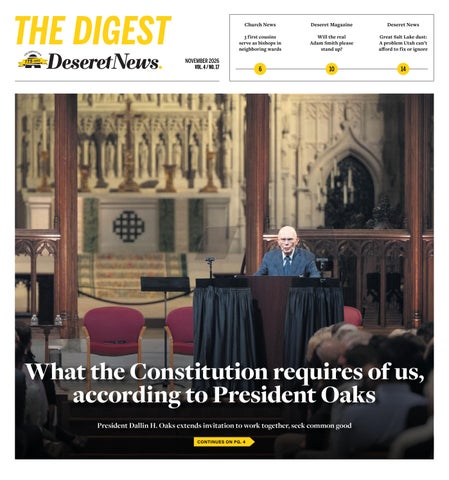
What the Constitution requires of us, according to President Oaks President Dallin H. Oaks extends invitation to work together, seek common good CONTINUES ON PG. 4
2
DESERET NEWS | NOVEMBER 2026
INTRODUCING 'THE DIGEST' or on the go with your mobile phone, you can access our website for the latest news, analysis and commentary.
Mobile apps By Doug Wilks Executive Editor
By Burke Olsen Publisher
We are pleased to introduce you to The Digest, a sampling of some of the best stories written every day by the dedicated journalists at the Deseret News, Deseret Magazine and Church News. Our hope is that you will make us your trusted news source each day at a time when there is confusion and contention in the nation. The Deseret News brand stands for unimpeachable journalism centered on the issues most core to the human heart. While the Deseret News since its beginning in 1850 has evolved to meet the demands of its audience — reimagining print offerings, launching an acclaimed magazine and increasing the visibility and reach of its award-winning website — the publication remains committed to certain timeless ideals. We stand for truth and light. We stand for faith and family. We stand for liberty and responsibility. We provide news and perspective, exploring society’s thorniest problems in search of solutions that will improve your life. That’s our commitment to our readers. We invite you to discover what we can offer you:
Our apps for iOS and Android devices offer a seamless and convenient way to access the latest news, wherever you are. Choose what you want to read, save articles for later and receive push notifications for the breaking news you need to know.
Newsletters
Delivered straight to your inbox, our free email newsletters provide a curated selection of the most important stories of the day, as well as deeper dives into topics that matter to you. Choose from a variety of subjects and frequencies to tailor your news consumption to your needs.
Award-winning website
Our website, Deseret.com, is designed to be user-friendly and available on any device. Whether you’re at home on your computer
Don’t just follow the story. Be part of it. SHOP.DESERET.COM
Weekly print newspaper
For those who appreciate the tactile experience of a traditional newspaper, our weekly print edition offers a comprehensive roundup of the week’s most important stories and opinions, including the most comprehensive high school, college and professional sports offerings in the state.
Deseret Magazine
In 2020, we undertook an ambitious endeavor by launching a new magazine with in-depth journalism, unique voices and principled points of view. The reception to the magazine has far exceeded our expectations. You can read more from the magazine online at Deseret.com/magazine or subscribe to have it delivered to your home or office.
Church News
The Church News remains one of our most popular offerings for those who want to know the latest news from The Church of Jesus Christ of Latter-day Saints. It’s available online at TheChurchNews.com and via iOS and Android apps. A print version is included in the Friday edition of the Deseret News.
SUBSCRIBE
ONLINE: DESERET.COM/SUBSCRIBE BY PHONE: 801-204-6100
DESERET NEWS | NOVEMBER 2026
ADVERTISEMENT
Fall Into Action: Tackle Cancer Screenings This Season Fall is more than football and pumpkin spice – it’s time for men and women to prioritize their health. As September spotlights Prostate Cancer Awareness and October approaches with Breast Cancer Awareness, our local medical experts are issuing a direct call to our community. This is your cue: men, actively engage with your prostate health; women, prioritize your breast health. Early detection is the most powerful tool you have to protect your life and your loved ones. The statistics are sobering. For men, prostate cancer is the most diagnosed cancer, and tragically, it stands as the second leading cause of cancer death, surpassed only by lung cancer. Similarly, for women, breast cancer is a significant threat, also ranking as the second leading cause of cancer death, second only to lung cancer. These aren’t just abstract figures; they represent real individuals whose lives can be profoundly impacted by timely action. “Too often, men delay necessary screenings,” explains Dr. Pursifull, a urologist at Holy Cross Hospital – Moun-
tain Point in Lehi. “But waiting for symptoms to appear significantly reduces treatment options. Regular PSA blood tests and digital rectal exams are straightforward procedures that detect cancer early. Talk to your primary care physician about your risk factors, especially if you have a family history or are of African American descent. CommonSpirit hospitals offer comprehensive prostate cancer screenings and advanced treatment options.” For women, prioritizing breast health is equally critical. “Early detection is truly a game- changer when it comes to breast cancer,” states Dr. Raylene Natwick, a breast surgeon practicing at a Holy Cross Hospital – Jordan Valley. “When breast cancer is identified early, the chances of successful treatment and a full recovery are remarkably higher. This is precisely why regular mammograms are so vital. They can detect subtle changes years before they would ever be palpable.” Dr. Natwick advises women to discuss screening guidelines starting around age 40, or earlier if risk factors warrant it. Monthly self-examinations and annual clinical breast exams are
also crucial. “CommonSpirit hospitals are equipped with state-of-the-art mammography technology and a dedicated team ready to support women.” “As primary care providers, we are frequently the entry portal to the health care system.” said Dr. Grant Hawkins, an internal medicine physician with CommonSpirit in West Jordan. We encourage our patients to have their yearly wellness checkups. At that time we have the opportunity to review medical issues, make medication adjustments, discuss new concerns and arrange for screening tests that are so important in preventing serious problems in the future.” This Fall, make the decision to prioritize your health. Both prostate and breast cancer often have excellent prognoses when caught early. CommonSpirit hospitals are committed to providing accessible screenings, expert diagnostics, and leading-edge treatments. Schedule your screenings and engage in crucial conversations with your doctor. Your life, your future, and your well-being depend on it.
When minutes count, count on our emergency care. Get to know us before you need us. When you need emergency care fast, the closest emergency room is a smart thing to know. You never know the level of care you’ll need when an emergency happens and choosing the right ER can make all the difference. And a hospital ER comes with the confidence of additional services right on-site. Find emergency care close to you at mountain.commonspirit.org.
CommonSpirit Health Mountain Region does not discriminate against any person on the basis of race, color, national origin, disability, age, sex, religion, creed, ancestry, sexual orientation, and marital status in admission, treatment, or participation in its programs, services and activities, or in employment. For further information about this policy contact CommonSpirit Health Mountain Region Office of the General Counsel at 1-303-643-1000 (TTY: 711). Copyright © CommonSpirit Health Mountain Region, 2026. ATENCIÓN: Si habla español, tiene a su disposición servicios gratuitos de asistencia lingüística. Llame al 1-303-643-1000 (TTY: 711). CHÚ Ý: Nếu bạn nói Tiếng Việt, có các dịch vụ hỗ trợ ngôn ngữ miễn phí dành cho bạn. Gọi số 1-303-643-1000 (TTY: 711).
3
4
DESERET NEWS | NOVEMBER 2026
DESERET NEWS
What the Constitution requires of us, according to President Oaks At the National Cathedral, President Dallin H. Oaks extends invitation to work together, seek common good By Mariya Manzhos
Deseret News
To share a country together, Americans don’t need to agree with one another — in fact, working alongside those you disagree with is precisely what the Constitution requires of people, said President Dallin H. Oaks in a speech at the National Cathedral in Washington, D.C. on Sept. 16. Speaking beneath the cathedral’s vaulted ceiling to a capacity audience of 4,000 people, the leader of The Church of Jesus Christ of Latter-day Saints delivered the historic address on the eve of Constitution Day, as the nation marks 250th anniversary since its founding. “The Constitution requires us to deal constantly with people who disagree with us. It compels a divided people to build coalitions that allow them to act together for the common good,” said President Oaks. He described the Constitution as a “model for a diverse people to achieve self-government.” President Oaks spoke as part of the cathedral’s “A Better Way” series, an effort to convene bipartisan leaders with the goal of deepening understanding and promoting civil discourse. A constitutional scholar and former Utah Supreme Court justice, President Oaks has spoken over the years about the importance of listening to opposing views and balancing competing rights in a pluralistic democracy. In a 2021 address at the University of Virginia, he argued that differences should be solved through “mutual respect, shared understanding and good faith negotiations.” In his National Cathedral address, President Oaks brought the focus to the Constitution’s essential charge to seek common ground. “‘Compels’ is a strong word, but it is exactly what the Constitution does,” President Oaks said. “It puts what we now call ‘peacemaking’ at the heart of the Constitution’s process for achieving freedom and unity, and fairness for all.”
Peacemakers by necessity
President Oaks drew on the history of the Latter-day Saints to illustrate how a religious minority learned to live amid disagreement. He described the early church members as “refugees,” driven from Missouri in the 1830s and then pushed out westward to build a new community. When Brigham Young became both president of the church and governor of the Utah Territory, Latter-day Saints lived under what President Oaks called “a theocracy and a democracy.” That changed after a non-Latter-day Saint became Utah’s new governor and people had to learn how to live within a new order. “We gradually learned to live with dual authorities,” President Oaks said. More recently, Latter-day Saints have faced rejection from those who don’t recognize them as Christian, he said.
Scott G Winterton, Deseret News President Dallin H. Oaks of The Church of Jesus Christ of Latter-day Saints delivers the keynote address at the Washington National Cathedral in Washington, D.C., on Sept. 16. President Oaks highlighted the Constitution's essential charge to seek common ground.
“You might say, we have become peacemakers and advocates of freedom and unity by necessity,” President Oaks said. “At the same time, we have preserved the freedom required for us to continue with our most important doctrines and practices.” The faith’s leader clarified that he wasn’t speaking on behalf of any political party or group. “I speak for the United States Constitution, which I have studied for 70 years,” said President Oaks. He began the study of the document as a clerk for the U.S. Supreme Court Chief Justice Earl Warren. He continued his study of the Constitution as a law professor and a justice on the Utah Supreme Court. In his role as an apostle for four decades, he’d
studied what the “divinely inspired principles” of the Constitution meant for the work of the church. The church holds a theological teaching that the Constitution is divinely inspired, but “this does not mean that every word is inspired, but that it is based on inspired principles,” President Oaks said. He highlighted the principles at the heart of the founding document: that people are a source of government authority; the separation of power between federal and state governments and among three branches; protection of individual rights and that everyone is governed by law rather than a person.
DESERET NEWS | NOVEMBER 2026 “Our loyalty is based on the Constitution and its principles and processes, not to particular office-holders,” he said. President Oaks acknowledged that he’s come to better understand why some people might think religious liberty infringes on their rights. “More recently, I have come to understand better the distress of other minorities who feel that some of us are invoking constitutional rights like free exercise of religion and freedom of speech to deny or challenge their own core beliefs and their basic constitutional rights.”
Legislation over litigation
Unity is rooted in the understanding that “we are fellow citizens who need each other,” and that means that to live peacefully, all citizens will sometimes have to obey laws they don’t like, President Oaks said. In these situations, he suggested making a genuine effort to understand the concerns of others, “especially when they differ from our own.” He also cautioned against “total dominance” in one’s views and emphasized that in a pluralistic society, the rights to exercise religious beliefs should be balanced with the interests of others. “The government must sometimes limit the right of some to act upon some of their beliefs when it is necessary to protect the health, safety, and welfare of all,” he said. Despite his work in the courts, President Oaks said he preferred resolving conflict through legislation — “the less contentious route” — rather
than litigation. He cited Harvard Law School professor Martha Minow, who has defended the effectiveness of “accommodation and negotiation” in her work. The Utah Compromise is an exemplary case of this kind of negotiation, according to the church’s leader. In 2015, The Church of Jesus Christ of Latter-day Saints and LGBTQ nondiscrimination advocates came together to negotiate a Utah law that balanced protections against discrimination in housing and employment with safeguards for religious freedom. Neither side got everything it wanted, but their willingness to come together resulted in meaningful protections for both. “This win-win outcome could not have been obtained without the balancing of interests made possible by the dynamics of a legislative process.” A conflict is an opportunity to listen and find “common moral instincts” to then begin building coalitions, President Oaks said. One example of this kind of coalition building is the church’s Helping Hands volunteer program, which provides community service and disaster relief. The “people-to-people” model allows for relationships across differences, something that institutions can’t replicate on their own.
Reflecting on President Oaks’ address
Following the address, a panel of legal and religious leaders reflected on ideas discussed by President Oaks.
The polarization is fueled partly by how Americans are conditioned to perceive each other, said the Rev. Mariann Edgar Budde, Bishop of the Episcopal Diocese of Washington. “We have been encouraged to constantly see one another in the worst possible light,” she said. “Particularly those with whom we disagree.” The change of posture requires curiosity and openness, she said. The religious teaching of treating everyone with inherent human dignity offers an antidote to the adversarial rhetoric, she said. In 2025, the Rev. Budde’s speech at the Inauguration Prayer Service, also held at the National Cathedral, went viral when she directly appealed to President Donald Trump in the audience to have mercy on people “who are scared now,” including immigrants and LGBTQ people. The Rev. Budde echoed President Oaks’ call to learn through conflict. Diversity is more than allowing people to co-exist, but it’s also about learning “how to be human together.” Melody Barnes, the executive director of Karsh Institute of Democracy at the University of Virginia, likened efforts to resolve conflict through legislative process to building a muscle. Historically, she said, there’s been a “push and pull” between the courts and legislature until a window opens up for legislative activity. She offered another example of successful coalition-building, when in 1993, over 60 different faith traditions — from the National Evangelical Association to the ACLU — joined forces to pass The Religious Freedom Restoration Act.
She also noted the partnership between late senators Lindsey Graham and Ted Kennedy, who partnered on bipartisan immigration reform. Productive disagreement, she said, depends not only on laws, but on norms. “It is about a set of habits that we have to have as citizens, as legislators, as representatives in a constitutional republic,” Barnes said. Barnes echoed President Oaks’ point about volunteerism — it’s “ a foundation that allows people to have more difficult conversations,” she said. Amid debates about the role of government and religion, America remains the country of vibrant religious dialogue and partnerships, said Rabbi David Saperstein, former United States ambassador-at-large for religious freedom. The separation of church and state has helped religion to flourish, he went on, even while the religious affiliation rates have plummeted. “So we have both narratives out there, and the question is, which will prevail?” said Saperstein. At the end of his address, President Oaks drew attention to the elements at the heart of peacemaking. “People of goodwill, compassion, and a desire to understand and help one another are at the core of peacemaking and fairness for all in the constitutional process of achieving freedom and unity, as difficult and slow as it is,” he said. “It is all about trying to understand the deep needs, the deep commitments, on both sides and then to forge solutions that yield peace and fairness for all.”
Fall Investment Rates Dancing on the Front Porch of Heaven • Rooster • Je ne t’Aime Pas This Bitter Earth • Three Preludes
NOW OPEN DON’T MISS OUT ON OUR EXCLUSIVE RATES
1 year • 8.0 0%
$10,000
3 years • 8.50% 5 years • 9.00%
$800,000
minimum
TICKETS
maximum
BALLETWEST.ORG
* Rates subject to change. Please call to verify current rates. SEASON SPONSORS
Call Ashley or visit us online today! (By appointment only) 801-566-5559 • WasatchCredit.com 7324 Union Park Ave., Suite #100, Midvale 84047 Monday - Thursday 9:30AM - 3:00PM Interest paid quarterly
For Utah residents only.
5
ARTISTS OF BALLET WEST | PHOTO BY BEAU PEARSON
6
DESERET NEWS | NOVEMBER 2026
CHURCH NEWS
3 first cousins serve as bishops in neighboring Othello, Washington, wards The 3 cousins and bishops draw on their ancestors’ legacy of testimony and hard work By Mary Richards
Church News
In Othello, an agricultural city in central Washington, three bishops are serving in neighboring wards of the Othello Washington Stake who also happen to be first cousins. Othello 3rd Ward Bishop Scott J. Harris was called in 2022, then Othello 1st Ward Bishop David K. Beus in 2023, then Othello 2nd Ward Bishop E. Brian Gentry in 2024. Their parents are siblings and their grandparents are Evan and Alta Beus, who were pioneers in the farming community. But since they have different last names, the cousins don’t believe the stake president even knew they were related when he called them to be bishops. These bishop cousins are close — almost like brothers. “We like to go to lunch and just talk about what’s working, what’s not working,” Bishop Gentry said. Talking to someone having a similar experience is helpful, Bishop Beus said. “To, generally speaking, say: ‘Hey, what’s been hard for you? What’s good for you?’ I always leave feeling better about life after talking to these guys for an hour.” Bishop Harris added: “And because we are so close, there’s not a lot of apprehension to ask what might be a silly question or a dumb question. It’s nice to be able to ask any question and get some honest feedback from someone we really know well and trust.” Bishop Gentry said one thing they have worked on as bishops of neighboring wards is to unite Othello a little bit more. The youth know each other as they go to school and seminary, but some of the adults in different wards don’t always see each other. So the cousins have been working with their three wards and the bishop of Othello 4th Ward (Spanish) to hold more events and build more unity. The 4th Ward’s bishop is Bishop Javier Ramirez, and Bishop Gentry said: “I always felt he’s like a cousin to us. He’s awesome. He really plays a big role in the work here in Othello.” The whole group of bishops and branch presidents in the stake are close, Bishop Harris said. “We have a wonderful stake.”
Cynthia Gentry From left, Othello 1st Ward Bishop David K. Beus, Othello 2nd Ward Bishop E. Brian Gentry and Othello 3rd Ward Bishop Scott J. Harris, all first cousins in the Othello Washington Stake, take a picture together in Othello, Wash., on Sept. 13.
Pioneer heritage
The cousins are descendants of Michel and Marianne Combe Beus, who joined The Church of Jesus Christ of Latter-day Saints because of Lorenzo Snow’s mission to Italy. The Beuses were baptized in the Alps region and came to America,
where they joined the Ellsworth Handcart Company in 1856 and crossed the Plains. Brigham Young sent them to the Ogden, Utah, area, where they helped establish agriculture and local water resources in Weber County. Beus Pond and Beus Park in Ogden are where
Michel and Marianne Beus dug their original irrigation pond, Bishop Gentry said. Beus Canyon Trail in Ogden is also named for the Beus family. CONTINUES ON PG. 8
DESERET NEWS | NOVEMBER 2026
7
Peripheral Neuropathy WARNING! begin to degenerate due to lack of nutrient South Jordan, UT - The most common flow. method your doctor will recommend to treat your neuropathy is with prescription drugs that may temporarily reduce your symptoms. These drugs have names such as Gabapentin, Lyrica, Cymbalta, and Neurontin, and are primarily antidepressant or anti-seizure drugs. These drugs may cause you to feel uncomfortable and have a variety of harmful side effects.
There is now a facility right here in South Jordan that offers you hope without taking those endless drugs with serious side effects. (See the special neuropathy severity examination at the end of this article) In order to effectively treat your neuropathy three factors must be determined.
1) What is the underlying cause? Figure 2: When these very small blood vessels become diseased they begin to shrivel up and the nerves begin to degenerate.
Figure 1: Notice the very small blood vessels surrounding each nerve. Peripheral neuropathy is a result of damage to the nerve often causing weakness, pain, numbness, tingling, and the most debilitating balance problems. This damage is commonly caused by a lack of blood flow to the nerves in the hands and feet which causes the nerves to
As you can see in Figure 2, as the blood vessels that surround the nerves become diseased they shrivel up which causes the nerves to not get the nutrients to continue to survive. When these nerves begin to “die” they cause you to have balance problems, pain, numbness, tingling, burning, and many additional symptoms. The main problem is that your doctor has told you to just live with the problems or try the drugs which you don’t like taking because they make you feel uncomfortable.
2) How Much Nerve Damage Has Been Sustained. NOTE: Once you have sustained 85% nerve loss, there is likely nothing we can do for you.
therapy) using light emitting diode technology. This technology was originally developed by NASA to assist in increasing blood flow. The low level light therapy is like watering a plant. The light therapy will allow the blood vessels to grow back around the peripheral nerves and provide them with the proper nutrients to heal and repair. It’s like adding water to a plant and seeing the roots grow deeper and deeper. The amount of treatment needed to allow the nerves to fully recover varies from person to person and can only be determined after a detailed neurological and vascular evaluation.
Freedom Integrated Medicine will do a neuropathy severity examination to determine the extent of the nerve damage for only $49. This neuropathy severity examination will consist of a detailed sensory evaluation, extensive peripheral vascular testing, and a detailed analysis of the findings of your neuropathy. We will be offering this promotion for neuropathy severity examination from now until November 30th 2026. Call 801-571-1338 to make an appointment with us to determine if your peripheral neuropathy can be treated.
CALL TODAY!
3) How much treatment will your condition require?
(801) 571-1338
The treatment that is provided at Freedom Integrated Medicine has three main goals:
Dr. Alec Laracuente, N. MD, PhD 4775 W. Daybreak Pkwy #102 South Jordan, UT 84009
1) Increase blood flow
2) Stimulate small fiber nerves
www.FreedomClinicUtah.com
3) Decrease brain-based pain The treatment to increase blood flow utilizes a specialized low-level light therapy (not to be confused with laser
As long as you have not sustained at least 85% nerve damage there is hope!
Figure 3: The blood vessels will grow back around the nerves much like a plant’s roots grow when watered.
8
DESERET NEWS | NOVEMBER 2026
The bishops’ grandparents, Evan and Alta Beus, moved from Ogden to Washington state in 1957 and bought farmland in Othello shortly after canals brought water to the area from the Columbia River. Several Latter-day Saint families moved there around the same time to farm the land, and a chapel was built in the early 1960s. These families invented better watering and farming techniques and created a community. Many members of the Othello Washington Stake are descendants of those first families. Evan and Alta Beus had nine children. Some continued to farm the land, passing on lessons of hard work and sacrifice to their children. Now the property is mainly an apple orchard. Each of those nine children had families of their own, resulting in around 50 first cousins. The cousins grew up as neighbors, playing and working together mainly on the Beus farm for almost all their childhoods. Bishop Beus said he feels blessed — “I figured that’s how everyone’s childhood was.” Bishop Harris said it seemed like his grandparents, parents and aunts and uncles had to work hard to make things work. “There’s a determination in their character, and that plays a role in their testimony and discipleship. There’s just a determination to follow the principles of the gospel no matter what comes their way. And I’ve seen that strength pass on to the kids, to each generation — just a determination to be a disciple of Jesus Christ, to do the right thing, to be a good person.” Bishop Beus said the most important thing for his grandmother, Alta Beus, was to be kind. As one of the younger children growing up around a lot of extended family, he saw that kindness among his older cousins and family members. Those examples helped Bishop Gentry when he turned 19 and was nervous to serve a mission. But all of his older cousins had served missions, and he felt a desire to serve in part because of his grandparents’ faith and testimonies. “I didn’t want to disappoint them.”
Provided by the Beus family The Beus family is photographed in 1968. Back row: Roger Beus, Clark Beus, Don Beus, Glenn Beus, Clair Beus, Dale Beus and Kathy (Beus) Harris. Seated: Susan (Beus) Gentry, Alta Beus, Evan Beus, and Eva Lu (Beus) Kent.
20OFF %
“Make a Blind Date with Us” TRAVIS THOMPSON
DAN SHEPHERD
BROCK SHEPHERD
ALL PRODUCTS! Must mention ad.
OUTDOOR PATIO/DECK SCREENS PROTECTION FROM SUN, BUGS & NOSY NEIGHBORS
ROLLER SHADES
FREE MOTORIZATION ON OUTDOOR SCREENS!
801-243-4464
BLINDMASTERS@GMAIL.COM BLINDMASTERSUTAH
SHUTTERS
CELL SHADES
Lowest Prices in years!
5
WE WILL BEAT ANYBODY’S PRICE, EVEN THE BIG BOX STORES!
DESERET NEWS | NOVEMBER 2026
9
Bishop E. Brian Gentry Bishops of the four Othello wards in the Othello Washington Stake take a picture together after a leadership conference on June 7, 2025. From left are Othello 2nd Ward Bishop E. Brian Gentry, Othello 4th Ward (Spanish) Bishop Javier Ramirez, Othello 1st Ward Bishop David K. Beus and Othello 3rd Ward Bishop Scott J. Harris. Bishops Gentry, Beus and Harris are all first cousins.
Then, Bishop Gentry’s mission helped Bishop Harris when it was his turn to go. “To see [my cousins] be willing to dedicate two years of their lives just made it an easy decision for me.” Bishop Beus agreed.
Serving among family and friends
Bishop Gentry, Bishop Harris and Bishop Beus all grew up in the Othello 3rd Ward boundaries. When it comes to age, Bishop Gentry is the oldest, then Bishop Harris, then Bishop Beus. Their parents all still live in the 3rd Ward under Bishop Harris’ watchful care.
“We have a good amount of people in the older generation in the ward, but they really are such stalwart, humble, faithful members,” Bishop Harris said. “It’s an interesting experience to know that these are not just the family that I looked up to as a child, but also adults, home teachers, that now I have the opportunity to be a bishop for them.” Bishop Gentry also has some of his family members in his Othello 2nd Ward boundaries, and Bishop Beus said he has members in his Othello 1st Ward who have lived in Othello for a long time.
Gathering from the different towns for stake conference can feel like a reunion, he said, with members feeling genuine love for each other. “I grew up with a lot of these people, and my friends’ parents are in the ward, and I’ve been impressed that they’re just a lot of really good, humble people,” Bishop Beus said. “They could easily look at me and think, ‘You’re the bishop?’ But they are very kind and patient. … It’s interesting for all three of us, I think, to be the bishop over a ward where we have known the people for our whole lives.”
Make Your Bathroom Safer This Year!
Call Today!
www.thegrabbarspecialist.com
10 DESERET NEWS | NOVEMBER 2026
DESERET MAGAZINE
Will the real Adam Smith please stand up? The patron saint of free markets saw capitalism’s virtues — and its dangers By Michael S. Kofoed
For Deseret Magazine
The week before Thanksgiving 1988, at the end of his presidency, Ronald Reagan took the microphone for his weekly radio address. With his time in off ice running short, Reagan wanted to express his hopes for the future of the country he had led for eight years. From the canon of American and world history, who could a president many called “The Great Communicator” draw inspiration from to portray a vision of what made America an exceptional and powerful country? A former president like Washington, Lincoln or Franklin Roosevelt? A world leader like Churchill? Or someone from Reagan’s own days in Hollywood? What ideas would an outgoing leader give thanks for during the holiday season? America’s military might? Technological advancement? Political and democratic freedom? Reagan chose a Scottish economist nearly everyone has heard of and almost no one has read — a man whose 900page treatise on markets and wealth remains one of the most cited, least-f inished books in the English language. The Gipper relied on Adam Smith. Given the holiday theme, Reagan expressed his gratitude for two documents that were, coincidentally, both written in 1776 and that revolutionized the young nation, imprinting themselves into its DNA: the Declaration of Independence and Smith’s masterpiece, “The Wealth of Nations.” Reagan pointed out that among the key complaints against the British Crown that Jefferson listed was “cutting off our trade with all parts of the world.” International trade — the ability to freely exchange goods and services across borders — was a key liberty that King George III was happy to restrict in order to bring the American rebels to heel. Jefferson bristled at the idea that a distant, unrepresentative government should tax its subjects simply for trying to better their station and flourish. Smith made a similarly radical argument in economics. A nation’s wealth, he insisted, was not the accumulation of gold and silver that so obsessed the Spanish conquistadors, but a country’s productive capacity. And what built that capacity, Smith pointed out, wasn’t conquest or resource extraction — it was cooperation and eff iciency. “It is the maxim of every prudent master of a family,” Smith explained, “never to attempt to make at home what it will cost him more to make than to buy. ... What is prudence in the conduct of every private family, can scarce be folly in that of a great kingdom.” In other words, if your neighbor grows better wheat than you can, buy his wheat and spend your energy on what you do best. Nations, Smith argued, should trade the same way.
Robert Neubecker
Reagan’s Adam Smith was a free-trader’s Adam Smith, a small-government Adam Smith, a patron saint for the libertarian vision of American exceptionalism. But it is worth asking what Smith himself would have made of that adoption — because the very same book Reagan invoked contains some of the sharpest attacks on concentrated business power ever written by an economist. “People of the same trade seldom meet together, even for merriment and diversion,” Smith warned, “but the conversation ends in a conspiracy against the public, or in some contrivance to raise prices.” Modern antitrust advocates and labor lawyers invoke his work routinely. Smith went further still, writing in “Wealth of
Nations” that civil government, insofar as it exists to secure property, is in reality instituted to defend the poor against the rich — a line that sits uneasily with the free-market-patron-saint version of Smith that Reagan invoked, and one that progressive critics of corporate power have leaned on for two centuries since. How is it that a philosopher in the Scottish Highlands could put his f inger on the pulse of debates in a country an ocean away that would rage for 250 years? Smith’s work not only revolutionized the way that countries allocate scarce resources, but his arguments touch on the very core questions of Western civilization: What does it mean to be human, and what do I owe my community and my neighbor?
DESERET NEWS | NOVEMBER 2026
Harnessing self-interest for good
Adam Smith was born in Scotland in 1723 to a family in Glasgow’s growing middle class. His father was comptroller of customs — a small irony, given that the future economist would spend his life arguing against protectionism. Smith entered the University of Glasgow as a teenager and later studied at Oxford, where his disdain for England’s rigid higher education system only deepened. He returned to Glasgow, where he accepted a position as a professor of moral philosophy — a f ield that in his day covered something closer to a mix of civics, political science and economics than what we’d now call “philosophy.” Smith’s early writing centered on a single question: What does it mean to live a virtuous life? The 1750s were a remarkable moment to be a scholar in Glasgow, as a cluster of thinkers kicked off what would come to be called the Scottish Enlightenment. Chief among them was Smith’s closest friend and colleague, David Hume. Hume and his circle were, in part, reacting against the better-known Enlightenment sweeping France earlier in the century. French thinkers like Voltaire and Rousseau argued that reason was the apex of human capability, and that logic would eventually displace the superstitions of the medieval church — that human nature could progress toward something like perfection, f it for full self-governance by the enlightened. These ideas fueled arguments for overthrowing the French monarchy outright; a bloody future that led to Napoleon and war. Hume and Smith were skeptical. They worried that casting off tradition and institutions so radically would lead not to enlightenment but to anarchy — extinguishing liberty rather than expanding it. Their counterargument was that human nature is f ixed and people are driven primarily not by logic but by emotion. A functioning society, in their view, needed safeguards to cool the passions of the crowd, and institutions to transmit hard-won values across generations. Where Hume’s writing focused on political systems built to preserve liberty, Smith noticed the same dynamics at work in personal and economic life. In 1759, he published the book he would later call his best work: “The Theory of Moral Sentiments.” Its central claim was that human beings are, at bottom, emotional creatures — driven by passion and self-interest. But Smith believed that force could be harnessed for good. Where many modern readers hear “self-interest” and think “self ishness,” Smith meant something closer to the opposite: “Man naturally desires, not only to be loved, but to be lovely; or to be that thing which is the natural and proper object of love.” The idea at the heart of that line: People don’t just want praise from their community — they want to actually deserve it. The trouble is, we often don’t know how to become someone worthy of that esteem. That’s where institutions — religious and civic ones especially — come in: They model and reinforce shared values that spring from this desire, giving people a path toward it. Institutions, for Smith, aren’t the source of
human values — they’re the guardrails that keep a society on the road toward those values. He believed government’s core job was enforcing justice: fair play, the rule of law, a level playing f ield. Everyday people, meanwhile, doing their best to build good lives every day, power the engine of the free enterprise system. Smith held that neighbors would look after the poor, too — some out of genuine altruism, some because incentives pushed them that way — with government’s role being to make sure everyone had a fair shot, even as free will, talent and choice still determined where they ended up. Today, Smith is seen as a prophet of pure self-interest — Gordon Gekko’s “greed is good,” with a powdered wig. That’s not quite right. Smith’s view was that a society built on shared values and a working sense of justice creates the conditions for economic growth and for taking care of the disadvantaged — not one or the other. His f irst use of the phrase “invisible hand” makes the point. Imagining a wealthy, self-absorbed landlord who employs farmers to work his land, Smith argued that even a man with no warmth toward his workers at all would still “be led by an invisible hand to make nearly the same distribution of the necessaries of life which would have been made had the earth been divided into equal portions among all its inhabitants — and thus, without intending it, without knowing it, advance the interest of society.” But Smith didn’t think private philanthropy alone could solve inequality or handle problems that require coordination at the community level — public education, infrastructure, common defense all needed government. At the same time, he was wary of handing bureaucracy too much conf idence in its own wisdom. While government can solve collective action problems, it has incomplete information and can lose touch with the governed. “The man of system ... is often so enamoured with the supposed beauty of his own ideal plan of government that he cannot suffer the smallest deviation from any part of it. ... He seems to imagine that he can arrange the different members of a great society with as much ease as the hand arranges the different pieces upon a chessboard.” Smith wasn’t the libertarian patron saint he’s often made out to be — but his deep suspicion of concentrated power, rooted in a belief that all of us are flawed and fallible, wasn’t so different from the argument James Madison would make a few decades later while drafting the U.S. Constitution.
Among Smith’s fans? The Founding Fathers
In 1759, the same year Smith’s book made him a rising star across the continent, David Hume welcomed two visitors from across the Atlantic to Edinburgh: Benjamin Franklin and his son William, touring Scotland for the f irst time. That September, Smith and a circle of friends sat down to dinner with them. Smith and Franklin took to each other immediately and stayed in contact for years afterward. A few years later, after a long stretch
teaching at Glasgow, Smith was offered a different kind of education: a tour of Europe as traveling tutor to the young Duke of Buccleuch, a position arranged by the Duke’s stepfather, Charles Townshend — a prominent politician who would later become Chancellor of the Exchequer. The tour opened Smith’s eyes to a much larger world. Why did one country specialize so heavily in one kind of good, and its neighbor in something else entirely? What determined the standard of living in the towns and hovels he passed through? And how should his own country handle the fast-growing, increasingly restless colonies of its expanding empire? It was on this trip, restless in a French drawing room, that Smith began scratching out the manuscript that would occupy the next decade of his life — and that would arrive in print in 1776, the same spring the American colonies he’d been puzzling over declared their independence. Given where and when Smith lived, “The Wealth of Nations” is an extraordinary book that turns many conventional ideas about the economy on their head. Smith derides mercantilism, the reigning economic system of the British Empire. Mercantilism held that trade and markets were zero-sum, and that to retain power and influence, a monarch should tightly control economic activity and hoard wealth in the form of gold and silver. A mercantilist monarch (like King George III) would limit international trade, protect domestic industries from foreign competition, extract resources from colonies and lesser powers, and have the sovereign take a stake in preferred private companies like the East India Company. The point of Smith’s book was to carefully dismantle the mercantilist ideology of his time. F irst, Smith saw trade — on the international or individual level — as positive-sum, meaning these transactions only happen when they’re mutually benef icial. Millions of people trying to do their best every day create marketplaces that solve the problems of strangers they may never meet. As Smith famously wrote: “It is not from the benevolence of the butcher, the brewer, or the baker that we expect our dinner, but from their regard to their own interest. We address ourselves, not to their humanity but to their self-love, and never talk to them of our own necessities but of their advantages.” Like the “invisible hand,” this famous line is often misunderstood. The butcher and the baker need to feed their own families; they need some way to contribute so that they, too, can survive. Markets and prices give them the incentive to discover their talents and offer them to their communities. Customers may be buying bread and meat in this instance, but they’ll turn around and supply their own time, talents and effort toward another community problem. These unknown, disparate groups only choose to cooperate when it helps both sides. But who should make what, for whom and where? Smith imagines a pin factory where a manager decides whether to have a complete team of workers make each entire pin, or to let
11
workers specialize in one part of the operation and collaborate along a production line: “I have seen a small manufactory of this kind where ten men only were employed ... (they) could make among them upwards of forty-eight thousand pins in a day. ... But if they had all wrought separately and independently, ... they certainly could not each of them have made twenty, perhaps not one pin in a day.” Smith does not argue that some workers were naturally gifted at wire-cutting and others at head-forming — it was that repetition itself builds skill. Practice one narrow motion all day, and you’ll get faster at it than someone splitting their attention across 18 different tasks ever could. Smith extended that same logic from the factory floor to international trade. If specialization made 10 pinmakers more productive than 10 generalists, the same should hold for nations: A country ought to make what it can produce most eff iciently and trade for the rest, rather than trying to produce everything itself behind a wall of tariffs. Tariffs and protectionism, in Smith’s view, shrank the very productive dynamism — wages, wealth and human flourishing — that free exchange could generate. Smith’s “Wealth of Nations” created the intellectual framework for the economic boom of the next two centuries, and his ideas spread quickly across the Atlantic. Smith took notice of the American Revolution, arguing that the British crown should either grant the colonies full representation or let them go. The unruly colonists loved him for it. Jefferson kept a full set of Smith’s volumes at Monticello, later calling “The Wealth of Nations” simply “the best book extant.” Franklin continued to meet with Smith and Hume while in London, and Madison would go on to echo some of Smith’s economic logic while defending the new Constitution. Smith’s ideas are uniquely American. The balance between individual liberty and solving communal problems would challenge the new country just as it did Smith’s own thinking about what makes a good life. Smith’s key insight into the benevolent but flawed nature of mankind shows that markets, liberty and smart public policy combine to promote what Jefferson would call “the pursuit of happiness.” A nation’s true wealth isn’t in its stockpile of gold, or in extracting resources from others, but in the ingenuity, entrepreneurship and virtue of its people. Who is the true heir to Adam Smith? Reagan claimed him. So have the critics of the monopolies Smith despised. Perhaps, like the founding documents themselves, no one side can make a full claim on Adam Smith, and that is what makes his insights so relevant for a republic that has lasted 250 years. Michael S. Kofoed is an associate professor of economics at the University of Tennessee, Knoxville, and a research fellow at the Institute of Labor Economics. This story appears in the October 2026 issue of Deseret Magazine. Learn more about how to subscribe.
12
DESERET NEWS | NOVEMBER 2026
DESERET MAGAZINE
Sticky service By Kristin Andrus
For Deseret Magazine
When my work shifted from service to philanthropy, I asked myself, “What causes mattered most to our family?” At first, I chased every organization that needed our attention — from food banks and homeless shelters to refugee resettlement agencies and teen mental health advocacy groups. But I soon realized that the list of worthy partners and organizations is endless and choosing where to engage was overwhelming. While looking for an answer, I signed my family up to serve dinner at the Ronald McDonald Family Room at our local children’s hospital. We had been there several times, but this night was different. This was the night we met Sara — a teenager, newly navigating life in a wheelchair. As her father was plating her dinner, my daughters, a few years younger than Sara, gravitated toward her immediately and started asking questions. Within minutes they were deep in conversation about ordinary teenager things, and the bond between them was instant, easy and real. When I signed our family up to provide dinner at the Ronald McDonald Family Room, it checked all the right boxes: close enough for a weeknight, manageable with children and centered around food, which is my love language. But on the seventh or eighth visit, when our paths crossed with Sara’s, I felt something shift and realized the magic of serving is rarely in the f irst visit, or even the second. It happens after we keep going back. This is what I call “sticky service.” It’s when you care about a cause so personally that you keep returning until serving stops being something you do and becomes part of who you are. Because we kept going back, we learned something I don’t believe we could have ever learned in a single visit.
Zoë Petersen, Deseret News
Six weeks later, we returned to the hospital and saw Sara again. Yet, while our family had gone many places since our last visit — school, soccer games, spring break — Sara and her family had not. They were still at the hospital, focused on her long-term rehabilitation and recovery. I realized then, in a deeply personal and spiritual way, another dimension of sticky service: that the problems we show up to help with do not end when we leave. Poverty does not end. The pain of illness, homelessness or grief sits
with the people living it long after we have gone back to our comfortable lives. Understanding this has made me not only a better mother and neighbor but a more intentional community member and philanthropist. I stopped focusing on outcomes and started asking deeper questions about why families were facing these barriers in the f irst place. I stopped arriving with answers and my own solutions. I fell in love with Sara and her dad and the families who are still sitting in that room after I drive home. That is what brings me back
to the same place, again and again. My own sticky service started with food. I have always loved to host and gather people around one table to break bread. So as a young mom with a lot of little kids, anything involving food, women and children pulled at me. That was my entry point. Ten years of engaging in sticky service has changed my perspective. Previously, I was engaged and excited about efforts supporting children. However, I have come to recognize that helping children is not enough on its own. As our work at the Ronald McDonald House showed me, it is essential to nurture the nurturer. Focusing my efforts on the caretaker is a completely different approach than the one I started with, and I learned that by coming back. When families ask how to f ind their own sticky service, I tell them not to invent something new. It is already there. Follow a few organizations. Show up once, watch what happens to your children and ask them the question I love most: If you had $5 to give, who would you give it to? You will be amazed what children carry in their hearts. Look for the opportunities where you can get your hands dirty and your hearts broken. Sign up. Show up. Then keep going back. Talk about the cause at dinner. Pray for the people you meet. Then invite people in. Champion your cause so openly that your neighbors and cousins start wondering what theirs might be. Sticky service is long-term culture building, and the culture of a home is built by what we repeat, what we celebrate and what we make room for. This story appears in the October 2026 issue of Deseret Magazine. Learn more about how to subscribe.
Utah Always Answers The Call For Help Utah Gives highlights the work of non-profit organizations across our state. This section connects readers with meaningful causes, volunteer opportunities, and community events. Our goal is to raise awareness and support for various charitable efforts. Whether you want to get involved, donate, or learn more, Utah Gives is your gateway to making a positive impact.
Community
DESERET NEWS | NOVEMBER 2026
LISTEN NOW
A NEW PODCAST FROM THE DESERET NEWS DESERET.COM/PODCASTS
and on YouTube
13
14
DESERET NEWS | NOVEMBER 2026
DESERET NEWS
Great Salt Lake dust: A problem Utah can’t afford to fix or ignore University of Utah researchers warn dust mitigation could cost billions, but the state’s top air regulator says other air quality concerns take precedence By Leah Bowers
Deseret News
Utah leaders face the costs of controlling dust from a shrinking Great Salt Lake — whether they choose to act now or not. More than 800 square miles of lakebed are now exposed as the Great Salt Lake water levels continue to decline — leaving dry, dusty areas surrounding the city. University of Utah researchers claim 70 of those square miles are “active dust hotspots” — which have the potential to expand to over 100 square miles as groundwater levels decline. The Great Salt Lake Alliance, a local nonprofit, held an event to discuss the current state of the dust on Oct. 5.
‘We need to start making progress now’
“I think it’s a pretty urgent issue,” said Derek Mallia, a research professor at the University of Utah Department of Atmospheric Sciences, and one of the panelists. “We definitely need to make progress. We need to start making that progress now.” When speaking about the Great Salt Lake’s dust makeup, David Parrott, assistant director of Great Salt Lake Institute, said: “We don’t really know.” He explained many believe the dust is laced with arsenic — something that is actually unproven. Mallia, however, pointed out that the dust itself is an atmospheric pollutant, whether it is laced with heavy metals or not. Parrott explained that aside from the dust itself, micro-irritants — like bacteria and fungi — can also travel in the wind. The University of Utah found the dust and micro-irritants will cost Utah an estimated $116 million in annual health costs, including roughly seven premature deaths each year. “Most of the time, the result has been it’s become unlivable and people have moved away,” said Bryce Bird, director of the Utah Division of Air Quality. “Of course, we don’t have that option here. We are planted here, our roots go deep, and we need to find ways to address it.” Though, that doesn’t mean the lake is the top priority for the division.
Not the f irst priority
“We have other air pollution concerns that I think are more pressing to us public health-wise than the Great Salt Lake today,” he said. Bird referred to the Environmental Protection Agency’s ozone standard, which he said Utah has exceeded 19 times in 2026. The dust pollutants haven’t exceeded the EPA’s standards once. “And so, probably the more pressing effort or issue for me as a regulator is focusing on ground level ozone in our urban areas — which is what is actually impacting public health today.” Bird pointed out that there are also other local dust sources that can be put under control first, like sandy construction areas. “It used to be that in the sand and gravel areas, neighbors didn’t
Spenser Heaps, Deseret News Dust blows across the dry lakebed of the Great Salt Lake near Salt Lake City on Aug. 12, 2022.
live right next door — they lived a mile away,” he said. “But as planning and zoning commissions have approved new subdivisions, we’re seeing them get closer and closer.” He also pointed to historical mining tailings — such as the Kennecott tailings pond near Magna — which was considered Utah’s primary air quality hazard in the 1970s before engineering controls were implemented. Though the scientists and elected officials may have had different stances on what should be Utah’s number one priority, all three seemed to agree on what is the cheapest option: Putting water back in the lake.
‘The cheapest and easiest thing to do’
“The cheapest and easiest thing to do would just be to put water back into the lake,” said Mallia.
In the panel discussion, Owens Lake in Inyo County, California, became a prime example of why the speakers thought this way. At Owens Lake, various physical and engineering modif ications were implemented to prevent dust from blowing — such as drilling wells in the lakebed to keep the playa moist and installing structures such as solar panels. A new collaborative report from the University of Utah weighed the potential costs of controlling the dust while also looking at the long-term benef its of stabilizing lake levels — using Owens Lake as a case study. “When we did the math of what these dust mitigation techniques would cost (in the Great Salt Lake), it just ends up costing anywhere from hundreds of millions to billions of dollars,” Mallia said. “It gets really expensive really really quickly.”
DESERET NEWS | NOVEMBER 2026
15
EVENTS
FESTIVALS REGENCY CHRISTMAS FESTIVAL DATE: Nov. 7
TIME: 11 a.m.-9 p.m. LOCATION: 1200 Towne Centre Blvd., Provo Kick off your holiday season with us.
SCIENCEFEST DATE: Nov. 7-8
TIME: 10 a.m.–5 p.m. LOCATION: 301 Wakara Way, Salt Lake City Celebrate the drivers of scientific advancement.
SPLC HOLIDAY BAZAAR DATE: Nov. 7
TIME: 10 a.m.–5 p.m. LOCATION: 3329 Harrison Blvd., Ogden Unique gifts for everyone on your list.
HOLY COW CHRISTMAS BOUTIQUE DATE: Nov. 17-21
TIME: Tuesday-Friday, 9 a.m.-9.m.; Saturday, 9 a.m.-7 p.m. LOCATION: 25 N. Main Street, Lindon Craft and home decor boutique.
HOLIDAY LIGHTS AT THE BALLPARK AT AMERICA FIRST SQUARE DATE: Nov. 20-Jan. 2, 2027 TIME: 6 p.m.–9 p.m. LOCATION: 11098 S Grandville Ave., South Jordan
Tess Crowley, Deseret News Utah's Anders Lee (72) skates with the puck during a game against the Colorado Avalanche at the Delta Center in Salt Lake City on Sept. 26.
ALEXANDRA DARIESCU & UTAH SYMPHONY ORCHESTRA DATE: Nov. 13-14 TIME: 7:30 p.m.
LOCATION: 123 W. South Temple, Salt Lake City
Walk-through light show at the ballpark.
Classical concert pianist performs.
CONCERTS & LIVE MUSIC
THEATER & COMEDY
FOR HEROES PROVED: A VETERANS DAY CELEBRATION
THE NUTCRACKER
DATE: Nov. 11
TIME: 7:30 p.m. LOCATION: 3209 Music Building, Provo
DATE: Nov. 12-14
TIME: 7 p.m. (Saturday, 1 p.m., 7 p.m.) LOCATION: 425 West Center St., Provo
Honor our nation’s veterans with this patriotic tribute concert.
Popular classical ballet.
FOX STEVENSON & MYSTERY SKULLS
CHELSEA HANDLER
DATE: Nov. 11 TIME: 7 p.m.
LOCATION: 241 S. 500 East, Salt Lake City
DATE: Nov. 13 TIME: 8 p.m.
LOCATION: 1395 Presidents Circle, Salt Lake City
High-energy electronic music, drum & bass, funk, disco and R&B.
Named one of Time’s 100 most influential in 2012.
JIM BRICKMAN PIANO SENSATION
CRAIG CONANT
DATE: Nov. 11
TIME: 7:30 p.m.
DATE: Nov. 13-14 TIME: 6:30 p.m.
SETH MEYERS DATE: Nov. 21 TIME: 7 p.m. LOCATION: 1395 Presidents Circle, Salt Lake City Has hosted late-night talk show on NBC since 2014.
SPORTS BYU MEN’S BASKETBALL VS. MONTANA STATE DATE: Nov. 12 TIME: 7 p.m. LOCATION: 500 E. University Parkway, Provo Cougars began season at No. 25 in AP poll.
UTAH MEN’S BASKETBALL VS. WASHINGTON DATE: Nov. 14 TIME: 5 p.m. LOCATION: 1825 S. Campus Drive, Salt Lake City Runnin’ Utes tangle with former Pac-12 foe.
UTAH MAMMOTH VS. COLORADO AVALANCHE DATE: Nov. 18 TIME: 7 p.m.
Perfect mix of timeless songs and holiday favorites.
LOCATION: 190 S. 400 West, Salt Lake City
Fast-rising comedian known for storytelling.
LOCATION: 301 S. Temple, Salt Lake City Divisional rivals face off.
FOREVER MOTOWN
EDDIE IFFT
UTAH JAZZ VS. PHOENIX SUNS
TIME: 7 p.m.
TIME: 7:30 p.m.
LOCATION: 138 W. 300 South, Salt Lake City
DATE: Nov. 12-14 TIME: 8 p.m.
LOCATION: 328 Main, Park City
High energy trip down memory lane.
DATE: Nov. 13-14
DATE: Nov. 20
LOCATION: 625 Main, Park City
LOCATION: 301 S. Temple, Salt Lake City Devin Booker and the Suns come to town.
GQ Magazine featured two of his jokes in their Top 75.
16
DESERET NEWS | NOVEMBER 2026
You've worked hard for the harvest Let us help you make the most of what you have built FINANCIAL TAX ESTATE PLANNING
Let's talk about your retirement.
Schedule your complimentary consultation
801-CPA-HELP WealthCPAs.com
Advisory services are offered through Wealth Management CPAs, LLC, an SEC Investment Advisor. Tax services are offered through Wealth Management Tax Solutions, an affiliated company. Insurance products and services are offered through Wealth Management Insurance Solutions, LLC, an affiliated company. Copyright © 2010-2026 Wealth Management CPAs. All rights reserved.