The fight over water in the West







By Doug Wilks Executive Editor

By Burke Olsen Publisher
We are pleased to introduce you to The Digest, a sampling of some of the best stories written every day by the dedicated journalists at the Deseret News, Deseret Magazine and Church News. Our hope is that you will make us your trusted news source each day at a time when there is confusion and contention in the nation.
The Deseret News brand stands for unimpeachable journalism centered on the issues most core to the human heart. While the Deseret News since its beginning in 1850 has evolved to meet the demands of its audience — reimagining print offerings, launching an acclaimed magazine and increasing the visibility and reach of its award-winning website — the publication remains committed to certain timeless ideals.
We stand for truth and light. We stand for faith and family. We stand for liberty and responsibility. We provide news and perspective, exploring society’s thorniest problems in search of solutions that will improve your life. That’s our commitment to our readers.
We invite you to discover what we can offer you:
Award-winning website
Our website, Deseret.com, is designed to be user-friendly and available on any device. Whether you’re at home on your computer



INTRODUCING 'THE DIGEST'
or on the go with your mobile phone, you can access our website for the latest news, analysis and commentary.
Mobile apps
Our apps for iOS and Android devices offer a seamless and convenient way to access the latest news, wherever you are. Choose what you want to read, save articles for later and receive push notifications for the breaking news you need to know.
Newsletters
Delivered straight to your inbox, our free email newsletters provide a curated selection of the most important stories of the day, as well as deeper dives into topics that matter to you. Choose from a variety of subjects and frequencies to tailor your news consumption to your needs.
Weekly print newspaper
For those who appreciate the tactile experience of a traditional newspaper, our weekly print edition offers a comprehensive roundup of the week’s most important stories and opinions, including the most comprehensive high school, college and professional sports offerings in the state.
Deseret Magazine
In 2020, we undertook an ambitious endeavor by launching a new magazine with in-depth journalism, unique voices and principled points of view. The reception to the magazine has far exceeded our expectations. You can read more from the magazine online at Deseret.com/magazine or subscribe to have it delivered to your home or office.
Church News
The Church News remains one of our most popular offerings for those who want to know the latest news from The Church of Jesus Christ of Latter-day Saints. It’s available online at TheChurchNews.com and via iOS and Android apps. A print version is included in the Friday edition of the Deseret News.










DESERET
The fight over water in the West
As temperatures climb, here’s how 7 states are negotiating over dwindling water resources
By Gitanjali Poonia and Eva Terry Deseret News
The seven states connected to Colorado River share at least one thing in common: all are feeling the pain of trying to cut their water consumption from the iconic Western waterway.
As the current guidelines over how to divide water resources in dry years expires, the states have a deadline of Oct. 1 to come to a new agreement.
This is no small feat. The states have been stuck in a stalemate over water cuts for more than two years, with the Upper Basin states — Utah, Colorado, New Mexico and Wyoming — at odds with their Lower Basin neighbors — Arizona, California and Nevada.
The urgency for these Western states to f inalize a deal is greater than ever amid the record-breaking heatwave and generational drought moving through the Mountain West.
“It’s way too early to be having 80-degree weather and of course, the snowpack is a concern,” Utah Gov. Spencer Cox said last month during his monthly news conference. In Phoenix, Arizona, temperatures have been over 100 degrees for multiple days in March, marking the earliest 100-degree weather in the city’s recorded history.
While the last Colorado River agreement lasted two decades, current negotiations have focused on a potential shortterm agreement, based on the grim water forecasts this year.
The root of the issue comes from the states’ original 1922 compact, which was based on unusually wet years, allocating each basin 7.5 million acre-feet of water.
Through the next century, populations exploded across all seven states, and the river’s level withered through overconsumption and long-term drought.
Colorado River flows have shrunk 20% since 2000, and in 2026, its largest basins sit at critical levels. Lake Powell is 25% full; Lake Mead is 34% full.
What’s water usage been lately?
Both basins use less water than is appropriated to them.
Between 2016 and 2020, the Upper Basin’s total consumptive use averaged 4.6 million acre-feet per year, according to the Bureau of Reclamation. Meanwhile in 2024, the Lower Basin used 6.1 million acre-feet.
About 60% of the basins’ water consumption is for agriculture and livestock.
Both Colorado and Utah have battled severe snow droughts and record-warm summers in the past decade. Wyoming fared better, but it can’t avoid the strains on the system.
To the south in New Mexico, low snowpack and prolonged drought have also reduced flow. The state doesn’t sit on the main Colorado River but pulls from a tributary, the San Juan River.
The 1948 compact allocated 51.75% of the Upper Basin’s 7.5 million acre-feet to Colorado, 23% to Utah, 14% to Wyoming and 11.25% to New Mexico.
Meanwhile, California enjoyed the highest apportionment of water of roughly 4.4 million acre-feet. Arizona is entitled to 2.8 million acre-feet and Nevada 0.3 million acre-feet.
But as the Upper Basin experienced “natural” mandatory cuts every dry year, the Lower Basin is subject to mandatory federal cuts. In 2021, the Colorado River system faced a Tier 1 shortage, and escalated to Tier 2 in 2023. It has since reversed back to Tier 1.
In 2025, California decreased its Colorado River water consumption by 14% — the lowest use level since 1949. In that time, the state’s population has quadrupled.
Meanwhile, Arizona decreased its Colorado River consumption 32% in 2024. The cuts led to most farmers losing access to their share of the river’s water supply.
Nevada also faced cuts, but the state has managed to
“decouple water demand and population growth,” Las Vegas Fox5 reported.
What does the Upper Basin want?
Upper Basin states are hesitant to commit to guaranteed releases from Blue Mesa, Flaming Gorge, and Navajo dams to meet water demands in the Lower Basin.
Utah representatives say that requiring such releases is unsustainable and delays the problem of over-consumption. Lower Basin water demands were initially met by the Upper Basin releasing water storage from Lake Powell and Lake Mead, but “that storage is essentially gone,” Utah’s Colorado River commissioner, Gene Shawcroft, told the press in mid-February.
“So reductions have to occur to be on par with what the
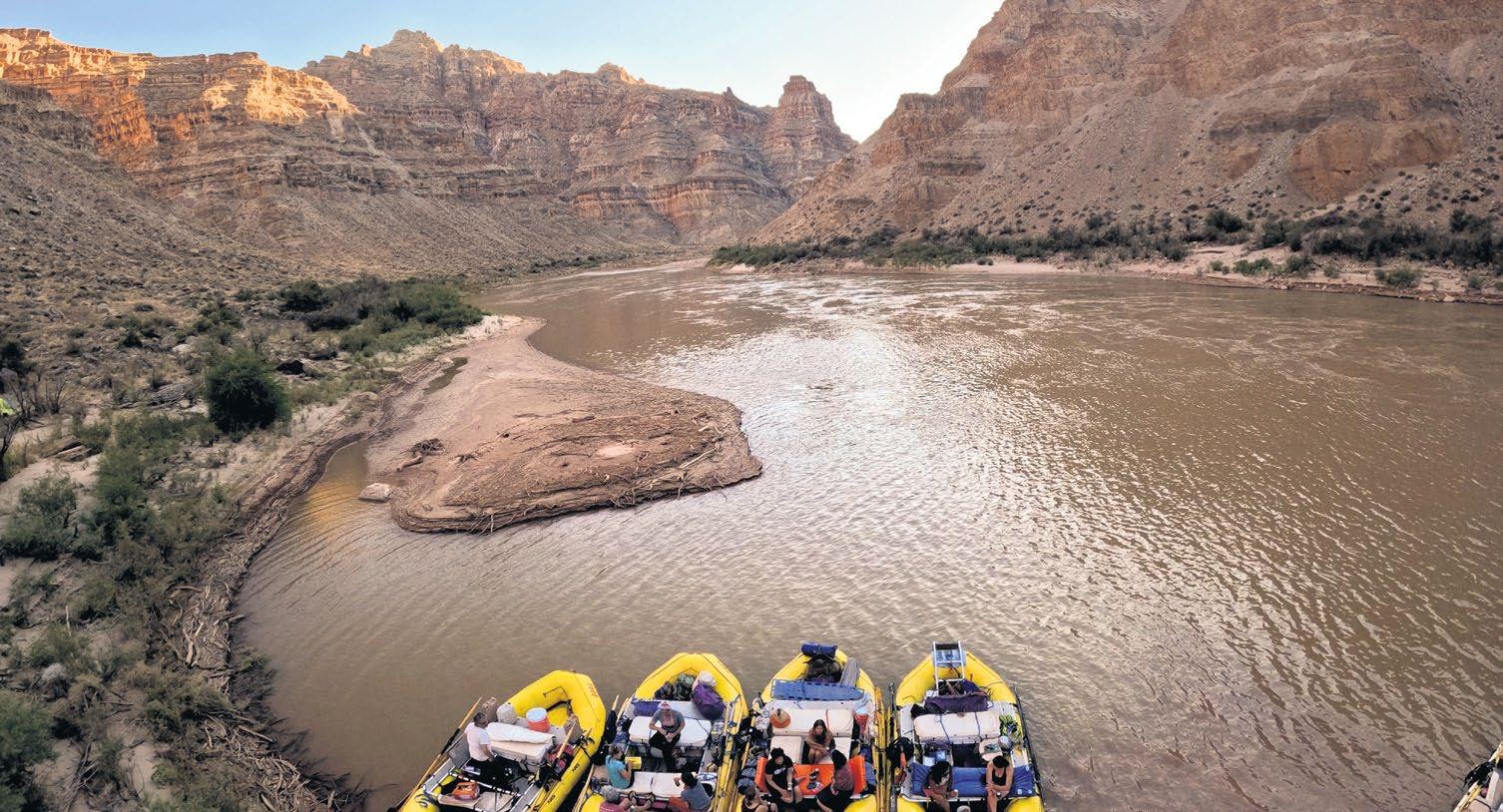
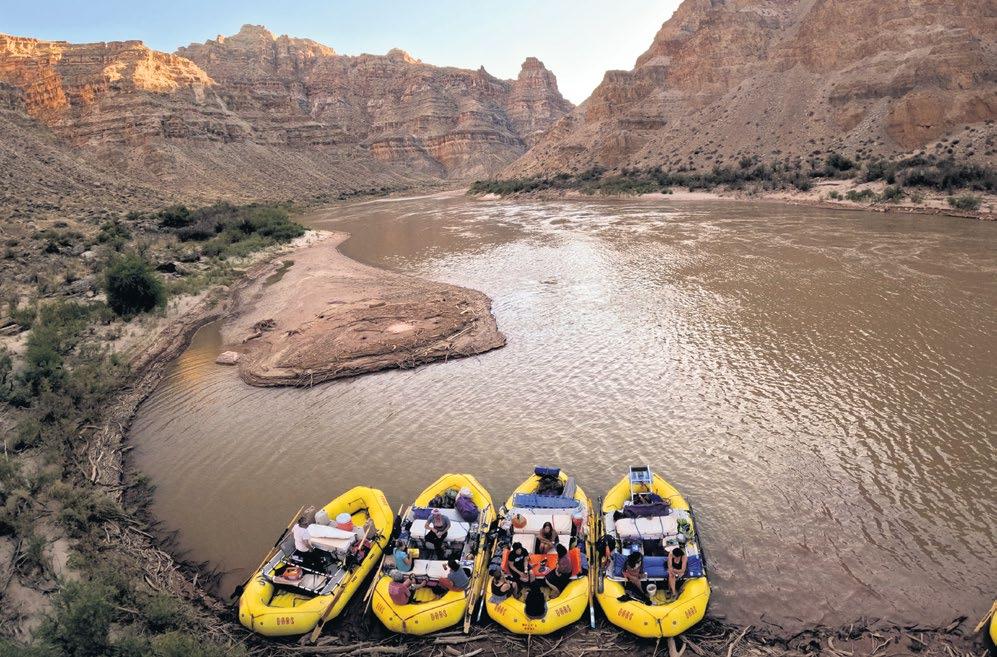
Kristin Murphy, Deseret News
Boaters lounge on rafts near a mud bank at Lower Ten Cent campsite in Cataract Canyon on the Colorado River on Sept. 19, 2024.
system will actually provide,” he said.
If Lake Powell, which sits above the Glen Canyon Dam, continues to release more water than it accumulates, it could present serious problems for the West. Turbines in the dam generate power for more than 1 million homes at maximum capacity.
However, if water elevation dips below 3,490 feet, power generation comes to a halt. And if it falls beneath 3,370 feet, it becomes a dead pool, and water cannot pass through the dam.
Amy Haas, the executive director of Colorado River Authority Utah, told the Deseret News that discussions “have pivoted to the possibility of a shorter-term agreement, focusing on the dire hydrology and grim forecasts for this water year.”
She referenced projections showing Lake Powell declining to levels that cease power production and jeopardize infrastructure at Glen Canyon Dam.
“The latest reports show that Upper Basin snowpack peaked at the lowest date on record and at its lowest level since the early 1980s. We are in serious trouble on this river,” she said.
What does the Lower Basin want?
The Lower Basin group argues that all seven states should share the burden of cuts.
The Colorado River may begin in the Upper Basin, but the way Arizona sees it, the federal government wants “to balance a water shortage completely on” the Grand Canyon State’s back, as Gov. Katie Hobbs said.
Historically, the lower basin states are governed by the “junior water rights system,” which has made Arizona bear the largest burden of cuts.
In 2023, the three lower basin states agreed to commit to reducing their water use by about 14% through 2026. Despite





this move, Arizona believes a long-term and sustainable solution is necessary.
Hobbs, a Democrat who brokered a deal with Nevada and California and secured the meeting with U.S. Secretary of the Interior Doug Burgum, is now leaning on Arizona’s businesses to bring in more water from the Colorado River.
Hobbs made the case for Arizona to get more water at the recent U.S. Chamber of Commerce “Keep America Moving” summit.
“I f irmly believe Arizona has the most to offer in advancing national priorities of AI, national defense, and technological advancement,” the governor said. She also noted the importance of Arizona’s semiconductor industry, which is key in the AI arms race against China, and the aerospace and defense sector, which becomes crucial amid the ongoing conflict in Iran.
Arizona is also responsible for about 25% of the entire lettuce supply nationwide and about 90% of the leafy greens and winter vegetables.
“This administration must step in, show leadership, and help the seven states come to a reasonable and fair agreement and ensure Arizona has the ability to defend our nation, feed our nation and build the high-tech economy of our nation’s future,” Hobbs said.
In a statement to the Deseret News, her off ice said the primary goal is for all seven basin states to “share the responsibility of water conservation to save the Colorado River.”
“While Upper Basin states have rejected proposals to commit to water use reductions of 2% each year, Arizona remains at the table ready to negotiate a deal.”
“Arizona water users are demanding an equitable plan to manage the Colorado River, and Gov. Hobbs is committed to working with anyone to achieve this outcome and chart a
sustainable course forward for the Basin.”
Meanwhile, Utah has clashed Arizona over how the latter has characterized the negotiations.
At the end of February, Shawcroft scheduled a press conference to address the Lower Basin’s reporting about the ongoing negotiations.
“When we see and hear the press indicating that the Upper Basin states were unwilling to do anything, that’s simply not true. ... The Upper Basin did have a plan. We put that plan on the table, and it was not accepted. It wasn’t countered. It just simply wasn’t accepted,” he said.
What’s next?
If the seven basin states haven’t come to an agreement by the end of the summer, the Department of the Interior will impose a plan.
Since odds are low that every basin state will agree to a federally proposed plan, the most likely outcome is years of litigation, which would go straight to the Supreme Court.
As for Utah, Gov. Spencer Cox said last month that the state should anticipate water restrictions through most of the summer.
However, the state “actually had a good water year,” he said. “If you look at precipitation from October to now, we’re really close to normal. It hasn’t been bad.” The problem is snowpack, which is at a record low.
Most of Utah’s reservoir storage comes from snowpack, so state leadership is hoping for a very wet spring and an early monsoon season.
“I would remind people that all of the decisions around cutbacks happen at the local level,” Cox added. “So we’re in constant contact with our water managers all across the state; they know what they need to do.”





By Valerie Braylovskiy Deseret Magazine
If there was ever a golden age of farming, it was the early 20th century, when rural life anchored the nation. More than half of Americans lived outside cities, and nearly half the workforce farmed — growing diverse crops by hand and earning a living directly from the soil. Those days are gone.
Today, the U.S. loses an average of 63 farms each day. That’s more than 23,000 each year since 2017. That means that between 2017 and 2024, 162,000 farms — nearly 13% of the national total — went out of business. It’s a loss of nearly 24 million acres, an area larger than Maine.
Most of these farms that are going out of business in the U.S. are family-owned, small farms — with an annual gross income below $350,000. Large farms that gross over $1 million are continuing to expand, producing nearly half of the country’s total domestic food output while accounting for less than 4% of total farming operations in the country.
The numbers don’t paint a bucolic picture. While median farm household income exceeded the national average, over half of small farms are running on profit margins below 10 percent. For new farmers, startup and operating costs now require millions in upfront capital. Making ends meet is nearly impossible for most, and the few who do make a profit are almost always large commercial operations.
Caught between consolidation, trade wars, rural flight and record production costs of nearly $482 billion in 2023, the majority of American family farms are teetering on collapse. For generations, the government has tried to save them with bailouts. So far, it hasn’t slowed the number of family farms going out of business year over year.
Since 1933, subsidies and crop insurance have pumped an inflation-adjusted average of $17.6 billion annually into farm income. But those dollars now flow mostly to the largest operations — those with the most acreage and commodity crops like corn and soybeans — allowing them to expand by buying up land from neighboring small farms. In 2022, around half of the farms that participated in the federal crop insurance program were small family farms. Despite that, they received just 12% of the payouts. Large and medium farms, which accounted for 42% of participants, collected 80% of the funds.
Government payouts don’t provide as much relief to small farmers as they do commercial operations, and short-term bailouts paid by the federal government have been widely criticized for weak oversight and uneven distribution.
An analysis of early Coronavirus Food Assistance Program payments — totaling $5.6 billion — found the top 1% of recipients received more than 20% of the funds, while the bottom 10 percent got just 0.26%. Despite a $250,000 cap on payments, large operations often bypassed limits through eligibility loopholes. Titan Swine, a conglomerate of Iowa hog producers, claimed over $2.5 million. Small, family farms didn’t receive as much help.
Jonathan Coppess, former administrator of the USDA’s Farm Service Agency and professor of agricultural and consumer economics at the University of Illinois Urbana-Champaign, uses this kind of example to stress how “bailouts” for farmers are the very thing that
No bailouts
Can the American farmer hang on?

can drive midsize and small family farms out of business.
Last December, the Trump administration announced another $12 billion in one-time “bridge payments” for farmers that produce row crops like soybeans and corn ahead of expected funding later this year under the One Big Beautiful Bill Act. Farmers and lawmakers across party lines dismissed it as a “Band-Aid” that ignored structural problems.
“How many bridge payments can there be?” Coppess says. “I don’t think we’re learning the right lessons here, and we’re certainly not learning the right lessons from history because we’ve seen these problems before.”
The United States was built on the ideal of the American farmer: self-reliant, hard-working, abundant. But the reality is a hundred years of hard times. The number of American farms peaked at 6.8 million in 1935, then fell sharply midcentury. Since the 1970s, they’ve continued to steadily decrease.
If decades of policy and payouts were meant to save American farmers, then why are we still losing them so dramatically?
In 1932, months before Franklin D. Roosevelt took office, Farmers Union president John Simpson issued a warning. “My candid opinion is that unless you call a special session of Congress … and start a revolution in government affairs, there will be one started in the country,” Simpson wrote the president-elect in a letter. Dust Bowl droughts, Depression-era debt and collapsing markets had pushed farmers to the brink.
Roosevelt responded by signing the New Deal’s 1933 Agricultural Adjustment Act, paying farmers to cut acreage and stabilize prices — putting millions of acres out of use to revive demand. After the Supreme Court struck down parts of the law for creating artificial scarcity, Congress passed a revised version in 1938, financed through federal revenues and laying the foundation for the modern Farm Bill. The USDA’s Farm Security Administration — precursor to today’s
David Plunkert, for Deseret Magazine
Farm Service Agency — began offering land-purchase loans, resettlement housing and health care, raising participating farm families’ net worth by 21% in its first year.
These safety nets were unprecedented. But the farmer’s role as a political figure — both celebrated and defiant — long predated them. George Washington released a militia against farmers protesting grain taxes during the 1794 Whiskey Rebellion. Thomas Jefferson called farmers America’s “most valuable citizens.” By the Civil War, Abraham Lincoln’s signing of the Homestead Act of 1862 — granting land to aspiring farmers — and the creation of the USDA formalized support, even as populist movements rose in protest of falling crop prices and land speculation. Even 164 years ago, farmers needed help to get started and to get by.
“Already in the 18th century, there’s this ideal of the self-sufficient American farmer that just wasn’t true,” says Peter Simons, an environmental historian at Hamilton College in New York. This “tension,” as he puts it, is always going to be there. It’s why farmers were catapulted into powerful political symbols early on — the tension is “so unsatisfying,” he says, because those whose work it is to feed the country and who serve as a symbol of its bounty have always struggled, and the American government has struggled to support them.
That struggle hasn’t always been evident, politically or otherwise. Under the 1941 Lend-Lease Act during World War II, farmers ramped up production to feed Allied nations, even as many were drafted. Within three years, output rose 16%. After the war, President Dwight D. Eisenhower’s Food for Peace program exported surpluses abroad, turning agriculture into a tool of Cold War soft power.
“Most of the world is devastated because of World War II, and American farmers step in to fill this void,” Simons says. “They perceive that they’re holding communism at bay in the rest of the world.”
But at home, the costs mounted. Between 1940 and 1980, the farm population dropped from about one-quarter of Americans to less than 3%, while the average farm size more than doubled. The Green Revolution, urban sprawl and USDA pressure to “get big or get out,” as Secretary of Agriculture Earl Butz famously put it, accelerated consolidation. When the U.S. sold massive portions of subsidized wheat to the Soviet Union in 1972, farmers took on heavy debt. By the 1980s, high interest rates and embargoes triggered another farm crisis. Over the decade, more than 250,000 farms went out of business, and hundreds of thousands defaulted on loans. In 1985, the U.S. saw its highest number of bank failures since the Great Depression, in large part because farmers simply couldn’t make it.
That year’s farm bill, the most expensive in history at that time, aimed to stabilize the sector while initiating a deeper restructuring of federal support. Price supports were lowered to match global markets and loan deficiency programs introduced direct payments when prices fell below targets. A decade later, the 1996 Freedom to Farm Act completed the shift — eliminating remaining price supports, ending acreage limits and mandating crop insurance to receive subsidies — leaving small and midsize farms newly exposed to global market swings.
Ryan Dennis, author of “Barn Gothic: Three Generations and the Death of the Family Dairy Farm,” grew up on his family’s dairy farm in upstate New York as those changes took hold. Deregulation gutted milk price supports — briefly restored in 2002, then ended again in 2012. Between 2003 and 2019, the U.S. lost over half of its dairy farms. His family sold theirs in 2008.
“To me, the big issue is that (farmers) felt unseen and unheard for so long, and that’s had consequences,” Dennis says.
A 2016 Journal of Rural Studies analysis found farmers’ trust in government plummeted after 1968. Between 2002 and 2008, not a single surveyed farmer said they trusted the federal government “just about always.”
“Farmers have a really long memory,” says Pam Lewison, a fourth-generation farmer and agricultural policy research director at the Washington Policy Center. “If you continually get bit over and over and over again, eventually that loyalty erodes and it turns into something different.”
Once a volatile voting bloc swayed by commodity prices, farmers are now a smaller share of the electorate, folded into broader rural
politics. In the 444 farming-dependent counties designated by the USDA, about three-quarters of voters supported President Donald Trump in 2016, 2020 and again in 2024. His promises to revive rural America resonated, but his trade policies during both terms destabilized markets, triggered billions in federal aid and left many farmers uncertain where their loyalties lie.
“He doesn’t seem or act like a person who is going to help someone from a farm,” Dennis says. “But because he promised to disrupt the system, that was attractive to farmers. In my opinion, it did nothing but hurt them.”
With most agricultural lobbying now driven by agribusiness, the gap between policy and farmers’ needs has only widened. Lewison argues the problem is more about perception than partisanship. Farmers are often reduced to caricatures — either faceless conglomerates or nostalgic pastoral figures.
“There are all kinds of farmers, and there are all kinds of people on farms,” Lewison says. She believes there’s a disconnect between who farmers are and the picture that government policy has painted of them; that “farmers aren’t people who are aware of the things that happen to them politically (and) the broader world around them.”
When a family business is running on razor-thin margins, all it takes to shut down the operation is a little bit of bad luck. A disease like bird flu or brucellosis infects a herd. Drought wipes out a crop. A combine breaks down.
That’s why when grain farmer and former Montana Sen. Jon Tester, a Democrat, entered Congress in 2007, he bought duplicate versions of nearly every piece of equipment to keep his farm running while he was in Washington. In recent years, modern farm machinery has become so digitally dependent that a single malfunction can mean days of waiting for a technician, and thousands in losses. A 2023 U.S. PIRG Education Fund report estimated that farmers lose $3 billion annually to tractor downtime and another $1.2 billion in excess repair costs.
Tester’s Agricultural Right to Repair Act, introduced in the Senate in 2022, requires manufacturers to provide farmers access to diagnostic tools and software. Dozens of states have proposed similar laws, but only Colorado has passed one that covers farm equipment.
“The good lord played a trick on me,” Tester says, recalling a tractor failure shortly after introducing the bill — and the $800 repair that amounted to resetting a computer code. “It’s amazing to me that you can buy a tractor with a computer and not own the computer.”
Equipment costs are just one pressure farmers can’t control these days. In the f irst half of 2025, the U.S. posted a record $28.6 billion agricultural trade def icit. Soybean prices sank under Chinese tariffs, with farmers shouldering an estimated market loss of $89 per planted acre. Cattle ranchers faced their own strain after record prices, spurred by restrictions on imported beef from Brazil, fell steeply as Trump opened the U.S. market to increased imports from Argentina. Shawn Arita, a former USDA economist, estimates losses of $35 billion to $44 billion across nine major commodities in 2025.
As so many farms shut down, the land and resources they leave behind are reshaping America’s role in the global food system. Foreign ownership of U.S. farmland has risen 67% in less than 10 years. The termination of USAID in mid-2025 threatens not only future farm income, but also international agricultural research — millions once funneled through U.S. universities into disease management, crop resilience and climate adaptation. Food insecurity in farmingdependent counties rose nearly 12% between 2013 and 2023, though the USDA has since stopped tracking much of that data. Budget cuts also wiped out roughly $1 billion in local food programs connecting farms to schools and food banks.
“If the purpose is to generate commodity exchanges, then this is a terrific system,” says Andrew Flachs, an anthropology professor at Purdue University. “But if the purpose is to feed hungry people and sustain rural communities in place, then we need to think of a better system.”
No one knows when the next bailout will arrive, what the new Farm Bill — up for renewal in September — will deliver or how many more farms will disappear before then. Farming has always been a gamble shaped by weather, markets and politics. But today, the odds are stacked almost entirely against those still playing.
“If things don’t change, it’s hard to figure out how things are going to pencil out moving forward,” Tester says. “I watched my neighbors leave en masse in the 1980s, and I’m watching my neighbors leave now, too.”
How many more decades of loss can American agriculture endure? At the current pace — more than 23,000 farms lost each year — within three generations, the nation’s remaining 1.6 million small and midsize family farms could all be gone.
This story appears in the March 2026 issue of Deseret Magazine. Learn more about how to subscribe.
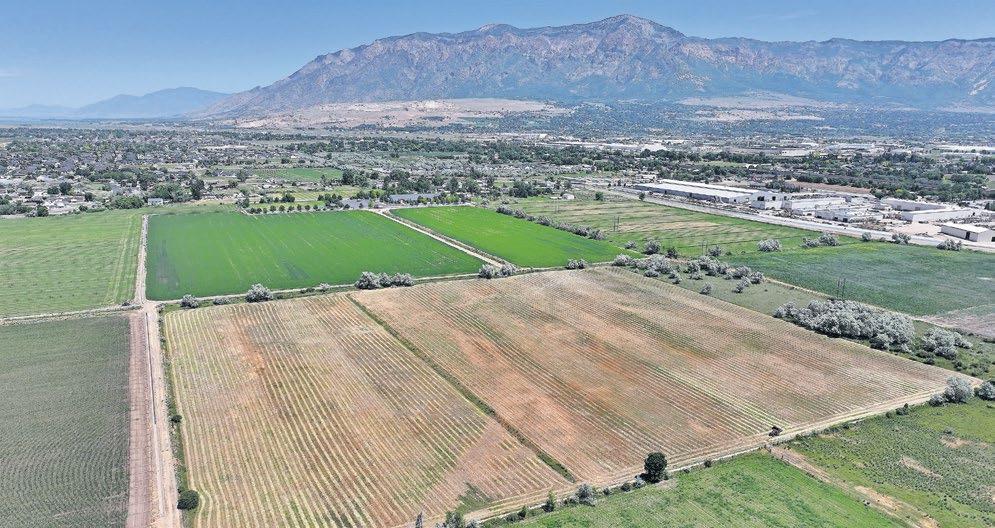
Kristin Murphy, Deseret News Farmland is pictured in Farr West, Weber County, on June 10, 2025.
CHURCH NEWS
Deseret Industries helps individuals achieve self-reliance
‘Ready for Work’ program offers workplace training, developmental counseling and vocational certifications
By Jackie Asher Church News
While some people see Deseret Industries thrift stores and donation centers as regular secondhand stores, Houston store manager Dale Kerr knows they are much more than that.
Deseret Industries serves as training facilities for those facing employment barriers. Employees — called associates — all participate in a program called “Ready for Work” throughout their employment. This job training program prepares associates for future employment opportunities and is part of The Church of Jesus Christ of Latter-day Saints’ efforts to help individuals achieve self-reliance.
“It’s what Christ would do if He were here on the earth,” said Kerr. “He would help people better their situations and better who they are.”
What is Ready for Work?
Ready for Work is a 13-week program where Deseret Industries associates receive workplace training and development counseling to help them overcome barriers to employment.
“I tell people it’s like a stepping stone in their career path,” said Kerr.
Throughout the program, associates meet one-on-one with operations supervisors to learn about workplace behaviors that fall into one of f ive categories: dependability, productivity, professionalism, teachability and teamwork. Associates rate themselves on how well they currently exemplify each skill and set goals for improvement.
Additionally, professional counselors help associates identify and pursue opportunities for vocational training, such as receiving CNA, automotive repair, phlebotomy or welding certif ications. GED assistance can also be provided. Kerr said people from all walks of life participate in the Ready for Work program.
“Some, it might be their f irst job, and some, they might be returning back to work after several years of not working, and some, it may be a career change,” he said. “So we facilitate and help people on their path. We meet them wherever they’re at.”
According to the Church’s Caring for Those in Need 2025 Summary, the 46 Deseret Industries stores in the United States helped 10,653 individuals complete the Ready for Work program in 2025. The program has been translated into Spanish, Swahili, French and Arabic.
An emphasis on self-reliance
Deseret Industries is one of several programs headed by the Church in an effort to help individuals become self-reliant. Other programs include employment services — where individuals can receive hands-on help with resumes and

interview skills — and transitional services, which helps individuals facing signif icant life challenges such as incarceration, homelessness or displacement rebuild their lives and regain stability.
“The Lord is very heavily invested in our lives and genuinely cares about our path to self-reliance,” said Deseret Industries program manager Mark Thornton. “Our Father in Heaven wants His children to be taken care of temporally and spiritually. To the Lord, they’re one and the same.”
Kerr said that when individuals are self-reliant, new
opportunities for growth arise.
“You can’t grow spiritually unless your temporal needs are met. And so we help meet those needs for the people that are employed here in our training program,” he said. “As we help there, then it just opens the door for the Spirit to touch their lives.”
A living witness
Thornton called himself a “living witness” of the Ready for Work model.
The Church of Jesus Christ of Latter-day Saints A Deseret Industries associate smiles while working at the cash register.
Thornton began working with Deseret Industries in 2008 after losing his job as an accountant during the Great Recession. His bishop initially suggested that he apply to be a job coach at Deseret Industries — now called an operations supervisor — but when there were no openings available, Thornton was hired as an associate.
Although Ready for Work hadn’t been developed when Thornton was an associate, he said the same principles of encouragement and hope for the future were exemplif ied by his supervisors, which he said “changed my life dramatically.”
He worked as an associate for a year and a half before being hired as a job coach, eventually being promoted to assistant store manager, project manager and now program manager.
Thornton was working as an assistant store manager when Ready for Work was developed about eight years ago. A self-proclaimed analytical thinker, Thornton said he had been very focused on the business side of Deseret Industries. That changed when the job training program was implemented.
“I would say it made me start thinking correctly about the program, from less of a managerial or cost-accounting perspective to more of a people-person or Christlike leadership perspective.”
Building conf idence
Kerr said it’s amazing to watch people’s conf idence grow as they meet with their operations supervisors and develop new skills.
“I love coming to work every single day,” he said. “To see people make even small steps, and the joy that brings them and the happiness, and it’s just like, ‘Wow, I’ve done something. I’ve accomplished something.’ That makes it all worth it every single day to come to work.”
Kerr recalled a man he worked with several years ago who thought he was completely unemployable.
“As he worked through the Ready for Work program, it really opened up his eyes. He started to realize that he had skills and abilities that he didn’t recognize.”
This man — who once thought he would never have a job — got his commercial driver’s license through Ready for Work and now works as a truck driver. Kerr says that man stops by and says thank you whenever he’s in town.
The Church of Jesus Christ of Latter-day Saints
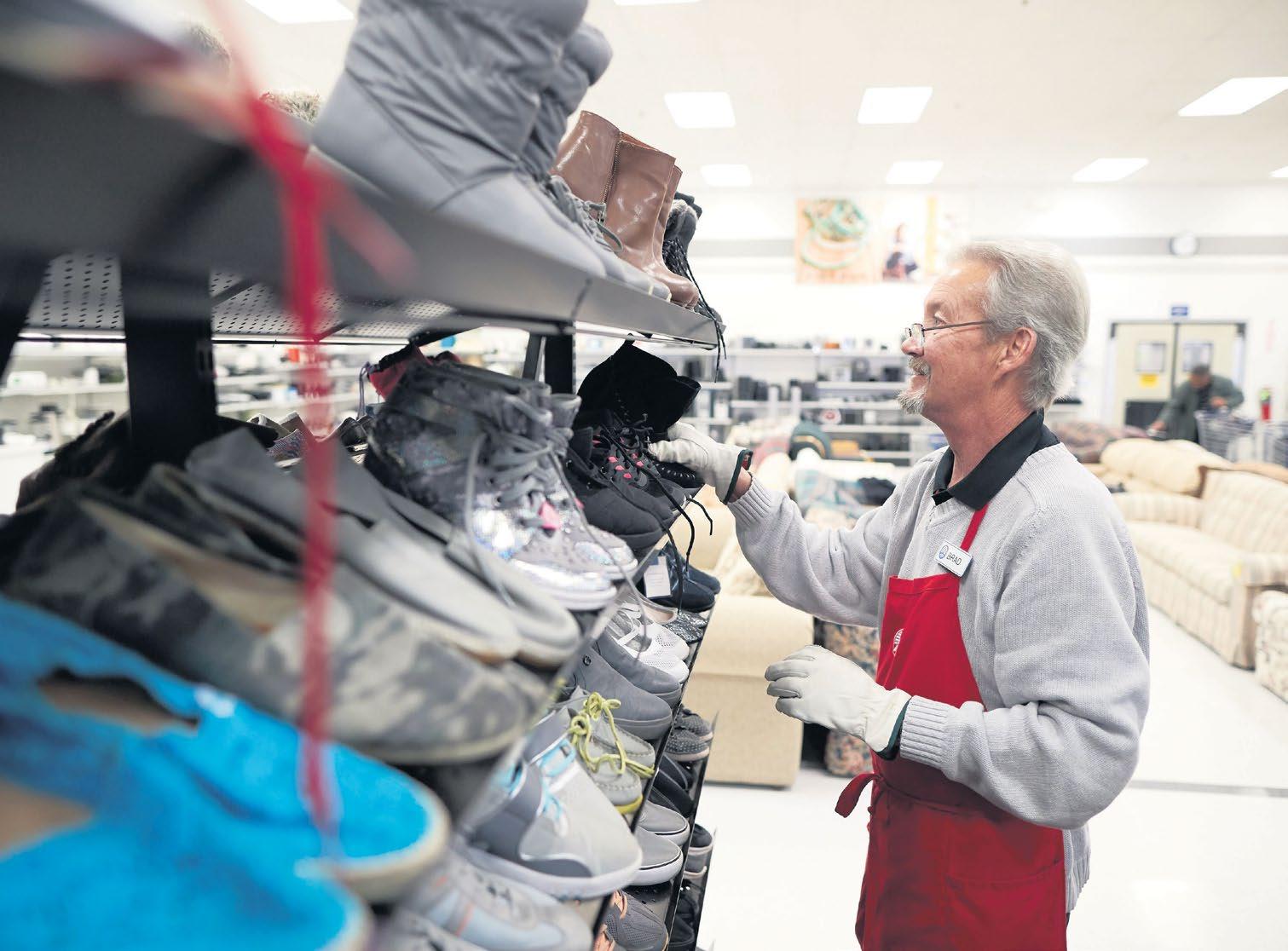
An associate at Deseret Industries sorts shoes at one of the D.I. thrift stores.
DESERET NEWS
Here’s where to find festivals and activities across Utah this summer
By Sarah Gambles Deseret News
Here are some of the major festivals and community days around the Beehive State this summer
Utah is host to multiple festivals and community day celebrations throughout the summer. Here are some of the main ones this year, as well as some shows that might be worth checking out.
May
• May 2-9 — “Come From Away” | Pioneer Theatre Company
• May 2-Oct. 24 — “F inding Nemo: A 70Minute Family Musical” | Tuacahn Amphitheatre
• May 2-3 — Dancing With the Stars: Live! | Eccles Theater
• May 4-July 3 — “Once on this Island” | The Ruth and Nathan Hale Theater
• May 5 — Puscifer | Maverik Center
• May 7-9 — Pablo Cruise | Egyptian Theatre
• May 8-23 — “Descendants: The Musical” | The Empress Theatre
• May 9 — Charlie Puth | Maverik Center
• May 9-17 — “Verdi’s La Traviata” | Utah Opera at Capitol Theatre
• May 15-17 — Living Traditions Festival | Salt Lake City
• May 14-17 — Great Salt Lake Bird Festival | Farmington
• May 14-17 — Los Lobos | Egyptian Theatre
• May 15-16 — Beehive Roundup | Richfield
• May 15-17 — Kilby Block Party | Utah State Fairpark
• May 15-June 18 — “Fiddler on the Roof” | CenterPoint Theatre
• May 15-30 — “Something Rotten!” | Ziegfeld Theater
• May 15-Oct. 23 — “Les Misérables” | Tuacahn Amphitheatre
• May 16-June 27 — Woodland Fairy Festival at Gardner Village | West Jordan
• May 18 — Indigo Girls | Eccles Theater
• May 18-July 11 — “My Fair Lady” | Hale Center Theatre
• May 20-June 13 — “The Producers” | The Grand Theatre
• May 21 — Yellowcard, New Found Glory and Plain White T’s | The Plaza at America First Field
• May 21-23 — An Evening With Iris DeMent | Egyptian Theatre
• May 22-23 — Scandinavian Heritage Festival | Ephraim
• May 22-24 — Riverdance | Eccles Theater
• May 22-June 13 — “Mary Poppins” | Heritage Theatre
• May 23 — Spring City Heritage Day | Spring City, Sanpete County
• May 23 — “Twilight”: Special Cast Event with Peter Facinelli and Ashley Greene | Capitol Theatre
• May 23-June 27 — “No Time for Sergeants” | Parker Theatre
• May 25-30 — Pony Express Days | Eagle Mountain
• May 25-Aug. 1 — “Harmony: A New Musical” | Hale Center Theatre
• May 28-30 — Fort Herriman PRCA Rodeo | Herriman
• May 28-30 — Keller Williams and The Keels
| Egyptian Theatre
• May 29-31 — Ogden Music Fest | Ogden
• May 30 — Tash Sultana | Sandy Amphitheater
• May 30 — Kesha | Utah First Credit Union Amphitheatre
June
• June 1 — Ringo Starr and His All-Starr Band | Eccles Theater
• June 2 — Neil deGrasse Tyson | Eccles Theater
• June 2-6 — Vineyard Days | Vineyard
• June 2-6 — SoJo Summerfest | South Jordan
• June 3 — Pitbull, with special guest Lil Jon | Utah First Credit Union Amphitheatre
• June 3-7 — “Something Rotten” | Ziegfeld Theater
• June 5-Aug. 3 — “Disney’s Tarzan” | CenterPoint Theatre
• June 5-27 — “Dirty Rotten Scoundrels” | Draper Historic Theatre
• June 6 — Brit Floyd | Maverik Center
• June 6 — Utah Asian Festival | Salt Lake City
• June 6-13 — Art City Days | Springville
• June 6-13 — Pony Express PRCA Rodeo & Derby | Eagle Mountain
• June 8-13 — Oremfest | Orem
• June 9-14 — “Back to the Future” | Broadway at the Eccles
• June 10-13 — Saratoga Splash Days | Saratoga Springs
• June 11 — The Human League | Red Butte Garden Concert Series

Scott G Winterton, Deseret News
Dancers entertain audience members at the Living Traditions Festival at Washington Square in Salt Lake City on May 18, 2025. This year's festival runs from May 15-17.
• June 11-13 — Dustbowl Revival | Egyptian Theatre
• June 11-Aug. 12 — “The Big Bang Theory: The Nerds Are Back” | Desert Star Playhouse
• June 12 — Gary Allan | Sandy Amphitheater
• June 12-14 — Latino Arts Festival | Park City
• June 12-27 — “Xanadu” | West Valley Performing Arts Center
• June 12-July 11 — “Urinetown” | Hopebox Theatre
• June 13 — Kid Cudi | Utah First Credit Union Amphitheatre
• June 13 — Metric, with Broken Social Scene and Stars | Sandy Amphitheater
• May 13 — Yungblud | UCCU Center
• June 13-15 — Scottish Festival | Salt Lake City
• June 13-21 — Strawberry Days | Pleasant Grove
• June 14 — Nitty Gritty Dirt Band | Sandy Amphitheater
• June 15 — The Pussycat Dolls | Utah First
Credit Union Amphitheatre
• June 17 — Alex Warren | Utah First Credit Union Amphitheatre
• June 17-20 — Strawberry Days Rodeo | Pleasant Grove
• June 18-20 — The Grass Roots | Egyptian Theatre
• June 18-20 — Summerfest Arts Fair | Logan
• June 18-Oct. 3 — Utah Shakespeare Festival | Cedar City
• June 18-21 — Utah Arts Festival | Salt Lake City
• June 19 — The Dead South, with Amigo the Devil | Sandy Amphitheater
• June 19 — Rod Stewart | Utah First Credit Union Amphitheatre
• June 19-July 4 — “Frozen” | Ziegfeld Theater
• June 20 — Watchhouse | Sandy Amphitheater

• June 20-22 — Tooele Arts Festival | Tooele
• June 24 — Brothers Osborne | Sandy Amphitheater
• June 24-26 — The Babys | Egyptian Theatre
• June 24-27 — Lehi Round-up Rodeo | Lehi
• June 25 — Kenny Wayne Shepherd Band | Capitol Theatre
• June 25-30 — “Bye Bye Birdie: Youth Edition” | Heritage Theatre
• June 26 — MGK | Utah First Credit Union Amphitheatre
• June 26-27 — Days of Old West Rodeo | Delta
• June 26-27 — Derek Hough | Eccles Theater
• June 26-28 — Riverton Town Days | Riverton
• June 25-27 — Taylorsville Dayzz | Taylorsville
July
• July 2-4 — America’s Freedom Festival | Provo
• July 3 — Josh Groban, with special guest Jennifer Hudson | Maverik Center
• July 3-4 — Scofield Pleasant Valley Days | Scofield, Carbon County
• July 3-18 — “The Wizard of Oz” | Hopebox Theatre
• July 4-6 — Brian Head Art Fair | Brian Head
• July 6-Aug. 22 — “The Scarlet Pimpernel” | The Ruth and Nathan Hale Theater
• July 6-Oct. 24 — “Our Town” | Hale Centre Theatre
• July 7-12 — “Hell’s Kitchen” | Broadway at the Eccles
• July 10-18 — Draper Days | Draper
• July 10-Oct. 22 — “Grease” | Tuacahn Amphitheatre
• July 12 — Kaleo | Red Butte Garden Concert Series
• July 15-18 — Russell Thompkins Jr. and the New Stylistics | Egyptian Theatre
• July 15-Aug. 18 — “Once” | CenterPoint Theatre
• July 16-21 — “Alice in Wonderland” | Heritage Theatre
• July 17 — Avett Brothers | Maverik Center
• July 17 — Hilary Duff | Utah F irst Credit Union Amphitheatre
• July 8-12 — “Frozen — the Live Musical” | Egyptian Theatre
• July 17-Aug. 8 — “High School Musical” | Draper Historic Theatre
• July 18 — Treaty Oak Revival | Utah First Credit Union Amphitheatre
• July 18-25 — American Fork Steel Days | American Fork
• July 20-24 — Spanish Fork F iesta Days | Spanish Fork
• July 21 — Joji | Maverik Center
• July 21-22 — Jimmy Eat World, with Motion City Soundtrack and Illuminati Hotties | Sandy Amphitheater
• July 21-25 — Utah Days of '47 | Salt Lake City
• July 22 — Olivia Dean | Maverik Center
• July 23 — Riley Green | Utah F irst Credit Union Amphitheatre
• July 23-Aug. 1 — Wasatch County Fair Days | Heber
• July 24-26 — Price International Days festival | Price
• July 24-Aug. 8 — “The Lightning Thief” | The Empress Theatre
• July 25 — Evanescence | Utah First Credit
Union Amphitheatre
• July 25-Aug. 15 — “Hairspray” | Peery’s Egyptian Theater
• July 26-Aug. 2 — Santaquin Orchard Days | Santaquin
• July 27-22 — Deer Valley Music Festival | Park City
• July 28 — Post Malone and Jelly Roll | Rice-Eccles Stadium
• July 28-29 — Death Cab for Cutie | Sandy Amphitheater
• July 30 — Sarah McLachlan | Utah First Credit Union Amphitheatre
• July 30-Aug. 1 — World Folkfest | Springville
August
• Aug. 1-8 — Lindon Days | Lindon
• Aug. 1-9 — Salem Days | Salem
• Aug. 1-29 — “Cyrano de Bergerac” | Parker Theatre
• Aug. 3 — Meghan Trainor | Maverik Center
• Aug. 3 — Sara Evans | Summer Nights with the Stars (Davis County Arts Council)
• Aug. 3-Oct. 24 — “Joseph and the Amazing Technicolor Dreamcoat” | Hale Centre Theatre
• Aug. 4 — The Stray Cats | Sandy Amphitheater
• Aug. 6 — Western Rough Riders Rodeo | Richfield
• Aug. 6 — Audrey Hobert | Union Event Center
• Aug. 7 — Zach Bryan | Rice-Eccles Stadium
• Aug. 7-8 — Sevier County Rodeo | Richfield
• Aug. 7-9 — Kimball Arts Festival | Park City
• Aug. 7-9 — Bear Lake Raspberry Days | Garden City
• Aug. 7-29 — “Newsies” | West Valley Performing Arts Center
• Aug. 7-Sept. 5 — “Anything Goes” | Hopebox Theatre
• Aug. 8 — 311 and Dirty Heads | Utah First Credit Union Amphitheatre
• Aug. 9-10 — Bountiful Davis Arts Center Summerfest | Bountiful
• Aug. 13 — The Black Crowes and Whiskey Myers | Utah First Credit Union Amphitheatre
• Aug. 13-15 — Alpine Rodeo | Alpine
• Aug. 14 — Jesse Welles | Red Butte Garden Concert Series
• Aug. 14 — The Guess Who | Maverik Center
• Aug. 15-16 — NEEDTOBREATHE | Sandy Amphitheater
• Aug. 15-17 — Kanab Western Legends Festival | Kanab
• Aug. 17-Nov. 7 — “Pride and Prejudice” | The Ruth and Nathan Hale Theater
• Aug. 17-Nov. 14 — “Moriarty: A New Sherlock Holmes Adventure” | Hale Centre Theatre
• Aug. 19 — Train | Utah First Credit Union Amphitheatre
• Aug. 20 — Lee Brice | Sandy Amphitheater
• Aug. 20-22 — Sixpence None The Richer | Egyptian Theatre
• Aug. 21 — Josh Johnson | Kingsbury Hall
• Aug. 21 — O.A.R., with Gavin DeGraw and Lisa Loeb | Sandy Amphitheater
• Aug. 21 — Toto, Christopher Cross and The Romantics | Utah First Credit Union Amphitheatre
• Aug. 21 — Joe Bonamassa | Eccles Theater
• Aug. 21-Sept. 12 — “Curtains” | Heritage Theatre
• Aug. 22 — Urban Arts Festival | Salt Lake City
• Aug. 22 — Art on the Trails | Park City
• Aug. 23 — Grupo Frontera | Maverik Center
• Aug. 23 — Ray LaMontagne (rescheduled from 2025) | Red Butte Garden Concert Series
• Aug. 24 — Ricardo Montaner | Maverik Center
• Aug. 25 — Noah Kahan | The Plaza at America First Field
• Aug. 25 — Avenged Sevenfold and Good Charlotte | Utah First Credit Union Amphitheatre
• Aug. 25-30 — “Water for Elephants” | Broadway at the Eccles
• Aug. 26 — 5 Seconds of Summer | Utah First Credit Union Amphitheatre
• Aug. 26-29 — The Golden Spike Rodeo | Tremonton
• Aug. 27-Nov. 7 — “Scooby Doo: Even Stranger Things” | Desert Star Playhouse
• Aug. 28-30 — Pure Prairie League | Egyptian Theatre
• Aug. 28-30 — Dinah “SOAR” Days | Vernal
• Aug. 28-Sept. 7 — Payson Golden Onion Days | Payson
• Aug. 28-Sept. 12 — “A Midsummer Night’s Dream” | The Empress Theatre
• Aug. 28-Sept. 12 — “Avenue Q” | Ziegfeld Theater
• Aug. 29 — Yaleo: The Ultimate Santana Experience | Summer Nights with the Stars (Davis County Arts Council)
• Aug. 30 — Styx and Chicago | Utah F irst Credit Union Amphitheatre
September
• Sept. 2-18 — Moab Music Festival | Moab
• Sept. 4 — Jack Johnson | Utah First Credit Union Amphitheatre
• Sept. 4-5 — Francis Frontier Days | Francis
• Sept. 4-6 — The Drifters | Egyptian Theatre
• Sept. 8 — Undertale: The Determination Symphony World Tour | Eccles Theater
• Sept. 9-12 — A.J. Croce presents Croce Plays Croce | Egyptian Theatre
• Sept. 11 — Coalville Patriot Days Stampede | Coalville
• Sept. 12-17 — “To Kill a Mockingbird” | Parker Theatre
• Sept. 14 — Rob Zombie and Marilyn Manson | Utah First Credit Union Amphitheatre
• Sept. 17-19 — St. George Lions Club Dixie Roundup | St. George
• Sept. 18-19 — Mat Kearney | Sandy Amphitheater
• Sept. 18-19 — Melon Days | Green River
• Sept. 19-Oct. 11 — “Harry Potter and the Cursed Child” | Broadway at the Eccles

• Sept. 21 — Motley Crue | Utah First Credit Union Amphitheatre
• Sept. 22 — Five Finger Death Punch | Utah First Credit Union Amphitheatre
• Sept. 24-26 — Mason Jennings | Egyptian Theatre
• Sept. 26 — Zeppelin USA | Sandy Amphitheater
• Sept. 29 — Wu-Tang Clan | Utah First Credit Union Amphitheatre
• Sept. 30 — Breaking Benjamin | Utah First Credit Union Amphitheatre