We are pleased to introduce you to The Digest, a sampling of some of the best stories written every day by the dedicated journalists at the Deseret News, Deseret Magazine and Church News. Our hope is that you will make us your trusted news source each day at a time when there is confusion and contention in the nation.
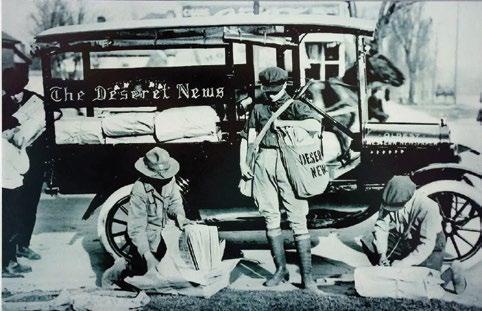
The Deseret News brand stands for unimpeachable journalism centered on the issues most core to the human heart. While the Deseret News since its beginning in 1850 has evolved to meet the demands of its audience — reimagining print offerings, launching an acclaimed magazine and increasing the visibility and reach of its award-winning website — the publication remains committed to certain timeless ideals.
We stand for truth and light. We stand for faith and family. We stand for liberty and responsibility. We provide news and perspective, exploring society’s thorniest problems in search of solutions that will improve your life. That’s our commitment to our readers.
We invite you to discover what we can offer you:
Award-winning website
Our website, Deseret.com, is designed to be user-friendly and available on any device. Whether you’re at home on your computer
INTRODUCING 'THE DIGEST'
or on the go with your mobile phone, you can access our website for the latest news, analysis and commentary.
Mobile apps
Our apps for iOS and Android devices offer a seamless and convenient way to access the latest news, wherever you are. Choose what you want to read, save articles for later and receive push notifications for the breaking news you need to know.
Newsletters
Delivered straight to your inbox, our free email newsletters provide a curated selection of the most important stories of the day, as well as deeper dives into topics that matter to you. Choose from a variety of subjects and frequencies to tailor your news consumption to your needs.
Weekly print newspaper
For those who appreciate the tactile experience of a traditional newspaper, our weekly print edition offers a comprehensive roundup of the week’s most important stories and opinions, including the most comprehensive high school, college and professional sports offerings in the state.
Deseret Magazine
In 2020, we undertook an ambitious endeavor by launching a new magazine with in-depth journalism, unique voices and principled points of view. The reception to the magazine has far exceeded our expectations. You can read more from the magazine online at Deseret.com/magazine or subscribe to have it delivered to your home or office.
Church News
The Church News remains one of our most popular offerings for those who want to know the latest news from The Church of Jesus Christ of Latter-day Saints. It’s available online at TheChurchNews.com and via iOS and Android apps. A print version is included in the Friday edition of the Deseret News.
DESERET
The housing crisis, by the numbers
By Matthew Brown Deseret Magazine
Owning a home seems like a primal urge. It’s good for a person’s well-being and it’s a sound investment that contributes to the economy, both locally and nationally. That’s why governments create laws, bureaucracies and tax codes to keep the real estate engine humming through the market’s peaks and troughs. But in the past decade, home prices have lurched out of reach for many younger adults. While political figures grasp at new and sometimes extreme solutions, it’s worth grounding ourselves in facts. Here’s the breakdown.
The
69.2% peak
Almost 7 in 10 Americans owned a home in 2004, more than ever before or since. In 1940, before the American dream meant a single-family home with a white picket fence, the homeownership rate was just 44 percent. New Deal reforms and the post-WWII economic boom boosted that
to 62 percent by 1960, and it hasn’t varied much since. Today’s rate of 65 percent is just 1.3 points below the 25-year average, but that’s enough to trigger industry alarm.
5x = unaffordable
Harvard’s Joint Center for Housing Studies reported that the median price for a singlefamily home in 2024 was a record $412,500, f ive times the median household income. That ratio is essential to gauging affordability. Home prices have increased more than 900 percent since 1975, but salaries haven’t kept up. Over that same period, household income increased by just 91 percent.
40 and new to this
Today’s median first-time home buyer is older than ever at age 40. First-timers made just 21
percent of purchases in 2025, an all-time low. Half are married, 25 percent are single women and just 10 percent are single men. The remaining 15 percent were not specified by the National Association of Realtors. Almost a third had children under 18. Baby boomers (ages 60–78) bought 42 percent of all homes.
The $80,394 shortfall
The gap between median income ($77,609) and the recommended income ($158,003) to afford an average-priced home listed in Idaho ($599,450) last July was sixth-largest in the nation. Six of the 10 biggest gaps were in western states like Nevada and Montana, per Realtor.com. Iowa was most affordable with a $431 gap, but incomes fell short in all 50 states and the District of Columbia. Buyers should earn at least $158K in Utah, $99K in Texas and $210K in Massachusetts.
1/4 in cash
Today, 26 percent of buyers pay cash for homes, more than double the average between 2003 and 2010. Many use equity from a previous sale, often in a pricier market. Wall Street doesn’t need mortgages either. Institutional investors were blamed for rising prices after a post-pandemic buying binge, but reports say they’re quietly exiting the field. Airbnb is another housing bogeyman; last July, short-term rentals represented just 1.2 percent of America’s 148.3 million housing units.
‘2008 level’
The domino effect of banks holding mortgages to uninsurable property could trigger the next big financial crisis, as U.S. Sens. Tim Sheehy of Montana and Sheldon Whitehouse of Rhode Island wrote in a recent op-ed for The New York Times.
By Lois M. Collins Deseret News
DESERET NEWS
Harmony and hope
Diagnosed with multiple sclerosis at 26, David Osmond has gone from denial to advocacy
David Osmond’s no stranger to the stage — a musician, on Broadway and as part of The Osmonds 2nd Generation singing group alongside his seven brothers, all sons of Alan Osmond, one of the original Osmond Brothers.
But Osmond shares something beside musical talent and a love of performing with his famous father. When he was 26, he was diagnosed with multiple sclerosis, the disease that eventually curtailed his dad’s performing career.
The literal translation of multiple sclerosis is “many scars.” It’s an unpredictable autoimmune disease of the central nervous system — including the brain, spinal cord and optic nerves — that can interfere with how information passes between the brain and the rest of the body, according to the National Multiple Sclerosis Society. The estimate is at least 1 million people in the U.S. now share the diagnosis.
The immune system attacks myelin, the protective protein-and-fatty sheath around nerve fibers, creating scar tissue or “lesions” that can’t carry electrical impulses normally. Traditionally, it’s seen as having two forms: The relapsing-remitting version that David Osmond has, which flares and ebbs, and the progressive form that Alan Osmond, who died April 20 at the age of 76, lived with for many years.
Usually referred to by the shorthand name MS, the disease shows up differently in people, but often includes fatigue, problems with memory and varying degrees of mobility impairment. For a while, David Osmond used a wheelchair, though he’s back on his feet again.
Amid his busy performing schedule, Osmond, 46, now lends his very recognizable name to the Race to Erase MS, a massive fundraising effort that stretches back to the dark ages of the disease and which has contributed to a majority of the big and fairly recent breakthroughs leading to treatments to ease the pain and misery of those who have MS. More progress has been made in the past five years of the disease’s history than in the previous 100, he said.
The making of the Race to Erase MS
When Nancy Davis was 33 — just over half her lifetime ago — she was diagnosed with MS. Doctors described the sad reality of the disease at the time: no cure, no FDA-approved treatment, no idea why it happens or good suggestions about
how to manage it. She was told that even her hands would weaken to the point that “you’ll be lucky if you can hold a TV remote.” The field of medicine had nothing to offer her.
Figuring she was too young to give up and not one to sit around, Davis decided to get a second opinion and also see what MS research was being done. To her dismay, she found that “all the best doctors in our country were doing identical research” and none of them realized it as they plugged away in their research silos.
She didn’t find anyone to tell her she didn’t have MS, but Davis told Deseret News that amid her discouragement and fear over the diagnosis, she experienced a “lightbulb moment.”
“What would happen if I could get the best and the brightest doctors and researchers to work together as a team with the idea to never duplicate research but to constantly communicate with each other,” Davis said.
That was the birth of the Race to Erase MS, launched in Aspen, Colorado, as a ski race fundraiser that over time has evolved into a gala in Los Angeles, where she now lives, featuring celebrities, brilliant researchers, families with a tie to MS, well-wishers and philanthropists.
David Osmond is on the national board of directors. Other public figures with MS including Christina Applegate, Selma Blair, Jamie-Lynn Sigler, Jack Osbourne and Montel Williams are among those who have MS and are using their platforms to educate others.
Meanwhile, the Race to Erase MS has become a force that is changing lives in real time. Over the years, Davis’ brainchild has raised nearly $60 million to fund research.
David Osmond’s denial
On Christmas Eve 2005, David Osmond got his first hint of MS — pain that hit him like a fire. He was ready to relax after a show, but when he took his shoes off, he told his then-girlfriend, “Valerie, my feet feel like they’re being actually crushed by a steamroller, like I’m being run over. It’s this burning crushing pain I’ve never experienced and it started in my toes.”
Despite all the medical advancements in recent years, Osmond told Deseret News that sensation remains.
Although his dad has had MS as long as he can remember, Osmond said he didn’t understand the
mechanics and “it didn’t even cross my mind because my symptoms were so vastly different than anything he had experienced.”
The younger Osmond’s version would prove to be much more aggressive; within “a matter of weeks,” he said he was worse off than his dad had been in decades with MS.
Osmond lost the use of his legs, so he needed a wheelchair. The diagnosis came from a doctor who looked at all of the scans Osmond had undergone and told him, “Son, you’ve been through the war. This looks like MS for sure.”
And Osmond responded, “No. It’s not.”
Will there be a cure for MS?
The fundraising is very important, but the heart of Davis’ work was creation of the Center Without Walls. She convinced eight of “arguably the best doctors in our country to work together, which was a magical thing to make happen at the time.”
The center — with research funding from the Race to Erase — has played a role in 18 of the 25
MS treatments that now have Food and Drug Administration approval, with more in the pipeline, she said.
“We do the pilot study for them in the very beginning, we come up with the concept, the idea and the doctors and we fund it in the beginning, and then they turn into FDA-approved drugs, which is really exciting,” Davis said. “For someone being diagnosed today, it’s such a different thing. There’s so much hope and a lot of people will be independent their whole life as opposed to being in a wheelchair, not having their independence.”
The Center Without Walls operates on simple but unusual rules. For one thing, the funds raised are only used on new research and innovation. If it’s been done before, they’re not putting money into it again, which keeps new ideas flourishing.
The center includes physicians and scientists from Cedars-Sinai Medical Center, Harvard University, Johns Hopkins University, Oregon Health & Science University, University of California Los Angeles, University of California San Francisco, University of Southern California and
Tess Crowley, Deseret News
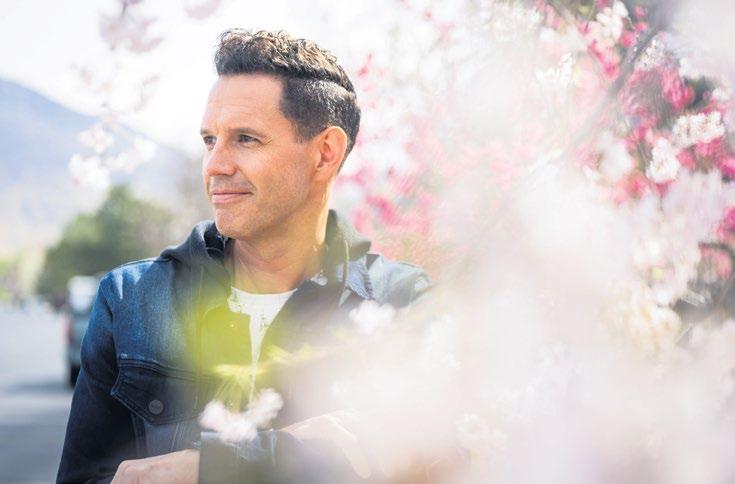
David Osmond, who has multiple sclerosis, poses for a photo in Lindon on Friday, March 27.
Yale University.
Those receiving the money have to report what they’re f inding every month and share data back and forth with each other. Anyone’s research — whether it succeeds or fails — is everyone’s stepping stone. They meet in person a couple of times a year and “have these wonderful forums and they report all their studies that they’re doing, everything good and bad,” Davis said. “Not every study’s going to end up with a positive result, but the bad is just as important as the good because you have to communicate on what’s happening. And you have a much better shot of f inding a cure, so that’s what we do by putting the best and the brightest together. It’s so key to what we do.”
One of the in-person gatherings happens alongside the gala; the 33rd annual event is June 5. The day of, the researchers meet and discuss their individual efforts. The day after the gala, they are part of a daylong symposium, where they share f indings with each other and with the families where someone has MS. Families that can’t come can attend the symposium virtually. Information is available at erasems.org.
Will MS be cured? “We know it will happen,” Davis said. “We’re working really hard and we keep coming up with brilliant things every year that are changing a lot of lives. We wish we could do it at a faster pace, obviously,” since MS is “miserable, a nightmare.”
David Osmond’s battle
The Osmonds all likely know the story David Osmond said is part of family history. When Alan Osmond was diagnosed in his late 30s, he was given an aspirin and told, “Come back in six months. Maybe we’ll have something for you then.” They’ve also heard that years ago his friend Annette Funicello, a popular Mouseketeer and actress who had MS, told Alan Osmond, “It’s not the disease that gets you down, it’s the lack of hope.”
Fortunately, he said, his dad is “a larger-thanlife, uber-optimistic character” who decided, “I may have MS, but MS does not have me.”
The younger Osmond decided that was a good way to approach it. And he found that optimism was handy when “I started tripping and falling and ultimately not being able to do anything for myself and I had to drag myself across the floor just to get to a restroom facility.”
Osmond said his “denial was aggressive at the beginning.” Now he wants to know everything: How fast it’s moving, what might happen next and what he can do about it.
He’s been through stages, not all consecutive, of feeling hope and then feeling almost like multiple sclerosis mocks him, Osmond said. Although he has been up and down, he is especially grateful for a mostly hope-f illed disposition that’s similar to Alan Osmond’s. Osmond changed what he could, starting with diet, cleansing his body and giving it every chance to grow strong and heal. He’s been as aggressive as the disease as he f ights it and has left the wheelchair behind, though he kept the electric scooter and cane for moments he might need them.
“I’m in massive pain every second of the day, but my hands are moving again. My toes move
again. I’m not able to quite run, I can’t quite jump and I hide it pretty darn good, but I’m back on stage. I drove a car today.”
Life, he said, is full of “little things that are so miraculous in my life.”
He proposed to that girlfriend, Valerie, from his wheelchair and has been walking without assistance since their wedding day eight months later.
He credits both lifestyle changes and modern medicine and said he tries to eat “as healthy and raw and pure” as he can.
As for the disease, it has proven to be a terrible blessing. “Crazy as it sounds, it’s been one of the best things that’s happened to me.” He said he appreciates everything more, including the ability to genuinely see others.
“When my toes moved for the f irst time again when I wanted them to, oh I wish I could gift that, bottle it up and just give it to everybody to say ‘Look what you have. Don’t take it for granted,’” Osmond said.
“Though the cards I’ve been dealt are not great, I also recognize I can see what everyone else is holding and I don’t want those cards. I’m going to stick with this. We’ve all got pain, we all have challenges and you start to see that vividly because I’m in that space of pain every second, where every step I take is a miracle.”
Doctors have told him optimism is both a gift and a necessity with MS, making a clinical difference. One told him, “When I diagnose someone, they have one of two ways they’re going to go. If there is a negative disposition, a negative outlook where everything is terrible, it goes that way. If you have that positive outlook, being not bitter but better, we see that you do better.”
He adds it’s easier to be positive because he has a wife he adores and two girls and a boy he would do anything for.
“MS,” he added, only half joking, ”is a terrible way to meet great people.”
Effective drugs for treating MS
Two drugs in particular have been what Davis calls a “game changer:” Ocrevus and Kesimpta. “They’re basically the same drug packaged rather differently. Kesimpta, you give yourself a shot once a month. The other you have an infusion twice a year. They do the same thing: They kill your B cells.”
When B cell levels are high, it sparks a reaction where T cells attack each other. “That’s your MS,” she said.
Davis said the need for multiple treatment options is important because people respond differently or can’t take certain medications.
Dr. David Hafler of Yale University is a neuroimmunologist and the Neurology Department chair. Davis describes him as “a very important part of our Center Without Walls.”
Hafler worries that progress in many diseases, not just MS, will slow because so much of the federal funding for disease research has been cut. Not everyone has a Nancy Davis behind them and even great private funding can’t do it all. He hopes that promoting “big wins” will turn research funding around.
When it comes to wins, he thinks MS has had a doozy.
Hafler decided to study MS when he was 17 and has been at it for more than half a century, starting as a freshman at Emory College. He’s 74 now. In that time, Hafler said researchers have gone from not knowing what causes MS and having no treatment to being pretty sure they understand its roots. He’s among those who believe getting the Epstein-Barr virus kicks off the process that will become MS in some people, based on what he calls an “increasingly ref ined and probably correct working model.”
While much of the world divides MS into a relapsing-remitting form David Osmond has and the progressive form that beset Alan Osmond, Hafler prefers to divide it into two different disease phases: the autoimmune phase and the neurodegenerative phase.
The doozy? “We know how to cure the autoimmune phase,” he said, but it has to be done early. He admits that “the word cure is a dangerous word because it’s never 100%, there’s always variability, but we have treatments that are so effective that if a patient doesn’t respond, we start looking for other diseases,” Hafler told Deseret News. “They’re 98% effective in very early disease.”
But MS can change, evolving from an inflammatory autoimmune disease to a neurodegenerative form that’s a lot like Alzheimer’s or Parkinson’s disease. Once it becomes neurodegenerative, it’s very hard to treat, he said.
“We can’t take someone in a wheelchair and cure them, but if we treat someone very early,
we can stop the disease.” He and other researchers have a new paper under review that suggests Epstein-Barr virus, which is better known for causing mononucleosis, is the root cause. If one is infected as a child, it’s not a risk factor for MS, he said, but as an adolescent, “it’s a major risk factor.” Some of the research funding came from Race to Erase MS. Hafler reports that 100% of MS patients have been infected with Epstein-Barr virus, compared with about 90% of the general population. He cited research by his friend and colleague at Harvard, Alberto Ascherio, using serial blood samples from 4 million military recruits that showed MS is preceded an average of roughly seven years by an Epstein-Barr infection. Now the theory is the virus infects B cells, turning them into something that “juices up” the immune system in such a way that someone who is genetically susceptible will have T cells attack the brain.
Singing a new tune
David Osmond has done a lot of thinking about what the future holds. And he’s decided that if you ask “Why me?” for the bad things that happen, you have to turn it around and ask that for the good things, too.
“I’ve learned that I’m not allowed to ask it any more unless I make sure that I ask the exact same question always for every single moment of happiness and joy, great or small, whatever it is that comes into my life.”
DESERET
Immersive new Temple Square Visitors’ Center unlike anything in church history
President Uchtdorf announces reservations available online now for the unique visitors’ center tour that begins May 18
By Tad Walch Deseret News
A new, immersive Temple Square Visitors’ Center will open May 18 and provide a unique, interactive experience to millions who arrive at the centerpiece of The Church of Jesus Christ of Latter-day Saints.
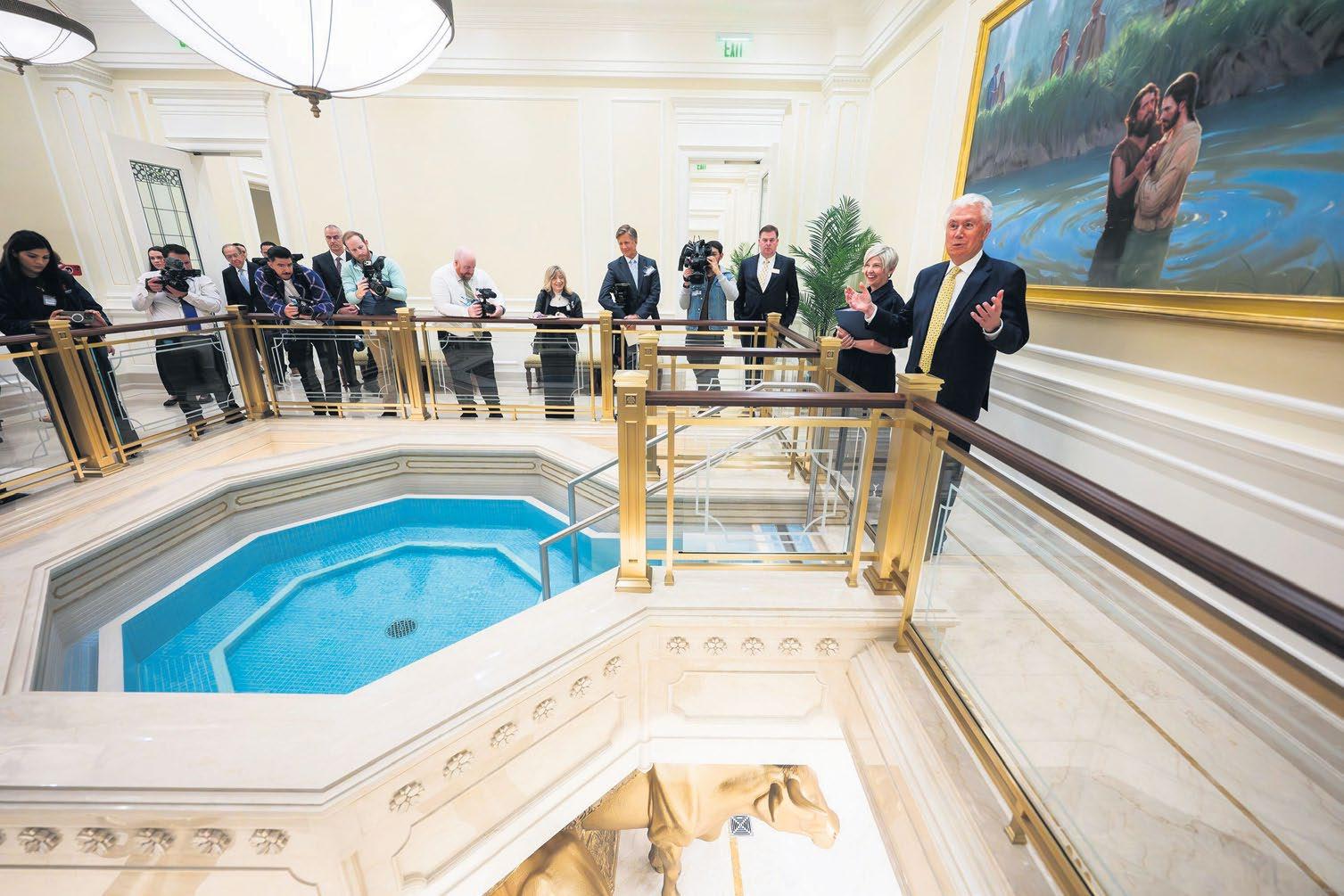
The center will offer the public the f irst walk-through experience of a temple — complete with replicas of a celestial room and baptismal font — outside of the generally brief open houses held right after a temple is completed or renovated.
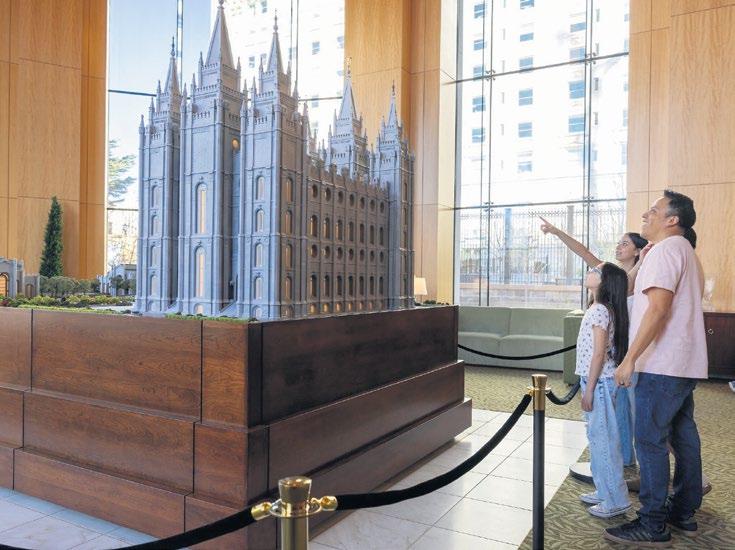
The visitors’ center also has a remarkable new, automated cutaway model of the temple. When you enter the room, the exterior walls of the temple model are up. After a brief introduction, the walls slowly drop to reveal the inside of the temple.
“The church is an open church,” said President Dieter F. Uchtdorf, acting president of the church’s Quorum of the Twelve Apostles. “I think it is wonderful that we have now this openness of showing what is happening so no one can feel that we’re keeping anything in the hidden, because there’s nothing to hide.
“It’s only sacred, and we hope it will be honored and respected.”
President Uchtdorf gave the Deseret News and other media a sneak-peek tour of the center’s two wings and underground replica rooms on April 13.
It’s unlike anything the Latter-day Saints have done before.
“You may think you have been to a visitors’ center experience with us before, and I’m going to tell you, this is not that,” said President Emily Belle Freeman, Young Women general president. “This is a visitors’ center experience like you have never had before.”
Here’s what you need to know:
• Free reservations: The center will open on May 18. You can visit the center any time, but for the 30-minute “Inside a Temple" tour experience with the replica rooms, make free reservations at Ticketing.ChurchofJesus Christ.org.
Scott
G Winterton,
Deseret News
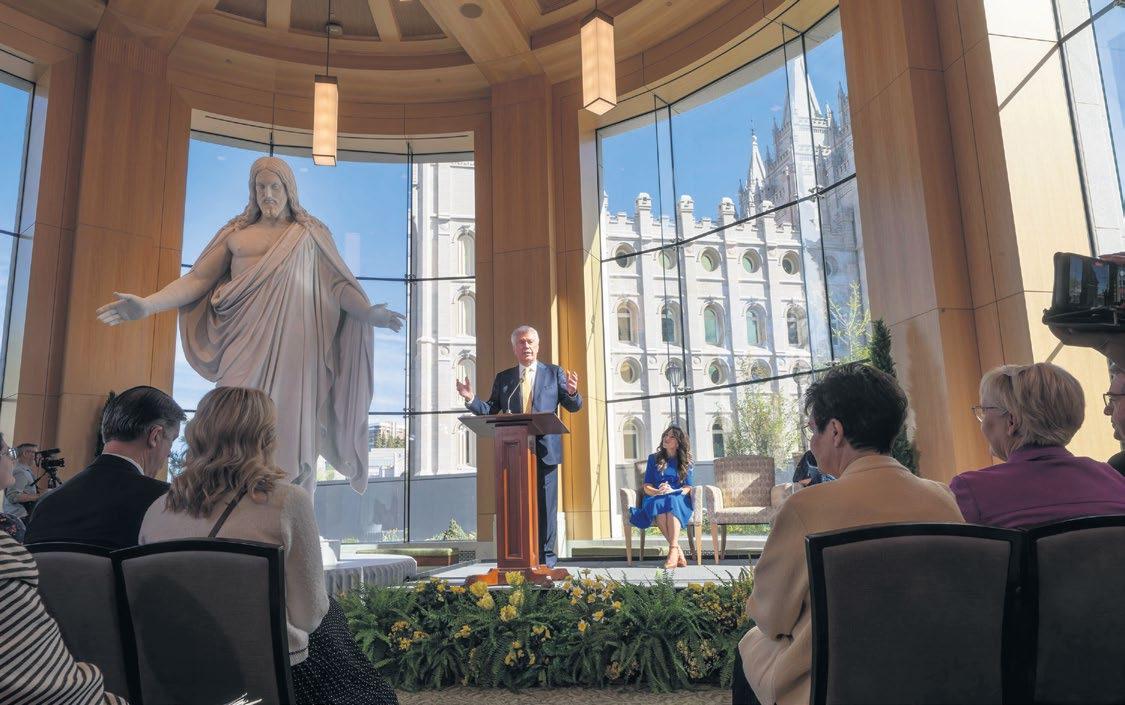
President Dieter F. Uchtdorf, acting president of the Quorum of the Twelve Apostles of The Church of Jesus Christ of Latter-day Saints, talks to media members before he and President Emily Belle Freeman, Young Women general president for The Church of Jesus Christ of Latter-day Saints, lead them on a tour of the new visitors' center on Temple Square in Salt Lake City on Monday, April 13.
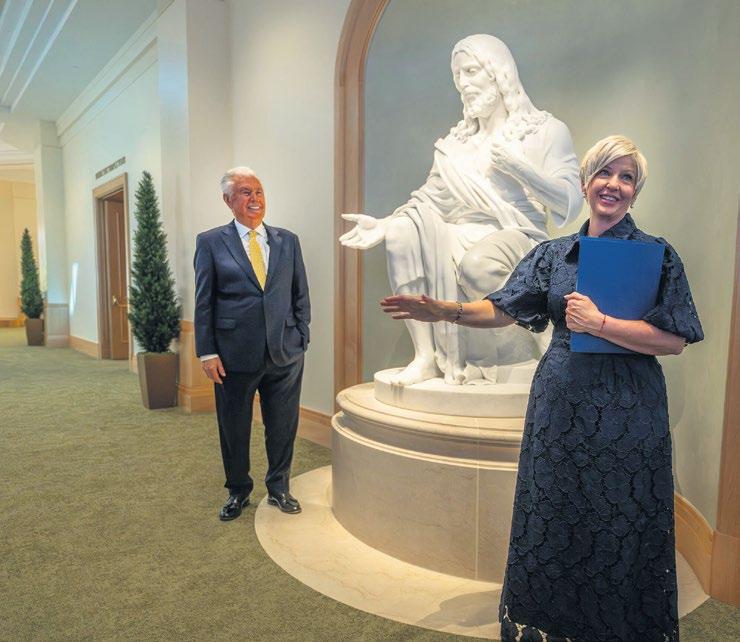
• Iconic exhibits: One ground-level wing is the new home of the Christus statue. A feature of Temple Square since 1967, the statue now stands in front of huge bay windows with the Salt Lake Temple in the background. The other ground level wing houses the new cutaway scale model of the temple.
beneath the two wings features full-sized walk-through replicas of sacred temple ordinance rooms, including the baptismal, instruction, sealing and celestial rooms.
recorded in 3 Nephi 17 and his appearance to Mary Magdalene.
• Unobstructed views: The two ground-level wings are pavilions encased
• Walk-through replicas: The lower level
• Art-glass windows: New stained glass depicts scenes from the life of Christ, including his ministry to children as
in glass with stunning direct sightlines of the Salt Lake Temple’s south side.
• New webpage, app, virtual tours: On April 13, the church also relaunched its webpage, TempleSquare.org. A new Temple Square app is coming. In October, digital virtual tours of completed spaces of the renovated temple and new visitors’ center will be available online, President Uchtdorf said.
The theme for both is “Rejoice in Christ,” he said.
“This morning I dedicated this visitors’ center and consecrated it to the purpose of proclaiming the gospel of Jesus Christ to all those who come,” said President Uchtdorf, who chairs the church’s Salt Lake Temple open house committee.
One of the highlights for many visitors will come when a short introductory f ilm ends at the start of the replica-room tour. The screen parts to reveal a replica door to the temple. Then the tour goes through the door and into a replica temple lobby.
“It’s a magical moment,” said Marc Epstein, vice president of development for THG Creative, which designed the visitors’ center under church direction. “It’s that kind of dramatic moment that can really create an emotional feeling with a person that really does stay with them.”
Scott G Winterton, Deseret News
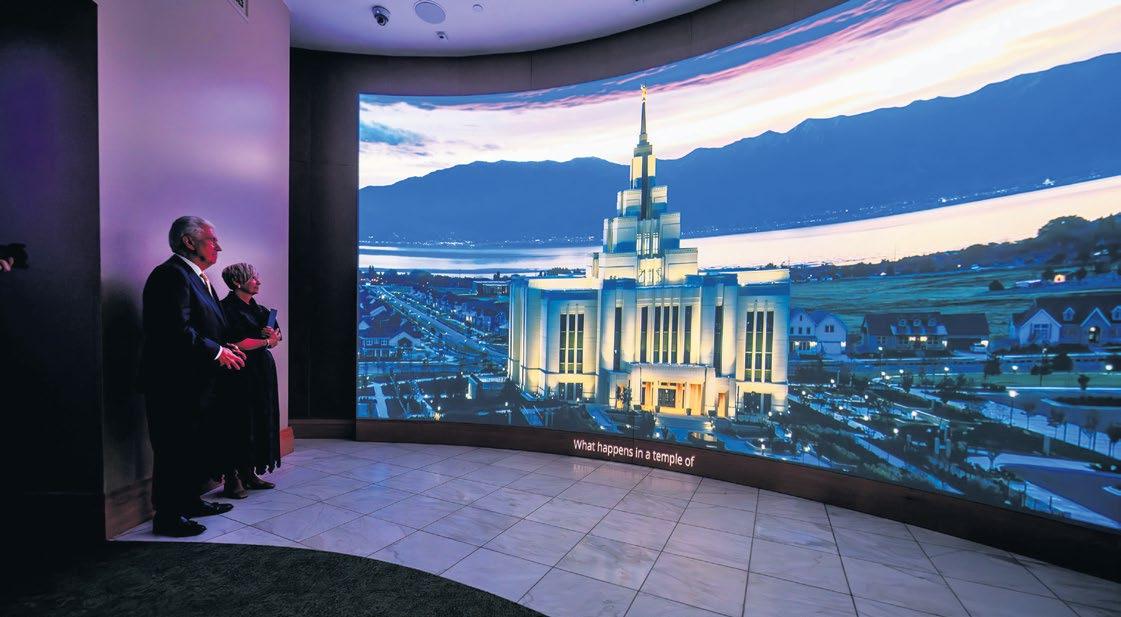
President Dieter F. Uchtdorf, acting president of the Quorum of the Twelve Apostles of The Church of Jesus Christ of Latter-day Saints, and President Emily Belle Freeman, Young Women general president for The Church of Jesus Christ of Latter-day Saints, watch a video during a tour with media members of the new Temple Square Visitors' Center in Salt Lake City on Monday, April 13.
The goal is the same as the temple in Latterday Saint belief, to point people to Jesus Christ, President Freeman said.
“I hope you feel the reverence,” she said. “I hope you learn Jesus Christ is the center of our faith.”
President Uchtdorf said the church expects 5 million people to participate in a sixmonth public open house for the Salt Lake Temple in 2027. It will be the f irst time in history that the church has invited the world to tour the inside of the iconic, pioneer-era temple.
The temple and Temple Square closed for major renovations on Dec. 30, 2019. The church will rededicate the temple at the end of 2027, and it will be closed to the general public again.
The new center will help the church continue to show visitors what it looks like on the inside.
The celebration of the completed renovation of the Salt Lake Temple will include the public open house that will run every day from April 5, 2027, through Oct. 1, 2027. The process for obtaining free reservations to tour the renovated temple will begin on Sept. 1, 2026.
The new visitors’ center stands close to the base of the massive temple. It has two glass-enclosed pavilions at ground level with a large underground space, built on the plot where the South Visitors’ Center previously stood. That center was demolished in early 2020.
The church hired outside professionals
to improve the visitors’ center experience. THG Creative, a themed-experience design company from Pasadena, California, oversaw the visitors’ center project.
Midwest Studios of Indianapolis created the temple model, which uses 3D printed elements throughout and has multiple levels that rise and lower to help visitors see inside and better understand the temple.
“The church wanted us to look at it as impartial observer,” said THG’s Epstein. “They wanted us to determine how they could tell this story in a way that would be interesting and get people to understand what happens in the temple, understand what happens as a member of the faith in the temple.”
Naturally, demand will be high for the "Inside a Temple" tour at the visitors’ center.
By mid-afternoon on April 13, only four time slots remained unreserved for opening day on May 18.
The church is paying Salt Lake City over $2 million to shut down a block of the street along the north side of the temple, another block along the west side and portions of three other adjacent streets will also close:
• One block of North Temple between West Temple and Main Street.
• One block of West Temple between North Temple and South Temple.
• A portion of North Temple between 200 West and West Temple.
• A portion of West Temple between 200
Scott G Winterton, Deseret News
President Dieter F. Uchtdorf, acting president of the Quorum of the Twelve Apostles of The Church of Jesus Christ of Latter-day Saints, speaks as he and President Emily Belle Freeman, Young Women general president for The Church of Jesus Christ of Latter-day Saints, lead members of the media on a tour that shows a full-scale replica of a temple baptistry room in the Temple Square Visitors' Center in Salt Lake City on April 13.
Scott G Winterton, Deseret News
President Emily Belle Freeman, Young Women general president for The Church of Jesus Christ of Latterday Saints, speaks about the new displays at the new visitors' center on Temple Square on April 13.
North and North Temple.
• A portion of South Temple between West Temple and Main Street.
The goal is safety against bad actors, said President Uchtdorf, who met with Salt Lake City Mayor Erin Mendenhall and others on planning.
“We have to learn from the mistakes of others,” he said, mentioning attacks in other places. He said the city and church don’t want the open house to become “a soft target.”
“We have to make sure these streets are closed so we have an enclosed, secure area,” he said. “We’re not closing many streets, just the opposite. We’re opening up many streets here and beautifying them because community leaders have decided we pitch in, we help to beautify the city, that when the open house is over and when the Olympics come, they will be even more surprised how beautiful the city is.”
President Uchtdorf began his remarks standing next to the Christus statue. He called it humbling for a man called to be a special witness of Jesus Christ.
“I love my Jesus,” he said.
The temple is meant to connect all of God’s children — all people, in Latter-day Saint theology — to Jesus Christ and his plan to bring them home again after this life.
“We hope,” President Uchtdorf said, “the world will come.”
Scott G Winterton, Deseret News
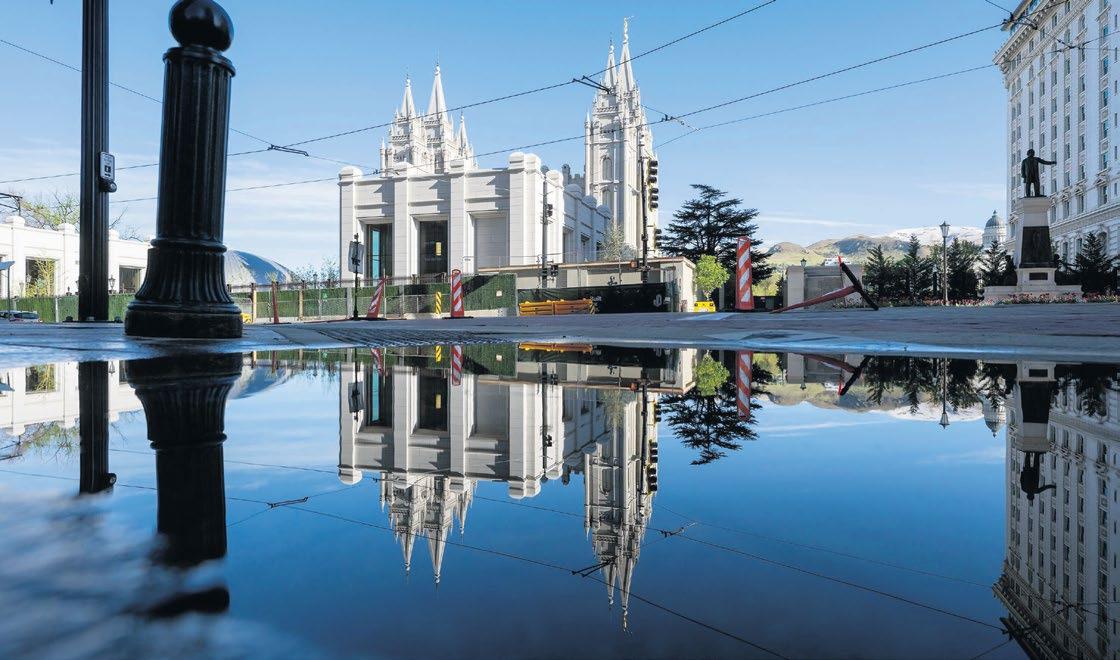
The east lobby of the new visitors' center on Temple Square in Salt Lake City and the Salt Lake Temple are reflected in a puddle of water on April 13.
By Ryan Jensen Church News
CHURCH NEWS
First look inside the new visitors’ center at Temple Square
Doors will open to the public Monday, May 18, with never-before-seen temple exhibits
The Church of Jesus Christ of Latter-day Saints provided its f irst look inside the new 39,800-square-foot Temple Square Visitors’ Center on Monday, April 13.
The visitors’ center opens its doors to the public on May 18. The media day on Temple Square provided the first opportunity to see some of the new experiences individuals can be a part of beginning in May.
The Church released the first official photos of the new visitors’ center on ChurchofJesus Christ.org. The new facility focuses on the Savior, with elements designed to help individuals understand the purpose of houses of the Lord and their role in the plan of salvation.
“The new visitors’ center is a window into our sacred covenants with Christ,” said President Dieter F. Uchtdorf, acting president of the Quorum of the Twelve Apostles. “It helps people of all backgrounds understand the role our temples play and why they matter to our members and to the communities. Here, guests can discover how temple teachings connect to everyday life and uncover the greater context of Latter-day Saint beliefs and commitment to family and Christ.”
Framed by large windows, a replica of Bertel Thorvaldsen’s Christus statue is located inside the west wing of the new visitors’ center. The temple is visible through the windows behind the statue.
A sculpture titled Come Unto Me by Swiss artist Christian Bolt depicts the Savior after His Resurrection extending His hand to visitors on the main level of the new visitors’ center.
While a General Authority Seventy, Elder Brent H. Nielson (now an emeritus General Authority Seventy) served as the executive director of the Missionary Department. He now serves as the coordinator for the Salt Lake Temple Celebration.
“Our Church leaders really wanted the focus to be on Jesus Christ and the fact that this is His house,” he said. “The visitors’ center gives those not of our faith an opportunity to see inside a temple and better understand what happens there.”
While the temple itself will have open house tours, the six months of events surrounding the open house are being referred to by Church leaders as the Salt Lake Temple Celebration.
The Salt Lake Temple renovation project began after the temple and much of Temple Square closed to the public on Dec. 29, 2019. In February 2025, the late President Russell M. Nelson announced that the temple would host an open house from April to October 2027.
The opening of the new visitors’ center comes nearly one year before that open house begins.
New exhibits in the visitors’ center include a “Inside a Temple” experience, a new scale model of the Salt Lake Temple and a gallery of 11 replicas of houses of the Lord from around the world.
The Church also relaunched the Temple Square app that will help individuals plan their time at Temple Square. The app allows users to reserve times for the “Inside a Temple” experience and other events happening on Temple Square during the Salt Lake Temple Celebration.
‘Inside a Temple’ experience
Most temples in this dispensation have included a public open-house period that allows individuals who do not have a temple recommend to enter the temple, see its rooms and learn what happens there. However, temples don’t allow for such visits once its dedication has taken place.
Inside the new visitors’ center, a guided 30-minute tour allows visitors to visit full-scale replicas of rooms included in many temples. These include a replica welcome desk, baptistry, instruction room, sealing room and celestial room. Each is generic in nature and not a replica of rooms inside the Salt Lake Temple.
Rich Sutton, a senior director in the Church’s Temple Department, said this feature basically becomes a nonstop open house for visitors.
“This will always be available to the public to come and see what a temple is like,” he said. “The rooms themselves, even though they’re not dedicated temple spaces — they sure feel like it. They’re built to the same standards as temples are. And there is a feeling in there that is different. It’s peaceful. It’s quiet. It’s contemplative. It’s even worshipful. And it’s beautiful.”
Reservations for the “Inside a Temple” experience are required and can be made at Temple Square.org.
How to visit the Temple Square Visitors' Center
• Hours: The Temple Square Visitors’ Center will be open every day from 9 a.m. to 9 p.m. beginning May 18, 2026.
• Tickets: Admission is free. Reservations are required for the 30-minute “Inside a Temple” tour. Reservations can be made through the Temple Square app or at TempleSquare.org.
• Parking: Free parking is available at the Conference Center with validation. Parking is also available at City Creek Center, south of Temple Square (first two hours free).
• Public transit: The Temple Square TRAX station is located at the southwest corner of Temple Square.
• Accessibility: The visitors’ center is ADA (Americans with Disabilities Act) compliant and fully accessible to all visitors.
Brian Nicholson, The Church of Jesus Christ of Latter-day Saints Visitors look at a scale model of the Salt Lake Temple in the east wing of the Temple Square Visitors' Center.