Deseret Magazine
Breathe like Tucson: In hard times, the symphony turns populist
Congressional candidates for closely contested primaries visit with the Deseret News editorial board

Deseret Magazine
Breathe like Tucson: In hard times, the symphony turns populist
Congressional candidates for closely contested primaries visit with the Deseret News editorial board
Also, Utah House Speaker Mike Schultz addresses data center controversy, and whether he met with Kevin O’Leary

By Doug Wilks Executive Editor

By Burke Olsen Publisher
We are pleased to introduce you to The Digest, a sampling of some of the best stories written every day by the dedicated journalists at the Deseret News, Deseret Magazine and Church News. Our hope is that you will make us your trusted news source each day at a time when there is confusion and contention in the nation.
The Deseret News brand stands for unimpeachable journalism centered on the issues most core to the human heart. While the Deseret News since its beginning in 1850 has evolved to meet the demands of its audience — reimagining print offerings, launching an acclaimed magazine and increasing the visibility and reach of its award-winning website — the publication remains committed to certain timeless ideals.
We stand for truth and light. We stand for faith and family. We stand for liberty and responsibility. We provide news and perspective, exploring society’s thorniest problems in search of solutions that will improve your life. That’s our commitment to our readers.
We invite you to discover what we can offer you:
Our website, Deseret.com, is designed to be user-friendly and available on any device. Whether you’re at home on your computer
or on the go with your mobile phone, you can access our website for the latest news, analysis and commentary.
Our apps for iOS and Android devices offer a seamless and convenient way to access the latest news, wherever you are. Choose what you want to read, save articles for later and receive push notifications for the breaking news you need to know.
Delivered straight to your inbox, our free email newsletters provide a curated selection of the most important stories of the day, as well as deeper dives into topics that matter to you. Choose from a variety of subjects and frequencies to tailor your news consumption to your needs.

For those who appreciate the tactile experience of a traditional newspaper, our weekly print edition offers a comprehensive roundup of the week’s most important stories and opinions, including the most comprehensive high school, college and professional sports offerings in the state.
In 2020, we undertook an ambitious endeavor by launching a new magazine with in-depth journalism, unique voices and principled points of view. The reception to the magazine has far exceeded our expectations. You can read more from the magazine online at Deseret.com/magazine or subscribe to have it delivered to your home or office.
The Church News remains one of our most popular offerings for those who want to know the latest news from The Church of Jesus Christ of Latter-day Saints. It’s available online at TheChurchNews.com and via iOS and Android apps. A print version is included in the Friday edition of the Deseret News.




Watch how BYU students are developing affordable prosthetics in Ecuador. It’s one way we show our love for all God’s children.
BYU.EDU/FORTHEWORLD
FOR THE BENEFIT OF THE WORLD
By Eva Terry Deseret News
Box Elder County commissioners on May 4 unanimously approved plans for a 40,000-acre data center in northern Utah’s Hansel Valley.
Almost instantly upon approval, the project generated a haze of anxiety from both Utah residents and national groups. Reports have claimed the project will hurt the Great Salt Lake, inflate energy costs and use an inordinate amount of water.
Now Gov. Spencer Cox says the project will be built out more gradually, with county commissioners and the Military Installation Development Authority only approving one phase at a time.
The project is backed by “Shark Tank” investor Kevin O’Leary, who has spoken regularly about his Utah plans on national TV news networks.
He also said he met with three Utah lawmakers who were enthusiastic about the project, including House Speaker Mike Schultz. But Schultz said he wasn’t at the reported meeting, and said he is still looking into the project.
Last month, Cox defended the county commissioners’ decision to approve the project, saying Utah must remain a place where people can innovate “while also protecting our land, air, water and way of life,” as he wrote on May 8 in an X post.
Meanwhile, think tanks, university professors and travel influencers alike have shared what they believe the data center will do to the state, reporting a range of opinions.
Ford Copple, the Sutherland Institute’s development coordinator, told the Deseret News on May 11 that the concerns raised around air quality, water and electricity are valid, “but there are also huge potential benef its” to the project.
“AI has the potential to advance human flourishing,” he said, and “we need to f ind a balanced regulatory approach to bring these two things together.”
Utah’s “innovative and entrepreneurial spirit” is a def ining characteristic of the state, Copple continued. “It’s important that we remain a state where innovation is not only allowed but encouraged.”
Here’s what we know so far about plans for the data center.
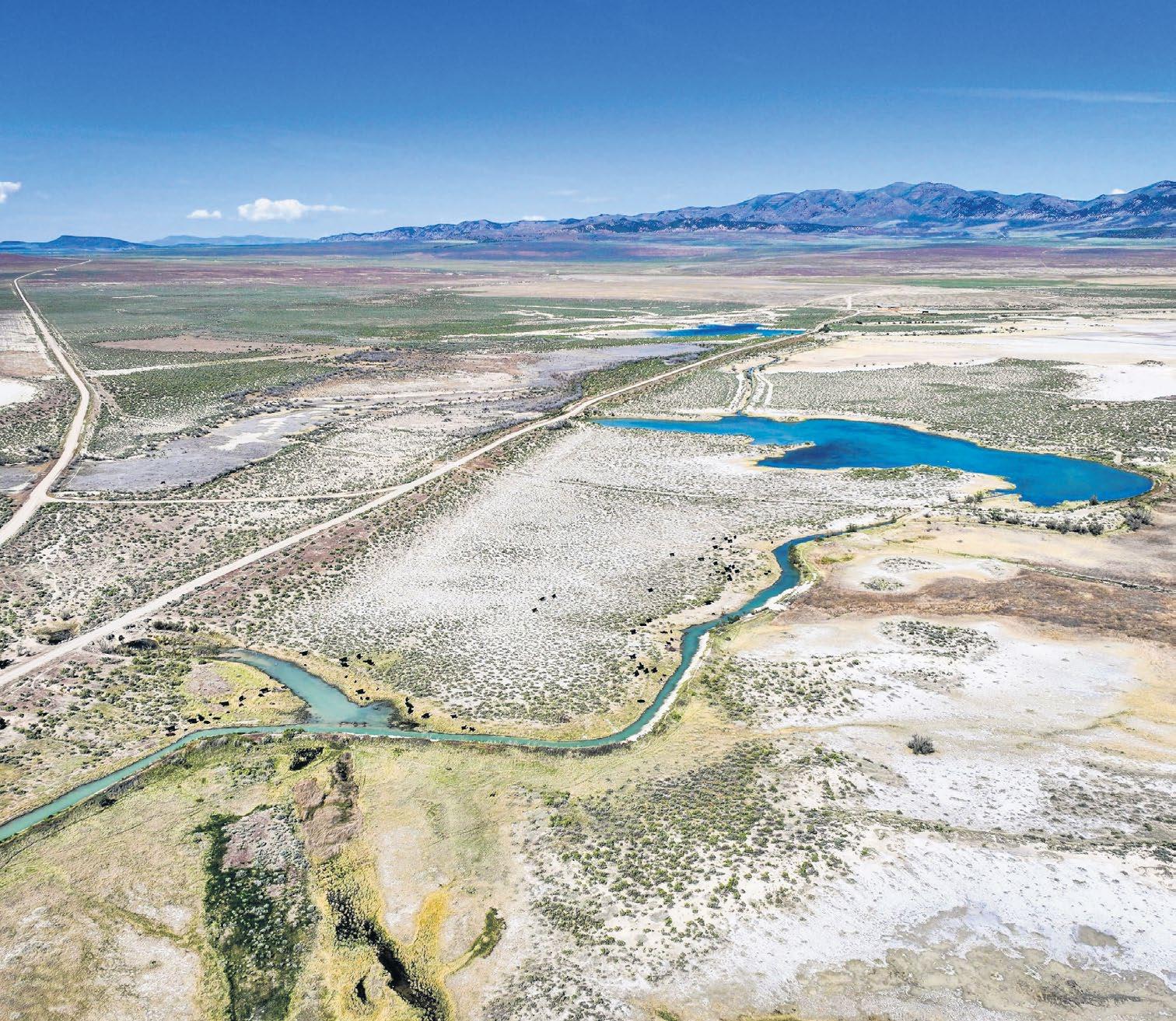
The project, dubbed the Stratos Project, will be split between three parcels of land in northern Utah and will require 9 gigawatts of energy to help power artif icial intelligence, cloud computing and national security.
According to plans, power for the project is expected to be generated onsite.
Most of the area, located about 40 miles west of Tremonton, will remain undeveloped to allow continued grazing and wildlife corridors. The initial phase-one permit grants a center covering
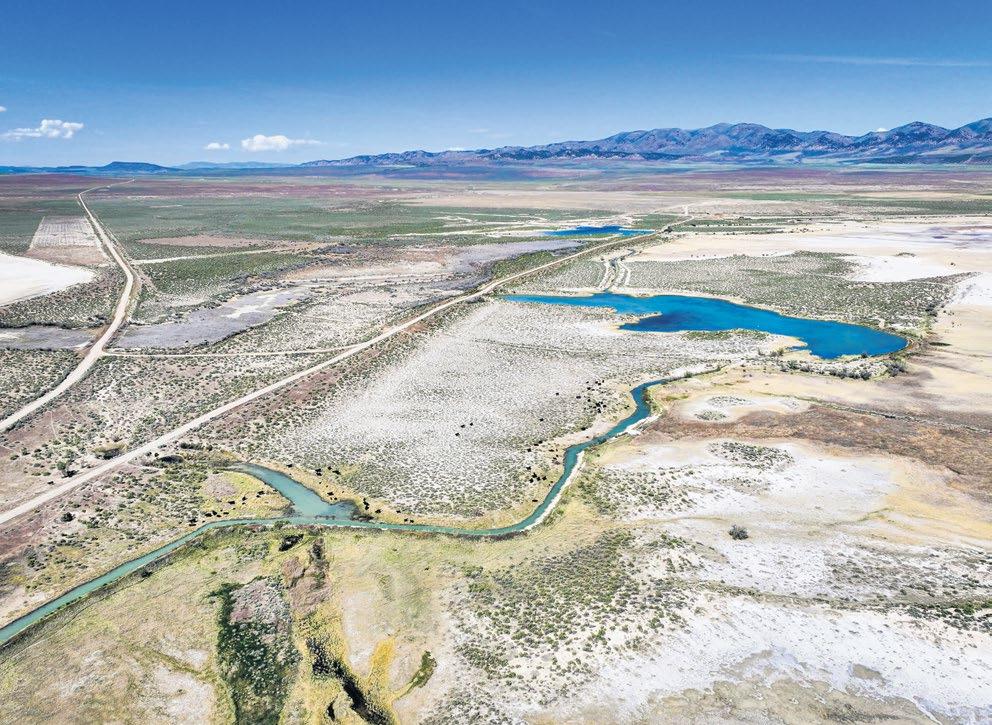
fewer than 2,000 acres.
To preserve water, the center will use a closed-loop system for cooling, which supporters say uses less water.
So far, developers, including “Shark Tank” investor Kevin O’Leary, have put $20 million into the project. By the time it’s f inished, the project will likely cost investors more than $100 billion.
If construction proceeds quickly, the f irst gigawatt of data
center capacity will be operational within two years. The Stratos Project is expected to provide economic benef its to Box Elder County. In its initial phases, the area will receive $30 million in new revenues annually, and at full buildout, it could provide $108 million from the energy and data center complex.
South Jordan, UT - The most common method your doctor will recommend to treat your neuropathy is with prescription drugs that may temporarily reduce your symptoms. These drugs have names such as Gabapentin, Lyrica, Cymbalta, and Neurontin, and are primarily antidepressant or anti-seizure drugs. These drugs may cause you to feel uncomfortable and have a variety of harmful side effects.

ig y vessels surrounding each nerve.
Peripheral neuropathy is a result of damage to the nerve often causing weakness, pain, numbness, tingling, and the most debilitating balance problems. This damage is commonly caused by a lack of blood flow to the nerves in the hands and feet which causes the nerves to
begin to degenerate due to lack of nutrient flow

Figure 2: When these very small blood vessels become diseased they begin to shrivel up and the nerves begin to degenerate.
As you can see in Figure 2, as the blood vessels that surround the nerves become diseased they shrivel up which causes the nerves to not get the nutrients to continue to survive When these nerves begin to “die” they cause you to have balance problems, pain, numbness, tingling, burning, and many additional symptoms.
The main problem is that your doctor has told you to just live with the problems or try the drugs which you don ’t like taking because they make you feel uncomfortable

There is now a facility right here in South Jordan that offers you hope without taking those endless drugs with serious side effects. (See the special neuropathy severity examination at the end of this article)
In order to effectively treat your neuropathy three factors must be determined
1) What is the underlying cause?
2) How Much Nerve Damage Has Been Sustained
NOTE: Once you have sustained 85% nerve loss, there is likely nothing we can do for you
3) How much treatment will your condition require?
The treatment that is provided at Freedom Integrated Medicine has three main goals:
1) Increase blood flow
2) Stimulate small fiber nerves
3) Decrease brain-based pain
The treatment to increase blood flow utilizes a specialized low-level light therapy (not to be confused with laser
therapy) using light emitting diode technology This technology was originally developed by NASA to assist in increasing blood flow The low level light therapy is like watering a plant The light therapy will allow the blood vessels to grow back around the peripheral nerves and provide them with the proper nutrients to heal and repair It’s like adding water to a plant and seeing the roots grow deeper and deeper
The amount of treatment needed to allow the nerves to fully recover varies from person to person and can only be determined after a detailed neurological and vascular evaluation

Figure 3: The blood vessels will grow back around the nerves much like a plant’s roots grow when watered.
As long as you have not sustained at least 85% nerve damage there is hope!
Freedom Integrated Medicine will do a neuropathy severity examination to determine the extent of the nerve damage for only $49 This neuropathy severity examination will consist of a detailed sensory evaluation, extensive peripheral vascular testing, and a detailed analysis of the findings of your neuropathy
We will be offering this promotion for neuropathy severity examination from now until June 20th, 2026
Call 801-571-1338 to make an appointment with us to determine if your peripheral neuropathy can be treated



Has Kevin O’Leary been meeting with Utah’s House speaker?
On April 27, O’Leary told “Fox and Friends” that he had met with Utah Gov. Spencer Cox, House Speaker Mike Schultz and Senate President Stuart Adams in late 2025 about the project.
O’Leary recounted their conversation: “They said, ‘We want to build this thing, can you do it?’ I said, ‘I’ve got the team. I can raise the capital. Do you have the land?’ And they said, ’40,000 acres.’”
Schultz told the Deseret News on May 12, “Yeah, I wasn’t part of that.”
“He did reach out for a meeting, but my schedule was busy and I did not have a chance to meet,” Schultz said, adding that he didn’t find out about the project until early April.
He continued, “So, you know, I’m just a little over 30 days with this information as well, so I’m not trying to make a statement one way or the other around it. … But I was not made aware of it until just a little over 30 days ago.”
Schultz said the “most crucial” things to consider about the data center are “what is best for Box Elder County and what is best for the state of Utah.”
The Deseret News reached out to O’Leary for comment but did not hear back before publication time.
Will the data center raise the cost of energy in the state?
During the 2025 legislative session, lawmakers passed a bill requiring any power development for data center projects to not negatively impact electricity costs for Utahns. All power consumed by the data center will be generated onsite or brought in.
A University of Southern California professor, Shon Hiatt, recently presented his research on how existing data centers influence the cost of electricity.
Data centers are responsible for only a 0.007%-0.08% increase in residential power bills, he said.
Will the data center hurt the environment?
On May 5, Utah State University professor Rob Davies published preliminary analysis on the project’s environmental impact if it is powered solely by natural gas.
He said the project would generate 16 gigawatts of thermal load and produce “extreme” ecological impact.
Davies predicted that the project would increase the region’s nighttime temperatures by 8 to 12 degrees Fahrenheit, which would be enough to prevent condensation and dew point.
The same day, O’Leary posted a video to X addressing similar concerns. “We search for the best technology. There are air-cooled turbines now. … There are so many different ways to generate power. We can also put a percentage of the power through solar, wind and batteries,” he said.
Then on May 8, Cox announced that the developer had committed to pursuing a wide variety of power sources for the plant, including renewable energy resources, energy storage, nuclear generation and other low- or no-emissions solutions in addition to natural gas.
Will the data center hurt the Great Salt Lake?
On May 8, Cox tasked Utah’s Department of Natural Resources to ensure the project uses “the most environmentally-sensitive cooling technology” and that the Great Salt Lake is protected.
The governor also asked the developer to publish a publicly available water plan that shows Utah DNR officials that “no degradation occurs to the Great Salt Lake.”
“All water use must be reported publicly, and in no event will the developer reduce water going to the Great Salt Lake,” he said.
How is the military involved in Utah’s data center?
Utah’s Legislature created the Military Installation Development Authority, or MIDA, in 2007 to support military installations in the state.
In late April, MIDA’s board of directors approved the Stratos
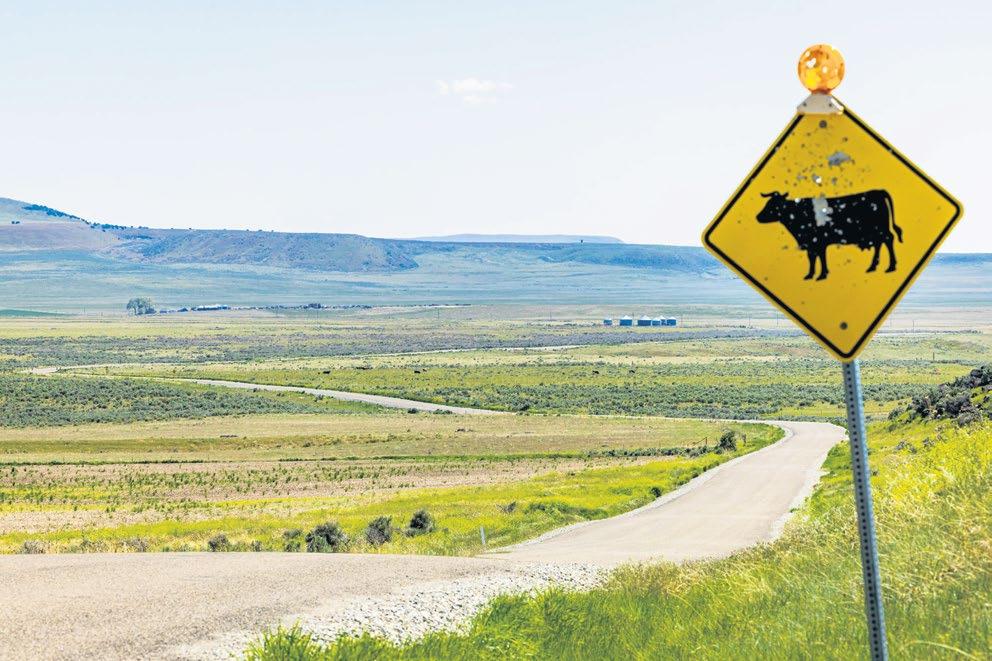
Isaac Hale, Deseret News
A cattle sign is posted along Hansel Valley Road, north of land proposed to be used for the Stratos Project data center in the Hansel Valley area of Box Elder County on May 12. The swath of land on the other side of the ridge pictured here is the more eastern of the two largest sections of land proposed to be used for the data center.
Project. Their website says the project is “designed to strengthen military readiness, national security and Utah’s long-term economic competitiveness.”
Specifically, the project will support Hill Air Force Base and the Utah National Guard by creating revenues that will “help fund critical infrastructure project tied to military readiness,” according to MIDA.
Paul Morris, the executive director of MIDA spoke to the Box Elder County commission on April 23 in favor of the project.
“We get a lot of proposals, and we turn them down. Either they’re not viable or they don’t have a military component. But this one was unusual for both its military and national security reasons and as well as its viability and economic opportunity it would bring,” he said.
Col. Andrew Owens, Utah National Guard director of joint staff, then told the commission that the project would help ensure that the military will “be able to operate without interruption when it matters the most.”
The week before approval, Box Elder took public comments
On April 23, a week and a half before voting unanimously to approve the data center, Box Elder County Commissioner Tyler Vincent said, “This project looks exciting, and the potential investment and job creation sounds great, but we want to make sure this project is done in the right way.”
“We want to protect our agricultural heritage; we want to maintain local control and address the concerns of our local residents,” he said.
When the commissioners gave time for the public to comment, a majority said they supported the data center.
Becky Meyer, a landowner in the area, told the commission, “I feel like (the data center) is going to be a great economic thing for this
county or I wouldn’t be supporting it. I feel like it will be a positive thing with not a lot of impact.”
The only resident who spoke against the project on April 23 was Dustin Mills, who said he was concerned about the center’s water use. “If the water impact is greater than anticipated and if it affects us, moving forward, what’s our recourse? What can we do to ensure that our livelihood and our properties are protected?” he asked.
On May 4, after public comment had closed, the public’s response to the data center turned explosive. As the commissioners began their meeting, protesters shouted, “Shame.”
“We will not allow shouting, we will not allow cat calling, we expect you to be kind,” Vincent said before being interrupted by yells. The hourlong meeting was consistently interrupted by protesters opposed to the data center.
Cox requires studies and approvals before construction can begin
Several divisions within Cox’s administration still need to evaluate the proposed plans before the project can move forward. These include:
• Division of Air Quality: Will evaluate projected air pollutant emissions and mandate control techniques.
• Division of Drinking Water: Will review drinking water systems. These systems must be physically separate from water used for cooling, fire protection or power generation.
• Division of Water Quality: Requires permits for all surface water and groundwater discharges to waters of the state, including the Great Salt Lake.
• Division of Water Rights: Will evaluate water availability.
• Division of Wildlife Resources: Can review the center’s potential impacts and provide recommendations to minimize/mitigate impacts to wildlife once a formal plan is submitted.





By Valerie Braylovskiy Deseret Magazine
The strings pull the audience through time. Violins climb in a panicked chant, coiling like a rickety staircase that’s about to collapse. Cellos and basses deepen the suspense, layering uneven brushstrokes of gray-blue sound. Onstage, the conductor glows beneath white lights, his tailcoat swinging with each flick of the baton. To his left, the first violins lift their bows at sharp right angles. Somewhere in the sound, I hear the last droplets of a rare desert downpour tapping faintly against the concrete roof of Linda Ronstadt Hall, home of the Tucson Symphony Orchestra.
I sink into my plush crimson seat, one of many in curved rows climbing above the stage where a grand array of musicians clad in black play “Les Offrandes oubliées” (“The Forgotten Offerings”) by French composer Olivier Messiaen. In three movements, it traces Catholic beliefs from The Cross through Sin to the Eucharist, but no theology is required to feel its ache. When a barrage of trumpets bursts through the wall of sound, I jolt upright. Percussion and brass strike, strings whistling across an ominous glissando.
Beside me, Paul Meecham taps his foot just ahead of the beat. Checkered socks peek out from his scuffed dress shoes; his blue tie, patterned with green spirals, hangs loose at the collar. A genial Brit classically trained in piano and violin, Meecham is the Tucson Symphony’s president and CEO. He greets donors and longtime patrons before nearly every performance, but once the lights dim, he’s just another fan in a navy suit, save for the shiny name tag on his lapel. “Brava, brava!” he calls through the applause as the final chord fades out.
Meecham lives for the music, but it’s his job to ensure that the orchestra survives. Artistry alone is not enough. When he took the post in 2021, symphonies were struggling across the country, from small towns to major cities. Audiences had lost touch with the art form. Traditional funding models were falling short. The pandemic struck them like a knockout punch. He knew the symphony had to change, to make its work matter to people again. But tonight, as the orchestra sweeps through a suite of French works before a modest but enraptured crowd, the music feels very much alive. “Brava!” The word symphony comes from the Greek symphonia, which means “sounding together.” Musicians played in groups for millennia before a small ensemble joined the French court around 1570 and evolved into a permanent orchestra called the Vingt-quatre Violons du Roi (The King’s 24 Violins) by 1626. In 1607, Italian composer Claudio Monteverdi first wrote distinct parts for each specific instrument in his opera “L’Orfeo” (1607). Orchestras evolved and grew with the advent of new instruments, more complex compositions and formalized organization into sections like woodwinds and percussion, largely playing for aristocrats and opera houses through the 18th century. In some cases, the continued rise of merchants and bureaucrats influenced music. In 1743, 16 burghers and nobles in Leipzig, Germany, founded the first civic symphony orchestra: the Gewandhausorchester, or Garment House Orchestra, named for the building where it eventually moved. In 1748, the English city of Oxford built Europe’s first intentional music venue, designed for chamber music. Wolfgang Amadeus Mozart left the employ of a powerful archbishop to work

as a freelance artist, sponsored by private individuals. During the Napoleonic wars (1803-1815), when composers like Ludwig van Beethoven channeled political unrest into their scores, amateur concerts flourished.
Beethoven’s work reached America in 1805, when a German conductor performed for a private audience in Charleston, South Carolina. But it was the New York Philharmonic, founded in 1842, that cemented a model for American symphonies, funded by philanthropy. The art form expanded as European immigrants — especially Germans — brought their instruments, teaching methods and repertoire with them. By the late 19th century, grand stateside concert halls were housing orchestras with 80-100 musicians, led by conductors who often became public figures. They even played the works of American composers like John Knowles Paine, Harvard’s first music professor. A night at the symphony was a special event.
The “Big Five” have set the national standard since the early 1900s:
New York, Boston, Philadelphia, Cleveland and Chicago. Their presence helped to foster innovative composers like Charles Ives and Aaron Copland, who incorporated folk and jazz influences to create truly homegrown music. As industrialization followed railroads and resources across the country, orchestras sprouted up, too. There were just 17 before World War I and at least 270 by 1939, according to historian Joseph Horowitz, author of “Classical Music in America: A History of its Rise and Fall.”
Out West, symphonies arose in Seattle (1903), San Francisco (1911), Los Angeles (1919), Portland (1924), Albuquerque (1932) and Denver (1934). The Tucson Symphony began in 1928 as a volunteer ensemble in a high school auditorium under a Belgian conductor. Founded in 1940, the Utah Symphony was transformed when conductor Maurice Abravanel left New York’s Metropolitan Opera in 1947 to make the fledgling group one of the nation’s few full-time orchestras, touring internationally and paying musicians year-round.
That golden age persisted through the Jazz Age, the Big Band Era and the birth of rock ’n’ roll, even as radio and recorded music transformed popular culture. The economy was booming and philanthropies like the Rockefeller Foundation and the Ford Foundation funneled money into grander halls, longer seasons and celebrity soloists. Conductors became stars, shuttling across continents in what became known as the “jet-set maestro” era.
So it was jarring when Leonard Bernstein issued a stark warning in 1980. Speaking before the American Symphony Orchestra League, the former director of the New York Philharmonic — famous for his televised “Young People’s Concerts” and for blending jazz and Broadway styles — cautioned that orchestras could not survive as museums. They had to provide “fertile soil” where new music could grow. “If (the musician) is fenced off, he will stagnate,” Bernstein said. “So will the orchestra. So will the public. So will art.”
A monumental gray box met Meecham in stony silence. The building known then as the Tucson Music Hall is almost foreboding in its modernist severity, with straight lines and thick walls, tucked between a parking garage and a beige office building on the city’s convention center campus. In May 2021, the sun pummeled the spare plaza dotted with palm trees and palo verde. Live music had gone quiet in response to the pandemic, at least indoors, leaving the symphony dependent on federal relief funds. Some employees were furloughed. Others left. That was just one more challenge for the new president, the fourth in five years, but Meecham knew what he was getting into.
He had been managing orchestras for decades, from London to Baltimore, Seattle and Salt Lake City. When he joined the business in the 1990s, crowds were already shrinking, the audience was aging and the culture felt lost, relying on safe, repetitive programming and a revolving door of guest conductors. The rise of the internet only made things worse, offering audiences infinite alternatives and raising up the next generations on streaming and instant entertainment. Many private donors were aging out or redirecting their giving.
The Great Recession further thinned support for classical music, shrinking endowments, shortening seasons and pushing orchestras like Pittsburgh to the brink. Others, like Honolulu and Syracuse, filed for bankruptcy or simply shuttered. Even oncereliable subscription models — concert packages purchased months in advance — faltered. Ticket revenue, which made up more than half of U.S. orchestra income in 1990, fell to roughly a quarter by 2023.
Like Meecham, Carlos Izcaray lived the unraveling. From 2016-24, he was music director of the American Youth Symphony in Los Angeles, founded in 1964 to develop emerging musicians. Long before COVID, the AYS struggled with dwindling donations and disagreements over its identity. Izcaray believes the organization had become siloed, its leadership disconnected from each other and their purpose. He watched in dismay with a rebranding plan in hand as the 60-year-old organization disbanded in 2024. “It’s not just battling about more budget, less budget,” he says. “What’s the mission? How do you implement it?”
Meecham recognized the same questions in
Tucson, but he knew he couldn’t answer them alone. So one day he stood on the balcony inside the hall with music director José Luis Gómez, gazing over empty seats. Concrete pillars jutted from stone-lined walls, their wooden borders catching bits of light. The dark, rather minimalist space — built in 1971 — felt hollow. As they prepared for the first in-person season in nearly two years, the pair agreed that the symphony needed to shed its image as distant or elite, and give the people of Tucson reasons to come back. “Without the community finding us, we wouldn’t exist,” Meecham said later. “So I think it’s incumbent upon orchestras to reflect the needs of the communities.”
Or, as Gómez puts it: “The Tucson Symphony has to breathe like Tucson, it has to look like Tucson, it has to sound like Tucson.”
An hour before the concert, the hall hums softly. Early arrivals settle into seats near the front: gray-haired regulars, college students clutching notebooks, a giddy couple on a date. Gómez, a Venezuelan-born Spaniard, paces onstage as he speaks, his dark hair swaying along a clear side part with each gesture. Several rows back, Meecham is hard at work on his phone, but looks up to check in. “I will encourage you to find the poetry in the music,” Gómez tells the audience. “The words are said in notes. The colors are painted in notes.”
Tucson is a colorful city at the eastern edge of the Sonora Desert, surrounded by five arid mountain ranges dotted with saguaro cacti, home to Gila monsters and seven kinds of snakes. A Spanish outpost-turned-Mexican presidio and American border town, the city is conscious of its historical identity, proudly celebrating Día de los Muertos and hosting an international mariachi festival. Murals and casitas pepper the older, narrow streets. Spanish is commonly spoken in certain barrios; 42 percent of the population is Hispanic or Latino.
On the other hand, Tucson is a modern Sun Belt destination city, a sprawling and glimmering grid of strip malls, golf courses and gimmicky restaurants. Its economy is anchored by a major research university, an Air Force base, a nearby Army intelligence center and an array of defense contractors. An annual influx of “snowbird” retirees descends on the city each winter along with overwhelming crowds for the country’s biggest gem expo. So how can anything belong to everybody?
Fittingly, the hall was renamed in 2022 for Linda Ronstadt, a Hispanic icon and beloved daughter of Tucson who won 24 Grammys in her singing career. Each September, the orchestra partners with the Mexican consulate to give a free concert with mariachi music for that country’s Día de la Independencia. And this year, for America’s upcoming 250th anniversary, the symphony presented a national portrait through Tucson’s lens — playing Bernstein’s “West Side Story” alongside works by Duke Ellington, contemporary Hispanic composers and patriotic classics. “We tried to change people’s perceptions of a traditional symphony orchestra,” Meecham says, “by making it more relevant to all of the community, not just some of the community.”
But it’s also imperative to make the symphony welcoming and fun, enlivening a form that people often hear in fragments — film scores, café playlists, elevator rides. So the symphony screens films like “Star Wars” and Chaplin’s “The Gold Rush,”
and plays the soundtracks live — with popcorn at intermission. Meecham and Gómez have also launched “Underscore,” a series that explores individual works in depth; hired the first principal pops conductor; and expanded youth outreach, bringing ensembles and composition lessons into classrooms. And the pair have continued holding an informal talk before each concert, less a lecture than an invitation.
“We are trying to make the audience experience a little looser,” Meecham says, hoping the broader programming “helps over time to break down our perceptions that we’re kind of a very formal experience where you can’t applaud between movements and you just have to sit and be very quiet.”
Tonight’s program will culminate with Claude Debussy’s “La Mer” (“The Sea”). As a young composer studying in 19th-century Rome, Debussy became fascinated with Japanese art, scouring antique shops for woodblock prints. Years later, he translated one iconic image — Hokusai’s “Great Wave off Kanagawa” — into three symphonic “sketches,” music rooted in tradition yet radical in its rejection of rigid symphonic structure. “We sometimes think that our music … is boring or very academic,” Gómez says. “But they were all experimenting. It’s all about experimenting and discovering things.”
Tucson’s not the only symphony embracing its local identity or trying something new. In Sioux Falls, the South Dakota Symphony’s Lakota Music Project bridges Indigenous and Western traditions. In Florida, where some orchestras have gone dark, the Naples Community Orchestra has hit record attendance with community events and savvy social media outreach. The Arkansas Symphony’s membership model — unlimited concerts for a monthly fee — has outperformed traditional subscriptions. A regional orchestra’s smaller scale can be liberating, with fewer legacy constraints, seats to fill or donors to please, and a lower threshold to keep the lights on.
Between numbers, Meecham leans over and whispers, his British accent thick with delight: “Now the sea, in land-locked Arizona.” Debussy’s piece unfurls like dawn breaking over water. Violins and violas shimmer, timpani rolling behind them like an approaching tide. In the second sketch, two flutes and a piccolo trade playful phrases, like children splashing at the shore. By the final movement, the full ensemble erupts into a stormy exchange

between wind and sea. Brass roars, cymbals crash — surf breaking over rock. I can’t name every instrument, but I can feel the ocean.
Gómez says that orchestras show how society can work together in hard times. Tonight, that feels undeniable. For two hours, an ensemble moves in synchrony; no single instrument can be removed without changing the whole. Hundreds of strangers breathe in tandem, listening as one, each unmistakably moved in their own way. No wonder he’s an optimist. “Somebody was passionate and crazy enough to come to a desert and create a symphony orchestra,” Gómez says. “Am I worried? No, I am excited about what is going to happen in the next hundred years.”
Outside, I feel the vertigo that great art leaves behind — unsure where I’ve been, certain I couldn’t have been anywhere else. The air is crisp, freshly washed by rain. Musicians chatter as they load their instruments into trunks. Slightly disoriented, I circle the convention center and emerge on the far side of downtown, across from an older neighborhood of beige adobe houses with chipped paint. Above me, a wide sky, studded with plenty of stars. This story appears in the April 2026 issue of Deseret Magazine. Learn more about how to subscribe.







By Emma Pitts Deseret News
Editor’s note: The Deseret News has invited congressional candidates for the closely contested party primaries to visit with its editorial board. This story is one in a series of candidate previews on issues.
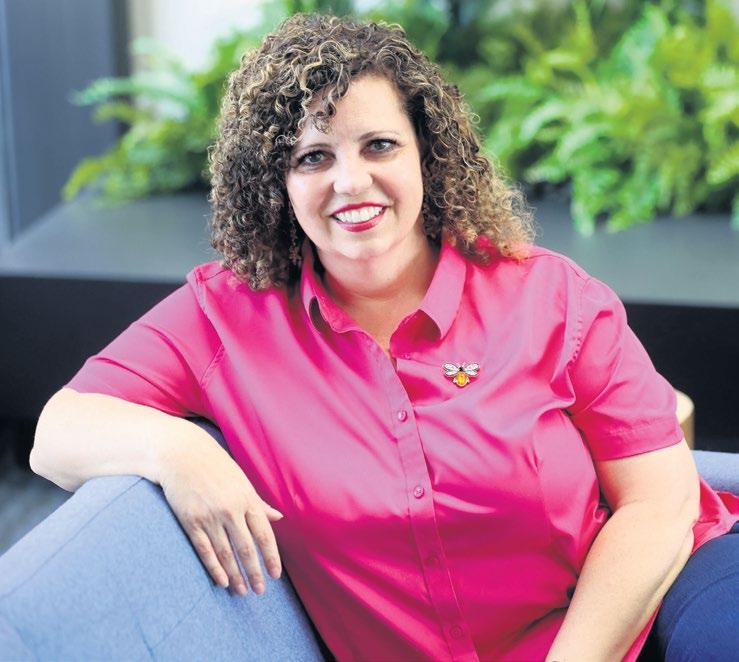
Nate Blouin believes the government should play a larger role in Americans’ lives.
A self-described progressive Democrat, he told the Deseret News and KSL editorial boards on May 19 that while he isn’t a member of the Democratic Socialists of America, he aligns politically with prominent f igures who are part of the democratic socialist movement, including New York City Mayor Zohran Mamdani and New York Rep. Alexandria Ocasio-Cortez (AOC).
As a Utah state senator, Blouin said his greatest achievement was moving the needle for Democrats in a Republican-led state. Now running for Utah’s 1st Congressional District in the Democratic primary, Blouin said if he won and found himself working alongside Utah’s GOP-majority congressional delegation, he would “f ight f ire with f ire.”
Compromise, he said, has weakened Democrats’ leverage in the state. He criticized his fellow Utah Democrats for being too moderate, too accommodating to the GOP majority, and too afraid to advocate aggressively for progressive policies.
Democrats believe they have a real opportunity to challenge the state’s GOP leadership and increase their federal influence after a judge struck down Utah’s congressional map and selected a new map with a heavily-Democratic district.
In a political upset in April, Liban Mohamed became the Democratic Party’s nominee coming out of the convention for Utah’s newly created 1st Congressional District, gaining 51.18% of the votes at Utah’s Democratic Party Convention.
Mohamed, Blouin, former Rep. Ben McAdams and candidate Michael Farrell all qualif ied for the primary through signature gathering. The candidate who wins the June primary will go up against Republican Riley

Owen in the November general election.
But Blouin said he believes the real race is between him and McAdams.
“I’m advocating for policies that would expand the scope of government that would allow people to get more resources who need it from the government,” Blouin said, mentioning universal healthcare, more
subsidized housing, and even suggesting eminent domain to potentially acquire agricultural water rights for Great Salt Lake preservation efforts.
He rejected the former President Ronald Reagan’s famous line, “The nine most terrifying words in the English language are: ‘I’m from the government, and I’m here to help,’”
instead aligning himself with Mamdani’s recent criticism of the quote, when he said, “I disagree. I think nine more terrifying words are actually, ‘I worked all day and can’t feed my family.’”
I chose to raise my family in Northern Utah. I love our community. I’ve served on the Syracuse city council and in the Utah House and I would be honored to represent you in Congress.
I will vote to cut wasteful spending and to balance the budget.
I will fight corruption and will never trade individual stocks while in office.
I will vote to end FISA’s warrantless surveillance of American citizens.
Banned elective abortions due to a Down syndrome diagnosis.
Prohibited abortion in Utah with exceptions upon the overturning of Roe v. Wade.
Alleviated regulatory and tax burdens from Utah businesses.

I will continue to defend the 2 Amendment. nd
I will maintain a 100% Pro-Life voting record.

Shifts pre-trial burden of proof to the state, protecting law-abiding Utahns who act in self-defense.
Required habitual offenders to be held until seeing a judge, limiting overcrowding-release loopholes.
Prohibited gender-affirming care and required sex-based housing assignments for individuals in state custody.
I’ve passed over
Taxing the rich
Blouin said his top priority is “unrigging the system.”
He criticized capitalism, arguing that it allows the wealthiest in the country to hoard their money rather than reinvest it in society through government programs, a belief he shares with his endorser, Vermont Democratic Sen. Bernie Sanders.
Like Ocasio-Cortez, Blouin said he doesn’t believe self-made billionaires exist: “There’s only so much money someone can earn, and at some point that money is made off of our system, off of our infrastructure, off of working people who are getting screwed over or who aren’t getting paid the wages they deserve.”
When asked how he felt the contributions wealthy Americans make in places like Salt Lake City, including charitable giving, job creation, community investment and scholarship programs, Blouin said billionaires should be taxed more heavily instead of deciding themselves where money goes.
Blouin argued that government, not rich individuals, should decide how to spend money to help those in need.
“I would like to double some people’s tax rates,” he said. “I’m not talking about raising taxes on everyone, I think the vast majority do pay their fair share, but there’s an upper echelon where they are not ... there’s these loopholes, all these loopholes that people are exploiting, and you know, it may look like their rates are high, but they’re not.”
Blouin was not sure at what income level he would like to see taxes raised, saying maybe for those making over $1 million, but also mentioning those who make several hundred thousand dollars a year.
On May 14, Blouin went live with controversial online streamer Hasan Piker on Twitch.
A self-described Marxist, Piker has made comments suggesting Americans deserved the 9/11 attacks. Piker minimized the sexual as saults that took place during the Oct. 7 Hamas attack against Israel,

saying it didn’t change his perspective on the matter, and gave praise to Hezbollah, a terrorist organization that openly promotes the killing of LGBTQ people.
Blouin acknowledged that some of Piker’s comments make him uncomfortable, but said it’s worth setting those aside for the opportunity to be platformed by Piker, who has more than 3.1 million followers.
“I think we need to be engaging with people who have a platform that can reach people who are otherwise, like disaffected and not engaging in the system, because I think when more people get engaged in the system, we get better outcomes,” he said. "That does not mean that I agree with his comments and everything, but you know, I do agree with his perspectives on many things. But, like myself, he has said controversial things.”
Ahead of the Utah Democratic Convention in April, social media posts written by Blouin more than a decade ago were made public. In them, he labeled Latter-day Saints as “a bunch of bigoted (expletive)” and said the church was “DEFiNITELY just a front for the largest US drug cartel.” The New Hampshire native also said church members were the worst part about living in Utah and that members were “quite oppressive and narrow-minded.”
Blouin publicly apologized after the comments were revealed.
On May 19, he said that if elected he would prioritize all of his constituents, including Latter-day Saints.
“I think there’s a very real place where religion can play a very positive role in people’s lives. And at that point in my life, I was frustrated because I felt like I had no path forward. I failed out of college, didn’t have good jobs, had a car that was barely running, felt like I’d lost my opportunity,” he said. “About the same time I got back into Salt Lake Community College and moved forward, those comments stopped appearing because I felt like I wasn’t taking my anger out at a group or at a religion or anything like that, and so that’s really been able to inform my perspective on things.”
• Tax the Ultrarich


The Democratic and Republican primaries are on June 23.
Have the 1% finally pay their fair share by closing loopholes, creating new rates for multimillionaires and billionaires, and lowering tax rates for everyone else.
• Affordable and Quality Healthcare for All
Eliminating the tax preference for employersponsored health insurance, lowering the age of eligibility for Medicare to 0, and increasing the additional Medicare tax on the ultrarich.
• End the Corruption in D.C.
Ban stock trading by any member of Congress, the judiciary, and the White House; ban any former lobbyists from serving in Congress because the American people deserve to know who their Representatives are working for.

By Brigham Tomco Deseret News
Editor’s note: The Deseret News has invited congressional candidates for the closely contested party primaries to visit with its editorial board. This story is one in a series of candidate previews on issues.
Phil Lyman — who is running against Rep. Celeste Maloy in the 3rd Congressional District primary after election losses in 2024 and 2025 — knows exactly where he f its into the Republican Party of 2026.
The GOP establishment in Congress represented by House Speaker Mike Johnson is too top-down, he said, while the “MAGA loyalists” are inconsistent in enforcing constitutional restraints on federal power.
Lyman frames himself as f itting squarely within the House Freedom Caucus, where he said he hopes to f ight, if elected, as the face of anti-establishment conservatism in the state of Utah.
“I save all my criticism for the Republicans because I see a willingness to go along with policies and operations that they should be standing up against,” Lyman told the Deseret News and KSL editorial boards on May 14.
A crusade against the “go-along-to-getalong” GOP motivates Lyman’s latest bid to restore small-r “republicanism.” It also underlies his fundamental distrust in state democratic institutions.
After two years of disputing election outcomes, challenging electoral processes and hitting dead ends in court, Lyman has emerged more convinced than ever that the political system is rotten to the core.
Trust is earned through transparency, and where it is denied, corruption can be assumed, according to Lyman, who believes def initively that the 2020 presidential election was stolen from President Donald Trump.
Is Trump in control?
His worldview has convinced Lyman that Trump’s Iran foreign policy has been “hijacked” by deep-state actors in his Cabinet or military who want U.S. intervention to extend past the president’s initially limited goals.
Why
While he said he supports preventing Iran from obtaining a nuclear bomb, Lyman said he would not vote to authorize further military action because he believes the battle over the Strait of Hormuz has turned into
a “f iasco.”
“On one hand, I’d like to believe that Trump is in charge of those decisions. But on the other hand, it seems inconsistent with what he started, to then f ind himself
in a quagmire of dysfunctional, bad policy,” Lyman said.



There are “penetration agents” in government working against America’s interests, Lyman said, pointing to former CIA Director John Brennan, who was involved in a 2017 report on Russian interference in 2016’s election.
Brennan continues to hold sway over the CIA, Lyman alleged, accusing the CIA of raiding Director of National Intelligence Tulsi Gabbard’s off ice allegedly to prevent the full release of f iles on President John F. Kennedy.
Rep. Anna Paulina Luna made similar claims this week, saying the CIA removed f iles related to JFK and the CIA’s Project MK-ULTRA. On May 13, Gabbard’s spokesperson said “This is false. The CIA did not raid the DNI’s off ice.”
This does not change Lyman’s view that foreign policy is being shaped by “a massive propaganda operation underway at the federal level.” Lyman applies an equally dim prognosis to the nation’s spending problem.
It is impossible to recover from the $39 trillion in debt, Lyman said. Americans should distance themselves from a broken dollar by investing in digital currency, like Bitcoin, which Lyman said should not be regulated.
There should also be little to no federal regulation of public lands, according to Lyman, who often cites his arrest as a San Juan County commissioner in 2014 for protesting the government’s closure of an ATV trail.
Is Utah’s success a ‘facade’?
If elected to Congress, Lyman said he will help ensure Washington, D.C., acts on his priorities of land access, energy independence and water rights in a way that protects control by state and local leaders.
In reaction to recent congressional actions, Lyman said he would vote to protect American’s right to privacy from
surveillance, to hold corporations accountable and to limit government control of their property.
The mentality that a class of well-known politicians and wealthy activists know what is best for the people is to blame for malfeasance at the capitols in Washington, D.C., and Salt Lake City, according to Lyman.
As a state lawmaker and candidate, Lyman lambasted publicprivate partnerships to renovate sports arenas, to grade offensive political speech and, more recently, to incentivize a massive AI data center in Box Elder County.
“When government gets involved with that, then if those ideas fail, then the entire state is harmed,” Lyman said. “It’s not government by the people. It’s government by an oligarchy. It’s not conducive to liberty.”
Metrics that show Utah as having the top GDP increase, median household income, economic outlook and upward mobility in the country are “a facade” that do not reflect the experience of everyday Utahns, Lyman said.
Residents remain “overtaxed,” and “overregulated” and are right to hold current elected leaders responsible for the unaffordable housing market and controversial approaches to managing growth, Lyman said.
“The problem is not lack of trust,” Lyman said, repeating his phrase from April’s GOP nominating convention. “It’s trusting people who are not trustworthy. And trustworthy is a component of competence, reliability and honesty.”
Lyman doubts all three when it comes to the election system. His skepticism is centered in the lieutenant governor’s refusal to provide him with a record of Gov. Spencer Cox’s 2024 primary signature petitions.
An investigation into fraud by signature gatherers working on a different race for the same f irm Cox contracted, and an audit f inding errors in verifying Cox’s signatures has persuaded Lyman that Cox did not qualify.
Ultimately, Cox won the race soundly, 55%-45%. But Lyman did not concede, saying he needed to verify the election returns through an independent, third-party audit f irst. Lyman has never conceded the loss.
On May 14, Lyman did not say whether he would trust the results of his 3rd District primary race this year against Maloy. He will “verify the election results,” Lyman said, by looking at a “statistical analysis.”
In 2024, Lyman asked the Utah and U.S. high courts to reverse the election outcome and to place him on the general ballot. Lyman later dismissed the rulings against him, saying they were not decided on the merits.
Lyman said he does not “challenge election results” unless there are indications of fraud, like he claims to have found in the 2024 primary. Lyman referenced that he accepted his loss in the GOP chair race last year.
“When I’m defeated, when I’m done I will go away. I’m a very good loser. I’m happy to lose in a fair f ight,” Lyman said. “It’s hard to walk away from something midstream mid-f ight when we’re making so much progress.”
After waging a historic write-in campaign in 2024, that saw more than 200,000 Utahns write in Lyman’s name for the general election, Lyman promised his supporters he would run for governor again in 2028.
That race proved his message of transparency “really resonated with people,” he said May 14. Lyman did not say if he still planned to run for governor. His current bid, he said, gives him “an opportunity to continue the f ight.”














By Brigham Tomco Deseret News
Editor’s note: The Deseret News has invited congressional candidates for the closely contested party primaries to visit with its editorial board. This story is one in a series of candidate previews on issues.
Utah Rep. Celeste Maloy took a step back from the news cycle this year when deciding what to put at the center of her third congressional campaign in three years.
Her message would not be curbing government overreach like it has been in the past — though she has built a track record defending Utah lands, mines and rural residents.
Nor would it be the pressing issues of wars, water and debt — though she has remained consistent that Congress needs to take a more proactive approach on all three.
It is the thing she thinks underlies all these voter concerns: a crisis of faith in the United States of America.
“My fear is that the American people are going to stop believing in the American system of government. And if that happens, none of the rest of this matters,” Maloy said.
How to restore conf idence in American institutions is not just a good thought exercise, it is the central question “of our time,” Maloy told the Deseret News and KSL editorial boards on May 8.
Maloy is trying to provide the answer as she runs her Republican primary race against former gubernatorial candidate Phil Lyman in the new 3rd Congressional District.
The solution includes Congress members doing their constitutionally mandated job to budget, Maloy said, without giving in to incentives to tear down the other side.
A congressional course correction on spending has never been more urgent. Last month, the national debt surpassed the GDP for the first time since World War II.
This means that all of the income, investments and output of all Americans in a year, totaling $31.22 trillion, could not pay off the publicly held debt, which has hit $31.27 trillion.
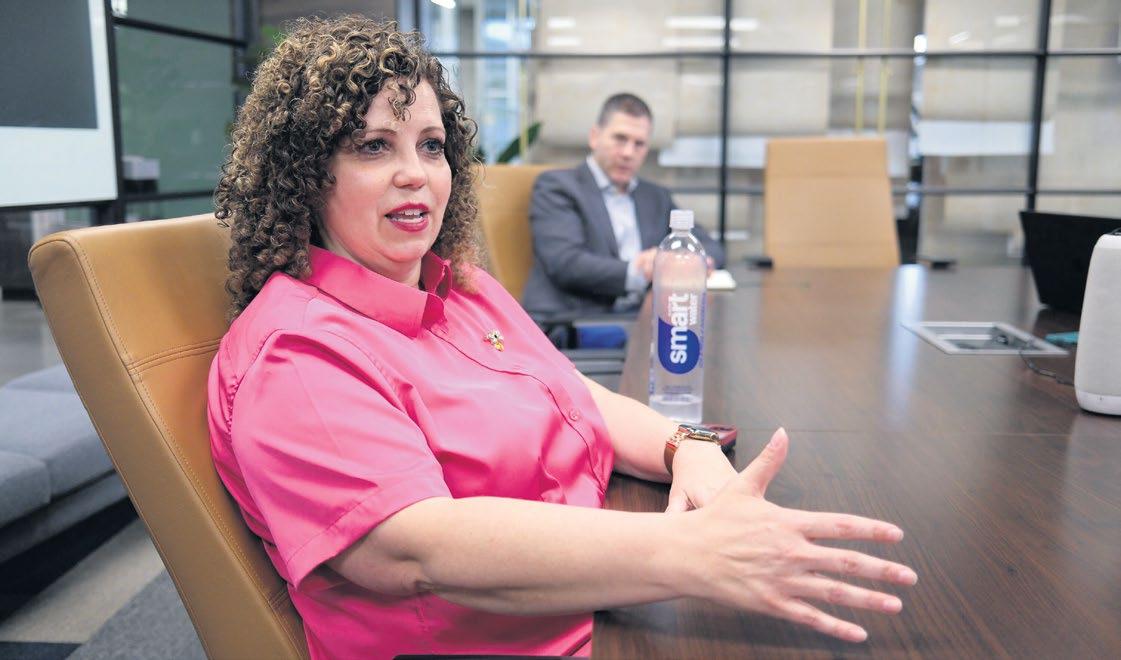
The economic effects are already hitting the wallets of everyday people, said Brett Loper, the executive vice president of policy at the Peter G. Peterson Foundation.
To borrow more money, the government has to sell more Treasury bonds at higher interest rates — leading to higher rates on mortgages, credit cards and business loans.
Debt also makes inflation more likely as the government prints money to keep up with interest payments, which now eat up more of the budget
than defense spending.
This is in addition to the coming insolvency of retirement programs like Social Security and Medicare — which drive the debt, making up more than one-third of the budget.
If Congress does nothing, Social Security benefits will automatically fall by 23% in 2033, impacting 71 million individuals by an average of $18,000 per retired couple.
“That’s a real call for action,” Loper said. “The challenge is it’s constantly used as a political
piñata. ... The only way they’re going to address this is on a bipartisan basis.”
While some are quietly exploring consensus proposals to reduce spending and raise revenue, Loper sees “no indication either party is going to get this under control.”
Incremental plan to save the budget
But Maloy sees things differently. House Speaker Mike Johnson is committed to lead the GOP caucus toward greater budget reform,
according to Maloy.
The congresswoman pointed to last year’s budget process where House Republicans passed all 12 spending bills through committees in a partial return to “regular order.”
This rare accomplishment, which has been replaced in recent years by opaque omnibus bills, was paired with Medicaid and SNAP restrictions, Maloy said.
While the federal def icit has shrunk slightly, with President Donald Trump’s tariffs bringing in new revenue, Maloy recognizes these moves are just a drop in the bucket.
“Everything’s on the table,” Maloy said, regarding long-term reforms to stabilize Social Security, like slowly raising the retirement age or lifting the cap on taxable income.
As the only Utahn on the powerful House Appropriations Committee, Maloy is in a unique position to push these discussions along — and to prioritize Utah projects.
F irst is making sure as much of Trump’s $1 billion budget recommendation to help the Great Salt Lake makes it into next year’s budget bills, which are already being drafted.
To convince colleagues to carve out this much money for the Beehive State, Maloy said she is making the case that this is part of long-term water stability for the entire West.
Maloy’s f ive bills to become law have focused on keeping public roads accessible, bringing federal courts to southern Utah and letting Utah manage more of its public lands.
Since entering Congress, Maloy has repeated that one of the most important things Congress can do to reclaim trust is retake the authority it has abdicated to the president.
A GOP-led Congress has often deferred to Trump’s executive action, opting not to legislate their own policies on tariff rates, war powers or immigration status.
Maloy said media coverage in this area has been misleading: Republicans have taken votes to give Trump more leeway to negotiate trade, military and deportation actions, she said.
But she acknowledged Congress must decide whether to authorize military force in Iran when they return from recess because Trump’s 60-day legal deadline has passed.
Besides showing more competence in their job, members of Congress can increase voter conf idence by not capitalizing on polarization by demonizing the other party, Maloy said.
“It gets a lot of clicks, it gets a lot of attention, but it undermines the foundation of who we are,” Maloy said on May 8. “You can’t sink half a ship.”
Trust in government to do the right thing has fallen to 17%, while Congress has the lowest confidence of any branch of government, with just 7% of Americans having a great deal.
With this in mind, Maloy said she plans to devote her campaign to “making sure the American public sees the value in our institutions” on the country’s 250th birthday.
KENDALYN HARRIS FOR COUNTY COMMISSIONER YOUR VOICE. YOUR VISION.
THE WISDOM TO LISTEN. THE EXPERIENCE TO LEAD.
What if you could have a County Commissioner with 12 years of local government AND private business experience, who served as mayor in Davis County's 2nd largest city, who kept the tax rate low, who is bold enough to stand up against unnecessary expenses, who is collaborative, respectful and professional and who worked to boost local businesses? Well, now you can.

JOIN US IN SUPPORTING KENDALYN:
Kendalyn is ABSOLUTELY the right candidate. She has the experience and balance we need on the Commission.
– Jim Smith, former County Commissioner


o o l s
D e e p l y c o n n e c t e d t o o u r c o m m u n
A d v o c a t e f o r p r o t e c t i n g l o c a l
g o v e r n m e n t d e c i s i o n - m a k i n g
O p p o s e d t o b a c k r o o m D a t a C e n t
d e a l s r i s k i n g r e s o u r c e s w i t h o u t
t r a n s p a r e n c y a n d p u b l i c i n p u t
Kendalyn’s level of experience is unparalleled and she works so well with other leaders and staff. She has my vote!
– John Petroff, former County Commissioner
View more endorsements and learn about Kendalyn at VOTEKENDALYN.COM
S t e p h a n i e s t e p p e d u p t o r u n a g a
By Eva Terry Deseret News
Editor’s note: The Deseret News has invited congressional candidates for the closely contested party primaries to visit with its editorial board. This story is one in a series of candidate previews on issues.
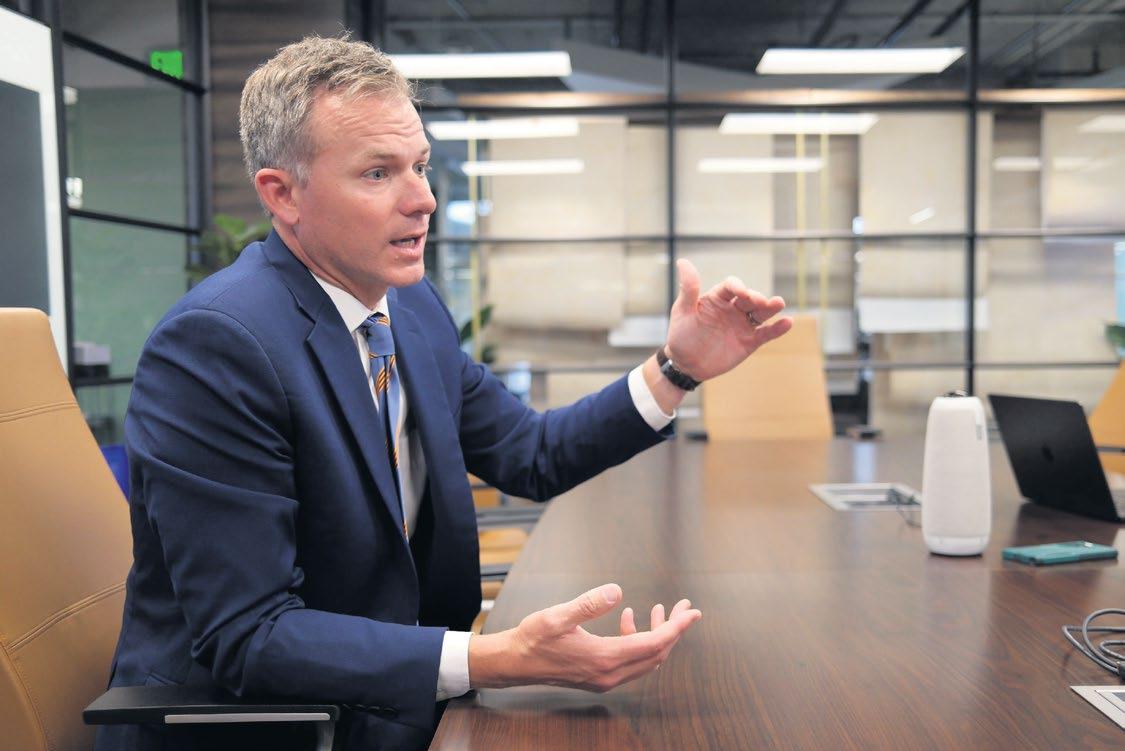
As the Republican primary for Utah’s 2nd Congressional District approaches, Rep. Blake Moore said he is focused on getting the U.S. back on the path to f iscal responsibility.
Moore has served as a U.S. representative since 2021 and currently sits on several committees, including the powerful Ways and Means Committee, which is the primary force behind tax policy in Washington, D.C.
He is also the f ifth-highest ranking House Republican, serving as vice chair of the Republican Conference. This position, to which he was appointed by the GOP caucus, gives him a say in committee placements and legislation.
At the Utah Republican convention at the end of April, Moore lost the party’s nomination to state Rep. Karianne Lisonbee, R-Syracuse. Lisonbee criticized the incumbent lawmaker for his support of a redistricting initiative, which eventually led to the creation of a heavily Democraticleaning district.
Despite losing at convention, Moore gathered enough signatures to get on the ballot in the newly drawn 2nd District, which includes most of the Northern Utah counties in his current district.
In a meeting with the Deseret News and KSL editorial boards on May 11, Moore described his proudest accomplishments in the House so far and where he hopes to focus his efforts if reelected.
The U.S. national debt surpassed $39 trillion in March; it is expected to reach $40 trillion by the fall.
While the Republican conference has cut some spending, and the def icit was lower in 2025 than 2024, Moore said they still have a lot of work to do.
revenue, he said.
Moore listed making the 2017 tax cuts permanent through the One Big Beautiful Bill Act as his proudest accomplishment of the past year. The tax cuts led to economic growth, bringing with them higher tax
On the flip side, he described the exponentially increasing debt as a crisis. “The numbers don’t work anymore, and we’ve got to be able to f ix it,” he said.
The reason the U.S. is in so deep, Moore believes, is because a high percentage of federal
funding for government programs is never voted on by Congress.
“We’re not solving the debt unless we deal with mandatory spending,” he said.





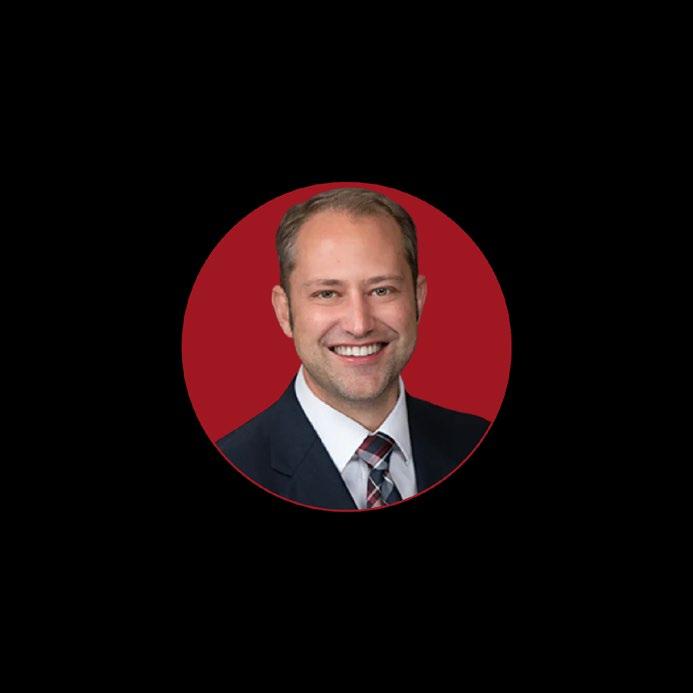















Moore referenced two bills he’s sponsored to try to rein in federal spending — the Fiscal Commission Act and the Comprehensive Congressional Budget Act.
“We never vote on at least 75% of the expenditures, so the F iscal Commission Act would give us a chance to vote and reform some of these programs that are continually growing so rapidly,” Moore said.
The bill would convene a bipartisan f iscal commission to draw up policies to stabilize spending and reduce the national debt, including by looking at Social Security and other entitlement programs. The package of recommendations made by the commission would be delivered to the House and Senate for a required up-or-down vote.
The act passed in committee last year, then never made it out of the House, Moore said, adding he believes it has a better chance in 2026.
Meanwhile, Moore’s Comprehensive Congressional Budget Act would make it so Congress would have to vote on all federal expenditures every single year.
In the meantime, the House continues to try to cut spending where they can in order to try to bring down the def icit, Moore said.
When asked what he thought about President Donald Trump’s $1.5 trillion budget request for the Defense Department for 2027, Moore said, “It’s going to be tough to get to that number.”
‘My kids should not expect the same Social Security,’ Moore says
Last spring, Moore proposed child investment accounts to the Ways and Means Committee, dubbed the “MAGA Act.” His legislation passed through committee and was folded into the One Big Beautiful Bill Act, which Trump signed into law last Fourth of July.
“My kids should not expect the same Social Security that my father is experiencing now,” Moore told the Deseret News. “That’s why I introduced the Trump Accounts.”
He continued, “We can start hedging for the next generation, because it’s going to be a different program. It has to be a different program. The numbers don’t work anymore, and we’ve got to be able to f ix it.”
Last December, the Michael & Susan Dell Foundation committed a $6.25 billion investment to seed Trump Accounts for 25 million American children.
Moore discusses experience as DOGE co-chairman
As Trump reentered off ice in 2025, the president enlisted DOGE, the Department of Government Eff iciency, a newly created White House advisory body with no direct policymaking authority, to root out waste, fraud and abuse within the federal government.
The effort was initially headed by billionaire Elon Musk, who at one point promised to f ind $2 trillion that could be cut from the federal
government.
“All of us on committees knew that was not the case,” Moore told the Deseret News. Moore served as co-chairman of the congressional DOGE caucus.
While DOGE “def initely shined a light on a lot of issues,” Moore believed the advisory body should have focused its energy differently.
“They focused too much on the workforce, like, ‘Let’s go cut X% from an agency,’ almost haphazardly,” Moore said.
If the federal government wanted to “get at the real issues,” they would focus on hospice fraud in California and Florida, and Medicaid fraud in Minnesota, he said.
Does Moore believe the Iran war is justif ied?
When asked if he supports the administration’s goals of a nuclear-free Iran and whether that goal was adequate justif ication for the war, Moore said, “Absolutely. We have to have a nuclear-free Iran.”
A nuclear-free Iran is “better for every single person in the region,” Moore said. “It’s better for the Iranian people, it’s obviously better for Israel, and it’s better for the Arab states as well.”
“I would be very supportive of an AUMF (authorization for use of military force) drafted in the right way,” Moore said. He pointed to an AUMF drawn up by Rep. Tom Barrett of Michigan as something he’d support.
He also said he was very supportive of the current ceasef ire, adding he hopes it will lead to an agreement.
If Iran agreed to nuclear restraints, Moore said he believes the U.S. would be willing to ease sanctions on the country.
Moore also described the Abraham Accords — agreements made between Israel and other Middle Eastern nations — as one of Trump’s biggest successes in his f irst term.
Moore discusses Utah’s new congressional districts
In 2018, prior to joining the House of Representatives, Moore was one of four co-chairs for the anti-gerrymandering group Better Boundaries, which led the campaign for the state’s Proposition 4.
When asked if he had regrets about the proposition, Moore said, “It’s tough to do principled things in this job, but they’re still worth doing.”
He described the gerrymandering battles across the U.S. as a “race to the bottom” and added, “I want to be a part of it not existing.”
When asked for a solution to gerrymandering, Moore said he believes all 50 governors should convene in 2030 and agree to basic standards on how to draw districts in their states.
Moore will face Lisonbee in the Republican primary for Utah’s 2nd Congressional District on June 23.




By Brigham Tomco Deseret News
In an interview with the Deseret News, Fox News contributor Jason Chaffetz confirmed he is considering a run for governor
The Republican race for Utah governor has already begun to take shape a full two years before the primary election, and at least a year before candidates would normally begin to consider making their announcements.
A behind-the-scenes bid by former Rep. Jason Chaffetz to frame himself as the presumptive nominee has sparked a premature “shadow primary,” four of the state’s top GOP consultants and donors told the Deseret News. They all asked to remain anonymous so they could speak about the race freely.
Chaffetz conf irmed he is considering a run for governor in an interview with the Deseret News, but dismissed the claim he is actively seeking donors this early. There is still “an eternity” for election decisions to be made, he said.
The reason he has been traveling up and down the state, headlining Lincoln Day fundraising dinners and working the crowds at GOP nominating conventions, is to “garner support for conservatives,” the Fox News contributor said.
This is also why last year he transferred money from a federal political action committee to a state PAC, Chaffetz said, to support individuals like Salt Lake County sheriff candidate Shane Manwaring and local Republican parties.
“I’m actively doing those things,” Chaffetz said. “It takes money and resources. I’ve raised the money, but I’ve been handing it back out.”
As of mid-April, Chaffetz’s Utah Victory PAC had received nearly $60,000 in 2026 for a total of $427,000, after giving less than $9,000 to the GOP in Utah, San Juan, Sevier, Summit, Utah, Washington and Weber counties.
On May 12, Chaffetz said it is a “distinct possibility” he will run to replace Gov. Spencer Cox. He has teased his ambitions before: In 2016, he said he would “take a serious, serious look at running for governor” in 2020.
Who else is considering a bid?
The state’s most plugged-in politicos from across the conservative spectrum say Chaffetz is doing more than simply currying favor with the grassroots; he is going all in to make the

2028 race his to lose before it even begins.
“Jason’s running for governor. He’s basically told everyone he’s running for governor,” a top GOP donor, who has spoken directly with Chaffetz, told the Deseret News.
Other candidates considering the seat include House Speaker Mike Schultz, Lt. Gov. Deidre Henderson, Traeger Grills CEO Jeremy
Andrus, serial entrepreneur Brad Bonham and Rep. Blake Moore, according to multiple sources.
Meanwhile, a group of longtime allies are trying to recruit Sen. John Curtis to leave his recently won position in the Senate because they feel he is the only viable candidate who can continue Cox’s brand of civility and compromise.
Underlying all these conversations is Chaffetz’s push to clear the way to the state Capitol by securing commitments from donors before most candidates have even started thinking about the gubernatorial election.

H a v e y o u b e e n f e e l i n g H a v e y o u b e e n f e e l i n g H a v e y o u b e e n f e e l i n g
l e f t b e h i n d ?
l e f t b e h i n d ? h
l e f t b e h i n d ?
Tr y s o m e t h i n g n e w.
Tr y o m e t h i n g n w.
Tr y s o m e t h i n g n e w.

T h e U t a h D e m o c r a t i c P a r t y f i g h t s f o r t h e h U h g h i P y i t
v a l u e s t h a t m a t t e r m o s t : f a m i l y, c o m m u n i t y, a s u t l e m t y, o
a n d a g o v e r n m e n t t h a t a c t u a l l y l i s t e n s . Yo u r t l a i n
S e e o u r v a l u e s . e
L e a r n m o r e a b o u t o u r p l a t f o r m a n d f m i s s i o n . l i s i
M e e t o u r o c a n d i d a t e s . S e e i e w h a t w e ' r e w
f i g h t i n g f o r . h e f g i g
d o n ' t h a v e t o l e a v e y o u r b e l i e f s a t t h e d o o r. o u e l r. v v y u i
U t a h d e s e r v e s b e t t e r. S o d o y o u . d e S t o u .
L e s b u i l d c l l b d f
L e t ’ s b u i l d a f u t u r e w e c a n a l l b e p r o u d o f . l u e c n . e r u v u e o o .
T h i s a d i s p a i d f o r b y t h e U t a h D e m o c r a t i c P a r t y d r e y
“Jason wants to make it a juggernaut, no question. And Jason works hard,” a veteran GOP consultant told the Deseret News.
The consultant believes Chaffetz’s easy-mannered tone coupled with his deeply conservative views could make him uniquely capable to bridge the widening gap between the right wing and the center right in Utah GOP politics.
The Fox News contributor’s momentum has spurred the state’s set of “Disagree Better”-style Republicans into action, with well-known influencers launching a campaign to pull another juggernaut into the 2028 shadow primary.
Will John Curtis enter the race?
Hoping to stem the tide of money tied up in promises to Chaffetz, a group of Cox and Curtis backers spoke to Politico’s Samuel Benson, suggesting Curtis might want to swap his Senate seat to become the state’s chief executive.
Following the article’s release, Curtis told the Deseret News on May 12 he is not thinking about Utah’s gubernatorial race and disputed claims made in the piece, particularly that he is unsatisf ied with his work in Washington, D.C.
The news may still have had the intended effect of Curtis supporters. At least one top donor canceled a meet-and-greet scheduled with Chaffetz after learning Curtis might run, according to two sources familiar with the decision.
For months, Chaffetz has worked to craft a narrative that despite the extended timeline, the 2028 race is coming into focus with him as the
front runner, said one Utah donor, who cannot remember another race rolling out this early.
“Chaffetz is running the most aggressive shadow primary campaign of anybody that I’ve seen in recent history in Utah,” the source said. “That is the motion in the political market that is creating everything else that’s happening.”
Chaffetz’s pitch, according to the source is, “Hey, it’s inevitable that I’m going to be the next governor. When I’m focused, I don’t lose. I’m going to lock up the support. I’m going to be the next governor, so you better get on board.”
It may be smart politics to try to scare away potential contenders, but the source said Chaffetz’s victory is far from inevitable as Curtis’ name has already convinced dozens of donors to remain neutral until the primary draws closer.
Donors are frustrated the “shadow primary stage” started so early, according to another top GOP operative. And there is skepticism that Chaffetz, who has been out of off ice for eight years since resigning, is the best to govern the state.
self-fund a campaign, said he is entirely focused on serving Utah in his current position, and will wait to make a decision about 2028.
“I have not even came close to making a decision,” Schultz said. “Honestly, it will depend on what the f ield looks like before I make that decision.”
Henderson, who ran against Curtis in the 2017 special election to replace Chaffetz, said she will “think about 2028 when it’s time to think about 2028” and that she did not accept the role as Cox’s lieutenant “to get a different one.”
While he rejected aspects of the Politico story that claimed he has prayerfully sought guidance about a gubernatorial bid, Curtis has become more open to it as people have reached out, sources close to the senator told the Deseret News.
This echoes the process that led Curtis to reverse his decision not to run for Senate in 2023, when his refusal was met with a fundraising campaign by some supporters of outgoing Sen. Mitt Romney to get Curtis to change his mind.
run?
Even with two years to go, it seems likely the 2028 race could become a two-way contest between Chaffetz and Curtis because they have the most important ingredient — name ID — which is hard to earn or buy, the operative said.
In an interview with the Deseret News, Schultz, R-Hooper, who has the wealth to potentially
Curtis f inally entered the race in January 2024, long after former state Speaker Brad Wilson shored up support among donors, who eventually split between the candidates. That could happen again, the veteran consultant said.
“There may be some flip-flop fatigue on that,” the source said. “Politicians are very susceptible to having two people tell them ‘you should run,’ and feeling like it’s the Tabernacle Choir.”




By Lauren Irwin Deseret News
On the eve of America’s 250th birthday, patriotism in the United States is on the decline. It’s a symptom of a broader problem the United States is facing in 2026 and will not easily be reversed.
New Deseret News and the Hinckley Institute of Politics’ surveys of Utahns and voters nationwide, conducted by Morning Consult, f ind that there are very real partisan, gender and age differences around feelings of patriotism.
This comes ahead of a historic summer, as events and activities will take place in Washington, D.C., across the country and in Utah to honor the nation’s 250th birthday.
The survey found that Utahns are more likely than the general American public to say that they are either somewhat or very patriotic, with 75% of Utah respondents choosing those options. Nationally, that number is 69%.
Still, experts say that number is low. Matthew Wilson, an associate professor at Southern Methodist University, said it’s an “unfortunate development” that’s happened relatively recently.
Utah Democrats least likely of all to be patriotic
The f indings also found that Republicans are more likely to say they’re patriotic than independent voters or Democrats.
In Utah, 90% of Republican voters say they’re patriotic and nationally it’s 82%. In Utah, just 49% of Democrats — the lowest of any group in the survey data — say they’re patriotic. That number jumps at the national level to 61% of Democrats.
“Traditionally, we assumed that patriotism, love of and pride in the country, was a constant that cut across party lines, that Republicans and Democrats might have different visions of what America should be and how the country should move forward, but that they were united and consistent in their love for and pride in the country,” Wilson said. “And unfortunately, that is less true than it used to be.”
Wilson noted that when Republicans accuse Democrats of being less patriotic, the data show that they’re “not wrong.” But, patriotism is not solely related to who controls Washington, he argued.
President Donald Trump has not only embraced patriotism in his campaigns and administrations, but has tried to portray patriotism and love of America as “largely synonymous with support for Donald Trump and the MAGA movement,” Wilson said.
To that extent, Trump has seen more support among male voters, which Wilson notes could be why more men in Utah and nationwide say they are patriotic than women. To the extent that

women tend to be skeptical or not approve of Trump’s messaging, it “may bleed over” into skepticism about American patriotism generally.
The survey found that among men, 81% in Utah and 75% nationally say they are either somewhat or very patriotic. This drops among women to 70% in Utah and 64% nationally.
Hinckley Institute Director Jason Perry noted that the partisan gap, in addition to gender and age differences, shows that “people’s relationship with national identity” is being shaped more by politics than it used to be. He said it was “striking” that the same patterns continued to show up across multiple surveys.
The survey found that in both Utah and nationwide, the younger generations are less likely to say they’re patriotic. In Utah, among respondents ages 18-34, 57% say they are very or somewhat patriotic. Nationally, it’s nearly equal at 56%. For people ages 35-44, those saying they’re patriotic jumps to 71% in Utah and 61% nationally. For those 45-64, in Utah, 86% say they’re patriotic and 67% of the general population says the same. The oldest generation was the most likely to say they are somewhat
Utah County deserves steady, experienced leadership focused on integrity, execution, and service to every voter. Administering elections isn’t about politics — it’s about process. Recent years have brought unnecessary controversy, state intervention, and operational missteps to our elections. Corey Astill will bring professional management, strong internal controls, and transparent operations back to the Clerk’s office. Corey will restore Trust from

• Built several schools WITHOUT raising taxes on our families and businesses
• Changed district building process to pay-as-you-go
• Protected Parents’ rights
• Led the fight to remove inappropriate materials from schools

• Attorney with 30+ years of experience
• U.S. Army – Ret.
• Washington County School Board
• Washington County Library Board
• Hosted a daily book review radio program
• Wife & I grew up in Alpine
• Parent and Grandparent
or very patriotic with 92% of Utahns and 86% nationwide.
Wilson noted that the decline in patriotism seen among younger generations could be attributed to multiple things. Younger people are more likely to be “disillusioned” with the extreme political polarization they have been raised in, but changes in the country’s education system have also likely impacted the way younger Americans view their country — and their love or disdain for it.
“Older generations, certainly the Silent Generation, baby boomers, even Gen X, when they came up through the educational system, the predominant message in schools was America-positive. That is, there was an optimistic and laudatory narrative of America that dominated history and government instruction and that was an intentional part of political socialization in the school system was to cultivate patriotism,” Wilson said. “I think in the school system, as millennials and Gen Z have experienced it, that is much less the case.”
Wilson argued that there have been significant changes in curriculum that have put more emphasis on the problematic, unfortunate aspects about America’s history and systems and their shortcomings. Younger Americans haven’t been socialized with the same sort of positive messaging as their parents or grandparents and Wilson said he thinks it shows up in the data, including in the Deseret News-Hinckley Institute surveys.
Part of the battle and tension around America’s messaging, both in schools and at museums, comes from the desire to paint the country in a positive light while still being factual, truthful and not shying away from some dark or difficult topics, Wilson said.
Wilson highlighted the unique relationship between patriotism and The Church of Jesus Christ of Latter-day Saints.
The survey found that 88% of Utah Latter-day Saints considered themselves patriotic.




Leaders in the church teach that America’s founding documents are divinely inspired, including the Declaration of Independence and the U.S. Constitution.
Church President Joseph Smith in 1839 said the Constitution is a “glorious standard” and was “founded in the wisdom of God.” He said that the love of liberty inspired him and civil and religious liberty were “diffused into my soul by my grandfathers.
Utah Gov. Spencer Cox has spoken about how his faith informs his public service. He said the country needs to look beyond politics to solve the nation’s problems and believes there needs to be a “religious revival.”
Wilson said that for members of the church, the founding of America was not just historical, but theological. Church leaders and the Book of Mormon teach that God would raise up a free nation where his church could be restored. It’s why religious freedom and patriotism are core tenets of the faith, he said.
“There’s a kind of core LDS belief in the divinely guided nature of the American founding and so patriotism is kind of woven, in some ways, into Mormon religious DNA,” he said. “More than any other religion, it is completely interwoven with American patriotism.”
Perry agreed. Utahns are more likely than the rest of the country to say they’re patriotic and faith plays an “important role” in that.
“It speaks to Utah’s strong traditions of service, volunteerism, and community life,” Perry said.
The survey asked individuals about how they have expressed patriotism, including by voting, standing for the national anthem, saying the Pledge of Allegiance, flying an American flag, protesting and more.
While Utahns were more likely to say they have engaged in several patriotic activities, including 41% to the nation’s 17% that have participated in service, there are several issues where the two surveys line up.

For example, 79% of Utahns say they expressed patriotism by voting while nationally 72% say the same. Additionally, 17% of Utahns say they have made political statements online and 16% of the general public say the same.
Perry argued that an “encouraging” finding from the data shows that Americans still broadly agree on what patriotic behavior is.
“Voting, military service, and civic participation continue to receive strong support across political lines,” he said. “Even when people disagree about the meaning of patriotism, there is still considerable agreement around the civic values behind it.”
Is there a f ix to falling levels of patriotism?
Wilson highlighted how over the last several decades, Americans have changed the way they identify with political parties. The polarization seen in the nation today is part of a phenomenon that is fueling the decline of patriotism.
“There are partisan gaps opening up in almost everything,” he said. “This deep division between people on the left and people on the right shows up in things from what television shows they watch, what cars they buy, what fast food or coffee places they patronize and it has shown up in whether and how they express their affection for and pride in the country.”
Wilson said he thinks the decline in Americans who say they are patriotic is a “symptom of broader social polarization.”
So, is there anything that can be done? Wilson said there’s not an easy or quick fix.
“I do think that some correction of the highly critical America narratives that have pervaded education, that’s a part of restoring this balance, but a general decrease in social and political polarization would help as well,” he said.
For patriotism to evade being “partisan coded,” it will likely take work of an intentional, bipartisan yearslong project to change the way patriotism is viewed and acted upon in the country.


ART CITY DAYS
DATE: June 6-13
TIME: Varies
LOCATION: 700 S. 1300 East, Springville A celebration of the arts and crafts.
WOODLAND FAIRY FESTIVAL
DATE: June 6-27
TIME: 10 a.m.-6 p.m.
LOCATION: 1100 W. 7800 South, West Jordan Immerse yourself in our woodland gardens.
LATINO ARTS FESTIVAL
DATE: June 12-14
TIME: Varies
LOCATION: 4000 Canyons Resort Drive, Park City Latin American art, music, dance and food.
UTAH SCOTTISH HERITAGE FESTIVAL
DATE: June 12-14
TIME: Varies
LOCATION: 155 N. 1000 West, Salt Lake City Festival showcases a variety of cultural traditions.



THE BLACK KEYS
DATE: June 9
TIME: 5 p.m.
LOCATION: 343 E. 25th St., Ogden
American rock duo brings feel-good energy.
THE HUMAN LEAGUE
DATE: June 11
TIME: 7 p.m.
LOCATION: 300 Wakara Way, Salt Lake City Soft Cell and Alison Moyet also perform.
NITTY GRITTY DIRT BAND
DATE: June 14
TIME: 7 p.m.
LOCATION: 9400 S. 1300 East, Sandy
Come see the band's farewell tour.
ROD STEWART
DATE: June 19
TIME: 7:30 p.m.
LOCATION: 5150 S. 6055 West, West Valley City Raspy crooner's career has spanned four decades.


SPORTS
SALT LAKE BEES VS. TACOMA RAINIERS
DATE: June 16-21
TIME: 6:30 p.m. (Sunday, 6 p.m.)
LOCATION: 11111 South Ballpark Drive, South Jordan Homestand ends on Father's Day.
UTAH ROYALS FC VS. GOTHAM FC
DATE: July 10
TIME: 8 p.m.
LOCATION: 9256 S. State, Sandy Royals aim to swat away the Bats.
MISS UTAH USA
DATE: June 7
TIME: 7 p.m.
LOCATION: 138 Broadway, Salt Lake City Beauty pageant takes center stage.
NSL NIGHTS OUT: AMERICA 250
DATE: June 8
TIME: 5 p.m.-8 p.m.
LOCATION: 1140 W. 1100 North, North Salt Lake Special night includes a patriotic aerial photo.