Deseret Magazine
Show Up for Teachers
Honors in Education
'Heckler's veto': Is protesting good for democracy?
The upshot of 'Showing Up' for Utah's teachers
Abby Cox to teachers, parents: 'We have to protect our children'
8
10
14
AUGUST 2026 VOL. 4 / NO. 12
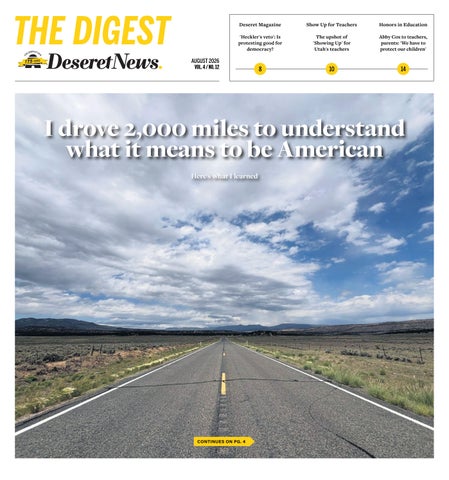
I drove 2,000 miles to understand what it means to be American Here's what I learned
CONTINUES ON PG. 4
2
DESERET NEWS | AUGUST 2026
INTRODUCING 'THE DIGEST' or on the go with your mobile phone, you can access our website for the latest news, analysis and commentary.
Mobile apps By Doug Wilks Executive Editor
By Burke Olsen Publisher
We are pleased to introduce you to The Digest, a sampling of some of the best stories written every day by the dedicated journalists at the Deseret News, Deseret Magazine and Church News. Our hope is that you will make us your trusted news source each day at a time when there is confusion and contention in the nation. The Deseret News brand stands for unimpeachable journalism centered on the issues most core to the human heart. While the Deseret News since its beginning in 1850 has evolved to meet the demands of its audience — reimagining print offerings, launching an acclaimed magazine and increasing the visibility and reach of its award-winning website — the publication remains committed to certain timeless ideals. We stand for truth and light. We stand for faith and family. We stand for liberty and responsibility. We provide news and perspective, exploring society’s thorniest problems in search of solutions that will improve your life. That’s our commitment to our readers. We invite you to discover what we can offer you:
Our apps for iOS and Android devices offer a seamless and convenient way to access the latest news, wherever you are. Choose what you want to read, save articles for later and receive push notifications for the breaking news you need to know.
Newsletters
Delivered straight to your inbox, our free email newsletters provide a curated selection of the most important stories of the day, as well as deeper dives into topics that matter to you. Choose from a variety of subjects and frequencies to tailor your news consumption to your needs.
Weekly print newspaper
For those who appreciate the tactile experience of a traditional newspaper, our weekly print edition o!ers a comprehensive roundup of the week’s most important stories and opinions, including the most comprehensive high school, college and professional sports o!erings in the state.
Deseret Magazine
In 2020, we undertook an ambitious endeavor by launching a new magazine with in-depth journalism, unique voices and principled points of view. The reception to the magazine has far exceeded our expectations. You can read more from the magazine online at Deseret.com/magazine or subscribe to have it delivered to your home or o"ce.
Church News
The Church News remains one of our most popular o!erings for those who want to know the latest news from The Church of Jesus Christ of Latter-day Saints. It’s available online at TheChurchNews.com and via iOS and Android apps. A print version is included in the Friday edition of the Deseret News.
SUBSCRIBE
ONLINE: DESERET.COM/SUBSCRIBE BY PHONE: 801-204-6100
Award-winning website
Our website, Deseret.com, is designed to be user-friendly and available on any device. Whether you’re at home on your computer
SAVE THE DATE
AUG 28-30 AND SEPT 4–7, 2026 Many exquisite homes will be on display throughout the Park City area and Heber Valley, all within or in sight of the scenic mountain ranges that offer world-class skiing, hiking, biking, dining, and golf. These luxurious homes range from traditional mountain homes that use rustic logs, reclaimed wood and rock, to contemporary homes that incorporate exposed steel beams, large windows all with clean architectural lines. Every home, however, achieves a balanced harmony with its natural surroundings. Come get inspired and take in some of Utah’s most breathtaking views along the way! PRESENTED BY:
PARK CITY AREA HOME BUILDERS ASSOCIATION
PRESENTING SPONSOR
FOR TICKETS AND INFO VISIT
PCSHOWCASEOFHOMES.COM
DESERET NEWS | AUGUST 2026
Building Bridges by Listening
Watch how a 2,000-year-old unwritten language is connecting cultures. Strengthening bonds is one way we show love for all God’s children. BYU .ED U/FOR T HE WOR L D
FOR THE BENEFIT OF THE WORLD
3
4
DESERET NEWS | AUGUST 2026
DESERET NEWS
I drove 2,000 miles to understand what it means to be American Here's what I learned By Mariya Manzhos
Deseret News
Clouds hovered over the highway like omens hinting at what lay ahead. Some looked like pillowy cotton candy, suspended in the blue sky without a care in the world. Others gathered into gray, despondent masses or stretched into white sheets from one end of the horizon to the other. The road trip across America was conceived out of both necessity and curiosity. It was a way of moving my family of five and two cars across the country from Massachusetts to Utah, the beginning of a new chapter for our family. The drive would also be a way to show my kids the unexplored corners of the country. After all, as Transportation Secretary Sean Du!y put in his campaign for Americans to take a cross-country road trip to celebrate America 250: “To love America is to see America.” As a journalist, I spend much of my time writing about America from behind a laptop, scouring the news and talking to people through a screen. But the 250th anniversary presented an opening for a kind of reacquaintance with America. I wanted to see what America smelled and sounded like — to conjure a multidimensional portrait of the nation outside the headlines and media feeds. The trip was supposed to be a journalistic quest as much as a personal one. After my naturalization ceremony to become a U.S. citizen in 2021, I brought home the letter in the envelope signed by President Donald Trump. It called me a “fellow American” and had the following words: “The United States is now your homeland, and all Americans are now your brothers and sisters.” The president, presumably, went on: “You have pledged your heart to America. And when you give your love and loyalty to America, she returns her love and loyalty to you.” But what, exactly, had I pledged my heart to? Up until then, I had a clear sense of what it meant to be Ukrainian — defending national identity, correcting distorted historical narratives from the Soviet past, and, of course, spreading my love of borscht. But what my new Americanness meant was less certain at the time. American identity was diverse, and apart from a right to vote, I didn’t have a good answer of what it entailed for me personally. I wondered whether I might find some sort of answer on my family’s road trip across America. Over the course of roughly a dozen states and
conversations with people at gas stations, motels and ad hoc stops along the way from Massachusetts to Utah, this became my animating question: What exactly made my “brothers and sisters,” as my citizenship letter called them, American, when the country’s founding ideals are interpreted so di!erently by di!erent groups, and what is America, really, beyond the political theatrics that so often define it? And for me, in the most honest sense, what did it mean to inhabit that identity at this particular moment in the life of this ambitious and restless nation?
Looking for the American dream
We deliberately kept the itinerary for the road trip loose. We knew we would spend several hours driving each day, stop at several historic sites of my faith, The Church of Jesus Christ of Latter-day Saints, and leave room for detours whenever a sign or roadside curiosity pulled us o! course. I was especially eager to visit the nation’s heartland — Missouri, Illinois, Kansas, places that I imagined would reveal a face of America that I had never gotten to know while living in Boston for 15 years. We had a few mostly practical constraints. We limited the trip to a week, trying to preserve both our sanity and our budget. The children would switch between two cars, forming various personality configurations that we hoped would reduce inter-sibling fighting on long drives. The lush greenery enveloped the road as we arrived at the area outside of the Hancock Shaker village, one of the earliest and largest Shaker communities established after Ann Lee brought the faith to America in 1774. Our friends Carl and Gloria welcomed us for the night in what was once a Shaker dairy farm. Over breakfast at a local diner, our conversation turned to the astounding arc of progress that our country, and the world, had seen in the past hundred years. Child and maternal mortality have fallen dramatically, and with medicine, cars, air conditioning and cellphones, our material well-being has never been better. If this is the best that life has ever been for humans in the history of the world, Gloria noted, why does it not feel like it? “I think the question is, did we get it wrong? Are those not the things that make us happy?” she said,
Mariya Manzhos, Deseret News Highway 40 stretches through Fruitland, an unincorporated community in Duchesne County in southeastern Utah, during Deseret News reporter Mariya Manzhos' cross-country drive from Massachusetts to Utah in June 2026.
while our combined five children buzzed around in an anticipatory thrill of pancakes. “Because people seem like they’re spiritually sick, people are so unhappy. People feel a sense of social threat all the time from a lack of cohesion.” Gloria’s great-grandfather came to California from China at 14 years old after selling his water bu!alo. Carl’s ancestors were among the first Quakers in England who fled religious persecution and landed on the banks of the Delaware River. But today, despite those inherited stories of striving and refuge, the promise of the American dream felt not as straightforward as it used to be. On the road, I learned that the modern iteration of the American dream was no longer just about social mobility and economic prosperity.
For Ankit Patel — the owner of the Super 8 in Macon, Missouri, where we stayed for a night — living in America was complicated. His parents came from Gujarat, India, in 2007, and began working in housekeeping — a job they could do without speaking English. Patel went to college in Kentucky, became an accountant and saved enough to buy a 15-room hotel in Pittsburgh, Pennsylvania. He now owns two hotels and supports his family. “Was he living the American dream?” I asked. Yes, but only in a financial sense, he responded. “I try to make as much money as I can,” Patel told me. “And then I’ll figure out something later.” He had doubts about bringing his son over, who was still living in India. He’d seen the darker side of America, too,
DESERET NEWS | AUGUST 2026 ravaged by addiction and crime. At the f irst hotel he owned, he told me he found nine dead bodies over the course of his time there. “I cried for four years running that place,” he said. The scenes of America’s underbelly have instilled in him a mistrust of society, even though the latest FBI data showed that crime rates in America have dramatically declined after the COVID-19 spike. Patel much preferred the quieter pace in Macon, where truckers and construction workers check in late for the night and leave early in the morning. Ironically, he thought the city’s diversity — even despite his fears about safety — would ultimately help his son assimilate more easily if he joined him. “I’m kind of stuck right now,” he said. The American dream hasn’t vanished, but after talking to Patel, I realized that maybe it looks different today. For earlier generations, it meant the chance to build a business and give children opportunities their parents never had. But for many today, the longing goes beyond upward mobility. The American dream is also about finding a sense of belonging in communities and institutions and building relationships of trust.
A quiet and steady faith
Traveling with children infuses nearly every experience with a dose of wonder and awe. At Niagara Falls, we boarded the Maid of the Mist boat and drifted toward the roaring curtain of water. Within minutes, we were soaked despite the awkward blue ponchos we were wearing. But to my surprise, instead of complaining, the
children shrieked with delight. “This is incredible!” my 13-year-old son yelled out. As we headed farther west, the crowds thinned. We passed through towns that were quiet and felt almost suspended in time. In Fremont, Ohio, storefronts were decorated with American flags and patriotic bunting, yet many businesses sat dark behind locked doors. I wandered the streets only encountering a few passersby. Where has everyone gone? Fremont, which is about halfway between Toledo and Cleveland, is known for being the home to two things: the Heinz Ketchup factory and the Rutherford B. Hayes Presidential Library & Museums, the first presidential library in the United States. For how few people there seemed to be in town, it was brimming with churches. From the center, I could see at least four: two Lutheran churches standing next to each other, a Catholic church with an adjacent school, and the First Presbyterian Church, marked by a “for sale” sign planted in the front yard. Last September, it held its final service and merged with another Presbyterian congregation in town. After looking at the map later, I spotted 17 total churches in the area. When I was a child, the first Latter-day Saint branch in Kyiv rented a space within a building that housed Soviet trade unions. So an abundance of church buildings in towns like Fremont reminded me of how visible faith could be if it weren’t restricted or banned. I rang the doorbell at St. John’s Lutheran
Church, where secretary Karen Schwochow welcomed me in. Like many churches in America, St. John’s is made up of a largely aging congregation with a total of about 150 people who attend two Sunday services. In an attempt to attract more people, the pastor experimented with a nontraditional Sunday evening gathering with shared meals and music. “But it’s the same people that are sitting in the pews on Sunday morning that are still coming Sunday night,” Schwochow said. Still, she takes comfort in the fact that her 11 grandchildren still go to church. “We’re trying,” she said with a sigh. What has sustained their church was continuity — a loyalty to family traditions that go back for generations and that have persisted in the face of secularism. One denomination in town seems to be thriving unlike the mainline churches, Schwochow said — the nondenominational congregation. I thought about what happens to the rest of these churches in Fremont when a cycle of inherited belonging is broken. I asked Schwochow if she felt like politics was a point of division in her community. “We try to keep politics out of it,” she said, noting that many congregants are involved in the Republican Party. “We really don’t talk about politics, it doesn’t come up a lot.” I heard similar sentiments from others, and they seemed to counteract the picture of adversarial and polarized America that we read about in the news. People talked with ease and respect
about those with whom they disagreed and they surely didn’t sound like the angry pundits encountered online. When in a Western Kansas town, I asked if everyone was supportive of Trump, a Kansas cattle worker said: “Everybody’s got their own choice.” It’s not to say that polarization, and passionate convictions behind it, was entirely absent. I’ve seen a fair share of bombastic billboards along the way: “If you die today, where will you spend eternity?” or “Kill relativism, not babies.” But in conversations with farmers and residents, it didn’t feel as strident and sharp as I had imagined. Faith wasn’t a culture war weapon, but a steady and quiet force that held small and struggling communities together like glue.
Encounter with the land
Each state unfolded with its own distinct landscape and set of concerns. Driving through Illinois, I was utterly mesmerized by the synchronized motion of wind turbines that rose like otherworldly creatures over the fields. But Galva resident Randy McGinnis said they killed too many birds and wore out too soon. Galva residents were concerned over another issue: a project that would take carbon emissions from their ethanol plant to then be liquefied and pumped into the ground. On the one hand, carbon capture could help with rural manufacturing CONTINUES ON PG. 6
SUMMER IS HEATING UP
SUMMER
SPECIALS
18 MO. SAME AS CASH OAC
COMFORTCHAMPIONS.COM CALL 866-753-1165
49
$
Furnace or A/C Tuneup
~With coupon~ Expires 9/1/26
Not valid with other offers or discounts. Must present coupon at time of estimate.
HIGH EFFICIENCY FURNACE & A/C ~With coupon~
96.7%
EFFICIENT 16 SEER
FROM
$7,997
After rebates. 2 ton models only. Some restrictions apply. Expires 9/1/26. Purchase & installation. Not valid with other offers or discounts. Must present coupon at time of estimate.
5
Furnace or A/C $3,495 95%
EFFICIENT
FROM
~With coupon~
After rebates. Replacement only. 2 ton models only. Some restrictions apply. Expires 9/1/26. Purchase & installation. Not valid with other offers or discounts. Must present coupon at time of estimate.
FURNACE & A/C COMBO ~With coupon~
80%
EFFICIENT 13 SEER
FROM
$6,495
2 ton models only. Some restrictions apply. Expires 9/1/26. Purchase & installation. Not valid with other offers or discounts. Must present coupon at time of estimate.
0%
FOR 18 MONTHS FINANCING OAC ~With coupon~ Expires 9/1/26 Not valid with other offers or discounts. Must present coupon at time of estimate.
6
DESERET NEWS | AUGUST 2026
jobs, but people like McGinnis worried about safety. “I don’t like to see it this close to people, right next to the diesel plant,” he said. “There’s things that could really go wrong.” The war in Iran, he said, has disrupted the fertilizer and energy supplies, which is driving up production costs for farmers. “We’ve never seen it like this,” McGinnis said. Still, a self-described libertarian, he is pleased with the current administration. “I feel that we are more powerful, we’re getting more work in the area,” he said. Some states announced themselves with a pungent smell. In Oakley, Kansas, the wind carried the foul smell of manure and wet silage from the nearby feeding yards, where over 50,000 steers were eating corn, ethanol byproduct mash, and hay to be fattened up for slaughtering. The stench, I learned after visiting those feeding yards, was a result of a blessing for drought-stricken farms — plentiful rain, the most the area had seen in 10 years in a span of a few days. The land changed f irst to shrubs and then hills and mountains. Driving into Colorado, I first noticed a haze along the horizon, the Rockies emerging as dark silhouettes against an orange blur. As we approached Utah, I rolled down the window and caught the acrid smell of wildfire smoke in the air. The woods looked apocalyptic — we passed scorched, blackened trees rising from grass that somehow still remained green. The f ire had
burned nearly 30,000 acres along the border and claimed the lives of three f iref ighters. On our last stretch of the drive, I thought about the words of Jane Kamensky, a historian and president and CEO of Thomas Je!erson’s Monticello. “As you mark this moment on July 4, what is the nature of your patriotism?” she said during a panel I stopped to cover at the Aspen Ideas Festival in Colorado, a high-powered conference of the world’s most influential movers and shakers. “Because ‘none’ is not an answer. ‘None’ just means somebody else will def ine it for you.”
The act of becoming
When we entered Utah, the setting sun pierced through the gray clouds in straight shafts of light. I took it as a kind of welcome. We had Cafe Rio for dinner and we were exhausted. On Sunday morning, in Vernal, Utah, I approached a man outside of a 7-Eleven. “Excuse me, what does it mean to you to be an American?” I asked. He wore work clothes, maybe paint or construction gear, and was clearly in a rush. “I don’t know. Freedom or something,” he said, then added a string of expletives about the state of the country. His companion, waiting in a truck, asked if I was liberal or conservative. When I said I was a journalist trying to understand different perspectives, he sent more expletives
my way and drove off. The encounter left me feeling foolish, even embarrassed that I had asked two men to contemplate a question that they clearly had no time or interest to indulge in at that moment. Far from the Aspen Ideas crowd, they were likely on their way to work, and while that didn’t excuse their brusque reaction, it did feel revealing. I realized that asking the question itself — to contemplate what it meant to be an American — was itself a kind of luxury. To pose it assumes a certain distance from the urgent demands of life, and the willingness to answer it implies that whatever said will not be held against you. There is no single way of being an American, or even talking about it. In many ways, the most American characteristic is the ongoing attempt to f igure out what that means within the circumstances and histories of one’s own life. This land has witnessed and absorbed so much hope and it has become for each person, whatever they needed it to become. After driving with his dog Charley across America in 1960, John Steinbeck observed: “External reality has a way of being not so external after all. This monster of a land, this mightiest of nations, this spawn of the future, turns out to be the macrocosm of microcosm me. If an Englishman or a Frenchman or an Italian should travel my route, see what I saw,
hear what I heard, their stored pictures would be not only different from mine but equally different from one another.” The more I considered the pledge I made in my naturalization ceremony, the more I thought of Roy, a Vietnam veteran I met in Duchesne, Utah, who told me that he carried $50 to $100 on him to hand out to anyone who asked for help. He had more than he needed, he said. He had so much. “I never refuse some-
“
To love America is to see America.”
— Transportation Secretary Sean Duffy's America 250 campaign
one in need,” he told me. “And people in this valley would do the same.” Perhaps I feel most American in that refusal to disengage — in the ongoing act of becoming more generous, more honest and more caring for those in our proximity. America encourages that kind of remaking without requiring perfection or certainty. It’s an invitation to keep arriving, over and over again, together.
DESERET NEWS | AUGUST 2026
20OFF %
“Make a Blind Date with Us” TRAVIS THOMPSON
DAN SHEPHERD
BROCK SHEPHERD
ALL PRODUCTS! Must mention ad.
OUTDOOR PATIO/DECK SCREENS PROTECTION FROM SUN, BUGS & NOSY NEIGHBORS
ROLLER SHADES
SHUTTERS
CELL SHADES
Lowest Prices ORDER NOW AND BEAT THE SUMMER RUSH! in years! FREE MOTORIZATION ON OUTDOOR SCREENS!
801-243-4464
BLINDMASTERS@GMAIL.COM BLINDMASTERSUTAH
5
WE WILL BEAT ANYBODY’S PRICE, EVEN THE BIG BOX STORES!
7
8
DESERET NEWS | AUGUST 2026
DESERET MAGAZINE
Is protesting good for democracy? A guide to the pros and cons of American civil demonstration By Ethan Bauer
Deseret Magazine
Many Americans feel conflicted about protests, but that’s exactly how the War of Independence started. We commemorate the Boston Tea Party, a 1773 tax protest where citizens threw crates of the stu! into the harbor. We often celebrate when people in other countries take to the streets, from the fall of the Berlin Wall to the Arab Spring and Iran late last year. But when civil demonstrations hit closer to home, in a political system that o!ers citizens every opportunity to participate, the questions get harder. Is protesting democracy in action? Or a self ish end-around?
Whose streets?
Protesting is inherently democratic. Marching in peaceful demonstration is freedom of speech in action, a practical expression of the idea at the heart of the American system: rule of the people, for the people, by the people. It can also be a warning or indicator for those in power. As Thomas Je!erson wrote in 1787, “What country can preserve its liberties if their rulers are not warned from time to time that their people preserve the spirit of resistance?” Protests give voice to minority groups and opinions. Our pluralistic society protects those of smaller number, whether def ined by ethnicity, religion, ideology or any other measure. They may not prevail alone at the ballot box, but the First Amendment protects their right to assemble and petition the government to correct whatever wrongs they perceive. Demonstrations can also persuade fellow citizens to support a cause. For example, the Civil Rights Movement became popular after the widely televised March on Washington in 1963. Peaceful protesting can prevent political violence. Like a release valve, it lets people vent the kind of resentment that might otherwise fester and lead some to more problematic actions. We’ve seen examples of the opposite under authoritarian regimes around the world, but any government can f ind itself exercising authority beyond what its people are willing to accept. Even Martin Luther King Jr., known for his commitment to peaceful action, warned that “a riot is the language of the unheard.” Protests may make us uncomfortable, but that can also make them e!ective. It’s why sit-ins, walkouts, boycotts, picket lines and tra!ic stoppages
Roosevelt H. Carter/Getty Images The National Mall has been a focal point of peaceful protests since the late 1800s, though it became most famous as the backdrop of the Rev. Martin Luther King Jr.'s "I Have a Dream" speech on Aug. 28, 1963.
are popular methods: By interrupting commerce, disrupting governance and inconveniencing fellow citizens, they put pressure on those in power. “Nonviolent protests put authoritarian regimes in a lose-lose situation,” as David Brooks wrote in The Atlantic last October. “Either cede the streets to the protesters, or crack down in ways that weaken your legitimacy.” So when our neighbors march or occupy some public place, whether or not we agree with their cause, we can remember this observation of abolitionist Frederick Douglass in 1857: “If there is no struggle, there is no progress. Those who profess to favor freedom and yet deprecate agitation are men who want crops without plowing up the ground.”
Our streets!
Protesting is an unnecessary nuisance in America today. Citizens can e!ect change through many avenues: creating or signing petitions; canvassing, fundraising or caucusing for their preferred candidate or party; volunteering to serve as delegates and electors; writing op-eds and letters to the editor to argue their positions; and even running for o! ice themselves. Those who lack the time or energy to get that involved can easily make their opinions known thanks to modern technology. More importantly, they can vote. Protests are an attempt to circumvent our democracy. American governance is built on
voting at every level. Congressmen, senators and the president are elected by the people. The Senate conf irms the president’s nominees to the Cabinet and Supreme Court. Bills are written, revised and passed or rejected in a democratic process before they are ever enacted into law. The system is designed to measure public sentiment with fairness, giving each voice equal respect. Protesters try to manipulate this system by being loud. Public demonstrations undermine civil discourse. They deepen political divisions, rather than fostering the nuance and compromise that underpin democracy. When crowds gather to shout their opinions,
DESERET NEWS | AUGUST 2026
9
People walk from Washington Square Park to the Capitol during a “No Kings” anti-Trump protest in Salt Lake City on March 28.
Tess Crowley, Deseret News
they contribute to tribalism — often attracting counterprotesters — and risk violence. The passions they excite form a powder keg waiting for a spark to turn that peaceful protest into a riot. As psychotherapist Jonathan Alpert wrote in The Wall Street Journal, “Democratic systems depend on something more demanding (than emotional validation): the ability to tolerate disagreement, engage with complexity and distinguish between what feels true and what is demonstrably so.” At worst, protesting can result in a “heckler’s veto.” Essentially, this is when a loud argument from a small number of individuals overwhelms the democratic process, making it impossible
for governance to proceed, or simply drowns out the softer, more respectful voices of those with whom they disagree. That’s what then-President Richard Nixon had in mind when he called on the “silent majority” of Americans to back him while chastising anti-war protesters, who he called “the minority who hold that point of view and who try to impose it on the nation by mounting demonstrations.” There is a place for all opinions to be heard, and that is the ballot box. This story appears in the July 2026 issue of Deseret Magazine under the headline “Heckler’s Veto.” Learn more about how to subscribe.
Summertime Means Sunshine and Top Investment Rates! DON’T MISS OUT ON OUR
1 year • 8.00%
EXCLUSIVE 3 years • 8.50%
RATES 5 years • 9.00%
Make Your Bathroom Safer This Year!
$10,000 $800,000 minimum
maximum
* Rates subject to change. Please call to verify current rates. Call Ashley or visit us online today! (By appointment only) 801-566-5559 • WasatchCredit.com 7324 Union Park Ave., Suite #100, Midvale 84047 Mon-Thur 9:30-3:00
Call Today!
www.thegrabbarspecialist.com
Interest paid quarterly
For Utah residents only.
10 DESERET NEWS | AUGUST 2026
SHOW UP FOR TEACHERS
The upshot of ‘Showing Up’ for Utah’s teachers: Student success, connection First lady Abby Cox’s annual educators conference anchored in caring for Utah’s K-12 teachers — in and out of the classroom By Jason Swensen
Deseret News
Utah f irst lady Abby Cox would challenge assertions that AI will shrink the essentialness of teachers. “AI increases the relevance of our teachers because we need, more than ever, the human connection,” said Cox at the annual Show Up For Teachers Conference on July 9. “Our kiddos need you more than ever.” Anchored to the theme “F inding Focus,” the event drew thousands of educators from across the state to Sandy’s Mountain America Exposition Center. The daylong conference included a variety of speakers and almost three dozen breakout sessions addressing evolving topics facing today’s Utah teachers such as creating connections in an age of loneliness, AI in action, preventing misbehavior, proper nutrition and sleep. It was all about prioritizing educator wellness. Attachments are vital in today’s Utah schools, a! irmed Cox during the event’s morning general session. “We need to get attached,” she added. “We need to get attached to these children. We need to make sure that we are connecting with these kiddos in every single way that we can. And we need to make sure that we have human connection with our peers, with our families. “It is a beautiful moment when we see those children have that connection with us.” Today’s children are arriving at school with brains overloaded by the noise of the day. It’s essential that someone curates such information — and teaches children how to navigate that noisy world. “And you are the people to make that happen,” she told the teachers. “You are more important than ever.”
Returning to ‘play-based’ childhoods
Abby Cox saluted recent legislation establishing bell-to-bell cellphone bans in Utah’s K-12 schools. The state’s new default cellphone law will allow teachers and their students to refocus and connect. “It’s critical that we get back to a play-based childhood, not a phone-based childhood,” she said. “And as we open our hearts and we teach children to be human, that solidif ies the need for teachers to connect on a human level. “Teaching is the best profession to do this — and we need more humans in this environment, not less.” The f irst lady said the Show Up For Teachers Conference has always prioritized teacher well-being, both in and out of the classroom. So stay connected with loved ones, she advised. The result will be better focus in the classroom. And then shelve the negatives.
Laura Seitz, Deseret News Attendees choose free books from Marissa's Books & Gifts at the Show Up for Teachers Conference in Sandy on July 9.
“You don’t need to wallow in it,” she said. “What we need is for you to bring your best self. F ill up the moments with beautiful things so that when you come to your classroom, you can give the best of you to your students.”
Pep-talk from a veteran pigskin coach/teacher
The keynote speaker was a teacher of a di!erent sort — Utah State football coach Bronco Mendenhall.
Overseeing a team of young men who are not far removed from high school gives the veteran coach a keen appreciation for K-12 teachers. “I admire what you do,” Mendenhall told his audience of Utah educators. “I get to see so many schools and so many homes while CONTINUES ON PG. 12
DESERET NEWS | AUGUST 2026
11
12
DESERET NEWS | AUGUST 2026
Laura Seitz, Deseret News People attend the Show Up for Teachers Conference at the Mountain America Exposition Center in Sandy on July 9.
recruiting all these student-athletes. And the teachers that I see — the passion, the energy, the competency, the capability, the leadership — it’s really impressive.” During his remarks, Mendenhall drew upon his 19 years of experience as a Division I college head football coach to o!er insights and counsel. He shared many lessons he’s learned while imparting lessons upon his players. Mendenhall’s “personal purpose” is anchored to faith, hope, gratitude, family — and teaching and developing others to magnify their divine potential. The former BYU head coach recalled receiving an unexpected letter shortly after being hired at Utah State from Latter-day Saint apostle Elder Je!rey R. Holland. The letter, penned by his friend and veteran teacher, o!ered a simple directive to the new Aggie coach: “You will bless lives and build character, as you’ve always done.” Today’s school teachers are also charged with blessing lives and building character. And today’s young people, stated Mendenhall, possess unlimited capacity. “They are capable of anything — and they
need hope and they need optimism,” said the coach. “But they also need rigor. They need standards. They need belief. And that’s what you’re doing. And man, is that cool. “I appreciate that and acknowledge that and I’m grateful for you.”
Gov. Cox: Literacy worries — and hopes
Utah Gov. Spencer Cox joined his wife at the educator advocate breakfast to tout one of his primary priorities: literacy. Americans are perhaps reading more words than ever before through texts, social media and emails. But a growing number of people are no longer reading books. Cox suggested that the U.S. has become a “post-literate” society. “Less than half of Americans read a book in the past year; that’s not great,” he said. “Only 38% read a novel or short story. And a study analyzing 236,000 responses from the American Time Use Survey found that the proportion of Americans who read for pleasure on any given day fell from 28% in 2004 to 16% in 2023.” More Americans today, he added, are
gambling and placing bets at signif icantly higher rates than they are reading. Meanwhile, most American high school students are not prof icient at advanced literacy skills such as analyzing complex f ictional themes and evaluating a book’s arguments. But there is hope, assured Cox — pointing to bell-to-bell cellphone bans in school. And research is showing that such bans are fostering interest in reading. “Our Legislature gave us more money than we thought we could get for reading coaches and literacy coaches in our schools,” he said. “It’s going to make a tremendous impact. We now know the science of reading. We know how to get kids to read.” Almost every child, Cox added, can learn to read if given the correct resources. The governor himself has read more f iction in recent years — and it’s bettered his life. “I’m a better governor because of it. I’m a better husband. I’m a better father. I’m a better American because I’m reading again. “And I want that for all of you. I want that for all of us. And I truly believe that the history of our country depends on it.”
Showing up for teachers
Utah 2026 Teacher of the Year Joanna Andres, a social studies teacher at Park City High School, noted in her remarks during the educator advocate breakfast that teaching is not simply a profession. It’s an emotional investment. “For teachers, we don’t just teach content, we don’t just teach skills. We’re counselors. We’re advocates. We’re mentors. We’re resources for our students all year long. “And it can be heavy.” She thanked the Park City School District for prioritizing her well-being. Such encouragement, she said, has resulted in enrollment increases in her AP classes and greater student success. Meanwhile, the f irst lady’s Show Up Initiative for educator wellness champions the need to support teachers. But more support is needed, said Andres. “We need it more often because it reminds all of us — teachers, business leaders, educators, as well as other community members — that we need to show up for teachers.”
DESERET NEWS | AUGUST 2026
13
DESERET NEWS | AUGUST 2026
CHANGING THE WORLD ONE STUDENT AT A TIME. The mission of Ken Garff for Good is to provide pathways to college and careers. We do this through literacy, technology, mentoring programs, and exposure to scholarships, and internships. Ken Garff for Good is a 501c3 nonprofit, serving every school district in the state of Utah with education-based Initiatives.
KEN GARFF FOR GOOD APP LAUNCHING SOON! LEARN MORE ABOUT OUR INITIATIVES AT WWW.KENGARFFFORGOOD.ORG
13
14
DESERET NEWS | AUGUST 2026
HONORS IN EDUCATION GALA
Abby Cox to Utah teachers, parents: ‘We have to protect our children’ Annual Honors in Education Gala salutes Beehive State's teachers and education-advocating businesses By Jason Swensen
Deseret News
“Grateful” was a word Utah first lady Abby Cox used often on July 7 as she stood in front of a vast ballroom filled with many of the state’s most dedicated teachers and education advocates. “I am so grateful again for the teachers in my life — for the educators that I see here tonight, for the educators that I speak to every single day who inspire me, and for the educators that inspired my own children,” said Cox at the conclusion of the fourth annual Honors in Education Gala at The Grand America Hotel. Educating Utah’s children, she added, goes beyond simply instruction happening inside classrooms. Teaching kids occurs when all in the community “are willing to pull together and make sure that our children have the best possible future.” Hosted by the Deseret News and its presenting sponsor Ken Gar! for Good and the Robert H. and Katharine B. Gar! Foundation, the gala celebrates the state’s outstanding educators — and the businesses that support them. Twenty Utah educators from a variety of professional disciplines and regions were honored — including Lifetime Achievement Award recipient Nadine Ruth Curtis, a drama teacher and director at Roy High School. The Deseret News also awarded civic and community leader C. Hope Eccles with its Educator Advocate Award. Meanwhile, six businesses were honored for their support of Utah education. Deseret News Publisher Burke Olsen said in his welcome remarks that the Honors in Education Gala prompts personal memories of the many believing teachers who placed him on an ongoing quest for a life of learning. “Tonight we’re thrilled to express our collective gratitude for Utah’s outstanding educators,” added Olsen. “And from the nominations for today’s award recipients, we’ve learned even more about the work you do and the challenges you face. We appreciate you and we thank you for your commitment to educating Utah’s youth.
First lady Abby Cox: ‘As a community, let’s come together’
A former special education teacher, Cox was influenced by a family legacy of educators — including her mother and grandmother. Now As part of her civic service, she prioritizes teachers, literacy and inclusion for the state’s children. It was a busy week for the first lady. On July 9, she hosted the annual Show Up For Teachers Conference as part of her Show Up service initiative. Given the commitment and capacity of the state’s teachers and education administrators, it’s a hopeful time for Utah’s children, said Cox.
Jeffrey D. Allred, for the Deseret News First lady Abby Cox hugs C. Hope Eccles after Eccles received an award during the Honors in Education Gala in Salt Lake City on July 7.
But, she added, there are also grave concerns. Today’s children are witnessing “the worst things in the world every day in front of their face.” Many are facing trauma they are not equipped to manage. “In my generation, we didn’t have to see everything happening in the world in our faces and internalize that,” she said. “You as educators are now getting those students with all that
stu! going on in them and all the horrible trauma that they’re seeing around the world every single day — and you’re having to now teach those children in a way that is powerful.” Parents and communities have a shared duty to remove such danger from our children’s lives, said Cox. “We have to protect our children, “ she said. “We have to protect our communities from the horrible things that they’re seeing every
DESERET NEWS | AUGUST 2026
15
single day. “We have to get social media out of their heads and out of their hands. We have to get it out of our schools. “We have to make sure that our children are coming to school full of anticipation of the good, wonderful things that are in the world.” Literacy and reading a book daily, she added, must be part of every Utah child’s life to help protect them from the trauma the world sends them. “As a community, let’s come together and make sure that our children have what they need to succeed. To be readers. To be the next leaders.”
Gov. Cox calls for ‘lifelong readers’
Utah Gov. Spencer Cox joined his wife Tuesday, thanking teachers for “making Utah a better place.” In his remarks, the governor recalled his own school teachers that taught lessons that serve him well today — including lessons of resilience and unity. The country’s founders, Cox noted, understood that an educated public was essential for the survival of America’s experiment in self-government. “We needed an educated public — people who understood government and learned about history. And, of course, at the base of all of that was literacy. The founders were incredibly well-read, and they expected that the American people would be well-read, as well.” But reading is becoming something of a lost art across the country, even among well-educated Americans, observed Cox. “That’s not good for us. Science and research will tell you that we need readers. We need lifelong readers. And, of course, we know that we need readers at a young age. Especially by third grade.” The governor thanked the first lady, Utah lawmakers and policymakers and local businesses for prioritizing early literacy. “We have passed some of the most forward-looking legislation anywhere in the country,” said Cox. “We are doing everything possible — (including) new resources and tens of millions of dollars that the Legislature is going to invest in reading coaches in our schools to make sure that every single child can read on grade level and they have the tools they need.”
Why trust is essential is educating Utah kids
Katharine Gar! looked out across the ballroom filled with teachers and felt she was “in the midst of royalty.” “I’ve always felt that being a teacher is the most honorable profession. … I think you’re the best people in the world,” she said during her remarks. Gar! then asked a question she has asked many Utah teachers: “How do you instill trust in those with whom you are associated?” It’s a query she often poses “because I believe that you are the most trusted people in the world, next to parents.” Unfortunately, she noted, not all children enjoy healthy influences in their own homes. So teachers are often relied upon to teach character. Gar! spoke of the change that comes in a child’s life when he or she is trusted by a teacher — and when that trust is reciprocated. “You are the most trusted profession that we have in the world,” she said. “You are in charge of our precious children, our precious grandchildren, the youth of the world, the youth of this country, the youth of this state, the youth of your community.” Children can be taught all the essential subjects when they trust their teachers and educators. “And most of all,” said Gar!,” you can form their character. You can teach them that good people exist around the world.”
An early literacy challenge for all Utahns
After receiving the evening’s Educator Advocate Award, Eccles saluted Utah teachers for selecting a challenging profession that builds lives — and o!ers opportunities. “Every day you show up for children,” she said. “You celebrate their successes and you encourage them through their struggles. For that, I am deeply grateful.” Eccles grew up in a family that prized education. It was the vehicle that would allow her and her siblings to provide for their families,
Jeffrey D. Allred, for the Deseret News Deseret News Publisher Burke Olsen, Katharine Garff, Deseret News Editor Sarah Jane Weaver and first lady Abby Cox are photographed with award winner C. Hope Eccles during the Honors in Education Gala at The Grand America Hotel in Salt Lake City on July 7. Eccles received the Deseret News Educator Advocate Award.
serve their communities “and participate fully in civic life.” She credited her parents and grandparents for creating a family culture where learning was valued. “They taught us that education enriches individual lives, creates choices, and makes our families and communities stronger. “I’ve always been interested in education and education policy — and that reinforced my conviction that a strong education system must provide multiple pathways to success.” Utah’s higher education system is key to the state’s prosperity, she said. But before students can go to college or enter the workforce, they must first learn to read. “This is one of the most urgent challenges facing Utah today because less than half of our third graders read proficiently at grade level, and the implications are profound,” said Eccles. “When children do not develop strong literacy skills by third grade, the e!ects can extend far beyond the classroom — shaping outcomes throughout their lives.” The good news: Data confirms that all children can learn to read. “So the question is not whether the children can learn to read — the question is whether we, the adults, are willing to create the programs, incentives, and accountability to ensure that they do,” said Eccles. “Other states are moving the needle. Utah can too.” Child literacy, she added, is a civic duty shared by all. “Together we can create a culture that tells every student and every family: ‘We believe in you. We believe your future matters. We believe in your potential. And we’re committed to helping you succeed,’” Eccles said. “The same message applies to our educators. We believe in you. We value your expertise. And we are committed to providing the training, coaching, resources, accountability, and support you need to educate our kids.”
Props for many of Utah's premier educators Honorees included Weber School District teacher Jenifer Allen, Draper Elementary teacher Amy Brand, Alpine School District special education teacher Sally Cannon, Corner Canyon High School teacher Jared Collette, Nebo School District speech pathologist Mollie Bradley Eddy, Davis School District teacher Hollie Fisher, and Utah School for the Deaf and Blind teacher Megan Larsen Gardner. Also, American Academy of Innovation visual arts teacher Camille Grimshaw, Alpine School District teacher Kandas Hardman, Utah Schools for the Deaf and the Blind and Skyline High teacher Teresa Lynn Kunde, Davis School District administrative intern Amber Rose McCord, Timpview High School drama teacher Kennedy Napierski, Washington County School District special education teacher Mary PoVey, Edith Bowen Laboratory School at Utah State University teacher Shannon S. Rhodes, Utah County Academy of Sciences math teacher Douglas Schiffman, Juab School District teacher Darcee Shepherd, Monticello Academy teacher Ingrid Veldhuis, South Jordan Elementary educator Diane Witt-Roper and Davis School District teacher Ken Wright. Business honorees included Walmart, Goldener Hirsch/an Auberge Resort, America First Credit Union Charitable Foundation, The Larry H. & Gail Miller Family Foundation, Mountain America Credit Union and Evolutionary Martial Arts.
16
DESERET NEWS | AUGUST 2026
DESERET NEWS | AUGUST 2026
CONGRATULATIONS TO
Hope Eccles for being recognized as the
2026 DESERET NEWS EDUCATOR ADVOCATE Your dedication to educational excellence and your unwavering belief in the power of education to help every child live their dreams strengthens and inspires all Utahns.
The George S. and Dolores Doré Eccles Foundation is dedicated to enriching the quality of life for the people of Utah
17
18
DESERET NEWS | AUGUST 2026
HONOREES EDUCATOR ADVOCATE AWARD
LIFETIME ACHIEVEMENT
C. HOPE ECCLES
NADINE RUTH CURTIS
President, Goldener Hirsch
Roy High School
Financial Education Resources for Teachers Free, engaging tools from Cyprus Credit Union to help students build real-world money skills. Scan to discover our teacher resources!
CyprusCU.com/schools
DESERET NEWS | AUGUST 2026
Pineapple Dragonfruit
one Pepper Pi ento an i
Pea il a e
© 2026 CFA Properties, Inc. All trademarks are the property of CFA Properties, Inc.
19
20
DESERET NEWS | AUGUST 2026
HONOREES
VISUAL ARTS TEACHER
ELEMENTARY SCHOOL TEACHER
TEACHER
CAMILLE GRIMSHAW
KANDAS HARDMAN
TERESA LYNN KUNDE
American Academy of Innovation
Alpine School District
Utah Schools for the Deaf and Blind/ Skyline High School
FOURTH GRADE TEACHER
TEACHER
JENIFER ALLEN
AMY BRAND
Weber School District
Draper Elementary
DESERET NEWS | AUGUST 2026
HONOREES ADMINISTRATIVE INTERN
DRAMA TEACHER & DIRECTOR
SPECIAL EDUCATION TEACHER
AMBER ROSE MCCORD
KENNEDY NAPIERSKI
MARY POVEY
Davis School District
Timpview High School
Washington County School District
SPECIAL EDUCATION TEACHER
SOCIAL STUDIES TEACHER
SALLY CANNON
JARED COLLETTE
Alpine School District
Corner Canyon High School
21
22
DESERET NEWS | AUGUST 2026
HONOREES
TEACHER & DIRECTOR
TEACHER
MATH TEACHER
NADINE RUTH CURTIS
SHANNON S. RHODES
DOUGLAS SCHIFFMAN
Roy High School
Utah State University
Utah County Academy of Sciences
TEACHER
SPEECH PATHOLOGIST
DARCEE SHEPHERD
MOLLIE BRADLEY EDDY
Juab School District
Nebo School District
DESERET NEWS | AUGUST 2026
23
Whatcould could$1,000 $1,000dodo What for your yourclassroom? classroom? for ThisNovember, November,you youcan can nominate Utah educator This nominate anyany K-6K-6 Utah educator (even Health Brain Body Boost Awards. (evenyourself) yourself)for forthe theSelect Select Health Brain Body Boost Awards. Each forfor school supplies. Eachaward awardprovides provides$1,000 $1,000 school supplies.
Don’t Settle For Less. Teachers Deserve More. High interest | Cash back | No account fees Early direct deposit | No minimum balance
Scan to Discover TAB Spend
www.tabbank.com/teachers
To apply and learn more visit, Selecthealth.org/b3.
Them
Us
To apply and learn more visit, Selecthealth.org/b3.
24
DESERET NEWS | AUGUST 2026
HONOREES
FOURTH GRADE TEACHER
TEACHER
FIRST GRADE TEACHER
HOLLIE FISHER
MEGAN LARSEN GARDNER
INGRID VELDHUIS
Davis School District
Utah Schools for the Deaf and Blind EDUCATOR
TEACHER
DIANE WITT-ROPER
KEN WRIGHT
South Jordan Elementary
Monticello Academy
Davis School District
BUSINESS HONOREES
DESERET NEWS | AUGUST 2026
STORE MANAGER
PRESIDENT
E XECUTIVE DIRECTOR
KEVIN CARLILE
C. HOPE ECCLES
AMBER GREENWELL
Walmart
Goldener Hirsch, an Auberge Resort
America First Credit Union Charitable Foundation
BOARD OF TRUSTEES
PRESIDENT & CEO
FOUNDER & OWNER
THE LARRY H. & GAIL MILLER FAMILY FOUNDATION
STERLING NIELSEN
JEFF PRICE
Mountain America Credit Union
Evolutionary Martial Arts
25
26
DESERET NEWS | AUGUST 2026
“Educating the mind without educating the hea t i no education at a -Aristotle The Semnani Family Foundation created the One Kind Act a Day initiative because small acts of kindness, when done by many, can lead to big change. Kindness has the power to change our lives and world for the better.
One Kind Act a Day is designed to help people commit to one act of kindness every day. Not only do both the giver and the recipient benefit from daily acts of selflessness—the spirit of generosity has a way of gaining momentum and spreading from one person to another.
MyStyle® Checking
My
green fees Account
Featuring personalized guidance and rewarding perks macu.com/mystyle
Insured by NCUA Membership required—based on eligibility.
DESERET NEWS | AUGUST 2026
27
STF Show up for Teachers Deseret Digest.pdf
28
6
7/1/26
9:57 AM
DESERET NEWS | AUGUST 2026
C
M
Y
CM
MY
CY
CMY
K
FUTURE GENERATIONS OF WATER STEWARDS COUNT ON YOU.
Bring water conservation to your classroom at SlowtheFlow.org.
DESERET NEWS | AUGUST 2026 29
BECAUSE EVERY INNOVATOR STARTS WITH A TEACHER At WGU, we know teachers change lives—so we built programs to change theirs. As a nonprofit, accredited, online university built for busy professionals, WGU understands what educators are up against. That’s why our School of Education offers • freedom from rigid class schedules • 24/7 access to courses • the ability to earn your degree faster • a tuition rate well below the national average. Need a teaching license? Eyeing a master’s? Aiming for leadership? We’ll help you move forward—without pressing pause on life.
Learn how WGU helps educators thrive at wgu.edu/education
26-3629804
Join 30,000+ educators in Utah and beyond who are making a difference every day—just like you.
30
DESERET NEWS | AUGUST 2026
SHOW UP FOR TEACHERS
Why will Utahns be coming to work Oct. 2 in jammies — and with a favorite book? Gov. Spencer Cox and first lady Abby Cox hope Utah businesses celebrate a day of reading alongside ‘the kiddos’ By Jason Swensen
Deseret News
Remember those school read-a-thons where jammies-clad kids would arrive in class with pillows and their copies of “Harry Potter” or maybe “Diary of a Wimpy Kid”? Then all the students would scout out quiet spots, stretch across classroom f loors and spend the day doing nothing but reading. Still popular today, school read-a-thons are memorable diversions from day-to-day classroom routines — and both celebrations and promotions of student literacy. Utah Gov. Spencer Cox is himself a veteran of school reada-thons at rural Fairview Elementary in Sanpete County. The memories of read-a-thons — and Pizza Hut’s ubiquitous BOOK IT! K-6 reading programs — bring a smile to his face. And now as part of his ongoing call for boosting literacy, Cox and his wife, f irst lady Abby Cox, are staging a Utah Statewide Read-A-Thon for all ages. “On Oct. 2, mark your calendars — we are having a statewide read-a-thon,” said Cox on July 9 at the Show Up for Teachers Conference at Mountain America Expo Center. And, he added, the upcoming Utah Statewide Read-AThon won’t be just for kids arriving at school with their pillows and books. “We want businesspeople in their pajamas and bringing their pillows and their books to work,” he said. “We’re hoping that every Utah business gives their workers at least an hour on Oct. 2 to bring a book, read a book and talk about a book.” “Let’s get reading again.”
Gov. Cox, meet the Count of Monte Cristo
Cox earlier touted the Utah Statewide Read-A-Thon during Tuesday’s Honors in Education Gala. The purpose of the Oct. 2 event, he added, is simple: Everyone in the Beehive State should be reading. “I need all of you to engage and start reading again if you’ve stopped,” said Cox. “And if you are reading, keep going.” The governor paused his gala message for a moment to ask all in his sprawling audience of educators to turn to the person at their side and ask what they would be reading on Oct. 2. “And,” he quipped, “if you can’t think of anything to read, I have a book coming out on Sept. 8. You’re welcome to read it.” Sitting next to Cox was Deseret News Publisher Burke Olsen, who told the governor he planned to spend the Utah Statewide Read-A-Thon with a copy of Yuval Levin’s “American Covenant” — a book on Cox’s must-read list because of its examination of the Constitution. And what book will be in Cox’s hand on Oct. 2? “I’m going to read ‘The Count of Monte Cristo,’ because it’s
Laura Seitz, Deseret News Attendees choose free books from Marissa's Books & Gifts at the Show Up for Teachers Conference in Sandy on July 9.
Abby’s favorite book. I haven’t read it, so I’m going to do that.”
A day of reading for husbands, wives — and the ‘kiddos’
During the Show Up for Teachers event in Sandy, Abby Cox broke the news of the Oct. 2 Utah Statewide Read-A-Thon to thousands of Utah educators.
Literacy is a def ining priority for both Gov. Cox and the f irst lady. “We are going to make sure that your kiddos are doing it — but also the businesses and the higher ed and the CONTINUES ON PG. &2
DESERET NEWS | AUGUST 2026
REIMAGINED. Income & Retirement Planning tate Planning ocial ec rit ine ner In e ting arita le i ing a Planning e icare & In rance
801-566-5058
31
32
DESERET NEWS | AUGUST 2026
libraries and the communities,” she said of the event. “You’re going to see your husbands or your wives going to their businesses, and they’re going to be in their pajamas, and they’re going to get their pillows out, and we’re going to have a day of reading,” she said to cheers. “We’re really excited about that.” The governor has admitted that reading for pleasure has not always been a favorite diversion. “I didn’t like reading either, but let me tell you why it’s so important — reading has the ability to change everything in your life,” he told a group of Bryant Middle School students in February. Setting aside cellphones and video games to sit down with a book can be tough — but it’s worth it, he promised. “It can actually rewire your brain in very, very positive ways.” Research, he added, conf irms that students who read every day will do better in school. But that’s just the beginning. “Later on, you will actually make more money in your career,” Cox promised the middle schoolers. “You’ll be happier throughout your life and you will have better and stronger families. The outcomes that are associated with people who read are incredible. “A nd so even if you don’t like reading, if you start right now — I promise it will change.”
Laura Seitz, Deseret News Gov. Spencer Cox speaks at the Show Up for Teachers Conference at the Mountain America Exposition Center in Sandy on July 9.
UNDERSTAND. INNOVATE. DELIVER. Merit Medical’s mission is to be the world’s most customer-focused healthcare company by understanding customers’ needs and innovating and delivering a diverse range of products that improve the lives of people, families, and communities throughout the world.
// Global Headquarters in South Jordan, Utah FOUNDED // 9 Manufacturing Locations Worldwide IN 1987 // 7,600 Employees // MMSI Approximately $1.6B in Revenue
Operations // Sales // Engineering // Research and Development // merit.com/careers
DESERET NEWS | AUGUST 2026
Tomorrow's innovations come from inspiring students today
33
34 DESERET NEWS | AUGUST 2026
EVENTS
FESTIVALS CRAFT LAKE CITY DIY FESTIVAL DATE: Aug. 7-9 TIME: 5 p.m.-10 p.m. (Saturday/Sunday, noon-10 p.m.) LOCATION: 155 N. 1000 West, Salt Lake City Utah's largest local-f irst arts festival.
DAS ENERGI FESTIVAL DATE: Aug. 7-9 TIME: 5 p.m. LOCATION: 12408 W. Saltair Drive, Magna Utah's premier annual electronic dance music festival.
BLUFFDALE OLD WEST DAYS FESTIVAL DATE: Aug. 8 TIME: 11 a.m.-6 p.m. LOCATION: 2400 W. 14400 South, Blu!dale Blu!dale's biggest day of the year is packed with excitement.
KIMBALL ARTS FESTIVAL DATE: Aug. 8-9 TIME: 10 a.m.-8 p.m. (Sunday, 10 a.m.-6 p.m.)
Kristin Murphy, Deseret News Simon Anderson, 4, checks out Dakota Pratt's pop sculptures at the Park City Kimball Arts Festival in Park City on Friday, Aug. 1, 2014.
LOCATION: 1251 Kearns Blvd., Park City One of the top-ranked art festivals in the country.
HOOT & HOLLER FESTIVAL DATE: Aug. 8 TIME: 7 p.m. LOCATION: 8841 Alpine Loop Road, Provo
An unforgettable night of music and fun. UTAH SUMMER DANCE FESTIVAL DATE: Aug. 15 TIME: 11 a.m.-8 p.m. LOCATION: 2530 S. 500 East, South Salt Lake
Celebrate dance in all of its beautiful forms.
TRAIN DATE: Aug. 19 TIME: 6:45 p.m. LOCATION: 5150 S. 6055 West, West Valley City
Band celebrates 25th anniversary of "Drops of Jupiter."
THEATER & COMEDY GUYS AND DOLLS DATE: Aug. 8-18 TIME: 8 p.m.
CONCERTS & LIVE MUSIC
LOCATION: 745 S. State, Orem Luck, love and laughter take center stage.
!11 AND DIRTY HEADS
ANNIE THE MUSICAL
DATE: Aug. 8 TIME: 5:30 p.m.
DATE: Aug. 11, 14-16 TIME: 7 p.m.
LOCATION: 5150 S. 6055 West, West Valley City Alt-rock and reggae-rock favorites team up.
LOCATION: 131 Main, Salt Lake City Classic musical is perfect for the whole family.
IDINA MENZEL
THAT'S NOT ME COMEDY TOUR
DATE: Aug. 8 TIME: 7:30 p.m. LOCATION: 2250 Deer Valley Drive South, Park City
DATE: Aug. 15 TIME: 7 p.m. LOCATION: 400 W. South Temple, Salt Lake City
Tony Award-winning vocalist joins with the Utah Symphony.
Featuring Concrete and Jerry Garcia.
ANI DIFRANCO
JOSH JOHNSON'S COMEDY BAND CAMP
DATE: Aug. 9
DATE: Aug. 21-22
TIME: 6 p.m.
TIME: 7 p.m. (Saturday, 5 p.m., 8:30 p.m.)
LOCATION: 300 Wakara Way, Salt Lake City
LOCATION: 1395 Presidents Circle, Salt Lake City
Valerie June also performs.
Comedian is known for his work on "The Daily Show."
SPORTS UTAH ROYALS FC VS. BAY FC DATE: Aug. 14 TIME: 8 p.m.
LOCATION: 9256 S. State, Sandy Royals are among the top clubs in the NWSL.
REAL SALT LAKE VS. MINNESOTA UNITED DATE: Aug. 15
TIME: 7:30 p.m.
LOCATION: 9256 S. State, Sandy RSL returns to MLS action.
SALT LAKE BEES VS. RENO ACES DATE: Aug. 18-23
TIME: 6:30 p.m. (Sunday, 6 p.m.)
LOCATION: 11111 South Ballpark Drive, South Jordan Bees battle fellow PCL West foe.
COMMUNIT Y & MARKETS WEBER COUNTY FAIR DATE: Aug. 8
TIME: 11 a.m.-11 p.m.
LOCATION: 1000 N. 1200 West, Ogden The fair o!ers something for everyone.
STANSBURY DAYS DATE: Aug. 13-15
TIME: 9 a.m.-3 p.m.
LOCATION: 1 Clubhouse Drive, Tooele A weekend of fun, community and memories.
DESERET NEWS | AUGUST 2026
35
36 DESERET NEWS | AUGUST 2026
Advisory services are offered through Wealth Management CPAs, LLC, an SEC Investment Advisor. Tax services are offered through Wealth Management Tax Solutions, an affiliated company. Insurance products and services are offered through Wealth Management Insurance Solutions, LLC, an affiliated company. Copyright © 2010-2026 Wealth Management CPAs. All rights reserved.