THE DIGEST
AUGUST 2025 VOL. 3 / NO. 8
Church News
Deseret Magazine
Show Up For Teachers
Missionaries worldwide are making a difference through community and humanitarian service
Doomscroll detox: The news can feel overwhelming, why staying engaged matters
First lady Abby Cox to Utah educators: ‘You are the definition of hope during difficult days’
10
12
20
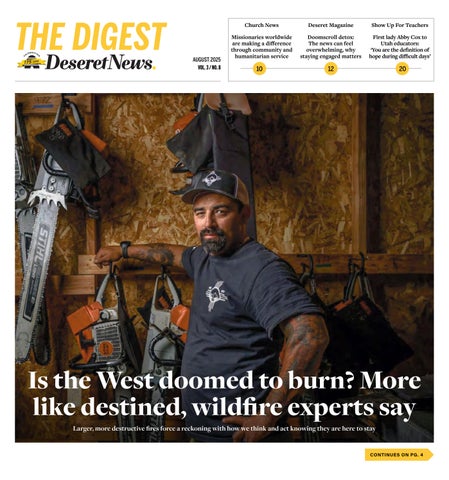
Is the West doomed to burn? More like destined, wildfire experts say Larger, more destructive fires force a reckoning with how we think and act knowing they are here to stay
CONTINUES ON PG. 4
2 DESERET NEWS | AUGUST 2025
INTRODUCING ' THE DIGEST ' and available on any device. Whether you’re at home on your computer or on the go with your mobile phone, you can access our website for the latest news, analysis and commentary.
Mobile apps By Doug Wilks Executive Editor
By Burke Olsen Publisher
We are pleased to introduce you to The Digest, a sampling of some of the best stories written every day by the dedicated journalists at the Deseret News, Deseret Magazine and Church News. Our hope is that you will make us your trusted news source each day at a time when there is confusion and contention in the nation. The Deseret News brand stands for unimpeachable journalism centered on the issues most core to the human heart. While the Deseret News since its beginning in 1850 has evolved to meet the demands of its audience — reimagining print offerings, launching an acclaimed magazine and increasing the visibility and reach of its award-winning website — the publication remains committed to certain timeless ideals. We stand for truth and light. We stand for faith and family. We stand for liberty and responsibility. We provide news and perspective, exploring society’s thorniest problems in search of solutions that will improve your life. That’s our commitment to our readers. We invite you to discover what we can offer you:
Our apps for iOS and Android devices offer a seamless and convenient way to access the latest news, wherever you are. Choose what you want to read, save articles for later and receive push notifications for the breaking news you need to know.
Newsletters
Delivered straight to your inbox, our free email newsletters provide a curated selection of the most important stories of the day, as well as deeper dives into topics that matter to you. Choose from a variety of subjects and frequencies to tailor your news consumption to your needs.
Weekly print newspaper
For those who appreciate the tactile experience of a traditional newspaper, our twice-weekly print edition offers a comprehensive roundup of the week’s most important stories and opinions, including the most comprehensive high school, college and professional sports offerings in the state.
Deseret Magazine
In 2020, we undertook an ambitious endeavor by launching a new magazine with in-depth journalism, unique voices and principled points of view. The reception to the magazine has far exceeded our expectations. You can read more from the magazine online at Deseret.com/magazine or subscribe to have it delivered to your home or office.
Church News
The Church News remains one of our most popular offerings for those who want to know the latest news from The Church of Jesus Christ of Latter-day Saints. It’s available online at TheChurchNews.com and via iOS and Android apps. A print version is included in the Friday edition of the Deseret News.
SUBSCRIBE
ONLINE: DESERET.COM/SUBSCRIBE BY PHONE: 801-204-6100
Award-winning website
Our website, Deseret.com, is designed to be user-friendly
Re-Elect
Bettina Smith Edmondson
Layton City Council Bettina’s Accomplishments Funded a new fire station, protecting Layton from wildfires & ensuring quick response time Was instrumental in building walkable infrastructure, crosswalks & trailhead connections, keeping pedestrians and bikers safe from traffic Delivered balanced budgets and maintained strong fiscal stewardship without raising property taxes Promoted economic development to bring good-paying jobs to Layton Reinstated All-Star tournaments for youth sports with emphasis on sportsmanship, leadership & positive role modeling
electbettina.com
@ElectBettinaSmithEdmondson
DESERET NEWS | AUGUST 2025
150 YEARS OF SHARING LIGHT AND LOVE FOR THE BENEFIT OF THE WORLD
F I N D WAY S T O J O I N T H E C E L E B R AT I O N AT
1 5 0 . BY U. E D U
Above: BYU students sew for the Red Cross during World War II (left) and weave sleeping mats for refugees (right).
3
4 DESERET NEWS | AUGUST 2025
DESERET NEWS
Is the West doomed to burn? More like destined, wildfire experts say Larger, more destructive fires force a reckoning with how we think and act knowing they are here to stay By Kevin Lind Deseret News
When Steven Griego began fighting wildfires in 2009, the ones that he and his crew considered “big” would burn around 30,000 acres. In those early years, Griego, the supervisor of the Rio Grande Wildland fire fighting crew of the New Mexico Forestry Division, would point out different areas around his hometown of Mora to his wife, Leticia, that would be hardest to fight if wildfire ever reached the Sangre de Cristo Mountains around Santa Fe. While riding their ATVs, Griego would say, “If we get a fire right here … it’s gonna get big.” Then they’d drive somewhere else and he’d say, “If we got a fire there, it’s going to be tough.” Leticia did not realize how prescient her husband’s concerns were. Come early April of 2022, the Hermits Peak/Calf Canyon Fire burned nearly 350,000 acres across Taos, San Miguel and Mora counties in northern New Mexico. The fire burned through June and was the biggest in the state’s history, destroying an area 100 square miles larger than the city of Los Angeles. Damages were estimated to cost approximately $5 billion. Griego spent around 50 days fighting the fire and evacuating locals — his family and friends included. “You had told me about all those places, that it was going to be tough fighting, and it all burnt at one time,” Griego remembers Leticia saying to him. “It wasn’t just like, ‘OK, a fire here, a fire there.’ It was all at once, and it was gone.” Griego’s used to fighting hundreds of fires a year — the West burns often — but the vast majority never make the news, in part because of the valiant efforts of firefighters. But over the last 16 years, his understanding of wildfires’ potential scale has changed considerably. In June, he sent a crew to fight the Buck Fire, which burned nearly 60,000 acres near New Mexico’s Gila National Forest. These days, that’s business as usual. Now the “big” fires are the ones greater than 300,000 acres. “That’s tenfold what it used to be, and that’s a big fire,” Griego said. “But then you look out towards California, a little bit further west, and we’re hitting a million acres out there,” he said. “It’s like, where is it gonna stop?”
Roberto Rosales, for the Deseret News
Steven Griego is a crew leader for a wildland firefighting outfit in Santa Fe, New Mexico. He's been fighting wildfire for 17 years and has seen a large uptick in the general scale of fires in that time. His hometown of Mora was impacted by the Hermits Peak Calf Canyon Fire, New Mexico's largest burn. Pictured is Griego inspecting his unit before heading home Thursday, June 12, 2025.
‘The West is going to burn’
So far this year, 33,552 wildfires have burned 1.7 million acres in the U.S., according to the National Interagency Fire Center. As of this publishing, there are 69 large fires receiving “full suppression” treatment across eight states in the West. Fourteen states — seven in the West — have red-flag warnings from the National Weather Service, which means there’s an “increased risk” of wildfire with the potential for rapid growth. Over the northern border in Canada, over 10 million acres have burned since the start of the year — 347% of a “normal” year — with at least 65 fires that are deemed “out of control.” Utah recently put in place statewide Stage 1 fire restrictions, preventing the use of campfires, fireworks, shooting and metalworking. Federal land managers in
the state also have restrictions across most major regions. All while at least two large wildfires are burning. The France Canyon fire has now burned over 34,000 acres. The Forsyth Fire in Washington County, Utah, destroyed 14 homes with a total acreage of 15,500 plus acres. It’s dispassionate, but none of this is particularly surprising in 2025. Wildfires are not unfamiliar. After the world witnessed what happened to Los Angeles, Maui, or any other of the many large scale wildfire disasters of the past several years, even the truly big ones are no longer unexpected. Also, fire has just always been a part of the North American landscape. Which is part of the answer to Griego’s question: wildfires aren’t going to stop. “As practitioners, we don’t see (wildfire)
as doom,” said Casey Teske, the wildland fire science and ecology program lead for the National Park Service’s Wildland Fire Program. “We know that we’re on a landscape where the plants and vegetation, the trees, the grass, the shrubs, that’s part of their lifecycle process. So, is it doomed to burn? I prefer ‘destined’ to ‘doom.’ The West is going to burn. Fire’s part of the process.” Other wildfire professionals even celebrate its presence, grateful that our landscapes have a built in system to rejuvenate. “Yes — most of the West is destined to burn and there would be, maybe, an excited exclamation point on that sentence,” CONTINUES ON PG. 6
DESERET NEWS | AUGUST 2025
VOTE LINDA LARTIGUE FOR LAYTON CITY COUNCIL
COMMUNITY SERVICE PURPOSE
August 23 August 23 -- 24 2
“Public service isn’t just a job, it’s a calling to listen, to lead with compassion, and to make sure no one is left out of the conversation. I’m running for City Council because Layton deserves leadership that sees every resident, values every voice, and works every day to build a stronger, more connected community.”
SS PP AA NN II SS H H FF OO RR KK FF AA II RR GG RR OO UU NN DD SS
VISIT MY WEBSITE FOR MORE INFORMATION electlinda@outlook.com | www.electlinda.com
SOMETHING FOR EVERYONE
$
72
52 WEEKS Deseret News 10 ISSUES Deseret Magazine 52 WEEKS Church News *offer is available for new subscribers only
Use offer code: DD72 Call 801-204-6100 or email service@deseretnews.com
Scan QR Code to purchase bundle offer
GUNS AMMO AMMO SCOPES HOLSTERS HOLSTERS KNIVES RANGE KNIVES RANGE BAGS FIRST AID & & MORE BRING THIS AD FOR A DISCOUNT OR BUY TICKETS ONLINE @CROSSROADSGUNSHOWS.COM
5
6 DESERET NEWS | AUGUST 2025 practical action, but coming to terms with the existential threat of living with the pervasive, “act of God” level of risk that wildfires pose. Part of that process requires individuals and communities to reframe how they understand it — both as just a regular part of life in the West, and also something that has the potential to change depending on the choices people make both separately and together. “It is the new baseline, but really only if we do nothing,” said Jennifer Marlon, a senior research scientist and wildfire expert at Yale’s School of the Environment. “Doing nothing is not a neutral choice.”
How should we think about it?
Scott G Winterton, Deseret News
Firefighters respond to a brush fire burning near homes in Draper, Utah, on Sunday, June 15, 2025.
said Greg Dillon, the director of the Fire Modeling Institute for the U.S. Forest Service and one of the architects of the Wildfire Risk to Communities interactive website. “We’re not doomed to it — it’s an exciting element of the ecosystems of North America.” It’s within those ecosystems, however, where more and more people in the West are building homes and communities that are not intended to rejuvenate after cyclical
destruction. And while the number of fires per year has stayed stable, the size of those fires has been increasing. That’s caused by a kaleidoscope of factors — changing weather, invasive vegetation species and a wide variety of human actions. But experts and wildfire fighters agree that there are things that can be done to mitigate their spread, keep families and communities more safe and even address underlying causes. It requires not just
Dillon’s and Teske’s perspective regarding wildfire owes to the fact that it’s a necessary and beneficial part of the West’s ecological nature. It clears overgrowth, kills diseases and, while doing so, adds nutrients to soil which, in turn, spurs new life and fosters greater biodiversity. This phoenixlike regeneration is just another one of the earth’s ineffable, beautiful complexities. North American landscapes have also been burning in some form or another for millennia, said Jason Fallon, the branch chief of Wildland Fire for the National Park Service Division of Fire and Aviation. Not only is that pattern unlikely to stop, it’s also “always constantly changing.” Fallon takes umbrage with the framing of
“doom” or “destiny,” as the potential for a negative connotation skews how someone might understand or define the problems of wildfire before the conversation even begins. In his estimation, fire is only good or bad depending on where and how it is burning. For example, fire on our stove that’s cooking dinner, or in our engines powering our car’s movement, is a good, unthreatening force. But where the fire is burning can quickly change our perception. “It’s OK if the fire’s inside the engine,” Fallon said. “If it’s in the seat next to me, that’s not good.” But the forests, deserts and grasslands of the West are natural locations for fire. In those landscapes, it has a natural and good existence, Fallon said. That dichotomy, of fire being both good and bad depending on where and when, is a better way to frame it, he suggested. “There’s a duality to wildland fire where in some cases it can be a great tool and highly beneficial to the landscape, and in other cases, it can have severe negative consequences,” Fallon said. “It’s highly dynamic. So there’s a lot of things we can’t control and we don’t know exactly when and exactly how this chain of events is going to occur. The best thing we can do is be prepared and give ourselves lots of options for whatever that situation is.” CONTINUES ON PG. 8
YOU WERE RIGHT ALL ALONG—YOUR KID IS THE BEST. Let’s give them the best.
DESERET NEWS | AUGUST 2025
RETIREMENT i n 2025 LIVING YOUR BEST LIFE!
RETIRED OR RETIRING SOON?
Has my CPA talked with me about N Y ■ ■ eliminating taxes on my Social
Is my estate protected so I can stay N Y ■ ■ in my own home if I have long-
Do I know why a trust may be N Y ■ ■ more effective than a will and why
Will I maintain my purchasing N Y ■ ■ power through high inflation and
Am I aware of the tax and legal N Y ■ ■ consequences of placing children
Do I understand probate and how N Y ■ ■ to avoid it?
When donating to charity N Y ■ ■ (including tithing) do I donate tax
comfortable retirement?
term care expenses?
market volatility?
Are my assets protected from N Y ■ ■ being forced to surrender to Medicaid?
Security benefits?
I may need one?
on my bank accounts or home?
efficiently?
Is my retirement income protected N Y ■ ■ from taxes and inflation, so I don’t outlive it?
CALL (801) CPA-HELP (801) 272-4357
Advisory services are offered through Wealth Management CPAs, LLC, an SEC Investment Advisor. Tax services offered through Wealth Management Tax Solutions, an affiliated company. Insurance products and services offered through Wealth Management Insurance Solutions, LLC, an affiliated company. Copyright © 2010-2024 Wealth Management CPAs. All rights reserved.
2 COMPLIMENTARY CONSULTATIONS AND A PERSONALIZED RETIREMENT PLAN ($1,000 VALUE!)
Get answers to your questions for a comfortable retirement!
PASS
WITH OUR RETIREMENT PLANNING CHECKLIST:
Do I know ways to lower the taxes N Y ■ ■ on my IRA and 401(k) for a more
BOARDING
GAIN CONFIDENCE
7
8 DESERET NEWS | AUGUST 2025
Scott G Winterton, Deseret News
A single-engine air attack plane makes a retardant drop on a brush fire burning near homes in Draper, Utah, on Sunday, June 15, 2025.
What we can do to prepare
Wildfire “is a natural ecological process, just like rain and snow and wind,” Dillon, from the U.S. Forest Service, said. “It’s something that our society has vilified because obviously it can cause damage. But what we need to learn to do as a society is embrace it.” The website that Dillon manages, Wildfire Risk to Communities, is a thorough guide for how individuals, communities and leaders can practically address the threats of wildfire. It is very similar to Utah’s Fire Sense program. Teske and Fallon both said it is the best reference for those seeking to protect their property and communities
from the risk of wildfire. “I don’t want to see people’s homes lost, lives lost. I don’t want to see property burned up,” Dillon added. “So, how do we as a society adapt to understanding that fire is something that we do have to live with but manage our own environment — our built environment, the places that we live and work — in a way that they can be resilient and a wildfire event doesn’t have to be a human disaster.” The site offers a search function so visitors can assess their own communities’ wildfire risk as well as detailed advice on ways to reduce it. Those include the way people build a “defensible space” around
“People don’t realize that we’re building communities right up against these forests that are designed to survive fire and to burn. But our homes are not designed that way.”
their home. The idea is to create breaks between shrubs, decks, fences or other items that could easily ignite and subsequently set the house itself on fire. One can also remove those things entirely. Within that defensible space, the site has advice about building materials, venting, fuel storage, landscaping and, moving outward again, even suggestions for things a homeowner can do to trees up to a 100 feet away. When the site launched in 2020, Dillon himself, who lives in Missoula, Montana, began making the updates that he suggested homeowners do on the website to his own home. Before he started, however, a colleague noticed over a Zoom call some Juniper trees — one of the most flammable trees in the West — in his backyard. That was a catalyst for his own action. Along with a few neighbors, Dillon got a chainsaw and started landscaping. But the site also has recommendations for how communities and town leaders can implement wildfire codes, build evacuation routes and plan for wildfire eventualities, too. That is because, while it’s important for individuals to do what they can to manage their own property, it is mostly a society level issue, Dillon said. “If you just have one or two people in a neighborhood doing all the things you’re supposed to do and the rest of the people choose not to do any mitigation that’s probably not enough,” Dillon said. “You
need to address it as a community issue so that an entire neighborhood — an entire community — works to make themselves more fire resilient.” He points out how massive urban fires were a major issue before regulations like general fire codes and sprinkler ordinances were put in place. With a little collective spirit, communities in areas where towns and wild spaces intersect — the “wildlandurban interfaces” that are ubiquitous in the West, colloquially referred to as “woo-EE’s” — can also limit the damage of wildfires. Making those kinds of decisions for yourself or your community is hard and not everyone has the appetite for it. Teske referenced a study done after the Oakland Hills Fire of 1991, in Berkeley, California, to illustrate how different people react when faced with the threat of wildfire. Those who lost their homes, rebuilt them in the same way because their insurance covered it. Those whose homes were spared and who also avoided a close call, did not make any updates to their home at all. “But if you were in that almost-hadmy-home-burned (category), you did everything — took the wood pile away, tried to put up the most fire resilient sideboards and everything,” Teske said. “That human factors piece is really part of it.” Which is why Teske thinks it so important for people to discuss what can be done to mitigate wildfires spread — because those that know are often willing to do whatever it takes to spare their property and persons from the damage that can come from doing nothing. Echoing Dillon’s sentiments, she said that by communicating and understanding these dangers, “communities and the planning commissions have to accept part of their responsibility to help make their communities safe as well. ”
How a changing planet has changed wildfire
For most of North America, what used to be a “wildfire season” correlated to the summer months, is now a wildfire year. Since the 1970s, Teske said that the average length of the planet’s fire season has increased by one month, but within the U.S. it’s now 84 days longer. In addition to that, Griego’s anecdotal experience from fighting wildfire in New Mexico is not isolated either. According to Teske, the fires themselves are, in fact, getting larger too. “The numbers are relatively stable in terms of the number of fires,” per year, Teske said. “It’s actually the size that is increasing. The area burn is increasing on an annual basis. That trend is up.” The simple truth that wildfire is a natural process obfuscates part of wildfire’s story in the West. Wildfire may be normal for western landscapes, but like a lot of things on Earth, its nature is complicated by human presence and our lifestyle choices. So aside from whether or not wildfire regulations are put into place or how well
DESERET NEWS | AUGUST 2025 a homeowner builds a defensible space around their property, there are choices we make with regards to where homes are built and what level of seriousness we give to concerns of climate change that can also mitigate the scale and spread of wildfire. “People don’t realize that we’re building communities right up against these forests that are designed to survive fire and to burn,” Marlon, the Yale researcher, said. “But our homes are not designed that way.” As such, Marlon said, now is a time for action. In addition to making a defensible space and packing a to-go bag, she said, “We need to start raising the question at every town meeting, every planning meeting, every zoning meeting, how is this development, new building, soccer field or whatever making our community safer? How is it going to help our community survive when the fire comes?” “Because the fire is going to come. It’s just a matter of when and where exactly, but yes there’s going to be more severe fires in the future,” she said. “This is not going to slow down anytime soon.” There are many reasons for that. Teske and Fallon described the pervasive amount
of invasive grasses that are quicker to burn. Marlon referenced a growing population of people who use fire all the time in their day-to-day lives (cooking, driving, heating and, also, the Fourth of July is this week) living adjacent to ignitable landscapes. She mentioned that, as the world has gotten hotter, there is a demonstrable increase in the amount of lightning, the strikes of which often ignite wildfire. Griego described how New Mexico’s droughts have constantly made conditions ripe for wildfire, too. The relative humidity was so low before the Hermits Peak/Calf Canyon Fire that they had 37 red flag days in a row, something he had never seen before. The vast majority of the 30% of the U.S. currently under drought conditions are in the southwest part of the country. Also, there’s a vast body of scientific evidence linking human-caused climate change driven by fossil fuel emissions to more extreme weather events and rising temperatures. John Vaillant wrote “Fire Weather: On the Front Lines of a Burning World‚” which detailed the connections between society’s dependence on fossil fuels and the growing
scale of wildfire disasters. He thinks it’s folly to ignore the relationship between burning fossil fuels and massive wildfire. “We have agency here,” he said. Even if we are dependent on fossil fuels today, “it is morally lazy to just throw up our hands and say, ‘well, there’s nothing we can do.’” Vaillant explained that Texas, the largest producer of fossil fuels in the country, is also a leader of renewable energy development. This suggests to him that it’s more than possible to limit fossil fuels production and subsequently lower the risk of greater, larger wildfires. If we do decide to do nothing — something Marlon said was no longer neutral — then we are just subjecting ourselves to more fires, more floods, and more suffering, she suggested. “We used to have a billion-dollar disaster every three to four months in this country, now we have one every two weeks,” she said. “How are we going to handle the insurance crisis? Everybody should check their policy. A lot of them are renewing in a month or two. Your bill is going to go up. And that’s not just inflation or the Ukraine war, that’s actually climate change.”
A stark reminder
Griego keeps a visual diary of the more memorable fires he has fought in the form of a full sleeve of tattoos along his left arm. He has images of trees burning, portraits of some of his crew but he also memorialized
a scary reminder of a home that he was not able to save. During one wildfire fight, Griego could clearly see the entire frame of a house in silhouette through the engulfing flames. It was exactly the kind of disaster he fights to prevent. They’re all a reminder of his lifestyle, and what is at stake when he does this kind of work. As parting advice, Griego mentioned that he and fire crews often have to deal with those who don’t evacuate when the order was given, or don’t want to evacuate even when the fire is burning in their neighborhood. When people don’t take the warnings seriously — he remembered someone who needed help changing a flat tire in the midst of a burning maelstrom — they complicate the fight. “You’re holding us up from doing our job. If you would’ve listened to us two, three days ago to evacuate your house and not last minute, we’d have good access in there. ‘Egress’ is what we call it — a way in, a way out,” Griego said. Part of knowing that the landscape of the West is destined to burn and that there are things we can do to mitigate our risks, is trusting the evacuation order when it comes. “We’re telling you something. We’re telling it to you from professional experience. We’re not telling you because we want you to leave your home,” Griego said. “You need to leave your home.”
Rex Warner for the Church News
An overview image shows Matthew and Wendy Garff's home and others destroyed by January 2025's Palisades Fire in Palisades, California, on Saturday, Feb. 22, 2025.
Make Your Bathroom Safer This Year!
COMFORTCHAMPIONS.COM CALL 866-753-1165
49
$
Furnace or A/C Tuneup
~With coupon~ Expires 8/31/25
Not valid with other offers or discounts. Must present coupon at time of estimate.
HIGH EFFICIENCY FURNACE & A/C
Call Today!
www.thegrabbarspecialist.com
~With coupon~
96.7%
EFFICIENT 16 SEER
FROM
$7,997
After rebates. 2 ton models only. Some restrictions apply. Expires 8/31/25. Purchase & installation. Not valid with other offers or discounts. Must present coupon at time of estimate.
9
Furnace or A/C $3,495 95%
EFFICIENT
FROM
~With coupon~
After rebates. Replacement only. 2 ton models only. Some restrictions apply. Expires 8/31/25. Purchase & installation. Not valid with other offers or discounts. Must present coupon at time of estimate.
FURNACE & A/C COMBO ~With coupon~
80%
EFFICIENT 13 SEER
FROM
$6,495
2 ton models only. Some restrictions apply. Expires 8/31/25. Purchase & installation. Not valid with other offers or discounts. Must present coupon at time of estimate.
FREE SERVICE CALL with any Heating, A/C or Plumbing Repair ~With coupon~ Expires 8/31/25 Not valid with other offers or discounts. Must present coupon at time of estimate.
10 DESERET NEWS | AUGUST 2025
CHURCH NEWS
How missionaries worldwide are making a difference through community and humanitarian service The Church’s 80,000 missionaries contribute to community service efforts, disaster cleanup and welfare and self-reliance operations By Trent Toone Church News
Serving in 450 missions worldwide, 80,000 missionaries of The Church of Jesus Christ of Latter-day Saints are playing a key role in community-service efforts, disaster cleanup and other projects related to the faith’s welfare and self-reliance operations. The Church highlighted some of the efforts by these proselyting, service and senior missionaries in a July 7 article on ChurchofJesusChrist.org. In May, the Church collaborated with other organizations to host a six-day event at a meetinghouse in Pasadena, California, to provide resources and support for 2,500 households affected by the Southern California wildfires. The missionaries were there to help. One of the organizers at the event, Kevin Cox, CEO and founder of the Hope Crisis Response Network, said he has never met a missionary who ever used the word “no” — they always tried to figure out a solution to every situation. “The Church needs to be very proud of its missionaries,” he said. “When you send these young people out, they’re learning a lot of life lessons, but they’re also sowing such great seed. And that’s what we need in our country.” Following the destruction of hurricanes Helene and Milton in the Southeast United States in September and October 2024, Latter-day Saint missionaries were among thousands of Church volunteers who mobilized to serve neighbors in North and South Carolina, Florida, Georgia and Tennessee. “The consecration of time by our thousands of members and full-time missionaries, along with the food, water and many other commodities provided by the Church, has helped our friends and neighbors across the South. It was all part of living the Savior’s two great commandments [to love God and love others], and it was inspiring. I personally saw hope and tears of joy in the faces of the grateful recipients,” said Elder Ahmad S. Corbitt, a General Authority Seventy who serves in the Church’s North America Southeast Area presidency. In 2022, missionaries joined other volunteers in a service project with the National Association for the Advancement of Colored People in San Francisco, California. Together, they installed an irrigation system at the Florence Fang Community Farm, which provides fresh food to a diverse and underserved community that inhabits a food desert. On that occasion, Elder Patrick Kearon, then a member of the Presidency of the Seventy, said the project fostered unity in the community. “We’re here from all kinds of backgrounds, ethnicities and cultures, all working together to make this extraordinary garden a better place,” said Elder Kearon, now a member of the Quorum of the Twelve Apostles. “The real benefit today is working together. When society generally is showing so many fractures, this is pulling all kinds of people together, and we’re delighted to be a part of it.” In the Philippines in April, missionaries joined a congregation-led medical mission in Barangay Mintal, Davao City, offering free physical and mental health services to the community.
The Church of Jesus Christ of Latter-day Saints
Volunteers connect drip lines at the Florence Fang Community Farm in San Francisco, California, on Saturday, Oct. 22, 2022, as part of a humanitarian project to install an irrigation system. The Church of Jesus Christ of Latter-day Saints and the National Association for the Advancement of Colored People sponsored the event.
The same month, missionaries and Church members in Costa Rica cleaned a children’s playground and the Catholic parish in San José. Missionaries were essential to flood relief on Parama Island, Papua New Guinea, in October 2024. Unable to reach the village by boat due to shallow waters, villagers and missionaries spent a day transporting supplies from a barge a kilometer offshore through tide pools to grateful families. In July 2024, missionaries assisted in cleanup work in Saas-Grund, Switzerland, after devastating storms. “Seeing how our work improves the lives of the people here was very moving,” said Elder Tobias Kroes, a missionary in the Alpine German-Speaking Mission. “Instead of our everyday tasks, we were able to achieve something really meaningful by joining forces.” In Rome, Italy, missionaries and local Latter-day Saints spend one day a week preparing and serving hot meals to
the homeless at Parrocchia del Santissimo Redentore charity kitchen. They also prepare gift bags with sweets and other items at Christmas. All service provided by missionaries is rooted in a desire to follow Jesus Christ’s two great commandments — love God and love your neighbor, as Elder Dieter F. Uchtdorf of the Quorum of the Twelve Apostles taught in 2017. “The Savior loves all of God’s children regardless of their socioeconomic circumstance, race, religion, language, political orientation, nationality or any other grouping. And so should we,” he said in April 2017 general conference, then serving as second counselor in the First Presidency. “God’s greatest reward goes to those who serve without expectation of reward. It goes to those who serve without fanfare; those who quietly go about seeking ways to help others; those who minister to others simply because they love God and God’s children.”
DESERET NEWS | AUGUST 2025
r
CALL TODAY!
Grandpa's Family Dental Our Business is Dentistry, our Legacy is You
EEsstt.. 2 6 06 20 00
Full mouth Restoration
Your trusted plumbing and HVAC company. We get the job done, Right Away!
AC
$ 59 normally $149
AC NOT COOLIN
G?
FREE DIAG WITH REPNOSIS A I R! normally $59
WE’RE HERE FOR YOU 24/7 3038 S 9000 W Magna, UT 84044
58 E Catamaran Way S Saratoga Springs, UT 84045
rightawayplumbing.pro
55+ INDEPENDENT LIVING 2 BED/2 BATH COTTAGES
NEW HOMES AVAILABLE AUGUST 1
pasdenta .com
g and
385-410-2929
L! TUNE UP SPECIA
11
$
Includes final durable zirconia fixed bridge
13,999 per arch
New Patient, Cash & Non insured only. 08/30/25
Trusted By Thousands - Quality Dentistry at Prices You Can Afford! Regular Utah Price
Grandpa’s Cash Special (Uninsured)
$1100- $1400
$599
Premium Denture
$1800- $3400
$800
Implant & Crown
$3000- $3800
$1599
$7000- $9000
$4800
Service Crown w/ Lifetime Warranty
Snap Denture w/ 2 implants
3 locations - Call us today to schedule - 801-262-2040
Experience effortless living in our brand-new single-story twin homes, ranging from 1,500 to 2,300 square feet. Thoughtfully designed for comfort and convenience,
each spacious layout features 2 bedrooms, 2 bathrooms,
a home office or den, cozy fireplace, and a two-car garage - perfect for relaxed, independent living. Don’t miss your chance to become part of the vibrant Cedarwood at
Sandy community. Contact us today to tour our cottages and explore our flexible dining options!
SCAN QR OR CALL US AT 801.618.4362 FOR MORE INFO.
lifeatcedarwood.com
CW Cottages 10.04 x 5.1 The Digest Deseret News ad August.indd 1
7/9/25 11:05 AM
12 DESERET NEWS | AUGUST 2025
DESERET MAGAZINE
Doomscroll detox The news can feel overwhelming, why staying engaged matters By Maria McNair Deseret Magazine
In 2010, 16-year-old Hannah Ritchie arrived at the University of Edinburgh to start a degree in environmental geoscience. Environmental issues were her passion, and she was excited to learn how to solve some of these great global challenges. “Four years later,” she writes in her first book, “I left with no solutions. Instead, I felt the deadweight of endless unsolvable problems. Each day at Edinburgh was a constant reminder of how humanity was ravaging the planet.” Contributing to this sense of deadweight was mainstream media. “During my time at university, I made a conscious effort to keep up with the news,” Ritchie notes. “Everywhere were images of natural disasters, droughts and hungry faces. More people seemed to be dying than ever before, more were living in poverty and more children were starving than at any time in history. I believed I was living through humanity’s most tragic period.” The unrelenting exposure to the world’s negative trends looked like it was going to change the trajectory of Ritchie’s life. “Despite working relentlessly to get my degree, I was ready to turn my back on my obsession and find a new career path. I started applying for jobs far away from environmental science,” she writes. “Those years made me feel helpless.” This chapter of Hannah Ritchie’s story may be familiar to many news readers. “More people are turning away from news, describing it as depressing, relentless and boring, a global study suggests,” writes Noor Nanji for the BBC. “Almost 4 in 10 (39 percent) people worldwide said they sometimes or often actively avoid the news, compared with 29 percent in 2017,” Nanji highlights from a report by Oxford University’s Reuters Institute that noted record high levels of news avoidance. A key reason for actively avoiding the news has to do with that emotion of helplessness that Ritchie experienced. The report’s lead author, Nic Newman, tells the BBC that people often choose to avoid the news because they feel “they have no agency over massive things that are happening in the world.” People are similarly driven away by the focus on “endless unsolvable problems.” “Haunted by a sense that the news is relentlessly toxic, once-loyal readers and viewers have been gradually ebbing away,” Paul Farhi reports in The Washington Post. “Digital media has made news ubiquitous. … And much of it, people say, drives feelings of depression, anger, anxiety or helplessness.” Farhi quotes one reader who’s backed off her dedicated news reading: “I can’t handle the stress put on me when I go to the front page,” she said. “It feels like it affects me directly. I don’t know if the world is worse now than it was before. But it never used to feel like a personal threat.” Ritchie once felt powerless to make a difference. But she didn’t stop consuming news; instead, she expanded the kinds of stories she reads. Today, she is one of a growing number of voices in journalism dedicated to highlighting what’s improving in our world and how we can lean into progress. When we know what’s going well — and why — we can help it keep going.
Blair Kelly for the Deseret News
Protecting democracy locally
Michelle Cottle became a champion of spotlighting progress in the news for similar reasons. In 2018, Cottle joined The New York Times as a national political writer for its opinion section. In the two years following the January 6 insurrection, she had a particular focus on “ways to protect democracy.” “This is not a question of ideology,” she says. “I have deep respect for members of the Republican Party and the Democratic Party.” The concern was over “efforts to undermine the foundations of democracy, like the peaceful transfer of power, respecting the will of voters.” The question was, what role would the news play in helping shore up those foundations of democracy? “On one level, that’s a very important story that people get very stressed out about. But when you get down to the mechanics of what you have to worry about, like the officeholders way down the political food chain, like county clerks, secretaries of state, the attorneys general … election board commissioners, those are really boring races for people,” Cottle says. Even though these stories about obscure elected offices are crucial to explaining how U.S. elections function, it’s hard to get readers to take an interest in them.
The potential danger of this lack of interest surfaced in the 2022 midterm election season. As Cottle explains, there had been a push from certain quarters after January 6 for those who believed the electoral process was corrupt to take over local election machinery: “Steve Bannon, the Trump adviser, pushed this strategy out nationwide, trying to stack the election infrastructure with people who were convinced that there was massive democratic fraud and they needed to stop it at all costs. You saw stories of election watchers out eyeballing people and being vaguely intimidating. So we learned that this was an ongoing, multi-pronged plan.” In response to this election-stacking plan, the Times and other news organizations strove to alert voters to the candidates running for less prominent local offices. “In addition to all the pieces about the Senate races and the House races,” Cottle says, “we were constantly hammering the whole, ‘These secretaries of state candidates need to be watched; they are a danger.’” If voters had just avoided the news, they might never have known about the candidates’ positions. They might not have CONTINUES ON PG. 14
DESERET NEWS | AUGUST 2025
PRODUCED BY
AUGUST 1-16, 2025 Closed Sundays & Mondays
$
4OFF
SPECIAL AUGUST DISCOUNT
USE CODE: AUGUST4
13
14 DESERET NEWS | AUGUST 2025
“More people are turning away from news, describing it as depressing, relentless and boring, a global study suggests.” reflected their real values with their vote, or might never have turned out to vote at all. As it turned out, voters apparently did pay attention to the news. Candidates who questioned the legitimacy of the 2020 election were overwhelmingly defeated in battleground states. For Cottle, the midterm results had a very positive message about people’s ability to change outcomes — and she wants this message shared. “What I learned is that you really do need to put the spotlight on these things. One of the things that you worry about when you cover politics is that people just get exhausted and frustrated and they lose any sense that they have the ability to affect things. And so when they do, it’s very important to jump up and down and say, ‘See, you need to go out and vote. This matters.’” The direct impact of local politics on individual lives is one reason many media scholars recommend reading and supporting local news. If you’re concerned about making an impact in the world, your own community is a good place to start. Following local news will help you discover where your efforts can make a positive difference.
Rethinking global crisis
Whatever you can do locally, you might still feel overwhelmed by the crises you see happening around the world. If so, it’s essential to remember that “the news” isn’t actually the best way to understand the world. Discouraged by a fiercely negative picture of global events, Ritchie was tempted to abandon environmental science as a career path. But her mind was changed when she came upon a new way of looking at global issues — something quite different from the tragic headlines and images she saw in every day’s news. It started with a presentation by a man named Hans Rosling. Rosling, who died in 2017, was a physician, professor of global health and statistician who developed new ways of visualizing and understanding statistics. In particular, he used big sets of data to reveal hidden truths about global trends. These truths were often startling to his viewers because of the positive picture they portrayed, exposing audiences to a different perspective than the one they had seen while scrolling the web, watching cable TV or thumbing through the paper. Rosling’s presentation changed Ritchie’s outlook on the state of the world. She had assumed everything was getting worse. What Rosling showed in this presentation was how
many things were actually getting better — how countries around the world, for example, were getting healthier and healthier. There was a vast gap between Ritchie’s perception of the world and reality — a gap that comes from the way we take in information about the world. The kinds of daily news stories we consume are not designed to tell us the whole truth about world trends. “The news is designed to tell us, well, something new — an individual story, a rare event, the latest disaster. Because we see them in the news so often, unlikely events seem like probable ones. But they’re often not,” Ritchie explains. “That’s why they make the news and why they capture our attention.” It is the disasters, in particular, that are highlighted to draw us in. In an attention economy, news outlets bank on crises as the best bet for attracting our clicks. They’ve learned that their audiences are drawn to catastrophes and potential threats to their well-being. “These individual (news stories) are important,” Ritchie writes. “But it’s a terrible way to understand the bigger picture. Many changes that do profoundly shape the world are not rare, exciting or headline-grabbing. They are persistent things that happen day by day and year by year. … The only way to really see these changes is to step back and look at the long-run data.” And what Ritchie saw, as she studied that data, was a global picture far more positive than the one she’d seen in those despondent years at university. As she states in her book, “If we take several steps back, we can see something truly radical, game-changing and life-giving: Humanity is in a truly unique position to build a sustainable world.” Her book is, fittingly, titled “Not the End of the World: How to be the First Generation to Build a Sustainable Planet.” There are still many ways we can change the world for the better. A crucial way to make these changes is to find broader and better stories about the world. Broader, in that they capture more data. Better, in that they focus on what’s going well.
Hope drives action
Ritchie is a featured author with “The Progress Network.” Supported by over 100 scholars in diverse fields, this organization is dedicated to sharing stories about the progress that humankind is making in many areas — stories backed up by the kind of big data for which Rosling advocated. The goal is to “balance out this strongly negative viewpoint (in) the mainstream media” and “help show people there is progress actually happening,” says Emma Varvaloucas, the network’s executive director. This is a vital task because many people are not aware of this progress. Take climate change. Anxiety levels would likely not be so high, says Varvaloucas, if more people knew “that the truly apocalyptic levels of warming that were possible even 10 years ago are widely seen as implausible now. So the really scary scenarios that (a United Nations panel) outlined for 7, 8, 9 degrees of warming, we’re done with them. We avoided them already.” We’re still faced with a very serious situation trying to avert the possibility of 3 degrees of warming and hopefully keep warming under 2 degrees, she says, but progress is happening toward this goal. “What we’re doing already has worked,” says Varvaloucas. “I really wish that a lot of climate coverage in the U.S. would mention that emissions … are down almost 20 percent already from 2005 levels. … People think that the world is about to blow up in 10 years … and that (scenario) is just not the case anymore.” That lack of awareness of crucial facts can have serious consequences. One is the uptick of anxiety that negative misperceptions can cause. Another is the way that anxiety can prevent engagement.
For the past 10 years, the narrative around climate change has simply been one of urgency and alarm. There was good reason for this strategy in the past, but Varvaloucas contends that it has become counterproductive as the distress it creates has possibly prevented people from engaging with the issue as much as they could and engaging with it in a healthy way. Varvaloucas was one of those people. “I was really turned off by the whole climate change discussion for a long time because I just felt there weren’t any entry points. It was just like, ‘Hey, we have this problem. No one’s solving it. The end.’ And I was like, ‘OK, well, what do you want me to do about that?’” This is where stories about progress can help. They provide the information and the motivation necessary to drive engagement with crucial problems — to let people know that it’s worth it to get involved. “If you are aware that progress has happened, it leads to a completely different set of decisions,” says Varvaloucas. When people have access to the data on where progress is happening and what’s driving it, they can invest in strategies that have actually worked to improve people’s lives. For example, Ritchie wrote on her Substack newsletter, “Every month I donate a share of my income to global health charities. The money goes toward the most costeffective ways to save lives and improve health: malarial bed nets; nutritional supplements for low-income kids. … I only donate because I know that it’s effective and I know it works.” Contrary to what some critics say, stories that focus on progress don’t tend to cause complacency, Ritchie says; they inspire action. “When we can see real results coming through, we tend to lean in, not out.”
Progress you can see
Public health is just one area where the Progress Network documents significant advancements over the past decades: reductions in new HIV infections and deaths from AIDS; positive developments in vaccines for diseases like malaria and RSV (not to mention Covid-19); huge drops in child mortality; and declines in severe poverty. To learn about the positive changes that are happening and how to help sustain them, you can start with the Progress Network’s website and weekly newsletter, and the Solutions Story Tracker at SolutionsJournalism.org. To improve your understanding of global trends, including trends for the better, you can check out Gapminder. Cofounded by Rosling, the site uses clear, reliable data to expand understanding and correct misconceptions about global issues. Our World in Data is also dedicated to using data to make progress on the world’s biggest problems — and to share news about the progress that has been made. Today, Ritchie is deputy editor and science outreach lead at Our World in Data. After almost giving up on a career in the environmental field, she has now spent nearly a decade researching, writing about and sharing the news on environmental issues. A key part of her work is letting the world know about the problems we still face and the magnitude of those problems. But, she notes, she couldn’t have embarked on this vital work at all without an escape from doomsday thinking. “Our impending doom leaves us feeling paralyzed,” she writes in her book. “I recognize this from my own dark period when I nearly walked away from the field entirely. I can assure you that after reframing how I saw the world, I have had a much, much bigger impact on changing things.” Maria McNair is a writer and podcast producer based in St. Louis, Missouri. This essay is an adaptation of an episode of “Article 13,” a Faith Matters podcast she researched and co-produced. This story appears in the June 2025 issue of Deseret Magazine. Learn more about how to subscribe.
DESERET NEWS | AUGUST 2025
15
Expect the Best for Your Loved One Crescent Senior Living has received recognition as Best Memory Care community by U.S. News and World Report. All recognition is based on the reviews of families and residents.
“ Crescent has a great staff who clearly understands the challenges of people with memory loss. They work very closely with residents and their families to be a leader in the area of memory care.” — online review
SCHEDULE A TOUR (801) 960 - 3342 11052 S Grapevine Cove | Sandy, UT 84070 crescentseniorliving.com
The Area’s Premier Community for
A MERIDIAN SENIOR LIVING COMMUNITY
Assisted Living and Memory Care
801.243.4464 Blindmastersutah.com
35 YEARS COVERING UTAH’S WINDOWS
MEET OUR FRIENDLY, KNOWLEDGABLE, SALES TEAM!
20% OFF
All Graber Brand Products Expires 08/31/25
Trale Mathis
Dan Shepherd
Travis Thompson
CELL SHADES
SHUTTERS
ROLLERSHADES
50% OFF FREE Topdown/Bottom up
Many FREE Upgrades
20% OFF Motorization
*Also available 2.5 Faux Wood, Roman Shades, Verticals
Motorization on
Outdoor Patio/Deck Shades Expires 08/31/25
Outdoor shades will change your life!!
WE WILL BEAT ANYBODYS PRICE, EVEN THE BIG BOX STORES!
16 DESERET NEWS | AUGUST 2025
DESERET MAGAZINE
A big, happy family Large families aren’t as common as they used to be, but I still want one
Julija Straizyte for the Deseret News
By Stephanie H. Murray Deseret Magazine
I grew up in what, by modern standards, is a pretty big family. I have four siblings, including two sisters — one older and one younger. At the moment, my older sister has four children. My younger sister and I are each in the process of welcoming our thirds. I honestly don’t know how many we’ll end up with between us because we’re all still in our early-to-mid-30s, with a fair bit of time for more kids to enter the picture. Given that we’re all millennials with graduate degrees, the childbearing trajectory my sisters and I have followed is already a bit unusual. These days, an American woman with a master’s degree has an average of 1.4
kids, and won’t have her first child until she is 30. At that age, my sisters and I already had two each. In my 60-some-odd-person graduate school cohort, there was only one other student with young kids. I found out I was pregnant with my eldest the day before my first semester of classes began, and I remember feeling almost embarrassed to tell my classmates about it, like I’d messed up somehow. When I finally did, everyone was kind, but many were utterly flummoxed. But in another sense, the earlier-andmore approach to parenthood my sisters and I have taken is entirely in step with a pattern demographers have observed in many countries: the “intergenerational transmission of fertility.” That’s just a big way of saying that people tend to mirror the older
generations in their family tree when starting a family. Kids without a sibling are more likely than others to stay childless in adulthood. Those who grow up with a bunch of siblings are more likely to go on to have a lot of kids themselves. The more children that your aunts, uncles, grandparents and in-laws have, the more you’re likely to have. Bigger families beget bigger families. When I first learned about this phenomenon, it struck me as fairly intuitive, but also somewhat puzzling. There is a decent amount of evidence that kids from bigger families, and particularly those who fall later in the lineup, end up worse off in a variety of ways as adults. They tend not to go as far or do as well in school, for one thing. Having a lot of siblings often means sharing bedrooms,
hand-me-downs and generally getting a smaller slice of your parents’ resources, be that money or time. Surely those of us who grew up in big families (especially if we’re, like me, not among the oldest) know better than anyone else of the sacrifices the lifestyle involves. What about the allure of having a big family of your own — with all the bills and bulk grocery shopping and crammed calendars — is bigger than the drawbacks? A childhood in a big family, for all its chaos and sacrifice, offers an answer for future generations. And it may provide a smoother on-ramp to future parenthood than exists elsewhere in modern American life. CONTINUES ON PG. 18
DESERET NEWS | AUGUST 2025
17
18 DESERET NEWS | AUGUST 2025
“We are born in families that have a given educational level, a given social status, a given residential outlook, proven to be very much related to fertility levels, fertility timing and preferences.” Why big families repeat
Studying how — and why — family sizes correlate across generations is a question that statisticians have been focused on “for as long as their tools have existed,” says Tom Vogl, an associate professor of economics at the University of California, San Diego. It’s been over a century of study, beginning with English statistician and eugenicist Karl Pearson estimating the continuity in family size for his own analysis using the correlation coefficient he developed and that’s still widely used today. Despite 120-something years of statistical examination, there’s still a lot we don’t know about how family size is passed from one generation to the next. Generally speaking, the most prominent theories fall into three broad — and not entirely distinct — categories, Laura Bernardi, an associate professor of demography at the University of Lausanne, says. The first is genetic. “You have the same genes of your parents,” Bernardi explains. Those genes may influence several aspects of a woman’s life that, in turn, impact the number of kids she has. But arguably the best-evidenced explanation for the intergenerational transmission of fertility is what Bernardi refers to as status inheritance. “We are born in families that have a given educational level, a given social status, a given residential outlook,” she says. As such, we share quite a few sociodemographic characteristics with our parents that are “proven to be very much related to fertility levels, fertility timing and preferences.” Factors like these explain a good chunk of the link between siblings and fertility in the U.S., but not all of it, Vogl says. Tinkering with data from the General Social Survey, he couldn’t get the association to disappear by accounting for such attributes, “so there’s a lot left that I don’t know how to explain.” The children of college-educated Americans tend to go to college themselves, for example, and women with a college education tend to have fewer kids than their less-educated counterparts. Likewise, religion tends to be passed from parent to child, and religious folks tend to have more kids than nonreligious ones. (Unlike the educational component, which, as I alluded to above, doesn’t appear terribly relevant in
my particular family, the religious influence checks out. We’re Catholic.) The last, and perhaps murkiest, of the possible causes of the big family to big family link is what Bernardi calls “socialization.” This would include all the ways that growing up in a particular family shapes one’s attitudes toward family formation. As our first reference, our families offer a model for what a family ought to look like. Likewise, parents may hold certain values that they impress upon their kids. “Some people are more child-oriented or family-friendly,” Martin Kolk, an associate professor of demography at Stockholm University, says. “In turn, their children are more child-oriented or family-oriented.” Or those of us growing up surrounded by children may simply come to “like having children around,” Eva Beaujouan, an associate professor of demography at the University of Vienna, says.
Demystifying family life
I grew up with a strong sense that raising kids was a good thing to do. Even beyond the “be fruitful and multiply” outlook that is common to the sort of traditional Catholic community I was raised in, I always got the sense that my parents and extended family members truly believed that parenthood was a worthy use of one’s talents. But when I reflect on what led me to launch myself into parenthood so much earlier than my peers, I find myself wondering if having so many siblings merely helped to demystify family life in a way that made it seem less daunting. This is not something that existing research can verify or refute, but there are tidbits of evidence that seem to give it credence. A study based in Poland found that so-called parentification — defined rather broadly as having “early caregiving responsibilities” — is positively associated with the future decision to have a child, perhaps playing an important role in “shaping childbearing motivations and desires,” the authors concluded. Parentification can, of course, be damaging for a child if taken to the extreme. But it seems that, where appropriate, the smallscale introduction to caregiving that life with siblings offers can function as a sort of apprenticeship for parenting down the road.
In another recent study, researchers in Finland found that those who grow up with more siblings tend to want more kids, but that the association is particularly strong for childless folks, which suggests that one’s childhood family size has the strongest sway for people navigating the transition to parenthood, Kateryna Golovina, a psychologist at the University of Helsinki, says. To her, it seems plausible that growing up in a big family would provide experience with children that many young people these days lack, and in that way make raising kids seem less intimidating. In an environment in which the expectations of parenthood are so high, and the time that people spend as adults without kids stretches ever longer, the thought of having a child can feel like “one big unknown.” Bernardi, the professor of demography in Lausanne, Switzerland, says that while studying the social forces that influence childbearing decisions for her dissertation, she picked up on one mechanism that was “difficult to communicate,” but discernible in all of her interviews. In conversation with childless women about their fertility plans, many noted that something about watching a sister or friend become a parent provoked an almost emotional drive to have a child themselves. This could offer another potential explanation for why people with many siblings have more kids: They have more opportunities for such exposure. Research published in 2010 by the Population Association of America suggests you are more likely to become a parent if your sibling has a child. Perhaps one reason I went ahead and had a child in graduate school, despite being surrounded by baffled childless peers, is that my older sister was having kids, too. And then, of course, there’s the simple fact that almost by necessity, parenting in a large family tends to be more relaxed. I’m convinced that having an extra couple of kids automatically sets your parenting style back a generation. There is simply no way for parents to maintain the same level of vigilance you might with one child when there are five. I imagine this helps to explain why those in larger families don’t do quite as well in school as their peers from smaller families — I’m certainly
open to the idea that I might have been a better student with a little more focused attention from my parents. But, given that my siblings and I all mostly turned out just fine, our less structured childhood didn’t saddle me with resentment so much as it left me with the impression that parenthood simply isn’t the tightrope walk that many make it out to be. Of course, the influence of one’s family background on childbearing is complex. There’s evidence, for example, that childhood experiences can shape people’s views on families in unpredictable ways. In one paper, associate professor of demography Beaujouan looked at the impact of parental death in childhood on fertility in adulthood and found a polarizing effect: Some went on to be childless, while others swung in the other direction and had many kids. Other research suggests that whether someone goes on to replicate their childhood experience depends, to an extent, on how fondly they think of their parents. This finding aligns with Golovina’s study, which found that in addition to the sibling effect, those who held a negative view of their childhood environment tended to want fewer kids. And despite its persistence, the intergenerational transmission of fertility has not been enough to counteract the massive decline in fertility that has occurred across the world over the past couple of centuries. Whereas the average American woman had five or six kids in the 1850s, she’ll have fewer than two today. Whatever upward pressure growing up with a lot of siblings has on a person’s approach to family formation has been swamped by stronger cultural and economic shifts pushing American family sizes down. If that’s the case, the tendency for people from big families to have more kids will not be enough to reverse our country’s ongoing baby bust. But I suspect that America may still have something to learn from big families. America would be a more family-friendly place if its culture more closely resembled that of a large family. If the effort of raising children was more broadly valued, if parenthood was more relaxed, if kids weren’t tucked away in gated playgrounds and schools, but were an ever-present aspect of daily life. Maybe then, even those who didn’t grow up in big families might not hesitate so much to raise a family, small or big, themselves. For all the real challenges of modern parenthood, I am nevertheless grateful for the ways that growing up with many siblings seems to have primed me to pursue it. The simple fact is that, when I think about what sort of life this third baby of mine will have, I don’t find myself worrying much about whether he will get enough love or attention or how he will fare in school. I think he’ll get along fine, just like I did. This story appears in the June 2025 issue of Deseret Magazine. Learn more about how to subscribe.
DESERET NEWS | AUGUST 2025
SHOW UP FOR TEACHERS
CELEBRATING EDUCATORS WHO
INSPIRE, IMPACT AND LEAD
19
20 DESERET NEWS | AUGUST 2025
SHOW UP FOR TEACHERS
First lady Abby Cox to Utah educators: ‘You are the definition of hope during difficult days’ Annual Honors in Education Gala salutes Utah’s teachers, principals and education-advocating businesses By Jason Swensen Deseret News
If possible, Utah first lady Abby Cox would invite each of the state’s tens of thousands of teachers to “walk down the red carpet” and receive the individual recognition she believes they deserve: Recognition for instilling hope in Utah’s kids — and recognition for educating them with love. “Through your inspiration, your love and your hope, we are all going to make this state and this country a better place,” said Cox at the third annual Honors in Education Gala at The Grand America on July 8. “You’re teaching and you’re inspiring the next leaders, the next innovators, the next peacemakers in this state and in this country — and that’s what we so desperately need. Thank you for your service as teachers.” Presented by the Deseret News and sponsored by the Robert H. and Katharine B. Garff Foundation and Success in Education, the gala celebrates the state’s outstanding educators — and the businesses that support them. Twenty-one educators from a variety of professional disciplines and regions were honored — including the Lifetime Achievement Award to Camie Palmer, a kindergarten teacher for The Center for Creativity, Innovation and Discovery in Cache County. Meanwhile, five businesses were honored for their support of Utah education. Deseret News Executive Editor Doug Wilks said the 175-year-old newspaper is proud to partner with the first lady and her Show Up for Teachers initiative that elevates the teaching profession in Utah. “We express our gratitude for Utah’s outstanding educators,” he said. “We are learning more about the work you do and the challenges you face, and we appreciate you.”
The first lady and the governor salute Utah’s educators
Teaching is elemental to Abby Cox’s family legacy. Her mother, Charlene Palmer, was a school teacher — and a lifelong example of resilience. That’s a trait the first lady continues to draw upon in her own unique duties. At one point during a challenging period for the Palmer family, Mrs. Palmer had to
Isaac Hale, Deseret News
Awards are displayed onstage during the Show Up For Teachers - Honors in Education Awards Gala held at the Grand America Hotel in Salt Lake City on Tuesday, July 8, 2025.
return to the classroom and teach full time to help care for her 10 children, the family farm and her husband, who was ill. Such resilience, said Cox, “was beautiful to behold” — and it inspired the future first lady to become an educator working with children with special needs. Now as first lady, Cox said she thinks about Utah’s educators every day — and, once again, she finds examples of resilience and hope. “You, as educators, are the very definition of hope during the difficult days; during the difficult times. You press
forward.” The love that Utah’s educators share with the children in their care, Cox added, helps each student know “that they are seen — and that they can do hard things.” Abby Cox’s husband, Utah Gov. Spencer Cox, also spoke July 8 — and offered an apology of sorts in regards to a bill that was passed during the recent Legislative session that was unpopular with many educators. The governor did not specify the bill in his remarks — but he was likely referring to House Bill 267, which bans collective
bargaining for public labor unions. “I want to thank those of you who have been vocal and who have made your voices heard,” said Cox. “This was a very difficult legislative session for lots of reasons that I could get into — particularly around that bill and the way it went, the negotiations that happened around that bill, and the way things turned out. “I was not happy about it, and I know many of you were very angry about it.” The governor reassured educators that their voices continue to be heard.
DESERET NEWS | AUGUST 2025
21
most human about us: our ability to think and our ability to reason. The people who can (do those things) will have all the advantages in the future.” Utah continues to be renowned for its economy and education, said Cox — adding that success in those two sectors is directly related. “And it’s because of you — the teachers who are in this room, and those who are not in this room — who are making all of the difference. So I thank you and keep pleading with you to keep doing what you’re doing.”
Kathi Garff: ‘You are teaching the future leaders of our world’
Isaac Hale, Deseret News
Camie Palmer, second from right, a kindergarten teacher at The Center for Creativity, Innovation, and Discovery, holds the distinguished educator lifetime achievement award as she poses with, from left, Deseret News Publisher Burke Olsen; Kathi Garff, board chair of the Ken Garff Automotive Group; Utah first lady Abby Cox; and Deseret News Executive Editor Doug Wilks during the Show Up For Teachers - Honors in Education Awards Gala held at the Grand America Hotel in Salt Lake City on Tuesday, July 8, 2025.
Love to learn? Raise your paw
Combine your love of learning with your love of animals by enrolling in one of our contemporary animal services learning programs. Learn more at bestfriends.org/learn
“The last chapter has not been written,” he said. “There will be changes that you will be very happy about, and that’s because of the way that you came together and worked so hard to help people understand why it meant so much to you.” In June, Cox issued an executive order declaring a referendum over HB267 will go on the ballot for the 2026 general election. This executive order comes after an earlier announcement from Lt. Gov. Deidre Henderson that the referendum had officially fulfilled the requirements to go to public vote. Following the 2025 legislative session a group of public labor unions against HB267 submitted a referendum application and launched a massive signature gathering effort. In the end, a total of 251,590 signatures were verified. Spencer Cox added that his wife, Abby, remains a tireless advocate for Utah’s educators. The governor also spoke Tuesday about another challenge facing Utah classrooms: smart phones. “The best teacher in the world is no competition for the addiction that comes with this device and the apps that are on that device.” Cox encouraged educators to exercise their authority to outlaw smart phones “the minute they (enter) your classroom.” The emergence of AI in education, he added, will present new challenges to Utah teachers. “I fear that we’re losing what is
A longtime champion of education, Garff said that the teaching profession represents “my heroes and my inspiration.” “You have embraced one of the most important professions on the face of the earth … and I thank you for your dedication to your profession,” she told the educators. Garff assured teachers that their quiet, personal and often unseen efforts to empower and educate students truly matter. It’s what makes them remarkable. “You are teaching the future leaders of our world. The future scientists. The future doctors. The future craftsmen. Our future neighbors and our friends.” The education honorees were each saluted in short video tributes offered by nominators that included professional colleagues, parents, spouses and students. The honorees represented a variety of educational fields — including teachers, principals, advisors, a library technology specialist, a college professor and a coach. Honorees included Westmore Elementary teacher Alema Tauiliili, Roy Junior High School library technology specialist Amy Hall, Granite School District special education teacher Andrea Parker, Copper Canyon Elementary teacher Brittany Jaque, Settlement Canyon Elementary Principal Camille Hanson, Barratt Elementary School Principal Caroline E. Knadler, Brigham Young University English professor Chris Crowe, Mountain Ridge High School teacher Dannel Black and Fielding Elementary, Box Elder County, teacher Dawnell Marie Ticarich. Also, Hillsdale Elementary teacher Emily Devault, Snow Canyon Middle School teacher Hayley Winslow, Wasatch High School college success adviser Kim Danley, Northridge Elementary teacher Linda Pontius, Timpanogos High School teacher Marcus Scott Draper, Holbrook Elementary teacher Marilee Hullinger, Hurricane Intermediate teacher Senecca Corsetti, American Fork Junior High School teacher Sherilyn Rawlings, Lone Peak High School’s Sherri Parrish Berry, Maple Mountain High School teacher Steve Boyack and Tintic High School teacher Traci W. Warnick. Business honorees included Utah Symphony/Utah Opera, Sagato Bakery, Cyprus Credit Union, Young Automotive Groups and WCF Insurance.
22 DESERET NEWS | AUGUST 2025
SHOW UP FOR TEACHERS
Show Up for Teachers Conference seeks to empower Utah educators facing challenges First lady Abby Cox and others salute teachers — while warning of the classroom dangers of cellphones, AI
Utah's first lady Abby Cox speaks at the Show Up for Teachers conference at the Mountain America Expo Center in Sandy on Thursday, July 10, 2025. By Jason Swensen Deseret News
Parent-teacher conferences are officially part of Utah first lady Abby Cox’s past. Her youngest child recently wrapped up the 12th grade. So for the first time in some two decades, Cox and her husband — Utah Gov. Spencer Cox — no longer have a son or daughter attending a Utah public K-12 school. “This year, my baby graduated from high school,” said Abby Cox to cheers during the opening session at the fourth edition of the Show Up for Teachers conference on July 10. Each of the Cox kids, she said, stepped into the posthigh school world well-equipped and well-educated
because of “teachers, educators, counselors, principals and administrators that believed in each one of them — and for that, I am incredibly grateful.” But even without children in K-12 schools, the first lady remains tightly linked — professionally and emotionally — to Utah’s educators through her Show Up initiative that presents the annual conference to support the emotional and mental well-being of Utah educators. The event drew thousands of educators from across the state to Sandy’s Mountain America Exposition Center. The daylong conference included speakers and breakout sessions addressing evolving topics facing today’s Utah teachers such as stress management, conflict resolution, classroom engagement, nutrition and sleep and managing finances.
Laura Seitz, Deseret News
Gov. Cox: Cellphones, AI pose dual dangers to education
The first lady’s husband, Gov. Cox, spoke July 10 at the conference’s “Educator Advocate” breakfast. In his remarks, Cox recalled being a first grader in “Mrs. Day’s class” and participating in a classroom reading competition. Winners were awarded a seat in a school screening of Christopher Reeve’s “Superman.” “That was the most exciting thing that had ever happened in my entire life,’ he said, laughing. That long-ago “Superman” reading competition made Spencer Cox a lifelong reader. “I am so incredibly lucky that Mrs. Day cared that much about us and figured out a way to tap into something that I care deeply about,” he said. “And because of her, I love to
DESERET NEWS | AUGUST 2025 read. I still read every day, every morning and every night. I read because of Mrs. Day.” The governor saluted today’s Utah educators who are having a “Mrs. Day-like influence” on their own students. “Thank you,” he said, “for what you’re doing.” Cox assured his audience that they have a friend in his wife, Abby Cox. “You need to know that the first lady of our state has never once stopped fighting for you. She cares deeply about you.” The governor again sounded the alarms over the proliferation of smartphones in K-12 classrooms. Such technology, he said, has revolutionized the world — but not for the better. ”It has been incredibly destructive,” he said. “It is tearing us apart … and it is especially damaging to our kids — and we have made a terrible mistake in allowing these devices and these apps into our classrooms.” Not even the most skilled teachers can win the battle for a student’s attention if he or she has easy classroom access to a cellphone. Cox praised schools and districts that are prohibiting cellphones in class. “Test scores go up — behavioral problems go down.” He also warned of developing danger as AI becomes more widely utilized in the lives and classrooms of students. “Artificial intelligence is dumber than it will ever be right now — and it’s smarter than most of us right now,” he said. Fundamentals that have long defined K-12 education — reading, writing and even grading papers — are being threatened by the emerging technology, he added. “We no longer have to do the stuff that makes us human ... thinking. We no longer have to think anymore, and I think that is incredibly dangerous for all of us.” Cox pleaded with educators to have “eyes wide open” as students continue to move into an AI-driven world. “Challenge them,” he said, “They’re better and more capable than we believe and give them credit for.” The governor concluded his remarks by saying that the country’s founders knew that the American experiment would only be realized by an educated citizenry that reasons and thinks. Social media and AI, he observed, have “made us dumber.” “If this experiment is going to continue in the next 250 years, we’re going to need people who can reason and who can spend every day bettering themselves … giving back and conversing one with another and challenging each other without hating each other. “That’s what we need more than ever — and it has to start in our schools.”
Helping Utah students capture potential
In her remarks at the breakfast, Sheri Dew, the executive vice president and chief content officer of Deseret Management Corporation, shared defining memories of a school basketball coach who challenged her to match her talent with an equal measure of hard work. Young Sheri didn’t always practice as hard as she could. Her coach knew it — and called her out on it when the two were apart from the other players. Dew remembered not wanting to disappoint a coach who wanted her to realize her potential. She decided to work harder than all the other players — and, most importantly, demand more from herself. “It changed inside of me how much effort I was going to give,” she said. Dew applauded today’s Utah educators who are also changing lives. “What’s better than helping someone live up to their potential?” she asked. “That’s what each of us are in a position to do. Thank you for all you do. “May we each think about ways we can do a good work to help raise the next generation — so they can reach their potential.”
23
Laura Seitz, Deseret News
Gov. Spencer Cox speaks at the Show Up for Teachers conference at the Mountain America Expo Center in Sandy on Thursday, July 10, 2025.
Molly Hart, the recently appointed state school superintendent of public instruction, said the role of education advocates and policymakers is to fuel the passion driving teachers. “It’s our job to make policies and to make rules and to do all the things we do in our roles — but really, our job is to keep that spark alive, because that is the essence of teaching.” Hart said she is committed to allowing teachers’ voices and concerns to be heard and addressed. “Join me in listening and learning from the very teachers that educate each one of our children,” she said. “Education is truly the path to liberty and freedom. Truth is the only real path to liberty and freedom — and because of this, we have an enormous responsibility to work together.”
Talking education with Utah’s first lady
First lady Cox took a few minutes away from the conference to talk teaching with the Deseret News. There are several worthwhile initiatives she could promote, but she prioritizes education and Utah’s teachers. “I come from a long line of educators,” she said. “My grandmother was an educator. My mom was an educator. I was a special education teacher. To me, this is upstream of everything.” She noted the symbiotic relationship shared by Utah’s education and Utah’s economy. “It’s important for both of us — the governor and myself — to prioritize education and our teachers.” Resiliency was an anchoring theme of the Show Up for Teachers conference. Cox said that today’s educators are dealing with issues she could not have imagined when she was beginning her own
teaching career. Mental health challenges, food insecurity and distracting technologies are realities for many students. “Teachers are dealing with so much right now — and we need them to know that we have their back, that we know of their struggles and that we have confidence in their abilities. … We know they’re resilient. We just want to help them to recognize how resilient they are through the theme of this conference.” Utah’s first lady didn’t pause when asked what education issue troubles her most: cellphones in classrooms. A barrage of notifications and apps are drawing students away from learning and developing — and it’s frustrating their teachers. “I would love to see phones out of the classroom — not only for that instruction time, but also for (students’) socialization,” she said. “We have kids that are in the workforce that don’t know how to have conversations. They don’t know how to communicate. They don’t know how to interact in a positive way.” Removing cellphones from schools — from bell to bell — won’t solve all of education’s problems, she added. But it’s a good place to start. When asked how Utah parents and guardians can support teachers, Cox said it begins by moms and dads simply being involved. “Go into the classroom. … Observe, and then help.” The first lady said her understanding and collaborations with her own children’ s teachers were enhanced by simply connecting. “Just having a conversation with that teacher in a noncombative way helped me learn to figure out how we can be a team together.”
24 DESERET NEWS | AUGUST 2025
A History of Inspiring Teachers. From classrooms to communities, teachers help shape the world around us. The Larry H. Miller Company is proud to support Show Up for Teachers and other initiatives—like Driven 2 Teach—that empower educators and inspire future leaders. Thank you, teachers, for all you do.
www.lhm.com www.driven2teach.org
DESERET NEWS | AUGUST 2025
25
26 DESERET NEWS | AUGUST 2025
UNDERSTAND. INNOVATE. DELIVER. Merit Medical’s mission is to be the world’s most customer-focused healthcare company by understanding customers’ needs and innovating and delivering a diverse range of products that improve the lives of people, families, and communities throughout the world.
// Global Headquarters in South Jordan, Utah FOUNDED // 9 Manufacturing Locations Worldwide IN 1987 // 7,300 Employees // MMSI $6B approximate Market Cap
Operations // Sales // Engineering // Research and Development // merit.com/careers
BUILDING A BETTER COMMUNITY At Clyde Companies, building better communities means more than construction. It means investing in the people who shape our future. That is why we proudly support local schools, educators, and the students they inspire. Together, we are laying the foundation for stronger neighborhoods and brighter tomorrows.
DESERET NEWS | AUGUST 2025
Walmart is proud to support Utah’s educators at the 2025 Honors in Education Awards Gala At Walmart, we’re proud of our role in helping set up students and teachers for success. We use programs like Classroom Registry, Spark Good Registry and Round Up to give back to schools in our communities. To Show Up for Teachers in Utah, Walmart is donating gift cards for in-class school supplies to the top 20 awarded educators.
corporate.walmart.com
27
28 DESERET NEWS | AUGUST 2025
5 Million Students Connected. scan here to learn more
“Educating the mind without educating the heart is no education at all.”
The Semnani Family Foundation created the One Kind Act a Day initiative because small acts of kindness, when done by many, can lead to big change. At the heart of this vision is the idea that kindness has the power to change our lives and our world for the better. Our communities, our families, and even our personal health can all benefit from making kindness a daily habit.
-Aristotle
DESERET NEWS | AUGUST 2025
29
M
Y
30 DESERET NEWS | AUGUST 2025 1 DeseretDigets_AugAd_SIE.pdf
7/17/25
2:21 PM
C H A N G I N G T H E WO R L D O N E STU D E N T AT A T I M E . The mission of Success in Education is to provide p a t h w a y s t o c o l l e g e o r c a r e e r s . We d o t h i s t h r o u g h l i te ra c y,
technology,
mentoring
p ro g ra m s ,
and
exposure to scholarships, internships, and careers.
Y
Y
Success in Education is a 501c3 nonprofit, serving every school district in the state of Utah with four c o re e d u c a t i o n - b a s e d p ro g ra m s :
L E A R N M O R E AT S I E UTA H .O R G
DESERET NEWS | AUGUST 2025
salt lake refinery
the future of energy starts with education
31
32 DESERET NEWS | AUGUST 2025
DESERET NEWS | AUGUST 2025
SHE WANTS A POOL.
YOU WANT A DECK.
WE HAVE A PLAN. Make your next home improvement project possible with a low-rate Home Equity Line of Credit (HELOC)1 from Zions Bank. Intro rate as low as 6.24% APR variable for the first 6 months with a variable APR from 8.00% to 10.50% APR thereafter.2 Advertised APR assumes excellent credit. Your APR may be higher.
For a limited time, new, qualifying HELOC1 clients get: • A special APR • No origination fees • No closing costs • No third-party fees
Stop by your local Zions Bank branch to get started or visit zionsbank.com/heloc to learn more.
1. Loans subject to credit approval, terms and conditions apply. See banker for details. Minimum loan amount is $5,000. Collateral must be owner-occupied single-family residential property, including condos, townhomes and duplexes located in Utah, Idaho and Wyoming with a maximum 85% Loan to Value. Properties for sale not eligible. Property insurance is required. 2. Rates effective July 1, 2025, and are subject to change without notice. Introductory APR is variable for the first 6 months of account opening. Proceeds may not be used to refinance an existing home equity credit line unless the home equity credit line commitment amount is increased by at least $20,000. See banker for details. A variable APR of 8.00% to 10.50% based on commitment amount, loan-to-value, lien position and credit worthiness will apply thereafter. The lowest advertised 8.00% APR is based on 1st lien position, loan-to-value less than or equal to 70%, and excellent credit history. The variable APR is based on the Prime Rate as stated in The Wall Street Journal plus a margin and is subject to change. Maximum APR is 21%. The interest rate will change effective with changes in the Index. No origination or closing costs on loan amounts up to $500,000 (excluding rental properties and manufactured homes). For lines over $500,000, borrower is responsible for third party costs that may range from $250 to $20,000. Borrower to pay third party costs and origination or closing costs on rental properties. If an appraisal is needed, borrower is responsible for that cost, regardless of the loan amount. Early closure fees range from $500-$1,000 and will apply for terminating the plan within the first three years. Loans subject to credit approval, terms and conditions apply. Offer is subject to change at any time without notice. A division of Zions Bancorporation, N.A. Member FDIC Equal Housing Lender NMLS# 467014
33
34 DESERET NEWS | AUGUST 2025
We Have Financing Options! Call For Details!
www.HandymanHub.com
*Certified Safe Pros - All Craftsmen Background Checked
801-662-0073 Call Today to Schedule Your FREE ESTIMATE! A COMPANY YOU CAN TRUST
25 Years of Experience
Now Recruiting Craftsmen!
All our work is Insured & Guaranteed IN WRITING!
WE ARE SALT LAKE CITY’S HOME UPDATING SPECIALISTS
Services • Home Repairs • Bath Remodels • Faucets • Drywall Repairs • Ceramic Tile • Painting • Lighting • Much More!
NOW GIVE US A CALL TO FIND OUT HOW AFFORDABLE IT CAN BE!
Picture Your Bathroom Nicely Remodeled...
Picture Your Bathroom Nicely Remodeled...
NOW GIVE US A CALL TO FIND OUT HOW AFFORDABLE IT CAN BE!
. Please call for details. Not valid with any other offer or discount.
Any Work Over $250
• Faucets • Ceramic Tile • Lighting • Much More!
Any Work Over $750
We Are Salt Lake City’s Home Updating Specialists
SERVICES
Any Work Over $100
• Bath Remodels • Drywall Repairs • Painting • Home Repairs
A Company You Can Trust
*CERTIFIED SAFE PROS
Now Recruiting Craftsmen!
All Craftsmen Background Checked 100%
ALL OUR WORK IS INSURED & GUARANTEED IN WRITING!
25 YEARS OF EXPERIENCE
CALL TODAY TO SCHEDULE
Your FREE ESTIMATE! OWNER OCCUPIED ONLY
801-662-0073
WWW.HANDYMANHUB.COM
15 OFF $ 50 OFF $ 100 OFF $
Any Work Over $100 Any Work Over $250 Any Work Over $750
Offers expire 8-31-2025. Please call for details. Not valid with any other offer or discount.
Early Bird gets $50 off before 8/31/25 for $535
DESERET NEWS | AUGUST 2025
Cyprus Credit Union Educator Mini-Grants Educator Mini-Grants help teachers fund creative projects and purchase supplies to enhance standard curriculum and enrich students' learning.
It only takes a few minutes to apply!
Apply now
Get up to $250 for your next class project!
cypruscu.com/about/teacherresources/educator-mini-grants
35
36 DESERET NEWS | AUGUST 2025
ONE GREAT TEACHER CAN CHANGE MANY LIVES.
BE THAT TEACHER.
EMPOWER YOUNG MINDS. INSPIRE FUTURES. LEAD WITH PURPOSE. The best teachers don’t just teach—they ignite curiosity, build confidence, and shape lives. If you feel called to the classroom, WGU’s School of Education can help you achieve your calling. As a leading conferrer of teaching degrees, WGU is committed to preparing educators so they can make a lasting impact.*
WHY WGU? • Our flexible, online, competency-based model allows you to earn your degree on your schedule. • Dedicated Program Mentors and expert Course Instructors who are invested in your success. • Over 30 bachelor’s and master’s degree programs to choose from that help aspiring teachers unlock their potential. • Low, flat-rate tuition that enables you to complete more courses without paying more. *2023 IPEDS Completion Survey
Lead the future of education. Start your journey today. Learn more at wgu.edu/schoolofeducation
DESERET NEWS | AUGUST 2025
Summertime Means Sunshine and Top Investment Rates! DON’T MISS OUT ON OUR
1 year • 8.00%
EXCLUSIVE 3 years • 8.50%
RATES 5 years • 9.00% $10,000 $800,000 minimum
maximum
* Rates subject to change. Please call to verify current rates. Call Ashley or visit us online today! (By appointment only) 801-566-5559 • WasatchCredit.com 7324 Union Park Ave., Suite #100, Midvale 84047 Mon-Thur 9:30-3:00 Interest paid quarterly
For Utah residents only.
37
38 DESERET NEWS | AUGUST 2025
© 2025
41, No. 35
1. Make an ovalshaped ball.
Mold and make hard as rock pulptures with clay made from newspaper pulp.
Lay down some plastic and make a batch of newspaper clay. Make some cool things out of the clay.
newspaper
1. First, make some newspaper pulp. Fill a large bowl with little squares of newspaper. Make the pieces about 2 inches square.
2. Cover with warm water. Let soak overnight. Drain away excess water in the morning.
2. Make eight rope tentacles. Make a pointy tip on the end of each tentacle.
3. Attach the blunt end of each tentacle to the oval. Add four round disks to form eyes.
4. Curve the end of each tentacle so it can hold a pencil or crayon.
large bowl
1. Flatten five pieces of clay into palm leaf shapes. 2. Roll out a small piece of clay for a trunk. Push in one end of a pencil to indent.
dry wallpaper paste
measuring cup/spoon
3. Attach leaves to trunk. Let dry. Paint and glue on pencil top.
oil of clove
3. To make the clay, squeeze the pulp to remove excess water. Add 2 tablespoons of dry wallpaper paste to one cup of damp pulp. Add a couple drops of clove oil to make your clay smell good. Mix well with your hands until it is pliable.
1. Form the letters of your name out of thick clay ropes. 4. Use the clay to make a pulpture. Once dry, your creation can be sanded, painted and sealed.
5. After it is completely dry, paint the octopus whatever color you like.
3. Paint each letter a different 2. Let dry overnight. color. Put your name on Once the letters are dry, your bedroom door with an glue the letters together. adult’s help.
! s d i K HeyGET A FREE T-SHIRT
when you bring this ad to the Visitors Bureau at 199 N. Main in Logan. Limit one per family. Ages 12 and under.
199 N. Main Street in Logan
ExploreLogan.com
While You're in Town... • Hiking in Logan Canyon National Scenic Byway • Cache Valley Fun Park for laser tag, axe throwing, bowling and arcade • Foodie Trek with 20+ delicious stops
DESERET NEWS | AUGUST 2025
39
EVENTS 2025 Starry Nights at the Plaza
Psychic Fair
2025 Cornbelly's Sunflower Festival
Antelope Island Spider Fest 2025
Chalk the Block for Charity Utah™ 2025
Urban Arts Festival
Celest Fest 2025!
Grillfest '25
Layton FEST 2025
Layton Home Show
Aug. 15 - Sept. 5 Time: 5pm Location: Taylorsville https://nowplayingutah.com/event/2025-starry-nights-atthe-plaza/ Aug. 15 Time: 3pm-9pm Location: 4528 W 1700 S - Syracuse https://nowplayingutah.com/event/antelope-island-spiderfest-2025/ Aug. 15 - 18 Time: 1pm Location: 14374 Causey Dr - Huntsville https://nowplayingutah.com/event/celest-fest-2025/ Aug. 15 - 29 Time: 5:30pm Location: 437 N Wasatch Dr - Layton https://nowplayingutah.com/event/layton-fest-2025/
Park City Song Summit 2025
Aug. 15 - 16 Time: 9am Location: 333 Historic Main Street - Park City https://nowplayingutah.com/event/park-city-songsummit-2025/
PSYCH LAKE CITY 2025
Aug. 15 - 16 Time: 8pm Location: 241 S 500 E - SLC https://www.24tix.com/events/wlrwszuaubgrnkarsmcrgv32gu
Westside CultureFest 2025
Aug. 15 - 16 Time: 5pm-10pm Location: 2525 Taylorsville Blvd - Taylorsville https://tockify.com/kuer.community.calendar/ detail/5936/1755298800000
2025 Millcreek Arts Fest
Aug. 16 Time: 11am-10pm Location: 3474 S 2300 E - SLC https://nowplayingutah.com/event/2025-millcreek-arts-fest/
Utah Dance Film Festival 2025
Aug. 16 - 17 Time: 7:30pm Location: 138 W. 300 South - SLC https://nowplayingutah.com/event/utah-dance-filmfestival-2025/
Herriman Summer Sunset Series
Aug. 18 Location: 2998 S Fort Herriman Pkwy - Herriman https://festivalnet.com/96272/Herriman-Utah/FarmersMarkets/Herriman-Summer-Sunset-Series-August
Aug. 20 Time: 6pm-9pm Location: 151 S 500 E - SLC https://tockify.com/kuer.community.calendar/ detail/5712/1755734400000 Aug. 21 - 23 Time: 9am-9pm Location: 4801 N University Ave #480 - Provo https://shopsatriverwoods.com/event/chalk-the-block-forcharity-utah-2025/ Aug. 22 - 23 Time: 5pm Location: 7711 S. Main St - Midvale https://www.24tix.com/events/emnifvzpjrdfxjqh7avk4h3dgu Aug. 22 - 23 Time: 12pm-8pm Location: 1651 N 700 W - Layton https://eventvesta.com/events/103357/t/tickets
Mariachi Festival
Aug. 22 Time: 6pm Location: 131 S Main St - SLC https://www.facebook.com/events/3099005863581686/
Crystal Festival - A Rock, Mineral, Gem & Crystal Show Aug. 23 - 24 Time: 10am-8pm Location: 9575 S. State Street - Sandy http://www.CrystalFestival.org
Our Carnival of the Animals: A Zoological Fantasy Aug. 23 Time: 7pm Location: 138 W. 300 South - SLC https://nowplayingutah.com/event/our-carnival-of-theanimals-a-zoological-fantasy/
West Jordan's Demolition Derby 2025
Aug. 30 - Sept. 11 Time: 10am-10pm Location: Spanish Fork 3687 W 5600 S - Spanish Fork https://nowplayingutah.com/event/2025-cornbellyssunflower-festival/ Aug. 30 Time: 10am-6pm Location: 400 W 200 S, - SLC https://atthegateway.com/calendars/urban-arts-festival/
Park City's Miners Day Celebration 2025
Sept. 1 Time: 7:30am Location: Main Street - Park City https://nowplayingutah.com/event/park-citys-miners-daycelebration-2025/
Get to the River Festival Kick Off Celebration and Walk with Mayor
Sept. 2 Time: 6pm-8pm Location: Bluffdale https://www.bluffdale.gov/calendar.aspx?EID=3526
Community & Global Engagement Fair
Sept. 4 Time: 11:30am-1:30pm Location: 1840 South 1300 East - SLC https://westminsteru.edu/calendar.html#event-details/ da1a4f26-f22b-4a13 -b635-beb49ce66af8
Oddity Showcase Extravaganza Pop Up Event Sept. 5 Time: 6pm-9pm Location: 2371 Kiesel Ave - Ogden https://nowplayingutah.com/event/oddity-showcaseextravaganza-pop-up-event-2/
Utah's Own Rodeo 2025
Sept. 5 - 8 Time: 7pm Location: Days of 47 Arena - SLC https://nowplayingutah.com/event/utahs-own-rodeo-2025/
Aug. 23 Time: 6pm-9pm Location: 8125 South 2200 West - West Jordan https://nowplayingutah.com/event/west-jordansdemolition-derby-2025/
Afro Utah Festival 2025
2025 Festival of Cultures: Rooted and Rising: Many Roots, One U
ZepStone International Film & Musical Festival
Salt Lake Home Expo
Gabriel "Fluffy" Iglesias
Aug. 27 Time: 10am-4pm Location: 200 Central Campus Dr - SLC https://nowplayingutah.com/event/2025-festival-ofcultures-rooted-and-rising-many-roots-one-u/ Aug. 29 - 31 Time: 12pm-8pm Location: 9575 State Street - Sandy Price: Free | 1-800-201-4663 https://eventvesta.com/events/103364/t/tickets
Sept. 6 Time: 11am-9pm Location: 226 East 500 South - SLC https://nowplayingutah.com/event/afro-utah-festival-2025/
Sept. 8 Time: 7pm Location: 50 W. 200 South - SLC https://nowplayingutah.com/event/zepfest-openingceremony-and-gala/
Sept. 11 Time: 8pm Location: 155 N 1000 W - SLC https://www.facebook.com/events/1245085220444142/
*Events and details are subject to change. Please visit the event websites for the most up to date and correct information.
40 DESERET NEWS | AUGUST 2025
FREE ADMISSION AT THE
HOME SHOW!
WHAT YOU'LL FIND HERE Direct Access to
Target Audience
Increased
Brand Exposure
Live
Product Demos
MARK YOUR CALENDARS LAYTON HOME SHOW AUG 22 & 23
SALT LAKE HOME EXPO
Davis Conference Center
Mountain America Expo Center
FRI: 12PM - 8PM SAT: 10AM - 6PM
FRI: 12PM - 8PM SAT: 10AM - 6PM SUN: 11AM - 4PM
LaytonHomeShow.com
SaltLakeHomeExpo.com