JUNE 2025
VOL. 1 / NO. 2
Better With Age 2
6
14
The new birders: Young people are taking up the old binoculars
Bill Reagan plastered his heart along America’s highways.
I’ve been to 37 national parks. Here are the best ones I’ve seen
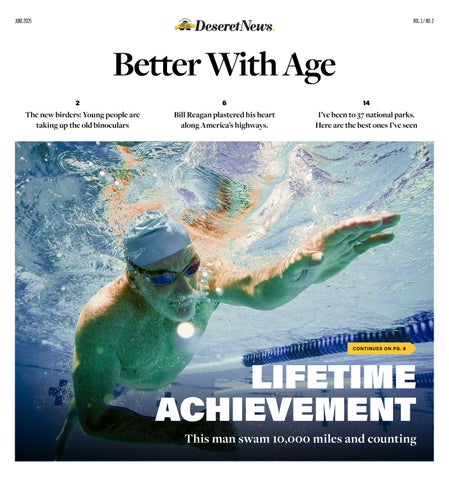
CONTINUES ON PG. 8
LIFETIME ACHIEVEMENT This man swam 10,000 miles and counting
2 BETTER WITH AGE | JUNE 2025
DESERET MAGAZINE
The new birders Young people are taking up the old binoculars By Natalia Galicza Deseret Magazine
The cottonwood trees around me seemed to shimmy with life. Maybe it was just a late spring breeze nudging its way through the overstory, but there was also a chance that some winged tenant was fidgeting in its nest on a nearby branch and causing the stir. I wasn’t sure. Still, I was curious enough to pick up a borrowed set of binoculars, fumble for the focus wheel, and take a closer look. Gazing skyward, I made out a faint feathered outline. What a thrill! As much as I enjoyed the idea of exploring the outdoors and encountering wildlife, I hadn’t made much effort to do so before that Saturday morning in May, when I found my way to the shores of Jordanelle Reservoir east of Salt Lake City. I’d recently moved here from the East Coast, and wanted to familiarize myself with the people, places and experiences my new home had to offer. So, with no prior avian knowledge, I joined a free birdwatching event I saw advertised on social media. That’s how I learned that birding (or birdwatching, as it was once called) has become America’s sweetheart of pastimes. Sadly, my first find didn’t exactly hold up. Upon closer examination, the subject looked like an ordinary barn swallow — about the most anticlimactic species an aspiring birder could possibly spot. These tiny, black and blue creatures are the most common type of swallow, spotted from my perch near the Uinta Mountains of northeastern Utah to the farthest recesses of the globe — even, on occasion, Antarctica. But I didn’t know that at the time. I didn’t know much of anything about birds. So I celebrated the discovery like any other. Because after all, it was a discovery, at least for me. Birding is the mere act of looking at birds, whether through pricey binoculars or an eager set of eyes. It’s long been associated with older hobbyists — the stereotypical retiree in a khaki vest, with plenty of free time and disposable income. But each of the eight strangers who showed up to stare at birds that morning were in their 20s and 30s, including myself. We called out to each other when we spotted the circling silhouette of a redtailed hawk and logged our sightings in physical or digital field diaries. We oohed and aahed at the majestic hover of an osprey as it stalked its meal over the Provo River, whipping out our iPhones to take photos. Technology has made it easier than ever to get into birding, which has attracted millennials and zoomers alike. Hashtags like #birdwatching and #birding have garnered hundreds of thousands of posts and billions of views on TikTok. The rate of young adults who watch any kind of wildlife has tripled within the last decade, according to the U.S. Fish and Wildlife Service. Now about a third of all Americans over 16 watch birds. “They’re accessible and interesting to us intellectually,” says John Fitzpatrick, director emeritus of the Cornell Lab of Ornithology. “We love to count them. We love to keep lists about them. Since the earliest dawn of human civilization, they’ve been very important for us spiritually and emotionally as well.” Edmund Selous crouched in hiding and stared at the object in front of him. The British ornithologist knew, to some degree, that the brown blob that had captured his interest was a pair of incubating birds — yet it took him more than an hour to distinguish them from a lump of tree bark. He could have killed the specimens to study them at closer range, as was customary for bird enthusiasts before the 20th century. Instead, on that fateful night in 1898, he chose to watch under the cover of night.
Carlos Arrojo for the Deseret News
The camouflaged creatures were European nightjars, nocturnal birds with mottled plumage, large dark eyes and wide, almost reptilian mouths. Selous excitedly jotted notes in his field journal, describing their behaviors in detail. He found that the act of watching birds felt more rewarding than hunting them, and offered more opportunities for intelligent analysis. He made that case later in his book “Bird Watching,” published in 1901. “The pleasure that belongs to observation and inference is, really, far greater than that which attends any kind of skill or dexterity,” he wrote, “even when death and pain add their zest to the latter.” Selous’ approach changed how scientists approached birdwatching, and shaped how the general public chose to interact with birds when binoculars became widely available in the 20th century. But the instinct to bear witness to these animals has existed for much longer. Red ochre paintings at Tajo de Las Figuras, a cave in southern Spain, depict hundreds of birds dating to the neolithic period. In ancient Egypt, the ibis was the sacred bird of Thoth, god of wisdom, and 10,000 birds were sacrificed
and mummified each year beginning around 600 B.C. with the intention of procuring health, long life or romance. As of 2022, 96 million Americans were birding — more than the populations of France, Germany, the United Kingdom, Spain or Canada. In 2022, they spent $107.6 billion on equipment and birdwatching trips, according to the U.S. Fish and Wildlife Service. There are at least 150 chapters of Audubon clubs on college campuses, while groups like Feminist Bird Club and Flock Together focus on supporting people from marginalized communities who want to get outdoors. “You could make a pretty strong argument that birding is the most accessible form of outdoor recreation,” says Alli Smith, project coordinator at the Cornell Lab of Ornithology, “because birds are everywhere.”
Covid and the revival
Two years after my first attempt at birding, I still don’t own my own binoculars or a single field guide, but I do borrow some lessons from the experience. I’ve learned to identify black-billed
BETTER WITH AGE | JUNE 2025 magpies by the squawk they make when looking for trouble in my backyard. I’ve learned to spot American robins from afar; they’re friendly and curious, and even seem to draw closer when I call out to them. These are common birds I see around my home, yet they make me feel like I’m in on some big cosmic secret of the natural world — or, at the very least, like I know my neighbors. Outdoor recreation often presents large barriers to entry. Mountain biking requires daunting levels of technical skill; skiing calls for years of practice and decent health insurance; and don’t get me started on horseback riding. Sports like these can be costly and physically demanding, specific to certain regions and reliant on specialized gear. Birds, on the other hand, exist everywhere, from rural towns to major cities, year-round and all day. There are an estimated 50 billion wild birds worldwide — about six for every human being. And the advent of technology has made it easier than ever to find them. “BirdNote Daily,” a two-minute radio show that broadcasts bird sounds and stories, is one of the country’s most popular programs. It reaches more than 8 million people each week via hundreds of stations and the sponsoring organization’s website, birdnote.org, helping birders learn more about different species and familiarize themselves with calls. Apps like Merlin Bird ID let users record sounds, snap photos or log traits to identify birds in real time. This app boasts 25 million downloads in its 11 years, but most took place within the last four years. One catalyst was the Covid-19 lockdown, which led bored adults and children to find ways to spend time outdoors, where they could interact with less risk of contagion. An early example was Pokémon Go, a phone-based game that overlaid a virtual hunt for digital creatures onto real landscapes, which drew groups — and sometimes mobs — of players to parks and plazas where exotic targets tended to appear. Maybe that search for fantasy beings in their towns and cities inspired young people to seek out real-life animals in the state of nature.
Gen Z generally wants to spend more time outdoors, experiences higher rates of anxiety about the effects of climate change, and reports concern for the environment and animals. Birding not only mirrors those concerns and interests, it helps alleviate any associated stress. “It’s really important, because it gives you a firsthand knowledge of what’s going on in the world,” says Geoffrey Hill, professor of ornithology and curator of birds at Auburn University’s Hill Lab. “If you get out a lot, you have a pretty good impression of the world. You see, is it ruined? Is it untouched? It’s neither ruined nor untouched, it’s somewhere in between.” Perhaps they’re also finding that birding helps them to feel better. Younger Americans’ struggles with mental health are well documented. One study published in Nature in 2022 found that participants who saw or heard birds had improved mental well-being that lingered for hours. Another Nature study that year found that listening to short audio clips of birdsong decreased feelings of anxiety, depression and paranoia. And last year, the Journal of Environmental Psychology published a study where university-aged participants found that nature walks with birdwatching were more effective at reducing stress than nature walks without birds. “When we take the time to slow down and notice what’s around us, we become more mindful,” says Holly Merker, co-author of “Ornitherapy: For Your Mind, Body, and Soul,” a book that advocates birding as a path to wellness. “The stress in our lives starts to fade away. It starts to blur in the background.”
Appreciating what surrounds us
Every afternoon, when the traffic quiets down a bit, I go sit on my porch for a breath of fresh air. That’s usually when the trees in my front yard fill with swallows. They zip by in packs, bouncing from tree to tree then shrub to shrub, ripping off little black chokeberries before buzzing off to some other undisclosed location.
3
Now that I recognize their general shape, I can’t help but think back to the swallow I saw at Jordanelle State Park. The tiny body backed by a forked tail. I’d seen this bird probably hundreds of times before in my life, but I’d never had a name for it. I guess I’d never really seen it at all. It’s easy to take birds for granted. I’ve spent the majority of my life glancing past swallows, and every one of their avian relatives. Birding broke through that blur for me. But, more importantly, it shattered my assumption that birds are a given — that there will always be plenty around. Three billion birds have disappeared from the United States and Canada since 1970 — onethird of their population. Imagine losing 2.7 billion people in one lifetime. Many birds are indicator species, which means that studying birds can tip off humans to environmental issues — the canary in the coal mine, writ large. Birds are essential to our ecosystems. They scatter seeds, build habitat, contribute to pollination, perform pest and weed control, and even remove dead carcasses from the landscape. No wonder one study found that birders are four or five times more likely to engage in conservation efforts. “It doesn’t take much experience out there in the wild to realize that the nature of the environment matters a ton as to how many and which kinds of birds you see. So that starts to get us thinking about the environment as a place that’s pretty important for these things,” Fitzpatrick says. “This connection between birding and environmental protection is enormously important.” That certainly appeals to my generation. The new birders who seem to be turning this age-old hobby on its head are also the first Americans who can’t take the future of birds, nature or the rest of their environment for granted. Now, when I see another swallow or otherwise ordinary bird, I make sure to hold my gaze a bit longer. I take in the sight for as long as it’ll last. This story appears in the May 2025 issue of Deseret Magazine. Learn more about how to subscribe.
LUMBER & HOME IMPROVEMENT
Seniors Save
10%*
Scan here for our current sales flyer
Every Tuesday
*Up to $500 purchase ($50 off). May not be combined with any other offer. See store for complete details.
4 BETTER WITH AGE | JUNE 2025
LIFEST YLE
Silver linings: What is generativity and how does it make life meaningful? Instead of seeing aging as merely dodging physical and mental ailments or having enough money and time for hobbies or travel, some are flipping the narrative and focusing on ‘passing the baton’ By Norman Hill Deseret News
My wife likes to say there are three critical ingredients in everyone’s life: • Something to do • Someone to love • Something to look forward to Meaningful activities are “a restorer of thy life, and a nourisher of thine old age,” the Bible notes in Ruth 4:15. Without them, we literally have nothing to live for. In his 80s, “Uncle Leo” Hurst continued to build and repair cabins with others at Camp Lamondi near Ogden, Utah, despite suffering from late stage prostate cancer. Asked by friends why he does this each day, he replies that without something to do he would have died long ago. “I’ve got things I want to do before I pass to the other side. I have a long list of goals! I can’t waste my time sitting in a rocker by the fireplace,” he said. Despite sometimes needing help, he showed up for “work” whenever there was work to be done. The British writer Alfred, Lord Tennyson noted in his oft-cited poem, “Ulysses,” that when we get older, we may not have the physical strength or stamina we once had; but we may, in fact, have an even stronger will that we can leverage for new ambitions. Old age hath yet his honor and his toil; Death closes all: but something ere the end, Some work of noble note, may yet be done, Not unbecoming men that strove with gods. Tho’ much is taken, much abides; and tho’ We are not now that strength which in old days Moved earth and heaven, that which we are, we are; One equal temper of heroic hearts, Made weak by time and fate, but strong in will To strive, to seek, to find, and not to yield. This focus on both continually learning and giving back is sometimes called generativity and is increasingly acknowledged as the key to growing older successfully. Instead of seeing aging as merely dodging physical and mental ailments or having enough money and time for hobbies or travel, it flips the narrative by looking at what makes life meaningful. It’s about considering “Have I done any good in the world today?” and not merely getting the most from personal entertainment.
Adobe.com
Research suggests that children who discuss everyday events and family history with parents and grandparents often have higher self-esteem and stronger self-concepts than their peers.
Like runners in a relay race, it’s about “passing the baton” successfully to family members as well as friends. A leader of The Church of Jesus Christ of Latter-day Saints spoke about this in general conference some years ago. When a friend commented that it must be satisfying to see how her children had all become contributing adults, the leader said: “No, not yet. I’m not finished until I see how my grandchildren turn out!” Grandparents can have a unique role in the lives of their adult children and grandchildren if they are willing to remain flexible about boundaries and experiment with various activities. Grandma Camps, family rituals, holiday celebrations and gospel participation are all opportunities to connect and collaborate as major events occur. Life has many transitions that happen to everyone at various times: children to adolescents, teenagers to young adults, newlyweds to mature adults. Having traveled previous paths already, older adults can help younger family members navigate the future if both are open
to each other’s point of view. If growing older does anything, it gives us perspective. The kind of perspective that allows us to become: • Mentors who can help with problems • Listeners without a stake in daily outcomes • Windows into childhood memories • Perpetuators of family and community traditions • Observers with valuable life lessons • Role models for life transitions R.J. Sprague, a former professor of sociology and economics at the University of Massachusetts, famously wrote: “Every period of human life is wonderful; the irresponsible age of childhood, the thrilling years of adolescence and courtship, the productive, struggling, burden-bearing era of parenthood; but the most wonderful time of life comes when the father and mother become close friends of their grown-up, successful sons and daughters, and can begin to enjoy their children’s children.” We enjoy our children’s children when sharing our common legacy by telling family
stories in compelling ways. As the Psalmist noted: “Now also when I am old and grayheaded, O God, forsake me not: until I have shewed my strength unto this generation; and thy power to every one that is to come” (Psalms 71:18). Research shows that both younger children and teenagers alike learn how to maneuver through difficult circumstances and life transitions by hearing how family members handled similar challenges. In the preteen years, in particular, children who discuss everyday events and family history with parents and grandparents often have higher self-esteem and stronger self-concepts than their peers. And teens who have learned about their family’s history have more robust identities, better coping skills, and lower rates of depression and anxiety. Family storytelling can help children grow into teenagers who feel connected to the important people in their life. No one does that better than those of us with graying or receding hair who “know a thing or two because we’ve seen a thing or two.”
BETTER WITH AGE | JUNE 2025
Expect the Best for Your Loved One Crescent Senior Living has received recognition as Best Memory Care community by U.S. News and World Report. All recognition is based on the reviews of families and residents.
“Crescent has a great staff who clearly understands the challenges of people with memory loss. They work very closely with residents and their families to be a leader in the area of memory care.” — online review
SCHEDULE A TOUR (801) 960 - 3342 11052 S Grapevine Cove | Sandy, UT 84070 crescentseniorliving.com A MERIDIAN SENIOR LIVING COMMUNITY
The Area’s Premier Community for Assisted Living and Memory Care
5
6 BETTER WITH AGE | JUNE 2025
ENTERTAINMENT
Bill Reagan plastered his heart along America’s highways. He didn’t realize everyone would notice And their love story deserves more than a billboard; it needs a major motion picture By Emma Pitts Deseret News
In 1965, William “Bill” Reagan was a man hopelessly in love. Though Catholic, he ended up at a Jewish party before Hanukkah because his friend needed a ride. That’s when he saw Julia. “She was the most attractive woman in the room,” he said. “So I walked over and asked her to dance, and she accepted.” They danced several times that night. Three weeks and five dates later, she was Mrs. Julia Reagan. Before she was the cultural phenomenon of 2024/25 with photos and videos of billboards across the nation dedicated to her flooding social media — the lady who popped up on billboards along America’s highway system — she was someone’s soulmate. After talking with Bill Reagan, now 80 years old, at the headquarters of his billboard company, Reagan Outdoor Advertising, in North Salt Lake, one thing became unmistakably clear: Julia was his muse, and the open sky above the country’s highways, his canvas. “We were soulmates,” he told the Deseret News, and with her now gone, his billboards featuring her help ease what he’s lost. “It’s really helped me with my grieving, seeing her on our billboards,“ he said tearfully. “Whether I’m here or Indianapolis or Chattanooga or Austin, Texas, she’ll surprise me.” Their love story sounded more like a Nicholas Sparks novel — a whirlwind romance with different religious, political and economic backgrounds standing in their way. But despite it all, they always fought for each other. Almost incomprehensible by the standards of dating today.
A last-minute elopement
On their first proper date, Bill took Julia to the Weber State snowball formal. When he called and invited her, she “gave me a little bit of a hard time,” he said. What he didn’t know was that she had a prospective fiancé, a Harvard Medical School graduate, whom her parents were pushing her to be with. She said yes to Bill anyway. After the dance ended at around midnight, “I took her down and showed her my motorcycle,” he said. “We then got on the motorcycle, and in my tux and my top hat and her formal, we rode down Washington Boulevard in Ogden, Utah.” On their fifth date, after going out and eating at the Sky Room of the Hotel Utah, they found themselves at the bus station to get a midnight snack. He noted that it was the only place open with food at that time of night. While they were there, Bill said announcements were being called for buses leaving to Wendover, Reno and then San Francisco. “And as a tease, Julia said, ‘Let’s go to San Francisco.’” “And I said, ‘Well, if we do that, we better stop in Reno and get married.’” “And so she said, ‘OK,’” Bill said. “I mean, this is truly how it happened. It was crazy. It was almost like a dare.” “I got the car and got driving, and I said, ‘If I get past the airport, I’m not stopping.’ She said, ‘That’s fine.’” They drove seven hours through the night to Reno, Nevada, taking turns for the other to sleep. When Bill woke up while
Kristin Murphy, Deseret News
William "Bill" Reagan poses for a portrait with a model of a billboard honoring his late wife, Julia Reagan, at Reagan Outdoor Advertising in Salt Lake City on Thursday, May 29, 2025. He finds comfort in seeing any of the 300 billboards on display honoring Julia.
Julia was taking her turn driving, he said he started wondering, “What did I get myself into here?” But then, “I just remember looking at her, and she looked so beautiful driving my 1964 Chevelle Super Sport convertible.” He was hooked. The next morning, they were married at the courthouse then called her parents to tell them what they’d just done. Her folks were so upset that the newlyweds thought about making a run for San Francisco, but ultimately decided against it. “I don’t think we ever could have made a protracted courtship because of the differences of religion, differences of social structure,” he said. They agreed to have a religious ceremony when they returned. “So we have two wedding dates, the 26th and 29th of December of 1965. Her mother always recognized the second date,” he said, laughing.
A life well lived
The genesis of their union was only a preview of the exciting life they would build together. They both kept each other on their toes. For her 30th birthday, he surprised her with a giant surprise party. She returned the favor twice, even faking an entire wedding to trick him into showing up at his own birthday celebration. They had four children together, giving them 10 grandchil-
dren. “She dedicated her life to me above all, and then to the children, and then to humanity,” Bill said with tears filling his eyes. She was heavily involved in community nonprofits. “She was liberal left, and of course, I was right (politically),” which at times caused tense discussions, he said, but they always put their love first. Julia used to joke that “I’m fortunate because I have this right-wing husband, but he allows me to donate where I want,” Bill said. Despite it all, there was one party they had in common: the billboard party. “Whether someone was a Democrat, Republican, independent, or whatever, if they liked billboards, they were friends of ours.” But, “We were complete opposites. She was very introverted, quiet, and I was the extrovert,” he said. When asked how she would have felt toward the billboards, he said he didn’t know. “She would have liked the boards, because we would do that for our birthdays and things like that,” he noted, but the length and attention they’ve been given, she probably wouldn’t have loved, he joked. “She’d have to be dead to tolerate this because she was so private,” he laughed, but “that’s my choice. This is part of my way of grieving her.” “It’s going to be hard on me when the boards go down, really. ... Because I just get a warm and positive feeling when I drive along, and all of a sudden I see one of her boards. So it’s going to be hard.”
BETTER WITH AGE | JUNE 2025
7
It’s almost been a year since Julia died on June 12, 2024, and Bill said the billboards are going to begin coming down soon. Starting on June 15, 25% of the 300 billboards will come down. Then each week, 25% more will come down until they are all gone. But don’t worry, Julia won’t be gone long. They will all be put back up every year around May 15, right before Memorial Day, and run through mid-June. For Bill, it’s a chance to say goodbye. The night that she died, he kissed her good night and went to sleep at their home about five minutes away. “I walked into the room just as they pronounced her dead.” The whole reason for the billboards, Bill said, “is I didn’t get a chance to say goodbye.” In February, Bill Reagan filed a medical malpractice lawsuit against the University of Utah Hospital, alleging that she was not properly treated, causing her “catastrophic sequelae and consequences, including but not limited to severe prolonged pain, fear, suffering, and death,” the lawsuit, obtained by Deseret News, said. Because the lawsuit is ongoing, the hospital has previously said it will not comment on the proceeding, but did say that “As always, the care of our patients is our priority.”
Julia the phenomenon
What started as a man’s last love letter to his beloved has become a national-scale sensation. Bill had no idea. After scrolling TikTok for a moment, Bill saw the Halloween costumes ... The tattoos ... and the playful envy ... “I’m just so surprised, because it’s like unintended consequences,” he said, laughing. “I mean, they’re positive. Now, I have seen some people making fun of them and making some negative comments too, but that’s life, and everybody has
A billboard in memory of Julia Reagan is pictured in Salt Lake City on Tuesday, May 20, 2025.
their opinion one way or the other.” However, he believes that most people have positive feelings toward the billboards. “Like, you know, ‘I’d like to have that happen to me when I die,’ type of thing.” He did share a video someone sent him of a girl who wrote a song about the billboards of his wife.
Kristin Murphy, Deseret News
“Julia Reagan, you are the queen of the I-15. ... Julia Reagan we never met, I’ll never forget to remember you,” the song goes. With the billboards returning every spring, it’s doubtful anyone in a state where Reagan billboards are located will forget Julia. And maybe that’s a good thing.
Old Trails. New Tales.
165 years of stories made along the Pony Express Trail. Explore the communities along The Loneliest Road in America, Nevada’s Highway 50.
LONELIESTROAD.US
8 BETTER WITH AGE | JUNE 2025
HEALTH
Lifetime achievement: This man swam 10,000 miles and counting A Utah hospital administrator found the pool a perfect place to sort through life’s problems By Dennis Romboy Deseret News
A swimming pool, or any body of water for that matter, might as well be Walden Pond to Joe Horton. Henry David Thoreau ranks as one of his favorite authors, “Walden” one of his favorite books. Thoreau spent two years living a simple life. He studied ants. He swam in the pond. Horton’s connection to the 19th century essayist and naturalist started in high school in California at a time when he felt embarrassed about being different because he was a member of The Church of Jesus Christ of Latter-day Saints. “If a man does not keep pace with his companions, perhaps it is because he hears a different drummer. Let him step to the music which he hears, however measured or far away,” Thoreau wrote. Horton loves that quote. It’s on display in his home. “What I got from Thoreau was permission to be different,” he said. On this warm May morning, Horton, who turns 71 in July, swims laps at the Sports Mall in Murray, though he might as well be at Walden Pond. He powers through the lane in a turquoise swim cap, goggles and light blue trunks, his white beard flashing to the surface when he turns his head to take a breath. The waterline is where all his deep thinking is done. Immersed in aqueous solitude, the retired hospital administrator ponders and prays about his most vexing problems stroke after stroke, lap after lap. He spends the first 15 minutes of his typical hour-long swims giving thanks. He thinks about his wife, Pat, two sons and six grandchildren. He recites to himself things he likes to keep in his head, not the least of which is the Crispin Day speech, one of the most famous monologues from Shakespeare’s “Henry V.” “I find that my problem-solving skills are better after about 30 minutes of swimming. My mind would clear. I was just sharper. So I solved a lot of problems just swimming in the pool,” he said, a congenial tone to his voice. “But also it’s like just sort of meditating. It lends itself to that because you can’t talk to anybody. The sounds are kind of meditative. You just hear the sound of the water as you move through it and you can’t see very far, so it lends itself to meditating and prayer.”
Joe Horton, of Murray, poses for a portrait in the pool at the Sports Mall in Salt Lake City on Wednesday, May 28, 2025.
10,000 miles and counting
Previously a runner, Horton started swimming after he tore his meniscus in a fall during a hike in Yosemite. That was in 1982. He has swum a mile three or four times a week ever since. About a year ago, a close friend who had just run his 10,000th mile inspired him to calculate all his miles in the pool. He realized he was about 300 short of 10,000. He ramped up to six or seven times a week, hitting the milestone in late April. And he has no plans to hang up his goggles. Swimming 10,000 miles in a lifetime is a significant physical and mental accomplishment. It’s about the equivalent of swimming across the Atlantic Ocean from New York City to the coast of Africa and back. It’s roughly 9.2 million strokes. Swimming that distance over four decades is a testa-
ment to perseverance, dedication and passion for the sport. And for Horton, a necessity. “He swims everywhere he goes. I think it helps him clear his head,” said his wife, former Utah state Sen. Pat Jones, whom he married in 2023 and who now goes by Jones Horton. Her husband, Dan Jones, died in 2018. Jones Horton posted Horton’s achievement on Facebook with a photo of him holding a handwritten sign, reading, “10,000 swim miles, 4/27/2025, Congratulations, Joe!!”
A new beginning
The couple met serendipitously through University of Michigan professor Cathy Kilaly who was in Salt Lake City for a hospital administration conference in June 2022.
Isaac Hale, Deseret News
Kilaly happened to sit next to Jones Horton in a cafe at Little America and they started talking. When Jones Horton mentioned she was on the board at Intermountain Health, the professor said she knew someone at Intermountain: Joe Horton. As it happened, Horton, who teaches a yearly leadership class at Michigan, met Kilaly for dinner while she was in town and she told him she had shared his contact information with Jones Horton and hoped it was OK. It was more than OK. Turns out, Horton lived in her legislative district and had voted for her all five times she won seats in the Utah House and Utah Senate. “I had no idea how important that would turn out to be later in my life,” he said. Neither expected to ever marry again but a romance blossomed. “The truth of my life is that my marriage to Pat is a miracle,” Hor-
BETTER WITH AGE | JUNE 2025 ton said. “That is something I thought would never happen.” Last October, the two traveled to Walden Pond in Concord, Massachusetts to pay homage to Thoreau. They both swam in the crystal clear water. “I love getting into water at places that matter to me so Walden Pond is one of those, and it was wonderful to do that with Pat,” Horton said. He also swims at Laguna Beach beyond the breakers where the water is calm and clean. “I think it keeps him young and vibrant, which is what I need,” Jones Horton said. Motivation to swim is never a problem. “I’ve just done it for a lot of years. It’s become part of my lifestyle. I’ve become very committed to it. If I don’t do it, I don’t feel as good,” Horton said.
The ants go marching on
An English major, naturally, at the University of Utah, Horton wasn’t sure what to do with his life after graduation. After a week in law school, he decided that wasn’t for him. He took what today might be called a gap year to figure it out. He discovered hospital administration while working at LDS Hospital in the meantime. He went on to get a master’s degree in the field at the University of Minnesota. His first administration job was at Cottonwood Hospital in Murray. His true calling, though, didn’t come until five years later. And that starts with a story about ants. Horton didn’t study ants like Thoreau, but
he protected them. On the playground in elementary school, he stood guard on an ant hill that a couple of his third-grade classmates were planning to invade to see how many ants they could kill. After a little jostling, the boys gave up. He even got the most feared teacher in school to make a rule against killing ants for no reason. “I was the weird kid that actually thought that was wrong, I didn’t know what to call it then but Albert Schweitzer calls it reverence for life. I had that as a kid,” he said. Horton shares that childhood memory as we sit poolside after his swim. He relates that Ann told him he’s supposed to be at a children’s hospital because he has strong feelings about protecting the vulnerable, and there’s nobody more vulnerable than babies and sick or injured children. That, she told him, fits who you are. “When she said that it was like a lightning bolt just went through my head. I knew she was right. I’d never had that experience before or since but that was just like a moment of clarity,” he said. That led him to Primary Children’s Hospital where he worked for 21 years, the last 14 as CEO. He finished his hospital administration career as Intermountain Health’s senior vice president over its 23 hospitals at the time. He retired in 2012 but started teaching ethics and leadership courses in the hospital administration program at the University of Utah. And he never stopped swimming.
“What I found was that running hospitals is a pretty intense job. I needed something to manage the stress and kind of wash out the tension and it needed to be after work so I could go home and be a good human being to my family. Swimming did that better than anything else,” Horton said.
Never give up
Joe and Ann Horton were married 42 years and raised two sons. She was diagnosed with secondary progressive multiple sclerosis just before they were sealed in the Salt Lake Temple. She used a wheelchair the last 30 years before she died in 2021. Swimming helped him get through what also was an intense part of his life. “There’s so many times where I felt like I hit the wall and the swimming would kind of just bring me back. It’s going to be OK. You can do it. And the Crispin Day speech was part of that, like don’t give up,” he said. Horton memorized the speech 30 years ago line by line as he swam. He quotes it as we sit by the pool. “If we are mark’d to die, we are enow, To do our country loss; and if to live, The fewer men, the greater share of honour . . . ” In “Henry V,” a young King Henry addresses his badly outnumbered English troops to inspire and motivate them against the French army in the Battle of Agincourt. He emphasizes honor, camaraderie and valor. He tells his soldiers that those who fight with him on St. Crispin’s Day will be forever
bonded as “we happy few, we band of brothers.” He tells them that those who survive will be remembered and honored. In the end, the English suffered few casualties, while the French lost an estimated 10,000 men. There were times when Horton felt outnumbered and couldn’t see his way out of a problem, and the stakes were always high. Instead of quitting, he recited the speech. And there was always the water. “I really think that speech,” he said, “and with it the swimming . . . was sort of the time where I could take a breath and take heart, where I could relax, in an otherwise intense world.”
“He swims everywhere he goes. I think it helps him clear his head. ”
Summertime Means Sunshine and Top Investment Rates! DON’T MISS OUT ON OUR
EXCLUSIVE
RATES Interest paid quarterly
1 year • 8.00% 3 years • 8.50% 5 years • 9.00%
9
$10,000 minimum
$800,000 maximum
* Rates subject to change. Please call to verify current rates. Call Ashley or visit us online today! (By appointment only) 801-566-5559 • WasatchCredit.com 7324 Union Park Ave., Suite #100, Midvale 84047 Mon-Thur 9:30-3:00
For Utah residents only.
10 BETTER WITH AGE | JUNE 2025
FAITH
What would happen if all American adults connected personally with their family heritage? It’s hard not to wonder what an extra dose of the curiosity, humility, and gratitude inherent in family history could mean for escalating anger and hardness all around us
Attendees walk around during the final day of RootsTech 2025, held at the Salt Palace Convention Center in Salt Lake City, Utah, from March 6-8, 2025. By Jacob Hess Deseret News
In all the reporting and other writing I’ve done about political peacemaking, I’ve never heard anyone bring up family history. This just isn’t something people typically think of as a way to reduce polarization and achieve more peace across differences. But maybe they should? In the wake of one of the most bitter elections in American history, it was hard to shake this sense at this week’s RootsTech conference. Underlying this seemingly staid convening presumably about “connecting with the past” was something that felt abundantly relevant to the present — perhaps even revealing a radically fresh solution to the escalating tribal-
ization and polarization around us. While interviewing people about a report exploring this possibility, I spoke with a co-founder and lead genealogist with the Holocaust Reunion Project, Jennifer Mendelsohn, who told me about her immigrant grandfather who “spoke with a thick accent and ate weird foods.” Although he was “a very proud American,” she said, he clearly “was not American born.” Yet the sisters of her grandmother, all of whom were born in New York City around the turn of the century, “did not approve” of her interest in marrying this man. “They looked down on him and thought he was lesser because, you know, they were born here and he was born there.” Over a century later, when Mendelsohn decided to dig deeper into her grandparents’ story, she was surprised to dis-
Isaac Hale, Deseret News
cover these sisters’ parents had been in the country for less than five years when they were born. “It’s a long American tradition that, once people get assimilated, they tend to look down on the next group of people who are coming.” “If you can breed that sort of contempt after five years in the country,” she told me, “what does that look like when your family’s been here for 50 years or 100 years?” “So many Americans have kind of lost touch with their immigrant past,” Mendelsohn said — little realizing that “just a few generations before, they were in the same position as some of the impoverished Central and South Americans who are trying to get here now.” She proposes: “Every American should investigate their family history.” It’s got me wondering, what if that actually happened?
BETTER WITH AGE | JUNE 2025
“There’s this calmness that kind of comes over. It brings this stillness that I know who I am.” “There’s this amazing thing that occurs where we’re able to find ways that you and I are connected,” said Steve Rockwood, CEO of FamilySearch at the RootsTech conference this week. “Where we find out how we’re connected, we then treat each other differently.” Imagine a public health experiment where everyone in America — including an estimated 262 million adults — created a FamilySearch or Ancestry or MyHeritage account, sent off a genetic ancestry test, or looked up a family journal from an ancestor. What effect could that have on the country as a whole? A micro-version of this experiment took place when 67 people randomly selected from various countries all received the same DNA test, part of a viral advertisement campaign several years ago. What was most striking was how many participants who acknowledged some dislike for certain na-
tionalities were shocked to discover some of their ancestors hailed from that very place. For instance, a Kurdish woman with hard feelings towards Turkey found out some of her ancestors were from that region of the world. A British man discovered ancestors in the very country of Germany he felt some prejudice against. And an Icelandic man who saw himself as somehow superior was humbled to see a mix of several European nationalities. Humility. Empathy. Compassion. In stark contrast to nationalistic chest-beating, these are the qualities arising from hearts drawn out to forefathers and foremothers. Abhilash Pillai, one of the researchers at SBL, a major leader in genealogy for India SBL told Deseret News “what we are actually enjoying now has been a result of the struggles that our ancestors have faced at a period of time.” In his online RootsTech keynote, Ndaba Mandela similarly noted that his grandfather, the legendary South African president, Nelson Mandela, had spoken about “all the mountains that you have to climb in order for you to achieve your goals.” The writer then added, “what about the mountains that your ancestors had to climb in order for you to get to where you are today?” They deserve our acknowledgement, he said, because “without those ancestors who have climbed those great hills and great mountains to get you to where you are, where would you be today?” Paul Nauta, a senior communications manager at Rootstech, told me about taking his children back to Italy — to personally visit the land where his family worked the land for hundreds of years — before ultimately coming to America, after deciding they couldn’t make ends meet. “You can’t describe what it does to go back where their ancestors are from,” he said. “It’s changed them.” Far beyond the impact of simply hearing the story, descendants were deeply moved by walking the olive orchards and seeing a little home their family owned near the outer wall of the town.
“There’s this calmness that kind of comes over. It brings this stillness that I know who I am.” “You stand on shoulders, right?” Nauta reflected. “You stand on shoulders of those that have come before you ... you are who you are, because someone else has paid a price for you to be here.” When discoveries like immigration roots start happening “the world becomes a lot smaller place,” said Ann Harrison, Director of Global Engagement at RootsTech. “That breaks down those walls, and really helps us see each other as one global family.” Professional genealogist Adina Newman, another co-founder with the Holocaust Reunion, described genetic research as pressing us to become more welcoming of multiculturalism. “I have relatives all over the world, and I think DNA kind of breaks down those barriers to see, ‘oh, I have cousins in Europe still, yeah, I have somebody who went to Australia’ …. it really brings people together.” At the RootsTech conference itself, a larger scale social experiment demonstrates much the same point. Within the RootsTech app is a feature called “Relatives at Rootstech,” which looks across the millions of attendees and figures out relationships. Major genealogical sites have similar features. “That is really binding to know,” said conference participant Nancy Goddard, “it just makes you more loving, because you really are related by blood.” Her husband, former Utah State professor Wally Goddard added, “We belong to each other.” After mentioning how her husband learned he has literally tens of thousands of relatives participating in the RootsTech conference, Sandy Andrus, whose DecipherInk app helps people around the world interpret genealogical documents in various languages, told me, “If you know that you’re related to 42,000 people, how can you be mad at anybody?”
welcome
“We discovered that everyone we met at Summit was genuinely warm and caring.” Open House and Tour
explore more
— Gary H.
July 10–12 • 10:00 AM to 12:00 PM Get a feel for our friendly community firsthand. Take a tour and meet the team and residents who make each day here extraordinary. More than an option, Summit Senior Living is an opportunity to experience worry-free living with expert support, a family feel, and plenty to do.
Experience our community for yourself. Call 801-252-4236 to RSVP by July 8. Assisted Living • Memory Care
11
5524 West 6200 South • Salt Lake City, UT 84118 • SummitWatermark.com 2505-KSL-7329A
12 BETTER WITH AGE | JUNE 2025
COME ON UP BRING THE WHOLE FAMILY AUGUST 7-9 • Garden City, UT Craft Fair Golf Tournament Parade Kids Games Bingo Pie-Eating Contest Family Friendly Concerts Rodeo 5K Fun Run AND MORE!
800.448.2327 | bearlake.org
BETTER WITH AGE | JUNE 2025
801.243.4464 Blindmastersutah.com
35 YEARS COVERING UTAH’S WINDOWS
MEET OUR FRIENDLY, KNOWLEDGABLE, SALES TEAM!
13
20% OFF
All Graber Brand Products Expires 07/31/25
Trale Mathis
Dan Shepherd
Travis Thompson
CELL SHADES
SHUTTERS
ROLLERSHADES
50% OFF FREE Topdown/Bottom up
Many FREE Upgrades
20% OFF Motorization
*Also available 2.5 Faux Wood, Roman Shades, Verticals
Motorization on
Outdoor Patio/Deck Shades Expires 04/30/25
Outdoor shades will change your life!!
WE WILL BEAT ANYBODYS PRICE, EVEN THE BIG BOX STORES!
14 BETTER WITH AGE | JUNE 2025
LIFEST YLE
I’ve been to 37 national parks. Here are the best ones I’ve seen I started this journey in 2019 and, with a lot of hard work and planning, I’ve made it to 37 national parks so far By Sarah Gambles Deseret News
I’m six years into a quest to see all 63 national parks. When I first set off on this endeavor in 2019, I had only been to two national parks — Yellowstone and Zion. Now I’ve been to 37. My friend and I went to Bryce Canyon National Park for my birthday in April 2019, and I bought a national parks passport. The passport’s empty pages begging for stamps, along with the beauty of Bryce Canyon, sparked something in me. I had to see the rest of the national parks to see what made them so special too. And in six years, with a lot of planning and hard work, I’ve made it to 37 national parks so far.
Which national parks are best?
Here’s what I can tell you about 58% of the national parks. In my opinion, each of the parks fall into three tiers. The first tier is the “wow, that takes your breath away” tier. The second tier has pretty views or cool hikes, but doesn’t have that same “wow” factor. The third tier might still be worth visiting but might not be so spectacular, especially when compared to the first tier. Based on my own experience of them, here’s where I would put the 37 parks I’ve seen so far. First tier Zion Bryce Canyon Olympic Yellowstone Channel Islands Grand Teton Petrified Forest Carlsbad Caverns Grand Canyon Arches Rocky Mountain Badlands Acadia Dry Tortugas Mesa Verde Shenandoah Capitol Reef Second tier Big Bend Everglades Canyonlands Black Canyon of the Gunnison Saguaro Theodore Roosevelt Death Valley North Cascades Isle Royale Joshua Tree Pinnacles Indiana Dunes
Eliza Anderson, Deseret News
Third tier White Sands Guadalupe Mountains Cuyahoga Valley Great Sand Dunes Biscayne Great Basin Voyageurs Wind Cave
Which national parks have the best sights and activities?
And here are my fully biased, 100% subjective superlatives for the 37 national parks I’ve been to so far. Best scenic drive Bryce Canyon has my favorite scenic drive. You can see so much just from stopping at the stops along the way and getting out of the car. Honorable mentions: Shenandoah, Acadia, Petrified Forest Prettiest sunset White Sands National Park had the most memorable sunset for me. The way the light and colors dance along the rim of the white sands is truly breathtaking.
Honorable mention: Black Canyon of the Gunnison. When I was there, there was a crowd of about 25 people huddled at a lookout spot. It was cold and windy, but the entire group remained silent until the sun went down — even the kids in the group were quiet. It was a really special and reverent experience. Most worthwhile hikes Zion has the best hikes, in my opinion. The shuttle makes it easy to get around to different hikes and the hikes in Zion are varied in difficulty and experience, so each hike is worth the work. Honorable mention: Olympic. If you’re coming from Utah or Idaho like me, then hiking around Olympic feels like a breeze because it’s so close to sea level compared to the elevation levels in Utah. Best place to spend downtime There’s a lot to do in Big Bend — there are hot springs, hikes, kayaking and little shops. It’s also extremely vast, so getting around throughout the park takes some time.
CONTINUES ON PG. 20
BETTER WITH AGE | JUNE 2025
THIS IS TRYING SOMETHING NEW JULY 24, 2025 SALT LAKE CITY SIGN UP AT
RUN.DESERET.COM P R E S E N T E D B Y:
S P O N S O R E D B Y:
15
16 BETTER WITH AGE | JUNE 2025
Sarah Gambles, Deseret News
The sun sets over the hills in White Sands National Park on Feb. 22, 2021.
My advice on visiting more national parks
Sarah Gambles, Deseret News
Bryce Canyon National Park offers many scenic overlooks and stops along its scenic drive through the park. This photo was taken on Oct. 20, 2023.
Sarah Gambles, Deseret News
Hills at Zion National Park gleam red and gold off the trail of Angels Landing on May 31, 2016.
Coolest cave Carlsbad Caverns takes the cave on this one handily. I haven’t been to Mammoth Cave National Park in Kentucky yet, but I’ve seen all the other parks that have caves, and Carlsbad is definitely the coolest and most cavernous. Best place to see animals in the wild Yellowstone has been the best place to see animals in the wild for me. Seeing the bison in person is quite remarkable. And one day I hope to see a bear. Honorable mention: Everglades — seeing alligators up close is a little terrifying but also pretty cool.
Biggest surprises There have been a few that surprised me. Saguaro National Park surprised me because on the drive into the park, I thought, “Did I waste my day coming here?” It was nothing to write home about. But once I pulled into the park, I saw a sea of saguaros dotting my sight lines, and it took my breath away. Honorable mention: Badlands. Most overrated Pinnacles disappointed me because the pinnacles were so far away that it was hard to see them. I also missed a turn on the hike we did, so we ended up having to basically do the same hike twice. The caves were also really crowded when I was there, so it was hard to really appreciate the grandeur. Best place for the fall leaves Acadia was really stunning with the fall foliage on the backdrop to the water inlets. Honorable mention: Shenandoah Best island experience Three of the national parks I’ve visited are only accessible by ferry — they include Isle Royale, Dry Tortugas and Channel Islands. Channel Islands had the most to do on the island and was also an incredible ferry ride. Dolphins swim alongside the boat for a good portion of the trip, and we also saw a whale a couple times. Dry Tortugas is pretty stunning with the contrast of the red brick against the blue water and green foliage. To take the trip, you sign up for a historical tour, which is really interesting. Isle Royale doesn’t have a lot to do for a day trip, so we attended the ranger programs to learn about the moose and birds endemic to the area. The ride to and from the park is on Lake Superior, so it gets pretty chilly.
If you’re hoping to see more national parks, or if you want to see all 63, here’s my advice. • You have to be willing to drive. A LOT. Many of the parks are very remote, and sometimes far away from anything else. So get ready with the Taylor Swift playlist. • You have to be OK with either staying in some interesting, if not slightly sketchy, motels or camping. I’ve done both. And both can get interesting, to say the least. • Most parks are at their peak beauty during the golden hour, so try to get there early or be there for the sunset to see them at their best. • Decide early if and what you want to collect from each park. I buy a magnet from each park I visit, and it’s a fun reminder of the trip and experience I had. • If you do get a parks passport, don’t forget it when you go to the park. I have about 10 glued in stamps in mine because I’ve forgotten mine a lot.
The Junior Ranger program
Another thing I would recommend checking out is the Junior Ranger programs offered at the parks, especially if you’re traveling with kids. All you have to do is head to a visitor center during office hours and ask the clerk or ranger about their junior ranger program. You will get a packet of activities that you can do either in the visitor center or throughout the park. When you complete what’s required, you take it back to a ranger, and they have you repeat the junior ranger oath. Once completed and approved, you receive a junior ranger badge you can wear with pride and honor. “It‘s a special program because it builds the foundations of what we hope transforms into not only a love of nature, but, you know, civic duty, or even just as simple as pick up litter,” Matthew Fink, public affairs specialist for Zion National Park, said. “It’s building that foundation, those building blocks to what we hope is a lover of nature, a lover of our national parks, a lover of our country, and somebody who is responsible and loves nature and loves conservation,” he added. The message within the junior ranger program makes the parks even more special, with reminders like how to best take care of the park and to pick up trash if you see it. My 7-year-old niece and I did the book in Bryce Canyon once, and it was heartening to see her take her oath seriously. “Our parks are the best that nature has to offer in the country, and nature has the healing power for all of us,” Fink said.
BETTER WITH AGE | JUNE 2025
Get articles and advice about improving relationships, learning about interesting people and ideas that just might improve our world and giving you some inspiration to give back. Plus, discounts available only to 55+. Subscribe today at today at deseret.com/newsletters
17
18 BETTER WITH AGE | JUNE 2025
LIFEST YLE
These are the best times to get cheap flights Helpful tips and tricks to know before booking flights for your next trip By Bethany Twede Deseret News
Everyone has their own theory as to when the best time to book flights is. But booking a flight can feel complicated — so how can you be sure? To make things a little easier, here are the best tips and tricks to know before booking your next flight.
Domestic and international flights
Whether you’re wanting to relax on the beaches of Florida or explore the woods of Washington, Travel + Leisure states that when booking a domestic flight, you’ll want to look two weeks to two months in advance to find the lowest price. However, if this feels a little too last minute for you, NerdWallet reported that domestic flights that are booked between one to three months in advance are “25% less expensive than last-minute deals” on average. You want to avoid those last minute deals because you can risk not getting a seat. When booking an international flight, you don’t want to book too far in advance but also not too last-minute. Travel + Leisure and The Points Guy both say that it’s best to look three to five months ahead of the time. But be aware that, unlike domestic flights, the optimal window for international flights could differ depending on the route that you take, according to Travel + Leisure. For example, a flight from New York to Paris might be cheaper at a different time than a flight from Los Angeles to Paris.
Tips for traveling in the summer
Summer time is usually a big time for traveling for most families, but it’s also one of the more expensive times to travel. Here are two ways to find cheaper airfare during this time of year. Look as early as possible Travel + Leisure advises to start looking as early as possible. Then, you should book at least 90 days before your departure for any international flights and within 90 days of your departure for domestic flights. This will be where you can find the best prices for you and your family. Try traveling in August If prices are still too high for you, another option is to look at traveling in August. This is the cheapest month to fly and you
Isaac Hale, Deseret News
A passenger walks toward a security checkpoint at the Salt Lake City International Airport in Salt Lake City on Sunday, March 23, 2025.
can save up to 12% on domestic and up to 7% on international flights, according to USA Today.
But there is a better chance of getting a cheaper flight when you fly on a weekday, when it’s less busy, rather than a weekend.
Is there a best day of the week to book a flight?
Other helpful booking tips
One of the biggest myths when it comes to purchasing airfare is that there is a specific day of the week that always has the cheapest tickets. This is not exactly true. The Points Guy and Booking.com state that there is no “magical” day or time to find the best prices.
Here are some helpful tips when it comes to booking flights in 2025. Price alerts Tracking the prices of tickets is also very helpful for any kind of flight you are looking at and you’ll notice everyone telling you to let technology track them for you by using price alerts. This helps in the fact that you don’t have
to get on everyday and check what the prices are, instead you can receive an alert when prices have dropped. Google Flights is a great option for tracking prices and it also sometimes shows when the prices are expected to drop based on past history, according to NerdWallet. Be flexible Lastly, be flexible. This means being flexible about the days, times, locations and even layovers for your trip. Being flexible can make a big difference in helping you to find the best deals for your flight, according to Booking.com.
Bet ter Wit h A ge
BETTER WITH AGE | JUNE 2025
19
Bet ter Wit hh Wit AAge Bet ter Bet Wit ter h ge A ge Deals & Discounts Ages 55+
SERVING YOUR HEALTHC NEEDS AT EVERY STAGE OF L
USE CODE BESTLIFE50 FOR 50% OFF ANY ITEM Ages 55+
USE CODE BESTLIFE50 FOR 50% OFF ANY ITEM softminkyblankets.com
Bet ter Wit h A ge
EXPIRES 7/10/2025 softminkyblankets.com EXPIRES 7/10/2025
Ages 55+ Ages 55+
SERVING YOUR HEALTHCARE reverehealth.com/spec NEEDS AT EVERY STAGE OF LIFE. reverehealth.com/specialty
LUMBER & HOME IMPROVE LUMBER & HOME IMPROVEMENT
Ages 55+
SERVINGSUTHERLANDS YOUR HEALTHCARE DE BESTLIFE50 FOR 50% OFF ANY ITEM OF SALT LAKE CITY - 60 PLUS CLUB a regular room SERVING YOUR HEALTHCARE SERVING YOUR HEALTHCARE SUTHERLANDS OF SALT LAKE CIT ODE BESTLIFE50 USE CODE FOR BESTLIFE50 50% OFFFOR ANY50% ITEMOFFUpgrade ANY ITEM Upgrade a regular room AT EVERY STAGE OF LIFE. 10% discount every Tuesday up to $50. booking to a suite whenNEEDS NEEDS AT EVERY STAGE OFevery LIFE. STAGE OF LIFE. 10% discount Tuesday booking to a suite NEEDS when AT EVERY softminkyblankets.com using this promotion reverehealth.com/specialty softminkyblankets.com softminkyblankets.com sutherlands.com using this promotion reverehealth.com/specialty EXPIRES 7/10/2025 reverehealth.com/specialty sutherlands.com EXPIRES 7/10/2025EXPIRES 7/10/2025 Ages 55+
USE CODE BESTLIFE50 FOR 50% OFF ANY ITEM softminkyblankets.com EXPIRES 7/10/2025
55+ Discount
SERVING YOUR HEALTHCARE NEEDS AT EVERY STAGE OF LIFE.
Take advantage of 10% 55+ Discount off any heating or air conditioning repairs or of 10% Take advantage services. off any heating or air
20% off on all of our Blinds, Shutte Outdoor Patio/Deck LUMBER & HOME IMPROVEMENT Shades. LUMBER & HOME IMPROVEMENT LUMBER & HOME IMPROVEMENT
reverehealth.com/specialty
repairs or Call us conditioning today at 801.542.7100 Call us today at 801.243.4464 comfortzoneusa.com services. SUTHERLANDS OF SALT LAKE CITY - 60 PLUS CLUB
Upgrade a regular room blindmastersutah.com | Blindmasters@gmail.com SUTHERLANDS OF SALT LAKE CITY SUTHERLANDS OF SALT LAKE CITY - 60 PLUS CLUB SUTHERLANDS OF SALT LAKE CITY - 60 PLU Upgrade a regular Upgrade room a regular room 10% discount every Tuesday up to $50. booking55+ toDiscount a suite when Call us today at 801.542.7100 LUMBER & HOME IMPROVEMENT 10% discount every 10% Tuesday discount up every to $50. Tuesday up to booking topromotion a suite booking when to a suite when 60 PLUS Call CLUB us today at 801.243.4464$50. using this comfortzoneusa.com Take advantage of 10% any heating or air using this off promotion using this promotion sutherlands.com blindmastersutah.com 10% discount every Tuesday up to $50. | Blindmaste sutherlands.com sutherlands.com SUTHERLANDS OF SALT LAKE CITY - 60 PLUS CLUB Upgrade a regular room conditioning repairs or services. booking to a suite when
AARP is hard at work to Call us today at 801.542.7100 | comfortzoneusa.com using this promotion
empower everyone to choose how they live as they age.
10% discount every Tuesday up to $50. sutherlands.com
sutherlands.com
For Discounts free 20% off on AARP isand hard at work to 20% off on 20% 55+events Discount visit: aarp.org/ut all of our Take advantage of 10% empower everyone to choose all of our al Take advantage 10% advantage of 10% Blinds, Shutters, 20% off on 55+ how they live as they age. off any heatingTake orofDiscount air Blinds, Shutters, Blinds off any heating offorany air heating or air allOutdoor of our Take advantage of 10% conditioning repairs or Outdoor O conditioning repairs conditioning or or airrepairs or Blinds, Shutters, Patio/Deck off any heating For Discounts and free services. Patio/Deck Pat Outdoor services. services. conditioning repairs or Shades. events visit: aarp.org/ut Patio/Deck Shades. S services. Call us today at 801.542.7100 Call us today at 801.243.4464 Shades. Call us today at 801.542.7100 Call us today at 801.542.7100 comfortzoneusa.com Call us today at Call 801.243.4464 us today at 801.243.4464 Call everyone us today at to 801.542.7100 AARP is hard at work to empower choose how blindmastersutah.com | Blindmasters@gmail.com comfortzoneusa.com comfortzoneusa.com Call us today at 801.243.4464 blindmastersutah.com blindmastersutah.com | Blindmasters@gmail.com | Blindmasters@gmail. they live as theycomfortzoneusa.com age blindmastersutah.com | Blindmasters@gmail.com
55+ Discount 55+ Discount
For discounts and free events visit: aarp.org/ut
AARP is hardAARP at work to at work to is hard
20 BETTER WITH AGE | JUNE 2025
Will you
outlive money YOUR
Or will your money outlive you?
Outliving your money is the number one fear in retirement ... The Perennial Income Model™ is designed to: Maximize your retirement income Minimize your taxes Protect your income from the effects of inflation It’s all outlined in this FREE Plan on Living book by author Scott Peterson
Get your free copy today! Visit PetersonWealth.com/bookbetterwithage (or scan our QR code with your smart phone)
801-225-0000