MARCH 2025 VOL. 1 / NO. 1
As marriage and childbearing rates decline, researchers look for ways to help families
Find your silver linings — Renew, rebirth, reboot
Genealogy has reached a new golden age
14
16
20
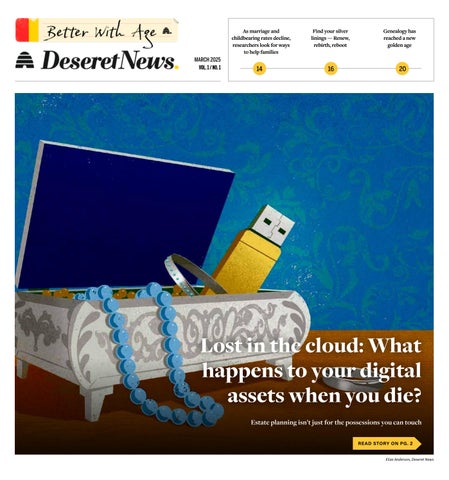
Lost in the cloud: What happens to your digital assets when you die? Estate planning isn’t just for the possessions you can touch READ STORY ON PG. 2 Eliza Anderson, Deseret News
2 BETTER WITH AGE | MARCH 2025
TECH
Lost in the cloud: What happens to your digital assets when you die? Estate planning isn’t just for the possessions you can touch By Lois M. Collins Deseret News
Even the Luddites among us have lives online: bank statements and power bills delivered by email, passwords, social media accounts, digital photographs, video game assets and maybe even some cryptocurrency. There’s more to your digital life than you probably realize, said Gerry W. Beyer, a law professor and a leading U.S. expert on estate planning who teaches at the Texas Tech University School of Law in Lubbock. Your assets include all the passwords that unlock your digital world. If you don’t plan how to pass that on before you die, it’s going to pass along with you. You have to know what online accounts you have, including social media, email, finances, subscriptions and digital files. In addition to teaching others about estate planning, Beyer has written several articles and books on the topic, including “Estate Planning for Cyber Property.” That guide to help estate planning professionals, written with Kerri G. Nipp, includes a breakdown of digital possessions that shows just how much someone might have and how diverse those assets could be. Their list includes items stored on technology like computers and smartphones and in the cloud: digital photos, personal and professional blogs, videos, emails, texts, documents, music playlists, medical records, tax documents, home security recordings and avatars, among other things. Have you thought about what should happen to your YouTube and other videos stored somewhere in cyberspace? Or who should be able to access virtual currencies and online banking and investment accounts or your eBay shop? How will others pay your bills online, either permanently or for a short time because you’re temporarily indisposed? Who’s going to cancel the automatic payment for the food delivery subscription when you’re no longer cooking dinner? Some people keep client records, patient records, inventory, customer databases and more in cyberspace. Even domain names or blogs can be valuable, but Beyer and Nipp note they require a password to access or renew. And wouldn’t it be a shame to let those airline and credit card points expire when you know your daughter would love to use them? There are also tangible assets in digital form, including cryptocurrency, non-fungible tokens (NFTs), assets collected in online games and Metaverse assets that bring an immersive experience to life, for example, per Beyer. But Americans are notably bad at planning for what happens when they die or are disabled. While fewer than a third of U.S. adults had a will in 2024, according to the Wills and Estate Planning Study from Caring. com, it’s likely that fewer still have planned for their digital assets. And many might not even realize they have them, Beyer told the Deseret News. He believes failure to do that planning is more than a missed opportunity. It’s the beginning of a nightmare for loved ones and increases the likelihood that things that really matter could be lost in the cloud.
Start with what’s easy
First, of course, you have to know what you have. Do a digital inventory and be thorough. Then start with what’s easy. That’s Beyer’s advice. Super easy means adjusting your setting on Facebook and Google and Apple and other social media or virtual platforms that let you designate someone who can access what’s there should something happen to you. You can set that up yourself without outside help. If something happens to you and you took that step, a loved one can easily have the access you wanted to give them. If you didn’t preplan and take care of it, getting access could require a court order, lots of time and is possibly not doable. Electronic communications planning is next. Do you want someone to be able to get into your email and find your Visa bill, the bank account statements and all those bits and pieces that come to your inbox? It would help them pay creditors, notify family members and probably transfer assets. One of the key distinctions is planning between electronic communications and ones that aren’t: “That’s where you see a lot of rule differences,” said Beyer, who lists emails, text messages and private posts on social media accounts as examples. You have to decide if you’re going to give someone access to what the messages say or just the catalog, such as who the messages are from and to and the dates, but not the substance. Sometimes people would rather keep loved ones out of private emails, documents or other electronic material “because they may contain hurtful secrets, non-politically correct jokes and stories, or personal rantings,” per Beyer and Nipp. Figuring out access is not just about death, either. Will someone be able to get into your accounts to pay your bills if you become disabled short or long term? Skip your mortgage payment or phone bill for a month and see what happens. Beyer said to consider what to do with your personal email from two perspectives: Put it in your durable power of attorney in case you become disabled, stating whether someone can access contents. And put it in your will in case you die.
The email trap
If you’re always in your work email and figure that’s the best place to have your statements, receipts and correspondence sent so you don’t miss anything, reconsider. Your work email account probably isn’t actually yours, so the likelihood you can legitimately share the password or grant someone else access if something happens to you is slim to nonexistent. Most companies shut off access about 11 seconds after learning you died and they’re even faster to cut you off if you’re let go. Beyer said he has seen that happen to the students he teaches, too. “They get their email for a certain length of time after they graduate, then it’s all gone.” Perhaps worse, your email will probably be forwarded to someone else — perhaps your boss or that colleague that was always competing with you for a promotion. If you leave a company, that doesn’t mean the company lets go of your role or work product. What arrives in that inbox could have a broader audience than you thought. And lots of times, companies monitor email, as well. The work-around to losing access might be making backup copies. That requires both planning and ensuring that your work email agreement allows that.
Call in a pro
Digital estate planning involves paperwork, just like estate planning for tangible assets. Beyer suggests people need a power of attorney for property management, a financial power of attorney and a will or trust to control who will have access to assets and communications, including emails and texts. Appropriate plans are sorely needed for those who have cryptocurrency or NFTs. Getting a professional to help can ensure wishes are clear and enforceable, Beyer said. Laws in different states vary, so he recommends finding a lawyer who does a lot of estate planning. “If you’re not legally trained, you may not appreciate some of the things you do that won’t have the result that you want,” he said. “A document that could be 100% valid in one state might be worthless in another.” Beyer admits it’s a pain on lots of fronts. No one wants to think about death. No one wants to shell out money if they think they can do something themselves. “It’s a very stressful thing, but afterwards the difference of how easy or hard it’ll be on your family is incredible.” Not planning impacts both physical and virtual treasures. He worked on a case where the parents had been dead many years and the adult child lived in the house and paid the bills and taxes, but didn’t do the paperwork to transfer the title. When the house needed major repairs, the heir couldn’t prove home ownership and things stalled. “It took almost a year for us to do all the legal proceedings and all the stuff needed to get the property transferred, whereas a simple will would have solved all the problems. It’s very common. It’s a real hassle and a lot of people don’t take the necessary steps to either plan or take care of it after somebody passes,” he said. Assets like bank accounts where you can name a beneficiary don’t have to be in your will. But to pass the other things on, you probably want to list them and provide directions so that someone can actually get the information needed to access them. Back when everyone got paper bank statements and bills, a person could watch the mail for a month and know what was out there. That’s no longer true. Most people get those updates by email, which you have to be able to get into.
Paradise lost
With cryptocurrency and NFTs, you need pass phrases and seed phrases and passwords. Forget those and what was owned disappears. Unless they’re on an exchange, there’s no way to get the password back, Beyer said. “People have lost umpteen millions of dollars because they don’t have any way of getting the password. You have to plan for that or the assets just disappear,” he said. For example, in December, Medium reported that about 13% of all Bitcoin has been “lost due to forgotten private keys, hardware failures and irreversible mistakes. This isn’t just a quirky footnote in Bitcoin’s history; it’s a dynamic factor that could reshape its value and role in the financial world.” The question is, how do you control the assets yourself while ensuring they’ll be safely transferred to someone you designate should something happen to you? Safely is the key word, because things can go awry between people, especially when something with monetary value is involved.
BETTER WITH AGE | MARCH 2025 There are lots of hypothetical situations that for some people come true. It’s hard to over-imagine the possibilities. Say you tell your husband your password and the seed phrase for your cryptocurrency, then you divorce and he snags it. What then? Or you die and your daughter knows information to access the crypto, but you actually wanted to leave it to your niece and did so in your will. Your daughter could say she forgot the password. Yikes. Then again, if you tell your niece the password so she can get it, maybe she’ll do so prematurely. What you never want to do is put pass phrases, seed phrases and passwords in the will, where who sees it is out of your control. Wills, once probated, can be viewed. Most people don’t have millions in crypto. But without planning, your photos and poetry and that music library you built over decades could disappear, too.
Startups tackling gaps
Even if you do everything you can to secure and pass on your digital treasure, things can go wrong. But the risk is smaller than if you did nothing. What happens if your executor is lousy? “Then everything is bad,” Beyer said. Companies are tackling some of those problems, storing names and passwords securely, with the promise that upon your death they will distribute the Bitcoin or whatever to those you designate. Beyer said a lot of them are startups with great ideas, but he added it’s hard to say whether or not they will have longevity. He likens it to when stocks and bonds first became a thing and transferring shares and sorting out percentages of ownership and distributing profit was new. “Historically, that was very, very difficult. Now it’s easy and we don’t hold the stock certificates any more, right? A broker has them, but they are all regulated and insured and the system has evolved over the last 150-200 years, while we’re just in the very beginnings of dealing with digital things.”
The exchanges are based on the blueprint created for stocks and bonds, but for now at least, they’re not insured. “It’s all sort of still a Wild West sort of thing,” said Beyer. Still, there are other tips to help the process of giving your digital assets their own afterlife. Among the tips from Beyer and Nipp: • Make tangible media backups. Put important digital materials on a thumb drive or copy them to a CD or DVD, for example. • Take inventory of assets, including account details, usernames, passwords and instructions for handling the accounts in case of disability or death. “Store this inventory carefully, considering options like a trusted person, encryption, a safety deposit box or an online password storage service,” they said. Beyer and his wife use a safety deposit box their heirs will be able to access later. And they update it at least once a year. • Consider storing photos and videos on a website that multiple family members or friends can access immediately. Why not share them now? • Wills should state whether the fiduciary has access to digital assets. • Consider putting digital assets in a revocable trust, “which may not become part of the public record and is easier to amend than a will.” You really don’t want to redo your paperwork with every password change. • There are online afterlife companies that can help plan for digital assets. • There are also businesses that will manage your passwords securely so you only have to keep track of one. But guard that one carefully. The good news now, per Beyer, is that most estate planners now know a lot about dealing with digital assets because they’re so common. A decade ago, you needed a specialist. That’s no longer true.
Have you thought about what should happen to your YouTube and other videos stored somewhere in cyberspace?
It’s Worth It! WITH
3 DELIVERY OPTIONS: Face-to-face Live Broadcast Interactive Online
Contact us for a code to waive the $55 application fee.
UtahStateMBA@usu.edu
3
Jon M. Huntsman School of Business
4 BETTER WITH AGE | MARCH 2025
TRAVEL
Data shows air travel is safe — and getting safer Recent crashes have raised concerns, but aviation safety continues to improve
A Delta Air Lines plane lies upside down at Toronto Pearson Airport on Tuesday, Feb. 18, 2025. By Madeline Thorpe Deseret News
Recent aviation incidents have sparked concerns about flight safety. On Feb. 17, a Delta jet crashed and flipped, leaving passengers strapped in their seats, hanging upside down. Remarkably, everyone survived the accident, as the Deseret News previously reported. The Toronto crash was the latest in a series of high-profile crashes and adds to growing concerns over the safety of air travel. But data shows that air travel is very safe — and getting safer.
Recent plane incidents
• Here are the most recent aviation incidents: • On Jan. 20, a collision between an American Airlines plane and an U.S. Army Black Hawk claimed the lives of all 67 travelers, according to ABC News. The plane was coming from Wichita, Kansas, and was moments from landing at Ronald Reagan Washington National Airport. • On Jan. 31, a medical transport jet crashed into a Philadelphia neighborhood, killing all six people on board from Mexico, according to The Associated Press. A raging fire ignited by the wreckage engulfed nearby homes, leaving 19 injured. • On Feb. 7, a small commuter plane carrying 10 people crashed on the ice near Juneau, Alaska. There were no survivors, according to the AP. • On Feb. 12, a Navy jet plunged into the ocean off the San Di-
ego coast. The cause remains under investigation, according to the AP. • On Feb. 17, a Delta jet crashed at Toronto Pearson Airport. Everyone on board survived — though more than 20 passengers sustained injuries.
Flying is the safest mode of transportation
According to Transportation Secretary Sean Duffy, air travel remains the safest form of transportation, as the Deseret News previously reported. The National Safety Council estimates Americans face a 1-in95 chance of dying in a motor vehicle accident, while the odds of dying in a plane crash are so rare, they’re nearly impossible to calculate. The 2024 Transportation Statistics Report from the Bureau of Transportation Statistics affirms that takeaway. “Transportation incidents for all modes claimed 44,546 lives in 2022, of which all but 2,032 involved highway motor vehicles,” says the report. “There were no deaths from crashes on large commercial airlines in 2023, but several hundred deaths occurred in crashes in general aviation, commuter air, and air taxi services.” The Federal Aviation Administration has reported that 16,405,000 flights are handled by the FAA yearly and provides service 2.9 million airline passengers daily.
Flying has never been safer
A 2024 study by MIT researchers found that air travel has never been safer. Despite recent headlines, “commercial flight has
Chris Young, The Canadian Press via AP
become roughly twice as safe each decade since the 1960s,” the article said. Between 2018 and 2022, the risk of death by commercial air travel stood at 1 in every 13.7 million passengers, according to the study. This marks a significant improvement from the previous decade, 2008 to 2017, when the risk was 1 in 7.9 million. Safety regulations have made a profound impact over the years; in 1968-1977, the risk was 1 in every 350,000, according to the research. “The chance of dying during an air journey keeps dropping by about 7% annually, and continues to go down by a factor of two every decade,” Arnold Barnett, an MIT professor, said in the article.
What is the aviation industry is doing to improve safety? The National Transportation Safety Board and Federal Aviation Administration are investigating the recent fatal tragedies to uncover the causes. Their findings will inform what happens next and hopefully boost trust in air travel in the future, per the AP. “One good thing that the aviation community does do is it really does learn from its past experiences and past accidents,” Jim Brauchle, an aviation attorney at Motley Rice, told USA Today. “The FAA has implemented or tired to implement a lot of programs where, if you report safety issues, there’s no repercussions for things like that.”
BETTER WITH AGE | MARCH 2025
POLITICS
The confusion over Social Security: Is it getting cut or not?
FREE SEMINAR
The White House insists that Elon Musk wants to cut waste, not Social Security benefits By Sydney Jezik Deseret News
On March 10, Elon Musk, wealthy entrepreneur and leader of the Department of Government Efficiency, characterized Social Security and other entitlement programs like Medicaid and Medicare as full of fraud, per The New York Times. Musk said as much as $700 billion of waste could be eliminated via cuts to entitlement spending. “So, the waste and fraud in entitlement spending, which is all of the — which is, most of the federal spending is entitlements. So, that’s, like, the big one to eliminate,” Musk said, per The Hill. Many media outlets interpreted his words as a desire to cut benefits, rather than cutting waste. But the White House issued a statement Tuesday addressing the situation. “The Trump administration will not cut Social Security, Medicare, or Medicaid benefits. President Trump himself has said it (over and over and over again),” read the press release. “Elon Musk didn’t say that, either. The press is lying again.” During a White House press conference March 11, White House press secretary Karoline Leavitt again blamed some in the media for taking Musk’s quotes out of context. She said he was specifically referring to cutting waste and fraud, not all of Social Security.
Trump’s stance — what is the future of Social Security?
During the press briefing, Leavitt fielded questions from reporters about Trump and Musk’s relationship and the future of the entitlement programs, which are already under significant fiscal pressure. “President Trump has been unequivocally clear on this,” Leavitt said. “He is going to protect Social Security and Medicare benefits and Medicaid for hardworking Americans who paid into these entitlement programs and deserve those hard-earned benefits.” Nevertheless, she said, too much money is going to noncitizens, including billions of dollars in fraud and wasteful spending to those who have never paid into entitlement programs. “There is more than 70 billion dollars of fraud
in the Social Security program alone that we know of,” she said. “That’s exactly why DOGE was created: To ensure that we are investigating the fraudulent spending, the wasteful abuse across our federal government.” The White House press release included estimates that taxpayers lose up to $521 billion annually to fraud, mostly within entitlement programs; that over the last two decades; the federal government has made about $2.7 trillion in “improper payments” to deceased or ineligible people; that Social Security spent $72 billion in improper payments between 2015 and 2022; and Medicare and Medicaid spent over $140 billion in improper payments in 2024 alone. “What kind of a person doesn’t support eliminating waste, fraud and abuse in government spending that ultimately costs taxpayers more?” read the press release. Some news reports, including one by The Associated Press, claim Musk’s fraud findings are overblown, pointing to a Social Security study that said there was $71.8 billion in improper payments over a 7 year period, which is about 1% of total payments. DOGE, which released the statistics guiding Musk and Trump’s actions concerning entitlement programs, has previously not been open to public records requests, per Trump’s orders. This may be about to change. Late on March 10, a federal judge ruled that DOGE is subject to the Freedom of Information Act, meaning that anyone who wishes to make a request may personally access DOGE’s records. Research by the Cato Institute found that the federal government spent $2.8 trillion in entitlement and welfare programs in 2022 — over $2 trillion on Social Security and Medicare and another $784 billion on welfare. A majority of Republicans, Democrats and independents hold favorable opinions of Medicaid. 97% of adults in a poll taken by KFF said that Medicaid was at least somewhat important. Seventy-three percent indicated they thought it was very important. Republicans were less likely to agree. During the White House press conference, Leavitt repeated Trump’s promise to put money back into the pockets of American citizens. “The president wants the American people to have so much money in their pockets they don’t know what to do with it,” she said.
You are cordially invited to join us for a Free Educational Workshop on
REVERSE MORTGAGES Fast Facts
Answers to Important Questions:
A Free Educational Workshop
→ How old do I have to be?
FSI Mortgage, LC
→ Will I still own my home?
Presented by:
10:30 am to 11:30 am 111 East 5600 South, Suite 104 Murray, UT 84107 Choose from one of these upcoming classes. Tuesday, March 25th, 2025 or Thursday, March 27th, 2025 Pre-registration is required.
Spaces fill up quickly. Call to reserve your seats TODAY!
1-(801) 281-0205
You may reserve up to 4 seats.
→ What if my spouse is not old enough?
→ What happens to my home after I die? → Do I need to pay income taxes on this money? → What are the risks and down sides? → What is the difference between this type of mortgage and other types of loans? → How much monthly income do I need? → Does my credit have to be good? → How much equity can I get from my home? → What are the requirements to get this loan? → What is the next step?
FSI Mortgage, LC Financing Seniors’ Independence 111 East 5600 South, Suite 102 Murray, UT 84107 NMLS #4398
5
6 BETTER WITH AGE | MARCH 2025
South Jordan View
Retirement, Served to Perfection Retire in a community where every meal is an experience, every detail is curated, and every day is a celebration. From chef-inspired dining and vibrant social events to resort-style amenities, our dedicated team handles every detail, allowing you to savor every moment with peace of mind! This is retirement as it should be—effortless, enriching, and uniquely you.
Tour Today! Experience our Signature Freedom Dining program for yourself! Schedule a private tour and be our guest for a fabulous meal.
Call today to plan your visit!
801-386-9140
11352 S. Redwood Road South Jordan, UT 84095 SouthJordanViewRetirement.com
BETTER WITH AGE | MARCH 2025
7
LIFEST YLE
Hollywood is hoping for a movie theater comeback A survey shows what may need to change for that to happen By Madeline Thorpe Deseret News
The debate over how to save movie theaters in the streaming era was reignited during the Oscars on Sunday, when filmmakers urged Americans to go to the cinema again. “Watching a film in the theater with an audience is an experience,” director Sean Baker, who won four Oscars for his film “Anora,” said during the 97th annual Academy Awards. “We can laugh together, cry together, scream in fright together, perhaps sit in devastated silence together. It’s a communal experience you simply don’t get at home. And right now, the theatergoing experience is under threat.” A new study by Octane Seating reveals why many Americans choose to stay home instead of experiencing the laughter, action and emotional intimacy that Baker described. But it also gives movie theater fans some reasons for hope. CONTINUES ON PG. 9
An AMC Theater in Paramus, N.J., on Monday, March 13, 2023.
Ted Shaffrey, Associated Press
LUMBER & HOME IMPROVEMENT
Seniors Save
10%*
Scan here for our current sales flyer
Every Tuesday
*Up to $500 purchase ($50 off). May not be combined with any other offer. See store for complete details.
8 BETTER WITH AGE | MARCH 2025
THIS IS SNEAKER THERAPY
JULY 24, 2025 / SLC, UT SIGN UP AT RUN.DESERET.COM
BETTER WITH AGE | MARCH 2025
9
Key takeaways from the study
According to the study, which draws on responses from 1,000 U.S. adults, nearly two-thirds of Americans watch more than one movie per week. However, most of this viewing is happening at home for a variety of reasons, including cost- and comfort-related concerns, researchers found. “Overall, only 13% of people go to the movies a few times per month, with 4% going weekly,” Octane Seating reported. To boost those figures, movie theater leaders will have to address some of the issues that people say are keeping them from buying tickets and enjoying the big screen experience. Fifty-nine percent of respondents said movie theaters need to be cleaner. Fifty-seven percent of moviegoers are sneaking in their own snacks because of frustrations with concession stand prices. In general, Americans want movie costs to be lower. Seventy-two percent said they’d go to movie theaters more often if it wasn’t so expensive.
Cost challenges
To address cost concerns, movie theaters have created subscription services that give people a discount if they pay for multiple tickets up front. But the survey found that few people are taking advantage of this option. “Only 16% of Americans have such a subscription,” researchers reported. And those who do take part in a movie theater program don’t always use it. Half of subscribers “only use their membership a few times per year,” Octane Seating reported.
The comfort factor
Here are some of the factors that can help bring people back to
Vince Bucci, Invision for AARP via the Associated Press
A general view of atmosphere is seen at the AARP Movies for Grownups Film Showcase at Regal Cinemas L.A. LIVE on Sunday, Nov. 9, 2014, in Los Angeles.
movie theaters, according to the report: • Audio and picture quality • Access to new releases before streaming viewers • The ability to see a movie before it gets spoiled The study revealed that 97% of Americans think picture and audio quality are important when deciding where to watch a movie. It was also clear that movie theaters need to prioritize comfort. One of the key factors keeping people at home on the couch is that they feel comfortable there, researchers found. “Overall, 60% of people think comfortable seating is extremely or very important to their decision about whether to see a movie in a theater or stay home,” Octane Seating reported.
That helps explain why movie theaters are upgrading auditorium-style seats to plush recliners — some are even heated.
How can Americans help Hollywood?
As movie theaters attempt to create an environment that’s nearly as comfortable as your couch at home, viewers can take action, as well, if they want to keep cinemas alive. If you’re dissatisfied with cleanliness or customer service, consider offering feedback. Let theaters know what would improve the experience and encourage ticket sales. Plus, if you’re worried about movie theater costs, you can ask for help understanding subscription service discounts.
10 BETTER WITH AGE | MARCH 2025
Bet ter Wit h A ge DEALS & DISCOUNTS FOR 55+
Ages 55+
USE CODE BESTLIFE50 FOR 50% OFF ANY ITEM softminkyblankets.com
SERVING YOUR HEALTHCARE NEEDS AT EVERY STAGE OF LIFE. reverehealth.com/specialty
EXPIRES 3/31/2025
LUMBER & HOME IMPROVEMENT
Upgrade a regular room booking to a suite when using this promotion
55+ Discount
Take advantage of 10% off any heating or air conditioning repairs or services. Call us today at 801.542.7100 comfortzoneusa.com
AARP is hard at work to empower everyone to choose how they live as they age.
For Discounts and free events visit: aarp.org/ut
SUTHERLANDS OF SALT LAKE CITY - 60 PLUS CLUB 10% discount every Tuesday up to $50.
sutherlands.com
20% off on all of our Blinds, Shutters, Outdoor Patio/Deck Shades. Call us today at 801.243.4464 blindmastersutah.com | Blindmasters@gmail.com
BETTER WITH AGE | MARCH 2025
Get articles and advice about improving relationships, learning about interesting people and ideas that just might improve our world and giving you some inspiration to give back. Plus, discounts available only to 55+. Subscribe today at deseret.com/newsletters
ARE STAIRS BECOMING A CHALLENGE FOR YOU OR A LOVED ONE?
WE'RE HERE TO HELP! Stair Lifts Vertical Platform Lifts In-home Elevators Portable Ramps CALL US, AVAILABLE 24/7
801-386-2408 WWW.WESTERNSTAIRLIFTS.COM
11
12 BETTER WITH AGE | MARCH 2025
ENTERTAINMENT
Disneyland celebrates 70th anniversary with low ticket prices Exclusive promotions and revamped attractions entice visitors for a historic milestone By Madeline Thorpe Deseret News
Disneyland is counting down the days for a big event reflecting on the history of the park — Disneyland is preparing for its 70th anniversary. The park is celebrating this monumental milestone with discounted ticket prices. The special offer is a perfect opportunity for everyone to create unforgettable memories at “the happiest place on earth.” The Disneyland resort 70th commemoration “will honor seven decades of happiness and many moments of joy in the making,” with celebrations taking place from May 14 through summer 2026, according to Travel and Leisure.
Here are the details
• The discounted multi-day tickets enables admission for visits May 16 through Aug. 14. • Guests can visit the resort for as low as $100 per day when purchasing tickets for four days, with one-park per day tickets.
• The three-day, one-park per day offer starts at $120 per day. • Tickets may be used on non-consecutive days and guests can purchase up to five tickets per person per day. • Before buying your tickets, be sure reservations are available for the dates you want to visit.
Other special offers Disneyland is offering to celebrate its 70th anniversary
In preparation of the big year, Disneyland is enhancing the happiest place on earth with special offers at hotels, new food items, new and returning fan-favorite shows, and new attractions according to Disneyland. The resort is offering up to 30% off on select hotel stays of four nights or longer at Disneyland Resort hotels from May 16 to Sept. 26 said the website. Those who attended the special anniversary will be the first to see the parks new nighttime show, “World of Color Happiness,” which will be at Disney California Adventure Park. Other fan favorites will return to the resort, including “Paint the Night” parade and “Wondrous Journeys” nighttime spectacular.
801.243.4464 Blindmastersutah.com
35 YEARS COVERING UTAH’S WINDOWS
MEET OUR FRIENDLY, KNOWLEDGABLE, SALES TEAM!
Along with the new and returning shows, Disneyland will be featuring a brand new attraction, “Walt Disney — A magical Life,” which will be located on the Main Street Opera House. The announcement stated it will “feature a cinematic presentation of Walt Disney’s journey, culminating in a visit with Walt in his office.” That is not where the fun stops. Mickey and Minnie will also be donning new anniversary outfits and “It’s a Small World” will be reopening with updates available on the Disneyland website.
A look back to the day Disneyland opened 7 decades ago
Disneyland wasn’t built overnight. It was a year of diligent construction with a price tag of $17 million according to Designing Disney. After the year of rigorous efforts, Disneyland opened its gates for select guests on Sunday, July 17, 1955. The park was not open for public until July 18, but was covered with a live special by ABC and hosted by Art Linkletter, Ronald Reagan and Bob Cummings.
20% OFF
All Graber Brand Products Expires 04/30/25
Trale Mathis
Dan Shepherd
Travis Thompson
CELL SHADES
SHUTTERS
ROLLERSHADES
50% OFF FREE Topdown/Bottom up
Many FREE Upgrades
20% OFF Motorization
*Also available 2.5 Faux Wood, Roman Shades, Verticals
Motorization on
Outdoor Patio/Deck Shades Expires 04/30/25
Outdoor shades will change your life!!
WE WILL BEAT ANYBODYS PRICE, EVEN THE BIG BOX STORES!
BETTER WITH AGE | MARCH 2025
13
Disneyland was still undergoing finaltouches to the park when guests flooded the gates.
Jae C. Hong, Associated Press
In this Jan. 22, 2015, file photo, visitors walk toward Sleeping Beauty's Castle at Disneyland Resort in Anaheim, Calif.
The broadcast had 90 million viewers watching the reveal of the magical kingdom. Disneyland was still undergoing final-touches to the park when guests flooded the gates. The asphalt on Main Street USA was still soft, trees were still being planted and paint had yet to dry, per the article. Along with the incomplete park, and multiple broken down rides, the opening day had bigger problems than wet paint. 11,000 people were invited to arrive, but 28,000 people showed up as a result of counterfeit tickets. Southern California was also experiencing a heat wave alongside a plumbers’ strike that resulted in dirt-dry drinking fountains. Despite the unexpected mishaps, crowds were lining up to experience the kingdom themselves by 2 a.m.
55+nities
Commu
Whatever Your Day, Peterson Brings You Home JOIN ONE OF THESE COMMUNITIES THAT HAVE RESORT-LIKE AMENITIES AND THOUGHTFULLY DESIGNED FLOOR PLANS. South Jordan - Now Selling
Heber - Now Selling
West Jordan - Coming Spring 2025
Scan QR codes to learn more about each community
Contact us to Learn More: 801-913-3553 | choosepeterson.com
14 BETTER WITH AGE | MARCH 2025
FAMILY
As marriage and childbearing rates decline, researchers look for ways to help families American Family Survey finds disconnects, areas of agreement on what families need and how to help them
A panel discussion on the 10th annual American Family Survey was held at the American Enterprise Institute, Wednesday, Feb. 6, 2025, in Washington, D.C. By Lois M. Collins Deseret News
Would changing the words used by policymakers and others bring Americans on the right and the left of the political aisle closer to agreement on the role that government can and should play in supporting family stability and ability to thrive? That question came up in a discussion as part of the release of the 10th American Family Survey Thursday afternoon, hosted by the American Enterprise Institute in Washington, D.C. The theme was “Opportunities to a Broad-Based Political Coalition for Families.” American family life has been changing for some time, marriage and fertility both falling, to the chagrin of researchers who deem both to be important for family stability and having a country that does well not just economically, but in terms of happiness and on other measures. Christopher K. Karpowitz and Jeremy C. Pope, both polit-
ical science professors at Brigham Young University and the survey report’s authors, were talking about the challenges families face and the fact the majority of survey respondents believe that government could do more to help families. But they noted that against a partisan backdrop, it’s hard to get much agreement on what form those supports should take. “Family in our view is in a little bit of danger at the moment,” said Pope, who noted that any potential coalition that supports families is “split in an interesting, problematic way.” The nationally representative survey, conducted Aug. 22-29 by YouGov for Brigham Young University’s Wheatley Institute, BYU’s Center for the Study of Elections and Democracy, and Deseret News, found that majorities on both the left and the right agree that “raising children is one of life’s greatest joys.” And they agree that children do better financially when they are raised by married parents. But just 23% think government should be encouraging people to have more children. Most don’t want government to
John McDonnell for the Deseret News
do that, though they are generally in favor of programs that support marriage and do deem helpful a number of programs to benefit families. Pope, who like Karpowitz is also affiliated with BYU’s institute and its center, said that creates pretty broad approval of a number of would-be government goals, from helping low-income families to boosting education and bolstering other programs like housing. Democrats are fairly keen on many types of supports for families, though there’s no majority support for programs specifically to encourage two-parent homes for kids, marriage or having more children. Republicans are less keen than Democrats on providing more support to parents who are unmarried or to low-income families, among other differences. How do you bring the two groups together to support families in a full spectrum of policies? Karpowitz and Pope wondered. Not doing so means fewer people will marry, more will delay marriage and people will drift, as Pope put it.
BETTER WITH AGE | MARCH 2025 Galena K. Rhoades, a research professor at the University of Denver and director of the Family Research Center, noticed that when the survey used the word “encouraging,” the Republican response was higher. When “support” was used, the Democrat response was higher. Could a coalition succeed if the terminology was different?
Who should be helped?
Words matter to those who might benefit from programs, too, Rhoades said. People don’t want to be told what to do but do want to be supported. Her experience working with low-income women is that they do want to get married, but would “like not to hear that they should get married,” she said. Rhoades also noted that often people don’t know what marriage is supposed to look like because they haven’t seen healthy, functional marriages. Brad Wilcox, a nonresident senior fellow at AEI, said he believes the upper middle class is “doing quite well” and that the working middle class needs to be strengthened. Low-income families are “getting lots of things from the government,” he said. Those in the middle are not being helped. Melissa S. Kearney, economics professor at the University of Maryland and author of “The Two-Parent Privilege: How Americans Stopped Getting Married and Started Falling Behind,” said the focus needs to be on supporting families and children in general, recognizing that families in the lower income groups need help, too. Children in two-parent households have more resources and do better. Single parents often have more struggles and barriers and their children struggle, so the focus needs to be on “breaking cycles of disadvantage,” she said. She agrees that Democrats don’t want to seem judgmental, but said facts are facts and people should be aware of them. We should acknowledge that marriage and having two parents provides more resources and stability.
15
Two views that don’t meet
Both Karpowitz and Pope fear families will suffer if partisanship gets in the way of coalition-forming. “We talk about this idea a lot,” Karpowitz told Deseret News. According to Pope, since the public isn’t interested in the government encouraging births, “If it’s going to be done, it needs to be done in a way that’s more subtle than the government saying we need to have more kids.” He said that the “U.S. Constitution demands something that it never explicitly says:” a coalition that is “sizeable and sustained.” He said we tend not to have good coalitions in government right now because party control flips back and forth and sides don’t meet in the middle. So a real coalition would have to involve both parties. If government is going to have any effect on families through programs, it can’t start and stop them all the time. To have a coalition that truly supports families would require getting together two groups that “aren’t that interested in getting together,” right now, he said. “They’re not going to want to play well together, but our point today is if you want to support families, you need to figure out a way to get these two groups to come together and support a full spectrum family policy that talks about not just that families are good,” he said, but that the two-parent advantage is real for families. He warned that failure to do that will lead to fewer and fewer families that are married, more people putting it off and drifting. They might never form the families they want. Moderates in both parties and church-attending people in both parties in higher numbers are more apt to be in favor of governments providing supports for both marriage and having more children, the survey found.
About the survey
Now in its 10th edition, the nationally representative
together
John McDonnell, for the Deseret News
Chris Karpowitz, a political science professor and fellow at Center for the Study of Elections and Democracy at Brigham Young University, addresses the audience during a panel discussion on the 10th annual American Family Survey at the American Enterprise Institute, Wednesday, Feb. 6, 2025, in Washington, D.C.
American Family Survey has a margin of error of plus or minus 2 percentage points. The survey looks at how families live, views of marriage and family, attitudes on topics like abortion and social media bans, as well as what concerns families, among others. This 10 edition to some degree focused on political divides — and found that regardless of where you sit in relationship to the political aisle, the economy and financial pressure on families is a very big deal. The survey report can be found at deseret.com/Americanfamilysurvey.
It Really Is a Family
Imagine living in a tightly-knit community where people know your name, and where friends quickly become family.
Assisted Living
Stay independent longer with a helping hand that’s ready when you are, and a calendar full of fun and engaging events.
Memory Care
Putting each resident’s unique preferences and needs first, our positive approach focuses on what people can do, never what they cannot.
scan to explore more
Call 801-252-4236 to schedule a private tour. ASSISTED LIVING & MEMORY CARE 5524 West 6200 South • Salt Lake City, UT 84118 SummitWatermark.com 2503-KSL-9635A
16 BETTER WITH AGE | MARCH 2025
LIFEST YLE
Find your silver linings — Renew, rebirth, reboot We often think about aging as a decline, but new research suggests it might be more like a roller coaster with all sorts of ups and downs
Ted Danson arrives at the premiere of "A Man on the Inside" on Sunday, Nov. 10, 2024, at Netflix Tudum Theater in Los Angeles. By Norman Hill For the Deseret News
Demographers talk about a coming “silver tsunami,” a unique phenomenon. For the first time in recorded history, they say, there will be more people over the age of 60 than under the age of 20. It could be revolutionary, overwhelming health care systems and retirement plans alike. And remaking family and community relationships. Currently, 17% of the U.S. population is retired. By 2030 — only five years from now — one out of five Americans will be retired. Television is catching up with these evolving times. Two recent programs featuring older people navigating life in their later years are among today’s most viewed shows. “A Man on the Inside,” stars Ted Danson who responds to
a classified ad by becoming an investigative assistant for a detective agency. In the first season of the series, he is hired to go undercover by investigating a theft at an assisted living center. Danson, who is 76 years old in real life, depicts a lonely widower whose wife has passed away from complications related to dementia. His daughter, who regularly gets newspaper articles her dad has cut out and mailed to her, wants him to move on: get a hobby, find a job, start volunteering. Try something new. Anything. Just do it. The second television program features Kathy Bates as “Matlock.” It isn’t a reboot of the old Andy Griffith series, but instead depicts a lawyer returning to work post-retirement. She is perceptive and disarming while also telling others that she can get access to people and places because her age makes her nominally invisible. Each of these new television series portrays realistic situ-
Richard Shotwell, Associated Press
ations that older people face every day. Neither are melodramatic. Both show characters who are interesting and energetic as well as characters who are lonely or sullen. Along with movies like Walter Matthau and Jack Lennon’s “Grumpy Old Men” and Henry Fonda and Katharine Hepburn’s “On Golden Pond,” television and movies have characterized aging in different ways revealing how both society and time take their toll. But there is a changing landscape and new research demonstrating how Americans are growing older differently than previous generations. Longevity research, podcasts and dinner table conversations are a hot new topic. Even on TikTok. Currently, there are 22.7 million posts that refer to “longevity” on TikTok. Books with titles like “Lifespan,” “Outlive” and “Forever Strong” proclaim the realistic possibility of people living to 150 years old with fully functioning men-
BETTER WITH AGE | MARCH 2025 tal and physical capabilities. In recent years, scientists have identified bodily molecular and cellular markers called “the hallmarks of aging” which may be controllable and promote healthy living longer than previously considered possible. That changes everything. One of the dramatic conditions it changes is family relationships. As we grow older, our adult children may not only feel more protective of us, but they may also feel more entitled to tell us what to do. ”Are you still riding your bike on the road? How well do you see while driving at night? When was the last time you had a physical exam?” Our adult kids have poked around asking these and other nosey questions several times just this past week! Such questions can — and did — morph into unsolicited advice about finances, health care and daily habits. If we asked them these same questions, we would be “meddling.” Not them. They are asking us because they are “concerned.” Such role reversals not only can happen in family relations but also in other aspects of daily living as well. “Past your prime,” “over the hill” and “aging gracefully” are common stereotypes that imply there is little left to do at a certain age except sit on the proverbial park bench and feed the birds. That too is changing. There’s plenty of new names emerging to replace the outdated moniker “the golden years.” From “the third act” to “fourth quarter” to “ageless,” these fresh new appellations suggest the many new possibilities available for living longer and better. They all refer to new beginnings, new opportunities and new horizons. We often think about aging as a decline, but new research suggests it might be more like a roller coaster with all sorts of ups and downs. The new data doesn’t fit our old assumptions and stereotypes anymore. Living well into our 80s and 90s and beyond also seems to have more to do with our mindset than our genes, according to new research from UC Berkeley. Researchers found that our genetic makeup affects our ten-
dency toward such maladies as Alzheimer’s, diabetes, cancer and heart diseases when younger, but as we age our DNA has a lower impact than outlook and environment. According to Dr. Peter Sudmant, assistant professor of Integrative Biology at UC Berkeley, our genes ramp up or down based on certain “markers” causing various ailments. These seem to be controlled less by our DNA as we age and more by factors such as where and how we live. “Massive amounts of public resources have gone into identifying genetic variants,” he says, even though “genetic variants” matter less than other factors as we age. These other factors seem to hinge on what today is termed “movement” or daily activity and “mindset” or outlook and sense of well-being. Perhaps the old saying, “You are only as old as you think we are” may be more accurate than we ever knew. Or, as my wife likes to say, “Age is just a number and mine is unlisted.” Start now. Rethink your future. Renew. Refresh. Reboot. also in other aspects of daily living as well. “Past your prime,” “over the hill” and “aging gracefully” are common stereotypes that imply there is little left to do at a certain age except sit on the proverbial park bench and feed the birds. That too is changing. There’s plenty of new names emerging to replace the outdated moniker “the golden years.” From “the third act” to “fourth quarter” to “ageless,” these fresh new appellations suggest the many new possibilities available for living longer and better. They all refer to new beginnings, new opportunities and new horizons. We often think about aging as a decline, but new research suggests it might be more like a rollercoaster with all sorts of ups and downs. The new data doesn’t fit our old assumptions and stereotypes anymore. Living well into our 80s and 90s and beyond also seems to have more to do with our mindset than our genes, according to new research from UC Berkeley.
17
Television is catching up with these evolving times. Researchers found that our genetic makeup affects our tendency toward such maladies as Alzheimer’s, diabetes, cancer and heart diseases when younger, but as we age our DNA has a lower impact than outlook and environment. According to Dr. Peter Sudmant, assistant professor of Integrative Biology at UC Berkeley, our genes ramp up or down based on certain “markers” causing various ailments. These seem to be controlled less by our DNA as we age and more by factors such as where and how we live. “Massive amounts of public resources have gone into identifying genetic variants,” he says, even though “genetic variants” matter less than other factors as we age. These other factors seem to hinge on what today is termed “movement” or daily activity and “mindset” or outlook and sense of well-being. Perhaps the old saying, “You are only as old as you think we are” may be more accurate than we ever knew. Or, as my wife likes to say, “Age is just a number and mine is unlisted.” Start now. Rethink your future. Renew. Refresh. Reboot.
18 BETTER WITH AGE | MARCH 2025
HEALTH
Genes vs. lifestyle: What drives aging well? International study sorts out risks related to early death, how well you age
Laura Seitz, Deseret News
Joggers and walkers take advantage of the warm weather in Sugar House Park in Salt Lake City on Friday, Jan. 3, 2025. Temperatures were in the records along the Wasatch Front with highs in the mid-50s. Temperatures would normally be in the mid-30s for this time of year. Thankfully, another winter storm is on the way for Saturday morning into Sunday. By Lois M. Collins Deseret News
Is your ZIP code more important than your genetic code when it comes to having a long, healthy life? Genetics and lifestyle both contribute to how people age, the diseases they develop and how long they’re likely to live. But the role the factors play and how much they influence disease development and premature death might surprise you. Socioeconomics and lifestyle have more to do with healthy aging than genetics, according to a big new international study published in the journal Nature Medicine that says
both lifestyle choices and living conditions are significantly more important than genetics to living a long, healthy life. According to the study, of 25 independent exposures associated with premature death, age-related diseases and healthy aging, “We find that the major drivers or premature death and aging in our sample are smoking, socioeconomic status and deprivation, ethnicity, physical activity, living with a partner, sleep and mental and physical wellness including tiredness, as well as early life exposures including health and body size at 10 years and maternal smoking around birth.” They note that many factors combine to form the “environmental architecture of mortality and aging,” and each may play a very small role, but adding them up creates a
“substantial amount of variation for premature mortality, far exceeding” that posed by genetic risk. “Your income, postcode and background shouldn’t determine your chances of living a long and healthy life,” Bryan Williams, chief scientific and medical officer at the British Heart Foundation, said in a news release. “But this pioneering study reinforces that this is the reality for far too many people.”
Study nuts and bolts
The study was led by researchers from Oxford Population Health in collaboration with researchers from the departments of psychiatry and anthropology at the University of
BETTER WITH AGE | MARCH 2025 Oxford; Massachusetts General Hospital and the Broad Institute, Boston; the University of Amsterdam; Erasmus University, Rotterdam; and the University of Montpellier. They also got technical help from the China Kadoorie Biobank team. The data researchers used included extensive genetic and phenotype information on 502,505 people who were participants in UK Biobank research and data collection. They looked at 164 environmental facts and genetic risk scores for 22 major diseases. A key part of the research was an “aging clock” that used blood protein levels to see how fast people aged. “This enabled them to link environmental exposures that predict early mortality with biological aging,” the team said in background material on the study. The measure has also been validated in large studies in China and Finland. Cornelia van Duijn, St. Cross professor of epidemiology at Oxford Population Health and the paper’s senior author, noted that instead of focusing on individual exposures and hypotheses, they used a hypothesis-free, lifetime exposure approach to see what drives disease and death.
19
Genetics and lifestyle both contribute to how people age, the diseases they develop and how long they’re likely to live.
Genes vs. lifestyle
Among the findings: • Environmental factors explained 17% of the death risk variation, while genetic predisposition “as we understand it at present” explained just 2%. • Of the 25 environmental factors, those with the most impact on healthy or unhealthy aging were smoking, socioeconomic status, physical activity and living conditions. • Smoking was linked to 21 diseases, while socioeconomic factors like household income, employment and home ownership were linked to 19 diseases. Physical activity impacted 17. • Of the factors, 23 could be changed. • Early life exposures, including whether your mother smoked around the time of your birth and your body
weight at 10 years old, influenced aging and risk of death decades later. • Environmental exposure had greater effect on lung, heart and liver disease, while genetic risk was stronger for dementias and breast cancer. “Our research demonstrates the profound health impact of exposures that can be changed either by individuals or through policies to improve socioeconomic conditions, reduce smoking, or promote physical activity. While genes play a key role in brain conditions and some cancers, our findings highlight opportunities to mitigate the risks of chronic diseases of the lung, heart and liver which are leading causes of disability and death globally,” said van Duijn.
She added, “The early life exposures are particularly important as they show that environmental factors accelerate aging early in life but leave ample opportunity to prevent long-lasting diseases and early death.” Dr. Austin Argentieri, lead author of the study at Oxford Population Health and research fellow at Massachusetts General Hospital, said the approach they used made the research the “most comprehensive to date of the environmental and lifestyle factors driving aging and premature death. These findings underscore the potential benefits of focusing interventions on our environments, socioeconomic contexts and behaviors for the prevention of many age-related diseases and premature death.”
19TH ANNUAL
Amazing Earthfest MAY 8-11, 2025 | KANAB
Photo by Marty Feely
Celebrating the natural world with 25 scheduled events, an experiential learning festival of arts, outdoor adventure, science, and film.
AMAZINGEARTHFEST.COM
20 BETTER WITH AGE | MARCH 2025
FAMILY
Genealogy has reached a new golden age How two separate hunts for family history help explain what is now possible in the search for connection
Zack Wittman and Mary F. Calvert for the Deseret News
By Natalia Galicza Deseret Magazine
Out of all the emails Yvette LaGonterie received in 1998 from colleagues and bosses at the U.S. Immigration and Naturalization Service, where she worked as an overseas office director and regional attaché south of the border in Mexico City — only one was impossible to forget. It came from an unknown sender. And the subject line contained a single word, posed as a question. “Cousins?” The sender said her name was Cathy and that she lived in Arizona. She was looking for descendants of distant relatives, including, she said, descendants of a man named Ralph, a cousin of her great-uncle. She’d hit a roadblock in her quest to uncover more of her lineage and was asking for help. Yvette hadn’t delved much into her own family history, but the same Ralph happened to be her paternal grandfather. Which would make the two women third cousins. Yvette, in her early 40s at the time, knew of few relatives on her father’s side. In fact, she understood the surname LaGonterie to be particularly rare, belonging to only about a dozen people in
the United States. She’d always wanted to learn more about that familial line, to feel a part of something larger than herself. Yet she doubted her own ability to lead that charge; she also had every reason to feel skeptical of this stranger. But curiosity got the better of her. She wrote back. That decision would take her on a journey halfway around the planet with the most unlikely of travel companions. It would open up to her a whole world, of not just her own lineage, but the ever-growing technological advancements in family history research, from digitized public records to DNA testing sites to video archives — what now, nearly 30 years after that first email, amounts to what experts consider a golden age for genealogy. And for no other demographic is family history research more needed or showing more promise than it is for Black Americans like Yvette. The earliest census records to list African Americans as citizens date back only to 1870, five years after the country officially abolished slavery. This obstacle is known as the “brick wall” among genealogists, a barrier to drawing ancestral knowledge before the start of the Gilded Age. Most of the available records dated before the 1870s are slave trade documents with few humanizing de-
scriptors and little information to offer descendants, which leaves modern archives across museums and educational institutions nationwide largely lacking in Black primary resources. The trickle-down effect of that scarcity manifests most in younger generations. Pew Research Center surveyed four age groups of Black Americans in 2022 to gauge their understanding of Black history. The share of those who felt well informed was low among every age group, but fell more among younger respondents. Fewer than 40 percent of Black adults under 30 consider themselves particularly informed of Black history. It takes citizen archivists and family historians to break through that brick wall, to preserve and pass down the artifacts that make histories beyond those of enslavement and struggle possible. In the months that followed Cathy’s email, Yvette became entranced by this search to trace her family across centuries and continents. And though she didn’t know the extent of what she would uncover, she knew enough to understand it mattered, and that any answers she sought would not come easy. Nine years after Yvette received the mysterious email, another woman, Pia Jordan, came across an artifact that sent her on her own family history journey. She didn’t recognize the scrapbook.
BETTER WITH AGE | MARCH 2025
21
It was blue, embellished with three silver airplanes, two tassels and an unfamiliar insignia. Pia, then in her early 50s, had found it stowed away in a trunk at her mother’s apartment in Maryland — not quite kept secret, yet still hidden out of view. The mixed medium of metal and ribbon gave the book heft; it felt important. Valuable. When she opened it, she could see why. It held medals, stamps, invitations to dances. Newspaper clippings, handwritten love letters, aged photographs. Party invitations, matchbooks, punch cards. Memorabilia from her mom’s time as a nurse in the military. But when she looked closer at its contents, at the text and the faces within the scrapbook’s adorned pages, she realized her mother, Louise Virginia Lomax Winters, hadn’t just served in the armed forces. She’d served in Alabama during World War II alongside the Tuskegee Airmen, the first African American flying unit in the United States military. Moreover, Pia found, Louise was one of the first Black nurses, in 1943, to ever serve in the Army Nurse Corps, just a couple years after the corps became the first branch of the military to formally allow Black nurses. She was a first lieutenant. This all came as a shock to Pia. By the time she’d made this discovery, in 2007, she was packing up her mom’s apartment to place in storage. Louise had suffered a series of strokes, seizures, hallucinations and early dementia and was moving into a nursing home. Her voice had changed almost beyond recognition as a result of a tracheotomy and she struggled to speak for long stretches at a time. So Pia had to swallow, for now, the curiosity that scrapbook stirred. When her son had a high school project in 2002 that required an interview with his grandmother, Pia decided to conduct and record it. Over the course of 33 minutes, mother and daughter discussed what life was like for Louise in Virginia during the 1920s, at the height of segregation and Jim Crow. Zack Wittman and Mary F. Calvert for the Deseret News
CONTINUES ON PG. 22
Yvette Lagonterie's globe-trotting family history journey began with a mysterious email she received three decades ago.
1320 East 500 South Salt Lake City, UT 84102
Call Wendy today at: 801-582-3100
New Heights in Senior Living Beautiful, Spacious Apartments with Fantastic Views Units start at only $785 including all utilities. For those 62+ years or disabled.
See our virtual tours at: www.friendship-manor.com
TTY: 711 wendy@friendship-manor.com
22 BETTER WITH AGE | MARCH 2025
Zack Wittman and Mary F. Calvert for the Deseret News
Louise’s voice rasped as she spoke, slowly and with frequent pauses. She held a display case Pia made for her that showcased a portrait of Louise in uniform, framed by two of her medals. The two discussed aspects of Louise’s military career, as well as her many years spent nursing off the airfield. How, after her more than three years as a military nurse, she worked at the St. Elizabeths Hospital for forensic patients in Washington, D.C., the first federally funded mental hospital nationwide, formerly known as the “Government Hospital for the Insane.” The work was both emotionally and physically demanding. Pia remembered her mother coming home on at least one occasion with a blood-drenched uniform after a patient punched her in the nose. But she never wavered. Pia admired this. Like her mother, Pia too had experienced segregation. In the 1960s, she’d even been part of the inaugural group of students to integrate her local white primary school in third grade, and had always looked up to her mother as a force to be reckoned with, even without knowing her whole story. After finding the scrapbook and realizing the extent of history her mother made, Pia felt grateful she had at least one interview logged with Louise. Especially since her ailing health made it difficult to record more. But she couldn’t shake the feeling that she had to, somehow, dig deeper. Another decade went by before the guilt began to bear down on Pia. She was her mother’s only child. The only person to shoulder the responsibility of passing on her story. Louise had contributed to one of the most pivotal moments for the advancement of civil rights in the United States. Not spreading that knowledge felt like a betrayal to herself, her family and her country. She had to share that truth before it vanished. So she set out to do just that. On the ride from Paris to the province of Dordogne, Yvette LaGonterie looked out the train car windows as castles, limestone churches and ancient farmland blurred by, the locomotive carving its way through rural France. Catching glimpses of this landscape’s history — present but fading — Yvette wondered how she figured into it. Were any of her ancestors here? Would
they have lived in the manors? Would they have been tasked with maintaining them? She’d traveled thousands of miles to answer those questions and others. So did her newfound family members. After about a year of email exchanges, phone calls, remote public records requests and online searches, Yvette planned to meet Cathy and Cathy’s aunt Marie — Yvette’s newly discovered second cousin — in person for the first time. The team of amateur historians had hoped to answer how the surname LaGonterie made its way to the Caribbean. They knew the history of enslavement differs wildly outside the United States, and figured the lives of their ancestors of color might be less difficult to trace as a result. They’d been able to confirm Yvette’s grandfather was born in Saint Lucia, and in 1913, when he was 16 years old, his mother brought him to Manhattan to live with his sister. But still, anything beyond those details eluded them. The internet was still in its infancy, and they’d hit a wall with what information they could glean from it. When the digital tools at their disposal failed to take them further, Yvette asked a French teacher how best to trace her origins. That’s how she learned of a tiny village in France called La Gonterie-Boulouneix. She shared this finding with her cousins. And in 1999, they decided to travel to the nearly eponymous hamlet together, to root around for records in archives and seek regional experts. It didn’t feel like a first meeting. Yvette had by then heard her cousins’ voices during their many phone calls, had learned about their lives and shared details of her own. If anything, it felt more like a reunion than an initial encounter. Joyous and hopeful, but with the purpose of dogged pursuit. The group went to the departmental archives in Périgueux, where they found only one record which contained Yvette’s surname — and it didn’t even belong to their ancestors. They traveled to the village of La Gonterie-Boulouneix, where the mayor confirmed none of the current locals carried the same name. The same proved true in Saint-Priest-les-Fougeres, which they’d read about in the archives. Several LaGonteries lived
there throughout the 17th and 18th centuries. None did by the time of their visit. It became clear just how easy it is to lose access to history. If they had traveled years earlier, would they have encountered any remaining descendants? Would they have gotten more leads? They’d only budgeted a week together for their trip to France before they had to part, and by the final fruitless search in Saint-Priest-les-Fougeres, that time had run out. The cousins ended their trip with little more information than when they started. What happens when the written word fails to convey unseen truths? When paper trails, past a certain point, follow only certain demographics? When the writers of history have a tendency to skew? These are questions the Smithsonian Institution’s National Museum of African American History and Culture aimed to answer when it opened its doors in Washington, D.C., in 2016. And rather than simply lean on retellings and recreations of history to do so — artifacts and documents subject to interpretation — the museum chose to prioritize, with equal weight, an oft-overlooked medium. Home videos. Even outside the confines of race, home videos and other primary sources offer a bottom-up approach to analyzing history. They’re divorced from preconceived notions and interfering bias; they even record details not usually found in written texts like body language and fashion. Perhaps even more than film, television or other forms of media, home videos are vital to understanding and appreciating a person’s place in the timeline of all things. “The coming together of family and the capturing of genealogy and family history — you need it to tell your whole story,” says Doretha Williams, director of the Center for the Smithsonian’s Digitization and Curation of African American History. “Everyone doesn’t get that. A lot of people, their elders pass when they’re young children, and it’s not until after they’re gone that they think, ‘I should have asked this person this question.’” That kind of curiosity and connection is essential to gathering and preserving authentic experiences; to tamping holes in knowledge that, when left alone, pose dire societal consequences.
BETTER WITH AGE | MARCH 2025 An ongoing analysis by Johns Hopkins University found that more K-12 schools across the country teach Black history than ever. At least 12 states require it, an effort that started with some 10 states in 2017. Yet most of those programs stop short of discussing any positive developments or contributions people of color have had on society. They also account for less than 10 percent of instruction in history classrooms, a share that threatens to shrink with at least 18 states creating bans or restrictions on teaching topics related to race within the last few years. Educational attempts fail when they aren’t founded on stories that are holistic and well-rounded. When they fail, students miss out on the opportunity to build empathy and critical thinking skills; to boost mental health, heal intergenerational traumas or find a sense of purpose; to learn how to coexist and grow as informed citizens. That’s part of the reason why the museum created a Family History Center to teach visitors the basics of tracing African American genealogy, as well as digitizing and archiving their own primary documents. Visitors who make an appointment can digitize their home movies at the museum for free. These captures aim to make up for a void of historical representation or misrepresentations of Black people on screen. When people of color were still largely excluded from media in the United States, it was up to families to put their own lives in front of the lens by recording home videos. “I never saw home movie footage of Black families. Every time, it had to do with civil rights or protesting,” says Jasmyn R. Castro, creator of the African American Home Movie Archive, an online aggregate of African American home movie collections. “I really think it’s important for people to hold onto their own family history and have control over that. Home movies save the visual memory of America.” Home videos are like etchings on a cave wall, cuneiform on clay or oil on canvas — a way for humans to fulfill the innate urge to leave record of their existence. To inform, warn, delight, entertain. To help shape the world as it turns forward. Even, perhaps especially, when it’s hard. “The stories that we tell currently are also grounded in history,” says LaCharles Ward, a curator for the National Museum of African American History and Culture. “The goal is to preserve history so that in the future it can continue to be told. And that’s really important because, if not, those objects, those artifacts, are lost to the world.” Pia Jordan set out to tell the definitive story of her mother, as well as of the Tuskegee Army nurses. That meant talking to family members, friends, archivists, experts and veterans. It also meant taking her mother’s scrapbook and VHS tapes to the National Museum of African American History and Culture to get digitized, including the tape where she interviewed Louise. It became one of the many resources she’d gathered in order to write and publish a book, “Memories of a Tuskegee Airmen Nurse and Her Military Sisters,” in June 2023. The book honors her mother and the nurses who served with her. Despite how they overcame the same social obstacles in order to serve, despite how they held rank even while the pilots did not, their roles had gone essentially undiscussed at the national level. So had the ancillary roles of the more than 10,000 Black men and women who supported the Tuskegee pilots as flight instructors, medics, cooks and mechanics. They are what made the crew’s “double victory” possible — a win against the fascist forces during World War II, as well as racial discrimination stateside. That reality wouldn’t be public knowledge if not for Pia and Louise. At least five movies about the Tuskegee Airmen have been made. None place any focus on the nurses. There’s damage in that beyond just the frustration of a missed opportunity. The entire process of tracking that history taught Pia more about her mother than she’d ever known. Yet it also made clear that physical documentation — a scrapbook, an aged photograph, a home video — can change the trajectory of a life, of history. Pia’s account became the first holistic account of the Tuskegee nurses. “There are a lot of stories out there that are
not being told,” she says. “I feel more thankful and grateful that I got them than anything else.” Even now that the book is done and she successfully shared her mother’s story, Pia still occasionally returns to watch the home video where she interviewed Louise all those years ago. Each time she does, she smiles. Her son especially appreciates it; he was close with his grandmother and insists the family hold on to all photos and videos of her as possible. Along with other family memories. They may just become all the more valuable one day. After Yvette returned from France, she continued to consult books, military records and Napoleonic War researcher groups. Seven years later, she traveled solo to the National Archives of the United Kingdom near London and Saint Lucia’s archives in Castries to sort through any records she could access: marriage, death, baptism. That’s how she discovered Charles LaGonterie, who served as a lieutenant for the British Army in Saint Lucia sometime around 1794 to 1801. He also later fathered a son by the same name, born to a free woman of color who owned her own property in Vieux, where colonial forces sought brute control over the Caribbean. The whole process took about a decade, but Yvette discovered her lineage to be a product of strain and success, freedom and force. It was a piece of knowledge that brought her closer to family she never knew she had, and would never be able to reach or learn from any other way. “I find by uncovering their stories, I have a greater understanding of not only their lives, but about the era and the locations where they lived,” she says. “That’s the only way we’ll ever know the full story of life at any time.” When her mother died in 2018, Yvette had already been researching her family history for two decades. She’d been tasked with going through the belongings her mom had left behind, deciding what to keep and what to discard. As she pored through that clutter, she happened upon rolls of abandoned film in a box on the floor of a closet. The label read, “Marcella and Donald’s wedding, 1949.” Yvette had never seen these films before, nor did she own a projector to view them with. So she converted the old film onto a CD format, and watched.
23
She saw her mother in black and white, her silhouette peeking through a delicate white veil as she stood beside her father, maid of honor and ring bearer. Wedding guests walked in and out of frame intermittently, their feathers stuck in caps and tailored evening dresses spilling 1949 all throughout the steps and pews of St. Augustine’s Protestant Episcopal Church in Brooklyn, New York. Five generations of her family attended that church, founded a decade after the United States abolished slavery as a place of worship for Black congregants. It burned down in 1969, incinerating all of its known records — evidence of baptisms, of services. Of weddings. Had Yvette not found these films and chosen to digitize them, she might have lost both one of the last remaining pieces of evidence to prove this place existed, as well as one of her final chances to experience a new memory with her mother. “Finding the film of my parents’ wedding was like finding a treasure,” she says. One she wanted to share with others by donating the film to the Smithsonian Institution’s National Museum of African American History and Culture in Washington, D.C. Most interested in learning about their families might not have the means to cross several different countries in search of stories. Yvette knows this. Every record she’s found, every family photo she’s inherited, she safeguards for future use. She keeps a filing cabinet filled with documents in her home despite the dawn of the digital age; she’s a member of organizations like the Afro-American Historical and Genealogical Society and National Genealogy Society; she’s written about her findings, which includes personal ties to her great-great-grandmother’s uncle Jacob Clement White, the first secretary of the Underground Railroad. “Why didn’t someone ever tell me that? We’re related to this incredible man who has been largely forgotten by history,” she says. “His own obituary said that to tell the story of his life and all of the accomplishments and the things that he was involved in would take volumes, but I have found not one book about him.” This story appears in the January/February 2025 issue of Deseret Magazine. Learn more about how to subscribe.
Zack Wittman and Mary F. Calvert for the Deseret News
24 BETTER WITH AGE | MARCH 2025
Will you
outlive money YOUR
Or will your money outlive you?
Outliving your money is the number one fear in retirement ... The Perennial Income Model™ is designed to: Maximize your retirement income Minimize your taxes Protect your income from the effects of inflation It’s all outlined in this FREE Plan on Living book by author Scott Peterson
Get your free copy today! Visit PetersonWealth.com/bookbetterwithage (or scan our QR code with your smart phone)
801-225-0000