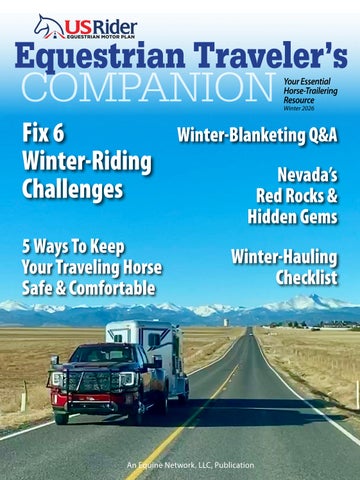
Your Essential Horse-Trailering Resource Winter 2026
Fix 6 Winter-Riding Challenges
Winter-Blanketing Q&A
5 Ways To Keep Your Traveling Horse Safe & Comfortable
Winter-Hauling Checklist
Nevada’s Red Rocks & Hidden Gems
An Equine Network, LLC, Publication
Equestrian Traveler’s COMPANION FEATURES 8 Hone Your Horsemanship
Your Essential HorseTrailering Resource
Winter 2026
Step Into Sidepassing
12 Equine Gear Winter-Blanketing Q&A
16 Hauling Hints
5 Expert Hauling Strategies
20 Your Healthy Horse
Fix 6 Winter-Riding Challenges
22 Getaways
Red Rocks & Hidden Gems
26 USRider Member Story
Sierra Rescue
DEPARTMENTS 4 Trip Tips
Expert Advice for Equestrian Travelers
6 Skill Set
Winter-Blanket Repair
28 Equine Essentials
Comfort & Joy
30 USRider Member Discounts Holiday Gifts
32 Handy Checklist COVER PHOTO BY PHOTO BY HEIDI MELOCCO
Safe Winter Hauling
USRider General Manager: Bill Riss Editor: René E. Riley Art Director: Abby McDougall Contact USRider: (800) 844-1409 1079 S. Hover St., Ste. 200, Longmont, CO 80501 memberservice@usrider.org • www.usrider.org USRider® Equestrian Traveler’s Companion
Equine Network, LLC, is the producer of award-winning magazines, including EQUUS, Horse&Rider, Practical Horseman, and The Team Roping Journal.
2
Winter 2026
What Members Are Saying About Recent Services "About as perfect as I could expect for a bad situation! Telling many others and telling them all that your service is the only one to have when hauling horses!" — Jennifer A, CA (Dec 25) "Mike was very kind when talking to me. I was not alone at the time, but he really helped with the anxiety of logistics. He stayed on the line, relayed messages, continued checking with me even when I did get home with truck, trailer, and pony. Customer service at it's best!" — Sharon G, AZ (Dec 25) "She was great! She found the right person to help me and he was there in less than 5 min. Your service has always been reliable and I am happy to have it. Thank you." — Judith C, TX (Nov 25) "Great job! I will be renewing my membership and recommending your company to friends and family, your coverage was a huge help!" — Colton M, ID (Oct 25) "When the service provider arrived, they were under the impression that the USRider folks were either my employer or a family member, because they had shown so much more care for my situation and wellbeing than other roadside service call center employees. Mike is off the charts in terms of how he handled this." — Andrew T, WV (Oct 25) "Kelsie was an absolute rockstar! She understood what I needed and kept me informed all along the way as she organized service for me. I had the roadside assistance I needed faster than if I hadn’t had a trailer! It made a stressful situation less stressful and got me home safely." — Meredith B, CT (Oct 25)
Our 24/7 nationwide plan covers everything from lockouts and jump starts to towing your vehicles, trucks, and trailers. Travel with confidence knowing USRider will get you back on the road safely and efficiently, should unexpected vehicle or trailer problems occur. PHOTO COURTESY OF USRIDER
USRider® Equestrian Traveler’s Companion
3
Winter 2026
------------ TOPTIPS-----------SEASONALTIP
HEALTHTIP
Pack Enough Hay
Winter Feeding If you live in a cold area of the country, work with your veterinarian to design an ideal winter diet for your horse; use this checklist as general guidelines to help ensure your horse’s nutritional requirements are met at home and on the road during winter months. Consider high-protein hay. If the weather is really cold and you want to stoke your horse’s internal furnace, PHOTO BY CLIXPHOTO.COM feed him an extra flake of Before you store your trailer for high-protein hay, such as the winter, perform preventive alfalfa, every day. When his maintenance to ensure that it’ll normal protein needs are be- be in optimal shape for the uping adequately met, his body coming riding season. will use the excess protein for energy, adding to his body-fat stores. As your horse digests and metabolizes high-protein hay, he’ll produce extra heat, raising his core body temperature by a degree or so for about half a day (significant in subzero weather). If alfalfa hay isn’t available, you can feed your horse three to four pounds of alfalfa pellets once or twice per day. Increase his ration. In cold regions, the energy that a horse would normally use under saddle goes toward maintaining his body temperature. If your horse is losing weight during the winter, offer him plenty of hay. Supplement wisely. A little extra fat for insulation can help keep your horse warm in the winter. However, although grain and fat are higher in calories than hay, they won’t build an insulating layer of fat very rapidly. Use these supplements to maintain his weight or to add just a few pounds over time. Offer clean, warm water. Your horse will generally drink enough water if he has good access to water that’s remotely drinkable. However, his intake might decline if the water is very cold and/or contaminated with debris. This can lead to dehydration and even colic, the No. 1 killer of horses. To encourage your horse to drink, keep the water bucket clean, and use a safe heater to keep the water above 50 degrees. If he’s eating well, and seems bright and cheerful, with no signs of abdominal discomfort, he’s probably drinking all he needs. —Susan E. Garlinghouse, DVM USRider® Equestrian Traveler’s Companion
4
As you pack for equestrian travels, be sure to pack enough hay. You need enough forage to keep your horse’s digestive system working 24 hours per day, says equine-nutrition expert Juliet Getty, PhD. According to Dr. Getty, horses are trickle feeders, designed to graze continuously to keep their digestive systems functioning normally. A healthy digestive tract is less likely to experience colic or ulcers. When your horse runs out of hay, he’s hungry, uncomfortable, and possibly in pain due to the digestive acid bathing his empty stomach. To help keep him healthy and comfortable at home and on the road, feed him continuously, so his stomach is never empty. This rule extends into nighttime hours. Unlike humans, horses are awake and moving at night, and looking for forage. Every evening, feed your horse enough hay so that there’s some left over the following morning. When you travel, pack enough hay to cover continuous feeding, including night rations. If your horse will be grazing for his forage while you’re away, supplement his diet with certified weed-free feed or pellets. —Heidi Melocco
PHOTO BY HEIDI MELOCCO
As you pack for equestrian travels, be sure to pack enough hay. You need enough forage to keep your horse’s digestive system working 24 hours per day. Winter 2026
USRIDERMEMBER TIP
Don’t Disconnect Your Trailer When you experience a roadside emergency and contact USRider for service, you don’t need to disconnect your trailer from your tow vehicle; you should do so only as a last resort. Each situation is different. We prefer to attempt a repair and avoid towing whenever possible—especially when horses are onboard. (Also, keep your horse inside the trailer. Unloading him roadside can be stressful and hazardous.) When towing is the only course, we’ve had great success towing a truck and trailer in tandem to a place of safety where a repair can be made, and/or other options can be explored. If necessary, we’ll tow your trailer whether it is empty or loaded with horses. If your trailer can no longer be used to safely transport PHOTO BY HEIDI MELOCCO horses, we’ll help locate Alternative Equine Transportation. AlWhen you experience a roadside emergency and ternative Equine Transportation costs are the responsibility of the contact USRider for service, you don’t need to Member. Our primary concern is getting you and your horse off the highway disconnect your trailer from your tow vehicle; you should only do so as a last resort. and to a place of safety.
TRAILERINGTIP
Cold-Weather Tire Pressure Studies show that the leading factor in roadside breakdowns is tires. And as temperatures cool, tire pressure decreases. USRider advises you to check the air pressure on both your tow vehicle and trailer at least once a month and prior to each trip. A general rule of thumb: For every 10-degree change in temperature, tire pressure changes by one pound per square inch (PSI). Pressure goes up when temperatures are higher and down when temperatures are lower. The correct tire pressure for your vehicle will be on a placard located in an interior doorjamb; you can also find it in your owner’s manual. The air pressure for trailers can be found stamped on the tire sidewall. Tire-pressure recommendations are as listed as “Maximum Cold Air Pressure.” Unlike vehicle tires, trailer tires should be inflated to the maximum pressure indicated on the tire. Check tire pressure prior to traveling, while the tires are cold. Avoid checking tire pressure in direct sunlight, which will increase pressure readings. Use a high-quality air-pressure gauge, and know how to use it. In addition to preventing blowouts, properly inflated tires will last longer, handle safer, and get better gas mileage by reducing rolling resistance. Consider investing in a tire-pressure monitoring system to alert you to any sudden drop in pressure. USRider® Equestrian Traveler’s Companion
5
PHOTO BY CLIXPHOTO.COM
Check tire pressure prior to traveling, while the tires are cold. Winter 2026
------------ SKILLSET------------
Winter-Blanket Repair Don’t replace your horse’s winter blanket every time it’s torn. Learn how to mend it yourself with these expert tips. By Nancy Butler
D
o you blanket your horse on cold winter days? If so, you know that to your equine friend and his pasture buddies, that blanket represents extra padding during a game of tag, or it gets in the way while scratching a really big itch, or it takes the brunt of a well-aimed bite. By spring, your horse’s winter blanket can end up torn or in tatters from these antics, but replacing them can be a bank account-buster. So, since your horses aren’t going to mend their ways, learn how to do a little mending yourself. Here are some tips. Wash the blanket. Wash your blanket before repairing it. First, remove as much hair from the lining as possible. A stiff brush will work, but a circular metal curry is best—just go easy, so the sharp teeth don’t gouge the material. To wash the blanket, use a large machine at your local laundromat. (Washing a heavy winter blanket in your home washing machine is pretty much out of the question.) Detergent can damage waterproofing, so use a mild soap, or a product formulated for washing waterproof blankets (such as Nikwax or Rambo Blanket Wash). Hang the blanket over a fence to dry.
If you blanket your horse then turn him out to pasture, your blanket can end up in tatters by spring. Learn how to repair your winter blanket with these tips. Assess the damage. Spread out the blanket, and match up any torn edges. If no big chunks are missing, you’re in good shape. Simple rips can be sewn, holes can be covered with a patch, surcingles can be replaced, and leather parts can be stitched back together.
USRider® Equestrian Traveler’s Companion
6
Gather the materials. If you have a heavy-duty sewing machine, you’re home free. But even if you don’t have a machine—or don’t know a lot about sewing—you can do a fair repair job by hand. Buy some carpet/canvas needles at a sewing, craft, or dollar store. You’ll also Winter 2026
Awls are designed to push thick thread through existing holes in leather, but they also work pretty well punching new paths through nylon straps.
Wash your blanket before repairing it. To wash the blanket, use a large machine at your local laundromat. need heavy-duty thread, but dental floss works really well, too—so does fishing line. Heavyweight-denim iron-on patches are good for covering tears and holes. There are also pressure-sensitive tapes, patch-andglue kits, and seam sealers made for repairing horse blankets. Camping-supply stores, catalogs, and websites also sell tent and sleeping-bag repair tapes, patches, and seam
Chest straps and surcingles may not be readily available, so before you throw out shredded-beyond-repair blankets or sheets, cut off any usable straps and hardware to use for future blanket repair.
sealers that will work. Bridge the gaps. A rip in the outside covering of a multilayer winter blanket will need to be covered with repair tape or a patch. You can buy patches or make one by cutting a slightly larger piece of fabric from an old blanket. Fold under the edges and sew it over the hole or tear. Ironon patches work, too. Put one on each side, and stitch around the edges to reinforce it. When you’re finished, coat the edges with a seam sealer. Take care that the underside of your repair is smooth next to your horse’s skin. Replace missing parts. Many tack shops sell replacement leg straps— when you invest in a new blanket, look for one with removable straps to make this repair easier. Chest straps and surcingles may not be as readily available, so before you throw out shredded-beyond-repair blankets or sheets, cut off any usable straps and hardware to use for future blanket repair. Sew straps and surcingles back on with a carpet needle thread-
USRider® Equestrian Traveler’s Companion
ed with dental floss. Apply a piece of heavy material on the inside to strengthen the repair. Use an awl. Pushing a needle through heavy nylon or leather straps can be risky to your fingers. Instead, use an awl. Every barn should have one of these leather-stitching devices for repairing tack. The waxed thread it uses and the locking stitch it makes provide a sturdy way to reattach surcingles and chest straps. Awls are designed to push thick thread through existing holes in leather, but they also work pretty well punching new paths through nylon straps. Call the pros. If your blanket is really battered, or your knees buckle at the thought of sewing on a buckle, it’s time to call the pros. Many tack shops offer blanket-repair services, and some people with sewing skills will repair blankets for a fee. USR
Replacing torn winter blankets is expensive, but basic repairs can save serious money.
7
Nancy Butler is an avid horsewoman, longtime journalist, and freelance writer based in Delaware. Winter 2026
------------HONEYOURHORSEMANSHIP-----------
Step Into Sidepassing Teach your horse how to sidepass for greater control and maneuverability both in and out of the arena with top trainer/clinician Julie Goodnight. By Heidi Melocco with Julie Goodnight Photos by Heidi Melocco
Sidepassing is an important horsemanship skill. Read on for top trainer/clinician Julie Goodnight’s method to teaching this maneuver.
W
hen you teach your horse to sidepass, you learn to control his every foot placement and guide his every step. If you teach your horse this skill correctly, he’ll respond to your every cue and to your natural aids (seat, hand, and USRider® Equestrian Traveler’s Companion
8
leg). Here, top clinician/trainer Julie Goodnight will teach you how to position your body so that your horse will quickly understand that you’re asking for sideways movement. She’ll help you reinforce this new skill by asking you to practice it using a fence line as a guide. Winter 2026
What you’ll need: If your horse hasn’t been trained to sidepass at all, it’s best to start out with a snaffle or curb bit with articulation between the shanks (rather than a solid mouthpiece). A bit with movement will help him better feel your side-to-side rein aids. Skills your horse will need: Your horse needs to know how to stop with just a seat cue, go forward off your leg cue, and back up on cue (using more leg than rein).
STEP 1: LEARN THE CUES
Step 1: Learn the Cues Tack up and warm up as usual. Practice starting, stopping, and turns to make sure your horse is listening to your cues. In this step, you’ll learn how to use your body to ask your horse for this precise cue. In the next step, you’ll introduce him to the training process by using the cue. Your horse can move only six ways: forward; back; through the right shoulder; though the right hip; through the left shoulder; and through the left hip. Imagine these directions as the “doors” that you can open and close with your leg and rein aids. To start, we’ll open the doors to the right and close the doors to the front, back, and left. Pick up the reins, and slightly shift your weight back to block your horse’s forward motion (that is, close the door to the front). For a sidepass to the right (shown), open the right rein (lift it slightly to encourage your horse to lift his shoulder), and slide your left hand to his neck’s midline (closing the “door” to movement to the left and opening a passageway to the right). Open your right leg by stretching your foot to the right. (Be careful not to stiffen or brace this leg.) Close your left leg on his rib cage, and bump your lower leg against his side. By disallowing forward movement with your hands, opening your right aids, and closing with your left aids, your horse will move toward the opening, that is, to the right (Photo 1).
STEP 2A: USE A FENCE LINE
Step 2: Use a Fence Line Now teach your horse to move sideways. For this, you’ll need the help of a fence. Use a safe, solid fence to remind him to move sideways and that there’s no chance of moving forward. Fence work will give you a visual guide and will provide a natural barrier to block your horse’s forward movement. You’ll also make sure that you’re truly moving to the left or right and quickly make any corrections. Walk your horse up to a fence, and stop him with his nose to the rail and his body perpendicular to the fence. Keeping his body straight and perpendicular to the fence, ask him to sidepass using your opening and closing aids. As soon as any movement occurs, release the cue, and USRider® Equestrian Traveler’s Companion
9
Winter 2026
STEP 2B
return to a neutral sitting position. Reward your horse with a release and a pet no matter how small of a sidestep he takes. This lets him know that he moved in the correct direction. Pause briefly, then ask your horse to move to the right once again. As soon as he steps to the side, however small, reward him with a quick release of cues and a pet. When he associates your new cue with moving sideways, you can begin to ask for more steps before rewarding him. Repeat these steps to ask for a sidepass to the left. That is, open the doors to the left, while closing the doors to the right, front, and back. When your horse understands your sidepass cue and is responding well (that is, he’ll easily walk two or three steps before needing encouragement), ask him to sidepass a few more steps. Work on a sidepass to the right until your horse is compliant (Photos 2A and 2B). Repeat to the left. Then gradually increase the number of steps until he can sidepass 10 to 15 steps while staying fairly straight through his body. When your horse is moving well off your aids, try sidepassing with his nose pointed away from the fence (Photo 2C). Focus on keeping him straight through his body. Troubleshooting tips: As you begin to teach your horse to sidepass, he may (1) move forward or back too much; (2) move his shoulder in front of his hips (this is most common and causes a turn instead of a sidepass), or (3) move his hip before his shoulder. To fix these problems, use your aids either to block movement of a body part or to encourage more movement of another body part. For instance, if your horse moves his shoulders too far and lags with his hip, block his shoulder a little by closing with your right rein. To do so, bring your hand back toward his neck (don’t pull back), and bring your left hand back and up toward your belly button in an “indirect rein.” At the same time, reach back more with your outside leg, and bump his side to encourage his hip to move. Apply slight, backward, equal rein pressure to close the door to forward movement. Any time your horse moves correctly, or tries extra hard, reward him with a release and a pet. Moving laterally isn’t easy for him, so don’t overdo it. Once you get a few steps, reward him, and end on a good note. If your horse gets nervous when working on this, he’s feeling too much pressure. Slow down, shorten your training sessions, and reward him after he takes fewer steps in the right direction.
STEP 2C
USRider® Equestrian Traveler’s Companion
10
Winter 2026
Step 3: Add a Ground Pole
STEP 3: ADD A GROUND POLE
As your horse progresses, test your sidepassing skills over a ground pole. Work to keep the pole between your horse’s front and back feet. You’ll quickly notice any idiosyncrasies if he steps forward or back. Work to the left and right, and remember to stop and praise your horse for his efforts. Ride around the pole, then return to sidepass over it, in front of it, or behind it. Then he won’t learn that his feet must always be over a pole. When your horse easily sidepasses over a ground pole, progress to sidepassing over larger logs. Look for other opportunities to sidepass, such as moving toward a post to pick up a helmet or jacket. USR Julie Goodnight trains horses and coaches horse owners to be ready for any event, on the trail or in the performance arena. After producing the popular RFD-TV series, Horse Master with Julie Goodnight, for 11 years, Goodnight now shares the world of horses through 2Horse Productions, and through appearances at clinics and horse expos throughout the United States. She also hosts her monthly horse training podcast, Ride On with Julie Goodnight. Heidi Melocco is a riding instructor, photographer, and writer based in Mead, Colorado.
THE
APP:
THE ROPER’S ULTIMATE STREAMING EXPERIENCE
Stream videos on your device or cast to your TV.
Download videos and create a personal playlist to watch offline in the app—anywhere.
ROPING.COM/PAGES/APP
USRider® Equestrian Traveler’s Companion
11
Winter 2026
------------EQUINEGEAR-----------
Winter Blanketing Q&A Does your horse need to be blanketed this winter? Use this expert Q&A for a comfortable, happy horse. By Lee Foley
D
oes your horse need to be blanketed this winter? Some believe winter blankets aren’t necessary, saying it’s not natural. They insist that by blanketing the horse, you slow his natural hair growth and cause him to “depend” upon the blanket for warmth instead of his own natural coat. They have a point, but don’t take this
USRider® Equestrian Traveler’s Companion
12
as the last word. It’s true that if you start blanketing your horse, you’ll likely need to continue blanketing throughout that season at least. But the extremists who insist you’re harming your horse or you’re foolish to blanket him, are all wet. No one can accurately state that no horse on earth ever needs to be blanketed. Winter 2026
Q. Should I blanket my horse?
stay warm. Any animal that’s ill or has a compromised immune system will need the added help from a winter blanket. If you’re not sure, your veterinarian can advise you.
Q. What about liners?
Q. Is my horse cold? A. You’ll note your horse is cold if
Horses are designed to heat themselves through the digestion of forage (hay or pasture) in the hindgut. Feed him free-choice hay, and carefully monitor his weight.
A. Certainly, the healthiest solution is to let your horse grow his long winter coat and provide him with adequate shelter from the wind and wet. Note that horses are designed to heat themselves through the digestion of forage (hay or pasture) in the hindgut. Feed him free-choice hay, and carefully monitor his weight by touch or with a weight-measuring tape. (Winter coats can hide weight loss.) If your horse is a mature adult, healthy, well-fed, and not exercised hard enough to sweat during the cold months, by all means spend your money on something other than a winter blanket. However, if your horse is old or young, you may need to blanket him, as he may need added protection from wind, wet, and frigid temperatures. He simply might not be able to generate the body heat necessary to
he’s standing with his head down and his tail tucked tight against his body. Usually, he’ll put his tail toward the wind. Often the wet weather has matted down his coat, which decreases his natural protection. It’s nearly impossible for a horse to stay warm in severe wind without shelter or a blanket. A horse in this type of weather is miserable and may be shivering. You can opt to put your horse in a barn during the worst weather, but he’ll still need a stable
"It’s nearly impossible for a horse to stay warm in severe wind without shelter or a blanket. " blanket until he’s warm again. A horse that’s shivering is too cold, and it’s cruel not to address the problem. Making a horse comfortable in occasional odd weather extremes is not going to cause him to stop growing a winter coat. If you work your horse in winter, body clipping him will help his sweat dry quickly. If he’s clipped, he needs to be blanketed—period. Note: Just as your horse shouldn’t get too cold, he also shouldn’t be allowed to overheat. You can easily over-blanket your horse, causing him to sweat and become chilled because he’s wet, as quickly as having no blanket at all. Slip your hand under the blanket to monitor how warm it feels to you, and gauge if your horse seems comfortable or not. If he’s damp, he’s too hot.
USRider® Equestrian Traveler’s Companion
13
PHOTO COURTESY OF DOVER SADDLERY
Fleece blanket liners work well for layering multiple blankets as temperatures dip.
A. Frequently made of Lycra or fleece, lightweight liners protect the horse from rubs and keep your blanket cleaner longer. You can wash the liner more frequently than the heavier blanket. Darker colors tend to be better for these workhorses, and some liners are durable enough to double as stable blankets. Some of the slicker liners are said to constantly “groom” the horse’s coat and keep it shiny. These liners are usually made of nylon and or a polyester-cotton blend. The original blanket liners were actually lightweight cotton stable sheets. Match the liner style/size to your blanket. If you’d like a liner that doubles as a stable sheet, look for one with (removable) surcingles to keep it on when worn alone.
Winter 2026
Q. What should I look for in blanket materials?
Q. How do I measure for proper fit?
PHOTO BY MICHELLE ANDERSON
A. To measure your horse for a blanket, start from the
A. Here’s a rundown of materials you’ll see in new and used blankets. • Cotton, the most secure material, is breathable and easy to wash. Some cotton fabrics are a bit stiff. A polyester-cotton blend is a little softer than pure cotton. • Fleece is warm, lightweight, breathable, and easy to wash. Fleece tends to be soft and cuddly, but picks up a lot of debris. • Nylon or polyester materials are the warmest but also the heaviest. They’re the most difficult to wash and keep clean. Nylon is usually on the blanket’s underside, as it’s not durable enough to be an outer layer on its own. Nylon also isn’t breathable. • Textilene/PVC is a tough, mesh vinyl fabric that’s more resistant to tears and snags. It tends to be a bit stiff, but you can usually clean it with a water hose and brush. • Gore-Tex and Sympatex are waterproof, windproof, highly breathable and expensive. • Lycra is great for preventing rubs and keeping the coat slick. However, Lycra needs to stretch to work, so don’t go overboard on size. • Cordura is a tough, durable material that’s easy to clean and water-resistant. • Wool is found in coolers and exercise sheets, and occasionally in blanket linings. It’s expensive compared to more synthetic options. USRider® Equestrian Traveler’s Companion
center of his chest. Run the tape straight back to the center of his tail. This is his blanket size. Note that the majority of sizes are listed in even numbers, so if your horse measures 71, first try a blanket size 70. Smaller sizes will likely have enough room for your horse, but are less likely to shift and twist. Rubs can occur from shifting side to side and front to back. • A contoured blanket is designed to fit the shape of the horse more closely, often with a dart in the hip area and a gusset or dart in the shoulder area, too. • A Euro cut means the blanket is more draping and boxy, with longer sides and usually no back seams. • A Quarter Horse cut is made to accommodate a horse with a more heavily muscled build.
Winter-Blanket Glossary Denier: A linear mass of fibers. The higher the number, the more fibers (or threads) per 9,000 meters. Therefore, the higher the denier, the more durable the fabric. Waterproof: Stops moisture from penetrating through the cloth. Water-resistant: Keeps moisture from penetrating through the cloth. A heavy downpour or a lot of snow may leak through a water-resistant blanket. Breathable: Allows the horse’s perspiration to escape through the blanket, so he doesn’t get wet from sweat under the blanket. Ripstop: A lightweight, tear-resistant nylon. 3M Insulate/Primaloft/Hollofill/Fiberfill: High-loft filler materials for added warmth and insulation. Microfiber: Made of a fiber thinner than a one-denier. This material wicks moisture, resists debris better than fleece, and is thin and easy to wash.
14
Winter 2026
When AAA says no,
USRider says yes! USRider’s roadside assistance program provies 24/7 roadside assistance for any vehicle our members are traveling in, including tow vehicles and trailers carrying horses. If the unexpected happens, our members know they can call us anytime, day or night. *Applies to passenger vehicles or light-duty trucks maximum GVWR 14,000 lbs.
AAA
USRIDER CLASSIC
USRIDER PREMIER
LOCKOUT BATTERY ASSISTANCE ROADSIDE SERVICE: FLAT TIRE ASSISTANCE, JUMPSTARTS, FUEL DELIVERY HORSE TRAILER SERVICE & TOWING EMERGENCY STABLING, VETERINARY & FARRIER REFERRALS WINCH-OUT COVERAGE ON DUAL-WHEELED VEHICLES $5,000 THEFT REWARD FOR TOW VEHICLE & TRAILER WINNER’S CIRCLE ADVANTAGE DISCOUNTS ONE FREE ASSOCIATE EMERGENCY DISABLEMENT EXPENSE REIMBURSEMENT 24-HOUR CONCIERGE SERVICE
Join Today Join Today SAVE 15% WITH DISCOUNT CODE: HRM15
VISIT: https://usrider.org/hrm15/ WWW.USRIDER.ORG | 800-844-1409 Discount applied to new memberships only
------------HAULINGHINTS-----------
5 Expert Hauling Strategies By Julie Goodnight With Heidi Melocco Photos by Heidi Melocco
On long road trips, you need to consider your horse, your trailer, and your goals once you arrive. Here are expert tips from top trainer/clinician Julie Goodnight.
I
’ve learned a lot of things to do (and not to do) over a lifetime of hauling horses. On long trips, you need to consider your horse, your trailer, and your goals once you arrive. Overall, you’ll feel more prepared when you make a plan that feels right for you. Here are five things to consider.
1. Observe Your Horse First, observe how your horse travels in the trailer. If he’s nervous and tends to fidget and shake, he’ll use more energy, get himself hot, and need frequent breaks. Some horses are anxious when you’re [I] not[I] moving, but they do okay once you’re in motion. Consider hauling with a riding friend. A horse will always travel better with a buddy, and you’ll have driving help. I can tell when one of my horses is comUSRider® Equestrian Traveler’s Companion
16
fortable in the trailer, because he stands still. There are few hoofprints in the shavings when we travel long distances. When trailering a seasoned traveler, you can drive on a bit farther than with a nervous horse. How your horse feels in the trailer may impact how you dress him up. If he’s new to trailering or you feel he may lose his balance, protect his legs with standing wraps. I like these wraps, because they stay in place during travel. I might not wrap a horse if it’s a hot day or we’re going a short distance, and I’m fairly certain he’ll stand still and relax.
2. Prep Your Trailer Next, prepare your trailer. The more comfortable it is, the longer you’ll be able to drive without taking a break. Winter 2026
Add only a thin layer of shavings to absorb any urine and help prevent slips and falls. If you use too much, they’ll blow around and affect your horse’s air quality.
Tie your horse with enough length in the rope that he can relax his head, but not so long that he can turn his head back behind him. He can catch a hoof in a too-long lead rope, which can lead to a serious injury.
If you have a slant-load with padded sides that your horse can lean against, he’ll be able to take a break from the stress of balancing. If you have an open stock-type trailer, he won’t have a chance to lean and may tire more quickly. Think about how you’ll access your horse while on the road. Is it comfortable for him to eat in the trailer? If you can access your horse’s head from a window, you can give him water and feed on the road without offloading, shortening your breaks. Here are a few more trailer-prep tips. • Invest in a trailer cam. I suggest that you invest in a wireless trailer camera that you can monitor from your truck’s cab. Then you can check in on your horse along the way to see how he’s doing. • Go light on shavings. Add only a thin layer of shavings to absorb any urine and help prevent slips and falls. If you use too much, they’ll blow around and affect your horse’s air quality. Shavings can also become slippery, so keep
them at a minimum. • Check ventilation. Make sure your trailer has adequate ventilation to support your horse’s lung health and overall comfort. Make sure the roof vents are open and that air can circulate inside the trailer without the windows being open all the way. You want airflow, but you don’t want your horse to be able to stick his head out the window. • To tie or not to tie? There are advocates on both sides of this debate. I always tie my horse in the trailer, so I know where his head is. If I feel the trailer moving and feel him moving around, I know that there’s something wrong. I also like to know that I can get to my horse’s head to feed and water him, if needed. I want him to stay how I put him. Of course, if you tie your horse, use only a halter designed to break away in an emergency. A rope or nylon halter likely won’t break if your horse pulls back, which can lead to injury or worse. Tie your horse with enough length in the rope that he can relax his head,
USRider® Equestrian Traveler’s Companion
17
If you’ll be gaining altitude, your horse will need at least 48 hours to rest and acclimate, especially if you’re going on a mountain trail ride. but not so long that he can turn his head back behind him. He can catch a hoof in a too-long lead rope, which can lead to a serious injury.
3. Plan Your Drive Time Before you go, decide whether you’ll push to drive straight through or stop to rest and board along the route. From my place in Central Colorado, I have to trailer three hours just to get out of the mountains. My horses and I are used to a moderately long trailer ride. Plan ahead for a long trip. Schedule rest stops, water breaks, and feeding times. Keep in mind that you’ll need to stop more often if your horse is nervous. Decide how many days you’ll be on the road, and arrange overnight stabling in advance. Consider what you’ll ask of your horse when you arrive at your destination. Will you be arriving the night before a performance class or grueling trail ride, requiring him to work hard as soon as he arrives? If so, build in some downtime. Don’t push through and drive all at once, then ask your horse to immediately carry Winter 2026
you over jumps or up a mountain. Note that if you’ll be gaining altitude, your horse will need at least 48 hours to rest and acclimate, especially if you’ll be going on a mountain trail ride. On the road, keep your horse in the trailer. During breaks along the route, park in a safe place, open the window, check on him, then sit down and rest for a half hour. You and your horse will both get a break from balancing while the trailer is in motion. When you stop for the day, offload your horse at your destination. Bring your own feed and water buckets to avoid contamination risk. Optimally, I’d travel no more than eight hours per day. That allows me time to arrive early at the overnight accommodations I booked ahead Avoid offloading your horse onto conof time. Only push through longer crete or asphalt, where he can easily than this if your horse has time to rest slip. And only offload him if you know when you arrive at your destination, he’ll load up again easily. he travels well, and your trailer is comfortable. buckets with lids so your horse has When I arrived, I’d make sure to some water from home that he’ll take my horse on a nice leisurely walk recognize and drink. to help his digestion and muscles. You’ll also need hay from home. Horses aren’t made to stand still all Your horse’s digestive system is deday, so walking can help them relax. signed to have food moving through With that plan, I’d stop every two his system throughout the day. He’ll hours, even if it’s only for 20 minutes. tend to be healthy and relaxed when I’d open the windows and make sure he has access to feed. the ventilation is okay. I’d feel his However, make sure that there’s chest to see whether my horse is too adequate room in the trailer for your hot or cold, then make any necessary horse and the haybag. If you stuff a changes. full hay bag in a slant-load, there will be little room for your horse to move. 4. Consider Feed and Water He won’t be able to relax his neck. If your trailer allows you to access Short-trip tip: When you haul your horse’s head, hang a haybag and shorter distances (less than three water bucket when you stop to rest. hours), make sure your horse has If you can’t get to your horse’s head, eaten well before you start. If he gets you’ll be able to feed and water him into the trailer with a full belly, he only when you offload. won’t be thinking about food for an Hydration is vital to your horse’s hour or two. Give your horse hay and health when you’re hauling a long water as soon as you arrive. This also distance. Bring a few five-gallon means he’ll have more room to move USRider® Equestrian Traveler’s Companion
18
in the trailer without a space-limiting haybag.
5. Offload Safely Offloading along your route may seem like a good break for your horse, but it’s tough to find a safe place to unload and load safely if you’re not traveling a familiar route. Avoid offloading your horse onto concrete or asphalt, where he can easily slip. And only offload him if you know he’ll load up again easily. If there’s any question about your horse’s intent to get back onboard, wait until you reach the overnight-stabling facility to unload him. Don’t do a trailer-loading training session along a busy highway. If you plan to offload your horse, make sure that you have as many people with you as you do horses, so you have enough help managing your traveling herd. If I’m by myself, I want to get there as fast as I can and make sure I don’t have any incidents along the way. USR Heidi Melocco is a lifelong horsewoman, equine journalist, and photographer based in Mead, Colorado.
Julie Goodnight trains horses and coaches horse owners to be ready for any event, on the trail or in the performance arena. After producing the popular RFD-TV series, Horse Master with Julie Goodnight, for 11 years, Goodnight now shares the world of horses through 2Horse Productions, and through appearances at clinics and horse expos throughout the United States. She also hosts her monthly horse training podcast, Ride On with Julie Goodnight.
Winter 2026
The Stink Stops Here.
Bye Bye Odor’s powerful microbes break down ammonia and odors—no cover‑ups, just cleaner air for you and your animals.
spalding‑labs.com
------------YOURHEALTHYHORSE------------
Fix 6 Winter-Riding Challenges If you love riding on cold winter days, use these six fixes to help keep your horse healthy and sound. By Eleanor M. Kellon, VMD
As you ride this winter, be considerate of your horse’s fitness level, and be careful of the ground conditions.
W
inter riding is exhilarating, but it can pose some problems. Here, we outline six potential winter-riding challenges, then give you the expert fix for each one. Challenge #1: Physical fitness. Your horse probably isn’t getting as much exercise as he did when temperatures were balmy. The end result is that he’s probably losing some of his physical fitness. The fix: When you do ride, be considerate of your horse’s needs. Warm up slowly. Stay alert for any signs of fatigue, such as heavy breathing, sweating, “stumping,” or bad steps.
Challenge #2: Dander. Dust and dead skin cells tend to accumulate against your horse’s skin under his dense winter coat. The fix: Spend time deep-grooming your horse to remove any buildup so you don’t risk dander irritation under tack. Clipping his belly, or doing a trace clip of the belly and halfway up the chest wall, will make these areas easier to keep clean. (If you clip, blanket your horse so he’ll be insulated from the cold.) Otherwise, use a curry and lots of elbow grease to deeply clean and loosen material close to the skin surface. A vacuum works best for remov-
USRider® Equestrian Traveler’s Companion
20
ing dirt, hair, and debris, but vigorous brushing with a fairly stiff bristle brush will get the job done, too. Challenge #3: Joint stiffness. Cold weather quickly stiffens areas of arthritis and/or old injuries. The fix: A brisk rub with a warming liniment, plus stretching and flexing by hand, will help your horse loosen up more quickly. Wear heavy rubber house-cleaning gloves to protect your hands from the chemicals and the cold. Wrapping your horse’s legs overnight also helps keep the joints more flexible. Challenge #4: Frozen ground. Frozen ground creates concussion on Winter 2026
PHOTO BY BOB LANGRISH
Studs in shoes provide traction on icy surfaces, but they also increase leg strain. your horse’s feet and joints. It’s like working him on concrete. Plus, frozen, uneven ground can easily bruise the bottom of his foot and even cut the frog. The fix: Consider protection in the form of hoof boots for barefoot horses, or pads under shoes. Many hoofboot models can also be worn over shoes. Challenge #5: Icy ground. Ice is a particularly treacherous situation, as your horse can slip and fall, risking serious injury. The fix: A barefoot horse will have better grip on ice than a horse in shoes. But even the barefoot horse will be safer on ice with boots. Borium, or studs in shoes, provide much better traction, but at the price of more strain on the joints, ligaments, and tendons. Boots over shoes is another option. Challenge #6: Snowballing. Riding in snow is fun, but can result in snowballing—the accumulation of ice
Riding in snow is fun, but can result in snowballing—the accumulation of ice and snow in the bottom of the foot. Inset: This rim snow pad serves a dual PHOTO BY CLIXPHOTO.COM Frozen ground creates concussion on purpose: shedding snow and reducing your horse’s feet and joints. concussion to the feet and legs. and snow in the bottom of the foot. Snow melts a bit on contact with the hoof, then refreezes quickly, creating a mound of snow and ice that is difficult to remove. A barefoot horse with a well-maintained, nicely rounded, concave foot
That part works well, but some horses find the pressure uncomfortable. Such pads also don’t allow the bottom of the foot to “breathe,” predisposing the hoof to softening of the sole, along with bacterial growth. A better solution is a rim snow pad. These pads fit under the shoe and extend out over the sole for a short distance without covering the whole sole. Pad movement when the horse walks and trots forces out the snow. Another solution is boots over shoes. When you’re done riding, just take them off. USR
“When you do ride, be considerate of your horse’s needs. Warm up slowly. Stay alert for any signs of fatigue, such as heavy breathing, sweating, “stumping,” or bad steps. ” may be able to pop out the snow naturally. But a longer-toed, flatter-footed (or shod) horse cannot. Regular full, flat pads don’t solve the problem, because snow will still build up between the pad bottom and the shoe walls. The fix: Full pads with a large bubble in the middle, called “snow popper pads” used to be popular. They work by compressing when the foot hits the ground and popping out again when the leg is lifted, forcing the snow out of the bottom of the foot.
USRider® Equestrian Traveler’s Companion
21
Eleanor M. Kellon, VMD, the owner of Equine Nutritional Solutions in Robesonia, Pennsylvania, is one of a handful of experts in the field of applications of nutraceuticals for horses. She’s an authority in the field of equine nutrition, as well as conditions affecting performance horses. Dr. Kellon’s books include Equine Supplements and Nutraceuticals (Breakthrough Publications). Winter 2026
------------ GETAWAYS ------------
Red Rocks & Hidden Gems Discover Southern Nevada’s towering mountain ranges, scenic canyons, and hidden charms. Story and Photos by Kent & Charlene Krone
Look beyond Nevada’s parched deserts and gambling glitter and you’ll find a treasure trove of delights for adventurous equestrian travelers.
L The entrance to Red Rock Canyon National Conservation Area just west of Las Vegas.
ook beyond Nevada’s parched deserts and gambling glitter and you’ll find a treasure trove of delights for adventurous equestrian travelers. The state has 150 named mountain ranges, more than any other state. Peaks soar more than 10,000 feet above sea level. The highest point, Boundary Peak, reaches 13,140 feet. The Silver State also offers riders scenic canyons and hundreds of thousands of acres of public lands to explore. We explored the southern Nevada region with our Missouri Fox Trotter geldings, Nate and Cowboy. We found several superb riding locations within an easy drive of Las Vegas.
22
Winter 2026
USRider® Equestrian Traveler’s Companion
Valley of Fire State Park Valley of Fire State Park is located 56 miles northeast of Las Vegas. This 42,000-acre park contains sandstone formations, washes, and several cacti species. The park’s name comes from the area’s red sandstone formations that were made by shifting sands and extensive erosion 150 million years ago. There are no overnight-stabling facilities in the park, but it’s a good location for day rides. Many folks ride cross-country, blazing their own trails. One popular ride is the Prospect Trail, a scenic 12mile day trip. Much of the trail is silt and sand, which is easy to navigate over. As you ride, look for ancient petroglyphs on rock walls.
The Krones’ rig parked at the trailhead to Oak Creek Canyon in Red Rock Canyon National Conservation Area.
Red Rock Canyon Red Rock Canyon National Conservation Area is located just 20 miles from the famous Las Vegas strip. It’s hard to believe such a beautiful 200,000-acre wilderness area could be so close to the glitter of Vegas. Colorful mountain ranges composed of gray limestone and red sandstone serve as a Western backdrop to trail riders. Folks ride on dirt roads, washes, and designated trails. The best riding in this region occurs fall through spring. Summer can have punishing 100-degree-plus temperatures. Be careful of cacti in the area, especially the cholla cactus, which has nasty balls of spines that can attach to you or your equine partner. On one ride, Charlene’s horse, Nate, bumped into a cholla. Ten balls of spines detached and stuck into his side. Luckily, Nate was calm and waited for help as we removed the spines with a wide comb and Leatherman tool. Fate smiled on us when we met avid horseman Mary Sue Kunz, who offered to guide us on rides in Red Rock Canyon. She’s lived and ridden here for more than 30 years, and was delighted to share her deep knowledge of the area with us. Mary Sue rode her 9-year-old mustang, Kodak, whose mother had been a wild mustang in Red Rock Canyon. For many years, Mary Sue observed and documented the wild mustangs. She then used this information to advise the Bureau of Land Management on the mustangs’ status. We rode past cottonwoods, scrub oaks, and various species of cacti. Since we rode on unmarked trails, it would be difficult to recreate the figure-eight loop we took. However, it’s easy to create your own ride. There USRider® Equestrian Traveler’s Companion
Kent and Charlene Krone on the Oak Creek Canyon ride. Rainbow Mountain and Sandstone Bluffs are behind them.
Charlene and Kent Krone after leaving Oak Creek Canyon with views of the red rocks.
23
Winter 2026
are animal trails, hiking trails, and, of course, horse trails. The next day, we ventured into Oak Canyon in Red Rock Canyon National Conservation Area. We did an easy 5-mile loop, taking time to enjoy the fiery red cliffs and varied terrain.
Loop Rides
Charlene Krone rides Nate on the Landmine Trail loop that travels around a mountain and through the town of Blue Diamond.
Charlene Krone and Mary Sue Kunz riding in Red Rock Canyon.
Charlene Krone and Nate come across a marker for the Old Spanish Trail on the Landmine Trail loop. The Old Spanish Trail was a trade route between Santa Fe and Los Angeles between 1829 and 1848. USRider® Equestrian Traveler’s Companion
Before leaving this region, we went on two more rides: the Landmine Trail loop and the Badger Pass Trail loop. To begin the 9.4 mile Landmine Loop, head through the gate on the south side of the former Bonnie Springs Ranch, and work your way toward the mountain. When you see the main trail at the base of the mountain, veer to your left. At first, this landscape seems dry and bland. But as we rode along, we made some interesting discoveries. Hidden in shadowy folds below the mountain was a small burro family. The Landmine Trail enters the little town of Blue Diamond at the west end of Cottonwood St. Follow this street east to the other end of town. When it branches left, take the first street to the right. Look for a multiuse trail sign. This trail lends itself to easy gaiting or trotting as it flows around the mountain. Soon, you’ll see an Old Spanish Trail marker. Almost 200 years ago, this arduous trade route connected Santa Fe with Los Angeles via southern Nevada. The Landmine Trail continues around the mountain, gently climbing a low pass and gradually heading toward the highway. This side of the loop is more scenic in terms of distant background scenery and cacti. After circling the mountain, you’ll be back where you started. Our last ride in this area was the Badger Pass Trail loop. Take Highway 159 to Highway 160, and turn right. The trailhead will be in approximately 5 miles. We rode .7 miles along a dirt road that paralleled Highway 159 before turning left onto the Badger Pass Trail loop. This 8-mile loop seemed more remote than the Landmine Trail, but it’s gentle and easy, with mostly sandy terrain and well-designed switchbacks. USR Seasoned equestrian travelers Kent and Charlene Krone combine their interest in photojournalism with a passion for horses. They enjoy sharing their horseback adventures and equestrian-travel tips with fellow enthusiasts.
24
Winter 2026
EXCLUSIVE FOR
new H O R S E O W N E R S
PRES E N T E D BY
A COMMUNITY OF HORSE LOVERS,
a resource you can trust.
• How-tos, Videos, and Fun Facts from Industry Experts • An Inclusive and Supportive Community • Everything You Need in One Place
Visit MyNewHorse.com!
------------ USRIDERMEMBERSTORY------------
Sierra Rescue USRider saved the day for this novice hauler. By Candice F.
One Sunday, USRider Member Candice F. was on her way to go riding with a friend in the Sierra foothills aboard her palomino Quarter Horse, Sunny, when a trailer tire went flat. USRider quickly came to the rescue. USRider® Equestrian Traveler’s Companion
26
Winter 2026
USRider Member Candice F.’s drill-team competitions take her on the road with her horse—including the Grand National Rodeo in San Francisco held at the Cow Palace and the Reno Rodeo.
I
’m a first-time horse owner of a palomino Quarter Horse gelding named Sunny. Although I dream of owning a big truck and a living-quarters gooseneck trailer, my current hauling setup comprises a Chevy Tahoe and a gracefully aging Circle J bumper-pull. Sunny and I compete on a drill team, and travel all around—from the Grand National Rodeo in San Francisco held at the Cow Palace to the Reno Rodeo. (I’m based in Sacramento.) I’m also an avid trail rider, so I often meet my friend Marilyn for adventures on the route of the famous Western States Trail Ride (known as the Tevis Cup), and high-elevation outings to the Sierra Nevada mountains.
‘I Was Impressed’ When Marilyn told me about an advertisement she saw for USRider, I wanted to join immediately, as I was inexperienced and a little apprehensive about hauling my horse. I was impressed with the friendly customer
service I received. I hoped if I ever needed roadside assistance that I would be just as pleased. Of course, no one wants to think about needing to be rescued while trailering, but I certainly felt more confident driving down the road knowing that USRider would send the right people if I was ever in a bind.
Flat-Tire Emergency On a recent Sunday, Sunny and I were on our way to the Sierra foothills to meet Marilyn for a ride when my trailer tire went flat. USRider immediately sent out a tow truck to put on my spare tire. This garden-variety rescue was outstanding on its own, since the time between dispatch and arrival was less than 30 minutes. And representatives called me at least four times to see how Sunny and I were doing and to make sure we made it back on the road. But wait, there’s more. I mentioned to USRider’s very friendly dispatch representative that
USRider® Equestrian Traveler’s Companion
27
I’d be happy to get all new trailer tires. So this nice person—who was based all the way in Oklahoma City—found a tire store that was open on a Sunday less than five miles from where I was stranded. The tire store even let my horse hang out in the parking lot for an hour or two. This is just the kind of “above and beyond” service I get from USRider.
Spreading the Word After my very patient horse and I got home safely, I contacted all the riders I know, encouraging them to join USRider. Having heard unpleasant stories of experienced horsemen with newer rigs getting stranded everywhere from the Sierra mountains to the Nevada desert—relying on friends to drive hours to their rescue or finding that other companies don’t offer adequate roadside assistance for a rider’s needs—I want to get the word out that USRider is all about taking care of people, our trailers, and our horses! USR Winter 2026
------------EQUESTRIANESSENTIALS------------
Comfort & Joy Healthy Horse Cookies Winnie’s Cookies are made from certified organic ingredients selected for their 22 vitamins, trace minerals, and amino acids, creating a complete nutritional supplement. Your custom order will be handmade, baked fresh and shipped directly to your home or barn. Treat your horse for the holidays and year-round.
Boot Covers
Sweet Treats
Do you have problems keeping your Sports Medicine Boots looking new because of mud, weeds or burs? If so, Professional’s Choice Boot Covers are the answer. Affordable and practical, Boot Covers are made of a durable, waterproof nylon that will keep your boots clean and can help to extend their life. With elastic tops and bottoms, and a hook and loop seam, they’re easy to apply. Sold in pairs.
Chocolate and Peppermint Truffles from Harbor Sweets’ Dark Horse Chocolates collection combine premium dark chocolate and decadent ganache with the cool taste of peppermint. Each truffle is capped with creamy white or rich dark chocolate and finished with crisp peppermint candy bits. A special treat only available for the holiday season!
Peace of Mind
Road-Visibility Decals
Give the gift of peace of mind! A USRider® Equestrian Motor Plan membership includes trailer service and towing, a 100-mile free towing radius, flat-tire service on dual wheels, emergency veterinarian and farrier referrals, emergency-stabling assistance, Winner’s Circle Advantage discounts, and more. $139 annually for an individual membership, plus a $29 activation fee. www.usrider.org. USRider® Equestrian Traveler’s Companion
28
CAUTION HORSES Safety Products™ create driver awareness of trucks and trailers on the highway during the day and at night. Made from engineergrade reflective vinyl, these decals can be applied to a truck, trailer, or tack trunk for daytime and nighttime visibility.
Winter 2026
TRAIN WITH THE PROS Training with the top equine professionals has never been easier. Equine Network’s subscription video platforms are home to top-quality videos on the topics that interest you. From horse care to colt starting, dressage to roping—our video platforms make it easy to learn from the best in the business anytime, anywhere. Download and start streaming from your smart devices for FREE today! Click on the brand to start your FREE trial.
------------ USRIDERBENEFITS------------
Access Discounts on Holiday Gifts As a Member of USRider, you can enjoy money-saving discounts from our nationally recognized equine-industry partners. You’ll find exclusive deals on items for you and your horse, including trailering products, tack and equipment, apparel, veterinary supplies, equestrian gifts and jewelry, equine publications, services, and more! If you’re a USRider Member, please log in to access exclusive discount codes. Not a Member? Join today! This issue, we spotlight Holiday Gifts. For more information on each of these companies, and for more Members-only discounts, click here.
Fair Hill Saddlery From Breyer models and plushies for horse-crazy kids to gear bags, grooming tools, and colorful socks for your barn buddies, Fair Hill Saddlery offers gifts to suit every horseperson on your holiday list. Based in Elkton, Maryland, Fair Hill Saddlery also offers apparel, footwear, helmets, protective vests, horse blankets and sheets, training equipment, and more. USRider Members receive a 10% discount.
Hey Box, Inc. Hey Box, an organizer box from Hey Box, Inc., is the perfect gift for stable managers, horse owners, and pet owners in the barn or in any environment. It offers a central location for drop-offs and pickups for on-the-go equestrians, as well as temporary storage for personal belongings and horse gear. The box features durable hooks to hang reins, bridles, jackets, hats, purses, leashes, harnesses, and more. Made in the U.S.A. USRider Members receive a 25% discount.
Spirithorse Designs Give a gift with the personal touch. Spirithorse Designs, which specializes in personalized horsehair accessories, such as holiday ornaments, bracelets, hat bands, necklaces, and keychains. These one-of-a-kind treasures are especially meaningful for those who are saying goodbye to a cherished horse or pet. “Working in the veterinary field for almost 15 years, the most difficult part of my job was helping clients during the sensitive moments of saying goodbye to their beloved horses and pets,” says Angela King, the company’s owner, artist, and designer. “I created Sprithorse Designs to help everyone who loves their horse and pet like family celebrate their stories with timeless pieces designed to keep them with you always.” USRider Members receive a 20% discount.
Virtue Soap Company For the special horses in your life, this soap and skin care line from Virtue Soap Company offers a blend of premium ingredients that create a luxurious, velvety lather to gently cleanse your horse’s coat, mane, and tail without stripping natural oils or drying their skin. The handcrafted, vegan, emollient-rich soaps are scented with botanicals and beneficial essential oils. a recyclable scrubbing pouch is included to keep the soap bacteria-free between uses. USRider Members receive a 10% discount. USRider® Equestrian Traveler’s Companion
30
Winter 2026
EVERYTHING YOU LOVE ABOUT HORSES ALL IN ONE PLACE
Discover Ride TV, the ultimate equine streaming platform. Whether you want to watch the biggest events in equestrian sport, bingewatch your favorite series, or learn from top pros, Ride TV makes it easy to watch your favorite videos anywhere, anytime, all in one place.
Start your 7-DAY FREE TRIAL! SUBSCRIBE TODAY
------------HANDYCHECKLIST------------
Safe Winter Hauling
Haul your horse all winter long with these expert tips.
You can haul your horse all year long, even in the dead of winter, as long as you do so safely. Use this checklist to help keep you and your horse safe and comfortable on chilly trips.
Ready Your Rig ■ Invest in good tires. Invest in quality tires for your entire rig. Check tire pressure before every trip, and comply with the manufacturer’s tire-pressure recommendations. ■ Check all lights. Recruit an assistant to help you check all lights on your towing vehicle and trailer. Replace any nonfunctioning lights. ■ Carry chains. Keep quality chains handy if snow and ice are significant enough to use them. Check your state’s chain requirements. Generally, if you have to chain up the drive axle of your tow vehicle, you should have chains on your trailer, as well.
■ Top off the fuel tank. Don’t let your fuel tank get below a half-tank. If you’ll be driving in remote areas, carry extra fuel. ■ Keep the windshield clean. Top off the windshield cleaner in your tow-vehicle’s tank, and keep extra cleaner handy. Make sure the windshield wipers are working. Place a long-handled windshield-scraper in your tow vehicle. ■ Disengage the engine brake. Engine brakes in trucks do a fantastic job slowing your rig to minimize brake wear under dry conditions. But a diesel engine’s compression-release engine brake (also referred to by the brand name Jacob’s Brake or Jake Brake) can lead to a jackknife if used in slick road conditions, since they slow your tow vehicle first. ■ Sync the brakes. Consult the manufacturer’s instructions to make sure your trailer’s brakes
USRider® Equestrian Traveler’s Companion
32
complement the brakes of your tow vehicle. When you’re on a steep downhill in slick conditions, you might need to slow your trailer with brakes greater than your vehicle’s brakes. Position the electronic brake so you can manually engage it via the thumb control. ■ Disengage the cruise control. If you get into a slide, the precious second or two that it takes to turn off your tow-vehicle’s cruise control may doom your chances of maintaining control. ■ Apply reflective decals. Apply extra-reflective decals on the back and sides of your trailer, so that other drivers can see your rig in poor-visibility conditions. ■ Clean your trailer. Frozen urine and manure are slippery. If your horse falls inside your trailer, he could suffer a serious injury or even death. ■ Weight your empty trailer. An empty trailer jackknifes more easily than a loaded one. For better control, place concrete blocks or bags of sand into the back of your tow vehicle to add weight over the rear axle. ■ Pack cold-weather gear. Pack extra hay and at least 10 gallons of water per horse. Carry a mobile phone with charger, emergency blankets, jackets, high-energy snack foods, and a thermos of hot drink, in case your tow vehicle or trailer breaks down and you need to wait roadside for help. ■ Lay in supplies. Keep a rubber Winter 2026
broom, a snow shovel, sand, shavings, and salt in your trailer or tow vehicle. Use these tools to clear snow and ice from the area around your trailer and to add traction. These measures will minimize the chance of injury as you load and unload your horse.
Keep Your Horse Comfortable ■ Apply leg protection. In winter, it’s especially important to protect your horse’s precious lower legs from slips and kicks. ■ Provide good-quality hay. Horses create heat by digesting forage in the hind gut. The best way to keep your horse warm in the trailer is to provide good-quality hay. ■ Watch over-blanketing. It’s easy to over-blanket your horse. Most trailers are poorly ventilated, so they tend to get very warm with body heat, even in below-freezing temperatures. A light sheet or blanket is sufficient for most horses. ■ Increase ventilation. Humidity and condensation buildup from your horse’s breath can cause respiratory illness. Improve the indirect ventilation in your trailer to counteract this risk. ■ Avoid drafts. That said, make sure that there are no direct drafts hitting your horse, especially on his face and eyes. Freezing-cold temperatures with wind can result in damaged corneas from frostbite. ■ Monitor your horse. On the road, check your horse frequently. If there’s sweat under the blanket, he’s cooking inside. If he’s clipped and lacks natural insulation, carefully monitor him for sweat or shivering.
■ Find traction. Park so that your trailer’s ramp is positioned on the best traction you can find. Dirt is preferred, but snow is better than ice or asphalt.
Drive Carefully ■ Recruit an assistant driver. In poor conditions, it’s helpful to have an assistant driver to watch road conditions, unusual events, and environmental conditions that could create a problem. This person also does all navigation, is the ground guide for backing and in tight spots, checks on the horses from the in-cab camera, and handles important mobile-phone calls. ■ Turn on all lights. Keep on the appropriate lights of your tow vehicle and trailer at all times, day and night. ■ Take it slow. Go as slow as you need to, to avoid a wreck. Run your hazard lights, if necessary. Stay right, and let the rest of the traffic go around you; your priority is your safety, and that of your horse and your passengers.
PHOTO BY CLIXPHOTO.COM
Go as slow as you need to, to avoid a wreck.
■ Watch for snowplows. Take extra precaution around snow-removal equipment. In some cases, the operator’s vision may be reduced. Give operators plenty of room, staying at least 200 feet behind them. ■ Allow room to brake. Leave enough room between you and
USRider® Equestrian Traveler’s Companion
33
PHOTO BY HEIDI MELOCCO
Leave enough room between you and the vehicle in front of you to account for much longer braking distances than normal. the vehicle in front of you to account for much longer braking distances than normal. Watch for black ice. Forget the 2-second rule. In poor driving conditions, allow yourself 8, 10, 12 seconds or longer to come to a complete stop. The National Safety Council recommends that you add one second per factor of driving difficulty. These factors include poor lighting conditions, inclement weather, an adverse traffic mix, and driver condition (such as fatigue). ■ Drive defensively. Plowed snow can make normal roads and driveways very narrow. Take the time to allow other vehicles to pass, and set up for turns and backups ahead of time. ■ Avoid a skid. If all else fails and you must brake hard, do so as calmly and smoothly as possible, using your trailer’s brakes to assist you. If you start to skid or slide, ease off the brakes immediately, and steer into the direction of the skid to regain control. This maneuver is counterintuitive, so practice it an open parking lot or at a driving school in good weather conditions. —Rebecca Gimenez Husted, PhD Winter 2026