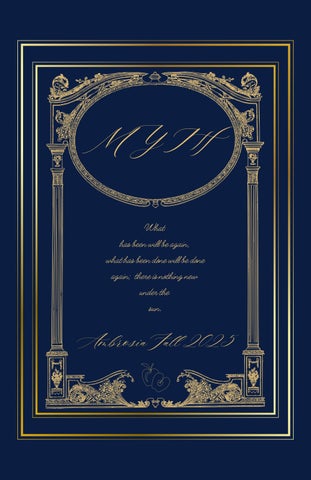
MYTH
What has been will be again, what has been done will be done again; there is nothing new under the sun.
AmbrosiaFall 2025
AMBROSIA EDITORIAL TEAM WEB AND PRODUCTION
MANAGING EDITOR Alexis Kupidy
Ambrose University
DESIGN AND LAYOUT
SUBMISSION AND COPY EDITORS Micael Bittle Lucy Graham Esther Lawe Shauna Manson
Judah Isaacs Bhutia Alexis Kupidy
FACULTY ADVISOR Dr. Darren Dyck
Ambrosia Literary Review Volume 4, Issue 2: Winter 2025 Published by Ambrose University 150 Ambrose Circle SW Calgary, AB T3H 0L5 E-mail: literaryreview@ambrose.edu
i
TABLE OF CONTENTS
01
Ben Jonson’s Icarus? Wanda Bitangcol-Yu
17
Substantial Shauna Manson
02
Seven Sins and One Kiss Shiva Seifi
18
The Final Glance Micael Bittle
08
Labour Josiah Cullen
19
Whispers Alexis Kupidy
09
The Psyche’s Plead Aysha Akther
20
Picture Perfect Rafael Baillie
10
The Princess in the Tower Hannah Butler
22
Myth-tery of Mirth Nathan Snow
23
Bios
ii
EDITOR’S NOTE Growing up I wasn’t much of a reader. In fact, some of my only memories involving books are when my mom would read to me and my sister as a part of our elementary school curriculum. When I wasn’t busy scheming the various ways I could ship my sister off to boarding school, the only books that seemed to catch my interest were ones that promised to teach me how to transform into a mermaid; To my current disappointment, none of them worked. Though reading wasn’t quite my thing, I loved writing. My sister and I—after reconciling from whatever we were fighting about during that hour—would take paper in various playful colours and write. News broadcaster sketches, creative stories, Oscar award winning dramatic journal entries, and Imovie scripts varying in levels of intensity. My all time favourite is an Imovie sketch capturing a girl who fatally stubs her toe whilst on the way to sniff a freshly baked cheesecake. It was surprisingly violent. Once I graduated high school and received no call from Hollywood offering me a career, I was left with the inevitable question: what should I do with my life? My grades in English were decent so I applied for a Bachelor of Arts In English at Ambrose. On a sunny September day, I sat bright eyed in my EN-130 class ready for my horizons to be broadened. Immediately, I was inundated with stories of all kinds I had never known existed. From Milton and Shakespeare to Tolstoy and Lewis I felt overwhelmed with all that I had not read. As my class levels and stress levels increased I was introduced to literature in its origin, myth. Greek, Roman, Celtic, Indian, and Asiatic myths infiltrated every classroom I entered. And although writing about Odysseus’ journey homeward was engaging enough, I was consumed with the desire to stop reading stories about others and write a story of my own. Unfortunately, no amount of rough drafts, mind maps, or rhetorical figures seemed to get me anywhere near close to what I deemed a “successful writer”. This year, as I returned for my third year at Ambrose, I walked through the doors feeling dejected, wondering when all this reading I was doing would finally translate into “worth it”; I had missed the entire point.
iv
The reason I was doing all this reading wasn’t so that overbearing professors could mold me into another perfect, cookie-cutter student. Rather, it was assigned by slightly overbearing professors with hopes of forming me into an intelligent, thinking individual, despite my ever so slowly forming frontal lobe. Soon I realized I wasn’t simply reading these stories to become someone, rather I was reading these stories to learn what to become. Now, almost halfway through my third year, I have finally begun to understand the reality that you can’t write without reading what has been written before you. And what were literature's first stories other than myths? Though there are still many days when I (like every student) seem to misplace my motivation to submit essays, analyses, and reading responses, I do my best to realize the privilege it is to be here, learning through the stories that—consciously or unconsciously—molded me into the person that I am. The stories that all started with a myth. Thank you to Ambrosia’s faculty advisor Professor Dyck for guiding and encouraging our team throughout the assembly of the fall 2025 edition. A special thank you to the small-but-mighty Ambrosia team. This edition would not have come to fruition without their hard work and dedication. Thank you to all the writers and artists who submitted pieces for this edition. Finally, thank you to the Ambrose student body for cultivating an educational environment full of bright minds, new ideas, and infinite support. With all that being said, I truly hope you enjoy the Fall 2025 edition of Ambrosia. Sincerely,
Alexis Kupidy
v
Ben Jonson’s Icarus? On Something, That Flies In Air Wanda Bitangcol-Yu
In skies I saw two, in wings light enough To be like the gods, and shine bright enough To seem angels wings: as I squint my eyes, A winged form turned to blaze. I asked the why. “My son,” he cried, “Daedalus flesh and blood, And such from no mean state but high nor good, For follow my lead; and avoid the ill, For follow what leads.” Good son, fly dead still.
Wanda Bitangcol-Yu | 1
Seven Sins and One Kiss Shiva Seifi Growing up in Iran, I remember a myth was told every year for Persian New Year's Eve: that after capturing little Chele, for his harsh winter rule, and imprisoning him in Damavan Mountain next to the Devil with two snakes on his shoulders, Amo Nowruz (Uncle Nowruz) arrives on the first day of spring, carrying flowers and sweets. But Nane Sarma (Granny Coldness) always falls asleep as she is waiting to see him, carrying her frost and sorrow. As she sleeps in front of Haft-sin table, Uncle Nowruz arrives, takes one citrus and eats half of it, smokes some hookah, gives Granny Coldness a kiss on her cheek as she falls deeper in sleep, and leaves. They never meet; the folk myth says that they shall never meet, as if they do, it would be the end of the world. And so winter and spring forever chase each other like two lovers that are not meant embrace each other. But since moving to Canada, every March as Persian New Year's Eve approaches, I can't help but reimagine the story differently. Here, the winters are longer, sharper, and sometimes I wonder if Granny Coldness has been given eternal life or has followed me all the way across the ocean. I see her wandering through the snowdrifts of Calgary, her breath freezing the bus shelters, her footsteps echoing on the frozen Bow River. Great Cheleh, named Ahman, Granny Coldness’s righteous firstborn, stands beside her. He stands tall and proud as his touch is cold yet gentle, knowing that he has never taken lives, only scattering storms, while Little Cheleh, called Bahman, her younger son, cowers in her cloak, guilty and trembling, aware of his sins: all that frostbite he left on the living, the deaths he cannot deny. He waits for rescue, but justice waits for him first. Shiva Seifi | 2
Bahman is no longer trapped on Damavand Mountain. He doesn’t need to be rescued by her mother, who mistakenly has fallen in love with the man of spring and has gone mad over the loss of her son. She doesn’t need to set the world on flame with her broom to see him again, because now he is out of trouble, and has a new white friend named Jack Frost, that famous wicked western cold man who is known to be responsible for the cold and flu kids catch in winter. The two of them do silly things as they wander the streets of Calgary, drawing patterns on car windows and sneaking into lecture halls. Bahman is probably a political refugee too, though he never says from where because he is ashamed of his past and what he has done. He studies at the University of Calgary, hoping to become “something respectable”, other than a wicked heartless snow king, because his Persian family has given him no other choice but to become a doctor, engineer, or lawyer. At night, instead of sleeping, he scribbles equations across the fogged glass of the library windows, his handwriting dissolving as quickly as it forms. Jack Frost laughs at him, telling him there must be more to life than grades and degrees. But Bahman only shrugs, his breath crystallizing in the air. As March begins, Granny Coldness starts to prepare her home for the new year. She is desperate for Amo Nowruz’s approval, longing for his blessing throughout the year. For everyone knows: if Amo Nowruz walks into your home and finds it messy, or if the New Year's feast is not ready, or, most importantly, if the Haft-sin table is missing, then the household will be cursed for the entire year ahead. Nane Sarma has ordered her Haft-sin set from “Persis Collection” a couple of months in advance. Her set is a luxury Blue and turquoise Minakari art copper set that comes with a Shiva Seifil | 3
mirror and two candle holders, along with seven bowls to place seven “sins.” One of the bowls is bigger and wider than the others. She is planning to add candles, some coins, some painted eggs, a Persian poetry book, and a small fish tank with a goldfish on her table. The seven “sins” are not sins at all, but seven items that begin with the letter sin ( )سin Farsi: sabzeh ( سبزه- sprouts), seeb ( سیب- apple), serkeh ( سرکه- vinegar), seer ( سیرgarlic), samanu ( سمنو- sweet pudding), somaq / sumac ( سماق- the sour red spice), and Senjed ( – سنجدdried oleaster fruit) . Each object is a small prayer, each one a hope for the year to come. Some say they are seven to honor the Zoroastrian magi, who charted the seven planets. Others say the number itself carries its own meaning, that seven is the number of wholeness, of completion, of the circle closing so that it can begin again. Apples, garlic, and vinegar can be found in any FreshCo or Superstore, tucked among ordinary produce and condiments. But the others are too Persian, too steeped in the memory of bazaars and grandmothers’ kitchens to appear on regular grocery shelves. Samanu pudding must be coaxed from sprouted wheat over the course of days of patient tending. Sabzeh too must be grown, lentils or wheat soaked and nurtured until their green shoots whisper of spring. Sumac must be ground from its crimson berries. And Senjed, with its dry sweetness, must be hunted down in a Persian market, carried home like a secret from the old country. Every year, as March begins, Nane Sarma fills her kitchen with the aroma of wheat and sugar, stirring pots of Samanu pudding that bubble like molten earth. She grows trays of Sabzeh, sprouts spilling over clay bowls, and gives them away to neighbors, friends, even strangers who might want to taste Shiva Seifi | 4
Nowruz. She makes her pilgrimage to the Persian market for sumac and Senjed, and never forgets Esfand, the wild rue seeds to ward off the evil eye, or Sonbol, the hyacinth whose fragrance announces spring before the snow has melted. Every year, as March comes, she tells Ahman to warn Bahman to clean his room, otherwise Amo Norouz will leave coal in his room. As she begins preparing her house, she vacuums the Persian rugs until the patterns bloom bright again, sends the curtains to be dry-cleaned, and polishes her crystals with the corner of an old napkin until they sparkle like frozen stars. She changes the tablecloths, lays out fresh dishes, and scrubs the bathrooms with Mr. Clean, as if even the mirrors must shine clear enough to catch Amo Nowruz’s approving eye. She wipes down every window and dusts every surface, chasing away the stale breath of winter, trying to make her house worthy of the footsteps of spring. Every year as spring approaches, Nane Sarma walks to the nearest ATM to withdraw crisp bills. She slips them between the pages of the Divan of Hafez, so that on New Year’s Eve, the children can test their luck by opening the book at random. Whoever finds the page with the most zeros on their bill is said to be the luckiest soul of the year. She puts the poetry book in the middle of the table in front of the mirror and sets two candles on each side. She puts seven sins on seven bowls and places the sprouts in the wider bowl, along with coins, colored eggs, espand, hyacinths, and a table clock. Every year, as March 20th approaches, she puts on her babyblue wool coat and her white knitted scarf, and heads to the seasonal Nowruz bazaar to buy a goldfish. Carrying it home in a thin plastic bag, she walks slowly through the snow. Passersby give her curious looks. After all, to those who don’t know Nowruz, she must seem like an old lady taking her fish out for a walk. Shiva Seifi | 5
She brings the fish home and put it in a crystal fish tank next to the mirror in her Haft-sin table. Before spring arrives and the year begins anew, she books an appointment with a henna artist to decorate her hands, and another with her favorite Sephora makeup artist. On the first day of spring, she wears her Scandale Absolu pour Femme perfume and lets her long, voluminous white curls flow freely, as if even her hair is made of snow and wind. Every year, as March 20th approaches, Amo Nowruz dyes his white hair and his long beard with henna, making them a deep shade of red. He ties his hair low at the back and trims his split ends. He puts on his special green suit, a crisp white shirt underneath, a cashmere-patterned red tie, and a brown leather belt. He polishes his shiny Verni shoes until they gleam, then finishes with a touch of Dior cologne. Every year, as the spring arrives, Nane Sarma leaves her house door open, and she lights the two candles beside the mirror. Their flames tremble, reflecting against her red cheek, like twin stars over snow. The hyacinths release their perfume, and the goldfish glides in slow circles as if stirring time itself. She stands for a moment before the table, hands folded, eyes glistening. Her home carries the aroma of vinegar and sugar, of freshly polished copper and rosewater. The air hums softly with expectation. But this year, something feels different. The frost on her window has melted into long silver tears. The clock ticks louder. The snow outside glows faintly, as though touched by invisible light. She sits in front of the Haft-sin table, waiting for him, as snow pours outside. Her confidence grows as she knows that she is alive, and this time, she will stay awake. The New Year’s feast, Sabzi polo and fish, rests warm on the stove, filling the house with the scent of herbs and saffron. Shiva Seifi | 6
And then, there he stands, Amo Nowruz. His beard, tinted red with henna, glows under the faint moonlight. His green suit gleams softly, his eyes bright as the first morning sun. In his hands, he holds a red sack and a small bouquet of daffodils. He looks at the Sabzi polo and the fish, and takes a spoon, grabbing a bite. Then he slowly walks around the house and sits in front of the Haft-sin table beside Nane Sarma. He smokes the hookah, the air curling with the scent of apple and mint, then picks up a citrus from the table. He peels it, eats half, and gently offers her the other half. Their eyes meet, winter and spring, frost and blossom, and in that still, impossible moment, they lean toward each other. And there it was … a kiss!
Shiva Seifi | 7
Labour Josiah Cullen Light prowls down, slinks not up the wall. Mouths open wide, the beasts stealthy labour reveals rise and fall. It is yet early still and the golden beast of awakening draws closer. And so I must rise and act, as dismay mounts akin arrows fall. I am compelled to chase the threat, and seek its end, my final goal. Up the mountain and through the blinds. Choose a string to bind and blind, that maned beast that would keep me from a good night’s sleep. I choose right, and the beast retreats. One last feat to conquer light, I must wrestle with my mask of night, to strangle out the beams last fight. Darkness wins and I sleep thus. The beast is dead, with final thrust! Further on in golden day, energized from an early clash, I am draped with the mane of titanic progeny Which has won for me sleep, more – but a dash. With this sleep I can face once more the labours of day, and creatures of morn. Josiah Cullen | 8
The Psyche’s Plead Aysha Akther
tossed and turned, amongst the divines. once a beaut, now for naught. tossed and turned, lying next to him. blind and bare, with nothing left to spare. the beauty of a peach, the will of a siege. a Woman’s need, is the Psyche’s Plead.
Aysha Akther | 9
The Princess in the Tower Hannah Butler The story of the princess in the tower is tragically misrepresented. It is not the story of a young girl whisked away from her family by an evil witch and trapped in a tower. Nor is it the story of a naive young girl who spends her days staring out the window pining for the world beyond. She has wandered the earth and saw everything it had to offer, and it is because of what she saw out there that she built her tower brick-by-brick. Over the years, there was no shortage of princes who tried to force their way into the tower. They tried scaling the walls, or they attempted to tear the tower down, and one even got in by climbing a tree. The Princess had pushed him out of the window and promptly cut the tree down. Despite the numerous attempts, the tower only seemed to grow taller and taller. One day, the Princess was busy making herself a cup of tea before she settled down with a book when she heard a horse approaching from outside. “Hail! Fair maiden,” a voice called. The Princess glanced towards the window and then back at the steaming mug on her counter. “Fair maiden!” it called again. Knowing this could go on for quite some time if she did not intervene, the Princess moved to the window and gazed out on the fair-haired prince below. “Are you lost?” she called. “Lost? I should think not! You are the Princess they sing of: a maiden with auburn hair locked away from the world waiting for a worthy prince to rescue her,” he declared. Shana Hekman | 10
“Actually, you’ve come at a bad time. See I’ve just made myself a cup of tea and I’d like to drink it while it’s still hot so…” “Fear not, fair lady. There is plenty of tea in my kingdom.” He left his horse grazing by a tree, planted a foot firmly against the base of the tower, and sought a hand hold. The Princess sighed, gazing back at her forlorn tea, and turned to gauge the prince’s progress. Unfortunately, he was doing quite well! As he reached the midpoint of the tower, she reached for the lever at her feet and pulled it back. The upper section of the tower shot up several feet, suspended by a thin beam. The prince froze. “Your tower has leapt from its foundations!” he called. “Alas!” she cried. “It is rather temperamental.” She heard his feet slip back down the side of the tower and the Princess took up a cup of now tepid tea and her book. Once she was sure the prince would not return, the tower lowered, and the lever was reset. A few days later, on a sunny afternoon, while the princess was sat at the table with a puzzle, she heard the sound of hooves picking their way through the forest. Praying they would pass the tower, she shut her eyes. The horse halted, and the sound of armour rang out as another prince landed on the ground. “Princess, lovely princess!” he called The Princess set down the puzzle piece she had been attempting to place and moved to the window. “Hullo.” “It is you!” he cried. “The maiden of the tower with the auburn hair.” Perhaps, she thought, colouring her hair might dissuade them. Magenta or something of the sort. Hannah Butler | 11
“Yes, yes,” she sighed. “What do you want?” “Why, I’ve come to rescue you of course!” “Of course,” she sighed. “I’m afraid it’s quite hopeless! Many have tried but, as you see, I am still here.” “Fear not. I shall soon amend that!” “I really wish you wouldn’t,” she muttered, but he was already inspecting the base of the tower. “Aha! A door!” “Oh joy,” she breathed. There was a hatch in the floor that opened onto the stairs. The Princess carefully began picking her way down the stone steps towards the door being mercilessly battered by the prince. “It is stubborn, but I think I am making progress!” he cried. The Princess started moving crates to barricade the door. The prince threw himself against the door again. The crates shuddered but held their ground. Satisfied with her work, the Princess started back up the steps, and wondered if she should invest in a moat. She returned to her puzzle. Eventually, the sound of the prince throwing himself at the door ceased, and she heard his horse start back into the woods. Finally, there came a day where no horses were to be heard on the road. The Princess had spent the morning experimenting with floral dyes with limited success. Her hair now held a faint pink tinge, but it was far from the discouragement she’d hoped for. She laid the table and sat down to dinner when she heard the sound of hooves approach and stop outside her tower. Sighing, she cut into her dinner in the hopes of having a few bites of it before the prince began shouting at her. A few bites turned into several, and then the food disappeared from her plate entirely. She glanced towards the window. She could see Hannah Butler | 12
the sun sinking below the trees and a soft glow rose up from the ground, but no shouts were issued. She finished her dessert and the washing up, yet still the woods remained silent. There was no sign of life at all save for the steady orange glow coming through the window. Finally, her curiosity became too much, so she moved to peer out the window. A boy sat on the ground between the twisted roots of an old oak. There was a small fire a few feet from him , and his dark horse which had settled for the night. At breakfast the next morning, the Princess glanced out of the window to see the boy, still sat in the roots, tuning a small lute. She smiled softly to herself as a graceful melody reached her ears. It had been many years since she’d last heard music. She herself had never been so inclined, and it was far too challenging to get a musician to play at one’s tower. The music continued steadily until lunch time, and she peered out the window to find the boy and his horse unmoved. This time he saw her looking out. “Am I disturbing you?” he asked. “For if I am I will gladly move on.” “No, not at all. Your lute sounds lovely.” “I thank you. It has taken many years of practice. What are you doing up there?” “I was just making lunch,” she replied. He laughed. “I shan’t keep you then,” he said, and turned back to his music. The music continued all day and well into the night. It started again when the Princess awoke, and she stopped at the window to wave before making breakfast. The boy smiled and waved back. She settled back with a book, but suddenly, the music stopped. The Princess rushed to the window to see what was happening. The lute lay on the ground next to the boy, Hannah Butler | 13
who had pulled a book from his bag and started to read. She smiled softly and went to move away from the window, but he caught sight of her. “How long have you lived up there?” he asked. “How long have you lived down there?” she replied. “All my life,” he said with a smile. “I do not know when I started to live in the tower,” she said. “Only that I have found it far kinder than the ground.” He said something else, but it was quiet, and the Princess could not quite hear it, so she leaned out the window. As she did, the tower shrank, and she found she could see and hear him quite clearly. He had soft eyes and curled hair that seemed to leap from his head. “I’m sorry?” she asked. “Your name?” he asked with a smile. “I assume you have one.” “Desirée,” she replied. “And you?” “Alden,” he said. “What are you reading, Alden?” she asked. “The tales of the seven,” he replied. “What is it about?” she asked. “It is about a group of friends who travel the world, and sing songs, and fight pirates, and dine with fairies.” “I’m not sure I’ve heard that one.” “I would happily read it aloud,” he told her. “I should happily listen.” Desirée soon found that the sun was setting, and she’d spent her day by the window listening to Alden’s stories. “Will you read more tomorrow?” she asked. “If you will listen,” he said. She smiled and went to bed, and Alden noted the tower, which had seemed formidable and lofty upon his arrival, had Hannah Butler | 14
halved in height. Alden’s book only lasted them a few days, and then he insisted that Desirée ought to read him something from her collection. Sometimes he would play his lute as she read and sometimes, late at night, she would catch him singing quietly to himself. Though she was not sure how or when, Desirée found that her tower was almost on the ground now. “Would you like some dinner?” she found herself asking one day. “Well, that depends. Are you a good cook?” “I’ve never had any complaints,” she said with a laugh. “But then again there’s never been anyone to complain.” “That does not encourage me,” he said. “Well then I suppose you shall have to judge for yourself,” she decided, adding another setting to the table. After that Alden joined her for most meals, but always he would climb right back out the window and return to his place amongst the tree roots. “Why are you here?” Desirée asked him one night. “I was looking for somewhere to sit and read,” he replied. “But it is very hard to find a good place for it, what with all the carts and people and such.” “And why are you still here?” “Why, for the cooking of course,” Alden professed. Desirée laughed. “Why haven’t you pushed me out the window?” he asked. “It isn’t really much of a fall anymore,” she said. “And I have not had the pleasure of such excellent company in a very long time. You know, if the tree roots are ever digging into your back, I boast a very comfortable sofa.” “I’m afraid I cannot pay you room and board,” he said. Hannah Butler | 15
“Pay me in song and story, and you are welcome for as long as you should like.” And that night, as Alden settled himself on the sofa, the tower reached the ground. and Desirée set about removing the crates and unlocked the door, for she knew that she would never again need to defend her tower from invading forces, and the force that had invaded was quite welcome indeed.
Hannah Butler | 16
Substantial Shauna Manson
My thoughts are sculptures in my mind there stands the Victory of Samothrace filling the space behind my shining eyes and Daphne to Apollo’s surprise* is sprouting leafy lace her place is deep inside of me of my corporeal rind.
*Apollo and Daphne sculpture by Gian Lorenzo Berninit
Shauna Manson | 17
The Final Glance Micael Bittle
Micael Bittle | 18
Whispers Alexis Kupidy I whispered—too softly for a scribe’s ear to record, But my love, tuned to my tone, turned round upon instinct, And in that moment, his figure ascending beyond mine Fell to the ground, his statue no longer divine. For he knew what he had done. Hades had instructed him not, “The past is my dominion. Leave! Look beyond! Do not obstruct.” Determined was he when he seized my hand, To disappear from the world of souls, and return to his homeland. But my love, he was not mine equal, and in his shadow I fell, His pride surged like an ocean wave, and it drowned me in salty, deep swells. His song too enchanting for even him to bare, He had charmed the whole world; he himself did not spare. When that viper bit and its venom spread I welcomed death like our own familiar bed. In his arms, he held me like an instrument, Tears fell down poetically. With a melody, he sang his lament. When he came to fetch me, I knew I couldn’t object Returned to him was I, but not as a wife, as an object. So I whispered. Inaudible to most, but not to Orpheus, And he turned around, gone. Until one day when he will return to me thus. “Leave me here until you find me again. As an equal in death, then I will take your hand.” Alexis Kupidy | 19
Picture Perfect Rafael Baillie Brown and dull, hardly a rustle, silent when stirred Passed right by, easily missed, almost certainly unheard But hey, give it time. Surely its beauty will shine Hurt and broken, some part sulkin’, showing off for others’ dime “What happened” – some asked, not bothering to listen So vibrant, so alive, now confined it to a prison Give it time, let it warm, it will colour once again If unchanged on seasons different – what will happen then? The wind blows, it rustles, some part still stirring Give it time, it buds, some aspect still spinning But what happens if it didn’t? Would you keep it around? “I’d water and nurture, care ‘fore ‘till life’s found” Uproot it, cut it down, replace with something better Once vibrant and so colourful, now reduced: a measly letter “Kill it, remove it – we don’t want it here” “Put in something new, something vibrant; bring us cheer” What happened to our dignity, perseverance, and longevity Commitment and care, your presence just an amenity Look! It’s damaged, hurt-broken, and dishevel “Remove it at once, lest it bring down our level”
Rafael Baillie | 20
Once vibrant and alive, now damaged and broken Replant its own roots: How-to? Unspoken. Fall down, dead and brown, something good now lost But the new has come, old replaced… At what cost? Some parts may be better, look good, follow trend Those roots are shallow, unsecure: What then? “Do this, do that. Can’t you see what we say?” Take advice, follow closely. Who’s leading your way? What once stood tall, pushed aside, discarded Picked up by someone new, who will definitely regard it. The road is long, full of pain, very hard In the end it is worth it, to reveal the shining star. How did we get here? Is it all really worth it? Destroying the good in pursuit of picture perfect?
Rafael Baillie | 21
Myth-tery of Mirth Nathan Snow
*Key located on page 25 Nathan Snow | 22
BIOs Wanda Bitangcol-Yu Wanda is a third-year English Literature student at Ambrose University. Just like her poem: Wanda looks to the sky, draws close to the Son, follows the Father's lead, and knows it is done. Shiva Seifi Shiva is a second-year Christian Studies student at Ambrose University. Having lived between two cultures and languages, she enjoys exploring the literary works and traditions of the places she has called home. Josiah Cullen Josiah was born and raised in Alberta and is a second year English major at Ambrose University. Before attending Ambrose, he attended Columbia Bible College in Abbotsford for two years, graduating with a diploma in Intercultural studies. Aysha Akther Aysha is a third year Psychology major, minoring in Industrial Psychology who utilizes her time watching rom-coms, reading books, and sometimes writing (she wishes she wrote more). Lately her hyper fixation has been rewatching Modern Family and baking fall/winter treats :0 Hannah Butler Having graduated from the English program, Hannah is now pursuing her education after degree here at Ambrose. She has a deep love for books, nature, and - above all - solitude. Shauna Manson Shauna is pursuing her Bachelor of Arts in English and Music at Ambrose. Her love of words and music intersect in a delightful way through the medium of poetry.
Bios | 23
Micael Bittle Micael is in her fourth and final year of an English degree and plans to become a teacher. She loves expressing her creativity through the visual arts, mostly painting, and she wishes she had more time to do so. Alexis Kupidy Ally is a third year English Major with a love for good coffee, deep conversations, and all things introverted. Her lifelong dream is to visit the Yukon though she will not expand upon a particular reason why. Nathan Snow Nathan is a man, a myth, but not really a legend. He was a student here... at some point? We aren't quite sure on the timeline. Some low-resolution photographs as well as a few second-hand accounts of sightings have been collected but have yet to prove anything definitive. If you actually have real evidence of sightings of this mythological creature, then please present them! Rafael Baillie Rafael is a fourth year Biology major, in his last year of studies. He enjoys creative hobbies in his free time including writing, tinkering, sketching, and trying out new things. He loves helping people in whatever way possible, from making someone smile to getting them a meal, showing God’s love for each individual person no matter their circumstances. He hopes to continue to pursuit God’s purpose for his life, wherever that may lead.
Bios | 24
Myth-tery of Mirth Key
Key | 25
There is a certain power a new pen can bring to an old story, even if it was first told centuries ago.