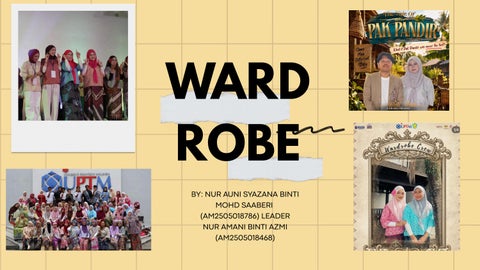
WARD ROBE BY: NUR AUNI SYAZANA BINTI MOHD SAABERI (AM2505018786) LEADER NUR AMANI BINTI AZMI (AM2505018468)
Welcome, A 1 . Our role & Our Journey Our Wardrobe Team was the smallest team in the production, with only two members: Auni, our leader, and Amani. With a whole cast to dress and only two of us, we divided the main characters between us. Amani took care of Jebat and Pak Pandir, while Auni handled Kasim and Harun. For the rest, which were Queen Ratna and her six dayang, Wan Jaya, Pak Pandir’s wife, Mawas and Mariam the Hunter, we worked on the costumes together. Almost all of our costumes were bought from Shopee. We spent a lot of time scrolling, comparing and choosing outfits that matched each character. The costume that gave us the biggest story was Mawas. At first, we made it ourselves. We bought brown fabric and a brown shirt, then stuck cotton all over it by hand to make it look like fur. It looked fine at the beginning, but the cotton kept falling off. We felt sorry for the actor who had to wear it, so at the last minute we decided to let our handmade version go and bought a full ghillie suit set instead.
2.CHALLENGES, TEAMWORK & WORKING WITH OTHER Buying costumes online saved us time, but it also meant we could not try anything on first. When the costumes for the dayang arrived, they were too long and too big for the actors. We did not have enough time to send them for alteration, and we also had to cut costs, so we pinned every outfit by hand until it fitted properly. Our work also overlapped with the Makeup unit more than we expected. They often needed us to fix the details on the costumes, such as the decorations on the outfits, the shawls and the jewellery, so we ended up working side by side instead of as two separate units. They helped us in return. On the staging day, the Makeup unit helped us dress the actors, especially Mawas and Queen Ratna, because those two costumes needed extra hands to put on and keep neat. With only two of us in Wardrobe, we could not have managed it alone.
3.LOOKING BACK AT OUR JOURNEY If we had to choose one thing we are proudest of, it is Mawas. It was the hardest costume to find, because the actor is a tall man and almost nothing we found would fit him. It gave us the most trouble, which is exactly why it is the one we are proudest of. If we did it again, we would push the costumes further. We want every outfit to be on point and eye-catching, so that the audience knows who the character is the moment they walk on stage. The memory we will keep is from the Sungai Besi MRT station. It was peak hour, people were rushing past, and the two of us were in the middle of it all, fixing the Mawas costume again and again. It was raining that day too, so the cotton came off even faster than we could stick it back on. It was tiring at the time, but it is the first picture that comes to mind when we think of this production.
PART B : INDIVIDUAL REFLECTION NAME: NUR AUNI SYAZANA BINTI MOHD SAABERI ROLE: LEADER, WARDROBE TEAM TEAM: WARDROBE TEAM
MY JOURNEY BEHIND THE STAGE As the leader, I felt responsible for making sure every costume suited the old kampung look of Pak Pandir. I searched for ideas, worked with my partner, Nur Amani, and prepared the Mawas and dayang-dayang costumes. Besides that, I helped the Props Team by making trees, cutting tickets, drawing, and cutting and spray-painting boxes, so I was often busy and tired. I felt most stressed when the cotton wool on the Mawas costume kept falling off, but I felt relieved when we ordered a costume instead. On the staging day, I also acted as a villager who sold things and looked after a stall at the market. Everything went smoothly, and I felt so happy. Then came the best moment: our production, Pak Pandir, was announced as the champion and we received RM1000. We never expected it! All our tiredness and hard work finally paid off, and everyone was so happy. That was my most memorable moment.
MY ENGLISH JOURNEY Before this project, I did not often use English outside the classroom. During discussions, rehearsals and the performance, I felt nervous and sometimes unsure of my words. After many rehearsals and working with my friends, I became more comfortable and confident. Now I feel that English is not only a subject to study, but something I can really use to communicate. LOOKING BACK AT MYSELF I discovered that I can lead a team, cooperate with others and stay calm when plans change. I still need to improve my confidence in speaking English and managing my time. If I could do this journey again, I would test the costume materials earlier. This project also gave me many new friends because our class combined Early Childhood Education and TESL students, and I am thankful for that. I would also like to thank Dr. Saadah, who was very supportive as a lecturer. I am truly happy to have known her and all my friends. One thing I will always carry with me is that teamwork, support and hard work can bring us to something we never expected.
PART B : INDIVIDUAL REFLECTION NAME: NUR AMANI BINTI AZMI ROLE: ASSISTANT WARDROBE TEAM TEAM: WARDROBE TEAM
MY JOURNEY BEHIND THE STAGE My main job was in Wardrobe, where I looked after the costumes for Jebat and Pak Pandir. But my journey did not stay in one place. I also helped the Props unit make the flowers for the magical forest, and I ended up on stage myself as one of the villagers. I will not pretend this journey was always fun. I was stressed for a lot of it. Just as the staging date was getting close, I suddenly got food poisoning. On top of that, I had a fight with my own best friend. The moment I remember most is becoming a villager at the last minute. I was only supposed to be in Wardrobe, and acting is not something I am good at. My villager was a spice seller, and I had to look warm and friendly at my stall. I had no lines for the audience. I only chatted with the villagers around me: the meat seller, the vegetable seller and the chicken rice stall owner. It was a small part, but I was still nervous, and I still tried to give it all my energy. On the staging day I kept switching between two jobs: fixing the actors’ costumes for each part of the story, then walking out as the spice seller. When the show was finally over and everything had worked, what I felt first was relief, and then happiness.
NARRATIVE REVISIONING & MY CREATIVE AGENCY I cannot list every change we made to the original Pak Pandir story, but I clearly remember what we added to our version along the way. In the beginning, there was no sound and no lighting when each scene came in. Our lecturer asked us to add them, and the story started to feel more alive. One change I remember well is Mariam the Hunter’s monologue. At first it was long. Later it was made shorter and given a funny part, which suited her character much better. To me, the new version has more energy and is more fun to watch. There are songs now, [lagu Pak Pandir], a sweet scene between Pak Pandir and his wife, and the song in [temberang]. When I watched it all come together on stage, everything looked steady and impressive.
MY ENGLISH JOURNEY In this production, English was everywhere. I used it when I spoke to our lecturer, Dr Saadah, when I listened to her instructions, and when I read the script. At first it was hard. I am used to everything being in Malay: talking to my lecturers, talking to my friends, getting instructions. Suddenly all of it had to be in English, and I needed a little time to think and translate in my head before I could answer. The hardest part was the shyness. Our production was combined with the TESL students, who study English as their main course, so I felt shy to speak in front of them. I had to “tebal muka”, as we say in Malay, and speak anyway. That is what I take from this experience. I learned to be brave enough to speak in English, and to listen better too.
Thank You