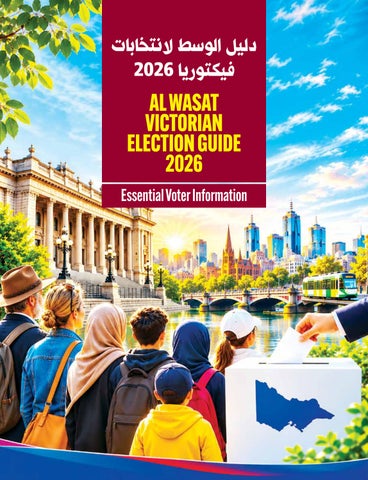
دليل الوسط النتخابات 2026 فيكتوريا AL WASAT VICTORIAN ELECTION GUIDE 2026 Essential Voter Information
VICTORIA ELECTION GUIDE 2026
2
VICTORIA STATE ELECTION 2026 WHAT EVERY VOTER SHOULD KNOW ELECTION DAY: SATURDAY 28 NOVEMBER 2026 Victorians will vote on Saturday 28 November to elect their representatives in State Parliament. Held every four years, state elections give voters the opportunity to choose who represents them and makes decisions affecting their communities.
WHO MUST VOTE?
WHY DO STATE ELECTIONS MATTER?
You must enrol and vote in Victorian state elections if you: • Are an Australian citizen. • Are aged 18 or over. • Have lived in Victoria for more than one month. Voting is compulsory. Enrolled voters who do not vote without a valid reason may receive a fine.
The Victorian Government makes decisions about services affecting everyday life, including: • Hospitals and healthcare. • Education and training. • Public transport and road safety. • Policing and crime prevention.
UNDERSTANDING VICTORIA’S PARLIAMENT
WHEN AND WHERE CAN YOU VOTE?
The Victorian Parliament has two houses.
Election Day - Saturday 28 November
Legislative Assembly (Lower House)
Voting centres will be open from 8 am to 6 pm. You can vote at any voting centre in Victoria.
The Lower House has 88 Members of Parliament (MPs), each representing one electoral district. Voters elect one member for their district. The party or coalition with majority support in the Lower House forms the Victorian Government.
Legislative Council (Upper House) The Upper House has 40 MPs, with five representing each of Victoria’s eight electoral regions. Upper House members review legislation passed by the Lower House.
Early Voting - 18 to 27 November Early voting centres will open from 9 am to 6 pm, except Sunday 22 November, when they will be closed. You do not need a reason to vote early. Voting centre locations and accessibility information will be available from 4 November.
OFFICIAL INFORMATION AND VOTING CENTRE LOCATOR: WWW.VEC.VIC.GOV.AU
Source: © Victorian Electoral Commission (VEC) — www.vec.vic.gov.au. Content adapted and translated by Al Wasat Magazine. AL WASAT 179 ¿ Jumada I 1448 ¿ October 2026 هـ ¿ تشرين األول1448 ¿ جمادي األولى179 الوسط
3 VICTORIA ELECTION GUIDE 2026
انتخابات والية فيكتوريا 2026 ما ينبغي لكل ناخب معرفته
موعد االنتخابات :السبت 28تشرين الثاني/نوفمبر 2026 يتوجه الناخبون في والية فيكتوريا يوم السبت 28 نوفمبر إلى صناديق االقتراع الختيار ممثليهم في برلمان الوالية. و ُُتجرى انتخابات الوالية كل أربع سنوات ،وتمنح الناخبين فرصة اختيار ممثليهم الذين يتولون اتخاذ القرارات المتعلقة بشؤون الوالية والمجتمعات المحلية.
ُ لماذا ُتعد انتخابات الوالية مهمة؟
من يجب عليه التصويت؟ يجب على المقيمين في والية فيكتوريا التسجيل والتصويت إذا توافرت فيهم الشروط التالية: • أن يكون الناخب مواطن ًًا أسترالي ًًا. • أن يبلغ من العمر 18عام ًًا أو أكثر. • أن يكون قد أقام في فيكتوريا ألكثر من شهر. يصّوت دون التصويت إلزامي ،وقد يتعرض الناخب المسجل لغرامة إذا لم ّ عذر مقبول.
كيف ّ يتكّون برلمان فيكتوريا؟
تتخذ حكومة فيكتوريا قرارات تؤثر في الحياة اليومية للسكان ،ومنها: • المستشفيات والرعاية الصحية. • التعليم والتدريب. • النقل العام والسالمة على الطرق. • الوقاية من الجريمة.
متى وأين يمكنك التصويت؟ يوم االنتخابات -السبت 28نوفمبر
يتألف برلمان الوالية من مجلسين:
تفتح مراكز االقتراع أبوابها من الثامنة صباح ًًا حتى السادسة مسا ًًء. ويمكن للناخب التصويت في أي مركز اقتراع داخل والية فيكتوريا.
مجلس النواب Lower House
تضم الجمعية التشريعية 88نائب ًًا ،يمثل كل منهم دائرة انتخابية واحدة. وينتخب الناخبون نائب ًًا عن دائرتهم ،ويشّكّ ل الحزب أو االئتالف الذي يحظى بدعم األغلبية في هذا المجلس حكومة الوالية.
المجلس التشريعي )Legislative Council (Upper House يضم المجلس التشريعي 40عضو ًًا يمثلون ثماني مناطق انتخابية ،بواقع خمسة أعضاء عن كل منطقة. يقّرها مجلس التي التشريعات اجعة ر م التشريعي ويتولى أعضاء المجلس ّ النواب.
التصويت المبكر -من 18إلى 27نوفمبر تفتح مراكز التصويت المبكر أبوابها من التاسعة صباح ًًا حتى السادسة مسا ًًء، باستثناء األحد 22نوفمبر ،حيث تكون مغلقة. ويحق ألي ناخب التصويت مبكر ًًا دون الحاجة إلى تقديم سبب. وستتوافر مواقع مراكز االقتراع والمعلومات المتعلقة بإمكانية الوصول إليها اعتبار ًًا من 4نوفمبر.
الموقع الرسمي ومعلومات مراكز االقتراع:
www.vec.vic.gov.au
المصدر :مفوضية انتخابات فيكتوريا ( .)VECإعداد وتحرير مجلة الوسط. الوسط ¿ 179جمادي األولى 1448هـ ¿ تشرين األول AL WASAT 179 ¿ Jumada I 1448 ¿ October 2026
VICTORIA ELECTION GUIDE 2026
4
COMMUNITY PERSPECTIVES ON THE 2026 UPCOMING VICTORIAN ELECTION By Shazma Gaffoor
On 28 November, Victorians will head to the polls to elect their 61st state Parliament, with all 88 lower house and 40 upper house seats contested.
Islamophobia The Islamophobia Register Australia’s 2025 report documented a 150 per cent increase in verified in-person incidents and a 250 per cent increase in reported online incidents between January 2023 and November 2024.
The Islamophobia Register’s Executive Director, Aishah Ali
The Register’s Executive Director, Aishah Ali, said recent incidents included attacks on mosques, physical assaults on Muslim worshippers and a rise in incidents targeting children as young as five
With the writs due to be issued on Melbourne Cup Day, political parties must take seriously the concerns and priorities of Muslim communities across the state. Islamophobia, political
to 10 in Victoria. “These are children who’ve faced verbal abuse while on excursions, intimidation, and school bullying. All of these trends are things that the Muslim population has to be acutely aware of as we approach the election,” Ali said. “According to our current data, Victoria is still the second largest victim incident report cohort.” Virgin Mary Mosque Imam, Shaykh Abdulla Hawari, expressed similar concern about rising antiMuslim hate. “Priority should be given to tackling Islamophobia and strengthening Muslims’ sense of safety and belonging, alongside supporting the rights of the Palestinian people an issue of great concern to the community,” he said. Shaykh Hawari also emphasised Muslims’ civic responsibility to vote.
AL WASAT 179 ¿ Jumada I 1448 ¿ October 2026 هـ ¿ تشرين األول1448 ¿ جمادي األولى179 الوسط
representation, particularly on Palestine, and economic and social inequality remain key concerns.
to enable it in their messaging,” she said. She also urged voters to look for concrete commitments to properly fund and resource community monitoring organisations that empower victims through culturally sensitive, trauma-informed care. Virgin Mary Mosque Imam, Shaykh Abdulla Hawari
“Participation allows our voices to be heard, and helps shape decisions affecting our lives, our children’s future, and society as a whole.”
Political representation Ali said political leaders must take responsibility for preventing Islamophobia, including through their public messaging. “Political leaders have an utmost responsibility in not only preventing Islamophobia but curtailing the conditions
RemoteComs Managing Director, Azzam Barakat
Ali drew a link between political rhetoric, including that associated with One Nation, and the language used in Islamophobic abuse. “When we see ‘Hansonism’ expressed
in media or through One Nation, the same exact terminology is then used by perpetrators in verbal abuse cases, but we see it even more acutely in online Islamophobia,” she said. RemoteComs Managing Director, Azzam Barakat, said his voting intention would depend on whether political representatives were “willing to engage with the Muslim community to work with them constructively” on decisions affecting them. “There is a need to introduce laws to protect the Muslim community from smear campaigns and unfair media targeting, while equally protecting the rest of Australian society,” Barakat said.
Community Leader, Nail Aykan
Community Leader, Nail Aykan, urged voters to look beyond campaign promises and examine candidates’ policies, track records, integrity, and accountability. “Consider how their commitments address community needs, social cohesion, and the wellbeing of all Victorians,” Aykan said. “Muslim communities must participate confidently, engage with candidates and hold representatives accountable.” Public health practitioner and antiracism advocate, Dr Umber Rind, offered similar advice. “Look at the track record, not the campaign slogans,” she said. “How has this candidate or party responded to Islamophobia, to migration, and to Gaza, where a UN Commission of Inquiry has found that genocide is occurring?” “Our faith doesn’t ask us to be passive. It asks us to act with clear eyes. That means taking part while understanding where real power sits in a system still shaped by colonialism.”
Economic and social inequality Islamic council of Victoria (ICV) President, Dr Mohamed Mohideen, identified anti-Muslim hate, the cost of living, and the freedom to practice one’s faith as key concerns. “Muslim voters should read about the policies, educate themselves, and
make informed choices based on what’s best for all communities,” Dr Mohideen said. Aykan also highlighted housing, education, healthcare, youth opportunities, and religious discrimination. “Governments should also recognise grassroots and faithbased organisations’ contributions to supporting vulnerable people and strengthening communities,” he said. The scale of Islamophobia remains a pressing concern. Ali said the Register had experienced a backlog of about 400 cases amid a reported 612 per cent increase in incidents nationally over three years.
Public health practitioner and anti-racism advocate, Dr Umber Rind
“While we work tangentially with all forms of policy and government, and have a clear relationship with police and authorities, we do not have the resources to meet the scale and the severity of incidences that are being reported,” she said. In September 2025, Australia’s Special Envoy to Combat Islamophobia, Aftab Malik, presented the report, A National Response to Islamophobia: A Strategic Framework for Inclusion, Safety, and Prosperity, containing 54 recommendations. In July 2026, the federal government announced it would accept 35 of those recommendations. “The government’s own Special Envoy has called Islamophobia
VICTORIA ELECTION GUIDE 2026
5
“pervasive”, and Muslim women and girls are bearing the brunt of it. We need to hear what each party will actually do about it,” Dr Rind said.
Islamic council of Victoria (ICV) President, Dr Mohamed Mohideen
The Islamophobia Register and the Special Envoy have both highlighted the problem of underreporting, reinforcing the need for meaningful action and adequate resources. The 2026 Victorian election presents an opportunity for Muslim communities to press for change and build constructive relationships with candidates across the political spectrum. The ultimate test is not what politicians promise during the campaign, but what they deliver once elected. “Whether it’s acknowledged or not, Muslims have helped build this nation, from the Macassan traders of the 1700s to the cameleers of the 1860s–1930s. And as we claim our voice, we must also centre First Nations voices. This is their land, and justice for one community is bound up with justice for all,” Dr Rind said. “We must move beyond simply seeking to be heard and actively help shape decisions, advocating not only for our own interests but for a more confident society for everyone,” Aykan said.
AL WASAT 179 ¿ Jumada I 1448 ¿ October 2026 هـ ¿ تشرين األول1448 ¿ جمادي األولى179 الوسط
VICTORIA ELECTION GUIDE 2026
6
BEFORE YOU VOTE
KNOW YOUR ELECTORATE AND UNDERSTAND THE PROCESS Preparing for the Victorian State Election involves knowing your electorate, learning about the candidates and understanding how your vote is counted.
KNOW YOUR ELECTORATE Every Victorian voter belongs to an electoral district for the Legislative Assembly (Lower House) and an electoral region for the Legislative Council (Upper House). Your electorate determines which candidates appear on your ballot papers. You can check your electorate and its boundaries at www.vec. vic.gov.au.
FIND OUT WHO IS STANDING Candidate nominations close at 12 noon on Monday 9 November 2026. Once nominations are finalised, voters can research candidates
in their district and region. Before voting, consider their policies, experience and public statements on issues important to you.
WHAT HAPPENS AT A VOTING CENTRE? An election official will normally ask for your name, address and whether you have already voted. Silent electors are not required to provide their address. They will check your enrolment and provide your ballot papers. You then complete the papers privately and place them in the ballot boxes. If you are voting outside your district or your name cannot be found on the electoral roll, staff will explain the declaration voting process.
AL WASAT 179 ¿ Jumada I 1448 ¿ October 2026 هـ ¿ تشرين األول1448 ¿ جمادي األولى179 الوسط
HOW-TO-VOTE CARDS Political parties and candidates may distribute how-to-vote cards outside voting centres. These cards suggest how to number your preferences, but you are free to choose your own order.
HOW IS YOUR VOTE COUNTED? Lower House, Preferential Voting A candidate must receive more than 50% of formal votes to win. If no candidate achieves this, the candidate with the fewest votes is excluded and their votes are redistributed according to voters’ next available
preferences. This continues until a candidate receives a majority.
Upper House, Proportional Representation Five members are elected from each region. Candidates are elected by reaching a required share of votes, known as a quota. Preferences are used to help determine the remaining elected candidates.
CHECK RELIABLE INFORMATION For official election information, candidate details and voting procedures, visit: www.vec.vic.gov.au
VICTORIA ELECTION GUIDE 2026
7
AL WASAT 179 ¿ Jumada I 1448 ¿ October 2026 هـ ¿ تشرين األول1448 ¿ جمادي األولى179 الوسط
VICTORIA ELECTION GUIDE 2026
8
MUSLIMS, POLITICS AND OUR RESPONSIBILITY TOWARDS AUSTRALIA Dr Bekim Hasani Imam, Islamic Scholar and Community Leader - Melbourne
For many years, I have heard discussions within our Muslim community about politics, elections and whether Muslims should vote. Some believe Muslims should stay away from politics, while others only become interested when an election approaches or when a government decision directly affects our community. But I often ask myself a simple question: If Australia is our home, our children are growing up here, and our future is connected to this country, why should we leave important decisions about its future entirely to others?
As the Victorian State Election approaches, I believe this is something our community needs to seriously think about. Muslims have been part of Australian society for generations. Many of us were born here, while others, including myself, came from different parts of the world and made Australia our home. We have established families, businesses, mosques, Islamic schools and community organisations. Australia has given us the freedom to practise our religion and live according to our beliefs. These are blessings we should never take for granted. However, with these opportunities also comes responsibility.
We cannot continue to see ourselves as outsiders when it comes to decisions
that affect our lives and the future of our children. What does Islam say about voting? Voting has been discussed among Muslim scholars, particularly in countries where Muslims live as minorities. Many contemporary Muslim scholars support participation in democratic elections as a means of promoting justice, protecting people’s rights and preventing harm. The European Council for Fatwa and Research has also supported Muslim participation in elections as a form of cooperation in what is good and beneficial to society. Allah Almighty says in the Qur’an: “Cooperate with one another in goodness and righteousness, and do not cooperate in sin and aggression.” (Quran, 5:2)
AL WASAT 179 ¿ Jumada I 1448 ¿ October 2026 هـ ¿ تشرين األول1448 ¿ جمادي األولى179 الوسط
In my view, voting is one way we can fulfil this responsibility. We cannot complain about government policies, the cost of living, education, housing or decisions affecting our families while refusing to participate in the democratic process that helps shape those decisions.
We need more Muslims involved in politics One thing that concerns me is that we have established hundreds of mosques, Islamic schools, businesses and community organisations across Australia, yet our political involvement does not always reflect our contribution to this country. We have educated young Muslims, professionals, businesspeople and community leaders who are capable of contributing to public
life. But how many of us encourage our children to consider politics as a career? How many community organisations are preparing young Muslims to become future leaders? We should not be satisfied with simply inviting politicians to our mosques during election campaigns. We should also be preparing our own young people to become future leaders of this country. I believe we should encourage more Muslims to join political parties, participate in community discussions and consider standing for local councils, state and federal parliament. I also believe there is room for stronger conservative political representation that values family, faith, moral responsibility and religious freedom. Whether through existing
political parties or the establishment of a new conservative political party, this is a discussion worth having. However, such a movement should not represent Muslims alone. It should welcome all Australians who share these values and genuinely want to contribute to the wellbeing of our country. Politics should be about serving people, not dividing them.
What should Muslims consider before voting? Voting is a serious responsibility, and there are several Islamic principles we should consider before making our decisions.
1. Vote for the greater good.
We should support candidates who promote justice,
protect people’s rights and work towards the wellbeing of society, not simply those who benefit us personally.
2. Do not vote based on personal relationships. Supporting someone simply because they are a relative, friend or from the same religious or ethnic background, while knowing they are not suitable, goes against the Islamic principles of fairness and trustworthiness.
3. Keep mosques away from political campaigns. Our mosques belong to the entire Muslim community. Imams and community leaders should educate people about their civic responsibilities without turning religious institutions into political campaign centres or creating division among worshippers.
4. No candidate will be perfect. Sometimes we may disagree with the policies of every political party. However, we should consider which candidate is more trustworthy, capable and likely to benefit society or reduce harm.
5. Make an informed decision. Before voting, understand the policies and backgrounds of the candidates. Unfortunately, many people today form their political opinions based on short social media videos or emotional speeches rather than proper research.
6. A good candidate does not have to be Muslim. A non-Muslim candidate may be honest, fair and capable of serving society. Likewise, being Muslim does not automatically make someone a good political representative. Character, competence and trustworthiness should guide our decisions.
Australia is our home Having lived in Australia for many years and worked closely with our Muslim community, I have seen how much our community has grown and contributed to this country. We have doctors, teachers,
engineers, business owners and professionals working across Australian society. We have established mosques, schools and charitable organisations that provide valuable services to thousands of people. These are achievements we should be proud of, but I believe we can do much more. Our responsibility as Muslims does not end at the doors of our mosques. We also have responsibilities towards our neighbours, our communities and the wider society. We should be concerned when families struggle financially, when young people cannot afford housing, when children face bullying or when injustice affects anyone in our society. These are not simply Muslim issues. They are Australian issues. I often remind our community that we cannot expect others to build the Australia we want for our children while we remain on the sidelines. At the same time, political differences should never divide our families, friendships or religious communities. We can support different political parties and still respect one another.
Delivering for Greenvale State Labor Member of Parliament for Greenvale, Meadow Heights, Roxburgh Park, Attwood, Somerton, Craigieburn and Westmeadows Authorised by Steve Staikos, Australian Labor Party (Victorian Branch), 438 Docklands Drive, Docklands
اﻻﺳﺘﺜﻤﺎر ﻓﻲ اﻟﻤﺪارس ورﻳﺎض اﻷﻃﻔﺎل
Bethal Primary) واﻻﺳﺘﺜﻤﺎر ﻓﻲ ﻣﺪرﺳﺔ ﺑﻴﺜﺎل اﻻﺑﺘﺪاﺋﻴﺔ،(Greenvale Secondary) ﺗﻢ ﺑﻨﺎء ﻣﺪرﺳﺔ ﻏﺮﻳﻨﻔﻴﻞ اﻟﺜﺎﻧﻮﻳﺔ .(Kolbe College) وﻛﻠﻴﺔ ﻛﻮﻟﺒﻲ،(Mary Queen of Heaven) وﻣﺪرﺳﺔ ﻣﺮﻳﻢ ﻣﻠﻜﺔ اﻟﺴﻤﺎء،(School .ﻛﻤﺎ ﺗﻢ ﺗﺄﻣﻴﻦ إﻧﺸﺎء رﻳﺎض أﻃﻔﺎل ﺟﺪﻳﺪة ﻓﻲ ﻣﺪرﺳﺔ روﻛﺴﺒﻴﺮغ ﺑﺎرك اﻻﺑﺘﺪاﺋﻴﺔ وﻣﺪرﺳﺔ ﻏﺮﻳﻨﻔﻴﻞ اﻻﺑﺘﺪاﺋﻴﺔ
ﺗﻄﻮﻳﺮ اﻟﻄﺮق واﻟﺘﻘﺎﻃﻌﺎت
. وﺗﻢ ﺗﻤﻮﻳﻞ اﻟﻤﺮﺣﻠﺔ اﻟﺜﺎﻧﻴﺔ،(Mickleham Road) ﺗﻢ إﻧﺠﺎز اﻟﻤﺮﺣﻠﺔ اﻷوﱃ ﻣﻦ ﻣﺸﺮوع ﺗﻄﻮﻳﺮ ﻃﺮﻳﻖ ﻣﻴﻜﻠﻬﻢ ( إﱃ ﻃﺮﻳﻖSomerton Road) ﺳﻴﺘﻢ ﺗﻮﺳﻴﻊ ﻃﺮﻳﻖ ﺳﻮﻣﺮﺗﻮن،وﻓﻲ ﺣﺎل إﻋﺎدة اﻧﺘﺨﺎب ﺣﻜﻮﻣﺔ ﻛﺎرول اﻟﻌﻤﺎﻟﻴﺔ .ﻣﺰدوج ﻳﻤﺘﺪ ﻣﻦ ﻏﺮﻳﻨﻔﻴﻞ إﱃ روﻛﺴﺒﻴﺮغ ﺑﺎرك دراﻳﻒ
ﺗﻄﻮﻳﺮ اﻟﺤﺪاﺋﻖ واﻟﻤﺮاﻓﻖ اﻟﺮﻳﺎﺿﻴﺔ
ﻣﻊ اﺳﺘﻤﺮار ﺗﻨﻔﻴﺬ اﻟﻤﺰﻳﺪ ﻣﻦ أﻋﻤﺎل،(Greenvale Reservoir Park) ﺗﻤﺖ إﻋﺎدة اﻓﺘﺘﺎح ﺣﺪﻳﻘﺔ ﺧﺰان ﻏﺮﻳﻨﻔﻴﻞ .اﻟﺘﻄﻮﻳﺮ واﻟﺘﺤﺴﻴﻦ . وﺗﺤﺪﻳﺚ اﻹﻧﺎرة ﻓﻲ اﻷﻧﺪﻳﺔ اﻟﺮﻳﺎﺿﻴﺔ اﻟﻤﺤﻠﻴﺔ، وﻏﺮف ﺗﺒﺪﻳﻞ ﻣﻼﺑﺲ،ﻛﻤﺎ ﺗﻢ إﻧﺸﺎء ﻣﺮاﻓﻖ ﺟﺪﻳﺪة ﻟﻠﻜﺮﻳﻜﻴﺖ
ﺗﻮﺳﻴﻊ ﺧﺪﻣﺎت اﻟﻘﻄﺎرات واﻟﺤﺎﻓﻼت
ﻣﻊ اﺳﺘﻤﺮار ﺗﻨﻔﻴﺬ اﻟﻤﺰﻳﺪ ﻣﻦ أﻋﻤﺎل،(Greenvale Reservoir Park) ﺗﻤﺖ إﻋﺎدة اﻓﺘﺘﺎح ﺣﺪﻳﻘﺔ ﺧﺰان ﻏﺮﻳﻨﻔﻴﻞ .اﻟﺘﻄﻮﻳﺮ واﻟﺘﺤﺴﻴﻦ . وﺗﺤﺪﻳﺚ اﻹﻧﺎرة ﻓﻲ اﻷﻧﺪﻳﺔ اﻟﺮﻳﺎﺿﻴﺔ اﻟﻤﺤﻠﻴﺔ، وﻏﺮف ﺗﺒﺪﻳﻞ ﻣﻼﺑﺲ،ﻛﻤﺎ ﺗﻢ إﻧﺸﺎء ﻣﺮاﻓﻖ ﺟﺪﻳﺪة ﻟﻠﻜﺮﻳﻜﻴﺖ
ﺗﻮﻓﻴﺮ أﺳﻌﺎر ﻧﻘﻞ أرﺧﺺ وﺗﺤﺪﻳﺪ ﺳﻘﻒ ﻟﺮﺳﻮم اﻟﻄﺮق
. وﺧﻔﺾ أﺳﻌﺎر ﺗﺬاﻛﺮ اﻟﻨﻘﻞ اﻟﻌﺎم إﱃ اﻟﻨﺼﻒ ﻟﺒﻘﻴﺔ اﻟﺮﻛﺎب،ً ﻋﺎﻣﺎ18 ﺗﻢ ﺗﻮﻓﻴﺮ اﻟﻨﻘﻞ اﻟﻌﺎم ﻣﺠﺎﻧﺎ ً ﻟﻤﻦ ﻫﻢ دون ﺳﻦ ﺑﺤﻴﺚ،( وأﺳﻌﺎر اﻟﻨﻘﻞ اﻟﻌﺎمTolls) ﻧﺘﻌﻬﺪ ﺑﺘﺤﺪﻳﺪ ﺳﻘﻒ ﻟﺮﺳﻮم اﻟﻄﺮق اﻟﻤﺪﻓﻮﻋﺔ،وﻓﻲ ﺣﺎل إﻋﺎدة اﻧﺘﺨﺎب اﻟﺤﻜﻮﻣﺔ .ً دوﻻرا ً أﺳﺒﻮﻋﻴﺎ30 ﻻ ﺗﺘﺠﺎوز ﻣﻨﻄﻘﺔ، ﺷﺎرع دوﻛﻼﻧﺪز دراﻳﻒ438 : اﻟﻌﻨﻮان،( ﺣﺰب اﻟﻌﻤﺎل اﻷﺳﺘﺮاﻟﻲ )ﻓﺮع وﻻﻳﺔ ﻓﻴﻜﺘﻮرﻳﺎ،ﺻﺎدر ﺑﻤﻮﺟﺐ ﺗﺼﺮﻳﺢ ﻣﻦ ﺳﺘﻴﻒ ﺳﺘﺎﻳﻜﻮس .دوﻛﻼﻧﺪز
My message to our Muslim community is simple: Do not isolate yourselves from Australian society. Do not believe your voice does not matter. And do not leave important decisions to others while complaining about the outcome. Encourage your children to become educated, responsible and active members of society. Support those who genuinely want to serve the community. Australia is our home, and its future is our responsibility too. May Allah guide us towards what is right and enable us to be a source of goodness for our communities and for Australia. Ameen.
AL WASAT 179 ¿ Jumada I 1448 ¿ October 2026 هـ ¿ تشرين األول1448 ¿ جمادي األولى179 الوسط
VICTORIA ELECTION GUIDE 2026
9
10 VICTORIA ELECTION GUIDE 2026
قبل أن تدلي بصوتك ّ تعّرف إلى دائرتك االنتخابية وإجراءات التصويت
تبدأ االستعدادات النتخابات والية فيكتوريا بمعرفة دائرتك االنتخابية ،واالطالع على المرشحين، وفهم كيفية احتساب صوتك. تعّرف إلى دائرتك ّ االنتخابية
ينتمي كل ناخب في فيكتوريا إلى
دائــرة انتخابية للجمعية التشريعية (مجلس النواب) (،)Lower House ومنطقة انتخابية للمجلس التشريعي (.)Upper House وتحدد دائرتك ومنطقتك االنتخابيتان
المرشحين الذين تظهر أسماؤهم على ورقتي االقتراع. يمكنك معرفة دائرتك وحدودها عبر موقع المفوضية: www.vec.vic.gov.au
مراكز االقتراع بطاقات ُتُعرف باسم (.)How-to-Vote Cards تــقــتــرح هـــذه الــبــطــاقــات ترتيبًاً للتفضيالت ،لكن لك الحرية الكاملة في تحديد ترتيب اختياراتك.
تعّرف إلى المرشحين ّ
كيف ُُتحتسب األصوات؟
ُُيغلق باب الترشيحات عند الساعة الثانية عشرة ظهر ا� يوم االثنين 9 نوفمبر .2026 وبعد اعتماد الترشيحات ،يمكن للناخبين االطالع على المرشحين في دوائرهم ومناطقهم االنتخابية. ومــن المفيد التعرف إلــى برامج المرشحين وخبراتهم ومواقفهم من القضايا التي تهمك قبل اتخاذ قرار التصويت.
ماذا يحدث داخل مركز االقتراع؟
يسألك أحد موظفي االنتخابات عادًةً عن اسمك وعنوانك ،وما إذا كنت قد ص ّّوت سابقًاً ،مع استثناء الناخبين المسجلين بسرية من تقديم عنوانهم. وبعد التحقق من تسجيلك ،يسّلّمك أوراق االقتراع لتعبئتها بصورة سرية، ثم وضعها في صناديق االقتراع. وإذا كنت تص ّّوت خارج دائرتك أو لم ُُيعثر على اسمك في السجل ،فسيوضح لك الموظفون إجــراءات التصويت بموجب إقرار (.)Declaration Vote
بطاقات إرشادات التصويت
مجلس النواب — التصويت التفضيلي يحتاج المرشح إلى أكثر من 50%من األصوات الصحيحة للفوز. وإذا لم يحصل أي مرشح على هذه النسبةُُ ،يستبعد صاحب أقــل عدد من األصــوات ،و�تـُوّزّع أصواته وفق التفضيالت التالية للناخبين .وتتكرر العملية حتى يحصل أحد المرشحين على األغلبية. المجلس التشريعي — التمثيل النسبي ُُينتخب خمسة أعضاء عن كل منطقة انتخابية. ويحتاج المرشح إلــى بلوغ حصة محددة من األصــوات ُتُعرف باسم ( ،)Quotaوتساعد التفضيالت في تحديد بقية الفائزين بالمقاعد.
تحّقّ ق من المعلومات
للحصول على معلومات رسمية عن االنتخابات والمرشحين وإج ـراءات التصويتُُ ،يرجى زيارة: www.vec.vic.gov.au
قد توّزّع األحزاب والمرشحون خارج الوسط ¿ 179جمادي األولى 1448هـ ¿ تشرين األول AL WASAT 179 ¿ Jumada I 1448 ¿ October 2026
11 VICTORIA ELECTION GUIDE 2026
خيارات التصويت في انتخابات فيكتوريا التصويت البريدي والسفر والمساعدة للناخبين
توفر مفوضية انتخابات فيكتوريا ( )VECعدة خيارات لمساعدة الناخبين المؤهلين على المشاركة في انتخابات الوالية لعام .2026 الــتــصــويــت عبر البريد يمكن ألي ناخب تقديم طلب للتصويت عبر البريد. بدء استقبال الطلبات: األربعاء 4نوفمبر ،الساعة التاسعة صباحًاً . الموعد النهائي للطلبات: األربعاء 25نوفمبر ،الساعة السادسة مساًءً . و ُُينصح بتقديم الطلب مبكرًاً إلتاحة الوقت الكافي لوصول أوراق االقتراع. أمــا المسجلون مسبق ا� للتصويت البريدي الدائم ،فال يحتاجون إلى تقديم طلب جديد. كيفية التصويت عبر البريد: • أكمل ورقتي االقتراع بحضور شاهد، دون الكشف له عن اختياراتك. • و�قـّع على ظــرف اإلقـــرار ود ّّون التاريخ ،وتأكد من استكمال الشاهد بياناته وتوقيعه. • إذا تقدمت بطلب التصويت إلكترونيًاً ،فيجب إدراج إجابتك عن
سؤال التحقق. • أرسل صوتك بالبريد أو سّلّمه إلى أحد مراكز االقتراع قبل السادسة مساء السبت 28نوفمبر. مهم :يجب أن تصل األصوات البريدية إلى المفوضية في موعد أقصاه الجمعة 4ديسمبر حتى ُتُحتسب.
مواقع االستالم الدولية المحددة. ال يجوز إعــادة أوراق االقتراع عبر البريد اإللكتروني ،وال يتوافر التصويت عبر اإلنترنت في هذه االنتخابات. يمكن االطالع على مواقع التصويت خارج فيكتوريا وساعات عملها عبر موقع المفوضية.
الــتــصــويــت مــن خــارج فيكتوريا أو أستراليا المساعدة للناخبين
الناخبون الموجودون في واليات أسترالية أخرى: يمكنهم التصويت عبر البريد ،أو حــضــوريـ ا� فــي المكاتب الرئيسية للمفوضيات االنتخابية في الواليات واألقاليم األخرى ،خالل الفترة من 18 إلى 27نوفمبر ،أثناء ساعات العمل المحلية ،باستثناء عطلة نهاية األسبوع. الناخبون الــمــوجــودون خارج أستراليا: يمكنهم التصويت حضوريًاً في مراكز دولية محددة ،أو عبر البريد. ويمكنهم أيضًاً طلب أوراق االقتراع عبر البريد اإللكتروني ،ثم طباعتها وإعادتها بالبريد أو تسليمها في أحد
توفر مفوضية انتخابات فيكتوريا خدمات لمساعدة الناخبين من ذوي اإلعاقة واالحتياجات اإلضافية. • التصويت بمساعدة الهاتف: متاح للناخبين المؤهلين من المكفوفين وضــعــاف البصر واألشــخــاص ذوي اإلعاقات الحركية الذين يحتاجون إلى مساعدة .يبدأ التسجيل والتصويت في 18نوفمبر. • تسهيالت الوصول :توفر مراكز ميّسرة ،وأوراقــًاً االقتراع تجهيزات ّ لتكبير النصوص ،ووسائل مساعدة أخرى. • التصويت المتنقل :تتوافر هذه الخدمة في بعض دور رعاية المسنين ومرافق التمريض والمراكز المجتمعية.
• التصويت في بيئة هادئة: تتوافر جلسات خاصة في كل دائرة انتخابية يوم الثالثاء 17نوفمبر ،من العاشرة صباح ا� حتى الرابعة مساًءً ، للناخبين الذين يحتاجون إلى بيئة أقل إثارة للمؤثرات الحسية. ويمكن للناخبين أيضًاً طلب المساعدة من موظفي االنتخابات أو من شخص يثقون به.
هل تحتاج إلى معلومات باللغة العربية؟ للحصول على مساعدة بواسطة مترجم عربي:
03 9209 0100
لالستفسارات العامة:
131 832
الموقع الرسمي:
www.vec.vic.gov.au Source: © Victorian Electoral )Commission (VEC www.vec.vic.gov.au. Content adapted and translated by Al Wasat Magazine
Dylan Wight MP ﺣﺰب اﻟﻌﻤﺎل ﺳﻴﺠﻌﻞ رﻋﺎﻳﺔ اﻷﺳﻨﺎن ﻣﺠﺎﻧﻴﺔ ﻟﻸﻃﻔﺎل واﻟﺒﺎﻟﻐﻴﻦ . Dylan.Wight@vic.alp.org.au
0466 499 071
DylanWightLabor
DylanWightMP
Authorised by Steve Staikos, Australian Labor Party, (Victorian Branch), 438 Docklands Drive, Docklands VIC 3008. صادر بتصر يح من ستيف ستايكوس ،حزب العمال الأسترالي )فرع فيكتور يا( 438 ،دوكلاندز درايف ،دوكلاندز ،فيكتور يا .3008
الوسط ¿ 179جمادي األولى 1448هـ ¿ تشرين األول AL WASAT 179 ¿ Jumada I 1448 ¿ October 2026
VICTORIA ELECTION GUIDE 2026
12
YOUNG VOICES:
PERSPECTIVES ON VICTORIA’S 2026 ELECTION
As Victoria prepares for its state election on 28 November, young people have their own perspectives on the issues shaping their communities and their future. In this special section of Al Wasat’s 2026 Victorian State Election Guide, four students
from the Islamic College of Melbourne share their thoughts on issues they believe deserve greater attention. From the growing concern over youth vaping and the importance of crime prevention to the voices of residents who cannot vote and the political participation
of Muslim women, these articles offer a valuable insight into the priorities and concerns of the younger generation. The views expressed are those of the individual students, reflecting their personal experiences, values and hopes for Victoria’s future.
CLEARING THE AIR: WHY VAPING MUST BE A PRIORITY THIS ELECTION As a young Muslim in Victoria, I believe vaping is one of the most pressing issues facing my generation. Many young people now struggle to go more than a few hours without reaching for a device. The sweet, artificial smell of fruit-flavoured vapour has become part of everyday life. It drifts through shopping centres, bus stops, gyms, train stations and public bathrooms, and even through our schools. Islam gives us a clear way to think about this. Our bodies are an Amanah, a trust from Allah, and we are responsible for how we care for them. The Qur’an tells us not to throw ourselves into
By Muhammad Ahmed (Year 11 VCE student)
destruction with our own hands (2:195), and the Prophet Muhammad (peace be upon him) taught that there should be neither harming nor reciprocating harm. For this reason, many scholars regard vaping as something a Muslim should avoid. Something that slowly weakens
AL WASAT 179 ¿ Jumada I 1448 ¿ October 2026 هـ ¿ تشرين األول1448 ¿ جمادي األولى179 الوسط
the health of our young people, and takes their money and their focus with it, cannot sit comfortably with these teachings. Any serious response has to start with why young people vape in the first place. For some it begins as curiosity. For others it is peer pressure, or a way of coping with stress, anxiety or the general pressure of growing up. Many believe they are in control of the habit. In reality the habit soon controls them, and they start to plan their days around their next opportunity to vape. Prevention has to begin with alternatives. Young people need healthier ways to manage stress and more meaningful ways to spend their free
time. Sport, martial arts, cooking and creative hobbies all offer a sense of purpose and belonging that vaping never can. Our Masjid, schools and families each have a part to play, by offering youth programs, safe spaces and, above all, conversations that come from care rather than judgement. Vapes can now only be sold legally through pharmacies. Even so, they remain easy for teenagers to get hold of, and their bright colours and sweet flavours make it clear who they are aimed at. A law means little if it is not enforced. Retailers who sell to minors should face real and consistent penalties, and the illegal supply chains behind them must
be shut down. At the upcoming state election, our community should look for representatives who understand how serious this problem is, not candidates who offer empty promises and polished words. Young people are watching, and many of us will remember which leaders took this issue seriously. Allowing vaping to take hold of our youth is like drawing something beautiful while erasing it at the same time, then wondering why the picture is never complete. Our young people are that picture, and it is our shared responsibility to protect it.
SAFER STREETS START WITH PREVENTION
HOLDING OUR BREATH: A VOTE FOR THOSE WHO CANNOT As Victoria prepares to go to the polls on 28 November, conversations everywhere turn to who to vote for, and why. Meanwhile, a large part of our population is quietly holding its breath: the residents who are not Australian citizens and cannot vote. Every day, new people arrive on Australia’s shores hoping for safety and better opportunities for themselves and their families. Whether we are immigrants, refugees, international students or visiting relatives, every Victorian resident is affected by the outcome of this election and by the policies each party promises. Yet as non-citizens, we have no say in that outcome. All we can do is wait, Bariyah Batool and hope that those who can vote will make the right (Year 12 IB student) decisions, not only for themselves but for us too. This is not an argument against citizen voting. It is a reminder to those who may take their vote for granted. Voting in Australia is compulsory, but it is still a privilege, and one that many people around the world, and many people living in Victoria today, do not have. Our faith speaks directly to this. The Prophet Muhammad (peace be upon him) was himself a migrant, and the people of Madinah, the Ansar, welcomed him and his companions and shared what they had with them. He also taught that none of us truly believes until we love for our brother what we love for ourselves. A vote cast with that spirit considers not only what we want for our own families, but also what our neighbours, our classmates and newly arrived families need to build a life here. So to every citizen heading to the polls this November: when you cast your vote, think beyond your own interests. Consider the impact your single vote could have on the many people around you who were unable to cast one of their own.
As a young Victorian, I have come to understand just how much our vote is our voice. Voting is both an obligation and a choice, and its outcome affects our lives whether we pay attention or not. When we vote, we are choosing who will represent us, and we should be choosing Mayesha M Ahmed someone who will (Year 11 IB student) genuinely listen to our concerns. I have lived in this beautiful state my whole life and have watched it grow. I have also seen challenges within my community that deserve to be heard and addressed. One of the most pressing is youth crime. Over the past year, concerns about youth offending and community safety have become more and more prominent, and many families no longer feel as safe as they once did. Addressing this issue requires a proper understanding of its underlying causes, and a willingness from all of us, as a community, to support prevention. Investing in mental health support, providing practical education and intervening early can help steer young people away from crime. These measures support those who are at risk of offending before it is too late, and they create a safer community for every Victorian. As Muslims, we are taught to enjoin practical way to do all three. what is good and to care for those For generations, women fought for around us, and that includes the the right to be heard at the ballot young people in our neighbourhoods box, and in parts of the world who are struggling. Our Masajid, women’s voices are still shut out of schools and families can all play a politics today. We have that right, part by offering mentoring, youth so we should not waste it. When we programs and a sense of belonging. stay silent, others decide for us. But lasting change also needs When we turn up, candidates take leaders in Parliament who are notice of the issues that matter to willing to invest in prevention rather us: affordable childcare, mental than simply react after harm has health support, protection from been done. Talk to your sisters, your Victoria is not perfect, and it never neighbours and your daughters. will be. But we can always work to Read the candidates’ policies and make it better, and that work begins vote with your values. with something simple: casting an Our voices matter. Let us make informed vote and taking the time sure they are counted. to listen.
OUR VOICE, OUR VOTE
Hibah Mohammed (Year 12 IB student)
As Muslim women in Victoria, we are mothers, students, nurses, teachers, business owners and carers. Every day we feel the effects of decisions made in Parliament, even when we never see them being made. The state government shapes our hospitals, schools, public transport, road safety and community services. It also shapes whether our daughters and sisters feel safe walking down the street in their hijab. On 28 November, Victorians will elect a new Parliament. Voting is compulsory, but I hope we see it as more than an obligation. Islam teaches us to enjoin good, to uphold justice and to take responsibility for our communities. Casting an informed vote is one
AL WASAT 179 ¿ Jumada I 1448 ¿ October 2026 هـ ¿ تشرين األول1448 ¿ جمادي األولى179 الوسط
VICTORIA ELECTION GUIDE 2026
13
VICTORIA ELECTION GUIDE 2026
14
YOUR VOTING OPTIONS
POSTAL VOTING, TRAVELLING AND VOTER ASSISTANCE The Victorian Electoral Commission (VEC) provides several voting options to help eligible voters participate in the 2026 State Election.
VOTING BY POST Anyone can apply to vote by post.
Applications open: Wednesday 4 November, 9 am.
Applications close: Wednesday 25 November, 6 pm. Apply early to allow enough time for delivery of your ballot pack. If you are already registered as a general postal voter, you do not need to apply again.
How to complete your postal vote: • Complete your ballot papers in the presence of a witness, without revealing your choices. • Sign and date the declaration envelope and have your witness complete and sign it. • If you applied online, include your answer to the verification question. • Post your completed vote or deliver it to a voting centre before 6 pm on Saturday 28 November.
Important: Postal votes must
reach the VEC by Friday 4 December to be counted.
VOTING INTERSTATE OR OVERSEAS
between 18 and 27 November, during local business hours, excluding weekends.
Overseas voters: You can vote in person at designated international venues or use postal voting. You can also apply to receive ballot papers by email, print them and return them by post or through a designated overseas drop-off location.
Ballot papers cannot be returned by email. Online voting is not available. Check the VEC website for voting locations and opening hours.
ASSISTANCE FOR VOTERS The VEC provides assistance for voters with disabilities and additional needs.
• Telephone-assisted voting: Available to eligible voters who are blind, have low vision or have a motor impairment requiring assistance. Registration and voting open on 18 November.
• Accessible voting: Voting centres provide accessible voting screens, magnifying sheets and other assistance.
Interstate voters:
• Mobile voting:
You can vote by post or in person at another Australian state or territory electoral commission head office
Available at selected aged care facilities, nursing homes and community locations.
AL WASAT 179 ¿ Jumada I 1448 ¿ October 2026 هـ ¿ تشرين األول1448 ¿ جمادي األولى179 الوسط
• Low-sensory voting: A quieter voting environment will be available in each electoral district on Tuesday 17 November, from 10 am to 4 pm. Voters may also seek assistance from election staff or someone they trust.
Need Information in Arabic?
Arabic interpreter assistance: 03 9209 0100 General enquiries: 131 832
Source: © Victorian Electoral Commission (VEC) www.vec.vic.gov.au. Content adapted and translated by Al Wasat Magazine
A BETTER FUTURE IS POSSIBLE OUR PLAN Make housing affordable cap rent increases, double public housing, and cut stamp duty. End Coal & Gas and build publicly-owned renewables. No nuclear power.
BRITTNEY HENDERSON
Bring down costs with free public FOR WESTERN METROPOLITAN transport and better service, free dental care and make groceries more affordable. Get money out of politics ban corporate donations to politicians, end corruption.
We’ll pay for it by making big corporations pay their fair share.
VOTE 111 GREENS Everything I am is because of the Country and communities I grew up with. I acknowledge the love, care, and generosity of the Wurundjeri, Bunurong, and Wadawurrong peoples. Mob hav always shared lateral love and it’s a privilege to experience that every day in Western Metro.
Fed up with the Major Parties?
Authorised by M Shield, Victorian Greens, 1.05/50 Queen St. Melbourne VIC 3000
VOTE
GREENS
VICTORIA ELECTION GUIDE 2026
15
AL WASAT 179 ¿ Jumada I 1448 ¿ October 2026 هـ ¿ تشرين األول1448 ¿ جمادي األولى179 الوسط