1 October/November 2026
Vol. 66 Issue 2
October/November 2026
what’s in THIS ISSUE
Student Athletes
Pop Culture
Local Businesses
Volume 66 Issue 2
The Power of a Hug Kimberly Nieves Contributing Writer Take a few seconds to remember and answer the question: What’s the biggest hug you have received? What made it so special? For many, a hug may just mean a “hug,” but for others, it is a way to express their love and admiration for someone. It is also a way for others to be vulnerable, accept help, and feel hope. For 25 years, David Hale Sylvester has traveled across the world, giving hugs and high fives to those who accept his kindness. In the summer of 2017, he started a “Summer of Hugs” drive tour across the 48 states in America and hugged 13,986 people. After the COVID-19 pandemic, he decided to write a book, “One Hug at a Time,” based on his 25-year career showing love and kindness to others. The origin of his campaign begins with his “Big Brother,” Kevin Bowser, who died on the 98th floor in the World Trade Center, September 11, 2001. Sylvester visited Alvernia University on September 24, 2026, to speak about his book to a few classes, including Creativity Workshop. Jessica Warchal-King, MFA, is a close friend of Sylvester, which helped in recruiting him to speak on campus. In the beginning of his presentation, Sylvester mentioned his friend, Kevin
Bowser, who had died in the 9/11 attacks. Though it was 25 years ago, it brought him to tears and revealed to the students how open he is to express his emotions and show his humanity. The room was silent as he also shared another about his friend Scott Jon Miller, who died by committing suicide on September 11, 2022. Sylvester and Miller biked alongside each other for nearly a year and had become one of his closest friends. As Sylvester conveyed his tribulations, he used his story to empower others to make a difference in the world. Despite Sylvester’s sincerity, sometimes people doubt him and his work. In 2004, he traveled to Africa by bicycle through the country. Through his journey, he met a drunk man named Peter, at a rundown bar in Africa on his bicycling tour there. He trusted Peter to give him a ride where Sylvester stayed, even though he was drunk. They had a profound conversation and spoke about power. “I have outlasted the haters, the people who didn’t get it,” he said. “It was tougher early on explaining what does this have to do with 9/11, what does this have to do with your friend, all of those questions have fallen by the wayside now, but now people are like oh I get it...” “Years ago, that would have been a tougher question to handle. I think about that
Academics
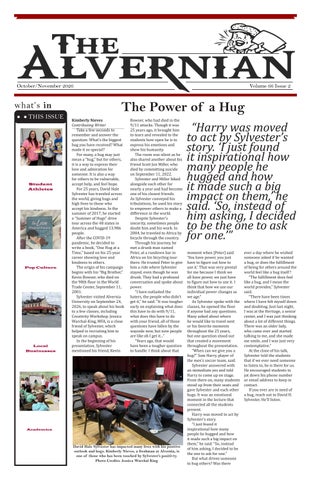
David Hale Sylvester has impacted many lives with his positive outlook and hugs. Kimberly Nieves, a freshman at Alvernia, is one of those who has been touched by Sylvester’s positivty. Photo Credits: Jessica Warchal King
“Harry was moved to act by Sylvester’s story. ‘I just found it inspirational how many people he hugged and how it made such a big impact on them,’ he said. ‘So, instead of him asking, I decided to be the one to ask for one.’” moment when [Peter] said ‘You have power, you just have to figure out how to use it.’ That was very pivotal for me because I think we all have power, we just have to figure out how to use it. I think that how we use our individual power changes as we age.” As Sylvester spoke with the classes, he opened the floor if anyone had any questions. Many asked about where he would like to travel next or his favorite moments throughout the 25 years, but one question stood out that created a movement throughout the presentation. “When can we give you a hug?” Sam Harry, player of the men’s soccer team, said. Sylvester answered with an immediate yes and told Harry to come up on stage. From there on, many students stood up from their seats and gave Sylvester and each other hugs. It was an emotional moment in the lecture that connected all the students present. Harry was moved to act by Sylvester’s story. “I just found it inspirational how many people he hugged and how it made such a big impact on them,” he said. “So, instead of him asking, I decided to be the one to ask for one.” But what drives someone to hug others? Was there
ever a day where he wished someone asked if he wanted a hug, or does the fulfillment of being for others around the world feel like a hug itself? “The fulfillment does feel like a hug, and I mean the world provides,” Sylvester said. “There have been times where I have felt myself down and doubting. Just last night, I was at the Heritage, a senior center, and I was just thinking about a lot of different things. There was an older lady, who came over and started talking to me, and she made me smile, and I was just very contemplative.” At the close of his talk, Sylvester told the students that if we ever need someone to listen to, he is there for us. He encouraged students to jot down his phone number or email address to keep in contact. If you ever are in need of a hug, reach out to David H. Sylvester. He’ll listen.
2
Student Athletes
October/November 2026
t h e alver nian Managing Editor/Layout Amelia Fortunato Section Editors Danica Leister Maura Mee Jamie Michalsky Grace Wanner Contributing Writers Anthony Cabello-Soria Reilly Collins Dylan Correll Ethan Dizon Adam Livingood Sam Lledo Peightyn Magruder Kenny Miller Manuel Morales-Garcia Marcel Nardo Kimberly Nieves Lilianna Orapallo Mia Ralston Jadison Shuey Jack Willson Yajaira Zarabia Andrew Zook Faculty Advisor Dr. Ryan Lange
The Alvernian is the official student newspaper of Alvernia University.
Articles submitted for consideration into The Alvernian should be written in some semblance of AP style. Letters to the editor, requests for advertisements, and general comments and questions may be submitted to ryan.lange@alvernia.edu. The editors reserve the right to edit submissions for clarity, accuracy, and length. The views expressed in The Alvernian are those of the individual writers and do not necessarily reflect the student body, faculty, staff, administration, or sponsors.
© 2026 The Alvernian
Vol. 66 Issue 2
More than Athletes: The Student-Athlete Advisory Committee (SAAC) at Alvernia University Mia Ralston Contributing Writer Especially at Alvernia, it is easy to recognize an athlete. They may be wearing their team gear, carrying a backpack with their school’s logo, or heading across campus after practice. But being a student athlete at Alvernia University means more than what happens during a game. For members of Alvernia’s Student-Athlete Advisory Committee, or SAAC, being an athlete means having a voice in the university’s athletic community. SAAC brings together students from all teams across campus. Representatives have the opportunity to communicate with their teammates, share ideas and concerns, and collaborate with other athletes to improve the student-athlete experience. “I joined SAAC because I wanted to become a voice for student athletes and help make a difference in the athletics program,” Kaleigh Willwerth, third-year member of SAAC, said. “To me, SAAC means having the opportunity to represent other student athletes and make sure that their ideas and concerns are heard. It also gives me a chance to be more involved, help improve the student athlete experience, and make a positive impact on my school and athletic community.” One of the main purposes of SAAC is to create communication between student athletes and the athletic department. Because representatives come from many different teams, they can bring a variety of perspectives to the table. An idea or concern from one team can become part of a larger conversation involving athletes across the university. SAAC is not just about meetings. Throughout the year, student athletes can take part in activities that bring teams together and encourage involvement outside of their individual sports. Community service, campus events, fundraisers, and other initiatives give athletes opportunities to connect with people outside of their normal circles. One event hosted by
Photo Credits: Kaleigh Willwerth
SAAC was the Pie a Coach fundraiser where students could buy a plate of whipped cream and pie a coach in the face. For first-year athletes in particular, getting involved in an organization like SAAC can be a way to become more connected to campus. The organization also gives student athletes the chance to develop leadership skills. Representatives are responsible for communicating with their teams, listening to their teammates, and bringing those ideas to the committee. They have to work with people from different sports and backgrounds while finding ways to turn ideas into action. That experience can extend beyond athletics. Learning how to communicate, collaborate, and advocate for others is a set of skills that
student athletes can carry with them long after their playing careers are over. One of SAAC’s biggest strengths is its ability to bring athletes together. A soccer player and a basketball player may spend most of their seasons focused on completely different schedules, but through SAAC, they have a reason to work toward common goals. finding ways to turn ideas into action. That experience can extend beyond athletics. Learning how to communicate, collaborate, and advocate for others is a set of skills that student athletes can carry with them long after their playing careers are over. One of SAAC’s biggest strengths is its ability to bring athletes together. A soccer player and a basketball player may spend most of their seasons focused on completely
Photo Credits: Kaleigh Willwerth
different schedules, but through SAAC, they have a reason to work toward common goals. “With the large amount of student athletes on campus, the events hosted by SAAC give us a chance to meet new people and other athletes, with the benefit of making all athletes on campus seen and heard,” Ava Schmidt, first-year women’s soccer player, said. College athletics can sometimes make it seem like an athlete is defined by their sport. SAAC offers a different perspective. It gives student athletes a chance to step outside their roles as competitors and become leaders, representatives, and members of the larger Alvernia community. The scoreboard may show what happens during a game, but organizations like SAAC show another side of college athletics, the part that happens when the game is over. For Alvernia’s student athletes, being part of a team is only one piece of the experience. Through SAAC, they have an opportunity to make their voices heard and leave an impact that reaches beyond the field or court.
Student Athletes
3
October/November 2026
Vol. 66 Issue 2
The Experience of Student Athletes At Alvernia
Three football players, Dennis Urena, James Shaeffer, and Ahmed Christ take a break from their busy lives in the library. Photo Credits: Andrew Zook
Andrew Zook Contributing Writer Playing a college sport is about more than competing. At Alvernia University, student-athletes balance their team responsibilities with school. A strong support system is essential for success in college for everyone, but especially for student athletes, and it can make that either easier or harder. Athletics are a big part of campus life. The school competes in NCAA Division III. More than 650 student
athletes competed in 29 team sports during the 2024-25 school year. Keep in mind that students can’t get full rides or athletic scholarships, so athletes have to commit not only to their sport but also to academics. Interviewing athletes from different sports shows how team discipline differs from other sports. When asked why they chose Alvernia and what they like most about playing here, freshman football player Logan Curcio said, “I came here to play football,
Reilly Collins Contributing Writer Olivia Rohrbaugh shares something in common with nearly two-thirds of Alvernia undergraduates: She is a student athlete. Rohrbaugh, a senior OT major on the women’s volleyball team, balances the challenging OT curriculum and volleyball. According to Rohrbaugh, she is a very “type A person.” Someone who has a type A personality is generally ambitious, highly organized, competitive, and impatient, so this enables her to thrive on being able to check things off her list and by doing her schoolwork ahead of time, so that when it comes to practice or gamedays, she can keep her head in the game without stressing about what she needs to do. To start off the school day, Rohrbaugh takes the long walk down the hill to the PLEX for a pro bono clinic. Pro bono refers to professional work done for free to help people who are unable to pay, usually those who are uninsured, underinsured, or underrepresented members of the school’s community.
Many healthcare programs employ this for their students because it allows them to gain real-world experience performing evaluations, developing interventions, and practicing documentation with actual clients. At this pro bono, she “... worked with my primary patient for an hour and a half, working on standing balance and functional activity tolerance while incorporating left upper extremity control and grip.” She loves doing these because they give her “reallife learning experience,” as well as “getting to know a member of the community” and the ability to “develop client-therapist rapport.” After that, Rohrbaugh attends her gerontology class. Gerontology is the science of old age and the aging process, which includes physical, mental, and social changes across the human lifespan. Gerontology deals with prevention, rehabilitation, diagnosis, prognosis, and treatment of diseases, disorders, and conditions associated with the changes that occur in humans throughout their entire lifespan, with particular emphasis on longevity.
and what I like most about playing is the friends.” Facilities are another important part of the experience. Alvernia has a decent amount of sports facilities that can be used for multiple sports. Another factor to consider is practice time because one field serves four fall sports teams. “The facilities are good, which include the locker room and turf,” Jackson Hussman, a first-year soccer player, said. “The practice times can be from 2 p.m. one day to 11 p.m. another, but the facilities are nice, and the turf field is nice as well,” James Shaeffer, a first-year football player, said. Practices can run late, and away games may leave athletes too tired to go to class or feeling bad overall. Alvernia named 102 fall athletes to the Middle Atlantic Conference Academic Honor Roll for fall 2025, and 247 winter and spring athletes earned the honor in 2026. A student needed at least a 3.20
semester GPA to qualify. “I wanted to play the sport so I knew what I was going to be dealing with, and I love the grind,” Jackie Miller, a field hockey player, said when asked how practices and travel affect schoolwork and sleep. Success as a studentathlete depends on a strong support structure, including coaches and fellow players. Teammates spend many hours together and can become close friends. However, competition for playing time and the pressure to perform can also cause stress. First-year football player Dennis Urena responded to this segment. “I knew the competition was going to be gritty, but that just develops me more and makes me closer with teammates,” Urena said. Travel may also bring different stressors. Some teams stay close to Reading, while others take longer trips or stay overnight. Road trips
can bring teammates closer, but they also take away study time and make the week more tiring. Athletic trainers and other medical staff can help during a busy season. In August 2026, Alvernia announced Penn Medicine as its official sports medicine provider. Because this change is new, it may help to ask an athlete where to get help and whether every team receives fair support. “The Penn Medicine building is right outside of the O’Pake’s main doors and will treat any athlete the same,” Griffin Bunzten, a first-year baseball player, said. This story shows both the good and difficult parts of Alvernia athletics. Speaking with students from different sports and class years will provide the best information and show what happens outside of game day.
Follow a Day in the Life of a Student Athlete
Olivia Rohrbraugh balances being a student athlete with her rigorous OT curriculum. Photo Credits: Dane Sabarese
Complicated stuff. After the academics are done for the day, she relaxes with her dog, Frankie Mae, to mentally prepare for Alvernia’s tough conference opponent, York College. Heading into this game, the team hasn’t won a conference match in three years. On top of that, Alvernia has never beaten York in their over thirty years of history. Before the match, there were certainly nerves, but also excitement. “I was thinking about how amazing it would be to beat a team I have never beaten
before,” Rohrbaugh said. On top of that, a girl that Rohrbaugh played club volleyball with (travel ball for high schoolers) plays on York, so she had her own internal rivalry that kept her motivated, and she wanted to uphold their home winning streak. She also “loves big games” because they let her push herself harder to beat players who might be better than she is, and she gets to play the sport she loves while doing it. Rohrbaugh then attends warm-ups with the team. When that’s done, she takes
the court as one of their starting middle blockers. As it turns out, it’s a thrilling game that features a stunning 25-21, 21-25, 25-18, 23-25, 15-9, 3-2 win. In football terms, that would be like kicking a gamewinning field goal as time expires in the fourth quarter, or in baseball terms, like hitting a walk-off home run in the bottom of the ninth. Rohrbaugh finished with three kills, two blocks, two digs, and an assist. The team is off to an incredibly promising start, 5-2. To be continued!
Pop Culture
4 October/November 2026
Vol. 66 Issue 2
Has Dancing With the Stars Changed for the Worse? Danica Leister Contributing Editor The highly anticipated season 35 of “Dancing with the Stars” premiered on September 14 and 15 at 8 p.m., but with some new changes. For those who aren’t familiar, “Dancing with the Stars” is a weekly competitive TV show where a celebrity, paired with a dance pro, called a couple, competes against other couples for the Mirrorball trophy. Couples receive a combination of judges’ scores and live audience votes, and the couple with the lowest combined score and audience vote is eliminated each week. This season’s premiere was split into two nights, one for the boys and one for the girls. The boys danced on the first night, and the girls danced the following night. Dividing the couples by gender is a change compared to previous seasons. Last season, all 14 couples danced on the same night, and no one was eliminated during the premiere.
This year, “Dancing With the Stars” had a two-night premiere, one for the boys and one for the girls. The photo does not come from the show. Photo Credits: Nicola Dowie on Unsplash.com
However, instead of 14 couples, season 35 featured 16. With these extra couples, the premiere had to be split into two nights to allow enough time for everyone to dance. “I like how both premieres kept it as short as it possibly could because I love ‘Dancing with the Stars,’ but not two-plus hours just to get through one dance for everyone,” Grace Horengic, a junior in the Doctor of Physical Therapy program and Healthcare Science undergraduate, said. If Dancing with the Stars had kept its original premiere format, the first episode of season 35 would have run
over two hours because of the increase in couples. The increase in couples also meant that a celebrity couple had to be eliminated each night of the premiere. On the first night, Conner Leavitt, husband of reality TV star Whitney Leavitt, was eliminated with his partner, Adele Zaikman. Then, on night two of the premiere, Sarah Jane Nader, a reality TV star from “Love Thy Nader,” with her partner Hailey Bills, was also eliminated. Unfortunately, this season’s two new pros were the first to be eliminated, but fans can still see them in behind-thescenes TikTok livestreams or group dances.
such as the scene where Olive is applying sunscreen lotion to Adam’s back. It’s meant to be a tender moment, but instead it feels rather awkward. Ultimately, “The Love Hypothesis” is lacking in a lot of areas, and it is unmemorable. “I’m glad I didn’t see it in the theater,” Fortunato said. One of the main problems with “The Love Hypothesis” is the lack of development of the main characters outside of their relationship. The audience learns very little about Olive’s research on pancreatic cancer, other than the fact that she’s doing it because her mom died when she was young. Even this feels as if it deserves more emphasis throughout the movie. There are no flashback scenes between Olive and her mom, and her mom is given very little character outside of being the reason for Olive’s research. There’s a scene where Olive talks about her childhood and growing up in foster care, but outside of that, there’s not much about her childhood. Adam also lacks much depth, outside of being the
stereotypical “grumpy” character in the “grumpy/ sunshine trope.” The film provides small details about him, such as his fear of needles, but offers very little in terms of the big picture. His character in general is quite painful to watch, even if his awkwardness is intentional. The monotone in which the actor delivers his lines is a big contributor to this. “The characters made the movie less enjoyable for me. I wasn’t rooting for them to get together like you’re supposed to in a romantic comedy,” Mark Fortunato said. One of the highlights of “The Love Hypothesis” is Olive’s relationship with her best friend, Anh. Ultimately, Anh is the reason Olive decides to fakedate Adam, as she wants her to believe that she doesn’t have feelings for their mutual friend who asked Anh on a date. Their relationship is sweet, and it’s lovely to hear the way Olive talks about Anh. She often refers to her as family, and this can be seen in their relationship. While Olive’s relationship with Anh is enjoyable, her relationship with her
Some audience members argued that eliminating couples on the first episode does not give the audience enough time to get to know the celebrity couples before voting. “We got way too many [celebs] that it’s hard to keep track of them all,” Horengic said. More importantly, it does not allow the celebrity to improve. The judges score not just on performance but also on improvement. When celebrities are eliminated after their first dance, it denies them the ability to improve, which seems to undermine the systems in previous seasons. The judges also give feedback on each episode on what the celebrity did well and what they can improve on, but time constraints are starting to limit the ability for judges to give feedback. In the third episode of season 35, all 14 remaining couples competed, resulting in time constraints. To accommodate, not all judges were able to give feedback. Two of the three judges had to give
quick notes, and the third was limited to a one-word description. “I don’t think that’s fair to the contestants who are trying to be the best performer they can be, and if you’re not given the ample opportunity to give the exact feedback to help out, I don’t think that is helpful for them,” Felicia Nelson, Director of Student Activities for Alvernia University, said. It is unclear whether the next season of “Dancing with the Stars” will have a twonight premiere, but it seems the rest of season 35 will stay the same as the season prior. Fans will have to keep watching to find out. All remaining couples will compete every Tuesday at 8 p.m. on all ABC platforms and Disney+ until the finale on November 24 and need fan votes to stay in the running for the mirror ball trophy. Fans can vote on ABC.com or text 215-23 for their favorite couples. Fans can vote up to ten times per couple per voting method.
“The Love Hypothesis” Lacks any Real Substance
Amelia Fortunato Managing Editor “The Love Hypothesis” is a study of love. The film released on September 23, 2026. It stars Lili Reinhart, known from “Riverdale,” and Tom Bateman, known for “Murder on the Orient Express.” It is directed by Claire Scanlon. The movie is based on Ali Hazelwood’s book of the same name. The book began its life as fanfiction about Rey and Kylo Ren from the most recent “Star Wars” movies and was then turned into an original novel for publication. The fanfiction is no longer available to read online. “The Love Hypothesis” is enjoyable enough. “I enjoyed the movie. I thought it was interesting,” Cindy Fortunato said. The film tells the story of Olive Smith, a Ph.D. candidate at Stanford who starts fake-dating Adam Carlsen, a professor at the school, in order to convince her best friend that she’s not interested in the boy they both have feelings for. The relationship between Olive and Adam is sweet, if a bit awkward at times. Some of the scenes lack chemistry,
“The Love Hypothesis” has had three iterations: it started as a fanfiction, turned into a novel, and is now a film. Photo Credits: Amelia Fortunato
roommate, Malcolm, is extremely underdeveloped. Near the end of the movie, Malcolm accuses Olive of not caring about him, and it’s never really worked through or addressed after. The relationship we see between the two of them is very surface level. Malcolm could even be considered to fall into the gay best friend stereotype, which is disappointing to see in 2026. While there is a lot to bemoan about the film, it is still a pleasant viewing experience. For someone who’s just looking to have
a good time and enjoy themselves, “The Love Hypothesis” is perfect. However, for someone looking for a romance movie with a bit more substance, this might not be the best option. “The Love Hypothesis” is available for streaming on Prime Video.
5
Inspiring/Local Businesses
October/November 2026
Vol. 66 Issue 2
Does true fulfillment exist? Yajaira Zarabia Contributing Writer Frederick Keonig once said, “We tend to forget that happiness doesn’t come as a result of getting something we don’t have, but rather of recognizing and appreciating what we do have.” We are told that throughout different milestones in our life we will finally reach fulfillment. What if after every milestone the finish line seems farther away? A lot of us were raised to understand that you have to get the degree, land the job, find a partner, buy that dream home, and have children, and then you’ll finally reach fulfillment. But this mindset puts us on a treadmill of our own making. Our minds adapt to success making our current attainment the new baseline instead of inhabiting the success we have just accomplished. Cole A. Randall once said, “If we search outwardly for our purpose we are only
What does it mean to be fulfilled/happy? Is it something you achieve, or is something that just happens? Photo Credits: Jacqueline Munguía on Unsplash.com
dreaming of a fulfilling life, it’s when we look within that we awaken our dream maker.” Dr. Ryan Lange is a full professor of communication and chair of the communication and digital media department. He often cautions students that what their parents think they want for them may not be what they want. “I know your parents want you to be successful, but there are a lot of ways to do that,” Dr. Lange said. “Just because they’ve seen that health care or computer
science jobs have big starting salaries doesn’t mean that this is right for you.” What do Alvernia students think about fulfillment? The Alvernian, Alvernia’s newspaper,provided students an anonymous Google Form to write their responses in a way that wouldn’t be connected to their names or majors to make them feel comfortable enough to answer honestly. Some students said that they weren’t chasing fulfillment at all since they were too busy trying to get
through the working day. Other students were very aware of their fulfillment needs. But one question sparked attention; “Do you ever feel like every time you hit a milestone, the finish line keeps on moving?” “Yes but not in a negative sense,” one student wrote. “Anytime I reach a milestone the finish line “evolves” in a sense. I reach my milestone and my end goal changes in response to that.” So, does this answer our question? Yes. True fulfillment isn’t packaged. It’s not waiting for us at an altar, in a corporate office, or even at graduation. Fulfillment isn’t a final destination, but an active process. Fulfillment isn’t a trophy at the end of a race but the capacity to keep running.
Dr. Lange is a full professor of communication and chair of the Photo Credits: Writing the Discipline: An OER Textbook
Game on, Food’s Up: Will the Pike Cafe Score Big with Alvernia University Students?
Kenny Miller Contributing Writer The Pike Café, founded in 1985, is located at 930 Pike Street in North Reading. The café is a casual spot for students looking to watch a game, grab a bite to eat, or just hang out with friends. For Alvernia students who take classes at the Post Center, it’s about a tenminute drive, while it’s about 15 minutes from the Hill campus. What makes The Pike Cafe a good option for Alvernia University students? The location, budget friendly menu and sports atmosphere speak for itself. Whether you are looking to eat and bond with friends or dive into local and national sports, the Pike Cafe is the place to be. Once inside The Pike Cafe, customers are immersed in a sports bar atmosphere. There are 60 large televisions displaying local sports as well as sports coverage around the world. The Pike Café shows a wide variety of sporting events every day. The Pike Café offers the usual variety of sports bar fare. Patrons can select appetizers like mozzarella
Research Hospital, go to https://www.pikecafe.com news-events
The Pike Cafe is a wonderful destination for Alvernia students looking to relax, grab a bite to eat, and watch a game. Photo Credits: Kenneth Miller
sticks, cheese curds, and gameday nachos to burgers, chicken fingers, sandwiches, and pizza. For those looking for full entrees, there are also options for steak, seafood, and pasta. The Pike Cafe takes pride in the food they make, down to the bread and rolls, which are stamped with their logo. Amy, a server at the Pike Cafe says the Pike Cafe is a good place for people hang out and watch the games. According to Amy, area college students come to the Cafe often to get wings. “The wings are good and the customers complement our sauces all the time,” she said. “We are competing at the
Berks Finest this weekend and highlighting our wings,” the server said. She believes the wings will win the competition. For students on a budget, The Pike Cafe has many specials offered throughout the week. They offer wing nights, beer and burger nights, seafood nights, and happy hours each week. And for those eating healthy, the Pikes provides many healthy options available from open to close. Owen Kingma, an upcoming 2027 Alvernia University transfer, comes to watch games with his Alvernia friends often. “I love watching the Phillies and
Eagles here with friends,” Kingma said. “We always get a ton of wings with different sauces, fries and a bunch of appetizers. The cost is reasonable and the food is really good. I love that I can catch all the sports in one place,” he said. The Pike Cafe has established itself as a vital business in Berks County. They have been around since 1985 and have become an atmosphere where people can get together, watch sports, and enjoy good food. For more details on the hours of operation, menu and prices, specials, delivery options and the Pikes Golf tournament to benefit St. Jude’s Children’s
Server Amy recommended the Mozzarella Sticks for an appetizer, which is popular with patrons. Photo Credits: Kenneth Miller
6 October/November 2026
Academics
Vol. 66 Issue 2
Excellence in Motion: Behind the Scenes of Alvernia’s DPT Graduate Program Peightyn Magruder Contributing Writer Alvernia University’s Doctor of Physical Therapy program, commonly known as DPT, is more than practical training in physical therapy. The DPT program teaches students how to establish independence, confidence, and how to build a healthy and trustworthy relationship between themselves and their patients. The program works to establish students in the field early, moving them through two semesters in the summer and fall focused on their basic sciences, including anatomy, physiology, and kinesiology. After these first two semesters, students begin to gain hands-on clinical experience, a feature the program is best known for. This includes visits to St. Joseph’s Villa, which is right near Alvernia. Another part of the DPT clinical experience is the Pro Bono Clinic, which begins in Week 7 of the program. The Pro Bono Clinic has students go two to three times during the semester to expose them to the basics of taking care of patients, such as taking their vitals, but without the pressure and responsibility of being the primary caretaker. “Our main goal with this is to get students comfortable and integrated with interacting with other individuals, and then we build on that leading to the second semester,” Dr. Pam Unger, Department Chair of the DPT Program, said. During the second semester, practical exams are set up where students apply what they have been learning to real-life people. At first, students practice with classmates acting as patients, but eventually, professional patients are called in so students can begin working with them. Every interaction is aimed at having students learn how to establish what’s called the “Therapeutic Alliance” with their patients. “Having a therapeutic alliance with a patient is how you establish a relationship and trust with your patient,” Dr. Unger said. “In fact, many of Alvernia’s main pillars can be applied to being a PT. We want you to be empathetic, to be a lifelong learner, and for all of these things to be incorporated into what you’re doing. That way, 12 months after you start with us, you
As part of the DPT clincial experience, students go to a Pro Bono Clinic two or three times during the semester. Photo Credits: Catherine Stark
are ready to start your first full-time internship for six weeks.” Because of the rigorous preparation the program has established, it has become very rare for a student not to do well in their first week of internships. The faculty and staff work with all their students to ensure they are comfortable with every aspect of the physical therapy field. “Graduate school is meant to be intense because it’s meant to help prepare our students for anything,” Dr. Marcia Thompson, associate professor and program director for the DPT program, said. “You’re not expected to know everything, but you are expected to be an advanced beginner by the time your first internship comes around.” For the first few internships, students are kept within an hour of Alvernia, such as Harrisburg, New Jersey or Delaware, and are required to intern in acute care, pediatric, and geriatric specialties. They are also required to have a variety of internships that work with different caseloads, such as interning at a corporateowned outpatient center versus a privately owned one. This helps students identify the kind of physical therapy work environment they prefer and narrow down
their choices for their next internship. Later, they can choose which area they would like to intern in, and the program works to ensure they can intern in the specific area they wish to focus on in their
career. Students fill out a “site preference form” on what field they want to specialize in and where they want to go. If they find they don’t like that specific field, the program works with them to find a place where they feel comfortable working and can grow to their full potential. “We would never put a student into a program of physical therapy that they don’t feel comfortable in,” Dr. Unger said. “We always work to have our students find the field they want to be in, because if they don’t like it, that’s just torturing someone and that isn’t fair to our students.” During student’s third year, the week after the New Year, students can go on a service trip to Belize, where they can provide care in Belize’s pediatric facilities, home services, and outpatient clinics. Not only do students get clinical experience with helping patients, but it also grants students the opportunity to teach their patients to take care of themselves when they leave, providing service and a lasting impact to help people improve beyond the 10-day trip. “This experience isn’t meant to be combat therapy,
where all we would do is drop in, do the treatment, and leave,” Dr. Robin Zappin, Assistant Professor of Physical Therapy, said. “What I want is to go to Belize and figure out how we can enhance an individual’s life with the little bit of time we connect with them.” During the final year of the program, students are only with the program for 6 weeks, where an actual clinic is run in the PLEX. Students are assigned two patients and are tasked with documentation, diagnosis codes, and physical work with the patients as if they were in an actual job setting, before going on a 10-week internship following a 12-week internship, and then ultimately, graduating. “I think, after 6 weeks into their first job, students begin to realize how hard their professors worked to have students be able to do anything in the PT world,” Dr. Unger said. “And that’s the message we want to send them. The profession of physical therapy is so diverse, and we take a certain pride in making sure our students are prepared for anything and everything the profession could throw at them.”
DPT Students can attend a service trip in Belize. Photo Credits: Dr. Robin Zappin
Campus Orgs
7
October/November 2026
Vol. 66 Issue 2
16 Hours of Dancing, Fundraising, and Community Liliana Orapallo Contributing Writer Alvernia’s core value of service shines through the FTK 16-Hour Dance-A-Thon. “Alvernia’s FTK event started in the spring of 2025 by DPT students Hailey and Claire. It was created to bring students together to support children and families facing childhood cancer.,” Jenna Lawson, Vice President of Team FTK, said. This year’s event will be from Saturday, April 3 through Sunday, April 4. This year’s fundraising goal is $15,000 to benefit families affected by childhood cancer. All students are welcome to participate in the Dance-AThon and come together to support the FTK mission. FTK, meaning “for the kids,” supports the nonprofit organization Four Diamonds. Four Diamonds was founded in 1972, and its goal is to cover 100% of children’s cancer treatment costs not paid by insurance. During the Dance-A-Thon, or “Thon,” students unite to support children and families affected by childhood cancer. The 16-hour Dance-AThon brings the Alvernia community together through fundraising, student
participation, and service to the children and families affected. Students are able to receive service hours for participating and standing for 16 hours. Past students who have participated said it was so awesome to see who exactly is getting the money that they raised. Well before the “Thon,” Alvernia’s FTK team holds events throughout the year leading up to the Dance-AThon to help the FTK team reach its fundraising goal. A platform called Donor Drive allows students who participate to create personal fundraising pages, share their goals, and collect donations to support the FTK Dance-AThon. Throughout the year, FTK holds fundraising events such as Push Week, Giving Day, tournaments, and giveaways to help reach its goal. Some other events include raffles, dine outs, and pop-up tables. These events allow students to get involved on one and off campus and contribute to the cause. While fundraising throughout the year is important, the Dance-A-Thon is when students can come together to celebrate their hard work.
In Spring 2026, Alvernia’s FTK Dance Marathon raised $12,002.50. Imagine how much good this can do for children with cancer and their families. Photo Credits: Jenna Lawson
During the event, students stand for the entire 16 hours and follow a schedule planned by committee members. Activities include line dancing, a glow party, karaoke, a dodgeball tournament, an ice cream bar, nostalgia hour, and a scavenger hunt. These activities give students a chance to have fun,
spend time with each other, and meet other people who strive to support children and families affected by cancer. The FTK team focuses their work on their “why,” the children and families they are supporting and what motivates them to continue fundraising and participating in the Dance-A-Thon. “We finish off the night
with a big reveal of the money we raised all year long, and truthfully, that is my favorite part of the entire year,” Jenna Lawson said. The final reveal celebrates the hard work of everyone involved and reminds students that the 16 hours are about more than dancing.
ASC has a paper drop-off, as well as online options for students. “Tutor.com is online 24 hours a day, 7 days a week,” Mannix said. The ASC wants everyone to succeed. If a student feels more comfortable with people they know, they can bring a friend. There are private and group seating options, so everyone feels welcome, safe, and relaxed. “There is a wide variety of courses offered for tutoring,” Graczyk said. “I tutor anatomy 1 and 2, all the nursing classes, nursing chemistry, biology and microbiology. I don’t think students are aware of all that we offer because they see it as a resource for only when you are struggling.” The main assumption students make is that the ASC is a place to go only when struggling, which is not true. The ASC encourages students to use the center as a regular part of their academic routine, rather than waiting until they need help. “You do not have to be
struggling or have a question in order to come,” Mannix said. “Just come, bring the assignment, and we will work it out together.” Whether a student needs help understanding an assignment, wants to improve their study habits or simply wants another person to work through a problem with them, the center provides support before a student reaches the point of struggling. “It’s good for just getting started on an assignment and having a positive work environment, or wanting a space where people are serious about their academics but still want a good time,” Mannix said. “This is the place to come.” To schedule an appointment, call 610568-1494, email academic. support@alvernia.edu, or go to https://alvernia. mywconline.com. The ASC is located on the first floor of Bernardine Hall in room 105, and they are open from 8 a.m. to 4:30 p.m. from Monday to Friday.
Beyond the Books: The Academic Success Center
Maura Mee Contributing Editor For Alvernia students, the Academic Success Center, or the ASC, is best known as a place to go when they need help with a difficult class, but tutoring is only one of the resources available to students. In this picture is Carla Mannix in the ASC. Behind her is the different resources that the ASC offers to students. The photo was taken by Maura Mee. “Tutoring is for everyone, even if you are a strong student,” Carla Mannix, Director of Academic Support Services, said. “You can get something out of having a conversation with a peer who is generous and excited about the topic.” The Academic Success Center contains both the Office of Academic Support Services and the Office of Accessibility. The academic support service offers peer tutoring, writing tutors, professional tutors, and academic coaching with a graduate assistant.
ASC logo. Photo Credits: Maura Mee
“All the tutors promote cognitive-based learning strategies that are based on research to help all Alvernia students deepen their understanding, study more efficiently, and learn more effectively,” Mannix said. The other portion of the ASC’s task is the Office of Accessibility Services, which offers academic accommodations to students who have a documented disability. If anything interferes with a student’s access to education, the ASC can arrange approved accommodations. “It is a good review for a lot of different things,” Gianna Graczyk, a senior tutor at the ASC, said. “You do not want to wait until you are struggling to ask for help.” From academic coaching and study strategies to tutoring, the Academic
Success Center provides students with resources to help them navigate college academics. However, some students may not be aware of everything the center offers. The ASC offers academic coaching, an in-person study group every other Monday in the Bernardine lecture hall for two hours, and an online study den every Tuesday night for two hours. “I like that what I am doing is helping them and it reflects what they are learning and it also reflects that they are succeeding. Being a tutor is rewarding,” Graczyk said. There are always resources available for the students, and if there isn’t something available, the ASC is more than willing to provide arrangements for students who are uncomfortable, nervous, anxious, or even just shy. The
8
Student Life
October/November 2026
Vol. 66 Issue 2
The Dangers of E-Bikes Jack Willson Contributing Writer Urban areas are seeing a rise in e-bike usage as people seek more convenient methods of transportation than cars and walking. While e-bikes are much better for the environment than cars, riders sometimes forget that they are still driving a motor vehicle. On September 15, Alvernia students were involved in a traffic accident involving an adolescent riding an e-bike on a residential street that collided with their car. Andrew Bricker, Alvernia student, claims he didn’t see the rider coming. “He was coming at me, and he swerved into the lane,” he said. “Headfirst, dove, header into the car. I had no reaction time to swerve out or do anything, and I kind of just stopped the car after.” The e-bike rider sustained lacerations at a minimum. “(his) head was bleeding,” Bricker said. “I couldn’t see very well at first, because his hair was curly and long, he was just like so bloody. Also, his leg was injured, but I didn’t really get a good look at that.” There was also a second passenger on the e-bike who
seemed to escape harm. However, neither were wearing a helmet or any sort of protective gear. Bricker wants to use his experience to remind area drivers to use extra care. “Be alert, especially at night, because [e-bikes] are hard to see,” he said. In the aftermath of the accident, Bricker’s car was severely damaged. His front driver’s sidecar door would not open after the accident due to the impact. The e-bike fared much worse: It broke in half, with many pieces of the e-bike strewn across the street. Bricker thinks that e-bike riders need to be careful, “especially at night.” Pennsylvania categorizes e-bikes as a “pedal cycle with electric assist,” and permits anyone 16 years of age or older to ride them. They must be under 750 watts and cannot go over 20 miles per hour on motor power. They are allowed wherever traditional bikes are allowed. However, some commercial e-bikes that are not street legal can travel up to 70 miles an hour, which can be a very dangerous speed for riders and others.
Andrew Bricker, an Alvernia student, was in an accident with an e-bike on September 15th. Above shows the damages. Left: Front driver side damages from the side view. Right: Front driver side damage from the front. Photo Credits: Andrew Bricker
Most e-bikes sit within a $500 to $4,000 range. This means that they are widely available and because people ages 16 and up can own them, they will continue to become more common. E-bikes could be beneficial to many who do not have
the means to purchase other forms of transportation, but proper safety is advised. While there is no law in Pennsylvania saying that riders sixteen and up must wear a helmet or other protective gear, riders should wear at least a helmet, as an
injury like what happened to the adolescent involved in the accident was extremely lucky, as it could have been much worse.
other students. “I try to stay on campus as much as possible, even if I have nothing going on,” Reese said. “Being an athlete makes commuting hard, though, because we can have late nights, but athletics helped in making friends,” he said. For many students, commuting is a financial decision. Living at home still comes with expenses, such as gas and parking, which still cost money. Jackson Hussman, a commuter from Tulpehocken, has to mind his budget every month. “I manage my finances by making sure I have enough money to balance gas for getting to school, school supplies, and extra money for going out with friends,” he said. Alvernia offers many resources and extra support for commuters, so they don’t feel forgotten about. Alvernia’s CampusRec, an organization that takes charge of campus activities, hosts many events that are open to commuter students as well as students who live
on campus. They host trivia nights, game shows, and even a carnival. Alvernia also has many spots where commuters can hang out between classes or before classes. Bernardine Hall and Kestrel Cafe are recommended spots for all commuters, and many enjoy them. “Bernardine Hall is definitely my favorite place to study,” said freshman commuter Jackson Hussman. All in all, commuting can be a privilege for the benefits of not being away from home and having flexibility all while still pursuing further education. It does have its downsides, however, as those students may be doing it for a financial reason, and connection with other students. Alvernia does well to provide great opportunities for commuters to stay connected with campus life.
Commuting: A Home Away from College
Manuel Morales-Garcia Contributing Writer Many students at Alvernia start their day by driving to campus instead of walking from a dorm. Commuting is normal for a lot of people, but it comes with its own routines, challenges, and benefits. For some commuters, the drive is just part of their day. They might enjoy the quiet time in the car or the comfort of going home after class. Damian Ramirez, a graduate of Muhlenberg High School, said he likes commuting. “I didn’t want to move far away from home, so Alvernia was perfect. My drive is only around 15 minutes,” he said. For others, the drive can feel tiring, especially when they have early classes, long days, or bad weather. Even though commuting seems simple, it adds extra time and planning that on campus students don’t deal with. “The thing I don’t like about commuting is that I have to drive an hour a day. It gets tiring, especially on days
Being a commuter comes with unique challenges, such as tiring drives and social challenges. Photo Credits: Ryan Porter on Unsplash.com
when I’m tired.” Derek Cruz, a Muhlenberg commuter, said. Another downside of commuting is the social challenges. Students who live on campus can easily walk around, meet friends, or join events without thinking about transportation. Commuters sometimes miss out on those moments because they leave right after class or don’t want to drive back later in the day.
Some try to stay on campus longer, but others feel it’s hard to stay involved when home isn’t close by. They feel away from home for much longer, and it is harder to deal with. Overcoming the social disconnection of commuting is possible but takes extra work. Graeson Reese, Alvernia men’s soccer player, is grateful that athletics helped him connect with