Alvernia
Summer/Fall 2026
MAGAZINE
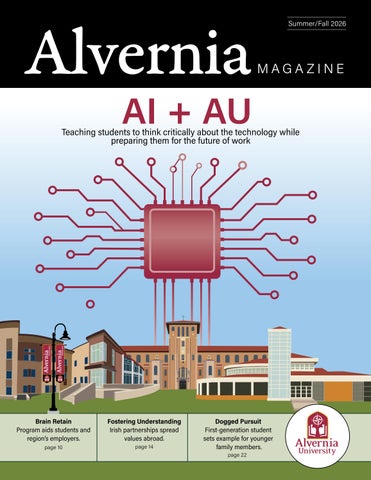
AI + AU
Teaching students to think critically about the technology while preparing them for the future of work
Brain Retain Program aids students and region’s employers.
Fostering Understanding Irish partnerships spread values abroad.
page 10
page 14
Dogged Pursuit First-generation student sets example for younger family members. page 22
contents
Summer/Fall 2026
COVER STORY 4 Higher Learning FEATURES 10 Brain Retain 14 Beyond Campus 18 In Good Health PROFILES 22 Dogged Pursuit 24 Laying the Foundation 26 Growing in Tandem 28 Keeping His Legacy Alive ON CAMPUS
Alvernia expands to Allentown,
32 offering $10K hybrid MBA at new site Earth Day of Service, solar panels, EVs
35 highlight university’s sustainability push Alvernia partners with Jay Sidhu, YPO
37 to present two-week leadership boot camp
38 Periscope 43 Class notes 45 Alumni news
SUMMER 2026
ALVERNIA UNIVERSITY BOARD OF TRUSTEES
Officers of the Board PRESIDENT
Chair
Glynis A. Fitzgerald, Ph.D.
Michael Duff Retired Senior Vice President Penske Truck Leasing
EDITOR
Vice Chair
ART DIRECTOR
Jeffrey Rush President of Commercial Markets Fulton Bank
Lynn N. Gano
President
Jon Fassnacht
CONTRIBUTING DESIGNER Jennifer Rathman
Glynis A. Fitzgerald, Ph.D. Alvernia University President
Secretary
CONTRIBUTING WRITERS
Patricia C. Giles Foundation President Wyomissing Foundation, Inc.
Claire Curry
University Counsel
Kristin Eck Jon Fassnacht Lini S. Kadaba Sarah Matarella Nikki M. Murry
CONTRIBUTING PHOTOGRAPHERS Susan Angstadt Dan Z. Johnson Stephen Johnson Sarah Matarella Adam Pivirotto Hailey Rohrer
Alvernia Magazine is published by Alvernia University to share news and information about the institution with alumni, friends and the community. Opinions expressed in the magazine are those of the authors and do not necessarily represent the university. Please share your feedback, as we work to continuously enhance the publication: news@alvernia.edu.
Alvernia Magazine is a publication of Alvernia University. Copyright 2026. All rights reserved.
Hourigan, Kluger & Quinn
Members of the Board
Charles Barbera, MBA ’01, MD President and CEO Reading Hospital Paula Barrett, CPA Retired Reinsel Kuntz Lesher Michael J. Caron, GTS Retired, Welco Tim Daley’79 Executive Director Habitat for Humanity of Berks County
Jane McBride Gates, Ph.D. Retired Provost and SVP for Academic and Student Affairs Connecticut State Colleges and Universities
Micheal Tobash Owner Tobash Insurance Agencies Former member of PA House of Representatives
Sr. Madonna Marie Harvath Bernardine Franciscan Sisters
David Turner Regional Manager, External Affairs Met-Ed FirstEnergy Co.
Steven M. Koons, PMP ’05 CPA Partner and Federal Service Line Leader Sikich LLP Ginger Kunkel President Tompkins Community Bank Pennsylvania Market Daniel Langdon Retired CEO East Penn Manufacturing Sr. Sandra Lyons ’69 Assistant Congregational Minister Bernardine Franciscan Sisters David W. Patti Director of Communications & Marketing Customers Bank Karen Piraino CEO LVR Inc. Sr. John Ann Proach ’74 Congregational Minister Bernardine Franciscan Sisters
Kevin P. DeAcosta ’00 President & CEO The Highlands of Wyomissing
Stephanie Rawden President Rawden Joint Ventures Corporation
Chris deGruchy ‘93 Principal/General Manager Cast Rite Metal Co.
Jeanne L. Savage ’88 Community Volunteer
Sister Ann Therese deGuise Bernardine Franciscan Sisters
Barry L. Schlouch Owner, President Schlouch Incorporated
Richard Allen Ehst Customers Bank Retired President and CEO Michael Fromm Chairman Fromm Electric Supply John H. Gallen Jr. Owner and President EthoSource & Wyatt Seating
Lucine E. Sihelnik ’13 President and CEO Greater Reading Chamber Alliance Sr. Mary Sninsky Director of the Bernardine Franciscan Associates Bernardine Franciscan Sisters Sister Mary Joseph Tirpak Bernardine Franciscan Sisters
Angelo J. Valletta President and CEO Ben Franklin Technology Partners of Northeastern Pennsylvania Patrick Witmer, MPA Corporate Vice President for Corporate Affairs and Communications B. Braun
Growth for the Common Good Since I arrived at Alvernia in 2019, change has been a constant companion. The university has expanded into downtown Reading, Pottsville and Allentown. We’ve built state-of-the-art classrooms and labs to enhance our student experience, partnered with local organizations to provide needed services to the area and increased our online offerings to help students fit learning into their schedules.
International Summer School in Belfast, Northern Ireland. I recently traveled to Belfast to attend Study USA’s 30th anniversary celebrations as a representative of the Association of the Catholic Colleges and Universities. Seeing the depth of the relationship between our schools reaffirmed my commitment to the exchange.
But the soul of Alvernia remains the same. Though we’ve expanded considerably, we’re still rooted in our Franciscan values, which call us to seek growth for the common good.
In the profile section, you will meet a recent graduate of the cybersecurity track of our computer science major who helped design Frankie, the university’s robot dog; a graduate student who made her mark as a member of the first Master of Medical Science in Physician Associate Studies cohort; an alumni who honors his late brother through a nonprofit supporting individuals with spinal cord injuries; and a longtime donor who has maintained strong ties to her alma mater and who recently earned a master’s degree in theology at 81 years old.
Like Alvernia, the world continues to change rapidly, and nowhere is that more evident than in the explosive growth of artificial intelligence. Things we did not imagine only a few short years ago are becoming commonplace. AI is being incorporated across our academic offerings, teaching students to think critically about the technology while preparing them for the future of work. But we’re taking care to use it ethically and responsibly, keeping it “human-friendly,” as Pope Leo XIV recently wrote in his first encyclical. We are also innovating with our new Apprenticeship to Degree program, which allows students to work with businesses in the Greater Reading area for multiple years. It’s a win-win: Students develop broader skill sets, positioning themselves for future success, while employers and our community reap the rewards of retaining talent in the region.
As we continue to break ground, rest assured we will remain grounded. Sincerely, Glynis A. Fitzgerald, Ph.D.
President
This issue of Alvernia Magazine also spotlights our annual study abroad trip to St. Mary’s University College
Alvernia Magazine | 3
HIGHER LEARNING
By Jon Fassnacht
EDUCATE Empowering Minds
RESEARCH Expanding Knowledge
COLLABORATE Stronger Together
INNOVATE Shaping the Future
CREATE IMPACT For Society and Beyond
Alvernia’s implementation of artificial intelligence aims to teach students to think critically about the technology while producing graduates prepared for the future of work.
4 | Alvernia Magazine
Higher Learning | F E A T U R E
P
ope Leo XIV commanded attention in May when he published his first encyclical, Magnifica Humanitas, in which he laid out the importance of making artificial intelligence “human-friendly and restoring it to the plurality of human cultures and ways of life.” As a Franciscan university, Alvernia is heeding the advice. “Our goal is not AI adoption for every student, it’s AI literacy for every graduate,” said Chief Academic Officer and Provost Mary Ellen Wells, JD, LLM. “We want students to think critically about AI rather than simply consume it.”
“Producing graduates who don’t have an understanding of how AI is shaping their professions, industries, and communities they serve doesn’t make sense.” — Mary Ellen Wells, JD, LLM
But just because the university is implementing it with care doesn’t mean it is taking it lightly. Just a few examples already in place: • AI is integrated into all Computer Science and Technology programs. • Over a dozen other courses have AI components, heavily involve AI or focus on AI as a concept when discussing the human mind and brain.
Note on Cover and Story Illustrations Fittingly, the illustrations used for this magazine’s cover and for this story were created with the help of artificial intelligence, but not without significant human contributions. Lynn Gano, Alvernia’s senior director of creative services and Alvernia Magazine’s art director, prompted ChatGPT to create an illustration featuring AI and a university; see the top right. Gano repurposed it by replacing the building with an illustration of Alvernia’s campus and altering ChatGPT’s graphic with Alvernia’s maroon; see the bottom right.
Alvernia Magazine | 5
F E A T U R E | Higher Learning
technical side, according to David Shoup, Ph.D., dean of the College of Innovation, Discovery and Enterprise. “We need to change our perception and follow certain types of observation and understanding so we put AI in the right spot in our system and plan ahead to deal with any issues.” — Bongrae Seok, Ph.D.
“The future of work is not one in which people are simply replaced by AI; rather, it is one in which individuals who understand how to use AI effectively will be better positioned to succeed,” Shoup said. “Students must learn not only how to leverage AI tools, but also how to contribute the creativity, critical thinking, empathy and ethical reasoning that machines cannot replicate.”
Changing Perception AI’s critics condemn its environmental impact and its role in the spread of disinformation. But it isn’t wise to simply take the position that AI is bad, according to Wells. “There are elements to AI that have negative impacts, but you can’t put the genie back in the bottle. It’s out,” she said. “Producing graduates who don’t have an understanding of how AI is shaping their professions, industries, and communities they serve doesn’t make sense.”
• Ashlee, Alvernia’s AI recruiter, allows the university’s admissions teams to engage with a significantly larger pool of prospective students, providing 24/7 communication. “We don’t have to make AI the center of the student experience, but we can’t pretend it doesn’t exist,” Wells said. “Our goal is to help students develop the judgment, critical thinking, and ethical reasoning that will help them decide when AI should be used, when it shouldn’t, and how it can be used responsibly.” A newly formed AI committee will aid in that cause, according to Alvernia President Glynis A. Fitzgerald, Ph.D. “Universities have a responsibility to lead thoughtful conversations about emerging technologies,” Fitzgerald said. “This committee will bring together faculty and staff from across disciplines and functions to shape a shared vision for how we embrace AI — ethically, responsibly and with humanity at the center. Rather than approaching AI one department at a time, we are creating a university-wide conversation about how this technology can strengthen teaching, learning, research and service while ensuring people remain at the heart of every decision.” While AI is most prominent in Alvernia’s Computer Science and Technology majors — artificial intelligence, data science and cybersecurity — its implementation throughout the university’s curriculum goes beyond the
6 | Alvernia Magazine
It’s also helpful to view AI not as a tool but as a system, according to Professor of Philosophy Bongrae Seok, Ph.D.
“This committee will bring together faculty and staff from across disciplines and functions to shape a shared vision for how we embrace AI — ethically, responsibly and with humanity at the center. Rather than approaching AI one department at a time, we are creating a universitywide conversation about how this technology can strengthen teaching, learning, research and service while ensuring people remain at the heart of every decision.” — Glynis A. Fitzgerald, Ph.D.
Higher Learning | F E A T U R E
In November, Seok presented at the AI-themed 8th World Humanities Forum in Andong, South Korea, discussing the prospects of AI advancing to the point where it can be considered a moral agent, an entity capable of discerning right from wrong and being held accountable for its choices. “If we understand AI simply from the perspective of a machine, then we may deal with some problems, because it is not just a machine,” Seok said. “AI is a nonliving thing but it’s part of our society. We make decisions together. We need to change our perception and follow certain types of observation and understanding so we put AI in the right spot in our system and plan ahead to deal with any issues.”
Usage of SOLARassociated resources “Ashlee provided the ability to connect with students at a scale that was previously not possible with existing staff capacity.” — Bret Krotee.
Ashlee Not only is AI being incorporated into current students’ academic journeys, it’s also helping to recruit future students. Working with the CollegeVine platform, Alvernia’s admissions teams curated Ashlee. The multilingual AI recruiter streamlines the recruiting process, increasing the pool of students to cultivate. “Ashlee provided the ability to connect with students at a scale that was previously not possible with existing staff capacity,” said Associate Vice President of Admissions Bret Krotee.
“Approximately 66% of interactions occur outside normal business hours,” said Krotee, who noted that Alvernia’s AI advancements were spotlighted in an article in the Chronicle of Higher Education. “Since implementation, the AI recruiter has delivered more than 550,000 emails and placed over 65,000 phone calls.”
Ashlee’s knowledge database was built through conversations with staff and faculty and hundreds of webpages uploaded to an online vault. The admissions teams manage the system by adding contact populations to the database, creating custom “missions” that determine which students are contacted and what type of communication they receive.
Keeping Them Honest
The impact has been significant, most notably during the hours of the day that had been an issue due to lack of staffing.
Wells believes the way to minimize that is to focus on offerings that AI can’t replicate while reiterating to students that cutting corners now will paint them into a corner later.
k Ashlee ! As
Al
As with every other technological advance, AI is raising concerns about the potential for students to have work performed for them.
“Education is about developing capabilities, not simply earning a credential. Getting that credential without the development of capabilities and relying on AI does not support them later on when they’re working and need to think critically, problem-solve and be good citizens,” Wells said. “We’ve always been an experiential learning institution, so we’re leveraging that as much as possible to enhance student learning along with more writing, internships and apprenticeships.”
ve rnia .e du Alvernia Magazine | 7
F E A T U R E | Higher Learning
Serving, Not Replacing “The future of work is not one in which people are simply replaced by AI; rather, it is one in which individuals who understand how to use AI effectively will be better positioned to succeed.” — David Shoup, Ph.D.
As technology continues to evolve at breakneck speed, Alvernia’s goal is to equip students with the adaptability and foundational understanding needed to thrive in whatever comes next. “By fostering both technical proficiency and a mindset of continuous learning, we ensure that our graduates remain well-positioned to pivot alongside future developments and lead in the next phase of AI innovation and adoption,” Shoup said. Because the goal for AI, like all technology, should be to serve people, not replace them, according to Wells. “Human dignity can be enhanced by technology, because it enables people to focus on the work that requires judgment, creativity and human connection while AI supports certain routine tasks,” Wells said. “AI creates new possibilities, but our values are what guide how we use it and ensure it serves people rather than the other way around.
AI can make mistakes, Seok says. So it’s imperative to teach students to double-check any answer obtained from AI, often achieved by asking more questions. “We need to ask the right kind of questions,” he said. “And not just once, but several times. Let the AI run its reasoning but ask follow-up questions. Make your questions sharp and really clear so you get the answer that you want. Otherwise, AI’s just throwing out some generic answers.” Professor of History Kevin Donnelly, Ph.D., is less concerned about students using AI to cheat than he is about the homogenized content it produces when they use it to help them write a paper or email. Donnelly recently released the award-winning book, “The Descent of Artificial Intelligence: A Deep History of an Idea 400 Years in the Making.” “What’s so striking is the slopification of everything,” he said. “It’s just so incredibly boring. And it takes away one of the great joys of learning and education. People will say, ‘Well, I’m just going to use AI to create my outline,’ but creating the outline is a creative act. You don’t know what you’re writing until you’ve scripted the outline yourself. It just doesn’t create a real opportunity for individual human creativity, which is the whole point.”
8 | Alvernia Magazine
“People will say, ‘Well, I’m just going to use AI to create my outline,’ but creating the outline is a creative act. You don’t know what you’re writing until you’ve scripted the outline yourself. It just doesn’t create a real opportunity for individual human creativity, which is the whole point.” — Kevin Donnelly, Ph.D.
| F E AT U R E
History professor traces artificial intelligence’s origins back to 17th century
W
hen Kevin Donnelly, Ph.D., professor of history, released his second book, “The Descent of Artificial Intelligence: A Deep History of an Idea 400 Years in the Making,” in 2024, the technology was just beginning to take hold in society. Two years later, it has become allencompassing. “It confirmed a lot of the things I had concerns about,” Donnelly said about AI’s meteoric rise. “I don’t think I had any sense of just how quickly it would spread and how rapidly it would be adopted by schools and adopted by students. And the thing I didn’t talk at all about that has most surprised me is the energy cost, the material way in which AI gets produced and the spread of data centers.” The book, published by the University of Pittsburgh Press, was named one of 2025’s Outstanding Academic Titles in the Technology, AI, and Misinformation category by the American Library Association. “The overall critique of artificial intelligence creating a homogenizing machine intelligence has held up,” he said. “I still think concerns about the technology taking over the world like a kind of ‘Terminator’ is misleading. The major concerns people should have are with the power concentrated in major American technology companies. The fact that most AI today is tied directly to ideals and goals of profit-making companies rather than democratically elected
governments is deeply problematic.” The idea for the book began percolating when Donnelly spoke at a 2017 conference at Penn State’s Center for Humanities and Information, which featured presentations on statistics, data collection and algorithms throughout history, the types of information that make up today’s AI. “It struck me that while ‘artificial intelligence’ had been around as a term for over 70 years — and many futurists and tech people were starting to predict when AI might reach a human level — no one was really looking at what kind of human AI was supposed to replicate,” he said. “To understand how AI might work, there needed to be a history of how people have thought, or at the least, how people had tried to define how we think.” In the book, Donnelly traces AI’s origins to the popularity of the ideas of René Descartes in Europe in the 17th century. Mechanical philosophy imagined that people are subject to scientific understanding just like other parts of nature, and that the same kind of experiments, quantification and scientific methods applied to nature could be applied to people. Other big historical events profiled in the book are the Enlightenment, the French Revolution, the Industrial Revolution and the Cold War. “While the book is not at all a history of these events and people, it shows how major historical events in Europe and America led thinkers — particularly social
scientists who study people as if they were machines — to imagine the ‘human level’ in new ways,” he said. “I argue that each new scientific description that emerged from these thinkers simplified people, making the human level something closer to a machine. While many histories discuss the rise of AI, focusing on the increasing complexity of machines, the book looks at the lowering of human complexity. This is where the ‘descent’ part of the title comes in.” One of society’s most common misconceptions about AI, according to Donnelly, is the perception of it as a kind of effortless technological marvel. In fact, it resulted from enormous amounts of human labor. Donnelly has used ChatGPT to test various questions and prompts to detect cheating on student papers and exams. But he doesn’t use AI in his personal life, at least not consciously. He believes one of his book’s strongest attributes is that it gives people the chance to view artificial intelligence from the perspective of humans. Only a select few can understand AI at the level of pure technology, which can lead to the pessimistic belief that humans are at the mercy of technology and the smart people who create it. “Fortunately, the book demonstrates that AI today is also the result of the stories we tell about ourselves,” he said. “And the one thing we can be in control of is how we define ourselves.”
Alvernia Magazine | 9
Brain Retain By Nikki M. Murry
Alvernia’s innovative Apprenticeship to Degree Program allows students to work with employers for multiple years, positioning them for future success while retaining talent long term in the region.
Kayla Moriarty’s tasks with Entech Engineering included performing computer-add design for the new ducting and piping.
| F E AT U R E
Left photo: Kayla Moriarty during her internship with Entech Engineering Inc.
“It taught me the importance of technical precision, crossdisciplinary collaboration, how to communicate with others and, most importantly, to ask questions when I’m unsure about how to do something.” — Kayla Moriarty ’26
W
hile the education received in the university classroom is an important step toward landing a career in one’s desired field post-graduation, there’s nothing like hands-on experience. That’s at the heart of Alvernia University’s Apprenticeship to Degree Program, which gives students the opportunity to earn, learn and intern with businesses in the Greater Reading area. Unlike an internship, students in the program can work with the same employer for multiple years, gaining a more thorough understanding of the organization and developing a broader skillset, positioning them for future success. “One of the biggest components and goals of the program is to have a brain retain,” said past Director of Career Development Marc Goldman, who helped launch the program. “To retain talent long term in the region is a big gain for the employers in the area.” Students interested in participating in the program’s internships must apply through the Office of Career Development on Handshake and be in good academic standing with the university. Additional benefits for Apprenticeship to Degree
Alexa Ullrich worked over 20 hours a week with the County of Berks during the 2026 spring semester.
participants include: • Free housing on Alvernia’s campus during the summer months, invaluable for students who would otherwise return home instead of continuing in their roles. • Getting paid at an internship while exploring a career path they are considering in a longer-term way. Kayla Moriarty ’26 transitioned into the program from her internship with Entech Engineering Inc. in Reading. During her year with the program, the mechanical engineering major handled a variety of tasks, including designing a building renovation, performing calculations for its HVAC systems, installing new plumbing, and doing computer-aided design for the new ducting and piping, all while earning a competitive wage. “It taught me the importance of technical precision, cross-disciplinary collaboration, how to communicate with others and, most importantly, to ask questions when I’m unsure about how to do something,” she said. Kirsten Deysher, director of strategic partnerships and business development at Entech, asserts that the Apprenticeship to Degree Program is a win-win for businesses and students. Alvernia Magazine | 11
F E A T U R E | Brain Retain
the opportunities that exist here in Greater Reading and to envision themselves building a life here. When done well, these experiences don’t just support students, they strengthen the broader business community.” Alexa Ullrich ’26 hadn’t heard of the program when she spotted a listing for an information-technology department opening at the County of Berks on Handshake. It couldn’t have come at a better time. With one semester remaining before graduation, she had no idea what she wanted to do post-graduation. She worked about 22 hours a week for the county from January through May, earning all six of her internship credits through the experience. Most importantly, she discovered her long-sought-after career path. “Working in this department, seeing their day-to-day operations, the company culture, it made me realize I could see myself working within IT because I’ve always wanted to go into a department or vocation where I wanted to help people,” she said. “And I really do like interacting with so many people in different departments.” What would Ullrich tell other students possibly interested in this program? Alexa Ullrich during her internship with the County of Berks.
“It connects us with students who are prepared to contribute in a professional environment,” Deysher said. “In Kayla’s case, what stood out immediately was how ready she was to jump in. Compared to many interns, she required minimal ramp-up time and demonstrated a strong ability to adapt quickly, take direction and begin contributing right away.” One of the first students in the program was offered and accepted a full-time position with the County of Berks Controller’s Office, while another secured a permanent part-time position at Custom Processing Services. Moriarty landed a position with a different employer in the area, but Deysher said she is looking forward to welcoming additional Alvernia apprentices. “Our experience has reinforced the value of building strong partnerships with local universities, and we see this as an important way to invest in developing talent within our region,” she said. “We want students to see
12 | Alvernia Magazine
“Do it, 100%,” she said. “Take the opportunity, especially at the county, because I have government work experience now. I feel like that’s a very hard thing to come by, especially during undergrad. And the experience you get is so important on a resume or even to talk about with someone, whether that be a family member, a professor or recruiter.” Additional host employers in the program include Bayada Home Healthcare, B. Braun and Tompkins Financial. Engineering firm Traffic Planning and Design joined the roster in the fall. “Success breeds more success,” Goldman said.
| F E AT U R E
Alvernia Magazine | 13
Alvernia’s Irish partnerships spread Franciscan values abroad. By Sarah Matarella
S
tanding beside the towering peace walls in Belfast, Ireland, Christopher Grilli was not simply studying history. He was walking through it. Grilli stood at the wall dividing the city as guides from both sides of Northern Ireland’s decadeslong political and religious conflicts shared their personal stories. The political science major witnessed the lasting impact of division, reconciliation and the ongoing work of peacemaking firsthand. 14 | Alvernia Magazine
“The physical barrier between communities helped visualize the tension and discourse that still exist within them,” Grilli shared. “This allowed us to observe the tension, division, and see the true effects of the tragedy on the modern community, and to speak with those who were present during the conflict, giving them space to share how Belfast, Ireland, and their own communities have changed as a result.” The experience was crucial in providing a deepened understanding of global conflicts and the ways in which legislation and culture have worked to mediate and resolve the Troubles, according to Grilli.
This study-abroad experience reflects a partnership that has connected Alvernia to Northern Ireland — one rooted in Franciscan values of peace, humility and respect for every person. Today, that commitment continues through Alvernia’s partnership with St. Mary’s University College in Belfast, where students from any academic major can participate in the International Summer School. The immersive program combines academic seminars with firsthand exploration of Northern Ireland’s history, politics and culture.
“Learning about how their community has grown ... has allowed me as a political science student to better understand how to grow from and prevent future tragedies, the importance of peacemaking, and the role that geography and religion can play in peacemaking and politics abroad.” — Christopher Grilli
Alvernia Magazine | 15
F E A T U R E | Fostering Understanding
A Legacy of Peacemaking Alvernia’s relationship with Belfast began over 30 years ago as university leaders sought to better understand Northern Ireland’s peace process and the role higher education could play in reconciliation. That commitment was celebrated last summer when President Glynis A. Fitzgerald, Ph.D., represented the Association of Catholic Colleges and Universities (ACCU) during the 30th anniversary celebration of the Study USA program at the U.S. Consulate in Belfast. That program has provided more than 2,500 Northern Ireland students with the opportunity to spend a year studying at colleges and universities throughout the United States, fostering cultural understanding and lasting relationships across communities. Selected by the ACCU to represent Catholic higher education, Fitzgerald joined fellow university presidents and international leaders in recognizing three decades of educational exchange and peacemaking.
“It was an honor to represent Alvernia and Catholic higher education during such a meaningful celebration,” Fitzgerald said. “It reflects the strength of relationships that have been built over decades and our shared commitment to educating students who lead with compassion, humility and a desire to build stronger communities.” From Belonging to Mattering One of the aspects of Alvernia’s Franciscan tradition is reverence for the dignity of each individual. Director of Justice, Equity and Inclusion Arielle Phillips-Law, Ph.D., shared that experiences like the international summer school in Belfast supplement the university’s dedication to making students feel like they not only belong here — they matter here. “We talk about belonging, and that’s the work of the student. We create an environment that fosters belonging, but then the student has to take an active role. Whereas mattering puts a little bit more of the focus on us as staff. They’re contributing to us, and we contribute tenfold into them,” said PhillipsLaw, who traveled to Belfast alongside Grilli. “We aren’t sending students on these trips simply for the trip’s sake. We’re investing in their growth, their perspectives and their ability to approach the world differently. It’s one thing to vacation in Ireland. It’s another to learn from its people, its history and the ways communities have worked toward healing.” Studying abroad examines topics ranging from the legacy of the Troubles and post-Brexit society to conflict resolution, identity and community building. Students also participate in Irish language lessons, Gaelic games, Irish dance, visits to cultural landmarks like the Titanic Belfast museum and conversations with civic leaders, including Belfast’s Lord Mayor. “Students theorize about these issues in the classroom,” Phillips-Law said. “In Belfast, they see what those conversations look like lived out in real communities. They begin asking important questions about their own assumptions, their own biases and how they’ll serve others in their professions.”
Top, from left: Christopher Grilli, Emma Strunk, Arielle Phillips-Law, Ph.D., and Charlotte Case in Belfast.
16 | Alvernia Magazine
While the itinerary offers a long list of unforgettable experiences, the true value lies in the lessons students bring home. Discussions about conflict, reconciliation
Fostering Understanding | F E A T U R E
The Titanic Museum in Belfast.
and social division move beyond textbooks into communities where history is still visible in neighborhoods, murals and everyday life. The experience encourages students to step outside their comfort zones and recognize that meaningful learning often happens through unfamiliar perspectives.
said. “Whether within the Reading and Alvernia communities or abroad, Alvernia has made a concerted effort to ensure students understand their roles not only as Franciscan servants but also as empathetic and well-rounded human beings.”
“Learning about how their community has grown from the initial event has allowed me as a political science student to better understand how to grow from and prevent future tragedies, the importance of peacemaking, and the role that geography and religion can play in peacemaking and politics abroad,” said Grilli, who hopes to work in government and politics upon graduation. “This is particularly important in my major and future professional work, as peacemaking and global perspectives are essential for understanding when engaging in conversations about domestic and global politics.” As Alvernia continues deepening its partnerships in Northern Ireland, those lessons remain at the heart of the university’s values-based education that prepares empathetic graduates who seek understanding before judgment and recognize that education has the power to build peace across communities, cultures and borders. “This trip is just one of the many ways Alvernia promotes belonging, peacemaking, curiosity and exploration through knowledge,” Fitzgerald
Students from any academic major can participate in the International Summer School through Alvernia’s partnership with St. Mary’s University College in Belfast.
Alvernia Magazine | 17
F E A T U R E | In Good Health
In Good Health
Two health sciences programs rooted in one of Alvernia’s core values celebrate significant anniversaries.
By Nikki M. Murry
18 | Alvernia Magazine
In Good Health | F E A T U R E
The occupational therapy and nursing programs recently moved to the state-of-the-art facilities at the John R. Post Center at Reading CollegeTowne.
S
ervice has been synonymous with Alvernia University since the school’s founding in 1958. Two programs rooted in the core value marked significant anniversaries in 2026: nursing celebrated 50 years, while occupational therapy turned 30. The programs have evolved in both scope and impact over time, reflecting a strong commitment to innovation, collaboration and student success, said Patricia Reger, Ph.D., PT, dean of the College of Health Sciences, which houses the nursing and occupational therapy programs. “One of the most visible milestones has been our transition into state-of-the-art [laboratory] facilities at the John R. Post Center at Reading CollegeTowne, which now houses our nursing, physician associate (PA) and occupational therapy programs,” she said. “This move has significantly enhanced our teaching and learning environment, allowing us to better integrate simulation, hands-on training and collaborative learning.” Reger notes that the impressive 55,000 square feet of facilities – funded in part by the largest-ever trustee gift in the university’s history, bestowed by John and Karen Arnold – have had a transformative impact on student learning, particularly in the lab spaces. “The environments were intentionally designed to mirror realworld clinical settings, which allows students to move beyond theory and fully immerse themselves in hands-on, experiential learning,” she said. “Our lab spaces integrate high-fidelity simulation, standardized patient encounters and discipline-
“The environments were intentionally designed to mirror real-world clinical settings, which allows students to move beyond theory and fully immerse themselves in hands-on, experiential learning.” — Patricia Reger
Alvernia Magazine | 19
F E A T U R E | In Good Health
The 55,000 square feet of facilities in the Post Center, funded in part by the largest trustee gift in the university’s history, have had a transformative impact on student learning.
specific equipment that closely reproduces what students will encounter in practice. This level of realism enhances clinical reasoning, builds confidence, and allows students to safely practice and refine their skills before entering clinical placements. The ability to make mistakes, receive immediate feedback and repeat procedures in a controlled environment is invaluable to skill development.”
Nationally Recognized
Starting as an associate degree program, the nursing program transitioned to a bachelor’s degree. After that, it expanded further to offer an RN to BSN option and an MSN in nursing education and nursing administration, explained Linda Roy, chief nursing officer of the John and Karen Arnold School of Nursing. “There has been a growth in faculty, both part time and full time, along with student growth – not so much in numbers, but in opportunities for learning in the skills lab, simulation lab and working with other disciplines,” she said. Alvernia’s American House Project, in partnership with Berks Community Health Center, will expand student learning and real-world practice opportunities even further.
20 | Alvernia Magazine
“It will allow students to work closely with members of the community, providing health teaching and health promotion activities,” Roy explained. “The goal is to improve the health of the overall community and the student experience in helping others, which is part of the university mission.” Another new aspect of the nursing major is the Clinical Judgment Support Program. “It offers students the opportunity to work one-on-one with a faculty member to improve their skills, increase their clinical judgment and critical thinking, which increases their confidence,” Roy said. “Students who have participated in the program describe how much it helped them to feel confident in the clinical area. We are looking to expand this program and to increase our ability to offer students ongoing support.” It’s no wonder that the nursing program has been nationally recognized for its strong NCLEX scores: 100 percent in 2024 and 2025, for quality education and strong job placement.
OT: From the Ground Up
Occupational Therapy Assistant Professor Catherine Emenheiser started her career at Alvernia in the 1999-2000 academic year and was part of a group of four faculty members
In Good Health | F E A T U R E
The Post Center labs were designed to mirror real-world clinical settings, allowing students to immerse themselves in hands-on, experiential learning.
who came aboard full time that fall. She helped develop the occupational therapy major into one of the signature programs for which Alvernia is recognized. Emenheiser recalls the days that OT majors and staff worked in a one-size-fits-all lab space, to renovations being made in Bernardine Hall to expand to three labs focused on varying practice sites (i.e., pediatrics, in-patient rehabilitation, and lowamp, high-tech). “We were early adopters of 3-D printing thanks to Dr. Gregory Chown, and international service learning by providing splints to clients across the globe,” she said. Today’s students can take advantage of the combined lab spaces in the Post Center. “Here we can move a lecture discussion into a lab demonstration without the need to reserve another space,” explained Emenheiser. “It allows us to follow the flow of the teaching and learning; as students ask questions or show confusion, we can demonstrate the concept in real time. We have more equipment to allow all students to get hands-on practice more efficiently.” The lab space isn’t the only thing that sets Alvernia’s OT program apart.
MSOT Program Director Amanda Stilianos, OTD, OTR/L, CDP, an alum of the 2010 OT class, said the faculty is first-rate. “The faculty are a close-knit group who get to know their students not only as students, but on a personal level as well,” she said. “This is something I highly valued when I was a student and I continue to value it highly as a faculty member.”
A Look to the Future
Employers hiring Alvernia grads report that students are quick to make the transition to real-world positions, and many students secure jobs prior to graduation. As for what lies ahead for the nursing and OT majors, Reger said, “The future of our majors is one of thoughtful evolution: adapting to change while staying firmly rooted in the values and competencies that make for truly outstanding healthcare professionals.”
Alvernia Magazine | 21
P R O F I L E | Dogged Pursuit
First-generation student Jaden Roman ’26 was determined to show younger family members what is possible when enrolling in college. Like, for example, developing a robot dog.
22 | Alvernia Magazine
Dogged Pursuit | P R O F I L E
Dogged Pursuit By Nikki M. Murry
J
aden Roman ’26, a recent graduate of the cybersecurity track of Alvernia’s computer science major, readily admits that being a firstgeneration college student comes with a unique type of pressure. For that reason, it was important for him to land in a place where he felt at home while earning his degree. “I was really set on finding a university with a tight-knit community and small, personal classes,” Roman recalled. “Alvernia was by far the most welcoming campus I’d been to. When I attended one of the connection days, they treated me like I was already part of the community.” Now he’s determined to show his younger family members what’s possible when enrolling in college. “Higher education is also a massive commitment, and I knew that I had to make the most of each of my four years at Alvernia,” he said. “Thankfully, the university was very helpful throughout the transition.” Roman has seized many opportunities while pursuing his degree. Just one of those is acting as lead student researcher on Frankie, Alvernia’s robot dog. It’s a perfect fit as Roman’s interest in tech is ever-growing. “I enrolled in 2022, which is right around when the huge AI boom occurred,” he explained. “We can see now just how explosive AI has been in popularity, and how it just keeps growing. Frankie came from the idea that digital threats are constantly
evolving. The growth of AI is giving even amateurs immense power, and institutions should be prepared for the new threat landscape. If they’re evolving, the defense should be evolving, too.” Frankie is equipped with surveillance and investigative tools, giving students an opportunity to research and discover what’s possible on the defense side of cybersecurity. “Reactions to him seem to be a 60/40 split between adoration and pure fear, which has been funny to see,” Roman said. “I’ve had a blast learning how to operate a robot and manage a long-term project across multiple departments. The team has successfully equipped an onboard computer with digital forensics tools, and our current
goal is full automation and patrolling.” Most of that work and testing takes place in the program’s new cybersecurity lab in the John R. Post Center at Reading CollegeTowne, where Roman was a fellow at the O’Pake Institute for Economic Development and Entrepreneurship, an experience he called priceless. “I’ve learned what it means to be a great team member and a leader,” Roman said. “The program really transformed my mindset and skillset during my four years at Alvernia. I’m much more confident in myself and my work. I’ve had the opportunity to work with many local businesses … developing websites and implementing AI agents.” Roman entered the computer science major at Alvernia at a time of great change and restructuring, another experience he’s found to be extremely valuable. “I saw the major split into multiple different majors, and a variety of different professors make their mark on the program until we settled on our current roster of professors,” he said. “Cybersecurity at Alvernia continues to grow rapidly with full classes, a new cybersecurity lab and AI-related courses on the way. The program prepared me to be successful as a professional in the industry, and I’m excited to see what it can do for future students.”
Alvernia Magazine | 23
P R O F I L E | A Foundation of Faith and Support
Laying the Foundation By Jon Fassnacht
Enrolling in Alvernia due to its size and values, Alexis Calkins MSPAS ’26 makes her mark as a member of the first Master of Medical Science in Physician Associate Studies cohort.
24 | Alvernia Magazine
Laying the Foundation | P R O F I L E
“Alvernia does a great job developing your clinical foundational knowledge, and they also give you a lot of hands-on experience so that you feel prepared to go into work as a PA.” — Alexis Calkins MSPAS ’26
A
lexis Calkins MSPAS ’26 chose Alvernia for her graduate studies due to its strong foundation of community. During her two years on campus, she helped to foster another foundation, serving among the university’s first Master of Medical Science in Physician Associate Studies cohort. The native of Auburn, N.Y. — located about 240 miles north of Reading, Pa. — found her way to Alvernia via Villanova University just outside of Philadelphia. While an undergraduate there, she researched PA programs in the region, enrolling in Alvernia because of its size and values. Helping to make history was a nice perk. “I was drawn to the small cohort size, because you’re able to really get to know your classmates,” said Calkins, one of two dozen PA students who graduated this summer. “That added to the sense of community. And I thought it would be a unique opportunity to be part of the first cohort here, because we would be able to lay the foundation for the future classes.” Always interested in the medical field but not sure which career she wanted to pursue, Calkins found her calling when she shadowed a physician associate, admiring how she was able to treat and diagnose her patients while also working as part of a larger healthcare team. The flexibility of the profession, in which you can change specialties to focus on different patient populations, also appealed to her. In between undergraduate and graduate studies, Calkins gained experience working as a cardiology medical assistant and volunteered for Simon’s Heart, a nonprofit that focuses on preventing sudden cardiac arrest in young people. During her time at Alvernia, state-of-the-art labs utilized by the Physician Associate and Occupational Therapy programs opened in the John R. Post Center at Reading CollegeTowne. Simulation centers, classrooms, laboratories and other spaces allow students to practice their skills in a controlled environment. “Alvernia does a great job developing your clinical foundational knowledge, and they also give you a lot of
hands-on experience so that you feel prepared to go into work as a PA,” she said. High-tech equipment like the Anatomage lab, which uses life-sized 3-D touchscreens to provide virtual cadaver dissection, enhance the program’s ability to teach students. But the human aspect also impressed Calkins. “Something that exceeded my expectations was how much the professors want you to understand the material, and how willing they are to explain any difficult concepts to you,” she said. “You’re assigned a faculty advisor whom you’re able to meet with as often as you want. And my classmates were a great source of support because we were able to really help motivate each other. I’ve definitely built a few lifelong friendships.” Two of those classmates shared an apartment with her in West Reading, with each taking turns driving to campus. Post-graduation, Calkins moved back to upstate New York, having accepted a position at a dermatology practice in the area. “I feel very proud to be part of this first graduating PA class at Alvernia,” she said. “It’s been very rewarding to see how we’ve developed alongside the program, and I’m excited to see what future developments the PA program makes.”
Alvernia Magazine | 25
Growing
P R O F I L E | Growing in Tandem
Tandem By Hailey Rohrer ’25, MBA ’27
Hailey Rohrer’s evolution at Alvernia — from an undecided first-year student to an ambitious graduate student assisting the marketing and communications department — has mirrored that of the university.
26 | Alvernia Magazine
Growing in Tandem | P R O F I L E
“I will leave Alvernia having grown alongside a campus that continues to evolve, carrying with me the confidences, experiences and relationships that will shape what comes next.”
Hailey Rohrer served as a Golden Guide during 2024-25.
I
n many ways, my time at Alvernia University grew alongside the campus itself. When I arrived as a firstyear student, I hadn’t yet decided on a major. What I did know was that I wanted a place where I could explore my options while staying close to home. Alvernia’s small, closeknit environment made that decision easy and felt like a place where I could grow into who I wanted to be. That sense of growth became clearer as I found my place on campus. After starting undecided, I chose to pursue marketing, allowing me to turn my creativity into something more meaningful. What once felt uncertain quickly became a path in which I was confident. Starting college in 2021 also meant arriving as campus was still adjusting after COVID-19. While some precautions remained, the transition felt manageable. Living with multiple roommates in Clare Hall helped maintain a strong sense of connection, and campus life continued to open as the year went on. I was fortunate to stay with the same group of roommates all four years, which created consistency and made campus feel like home from the beginning. As I progressed through my time at Alvernia, the campus evolved as well. Taking classes at the John R. Post Center at Reading CollegeTowne became a defining part of my academic experience. When I started going there, the building was new and primarily open to business and communication students, with other floors still being completed. Taking the shuttle instead of walking across
campus was an adjustment but quickly became something I appreciated. It added a sense of purpose to each day and introduced me to new resources, including the Bloomberg Terminal, that expanded my understanding of business beyond the classroom, along with a slight coffee habit thanks to the Starbucks café you pass on the way in. That growth extended beyond my own experience and was reflected across the student body during a time of change. As early childhood education alum Josephine Lau ’26 shared, “Growing as a student while Alvernia was evolving made me feel like I was part of something uniquely special … while still maintaining a close-knit, supportive environment.” Beyond academics, getting involved on campus played a major role in shaping my experience. Serving as a Golden Guide and an Orientation Weekend Leader allowed me to connect with incoming students and share what makes Alvernia unique. After completing my undergraduate degree, staying at Alvernia for my MBA felt like a natural next step. Through my role as a graduate assistant in the marketing and communications department, I’ve been able to continue building real-world experience while advancing my education. The online MBA program has provided flexibility while still challenging me to grow, allowing me to balance hands-on work with coursework that directly applies to my field. Now, as I look ahead, I will leave Alvernia having grown alongside a campus that continues to evolve, carrying with me the confidence, experiences and relationships that will shape what comes next. Alvernia Magazine | 27
PROFILE |
Keeping His Legacy By Lini S. Kadaba
Alive Drawing on the values instilled at Alvernia, Bob Graul ’78 honors his late brother by founding a nonprofit that supports individuals with spinal cord injuries.
F
or two decades, Bob Graul ’78 was a San Antonio divorce attorney. Wanting to follow the path of giving back to the community that Alvernia University’s Bernardine Sisters always fostered, he also took on pro bono family law cases and later represented abused and neglected children.
“They instilled a love of learning, the idea that you’re more than just an individual,” said the 71-year-old originally from Reading and now living in Port Angeles, Wash. “You’re part of a community.” After graduating from Alvernia, the English major studied law at the University of Houston Law Center at the urging of pioneering educator Sister Mary Pacelli Staskiel, OSF. Graul thought he would change the world as an international human rights attorney. Instead, he came to realize that one’s impact doesn’t have to be a big, precedent-setting case but can happen one individual at a time.
“If I can make the world better for one person, one kid,” he said, “maybe I lived a good life.”
28 | Alvernia Magazine
Keeping His Legacy Alive | P R O F I L E
Terry and Bob Graul Now, Graul has brought that same energy to Terry’s Legacy, a nonprofit he began in 2021 to honor his brother, Terry, who died in 2017 from complications of a spinal cord injury. The organization, which the O’Pake Institute for Economic Development and Entrepreneurship helped establish, provides grants to individuals with spinal cord injuries in Berks County and beyond to foster independent living by covering home modifications. Besides Graul, four other Alvernia graduates — his wife, Therese O’Connor Graul ’78, also an English major; Kevin Rudy ’80; his brother, Christopher Graul ’83; and Jaclyn Nagle ’26, Ph.D. — sit on the group’s board. “The whole idea,” Graul said, “is for people to get home and start living their lives again. Terry always stressed for himself and others independent living and accessibility.” Terry Graul was a student at Shippensburg University and working a summer job at a battery plant when the brakes failed on a forklift he was operating and rolled over on him, leaving him a paraplegic at just 20 years old. He was paralyzed from the waist down, with two metal rods in his back and constant pain.
“He just stayed positive,” Graul said, adding that his brother never thought of himself as disabled. “He didn’t like us to use the word inspiration, but that’s what he was.”
After rehab, Terry came home to a house fitted with the bare minimum: a ramp and a lowered sink in a back bathroom, Graul said. Terry would face other accessibility issues, such as the elevator failing in his apartment building. The experiences made him an advocate for independent living.
“(The Bernardine Sisters) instilled a love of learning, the idea that you’re more than just an individual.” – Bob Graul
Terry became president of Abilities in Motion, a Reading nonprofit that offers services to those with disabilities, while working at his father’s insurance company. He also lived life, playing wheelchair basketball, traveling the country in a van with hand controls and marrying. “He kept going,” Graul said. “I would have given up a long time ago.”
Last year, Terry’s Legacy gave out $20,000 in grants. Bob Schmell, 63, who suffered a C5 spinal cord injury when he fell out of bed, was one of three recipients, getting two chair lifts to allow him access to his split-level home in Sellersville. “It was a godsend to us,” said the retired bookkeeper. “We wouldn’t have been able to pay out of pocket.”
For Graul, Terry’s Legacy is not only a tangible way to remember his brother but also to live the values instilled by his parents and Alvernia.
“The nuns fostered a desire to do well for the community,” he said. “You can make a difference, no matter where you start.”
Alvernia Magazine | 29
P R O F I L E | Helping Those Who Help Others
Helping Those Who Help Others Development expert Linda Lysakowski ’88 drives nonprofits to soar.
By Claire Curry
A
four-decade career in fundraising and development began for Linda Lysakowski ’88 with a chance encounter while she was working at a local bank in the early 1980s and studying at Alvernia College.
30 | Alvernia Magazine
Helping Those Who Help Others | P R O F I L E
It was then that Lysakowski received a curious invitation to breakfast from the bank’s executive vice president. He had been asked to serve on Alvernia’s annual business appeal campaign but was new to Reading and hadn’t yet made business connections. Knowing that Lysakowski was active in the Chamber of Commerce and a student at the college, he thought she’d be a more suitable fit for the role. “I thought it sounded adventurous!” she said, accepting the charge that eventually led to a career as a consultant, author, trainer and public speaker. “When I met Alvernia’s development department, I thought, ‘People actually get paid to raise money? This is what I love doing.’” A master of time management, Lysakowski helped lead a family of six while working full time and volunteering with the Special Olympics and American Heart Association. She attended school at night and worked toward three majors: banking and finance, theology and philosophy, and communications. Her efforts paid off. Just weeks after receiving her diploma, Lysakowski landed her dream job when she was recruited to serve as assistant vice president for institutional advancement at Alvernia. Since then, Lysakowski has maintained strong ties to her alma mater as a consultant and longtime donor. She’s also kept in touch with those who made a difference in her life. “The professors I had were absolutely wonderful,” Lysakowski said. “I could tell that they really loved what they were doing. I learned so much from them.” Lysakowski runs her own consultancy, helping myriad nonprofits supercharge their fundraising efforts and outcomes. She’s inspired by the fact that many smaller nonprofits do great work and make a meaningful difference in society but often don’t have the resources or bandwidth to raise enough capital. “What’s really exciting for me and
what’s kept me going in this field all of these years is helping those organizations that are struggling,” she explained. “It’s really worthwhile when they succeed.” Throughout her career, Lysakowski has achieved many impressive accomplishments. To spread her development expertise more widely, she wrote more than 40 books, has spoken at numerous industry conferences, and trained more than 100,000 development professionals nationally and internationally. She holds several certifications and designations, including Advanced Certified Fund-Raising Executive (ACFRE), and has received countless awards and recognitions for her contributions to the field. A deeply faithful lifelong learner, Lysakowski earned a master’s degree from the Franciscan School of Theology at the University of San Diego. “People thought I was a little crazy,” she joked. “They said, ‘What on earth are you going to do with a master’s degree in theology at 81 years old?’ I said, ‘I’m not going to do anything with it. I just wanted it because I never had a master’s degree, so I thought it was time to get one!’” Lysakowski resides in Kansas City and has no intention of retiring anytime soon.
“When I met Alvernia’s development department, I thought, ‘People actually get paid to raise money? This is what I love doing.’”
Alvernia Magazine | 31
O N CA M P US
For more news, visit alvernia.edu/news
Alvernia expands to Allentown, offering $10K hybrid MBA at new site
Michael Fromm
Christopher deGruchy
Stephanie Rawden Angelo Valletta
4 BUSINESS LEADERS ADDED TO BOARD Alvernia announced the appointment of business leaders Michael Fromm, Christopher deGruchy ’93/MBA ’05, Stephanie Rawden and Angelo J. Valletta to its Board of Trustees. Michael Fromm, chairman of Fromm Electric Supply Corp., returns as an Alvernia trustee after serving on the board for over a decade. Christopher deGruchy, the former principal/general manager of Cast Rite Metal Co., earned a bachelor’s degree in finance and accounting and an MBA at Alvernia after serving in the U.S. Army. Stephanie Rawden is a multi-restaurant entrepreneur with more than 30 years of leadership within the McDonald’s system. Angelo J. Valletta, president and CEO of Ben Franklin Technology Partners of Northeastern Pennsylvania, was named Alvernia’s 2025-26 Executive in Residence for its Header School of Business. Alvernia and the board also acknowledge the valued service of departing board members Peter Rye, president of Brentwood Industries Inc., and former Board Chair Gregory Shemanski, president and owner of Custom Processing Service Inc.
32 | Alvernia Magazine
Alvernia University expanded into the Lehigh Valley this summer. The university purchased the 3,300-square-foot building located at 520 Hamilton Street in Allentown. The latest addition to the Alvernia footprint will undergo renovations prior to opening to students later this year. “Alvernia University has a long tradition of bringing our model of higher education directly where our students live and work. Thanks to the vision, collaboration and shared commitment of the Lehigh Valley’s community leaders, public officials and industry partners,” said Alvernia University President Glynis A. Fitzgerald, Ph.D. “This milestone reflects our commitment to the region and advances our mission to provide transformative, real-world learning experiences while serving as a catalyst for workforce development, innovation and economic vitality. For our MBA students, this new location creates meaningful opportunities to engage with regional employers, collaborate on real business challenges and develop the leadership skills needed to help shape the Lehigh Valley’s future.” The 520 Hamilton Street location will be the home of expanded academic programming, including a $10,000 hybrid Master of Business Administration (MBA). Students will be able to meet for an hour and a half per week for each session, with the rest of the courses offered online. “Our goal is to meet the needs of the communities that we serve and, in this case, we are committed to delivering the flexibility and affordability of quality, online programs with the in-person element that people are craving in higher education in a post-COVID market,” said Alvernia University Chief Enrollment and Strategic Communications Officer Gaetan T. Giannini, Ed.D. “This is what allows Alvernia’s culture of care and realworld learning to be sustained beyond traditional undergraduate student populations that live on campus for four years. Hybrid and affordable does not have to mean less value to graduate and adult students.” Noncredit seminars and other community-based programming will be offered at the location in the future.
For more news, visit alvernia.edu/news
O N CA M P US
Wallbreaking celebrated for renovation of American House at Reading CollegeTowne
Alvernia University, Berks Community Health Center (BCHC), John Paul II Center for Special Learning and community partners celebrated a wallbreaking in February for the renovation of the historic American House at Reading CollegeTowne, a 45,000-square-foot, four-story property at 354 Penn St. The $23 million project will transform the building into a community-facing hub that expands access to comprehensive primary care and wraparound services, strengthens Alvernia’s experiential learning pipeline, and supports economic revitalization in downtown Reading. “The American House is where the full promise of CollegeTowne and our Franciscan mission come together in service to our neighbors,” said President Glynis A. Fitzgerald, Ph.D. In July, Alvernia received $750,000 in Pennsylvania Redevelopment Assistance Capital Program (RACP) funding to support the renovation, adding to the more than $13 million already secured for the project. The first and second floors will serve as BCHC’s new community-based health center location. Services will include mental health care, nutrition and wellness education, financial literacy education, social services assistance, and warm hand-off referrals, ensuring patients can access coordinated care in one location. Project highlights include: • A new BCHC health center designed to serve more than 2,000 individuals in its first year of operation. • Space planned for a John Paul II Center for Special Learning client-run retail operation called Special Blends Cafe, part of an expanded partnership that supports job readiness and community engagement. • At least 50 annual clinical experiences supporting student training across programs including nursing, occupational therapy, physical therapy, physician associate, social work, and addictions and mental health treatment. • Additional business incubator space for the O’Pake Institute for Economic Development and Entrepreneurship and complementary retail uses. SCHRADERGROUP Studio was selected as architect and Heim Construction Co. as general contractor for the project. Phase 1 exterior rehabilitation and the John Paul II Center tenant space are completed. First- and second-floor work is planned through December, with overall occupancy anticipated in March.
Wells named provost, chief academic officer Mary Ellen Wells, JD, LLM, was named Alvernia’s new provost and chief academic officer. Wells, who most recently served as associate provost, will oversee the university’s academic enterprise, career development, educational technology, registrar, library and several other important administrative areas. She replaces Leamor Kahanov, Ed.D., ATC/LAT, who became the new president of Notre Dame de Namur University in California following a three-year term at Alvernia. An attorney and faculty member for more than 20 years, Wells has served the university in a variety of leadership roles, including president of the Faculty Council, chair of the Business Department, and interim provost. Over the past three years, she has worked closely with the academic leadership team and broader university community in support of institutional priorities, academic operations and strategic initiatives. Caroline Fitzpatrick, Ph.D., assumed Wells’ role as associate provost.
Over 100 students present research at conference Over 100 Alvernia students presented their research at the Higher Education Council of Berks County (HECBC) Undergraduate Research and Creativity Conference held in April at the PLEX. Sponsored by the HECBC, the annual conference brings together five institutions of higher education in Berks County: Alvernia, Albright College, Kutztown University, Penn State Berks and Reading Area Community College. The 2026 theme, Minds in Motion: Research, Reflection, and Insight, highlighted the importance of innovation and critical thinking across disciplines.
Alvernia Magazine | 33
O N CA M P US
For more news, visit alvernia.edu/news
Broadway veterans, community members help Alvernia stage musical ‘Godspell’ Theater professor recognized for innovative teaching Nathan Thomas, Ph.D., professor and founder of Alvernia’s theater program, was recognized with the Innovative Teaching Award from the Kennedy Center American College Theater Festival (KCACTF) Region 2. “Our region includes many fine schools, some incredible theatre programs and a small army of wonderful teachers,” said Thomas. “To be singled out from that group for innovative teaching is a huge honor.” Thomas was recognized for his creative approach to teaching acting and for developing courses and a curriculum that foster creativity and student engagement. His methods emphasize experiential learning and finding fresh ways to connect students with material.
Alvernia again earns national designation Alvernia earned the Carnegie Community Engagement Classification for 2026, continuing ongoing recognition since 2008. The national designation recognizes institutions that demonstrate deep, reciprocal partnerships with their communities through teaching, learning and institutional practice. The 2026 designees represent more than 230 U.S. colleges and universities. Administered by the Carnegie Foundation for the Advancement of Teaching and the American Council on Education, the classification is awarded to institutions that demonstrate collaboration with local, regional, national and global partners for the mutually beneficial exchange of knowledge and resources. The current designation runs through 2032.
34 | Alvernia Magazine
During the spring, Alvernia brought a beloved musical to the Francis Hall Theatre stage with a little help from friends in the community and two Broadway veterans. The cast included 13 Alvernia students and five community members. The creative team, production team, band and crew comprised 10 students and approximately 10 community members. Support for the production was provided by the Hawley and Myrtle Quier Fund of the Berks County Community Foundation and the Reading Musical Foundation. With Nathan Thomas, Ph.D., the founder of Alvernia’s theatre program, going on sabbatical, Fitzgerald reached out to Kevin Murphy, president and CEO of the Berks County Community Foundation, to discuss the possibility of a community musical. Murphy contacted college friend Jane Brockman to inquire if she and her husband, Timothy Shew, would direct a production while teaching classes. The Broadway performers’ resumes include “Wicked,” “Les Misérables,” “Guys and Dolls” and “The Music Man.” Though they still maintain a place in New York for when they’re performing, they moved back to Hershey a decade ago. The maiden steps for the production were taken late in 2025, when Shew and Brockman hosted three workshops, followed by auditions in January. “It’s been wonderful,” Brockman said. “Having the community members come in to do the workshops and getting to know them, and then also getting to see the students go through the workshops and see them grow has been really satisfying and terrific.” The directors said the experience was revealing for everyone involved. They were able to impart lessons from their many years on the stage to the participants, some of whom had never acted in a musical. Alvernia President Glynis A. Fitzgerald, Ph.D., lauded the directors for their selfless roles in bringing “Godspell” to fruition. “What makes their presence truly meaningful is not just where they have been; it is what they have chosen to do with that experience,” said Fitzgerald, who made cameo appearances in a few of the stagings. “They have stepped into this community not as stars, but as mentors.”
For more news, visit alvernia.edu/news
O N CA M P US
Gymnastics facility opens in Pottsville
Earth Day of Service, solar panels, EVs highlight university’s sustainability push Alvernia students, leadership, faculty and staff participated in the Holleran Center’s annual Earth Day of Service, clearing storm drains, trimming trees and pulling weeds as part of the Reading Great American Cleanup ahead of the City of Reading’s 2026 Earth Day celebration in City Park. Teams also performed cleanup work at Gring’s Mill Recreation Area in Spring Township, leading up to the university’s annual Earth Day Festival on campus, which drew over 350 attendees. The events highlighted the continued push by the Office of Institutional Sustainability (OIS) to advance sustainability across campus operations and student engagement. Clean Energy Progress Since July 2025, solar panels installed on the university’s Pottsville CollegeTowne location have generated over 100 megawatt hours of clean energy, helping prevent nearly 175,000 pounds of CO2 emissions. The university also installed solar panels to power its Tom and Helen Flynn Complex for Recreation, Wellness and Health Sciences (PLEX) in Reading. A digital display will be installed in the lobby to show real-time, energy-saving statistics. Electric Vehicles In February, Alvernia’s Facilities Department replaced six maintenance vans with electric vehicles, and is installing EV charging stations at the Hill Campus, Pottsville CollegeTowne and Cedar Hill Farm (also known as the President’s House). Greenhouse Restoration A donor gift will help to restore the campus greenhouse originally used by the Bernardine Franciscan Sisters to create a year-round aeroponics project and outdoor garden. Alvernia has also been awarded $16,200 through the second round of Pennsylvania’s Agricultural Innovation Grant Program to support the project. Expedition: First-Year Adventure This pre-orientation camp allowed first-year students to kayak on a local lake, explore forest trails, enjoy team activities at an adventure course and perform hands-on service at Bog Turtle Creek Farm, Alvernia’s student-supported regenerative agriculture project. Pennsylvania Department of Agriculture Grant Award Bog Turtle Creek Farm will use a $7,500 Agriculture and Youth Grant to transform an underutilized area of the farm into a living laboratory for sustainable agriculture. Experiential Learning Abroad In June, OIS Director Alicia Sprow, Ph.D., led a one-week experiential-learning studyabroad program on Grand Manan Island in New Brunswick, Canada.
Alvernia, Schuylkill YMCA and Pottsville Area Development Corporation (PADCO) in March marked the completion of a new community-focused expansion at Pottsville CollegeTowne. This project transformed more than 8,000 square feet at the 500 Progress Avenue location into a Schuylkill YMCA gymnastics facility. The expansion was originally announced as a $2.2 million collaboration expected to double YMCA gymnastics participation from 75 to 150 youth while also supporting job creation and new food and beverage activity downtown. In addition, the Golden Kettle opened in the site’s kitchen space in August, serving macaroni and cheese bowls, slow-roasted meat, sandwiches, specialty coffee and other drinks.
Santander supports Reading Collegiate Scholars Program Alvernia received a $50,000 gift from Santander US to support the Reading Collegiate Scholars Program (RCSP), a scholarship and student-success initiative administered through the Holleran Center for Community and Global Engagement. Established in 2014, RCSP provides tuition-based scholarship support and comprehensive services that promote college persistence and successful degree completion. RCSP also offers an after-school College Readiness Program featuring work-study students and dedicated volunteers providing tutoring and mentorship. Originally offered to Reading High School students, the program expanded to Gov. Mifflin High School during the spring semester.
Alvernia Magazine | 35
O N CA M P US
For more news, visit alvernia.edu/news
Survey: TExpL boosts confidence, retention A 2025 survey of Total Experience Learning® (TExpL) graduate certificate students provided evidence that the methodology improves educator confidence and supports retention in the profession, including a 25% increased likelihood of staying employed in a school district and 28% increase in likelihood of remaining an educator. The survey included approximately 200 educators who completed the fourcourse graduate certificate between fall 2024 and May 2025. “When teachers learn to design purposeful, student-led experiences, they feel energized and choose to stay and lead in their schools,” said Adelle L. Schade, Ph.D., Alvernia vice president for innovation and educational ventures and founder of Total Experience Learning. Anonymous survey comments echoed these findings, noting renewed enthusiasm for teaching and the value of networking with peers.
Digital equity grant expands device access Alvernia was awarded 120 laptops as part of the COVID-19 ARPA Digital Connectivity Technology Program, a $20 million statewide initiative administered by the Pennsylvania Broadband Development Authority to expand access to digital resources. Laptops are available at no cost to undergraduate, graduate and adult students through the Media Suite and Seniors College as well as to community members through the O’Pake Institute for Economic Development and Entrepreneurship. Alvernia was the only university in Berks County to receive devices through the program.
36 | Alvernia Magazine
Total Experience Learning®, Caterpillar champion workforce-ready pipeline Alvernia’s Total Experience Learning® (TExpL®) Institute received a multi-year, $1.04 million grant from Caterpillar Inc. to expand high-quality STEM education and educator development aligned with the workforce needs of today and the future. This two-year initiative will be launched with Berks County school districts in Pennsylvania, and scale to additional regions aligned with the CAT® dealer network and community footprint. The initiative addresses two critical challenges affecting workforce readiness: declining student proficiency in foundational STEM skills, resulting in a shortage of skill-ready talent for open positions in skilled trades, and the increasing challenges of finding and retaining qualified educators. Through a structured, four-course graduate certificate and ongoing professional support services, Total Experience Learning® equips educators to deliver hands-on, inquiry-based instruction that strengthens problem-solving, innovation, and applied learning. “Preparing students for future careers starts with supporting educators,” said Alvernia University Chief Innovation Officer and Founder of the Total Experience Learning® Institute Adelle Schade, Ph.D. “This collaboration helps teachers deliver relevant, realworld learning while working with industry experts to support the complexities of business and industry talent needs.” Prior implementations of Total Experience Learning® demonstrate strong outcomes in educator engagement and instructional effectiveness. Ninety-seven percent of participating educators reported they would repeat the training, and districts report improvements in instructional quality and educator retention, key factors in long-term student success. Caterpillar will support alignment between classroom learning and workforce priorities, helping students understand career pathways in STEM, advanced manufacturing, and technology-related fields. The program is designed with a phased funding model that builds district ownership, collaboration and sustainability beyond the initial grant period. Over the two-year project period, the initiative is expected to directly serve more than 9,200 students and educators and indirectly benefit more than 18,000 family and community members, contributing to improved school stability, workforce readiness and regional economic vitality.
For more news, visit alvernia.edu/news
O N CA M P US Students excel in sales competitions
Alvernia partners with Jay Sidhu, YPO to present two-week leadership boot camp The New York Stock Exchange (NYSE) welcomed executives and guests of Alvernia University and Customers Bancorp, Inc. on June 26 as the founders of the Never Ever Ever Give Up Global Youth Leadership Boot Camp in collaboration with Young Presidents’ Organization (YPO). To honor the occasion, Jay Sidhu, Executive Chair of Customers Bancorp, Inc., joined by Tara Dziedzic, NYSE Head of U.S. Listings, rang the closing bell. The ceremony capped off the immersive two-week summer experience designed for the teenage children of YPO members. “We believe education is about far more than earning a degree” said Alvernia President Glynis A. Fitzgerald, Ph.D. “It is about discovering who you are, developing your gifts and using those gifts to make a difference in the lives of others.” Named after Sidhu’s 2023 Wall Street Journal bestseller “Never Ever, Ever Give Up,” the camp brought over three dozen students from 10 countries and seven U.S. states to Alvernia’s Reading campus for a high-touch leadership experience shaped by entrepreneurs and executives, including daily engagement with Sidhu and YPO champions, many from the Pennsylvania Chapter. Participants also visited Philadelphia, where students toured Independence Hall and the Wharton School at the University of Pennsylvania; and Washington, D.C., where they met and discussed current policy topics with U.S. Congresswoman Chrissy Houlahan, U.S. Congressman Dan Meuser, Director of the Office of Technology Commercialization, and the Chief Commercialization Officer of the U.S. Department of Energy, Anthony Pugliese, and senior staff from the office of U.S. Senator John Fetterman. Prior to ringing the NYSE closing bell, participants toured the United Nations and met with U.S. Ambassador Jeff Bartos at the U.S. Mission to the UN. Speakers included Alvernia’s Header School of Business namesake Greg Header ’97, founder of Solar Innovations; Luvleen Sidhu, BM Technologies CEO; Michael Pavone, founder of the Pavone Group; Brian Johnson, founder of MailShark; Shailu Tipparaju, YPO board member and founder of MagnaEducation; Sam Sidhu, Customers Bank CEO; Alvernia Trustee Barry Schlouch, Schlouch Inc. president; and Sandy Solmon, Sweet Street founder and CEO. Participants had one more surprise in store following their graduation in the NYSE boardroom: Fitzgerald announced that each graduating participant received a guaranteed merit scholarship upon acceptance to Alvernia for full-time undergraduate programs. The boot camp was presented with support from members of the YPO Pennsylvania Chapter and other global chapters.
Alvernia business students made their mark on the regional sales stage. Under the guidance of Assistant Professor of Business Jane Brooker, Ph.D., MBA, students competed in the 2025 Keystone Sales Challenge hosted by Commonwealth University–Bloomsburg, followed by the Susquehanna University Department of Communications Speed Sell Competition. Among the standout competitors was Business Administration and Management and Finance major Younes Naimi ‘26, who reached the Sweet 16 and earned the second-highest overall score in the challenge. Joining him was Francisco Sandoval, an accounting major who achieved the highest score of any former Alvernia sales team member. Students also excelled in the 2025 Bloomberg Global Trading Challenge, which drew nearly 2,400 teams from 50 countries. As a part of the BUS 410: Financial Markets course led by Damon Gray, Ph.D., DBA, MBA, adjunct professor of finance and business analytics, students competed in a real-time market simulation using the Bloomberg Terminal. One of Alvernia’s teams placed first at the university and 309th globally, finishing in the top 13 percent of all competitors.
Alvernia expands program offerings Alvernia expanded its doctoral portfolio with the launch of an online Ed.D. in Transformative Education, designed for educational leaders across PreK–12 systems, higher education institutions, intermediate units, nonprofit organizations and the broader educational industry. It also announced an associate degree to bachelor’s degree program pathway. Students with an earned associate degree from an institution accredited by a U.S.-recognized agency who are accepted as transfer students are considered to have met Alvernia’s general education curriculum. Students then complete major requirements and upper-level coursework to earn an Alvernia bachelor’s degree.
Alvernia Magazine | 37
Peris c op e
Alvernia’s faculty making a difference
Faculty SPOTLIGHT physical therapists. My only hope is they love the profession of physical therapy as much as I have.” Unger received the award less than two years after the APTA named her a Catherine Worthingham Fellow. That prestigious recognition is the highest membership category bestowed by the APTA and serves as inspiration for all physical therapists to attain professional excellence. “I am deeply honored to be recognized as a Catherine Worthingham Fellow,” Unger said upon receiving that award. “This distinction not only reflects my dedication to the field but also acknowledges the collective efforts of colleagues, students, and collaborators who have contributed to the advancement of physical therapy and wound management.”
Pamela G. Unger, PT, DPT, CWS Doctor of Physical Therapy department chair and associate professor Unger received the highest honor from the Pennsylvania chapter of the American Physical Therapy Association (APTA) when the organization selected her to receive its President Award in October. According to the chapter, the award honors individuals whose years of dedicated service and contributions may have gone unrecognized, but whose impact has been deeply felt. “Over the past 49 years, this organization has been a resource and wealth of knowledge for me as a physical therapist,” Unger said. “The organization has afforded me many opportunities to advance the profession in the specialty of wound care. I have also developed lifelong friends and colleagues. I can think of no greater way to give back to this magnificent profession than serving the organization and educating the next generation of
38 | Alvernia Magazine
Unger’s multifaceted career includes leadership, advocacy, education, research and clinical practice. Her legislative advocacy and collaborative efforts with professional organizations have significantly influenced policies and standards for the practice of wound care for physical therapists. Since joining Alvernia in 2019, Unger has developed the clinical education program through increasing the number of clinical sites and improving processes for every aspect of the program. She has contributed to instilling her passion for advocacy within Alvernia DPT students by introducing them to the APTA House of Delegates (HOD) and engaging them in legislative advocacy in Pennsylvania and in Washington, D.C. Dr. Unger’s recognition by her peers reflects the impact she has made throughout her career as a clinician, educator, advocate and leader,” said Alvernia University Chief Academic Officer and Provost Mary Ellen Wells, J.D. “We are fortunate to have an educator of her experience and distinction at Alvernia, where our students benefit directly from the expertise, professional leadership and passion for physical therapy that have defined her career.”
Peris c op e
Alvernia’s faculty making a difference
Jodi Radosh, Ph.D. Professor of Communication and Digital Media, Professor of English & Communication Radosh received the Alvernia Faculty Award of Justice, Equity, and Diversity and her Master of Education in Global Higher Education Management from the University of Pennsylvania. Radosh and her husband, an addiction medicine physician, presented the workshop “TV 101: Mastering Media Skills to Pitch and Promote Addiction Treatment” at the American Society of Addiction Medicine (ASAM) Conference in San Diego, Calif., in April. She also presented “Communication for Change: Service Learning as a Catalyst for Cultural and Civic Transformation” at the Mid-Atlantic Popular & American Culture Association (MAPACA) virtual conference in July 2025.
Travis A. Berger, Ph.D. Inaugural Applied Leadership Fellow, Associate Professor of Business & Leadership Berger was inducted into the Berks County Chapter of the Pennsylvania Sports Hall of Fame and elected to its Board of Directors. Berger helped lead Wilson High School’s soccer team to the district’s first state championship in 1992, along with a district championship and consecutive county titles. Berger earned All-American honors, First Team All-State recognition, County MVP honors, and was later inducted into the Wilson High School Sports Hall of Fame. Berger continued his career at Penn State University, where he was a four-year starter and helped lead the Nittany Lions to the program’s first Big Ten Championship. Additionally, Berger was invited to present for the Commonwealth of Pennsylvania’s executive leadership development program for senior administrators, where he delivered keynote sessions on: · The Best Practices of Leadership: High Performance for Organizational Excellence
Kris Lowrey, Ph.D. Assistant Professor of Communication Lowrey presented “Layers of Time and Memory: Reflections on Home and American Identity in Here” at the 2025 Annual Conference of the Mid-Atlantic Popular & American Culture Association and “Time, Memory, and the Fragmented Past: Reimagining History in Richard McGuire’s Here” at the annual conference of the Northeast Popular Culture Association. In addition to her conference presentations, Lowrey guided Alvernia University communication students through the founding of the university’s chapter of Lambda Pi Eta, the official honor society of the National Communication Association, and the chapter’s inaugural induction ceremony, marking an important milestone for both the department and its students. The ceremony featured guest speaker John Zaring, an award-winning Hollywood film producer and director, whose remarks offered students practical and inspiring reflections on navigating their future careers in communication and media.
Kayla Landers Instructor of Communication and Writing Program Director Landers attended and presented at the CCCC Annual Convention, March 4–7 in Cleveland. Her session, “Beyond the Library Tour: Meaningful Collaboration with Information Literacy Librarians in the Composition Classroom,” was developed with support from Jo Dienst, Information Literacy Librarian at the Franco Library of Alvernia University. The presentation highlighted strategies for moving beyond one-time library visits toward codesigned, scaffolded instructional activities and integrated research support throughout the curriculum. In addition, Landers served as a Stage 1 proposal reviewer for the convention, contributing to the peer review process that shapes the conference program and supports scholarly engagement in the field. She was also selected as a 2026 Convention Documentarian, a role that engages participants in collaborative inquiry about the purpose, impact and inclusivity of the convention.
· Leading Change in Government
Alvernia Magazine | 39
Peris c op e
Alvernia’s faculty making a difference
Janae Sholtz, Ph.D. Professor of Philosophy / Coordinator of Women’s Gender Studies Joseph Mahoney, Ph.D. Chair of John R. Post School of Engineering, Professor of Engineering
Caroline Fitzpatrick, Ph.D. Associate Provost, Professor of Communication & Digital Media
Mahoney, Allison Altman-Singles and the BaGEL lab presented three posters at the American Society of Biomechanics East Coast Meeting in Newark, Del., in April 2026. The presentations highlighted the group’s ongoing work in stroller running, running injury risk and clinically useful gait reporting from OpenCap data.
Fitzpatrick presented a paper titled “Open the Pod Bay Doors, HAL: AI, Intellectual Property, and the Future of Teaching and Scholarship” at the 2025 MidAtlantic Popular & American Culture Association Virtual Conference. Fitzpatrick also served as a judge for the 2026 Short Term Study Abroad Awards and the Summer Internship Awards of the Sigma Tau Delta International Honor Society in Dekalb, Ill.
• Sholtz published a book (edited volume) in March 2026 titled “Deleuze and Cosmology: Between Art, Philosophy and the Sciences” (Edinburgh Press) and had a chapter, “Deleuze and the Many Faces of Affect: An EpistemoEthical Account of What Affects Do and Why We Need Them,” published in “Deleuze and Affect (Deleuze Connections)” (Edinburgh Press). In addition, Edinburgh will publish “Incorporeal Matters: Between Deleuze and New Materialism” in spring 2027. • Sholtz was appointed as an honorary Research Associate in the Faculty of Humanities, University of Johannesburg, South Africa (Fall 2025 - present). In spring, Sholtz was appointed as an Extraordinary Professor at NorthWest University in Potchefstroom, South Africa. • In December, she organized and directed an International Winter School at the Indian Institute of Technology in Kharagpur India entitled “Beyond Posthumanism: AI, Technology & Consciousness,” which was awarded a prestigious SPARC Grant from the Indian government. • Presentations: – “The Importance of Style in Deleuze’s Onto-Epistemological Project,” North Texas Philosophical Association Conference, Dallas, March 2026. – “Style between the Incorporeal-Corporeal,” Philosophical Society of Southern Africa, Cape Town, South Africa, January 2026.
Meggan Hannigan ’96, MBA’01 Associate Vice President of Institutional Advancement Hannigan received a Take the Lead Award from Girl Scouts of Eastern Pennsylvania. Take the Lead, the organization’s signature fundraising event, honors women leaders from the community who inspire girls as role models, providing them with courage, confidence and character.
40 | Alvernia Magazine
– “The Fragility of Relation: Love, Loss, and Care,” International Seminar: Belief, Emotion, and Human Flourishing: Interfacing Science, Philosophy and Religion, North-Eastern Hill University, Shillong, India (online), November 2025. – “Geophilosophy, the Cosmic, and the Political,” Deleuze Seminar: Earth and Politics, sponsored by Swarthmore, October 2025. – “A Virtual Exhibit on Cosmic Art,” Existential and Phenomenal Theory and Culture Association, Congress of the Humanities and Social Sciences, Toronto, Canada, June 2025.
Peris c op e
Alvernia’s faculty making a difference
Jodi Radosh, Ph.D.. Professor of Communication and Digital Media, Professor of English & Communication
Kris Lowrey, Ph.D. Assistant Professor of Communication
Radosh, Lowery, Caroline Fitzpatrick and Lange presented the panel discussion “Ctrl+Alt+Reimagine: Rebooting the University for a Digital Age” at the 85th Pennsylvania Communication Association Conference at Saint Francis University, Loretto, Pa., in September. Also at the conference,
Rodney S. Ridley Sr., Ph.D., RTT Chief Economic, Community and Strategic Development Officer Ridley was named to the City & State Pennsylvania 2026 Black Trailblazers list. The annual recognition highlights Pennsylvanians who are shattering glass ceilings, setting records, and making history across sectors and communities statewide, according to City & State. Ridley was recognized for the O’Pake Institute for Economic Development and Entrepreneurship’s community impact and its growing national reach, including work supported by a National Science Foundation grant.
Jane D. Brooker, Ph.D., MBA Assistant Professor of Business Brooker and Krista Troiani presented “Ethical challenges facing discrimination of women in the workforce: A systematic literature review and narrative synthesis” at the NBEA (National Business Education Association) National Research Conference in Cincinnati, Ohio, in 2025. Brooker and Troiani are also writing “Ethical challenges facing discrimination of women in the workforce: A systematic literature review and narrative synthesis” for the Journal of Research In Business Education.
Caroline Fitzpatrick, Ph.D. Associate Provost, Professor of Communication & Digital Media
Ryan Lange, Ph.D. . Communication and Digital Media Department Chair, Professor
Lowery served as chair of the Media, Society, and Technology Interest Group, and Fitzpatrick shared case studies on the impact of artificial intelligence on the intellectual property of content creators.
Gaetan T. Giannini, Ed.D. Chief Enrollment and Strategic Communications Officer
Robin Zappin, PT, Ed.D. Assistant Professor of Physical Therapy
Giannini discussed how Alvernia is addressing the changing role of higher education and what it means for students, families and communities on a May episode of the podcast “Feedback with Toni Reece.”
Zappin received the University of Pittsburgh Department of Occupational Therapy’s Award of Appreciation, which recognizes individuals or organizations that have helped its students become the practitioners of the future.
Ridley was also recognized as a valued Greater Reading community leader at a Black History Month celebration hosted by state Rep. Manny Guzman.
Alvernia Magazine | 41
Com m e nc e me nt 2 0 26
42 | Alvernia Magazine
Alumni
Class Notes Attention, Alumni: • Married? • New job? • Addition to the family? Share your news! Contact us at alumni@alvernia.edu.
1980s Rev. Megan (Reichelderfer) Fiti ’80 retired after serving as an Assemblies of God Missionary for 27 years in Pacific Oceania. (1.) Joseph J. Swope’s ’80 book ”Sharpened Blade: The Story of Dinah Clark,” was released in February 2026 by Black Rose Writing.
1990s
2000s
(2.) Sergeant David M. Bentz ’94 of the Exeter Township Police Department received the Crime Alert Berks County 2025 Law Enforcement Officer of the Year Award.
Wayne Holben ’00 is the new police chief for Northern Berks Regional Police Department.
Keith Stamm ’94 is a new member of the Penn State Berks Advisory Board. Dr. Elizabeth (Kocher) Bentzr ’95 was re-elected to the Shillington Borough Council for another four-year term. She has served as a council member for 15 years. Meggan Hannigan-Kerber ’96 MBA ’01 received a Take the Lead Award from Girl Scouts of Eastern Pennsylvania. Jamie (Brogan) Minick ’98 was appointed chief operating officer of Opportunity House.
Rochelle Grey ’86 accepted a position with Mid Penn Bank as vice president and trust relationship manager within its trust and wealth management division.
1.
3.
Roberto Sanchez Jr. ’01 started a new position at Diamond Credit Union as a business relationship officer. John Scolastico Jr. ’02 MBA ’16 was promoted to deputy chief of the Berks County Adult Probation/Parole Department. Dr. Katherine (Lauritsen) Schiefer ’03 is the new principal for Gettysburg Area School District’s Lincoln Elementary School. Dr. David Carlson MBA ’04 was named the president and CEO of Physicians Insurance. (3.) Peter Jordan ’07 is engaged to Casey McKee. Amy (Sikorski) Klatt ’08 MBA ’09 joined Capstan Tax Strategies as chief marketing officer.
4.
5.
2.
1. Joseph J. Swope ’80 2. Sergeant David M. Bentz ’94 3. Peter Jordan ’07 4. Ashley Knight ’10 5. Cassandra (Colosimo) Pio ’15
Alvernia Magazine | 43
Alumni
Class Notes 2010s (4.) Ashley Knight ’10 received YMCA’s Persimmon Award in 2025, which honors women in Cumberland County who exemplify peace, justice and dignity for all through their lives as business leaders, educators, medical professionals, public servants, artists and community volunteers. Gabriel Kamarousky MBA ’12 delivered the commencement address at Penn State Schuylkill’s ceremony. Kelli McIntyre ’12 was inducted into the Blue Mountain All-Sports Hall of Fame for basketball and track. Zachary Reber ’12 was appointed by Gov. Josh Shapiro as Pennsylvania’s Secretary of Budget. Jennifer Lambert MBA ’15 has been appointed executive director at Garden Spot Village in New Holland, Pa.
Dr. Tiffany (Geroge) Yoch MS ’15, and husband Christopher welcomed daughter Sophia Mae Yoch in November. Kristin Gehris MA ’16, was named school and community engagement director for the Yocum Institute. Julie Sutton ’16 and Eric Glassman were married in September. Jessica Vernon ’16 received the Excellence in Nursing Professional Development Award from Reading Hospital at the 17th Annual Nursing Excellence Awards Gala. (6.) Autumn-Raine Martinez MS ’17 earned her Doctor of Occupational Therapy degree from Bay Path University in May 2025. (7.) Heather (Wanner) Bellott MS ’19 and Seth Bellott ’17, Ph.D. ’19 welcomed baby Benson Cooper Bellott.
2020s Emily Hosier ’21 and Zach Bowman ’20 are engaged to be married. (8.) McKenzy Lilliock ’21, MBA ’22 and Nathan Breighner ’20, DPT ’22 were married on June 21, 2025. Molly Gaffney ’22, MBA ’24 and Ty Robinson ’20 MBA ’22 were married in November. Wyatt Hessler ’22 accepted a new position as marketing coordinator for McEldrew Purtell. (9.) Carla Levine ’22, MSW ’24 started a new job as a program counselor at Blueprints for Addiction Recovery in Lancaster, Pa. Anthony Kuklinski ’23, MA ’25 was elected president of the Berks County Chiefs of Police Association.
(5.) Cassandra (Colosimo) Pio ’15 gave birth to her second child, James, in April 2025.
6.
8.
9.
7.
6. Autumn-Raine Martinez MS ’17 7. Heather (Wanner) Bellott MS ’19 and Seth Bellott ’17, Ph.D. ’19 8. McKenzy Lilliock ’21, MBA ’22 and Nathan Breighner ’20, DPT ’22 9. Carla Levine ’22, MSW ’24
44 | Alvernia Magazine
| ALUMNI NEWS
Alumni NEWS
Save the Date
MargaritaVern 2026
•Santa Event (Claus & Cocoa) – December 6
MargaritaVern 2026 was a great night for alumni and soon-to-be graduates to celebrate together. We welcomed about 300 people to the Flynn PLEX, spanning graduation years from 1967 through 2026. The People’s DJ, Nick Talarico ’03, entertained everyone with various music and games, and the eight party-themed food stations were a hit with everyone’s appetites. Local brewer Pagoda City Brewing provided Golden Wolves Lager to help with the festivities. Save the date for MargaritaVern 2027: Saturday, May 1
In Memoriam In memory of our deceased alumni who are gone but not forgotten.
1960s Sr. Maria Rosalita Roberts ’63 Elaine (Pryzblick) Jermyn ’66
1970s Gilbert Darlak ’74 Jean (De Fazio) Ustaszewski ’74 Joseph Biro ’75 Sr. Vincent de Paul Malecki OSF ’75 Gerard Radke ’76 Josephine Quaglia ’77 Patrick J. Hoyer ’78 Kevin Mills ’78
1980s David Gabrielli ’80 Steve Keiser ’80 Marilyn Oplinger ’81 William G. Huey ’82 Anne Essig ’83 Robert Letts Jr. ’83 Richard W. Jacobs ’85
Eric Benham ’86 Kenneth Culton ’86 Beverlyann Hubbard ’87 Joseph Noviello Jr. ’87 Thomas Vojtasek ’88 Anthony Weaver ’89
1990s Lois (Hollenbeck) Compaan ’91 Patricia (Stoessel) Swartz ’91 Carl Solarek Jr. ’92, MBA ’11 Agnes (Miklusicak) Tillery ’92 Ann Vida ’92 Chad Anders ’93 Gregory Bender ’93 Karen Berkheiser ’93 Richard Hostetter ’93 John Davis ’94 Yvonne Frey Oppenheimer ’95, MBA ’01 Frances Pilarski ’95 Pauline James ‘99, MBA ’01 Carol Seitzinger ’99
2000s Alfred Tomasetti ’00 Frederick Kirby ’01, MA ’05 Carolin Anderson ’02, MA ’04 Nancy (Urban) Ketner ’02 Debra Shollenberger ’02 Miriam (Boucher) Carlance ’03 Timothy Behney ’04 Regina Johnson ’05 Pedro Morales ’05 Richard Walker ’07, MA ’09 Robert Kleinhagen II ’08 Jenny Lapekas ’08 Sandra Van Sickle ’08 Felicia Herbert ’09 Shana (Nye) Sholly ’09
2010s Scott Barr ’11 Teresa Graham ’11 Susan Rhoad MBA ’12 Adele Holloway MA ’13 Pamela Rothharpt ’16 Rachel Brightbill ’18
Alvernia Magazine | 45
Remembering Peggy Bowen-Hartung
A
Johnny White Bull, left, with Peggy Bowen-Hartung’s son Edgar (Jed) Hartung Jr. and Hartung’s wife, Amy, at Alvernia’s Celebration of Life in March.
46 | Alvernia Magazine
lvernia University mourns the loss of Peggy Bowen-Hartung, Ph.D., Professor Emerita of Psychology, who passed away on Dec. 3. A member of the Alvernia faculty from 2004 to 2020, Bowen-Hartung was a highly respected educator, forensic psychologist and mentor whose work shaped a generation of Alvernia psychology students. “Peggy will be deeply missed by her family, friends, former students, colleagues and all members of the Alvernia community whose lives were touched by her wisdom, compassion and unwavering dedication to serving others,” said Alvernia President Glynis A. Fitzgerald, Ph.D. “May we continue her legacy by serving others with the same courage, compassion and moral clarity that defined her life.” Bowen-Hartung’s journey to Alvernia was rooted in a lifelong commitment to education and public safety. Raised on an Osage Indian reservation in Oklahoma, she left home to attend Stanford University before completing her bachelor’s, master’s and doctoral degrees in educational psychology at Texas A&M University. She went on to become a law enforcement instructor and, notably, the first woman in Texas to be named to a special weapons unit. She built a distinguished career as a forensic psychologist with the Federal Bureau of Investigation, bringing her expertise in crisis, trauma and behavioral science to complex cases and critical incidents around the world. She was known internationally for assisting in the aftermath of major disasters, including work at Ground Zero in New York City following the September 11 attacks. Bowen-Hartung joined Alvernia in 2004 as a tenured faculty member with an appointment in the psychology program. Over the next 16 years, she helped build and strengthen the university’s psychology and criminal justice offerings, connecting classroom learning to the realities of law enforcement, crisis management and trauma-informed care. She later served as chair of the Institutional Review Board (IRB), where she authored Alvernia’s IRB manual and established standards for ethical research that continue to guide faculty and student scholarship today. For her outstanding service to the university, Bowen-Hartung received the Sister Donatilla Faculty Award, one of Alvernia’s highest honors for faculty commitment and contribution. In recognition of her long and impactful career, she was later granted the title of Professor Emerita of Psychology. Beyond her teaching and research, Bowen-Hartung was instrumental in the creation and development of Alvernia’s Veterans Center. She married Professor Emeritus of Criminal Justice Ed Hartung in Alvernia’s former Crusader Café in the Student Center in 2009 and enjoyed a joyous union until his passing in 2017. Her commitment to service extended well beyond campus. She worked with local initiatives focused on gang prevention and public safety, served on advisory committees and review boards, and remained active in professional associations at the intersection of criminal justice, psychology and emergency response.
Remembering
A
Polly Mathys
lvernia mourns the loss of Polly Mathys, a beloved educator, mentor, devoted supporter of Alvernia Athletics and the arts, and faithful steward of our Franciscan values. For 34 years, Mathys dedicated her life to Alvernia and to the success of our students. Serving as an assistant professor of Computer Information Systems from 1986 to 2020 and later as Learning Coordinator in the Academic Success Center, she helped shape the academic and personal journeys of countless students. Mathys’ impact also reached far beyond the classroom. She leaves behind a remarkable legacy of service to our broader community. As the founder of Alvernia’s Turkey Drive, she inspired a tradition that has provided Thanksgiving meals to thousands of local families over three decades. She was also the inspiration behind Angels in the Attic, which has grown into Clare’s Cupboard and continues to feed the campus community. Additionally, through Alvernia’s Alternative Break program, she found joy in serving others shoulder to shoulder with students, once reflecting that what she treasured most was “how we all take care of each other.” For her dedication to service, she was honored with a Legacy Award. She’s also known for her famous “Polly Trolley” at graduation. Her love for Alvernia Athletics became one of the hallmarks of her time at the university. What began with an invitation to attend a basketball game in 1993 grew into decades of enthusiastic support for student athletes. Polly served as the Faculty Athletics Representative. In recognition of her extraordinary commitment to the Golden Wolves, she was named the inaugural recipient of the Friends of Alvernia Athletics Award in 2022. Even while facing her own journey with cancer, Polly continued to inspire those around her through her resilience, optimism and unwavering commitment to others. In 2019, she was recognized as the honorary captain of the men’s soccer team’s annual Kicks Against Cancer match, a fitting tribute to her courage and the many lives she touched.
Alvernia Magazine | 47
Remembering
John R. Post
A
lvernia University mourns the loss of John R. Post, a cherished friend and benefactor of the university whose generosity helped shape the future of Reading CollegeTowne, engineering education and downtown Reading. John’s legacy is permanently woven into the tapestry of Alvernia and downtown Reading. He and his wife, Maryanne, made the university’s largest individual philanthropic commitment to date. In recognition of his extraordinary leadership, generosity and belief in our Franciscan Catholic mission, the John R. Post Center at Reading CollegeTowne stands as a daily reminder of his commitment to educational opportunity and community revitalization. Likewise, his support for the John R. Post School of Engineering reflects his conviction that innovation, workforce development and access to high-quality education are essential to our region’s future prosperity. Because of his generosity, generations of engineers will be equipped to tackle the region’s greatest challenges and support local industry, just as John and his father, Carl, did for many years. His influence does not end with his name on a building. The scholarships, programs and partnerships made possible through his philanthropy are actively changing the trajectories of students finding their way to Alvernia. Many may never have known John personally, but will carry forward the opportunities he made possible. Beyond Alvernia, Post served as a director of the Bank of Pennsylvania, Dauphin Deposit Bank and Trust Company, Investors Trust Company, Post Precision Properties, and the John R. Post Charitable Trust. He was also a member of the American Society for Metals, the American Foundry Society and the Advisory Council of Holy Name High School. His leadership, service and philanthropy earned him numerous honors, including the Shield of Loyola Award from Saint Joseph’s University (2006); the Beta Gamma Sigma Award, Haub School of Business, Saint Joseph’s University (2012); the Most Distinguished Alumnus Award from Reading Central Catholic High School (2013); the Sacred Heart Legacy Award (2019); and the Richard J. Caron Award of Excellence (2020).
48 | Alvernia Magazine
Home co
ekend We
1926
& Fami ly ing m
100 Years of Francis Hall
2026
Homecoming & Family Weekend 2026 Preview Homecoming & Family Weekend is set for Oct. 9-11. This year’s event will celebrate 100 years of Francis Hall. Invitations will be sent in the mail; you can access the full schedule online at Alvernia.edu/ Homecoming. We will also celebrate a handful of special Reunion Years; special invites will go out to those classes. A list of the events are:
Thursday, October 8 • Athletic Hall of Fame Friday, October 9 • Inaugural Athletic Golf Outing, Reading Country Club • Alumni and Student Happy Hour, Holleran Patio – 5:00 PM • Fall Follies Cabaret Performances, Francis Hall Theatre – 6:00 PM • Women’s Soccer Game – 7:00 PM Saturday, October 10 • Tailgating, C Lot – 9:00 AM • Rosary at the Grotto – 9:00 AM
• Campus Tours – 10:30-11:30, 1:30 – 2:00 PM • Fireside Chat on Francis Hall – 10:30 AM and 2:00 PM • Family Fun Zone and Food Truck Festival– 11:00 AM – 3:00 PM • Football vs Misericordia – 1:00 PM • Golden Social with Bernardine Franciscan Sisters and Reunions – 4:00 PM • Painting with Bernie – 5:00 PM Sunday, October 11 • Sacred Heart Mass – 9:00 AM • Brunch with President Glynis Fitzgerald – 10:00 AM • Pack Dash 5K – 10:00 AM
Print or Digital… You Decide
NOTE TO PARENTS
We’ve added more digital content, like photo galleries and videos, to the Alvernia Magazine. In fall 2024, we started reducing printed copies by 70%, an effort that is in line with our commitment to environmental and fiscal sustainability of the university. You can still enjoy the magazine in print or digital format — whichever you prefer, but we are asking you to declare your preference.
WANT TO UNSUBSCRIBE?
Request Your Alvernia Magazine To continue receiving a printed copy or selecting the new digital issue with a postcard reminder, let us know by: • Emailing alumni@alvernia.edu or calling 610-796-8259. • Completing the quick survey at alvernia.edu/Magazine
If this issue of Alvernia Magazine is addressed to a daughter or son who has established a separate residence, please notify us of that new address by sending an email to alumni@alvernia.edu.
If you no longer wish to receive the print edition of the magazine, use the QR code to the left or notify us by sending an email to alumni@alvernia.edu.
Nonprofit Organization U.S. Postage
Alvernia University 400 Saint Bernardine St. Reading, PA 19607
PAID
Reading, PA Permit No. 311
alvernia.edu
Follow Alvernia on social media to stay connected to the stories, people and moments that bring our community to life.
Alvernia University
@alverniau
Alvernia University
@alverniau
Alvernia community celebrates a piece of American history on campus
The first class of PA graduates are ready to serve
Ringing the New York Stock Exchange closing bell
Touring campus in Pokémon GO stops