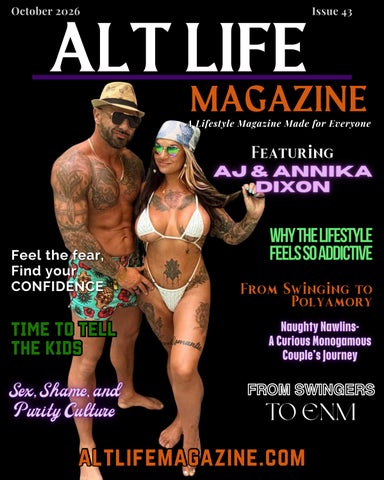
Oc to be r 2026 October
ALT LIFE
I ssu e 43 Issue
MAGAZINE MAGAZINE
A Lifestyle A L i f e styl e M Magazine a g a zin e M Made ade f for or E Everyone v e ryon e
Featuring Featuring
AJ & ANNIKA DIXON
Why the Lifestyle feels so addictive Why the Lifestyle
Feel the fear, Find your CONFIDENCE
TIME TO TIME TO TELL TELL THE KIDS THE KIDS Sex, Shame, and Purity Culture
feels so addictive
From Swinging to Polyamory Naughty NawlinsA Curious Monogamous Couple’s Journey
FROM SWINGERS FROM SWINGERS
TO ENM
altlifemagazine.com altlifemagazine.com
October 2026
TABLE OF CONTENTS 03
Behind the Scenes
04
Cover Model Spread: AJ & Annika DIxon
11
Why the Lifestyle Feels so Addictive
18
Sex, Shame, and Purity Culture
25
The Trick to Bagging Super-Hot Couples
29
Time to Tell the Kids
Issue 43
altlifemagazine.com altlifemagazine.com 33
From Swingers to ENM
42
Naughty NawlinsA Curious Monogamous Couple’s Journey
48
Feel the Fear, Find your CONFIDENCE
53
From Swinging to Polyamory: When Casual Connections Become Real Love
60
Alt Life Definitions
61
Lifestyle Events
02
BEHIND THE SCENES
Dan & Lacy The Swing Nation
Nicole
Swinger Society Co-Owner
Mandy
Swinger Society Operations
Dianna
Swinger Society Marketing
SU P POR T STA FF & WR ITER S C HA R L I E LIV LOVE F A IR Y PU S S Y M O T HE R C A YD E NCE R A YN E S H ER IF F. D IL F MAT
Alt Life Magazine was created with a simple but powerful belief: that our stories matter, even when the world tells us to keep them hidden. From the very beginning, this magazine was never about us—it was about you, the readers, contributors, and quiet voices who needed a place to feel seen without fear of judgment. Over the years, we’ve witnessed firsthand how sharing authentic experiences can replace stigma with understanding and isolation with connection. Every article read in private, every message that says “I finally feel understood,” and every volunteer who gives their time to help shine a little more light reminds us why this work matters. As we continue this journey together, our hope remains the same—to create a sanctuary where truth is celebrated, courage is nurtured, and our community no longer has to live in the shadows, but can stand proudly in the glow of shared humanity.
OPE NLOVE.ORG
03
AJ & ANNIKA DIXON
Cover Feature
Getting to Know
For Annika and AJ, ethical nonmonogamy wasn’t where their relationship began. In fact, despite Annika’s previous experience in the lifestyle, the couple spent eight years building a monogamous marriage, raising their family, and creating a strong foundation together before deciding to explore something new. Today, they openly share their experiences in the alternative lifestyle community, offering a glimpse into a relationship built on communication, consent, connection, and a willingness to explore. Their story is also a reminder that there is no single path into ethical non-monogamy— and no one way an alternative relationship has to look. We sat down with Annika and AJ to talk about their journey, their boundaries, their fantasies, and why they’ve chosen to live the swinger dream a little more publicly than most.
04 27
Cover Feature WHAT FIRST DREW YOU INTO THE ALTERNATIVE LIFESTYLE COMMUNITY? Annika had actually been a unicorn for about five years before we met, so she already had experience with the lifestyle. When we got together, though, AJ had no interest in joining the lifestyle. We were monogamous for eight years. During that time, we built a strong foundation in our relationship, raised our family, and really learned who we were as a couple. Eventually, the conversation came back around, and this time we made the decision together to give the lifestyle a try. Looking back, we’re glad we had those years together first. We weren’t trying to fix something that was missing in our relationship. We were exploring something new from a foundation that was already strong.
05 27
Cover Feature
ARE THERE ANY BOUNDARIES OR AGREEMENTS THAT ARE ESPECIALLY IMPORTANT IN YOUR RELATIONSHIP? Absolutely. Our biggest boundary is that we always play together. For us, this is something we experience as a couple, and that shared experience is an important part of what makes the lifestyle enjoyable. When connecting with another couple, we also want a genuine four-way connection. Chemistry matters between everyone involved. We’re not interested in forcing a dynamic simply because two people happen to be attracted to each other. Safe play is also our standard unless we are with trusted friends and have mutually agreed otherwise. Communication, comfort, and consent always come first.
HOW HAS EXPLORING ENM INFLUENCED YOUR UNDERSTANDING OF YOUR OWN SEXUALITY? AJ: Exploring ethical non-monogamy has helped me better understand and embrace my sexuality. It has strengthened my confidence, motivated me to work toward my fitness goals, and given me a much clearer understanding of what I enjoy and what I prefer when it comes to my play style. There is something empowering about being able to openly communicate your desires rather than feeling like they are things you’re supposed to hide or never talk about.
06 27
YES, there are definitely still things on the fantasy list!
Cover Feature
Is there anything you’re still wanting to try?
We each have fantasies we may explore someday—one involving a gangbang and the other a reverse gangbang. Like everything else we’ve explored, those experiences would only happen if the circumstances felt safe, respectful, consensual, and comfortable for everyone involved. When and why did you decide to start sharing your journey publicly online? We realized that a lot of people in the lifestyle don’t have the ability to be public about this part of their lives. Careers, family situations, social expectations, and the fear of judgment can make being open incredibly difficult. We happen to be in a position where we can be public, so we decided to use that freedom. We believe visibility matters. The more people see ethical non-monogamy represented by everyday couples and real relationships, the more we can challenge some of the stereotypes surrounding it. Hopefully, that helps reduce the stigma and allows other people to feel a little more accepted and supported—even if they can’t be publicly open themselves.
07
Cover Feature WHAT’S THE MOST REWARDING PART OF LIVING AN ETHICALLY NON-MONOGAMOUS LIFE? The freedom to explore our fantasies together has been incredibly rewarding, but even more meaningful is how those shared experiences have brought us closer. Exploring together has strengthened our connection emotionally, mentally, and physically. It has encouraged conversations that we might never have had otherwise and taught us to be incredibly honest about our desires, boundaries, insecurities, and needs. We approach the lifestyle with an open mind, and we’ve learned not to automatically close ourselves off to experiences simply because they’re unfamiliar. That’s why our motto remains: “Never say never.”
08 27
Cover Feature
HOW DO YOU HANDLE CRITICISM, JUDGMENT, OR MISUNDERSTANDINGS ON SOCIAL MEDIA? We try to approach people with grace, understanding, and respect while recognizing that we’re never going to please everyone. One thing that helps us maintain that perspective is remembering that we weren’t always as open-minded as we are today either. People grow. Their perspectives evolve. Sometimes something that initially makes a person uncomfortable simply comes from not understanding it yet. That doesn’t mean we have to accept disrespect, but it does mean we try to extend patience when someone is genuinely trying to understand.
WHAT ARE SOME OF YOUR FAVORITE EVENTS OR LS EXPERIENCES? We’ve had some incredible experiences over the years. We LOVE a hosted by iCandy, Fusion, and Mindbenders. But Swinger Society has been our home party for years, and it remains our favorite by far. There’s something special about finding a community where you feel comfortable enough to keep coming back. The friendships and connections we’ve made have become just as meaningful as the parties themselves.
09 27
More than anything, we hope people understand that there isn’t one “right” way to build a relationship.
Cover Feature
WHAT DO YOU HOPE PEOPLE TAKE AWAY FROM YOUR STORY?
Our relationship started one way and evolved into something different because we made those decisions together. We spent years monogamous. We built our family and our foundation. Then, when the time was right for both of us, we chose to explore. The lifestyle isn’t what makes our relationship work. Communication, honesty, trust, respect, and choosing each other are what make it work.
NEW_SWINGER_ON_THE_BLOCK_
The lifestyle is simply something we get to explore together. And as for what comes next? Never say never.
10
e e v v i i t t c c i i d d d d A A
Lifestyle Advice
WHY THE LIFESTYLE FEELS SO By: Caydence Rayne
If you've spent any time in the alternative lifestyle, you've probably heard someone mention "subspace," "top drop," "new relationship energy," or simply "the high."
After attending Naughty in N'awlins for the first time, I found myself thinking less about what people were doing and more about what they were feeling. Thousands of people from every walk of life gathered in one place. Some came to learn. Some came to play. Some simply wanted to observe. Yet despite the variety of interests and relationship styles, there was one thing almost everyone seemed to have in common.
Connection. 11
The more I thought about it, the more I realized that many of the experiences people describe in BDSM and ethically non-monogamous relationships are deeply rooted in neuroscience. Understanding what is happening inside our bodies doesn't make these experiences less magical. If anything, it makes them even more fascinating.
Lifestyle Advice
Not just sexual connection, but emotional, psychological, intellectual, and even chemical connection.
It's More Than Endorphins For years, discussions about BDSM focused primarily on endorphins. Endorphins are often called the body's natural painkillers. During impact play, intense sensation, exercise, or even laughter, they reduce pain perception and create feelings of euphoria. That is certainly part of the story. But it is far from the whole story. Our brains are simultaneously releasing and regulating an entire cocktail of neurochemicals that influence how we think, feel, bond, and remember experiences. Researchers have shown that sexual arousal, novelty, anticipation, and social bonding involve multiple neurotransmitter systems working together, not just one. This helps explain why one scene, one conversation, or even one lingering glance across a room can stay with someone for weeks.
Dopamine: The Chase Dopamine is often called the "reward" chemical, but that's actually a bit misleading. It is really the anticipation chemical. It is released when we expect something exciting might happen.
12
Receiving a flirtatious message. Negotiating a scene. Locking eyes across a crowded hotel lobby.
The brain begins rewarding us before anything physical has even happened. That anticipation is one reason why flirting can sometimes feel almost as intoxicating as sex itself.
Lifestyle Advice
Waiting to meet someone new.
Walking into an event like Naughty in N'awlins for the first time.
Adrenaline: The Excitement Many lifestyle experiences naturally activate our sympathetic nervous system. Heart rate increases.
Whether you're preparing for a BDSM scene, meeting someone you've been talking to for months, or simply stepping into an unfamiliar environment, adrenaline heightens awareness and amplifies emotion.
Breathing changes. Pupils dilate. The senses become sharper.
It is one reason memories formed during emotionally intense experiences often remain incredibly vivid.
13
Impact play, restraint, sensation play, intense physical activity, and even prolonged excitement can trigger their release. They reduce pain while increasing feelings of pleasure and relaxation.
Lifestyle Advice
Endorphins: Nature’s Pain Relief
Then come the endorphins.
Many people describe entering a dreamlike mental state where outside distractions disappear and they become fully immersed in the moment. Some call this subspace. Others simply describe it as feeling completely present. Not everyone experiences it the same way, and that's perfectly normal.
Perhaps the most misunderstood chemical involved is oxytocin. Often called the "bonding hormone," oxytocin is released through affectionate touch, hugging, kissing, orgasm, eye contact, and emotional vulnerability.
Oxytocin: The Bond
This is why aftercare matters. Aftercare is not just about blankets, snacks, and hydration, although those certainly help. It is about helping the nervous system transition safely while reinforcing trust and emotional security. Even in ethically non-monogamous relationships, oxytocin reminds us that human beings are wired for attachment. Connection isn't a weakness. It's biology.
14
Every high eventually comes back to baseline.
Lifestyle Advice
When the High Ends Sometimes gently. Sometimes all at once. In BDSM, this may be called sub drop or top drop. After an exciting date or lifestyle event, people may experience something similar. The dopamine settles. Adrenaline fades. Endorphins decrease. The body begins restoring equilibrium. That emotional shift can leave someone feeling tired, emotional, irritable, or unexpectedly sad. It doesn't necessarily mean something went wrong. It often means your brain is simply recalibrating after an extraordinary experience. Understanding that can remove a tremendous amount of unnecessary anxiety.
15
Lifestyle Advice
Why communication matters
One thing I noticed repeatedly at Naughty in N'awlins wasn't the play. It was the conversations. People discussed boundaries. They negotiated expectations. They checked in with partners. They laughed together. They supported each other after scenes. Healthy communication is not separate from chemistry. It enhances it. When people feel psychologically safe, the brain is actually better able to experience pleasure and connection. Trust lowers stress responses while strengthening emotional bonding. Science and consent work beautifully together.
16
The alternative lifestyle often gets reduced to what happens behind closed doors.
Lifestyle Advice
The Takeaway That misses the point entirely. Whether you're exploring BDSM, ethical non-monogamy, power exchange, or simply discovering new parts of yourself, you're engaging one of the most complex systems the human body possesses. The brain. Understanding dopamine, adrenaline, endorphins, oxytocin, and the natural emotional rhythms that follow doesn't diminish the experience. It helps us approach it with greater awareness, empathy, and intention. The chemistry is real. The emotions are real. The connections are real. And perhaps that's what struck me most during my first Naughty in N'awlins. Behind every whip, every hug, every kiss, every conversation, and every smile was a reminder that human connection has always been part science and part magic. Thankfully, we don't have to choose between the two.
17
Sex, Shame & Purity Culture
By Dirty D
Lifestyle Advice
erutluC ytiruP
& e m a h S , xe S
How purity culture followed me into adulthood, and even my relationship with my own body Growing up around purity culture meant learning very early that sex was something dangerous to your character. It wasn't talked about as something you needed to understand. We weren't taught to know our bodies. We weren't encouraged to understand pleasure, desire, or even our own anatomy beyond what was necessary. Instead, there were rules. Don't have sex. Don't masturbate. Don't touch yourself. Don't entertain sexual thoughts. Don't give too much of yourself away. And if you're married? Well, then sex isn't a sin anymore.
18
Lifestyle Advice
That was about as close as the conversation came to making sex acceptable. There wasn't suddenly
a
message
about
pleasure
or
discovering your sexuality. Nobody explained how a woman who had spent years learning to associate her body with temptation and shame was supposed to develop a healthy relationship with it. The rule simply changed from don't to now you're allowed. Except shame doesn't work that way.
There is something deeply damaging about
The men standing at the altar There is one sermon I remember in particular. We were told that if you had sex with people before the person you eventually married, then when you stood at the altar on your wedding day, those other men would essentially be standing there beside you. Every one of them. Because you had given a piece of yourself to each one. That imagery stayed with me.
teaching a woman to measure herself that way. Because once you've had sex outside of marriage, what are you supposed to believe about yourself? You can't undo it. You can't become the untouched version of yourself you've been told was the ideal. So where does that leave you? For me, it left shame.
Imagine being a young woman and being taught to visualize your sexual history that way —not as experiences you've had, choices you've made,
mistakes
you've
learned
from,
relationships you've shared, or simply chapters of your life. Instead, you're supposed to picture pieces of yourself missing, Given away, And the person you eventually marry gets whatever is left.
19
in its simplicity: If you only ever have sex with the person you marry, you won't know if the sex is bad because you won't have anything to compare it to. That was actually presented as a benefit. Think about that. Not knowing whether you're satisfied is somehow preferable to having enough
knowledge
and
experience
to
recognize what you want.
A elytsefiL
VIRGIN
ecivd
Another message I heard was almost laughable
Lifestyle Advice
At Least You Won't Know If It's Bad
This WASN’T true! I married the first man I ever slept with and I absolutely knew something wasn’t right. We were not matched in our drive. I felt rejected often.
I didn’t know how to
communicate about my feelings. He NEVER asked about my pleasure. I gave, he took. And all I kept thinking was that it would get better because I was just learning.
Nobody Taught Me to Know My Own Body Masturbation was a sin. Touching yourself sexually was wrong. Even exploring your own body carried shame. And that particular lesson affected me far more And there's something especially troubling
than I realized at the time.
about that message when you consider how little many women raised in purity culture are
I didn't know I could orgasm until I was 32
taught about their own pleasure in the first
years old.
place. You don't need to know what good sex feels like.
Even writing that feels significant. Thirty-two. I had been sexually active. I had been married. I
You don't need anything to compare it to.
had lived an entire adult life inside this body.
You don't need to know what you like.
And I didn't know what it was capable of. It
You certainly shouldn't figure it out yourself.
wasn't because my body didn't work. I didn't
Just don't have sex until you're married.
know because I didn't know my own body.
The goal wasn't knowledge. It was compliance.
20
culture
can
damage
A elytsefiL ecivd
Purity
Lifestyle Advice
Women Seemed to Carry More of the Weight
anyone,
regardless of gender. But growing up as a girl, the expectations felt particularly heavy. There always seemed to be more at stake for us. A woman could be too sexual. I had never really learned what felt good to me because somewhere inside me was still that girl who had been taught that she wasn't supposed to touch herself that way. Even as an adult, there was shame attached to exploring myself. So how was I supposed to tell someone else what I liked? How was a partner supposed to magically understand a body I hadn't been allowed to understand myself? I spent years thinking about my sexuality through the lens of what I was supposed to give someone else without ever really asking
Too experienced. Too revealing. Too tempting. Too easy. Too knowledgeable. Even our clothing could supposedly cause someone else to stumble. We weren't only responsible for controlling ourselves. Somehow, we could also become responsible for what men thought when they looked at us. And underneath all of it was this idea of female purity as something valuable precisely because it could be lost.
what sexuality meant inside my own body. Discovering that I could orgasm wasn't simply discovering pleasure. It forced me to confront how disconnected I had been from myself. And that's when I started realizing how deeply those old messages had gotten inside me.
21
A elytsefiL
Lifestyle Advice
Men certainly weren't given permission to have sex outside of marriage. But the
ecivd
language surrounding women felt different. A woman's sexual history could become a statement about who she was. Her worth. Her character. What kind of wife she might someday be. How much of herself she supposedly had left to give. Those ideas don't simply disappear because you grow up and stop believing every lesson exactly as it was taught. Sometimes your adult mind rejects something long before your body stops reacting to it.
You Can Break the Rules and Still Carry the Shame That's something I wish people understood about religious sexual trauma and purity culture. You don't have to have followed all the rules for them to hurt you I got married. I got divorced. I had sexual experiences. But having sex didn't automatically undo what I'd been taught about sex or my body. Or better yet what I hadn’t been taught !
22
A elytsefiL
It didn't teach me much about what I
ecivd
It taught me plenty about what not to do.
Lifestyle Advice
What Purity Culture Didn't Teach Me
actually needed. I needed to understand consent beyond simply saying no to sex. I needed to understand boundaries. I needed accurate information about my anatomy. I needed to understand desire. I needed to know that my body could Sometimes it just meant doing something while simultaneously carrying the belief that I shouldn't be doing it. And that's a very different experience from sexual freedom. You can reject a rule intellectually and still feel shame emotionally. You can know you're an adult making your own decisions and still hear an old sermon somewhere in the back of your mind. You can believe that masturbation shouldn't be shameful and still feel uncomfortable touching your own body. You can leave the belief system behind and discover that pieces of it came
experience pleasure and that understanding how it worked wasn't dirty. I needed to know that another person's sexual expectations didn't create an obligation for me. I needed to know that my sexual history wasn't a running tally of how much of myself I had left.
Most of all, I needed ownership of my own body.
with you. That's what makes this kind of conditioning so difficult to unpack.
Instead, I learned shame before I ever had enough experience to understand what I was supposed to be ashamed of.
23
Lifestyle Advice
I DIDN'T GIVE PIECES OF MYSELF AWAY
Today, I keep coming back to that image from the sermon. All those men supposedly standing beside me at an altar because each one had taken a piece of me. I don't believe that anymore. Nobody has pieces of me. My divorce doesn't mean someone walked away carrying part of my worth. My sexual history doesn't make me a collection of pieces other people have touched. And learning my own body didn't make me less pure, less worthy, or less anything. At 32, when I finally began discovering what my own body was capable of, I wasn't corrupting something. I was meeting a part of myself I should have been allowed to know all along.
Maybe that's one of the most damaging things purity culture took from me—not my purity, but my permission to know myself. It taught me to worry so much about who might someday have access to my body that I never stopped to consider the person who had been living inside it the entire time. Me. I can't change what I was taught. I can't erase the years I spent carrying shame that never belonged in my relationship with my own body. But I can question it now. I can name it. Ican talk about it. And I can finally reject the idea that becoming sexually knowledgeable somehow makes a woman less valuable. I didn't give pieces of myself away. If anything, I've spent adulthood taking them back.
24
Lifestyle Advice
THE TRICK TO BAGGING SUPERHOT COUPLES
By: Liv Love
This goes whether you are a super-hot couple yourself or not. The thing about super-hot couples in the Lifestyle is they are rare. They are almost as rare as a unicorn, especially in the wild (i.e. not at some event known for having super hot couples). When you see them, you’ll likely have one of two reactions, or both: you’ll be extremely keen about meeting them (and more); or you’ll become bashful and timid. Sadly, neither approach is going to get you laid. Especially-hot couples in the Lifestyle know they are hot, and they are used to being pursued. They are also used to both responses—over-eagerness and over-shyness—and often find both exhausting.
Take for example my last week. Mr. Honey spent the year making his body rockhard, which made us an even hotter couple. I also changed my hair and upped my makeup game, so on the whole I think we moved from very-hot to super-hot. We connected with several couples during our weeklong takeover, and usually it went one of two, well perhaps three, ways.
25
Lifestyle Advice
The first set of couples was eager, cute, sweet, and made their interest obvious. We chatted briefly, maybe I kissed the woman, and then we were off circulating again. But after that initial interaction, they didn’t approach us again. We approached several of these couples again, trying to talk more or get to feel out whether attraction was mutual, but we didn’t get much from them. They seemed shy and acted as though we had already rejected them. I made up a story that they were waiting for us to make a move, having already indicated interest, but I wasn’t ready to make a move. They were one of tens of couples who had indicated preliminary interest, I needed more information before I could move forward, but I found it hard to get. If this sounds like you: remember, super-hot couples have tens if not hundreds of options any given night. You are not unique for having indicated interest one time. Put in a little more work. Let them see your personality. Let them feel safe with you. You have a chance, but you have to put in more work than just one touch. The second set of couples displayed their interest and quickly acted on it. They may have danced with us or maybe we all kissed. Good job. But then something happened, in every single one of these couples: The man pushed too hard too fast, and crossed a boundary. This happens all the time, when we let our eager, child-selves take over. It’s the, “I want it and I have to have it now,” part of us. And sadly, that part reached for my vagina before I was ready. For any Lifestyle couple, super-hot or not, we need to feel safe with before we decide to play with people. People show they are safe by not bulldozing over us or our partners, by doing verbal check-ins like, “Is this okay?” and, “Can I touch you?” and respecting the answers they get. Safe people earn play by not being selfish partners who take what they want but instead appear genuinely interested in pleasuring the other people. Consent is key.
26
Lifestyle Advice
If this sounds like you: remember that what will distinguish you from other couples is how safe the super-hot couple feels with you. Practice restraint, verbal check-ins, and going slow. You want their hands to pull you to them, not push you away. The final set of couples were so shy they didn’t even approach. Some of these were super hot themselves. For instance, on our final day, we met a couple (who claimed to know us, but…duh, we are super identifiable), that I hadn’t seen before. When I saw them and felt their energy, I was basically an immediate “yes” for play. But it was too late, it was the last day. If this sounds like you: don’t throw yourself out of the ring! Super-hot couples are just as busy and overstimulated by the environment as you; if you want to be noticed, you either have to peacock hard or go up and make yourselves memorable to them with a warm introduction. Don’t be so shy that you miss out entirely. They are going to play with people, why not you?
27
Another couple took three touches. We met them at one party but didn’t kiss. Then we ran into them again, and we all kissed. But I was too tired to play, and said we’d see them tomorrow. When we did see them the following day, they engaged in a lot of mirroring: for example, I reached for the husband, so she reached for Mr. Honey. When we invited them up to our room to play, the husband said to me, “You control the tempo, the depth, everything. You are in control.” I loved that and it made me feel way safe.
Lifestyle Advice
I guess I should also mention the couples who succeeded, because yes, we did play. These couples engaged in a gentle push and pull with us, a game, that let us pursue them and be pursued by them. It made us feel more equal with them. For example, we ran into one couple as they were eating, and they offered that we stay and venture to the next place together with them. We declined, but we grabbed their number so we could stay in touch. We actually swung back to the restaurant they were at but they weren’t there, so we texted them telling them we’d be going to their chosen club, and we hoped to see them there. When they greeted us there it was game on, but still, no one rushed anything, which made it more delicious.
What’s worth noting with each of these couples is that they didn’t take “not now,” or our desire to keep meeting people as a reason to get discouraged. Instead, they were patient and approached us or let us approach again. They moved forward with us patiently and allowed us to get more information, not assuming a kiss meant more or even soft play meant we would full swap. And what made play great was that again, no one rushed anything. Even though many moments were pregnant with desire, and they all moved respectfully and consensually, empowering us to make moves too.
Hoping this helps you, and me, get laid more. To fewer missed connections, Honey
Originally published on Honeyahh.com
28
Lifestyle Advice
Parenting in an open relationship comes with its
When it comes to talking with children about
own unique challenges — and opportunities.
relationships — whether traditional or alternative — silence can breed confusion. We believe in
In one of our most heartfelt conversations, we
open, age-appropriate communication. Children
discussed a question we get asked often: “How
are naturally curious, and when they see love
do you talk to your kids about your lifestyle?”
modeled in healthy, respectful ways, they begin to understand that relationships can take many
It’s a question rooted in love and concern, and
forms.
it’s one that deserves honesty, compassion, and balance. As parents of eight children, we’ve learned that openness doesn’t mean oversharing — it means creating a foundation of trust, honesty, and communication that guides every conversation we have with our family.
Jackie shares that she’s always approached these conversations with sensitivity to each child’s age and maturity level. When her kids were younger, the focus was on values — kindness, honesty, and respect. As they grew older, the discussions expanded into what relationships can look like, including the concept of nonmonogamy. These talks were never graphic or explicit. Instead, they
THE IMPORTANCE OF OPEN CONVERSATIONS
were about modeling how to love openly and communicate truthfully.
29
Lifestyle Advice
AGE-APPROPRIATE HONESTY Children process information differently at every stage of development. That’s why timing and tone matter. Jackie explains that she spoke to her adult children about her lifestyle only when they were mature enough to understand the nuances of adult relationships. Younger children, on the other hand, don’t need details — they need reassurance that their parents love and respect each other. Openness
isn’t
about
giving
kids
adult
information; it’s about giving them honest answers at the level they can handle.
MODELING HEALTHY RELATIONSHIP SKILLS One of the biggest lessons we try to pass on is that there’s no single “right” way to love — but every relationship, no matter it’s structure, should be
rooted
in
respect,
integrity,
and
communication. We talk openly with our kids about emotional honesty, trust, and empathy — the same tools that sustain our relationship. We want them to understand that communication isn’t just about talking; it’s about listening and working through feelings
like
jealousy
or
insecurity
with
compassion. Our open lifestyle has actually strengthened our ability to model those skills. We’ve learned how to express
vulnerability,
set
boundaries,
and
navigate emotional complexity — lessons that make us better parents as well as partners.
30
Lifestyle Advice
REDUCING FEAR THROUGH KNOWLEDGE
A big part of why we’re open with our children is because knowledge eliminates fear. When kids understand that love can look different for different people, it removes the stigma around relationships that fall outside the norm. Instead of judgment or confusion, they learn empathy and confidence. They see that strong relationships — whether monogamous
PRIVACY AND PROTECTION
or
open
—
are
built
on
communication, compassion, and respect. And that’s the kind of understanding that will serve them for life.
While honesty is crucial, privacy is equally important. Children don’t need to know the intimate details of their parents’ romantic lives — and in truth, they probably don’t want to. We’ve
found
that
maintaining
a
healthy
boundary between our adult experiences and our family life creates safety and clarity. Our kids know who we are, and they know they can come to us with questions, but they also know there are aspects of adult relationships that are private. It’s a balance — one that allows for transparency without discomfort.
31
Lifestyle Advice
THE CORE VALUES THAT MATTER MOST At the end of the day, what we teach our children isn’t about swinging, monogamy, or polyamory — it’s about values. We want them to see: Trust as the foundation of love. Honesty as a gift you give your partner. Integrity as the glue that holds relationships together. When those values are in place, the structure of a relationship becomes secondary to the strength of its connection.
FINAL THOUGHTS Talking to your kids about your lifestyle doesn’t have to be daunting — it just requires honesty, awareness, and heart. Be open, be mindful, and remember: your children learn about relationships not just from what you say, but from how you live. By showing them love, respect, and authenticity, you’re already giving them everything they need to build healthy relationships of their own. For
more
insights
on
communication,
relationships,
and
navigating
life
with
authenticity,
visit
OpenLove101.com
and
subscribe to our blog and videos.
32
IS THE LANGUAGE CHANGING THE LIFESTYLE?
Lifestyle Advice
FROM SWINGERS TO ENM: Why younger people are moving away from “swinger” - and why some of us still wear the label proudly If you spend enough time around people in the lifestyle, you'll eventually discover that we have a lot of words for not being monogamous.
By: Aeroroses
Swinger. Lifestyle. Open relationship. ENM. CNM. Poly. Relationship anarchist. And probably three more terms that were invented while I was writing this paragraph. For those of us who came into the lifestyle later in life, especially those of us who found it in our late thirties or forties, the terminology can be fascinating. Because depending on who you're talking to, the word “swinger” can mean very different things. To some people, it's an identity they wear proudly. To others—particularly some younger people—it sounds like something their grand-parents were doing at a Key Party in 1978. And that difference isn't just about vocabulary. It can tell you something about how different generations approach sex, relationships, and the communities surrounding them.
33
Lifestyle Advice
“SWINGER” HAS A HISTORY Let's start with the obvious elephant in the room—or perhaps the naked couple in the room. The word swinger comes with baggage. For decades, popular culture has portrayed swinging through the lens of the infamous Key Party: couples gathering in some suburban living room, tossing car keys into a bowl, and letting fate— or Bob from accounting—decide who goes home with whom.
Whether that depiction was ever an accurate representation of most swingers is another conversation entirely. But the stuck.
stereotype
For someone who grew up seeing “swinging” portrayed that way, the word can feel dated, couple-centric, or overly focused on partner swapping.
IT FEELS MODERN IT FEELS BROADER
And if you're a younger person discovering consensual non-monogamy through TikTok, Reddit, dating apps, podcasts, or online communities, ENM may simply sound more accurate.
And perhaps most importantly, it doesn't come with a picture of somebody dropping their keys into a bowl.
34
Lifestyle Advice
ENM DESCRIBES THE RELATIONSHIP. SWINGING DESCRIBES THE SCENE. This is where I think the distinction gets really interesting.
ENM - ethical non-monogamy-is a broad description of how a relationship operates. It tells you that the people involved have agreed that their relationship doesn't have to be sexually or romantically exclusive. But it doesn't necessarily tell you what they actually do. Are they dating other people? Are they having separate sexual partners? Are they forming emotional connections? Are they attending parties? Are they occasionally hooking up with strangers? Are they building ongoing relationships with other couples? Are they doing all of the above?
ENM doesn't really answer that question. And that's not a criticism. That's the point. It's an umbrella. “Swinger,” on the other hand, can communicate something much more specific about the culture and social experience someone is looking for. At least, that's how personally use the word.
I
35
Lifestyle Advice
WHY I STILL CALL MYSELF A SWINGER I'm over 40, but I didn't discover swinging until my late thirties. So I'm not exactly a lifelong member of the old guard. But when I found the lifestyle, “swinger” just made sense to me. For me, swinging isn't about finding another person to date. It's not about building a second romantic relationship. It's not about replacing my marriage with multiple partnerships. My husband is my husband. That's my romantic relationship. The rest? That's where things get a lot more fun. I enjoy meeting people. I enjoy socializing. I enjoy parties. I enjoy sexual exploration. I enjoy the spontaneity and the energy of meeting people who are open-minded and sexually adventurous. And, frankly, sometimes the goal is simply: We're attracted to each other. We're having fun. Let's see where this goes. or perhaps more accurately:
DTF? There doesn't need to be a coffee date. There doesn't need to be a three-week texting relationship. There doesn't need to be an emotional connection before anyone takes their clothes off. Sometimes you meet someone, the chemistry is there, everyone's boundaries are clear, everyone is consenting, and that's enough. That's swinging to me.
36
Lifestyle Advice
AND THAT’S WHERE ENM AND SWINGING CAN FEEL VERY DIFFERENT Someone can absolutely be ENM and want exactly that. But someone can also be ENM and want the complete opposite. They might want to meet one person repeatedly. They might want dinner dates. They might want emotional intimacy. They might want a romantic relationship outside their marriage. They might even want something that looks a lot like having two partners. All of those relationships can fall under the ENM umbrella. But if I tell someone I'm a swinger, I'm hoping they're hearing something a little more specific. I'm not looking for a boyfriend. I'm not looking to become someone's girlfriend. I'm looking for sex, fun, social connection, and adventure— with boundaries.
That's a different dynamic. And knowing that difference can save everyone a lot of awkward conversations.
37
This may be one of the biggest reasons we’re seeing the language shift.
Lifestyle Advice
Younger people may be choosing ENM because it doesn’t make assumptions. “Swinger” can make assumptions. It can suggest you're part of a particular scene. It can suggest you're a couple. It can suggest partner swapping. It can suggest recreational sex. It can even suggest that you're looking for the same things other swingers are looking for. ENM doesn't make nearly as many assumptions. A 27-year-old can say, “I'm ENM,” without having to explain exactly what that means. And then they can have the conversation that actually matters: What does non-monogamy look like for you? That is arguably a much healthier conversation than assuming someone's relationship structure based on a single label.
BUT HERE’S THE FUNNY PART... The older generation may have been practicing ENM without ever calling it ENM. Think about the couple who has been together for 15 years and has always had agreements about outside sexual partners. They communicate. They negotiate boundaries. They disclose partners. They talk about safer sex. They have rules around emotional involvement. They check in with each other. They just call themselves swingers. They aren't necessarily less ethical, less communicative, or less evolved because they don't use the latest terminology. They simply came into the conversation through a different door. And some of those people have been having these conversations since before “ENM” became something you could put in an Instagram bio.
38
Lifestyle Advice
DOES THE NEW LANGUAGE CHANGE EXPECTATIONS? Absolutely. And this might be the most important part of the conversation. When someone says they're ENM, you can't necessarily assume what they're looking for. That can be a good thing. But it also means you have to ask. If someone says they're a swinger, there are still plenty of questions to ask —but you may have a slightly better idea of the general neighborhood they're standing in.
Are they looking for couples? Singles? One-time hookups? Regular play partners? Parties? Clubs? Threesomes? Separate play? Together only? And yes, some swingers want emotional connections too. Because humans are messy and apparently incapable of sticking neatly inside the boxes we create for ourselves. But generally speaking, the traditional swinger culture has tended to emphasize sexual exploration and social connection rather than building additional romantic partnerships.
That's a meaningful distinction.
39
Lifestyle Advice
THE DANGER OF ASSUMING ONE LABEL TELLS YOU EVERYTHING Here's where both sides can get themselves into trouble. A swinger might hear “ENM” and assume: Oh, they're basically poly. Not necessarily. An ENM person might hear “swinger” and assume: Oh, they're just looking to swap partners. Also, not necessarily. And someone who identifies as poly might hear both of those descriptions and think: Please stop putting me in your box. Fair enough.
DTF? Labels are useful because they give us a starting point. They're dangerous when we treat them as a complete instruction manual.
40
Maybe it's expanding it.
Lifestyle Advice
MAYBE THE LANGUAGE ISN’T CHANGING THE LIFESTYLE The younger generation isn't necessarily abandoning swinging. They may simply be less interested in adopting a label that doesn't feel like it represents them. At the same time, longtime swingers aren't necessarily resistant to change because they continue to use the word “swinger.” For many of us, the word still says exactly what we want it to say. It says: We love each other. We're committed to each other. And we're also having a hell of a lot of fun. There is something wonderfully uncomplicated about that.
So, What should we call ourselves?
Whatever the hell actually fits. If ENM feels right, use ENM. If CNM feels right, use CNM. If “open relationship” makes more sense, go with that. If you're happily calling yourself a swinger, keep swinging. And if you're like me and “swinger” tells people more about the kind of fun you're interested in than “ENM” does, there's absolutely nothing wrong with keeping the old-school terminology.
Because ultimately, the important part isn't the label. It's the conversation behind it. Tell people what you mean. Ask them what they mean. Don't assume that “swinger” means one thing or “ENM” means another. Maybe the language is changing. Maybe the lifestyle is changing with it. Or maybe we're just finally realizing that there have always been a whole lot of different ways to have consensual, non-monogamous fun. Personally, I'll keep calling myself a swinger. Because sometimes I want deep conversation, emotional intimacy, and meaningful connections. And sometimes I want to meet someone at a party, discover we're both attracted to each other, confirm everyone's boundaries, and get straight to the fun part. I don't need a new acronym for that.
41
A Curious Monogamous Couple’s Journey
Lifestyle Stories
Naughty N’awlins: By: Mat
What started as curiosity about a world we didn’t understand became a lesson in boundaries, openness, and assuming a little less. In July 2026, my wife and I boarded a flight from the Northeast to New Orleans with plans to scope out the city for a future vacation. Somewhere in our research, however, we discovered something we hadn’t expected: Naughty N’awlins would be taking place July 8–12, with events spread between the Astor Crowne Plaza and the NOPSI. Our curiosity was immediately sparked. So were about a thousand questions. At the time, my wife and I were monogamous. We weren’t looking to change our relationship, open our marriage, or suddenly become part of the lifestyle. We simply wanted to understand something that was completely outside our experience. In a sense, we arrived as tourists—but this certainly wasn’t going to be the usual kind of sightseeing. We packed our clothes, our curiosity, and probably more uncertainty than either of us realized. And off we went.
42
We stayed at the Astor, which, from our perspective, seemed to lean more toward the swinging community. Throughout the weekend, we also made the walk to the NOPSI many times, where we encountered an atmosphere that appeared more focused on BDSM. Both locations felt friendly and welcoming, but the energy was noticeably different.
Lifestyle Stories
Two Hotels, Two Different Energies At the Astor, people seemed particularly open to meeting new people, socializing, and potentially sharing experiences. The NOPSI felt quieter to us, with many attendees appearing more focused on the partners and friends they had arrived with.Of course, these were simply our impressions as two newcomers trying to make sense of an unfamiliar environment. We were observing everything through the lens of people who had never experienced anything quite like it before. There was also one fairly important detail we kept to ourselves:We never told anyone we were monogamous. We weren’t trying to be deceptive. We genuinely didn’t know whether we would be welcome if people knew we weren’t part of the lifestyle. More importantly, we didn’t want anyone to think we were there to gawk. We weren’t spectators searching for outrageous stories to take home. We weren’t there to judge anyone or treat someone else’s sexuality like entertainment. We wanted to learn.
Welcome to the Deep End
During the day, we attended seminars, demos, and several paid workshops covering adult topics, toys, lubrication, intimacy, and sexuality. Some involved full nudity, shared bed spaces, and sexual activity. To say this was new territory for us would be an understatement. If you could have seen our faces during some of those first experiences, you might have thought someone had just announced an unexpected fire drill. Funny enough, that actually happened a few times, too. There were moments when my wife and I looked at each other and silently wondered whether it was time to make a discreet exit. I’m fairly certain there were points when both of us were prepared to turn around and run. But we didn’t. We stayed.
43
Lifestyle Stories
And once the initial shock wore off, something interesting happened: we became more comfortable. The workshops were fun. They were educational. More importantly, we began to understand that the people around us were adults making their own choices, communicating their boundaries, and participating because they wanted to be there. That realization challenged some of the assumptions we had unknowingly brought with us. So did the people themselves. We met genuinely kind, welcoming people throughout the weekend —people who didn’t fit whatever vague stereotype we might have expected before arriving.
Looking Without Participating In the evenings, we explored the open-play areas without participating ourselves. There were private rooms, group spaces, a dark room, dungeons, a toy room, and other areas dedicated to different interests and experiences. At the NOPSI, before the evening activities began, we watched— and even participated in—demonstrations involving flogging, hot wax, and other BDSM practices. Again, much of it wasn’t what we expected. That turned out to be one of the most useful parts of the entire experience. Sometimes the best education begins with discovering just how much you don’t know.
44
Lifestyle Stories
We also briefly ventured into a foam party. Thirty minutes was enough for us to determine that foam, music, and a very large crowd probably weren’t destined to become our new favorite shared hobby. We skipped the parade for sexual freedom down Bourbon Street and left plenty of other activities to the people who were actively participating in the event. And because we were still in New Orleans, we spent plenty of time exploring the French Quarter—which, as anyone who has visited knows, can provide more than enough stimulation without ever requiring you to enter a playroom.
The Most Surprising Discovery
For all the workshops, demonstrations, play spaces, and things we had never encountered before, the most memorable realization of the weekend was remarkably simple. Everyone seemed so…ordinary. They were everyday people. These weren’t mysterious people living some completely separate existence from ours. They were the same kinds of people we passed in grocery stores. They looked like our neighbors. They could have been sitting beside us at a local town meeting or standing behind us in line for coffee. They simply had different interests, boundaries, relationships, and ways of expressing themselves. Looking back, that realization may have been more important than anything we learned in a seminar.
45
From my monogamous perspective at the time, some of what I observed in the play spaces seemed to separate sex from the kind of emotional intimacy I associated with it. My initial interpretation was simple: sex for the sake of sex. But even then, I understood that this was my interpretation. It was shaped by my marriage, my experiences, and the meaning I personally attached to sex. The people participating might have experienced those exact same encounters as liberating, intimate, connective, exciting, affirming, or deeply meaningful in ways I simply didn’t understand.
Lifestyle Stories
The Questions I Couldn't Stop Asking
That realization left me with one question that followed me throughout the weekend: Why? What draws someone to this lifestyle? More importantly, what do they receive from it beyond sex? Is it freedom? Novelty? Community? Trust? Self-discovery? The ability to explore parts of themselves that traditional relationships don’t always leave room for? Or is it some combination of all those things—and probably a dozen others I hadn’t considered? I don’t think we ever really found the answer. And, looking back, part of that was our own fault.
The Conversation I Wish We'd Had In retrospect, I wish we had simply told people the truth. We’re monogamous. We’re curious. We don’t want to participate. We just want to understand. Our reluctance wasn’t rooted in judgment. It was uncertainty.
We didn’t know whether a monogamous couple would be accepted in that environment. We didn’t want anyone thinking we viewed their lives as a spectacle or that we had wandered into their community simply to watch. Ironically, our attempt to be respectful may have prevented us from having the very conversations that could have taught us the most.
What does this give you? How does it affect your relationship? What makes this meaningful to you? Why does this work for you? Those conversations might have answered questions that observation alone never could.
Had we been a little more confident, maybe we would have sat down with another couple and simply asked:
46
We left Naughty N’awlins exactly as we had arrived: a happy, committed monogamous couple. The weekend didn’t convince us to change our relationship. It didn’t suddenly make us want to participate in the lifestyle.
Lifestyle Stories
Learning More, Assuming Less What it changed was something subtler. It changed the way we thought about the people who did. We learned that understanding someone does not require becoming like them. Curiosity doesn’t require participation. And respecting another person’s choices doesn’t require those choices to become our own.
Picture from:
Sexual Freedom Parade
Sometimes understanding simply requires being willing to step outside what is familiar long enough to question the assumptions we brought with us. More than anything, Naughty N’awlins reminded us that the people whose lives we don’t immediately understand may not be nearly as different from us as we imagine. They may shop at the same grocery stores, live in the same neighborhoods, attend the same community meetings, raise families, build careers, love their partners, and navigate life just like everyone else. Their relationships may look different. Their boundaries may be different. Their definition of intimacy may be different. But different doesn’t have to mean mysterious. Sometimes it simply means there is more to learn.
Learning more. Assuming less.— Mat
47
Lifestyle Advice
By: Fairy By: Fairy Pussy Pussy Mother Mother
Feel the Fear, Find Your
Taking the plunge into the lifestyle can feel exciting, intimidating, freeing, and absolutely terrifying—all at the same time. A lot of people assume confidence is something you need before you take that first step. But the truth? Most of the time, confidence is built because you took it. You don’t have to walk through the door fearless. Sometimes, you just have to walk through the door. Here are a few ways to hype yourself up when fear and self-doubt start creeping in.
48
Lifestyle Advice
REMEMBER WHY YOU WANTED THIS IN THE FIRST PLACE
You were curious for a reason. Maybe you’re looking for connection. Confidence. Exploration. Freedom. Community. Pleasure. Self-discovery. Or maybe there’s a part of yourself you’re finally ready to get to know. Whatever brought reconnect with it.
you
here,
It’s easy to let the “What if this goes wrong?” thoughts become louder than the “What if I love this?” ones. Give the possibilities some space, too.
STOP WAITING TO FEEL “PERFECT”
You do not need the perfect body. You don’t need the perfect outfit. You don’t need years of experience or an endless supply of confidence. And you certainly don’t need to become some imaginary “better” version of yourself before you deserve experiences that make you happy. Nobody walks into something completely new feeling 100% fearless. Stop making perfection the admission price for your own life.
49
Lifestyle Advice
HYPE YOURSELF UP BEFOREHAND
Create a pre-event or pre-date ritual that makes you feel good. Wear something that makes you feel hot. Take extra time getting ready. Put on the playlist that makes you feel unstoppable. Look at yourself in the mirror and remind yourself exactly who you are. Hell, pull up those old compliments, messages, or screenshots that made you smile and remember how other people have seen you on the days you struggled to see it yourself. Sometimes confidence starts as a performance. You stand a little taller. You put on the outfit. You tell yourself you belong there. And somewhere along the way, you start believing it.
GIVE YOURSELF PERMISSION TO GO SLOWLY
Taking the plunge doesn’t mean diving into the deep end on night one. You can observe. You can talk to people. You can attend an event just to experience the atmosphere. You can flirt without taking it further. You can establish hard boundaries. You can say yes and later decide no. You can leave whenever you want. There is no finish line you’re racing toward and no prize for doing more than you’re comfortable doing. Moving at your own pace is still progress.
50
Lifestyle Advice
BEING NERVOUS IS USE
NORMAL
Even experienced butterflies.
people
get
AFFIRMATIONS YOU ACTUALLY BELIEVE
Being nervous doesn’t automatically mean something is wrong or that you shouldn’t be there. Sometimes those butterflies simply mean you’re stepping outside your comfort zone. Learn to recognize the difference between a boundary telling you no and nerves asking, “Are we really doing this?” You are always allowed to listen to yourself and decide what feels right. CHOOSE CURIOSITY OVER PERFORMANCE
You don’t have to impress everyone. You don’t have to be the hottest person in the room. You don’t have to prove how adventurous, sexy, experienced, or confident you are. You just have to show up as yourself. Instead of wondering, “What does everyone think of me?” try asking, “How do I feel here?” That question matters a whole lot more.
Sometimes standing in front of the mirror declaring, “I AM FEARLESS!” doesn’t work because your brain immediately responds, “Girl, no you’re not.”
somewhere
SO START
BELIEVABLE “I can handle new experiences.” “I deserve pleasure and connection.” “I’m allowed to explore safely.” “My boundaries deserve to be respected.” “I don’t have to prove anything to anyone.” “It’s okay to be nervous and excited at the same time.” Confidence doesn’t have to sound like fearlessness. Sometimes confidence sounds like, “I’m nervous, but I trust myself.”
51
Lifestyle Advice
CONFIDENCE COMES AFTER THE ACTION
The first message. The first meet-and-greet. The first event. The first conversation. The first time walking through that door. Those firsts can feel enormous. Then you do it. And afterward, your brain has a tiny realization: Oh... I survived. Maybe I can do this. Then you do something else. And something else. Eventually, the thing that once made your stomach flip becomes something you know you can handle. That’s how confidence is built—not by waiting until fear disappears, but by collecting evidence that you can trust yourself when it shows up.
AND MOST IMPORTANTLY...
You are allowed to explore your desires without shame. You are allowed to be curious. You are allowed to change your mind. You are allowed to have boundaries. You are allowed to say yes. You are allowed to say no. You are allowed to move slowly, take a break, or decide something simply isn’t for you. And you are allowed to walk into these spaces and take up space exactly as you are. You don’t need to become more attractive, more experienced, more adventurous, or more confident first. You’re already worthy of being there. Sometimes you just have to take the first step and give yourself the chance to realize it.
52
Real Stories
From Swinging to Polyamory:
By: SheriffDILF
WHEN CASUAL CONNECTIONS BECOME REAL
Love
For many couples, swinging begins with a sense of adventure. It can be about exploring sexuality together, meeting new people, sharing experiences, and discovering parts of yourselves that traditional structure didn’t allow the space for. But sometimes, something unexpected happens. A connection that was supposed to be casual becomes emotional. Someone you talked to daily, becomes more than just casual. Conversations become deeper. You start caring about their day, their happiness, their struggles, and their future. And suddenly, the connection isn’t just physical; it's emotional. This could be the start of swinging into polyamory.
53
Real Stories
Swinging and Polyamory Aren’t the Same Thing Although swinging and polyamory both fall under the broader umbrella of consensual non-monogamy, they often operate from very different places. As we are aware, swinging focuses more on the physical and sexual nature. A couple may play with others, attend lifestyle events, or develop friendships and sexual connections while maintaining their primary romantic relationship. Polyamory, on the other hand, makes room for multiple romantic and emotional relationships. The difference isn’t necessarily about how much sex someone has. It’s about whether there’s room for love. Love isn’t finite; it's infinite, and each person is different. A swinger might say, “We’re looking for someone to play with.” A polyamorous person might say, “I’m open to building another emotional connection with someone else, and possibly deeper.” Those may sound similar on the surface, but emotionally they can create two completely different experiences.
The First Big Change: Feelings Are No Longer Something to Avoid One of the biggest adjustments when moving from swinging to polyamory is realizing that emotions aren’t necessarily the enemy. In swinging, some couples establish boundaries specifically designed to protect their relationship from emotional attachment. The expectation might be to have fun, enjoy the experience, and maintain the emotional relationship between the couple. Polyamory challenges that idea. Instead of asking, “How do we prevent feelings?” You may start asking: “What do we do when feelings happen?” That requires an entirely different level of communication. You can’t always control who you develop feelings for. You can, however, control how honestly and responsibly you handle those feelings.
54
Real Stories
Jealousy Changes, Too Jealousy doesn’t magically disappear when someone becomes polyamorous, either. In fact, sometimes it can become a little more complex. Swinging can involve only seeing your partner connect with someone else while knowing that the experience is primarily physical. Polyamory can introduce the possibility that your partner genuinely loves someone else, and that can hit differently. You might be comfortable watching your partner kiss someone at a party, but struggle when they spend an entire weekend with someone they love. You might be okay with sex but not the emotional intimacy. You may even discover jealousy surrounding time, attention, holidays, birthdays, vacations, or seemingly small things like how quickly someone responds to a text. Polyamory often teaches an uncomfortable but valuable lesson: Jealousy isn’t always proof that something is wrong. Sometimes it’s information. It can reveal insecurity, fear of abandonment, unmet needs, or a desire for reassurance. Most will try to avoid it or eliminate the perceived “threat”. When, instead, you can learn to understand why you are feeling this way and address it.
55
Real Stories
Your Relationship Agreements Have to Evolve Swinging often comes with rules. Maybe you only play together. Maybe there are certain acts that are off-limits. Maybe there are rules about who you can meet, where you can meet them, and whether you can communicate afterward. When you move toward polyamory, some of those rules may no longer make sense.
You may need agreements about: How much time partners spend together Overnight visits Vacations Meeting metamours Communication expectations Sexual health and safer-sex practices Introducing partners to friends or family Holidays and special occasions Emotional support Privacy and social media What happens when someone develops stronger feelings The important distinction is between rules and agreements. Rules often tell another person what they’re allowed to do. Agreements describe what everyone involved needs in order to participate freely and consensually. That shift can make relationships healthier because you’re no longer simply trying to control circumstances. You’re building a structure that everyone has voluntarily agreed to participate in.
56
One of the most interesting parts of moving from swinging to polyamory is that you may learn that your sexuality wasn’t the only thing you were exploring. You were exploring your capacity for connection.
The Hardest Part May Be Letting Go of Control Perhaps the biggest transition of all is learning that you can’t completely control another person’s heart. You can’t guarantee that your partner won’t fall in love, that another relationship won’t become serious, and you can’t guarantee that nobody will ever get hurt.
You may discover that you can love more than one person without loving your existing partner any less. You could discover that your partner’s happiness with someone else doesn’t have to diminish your own relationship, that you might just need more reassurance than you thought. Maybe you discover that you’re more independent than you realized. There isn’t a trophy for becoming “more evolved” by having more relationships. Consensual non-monogamy is about finding the structure that works for the people involved —not forcing yourself into a particular identity.
What you can do is build relationships based on honesty, consent, communication, boundaries, and respect. You can choose partners who communicate. You can address problems before they become disasters, and you can acknowledge uncomfortable feelings instead of pretending they don’t exist. You can trust that love doesn’t automatically become smaller simply because there is more of it.
57
Real Stories
You May Discover Things About Yourself You Didn’t Expect
Real Stories
The Idea of the “Primary” Relationship May Change For couples coming from swinging, the marriage or long-term relationship may naturally be the center of everything. Polyamory can challenge that hierarchy. That doesn’t mean your partner suddenly becomes less important. It means another person may also become deeply important. Your partner may have a relationship that exists independently of you. They may have memories you weren’t part of, inside jokes you don’t understand, and experiences that belong entirely to them. That can be beautiful. It can also be uncomfortable. Learning that your partner has something independent from you can be a tough transition.
Time Becomes More Valuable Than Sex This is another major change. In swinging, you might spend a few hours with someone and have an incredible experience. Polyamory asks a different question: What happens when you want more than a few hours? Now you’re coordinating schedules. You’re making dinner. You’re having phone calls. You’re watching movies. You’re supporting someone through a bad day. You’re celebrating birthdays. You’re missing them when they’re gone. Sex can still be part of the relationship, but it becomes only one piece of something much larger. And sometimes the most moments aren’t sexual at all.
intimate
58
Real Stories
From “Us Against the World” to “Us With More People” For some, the transition from swinging to polyamory feels like losing the simplicity they once had. For others, it feels like discovering an entirely new dimension of their relationship.
The journey can be messy. There can be jealousy, insecurity, misunderstandings, difficult conversations, unexpected emotions, and moments when you question everything. But there can also be something incredibly rewarding about realizing that love doesn’t always have to be treated like a limited resource. Swinging may teach you that your relationship can survive sexual exploration. Polyamory may teach you that it can survive—and even thrive through—emotional expansion. The biggest lesson isn’t that everyone should become polyamorous. It’s that relationships don’t have to follow one predetermined blueprint. Some people want sexual freedom without romantic relationships. Some want multiple loving relationships. Some want something in between. And some people discover along the way that what they thought they wanted isn’t actually what they need. The important part is that everyone involved gets a voice. Because ultimately, the journey from swinging to polyamory isn’t really about having more partners.
It’s about learning how to create more honest, intentional, and emotionally responsible relationships—and discovering what love can look like when you stop assuming it has to fit inside a box.
59
ALT LIFE
By TnGalNicole
Lifestyle Definitions
Defining
60
Lifestyle Events
COME PARTY WITH US!
61