JUNE


KAPPA


JUNE


1 International President’s Message
2 Finding What Works for Your Chapter
3 Academy Students Present Capstone Projects
4 Honor a Sister Has Ripple Effect
5 Bytes & Pieces
5 Alpha Delta Kappa Strategic Plan 2026-2029
8 ITE Scholars and Sponsors: Building Lasting Connections
9 Your Contributions Make a Difference
10 Connecting Puzzle Pieces
11 Staying Safe in Today’s Digital World
12 A String of Pearls
13 Pearls of Achievement Award Has Purpose
14 A Sisterhood Without Borders
15 Students Learn From Lessons on Location
16 Making the Most of Your Regional Conference
18 Artificial Intelligence Enters the Classroom
19 Celebrating One Year of Alabama Gamma Epsilon
20 Intergenerational Collaboration Strengthens World Understanding
21 Building Connections Through Celebration
22 AZ Iota Sponsors New Collegiate Club
23 Congratulations
26 Altruism
30 #A∆K
32 Omega Chapter
33 A∆K Dates and Deadlines
The cover photograph is of the Ligurian Sea Cliffs in Cinque Terre, Italy, on the Italian Riviera. It is a UNESCO World Heritage Site. Rocks evolve through heat, pressure, weathering and erosion. Even as they transform and adapt to a new environment, they retain strength and endurance. Rock represents permanence and the overcoming of hardships.
KAPPAN EDITOR
Joanne Grimm, CA Alpha Alpha
KAPPAN TEAM
Susan Pelchat, CT Mu
Shannon Lorenzo-Rivero, TN Chi
Betty Sherrod, VA Gamma Omicron
Susan Whelan, NJ Kappa
Julie Kinder-McMillan, TN Alpha Gamma
Gwen Steele, NE Kappa
Judy Barnhill, TN Beta Zeta
Judy Tate, VA Tau
Daniel LaBorde, Communications & Publications Manager, Int'l HQ
KAPPAN EDITORIAL BOARD
Conway Blankenship, International President
Mary Ey, International President-Elect
Ann Marie Brown, Immediate Past International President
Christi Smith, Executive Director
KAPPAN PHOTO EDITOR
Betty Sherrod

Alpha Delta Kappa empowers women educators to advance educational excellence, altruism and world understanding.
The KAPPAN magazine is published quarterly by Alpha Delta Kappa, International Honorary Organization for Women Educators. Find the KAPPAN Publishing Guidelines online at www.alphadeltakappa.org.
Alpha Delta Kappa International Headquarters: 1615 W. 92nd St., Kansas City, MO 64114-3210 (816) 363-5525, (800) 247-2311, Fax (816) 363-4010 email: headquarters@alphadeltakappa.org www.alphadeltakappa.org
The opinions expressed herein are those of the individual authors and are not necessarily in conformity with those of Alpha Delta Kappa or the editor.
The deadline for the Sept. issue is July 1, 2026. Please include your name, chapter, state, province or nation, your office and a way we can reach you if there are questions or more information needed. To submit articles/photos, go to the A∆K website >About>Publications>Submit to the KAPPAN. Follow submission guidelines on the submission form.
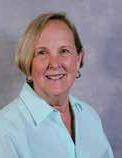
Here we are welcoming another season, one that active educators, as well as retirees, anticipate with smiles. I still remember experiencing different emotions at the end of a school year. Happiness over the impending weeks without grading papers, writing lesson plans or staying on a strict schedule. But, some years there was a little sadness, too. Even though the changes I made along my journey as an educator were changes I sought, leaving certain aspects behind caused some anxiety. I feel certain you may have experienced this situation, too.
Fred Rogers, aka Mister Rogers, once said, “Transitions are almost always signs of growth, but they can bring feelings of loss. To get somewhere new, we may have to leave somewhere else behind.” Many of us are in the process of transitioning to something new, whether it be a new school, a new position within a school system, a move to a smaller home with a master bedroom on one floor or a new leadership challenge in Alpha Delta Kappa. Life is full of transitions. How we deal with them makes a difference in whether or not we are successful.
When was the last time you tried a new craft? This winter, I decided I wanted to bake sourdough bread. I thought mixing the dough and then kneading it would be challenging and maybe even therapeutic. I did some research online, and the photos on Instagram made it look so easy. In no time, the Amazon deliveries arrived at my door, and a friend shared her starter with me. Quickly, I learned the three basic ingredients of sourdough bread (starter, flour and water) must go through several transitions before baking. Was I challenged? YES! I am not showing any photos of my experiments, but I will tell you that each loaf was edible, especially when served warm with butter. It’s not been easy, but I am not giving up. I am learning from my mistakes, and there will be a sourdough loaf worthy of a photo in my future.
filled with numerous discussions among leadership teams to gain new perspectives and knowledge, are here. I encourage each recently installed president to try something different. If it doesn’t bake perfectly, continue discovering what will work by asking for suggestions from your members.
The goals for the organization are transitioning with the adoption of the 2026-2029 Alpha Delta Kappa Strategic Plan. It is designed to help support leaders with current and future needs. It was first introduced to regional leaders and the International Membership Committee in late February and then offered to all members via a Toolbox on March 16. It is posted on our website and is included in this issue and should be used as a guide to accomplish your ongoing goals. Future Chapter Needs Assessments, as well as State, Provincial, National assessments and the H-114 report have been modified to coordinate with the strategic plan.
The International Executive Board is tasked with many responsibilities, the most important being the fiduciary responsibility we have for the organization. We do not desire a dues increase, so we continue searching for ways to cut costs. We review all areas of the organization and offer optional member surveys to ensure members may share their perspectives and recommendations. Most recently, due to increased postage rates, all members were informed of an optional survey regarding the KAPPAN and its future form. We are accepting responses to this survey until August 1. The survey can be located in the All Member Community in CONNECT.
According to American journalist David Simon, “Transitions are a part of life, allowing for perpetual renewal.” At three regional conferences this summer, we have the opportunity to personally thank our outgoing regional leaders for their leadership and congratulate the newest leadership teams being installed. If you are not attending a conference, I encourage you to send a card, email, text or pick up the phone and let these women know you are appreciative of their service.
Our chapters, states, provinces, nations and regions are all in the process of transitioning. Exciting times,
As we continue Evolving Together, let your voice be heard by sharing your ideas with others.

By International Membership Committee members Ann Ainslie (NCR), Julie Brown (SER), Minie Coon (Gulf), Valerie Johnson (NCR) and Gay Toomy (NER)
The International theme “Evolving Together” encourages us to envision chapter structures and organization in new ways. The 2026–2028 State/Provincial/National biennium has begun with many chapters and S/P/Ns energized by new leaders. At the same time, others continue to face unfilled positions or are forced to rely on the same sisters to serve again. Leadership demand exceeds supply, and many members are hesitant to step into roles.
Is there hope for change? Absolutely! The path forward begins with open conversations, active listening and a willingness to try new ideas. By shifting mindsets and rethinking traditional leadership structures, chapters and S/P/Ns can find approaches that better fit their members and their current realities.
Recent membership seminars highlighted ideas such as microvolunteering and shared leadership, approaches that focus on distributing responsibility rather than placing it on a few individuals. Instead of one person managing an entire role, duties can be divided into smaller, more manageable parts. The guiding principle is simple: do what works for your chapter or S/P/N.
titles, allowing more members to contribute in meaningful ways. Any office or committee role can be reimagined through communication and coordination, rather than one person carrying the full workload of a particular office or committee.

Change always brings challenges, and it also creates opportunities.
Another effective approach is microvolunteering, where members take on small, flexible tasks that fit their schedules and interests. Whether it’s leading a brief part of a meeting, completing a form or helping with a single event, these contributions make a difference and distribute the workload among sisters. Microvolunteering gently introduces newer members to the many aspects of how chapters operate. Over time, these ideas help build leadership confidence and encourage broader participation. Simply put, small roles can make a big impact.
Successful change depends on communication, trust and a willingness to adapt. When responsibilities are shared and manageable, more sisters become involved, and chapters develop a culture of engagement where everyone contributes.
Some sisters may be concerned about “breaking rules.” However, updated policies now provide greater flexibility in how leadership is organized. While certain positions must still be on record - president, secretary, and treasurer - the work itself can be shared. Starting with these essential roles, chapters and S/P/Ns can then determine how best to divide responsibilities among members.
This is not a new concept. Many chapters have already experimented with shared responsibilities, coofficers, and committees that divide tasks based on interest and ability. Shared leadership focuses on actions, not
Change always brings challenges, and it also creates opportunities. Chapter success may be found in trying new approaches, committing to them and making adjustments along the way. The key is to focus on what might work. Every chapter and S/P/N has the ability to create a leadership structure that meets its needs. By embracing flexibility, shared responsibility and connection, chapters can strengthen engagement and rediscover the joy of sisterhood. In the end, success is not about perfect structures; it’s about working together, staying connected, reflecting on what is best for your chapter or S/P/N and having fun along the way.
raduates of the A∆K Leadership Academy now have several options for presenting their capstone projects. When the Academy began in 2021, final projects were presented at conventions and conferences. The option of writing an article to be submitted for publication has been added. Completing the capstone project is an Academy requirement.
“Through their projects, participants put the skills they’ve developed in the Academy to work, creating a positive impact on Alpha Delta Kappa, their schools, and the wider community,” said Jamie Hawkins, Leadership Academy Board Chair.
The Leadership Academy helps active educators who have been a member for ten years or fewer to develop personal, professional and A∆K leadership skills. Applications for the next Academy cohort will open in June.
for the next Academy cohort will open in June.
An excerpt from “ Chasing Rainbow Zebras… A Promise that Led to Leadership” by Michelle Bowers, VA Eta, is printed in this issue of the KAPPAN The full article can be found in the All Member Community on CONNECT.. Jennifer Genova, NH Nu, also chose to complete her project by writing an article. Michelle’s mentor is Judy Gilbert, NJ Sustaining. Barbara Van Dyke, MD Eta, is Jennifer’s mentor.
At the Conference in Las Vegas in June, Marj Oesch, IL Alpha Theta, will talk about how the Academy has helped her and what she learned from her mentor, Leslie Koenck, LA Alpha Sigma.
Kim Norman, VA Zeta, whose mentor is Past International President Mollie Acosta, will facilitate a learning session titled “Google Drive 101: Organizing Your Life” at the Conference in Nashville in July.
Stacy Redding, TX Beta Omicron, will present a session i n July in New Orleans, using bucket drumming and rhythms to demonstrate that every sister plays an important role at every step of A∆K. Her mentor is Betty Jo Evers, AZ Iota.
Erica Ruder, NC Alpha Chi, will share her leadership journey at a meeting of the NC State Board this summer. Her mentor, Yvette Keel, NC Beta Upsilon, suggested this opportunity as a way for Erica to describe how this program has helped her grow as a state leader.
“People enter into leadership roles for many reasons and through many paths. My own journey was anything but traditional. It began with a promise to a tiny rainbow baby fighting for his life.
When I walked into my first classroom more than 32 years ago, I was instantly a leader of children and a school leader. I gained many skills in those early days, but my greatest leadership skills were not solidly rooted in that classroom or in the varied titles I have held through the years. I honestly started in a NICU beside an incubator, staring at a tiny baby struggling for every breath.”
In 2002, my son Joey was born prematurely at just 31½ weeks. He was tiny, struggled to breathe, and was immediately placed in an incubator before being lifeflighted to the local children’s hospital. Once there, he spent more than a month in the neonatal intensive care unit. In those brief beginning moments, before Joey was whisked away, the doctors were trying to make sure that I knew he might not survive. I begged God that he would be ok, and at that quick glimmer of a moment, I made Joey a promise: I will fight for you, no matter what. In that promise, I didn’t know what battles lay ahead or how many times I would have to repeat those words to myself. At that time, I also couldn’t predict that those pleading words would lead me into multiple specialists’ offices, emergency rooms, long hospital stays, insurance battles, working extra jobs to afford medications and endless hours of research.
By Ellen Roderick, A∆K Foundation Board Member, MD Beta Chapter
ow do you show gratitude to an Alpha Delta Kappa sister for the dedicated service she provides on your behalf? Perhaps you bestow a gift when a sister becomes a Violet, Silver, Sapphire, Golden, Diamond or Platinum Sister. Perhaps you write a note of thanks for a job well done when your S/P/N or chapter president completes a dynamic biennium. Or perhaps you take a sister out to lunch to honor her service. Those are all worthy gestures to show that you value her contributions and appreciate her devotion to AΔK.
Permit me to suggest an additional way to honor this sister and show appreciation for her leadership, service, friendship and support. Donating to the AΔK Foundation through “Honor a Sister” not only shows your gratitude but also ripples across the organization, supporting key programs funded by the Foundation. Your donations are earmarked for the Scholarship and Grants Program, the International Teacher Education Program, the Leadership Academy, the Excellence in Education and Disaster Relief programs. The bottom line is that your donation not only honors a sister you love and admire, it also advances the professional development of members and ITE scholars and provides funds to help sisters in times of disaster.
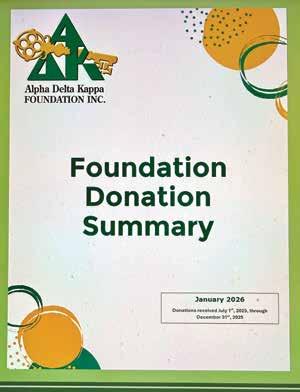
dation Donation Summary” that lists donors and those they are honoring. To read the document, go to the AΔK website to ‘Foundation’ and click on it. The document is located on the right side of the screen.
You might consider honoring a sister or group while attending your regional conference this summer. Foundation Board members will attend the conferences and are eager to interact with as many members as possible. The Foundation’s goal is to build a strong understanding among members of the Foundation’s role and the impact of their donations on AΔK’s five-star programs. You will find Foundation Board Members in several locations and engaged in a number of activities. Foundation Board Chair Mollie Acosta will speak about the Foundation’s mission and goals during a general session.
How might you honor a sister? You, your chapter or S/P/N may honor a sister with a $25 donation, or honor a special AΔK group with a $150 donation to the AΔK Foundation. To donate, simply go to the AΔK website to ‘Foundation’ and hover over it; the dropdown menu appears; tap on ‘Donate’ and 12 purple boxes appear. Find the box labeled “Honor a Group/Honor a Sister”, and follow the prompts. We also accept checks: AΔK Foundation, 1615 W. 92nd St., Kansas City, MO 64114-3210.
How does a sister or a group learn that they have been honored and who has honored them? Twice a year, the Foundation publishes an online document titled “Foun-
In the AΔK Foundation Learning Session, Foundation Board members will moderate a panel of sisters who have benefited from your donations, whether through a scholarship or grant, the Leadership Academy, disaster relief funds, the ITE Program, or the EiE Program. At the AΔK Foundation Information and Donation Table, Foundation Board members will be available to chat informally with sisters about the many donation programs, in addition to accepting donations for “Honor a Group/Honor a Sister”, donations may be made for the other Foundation programs. Donations may be made using checks, cash or credit cards. Receipts will be provided. All donations are tax-deductible.
The Foundation Board extends a warm thank-you for your unwavering generosity to the Foundation over the years. The Foundation Board experienced the incredible generosity of members at the International Convention in Austin, when over $50,000 was raised for the Foundation. The Board is hoping to sustain that momentum as sisters come together at the regional conferences.
An Order of Precedence is a ranked hierarchy that determines order. In the Order of Precedence for bylaws, nothing lower may disagree with the guiding documents above it.
The Constitution of Alpha Delta Kappa is the organization’s primary governing document and may be amended only by the International Executive Board. The International Bylaws may only be amended by delegates to the International Convention. State, provincial and national and bylaws may only be amended by delegates to state, nation and province conventions. The Policies and Procedures of these groups may be amended by their Executive Boards. Chapter Bylaws are amended by chapter members.
By Pat Valle, ABC Committee Chair, WA Alpha Delta CIPP

States, provinces, nations and chapters may have bylaws that address the specific needs of the organization as long as these bylaws are not in conflict with the Order of Precedence.
By International President-Elect Mary Ey.
The future is bright for Alpha Delta Kappa. Our new Strategic Plan charts a bold, thoughtful path forward, strengthening our commitment to educational excellence, leadership development and meaningful sisterhood. Together, we are building on our legacy while embracing innovative opportunities to grow, serve and lead.
After careful study and member input, the IEB Strategic Plan Workgroup presented a three-year plan that focuses on developing programs, opportunities and activities in three goal areas: leadership development, member engagement and member-focused initiatives. The International Executive Board approved the 2026-2029 Alpha Delta Kappa Strategic Plan on February 4, 2026. It will be effective June 1, 2026, through May 31, 2029. The plan was introduced to the membership at a Toolbox Zoom session on March 16, 2026.
Serving on the plan workgroup were IEB members Katy Matthews, Terry Peyton, Su Wade and Mary Ey.
The plan is in the Resource Library on the International website.
lthough under a new name, the Access, Belonging and Community Committee (ABC) is in its sixth year and continues to offer professional development opportunities to the sisters of Alpha Delta Kappa. In the past, the committee has sponsored professional development book discussions that focused on titles such as “White Fragility,” “Just Mercy” and “Stamped: Racism, Antiracism and You.” This biennium, the committee will host a series of professional development discussions centered around children’s books. Six books were chosen by members of the committee. The first book discussion was held in May. Some of the books chosen were “A Kids Book About Incarceration” by Ethan Thrower; “Lena and the Dragon: A Book on Childhood Trauma and Resiliency” by Bethany Walker; and “Roll With It - Cerebral Palsy” by Jamie Sumner. “Our goal is to broaden perspectives and understanding among our communities and schools as well as to engage in conversations with each other,” said ABC Chair Pat Valle. Future discussion dates, times and books will be posted on CONNECT.
To further deepen a sense of belonging in A∆K, committee members are presenting at each of the three regional conferences this summer. Presentations will focus on survival skills in controversial times and will feature self-care ideas, active participation and creating a calm environment. These presentations are in keeping with past regional discussions about microaggressions and ways to hold critical conversations about difficult topics.
The committee will try something new in the fall. “Digital Dialogues” will be open-ended conversations driven by the interests of the participants. The proposed dialogues will be held at least three times in the final year of the biennium. As with other activities of the ABC Committee, the purpose is to create an opportunity for sisters to share their perspectives, broaden their understanding of each other and deepen a sense of belonging in Alpha Delta Kappa.
The ABC Committee will issue a Jotform to ask for input from A∆K members in the near future. The form will be available online and can be completed in only a few minutes. The committee looks forward to hearing from members as they plan for the future work of the committee.


We are a sisterhood of educators united by shared altruism, fellowship and professional leadership , working together to elevate education, support communities and inspire lasting change. Up to 20 years before our official charter, our organization emerged to meet a vital need: connecting professional educators to grow personally and professionally ,a mission that shaped our future and remains just as relevant today. After careful study and research, International Executive Board members reached the decision to invest in developing programs, opportunities and activities in leadership, member engagement and member-focused initiatives that will elevate the organization as we look forward to the future.
VISION A world that values all people and quality education
e are a sisterhood of educators united by shared altruism, fellowship and professional leadership, working together to elevate education, support communities and inspire lasting change. Up to 20 years before our official charter, our organization emerged to meet a vital need: connecting professional educators to grow personally and professionally,
MISSION Empower women educators to advance educational excellence, altruism, and world understanding
● to honor outstanding women educators
a mission that shaped our future and remains just as relevant today. After careful study and research, International Executive Board members reached the decision to invest in developing programs, opportunities and activities in leadership, member engagement and member-focused initiatives that will elevate the organization as we look forward to the future.
We are a sisterhood of educators united by shared altruism, fellowship and professional leadership , working together to elevate education, support communities and inspire lasting change. Up to 20 years before our official charter, our organization emerged to meet a vital need: connecting professional educators to grow personally and professionally ,a mission that shaped our future and remains just as relevant today. After careful study and research, International Executive Board members reached the decision to invest in developing programs, opportunities and activities in leadership, member engagement and member-focused initiatives that will elevate the organization as we look forward to the future.
VISION A world that values all people and quality education
MISSION Empower women educators to advance educational excellence, altruism, and world understanding
PURPOSES
PURPOSES
● to strengthen the education profession through commitment to practices that respect and value each person for their unique qualities
● to nurture relationships and networking opportunities
● to honor outstanding women educators
● to enrich personal and professional development
● to strengthen the education profession through commitment to practices that respect and value each person for their unique qualities
● to support altruistic projects, grants and scholarships with time and resources
● to embrace cultural differences and make an impact through world understanding
● to nurture relationships and networking opportunities
● to enrich personal and professional development
● to support altruistic projects, grants and scholarships with time and resources
● to embrace cultural differences and make an impact through world understanding
To be an International force that connects and empowers educators, especially women, to lead, serve, and elevate quality education, fostering professional growth, altruism, and cross-cultural understanding.
To be an International force that connects and empowers educators, especially women, to lead, serve, and elevate quality education, fostering professional growth, altruism, and cross-cultural understanding.
To be an International force that connects and empowers educators, especially women, to lead, serve, and elevate quality education, fostering professional growth, altruism, and cross-cultural understanding.
GOAL
GOAL
GOAL
Strengthen the organization’s leadership capacity at all levels
GOAL 1: LEADERSHIP DEVELOPMENT
Strengthen the organization’s leadership capacity at all levels
OBJECTIVE(S)
STRATEGIES
1.1 Create and deliver a menu of leadership modules for members
Key Performance Indicators
⚫ Build and launch microlearning modules on leadership skills
⚫ Offer digital micro-credentials or badges (assists with monitoring)
75% of members participate in a leadership role at the chapter, S/P/N, regional or International level
OBJECTIVE(S) STRATEGIES Key Performance Indicators
1.1 Create and deliver a menu of leadership modules for members
1.2 Create an AΔK Think Tank for women educators to share research, policy insights and best practices.
1.2 Create an AΔK Think Tank for women educators to share research, policy insights and best practices.
1.3 Increase leader relationships through networking
1.3 Increase leader relationships through networking
⚫ Build and launch microlearning modules on leadership skills
⚫ Offer digital micro-credentials or badges (assists with monitoring)
⚫ Speaker Series – Invite educators, authors, or community leaders to present at chapter meetings or conferences.
⚫ Partner with education-focused universities and leadership programs.
⚫ Speaker Series – Invite educators, authors, or community leaders to present at chapter meetings or conferences.
⚫ Increase opportunities for leaders to share knowledge and expertise across S/P/Ns and Regions
⚫ Partner with education-focused universities and leadership programs.
⚫ Increase opportunities for leaders to share knowledge and expertise across S/P/Ns and Regions
5% of members participate in ΑΔΚ Think Tank in any capacity
75% of members participate in a leadership role at the chapter, S/P/N, regional or International level
5% of members participate in ΑΔΚ Think Tank in any capacity
75% of leaders participate in at least one knowledge exchange annually beyond the chapter level
75% of leaders participate in at least one knowledge exchange annually beyond
Strengthen the organization’s leadership capacity at all levels
Maximize communication, commitment and collaboration to enhance member sustainability
Enhance the value of membership by prioritizing the needs, experiences and accomplishments of members
2.1 Implement a communication network across all levels of the organization and staff
1.1 Create and deliver a menu of leadership modules for members
1.2 Create an AΔK Think Tank for women educators to share research, policy insights and best practices.
2.2 Spotlight members and chapters as impact innovators in the organization or in local communities
1.3 Increase leader relationships through networking
2.3 Increase opportunities for collaboration among chapters, S/P/Ns and regions within the community
3.1 Include activities that address all generations of members of the organization
3.2 Share membership opportunities
⚫ Establish networking/ discussion groups on CONNECT with like interests or experience
⚫ Build and launch microlearning modules on leadership skills
⚫ Offer digital micro-credentials or badges (assists with monitoring)
⚫ Invest and implement in a CRM (Customer Relationship Management) & member portal dashboard so members see value (events, networking, recognition badges).
⚫ Speaker Series – Invite educators, authors, or community leaders to present at chapter meetings or conferences.
Establish a baseline with data from conventions, conferences, social media, CONNECT, etc
10% of members participate in CONNECT networking discussion groups
75% of members participate in a leadership role at the chapter, S/P/N, regional or International level
75% improvement over the baseline at the end of the three-year strategic plan
5% of members participate in ΑΔΚ Think Tank in any capacity
⚫ Create an “Impact Innovator” initiative to nominate members for their professional and personal accomplishments in publications and social media
⚫ Partner with education-focused universities and leadership programs.
⚫ Increase opportunities for leaders to share knowledge and expertise across S/P/Ns and Regions
⚫ Create and implement joint project-based membership activities among chapters, S/P/Ns and regions
⚫ Connect community service projects across chapters, S/P/Ns and regions
Minimum target of 200 nominations submitted for each “Impact Innovator” recognition
75% of leaders participate in at least one knowledge exchange annually beyond the chapter level
Minimum target of 100 chapters, S/P/Ns and regions participate in the project-based activities
Minimum target of 100 chapters, S/P/Ns and regions participate in the joint community service projects
⚫ Create and deliver a menu of learning sessions and networking activities that meet the needs and interests of active educators and retired members
75% approval rating by members attending learning sessions and networking activities
⚫ Conduct collegiate club fairs to transition graduates to full AΔK membership
⚫ Charter new chapters (i.e., “Ignite Membership Campaign”)
⚫ Charter new collegiate clubs
50% of collegiate club members initiated as active within a year of employment in educational field
10 new chapters are chartered over the 3 years
5 new collegiate clubs are chartered over the 3 years
Addendum to Strategic Plan 2026-2029 is available on the International website. The addendum contains the data analysis and recommendations from the IEB Strategic Plan workgroup.
Addendum to Strategic Plan 2026-2029 is available on the International website. The addendum contains the data analysis and recommendations from the IEB Strategic Plan workgroup.
By Barb Eason, ITE Board Chair
The Alpha Delta Kappa members who volunteer as sponsors for International Teacher Education Scholars play a vital role at the heart of the ITE Program. These remarkable women, living near the universities where the scholars study, provide essential support and genuine care, often welcoming scholars into their own homes.
Sponsors meet the scholars upon their arrival in the United States, greeting them at the airport and assisting them as they settle into their new apartments. They also facilitate connections with other Alpha Delta Kappa members within their chapters, districts and states, thereby expanding the scholars’ networks and circles of support.
Over time, these interactions often develop into strong, loving bonds, enriching both the scholars’ and sponsors’ experiences and fostering lasting relationships.
Two ITE Scholars, Meri Kadagidze, University of Washington, and Shehneela Naz, University of Illinois, graduated in May. They participated in two webinars and a panel discussion at the 2025 International Convention in Austin, TX.
She has also been accepted into a PhD program, so she will return to Bangladesh in June to reapply for a student visa. She has enjoyed traveling throughout the U.S. over the past two years.
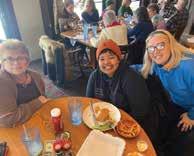
Nondumiso Thango (South Africa), Syracuse University, is shown having lunch with her sponsors, Amy Healy and Laura Weaver, who are both from NY Alpha Beta. Nondumiso will graduate in June, finishing her studies in just one year.
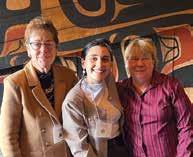
Meri Kadagidze (Country of Georgia) University of Washington, with her sponsors Sue Downing and Kathy Fleming, both from WA Beta Iota, at a Founders’ Day celebration. Meri has enriched many lives, especially those of her sponsors and the close-knit group of Washington A∆K members.
Shehneela Naz (Bangladesh) UI, with her sponsor Valerie Johnson (NCR PresidentElect) at the 2025 International Convention in Austin, TX. Val Johnson said, “Shehneela has achieved several goals during this school year. In addition to her own courses, she became a Teaching Assistant.
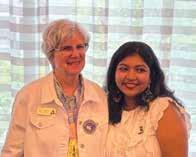
Sangsupa (New) Penrach (Thailand) University of Washington, is at a Founders’ Day with her sponsors, Anna Nuno and Eileen Berlin, both from WA Alpha Delta. Eileen said, “She’s very busy with school and works a part-time job. She was the guest speaker at our March chapter meeting and spoke about what she hopes to achieve in Thailand regarding equalizing education opportunities for migrant children.”
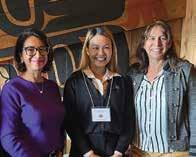

Emma Alfaro-Martinez (El Salvador) University of Pennsylvania, celebrated her birthday with her sponsors, Alessandra Villella and Laura Schmerfeld from NY Gamma. Alessandra said, “It has been a pleasure getting to know Emma. She works hard, studies harder and still finds time to marvel at where she is and where she’s going. Equal parts determination and delight, Emma is tenaciously building a future!”

Thembisile Buthelezi (South Africa) UD, is lucky enough to have three wonderful Delaware A∆K sisters as her sponsors. They are Linda Bledsoe, Lorraine Lacsny and Sally Fraticelli from DE Zeta, Gamma and Eta. Linda said, “My life has been so enriched by meeting and spending time with our lovely Thembi. I know Sally and Lorraine feel the same way.”
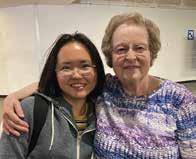
Hengly Te (Cambodia) University of Nebraska, has enjoyed shopping for groceries and clothing with her sponsors. Linda Brown, NE Theta, said, “This is the kind of person that Hengly
Dis: disciplined, conscientious, and dedicated to her studies. She will be an asset to future education in Cambodia.”
April Bridwell, sponsor and Nebraska State President, said, “Hengly Te, an ITE scholar from Cambodia studying at the University of Nebraska, is a truly wonderful presence in our community. She is outgoing and always willing to take part in our Alpha Delta Kappa chapter activities, bringing positivity and enthusiasm wherever she goes. Hengly is kind, dedicated and deeply appreciative of the opportunities she has been given. Her commitment is evident in her daily effort; she even rides her bike to campus for classes in cold weather without complaint. Above all, she has a strong desire to do well and continuously improve, which makes her both admirable and inspiring.”
onations to the International altruistic projects make a difference in many ways. Foundation Board Chair Mollie Acosta shares a few.
A combination of physical activity, improved nutrition, cognitive and social challenges, and health monitoring can improve cognition, according to U.S. Pointer, a clinical trial funded by the Alzheimer’s Association. The first such study, involving a large group of U.S. residents, evaluated whether lifestyle interventions protect cognitive function in older adults at increased risk of cognitive decline. The study found that more than 2,000 participants showed cognitive improvement regardless of sex, ethnicity, genetic risk or heart health status. The trial underscores the message that healthy behavior has a powerful impact on brain health.
St. Jude @ School programs offer educators, students and families a meaningful way to connect learning with compassion, engaging classrooms nationwide in activities that support the lifesaving mission of St. Jude Children’s Research Hospital, according to Beth Perkins, principal advisor, partnership and stewardship, ALSAC. The fundraisers combine learning, character development and philanthropy in age-appropriate activities. Among the favorite activities is the St. Jude Trike-A-Thon, a safety-focused
event for young children that teaches the importance of helping others while they pedal for a purpose. Many middle school students participate in Math-A-Thon, a longstanding program that uses engaging math challenges to build critical skills while empowering students to raise funds that support St. Jude’s groundbreaking research and patient care. For older students, the EPIC Challenge encourages creativity, collaboration and problem-solving as participants design innovative fundraising ideas that make a real impact. At the high-school level, the St. Jude Leadership Society (SJLS) offers a transformative experience for emerging leaders who want to expand their service mindset and strengthen their personal growth. Through hands-on learning, mentorship, leadership development and philanthropic engagement, SJLS members gain valuable skills while championing St. Jude’s mission in their schools and communities. By participating in St. Jude @ School programs, Perkins said, students not only deepen their academic and leadership abilities but also learn the powerful lesson that even at a young age, they can make a meaningful difference in the lives of others. For information, please contact Sarah Bucciero, sarah. bucciero@alsac.stjude.org for Trike, Math and EPIC. For St. Jude Leadership Society, please contact Brittni Blankenship at Brittni.blankenship@alsac.stjude.org or see https://www.stjude.org/get-involved/school-fundraisingideas.html?sc_icid=get-involved-lz-schoo
By Roberta Casabon – 4-Year IEB Member
Are you able to walk past an unfinished jigsaw puzzle? Some do not succumb to the challenge to test their problem-solving skills, but others can’t resist the attraction. You might wander over for a quick look at the current progress. That’s when it can happen. Suddenly, you spot where one or more pieces fit together. On rare occasions, you might even find a piece that is in the wrong place. As you continue on your way, you experience a brief sense of accomplishment. All from two pieces of cardboard that fit together and become a small part of the whole.
The International Executive Board (IEB) is continuing the work that started last biennium. It is their equivalent of a jigsaw puzzle. The focus of this work is to concentrate on leadership and provide greater autonomy to chapters and their members.
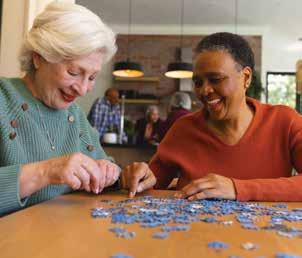
Let’s take a look at the timeline. During the 2023 International Convention, the delegation made it clear that they wanted IEB to change voting practices for future International conventions. As a result of the directive, IEB held open Listening Sessions that provided opportunities for members to share their thoughts and concerns. The recommendations were analyzed and a final report was submitted to IEB and printed in the KAPPAN. As a result of the information gathered from these member-focused listening sessions, the bylaws were amended and approved by the delegates during the 2025 International Convention.
The changes triggered revisions to our Constitution and the Bylaws of Alpha Delta Kappa. Before the work began, the IEB sought the advice of legal counsel. Consequently, duplicated information and policy statements were removed, and some items/sections were reassigned from the Constitution to our Bylaws. These shifts concentrated and strengthened leadership responsibilities.
In addition, last biennium’s IEB sought to embrace lead- ership opportunities in Alpha Delta Kappa and bring a new voice to the board table. After discussion, and by unanimous vote, a new Board-elected 2-year Memberat-Large position was created. Sisters who have been members for under 10 years (Pearl Sisters) are eligible to apply for the role. A fresh voice at the table brings a new perspective and energy to the discussions. The role pro-
vides a fresh and new avenue for leadership development. The one constant, overriding voice during the revision of our documents was that of our membership asking for greater autonomy. During the listening sessions, the committee was told repeatedly that chapters wanted greater flexibility to allow their leaders to respond to the needs and circumstances unique to their chapter. To this end, document-wide changes were made to our Bylaws. Numerous ‘shall’ statements were changed to ‘may’ or ‘should’ statements. This may seem minor to some, but it moved the statement from a mandatory action to one that gives discretion to the chapter. The statements are now member-focused.
The timing of these changes was serendipitous. Our Strategic Plan was due for a revision. A newly formatted and member-focused strategic plan was developed. The new Strategic Plan was introduced during a Toolbox session on March 16, 2026.
The traditional presentation of the Strategic Conversation that was always part of S/P/N conventions has also undergone an overhaul. The new format respects S/P/N leaders’ convention workload and limited time. ‘Evolving through Curiosity’ offered a fresh approach, limited to an on-site 20-minute presentation, designed to encourage and support leadership. Chapter leaders were asked to share a video featuring reflections from a cross-section of our membership before their convention. A subsequent video was shared during the conventions. Both videos are posted on CONNECT in the All Member Community, making them available to all members to view at their leisure. This focus on chapters provides an opportunity for members to discuss what they viewed and consider appropriate approaches for implementation in their chapter.
The puzzle pieces fit. IEB asked for input. Member voices and concerns were heard and became actionable initiatives. Changes were enacted that empowered and supported leadership throughout all levels of Alpha Delta Kappa. Your voice matters. You encourage the leadership of Alpha Delta Kappa to embrace change. You make “Evolving Together” vibrant.
Continue adding your voice to a process that enables change.
By Daniel LaBorde, A∆K Headquarters Communications and Publications Manager
We live in a time when so much of our communication happens through email and online platforms. While this allows us to stay connected more easily than ever before, it also means we must be a little more mindful.
Across the country, organizations of all kinds are seeing an increase in suspicious emails. Often, these messages appear to come from someone we know and trust. They may include a shared document, a Google Drive link or a request to open a file. That is what makes them confusing.
The email may look completely normal. The sender’s name may be familiar. There may be nothing obviously “wrong” at first glance. But sometimes, even trusted accounts can be temporarily compromised. When that happens, messages can be sent without the person realizing it. This does not mean anyone has done anything wrong. It simply means that, in today’s digital world, we all need to pause before clicking.
of mind.
If you believe you may have clicked on something suspicious, do not panic. Take these simple steps:
• Close the email or browser window.
• Change your email password as soon as possible.
• Ask a trusted family member or friend to help you review your account settings if needed.
Staying safe online does not require advanced technical knowledge. It requires awareness, patience and the willingness to double-check.
Here are a few simple habits that can help protect you:
First, if you receive an unexpected email with a document or link, ask yourself: Was I expecting this? If the answer is no, it is perfectly fine not to click.
Second, look closely at the sender’s full email address, not just the name displayed. Sometimes the address may look slightly unusual or unfamiliar.
Third, never enter your password after clicking a link unless you are absolutely certain you are on a legitimate website. If something feels confusing or rushed, that is your signal to stop.
It is always okay to slow down.
If you are unsure about a message, reach out directly to Headquarters or to the person who supposedly sent it. A quick phone call or separate email can provide peace
• Enable two-factor authentication (often called 2FA), which adds an extra layer of security when signing in.
These small actions can make a significant difference.
It is important to remember that online scams are designed to look convincing. They rely on trust, urgency and familiarity. They do not target people because they are careless. They succeed because they are sophisticated.
Our members are caring, generous and communityfocused. Those are strengths. We simply need to pair those strengths with awareness in the digital space.
As an organization, we remain committed to protecting our systems and our members. But security is a shared responsibility. A brief pause before clicking a link can protect not only you, but our entire Alpha Delta Kappa community.
If you ever have questions about an email or online message, please contact Headquarters. We would much rather answer a quick question than have you feel uncertain or worried.
Staying safe online does not require advanced technical knowledge. It requires awareness, patience and the willingness to double-check.
Together, we can continue to connect, collaborate and communicate confidently while keeping ourselves and one another secure.
By Judy Barnhill, TN Beta Zeta and KAPPAN Correspondent
As the daughter and granddaughter of a long line of Southern women, I must say that pearls have always been the staple gem in my jewelry collection. Even the one tiny pearl on a bracelet that adorned my arm at my christening ceremony as an infant was evidence of the allure of pearls in my life. Now, what does that have to do with Alpha Delta Kappa pearls, you may ask? You guessed it. The questions of why pearls were chosen as our gem, when they were chosen and their significance piqued my curiosity, so I immediately began a search for answers.
You are all probably aware that an Alpha Delta Kappa sister never says “no” to a request for help from another sister, so I carefully composed a short survey and sent it to some sisters across our entire organization. These were sisters that I had met at various conferences and conventions, and I was fairly certain that they would agree to be brutally honest in their answers, especially if I promised complete anonymity. With that in mind, I sent the email and hoped for some answers.
The survey consisted of four questions, one or two with a part two: Is earning a pearl or the pearl program important to the members of your chapter? Do you or your chapter members feel that the criteria for earning pearls are worthy? What could be better reasons for earning a pearl? What incentive do you or your chapter think would make earning pearls more important to our members? Do you have any idea why pearls were chosen as our gemstone, and why the goal is seven pearls?
Shortly after that first email, the answers and some questions started to fill my inbox. The answers were fascinating and forthright. The “why” question was especially enlightening. No one seemed to have a concrete answer. That was a lesson in the importance of archives. The general assumption was that pearls were chosen because they symbolize wisdom, grace, resilience, femininity, refined elegance and growth in the face of adversity. Remember that the formation of the precious pearl is because a grain of sand has slipped into the oyster, causing great irritation. Another comment was that the pearl was probably Agnes’s favorite gem. I would certainly like to think that, if that was the case and Agnes knew of the symbolic qualities of pearls, then she obviously expected sisters and chapters to embrace those qualities.
I had to laugh when I saw the diversity of answers to the question regarding the importance of earning a pearl
both personally and as a chapter. Some answers were brutally honest in saying that the chapter really couldn’t care less about the Pearl program. Others were adamant that they were so honored for their chapter to earn pearls, but lamented the fact that they had difficulty earning seven pearls because of not being able to initiate a new member…the growth in adversity factor. Then, the same chapters revealed that they were actually excited when they earned that seventh pearl. You know how teachers love a little gift of recognition, and the certificate for seven pearls becomes a lovely addition to their chapter’s archives. Some chapters said they would continue doing the things that earned pearls even when they could complete only three or four of the requirements.
Most respondents agreed that the criteria were reasonable as they are. However, several mentioned that adding attendance to a state convention or a conference might give chapters a better opportunity to earn that pearl. They also agreed that it would certainly require more bookkeeping at the International level. As for better incentives to earn pearls, one suggestion was to have a state or district officer present the certificate at a chapter meeting because all the members would be present for the presentation, not just those who were able to attend S/P/N, regional or International events. Another suggestion was that chapters make a special effort during fraternity education training to emphasize the importance of meeting the expectations for earning seven pearls. Some comments indicated that members really know very little about any part of the Pearl program.
One or two answers as to why the goal is seven pearls was probably the most entertaining of the answers. A member suggested that seven pearls were selected because seven were needed to fit the badge mold. Another thought was that it might have to do with the seven regions. I considered that, but further research reminded me that Agnes started with five regions, not seven. The bottom line is that no one really knows.

A transcript of a very old recording made by Pauline Graham, MI Sigma, was fascinating. The transcript was shared with me by Debby Stubing, FL Epsilon. Pauline was an International Executive Board Member. She traveled with Agnes during the early years of Alpha Delta Kappa, and her husband always took her to International Executive Board meetings. Pauline noted some interesting facts
about our badges in the recording. Many of her reflections were based on what she had learned from the first convention, held in Chicago in 1955. She was very specific in stating that the decision was made that there would be one diamond-encrusted badge that would be called a Founder’s Badge and it would be for Agnes Shipman Robertson. Emerald-studded badges would be awarded to Past Grand Presidents. Badges with pearls would be awarded to other members. The diamond badge is currently housed in the archive room at International Headquarters in Kansas City, Missouri.
While these quotes from Pauline’s audio recording do not specifically address the “pearl” question, it is important
for all members to read these words from Pauline Graham: “The seeds of sisterhood first sown by Agnes, Marie, Hattie and Marion in 1947 have grown into a towering tree, with branches stretching throughout the United States and crossing international borders.”
All of my research has not given me all the answers, but sharing thoughts about pearls is a definite step toward helping all members evaluate their personal thoughts on the questions asked. And while you are thinking about the questions and what may be an answer, remember that every lady should wear a string of pearls from time to time. Pearls are a sign of resilience, wisdom, dignity and grace, and they never go out of style.
“I hope you will consider the Pearls a progress report and not a competition. Each pearl a chapter earns reflects the dedication of its members to achieve goals that strengthen our organization.” ~ International President Conway Blankenship
By Pam Collins, A∆K Headquarters Director
Success doesn’t happen by accident. It’s built through strong membership, active participation and consistent communication. The Pearls of Achievement Award is designed to recognize and highlight chapters in the areas most vital to Alpha Delta Kappa’s growth and sustainability. By focusing on membership, participation and reporting, the award celebrates the chapters that keep the organization vibrant and forward-moving.
At its core, A∆K is a membership organization. Thriving chapters are those that actively maintain their current members while welcoming new members. Pearls are awarded to chapters that maintain active membership, initiate new members and reinstate members. Every recruitment effort and every retained member strengthens not only the chapter but also the entire organization.

Chapters grow stronger when members attend conferences and conventions. Attendance at regional conferences and International conventions creates opportunities for connections, leadership development and collaboration across S/P/N’s, regions and International networks. Participation expands perspectives and builds relationships that extend beyond a single event. Chapters also receive Pearls through the timely sub-
mission of chapter ITE payments, another key mark of active engagement and accountability.
Behind every organization is accurate, timely data. Pearls are given for submitting required information online to Headquarters before the submission deadline. These reports provide valuable insight into chapter achievements, challenges and needs, allowing leadership to offer informed support and strategic guidance. Key reports are the Annual Chapter Highlights Summary, the Chapter Needs Assessment and the Altruistic Report. The official reporting period runs from June 1 to May 31. Each report has its own submission deadline. The officers responsible for submitting the reports and the due dates are listed on the International website.
The Pearls of Achievement Award shines a light on what sustains A∆K. Membership is the foundation. Participation fuels growth and connection. Reporting empowers strategic support and future planning.
The program is more than recognition. It is a roadmap for chapter excellence. Each pearl earned reflects dedication, accountability and a commitment to strengthening both the chapter and the organization as a whole. When chapters focus on these essential areas, they don’t just earn Pearls; they shine.
By Laurie Allan, Immediate Past President VA Alpha Epsilon
Leaving home to teach thousands of miles away requires courage, faith and determination. For Susan Aduda and Dorcas Anyieni, that journey meant leaving Kenya to begin new teaching careers in the United States, an opportunity that promised professional growth but also brought unfamiliar challenges.
Their move was about more than geography. It meant adjusting to a new culture, navigating a different school system and building a life in an unfamiliar place. Like many international educators, Susan and Dorcas arrived with strong academic preparation and a deep commitment to teaching. Yet, settling into a new country brought challenges both inside and outside the classroom.
What they soon discovered, however, was the power of Alpha Delta Kappa sisterhood.
Members of VA Alpha Epsilon quickly embraced Susan and Dorcas with warmth, generosity and practical support. From the moment the teachers arrived, chapter sisters worked together to help them feel welcomed and prepared for their new roles.
Members assisted with setting up classrooms and gathering essential instructional supplies. They drove the teachers to pick up their first paychecks and helped them navigate unfamiliar processes such as opening bank accounts and obtaining Social Security numbers.
Support extended well beyond the school day. Chapter members helped secure housing, set up utilities, and reached out to the community to gather donations of furniture and household necessities. Sisters personally picked up donated items and helped move them into teachers’ homes, transforming empty spaces into comfortable, welcoming living environments.
Through these thoughtful acts of service, Alpha Epsilon demonstrated the true spirit of Alpha Delta Kappa, supporting educators not only as professionals but also as individuals beginning a new chapter in life.
Teaching in the United States also required Susan and Dorcas to adapt to differences in classroom management and school culture. Student discipline and behavior expectations differed significantly from what they had experienced in Kenya. At times, they felt overwhelmed by challenging behaviors and wished for greater support from administrators and parents when addressing disci-
pline concerns.
Academically, they noticed that while the curriculum covered many of the same subjects they had taught in Kenya, the pace of instruction often felt faster. Students were frequently expected to move quickly from one concept to the next before fully mastering foundational skills.
They were also surprised by the frequency of student assessments. The strong emphasis on standardized testing and regular benchmarking stood in contrast to their previous experiences, where teachers typically had more time to focus on skill development before formal evaluations.
Despite these adjustments, Susan and Dorcas also discovered exciting opportunities in American classrooms. The availability of advanced technology, including digital learning tools, online resources and instructional platforms, opened new possibilities for lesson planning and student engagement. What initially felt unfamiliar soon became a valuable part of their teaching practice.
Living in the United States also introduced the teachers to new cultural traditions. Both women found Thanksgiving particularly meaningful. They appreciated seeing families gather around a table to share a meal, express gratitude and spend intentional time together. The sense of family and community reminded them of values similar
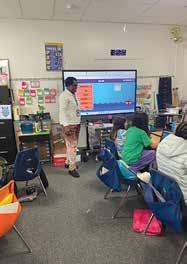
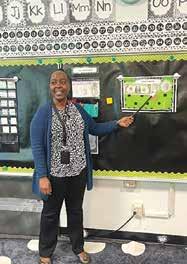
Above left, Susan Aduda teaches social studies to her fourth-grade class.
Above right, Dorcas Anyieni teaches math to her secondgrade class.
to those celebrated in their own culture.
At the same time, they were surprised by the commercialization of Christmas. In Kenya, the holiday season often centers on church services and faith-based celebrations. In the United States, the season is frequently associated with gift-giving and retail activity.
Another memorable first was experiencing snow and extremely cold temperatures. Coming from Kenya’s warm climate, they had never seen snow before. Adjusting to freezing weather required heavy coats, gloves and layers unfamiliar to them. Despite the cold, they embraced the experience with curiosity and good humor.
The experience of Susan and Dorcas reminds us that international educators bring valuable perspectives and dedication to our schools. Their journeys also highlight the difference that caring professional organizations can make.
Through compassion, service and genuine sisterhood, Alpha Epsilon helped ensure that two educators from across the world felt welcomed, supported and encouraged in their new community.
Their story is a beautiful reminder that the bonds of Alpha Delta Kappa truly extend beyond borders.
By Heidi Schramm, World Understanding Chair, MD Sigma,
When I first started teaching 30-odd years ago, I was introduced to students who were tough to teach. By Christmas, I was through crying and took myself on an international trip. As I was sitting on an eight-hour flight, I had an aha! moment. It occurred to me that I could use the places to which I was traveling to develop my lessons. I was lucky to be teaching where I was, because there was no curriculum for the students. I had to develop my own curriculum. Since I had the students for two consecutive years, I decided to rotate topics from world history, geography and U.S. history. I used the duration of the flight to map out the types of lessons I thought the students would enjoy, established units and considered what I learned on my trip could be used in the units. Italy led to Julius Caesar and ancient Rome. The created unit included a short story, “I am the Colosseum,” where the students would close their eyes and put their heads on their desks. At the end, they did a journal entry about how it felt to be in Rome. That unit became my most popular of all time.
I called my program Lessons on Location because they were developed on site. I took photos, spoke with the locals and asked to use their archives. I asked what Italian children enjoy on their field trips
to the same sites. From this information, I wrote a lesson with activities. These activities included artifacts from the places. I created mini ”museum” trunks for these units. Inside the trunks were a teen magazine, coins, stamps, the diary pages I kept from the trip, a menu, copies of my photos in an album, brochures from places I visited and a map of the country. I created a learning center chart, so students had equal time to explore the trunk.
I began to travel every possible school holiday, targeting the areas I wanted to create lessons about. The academic-based activities were meant to inspire students disenchanted with school and to help them see themselves as successful with classroom work. Students took photos of themselves working with other students and their work. These photos showed how the students were connecting to the lessons and how they began to personalize the lessons. Their grades quickly rose, and they came to school regularly. I had parents who helped with the expense of the Polaroid camera and film. My 3-year grant from MetLife helped me to document the success of my students, which led to an invitation to present my work to invited members of Congress at a Teacher Researcher conference.
My teaching career has been blessed with so much fun in the classroom. I continue to move Lessons on Location forward and want to offer my A∆K sisters a lesson and reflective activities at our 2027 International Conference in Spokane, Washington.





Paula Henry, A∆K Events and Membership experience manager, suggests what to see, eat and wear when the regions meet this summer.
The Park MGM, part of the MGM Resorts family, is considered a stylish, modern boutique hotel with a perfect blend of comfort and character.
Las Vegas is a full-blown entertainment capital bursting with world-class shows, vibrant art, incred ible food and unforgettable experiences at every turn.
Las Vegas hosts some of the biggest names in entertainment. While you’re in town, you can catch live performances by Kenny Chesney, Alicia Keys and the legendary Wayne Newton. You’ll find several Cirque du Soleil shows, the always-energetic Blue Man Group, mesmerizing magic from David Copperfield, plus comedians, dancers and specialty acts every night of the week.
Food in Las Vegas is an experience all its own. You’ll find every cuisine, every style and every budget represented, and the hotel you’re staying at has plenty of options. Across the Strip, celebrity chefs are everywhere. There’s Bobby Flay’s Amalfi, Martha Stewart’s The Bedford, Gordon Ramsay’s Hell’s Kitchen and Wolfgang Puck’s Spago.

If you’re into museums, like I know you are, Las Vegas has some truly unique gems.
The Mob Museum is an interactive journey through the history of organized crime and law enforcement. The Neon Museum is home to iconic vintage Vegas signs, while REAL Bodies is a deep dive into the human body. Meow Wolf’s Omega Mart, an immersive artmeets-surrealism experience that’s hard to explain but worth seeing.
A.Y.C.E. Buffet, located at the Palms, was voted the best buffet in Las Vegas, offering an impressive spread of cuisine. It’s the perfect spot to plan your state dinners, lunches or even brunches, especially if you want a lot of variety without sacrificing quality.
Las Vegas has plenty of amazing experiences that don’t cost a cent. Take advantage of the incredible weather to explore: The iconic “Welcome to Fabulous Las Vegas” sign, free shows and street performers on Fremont Street, The Bellagio Conservatory and Botanical Gardens, featuring five gorgeous seasonal displays, The Shelby Heritage Center, perfect for car lovers and racing fans, The Hand of Faith at the Golden Nugget—the largest gold nugget in existence orThe Flamingo Wildlife Habitat, a peaceful oasis with birds, waterfalls and lush landscaping.
With 320 days of sunshine a year, Las Vegas is practically built for outdoor fun. The weather here is as close to perfect as it gets. Daytime attire for sightseeing is easy: T-shirts, shorts and comfortable shoes. For hitting the evening shows and fine dining, pack more formal wear.


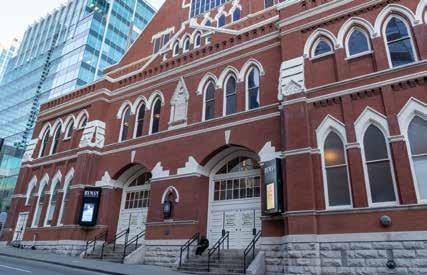
Gaylord Opryland, the convention hotel, is famous for its indoor gardens, cascading waterfalls, walking paths and charming shops. You can explore for hours without ever stepping outside. Everything you need is right under one roof.
Exploring Nashville
Nashville is just a short drive away, giving you access to its music, culture, food and Southern charm. Some of the top things to do: experience live music on Broadway (“Honky Tonk Highway”), tour the Ryman Auditorium –(known as the “Mother Church of Country Music”), visit the full-scale Parthenon replica in Central Park, shop at the Nashville Farmers’ Market or discover indie music at local venues.
What to Wear when visiting Nashville and Opryland in July
Summer in Nashville can be hot and humid, so plan for comfort. Think casual and breathable clothing like cotton or linen tops, skirts and pants. Don’t forget walking shoes, sunglasses, sunscreen, a hat and a rain jacket for sudden July Dhowers.

What to Eat: Nashville is a Foodie Paradise
Whether you are a foodie or just like to eat, you get a bite of Nashville at Prince’s Hot Chicken Shack, the legendary original spot with generations of tradition and real heat. Hattie B’s Hot Chicken is famous for its hot chicken with spice levels from mild to “bring it on!” For BBQ, there’s Marti’s Bar-BQue Joint, Peg Leg Poker and Edley’s Bar-B-Que. Arnold’s Country Kitchen and Swett’s feature meatand-three-meals menus.
Staying at the JW Marriott New Orleans places you right in the heart of one of the most vibrant, soulful and culturally rich cities in the country. Located on historic Canal Street, the JW Marriott New Orleans offers a peaceful, polished haven amid the city’s excitement. Inside, you’ll find elegant décor, quiet corners to unwind and the kind of attentive service that makes you instantly feel taken care of.
Step outside and you’re just moments from the culture, flavor and rhythm that make New Orleans unforgettable. Canal Street, the French Quarter and the riverfront are all within walking distance. Top things to do: wander the French Quarter, enjoy live jazz on Frenchmen Street, visit Jackson Square and St. Louis Cathedral, explore the Garden District, take a steambook cruise and shop at the open-air French Market.

New Orleans summers are warm, humid and lively, so dress to stay cool and comfortable. Pack casual clothes, walking shoes and a rain jacket for changing weather. Don’t forget a hat.
NOLA is world-famous for its food, and the flavors are truly unforgettable. Classic New Orleans must-try spots are Café du Monde for beignets and chicory coffee, Brennan’s for iconic brunch, and Galatoire’s, a French-Creole tradition. For Creole and Cajun food, there is Commander’s Place, Dooky Chase’s and Coop’s Place. “Laissez les bons temps rouler.” (Let the good times roll.)

By Betty Sherrod, KAPPAN Correspondent
Artificial Intelligence is here. It is likely to remain a part of the educational landscape, enhancing teaching and learning, not replacing teachers, and preparing students for a world driven by technology. It is becoming more common in classrooms, offering new opportunities for learning while raising some concerns about its use.
I wanted to learn more about AI, so I went online, read numerous educational articles, and I asked friends to share their knowledge and opinions about its use. Additionally, I reached out to a former student, Trent Zakielarz, a software engineer and graduate teaching assistant at the College of Engineering and Computing at George Mason University in Fairfax, VA. He shared some insights. “I see AI as a tool to enhance in-class activities, creating an engaging classroom environment. Teachers can use AI to prepare activities that they facilitate, or even use AI as a facilitator. For instance, AI could provide instant feedback on group answers by parsing natural-language responses. Even with a fixed right and/or wrong answer, AI can identify students’ thought process errors. It is like having an unlimited number of teaching assistants. The teacher still controls the course content and can answer more nuanced questions, but AI provides a more personalized experience without more staff.”
AI tools can quickly grade assignments, quizzes and tests, giving immediate feedback and allowing students to understand their mistakes. For the teacher, it can flag learning gaps that need to be addressed before moving forward. Teachers are able to focus more on interacting with students since AI can create lesson plans, grade assignments and generate practice questions for core subjects. Time spent working one-on-one or in small groups can be very productive.
For students who have learning differences, language barriers or disabilities, a teacher can provide AI tools such as translation or reading support. With guidance from the educator, AI can assist students with curiosity and creativity.
Teachers want to reach every child, and AI can help them do just that.
We know that teaching with a student’s learning style in mind is paramount to a student’s success. Our classrooms are filled with diverse learners, cultures from around the globe and abilities that define each and every child. Teachers want to reach every child, and AI can help them do just that.
During my research, I learned additional ways AI can assist in the classroom. Using AI, lesson plans can be adapted to fit the learning pace of every student. As we know, many students can understand the material presented; they just need more time to do so. Others absorb concepts quickly and can move ahead as needed.
KAPPAN Guidelines
AI should not be thought of as a replacement for a teacher. It should be used to assist educators with addressing the needs of every student. School policies and guidelines that address the use of AI by teachers and students need to be well-planned and implemented. Training and support are essential before using AI in the classroom.
Many concerns arise as the door to AI is opened and used by students and educators. Ethical concerns, bias, accuracy and replacing critical thinking skills needed for academic success are just a few of the challenges presented by AI.
Trent answered some of these concerns. “Verifying AI output is crucial. The accuracy of AI depends on its training data. ‘Garbage in, garbage out’ applies. If AI is trained on poor data, it will produce poor output. If another AI uses that output, accuracy and value will decline. Therefore, it is critical to underscore the significance of relying on original primary sources.”
We expect AI to remain a part of the educational landscape and to offer exciting possibilities for both teachers and students. The value of its use will depend on focusing on student learning, adhering to transparent expectations, following ethical guidelines and monitoring activities in the classroom.
It is important that all members respect each other. Articles shall not include political opinions, advocacy or campaign-related material, as well as religious content.
“A∆K Policies and Procedures” Adopted by the International Executive Board, February 2026.
By Susan Pelchat, KAPPAN Correspondent and Eugenia Lowery, AL Gamma Epsilon Chapter President
AL Gamma Epsilon began not just as a chapter, but as a vision brought to life on Sunday, May 4, 2025, in Birmingham. A dedicated group of 15 women educators came together with a shared purpose: to build a community rooted in sisterhood, leadership and empowerment. Inspired by 2022 Gulf IVP Lottie Roy, who continually emphasized growth and change for Alpha Delta Kappa, Eugenia Lowery, an eight-year A∆K member, accepted the challenge and sought to broaden, expand and grow the organization by bringing in more active teachers, meeting their scheduling needs for monthly gatherings and supporting inner city educators who would benefit from membership in A∆K. Lottie’s words rang in her ears, “You can charter a chapter.”
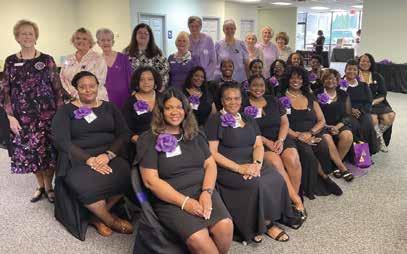
five retired educators who, far from stepping away, have expanded their impact in the broader community. As entrepreneurs, business owners, health and wellness mentors and nonprofit coordinators, they continue to champion women’s leadership and advocacy.
That was an ongoing impetus for Eugenia. She spent four years researching and planning how to charter a new chapter and finally, with the support of Sherri Sublett, whom she calls an invaluable resource, Eugenia was ready to charter the new chapter. AL Gamma Epsilon has a clear, intentional goal: to uplift and empower women within the community. Their mission extends beyond membership; they seek to recruit like-minded women who are eager to connect, grow and make a difference through Alpha Delta Kappa, according to Eugenia.
Guided by their motto, “Each One, Reach One,” the one-year-old chapter embraces the idea that impact begins with individual connections that ripple outward. AL Gamma Epsilon members share a deep love for education, a commitment to one another and a vision for strengthening both their organization and the community they serve. Their charter group included a blend of experience and passion. Ten members are active classroom educators, serving in roles that shape the future of education every day: principals, reading curriculum coaches, lead teachers, SPED specialists, teacher mentors and seasoned classroom instructors. Alongside them are
For Chapter President Eugenia, the journey to establishing AL Gamma Epsilon was both challenging and deeply rewarding. She said that one of the earliest hurdles was visibility. Many people had never heard of Alpha Delta Kappa, which made outreach an uphill climb. Practical challenges, like securing a consistent meeting space, added to the difficulty. Perhaps most challenging, however, was navigating rejection and the moments of isolation that came with building something new. Through it all, Eugenia remained steadfast. “I am honored to have chartered this chapter and to provide leadership as we move forward,” she shared. “Even in moments when I felt like I was working alone, I leaned on faith and the belief in what we were building.”
She credits fellow member Veronica Hilliard as a vital force within the chapter. Veronica has long valued the importance of connection among Black women and brings that vision to life through her encouragement and commitment to unity. Her influence helps the chapter embody its mission of friendship, sisterhood and empowerment in ways that are both meaningful and accessible. Gamma Epsilon has initiated two new members: Arlinda Davis and Joyce Tyus.
Member Jamie Harris shared, “Being a member of Alpha Delta Kappa has given me the opportunity to network with other educators throughout Birmingham. It is great to get classroom ideas from fellow educators and try them in your classroom.”
Eugenia still keeps her finger on the pulse of her first chapter. She collaborated on a veterans project last November and looks forward to creating other joint ventures.
By Giselle Whyte, Ontario Psi and D’Hann Ch’ng, Ontario Virtual Chapter Epsilon and Ontario Executive World Understanding Chair
Ontario Psi, like most other AΔK chapters, is composed of wonderful intergenerational women who collaborate, share and navigate monthly meetings with a strong sense of sisterhood, unity, purpose and partnership. As a result, there are true benefits to be embraced as captured by D’Hann Ch’ng, Epsilon virtual chapter member, in her opening comments to Psi’s March gathering. In a most contemplative piece, she looked at intergenerational collaboration through a world understanding lens:
“And perhaps the crux of world understanding begins here - in humility. As educators, it can be tempting to believe that expertise alone equips us to navigate complexity. But intergenerational strength reminds us of something deeper: it is a fallacy to think we are the smartest person in the room. In A∆K, our collective experiences span decades of teaching, leading, mentoring, adapting and reimagining. No single voice holds the full picture. Wisdom lives in the exchange.”
That is why, in response to Maria Luisa Lebar’s most poignant article in KAPPAN ’s December 2025 issue, “Evolving Together: Building Bridges through Intergenerational Collaboration,” Psi delved deeper into its message through the means of writing poetry. By focusing on key nouns from within this piece, groups of four members, including two sisters who joined virtually, selected a word such as bridges, innovation, vision and partnership to create formulaic poems using our senses, followed by a concluding overarching thought.
It was a most successful immersive activity embracing intergenerational collaboration of ideas and thoughts with meaty discussions, an exploration of various perspectives and wholesome laughter. Our “poets” then shared their creations. This was also an opportunity to celebrate and acknowledge the exceptional biennium that Ontario President Maria Luisa Lebar has had in Ontario and to pay tribute to her outstanding leadership. These poems were fine examples of recognizing members’ voices and empowering membership.
D’Hann’s insightful and engaging thoughts took the intergenerational collaborative theme one step further by linking these ideas to world understanding, a concept Psi chapter aims to include in each of its future meetings. She stated, “World understanding is not an agreement. It is
not uniformity. It is the disciplined commitment to remain in community, especially when perspectives differ. It is the courage to listen across generations, across experiences and across shifting realities. It is recognizing that leadership is strongest when it is shared.”
Through our collaborative poetry endeavors, Psi members experienced a heightened understanding of what it means to reach across generations, to listen, to work together, to cooperate and to produce for the betterment of all. D’Hann summarized this cooperative exercise very aptly by saying, “If we want world understanding in our nations and in our classrooms, we must embody it in our chapters. It is committing to the belief that we are stronger and wiser together.”
The lens of world understanding is not optional in our work – it is essential. As a pillar of A∆K’s vision, mission, and purpose, it moves us beyond altruism into intentional and reflective practice. It calls us to remain steadfast with and alongside our community, which deeply understands that growth is collective. Within and beyond our chapters, we are reminded that strength is woven, wisdom is distributed, and humility is leadership. When we commit to this lens, we do more than collaborate across generations –we model the understanding our world so urgently needs.
Below is one of the poems.
If innovation were a colour, it would be a bright rising yellow sun, new on the horizon.
If innovation were a taste, it would be like a burst of citrus with an extra helping of sweet and tart.
If innovation were a sight, it would be like a geodesic dome iridescent with light shining through.
If innovation were a smell, it would be like that of the first cut grass of the season, suggesting possibilities.
If innovation were a sound, it would be like a crack of thunder signifying an “AHA” moment.
If innovation were a feeling, it would make me energized, inspired and totally in tune.
Innovation is progress, excitement and moving forward.
By Mary Yeates, MD, Beta President 2024-26
In 2023, MD Beta chapter launched ‘Excellence in Education Celebration, ’ a program that has become both a meaningful tradition and a powerful membership tool. Created by Beta member Annie Kozma, the annual spring event was designed with a simple but impactful goal: to honor outstanding educators while building authentic relationships. As Annie said, “Teaching is hard, so I wanted to find a reason to celebrate the amazing work that strong women accomplish in our profession while also creating a way to introduce Alpha Delta Kappa to local educators in a meaningful way.”
Each April, our members invite a non-member educator they admire to be our guest of honor. The afternoon begins with a shared meal, followed by a program that highlights each honoree’s accomplishments through a personalized presentation. Each teacher is recognized as an educator of excellence and presented with a certificate as a token of our appreciation.
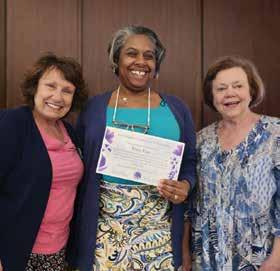
years, two honorees have chosen to join our chapter. One of those members, Linda Suarez, reflected that attending the EIE Celebration introduced her to “a community of passionate educators dedicated not only to their students, but also to uplifting one another.” Linda reported feeling “genuinely inspired by the overwhelming sense of sisterhood, encouragement, positive energy and meaningful networking that filled the event.” She described the experience as transformative and a compelling introduction to the support and opportunities within Alpha Delta Kappa. Our newest member, Toni Quan, shared that she was drawn to the “welcoming, intelligent, and genuinely supportive community of women,” and valued the organization’s spirit of service, collaboration and professional connection.
What makes this program especially effective is its intentional focus on recognition and connection rather than recruitment. We do not begin by promoting membership; instead, we create a welcoming environment where educators feel seen, heard and valued. As our Historian, Linda Lindstrom, said, “The event is very encouraging, offering members the opportunity to learn about the level of professionalism present teachers are practicing in their classrooms, making human connections with today’s technology.”
The program has grown steadily each year. What began as a small gathering has evolved into a highly anticipated annual event, with increasing participation and enthusiasm. Annie noted that while there were no expectations for membership initially, “the momentum continued,” leading to new members in subsequent years. Today, the program is a valued MD Beta tradition that allows us to extend support beyond our chapter to a wider community of educators.
The impact has been significant. Over the past two
Our chapter has also strengthened this relationship-building approach through participation in the “Educators Are Heroes” grant program. While the EIE Celebration began prior to receiving the grant, the training reinforced our philosophy of building connections first. We are intentional about creating meaningful interactions and allowing interest in membership to develop naturally over time. Notably, both new members who were first honored at our EIE Celebration later attended our fall “ Educators Are Heroes” events, further deepening their connection to our chapter.
Former Maryland State Vice President Kay Caviness noted that many chapters struggle to find effective ways to promote excellence in education programs. She shared that this program has provided “a win-win,” honoring outstanding educators while also giving members the opportunity to celebrate excellence and connect with like-minded professionals.
The success of the EIE Celebration demonstrates that a simple, relationship-centered approach can have a lasting impact. When recognition and celebration come first, interest and engagement naturally follow, offering a sustainable and replicable model for growth.
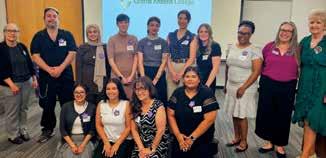
Pictured are 11 of the 14 charter members flanked by (L) Nicole Haldeman, advisor, and (R) Lisa Clegg, advisor, and Betty Jo Evers, sponsor.
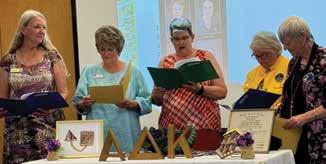
L to R: Mollie Acosta, Foundation Chair; Arizona State President-Elect Nancy Harrison; Arizona State President Helen Valliere, Southwest Regional President Jeanie Hinck, and International Executive Board Member Mary Ann Englehart.


Alpha Delta Kappa’s eleventh collegiate club, Central Arizona College Collegiate Club, was chartered in March in Coolidge, AZ, with 14 charter members. Lisa Clegg and Nicole Haldeman, instructional specialists at the college, serve as the club’s advisors. AZ Iota is the sponsoring chapter, and Betty Jo Evers, an Iota member, is the sponsor. Each CC member has an Iota sister as a mentor. The club officers are Jenna Clegg, president; Carrie Morris, president-elect; Michael Lepage, treasurer; and Brooklyn Wade, secretary
Iota Chapter members, family and friends of the initiates, and guests from Arizona, California, Colorado, with an audience on Zoom, welcomed initiates into the first collegiate club chartered by Alpha Delta Kappa at a community college. Central Arizona College now offers a four-year bachelor’s degree in Elementary Education. International President-Elect Mary Ey attended virtually, bringing greetings from International President Conway Blankenship and the IEB. Past International President Ann Marie Brown, IEB Member Mary Ann Englehart, Foundation Chair Mollie Acosta and Southwest Regional President Jeanie Hinck attended in person. Information provided by Betty Jo Evers and Mollie Acosta.
The initiation of Jazzmine Aranda into the University of Arizona Collegiate Club was a highlight of the annual Alpha Delta Kappa Day at McKale Center. Rita Mills, AZ Zeta, conducted the ceremony at halftime during the basketball game between the UA Wildcats and the Oklahoma State University Cowgirls. It is the first time an initiation has occurred during the event. A∆K sisters gathered at center court after the game for a photograph with Wildcat Coach Becky Burke and her coaching staff.
State board members attending included President Helen Valliere; Historian Barbara Sundust; Recording Secretary Betty Smith, Corresponding Secretary Julia Gales, Sergeant-at-Arms Michelle Roosma, and Guiding Principles and Membership Chair Betty Jo Evers. Also present were members from Beta, Psi, Omicron and Zeta chapters, in addition to friends of members.
“This annual event provided AZ A∆K the opportunity to be recognized on the Big Screen Jumbotron and gave us the opportunity to meet and build friendships with other Southern District chapter and State Board members,” said Filomena Brooks, immediate past president of AZ Omicron. Filomena and her husband, Roger, hosted a dinner at their home after the game.
Information provided by Filomena Brooks, AZ Omicron.
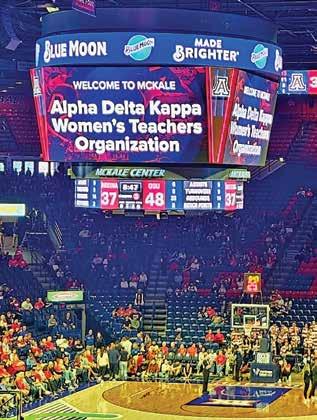
By Mariam Ludim Rosa Vélez, PR Delta, Mayagüez, Puerto Rico
ing opportunities for faculty and students.
Her career includes service as a program director at the National Science Foundation and membership on the U.S. Navy Research Advisory Committee. She is also a fellow of the Geological Society of America.
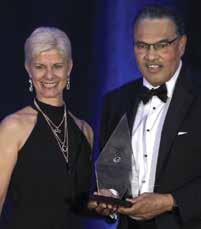
Dr. Ingrid Padilla and Dr. Freeman A. Hrabowski.
Violet sister Ingrid Y. Padilla, a member of PR Delta in Mayagüez, Puerto Rico, recently received the Dr. Freeman Hrabowski III Legacy Award during the 40th annual BEYA STEM Conference held in Baltimore, Maryland. Dr. Padilla is a professor in the Department of Civil Engineering and Surveying at the University of Puerto Rico Mayagüez Campus and serves as special assistant to the chancellor for research and creative endeavors. She holds a doctorate in hydrology from the University of Arizona.
The BEYA Conference, whose name stands for Becoming Everything You Are in STEM, recognizes leaders who have made significant contributions to science, technology, engineering and mathematics across academia, industry and government.
The award was presented by Dr. Freeman A. Hrabowski III, president emeritus of the University of Maryland, Baltimore County, widely recognized for his transformative leadership in higher education and his commitment to expanding opportunity in STEM.
“Receiving a legacy award of this nature is a profound honor,” Dr. Padilla said. “This achievement reflects the collective efforts of our institution and affirms that the University of Puerto Rico Mayagüez Campus is nationally recognized for leadership in research, innovation and talent development.” Her nomination was submitted by Victor McCrary, chair of the U.S. National Science Board.
Dr. Padilla brings more than 25 years of experience leading initiatives in research, education, and project management across academic, governmental and private sectors. At the University of Puerto Rico Mayagüez Campus, she has played an important role in strengthening the institution’s research ecosystem and expand-
Throughout her career, Dr. Padilla has championed mentorship and expanded participation in STEM, particularly for women and underrepresented communities. Her work continues to reflect the leadership, service and educational excellence that define Alpha Delta Kappa members.
Entente Education Canada, a retired teachers’ organization, announced that Janet Beaton, ON Tau, is the recipient of Entente’s 2026 Distinguished Member Award. Joining the District Council in 2010, Janet was selected because she has demonstrated a commitment to excellence, openness to innovation and compassion for others, especially the most vulnerable, according to the award. The award includes $500 which Janet can contribute to her charity of choice and an invitation to Entente’s spring banquet where she will be formally acknowledged.
Sapphire Sister Lana Riding, a member of AR Alpha Mu, was recently featured in “Impact,” the periodical of the University of Arkansas - Pulaski Tech Community College, for her dedication and effectiveness as a teacher. The article shared how Lana builds confidence in her students and creates a classroom that is calm, patient and kind, one where mistakes are expected. Before coming to Pulaski 17 years ago, Lana taught high school math classes. She has taught at the Arkansas Governor’s School for three summers. Lana holds a BA in Mathematics from Hendrik College and a BS in Education from UA.
By Bridget Pike, LA Beta Eta
LA Beta Eta’s Golden Sister, Judi Polivka Betts, was honored as a Louisiana Legend in 2025 by Louisiana Public Broadcasting. Judi is an internationally acclaimed watercolor artist, instructor, author and juror for many major exhibitions.
LPB President, Clarence Copeland, said of the Louisiana Legends, “These are Louisianans who have touched and impacted the lives of others in profound ways.”
Judi was honored by the LSU Museum of Art in 2023. She was selected to exhibit her artwork at The Gallery at the Manship Museum in Baton Rouge. The four-month exhibit titled “Celebrate! Sixty-Year Watercolor Retrospective” included 125 original paintings. The collection included some of her early paintings, as well as later works that have earned her the highest accolades a watercolor artist can receive.
Senator and Mrs. Russell Long commissioned Judi to do a painting of the Russell B. Long Federal Building in Baton Rouge for their own private collection. Her painting of the Louisiana Old State Capitol hung in the Rotunda of the Governor’s Mansion during the Foster Administration.
Judi’s paintings have been exhibited in invitational exhibitions in Nanjing and Shanghai, China; Japan, Taiwan, Bulgaria and Canada, as well as galleries across the United States. Judi’s first love is teaching. She has conducted workshops in 48 states and 10 foreign countries. She taught many summers at the University of Alaska Fairbanks. She and her paintings have received prestigious awards: the Louisiana Governor’s Award for Professional Artists; the Transparent Watercolor Society of America’s Master of Watercolor designation; a Lifetime Achievement Award from the Watercolor A Honor Society and a signature member of the American and National Watercolor Societies.
Judi and her twin sister, Janet P. Curtis were born in Chicago and both graduated from Indiana University in 1958. They were both members of Alpha Omicron Pi. Later, Judi was awarded the AOII’s Founder’s Award. She began her teaching career in Oak Park, Illinois. A year later, she married Tom Betts and they moved to Baton
Rouge. Judi later earned a master’s degree in education from Louisiana State University and did postgraduate studies at Southern Oregon State University.
In 1959, Judi continued her teaching career in the Ascension Parish School System at Gonzales Elementary. She later became the first art teacher hired in Ascension Parish. Teaching art for 25 years at East Ascension High School, she said, brought joy and fulfillment to her life. She became a charter member of the LA Alpha Lambda Chapter in 1965. Together with her sisters, they established a new chapter, LA Beta Eta in 1982. She remains an active member. Over the years, she has donated many pieces of framed art to help with altruistic endeavors on the chapter and state levels. Judi has made many friends all over the world through painting, teaching and traveling, but none are as dear to her as her A∆K sisters, she says.
Members of OH
Alpha Eta celebrated Virginia Prucha’s 101st birthday in January with cake, punch and a rousing chorus of “Happy Birthday.”
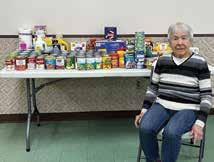
To honor Virginia, the members were asked to bring canned goods to reach a total of 101 items. The goal was surpassed, according to Past Co-President Judy Dally, with 168 items donated. Virginia asked that the donations go to St. John UCC’s Little Free Pantry.
Virginia was initiated into the Alpha Eta Chapter in 1973. She has held the office of president and was OH A∆K’s music chair for a year. She spearheaded the sale of Rada knives, which raised funds for the Joan Gerken Alpha Delta Kappa Scholarship and the Alpha Delta Award. The scholarship and award are given annually to women from northwest Ohio majoring in education at Defiance College, Defiance, OH. Alpha Eta’s meetings always end with Virginia leading the members in singing “The Lamp of Alpha Delta Kappa.”
Virginia says she is grateful for the support of her Alpha Eta sisters and for the opportunity to remain active in the organization’s activities.
By Gwen Steele, KAPPAN Correspondent
Florence “Pippy” Rogers, a member of GA Beta Iota, was presented the Alzheimer’s Association’s 2026 Harry Johns Award for Volunteer Excellence during the Community Leaders Summit in February in Anaheim, CA. This honor was in recognition of her exceptional contributions, distinguished service and unyielding dedication in the fight to end Alzheimer’s and all other dementias. The announcement by ALZ stated, “Since joining the fight, Rogers’ impact has been felt across the organization. She is an advocate and member of the Alzheimer’s Impact Movement Leadership Society. She supports fundraising activities like ‘Walk to End Alzheimer’s’ galas, and ‘Do What You Love to End ALZ.’ She has served on the Georgia Chapter board since 2018 and coaches, encourages and supports volunteers in the quest of achieving our vision of a world without Alzheimer’s and all other dementias.”
Alzheimer’s is a mean, encroaching, life-altering, confusing and devastating disease that attacks not only the body and soul of the victim, but also their families, friends, and yes, even their community. It has touched directly or indirectly almost every single one of us who is reading the KAPPAN right now. We have all helped, supported and grieved. Pippy is no exception. Caring for her mother, who journeyed through the disease for 16 years, she began volunteering with the Alzheimer’s Association through Alpha Delta Kappa. One of Pippy’s “aha!” moments came in 2015 at that year’s International Convention while conversing with the then International President, June Bellamy. Both A∆K sisters shared the role of caretaker for their mothers and fervently expressed to each other, in the lobby of the Marriott, their desire to support ALZ in some way. June encouraged Pippy to pen a letter to the A∆K Executive Board requesting them to consider designating ALZ as one of the International altruistic projects in the following biennium. Pippy did. And lo and behold, it came to be. Over these past many years, A∆K and ALZ have continued to join ranks in the fight to eradicate Alzheimer’s and its many dementia-affiliated cousins. Did you know that our organization is among the very top leaders in ALZ fundraising? We are.
In Washington D.C. visits, Pippy has been instrumental in pushing for legislation regarding National Institute of Health funding as well as seeking approval in the use of the bio-marker protein TAW to determine implementa-
tion of infusion drugs appropriate for the various seven stages of Alzheimer’s and subsequent treatment plans.
While Pippy understands and supports all dimensions of the ALZ mission, her devotion to A∆K is just as strong. Back in the day, her LaGrange, GA, principal, a charter member of Beta Iota, corralled her staff regularly to assist in setting up chapter meetings at school. Pippy has held all chapter officer roles except treasurer, all district roles except secretary, served Georgia A∆K as VP for Membership twice and has served as both State and International Excellence in Education chair. She works with the A∆K Foundation, participates in local and state ALZ-affiliated groups, hasn’t missed even one of the past 13 conventions, and most recently spoke at last summer’s International Convention in Austin.
Pippy, two years shy of becoming a Sapphire Sister, shares the following “Quip from Pip”: “It’s all in our genes— not the ones we wear but how we are wired and fired. People like us are wired with a desire to ‘make a difference,’ ‘lend a helping hand,’ ‘be altruistic.’ It’s in our DNA! All of us…are a fired-up purple family of change-makers!”
The question bouncing around in your brain deserves an answer: Pippy’s real name is Florence, which was her grandmother’s name as well. Family confusion ensued, so Pippy’s mother assigned the job of creating a nickname for Florence to her 3 ½-year-old brother. True story. And he chose, for absolutely no explainable reason, “Pippy.” When her third-grade teacher insisted on calling her “Flo,” Mom’s reply was, “We can fix that.” And Florence has been called “Pippy” ever since!
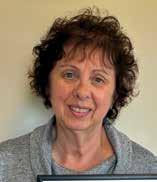
PA Delta is proud to announce the acceptance of chapter CoPresident Sue Masley into the Pittsburgh Society of Artists. The PSA, founded in 1965, represents nearly three hundred members, provides its members opportunities to exhibit their work and encourages creative thinking through public dialogue in the Pittsburgh and Southwestern Pennsylvania region.
Sue was awarded a 2025 Northeast Regional Spring Mini Scholarship which she used to expand her skills in figure drawing. She used one of her pieces created during this time as a submission for consideration into the PSA.
Sue taught Visual Arts for grades 9-12 for 36 years.

“Life’s most persistent and urgent question is “What are we doing for others?’” ~ Martin Luther King, Jr.
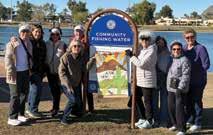
AZ Mu members met in January at Chaparral Park in Scottsdale, AZ, to walk for the Alzheimer’s Association. Members walked around the beautiful lake, raised $1000.00 and ate lunch afterward at a local restaurant. Walkers included: (L to R) Sue McConnell, Sherry Grant, Evelyn Leone, Renee Wiess, Julie Erickson, Jane Kennedy, Betty Ehret, Shirley Bruns and Debbie Stout.
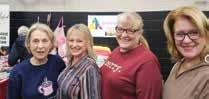
WA Rho chapter used the funds they raised from their altruistic projects to award $1,500 in May to a college and/or university student pursuing an education career. Members sell handmade crochet blankets, knit afghans, potholders, aprons and holiday stockings at a two-day local high school craft fair and hold a garage sale to support the scholarship. Pictured (L to R) are Rho members Treasurer Pat Felgenhauer, Membership Chair Lorrie Perry, Cindy Simonson and Secretary Dori Nielsen.
CT Zeta
Members of CT Zeta recently brought a touch of spring to residents at the Royal of Westerly Nursing Center. Chapter members Kay Perrone, Alicia Luther, Ann McLean and Chapter President Barbara Hatch delivered handmade spring birds and sun catchers created by the members.
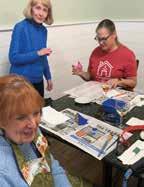
“The bright and cheerful decorations were warmly received and truly brightened the residents’ day. There were many beautiful smiles and heartfelt “thank yous,” making the visit especially meaningful. Moments like these remind us how simple acts of kindness reflect our spirit of service and strengthen our connection to the communities we serve,” said President Barbara. Pictured (L to R) are Delberta Novicki, Joanne Wildes and Jen Nowak.
“Small but Mighty!” is AZ Sigma’s motto. Sigma’s nine members make altruistic donations every month to an organization selected by a Sigma member. Current and past recipients have been the Ronald McDonald House, Youth on Their Own, the Birth and Women’s Center, the Alzheimer’s Association, the Diabetes Foundation and the AZ Council on Aging.
In February, Sigma joined forces with the San Xavier Kiwanis Club of Tucson to support the Singletons organization through its Bare Necessities Drive. Singletons is an Arizona-based, non-profit devoted to meeting the needs of single-parent families battling cancer.” Combined donations totaled over five cartloads of household and personal hygiene items collected at the Kiwanis meeting site.
Information from Sigma Co-President Robin Leebardt and Fraternity Education Chair Joy Goodsell.
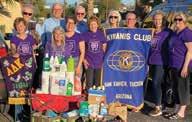
Displaying their Bare Necessities collection are Sigma and San Xavier Kiwanis members. Front row (L to R): Fraternity Education Chair Joy Goodsell, Lynn Ramsey, Co-President Robin Leebardt, Past President Alice Bever, San Xavier President Carla Bailes, Rudy Benitez, Recording and Corresponding Secretary Linda Brady and Treasurer Susan Naegle. (Back Row, L to R) Ed and Jade Verberg, Mark Greaves and Dick Cloud.
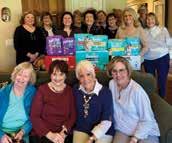
CA Eta members donated diapers to the Support the Enlisted Project’s “Baby on Board” diaper drive. STEP is a nonprofit organization that offers programs to help the families of active-duty enlisted service members experiencing financial hardship. The donations were collected at an Eta afternoon appetizers and wine social. “We hope our donations will help in some way to make a difference for those in need,” said Eta President Barbara Campbell.
Eta sisters display the diapers they collected for STEP. Front row: (L to R) Vice President for Membership Trina Gerdes-Hughes, Chapter President Barbara Campbell, Past President Diana Keyes and Chaplain Zahydie Annandono.
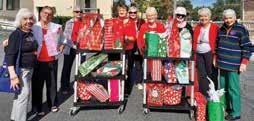
FL Fidelis Beta sisters (L to R) Eileen Hart, Laura Fraser, Gayle Bloom, Sandy Mockus, Shirlynn Dedinsky, Kathy Ferrante, Peggy Douglas, Irene Clark and Jan Force show some of the items they purchased for the residents of Savannah Manor, Leesburg, FL, as the chapter's altruistic project. Giving personal care and other items to the residents is a long standing project of the chapter.
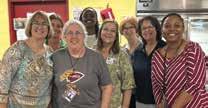
FL Gamma Delta members hosted a spring dance for fourth and fifth graders at Middleton Elementary School to raise funds for the chapter’s annual senior scholarships. The sisters supervised and provided the music and a concession stand, raising over $1,600. Pictured (L to R) are President-Elect Sharon Harris, Immediate Past President Michelle Mikell, Altruistic Chair Sara Kreglo, Chaplain Mildra Walker, Gayle Overturf, Sandra Black, Geneva Overturf and Treasurer Tonya Miles.
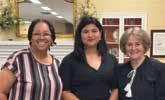
Juandalynn Freeman-Sankey (L) and Marilyn St. Pierre (R), members of NC Alpha Pi, proudly present a scholarship to Maren Rangel (center), a student of the Associate of Arts Teacher Preparation Program at Sampson Community College in Clinton, NC. Maren plans to continue her academic journey at UNC Pembroke this fall.
from ME
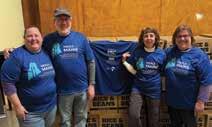
Alpha joined members of the Maine Masons, New England Cancer Specialists and students from the University of New England to “feed the funnel”, packing over 50,000 meal kits for the program Meals for Maine. Fighting food insecurity, meals will be distributed to food pantries and those in need in every county in Maine. Pictured (L to R) are ME State President Jen Robitaille, John Ricker, Alpha President Kendra O’Connell and Alpha Secretary Donna Rimiller.
MI Beta Mu members show some of the $600 worth of school supplies the chapter donated to Turning Point, a residence for victims of domestic violence and their children. (L to R) Corresponding Secretary Suzanne Erbes, Co-Historian Janet Alaska, President-Elect Ann Mucha, Co-Historian Joanne Benham, Susan Troxell, Mary Popielarz, Ginny Palubin, Chaplain Carol Szuba and Immediate Past President April Walker.
Each February, ME Beta chapter enjoys visiting a local assisted-living center to give residents a Valentine’s party complete with several games of Bingo and refreshments.
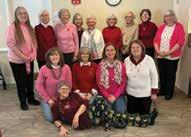
Party hostesses pictured are back row (L to R) Ellen Lucy, Diane Knott, Recording Secretary Teresa Keahon, Lynn Silcox, Jean Davis, Cathy Larocchelle, Judy Wing, and ME State Historian and ME State Secretary Sigrid Serpico. Kneeling: ME VP for Membership Anne Sullivan, Laurie Tibbitts, Lucille Bowers, Chapter Membership Chair Sandra Jones. Lying: Allison Rimkunas.
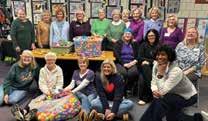
MO Beta Xi sisters display the hundreds of eggs they filled with candy for an event of the mission and community services program of Good Shepherd and Family Services of St. Louis, MO. Beta Xi members learned about the program of the St Louis Catholic Charities at a recent chapter meeting. The program connects children with families and keeps families connected by providing pregnancy and parenting support, foster care programs and adoption services. Chapter members also made monetary donations.
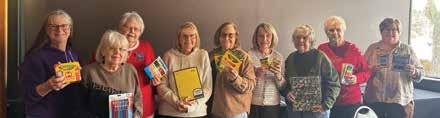
OH Alpha Rho’s March meeting was filled with special events. Ohio State President Denise Sontag visited the chapter and participated in the evening’s activities, which included a raffle and a fraternity education game designed to challenge members’ AΔK knowledge. “The game was fun and an engaging way for members to review and strengthen their understanding of the organization,” said Chapter Historian Linda Stephens. The chapter also celebrated the initiation of new member Tabatha Stover.
At the meeting, members assembled 30 baskets for Kinship Care, an organization that assists relatives and close family friends who are caring for children from families throughout the Columbus area. For more than a decade, Alpha Rho has carried on a tradition of filling Easter baskets for foster children with toys, games, candy and other useful items donated by the members.
“Easter baskets are a welcome gift that helps brighten the children’s day and offers encouragement to their caregivers. When the children receive their baskets, you can imagine how delighted they are,” Linda said.
Helping with the Easter baskets were Chaplain Teri Marsh, Treasurer Cara Jones, Donna Carter, Corresponding Secretary Stacey Zawisza, Sergeant-at-Arms Karen VanVleet, President Kay Bible, Immediate Past President Kathy Gardner, Ohio State President Denise Sontag, Membership Chair Allison Ellis, Lisa Cook, Corresponding Secretary Mary O’Kane, President-Elect Linda Reasinger, Tabatha Stover and Linda Stephens.
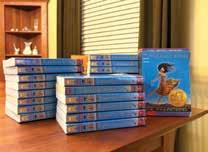
Pictured are the 25 copies of “Esperanza Rising” by Mexican-American author Pam Muñoz Ryan that the members of NC Beta Phi donated to a local elementary school. The book is a work of historical fiction about the life of 13-year-old Esperanza as she is forced to leave her wealthy life in Mexico and begin life in a farm labor camp in California. The suggested reading level is fourth to sixth grade. In keeping with the spirit of the text, sisters met for a Mexican dinner beforehand and sipped Jamaican Flower tea while discussing the book. This is the second year that members chose to supply a classroom set of books requested by one of their colleagues.
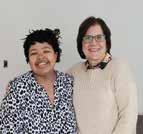
NY Alpha sisters donated proceeds from a 50/50 raffle to support Nondumiso Thango (L), an ITE scholar from South Africa studying at Syracuse University. President MaryAnn Kramer (R) visited Nondumiso in February to deliver a basket of goodies along with an Amazon gift card. MaryAnn said, “It was a pleasure speaking with Nondumiso, who was so appreciative of Alpha’s donation as well as all the sisters of Alpha Delta Kappa.”
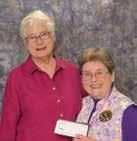
Andrea O’Neill, OH Alpha member, and Judy Hornsby, Alpha treasurer, show the $3,000 check OH Alpha donated to the Mt. Healthy Alliance Community Food Pantry. The chapter used the “Double Match Days” of the Meijer grocery chain’s “Simple Give” program to raise the money.
Shoppers in the Cincinnati area Meijer stores have the opportunity to purchase gift cards to be given to the clients of local food pantries for produce, meat and dairy products. Three times a year, Meijer matches and doubles the amount on the cards.
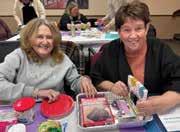
The sisters of Manitoba Beta believe that every child deserves to feel celebrated on their birthday, but they know that for families facing food insecurity, even a simple cake can be out of reach. They met to create “Birthday Cake Boxes” to be distributed by local food banks. The boxes contained everything needed to create a complete birthday celebration. All items were donated by Beta members.
“More than just ingredients and party supplies, these boxes deliver something deeper; the chance for families to pause, gather together and celebrate their child in a meaningful way. By providing the tools for a homemade birthday party, these simple boxes remind families that their children are seen, valued and worthy of celebration, no matter their circumstances,” said member Kathy Isfeld-Jones.
Pictured: Beta members Angeline Cara and Arlene Billeck fill the birthday boxes.
OH Alpha Nu sisters have been busy supporting several altruistic projects. Among the projects were Parma City School District students and the Home Liaisons, for which monetary donations and hygiene products were collected. The sisters donated school supplies to the Parma City School District in September. At their Christmas banquet, Alpha Nu joined with OH Sigma sisters to donate money to three area food pantries. The Ann George Food Pantry in Parma Heights received non-perishable food and hygiene products from the chapter in January.
Members of TN
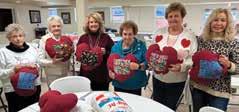
Fidelis Theta show the 24 heart-shaped pillows they created for patients at the Thompson Cancer Center in Morristown, TN. The pillows have a special pocket where the patients can insert their hands. Pictured with the pillows are (L to R) Martha Kaylor, Paula Cox, Debra Rogers, Nancy Goan, Susan DiVittorio and Betty Golden. “The project combined fellowship and service as members enjoyed making items intended to bring warmth and encouragement to those undergoing cancer treatment. Laughter and conversation filled the room as the pillows took shape, reflecting the chapter’s shared commitment to helping others,” said Fidelis Theta Historian Barbara Morgan.
Fighting hunger in their community is important to NJ Lambda members. The members have been making monthly donations to the Toms River St. Joseph and St. Luke Pantry and recently added Fulfill, the Monmouth and Ocean Counties Food Pantry, in collaboration with the Toms River JBJ Soul Kitchen program “Hunger Won’t Win Here.”
The students of the Intermediate West County Service Club worked with the Lambda sisters to coordinate a recent food drive. Joanne Gwin, coordinator of the Soul Kitchen, and Stephanie Ferrier, Fulfill representative, described their programs at a chapter meeting. “The generosity of our Lambda members and the caring of our dedicated students helped Fulfill remain a reliable source of nourishment and hope to help whether a crisis touches our entire community or reshapes a person’s life. Lambda looks forward to continuing this meaningful impact of support and hope to our community,” said Northeast Regional President Sue McDowell.
WV Eta members have been busy working with Heart and Hand Outreach Ministries, a nonprofit that serves underserved communities.
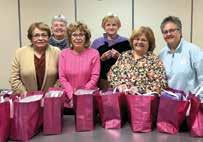
Pictured with the pink bags members filled with feminine hygiene items for the organization are (L to R): Nancy Sullivan, Marianne Annie, Mary Stout, Cathie Perry, Susan Collazo and Lisa Cox. Members also donated food, held a walk-a-thon and took part in bell ringing. Each year, the sisters award a scholarship for a week at Camp Kno-Koa, a camp for children with diabetes. They also held a coffee basket raffle to support the camp. Camp Kno-Koa is the West Virginia altruistic project. At the chapter’s May dinner, contributions for the Alzheimer’s Association were collected.
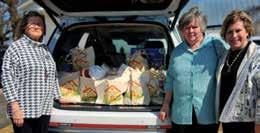
As part of their February altruistic project, NC Fidelis Xi members donated tote bags filled with items from the Ronald McDonald House wish list to help families feel comfortable and supported. (L to R) Betty Pelletier, Rebecca Roberson and Sharon Hawkins fill “Home Away From Home” bags. Betty Pelletier organized the project. The Ronald McDonald House inside the James and Connie Maynard Children’s Hospital is available to all families with children being treated at ECU Health in Greenville, NC.
The NE Zeta sisters volunteered at the Nebraska Diaper Bank where they wrapped over 43,000 diapers to serve 638 babies and donated an additional 566 diapers.
Zeta diaper wrappers (L to R) are April Bridwell, Sandy Power, Kay Ogle, Patty McArdle, Ruth Woodland, Debbie Hanslip, Marla Fries, Mary Drew, Laura Croom and Carolyn Law.
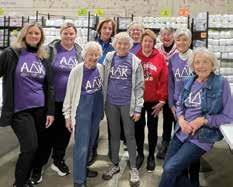


AZ Psi chapter’s January brunch meeting was not only about sisterhood and catching up, but also a surprise “grandma shower” for Sapphire sister Denise Murphy, who was the 2024 AZ Honoris Causa recipient for her continuous A∆K service and work. She was now ready for a new title: Grandma. In August, Denise had tearfully shared with her Psi sisters that her only daughter was expecting, adding that she never thought she would be a grandmother. Psi members decided to “shower” Denise with gifts to welcome this miracle. “There were lots of oohs, aahs, laughter and joyful tears,” according to Psi President Ann Fullerton.
Above, Grandmother Denise Murphy introduces her granddaughter, Salem, to her Psi sisters.
At a special December ceremony and reception, MS Iota sisters recognized Peggy Jacobus for 50 years of membership in Alpha Delta Kappa, as a member of both the MS Delta and Iota chapters. Pictured left to right: Chapter President-Elect Gretchen Waters, Golden Sister Peggy Jacobus and Chapter President Brandy Fairley.
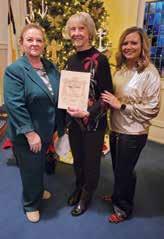
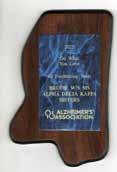
“Brucie W’s MS Alpha Delta Kappa Sisters” team, Mississippi’s #2 fundraising team for the 2025 Longest Day campaign, was recognized earlier this year by the Mississippi Chapter of Alzheimer’s Association at its Volunteer Awards Luncheon in Jackson, MS. Donations to the team included MS Chapters, individual A∆K members and friends and families of MS A∆K sisters. The Longest Day activity focused on raising awareness of Alzheimer’s Disease. Donations totaled $7,550.
The invitation to the luncheon included the statement, “Some of Mississippi’s most prestigious Alzheimer’s Association, Mississippi Chapter’s volunteers, physicians, health systems, board members and others from across the state are honored for their dedication, leadership and commitment to advancing the Mississippi Chapter’s mission.”
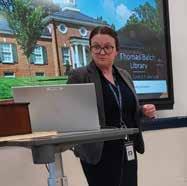
In honor of Women’s History Month, VA Gamma Sigma heard a special presentation from Laura Christiansen, the director of the Thomas Balch Library in Leesburg, VA. Her topic was “Women in Loudoun History: Leading from Community Action to Health.” She explored the history of Loudoun County women who made significant contributions from suffrage to science and medicine. The members viewed documents, photographs and artifacts from the library’s archives.
FL Alpha Sigma was invited again this year by Jessica Tize, coordinator of Early Career Educators Support for the Leon County School District to participate in a training session for new teachers. Camille Park introduced the participants to the mission and purpose of Alpha Delta Kappa. Cana Nudi led a session on self-care using information from the resource platform “Pathway 2 Success” to jumpstart her presentation. Chapter President Claudette McCann led the teachers in scanning a QR code linked to a selection of classroom management videos. To conclude the session, the Alpha Sigma sisters presented the teachers with a sweet and salty bag of treats, a QR code that revealed a $15 gift card and a bag of teaching supplies.
Pictured (L to R) Chapter Alturistic Chair Peggy Harter, Sally Huston, Kathy Law, Cheryl Jackson and Camille Park.
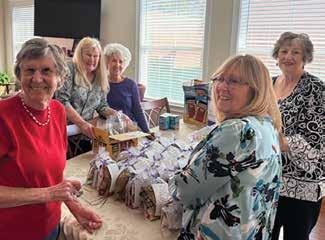
“He’ahui a’ali’’l is the theme of Heidi Tokuda’s biennium as Hawaii State President.
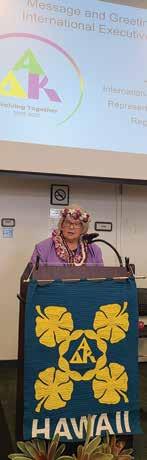
The rough translation is “I am wind resistant, no gale can blow me over.” The Hawaiian sisters proved that when the Kona storms in March caused Hawaii Governor Josh Green to order all government buildings closed, including Windward Community College, the site of the state convention in Kane’ohe on Oahu. Greetings from Southwest Region President Jeanie Hinck, and the voting for state officers was the only business conducted before the closure. In less than a week, the sisters organized a wrap-up session over ZOOM with Co-Presidents Tina Young and Karen Victor presiding. The virtual program included a memorial service, Introduction of award recipients and the installation of officers.
Left, Southwest Region President Jeanie Hinck greets the Hawaiian State Convention.
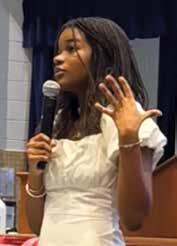
VA Gamma Sigma hosted its fifth annual Women’s Summit at Loudoun County High School in March, with 82 students in attendance. The keynote speaker was Bellen Woodard, a sophomore. When she was eight years old, Bellen developed the “More Than Peach” project after noticing that the only flesh-colored crayon was peach. She created her own crayon brand, “More Than Peach,” with a wide variety of skin tones. The crayons are sold at major retailers. In her speech, Bellen commented, “When we make room for ourselves and build room for others, the world grows with us.” Bellen is shown here addressing the Summit.
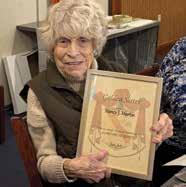
MD Sigma member Nancy Martin holds the certificate recognizing her as a Golden Sister. Nancy was celebrated at the chapter’s 50th anniversary in February. To share the celebration, the members prepared birthday bags for the local food bank. “Birthdays are often not observed by underserved families,” said MD Sigma President Sharon Chirgott. The bags held cake mix, a can of soda with directions for using it to replace oil and eggs, a disposable cake pan, a greeting card and candles. MD State President Marjorie Scott joined in the chapter’s Golden Day.
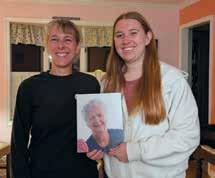
Maddie McDannell (R) was recently initiated into the PA Rho chapter as a third-generation member. Her mother, Melisha Miller (L), a 27-year member, participated in the initiation ceremony and presented Maddie with her grandmother’s badge. Maddie’s grandmother, Arlene Miller, was a member for nearly 50 years before joining Omega chapter.
NC Alpha Nu officers (L to R): Chaplain Donna Matthews, President Cindi Brown, Vice President Sharon Surles and Treasurer Vivian Covington led the initiation ceremony for Mary Beth Provence early this year. Vivian presented Mary Beth, a science teacher at SouthWest Edgecomb High School, with her A∆K badge.
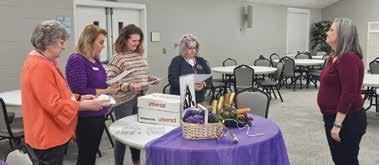
Phyllis Abad ....................................................
California Sustaining
Margie A. Argotsinger .................................................... Iowa Alpha
Margaret E. Baird
Shirley J. Bakies
Ruth I. Barsevich
Loretta Batina
Hazel M. Beard
Janelle B. Bergant
Janice Bianchini
Ohio Kappa
Nevada Alpha
Arizona Omicron
Arizona Fidelis Theta
Arizona Alpha Nu
Colorado Tau
California Beta Eta
Jacqueline Blanton .................................... North Carolina Beta Chi
Peggy Woods Blood .................................... Washington Beta Beta
Linda S. Bogdan
Doris B. Bottom
Helen M. Boyd
Linda S. Breaux
Mae W. Brooks
Rhode Island Eta
Florida Fidelis Zeta
Rhode Island Alpha
Louisiana Nu
North Carolina Xi
Peggy A. Brown Illinois Lambda
Margaret I. Bullock
Permelia P. Bussey.................................
Queensland Alpha
South Carolina Alpha Tau
Mary R. Butt................................................
Annelle Carden
Dinah K. Carter
Dianne H. Chandler
Judith R. Chelin
Debra J. Cobb
Nina A. Coe
Doris B. Crawford
North Carolina Gamma
Georgia Alpha Theta
Texas Gamma Nu
Georgia Beta Beta
Illinois Theta
Missouri Beta Lambda
Florida Upsilon
North Carolina Alpha Sigma
Marilyn D. Cromar ............................................................Idaho Eta
Heather J. Dick ................................................. Ohio Alpha Upsilon
M. Evelyn Baldwin
Naida M. Fenwick
Pamela S. Fogle
Bonnie L. Ford
Judy Frye
Leslie S. Gaertner
Elizabeth H. Grainger
Texas Delta Alpha
Missouri Nu
Nebraska Chi
Arizona Alpha Epsilon
Mississippi Tau
New Jersey Kappa
Michigan Sustaining
Kathleen L. Hackett ....................................................... Ohio Alpha
Geraldine Haggard .............................................
Jacquelin S. Hall
Marilyn D. Hammond
Susan W. Havice
Mary Jane Hinrichsen
Frances D. Humelsine
Gloria Hunt
Anna S. Hunter
Texas Gamma Nu
Virginia Beta Kappa
Nebraska Zeta
Virginia Alpha
Nebraska Epsilon
Pennsylvania Rho
Florida Alpha Eta
Daphne Johnson ......................................................
Sandra J. Johnson................................................
Phyllis O. Kalin
Sybil Kelly
Sarah D. Kelsay
Gail W. Kirby
Marie B. Koals
Nancy P. Kodan
Joan E. Kraft
Elsee K. Latawiec ....................................................... Minnesota Pi
Sallie R. Long ............................................................. Alaska Alpha
Irma G. Lopez Arizona Beta
Anne T. Madsen
Virginia Alpha Lambda
Claudia M. McBride Louisiana Omicron
Nettie J. McCulley Florida Fidelis Nu
Barbara W. McGinty Georgia Alpha Gamma
Lenore H. Mekeal Colorado Alpha Delta
Mary S. Miller Texas Gamma
Patricia A. Moffett ....................................................... Michigan Phi
Deborah R. Mullins ................................................ Alabama Kappa
Barbara E. Neubert Arizona Omicron
Melanie Norris Kentucky Kappa
Nancy A. O’Dell Indiana Sustaining
Mary Ann Olson Iowa Phi
Sylvia H. Parsons Louisiana Nu
Lois H. Peck Pennsylvania Upsilon
Barbara Pennington Kentucky Chi
Mary Curran-Perkins ................................. International Sustaining
Shirley Plumb ............................................................. Iowa Upsilon
Betty G. Quinn Mississippi Tau
Billie Ray Iowa Sustaining
Grace D. Reavis North Carolina Alpha Delta
Olga M. Richards Jamaica Beta
Judy Rohlfs Connecticut Gamma
Meta T. Sampson Virginia Beta Lambda
Reba F. Sane Tennessee Alpha Omicron
Ruth C. Schlosser.................................................. Illinois Alpha Mu
Joy Lynn Schnell ........................................ Texas Epsilon Omicron
Barbara L. Schulte Florida Chi
Violet Wycuff-Shirey Texas Sustaining
Marilyn Sickle Michigan Beta Mu
Joyce Smith Alabama Alpha Zeta
Georgia E. Steeber Illinois Alpha Kappa
Claudia A. Steinacker Florida Delta Xi
Betty S. Stephens North Carolina Gamma Lambda
Evelyn L. Stephens........................................ Arizona Fidelis Theta
Swaim C. Strong...................................................North Carolina Pi
Alieta K. Surface Texas Epsilon Omicron
Georgia A. Tasho Massachusetts Mu
Gladys Thomas Illinois Lambda
Shirley W. Tomlin Tennessee Upsilon
Sharon C. Triggs Kansas Alpha Rho
Judith R. Trossbach Florida Fidelis Tau
Georgia Chi
Oklahoma Chi
Illinois Beta Zeta
Illinois Upsilon
Louisiana Tau
Florida Fidelis Kappa
Texas Epsilon Sigma
Pennsylvania Eta
New Jersey Sigma
Maryland Chi
Jane E. Lackman ..................................................Georgia Omicron
Judy Carol R. Lamberth......................................
Marilyn Lapham
North Carolina Psi
Michigan Fidelis Gamma
Bobbie T. Umbach Alabama Beta Phi
Rosamond N. Vaughan ........................... Virginia Gamma Omicron
Jean Vickers ............................................................... Kentucky Chi
Jayne Visser Michigan Gamma Zeta
Elaine Watson West Virginia Mu
Marti Welch Nebraska Zeta
Ollie Wiegel Arizona Fidelis Zeta
Joyce T. Wolfe Virginia Beta Xi
Dorothy R. Woodward Alabama Alpha Xi
Kaye P. Wren South Carolina Alpha Tau
Anne H. Yost ...................................................... West Virginia Beta
Patricia A. Zimmerman ................................... Pennsylvania Kappa
June..................................... Regional Conferences hosted H-134 S/P/N Convention Report submitted within 7 days after the S/P/N convention Update officers in the directory immediately following the chapter and S/P/N elections.
June 19.............................. Headquarters closed – Holiday
June 30.......... H-114, Annual Chapter Highlights Summary deadline
June 30 Chapter 2026 Financial Summary deadline (Former C-1) for U.S. and Puerto Rico
June 30...............S/P/N 2026 Financial Summary deadline (Former S-1) for U.S. and Puerto Rico
July ...................................... Regional Conferences hosted
July 1 KAPPAN submissions deadline for September publication
July 3 Headquarters closed – Holiday
August 15 .... Distinguished Program Recognition deadline
September 9 Headquarters closed – Holiday
By Joanne Grimm, KAPPAN Editor
Two of the common questions I am asked are “Can I write for the KAPPAN?” and “How do I get a story in the KAPPAN?” Here are the answers.
Can I write for the KAPPAN?
The KAPPAN is published to tell the story of Alpha Delta Kappa. Who better to tell that story than you, the members? We welcome articles about your adventures, teaching tips, talents or anything you would like to share. The Guidelines developed by the International Executive Board regarding article length and the use of Associated Press Style for grammar and punctuation are on the International Website under Current KAPPAN. The September issue will focus on fall and back-to-school. We are looking for articles about teacher-made games, memories of the first day of school as a teacher or a student and advice to new teachers.
How to send your article
Articles should be sent using the jotform. Photographs are to be sent separately. Captions with the full names and titles of those in the picture are to be submitted at the end of the article, not with the photograph.
What does the KAPPAN team do?
The KAPPAN is an International committee with the
editor as the chair. The members of the committee are called correspondents, and their responsibility is to identify and write about subjects of interest to the members and to provide information that will help them make informed decisions. Articles about the activities of standing committees are the responsibility of the committee chair, although they may be contacted by a correspondent with an idea for a story.
How can I get a story in the KAPPAN?
To get your story published, you have to first write and submit it. Don’t strive for perfection. Tell us your story. If we need more information, we will reach out to you. You can also tell one of the correspondents about it, and they will write it. The KAPPAN reserves the right to edit articles for clarity and length and to determine whether articles exemplify the mission and purpose of Alpha Delta Kappa
Will I be told if and when my article is being published?
We wish we could, but we never really know. Each issue has a different layout determined by the length of articles and special features, such as the convention issue, where as many articles as can fit in the issue’s layout are used. Unpublished articles are kept for future editions.


Greetings from Spokane, WA, site of the International Convention, July 14-18, 2027.