1
Vol. 16, No. 1 • SPRING 2018
A MAGAZINE OF THE ALPHA-1 FOUNDATION
ALPHA- -TO-ONE Practical advice, personal experiences and
pertinent news for people touched by ALPHA-1
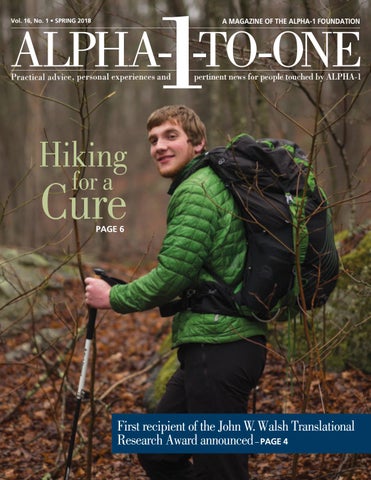
Hiking for a
Cure PAGE 6
First recipient of the John W. Walsh Translational Research Award announced – PAGE 4
LETTER FROM THE PRESIDENT
Moving the organization forward
I
was diagnosed with Alpha-1 Antitrypsin Deficiency (Alpha-1) in 1997. What did it mean back then? Information was scarce for what seemed like a rare condition that nobody really knew much about. I left the doctor’s office not knowing exactly what to do, or where to go, and the doctor himself did not have much experience with Alpha-1. It was scary, quite honestly. More than 20 years later, I can say that the Alpha-1 Foundation (A1F) and the efforts of many have changed that situation. I recently met a woman who, after being diagnosed right before last Christmas, quickly connected to a physician that knew about Alpha-1, looked up information through the A1F website, and found a support group within weeks. To me, her diagnosis experience shows how much progress has been made and is an amazing, energizing, and exciting achievement. Yet there is more to do. John W. Walsh, Sandy Lindsey and Susan Stanley, the founders of the A1F, had an incredible vision of finding a cure for Alpha-1 and improving the lives of Alphas, worldwide. I am proud and grateful to be a part of that vision, which has become the mission of the A1F. I am humbled and thankful to be able to reach out to every one of you, our incredible community of Alphas, to see our mission in action. Incredible advancements in research, ongoing nationwide education events, patient advocacy, and Alpha-1 awareness are some of the amazing things that are happening and that keep moving the A1F forward, more than two decades after being founded, by those three amazing individuals. New and exciting things are happening right now, and we want to share them with you. Thank you for being part of us.
1
ALPHA- -TO-ONE Practical advice, personal experiences and pertinent news for people touched by Alpha-1 VOL. 16, NO. 1 (Spring 2018) Published by the Alpha-1 Foundation 3300 Ponce de Leon Blvd. Coral Gables, FL 33134 1.877.2.CURE.A1 (228.7321) www.alpha1.org Alpha-1 Foundation Board of Directors Executive Committee Gordon Cadwgan, PhD*, Chair James Quill*, Vice-Chair Elizabeth Johnson*, Secretary Jeanine D’Armiento, MD, PhD, Treasurer Martin R. Zamora, MD, Scientific Advisor Ab Rees*, Immediate Past Chair Members Virginia Clark, MD Sandra Douglas + Jennifer Jopp* Ann Knebel, PhD, RN Noel G. McElvaney, MD, Mch, BAO, FRCPI, FRCPC James K. Stoller, MD, MS (Org. Dev.) Fred Walsh* Frank Willersinn, MD* Dell Witcher* Editorial Board William J. Martin II, MD Robert A. Sandhaus, MD, PhD, FCCP Bruce C. Trapnell, MD Henry Moehring* Jen Childress + Ab Rees* Executive Editor Karen Erickson Managing Editor Bernardo Pisani Digital Media Manager Maria Virginia Deliz Editorial Manager Alejandro Hernandez-Padilla Contributing Editors Alexis Artiles Roberto Balderas, MPH Barbee Bennington Ignacio Blanco, MD Cathey Horsak Richard Lovrich Marelis Requejado Linda Rodriguez Adam Wanner, MD Advertising If you are interested in advertising, please contact Karen Erickson at 877-228-7321 ext. 214. ALPHA-1-TO-ONE is published by the Alpha-1 Foundation with the support of our advertisers. No part of ALPHA-1-TO-ONE may be reproduced in any form by any means without prior written permission of the Alpha-1 Foundation. The contents of ALPHA-1-TO-ONE are not intended to provide personal medical advice, which should be obtained directly from a physician. The Alpha-1 Foundation is not responsible for the accuracy of information expressed in advertisements in this publication. Letters to the Editor. ALPHA-1-TO-ONE would like to hear from you. Please send letters to the editor at the Foundation or e-mail us at bpisani@alpha1.org. Letters may be edited for clarity and length.
1 ALPHA-1 FOUNDATION The Alpha-1 Foundation is committed to finding a cure for Alpha-1 Antitrypsin Deficiency and to improving the lives of people affected by Alpha-1 worldwide. * Diagnosed Alpha-1 Antitrypsin Deficient + Diagnosed Family Member
Henry R. Moehring, MBA President and CEO 2
1.877.2.CURE.A1 (228.7321)
Vol. 16, No. 1 • SPRING 2018
1
A MAGAZINE OF THE ALPHA-1 FOUNDATION
Inside ALPHA- -TO-ONE Features SPOTLIGHT Hiking for a cure Jonathan Maidment’s determination has no limits .....................................page 6 FRONTIERS
4
First John W. Walsh Translational Research Award granted Fulfilling the mission of the Alpha-1 Foundation ........................................page 4 MZ carrier state in Alpha-1 Antitrypsin Deficiency Clinical manifestations and biology of the MZ carrier state ........................page 15 ALPHA LIFE United Alphas Together there is nothing they can’t achieve ..................................................page 18 Paying it forward How three caregivers are helping others learn the ropes ...............................page 22 ALPHA-1 KIDS
12
The Bodeker family From zero to three ...........................................................................................page 12 IN YOUR INTEREST Alpha-1 for Nurse Practitioners New online course about Alpha-1 Antitrypsin Deficiency ...........................page 21 Advocacy Agenda Update The true cost of competitive bidding ..............................................................page 16 SUPPORT GROUP UPDATE San Francisco Bay Area Alphas New support groups emerge ...........................................................................page 24
18
Re-establishing the San Diego Alphas Reviving a support group in Southern California ........................................page 25 ASK THE ALPHA DOC Ignacio Blanco, MD, answers some frequently asked questions ...................page 14 2018 CALENDAR Support group meetings, webinars, events and education on Alpha-1 ........page 27
fb.com/alpha1foundation www.alpha1.org
@AlphaFriend
@alpha1foundation
@Alpha-1FDN 3
FRONTIERS 4
First John W. Walsh Translational Research Award granted
T
he Alpha-1 Foundation (A1F) celebrates disease. As up to 6% of the U.S. population could be an Alpha-1 carrier, there remains a critical need the first granting of the John W. Walsh Translational Research Award in Alpha-1 to address this important question. Antitrypsin Deficiency (Alpha-1), an For his research, Kaserman will be working honorable award named after John W. Walsh, cowith specialized adult stem cells named induced founder of the A1F, a visionary man who dedicated pluripotent stem cells (iPSCs), which are stem cells his life’s work to that have been finding a cure for Translational research in the biomedical field is created from patients Alpha-1 and helping with Alpha-1. those affected by it. understood as the application of basic knowledge Importantly, iPSCs contain all the The grant committee acquired in the research laboratory to clinical received four very practice, to improve medical care. This type of genetic information of the original strong submissions, research is a necessary element for the success patient, and provide and after review the award was granted of any strategy that aims to improve the health the ability to compare cells from to Joseph Kaserman, of patients through specific programs. patients that have MD, instructor of the same mutation medicine at Boston University School of Medicine (BUSM) and a physician in Pulmonary, Allergy, Sleep but different disease severity, i.e., patients who have the Z-mutation with or without liver damage. and Critical Care Medicine at Boston Medical Center. To understand the risk associated with having either one or two Z genes, Kaserman will take advantage of a technology known as CRISPR that allows for altering or “editing” the DNA of cells including iPSCs that he has made from Alpha-1 patients. Using this approach, Kaserman will be able to conduct experiments comparing ZZ, MZ, and MM cells that all come from the same individual PHOTO: DARRELL KOTTON and thus are genetically identical, varying only Andrew Wilson, MD, and Joseph Kaserman, MD, with patient Alyce Yout (center) at the site of the Alpha-1 gene that has been edited. The inaugural John W. Walsh Translational Research Award will be used by Kaserman to Kaserman will address a long outstanding question in the field of then create whether Alpha-1 carriers (these are individuals who liver cells from have one normal Alpha-1 gene (M) and one mutated these iPSCs and gene (Z) have an increased risk of developing liver examine whether 1.877.2.CURE.A1 (228.7321)
MZ cells accumulate more misfolded alpha-1 antitrypsin protein (AAT) or are more susceptible to injury than MM cells. As there remain no approved therapies for Alpha-1 liver disease, this study will also test new therapeutic agents targeting the mutated Z-protein within cells to see if they will protect the susceptible liver cells from injury. Overall this study has the potential to not only address the concerns of many Alpha-1 carriers about their risk of developing liver disease, but also to find new treatments for Alpha-1 related liver disease helping both Alpha-1 carriers as well as Alpha-1 patients. The award consists of up to a total of $225,000 over three years. In October 2016, in recognition of John Walsh’s many accomplishments, Mark Brantly, MD, announced a gift for the same amount from himself and his wife Judy Lew, MD, to the A1F, which was intended to establish the Research Award. Brantly is a professor of medicine, chief of molecular genetics and microbiology and A1F research professor at the University of Florida. The Walsh Family is incredibly grateful to Brantly and Lew for their generous contribution to establish the Research Award, and expressed that “it is only through supporting research that we can find a cure for Alpha-1. We congratulate Dr. Kaserman for his work and dedication to moving John’s legacy forward. Keep the Faith.” “This is a tangible, concrete way to continue the work that John was so committed to do. The A1F is honored that AlphaNet was able to make a matching contribution to this grant, enhancing even further the value we give to John’s legacy and his commitment to research,” said Henry Moehring, President and CEO of the A1F.
www.alpha1.org
PHOTO: DAVID KEOUGH, BUMC COMMUNICATIONS
Andrew Wilson, MD, and Joseph Kaserman, MD, at their lab at the The Center for Regenerative Medicine (CReM)
“We are extremely gratified that Kaserman has received this award because of the significance this kind of award has in sustaining the career of a young researcher,” said Andrew Wilson, MD, associate professor of Medicine at BUSM, and Director of The Alpha-1 Center at Boston University and Boston Medical Center. “John Walsh had a major impact on my career and on the Alpha-1 research that we carry out at the Center for Regenerative Medicine of Boston University (CReM) and Boston Medical Center. He served as a mentor both to me and to Dr. Darrell Kotton and was instrumental in bringing us into the Alpha-1 community,” added Wilson. “I am both excited and extremely humbled to have been selected as the inaugural recipient for this award. I never met John personally, but I know how relentless he was about finding a cure for Alpha-1. As a pulmonologist caring for patients suffering from the complications of Alpha-1, I am continually reminded that our current therapies remain grossly inadequate, but this only reinforces the clinical relevance of our research especially if we are going to one day realize John’s goal of finding a cure for Alpha-1,” said Kaserman. Boston Medical Center and the Boston University Pulmonary Center have long-standing ties to the Alpha-1 community through John Walsh, Andrew Wilson, MD Gordon Snider, MD, and Fred Walsh the first chief of pulmonary medicine at Boston University, and a seminal clinician, teacher and researcher in the field. Snider’s work demonstrating the role of neutrophil elastase in the pathogenesis of emphysema, and interest in the role of AAT in protecting the lung against it, created a legacy that lives on today in the form of the research that Kaserman and Wilson carry out in their lab. 5
for a Cure
D
etermined and driven are the first himself is an Alpha, diagnosed at age 10. So is his two adjectives that come to mind father, Dave. His mother, Karen, is an MZ, when you get a grasp of the endeavor a carrier. that 23-yearHis maternal grandmother, old Jonathan Maidment Proceeds from the Alyce McArdle, passed away has assumed for the last fundraising activities relating several years ago from Alpha-1 four years. His inspiration disease, and hiking the to Jonathan will be dedicated lung knows no boundaries, and AT was, in fact, a tribute to his determination has turned to research and programs her. It was Jonathan’s way to every obstacle into a triumph. honor and praise the memory of the Alpha-1 Foundation. Back in 2014, Jonathan hiked of his grandma. To contribute, please visit the entire Appalachian Trail Jonathan, who raised more (AT) from Springer Mountain, alpha1.org/maidment than $56,000 for the Alpha-1 Georgia to Mount Katahdin, Foundation’s (A1F) research Maine, some 2,200 miles which cut through 51 programs hiking the AT – a figure that surpassed miles of his native Connecticut. His motivation was many times over his original goal of $10,000 – took and remains finding a cure for Alpha-1 Antitrypsin six months, 21 days, and nine pairs of boots to Deficiency (Alpha-1) through raising funds for complete the trail. research and other related programs. Jonathan While on his trail he faced hilarious adventures like being chased by a herd of cows and having to jump over a fence to avoid them, but also encountered hurdles like having to take two weeks off the trail to let his injured feet heal. There were also sad moments, as Jonathan’s grandfather passed away a few days before he finished the trail. Jonathan - or “Money Maker,” the trail name fellow hikers gave him because of his goal to raise funds for the A1F — is no stranger to impressive accomplishments: the third-generation Eagle Scout spent a week hiking the AT in New Hampshire at age 15. Now for 2018 the challenge has become bigger, as he is getting ready to hike the entire Pacific Crest Trail (PCT), also as a fundraiser Jonathan Maidment for the A1F. The PCT is a longPHOTO: RICHARD LOVRICH
SPOTLIGHT
Hiking
6
1.877.2.CURE.A1 (228.7321)
distance hiking trail aligned with the highest portion of the Sierra Nevada and Cascade mountain ranges. “Every time I tell my friends what I am doing, they tell me I am nuts. How can I be doing this again, but when I tell them I am doing it for Alpha-1, then “For the PCT my biggest challenge the tone of the will be the mental obstacle that I will conversation have to face...” starts moving into a different direction because they all know how passionate the whole family feels about Alpha-1,” says Jonathan very seriously. The PCT southern end is on the U.S. border with Mexico, just south of Campo, California, and its northern end is on the U.S. - Canada border on the edge of Manning Park in British Columbia. The trail is 2,650 miles long and at some points reaches more than 13,000 feet above sea level, which means that Jonathan will be hiking at a much higher altitude, and some 450 more miles than his 2014 AT adventure. “When I hiked the AT, I found out that much of the challenge of the trail was not the physical aspect because after one month or two anyone can walk a couple of miles a day, but it is the actual task of having to do it day after day, week after week, month after month. It is the mental aspect where the challenge is,” notes Jonathan. “For the PCT, my biggest challenge will be the mental obstacle that I will have to face because you are out there for five or five and a half months without any family or friends, and you have time to overthink, that might not be the best thing in the world,” he adds. Even though Jonathan gives an 80% value to the mental aspect of preparing for this kind of endeavor, such as crossing the entire PCT, there is also a heavy 20% that must be attended to the physical aspect. This time around, and unlike what happened on the AT, Jonathan will make certain that he takes In 1968, President Lyndon B. good care of his feet. Johnson defined the PCT and According to Jonathan the AT with the National Trails himself, “this hike is a System Act. The PCT was then bit different from my 2014 thru-hike of the constructed by the federal AT as I had to apply government and in 1993 was for a permit to hike the officially declared finished. PCT. On November 2nd, 2017, I applied for my PCT permit. Since November 2nd was the first day that you could apply, spots filled up quickly. Don’t worry I was able to get a spot, but my starting date that I chose was a little earlier than I initially intended to start the PCT.” As per his PCT permit, he will be starting his hike in early April and intends to be on the trail for at least 10 hours a day, to complete some 20 miles a day. Of course, this may change by a week or so. If the weather is horrible on April Fool’s Day then he may wait a little while, but as far as the PCT organization is www.alpha1.org
7
“My biggest motivation has always been the Alpha-1 community.” concerned, he will be on the trail on April 4th. This time, Jonathan will also carry with him his flag with the names of many Alpha Angels on it, including his late grandmother. “We are ecstatic that Jonathan will help us bring awareness of Alpha-1 up and down the west coast of the U.S. Our commitment at the A1F is to make sure that we motivate the community to help him along the hike, either by donating or simply following him virtually on his social media page and sharing it with our friends. He is an
inspiration and we hope other Alphas gain strength from Jonathan’s courage and commitment to our community,” said Angela McBride, Director of Corporate Relations and Community Engagement at the A1F. “My biggest motivation has always been the Alpha-1 community,” expressed Jonathan. “I am not going to lie, there were multiple occasions in which I wanted to quit the AT, but what kept me motivated was going back to Facebook and seeing how many people were cheering me. And if I compare how my day was as opposed to the day of an The Pacific Crest Alpha who is suffering from Trail is 2,659 miles the condition long and ranges in then I can consider myself elevation from just lucky. Even though above sea level I am a ZZ, I am still very healthy compared at the Oregon– to other people.” Washington To follow and share Jonathan’s hike along the border to 13,153 PCT, please visit feet at Forester facebook.com/ hiking4acure Pass in the Sierra
Nevada. The route passes through 25 national forests and 7 national parks.
8
1.877.2.CURE.A1 (228.7321)
For adult patients diagnosed with emphysema due to e hereditary alpha1-antitrypsin (A (AAT) (AA AT) A T) deficiency severe
As personal as care gets PROLASTIN®-C (alpha1-proteinase inhibitor [human]): The #1-prescribed augmentation therapy every year for over 25 years1
• >3 million infusions worldwide1
PROLASTIN C
• 15-minute average infusion time at the recommended rate of 0.08 mL/kg/min2 • Well-established safety profile — Because PROLASTIN-C is made from human plasma, it may carry a risk of transmitting infectious agents, eg, viruses, the variant Creutzfeldt-Jakob disease (vCJD) agent, and, theoretically, the Creutzfeldt-Jakob disease (CJD) agent. This also applies to unknown or emerging viruses and other pathogens 2
• PROLASTIN-C is available ONLY through the PROLASTIN DIRECT® program, offering comprehensive, personalized alpha-1 support for patients and physicians and their practices
Your Alpha-1 Partner For more information, call 1-800-305-7881 or visit www.prolastin.com.
Important Safety Information PROLASTIN®-C (alpha1-proteinase inhibitor [human]) is indicated for chronic augmentation and maintenance therapy in adults with clinical evidence of emphysema due to severe hereditary deficiency of alpha1-PI (alpha1-antitrypsin deficiency). The effect of augmentation therapy with any alpha1-proteinase inhibitor (alpha1-PI), including PROLASTIN-C, on pulmonary exacerbations and on the progression of emphysema in alpha1-antitrypsin deficiency has not been conclusively demonstrated in randomized, controlled clinical trials. Clinical data demonstrating the long-term effects of chronic augmentation or maintenance therapy with PROLASTIN-C are not available. PROLASTIN-C is not indicated as therapy for lung disease in patients in whom severe alpha1-PI deficiency has not been established. PROLASTIN-C is contraindicated in IgA-deficient patients with antibodies against IgA due to the risk of severe hypersensitivity and in patients with a history of anaphylaxis or other severe systemic reactions to alpha1-PI. Hypersensitivity reactions, including anaphylaxis, may occur. Monitor vital signs and observe the patient carefully throughout the infusion. Should hypersensitivity symptoms be observed, promptly stop infusion and begin appropriate therapy. Have epinephrine and other appropriate therapy available for the treatment of any acute anaphylactic or anaphylactoid reaction.
www.alpha1.org
PROLASTIN-C may contain trace amounts of IgA. Patients with known antibodies to IgA, which can be present in patients with selective or severe IgA deficiency, have a greater risk of developing potentially severe hypersensitivity and anaphylactic reactions. The most common drug-related adverse reaction observed at a rate of >5% in subjects receiving PROLASTIN-C was upper respiratory tract infection. The most serious adverse reaction observed during clinical trials with PROLASTIN-C was an abdominal and extremity rash in 1 subject. Because PROLASTIN-C is made from human plasma, it may carry a risk of transmitting infectious agents, eg, viruses, the variant Creutzfeldt-Jakob disease (vCJD) agent, and, theoretically, the Creutzfeldt-Jakob disease (CJD) agent. This also applies to unknown or emerging viruses and other pathogens. Please see brief summary of PROLASTIN-C full Prescribing Information on adjacent page. You are encouraged to report negative side effects of prescription drugs to the FDA. Visit www.fda.gov/medwatch, or call 1-800-FDA-1088.
References: 1. Data on file, Grifols. 2. PROLASTIN®-C (alpha1-proteinase inhibitor [human]) Prescribing Information. Grifols.
© 2017 Grifols.
All rights reserved.
July 2017
US/PR/0716/0263a
9
10
1.877.2.CURE.A1 (228.7321)
BIORX IS NOW KNOWN AS
STILL PROVIDING: • Home delivery of multiple alpha-1 augmentation therapies • In-home nursing, caregiver venipuncture training, and drug administration customized to your needs • Access to a pharmacist 365 days a year, 24 hours a day • Expert reimbursement support team • Personal Alpha-1 Solutions advocates for treatment support and resource assistance
WE’RE STRONGER TOGETHER. FOR MORE INFORMATION
Copyright © 2017 by Diplomat Pharmacy Inc. Diplomat and Diplomat Specialty Infusion Group are either trademarks or registered trademarks of Diplomat Pharmacy Inc. All rights reserved. DSIG-29725-0117
CALL: 866.442.4679 VISIT: diplomat.is/specialtyinfusion
ALPHA-1 KIDS
The Bodeker Family: From zero to three
J
en Bodeker and her husband, Nathan, are the parents of Olivia and Myles. Jen confesses that although they love each other very much, her kids drive each other crazy now and then, like the typical relationship of siblings. They are a beautiful family of four. Olivia and Myles are two years apart and Olivia likes to take care of her little brother. The Bodeker family loves to spend quality time on weekends; they usually go to the park, to the Children’s Museum, and to different playgrounds around their home in Fort Thomas, Kentucky. Jen, Nathan, Myles and Olivia Bodeker
Myles was born in March of 2017. During his first month checkup, the doctor noticed that he was jaundiced (his skin was yellowish), he had lost weight, and he was also sleeping more than usual for a newborn. After doing lab tests, the doctor told the Bodekers that Myles had elevated liver enzymes. He had high levels of bilirubin, too. Myles was referred to a liver specialist the very next morning, and after ruling out other conditions, the doctor confirmed he had Alpha-1 Antitrypsin Deficiency (Alpha-1). Myles is a ZZ. The doctor explained the condition to Jen and Nathan and suggested for the whole family to get tested, so they ordered test kits from the Alpha-1 Foundation (A1F) ACT Study, a free, confidential testing program. They discovered that mom is an SZ (Jen), dad is an MZ (Nathan) and big sister is also an SZ (Olivia). Olivia is asymptomatic, Jen is not. Also, Jen found out that her grandmother was a lung-affected Alpha, and that her mother is a carrier. 12
1.877.2.CURE.A1 (228.7321)
Life can change in a heartbeat
those that are newly diagnosed or even for those who were diagnosed earlier but do not have a great support system. “If you need to contact a support group for more information about Alpha-1, get into the Peer Guide Program (a special program that links parents with other parents as a source of information and support), or just someone to talk to,” says Jen. “You don’t have to do it alone, you can ask questions, and do not be afraid to reach out to anybody,” she finished. The Robert Seigman Memorial Scholarship Fund consists of travel scholarships provided to newly diagnosed and returning families of Alpha children to attend the A1F Annual National Education Conference. A Kids and Teen room provides the opportunity for parents to attend the conference while their children are enjoying activities with other Alpha children and teens. Activities are planned for both groups and staffed by parents. To apply for a scholarship, email Cathey Horsak at chorsak@alpha1.org. For more details, you can contact the Patient Information and Resource Referral Line, which assists parents in obtaining information, locating resources and expert physicians on Alpha-1, at 1-877-346-3212.
Although Jen says that it was scary when they got their diagnoses, she and her husband felt better when they started learning about Alpha-1 through the A1F website. They found out about the National Education Conference that would take place in Chicago that same summer (2017). They had to attend. Fortunately, they found the way to go to the National Conference against all odds. They received help through the Robert Seigman Memorial Scholarship Fund for newly diagnosed Alpha children, and even though their flight to Chicago got delayed twice and then canceled, they drove eight hours and made it on time for the conference. Jen and Nathan were able to see that they were not alone in this new journey that life had brought their way. In a short period of time, the Bodekers went from not knowing the term Alpha-1, to being three Alphas and a carrier in a family of four. The National Education Conference showed them that they have people to count on; it also showed them all the resources that are available for the community of Alphas, including all the information available on the A1F website. Jen confirms the website has been the most useful tool for her, as she was able to use it to find her Clinical Resource Center (CRC) doctor, the support network for the community, education events, and most importantly, they connected to other parents whose children have been affected by Alpha-1. They are focusing on the present and living their lives. Myles is taken to the doctor every three months for a full checkup on his liver enzymes, he is having speech therapy, and was diagnosed with delayed visual maturation, because his sight was not fully developed since his body was so focused on his liver at birth. He is also receiving occupational therapy and developmental interventions. This condition cannot be corrected with glasses or with surgery, but Myles is getting all the help he needs and mom was happy to say that he is a happy baby, in a conversation with the A1F. Jen advises the community to reach out to The Bodeker family the A1F for information and resources, for
“ You don’t have to do it alone... do not be afraid to reach out.”
www.alpha1.org
13
ASK THE ALPHA DOC 14
Alpha-1 and Fibromyalgia Q
Is my diagnosis of FIBROMYALGIA directly or indirectly related to (or explained by) my Alpha-1 diagnosis?
I
f I were to answer your question with a single word, I must honestly say: “No.” To be more precise: “The answer is not known, because there are not enough studies on the subject, and the level of available scientific evidence is very low.” But to expand on these short answers, I would like to tell a brief story about the reasons that gave rise to the suspicion of the possible relationship between fibromyalgia (FM) and Alpha-1 Antitrypsin (AAT) Deficiency (Alpha-1). • A clinical alert. In the early 1990s, two young ZZ Spanish sisters with severe FM started augmentation therapy for respiratory problems. Surprisingly, after two or three infusions, the women’s FM symptoms gradually disappeared. Both did well during the next years. But in 1998, there was a worldwide augmentation therapy shortage, which forced Spanish patients to stop infusions for four to five consecutive months every year. The sisters’ FM symptoms slowly recurred when infusions were stopped, but disappeared every time infusions were resumed. Both sisters continued to be fine with infusions until today. ncbi.nlm. nih.gov/pubmed/15468381). • A favorable response to AAT augmentation therapy in an FM patient with moderate Alpha-1. In 2004, a patient with severe FM, bronchial asthma and moderate Alpha-1 accepted a clinical trial with augmentation therapy. FM symptoms relapsed with placebo, and improved again with treatment. Given her favorable response, the patient continued with
augmentation therapy indefinitely. tandfonline.com/ doi/abs/10.1300/J094v14n03_02 • An epidemiological study conducted in Spain between 2003 and 2005 showed that severe Alpha-1 was found twice as often in FM patients than in the general population, suggesting that Alpha-1 might play a role in FM development and clinical expression in a subset of FM patients. ezfind. technion.ac.il/vufind/EdsRecord/edb,23271235 However, the physiopathological mechanisms of FM are not known, and there are no therapeutic trials with AAT infusions in “Alphas.” There has been a randomized, placebo-controlled, double-blind and crossover pilot trial in 13 FM patients who did not have Alpha-1. This study did not demonstrate any significant improvement over placebo on reducing symptoms of FM ncbi.nlm.nih.gov/ pubmed/22190533 In conclusion, in my opinion, it is necessary to investigate the mechanisms of FM more thoroughly, including neuroinflammation, and once these mechanisms are better understood, assess whether AAT can have a protective effect, and Alpha-1 can facilitate FM development. But with the data available in the present, the relationship seems more casual than causal. Ignacio Blanco, MD, is a specialist in internal medicine and pulmonology. He has worked with the Alpha-1 community since 1993 and is currently the senior coordinator of the Alpha-1 Antitrypsin Deficiency Spanish Registry (REDAAT). He coordinated the first book in Spanish on AATD (2012) and participated in the publication of the Spanish Guide for Alpha-1 Patients (2014). He is inventor of the International patent “Use of Alpha-1 Antitrypsin for the preparation of medicaments for the treatment of fibromyalgia” (2006). In May 2017 Academic Press published the first edition of the international book Blanco’s Overview of Alpha-1 Antitrypsin Deficiency.
1.877.2.CURE.A1 (228.7321)
Antitrypsin Deficiency I
n recent years, the Alpha-1 patient community has raised concerns about the potential for lung and/or liver disease in the MZ carrier state. To address these concerns, the Alpha-1 Foundation (A1F) hosted the 16th Gordon L. Snider Critical Issues Workshop on November 13, 2017, in Bethesda, Maryland. The workshop, “MZ Carrier State in Alpha-1 Antitrypsin Deficiency,” featured two sessions: Carrier States in Rare Diseases and Observational and Mechanistic Studies in Alpha-1 Antitrypsin Deficiency. There were 70 attendees from academia, the National Institutes of Health (NIH), the US Food and Drug Administration (FDA), industry and voluntary health care organizations. The purpose of the workshop was to summarize what is currently known about the clinical manifestations and biology of the MZ carrier state and to develop an action plan to address unanswered questions. The presentations were opened by Dr. Joshua Denny, Vanderbilt University, who reported on a Vanderbilt-based Jeanine D’Armiento, MD, PhD, database linking Director for the Center for electronic medical LAM and Rare Lung Diseases at records to a DNA Columbia University chaired the repository that 16th Gordon L. Snider Critical can be used to Issues Workshop. explore phenotypegenotype relationships. Based on the analysis of 250,000 samples, the data showed an elevated risk score for clinical disease in MZ carriers. Dr. Steven Rowe from the University of Birmingham, Alabama, discussed the carrier state in cystic fibrosis, a sister disease to Alpha-1. He stressed the importance of genetic and environmental modifiers that determine if clinical www.alpha1.org
symptoms are present in carriers. Dr. Gerry McElvaney, from the Royal College of Surgeons in Dublin, showed in a family-based longitudinal study that MZ carriers who smoke, but not MZ non-smokers have an accelerated decline in lung function over time. Dr. Marilyn Foreman from Morehouse Medical School then reported on genetic investigations, some as part of the COPDGene project and some conducted at Harvard University. While she stated that MZ heterozygosity might confer a chronic obstructive pulmonary disease (COPD) risk, the data must be interpreted with caution. To wrap up the discussion of links between the MZ carrier state and lung disease, Dr. Mark Brantly from the University of Florida summarized the findings of the United States Targeted Detection Program for Alpha-1 Antitrypsin Deficiency that now contains more than 580,000 samples from patients across the U.S. and its territories. The presentations then turned to liver disease in MZ or MS carriers. First, Dr. Pavel Strnad from the University of Aachen, Germany, addressed the clinical impact of the MZ or MS state. He reported the results of a study involving 176 carriers of the MZ genotype and 176 non-carriers. Subjects were assessed for liver disease burden and genotype status for the alpha-1 antitrypsin protein variants Z and S. The main outcomes and measures were development of liver fibrosis. The investigators found that MZ carriers had significantly higher liver enzymes and evidence of liver cirrhosis as assessed non-invasively than non-carriers. A possible mechanism for this observation was offered by Dr. David Lomas from the University of London, UK. He reported that the MZ protein could also form polymers by showing that a single copy of the Z allele is sufficient to form polymers within liver cells, and may act as a co-factor in driving the liver disease in MZ carriers. The meeting proceedings will be formally published in greater detail in a peer-reviewed scientific journal.
FRONTIERS
MZ Carrier State in Alpha-1
15
IN YOUR INTEREST 16
Advocacy Agenda Update:
The true cost of competitive bidding
T
he multiphase competitive bidding program began in January of 2011 with the purpose of ensuring Medicare beneficiaries access to quality supplemental oxygen products and services that reflected a competitive market, with benefits to both providers and beneficiaries, all while reducing out of pocket expenses for patients. In the years since, Alphas and their physicians have consistently reported problems on: • Mode of oxygen being switched • Equipment malfunctioning • Supply not adequate • Delivery not timely • Documentation was cumbersome • Training was minimal • Lack of coverage for travel The Alpha-1 community went into action and worked closely with the COPD Foundation to collect and report issues from our communities. Centers for Medicare and Medicaid Services (CMS) stood up and took notice, participating in our patient conferences and with Patient Advocacy Group (PAG) leadership. Still, additional data was needed to make a plea to stop the competitive bidding program or at least reduce the aggressiveness and reach of the program. West West Others had taken note of Pacific Mount 56% 54% the widespread problems as well, and in 2015 the American Thoracic Society (ATS) Nursing Assembly Program Planning Committee assembled an Oxygen Working Group (OWG) to address them. A multi-stakeholder group of 26 patients, PAG leaders, and professional respiratory/lung health society representatives
met at the ATS International Conference in May of 2016. The Alpha-1 Foundation was at the table. In September of that year, The Patient Supplemental Oxygen Survey created by the OWG was posted, and they collected responses about the frequency and types of problems experienced by supplemental oxygen users in the United States. The results of 1,926 responses were analyzed and recently published: Jacobs, Susan et al. (2018), Patient Perceptions of the Adequacy of Supplemental Oxygen Therapy- Results of the American Thoracic Society Nursing Assembly Oxygen Working Group Survey, Annals of ATS, vol. 15, number 1, January 2018. Of the 1,926 respondents, most reported they have used oxygen for one-to-five years and were using supplemental oxygen 24 hours/day, with 31% of all respondents using high flow with exertion. Nearly two-thirds reported that their saturations were not checked at the time of delivery and about the same number recounted the delivery driver provided the equipment instruction. While 8% received instruction from a healthcare provider, 10% received no instruction at all and approximately one-third of total respondents reported feeling “very” or “somewhat” unprepared to operate their equipment. Northeast New England 46%
Midwest N. Central 46%
Northeast N. Central 49% Northeast Mid. Atlantic 54%
South Atlantic 54% Midwest S. Central 43%
South East S. Central 48%
Percent of respondents by geographic region answering “YES” to having oxygen problems.
1.877.2.CURE.A1 (228.7321)
Hours Portable Oxygen Lasts
Types of Problems
Over half of the respondents reported issues Equipment not working 499 with their supplemental oxygen and the average Travel oxygen problems 268 number of issues per those respondents was 3.7 Delivery Problems 267 issues. Equipment malfunction was the issue Lack of portable systems I can physically manage 260 reported most frequently and lack of portable Other 220 Lack of high flow portable systems 219 systems, service issues and supply were common Not enough tanks for activity outside home 201 responses. Importantly, the respondents reporting Can’t change companies 177 oxygen problems also experienced higher rates of Company does not respond to calls 169 hospitalization and emergency room visits. Incorrect or delayed MD orders 166 Can’t mix systems 123 Patients living in Competitive Bidding Program Need or used to use liquid and can’t get 86 areas reported oxygen problems more often than Bills not explained 68 those who did not (55% [389] vs. 45% [318]; Not enough portable so I can work 40 P=0.025). Respondents from every region 0 100 200 300 400 500 600 700 Number of Respondents reported issues. Of the 1,926 respondents, 156 (8%) were Frequency of types of oxygen problems reported by Alpha-1 Antitrypsin Deficiency (Alpha-1) respondents who replied “yes” to having oxygen problems (n=899; able to check more than one response). patients. The Alpha-1 cohort responses were similar to those from the entire population, but there were some differing characteristics of importance: • More reported issues with their supplemental 11% Actual Hrs. About 1 hr. or less oxygen (60% vs. 51%) 0% Desired Hrs. • Alpha-1 cohort had a slightly higher response 38% Up to 2 hrs. from rural areas (35% vs. 28%) 2% 32% • Alpha-1 patients had fewer hospital and ER Up to 4 hrs. 17% visits (20 and 30%, vs. 29 and 34%) 15% • More reported being on oxygen for over 5-6 hrs. 66% 5 years (55% vs. 32%) 4% • Alpha-1 population had a very high rate of More than 6 hrs. 15% 40 pulmonary rehab participation (70%) 0 200 400 600 800 1000 1200 Only 12% of the Alpha-1 respondents did not feel Number of Respondents they were limited by their supplemental oxygen. In fact, 39% were sometimes limited, 27% were Actual versus desired hours that portable oxygen lasts. frequently limited and 22% reported being limited all of the time. In the total survey population, equipment and education of providers, patients and 68% of the respondents reported desiring oxygen systems that would last 5-6 hours outside of the home, yet the majority had physicians, at the very least. It will take every interested systems that lasted less than 4 hours. individual, professional society and patient group to ensure appropriate supplemental oxygen access, supply and This was the first survey to provide both quantitative and qualitative data about supplemental oxygen use. Since its services are available to every patient that needs it. publication, an additional survey by Dobson and DaVanzo, The data alone will not do it. Your voice needs to be heard. Access to Home Medical Equipment: Survey of Beneficiary, Case Manager, and Supplier Experiences - Understanding the Impact of Be sure to visit the Action Center on alpha1.org, under “How to Help”, and sign up to get involved. Or contact Competitive Bidding, was published. It corroborates the same Roberto Balderas at RBalderas@alpha1.org. access issues and reports the issues resulting in unnecessary medical complications, hospital discharge delays, increased All charts from Jacobs, Susan et al. (2018), Patient Perceptions of the Adequacy expenses and issues resulting in readmissions. of Supplemental Oxygen Therapy- Results of the American Thoracic Society Nursing The OWG reconvened in 2017 to discuss solutions. Assembly Oxygen Working Group Survey, Annals of ATS, vol. 15, number 1, January 2018. www.atsjournals.org The issues demand policy based fixes, innovation in the www.alpha1.org
17
ALPHA LIFE
United Alphas:
“Together, there is nothing that we can’t achieve”
L
ois Lange lives in Boise, Idaho, with her husband, Jerry. They have six children from previous marriages (1 deceased), 13 grandchildren and 13 greatgrandchildren, and this is their story. It was the year 2003 and Jerry had to go to the doctor for a routine visit, with an added ingredient: Jerry was feeling out of breath all the time. Uncertain of what to do, his primary doctor referred him to a cardiologist, who confirmed that everything was good with Jerry’s heart; however, he was still out of breath. Jerry was sent to a pulmonologist, who was also uncertain about Jerry’s breathing problem, but had another idea: he suggested another test to be made. Two weeks later, Jerry revisited the doctor and found out that he had Alpha-1 Antitrypsin Deficiency (Alpha-1). Jerry started treatment (augmentation therapy) to prevent his lung function from worsening, as he already needed oxygen 24/7. However, this never stopped him from having a good life with his wife, Lois, who had been side by side with him throughout the journey, helping, assisting and learning about Alpha-1. Fast forward to 2010, while attending an Alpha-1 Education Day in Boise, Idaho, Jerry insisted that Lois get tested for Alpha-1. Although she was reluctant, she agreed. Lois found out that she was also an Alpha. Fortunately, Lois had already been involved with the Alpha-1 community for a few years with her husband, so she was aware of what was going
“He gives me my infusion and I give him his infusion.”
Lois and Jerry Lange
18
on, she knew where to go, she knew what to do. Being snowbirds and running away from the cold, Lois and Jerry got involved with the Alphazonies Support Group in Arizona, and they also started going to the Idaho Alpha-1 Support Group, while back in Boise. They had attended the Alpha-1 National Education Conference in 2007, in Washington, D.C., an experience that Lois will never forget: “The magnitude of the event was incredible, and the number of Alphas that I was able to meet was amazing,” she said in an interview with the Alpha-1 Foundation (A1F). After that, they both realized that they were not alone. Lois saw herself engaged in helping other Alphas as time went on. She became an Alpha-1 mentor, and by the summer of 2014, she was an AlphaNet Coordinator after opportunity knocked on her door. “It means everything to me to be able to talk to my Alphas, and hopefully make things easier and better for them, point them in the right direction of what is needed for their journey, because everybody’s journey is different,” said Lois. Lois and Jerry have been married for 30 years, and they now share a deeper connection as a married couple of Alphas. They give each other their infusions, assist one another in everyday tasks and go to Alpha-1 meetings together. Lois encourages all Alphas to get involved, to find a support group and to start going to meetings. She also recommends the A1F website to learn as much as possible and to get an AlphaNet Coordinator. You can learn more about AlphaNet on the official website, at www.alphanet.org. “I am grateful it was Alpha-1 because we have the best support system ever,” she finished. 1.877.2.CURE.A1 (228.7321)
Explore, Engage, and Experience the Alpha-1 Community that CareZ
Zemaira CareZ offers comprehensive support for you and your family
Explore helpful educational resources • Living With Alpha-1 brochure • My Steps for Healthy Living program
Engage meaningfully with other Alphas • Peer-to-peer engagement with AlphaNet Coordinators • Community building through the Alpha-1 Foundation • Walk for Breath Celebration
Experience support when you need it most • Experienced CareZ Care Coordinators to help you navigate access • Zemaira® Signature SavingsSM* offers 12 months of renewable co-pay assistance • CSL Behring AssuranceSM* provides free Zemaira therapy in the event of a loss of or lapse in commercial insurance coverage
ENROLL today at ZemairaCareZ.com or call 1-866-ZEMAIRA (1-866-936-2472).
*Eligibility confirmed upon program enrollment.
Important Safety Information Zemaira® is indicated to raise the plasma level of alpha1-proteinase inhibitor (A1-PI) in patients with A1-PI deficiency and related emphysema. The effect of this raised level on the frequency of pulmonary exacerbations and the progression of emphysema have not been established in clinical trials. In clinical studies, the following adverse reactions were reported in at least 5% of subjects receiving Zemaira: headache, sinusitis, upper respiratory infection, bronchitis, fatigue, increased cough, fever, injection-site bleeding, nasal symptoms, sore throat, and swelled blood vessels. Please see full Important Safety Information and brief summary of prescribing information for Zemaira on the following page.
Zemaira is manufactured and distributed by CSL Behring LLC. Zemaira® and CareZ® are registered trademarks of CSL Behring LLC. Zemaira® Signature SavingsSM and CSL Behring AssuranceSM are service marks of CSL Behring LLC. ©2017 CSL Behring LLC 1020 First Avenue, PO Box 61501, King of Prussia, PA 19406-0901 USA www.CSLBehring-us.com www.Zemaira.com ZMR-0101-OCT17
Important Safety Information ZemairaÂŽ is indicated to raise the plasma level of alpha1-proteinase inhibitor (A1-PI) in patients with A1-PI deficiency and related emphysema. The effect of this raised level on the frequency of pulmonary exacerbations and the progression of emphysema have not been established in clinical trials. Zemaira may not be suitable for everyone; for example, people with known hypersensitivity to components used to make Zemaira, those with a history of anaphylaxis or severe systemic response to A1-PI products, and those with certain IgA deficiencies. If you think any of these may apply to you, ask your doctor. Early signs of hypersensitivity reactions to Zemaira include hives, rash, tightness of the chest, unusual breathing difficulty, wheezing, and feeling faint. Immediately discontinue use and consult with physician if such symptoms occur. In clinical studies, the following adverse reactions were reported in at least 5% of subjects receiving Zemaira: headache, sinusitis, upper respiratory infection, bronchitis, fatigue, increased cough, fever, injection-site bleeding, nasal symptoms, sore throat, and swelled blood vessels. Because Zemaira is made from human blood, the risk of transmitting infectious agents, including viruses and, theoretically, the Creutzfeldt-Jakob disease (CJD) agent, cannot be completely eliminated. Please see brief summary of prescribing information for Zemaira below. You are encouraged to report negative side effects of prescription drugs to the FDA. Visit www.fda.gov/medwatch, or call 1-800-FDA-1088.
Based on September 2015 revision.
20
You are encouraged to report negative side effects of prescription drugs to the FDA. Visit www.fda.gov/medwatch or call 1-800-FDA-1088.
1.877.2.CURE.A1 (228.7321)
T
he Alpha-1 Foundation (A1F) is the disorder; to examine the data supporting committed to improving the lives of augmentation therapy and how to manage people affected by Alpha-1 Antitrypsin these patients and; to list the nurse’s role in Deficiency (Alpha-1). Awareness of overcoming nonadherence using communication Alpha-1 among healthcare providers and allied techniques that may positively impact patient healthcare professionals is vital to that commitment compliance. and drives our detection and professional education The author of the course is James K. Stoller, MD, programs. MS (Org. Dev.), who is a member of the A1F Board In a robust effort to improve diagnosis and quality of Directors. The nurse planner for the course is of care for Alpha-1 patients, the A1F is launching Debbie Waldrop, MSN, RN, CCRC, who is also an online course about Alpha-1 accredited by a member of the A1F’s Medical and Scientific the American Nurses Credentialing Center’s Advisory Committee. Commission on Accreditation. NPs manage The course is free of charge, is acute and aimed at nurse practitioners chronic medical (NPs), and will be worth one conditions, both contact hour. physical and This on demand accredited mental, through activity intends to create medical history awareness of Alpha-1 and to and physical inform nurse practitioners on the exam, and the different clinical manifestations of ordering of the disorder. This is paramount diagnostic tests to increasing the number and medical identified Alphas and ultimately treatments. They improving patient outcomes as have become a result of early detection and an integral part James K. Stoller, MD, MS (Org. Dev.) proper care delivery. of the medical and health care This on-demand accredited system, due to the combination of experience and activity intents to close knowledge gaps by expertise they bring with them. improving awareness of Alpha-1. This is paramount to increasing the number of identified Alphas, Work experience as a nurse gives them a special which will provide strategies for diagnosing further approach in providing patient care, while their damage and therefore, improve patient outcomes to advanced studies provide the expertise and prolong their lifespan. capability to carry on tasks otherwise assigned to Some of the main objectives of the course will be administrators, as they take intense courses on leadership, health care policy, and lobbying. to recognize the different clinical manifestations of Alpha-1; to improve the understanding of For more information and to register for the course, the condition and the genetic background of please visit alpha1.org/np-rn. www.alpha1.org
IN YOUR INTEREST
Alpha-1 Antitrypsin Deficiency for Nurse Practitioners
21
ALPHA LIFE
Paying it Forward How three Alpha-1 caregivers are helping others learn the ropes
T
here are certain things in life that you will not know how to do until you have to tackle them, and that is exactly what happened to these Alpha-1 caregivers. When they started taking care of their Alphas, they were not given an instruction manual. They had to learn by doing, and all of them have found a way to pay it forward for others in the Alpha-1 and caregiver communities. Bailey was overwhelmed with the new D awn responsibilities of caring for Rob when he
was released from an extended hospital stay. “I asked the nurse if they had any type of information to help me learn how to care for him at home, but she suggested I take a nursing assistant course,” says Dawn. To find the resources she needed, Dawn went to a caregivers’ support group at her local hospital for Alzheimer’s and cancer patients, as Rob had also been affected by lymphoma. He is currently in remission. She also recently attended a workshop shared by the Alpha-1 Foundation (A1F) and held by the Care Action Network (CAN), a leading family caregiver organization. There were four components to the Dawn and Rob Bailey – workshop, with content Chicago, IL focused on preparation for medical visits and how to set goals for the patient and the family. Rob was diagnosed with Alpha-1 Antitrypsin Deficiency (Alpha-1) in 2009, but Dawn never 22
Cathey Horsak, the Director of Community Programs at the Alpha-1 Foundation, sat down with us to share her Alpha-1 story on the February 2018 episode of the brand new Alpha-1-To-One Podcast. To listen to the complete interview and much more, visit alpha1.org/podcast
thought about herself as a caregiver until he was in the hospital last year. “As the caregiver, you need to be able to advocate for your loved one and understand the instructions for care, as the sick person is not always able to understand,” according to Dawn. In the caregiving workshop, they discussed having a go-bag for emergency room visits and having a patient file binder with current medication lists and tests results. “That binder has been invaluable for hospital visits, and for both local and out of town appointments with specialists,” Dawn says. “They also urge us to make sure to let the ER staff know that you are the caregiver, and never be afraid to ask questions,” she added. Dawn’s advice for new caregivers: “Take a deep breath, and take one day at a time.” “The hardest part is the change in friendships. Your old friends do not know how to react to sickness, and that is why support groups are important because you interact with people who are going through the same experiences,” Dawn affirms. This is the very reason why Dawn became a support group leader. She has learned so much from her peers and is willing to share her experiences and tools with the patients and caregivers in the Chicagoland Alpha-1 Support Group. 1.877.2.CURE.A1 (228.7321)
onna and Kreg Thornton could not convince their primary care physician that Kreg’s breathing issues D were not being caused by what their doctor called chronic
asthma. It was not until a family vacation in 2009, when Kreg had great difficulty breathing while trying to snorkel, that it dawned on them that the problem was very serious. Donna saw an advertisement in a newspaper for an asthma screening event, so they went. Once there, the doctor agreed with them that it was not asthma. They were referred to a lung specialist, and Kreg was diagnosed Donna and Kreg Thornton – with Alpha-1 and American Falls, ID tested at 31% lung function. He was put on augmentation therapy. After a year of having a nurse administer the infusions, they decided together that Donna would begin administering them. “I was given two lessons by the infusion nurse and was thrown into the fire. I hated poking him, but I did it. I felt the more I got involved, the more I was part of the process, and the better I could help others that were going through the same. We learned to lean on each other more. It brought us closer together,” says Donna. Kreg had a lung transplant in late October 2016, but had issues with those lungs and had to be re-transplanted in January 2017. Through the years they became active with both the Utah and Idaho Alpha-1 Support Groups. They realized the importance of virtual support early on. For both, it is important to be able to connect with other people because there are not very many Alphas in their area. “Even though Alpha-1 affects people differently, it’s good to hear other’s perspectives that you can learn from,” explained Donna. “A lot of my learning came from attending National Conferences and from sharing experiences with nurses and doctors in our area. Now many of them have learned about Alpha-1,” says Donna. “Connect with a support group and connect with the caregivers in the Alpha-1 community. When Kreg was getting close to transplant, we would reach out to our caregiver friends to learn what to expect. And now, Kreg and I are Peer Guides and help new Alpha-1 friends who are on that same path,” she finished. www.alpha1.org
ichard Horsak had suffered from liver disease for five years. He saw five different doctors during that time R and all admitted they tested him for everything, yet they did
not discover what was causing his liver disease. Richard died in 1999. He was 49. It was when the autopsy results came back that his wife, Cathey, heard for the very first time in her life the words Alpha-1 Antitrypsin Deficiency. “After that, we tested Richard’s family, and we determined that he was an MZ,” says Cathey. A friend gave Cathey the phone number for the Alpha-1 Association. She spoke with Sandy Brandley, then executive director of the Association, who suggested she attend the upcoming Annual National Education Conference. In April of 2000, she and her son and daughter-in law attended the conference. As she walked into the meeting room filled with some 300 people, her first impression was that this condition was not as rare as the doctors had told her. She decided she was going to get involved. She was determined to help as many Alphas as she could so that others would not have to go through what she had gone through. Cathey became a support group leader in her area. Then she was asked to be part of a national committee to represent caregivers. “At one of the conferences I sat down and talked with John Walsh about my volunteer work in the Alpha-1 community,” she remembers. They kept in touch and in early 2003, she received an invitation to turn her volunteer work into full-time work with community. “I think it is vitally important for our caregivers and patients to get involved. The more they learn and participate, the better they can cope with Alpha-1,” says Cathey. She is excited for the new opportunities for novice and experienced Alpha-1 caregivers, as “right now, we’re in the process of revamping our caregiver resources and are partnering with caregiving organizations. We also have our Peer Guide program which helps connect people Cathey and Richard Horsak – that are going through Temple, TX a similar situation to someone who has already been through it, so they can learn from a more experienced Alpha or caregiver. We are also recruiting for focus groups to address caregiver’s needs.” To learn more about the Alpha-1 caregivers program or to find out how you can connect with a peer guide, visit a1f.org/alpha1-caregivers or call 1-877-346-3212. 23
SUPPORT GROUP UPDATE 24
San Francisco Bay
Alphas
Area
S
impressed by this teve Shurtz was diagnosed with Alpha-1 group of people that Antitrypsin Deficiency (Alpha-1) I humbly want to by the end of 2009. He started try to give back,” he augmentation therapy to help stop his added. lung function from worsening and started to attend the Sacramento Alphas Support Group, where he Steve is looking met Valerie Benko, the support group leader for the forward to the 2018 Sacramento Alphas. National Education Conference in San Unfortunately, he had to stop going because it was Francisco, and he a long drive from his home. Steve uses supplemental is excited that his oxygen 24/7 and recently enlisted for a lung Steve Shurtz group is one of transplant, by recommendation of his doctor. the California host Steve retired in the spring of 2017, and due to his groups for the event: “I hope to meet many other extensive career in the music and film production Alphas in our area and hopefully expand the size of industries, he knows what he is doing when our group,” he said. it comes to running a facility, so he puts that experience to good use with the new support group “I’m very happy to start the group, I can provide things and get it going, but I don’t look at it so he started, the San Francisco Bay Area Alphas. much as my group. I They had their first would want to recruit meeting this past “ I ’m incredibly impressed by the a co-leader and try to January and it was a Alpha-1 Foundation and all the make our group a more success. participatory group Steve recommends people that are part of it.” that runs itself and the Alpha-1 does not depend on any Foundation (A1F) single individual,” he finished. website for information and resources, www. On an ending note, Steve said that he is very lucky alpha1.org. When meeting other Alphas, he to have a disease with this kind of community and likes sharing his story and other stories he support associated with it: “I don’t think every rare has heard. He also thinks it is wise to always disease has this and I feel very fortunate that this is ask them about their current status with the condition, what the doctor said and what they the case.” are currently doing, so he can provide feedback For more information about support groups and and comments about living with Alpha-1. meetings near your area, you can go to the A1F “I’m incredibly impressed by the A1F and all the website at www.alpha1.org, under the Alphas, people that are part of it,” said Steve. “I am so Friends & Family section. 1.877.2.CURE.A1 (228.7321)
Re-establishing the
San Diego Alphas B
Angela by taking care of the programs and accommodations. He truly enjoys serving other Alphas and encourages everyone in the community to get involved in any way possible. “I get back far more that I put in,” he adds with a smile. They have meetings every three months in the San Diego area, but their goal is to have them every two months. They are Bill Libby working on it. Bill Libby enjoys helping other Alphas so much that he and his wife, Dolly, have been volunteering for the National Education Conference the past few years. Dolly, an artist with a passion for teaching kids, loves to come up with art projects, and fun and creative ideas so the children have a great time in the Kids Room while their parents are attending the conference. “Dolly loves to think of ideas and logistics in another city, based on what the city can provide; she tries to find something that ties with the area that we are at” said Bill but did not reveal more details on what the Kids Rooms will have to offer this summer, in the San Francisco National Education Conference. We will have to wait and see! Bill says that, “by the way things came together in the past few years, this was also meant to Dolly Libby in the kids room at the National Conference happen.” PHOTO: RICHARD LOVRICH
ill Libby co-leads the San Diego Alphas with Angela Merkens. After being diagnosed in early 2012, Bill had the gut feeling when he met another Alpha - right after a treatment session several months later - to start getting involved in the Alpha-1 community. So, he followed his heart. Based in San Diego, he found out that there was a support group in previous years but it had not been active for a long time. He met with Ken Benson a few times that year, the leader of the Los Angeles Alphas at the time, and some ideas came to his mind, but nothing concrete just yet. By the summer of 2013, Bill met with Angela Merkens, support group leader for the Los Angeles Alphas, and everything fell into place throughout that year: “It was like it was meant to happen,” said Bill to the Alpha-1 Foundation (A1F). By the spring of the following year the San Diego Alphas was re-established. Bill co-leads the support group with
www.alpha1.org
25
26
1.877.2.CURE.A1 (228.7321)
Mar.12 Mar. 13 Mar. 14 Mar. 17 Mar. 19 Mar. 20 Mar. 24
Mar. 29 Mar. 31 Apr. 5 Apr. 7
Apr. 11 Apr. 12 Apr. 14
Meridian, ID Portland, OR Scottsdale, AZ South Jordon, UT Hersey, PA Casper, WY Kennewick, WA Fort Wayne, IN Terra Haute, IN Severna Park, MD Princeton, WV Oaks, PA Monroeville, PA Alpharetta, GA Schenectady, NY Columbus, OH Edina, MN New Britain, CT Bentonville, AR Los Angeles, CA Sioux Falls, SD Palm Desert, CA Fairfax, VA Lutz, FL Scottsdale, AZ Milwaukee, WI Needham, MA Wood Dale, IL Norfolk, VA
Idaho Alphas Alpha-1 PDX Alphazonies Utah Alphas Southeast Keystone Alphas Casper Alphas South Central Washington Alphas Fort Wayne Alphas Illiana Alphas Maryland Alphas West Virginia Better Together Alphas Alpha Opportunities AlphaBurgherZ Central Georgia Alphas Capital Region Alphas Buckeye Alphas Twin Cities Alphas CT Nutmeggers Northwest Arkansas Los Angeles Alphas Dakotaland Alphas SoCal Roadrunners Northern Virginia (NOVA) Tampa FL Alphas Alphazonies Milwaukee Alphas Massachusetts Alphas Chicagoland Alphas Norfolk, VA Alpha-1 Connection
Apr. 14 Apr. 20 Apr. 21
Apr. 22 Apr. 28 May 4 May 5 May 8 May 12
May 14 May 15 May 19
May 26 May 27
Greater Detroit Area Benton, AR Sarasota, FL Rockford, IL Fort Wayne, IN Houston, TX Portland, OR Grand Island, NE Arlington, TX Van Nuys, CA Reno, NV Portland, OR Metairie, LA Fort Lee, NJ Peoria, IL Richmond, VA Casper, WY Milwaukee, WI Meridian, ID Joplin, MO Palm Desert, CA Princeton, WV Indianapolis, IN Fredrick, MD Roseville, CA Alpharetta, GA Shepherdsville, KY Terra Haute, IN San Diego, CA
MI (Michigan) Alphas Arkansas Alphas FL Gulf Coast Alphas Alphas of Northern Illinois Fort Wayne Alphas Bayou City Alphas Alpha-1 PDX Central Nebraska Alphas Dallas/Fort Worth Alphas Los Angeles Alphas Reno-Tahoe Alphas Alpha-1 PDX Southeast Louisiana Alphas NY/NJ Alphas Open Arms for Alpha-1 SG Virginia Alpha-1 Connection Alphas Casper Alphas Milwaukee Alphas Idaho Alphas Southwest Missouri Alphas SoCal Roadrunners West Virginia Better Together Alphas Hoosier Alphas Maryland Alphas Sacramento Alphas Central Georgia Alphas Kentucky Alphas Illiana Alphas San Diego Alphas
2018 CALENDAR
SUPPORT GROUP MEETINGS
For more information about Support Group Meetings, contact Barbee Bennington, (877) 228-7321, ext. 227 or bbennington@alpha1.org. TIMELY TOPICS March 13 at 4 pm Research Registry and Clinical Trials Update Webinar
BUILDING FRIENDS FOR A CURE EVENTS Bob Healy Mar. 3 Celtic Connection bobhealy125@msn.com Apr. 16 Golf for a Cure Richard & Sarah Johnson rpjjag@comcast.net Apr. 28 Hero Walk Pam Vanscoy vaalpha1herowalk@yahoo.com May 12 George Washington Bridge Walk Joe Reidy JoeReidy@Verizon.net Jun. 9 Step Forward for Alpha-1 Iowa Peg Iverson pegiver@mchsi.com Jun.11 The Bettina B. Irvine Invitational Classic Ken Irvine ken.irvine@scotiabank.com For more information about Building Friends for a Cure, contact Angela McBride, (877) 228-7321, ext. 233 or amcbride@alpha1.org. For more information about Support Group Meetings, contact Barbee Bennington, (877) 228-7321, ext. 227 or bbennington@alpha1.org. SPECIAL EVENTS Apr. 30 Celebration of Life Golf Classic and Dinner Reception Miami, FL For more information contact Jeanne Kushner, (877) 228-7321, ext. 204 or jkushner@alpha1.org EDUCATION DAYS & 27TH ANNUAL NATIONAL EDUCATION CONFERENCE Sep. 22 Mar. 24 Tulsa, OK Grand Rapids/Lansing, MI Apr. 28 Richmond, VA Oct. 20 Seattle, WA Aug. 25 Omaha, NE National Conference June 29 – July 1 in San Francisco, CA For more information about Education Days or the National Conference, contact Kim Caraballo, (877) 228-7321, ext. 323 or ycaraballo@alpha1.org.
Please visit the calendar at alpha1.org for more information on these support group meetings and other upcoming events. www.alpha1.org
27
ALPHA-1 1 FOUNDATION
NONPROFIT ORG U.S. POSTAGE PAID MIAMI, FL PERMIT # 8124
3300 Ponce de Leon Blvd. • Coral Gables, FL 33134
Interested in joining a research study? The best way to learn about studies you might qualify for is to join the Alpha-1 Foundation Research Registry. Here is a list of studies now enrolling volunteers: The Alpha-1 Carbamazepine Study - This study is sponsored by the National Institutes of Health (NIH) and is investigating whether carbamazepine (CBZ), a drug which has been used safely for many years for seizures and depression, can reduce the severity of liver disease that occurs in Alpha-1 patients. This yearlong study is hoping to recruit Alphas with a ZZ or SZ genotype between the ages of 14 and 80. Alpha-1 Foundation Liver Study - The Alpha-1 Foundation is funding a study to understand the natural history of liver disease in ZZ Alphas. This is a 5-year study that hopes to determine what causes liver disease and how liver disease progresses. There are three sites enrolling: St. Louis, MO, San Diego, CA and Boston, MA.
associated lung disease, PiZZ phenotype. The study evaluates whether aspirin improves pulmonary blood flow in persons with Alpha-1 Antitrypsin Deficiency. SPARTA - Grifols Therapeutics is sponsoring a study to investigate a study drug called Alpha-1 MP to discover if it is safe and effective at slowing down the progression of lung damage in severely deficient Alphas. This study will look at two different doses of the study drug as well as a placebo over a 3-year period. Multiple medical centers around the United States are currently recruiting Alphas. Glassia - Shire is sponsoring an augmentation therapy research study. This study is being conducted to see if there are any differences in the symptoms and side effects experienced when receiving a study drug Glassia with a high particle number versus a low particle number, and how the immune system may react to the study drug. Glassia’s ability to increase the Alpha-1 Proteinase Inhibitor (A1PI) levels in the lungs of patients with Alpha-1 Antitrypsin Deficiency (AATD) will also be examined.
Lung Studies
Gene Therapy
Hyaluronic Acid Inhalation Study - MatRx Therapeutics is sponsoring a Hyaluronic Acid Inhalation Study that will be focusing on treating the effects of Alpha-1 emphysema by using an inhaled therapy. The study plans to enroll adult Alphas between the ages of 18 and 80 with SZ, ZZ, SNull or ZNull genotypes diagnosed with emphysema. The goal is to determine if the hyaluronic acid inhalation therapy improves markers of lung destruction in individuals receiving drug versus placebo. Targeting Pulmonary Perfusion In Alpha-1 Antitrypsin Deficiency - The Alpha-1 Foundation is sponsoring a research study at Columbia University in New York, NY. The study plans to enroll subjects 40 years and older with Alpha-1 Antitrypsin Deficiency-
Adverum Biotechnologies, Inc is sponsoring a study to investigate the safety and efficacy of ADVM-043 gene therapy treatment. Gene therapy can be defined as replacing a missing or defective gene with a normal or functioning gene. The ADVM-043 study will use a virus called adeno-associated virus (AAV) to carry a functional copy of the alpha-1 antitrypsin gene into the cells of patients with alpha-1 antitrypsin deficiency. Eligible participants must be at least 18 years of age with a genotype of ZZ or Z/Null. Participation will last approximately 15 months and subjects will be enrolled at multiple medical centers throughout the United States. For more information about these studies or to enroll in the Alpha-1 Research Registry, visit alphaoneregistry.org
Liver Studies
28
1.877.2.CURE.A1 (228.7321)