
Correspondence
Contents lists available at ScienceDirect
Respiratory Medicine
journal homepage: www.elsevier.com/locate/rmed
Correspondence: A two-step algorithm for pharmacologic management of COPD: Bridging foundational and personalized medicine
ARTICLE INFO
Keywords: COPD
Pharmacotherapy Algorithm GOLD
Our understanding of chronic obstructive pulmonary disease (COPD) has evolved over years to account for its wide biological and clinical heterogeneity. The identification of phenotypes as treatable traits has been crucial for advancing personalized therapies. Unfortunately, profiling validated phenotypes which associate endotypes and biomarkers to clinical outcomes has proved to be challenging [1]. After years of disappointment in the search for novel broadly-targeted pharmacotherapies, it has become evident that the selection of clinical trial participants based on phenotypic characteristics is most often crucial for a successful trial [2].
Inhaled long-acting bronchodilators remain the foundation of COPD therapy, while oral or subcutaneous agents have shown benefit in selected biomarker-defined cohorts [3,4]. The GOLD report now explicitly recognizes blood eosinophils as a quantitative biomarker of type 2 inflammation, associated with a higher exacerbation risk and a more favorable response to inhaled corticosteroids. Eosinophil-guided biologic therapy represents the example of an endotype-targeted approach in COPD [4]. GOLD also highlights other clinical markers smoking status, chronic bronchitis, exacerbation or pneumonia history as pragmatic indicators guiding treatment choice [4]. Together, these elements have indirectly framed the concept of a personalized therapeutic approach in COPD. However, a focus on personalized medicine has not been formally integrated into a coherent and user-friendly treatment algorithm. Instead, with each newly approved therapy, existing algorithms have become increasingly complex and clinically cumbersome [4].
A decade ago, we proposed “a new algorithm for the management of COPD” , emphasizing the need for tailored interventions after stabilization on dual bronchodilation (LAMA/LABA) [5]. That framework also incorporated several phenotype concepts including “frequent exacerbator” , “debilitated” or “bronchiectatic” at a time when their definitions were evolving [5]. Subsequent evidence and the emergence of biomarker-targeted therapies have validated many of these principles. The incorporation of biologics such as dupilumab or mepolizumab [4] has effectively divided COPD pharmacotherapeutic approaches into foundational treatments and precision add-on interventions Fig. 1.
Building on our original proposal, we outline an updated two-step
https://doi.org/10.1016/j.rmed.2026.108964
Received 10 June 2026; Accepted 11 June 2026
algorithm aligned with the evidence summarized in GOLD. The first step introduces the foundational pharmacothepy and mirrors GOLD's escalation principles: symptom and exacerbation burden guide stepwise optimization of bronchodilation, with long-acting muscarinic antagonist/long acting beta agonists (LAMA/LABA) as the final anchor for maintenance therapy build-up. In parallel, clinicians should proactively identify phenotypic features that will determine next management steps. This includes laboratory evaluation (blood eosinophils, alpha-1 antitrypsin testing), sputum analysis for cytology and microbiology, and imaging to identidy structural airway or parenchymal abnormalities. Assessment of chronic bronchitis, prior respiratory infections and comorbidities further supports phenotype classification and guides personalized pharmacologic recommendations can be generated. The second step necessitates a customized approach based on the identified phenotypes (which may overlap) and judicious choice of pharmacotherapies that best fit the actual patient. This approach embraces personalized medicine utilization in COPD and emphasizes the need for pulmonary expertise in the management of more advanced disease.
The strength of this updated algorithm lies in its hierarchical and modular structure. It enables rapid therapeutic decision-making early in disease while allowing for easy incorporation of new medications as evidence accumulates. It explicitly acknowledges a paradigm shift toward precision medicine in COPD and provides a scaffold for future phenotype and endotype discovery that can be incorporated into therapeutic strategies.
Our algorithm intentionally broadens the therapeutic landscape beyond the escalation pathway described in GOLD, particularly by incorporating treatments beneficial to distinct COPD phenotypes. Bronchiectasis represents a prevalent but variably defined phenotype of COPD. Brensocatib, recently approved for non-cystic fibrosis bronchiectasis (NCFB), warrants explicit consideration for patients with COPDassociated bronchiectasis, with or without concomitant asthma [6]. Besides mucolytic therapies, the role for antibiotics in the management of NCFB has been defined in non-tuberculous mycobacterial disease, with more limited evidence for chronic infection by organisms such as Pseudomonas or molds [7]. Ensifentrine, an inhaled PDE3/4 inhibitor has been approved to improve dyspnea and lung function,
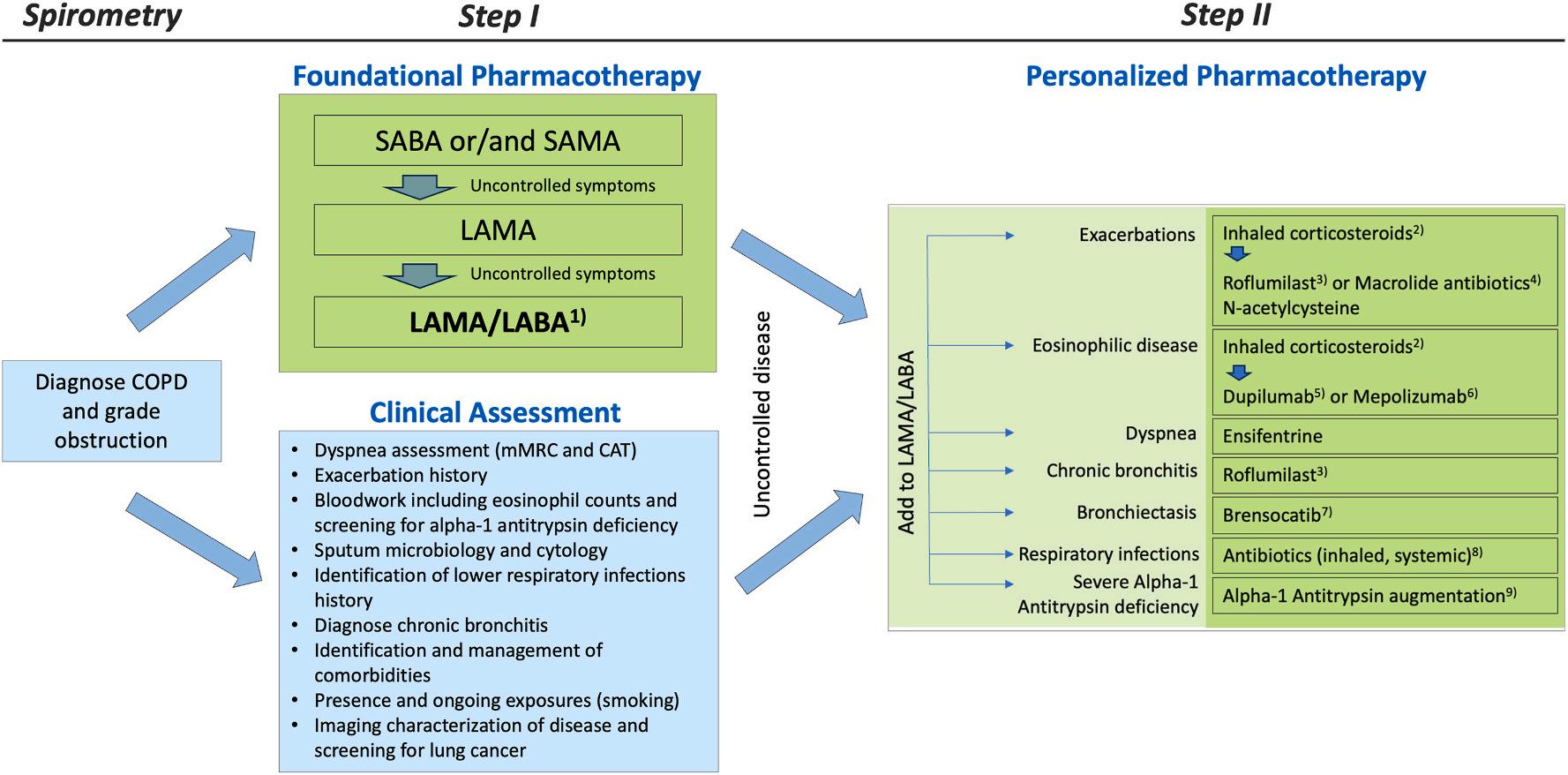
Fig. 1. Simplified 2-step algorithm for the pharmacological management of COPD: 1) Recommended prior to further escalation unless contraindicated, 2) Consider avoiding in Eos<100 cells/μL or history of lower respiratory infections, 3) Chronic bronchitis with exacerbation history, 4) Former smokers wth exacerbations, 5) Eos≥300 cells/μL, 6) Eos≥150 cells/μL, 7) Clinically relevant bronchiectasis with exacerbations, 8) Sputum cultures, 9) Confirmed severe alpha-1 antitrypsin deficiency
notwithstanding the less convincing effect on exacerbations, a likely consequence of study design [8]. If future studies confirm the broad mechanistic benefits and clinical impact[4], it is possible that PDE3/4 inhibitors may eventually belong to foundational therapies. Conversely, several frequently discussed phenotypes such as asthma–COPD overlap, COPD with heart failure, COPD with pulmonary hypertension (COPD-PH) or combined pulmonary fibrosis and emphysema (CPFE) are not currently incorporated in this algorithm due to the absence of solid data showing benefits of phenotype-specific pharmacotherapies beyond standard COPD management; nevertheless, a growing body of evidence supports their potential relevance. Likewise, phenotypes primarily linked to non-pharmacologic interventions (i.e. hyperinflated emphysema responsive to lung volume reduction [4]) are intentionally excluded from our medication-focused algorithm.
Taken together, this updated strategy provides a clearer, more clinically actionable pathway for integrating foundational and personalized therapies in COPD. It aligns evolving evidence with the structure and clarity needed for real-world implementation and supports continued advancement toward precision respiratory medicine.
CRediT authorship contribution statement
Igor Z. Barjaktarevic: Conceptualization, Data curation, Investigation, Methodology, Project administration, Supervision, Validation, Visualization, Writing – original draft, Writing – review & editing. Donald P. Tashkin: Conceptualization, Methodology, Supervision, Validation, Visualization, Writing – original draft, Writing – review & editing. Christopher B. Cooper: Conceptualization, Methodology, Project administration, Validation, Visualization, Writing – original draft, Writing – review & editing.
Declaration of competing interest
The authors declare the following financial interests/personal relationships which may be considered as potential competing interests: The authors declare that they have no known competing financial interests or personal relationships that could have appeared to influence the work reported in this article but report the following disclosures:Dr. Barjaktarevic reports consulting fees from Astra Zeneca, Therevance,
Viatris, Verona Pharma, Merck, Insmed, Takeda, Grifols, Liquidia, Aerogen, Sanofi and Regeneron, and Genentech, outside the submitted workChristopher Cooper reports personal fees from AstraZeneca, GSK, Chiesi, NUVAIRA, MGC Diagnostics, Horizon Therapeutics, Respiree, Herbalife, Verona, RS, BioTherapeutics, Genentech, and Cambridge University Press, outside the submitted work, none related to this work. Dr Tashkin reports no consulting fees.
References
[1] M.K. Han, A. Agusti, P.M. Calverley, et al., Chronic obstructive pulmonary disease phenotypes: the future of COPD, Am. J. Respir. Crit. Care Med. 182 (5) (2010) 598–604
[2] M. Mintz, I. Barjaktarevic, D.A. Mahler, et al., Reducing the risk of mortality in chronic obstructive pulmonary disease with pharmacotherapy: a narrative review, Mayo Clin. Proc. 98 (2) (2023) 301–315
[3] R. Buhl, M. Miravitlles, A. Anzueto, S. Brunton, Long-acting muscarinic antagonist and long-acting beta(2)-agonist combination for the treatment of maintenance therapy-naive patients with chronic obstructive pulmonary disease: a narrative review, Ther. Adv. Respir. Dis. 18 (2024) 17534666241279115
[4] GLOBAL STRATEGY FOR PREVENTION, Diagnosis and management of COPD: 2026 report. www.goldcopd.org, 2025.
[5] C.B. Cooper, I. Barjaktarevic, A new algorithm for the management of COPD, Lancet Respir. Med. 3 (4) (2015) 266–268
[6] J.D. Chalmers, P.R. Burgel, C.L. Daley, et al., Phase 3 trial of the DPP-1 inhibitor brensocatib in bronchiectasis, N. Engl. J. Med. 392 (16) (2025) 1569–1581
[7] A.T. Hill, A.L. Sullivan, J.D. Chalmers, et al., British thoracic society guideline for bronchiectasis in adults, Thorax 74 (Suppl 1) (2019) 1–69
[8] A. Anzueto, I.Z. Barjaktarevic, T.M. Siler, et al., Ensifentrine, a novel phosphodiesterase 3 and 4 inhibitor for the treatment of chronic obstructive pulmonary disease: randomized, double-blind, placebo-controlled, multicenter phase III trials (the ENHANCE trials), Am. J. Respir. Crit. Care Med. 208 (4) (2023) 406–416

Igor Z. Barjaktarevica,* , Donald P. Tashkina , Christopher B. Coopera,b
a Division of Pulmonary, Critical Care, and Sleep Medicine, Department of Medicine, David Geffen School of Medicine, University of California, Los Angeles, CA, USA
b Department of Physiology, David Geffen School of Medicine, University of California, Los Angeles, CA, USA
* Corresponding author. E-mail address: ibarjaktarevic@mednet.ucla.edu (I.Z. Barjaktarevic).