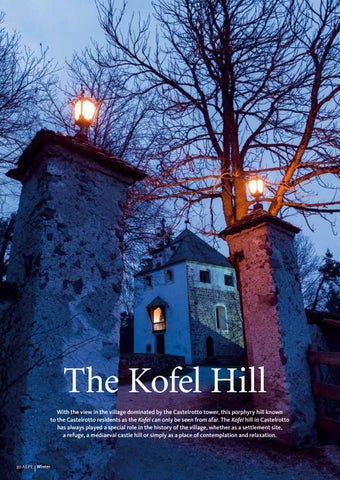
The Kofel Hill With the view in the village dominated by the Castelrotto tower, this porphyry hill known to the Castelrotto residents as the Kofel can only be seen from afar. The Kofel hill in Castelrotto has always played a special role in the history of the village, whether as a settlement site, a refuge, a mediaeval castle hill or simply as a place of contemplation and relaxation.
30 ALPE | Winter
A mystical site in the heart of Castelrotto
C Castellum ruptum. The ‘Broken Castle’. From time to time, guests ask about the castle ruins of the village. Castelrotto’s namesake is none other than this ‘Castellum ruptum’, a castle which once stood on the porphyry hill behind the town hall. Undoubtedly, it is not just an unusual memorial, but, given its location, a site steeped in historical importance. Locals and guests alike treasure the tranquillity of this hill, with its welcoming benches in the winter and shade under the large, leafy trees in summer. The highest point of the Kofel, known to locals as the Infong, is surrounded by a wall. It is a favoured spot for kids to play, and also for older wanderers to take their daily constitutional. Tra-
ditionally, this is the venue for the Oswald von Wolkenstein Riding Tournament and, over the last two years, for the festive open-air gourmet event known as the ‘Krausen Banquet’. Monte Calvario - the Calvary Hill. The right-hand entrance to the town hall leads to the Kofel, bought in the 17th century by Georg von Kraus, in order to build a Calvary. At that time the route was lined by six chapels and the crucifixion group, and a double chapel was built from the ruins of the mediaeval castle keep. The group with the disciples and Christ on the Olive Mount was only added in 1908; the statues were cut to the designs of »
Text: Barbara Pichler Photo: Helmuth Rier
Faith leads the way to the Calvary Hill.
Winter | ALPE 31
32 ALPE | Winter
local painter Eduard Burgauner, who also installed them. In 1908, the Holy Spirit Chapel, at the highest point of the Kofel, was converted by Burgauner into a memorial jubilee fountain in honour of Emperor Franz Josef. Wooden figurines depicting the Passion of Christ are housed within the chapel: Christ parting from his mother, the Mount of Olives, the flagellation, the Crowning with Thorns, Jesus carrying the cross, the Crucifixion Group, the Entombment and the double chapels of Saints Anthony and Cajetan. The chapels are cleaned and cared for by the Castelrotto locals all through the year. “The duty, or rather, the honour, of maintaining the chapels, and of decorating them during the Passion Week, depends on where you live in the village. The families who carry out this service for the community all live close to the Kofel,” says Franz Wendt, who tends the entombment chapel. Life is particularly hectic around the Kofel during Passion Week, when spruce branches are wound into garlands and the ball-shaped glasses are taken up from the cellars and filled with coloured water, tinted with Easter egg dye. “It wasn’t so easy in the past to find good lanterns for the garlands between the three crosses. There wasn’t as much choice as there is nowadays,” says Hans Peter Trocker. His family have looked after the crucifixion group for many years now; even when he was a child, he helped his father with the task. Othmar Burgauner is another who can remember helping his mother to decorate the flagellation chapel. He has been performing the task himself for many years now, assisted by his own son. It is, then, a responsibility which is handed down within families. In the same manner, the Silbernagl family have been looking after the first chapel - Jesus parting from his mother - for generations. “Normally, our housemaid Mena looked after the chapel and I was her helper,” says Martha Silbernagl. Now she tries to do everything exactly as Mena taught her: Heather blossom arranged around the figurines, candles lit behind the balls filled with coloured water to create a warm glow and a festive atmosphere.
Procession. The Holy Thursday and Good Friday processions take place on the Kofel. The chapel attendants arrive early to light the candles. In the St. Anthony Chapel in the tower, the altar has already been illuminated, the pews pushed back to allow enough room for the choir, and Paula Nössing stands ready to greet the congregation. «
Living tradition: The Kofel is sacred to the people of Castelrotto.
Winter | ALPE 33