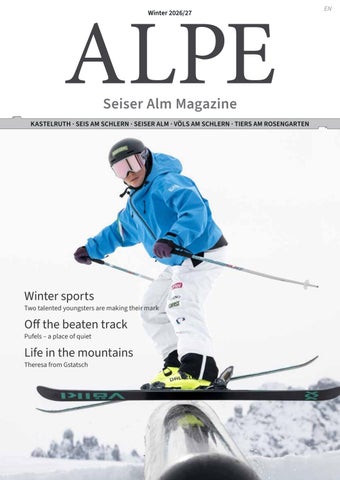
ALPE Winter 2026/27
Seiser Alm Magazine
KASTELRUTH · SEIS AM SCHLERN · SEISER ALM · VÖLS AM SCHLERN · TIERS AM ROSENGARTEN
Winter sports Two talented youngsters are making their mark
Off the beaten track Pufels – a place of quiet
Life in the mountains Theresa from Gstatsch
EN
Komma Graphik | Foto: SAM / Roschan Fill
Elevation difference 177,00 m Length 995,50 m Passenger capacity 2.200 people/hour Speed 5,00 m/s Journey time 3,225 mins
THE NEW
STEGER DELLAI
8-SEATER CHAIRLIFT
The new Steger Dellai 8 CLD 8-seater chairlift marks another important step towards the modernisation of the ski lifts on the Seiser Alm. It is the first 8-seater chairlift on the Seiser Alm. The installation, built by Doppelmayr, combines state-of-the-art cable car technology with the highest levels of comfort and optimum safety standards.
Photo: SAM/Roschan Fill
Foreword & Contents
Dear readers, Stories about fascinating people, places of interest and incredible events; sport and exercise, culture and tradition, the pleasures of the palate and the South Tyrolean way of life – the visitor’s magazine ALPE has been showcasing the region and its people for 25 years now. The editorial team is delighted to have been able to provide both holidaymakers and locals with comprehensive – and, we hope, entertaining – information over so many years. Here’s to many more years to come! In this issue of ALPE, you can sense the editorial team’s longing for winter and snow after such an intense and long summer, even in the Dolomites region Seiser Alm. There are no fewer than three skiing stories this time. Our young skiers, trained by the former professionals Denise Karbon, Alex Hofer and Verena Gasslitter, take their sport very seriously; the narratives of ski racer Anna Trocker and freestyle skier Maria Gasslitter reveal how two such talented young sportspeople have worked their way to the very top; while Albert Wanker, a paraplegic winter sports enthusiast, proves that you can go a very long way on the Seiser Alm – even on a monoski.
Page 4
In winter-flow Seiser Alm in white Away from the hustle and bustle, we present two wonderful places where absolute tranquillity reigns. The image of the Kastelruth hamlet of Pufels is reminiscent of a model railway landscape: just a few houses, a church tower, paths, meadows, woods and rocks. And, once nature covers fields and forests in white, the short walk to the Little Church of St Sebastian in Tiers am Rosengarten has a peacefulness that is hard to match. ALPE is also dedicating a profile to two special people: Theresa Gasslitter, doyenne of the Gstatsch inn, is 96 years old: she invites us on a walk to share the many years of her life. Marc Oberhofer, on the other hand, is still searching: although never actually wanting to become a chef, he and his team are now working to earn a Michelin star. The music bands of South Tyrol are a vital part of the local parades, processions and festivals. As they march, the “Musig” brings these sounds straight to the people. For the first time ever, the brass bands of the Schlern region came together for a marching show – and ALPE was there too.
Page 6
Winter sports Talents making their mark Page 12
Ski training Learning from the best Page 18
Off the beaten track Pufels – a place of quiet Page 22
Life in the mountains The Gstatsch landlady Page 26
Freedom Mobile with a monoski Page 30
Marching show Music on the move Page 34
Winter tranquillity Idyllic St Sebastian Page 38
Culinary arts Marc Oberhofer Page 44
Recipe Homemade biscuits Page 46 Winter Highlights 2026/27 Page 48
Helmut Mitterstieler President, Seiser Alm Marketing, on behalf of the tourist authorities of Kastelruth, Seis am Schlern, Völs am Schlern, Seiser Alm and Tiers am Rosengarten
Summer Preview 2027 Page 50
Seen & heard Winter | ALPE 3
In winter flow When scent of snow is in the air, skis glide silently over the landscape and the sense of time fades away, the world around us loses its significance: all that matters is the fascination of the moment. Away from the hustle and bustle of the ski slopes, the Seiser Alm offers endless expanses for cross-country skiing and winter walks – a natural spectacle that never fails to inspire.
Text: Elisabeth Augustin Photo: Helmuth Rier
4 ALPE | Winter
Winter | ALPE 5
On the way to the top Two young women, two dreams – freestyle skier Maria Gasslitter and downhill skier Anna Trocker are making their mark!
During the past winter season, two rising stars from the Dolomites Region Seiser Alm have made headlines with their sporting achievements: freestyle skier Maria Gasslitter and alpine skier Anna Trocker. In an interview with ALPE, they talk about their journey towards the world elite, the setbacks they have faced, and what matters more to them: winning or constantly striving to improve themselves?
ALPE: You’re both very young and, over the past winter season, you have established yourselves among the world’s best in your respective disciplines. What’s it like when the sportswomen who, just a short while ago, were your role models suddenly become your direct rivals? As young talents, do you still have respect for them?
Interview: Simone Treibenreif Photo: Helmuth Rier
6 ALPE | Winter
Maria Gasslitter: I hadn’t thought about it. In our sport, the relationships between us are very friendly – it’s almost like one big family. When someone skis well, everyone’s happy for them. And when you get to know the people who were once your role models at World Cup races, you quickly realise that they’re human too and that they often face the same difficulties as you
do: sometimes a “bump”, a jump, doesn’t quite suit them or is a bit too big, yet somehow they manage to master it. You can learn a lot from that – especially from the best. Anna Trocker: I watched the first World Cup races at the start of the season on TV and I never expected that I’d be racing against the world’s best women skiers so soon. My role model is Mikaela Shiffrin – suddenly being out on the course with her and the other World Cup skiers, seeing how they take it all in and tackle it – the warm-up and the whole preparation at the start – I found that all very interesting. Have you been able to pick up any tips? Anna Trocker: I think I’ve picked up a great many. Just the intense concentration while inspecting a
course; many of the others take an extremely long time to look over it, even committing certain sections to memory. And, even during the warm-up, their focus is usually already very much on the race. As a young skier, do you feel a sense of awe when suddenly you find yourself on the start line alongside such established sportswomen? Anna Trocker: Observing the whole ambience is certainly something special. On the other hand, they scarcely notice me. You were among the youngest members of the Italian team at the 2026 Milan-Cortina Winter Olympics. Was that an issue for you? Maria Gasslitter: Not for me.
Skier Anna Trocker (left) and freestyle skier Maria Gasslitter, who made their mark on the international sporting stage for the first time last winter.
Winter | ALPE 7
Photo: Marco Trovati / Pentaphoto
At the 2025-26 World Cup Finals, the young Anna Trocker, a native of Völs, finished ninth in the slalom and clocked the fastest time in the second run – beating even her great role model and the winner on the day, Mikaela Shiffrin.
Perhaps because freestyle skiing is generally a very young sport? Maria Gasslitter: Even though it’s a young sport, those at the forefront are usually those who’ve been competing in the World Cup for a while. For me, it was my very first season on the World Cup circuit and it wasn’t even sure that I’d make the Olympics, because only the top thirty from the two World Cup seasons leading up to the Games are allowed to take part. I had missed an entire season and then only had six races to get into the top thirty – which I only just managed. So I was really, really happy and decided to simply enjoy the Olympic Games. So it wasn’t your age
8 ALPE | Winter
that was the issue, but rather your lack of experience at this level? Maria Gasslitter: I wouldn’t say lack of experience, but rather that I’d only just started competing in the World Cup and that I’d missed a whole World Cup season. And, when you make the World Cup for the first time, you have to see how it all works to begin with: the jumps are bigger, so are the rails – everything’s a bit different, and you have to get some experience first. That’s why competing in the Olympics at the start of the season was one goal, but not one that came before everything else. I was really pleased that I made it in the end. The results were great too, and it’s all continued to go really well since the Olympics. I never
expected my first World Cup season to turn out like this. Were your young age and inexperience brought up when it came to your Olympic participation? Anna Trocker: Not really – although my selection for the Olympics did come as a surprise, even to me. I’d competed in the World Cup previously, but never managed to qualify for the second run; however, I’d achieved some very good placings in FIS and Nor-Am Cup races. Before the Olympics, the message was that they wanted to let young skiers compete so they could gain experience. During the pre-Olympic training, however, our age was never an issue; we followed the same programme
Maria Gasslitter only began competing in the Freeski World Cup in the 2025-26 season and immediately established herself amongst the world’s best – qualifying for the 2026 Milan-Cortina Winter Olympics.
as everyone else and there was never any discussion as to why one person was selected and another not. What drives you to keep training day after day, to keep giving your best – even when it gets tough? Anna Trocker: I simply like skiing. In the summer, I look forward to winter, and in winter I enjoy training on the slopes. I like improving, pushing myself to the limit and learning how far I can go. It’s also good fun being part of the group – I enjoy travelling to the races. We get on really well as a group. Maria Gasslitter: I have to say that I still really enjoy skiing – I think you can see that. I always have a brilliant time and I abso-
lutely love skiing. If I have a day off in winter and I’m at home, I still head up to the Seiser Alm to ski – or rather, to do jumps. I can spend the whole day in the snow park by the Laurin lift – and I enjoy every run and every jump. I get so much out of it. And, while there are sometimes difficult moments, there are just as many when you realise it’s coming together and all that hard work is paying off. Those are the moments that drive you on when things get that bit tougher. When is it that you, Anna, realise that all the effort is paying off? Anna Trocker: It’s when you see that what you’re doing – the training – is worth it – and then when you manage a good run.
How do you deal with setbacks? Maria Gasslitter: Fortunately, I haven’t had any major setbacks so far. Anna Trocker: I’ve had a few injuries but, when you practise this sport, you have to accept that something might happen. It’s the same for me as for everyone else. The most important thing is not to give up and to take things as they come. And to train hard again, even after injury, and go through the vital rehabilitation training so you can get back on your skis in good shape. What’s more important to you: winning or improving yourselves? Anna Trocker: For me, it’s seeing that I’ve improved and devel-
Winter | ALPE 9
_ Anna Trocker
_ Maria Gasslitter
Born in 2008, this young sportswoman from Völs am Schlern is one of the most promising new talents in Italian downhill skiing. She started at the age of three alongside her mother, who herself once competed in the Ski World Cup. Anna Trocker demonstrated her talent while competing at junior and youth level, but also had to cope with a number of injuries. Nevertheless, as a technical specialist, she achieved impressive results at international competitions in winter 2024-25 and last season, 2025-26, began to make a name for herself among the world’s best. Following several outstanding results in FIS and Nor-Am Cup races, she was nominated for the Ski World Cup for the first time in late December 2025, shortly after her 17th birthday. Although she narrowly missed out on the second run in the giant slalom at Semmering, Austria, her performance was impressive. This was followed by further World Cup appearances and qualification for the Milan-Cortina Winter Olympics. The youngest Olympian from South Tyrol finished tenth in the team combined event. Then, in March 2026, Anna Trocker caused a sensation at the Junior World Championships in Narvik, Norway: she won gold in both the giant slalom and the slalom – in each case with a clear lead over her rivals, some of whom were considerably older – as well as silver in the team combined event. Her two Junior World Championship titles meant she was eligible to compete at the World Cup Finals in Lillehammer in Norway, where she achieved two top-ten finishes: ninth in the slalom, clocking the fastest time in the second run – beating her great role model and the day’s overall winner, Mikaela Shiffrin – while, in the giant slalom, she finished eighth. To round off the season, she also won the Italian championship titles in her speciality disciplines.
Within just a few years, this freestyle skier from Kastelruth, born in 2006, has made a name for herself on the international freestyle scene – following in the footsteps of her mother, Petra Moroder. As a mogul specialist, Moroder competed in the Winter Olympics three times, won a World Championship silver medal and secured several podium finishes in the World Cup. Maria Gasslitter initially competed in downhill skiing, but switched to freestyle at the age of 13 – and found her true sporting passion in the slopestyle and Big Air events.
Anna Trocker has recently joined the ski team of Italy’s Polizia di Stato, alongside her older sister Nadine.
10 ALPE | Winter
At the 2024 Junior World Championships in Livigno, Gasslitter achieved an impressive two top-ten finishes: sixth place in slopestyle and ninth in Big Air. Also in 2024, she triumphed in the World Rookie Tour, a series for young talent. The next major step followed in 2025:, when Maria Gasslitter dominated the Freestyle European Cup season and won the overall title. In the 2025-26 season, she finally made her Freeski World Cup debut and established herself among the world’s best. In January 2026, she managed her best World Cup result of the winter, with a fifth-place finish in the slopestyle event in Aspen in the USA. At the 2026 Milan-Cortina Winter Olympics – where Maria Gasslitter was one of the youngest members of the Italian team – she qualified for the finals in both slopestyle and Big Air, eventually finishing tenth and ninth respectively. She went on to confirm her ability with further top-ten finishes in the World Cup. Maria Gasslitter, who cites horse riding and playing the violin as her hobbies, was recently accepted into Italy’s Carabinieri skiing team.
Photo: Pentaphoto
She can never get enough of her sport: Maria Gasslitter likes to spend her free days in the snow park by the Laurin lift on the Seiser Alm.
oped technically, and that my times are good. Whether you win or not always depends on the competition: because, even if you yourself have two good runs, someone else might have two even better ones. Maria Gasslitter: Of course, you’d always like to be right out in front, but that’s not always possible – sometimes when you go into a race, you already know you don’t stand a chance of finishing in the top spot. That’s why the most important thing for me is to be satisfied with my own performance, especially in slopestyle – when I manage to put in a great run, one where everything is just right. That always gives me a really good
feeling. And managing a really good run is always very difficult, because so many little details can go wrong and so much has to come together exactly at the right moment. That’s why, when I manage to do everything perfectly – which is actually almost impossible – it means an awful lot to me. What are your sporting goals? Maria Gasslitter: I’ve achieved one major goal just by competing at the Olympics. Now I want to keep skiing well, have fun, learn new tricks and – naturally – also do really well in races. Anna Trocker: My goal is to develop my technique further and iron out any mistakes – I
still have plenty of room for improvement. I want to try to do that every day. And it would be wonderful to make the Olympic Games once more.
Anna Trocker was the youngest competitor from South Tyrol at the 2026 Milan-Cortina Winter Olympics.
Where do you see yourselves in five years from now? Still on skis and keeping active? Anna Trocker: I certainly hope so and that nothing will get in the way. The aim is of course to ski as well as possible. Maria Gasslitter: That’s hard to say; five years is a very long time and a lot can happen in that time. In any case, I hope that I’ll still enjoy skiing so much that I can relish every moment when I’m on the start line and continue to give it my best shot. <
Winter | ALPE 11
Denise Karbon has won two World Championship medals in the giant slalom, achieved 16 podium finishes in World Cup events and won the World Cup discipline title; she now trains young skiers on the Seiser Alm.
12 ALPE | Winter
From World Cup to practice slope They used to compete for World Cup points and podium places; now they are passing on their knowledge to the next generation. Former racing skiers Denise Karbon, Verena Gasslitter and Alex Hofer are currently coaching young up-and-coming talents on the Seiser Alm.
Daily training, the battle for hundredths of a second and the challenge of giving your all at the crucial moment: for Denise Karbon, Verena Gasslitter and Alex Hofer, this was for many years the main focus of their lives. They competed in ski racing at the very highest level, pitting themselves against the world’s best in the Ski World Cup. Now, however, they are no longer the ones whizzing through the gates; instead, they stand alongside the piste, giving instructions. The three former top skiers work as coaches on the Seiser Alm, supporting youngsters at the three local sports clubs: ASC Seiser Alm, ASV Völs am Schlern and Seiser Alm Ski Team.
to compete at that level”, she surmises. “At first, the kids are amazed, but that soon passes.” Generally speaking, she sees no difference in how the children interact with her compared to the other coaches on the team.
World Cup history – hardly an issue
Verena Gasslitter, who for several years now has been coaching skiers born in 2017 and 2018, has had a similar experience. “When you ask the children what they’d like to be when they grow up, some have very clear ideas and say: I want to be a ski racer”, she explains. “But the children hardly ever ask me about my time competing in the European Cup or World Cup. And, if they do, it usually quite quickly becomes a secondary issue because children ask so many questions about so many different things.”
But is this successful sporting past even an issue for the younger generation? “For the children in my training group, it wasn’t a big deal, especially the very young – they were about six years old at the time. To them, I was simply “Denise”, says Karbon, who has achieved sixteen podium finishes at World Cup events and has now been coaching children for some six years. “Over the past year or two, quite a few of them have actually mentioned it to me.” She reckons this is probably down to the children getting older. “Some have started following the Ski World Cup and are fans of the top competitors. This creates a link to the fact that I too used
Alex Hofer, who coaches teenagers, is also rarely asked about his World Cup past. “It did however come up once”, he recalls with a smile, “when I beat Marco Odermatt in a European Cup race.” The teenagers also notice that he is personally acquainted with many of those from the world of top-level skiing. Hofer coaches the Juniors – youngsters aged between 16 and 20 – and oversees both their skiing and their fitness training. He had already worked for the Seiser Alm Ski Team during his career as an active ski racer – as a fitness coach during the summer of 2022. He enjoyed working with young people. “I enjoy pass-
Text: Simone Treibenreif Fotos: Helmuth Rier
Winter | ALPE 13
Verena Gasslitter used to compete in World Cup and European Cup races: since 2022-23 she has been working as a ski coach for children.
Is the positioning right? Is the heading correct? Denise Karbon watches one of her protégés during a training run.
14 ALPE | Winter
ing on my knowledge”, says Hofer, adding: “I’m convinced that my experiences as a top-level sportsman mean that I can offer the youngsters something valuable: I’ve had good times and difficult times – I’ve experienced every level. When I see certain things and put them into perspective against this background, I can teach the up-andcoming young talent a great deal.” Children communicate differently Verena Gasslitter adds that, while she can draw on her experience as a ski racer, it is not always easy to get the message across in view of the young age of her training group. “You can’t just communicate things word for word, because the children won’t understand. You first have to find a way to make sure that they actually grasp what you’re trying to say”, says Gasslitter. It is often not the words themselves, but rather creative aids on the slope – such as a gate pole placed in an unusual position – that achieve the desired effect. One year after the end of her active sporting career, Verena Gasslitter switched from working as a ski instructor to her role as ski coach; winter 2026-27 will now be her fourth season. She works exclusively as a coach in winter while, in summer, she runs a riding centre. For Denise Karbon, who ended her active sporting career in 2014, working with young talent is also one of several roles she has taken on in addition to her main job – that of training ski instructors. She became a youth coach in 2021 rather by chance, when her daughter Pia, born in 2015, did a racing course “taster”. Denise’s younger son, Samuel, now also competes in ski races. Pia is still in her mother’s training group which, with its three coaches, consists of 23 children born in 2015 and 2016 from all the villages in the Schlern area,. As well as training on snow – three times a week in winter – and participation in competitions at the weekend, Karbon also regularly leads fitness
Goals: skiing, self-confidence and fair play
and preparatory training sessions away from the slopes. “But it’s training on skis that I enjoy most; that’s when I can really empathise with the children”, she says. “I enjoy seeing not only how they develop physically, but also mentally. Sometimes they get scared when the piste is a little steeper or icier, or if they feel unsure.” Supporting them in these moments and having faith that they can meet the challenge is both rewarding and wonderful – especially when the children successfully overcome difficulties and are pleased with themselves. Fun and Determination At this age, you can already see the children’s characteristics and strengths, but the aim is not yet to identify future World Cup skiers. “The path a child will take – whether they enjoy the sport and are prepared to make sacrifices for it, and whether their family will support a racing career – these things only become clear later on”, says Denise Karbon. Gasslitter and Hofer also share this view: “Everyone should have the opportunity to develop; children and young people should learn to ski well and to be fair within the group – even when things don’t go quite as they might hope”.
Winter | ALPE 15
_ Short biographies Born in 1996, Verena Gasslitter from Kastelruth specialised in the speed disciplines of downhill and super-G, competing in these events in the World Cup between 2016 and 2020 and finishing in the points on two occasions. In the second-highest racing series, the European Cup, Verena secured several podium finishes and, in the greatest success of her career, won the Super-G discipline standings in the 2015-16 season. Since 2022-23 she has been working as a ski coach for children. Alex Hofer, born in 1994, grew up in Kastelruth and now lives in Völs am Schlern. Between 2018 and 2023, he competed in some 23 World Cup giant slaloms, achieving several finishes in the points. His best result was 18th place in Adelboden, Switzerland, in 2022. In the European Cup, the second-highest racing series, Alex Hofer made it onto the podium on several occasions. Immediately after retiring from competitive skiing, in spring 2024, he joined the Seiser Alm Ski Team as a youth coach. Denise Karbon, born in 1980 and raised in Kastelruth, was for many years one of the top female competitors on the Alpine Skiing World Cup circuit. In 1999 she became Junior World Champion in the giant slalom, going on to win two World Championship medals in her speciality and achieving 16 podium finishes in World Cup events – six of those as winner. In 2008 she won the World Cup discipline title, while in 2004 she finished second. Suffering numerous injuries, Karbon ended her competitive career in 2014. She now lives in Völs am Schlern with her husband Franz Hofer, a top mountain biker, and their two children. In 2021 she began working as a children’s ski coach.
16 ALPE | Winter
Former Ski World Cup athlete Alex Hofer is well-placed to pass on his knowledge to the next generation of racers.
Denise Karbon does not know how long she will continue in her role as a youth coach. “At the moment, it is logistically feasible; I can take my children to training or they can train at the same time as me – it is important for me to strike this balance. It’s too early to say how things will turn out over the next few years.” Alex Hofer says: “I travelled a lot with my sport for many years; now I’m really enjoying being at home and at the club”. However, even though he currently finds his youth coaching role very rewarding and enjoyable, he is not sure whether, in the long term, he might want to take his professional future in a different direction – perhaps from working with young people to those competing in the top international racing series.
Verena Gasslitter too wants to continue coaching young skiers – but with one proviso. “The older the children get, the more intense the training becomes – there’s more fitness training and there’s glacier skiing in the spring and autumn. But I don’t want to go back up to the glaciers; that wasn’t my thing even when I was active as a ski racer”, she laughs. That is why she wants to stick with the younger age groups. Whether they are former World Cup competitors or dedicated youth coaches, what matters most to all three is not their own past, but the joy they gain from supporting and encouraging children and young people on their sporting journeys. <
KOMMAGraphik | Foto: Helmuth Rier
ard bito-mCobil u a Coithm t ou
c Pass Nortdi auto-mobil withou
w
Nam
e&
Surn
am
e. C
ard
not
tras
fera
ble. Your Name
o Eur 4 9 ,00 - 74 ero: 08 4 ior Sen ta num - 09:2 Car 2.2026 23.1
Your
& Surname.
Card not trasfe
rable.
00 Euro Senior - 90, : 1224 Carta numero 24 08: 12.01.2027 -
WITH COMBI CARD OR NORDIC PASS AFFORDABLY TO THE WINTER WONDERLAND Benefit card for toboganists, hikers and snow shoe hikers, cross-country skiers. Combi Card 3 in 7
73.00 Euro
Nordic Pass 3 in 7
90.00 Euro
In the course of 7 successive days (after first use)
Over the course of 7 successive days (after first use)
> 3 times to the Seiser Alm and back, with the Seiser Alm Aerial Cableway OR the Seiser Alm Express (Bus Routes 10) > unrestricted use of the Shuttle Bus Service (Bus Routes 1, 2, 3, 3A, 5, 15) around the Seiser Alm and the Almbus (Bus Routes 11) > Extra charge for the dog: 15.00 €
> on 3 days unrestricted use of the Seiser Alm Aerial Cableway OR the Seiser Alm Express (Bus Route 10), on the same 3 days unrestricted use of using the Cross-Country Ski Courses Seiser Alm / Val Gardena and the Almbus (Bus Routes 11) > unrestricted use of the Shuttle Bus Service (Bus Routes 1, 2, 3, 3A, 5, 15)
Combi Card 7
Nordic Pass 7
95.00 Euro
121.00 Euro
Valid for 7 successive days (after first use)
Valid for 7 successive days (after first use)
> unrestricted use of the Seiser Alm Aerial Cableway or the Seiser Alm Express (Bus Route 10) > unrestricted use of the Shuttle Bus Service (Bus Routes 1, 2, 3, 3A, 5, 15) around the Seiser Alm and the Almbus (Bus Routes 11) > Extra charge for the dog: 35.00 €
> unrestricted use of the Cross-Country Ski Courses Seiser Alm / Val Gardena, of the Seiser Alm Aerial Cableway and the Seiser Alm Express (Bus Route 10) > unrestricted use of the Shuttle Bus Service (Bus Routes 1, 2, 3, 3A, 5, 15) and the Almbus (Bus Route 11)
Combi Card 14
143.00 Euro
Valid for 14 successive days (after first use) > unrestricted use of the Seiser Alm Aerial Cableway or the Seiser Alm Express (Bus Route 10) > unrestricted use of the Shuttle Bus Service (Bus Routes 1, 2, 3, 3A, 5, 15) around the Seiser Alm and the Almbus (Bus Routes 11) > Extra charge for the dog: 45.00 €
Nordic Pass 14
184.00 Euro
Valid for 14 successive days (after first use) > unrestricted use of the Cross-Country Ski Courses Seiser Alm / Val Gardena, of the Seiser Alm Aerial Cableway and the Seiser Alm Express (Bus Route 10) > unrestricted use of the Shuttle Bus Service (Bus Routes 1, 2, 3, 3A, 5, 15) and the Almbus (Bus Route 11)
> The Combi Card and the Nordic Pass are not transferable and are available at all cash desks of the Seiser Alm Aerial Cableway, at the Tourist Offices of Kastelruth, Seis am Schlern, Völs am Schlern and at some accommodation. > Combi Card: Kids born 2019–2027 and persons in wheelchairs ride free of charge. Juniors born 2009–2018 pay only half fare. > Nordic Pass: Juniors born after 01.01.2011 pay only half fare.
Seis-Seiser Alm Aerial Cableway 39040 Seis am Schlern · Schlernstr. 39 Tel. +39 0471 704 270 · www.seiseralmbahn.it · info@seiseralmbahn.it
View of St. Ulrich: Pufels belongs to the municipality of Kastelruth, but is strongly oriented towards the Gröden Valley in terms of its language and culture.
A little off the beaten track Beyond a tunnel – one that is only 20 years old – the world suddenly takes on a different appearance. In the little village of Pufels, one thing stands out above all else: a reflective sense of quiet.
Ancient farmsteads are scattered across the mountainside, separated by snow-covered meadows in winter: the slopes of the Puflatsch hill rise above. The houses appear spread out at random, yet they are distributed quite evenly; the scene inevitably brings to mind the replica landscape of a model railway, with a few houses, a church tower, paths, meadows, woods and rocks. The Kastelruth “fraction” – that is, district – of Pufels lies at an altitude of 1,481 metres above sea level on a hillside above the outer reaches of the Gröden Valley. You need a moment to get your bearings when you emerge from the tunnel in Pufels, as many trusted landmarks are no longer familiar. Looking down, you can see St. Ulrich, the Gröden Valley’s main town, with the slopes of the Seceda rising behind it. Although Pufels is not far from the settlements in the valley and the Schlern region, it is nonetheless a little off the beaten track – and sufficiently far from the hustle and bustle.
Text: Sabine Funk Photo: Helmuth Rier
18 ALPE | Winter
“This”, says Leopold Kasslatter, “is the end of the line”. He means this in an entirely positive sense: the fact that the road ends here and no through traffic passes through the village is, for him, one of the great advantages of Pufels. Kasslatter is the landlord of the Platz inn, which plays a special role in this little village. Pufels in fact has no village square as such; the inn, so to speak, forms the centre. Kasslatter has very close ties to the es-
tablishment: his family has now been running the inn for three generations. The history of the inn goes back a long way and it is said to have existed since 1280. The family history is also impressive: Kasslatter’s grandmother, the former landlady, gave birth to no fewer than twenty children, a detail that is inscribed on the imposing gravestone in the small cemetery. Six of her children did not reach adolescence, but 14 grew to adulthood. Their mother did not reach the age of fifty, however, dying as a result of her final childbirth. Life in Pufels was for a long time anything but comfortable. Older accounts of the village repeatedly mention poverty and hunger. The fields were too high to produce cereals in any quantity, while early snowfall could jeopardise the whole harvest. “In the past, people here lived solely from potatoes, arable and livestock farming”, explains Kasslatter. Nevertheless, the existence of permanent human settlement up here is by no means a recent development: Pufels was first documented as early as 1250 and, by 1288, eight existing farmsteads were registered, evolving over the centuries into the scattered settlement we see today. The landscape, too, bears witness to the passage of time. Over the centuries, the stream known as the Pufler Bach has carved its way deep into the
Winter | ALPE 19
The Pufels Gorge was once a veritable treasure trove of fossils.
The people lived mainly from livestock farming and whatever the bare fields would yield. land, forming the Pufels Gorge – once a veritable treasure trove of the fossils that bear witness to the geological origins of the Dolomites. The Geologists’ Trail, leading from the Pinei Pass to Pufels, is dedicated to this fascinating subject. The path from Pufels up to the Seiser Alm was once one of the shortest routes to the pastures; farmers from the Gröden Valley would also pass through the locality with their livestock. The connection is still visible today: in autumn, the traditional cattle drive down from the mountain pastures to St. Michael still passes through Pufels. “For the farmers, it’s a short route up here”, says Kasslatter. The old link to the pastureland is not mere history – it is still a part of the everyday life of the village. The Ladin language is spoken here. Another aspect of the history of Pufels that has been preserved is its language. Administratively, the village
20 ALPE | Winter
belongs to the market town of Kastelruth: linguistically and culturally, however, the situation is more ambivalent. Pufels is – alongside the hamlet of Runggaditsch – one of two Ladin-speaking villages within the municipal area. The language boundary runs along the Pinei Pass, i.e. the pass between Kastelruth and Gröden. Ladin is the ancient Rhaeto-Romance language spoken in South Tyrol, primarily in the Gröden and Badia valleys, and is inextricably linked to the identity of these Dolomite valleys and their inhabitants. There is even a separate Ladin school system, with Ladin also used as a medium of instruction (alongside Italian and German) as part of a deliberate policy of nurturing the language. “Like all South Tyroleans, we are situated not only between Italy and Austria, but also between Ladinia and the Schlern region”, says Kasslatter. The village used to have its own school; today, the children travel to Runggaditsch and subsequently attend the middle school in St. Ulrich, the valley’s main town. As in the Gröden Valley, the regional languages continue to coexist side by side. The days when people mainly married within their own community
As recently as fifty years ago, visitors would walk up from here to go skiing on the Seiser Alm in winter.
are however here too a thing of the past; and families who speak only Ladin are becoming rarer. Kasslatter speaks Ladin with certain friends and German with others. The language persists – yet at the same time is changing. An acoustic sanctuary. For a long time, the village could only be reached via a winding mountain road. Rockfalls and snow made the journey particularly difficult in winter. It was not until 1977 that access via the Pinei Pass became easier, with the tunnel opened in 2006, putting St. Ulrich within easy reach. This has also made Pufels a more attractive place to live, yet, in a positive sense, it remains secluded. The farmsteads remain, some of them almost as if from another era. Farm stay vacations, small guesthouses and holiday flats are all available, while wood carvers and wood sculptors – typical
forms of Ladin arts and crafts – are part of the village tradition. The music band also helps to keep village life going. Life in winter has changed too. In the past, visitors would use Pufels directly as a base for skiing holidays on the Seiser Alm, walking up while horsedrawn carriages transported their skis. They would then spend the whole day skiing from the Steger and Demetz lifts – and be content with that. Nowadays, however, many visitors prioritise quick access to such skiing highlights as the Saslong piste or the Sellaronda carousel. Above all, there exists a tranquillity here in Pufels – the hamlet lies in a sort of acoustic sanctuary. The noise of the main roads fades away in the Pufels Gorge. Even in the evening, says Kasslatter, you can hardly hear any cars; the busy road over the Pinei Pass is inaudible. Perhaps it is the silence beyond the tunnel that is today the village’s most precious asset. <
Winter | ALPE 21
In winter Theresa Gasslitter walks from the Wiedner Eck towards Compatsch whenever she can.
“ Are you older than me?” Theresa Gasslitter is 96 and walks on the Seiser Alm almost every day in winter, best of all under the larch trees: a stroll that takes in a lifetime.
Theresa Gasslitter has no need to press the “stop” button: the bus driver knows exactly where the frail old lady with the ice-blue eyes and carefully plaited bun will get off. Just before the road curves down towards Saltria, at the Wiedner Eck, the driver brakes and opens the front door. Theresa Gasslitter springs to her feet, darts down the steps and leaves the bus with a cheery “Grazie, arrivederci!” Now she is where she begins her walk almost every day in winter. The biting cold wind of the last few days has died down; there is still snow on the Seiser Alm, with hardly anyone in sight. “Isn’t it wonderful?” exclaims Theresa. “It’s as if we were alone in the world!”
Text: Lisa Maria Gasser Photo: Helmuth Rier
22 ALPE | Winter
As a young woman, Theresa Gasslitter often went up to the Seiser Alm to help the farmers with the haymaking, centred on the traditional “Schwoagen” [hay barns]. That was in summer: she never saw the Alm in winter, she says. Back then she was busy running the establishment she had taken over with her husband in 1956: the Gstatsch inn, on the road up to the Seiser Alm, at an altitude of just under 1,500 metres. Theresa was 26 years old in 1956: now she is 96. That this is an extraordinary woman who is making her way along the icy path through the sparse coniferous forest towards Compatsch is demonstrated not only by the impressive pace set by this former landlady, but also by her stories of the past and her thoughts of today.
The life on which “Theresa from Gstatsch” can look back is rich both in work and in children. She herself is from a family of seven children and grew up in St. Oswald: her husband Bernhard, whom she met at the Gstatsch inn while working as a seamstress, had ten siblings. They themselves had eight children together. While Bernhard ran the eponymous farm, Theresa worked in the kitchen at the inn (which opened its doors in 1911), did the washing, looked after the guests – and her children. She still clearly remembers the relief she felt when, in 1960, her husband bought their first washing machine. It was the year when their third child and first son was born. “I was so happy!” she laughs – a cheerful, infectious laugh that the 96-year-old loves to let ring out. It is not just at the inn that Theresa has witnessed and lived through many changes: first there was a wood-burning stove, then an oil burner. “It was only with the gas hob that cooking became easier – and the kitchen was no longer full of soot”, she says. These days they have an electric stove. “Now I’d love to start cooking for myself again”, she admits. The former landlady speaks honestly about the burdens and hardships she has known, yet sounds neither bitter nor as if she wished to complain: times were simply different back then. Nor have the changes up on the Seiser Alm escaped her notice. She points to an overgrown path: she
Winter | ALPE 23
The 96-year-old loves nothing more than being amongst the larch trees, which she talks to, asking them questions – even if no answers are forthcoming.
24 ALPE | Winter
The ice-blue eyes of this mother of eight, grandmother and great-grandmother have witnessed almost a whole century, yet show no signs of fatigue.
knows that horse- and ox-drawn carts once made their way along the track. And, where there are now winding tarmac roads, there used to be nothing but gravel – or indeed no road at all. Nowadays machines take care of the haymaking that she once did by hand in the summer weeks, wearing her long skirt: mowing, raking, gathering. “The distances that we used to walk”, says Theresa, “can hardly be imagined today.” She has never counted the hours or miles that she has covered on foot. “But it was lovely – and you were never alone; you would always meet people along the way.” Now, she says, it’s all “just a little bit different”. Her gaze wanders over the snow- and ice-covered meadows beneath the cloudy winter sky. In all those years she had hardly time to think about herself. “You know,” she says, sounding pensive, “there was so much work to do just in that kitchen.” The next sentence comes softly: “It feels as though I’ve lost so many years.” But her bright eyes immediately light up again: “That’s why I can enjoy it all now.” By “it” Theresa first and foremost means the natural world, whose beauty she repeatedly points out along the way. How many times must she have done this walk before? Yet she seems to have lost none of her enthusiasm. “It’s a paradise!” The eyes that have seen so much, the feet that have walked so far, show no sign of tiredness. The 96-year-old nimbly swings under a wooden fence so as to avoid an icy patch on the way. Although she’s well equipped for the walk, she remains alert. She says she considers it a great blessing that, despite the many summers and winters she has seen, she is in good health and still has a spring in her step. “Not everyone is so lucky.” The author and student of history Joachim Schwarz from Kastelruth has recorded Theresa Gasslitter’s memoirs in his book “Der groaße Rechen” [The Great Harvest]. There, we learn that she was probably the first woman in the area to
obtain a driving licence and get behind the wheel, back in 1958. Her husband had urged her to do so, not least so that she could help with transporting livestock. For most women back then, cars were off-limits. “One of my brothers-in-law said to my husband: ‘You’re not going to let her drive, are you? You’ll never be able to keep her at home!’”, she recalls with a smile. She drove for the last time at the age of 86.
Theresa Gasslitter was born in St. Oswald in 1930. She has lived at the Gstatsch inn since she was 26 years old: she still lends a hand in the family business there.
Light snow is falling as the path leads towards the Ritsch Schwaige hut, run by one of Theresa’s daughters and her family. There is a warm welcome; her grandson, one of 25, is also there in the dining room. She also has 27 great-grandchildren, she says, not without a touch of pride. “But I’m just Granny to one and all.” This includes the guests at Gstatsch, Theresa’s home, where she still lives. Whenever she can, she lends a hand. But, best of all, she loves being up on the Seiser Alm. And the very best of all, she confides, is being among the larch trees. “I talk to them and sometimes ask one: “Are you older than me?” But they don’t answer.” There it is again, that twinkle in the eyes of this little woman among these tall trees. Time has not stood still for Theresa Gasslitter: but it has paused for her, up here on her mountain pasture. She needs no stop button for that. <
Winter | ALPE 25
26 ALPE | Winter
Freedom on the slopes For Albert Wanker, skiing is above all about enjoyment and freedom. Since suffering an accident, he has been paraplegic and gets about on the Seiser Alm on his monoski. Albert’s story shows how modern technology, perseverance and passion can make winter sports accessible to all.
Albert Wanker with his wife Ulrike, who spend around 45 days together on the ski slopes in winter.
The sun is shining brightly, a pleasant breeze blows over your face, and your skis glide smoothly over the snow – this is what skiers dream of. It’s no different for Albert Wanker: he relishes the feeling of freedom and ease as he carves his way down the slopes on the Seiser Alm. Yet this man in his mid-fifties, who along with his wife Ulrike runs a bar in Pufels, just below the Seiser Alm, catches the eye when he is out on his skis – or, to be more
precise, on his single ski. Albert, who has been paraplegic since a work-related accident 25 years ago, uses what is known as a monoski. Winter sports equipment for wheelchair users This type of winter sports equipment was developed for wheelchair users with spinal cord injuries
Text: Simone Treibenreif Photo: Helmuth Rier
Winter | ALPE 27
Albert Wanker really enjoys riding his monoski and tries to get out onto the slopes as often as he can.
28 ALPE | Winter
The monoski’s suspension system can be adjusted to the rider’s style and ability.
or who have difficulty when walking: the user sits in an ergonomically shaped shell with a backrest and is secured by straps. The seat shell is mounted on a single alpine ski via a suspension system, hence the name “monoski”. Albert explains: “The shock absorbers can be adjusted to suit your own skiing style, ability and the piste conditions”. The suspension thus compensates for uneven slopes and ensures greater comfort and control. Monoskis are apparently produced by just two manufacturers in Europe: Albert’s model is from Austria and has been adapted to his personal requirements. However, he does not use the ski brand favoured by the monoski manufacturer, but his own favourite instead. The monoski is steered using outriggers, two short pole-like extensions – which Albert also calls “crutches” – that are essential for the skier’s balance and help with steering and braking. The outriggers look like a cross between ski poles and small skis. The mini-skis are attached to the ends of the poles; on flat piste sections or at the lifts they can be retracted by means of a finger-operated mechanism. This allows the poles to be used like conventional ski poles. The cost of this essential basic equipment runs to several thousand euros. Albert Wanker really enjoys riding his monoski and tries to get out onto the slopes as often as possible. He spent around 45 days on his monoski last winter, on the Seiser Alm and elsewhere. “When I go skiing with my wife, I usually have to wait for her at the lifts – I’m faster than she is”, he says with a smile. Although things are fine now, Albert’s early days on the monoski, some ten years ago, were not always so easy. “Skiing on slopes with hollows or moguls was quite exhausting”, he recalls, “as it was on ice.” Getting onto lifts was just as much of a challenge, for example because he hadn’t pushed himself up high enough, or the mechanism on the monoski didn’t work as it should to get onto a chairlift. To get on, Albert has to fold up the mini-skis on the
end of the poles, set the monoski’s shock absorber to the “chairlift position”, brace himself and sit on his seat. The use of drag lifts also requires careful coordination: the monoski has its own special attachment for this purpose. Armed with the necessary determination, however, Albert quickly learnt everything he needed to know and became an enthusiast for the sport and the associated sense of lightness and independence. For a while he even took part in monoski races with a sports group; he has since completed training as a monoski instructor in Austria. “It took four years, just like a conventional ski instructor training course. Alongside monoskiers from Austria and Italy, there were also participants from Switzerland and the Netherlands”, he states. Improvisation is sometimes necessary Many of the issues that require little effort for “normal” skiers are rather more difficult for monoskiers. Take gondola lifts, for example: if a monoski skier needs to use one, he or she can only do so while seated in a wheelchair. The monoski must be carried into and out of the gondola by a companion, and switching to the monoski is only possible once the skier is on the snow. Even stopping for a break at a mountain hut next to a ski run is only possible if a wheelchair is available. “Sometimes, though, you can stop at the edge of the terrace and be served there” says Albert, demonstrating his talent for improvisation and his adaptability. The “Accessibility Check” recently carried out by monorolly.com also shows that, when it comes to accessibility for monoskiers, there is still room for improvement on the Seiser Alm. It was nevertheless also emphasised that the Seiser Alm can be described as “very wheelchair-friendly, with much of the area ideal for monoskiers – from the car parking right through to the ski lifts. In South Tyrol, concludes Hans-Peter Schraffl, who conducted the tests: “As a ski resort the Seiser Alm is certainly a leader in this respect” <
Winter | ALPE 29
Music on the move In May 2026, a first-of-its-kind event was celebrated in Völs am Schlern: the music bands of the Dolomites region Seiser Alm took up the unique challenge of performing a „Marching Show“ together.
South Tyrol is home to no fewer than 209 active music bands that give around 2,600 public concerts a year and are an integral part of church events and official celebrations. Their high musical standards are the result of first-rate training, intensive rehearsal and, not least, the ambition that drives the bands and promotes the diversity of their repertoire. For their performances, the musicians usually wear their time-honoured village costumes, thus making an indispensable contribution to the preservation of traditions and customs.
Text: Elisabeth Augustin Photo: Helmuth Rier
30 ALPE | Winter
Manfred Haselrieder, conductor of the Völs am Schlern ensemble, had a particularly ingenious idea: during a performance in the Überetsch region, he heard that two music bands were to hold their marching rehearsals together. So what
if the six bands from the Schlern area – that is, the Dolomites region Seiser Alm – were brought together for a single marching event? The idea certainly sounded ambitious, but it went down well with the organisers and the potential participants. Right from the start, the main focus was on the joy of making music: there was to be no judging of the marching itself, because “anyone who takes part in an event like this is already a winner from the very outset”, as Manfred Haselrieder puts it. The Marching Show – a unique experience Manfred emphasises the importance of marching: “It is impossible to imagine a South Tyrolean music band that does not also march.” For
The musicians, approximately 250 strong, marched in festive traditional costume.
the “Musig”, as it is known locally, it is not just the concert that matters. “At parades, processions and festivals, marching allows us to bring the music directly to the people. When a band marches in step, this – alongside the right notes – creates a polished and professional impression. And it strengthens the sense of community amongst the musicians.” Barely two years after the idea was conceived, and following a series of preparatory meetings and rehearsals, Manfred Haselrieder saw all six
bands gathered at the marching event: five took part in the march, while one performed the opening concert. It was an uplifting moment – and ALPE was also there, live: May 2026: it is a beautiful Saturday evening. At 7.40 pm, the bands from Völs am Schlern, Völser Aicha, Tiers am Rosengarten, Seis am Schlern and Kastelruth march, one after the other, onto the football pitch in Völs. The music band from Pufels has previously given a concert at the village’s festival ground. As the sun slowly sets be-
The marching bands put a great deal of heart and enthusiasm into their first joint marching show.
Winter | ALPE 31
The six music bands in figures Kastelruth Founded in 1796 Currently 65 members (30 women, 35 men) Average age 25.8 years Director: Maria Karbon Bandmaster: Jonas Holzknecht Conductor: Günther Prossliner Völs am Schlern Founded in 1809 Currently 68 members (26 women, 42 men) Average age 31.3 years Director: Martin Rabensteiner Bandmaster: Michael Vikoler Conductor: Manfred Haselrieder Tiers am Rosengarten Founded in 1836 Currently 27 members (10 women, 17 men) Average age 37.45 years Director: Markus Resch Bandmaster: Johannes Heim Conductor: Julius Villgrattner Völser Aicha Founded in 1857 Currently 48 members (19 women, 29 men) Average age 35.5 years Director: Manuela Erna Koch Bandmaster: Tobias Profanter Conductor: Markus Kompatscher Pufels Founded in 1888 Currently 34 members (14 women, 20 men) Average age 34.26 years Director: Daniel Hofer Bandmaster: Luzia Tirler Conductor: Daniel Hofer Seis am Schlern Founded in 1912 Currently 62 members (27 women, 35 men) Average age 32 years Director: Elias Malfertheiner Bandmaster: Michael Pichler Conductor: Christian Fill
32 ALPE | Winter
hind the Ritten plateau to the west, the musicians – some 250 in all – form up for a unique performance. In the stands, the Provincial Bandmaster Michael Vikoler, Provincial Conductor Klaus Fischnaller and announcer Toni Profanter – the former Provincial Conductor – are already glowing with pride. At the ceremonial opening of the Marching Show – dubbed “Marching United” by the directors and conductors – it is emphasised that never before has there been such an event in South Tyrol. Bringing six bands together in this way could only succeed if the idea came from within and was supported by all those involved. “Fall in and – MARCH!” First to march in is the Völser Aicha band. Their programme has the theme “Marching on Sunshine”. The imaginative choreography – featuring an opening thunderstorm and a blossoming flower to the “Awakening” march, as well as “Die Sonne geht auf” – is clearly great fun for the band’s 48 members. At one point, the female musicians even dance to “Walking on Sunshine”, delighting the audience with their fluttering blue aprons. Next up are the hosts, the 68-strong band from Völs am Schlern, who march in to “Treu zur Musik”. This is a staple of the brass band and marching music repertoire. There is great applause for the band’s heart-shaped formation as the musicians play “Tiroler Herz”, accompanied by their singing: the march celebrates the bond with the craggy region of South Tyrol, the mountains themselves and the traditional roots. During the world-famous “Schneewalzer” waltz, three of the musicians prove themselves to be talented Goasslschnöller, whip-crackers. Finally, the Völs band puts on a modern and lively performance of the party song “Wackelkontakt”, together with a little fireworks display.
Then, the smaller band from Tiers am Rosengarten enters in a butterfly shape and, to the sound of a drum roll, forms up as a “long train”. A polka, “Die Vogelwiese”, prompts the band to perform a 360-degree turn, after which they line up as the train, then turn 90 degrees to resume their normal formation before marching off while continuing to play. The members of the Seis am Schlern band join the ensemble to the dramatic strains of Richard Strauss’s “Also Sprach Zarathustra”. The band then marches in rows of five from the back to the front. At the conductor’s signal, the formation of five switches to a formation of three, then immediately goes back to a formation of five. In technical terms this is known as “falling out, falling in”. All this is followed by a “music lyre” formation: the performance concludes with the melody “Ein Leben lang” by the band Fäaschtbänkler. The band from the market town of Kastelruth marches in to the tune of “Mein Heimatland” by Sepp Neumayr. For the “Olympiade” march the band adopts a wide formation of five circles, evoking the 2026 Winter Olympics: a number of events were held in the South Tyrolean locality of Antholz. The people of Kastelruth in fact have an Olympian in their ranks, namely ski racer Florian Schieder. The five circles then merge into two, thus forming a heart shape. Naturally, “Eine weisse Rose” and a medley of well-known songs by the Kastelruther Spatzen folk group feature on the programme. After the hour-long show, the five bands march in together once more. While, ultimately, none of the bands has actually won anything, they have all gained a wealth of experience, admiration and applause. This unique experience, soon to become a cherished memory, is rounded off with a joint performance of Sepp Thaler’s march “Mein Heimatland”. <
Their joy of music and community spirit keeps he marching bands going.
_ The conductor Manfred Haselrieder has been the conductor of the Völs am Schlern band since 2018. This is an important role, particularly as he leads the band behind the standard-bearer during performances and parades and must therefore set a good example. ALPE: So behind every conductor stands or marches a row of musicians?
Manfred Haselrieder: The Völs music band has a total of 68 members. I march at the head of the formation and set the beat, determining the tempo, the direction of march and any change of direction. This is done in close consultation with the bandmaster, who is responsible for the overall musical direction while the band is not marching. And you use your baton to give the appropriate signals and commands? Yes, I use the baton to direct the music and the formation while we are on the move. The baton, which is 130 centimetres long, signals when to march off or to halt, as well as when to start and stop playing. When the sharp end of the baton points upwards, it is the signal to march; when the round end points upwards, it relates to the music. What do you do when the band is playing a concert? Well, then I’m just a simple musician and I play the baritone horn.
Winter | ALPE 33
Caption: The Little Church is dedicated to Saint Sebastian. A Roman soldier and Christian martyr, he is among other things regarded as the patron saint of wells, gardeners, police officers, foresters and hunters, and is invoked for protection against plagues.
A place of tranquillity The Little Church of St Sebastian stands in a woodland clearing, some thirty minutes from the village of Tiers am Rosengarten. With its magnificent views of the Rosengarten massif, here reigns a heavenly tranquillity.
associations and families. The bronze reliefs are the work of the German sculptor Walter Mellmann, who died in 2001, while the wooden pillars were designed and erected by Norbert Pattis. The aim was to create a Via Crucis that would be both weather-resistant and long-lasting. Situated at 1,200 metres above sea level, many paths lead to the church. The quickest route – for those perhaps needing a quick break to clear their mind or let their thoughts wander – is the Way of the Cross: this leads from the village community centre in Tiers am Rosengarten through the Pauln Valley, along a short stretch of the Oberstrasse, then up a slightly steeper slope through the woods and directly to the idyllic clearing.
Text: Katja Sanin Photo: Helmuth Rier
34 ALPE | Winter
The Way of the Cross was created around 25 years ago by the parish council of the time, with the help and financial support of several Tiers-based
In winter, when nature covers fields and woods with its white blanket, this short walk offers a tranquillity that is hard to match. With luck, someone – perhaps the hiking guide Heidi Pattis – will have cleared the snow from the table and bench up by the little church and the sun will already have dried the wood, so that you can comfortably spend time there even in winter. In addition to the seating by the church, there is another bench where walkers can take a rest a little higher up in the woodland clearing, also known as the “Weihboden” or “consecrated
Winter | ALPE 35
36 ALPE | Winter
ground”. The clearing was used as a place of worship as far back as pagan times, when people believed in various gods and spirits of nature, and would offer sacrifices to them. Paganism was replaced by Christianity in the Roman Empire from the year 312 onwards: the Emperor Constantine permitted the Christian faith, with the subsequent Christianisation of humanity transforming the European world. Although it is not open to the public, through the window of the church – dedicated to St Sebastian and St Roch, the patron saints of the plaguestricken – the mural and a very simply designed, black-stained altar can be glimpsed. It was built
in Gothic style in 1635, as the plague raged in the area: its shingled roof and small bell tower offer a charming simplicity.
Churches and chapels in South Tyrol are often situated in places that invite contemplation, such as the Little Church of St Sebastian in Tiers am Rosengarten.
For a slightly longer walk, the Little Church of St Sebastian can also be reached from Weisslahn bad via the Wuhnleger lake, or from the village centre of Tiers via Völsegg. You could almost say that all roads lead to St Sebastian, as even a hike up to the Tschafon peak can lead via St Sebastian on the way back down to the village. Although the Tschafon hut is not open in winter, the climb is well worth it for the views alone. Depending on the snow conditions, you may need either snowshoes or spikes.
Winter | ALPE 37
Making his own way Marc Oberhofer is a chef on a mission – a quest that involves finding newness, simplicity and criticism. He draws inspiration from the forest – and from a farmer who has since become a friend.
As if it were only yesterday, Marc Oberhofer lists the dishes he has prepared for what is probably his most special guest to date: “Vegetarian black pudding, smoked beef marrow, “Aspinger crudo”, golden trout tartare, mountain herb risotto with smoked lamb ham, char with burnt whey and dandelion capers, zebu lights with buckwheat flat dumplings and Oona caviar.” He can’t quite remember what was served for dessert. He does, however, remember very well what Italian President Sergio Mattarella said to him after the meal: “He said he’d never had so much of the forest on his plate as he’d had here with us. That was welcome criticism”.
Text: Lisa Maria Gasser Photo: Kayaminds
38 ALPE | Winter
The expression “here with us” refers to the Hotel Lamm on the village square in Kastelruth, which houses the gourmet restaurant known as the “Lampl Stube”. Oberhofer has been head chef there for almost ten years: his partner, Verena Gabrielli, is the hotel’s managing director. Although Marc grew up in a hotel establishment, his path to the kitchen was anything but a foregone conclusion. “I didn’t follow the traditional routes”, he says. Perhaps this is why he does things a little differently, doing “only what I’m personally
convinced of”. In his kitchen this means radically regional, seasonal and constantly new. Actually, he never wanted to be a chef, says Oberhofer – a tall man, with shaven head and dimples when he smiles – as he leans back briefly in the soft armchair. He’s on his lunch break. In the background is a bookshelf; soft lounge music is playing. He immediately straightens up. As a boy he knew only one thing: gruelling training. His dream was to become a professional cyclist, and he was well on the way to realising it. As he grew up, however, he began to lose focus; after having to repeat a school year, his father eventually sent him to college to study the hotel trade. Marc opted for an apprenticeship as a cook. His father Leo, himself a chef, at the time ran the Hotel Ritterhof – located at the entrance to the village of Seis – along with his wife Hanni. Oberhofer says he “really liked” working in the kitchen from the outset. “I could enjoy being creative and seeing lots of new things.” There was no celebrity chef there as mentor, nor any stints in Copenhagen or Paris. “I don’t have the CV that other top chefs have”, says Marc, 44.
“I don’t have the same CV that other top chefs have.” Despite this – or perhaps precisely because of it – Marc Oberhofer, 44, is always on the lookout for something new.
Winter | ALPE 39
Different; less; and whatever the season provides: the head chef at the “Lampl Stube” sources the vast majority of his ingredients from nature – and from farmer Harald Aspinger in Barbian.
Everything he can do today, he taught himself. He read a lot, tried things out, abandoned them, tried again – and talked a lot, especially with farmers. The ambition to compete at the very top came later, he reveals. His parents instilled in him one thing above all others: discipline. “And perseverance, even when things got tough.” He does not need to put his appreciation for his parents into words: his two gourmet menus are named after his father and mother. The beginnings at the Lampl Stube were difficult. Looking back, Oberhofer says that, in the early years, he tried to please everyone. Alongside the regional menu, there was a “cosmopolitan” option on offer: prawns, scallops, sea bass, turbot – just what a guest might expect in a gourmet restaurant. He himself, however, didn’t believe in it. “I didn’t feel comfortable with it all.” So he began to cut things out: no more sea fish, no more lobster. Instead, he chose char and whitefish, supposedly less “classy” fish from local waters. There was also plenty from the forest: lichen, pine cones, spruce shoots, mountain pine, dandelion capers, wild garlic and elderberry. The kitchen team, including the head chef himself, all forage for these natural ingredients. Since then, he says, guest feedback has been better than ever before. Because the season helps dictate the menu, Oberhofer avoids using fresh produce in winter. In summer and autumn, therefore, dozens of varieties of vegetables and herbs are pickled and fermented in jars. The menus are created in a counter-cyclical manner, with the winter menu planned as early as autumn. “And it’s new every season”, Marc emphasises: a dish from the previous year will almost never reappear on the menu. He likes to draw inspiration from old dishes – and from a man from the village of Barbian. That is where Harald Aspinger grows over a thousand vegetable varieties on an area covering just four hectares. The Lampl Stube sources all of its vegetables from him. The supplier relationship has now become a friendship; from the friendship has sprung a collaborative workshop. The two men meet regularly, tasting and trying things out. If the chef is looking for something that goes well with milk, he will ask the farmer, who finds something.
Winter | ALPE 41
He has recently bred a thumb-sized cross between an orange and a lemon – a “South Tyrolean lemon” – with which Oberhofer is now experimenting for his winter menu. But Aspinger is also the one who drives him on. When Oberhofer wanted to order the same herbs and salads as last year for the new season, the farmer refused. Everything must be new, was the message. “Harald really pushes me hard”, says Marc – and sounds grateful for it. The partnership is evident right from the start of every menu: in summer, the “Aspinger crudo” puts 47 herbs and 15 pickled vegetables together on a single plate; in winter, there are 80 pickled items. As well as growing vegetables, Aspinger, who keeps zebu cattle, also provides the meat. Oberhofer uses every part of the animal, from head to hoof – a skill that a chef must first master. Marc has now hung up his racing bike. As he admits: “I miss it, but I simply don’t have the time
for cycling”. Instead, he does plenty of other sport in his limited spare time. As well as running the gourmet restaurant, he also manages the Lamm’s hotel kitchen and heads a team of ten people. The gourmet section is run by a trio: Marc, his sous-chef Luigi Iadicicco, and Oberhofer’s son Simon. Sommelier Gianluca Rovai complements the team. There are three tables, a maximum of twelve guests, and thirteen courses. The standard is simple to express, but difficult to maintain: “Nothing leaves the kitchen that isn’t 1,000 per cent perfect”. Nevertheless, Oberhofer claims that he manages in a different way from how he himself was managed. His own training was very strict; in his kitchen, however, he allows creative freedom – and encourages the team to grow together. Even so, discipline remains non-negotiable. The same goes for his closeness to guests: “I think it’s vital for the guests to see the chefs”. Several times an evening, Oberhofer personally goes round the tables, explaining what’s on each plate and where it comes from. The “Große Restaurant & Hotel Guide” named him South Tyrol’s “Chef of the Year” for 2026, describing him as a “culinary artist”. The Gault&Millau restaurant guide called him an “experimenter” and awarded him 17 out of 20 points. For Falstaff Italy, he is the current “Newcomer of the Year.” And as of this year, Lampl Stube has also made it into the Michelin Guide. No star yet, but a foot in the door. But there is one accolade that Oberhofer still hopes to receive: “For a chef, there’s nothing finer than a Michelin star”. He openly admits that his team is working towards this goal. He also states that he welcomes criticism: “I can do more with that than if someone, after thirteen courses, says that everything was fantastic”.
Marc Oberhofer cooked a seven-course meal for Italian President Sergio Mattarella (left) – and in return received a comment that has stayed with him.
42 ALPE | Winter
Sergio Mattarella’s praise has nevertheless stayed with him. Just like the seven-course menu that, by way of exception, he put together for the Italian president during the latter’s visit in the summer of 2025. One year later there was a brief reunion in Seis, where Mattarella was once again spending his summer holiday and where Oberhofer and Gabrielli are based. Next spring, the pair plan to visit him at the Quirinal Palace in Rome, an invitation extended during their first, culinary, encounter. It may not be a Michelin star – but it is something no guide can give or take away. <
Respect the Dolomites Respect the mountain in winter We all love sunny winter walks, perfectly groomed ski runs, fantastic cross-country ski trails, fun toboggan runs, idyllic snow-shoe hikes, ice-skating fun or romantic horse-drawn sleigh rides in a dreamy setting. The Dolomites Region Seiser Alm, with Kastelruth, Seis am Schlern, Seiser Alm, Völs am Schlern and Tiers am Rosengarten, offers ideal conditions for relaxing and varied activities in a breathtaking natural landscape. Help us to preserve the Dolomites Region Seiser Alm as an attractive living space for everyone! Be respectful and work together with us to preserve our unique natural environment. Your support counts!
Less waste - more nature Our mountain scenery is a delicate ecosystem. It is extremely important not to leave any rubbish behind. Even dog poop bags must not be discarded in the countryside. The best kind of waste is waste that is not produced at all.
Consideration for wildlife Winter is the hardest time of year for wild animals. Snow, cold weather and lack of food mean they need to do all they can to save energy. But if they are frightened and stressed repeatedly, they lose too much energy and can also die from exhaustion. That’s why dogs must be kept on a lead.
Move safely - more fun To ensure that every excursion becomes an unforgettable winter experience, it is essential to plan carefully, travel by public transport, be adequately equipped, and avoid dangerous areas. To preserve our unique natural landscape, it is important to respect the marked trails. Walking on cross-country ski trails is prohibited.
Further tips for a mindful and unforgettable holiday: www.seiseralm.it/respect
®
CERTIFIED GSTC DGD260106
Homemade biscuits ... ... not just for Christmas
Homemade biscuits have always formed part of South Tyrol’s baking tradition. Made from a simple, delicate shortcrust pastry, they are buttery, crumbly and wonderfully versatile. They are delicious all year round, either with a cup of coffee or just as a little treat – and are of course a must on any plate of biscuits at Christmas. The shortcrust pastry is also perfect for making the classic “Spitzbuben”, cookies filled with light jam.
INGREDIENTS
PREPARATION
600 g flour 400 g butter 200 g sugar 2 eggs Zest of one unwaxed lemon 1 pinch vanilla 1 sachet baking powder
Spread the flour on a working surface, then add the sugar, vanilla, baking powder, lemon zest and the two eggs. Cut the butter into small pieces, then briskly knead the dough, form it into a ball and leave to rest in the fridge for at least one hour. Roll out the dough on a lightly floured working surface and cut out various biscuit shapes using cookie cutters. Bake at 180 degrees for around 10 minutes. The biscuits should be lightly browned. Recipe (also works for Spitzbuben, cookies filled with jam)
Rezept: Barbara Pichler Photo: Helmuth Rier
44 ALPE | Winter
@carezzadolomites #mycarezza www.carezza.it
from Tiers/Tires to the Dolomites World Heritage
Rosengarten
Photo: SAM/Fabian Dalpiaz
Photo: SchlossPrösels/Helmuth Rier
Photo: TVKastelruth/Helmuth Rier
Winter Highlights 2026/27
December 2026
Winter 2026/27
Winter 2026/27
CHRISTMAS MAGIC IN THE DOLOMITES REGION SEISER ALM
PRÖSELS CASTLE IN THE WINTER
WINTER-ADVENTURES OFF THE SLOPES
Prösels Castle is also open to visitors in winter. Winter castle tours offer a variety-packed alternative to skiing. Every Thursday from from 14 January to 11 March 2027, Prösels Castle will be awakening from its winter slumber and open its doors at 3 pm. During a one-hour tour, visitors will learn a wealth of fascinating information about the castle and its former residents and, at the same time, can visit three art exhibitions and a vast weaponry collection. On three days this winter (28.12.2026, 04.01.2027 and 11.02.2027) at 3 pm, the “Winter Cuisine & Culture” event will be held once more at Prösels Castle: After the castle tour, guests will have the opportunity to sample traditional local products free of charge in the castle grounds, where local producers will be hosting an array of stands. schloss-proesels.it
The Nature Experience programme includes pilates courses with breakfast in Kastelruth. In Seis we enjoy the evening twilight and bake bread together. In Völs, you can enjoy an exquisite gourmet experience named “hike with mill and farm tour and traditional lunch” and guided tours in the Prösels Castle dedicated to the taste, history and culture. In Tiers, we can explore the rustic Tschamin valley on a snowshoe guided hike through the untouched winter countryside and Bread baking workshops. On full-moon nights, you have the opportunity to embark on a hike across the snowy Seiser Alm. Kaiserschmarrn cooking courses are also offered in an Alpine hut. seiseralm.it/winteradventure
When the air is thick with the scent of gingerbread, cinnamon and mulled wine, you know it’s advent time here at the foot of the Schlern mountain. The run-up to Christmas is a meaningful time here in the Dolomites Region Seiser Alm; the Christmas markets in the villages of Kastelruth, Seis, Völs and Tiers are small but incredibly beautiful, and are guaranteed to get guests and locals alike into the Christmas spirit, far from the hustle and bustle of the city. With their traditional handcrafts, specialties of South Tyrolean cuisine and Christmassy melodies, they warmly invite you to join them for a sociable Advent of companionship.
20th Kastelruth Mountain Christmas > 28–29 November 2026 > 4–8 December 2026 > 11–13 December 2026 > 18–20 December 2026 > 23–24 December 2026 > 26–27 December 2026 Waiting for Jesus Child in Völs am Schlern > 7 December 2026 > 12 December 2026 > 19–20 December 2026 > 26 December 2026 > 29 December 2026 > 5 January 2027 Winterfeast Mountaineer’s Winter in Tiers am Rosengarten Culinary delight with local products > 12 December 2026 > 19 December 2026 > 26 December 2026 Seis on Ice Ice skating with varied entertainment programme for young and old. > 28 November 2026 to 9 January 2027
46 ALPE | Winter
Prior booking is essential for winter guided tours and can be reserved at the Castle up to 12 pm on the day of the event: info@schloss-proesels.it Winter 2026/27
SCHLERN-ROSENGARTEN NATURE PARK VISITOR CENTER While nature rests outside, the Visitor Center in Seis am Schlern offers insights into the diverse and fascinating flora and fauna of the Schlern-Rosengarten Nature Park. With the special exhibition “Countdown to Mass Extinction,” a special focus will be placed on climate change this winter. The visitor center can be visited free of charge during opening hours. seiseralm.it/visitorcenter
6 January 2027
WINE ON ICE VÖLSER WEIHER LAKE A winter treat at the Völser Weiher. The exclusive ‘Wine on Ice’ event takes place at the Völser Weiher, one of South Tyrol’s most beautiful spots. From 12 noon, the curling rink transforms into an elegant setting for indulgence, where selected winemakers and caterers showcase their passion for wine and fine dining. Lounge and jazz music, fire pits, stylish bar tables and wine barrels create a cosy atmosphere that invites you to linger.
Photo: SAM/Fabian Dalpiaz
Photo: SAM/Kottersteger
Photo: SAM/Armin Mayr
17 January 2027
31 January 2027
March 2027
March 2027
THE KASTELRUTH FARMER’S WEDDING
TRADITIONAL SKIJÖRING ON THE SEISER ALM
EARLY BIRD SKIING WITH ALPINE BREAKFAST
SWING ON SNOW WINTER MUSIC FESTIVAL
Over the years, it has grown to become an established tradition: The Kastelruth Farmer’s Wedding. It is an authentic reproduction of an old-fashioned farmer’s wedding as celebrated since time immemorial here at the foot of the Seiser Alm. The high point of the event is the wedding parade from St. Valentin to Kastelruth. The wedding party, dressed in traditional attire, drive to the centre of Kastelruth in a magnificently decorated horse-drawn sleigh, bringing their guests along with them on a trip back in time to the 19th century.
Fascinating combination of skis and horsepower! In skijoring, skiers are pulled by horses over a prepared course and engage in exciting races. A spectacular experience for participants and spectators.
Exclusive skiing experience for early risers followed by breakfast on the Seiser Alm. Weekly, three ski lifts will take turns to start running at 7 am. Early risers will have the unique opportunity to cross the freshly groomed, deserted slopes and enjoy the special morning atmosphere on Europe’s largest mountain plateau, accompanied by a ski instructor who will provide a wealth of handy tips. At 9 am, we’ll be heading to a mountain hut to enjoy a sociable Alpine breakfast.
For six days, the Dolomites Region Seiser Alm transforms into a unique soundscape: during Swing on Snow, folk music, brass, soul, pop, and jazz merge into an unmistakable alpine festival experience. For 21 years, the WinterMusicFestival has been inviting guests from near and far to combine the joys of winter with musical highlights. In the mornings, the first notes can be heard at the Seiser Alm cable car mountain station, at midday the music continues in the huts of the Seiser Alm. In the evenings, concerts fill the villages of Kastelruth, Seis am Schlern, Völs am Schlern und Tiers am Rosengarten – often in such an intimate setting that it feels like a private living room concert. Swing on Snow is a small yet special insider tip: the concerts are personal and intimate – and still of the highest quality. The performing musicians are by no means unknown; many are among the most exciting discoveries in folk, brass, soul, pop, and jazz music. Alongside them, renowned bands perform that usually only appear on the big stages. swingonsnow.com
22 January 2027
SOUTH TYROL MOONLIGHT CLASSIC SEISER ALM A sporting event illuminated by the glow of flickering torchlight, the chance to put your skills to the test at international level, and the magical winter backdrop of Europe’s largest mountain plateau: In 2026, the Moonlight Classic will once again be offering numerous athletes and cross-country fans the chance to spend a sensational evening on the Seiser Alm by night. Participants can opt to take part in either the 30 km or the 15 km variant of the loop route. Both variants begin and end in Compatsch and are raced exclusively in classic diagonal style. The starting pistol for this cross-country spectacle will be fired at 8 pm.
6 March 2027
NOSTALGIA FUN RACE Travel back to bygone days at the Nostalgic Jamboree ace! Numerous nostalgia groups from South Tyrol and the Alpine region have been invited to the Seiser Alm to do just that. Before the race, there will be a charming parade featuring participants in their vintage attire. Spectators can admire the period clothing from a variety of eras on the Panorama slope and meet the nostalgia skiers during the lunch break in the surrounding huts.
DATES > Wednesday, 3 March 2027 > Wednesday, 10 March 2027 > Wednesday, 17 March 2027 > Wednesday, 24 March 2027 > Wednesday, 31 March 2027 27 March 2027
TASTE MILE SEISER ALM Enjoy special culinary experiences right on the ski slopes of the Seiser Alm! Several mountain huts will be transformed into culinary stops, offering regional specialities and selected products from local producers to taste. Accompanied by local wines and atmospheric music, the event combines winter sports, regional cuisine and unforgettable culinary experiences in a unique and breathtaking setting.
Registration required: moonlightclassic.info
Winter | ALPE 47
Photo: TV Seis am Schlern
Photo: OvW-Ritt
Photo: SAM/Roschan Fill
Summer Preview 2027
10 May – 2 July 2027
Summer 2027
11 – 13 June 2027
18 and 19 June 2027
SEISER ALM BALANCE
PRÖSELS CASTLE IN SUMMER
KASTELRUTHER SPATZEN OPEN-AIR CONCERT
Fancy a break? When the days get longer in spring and nature awakens, the desire for outdoor exercise increases. With special “Balance” experiences you can recharge your batteries in and with nature. A morning hike to the Tschafon mountain refuge, a yoga session on the Calvary hill in Kastelruth or taking a pottery course. The Balance experiences offer movement, relaxation and well-being for body and mind. seiseralm.it/balance
From 1 May to 31 October, Prösels Castle, dating back to the days of Maximilian and arguably Tyrol’s most emblematic castle, is open to the public. Guided tours will offer visitors a fascinating insight into the history of the castle and the infamous Lords of Völs, so closely interwoven in the threads of time. A series of concerts, readings and special events round off this castle’s cultural programme. Prösels Castle has two outdoor escapes. Children (9 years old and upwards) accompanied by their parents, young people and adults in groups of up to 5 people can put their skills to the test in intuition, creativity, team spirit, logic, maths and, above all, their ability to learn and have fun. And while the kids are having fun in the play park, their parents can savour the delights of local cuisine in the castle bar. schloss-proesels.it
44TH OSWALD VON WOLKENSTEIN RIDING TOURNAMENT
5 – 20 June 2027
CULINARY WEEKS: SCHLERNGENUSS DOLOMITES During this period, you can expect delicious dishes made from ingredients that come from the Dolomites Region Seiser Alm (0 km) in all participating restaurants. Gourmets will get an insight into the large selection of local specialties. seiseralm.it/culinaryweeks
3 days, 4 locations and 36 teams: In tribute to knight and minstrel Oswald von Wolkenstein, the three villages of Kastelruth, Seis am Schlern and Völs am Schlern organise a historical riding tournament at its very finest. On 11, 12 and 13 June 2027, visitors of the Oswald von Wolkenstein Riding Tournament can leap back in time to the 14th century and experience life in the Middle Ages, admire the masterly horsemanship and feel the hospitality in South Tyrol. No other riding tournament has the good fortune to be able to offer this kind of culture, tradition, history, sport and folklore all rolled into one single event. This year, the opening ceremony and festive parade take place in the village Seis am Schlern. ovwritt.com 5 June 2027
„VÖLSER DORFKUCHL“ (STREET FOOD) IN VÖLS This evening, the church square in Völs will be transformed into a unique culinary venue. Creative show kitchens and gourmet stands, led by farmers of Völs will transform the village centre into a very special gastronomic mile. seiseralm.it/culinaryexperiences
48 ALPE | Winter
Thousands of fans make their way to Seis am Schlern to enjoy the breath-taking landscape and to experience the “Spatzen” live. They’ll be treating fans and friends to a nostalgia concert of their hits from 1993 to today. This coming year, as always, music bands from near and far will be providing fringe entertainment. July / August 2027
WITCHES‘ NIGHTS IN SEIS AND KASTELRUTH Experience magical evenings in the village centers of Kastelruth and Seis am Schlern, because there is a lot on offer at the Witches‘ Nights! Various live bands provide a great atmosphere, while folk dance groups show off their skills. There is a variety of children‘s entertainment for the little ones and, as a highlight, the witches dance on the village square. 21 June – 6 September 2027
SUMMER CLASSICS IN SEIS AM SCHLERN Seis offers an extraordinary series of concerts for lovers of classical music. The artists, mainly from Italy and with a wealth of international experience behind them, will be performing the works of great composers.
Photo: SAM: Helmuth Rier
Photo: SAM/Roschan Fill
Photo: IDM/Wild Zoo Entertainment
15 July 2027
10 July 2027
8 September 2027
1 – 31 October 2027
BERGLER TAFEL MOUNTAINEERS‘ DINNER
10TH ROSENGARTEN SCHLERN SKY MARATHON
TRADITIONAL ALM MARKET
On 15 July, a 100-meter-long table at the “Berglertafel” offers space for 170 guests, who can enjoy a five-course gourmet menu with a panoramic view of the Enrosadira at the Rosengarten. seiseralm.it/culinaryexperiences
Right in the very heart of the unique Dolomites UNESCO World Heritage, a 45-kilometre Alpine Mountain Marathon with around 3,000 m of elevation difference will set off from Tiers am Rosengarten. There are two other routes to choose from: 36 km with 2,000 meters in elevation and 16 km with 800 meters in elevation. The challenging mountain race will begin in St. Zyprian at 1,136 m asl, lead round the Rosengarten Massif, over the Schlern and the Tschafon and back to Tiers am Rosengarten. The highest point of the Sky Marathon is the Grasleiten Pass at 2,630 m. skymarathontiers.it
The traditional Alm Market in Compatsch is held every year on 8 September, and features live music, stalls selling a wide variety of goods, and culinary specialities.
50TH VÖLSER KUCHLKASTL GASTRONOMIC OCTOBER CULINARY FESTIVAL
4 July 2027
14TH SEISER ALM HALF MARATHON 21 kilometres, 601 metres of elevation difference and 1000 participants: These are the key statistics of the Seiser Alm Half Marathon, which will start and finish in Compatsch. Surrounded by the Dolomites UNESCO World Heritage, the Seiser Alm Half Marathon is a unique experience and sporting challenge for both professional and amateur athletes. The route leads past the majestic Schlern and Plattkofel, as it weaves up to its highest point at 2,050 metres under the Goldknopf and, from here, back to Compatsch. New: This edition will also feature a children’s run. running.seiseralm.it
October 2027
TRANSHUMANCE Marking the end of the season and the return of the cattle to the valleys, this festival features whip-crackers, live music and mouthwatering traditional fare. The transhumance from the Seiser Alm to the valley will take place on 2 October and the Völs am Schlern and Tiers am Rosengarten transhumance on 3 October 2027. 8 – 10 October 2027
41ST KASTELRUTHER SPATZEN MUSIC FESTIVAL Three days of celebrating, spending pleasant evenings together, experiencing the “Kastelruther Spatzen” live: the Spatzen-Festival in Kastelruth is a must for every fan. Surrounded by the unique scenery of the Dolomites the seven “Spatzen” mesmerise all lovers of traditional music.
The Völser “Kuchlkastl” event has been a culinary high point of autumn in the Dolomites Region Seiser Alm for 50 years and counting. Foodies and lovers of down-home cuisine can feast to their hearts’ content from 1 to 31 October, when the restaurateurs of Völs warmly welcome guests to enjoy a “Gastronomical October.” The chefs of Völs will be cooking up traditional recipes with a sophisticated twist: Time honoured recipes reinterpreted and served with love. voelserkuchlkastl.com 31 August – 29 October 2027
AUTUMN PLEASURES IN THE DOLOMITES REGION SEISER ALM A very special atmosphere awaits you in the golden autumn months in the Dolomites Region Seiser Alm. The Seiser Alm mountain autumn brings together outdoor experiences with a magnificent landscape and outstanding cuisine. The programme of events features sunrise hikes to the most beautiful peaks of the Dolomites with breakfast in a mountain refuge, guided hikes, cookery courses and guided tours to local producers. seiseralm.it/mountainautumn
Winter | ALPE 49
Photo: SAM/Helmuth Rier
Seen & heard
#Team Seiser Alm The Seiser Alm has always been a training ground for world-class winter sportsmen and women, as well as a sporting home for numerous other talents. Once again this year, a strong #TeamSeiserAlm will be lining up: ski racer Florian Schieder, artificial track luger Andrea Vötter, telemark skier Raphael Mahlknecht, snowboard freestyler Felix Fulterer, snowboarders Aaron March and Tommy Rabanser, natural track lugers Lotte Mulser and Tobias Paur, artificial track luger Leon Haselrieder, the sisters and downhill skiers Anna Trocker and Nadine Trocker, freestyle skier Maria Gasslitter, ski jumper Maximilian Gartner, tennis player Finja Matuella and paraglider and Hike&Fly professional Tobias Grossrubatscher. Former ski racer and current ski coach Peter Fill remains closely linked to the team. The tourism associations of the Dolomites region Seiser Alm, the ski lift operators and Seiser Alm Marketing all support local, up-and-coming sportspeople, promoting both elite sport and the development of young talents from the area. We are proud of our competitors and we wish them a successful, injury-free season!
Gold and silver for Fronteggele 25 years of ALPE Magazine – a very special anniversary! ALPE is celebrating 25 years of frequent encounters, shared experiences and wonderful stories. Much has changed in this lengthy period, but one thing has remained the same: the people who have marked ALPE with their commitment, passion and trust. We wish to express our heartfelt thanks to all those who have been part of this story and continue to be part of it today: the associates, staff, partners and friends who have supported and helped shape ALPE Magazine over the years!
A double success for the Fronteggele farm in Völs am Schlern, as two products from the family-run business impressed the jury at the 2026 Alpen Adria tasting event. Its apricot fruit nectar received a gold medal, while the apricot fruit nectar with apple juice was awarded silver. Robert Kompatscher has been growing apricots near the Schnaggenkreuz cross since 2008, where the fruit ripens at an altitude of around 1,000 metres above sea level and is then carefully processed.
IMPRINT. ALPE is registered by the court of Bozen / Bolzano, n. 9/2002 R.St. Published by Seiser Alm Marketing, 39050 Völs am Schlern, Dorfstraße 15, Tel. +39 0471 709 600, info@seiseralm.it, www.seiseralm.it. Legally responsible for the editorial content: Elisabeth Augustin Editorial Team: Elisabeth Augustin, Vanessa Brusoni, Sabine Funk, Lisa Maria Gasser, Barbara Pichler, Vera Rier, Katja Sanin, Simone Treibenreif. Photo: Helmuth Rier. Translations: Bonetti & Peroni. Advertising: Sabine Demetz. Graphic: Komma Graphik. Printing: Girardi Print Factory Srl/GmbH.
50 ALPE | Winter
We are certified with the South Tyrol Sustainability Label – Level 3 With a sense of responsibility, we shape the Dolomites Region Seiser Alm as a place worth living in and a future-oriented holiday destination. Experience our region with mindfulness and respect.
www.seiseralm.it/respect
O F F I C I A L PA RTNER
®
CERTIFIED GSTC DGD260106
www.raiffeisen.it
Werbemitteilung mit Verkaufsabsicht. | Messaggio pubblicitario con finalità promozionale.
Nähe lässt Herzen höherschlagen. Più vicini, anche nello sport.