SUPER YACHT
upstream supplemento di www.superyacht24.it | 4 /2026
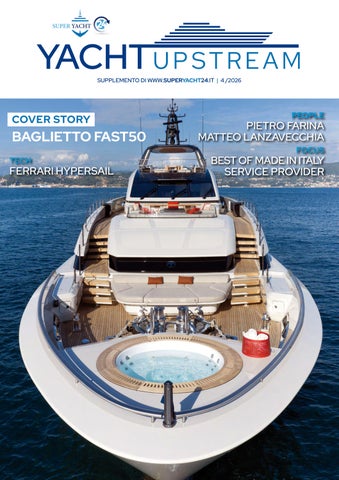
COVER STORY
Baglietto FAST50 TECH
Ferrari Hypersail
PEOPLE
Pietro Farina Matteo Lanzavecchia Focus
Best of Made in Italy Service Provider
THERE’S MORE AZIMUT YACHTS IN THESE PAGES THAN YOU THINK.
Editoriale / editorial Alberto Mariotti -
-
Tra record e mercato a due velocità
Between record figures and a two-speed market
I numeri presentati da Confindustria Nautica al Salone di Genova raccontano un’industria che nel 2025 ha raggiunto il nuovo record di 8,72 miliardi di euro di fatturato (+1,4%), 4,4 miliardi di export e 32.420 addetti diretti (+3%), circa 170.000 nell’intera filiera. L’Italia conserva inoltre il 52% degli ordini mondiali di superyacht. Dati che pochi altri settori industriali italiani possono vantare ma che, presi da soli, non svelano come sta cambiando il mondo dello yachting. Per provare a capirlo abbiamo intervistato undici protagonisti della cantieristica italiana, raccogliendo punti di vista diversi sull’andamento del mercato e sulle prospettive dei prossimi anni. Le loro risposte descrivono un mercato a due velocità, sotto ai 30/40 metri si avverte un rallentamento, mentre sulle dimensioni maggiori gli ordini continuano ad arrivare. Anche dove il lavoro non manca, però, aumentano le difficoltà nel reperire personale e fornitori qualificati, rispettare le consegne e tenere sotto controllo i costi. La crescita delle dimensioni degli yacht impone ai cantieri uno sforzo organizzativo sempre maggiore. Non basta avere capacità produttiva, servono strutture in grado di seguire progetti che coinvolgono numerosi fornitori, tecnologie differenti e tempi di costruzione che possono estendersi a lungo. Senza perdere quella flessibilità che ha contribuito al successo della cantieristica italiana. Anche sul piano tecnico le scelte si fanno più impegnative. L’attenzione ai consumi, al peso, all’efficienza energetica e all’automazione sta portando a sviluppare soluzioni nuove, alcune delle quali arrivano da settori industriali diversi dalla nautica, come l’automotive. Ma una tecnologia, per quanto avanzata, deve poi funzionare in mare, essere affidabile e poter essere mantenuta in efficienza. E chi lavora a bordo deve essere formato e avere le competenze necessarie per gestirla. Sono temi che devono entrare nelle scelte progettuali almeno quanto le prestazioni o il comfort. C’è inoltre una parte del settore sulla quale i cantieri hanno un’influenza ancora limitata ma crescente e che può incidere sulla competitività del sistema italiano. La disponibilità di personale qualificato, le infrastrutture portuali, la burocrazia e le procedure che regolano l’attività degli yacht sono questioni note da tempo. A queste si aggiunge la necessità di una rete di assistenza e servizi adeguata a una flotta che continua a crescere e che richiede interventi sempre più specialistici. Per continuare a crescere non sarà quindi sufficiente investire in nuovi modelli e capacità produttiva. Occorrerà dedicare altrettanta attenzione alle infrastrutture a terra, ai servizi e alle competenze necessarie per gestire e mantenere in efficienza yacht sempre più grandi e sofisticati.
The figures presented by Confindustria Nautica at the Genoa Boat Show paint a picture of an industry that, in 2025, reached a new record of €8.72 billion in turnover (+1.4 per cent), €4.4 billion in exports and 32,420 direct employees (+3 per cent), with around 170,000 jobs across the entire supply chain. Italy also retains 52 per cent of global superyacht orders. These are figures that few other Italian industrial sectors can boast, but which, taken on their own, do not reveal how the world of yachting is changing. To try to understand this, we interviewed eleven key figures in the Italian shipbuilding industry, gathering different perspectives on market trends and the outlook for the coming years. Their responses paint a picture of a two-speed market: below 30–40 metres, a slowdown is evident, whilst orders for larger vessels continue to come in. Even where there is no shortage of work, however, it is becoming increasingly difficult to find qualified staff and suppliers, meet delivery deadlines and keep costs under control. The increasing size of yachts is placing ever-greater organisational demands on shipyards. It is not enough simply to have production capacity; facilities are needed that can manage projects involving numerous suppliers, different technologies and construction times that can be quite lengthy – all without losing the flexibility that has contributed to the success of the Italian shipbuilding industry. On a technical level, too, the choices are becoming more challenging. The focus on fuel consumption, weight, energy efficiency and automation is leading to the development of new solutions, some of which originate from industrial sectors other than the marine industry, such as the automotive sector. But any technology, however advanced, must ultimately function at sea, be reliable and be capable of being maintained in good working order. And those working on board must be trained and possess the necessary skills to operate it. These are issues that must be factored into design decisions at least as much as performance or comfort. There is also a part of the sector over which shipyards still have limited but growing influence, and which can affect the competitiveness of the Italian industry. The availability of qualified personnel, port infrastructure, bureaucracy and the procedures governing yacht operations are long-standing issues. Added to these is the need for a support and service network capable of catering for a fleet that continues to grow and requires increasingly specialised interventions. To continue growing, it will therefore not be enough to invest in new models and production capacity. Equal attention will need to be paid to onshore infrastructure, services and the expertise required to manage and maintain increasingly large and sophisticated yachts in good working order.
Indice dei contenuti Table of contents 03 Editoriale | Editorial TECH 04 Superyacht Baglietto FAST50 Market 08 Superyacht Financial Performance 12 People Pietro Farina 16 Focus Best of Made in Italy Best of Made in Italy 18 Focus Marco Valle – Azimut Benetti Group Best of Made in Italy 20 Focus Tommaso Vincenzi – Sanlorenzo Best of Made in Italy 22 Focus Stassi Anastassov – Ferretti Group Best of Made in Italy 24 Focus Francesco Carbone – Palumbo Superyachts Best of Made in Italy 26 Focus Diego Michele Deprati - Baglietto Best of Made in Italy 28 Focus Giorgio Mattei – Next Yacht Group Best of Made in Italy 30 Focus Federico Rossi - Rossinavi
32 34 36 38 40 42 44 46 48 50 52 55
Super Yacht 24 ALOCIN MEDIA Piazza Roberto Baldini 7/75, 16149 Genova +39 010 9703071 info@alocinmedia.it
Focus Best of Made in Italy
Maurizio Balducci – Mangusta Yachts Focus Best of Made in Italy
Guido Orsi – Tankoa Yachts
Focus Best of Made in Italy
CO-EDITOR IN CHIEF: Alberto Mariotti mariotti@superyacht24.it + 39 328.29.37.133
Barbara Amerio – Amer Yachts Focus Best of Made in Italy
Ugo Pellegrino – Arcadia Yachts
Progetto grafico: Claudia Giorgini claudiagiorgini@gmail.com
Focus Service Provider Focus Service Provider
Federico Sommella – Clever Synergy Focus Service Provider
Contributors: Cinzia Garofoli, Alberto Mariotti, Giuseppe Orrù, Nicola Capuzzo Advertising & Marketing: Per informazioni sulle opportunità di marketing, pubblicità e visibilità For information on marketing, advertising and visibility opportunities
Paolo Mascino – AON
Focus Service Provider
Claudio Bencini – Medicea Medica Focus Service Provider
Sabrina Carozzino marketing@alocinmedia.it + 39 350.071.6304
M. Tirrito + M. Pennati – SLT Yacht Focus Service Provider
C. Vernetti + F. Munari46 – Deloitte Legal
People
EDITOR IN CHIEF: Nicola Capuzzo capuzzo.nicola@gmail.com +39 334.788.9863
Matteo Lanzavecchia – Ferrari Hypersail
Emanuele Buffa di Perrero ebuffa@link-media.com + 39 335.649.4152
Launch highlights NOVEMBRE | November 2026 [ 3 ]
THERE’S MORE AZIMUT YACHTS IN THESE PAGES THAN YOU THINK.
Editoriale / editorial Alberto Mariotti -
-
Tra record e mercato a due velocità
Between record figures and a two-speed market
I numeri presentati da Confindustria Nautica al Salone di Genova raccontano un’industria che nel 2025 ha raggiunto il nuovo record di 8,72 miliardi di euro di fatturato (+1,4%), 4,4 miliardi di export e 32.420 addetti diretti (+3%), circa 170.000 nell’intera filiera. L’Italia conserva inoltre il 52% degli ordini mondiali di superyacht. Dati che pochi altri settori industriali italiani possono vantare ma che, presi da soli, non svelano come sta cambiando il mondo dello yachting. Per provare a capirlo abbiamo intervistato undici protagonisti della cantieristica italiana, raccogliendo punti di vista diversi sull’andamento del mercato e sulle prospettive dei prossimi anni. Le loro risposte descrivono un mercato a due velocità, sotto ai 30/40 metri si avverte un rallentamento, mentre sulle dimensioni maggiori gli ordini continuano ad arrivare. Anche dove il lavoro non manca, però, aumentano le difficoltà nel reperire personale e fornitori qualificati, rispettare le consegne e tenere sotto controllo i costi. La crescita delle dimensioni degli yacht impone ai cantieri uno sforzo organizzativo sempre maggiore. Non basta avere capacità produttiva, servono strutture in grado di seguire progetti che coinvolgono numerosi fornitori, tecnologie differenti e tempi di costruzione che possono estendersi a lungo. Senza perdere quella flessibilità che ha contribuito al successo della cantieristica italiana. Anche sul piano tecnico le scelte si fanno più impegnative. L’attenzione ai consumi, al peso, all’efficienza energetica e all’automazione sta portando a sviluppare soluzioni nuove, alcune delle quali arrivano da settori industriali diversi dalla nautica, come l’automotive. Ma una tecnologia, per quanto avanzata, deve poi funzionare in mare, essere affidabile e poter essere mantenuta in efficienza. E chi lavora a bordo deve essere formato e avere le competenze necessarie per gestirla. Sono temi che devono entrare nelle scelte progettuali almeno quanto le prestazioni o il comfort. C’è inoltre una parte del settore sulla quale i cantieri hanno un’influenza ancora limitata ma crescente e che può incidere sulla competitività del sistema italiano. La disponibilità di personale qualificato, le infrastrutture portuali, la burocrazia e le procedure che regolano l’attività degli yacht sono questioni note da tempo. A queste si aggiunge la necessità di una rete di assistenza e servizi adeguata a una flotta che continua a crescere e che richiede interventi sempre più specialistici. Per continuare a crescere non sarà quindi sufficiente investire in nuovi modelli e capacità produttiva. Occorrerà dedicare altrettanta attenzione alle infrastrutture a terra, ai servizi e alle competenze necessarie per gestire e mantenere in efficienza yacht sempre più grandi e sofisticati.
The figures presented by Confindustria Nautica at the Genoa Boat Show paint a picture of an industry that, in 2025, reached a new record of €8.72 billion in turnover (+1.4 per cent), €4.4 billion in exports and 32,420 direct employees (+3 per cent), with around 170,000 jobs across the entire supply chain. Italy also retains 52 per cent of global superyacht orders. These are figures that few other Italian industrial sectors can boast, but which, taken on their own, do not reveal how the world of yachting is changing. To try to understand this, we interviewed eleven key figures in the Italian shipbuilding industry, gathering different perspectives on market trends and the outlook for the coming years. Their responses paint a picture of a two-speed market: below 30–40 metres, a slowdown is evident, whilst orders for larger vessels continue to come in. Even where there is no shortage of work, however, it is becoming increasingly difficult to find qualified staff and suppliers, meet delivery deadlines and keep costs under control. The increasing size of yachts is placing ever-greater organisational demands on shipyards. It is not enough simply to have production capacity; facilities are needed that can manage projects involving numerous suppliers, different technologies and construction times that can be quite lengthy – all without losing the flexibility that has contributed to the success of the Italian shipbuilding industry. On a technical level, too, the choices are becoming more challenging. The focus on fuel consumption, weight, energy efficiency and automation is leading to the development of new solutions, some of which originate from industrial sectors other than the marine industry, such as the automotive sector. But any technology, however advanced, must ultimately function at sea, be reliable and be capable of being maintained in good working order. And those working on board must be trained and possess the necessary skills to operate it. These are issues that must be factored into design decisions at least as much as performance or comfort. There is also a part of the sector over which shipyards still have limited but growing influence, and which can affect the competitiveness of the Italian industry. The availability of qualified personnel, port infrastructure, bureaucracy and the procedures governing yacht operations are long-standing issues. Added to these is the need for a support and service network capable of catering for a fleet that continues to grow and requires increasingly specialised interventions. To continue growing, it will therefore not be enough to invest in new models and production capacity. Equal attention will need to be paid to onshore infrastructure, services and the expertise required to manage and maintain increasingly large and sophisticated yachts in good working order.
Indice dei contenuti Table of contents 03 Editoriale | Editorial TECH 04 Superyacht Baglietto FAST50 Market 08 Superyacht Financial Performance 12 People Pietro Farina 16 Focus Best of Made in Italy Best of Made in Italy 18 Focus Marco Valle – Azimut Benetti Group Best of Made in Italy 20 Focus Tommaso Vincenzi – Sanlorenzo Best of Made in Italy 22 Focus Stassi Anastassov – Ferretti Group Best of Made in Italy 24 Focus Francesco Carbone – Palumbo Superyachts Best of Made in Italy 26 Focus Diego Michele Deprati - Baglietto Best of Made in Italy 28 Focus Giorgio Mattei – Next Yacht Group Best of Made in Italy 30 Focus Federico Rossi - Rossinavi
32 34 36 38 40 42 44 46 48 50 52 55
Super Yacht 24 ALOCIN MEDIA Piazza Roberto Baldini 7/75, 16149 Genova +39 010 9703071 info@alocinmedia.it
Focus Best of Made in Italy
Maurizio Balducci – Mangusta Yachts Focus Best of Made in Italy
Guido Orsi – Tankoa Yachts
Focus Best of Made in Italy
CO-EDITOR IN CHIEF: Alberto Mariotti mariotti@superyacht24.it + 39 328.29.37.133
Barbara Amerio – Amer Yachts Focus Best of Made in Italy
Ugo Pellegrino – Arcadia Yachts
Progetto grafico: Claudia Giorgini claudiagiorgini@gmail.com
Focus Service Provider Focus Service Provider
Federico Sommella – Clever Synergy Focus Service Provider
Contributors: Cinzia Garofoli, Alberto Mariotti, Giuseppe Orrù, Nicola Capuzzo Advertising & Marketing: Per informazioni sulle opportunità di marketing, pubblicità e visibilità For information on marketing, advertising and visibility opportunities
Paolo Mascino – AON
Focus Service Provider
Claudio Bencini – Medicea Medica Focus Service Provider
Sabrina Carozzino marketing@alocinmedia.it + 39 350.071.6304
M. Tirrito + M. Pennati – SLT Yacht Focus Service Provider
C. Vernetti + F. Munari46 – Deloitte Legal
People
EDITOR IN CHIEF: Nicola Capuzzo capuzzo.nicola@gmail.com +39 334.788.9863
Matteo Lanzavecchia – Ferrari Hypersail
Emanuele Buffa di Perrero ebuffa@link-media.com + 39 335.649.4152
Launch highlights NOVEMBRE | November 2026 [ 3 ]
SUPERYACHT TECH BAGLIETTO FAST50
Strutture alleggerite e titanio per il Fast50
La project manager Laura Barcellone approfondisce le soluzioni costruttive adottate per contenere i pesi, le prestazioni della carena e l’integrazione degli impianti di bordo
Lightweight structures and titanium for the Fast50 Project manager Laura Barcellone explores the construction solutions adopted to keep weight down, the hull’s performance and the integration of on-board systems
I
l Fast50 di Baglietto è il primo esemplare di una nuova gamma di yacht veloci, lungo 50 metri, interamente in alluminio e con stazza inferiore alle 500 Gt. Il progetto porta la firma di Francesco Paszkowski Design per gli esterni e gli interni, questi ultimi sviluppati con Margherita Casprini, mentre l’architettura navale è di Pierluigi Ausonio Naval Architecture. La carena semi-tunnel a basso pescaggio è abbinata a quattro motori Mtu 2000 M96L con trasmissione in linea d’asse, per una
[ 4 ] NOVEMBRE | November 2026
velocità massima di progetto di 30 nodi, superata durante le prove in mare. Particolare attenzione è stata dedicata al contenimento dei pesi, attraverso l’impiego di materiali alleggeriti, spessori ridotti e componenti in titanio. SUPER YACHT 24 ha intervistato la project manager Laura Barcellone per approfondire le principali soluzioni tecniche e costruttive adottate a bordo. Quali sono state le principali sfide ingegneristiche nella realizzazione del Fast50?
B
aglietto’s Fast50 is the first model in a new range of high-speed yachts, measuring 50 metres in length, built entirely from aluminium and with a tonnage of less than 500 GT. The design bears the signature of Francesco Paszkowski Design for the exteriors and interiors, the latter developed in collaboration with Margherita Casprini, whilst the naval architecture is by Pierluigi Ausonio Naval Architecture.
The shallow-draught semi-tunnel hull is paired with four MTU 2000 M96L engines with in-line shaft drive, delivering a maximum design speed of 30 knots, a figure exceeded during sea trials. Particular attention has been paid to weight reduction, through the use of lightweight materials, reduced thicknesses and titanium components. SUPER YACHT 24 interviewed project manager Laura Barcellone to explore the
alberto mariotti
“La sfida principale è stata conciliare le prestazioni, legate alla potenza e al peso dell’imbarcazione, con i numerosi dettagli estetici. Ci siamo concentrati soprattutto sul contenimento dei pesi, attraverso un’attenta ricerca sui materiali e sulle soluzioni costruttive. Siamo partiti dalle strutture, riducendo gli spessori, per poi adottare soluzioni sperimentali adottate su barche da competizione come i corrimani in titanio. Insieme a Isoclima abbiamo lavorato sulla composizione dei vetri per ridurne lo spessore e quindi il peso. Anche gli arredi, interni ed esterni, sono realizzati con materiali alleggeriti, compresi cielini e paglioli. I marmi, per esempio, hanno uno spessore di 6 mm anziché gli 8 mm standard. Sono tanti piccoli interventi che, nel complesso, hanno fatto la differenza. Alla fine la barca pesa significativamente meno rispetto a quanto avevamo inizialmente previsto”. Altri dettagli che hanno contribuito alla riduzione del peso? “I dettagli sono tantissimi. Insieme a Francesco Paszkowski abbiamo organizzato riunioni settimanali nelle quali discutevamo ogni singola soluzione. Tutte le griglie estetiche sullo scafo e sulle sovrastrutture, tutte rilevate attraverso scansioni, rielaborate in 3D e realizzate a controllo nu-
merico utilizzando materiali espansi. Ci sono poi l’isola di manovra a poppa con scivolo in teak e le scale sospese con gradini incastonati in alleggerito e teak. Abbiamo utilizzato anche bacchette in legno bruciato per rivestire le salite dal main deck all’upper deck e da quest’ultimo al sun deck”. Quali sono le caratteristiche della propulsione e degli impianti di bordo? “Lo scafo è in alluminio e in sala macchine abbiamo installato quattro Mtu 16V 2000 M96L, da circa 2.000 kW ciascuno, con trasmissione in linea d’asse e quattro eliche con propulsione tradizionale. I motori sono dotati di un sistema Scr, per rispettare i requisiti sulle emissioni previsti dalla normativa Imo 3 Tier II, anche in relazione alla navigazione in aree come il Baltico e i Caraibi. Abbiamo abbinato interceptor fissi e mobili di Humphree e un sistema di stabilizzazione Cmc con due pinne ad azionamento elettrico. La timoneria è della Xenta con timoni indipendenti, senza barra di accoppiamento. A bordo ci sono inoltre due generatori da 118 kW, un impianto di climatizzazione Frigomar e un converter da banchina Eekels”. Quali prestazioni avete registrato durante le prove in mare? “La barca ha raggiunto i 32 nodi, superando di circa due nodi le nostre
main technical and construction solutions adopted on board. What were the main engineering challenges in building the Fast50? “The main challenge was to balance performance – linked to the boat’s power and weight – with the numerous aesthetic details. We focused primarily on weight reduction through careful research into materials and construction methods. We started with the structural elements, reducing their thickness, before adopting experimental solutions used on racing yachts, such as titanium handrails. Together with Isoclima, we worked on the composition of the glass to reduce its thickness and thus its weight. Even the furnishings, both interior and exterior, are made from lightweight materials, including the headliners and floorboards. The marble, for example, is 6 mm thick instead of the standard 8 mm. There are many small changes which, taken together, have made all the difference. Ultimately, the boat weighs significantly less than we had initially anticipated”. Any other details that contributed to the weight reduction? “There are countless details.
Together with Francesco Paszkowski, we held weekly meetings to discuss every single solution. All the decorative grilles on the hull and superstructures were scanned, reworked in 3D and produced using CNC machining with foam materials. Then there’s the aft control station with a teak slipway and the suspended staircases with steps set into lightweight composite and teak. We also used burnt wood slats to clad the stairways leading from the main deck to the upper deck and from the upper deck to the sun deck”. What are the characteristics of the propulsion system and on-board systems? “The hull is made of aluminium and in the engine room we have installed four MTU 16V 2000 M96L engines, each producing around 2,000 kW, with shaft-line transmission and four propellers using conventional propulsion. The engines are fitted with an SCR system to comply with the emission requirements set out in the IMO Tier 3 Tier II regulations, particularly in relation to navigation in areas such as the Baltic and the Caribbean. We have combined fixed and mobile Humphree interceptors with a CMC
NOVEMBRE | November 2026 [ 5 ]
SUPERYACHT TECH BAGLIETTO FAST50
Strutture alleggerite e titanio per il Fast50
La project manager Laura Barcellone approfondisce le soluzioni costruttive adottate per contenere i pesi, le prestazioni della carena e l’integrazione degli impianti di bordo
Lightweight structures and titanium for the Fast50 Project manager Laura Barcellone explores the construction solutions adopted to keep weight down, the hull’s performance and the integration of on-board systems
I
l Fast50 di Baglietto è il primo esemplare di una nuova gamma di yacht veloci, lungo 50 metri, interamente in alluminio e con stazza inferiore alle 500 Gt. Il progetto porta la firma di Francesco Paszkowski Design per gli esterni e gli interni, questi ultimi sviluppati con Margherita Casprini, mentre l’architettura navale è di Pierluigi Ausonio Naval Architecture. La carena semi-tunnel a basso pescaggio è abbinata a quattro motori Mtu 2000 M96L con trasmissione in linea d’asse, per una
[ 4 ] NOVEMBRE | November 2026
velocità massima di progetto di 30 nodi, superata durante le prove in mare. Particolare attenzione è stata dedicata al contenimento dei pesi, attraverso l’impiego di materiali alleggeriti, spessori ridotti e componenti in titanio. SUPER YACHT 24 ha intervistato la project manager Laura Barcellone per approfondire le principali soluzioni tecniche e costruttive adottate a bordo. Quali sono state le principali sfide ingegneristiche nella realizzazione del Fast50?
B
aglietto’s Fast50 is the first model in a new range of high-speed yachts, measuring 50 metres in length, built entirely from aluminium and with a tonnage of less than 500 GT. The design bears the signature of Francesco Paszkowski Design for the exteriors and interiors, the latter developed in collaboration with Margherita Casprini, whilst the naval architecture is by Pierluigi Ausonio Naval Architecture.
The shallow-draught semi-tunnel hull is paired with four MTU 2000 M96L engines with in-line shaft drive, delivering a maximum design speed of 30 knots, a figure exceeded during sea trials. Particular attention has been paid to weight reduction, through the use of lightweight materials, reduced thicknesses and titanium components. SUPER YACHT 24 interviewed project manager Laura Barcellone to explore the
alberto mariotti
“La sfida principale è stata conciliare le prestazioni, legate alla potenza e al peso dell’imbarcazione, con i numerosi dettagli estetici. Ci siamo concentrati soprattutto sul contenimento dei pesi, attraverso un’attenta ricerca sui materiali e sulle soluzioni costruttive. Siamo partiti dalle strutture, riducendo gli spessori, per poi adottare soluzioni sperimentali adottate su barche da competizione come i corrimani in titanio. Insieme a Isoclima abbiamo lavorato sulla composizione dei vetri per ridurne lo spessore e quindi il peso. Anche gli arredi, interni ed esterni, sono realizzati con materiali alleggeriti, compresi cielini e paglioli. I marmi, per esempio, hanno uno spessore di 6 mm anziché gli 8 mm standard. Sono tanti piccoli interventi che, nel complesso, hanno fatto la differenza. Alla fine la barca pesa significativamente meno rispetto a quanto avevamo inizialmente previsto”. Altri dettagli che hanno contribuito alla riduzione del peso? “I dettagli sono tantissimi. Insieme a Francesco Paszkowski abbiamo organizzato riunioni settimanali nelle quali discutevamo ogni singola soluzione. Tutte le griglie estetiche sullo scafo e sulle sovrastrutture, tutte rilevate attraverso scansioni, rielaborate in 3D e realizzate a controllo nu-
merico utilizzando materiali espansi. Ci sono poi l’isola di manovra a poppa con scivolo in teak e le scale sospese con gradini incastonati in alleggerito e teak. Abbiamo utilizzato anche bacchette in legno bruciato per rivestire le salite dal main deck all’upper deck e da quest’ultimo al sun deck”. Quali sono le caratteristiche della propulsione e degli impianti di bordo? “Lo scafo è in alluminio e in sala macchine abbiamo installato quattro Mtu 16V 2000 M96L, da circa 2.000 kW ciascuno, con trasmissione in linea d’asse e quattro eliche con propulsione tradizionale. I motori sono dotati di un sistema Scr, per rispettare i requisiti sulle emissioni previsti dalla normativa Imo 3 Tier II, anche in relazione alla navigazione in aree come il Baltico e i Caraibi. Abbiamo abbinato interceptor fissi e mobili di Humphree e un sistema di stabilizzazione Cmc con due pinne ad azionamento elettrico. La timoneria è della Xenta con timoni indipendenti, senza barra di accoppiamento. A bordo ci sono inoltre due generatori da 118 kW, un impianto di climatizzazione Frigomar e un converter da banchina Eekels”. Quali prestazioni avete registrato durante le prove in mare? “La barca ha raggiunto i 32 nodi, superando di circa due nodi le nostre
main technical and construction solutions adopted on board. What were the main engineering challenges in building the Fast50? “The main challenge was to balance performance – linked to the boat’s power and weight – with the numerous aesthetic details. We focused primarily on weight reduction through careful research into materials and construction methods. We started with the structural elements, reducing their thickness, before adopting experimental solutions used on racing yachts, such as titanium handrails. Together with Isoclima, we worked on the composition of the glass to reduce its thickness and thus its weight. Even the furnishings, both interior and exterior, are made from lightweight materials, including the headliners and floorboards. The marble, for example, is 6 mm thick instead of the standard 8 mm. There are many small changes which, taken together, have made all the difference. Ultimately, the boat weighs significantly less than we had initially anticipated”. Any other details that contributed to the weight reduction? “There are countless details.
Together with Francesco Paszkowski, we held weekly meetings to discuss every single solution. All the decorative grilles on the hull and superstructures were scanned, reworked in 3D and produced using CNC machining with foam materials. Then there’s the aft control station with a teak slipway and the suspended staircases with steps set into lightweight composite and teak. We also used burnt wood slats to clad the stairways leading from the main deck to the upper deck and from the upper deck to the sun deck”. What are the characteristics of the propulsion system and on-board systems? “The hull is made of aluminium and in the engine room we have installed four MTU 16V 2000 M96L engines, each producing around 2,000 kW, with shaft-line transmission and four propellers using conventional propulsion. The engines are fitted with an SCR system to comply with the emission requirements set out in the IMO Tier 3 Tier II regulations, particularly in relation to navigation in areas such as the Baltic and the Caribbean. We have combined fixed and mobile Humphree interceptors with a CMC
NOVEMBRE | November 2026 [ 5 ]
SUPERYACHT TECH BAGLIETTO FAST50
aspettative. Considerando i quattro propulsori, anche i consumi sono contenuti. Alla massima velocità siamo intorno ai 490 litri/ora per motore, mentre a 12 nodi scendiamo a circa 38 litri/ora per motore. Durante le prove abbiamo sottoposto la barca a condizioni impegnative e ha sempre risposto bene. Abbiamo aumentato progressivamente il carico, riempiendo le casse il più possibile, per verificare come si comportasse anche con pesi superiori a quelli delle prime uscite. Anche a pieno carico le prestazioni sono rimaste superiori alle previsioni progettuali”. E per quanto riguarda il comfort acustico? “È uno degli aspetti che ci ha sorpreso maggiormente. Fino a 12 nodi si fa quasi fatica a capire se la barca sia in moto. Un contributo importante arriva anche dalla disposizione del garage di poppa, che si trova tra la sala macchine e le cabine e che ha permesso di ottenere ottimi valori di rumore e vibrazioni nelle zone abitabili”. Come sono organizzati i garage e quali tender avete scelto? “Abbiamo due garage, uno a poppa e uno a prua. Quello di poppa è semiallagabile e, con una larghezza dello yacht di 9 metri, riesce a ospitare un tender da 7 metri. La scelta è ricaduta su un waterjet Williams, anche su richiesta dell’armatore. È dotato di console abbattibile, hard top facilmente montabili e smontabili e un sistema automatico per il gonfiaggio e lo sgonfiaggio parziale dei tubolari. Il garage dispone di una slitta che scende in acqua, consentendo al tender di entrare galleggiando fino a circa metà della sua lunghezza. A
[ 6 ] NOVEMBRE | November 2026
quel punto interviene un verricello che lo tira verso l’interno e, contemporaneamente, fa scorrere la slitta fino a portarlo a bordo. Il portellone e la movimentazione della slitta sono stati realizzati da Pin-Craft. Il garage di prua, invece, è destinato alla moto d’acqua. È predisposto anche per ospitare un rescue boat nel caso in cui lo yacht venga registrato per uso commerciale e impiegato nel charter. La distinzione tra i due garage riguarda anche il carburante. Quello di prua è previsto per mezzi a benzina, mentre quello di poppa per il tender diesel”. Come avete sfruttato gli spazi esterni? “La presenza dei due garage ci ha consentito di sfruttare anche tutta la zona a proravia della timoneria. Qui abbiamo ricavato un’ampia area relax, con un divano a L, un prendisole e un tavolo estensibile. Un altro elemento particolare, per una barca di queste caratteristiche, è il sun deck, voluto dall’armatore. Su uno yacht veloce non è una soluzione così usuale. Siamo riusciti a ricavare sia una zona lounge sia un’area pranzo per 12 persone protetta da un roof. A prua abbiamo inoltre una piscina realizzata da Hi-Tide”. Quali soluzioni avete adottato per aumentare le superfici vetrate? “Nel salone abbiamo quattro finestroni di grandi dimensioni. Per ottenere questo risultato abbiamo eliminato i trunk di ventilazione che di solito occupano parte dello spazio interno, spostandoli verso poppa, all’esterno della nave, nelle falchette. Di solito questi elementi vengono nascosti dietro armadi o pannellatu-
stabilisation system featuring two electrically operated fins. The steering system is by Xenta, with independent rudders and no coupling bar. On board there are also two 118 kW generators, a Frigomar air-conditioning system and an Eekels shore power converter”. What performance figures did you record during sea trials? “The boat reached 32 knots, exceeding our expectations by about two knots. Given the four propulsion units, fuel consumption is also low. At top speed, we’re looking at around 490 litres per hour per engine, whilst at 12 knots this drops to about 38 litres per hour per engine. During the trials, we put the boat through its paces under demanding conditions and it always performed well. We gradually increased the load, filling the holds as much as possible, to check how the ‘ ’ would perform even with weights greater than those of the initial trials. Even at full load, performance remained above design forecasts”. And what about acoustic comfort? “It’s one of the aspects that surprised us the most. Up to 12 knots, it’s almost hard to tell whether the boat is moving. The layout of the aft garage, situated between the engine room and the cabins, also plays a significant role, enabling us to achieve excellent noise and vibration levels in the living areas”. How are the garages organised and which tenders have you chosen?
“We have two garages, one at the stern and one at the bow. The stern garage is semi-floodable and, with the yacht being 9 metres wide, it can accommodate a 7-metre tender. The choice fell on a Williams waterjet, partly at the owner’s request. It is fitted with a fold-down console, a hard top that is easy to fit and remove, and an automatic system for inflating and partially deflating the tubes. The garage features a slide that lowers into the water, allowing the tender to float in until it is approximately halfway into the slide. At that point, a winch takes over, pulling the tender inwards whilst simultaneously sliding the slide to bring it on board. The hatch and the slide mechanism were manufactured by PinCraft. The bow garage, on the other hand, is intended for the jet ski. It is also designed to accommodate a rescue boat should the yacht be registered for commercial use and employed in the charter business. The distinction between the two garages also relates to fuel. The bow garage is intended for petrol-powered craft, whilst the stern garage is for the diesel tender”. How have you made the most of the outdoor spaces? “The presence of the two garages has allowed us to make full use of the entire area forward of the wheelhouse. Here we have created a spacious relaxation area, featuring an L-shaped sofa, a sun deck and an extendable table. Another distinctive feature, for a boat of this type, is the sun deck, which was requested by the
re, ma finiscono comunque per sottrarre spazio. Qui, invece, quando si entra a bordo si vedono solo superfici vetrate, non ci sono strutture che interrompono la vista, a eccezione di un elemento strutturale sottile a metà salone, necessario per sostenere la sovrastruttura”. Quali sistemi avete installato in plancia per navigazione e monitoraggio? “Abbiamo definito un pacchetto con Rolls-Royce che comprende i quattro motori Mtu e il sistema di navigazione, fornito attraverso Team Italia, che all’epoca era già entrata nel gruppo. La plancia è paperless e abbiamo integrato anche tutto il sistema di monitoraggio. In questo modo propulsione, navigazione e monitoraggio fanno parte di un unico sistema fornito da Rolls-Royce”. Come è organizzato il sistema di domotica e intrattenimento? “Attraverso la domotica possiamo controllare quasi tutti gli impianti della barca. Il sistema gestisce l’audio-video, l’illuminazione, le tende e la climatizzazione. Le luci sono dimmerabili e permettono di impostare diversi scenari. Una volta programmati, è anche semplice modificarli, intervenendo sulle sequenze e sulle accensioni in base alle esigenze. Il controllo avviene attraverso i tastierini locali, presenti nelle cabine e nelle varie postazioni, oppure tramite iPad. Ne abbiamo previsto uno per ogni cabina, uno per il salone e uno per ciascun ponte esterno. Il comandante dispone inoltre di un iPad dal quale può gestire l’intero sistema, comprese le aree diverse dalla propria. Abbiamo installato anche due postazioni Dj, una sull’upper deck e una sul sun deck. Una scelta legata anche al fatto che la barca si rivolge a un pubblico giovane. L’integrazione della domotica è stata sviluppata da Elettromeccanica L.A. insieme a Videoworks, che ha fornito gli impianti audio-video”. Quali fornitori avete coinvolto per le movimentazioni e altre dotazioni?
“Per le porte scorrevoli esterne delle sovrastrutture, comprese quelle del main deck, abbiamo lavorato con Tecnoinox. Sull’upper deck ci sono invece le porte tagliavento della veranda, realizzate da Nautilus. Permettono di utilizzare questo ambiente aperto, in continuità con il pozzetto esterno, oppure di chiuderlo in caso di maltempo. Per le movimentazioni abbiamo poi il sistema del garage di poppa di Pin-Craft, mentre la passerella e la scala da bagno sono state fornite da Mor Saverio. Per quanto riguarda l’ormeggio e l’ancoraggio, i verricelli sono di Maxwell, mentre le porte stagne e tagliafuoco sono di Officina Lambo. Tutto il ciclo di verniciatura è Boero, dal primer fino al top coat, compresi i trattamenti dello scafo e l’antivegetativa”. Quali soluzioni avete adottato per gli interni? “Per gli arredi avevamo stabilito specifiche molto stringenti sull’utilizzo di materiali alleggeriti. Diesse Arredamenti ha rispettato tutte le nostre richieste, soddisfacendo anche le esigenze specifiche legate alla costruzione dei mobili. La collaborazione è stata positiva, soprattutto per la disponibilità a seguire le indicazioni sui materiali. Quali certificazioni ha ottenuto il Fast50? “La barca è certificata Abs ed è conforme al Red Ensign Group Yacht Code, anche per l’impiego commerciale. Abbiamo lavorato prevedendo una possibile registrazione sotto bandiera italiana, ma al momento non sappiamo ancora quale sarà la scelta definitiva dell’armatore”.
owner. On a fast yacht, this isn’t a particularly common feature. We’ve managed to create both a lounge area and a dining area for 12 people, sheltered by a roof. At the bow, we also have a swimming pool built by Hi-Tide”. What solutions did you adopt to increase the glazed areas? “In the saloon, we have four large windows. To achieve this, we removed the ventilation trunks that usually take up part of the interior space, relocating them aft, outside the hull, into the gunwales. Usually, these elements are concealed behind cupboards or panelling, but they still end up taking up space. Here, however, when you come on board, all you see are glass surfaces; there are no structures obstructing the view, apart from a slender structural element in the middle of the saloon, which is necessary to support the superstructure”. What systems have you installed on the bridge for navigation and monitoring? “We put together a package with Rolls-Royce that includes the four MTU engines and the navigation system, supplied through Team Italia, which had already joined the group at the time. The bridge is paperless, and we have also integrated the entire monitoring system. In this way, propulsion, navigation and monitoring form part of a single system supplied by Rolls-Royce”. How is the home automation and entertainment system
organised? “Through the home automation system, we can control almost all the boat’s systems. The system manages the audio-visual equipment, lighting, blinds and air conditioning. The lights are dimmable and allow you to set up different scenarios. Once programmed, it is also easy to modify them by adjusting the sequences and timing to suit your needs. Control is via local control panels, located in the cabins and at various stations, or via iPad. We have provided one for each cabin, one for the saloon and one for each outdoor deck. The captain also has an iPad from which he can manage the entire system, including areas other than his own. We have also installed two DJ stations, one on the upper deck and one on the sun deck. This choice is partly linked to the fact that the yacht is aimed at a young clientele. The integration of the home automation system was developed by Elettromeccanica L.A. in collaboration with Videoworks, which supplied the audio-visual systems”. Which suppliers did you work with for the moving parts and other fittings? “For the external sliding doors of the superstructures, including those on the main deck, we worked with Tecnoinox. On the upper deck, meanwhile, there are the veranda windbreak doors, manufactured by Nautilus. These allow this open space to be used as an extension of the outdoor cockpit, or closed off in the event of bad weather. For the handling systems, we have the Pin-Craft aft garage system, whilst the gangway and swim ladder were supplied by Mor Saverio. As for mooring and anchoring, the winches are by Maxwell, whilst the watertight and fire-rated doors are by Officina Lambo. The entire paintwork is by Boero, from the primer right through to the top coat, including the hull treatments and the antifouling”. What solutions did you adopt for the interiors? “For the furnishings, we had set very strict specifications regarding the use of lightweight materials. Diesse Arredamenti met all our requirements, whilst also addressing the specific needs related to the construction of the furniture. The collaboration was positive, particularly due to their willingness to follow our guidance on materials. What certifications has the Fast50 obtained? “The yacht is ABS-certified and complies with the Red Ensign Group Yacht Code, including for commercial use. We have worked with the possibility of registration under the Italian flag in mind, but at the moment we do not yet know what the owner’s final decision will be”.
NOVEMBRE | November 2026 [ 7 ]
SUPERYACHT TECH BAGLIETTO FAST50
aspettative. Considerando i quattro propulsori, anche i consumi sono contenuti. Alla massima velocità siamo intorno ai 490 litri/ora per motore, mentre a 12 nodi scendiamo a circa 38 litri/ora per motore. Durante le prove abbiamo sottoposto la barca a condizioni impegnative e ha sempre risposto bene. Abbiamo aumentato progressivamente il carico, riempiendo le casse il più possibile, per verificare come si comportasse anche con pesi superiori a quelli delle prime uscite. Anche a pieno carico le prestazioni sono rimaste superiori alle previsioni progettuali”. E per quanto riguarda il comfort acustico? “È uno degli aspetti che ci ha sorpreso maggiormente. Fino a 12 nodi si fa quasi fatica a capire se la barca sia in moto. Un contributo importante arriva anche dalla disposizione del garage di poppa, che si trova tra la sala macchine e le cabine e che ha permesso di ottenere ottimi valori di rumore e vibrazioni nelle zone abitabili”. Come sono organizzati i garage e quali tender avete scelto? “Abbiamo due garage, uno a poppa e uno a prua. Quello di poppa è semiallagabile e, con una larghezza dello yacht di 9 metri, riesce a ospitare un tender da 7 metri. La scelta è ricaduta su un waterjet Williams, anche su richiesta dell’armatore. È dotato di console abbattibile, hard top facilmente montabili e smontabili e un sistema automatico per il gonfiaggio e lo sgonfiaggio parziale dei tubolari. Il garage dispone di una slitta che scende in acqua, consentendo al tender di entrare galleggiando fino a circa metà della sua lunghezza. A
[ 6 ] NOVEMBRE | November 2026
quel punto interviene un verricello che lo tira verso l’interno e, contemporaneamente, fa scorrere la slitta fino a portarlo a bordo. Il portellone e la movimentazione della slitta sono stati realizzati da Pin-Craft. Il garage di prua, invece, è destinato alla moto d’acqua. È predisposto anche per ospitare un rescue boat nel caso in cui lo yacht venga registrato per uso commerciale e impiegato nel charter. La distinzione tra i due garage riguarda anche il carburante. Quello di prua è previsto per mezzi a benzina, mentre quello di poppa per il tender diesel”. Come avete sfruttato gli spazi esterni? “La presenza dei due garage ci ha consentito di sfruttare anche tutta la zona a proravia della timoneria. Qui abbiamo ricavato un’ampia area relax, con un divano a L, un prendisole e un tavolo estensibile. Un altro elemento particolare, per una barca di queste caratteristiche, è il sun deck, voluto dall’armatore. Su uno yacht veloce non è una soluzione così usuale. Siamo riusciti a ricavare sia una zona lounge sia un’area pranzo per 12 persone protetta da un roof. A prua abbiamo inoltre una piscina realizzata da Hi-Tide”. Quali soluzioni avete adottato per aumentare le superfici vetrate? “Nel salone abbiamo quattro finestroni di grandi dimensioni. Per ottenere questo risultato abbiamo eliminato i trunk di ventilazione che di solito occupano parte dello spazio interno, spostandoli verso poppa, all’esterno della nave, nelle falchette. Di solito questi elementi vengono nascosti dietro armadi o pannellatu-
stabilisation system featuring two electrically operated fins. The steering system is by Xenta, with independent rudders and no coupling bar. On board there are also two 118 kW generators, a Frigomar air-conditioning system and an Eekels shore power converter”. What performance figures did you record during sea trials? “The boat reached 32 knots, exceeding our expectations by about two knots. Given the four propulsion units, fuel consumption is also low. At top speed, we’re looking at around 490 litres per hour per engine, whilst at 12 knots this drops to about 38 litres per hour per engine. During the trials, we put the boat through its paces under demanding conditions and it always performed well. We gradually increased the load, filling the holds as much as possible, to check how the ‘ ’ would perform even with weights greater than those of the initial trials. Even at full load, performance remained above design forecasts”. And what about acoustic comfort? “It’s one of the aspects that surprised us the most. Up to 12 knots, it’s almost hard to tell whether the boat is moving. The layout of the aft garage, situated between the engine room and the cabins, also plays a significant role, enabling us to achieve excellent noise and vibration levels in the living areas”. How are the garages organised and which tenders have you chosen?
“We have two garages, one at the stern and one at the bow. The stern garage is semi-floodable and, with the yacht being 9 metres wide, it can accommodate a 7-metre tender. The choice fell on a Williams waterjet, partly at the owner’s request. It is fitted with a fold-down console, a hard top that is easy to fit and remove, and an automatic system for inflating and partially deflating the tubes. The garage features a slide that lowers into the water, allowing the tender to float in until it is approximately halfway into the slide. At that point, a winch takes over, pulling the tender inwards whilst simultaneously sliding the slide to bring it on board. The hatch and the slide mechanism were manufactured by PinCraft. The bow garage, on the other hand, is intended for the jet ski. It is also designed to accommodate a rescue boat should the yacht be registered for commercial use and employed in the charter business. The distinction between the two garages also relates to fuel. The bow garage is intended for petrol-powered craft, whilst the stern garage is for the diesel tender”. How have you made the most of the outdoor spaces? “The presence of the two garages has allowed us to make full use of the entire area forward of the wheelhouse. Here we have created a spacious relaxation area, featuring an L-shaped sofa, a sun deck and an extendable table. Another distinctive feature, for a boat of this type, is the sun deck, which was requested by the
re, ma finiscono comunque per sottrarre spazio. Qui, invece, quando si entra a bordo si vedono solo superfici vetrate, non ci sono strutture che interrompono la vista, a eccezione di un elemento strutturale sottile a metà salone, necessario per sostenere la sovrastruttura”. Quali sistemi avete installato in plancia per navigazione e monitoraggio? “Abbiamo definito un pacchetto con Rolls-Royce che comprende i quattro motori Mtu e il sistema di navigazione, fornito attraverso Team Italia, che all’epoca era già entrata nel gruppo. La plancia è paperless e abbiamo integrato anche tutto il sistema di monitoraggio. In questo modo propulsione, navigazione e monitoraggio fanno parte di un unico sistema fornito da Rolls-Royce”. Come è organizzato il sistema di domotica e intrattenimento? “Attraverso la domotica possiamo controllare quasi tutti gli impianti della barca. Il sistema gestisce l’audio-video, l’illuminazione, le tende e la climatizzazione. Le luci sono dimmerabili e permettono di impostare diversi scenari. Una volta programmati, è anche semplice modificarli, intervenendo sulle sequenze e sulle accensioni in base alle esigenze. Il controllo avviene attraverso i tastierini locali, presenti nelle cabine e nelle varie postazioni, oppure tramite iPad. Ne abbiamo previsto uno per ogni cabina, uno per il salone e uno per ciascun ponte esterno. Il comandante dispone inoltre di un iPad dal quale può gestire l’intero sistema, comprese le aree diverse dalla propria. Abbiamo installato anche due postazioni Dj, una sull’upper deck e una sul sun deck. Una scelta legata anche al fatto che la barca si rivolge a un pubblico giovane. L’integrazione della domotica è stata sviluppata da Elettromeccanica L.A. insieme a Videoworks, che ha fornito gli impianti audio-video”. Quali fornitori avete coinvolto per le movimentazioni e altre dotazioni?
“Per le porte scorrevoli esterne delle sovrastrutture, comprese quelle del main deck, abbiamo lavorato con Tecnoinox. Sull’upper deck ci sono invece le porte tagliavento della veranda, realizzate da Nautilus. Permettono di utilizzare questo ambiente aperto, in continuità con il pozzetto esterno, oppure di chiuderlo in caso di maltempo. Per le movimentazioni abbiamo poi il sistema del garage di poppa di Pin-Craft, mentre la passerella e la scala da bagno sono state fornite da Mor Saverio. Per quanto riguarda l’ormeggio e l’ancoraggio, i verricelli sono di Maxwell, mentre le porte stagne e tagliafuoco sono di Officina Lambo. Tutto il ciclo di verniciatura è Boero, dal primer fino al top coat, compresi i trattamenti dello scafo e l’antivegetativa”. Quali soluzioni avete adottato per gli interni? “Per gli arredi avevamo stabilito specifiche molto stringenti sull’utilizzo di materiali alleggeriti. Diesse Arredamenti ha rispettato tutte le nostre richieste, soddisfacendo anche le esigenze specifiche legate alla costruzione dei mobili. La collaborazione è stata positiva, soprattutto per la disponibilità a seguire le indicazioni sui materiali. Quali certificazioni ha ottenuto il Fast50? “La barca è certificata Abs ed è conforme al Red Ensign Group Yacht Code, anche per l’impiego commerciale. Abbiamo lavorato prevedendo una possibile registrazione sotto bandiera italiana, ma al momento non sappiamo ancora quale sarà la scelta definitiva dell’armatore”.
owner. On a fast yacht, this isn’t a particularly common feature. We’ve managed to create both a lounge area and a dining area for 12 people, sheltered by a roof. At the bow, we also have a swimming pool built by Hi-Tide”. What solutions did you adopt to increase the glazed areas? “In the saloon, we have four large windows. To achieve this, we removed the ventilation trunks that usually take up part of the interior space, relocating them aft, outside the hull, into the gunwales. Usually, these elements are concealed behind cupboards or panelling, but they still end up taking up space. Here, however, when you come on board, all you see are glass surfaces; there are no structures obstructing the view, apart from a slender structural element in the middle of the saloon, which is necessary to support the superstructure”. What systems have you installed on the bridge for navigation and monitoring? “We put together a package with Rolls-Royce that includes the four MTU engines and the navigation system, supplied through Team Italia, which had already joined the group at the time. The bridge is paperless, and we have also integrated the entire monitoring system. In this way, propulsion, navigation and monitoring form part of a single system supplied by Rolls-Royce”. How is the home automation and entertainment system
organised? “Through the home automation system, we can control almost all the boat’s systems. The system manages the audio-visual equipment, lighting, blinds and air conditioning. The lights are dimmable and allow you to set up different scenarios. Once programmed, it is also easy to modify them by adjusting the sequences and timing to suit your needs. Control is via local control panels, located in the cabins and at various stations, or via iPad. We have provided one for each cabin, one for the saloon and one for each outdoor deck. The captain also has an iPad from which he can manage the entire system, including areas other than his own. We have also installed two DJ stations, one on the upper deck and one on the sun deck. This choice is partly linked to the fact that the yacht is aimed at a young clientele. The integration of the home automation system was developed by Elettromeccanica L.A. in collaboration with Videoworks, which supplied the audio-visual systems”. Which suppliers did you work with for the moving parts and other fittings? “For the external sliding doors of the superstructures, including those on the main deck, we worked with Tecnoinox. On the upper deck, meanwhile, there are the veranda windbreak doors, manufactured by Nautilus. These allow this open space to be used as an extension of the outdoor cockpit, or closed off in the event of bad weather. For the handling systems, we have the Pin-Craft aft garage system, whilst the gangway and swim ladder were supplied by Mor Saverio. As for mooring and anchoring, the winches are by Maxwell, whilst the watertight and fire-rated doors are by Officina Lambo. The entire paintwork is by Boero, from the primer right through to the top coat, including the hull treatments and the antifouling”. What solutions did you adopt for the interiors? “For the furnishings, we had set very strict specifications regarding the use of lightweight materials. Diesse Arredamenti met all our requirements, whilst also addressing the specific needs related to the construction of the furniture. The collaboration was positive, particularly due to their willingness to follow our guidance on materials. What certifications has the Fast50 obtained? “The yacht is ABS-certified and complies with the Red Ensign Group Yacht Code, including for commercial use. We have worked with the possibility of registration under the Italian flag in mind, but at the moment we do not yet know what the owner’s final decision will be”.
NOVEMBRE | November 2026 [ 7 ]
Superyacht Market | Financial Performance
Nicola Capuzzo
I bilanci dei cantieri italiani di superyacht a confronto
I tre colossi in salute e gli altri che vivono di acconti, oltre al caso The Italian Sea Group. Dai conti di 15 costruttori emerge un settore con portafogli ordini enormi ma redditività a due velocità
A comparison of the financial statements of Italian superyacht builders The three giants are in good health whilst the others rely on advance payments, plus the case of The Italian Sea Group. The accounts of 15 builders reveal a sector with huge order books but a two-tier profitability L’apertura: i numeri da ricordare Azimut|Benetti, Ferretti e Sanlorenzo hanno chiuso il 2025 con ricavi complessivi di circa 3,7 miliardi di euro, utili per circa 346 milioni e backlog attorno ai 4,3 miliardi. Tutti e tre hanno cassa netta positiva. Sono oltre i tre quarti del giro d’affari dei 13 bilanci di cantieri analizzati da SUPER YACHT 24 con l’ausilio di strumenti di intelligenza artificiale. Il valore complessivo è indicativo, perché considera ricavi e valore della produzione a seconda dei soggetti esaminati. Attorno a loro c’è un sistema di cantieri “indipendenti” (non facenti pare di un gruppo e quindi senza un bilancio consolidato) in cui, a volumi spesso rilevanti, i margini sono più sottili: • Backlog e acconti: Palumbo dichiara circa 800 milioni di portafoglio ordini con un patrimonio netto di 6,9 milioni. Cantiere delle Marche ha 124 milioni di acconti clienti contro 6,6 milioni di patrimonio netto. • Segnali di tensione: Next Yacht Group ha un covenant bancario non rispettato. Baglietto chiude con una perdita di 36,4 milioni, dovuta quasi interamente alla partecipata americana Bertram. Tankoa chiude in perdita di 1,7 milioni e il suo EBITDA positivo di 2,0 milioni dipende da un risarcimento una tantum di 7,2 milioni.
[ 8 ] NOVEMBRE | November 2026
•
•
Crisi conclamata: The Italian Sea Group ha un patrimonio netto negativo di 376,5 milioni, ha depositato un ricorso ai sensi dell’art. 44 del Codice della crisi, e la società di revisione ha dichiarato l’impossibilità di esprimere un giudizio sul bilancio. Eccezione di solidità: Codecasa non ha debiti bancari e ha una cassa netta di 36,6 milioni a fronte di un patrimonio netto di 40,9: è il bilancio più solido del campione.
Il campione e come leggerlo Sono stati esaminati i bilanci 2025 di Azimut|Benetti, Ferretti e Sanlorenzo (consolidati), di The Italian Sea Group (solo comunicato stampa) e di nove cantieri con bilancio d’esercizio civilistico: Overmarine, Palumbo Superyachts, Baglietto, Rossinavi, Tankoa Yachts, Cantiere delle Marche, Next Yacht Group, Amer Yachts, Arcadia Yachts e Cantieri Navali Codecasa Tre. A questi si aggiunge Cantieri di Pisa, in forma abbreviata. Due avvertenze sono necessarie per leggere i confronti: • Esercizi diversi: Azimut|Benetti, Overmarine e Cantieri di Pisa chiudono al 31 agosto 2025, gli altri al 31 dicembre. • Il fatturato civilistico inganna: I cantieri custom contabilizzano a stato avanzamento, quindi
Introduction: key figures to bear in mind Azimut|Benetti, Ferretti and Sanlorenzo closed 2025 with total revenues of around €3.7 billion, profits of approximately €346 million and a backlog of around €4.3 billion. All three have positive net cash flow. This accounts for over three-quarters of the turnover across the 13 shipyard financial statements analysed by SUPER YACHT 24 using artificial intelligence tools. The total figure is indicative, as it takes into account both revenue and production value depending on the entities examined. Surrounding them is a network of ‘independent’ shipyards (not part of a group and therefore without consolidated accounts) where, despite often significant volumes, margins are narrower: • Backlog and advance payments: Palumbo reports an order book of around 800 million with equity of 6.9 million. Cantiere delle Marche has 124 million in customer advance payments against 6.6 million in equity. • Signs of strain: Next Yacht Group has breached a bank covenant. Baglietto posted a loss of 36.4 million, almost entirely attributable to its US subsidiary Bertram. Tankoa posted a loss of 1.7 million, and its positive EBITDA of 2.0 million is due to a one-off compensation payment of 7.2 million. • Full-blown crisis: The Italian Sea Group has negative equity of 376.5 million; it has lodged an appeal under Article 44 of the Crisis Code; and the auditors have stated that they are unable to express an opinion on the financial statements. • An exception in terms of financial strength: Codecasa has no bank debt and holds net cash of 36.6 million against equity of 40.9 million: it has the strongest financial position in the sample. The sample and how to interpret it
The 2025 financial statements of Azimut|Benetti, Ferretti and Sanlorenzo (consolidated), The Italian Sea Group (press release only) and nine shipyards with statutory financial statements were examined: Overmarine, Palumbo Superyachts, Baglietto, Rossinavi, Tankoa Yachts, Cantiere delle Marche, Next Yacht Group, Amer Yachts, Arcadia Yachts and Cantieri Navali Codecasa Tre. Added to these is Cantieri di Pisa, in abridged form. Two caveats are necessary when interpreting the comparisons: • Different financial years: Azimut|Benetti, Overmarine and Cantieri di Pisa close their accounts on 31 August 2025, whilst the others close on 31 December. • Statutory turnover can be misleading: Custom shipyards account for revenue on a percentage-ofcompletion basis, so ‘sales revenue’ depends on how many boats are delivered during the year. Rossinavi did not deliver any vessels in 2025, following four deliveries and revenue of 123 million in 2024. However, its production value grew by 25 per cent. To compare shipyards, it is best to use the value of production. The market as seen by shipyards Management reports cite industry sources using different methodologies. • Boat International (cited by Arcadia): global superyacht orders fell by around 4 per cent, from 1,138 to 1,093 units. Italy’s share rose by two percentage points to 52 per cent, with 568 orders. Italy accounts for 56 per cent of orders by unit and 36 per cent by value. • SuperYacht Times (cited by Baglietto): the number of yachts under construction worldwide fell from 695 to 691. Italy leads the way with 371 projects, compared with 119 in Turkey and 67 in the
i “ricavi delle vendite” dipendono da quante barche vengono consegnate nell’anno. Rossinavi nel 2025 non ha consegnato nessuna unità, dopo quattro e 123 milioni di ricavi nel 2024. Il suo valore della produzione però cresce del 25%. Per confrontare i cantieri conviene usare il valore della produzione. Il mercato visto dai cantieri Le relazioni sulla gestione citano fonti di settore con metodologie diverse. • Boat International (riportata da Arcadia): gli ordini mondiali di superyacht scendono di circa il 4%, da 1.138 a 1.093 unità. La quota italiana sale di due punti al 52%, con 568 ordini. L’Italia pesa
•
•
il 56% degli ordini per unità e il 36% per valore. SuperYacht Times (citata da Baglietto): gli yacht in costruzione nel mondo passano da 695 a 691. L’Italia è prima con 371 progetti, contro i 119 della Turchia e i 67 dei Paesi Bassi. Il Paese ha una media di 517 GT per ordine, contro i 1.712 dei Paesi Bassi e i 4.663 della Germania. Dati di settore dal report “The State of the Art of the Global Yaching Market” (IV Edizione) realizzato da Deloitte in collaborazione con Confoindustria Nautica (riportati da Palumbo): il mercato globale delle nuove costruzioni vale 33,3 miliardi (−2,1%). La produzione italiana è
Netherlands. The country has an average of 517 GT per order, compared with 1,712 in the Netherlands and 4,663 in Germany. • Industry data from the report “The State of the Art of the Global Yachting Market” (4th Edition) produced by Deloitte in collaboration with Confindustria Nautica (reported by Palumbo): the global market for new builds is worth 33.3 billion (−2.1 per cent). Italian production is estimated at between 5.4 and 5.5 billion, with around 70 per cent attributable to large yachts and superyachts. Around 90 per cent is exported, of which 70 per cent goes to non-EU countries. The figures are not directly comparable because the size thresholds vary, but the message is the same. The market for large yachts is holding up and Italy is consolidating its leadership, whilst the smaller yacht sector is slowing down, particularly in the US. Overmarine states this explicitly: superyachts are driving growth, whilst the smaller yacht
sector is declining. Azimut|Benetti Consolidated production value stands at 1,561 million (+10 per cent). EBIT is 203.7 million, equity rises to 538.6 million from 415.3, and the net financial position is positive at 518 million. The report is dated “31 August 2024”, likely a typographical error for 2025. Net working capital is negative at 169 million, confirming a business model financed by customer deposits. The Benetti division, which is most closely associated with large yachts, recorded a production value of 656 million (+28% compared with 513) and revenue of 581. 55 per cent of sales were in North and South America, 30 per cent in Europe, and 15 per cent in the rest of the world. The Azimut division is worth 845 million (861 in 2024), including a contribution of 93 million from Azimut do Brasil, which sold 42 vessels and generated 9 million in EBITDA. The group claims to be the world leader for the 26th consecutive year in the over-24-metre segment in the Global Order Book
NOVEMBRE | November 2026 [ 9 ]
Superyacht Market | Financial Performance
Nicola Capuzzo
I bilanci dei cantieri italiani di superyacht a confronto
I tre colossi in salute e gli altri che vivono di acconti, oltre al caso The Italian Sea Group. Dai conti di 15 costruttori emerge un settore con portafogli ordini enormi ma redditività a due velocità
A comparison of the financial statements of Italian superyacht builders The three giants are in good health whilst the others rely on advance payments, plus the case of The Italian Sea Group. The accounts of 15 builders reveal a sector with huge order books but a two-tier profitability L’apertura: i numeri da ricordare Azimut|Benetti, Ferretti e Sanlorenzo hanno chiuso il 2025 con ricavi complessivi di circa 3,7 miliardi di euro, utili per circa 346 milioni e backlog attorno ai 4,3 miliardi. Tutti e tre hanno cassa netta positiva. Sono oltre i tre quarti del giro d’affari dei 13 bilanci di cantieri analizzati da SUPER YACHT 24 con l’ausilio di strumenti di intelligenza artificiale. Il valore complessivo è indicativo, perché considera ricavi e valore della produzione a seconda dei soggetti esaminati. Attorno a loro c’è un sistema di cantieri “indipendenti” (non facenti pare di un gruppo e quindi senza un bilancio consolidato) in cui, a volumi spesso rilevanti, i margini sono più sottili: • Backlog e acconti: Palumbo dichiara circa 800 milioni di portafoglio ordini con un patrimonio netto di 6,9 milioni. Cantiere delle Marche ha 124 milioni di acconti clienti contro 6,6 milioni di patrimonio netto. • Segnali di tensione: Next Yacht Group ha un covenant bancario non rispettato. Baglietto chiude con una perdita di 36,4 milioni, dovuta quasi interamente alla partecipata americana Bertram. Tankoa chiude in perdita di 1,7 milioni e il suo EBITDA positivo di 2,0 milioni dipende da un risarcimento una tantum di 7,2 milioni.
[ 8 ] NOVEMBRE | November 2026
•
•
Crisi conclamata: The Italian Sea Group ha un patrimonio netto negativo di 376,5 milioni, ha depositato un ricorso ai sensi dell’art. 44 del Codice della crisi, e la società di revisione ha dichiarato l’impossibilità di esprimere un giudizio sul bilancio. Eccezione di solidità: Codecasa non ha debiti bancari e ha una cassa netta di 36,6 milioni a fronte di un patrimonio netto di 40,9: è il bilancio più solido del campione.
Il campione e come leggerlo Sono stati esaminati i bilanci 2025 di Azimut|Benetti, Ferretti e Sanlorenzo (consolidati), di The Italian Sea Group (solo comunicato stampa) e di nove cantieri con bilancio d’esercizio civilistico: Overmarine, Palumbo Superyachts, Baglietto, Rossinavi, Tankoa Yachts, Cantiere delle Marche, Next Yacht Group, Amer Yachts, Arcadia Yachts e Cantieri Navali Codecasa Tre. A questi si aggiunge Cantieri di Pisa, in forma abbreviata. Due avvertenze sono necessarie per leggere i confronti: • Esercizi diversi: Azimut|Benetti, Overmarine e Cantieri di Pisa chiudono al 31 agosto 2025, gli altri al 31 dicembre. • Il fatturato civilistico inganna: I cantieri custom contabilizzano a stato avanzamento, quindi
Introduction: key figures to bear in mind Azimut|Benetti, Ferretti and Sanlorenzo closed 2025 with total revenues of around €3.7 billion, profits of approximately €346 million and a backlog of around €4.3 billion. All three have positive net cash flow. This accounts for over three-quarters of the turnover across the 13 shipyard financial statements analysed by SUPER YACHT 24 using artificial intelligence tools. The total figure is indicative, as it takes into account both revenue and production value depending on the entities examined. Surrounding them is a network of ‘independent’ shipyards (not part of a group and therefore without consolidated accounts) where, despite often significant volumes, margins are narrower: • Backlog and advance payments: Palumbo reports an order book of around 800 million with equity of 6.9 million. Cantiere delle Marche has 124 million in customer advance payments against 6.6 million in equity. • Signs of strain: Next Yacht Group has breached a bank covenant. Baglietto posted a loss of 36.4 million, almost entirely attributable to its US subsidiary Bertram. Tankoa posted a loss of 1.7 million, and its positive EBITDA of 2.0 million is due to a one-off compensation payment of 7.2 million. • Full-blown crisis: The Italian Sea Group has negative equity of 376.5 million; it has lodged an appeal under Article 44 of the Crisis Code; and the auditors have stated that they are unable to express an opinion on the financial statements. • An exception in terms of financial strength: Codecasa has no bank debt and holds net cash of 36.6 million against equity of 40.9 million: it has the strongest financial position in the sample. The sample and how to interpret it
The 2025 financial statements of Azimut|Benetti, Ferretti and Sanlorenzo (consolidated), The Italian Sea Group (press release only) and nine shipyards with statutory financial statements were examined: Overmarine, Palumbo Superyachts, Baglietto, Rossinavi, Tankoa Yachts, Cantiere delle Marche, Next Yacht Group, Amer Yachts, Arcadia Yachts and Cantieri Navali Codecasa Tre. Added to these is Cantieri di Pisa, in abridged form. Two caveats are necessary when interpreting the comparisons: • Different financial years: Azimut|Benetti, Overmarine and Cantieri di Pisa close their accounts on 31 August 2025, whilst the others close on 31 December. • Statutory turnover can be misleading: Custom shipyards account for revenue on a percentage-ofcompletion basis, so ‘sales revenue’ depends on how many boats are delivered during the year. Rossinavi did not deliver any vessels in 2025, following four deliveries and revenue of 123 million in 2024. However, its production value grew by 25 per cent. To compare shipyards, it is best to use the value of production. The market as seen by shipyards Management reports cite industry sources using different methodologies. • Boat International (cited by Arcadia): global superyacht orders fell by around 4 per cent, from 1,138 to 1,093 units. Italy’s share rose by two percentage points to 52 per cent, with 568 orders. Italy accounts for 56 per cent of orders by unit and 36 per cent by value. • SuperYacht Times (cited by Baglietto): the number of yachts under construction worldwide fell from 695 to 691. Italy leads the way with 371 projects, compared with 119 in Turkey and 67 in the
i “ricavi delle vendite” dipendono da quante barche vengono consegnate nell’anno. Rossinavi nel 2025 non ha consegnato nessuna unità, dopo quattro e 123 milioni di ricavi nel 2024. Il suo valore della produzione però cresce del 25%. Per confrontare i cantieri conviene usare il valore della produzione. Il mercato visto dai cantieri Le relazioni sulla gestione citano fonti di settore con metodologie diverse. • Boat International (riportata da Arcadia): gli ordini mondiali di superyacht scendono di circa il 4%, da 1.138 a 1.093 unità. La quota italiana sale di due punti al 52%, con 568 ordini. L’Italia pesa
•
•
il 56% degli ordini per unità e il 36% per valore. SuperYacht Times (citata da Baglietto): gli yacht in costruzione nel mondo passano da 695 a 691. L’Italia è prima con 371 progetti, contro i 119 della Turchia e i 67 dei Paesi Bassi. Il Paese ha una media di 517 GT per ordine, contro i 1.712 dei Paesi Bassi e i 4.663 della Germania. Dati di settore dal report “The State of the Art of the Global Yaching Market” (IV Edizione) realizzato da Deloitte in collaborazione con Confoindustria Nautica (riportati da Palumbo): il mercato globale delle nuove costruzioni vale 33,3 miliardi (−2,1%). La produzione italiana è
Netherlands. The country has an average of 517 GT per order, compared with 1,712 in the Netherlands and 4,663 in Germany. • Industry data from the report “The State of the Art of the Global Yachting Market” (4th Edition) produced by Deloitte in collaboration with Confindustria Nautica (reported by Palumbo): the global market for new builds is worth 33.3 billion (−2.1 per cent). Italian production is estimated at between 5.4 and 5.5 billion, with around 70 per cent attributable to large yachts and superyachts. Around 90 per cent is exported, of which 70 per cent goes to non-EU countries. The figures are not directly comparable because the size thresholds vary, but the message is the same. The market for large yachts is holding up and Italy is consolidating its leadership, whilst the smaller yacht sector is slowing down, particularly in the US. Overmarine states this explicitly: superyachts are driving growth, whilst the smaller yacht
sector is declining. Azimut|Benetti Consolidated production value stands at 1,561 million (+10 per cent). EBIT is 203.7 million, equity rises to 538.6 million from 415.3, and the net financial position is positive at 518 million. The report is dated “31 August 2024”, likely a typographical error for 2025. Net working capital is negative at 169 million, confirming a business model financed by customer deposits. The Benetti division, which is most closely associated with large yachts, recorded a production value of 656 million (+28% compared with 513) and revenue of 581. 55 per cent of sales were in North and South America, 30 per cent in Europe, and 15 per cent in the rest of the world. The Azimut division is worth 845 million (861 in 2024), including a contribution of 93 million from Azimut do Brasil, which sold 42 vessels and generated 9 million in EBITDA. The group claims to be the world leader for the 26th consecutive year in the over-24-metre segment in the Global Order Book
NOVEMBRE | November 2026 [ 9 ]
•
stimata tra 5,4 e 5,5 miliardi, con circa il 70% riconducibile a grandi yacht e superyacht. Circa il 90% è esportata, di cui il 70% verso paesi extra-UE. I numeri non sono sovrapponibili perché le soglie dimensionali cambiano, ma il messaggio è lo stesso. Il mercato dei grandi yacht tiene e l’Italia consolida la leadership, mentre la nautica più piccola rallenta, soprattutto verso gli Stati Uniti. Overmarine lo scrive esplicitamente: i superyacht trainano la crescita, la piccola nautica cala.
Azimut|Benetti Il valore della produzione consolidato è di 1.561 milioni (+10%). L’EBIT è di 203,7 milioni, il patrimonio netto sale a 538,6 milioni da 415,3 e la posizione finanziaria netta è positiva per 518 milioni. La relazione la data “31 agosto 2024”, probabilmente un refuso per il 2025. Il capitale circolante netto è negativo per 169 milioni, a conferma di un modello finanziato dagli acconti dei clienti. La divisione Benetti, la più legata ai grandi yacht, ha un valore della produzione di 656 milioni (+28% rispetto a 513) e ricavi per 581. Il 55% delle vendite è andato in Nord e Sud America, il 30% in Europa, il 15% nel resto del mondo. La divisione Azimut vale 845 milioni (861 nel 2024), incluso il contributo di 93 milioni di Azimut do Brasil, che ha venduto 42 imbarcazioni e fatto 9 milioni di EBITDA. Il gruppo si dichiara per il 26° anno leader mondiale sopra i 24 metri nel Global Order Book 2026, con 163 unità in costruzione per 5.924 metri complessivi. Gli investimenti sono stati di circa 72 milioni, gli affidamenti bancari di 759 milioni, utilizzati per una quota minima. Nel dicembre 2024 ha rilevato il 90% di Team Cup, società di carpenteria navale e vetroresina.
Ferretti Il Gruppo ha acquisito ordini per 1.136,6 milioni, in linea con i 1.139,3 del 2024. Il backlog a fine 2025 è di 1.715,7 milioni (+3,1% su dicembre 2024, +14,5% sul 30 settembre). L’EBITDA adjusted è di 202,8 milioni (+6,7%), con un margine del 16,5% sui ricavi netti nuovo, in aumento di 30 punti base. Ha distribuito un dividendo di 0,10 euro per azione, circa 33,8 milioni. Il segmento Super Yacht genera il 15,5% dei ricavi netti nuovo. Nel 2025 gli ordini del segmento sono stati due unità del portafoglio di marca, contro due su misura e tre di marca nel 2024. La ripartizione geografica dei ricavi netti nuovo mostra uno spostamento verso il Medio Oriente. L’area MEA vale 372,3 milioni (30,2%, dal 23,0%), l’Europa 540,5 milioni (43,9%, dal 50,6%), le Americhe 298,3 milioni (24,2%) e l’Asia-Pacifico 20,6 milioni (1,7%). È un dato di bilancio, da leggere accanto alle preoccupazioni geopolitiche citate da altri cantieri. Sanlorenzo I ricavi netti salgono del 4,0% a 1.002,1 milioni. I ricavi netti nuovo sono 960,4 milioni (930,4 nel 2024). L’EBITDA è di 180,6 milioni (18,0% dei ricavi netti), l’EBIT di 139,9 milioni, l’utile di gruppo di 107,4 milioni (+4,2%). L’utile ante imposte scende però da 141,5 a 137,0 milioni. Il tax rate del 20,3% riflette il beneficio patent box relativo al periodo 2020-2024.
leggi l’articolo completo
CAPTIVE REEL WINCH FOR SAIL AND POWER MEGAYACHT MOORING CONTROL
2026, with 163 vessels under construction totalling 5,924 metres. Investments totalled approximately 72 million, whilst bank credit facilities amounted to 759 million, of which only a minimal portion was utilised. In December 2024, it acquired a 90 per cent stake in Team Cup, a shipbuilding and fibreglass company. Ferretti The Group secured orders worth 1,136.6 million, in line with the
1,139.3 million recorded in 2024. The order backlog at the end of 2025 stood at 1,715.7 million (+3.1% compared with December 2024, +14.5% compared with 30 September). Adjusted EBITDA stood at 202.8 million (+6.7%), with a margin of 16.5 per cent on new net revenue, up by 30 basis points. It paid a dividend of 0.10 euros per share, totalling approximately 33.8 million. The Super Yacht segment generated 15.5 per cent of net revenue. In 2025, orders in the segment comprised two units from the brand portfolio, compared with two bespoke and three brandname units in 2024. The geographical breakdown of net new revenue shows a shift towards the Middle East. The MEA region accounts for €372.3 million (30.2 per cent, up from 23.0 per cent), Europe for €540.5 million (43.9 per cent, down from 50.6 per cent), the Americas for €298.3 million (24.2 per cent) and Asia-Pacific for €20.6 million (1.7 per cent). This is a financial figure that should be viewed alongside the geopolitical concerns cited by other shipyards.
Read the full article
The Mooring Reel Winch is Harken’s next-generation captive winch, engineered for the most demanding mooring operations. Built to manage loads up to 50 tons, it packs exceptional strength, reliability, and precision into a compact, fully integrated below-deck system. At its core lies Harken’s patented roller feeder, delivering unmatched smoothness and accuracy in line handling. The twin-screw feeder keeps the line perfectly aligned at all times, while the system’s smart adaptability allows quick, tool-free changes of line diameter—ready for any mooring scenario. Maintenance is equally effortless: single-side access minimizes downtime and keeps service simple while at sea. Hydraulic or electric. Powerful and precise. The Mooring Reel Winch gives you total control in every phase of mooring—no compromises.
[ 10 ] NOVEMBRE | November 2026
•
stimata tra 5,4 e 5,5 miliardi, con circa il 70% riconducibile a grandi yacht e superyacht. Circa il 90% è esportata, di cui il 70% verso paesi extra-UE. I numeri non sono sovrapponibili perché le soglie dimensionali cambiano, ma il messaggio è lo stesso. Il mercato dei grandi yacht tiene e l’Italia consolida la leadership, mentre la nautica più piccola rallenta, soprattutto verso gli Stati Uniti. Overmarine lo scrive esplicitamente: i superyacht trainano la crescita, la piccola nautica cala.
Azimut|Benetti Il valore della produzione consolidato è di 1.561 milioni (+10%). L’EBIT è di 203,7 milioni, il patrimonio netto sale a 538,6 milioni da 415,3 e la posizione finanziaria netta è positiva per 518 milioni. La relazione la data “31 agosto 2024”, probabilmente un refuso per il 2025. Il capitale circolante netto è negativo per 169 milioni, a conferma di un modello finanziato dagli acconti dei clienti. La divisione Benetti, la più legata ai grandi yacht, ha un valore della produzione di 656 milioni (+28% rispetto a 513) e ricavi per 581. Il 55% delle vendite è andato in Nord e Sud America, il 30% in Europa, il 15% nel resto del mondo. La divisione Azimut vale 845 milioni (861 nel 2024), incluso il contributo di 93 milioni di Azimut do Brasil, che ha venduto 42 imbarcazioni e fatto 9 milioni di EBITDA. Il gruppo si dichiara per il 26° anno leader mondiale sopra i 24 metri nel Global Order Book 2026, con 163 unità in costruzione per 5.924 metri complessivi. Gli investimenti sono stati di circa 72 milioni, gli affidamenti bancari di 759 milioni, utilizzati per una quota minima. Nel dicembre 2024 ha rilevato il 90% di Team Cup, società di carpenteria navale e vetroresina.
Ferretti Il Gruppo ha acquisito ordini per 1.136,6 milioni, in linea con i 1.139,3 del 2024. Il backlog a fine 2025 è di 1.715,7 milioni (+3,1% su dicembre 2024, +14,5% sul 30 settembre). L’EBITDA adjusted è di 202,8 milioni (+6,7%), con un margine del 16,5% sui ricavi netti nuovo, in aumento di 30 punti base. Ha distribuito un dividendo di 0,10 euro per azione, circa 33,8 milioni. Il segmento Super Yacht genera il 15,5% dei ricavi netti nuovo. Nel 2025 gli ordini del segmento sono stati due unità del portafoglio di marca, contro due su misura e tre di marca nel 2024. La ripartizione geografica dei ricavi netti nuovo mostra uno spostamento verso il Medio Oriente. L’area MEA vale 372,3 milioni (30,2%, dal 23,0%), l’Europa 540,5 milioni (43,9%, dal 50,6%), le Americhe 298,3 milioni (24,2%) e l’Asia-Pacifico 20,6 milioni (1,7%). È un dato di bilancio, da leggere accanto alle preoccupazioni geopolitiche citate da altri cantieri. Sanlorenzo I ricavi netti salgono del 4,0% a 1.002,1 milioni. I ricavi netti nuovo sono 960,4 milioni (930,4 nel 2024). L’EBITDA è di 180,6 milioni (18,0% dei ricavi netti), l’EBIT di 139,9 milioni, l’utile di gruppo di 107,4 milioni (+4,2%). L’utile ante imposte scende però da 141,5 a 137,0 milioni. Il tax rate del 20,3% riflette il beneficio patent box relativo al periodo 2020-2024.
leggi l’articolo completo
CAPTIVE REEL WINCH FOR SAIL AND POWER MEGAYACHT MOORING CONTROL
2026, with 163 vessels under construction totalling 5,924 metres. Investments totalled approximately 72 million, whilst bank credit facilities amounted to 759 million, of which only a minimal portion was utilised. In December 2024, it acquired a 90 per cent stake in Team Cup, a shipbuilding and fibreglass company. Ferretti The Group secured orders worth 1,136.6 million, in line with the
1,139.3 million recorded in 2024. The order backlog at the end of 2025 stood at 1,715.7 million (+3.1% compared with December 2024, +14.5% compared with 30 September). Adjusted EBITDA stood at 202.8 million (+6.7%), with a margin of 16.5 per cent on new net revenue, up by 30 basis points. It paid a dividend of 0.10 euros per share, totalling approximately 33.8 million. The Super Yacht segment generated 15.5 per cent of net revenue. In 2025, orders in the segment comprised two units from the brand portfolio, compared with two bespoke and three brandname units in 2024. The geographical breakdown of net new revenue shows a shift towards the Middle East. The MEA region accounts for €372.3 million (30.2 per cent, up from 23.0 per cent), Europe for €540.5 million (43.9 per cent, down from 50.6 per cent), the Americas for €298.3 million (24.2 per cent) and Asia-Pacific for €20.6 million (1.7 per cent). This is a financial figure that should be viewed alongside the geopolitical concerns cited by other shipyards.
Read the full article
The Mooring Reel Winch is Harken’s next-generation captive winch, engineered for the most demanding mooring operations. Built to manage loads up to 50 tons, it packs exceptional strength, reliability, and precision into a compact, fully integrated below-deck system. At its core lies Harken’s patented roller feeder, delivering unmatched smoothness and accuracy in line handling. The twin-screw feeder keeps the line perfectly aligned at all times, while the system’s smart adaptability allows quick, tool-free changes of line diameter—ready for any mooring scenario. Maintenance is equally effortless: single-side access minimizes downtime and keeps service simple while at sea. Hydraulic or electric. Powerful and precise. The Mooring Reel Winch gives you total control in every phase of mooring—no compromises.
[ 10 ] NOVEMBRE | November 2026
People - FIRST Engineer Pietro Farina
La manutenzione deve entrare nel progetto dello yacht
Il primo ufficiale di macchina Pietro Farina analizza come le nuove tecnologie e gli spazi tecnici influenzano il lavoro e le competenze, evidenziando esigenze operative e di formazione
Maintenance must be factored into the yacht’s design First engineer Pietro Farina examines how new technologies and technical spaces affect onboard work and skills, highlighting operational and training needs
D
al settore mercantile allo yachting, Pietro Farina porta in sala macchine un’esperienza maturata in quasi otto anni sulle navi prima del passaggio ai superyacht. Primo ufficiale unlimited di macchina, chief engineer 3000kW e tra i primi iscritti alla Iyea, Italian Yacht Engineers Association, affronta i temi che stanno cambiando il lavoro a bordo, dalle nuove propulsioni alla manutenzione e alla formazione. Temi che saranno al centro anche del primo Engine Room Forum, organizzato da SUPER YACHT 24 con Iyea il 15 ge nnaio a Genova e dedicato al confronto tra direttori di macchina, comandanti e filiera. Come è arrivato dal settore mercantile allo yachting? “Ho frequentato il Nautico San Giorgio di Genova, sezione macchina, dal 2009 al 2014. Dopo il diploma ho fatto il primo imbarco da allievo su una petroliera e poi quasi otto anni in Messina Line. Un ambiente distante dallo yachting, ma molto formativo. Dopo circa due anni di riflessione ho deciso di passare allo yachting,
[ 12 ] NOVEMBRE | November 2026
anche sulla spinta di due persone che avevano già fatto questo percorso. Inizialmente ho avuto la sensazione che al titolo mercantile e agli otto anni di esperienza non venisse dato molto valore, ma è un percorso che dà una visione d’insieme del macchinario e dei sistemi di bordo, anche se bisogna poi imparare le specificità dello yachting. Ho iniziato con alcuni imbarchi di gavetta. Il primo è stato su un Princess di 40 metri. Oggi sono imbarcato su un Sanlorenzo di 62 metri e sono soddisfatto del percorso”. Quali difficoltà ha incontrato entrando nello yachting? “Uno degli ostacoli è essere visti quasi come pesci fuor d’acqua quando ci presentiamo sugli yacht con un curriculum costruito sulle navi. Mi è capitato di dover spiegare a comandanti perplessi il mio Certificato di Competenza mercantile e il certificato Stcw. Mi chiedevano: ‘Ma è valido? Non è Maritime and Coastguard Agency?’. No, non è Mca, ma è valido. Anzi, è il massimo. Un altro aspetto è la scarsa conoscenza, anche tra colleghi con titolo mercantile, del certi-
H
aving moved from the merchant navy to the yachting sector, Pietro Farina brings to the engine room a wealth of experience gained over almost eight years at sea before making the switch to superyachts. As an unlimited first engineer, a 3000kW chief engineer and one of the first members of Iyea (Italian Yacht Engineers Association), he addresses the issues that are transforming work on board, from new propulsion systems to maintenance and training. These topics will also be at the heart of the first Engine Room Forum, organised by SUPER YACHT 24 in collaboration with Iyea on 15 January in Genoa and dedicated to bringing together chief engineers, captains and the supply chain. How did you make the move from the merchant navy to yachting? “I attended the San Giorgio Nautical School in Genoa, spe-
cialising in marine engineering, from 2009 to 2014. After graduating, I embarked for the first time as a trainee on an oil tanker and then spent almost eight years with Messina Line. It was a world away from yachting, but a very formative experience. After about two years of thinking it over, I decided to switch to yachting, partly encouraged by two people who’d already made the move. At first, I felt that my merchant navy qualification and eight years’ experience weren’t really valued, but it’s a background that gives you a broad overview of the machinery and on-board systems, even if you then have to learn the specifics of yachting. I started out with a few entry-level assignments. The first was on a 40-metre Princess. Today I’m on a 62-metre Sanlorenzo and I’m happy with the path I’ve taken”. What difficulties did you encounter when entering the yachting industry?
Alberto Mariotti
ficato di equipollenza. Con il certificato mercantile per le navi si può richiedere all’ufficio competente quello specifico per il diporto. Ne ho avuto conferma sulla barca dove sono imbarcato oggi, i direttori hanno avuto difficoltà a trovare professionisti con i titoli necessari perché alcuni candidati, senza il certificato di equipollenza, non potevano ricoprire determinate posizioni fino a 3.000 kW. È importante anche per una traversata oceanica, perché servono due persone a bordo con i titoli necessari. Anche se la barca sulla quale lavoro oggi è privata, il management richiede due figure abilitate almeno fino a 3.000 kW”. Che ruolo può avere un’associazione come Iyea? “Sono stato il primo iscritto oltre ai soci fondatori. L’idea è nata sul superyacht Kadimo’s, dove lavora Davide Staltari e Marco Bertacca come direttore di macchina, entrambi tra i fondatori. Quando hanno deciso di costituire l’associazione mi sono iscritto subito e ho cercato di dare una mano. Credo nell’associazionismo professionale e sono anche socio A.ma.di (Associazione Marittimi Diporto), queste realtà permettono di confrontarsi, scambiarsi consigli e fare networking. Essere parte di un’associazione di macchinisti significa avere un network professionale nel quale confrontarsi e crescere, non essere collegati soltanto attraverso management e società di gestione. Nonostante gran parte degli yacht venga costruita in Italia, il settore è fortemente legato a società di gestione anglofone. Un gruppo di macchinisti, direttori e ufficiali può aiutare ad accedere alle barche più grandi, dove il nostro background mercantile può essere va-
lorizzato meglio. Condividere informazioni sui titoli professionali può inoltre ampliare le opportunità di imbarco”. Come guarda alle nuove tecnologie di propulsione? “Le nuove tecnologie di propulsione sono interessanti, ma credo sia ancora presto per implementarle pienamente nello yachting. Molte sono in fase di sperimentazione oppure più avanti nel settore mercantile, che continua a guidare questa evoluzione. Nello yachting non vorrei che si parlasse troppo facilmente di propulsione ibrida quando la componente elettrica è limitata e serve soprattutto per definire la barca tale. Lo abbiamo già visto nell’automotive, il rischio è fare greenwashing. Per molti yacht è ancora presto, anche per ragioni dimensionali. Oggi guarderei soprattutto alle unità che iniziano ad avvicinarsi alle navi, indicativamente dai 70 metri in su. Un 60 metri è grande, ma dal punto di vista degli spazi disponibili non così tanto”. Qual è il principale limite alla loro introduzione a bordo? “Mi preoccupa che gli yacht, anche relativamente piccoli, siano sempre più pieni di impianti mentre a volte manca lo spazio persino per smontare una resistenza di un boiler. Spingere sull’ibrido aumenta la densità di spazi tecnici già ridotti, perché si privilegia lo spazio degli ospiti. Può diventare anche un problema di sicurezza, già con gli impianti tradizionali capita di dover inventare il modo di raggiungere un componente per la manutenzione; con nuove tecnologie il problema aumenta”. Quanto incidono gli spazi sulla manutenzione? “Moltissimo, se un componente è in uno
“One of the obstacles is being seen almost as fish out of water when we turn up on yachts with a CV built up on merchant ships. I’ve had to explain my Merchant Navy Certificate of Competence and my STCW certificate to perplexed skippers. They’d ask me: ‘But is it valid? Isn’t it from the Maritime and Coastguard Agency?’ No, it’s not from the MCA, but it is valid. In fact, it’s the highest standard. Another issue is the lack of awareness, even amongst colleagues with merchant navy qualifications, of the certificate of equivalence. With a merchant navy certificate for seagoing vessels, you can apply to the relevant authority for the specific certificate required for recreational craft. I’ve had this confirmed on the boat I’m currently working on; the managers had difficulty finding professionals with the necessary qualifications because some candidates, without the certificate of equivalence, were unable to hold certain positions up to 3,000 kW. It is also important for an ocean crossing, as two people on board with the necessary qualifications are required. Even though the boat I am working on today is privately owned, the management requires two qualified crew members authorised for vessels up to at least 3,000 kW”. What role can an association like Iyea play? “I was the first member apart from the founding members. The idea originated on the superyacht
Kadimo’s, where Davide Staltari and Marco Bertacca work as chief engineers, both of whom are among the founders. When they decided to set up the association, I joined straight away and tried to lend a hand. I believe in professional associations and I’m also a member of A.ma.di (Associazione Marittimi Diporto); these organisations allow you to exchange views, share advice and network. Being part of an association of engineers means having a professional network within which to exchange ideas and develop, rather than being connected solely through management and management companies. Although the majority of yachts are built in Italy, the sector is closely linked to English-speaking management companies. A group of engineers, managers and officers can help secure access to larger boats , where our merchant navy background can be put to better use. Sharing information on professional qualifications can also broaden opportunities for employment”. How do you view new propulsion technologies? “New propulsion technologies are interesting, but I believe it is still too early to fully implement them in yachting. Many are at the experimental stage or are further advanced in the merchant shipping sector, which continues to drive this evolution. In yachting, I wouldn’t want to see people talking too readily about hybrid propulsion when the electric component is limited and serves mainly to define the yacht as such. We’ve already seen this in the automotive industry; the risk is greenwashing. For many yachts, it is still too early, not least for reasons of size. Today, I would look primarily at vessels that are starting to approach the scale of ships, roughly 70 metres and above. A 60-metre yacht is large, but in terms of available space, not that much so”. What is the main obstacle to their introduction on board? “It worries me that yachts, even relatively small ones, are becoming increasingly crammed with systems, whilst at times there isn’t even enough space to remove a boiler heating element. The push towards hybrid technology increases the density of technical spaces that are already limited, because priority is given to guest areas. It can also become a safety issue; even with traditional systems, we sometimes have to find ways to access a component for maintenance; with new technologies, the problem becomes even greater”. How much of an impact do these spaces have on maintenance? “A great deal. If a component is in a cramped, awkward and hardto-reach space, it’s inevitably
NOVEMBRE | November 2026 [ 13 ]
People - FIRST Engineer Pietro Farina
La manutenzione deve entrare nel progetto dello yacht
Il primo ufficiale di macchina Pietro Farina analizza come le nuove tecnologie e gli spazi tecnici influenzano il lavoro e le competenze, evidenziando esigenze operative e di formazione
Maintenance must be factored into the yacht’s design First engineer Pietro Farina examines how new technologies and technical spaces affect onboard work and skills, highlighting operational and training needs
D
al settore mercantile allo yachting, Pietro Farina porta in sala macchine un’esperienza maturata in quasi otto anni sulle navi prima del passaggio ai superyacht. Primo ufficiale unlimited di macchina, chief engineer 3000kW e tra i primi iscritti alla Iyea, Italian Yacht Engineers Association, affronta i temi che stanno cambiando il lavoro a bordo, dalle nuove propulsioni alla manutenzione e alla formazione. Temi che saranno al centro anche del primo Engine Room Forum, organizzato da SUPER YACHT 24 con Iyea il 15 ge nnaio a Genova e dedicato al confronto tra direttori di macchina, comandanti e filiera. Come è arrivato dal settore mercantile allo yachting? “Ho frequentato il Nautico San Giorgio di Genova, sezione macchina, dal 2009 al 2014. Dopo il diploma ho fatto il primo imbarco da allievo su una petroliera e poi quasi otto anni in Messina Line. Un ambiente distante dallo yachting, ma molto formativo. Dopo circa due anni di riflessione ho deciso di passare allo yachting,
[ 12 ] NOVEMBRE | November 2026
anche sulla spinta di due persone che avevano già fatto questo percorso. Inizialmente ho avuto la sensazione che al titolo mercantile e agli otto anni di esperienza non venisse dato molto valore, ma è un percorso che dà una visione d’insieme del macchinario e dei sistemi di bordo, anche se bisogna poi imparare le specificità dello yachting. Ho iniziato con alcuni imbarchi di gavetta. Il primo è stato su un Princess di 40 metri. Oggi sono imbarcato su un Sanlorenzo di 62 metri e sono soddisfatto del percorso”. Quali difficoltà ha incontrato entrando nello yachting? “Uno degli ostacoli è essere visti quasi come pesci fuor d’acqua quando ci presentiamo sugli yacht con un curriculum costruito sulle navi. Mi è capitato di dover spiegare a comandanti perplessi il mio Certificato di Competenza mercantile e il certificato Stcw. Mi chiedevano: ‘Ma è valido? Non è Maritime and Coastguard Agency?’. No, non è Mca, ma è valido. Anzi, è il massimo. Un altro aspetto è la scarsa conoscenza, anche tra colleghi con titolo mercantile, del certi-
H
aving moved from the merchant navy to the yachting sector, Pietro Farina brings to the engine room a wealth of experience gained over almost eight years at sea before making the switch to superyachts. As an unlimited first engineer, a 3000kW chief engineer and one of the first members of Iyea (Italian Yacht Engineers Association), he addresses the issues that are transforming work on board, from new propulsion systems to maintenance and training. These topics will also be at the heart of the first Engine Room Forum, organised by SUPER YACHT 24 in collaboration with Iyea on 15 January in Genoa and dedicated to bringing together chief engineers, captains and the supply chain. How did you make the move from the merchant navy to yachting? “I attended the San Giorgio Nautical School in Genoa, spe-
cialising in marine engineering, from 2009 to 2014. After graduating, I embarked for the first time as a trainee on an oil tanker and then spent almost eight years with Messina Line. It was a world away from yachting, but a very formative experience. After about two years of thinking it over, I decided to switch to yachting, partly encouraged by two people who’d already made the move. At first, I felt that my merchant navy qualification and eight years’ experience weren’t really valued, but it’s a background that gives you a broad overview of the machinery and on-board systems, even if you then have to learn the specifics of yachting. I started out with a few entry-level assignments. The first was on a 40-metre Princess. Today I’m on a 62-metre Sanlorenzo and I’m happy with the path I’ve taken”. What difficulties did you encounter when entering the yachting industry?
Alberto Mariotti
ficato di equipollenza. Con il certificato mercantile per le navi si può richiedere all’ufficio competente quello specifico per il diporto. Ne ho avuto conferma sulla barca dove sono imbarcato oggi, i direttori hanno avuto difficoltà a trovare professionisti con i titoli necessari perché alcuni candidati, senza il certificato di equipollenza, non potevano ricoprire determinate posizioni fino a 3.000 kW. È importante anche per una traversata oceanica, perché servono due persone a bordo con i titoli necessari. Anche se la barca sulla quale lavoro oggi è privata, il management richiede due figure abilitate almeno fino a 3.000 kW”. Che ruolo può avere un’associazione come Iyea? “Sono stato il primo iscritto oltre ai soci fondatori. L’idea è nata sul superyacht Kadimo’s, dove lavora Davide Staltari e Marco Bertacca come direttore di macchina, entrambi tra i fondatori. Quando hanno deciso di costituire l’associazione mi sono iscritto subito e ho cercato di dare una mano. Credo nell’associazionismo professionale e sono anche socio A.ma.di (Associazione Marittimi Diporto), queste realtà permettono di confrontarsi, scambiarsi consigli e fare networking. Essere parte di un’associazione di macchinisti significa avere un network professionale nel quale confrontarsi e crescere, non essere collegati soltanto attraverso management e società di gestione. Nonostante gran parte degli yacht venga costruita in Italia, il settore è fortemente legato a società di gestione anglofone. Un gruppo di macchinisti, direttori e ufficiali può aiutare ad accedere alle barche più grandi, dove il nostro background mercantile può essere va-
lorizzato meglio. Condividere informazioni sui titoli professionali può inoltre ampliare le opportunità di imbarco”. Come guarda alle nuove tecnologie di propulsione? “Le nuove tecnologie di propulsione sono interessanti, ma credo sia ancora presto per implementarle pienamente nello yachting. Molte sono in fase di sperimentazione oppure più avanti nel settore mercantile, che continua a guidare questa evoluzione. Nello yachting non vorrei che si parlasse troppo facilmente di propulsione ibrida quando la componente elettrica è limitata e serve soprattutto per definire la barca tale. Lo abbiamo già visto nell’automotive, il rischio è fare greenwashing. Per molti yacht è ancora presto, anche per ragioni dimensionali. Oggi guarderei soprattutto alle unità che iniziano ad avvicinarsi alle navi, indicativamente dai 70 metri in su. Un 60 metri è grande, ma dal punto di vista degli spazi disponibili non così tanto”. Qual è il principale limite alla loro introduzione a bordo? “Mi preoccupa che gli yacht, anche relativamente piccoli, siano sempre più pieni di impianti mentre a volte manca lo spazio persino per smontare una resistenza di un boiler. Spingere sull’ibrido aumenta la densità di spazi tecnici già ridotti, perché si privilegia lo spazio degli ospiti. Può diventare anche un problema di sicurezza, già con gli impianti tradizionali capita di dover inventare il modo di raggiungere un componente per la manutenzione; con nuove tecnologie il problema aumenta”. Quanto incidono gli spazi sulla manutenzione? “Moltissimo, se un componente è in uno
“One of the obstacles is being seen almost as fish out of water when we turn up on yachts with a CV built up on merchant ships. I’ve had to explain my Merchant Navy Certificate of Competence and my STCW certificate to perplexed skippers. They’d ask me: ‘But is it valid? Isn’t it from the Maritime and Coastguard Agency?’ No, it’s not from the MCA, but it is valid. In fact, it’s the highest standard. Another issue is the lack of awareness, even amongst colleagues with merchant navy qualifications, of the certificate of equivalence. With a merchant navy certificate for seagoing vessels, you can apply to the relevant authority for the specific certificate required for recreational craft. I’ve had this confirmed on the boat I’m currently working on; the managers had difficulty finding professionals with the necessary qualifications because some candidates, without the certificate of equivalence, were unable to hold certain positions up to 3,000 kW. It is also important for an ocean crossing, as two people on board with the necessary qualifications are required. Even though the boat I am working on today is privately owned, the management requires two qualified crew members authorised for vessels up to at least 3,000 kW”. What role can an association like Iyea play? “I was the first member apart from the founding members. The idea originated on the superyacht
Kadimo’s, where Davide Staltari and Marco Bertacca work as chief engineers, both of whom are among the founders. When they decided to set up the association, I joined straight away and tried to lend a hand. I believe in professional associations and I’m also a member of A.ma.di (Associazione Marittimi Diporto); these organisations allow you to exchange views, share advice and network. Being part of an association of engineers means having a professional network within which to exchange ideas and develop, rather than being connected solely through management and management companies. Although the majority of yachts are built in Italy, the sector is closely linked to English-speaking management companies. A group of engineers, managers and officers can help secure access to larger boats , where our merchant navy background can be put to better use. Sharing information on professional qualifications can also broaden opportunities for employment”. How do you view new propulsion technologies? “New propulsion technologies are interesting, but I believe it is still too early to fully implement them in yachting. Many are at the experimental stage or are further advanced in the merchant shipping sector, which continues to drive this evolution. In yachting, I wouldn’t want to see people talking too readily about hybrid propulsion when the electric component is limited and serves mainly to define the yacht as such. We’ve already seen this in the automotive industry; the risk is greenwashing. For many yachts, it is still too early, not least for reasons of size. Today, I would look primarily at vessels that are starting to approach the scale of ships, roughly 70 metres and above. A 60-metre yacht is large, but in terms of available space, not that much so”. What is the main obstacle to their introduction on board? “It worries me that yachts, even relatively small ones, are becoming increasingly crammed with systems, whilst at times there isn’t even enough space to remove a boiler heating element. The push towards hybrid technology increases the density of technical spaces that are already limited, because priority is given to guest areas. It can also become a safety issue; even with traditional systems, we sometimes have to find ways to access a component for maintenance; with new technologies, the problem becomes even greater”. How much of an impact do these spaces have on maintenance? “A great deal. If a component is in a cramped, awkward and hardto-reach space, it’s inevitably
NOVEMBRE | November 2026 [ 13 ]
People - FIRST Engineer Pietro Farina spazio ristretto, scomodo e difficile da raggiungere, inevitabilmente è più facile rimandare. La manutenzione per me è prioritaria. Anni fa dissi ad alcuni studenti di Ingegneria meccanica ‘Ricordatevi della manutenzione’. Mi risposero: ‘Ah, è vero, poi c’è da fare anche quella’. Nella progettazione si rischia di dimenticare che qualsiasi sistema deve poter essere manutenuto, ancora di più su una barca, perché il mare è un ambiente ostile. Se lo spazio è poco, ne rimane poco anche per la manutenzione e i problemi emergono dopo qualche anno”. Quando dovrebbe essere coinvolto chi gestirà la sala macchine? “Spesso noi macchinisti veniamo coinvolti quando molte decisioni sulla barca in costruzione sono già state prese. Ogni modifica in corso d’opera diventa una battaglia, anche economica, perché toccando un elemento si rischia di modificare tutto il resto. Sarebbe utile coinvolgere chi dovrà gestire tecnicamente la barca già durante la progettazione. Per questo è molto utile il confronto diretto tra macchinisti, progettisti e figure tecniche dei cantieri, per comprendere prima le esigenze reciproche”. La ridondanza degli impianti è sempre adeguata? “No. Conosco barche nelle quali, per contenere i costi, su alcuni impianti non è stata prevista una ridondanza adeguata. È un problema serio. Pensiamo a una barca con 40 metri cubi di casse per le acque nere e una sola pompa per scaricarle, oppure con una capacità limitata dell’impianto di trattamento delle acque reflue. Basta che si rompa una girante o ci sia un componente difettoso e ci si trova con una capacità di contenimento limitata. A quel punto bisogna andare in marina a scaricare, sempre che sia possibile. Su alcuni yacht, anche grandi, manca quindi la ridondanza oppure alcuni sistemi sono concepiti con una logica da barca più piccola. Ma una barca piccola ha meno impianti e può appoggiarsi più facilmente a una marina. Per un grande yacht è diverso, alcuni gigayacht hanno difficoltà persino a trovare un posto dove ormeggiare”. Interventi semplici possono diventare complessi? “Sì, abbiamo avuto una televisione guasta sulla quale bisognava sostituire una ventola, un intervento teoricamente semplice. Per raggiungerla, però, era
[ 14 ] NOVEMBRE | November 2026
necessario intervenire sulla cornice e sulle finiture. Un lavoro da meno di 500 euro finisce così per costarne migliaia perché, per raggiungere il componente, bisogna smontare o rompere altre parti. Questo dimostra quanto sia importante il dialogo tra chi progetta, il cantiere e chi organizza i lavori”. Come cambia la preparazione del personale di macchina? “La familiarizzazione è fondamentale, ma la formazione richiede tempo. Chi ha un background mercantile parte spesso con un vantaggio, molti direttori della Iyea vengono dal mondo crocieristico, hanno già lavorato con il dual fuel e frequentato i corsi Igf, quindi possiedono una professionalità specifica. Io stesso, pur provenendo dalla propulsione tradizionale con motori due tempi lenti, posso essere facilitato nel comprendere certe tecnologie rispetto a un ragazzo che ha seguito un corso Aec e non ha mai messo piede su una barca, trovandosi poi davanti a una propulsione ibrida e a grandi sistemi di batterie. Noto già oggi una certa carenza nella gestione delle batterie e nella verifica del loro stato di salute. Anche su uno yacht tradizionale, con una batteria di avviamento o di servizio, non tutti sanno controllare correttamente valori, voltaggi e resistenza o eseguire un test per verificarne lo stato. Figuriamoci con batterie che partecipano alla propulsione o alimentano la barca in porto e all’ancora. Lo stoccaggio dell’energia sta assumendo un ruolo sempre più importante e richiede competenze adeguate”. E quale ruolo avrà l’automazione? “L’automazione è sempre più spinta e stiamo andando verso navi e imbarcazioni sempre più automatizzate. In futuro credo che questo porterà anche a una riduzione del personale nello yachting, sebbene non con la stessa rapidità del settore mercantile. Lo yachting resta un settore del lusso, dove l’attenzione alla persona e il servizio a bordo hanno un peso importante. Per questo penso che una forte riduzione degli equipaggi sia ancora lontana. Allo stesso tempo auspico che venga considerata l’introduzione di una figura in più nell’organigramma della macchina e dedicata all’automazione e all’elettronica, vista la crescente complessità dei sistemi di bordo”.
easier to put it off. Maintenance is a priority for me. Years ago, I told some mechanical engineering students, ‘Remember maintenance’. They replied: ‘Ah, that’s right, there’s that to do as well.’ In the design phase, there’s a risk of forgetting that any system must be maintainable , even more so on a boat, because the sea is a hostile environment. If space is limited, there’s little left for maintenance, and problems emerge after a few years”. When should the person who will manage the engine room be involved? “Often, we engineers are only brought in when many decisions regarding the boat under construction have already been made. Any modification during construction becomes a battle, including a financial one, because altering one element risks affecting everything else. It would be useful to involve those who will be responsible for the boat’s technical management right from the design stage. This is why direct dialogue between engineers, designers and technical staff at the shipyards is so valuable, to understand each other’s requirements from the outset”. Is system redundancy always adequate? “No. I know of boats where, to keep costs down, adequate redundancy has not been provided for certain systems. It’s a serious problem. Consider a boat with 40 cubic metres of black water tanks and just a single pump to discharge them, or one with a limited capacity in its wastewater treatment system. All it takes is for an impeller to break or for a component to be faulty, and you’re left with limited storage capacity. At that point, you have to go to a marina to discharge the waste, assuming that’s even possible. On some yachts, even large ones, there is therefore a lack of redundancy, or some systems are designed with a smaller boat in mind. But a small boat has fewer systems and can rely more easily on a marina. It’s
different for a large yacht; some gigayachts even struggle to find a place to moor”. Can simple repairs turn out to be complex? “Yes, we had a faulty television where a fan needed replacing, a theoretically simple job. To access it, however, we had to work on the frame and the trim. A job costing less than 500 euros thus ends up costing thousands because, to reach the component, other parts have to be dismantled or broken. This shows just how important communication is between the designers, the shipyard and those organising the work”. How is the training of engine room staff changing? “Familiarisation is essential, but training takes time. Those with a merchant navy background often have a head start; many Iyea managers come from the cruise industry, have already worked with dual-fuel systems and attended IGF courses, so they possess specific professional expertise. I myself, although coming from a background in traditional propulsion with slowspeed two-stroke engines, may find it easier to understand certain technologies compared to a young person who has completed an AEC course but has never set foot on a boat, and then finds themselves faced with a hybrid propulsion system and large battery banks. I’m already noticing a certain lack of expertise in battery management and in checking their health status. Even on a traditional yacht, with a starter or service battery, not everyone knows how to correctly check values, voltages and resistance, or carry out a test to verify its condition. Let alone with batteries that contribute to propulsion or power the boat in port and at anchor. Energy storage is taking on an increasingly important role and requires appropriate expertise”. And what role will automation play? “Automation is becoming increasingly widespread, and we are moving towards ever more automated ships and vessels. In the future, I believe this will also lead to a reduction in crew numbers in the yachting sector, although not at the same pace as in the merchant shipping sector. Yachting remains a luxury sector, where personal attention and on-board service carry significant weight. For this reason, I think a significant reduction in crew numbers is still a long way off. At the same time, I hope that consideration will be given to introducing an additional role within the engineering department, dedicated to automation and electronics, given the growing complexity of on-board systems”.
People - FIRST Engineer Pietro Farina spazio ristretto, scomodo e difficile da raggiungere, inevitabilmente è più facile rimandare. La manutenzione per me è prioritaria. Anni fa dissi ad alcuni studenti di Ingegneria meccanica ‘Ricordatevi della manutenzione’. Mi risposero: ‘Ah, è vero, poi c’è da fare anche quella’. Nella progettazione si rischia di dimenticare che qualsiasi sistema deve poter essere manutenuto, ancora di più su una barca, perché il mare è un ambiente ostile. Se lo spazio è poco, ne rimane poco anche per la manutenzione e i problemi emergono dopo qualche anno”. Quando dovrebbe essere coinvolto chi gestirà la sala macchine? “Spesso noi macchinisti veniamo coinvolti quando molte decisioni sulla barca in costruzione sono già state prese. Ogni modifica in corso d’opera diventa una battaglia, anche economica, perché toccando un elemento si rischia di modificare tutto il resto. Sarebbe utile coinvolgere chi dovrà gestire tecnicamente la barca già durante la progettazione. Per questo è molto utile il confronto diretto tra macchinisti, progettisti e figure tecniche dei cantieri, per comprendere prima le esigenze reciproche”. La ridondanza degli impianti è sempre adeguata? “No. Conosco barche nelle quali, per contenere i costi, su alcuni impianti non è stata prevista una ridondanza adeguata. È un problema serio. Pensiamo a una barca con 40 metri cubi di casse per le acque nere e una sola pompa per scaricarle, oppure con una capacità limitata dell’impianto di trattamento delle acque reflue. Basta che si rompa una girante o ci sia un componente difettoso e ci si trova con una capacità di contenimento limitata. A quel punto bisogna andare in marina a scaricare, sempre che sia possibile. Su alcuni yacht, anche grandi, manca quindi la ridondanza oppure alcuni sistemi sono concepiti con una logica da barca più piccola. Ma una barca piccola ha meno impianti e può appoggiarsi più facilmente a una marina. Per un grande yacht è diverso, alcuni gigayacht hanno difficoltà persino a trovare un posto dove ormeggiare”. Interventi semplici possono diventare complessi? “Sì, abbiamo avuto una televisione guasta sulla quale bisognava sostituire una ventola, un intervento teoricamente semplice. Per raggiungerla, però, era
[ 14 ] NOVEMBRE | November 2026
necessario intervenire sulla cornice e sulle finiture. Un lavoro da meno di 500 euro finisce così per costarne migliaia perché, per raggiungere il componente, bisogna smontare o rompere altre parti. Questo dimostra quanto sia importante il dialogo tra chi progetta, il cantiere e chi organizza i lavori”. Come cambia la preparazione del personale di macchina? “La familiarizzazione è fondamentale, ma la formazione richiede tempo. Chi ha un background mercantile parte spesso con un vantaggio, molti direttori della Iyea vengono dal mondo crocieristico, hanno già lavorato con il dual fuel e frequentato i corsi Igf, quindi possiedono una professionalità specifica. Io stesso, pur provenendo dalla propulsione tradizionale con motori due tempi lenti, posso essere facilitato nel comprendere certe tecnologie rispetto a un ragazzo che ha seguito un corso Aec e non ha mai messo piede su una barca, trovandosi poi davanti a una propulsione ibrida e a grandi sistemi di batterie. Noto già oggi una certa carenza nella gestione delle batterie e nella verifica del loro stato di salute. Anche su uno yacht tradizionale, con una batteria di avviamento o di servizio, non tutti sanno controllare correttamente valori, voltaggi e resistenza o eseguire un test per verificarne lo stato. Figuriamoci con batterie che partecipano alla propulsione o alimentano la barca in porto e all’ancora. Lo stoccaggio dell’energia sta assumendo un ruolo sempre più importante e richiede competenze adeguate”. E quale ruolo avrà l’automazione? “L’automazione è sempre più spinta e stiamo andando verso navi e imbarcazioni sempre più automatizzate. In futuro credo che questo porterà anche a una riduzione del personale nello yachting, sebbene non con la stessa rapidità del settore mercantile. Lo yachting resta un settore del lusso, dove l’attenzione alla persona e il servizio a bordo hanno un peso importante. Per questo penso che una forte riduzione degli equipaggi sia ancora lontana. Allo stesso tempo auspico che venga considerata l’introduzione di una figura in più nell’organigramma della macchina e dedicata all’automazione e all’elettronica, vista la crescente complessità dei sistemi di bordo”.
easier to put it off. Maintenance is a priority for me. Years ago, I told some mechanical engineering students, ‘Remember maintenance’. They replied: ‘Ah, that’s right, there’s that to do as well.’ In the design phase, there’s a risk of forgetting that any system must be maintainable , even more so on a boat, because the sea is a hostile environment. If space is limited, there’s little left for maintenance, and problems emerge after a few years”. When should the person who will manage the engine room be involved? “Often, we engineers are only brought in when many decisions regarding the boat under construction have already been made. Any modification during construction becomes a battle, including a financial one, because altering one element risks affecting everything else. It would be useful to involve those who will be responsible for the boat’s technical management right from the design stage. This is why direct dialogue between engineers, designers and technical staff at the shipyards is so valuable, to understand each other’s requirements from the outset”. Is system redundancy always adequate? “No. I know of boats where, to keep costs down, adequate redundancy has not been provided for certain systems. It’s a serious problem. Consider a boat with 40 cubic metres of black water tanks and just a single pump to discharge them, or one with a limited capacity in its wastewater treatment system. All it takes is for an impeller to break or for a component to be faulty, and you’re left with limited storage capacity. At that point, you have to go to a marina to discharge the waste, assuming that’s even possible. On some yachts, even large ones, there is therefore a lack of redundancy, or some systems are designed with a smaller boat in mind. But a small boat has fewer systems and can rely more easily on a marina. It’s
different for a large yacht; some gigayachts even struggle to find a place to moor”. Can simple repairs turn out to be complex? “Yes, we had a faulty television where a fan needed replacing, a theoretically simple job. To access it, however, we had to work on the frame and the trim. A job costing less than 500 euros thus ends up costing thousands because, to reach the component, other parts have to be dismantled or broken. This shows just how important communication is between the designers, the shipyard and those organising the work”. How is the training of engine room staff changing? “Familiarisation is essential, but training takes time. Those with a merchant navy background often have a head start; many Iyea managers come from the cruise industry, have already worked with dual-fuel systems and attended IGF courses, so they possess specific professional expertise. I myself, although coming from a background in traditional propulsion with slowspeed two-stroke engines, may find it easier to understand certain technologies compared to a young person who has completed an AEC course but has never set foot on a boat, and then finds themselves faced with a hybrid propulsion system and large battery banks. I’m already noticing a certain lack of expertise in battery management and in checking their health status. Even on a traditional yacht, with a starter or service battery, not everyone knows how to correctly check values, voltages and resistance, or carry out a test to verify its condition. Let alone with batteries that contribute to propulsion or power the boat in port and at anchor. Energy storage is taking on an increasingly important role and requires appropriate expertise”. And what role will automation play? “Automation is becoming increasingly widespread, and we are moving towards ever more automated ships and vessels. In the future, I believe this will also lead to a reduction in crew numbers in the yachting sector, although not at the same pace as in the merchant shipping sector. Yachting remains a luxury sector, where personal attention and on-board service carry significant weight. For this reason, I think a significant reduction in crew numbers is still a long way off. At the same time, I hope that consideration will be given to introducing an additional role within the engineering department, dedicated to automation and electronics, given the growing complexity of on-board systems”.
Focus Best of Made in Italy
Alberto Mariotti
Audio/Video | Lighting/Comfort | IT/Connectivity | Security
LIVE THE BEST ON BOARD EXPERIENCE!
La cantieristica guarda oltre la crescita
Undici interviste ai vertici dei cantieri italiani raccontano un settore che continua a investire, tra mercati a velocità diverse, innovazione e nuove complessità industriali videoworksgroup.com
The shipbuilding industry looks beyond growth Eleven interviews with the heads of Italian shipyards paint a picture of a sector that continues to invest, amidst markets moving at different paces, innovation and new industrial complexities
I
l mercato cambia, ma soprattutto cambia il modo di costruire, vendere e utilizzare gli yacht. È quanto emerge dalle undici interviste raccolte da SUPER YACHT 24 con i vertici di alcuni dei principali cantieri italiani per fare il punto sull’andamento del mercato e sulle prospettive dei prossimi anni. Un confronto che restituisce l’immagine di un’industria ancora dinamica, ma alle prese con criticità che vanno ben oltre l’incertezza geopolitica. La prima evidenza riguarda un mercato sempre più diviso per fasce dimensionali. Mentre sotto i 30/40 metri la domanda rallenta e gli armatori mostrano maggiore cautela, sulle grandi dimensioni continuano le trattative, gli ordini e gli investimenti. Una tendenza che spinge diversi costruttori verso yacht di lunghezza e stazza superiori, senza però cancellare l’importanza delle fasce d’ingresso, fondamentali per avvicinare nuovi clienti alla nautica. Crescere, tuttavia, significa anche gestire una complessità industriale maggiore. La disponibilità di fornitori qualificati, l’allungamento dei tempi di approvvigionamento, la capacità produttiva e il controllo dei processi
[ 16 ] NOVEMBRE | November 2026
sono temi ricorrenti nelle parole degli intervistati. Il patrimonio di competenze, flessibilità e capacità progettuale che caratterizza il Made in Italy resta un punto di forza, ma deve confrontarsi con l’esigenza di strutture organizzative sempre più solide. C’è poi il capitolo dell’innovazione. Propulsioni alternative, nuovi combustibili, automazione e gestione dell’energia sono al centro degli investimenti, ma dalle interviste emerge anche una richiesta di concretezza. La tecnologia deve migliorare consumi, comfort e semplicità di utilizzo, senza trasferire ulteriori complessità su armatori ed equipaggi. Da qui l’attenzione crescente alla formazione, all’assistenza postvendita e alla qualità dell’esperienza a bordo. Infine, le questioni che i cantieri non possono risolvere da soli, infrastrutture portuali, burocrazia, normativa, disponibilità di professionalità e competitività del sistema produttivo. Temi che accompagnano una fase in cui la leadership italiana non può essere affidata soltanto alla qualità del prodotto, ma richiede una filiera capace di sostenere l’evoluzione del settore.
T
he market is changing, but above all, the way yachts are built, sold and used is changing. This is what emerges from the eleven interviews conducted by SUPER YACHT 24 with the heads of some of Italy’s leading shipyards to take stock of market trends and the outlook for the coming years. This analysis paints a picture of an industry that remains dynamic, yet is grappling with challenges that go far beyond geopolitical uncertainty. The first key finding concerns a market that is increasingly segmented by size. Whilst demand is slowing in the under-30/40-metre segment and owners are showing greater caution, negotiations, orders and investments continue in the large-yacht segment. This trend is driving several builders towards yachts of greater length and tonnage, without, however, undermining the importance of the entry-level segments, which are fundamental for attracting new customers to the yachting sector. Growth, however, also means managing greater industrial complexity. The availability of qualified suppliers, longer lead times, production
capacity and process control are recurring themes in the interviewees’ comments. The wealth of expertise, flexibility and design capability that characterises ‘Made in Italy’ remains a strength, but must be balanced against the need for increasingly robust organisational structures. Then there is the matter of innovation. Alternative propulsion systems, new fuels, automation and energy management are at the heart of investment, but the interviews also reveal a demand for practicality. Technology must improve fuel efficiency, comfort and ease of use, without placing further complexities on boat owners and crews. Hence the growing focus on training, aftersales support and the quality of the on-board experience. Finally, there are the issues that shipyards cannot resolve on their own: port infrastructure, bureaucracy, regulations, the availability of skilled labour and the competitiveness of the production system. These are issues that characterise a phase in which Italian leadership cannot rely solely on product quality, but requires a supply chain capable of supporting the sector’s evolution.
VISIT US AT 2026 NOV. 17-19, BOOTH 07.118
Focus Best of Made in Italy
Alberto Mariotti
Audio/Video | Lighting/Comfort | IT/Connectivity | Security
LIVE THE BEST ON BOARD EXPERIENCE!
La cantieristica guarda oltre la crescita
Undici interviste ai vertici dei cantieri italiani raccontano un settore che continua a investire, tra mercati a velocità diverse, innovazione e nuove complessità industriali videoworksgroup.com
The shipbuilding industry looks beyond growth Eleven interviews with the heads of Italian shipyards paint a picture of a sector that continues to invest, amidst markets moving at different paces, innovation and new industrial complexities
I
l mercato cambia, ma soprattutto cambia il modo di costruire, vendere e utilizzare gli yacht. È quanto emerge dalle undici interviste raccolte da SUPER YACHT 24 con i vertici di alcuni dei principali cantieri italiani per fare il punto sull’andamento del mercato e sulle prospettive dei prossimi anni. Un confronto che restituisce l’immagine di un’industria ancora dinamica, ma alle prese con criticità che vanno ben oltre l’incertezza geopolitica. La prima evidenza riguarda un mercato sempre più diviso per fasce dimensionali. Mentre sotto i 30/40 metri la domanda rallenta e gli armatori mostrano maggiore cautela, sulle grandi dimensioni continuano le trattative, gli ordini e gli investimenti. Una tendenza che spinge diversi costruttori verso yacht di lunghezza e stazza superiori, senza però cancellare l’importanza delle fasce d’ingresso, fondamentali per avvicinare nuovi clienti alla nautica. Crescere, tuttavia, significa anche gestire una complessità industriale maggiore. La disponibilità di fornitori qualificati, l’allungamento dei tempi di approvvigionamento, la capacità produttiva e il controllo dei processi
[ 16 ] NOVEMBRE | November 2026
sono temi ricorrenti nelle parole degli intervistati. Il patrimonio di competenze, flessibilità e capacità progettuale che caratterizza il Made in Italy resta un punto di forza, ma deve confrontarsi con l’esigenza di strutture organizzative sempre più solide. C’è poi il capitolo dell’innovazione. Propulsioni alternative, nuovi combustibili, automazione e gestione dell’energia sono al centro degli investimenti, ma dalle interviste emerge anche una richiesta di concretezza. La tecnologia deve migliorare consumi, comfort e semplicità di utilizzo, senza trasferire ulteriori complessità su armatori ed equipaggi. Da qui l’attenzione crescente alla formazione, all’assistenza postvendita e alla qualità dell’esperienza a bordo. Infine, le questioni che i cantieri non possono risolvere da soli, infrastrutture portuali, burocrazia, normativa, disponibilità di professionalità e competitività del sistema produttivo. Temi che accompagnano una fase in cui la leadership italiana non può essere affidata soltanto alla qualità del prodotto, ma richiede una filiera capace di sostenere l’evoluzione del settore.
T
he market is changing, but above all, the way yachts are built, sold and used is changing. This is what emerges from the eleven interviews conducted by SUPER YACHT 24 with the heads of some of Italy’s leading shipyards to take stock of market trends and the outlook for the coming years. This analysis paints a picture of an industry that remains dynamic, yet is grappling with challenges that go far beyond geopolitical uncertainty. The first key finding concerns a market that is increasingly segmented by size. Whilst demand is slowing in the under-30/40-metre segment and owners are showing greater caution, negotiations, orders and investments continue in the large-yacht segment. This trend is driving several builders towards yachts of greater length and tonnage, without, however, undermining the importance of the entry-level segments, which are fundamental for attracting new customers to the yachting sector. Growth, however, also means managing greater industrial complexity. The availability of qualified suppliers, longer lead times, production
capacity and process control are recurring themes in the interviewees’ comments. The wealth of expertise, flexibility and design capability that characterises ‘Made in Italy’ remains a strength, but must be balanced against the need for increasingly robust organisational structures. Then there is the matter of innovation. Alternative propulsion systems, new fuels, automation and energy management are at the heart of investment, but the interviews also reveal a demand for practicality. Technology must improve fuel efficiency, comfort and ease of use, without placing further complexities on boat owners and crews. Hence the growing focus on training, aftersales support and the quality of the on-board experience. Finally, there are the issues that shipyards cannot resolve on their own: port infrastructure, bureaucracy, regulations, the availability of skilled labour and the competitiveness of the production system. These are issues that characterise a phase in which Italian leadership cannot rely solely on product quality, but requires a supply chain capable of supporting the sector’s evolution.
VISIT US AT 2026 NOV. 17-19, BOOTH 07.118
Focus Best of Made in Italy
Alberto Mariotti
Prodotti chiari, disciplina e processi sotto controllo Per Marco Valle il mercato resta solido sopra ai 30 metri, dove nuovi modelli e investimenti continuano a sostenere la domanda
Clear product strategy, discipline and processes under control For Marco Valle, the market remains strong in the over-30-metre segment, where new models and investment continue to underpin demand
I
l mercato nautico procede a velocità diverse, ma sopra i 30 metri la domanda continua a sostenere ordini e negoziazioni. Marco Valle, a.d. di Azimut Benetti Group, analizza lo scenario internazionale e il posizionamento della cantieristica italiana, partendo dagli investimenti del gruppo e dall’evoluzione della gamma. Con una direzione che può apparire in controtendenza: dopo anni di crescita dimensionale, una delle prossime sfide sarà tornare a presidiare l’entry level e coltivare nuovi clienti. Come sta andando il mercato a livello globale? “Se consideriamo l’intero comparto nautico, vediamo un mercato a tre velocità, con la fascia sotto i 40-50 piedi che mostra un marcato rallentamento. Il nostro entry level è il Fly 53 di Azimut, non siamo coinvolti nelle dinamiche delle imbarcazioni più piccole, ma riscontriamo comunque un andamento a due ritmi, con i 30 metri a fare indicativamente da discrimine. Sopra ai 30 metri non abbiamo avvertito un rallentamento, abbiamo continuità di contatti e clienti e, più cresce la barca, soprattutto lato Benetti, più aumentano le negoziazioni. Il backlog lungo aiuta [ 18 ] NOVEMBRE | November 2026
un po’ tutti i cantieri. Inoltre, i cantieri turchi hanno aumentato i costi a causa di un’inflazione interna importante, con una crescita del costo del lavoro che ne ha ridotto la competitività. I cantieri nordici sono pieni di ordini e per la maggior parte concentrati dagli 80 metri in su. Per il nostro Paese si è quindi creato uno spazio favorevole. Come gruppo stiamo vivendo un momento positivo grazie ai nuovi modelli, agli investimenti e a una governance solida, che assicura una strategia coerente nel medio e lungo termine”. Qual è al momento il mercato che vi sta dando i risultati migliori? “L’Europa. Gli Stati Uniti resteranno importanti perché è un mercato enorme. Le imbarcazioni più grandi non hanno una nazione, si vendono dappertutto. A livello di volumi è l’Europa a guidare, mentre a livello di fatturato parliamo di mondo. Il salone di Cannes ha confermato questa tendenza e quello di Monaco ancora di più sulle imbarcazioni grandi. In Azimut abbiamo avuto oltre il 35% in più di visitatori qualificati, complice anche il lancio del nuovo flagship di 44 metri. Gli investimenti sui modelli più grandi
T
he yachting market is progressing at varying speeds, but above 30 metres, demand continues to drive orders and negotiations. Marco Valle, CEO of the Azimut Benetti Group, analyses the international landscape and the positioning of the Italian shipbuilding industry, starting with the group’s investments and the evolution of its range. This approach may appear to go against the trend: after years of growth in vessel size, one of the next challenges will be to reclaim the entry-level segment and cultivate new customers. How is the market faring globally? “If we consider the entire yachting sector, we see a three-speed market, with the segment below 40–50 feet showing a marked slowdown. Our entry-level model is the Azimut Fly 53; we are not involved in the dynamics of smaller boats, but we are nevertheless seeing a twospeed trend, with 30 metres acting as a rough dividing line. Above 30 metres, we have not noticed a slowdown; we have a steady stream of enquiries and clients, and the larger the yacht – particularly on the Benetti side – the more negotiations there are. The long order book is helping all shipyards to
some extent. Furthermore, Turkish shipyards have raised their prices due to significant domestic inflation, with rising labour costs reducing their competitiveness. Nordic shipyards are full of orders, the majority of which are for vessels of 80 metres and above. This has therefore created a favourable environment for our country. As a group, we are experiencing a positive period thanks to new models, investments and sound governance, which ensures a consistent strategy in the medium and long term”. Which market is currently delivering the best results for you? “Europe. The United States will remain important because it is a huge market. Larger yachts are not tied to any one country; they sell everywhere. In terms of volume, Europe leads the way, whilst in terms of turnover, we’re talking about the global market. The Cannes Boat Show confirmed this trend, and the Monaco Boat Show did so even more so for large yachts. At Azimut, we saw a rise of over 35 per cent in qualified visitors, partly thanks to the launch of the new 44-metre flagship. Investments in larger models are paying off. The Italian market is also doing well; over the last two years, both Azimut and Be-
Marco Valle | Azimut Benetti Group
stanno dando frutti. Anche il mercato italiano va bene, negli ultimi due anni sia Azimut sia Benetti hanno venduto barche a clienti in Italia”. Cosa vi aspettate nei prossimi 12-24 mesi? “Abbiamo, come tutti, subito una battuta d’arresto quando è scoppiata la guerra in Iran. C’è stato un periodo di qualche mese in cui eravamo preoccupati, poi il mercato è ripartito. È chiaro che le tensioni geopolitiche possono rallentare la decisione di acquisto. Dal punto di vista aziendale, invece, la strategia è avere prodotti chiari, disciplina interna e processi sotto controllo”. Qual è stata la maggiore criticità che avete affrontato nell’ultimo anno? “È la strategia avviata tre anni fa, portare Avigliana, sito produttivo di imbarcazioni medio-piccole, ad alzare l’asticella e produrre barche più grandi, perché il mercato stava andando in quella direzione. Abbiamo cambiato il mix produttivo e investito nel cantiere per costruire imbarcazioni sopra ai 26 metri, iniziando dal Seadeck 9. È stata una sfida dal punto di vista progettuale, perché la barca deve essere costruita, poi scomposta e portata a Savona. Ma è stato anche un cambiamento di mentalità, soprattutto per integrare all’inizio o alla fine del processo produttivo le customizzazioni richieste a bordo di un modello di 26 metri. Qual è stata la novità più importante dell’ultima stagione? “Ai saloni di Genova e Cannes abbiamo portato il Seadeck 9, ammiraglia della linea Seadeck, nell’arco di un anno e mezzo abbiamo creato una categoria di prodotto e una gamma nuova. Altre novità sono il Magellano 27M, terza evoluzione della nostra famiglia di crossover, l’ammiraglia Azimut Grande 44 metri e il segmento core di Avigliana, il flybridge, con il nuovo Fly 70. Con Benetti a Monaco abbiamo presentato il M/Y Dagger di 67 metri, un progetto che si apprezza per realizzazione, complessità
tecnica a bordo e design. Abbiamo inoltre lanciato, ed è in fase di realizzazione, il nuovo B.Neos, che si aggiunge agli Oasis. Non c’è un prodotto che spicca su tutti, ognuno ha una funzione all’interno del proprio segmento”. La prossima sfida? “Rientrare nella fascia entry level, con imbarcazioni che possano riconquistare un segmento oggi calante, anche per via dei tanti concorrenti e della sensibilità al prezzo. Dobbiamo creare qualcosa adatto a questo mercato, ma allo stesso tempo desiderato e innovativo. Anni fa abbiamo deciso di andare sul segmento delle grandi imbarcazioni perché il mercato era favorevole, però non dobbiamo dimenticare che l’entry level è fondamentale, perché è da lì che si coltivano i nuovi clienti”. Quali saranno i principali investimenti dei prossimi anni? “A parte il prodotto, che rappresenta un investimento continuo, stiamo investendo sui cantieri e sugli uffici. Abbiamo concluso un investimento importante ad Avigliana, headquarter di Azimut. Adesso lo abbiamo avviato anche a Viareggio, sia lato Azimut sia Benetti, e successivamente a Livorno per Benetti. Le persone devono lavorare in un contesto bello, piacevole e sereno per migliorare produttività, creatività e senso di appartenenza”. Un’ultima battuta sulla collaborazione con Ferrari Hypersail. “È una collaborazione reale, fondata su una visione comune di innovazione e tecnologia. Il progetto prende infatti forma concretamente nel Fly 72, sviluppato per ‘far volare’ il prototipo Ferrari Hypersail. La sintonia tra due eccellenze italiane come le nostre è stata immediata e può diventare lo sbocco naturale per una partnership sui mercati globali”.
netti have sold boats to customers in Italy”. What do you expect over the next 12–24 months? “Like everyone else, we suffered a setback when the war in Iran broke out. There was a period of a few months during which we were concerned, but then the market picked up again. It is clear that geopolitical tensions can slow down purchasing decisions. From a business perspective, however, the strategy is to have clear products, internal discipline and processes under control”. What has been the biggest challenge you’ve faced over the past year? “It’s the strategy we launched three years ago: to encourage Avigliana, our production site for small to medium-sized boats, to raise the bar and produce larger vessels, because the market was moving in that direction. We changed our production mix and invested in the shipyard to build boats over 26 metres, starting with the Seadeck 9. It was a challenge from a design perspective, because the boat has to be built, then dismantled and transported to Savona. But it was also a shift in mindset, particularly in terms of integrating the customisations required on board a 26-metre model at the start or end of the production process”. What was the most significant development of the last season? “At the Genoa and Cannes boat shows, we showcased the Seadeck 9, the flagship of the Seadeck range; over the course of a year and a half, we have created a new product category and a new range. Other new additions include the Magellano 27M, the third evolution in our crossover range, the flagship Azimut Grande 44 metres, and the core segment of Avigliana – the flybridge – with the new Fly 70. Together with Benetti in Monaco, we unveiled the 67-metre M/Y Dagger, a project that stands out for its
craftsmanship, technical complexity on board and design. We have also launched – and construction is currently underway – the new B.Neos, which joins the Oasis range. No single product stands out above the rest; each has a specific role within its own segment”. The next challenge? “To re-enter the entry-level market with yachts capable of reclaiming a segment that is currently in decline, partly due to the high number of competitors and price sensitivity. We need to create something suited to this market, yet at the same time desirable and innovative. Years ago we decided to move into the large-yacht segment because the market was favourable, but we mustn’t forget that the entry-level segment is crucial, because that’s where we cultivate new customers”. What will be the main investments over the coming years? “Apart from the product itself, which represents an ongoing investment, we are investing in our shipyards and offices. We have completed a major investment in Avigliana, Azimut’s headquarters. We have now also launched a similar project in Viareggio, for both Azimut and Benetti, and subsequently in Livorno for Benetti. People need to work in a beautiful, pleasant and peaceful environment to enhance productivity, creativity and a sense of belonging”. A final word on the collaboration with Ferrari Hypersail. “It is a genuine collaboration, based on a shared vision of innovation and technology. The project is, in fact, taking concrete shape in the Fly 72, developed to ‘make the Ferrari Hypersail prototype fly’. The synergy between two Italian centres of excellence such as ours was immediate and could become the natural outlet for a partnership in global markets”.
NOVEMBRE | November 2026 [ 19 ]
Focus Best of Made in Italy
Alberto Mariotti
Prodotti chiari, disciplina e processi sotto controllo Per Marco Valle il mercato resta solido sopra ai 30 metri, dove nuovi modelli e investimenti continuano a sostenere la domanda
Clear product strategy, discipline and processes under control For Marco Valle, the market remains strong in the over-30-metre segment, where new models and investment continue to underpin demand
I
l mercato nautico procede a velocità diverse, ma sopra i 30 metri la domanda continua a sostenere ordini e negoziazioni. Marco Valle, a.d. di Azimut Benetti Group, analizza lo scenario internazionale e il posizionamento della cantieristica italiana, partendo dagli investimenti del gruppo e dall’evoluzione della gamma. Con una direzione che può apparire in controtendenza: dopo anni di crescita dimensionale, una delle prossime sfide sarà tornare a presidiare l’entry level e coltivare nuovi clienti. Come sta andando il mercato a livello globale? “Se consideriamo l’intero comparto nautico, vediamo un mercato a tre velocità, con la fascia sotto i 40-50 piedi che mostra un marcato rallentamento. Il nostro entry level è il Fly 53 di Azimut, non siamo coinvolti nelle dinamiche delle imbarcazioni più piccole, ma riscontriamo comunque un andamento a due ritmi, con i 30 metri a fare indicativamente da discrimine. Sopra ai 30 metri non abbiamo avvertito un rallentamento, abbiamo continuità di contatti e clienti e, più cresce la barca, soprattutto lato Benetti, più aumentano le negoziazioni. Il backlog lungo aiuta [ 18 ] NOVEMBRE | November 2026
un po’ tutti i cantieri. Inoltre, i cantieri turchi hanno aumentato i costi a causa di un’inflazione interna importante, con una crescita del costo del lavoro che ne ha ridotto la competitività. I cantieri nordici sono pieni di ordini e per la maggior parte concentrati dagli 80 metri in su. Per il nostro Paese si è quindi creato uno spazio favorevole. Come gruppo stiamo vivendo un momento positivo grazie ai nuovi modelli, agli investimenti e a una governance solida, che assicura una strategia coerente nel medio e lungo termine”. Qual è al momento il mercato che vi sta dando i risultati migliori? “L’Europa. Gli Stati Uniti resteranno importanti perché è un mercato enorme. Le imbarcazioni più grandi non hanno una nazione, si vendono dappertutto. A livello di volumi è l’Europa a guidare, mentre a livello di fatturato parliamo di mondo. Il salone di Cannes ha confermato questa tendenza e quello di Monaco ancora di più sulle imbarcazioni grandi. In Azimut abbiamo avuto oltre il 35% in più di visitatori qualificati, complice anche il lancio del nuovo flagship di 44 metri. Gli investimenti sui modelli più grandi
T
he yachting market is progressing at varying speeds, but above 30 metres, demand continues to drive orders and negotiations. Marco Valle, CEO of the Azimut Benetti Group, analyses the international landscape and the positioning of the Italian shipbuilding industry, starting with the group’s investments and the evolution of its range. This approach may appear to go against the trend: after years of growth in vessel size, one of the next challenges will be to reclaim the entry-level segment and cultivate new customers. How is the market faring globally? “If we consider the entire yachting sector, we see a three-speed market, with the segment below 40–50 feet showing a marked slowdown. Our entry-level model is the Azimut Fly 53; we are not involved in the dynamics of smaller boats, but we are nevertheless seeing a twospeed trend, with 30 metres acting as a rough dividing line. Above 30 metres, we have not noticed a slowdown; we have a steady stream of enquiries and clients, and the larger the yacht – particularly on the Benetti side – the more negotiations there are. The long order book is helping all shipyards to
some extent. Furthermore, Turkish shipyards have raised their prices due to significant domestic inflation, with rising labour costs reducing their competitiveness. Nordic shipyards are full of orders, the majority of which are for vessels of 80 metres and above. This has therefore created a favourable environment for our country. As a group, we are experiencing a positive period thanks to new models, investments and sound governance, which ensures a consistent strategy in the medium and long term”. Which market is currently delivering the best results for you? “Europe. The United States will remain important because it is a huge market. Larger yachts are not tied to any one country; they sell everywhere. In terms of volume, Europe leads the way, whilst in terms of turnover, we’re talking about the global market. The Cannes Boat Show confirmed this trend, and the Monaco Boat Show did so even more so for large yachts. At Azimut, we saw a rise of over 35 per cent in qualified visitors, partly thanks to the launch of the new 44-metre flagship. Investments in larger models are paying off. The Italian market is also doing well; over the last two years, both Azimut and Be-
Marco Valle | Azimut Benetti Group
stanno dando frutti. Anche il mercato italiano va bene, negli ultimi due anni sia Azimut sia Benetti hanno venduto barche a clienti in Italia”. Cosa vi aspettate nei prossimi 12-24 mesi? “Abbiamo, come tutti, subito una battuta d’arresto quando è scoppiata la guerra in Iran. C’è stato un periodo di qualche mese in cui eravamo preoccupati, poi il mercato è ripartito. È chiaro che le tensioni geopolitiche possono rallentare la decisione di acquisto. Dal punto di vista aziendale, invece, la strategia è avere prodotti chiari, disciplina interna e processi sotto controllo”. Qual è stata la maggiore criticità che avete affrontato nell’ultimo anno? “È la strategia avviata tre anni fa, portare Avigliana, sito produttivo di imbarcazioni medio-piccole, ad alzare l’asticella e produrre barche più grandi, perché il mercato stava andando in quella direzione. Abbiamo cambiato il mix produttivo e investito nel cantiere per costruire imbarcazioni sopra ai 26 metri, iniziando dal Seadeck 9. È stata una sfida dal punto di vista progettuale, perché la barca deve essere costruita, poi scomposta e portata a Savona. Ma è stato anche un cambiamento di mentalità, soprattutto per integrare all’inizio o alla fine del processo produttivo le customizzazioni richieste a bordo di un modello di 26 metri. Qual è stata la novità più importante dell’ultima stagione? “Ai saloni di Genova e Cannes abbiamo portato il Seadeck 9, ammiraglia della linea Seadeck, nell’arco di un anno e mezzo abbiamo creato una categoria di prodotto e una gamma nuova. Altre novità sono il Magellano 27M, terza evoluzione della nostra famiglia di crossover, l’ammiraglia Azimut Grande 44 metri e il segmento core di Avigliana, il flybridge, con il nuovo Fly 70. Con Benetti a Monaco abbiamo presentato il M/Y Dagger di 67 metri, un progetto che si apprezza per realizzazione, complessità
tecnica a bordo e design. Abbiamo inoltre lanciato, ed è in fase di realizzazione, il nuovo B.Neos, che si aggiunge agli Oasis. Non c’è un prodotto che spicca su tutti, ognuno ha una funzione all’interno del proprio segmento”. La prossima sfida? “Rientrare nella fascia entry level, con imbarcazioni che possano riconquistare un segmento oggi calante, anche per via dei tanti concorrenti e della sensibilità al prezzo. Dobbiamo creare qualcosa adatto a questo mercato, ma allo stesso tempo desiderato e innovativo. Anni fa abbiamo deciso di andare sul segmento delle grandi imbarcazioni perché il mercato era favorevole, però non dobbiamo dimenticare che l’entry level è fondamentale, perché è da lì che si coltivano i nuovi clienti”. Quali saranno i principali investimenti dei prossimi anni? “A parte il prodotto, che rappresenta un investimento continuo, stiamo investendo sui cantieri e sugli uffici. Abbiamo concluso un investimento importante ad Avigliana, headquarter di Azimut. Adesso lo abbiamo avviato anche a Viareggio, sia lato Azimut sia Benetti, e successivamente a Livorno per Benetti. Le persone devono lavorare in un contesto bello, piacevole e sereno per migliorare produttività, creatività e senso di appartenenza”. Un’ultima battuta sulla collaborazione con Ferrari Hypersail. “È una collaborazione reale, fondata su una visione comune di innovazione e tecnologia. Il progetto prende infatti forma concretamente nel Fly 72, sviluppato per ‘far volare’ il prototipo Ferrari Hypersail. La sintonia tra due eccellenze italiane come le nostre è stata immediata e può diventare lo sbocco naturale per una partnership sui mercati globali”.
netti have sold boats to customers in Italy”. What do you expect over the next 12–24 months? “Like everyone else, we suffered a setback when the war in Iran broke out. There was a period of a few months during which we were concerned, but then the market picked up again. It is clear that geopolitical tensions can slow down purchasing decisions. From a business perspective, however, the strategy is to have clear products, internal discipline and processes under control”. What has been the biggest challenge you’ve faced over the past year? “It’s the strategy we launched three years ago: to encourage Avigliana, our production site for small to medium-sized boats, to raise the bar and produce larger vessels, because the market was moving in that direction. We changed our production mix and invested in the shipyard to build boats over 26 metres, starting with the Seadeck 9. It was a challenge from a design perspective, because the boat has to be built, then dismantled and transported to Savona. But it was also a shift in mindset, particularly in terms of integrating the customisations required on board a 26-metre model at the start or end of the production process”. What was the most significant development of the last season? “At the Genoa and Cannes boat shows, we showcased the Seadeck 9, the flagship of the Seadeck range; over the course of a year and a half, we have created a new product category and a new range. Other new additions include the Magellano 27M, the third evolution in our crossover range, the flagship Azimut Grande 44 metres, and the core segment of Avigliana – the flybridge – with the new Fly 70. Together with Benetti in Monaco, we unveiled the 67-metre M/Y Dagger, a project that stands out for its
craftsmanship, technical complexity on board and design. We have also launched – and construction is currently underway – the new B.Neos, which joins the Oasis range. No single product stands out above the rest; each has a specific role within its own segment”. The next challenge? “To re-enter the entry-level market with yachts capable of reclaiming a segment that is currently in decline, partly due to the high number of competitors and price sensitivity. We need to create something suited to this market, yet at the same time desirable and innovative. Years ago we decided to move into the large-yacht segment because the market was favourable, but we mustn’t forget that the entry-level segment is crucial, because that’s where we cultivate new customers”. What will be the main investments over the coming years? “Apart from the product itself, which represents an ongoing investment, we are investing in our shipyards and offices. We have completed a major investment in Avigliana, Azimut’s headquarters. We have now also launched a similar project in Viareggio, for both Azimut and Benetti, and subsequently in Livorno for Benetti. People need to work in a beautiful, pleasant and peaceful environment to enhance productivity, creativity and a sense of belonging”. A final word on the collaboration with Ferrari Hypersail. “It is a genuine collaboration, based on a shared vision of innovation and technology. The project is, in fact, taking concrete shape in the Fly 72, developed to ‘make the Ferrari Hypersail prototype fly’. The synergy between two Italian centres of excellence such as ours was immediate and could become the natural outlet for a partnership in global markets”.
NOVEMBRE | November 2026 [ 19 ]
Focus Best of Made in Italy
Alberto Mariotti
Il capitale umano fattore strategico per il futuro L’a.d. di Sanlorenzo individua nella professionalità della crew un nodo centrale per lo sviluppo del settore nei prossimi anni
Human capital, a strategic factor for the future The CEO of Sanlorenzo identifies the professionalism of the crew as a key factor for the sector’s development in the coming years
N
ell’intervista a SUPER YACHT 24 Tommaso Vincenzi, a.d. di Sanlorenzo, spiega che il settore ha bisogno di maggiore professionalità a bordo. Alcuni armatori di yacht importanti, spiega, arrivano a rinunciare perché la complessità della gestione finisce per superare il piacere di vivere la barca. Un tema che riguarda anche le unità più piccole e che mette al centro il ruolo di comandanti e crew nell’esperienza dell’armatore. Qual è la principale sfida che il settore dovrà affrontare da qui al 2030? La vera sfida sarà continuare a elevare gli standard di professionalità degli equipaggi. In futuro il valore di uno yacht non sarà definito soltanto dalla qualità del prodotto, ma anche dalla qualità dell’esperienza che riesce a offrire. Credo che una delle più grandi opportunità per il settore sarà continuare a investire nella professionalità di comandanti ed equipaggi. Oggi gli armatori si aspettano molto
[ 20 ] NOVEMBRE | November 2026
più di uno yacht eccellente, cercano un’esperienza capace di far vivere il tempo a bordo nel modo più sereno e gratificante possibile. In questo contesto, un equipaggio preparato, attento e orientato al servizio diventa un elemento determinante. Anche in un’epoca in cui l’utilizzo conta talvolta più del possesso stesso, la capacità di offrire tempo di qualità, liberando l’armatore da ogni preoccupazione, rappresenterà un fattore sempre più importante per il futuro della nautica. Perché la professionalità dell’equipaggio è così determinante? Perché gli yacht sono il risultato di un patrimonio straordinario di competenze artigianali, esperienza e passione. Sono oggetti unici e complessi, realizzati attraverso il lavoro di persone dalle capacità eccezionali. Ma ciò che rende davvero speciale uno yacht è l’esperienza che si vive a bordo. Un equipaggio altamente professionale ha la capacità di valorizzare ogni momento, gestendo con
I
n an interview with SUPER YACHT 24, Tommaso Vincenzi, CEO of Sanlorenzo, explains that the sector needs greater professionalism on board. Some owners of high-end yachts, he explains, end up giving up because the complexity of management ultimately outweighs the pleasure of enjoying the boat. This is an issue that also affects smaller vessels and highlights the role of captains and crew in the owner’s experience. What is the main challenge the sector will face between now and 2030? “The real challenge will be to continue raising the standards of professionalism amongst crews. In the future, the value of a yacht will not be defined solely by the quality of the product, but also by the quality of the experience it offers. I believe that one of the greatest
opportunities for the sector will be to continue investing in the professionalism of captains and crews. Today, yacht owners expect much more than just an excellent yacht; they are looking for an experience that allows them to enjoy their time on board in the most carefree and rewarding way possible. In this context, a well-trained, attentive and service-oriented crew becomes a decisive factor. Even in an age where usage sometimes matters more than ownership itself, the ability to offer quality time, freeing the owner from all worries, will be an increasingly important factor for the future of the yachting industry”. Why is the crew’s professionalism so crucial? “Because yachts are the result of an extraordinary heritage of craftsmanship, experience and passion. They are unique
Tommaso Vincenzi | Sanlorenzo Yachts competenza ogni dettaglio e trasformando il tempo trascorso in mare in un’esperienza fluida, piacevole e memorabile. È proprio il contributo delle persone a fare la differenza tra un grande yacht e un’esperienza davvero straordinaria. Parliamo di mercato, cosa ha visto negli ultimi 12 mesi? “A un anno da Cannes 2025 possiamo dire di aver avuto un mercato comunque solido, anche se con variazioni significative. Una su tutte è stata l’instabilità geopolitica in Medio Oriente, che ha raffreddato e in parte congelato il business di quell’area. Vendendo in tutto il mondo, i mercati tendono però a riequilibrarsi. Gli Stati Uniti restano il primo mercato mondiale e abbiamo fatto molto bene sulle barche sopra i 100 piedi. Sulle dimensioni più piccole abbiamo invece registrato una flessione certamente influenzata dalle tariffe introdotte da Trump. L’Europa, invece, è rimasta stabile. Stiamo vendendo con un ritmo abbastanza costante e in questi mesi non abbiamo registrato flessioni temporali significative. Sta tornando a essere un pilastro importante per le nostre vendite”. Cosa vi aspettate dai prossimi 12 mesi? “Ci auguriamo che gli Stati Uniti possano tornare a essere un mercato importante anche sul segmento più piccolo. Sui superyacht, invece, il mercato sta andando molto bene e negli ultimi tre mesi abbiamo venduto sei yacht di 50 metri. Credo quindi che i prossimi 12 mesi continueranno a essere molto significativi per le barche di grandi dimensioni”. Uno degli elementi di successo? “Offrire tempi di consegna non troppo lunghi, anche su yacht di una certa dimensione, rappresenta oggi una chiave commerciale significativa”. Quali sono state le novità più significative introdotte da Sanlorenzo nel 2026? “Una è sicuramente SHE, perché non è solo uno yacht, ma una sintesi molto chiara del nostro brand positioning, che oggi esprimiamo attraverso Tomorrow’s Timeless. SHE nasce per riprendere le architetture che appartengono alla storia dello yachting, in particolare agli anni ‘60, declinandole attraverso tecnologie di utilizzo e di costruzione attuali. L’altra novità importante è il 73 metri, lo yacht su cui abbiamo installato un albero vero. Credo sarà un altro pilastro nella nostra storia. Il punto non è tanto l’albero in sé, un ficus nitida, quanto riuscire a creare un’unicità su yacht di grandi dimensioni, che normalmente tendono a essere un po’ omologati a determinati tipi di design e di impostazione. La scelta dell’albero è anche coraggiosa, perché significa rinunciare a una parte della barca per inserire un elemento decorativo rappresentato da una pianta. Secondo noi è un modo per essere precursori di una nuova modalità di interpretare anche il design degli yacht di grandi dimensioni”.
SHE ha la propulsione ibrida Volvo Penta, qual è la sua visione si questa tecnologia? “Non credo nella propulsione elettrica fine a sé stessa. Credo che possa essere di grande aiuto, per esempio, per uscire dal porto al mattino senza svegliare nessuno e senza accendere i motori, per accedere ad aree protette oppure per arrivare in rada, magari in mezzo a molte altre barche, senza disturbare e in maniera elegante. Ma ritengo che la vera grande potenzialità del sistema sia nell’autonomia energetica. Oggi Volvo Penta propone questa tecnologia e la mia intenzione è integrarla su tutti i modelli Sanlorenzo che adottano il sistema di propulsione Ips”.
and complex vessels, created through the work of people with exceptional skills. But what truly makes a yacht special is the experience one has on board. A highly professional crew has the ability to make the most of every moment, expertly managing every detail and transforming time spent at sea into a seamless, enjoyable and memorable experience. It is precisely the contribution of the people involved that makes the difference between a great yacht and a truly extraordinary experience”. Let’s talk about the market, what have you observed over the last 12 months? “With a year to go until Cannes 2025, we can say that the market has remained solid overall, albeit with significant fluctuations. One major factor has been the geopolitical instability in the Middle East, which has cooled and, to some extent, brought business in that region to a standstill. However, as we sell worldwide, the markets tend to rebalance themselves. The United States remains the world’s leading market, and we’ve performed very well with yachts over 100 feet. With smaller vessels, however, we’ve seen a decline, which has certainly been influenced by the tariffs introduced by Trump. Europe, on the other hand, has remained
stable. We’re selling at a fairly steady pace and haven’t experienced any significant temporary dips in recent months. It’s once again becoming a key pillar of our sales.” What are your expectations for the next 12 months? “We hope that the United States can once again become a key market in the smaller segment as well. As for superyachts, however, the market is performing very well and over the last three months we have sold six 50-metre yachts. I therefore believe that the next 12 months will continue to be very significant for large yachts.” One of the keys to success? “Offering delivery times that aren’t too long, even for yachts of a certain size, is now a key commercial factor.” What were the most significant innovations introduced by Sanlorenzo in 2026? “One is undoubtedly SHE, because it is not just a yacht, but a very clear embodiment of our brand positioning, which we now express through ‘Tomorrow’s Timeless’. SHE was created to draw on architectural styles from the history of yachting, particularly the 1960s, reinterpreting them through modern construction and user technologies. The other major innovation is the 73-metre yacht, on which we have installed a real mast. I believe it will be another milestone in our history. The point is not so much the tree itself, a Ficus nitida, as the ability to create something unique on a large yacht, which normally tend to be somewhat standardised in terms of certain design styles and layouts. The choice of the tree is also a bold one, because it means sacrificing part of the boat to incorporate a decorative element in the form of a plant. In our view, it is a way of pioneering a new approach to interpreting the design of large yachts as well.” SHE is powered by a Volvo Penta hybrid propulsion system; what is your view on this technology? “I don’t believe in electric propulsion as an end in itself. I believe it can be of great help, for example, when leaving the harbour in the morning without waking anyone or starting the engines, when accessing protected areas, or when arriving in the roadstead, perhaps amongst many other boats, without causing a disturbance and in a stylish manner. But I believe the system’s true potential lies in its energy autonomy. Today, Volvo Penta offers this technology, and my intention is to integrate it into all Sanlorenzo models that use the IPS propulsion system.”
NOVEMBRE | November 2026 [ 21 ]
Focus Best of Made in Italy
Alberto Mariotti
Il capitale umano fattore strategico per il futuro L’a.d. di Sanlorenzo individua nella professionalità della crew un nodo centrale per lo sviluppo del settore nei prossimi anni
Human capital, a strategic factor for the future The CEO of Sanlorenzo identifies the professionalism of the crew as a key factor for the sector’s development in the coming years
N
ell’intervista a SUPER YACHT 24 Tommaso Vincenzi, a.d. di Sanlorenzo, spiega che il settore ha bisogno di maggiore professionalità a bordo. Alcuni armatori di yacht importanti, spiega, arrivano a rinunciare perché la complessità della gestione finisce per superare il piacere di vivere la barca. Un tema che riguarda anche le unità più piccole e che mette al centro il ruolo di comandanti e crew nell’esperienza dell’armatore. Qual è la principale sfida che il settore dovrà affrontare da qui al 2030? La vera sfida sarà continuare a elevare gli standard di professionalità degli equipaggi. In futuro il valore di uno yacht non sarà definito soltanto dalla qualità del prodotto, ma anche dalla qualità dell’esperienza che riesce a offrire. Credo che una delle più grandi opportunità per il settore sarà continuare a investire nella professionalità di comandanti ed equipaggi. Oggi gli armatori si aspettano molto
[ 20 ] NOVEMBRE | November 2026
più di uno yacht eccellente, cercano un’esperienza capace di far vivere il tempo a bordo nel modo più sereno e gratificante possibile. In questo contesto, un equipaggio preparato, attento e orientato al servizio diventa un elemento determinante. Anche in un’epoca in cui l’utilizzo conta talvolta più del possesso stesso, la capacità di offrire tempo di qualità, liberando l’armatore da ogni preoccupazione, rappresenterà un fattore sempre più importante per il futuro della nautica. Perché la professionalità dell’equipaggio è così determinante? Perché gli yacht sono il risultato di un patrimonio straordinario di competenze artigianali, esperienza e passione. Sono oggetti unici e complessi, realizzati attraverso il lavoro di persone dalle capacità eccezionali. Ma ciò che rende davvero speciale uno yacht è l’esperienza che si vive a bordo. Un equipaggio altamente professionale ha la capacità di valorizzare ogni momento, gestendo con
I
n an interview with SUPER YACHT 24, Tommaso Vincenzi, CEO of Sanlorenzo, explains that the sector needs greater professionalism on board. Some owners of high-end yachts, he explains, end up giving up because the complexity of management ultimately outweighs the pleasure of enjoying the boat. This is an issue that also affects smaller vessels and highlights the role of captains and crew in the owner’s experience. What is the main challenge the sector will face between now and 2030? “The real challenge will be to continue raising the standards of professionalism amongst crews. In the future, the value of a yacht will not be defined solely by the quality of the product, but also by the quality of the experience it offers. I believe that one of the greatest
opportunities for the sector will be to continue investing in the professionalism of captains and crews. Today, yacht owners expect much more than just an excellent yacht; they are looking for an experience that allows them to enjoy their time on board in the most carefree and rewarding way possible. In this context, a well-trained, attentive and service-oriented crew becomes a decisive factor. Even in an age where usage sometimes matters more than ownership itself, the ability to offer quality time, freeing the owner from all worries, will be an increasingly important factor for the future of the yachting industry”. Why is the crew’s professionalism so crucial? “Because yachts are the result of an extraordinary heritage of craftsmanship, experience and passion. They are unique
Tommaso Vincenzi | Sanlorenzo Yachts competenza ogni dettaglio e trasformando il tempo trascorso in mare in un’esperienza fluida, piacevole e memorabile. È proprio il contributo delle persone a fare la differenza tra un grande yacht e un’esperienza davvero straordinaria. Parliamo di mercato, cosa ha visto negli ultimi 12 mesi? “A un anno da Cannes 2025 possiamo dire di aver avuto un mercato comunque solido, anche se con variazioni significative. Una su tutte è stata l’instabilità geopolitica in Medio Oriente, che ha raffreddato e in parte congelato il business di quell’area. Vendendo in tutto il mondo, i mercati tendono però a riequilibrarsi. Gli Stati Uniti restano il primo mercato mondiale e abbiamo fatto molto bene sulle barche sopra i 100 piedi. Sulle dimensioni più piccole abbiamo invece registrato una flessione certamente influenzata dalle tariffe introdotte da Trump. L’Europa, invece, è rimasta stabile. Stiamo vendendo con un ritmo abbastanza costante e in questi mesi non abbiamo registrato flessioni temporali significative. Sta tornando a essere un pilastro importante per le nostre vendite”. Cosa vi aspettate dai prossimi 12 mesi? “Ci auguriamo che gli Stati Uniti possano tornare a essere un mercato importante anche sul segmento più piccolo. Sui superyacht, invece, il mercato sta andando molto bene e negli ultimi tre mesi abbiamo venduto sei yacht di 50 metri. Credo quindi che i prossimi 12 mesi continueranno a essere molto significativi per le barche di grandi dimensioni”. Uno degli elementi di successo? “Offrire tempi di consegna non troppo lunghi, anche su yacht di una certa dimensione, rappresenta oggi una chiave commerciale significativa”. Quali sono state le novità più significative introdotte da Sanlorenzo nel 2026? “Una è sicuramente SHE, perché non è solo uno yacht, ma una sintesi molto chiara del nostro brand positioning, che oggi esprimiamo attraverso Tomorrow’s Timeless. SHE nasce per riprendere le architetture che appartengono alla storia dello yachting, in particolare agli anni ‘60, declinandole attraverso tecnologie di utilizzo e di costruzione attuali. L’altra novità importante è il 73 metri, lo yacht su cui abbiamo installato un albero vero. Credo sarà un altro pilastro nella nostra storia. Il punto non è tanto l’albero in sé, un ficus nitida, quanto riuscire a creare un’unicità su yacht di grandi dimensioni, che normalmente tendono a essere un po’ omologati a determinati tipi di design e di impostazione. La scelta dell’albero è anche coraggiosa, perché significa rinunciare a una parte della barca per inserire un elemento decorativo rappresentato da una pianta. Secondo noi è un modo per essere precursori di una nuova modalità di interpretare anche il design degli yacht di grandi dimensioni”.
SHE ha la propulsione ibrida Volvo Penta, qual è la sua visione si questa tecnologia? “Non credo nella propulsione elettrica fine a sé stessa. Credo che possa essere di grande aiuto, per esempio, per uscire dal porto al mattino senza svegliare nessuno e senza accendere i motori, per accedere ad aree protette oppure per arrivare in rada, magari in mezzo a molte altre barche, senza disturbare e in maniera elegante. Ma ritengo che la vera grande potenzialità del sistema sia nell’autonomia energetica. Oggi Volvo Penta propone questa tecnologia e la mia intenzione è integrarla su tutti i modelli Sanlorenzo che adottano il sistema di propulsione Ips”.
and complex vessels, created through the work of people with exceptional skills. But what truly makes a yacht special is the experience one has on board. A highly professional crew has the ability to make the most of every moment, expertly managing every detail and transforming time spent at sea into a seamless, enjoyable and memorable experience. It is precisely the contribution of the people involved that makes the difference between a great yacht and a truly extraordinary experience”. Let’s talk about the market, what have you observed over the last 12 months? “With a year to go until Cannes 2025, we can say that the market has remained solid overall, albeit with significant fluctuations. One major factor has been the geopolitical instability in the Middle East, which has cooled and, to some extent, brought business in that region to a standstill. However, as we sell worldwide, the markets tend to rebalance themselves. The United States remains the world’s leading market, and we’ve performed very well with yachts over 100 feet. With smaller vessels, however, we’ve seen a decline, which has certainly been influenced by the tariffs introduced by Trump. Europe, on the other hand, has remained
stable. We’re selling at a fairly steady pace and haven’t experienced any significant temporary dips in recent months. It’s once again becoming a key pillar of our sales.” What are your expectations for the next 12 months? “We hope that the United States can once again become a key market in the smaller segment as well. As for superyachts, however, the market is performing very well and over the last three months we have sold six 50-metre yachts. I therefore believe that the next 12 months will continue to be very significant for large yachts.” One of the keys to success? “Offering delivery times that aren’t too long, even for yachts of a certain size, is now a key commercial factor.” What were the most significant innovations introduced by Sanlorenzo in 2026? “One is undoubtedly SHE, because it is not just a yacht, but a very clear embodiment of our brand positioning, which we now express through ‘Tomorrow’s Timeless’. SHE was created to draw on architectural styles from the history of yachting, particularly the 1960s, reinterpreting them through modern construction and user technologies. The other major innovation is the 73-metre yacht, on which we have installed a real mast. I believe it will be another milestone in our history. The point is not so much the tree itself, a Ficus nitida, as the ability to create something unique on a large yacht, which normally tend to be somewhat standardised in terms of certain design styles and layouts. The choice of the tree is also a bold one, because it means sacrificing part of the boat to incorporate a decorative element in the form of a plant. In our view, it is a way of pioneering a new approach to interpreting the design of large yachts as well.” SHE is powered by a Volvo Penta hybrid propulsion system; what is your view on this technology? “I don’t believe in electric propulsion as an end in itself. I believe it can be of great help, for example, when leaving the harbour in the morning without waking anyone or starting the engines, when accessing protected areas, or when arriving in the roadstead, perhaps amongst many other boats, without causing a disturbance and in a stylish manner. But I believe the system’s true potential lies in its energy autonomy. Today, Volvo Penta offers this technology, and my intention is to integrate it into all Sanlorenzo models that use the IPS propulsion system.”
NOVEMBRE | November 2026 [ 21 ]
Focus Best of Made in Italy
Giuseppe Orrù
Eliminare le preoccupazioni legate al possesso
L’a. d. di Ferretti Group indica nei sette brand, nella qualità e nell’assistenza agli armatori le leve su cui il gruppo può agire in un mercato difficile
Eliminating the concerns associated with ownership The CEO of Ferretti Group identifies the group’s seven brands, quality and owner support as the key areas on which the group can focus in a challenging market
I
n un mercato che Ferretti Group considera difficile, il suo a.d. Stassi Anastassov indica nella gestione di ciò che l’azienda può controllare la linea per i prossimi anni e per affrontare la competizione futura. Il manager mette al centro il rafforzamento dei sette brand, la qualità, l’estensione della garanzia e il rapporto con gli armatori. E individua tre sfide per il settore: innovazione, capacità di competere con nuovi Paesi produttori e coinvolgimento delle nuove generazioni nel mondo della nautica. Stassi Anastassov, il mercato resta difficile: su quali leve può agire oggi Ferretti Group? “Tutti parlano di un mercato molto difficile e di problemi geopolitici, guerre e così via. Ma non voglio usare la geopolitica come una scusa per i risultati. I mercati salgono e scendono. Ricordiamo il Covid: tutti pensavano che fosse la fine del mondo e poi, improvvisamente, abbiamo smesso di ricordarcene. Sono state vendute molte barche. Personalmente preferisco concentrarmi su ciò che posso controllare. In Ferretti Group possiamo fare innanzitutto una cosa: rendere ancora più forti i nostri sette brand”. Perché considera così importan[ 22 ] NOVEMBRE | November 2026
te il rafforzamento dei brand? “Un marchio forte conquista quote di mercato, deve concedere meno sconti e crea maggiore fidelizzazione. Quando dico che amo i brand e che i nostri sette marchi sono il nostro principale asset, in un certo senso sto facendo un’affermazione finanziaria. Se lavoriamo bene sui sette marchi, possiamo vendere di più e ottenere un maggiore valore da ciascuno di essi”. La seconda leva è la qualità. Come intendete intervenire? “Abbiamo già introdotto un anno di garanzia aggiuntivo sulle nostre barche sotto i 45 metri. È qualcosa che possiamo controllare, perché in realtà vendiamo tempo. Quando si acquista un Pershing, per esempio, non si compra una barca per andare dal punto A al punto B. Si compra tempo da trascorrere con la famiglia e con le persone care. Non è quindi un mezzo di trasporto, ma un modo di vivere il tempo. Per questo, quando l’armatore utilizza la barca con la famiglia o con gli amici, ciò che non deve fare è preoccuparsi di problemi che gli impediscano di godersi quel tempo. Una qualità più elevata e una garanzia più lunga significano meno preoccupazioni, più diver-
I
n a market that the Ferretti Group considers challenging, its CEO, Stassi Anastassov, identifies the management of what the company can control as the strategy for the coming years and for tackling future competition. The executive emphasises the strengthening of the seven brands, quality, extended warranties and the relationship with owners. He also identifies three challenges for the sector: innovation, the ability to compete with new manufacturing countries, and engaging the younger generations in the world of boating. Stassi Anastassov, the market remains challenging: what levers can the Ferretti Group pull today? “Everyone is talking about a very difficult market and geopolitical issues, wars and so on. But I don’t want to use geopolitics as an excuse for our results. Markets go up and down. Let’s remember Covid: everyone thought it was the end of the world and then, suddenly, we stopped thinking about it. A lot of boats were sold. Personally, I prefer to focus on what I can control. At Ferretti Group, there’s one thing we can do above all else: make our seven brands even stronger.”
Why do you consider strengthening the brands so important? “A strong brand gains market share, needs to offer fewer discounts and builds greater customer loyalty. When I say that I love brands and that our seven brands are our main asset, in a sense I’m making a financial statement. If we work effectively on the seven brands, we can sell more and derive greater value from each of them.” The second key factor is quality. How do you intend to address this? “We have already introduced an additional year’s warranty on our boats under 45 metres. It’s something we can control, because in reality we’re selling time. When you buy a Pershing, for example, you’re not buying a boat to get from point A to point B. You’re buying time to spend with your family and loved ones. It is therefore not a means of transport, but a way of experiencing time. For this reason, when the owner is using the yacht with family or friends, the last thing they should have to worry about is problems that prevent them from enjoying that time. Higher quality and a longer warranty mean fewer worries, more enjoyment, greater
Stassi Anastassov | Ferretti Group
timento, maggiore fidelizzazione e, auspicabilmente, un prezzo più alto, più profitti e armatori più soddisfatti”. Quanto pesa, in questo quadro, il servizio agli armatori? “È il terzo punto: offrire il miglior servizio possibile dopo la vendita e la migliore assistenza ai nostri armatori. Alcuni arrivano sapendo tutto, altri sanno molto poco. Tutti devono sentirsi trattati con rispetto e trovare una risposta costante. C’è un numero che considero importante: non vendiamo 250 milioni di prodotti, né 2,5 milioni o 250mila. Vendiamo circa 250 unità all’anno. Posso avere sul telefono gli acquirenti degli ultimi tre anni. Ogni nostro armatore, prima dell’acquisto o durante la valutazione, è una persona unica. Non facciamo campagne pubblicitarie in televisione dicendo di comprare una barca Ferretti. Ogni rapporto è personalizzato, proprio perché i volumi sono limitati e ogni armatore rappresenta una relazione diretta con il gruppo. Quello che possiamo controllare è trattare ogni acquirente attuale, futuro, passato o potenziale con rispetto, attenzione e cura”. Qual è la decisione strategica che avrà maggiore impatto sulla competitività del gruppo? “Prendersi meglio cura dei nostri armatori. Dobbiamo eliminare le preoccupazioni legate al possesso di una barca: dal momento in cui iniziano a pensarci fino alla progettazione e alla consegna, passando per un finanziamento adeguato. Devono conoscere il valore di rivendita e, se necessario, avere un accordo per il charter. Devono poter concentrare l’attenzione sui pochi giorni, sulle settimane o sui mesi all’anno in cui utilizzeranno la barca. Vogliamo essere il partner preferito di chiunque desideri avere una barca”. Quali sono oggi i punti di forza della nautica italiana e quali le criticità? “Design, creatività e flessibilità sono, a mio avviso, i tratti distintivi
dell’Italia. E c’è anche la creatività tecnica. L’industria italiana è molto forte sia nel design industriale sia nella capacità di creare soluzioni tecniche. Anche l’artigianalità è un punto di forza. La capacità degli artigiani e il loro lavoro restano elementi importanti del prodotto italiano. La parte negativa riguarda invece sistemi, strutture, coerenza e capacità di scalare. Sono ambiti sui quali lavoro da tutta la vita e che sto cercando di portare anche in azienda, con una gestione molto più industriale e professionale di quello che facciamo”. Guardando al 2030, qual è la principale sfida strutturale per il settore? “L’innovazione. Dobbiamo innovare in un ambiente nel quale affrontiamo nuove sfide legate alla regolamentazione, alle emissioni e all’ormeggio vicino ai porti. È una delle aree nelle quali serve innovazione. La seconda sfida è che altri Paesi diventeranno molto bravi anche nella costruzione di yacht. Per restare davanti, dobbiamo spingere sull’innovazione. La terza è mantenere il nostro settore rilevante per le nuove generazioni. E questo non significa soltanto vendere yacht. Significa portare i bambini fuori, allontanarli dai display, portarli sulle spiagge, nei porti e nelle marine, metterli su piccoli Optimist, insegnare loro a navigare e a vivere l’acqua. Bisogna nascondere i loro smartphone e tablet e metterli su un Optimist, come abbiamo fatto io e mia moglie”. Su quali aree si concentreranno gli investimenti di Ferretti Group nei prossimi anni? “In tutte le aree che possono ridurre l’impatto della nostra industria, rendere più felici i nostri armatori e rendere curiosi i nuovi entranti, spingendoli a provare questa categoria. Voglio innovare in tutte queste aree”.
loyalty and, hopefully, a higher price, greater profits and more satisfied owners.” How important is after-sales service to boat owners in this context? “That’s the third point: offering the best possible after-sales service and support to our boat owners. Some come in knowing everything, others know very little. Everyone must feel treated with respect and receive a consistent response. There’s a figure I consider important: we don’t sell 250 million products, nor 2.5 million, nor 250,000. We sell around 250 units a year. I can have the contact details of buyers from the last three years on my phone. Every one of our boat owners, whether before purchase or during the evaluation process, is a unique individual. We do not run television advertising campaigns telling people to buy a Ferretti boat. Every relationship is personalised, precisely because volumes are limited and every boat owner represents a direct link with the group. What we can control is treating every buyer – current, future, past or potential – with respect, attention and care.” What is the strategic decision that will have the greatest impact on the group’s competitiveness? “Taking even better care of our owners. We must eliminate the concerns associated with owning a boat: from the moment they first start thinking about it through to the design and delivery stages, including securing suitable financing. They need to know the resale value and, if necessary, have a charter agreement in place. They must be able to focus their attention on the few days, weeks or months a year when they will be using the boat. We want to be the preferred partner for anyone who wishes to own a boat.” What are the strengths of the
Italian boating industry today, and what are the challenges? “Design, creativity and flexibility are, in my view, Italy’s defining characteristics. And then there’s technical creativity too. Italian industry is very strong both in industrial design and in its ability to create technical solutions. Craftsmanship is also a strength. The skill of artisans and their work remain key elements of Italian products. The downside, however, lies in systems, structures, consistency and the ability to scale up. These are areas I’ve been working on all my life and which I’m trying to bring into the company too, with a much more industrial and professional approach to how we operate.” Looking ahead to 2030, what is the main structural challenge for the sector? “Innovation. We must innovate in an environment where we face new challenges relating to regulation, emissions and mooring near ports. This is one of the areas where innovation is needed. The second challenge is that other countries will also become very proficient at building yachts. To stay ahead, we must push for innovation. The third is keeping our sector relevant to the younger generations. And this doesn’t just mean selling yachts. It means taking children out, away from their screens, to beaches, harbours and marinas, putting them in little Optimists, teaching them to sail and to enjoy the water. We need to put their smartphones and tablets away and get them into an Optimist, just as my wife and I did.” In which areas will the Ferretti Group’s investments focus in the coming years? “In all areas that can reduce our industry’s environmental impact, make our owners happier and spark the curiosity of newcomers, encouraging them to try this category. I want to innovate in all these areas.”
NOVEMBRE | November 2026 [ 23 ]
Focus Best of Made in Italy
Giuseppe Orrù
Eliminare le preoccupazioni legate al possesso
L’a. d. di Ferretti Group indica nei sette brand, nella qualità e nell’assistenza agli armatori le leve su cui il gruppo può agire in un mercato difficile
Eliminating the concerns associated with ownership The CEO of Ferretti Group identifies the group’s seven brands, quality and owner support as the key areas on which the group can focus in a challenging market
I
n un mercato che Ferretti Group considera difficile, il suo a.d. Stassi Anastassov indica nella gestione di ciò che l’azienda può controllare la linea per i prossimi anni e per affrontare la competizione futura. Il manager mette al centro il rafforzamento dei sette brand, la qualità, l’estensione della garanzia e il rapporto con gli armatori. E individua tre sfide per il settore: innovazione, capacità di competere con nuovi Paesi produttori e coinvolgimento delle nuove generazioni nel mondo della nautica. Stassi Anastassov, il mercato resta difficile: su quali leve può agire oggi Ferretti Group? “Tutti parlano di un mercato molto difficile e di problemi geopolitici, guerre e così via. Ma non voglio usare la geopolitica come una scusa per i risultati. I mercati salgono e scendono. Ricordiamo il Covid: tutti pensavano che fosse la fine del mondo e poi, improvvisamente, abbiamo smesso di ricordarcene. Sono state vendute molte barche. Personalmente preferisco concentrarmi su ciò che posso controllare. In Ferretti Group possiamo fare innanzitutto una cosa: rendere ancora più forti i nostri sette brand”. Perché considera così importan[ 22 ] NOVEMBRE | November 2026
te il rafforzamento dei brand? “Un marchio forte conquista quote di mercato, deve concedere meno sconti e crea maggiore fidelizzazione. Quando dico che amo i brand e che i nostri sette marchi sono il nostro principale asset, in un certo senso sto facendo un’affermazione finanziaria. Se lavoriamo bene sui sette marchi, possiamo vendere di più e ottenere un maggiore valore da ciascuno di essi”. La seconda leva è la qualità. Come intendete intervenire? “Abbiamo già introdotto un anno di garanzia aggiuntivo sulle nostre barche sotto i 45 metri. È qualcosa che possiamo controllare, perché in realtà vendiamo tempo. Quando si acquista un Pershing, per esempio, non si compra una barca per andare dal punto A al punto B. Si compra tempo da trascorrere con la famiglia e con le persone care. Non è quindi un mezzo di trasporto, ma un modo di vivere il tempo. Per questo, quando l’armatore utilizza la barca con la famiglia o con gli amici, ciò che non deve fare è preoccuparsi di problemi che gli impediscano di godersi quel tempo. Una qualità più elevata e una garanzia più lunga significano meno preoccupazioni, più diver-
I
n a market that the Ferretti Group considers challenging, its CEO, Stassi Anastassov, identifies the management of what the company can control as the strategy for the coming years and for tackling future competition. The executive emphasises the strengthening of the seven brands, quality, extended warranties and the relationship with owners. He also identifies three challenges for the sector: innovation, the ability to compete with new manufacturing countries, and engaging the younger generations in the world of boating. Stassi Anastassov, the market remains challenging: what levers can the Ferretti Group pull today? “Everyone is talking about a very difficult market and geopolitical issues, wars and so on. But I don’t want to use geopolitics as an excuse for our results. Markets go up and down. Let’s remember Covid: everyone thought it was the end of the world and then, suddenly, we stopped thinking about it. A lot of boats were sold. Personally, I prefer to focus on what I can control. At Ferretti Group, there’s one thing we can do above all else: make our seven brands even stronger.”
Why do you consider strengthening the brands so important? “A strong brand gains market share, needs to offer fewer discounts and builds greater customer loyalty. When I say that I love brands and that our seven brands are our main asset, in a sense I’m making a financial statement. If we work effectively on the seven brands, we can sell more and derive greater value from each of them.” The second key factor is quality. How do you intend to address this? “We have already introduced an additional year’s warranty on our boats under 45 metres. It’s something we can control, because in reality we’re selling time. When you buy a Pershing, for example, you’re not buying a boat to get from point A to point B. You’re buying time to spend with your family and loved ones. It is therefore not a means of transport, but a way of experiencing time. For this reason, when the owner is using the yacht with family or friends, the last thing they should have to worry about is problems that prevent them from enjoying that time. Higher quality and a longer warranty mean fewer worries, more enjoyment, greater
Stassi Anastassov | Ferretti Group
timento, maggiore fidelizzazione e, auspicabilmente, un prezzo più alto, più profitti e armatori più soddisfatti”. Quanto pesa, in questo quadro, il servizio agli armatori? “È il terzo punto: offrire il miglior servizio possibile dopo la vendita e la migliore assistenza ai nostri armatori. Alcuni arrivano sapendo tutto, altri sanno molto poco. Tutti devono sentirsi trattati con rispetto e trovare una risposta costante. C’è un numero che considero importante: non vendiamo 250 milioni di prodotti, né 2,5 milioni o 250mila. Vendiamo circa 250 unità all’anno. Posso avere sul telefono gli acquirenti degli ultimi tre anni. Ogni nostro armatore, prima dell’acquisto o durante la valutazione, è una persona unica. Non facciamo campagne pubblicitarie in televisione dicendo di comprare una barca Ferretti. Ogni rapporto è personalizzato, proprio perché i volumi sono limitati e ogni armatore rappresenta una relazione diretta con il gruppo. Quello che possiamo controllare è trattare ogni acquirente attuale, futuro, passato o potenziale con rispetto, attenzione e cura”. Qual è la decisione strategica che avrà maggiore impatto sulla competitività del gruppo? “Prendersi meglio cura dei nostri armatori. Dobbiamo eliminare le preoccupazioni legate al possesso di una barca: dal momento in cui iniziano a pensarci fino alla progettazione e alla consegna, passando per un finanziamento adeguato. Devono conoscere il valore di rivendita e, se necessario, avere un accordo per il charter. Devono poter concentrare l’attenzione sui pochi giorni, sulle settimane o sui mesi all’anno in cui utilizzeranno la barca. Vogliamo essere il partner preferito di chiunque desideri avere una barca”. Quali sono oggi i punti di forza della nautica italiana e quali le criticità? “Design, creatività e flessibilità sono, a mio avviso, i tratti distintivi
dell’Italia. E c’è anche la creatività tecnica. L’industria italiana è molto forte sia nel design industriale sia nella capacità di creare soluzioni tecniche. Anche l’artigianalità è un punto di forza. La capacità degli artigiani e il loro lavoro restano elementi importanti del prodotto italiano. La parte negativa riguarda invece sistemi, strutture, coerenza e capacità di scalare. Sono ambiti sui quali lavoro da tutta la vita e che sto cercando di portare anche in azienda, con una gestione molto più industriale e professionale di quello che facciamo”. Guardando al 2030, qual è la principale sfida strutturale per il settore? “L’innovazione. Dobbiamo innovare in un ambiente nel quale affrontiamo nuove sfide legate alla regolamentazione, alle emissioni e all’ormeggio vicino ai porti. È una delle aree nelle quali serve innovazione. La seconda sfida è che altri Paesi diventeranno molto bravi anche nella costruzione di yacht. Per restare davanti, dobbiamo spingere sull’innovazione. La terza è mantenere il nostro settore rilevante per le nuove generazioni. E questo non significa soltanto vendere yacht. Significa portare i bambini fuori, allontanarli dai display, portarli sulle spiagge, nei porti e nelle marine, metterli su piccoli Optimist, insegnare loro a navigare e a vivere l’acqua. Bisogna nascondere i loro smartphone e tablet e metterli su un Optimist, come abbiamo fatto io e mia moglie”. Su quali aree si concentreranno gli investimenti di Ferretti Group nei prossimi anni? “In tutte le aree che possono ridurre l’impatto della nostra industria, rendere più felici i nostri armatori e rendere curiosi i nuovi entranti, spingendoli a provare questa categoria. Voglio innovare in tutte queste aree”.
loyalty and, hopefully, a higher price, greater profits and more satisfied owners.” How important is after-sales service to boat owners in this context? “That’s the third point: offering the best possible after-sales service and support to our boat owners. Some come in knowing everything, others know very little. Everyone must feel treated with respect and receive a consistent response. There’s a figure I consider important: we don’t sell 250 million products, nor 2.5 million, nor 250,000. We sell around 250 units a year. I can have the contact details of buyers from the last three years on my phone. Every one of our boat owners, whether before purchase or during the evaluation process, is a unique individual. We do not run television advertising campaigns telling people to buy a Ferretti boat. Every relationship is personalised, precisely because volumes are limited and every boat owner represents a direct link with the group. What we can control is treating every buyer – current, future, past or potential – with respect, attention and care.” What is the strategic decision that will have the greatest impact on the group’s competitiveness? “Taking even better care of our owners. We must eliminate the concerns associated with owning a boat: from the moment they first start thinking about it through to the design and delivery stages, including securing suitable financing. They need to know the resale value and, if necessary, have a charter agreement in place. They must be able to focus their attention on the few days, weeks or months a year when they will be using the boat. We want to be the preferred partner for anyone who wishes to own a boat.” What are the strengths of the
Italian boating industry today, and what are the challenges? “Design, creativity and flexibility are, in my view, Italy’s defining characteristics. And then there’s technical creativity too. Italian industry is very strong both in industrial design and in its ability to create technical solutions. Craftsmanship is also a strength. The skill of artisans and their work remain key elements of Italian products. The downside, however, lies in systems, structures, consistency and the ability to scale up. These are areas I’ve been working on all my life and which I’m trying to bring into the company too, with a much more industrial and professional approach to how we operate.” Looking ahead to 2030, what is the main structural challenge for the sector? “Innovation. We must innovate in an environment where we face new challenges relating to regulation, emissions and mooring near ports. This is one of the areas where innovation is needed. The second challenge is that other countries will also become very proficient at building yachts. To stay ahead, we must push for innovation. The third is keeping our sector relevant to the younger generations. And this doesn’t just mean selling yachts. It means taking children out, away from their screens, to beaches, harbours and marinas, putting them in little Optimists, teaching them to sail and to enjoy the water. We need to put their smartphones and tablets away and get them into an Optimist, just as my wife and I did.” In which areas will the Ferretti Group’s investments focus in the coming years? “In all areas that can reduce our industry’s environmental impact, make our owners happier and spark the curiosity of newcomers, encouraging them to try this category. I want to innovate in all these areas.”
NOVEMBRE | November 2026 [ 23 ]
Focus Best of Made in Italy
Alberto Mariotti
Mercato dei superyacht a due velocità
La domanda si divide sempre più per fasce dimensionali, con supply chain e capacità dei fornitori tra le principali sfide della produzione
A two-speed superyacht market Demand is increasingly divided by size category, with supply chains and supplier capacity among the main challenges facing production
I
l mercato dei superyacht sta attraversando una fase di assestamento che non interessa allo stesso modo tutte le fasce dimensionali. Francesco Carbone, general manager di Palumbo Superyachts, traccia un quadro delle prospettive del settore, soffermandosi sulle criticità della supply chain, sull’allungamento dei tempi di approvvigionamento e consegna e sulla capacità dei fornitori. Come sono stati gli ultimi 12 mesi per il mercato? “Siamo ancora in una fase di transizione dopo la ‘sbornia’ post-Covid, durata più di quanto pensassimo. Il boom è proseguito fino alla fine del 2024, inizio 2025. Era inevitabile aspettarsi un ritorno con i piedi per terra. Oggi vediamo una netta differenza tra le barche dai 40 metri in su e tutto quello che è sotto. Sotto ai 40 metri la pressione è infatti notevole. Sopra, e in particolare oltre i 60 metri, c’è ancora un discreto movimento, le richieste sono diminuite, ma non in maniera così significativa. Per il futuro, al momento non vedo un fattore in grado di cambiare radicalmente la tendenza, né in positivo né in negativo, fatta eccezione per eventuali ulteriori e imprevedibili sviluppi dello scenario geopolitico internazionale”. La maggiore criticità? “La supply chain. Come tanti altri costruttori abbiamo aumentato ordini e consegne, ma vogliamo con-
[ 24 ] NOVEMBRE | November 2026
tinuare a lavorare con i fornitori più qualificati, quelli che offrono maggiori garanzie durante la costruzione e nell’after-sale. Il problema è che la loro capacità produttiva è limitata. Due barche dello stesso cantiere, consegnate nello stesso periodo, potrebbero avere livelli qualitativi diversi. In una fase di forte domanda, infatti, può accadere che il fornitore di riferimento, quello ritenuto migliore, non abbia la capacità di seguire entrambi i progetti. Questo può riguardare diversi aspetti della costruzione, dagli interni all’elettronica, dalla verniciatura fino ad altri componenti e lavorazioni”. E i tempi di produzione? “I lead time si sono allungati di molto. Componenti che in passato avevano tempi di approvvigionamento di 4-6 mesi oggi possono richiedere 12-18 mesi, con un impatto importante sulla pianificazione della produzione. Se una barca prevista in due anni passa a due anni e quattro mesi, magari riesci a gestirlo con il cliente. Se invece si arriva a tre anni, diventa più difficile: il cliente di un 40 metri, ad esempio, potrebbe non essere disposto ad aspettare così a lungo. È un problema comune per il settore, tra le maggiori complessità di questo periodo”. Quali saranno le principali sfide per il settore? “Vedo almeno due anni in cui sarà necessaria una buona dose di resi-
T
he superyacht market is going through a period of adjustment that is not affecting all size categories equally. Francesco Carbone, general manager of Palumbo Superyachts, outlines the sector’s prospects, focusing on supply chain issues, longer procurement and delivery times, and supplier capacity. How have the last 12 months been for the market? “We are still in a transitional phase following the post-Covid ‘hangover’, which has lasted longer than we anticipated. The boom continued until the end of 2024 and into early 2025. It was inevitable that we would see a return to reality. Today, we see a clear difference between yachts of 40 metres and above and everything below that. Below 40 metres, the pressure is indeed considerable. Above that, and particularly beyond 60 metres, there is still a fair amount of activity; demand has fallen, but not by a significant margin. As for the future, at the moment I don’t see any factor capable of radically changing the trend, either for the better or for the worse, barring any further and unforeseeable developments in the international geopolitical landscape”. The biggest challenge? “The supply chain. Like many other builders, we have increased orders and deliveries, but we want to continue working with the most
qualified suppliers – those who offer the best guarantees during construction and after-sales. The problem is that their production capacity is limited. Two boats from the same shipyard, delivered at the same time, could have different levels of quality. During a period of high demand, in fact, it may happen that the preferred supplier, the one considered the best, does not have the capacity to handle both projects. This can affect various aspects of construction, from the interiors to the electronics, from the paintwork to other components and processes”. And what about production lead times? “Lead times have lengthened considerably. Components that previously had lead times of 4/6 months may now take 12/18 months, with a significant impact on production planning. If a boat scheduled to be completed in two years takes two years and four months, you might be able to manage that with the client. If, however, it takes three years, it becomes more difficult: the client of a 40-metre yacht, for example, might not be willing to wait that long. It’s a common problem for the sector, and one of the major challenges of this period”. What will be the main challenges facing the sector? “I foresee at least two years in
Francesco Carbone | Palumbo Superyachts lienza, soprattutto per i gruppi più esposti alle dimensioni sotto i 30 metri, dove la situazione appare più complessa. Sulle grandi dimensioni, invece, per il momento non vediamo lo stesso downturn. La capacità di gestire questa diversa dinamica tra i due segmenti sarà, secondo me, una delle sfide principali dei prossimi anni”. Quali investimenti sono previsti nei siti produttivi? “L’ultimo sito rilevato è Ortona, l’ex Ortona Navi, che porta a dieci i cantieri del gruppo. Sarà ristrutturato per costruire scafi di grandi dimensioni in acciaio, poi trasferiti ad Ancona per l’outfitting. L’obiettivo è utilizzarlo dalla seconda metà del prossimo anno. Ad Ancona sono previsti l’ampliamento di alcuni capannoni e stiamo valutando la costruzione di uno ancora più grande. Proseguirà anche l’ammodernamento di Savona, l’ex Mondomarine, dove nel 2027 è previsto un importante refresh dell’intera struttura”. Quale ruolo avrà Savona? “Al momento produciamo barche intorno ai 40 metri. Se l’order flow si manterrà su questi livelli, l’idea è concentrare a Savona le unità tra 40 e 50 metri e focalizzare Ancona sulle dimensioni maggiori. A Savona, infatti, le caratteristiche degli edifici e dei capannoni, in particolare l’altezza disponibile, non ci consentono di costruire yacht oltre i 50-55 metri”. Quali sono state le principali novità? “La milestone principale è stata la chiusura di un contratto per un 100 metri Isa Yachts, che per l’Italia è obiettivamente un risultato importante: di fatto, è oggi il più grande yacht in costruzione nel nostro Paese. A questo si aggiunge un 80 metri realizzato con un mix di designer e fornitori del Nord Europa, un progetto anch’esso unico nel panorama italiano. Abbiamo trovato quello che chiamo il cliente ideale: un armatore che comprende che, per fare un vero salto di qualità sotto ogni punto di vista, è necessario anche adeguare il budget. Per noi questo 80 metri può diventare un game changer”. Cosa rende particolare l’80 metri? “Gli esterni sono di Espen Øino, probabilmente il designer che ha realizzato più progetti sopra gli 80
metri. Gli interni sono di Peter Marino, un’icona del design che arriva da fuori dello yachting. È una scelta che ci permette di uscire dai percorsi più tradizionali e di dare al progetto una dimensione ancora più internazionale. Gli interni sono realizzati dall’austriaca List e siamo l’unico cantiere italiano con cui stanno lavorando. Abbiamo inoltre coinvolto un’azienda specializzata nella verniciatura e un produttore di passerelle e meccanismi che lavoravano esclusivamente per Feadship. Questa barca mette insieme un mix di designer e fornitori tipico del Nord Europa all’interno di una costruzione italiana. Nel nostro mercato è ancora un’eccezione”. Quali altri progetti avete sulle grandi dimensioni? “Abbiamo in costruzione un secondo scafo di 80 metri della linea GT di Isa Yachts con consegna il prossimo anno, disegnato da Team for Design e con Nuvolari Lenard stiamo completando un progetto full custom 66 metri, con consegna sempre nel 2027. In parallelo, abbiamo sviluppato tre nuovi concept affidandoci a tre designer di fama internazionale: Nuvolari Lenard ha firmato i nuovi Isa Amarcord da 82 e 86 metri; Igor Lobanov ha curato l’exterior design del progetto Isa Essence di 82 metri, presentato al Monaco Yacht Show 2026; mentre Enrico Gobbi ha progettato un nuovo Isa di 86 metri, dopo aver ridisegnato l’intera flotta Isa a seguito dell’acquisizione da parte di Palumbo”.
which a good deal of resilience will be required, particularly for groups most exposed to the under-30-metre segment, where the situation appears more complex. In the large-yacht segment, however, we are not seeing the same downturn for the time being. The ability to manage this differing dynamic between the two segments will, in my view, be one of the main challenges of the coming years”. What investments are planned for the production sites? “The latest site acquired is Ortona, formerly Ortona Navi, bringing the group’s total number of shipyards to ten. It will be refurbished to build large steel hulls, which will then be transferred to Ancona for outfitting . The aim is to have it operational from the second half of next year. In Ancona, we plan to expand some of the workshops and are considering the construction of an even larger one. The modernisation of Savona, formerly Mondomarine, will also continue, with a major refurbishment of the entire facility scheduled for 2027”. What role will Savona play? “At the moment, we are building boats of around 40 metres. If the order flow remains at these levels, the plan is to concentrate the 40to 50-metre vessels at Savona and focus Ancona on larger vessels. In Savona, in fact, the layout of the buildings and workshops, particularly the available headroom, does not allow us to build yachts longer than 50/55 metres”. What have been the main developments? “The main milestone was the signing of a contract for a 100-metre Isa Yachts vessel, which is objectively a significant achievement for Italy: in fact, it is currently the largest yacht under construction in our country. Added to this is an 80-metre yacht built with a mix of designers and suppliers from Northern Europe, a project that is also unique on the Italian scene. We have found what I call the ideal client: a yacht owner
who understands that, to make a real leap in quality from every perspective, it is also necessary to adjust the budget. For us, this 80-metre yacht could become a game-changer”. What makes the 80-metre yacht so special? “The exteriors are by Espen Øino, probably the designer who has completed the most projects over 80 metres. The interiors are by Peter Marino, a design icon from outside the yachting world. It’s a choice that allows us to break away from more traditional approaches and give the project an even more international dimension. The interiors are being built by the Austrian firm List, and we are the only Italian shipyard they are working with. We have also brought on board a company specialising in paintwork and a manufacturer of gangways and mechanisms that previously worked exclusively for Feadship. This yacht brings together a mix of designers and suppliers typical of Northern Europe within an Italian build. In our market, this is still an exception”. What other large-scale projects do you have in the pipeline? “We have a second 80-metre hull from Isa Yachts’ GT range under construction, due for delivery next year, designed by Team for Design; and with Nuvolari Lenard we are completing a fully bespoke 66-metre project, also due for delivery in 2027. At the same time, we have developed three new concepts in collaboration with three internationally renowned designers: Nuvolari Lenard has designed the new 82-metre and 86-metre Isa Amarcord yachts; Igor Lobanov has overseen the exterior design of the 82-metre Isa Essence project, unveiled at the 2026 Monaco Yacht Show; whilst Enrico Gobbi has designed a new 86-metre Isa, having redesigned the entire Isa fleet following its acquisition by Palumbo”.
NOVEMBRE | November 2026 [ 25 ]
Focus Best of Made in Italy
Alberto Mariotti
Mercato dei superyacht a due velocità
La domanda si divide sempre più per fasce dimensionali, con supply chain e capacità dei fornitori tra le principali sfide della produzione
A two-speed superyacht market Demand is increasingly divided by size category, with supply chains and supplier capacity among the main challenges facing production
I
l mercato dei superyacht sta attraversando una fase di assestamento che non interessa allo stesso modo tutte le fasce dimensionali. Francesco Carbone, general manager di Palumbo Superyachts, traccia un quadro delle prospettive del settore, soffermandosi sulle criticità della supply chain, sull’allungamento dei tempi di approvvigionamento e consegna e sulla capacità dei fornitori. Come sono stati gli ultimi 12 mesi per il mercato? “Siamo ancora in una fase di transizione dopo la ‘sbornia’ post-Covid, durata più di quanto pensassimo. Il boom è proseguito fino alla fine del 2024, inizio 2025. Era inevitabile aspettarsi un ritorno con i piedi per terra. Oggi vediamo una netta differenza tra le barche dai 40 metri in su e tutto quello che è sotto. Sotto ai 40 metri la pressione è infatti notevole. Sopra, e in particolare oltre i 60 metri, c’è ancora un discreto movimento, le richieste sono diminuite, ma non in maniera così significativa. Per il futuro, al momento non vedo un fattore in grado di cambiare radicalmente la tendenza, né in positivo né in negativo, fatta eccezione per eventuali ulteriori e imprevedibili sviluppi dello scenario geopolitico internazionale”. La maggiore criticità? “La supply chain. Come tanti altri costruttori abbiamo aumentato ordini e consegne, ma vogliamo con-
[ 24 ] NOVEMBRE | November 2026
tinuare a lavorare con i fornitori più qualificati, quelli che offrono maggiori garanzie durante la costruzione e nell’after-sale. Il problema è che la loro capacità produttiva è limitata. Due barche dello stesso cantiere, consegnate nello stesso periodo, potrebbero avere livelli qualitativi diversi. In una fase di forte domanda, infatti, può accadere che il fornitore di riferimento, quello ritenuto migliore, non abbia la capacità di seguire entrambi i progetti. Questo può riguardare diversi aspetti della costruzione, dagli interni all’elettronica, dalla verniciatura fino ad altri componenti e lavorazioni”. E i tempi di produzione? “I lead time si sono allungati di molto. Componenti che in passato avevano tempi di approvvigionamento di 4-6 mesi oggi possono richiedere 12-18 mesi, con un impatto importante sulla pianificazione della produzione. Se una barca prevista in due anni passa a due anni e quattro mesi, magari riesci a gestirlo con il cliente. Se invece si arriva a tre anni, diventa più difficile: il cliente di un 40 metri, ad esempio, potrebbe non essere disposto ad aspettare così a lungo. È un problema comune per il settore, tra le maggiori complessità di questo periodo”. Quali saranno le principali sfide per il settore? “Vedo almeno due anni in cui sarà necessaria una buona dose di resi-
T
he superyacht market is going through a period of adjustment that is not affecting all size categories equally. Francesco Carbone, general manager of Palumbo Superyachts, outlines the sector’s prospects, focusing on supply chain issues, longer procurement and delivery times, and supplier capacity. How have the last 12 months been for the market? “We are still in a transitional phase following the post-Covid ‘hangover’, which has lasted longer than we anticipated. The boom continued until the end of 2024 and into early 2025. It was inevitable that we would see a return to reality. Today, we see a clear difference between yachts of 40 metres and above and everything below that. Below 40 metres, the pressure is indeed considerable. Above that, and particularly beyond 60 metres, there is still a fair amount of activity; demand has fallen, but not by a significant margin. As for the future, at the moment I don’t see any factor capable of radically changing the trend, either for the better or for the worse, barring any further and unforeseeable developments in the international geopolitical landscape”. The biggest challenge? “The supply chain. Like many other builders, we have increased orders and deliveries, but we want to continue working with the most
qualified suppliers – those who offer the best guarantees during construction and after-sales. The problem is that their production capacity is limited. Two boats from the same shipyard, delivered at the same time, could have different levels of quality. During a period of high demand, in fact, it may happen that the preferred supplier, the one considered the best, does not have the capacity to handle both projects. This can affect various aspects of construction, from the interiors to the electronics, from the paintwork to other components and processes”. And what about production lead times? “Lead times have lengthened considerably. Components that previously had lead times of 4/6 months may now take 12/18 months, with a significant impact on production planning. If a boat scheduled to be completed in two years takes two years and four months, you might be able to manage that with the client. If, however, it takes three years, it becomes more difficult: the client of a 40-metre yacht, for example, might not be willing to wait that long. It’s a common problem for the sector, and one of the major challenges of this period”. What will be the main challenges facing the sector? “I foresee at least two years in
Francesco Carbone | Palumbo Superyachts lienza, soprattutto per i gruppi più esposti alle dimensioni sotto i 30 metri, dove la situazione appare più complessa. Sulle grandi dimensioni, invece, per il momento non vediamo lo stesso downturn. La capacità di gestire questa diversa dinamica tra i due segmenti sarà, secondo me, una delle sfide principali dei prossimi anni”. Quali investimenti sono previsti nei siti produttivi? “L’ultimo sito rilevato è Ortona, l’ex Ortona Navi, che porta a dieci i cantieri del gruppo. Sarà ristrutturato per costruire scafi di grandi dimensioni in acciaio, poi trasferiti ad Ancona per l’outfitting. L’obiettivo è utilizzarlo dalla seconda metà del prossimo anno. Ad Ancona sono previsti l’ampliamento di alcuni capannoni e stiamo valutando la costruzione di uno ancora più grande. Proseguirà anche l’ammodernamento di Savona, l’ex Mondomarine, dove nel 2027 è previsto un importante refresh dell’intera struttura”. Quale ruolo avrà Savona? “Al momento produciamo barche intorno ai 40 metri. Se l’order flow si manterrà su questi livelli, l’idea è concentrare a Savona le unità tra 40 e 50 metri e focalizzare Ancona sulle dimensioni maggiori. A Savona, infatti, le caratteristiche degli edifici e dei capannoni, in particolare l’altezza disponibile, non ci consentono di costruire yacht oltre i 50-55 metri”. Quali sono state le principali novità? “La milestone principale è stata la chiusura di un contratto per un 100 metri Isa Yachts, che per l’Italia è obiettivamente un risultato importante: di fatto, è oggi il più grande yacht in costruzione nel nostro Paese. A questo si aggiunge un 80 metri realizzato con un mix di designer e fornitori del Nord Europa, un progetto anch’esso unico nel panorama italiano. Abbiamo trovato quello che chiamo il cliente ideale: un armatore che comprende che, per fare un vero salto di qualità sotto ogni punto di vista, è necessario anche adeguare il budget. Per noi questo 80 metri può diventare un game changer”. Cosa rende particolare l’80 metri? “Gli esterni sono di Espen Øino, probabilmente il designer che ha realizzato più progetti sopra gli 80
metri. Gli interni sono di Peter Marino, un’icona del design che arriva da fuori dello yachting. È una scelta che ci permette di uscire dai percorsi più tradizionali e di dare al progetto una dimensione ancora più internazionale. Gli interni sono realizzati dall’austriaca List e siamo l’unico cantiere italiano con cui stanno lavorando. Abbiamo inoltre coinvolto un’azienda specializzata nella verniciatura e un produttore di passerelle e meccanismi che lavoravano esclusivamente per Feadship. Questa barca mette insieme un mix di designer e fornitori tipico del Nord Europa all’interno di una costruzione italiana. Nel nostro mercato è ancora un’eccezione”. Quali altri progetti avete sulle grandi dimensioni? “Abbiamo in costruzione un secondo scafo di 80 metri della linea GT di Isa Yachts con consegna il prossimo anno, disegnato da Team for Design e con Nuvolari Lenard stiamo completando un progetto full custom 66 metri, con consegna sempre nel 2027. In parallelo, abbiamo sviluppato tre nuovi concept affidandoci a tre designer di fama internazionale: Nuvolari Lenard ha firmato i nuovi Isa Amarcord da 82 e 86 metri; Igor Lobanov ha curato l’exterior design del progetto Isa Essence di 82 metri, presentato al Monaco Yacht Show 2026; mentre Enrico Gobbi ha progettato un nuovo Isa di 86 metri, dopo aver ridisegnato l’intera flotta Isa a seguito dell’acquisizione da parte di Palumbo”.
which a good deal of resilience will be required, particularly for groups most exposed to the under-30-metre segment, where the situation appears more complex. In the large-yacht segment, however, we are not seeing the same downturn for the time being. The ability to manage this differing dynamic between the two segments will, in my view, be one of the main challenges of the coming years”. What investments are planned for the production sites? “The latest site acquired is Ortona, formerly Ortona Navi, bringing the group’s total number of shipyards to ten. It will be refurbished to build large steel hulls, which will then be transferred to Ancona for outfitting . The aim is to have it operational from the second half of next year. In Ancona, we plan to expand some of the workshops and are considering the construction of an even larger one. The modernisation of Savona, formerly Mondomarine, will also continue, with a major refurbishment of the entire facility scheduled for 2027”. What role will Savona play? “At the moment, we are building boats of around 40 metres. If the order flow remains at these levels, the plan is to concentrate the 40to 50-metre vessels at Savona and focus Ancona on larger vessels. In Savona, in fact, the layout of the buildings and workshops, particularly the available headroom, does not allow us to build yachts longer than 50/55 metres”. What have been the main developments? “The main milestone was the signing of a contract for a 100-metre Isa Yachts vessel, which is objectively a significant achievement for Italy: in fact, it is currently the largest yacht under construction in our country. Added to this is an 80-metre yacht built with a mix of designers and suppliers from Northern Europe, a project that is also unique on the Italian scene. We have found what I call the ideal client: a yacht owner
who understands that, to make a real leap in quality from every perspective, it is also necessary to adjust the budget. For us, this 80-metre yacht could become a game-changer”. What makes the 80-metre yacht so special? “The exteriors are by Espen Øino, probably the designer who has completed the most projects over 80 metres. The interiors are by Peter Marino, a design icon from outside the yachting world. It’s a choice that allows us to break away from more traditional approaches and give the project an even more international dimension. The interiors are being built by the Austrian firm List, and we are the only Italian shipyard they are working with. We have also brought on board a company specialising in paintwork and a manufacturer of gangways and mechanisms that previously worked exclusively for Feadship. This yacht brings together a mix of designers and suppliers typical of Northern Europe within an Italian build. In our market, this is still an exception”. What other large-scale projects do you have in the pipeline? “We have a second 80-metre hull from Isa Yachts’ GT range under construction, due for delivery next year, designed by Team for Design; and with Nuvolari Lenard we are completing a fully bespoke 66-metre project, also due for delivery in 2027. At the same time, we have developed three new concepts in collaboration with three internationally renowned designers: Nuvolari Lenard has designed the new 82-metre and 86-metre Isa Amarcord yachts; Igor Lobanov has overseen the exterior design of the 82-metre Isa Essence project, unveiled at the 2026 Monaco Yacht Show; whilst Enrico Gobbi has designed a new 86-metre Isa, having redesigned the entire Isa fleet following its acquisition by Palumbo”.
NOVEMBRE | November 2026 [ 25 ]
Focus Best of Made in Italy
Alberto Mariotti
La tecnologia richiede equipaggi sempre più preparati
Per Diego Michele Deprati formazione e competenze diventano sempre più centrali, anche per ridurre le criticità nella gestione delle imbarcazioni e durante i periodi di garanzia
Technology demands increasingly skilled crews For Diego Michele Deprati, training and skills are becoming increasingly important, also to reduce operational issues in yacht management and during warranty periods
B
aglietto guarda a yacht di dimensioni sempre maggiori, in un mercato che sopra i 40 metri mantiene una domanda stabile e tende a crescere sulle taglie superiori. Al Monaco Yacht Show il cantiere ha portato due anteprime mondiali, Kinda II, prima unità della linea T60, e il primo Fast50, entrambi firmati da Francesco Paszkowski Design, con architettura navale di Pier Luigi Ausonio. Proprio a bordo del Fast50 abbiamo incontrato l’a.d. Diego Michele Deprati che ha affrontato i temi della supply chain, della formazione degli equipaggi e delle infrastrutture necessarie per le nuove tecnologie. Come pensa dell’attuale fase di mercato? “Posso parlare soprattutto del nostro range, quindi sopra i 40 metri, anche se abbiamo un entry level intorno ai 35-36 metri. La domanda è costante, con una tendenza alla crescita soprattutto sulle dimensioni maggiori. Gli armatori che due anni fa hanno costruito con noi un 40 metri sono già passati a un 50, e quelli del 50 stanno pensando al 60. C’è quindi un’evoluzione abbastanza rapida verso barche di dimensioni superiori”. Questa crescita dimensionale cambierà anche il posiziona-
[ 26 ] NOVEMBRE | November 2026
mento di Baglietto? “Ci porterà nel medio periodo a muoverci in un range ancora superiore e ci stiamo già pensando. Posso anticipare che stiamo valutando una barca di 75 metri. Vedo quindi il mercato positivamente, soprattutto per quanto riguarda la crescita delle dimensioni”. Quali sono oggi le principali criticità per un cantiere? “In questo momento, per far fronte alla domanda, uno dei temi principali è la supply chain. Per noi è fondamentale mantenerla, costruire un sistema di fornitori richiede anni, mentre per depauperarlo basta molto meno. I fornitori sono le nostre colonne portanti. Bisogna quindi mantenerli, farli crescere e aiutarli anche nei momenti difficili. Può capitare, per esempio, che il default di un cantiere metta in difficoltà aziende che lavorano anche per altri operatori. Oggi i cantieri, parlo in generale, sono in buona parte coordinatori del lavoro di molte aziende. Per questo la catena di subfornitura è fondamentale ed è uno degli aspetti sui quali mi sto concentrando”. C’è anche un tema legato alla formazione degli equipaggi? “È un altro tema fondamentale. Con l’aumento delle dimensioni
B
aglietto is focusing on everlarger yachts, in a market where demand remains stable for vessels over 40 metres and is tending to grow for larger sizes. At the Monaco Yacht Show, the shipyard unveiled two world premieres: Kinda II, the first vessel in the T60 range, and the first Fast50, both designed by Francesco Paszkowski Design, with naval architecture by Pier Luigi Ausonio. It was on board the Fast50 that we met the CEO, Diego Michele Deprati, who discussed the supply chain, crew training and the infrastructure required for new technologies. What are your thoughts on the current market situation? “I can speak primarily about our range, that is, vessels over 40 metres, although we do have an entry-level model around 35/36 metres. Demand is steady, with a growing trend, particularly for larger vessels. Owners who built a 40-metre yacht with us two years ago have already moved on to a 50-metre, and those with a 50-metre are now considering a 60-metre. There is therefore a fairly rapid shift towards larger yachts”. Will this increase in size also change Baglietto’s positioning?
“In the medium term, it will lead us to move into an even higher size range, and we are already considering this. I can reveal that we are evaluating a 75-metre yacht. I therefore view the market positively, particularly with regard to the increase in size”. What are the main challenges facing a shipyard today? “At the moment, in order to meet demand, one of the main issues is the supply chain. For us, it is vital to maintain it; building a network of suppliers takes years, whilst it takes far less time to undermine it. Suppliers are our backbone. We must therefore retain them, help them grow and support them even in difficult times. It can happen, for example, that the collapse of a shipyard puts companies that also work for other operators in difficulty. Today, shipyards, speaking generally, largely act as coordinators for the work of many companies. This is why the subcontracting chain is vital, and it is one of the areas I am focusing on”. Is there also an issue relating to crew training? “It’s another key issue. As vessels become larger and more technologically advanced, the skills of the crews become increasingly important and more training is re-
Diego Michele Deprati | Baglietto
delle imbarcazioni e del loro livello tecnologico, le competenze degli equipaggi diventano sempre più importanti e serve una formazione maggiore. Capita anche che comandanti assunti dagli armatori durante la costruzione cambino improvvisamente, quindi esiste un problema di ricambio degli equipaggi e non sempre si trovano le competenze necessarie. Questo può creare problemi anche al cantiere, soprattutto durante il periodo di garanzia”. Quanto incide l’aumento della complessità tecnologica? “Gli equipaggiamenti di bordo diventano sempre più complessi, dalle barche ibride fino ai sistemi gestionali ed elettronici, e non sempre è facile trovare le professionalità adeguate. Quando arriva l’equipaggio dell’armatore, passiamo diversi mesi tra addestramento e test. Alla fine, se richiesto, diamo anche un nostro parere all’armatore sull’idoneità dell’equipaggio per quel tipo di imbarcazione. È importante anche per noi, perché durante il periodo di garanzia eventuali carenze nella gestione della barca ricadono inevitabilmente anche sul cantiere”. La crescita delle dimensioni pone problemi anche sul fronte delle infrastrutture? “Sì, perché le imbarcazioni crescono, ma i porti non crescono allo stesso modo. Yacht di 70/80 metri possono avere difficoltà a trovare strutture adeguate e questo è sicuramente un tema importante. Lo stesso vale per le nuove tecnologie. Noi, per esempio, stiamo lavorando sull’idrogeno e abbiamo ultimato la progettazione di una barca di 62 metri, fit for hydrogen, la cui costruzione partirà a breve”. Cosa serve perché soluzioni di questo tipo possano diffondersi? “È fondamentale sviluppare anche le infrastrutture a terra e la distribuzione dell’idrogeno. Puoi avere una
barca predisposta per funzionare a idrogeno, ma devi poi avere la possibilità di rifornirla. Credo quindi che ci sia ancora molto lavoro da fare nelle marine anche in questa direzione”. Siamo a bordo del Fast50, che prestazioni avete ottenuto? “Abbiamo raggiunto i 32 nodi. Il punto di progetto era 30 nodi, quindi il risultato è stato superiore alle aspettative. Anche nelle prove senza stabilizzatori, con massima barra a destra e a sinistra, il comportamento dello scafo è stato eccezionale. Abbiamo lavorato molto sul peso, tutta la barca è costruita utilizzando materiali alleggeriti, dagli arredi alle componenti tecniche, e siamo arrivati quasi 10 tonnellate sotto il peso di progetto. È stato un lavoro su ogni dettaglio. Per esempio, i mancorrenti sono tutti in titanio anziché in acciaio inox, mentre per gli arredi abbiamo utilizzato materiali alveolari alleggeriti, compresi i pannelli dei mobili. Apparentemente può sembrare una barca normale, ma dietro c’è una complessità costruttiva decisamente superiore”. Che ruolo ha un progetto del genere nella gamma? “Siamo molto contenti del progetto, anche se probabilmente meno del 10% del mercato cerca barche di questo tipo. Per noi era importante riportare nella filosofia Baglietto una barca performante e mostrare quello che siamo capaci di fare. Il grosso della domanda oggi è però su altre tipologie, per esempio, a Monaco esponevamo anche il nuovo 60 metri, che oggi sta raccogliendo più richieste”. Quali novità state preparando per il prossimo anno? “Abbiamo due nuovi modelli in fase avanzata di sviluppo tra i 50 ed i 60 metri firmati Francesco Paszkowski. Saranno modelli assolutamente innovativi che ben rappresenteranno il nostro marchio”.
quired. It also happens that captains hired by shipowners during construction are suddenly replaced, so there is a problem with crew turnover and the necessary skills are not always available. This can also create problems for the shipyard, especially during the warranty period”. To what extent does the increase in technological complexity play a part? “On-board equipment is becoming increasingly complex, from hybrid boats to management and electronic systems, and it is not always easy to find the right professionals. When the shipowner’s crew arrives, we spend several months on training and testing. Ultimately, if requested, we also give the shipowner our opinion on the crew’s suitability for that type of vessel. It’s important for us too, because during the warranty period, any shortcomings in the management of the boat inevitably reflect badly on the shipyard as well”. Does the increase in size also pose problems in terms of infrastructure? “Yes, because whilst boats are getting bigger, ports aren’t keeping pace. Yachts of 70–80 metres may struggle to find suitable facilities, and this is certainly a major issue. The same applies to new technologies. We, for example, are working on hydrogen and have finalised the design of a 62-metre yacht, ‘fit for hydrogen’, whose construction is due to start shortly”. What is needed for solutions of this kind to become more widespread? “It is essential to develop the onshore infrastructure and hydrogen distribution networks as well. You can have a boat designed to run on hydrogen, but you then need to be able to refuel it. I therefore believe there is still a great
deal of work to be done in marinas in this regard too”. We’re on board the Fast50, what performance figures have you achieved? “We’ve reached 32 knots. The design target was 30 knots, so the result exceeded expectations. Even during trials without stabilisers, with the helm hard to port and starboard, the hull’s behaviour was exceptional. We’ve worked extensively on weight; the entire boat is built using lightweight materials, from the fittings to the technical components, and we’ve come in almost 10 tonnes under the design weight. It was a matter of paying attention to every detail. For example, the handrails are all made of titanium rather than stainless steel, whilst for the fittings we’ve used lightweight honeycomb materials, including the cabinet panels. On the surface it may look like a normal boat, but behind the scenes there’s a significantly higher level of construction complexity”. What role does a project like this play within the range? “We’re very pleased with the project, even though probably less than 10 per cent of the market is looking for boats of this type. For us, it was important to bring a high-performance boat back into the Baglietto philosophy and show what we’re capable of. The bulk of demand today, however, is for other types; for example, at Monaco we were also exhibiting the new 60-metre yacht, which is currently attracting the most enquiries”. What new developments are you preparing for next year? “We have two new models in an advanced stage of development, ranging from 50 to 60 metres, designed by Francesco Paszkowski. They will be truly innovative models that will represent our brand well”.
NOVEMBRE | November 2026 [ 27 ]
Focus Best of Made in Italy
Alberto Mariotti
La tecnologia richiede equipaggi sempre più preparati
Per Diego Michele Deprati formazione e competenze diventano sempre più centrali, anche per ridurre le criticità nella gestione delle imbarcazioni e durante i periodi di garanzia
Technology demands increasingly skilled crews For Diego Michele Deprati, training and skills are becoming increasingly important, also to reduce operational issues in yacht management and during warranty periods
B
aglietto guarda a yacht di dimensioni sempre maggiori, in un mercato che sopra i 40 metri mantiene una domanda stabile e tende a crescere sulle taglie superiori. Al Monaco Yacht Show il cantiere ha portato due anteprime mondiali, Kinda II, prima unità della linea T60, e il primo Fast50, entrambi firmati da Francesco Paszkowski Design, con architettura navale di Pier Luigi Ausonio. Proprio a bordo del Fast50 abbiamo incontrato l’a.d. Diego Michele Deprati che ha affrontato i temi della supply chain, della formazione degli equipaggi e delle infrastrutture necessarie per le nuove tecnologie. Come pensa dell’attuale fase di mercato? “Posso parlare soprattutto del nostro range, quindi sopra i 40 metri, anche se abbiamo un entry level intorno ai 35-36 metri. La domanda è costante, con una tendenza alla crescita soprattutto sulle dimensioni maggiori. Gli armatori che due anni fa hanno costruito con noi un 40 metri sono già passati a un 50, e quelli del 50 stanno pensando al 60. C’è quindi un’evoluzione abbastanza rapida verso barche di dimensioni superiori”. Questa crescita dimensionale cambierà anche il posiziona-
[ 26 ] NOVEMBRE | November 2026
mento di Baglietto? “Ci porterà nel medio periodo a muoverci in un range ancora superiore e ci stiamo già pensando. Posso anticipare che stiamo valutando una barca di 75 metri. Vedo quindi il mercato positivamente, soprattutto per quanto riguarda la crescita delle dimensioni”. Quali sono oggi le principali criticità per un cantiere? “In questo momento, per far fronte alla domanda, uno dei temi principali è la supply chain. Per noi è fondamentale mantenerla, costruire un sistema di fornitori richiede anni, mentre per depauperarlo basta molto meno. I fornitori sono le nostre colonne portanti. Bisogna quindi mantenerli, farli crescere e aiutarli anche nei momenti difficili. Può capitare, per esempio, che il default di un cantiere metta in difficoltà aziende che lavorano anche per altri operatori. Oggi i cantieri, parlo in generale, sono in buona parte coordinatori del lavoro di molte aziende. Per questo la catena di subfornitura è fondamentale ed è uno degli aspetti sui quali mi sto concentrando”. C’è anche un tema legato alla formazione degli equipaggi? “È un altro tema fondamentale. Con l’aumento delle dimensioni
B
aglietto is focusing on everlarger yachts, in a market where demand remains stable for vessels over 40 metres and is tending to grow for larger sizes. At the Monaco Yacht Show, the shipyard unveiled two world premieres: Kinda II, the first vessel in the T60 range, and the first Fast50, both designed by Francesco Paszkowski Design, with naval architecture by Pier Luigi Ausonio. It was on board the Fast50 that we met the CEO, Diego Michele Deprati, who discussed the supply chain, crew training and the infrastructure required for new technologies. What are your thoughts on the current market situation? “I can speak primarily about our range, that is, vessels over 40 metres, although we do have an entry-level model around 35/36 metres. Demand is steady, with a growing trend, particularly for larger vessels. Owners who built a 40-metre yacht with us two years ago have already moved on to a 50-metre, and those with a 50-metre are now considering a 60-metre. There is therefore a fairly rapid shift towards larger yachts”. Will this increase in size also change Baglietto’s positioning?
“In the medium term, it will lead us to move into an even higher size range, and we are already considering this. I can reveal that we are evaluating a 75-metre yacht. I therefore view the market positively, particularly with regard to the increase in size”. What are the main challenges facing a shipyard today? “At the moment, in order to meet demand, one of the main issues is the supply chain. For us, it is vital to maintain it; building a network of suppliers takes years, whilst it takes far less time to undermine it. Suppliers are our backbone. We must therefore retain them, help them grow and support them even in difficult times. It can happen, for example, that the collapse of a shipyard puts companies that also work for other operators in difficulty. Today, shipyards, speaking generally, largely act as coordinators for the work of many companies. This is why the subcontracting chain is vital, and it is one of the areas I am focusing on”. Is there also an issue relating to crew training? “It’s another key issue. As vessels become larger and more technologically advanced, the skills of the crews become increasingly important and more training is re-
Diego Michele Deprati | Baglietto
delle imbarcazioni e del loro livello tecnologico, le competenze degli equipaggi diventano sempre più importanti e serve una formazione maggiore. Capita anche che comandanti assunti dagli armatori durante la costruzione cambino improvvisamente, quindi esiste un problema di ricambio degli equipaggi e non sempre si trovano le competenze necessarie. Questo può creare problemi anche al cantiere, soprattutto durante il periodo di garanzia”. Quanto incide l’aumento della complessità tecnologica? “Gli equipaggiamenti di bordo diventano sempre più complessi, dalle barche ibride fino ai sistemi gestionali ed elettronici, e non sempre è facile trovare le professionalità adeguate. Quando arriva l’equipaggio dell’armatore, passiamo diversi mesi tra addestramento e test. Alla fine, se richiesto, diamo anche un nostro parere all’armatore sull’idoneità dell’equipaggio per quel tipo di imbarcazione. È importante anche per noi, perché durante il periodo di garanzia eventuali carenze nella gestione della barca ricadono inevitabilmente anche sul cantiere”. La crescita delle dimensioni pone problemi anche sul fronte delle infrastrutture? “Sì, perché le imbarcazioni crescono, ma i porti non crescono allo stesso modo. Yacht di 70/80 metri possono avere difficoltà a trovare strutture adeguate e questo è sicuramente un tema importante. Lo stesso vale per le nuove tecnologie. Noi, per esempio, stiamo lavorando sull’idrogeno e abbiamo ultimato la progettazione di una barca di 62 metri, fit for hydrogen, la cui costruzione partirà a breve”. Cosa serve perché soluzioni di questo tipo possano diffondersi? “È fondamentale sviluppare anche le infrastrutture a terra e la distribuzione dell’idrogeno. Puoi avere una
barca predisposta per funzionare a idrogeno, ma devi poi avere la possibilità di rifornirla. Credo quindi che ci sia ancora molto lavoro da fare nelle marine anche in questa direzione”. Siamo a bordo del Fast50, che prestazioni avete ottenuto? “Abbiamo raggiunto i 32 nodi. Il punto di progetto era 30 nodi, quindi il risultato è stato superiore alle aspettative. Anche nelle prove senza stabilizzatori, con massima barra a destra e a sinistra, il comportamento dello scafo è stato eccezionale. Abbiamo lavorato molto sul peso, tutta la barca è costruita utilizzando materiali alleggeriti, dagli arredi alle componenti tecniche, e siamo arrivati quasi 10 tonnellate sotto il peso di progetto. È stato un lavoro su ogni dettaglio. Per esempio, i mancorrenti sono tutti in titanio anziché in acciaio inox, mentre per gli arredi abbiamo utilizzato materiali alveolari alleggeriti, compresi i pannelli dei mobili. Apparentemente può sembrare una barca normale, ma dietro c’è una complessità costruttiva decisamente superiore”. Che ruolo ha un progetto del genere nella gamma? “Siamo molto contenti del progetto, anche se probabilmente meno del 10% del mercato cerca barche di questo tipo. Per noi era importante riportare nella filosofia Baglietto una barca performante e mostrare quello che siamo capaci di fare. Il grosso della domanda oggi è però su altre tipologie, per esempio, a Monaco esponevamo anche il nuovo 60 metri, che oggi sta raccogliendo più richieste”. Quali novità state preparando per il prossimo anno? “Abbiamo due nuovi modelli in fase avanzata di sviluppo tra i 50 ed i 60 metri firmati Francesco Paszkowski. Saranno modelli assolutamente innovativi che ben rappresenteranno il nostro marchio”.
quired. It also happens that captains hired by shipowners during construction are suddenly replaced, so there is a problem with crew turnover and the necessary skills are not always available. This can also create problems for the shipyard, especially during the warranty period”. To what extent does the increase in technological complexity play a part? “On-board equipment is becoming increasingly complex, from hybrid boats to management and electronic systems, and it is not always easy to find the right professionals. When the shipowner’s crew arrives, we spend several months on training and testing. Ultimately, if requested, we also give the shipowner our opinion on the crew’s suitability for that type of vessel. It’s important for us too, because during the warranty period, any shortcomings in the management of the boat inevitably reflect badly on the shipyard as well”. Does the increase in size also pose problems in terms of infrastructure? “Yes, because whilst boats are getting bigger, ports aren’t keeping pace. Yachts of 70–80 metres may struggle to find suitable facilities, and this is certainly a major issue. The same applies to new technologies. We, for example, are working on hydrogen and have finalised the design of a 62-metre yacht, ‘fit for hydrogen’, whose construction is due to start shortly”. What is needed for solutions of this kind to become more widespread? “It is essential to develop the onshore infrastructure and hydrogen distribution networks as well. You can have a boat designed to run on hydrogen, but you then need to be able to refuel it. I therefore believe there is still a great
deal of work to be done in marinas in this regard too”. We’re on board the Fast50, what performance figures have you achieved? “We’ve reached 32 knots. The design target was 30 knots, so the result exceeded expectations. Even during trials without stabilisers, with the helm hard to port and starboard, the hull’s behaviour was exceptional. We’ve worked extensively on weight; the entire boat is built using lightweight materials, from the fittings to the technical components, and we’ve come in almost 10 tonnes under the design weight. It was a matter of paying attention to every detail. For example, the handrails are all made of titanium rather than stainless steel, whilst for the fittings we’ve used lightweight honeycomb materials, including the cabinet panels. On the surface it may look like a normal boat, but behind the scenes there’s a significantly higher level of construction complexity”. What role does a project like this play within the range? “We’re very pleased with the project, even though probably less than 10 per cent of the market is looking for boats of this type. For us, it was important to bring a high-performance boat back into the Baglietto philosophy and show what we’re capable of. The bulk of demand today, however, is for other types; for example, at Monaco we were also exhibiting the new 60-metre yacht, which is currently attracting the most enquiries”. What new developments are you preparing for next year? “We have two new models in an advanced stage of development, ranging from 50 to 60 metres, designed by Francesco Paszkowski. They will be truly innovative models that will represent our brand well”.
NOVEMBRE | November 2026 [ 27 ]
Focus Best of Made in Italy
Alberto Mariotti
È il momento di innovare, davvero
Per il vicepresidente del gruppo il settore deve smettere di inseguire le tendenze e trasformarle in risposte concrete al mercato, superando un approccio ancora troppo tradizionalista all’innovazione
It’s time to innovate, for real
According to the group’s vice president, the industry must stop chasing trends and turn them into concrete responses to market needs, moving beyond an approach to innovation that remains overly traditionalist
N
ext Yacht Group entra in una nuova fase del proprio percorso industriale puntando alla crescita, accompagnata dall’ingresso nella costruzione in metallo e dagli investimenti sulla filiera. Giorgio Mattei, vicepresidente del gruppo, spiega le direttrici della nuova fase e guarda alle sfide dei prossimi anni, dall’evoluzione del mercato al cambiamento generazionale degli armatori, fino alla necessità per la nautica di accelerare sull’innovazione e trasformare quelli che finora sono stati tendenze in reali risposte alle esigenze del mercato. Quali saranno le sfide principali per il settore nei prossimi anni? “Sono arrivato nella nautica nel 2019 e mi è diventato presto chiaro che questo è un settore che si dichiara innovativo, ma rimane molto tradizionalista. Per certi aspetti arriviamo dopo l’automotive e il real estate, parliamo di innovazione per la domotica a bordo o per gli impianti ibridi, tecnologie sulle quali altri settori lavorano da tempo. Veniamo da anni in cui il settore ha inseguito alcune tendenze, penso anche a sostenibilità e innovazione. Adesso dobbiamo dimostrare che non sono semplicemente tendenze, ma reali esigenze di mercato, metabolizzarle e tradurle in un’offerta concreta. Che si parli di idrogeno, metanolo o altro, il settore dovrà innovare e rinnovarsi. La sfida sarà capire, interpretare e materializzare questa trasforma[ 28 ] NOVEMBRE | November 2026
zione. Abbiamo la responsabilità di progettare un vero avanzamento, altrimenti la nautica rischia di rimanere indietro”. Come sono stati gli ultimi 12 mesi per Next Yacht Group? “Sono stati caratterizzati da una grande accelerazione e da molto lavoro dietro le quinte. Con Maiora abbiamo ultimato la progettazione dell’M|30 e dell’M|38 e presentato il Supernova 50, il primo progetto con cui Maiora e Next Yacht Group entrano nel metallo. Abbiamo inoltre illustrato la futura evoluzione della collezione M con l’M|53, sul quale lavoriamo con Luca Dini e che realizzeremo dopo il Supernova 50, già in costruzione. È stato un periodo importante anche per AB Yachts, con lo sviluppo della gamma e la collaborazione con Brabus, che non è semplicemente co-marketing, siamo partner e coprogettiamo le imbarcazioni”. E per il futuro? “Avere due marchi aiuta. AB Yachts, pur essendo di nicchia, ha una clientela ben definita, mentre Maiora si muove in un’arena competitiva più ampia. La linea Maiora Exuma rappresenta un po’ il blend dei due Dna, le performance di AB e gli ampi spazi e volumi di Maiora. Vedo un mercato con molti stimoli, anche se la situazione geopolitica ha rallentato il processo decisionale degli armatori in alcune aree geografiche. Lo abbiamo visto anche con l’America, dove l’incertezza ha portato alcuni a rimettere in
N
ext Yacht Group is entering a new phase in its industrial journey, focusing on growth, alongside its move into metal construction and investments in the supply chain. Giorgio Mattei, the group’s vice-president, explains the key directions of this new phase and looks ahead to the challenges of the coming years – from market evolution to the generational shift among yacht owners, right through to the need for the yachting industry to accelerate innovation and transform what have so far been trends into real responses to market needs. What will be the main challenges for the sector in the coming years? “I joined the yachting industry in 2019 and it soon became clear to me that this is a sector which claims to be innovative but remains very traditional. In some respects, we lag behind the automotive and property sectors; we talk about innovation in onboard home automation or hybrid systems, technologies that other sectors have been working on for some time. We’ve come through years in which the sector has been chasing certain trends, I’m thinking here of sustainability and innovation too. Now we must demonstrate that these are not merely trends, but genuine market needs; we must assimilate them and translate them into a concrete offering. Whether we’re talking about
hydrogen, methanol or something else, the sector will have to innovate and reinvent itself. The challenge will be to understand, interpret and bring about this transformation. We have a responsibility to drive real progress; otherwise, the yachting industry risks being left behind”. How have the last 12 months been for Next Yacht Group? “They have been characterised by rapid acceleration and a great deal of work behind the scenes. Together with Maiora, we have finalised the design of the M|30 and the M|38 and unveiled the Supernova 50, the first project through which Maiora and Next Yacht Group are venturing into metal construction. We have also outlined the future evolution of the M collection with the M|53, on which we are working with Luca Dini and which we will build after the Supernova 50, already under construction. It has also been an important period for AB Yachts, with the development of the range and the collaboration with Brabus, which is not simply co-marketing; we are partners and co-design the boats”. And what about the future? “Having two brands helps. AB Yachts, whilst niche, has a welldefined clientele, whilst Maiora operates in a broader competitive arena. The Maiora Exuma line represents, in a way, a blend of the two DNA’s: AB’s performance and Maiora’s spacious interiors and volumes. I see a market with plenty
Giorgio Mattei | Next Yacht Group
discussione le proprie scelte”. Sta cambiando il profilo degli armatori? “L’età dei nuovi armatori si sta abbassando sempre di più. Da un certo punto di vista è un’opportunità, perché ingaggiare un armatore più giovane può significare avere maggiori occasioni di reselling nel tempo. Allo stesso tempo ridefinisce il modo di vivere a bordo, alcune segmentazioni che condizionavano il design dell’imbarcazione oggi devono essere riviste, perché cambiano i flussi e i profili di utilizzo”. Su quali aspetti avete concentrato gli ultimi investimenti? “Il commitment della proprietà è chiaro. Siamo intervenuti sugli immobili della precedente gestione, rimettendoli in sicurezza e rinnovandoli, e dal 2024 abbiamo ampliato il perimetro con l’acquisizione dell’ex compendio Perini, che comprende lo stabilimento produttivo ex Picchiotti e la sede di via Coppino, diventata il nostro quartier generale. Qui abbiamo anche una deck lounge dove si sviluppa tutta la customer experience, dal primo incontro fino alla consegna dell’imbarcazione alla nostra banchina. Abbiamo investito molto anche negli stampi e nella progettazione. Siamo partiti da una situazione in cui l’azienda era costretta ad accontentare una domanda; il nostro obiettivo è invece proporre un’offerta”. In questo percorso rientrano anche le acquisizioni di Siman e Savema? “Sì. Poter affrontare la sfida del metallo con alle spalle una carpenteria strutturata come Siman ci permette di partire con maggiore solidità, anche grazie all’ingresso di nuove professionalità nella parte produttiva e tecnica. Lo stesso vale per Savema, azienda del mar-
mo che dispone anche di proprie cave. Non sono iniziative spot, ma operazioni sinergiche. Sul Maiora M|38, per esempio, ci sono già i marmi di Savema. C’è poi l’esperienza che possiamo far vivere ai nostri clienti portandoli direttamente nelle cave”. Perché avete deciso di entrare nel metallo? “Il metallo era qualcosa che avevamo nell’aria da tempo, ma non potevamo che arrivarci adesso. Prima dovevamo ricostruire, riposizionare i marchi e restituire loro una reputazione all’altezza della loro storia. Volendo rimanere una boutique ma avendo l’ambizione di fare scale-up, avevamo due possibilità: aumentare i volumi nella vetroresina oppure crescere nelle dimensioni mantenendo un numero di imbarcazioni che ci consentisse di continuare a definirci boutique. Non abbiamo scelto la prima strada perché avremmo snaturato il progetto cercando di replicare quello che altri fanno bene, cioè la produzione di semiserie. Inoltre, oggi il segmento delle imbarcazioni in vetroresina di dimensioni inferiori sta soffrendo”. Dove avete fissato il confine tra vetroresina e metallo? “È un limite più di percezione che strutturale, perché sul mercato esistono bellissime barche di 50 metri in vetroresina. Noi abbiamo definito una linea: fino a 40-45 metri continuiamo con la vetroresina, oltre entriamo nel metallo. Lo facciamo con umiltà e con la consapevolezza che per noi è un mondo nuovo ma con forte determinazione. Non a caso partiamo dal segmento dei 50 metri sotto le 500 GT. L’obiettivo è completare la gamma e il percorso non sarà limitato a Maiora, ma interesserà le linee di prodotto dei nostri marchi. Vediamo inoltre una convergenza del mercato, sia dal basso verso l’alto sia dall’alto verso il basso, nel segmento tra i 35-40 e i 55-60 metri”.
of momentum, even though the geopolitical situation has slowed down the decision-making process for yacht owners in certain geographical areas. We’ve seen this in America too, where uncertainty has led some to reconsider their choices”. Is the profile of shipowners changing? “The average age of new boat owners is getting lower and lower. From one perspective, this is an opportunity, because engaging a younger boat owner can mean greater resale potential over time. At the same time, it redefines the way of life on board; certain design considerations that previously influenced the boat’s layout now need to be revisited, as usage patterns and profiles are changing”. On which aspects have you focused your latest investments? “The owners’ commitment is clear. We have carried out work on the properties inherited from the previous management, bringing them up to safety standards and refurbishing them, and since 2024 we have expanded our premises with the acquisition of the former Perini complex, which includes the former Picchiotti production plant and the site on Via Coppino, which has become our headquarters. Here we also have a deck lounge where the entire customer experience unfolds, from the first meeting right through to the handover of the boat at our quay. We have also invested heavily in moulds and design. We started from a situation where the company was forced to simply meet demand; our aim, however, is to create an offering”. Do the acquisitions of Siman and Savema also form part of this strategy? “Yes. Being able to tackle the challenge of metalwork with a well-structured metalworking division like Siman behind us allows us to start on a more solid footing, thanks also to the addition of new expertise in the production and
technical departments. The same applies to Savema, a marble company that also has its own quarries. These are not one-off initiatives, but synergistic operations. On the Maiora M|38, for example, Savema’s marble is already being used. Then there’s the experience we can offer our customers by taking them directly to the quarries”. Why did you decide to move into metal? “Metal was something we’d been considering for some time, but we could only make the move now. First, we had to rebuild and reposition the brands, restoring their reputation to a level befitting their history. Wanting to remain a boutique firm whilst aspiring to scale up, we had two options: to increase volumes in fibreglass or to grow in size whilst maintaining a number of boats that would allow us to continue calling ourselves a boutique. We didn’t choose the first option because we would have distorted the project by trying to replicate what others do well, namely semimass production. Furthermore, the smaller fibreglass boat segment is currently struggling”. Where have you drawn the line between fibreglass and metal? “It’s more a matter of perception than structure, because there are some stunning 50-metre fibreglass boats on the market. We’ve drawn a line: up to 40/45 metres we’ll stick with fibreglass; beyond that, we’ll move into metal. We’re approaching this with humility and the awareness that this is a new world for us, but with strong determination. It is no coincidence that we are starting with the 50-metre segment below 500 GT. The aim is to complete the range, and this journey will not be limited to Maiora but will extend to the product lines of our brands. We are also seeing a convergence in the market, both from the lower to the upper end and from the upper to the lower end, in the segment between 35/40 and 55/60 metres”.
NOVEMBRE | November 2026 [ 29 ]
Focus Best of Made in Italy
Alberto Mariotti
È il momento di innovare, davvero
Per il vicepresidente del gruppo il settore deve smettere di inseguire le tendenze e trasformarle in risposte concrete al mercato, superando un approccio ancora troppo tradizionalista all’innovazione
It’s time to innovate, for real
According to the group’s vice president, the industry must stop chasing trends and turn them into concrete responses to market needs, moving beyond an approach to innovation that remains overly traditionalist
N
ext Yacht Group entra in una nuova fase del proprio percorso industriale puntando alla crescita, accompagnata dall’ingresso nella costruzione in metallo e dagli investimenti sulla filiera. Giorgio Mattei, vicepresidente del gruppo, spiega le direttrici della nuova fase e guarda alle sfide dei prossimi anni, dall’evoluzione del mercato al cambiamento generazionale degli armatori, fino alla necessità per la nautica di accelerare sull’innovazione e trasformare quelli che finora sono stati tendenze in reali risposte alle esigenze del mercato. Quali saranno le sfide principali per il settore nei prossimi anni? “Sono arrivato nella nautica nel 2019 e mi è diventato presto chiaro che questo è un settore che si dichiara innovativo, ma rimane molto tradizionalista. Per certi aspetti arriviamo dopo l’automotive e il real estate, parliamo di innovazione per la domotica a bordo o per gli impianti ibridi, tecnologie sulle quali altri settori lavorano da tempo. Veniamo da anni in cui il settore ha inseguito alcune tendenze, penso anche a sostenibilità e innovazione. Adesso dobbiamo dimostrare che non sono semplicemente tendenze, ma reali esigenze di mercato, metabolizzarle e tradurle in un’offerta concreta. Che si parli di idrogeno, metanolo o altro, il settore dovrà innovare e rinnovarsi. La sfida sarà capire, interpretare e materializzare questa trasforma[ 28 ] NOVEMBRE | November 2026
zione. Abbiamo la responsabilità di progettare un vero avanzamento, altrimenti la nautica rischia di rimanere indietro”. Come sono stati gli ultimi 12 mesi per Next Yacht Group? “Sono stati caratterizzati da una grande accelerazione e da molto lavoro dietro le quinte. Con Maiora abbiamo ultimato la progettazione dell’M|30 e dell’M|38 e presentato il Supernova 50, il primo progetto con cui Maiora e Next Yacht Group entrano nel metallo. Abbiamo inoltre illustrato la futura evoluzione della collezione M con l’M|53, sul quale lavoriamo con Luca Dini e che realizzeremo dopo il Supernova 50, già in costruzione. È stato un periodo importante anche per AB Yachts, con lo sviluppo della gamma e la collaborazione con Brabus, che non è semplicemente co-marketing, siamo partner e coprogettiamo le imbarcazioni”. E per il futuro? “Avere due marchi aiuta. AB Yachts, pur essendo di nicchia, ha una clientela ben definita, mentre Maiora si muove in un’arena competitiva più ampia. La linea Maiora Exuma rappresenta un po’ il blend dei due Dna, le performance di AB e gli ampi spazi e volumi di Maiora. Vedo un mercato con molti stimoli, anche se la situazione geopolitica ha rallentato il processo decisionale degli armatori in alcune aree geografiche. Lo abbiamo visto anche con l’America, dove l’incertezza ha portato alcuni a rimettere in
N
ext Yacht Group is entering a new phase in its industrial journey, focusing on growth, alongside its move into metal construction and investments in the supply chain. Giorgio Mattei, the group’s vice-president, explains the key directions of this new phase and looks ahead to the challenges of the coming years – from market evolution to the generational shift among yacht owners, right through to the need for the yachting industry to accelerate innovation and transform what have so far been trends into real responses to market needs. What will be the main challenges for the sector in the coming years? “I joined the yachting industry in 2019 and it soon became clear to me that this is a sector which claims to be innovative but remains very traditional. In some respects, we lag behind the automotive and property sectors; we talk about innovation in onboard home automation or hybrid systems, technologies that other sectors have been working on for some time. We’ve come through years in which the sector has been chasing certain trends, I’m thinking here of sustainability and innovation too. Now we must demonstrate that these are not merely trends, but genuine market needs; we must assimilate them and translate them into a concrete offering. Whether we’re talking about
hydrogen, methanol or something else, the sector will have to innovate and reinvent itself. The challenge will be to understand, interpret and bring about this transformation. We have a responsibility to drive real progress; otherwise, the yachting industry risks being left behind”. How have the last 12 months been for Next Yacht Group? “They have been characterised by rapid acceleration and a great deal of work behind the scenes. Together with Maiora, we have finalised the design of the M|30 and the M|38 and unveiled the Supernova 50, the first project through which Maiora and Next Yacht Group are venturing into metal construction. We have also outlined the future evolution of the M collection with the M|53, on which we are working with Luca Dini and which we will build after the Supernova 50, already under construction. It has also been an important period for AB Yachts, with the development of the range and the collaboration with Brabus, which is not simply co-marketing; we are partners and co-design the boats”. And what about the future? “Having two brands helps. AB Yachts, whilst niche, has a welldefined clientele, whilst Maiora operates in a broader competitive arena. The Maiora Exuma line represents, in a way, a blend of the two DNA’s: AB’s performance and Maiora’s spacious interiors and volumes. I see a market with plenty
Giorgio Mattei | Next Yacht Group
discussione le proprie scelte”. Sta cambiando il profilo degli armatori? “L’età dei nuovi armatori si sta abbassando sempre di più. Da un certo punto di vista è un’opportunità, perché ingaggiare un armatore più giovane può significare avere maggiori occasioni di reselling nel tempo. Allo stesso tempo ridefinisce il modo di vivere a bordo, alcune segmentazioni che condizionavano il design dell’imbarcazione oggi devono essere riviste, perché cambiano i flussi e i profili di utilizzo”. Su quali aspetti avete concentrato gli ultimi investimenti? “Il commitment della proprietà è chiaro. Siamo intervenuti sugli immobili della precedente gestione, rimettendoli in sicurezza e rinnovandoli, e dal 2024 abbiamo ampliato il perimetro con l’acquisizione dell’ex compendio Perini, che comprende lo stabilimento produttivo ex Picchiotti e la sede di via Coppino, diventata il nostro quartier generale. Qui abbiamo anche una deck lounge dove si sviluppa tutta la customer experience, dal primo incontro fino alla consegna dell’imbarcazione alla nostra banchina. Abbiamo investito molto anche negli stampi e nella progettazione. Siamo partiti da una situazione in cui l’azienda era costretta ad accontentare una domanda; il nostro obiettivo è invece proporre un’offerta”. In questo percorso rientrano anche le acquisizioni di Siman e Savema? “Sì. Poter affrontare la sfida del metallo con alle spalle una carpenteria strutturata come Siman ci permette di partire con maggiore solidità, anche grazie all’ingresso di nuove professionalità nella parte produttiva e tecnica. Lo stesso vale per Savema, azienda del mar-
mo che dispone anche di proprie cave. Non sono iniziative spot, ma operazioni sinergiche. Sul Maiora M|38, per esempio, ci sono già i marmi di Savema. C’è poi l’esperienza che possiamo far vivere ai nostri clienti portandoli direttamente nelle cave”. Perché avete deciso di entrare nel metallo? “Il metallo era qualcosa che avevamo nell’aria da tempo, ma non potevamo che arrivarci adesso. Prima dovevamo ricostruire, riposizionare i marchi e restituire loro una reputazione all’altezza della loro storia. Volendo rimanere una boutique ma avendo l’ambizione di fare scale-up, avevamo due possibilità: aumentare i volumi nella vetroresina oppure crescere nelle dimensioni mantenendo un numero di imbarcazioni che ci consentisse di continuare a definirci boutique. Non abbiamo scelto la prima strada perché avremmo snaturato il progetto cercando di replicare quello che altri fanno bene, cioè la produzione di semiserie. Inoltre, oggi il segmento delle imbarcazioni in vetroresina di dimensioni inferiori sta soffrendo”. Dove avete fissato il confine tra vetroresina e metallo? “È un limite più di percezione che strutturale, perché sul mercato esistono bellissime barche di 50 metri in vetroresina. Noi abbiamo definito una linea: fino a 40-45 metri continuiamo con la vetroresina, oltre entriamo nel metallo. Lo facciamo con umiltà e con la consapevolezza che per noi è un mondo nuovo ma con forte determinazione. Non a caso partiamo dal segmento dei 50 metri sotto le 500 GT. L’obiettivo è completare la gamma e il percorso non sarà limitato a Maiora, ma interesserà le linee di prodotto dei nostri marchi. Vediamo inoltre una convergenza del mercato, sia dal basso verso l’alto sia dall’alto verso il basso, nel segmento tra i 35-40 e i 55-60 metri”.
of momentum, even though the geopolitical situation has slowed down the decision-making process for yacht owners in certain geographical areas. We’ve seen this in America too, where uncertainty has led some to reconsider their choices”. Is the profile of shipowners changing? “The average age of new boat owners is getting lower and lower. From one perspective, this is an opportunity, because engaging a younger boat owner can mean greater resale potential over time. At the same time, it redefines the way of life on board; certain design considerations that previously influenced the boat’s layout now need to be revisited, as usage patterns and profiles are changing”. On which aspects have you focused your latest investments? “The owners’ commitment is clear. We have carried out work on the properties inherited from the previous management, bringing them up to safety standards and refurbishing them, and since 2024 we have expanded our premises with the acquisition of the former Perini complex, which includes the former Picchiotti production plant and the site on Via Coppino, which has become our headquarters. Here we also have a deck lounge where the entire customer experience unfolds, from the first meeting right through to the handover of the boat at our quay. We have also invested heavily in moulds and design. We started from a situation where the company was forced to simply meet demand; our aim, however, is to create an offering”. Do the acquisitions of Siman and Savema also form part of this strategy? “Yes. Being able to tackle the challenge of metalwork with a well-structured metalworking division like Siman behind us allows us to start on a more solid footing, thanks also to the addition of new expertise in the production and
technical departments. The same applies to Savema, a marble company that also has its own quarries. These are not one-off initiatives, but synergistic operations. On the Maiora M|38, for example, Savema’s marble is already being used. Then there’s the experience we can offer our customers by taking them directly to the quarries”. Why did you decide to move into metal? “Metal was something we’d been considering for some time, but we could only make the move now. First, we had to rebuild and reposition the brands, restoring their reputation to a level befitting their history. Wanting to remain a boutique firm whilst aspiring to scale up, we had two options: to increase volumes in fibreglass or to grow in size whilst maintaining a number of boats that would allow us to continue calling ourselves a boutique. We didn’t choose the first option because we would have distorted the project by trying to replicate what others do well, namely semimass production. Furthermore, the smaller fibreglass boat segment is currently struggling”. Where have you drawn the line between fibreglass and metal? “It’s more a matter of perception than structure, because there are some stunning 50-metre fibreglass boats on the market. We’ve drawn a line: up to 40/45 metres we’ll stick with fibreglass; beyond that, we’ll move into metal. We’re approaching this with humility and the awareness that this is a new world for us, but with strong determination. It is no coincidence that we are starting with the 50-metre segment below 500 GT. The aim is to complete the range, and this journey will not be limited to Maiora but will extend to the product lines of our brands. We are also seeing a convergence in the market, both from the lower to the upper end and from the upper to the lower end, in the segment between 35/40 and 55/60 metres”.
NOVEMBRE | November 2026 [ 29 ]
Focus Best of Made in Italy
Alberto Mariotti
La tecnologia deve alleggerire il lavoro della crew
Autodrive, nuovi combustibili e automazione segnano lo sviluppo di Rossinavi, mentre gli ordini si concentrano sopra i 60 metri, con nove yacht in costruzione e consegne programmate fino al 2031
Technology must make the crew’s work easier
Autodrive, new fuels and automation are driving Rossinavi’s development, while orders are increasingly focused on yachts over 60 metres, with nine yachts under construction and deliveries scheduled through 2031
C
on nove yacht in costruzione e ordini acquisiti fino al 2031, Rossinavi guarda al mercato dei grandi full custom, dove la domanda si sta spostando sempre più oltre i 60 metri. Federico Rossi fa il punto sull’andamento del cantiere e sullo sviluppo, dai nuovi combustibili all’automazione di bordo, con l’obiettivo di ridurre il carico di lavoro degli equipaggi. Sul fronte costruttivo resta centrale l’alluminio, impiegato anche sui dislocanti per contenere pesi, potenze e consumi. Che anno è stato il 2026 per il cantiere? “Il 2026 è stato un anno molto positivo sul fronte degli ordini acquisiti. Nella fascia in cui operiamo, tra i 50 e i 70/80 metri, probabilmente la flessione delle barche più piccole ha spinto gli operatori verso queste dimensioni. Rossinavi opera in un settore ristretto, quello del full custom su imbarcazioni un po’ più speciali, dove il rischio è maggiore. Credo che un’azienda più piccola e snella, nella quale la proprietà ha una conoscenza diretta del prodotto, riesca a trasmettere maggiore fiducia”. Qual è oggi il vostro order book? “Il trend ormai è sopra ai 60 metri. In questo momento abbiamo nove
[ 30 ] NOVEMBRE | November 2026
barche in costruzione e il prossimo anno ne consegneremo quattro. Abbiamo acquisito ordini con consegne fino al 2031”. Quattro consegne in un anno sono un impegno importante. “L’abbiamo già fatto, ma è impegnativo, le consegne sono comunque distribuite nell’arco dell’anno. Il problema della pianificazione è legato anche alla natura del nostro prodotto. Puoi negoziare cinque barche, una di 47 metri, una di 55, una di 65 e una di 75, ma poi dipende da quale contratto chiudi e dalle relative tempistiche. Non lavorando su speculazione e non partendo con barche per le quali conosci già il flusso produttivo, pianificare è più difficile e gli imprevisti sono molti”. Su quali aspetti si concentra l’attività di ricerca e sviluppo? “Siamo focalizzati sui nuovi combustibili e stiamo facendo sforzi enormi. Stiamo costruendo una barca, della quale non posso ancora raccontare i dettagli, molto innovativa a livello propulsivo. È una direzione sulla quale lavoriamo ormai dal 2018 e oggi le tecnologie disponibili sul mercato ci stanno aiutando ad accelerare il processo. Riteniamo che uno yacht, e più in generale un prodotto di lusso, debba avere un contenuto tecnologico elevato.
W
ith nine yachts under construction and orders secured through to 2031, Rossinavi is focusing on the market for large, fully bespoke yachts, where demand is increasingly shifting towards vessels over 60 metres. Federico Rossi takes stock of the shipyard’s progress and development, from new fuels to on-board automation, with the aim of reducing the crew’s workload. In terms of construction, aluminium remains central, also used on displacement yachts to keep weight, power requirements and fuel consumption in check. What sort of year was 2026 for the shipyard? “2026 was a very positive year in terms of orders secured. In the segment in which we operate, between 50 and 70/80 metres, the decline in demand for smaller boats has likely driven operators towards these sizes. Rossinavi operates in a niche sector: that of fully bespoke, somewhat more specialised vessels, where the risk is greater. I believe that a smaller, more streamlined company, where the owners have direct knowledge of the product, is able to inspire greater confidence”. What is your current order book like?
“The trend is now for vessels over 60 metres. At the moment we have nine yachts under construction and next year we will deliver four. We have secured orders with deliveries extending to 2031”. Four deliveries in a year is a significant undertaking. “We’ve done it before, but it’s demanding; the deliveries are spread out over the course of the year, though. The issue of planning is also linked to the nature of our product. You might negotiate five yachts, one at 47 metres, one at 55, one at 65 and one at 75, but it then depends on which contracts you finalise and their respective timelines. As we don’t work on a speculative basis and don’t start with yachts for which we already know the production workflow, planning is more difficult and there are many unforeseen circumstances”. What aspects does your research and development work focus on? “We’re focused on new fuels and are making enormous efforts. We’re building a yacht, the details of which I can’t reveal yet, that’s highly innovative in terms of propulsion. It’s a direction we’ve been working on since 2018, and today the technologies available on the market are helping us to speed
Federico Rossi | Rossinavi
Stiamo quindi introducendo automatismi che, anche grazie all’intelligenza artificiale e al contributo della robotica, possano alleggerire il lavoro degli equipaggi. Non siamo ancora al 100%, ma credo che nel prossimo futuro si possa arrivare molto avanti”. In quali compiti di bordo vede le maggiori possibilità di ridurre il carico di lavoro dell’equipaggio? “Soprattutto nei lunghi turni di guardia durante i trasferimenti. Quando l’armatore è a bordo c’è un’attività intensa di supporto e servizio, ma quando lo yacht va in trasferimento purtroppo non significa che per l’equipaggio sia arrivato il momento di riposarsi. Monitorando gli eventi a bordo ci siamo resi conto che quello della crew è un lavoro difficile, con livelli di stress alti. A bordo convivono spesso persone di culture ed età diverse e anche aspetti apparentemente semplici, come mettersi a tavola e definire un menù che vada bene per tutti, possono diventare complessi. Nei momenti in cui non è necessario il servizio all’armatore stiamo quindi cercando, attraverso la tecnologia, soluzioni che possano ridurre il carico di lavoro”. Quanto può spingersi l’automazione nella conduzione dello yacht? “Uno dei punti su cui stiamo lavorando è l’autodrive. Siamo ormai molto vicini ad aver sviluppato il sistema anche sotto il profilo delle certificazioni. Dal nostro punto di vista il comandante deve rimanere un supervisore. In parte succede già con l’autopilota, ma l’autopilota è un po’ come il cruise control, evita di tenere il piede sull’acceleratore, ma devi comunque mantenere costantemente l’attenzione sulla strada. Il passo successivo è alleggerire ulteriormente l’attività del comandante in plancia, mettendo
a disposizione degli occhi in più e arrivando a una barca che, in qualche modo, sappia navigare da sola. È uno dei nostri prossimi traguardi”. Negli ultimi anni avete puntato molto sull’alluminio. “L’alluminio ci piace, è leggero, permette di consumare meno e ci aiuta a risparmiare peso. Naturalmente costruiamo anche in acciaio, che per alcuni aspetti è più facile da lavorare, ma se vuoi lavorarlo bene richiede molti inserti di altri materiali, attenzioni e parecchio lavoro aggiuntivo. Avere un materiale unico semplifica alcuni aspetti costruttivi. Sulle barche più grandi, però, l’acciaio continua a rassicurare un po’ tutti, compreso l’armatore, ed è difficile portarlo verso una scelta diversa. Intorno ai 50 metri stiamo riuscendo a farlo. Anche la reputazione dell’alluminio è migliorata e oggi sono molti i cantieri capaci di lavorarlo bene, mentre in passato erano pochi e chi aveva avuto esperienze negative con operatori non adeguati finiva per compromettere anche la reputazione di chi invece sapeva lavorarlo correttamente”. Quali sono i vantaggi? “L’introduzione dell’alluminio sulle barche dislocanti sta dando buoni risultati. Il 53 metri full custom Heed, identico a Bell1, tocca una velocità di 18,6 nodi contro i 15/15,5 che raggiungerebbe se fosse in acciaio. In crociera, inoltre, i motori lavorano intorno al 60% della potenza, rispetto all’80-85% che potresti avere sull’altra configurazione, e quindi i consumi si riducono drasticamente. È una questione di peso, che poi influenza anche la linea di carena e richiede attenzione al bilanciamento. Oggi anche le poppe aperte aiutano, rendono le barche più leggere a poppa e permettono di distribuire meglio i pesi. In generale si riesce già a consumare meno e, se costruisci anche in alluminio, il vantaggio aumenta”.
up the process. We believe that a yacht, and, more generally, a luxury product, should feature a high level of technology. We are therefore introducing automated systems which, thanks in part to artificial intelligence and the contribution of robotics, can lighten the crew’s workload. We’re not quite there yet, but I believe we can make significant progress in the near future”. In which on-board tasks do you see the greatest potential for reducing the crew’s workload? “Above all, during long watch shifts whilst the yacht is underway. When the owner is on board, there is a high level of support and service required, but when the yacht is underway, unfortunately this does not mean it is time for the crew to rest. By monitoring events on board, we have realised that the crew’s work is demanding, with high levels of stress. People from different cultures and of different ages often live together on board, and even seemingly simple matters, such as sitting down to eat and agreeing on a menu that suits everyone, can become complex. At times when service to the owner is not required, we are therefore seeking, through technology, solutions that can reduce the workload”. How far can automation go in the operation of a yacht? “One of the areas we’re working on is autodrive. We’re now very close to finalising the system, including from a certification perspective. From our point of view, the captain must remain a supervisor. This is already partly the case with the autopilot, but the autopilot is a bit like cruise control: it means you don’t have to keep your foot on the accelerator, but you still have to keep your eyes on the road at all times. The next step is to further lighten the captain’s workload on the bridge, providing an extra set of eyes and creating a boat that, in a sense, can sail itself. It’s one of our
next goals”. In recent years, you’ve focused heavily on aluminium. “We like aluminium; it’s light, reduces fuel consumption and helps us save weight. Of course, we also build in steel, which in some respects is easier to work with, but if you want to work with it properly, it requires many inserts made of other materials, careful attention and a fair bit of extra work. Having a single material simplifies certain aspects of construction. On larger boats, however, steel continues to reassure just about everyone, including the owner, and it’s difficult to persuade them to choose something different. We’re managing to do so for boats around 50 metres. Aluminium’s reputation has also improved, and today there are many shipyards capable of working with it well, whereas in the past there were few, and those who’d had negative experiences with unskilled operators ended up compromising the reputation of those who did know how to work with it properly”. What are the advantages? “The introduction of aluminium on displacement yachts is yielding good results. The 53-metre fully custom-built Heed, identical to the Bell1, reaches a speed of 18.6 knots compared to the 15/15.5 knots it would achieve if it were made of steel. Furthermore, when cruising, the engines operate at around 60 per cent of their power, compared to the 80/85 per cent you might see in the other configuration, and so fuel consumption is drastically reduced. It’s a question of weight, which in turn influences the hull line and requires careful attention to balance. Nowadays, open sterns also help; they make the boats lighter at the stern and allow for better weight distribution. Generally speaking, you can already achieve lower fuel consumption, and if you build in aluminium as well, the advantage increases”.
NOVEMBRE | November 2026 [ 31 ]
Focus Best of Made in Italy
Alberto Mariotti
La tecnologia deve alleggerire il lavoro della crew
Autodrive, nuovi combustibili e automazione segnano lo sviluppo di Rossinavi, mentre gli ordini si concentrano sopra i 60 metri, con nove yacht in costruzione e consegne programmate fino al 2031
Technology must make the crew’s work easier
Autodrive, new fuels and automation are driving Rossinavi’s development, while orders are increasingly focused on yachts over 60 metres, with nine yachts under construction and deliveries scheduled through 2031
C
on nove yacht in costruzione e ordini acquisiti fino al 2031, Rossinavi guarda al mercato dei grandi full custom, dove la domanda si sta spostando sempre più oltre i 60 metri. Federico Rossi fa il punto sull’andamento del cantiere e sullo sviluppo, dai nuovi combustibili all’automazione di bordo, con l’obiettivo di ridurre il carico di lavoro degli equipaggi. Sul fronte costruttivo resta centrale l’alluminio, impiegato anche sui dislocanti per contenere pesi, potenze e consumi. Che anno è stato il 2026 per il cantiere? “Il 2026 è stato un anno molto positivo sul fronte degli ordini acquisiti. Nella fascia in cui operiamo, tra i 50 e i 70/80 metri, probabilmente la flessione delle barche più piccole ha spinto gli operatori verso queste dimensioni. Rossinavi opera in un settore ristretto, quello del full custom su imbarcazioni un po’ più speciali, dove il rischio è maggiore. Credo che un’azienda più piccola e snella, nella quale la proprietà ha una conoscenza diretta del prodotto, riesca a trasmettere maggiore fiducia”. Qual è oggi il vostro order book? “Il trend ormai è sopra ai 60 metri. In questo momento abbiamo nove
[ 30 ] NOVEMBRE | November 2026
barche in costruzione e il prossimo anno ne consegneremo quattro. Abbiamo acquisito ordini con consegne fino al 2031”. Quattro consegne in un anno sono un impegno importante. “L’abbiamo già fatto, ma è impegnativo, le consegne sono comunque distribuite nell’arco dell’anno. Il problema della pianificazione è legato anche alla natura del nostro prodotto. Puoi negoziare cinque barche, una di 47 metri, una di 55, una di 65 e una di 75, ma poi dipende da quale contratto chiudi e dalle relative tempistiche. Non lavorando su speculazione e non partendo con barche per le quali conosci già il flusso produttivo, pianificare è più difficile e gli imprevisti sono molti”. Su quali aspetti si concentra l’attività di ricerca e sviluppo? “Siamo focalizzati sui nuovi combustibili e stiamo facendo sforzi enormi. Stiamo costruendo una barca, della quale non posso ancora raccontare i dettagli, molto innovativa a livello propulsivo. È una direzione sulla quale lavoriamo ormai dal 2018 e oggi le tecnologie disponibili sul mercato ci stanno aiutando ad accelerare il processo. Riteniamo che uno yacht, e più in generale un prodotto di lusso, debba avere un contenuto tecnologico elevato.
W
ith nine yachts under construction and orders secured through to 2031, Rossinavi is focusing on the market for large, fully bespoke yachts, where demand is increasingly shifting towards vessels over 60 metres. Federico Rossi takes stock of the shipyard’s progress and development, from new fuels to on-board automation, with the aim of reducing the crew’s workload. In terms of construction, aluminium remains central, also used on displacement yachts to keep weight, power requirements and fuel consumption in check. What sort of year was 2026 for the shipyard? “2026 was a very positive year in terms of orders secured. In the segment in which we operate, between 50 and 70/80 metres, the decline in demand for smaller boats has likely driven operators towards these sizes. Rossinavi operates in a niche sector: that of fully bespoke, somewhat more specialised vessels, where the risk is greater. I believe that a smaller, more streamlined company, where the owners have direct knowledge of the product, is able to inspire greater confidence”. What is your current order book like?
“The trend is now for vessels over 60 metres. At the moment we have nine yachts under construction and next year we will deliver four. We have secured orders with deliveries extending to 2031”. Four deliveries in a year is a significant undertaking. “We’ve done it before, but it’s demanding; the deliveries are spread out over the course of the year, though. The issue of planning is also linked to the nature of our product. You might negotiate five yachts, one at 47 metres, one at 55, one at 65 and one at 75, but it then depends on which contracts you finalise and their respective timelines. As we don’t work on a speculative basis and don’t start with yachts for which we already know the production workflow, planning is more difficult and there are many unforeseen circumstances”. What aspects does your research and development work focus on? “We’re focused on new fuels and are making enormous efforts. We’re building a yacht, the details of which I can’t reveal yet, that’s highly innovative in terms of propulsion. It’s a direction we’ve been working on since 2018, and today the technologies available on the market are helping us to speed
Federico Rossi | Rossinavi
Stiamo quindi introducendo automatismi che, anche grazie all’intelligenza artificiale e al contributo della robotica, possano alleggerire il lavoro degli equipaggi. Non siamo ancora al 100%, ma credo che nel prossimo futuro si possa arrivare molto avanti”. In quali compiti di bordo vede le maggiori possibilità di ridurre il carico di lavoro dell’equipaggio? “Soprattutto nei lunghi turni di guardia durante i trasferimenti. Quando l’armatore è a bordo c’è un’attività intensa di supporto e servizio, ma quando lo yacht va in trasferimento purtroppo non significa che per l’equipaggio sia arrivato il momento di riposarsi. Monitorando gli eventi a bordo ci siamo resi conto che quello della crew è un lavoro difficile, con livelli di stress alti. A bordo convivono spesso persone di culture ed età diverse e anche aspetti apparentemente semplici, come mettersi a tavola e definire un menù che vada bene per tutti, possono diventare complessi. Nei momenti in cui non è necessario il servizio all’armatore stiamo quindi cercando, attraverso la tecnologia, soluzioni che possano ridurre il carico di lavoro”. Quanto può spingersi l’automazione nella conduzione dello yacht? “Uno dei punti su cui stiamo lavorando è l’autodrive. Siamo ormai molto vicini ad aver sviluppato il sistema anche sotto il profilo delle certificazioni. Dal nostro punto di vista il comandante deve rimanere un supervisore. In parte succede già con l’autopilota, ma l’autopilota è un po’ come il cruise control, evita di tenere il piede sull’acceleratore, ma devi comunque mantenere costantemente l’attenzione sulla strada. Il passo successivo è alleggerire ulteriormente l’attività del comandante in plancia, mettendo
a disposizione degli occhi in più e arrivando a una barca che, in qualche modo, sappia navigare da sola. È uno dei nostri prossimi traguardi”. Negli ultimi anni avete puntato molto sull’alluminio. “L’alluminio ci piace, è leggero, permette di consumare meno e ci aiuta a risparmiare peso. Naturalmente costruiamo anche in acciaio, che per alcuni aspetti è più facile da lavorare, ma se vuoi lavorarlo bene richiede molti inserti di altri materiali, attenzioni e parecchio lavoro aggiuntivo. Avere un materiale unico semplifica alcuni aspetti costruttivi. Sulle barche più grandi, però, l’acciaio continua a rassicurare un po’ tutti, compreso l’armatore, ed è difficile portarlo verso una scelta diversa. Intorno ai 50 metri stiamo riuscendo a farlo. Anche la reputazione dell’alluminio è migliorata e oggi sono molti i cantieri capaci di lavorarlo bene, mentre in passato erano pochi e chi aveva avuto esperienze negative con operatori non adeguati finiva per compromettere anche la reputazione di chi invece sapeva lavorarlo correttamente”. Quali sono i vantaggi? “L’introduzione dell’alluminio sulle barche dislocanti sta dando buoni risultati. Il 53 metri full custom Heed, identico a Bell1, tocca una velocità di 18,6 nodi contro i 15/15,5 che raggiungerebbe se fosse in acciaio. In crociera, inoltre, i motori lavorano intorno al 60% della potenza, rispetto all’80-85% che potresti avere sull’altra configurazione, e quindi i consumi si riducono drasticamente. È una questione di peso, che poi influenza anche la linea di carena e richiede attenzione al bilanciamento. Oggi anche le poppe aperte aiutano, rendono le barche più leggere a poppa e permettono di distribuire meglio i pesi. In generale si riesce già a consumare meno e, se costruisci anche in alluminio, il vantaggio aumenta”.
up the process. We believe that a yacht, and, more generally, a luxury product, should feature a high level of technology. We are therefore introducing automated systems which, thanks in part to artificial intelligence and the contribution of robotics, can lighten the crew’s workload. We’re not quite there yet, but I believe we can make significant progress in the near future”. In which on-board tasks do you see the greatest potential for reducing the crew’s workload? “Above all, during long watch shifts whilst the yacht is underway. When the owner is on board, there is a high level of support and service required, but when the yacht is underway, unfortunately this does not mean it is time for the crew to rest. By monitoring events on board, we have realised that the crew’s work is demanding, with high levels of stress. People from different cultures and of different ages often live together on board, and even seemingly simple matters, such as sitting down to eat and agreeing on a menu that suits everyone, can become complex. At times when service to the owner is not required, we are therefore seeking, through technology, solutions that can reduce the workload”. How far can automation go in the operation of a yacht? “One of the areas we’re working on is autodrive. We’re now very close to finalising the system, including from a certification perspective. From our point of view, the captain must remain a supervisor. This is already partly the case with the autopilot, but the autopilot is a bit like cruise control: it means you don’t have to keep your foot on the accelerator, but you still have to keep your eyes on the road at all times. The next step is to further lighten the captain’s workload on the bridge, providing an extra set of eyes and creating a boat that, in a sense, can sail itself. It’s one of our
next goals”. In recent years, you’ve focused heavily on aluminium. “We like aluminium; it’s light, reduces fuel consumption and helps us save weight. Of course, we also build in steel, which in some respects is easier to work with, but if you want to work with it properly, it requires many inserts made of other materials, careful attention and a fair bit of extra work. Having a single material simplifies certain aspects of construction. On larger boats, however, steel continues to reassure just about everyone, including the owner, and it’s difficult to persuade them to choose something different. We’re managing to do so for boats around 50 metres. Aluminium’s reputation has also improved, and today there are many shipyards capable of working with it well, whereas in the past there were few, and those who’d had negative experiences with unskilled operators ended up compromising the reputation of those who did know how to work with it properly”. What are the advantages? “The introduction of aluminium on displacement yachts is yielding good results. The 53-metre fully custom-built Heed, identical to the Bell1, reaches a speed of 18.6 knots compared to the 15/15.5 knots it would achieve if it were made of steel. Furthermore, when cruising, the engines operate at around 60 per cent of their power, compared to the 80/85 per cent you might see in the other configuration, and so fuel consumption is drastically reduced. It’s a question of weight, which in turn influences the hull line and requires careful attention to balance. Nowadays, open sterns also help; they make the boats lighter at the stern and allow for better weight distribution. Generally speaking, you can already achieve lower fuel consumption, and if you build in aluminium as well, the advantage increases”.
NOVEMBRE | November 2026 [ 31 ]
Focus Best of Made in Italy
Alberto Mariotti
La burocrazia continua a penalizzare la bandiera italiana Procedure e gestione degli equipaggi restano i punti critici, mentre il cantiere investe sulla crescita del polo produttivo di Pisa, con altri 30 milioni di euro già pianificati
Bureaucracy continues to hamper the Italian flag Procedures and crew management remain critical issues, while the shipyard continues to invest in expanding its Pisa production facility, with a further €30 million already planned
M
ercato ancora positivo, ma condizionato dall’incertezza internazionale, e un piano di crescita che prosegue con nuovi investimenti sul polo produttivo di Pisa. Maurizio Balducci di Mangusta Yachts fa il punto sul 2026 e sulle prospettive del cantiere, tra l’aumento del 50% della capacità produttiva, 30 milioni di euro già pianificati, nuovi progetti in sviluppo e le criticità che continuano a penalizzare la bandiera italiana. Quali sono le indicazioni sul mercato per il 2026? “Gli ultimi 12 mesi sono stati positivi per il nostro settore, la situazione mondiale non ha fermato il mercato e i saloni autunnali rappresentavano un passaggio importante per avere un quadro più chiaro. L’anno scorso, per esempio, abbiamo chiuso 10 contratti tra settembre e dicembre. È questa la fase dell’anno in cui riusciamo a capire meglio come sta andando il mercato. Da febbraio scorso molti clienti si erano fermati e non avevano concluso le trattative come previsto. Non avevano comprato altre barche, stavano aspettando di capire se fosse il momento giusto per acquistare. Ai saloni abbiamo visto tornare diversi di questi clienti. I segnali sono positivi”.
[ 32 ] NOVEMBRE | November 2026
Qual è stata la principale criticità in questo periodo? “L’incertezza che si respira a livello mondiale, il fatto di non avere situazioni definite. È questo che sta un po’ frenando l’acquisto delle imbarcazioni, che alla fine rimane sempre anche una scelta emozionale”. E i principali limiti dell’industria italiana? “Non parlerei di un limite dell’industria. Anche in Confindustria Nautica, dove sono presenti tutti i maggiori costruttori, stiamo lavorando bene e con il giusto clima. Quando ci sono problemi li affrontiamo e credo che si stia facendo un ottimo lavoro. Il problema è che riusciamo a far comprendere le difficoltà che abbiamo, ma poi diventa difficile risolverle. C’è un dato che dispiace a tutti, ogni anno diminuiscono le bandiere italiane”. Perché la bandiera italiana continua a perdere terreno? “Perché, nonostante i passi avanti fatti e il nuovo regolamento della nautica da diporto, l’Italia rimane un Paese molto burocratico e non si riescono a rendere semplici alcune operazioni come avviene altrove. Le altre bandiere europee sono spesso molto più flessibili. Sono problemi che, come Confindustria Nautica abbiamo spiegato e sono
T
he market remains positive, though affected by international uncertainty, and a growth plan is continuing with new investments in the Pisa production hub. Maurizio Balducci of Mangusta Yachts takes stock of 2026 and the shipyard’s prospects, including a 50 per cent increase in production capacity, €30 million already earmarked, new projects under development and the challenges that continue to hamper the Italian flag. What are the market indicators for 2026? “The last 12 months have been positive for our sector; the global situation has not brought the market to a standstill, and the autumn boat shows were an important milestone in gaining a clearer picture. Last year, for example, we finalised 10 contracts between September and December. This is the time of year when we are best able to gauge how the market is performing. Since last February, many customers had put their plans on hold and had not concluded negotiations as expected. They hadn’t bought any more boats; they were waiting to see if it was the right time to buy. At the boat shows, we saw several of these customers return. The signs are positive”.
What has been the main challenge during this period? “The uncertainty prevailing worldwide, the fact that situations remain undefined. This is what is holding back boat purchases to some extent, as ultimately it is always an emotional decision as well”. And what are the main limitations of the Italian industry? “I wouldn’t say the industry has any limitations. Even at Confindustria Nautica, where all the major manufacturers are represented, we’re working well and in the right atmosphere. When problems arise, we tackle them, and I believe we’re doing an excellent job. The problem is that whilst we manage to convey the difficulties we face, it then becomes difficult to resolve them. There’s one statistic that upsets us all, every year, the number of Italian-flagged boats is falling”. Why is the Italian flag continuing to lose ground? “Because, despite the progress made and the new regulations for recreational boating, Italy remains a highly bureaucratic country and certain procedures cannot be simplified as they are elsewhere. Other European flags are often much more flexible. These are issues which, as Confindustria Nautica, we have explained and which have
Maurizio Balducci | Mangusta Yachts
stati compresi. Per come è fatto il sistema italiano, però, non si riesce a trovare una soluzione. Dispiace quindi che produciamo tantissime barche e, invece di avere cittadini stranieri che scelgono la nostra bandiera, ci siano anche cittadini italiani che, a malincuore e nel pieno rispetto delle regole, decidono di utilizzare altre bandiere”. Quali investimenti state portando avanti sul polo produttivo di Pisa? “Abbiamo acquisito delle aree sulle quali nei prossimi anni costruiremo altri cantieri. Aumenteremo così del 50% la nostra capacità produttiva a Pisa, che è il polo dedicato all’acciaio e all’alluminio, quindi alle barche in metallo. Sono acquisizioni già concluse e investimenti pianificati che ci permetteranno di lavorare meglio e incrementare la produzione. La nostra filosofia in questi anni è sempre stata quella di crescere, ma poco alla volta”. A quanto ammontano gli investimenti previsti? “Sull’area di Pisa abbiamo già pianificato altri 30 milioni di euro di investimenti, oltre ai 10 milioni già investiti per l’acquisizione dei terreni. Siamo anche pronti ad investire a Viareggio per aumentare anche qui la capacità produttiva, ma siamo in attesa di trovare un accordo con le amministrazioni competenti “. Quanto conta lo sviluppo delle infrastrutture intorno al cantiere a Pisa? “Questi investimenti sono legati anche al fatto che l’amministrazione regionale, quella comunale e il Mit stanno investendo per rendere il Canale dei Navicelli una via d’acqua navigabile anche da navi di 60/65 metri. Per noi è un aspetto importante. Il Mit ha già investito 30 milioni di euro. Sono state stanziate due tranche e tra poco verrà stanziata la terza, per palancolare e mettere in sicurezza tutto il canale
ed evitare gli insabbiamenti. Regione Toscana e Comune di Pisa stanno inoltre valutando altri investimenti per semplificare l’uscita delle navi dal canale”. La principale novità introdotta da Mangusta nel 2026? “Nel 2026 abbiamo lanciato qui al salone di Cannes una nuova imbarcazione, Icona. Per noi rappresenta un ritorno alle dimensioni più piccole, ai 70 piedi. È un po’ una scommessa perché si tratta di uno dei segmenti che sta risentendo maggiormente del rallentamento, ma la nostra idea è realizzare poche imbarcazioni di qualità. È un prodotto abbastanza esclusivo e questa è sicuramente la novità più importante. In parallelo stiamo lavorando su quattro nuovi progetti che presenteremo nel 2027, 2028 e nel 2029”. Quali saranno le priorità per il prodotto nei prossimi anni? “Bisogna continuare a innovare, perché il mercato ce lo chiede. È un mercato vivo, ma sempre più esigente e alla ricerca di prodotti nuovi. Noi ci definiamo costruttori navali, lo siamo, è il nostro Dna. Vogliamo sviluppare prodotti nuovi che però rimangano marini, che permettano di vivere la barca in modo facile e confortevole. Non ci interessa fare cose ‘wow’ che poi non consentano di vivere il mare con il giusto comfort”. Sta cambiando anche il profilo degli armatori? “C’è sicuramente molta ricchezza giovane, soprattutto tra chi può noleggiare un’imbarcazione. Chi compra, però, è l’armatore che vuole avere la propria barca e non utilizzarla soltanto per qualche settimana o un mese, accontentandosi di quello che trova sul mercato. Gli armatori che acquistano le nostre barche non sono così giovani. La fascia media della clientela è tra i 45 e i 60 anni, ma abbiamo anche clienti di 70/80 anni che hanno ancora voglia di farsi la propria imbarcazione”.
been understood. However, given the way the Italian system is structured, we are unable to find a solution. It is therefore regrettable that we produce so many boats and, instead of having foreign nationals choosing our flag, there are also Italian citizens who, reluctantly and in full compliance with the rules, decide to fly other flags”. What investments are you making in the Pisa production hub? “We have acquired plots of land on which we will build further shipyards in the coming years. This will enable us to increase our production capacity in Pisa by 50 per cent; this hub is dedicated to steel and aluminium, and therefore to metal boats. These acquisitions have already been finalised and the investments planned, which will allow us to work more efficiently and boost production. Our philosophy over the years has always been to grow, but gradually”. How much are the planned investments? “In the Pisa area, we have already planned a further €30 million in investment, in addition to the €10 million already invested in acquiring the land. We are also ready to invest in Viareggio to increase production capacity there as well , but we are awaiting an agreement with the relevant local authorities”. How important is the development of infrastructure around the shipyard in Pisa? “These investments are also linked to the fact that the regional and municipal authorities, together with the MIT, are investing to make the Navicelli Canal a waterway navigable even by vessels of 60–65 metres. This is an important aspect for us. The MIT has already invested 30 million euros. Two instalments have been allocated, and a third will be allocated shortly, to pile-reinforce and secure the entire canal and prevent silting. The Tuscany Region and the Municipality
of Pisa are also considering further investments to facilitate the exit of ships from the canal”. What is the main innovation introduced by Mangusta in 2026? “In 2026, we launched a new yacht, the Icona, here at the Cannes Boat Show. For us, it marks a return to smaller sizes, to 70 feet. It’s a bit of a gamble because this is one of the segments most affected by the slowdown, but our idea is to build a small number of high-quality yachts. It’s a fairly exclusive product, and this is certainly the most important new development. At the same time, we’re working on four new projects that we’ll be unveiling in 2027, 2028 and 2029”. What will the product priorities be in the coming years? “We must continue to innovate, because the market demands it. It’s a vibrant market, but one that’s increasingly demanding and always on the lookout for new products. We describe ourselves as shipbuilders, that’s what we are; it’s in our DNA. We want to develop new products that remain true to their maritime roots, allowing people to enjoy life on board easily and comfortably. We’re not interested in creating ‘wow’ factors that don’t actually allow people to experience the sea with the right level of comfort”. Is the profile of boat owners changing too? “There is certainly a lot of young wealth, especially amongst those who can charter a boat. However, it is the boat owner who wants to own their own boat, rather than just using it for a few weeks or a month, making do with whatever is available on the market, who actually buys one. The boat owners who buy our boats aren’t that young. The average age of our clientele is between 45 and 60, but we also have customers in their 70s and 80s who still want to own their own boat”.
NOVEMBRE | November 2026 [ 33 ]
Focus Best of Made in Italy
Alberto Mariotti
La burocrazia continua a penalizzare la bandiera italiana Procedure e gestione degli equipaggi restano i punti critici, mentre il cantiere investe sulla crescita del polo produttivo di Pisa, con altri 30 milioni di euro già pianificati
Bureaucracy continues to hamper the Italian flag Procedures and crew management remain critical issues, while the shipyard continues to invest in expanding its Pisa production facility, with a further €30 million already planned
M
ercato ancora positivo, ma condizionato dall’incertezza internazionale, e un piano di crescita che prosegue con nuovi investimenti sul polo produttivo di Pisa. Maurizio Balducci di Mangusta Yachts fa il punto sul 2026 e sulle prospettive del cantiere, tra l’aumento del 50% della capacità produttiva, 30 milioni di euro già pianificati, nuovi progetti in sviluppo e le criticità che continuano a penalizzare la bandiera italiana. Quali sono le indicazioni sul mercato per il 2026? “Gli ultimi 12 mesi sono stati positivi per il nostro settore, la situazione mondiale non ha fermato il mercato e i saloni autunnali rappresentavano un passaggio importante per avere un quadro più chiaro. L’anno scorso, per esempio, abbiamo chiuso 10 contratti tra settembre e dicembre. È questa la fase dell’anno in cui riusciamo a capire meglio come sta andando il mercato. Da febbraio scorso molti clienti si erano fermati e non avevano concluso le trattative come previsto. Non avevano comprato altre barche, stavano aspettando di capire se fosse il momento giusto per acquistare. Ai saloni abbiamo visto tornare diversi di questi clienti. I segnali sono positivi”.
[ 32 ] NOVEMBRE | November 2026
Qual è stata la principale criticità in questo periodo? “L’incertezza che si respira a livello mondiale, il fatto di non avere situazioni definite. È questo che sta un po’ frenando l’acquisto delle imbarcazioni, che alla fine rimane sempre anche una scelta emozionale”. E i principali limiti dell’industria italiana? “Non parlerei di un limite dell’industria. Anche in Confindustria Nautica, dove sono presenti tutti i maggiori costruttori, stiamo lavorando bene e con il giusto clima. Quando ci sono problemi li affrontiamo e credo che si stia facendo un ottimo lavoro. Il problema è che riusciamo a far comprendere le difficoltà che abbiamo, ma poi diventa difficile risolverle. C’è un dato che dispiace a tutti, ogni anno diminuiscono le bandiere italiane”. Perché la bandiera italiana continua a perdere terreno? “Perché, nonostante i passi avanti fatti e il nuovo regolamento della nautica da diporto, l’Italia rimane un Paese molto burocratico e non si riescono a rendere semplici alcune operazioni come avviene altrove. Le altre bandiere europee sono spesso molto più flessibili. Sono problemi che, come Confindustria Nautica abbiamo spiegato e sono
T
he market remains positive, though affected by international uncertainty, and a growth plan is continuing with new investments in the Pisa production hub. Maurizio Balducci of Mangusta Yachts takes stock of 2026 and the shipyard’s prospects, including a 50 per cent increase in production capacity, €30 million already earmarked, new projects under development and the challenges that continue to hamper the Italian flag. What are the market indicators for 2026? “The last 12 months have been positive for our sector; the global situation has not brought the market to a standstill, and the autumn boat shows were an important milestone in gaining a clearer picture. Last year, for example, we finalised 10 contracts between September and December. This is the time of year when we are best able to gauge how the market is performing. Since last February, many customers had put their plans on hold and had not concluded negotiations as expected. They hadn’t bought any more boats; they were waiting to see if it was the right time to buy. At the boat shows, we saw several of these customers return. The signs are positive”.
What has been the main challenge during this period? “The uncertainty prevailing worldwide, the fact that situations remain undefined. This is what is holding back boat purchases to some extent, as ultimately it is always an emotional decision as well”. And what are the main limitations of the Italian industry? “I wouldn’t say the industry has any limitations. Even at Confindustria Nautica, where all the major manufacturers are represented, we’re working well and in the right atmosphere. When problems arise, we tackle them, and I believe we’re doing an excellent job. The problem is that whilst we manage to convey the difficulties we face, it then becomes difficult to resolve them. There’s one statistic that upsets us all, every year, the number of Italian-flagged boats is falling”. Why is the Italian flag continuing to lose ground? “Because, despite the progress made and the new regulations for recreational boating, Italy remains a highly bureaucratic country and certain procedures cannot be simplified as they are elsewhere. Other European flags are often much more flexible. These are issues which, as Confindustria Nautica, we have explained and which have
Maurizio Balducci | Mangusta Yachts
stati compresi. Per come è fatto il sistema italiano, però, non si riesce a trovare una soluzione. Dispiace quindi che produciamo tantissime barche e, invece di avere cittadini stranieri che scelgono la nostra bandiera, ci siano anche cittadini italiani che, a malincuore e nel pieno rispetto delle regole, decidono di utilizzare altre bandiere”. Quali investimenti state portando avanti sul polo produttivo di Pisa? “Abbiamo acquisito delle aree sulle quali nei prossimi anni costruiremo altri cantieri. Aumenteremo così del 50% la nostra capacità produttiva a Pisa, che è il polo dedicato all’acciaio e all’alluminio, quindi alle barche in metallo. Sono acquisizioni già concluse e investimenti pianificati che ci permetteranno di lavorare meglio e incrementare la produzione. La nostra filosofia in questi anni è sempre stata quella di crescere, ma poco alla volta”. A quanto ammontano gli investimenti previsti? “Sull’area di Pisa abbiamo già pianificato altri 30 milioni di euro di investimenti, oltre ai 10 milioni già investiti per l’acquisizione dei terreni. Siamo anche pronti ad investire a Viareggio per aumentare anche qui la capacità produttiva, ma siamo in attesa di trovare un accordo con le amministrazioni competenti “. Quanto conta lo sviluppo delle infrastrutture intorno al cantiere a Pisa? “Questi investimenti sono legati anche al fatto che l’amministrazione regionale, quella comunale e il Mit stanno investendo per rendere il Canale dei Navicelli una via d’acqua navigabile anche da navi di 60/65 metri. Per noi è un aspetto importante. Il Mit ha già investito 30 milioni di euro. Sono state stanziate due tranche e tra poco verrà stanziata la terza, per palancolare e mettere in sicurezza tutto il canale
ed evitare gli insabbiamenti. Regione Toscana e Comune di Pisa stanno inoltre valutando altri investimenti per semplificare l’uscita delle navi dal canale”. La principale novità introdotta da Mangusta nel 2026? “Nel 2026 abbiamo lanciato qui al salone di Cannes una nuova imbarcazione, Icona. Per noi rappresenta un ritorno alle dimensioni più piccole, ai 70 piedi. È un po’ una scommessa perché si tratta di uno dei segmenti che sta risentendo maggiormente del rallentamento, ma la nostra idea è realizzare poche imbarcazioni di qualità. È un prodotto abbastanza esclusivo e questa è sicuramente la novità più importante. In parallelo stiamo lavorando su quattro nuovi progetti che presenteremo nel 2027, 2028 e nel 2029”. Quali saranno le priorità per il prodotto nei prossimi anni? “Bisogna continuare a innovare, perché il mercato ce lo chiede. È un mercato vivo, ma sempre più esigente e alla ricerca di prodotti nuovi. Noi ci definiamo costruttori navali, lo siamo, è il nostro Dna. Vogliamo sviluppare prodotti nuovi che però rimangano marini, che permettano di vivere la barca in modo facile e confortevole. Non ci interessa fare cose ‘wow’ che poi non consentano di vivere il mare con il giusto comfort”. Sta cambiando anche il profilo degli armatori? “C’è sicuramente molta ricchezza giovane, soprattutto tra chi può noleggiare un’imbarcazione. Chi compra, però, è l’armatore che vuole avere la propria barca e non utilizzarla soltanto per qualche settimana o un mese, accontentandosi di quello che trova sul mercato. Gli armatori che acquistano le nostre barche non sono così giovani. La fascia media della clientela è tra i 45 e i 60 anni, ma abbiamo anche clienti di 70/80 anni che hanno ancora voglia di farsi la propria imbarcazione”.
been understood. However, given the way the Italian system is structured, we are unable to find a solution. It is therefore regrettable that we produce so many boats and, instead of having foreign nationals choosing our flag, there are also Italian citizens who, reluctantly and in full compliance with the rules, decide to fly other flags”. What investments are you making in the Pisa production hub? “We have acquired plots of land on which we will build further shipyards in the coming years. This will enable us to increase our production capacity in Pisa by 50 per cent; this hub is dedicated to steel and aluminium, and therefore to metal boats. These acquisitions have already been finalised and the investments planned, which will allow us to work more efficiently and boost production. Our philosophy over the years has always been to grow, but gradually”. How much are the planned investments? “In the Pisa area, we have already planned a further €30 million in investment, in addition to the €10 million already invested in acquiring the land. We are also ready to invest in Viareggio to increase production capacity there as well , but we are awaiting an agreement with the relevant local authorities”. How important is the development of infrastructure around the shipyard in Pisa? “These investments are also linked to the fact that the regional and municipal authorities, together with the MIT, are investing to make the Navicelli Canal a waterway navigable even by vessels of 60–65 metres. This is an important aspect for us. The MIT has already invested 30 million euros. Two instalments have been allocated, and a third will be allocated shortly, to pile-reinforce and secure the entire canal and prevent silting. The Tuscany Region and the Municipality
of Pisa are also considering further investments to facilitate the exit of ships from the canal”. What is the main innovation introduced by Mangusta in 2026? “In 2026, we launched a new yacht, the Icona, here at the Cannes Boat Show. For us, it marks a return to smaller sizes, to 70 feet. It’s a bit of a gamble because this is one of the segments most affected by the slowdown, but our idea is to build a small number of high-quality yachts. It’s a fairly exclusive product, and this is certainly the most important new development. At the same time, we’re working on four new projects that we’ll be unveiling in 2027, 2028 and 2029”. What will the product priorities be in the coming years? “We must continue to innovate, because the market demands it. It’s a vibrant market, but one that’s increasingly demanding and always on the lookout for new products. We describe ourselves as shipbuilders, that’s what we are; it’s in our DNA. We want to develop new products that remain true to their maritime roots, allowing people to enjoy life on board easily and comfortably. We’re not interested in creating ‘wow’ factors that don’t actually allow people to experience the sea with the right level of comfort”. Is the profile of boat owners changing too? “There is certainly a lot of young wealth, especially amongst those who can charter a boat. However, it is the boat owner who wants to own their own boat, rather than just using it for a few weeks or a month, making do with whatever is available on the market, who actually buys one. The boat owners who buy our boats aren’t that young. The average age of our clientele is between 45 and 60, but we also have customers in their 70s and 80s who still want to own their own boat”.
NOVEMBRE | November 2026 [ 33 ]
Focus Best of Made in Italy
Il mercato si sposta oltre le 500 Gt
Per il vice presidente la domanda è forte sulle grandi dimensioni, nella fascia 30/40 metri gli armatori mostrano maggiore cautela
The market is shifting towards vessels over 500 Gt According to the vice-president, demand is strong for larger vessels, whilst owners are showing greater caution in the 30–40-metre segment
L
a crescita delle dimensioni continua a sostenere il mercato dei superyacht, mentre per i cantieri aumenta la complessità da gestire sul piano produttivo e della filiera. Guido Orsi, vice presidente di Tankoa Yachts, fa il punto sull’andamento del settore e sulla crescita del cantiere, che in quattro anni è passato da 25 a quasi 140 dipendenti diretti. Sullo sfondo, gli investimenti previsti a Genova e Civitavecchia, con 40 milioni destinati al sito ligure e un’attenzione crescente al refit. Il cantiere ha presentato a Monaco due anteprime mondiali: il 45 metri T450 Singolare e il 52 metri full-custom Spirit. Come è andato il mercato negli ultimi 12 mesi e cosa vede per il futuro? “È andato come ci aspettavamo. Prosegue il trend verso barche sempre più grandi. Ormai non si ragiona più sotto le 500 Gt e abbiamo trattative in corso nella fascia tra 500 e 1.200 Gt. Non ultimo, abbiamo chiuso un 72 metri, su queste dimensioni il mercato resta in fermento, è positivo e continua a crescere, quindi siamo ottimisti. Mi aspetto che questo trend prosegua anche nei prossimi mesi. Chi può permettersi barche di queste
[ 34 ] NOVEMBRE | November 2026
dimensioni continua a comprare, mentre nella fascia dei 30/40 metri l’armatore può essere più portato a destinare determinate risorse alla propria azienda”. Questa crescita di dimensioni e stazza porta con sé anche delle criticità per l’industria? “Il mercato è ciclico e, quando attraversa una fase positiva, i cantieri cercano di vendere il più possibile, allo stesso modo i fornitori cercano di acquisire più contratti. Una criticità nasce proprio da questo, può capitare che un fornitore prenda molti impegni e poi faccia fatica a rispettare quanto promesso, mettendo a sua volta il cantiere nella condizione di doverlo spiegare al cliente. Poi c’è la geopolitica, con tutto ciò che comporta su materie prime, listini e forniture. Quando chiudi un appalto devi fare bene i conti, altrimenti rischi di pagarne le conseguenze durante la costruzione. Anche gli ordini, a seconda della parte del mondo da cui arrivano, possono subire ritardi. La geopolitica rimane un fattore con un punto interrogativo”. Per Tankoa qual è oggi la principale criticità? “Per noi, visto quanto siamo cresciuti in poco tempo, la priorità è
T
he trend towards larger vessels continues to drive the superyacht market, whilst shipyards face increasing complexity in terms of production and the supply chain. Guido Orsi, vice-president of Tankoa Yachts, takes stock of the sector’s performance and the shipyard’s growth, which has seen its direct workforce rise from 25 to nearly 140 in four years. Against this backdrop are the planned investments in Genoa and Civitavecchia, with 40 million earmarked for the Ligurian site and a growing focus on refits. The shipyard presented two world premieres in Monaco, the 45-metre T450 Singolare and the 52-metre fully bespoke Spirit. How has the market fared over the last 12 months and what do you see for the future? “It has gone as we expected. The trend towards ever-larger yachts continues. We no longer consider anything under 500 GT, and we have negotiations underway in the 500 to 1,200 GT range. Not least, we have secured a contract for a 72-metre yacht; the market for this size remains buoyant, positive and continues to grow, so we are optimistic. I expect this trend to continue over the coming months.
Alberto Mariotti
Those who can afford boats of this size continue to buy, whilst in the 30/40-metre range, owners may be more inclined to allocate certain resources to their businesses”. Does this increase in size and tonnage also present challenges for the industry? “The market is cyclical and, when it is going through a positive phase, shipyards try to sell as much as possible, just as suppliers try to secure more contracts. A challenge arises precisely from this: it can happen that a supplier takes on too many commitments and then struggles to deliver on what was promised, in turn putting the shipyard in the position of having to explain this to the client. Then there is geopolitics, with all that it entails in terms of raw materials, price lists and supplies. When you finalise a contract, you have to do your sums properly; otherwise, you risk facing the consequences during construction. Orders, too, depending on where in the world they come from, can be subject to delays. Geopolitics remains a factor with a question mark hanging over it”. What is the main challenge for Tankoa today? “For us, given how much we’ve grown in such a short time, the priority is to consolidate our position. The challenges arise mainly within the company itself, in managing the operational workflow and the various stages of construction. Four years ago we had 25 employees; today we have reached almost 140 direct staff. Taking the wider supply chain into account, we employ around 700 people in Genoa and 250/260 in Civitavecchia. Managing a workflow of this scale takes time to consolidate processes and make the company’s organisation more dynamic”. How has the company’s growth affected the production cycle? “Our aim was to reach where we are today without having more than
Guido Orsi | Tankoa Yachts
consolidarci. Le criticità nascono soprattutto all’interno dell’azienda, nella gestione del flusso operativo e delle diverse fasi di costruzione. Quattro anni fa eravamo 25 dipendenti, oggi siamo arrivati a quasi 140 diretti. Considerando anche l’indotto, arriviamo a circa 700 persone a Genova e 250/260 a Civitavecchia. Gestire un flusso di queste dimensioni richiede tempo per consolidare i processi e rendere più dinamica l’organizzazione aziendale”. La crescita dell’azienda come incide sul ciclo produttivo? “Il nostro obiettivo era arrivare dove siamo oggi, senza superare le 12 costruzioni contemporaneamente, dalla progettazione alla consegna. Con 12 progetti in ciclo e tre o quattro consegne all’anno, diventa impegnativo seguire ogni commessa mantenendo il livello qualitativo che ci aspettiamo. Oggi il ciclo produttivo è di circa tre anni. Ma, visto che la lunghezza delle barche sta aumentando, cresceranno anche i tempi di consegna, mediamente non saranno più tre anni, ma quattro”. La crescita delle dimensioni richiede anche un adeguamento dei servizi a terra? “Nella nautica c’è molta ricerca, sia da parte delle aziende sia dei fornitori. Bisogna farne ancora di più, ma su alcuni temi legati all’ecosostenibilità il settore è pronto già da qualche anno. Anche le marine italiane si stanno muovendo, ma i servizi necessari sono molti, dal bunkeraggio alla gestione dei rifiuti e ai posti barca. In Liguria, da Sanremo a Loano si vede che le marine stanno investendo. Serve però anche l’intervento dello Stato, soprattutto sul piano normativo e burocratico, perché altrimenti si rischia di fermare l’intera catena. Se domani dovesse arrivare l’idrogeno, per esempio, servirebbe una normativa adeguata. Noi possiamo fare la nostra parte, ma deve essere un lavoro comu-
ne e questo a volte è difficile”. Quali investimenti avete in programma a Genova? “A Genova abbiamo in programma una ristrutturazione importante, dopo l’acquisizione di Otam avvenuta circa un anno fa. Parliamo di un investimento di 40 milioni di euro e realizzeremo un bacino che ci permetterà di lavorare o costruire barche fino a 80 metri, oltre ad altre due stazioni e due capannoni per costruire yacht di 60-70 metri. Rifaremo anche due palazzine destinate agli uffici e avremo un piazzale più grande per ospitare le barche. Gli interventi ci permetteranno di pensare concretamente anche al refit, che secondo me in futuro diventerà un segmento sempre più importante per l’azienda. Saremo pronti intorno al 2030”. Perché il refit è importante? “Innanzitutto perché ci sono sempre più barche in acqua. Poi c’è un tema di fidelizzazione, Tankoa ha finalmente parecchie barche in navigazione e vogliamo mantenere il rapporto con i clienti, quindi tutto il post vendita diventa importante. Se un’azienda riesce a tenere bene sotto controllo i conti e l’intera fase produttiva di una nuova costruzione, il refit può rappresentare qualcosa in più. Se riesci a gestirlo bene, diventa una parte interessante dell’attività”. È previsto un ampliamento anche a Civitavecchia? “Sì. Civitavecchia è ormai quasi a pieno regime e anche lì abbiamo in programma un ampliamento, che si lega alla ristrutturazione prevista a Genova. Abbiamo già avviato i tavoli necessari con gli enti coinvolti, a partire dalla Regione. Lì realizziamo tutta la parte in lega: acciaio, alluminio, scafo e sovrastruttura. Successivamente vengono installati motori e generatori, si procede all’accoppiamento e poi le imbarcazioni vengono trasferite a Genova, dove completiamo la costruzione”.
12 projects underway at the same time, from design to delivery. With 12 projects in the pipeline and three or four deliveries a year, it becomes challenging to oversee every order whilst maintaining the quality standards we expect. Today, the production cycle is around three years. However, as the length of the boats is increasing, delivery times will also increase; on average, it will no longer be three years, but four”. Does the increase in size also require an adjustment to shorebased services? “There is a great deal of research going on in the yachting sector, both by companies and suppliers. We need to do even more, but on certain issues related to environmental sustainability, the sector has been ready for some years now. Italian marinas are also taking action, but there are many necessary services, from bunkering to waste management and moorings. In Liguria, from Sanremo to Loano, you can see that marinas are investing. However, government intervention is also needed, particularly in terms of regulations and bureaucracy, because otherwise there is a risk of bringing the entire chain to a standstill. If hydrogen were to arrive tomorrow, for example, appropriate legislation would be required. We can do our bit, but it must be a joint effort, and this is sometimes difficult”. What investments do you have planned in Genoa? “In Genoa, we are planning a major refurbishment following the acquisition of Otam about a year ago. We are talking about an investment of 40 million euros, and we will build a dry dock that will enable us to work
on or build boats up to 80 metres in length, as well as two further workstations and two hangars for building yachts measuring 60/70 metres. We will also refurbish two office blocks and create a larger yard to accommodate the boats. These developments will enable us to make concrete plans for refits, which I believe will become an increasingly important segment for the company in the future. We will be ready around 2030”. Why is refit important? “Firstly, because there are more and more boats on the water. Then there’s the issue of customer loyalty: Tankoa finally has quite a few boats out at sea, and we want to maintain our relationship with our customers, so the whole after-sales process becomes important. If a company manages to keep its accounts and the entire production phase of a new build well under control, refits can offer something extra. If you manage them well, they become an interesting part of the business”. Are there plans to expand in Civitavecchia as well? “Yes. Civitavecchia is now operating at almost full capacity, and we’re planning an expansion there too, which is linked to the planned refurbishment in Genoa. We have already initiated the necessary discussions with the relevant authorities, starting with the Regional Government. There, we manufacture all the alloy components: steel, aluminium, the hull and superstructure. Subsequently, engines and generators are installed, the assembly is completed, and then the vessels are transferred to Genoa, where we finalise the construction”.
NOVEMBRE | November 2026 [ 35 ]
Focus Best of Made in Italy
Il mercato si sposta oltre le 500 Gt
Per il vice presidente la domanda è forte sulle grandi dimensioni, nella fascia 30/40 metri gli armatori mostrano maggiore cautela
The market is shifting towards vessels over 500 Gt According to the vice-president, demand is strong for larger vessels, whilst owners are showing greater caution in the 30–40-metre segment
L
a crescita delle dimensioni continua a sostenere il mercato dei superyacht, mentre per i cantieri aumenta la complessità da gestire sul piano produttivo e della filiera. Guido Orsi, vice presidente di Tankoa Yachts, fa il punto sull’andamento del settore e sulla crescita del cantiere, che in quattro anni è passato da 25 a quasi 140 dipendenti diretti. Sullo sfondo, gli investimenti previsti a Genova e Civitavecchia, con 40 milioni destinati al sito ligure e un’attenzione crescente al refit. Il cantiere ha presentato a Monaco due anteprime mondiali: il 45 metri T450 Singolare e il 52 metri full-custom Spirit. Come è andato il mercato negli ultimi 12 mesi e cosa vede per il futuro? “È andato come ci aspettavamo. Prosegue il trend verso barche sempre più grandi. Ormai non si ragiona più sotto le 500 Gt e abbiamo trattative in corso nella fascia tra 500 e 1.200 Gt. Non ultimo, abbiamo chiuso un 72 metri, su queste dimensioni il mercato resta in fermento, è positivo e continua a crescere, quindi siamo ottimisti. Mi aspetto che questo trend prosegua anche nei prossimi mesi. Chi può permettersi barche di queste
[ 34 ] NOVEMBRE | November 2026
dimensioni continua a comprare, mentre nella fascia dei 30/40 metri l’armatore può essere più portato a destinare determinate risorse alla propria azienda”. Questa crescita di dimensioni e stazza porta con sé anche delle criticità per l’industria? “Il mercato è ciclico e, quando attraversa una fase positiva, i cantieri cercano di vendere il più possibile, allo stesso modo i fornitori cercano di acquisire più contratti. Una criticità nasce proprio da questo, può capitare che un fornitore prenda molti impegni e poi faccia fatica a rispettare quanto promesso, mettendo a sua volta il cantiere nella condizione di doverlo spiegare al cliente. Poi c’è la geopolitica, con tutto ciò che comporta su materie prime, listini e forniture. Quando chiudi un appalto devi fare bene i conti, altrimenti rischi di pagarne le conseguenze durante la costruzione. Anche gli ordini, a seconda della parte del mondo da cui arrivano, possono subire ritardi. La geopolitica rimane un fattore con un punto interrogativo”. Per Tankoa qual è oggi la principale criticità? “Per noi, visto quanto siamo cresciuti in poco tempo, la priorità è
T
he trend towards larger vessels continues to drive the superyacht market, whilst shipyards face increasing complexity in terms of production and the supply chain. Guido Orsi, vice-president of Tankoa Yachts, takes stock of the sector’s performance and the shipyard’s growth, which has seen its direct workforce rise from 25 to nearly 140 in four years. Against this backdrop are the planned investments in Genoa and Civitavecchia, with 40 million earmarked for the Ligurian site and a growing focus on refits. The shipyard presented two world premieres in Monaco, the 45-metre T450 Singolare and the 52-metre fully bespoke Spirit. How has the market fared over the last 12 months and what do you see for the future? “It has gone as we expected. The trend towards ever-larger yachts continues. We no longer consider anything under 500 GT, and we have negotiations underway in the 500 to 1,200 GT range. Not least, we have secured a contract for a 72-metre yacht; the market for this size remains buoyant, positive and continues to grow, so we are optimistic. I expect this trend to continue over the coming months.
Alberto Mariotti
Those who can afford boats of this size continue to buy, whilst in the 30/40-metre range, owners may be more inclined to allocate certain resources to their businesses”. Does this increase in size and tonnage also present challenges for the industry? “The market is cyclical and, when it is going through a positive phase, shipyards try to sell as much as possible, just as suppliers try to secure more contracts. A challenge arises precisely from this: it can happen that a supplier takes on too many commitments and then struggles to deliver on what was promised, in turn putting the shipyard in the position of having to explain this to the client. Then there is geopolitics, with all that it entails in terms of raw materials, price lists and supplies. When you finalise a contract, you have to do your sums properly; otherwise, you risk facing the consequences during construction. Orders, too, depending on where in the world they come from, can be subject to delays. Geopolitics remains a factor with a question mark hanging over it”. What is the main challenge for Tankoa today? “For us, given how much we’ve grown in such a short time, the priority is to consolidate our position. The challenges arise mainly within the company itself, in managing the operational workflow and the various stages of construction. Four years ago we had 25 employees; today we have reached almost 140 direct staff. Taking the wider supply chain into account, we employ around 700 people in Genoa and 250/260 in Civitavecchia. Managing a workflow of this scale takes time to consolidate processes and make the company’s organisation more dynamic”. How has the company’s growth affected the production cycle? “Our aim was to reach where we are today without having more than
Guido Orsi | Tankoa Yachts
consolidarci. Le criticità nascono soprattutto all’interno dell’azienda, nella gestione del flusso operativo e delle diverse fasi di costruzione. Quattro anni fa eravamo 25 dipendenti, oggi siamo arrivati a quasi 140 diretti. Considerando anche l’indotto, arriviamo a circa 700 persone a Genova e 250/260 a Civitavecchia. Gestire un flusso di queste dimensioni richiede tempo per consolidare i processi e rendere più dinamica l’organizzazione aziendale”. La crescita dell’azienda come incide sul ciclo produttivo? “Il nostro obiettivo era arrivare dove siamo oggi, senza superare le 12 costruzioni contemporaneamente, dalla progettazione alla consegna. Con 12 progetti in ciclo e tre o quattro consegne all’anno, diventa impegnativo seguire ogni commessa mantenendo il livello qualitativo che ci aspettiamo. Oggi il ciclo produttivo è di circa tre anni. Ma, visto che la lunghezza delle barche sta aumentando, cresceranno anche i tempi di consegna, mediamente non saranno più tre anni, ma quattro”. La crescita delle dimensioni richiede anche un adeguamento dei servizi a terra? “Nella nautica c’è molta ricerca, sia da parte delle aziende sia dei fornitori. Bisogna farne ancora di più, ma su alcuni temi legati all’ecosostenibilità il settore è pronto già da qualche anno. Anche le marine italiane si stanno muovendo, ma i servizi necessari sono molti, dal bunkeraggio alla gestione dei rifiuti e ai posti barca. In Liguria, da Sanremo a Loano si vede che le marine stanno investendo. Serve però anche l’intervento dello Stato, soprattutto sul piano normativo e burocratico, perché altrimenti si rischia di fermare l’intera catena. Se domani dovesse arrivare l’idrogeno, per esempio, servirebbe una normativa adeguata. Noi possiamo fare la nostra parte, ma deve essere un lavoro comu-
ne e questo a volte è difficile”. Quali investimenti avete in programma a Genova? “A Genova abbiamo in programma una ristrutturazione importante, dopo l’acquisizione di Otam avvenuta circa un anno fa. Parliamo di un investimento di 40 milioni di euro e realizzeremo un bacino che ci permetterà di lavorare o costruire barche fino a 80 metri, oltre ad altre due stazioni e due capannoni per costruire yacht di 60-70 metri. Rifaremo anche due palazzine destinate agli uffici e avremo un piazzale più grande per ospitare le barche. Gli interventi ci permetteranno di pensare concretamente anche al refit, che secondo me in futuro diventerà un segmento sempre più importante per l’azienda. Saremo pronti intorno al 2030”. Perché il refit è importante? “Innanzitutto perché ci sono sempre più barche in acqua. Poi c’è un tema di fidelizzazione, Tankoa ha finalmente parecchie barche in navigazione e vogliamo mantenere il rapporto con i clienti, quindi tutto il post vendita diventa importante. Se un’azienda riesce a tenere bene sotto controllo i conti e l’intera fase produttiva di una nuova costruzione, il refit può rappresentare qualcosa in più. Se riesci a gestirlo bene, diventa una parte interessante dell’attività”. È previsto un ampliamento anche a Civitavecchia? “Sì. Civitavecchia è ormai quasi a pieno regime e anche lì abbiamo in programma un ampliamento, che si lega alla ristrutturazione prevista a Genova. Abbiamo già avviato i tavoli necessari con gli enti coinvolti, a partire dalla Regione. Lì realizziamo tutta la parte in lega: acciaio, alluminio, scafo e sovrastruttura. Successivamente vengono installati motori e generatori, si procede all’accoppiamento e poi le imbarcazioni vengono trasferite a Genova, dove completiamo la costruzione”.
12 projects underway at the same time, from design to delivery. With 12 projects in the pipeline and three or four deliveries a year, it becomes challenging to oversee every order whilst maintaining the quality standards we expect. Today, the production cycle is around three years. However, as the length of the boats is increasing, delivery times will also increase; on average, it will no longer be three years, but four”. Does the increase in size also require an adjustment to shorebased services? “There is a great deal of research going on in the yachting sector, both by companies and suppliers. We need to do even more, but on certain issues related to environmental sustainability, the sector has been ready for some years now. Italian marinas are also taking action, but there are many necessary services, from bunkering to waste management and moorings. In Liguria, from Sanremo to Loano, you can see that marinas are investing. However, government intervention is also needed, particularly in terms of regulations and bureaucracy, because otherwise there is a risk of bringing the entire chain to a standstill. If hydrogen were to arrive tomorrow, for example, appropriate legislation would be required. We can do our bit, but it must be a joint effort, and this is sometimes difficult”. What investments do you have planned in Genoa? “In Genoa, we are planning a major refurbishment following the acquisition of Otam about a year ago. We are talking about an investment of 40 million euros, and we will build a dry dock that will enable us to work
on or build boats up to 80 metres in length, as well as two further workstations and two hangars for building yachts measuring 60/70 metres. We will also refurbish two office blocks and create a larger yard to accommodate the boats. These developments will enable us to make concrete plans for refits, which I believe will become an increasingly important segment for the company in the future. We will be ready around 2030”. Why is refit important? “Firstly, because there are more and more boats on the water. Then there’s the issue of customer loyalty: Tankoa finally has quite a few boats out at sea, and we want to maintain our relationship with our customers, so the whole after-sales process becomes important. If a company manages to keep its accounts and the entire production phase of a new build well under control, refits can offer something extra. If you manage them well, they become an interesting part of the business”. Are there plans to expand in Civitavecchia as well? “Yes. Civitavecchia is now operating at almost full capacity, and we’re planning an expansion there too, which is linked to the planned refurbishment in Genoa. We have already initiated the necessary discussions with the relevant authorities, starting with the Regional Government. There, we manufacture all the alloy components: steel, aluminium, the hull and superstructure. Subsequently, engines and generators are installed, the assembly is completed, and then the vessels are transferred to Genoa, where we finalise the construction”.
NOVEMBRE | November 2026 [ 35 ]
Focus Best of Made in Italy
Cinzia Garofoli
Nuove rotte e yacht più versatili
Barbara Amerio analizza come cambia la domanda, tra destinazioni emergenti, interesse per il dual use e nuove esigenze degli armatori
New routes and more versatile yachts Barbara Amerio analyses how demand is changing, amid emerging destinations, interest in dual-use vessels and new requirements from yacht owners
I
n un mercato nautico globale ridisegnato da nuove rotte e mutamenti geopolitici, il Made in Italy mantiene saldo il suo primato. Dietro questo successo, però, ci sono ostacoli strutturali che non possono essere ignorati. Ne parla Barbara Amerio, amministratore delegato di Amer Yachts, in un’intervista che diventa il manifesto di un comparto resiliente, composto da un’imprenditoria abituata a creare eccellenza sfidando da sola burocrazia e costi di produzione, ma che ora lancia un messaggio: per difendere la leadership italiana non si può correre da soli. Reduce dai saloni di Cannes, Monaco e Genova, qual è la fotografia attuale del mercato e del posizionamento di Amer Yachts? “Quest’anno ha rivelato il nuovo volto di Amer, che oggi affianca alla costruzione in composito l’alternativa del metallo, un materiale che offre maggiore flessibilità nelle forme e nella progettazione e consente di sviluppare progetti sempre più unici e personalizzati. Un esempio concreto è l’Amer 42 Explorer Even Further, un Ice Class che ha suscitato grande interesse nei tre appuntamenti di Cannes, Monaco e Genova. È il segnale di un mercato sempre più internazionale e sempre più orientato al dual use: charter e privato. Stanno cambiando anche le destinazioni. Alle mete tradizio-
[ 36 ] NOVEMBRE | November 2026
nalmente più glamour si affiancano itinerari sempre più remoti, favoriti anche dallo sviluppo di nuove infrastrutture portuali. Gli Emirati stanno registrando un rallentamento legato ai fattori geopolitici, mentre assistiamo a un ritorno di interesse verso il Mediterraneo, al quale si aggiunge l’Albania. Anche il Far East sta investendo fortemente nello yachting: Hong Kong prevede il completamento di dieci marine, affiancandosi a mercati come Tailandia, Singapore, Vietnam, Filippine e Malesia. Parallelamente crescono le rotte verso Nord, seguendo il trend delle crociere nei fiordi, purtroppo favorito dallo scioglimento dei ghiacci che rende più praticabile la navigazione durante la stagione estiva. Anche le Bahamas stanno investendo nella realizzazione di una grande marina dedicata al diporto. Disporre di un cantiere, come quello che abbiamo inaugurato quest’anno a Pisa, ci permette di rivolgerci a un mercato realmente globale. Siamo in grado di rispondere a esigenze diverse, sviluppando piattaforme in metallo adattabili, capaci di garantire bassi consumi e minore impatto ambientale, senza porre limiti alle lunghe navigazioni”. Tra gestione della supply chain e logistica, qual è stata la criticità maggiore dell’ultimo anno e come l’avete superata? “Sono stati anni impegnativi, so-
I
n a global yachting market reshaped by new routes and geopolitical shifts, ‘Made in Italy’ maintains its leading position. Behind this success, however, lie structural obstacles that cannot be ignored. Barbara Amerio, managing director of Amer Yachts, discusses this in an interview that serves as a manifesto for a resilient sector, made up of entrepreneurs accustomed to creating excellence whilst singlehandedly tackling bureaucracy and production costs, but who are now sending out a message: to defend Italy’s leadership, we cannot go it alone. Fresh from the boat shows in Cannes, Monaco and Genoa, what is the current picture of the market and Amer Yachts’ positioning? “This year has revealed Amer’s new direction: alongside composite construction, we now offer metal as an alternative, a material that provides greater flexibility in terms of shape and design, enabling us to develop increasingly unique and bespoke projects. A concrete example is the Amer 42 Explorer Even Further, an Ice Class yacht that attracted considerable interest at the three events in Cannes, Monaco and Genoa. This signals an increasingly international market that is increasingly geared towards dual use: charter and
private ownership. Destinations are also changing. Traditionally more glamorous destinations are being joined by increasingly remote itineraries, a trend also driven by the development of new port infrastructure. The UAE is experiencing a slowdown linked to geopolitical factors, whilst we are seeing a resurgence of interest in the Mediterranean, with Albania now also on the map. The Far East is also investing heavily in yachting: Hong Kong is set to complete ten marinas, joining markets such as Thailand, Singapore, Vietnam, the Philippines and Malaysia. At the same time, routes to the north are growing, following the trend for cruises in the fjords – a trend unfortunately fuelled by melting ice, which makes navigation more feasible during the summer season. The Bahamas are also investing in the construction of a large marina dedicated to recreational boating. Having a shipyard, such as the one we inaugurated this year in Pisa, allows us to cater to a truly global market. We are able to meet diverse needs by developing adaptable metal hulls that guarantee low fuel consumption and a reduced environmental impact, without limiting long-distance voyages”. Between supply chain management and logistics, what has been the biggest challenge over the past year and how did
Barbara Amerio | Amer Yachts prattutto per gli importanti investimenti realizzati nella nuova struttura cantieristica dei Navicelli. Non è stato un percorso semplice, anche se la Regione Toscana dimostra grande attenzione verso la cantieristica navale, riconoscendone la capacità di generare un indotto significativo. Se oggi riusciamo a raggiungere i nostri obiettivi, lo dobbiamo anche alla nostra catena di fornitori, alle loro competenze e al team che abbiamo costruito per supportare la produzione in metallo, affiancandolo a quello già dedicato al composito. Abbiamo 40 dipendenti, ma attiviamo una supply chain molto più ampia, articolata e altamente specializzata. Guardiamo inoltre con particolare attenzione alle nuove generazioni, che coinvolgiamo in progetti come quello in corso con lo IED, nella collaborazione con Daino Technologies, spin-off dell’Università La Sapienza, e nelle numerose tesi di laurea che ogni anno sviluppiamo insieme agli studenti. L’attrattività aziendale è per noi un tema importante, sul quale investiamo anche attraverso la divulgazione dei nostri progetti di ricerca, sviluppo e innovazione”. Conoscendo la vostra vocazione per la ricerca, qual è stata la novità più importante introdotta dalla vostra azienda quest’anno? “Siamo stati i primi al mondo, confermando un primato già raggiunto in passato, nell’applicazione della Volvo Penta IPS40 Professional Platform al metallo. Abbiamo inoltre avviato la creazione di un modello di processo costruttivo basato sul digital twin, applicato alla nuova Amer 106, e sviluppato una materioteca innovativa con materiali per la costruzione e l’arredo a basso impatto ambientale”. Dove vede oggi il principale vantaggio competitivo dell’industria nautica italiana e quale, invece, la maggiore criticità? “Più che nel vantaggio competitivo dell’industria italiana in sé, vedo una grande forza nel prodotto Made in Italy, che viene richiesto sempre di più. La Turchia ci sta inseguendo, mentre il Nord Europa è maggiormente focalizzato sulle metrature oltre gli 80 metri; allo stesso tempo, il mercato sta tornando a mostrare interesse per metrature inferiori. Gli imprenditori nautici se la sono sempre cavata da soli, senza importanti aiuti pubblici. Abbiamo i costi dell’elettricità più alti d’Europa e un cuneo fiscale elevato, la cui riduzione viene promessa da tempo. Nonostante questo, sia i grandi gruppi strutturati sia i cantieri di media dimensione e a proprietà familiare continuano a rappresentare ogni anno circa la metà della produzione mondiale. Abbiamo capito che dobbiamo fare maggiormente sistema, ma ci aspettiamo anche una maggiore attenzione verso un settore che rappresenta uno tra i più alti
moltiplicatori in termini di indotto e occupazione, oltre a dare un contributo importante all’export”. Oltre alla transizione ecologica, quale altra grande sfida attende il settore dei superyacht entro fine decennio? “Il coinvolgimento dell’intera filiera sulle tematiche ESG - la capacità di gestire, misurare e migliorare il nostro impatto Ambientale, Sociale e di Governance, l’orientamento verso nuove fonti energetiche, l’efficientamento dei processi e la formazione per l’utilizzo di applicativi digitali con agenti di Intelligenza Artificiale”. Quali saranno i principali investimenti di Amer Yachts nei prossimi anni? “Il completamento della palazzina uffici a Pisa, la definizione di contratti di lungo termine con partner affidabili per creare una filiera fidelizzata, il lancio di nuovi modelli e lo sviluppo della piattaforma dedicata al metallo. Continueremo inoltre a investire in progetti legati a programmi digitali, sia di processo sia di prodotto. Se arriveranno nuove commesse, prevediamo anche un’integrazione dell’organico per completare la squadra. Va inoltre considerata la peculiarità della nostra organizzazione: la sede di Pisa, particolarmente adatta alle attività di costruzione, e la sede di Sanremo, che completa il percorso con le attività di consegna, post-vendita e garanzia del prodotto. Siamo, a tutti gli effetti, un’azienda ligure e toscana”. A proposito di Intelligenza Artificiale, come sarà integrata nei vostri processi aziendali o nella gestione di bordo? “Il nuovo progetto con Daino Technologies prevede la creazione di un gemello digitale del prodotto durante tutte le fasi di costruzione. Servirà a comprendere meglio le tempistiche di realizzazione, quante persone vengono impiegate contemporaneamente a bordo e a terra, i picchi di produzione e gli eventuali colli di bottiglia nei processi. L’obiettivo è efficientare le operazioni e verificare quando le merci vengono ordinate e quando salgono effettivamente a bordo. Il sistema segnalerà anche eventuali picchi di spesa, ritardi e recuperi dei ritardi. Il modello sarà autolearning, in grado di memorizzare quanto acquisito come soluzione per poterlo riproporre in futuro. Stiamo lavorando anche con P2M, startup italiana di Genova, su un progetto dedicato alla nostra prima 74 metri, con l’obiettivo di rendere digitale la manualistica generale e documentale di bordo, così da poterla interrogare in caso di necessità attraverso la domotica di bordo. Lo stesso sistema potrà essere utilizzato anche a supporto della gestione charter, con wishlist dei clienti, l’inventario della cambusa e molte altre funzionalità”.
you overcome it? “These have been challenging years, particularly due to the significant investments made in the new Navicelli shipyard facility. It has not been an easy journey, even though the Tuscany Region has shown great support for the shipbuilding industry, recognising its ability to generate significant economic benefits. If we are able to achieve our objectives today, we owe it in part to our supply chain, to their expertise and to the team we have built to support metal production, alongside the team already dedicated to composites. We have 40 employees, but we operate a much broader, more complex and highly specialised supply chain. We also pay particular attention to the younger generations, whom we involve in projects such as the one currently underway with the IED, in our collaboration with Daino Technologies, a spin-off from La Sapienza University, and in the numerous degree theses we develop each year together with students. The company’s appeal is an important issue for us, and one in which we invest by publicising our research, development and innovation projects”. Given your commitment to research, what has been the most significant innovation introduced by your company this year? “We were the first in the world, confirming a record we had already achieved in the past, to apply the Volvo Penta IPS40 Professional Platform to metal. We have also begun developing a construction process model based on the digital twin, applied to the new Amer 106, and created an innovative materials library featuring construction and furnishing materials with a low environmental impact”. Where do you see the main competitive advantage of the Italian boatbuilding industry today, and what, on the other hand, is its greatest challenge? “Rather than the competitive advantage of the Italian industry itself, I see great strength in the ‘Made in Italy’ product, which is increasingly in demand. Turkey is catching up with us, whilst Northern Europe is more focused on vessels over 80 metres in length; at the same time, the market is once again showing interest in smaller vessels. Yachting entrepreneurs have always managed on their own, without significant public support. We have the highest electricity costs in Europe and a high tax wedge, the reduction of which has long been promised. Despite this, both large, well-established groups and medium-sized, family-owned shipyards continue to account for around half of global production each year. We realise that we need to work more closely together as a
sector, but we also expect greater attention to be paid to an industry that is one of the strongest drivers in terms of economic impact and employment, as well as making a significant contribution to exports”. Apart from the green transition, what other major challenge faces the superyacht sector by the end of the decade? “The involvement of the entire supply chain in ESG issues, the ability to manage, measure and improve our environmental, social and governance impact; the shift towards new energy sources; process efficiency; and training in the use of digital applications incorporating artificial intelligence”. What will be Amer Yachts’ main investments in the coming years? “The completion of the office block in Pisa, the finalisation of long-term contracts with reliable partners to build a loyal supply chain, the launch of new models and the development of the metal-dedicated platform. We will also continue to invest in projects linked to digital programmes, covering both processes and products. Should new orders come in, we also anticipate expanding our workforce to complete the team. We must also consider the unique nature of our organisation: the Pisa site, which is particularly wellsuited to construction activities, and the Sanremo site, which completes the process with delivery, after-sales and product warranty services. We are, to all intents and purposes, a Ligurian and Tuscan company”. Speaking of Artificial Intelligence, how will it be integrated into your business processes or on-board management? “The new project with Daino Technologies involves creating a digital twin of the product throughout all stages of construction. This will help us better understand production timelines, how many people are working simultaneously on board and on shore, production peaks and any bottlenecks in the processes. The aim is to streamline operations and monitor when goods are ordered and when they are actually loaded on board. The system will also flag any expenditure peaks, delays and the recovery from such delays. The model will be self-learning, capable of storing the data it acquires as a solution that can be reused in the future. We are also working with P2M, an Italian start-up based in Genoa, on a project dedicated to our first 74-metre yacht, with the aim of digitising the general manuals and on-board documentation, so that they can be accessed when needed via the on-board automation system. The same system can also be used to support charter management, with client wishlists, galley inventory and many other features”.
NOVEMBRE | November 2026 [ 37 ]
Focus Best of Made in Italy
Cinzia Garofoli
Nuove rotte e yacht più versatili
Barbara Amerio analizza come cambia la domanda, tra destinazioni emergenti, interesse per il dual use e nuove esigenze degli armatori
New routes and more versatile yachts Barbara Amerio analyses how demand is changing, amid emerging destinations, interest in dual-use vessels and new requirements from yacht owners
I
n un mercato nautico globale ridisegnato da nuove rotte e mutamenti geopolitici, il Made in Italy mantiene saldo il suo primato. Dietro questo successo, però, ci sono ostacoli strutturali che non possono essere ignorati. Ne parla Barbara Amerio, amministratore delegato di Amer Yachts, in un’intervista che diventa il manifesto di un comparto resiliente, composto da un’imprenditoria abituata a creare eccellenza sfidando da sola burocrazia e costi di produzione, ma che ora lancia un messaggio: per difendere la leadership italiana non si può correre da soli. Reduce dai saloni di Cannes, Monaco e Genova, qual è la fotografia attuale del mercato e del posizionamento di Amer Yachts? “Quest’anno ha rivelato il nuovo volto di Amer, che oggi affianca alla costruzione in composito l’alternativa del metallo, un materiale che offre maggiore flessibilità nelle forme e nella progettazione e consente di sviluppare progetti sempre più unici e personalizzati. Un esempio concreto è l’Amer 42 Explorer Even Further, un Ice Class che ha suscitato grande interesse nei tre appuntamenti di Cannes, Monaco e Genova. È il segnale di un mercato sempre più internazionale e sempre più orientato al dual use: charter e privato. Stanno cambiando anche le destinazioni. Alle mete tradizio-
[ 36 ] NOVEMBRE | November 2026
nalmente più glamour si affiancano itinerari sempre più remoti, favoriti anche dallo sviluppo di nuove infrastrutture portuali. Gli Emirati stanno registrando un rallentamento legato ai fattori geopolitici, mentre assistiamo a un ritorno di interesse verso il Mediterraneo, al quale si aggiunge l’Albania. Anche il Far East sta investendo fortemente nello yachting: Hong Kong prevede il completamento di dieci marine, affiancandosi a mercati come Tailandia, Singapore, Vietnam, Filippine e Malesia. Parallelamente crescono le rotte verso Nord, seguendo il trend delle crociere nei fiordi, purtroppo favorito dallo scioglimento dei ghiacci che rende più praticabile la navigazione durante la stagione estiva. Anche le Bahamas stanno investendo nella realizzazione di una grande marina dedicata al diporto. Disporre di un cantiere, come quello che abbiamo inaugurato quest’anno a Pisa, ci permette di rivolgerci a un mercato realmente globale. Siamo in grado di rispondere a esigenze diverse, sviluppando piattaforme in metallo adattabili, capaci di garantire bassi consumi e minore impatto ambientale, senza porre limiti alle lunghe navigazioni”. Tra gestione della supply chain e logistica, qual è stata la criticità maggiore dell’ultimo anno e come l’avete superata? “Sono stati anni impegnativi, so-
I
n a global yachting market reshaped by new routes and geopolitical shifts, ‘Made in Italy’ maintains its leading position. Behind this success, however, lie structural obstacles that cannot be ignored. Barbara Amerio, managing director of Amer Yachts, discusses this in an interview that serves as a manifesto for a resilient sector, made up of entrepreneurs accustomed to creating excellence whilst singlehandedly tackling bureaucracy and production costs, but who are now sending out a message: to defend Italy’s leadership, we cannot go it alone. Fresh from the boat shows in Cannes, Monaco and Genoa, what is the current picture of the market and Amer Yachts’ positioning? “This year has revealed Amer’s new direction: alongside composite construction, we now offer metal as an alternative, a material that provides greater flexibility in terms of shape and design, enabling us to develop increasingly unique and bespoke projects. A concrete example is the Amer 42 Explorer Even Further, an Ice Class yacht that attracted considerable interest at the three events in Cannes, Monaco and Genoa. This signals an increasingly international market that is increasingly geared towards dual use: charter and
private ownership. Destinations are also changing. Traditionally more glamorous destinations are being joined by increasingly remote itineraries, a trend also driven by the development of new port infrastructure. The UAE is experiencing a slowdown linked to geopolitical factors, whilst we are seeing a resurgence of interest in the Mediterranean, with Albania now also on the map. The Far East is also investing heavily in yachting: Hong Kong is set to complete ten marinas, joining markets such as Thailand, Singapore, Vietnam, the Philippines and Malaysia. At the same time, routes to the north are growing, following the trend for cruises in the fjords – a trend unfortunately fuelled by melting ice, which makes navigation more feasible during the summer season. The Bahamas are also investing in the construction of a large marina dedicated to recreational boating. Having a shipyard, such as the one we inaugurated this year in Pisa, allows us to cater to a truly global market. We are able to meet diverse needs by developing adaptable metal hulls that guarantee low fuel consumption and a reduced environmental impact, without limiting long-distance voyages”. Between supply chain management and logistics, what has been the biggest challenge over the past year and how did
Barbara Amerio | Amer Yachts prattutto per gli importanti investimenti realizzati nella nuova struttura cantieristica dei Navicelli. Non è stato un percorso semplice, anche se la Regione Toscana dimostra grande attenzione verso la cantieristica navale, riconoscendone la capacità di generare un indotto significativo. Se oggi riusciamo a raggiungere i nostri obiettivi, lo dobbiamo anche alla nostra catena di fornitori, alle loro competenze e al team che abbiamo costruito per supportare la produzione in metallo, affiancandolo a quello già dedicato al composito. Abbiamo 40 dipendenti, ma attiviamo una supply chain molto più ampia, articolata e altamente specializzata. Guardiamo inoltre con particolare attenzione alle nuove generazioni, che coinvolgiamo in progetti come quello in corso con lo IED, nella collaborazione con Daino Technologies, spin-off dell’Università La Sapienza, e nelle numerose tesi di laurea che ogni anno sviluppiamo insieme agli studenti. L’attrattività aziendale è per noi un tema importante, sul quale investiamo anche attraverso la divulgazione dei nostri progetti di ricerca, sviluppo e innovazione”. Conoscendo la vostra vocazione per la ricerca, qual è stata la novità più importante introdotta dalla vostra azienda quest’anno? “Siamo stati i primi al mondo, confermando un primato già raggiunto in passato, nell’applicazione della Volvo Penta IPS40 Professional Platform al metallo. Abbiamo inoltre avviato la creazione di un modello di processo costruttivo basato sul digital twin, applicato alla nuova Amer 106, e sviluppato una materioteca innovativa con materiali per la costruzione e l’arredo a basso impatto ambientale”. Dove vede oggi il principale vantaggio competitivo dell’industria nautica italiana e quale, invece, la maggiore criticità? “Più che nel vantaggio competitivo dell’industria italiana in sé, vedo una grande forza nel prodotto Made in Italy, che viene richiesto sempre di più. La Turchia ci sta inseguendo, mentre il Nord Europa è maggiormente focalizzato sulle metrature oltre gli 80 metri; allo stesso tempo, il mercato sta tornando a mostrare interesse per metrature inferiori. Gli imprenditori nautici se la sono sempre cavata da soli, senza importanti aiuti pubblici. Abbiamo i costi dell’elettricità più alti d’Europa e un cuneo fiscale elevato, la cui riduzione viene promessa da tempo. Nonostante questo, sia i grandi gruppi strutturati sia i cantieri di media dimensione e a proprietà familiare continuano a rappresentare ogni anno circa la metà della produzione mondiale. Abbiamo capito che dobbiamo fare maggiormente sistema, ma ci aspettiamo anche una maggiore attenzione verso un settore che rappresenta uno tra i più alti
moltiplicatori in termini di indotto e occupazione, oltre a dare un contributo importante all’export”. Oltre alla transizione ecologica, quale altra grande sfida attende il settore dei superyacht entro fine decennio? “Il coinvolgimento dell’intera filiera sulle tematiche ESG - la capacità di gestire, misurare e migliorare il nostro impatto Ambientale, Sociale e di Governance, l’orientamento verso nuove fonti energetiche, l’efficientamento dei processi e la formazione per l’utilizzo di applicativi digitali con agenti di Intelligenza Artificiale”. Quali saranno i principali investimenti di Amer Yachts nei prossimi anni? “Il completamento della palazzina uffici a Pisa, la definizione di contratti di lungo termine con partner affidabili per creare una filiera fidelizzata, il lancio di nuovi modelli e lo sviluppo della piattaforma dedicata al metallo. Continueremo inoltre a investire in progetti legati a programmi digitali, sia di processo sia di prodotto. Se arriveranno nuove commesse, prevediamo anche un’integrazione dell’organico per completare la squadra. Va inoltre considerata la peculiarità della nostra organizzazione: la sede di Pisa, particolarmente adatta alle attività di costruzione, e la sede di Sanremo, che completa il percorso con le attività di consegna, post-vendita e garanzia del prodotto. Siamo, a tutti gli effetti, un’azienda ligure e toscana”. A proposito di Intelligenza Artificiale, come sarà integrata nei vostri processi aziendali o nella gestione di bordo? “Il nuovo progetto con Daino Technologies prevede la creazione di un gemello digitale del prodotto durante tutte le fasi di costruzione. Servirà a comprendere meglio le tempistiche di realizzazione, quante persone vengono impiegate contemporaneamente a bordo e a terra, i picchi di produzione e gli eventuali colli di bottiglia nei processi. L’obiettivo è efficientare le operazioni e verificare quando le merci vengono ordinate e quando salgono effettivamente a bordo. Il sistema segnalerà anche eventuali picchi di spesa, ritardi e recuperi dei ritardi. Il modello sarà autolearning, in grado di memorizzare quanto acquisito come soluzione per poterlo riproporre in futuro. Stiamo lavorando anche con P2M, startup italiana di Genova, su un progetto dedicato alla nostra prima 74 metri, con l’obiettivo di rendere digitale la manualistica generale e documentale di bordo, così da poterla interrogare in caso di necessità attraverso la domotica di bordo. Lo stesso sistema potrà essere utilizzato anche a supporto della gestione charter, con wishlist dei clienti, l’inventario della cambusa e molte altre funzionalità”.
you overcome it? “These have been challenging years, particularly due to the significant investments made in the new Navicelli shipyard facility. It has not been an easy journey, even though the Tuscany Region has shown great support for the shipbuilding industry, recognising its ability to generate significant economic benefits. If we are able to achieve our objectives today, we owe it in part to our supply chain, to their expertise and to the team we have built to support metal production, alongside the team already dedicated to composites. We have 40 employees, but we operate a much broader, more complex and highly specialised supply chain. We also pay particular attention to the younger generations, whom we involve in projects such as the one currently underway with the IED, in our collaboration with Daino Technologies, a spin-off from La Sapienza University, and in the numerous degree theses we develop each year together with students. The company’s appeal is an important issue for us, and one in which we invest by publicising our research, development and innovation projects”. Given your commitment to research, what has been the most significant innovation introduced by your company this year? “We were the first in the world, confirming a record we had already achieved in the past, to apply the Volvo Penta IPS40 Professional Platform to metal. We have also begun developing a construction process model based on the digital twin, applied to the new Amer 106, and created an innovative materials library featuring construction and furnishing materials with a low environmental impact”. Where do you see the main competitive advantage of the Italian boatbuilding industry today, and what, on the other hand, is its greatest challenge? “Rather than the competitive advantage of the Italian industry itself, I see great strength in the ‘Made in Italy’ product, which is increasingly in demand. Turkey is catching up with us, whilst Northern Europe is more focused on vessels over 80 metres in length; at the same time, the market is once again showing interest in smaller vessels. Yachting entrepreneurs have always managed on their own, without significant public support. We have the highest electricity costs in Europe and a high tax wedge, the reduction of which has long been promised. Despite this, both large, well-established groups and medium-sized, family-owned shipyards continue to account for around half of global production each year. We realise that we need to work more closely together as a
sector, but we also expect greater attention to be paid to an industry that is one of the strongest drivers in terms of economic impact and employment, as well as making a significant contribution to exports”. Apart from the green transition, what other major challenge faces the superyacht sector by the end of the decade? “The involvement of the entire supply chain in ESG issues, the ability to manage, measure and improve our environmental, social and governance impact; the shift towards new energy sources; process efficiency; and training in the use of digital applications incorporating artificial intelligence”. What will be Amer Yachts’ main investments in the coming years? “The completion of the office block in Pisa, the finalisation of long-term contracts with reliable partners to build a loyal supply chain, the launch of new models and the development of the metal-dedicated platform. We will also continue to invest in projects linked to digital programmes, covering both processes and products. Should new orders come in, we also anticipate expanding our workforce to complete the team. We must also consider the unique nature of our organisation: the Pisa site, which is particularly wellsuited to construction activities, and the Sanremo site, which completes the process with delivery, after-sales and product warranty services. We are, to all intents and purposes, a Ligurian and Tuscan company”. Speaking of Artificial Intelligence, how will it be integrated into your business processes or on-board management? “The new project with Daino Technologies involves creating a digital twin of the product throughout all stages of construction. This will help us better understand production timelines, how many people are working simultaneously on board and on shore, production peaks and any bottlenecks in the processes. The aim is to streamline operations and monitor when goods are ordered and when they are actually loaded on board. The system will also flag any expenditure peaks, delays and the recovery from such delays. The model will be self-learning, capable of storing the data it acquires as a solution that can be reused in the future. We are also working with P2M, an Italian start-up based in Genoa, on a project dedicated to our first 74-metre yacht, with the aim of digitising the general manuals and on-board documentation, so that they can be accessed when needed via the on-board automation system. The same system can also be used to support charter management, with client wishlists, galley inventory and many other features”.
NOVEMBRE | November 2026 [ 37 ]
Focus Best of Made in Italy
Alberto Mariotti
La vera sfida è semplificare la vita a bordo
Propulsione, gestione dell’energia e comfort. Per Ugo Pellegrino la tecnologia deve rendere la barca più semplice da vivere, riducendo rumore e consumi
The real challenge is to simplify life on board Propulsion, energy management and comfort. For Ugo Pellegrino, technology must make life on board easier, reducing noise and fuel consumption
F
ondato nel 2008 da Ugo Pellegrino, Arcadia Yachts progetta e costruisce nel Golfo di Napoli yacht tra 60 e 125 piedi. Il cantiere sta lavorando allo sviluppo del nuovo A125, atteso al varo nel 2028. Con Pellegrino abbiamo fatto il punto sull’attività di Arcadia, a partire dall’A80, e sui principali temi di sviluppo del prodotto, dalla propulsione alla gestione dell’energia a bordo, fino ai materiali, al comfort e alle infrastrutture a terra. Come sono andati gli ultimi 12 mesi? “Lavoriamo sia su ordine sia ‘on spec’ e ormai da molti anni vendiamo tutta la produzione. Dal punto di vista produttivo il cantiere è saturo. Mediamente realizziamo tra le cinque e le otto unità all’anno e vedo i prossimi dodici mesi sulla stessa linea, con un forte impegno sulla produzione corrente”. Quale sfida vede per il settore nei prossimi anni? “Propulsione e possibilità di rendere le imbarcazioni sempre più confortevoli, riducendo ancora rumorosità e consumi. La vera sfida, però, è semplificare la vita di armatore ed equipaggio. Se introduciamo tecnologie che finiscono per complicare l’utilizzo della barca, abbiamo sbagliato. La tecnologia deve contribuire a rendere la vita a bordo più confortevole e più semplice”. Qual è stata la principale novità
[ 38 ] NOVEMBRE | November 2026
del 2026? “Sicuramente l’A80, l’ultima nata. L’abbiamo presentata alla fine del 2025 avviando una produzione di tre unità, che abbiamo venduto immediatamente”. Visitando l’A80 abbiamo incontrato l’armatrice, Paola Trifirò. Quanto questa barca rappresenta il cantiere? “Mabelle II è molto rappresentativa di Arcadia e del nostro modo di lavorare. Amiamo seguire il cliente con un livello di attenzione che, credo, pochi cantieri possano garantire. La terza unità di A80 ne è un esempio, perché i coniugi Trifirò sono clienti esigenti, abituati a standard estetici e qualitativi altissimi”. È il secondo yacht che realizzate per i coniugi Trifirò. “Abbiamo conosciuto Paola Trifirò come giudice di Boat International, quando venne a visitare un nostro 105 piedi che poi vinse un premio. Da quel momento è nato un rapporto diventato quasi familiare. Il confronto con lei e Salvatore è per noi anche un’occasione di crescita, sono abituati a yacht a vela di 50 metri e quindi a standard e soluzioni tipici di dimensioni maggiori, che noi cerchiamo di trasferire su un 80 piedi. È stata una barca sfidante da costruire, ma anche una bellissima esperienza”. Avete presentato la prossima novità, l’A125. Che progetto sarà?
F
ounded in 2008 by Ugo Pellegrino, Arcadia Yachts designs and builds yachts ranging from 60 to 125 feet in the Gulf of Naples. The shipyard is currently working on the development of the new A125, due to be launched in 2028. We spoke to Pellegrino to take stock of Arcadia’s activities, starting with the A80, and to discuss the main areas of product development, from propulsion and on-board energy management to materials, comfort and onshore infrastructure. How have the last 12 months gone? “We work on both to order and ‘on spec’, and for many years now we have been selling our entire production. From a production point of view, the shipyard is at full capacity. On average, we build between five and eight vessels a year, and I expect the next twelve months to follow the same pattern, with a strong focus on current production”. What challenges do you see for the sector in the coming years? “Propulsion and the ability to make boats increasingly comfortable, whilst further reducing noise levels and fuel consumption. The real challenge, however, is to simplify life for the owner and
crew. If we introduce technologies that end up complicating the use of the boat, we’ve got it wrong. Technology must help to make life on board more comfortable and simpler”. What was the main new development in 2026? “Definitely the A80, our latest model. We unveiled it at the end of 2025, launching production of three units, all of which sold immediately”. Whilst visiting the A80, we met the owner, Paola Trifirò. To what extent does this yacht represent the shipyard? “Mabelle II is very representative of Arcadia and our way of working. We love to look after our clients with a level of attention that, I believe, few shipyards can guarantee. The third A80 is a case in point, because Mr and Mrs Trifirò are discerning clients, accustomed to the very highest standards of aesthetics and quality”. This is the second yacht you have built for Mr and Mrs Trifirò. “We first met Paola Trifirò as a judge for Boat International, when she came to visit one of our 105-foot yachts, which went on to win an award. From that moment on, a relationship developed that has become almost like family. Working with her and Salvatore is
Ugo Pellegrino | Arcadia Yachts
“Sarà un quattro ponti di 38 metri, con un baglio di quasi nove metri, e seguirà pienamente il concetto Arcadia: porteremo in 38 metri quello che altri propongono su yacht di 45 o 50 metri. Avrà grandi volumi e superfici, con molta attenzione all’estetica, e sarà totalmente sviluppato all’interno del cantiere. Il varo è previsto per giugno 2028. Stiamo già lavorando anche a un altro modello, ma ci vorranno circa tre anni prima di vederlo”. Quali scelte avete fatto sul fronte della propulsione? “Da molti abbiamo abbandonato la linea d’asse e siamo passati alla propulsione pod. Lavoriamo molto con Volvo. Il pod non è una tecnologia nuova, sulle grandi navi viene utilizzato da tempo. È stata una soluzione brillante da trasferire alla nautica da diporto”. Come guarda oggi alla propulsione ibrida nella nautica da diporto? “A mio avviso il settore deve ancora maturare e faccio fatica a considerare la propulsione ibrida, di per sé, una soluzione automaticamente green. Bisogna guardare al sistema nel suo complesso, al profilo di utilizzo della barca e soprattutto a come viene prodotta l’energia. Se l’energia elettrica viene generata a bordo con il diesel e attraversa diversi passaggi prima della propulsione, dobbiamo considerare anche le perdite che avvengono lungo il processo e valutare il rendimento complessivo. È un tema interessante, ma credo vada affrontato con concretezza, senza pensare che basti adottare una determinata tecnologia per avere automaticamente un risultato più sostenibile”. Quale ruolo vede invece per le batterie? “Sulle batterie vedo già oggi un’utilità concreta. Possono alimentare i servizi, ridurre l’utilizzo dei generatori e consentire di vivere la barca in silent o night mode. È qualcosa che l’armatore percepisce, perché significa meno rumore, vibrazioni e maggiore comfort a bordo. In Arcadia lavoriamo da anni anche sulla produzione di energia con il fotovoltaico, introdotto sui nostri yacht già nel 2010. Produzione, accumulo e gestione dell’ener-
gia devono essere considerati come parti dello stesso sistema”. Il nuovo A125 sarà già predisposto per questa evoluzione? “Sì, l’A125 è già progettato per consentire il silent e il night mode e sarà predisposto anche per una possibile configurazione di propulsione ibrida. Abbiamo previsto gli spazi necessari per le batterie e per le unità legate al sistema propulsivo, in modo da poter accompagnare l’evoluzione della tecnologia senza dover ripensare la barca”. Quali sono oggi gli aspetti da affrontare con maggiore attenzione? “Uno dei temi principali è l’integrazione di quantità sempre più importanti di batterie a bordo. Bisogna considerare il peso, gli spazi, la sicurezza, la gestione durante la vita dello yacht e anche quello che accade a fine ciclo. Un conto sono le batterie dei toys, un altro è arrivare ad avere migliaia di chilogrammi di batterie installate a bordo e destinate ai sistemi principali della barca. Le tecnologie stanno evolvendo rapidamente e diventando sempre più sicure, ma conta moltissimo anche il modo in cui vengono progettate, integrate e utilizzate”. Che ruolo avranno le infrastrutture a terra? “Se aumentiamo l’utilizzo delle batterie dobbiamo sviluppare anche le infrastrutture a terra e ragionare sull’origine dell’energia con cui vengono ricaricate. Se per ricaricarle devo continuare a utilizzare i gruppi elettrogeni, una parte del ragionamento perde senso. Diverso è poter disporre in banchina di infrastrutture adeguate e di energia proveniente da fonti rinnovabili. Se vogliamo affrontare seriamente questa evoluzione, dobbiamo guardare all’intero sistema”. Su quali aspetti state lavorando oggi guardando al futuro? “Stiamo lavorando molto sul design, sia interno sia esterno, e sulla ricerca di nuovi materiali. In particolare, stiamo valutando materiali derivati da scarti naturali, un ambito che sta evolvendo molto rapidamente. Alcune di queste soluzioni potrebbero trovare applicazione sull’A125. Parliamo di finiture, arredi e tessuti, anche per applicazioni su superfici di grandi dimensioni”.
also an opportunity for us to grow; they are used to 50-metre sailing yachts and therefore to standards and solutions typical of larger vessels, which we are trying to adapt to an 80-foot yacht. It was a challenging boat to build, but also a wonderful experience”. You’ve unveiled your next new model, the A125. What sort of project will it be? “It will be a 38-metre, four-deck yacht with a beam of almost nine metres, and will fully embody the Arcadia concept: we’ll be bringing to a 38-metre yacht what others offer on 45- or 50-metre yachts. It will feature generous volumes and open spaces, with great attention to aesthetics, and will be developed entirely in-house at the shipyard. The launch is scheduled for June 2028. We’re already working on another model too, but it will take about three years before we see it”. What decisions have you made regarding propulsion? “We’ve moved away from the shaft drive in many models and switched to pod propulsion. We work closely with Volvo. The pod isn’t a new technology; it’s been used on large ships for some time. It was a brilliant solution to adapt for the pleasure craft sector”. How do you view hybrid propulsion in the pleasure craft sector today? “In my view, the sector still needs to mature, and I find it hard to regard hybrid propulsion, in and of itself, as an automatically ‘green’ solution. We need to look at the system as a whole, at the boat’s usage profile and, above all, at how the energy is produced. If the electricity is generated on board using diesel and goes through several stages before powering the propulsion system, we must also take into account the losses that occur throughout the process and assess the overall efficiency. It’s an interesting topic, but I believe it needs to be approached pragmatically, without assuming that simply adopting a particular technology is enough to automatically achieve a more sustainable outcome”. What role do you see for bat-
teries, on the other hand? “I already see a practical benefit in batteries today. They can power on-board services, reduce the use of generators and allow the boat to be used in silent or night mode. This is something the owner notices, as it means less noise, fewer vibrations and greater comfort on board. At Arcadia, we have also been working for years on energy generation using photovoltaics, which we introduced on our yachts as early as 2010. Energy generation, storage and management must be considered as parts of the same system”. Will the new A125 already be designed to accommodate this development? “Yes, the A125 has already been designed to allow for silent and night modes and will also be ready for a potential hybrid propulsion configuration. We have provided the necessary space for the batteries and for the units associated with the propulsion system, so that we can keep pace with technological developments without having to redesign the yacht”. What are the key issues that need to be addressed most carefully today? “One of the main issues is the integration of ever-increasing quantities of batteries on board. We need to consider weight, space, safety, management throughout the yacht’s lifespan, and also what happens at the end of its life cycle. It’s one thing to deal with batteries for water toys; it’s quite another to have thousands of kilograms of batteries installed on board and dedicated to the boat’s main systems. Technologies are evolving rapidly and becoming increasingly safe, but the way in which they are designed, integrated and used is also of the utmost importance”. What role will onshore infrastructure play? “If we increase the use of batteries, we must also develop the onshore infrastructure and consider the source of the energy used to recharge them. If I have to keep using generators to recharge them, part of the argument loses its meaning. It is a different matter altogether if we have adequate infrastructure at the quayside and energy from renewable sources. If we want to take this development seriously, we must look at the system as a whole”. What aspects are you currently working on with a view to the future? “We’re focusing heavily on design – both interior and exterior – and on researching new materials. In particular, we’re exploring materials derived from natural waste, a field that’s evolving very rapidly. Some of these solutions could be applied to the A125. We’re talking about finishes, furnishings and fabrics, including for use on large surfaces”.
NOVEMBRE | November 2026 [ 39 ]
Focus Best of Made in Italy
Alberto Mariotti
La vera sfida è semplificare la vita a bordo
Propulsione, gestione dell’energia e comfort. Per Ugo Pellegrino la tecnologia deve rendere la barca più semplice da vivere, riducendo rumore e consumi
The real challenge is to simplify life on board Propulsion, energy management and comfort. For Ugo Pellegrino, technology must make life on board easier, reducing noise and fuel consumption
F
ondato nel 2008 da Ugo Pellegrino, Arcadia Yachts progetta e costruisce nel Golfo di Napoli yacht tra 60 e 125 piedi. Il cantiere sta lavorando allo sviluppo del nuovo A125, atteso al varo nel 2028. Con Pellegrino abbiamo fatto il punto sull’attività di Arcadia, a partire dall’A80, e sui principali temi di sviluppo del prodotto, dalla propulsione alla gestione dell’energia a bordo, fino ai materiali, al comfort e alle infrastrutture a terra. Come sono andati gli ultimi 12 mesi? “Lavoriamo sia su ordine sia ‘on spec’ e ormai da molti anni vendiamo tutta la produzione. Dal punto di vista produttivo il cantiere è saturo. Mediamente realizziamo tra le cinque e le otto unità all’anno e vedo i prossimi dodici mesi sulla stessa linea, con un forte impegno sulla produzione corrente”. Quale sfida vede per il settore nei prossimi anni? “Propulsione e possibilità di rendere le imbarcazioni sempre più confortevoli, riducendo ancora rumorosità e consumi. La vera sfida, però, è semplificare la vita di armatore ed equipaggio. Se introduciamo tecnologie che finiscono per complicare l’utilizzo della barca, abbiamo sbagliato. La tecnologia deve contribuire a rendere la vita a bordo più confortevole e più semplice”. Qual è stata la principale novità
[ 38 ] NOVEMBRE | November 2026
del 2026? “Sicuramente l’A80, l’ultima nata. L’abbiamo presentata alla fine del 2025 avviando una produzione di tre unità, che abbiamo venduto immediatamente”. Visitando l’A80 abbiamo incontrato l’armatrice, Paola Trifirò. Quanto questa barca rappresenta il cantiere? “Mabelle II è molto rappresentativa di Arcadia e del nostro modo di lavorare. Amiamo seguire il cliente con un livello di attenzione che, credo, pochi cantieri possano garantire. La terza unità di A80 ne è un esempio, perché i coniugi Trifirò sono clienti esigenti, abituati a standard estetici e qualitativi altissimi”. È il secondo yacht che realizzate per i coniugi Trifirò. “Abbiamo conosciuto Paola Trifirò come giudice di Boat International, quando venne a visitare un nostro 105 piedi che poi vinse un premio. Da quel momento è nato un rapporto diventato quasi familiare. Il confronto con lei e Salvatore è per noi anche un’occasione di crescita, sono abituati a yacht a vela di 50 metri e quindi a standard e soluzioni tipici di dimensioni maggiori, che noi cerchiamo di trasferire su un 80 piedi. È stata una barca sfidante da costruire, ma anche una bellissima esperienza”. Avete presentato la prossima novità, l’A125. Che progetto sarà?
F
ounded in 2008 by Ugo Pellegrino, Arcadia Yachts designs and builds yachts ranging from 60 to 125 feet in the Gulf of Naples. The shipyard is currently working on the development of the new A125, due to be launched in 2028. We spoke to Pellegrino to take stock of Arcadia’s activities, starting with the A80, and to discuss the main areas of product development, from propulsion and on-board energy management to materials, comfort and onshore infrastructure. How have the last 12 months gone? “We work on both to order and ‘on spec’, and for many years now we have been selling our entire production. From a production point of view, the shipyard is at full capacity. On average, we build between five and eight vessels a year, and I expect the next twelve months to follow the same pattern, with a strong focus on current production”. What challenges do you see for the sector in the coming years? “Propulsion and the ability to make boats increasingly comfortable, whilst further reducing noise levels and fuel consumption. The real challenge, however, is to simplify life for the owner and
crew. If we introduce technologies that end up complicating the use of the boat, we’ve got it wrong. Technology must help to make life on board more comfortable and simpler”. What was the main new development in 2026? “Definitely the A80, our latest model. We unveiled it at the end of 2025, launching production of three units, all of which sold immediately”. Whilst visiting the A80, we met the owner, Paola Trifirò. To what extent does this yacht represent the shipyard? “Mabelle II is very representative of Arcadia and our way of working. We love to look after our clients with a level of attention that, I believe, few shipyards can guarantee. The third A80 is a case in point, because Mr and Mrs Trifirò are discerning clients, accustomed to the very highest standards of aesthetics and quality”. This is the second yacht you have built for Mr and Mrs Trifirò. “We first met Paola Trifirò as a judge for Boat International, when she came to visit one of our 105-foot yachts, which went on to win an award. From that moment on, a relationship developed that has become almost like family. Working with her and Salvatore is
Ugo Pellegrino | Arcadia Yachts
“Sarà un quattro ponti di 38 metri, con un baglio di quasi nove metri, e seguirà pienamente il concetto Arcadia: porteremo in 38 metri quello che altri propongono su yacht di 45 o 50 metri. Avrà grandi volumi e superfici, con molta attenzione all’estetica, e sarà totalmente sviluppato all’interno del cantiere. Il varo è previsto per giugno 2028. Stiamo già lavorando anche a un altro modello, ma ci vorranno circa tre anni prima di vederlo”. Quali scelte avete fatto sul fronte della propulsione? “Da molti abbiamo abbandonato la linea d’asse e siamo passati alla propulsione pod. Lavoriamo molto con Volvo. Il pod non è una tecnologia nuova, sulle grandi navi viene utilizzato da tempo. È stata una soluzione brillante da trasferire alla nautica da diporto”. Come guarda oggi alla propulsione ibrida nella nautica da diporto? “A mio avviso il settore deve ancora maturare e faccio fatica a considerare la propulsione ibrida, di per sé, una soluzione automaticamente green. Bisogna guardare al sistema nel suo complesso, al profilo di utilizzo della barca e soprattutto a come viene prodotta l’energia. Se l’energia elettrica viene generata a bordo con il diesel e attraversa diversi passaggi prima della propulsione, dobbiamo considerare anche le perdite che avvengono lungo il processo e valutare il rendimento complessivo. È un tema interessante, ma credo vada affrontato con concretezza, senza pensare che basti adottare una determinata tecnologia per avere automaticamente un risultato più sostenibile”. Quale ruolo vede invece per le batterie? “Sulle batterie vedo già oggi un’utilità concreta. Possono alimentare i servizi, ridurre l’utilizzo dei generatori e consentire di vivere la barca in silent o night mode. È qualcosa che l’armatore percepisce, perché significa meno rumore, vibrazioni e maggiore comfort a bordo. In Arcadia lavoriamo da anni anche sulla produzione di energia con il fotovoltaico, introdotto sui nostri yacht già nel 2010. Produzione, accumulo e gestione dell’ener-
gia devono essere considerati come parti dello stesso sistema”. Il nuovo A125 sarà già predisposto per questa evoluzione? “Sì, l’A125 è già progettato per consentire il silent e il night mode e sarà predisposto anche per una possibile configurazione di propulsione ibrida. Abbiamo previsto gli spazi necessari per le batterie e per le unità legate al sistema propulsivo, in modo da poter accompagnare l’evoluzione della tecnologia senza dover ripensare la barca”. Quali sono oggi gli aspetti da affrontare con maggiore attenzione? “Uno dei temi principali è l’integrazione di quantità sempre più importanti di batterie a bordo. Bisogna considerare il peso, gli spazi, la sicurezza, la gestione durante la vita dello yacht e anche quello che accade a fine ciclo. Un conto sono le batterie dei toys, un altro è arrivare ad avere migliaia di chilogrammi di batterie installate a bordo e destinate ai sistemi principali della barca. Le tecnologie stanno evolvendo rapidamente e diventando sempre più sicure, ma conta moltissimo anche il modo in cui vengono progettate, integrate e utilizzate”. Che ruolo avranno le infrastrutture a terra? “Se aumentiamo l’utilizzo delle batterie dobbiamo sviluppare anche le infrastrutture a terra e ragionare sull’origine dell’energia con cui vengono ricaricate. Se per ricaricarle devo continuare a utilizzare i gruppi elettrogeni, una parte del ragionamento perde senso. Diverso è poter disporre in banchina di infrastrutture adeguate e di energia proveniente da fonti rinnovabili. Se vogliamo affrontare seriamente questa evoluzione, dobbiamo guardare all’intero sistema”. Su quali aspetti state lavorando oggi guardando al futuro? “Stiamo lavorando molto sul design, sia interno sia esterno, e sulla ricerca di nuovi materiali. In particolare, stiamo valutando materiali derivati da scarti naturali, un ambito che sta evolvendo molto rapidamente. Alcune di queste soluzioni potrebbero trovare applicazione sull’A125. Parliamo di finiture, arredi e tessuti, anche per applicazioni su superfici di grandi dimensioni”.
also an opportunity for us to grow; they are used to 50-metre sailing yachts and therefore to standards and solutions typical of larger vessels, which we are trying to adapt to an 80-foot yacht. It was a challenging boat to build, but also a wonderful experience”. You’ve unveiled your next new model, the A125. What sort of project will it be? “It will be a 38-metre, four-deck yacht with a beam of almost nine metres, and will fully embody the Arcadia concept: we’ll be bringing to a 38-metre yacht what others offer on 45- or 50-metre yachts. It will feature generous volumes and open spaces, with great attention to aesthetics, and will be developed entirely in-house at the shipyard. The launch is scheduled for June 2028. We’re already working on another model too, but it will take about three years before we see it”. What decisions have you made regarding propulsion? “We’ve moved away from the shaft drive in many models and switched to pod propulsion. We work closely with Volvo. The pod isn’t a new technology; it’s been used on large ships for some time. It was a brilliant solution to adapt for the pleasure craft sector”. How do you view hybrid propulsion in the pleasure craft sector today? “In my view, the sector still needs to mature, and I find it hard to regard hybrid propulsion, in and of itself, as an automatically ‘green’ solution. We need to look at the system as a whole, at the boat’s usage profile and, above all, at how the energy is produced. If the electricity is generated on board using diesel and goes through several stages before powering the propulsion system, we must also take into account the losses that occur throughout the process and assess the overall efficiency. It’s an interesting topic, but I believe it needs to be approached pragmatically, without assuming that simply adopting a particular technology is enough to automatically achieve a more sustainable outcome”. What role do you see for bat-
teries, on the other hand? “I already see a practical benefit in batteries today. They can power on-board services, reduce the use of generators and allow the boat to be used in silent or night mode. This is something the owner notices, as it means less noise, fewer vibrations and greater comfort on board. At Arcadia, we have also been working for years on energy generation using photovoltaics, which we introduced on our yachts as early as 2010. Energy generation, storage and management must be considered as parts of the same system”. Will the new A125 already be designed to accommodate this development? “Yes, the A125 has already been designed to allow for silent and night modes and will also be ready for a potential hybrid propulsion configuration. We have provided the necessary space for the batteries and for the units associated with the propulsion system, so that we can keep pace with technological developments without having to redesign the yacht”. What are the key issues that need to be addressed most carefully today? “One of the main issues is the integration of ever-increasing quantities of batteries on board. We need to consider weight, space, safety, management throughout the yacht’s lifespan, and also what happens at the end of its life cycle. It’s one thing to deal with batteries for water toys; it’s quite another to have thousands of kilograms of batteries installed on board and dedicated to the boat’s main systems. Technologies are evolving rapidly and becoming increasingly safe, but the way in which they are designed, integrated and used is also of the utmost importance”. What role will onshore infrastructure play? “If we increase the use of batteries, we must also develop the onshore infrastructure and consider the source of the energy used to recharge them. If I have to keep using generators to recharge them, part of the argument loses its meaning. It is a different matter altogether if we have adequate infrastructure at the quayside and energy from renewable sources. If we want to take this development seriously, we must look at the system as a whole”. What aspects are you currently working on with a view to the future? “We’re focusing heavily on design – both interior and exterior – and on researching new materials. In particular, we’re exploring materials derived from natural waste, a field that’s evolving very rapidly. Some of these solutions could be applied to the A125. We’re talking about finishes, furnishings and fabrics, including for use on large surfaces”.
NOVEMBRE | November 2026 [ 39 ]
Focus Service provider
La complessità rafforza il ruolo dei servizi
Cinque contributi di professionisti del settore analizzano le nuove sfide dello yachting: competenze tecniche, responsabilità, normative e sicurezza a bordo
Complexity reinforces the role of services Five articles by industry professionals analyse the new challenges facing the yachting sector: technical expertise, responsibilities, regulations and safety on board
L
a costruzione e la gestione di un superyacht richiedono competenze che vanno oltre la progettazione, la produzione e la manutenzione dell’imbarcazione. Attorno a cantieri, armatori e comandanti opera una rete di professionisti e società specializzate in ambito tecnico, assicurativo, legale, organizzativo e sanitario. Attività spesso poco visibili, ma che incidono sulla sicurezza, sui costi e sulla gestione dei rischi. La crescente complessità degli yacht rende questo sistema di servizi sempre più articolato. Tecnologie, impianti integrati e materiali richiedono competenze specialistiche, ma anche la capacità di coordinarle. Le criticità possono nascere nei rapporti tra progettisti, fornitori, cantieri e soggetti incaricati delle verifiche. Il ruolo del service provider può quindi comprendere il coordinamento di professionalità differenti e la gestione delle informazioni necessarie alle decisioni. Accanto agli aspetti tecnici assumono rilievo le responsabilità dell’armatore e degli operatori. Le coperture assicurative per gli equipaggi, i massimali dei cantieri e la rinuncia alla rivalsa durante i refit richiedono va-
[ 40 ] NOVEMBRE | November 2026
lutazioni preventive. Sul fronte normativo, le nuove disposizioni europee antiriciclaggio introdurranno obblighi per le transazioni relative agli yacht di elevato valore, mentre nelle acquisizioni di aziende della filiera diventano determinanti le verifiche sui rapporti di lavoro, sugli appalti e sulle potenziali passività. Anche l’assistenza sanitaria a bordo rientra in questo quadro. La distanza dai soccorsi e l’assenza di personale medico rendono importante disporre di procedure definite, equipaggi formati e collegamenti con specialisti a terra, soprattutto nelle emergenze. Il focus affronta questi temi attraverso cinque contributi. Federico Sommella di Clever Synergy analizza l’integrazione delle competenze tecniche; Paolo Mascino di Aon Italia approfondisce le responsabilità assicurative; Cecilia Vernetti di Deloitte Legal esamina le nuove regole antiriciclaggio. Michael Tirrito e Matteo Pennati di SLT Yacht si concentrano sui rischi giuslavoristici nelle acquisizioni, mentre Claudio Bencini di Medicea Medica illustra un protocollo per la gestione delle emergenze cardiache a bordo.
T
he construction and management of a superyacht require skills that go beyond the design, production and maintenance of the vessel. A network of professionals and specialist firms operating in the technical, insurance, legal, organisational and healthcare sectors supports shipyards, owners and skippers. These activities are often overlooked, yet they have a significant impact on safety, costs and risk management. The growing complexity of yachts is making this service ecosystem increasingly intricate. Technologies, integrated systems and materials require specialist expertise, but also the ability to coordinate them. Critical issues can arise in the relationships between designers, suppliers, shipyards and those responsible for inspections. The role of the service provider may therefore involve coordinating different areas of expertise and managing the information required for decisionmaking. Alongside the technical aspects, the responsibilities of the shipowner and operators are of particular importance. Insurance cover for crews, shipyard liability limits and the waiver
of recourse during refits all require prior assessment. On the regulatory front, the new European anti-money laundering provisions will introduce obligations for transactions involving high-value yachts, whilst in the acquisition of companies within the supply chain, checks on employment relationships, contracts and potential liabilities become crucial. On-board healthcare also falls within this framework. The distance from emergency services and the absence of medical staff make it essential to have defined procedures, trained crews and links with specialists on shore, particularly in emergencies. This special focus addresses these issues through five articles. Federico Sommella of Clever Synergy analyses the integration of technical expertise; Paolo Mascino of Aon Italia examines insurance liabilities in depth; Cecilia Vernetti of Deloitte Legal examines the new anti-money laundering rules. Michael Tirrito and Matteo Pennati of SLT Yacht focus on employment law risks in acquisitions, whilst Claudio Bencini of Medicea Medica outlines a protocol for managing cardiac emergencies on board.
Focus Service provider
La complessità rafforza il ruolo dei servizi
Cinque contributi di professionisti del settore analizzano le nuove sfide dello yachting: competenze tecniche, responsabilità, normative e sicurezza a bordo
Complexity reinforces the role of services Five articles by industry professionals analyse the new challenges facing the yachting sector: technical expertise, responsibilities, regulations and safety on board
L
a costruzione e la gestione di un superyacht richiedono competenze che vanno oltre la progettazione, la produzione e la manutenzione dell’imbarcazione. Attorno a cantieri, armatori e comandanti opera una rete di professionisti e società specializzate in ambito tecnico, assicurativo, legale, organizzativo e sanitario. Attività spesso poco visibili, ma che incidono sulla sicurezza, sui costi e sulla gestione dei rischi. La crescente complessità degli yacht rende questo sistema di servizi sempre più articolato. Tecnologie, impianti integrati e materiali richiedono competenze specialistiche, ma anche la capacità di coordinarle. Le criticità possono nascere nei rapporti tra progettisti, fornitori, cantieri e soggetti incaricati delle verifiche. Il ruolo del service provider può quindi comprendere il coordinamento di professionalità differenti e la gestione delle informazioni necessarie alle decisioni. Accanto agli aspetti tecnici assumono rilievo le responsabilità dell’armatore e degli operatori. Le coperture assicurative per gli equipaggi, i massimali dei cantieri e la rinuncia alla rivalsa durante i refit richiedono va-
[ 40 ] NOVEMBRE | November 2026
lutazioni preventive. Sul fronte normativo, le nuove disposizioni europee antiriciclaggio introdurranno obblighi per le transazioni relative agli yacht di elevato valore, mentre nelle acquisizioni di aziende della filiera diventano determinanti le verifiche sui rapporti di lavoro, sugli appalti e sulle potenziali passività. Anche l’assistenza sanitaria a bordo rientra in questo quadro. La distanza dai soccorsi e l’assenza di personale medico rendono importante disporre di procedure definite, equipaggi formati e collegamenti con specialisti a terra, soprattutto nelle emergenze. Il focus affronta questi temi attraverso cinque contributi. Federico Sommella di Clever Synergy analizza l’integrazione delle competenze tecniche; Paolo Mascino di Aon Italia approfondisce le responsabilità assicurative; Cecilia Vernetti di Deloitte Legal esamina le nuove regole antiriciclaggio. Michael Tirrito e Matteo Pennati di SLT Yacht si concentrano sui rischi giuslavoristici nelle acquisizioni, mentre Claudio Bencini di Medicea Medica illustra un protocollo per la gestione delle emergenze cardiache a bordo.
T
he construction and management of a superyacht require skills that go beyond the design, production and maintenance of the vessel. A network of professionals and specialist firms operating in the technical, insurance, legal, organisational and healthcare sectors supports shipyards, owners and skippers. These activities are often overlooked, yet they have a significant impact on safety, costs and risk management. The growing complexity of yachts is making this service ecosystem increasingly intricate. Technologies, integrated systems and materials require specialist expertise, but also the ability to coordinate them. Critical issues can arise in the relationships between designers, suppliers, shipyards and those responsible for inspections. The role of the service provider may therefore involve coordinating different areas of expertise and managing the information required for decisionmaking. Alongside the technical aspects, the responsibilities of the shipowner and operators are of particular importance. Insurance cover for crews, shipyard liability limits and the waiver
of recourse during refits all require prior assessment. On the regulatory front, the new European anti-money laundering provisions will introduce obligations for transactions involving high-value yachts, whilst in the acquisition of companies within the supply chain, checks on employment relationships, contracts and potential liabilities become crucial. On-board healthcare also falls within this framework. The distance from emergency services and the absence of medical staff make it essential to have defined procedures, trained crews and links with specialists on shore, particularly in emergencies. This special focus addresses these issues through five articles. Federico Sommella of Clever Synergy analyses the integration of technical expertise; Paolo Mascino of Aon Italia examines insurance liabilities in depth; Cecilia Vernetti of Deloitte Legal examines the new anti-money laundering rules. Michael Tirrito and Matteo Pennati of SLT Yacht focus on employment law risks in acquisitions, whilst Claudio Bencini of Medicea Medica outlines a protocol for managing cardiac emergencies on board.
Focus Service Provider
Federico Sommella | Clever Synergy
Più specializzazione, più integrazione Gestire la crescente complessità significa integrare competenze specialistiche, governarne le interfacce e restituire al cliente soluzioni più semplici
Greater specialisation, greater integration Managing growing complexity means integrating specialist skills, managing their interfaces and providing customers with simpler solutions
L
a crescente complessità tecnica degli yacht porta con sé una maggiore specializzazione delle competenze, ma anche la necessità di coordinarle all’interno di un processo unico. Ne parliamo con Federico Sommella, Technical Manager di Clever Synergy, società genovese attiva nei servizi tecnici e nel project management. Yacht più complessi, tecnologie integrate e competenze specialistiche. Come sta cambiando il modo di gestire un progetto nautico? “Credo che il cambiamento più importante non sia soltanto l’aumento della complessità tecnica, ma il modo in cui siamo chiamati a gestirla. Le imbarcazioni sono sistemi sempre più articolati, nei quali convivono strutture, impianti, automazione, elettronica, materiali e tecnologie differenti. Parallelamente sono cresciute le aspettative in termini di qualità, prestazioni, sicurezza e tempi di realizzazione. Ma soprattutto sono aumentate le competenze coinvolte. In una nuova costruzione o in un refit importante possono intervenire decine di soggetti altamente specializzati. La
[ 42 ] NOVEMBRE | November 2026
specializzazione è indispensabile. La vera sfida, oggi, è far lavorare insieme queste competenze mantenendo una visione complessiva del progetto”. Quindi la complessità nasce anche dalle interfacce tra competenze diverse? “Sì, ed è forse uno degli aspetti più interessanti. Il nostro settore dispone di competenze straordinarie e sempre più verticali. Molte criticità, però, non nascono per forza all’interno di una singola attività, ma nei punti di contatto: tra progettazione e produzione, tra cantiere e fornitore, tra discipline tecniche differenti, tra chi individua un problema e chi deve poi risolverlo. Più cresce la specializzazione, più diventano importanti le interfacce. Per questo credo che una delle sfide dei prossimi anni non sarà avere più specialisti, ma collegare meglio quelli che abbiamo”. È questo che significa “governare la complessità”? “Sì, la complessità non è per forza negativa. È spesso la conseguenza naturale dell’evoluzione tecnologica e della crescita del settore. Diventa un problema quando vie-
T
he growing technical complexity of yachts brings with it greater specialisation of skills, but also the need to coordinate them within a single process. We discuss this with Federico Sommella, Technical Manager at Clever Synergy, a Genoa-based company specialising in technical services and project management. More complex yachts, integrated technologies and specialist expertise. How is the way we manage a yachting project changing? “I believe the most significant change is not merely the increase in technical complexity, but the way in which we are called upon to manage it. Boats are increasingly complex systems, combining different structures, systems, automation, electronics, materials and technologies. At the same time, expectations regarding quality, performance, safety and completion times have risen. But above all, the range of skills involved has expanded. In a new build or a major refit, dozens of highly specialised professionals may be involved. Specialisation is essential. The real challenge today is to get these specialists to
work together whilst maintaining an overall view of the project”. So does complexity also arise from the interfaces between different areas of expertise? “Yes, and it is perhaps one of the most interesting aspects. Our sector boasts extraordinary and increasingly specialised expertise. Many critical issues, however, do not necessarily arise within a single activity, but at the points of contact: between design and production, between the shipyard and the supplier, between different technical disciplines, and between those who identify a problem and those who must then resolve it. The more specialisation grows, the more important these interfaces become. That is why I believe that one of the challenges of the coming years will not be to have more specialists, but to better connect the ones we already have”. Is this what ‘managing complexity’ means? “Yes, complexity isn’t necessarily a bad thing. It is often the natural consequence of technological evolution and the sector’s growth. It becomes a problem when it is passed on to the client. If, to meet
ne trasferita al cliente. Se per risolvere un’esigenza il cliente deve individuare diversi specialisti, coordinarli, trasferire le informazioni tra loro e infine mettere insieme le diverse conclusioni, quella complessità non è stata realmente gestita. Governarla significa invece comprendere il problema nel suo insieme, individuare le competenze necessarie, gestire le interfacce e trasformare contributi diversi in una soluzione coerente”. Questo mette in discussione il modello del fornitore specializzato? “No, al contrario. Lo valorizza. Avremo sempre più bisogno di professionisti e aziende verticali. Ma più aumenta la specializzazione, più serve qualcuno capace di mantenere una visione trasversale. Il cliente, del resto, raramente arriva dicendo: ‘Ho bisogno di questo specifico servizio’. Molto più spesso dice: ‘Ho questo problema. Come lo risolviamo?’ La differenza è importante. Significa partire dall’esigenza e costruire intorno ad essa la risposta più appropriata, invece di partire dal servizio che si vuole vendere”. È anche il principio sul quale avete costruito Clever Synergy? “Sì. Clever Synergy nasce proprio dall’idea di mettere in relazione competenze differenti e farle lavorare all’interno di uno stesso processo. Il nostro know-how si è sviluppato negli anni partendo da una forte matrice ingegneristica e tecnico-assicurativa e ampliandosi poi al project management, ai survey, al quality control, alla diagnostica e ai controlli non distruttivi, fino al supporto di laboratorio e alla formazione. Questo ci permette di intervenire in momenti diversi della vita di un progetto, dalla comprensione iniziale di un problema alla sua caratterizzazione tecnica, dalla definizione della soluzione al controllo della sua esecuzione, fino alla verifica finale e alla restituzione delle informazioni al cliente. Non significa fare tutto internamente. Alcune competenze sono nostre, altre vengono integrate attraverso una rete di specialisti e realtà complementari. Il valore sta proprio nel riuscire a mettere a sistema know-how differenti, gestendone le interfacce e mantenendo una visione d’insieme. È ciò che definiamo Circle of Knowledge. Mi piace immaginarlo come un Trivial Pursuit: ogni competenza rappresenta uno spicchio diverso, con la propria specializzazione, ma è mettendo insieme gli spicchi che si completa il cerchio. La direzione è offrire al cliente un’interfaccia unica, capace di comprendere l’esigenza, attivare le competenze necessarie e accompagnare il processo fino alla soluzione. Non significa fare tutto ma sapere cosa serve, chi deve
farlo e come integrare i diversi contributi per arrivare al risultato”. In questo scenario, che ruolo hanno tecnologia e digitalizzazione? “Un ruolo importante, soprattutto nella gestione e nella condivisione delle informazioni. Oggi possiamo raccogliere enormi quantità di dati: documentazione, immagini, scansioni 3D, diagnostica, avanzamenti di progetto, report e informazioni provenienti dal campo. Ma avere più dati non significa automaticamente avere più conoscenza. Il valore nasce quando quelle informazioni vengono condivise, organizzate e interpretate, diventando strumenti utili per chi deve prendere decisioni. Anche la tecnologia, quindi, deve contribuire a connettere competenze e ridurre la complessità, non ad aggiungerne altra”. Come immagina allora l’evoluzione dei servizi tecnici nella nautica? “Credo che vedremo due tendenze procedere insieme. Da una parte una specializzazione sempre maggiore. Tecnologie, materiali e sistemi richiederanno competenze sempre più verticali. Dall’altra crescerà la necessità di integrare queste competenze, governarne le interfacce e mantenere una visione complessiva. Non credo che il futuro appartenga a chi pretende di saper fare tutto, ma a chi sa mettere insieme ciò che serve per arrivare al risultato. In fondo, governare la complessità significa rendere semplice per il cliente ciò che semplice non è”.
a need, the customer has to identify various specialists, coordinate them, pass information between them and finally piece together the different conclusions, that complexity has not really been managed. Managing it, on the other hand, means understanding the problem as a whole, identifying the necessary expertise, managing the interfaces and transforming different contributions into a coherent solution”. Does this call into question the model of the specialised supplier? “No, on the contrary. It enhances it. We will increasingly need vertical specialists and companies. But the more specialisation increases, the more we need someone capable of maintaining a crosscutting perspective. After all, the client rarely comes in saying, ‘I need this specific service’. Much more often they say, ‘I have this problem. How do we solve it?’ The difference is significant. It means starting from the need and building the most appropriate solution around it, rather than starting from the service you want to sell”. Is that also the principle on which you built Clever Synergy? “Yes. Clever Synergy was born precisely from the idea of bringing together different areas of expertise and integrating them within a single process. Our know-how has developed over the years, starting from a strong engineering and technical-insurance background and subsequently expanding to include project management,
surveys, quality control, diagnostics and non-destructive testing, right through to support for laboratory and training. This enables us to get involved at various stages of a project’s lifecycle, from the initial understanding of a problem to its technical characterisation, from defining the solution to monitoring its implementation, right through to the final verification and the handover of information to the client. This does not mean doing everything in-house. Some areas of expertise are our own, whilst others are integrated through a network of specialists and complementary organisations. The value lies precisely in being able to bring together different areas of expertise, managing the interfaces between them and maintaining an overview. This is what we call the Circle of Knowledge. I like to imagine it as a game of Trivial Pursuit: each area of expertise represents a different segment, with its own specialisation, but it is by putting the segments together that the circle is completed. The aim is to offer the client a single point of contact, capable of understanding their needs, mobilising the necessary expertise and guiding the process through to a solution. It doesn’t mean doing everything ourselves, but knowing what’s needed, who should do it and how to integrate the various contributions to achieve the result”. In this context, what role do technology and digitalisation play? “An important role, particularly in managing and sharing information. Today we can collect enormous amounts of data: documentation, images, 3D scans, diagnostics, project progress updates, reports and information from the field. But having more data does not automatically mean having more knowledge. Value arises when that information is shared, organised and interpreted, becoming useful tools for decision-makers. Technology, therefore, must also help to connect expertise and reduce complexity, not add to it”. How, then, do you envisage the evolution of technical services in the boating sector? “I believe we will see two trends running in parallel. On the one hand, ever-increasing specialisation. Technologies, materials and systems will require increasingly specialised expertise. On the other hand, there will be a growing need to integrate this expertise, manage the interfaces between them and maintain an overall view. I do not believe the future belongs to those who claim to be able to do everything, but to those who know how to bring together what is needed to achieve the result. After all, managing complexity means making what isn’t simple seem simple to the customer”.
NOVEMBRE | November 2026 [ 43 ]
Focus Service Provider
Federico Sommella | Clever Synergy
Più specializzazione, più integrazione Gestire la crescente complessità significa integrare competenze specialistiche, governarne le interfacce e restituire al cliente soluzioni più semplici
Greater specialisation, greater integration Managing growing complexity means integrating specialist skills, managing their interfaces and providing customers with simpler solutions
L
a crescente complessità tecnica degli yacht porta con sé una maggiore specializzazione delle competenze, ma anche la necessità di coordinarle all’interno di un processo unico. Ne parliamo con Federico Sommella, Technical Manager di Clever Synergy, società genovese attiva nei servizi tecnici e nel project management. Yacht più complessi, tecnologie integrate e competenze specialistiche. Come sta cambiando il modo di gestire un progetto nautico? “Credo che il cambiamento più importante non sia soltanto l’aumento della complessità tecnica, ma il modo in cui siamo chiamati a gestirla. Le imbarcazioni sono sistemi sempre più articolati, nei quali convivono strutture, impianti, automazione, elettronica, materiali e tecnologie differenti. Parallelamente sono cresciute le aspettative in termini di qualità, prestazioni, sicurezza e tempi di realizzazione. Ma soprattutto sono aumentate le competenze coinvolte. In una nuova costruzione o in un refit importante possono intervenire decine di soggetti altamente specializzati. La
[ 42 ] NOVEMBRE | November 2026
specializzazione è indispensabile. La vera sfida, oggi, è far lavorare insieme queste competenze mantenendo una visione complessiva del progetto”. Quindi la complessità nasce anche dalle interfacce tra competenze diverse? “Sì, ed è forse uno degli aspetti più interessanti. Il nostro settore dispone di competenze straordinarie e sempre più verticali. Molte criticità, però, non nascono per forza all’interno di una singola attività, ma nei punti di contatto: tra progettazione e produzione, tra cantiere e fornitore, tra discipline tecniche differenti, tra chi individua un problema e chi deve poi risolverlo. Più cresce la specializzazione, più diventano importanti le interfacce. Per questo credo che una delle sfide dei prossimi anni non sarà avere più specialisti, ma collegare meglio quelli che abbiamo”. È questo che significa “governare la complessità”? “Sì, la complessità non è per forza negativa. È spesso la conseguenza naturale dell’evoluzione tecnologica e della crescita del settore. Diventa un problema quando vie-
T
he growing technical complexity of yachts brings with it greater specialisation of skills, but also the need to coordinate them within a single process. We discuss this with Federico Sommella, Technical Manager at Clever Synergy, a Genoa-based company specialising in technical services and project management. More complex yachts, integrated technologies and specialist expertise. How is the way we manage a yachting project changing? “I believe the most significant change is not merely the increase in technical complexity, but the way in which we are called upon to manage it. Boats are increasingly complex systems, combining different structures, systems, automation, electronics, materials and technologies. At the same time, expectations regarding quality, performance, safety and completion times have risen. But above all, the range of skills involved has expanded. In a new build or a major refit, dozens of highly specialised professionals may be involved. Specialisation is essential. The real challenge today is to get these specialists to
work together whilst maintaining an overall view of the project”. So does complexity also arise from the interfaces between different areas of expertise? “Yes, and it is perhaps one of the most interesting aspects. Our sector boasts extraordinary and increasingly specialised expertise. Many critical issues, however, do not necessarily arise within a single activity, but at the points of contact: between design and production, between the shipyard and the supplier, between different technical disciplines, and between those who identify a problem and those who must then resolve it. The more specialisation grows, the more important these interfaces become. That is why I believe that one of the challenges of the coming years will not be to have more specialists, but to better connect the ones we already have”. Is this what ‘managing complexity’ means? “Yes, complexity isn’t necessarily a bad thing. It is often the natural consequence of technological evolution and the sector’s growth. It becomes a problem when it is passed on to the client. If, to meet
ne trasferita al cliente. Se per risolvere un’esigenza il cliente deve individuare diversi specialisti, coordinarli, trasferire le informazioni tra loro e infine mettere insieme le diverse conclusioni, quella complessità non è stata realmente gestita. Governarla significa invece comprendere il problema nel suo insieme, individuare le competenze necessarie, gestire le interfacce e trasformare contributi diversi in una soluzione coerente”. Questo mette in discussione il modello del fornitore specializzato? “No, al contrario. Lo valorizza. Avremo sempre più bisogno di professionisti e aziende verticali. Ma più aumenta la specializzazione, più serve qualcuno capace di mantenere una visione trasversale. Il cliente, del resto, raramente arriva dicendo: ‘Ho bisogno di questo specifico servizio’. Molto più spesso dice: ‘Ho questo problema. Come lo risolviamo?’ La differenza è importante. Significa partire dall’esigenza e costruire intorno ad essa la risposta più appropriata, invece di partire dal servizio che si vuole vendere”. È anche il principio sul quale avete costruito Clever Synergy? “Sì. Clever Synergy nasce proprio dall’idea di mettere in relazione competenze differenti e farle lavorare all’interno di uno stesso processo. Il nostro know-how si è sviluppato negli anni partendo da una forte matrice ingegneristica e tecnico-assicurativa e ampliandosi poi al project management, ai survey, al quality control, alla diagnostica e ai controlli non distruttivi, fino al supporto di laboratorio e alla formazione. Questo ci permette di intervenire in momenti diversi della vita di un progetto, dalla comprensione iniziale di un problema alla sua caratterizzazione tecnica, dalla definizione della soluzione al controllo della sua esecuzione, fino alla verifica finale e alla restituzione delle informazioni al cliente. Non significa fare tutto internamente. Alcune competenze sono nostre, altre vengono integrate attraverso una rete di specialisti e realtà complementari. Il valore sta proprio nel riuscire a mettere a sistema know-how differenti, gestendone le interfacce e mantenendo una visione d’insieme. È ciò che definiamo Circle of Knowledge. Mi piace immaginarlo come un Trivial Pursuit: ogni competenza rappresenta uno spicchio diverso, con la propria specializzazione, ma è mettendo insieme gli spicchi che si completa il cerchio. La direzione è offrire al cliente un’interfaccia unica, capace di comprendere l’esigenza, attivare le competenze necessarie e accompagnare il processo fino alla soluzione. Non significa fare tutto ma sapere cosa serve, chi deve
farlo e come integrare i diversi contributi per arrivare al risultato”. In questo scenario, che ruolo hanno tecnologia e digitalizzazione? “Un ruolo importante, soprattutto nella gestione e nella condivisione delle informazioni. Oggi possiamo raccogliere enormi quantità di dati: documentazione, immagini, scansioni 3D, diagnostica, avanzamenti di progetto, report e informazioni provenienti dal campo. Ma avere più dati non significa automaticamente avere più conoscenza. Il valore nasce quando quelle informazioni vengono condivise, organizzate e interpretate, diventando strumenti utili per chi deve prendere decisioni. Anche la tecnologia, quindi, deve contribuire a connettere competenze e ridurre la complessità, non ad aggiungerne altra”. Come immagina allora l’evoluzione dei servizi tecnici nella nautica? “Credo che vedremo due tendenze procedere insieme. Da una parte una specializzazione sempre maggiore. Tecnologie, materiali e sistemi richiederanno competenze sempre più verticali. Dall’altra crescerà la necessità di integrare queste competenze, governarne le interfacce e mantenere una visione complessiva. Non credo che il futuro appartenga a chi pretende di saper fare tutto, ma a chi sa mettere insieme ciò che serve per arrivare al risultato. In fondo, governare la complessità significa rendere semplice per il cliente ciò che semplice non è”.
a need, the customer has to identify various specialists, coordinate them, pass information between them and finally piece together the different conclusions, that complexity has not really been managed. Managing it, on the other hand, means understanding the problem as a whole, identifying the necessary expertise, managing the interfaces and transforming different contributions into a coherent solution”. Does this call into question the model of the specialised supplier? “No, on the contrary. It enhances it. We will increasingly need vertical specialists and companies. But the more specialisation increases, the more we need someone capable of maintaining a crosscutting perspective. After all, the client rarely comes in saying, ‘I need this specific service’. Much more often they say, ‘I have this problem. How do we solve it?’ The difference is significant. It means starting from the need and building the most appropriate solution around it, rather than starting from the service you want to sell”. Is that also the principle on which you built Clever Synergy? “Yes. Clever Synergy was born precisely from the idea of bringing together different areas of expertise and integrating them within a single process. Our know-how has developed over the years, starting from a strong engineering and technical-insurance background and subsequently expanding to include project management,
surveys, quality control, diagnostics and non-destructive testing, right through to support for laboratory and training. This enables us to get involved at various stages of a project’s lifecycle, from the initial understanding of a problem to its technical characterisation, from defining the solution to monitoring its implementation, right through to the final verification and the handover of information to the client. This does not mean doing everything in-house. Some areas of expertise are our own, whilst others are integrated through a network of specialists and complementary organisations. The value lies precisely in being able to bring together different areas of expertise, managing the interfaces between them and maintaining an overview. This is what we call the Circle of Knowledge. I like to imagine it as a game of Trivial Pursuit: each area of expertise represents a different segment, with its own specialisation, but it is by putting the segments together that the circle is completed. The aim is to offer the client a single point of contact, capable of understanding their needs, mobilising the necessary expertise and guiding the process through to a solution. It doesn’t mean doing everything ourselves, but knowing what’s needed, who should do it and how to integrate the various contributions to achieve the result”. In this context, what role do technology and digitalisation play? “An important role, particularly in managing and sharing information. Today we can collect enormous amounts of data: documentation, images, 3D scans, diagnostics, project progress updates, reports and information from the field. But having more data does not automatically mean having more knowledge. Value arises when that information is shared, organised and interpreted, becoming useful tools for decision-makers. Technology, therefore, must also help to connect expertise and reduce complexity, not add to it”. How, then, do you envisage the evolution of technical services in the boating sector? “I believe we will see two trends running in parallel. On the one hand, ever-increasing specialisation. Technologies, materials and systems will require increasingly specialised expertise. On the other hand, there will be a growing need to integrate this expertise, manage the interfaces between them and maintain an overall view. I do not believe the future belongs to those who claim to be able to do everything, but to those who know how to bring together what is needed to achieve the result. After all, managing complexity means making what isn’t simple seem simple to the customer”.
NOVEMBRE | November 2026 [ 43 ]
Alberto Mariotti
Focus Service Provider
Dall’equipaggio al cantiere, le responsabilità dell’armatore Le polizze P&I e la rinuncia alla rivalsa sono al centro dell’analisi di Paolo Mascino di Aon Italia, che approfondisce rischi, coperture e costi assicurativi
From the crew to the shipyard the shipowner’s responsibilities
FP&I policies and the waiver of recourse are at the heart of the analysis by Paolo Mascino of Aon Italia, who examines risks, cover and insurance costs in depth
A
fine stagione abbiamo chiesto a Paolo Mascino di Aon Italia di individuare due temi assicurativi “caldi” per armatori, comandanti e cantieri. L’intervista affronta in sintesi due questioni complesse, la responsabilità verso l’equipaggio in caso di infortunio o malattia e le coperture durante i lavori in cantiere, con particolare attenzione alla rinuncia alla rivalsa. Quali responsabilità ha l’armatore verso l’equipaggio? “L’armatore è responsabile dell’equipaggio in caso di infortunio o malattia. Come Aon notiamo una crescita dei sinistri in quest’ambito: il marittimo viene spesso considerato quasi un familiare, ma in caso di sinistro il rapporto resta quello fra datore di lavoro e dipendente. La Maritime Labour Convention 2006 (MLC 2006), come recepita dalla legislazione di
[ 44 ] NOVEMBRE | November 2026
bandiera, pone precisi obblighi in capo all’armatore in materia di condizioni di lavoro, assistenza e cure al marittimo. Sempre più spesso, però, l’equipaggio è assunto tramite società di crew management. Si distingue così l’armatore ‘economico’, che beneficia del lavoro, dal datore di lavoro. È bene che la copertura assicurativa comprenda entrambi, sostanzialmente coobbligati, evitando zone grigie e ritardi nella gestione dei sinistri”. Quali coperture sono previste per i marittimi? “La P&I copre la responsabilità dell’armatore legata all’attività della nave. Per malattia o infortunio in servizio comprende spese sanitarie, rimpatrio, viaggio e assunzione del sostituto, oltre alle sick wages, i salari pagati durante l’assenza. Tramite clausole o polizze aggiuntive (ad es. coperture ‘crew’ dedicate), si possono preve-
A
t the end of the season, we asked Paolo Mascino of Aon Italia to identify two ‘hot’ insurance topics for shipowners, captains and shipyards. The interview summarises two complex issues: liability towards the crew in the event of accident or illness, and cover during shipyard work, with particular attention to the waiver of subrogation. What are the shipowner’s liabilities towards the crew? “The shipowner is liable for the crew in the event of an accident or illness. At Aon, we are seeing an increase in claims in this area: seafarers are often regarded almost as family members, but in the event of a claim, the relationship remains that of employer and employee. The Maritime Labour Convention 2006 (MLC 2006), as transposed into flag state legislation, imposes specific obligations on the
shipowner regarding working conditions, assistance and medical care for seafarers. Increasingly, however, crew members are employed through crew management companies. This creates a distinction between the ‘economic’ shipowner – who benefits from the labour – and the employer. It is advisable for insurance cover to include both parties, who are essentially jointly liable, thereby avoiding grey areas and delays in claims handling.” What cover is provided for seafarers? “P&I covers the shipowner’s liability arising from the vessel’s operations. In the event of illness or injury whilst on duty, it covers medical expenses, repatriation, travel costs and the hiring of a replacement, as well as sick wages – the wages paid during the seafarer’s absence. Through additional clauses or policies (e.g. dedica-
Paolo Mascino | Aon Italia dere tutele per malattie e infortuni del marittimo anche al di fuori del servizio a bordo, quindi prescindendo dall’accertamento di una responsabilità dell’armatore. Non sempre, infatti, è chiaro di chi sia la responsabilità: se cado nel boccaporto perché guardavo il telefonino? L’attività dei superyacht è più intensa, gli equipaggi lavorano più a lungo e sono difficili da sostituire. Anche fuori servizio, un infortunio ha conseguenze umane ed economiche: consigliamo sempre questa estensione”. Come si gestisce un sinistro che coinvolge l’equipaggio? “Occorre notificare tempestivamente l’evento al broker o all’assicuratore e inviare il rapporto del comandante, i certificati medici e il contratto di lavoro, in base al quale vengono rimborsati i salari. Poiché di norma le polizze di norma non sono nominative, l’assicuratore verifica che la persona fosse sotto contratto al momento del sinistro e individua un referente che seguirà il caso”. E quando uno yacht entra in cantiere, quale problema assicurativo si presenta? “I cantieri raramente hanno massimali sufficienti a coprire l’intero valore di yacht importanti. Chiedono quindi all’assicuratore dell’armatore la rinuncia alla rivalsa oltre il massimale della propria polizza. Normalmente la polizza dell’armatore risarcisce il danno e, se responsabile è il cantiere, si rivale su quest’ultimo. Con la rinuncia, la rivalsa si ferma al massimale assicurato”. Può fare un esempio concreto? “Se il danno è di 5 milioni di euro e il cantiere è assicurato per 3 milioni, l’assicuratore dell’armatore paga e recupera dal cantiere fino a 3 milioni, rinunciando ai 2 milioni eccedenti. Se però prende fuoco un cantiere, possono essere coinvolti più yacht: quei 3 milioni devono eventualmente coprire danni a diverse imbarcazioni. L’assicuratore si assume quindi un rischio considerevole”. Perché la rinuncia alla rivalsa non è una formalità? “Spesso viene trattata come una pratica burocratica: ‘Mi hanno chiesto di firmare questo foglio’. Con la rinuncia, l’assicuratore dell’armatore accetta di limitare o escludere la propria azione di rivalsa nei confronti del cantiere, nei limiti previsti dall’accordo, assumendosi di fatto una quota del rischio di cantiere. Normalmente non firma quindi il modulo del cantiere, ma formula una propria dichiarazione. Prima esamina polizza e massimale, lista dei lavori, periodo di permanenza, date di alaggio e varo ed eventuali lavori a caldo, come le saldature. La rinuncia comporta un premio aggiuntivo per l’armatore: migliori sono le garanzie del cantiere, minore sarà il costo”. Quale polizza dovrebbe avere il cantiere? “Non basta una normale Rc, che spesso esclude l’oggetto lavorato, prevede sottolimiti o non opera dopo
la consegna. Serve una Ship Repair Liability, specifica per riparazioni e refit, che copre anche eventuali difetti delle lavorazioni per un periodo successivo alla riconsegna (ad esempio sei mesi, a seconda dei termini di polizza). Abbiamo visto cantieri che alano barche da milioni di euro con un sottolimite di appena 150 mila euro per i danni durante l’alaggio. In caso di sinistro l’assicuratore dell’armatore paga e cerca poi di rivalersi sul cantiere, che però potrebbe non disporre di coperture o risorse sufficienti. In casi estremi, questo squilibrio può compromettere seriamente la stabilità finanziaria del cantiere”. Perché i massimali dei cantieri sono spesso insufficienti? “Nei periodi più intensi possono esserci molti yacht affiancati, con valori complessivi enormi. Le compagnie difficilmente concedono massimali per coprirli tutti, oppure i premi sarebbero elevatissimi. Da qui la richiesta di rinuncia alla rivalsa. C’è chi cerca polizze complete, con franchigie basse, e chi guarda soprattutto al prezzo, abbassando il massimale. Consiglio ai cantieri di massimizzare le coperture: possono inserire questi costi nei preventivi”. Cosa consiglia all’armatore prima di scegliere un cantiere? “Chiedere la polizza integrale, con tutte le appendici, e farla valutare al broker. Non basta conoscere il massimale: vanno controllati franchigie, sottolimiti ed esclusioni e valutate per tempo eventuali coperture integrative. Sono verifiche che richiedono giorni. Oltre a qualità tecnica, tempi e prezzo, bisogna considerare come è assicurato il cantiere: incide direttamente sui costi dell’armatore”.
ted ‘crew’ cover), protection can be provided for seafarers’ illnesses and accidents even whilst off duty, thus regardless of whether the shipowner’s liability is established. In fact, it is not always clear who is liable: what if I fall down the hatch because I was looking at my mobile phone? Superyacht operations are more intense; crews work longer hours and are difficult to replace. Even whilst off duty, an accident has human and financial consequences: we always recommend this extension.” How is a claim involving the crew handled? “The incident must be reported promptly to the broker or insurer, and the captain’s report, medical certificates and employment contract must be submitted, on the basis of which wages are reimbursed. As policies are not usually named, the insurer checks that the person was under contract at the time of the incident and appoints a contact person to handle the case.” And when a yacht enters a shipyard, what insurance issues arise? “Shipyards rarely have sufficient cover limits to cover the full value of high-value yachts. They therefore ask the owner’s insurer to waive the right of recourse beyond the limit of their own policy. Normally, the owner’s policy compensates for the damage and, if the shipyard is liable, seeks recourse against it. With the waiver, recourse is limited to the insured limit.” Could you give a concrete example? “If the damage amounts to 5 million euros and the shipyard is insured for 3 million, the owner’s insurer pays out and recovers up to 3 million from
the shipyard, waiving the excess 2 million. However, if a shipyard catches fire, several yachts may be affected: those 3 million may need to cover damage to various vessels. The insurer therefore assumes a considerable risk.” Why isn’t the waiver of recourse just a formality? “It is often treated as a bureaucratic formality: ‘They asked me to sign this form’. By waiving recourse, the shipowner’s insurer agrees to limit or exclude its right of recourse against the shipyard, within the limits set out in the agreement, effectively assuming a share of the shipyard’s risk. Normally, therefore, it does not sign the shipyard’s form, but draws up its own declaration. First, they examine the policy and the sum insured, the list of works, the duration of the stay, the dates of hauling out and launching, and any hot work, such as welding. The waiver entails an additional premium for the shipowner: the better the shipyard’s guarantees, the lower the cost.” What sort of insurance policy should the shipyard have? “Standard third-party liability cover is not sufficient, as it often excludes the vessel being worked on, imposes sub-limits or ceases to apply after delivery. A Ship Repair Liability policy is required – specifically designed for repairs and refits – which also covers any defects in the work for a period following redelivery (for example, six months, depending on the policy terms). We have seen shipyards hauling boats worth millions of euros with a sub-limit of just 150,000 euros for damage during hauling. In the event of a claim, the shipowner’s insurer pays out and then seeks recourse against the shipyard, which, however, may not have sufficient cover or resources. In extreme cases, this imbalance can seriously jeopardise the shipyard’s financial stability.” Why are shipyards’ insurance limits often insufficient? “During the busiest periods, there may be many yachts moored side by side, with enormous combined values. Insurers are unlikely to grant limits high enough to cover them all, or else the premiums would be extremely high. Hence the request to waive the right of recourse. Some seek comprehensive policies with low excesses, whilst others focus primarily on price, lowering the cover limit. I advise shipyards to maximise their cover: they can include these costs in their quotations.” What advice would you give a yacht owner before choosing a shipyard? “Ask for the full policy, with all the appendices, and have it assessed by a broker. It’s not enough just to know the cover limit: excesses, sub-limits and exclusions must be checked, and any supplementary cover assessed in good time. These checks take days. As well as technical quality, lead times and price, you need to consider how the shipyard is insured: this has a direct impact on the shipowner’s costs.”
NOVEMBRE | November 2026 [ 45 ]
Alberto Mariotti
Focus Service Provider
Dall’equipaggio al cantiere, le responsabilità dell’armatore Le polizze P&I e la rinuncia alla rivalsa sono al centro dell’analisi di Paolo Mascino di Aon Italia, che approfondisce rischi, coperture e costi assicurativi
From the crew to the shipyard the shipowner’s responsibilities
FP&I policies and the waiver of recourse are at the heart of the analysis by Paolo Mascino of Aon Italia, who examines risks, cover and insurance costs in depth
A
fine stagione abbiamo chiesto a Paolo Mascino di Aon Italia di individuare due temi assicurativi “caldi” per armatori, comandanti e cantieri. L’intervista affronta in sintesi due questioni complesse, la responsabilità verso l’equipaggio in caso di infortunio o malattia e le coperture durante i lavori in cantiere, con particolare attenzione alla rinuncia alla rivalsa. Quali responsabilità ha l’armatore verso l’equipaggio? “L’armatore è responsabile dell’equipaggio in caso di infortunio o malattia. Come Aon notiamo una crescita dei sinistri in quest’ambito: il marittimo viene spesso considerato quasi un familiare, ma in caso di sinistro il rapporto resta quello fra datore di lavoro e dipendente. La Maritime Labour Convention 2006 (MLC 2006), come recepita dalla legislazione di
[ 44 ] NOVEMBRE | November 2026
bandiera, pone precisi obblighi in capo all’armatore in materia di condizioni di lavoro, assistenza e cure al marittimo. Sempre più spesso, però, l’equipaggio è assunto tramite società di crew management. Si distingue così l’armatore ‘economico’, che beneficia del lavoro, dal datore di lavoro. È bene che la copertura assicurativa comprenda entrambi, sostanzialmente coobbligati, evitando zone grigie e ritardi nella gestione dei sinistri”. Quali coperture sono previste per i marittimi? “La P&I copre la responsabilità dell’armatore legata all’attività della nave. Per malattia o infortunio in servizio comprende spese sanitarie, rimpatrio, viaggio e assunzione del sostituto, oltre alle sick wages, i salari pagati durante l’assenza. Tramite clausole o polizze aggiuntive (ad es. coperture ‘crew’ dedicate), si possono preve-
A
t the end of the season, we asked Paolo Mascino of Aon Italia to identify two ‘hot’ insurance topics for shipowners, captains and shipyards. The interview summarises two complex issues: liability towards the crew in the event of accident or illness, and cover during shipyard work, with particular attention to the waiver of subrogation. What are the shipowner’s liabilities towards the crew? “The shipowner is liable for the crew in the event of an accident or illness. At Aon, we are seeing an increase in claims in this area: seafarers are often regarded almost as family members, but in the event of a claim, the relationship remains that of employer and employee. The Maritime Labour Convention 2006 (MLC 2006), as transposed into flag state legislation, imposes specific obligations on the
shipowner regarding working conditions, assistance and medical care for seafarers. Increasingly, however, crew members are employed through crew management companies. This creates a distinction between the ‘economic’ shipowner – who benefits from the labour – and the employer. It is advisable for insurance cover to include both parties, who are essentially jointly liable, thereby avoiding grey areas and delays in claims handling.” What cover is provided for seafarers? “P&I covers the shipowner’s liability arising from the vessel’s operations. In the event of illness or injury whilst on duty, it covers medical expenses, repatriation, travel costs and the hiring of a replacement, as well as sick wages – the wages paid during the seafarer’s absence. Through additional clauses or policies (e.g. dedica-
Paolo Mascino | Aon Italia dere tutele per malattie e infortuni del marittimo anche al di fuori del servizio a bordo, quindi prescindendo dall’accertamento di una responsabilità dell’armatore. Non sempre, infatti, è chiaro di chi sia la responsabilità: se cado nel boccaporto perché guardavo il telefonino? L’attività dei superyacht è più intensa, gli equipaggi lavorano più a lungo e sono difficili da sostituire. Anche fuori servizio, un infortunio ha conseguenze umane ed economiche: consigliamo sempre questa estensione”. Come si gestisce un sinistro che coinvolge l’equipaggio? “Occorre notificare tempestivamente l’evento al broker o all’assicuratore e inviare il rapporto del comandante, i certificati medici e il contratto di lavoro, in base al quale vengono rimborsati i salari. Poiché di norma le polizze di norma non sono nominative, l’assicuratore verifica che la persona fosse sotto contratto al momento del sinistro e individua un referente che seguirà il caso”. E quando uno yacht entra in cantiere, quale problema assicurativo si presenta? “I cantieri raramente hanno massimali sufficienti a coprire l’intero valore di yacht importanti. Chiedono quindi all’assicuratore dell’armatore la rinuncia alla rivalsa oltre il massimale della propria polizza. Normalmente la polizza dell’armatore risarcisce il danno e, se responsabile è il cantiere, si rivale su quest’ultimo. Con la rinuncia, la rivalsa si ferma al massimale assicurato”. Può fare un esempio concreto? “Se il danno è di 5 milioni di euro e il cantiere è assicurato per 3 milioni, l’assicuratore dell’armatore paga e recupera dal cantiere fino a 3 milioni, rinunciando ai 2 milioni eccedenti. Se però prende fuoco un cantiere, possono essere coinvolti più yacht: quei 3 milioni devono eventualmente coprire danni a diverse imbarcazioni. L’assicuratore si assume quindi un rischio considerevole”. Perché la rinuncia alla rivalsa non è una formalità? “Spesso viene trattata come una pratica burocratica: ‘Mi hanno chiesto di firmare questo foglio’. Con la rinuncia, l’assicuratore dell’armatore accetta di limitare o escludere la propria azione di rivalsa nei confronti del cantiere, nei limiti previsti dall’accordo, assumendosi di fatto una quota del rischio di cantiere. Normalmente non firma quindi il modulo del cantiere, ma formula una propria dichiarazione. Prima esamina polizza e massimale, lista dei lavori, periodo di permanenza, date di alaggio e varo ed eventuali lavori a caldo, come le saldature. La rinuncia comporta un premio aggiuntivo per l’armatore: migliori sono le garanzie del cantiere, minore sarà il costo”. Quale polizza dovrebbe avere il cantiere? “Non basta una normale Rc, che spesso esclude l’oggetto lavorato, prevede sottolimiti o non opera dopo
la consegna. Serve una Ship Repair Liability, specifica per riparazioni e refit, che copre anche eventuali difetti delle lavorazioni per un periodo successivo alla riconsegna (ad esempio sei mesi, a seconda dei termini di polizza). Abbiamo visto cantieri che alano barche da milioni di euro con un sottolimite di appena 150 mila euro per i danni durante l’alaggio. In caso di sinistro l’assicuratore dell’armatore paga e cerca poi di rivalersi sul cantiere, che però potrebbe non disporre di coperture o risorse sufficienti. In casi estremi, questo squilibrio può compromettere seriamente la stabilità finanziaria del cantiere”. Perché i massimali dei cantieri sono spesso insufficienti? “Nei periodi più intensi possono esserci molti yacht affiancati, con valori complessivi enormi. Le compagnie difficilmente concedono massimali per coprirli tutti, oppure i premi sarebbero elevatissimi. Da qui la richiesta di rinuncia alla rivalsa. C’è chi cerca polizze complete, con franchigie basse, e chi guarda soprattutto al prezzo, abbassando il massimale. Consiglio ai cantieri di massimizzare le coperture: possono inserire questi costi nei preventivi”. Cosa consiglia all’armatore prima di scegliere un cantiere? “Chiedere la polizza integrale, con tutte le appendici, e farla valutare al broker. Non basta conoscere il massimale: vanno controllati franchigie, sottolimiti ed esclusioni e valutate per tempo eventuali coperture integrative. Sono verifiche che richiedono giorni. Oltre a qualità tecnica, tempi e prezzo, bisogna considerare come è assicurato il cantiere: incide direttamente sui costi dell’armatore”.
ted ‘crew’ cover), protection can be provided for seafarers’ illnesses and accidents even whilst off duty, thus regardless of whether the shipowner’s liability is established. In fact, it is not always clear who is liable: what if I fall down the hatch because I was looking at my mobile phone? Superyacht operations are more intense; crews work longer hours and are difficult to replace. Even whilst off duty, an accident has human and financial consequences: we always recommend this extension.” How is a claim involving the crew handled? “The incident must be reported promptly to the broker or insurer, and the captain’s report, medical certificates and employment contract must be submitted, on the basis of which wages are reimbursed. As policies are not usually named, the insurer checks that the person was under contract at the time of the incident and appoints a contact person to handle the case.” And when a yacht enters a shipyard, what insurance issues arise? “Shipyards rarely have sufficient cover limits to cover the full value of high-value yachts. They therefore ask the owner’s insurer to waive the right of recourse beyond the limit of their own policy. Normally, the owner’s policy compensates for the damage and, if the shipyard is liable, seeks recourse against it. With the waiver, recourse is limited to the insured limit.” Could you give a concrete example? “If the damage amounts to 5 million euros and the shipyard is insured for 3 million, the owner’s insurer pays out and recovers up to 3 million from
the shipyard, waiving the excess 2 million. However, if a shipyard catches fire, several yachts may be affected: those 3 million may need to cover damage to various vessels. The insurer therefore assumes a considerable risk.” Why isn’t the waiver of recourse just a formality? “It is often treated as a bureaucratic formality: ‘They asked me to sign this form’. By waiving recourse, the shipowner’s insurer agrees to limit or exclude its right of recourse against the shipyard, within the limits set out in the agreement, effectively assuming a share of the shipyard’s risk. Normally, therefore, it does not sign the shipyard’s form, but draws up its own declaration. First, they examine the policy and the sum insured, the list of works, the duration of the stay, the dates of hauling out and launching, and any hot work, such as welding. The waiver entails an additional premium for the shipowner: the better the shipyard’s guarantees, the lower the cost.” What sort of insurance policy should the shipyard have? “Standard third-party liability cover is not sufficient, as it often excludes the vessel being worked on, imposes sub-limits or ceases to apply after delivery. A Ship Repair Liability policy is required – specifically designed for repairs and refits – which also covers any defects in the work for a period following redelivery (for example, six months, depending on the policy terms). We have seen shipyards hauling boats worth millions of euros with a sub-limit of just 150,000 euros for damage during hauling. In the event of a claim, the shipowner’s insurer pays out and then seeks recourse against the shipyard, which, however, may not have sufficient cover or resources. In extreme cases, this imbalance can seriously jeopardise the shipyard’s financial stability.” Why are shipyards’ insurance limits often insufficient? “During the busiest periods, there may be many yachts moored side by side, with enormous combined values. Insurers are unlikely to grant limits high enough to cover them all, or else the premiums would be extremely high. Hence the request to waive the right of recourse. Some seek comprehensive policies with low excesses, whilst others focus primarily on price, lowering the cover limit. I advise shipyards to maximise their cover: they can include these costs in their quotations.” What advice would you give a yacht owner before choosing a shipyard? “Ask for the full policy, with all the appendices, and have it assessed by a broker. It’s not enough just to know the cover limit: excesses, sub-limits and exclusions must be checked, and any supplementary cover assessed in good time. These checks take days. As well as technical quality, lead times and price, you need to consider how the shipyard is insured: this has a direct impact on the shipowner’s costs.”
NOVEMBRE | November 2026 [ 45 ]
Focus Service provider
Claudio Bencini | Medicea Medica
I primi 15 minuti possono cambiare la sopravvivenza
Il Protocollo Ocean Heart Guard™️ struttura la gestione del sospetto evento coronarico, dalla raccolta dei parametri all’Ecg e alla valutazione video prima dei soccorsi
The first 15 minutes can make the difference between life and death
The Ocean Heart Guard™️ protocol structures the management of a suspected coronary event on board, from the collection of vital signs to the ECG and video assessment prior to the activation of emergency services
U
n dolore toracico a bordo apre una fase delicata. Nella maggior parte delle unità non sono disponibili un medico, un laboratorio o un percorso cardiologico strutturato e la catena dei soccorsi può richiedere ore. Ocean Heart Guard™ nasce per rendere clinicamente utili i primi 15 minuti. Non è un nuovo dispositivo medico, ma un protocollo che collega formazione dell’equipaggio, raccolta ordinata dei dati, Ecg portatile, test capillare della troponina, videocollegamento con il cardiologo e terapia iniziale quando prescritta. SUPER YACHT 24 ne ha parlato con Claudio Bencini, M.D., F.I.C.S., F.B.H.S., chirurgo specialista in chirurgia generale, toracica e vascolare, con formazione universitaria in chirurgia viscerale laparoscopica a Strasburgo nonché ideatore di Ocean Heart GuardOHG™️. Bencini è anche Chief Medical Officer (C.M.O.) in varie compagnie di navigazione e legale rappresentante di Medicea Medica S.r.l.. Dottor Bencini, da quale problema operativo nasce Ocean Heart Guard? “Nasce dall’osservazione di un vuoto nei primi minuti del sospetto evento coronarico in mare. Quando una persona riferisce dolore toracico, nausea, sudorazione o malessere, l’equipaggio può descrivere i sintomi ma, di norma, non dispone degli [ 46 ] NOVEMBRE | November 2026
elementi necessari per distinguere un quadro cardiaco da altre condizioni né per valutarne la gravità. La distanza dalla costa non è l’unico ritardo. Esiste anche un ritardo decisionale: il tempo necessario per raccogliere informazioni attendibili e trasformare una segnalazione generica in un quadro clinico utilizzabile. OHG ™️ interviene su questa componente, che è quella modificabile a bordo”. Che cosa accade nei primi 15 minuti? “L’operatore formato avvia il Protocollo OHG (OHG-P™️) e raccoglie sintomi, cronologia, parametri vitali essenziali, posizione dell’unità e informazioni cliniche rilevanti. Acquisisce poi un ECG tascabile a sei derivazioni ed esegue, quando previsto, il test capillare della troponina. Tutto confluisce in un unico pacchetto trasmesso al cardiologo, che interagisce con il paziente in video, valuta i dati e formula una prima diagnosi di lavoro specialistica. Se clinicamente indicato, prescrive la terapia iniziale e definisce il passo successivo: osservazione, contatto con CIRM (Centro Internazionale Radio Medico) e TMAS (Telemedical Maritime Assistance Service), modifica della rotta o attivazione dell’evacuazione”. Che cosa distingue OHG da un kit con alcuni strumenti medicali?
C
hest pain on board marks the start of a critical phase. On most vessels, there is no doctor, laboratory or structured cardiology protocol available, and the emergency response chain can take hours. Ocean Heart Guard™ was developed to ensure the first 15 minutes are clinically effective. It is not a new medical device, but a protocol that combines crew training, systematic data collection, a portable ECG, a capillary troponin test, a video link with a cardiologist and initial treatment where indicated. SUPER YACHT 24 discussed this with Claudio Bencini, M.D., F.I.C.S., F.B.H.S., a surgeon specialising in general, thoracic and vascular surgery, with university training in laparoscopic visceral surgery in Strasbourg, and the creator of Ocean Heart Guard – OHG™️. Bencini is also Chief Medical Officer (CMO) for various shipping companies and the legal representative of Medicea Medica S.r.l.. Dr Bencini, what operational challenge led to the creation of Ocean Heart Guard? “It arose from observing a gap in the first few minutes following a suspected coronary event at sea. When a person reports chest pain, nausea, sweating or feeling unwell, the crew can describe the
symptoms but, as a rule, do not have the necessary information to distinguish a cardiac condition from other conditions, nor to assess its severity. Distance from the coast is not the only delay. There is also a decision-making delay: the time needed to gather reliable information and transform a general report into a usable clinical picture. OHG ™️ addresses this aspect, which is the one that can be improved on board”. What happens in the first 15 minutes? “The trained operator initiates the OHG Protocol (OHG-P™️) and records symptoms, the timeline of events, essential vital signs, the unit’s location and relevant clinical information. They then take a six-lead pocket ECG and, where indicated, perform a capillary troponin test. All this information is compiled into a single package and sent to the cardiologist, who interacts with the patient via video link, assesses the data and formulates an initial specialist working diagnosis. If clinically indicated, they prescribe initial treatment and determine the next step: observation, contact with CIRM (International Radio Medical Centre) and TMAS (Telemedical Maritime Assistance Service), a
“Gli strumenti, da soli, non costituiscono un sistema, e solo un medico può formulare una diagnosi e prescrivere una terapia. Un ECG portatile o un test della troponina possono essere acquistati, ma il loro valore dipende da chi li usa, dal momento in cui vengono impiegati, dalla qualità del dato e soprattutto da come quel dato entra nella decisione clinica. OHG collega una sequenza predefinita, un operatore addestrato, strumenti point-of-care, trasmissione strutturata e valutazione specialistica. Il valore non risiede nel singolo componente, ma nell’architettura che li mette in relazione e riduce l’improvvisazione”. Qual è il rapporto fra Ohg, Cirm/ Tmas e la catena dei soccorsi? “OHG non sostituisce Cirm, Tmas, centrali operative o servizi di soccorso. Li precede e li prepara nel paziente con sospetto evento coronarico e circolo presente. Cirm o Tmas conservano il proprio ruolo, ricevono però informazioni più qualificate per organizzare il seguito. Arresto cardiaco, rianimazione cardiopolmonare e impiego del Dae rientrano già nelle competenze Medical Care degli ufficiali. OHG non duplica quella formazione: occupa lo spazio precedente, quando il paziente ha ancora circolo e vi è il tempo clinico per riconoscere il rischio e iniziare la cura. L’obiettivo è prevenire l’evoluzione verso l’arresto o almeno ritardare l’esito fatale, guadagnando tempo fino al soccorso e alla terapia ospedaliera definitiva”. Quindici minuti non rischiano di ritardare l’evacuazione? “In mare la catena dei soccorsi può durare molte ore: dipende dalla distanza, dalle condizioni meteomarine, dai mezzi disponibili e dal porto o dall’ospedale di destinazione. Quindici minuti non cambiano in modo significativo questa logistica; cambiano, invece, ciò che accade mentre il paziente attende. Nelle sindromi coronariche il tempo è miocardio: anticipare la decisione e il trattamento può incidere sul danno cardiaco, sulle complicanze e sulle possibilità di
sopravvivenza. È questo il senso dei 15 minuti OHG”. La terapia è automatica? “No. Il kit terapeutico è volutamente essenziale, nessun farmaco viene somministrato in modo automatico o per iniziativa autonoma dell’operatore. La cardiologa o il cardiologo verifica indicazioni e controindicazioni e, se appropriato, prescrive la terapia iniziale prevista dal protocollo, che comprende aspirina 300 mg e un’eparina a basso peso molecolare. Il principio è semplice: l’operatore esegue correttamente; lo specialista interpreta e decide. Questa separazione dei ruoli tutela il paziente e rende tracciabile l’intero percorso”. L’operatore OHG diventa quindi un sanitario di bordo? “No, l’operatore OHG (OHG-O™️) non diventa medico, infermiere o tecnico sanitario e non acquisisce autonomia diagnostica o prescrittiva. Viene addestrato ad applicare una procedura: riconoscere quando avviarla, raccogliere i dati senza alterarli, ottenere un tracciato utile, eseguire il test secondo le istruzioni e trasmettere tutto allo specialista. Non è una certificazione Stcw né un’abilitazione sanitaria. Serve a evitare che strumenti potenzialmente utili vengano impiegati in modo occasionale o improprio”. A quali yacht è destinato il protocollo? “La necessità non dipende soltanto dalla lunghezza o dal valore dell’unità. Contano l’età e il profilo di rischio di armatori e ospiti, le aree di navigazione, la distanza prevedibile da un ospedale, la presenza o meno di un medico a bordo e il livello di organizzazione sanitaria già disponibile. Per il comandante e per la società di management il vantaggio è anche organizzativo: sapere in anticipo chi deve fare cosa, con quali strumenti, in quale ordine e attraverso quale canale. Un evento cardiaco può verificarsi in navigazione, in rada o persino in porto, quando il trasferimento verso un centro cardiologico richiede comunque tempo”.
change of course or the initiation of evacuation”. What distinguishes OHG from a kit containing a few medical instruments? “The instruments, on their own, do not constitute a system, and only a doctor can formulate a diagnosis and prescribe treatment. A portable ECG or a troponin test can be purchased, but their value depends on who uses them, when they are used, the quality of the data and, above all, how that data informs the clinical decision. OHG brings together a predefined sequence, a trained operator, point-of-care devices, structured data transmission and specialist assessment. The value lies not in any single component, but in the architecture that links them together and minimises improvisation”. What is the relationship between OHG, CIRM/TMAS and the emergency response chain? “OHG does not replace Cirm, Tmas, operations centres or emergency services. It precedes and prepares them in cases where a patient is suspected of having a coronary event whilst still in circulation. Cirm and Tmas retain their roles, but receive more detailed information to organise the follow-up. Cardiac arrest, cardiopulmonary resuscitation and the use of an AED already fall within the Medical Care remit of the officers. OHG does not duplicate that training: it operates at the earlier stage, when the patient is still circulating and there is sufficient clinical time to recognise the risk and initiate treatment. The aim is to prevent the progression to cardiac arrest or at least delay a fatal outcome, buying time until rescue and definitive hospital treatment are available”.
Isn’t there a risk that fifteen minutes might delay evacuation? “At sea, the rescue chain can take many hours: it depends on the distance, the weather and sea conditions, the available resources, and the destination port or hospital. Fifteen minutes do not significantly alter these logistical arrangements; rather, they change what happens whilst the patient is waiting. In coronary syndromes, time is myocardium: bringing forward the decision and treatment can affect cardiac damage, complications and the chances of survival. This is the significance of the 15-minute OHG”. Is the treatment automated? “No. The treatment kit is deliberately basic; no medication is administered automatically or at the operator’s own initiative. The cardiologist checks the indications and contraindications and, if appropriate, prescribes the initial treatment set out in the protocol, which includes 300 mg of aspirin and low-molecularweight heparin. The principle is simple: the operator carries out the procedure correctly; the specialist interprets the results and makes the decision. This separation of roles protects the patient and ensures the entire process is traceable”. Does the OHG operator therefore become an on-board healthcare professional? “No, the OHG operator (OHGO™️) does not become a doctor, nurse or healthcare technician, nor do they acquire diagnostic or prescribing autonomy. They are trained to carry out a procedure: to recognise when to initiate it, to collect data without altering it, to obtain a useful recording, to perform the test according to instructions and to transmit everything to the specialist. It is neither an STCW certification nor a healthcare qualification. It is designed to prevent potentially useful instruments from being used haphazardly or improperly”. Which yachts is the protocol intended for? “The need does not depend solely on the length or value of the vessel. What matters is the age and risk profile of the owners and guests, the areas of navigation, the expected distance from a hospital, whether or not there is a doctor on board, and the level of medical organisation already in place. For the captain and the management company, there is also an organisational benefit: knowing in advance who is to do what, with which equipment, in what order and through which channel. A cardiac event can occur whilst at sea, at anchor or even in port, when transfer to a cardiology centre will still take time”.
NOVEMBRE | November 2026 [ 47 ]
Focus Service provider
Claudio Bencini | Medicea Medica
I primi 15 minuti possono cambiare la sopravvivenza
Il Protocollo Ocean Heart Guard™️ struttura la gestione del sospetto evento coronarico, dalla raccolta dei parametri all’Ecg e alla valutazione video prima dei soccorsi
The first 15 minutes can make the difference between life and death
The Ocean Heart Guard™️ protocol structures the management of a suspected coronary event on board, from the collection of vital signs to the ECG and video assessment prior to the activation of emergency services
U
n dolore toracico a bordo apre una fase delicata. Nella maggior parte delle unità non sono disponibili un medico, un laboratorio o un percorso cardiologico strutturato e la catena dei soccorsi può richiedere ore. Ocean Heart Guard™ nasce per rendere clinicamente utili i primi 15 minuti. Non è un nuovo dispositivo medico, ma un protocollo che collega formazione dell’equipaggio, raccolta ordinata dei dati, Ecg portatile, test capillare della troponina, videocollegamento con il cardiologo e terapia iniziale quando prescritta. SUPER YACHT 24 ne ha parlato con Claudio Bencini, M.D., F.I.C.S., F.B.H.S., chirurgo specialista in chirurgia generale, toracica e vascolare, con formazione universitaria in chirurgia viscerale laparoscopica a Strasburgo nonché ideatore di Ocean Heart GuardOHG™️. Bencini è anche Chief Medical Officer (C.M.O.) in varie compagnie di navigazione e legale rappresentante di Medicea Medica S.r.l.. Dottor Bencini, da quale problema operativo nasce Ocean Heart Guard? “Nasce dall’osservazione di un vuoto nei primi minuti del sospetto evento coronarico in mare. Quando una persona riferisce dolore toracico, nausea, sudorazione o malessere, l’equipaggio può descrivere i sintomi ma, di norma, non dispone degli [ 46 ] NOVEMBRE | November 2026
elementi necessari per distinguere un quadro cardiaco da altre condizioni né per valutarne la gravità. La distanza dalla costa non è l’unico ritardo. Esiste anche un ritardo decisionale: il tempo necessario per raccogliere informazioni attendibili e trasformare una segnalazione generica in un quadro clinico utilizzabile. OHG ™️ interviene su questa componente, che è quella modificabile a bordo”. Che cosa accade nei primi 15 minuti? “L’operatore formato avvia il Protocollo OHG (OHG-P™️) e raccoglie sintomi, cronologia, parametri vitali essenziali, posizione dell’unità e informazioni cliniche rilevanti. Acquisisce poi un ECG tascabile a sei derivazioni ed esegue, quando previsto, il test capillare della troponina. Tutto confluisce in un unico pacchetto trasmesso al cardiologo, che interagisce con il paziente in video, valuta i dati e formula una prima diagnosi di lavoro specialistica. Se clinicamente indicato, prescrive la terapia iniziale e definisce il passo successivo: osservazione, contatto con CIRM (Centro Internazionale Radio Medico) e TMAS (Telemedical Maritime Assistance Service), modifica della rotta o attivazione dell’evacuazione”. Che cosa distingue OHG da un kit con alcuni strumenti medicali?
C
hest pain on board marks the start of a critical phase. On most vessels, there is no doctor, laboratory or structured cardiology protocol available, and the emergency response chain can take hours. Ocean Heart Guard™ was developed to ensure the first 15 minutes are clinically effective. It is not a new medical device, but a protocol that combines crew training, systematic data collection, a portable ECG, a capillary troponin test, a video link with a cardiologist and initial treatment where indicated. SUPER YACHT 24 discussed this with Claudio Bencini, M.D., F.I.C.S., F.B.H.S., a surgeon specialising in general, thoracic and vascular surgery, with university training in laparoscopic visceral surgery in Strasbourg, and the creator of Ocean Heart Guard – OHG™️. Bencini is also Chief Medical Officer (CMO) for various shipping companies and the legal representative of Medicea Medica S.r.l.. Dr Bencini, what operational challenge led to the creation of Ocean Heart Guard? “It arose from observing a gap in the first few minutes following a suspected coronary event at sea. When a person reports chest pain, nausea, sweating or feeling unwell, the crew can describe the
symptoms but, as a rule, do not have the necessary information to distinguish a cardiac condition from other conditions, nor to assess its severity. Distance from the coast is not the only delay. There is also a decision-making delay: the time needed to gather reliable information and transform a general report into a usable clinical picture. OHG ™️ addresses this aspect, which is the one that can be improved on board”. What happens in the first 15 minutes? “The trained operator initiates the OHG Protocol (OHG-P™️) and records symptoms, the timeline of events, essential vital signs, the unit’s location and relevant clinical information. They then take a six-lead pocket ECG and, where indicated, perform a capillary troponin test. All this information is compiled into a single package and sent to the cardiologist, who interacts with the patient via video link, assesses the data and formulates an initial specialist working diagnosis. If clinically indicated, they prescribe initial treatment and determine the next step: observation, contact with CIRM (International Radio Medical Centre) and TMAS (Telemedical Maritime Assistance Service), a
“Gli strumenti, da soli, non costituiscono un sistema, e solo un medico può formulare una diagnosi e prescrivere una terapia. Un ECG portatile o un test della troponina possono essere acquistati, ma il loro valore dipende da chi li usa, dal momento in cui vengono impiegati, dalla qualità del dato e soprattutto da come quel dato entra nella decisione clinica. OHG collega una sequenza predefinita, un operatore addestrato, strumenti point-of-care, trasmissione strutturata e valutazione specialistica. Il valore non risiede nel singolo componente, ma nell’architettura che li mette in relazione e riduce l’improvvisazione”. Qual è il rapporto fra Ohg, Cirm/ Tmas e la catena dei soccorsi? “OHG non sostituisce Cirm, Tmas, centrali operative o servizi di soccorso. Li precede e li prepara nel paziente con sospetto evento coronarico e circolo presente. Cirm o Tmas conservano il proprio ruolo, ricevono però informazioni più qualificate per organizzare il seguito. Arresto cardiaco, rianimazione cardiopolmonare e impiego del Dae rientrano già nelle competenze Medical Care degli ufficiali. OHG non duplica quella formazione: occupa lo spazio precedente, quando il paziente ha ancora circolo e vi è il tempo clinico per riconoscere il rischio e iniziare la cura. L’obiettivo è prevenire l’evoluzione verso l’arresto o almeno ritardare l’esito fatale, guadagnando tempo fino al soccorso e alla terapia ospedaliera definitiva”. Quindici minuti non rischiano di ritardare l’evacuazione? “In mare la catena dei soccorsi può durare molte ore: dipende dalla distanza, dalle condizioni meteomarine, dai mezzi disponibili e dal porto o dall’ospedale di destinazione. Quindici minuti non cambiano in modo significativo questa logistica; cambiano, invece, ciò che accade mentre il paziente attende. Nelle sindromi coronariche il tempo è miocardio: anticipare la decisione e il trattamento può incidere sul danno cardiaco, sulle complicanze e sulle possibilità di
sopravvivenza. È questo il senso dei 15 minuti OHG”. La terapia è automatica? “No. Il kit terapeutico è volutamente essenziale, nessun farmaco viene somministrato in modo automatico o per iniziativa autonoma dell’operatore. La cardiologa o il cardiologo verifica indicazioni e controindicazioni e, se appropriato, prescrive la terapia iniziale prevista dal protocollo, che comprende aspirina 300 mg e un’eparina a basso peso molecolare. Il principio è semplice: l’operatore esegue correttamente; lo specialista interpreta e decide. Questa separazione dei ruoli tutela il paziente e rende tracciabile l’intero percorso”. L’operatore OHG diventa quindi un sanitario di bordo? “No, l’operatore OHG (OHG-O™️) non diventa medico, infermiere o tecnico sanitario e non acquisisce autonomia diagnostica o prescrittiva. Viene addestrato ad applicare una procedura: riconoscere quando avviarla, raccogliere i dati senza alterarli, ottenere un tracciato utile, eseguire il test secondo le istruzioni e trasmettere tutto allo specialista. Non è una certificazione Stcw né un’abilitazione sanitaria. Serve a evitare che strumenti potenzialmente utili vengano impiegati in modo occasionale o improprio”. A quali yacht è destinato il protocollo? “La necessità non dipende soltanto dalla lunghezza o dal valore dell’unità. Contano l’età e il profilo di rischio di armatori e ospiti, le aree di navigazione, la distanza prevedibile da un ospedale, la presenza o meno di un medico a bordo e il livello di organizzazione sanitaria già disponibile. Per il comandante e per la società di management il vantaggio è anche organizzativo: sapere in anticipo chi deve fare cosa, con quali strumenti, in quale ordine e attraverso quale canale. Un evento cardiaco può verificarsi in navigazione, in rada o persino in porto, quando il trasferimento verso un centro cardiologico richiede comunque tempo”.
change of course or the initiation of evacuation”. What distinguishes OHG from a kit containing a few medical instruments? “The instruments, on their own, do not constitute a system, and only a doctor can formulate a diagnosis and prescribe treatment. A portable ECG or a troponin test can be purchased, but their value depends on who uses them, when they are used, the quality of the data and, above all, how that data informs the clinical decision. OHG brings together a predefined sequence, a trained operator, point-of-care devices, structured data transmission and specialist assessment. The value lies not in any single component, but in the architecture that links them together and minimises improvisation”. What is the relationship between OHG, CIRM/TMAS and the emergency response chain? “OHG does not replace Cirm, Tmas, operations centres or emergency services. It precedes and prepares them in cases where a patient is suspected of having a coronary event whilst still in circulation. Cirm and Tmas retain their roles, but receive more detailed information to organise the follow-up. Cardiac arrest, cardiopulmonary resuscitation and the use of an AED already fall within the Medical Care remit of the officers. OHG does not duplicate that training: it operates at the earlier stage, when the patient is still circulating and there is sufficient clinical time to recognise the risk and initiate treatment. The aim is to prevent the progression to cardiac arrest or at least delay a fatal outcome, buying time until rescue and definitive hospital treatment are available”.
Isn’t there a risk that fifteen minutes might delay evacuation? “At sea, the rescue chain can take many hours: it depends on the distance, the weather and sea conditions, the available resources, and the destination port or hospital. Fifteen minutes do not significantly alter these logistical arrangements; rather, they change what happens whilst the patient is waiting. In coronary syndromes, time is myocardium: bringing forward the decision and treatment can affect cardiac damage, complications and the chances of survival. This is the significance of the 15-minute OHG”. Is the treatment automated? “No. The treatment kit is deliberately basic; no medication is administered automatically or at the operator’s own initiative. The cardiologist checks the indications and contraindications and, if appropriate, prescribes the initial treatment set out in the protocol, which includes 300 mg of aspirin and low-molecularweight heparin. The principle is simple: the operator carries out the procedure correctly; the specialist interprets the results and makes the decision. This separation of roles protects the patient and ensures the entire process is traceable”. Does the OHG operator therefore become an on-board healthcare professional? “No, the OHG operator (OHGO™️) does not become a doctor, nurse or healthcare technician, nor do they acquire diagnostic or prescribing autonomy. They are trained to carry out a procedure: to recognise when to initiate it, to collect data without altering it, to obtain a useful recording, to perform the test according to instructions and to transmit everything to the specialist. It is neither an STCW certification nor a healthcare qualification. It is designed to prevent potentially useful instruments from being used haphazardly or improperly”. Which yachts is the protocol intended for? “The need does not depend solely on the length or value of the vessel. What matters is the age and risk profile of the owners and guests, the areas of navigation, the expected distance from a hospital, whether or not there is a doctor on board, and the level of medical organisation already in place. For the captain and the management company, there is also an organisational benefit: knowing in advance who is to do what, with which equipment, in what order and through which channel. A cardiac event can occur whilst at sea, at anchor or even in port, when transfer to a cardiology centre will still take time”.
NOVEMBRE | November 2026 [ 47 ]
Focus Service Provider
Michael Tirrito e Matteo Pennati | SLT Yacht
Acquisizioni nella nautica, i rischi nascosti delle operazioni M&A Trasferimenti d’azienda, cambi di appalto e responsabilità nella filiera produttiva. il ruolo della due diligence giuslavoristica nelle operazioni M&A
Acquisitions in the yachting sector, the hidden risks of M&A transactions Business transfers, changes in contracts and liability within the supply chain the role of employment law due diligence in M&A transactions
N
elle operazioni di acquisizione di un’impresa della filiera nautica, l’attenzione dell’investitore si concentra su risultati economici, capacità produttiva, portafoglio ordini e prospettive di crescita. Si tratta di elementi essenziali per determinare il valore dell’azienda, che tuttavia non sempre consentono di comprendere pienamente i rischi connessi all’operazione. La costruzione di uno yacht, soprattutto quando si tratta di unità di grandi dimensioni, è infatti il risultato di un’organizzazione industriale complessa, nella quale convivono lavoratori dipendenti, imprese appaltatrici e fornitori specializzati. È proprio questa articolazione produttiva a rendere la componente giuslavoristica particolarmente rilevante nelle operazioni straordinarie. Una due diligence che si limiti a verificare il costo del personale, gli accantonamenti per il Tfr e l’esistenza di controversie pendenti rischia, pertanto, di trascurare esposizioni che posso-
[ 48 ] NOVEMBRE | November 2026
no incidere non soltanto sul prezzo dell’acquisizione, ma anche sulla sostenibilità del successivo piano industriale. Un primo elemento di attenzione riguarda la corretta qualificazione giuridica dell’operazione, soprattutto quando l’acquisizione interessa soltanto una parte dell’organizzazione produttiva. L’art. 2112 c.c. prevede che, in caso di trasferimento d’azienda, i rapporti di lavoro proseguano con il cessionario, conservando i diritti maturati dai lavoratori, e stabilisce specifiche responsabilità solidali tra cedente e cessionario. La disciplina trova applicazione anche al trasferimento di un ramo d’azienda, purché questo costituisca un’articolazione funzionalmente autonoma dell’attività economica organizzata. Non è quindi sufficiente individuare contrattualmente un insieme di lavoratori, beni o attività come ramo aziendale, occorre verificare che esso presenti una propria effettiva identità organizzativa. Sul punto è
W
en acquiring a company in the yachting supply chain, the investor’s focus is on financial results, production capacity, the order book and growth prospects. These are essential factors in determining the company’s value; however, they do not always provide a full understanding of the risks associated with the transaction. The construction of a yacht, particularly when it comes to large vessels, is in fact the result of a complex industrial organisation, involving employees, contractors and specialist suppliers. It is precisely this structure of the production process that makes the employment law aspect particularly significant in extraordinary transactions. A due diligence process that merely verifies staff costs, provisions for severance pay and the existence of pending disputes therefore risks overlooking exposures that may affect not only the acquisition price but also the sustainability of
the subsequent business plan. A key point to consider is the correct legal classification of the transaction, particularly when the acquisition concerns only part of the production organisation. Article 2112 of the Italian Civil Code provides that, in the event of a transfer of undertaking, employment relationships continue with the transferee, with employees retaining their accrued rights, and establishes specific joint and several liabilities between the transferor and the transferee. These provisions also apply to the transfer of a business unit, provided that this constitutes a functionally autonomous part of the organised economic activity. It is therefore not sufficient to contractually identify a group of employees, assets or activities as a business unit; it must be verified that it possesses its own effective organisational identity. The Court of Cassation ruled on this point in judgment no. 25189 of 10
intervenuta la Corte di Cassazione, con sentenza n. 25189 del 10 settembre 2026, ribadendo la necessità di una valutazione complessiva dell’organizzazione trasferita. La mancanza di una contabilità separata o la condivisione di determinate strutture non sono, considerate da sole, elementi sufficienti a escludere l’autonomia funzionale del ramo. Il principio assume particolare rilievo nella filiera nautica, dove divisioni dedicate progettazione, impiantistica o allestimento possono condividere infrastrutture e servizi con altre articolazioni dell’impresa. La questione decisiva non è, dunque, la loro separazione formale, ma la capacità dell’organizzazione trasferita di conservare la propria identità e svolgere in autonomia la funzione economica cui è destinata. Alla tematica del trasferimento d’azienda si affianca un’altra vicenda, frequente nei contesti produttivi caratterizzati da un ampio ricorso all’esternalizzazione: il cambio di appalto. Si pensi a un cantiere che decida di sostituire l’impresa incaricata di una determinata lavorazione e al nuovo appaltatore che assuma, in tutto o in parte, il personale già impiegato dal precedente fornitore. Un’operazione in apparenza riconducibile alla normale gestione dei rapporti commerciali può, in certe circostanze, assumere rilevanza anche ai fini della disciplina sul trasferimento d’azienda. L’art. 29, comma 3, del D.Lgs. 276/2003, come modificato dalla L. 122/2016, deve infatti essere interpretato in coordinamento con l’art. 2112 c.c. e con la Direttiva 2001/23/CE. La semplice acquisizione del personale non determina automaticamente un trasferimento d’azienda, occorre valutare se l’entità economica coinvolta abbia conservato la propria identità e se il subentrante presenti elementi di effettiva discontinuità organizzativa e produttiva. In questa prospettiva si collocano la Cassazione n. 27607 del 24 ottobre 2024 e la sentenza della Corte d’Appello di Roma n. 4302/2024, pubblicata il 17 gennaio 2025, che hanno valorizzato il rilievo della discontinuità introdotta dall’impresa subentrante. Per la filiera nautica, ciò significa che il cambio di un fornitore non può essere valutato solo attraverso il nuovo contratto commerciale. Occorre considerare anche l’eventuale continuità delle squadre operative, dei mezzi, delle procedure e dell’organizzazione produttiva. Il tema diventa significativo quando la società oggetto di acquisizione abbia assunto appalti prima gestiti da altre imprese: dietro l’incremento del portafoglio ordini potrebbero infatti celarsi responsabilità connesse alla continuità dei rapporti di lavoro. Un ulteriore profilo riguarda la genuinità degli appalti attraverso i quali viene organizzata la produzione. L’art. 29 del D.Lgs. 276/2003
individua nell’organizzazione dei mezzi necessari, nell’esercizio del potere organizzativo e direttivo sui lavoratori e nell’assunzione del rischio d’impresa gli elementi che distinguono l’appalto genuino dalla mera interposizione di manodopera. Il D.L. 19/2024, convertito nella L. 56/2024, ha inoltre rafforzato il sistema sanzionatorio, reintroducendo conseguenze penali per determinate ipotesi di appalto e somministrazione illeciti. Nelle acquisizioni di società della filiera nautica, la verifica non dovrebbe quindi limitarsi all’esame dei contratti con i fornitori, ma estendersi alle concrete modalità di organizzazione delle lavorazioni, chi impartisce le istruzioni, chi coordina il personale, chi mette a disposizione i mezzi e chi assume il rischio economico dell’attività. La distinzione non è soltanto formale. Un’organizzazione produttiva fondata su appalti privi dei necessari requisiti di autonomia può generare responsabilità e costi non subito evidenti, destinati a emergere anche dopo il perfezionamento dell’acquisizione. È a questo punto che la due diligence giuslavoristica assume una funzione che supera la tradizionale verifica di conformità normativa. Le criticità individuate possono incidere sulla struttura stessa dell’operazione, rendendo necessaria una diversa allocazione dei rischi tra venditore e acquirente. Occorre anzitutto distinguere l’acquisizione di partecipazioni societarie dal trasferimento di un’azienda o di un suo ramo. Nel primo caso, la società acquisita conserva, in linea generale, le proprie obbligazioni; nel secondo trovano applicazione le specifiche disposizioni che regolano la continuità dei rapporti di lavoro e le responsabilità del cessionario. La presenza di passività potenziali può quindi giustificare aggiustamenti del prezzo, garanzie contrattuali specifiche, obblighi di indennizzo o meccanismi di accantonamento. In altri casi, può rendersi necessaria una riorganizzazione preventiva dei rapporti di lavoro o del sistema degli appalti. Ma l’analisi non dovrebbe arrestarsi alle responsabilità pregresse. Una società può presentare risultati economici soddisfacenti e, al tempo stesso, dipendere da un’organizzazione produttiva la cui continuità richieda interventi onerosi dopo l’acquisizione. Anche questo rischio prospettico deve essere considerato nella valutazione dell’investimento.
leggi l’articolo completo
September 2026, reiterating the need for a comprehensive assessment of the transferred organisation. The absence of separate accounts or the sharing of certain facilities are not, considered in isolation, sufficient grounds to rule out the functional autonomy of the business unit. This principle is particularly significant in the nautical sector, where divisions dedicated to design, engineering or fit-out may share infrastructure and services with other parts of the company. The decisive factor is therefore not their formal separation, but the ability of the transferred organisation to retain its own identity and carry out the economic function for which it is intended independently. Alongside the issue of business transfers lies another scenario, common in manufacturing contexts characterised by extensive use of outsourcing: the change of contractor. Consider, for example, a shipyard that decides to replace the contractor responsible for a specific task, with the new contractor taking on, in whole or in part, the staff previously employed by the previous supplier. A transaction that appears to fall within the scope of normal commercial relations may, in certain circumstances, also be relevant for the purposes of the rules on the transfer of undertakings. Article 29(3) of Legislative Decree 276/2003, as amended by Law 122/2016, must in fact be interpreted in conjunction with Article 2112 of the Civil Code and Directive 2001/23/EC. The mere acquisition of staff does not automatically constitute a transfer of undertaking; it is necessary to assess whether the economic entity involved has retained its identity and whether the successor exhibits elements of genuine organisational and operational discontinuity. This perspective is reflected in Supreme Court judgment No. 27607 of 24 October 2024 and the judgment of the Rome Court of Appeal No. 4302/2024, published on 17 January 2025, which emphasised the significance of the discontinuity introduced by the successor undertaking. For the nautical supply chain, this means that a change of supplier cannot be assessed solely on the basis of the new commercial contract. Consideration must also be given to the possible continuity of operational teams, equipment, procedures and the production organisation. This issue becomes significant when the company being acquired has taken on contracts previously managed by other firms: behind the increase in the order book, there may in fact lie liabilities relating to the continuity of employment relationships. A further aspect concerns the genuineness of the subcontracting arrangements through which production is organised. Article 29
of Legislative Decree 276/2003 identifies the organisation of the necessary resources, the exercise of organisational and managerial authority over workers, and the assumption of business risk as the elements that distinguish a genuine subcontracting arrangement from the mere supply of labour. Decree-Law 19/2024, converted into Law 56/2024, has also strengthened the system of sanctions, reintroducing criminal penalties for certain cases of unlawful subcontracting and labour supply. In acquisitions of companies within the nautical supply chain, due diligence should therefore not be limited to examining contracts with suppliers, but should extend to the actual organisational arrangements for the work: who issues instructions, who coordinates staff, who provides the resources and who assumes the economic risk of the business. The distinction is not merely formal. A production organisation based on subcontracting arrangements that lack the necessary requirements for autonomy may give rise to liabilities and costs that are not immediately apparent, and which are bound to emerge even after the acquisition has been finalised. It is at this stage that labour law due diligence takes on a role that goes beyond the traditional assessment of regulatory compliance. Any critical issues identified may affect the very structure of the transaction, necessitating a different allocation of risks between the seller and the buyer. First and foremost, a distinction must be made between the acquisition of shareholdings and the transfer of a business or a branch thereof. In the former case, the acquired company generally retains its own obligations; in the latter, the specific provisions governing the continuity of employment relationships and the transferee’s liabilities apply. The presence of contingent liabilities may therefore justify price adjustments, specific contractual guarantees, indemnity obligations or provisioning mechanisms. In other cases, a prior reorganisation of employment relationships or the procurement system may be necessary. However, the analysis should not stop at past liabilities. A company may show satisfactory financial results whilst, at the same time, relying on a production structure whose continuity requires costly measures following the acquisition.
Read the full article
NOVEMBRE | November 2026 [ 49 ]
Focus Service Provider
Michael Tirrito e Matteo Pennati | SLT Yacht
Acquisizioni nella nautica, i rischi nascosti delle operazioni M&A Trasferimenti d’azienda, cambi di appalto e responsabilità nella filiera produttiva. il ruolo della due diligence giuslavoristica nelle operazioni M&A
Acquisitions in the yachting sector, the hidden risks of M&A transactions Business transfers, changes in contracts and liability within the supply chain the role of employment law due diligence in M&A transactions
N
elle operazioni di acquisizione di un’impresa della filiera nautica, l’attenzione dell’investitore si concentra su risultati economici, capacità produttiva, portafoglio ordini e prospettive di crescita. Si tratta di elementi essenziali per determinare il valore dell’azienda, che tuttavia non sempre consentono di comprendere pienamente i rischi connessi all’operazione. La costruzione di uno yacht, soprattutto quando si tratta di unità di grandi dimensioni, è infatti il risultato di un’organizzazione industriale complessa, nella quale convivono lavoratori dipendenti, imprese appaltatrici e fornitori specializzati. È proprio questa articolazione produttiva a rendere la componente giuslavoristica particolarmente rilevante nelle operazioni straordinarie. Una due diligence che si limiti a verificare il costo del personale, gli accantonamenti per il Tfr e l’esistenza di controversie pendenti rischia, pertanto, di trascurare esposizioni che posso-
[ 48 ] NOVEMBRE | November 2026
no incidere non soltanto sul prezzo dell’acquisizione, ma anche sulla sostenibilità del successivo piano industriale. Un primo elemento di attenzione riguarda la corretta qualificazione giuridica dell’operazione, soprattutto quando l’acquisizione interessa soltanto una parte dell’organizzazione produttiva. L’art. 2112 c.c. prevede che, in caso di trasferimento d’azienda, i rapporti di lavoro proseguano con il cessionario, conservando i diritti maturati dai lavoratori, e stabilisce specifiche responsabilità solidali tra cedente e cessionario. La disciplina trova applicazione anche al trasferimento di un ramo d’azienda, purché questo costituisca un’articolazione funzionalmente autonoma dell’attività economica organizzata. Non è quindi sufficiente individuare contrattualmente un insieme di lavoratori, beni o attività come ramo aziendale, occorre verificare che esso presenti una propria effettiva identità organizzativa. Sul punto è
W
en acquiring a company in the yachting supply chain, the investor’s focus is on financial results, production capacity, the order book and growth prospects. These are essential factors in determining the company’s value; however, they do not always provide a full understanding of the risks associated with the transaction. The construction of a yacht, particularly when it comes to large vessels, is in fact the result of a complex industrial organisation, involving employees, contractors and specialist suppliers. It is precisely this structure of the production process that makes the employment law aspect particularly significant in extraordinary transactions. A due diligence process that merely verifies staff costs, provisions for severance pay and the existence of pending disputes therefore risks overlooking exposures that may affect not only the acquisition price but also the sustainability of
the subsequent business plan. A key point to consider is the correct legal classification of the transaction, particularly when the acquisition concerns only part of the production organisation. Article 2112 of the Italian Civil Code provides that, in the event of a transfer of undertaking, employment relationships continue with the transferee, with employees retaining their accrued rights, and establishes specific joint and several liabilities between the transferor and the transferee. These provisions also apply to the transfer of a business unit, provided that this constitutes a functionally autonomous part of the organised economic activity. It is therefore not sufficient to contractually identify a group of employees, assets or activities as a business unit; it must be verified that it possesses its own effective organisational identity. The Court of Cassation ruled on this point in judgment no. 25189 of 10
intervenuta la Corte di Cassazione, con sentenza n. 25189 del 10 settembre 2026, ribadendo la necessità di una valutazione complessiva dell’organizzazione trasferita. La mancanza di una contabilità separata o la condivisione di determinate strutture non sono, considerate da sole, elementi sufficienti a escludere l’autonomia funzionale del ramo. Il principio assume particolare rilievo nella filiera nautica, dove divisioni dedicate progettazione, impiantistica o allestimento possono condividere infrastrutture e servizi con altre articolazioni dell’impresa. La questione decisiva non è, dunque, la loro separazione formale, ma la capacità dell’organizzazione trasferita di conservare la propria identità e svolgere in autonomia la funzione economica cui è destinata. Alla tematica del trasferimento d’azienda si affianca un’altra vicenda, frequente nei contesti produttivi caratterizzati da un ampio ricorso all’esternalizzazione: il cambio di appalto. Si pensi a un cantiere che decida di sostituire l’impresa incaricata di una determinata lavorazione e al nuovo appaltatore che assuma, in tutto o in parte, il personale già impiegato dal precedente fornitore. Un’operazione in apparenza riconducibile alla normale gestione dei rapporti commerciali può, in certe circostanze, assumere rilevanza anche ai fini della disciplina sul trasferimento d’azienda. L’art. 29, comma 3, del D.Lgs. 276/2003, come modificato dalla L. 122/2016, deve infatti essere interpretato in coordinamento con l’art. 2112 c.c. e con la Direttiva 2001/23/CE. La semplice acquisizione del personale non determina automaticamente un trasferimento d’azienda, occorre valutare se l’entità economica coinvolta abbia conservato la propria identità e se il subentrante presenti elementi di effettiva discontinuità organizzativa e produttiva. In questa prospettiva si collocano la Cassazione n. 27607 del 24 ottobre 2024 e la sentenza della Corte d’Appello di Roma n. 4302/2024, pubblicata il 17 gennaio 2025, che hanno valorizzato il rilievo della discontinuità introdotta dall’impresa subentrante. Per la filiera nautica, ciò significa che il cambio di un fornitore non può essere valutato solo attraverso il nuovo contratto commerciale. Occorre considerare anche l’eventuale continuità delle squadre operative, dei mezzi, delle procedure e dell’organizzazione produttiva. Il tema diventa significativo quando la società oggetto di acquisizione abbia assunto appalti prima gestiti da altre imprese: dietro l’incremento del portafoglio ordini potrebbero infatti celarsi responsabilità connesse alla continuità dei rapporti di lavoro. Un ulteriore profilo riguarda la genuinità degli appalti attraverso i quali viene organizzata la produzione. L’art. 29 del D.Lgs. 276/2003
individua nell’organizzazione dei mezzi necessari, nell’esercizio del potere organizzativo e direttivo sui lavoratori e nell’assunzione del rischio d’impresa gli elementi che distinguono l’appalto genuino dalla mera interposizione di manodopera. Il D.L. 19/2024, convertito nella L. 56/2024, ha inoltre rafforzato il sistema sanzionatorio, reintroducendo conseguenze penali per determinate ipotesi di appalto e somministrazione illeciti. Nelle acquisizioni di società della filiera nautica, la verifica non dovrebbe quindi limitarsi all’esame dei contratti con i fornitori, ma estendersi alle concrete modalità di organizzazione delle lavorazioni, chi impartisce le istruzioni, chi coordina il personale, chi mette a disposizione i mezzi e chi assume il rischio economico dell’attività. La distinzione non è soltanto formale. Un’organizzazione produttiva fondata su appalti privi dei necessari requisiti di autonomia può generare responsabilità e costi non subito evidenti, destinati a emergere anche dopo il perfezionamento dell’acquisizione. È a questo punto che la due diligence giuslavoristica assume una funzione che supera la tradizionale verifica di conformità normativa. Le criticità individuate possono incidere sulla struttura stessa dell’operazione, rendendo necessaria una diversa allocazione dei rischi tra venditore e acquirente. Occorre anzitutto distinguere l’acquisizione di partecipazioni societarie dal trasferimento di un’azienda o di un suo ramo. Nel primo caso, la società acquisita conserva, in linea generale, le proprie obbligazioni; nel secondo trovano applicazione le specifiche disposizioni che regolano la continuità dei rapporti di lavoro e le responsabilità del cessionario. La presenza di passività potenziali può quindi giustificare aggiustamenti del prezzo, garanzie contrattuali specifiche, obblighi di indennizzo o meccanismi di accantonamento. In altri casi, può rendersi necessaria una riorganizzazione preventiva dei rapporti di lavoro o del sistema degli appalti. Ma l’analisi non dovrebbe arrestarsi alle responsabilità pregresse. Una società può presentare risultati economici soddisfacenti e, al tempo stesso, dipendere da un’organizzazione produttiva la cui continuità richieda interventi onerosi dopo l’acquisizione. Anche questo rischio prospettico deve essere considerato nella valutazione dell’investimento.
leggi l’articolo completo
September 2026, reiterating the need for a comprehensive assessment of the transferred organisation. The absence of separate accounts or the sharing of certain facilities are not, considered in isolation, sufficient grounds to rule out the functional autonomy of the business unit. This principle is particularly significant in the nautical sector, where divisions dedicated to design, engineering or fit-out may share infrastructure and services with other parts of the company. The decisive factor is therefore not their formal separation, but the ability of the transferred organisation to retain its own identity and carry out the economic function for which it is intended independently. Alongside the issue of business transfers lies another scenario, common in manufacturing contexts characterised by extensive use of outsourcing: the change of contractor. Consider, for example, a shipyard that decides to replace the contractor responsible for a specific task, with the new contractor taking on, in whole or in part, the staff previously employed by the previous supplier. A transaction that appears to fall within the scope of normal commercial relations may, in certain circumstances, also be relevant for the purposes of the rules on the transfer of undertakings. Article 29(3) of Legislative Decree 276/2003, as amended by Law 122/2016, must in fact be interpreted in conjunction with Article 2112 of the Civil Code and Directive 2001/23/EC. The mere acquisition of staff does not automatically constitute a transfer of undertaking; it is necessary to assess whether the economic entity involved has retained its identity and whether the successor exhibits elements of genuine organisational and operational discontinuity. This perspective is reflected in Supreme Court judgment No. 27607 of 24 October 2024 and the judgment of the Rome Court of Appeal No. 4302/2024, published on 17 January 2025, which emphasised the significance of the discontinuity introduced by the successor undertaking. For the nautical supply chain, this means that a change of supplier cannot be assessed solely on the basis of the new commercial contract. Consideration must also be given to the possible continuity of operational teams, equipment, procedures and the production organisation. This issue becomes significant when the company being acquired has taken on contracts previously managed by other firms: behind the increase in the order book, there may in fact lie liabilities relating to the continuity of employment relationships. A further aspect concerns the genuineness of the subcontracting arrangements through which production is organised. Article 29
of Legislative Decree 276/2003 identifies the organisation of the necessary resources, the exercise of organisational and managerial authority over workers, and the assumption of business risk as the elements that distinguish a genuine subcontracting arrangement from the mere supply of labour. Decree-Law 19/2024, converted into Law 56/2024, has also strengthened the system of sanctions, reintroducing criminal penalties for certain cases of unlawful subcontracting and labour supply. In acquisitions of companies within the nautical supply chain, due diligence should therefore not be limited to examining contracts with suppliers, but should extend to the actual organisational arrangements for the work: who issues instructions, who coordinates staff, who provides the resources and who assumes the economic risk of the business. The distinction is not merely formal. A production organisation based on subcontracting arrangements that lack the necessary requirements for autonomy may give rise to liabilities and costs that are not immediately apparent, and which are bound to emerge even after the acquisition has been finalised. It is at this stage that labour law due diligence takes on a role that goes beyond the traditional assessment of regulatory compliance. Any critical issues identified may affect the very structure of the transaction, necessitating a different allocation of risks between the seller and the buyer. First and foremost, a distinction must be made between the acquisition of shareholdings and the transfer of a business or a branch thereof. In the former case, the acquired company generally retains its own obligations; in the latter, the specific provisions governing the continuity of employment relationships and the transferee’s liabilities apply. The presence of contingent liabilities may therefore justify price adjustments, specific contractual guarantees, indemnity obligations or provisioning mechanisms. In other cases, a prior reorganisation of employment relationships or the procurement system may be necessary. However, the analysis should not stop at past liabilities. A company may show satisfactory financial results whilst, at the same time, relying on a production structure whose continuity requires costly measures following the acquisition.
Read the full article
NOVEMBRE | November 2026 [ 49 ]
Focus Service Provider
C. Vernetti & Prof. F. Munari | Deloitte Legal
Antiriciclaggio Ue, nuove regole per gli yacht
Dal luglio 2027 obblighi di segnalazione per le transazioni oltre 7,5 milioni di euro. Cecilia Vernetti di Deloitte Legal analizza le ricadute su cantieri e armatori
EU Anti-Money Laundering: New Rules for Yachts From July 2027, reporting obligations will apply to transactions exceeding €7.5 million. Cecilia Vernetti of Deloitte Legal analyses the implications for shipyards and shipowners
C
on il pacchetto legislativo adottato il 31 maggio 2024, l’Unione Europea ha completato la riforma più ampia del quadro antiriciclaggio (Aml/ Cft) dall’introduzione della Direttiva 2015/849. Il nuovo assetto si fonda su tre atti principali: il Regolamento (UE) 2024/1624, direttamente applicabile in tutti gli Stati membri senza necessità di recepimento a partire dal 10 luglio 2027 (il c.d. “single rulebook”); la Direttiva (UE) 2024/1640, che disciplina i meccanismi organizzativi e di vigilanza che gli Stati membri devono istituire; e il Regolamento (UE) 2024/1620, che istituisce la nuova Autorità europea antiriciclaggio e per il contrasto al finanziamento del terrorismo (Amla). La riforma mira a garantire, attraverso lo strumento del regolamento, un’applicazione diretta e uniforme delle norme in tutta l’Unione da parte dei soggetti obbligati. Nel settore dello yachting, la riforma è particolarmente rilevante per cantieri, armatori, broker e professionisti che li assistono,
[ 50 ] NOVEMBRE | November 2026
perché introduce specifici obblighi antiriciclaggio per gli yacht di valore superiore a 7,5 milioni di euro, oltre a un irrigidimento delle regole sulla titolarità effettiva. La novità di maggior rilievo riguarda appunto l’obbligo, introdotto dall’articolo 74 del Regolamento, per chi commercia beni di alto valore (broker e cantieri) e per gli enti creditizi e finanziari che prestano i servizi strumentali all’affare, di segnalare alle FIU degli Stati membri (per l’Italia, l’Unità di Informazione Finanziaria “UIF”) le transazioni relative a yacht di valore superiore a 7,5 milioni di euro (le cd. “mandatory threshold-based disclosures”). L’obbligo dipende esclusivamente dal superamento della soglia e si applica anche in assenza di sospetto di riciclaggio: il Regolamento chiarisce infatti che gli yacht sono vulnerabili al rischio di abuso proprio per il loro alto valore e la loro trasportabilità. Riguarda solo gli yacht acquistati per finalità non commerciali, restando quindi escluso il charter, ma si
W
ith the legislative package adopted on 31 May 2024, the European Union has completed the most comprehensive reform of the anti-money laundering (AML/CFT) framework since the introduction of Directive 2015/849. The new framework is based on three main acts: Regulation (EU) 2024/1624, which is directly applicable in all Member States without the need for transposition from 10 July 2027 (the so-called ‘single rulebook’); Directive (EU) 2024/1640, which governs the organisational and supervisory mechanisms that Member States must establish; and Regulation (EU) 2024/1620, which establishes the new European Anti-Money Laundering and Counter-Terrorist Financing Authority (AMLA). The reform aims to ensure, through the use of a regulation, the direct and uniform application of the rules across the Union by obliged entities. In the yachting sector, the reform is particularly relevant for shipyards, shipowners, brokers and the professionals who assist them,
as it introduces specific anti-money laundering obligations for yachts valued at over 7.5 million euros, as well as stricter rules on beneficial ownership. The most significant change concerns the obligation, introduced by Article 74 of the Regulation, for those trading in high-value assets (brokers and shipyards) and for credit and financial institutions providing services instrumental to the transaction, to report to the FIUs of the Member States (in Italy, the Financial Intelligence Unit ‘UIF’) transactions relating to yachts valued at over 7.5 million euros (the so-called ‘mandatory threshold-based disclosures’). The obligation arises solely from the threshold being exceeded and applies even in the absence of any suspicion of money laundering: the Regulation clarifies that yachts are vulnerable to the risk of abuse precisely because of their high value and portability. It applies only to yachts purchased for non-commercial purposes – thus excluding charter – but also extends to sales
estende anche alle vendite effettuate a persone giuridiche o trust costituiti per amministrare il patrimonio del titolare effettivo. La seconda novità fondamentale è l’articolo 67, che impone alle persone giuridiche costituite fuori dall’Unione europea, e ai trust (o istituti giuridici simili) amministrati fuori dall’Unione o i cui fiduciari risiedono o sono stabiliti fuori dall’Unione, di presentare le informazioni sulla propria titolarità effettiva al registro centrale dello Stato membro in cui acquistano, anche tramite intermediari, un’imbarcazione per finalità non commerciali di valore pari o superiore a 7,5 milioni di euro, prima del completamento dell’acquisto. La previsione è di immediato rilievo operativo per cantieri, broker e yacht manager che interagiscono con strutture societarie o trust esteri tipicamente utilizzati per detenere la proprietà di yacht di grandi dimensioni, come confermato dalle statistiche di settore contenute nello Studio commissionato da Confindustria Nautica a Deloitte, presentato dal Dott. Tommaso Nastasi, Partner Value Creations Services Leader di Deloitte, al Salone Nautico Internazionale di Genova¹. L’acquirente estero dovrà comunicare le informazioni sulla titolarità effettiva al registro competente prima del perfezionamento della vendita. Il Regolamento prevede che, quando l’entità estera entra in un rapporto commerciale con un soggetto obbligato, quest’ultimo richieda un certificato di registrazione o un estratto delle informazioni sulla titolarità effettiva prima di procedere; resta da chiarire nella prassi se un presidio analogo si applicherà anche al solo acquisto del bene. In pratica, chi acquista uno yacht di valore superiore alla soglia tramite un veicolo societario estero non potrà più contare sull’anonimato: una misura di trasparenza che si affianca all’obbligo di segnalazione delle transazioni alla Fiu. In attesa di vedere come, nella pratica, la nuova normativa Aml influenzerà le transazioni, appesantendo la due diligence standard già prevista, due riflessioni meritano a mio avviso particolare attenzione. La prima riguarda i cantieri, i broker e gli altri operatori, che saranno chiamati a un adeguamento tempestivo delle proprie procedure interne, sia per rispettare gli obblighi derivanti direttamente dal Regolamento, una volta in vigore, sia per prepararsi alle disposizioni di dettaglio che deriveranno dal recepimento in Italia della Direttiva (UE) 2024/1640, ancora in corso. Inoltre, sarà opportuno già oggi provvedere ad adeguare la disciplina contrattuale in vista dell’entrata in vigore della nuova disciplina, ove possibile provvedendo anche a integrare la disciplina contrattuale già in essere,
qualora si prevedano termini di consegna degli yacht successivi all’entrata in vigore degli obblighi di cui al pacchetto Aml. La seconda riguarda gli armatori, i quali non gradiranno che la propria identità, ovvero quella del titolare effettivo, sia consultabile o divulgata a terzi dal registro: un effetto che, in certi casi, potrebbe influire sulla conclusione stessa della vendita, essendo ben nota l’importanza che gli armatori attribuiscono alla riservatezza. Al fine di evitare nella massima misura possibile che questa disciplina rischi di determinare un pregiudizio competitivo per le nostre imprese del settore a favore di soggetti non-UE, si tratterà quindi, nell’interesse di favorire le transazioni, di trovare un compromesso tra riservatezza e trasparenza: un bilanciamento che la nuova normativa sembra avere presente, imponendo all’ente che gestisce il registro centrale di subordinarne la consultazione all’esistenza di un legittimo interesse, da verificare caso per caso, e di respingere la richiesta qualora vi sia fondato dubbio che le informazioni saranno utilizzate per scopi diversi dalla prevenzione del riciclaggio. A tal fine, considerata anche l’importanza dell’industria cantieristica nazionale, è auspicabile che, in sede di recepimento della direttiva, il nostro legislatore stabilisca un opportuno bilanciamento tra esigenze di trasparenza (di natura peraltro “pubblicistica”) con riservatezza e tutela dei dati personali, peraltro altrettanto importante in ambito UE. E in questa prospettiva, anche nei contratti con gli armatori, i cantieri potranno enfatizzare queste legittime esigenze dei propri clienti, in chiave anche di favorire la relazione commerciale con gli armatori. Restano comunque altri interrogativi per cantieri e armatori, che i professionisti del settore dovranno risolvere con un accurato studio e interpretazione della nuova normativa, calata nella prassi che verrà adottata nei vari Paesi da operatori e amministrazioni. ¹ Lo Studio conferma che nel 2025 l’export italiano di “imbarcazioni da diporto e sportive” ha superato per il secondo anno consecutivo i 4 miliardi di euro, attestandosi a 4,4 miliardi, con i mercati extra-UE che assorbono il 74,2% dell’export (in crescita dal 70,6% del 2024). Il primo Paese di destinazione in assoluto sono le Isole Cayman (945,7 milioni di euro nel 2025, +8,6% sul 2024), seguite da Stati Uniti e Regno Unito; figurano inoltre tra le prime destinazioni le Isole Marshall (410,0 milioni, +119,2%) e le Isole Vergini Britanniche (198,5 milioni, +64,0%) — tutte giurisdizioni comunemente utilizzate per la costituzione di società e trust titolari di yacht di grandi dimensioni, e dunque tra i soggetti esteri direttamente interessati dall’articolo 67 del Regolamento. Fonte: Confindustria Nautica e Fondazione Edison, “La Nautica in Cifre”, Analisi del mercato per l’anno 2025, Edizione n. 47.
made to legal entities or trusts set up to manage the beneficial owner’s assets. The second key change is Article 67, which requires legal entities established outside the European Union, and trusts (or similar legal arrangements) administered outside the Union or whose trustees reside or are established outside the Union, to submit information on their beneficial ownership to the central register of the Member State in which they purchase, including through intermediaries, a vessel for non-commercial purposes with a value of 7.5 million euros or more, prior to the completion of the purchase. This provision has immediate operational implications for shipyards, brokers and yacht managers who deal with foreign corporate structures or trusts typically used to hold ownership of large yachts, as confirmed by the sector statistics contained in the study commissioned by Confindustria Nautica from Deloitte, presented by Mr Tommaso Nastasi, Partner and Value Creations Services Leader at Deloitte, at the Genoa International Boat Show¹. The foreign purchaser will be required to disclose information on beneficial ownership to the relevant register prior to the finalisation of the sale. The Regulation stipulates that, when a foreign entity enters into a commercial relationship with an obliged entity, the latter must request a certificate of registration or an extract from the containing information on beneficial ownership before proceeding; it remains to be clarified in practice whether a similar requirement will also apply to the mere purchase of the asset. In practice, anyone purchasing a yacht worth more than the threshold via a foreign corporate vehicle will no longer be able to rely on anonymity: this transparency measure goes hand in hand with the obligation to report transactions to the FIU. Whilst we await to see how, in practice, the new AML legislation will affect transactions – thereby adding to the standard due diligence already required – two considerations deserve particular attention, in my view. The first concerns shipyards, brokers and other operators, who will be required to adapt their internal procedures promptly, both to comply with the obligations arising directly from the Regulation once it comes into force, and to prepare for the detailed provisions that will result from the transposition into Italian law of Directive (EU) 2024/1640, which is still ongoing. Furthermore, it would be advisable to begin adapting contractual terms and conditions now in anticipation of the new regulations coming into force, where possible by amending existing contractual terms and conditions where yacht delivery dates are scheduled to fall after the entry into force of the obliga-
tions set out in the AML package. The second issue concerns yacht owners, who will not welcome the fact that their identity – or that of the beneficial owner – is accessible or disclosed to third parties via the register: a consequence which, in certain cases, could affect the conclusion of the sale itself, given the well-known importance that yacht owners attach to confidentiality. In order to avoid, as far as possible, the risk that these provisions might place our companies in the sector at a competitive disadvantage compared to non-EU entities, it will therefore be necessary – in the interests of facilitating transactions – to strike a balance between confidentiality and transparency: a balance which the new legislation appears to take into account, by requiring the body managing the central register to make access to it conditional upon the existence of a legitimate interest – to be assessed on a case-by-case basis – and to reject the request where there is reasonable doubt that the information will be used for purposes other than the prevention of money laundering. To this end, and given the importance of the national shipbuilding industry, it is to be hoped that, when transposing the directive, our legislature will strike an appropriate balance between the requirements of transparency (which are, moreover, of a ‘public interest’ nature) and confidentiality and the protection of personal data, which are equally important within the EU. From this perspective, even in contracts with shipowners, shipyards will be able to emphasise these legitimate requirements of their clients, not least with a view to fostering commercial relations with shipowners. However, other questions remain for shipyards and shipowners, which industry professionals will need to resolve through a thorough study and interpretation of the new legislation, as applied in practice by operators and administrations in the various countries. The study confirms that in 2025, Italian exports of ‘pleasure and sports boats’ exceeded €4 billion for the second consecutive year, standing at €4.4 billion, with non-EU markets accounting for 74.2 per cent of exports (up from 70.6 per cent in 2024). The top destination country overall is the Cayman Islands (€945.7 million in 2025, up 8.6 per cent on 2024), followed by the United States and the United Kingdom; also among the top destinations are the Marshall Islands (€410.0 million, +119.2 per cent) and the British Virgin Islands (€198.5 million, +64.0 per cent) — all jurisdictions commonly used for the incorporation of companies and trusts that own large yachts, and therefore among the foreign entities directly affected by Article 67 of the Regulation. Source: Confindustria Nautica and the Edison Foundation, “La Nautica in Cifre”, Market Analysis for the year 2025, Issue No. 47. 1
NOVEMBRE | November 2026 [ 51 ]
Focus Service Provider
C. Vernetti & Prof. F. Munari | Deloitte Legal
Antiriciclaggio Ue, nuove regole per gli yacht
Dal luglio 2027 obblighi di segnalazione per le transazioni oltre 7,5 milioni di euro. Cecilia Vernetti di Deloitte Legal analizza le ricadute su cantieri e armatori
EU Anti-Money Laundering: New Rules for Yachts From July 2027, reporting obligations will apply to transactions exceeding €7.5 million. Cecilia Vernetti of Deloitte Legal analyses the implications for shipyards and shipowners
C
on il pacchetto legislativo adottato il 31 maggio 2024, l’Unione Europea ha completato la riforma più ampia del quadro antiriciclaggio (Aml/ Cft) dall’introduzione della Direttiva 2015/849. Il nuovo assetto si fonda su tre atti principali: il Regolamento (UE) 2024/1624, direttamente applicabile in tutti gli Stati membri senza necessità di recepimento a partire dal 10 luglio 2027 (il c.d. “single rulebook”); la Direttiva (UE) 2024/1640, che disciplina i meccanismi organizzativi e di vigilanza che gli Stati membri devono istituire; e il Regolamento (UE) 2024/1620, che istituisce la nuova Autorità europea antiriciclaggio e per il contrasto al finanziamento del terrorismo (Amla). La riforma mira a garantire, attraverso lo strumento del regolamento, un’applicazione diretta e uniforme delle norme in tutta l’Unione da parte dei soggetti obbligati. Nel settore dello yachting, la riforma è particolarmente rilevante per cantieri, armatori, broker e professionisti che li assistono,
[ 50 ] NOVEMBRE | November 2026
perché introduce specifici obblighi antiriciclaggio per gli yacht di valore superiore a 7,5 milioni di euro, oltre a un irrigidimento delle regole sulla titolarità effettiva. La novità di maggior rilievo riguarda appunto l’obbligo, introdotto dall’articolo 74 del Regolamento, per chi commercia beni di alto valore (broker e cantieri) e per gli enti creditizi e finanziari che prestano i servizi strumentali all’affare, di segnalare alle FIU degli Stati membri (per l’Italia, l’Unità di Informazione Finanziaria “UIF”) le transazioni relative a yacht di valore superiore a 7,5 milioni di euro (le cd. “mandatory threshold-based disclosures”). L’obbligo dipende esclusivamente dal superamento della soglia e si applica anche in assenza di sospetto di riciclaggio: il Regolamento chiarisce infatti che gli yacht sono vulnerabili al rischio di abuso proprio per il loro alto valore e la loro trasportabilità. Riguarda solo gli yacht acquistati per finalità non commerciali, restando quindi escluso il charter, ma si
W
ith the legislative package adopted on 31 May 2024, the European Union has completed the most comprehensive reform of the anti-money laundering (AML/CFT) framework since the introduction of Directive 2015/849. The new framework is based on three main acts: Regulation (EU) 2024/1624, which is directly applicable in all Member States without the need for transposition from 10 July 2027 (the so-called ‘single rulebook’); Directive (EU) 2024/1640, which governs the organisational and supervisory mechanisms that Member States must establish; and Regulation (EU) 2024/1620, which establishes the new European Anti-Money Laundering and Counter-Terrorist Financing Authority (AMLA). The reform aims to ensure, through the use of a regulation, the direct and uniform application of the rules across the Union by obliged entities. In the yachting sector, the reform is particularly relevant for shipyards, shipowners, brokers and the professionals who assist them,
as it introduces specific anti-money laundering obligations for yachts valued at over 7.5 million euros, as well as stricter rules on beneficial ownership. The most significant change concerns the obligation, introduced by Article 74 of the Regulation, for those trading in high-value assets (brokers and shipyards) and for credit and financial institutions providing services instrumental to the transaction, to report to the FIUs of the Member States (in Italy, the Financial Intelligence Unit ‘UIF’) transactions relating to yachts valued at over 7.5 million euros (the so-called ‘mandatory threshold-based disclosures’). The obligation arises solely from the threshold being exceeded and applies even in the absence of any suspicion of money laundering: the Regulation clarifies that yachts are vulnerable to the risk of abuse precisely because of their high value and portability. It applies only to yachts purchased for non-commercial purposes – thus excluding charter – but also extends to sales
estende anche alle vendite effettuate a persone giuridiche o trust costituiti per amministrare il patrimonio del titolare effettivo. La seconda novità fondamentale è l’articolo 67, che impone alle persone giuridiche costituite fuori dall’Unione europea, e ai trust (o istituti giuridici simili) amministrati fuori dall’Unione o i cui fiduciari risiedono o sono stabiliti fuori dall’Unione, di presentare le informazioni sulla propria titolarità effettiva al registro centrale dello Stato membro in cui acquistano, anche tramite intermediari, un’imbarcazione per finalità non commerciali di valore pari o superiore a 7,5 milioni di euro, prima del completamento dell’acquisto. La previsione è di immediato rilievo operativo per cantieri, broker e yacht manager che interagiscono con strutture societarie o trust esteri tipicamente utilizzati per detenere la proprietà di yacht di grandi dimensioni, come confermato dalle statistiche di settore contenute nello Studio commissionato da Confindustria Nautica a Deloitte, presentato dal Dott. Tommaso Nastasi, Partner Value Creations Services Leader di Deloitte, al Salone Nautico Internazionale di Genova¹. L’acquirente estero dovrà comunicare le informazioni sulla titolarità effettiva al registro competente prima del perfezionamento della vendita. Il Regolamento prevede che, quando l’entità estera entra in un rapporto commerciale con un soggetto obbligato, quest’ultimo richieda un certificato di registrazione o un estratto delle informazioni sulla titolarità effettiva prima di procedere; resta da chiarire nella prassi se un presidio analogo si applicherà anche al solo acquisto del bene. In pratica, chi acquista uno yacht di valore superiore alla soglia tramite un veicolo societario estero non potrà più contare sull’anonimato: una misura di trasparenza che si affianca all’obbligo di segnalazione delle transazioni alla Fiu. In attesa di vedere come, nella pratica, la nuova normativa Aml influenzerà le transazioni, appesantendo la due diligence standard già prevista, due riflessioni meritano a mio avviso particolare attenzione. La prima riguarda i cantieri, i broker e gli altri operatori, che saranno chiamati a un adeguamento tempestivo delle proprie procedure interne, sia per rispettare gli obblighi derivanti direttamente dal Regolamento, una volta in vigore, sia per prepararsi alle disposizioni di dettaglio che deriveranno dal recepimento in Italia della Direttiva (UE) 2024/1640, ancora in corso. Inoltre, sarà opportuno già oggi provvedere ad adeguare la disciplina contrattuale in vista dell’entrata in vigore della nuova disciplina, ove possibile provvedendo anche a integrare la disciplina contrattuale già in essere,
qualora si prevedano termini di consegna degli yacht successivi all’entrata in vigore degli obblighi di cui al pacchetto Aml. La seconda riguarda gli armatori, i quali non gradiranno che la propria identità, ovvero quella del titolare effettivo, sia consultabile o divulgata a terzi dal registro: un effetto che, in certi casi, potrebbe influire sulla conclusione stessa della vendita, essendo ben nota l’importanza che gli armatori attribuiscono alla riservatezza. Al fine di evitare nella massima misura possibile che questa disciplina rischi di determinare un pregiudizio competitivo per le nostre imprese del settore a favore di soggetti non-UE, si tratterà quindi, nell’interesse di favorire le transazioni, di trovare un compromesso tra riservatezza e trasparenza: un bilanciamento che la nuova normativa sembra avere presente, imponendo all’ente che gestisce il registro centrale di subordinarne la consultazione all’esistenza di un legittimo interesse, da verificare caso per caso, e di respingere la richiesta qualora vi sia fondato dubbio che le informazioni saranno utilizzate per scopi diversi dalla prevenzione del riciclaggio. A tal fine, considerata anche l’importanza dell’industria cantieristica nazionale, è auspicabile che, in sede di recepimento della direttiva, il nostro legislatore stabilisca un opportuno bilanciamento tra esigenze di trasparenza (di natura peraltro “pubblicistica”) con riservatezza e tutela dei dati personali, peraltro altrettanto importante in ambito UE. E in questa prospettiva, anche nei contratti con gli armatori, i cantieri potranno enfatizzare queste legittime esigenze dei propri clienti, in chiave anche di favorire la relazione commerciale con gli armatori. Restano comunque altri interrogativi per cantieri e armatori, che i professionisti del settore dovranno risolvere con un accurato studio e interpretazione della nuova normativa, calata nella prassi che verrà adottata nei vari Paesi da operatori e amministrazioni. ¹ Lo Studio conferma che nel 2025 l’export italiano di “imbarcazioni da diporto e sportive” ha superato per il secondo anno consecutivo i 4 miliardi di euro, attestandosi a 4,4 miliardi, con i mercati extra-UE che assorbono il 74,2% dell’export (in crescita dal 70,6% del 2024). Il primo Paese di destinazione in assoluto sono le Isole Cayman (945,7 milioni di euro nel 2025, +8,6% sul 2024), seguite da Stati Uniti e Regno Unito; figurano inoltre tra le prime destinazioni le Isole Marshall (410,0 milioni, +119,2%) e le Isole Vergini Britanniche (198,5 milioni, +64,0%) — tutte giurisdizioni comunemente utilizzate per la costituzione di società e trust titolari di yacht di grandi dimensioni, e dunque tra i soggetti esteri direttamente interessati dall’articolo 67 del Regolamento. Fonte: Confindustria Nautica e Fondazione Edison, “La Nautica in Cifre”, Analisi del mercato per l’anno 2025, Edizione n. 47.
made to legal entities or trusts set up to manage the beneficial owner’s assets. The second key change is Article 67, which requires legal entities established outside the European Union, and trusts (or similar legal arrangements) administered outside the Union or whose trustees reside or are established outside the Union, to submit information on their beneficial ownership to the central register of the Member State in which they purchase, including through intermediaries, a vessel for non-commercial purposes with a value of 7.5 million euros or more, prior to the completion of the purchase. This provision has immediate operational implications for shipyards, brokers and yacht managers who deal with foreign corporate structures or trusts typically used to hold ownership of large yachts, as confirmed by the sector statistics contained in the study commissioned by Confindustria Nautica from Deloitte, presented by Mr Tommaso Nastasi, Partner and Value Creations Services Leader at Deloitte, at the Genoa International Boat Show¹. The foreign purchaser will be required to disclose information on beneficial ownership to the relevant register prior to the finalisation of the sale. The Regulation stipulates that, when a foreign entity enters into a commercial relationship with an obliged entity, the latter must request a certificate of registration or an extract from the containing information on beneficial ownership before proceeding; it remains to be clarified in practice whether a similar requirement will also apply to the mere purchase of the asset. In practice, anyone purchasing a yacht worth more than the threshold via a foreign corporate vehicle will no longer be able to rely on anonymity: this transparency measure goes hand in hand with the obligation to report transactions to the FIU. Whilst we await to see how, in practice, the new AML legislation will affect transactions – thereby adding to the standard due diligence already required – two considerations deserve particular attention, in my view. The first concerns shipyards, brokers and other operators, who will be required to adapt their internal procedures promptly, both to comply with the obligations arising directly from the Regulation once it comes into force, and to prepare for the detailed provisions that will result from the transposition into Italian law of Directive (EU) 2024/1640, which is still ongoing. Furthermore, it would be advisable to begin adapting contractual terms and conditions now in anticipation of the new regulations coming into force, where possible by amending existing contractual terms and conditions where yacht delivery dates are scheduled to fall after the entry into force of the obliga-
tions set out in the AML package. The second issue concerns yacht owners, who will not welcome the fact that their identity – or that of the beneficial owner – is accessible or disclosed to third parties via the register: a consequence which, in certain cases, could affect the conclusion of the sale itself, given the well-known importance that yacht owners attach to confidentiality. In order to avoid, as far as possible, the risk that these provisions might place our companies in the sector at a competitive disadvantage compared to non-EU entities, it will therefore be necessary – in the interests of facilitating transactions – to strike a balance between confidentiality and transparency: a balance which the new legislation appears to take into account, by requiring the body managing the central register to make access to it conditional upon the existence of a legitimate interest – to be assessed on a case-by-case basis – and to reject the request where there is reasonable doubt that the information will be used for purposes other than the prevention of money laundering. To this end, and given the importance of the national shipbuilding industry, it is to be hoped that, when transposing the directive, our legislature will strike an appropriate balance between the requirements of transparency (which are, moreover, of a ‘public interest’ nature) and confidentiality and the protection of personal data, which are equally important within the EU. From this perspective, even in contracts with shipowners, shipyards will be able to emphasise these legitimate requirements of their clients, not least with a view to fostering commercial relations with shipowners. However, other questions remain for shipyards and shipowners, which industry professionals will need to resolve through a thorough study and interpretation of the new legislation, as applied in practice by operators and administrations in the various countries. The study confirms that in 2025, Italian exports of ‘pleasure and sports boats’ exceeded €4 billion for the second consecutive year, standing at €4.4 billion, with non-EU markets accounting for 74.2 per cent of exports (up from 70.6 per cent in 2024). The top destination country overall is the Cayman Islands (€945.7 million in 2025, up 8.6 per cent on 2024), followed by the United States and the United Kingdom; also among the top destinations are the Marshall Islands (€410.0 million, +119.2 per cent) and the British Virgin Islands (€198.5 million, +64.0 per cent) — all jurisdictions commonly used for the incorporation of companies and trusts that own large yachts, and therefore among the foreign entities directly affected by Article 67 of the Regulation. Source: Confindustria Nautica and the Edison Foundation, “La Nautica in Cifre”, Market Analysis for the year 2025, Issue No. 47. 1
NOVEMBRE | November 2026 [ 51 ]
People - Matteo Lanzavecchia | Ferrari Hypersail
Come l’esperienza sulle auto guida il controllo del volo
Matteo Lanzavecchia spiega le tecnologie trasferite dalle vetture Ferrari al progetto Hypersail, dalla gestione automatica dell’assetto all’autosufficienza energetica e al sistema winch by wire
How experience with cars informs flight control Matteo Lanzavecchia explains the technologies transferred from Ferrari cars to the Hypersail project, from automatic trim control to energy self-sufficiency and the ‘winch-by-wire’ system
F
errari Hypersail, il monoscafo volante di 100 piedi progettato per la navigazione oceanica in full foiling, è entrato nella fase conclusiva della costruzione, con lo scafo già verniciato e le appendici presenti in cantiere. Il progetto prevede un albero alto 35,5 metri, un’altezza complessiva di 44 metri, paragonabile a un palazzo di 14 piani, e una superficie velica di 462 mq. In occasione della visita riservata alla stampa nel cantiere dove prende forma l’imbarcazione, SUPER YACHT 24 ha approfondito con Matteo Lanzavecchia, Head of vehicle engineering Ferrari e Chief technology officer Ferrari Hypersail, il trasferimento delle competenze automobilistiche al mondo della vela, dal controllo automatico del volo alla produzione e gestione dell’energia a bordo, fino al sistema winch by wire. Soluzioni sviluppate anche grazie all’esperienza sulle vetture Ferrari, con possibili applicazioni future nel settore dei superyacht a vela.
[ 52 ] NOVEMBRE | November 2026
Quali sono state le prime scelte tecniche? “Il punto di partenza è stato realizzare un monoscafo volante riducendo al minimo la resistenza aerodinamica. Anziché adottare una configurazione come quella dei trimarani volanti, utilizzata su molte imbarcazioni di questo tipo, abbiamo scelto di lavorare su un monoscafo per ridurre la sezione frontale e massimizzare l’efficienza aerodinamica. È un tema che stiamo affrontando anche sulle nostre vetture. Con l’arrivo dell’elettrico, e penso in particolare alla Luce, un’eccellente efficienza aerodinamica permette di aumentare l’autonomia e quindi di ridurre la quantità di energia da installare a bordo. Abbiamo portato nel progetto i nostri sistemi di simulazione, applicandoli al mondo della vela con un livello di approfondimento che probabilmente si era visto soltanto in Coppa America. La simulazione ha riguardato non soltanto l’aerodinamica, ma anche l’idrodinamica, permettendo di
F
errari Hypersail, the 100foot flying monohull designed for full-foiling ocean navigation, has entered the final stage of construction, with the hull already painted and the appendages on site. The project features a 35.5-metre-high mast, an overall height of 44 metres, comparable to a 14-storey building, and a sail area of 462 square metres. During a press visit to the shipyard where the vessel is taking shape, SUPER YACHT 24 spoke in depth with Matteo Lanzavecchia, Head of Vehicle Engineering at Ferrari and Chief Technology Officer at Ferrari Hypersail, about the transfer of automotive expertise to the world of sailing, from automatic flight control to on-board energy production and management, right through to the ‘winch-bywire’ system. These solutions have been developed in part thanks to the experience gained with Ferrari cars, with potential
future applications in the sailing superyacht sector. What were the initial technical decisions? “The starting point was to create a flying monohull whilst minimising aerodynamic drag. Rather than adopting a configuration like that of flying trimarans, which is used on many vessels of this type, we chose to work on a monohull to reduce the frontal area and maximise aerodynamic efficiency. This is an area we are also addressing on our cars. With the advent of electric power – and I’m thinking in particular of the Luce, excellent aerodynamic efficiency allows us to increase the range and therefore reduce the amount of energy that needs to be installed on board. We have incorporated our simulation systems into the project, applying them to the world of sailing with a level of detail that has probably only been seen in the America’s Cup. The simulation covered
Alberto Mariotti
approfondire competenze che, pur sembrando lontane dal settore automobilistico, ritroviamo nei sistemi di raffreddamento delle vetture e nei fenomeni di cavitazione”. Come avete sviluppato il controllo del volo? “Un’imbarcazione di questo tipo richiede un sistema di controllo del volo basato su algoritmi. L’esperienza maturata in Ferrari è stata fondamentale, con i sistemi di controllo diventati uno dei punti di forza delle nostre vetture. Abbiamo deciso di trasferire questa esperienza su Hypersail, sviluppando internamente il controllo del volo e utilizzando le logiche e l’elettronica già presenti sulle nostre vetture”. Come funziona il sistema sull’imbarcazione? “La Ferrari Luce utilizza una centralina chiamata Vcu, Vehicle control unit, che rappresenta il cervello dei sistemi di controllo della vettura. Su Hypersail avremo una Bcu, Boat control unit, una centralina analoga che gestirà i diversi attuatori. Il concetto è avere un’unica intelligenza capace di coordinare più sistemi. Chi naviga dovrà principalmente mantenere la rotta, mentre il sistema di controllo gestirà automaticamente l’assetto e l’altezza dello scafo rispetto alla superficie dell’acqua, regolando i flap per mantenere le condizioni di maggiore efficienza. Abbiamo implementato anche una funzione che stima la lunghezza d’onda, perché il sistema deve adattare il proprio comportamento alle caratteristiche del moto ondoso”. Oltre al volo, quali altre sfide tec-
niche avete affrontato? “La seconda grande sfida è stata l’autosufficienza energetica. Un’imbarcazione di questo genere ha bisogno di energia per alimentare i sistemi di controllo, quindi dovevamo trovare il modo di produrla a bordo e utilizzarla con la massima efficienza. È un tema che conosciamo bene anche nel settore automobilistico, sia sulle vetture elettriche sia sulle plug-in hybrid. Aumentare la capacità della batteria è relativamente semplice, ma significa aggiungere peso. Bisogna quindi trovare il giusto compromesso tra l’energia disponibile e il vantaggio prestazionale che si ottiene. Negli ultimi anni abbiamo lavorato molto sul dimensionamento delle batterie, cercando di garantire le prestazioni richieste senza introdurre un eccessivo aggravio di peso. Lo stesso principio è stato applicato a Hypersail”. Può fare un esempio di questo sviluppo? “Sulla Ferrari F80 abbiamo sviluppato un sistema capace di riconoscere il circuito sul quale si trova la vettura e di utilizzare il boost elettrico soltanto nei punti in cui offre il massimo vantaggio. Non viene quindi attivato a ogni accelerazione, ma soltanto dove è più efficace. In questo modo riusciamo a massimizzare le prestazioni senza dover installare una batteria particolarmente grande. Su Hypersail abbiamo seguito la stessa logica, dimensionando i sistemi per contenere il più possibile i consumi energetici”. Come avverrà la produzione di energia a bordo?
not only aerodynamics but also hydrodynamics, enabling us to explore areas of expertise which, whilst seemingly far removed from the automotive sector, are found in car cooling systems and cavitation phenomena”. How did you develop the flight control system? “A craft of this type requires an algorithm-based flight control system. The experience gained at Ferrari has been fundamental, with control systems having become one of the key strengths of our cars. We decided to transfer this experience to Hypersail, developing the flight control system in-house and utilising the logic and electronics already present in our cars”. How does the system work on the boat? “The Ferrari Luce uses a control unit called the VCU (Vehicle Control Unit), which acts as the brain of the car’s control systems. On Hypersail, we’ll have a BCU (Boat Control Unit), a similar control unit that will manage the various actuators. The concept is to have a single intelligent system capable of coordinating multiple systems. The person at the helm will mainly be responsible for maintaining the course, whilst the control system will automatically manage the trim and the height of the hull relative to the water’s surface, adjusting the flaps to maintain the most efficient conditions. We have also implemented a function that estimates the wave length, as the system
needs to adapt its behaviour to the characteristics of the swell”. Apart from flight, what other technical challenges did you face? “The second major challenge was energy self-sufficiency. A vessel of this kind needs energy to power the control systems, so we had to find a way to generate it on board and use it as efficiently as possible. It’s an issue we’re also very familiar with in the automotive sector, both with electric cars and plug-in hybrids. Increasing battery capacity is relatively simple, but it means adding weight. We therefore need to strike the right balance between the available energy and the performance benefit gained. In recent years, we have worked extensively on battery sizing, seeking to ensure the required performance without introducing excessive weight. The same principle has been applied to Hypersail”. Could you give an example of this development? “On the Ferrari F80, we developed a system capable of recognising the circuit on which the car is running and using the electric boost only at points where it offers the greatest advantage. It is therefore not activated with every acceleration, but only where it is most effective. In this way, we are able to maximise performance without having to install a particularly large battery. On the Hypersail, we followed the same logic, sizing the systems to minimise energy consumption as much as possible”. How will energy be generated on board? “We studied various energy generation and recovery systems. The first involved solar panels, which needed to be flexible to adapt to the boat’s surfaces. We didn’t just limit ourselves to choosing the panels; we analysed the different areas of the boat to identify those that would ensure the greatest efficiency. In the end, we arrived at a photovoltaic surface area of around 100 square metres. Another important development concerned the wind turbines. Normally, the systems available on the market are designed to operate within specific wind speed ranges. We have developed a system that can operate in winds ranging from 0 to 80 knots”. Are you also looking into other forms of energy recovery? “We’re still working on a third option: recovering the kinetic energy generated by the boat’s movement”. Another solution developed for Hypersail is the by-wire winch. How did that come about? “It’s a development that took place almost in parallel with that of the by-wire manual gearbox
NOVEMBRE | November 2026 [ 53 ]
People - Matteo Lanzavecchia | Ferrari Hypersail
Come l’esperienza sulle auto guida il controllo del volo
Matteo Lanzavecchia spiega le tecnologie trasferite dalle vetture Ferrari al progetto Hypersail, dalla gestione automatica dell’assetto all’autosufficienza energetica e al sistema winch by wire
How experience with cars informs flight control Matteo Lanzavecchia explains the technologies transferred from Ferrari cars to the Hypersail project, from automatic trim control to energy self-sufficiency and the ‘winch-by-wire’ system
F
errari Hypersail, il monoscafo volante di 100 piedi progettato per la navigazione oceanica in full foiling, è entrato nella fase conclusiva della costruzione, con lo scafo già verniciato e le appendici presenti in cantiere. Il progetto prevede un albero alto 35,5 metri, un’altezza complessiva di 44 metri, paragonabile a un palazzo di 14 piani, e una superficie velica di 462 mq. In occasione della visita riservata alla stampa nel cantiere dove prende forma l’imbarcazione, SUPER YACHT 24 ha approfondito con Matteo Lanzavecchia, Head of vehicle engineering Ferrari e Chief technology officer Ferrari Hypersail, il trasferimento delle competenze automobilistiche al mondo della vela, dal controllo automatico del volo alla produzione e gestione dell’energia a bordo, fino al sistema winch by wire. Soluzioni sviluppate anche grazie all’esperienza sulle vetture Ferrari, con possibili applicazioni future nel settore dei superyacht a vela.
[ 52 ] NOVEMBRE | November 2026
Quali sono state le prime scelte tecniche? “Il punto di partenza è stato realizzare un monoscafo volante riducendo al minimo la resistenza aerodinamica. Anziché adottare una configurazione come quella dei trimarani volanti, utilizzata su molte imbarcazioni di questo tipo, abbiamo scelto di lavorare su un monoscafo per ridurre la sezione frontale e massimizzare l’efficienza aerodinamica. È un tema che stiamo affrontando anche sulle nostre vetture. Con l’arrivo dell’elettrico, e penso in particolare alla Luce, un’eccellente efficienza aerodinamica permette di aumentare l’autonomia e quindi di ridurre la quantità di energia da installare a bordo. Abbiamo portato nel progetto i nostri sistemi di simulazione, applicandoli al mondo della vela con un livello di approfondimento che probabilmente si era visto soltanto in Coppa America. La simulazione ha riguardato non soltanto l’aerodinamica, ma anche l’idrodinamica, permettendo di
F
errari Hypersail, the 100foot flying monohull designed for full-foiling ocean navigation, has entered the final stage of construction, with the hull already painted and the appendages on site. The project features a 35.5-metre-high mast, an overall height of 44 metres, comparable to a 14-storey building, and a sail area of 462 square metres. During a press visit to the shipyard where the vessel is taking shape, SUPER YACHT 24 spoke in depth with Matteo Lanzavecchia, Head of Vehicle Engineering at Ferrari and Chief Technology Officer at Ferrari Hypersail, about the transfer of automotive expertise to the world of sailing, from automatic flight control to on-board energy production and management, right through to the ‘winch-bywire’ system. These solutions have been developed in part thanks to the experience gained with Ferrari cars, with potential
future applications in the sailing superyacht sector. What were the initial technical decisions? “The starting point was to create a flying monohull whilst minimising aerodynamic drag. Rather than adopting a configuration like that of flying trimarans, which is used on many vessels of this type, we chose to work on a monohull to reduce the frontal area and maximise aerodynamic efficiency. This is an area we are also addressing on our cars. With the advent of electric power – and I’m thinking in particular of the Luce, excellent aerodynamic efficiency allows us to increase the range and therefore reduce the amount of energy that needs to be installed on board. We have incorporated our simulation systems into the project, applying them to the world of sailing with a level of detail that has probably only been seen in the America’s Cup. The simulation covered
Alberto Mariotti
approfondire competenze che, pur sembrando lontane dal settore automobilistico, ritroviamo nei sistemi di raffreddamento delle vetture e nei fenomeni di cavitazione”. Come avete sviluppato il controllo del volo? “Un’imbarcazione di questo tipo richiede un sistema di controllo del volo basato su algoritmi. L’esperienza maturata in Ferrari è stata fondamentale, con i sistemi di controllo diventati uno dei punti di forza delle nostre vetture. Abbiamo deciso di trasferire questa esperienza su Hypersail, sviluppando internamente il controllo del volo e utilizzando le logiche e l’elettronica già presenti sulle nostre vetture”. Come funziona il sistema sull’imbarcazione? “La Ferrari Luce utilizza una centralina chiamata Vcu, Vehicle control unit, che rappresenta il cervello dei sistemi di controllo della vettura. Su Hypersail avremo una Bcu, Boat control unit, una centralina analoga che gestirà i diversi attuatori. Il concetto è avere un’unica intelligenza capace di coordinare più sistemi. Chi naviga dovrà principalmente mantenere la rotta, mentre il sistema di controllo gestirà automaticamente l’assetto e l’altezza dello scafo rispetto alla superficie dell’acqua, regolando i flap per mantenere le condizioni di maggiore efficienza. Abbiamo implementato anche una funzione che stima la lunghezza d’onda, perché il sistema deve adattare il proprio comportamento alle caratteristiche del moto ondoso”. Oltre al volo, quali altre sfide tec-
niche avete affrontato? “La seconda grande sfida è stata l’autosufficienza energetica. Un’imbarcazione di questo genere ha bisogno di energia per alimentare i sistemi di controllo, quindi dovevamo trovare il modo di produrla a bordo e utilizzarla con la massima efficienza. È un tema che conosciamo bene anche nel settore automobilistico, sia sulle vetture elettriche sia sulle plug-in hybrid. Aumentare la capacità della batteria è relativamente semplice, ma significa aggiungere peso. Bisogna quindi trovare il giusto compromesso tra l’energia disponibile e il vantaggio prestazionale che si ottiene. Negli ultimi anni abbiamo lavorato molto sul dimensionamento delle batterie, cercando di garantire le prestazioni richieste senza introdurre un eccessivo aggravio di peso. Lo stesso principio è stato applicato a Hypersail”. Può fare un esempio di questo sviluppo? “Sulla Ferrari F80 abbiamo sviluppato un sistema capace di riconoscere il circuito sul quale si trova la vettura e di utilizzare il boost elettrico soltanto nei punti in cui offre il massimo vantaggio. Non viene quindi attivato a ogni accelerazione, ma soltanto dove è più efficace. In questo modo riusciamo a massimizzare le prestazioni senza dover installare una batteria particolarmente grande. Su Hypersail abbiamo seguito la stessa logica, dimensionando i sistemi per contenere il più possibile i consumi energetici”. Come avverrà la produzione di energia a bordo?
not only aerodynamics but also hydrodynamics, enabling us to explore areas of expertise which, whilst seemingly far removed from the automotive sector, are found in car cooling systems and cavitation phenomena”. How did you develop the flight control system? “A craft of this type requires an algorithm-based flight control system. The experience gained at Ferrari has been fundamental, with control systems having become one of the key strengths of our cars. We decided to transfer this experience to Hypersail, developing the flight control system in-house and utilising the logic and electronics already present in our cars”. How does the system work on the boat? “The Ferrari Luce uses a control unit called the VCU (Vehicle Control Unit), which acts as the brain of the car’s control systems. On Hypersail, we’ll have a BCU (Boat Control Unit), a similar control unit that will manage the various actuators. The concept is to have a single intelligent system capable of coordinating multiple systems. The person at the helm will mainly be responsible for maintaining the course, whilst the control system will automatically manage the trim and the height of the hull relative to the water’s surface, adjusting the flaps to maintain the most efficient conditions. We have also implemented a function that estimates the wave length, as the system
needs to adapt its behaviour to the characteristics of the swell”. Apart from flight, what other technical challenges did you face? “The second major challenge was energy self-sufficiency. A vessel of this kind needs energy to power the control systems, so we had to find a way to generate it on board and use it as efficiently as possible. It’s an issue we’re also very familiar with in the automotive sector, both with electric cars and plug-in hybrids. Increasing battery capacity is relatively simple, but it means adding weight. We therefore need to strike the right balance between the available energy and the performance benefit gained. In recent years, we have worked extensively on battery sizing, seeking to ensure the required performance without introducing excessive weight. The same principle has been applied to Hypersail”. Could you give an example of this development? “On the Ferrari F80, we developed a system capable of recognising the circuit on which the car is running and using the electric boost only at points where it offers the greatest advantage. It is therefore not activated with every acceleration, but only where it is most effective. In this way, we are able to maximise performance without having to install a particularly large battery. On the Hypersail, we followed the same logic, sizing the systems to minimise energy consumption as much as possible”. How will energy be generated on board? “We studied various energy generation and recovery systems. The first involved solar panels, which needed to be flexible to adapt to the boat’s surfaces. We didn’t just limit ourselves to choosing the panels; we analysed the different areas of the boat to identify those that would ensure the greatest efficiency. In the end, we arrived at a photovoltaic surface area of around 100 square metres. Another important development concerned the wind turbines. Normally, the systems available on the market are designed to operate within specific wind speed ranges. We have developed a system that can operate in winds ranging from 0 to 80 knots”. Are you also looking into other forms of energy recovery? “We’re still working on a third option: recovering the kinetic energy generated by the boat’s movement”. Another solution developed for Hypersail is the by-wire winch. How did that come about? “It’s a development that took place almost in parallel with that of the by-wire manual gearbox
NOVEMBRE | November 2026 [ 53 ]
People - Matteo Lanzavecchia | Ferrari Hypersail
Launch Highlights
Scansiona i QR Code per scoprire i più recenti vari
Scan the QR codes to discover the latest launches For the English version, click the flag icon in the top-right corner of the website.
“Abbiamo studiato diversi sistemi di generazione e recupero dell’energia. Il primo riguarda i pannelli solari, che dovevano essere flessibili per adattarsi alle superfici dell’imbarcazione. Non ci siamo limitati alla scelta del pannello, ma abbiamo analizzato le diverse zone della barca per individuare quelle che avrebbero garantito la maggiore efficienza. Alla fine siamo arrivati a circa 100 metri quadrati di superficie fotovoltaica. Un altro sviluppo importante ha riguardato le pale eoliche. Normalmente i sistemi disponibili sul mercato sono progettati per lavorare entro determinati intervalli di forza del vento. Noi abbiamo sviluppato un sistema che può operare con venti da 0 a 80 nodi”. State studiando anche altre forme di recupero energetico? “Stiamo ancora lavorando su una terza possibilità, il recupero dell’energia cinetica generata dal movimento dell’imbarcazione”. Un’altra soluzione sviluppata per Hypersail è il winch by wire. Come è nato? “È uno sviluppo avvenuto quasi in parallelo a quello del cambio manuale by wire che abbiamo introdotto sulla Ferrari 12Cilindri Manuale appena presentata. In questo caso il trasferimento di competenze è avvenuto in entrambe le direzioni, dal mondo automobilistico alla vela e viceversa. Il principio è eliminare il collegamento meccanico diretto tra il comando e l’attuatore. Nel caso del winch, l’energia meccanica prodotta dal grinder viene trasformata in energia elettrica che alimenta il motore”. Quali vantaggi offre rispetto a un sistema tradizionale? “Il primo è la libertà di installazione, possiamo posizionare i componenti dove vogliamo, senza essere vincolati dai collegamenti meccanici. C’è poi un vantaggio importante nella gestione dell’energia prodotta dai grinder. In un sistema tradizionale, se ho bisogno della potenza generata da tre pedestal, normalmente devo dimensionare l’impianto per quattro, perché una parte dell’energia viene persa. Nel nostro sistema questo non succede, perché l’energia prodotta da ciascun grinder confluisce in un’unica centralina. Non importa
[ 54 ] NOVEMBRE | November 2026
se uno gira più lentamente e un altro più velocemente, entrambi contribuiscono alla produzione complessiva. Un altro vantaggio è la possibilità di mantenere una velocità di rotazione costante. Questo rende la produzione di energia più regolare e permette anche di ridurre lo sforzo fisico. Abbiamo condotto uno studio per individuare la velocità di rotazione alla quale una persona consuma mediamente meno ossigeno. Rispetto a un winch tradizionale, la soluzione scelta consente di ridurre tra il 15 e il 20% l’energia consumata dal grinder”. Quali di queste tecnologie potranno essere trasferite anche ai superyacht a vela? “Credo che uno degli aspetti più interessanti sia tutto il lavoro sull’efficienza energetica e sulla self-sufficiency, cioè la possibilità di rendere un’imbarcazione autosufficiente dal punto di vista energetico. Oggi anche le barche a vela consumano grandi quantità di carburante. Con un progetto come Hypersail, invece, l’obiettivo è poter navigare senza dover consumare energia prodotta da combustibili, perché siamo in grado di generarla direttamente a bordo. È un concetto importante e che potrà avere applicazioni interessanti”.
we introduced on the recently unveiled Ferrari 12Cilindri Manuale. In this case, the transfer of expertise went both ways, from the automotive world to sailing and vice versa. The principle is to eliminate the direct mechanical link between the control and the actuator. In the case of the winch, the mechanical energy produced by the grinder is converted into electrical energy which powers the motor”. What advantages does it offer compared to a traditional system? “The first is freedom of installation; we can position the components wherever we want, without being constrained by mechanical connections. There is also a significant advantage in managing the energy produced by the grinders. In a traditional system, if I need the power generated by three pedestals, I normally have to size the system for four, because some of the energy is lost. In our system, this doesn’t happen, because the energy produced by each grinder flows into a single control unit. It doesn’t matter if one turns more slowly and ano-
ther more quickly; both contribute to the overall output. Another advantage is the ability to maintain a constant rotational speed. This makes energy production more consistent and also reduces physical exertion. We carried out a study to identify the rotational speed at which a person consumes the least oxygen on average. Compared to a traditional winch, the chosen solution reduces the energy consumed by the grinder by between 15 and 20 per cent”. Which of these technologies could also be adapted for use on sailing superyachts? “I believe one of the most interesting aspects is all the work on energy efficiency and selfsufficiency, that is, the possibility of making a vessel self-sufficient in terms of energy. Today, even sailing boats consume large quantities of fuel. With a project like Hypersail, however, the aim is to be able to sail without having to use energy produced from fuels, because we are able to generate it directly on board. It is an important concept that could have interesting applications”.
Ferrari Hypersail, dentro al cantiere del monoscafo oceanico volante
Benetti B.Now 67M Dagger
Azimut Grande 44M
Sanlorenzo 74Steel Virtuosity
Sanlorenzo She
Riva 96 Argo super
Mangusta Icona 70
Rossinavi Heed
Isa Yachts Belita
Next yacht Group Maiora M30
Tankoa TX450
Amer 42 Explorer Even Further
Arcadia A96
Cantiere delle Marche Ammonite
Custom Line Saetta 128′
AB Yachts 110 Brabus
Mangusta GranSport 54 Betsy
CRN Project Thunderball
Isa Yachts Viper 130
Cantiere delle Marche Deep Blue 115 Octopus
Benetti B.Now 50M Inari
Ferrari Hypersail: a look inside the shipyard of the flying ocean-going monohull Leggi l’articolo completo
Read the full article
NOVEMBRE | November 2026 [ 55 ]
People - Matteo Lanzavecchia | Ferrari Hypersail
Launch Highlights
Scansiona i QR Code per scoprire i più recenti vari
Scan the QR codes to discover the latest launches For the English version, click the flag icon in the top-right corner of the website.
“Abbiamo studiato diversi sistemi di generazione e recupero dell’energia. Il primo riguarda i pannelli solari, che dovevano essere flessibili per adattarsi alle superfici dell’imbarcazione. Non ci siamo limitati alla scelta del pannello, ma abbiamo analizzato le diverse zone della barca per individuare quelle che avrebbero garantito la maggiore efficienza. Alla fine siamo arrivati a circa 100 metri quadrati di superficie fotovoltaica. Un altro sviluppo importante ha riguardato le pale eoliche. Normalmente i sistemi disponibili sul mercato sono progettati per lavorare entro determinati intervalli di forza del vento. Noi abbiamo sviluppato un sistema che può operare con venti da 0 a 80 nodi”. State studiando anche altre forme di recupero energetico? “Stiamo ancora lavorando su una terza possibilità, il recupero dell’energia cinetica generata dal movimento dell’imbarcazione”. Un’altra soluzione sviluppata per Hypersail è il winch by wire. Come è nato? “È uno sviluppo avvenuto quasi in parallelo a quello del cambio manuale by wire che abbiamo introdotto sulla Ferrari 12Cilindri Manuale appena presentata. In questo caso il trasferimento di competenze è avvenuto in entrambe le direzioni, dal mondo automobilistico alla vela e viceversa. Il principio è eliminare il collegamento meccanico diretto tra il comando e l’attuatore. Nel caso del winch, l’energia meccanica prodotta dal grinder viene trasformata in energia elettrica che alimenta il motore”. Quali vantaggi offre rispetto a un sistema tradizionale? “Il primo è la libertà di installazione, possiamo posizionare i componenti dove vogliamo, senza essere vincolati dai collegamenti meccanici. C’è poi un vantaggio importante nella gestione dell’energia prodotta dai grinder. In un sistema tradizionale, se ho bisogno della potenza generata da tre pedestal, normalmente devo dimensionare l’impianto per quattro, perché una parte dell’energia viene persa. Nel nostro sistema questo non succede, perché l’energia prodotta da ciascun grinder confluisce in un’unica centralina. Non importa
[ 54 ] NOVEMBRE | November 2026
se uno gira più lentamente e un altro più velocemente, entrambi contribuiscono alla produzione complessiva. Un altro vantaggio è la possibilità di mantenere una velocità di rotazione costante. Questo rende la produzione di energia più regolare e permette anche di ridurre lo sforzo fisico. Abbiamo condotto uno studio per individuare la velocità di rotazione alla quale una persona consuma mediamente meno ossigeno. Rispetto a un winch tradizionale, la soluzione scelta consente di ridurre tra il 15 e il 20% l’energia consumata dal grinder”. Quali di queste tecnologie potranno essere trasferite anche ai superyacht a vela? “Credo che uno degli aspetti più interessanti sia tutto il lavoro sull’efficienza energetica e sulla self-sufficiency, cioè la possibilità di rendere un’imbarcazione autosufficiente dal punto di vista energetico. Oggi anche le barche a vela consumano grandi quantità di carburante. Con un progetto come Hypersail, invece, l’obiettivo è poter navigare senza dover consumare energia prodotta da combustibili, perché siamo in grado di generarla direttamente a bordo. È un concetto importante e che potrà avere applicazioni interessanti”.
we introduced on the recently unveiled Ferrari 12Cilindri Manuale. In this case, the transfer of expertise went both ways, from the automotive world to sailing and vice versa. The principle is to eliminate the direct mechanical link between the control and the actuator. In the case of the winch, the mechanical energy produced by the grinder is converted into electrical energy which powers the motor”. What advantages does it offer compared to a traditional system? “The first is freedom of installation; we can position the components wherever we want, without being constrained by mechanical connections. There is also a significant advantage in managing the energy produced by the grinders. In a traditional system, if I need the power generated by three pedestals, I normally have to size the system for four, because some of the energy is lost. In our system, this doesn’t happen, because the energy produced by each grinder flows into a single control unit. It doesn’t matter if one turns more slowly and ano-
ther more quickly; both contribute to the overall output. Another advantage is the ability to maintain a constant rotational speed. This makes energy production more consistent and also reduces physical exertion. We carried out a study to identify the rotational speed at which a person consumes the least oxygen on average. Compared to a traditional winch, the chosen solution reduces the energy consumed by the grinder by between 15 and 20 per cent”. Which of these technologies could also be adapted for use on sailing superyachts? “I believe one of the most interesting aspects is all the work on energy efficiency and selfsufficiency, that is, the possibility of making a vessel self-sufficient in terms of energy. Today, even sailing boats consume large quantities of fuel. With a project like Hypersail, however, the aim is to be able to sail without having to use energy produced from fuels, because we are able to generate it directly on board. It is an important concept that could have interesting applications”.
Ferrari Hypersail, dentro al cantiere del monoscafo oceanico volante
Benetti B.Now 67M Dagger
Azimut Grande 44M
Sanlorenzo 74Steel Virtuosity
Sanlorenzo She
Riva 96 Argo super
Mangusta Icona 70
Rossinavi Heed
Isa Yachts Belita
Next yacht Group Maiora M30
Tankoa TX450
Amer 42 Explorer Even Further
Arcadia A96
Cantiere delle Marche Ammonite
Custom Line Saetta 128′
AB Yachts 110 Brabus
Mangusta GranSport 54 Betsy
CRN Project Thunderball
Isa Yachts Viper 130
Cantiere delle Marche Deep Blue 115 Octopus
Benetti B.Now 50M Inari
Ferrari Hypersail: a look inside the shipyard of the flying ocean-going monohull Leggi l’articolo completo
Read the full article
NOVEMBRE | November 2026 [ 55 ]
2027 FORUMS 2027
FORUMS
Where ideas, insights and relationships shaping the future of yachting come together. Where ideas, insights and relationships Three exclusive events designed for industry professionals, shaping the future of yachting come together. companies, shipyards, owners, designers, captains, yacht
Three exclusive events designed forentire industry professionals, managers and suppliers across the yachting supply chain. companies, shipyards, captains, A unique opportunity toowners, exploredesigners, the industry's mostyacht relevant managers and suppliers across entire yachting chain. topics, exchange knowledge andthe experiences, buildsupply valuable A unique opportunity to explore the industry's most relevant professional relationships and unlock new business topics, exchange knowledge and experiences, build valuable opportunities through meaningful networking and dialogue. professional relationships and unlock new business opportunities and dialogue. ENGINEthrough ROOMmeaningful networking SUPER YACHT 24
#1 SUPER YACHT
ENGINE ROOM #1FORUM SUPER YACHT FORUM
#9 ANNUAL
SUPER YACHT 24 SAILING FORUM #9 FORUM #3 ANNUAL SUPER YACHT FORUM
JANUARY 15 JANUARY 15 GENOA GENOA
ENGAGE
MEET
INDUSTRY
FORUM
FEBRUARY 26 FEBRUARY 26 PISA PISA
MEET
STAY INFORMED ABOUT THE KEY STAY INFORMED TRENDS SHAPING ABOUT THE KEY TRENDS SHAPING THE YACHTING THE YACHTING INDUSTRY
#3 SAILING SUPER YACHT
ENGAGE
GAIN INSIGHTS FROM INDUSTRY LEADERS GAIN INSIGHTS FROM THROUGH INDUSTRY EXPERT LEADERS THROUGH EXPERT DISCUSSIONS AND DISCUSSIONSCASE AND REAL-WORLD REAL-WORLD STUDIES CASE
BUILD VALUABLE PROFESSIONAL BUILD VALUABLE RELATIONSHIPS PROFESSIONAL RELATIONSHIPS
DECEMBER 3 DECEMBER 3 GENOA GENOA
CONNECT
CONNECT EXPAND AND
STRENGTHEN EXPAND AND YOUR NETWORK STRENGTHEN YOUR NETWORK
UNLOCK NEW
BUSINESS UNLOCK NEW OPPORTUNITIES BUSINESS OPPORTUNITIES
STUDIES
A year ofof inspiring players driving drivingthe theyachting yachtingindustry industry forward. A year inspiringconversations conversationswith with the the key key players forward. MEANINGFUL WHEN THE THERIGHT RIGHTPEOPLE PEOPLEMEET MEET MEANINGFULBUSINESS BUSINESS BEGINS BEGINS WHEN
www.superyacht24.it www.superyacht24.it
LEARNMORE MORE ABOUT LEARN ABOUT THE2027 2027FORUMS FORUMS THE