SUPER YACHT
upstream supplemento di www.superyacht24.it | 3 /2026
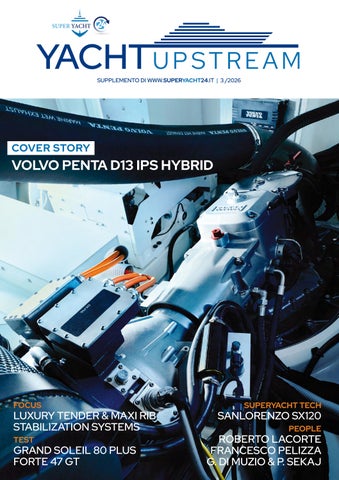
COVER STORY
Volvo Penta D13 IPS Hybrid
FOCUS
Luxury Tender & maxi rib Stabilization Systems TEST
Grand Soleil 80 Plus Forte 47 GT
SUPERYACHT TECH
Sanlorenzo SX120 PEOPLE
Roberto Lacorte Francesco Pelizza G. Di Muzio & P. Sekaj
Editoriale / editorial Alberto Mariotti -
-
L’innovazione invisibile
Invisible innovation
Beach area, volumi interni, stile e materiali degli arredi, décor, aperture verso il mare. Sono il risultato più visibile di un progetto, gli elementi che attirano clienti e visitatori a un salone nautico o stupiscono chi guarda lo yacht in rada. Ma a dare soddisfazione e comfort all’armatore e ai suoi ospiti, e a rendere più semplice la gestione per comandante ed equipaggio, sono spesso scelte e tecnologie meno evidenti. Si tratta di un lavoro che quasi mai si vede e che in genere viene poco raccontato. Una parte importante dell’evoluzione tecnologica riguarda infatti aspetti meno esposti: la distribuzione dei carichi, il rapporto tra propulsione e gestione dell’energia, lo spazio da riservare a impianti e manutenzione, il dialogo tra componenti diversi, la geometria delle pinne stabilizzatrici e gli algoritmi che ne regolano il funzionamento. Aspetti che incidono su affidabilità, sicurezza e consumi. È anche per questo che è nato Yacht Upstream: dare spazio a una parte dello yachting spesso nascosta e talvolta trascurata. In questo settimo numero se ne trovano esempi diversi. Nell’intervista a Francesco Pelizza di Advanced Mechanical Solutions, dedicata in parte al Cnb 62, l’analisi Fem - metodo degli elementi finiti - viene impiegata per simulare la risposta del ragno strutturale e del rollbar alle sollecitazioni reali. Sul Grand Soleil 80, la propulsione ibrida richiede più lavoro a monte ma permette navigazioni a motore più silenziose e confortevoli. Nel test del Volvo Penta D13 Ips Hybrid, propulsione, motori elettrici e termici, batterie, distribuzione dell’energia, software e plancia di comando sono concepiti come un sistema unico. Una scelta che non riguarda soltanto le prestazioni, ma anche assistenza e gestione delle anomalie, con un solo referente invece di una catena di fornitori con responsabilità difficili da scovare. Nel servizio tecnico sul Sanlorenzo SX120, grandi vetrate, terrazze apribili, piscina e beach area rimandano a strutture, movimentazioni, impianti e masse da gestire con attenzione. Infine, il focus sulla stabilizzazione chiude il cerchio e mostra come pinne, giroscopi e interceptor non vengano più valutati solo per ciò che fanno singolarmente, ma anche per il modo in cui si integrano con sensori, software, timoneria e propulsione. Anche questi sono nascosti, addirittura sott’acqua, ma il loro effetto è uno dei più importanti, richiesti e apprezzati a bordo di ogni imbarcazione tra 6 e oltre 100 metri di lunghezza.
The beach area, interior spaces, the style and materials of the furnishings, décor, and views out to sea. These are the most visible aspects of a design project – the elements that attract customers and visitors to a boat show or impress those admiring the yacht at anchor. But it is often the less obvious choices and technologies that provide satisfaction and comfort to the owner and their guests, and make life easier for the captain and crew. This is work that is almost never seen and is generally little talked about. An important part of technological evolution actually concerns less visible aspects: load distribution, the relationship between propulsion and energy management, the space required for systems and maintenance, the interaction between different components, the geometry of stabiliser fins and the algorithms that regulate their operation. These are aspects that affect reliability, safety and fuel consumption. This is also why Yacht Upstream was launched: to shine a light on a side of yachting that is often hidden and sometimes overlooked.This seventh issue features various examples of this. In the interview with Francesco Pelizza of Advanced Mechanical Solutions, which is partly dedicated to the CNB 62, FEM (finite element method) analysis is used to simulate the response of the structural frame and roll bar to real-world stresses. On the Grand Soleil 80, the hybrid propulsion system requires more preparatory work but allows for quieter and more comfortable motorised cruising. In the test of the Volvo Penta D13 IPS Hybrid, the propulsion system, electric and internal combustion engines, batteries, energy distribution, software and control panel are designed as a single integrated system. This approach concerns not only performance but also support and fault management, with a single point of contact rather than a chain of suppliers where responsibilities are hard to trace. In the technical feature on the Sanlorenzo SX120, large glass panels, retractable terraces, a swimming pool and beach area highlight the structures, mechanisms, systems and masses that require careful management. Finally, the focus on stabilisation brings things full circle and demonstrates how stabilisers, gyroscopes and interceptors are no longer assessed solely on what they do individually, but also on how they integrate with sensors, software, the helm and the propulsion system. These too are hidden – indeed, underwater – but their effect is one of the most important, sought-after and appreciated features on board any vessel between 6 and over 100 metres in length. could instead be allocated to the work itself”. And he is not the only one raising important points for reflection on this issue.
CLR MOORING SYSTEM The Harken CLR system redefines megayacht mooring with a clean, high-performance, fully retractable solution. It includes a bollard, fairlead, and mooring winch, keeping the deck flush and uncluttered when not in use. During mooring operations, the three elements work in perfect synergy, delivering maximum control and power.
Retractable Mooring System for Power and Sail Megayacht lUGLIO| July 2026 [ 3 ]
Editoriale / editorial Alberto Mariotti -
-
L’innovazione invisibile
Invisible innovation
Beach area, volumi interni, stile e materiali degli arredi, décor, aperture verso il mare. Sono il risultato più visibile di un progetto, gli elementi che attirano clienti e visitatori a un salone nautico o stupiscono chi guarda lo yacht in rada. Ma a dare soddisfazione e comfort all’armatore e ai suoi ospiti, e a rendere più semplice la gestione per comandante ed equipaggio, sono spesso scelte e tecnologie meno evidenti. Si tratta di un lavoro che quasi mai si vede e che in genere viene poco raccontato. Una parte importante dell’evoluzione tecnologica riguarda infatti aspetti meno esposti: la distribuzione dei carichi, il rapporto tra propulsione e gestione dell’energia, lo spazio da riservare a impianti e manutenzione, il dialogo tra componenti diversi, la geometria delle pinne stabilizzatrici e gli algoritmi che ne regolano il funzionamento. Aspetti che incidono su affidabilità, sicurezza e consumi. È anche per questo che è nato Yacht Upstream: dare spazio a una parte dello yachting spesso nascosta e talvolta trascurata. In questo settimo numero se ne trovano esempi diversi. Nell’intervista a Francesco Pelizza di Advanced Mechanical Solutions, dedicata in parte al Cnb 62, l’analisi Fem - metodo degli elementi finiti - viene impiegata per simulare la risposta del ragno strutturale e del rollbar alle sollecitazioni reali. Sul Grand Soleil 80, la propulsione ibrida richiede più lavoro a monte ma permette navigazioni a motore più silenziose e confortevoli. Nel test del Volvo Penta D13 Ips Hybrid, propulsione, motori elettrici e termici, batterie, distribuzione dell’energia, software e plancia di comando sono concepiti come un sistema unico. Una scelta che non riguarda soltanto le prestazioni, ma anche assistenza e gestione delle anomalie, con un solo referente invece di una catena di fornitori con responsabilità difficili da scovare. Nel servizio tecnico sul Sanlorenzo SX120, grandi vetrate, terrazze apribili, piscina e beach area rimandano a strutture, movimentazioni, impianti e masse da gestire con attenzione. Infine, il focus sulla stabilizzazione chiude il cerchio e mostra come pinne, giroscopi e interceptor non vengano più valutati solo per ciò che fanno singolarmente, ma anche per il modo in cui si integrano con sensori, software, timoneria e propulsione. Anche questi sono nascosti, addirittura sott’acqua, ma il loro effetto è uno dei più importanti, richiesti e apprezzati a bordo di ogni imbarcazione tra 6 e oltre 100 metri di lunghezza.
The beach area, interior spaces, the style and materials of the furnishings, décor, and views out to sea. These are the most visible aspects of a design project – the elements that attract customers and visitors to a boat show or impress those admiring the yacht at anchor. But it is often the less obvious choices and technologies that provide satisfaction and comfort to the owner and their guests, and make life easier for the captain and crew. This is work that is almost never seen and is generally little talked about. An important part of technological evolution actually concerns less visible aspects: load distribution, the relationship between propulsion and energy management, the space required for systems and maintenance, the interaction between different components, the geometry of stabiliser fins and the algorithms that regulate their operation. These are aspects that affect reliability, safety and fuel consumption. This is also why Yacht Upstream was launched: to shine a light on a side of yachting that is often hidden and sometimes overlooked.This seventh issue features various examples of this. In the interview with Francesco Pelizza of Advanced Mechanical Solutions, which is partly dedicated to the CNB 62, FEM (finite element method) analysis is used to simulate the response of the structural frame and roll bar to real-world stresses. On the Grand Soleil 80, the hybrid propulsion system requires more preparatory work but allows for quieter and more comfortable motorised cruising. In the test of the Volvo Penta D13 IPS Hybrid, the propulsion system, electric and internal combustion engines, batteries, energy distribution, software and control panel are designed as a single integrated system. This approach concerns not only performance but also support and fault management, with a single point of contact rather than a chain of suppliers where responsibilities are hard to trace. In the technical feature on the Sanlorenzo SX120, large glass panels, retractable terraces, a swimming pool and beach area highlight the structures, mechanisms, systems and masses that require careful management. Finally, the focus on stabilisation brings things full circle and demonstrates how stabilisers, gyroscopes and interceptors are no longer assessed solely on what they do individually, but also on how they integrate with sensors, software, the helm and the propulsion system. These too are hidden – indeed, underwater – but their effect is one of the most important, sought-after and appreciated features on board any vessel between 6 and over 100 metres in length. could instead be allocated to the work itself”. And he is not the only one raising important points for reflection on this issue.
CLR MOORING SYSTEM The Harken CLR system redefines megayacht mooring with a clean, high-performance, fully retractable solution. It includes a bollard, fairlead, and mooring winch, keeping the deck flush and uncluttered when not in use. During mooring operations, the three elements work in perfect synergy, delivering maximum control and power.
Retractable Mooring System for Power and Sail Megayacht lUGLIO| July 2026 [ 3 ]
Indice dei contenuti Table of contents 03 Editoriale | Editorial TECH 06 Superyacht Sanlorenzo SX120 10 TEST Grand Soleil 80 Plus 14 TEST Volvo Penta D13 IPS Hybrid 18 People Roberto Lacorte 22 People Francesco Pelizza – AMS 26 People G. Di Muzio e P. Sekaj – Accu Italia Luxury Tender & Maxi Rib 30 Focus TEST Forte Yachts 47 GT Luxury Tender & Maxi Rib 34 Focus Fabbrica Italiana Motoscafi Luxury Tender & Maxi Rib 36 Focus Jacopo Recchia – Gommoni Callegari Luxury Tender & Maxi Rib 38 Focus Alberto Montaruli – Spartivento Group
40 42 46 48 50 52 54
Focus Luxury Tender & Maxi Rib
Anvera
Focus Luxury Tender & Maxi Rib
Salvatore Ranieri – Ranieri International Focus Stabilization Systems
Pietro Cappiello – CMC Marine
Focus Stabilization Systems
Lorenzo Mongiardo – Quick Group Focus Stabilization Systems
Gennaro Giliberti – Samos
Focus Stabilization Systems
Andrea Fabbri – Zipwake/SaimMarine Focus Stabilization Systems
Claudio Locarno – Humphree
Super Yacht 24 - ALOCIN MEDIA - Piazza Roberto Baldini 7/75, 16149 Genova +39 010 9703071 | info@alocinmedia.it EDITOR IN CHIEF:
Nicola Capuzzo | capuzzo.nicola@gmail.com +39 334.788.9863
CO-EDITOR IN CHIEF: Alberto Mariotti | mariotti@superyacht24.it + 39 328.29.37.133 Progetto grafico: Claudia Giorgini | claudiagiorgini@gmail.com Contributors: Cinzia Garofoli, Alberto Mariotti, Giuseppe Orrù Advertising & Marketing: Per informazioni sulle opportunità di marketing, pubblicità e visibilità For information on marketing, advertising and visibility opportunities
ON BOARD NOISE AND VIBRATIONS, THEY SPEAK CLEARLY. BUT WHO REALLY UNDERSTANDS THEM? When an issue arises on board a superyacht, a calm and composed approach, technical expertise, troubleshooting skills and clear communication are essential to safeguard operational continuity while preserving the quality of the guest experience. This will be clearly illustrated by Pete Baker, Technical Manager at West Nautical, Giulio Alberti and Hanco Duvenage at VULKAN, as they recount a recent intervention that required close collaboration between the two organisations on board of a 62‑metre CRN motor yacht cruising along the African coastline. In the superyacht sector, and particularly within the charter market, operational continuity, reliability, performance, and premium service standards are prerequisites integral to the exceptional experience guests expect on board. An unexpected downtime immediately translates into tangible impact: • disruption to planned cruising programmes, causing owner dissatisfaction • financial and reputational impact on the charter company • operational and psychological pressure on the crew • a compromised guests experience In such a context, the ability to respond quickly, methodically, and effectively becomes a true strategic asset.
| Giulio Alberti, After Sales Manager VULKAN Italia |
A yacht is a highly complex system, composed of multiple subsystems subject to scheduled inspections, monitoring, and maintenance activities defined by technical manuals and class regulations. But is this level of attention consistently applied to every component on board?
Sabrina Carozzino | marketing@alocinmedia.it | + 39 350.071.6304 Emanuele Buffa di Perrero | ebuffa@link-media.com | + 39 335.649.4152
The case: an anomaly identified before the charter season The case centres on a 62‑metre CRN motor yacht, moored at the V&A Waterfront Marina in Cape Town, South Africa, where it was preparing for an ambitious cruising programme to South America and the Mediterranean. In December 2025, the Captain reported abnormal noise and vibrations originating from the thrust bearing integrated within the VULKAN Propflex T coupling on one of the two propulsion lines. Initially, both the Captain and Yacht Technical Manager could only hypothesize the cause. “The situation was further compounded by the limited availability of historical maintenance records, as well as the absence of maintenance integration into the planned maintenance system following the yacht’s recent incorporation into the fleet” explains Pete Baker.
| Pete Baker, Technical Manager at West Nautical |
Diagnosis before replacement: the VULKAN approach When abnormal noise and vibrations are present, immediate replacement is not always the most effective solution. “It is not about replacing a component, but about solving the root cause of the problem. Only by understanding its origin can a truly effective corrective action be ensured.” confirms Giulio Alberti, After Sales Manager at VULKAN Italia Diagnostic activities: objective data supporting decisions The VULKAN Italia team, composed of specialists in superyacht propulsion systems and the Propflex T tail shaft-coupling, supported by local VULKAN Africa technicians, performed three main analyses: • alignment verification between the Propflex T coupling and the gearbox engine group • vibro-acoustic analysis of the thrust bearing, with vibration levels reaching up to 15 mm/s (compared to typical values around 5 mm/s) • thrust bearing ultrasonic and thermal measurements, which revealed elevated acoustic levels, irregular patterns, and significantly higher temperatures compared to the starboard line. Options: overhaul or replacement? Following the analysis, two possible solutions were identified: • component overhaul, logistically complex and incompatible with charter commitments • complete replacement of the thrust bearing The complexity and uncertainty of dismantling the existing unit made a full replacement a more attractive solution to West Nautical.
[ 4 ] LUGLIO | July 2026
On-site execution The intervention was carried out in April 2026 at Cape Town Marina. The performed activities included: • removal of the existing unit • installation of the new unit • system alignment and bonding to the hull through resin choking
| Hanco Duvenage, After Sales Manager VULKAN South Africa |
ITALIAN TEXT
The value of a structured approach This project highlights how: • troubleshooting, together with the use of advanced diagnostic tools • the integration of specialist expertise and local presence are key factors in ensuring the reliability of high-end superyacht, especially when components, often considered secondary, are overlooked or not properly maintained. ‘’I can still recall sitting at my desk, thinking that it could not have come at a worse time. Yet, despite the timing, events moved quickly. Just one hour after my email, a response landed, setting in motion a chain of actions that would continue until the long 14 hours flight to Cape Town for the acceptance sea trials. The specialists’ intervention did not end with diagnosing the issue and supplying and installing the new thrust bearing. VULKAN continued to support West Nautical by addressing queries from the vessel’s classification society and other stakeholders. As the vessel completes its 5,000-plus nautical mile voyage from South Africa to the Mediterranean Sea, one can truly appreciate the value of having such specialists available.’’ concludes Pete Baker.
Indice dei contenuti Table of contents 03 Editoriale | Editorial TECH 06 Superyacht Sanlorenzo SX120 10 TEST Grand Soleil 80 Plus 14 TEST Volvo Penta D13 IPS Hybrid 18 People Roberto Lacorte 22 People Francesco Pelizza – AMS 26 People G. Di Muzio e P. Sekaj – Accu Italia Luxury Tender & Maxi Rib 30 Focus TEST Forte Yachts 47 GT Luxury Tender & Maxi Rib 34 Focus Fabbrica Italiana Motoscafi Luxury Tender & Maxi Rib 36 Focus Jacopo Recchia – Gommoni Callegari Luxury Tender & Maxi Rib 38 Focus Alberto Montaruli – Spartivento Group
40 42 46 48 48 50 52 54
Focus Luxury Tender & Maxi Rib
Anvera
Focus Luxury Tender & Maxi Rib
Salvatore Ranieri – Ranieri International Focus Luxury Tender & Maxi Rib
Pietro Cappiello – CMC Marine
Focus Stabilization Systems
Giancarlo Perlini – Isoclima Focus Glass & Glazing
Lorenzo Mongiardo – Quick Group Focus Stabilization Systems
Gennaro Giliberti – Samos
Focus Stabilization Systems
Andrea Fabbri – Zipwake/SaimMarine Focus Stabilization Systems
Claudio Locarno – Humphree
Super Yacht 24 - ALOCIN MEDIA - Piazza Roberto Baldini 7/75, 16149 Genova +39 010 9703071 | info@alocinmedia.it EDITOR IN CHIEF: Nicola Capuzzo | capuzzo.nicola@gmail.com +39 334.788.9863 CO-EDITOR IN CHIEF: Alberto Mariotti | mariotti@superyacht24.it + 39 328.29.37.133 Progetto grafico: Claudia Giorgini | claudiagiorgini@gmail.com Contributors: Cinzia Garofoli, Alberto Mariotti, Giuseppe Orrù Advertising & Marketing: Per informazioni sulle opportunità di marketing, pubblicità e visibilità For information on marketing, advertising and visibility opportunities Sabrina Carozzino | marketing@alocinmedia.it | + 39 350.071.6304 Emanuele Buffa di Perrero | ebuffa@link-media.com | + 39 335.649.4152
ON BOARD NOISE AND VIBRATIONS, THEY SPEAK CLEARLY. BUT WHO REALLY UNDERSTANDS THEM? When an issue arises on board a superyacht, a calm and composed approach, technical expertise, troubleshooting skills and clear communication are essential to safeguard operational continuity while preserving the quality of the guest experience. This will be clearly illustrated by Pete Baker, Technical Manager at West Nautical, Giulio Alberti and Hanco Duvenage at VULKAN, as they recount a recent intervention that required close collaboration between the two organisations on board of a 62‑metre CRN motor yacht cruising along the African coastline. In the superyacht sector, and particularly within the charter market, operational continuity, reliability, performance, and premium service standards are prerequisites integral to the exceptional experience guests expect on board. An unexpected downtime immediately translates into tangible impact: • disruption to planned cruising programmes, causing owner dissatisfaction • financial and reputational impact on the charter company • operational and psychological pressure on the crew • a compromised guests experience In such a context, the ability to respond quickly, methodically, and effectively becomes a true strategic asset.
| Giulio Alberti, After Sales Manager VULKAN Italia |
A yacht is a highly complex system, composed of multiple subsystems subject to scheduled inspections, monitoring, and maintenance activities defined by technical manuals and class regulations. But is this level of attention consistently applied to every component on board? The case: an anomaly identified before the charter season The case centres on a 62‑metre CRN motor yacht, moored at the V&A Waterfront Marina in Cape Town, South Africa, where it was preparing for an ambitious cruising programme to South America and the Mediterranean. In December 2025, the Captain reported abnormal noise and vibrations originating from the thrust bearing integrated within the VULKAN Propflex T coupling on one of the two propulsion lines. Initially, both the Captain and Yacht Technical Manager could only hypothesize the cause. “The situation was further compounded by the limited availability of historical maintenance records, as well as the absence of maintenance integration into the planned maintenance system following the yacht’s recent incorporation into the fleet” explains Pete Baker.
| Pete Baker, Technical Manager at West Nautical |
Diagnosis before replacement: the VULKAN approach When abnormal noise and vibrations are present, immediate replacement is not always the most effective solution. “It is not about replacing a component, but about solving the root cause of the problem. Only by understanding its origin can a truly effective corrective action be ensured.” confirms Giulio Alberti, After Sales Manager at VULKAN Italia Diagnostic activities: objective data supporting decisions The VULKAN Italia team, composed of specialists in superyacht propulsion systems and the Propflex T tail shaft-coupling, supported by local VULKAN Africa technicians, performed three main analyses: • alignment verification between the Propflex T coupling and the gearbox engine group • vibro-acoustic analysis of the thrust bearing, with vibration levels reaching up to 15 mm/s (compared to typical values around 5 mm/s) • thrust bearing ultrasonic and thermal measurements, which revealed elevated acoustic levels, irregular patterns, and significantly higher temperatures compared to the starboard line. Options: overhaul or replacement? Following the analysis, two possible solutions were identified: • component overhaul, logistically complex and incompatible with charter commitments • complete replacement of the thrust bearing The complexity and uncertainty of dismantling the existing unit made a full replacement a more attractive solution to West Nautical.
[ 4 ] LUGLIO | July 2026
On-site execution The intervention was carried out in April 2026 at Cape Town Marina. The performed activities included: • removal of the existing unit • installation of the new unit • system alignment and bonding to the hull through resin choking
| Hanco Duvenage, After Sales Manager VULKAN South Africa |
ITALIAN TEXT
The value of a structured approach This project highlights how: • troubleshooting, together with the use of advanced diagnostic tools • the integration of specialist expertise and local presence are key factors in ensuring the reliability of high-end superyacht, especially when components, often considered secondary, are overlooked or not properly maintained. ‘’I can still recall sitting at my desk, thinking that it could not have come at a worse time. Yet, despite the timing, events moved quickly. Just one hour after my email, a response landed, setting in motion a chain of actions that would continue until the long 14 hours flight to Cape Town for the acceptance sea trials. The specialists’ intervention did not end with diagnosing the issue and supplying and installing the new thrust bearing. VULKAN continued to support West Nautical by addressing queries from the vessel’s classification society and other stakeholders. As the vessel completes its 5,000-plus nautical mile voyage from South Africa to the Mediterranean Sea, one can truly appreciate the value of having such specialists available.’’ concludes Pete Baker.
SUPERYACHT TECH SANLORENZO SX120
Grandi vetrate, quattro motori e sala macchine ripensata Dalla nuova Ips Professional Platform sviluppata da Volvo Penta alle soluzioni strutturali fino ai sistemi di bordo. Le principali sfide tecniche del Sanlorenzo SX120
Large windows, four engines and a redesigned engine room for a new technical layout From the new IPS Professional Platform developed by Volvo Penta to structural solutions and on-board systems. The main technical challenges of the Sanlorenzo SX120
L
ungo 36,6 metri, largo 8 e dal‑ la stazza lorda di 270 Gt, l’SX120 rappresenta l’evoluzione più re‑ cente della linea crossover Sanlorenzo. Costruito in composito e sviluppato su quattro ponti, introduce per la pri‑ ma volta l’Ips Professional Platform di Volvo Penta, con quattro motori D13 da 1.000 cv e sistema Scr per il trat‑ tamento dei gas di scarico. L’adozione della nuova architettura propulsiva ha implicato il ripensamento di layout e di‑ stribuzione dei volumi, liberando spazi a bordo e portando a soluzioni come la
[ 6 ] LUGLIO | July 2026
beach area espandibile fino a 70 mq e la piscina a scomparsa integrata a pop‑ pa. Il progetto ha inoltre richiesto un importante lavoro di ingegnerizzazio‑ ne delle grandi superfici vetrate, delle movimentazioni laterali e dei sistemi di apertura. SUPER YACHT 24 ne ha parlato con Andrea Guido, technical & Npd director della business unit Yacht di Sanlorenzo, approfondendo le prin‑ cipali soluzioni prog ettuali adottate sull’SX120. Quali sono state le sfide progettuali e costruttive?
M
easuring 36.6 metres in length, 8 metres in beam and with a gross tonnage of 270 Gt, the SX120 represents the latest evolution of Sanlorenzo’s crossover range. Built from composite materials and featuring four decks, it introduces Volvo Penta’s IPS Professional Platform for the first time, with four 1,000 cv D13 engines and an SCR system for exhaust gas treatment. The adoption of the new propulsion
architecture has involved a rethink of the layout and distribution of space, freeing up areas on board and leading to features such as the beach area, which can be expanded to 70 m², and the retractable swimming pool integrated into the stern. The project also required significant engineering work on the large glazed surfaces, the lateral movement mechanisms and the opening systems. SUPER YACHT 24 discussed this with Andrea Gui-
alberto mariotti
“Le sfide ingegneristiche sono stretta‑ mente legate a quelle di design, per‑ ché derivano soprattutto dalle forme particolari e dalle soluzioni stilistiche che caratterizzano il progetto. Rispet‑ to all’SX112 abbiamo sviluppato una sovrastruttura nuova, con superfici vetrate più ampie sia sul main deck sia sull’upper deck, pensate per aumenta‑ re luminosità e visuale verso l’esterno. Questo ha richiesto un importante la‑ voro di dimensionamento strutturale delle vetroresine e una stretta collabo‑ razione con i fornitori, perché realizzare elementi come l’hard top o i grandi vetri curvi di prua ha rappresentato una sfi‑ da ingegneristica significativa. Lo stes‑ so vale per le movimentazioni di poppa: le terrazze apribili, le superfici vetrate del mezzanino lower deck affacciato sul lounge e i relativi portelloni hanno richiesto un importante lavoro sia sul piano strutturale sia su quello mecca‑ nico”. E quelle più tecniche? “L’integrazione dell’Ips Professional Platform, che ha comportato la com‑ pleta riprogettazione del fondo e del layout della sala macchine, con quat‑ tro motori disposti in linea, due per lato con i pod al centro. A tutto questo si aggiunge la beach area di poppa con la piscina incassata a ponte. Dal punto di vista ingegneristico significa gestire masse importanti tra jacuzzi, acqua, si‑
stemi di riscaldamento, coperture scor‑ revoli e swimming platform mobile”. Come è nata la collaborazione con Volvo sull’Ips Professional Platform? “È un progetto che abbiamo sostenu‑ to fin dall’inizio della nostra collabora‑ zione con Volvo. Quando, tra il 2017 e il 2018, abbiamo avviato il percorso co‑ mune sulla linea SX con l’Ips30, ci sia‑ mo resi conto che sulle nostre carene semiplananti le prestazioni alle velocità più contenute erano assimilabili a quel‑ le di una linea d’asse. Una situazione di‑ versa rispetto ai vantaggi che il sistema Ips esprime alle velocità più elevate. La collaborazione sviluppata in questi anni è servita proprio a fornire dati e indica‑ zioni che evidenziassero la necessità di una piattaforma di dimensioni superio‑ ri, capace di garantire elevata efficienza anche nei regimi dislocanti e semipla‑ nanti. L’Ips Professional Platform na‑ sce per rispondere a questa esigenza. I principali vantaggi derivano dall’im‑ piego di eliche più grandi, che miglio‑ rano il rendimento alle basse velocità, e da un rapporto di riduzione superiore rispetto all’Ips30. Un altro elemento fondamentale è il sistema di controllo Volvo, che gestisce automaticamente l’avviamento e la messa in linea dei mo‑ tori in funzione della potenza richiesta. In uscita dal porto, ad esempio, si può navigare utilizzando soltanto due mo‑
do, Technical & NPD Director of Sanlorenzo’s Yacht business unit, delving into the key design solutions adopted on the SX120. What were the main design and construction challenges of the SX120? “The engineering challenges are closely linked to the design challenges, as they stem primarily from the distinctive shapes and stylistic solutions that characterise the project. Compared to the SX112, we have developed a new superstructure, with larger glazed areas on both the main deck and the upper deck, designed to increase natural light and the view to the outside. This required significant structural design work on the fibreglass components and close collaboration with suppliers, as producing elements such as the hard top or the large curved bow windows presented a significant engineering challenge. The same applies to the stern features: the retractable terraces, the glazed surfaces of the lower deck mezzanine overlooking the lounge, and the associated hatches required substantial work on both the structural and mechanical fronts.” And what about the more technical aspects? “The integration of the IPS Profes-
sional Platform, which involved a complete redesign of the hull bottom and the engine room layout, with four engines arranged in-line, two on each side with the pods in the centre. Added to all this is the aft beach area with its decklevel sunken swimming pool. From an engineering perspective, this means managing substantial masses comprising the jacuzzi, water, heating systems, sliding covers and the mobile swimming platform.” How did the collaboration with Volvo on the IPS Professional Platform come about? “It is a project we have supported right from the start of our collaboration with Volvo. When, between 2017 and 2018, we embarked on our joint venture on the SX range with the IPS30, we realised that, on our semi-planing hulls, performance at lower speeds was comparable to that of a shaft-line propulsion. This was in contrast to the advantages that the IPS system offers at higher speeds. The collaboration developed over recent years has served precisely to provide data and insights highlighting the need for a larger platform, capable of ensuring high efficiency even in displacement and semiplaning modes. The IPS Professional Platform was developed to
lUGLIO| July 2026 [ 7 ]
SUPERYACHT TECH SANLORENZO SX120
Grandi vetrate, quattro motori e sala macchine ripensata Dalla nuova Ips Professional Platform sviluppata da Volvo Penta alle soluzioni strutturali fino ai sistemi di bordo. Le principali sfide tecniche del Sanlorenzo SX120
Large windows, four engines and a redesigned engine room for a new technical layout From the new IPS Professional Platform developed by Volvo Penta to structural solutions and on-board systems. The main technical challenges of the Sanlorenzo SX120
L
ungo 36,6 metri, largo 8 e dal‑ la stazza lorda di 270 Gt, l’SX120 rappresenta l’evoluzione più re‑ cente della linea crossover Sanlorenzo. Costruito in composito e sviluppato su quattro ponti, introduce per la pri‑ ma volta l’Ips Professional Platform di Volvo Penta, con quattro motori D13 da 1.000 cv e sistema Scr per il trat‑ tamento dei gas di scarico. L’adozione della nuova architettura propulsiva ha implicato il ripensamento di layout e di‑ stribuzione dei volumi, liberando spazi a bordo e portando a soluzioni come la
[ 6 ] LUGLIO | July 2026
beach area espandibile fino a 70 mq e la piscina a scomparsa integrata a pop‑ pa. Il progetto ha inoltre richiesto un importante lavoro di ingegnerizzazio‑ ne delle grandi superfici vetrate, delle movimentazioni laterali e dei sistemi di apertura. SUPER YACHT 24 ne ha parlato con Andrea Guido, technical & Npd director della business unit Yacht di Sanlorenzo, approfondendo le prin‑ cipali soluzioni prog ettuali adottate sull’SX120. Quali sono state le sfide progettuali e costruttive?
M
easuring 36.6 metres in length, 8 metres in beam and with a gross tonnage of 270 Gt, the SX120 represents the latest evolution of Sanlorenzo’s crossover range. Built from composite materials and featuring four decks, it introduces Volvo Penta’s IPS Professional Platform for the first time, with four 1,000 cv D13 engines and an SCR system for exhaust gas treatment. The adoption of the new propulsion
architecture has involved a rethink of the layout and distribution of space, freeing up areas on board and leading to features such as the beach area, which can be expanded to 70 m², and the retractable swimming pool integrated into the stern. The project also required significant engineering work on the large glazed surfaces, the lateral movement mechanisms and the opening systems. SUPER YACHT 24 discussed this with Andrea Gui-
alberto mariotti
“Le sfide ingegneristiche sono stretta‑ mente legate a quelle di design, per‑ ché derivano soprattutto dalle forme particolari e dalle soluzioni stilistiche che caratterizzano il progetto. Rispet‑ to all’SX112 abbiamo sviluppato una sovrastruttura nuova, con superfici vetrate più ampie sia sul main deck sia sull’upper deck, pensate per aumenta‑ re luminosità e visuale verso l’esterno. Questo ha richiesto un importante la‑ voro di dimensionamento strutturale delle vetroresine e una stretta collabo‑ razione con i fornitori, perché realizzare elementi come l’hard top o i grandi vetri curvi di prua ha rappresentato una sfi‑ da ingegneristica significativa. Lo stes‑ so vale per le movimentazioni di poppa: le terrazze apribili, le superfici vetrate del mezzanino lower deck affacciato sul lounge e i relativi portelloni hanno richiesto un importante lavoro sia sul piano strutturale sia su quello mecca‑ nico”. E quelle più tecniche? “L’integrazione dell’Ips Professional Platform, che ha comportato la com‑ pleta riprogettazione del fondo e del layout della sala macchine, con quat‑ tro motori disposti in linea, due per lato con i pod al centro. A tutto questo si aggiunge la beach area di poppa con la piscina incassata a ponte. Dal punto di vista ingegneristico significa gestire masse importanti tra jacuzzi, acqua, si‑
stemi di riscaldamento, coperture scor‑ revoli e swimming platform mobile”. Come è nata la collaborazione con Volvo sull’Ips Professional Platform? “È un progetto che abbiamo sostenu‑ to fin dall’inizio della nostra collabora‑ zione con Volvo. Quando, tra il 2017 e il 2018, abbiamo avviato il percorso co‑ mune sulla linea SX con l’Ips30, ci sia‑ mo resi conto che sulle nostre carene semiplananti le prestazioni alle velocità più contenute erano assimilabili a quel‑ le di una linea d’asse. Una situazione di‑ versa rispetto ai vantaggi che il sistema Ips esprime alle velocità più elevate. La collaborazione sviluppata in questi anni è servita proprio a fornire dati e indica‑ zioni che evidenziassero la necessità di una piattaforma di dimensioni superio‑ ri, capace di garantire elevata efficienza anche nei regimi dislocanti e semipla‑ nanti. L’Ips Professional Platform na‑ sce per rispondere a questa esigenza. I principali vantaggi derivano dall’im‑ piego di eliche più grandi, che miglio‑ rano il rendimento alle basse velocità, e da un rapporto di riduzione superiore rispetto all’Ips30. Un altro elemento fondamentale è il sistema di controllo Volvo, che gestisce automaticamente l’avviamento e la messa in linea dei mo‑ tori in funzione della potenza richiesta. In uscita dal porto, ad esempio, si può navigare utilizzando soltanto due mo‑
do, Technical & NPD Director of Sanlorenzo’s Yacht business unit, delving into the key design solutions adopted on the SX120. What were the main design and construction challenges of the SX120? “The engineering challenges are closely linked to the design challenges, as they stem primarily from the distinctive shapes and stylistic solutions that characterise the project. Compared to the SX112, we have developed a new superstructure, with larger glazed areas on both the main deck and the upper deck, designed to increase natural light and the view to the outside. This required significant structural design work on the fibreglass components and close collaboration with suppliers, as producing elements such as the hard top or the large curved bow windows presented a significant engineering challenge. The same applies to the stern features: the retractable terraces, the glazed surfaces of the lower deck mezzanine overlooking the lounge, and the associated hatches required substantial work on both the structural and mechanical fronts.” And what about the more technical aspects? “The integration of the IPS Profes-
sional Platform, which involved a complete redesign of the hull bottom and the engine room layout, with four engines arranged in-line, two on each side with the pods in the centre. Added to all this is the aft beach area with its decklevel sunken swimming pool. From an engineering perspective, this means managing substantial masses comprising the jacuzzi, water, heating systems, sliding covers and the mobile swimming platform.” How did the collaboration with Volvo on the IPS Professional Platform come about? “It is a project we have supported right from the start of our collaboration with Volvo. When, between 2017 and 2018, we embarked on our joint venture on the SX range with the IPS30, we realised that, on our semi-planing hulls, performance at lower speeds was comparable to that of a shaft-line propulsion. This was in contrast to the advantages that the IPS system offers at higher speeds. The collaboration developed over recent years has served precisely to provide data and insights highlighting the need for a larger platform, capable of ensuring high efficiency even in displacement and semiplaning modes. The IPS Professional Platform was developed to
lUGLIO| July 2026 [ 7 ]
SUPERYACHT TECH SANLORENZO SX120
tori, mentre gli altri entrano in funzione progressivamente quando aumenta la richiesta di potenza. Questo approccio riduce le ore motore e i costi di manu‑ tenzione, consentendo al tempo stesso di sfruttare al meglio le caratteristiche dell’apparato propulsivo. A tutto ciò si aggiunge l’integrazione del sistema Scr per l’abbattimento delle emissioni che ha comportato un importante lavoro di progettazione e ingegnerizzazio‑ ne legato all’installazione dei serbatoi dell’urea, dei sensori e di tutta la com‑ ponentistica necessaria”. Vedete ulteriori applicazioni future di questa piattaforma? “Non escludo che in futuro possano esserci ulteriori sviluppi e nuove appli‑ cazioni della piattaforma anche su altri progetti”. Quali materiali avete scelto per la costruzione dell’SX120? “Per quanto riguarda la costruzione, lo scafo viene realizzato con laminazione tradizionale manuale, mentre per co‑ perte, sovrastrutture e hard top utiliz‑ ziamo processi di infusione con ibridi in carbonio. L’obiettivo è ridurre i pesi nelle aree più sensibili della barca, mantenendo ele‑ vati livelli di resistenza strutturale”. Come sono stati sviluppati i sistemi di bordo e la plancia di comando? “La gestione dell’impianto di bordo, dei comandi di plancia e del monito‑ raggio nave deriva principalmente da know-how interno. La progettazione viene sviluppata insieme ai fornitori per la parte hardware e software, mentre per quanto riguarda i sistemi di naviga‑ zione non esiste una scelta esclusiva. Abbiamo realizzato yacht equipaggiati con Raymarine, Simrad e Furuno. Molto dipende dal mercato di destinazione e dalle richieste specifiche dell’armato‑
[ 8 ] LUGLIO | July 2026
re”. Quanto conta il tema della domotica e dell’integrazione dei sistemi di bordo? “È un aspetto che varia molto da barca a barca. Ormai parliamo di una piatta‑ forma che ha già diverse unità in co‑ struzione e le richieste degli armatori possono essere differenti. Le configu‑ razioni standard prevedono una base di domotica dedicata principalmente alla gestione dell’illuminazione e della cli‑ matizzazione, ma su alcune unità ven‑ gono installati sistemi di entertainment e cyber security più evoluti. In diversi casi abbiamo integrato anche sistemi di assistenza alla manovra con teleca‑ mere, utilizzando soluzioni Raymarine o Garmin a seconda delle esigenze del progetto”. Le superfici vetrate rappresentano uno degli elementi distintivi dell’SX120. “Abbiamo lavorato molto sulle forme dei cristalli e su superfici complesse, soprattutto nella zona di prua e nell’a‑ rea della piscina. Per questo modello la collaborazione principale è stata con Isoclima, ma sulla gamma SX lavoriamo anche con Sedak. Per quanto riguar‑ da le parti apribili, i vetri up-down del flybridge sull’upper deck sono stati svi‑ luppati insieme a Mak2. Anche le porte scorrevoli hanno richiesto un impor‑ tante lavoro di sviluppo: in questo caso collaboriamo con Foresti & Suardi, con cui negli ultimi anni abbiamo costruito una stretta collaborazione tecnica”. Quali sono i partner coinvolti nei sistemi di movimentazione? “Per verande, portelloni laterali, siste‑ mi di movimentazione, plancetta e gru di poppa collaboriamo con Fidema. Si tratta di un pacchetto che comprende progettazione, ingegnerizzazione e in‑
meet this need. The main advantages stem from the use of larger propellers, which improve performance at low speeds, and from a higher reduction ratio compared to the IPS30. Another key element is the Volvo control system, which automatically manages the startup and sequencing of the engines according to the power required. When leaving port, for example, the vessel can be operated using just two engines, whilst the others come online progressively as the demand for power increases. This approach reduces engine hours and maintenance costs, whilst at the same time making the most of the propulsion system’s capabilities. Added to this is the integration of the SCR system for emissions reduction, which involved significant design and engineering work relating to the installation of the urea tanks, sensors and all the necessary components.” Do you envisage any further future applications for this platform? “I wouldn’t rule out the possibility of further developments and new applications of the platform in the future, including on other projects.” What materials did you choose for the construction of the SX120? “As regards construction, the hull is built using traditional hand-lay-up lamination, whilst for the decks, superstructures and hardtop we use infusion processes with carbon hybrids. The aim is to reduce weight in the most critical areas of the boat, whilst maintaining high levels of structural strength.” How were the on-board sy-
stems and the bridge developed? “The management of the on-board systems, bridge controls and vessel monitoring is primarily based on in-house expertise. The design is developed in collaboration with suppliers for both hardware and software, whilst there is no exclusive choice when it comes to navigation systems. We have built yachts equipped with Raymarine, Simrad and Furuno. Much depends on the target market and the owner’s specific requirements.” How important is the issue of home automation and the integration of on-board systems? “It’s an aspect that varies greatly from yacht to yacht. We’re now talking about a platform that already has several vessels under construction, and owners’ requirements can differ. Standard configurations include a home automation system primarily dedicated to managing lighting and climate control, but on some vessels, more advanced entertainment and cyber security systems are installed. In several cases, we have also integrated manoeuvring assistance systems with cameras, using Raymarine or Garmin solutions depending on the project’s requirements.” The glazed surfaces are one of the SX120’s distinctive features. “We have worked extensively on the shapes of the glazing and on complex surfaces, particularly in the bow area and around the swimming pool. For this model, our main collaboration was with Isoclima, but for the SX range we also work with Sedak. As for the opening sections,
tegrazione di tutte le movimentazioni principali e che abbiamo sviluppa‑ to seguendo lo stesso approccio già adottato su SX100 e SX112”. Come avete affrontato il tema della stabilizzazione? “Su questa barca utilizziamo stabilizza‑ tori Sleipner con pinne Vector. Oggi sia le pinne sia i giroscopi hanno raggiun‑ to livelli molto elevati di efficacia, ma la scelta dipende dalle caratteristiche dell’imbarcazione e dal suo compor‑ tamento dinamico. La differenza è che ogni imbarcazione, in funzione della carena, della posizione del baricentro e dell’altezza complessiva, ha un proprio modo di muoversi sull’acqua. Nel caso di yacht superiori ai cento piedi, il pe‑ riodo di rollio tende ad aumentare per effetto delle dimensioni, della posizio‑ ne dei baricentri e delle caratteristiche della carena. In queste condizioni la pinna risulta generalmente più effi‑ ciente. Per ottenere risultati analoghi con i giroscopi sarebbe necessario in‑ stallare più unità, con un conseguente aumento di peso e costi. La pinna resta un’appendice dello scafo, ma se corret‑ tamente progettata consente di evita‑ re diverse tonnellate di peso aggiuntivo a bordo. Per questo motivo, su yacht di questa categoria riteniamo che rap‑ presenti la soluzione più efficace”. Perché avete scelto Sleipner? “Adottiamo un approccio multibrand e non abbiamo partnership esclusi‑ ve. Nel corso degli anni abbiamo la‑ vorato con Cmc Marine, Humphree e Sleipner, ampliando progressivamen‑ te il numero di fornitori presenti nella gamma. La scelta di Sleipner sugli SX nasce soprattutto dall’esperienza ma‑ turata con questi sistemi e dal buon livello di confidenza raggiunto nel tempo. Non esiste una motivazione esclusiva né una preclusione verso al‑ tre soluzioni”. Quale ruolo ha l’efficienza energetica nello sviluppo dell’SX120? “È un tema sempre più importante e coinvolge diversi sistemi di bordo. La climatizzazione, ad esempio, dispone di modalità eco e di controlli inverter che consentono di ridurre i consumi. Lo stesso vale per gli stabilizzatori, che
possono adottare modalità operative specifiche per limitare l’assorbimen‑ to energetico quando le condizioni lo consentono. Stiamo inoltre svilup‑ pando applicazioni con batterie al litio sia sull’SX100 sia sull’SX120. Dopo un periodo di rallentamento legato alle preoccupazioni sulla sicurezza, queste tecnologie stanno tornando a essere richieste dal mercato. Oggi i livelli di si‑ curezza sono molto superiori rispetto a quelli di sette o otto anni fa. In que‑ sto senso l’efficientamento energe‑ tico non dipende da un singolo siste‑ ma, ma dall’insieme delle tecnologie presenti a bordo: dalle modalità eco della climatizzazione alla gestione dei chiller e dei compressori a giri variabili, fino ai sistemi di stabilizzazione”. Quali soluzioni avete adottato per i grandi impianti? “Per quanto riguarda la climatizzazio‑ ne collaboriamo con Veco, utilizzando sistemi inverter orientati all’ottimiz‑ zazione energetica. Per ormeggio e ancoraggio lavoriamo con il brand Italwinch di Mz Electronic, mentre le bitte sono sviluppate internamente da Sanlorenzo e realizzate su disegno proprietario. Per porte stagne, taglia‑ fuoco e osteriggi collaboriamo prin‑ cipalmente con Calistri e a volte con Olcese Ricci. Molti altri elementi di‑ pendono invece dalle richieste dell’ar‑ matore”. Per i tender con chi lavorate? “Williams è probabilmente il marchio più diffuso perché offre una gamma di dimensioni adatta alle caratteri‑ stiche della barca. Abbiamo infatti li‑ miti dimensionali e di carico sulla gru di poppa che rappresentano uno dei vincoli progettuali da rispettare. Utiliz‑ ziamo comunque anche altri brand in funzione delle richieste dell’armatore e, in alcuni casi, realizziamo soluzioni custom”. Quali altri fornitori partecipano al progetto SX120? “Tra gli altri coinvolti figurano Hi-Tide per le piscine, Lopolight per le luci di via e Gallinea per i tergicristalli, Seafire per il sistema antincendio, OceanLed per luci subacquee e Boero Interna‑ tional per l’antivegetativa”.
the up-and-down windows on the flybridge of the upper deck were developed in collaboration with Mak2. The sliding doors also required significant development work: in this case, we collaborate with Foresti & Suardi, with whom we have built a close technical partnership in recent years.” Who are the main partners involved in the handling systems? “For sun decks, side hatches, movement systems, the swim platform and the stern crane, we work with Fidema. This is a package that encompasses the design, engineering and integration of all the main movement systems, which we have developed using the same approach already adopted on the SX100 and SX112.” How did you tackle the issue of stabilisation? “On this boat we use Sleipner stabilisers with Vector fins. Today, both the fins and the gyroscopes have reached very high levels of effectiveness, but the choice depends on the vessel’s characteristics and its dynamic behaviour. The difference is that every vessel, depending on its hull shape, the position of its centre of gravity and its overall height, has its own way of moving through the water. In the case of yachts over one hundred feet, the roll period tends to increase due to their size, the position of their centres of gravity and the characteristics of the hull. Under these conditions, the fin is generally more efficient. To achieve similar results with gyroscopes, it would be necessary to install multiple units, resulting in increased weight and costs. The fin remains an appendage of the hull, but if correctly designed, it allows to avoid several tonnes of additional weight on board. For this reason, on yachts in this category, we believe it represents the most effective solution.” Why did you choose Sleipner? “We adopt a multi-brand approach and do not have exclusive partnerships. Over the years, we have
worked with CMC Marine, Humphree and Sleipner, gradually expanding the number of suppliers in our range. The choice of Sleipner for the SX series stems primarily from the experience we have gained with these systems and the high level of trust built up over time. There is no single, exclusive reason for this choice, nor do we rule out other solutions.” What role does energy efficiency play in the development of the SX120? “It is an increasingly important issue and involves various on-board systems. The air conditioning, for example, features eco modes and inverter controls that help reduce energy consumption. The same applies to the stabilisers, which can adopt specific operating modes to limit energy consumption when conditions allow. We are also developing applications using lithiumion batteries on both the SX100 and the SX120. Following a period of slowdown linked to safety concerns, these technologies are once again in demand on the market. Today, safety standards are much higher than they were seven or eight years ago. In this sense, energy efficiency does not depend on a single system, but on the combination of technologies on board: from the air conditioning’s eco modes to the management of chillers and variable-speed compressors, right through to stabilisation systems.” What solutions have you adopted for large-scale installations? “As regards air conditioning, we collaborate with Veco, using inverter systems designed for energy optimisation. For mooring and anchoring, we work with the Italwinch brand from Mz Electronic, whilst the bollards are developed in-house by Sanlorenzo and manufactured to our own design. For watertight doors, fire doors and portholes, we mainly collaborate with Calistri and occasionally with Olcese Ricci. Many other elements, however, depend on the owner’s requirements.” Who do you work with for tenders? “Williams is probably the most widely used brand because it offers a range of sizes suited to the boat’s specifications. We do, in fact, have size and load limits on the stern crane, which represent one of the design constraints that must be adhered to. However, we also use other brands depending on the owner’s requirements and, in some cases, we create bespoke solutions.” Which other suppliers are involved in the SX120 project? “Other partners involved include Hi-Tide for swimming pools, Lopolight for navigation lights and Gallinea for windscreen wipers, Seafire for the fire-suppression system, OceanLed for underwater lighting and Boero International for antifouling.”
lUGLIO| July 2026 [ 9 ]
SUPERYACHT TECH SANLORENZO SX120
tori, mentre gli altri entrano in funzione progressivamente quando aumenta la richiesta di potenza. Questo approccio riduce le ore motore e i costi di manu‑ tenzione, consentendo al tempo stesso di sfruttare al meglio le caratteristiche dell’apparato propulsivo. A tutto ciò si aggiunge l’integrazione del sistema Scr per l’abbattimento delle emissioni che ha comportato un importante lavoro di progettazione e ingegnerizzazio‑ ne legato all’installazione dei serbatoi dell’urea, dei sensori e di tutta la com‑ ponentistica necessaria”. Vedete ulteriori applicazioni future di questa piattaforma? “Non escludo che in futuro possano esserci ulteriori sviluppi e nuove appli‑ cazioni della piattaforma anche su altri progetti”. Quali materiali avete scelto per la costruzione dell’SX120? “Per quanto riguarda la costruzione, lo scafo viene realizzato con laminazione tradizionale manuale, mentre per co‑ perte, sovrastrutture e hard top utiliz‑ ziamo processi di infusione con ibridi in carbonio. L’obiettivo è ridurre i pesi nelle aree più sensibili della barca, mantenendo ele‑ vati livelli di resistenza strutturale”. Come sono stati sviluppati i sistemi di bordo e la plancia di comando? “La gestione dell’impianto di bordo, dei comandi di plancia e del monito‑ raggio nave deriva principalmente da know-how interno. La progettazione viene sviluppata insieme ai fornitori per la parte hardware e software, mentre per quanto riguarda i sistemi di naviga‑ zione non esiste una scelta esclusiva. Abbiamo realizzato yacht equipaggiati con Raymarine, Simrad e Furuno. Molto dipende dal mercato di destinazione e dalle richieste specifiche dell’armato‑
[ 8 ] LUGLIO | July 2026
re”. Quanto conta il tema della domotica e dell’integrazione dei sistemi di bordo? “È un aspetto che varia molto da barca a barca. Ormai parliamo di una piatta‑ forma che ha già diverse unità in co‑ struzione e le richieste degli armatori possono essere differenti. Le configu‑ razioni standard prevedono una base di domotica dedicata principalmente alla gestione dell’illuminazione e della cli‑ matizzazione, ma su alcune unità ven‑ gono installati sistemi di entertainment e cyber security più evoluti. In diversi casi abbiamo integrato anche sistemi di assistenza alla manovra con teleca‑ mere, utilizzando soluzioni Raymarine o Garmin a seconda delle esigenze del progetto”. Le superfici vetrate rappresentano uno degli elementi distintivi dell’SX120. “Abbiamo lavorato molto sulle forme dei cristalli e su superfici complesse, soprattutto nella zona di prua e nell’a‑ rea della piscina. Per questo modello la collaborazione principale è stata con Isoclima, ma sulla gamma SX lavoriamo anche con Sedak. Per quanto riguar‑ da le parti apribili, i vetri up-down del flybridge sull’upper deck sono stati svi‑ luppati insieme a Mak2. Anche le porte scorrevoli hanno richiesto un impor‑ tante lavoro di sviluppo: in questo caso collaboriamo con Foresti & Suardi, con cui negli ultimi anni abbiamo costruito una stretta collaborazione tecnica”. Quali sono i partner coinvolti nei sistemi di movimentazione? “Per verande, portelloni laterali, siste‑ mi di movimentazione, plancetta e gru di poppa collaboriamo con Fidema. Si tratta di un pacchetto che comprende progettazione, ingegnerizzazione e in‑
meet this need. The main advantages stem from the use of larger propellers, which improve performance at low speeds, and from a higher reduction ratio compared to the IPS30. Another key element is the Volvo control system, which automatically manages the startup and sequencing of the engines according to the power required. When leaving port, for example, the vessel can be operated using just two engines, whilst the others come online progressively as the demand for power increases. This approach reduces engine hours and maintenance costs, whilst at the same time making the most of the propulsion system’s capabilities. Added to this is the integration of the SCR system for emissions reduction, which involved significant design and engineering work relating to the installation of the urea tanks, sensors and all the necessary components.” Do you envisage any further future applications for this platform? “I wouldn’t rule out the possibility of further developments and new applications of the platform in the future, including on other projects.” What materials did you choose for the construction of the SX120? “As regards construction, the hull is built using traditional hand-lay-up lamination, whilst for the decks, superstructures and hardtop we use infusion processes with carbon hybrids. The aim is to reduce weight in the most critical areas of the boat, whilst maintaining high levels of structural strength.” How were the on-board sy-
stems and the bridge developed? “The management of the on-board systems, bridge controls and vessel monitoring is primarily based on in-house expertise. The design is developed in collaboration with suppliers for both hardware and software, whilst there is no exclusive choice when it comes to navigation systems. We have built yachts equipped with Raymarine, Simrad and Furuno. Much depends on the target market and the owner’s specific requirements.” How important is the issue of home automation and the integration of on-board systems? “It’s an aspect that varies greatly from yacht to yacht. We’re now talking about a platform that already has several vessels under construction, and owners’ requirements can differ. Standard configurations include a home automation system primarily dedicated to managing lighting and climate control, but on some vessels, more advanced entertainment and cyber security systems are installed. In several cases, we have also integrated manoeuvring assistance systems with cameras, using Raymarine or Garmin solutions depending on the project’s requirements.” The glazed surfaces are one of the SX120’s distinctive features. “We have worked extensively on the shapes of the glazing and on complex surfaces, particularly in the bow area and around the swimming pool. For this model, our main collaboration was with Isoclima, but for the SX range we also work with Sedak. As for the opening sections,
tegrazione di tutte le movimentazioni principali e che abbiamo sviluppa‑ to seguendo lo stesso approccio già adottato su SX100 e SX112”. Come avete affrontato il tema della stabilizzazione? “Su questa barca utilizziamo stabilizza‑ tori Sleipner con pinne Vector. Oggi sia le pinne sia i giroscopi hanno raggiun‑ to livelli molto elevati di efficacia, ma la scelta dipende dalle caratteristiche dell’imbarcazione e dal suo compor‑ tamento dinamico. La differenza è che ogni imbarcazione, in funzione della carena, della posizione del baricentro e dell’altezza complessiva, ha un proprio modo di muoversi sull’acqua. Nel caso di yacht superiori ai cento piedi, il pe‑ riodo di rollio tende ad aumentare per effetto delle dimensioni, della posizio‑ ne dei baricentri e delle caratteristiche della carena. In queste condizioni la pinna risulta generalmente più effi‑ ciente. Per ottenere risultati analoghi con i giroscopi sarebbe necessario in‑ stallare più unità, con un conseguente aumento di peso e costi. La pinna resta un’appendice dello scafo, ma se corret‑ tamente progettata consente di evita‑ re diverse tonnellate di peso aggiuntivo a bordo. Per questo motivo, su yacht di questa categoria riteniamo che rap‑ presenti la soluzione più efficace”. Perché avete scelto Sleipner? “Adottiamo un approccio multibrand e non abbiamo partnership esclusi‑ ve. Nel corso degli anni abbiamo la‑ vorato con Cmc Marine, Humphree e Sleipner, ampliando progressivamen‑ te il numero di fornitori presenti nella gamma. La scelta di Sleipner sugli SX nasce soprattutto dall’esperienza ma‑ turata con questi sistemi e dal buon livello di confidenza raggiunto nel tempo. Non esiste una motivazione esclusiva né una preclusione verso al‑ tre soluzioni”. Quale ruolo ha l’efficienza energetica nello sviluppo dell’SX120? “È un tema sempre più importante e coinvolge diversi sistemi di bordo. La climatizzazione, ad esempio, dispone di modalità eco e di controlli inverter che consentono di ridurre i consumi. Lo stesso vale per gli stabilizzatori, che
possono adottare modalità operative specifiche per limitare l’assorbimen‑ to energetico quando le condizioni lo consentono. Stiamo inoltre svilup‑ pando applicazioni con batterie al litio sia sull’SX100 sia sull’SX120. Dopo un periodo di rallentamento legato alle preoccupazioni sulla sicurezza, queste tecnologie stanno tornando a essere richieste dal mercato. Oggi i livelli di si‑ curezza sono molto superiori rispetto a quelli di sette o otto anni fa. In que‑ sto senso l’efficientamento energe‑ tico non dipende da un singolo siste‑ ma, ma dall’insieme delle tecnologie presenti a bordo: dalle modalità eco della climatizzazione alla gestione dei chiller e dei compressori a giri variabili, fino ai sistemi di stabilizzazione”. Quali soluzioni avete adottato per i grandi impianti? “Per quanto riguarda la climatizzazio‑ ne collaboriamo con Veco, utilizzando sistemi inverter orientati all’ottimiz‑ zazione energetica. Per ormeggio e ancoraggio lavoriamo con il brand Italwinch di Mz Electronic, mentre le bitte sono sviluppate internamente da Sanlorenzo e realizzate su disegno proprietario. Per porte stagne, taglia‑ fuoco e osteriggi collaboriamo prin‑ cipalmente con Calistri e a volte con Olcese Ricci. Molti altri elementi di‑ pendono invece dalle richieste dell’ar‑ matore”. Per i tender con chi lavorate? “Williams è probabilmente il marchio più diffuso perché offre una gamma di dimensioni adatta alle caratteri‑ stiche della barca. Abbiamo infatti li‑ miti dimensionali e di carico sulla gru di poppa che rappresentano uno dei vincoli progettuali da rispettare. Utiliz‑ ziamo comunque anche altri brand in funzione delle richieste dell’armatore e, in alcuni casi, realizziamo soluzioni custom”. Quali altri fornitori partecipano al progetto SX120? “Tra gli altri coinvolti figurano Hi-Tide per le piscine, Lopolight per le luci di via e Gallinea per i tergicristalli, Seafire per il sistema antincendio, OceanLed per luci subacquee e Boero Interna‑ tional per l’antivegetativa”.
the up-and-down windows on the flybridge of the upper deck were developed in collaboration with Mak2. The sliding doors also required significant development work: in this case, we collaborate with Foresti & Suardi, with whom we have built a close technical partnership in recent years.” Who are the main partners involved in the handling systems? “For sun decks, side hatches, movement systems, the swim platform and the stern crane, we work with Fidema. This is a package that encompasses the design, engineering and integration of all the main movement systems, which we have developed using the same approach already adopted on the SX100 and SX112.” How did you tackle the issue of stabilisation? “On this boat we use Sleipner stabilisers with Vector fins. Today, both the fins and the gyroscopes have reached very high levels of effectiveness, but the choice depends on the vessel’s characteristics and its dynamic behaviour. The difference is that every vessel, depending on its hull shape, the position of its centre of gravity and its overall height, has its own way of moving through the water. In the case of yachts over one hundred feet, the roll period tends to increase due to their size, the position of their centres of gravity and the characteristics of the hull. Under these conditions, the fin is generally more efficient. To achieve similar results with gyroscopes, it would be necessary to install multiple units, resulting in increased weight and costs. The fin remains an appendage of the hull, but if correctly designed, it allows to avoid several tonnes of additional weight on board. For this reason, on yachts in this category, we believe it represents the most effective solution.” Why did you choose Sleipner? “We adopt a multi-brand approach and do not have exclusive partnerships. Over the years, we have
worked with CMC Marine, Humphree and Sleipner, gradually expanding the number of suppliers in our range. The choice of Sleipner for the SX series stems primarily from the experience we have gained with these systems and the high level of trust built up over time. There is no single, exclusive reason for this choice, nor do we rule out other solutions.” What role does energy efficiency play in the development of the SX120? “It is an increasingly important issue and involves various on-board systems. The air conditioning, for example, features eco modes and inverter controls that help reduce energy consumption. The same applies to the stabilisers, which can adopt specific operating modes to limit energy consumption when conditions allow. We are also developing applications using lithiumion batteries on both the SX100 and the SX120. Following a period of slowdown linked to safety concerns, these technologies are once again in demand on the market. Today, safety standards are much higher than they were seven or eight years ago. In this sense, energy efficiency does not depend on a single system, but on the combination of technologies on board: from the air conditioning’s eco modes to the management of chillers and variable-speed compressors, right through to stabilisation systems.” What solutions have you adopted for large-scale installations? “As regards air conditioning, we collaborate with Veco, using inverter systems designed for energy optimisation. For mooring and anchoring, we work with the Italwinch brand from Mz Electronic, whilst the bollards are developed in-house by Sanlorenzo and manufactured to our own design. For watertight doors, fire doors and portholes, we mainly collaborate with Calistri and occasionally with Olcese Ricci. Many other elements, however, depend on the owner’s requirements.” Who do you work with for tenders? “Williams is probably the most widely used brand because it offers a range of sizes suited to the boat’s specifications. We do, in fact, have size and load limits on the stern crane, which represent one of the design constraints that must be adhered to. However, we also use other brands depending on the owner’s requirements and, in some cases, we create bespoke solutions.” Which other suppliers are involved in the SX120 project? “Other partners involved include Hi-Tide for swimming pools, Lopolight for navigation lights and Gallinea for windscreen wipers, Seafire for the fire-suppression system, OceanLed for underwater lighting and Boero International for antifouling.”
lUGLIO| July 2026 [ 9 ]
test - Grand Soleil 80 PLUS
Alberto Mariotti
Propulsione ibrida, chiglia telescopica e fibra di carbonio
La nuova ammiraglia di Grand Soleil si distingue per il motore elettrico Torqeedo da 100 kW, il pescaggio variabile tra 2,90-4,40 metri con due pale del timone. La prova a Porto Cervo, in Sardegna
Hybrid propulsion, telescopic keel and carbon fibre Grand Soleil’s new flagship stands out for its Torqeedo electric motor of 100 kW and variable draught of between 2.90 and 4.40 metres, featuring a two-blade rudder. The test in Porto Cervo, Sardinia
P
orto Cervo - Si chiama Bianca II il nuovo GS Plus 80 Long Cruise ap‑ pena varato dal cantiere. La barca ha subito partecipato alle regate della Grand Soleil Cup a Porto Cervo, in Sar‑ degna, dove SUPER YACHT 24 ha po‑ tuto provarla insieme a Franco Corazza, project manager della linea Plus, e al suo progettista Matteo Polli. Per il cantiere non è il debutto in questa fascia dimen‑ sionale: nel 2018 mise in acqua la prima e unica unità del GS 80 Custom firmato da Giovanni Ceccarelli. Questa volta la storia è diversa: il nuovo modello fa par‑ te della gamma Plus, lanciata nel 2022 e che oggi comprende i GS65, 72 e 80 con 13 barche in acqua. L’80 conta quat‑ tro unità vendute, con la seconda già in costruzione. Bianca II si distingue per propulsione ibri‑ da, chiglia telescopica e sistema idraulico che gestisce winch, piano velico e chiglia. La costruzione dello scafo prevede san‑ dwich composito con resina vinilestere a base epossidica, laminazione in infusione sottovuoto e rinforzi di carbonio nelle aree più sollecitate. Ogni struttura è re‑
[ 10 ] LUGLIO | July 2026
alizzata e adattata in funzione del layout: le paratie, ad esempio, sono state pro‑ gettate integrando tubazioni in carbonio per il passaggio dei cavi elettrici, soluzio‑ ne che ha permesso di mantenere finitu‑ re sottili e pulite, migliorando accessibili‑ tà e organizzazione degli impianti. Durante la navigazione Franco Corazza ha raccontato che: “Questa è la barca più grande che ho mai costruito, per ora. In cantiere stiamo infatti guardando a di‑ mensioni maggiori e la grande differenza con la produzione attuale riguarderà i si‑ stemi. È qui che si annidano le maggiori complicazioni della costruzione di yacht di taglia superiore. Abbiamo realizza‑ to tutto internamente, dalla laminazio‑ ne fino alla messa in acqua della barca, una scelta che consente un controllo più accurato della qualità e favorisce una maggiore integrazione tra costruzione e impiantistica, permettendo di soddisfare pienamente le esigenze dei nostri arma‑ tori”. La propulsione è ibrida e consiste in un motore elettrico Torqeedo da 100 kW supportato da due generatori Fisher
T
he new GS Plus 80 Long Cruise, recently launched by the shipyard, is called Bianca II. The yacht immediately took part in the Grand Soleil Cup regattas in Porto Cervo, Sardinia, where SUPER YACHT 24 was able to test it alongside Franco Corazza, project manager of the Plus line, and its designer Matteo Polli. This is not the shipyard’s first venture into this size category: in 2018, it launched the first and only GS 80 Custom, designed by Giovanni Ceccarelli. This time, however, the story is different: the new model forms part of the Plus range, launched in 2022, which now comprises the GS65, 72 and 80, with 13 boats afloat. Four units of the 80 have been sold, with the second already under construction. Bianca II stands out for its hybrid propulsion, telescopic keel and hydraulic system that controls the winches, sail plan and keel.
The hull is constructed using a composite sandwich structure with epoxy-based vinylester resin, vacuum-infusion lamination and carbon fibre reinforcements in the areas subject to the greatest stress. Each structural element is fabricated and adapted to suit the layout: the bulkheads, for example, were designed to incorporate carbon fibre ducts for electrical cables, a solution that has allowed for slim, clean finishes whilst improving accessibility and the organisation of the systems. Whilst sailing, Franco Corazza remarked: “This is the largest boat I have ever built, so far. At the shipyard, we are in fact looking at larger dimensions, and the major difference compared to our current production will lie in the systems. This is where the greatest complications in building larger yachts lie. We have carried out everything in-house, from the lamination right throu-
Panda da 45 kW e due pacchi batterie da 40 kW ciascuno. Rispetto alla propulsio‑ ne tradizionale il sistema aggiunge circa 1.700 kg di peso (e incide circa l’8% in più sul costo dell’imbarcazione) e una mag‑ giore complessità in fase di costruzione e addestramento dell’equipaggio, ma non per l’armatore. Dal punto di vista del comfort, però, il sistema cambia sensibilmente la vita a bordo: gli ospiti possono godere di en‑ trate e uscite dal porto e, se necessario, di trasferimenti a motore in assoluto si‑ lenzio. Ed è quanto accaduto durante la prova quando, verso le 16, il vento è ca‑ lato costringendo al rientro in porto. La differenza si è percepita chiaramente e quando il giorno successivo, nelle stes‑ se condizioni di poco vento, il GS65 con propulsione diesel è rientrato ha fatto sentire inevitabilmente la presenza del motore termico. In una barca dedicata alla crociera e al charter, dove il peso non rappresenta una priorità assoluta, è una soluzione che ha senso. Questo primo GS80 ri‑ sulta più silenzioso in propulsione che
durante la navigazione a vela, quando il sistema idraulico Myt Systems, che ge‑ stisce winch, captive winch e piano veli‑ co, rende percepibile la potenza in gioco, soprattutto nelle manovre. In caso di avaria, una pompa d’emer‑ genza permette di gestire la chiglia e un winch per rientrare in porto. La barca di‑ spone inoltre di due eliche: una racing a pale abbattibili e una da crociera a pale fisse di Rolla, ottimizzata anche per l’i‑ drogenerazione. Secondo il cantiere la differenza di efficienza è significativa: con la prima, a 9,2 nodi, il consumo è di 73 kW, mentre con la seconda, a 9,5 nodi, scende a 56 kW. La chiglia telescopica è realizzata da Apm-Keels e ha un pescaggio variabile tra 2,90 e 4,40 metri. È abbinata a due pale del timone che completano l’archi‑ tettura delle appendici. Al riguardo, secondo il progettista Mat‑ teo Polli: “In genere, quando si adottano due pale, si tende a posizionarle molto distanti dal centro barca e con una for‑ te inclinazione, in modo da favorirne il funzionamento a vela. Sul GS80 è stato
gh to the boat’s launch – a choice that allows for more precise quality control and promotes greater integration between the hull and the systems, enabling us to fully meet the needs of our owners.” The propulsion system is hybrid and consists of a 100 kW Torqeedo electric motor supported by two 45 kW Fisher Panda generators and two battery packs of 40 kW each. Compared with traditional propulsion, the system adds around 1,700 kg in weight (and increases the cost of the vessel by around 8 per cent) and introduces greater complexity during construction and crew training, though not for the owner. From a comfort perspective, however, the system significantly changes life on board: guests can enjoy entering and leaving the harbour and, if necessary, motorised transfers in complete silence. And this is exactly
what happened during the test when, at around 4 pm, the wind dropped, forcing us to return to port. The difference was clearly noticeable, and when, the following day, under the same light wind conditions, the dieselpowered GS65 returned to port, the presence of the internal combustion engine was inevitably noticeable. In a boat designed for cruising and charter, where weight is not an absolute priority, this is a sensible solution. This first GS80 is quieter under engine power than when sailing, when the Myt Systems hydraulic system – which controls the winches, captive winches and sail plan – makes the power at work clearly noticeable, especially during manoeuvres. In the event of a breakdown, an emergency pump allows the keel to be managed and a winch to be used to return to port. The boat also features two propellers: a racing propeller with folding blades and a cruising propeller with fixed blades by Rolla, which is also optimised for hydro-generation. According to the shipyard, the difference in efficiency is significant: with the former, at 9.2 knots, power consumption is 73 kW, whilst with the latter, at 9.5 knots, it drops to 56 kW. The telescopic keel is manufactured by Apm-Keels and has a draught ranging from 2.90 to 4.40 metres. It is paired with two rudder blades that complete the architecture of the appendages. On this point, according to designer Matteo Polli: “Generally, when two rudders are used, they tend to be positioned far from the centre of the boat and at a steep angle, to optimise their performance under sail. On the GS80, the opposite approach was taken: by placing the rudders closer to the centre and accepting that the windward one does not emerge completely from the water, both remain operational at all times and can therefore be smaller. Their angle of inclination differs from what is normally seen: 15 degrees as opposed to the typical 20 degrees, which roughly corresponds to a boat’s heel angle when cruising. We believe we have found a happy medium that delivers good manoeuvrability in harbour, excellent performance at sea and impressive performance even in light winds”. (Scan the QR code to read the full interview). The second GS80 will be more performance-oriented, and not just because it is the Performance version. It will have a standard fixed keel of 3.95 metres, a single, deeper rudder, conventional propulsion and a weight reduced by approximately 3,000 kg: 42 tonnes compared to the over
lUGLIO| July 2026 [ 11 ]
test - Grand Soleil 80 PLUS
Alberto Mariotti
Propulsione ibrida, chiglia telescopica e fibra di carbonio
La nuova ammiraglia di Grand Soleil si distingue per il motore elettrico Torqeedo da 100 kW, il pescaggio variabile tra 2,90-4,40 metri con due pale del timone. La prova a Porto Cervo, in Sardegna
Hybrid propulsion, telescopic keel and carbon fibre Grand Soleil’s new flagship stands out for its Torqeedo electric motor of 100 kW and variable draught of between 2.90 and 4.40 metres, featuring a two-blade rudder. The test in Porto Cervo, Sardinia
P
orto Cervo - Si chiama Bianca II il nuovo GS Plus 80 Long Cruise ap‑ pena varato dal cantiere. La barca ha subito partecipato alle regate della Grand Soleil Cup a Porto Cervo, in Sar‑ degna, dove SUPER YACHT 24 ha po‑ tuto provarla insieme a Franco Corazza, project manager della linea Plus, e al suo progettista Matteo Polli. Per il cantiere non è il debutto in questa fascia dimen‑ sionale: nel 2018 mise in acqua la prima e unica unità del GS 80 Custom firmato da Giovanni Ceccarelli. Questa volta la storia è diversa: il nuovo modello fa par‑ te della gamma Plus, lanciata nel 2022 e che oggi comprende i GS65, 72 e 80 con 13 barche in acqua. L’80 conta quat‑ tro unità vendute, con la seconda già in costruzione. Bianca II si distingue per propulsione ibri‑ da, chiglia telescopica e sistema idraulico che gestisce winch, piano velico e chiglia. La costruzione dello scafo prevede san‑ dwich composito con resina vinilestere a base epossidica, laminazione in infusione sottovuoto e rinforzi di carbonio nelle aree più sollecitate. Ogni struttura è re‑
[ 10 ] LUGLIO | July 2026
alizzata e adattata in funzione del layout: le paratie, ad esempio, sono state pro‑ gettate integrando tubazioni in carbonio per il passaggio dei cavi elettrici, soluzio‑ ne che ha permesso di mantenere finitu‑ re sottili e pulite, migliorando accessibili‑ tà e organizzazione degli impianti. Durante la navigazione Franco Corazza ha raccontato che: “Questa è la barca più grande che ho mai costruito, per ora. In cantiere stiamo infatti guardando a di‑ mensioni maggiori e la grande differenza con la produzione attuale riguarderà i si‑ stemi. È qui che si annidano le maggiori complicazioni della costruzione di yacht di taglia superiore. Abbiamo realizza‑ to tutto internamente, dalla laminazio‑ ne fino alla messa in acqua della barca, una scelta che consente un controllo più accurato della qualità e favorisce una maggiore integrazione tra costruzione e impiantistica, permettendo di soddisfare pienamente le esigenze dei nostri arma‑ tori”. La propulsione è ibrida e consiste in un motore elettrico Torqeedo da 100 kW supportato da due generatori Fisher
T
he new GS Plus 80 Long Cruise, recently launched by the shipyard, is called Bianca II. The yacht immediately took part in the Grand Soleil Cup regattas in Porto Cervo, Sardinia, where SUPER YACHT 24 was able to test it alongside Franco Corazza, project manager of the Plus line, and its designer Matteo Polli. This is not the shipyard’s first venture into this size category: in 2018, it launched the first and only GS 80 Custom, designed by Giovanni Ceccarelli. This time, however, the story is different: the new model forms part of the Plus range, launched in 2022, which now comprises the GS65, 72 and 80, with 13 boats afloat. Four units of the 80 have been sold, with the second already under construction. Bianca II stands out for its hybrid propulsion, telescopic keel and hydraulic system that controls the winches, sail plan and keel.
The hull is constructed using a composite sandwich structure with epoxy-based vinylester resin, vacuum-infusion lamination and carbon fibre reinforcements in the areas subject to the greatest stress. Each structural element is fabricated and adapted to suit the layout: the bulkheads, for example, were designed to incorporate carbon fibre ducts for electrical cables, a solution that has allowed for slim, clean finishes whilst improving accessibility and the organisation of the systems. Whilst sailing, Franco Corazza remarked: “This is the largest boat I have ever built, so far. At the shipyard, we are in fact looking at larger dimensions, and the major difference compared to our current production will lie in the systems. This is where the greatest complications in building larger yachts lie. We have carried out everything in-house, from the lamination right throu-
Panda da 45 kW e due pacchi batterie da 40 kW ciascuno. Rispetto alla propulsio‑ ne tradizionale il sistema aggiunge circa 1.700 kg di peso (e incide circa l’8% in più sul costo dell’imbarcazione) e una mag‑ giore complessità in fase di costruzione e addestramento dell’equipaggio, ma non per l’armatore. Dal punto di vista del comfort, però, il sistema cambia sensibilmente la vita a bordo: gli ospiti possono godere di en‑ trate e uscite dal porto e, se necessario, di trasferimenti a motore in assoluto si‑ lenzio. Ed è quanto accaduto durante la prova quando, verso le 16, il vento è ca‑ lato costringendo al rientro in porto. La differenza si è percepita chiaramente e quando il giorno successivo, nelle stes‑ se condizioni di poco vento, il GS65 con propulsione diesel è rientrato ha fatto sentire inevitabilmente la presenza del motore termico. In una barca dedicata alla crociera e al charter, dove il peso non rappresenta una priorità assoluta, è una soluzione che ha senso. Questo primo GS80 ri‑ sulta più silenzioso in propulsione che
durante la navigazione a vela, quando il sistema idraulico Myt Systems, che ge‑ stisce winch, captive winch e piano veli‑ co, rende percepibile la potenza in gioco, soprattutto nelle manovre. In caso di avaria, una pompa d’emer‑ genza permette di gestire la chiglia e un winch per rientrare in porto. La barca di‑ spone inoltre di due eliche: una racing a pale abbattibili e una da crociera a pale fisse di Rolla, ottimizzata anche per l’i‑ drogenerazione. Secondo il cantiere la differenza di efficienza è significativa: con la prima, a 9,2 nodi, il consumo è di 73 kW, mentre con la seconda, a 9,5 nodi, scende a 56 kW. La chiglia telescopica è realizzata da Apm-Keels e ha un pescaggio variabile tra 2,90 e 4,40 metri. È abbinata a due pale del timone che completano l’archi‑ tettura delle appendici. Al riguardo, secondo il progettista Mat‑ teo Polli: “In genere, quando si adottano due pale, si tende a posizionarle molto distanti dal centro barca e con una for‑ te inclinazione, in modo da favorirne il funzionamento a vela. Sul GS80 è stato
gh to the boat’s launch – a choice that allows for more precise quality control and promotes greater integration between the hull and the systems, enabling us to fully meet the needs of our owners.” The propulsion system is hybrid and consists of a 100 kW Torqeedo electric motor supported by two 45 kW Fisher Panda generators and two battery packs of 40 kW each. Compared with traditional propulsion, the system adds around 1,700 kg in weight (and increases the cost of the vessel by around 8 per cent) and introduces greater complexity during construction and crew training, though not for the owner. From a comfort perspective, however, the system significantly changes life on board: guests can enjoy entering and leaving the harbour and, if necessary, motorised transfers in complete silence. And this is exactly
what happened during the test when, at around 4 pm, the wind dropped, forcing us to return to port. The difference was clearly noticeable, and when, the following day, under the same light wind conditions, the dieselpowered GS65 returned to port, the presence of the internal combustion engine was inevitably noticeable. In a boat designed for cruising and charter, where weight is not an absolute priority, this is a sensible solution. This first GS80 is quieter under engine power than when sailing, when the Myt Systems hydraulic system – which controls the winches, captive winches and sail plan – makes the power at work clearly noticeable, especially during manoeuvres. In the event of a breakdown, an emergency pump allows the keel to be managed and a winch to be used to return to port. The boat also features two propellers: a racing propeller with folding blades and a cruising propeller with fixed blades by Rolla, which is also optimised for hydro-generation. According to the shipyard, the difference in efficiency is significant: with the former, at 9.2 knots, power consumption is 73 kW, whilst with the latter, at 9.5 knots, it drops to 56 kW. The telescopic keel is manufactured by Apm-Keels and has a draught ranging from 2.90 to 4.40 metres. It is paired with two rudder blades that complete the architecture of the appendages. On this point, according to designer Matteo Polli: “Generally, when two rudders are used, they tend to be positioned far from the centre of the boat and at a steep angle, to optimise their performance under sail. On the GS80, the opposite approach was taken: by placing the rudders closer to the centre and accepting that the windward one does not emerge completely from the water, both remain operational at all times and can therefore be smaller. Their angle of inclination differs from what is normally seen: 15 degrees as opposed to the typical 20 degrees, which roughly corresponds to a boat’s heel angle when cruising. We believe we have found a happy medium that delivers good manoeuvrability in harbour, excellent performance at sea and impressive performance even in light winds”. (Scan the QR code to read the full interview). The second GS80 will be more performance-oriented, and not just because it is the Performance version. It will have a standard fixed keel of 3.95 metres, a single, deeper rudder, conventional propulsion and a weight reduced by approximately 3,000 kg: 42 tonnes compared to the over
lUGLIO| July 2026 [ 11 ]
test - Grand Soleil 80 PLUS
“Perché la doppia pala del Grand Soleil 80 è diversa dalle altre”
Why the Grand Soleil 80’s double blade is different from the others” matteo polli progettista ARCHITECT
read the full interview
leggi l’intervista completa
fatto il contrario: mettendo le pale più vicine al centro e accettando che quella sopravvento non esca completamente dall’acqua, restano sempre entrambe operative e possono quindi essere più piccole. La loro inclinazione è diversa rispetto a quanto si vede normalmen‑ te: 15 gradi contro i tipici 20 gradi, che corrispondono più o meno all’angolo di sbandamento di una barca in crociera. Crediamo di aver trovato una via di mez‑ zo che consente di ottenere una buona manovrabilità in porto, ottima in mare e prestazioni interessanti anche con poco vento”. (segui il QRCode per leggere l’in‑ tervista completa). Il secondo GS80 sarà più orientato alle prestazioni, e non solo perché in versio‑ ne Performance. Avrà una chiglia stan‑ dard fissa da 3,95 metri, un solo timone più profondo, propulsione tradizionale e un peso inferiore di circa 3.000 kg: 42 tonnellate contro le oltre 47 di Bianca II, equipaggiata anche con dissalatori Osmosea e aria condizionata Frigomar. A bordo un ruolo importante è stato svolto da Bamar, che ha fornito avvol‑ gitori e pistoni idraulici. A prua si trova l’avvolgitore del genoa, che utilizza uno strallo torsionale al posto dei tradizionali profili in alluminio e svolge tre funzioni: avvolgimento della vela, regolazione del‑ la tensione del bordo d’entrata e auto‑ allineamento tramite un fulcro sferico. È presente poi un secondo avvolgitore per la trinchetta, anch’esso recessato. Nella zona dell’albero trovano posto il vang e i pistoni per tesa base e tesa drizze, men‑ tre sottocoperta sono installati quelli dedicati alla regolazione del fiocco 3D e del relativo carrello. Nel garage di poppa si trovano invece i due cilindri che movi‑ mentano la plancetta e i due del pateraz‑ zo. Grand Soleil guarda ai grandi yacht e lo si intuisce anche dalla qualità e dal livello dell’attrezzatura di coperta. Spiccano il
[ 12 ] LUGLIO | July 2026
sistema di regolazione 3D del fiocco e il captive winch Harken per la scotta randa, ben visibile entrando nel gavone di pop‑ pa. Questo 80 adotta una randa con pun‑ to fisso in pozzetto, soluzione che con‑ tribuisce a mantenere completamente libera l’area relax. Il piano velico di Bian‑ ca II è composto da un albero Axxon e un V-boom, entrambi in carbonio. Tutta l’elettronica di navigazione è B&G, uti‑ lizzata anche per domotica e monito‑ raggio tramite centralina Edge H5000 e plotter Zeus installati alle timonerie e al tavolo da carteggio. A bordo sono pre‑ senti anche componenti Solimar e Sea‑ smart, rispettivamente con passauomo e portelloni la prima e bitte la seconda. Il layout interno di questo primo esem‑ plare, sviluppato come sempre insieme a Nauta, conta su quattro cabine ospiti con armatoriale a prua mentre la zona dedi‑ cata all’equipaggio è poppa con cabina doppia, cucina, zona carteggio e bagno. Il test si è svolto a Porto Cervo nel corso di due giornate caratterizzate da vento piuttosto leggero. In entrambe le uscite la barca era invelata con randa e fiocco autovirante. Dalle due consolle si gesti‑ sce facilmente l’intero piano velico, con l’accortezza di prestare attenzione du‑ rante le manovre al piccolo joystick della scotta randa e ai comandi di winch e av‑ volgitori: la potenza idraulica è notevole. La barca si muove bene anche nell’aria leggera, il dislocamento importante ri‑ chiede qualche istante per entrare in velocità. Rispetto al GS65, dotato di una sola pala del timone, si percepisce una differenza nel feeling e nella sensibilità della ruota, pur rimanendo sempre pia‑ cevole da timonare. Sarà soprattutto con vento più sostenuto che questa configu‑ razione mostrerà i propri vantaggi, grazie alla doppia timoneria capace di mante‑ nere controllo e morbidezza anche a bar‑ ca sbandata.
Prestazioni - Performances Velocità barca Vento reale Angolo vento reale Vele Boat speed True wind speed True wind angle Sails (kts) (kts) 7,8 8,1 7,2 7,5
11,2 10,5 8,4 9,1
57° randa/fiocco 53° randa/fiocco 73° randa/fiocco 39° randa/fiocco
SCHEDA TECNICA / Technical data dati | Specifications Lunghezza f.t. | Length o.a. 26, 20 m Lunghezza scafo | Hull length 23,99 m Lunghezza al gall | Waterline length 22 m Larghezza | Beam 6,6 m Pescaggio | Draft std 3,95 m Dislocamento a vuoto | Displacement light 42, 5 t Carburante | Fuel 2.000 lt Acqua | Water 1.300 lt Motore | Engine Yanmar 4LV250 250 cv
47 tonnes of Bianca II, which is also equipped with Osmosea watermakers and Frigomar air conditioning. Bamar played an important role on board, supplying furling systems and hydraulic pistons. At the bow is the genoa furler, which uses a torsional forestay instead of traditional aluminium profiles and performs three functions: furling the sail, adjusting the leading edge tension and self-alignment via a spherical pivot. There is also a second furler for the staysail, which is likewise recessed. The mast area houses the vang and the cylinders for the base and halyard lines, whilst below deck are those dedicated to adjusting the 3D jib and its traveller. In the aft garage,
Progetto | Project Cantiere del Pardo Architettura navale Matteo Polli Design ext/ int/layout Nauta
cantiere | shipyard Cantiere del Pardo, Forlì (FC); tel. 0543 782404; https://cantieredelpardo.com/it/ info@cantieredelpardo.com
meanwhile, are the two cylinders that operate the swim platform and the two for the backstay. Grand Soleil focuses on large yachts, and this is evident from the quality and standard of the deck fittings. Particularly noteworthy are the 3D jib adjustment system and the Harken captive winch for the mainsail sheet, which is clearly visible upon entering the aft locker. This 80 features a mainsail with a fixed point in the cockpit, a design that helps to keep the relaxation area completely unobstructed. Bianca II’s rig consists of an Axxon mast and a V-boom, both made of carbon fibre. All the navigation electronics are by B&G, which are also used for home automation and monito-
ring via an Edge H5000 control unit and a Zeus chartplotter installed in the wheelhouses and at the chart table. Solimar and Seasmart components are also fitted on board, the former providing manhole covers and hatches, and the latter providing cleats. The interior layout of this first model, developed as always in collaboration with Nauta, features four guest cabins with the owner’s cabin in the bow, whilst the crew area is located aft and comprises a twin cabin, galley, chart room and bathroom. The test took place in Porto Cervo over two days characterised by fairly light winds. On both outings, the boat was rigged with a mainsail and a self-tacking jib. The entire sail plan can be easily managed from the two consoles, though care must be taken during manoeuvres with the small mainsail sheet joystick and the winch and furling controls: the hydraulic power is considerable. The boat handles well even in light air, though its substantial displacement means it takes a moment to pick up speed. Compared to the GS65, which is fitted with a single rudder blade, there is a noticeable difference in the feel and responsiveness of the wheel, although it remains a pleasure to steer at all times. It is particularly in stronger winds that this configuration will demonstrate its advantages, thanks to the twin rudders, which are capable of maintaining control and smooth handling even when the boat is heeled over.
lUGLIO| July 2026 [ 13 ]
test - Grand Soleil 80 PLUS
“Perché la doppia pala del Grand Soleil 80 è diversa dalle altre”
Why the Grand Soleil 80’s double blade is different from the others” matteo polli progettista ARCHITECT
read the full interview
leggi l’intervista completa
fatto il contrario: mettendo le pale più vicine al centro e accettando che quella sopravvento non esca completamente dall’acqua, restano sempre entrambe operative e possono quindi essere più piccole. La loro inclinazione è diversa rispetto a quanto si vede normalmen‑ te: 15 gradi contro i tipici 20 gradi, che corrispondono più o meno all’angolo di sbandamento di una barca in crociera. Crediamo di aver trovato una via di mez‑ zo che consente di ottenere una buona manovrabilità in porto, ottima in mare e prestazioni interessanti anche con poco vento”. (segui il QRCode per leggere l’in‑ tervista completa). Il secondo GS80 sarà più orientato alle prestazioni, e non solo perché in versio‑ ne Performance. Avrà una chiglia stan‑ dard fissa da 3,95 metri, un solo timone più profondo, propulsione tradizionale e un peso inferiore di circa 3.000 kg: 42 tonnellate contro le oltre 47 di Bianca II, equipaggiata anche con dissalatori Osmosea e aria condizionata Frigomar. A bordo un ruolo importante è stato svolto da Bamar, che ha fornito avvol‑ gitori e pistoni idraulici. A prua si trova l’avvolgitore del genoa, che utilizza uno strallo torsionale al posto dei tradizionali profili in alluminio e svolge tre funzioni: avvolgimento della vela, regolazione del‑ la tensione del bordo d’entrata e auto‑ allineamento tramite un fulcro sferico. È presente poi un secondo avvolgitore per la trinchetta, anch’esso recessato. Nella zona dell’albero trovano posto il vang e i pistoni per tesa base e tesa drizze, men‑ tre sottocoperta sono installati quelli dedicati alla regolazione del fiocco 3D e del relativo carrello. Nel garage di poppa si trovano invece i due cilindri che movi‑ mentano la plancetta e i due del pateraz‑ zo. Grand Soleil guarda ai grandi yacht e lo si intuisce anche dalla qualità e dal livello dell’attrezzatura di coperta. Spiccano il
[ 12 ] LUGLIO | July 2026
sistema di regolazione 3D del fiocco e il captive winch Harken per la scotta randa, ben visibile entrando nel gavone di pop‑ pa. Questo 80 adotta una randa con pun‑ to fisso in pozzetto, soluzione che con‑ tribuisce a mantenere completamente libera l’area relax. Il piano velico di Bian‑ ca II è composto da un albero Axxon e un V-boom, entrambi in carbonio. Tutta l’elettronica di navigazione è B&G, uti‑ lizzata anche per domotica e monito‑ raggio tramite centralina Edge H5000 e plotter Zeus installati alle timonerie e al tavolo da carteggio. A bordo sono pre‑ senti anche componenti Solimar e Sea‑ smart, rispettivamente con passauomo e portelloni la prima e bitte la seconda. Il layout interno di questo primo esem‑ plare, sviluppato come sempre insieme a Nauta, conta su quattro cabine ospiti con armatoriale a prua mentre la zona dedi‑ cata all’equipaggio è poppa con cabina doppia, cucina, zona carteggio e bagno. Il test si è svolto a Porto Cervo nel corso di due giornate caratterizzate da vento piuttosto leggero. In entrambe le uscite la barca era invelata con randa e fiocco autovirante. Dalle due consolle si gesti‑ sce facilmente l’intero piano velico, con l’accortezza di prestare attenzione du‑ rante le manovre al piccolo joystick della scotta randa e ai comandi di winch e av‑ volgitori: la potenza idraulica è notevole. La barca si muove bene anche nell’aria leggera, il dislocamento importante ri‑ chiede qualche istante per entrare in velocità. Rispetto al GS65, dotato di una sola pala del timone, si percepisce una differenza nel feeling e nella sensibilità della ruota, pur rimanendo sempre pia‑ cevole da timonare. Sarà soprattutto con vento più sostenuto che questa configu‑ razione mostrerà i propri vantaggi, grazie alla doppia timoneria capace di mante‑ nere controllo e morbidezza anche a bar‑ ca sbandata.
Prestazioni - Performances Velocità barca Vento reale Angolo vento reale Vele Boat speed True wind speed True wind angle Sails (kts) (kts) 7,8 8,1 7,2 7,5
11,2 10,5 8,4 9,1
57° randa/fiocco 53° randa/fiocco 73° randa/fiocco 39° randa/fiocco
SCHEDA TECNICA / Technical data dati | Specifications Lunghezza f.t. | Length o.a. 26, 20 m Lunghezza scafo | Hull length 23,99 m Lunghezza al gall | Waterline length 22 m Larghezza | Beam 6,6 m Pescaggio | Draft std 3,95 m Dislocamento a vuoto | Displacement light 42, 5 t Carburante | Fuel 2.000 lt Acqua | Water 1.300 lt Motore | Engine Yanmar 4LV250 250 cv
47 tonnes of Bianca II, which is also equipped with Osmosea watermakers and Frigomar air conditioning. Bamar played an important role on board, supplying furling systems and hydraulic pistons. At the bow is the genoa furler, which uses a torsional forestay instead of traditional aluminium profiles and performs three functions: furling the sail, adjusting the leading edge tension and self-alignment via a spherical pivot. There is also a second furler for the staysail, which is likewise recessed. The mast area houses the vang and the cylinders for the base and halyard lines, whilst below deck are those dedicated to adjusting the 3D jib and its traveller. In the aft garage,
Progetto | Project Cantiere del Pardo Architettura navale Matteo Polli Design ext/ int/layout Nauta
cantiere | shipyard Cantiere del Pardo, Forlì (FC); tel. 0543 782404; https://cantieredelpardo.com/it/ info@cantieredelpardo.com
meanwhile, are the two cylinders that operate the swim platform and the two for the backstay. Grand Soleil focuses on large yachts, and this is evident from the quality and standard of the deck fittings. Particularly noteworthy are the 3D jib adjustment system and the Harken captive winch for the mainsail sheet, which is clearly visible upon entering the aft locker. This 80 features a mainsail with a fixed point in the cockpit, a design that helps to keep the relaxation area completely unobstructed. Bianca II’s rig consists of an Axxon mast and a V-boom, both made of carbon fibre. All the navigation electronics are by B&G, which are also used for home automation and monito-
ring via an Edge H5000 control unit and a Zeus chartplotter installed in the wheelhouses and at the chart table. Solimar and Seasmart components are also fitted on board, the former providing manhole covers and hatches, and the latter providing cleats. The interior layout of this first model, developed as always in collaboration with Nauta, features four guest cabins with the owner’s cabin in the bow, whilst the crew area is located aft and comprises a twin cabin, galley, chart room and bathroom. The test took place in Porto Cervo over two days characterised by fairly light winds. On both outings, the boat was rigged with a mainsail and a self-tacking jib. The entire sail plan can be easily managed from the two consoles, though care must be taken during manoeuvres with the small mainsail sheet joystick and the winch and furling controls: the hydraulic power is considerable. The boat handles well even in light air, though its substantial displacement means it takes a moment to pick up speed. Compared to the GS65, which is fitted with a single rudder blade, there is a noticeable difference in the feel and responsiveness of the wheel, although it remains a pleasure to steer at all times. It is particularly in stronger winds that this configuration will demonstrate its advantages, thanks to the twin rudders, which are capable of maintaining control and smooth handling even when the boat is heeled over.
lUGLIO| July 2026 [ 13 ]
test - Volvo Penta D 13 Ips Hybrid
Alberto Mariotti
Come funziona il nuovo ibrido integrato di Volvo Penta
Provata in Svezia la nuova propulsione ‘helm to propeller’ che semplifica progettazione, installazione e service con un referente unico per l’intero pacchetto
How the new integrated hybrid works Tested in Sweden, the new ‘helm-to-propeller’ propulsion system simplifies design, installation and servicing for shipyard, owners and captains, with a single point of contact for the entire package
K
rossholmen (Svezia) - In occasione della presentazione alla stampa del D13 Ips Hybrid SUPER YACHT 24 ha avuto la possibilità di testare in acqua sia il nuovo sistema di propulsione sia l’Ips Professional Platform presentato durante il Monaco Yacht Show 2024. Le prove si sono svolte a bordo di due imbarcazioni di proprietà del costruttore svedese allestite ad hoc per l’occasione e parte della flotta con cui Volvo Penta sperimenta in condizioni reali – dopo i test al banco – tutte le novità prima di immetterle nel mercato, momento che per il sistema ibrido arriverà nella seconda parte del 2026. Da notare che il sistema ibrido si è già visto a bordo del Seadeck 7 di Azimut presentato al Cannes Yachting Festival 2024 e che nel giro di qualche mese sarà quindi a listino. È inoltre anche a bordo del nuovo Sanlorenzo She. Combinando propulsione, motori elettrici, batterie, gestione dell’energia e controlli in un unico pacchetto,
[ 14 ] LUGLIO | July 2026
il sistema riduce la complessità per armatori, comandanti, progettisti e cantieri. Secondo Hanna Ljungqvist, vicepresidente senior della divisione Marine di Volvo Penta “Il nostro nuovo Volvo Penta D13 Ips Hybrid è una soluzione marina completa, dalla timoneria all’elica. Offrendo un pacchetto completamente integrato con un unico punto di responsabilità, semplifichiamo tutto, dalla progettazione e l’installazione all’operatività e al service, elevando al tempo stesso il comfort e le prestazioni a bordo”. Il punto critico della maggior parte dei sistemi ibridi è proprio l’integrazione e la gestione dei singoli componenti – motori termici ed elettrici, batterie, interfaccia e servizi di assistenza. Quando tutto funziona correttamente non emergono criticità, ma in caso contrario individuare le cause di un malfunzionamento risulta complesso, così come definire le responsabilità tra i diversi fornitori coinvolti. Il risultato è quasi sempre
K
rossholmen (Sweden)During the press launch of the D13 IPS Hybrid, SUPER YACHT 24 had the opportunity to test both the new propulsion system and the Ips Professional Platform, unveiled at the Monaco Yacht Show 2024, on the water. The trials took place aboard two vessels owned by the Swedish manufacturer, specially fitted out for the occasion and part of the fleet with which Volvo Penta tests all new developments in real-world conditions – following bench tests – before launching them onto the market, a milestone that for the hybrid system is set for the second half of 2026. It is worth noting that the hybrid system has already been seen on board Azimut’s Seadeck 7, presented at the 2024 Cannes Yachting Festival, and will therefore be available in the catalogue within a few months. It is also on board the new Sanlorenzo She. By combining propul-
sion, electric motors, batteries, energy management and controls into a single package, the system reduces complexity for owners, skippers, designers and shipyards. According to Hanna Ljungqvist, Senior Vice President of Volvo Penta’s Marine Division, “Our new Volvo Penta D13 IPS Hybrid is a complete marine solution, from the wheelhouse to the propeller. By offering a fully integrated package with a single point of responsibility, we simplify everything from design and installation to operation and service, whilst enhancing comfort and performance on board.” The critical issue with most hybrid systems is precisely the integration and management of individual components – combustion and electric engines, batteries, interfaces and support services. When everything works correctly, no problems arise, but if it does go wrong, identifying the causes of a malfunction is complex, as is determining responsibility among
lo stesso: costi in aumento, imbarcazione ferma e armatore insoddisfatto. Il vantaggio della soluzione ‘plugand-play’ sviluppata da Volvo Penta risiede nell’unicità del referente per l’intero sistema, progettato, costruito e validato internamente prima dell’immissione sul mercato. Anche in questo caso possono verificarsi problemi, ma a gestirli e risolverli è un interlocutore solo: Volvo Penta, responsabile dell’intero pacchetto di propulsione. La rete di assistenza globale dell’azienda garantisce l’accesso a tecnici qualificati e a diagnostica avanzata, contribuendo ad assicurare un’operatività affidabile e una risoluzione efficiente dei problemi ovunque la barca si trovi. Al riguardo Nicola Pomi, vicepresidente yacht & superyacht sales ha spiegato: “Operando come partner unico sull’intero sistema, possiamo supportare i clienti dalla progettazione iniziale fino all’installazione e all’operatività. Questo livello di co-engineering e collaborazione consente
costruzioni più efficienti, prestazioni ottimizzate e una maggiore flessibilità nel design degli yacht. Si tratta di offrire tranquillità tanto quanto prestazioni. Con un unico partner a garanzia dell’intero sistema, i nostri clienti possono concentrarsi sul piacere del mare, sapendo di poter contare su un supporto esperto in ogni fase”. Il sistema è composto da una coppia di motori diesel D13 Ips900 o Ips1350 accoppiati, ciascuno, a un motore elettrico da 160 kW e un pacco batterie da 4 o 6 moduli per una capacità di 147 o 221 kWh progettato in esclusiva per Volvo Penta con approvazione Dnv (Det Norske Veritas), unità di distribuzione della potenza e del raffreddamento, il software di controllo e l’interfaccia Evc (electronic vessel control) in plancia: è per questo che Volvo Penta parla di un sistema integrato ‘helm to propeller’, vuol dire che dal cruscotto alle eliche è tutto progettato, testato e integrato dal
the various suppliers involved. The result is almost always the same: rising costs, a boat out of service and a dissatisfied owner. The advantage of the ‘plug-and-play’ solution developed by Volvo Penta lies in having a single point of contact for the entire system, which is designed, built and validated in-house before being launched on the market. Problems can still arise, but there is a single point of contact to manage and resolve them: Volvo Penta, which is responsible for the entire propulsion package. The company’s global service network ensures access to qualified technicians and advanced diagnostics, helping to guarantee reliable operation and efficient problem-solving wherever the boat is located. On this subject, Nicola Pomi, Vice President of Yacht & Superyacht Sales, explained: “By acting as a single partner for the entire system, we can support customers from initial design through to installation and opera-
tion. This level of co-engineering and collaboration enables more efficient construction, optimised performance and greater flexibility in yacht design. It is as much about offering peace of mind as it is about performance. With a single partner guaranteeing the entire system, our customers can focus on enjoying the sea, knowing they can count on expert support at every stage.” The system comprises a pair of D13 IPS900 or IPS1350 diesel engines, each coupled to a 160 kW electric motor and a battery pack of 4 or 6 modules providing a capacity of 147 or 221 kWh, designed exclusively for Volvo Penta with DNV (Det Norske Veritas) approval, power and cooling distribution units, control software and the EVC (Electronic Vessel Control) interface on the bridge: this is why Volvo Penta refers to an integrated ‘helm-topropeller’ system, meaning that everything from the dashboard to the propellers is designed, tested
lUGLIO| July 2026 [ 15 ]
test - Volvo Penta D13 Ips Hybrid
Alberto Mariotti
Come funziona il nuovo ibrido integrato di Volvo Penta
Provata in Svezia la nuova propulsione ‘helm to propeller’ che semplifica progettazione, installazione e service con un referente unico per l’intero pacchetto
How the new integrated hybrid works Tested in Sweden, the new ‘helm-to-propeller’ propulsion system simplifies design, installation and servicing for shipyard, owners and captains, with a single point of contact for the entire package
K
rossholmen (Svezia) - In oc‑ casione della presentazione alla stampa del D13 Ips Hybrid SUPER YACHT 24 ha avuto la pos‑ sibilità di testare in acqua sia il nuovo sistema di propulsione sia l’Ips Pro‑ fessional Platform presentato du‑ rante il Monaco Yacht Show 2024. Le prove si sono svolte a bordo di due imbarcazioni di proprietà del costruttore svedese allestite ad hoc per l’occasione e parte della flot‑ ta con cui Volvo Penta sperimenta in condizioni reali – dopo i test al banco – tutte le novità prima di im‑ metterle nel mercato, momento che per il sistema ibrido arriverà nella seconda parte del 2026. Da notare che il sistema ibrido si è già visto a bordo del Seadeck 7 di Azimut pre‑ sentato al Cannes Yachting Festival 2024 e che nel giro di qualche mese sarà quindi a listino. È inoltre anche a bordo del nuovo Sanlorenzo She. Combinando propulsione, motori elettrici, batterie, gestione dell’ener‑ gia e controlli in un unico pacchetto,
[ 14 ] LUGLIO | July 2026
il sistema riduce la complessità per armatori, comandanti, progettisti e cantieri. Secondo Hanna Ljungqvist, vicepresidente senior della divisio‑ ne Marine di Volvo Penta “Il nostro nuovo Volvo Penta D13 Ips Hybrid è una soluzione marina completa, dalla timoneria all’elica. Offrendo un pacchetto completamente in‑ tegrato con un unico punto di re‑ sponsabilità, semplifichiamo tutto, dalla progettazione e l’installazione all’operatività e al service, elevando al tempo stesso il comfort e le pre‑ stazioni a bordo”. Il punto critico della maggior parte dei sistemi ibridi è proprio l’integra‑ zione e la gestione dei singoli com‑ ponenti – motori termici ed elettrici, batterie, interfaccia e servizi di assi‑ stenza. Quando tutto funziona cor‑ rettamente non emergono criticità, ma in caso contrario individuare le cause di un malfunzionamento risul‑ ta complesso, così come definire le responsabilità tra i diversi fornitori coinvolti. Il risultato è quasi sempre
K
rossholmen (Sweden)During the press launch of the D13 IPS Hybrid, SUPER YACHT 24 had the opportunity to test both the new propulsion system and the IPS40, unveiled at the Monaco Yacht Show 2024, on the water. The trials took place aboard two vessels owned by the Swedish manufacturer, specially fitted out for the occasion and part of the fleet with which Volvo Penta tests all new developments in real-world conditions – following bench tests – before launching them onto the market, a milestone that for the hybrid system is set for the second half of 2026. It is worth noting that the hybrid system has already been seen on board Azimut’s Seadeck 7, presented at the 2024 Cannes Yachting Festival, and will therefore be available in the catalogue within a few months. It is also on board the new Sanlorenzo She (making its world debut at the Cannes Boat Show). By combining propulsion, electric
motors, batteries, energy management and controls into a single package, the system reduces complexity for owners, skippers, designers and shipyards. According to Hanna Ljungqvist, Senior Vice President of Volvo Penta’s Marine Division, “Our new Volvo Penta D13 IPS Hybrid is a complete marine solution, from the wheelhouse to the propeller. By offering a fully integrated package with a single point of responsibility, we simplify everything from design and installation to operation and service, whilst enhancing comfort and performance on board.” The critical issue with most hybrid systems is precisely the integration and management of individual components – combustion and electric engines, batteries, interfaces and support services. When everything works correctly, no problems arise, but if it does go wrong, identifying the causes of a malfunction is complex, as is determining responsibility among
lo stesso: costi in aumento, imbarca‑ zione ferma e armatore insoddisfat‑ to. Il vantaggio della soluzione ‘plugand-play’ sviluppata da Volvo Penta risiede nell’unicità del referente per l’intero sistema, progettato, costru‑ ito e validato internamente prima dell’immissione sul mercato. Anche in questo caso possono verificarsi problemi, ma a gestirli e risolverli è un interlocutore solo: Volvo Penta, responsabile dell’intero pacchetto di propulsione. La rete di assisten‑ za globale dell’azienda garantisce l’accesso a tecnici qualificati e a dia‑ gnostica avanzata, contribuendo ad assicurare un’operatività affidabile e una risoluzione efficiente dei pro‑ blemi ovunque la barca si trovi. Al ri‑ guardo Nicola Pomi, vicepresidente yacht & superyacht sales ha spiega‑ to: “Operando come partner unico sull’intero sistema, possiamo sup‑ portare i clienti dalla progettazione iniziale fino all’installazione e all’o‑ peratività. Questo livello di co-en‑ gineering e collaborazione consente
costruzioni più efficienti, prestazioni ottimizzate e una maggiore flessibi‑ lità nel design degli yacht. Si tratta di offrire tranquillità tanto quanto prestazioni. Con un unico partner a garanzia dell’intero sistema, i no‑ stri clienti possono concentrarsi sul piacere del mare, sapendo di poter contare su un supporto esperto in ogni fase”. Il sistema è composto da una cop‑ pia di motori diesel D13 Ips900 o Ips1350 accoppiati, ciascuno, a un motore elettrico da 160 kW e un pacco batterie da 4 o 6 moduli per una capacità di 147 o 221 kWh pro‑ gettato in esclusiva per Volvo Penta con approvazione Dnv (Det Norske Veritas), unità di distribuzione del‑ la potenza e del raffreddamento, il software di controllo e l’interfac‑ cia Evc (electronic vessel control) in plancia: è per questo che Volvo Penta parla di un sistema integra‑ to ‘helm to propeller’, vuol dire che dal cruscotto alle eliche è tutto progettato, testato e integrato dal
the various suppliers involved. The result is almost always the same: rising costs, a boat out of service and a dissatisfied owner. The advantage of the ‘plug-and-play’ solution developed by Volvo Penta lies in having a single point of contact for the entire system, which is designed, built and validated in-house before being launched on the market. Problems can still arise, but there is a single point of contact to manage and resolve them: Volvo Penta, which is responsible for the entire propulsion package. The company’s global service network ensures access to qualified technicians and advanced diagnostics, helping to guarantee reliable operation and efficient problem-solving wherever the boat is located. On this subject, Nicola Pomi, Vice President of Yacht & Superyacht Sales, explained: “By acting as a single partner for the entire system, we can support customers from initial design through to installation and opera-
tion. This level of co-engineering and collaboration enables more efficient construction, optimised performance and greater flexibility in yacht design. It is as much about offering peace of mind as it is about performance. With a single partner guaranteeing the entire system, our customers can focus on enjoying the sea, knowing they can count on expert support at every stage.” The system comprises a pair of D13 IPS900 or IPS1350 diesel engines, each coupled to a 160 kW electric motor and a battery pack of 4 or 6 modules providing a capacity of 147 or 221 kWh, designed exclusively for Volvo Penta with DNV (Det Norske Veritas) approval, power and cooling distribution units, control software and the EVC (Electronic Vessel Control) interface on the bridge: this is why Volvo Penta refers to an integrated ‘helm-topropeller’ system, meaning that everything from the dashboard to the propellers is designed, tested
lUGLIO| July 2026 [ 15 ]
test - Volvo Penta D13 Ips Hybrid costruttore. Se il sistema ha un problema, l’armatore chiama Volvo Penta, non deve trovare la fonte del problema per capi‑ re se contattare il motorista, chi ha fornito le batterie, il motore elettrico o le altre unità. Il test si è svolto sul Penta 80, una delle tante imbarcazioni della flotta Volvo Penta adibita a barca la‑ boratorio. Qui sono installati gli IPS1350 con il pacco batterie da 6 elementi, la versione quindi più potente. Il Glass cockpit system permette di gestire e controllare le varie modalità di navigazione e una volta seduti sulla poltrona del pilota è tutto molto chiaro e immediato. Comprendere con‑ sumi elettrici, capacità di rica‑ rica e modalità di navigazione è piuttosto immediato. Una volta presi i comandi si hanno quattro modalità di propulsione tra cui scegliere: pure electric, hybrid electric, hybrid fuel e cross-over. La prima esclude del tutto i mo‑ tori diesel e serve soprattutto per manovre in porto, accesso in aree protette o brevi navigazioni entro i 10 nodi di velocità. Con il penta 80 la velocità massima è di 11 nodi, possibile per 30 minu‑ ti. A 6 nodi l’autonomia arriva a 6 ore di navigazione. La potenza disponibile è quella dei due mo‑ tori elettrici da 160 kW ciascuno. Nella modalità Hybrid Eletric il sistema decide quale sorgente uti‑ lizzare (elettrica o diesel) a secon‑ da della potenza richiesta: fino a 1.000 giri lavorano i motori elettri‑ ci. Nella Hybrid Fuel i motori diesel sono privilegiati per la propulsione mentre quelli elettrici entrano a supporto nelle fasi di accelerazio‑ ne e maggior richiesta di potenza; a bassa velocità è possibile ricari‑ care le batterie. Infine nella Hybrid cross over lavora un motore diesel mentre l’altro è utilizzato per rica‑ ricare le batterie e il sistema scam‑ bia i motori per minimizzare le ore motore e aumentare gli intervalli di manutenzione. Questa modalità è utile per navigazioni o trasferimen‑ ti senza fretta, quando è possibile andare piano. È possibile ricaricare le batterie anche alla fonda, in cir‑ ca 45 minuti a seconda del pacco batteire (4 o 6 slot), mentre non è
[ 16 ] LUGLIO | July 2026
possibile farlo solo nella modalità full electric o nella altre quando si naviga a tutta velocità. Il display è davvero facile da com‑ prendere: quattro palette in alto in‑ dicano la modalità di navigazione scelta e basta toccarle per passare da un all’altra. Al centro rimane sem‑ pre fissa l’indicazione di cosa stan‑ no facendo i quattro motori diesel/ elettrici grazie a simboli molto chiari (un’elica, una saetta e una goccia). Ai lati invece sono evidenziati i consumi, il range di navigazione e la power ba‑ lance. Il D13 Ips Hybrid è inoltre com‑ patibile con l’Hvo100, un carburante paraffinico rinnovabile che può ridur‑ re le emissioni fino al 90% rispetto al diesel convenzionale. Il sistema è inoltre dotato di un impianto di posttrattamento compatto conforme all’Imo III, la normativa sulle emissioni più restrittiva in vigore.
and integrated by the manufacturer. If the system has a problem, the owner calls Volvo Penta; they do not need to identify the source of the problem to determine whether to contact the engine manufacturer, the battery supplier, the electric motor supplier or the suppliers of other units. The test was carried out on the Penta 80, one of the many vessels in the Volvo Penta fleet used as a test boat. This vessel is fitted with IPS1350s and a 6-cell battery pack, making it the most powerful version. The Glass Cockpit system allows you to manage and control the various navigation modes, and once seated in the pilot’s seat, everything is very clear and intuitive. Understanding power consumption, charging capacity and navigation modes is quite straightforward. Once you’ve taken the controls , you have four propulsion modes to choose from: pure electric, hybrid electric, hybrid fuel and cross-over. The first excludes diesel engines entirely and is mainly used for manoeuvring in port, accessing protected areas or short trips at speeds of up to 10 knots. With the Penta 80, the maximum speed is 11 knots, sustainable for 30 minutes. At 6 knots, the range extends to 6 hours of sailing. The available power comes from the two electric motors, each rated at 160 kW. In Hybrid Electric mode, the system decides which power source to use (electric or diesel) depending on the power required: the electric motors operate up to 1,000 rpm. In
Hybrid Fuel mode, the diesel engines are prioritised for propulsion, whilst the electric motors provide support during acceleration and periods of higher power demand; at low speed, the batteries can be recharged. Finally, in Hybrid Crossover mode, one diesel engine operates whilst the other is used to recharge the batteries, and the system switches between the engines to minimise engine hours and extend maintenance intervals. This mode is useful for cruising or transfers without a rush, when it is possible to take it easy. It is possible to recharge the batteries even at anchor, in around 45 minutes depending on the battery pack (4 or 6 slots), whilst it is not possible to do so in full electric mode or in the other modes when cruising at full speed. The display is very easy to understand: four tabs at the top indicate the selected navigation mode, and you simply tap them to switch between them. In the centre, the status of the four diesel/electric engines is always clearly shown via simple symbols (a propeller, a lightning bolt and a drop). On either side, fuel consumption, range and power balance are highlighted. The D13 IPS Hybrid is also compatible with HVO100, a renewable paraffinic fuel that can reduce emissions by up to 90% compared to conventional diesel. The system is also equipped with a compact after-treatment system compliant with IMO III, the most stringent emissions regulation currently in force.
test - Volvo Penta D13 Ips Hybrid costruttore. Se il sistema ha un problema, l’armatore chiama Volvo Penta, non deve trovare la fonte del problema per capi‑ re se contattare il motorista, chi ha fornito le batterie, il motore elettrico o le altre unità. Il test si è svolto sul Penta 80, una delle tante imbarcazioni della flotta Volvo Penta adibita a barca la‑ boratorio. Qui sono installati gli IPS1350 con il pacco batterie da 6 elementi, la versione quindi più potente. Il Glass cockpit system permette di gestire e controllare le varie modalità di navigazione e una volta seduti sulla poltrona del pilota è tutto molto chiaro e immediato. Comprendere con‑ sumi elettrici, capacità di rica‑ rica e modalità di navigazione è piuttosto immediato. Una volta presi i comandi si hanno quattro modalità di propulsione tra cui scegliere: pure electric, hybrid electric, hybrid fuel e cross-over. La prima esclude del tutto i mo‑ tori diesel e serve soprattutto per manovre in porto, accesso in aree protette o brevi navigazioni entro i 10 nodi di velocità. Con il penta 80 la velocità massima è di 11 nodi, possibile per 30 minu‑ ti. A 6 nodi l’autonomia arriva a 6 ore di navigazione. La potenza disponibile è quella dei due mo‑ tori elettrici da 160 kW ciascuno. Nella modalità Hybrid Eletric il sistema decide quale sorgente uti‑ lizzare (elettrica o diesel) a secon‑ da della potenza richiesta: fino a 1.000 giri lavorano i motori elettri‑ ci. Nella Hybrid Fuel i motori diesel sono privilegiati per la propulsione mentre quelli elettrici entrano a supporto nelle fasi di accelerazio‑ ne e maggior richiesta di potenza; a bassa velocità è possibile ricari‑ care le batterie. Infine nella Hybrid cross over lavora un motore diesel mentre l’altro è utilizzato per rica‑ ricare le batterie e il sistema scam‑ bia i motori per minimizzare le ore motore e aumentare gli intervalli di manutenzione. Questa modalità è utile per navigazioni o trasferimen‑ ti senza fretta, quando è possibile andare piano. È possibile ricaricare le batterie anche alla fonda, in cir‑ ca 45 minuti a seconda del pacco batteire (4 o 6 slot), mentre non è
[ 16 ] LUGLIO | July 2026
possibile farlo solo nella modalità full electric o nella altre quando si naviga a tutta velocità. Il display è davvero facile da com‑ prendere: quattro palette in alto in‑ dicano la modalità di navigazione scelta e basta toccarle per passare da un all’altra. Al centro rimane sem‑ pre fissa l’indicazione di cosa stan‑ no facendo i quattro motori diesel/ elettrici grazie a simboli molto chiari (un’elica, una saetta e una goccia). Ai lati invece sono evidenziati i consumi, il range di navigazione e la power ba‑ lance. Il D13 Ips Hybrid è inoltre com‑ patibile con l’Hvo100, un carburante paraffinico rinnovabile che può ridur‑ re le emissioni fino al 90% rispetto al diesel convenzionale. Il sistema è inoltre dotato di un impianto di posttrattamento compatto conforme all’Imo III, la normativa sulle emissioni più restrittiva in vigore.
and integrated by the manufacturer. If the system has a problem, the owner calls Volvo Penta; they do not need to identify the source of the problem to determine whether to contact the engine manufacturer, the battery supplier, the electric motor supplier or the suppliers of other units. The test was carried out on the Penta 80, one of the many vessels in the Volvo Penta fleet used as a test boat. This vessel is fitted with IPS1350s and a 6-cell battery pack, making it the most powerful version. The Glass Cockpit system allows you to manage and control the various navigation modes, and once seated in the pilot’s seat, everything is very clear and intuitive. Understanding power consumption, charging capacity and navigation modes is quite straightforward. Once you’ve taken the controls , you have four propulsion modes to choose from: pure electric, hybrid electric, hybrid fuel and cross-over. The first excludes diesel engines entirely and is mainly used for manoeuvring in port, accessing protected areas or short trips at speeds of up to 10 knots. With the Penta 80, the maximum speed is 11 knots, sustainable for 30 minutes. At 6 knots, the range extends to 6 hours of sailing. The available power comes from the two electric motors, each rated at 160 kW. In Hybrid Electric mode, the system decides which power source to use (electric or diesel) depending on the power required: the electric motors operate up to 1,000 rpm. In
Hybrid Fuel mode, the diesel engines are prioritised for propulsion, whilst the electric motors provide support during acceleration and periods of higher power demand; at low speed, the batteries can be recharged. Finally, in Hybrid Crossover mode, one diesel engine operates whilst the other is used to recharge the batteries, and the system switches between the engines to minimise engine hours and extend maintenance intervals. This mode is useful for cruising or transfers without a rush, when it is possible to take it easy. It is possible to recharge the batteries even at anchor, in around 45 minutes depending on the battery pack (4 or 6 slots), whilst it is not possible to do so in full electric mode or in the other modes when cruising at full speed. The display is very easy to understand: four tabs at the top indicate the selected navigation mode, and you simply tap them to switch between them. In the centre, the status of the four diesel/electric engines is always clearly shown via simple symbols (a propeller, a lightning bolt and a drop). On either side, fuel consumption, range and power balance are highlighted. The D13 IPS Hybrid is also compatible with HVO100, a renewable paraffinic fuel that can reduce emissions by up to 90% compared to conventional diesel. The system is also equipped with a compact after-treatment system compliant with IMO III, the most stringent emissions regulation currently in force.
People - Roberto Lacorte
Il posto barca è un limite alla crescita del mercato
Dalla scelta del comandante alle manovre fatte personalmente, dai marina alla Coppa America: Roberto Lacorte racconta cosa significa essere armatore in Italia oggi
Berths are a constraint on market growth From choosing the skipper to manoeuvring the boat himself, from marinas to the America’s Cup: Roberto Lacorte explains what it means to be a yacht owner in Italy today
P
isano, classe 1968, Roberto La‑ corte è fondatore e amministra‑ tore delegato di Pharmanutra, azienda farmaceutica che ha costru‑ ito insieme al fratello Andrea. È inol‑ tre fondatore della regata 151 Miglia Trofeo Cetilar, con partenza e arrivo a Marina di Pisa, uno dei percorsi più belli nell’Arcipelago toscano. Lacor‑ te è uno di quegli armatori che non si fermano mai. Velista con risultati importanti nelle regate d’altura, da SuperNikka al progetto FlyingNikka nel foiling fino al nuovo wallyrocket51 RocketNikka, ha costruito nel tempo una flotta eterogenea che spazia da barche one-off a quelle di serie per le crociere a motore. Super Yacht 24 lo ha incontrato per parlare di barche, equipaggi, infrastrutture e di quel so‑ gno, la Coppa America, che tiene an‑
[ 18 ] LUGLIO | July 2026
cora vivo nel cassetto. Sig. Lacorte, come nasce il suo percorso da armatore? “Mi sono sempre sentito armatore delle barche che mio padre mi met‑ teva a disposizione: ha affrontato lo stare per mare insieme a me fin dall’inizio, e si è accorto di quanto ci tenessi, di quanto fosse importante per me la condivisione di quella pas‑ sione. Così tutto quello che abbiamo avuto nel tempo – un gozzo in legno, poi un Comet 28 Race autocostruito – lo abbiamo fatto insieme. La prima che ho sentita davvero mia, perché l’avevo costruita con le mie mani e con quelle di papà, è stata proprio quel Comet 28 Race con cui ho par‑ tecipato alle prime regate. Però era pur sempre la barca di mio babbo, anche se me la affidava spesso per‑
B
orn in Pisa in 1968, Roberto Lacorte is the founder and CEO of Pharmanutra, a pharmaceutical company he built up alongside his brother Andrea. He is also the founder of the 151 Miglia Trofeo Cetilar regatta, which starts and finishes in Marina di Pisa, one of the most beautiful routes in the Tuscan Archipelago. Lacorte is one of those boat owners who never stops. A sailor with impressive results in offshore racing, from SuperNikka to the FlyingNikka foiling project and on to the new WallyRocket51 RocketNikka, he has built up a diverse fleet over the years, ranging from one-off boats to production motor cruisers. Super Yacht 24 met him to talk about boats, crews, infrastructure and that
dream, the America’s Cup, which he still keeps alive in his heart. Mr Lacorte, how did your journey as a boat owner begin? “I’ve always felt like the owner of the boats my father made available to me: he embraced being out at sea with me right from the start, and realised how much I cared, how important it was for me to share that passion. So everything we’ve had over the years – a wooden gozzo, then a self-built Comet 28 Race – we did together. The first boat I really felt was mine, because I’d built it with my own hands and my dad’s, was that very Comet 28 Race, which I used to compete in my first regattas. But it was still my dad’s boat, even though he often let me use it be-
alberto mariotti
ché credeva in me. La prima compra‑ ta da me è stata invece il Vismara 34 Asell. È stata la mia prima vera espe‑ rienza da armatore, con tutto ciò che comporta l’acquisto, e con la fortuna di avere mia moglie accanto, con cui ho condiviso fin dall’inizio la passione per la vela. Da lì sono arrivate le varie Nikka, da Nicola e Chicca, ed è partita questa lunga striscia, tuttora in corso: barche più o meno estreme da regata come FlyingNikka e RocketNikka, una classica in legno, LuluNikka, e barche a motore come PowerNikka, un Ber‑ tram 25 del ‘63, e WonderNikka, un Riva 88’ Folgore”. Come descrive il rapporto con la costruzione e il progetto delle sue barche? “È un’esperienza che mi completa e che fa parte di me. Anche quando si tratta di barche di serie mi piace se‑ guire la costruzione. I momenti più belli sono infatti quelli della creazione, perché ci metto del mio, ci mettiamo del nostro, mia moglie e io. La parte importante dell’essere armatore è far crescere una ‘creatura’. LuluNikka ne è un esempio bellissimo: una barca in mogano con linee classiche, costru‑ zione tradizionale, ma con soluzioni sott’acqua estremamente rapide vo‑ lute da Giovanni Ceccarelli. Una bar‑ ca bellissima da godersi nel modo più totale, con cui ho ritrovato il contatto vero con il mare, regatando in Spirit of Tradition senza toglierle nulla alle prestazioni”. Cosa significa essere armatore in Italia oggi? “Senza entrare nella selva delle nor‑ mative, quello che trovo più limitante è il problema dei posti barca. I porti vecchi sono stati disegnati trent’anni fa per barche di trent’anni fa: un 42 piedi a vela allora era un maxi yacht, oggi è una barca piccola. Un maxi yacht oggi parte dai 25 metri, i mega yacht e i superyacht sono un’altra
cosa ancora. Lo stesso vale per le larghezze: ci sono porti che, pur esi‑ stendo, non sono più fruibili perché pensati per imbarcazioni di un’era precedente, e ce ne sono pochi e mal gestiti. Alcuni hanno grandi potenzia‑ lità e sono praticamente abbandona‑ ti, con permanenze né gradevoli né sicure. Il mercato risente direttamen‑ te di questo. Me lo confermano di‑ versi cantieri: una delle limitazioni alla crescita è proprio il posto barca. E più si sale di dimensioni, più le difficoltà crescono”. Come riesce a usare tutte le sue barche nel corso della stagione? “Per la parte sailing ho la fortuna di avere un equipaggio straordinario, oltre che professionale, molto ap‑ passionato, che mi supporta sempre bene grazie anche alla base a Punta Ala, dove riusciamo a gestirle bene. Per la barca a motore, invece, nessu‑ no mi può togliere almeno un mese di mare continuativo d’estate, altrimenti mi ammalo. Con quella navigo con la famiglia, gli amici, nei posti più belli, e mi godo davvero il ritmo del mare”. Prima del Riva 88 Folgore ha avuto altre barche a motore? “Sì, ho avuto un Itama 62 e un Riva Diablo 68’. L’Itama sarebbe stato meglio non venderlo, una barca così bella è difficile trovarla: è iconica, unica, la riconosci da lontano perché ha linee stupende e funziona molto bene. Certo, gli spazi sono limitati, però per quello che è in termini di de‑ sign e sportività dà tantissimo come comfort. Dall’Itama 62 sono passato al Diablo 68’, ed è iniziata una bella esperienza. Non pensavo di riuscire ad avere quel livello di comfort e cura del dettaglio: un heritage bellissimo, mantenuto con precisione. E le per‑ sone del cantiere intorno a me sono diventate amici. Sto parlando di per‑ sone con grandi responsabilità coin‑ volte al 100% nell’acquisto, nella ge‑
cause he believed in me. The first one I bought myself, however, was the Vismara 34 Asell. It was my first real experience as a boat owner, with everything that buying a boat entails, and with the good fortune of having my wife by my side, with whom I’ve shared a passion for sailing from the very beginning. From there came the various Nikka boats – from Nicola and Chicca – and this long journey began, one that is still ongoing: boats more or less dedicated to racing, such as FlyingNikka and RocketNikka, a classic wooden boat, LuluNikka, and motorboats such as PowerNikka, a 1963 Bertram 25, and WonderNikka, a Riva 88’ Folgore”. How would you describe your relationship with the construction and design of your boats? “It’s an experience that fulfils me and is part of who I am. Even when it comes to production boats, I like to oversee the build. The best moments are, in fact, those of creation, because I put my own touch into it – my wife and I put our own touch into it. The important part of being a boat owner is seeing a ‘creation’ come to life. LuluNikka is a wonderful example: a mahogany boat with classic lines, traditionally built, but with extremely fast underwater solutions designed by Giovanni Ceccarelli. A beautiful boat to be enjoyed to the full, with which I have rediscovered a true connection with the sea, racing in the Spirit of Tradition without compromising on performance”. What does it mean to be a boat owner in Italy today? “Without getting bogged down in the jungle of regulations, what I find most limiting is the issue of berths. Old marinas were designed thirty years ago for boats from
thirty years ago: a 42-foot sailing yacht was a maxi yacht back then; today it’s a small boat. A maxi yacht today starts at 25 metres; megayachts and superyachts are something else entirely. The same applies to beam: there are marinas which, although they exist, are no longer usable because they were designed for boats from a previous era, and there are few of them and they are poorly managed. Some have great potential and are practically abandoned, with moorings that are neither pleasant nor safe. The market is directly affected by this. Several shipyards confirm this to me: one of the constraints on growth is precisely the lack of moorings. And the larger the vessel, the greater the difficulties”. How do you manage to use all your boats throughout the season? “For the sailing side, I’m lucky enough to have an extraordinary crew - not only professional but also very passionate - who always support me well, thanks in part to the base in Punta Ala, where we manage things effectively. As for the motorboat, however, no one can take away at least a month of continuous time at sea in the summer from me, otherwise I get sick. With that one, I sail with family and friends to the most beautiful places, and I really enjoy the rhythm of the sea”. Did you have any other motorboats before the Riva 88 Folgore? “Yes, I’ve owned an Itama 62 and a Riva Diablo 68’. I wish I hadn’t sold the Itama; it’s hard to find a boat as beautiful as that: it’s iconic, unique, and you can spot it from a distance because of its stunning lines and excellent performance. Of course, space is limited, but in
lUGLIO| July 2026 [ 19 ]
People - Roberto Lacorte
Il posto barca è un limite alla crescita del mercato
Dalla scelta del comandante alle manovre fatte personalmente, dai marina alla Coppa America: Roberto Lacorte racconta cosa significa essere armatore in Italia oggi
Berths are a constraint on market growth From choosing the skipper to manoeuvring the boat himself, from marinas to the America’s Cup: Roberto Lacorte explains what it means to be a yacht owner in Italy today
P
isano, classe 1968, Roberto Lacorte è fondatore e amministratore delegato di Pharmanutra, azienda farmaceutica che ha costruito insieme al fratello Andrea. È inoltre fondatore della regata 151 Miglia Trofeo Cetilar, con partenza e arrivo a Marina di Pisa, uno dei percorsi più belli nell’Arcipelago toscano. Lacorte è uno di quegli armatori che non si fermano mai. Velista con risultati importanti nelle regate d’altura, da SuperNikka al progetto FlyingNikka nel foiling fino al nuovo wallyrocket51 RocketNikka, ha costruito nel tempo una flotta eterogenea che spazia da barche one-off a quelle di serie per le crociere a motore. Super Yacht 24 lo ha incontrato per parlare di barche, equipaggi, infrastrutture e di quel sogno, la Coppa America, che tiene an-
[ 18 ] LUGLIO | July 2026
cora vivo nel cassetto. Sig. Lacorte, come nasce il suo percorso da armatore? “Mi sono sempre sentito armatore delle barche che mio padre mi metteva a disposizione: ha affrontato lo stare per mare insieme a me fin dall’inizio, e si è accorto di quanto ci tenessi, di quanto fosse importante per me la condivisione di quella passione. Così tutto quello che abbiamo avuto nel tempo – un gozzo in legno, poi un Comet 28 Race autocostruito – lo abbiamo fatto insieme. La prima che ho sentita davvero mia, perché l’avevo costruita con le mie mani e con quelle di papà, è stata proprio quel Comet 28 Race con cui ho partecipato alle prime regate. Però era pur sempre la barca di mio babbo, anche se me la affidava spesso per-
B
orn in Pisa in 1968, Roberto Lacorte is the founder and CEO of Pharmanutra, a pharmaceutical company he built up alongside his brother Andrea. He is also the founder of the 151 Miglia Trofeo Cetilar regatta, which starts and finishes in Marina di Pisa, one of the most beautiful routes in the Tuscan Archipelago. Lacorte is one of those boat owners who never stops. A sailor with impressive results in offshore racing, from SuperNikka to the FlyingNikka foiling project and on to the new WallyRocket51 RocketNikka, he has built up a diverse fleet over the years, ranging from one-off boats to production motor cruisers. Super Yacht 24 met him to talk about boats, crews, infrastructure and that
dream, the America’s Cup, which he still keeps alive in his heart. Mr Lacorte, how did your journey as a boat owner begin? “I’ve always felt like the owner of the boats my father made available to me: he embraced being out at sea with me right from the start, and realised how much I cared, how important it was for me to share that passion. So everything we’ve had over the years – a wooden gozzo, then a self-built Comet 28 Race – we did together. The first boat I really felt was mine, because I’d built it with my own hands and my dad’s, was that very Comet 28 Race, which I used to compete in my first regattas. But it was still my dad’s boat, even though he often let me use it be-
alberto mariotti
ché credeva in me. La prima comprata da me è stata invece il Vismara 34 Asell. È stata la mia prima vera esperienza da armatore, con tutto ciò che comporta l’acquisto, e con la fortuna di avere mia moglie accanto, con cui ho condiviso fin dall’inizio la passione per la vela. Da lì sono arrivate le varie Nikka, da Nicola e Chicca, ed è partita questa lunga striscia, tuttora in corso: barche più o meno estreme da regata come FlyingNikka e RocketNikka, una classica in legno, LuluNikka, e barche a motore come PowerNikka, un Bertram 25 del ‘63, e WonderNikka, un Riva 88’ Folgore”. Come descrive il rapporto con la costruzione e il progetto delle sue barche? “È un’esperienza che mi completa e che fa parte di me. Anche quando si tratta di barche di serie mi piace seguire la costruzione. I momenti più belli sono infatti quelli della creazione, perché ci metto del mio, ci mettiamo del nostro, mia moglie e io. La parte importante dell’essere armatore è far crescere una ‘creatura’. LuluNikka ne è un esempio bellissimo: una barca in mogano con linee classiche, costruzione tradizionale, ma con soluzioni sott’acqua estremamente rapide volute da Giovanni Ceccarelli. Una barca bellissima da godersi nel modo più totale, con cui ho ritrovato il contatto vero con il mare, regatando in Spirit of Tradition senza toglierle nulla alle prestazioni”. Cosa significa essere armatore in Italia oggi? “Senza entrare nella selva delle normative, quello che trovo più limitante è il problema dei posti barca. I porti vecchi sono stati disegnati trent’anni fa per barche di trent’anni fa: un 42 piedi a vela allora era un maxi yacht, oggi è una barca piccola. Un maxi yacht oggi parte dai 25 metri, i mega yacht e i superyacht sono un’altra
cosa ancora. Lo stesso vale per le larghezze: ci sono porti che, pur esistendo, non sono più fruibili perché pensati per imbarcazioni di un’era precedente, e ce ne sono pochi e mal gestiti. Alcuni hanno grandi potenzialità e sono praticamente abbandonati, con permanenze né gradevoli né sicure. Il mercato risente direttamente di questo. Me lo confermano diversi cantieri: una delle limitazioni alla crescita è proprio il posto barca. E più si sale di dimensioni, più le difficoltà crescono”. Come riesce a usare tutte le sue barche nel corso della stagione? “Per la parte sailing ho la fortuna di avere un equipaggio straordinario, oltre che professionale, molto appassionato, che mi supporta sempre bene grazie anche alla base a Punta Ala, dove riusciamo a gestirle bene. Per la barca a motore, invece, nessuno mi può togliere almeno un mese di mare continuativo d’estate, altrimenti mi ammalo. Con quella navigo con la famiglia, gli amici, nei posti più belli, e mi godo davvero il ritmo del mare”. Prima del Riva 88 Folgore ha avuto altre barche a motore? “Sì, ho avuto un Itama 62 e un Riva Diablo 68’. L’Itama sarebbe stato meglio non venderlo, una barca così bella è difficile trovarla: è iconica, unica, la riconosci da lontano perché ha linee stupende e funziona molto bene. Certo, gli spazi sono limitati, però per quello che è in termini di design e sportività dà tantissimo come comfort. Dall’Itama 62 sono passato al Diablo 68’, ed è iniziata una bella esperienza. Non pensavo di riuscire ad avere quel livello di comfort e cura del dettaglio: un heritage bellissimo, mantenuto con precisione. E le persone del cantiere intorno a me sono diventate amici. Sto parlando di persone con grandi responsabilità coinvolte al 100% nell’acquisto, nella ge-
cause he believed in me. The first one I bought myself, however, was the Vismara 34 Asell. It was my first real experience as a boat owner, with everything that buying a boat entails, and with the good fortune of having my wife by my side, with whom I’ve shared a passion for sailing from the very beginning. From there came the various Nikka boats – from Nicola and Chicca – and this long journey began, one that is still ongoing: boats more or less dedicated to racing, such as FlyingNikka and RocketNikka, a classic wooden boat, LuluNikka, and motorboats such as PowerNikka, a 1963 Bertram 25, and WonderNikka, a Riva 88’ Folgore”. How would you describe your relationship with the construction and design of your boats? “It’s an experience that fulfils me and is part of who I am. Even when it comes to production boats, I like to oversee the build. The best moments are, in fact, those of creation, because I put my own touch into it – my wife and I put our own touch into it. The important part of being a boat owner is seeing a ‘creation’ come to life. LuluNikka is a wonderful example: a mahogany boat with classic lines, traditionally built, but with extremely fast underwater solutions designed by Giovanni Ceccarelli. A beautiful boat to be enjoyed to the full, with which I have rediscovered a true connection with the sea, racing in the Spirit of Tradition without compromising on performance”. What does it mean to be a boat owner in Italy today? “Without getting bogged down in the jungle of regulations, what I find most limiting is the issue of berths. Old marinas were designed thirty years ago for boats from
thirty years ago: a 42-foot sailing yacht was a maxi yacht back then; today it’s a small boat. A maxi yacht today starts at 25 metres; megayachts and superyachts are something else entirely. The same applies to beam: there are marinas which, although they exist, are no longer usable because they were designed for boats from a previous era, and there are few of them and they are poorly managed. Some have great potential and are practically abandoned, with moorings that are neither pleasant nor safe. The market is directly affected by this. Several shipyards confirm this to me: one of the constraints on growth is precisely the lack of moorings. And the larger the vessel, the greater the difficulties”. How do you manage to use all your boats throughout the season? “For the sailing side, I’m lucky enough to have an extraordinary crew - not only professional but also very passionate - who always support me well, thanks in part to the base in Punta Ala, where we manage things effectively. As for the motorboat, however, no one can take away at least a month of continuous time at sea in the summer from me, otherwise I get sick. With that one, I sail with family and friends to the most beautiful places, and I really enjoy the rhythm of the sea”. Did you have any other motorboats before the Riva 88 Folgore? “Yes, I’ve owned an Itama 62 and a Riva Diablo 68’. I wish I hadn’t sold the Itama; it’s hard to find a boat as beautiful as that: it’s iconic, unique, and you can spot it from a distance because of its stunning lines and excellent performance. Of course, space is limited, but in
lUGLIO| July 2026 [ 19 ]
People - Roberto Lacorte stione, nel post-vendita, nella vendita dell’usato. Riva si fa rappresentare da figure molto in linea con l’esclusività delle barche. Poi sono arrivato al Fol‑ gore 88’ perché lo reputo il Riva più bello in assoluto, una barca con gran‑ di volumi e dimensioni importanti che riesce a farti sentire bene”. Come sceglie il suo equipaggio? “Nella vela nasce tutto da un rappor‑ to di lunghissima data con Alessio Razeto, il team manager di tutta la parte sailing delle varie Nikka. Ma non è solo lui: c’è tutto lo zoccolo duro dei ragazzi con cui abbiamo costrui‑ to SuperNikka tanti anni fa e con cui abbiamo ottenuto tantissimi risultati. Ci siamo conosciuti alla Middle Sea Race con Nikka65, il Baltic 65 che avevo affittato per la regata, e lì ho incontrato tutti questi ragazzi. È sta‑ to il mio primo approccio a un maxi yacht e dopo quella regata abbiamo deciso di costruire SuperNikka. Tutto è stato possibile grazie alla presenza di un equipaggio su cui potevo sem‑ pre credere e contare. Tuttora è così: c’è una coesione molto solida”. E per il motore? “All’inizio cercavo di coinvolgere i miei velisti per portare la barca a motore d’estate, poi ho capito che è un mon‑ do del tutto differente. Il comandante e l’equipaggio della barca a motore sono professioni distinte, affascinan‑ ti ciascuna a modo suo. Ho avuto la fortuna di incontrare il mio attuale comandante, Andrea Rosi, già con l’Itama. È di Porto Santo Stefano, conosce molto bene quei fondali e soprattutto l’Argentario, e lì c’è una scuola molto importante di equipag‑ gi e comandanti da barca a motore. Passando all’88’ ha coinvolto altri due ragazzi di Santo Stefano, quindi ho tutto l’equipaggio di lì. Persone che conosco bene, marinai affascinanti, da barca a motore, con un modo di lavorare del tutto diverso da quello velico”. La qualità più importante che deve avere il suo comandante?
[ 20 ] LUGLIO | July 2026
“Prima di tutto deve avere la perce‑ zione di come si risolve un problema velocemente, direttamente o attra‑ verso le assistenze degli altri membri dell’equipaggio. La stella che guida un comandante è far stare bene l’arma‑ tore. Andrea me lo dice sempre: ‘La mia gratifica più importante è vederla felice quando scende a terra. Misuro tutto in quanto lei sta bene.’ E que‑ sto si traduce nei dettagli: conoscere le abitudini dell’armatore, replicarle perché si senta a casa, l’attenzione costante. Un velista non ha queste predisposizioni. Il comandante della barca a motore va oltre all’essere un marinaio: è qualcuno che quando è a bordo guarda negli occhi per capire come si sta. Fa venire voglia di torna‑ re, fa star bene, e si sta bene anche in compagnia. A me piace tantissimo mettermi lì con i ragazzi a chiacchie‑ rare del più e del meno, sono persone gradevoli, sono lì per te”. Che tipo di armatore è e come si descrive? “Uno che si mette a lavare la barca con i ragazzi. Quando arriviamo in porto, la manovra la comando sem‑ pre io, con l’88’ come con tutte le al‑ tre, e una volta finita vado a poppa a dare una mano con cime e traversini. Quante volte mi è capitato che qual‑ cuno mi chiedesse chi fosse l’arma‑ tore, parlandomi come se fossi equi‑ paggio. Tengo il gioco e mi diverto, perché significa essere ancora quel‑ la persona che ama vivere la barca a tutto tondo. All’inizio mettevo un po’ in imbarazzo il comandante: mi diceva ‘ma non faccio abbastanza?’. Rispon‑ devo sempre che sono io a voler stare lì. Credo di aver conquistato un gran‑ de rispetto in questo: in quei momen‑ ti siamo quattro ragazzi di equipaggio sincronizzati su posizione, movimenti e fasi di ormeggio. Mi avvicina ai miei ragazzi, li sento più vicini, con quei momenti di condivisione che ricorda‑ no una regata a vela: siamo tutti lì, è speciale”. Le sue radici nella vela hanno in-
terms of design and sportiness, it offers a great deal in terms of comfort. I moved on from the Itama 62 to the Diablo 68’, and that marked the start of a wonderful experience. I didn’t think I’d be able to achieve that level of comfort and attention to detail: a beautiful heritage, maintained with precision. And the people at the shipyard around me have become friends. I’m talking about people with significant responsibilities who are 100% committed to the purchase, management, after-sales service and resale of pre-owned boats. Riva is represented by people who are very much in keeping with the exclusivity of the boats. Then I moved on to the Folgore 88’ because I consider it the most beautiful Riva of all, a boat with generous volumes and substantial dimensions that really makes you feel at ease”. How do you choose your crew? “In sailing, it all stems from a longstanding relationship with Alessio Razeto, the team manager for the entire sailing side of the various Nikka yachts. But it’s not just him: there’s the core group of lads with whom we built SuperNikka many years ago and with whom we’ve achieved so much. We met at the Middle Sea Race with Nikka65 the Baltic 65 I’d chartered for the regatta - and that’s where I met all these guys. It was my first experience on a maxiyacht and after that regatta we decided to build SuperNikka. It was all made possible thanks to a crew I could always trust and rely on. It’s still the same today: there’s a very strong sense of unity”. And what about the power boats? “At first I tried to get my sailors involved in taking the motorboat out in the summer, then I realised it’s a completely different world. The skipper and the crew of a motor-
boat are distinct professions, each fascinating in its own way. I was lucky enough to meet my current skipper, Andrea Rosi, back when I was with Itama. He’s from Porto Santo Stefano, knows those waters very well - especially the Argentario - and there’s a very important school there for motorboat crews and skippers. When we moved to the 88’, he brought on board two other lads from Santo Stefano, so my entire crew is from there. People I know well, fascinating motorboat sailors, with a way of working that’s completely different from sailing”. What is the most important quality your skipper must have? “First and foremost, he must have the instinct to know how to solve a problem quickly, either directly or with the help of the other crew members. The guiding principle for a captain is to ensure the owner feels at ease. Andrea always tells me: ‘My greatest reward is seeing her happy when she goes ashore. I measure everything by how well she’s doing.’ And this comes down to the details: knowing the owner’s habits, replicating them so she feels right at home, and constant attention. A sailor doesn’t have these qualities. The captain of a motor yacht is more than just a sailor: he’s someone who, when on board, looks you in the eye to see how you’re doing. He makes you want to come back, he makes you feel at ease, and you feel at ease in his company too. I really love sitting there with the crew chatting about this and that; they’re lovely people, they’re there for you”. What sort of owner are you and how would you describe yourself? “Someone who gets stuck in washing the boat with the crew. When we arrive in port, I always take charge of the manoeuvre – with the 88’ as with all the others – and once it’s done, I go aft to lend a hand with the lines and cross-lines. How many times has it happened that someone asked me who the owner was, speaking to me as if I were part of the crew. I play along and enjoy it, because it means I’m still that person who loves every aspect of life on board. At first, I used to make the skipper a bit uncomfortable: he’d say to me, ‘But am I not doing enough?’. I always replied that it was me who wanted to be there. I think I’ve earned a lot of respect for this: in those moments, we’re four crew members in perfect sync with our positions, movements and mooring procedures. It brings me closer to my crew; I feel closer to them, with those shared moments that remind me of a sailing regatta: we’re all there together, it’s special”. Have your sailing roots influenced your relationship with the crew? “I started out with a gozzo and that 28-footer I built with my own hands, and I don’t want to abandon
fluenzato il rapporto con l’equipaggio? “Sono partito da un gozzo e da quel 28 piedi costruito con le mie mani, e quelle radici non voglio abbandonar‑ le, sono ciò che mi tiene ancorato al mare. Non riesco a immaginarmi a farmi portare, lo fanno in tanti, ma mi perderei troppo. La soddisfazio‑ ne è ancora quella di governare, di portare il mio mezzo, capire come va, come funziona”. Quali sono i posti che frequenta di più? “Ho dei punti fissi, senza i quali non è estate. Sono innamorato dell’isola di Cavallo, dove riesco ancora a entra‑ re con l’88’, e lì trascorro tre o quat‑ tro giorni in santa pace, anche nel momento di picco non c’è nessuno. Poi c’è Cala Spalmatore, bellissima, un’ampolla chiusa protetta dal ma‑ estrale forte nelle Bocche di Bonifa‑ cio. Un passaggio obbligatorio a fine crociera è l’Argentario, Porto Santo Stefano, un appuntamento in cui ci si rimette in pari con il ritmo dell’anno. Ci sono affezionato da sempre: è un porto vero, un paese di mare con una grande tradizione marinara, vissuto d’inverno come d’estate. E intorno ci sono angoli di costa strepitosi”. Con FlyingNikka ha scoperto il foiling: lo vede nel futuro della crociera? “Da forte appassionato dico di no. Il foiling non potrà mai rappresenta‑ re un nuovo modo di fare crociera, parlo di barche a vela, perché siste‑ mi, tecnologie e progettazioni non permettono ancora il comfort ne‑ cessario. È una barca che va saputa portare, consuma un’energia impres‑ sionante e pone problemi di logistica. La più crocieristica tra i foiling attuali è il Baltic 111 Raven, ma all’ormeggio è ingestibile: occupa cinque posti bar‑ ca, come un Imoca 60 del Vendée Globe. È un altro modo di fare vela, estremo, racing, tecnologico, ma non in sostituzione di quello che esiste. Il che lo rende ancora più interessante, se lo guardi da questa prospettiva. Prendi una bella barca da crociera, un Southern Wind, un Baltic 100: sono talmente belle così come sono. Per le uscite con mia moglie navigo con Lu‑ luNikka, una barca tradizionale con cui puoi mangiare un piatto di pasta mentre navighi, senza il casco. Il foi‑ ling in crociera non è ancora un for‑ mato sdoganato”. La sua prossima barca? “Ogni volta che vedo certe gran‑ di barche mi rimangono addosso, quelle che hanno fatto la storia della vela. Gli Swan disegnati da Frers, i Southern Wind: di un’ele‑ ganza senza pari. È una barca che mi piacerebbe sentirmela addosso e navigarci, perché dà tutto quello che ci si aspetta: sicurezza, velocità, vela vera. Nel motore il Riva 88’ Fol‑ gore è il punto di arrivo: oltre, non trovo niente. È uno sportfly con una buona motorizzazione che lo porta a 38-39 nodi, rapido e di grandi di‑ mensioni. Oltre l’88’, a parte il Man‑ gusta 165 Rev, si va a dimensioni
iperboliche. L’ho già detto a Riva: se vogliono disegnare un Folgore 100, evoluzione allungata del mio 88, sono qui a portare tutto quello che può servire, insieme ad altri arma‑ tori che condividono le stesse indi‑ cazioni. Sarebbe un altro successo perché il Folgore 88’ è un risultato industriale importante: ha centrato tutto, velocità, brillantezza, elegan‑ za, in dimensioni significative. Per adesso prevale ancora questa mia anima che mi lega al foiling e al mo‑ torsport. Mi piace avere un mezzo che brucia i ritmi, capace di espri‑ mere rapidità e brillantezza quando vuoi”. A che punto è il suo sogno in Coppa America? “Siamo ai blocchi di partenza, come sempre. Quest’edizione era impos‑ sibile da fare nei tempi, e sparare una cartuccia per fare una cosa af‑ frettata non aveva senso. Se non è questa, sarà la prossima. C’è però qualcosa che mi preoccupa: si sta spingendo verso un format da cir‑ cuito, sul modello della Formula 1 o del SailGP. Il SailGP ci può stare, è nato così. Ma la Coppa America è la competizione più antica del mon‑ do: ha sempre avuto quella magia dell’attesa, quei tre o quattro anni di preparazione, quella capacità di sorprendere con barche rivoluzio‑ narie ogni edizione. Se diventa un Grand Prix, non è più Coppa Ameri‑ ca. Spero che questo processo ab‑ bia un limite, perché perderla sareb‑ be un peccato enorme”.
those roots; they’re what keep me anchored to the sea. I can’t imagine letting someone else take the helm - lots of people do that - but I’d lose too much of myself. The satisfaction still lies in steering, in handling my own vessel, understanding how it moves, how it works”. Which places do you visit most often? “I have my regular haunts, without which it wouldn’t feel like summer. I’m in love with the island of Cavallo, where I can still get in with my 88’, and I spend three or four days there in absolute peace; even at the height of the season, there’s no one there. Then there’s Cala Spalmatore, which is beautiful - a sheltered cove protected from the strong mistral winds in the Strait of Bonifacio. A must-visit at the end of a cruise is the Argentario, Porto Santo Stefano, a stop where you get back in tune with the rhythm of the year. I’ve always been fond of it: it’s a proper harbour, a seaside town with a great seafaring tradition, bustling in winter as well as summer. And all around there are stunning stretches of coastline”. With FlyingNikka, you discovered foiling: do you see it in the future of cruising? “As a keen enthusiast, I’d say no. Foiling will never represent a new way of cruising - I’m talking about sailing boats - because the systems, technologies and designs don’t yet allow for the necessary
comfort. It’s a boat that needs to be handled with skill, consumes an incredible amount of energy and poses logistical problems. The most cruising-oriented of the current foiling boats is the Baltic 111 Raven, but it’s unmanageable at the mooring: it takes up five berths, just like a Vendée Globe IMOCA 60. It’s a different way of sailing - extreme, racing-oriented, hightech - but not a replacement for what already exists. Which makes it even more interesting, if you look at it from that perspective. Take a lovely cruising yacht, a Southern Wind, a Baltic 100: they’re so beautiful just as they are. For trips with my wife, I sail LuluNikka, a traditional boat where you can eat a plate of pasta whilst sailing, without a helmet. Foiling for cruising isn’t yet an established format”. His next boat? “Whenever I see certain large boats, they really make an impression on me – the ones that have shaped the history of sailing. The Swans designed by Frers, the Southern Winds: they’re of unrivalled elegance. It’s a boat I’d love to experience and sail, because it delivers everything you’d expect: safety, speed, and true sailing. In terms of motorboats, the Riva 88’ Folgore is the pinnacle: beyond it, I can find nothing. It’s a sportfly with a powerful engine that takes it up to 38/39 knots, fast and large. Beyond the 88’, apart from the Mangusta 165 Rev, we’re talking about hyperbolic dimensions. I’ve already told Riva: if they want to design a Folgore 100 – an elongated evolution of my 88 – I’m here to provide everything they might need, alongside other owners who share the same vision. It would be another success because the Folgore 88’ is a major industrial achievement: it has got everything right – speed, brilliance, elegance – on a significant scale. For now, the part of me that’s tied to foiling and motorsport still prevails. I like having a boat that flies past the pace, capable of expressing speed and brilliance whenever you want”. What stage is your America’s Cup dream at? “We’re at the starting blocks, as always. This edition was impossible to pull off in time, and wasting a shot on a rushed job made no sense. If not this one, then the next. There is, however, something that worries me: they’re pushing towards a circuit format, modelled on Formula 1 or SailGP. SailGP is fine, that’s how it was conceived. But the America’s Cup is the oldest competition in the world: it has always had that magic of anticipation, those three or four years of preparation, that ability to surprise with revolutionary boats in every edition. If it becomes a Grand Prix, it’s no longer the America’s Cup. I hope this process has a limit, because losing it would be a huge shame”.
lUGLIO| July 2026 [ 21 ]
People - Roberto Lacorte stione, nel post-vendita, nella vendita dell’usato. Riva si fa rappresentare da figure molto in linea con l’esclusività delle barche. Poi sono arrivato al Fol‑ gore 88’ perché lo reputo il Riva più bello in assoluto, una barca con gran‑ di volumi e dimensioni importanti che riesce a farti sentire bene”. Come sceglie il suo equipaggio? “Nella vela nasce tutto da un rappor‑ to di lunghissima data con Alessio Razeto, il team manager di tutta la parte sailing delle varie Nikka. Ma non è solo lui: c’è tutto lo zoccolo duro dei ragazzi con cui abbiamo costrui‑ to SuperNikka tanti anni fa e con cui abbiamo ottenuto tantissimi risultati. Ci siamo conosciuti alla Middle Sea Race con Nikka65, il Baltic 65 che avevo affittato per la regata, e lì ho incontrato tutti questi ragazzi. È sta‑ to il mio primo approccio a un maxi yacht e dopo quella regata abbiamo deciso di costruire SuperNikka. Tutto è stato possibile grazie alla presenza di un equipaggio su cui potevo sem‑ pre credere e contare. Tuttora è così: c’è una coesione molto solida”. E per il motore? “All’inizio cercavo di coinvolgere i miei velisti per portare la barca a motore d’estate, poi ho capito che è un mon‑ do del tutto differente. Il comandante e l’equipaggio della barca a motore sono professioni distinte, affascinan‑ ti ciascuna a modo suo. Ho avuto la fortuna di incontrare il mio attuale comandante, Andrea Rosi, già con l’Itama. È di Porto Santo Stefano, conosce molto bene quei fondali e soprattutto l’Argentario, e lì c’è una scuola molto importante di equipag‑ gi e comandanti da barca a motore. Passando all’88’ ha coinvolto altri due ragazzi di Santo Stefano, quindi ho tutto l’equipaggio di lì. Persone che conosco bene, marinai affascinanti, da barca a motore, con un modo di lavorare del tutto diverso da quello velico”. La qualità più importante che deve avere il suo comandante?
[ 20 ] LUGLIO | July 2026
“Prima di tutto deve avere la perce‑ zione di come si risolve un problema velocemente, direttamente o attra‑ verso le assistenze degli altri membri dell’equipaggio. La stella che guida un comandante è far stare bene l’arma‑ tore. Andrea me lo dice sempre: ‘La mia gratifica più importante è vederla felice quando scende a terra. Misuro tutto in quanto lei sta bene.’ E que‑ sto si traduce nei dettagli: conoscere le abitudini dell’armatore, replicarle perché si senta a casa, l’attenzione costante. Un velista non ha queste predisposizioni. Il comandante della barca a motore va oltre all’essere un marinaio: è qualcuno che quando è a bordo guarda negli occhi per capire come si sta. Fa venire voglia di torna‑ re, fa star bene, e si sta bene anche in compagnia. A me piace tantissimo mettermi lì con i ragazzi a chiacchie‑ rare del più e del meno, sono persone gradevoli, sono lì per te”. Che tipo di armatore è e come si descrive? “Uno che si mette a lavare la barca con i ragazzi. Quando arriviamo in porto, la manovra la comando sem‑ pre io, con l’88’ come con tutte le al‑ tre, e una volta finita vado a poppa a dare una mano con cime e traversini. Quante volte mi è capitato che qual‑ cuno mi chiedesse chi fosse l’arma‑ tore, parlandomi come se fossi equi‑ paggio. Tengo il gioco e mi diverto, perché significa essere ancora quel‑ la persona che ama vivere la barca a tutto tondo. All’inizio mettevo un po’ in imbarazzo il comandante: mi diceva ‘ma non faccio abbastanza?’. Rispon‑ devo sempre che sono io a voler stare lì. Credo di aver conquistato un gran‑ de rispetto in questo: in quei momen‑ ti siamo quattro ragazzi di equipaggio sincronizzati su posizione, movimenti e fasi di ormeggio. Mi avvicina ai miei ragazzi, li sento più vicini, con quei momenti di condivisione che ricorda‑ no una regata a vela: siamo tutti lì, è speciale”. Le sue radici nella vela hanno in-
terms of design and sportiness, it offers a great deal in terms of comfort. I moved on from the Itama 62 to the Diablo 68’, and that marked the start of a wonderful experience. I didn’t think I’d be able to achieve that level of comfort and attention to detail: a beautiful heritage, maintained with precision. And the people at the shipyard around me have become friends. I’m talking about people with significant responsibilities who are 100% committed to the purchase, management, after-sales service and resale of pre-owned boats. Riva is represented by people who are very much in keeping with the exclusivity of the boats. Then I moved on to the Folgore 88’ because I consider it the most beautiful Riva of all, a boat with generous volumes and substantial dimensions that really makes you feel at ease”. How do you choose your crew? “In sailing, it all stems from a longstanding relationship with Alessio Razeto, the team manager for the entire sailing side of the various Nikka yachts. But it’s not just him: there’s the core group of lads with whom we built SuperNikka many years ago and with whom we’ve achieved so much. We met at the Middle Sea Race with Nikka65 the Baltic 65 I’d chartered for the regatta - and that’s where I met all these guys. It was my first experience on a maxiyacht and after that regatta we decided to build SuperNikka. It was all made possible thanks to a crew I could always trust and rely on. It’s still the same today: there’s a very strong sense of unity”. And what about the power boats? “At first I tried to get my sailors involved in taking the motorboat out in the summer, then I realised it’s a completely different world. The skipper and the crew of a motor-
boat are distinct professions, each fascinating in its own way. I was lucky enough to meet my current skipper, Andrea Rosi, back when I was with Itama. He’s from Porto Santo Stefano, knows those waters very well - especially the Argentario - and there’s a very important school there for motorboat crews and skippers. When we moved to the 88’, he brought on board two other lads from Santo Stefano, so my entire crew is from there. People I know well, fascinating motorboat sailors, with a way of working that’s completely different from sailing”. What is the most important quality your skipper must have? “First and foremost, he must have the instinct to know how to solve a problem quickly, either directly or with the help of the other crew members. The guiding principle for a captain is to ensure the owner feels at ease. Andrea always tells me: ‘My greatest reward is seeing her happy when she goes ashore. I measure everything by how well she’s doing.’ And this comes down to the details: knowing the owner’s habits, replicating them so she feels right at home, and constant attention. A sailor doesn’t have these qualities. The captain of a motor yacht is more than just a sailor: he’s someone who, when on board, looks you in the eye to see how you’re doing. He makes you want to come back, he makes you feel at ease, and you feel at ease in his company too. I really love sitting there with the crew chatting about this and that; they’re lovely people, they’re there for you”. What sort of owner are you and how would you describe yourself? “Someone who gets stuck in washing the boat with the crew. When we arrive in port, I always take charge of the manoeuvre – with the 88’ as with all the others – and once it’s done, I go aft to lend a hand with the lines and cross-lines. How many times has it happened that someone asked me who the owner was, speaking to me as if I were part of the crew. I play along and enjoy it, because it means I’m still that person who loves every aspect of life on board. At first, I used to make the skipper a bit uncomfortable: he’d say to me, ‘But am I not doing enough?’. I always replied that it was me who wanted to be there. I think I’ve earned a lot of respect for this: in those moments, we’re four crew members in perfect sync with our positions, movements and mooring procedures. It brings me closer to my crew; I feel closer to them, with those shared moments that remind me of a sailing regatta: we’re all there together, it’s special”. Have your sailing roots influenced your relationship with the crew? “I started out with a gozzo and that 28-footer I built with my own hands, and I don’t want to abandon
fluenzato il rapporto con l’equipaggio? “Sono partito da un gozzo e da quel 28 piedi costruito con le mie mani, e quelle radici non voglio abbandonar‑ le, sono ciò che mi tiene ancorato al mare. Non riesco a immaginarmi a farmi portare, lo fanno in tanti, ma mi perderei troppo. La soddisfazio‑ ne è ancora quella di governare, di portare il mio mezzo, capire come va, come funziona”. Quali sono i posti che frequenta di più? “Ho dei punti fissi, senza i quali non è estate. Sono innamorato dell’isola di Cavallo, dove riesco ancora a entra‑ re con l’88’, e lì trascorro tre o quat‑ tro giorni in santa pace, anche nel momento di picco non c’è nessuno. Poi c’è Cala Spalmatore, bellissima, un’ampolla chiusa protetta dal ma‑ estrale forte nelle Bocche di Bonifa‑ cio. Un passaggio obbligatorio a fine crociera è l’Argentario, Porto Santo Stefano, un appuntamento in cui ci si rimette in pari con il ritmo dell’anno. Ci sono affezionato da sempre: è un porto vero, un paese di mare con una grande tradizione marinara, vissuto d’inverno come d’estate. E intorno ci sono angoli di costa strepitosi”. Con FlyingNikka ha scoperto il foiling: lo vede nel futuro della crociera? “Da forte appassionato dico di no. Il foiling non potrà mai rappresenta‑ re un nuovo modo di fare crociera, parlo di barche a vela, perché siste‑ mi, tecnologie e progettazioni non permettono ancora il comfort ne‑ cessario. È una barca che va saputa portare, consuma un’energia impres‑ sionante e pone problemi di logistica. La più crocieristica tra i foiling attuali è il Baltic 111 Raven, ma all’ormeggio è ingestibile: occupa cinque posti bar‑ ca, come un Imoca 60 del Vendée Globe. È un altro modo di fare vela, estremo, racing, tecnologico, ma non in sostituzione di quello che esiste. Il che lo rende ancora più interessante, se lo guardi da questa prospettiva. Prendi una bella barca da crociera, un Southern Wind, un Baltic 100: sono talmente belle così come sono. Per le uscite con mia moglie navigo con Lu‑ luNikka, una barca tradizionale con cui puoi mangiare un piatto di pasta mentre navighi, senza il casco. Il foi‑ ling in crociera non è ancora un for‑ mato sdoganato”. La sua prossima barca? “Ogni volta che vedo certe gran‑ di barche mi rimangono addosso, quelle che hanno fatto la storia della vela. Gli Swan disegnati da Frers, i Southern Wind: di un’ele‑ ganza senza pari. È una barca che mi piacerebbe sentirmela addosso e navigarci, perché dà tutto quello che ci si aspetta: sicurezza, velocità, vela vera. Nel motore il Riva 88’ Fol‑ gore è il punto di arrivo: oltre, non trovo niente. È uno sportfly con una buona motorizzazione che lo porta a 38-39 nodi, rapido e di grandi di‑ mensioni. Oltre l’88’, a parte il Man‑ gusta 165 Rev, si va a dimensioni
iperboliche. L’ho già detto a Riva: se vogliono disegnare un Folgore 100, evoluzione allungata del mio 88, sono qui a portare tutto quello che può servire, insieme ad altri arma‑ tori che condividono le stesse indi‑ cazioni. Sarebbe un altro successo perché il Folgore 88’ è un risultato industriale importante: ha centrato tutto, velocità, brillantezza, elegan‑ za, in dimensioni significative. Per adesso prevale ancora questa mia anima che mi lega al foiling e al mo‑ torsport. Mi piace avere un mezzo che brucia i ritmi, capace di espri‑ mere rapidità e brillantezza quando vuoi”. A che punto è il suo sogno in Coppa America? “Siamo ai blocchi di partenza, come sempre. Quest’edizione era impos‑ sibile da fare nei tempi, e sparare una cartuccia per fare una cosa af‑ frettata non aveva senso. Se non è questa, sarà la prossima. C’è però qualcosa che mi preoccupa: si sta spingendo verso un format da cir‑ cuito, sul modello della Formula 1 o del SailGP. Il SailGP ci può stare, è nato così. Ma la Coppa America è la competizione più antica del mon‑ do: ha sempre avuto quella magia dell’attesa, quei tre o quattro anni di preparazione, quella capacità di sorprendere con barche rivoluzio‑ narie ogni edizione. Se diventa un Grand Prix, non è più Coppa Ameri‑ ca. Spero che questo processo ab‑ bia un limite, perché perderla sareb‑ be un peccato enorme”.
those roots; they’re what keep me anchored to the sea. I can’t imagine letting someone else take the helm - lots of people do that - but I’d lose too much of myself. The satisfaction still lies in steering, in handling my own vessel, understanding how it moves, how it works”. Which places do you visit most often? “I have my regular haunts, without which it wouldn’t feel like summer. I’m in love with the island of Cavallo, where I can still get in with my 88’, and I spend three or four days there in absolute peace; even at the height of the season, there’s no one there. Then there’s Cala Spalmatore, which is beautiful - a sheltered cove protected from the strong mistral winds in the Strait of Bonifacio. A must-visit at the end of a cruise is the Argentario, Porto Santo Stefano, a stop where you get back in tune with the rhythm of the year. I’ve always been fond of it: it’s a proper harbour, a seaside town with a great seafaring tradition, bustling in winter as well as summer. And all around there are stunning stretches of coastline”. With FlyingNikka, you discovered foiling: do you see it in the future of cruising? “As a keen enthusiast, I’d say no. Foiling will never represent a new way of cruising - I’m talking about sailing boats - because the systems, technologies and designs don’t yet allow for the necessary
comfort. It’s a boat that needs to be handled with skill, consumes an incredible amount of energy and poses logistical problems. The most cruising-oriented of the current foiling boats is the Baltic 111 Raven, but it’s unmanageable at the mooring: it takes up five berths, just like a Vendée Globe IMOCA 60. It’s a different way of sailing - extreme, racing-oriented, hightech - but not a replacement for what already exists. Which makes it even more interesting, if you look at it from that perspective. Take a lovely cruising yacht, a Southern Wind, a Baltic 100: they’re so beautiful just as they are. For trips with my wife, I sail LuluNikka, a traditional boat where you can eat a plate of pasta whilst sailing, without a helmet. Foiling for cruising isn’t yet an established format”. His next boat? “Whenever I see certain large boats, they really make an impression on me – the ones that have shaped the history of sailing. The Swans designed by Frers, the Southern Winds: they’re of unrivalled elegance. It’s a boat I’d love to experience and sail, because it delivers everything you’d expect: safety, speed, and true sailing. In terms of motorboats, the Riva 88’ Folgore is the pinnacle: beyond it, I can find nothing. It’s a sportfly with a powerful engine that takes it up to 38/39 knots, fast and large. Beyond the 88’, apart from the Mangusta 165 Rev, we’re talking about hyperbolic dimensions. I’ve already told Riva: if they want to design a Folgore 100 – an elongated evolution of my 88 – I’m here to provide everything they might need, alongside other owners who share the same vision. It would be another success because the Folgore 88’ is a major industrial achievement: it has got everything right – speed, brilliance, elegance – on a significant scale. For now, the part of me that’s tied to foiling and motorsport still prevails. I like having a boat that flies past the pace, capable of expressing speed and brilliance whenever you want”. What stage is your America’s Cup dream at? “We’re at the starting blocks, as always. This edition was impossible to pull off in time, and wasting a shot on a rushed job made no sense. If not this one, then the next. There is, however, something that worries me: they’re pushing towards a circuit format, modelled on Formula 1 or SailGP. SailGP is fine, that’s how it was conceived. But the America’s Cup is the oldest competition in the world: it has always had that magic of anticipation, those three or four years of preparation, that ability to surprise with revolutionary boats in every edition. If it becomes a Grand Prix, it’s no longer the America’s Cup. I hope this process has a limit, because losing it would be a huge shame”.
lUGLIO| July 2026 [ 21 ]
People - Francesco Pelizza AMS
alberto mariotti
Barche più sicure grazie alle analisi Fem
Francesco Pelizza di Ams spiega come le verifiche a elementi finiti guidano ogni scelta strutturale, dalla chiglia al piede d’albero, dal rollbar fino al ragno di rinforzo. L’esempio del Cnb 62
Safer boats thanks to FEM analysis Francesco Pelizza of AMS explains how finite element analysis guides every structural decision, from the keel to the mast foot, from the roll bar to the reinforcement frame. The example of the CNB 62
C
on la revisione del 2019, la norma Iso 12215-5 ha intro‑ dotto formalmente il meto‑ do degli elementi finiti - Fem, finite element analysis - tra i percorsi ri‑ conosciuti per la verifica struttura‑ le delle imbarcazioni. Nell’edizione precedente, del 2008, il Fem non era contemplato come metodo di conformità. Nella pratica, l’analisi Fem permette di creare il modello digitale dello yacht e sottoporlo a condizioni di carico diverse per ve‑ rificarne le reazioni: dalla risposta della struttura sotto i carichi a vela al comportamento della coperta in compressione, dalla spinta sul piede albero alla tenuta delle strutture di chiglia in caso di urto con il fondale. Verifiche che un tempo richiedeva‑ no assunzioni empiriche o restitu‑ ivano risultati parziali. Francesco Pelizza, socio e fondatore di Ams Advanced Mechanical Solutions, racconta a SUPER YACHT 24 il caso del Cnb 62, yacht costruito in Italia dal cantiere oggi parte di Solaris e nominato all’edizione 2026 dell’Eu‑ ropean Yacht of the Year, esempio concreto di come l’analisi Fem guidi scelte costruttive difficilmente per‑ corribili altrimenti. Partiamo dal Cnb 62: quali sono le caratteristiche costruttive che lo contraddistinguono?
[ 22 ] LUGLIO | July 2026
“Il Cnb 62 ha lande in acciaio, ragno strutturale ricavato da stampo fem‑ mina e il rollbar per gestire la scotta della randa. Di solito le barche gran‑ di hanno le lande laminate in fibra di vetro o carbonio: è una costruzione più leggera e sportiva, più tirata. Dal mio punto di vista è un trend, cambia poco: ogni soluzione ha pro e con‑ tro. Per le barche più piccole, o dove l’appeal estetico è meno prioritario, si fanno in acciaio. Cnb ha note di stile consolidate nel tempo, tra cui l’albero posato in coperta e le lande in acciaio”. Un’altra caratteristica importante è il ragno strutturale. “È la barca più grande su cui abbia‑ mo applicato strutture del genere, tipiche di barche più piccole, sotto ai 50 piedi. Disporre di uno stampo anche per le strutture, oltre che per scafo e coperta, permette di ridurre i tempi di costruzione e quindi i co‑ sti. Tutte le strutture vengono stam‑ pate fuori opera e incollate a bordo in una volta sola. Non è un tipo di costruzione meno pregiata: se pro‑ gettata bene il risultato è una barca altrettanto rigida”. Quali sono le sfide principali di questa soluzione? “La sfida è stata individuare come rinforzare le giunzioni all’interno del ragno, che è vuoto. Su questa zona
W
ith the 2019 revision, the ISO 12215-5 standard formally introduced the finite element method (FEM) as one of the recognised approaches for the structural verification of boats. In the previous edition, from 2008, FEM was not included as a method of compliance. In practice, FEA allows a digital model of the yacht to be created and subjected to various loading conditions to verify its reactions: from the structure’s response under sailing loads to the behaviour of the deck under compression, from the thrust on the mast base to the integrity of the keel structures in the event of a collision with the seabed. These are checks that once required empirical assumptions or yielded incomplete results. Francesco Pelizza, partner and founder of AMS Advanced Mechanical Solutions, tells SUPER YACHT 24 about the CNB 62 – a yacht built in Italy by the shipyard now part of Solaris and nominated for the 2026 European Yacht of the Year award – a concrete example of how FEM analysis guides design choices that would otherwise be difficult to achieve. Let’s start with the CNB 62: what are the construction features that set it apart? “The CNB 62 features steel spreaders, a structural frame from a
female mould, and a roll bar to manage the mainsail sheet. Usually, large boats have spreaders laminated in fibreglass or carbon: it’s a lighter, sportier, more streamlined construction. From my point of view, it’s a trend, but it doesn’t change much: every solution has its pros and cons. For smaller boats, or where aesthetic appeal is less of a priority, they are made of steel. CNB has established design features, including the deck-mounted mast and steel spreaders”. Another important feature is the structural spider. “It is the largest boat on which we have applied such structures, which are typical of smaller boats under 50 feet. Having a mould for the structures as well – in addition to the hull and deck – allows us to reduce construction times and therefore costs. All the structures are moulded off-site and glued on board in a single operation. It is not a lesser form of construction: if designed well, the result is a boat that is just as rigid”. What are the main challenges of this solution? “The challenge was to identify how to reinforce the joints within the frame, which is hollow. We focused the FEM analysis on this area to manage the load transfer from one structure to another. The solution was to
abbiamo focalizzato l’analisi Fem per gestire il trasferimento del cari‑ co da una struttura all’altra. La solu‑ zione è stata riempire le intersezioni con uno scatolato monolitico prima di incollare il ragno a bordo, poi ese‑ guire una seconda laminazione in‑ terna per chiudere i nodi tra madieri e longitudinali. Era una criticità poco nota fino a 7-8 anni fa, quando l’a‑ nalisi Fem sulle barche piccole non era diffusa: quelle zone si crepavano e nessuno capiva il motivo. È stata l’analisi Fem a portarla alla luce”. Perché l’arco strutturale per la scotta della randa invece che soluzioni più tradizionali? “La scotta della randa non lavora su un punto fisso in pozzetto o sul clas‑ sico carrello in coperta, ma su un roll‑ bar di carbonio progettato tramite analisi Fem e costruito da Ams in due sezioni incollate. L’arco permette il passaggio della scotta al suo interno e libera il pozzetto dagli ingombri. La sfida più impegnativa è stata elimi‑ nare tiranti, puntelli o cavi d’acciaio al centro dell’arco per scaricare la tensione in coperta: la scotta passa dentro l’arco tramite delle pulegge e lo carica, ed è per questo che abbia‑ mo condotto anche qui analisi Fem approfondite. Il carico viene quindi portato dal carbonio stesso sui due fianchi dell’arco. È una soluzione che
abbiamo sviluppato nel 2014 per il Grand Soleil LC46 e constato che oggi molte delle barche in proget‑ tazione la prevedono come optional, mentre nel Cnb 62 è di serie”. Parliamo della metodologia di analisi Fem applicata allo scafo: come funziona concretamente? “L’analisi prevede di costruire il mo‑ dello digitale dello yacht, caricarlo con diversi casi di carico e studiare la risposta della struttura. Eseguia‑ mo sempre molte verifiche: la prima e più importante riguarda la travescafo e ne analizza le deformazioni sotto le forze in gioco: vele, albero, timone, chiglia. Da questa analisi va‑ lutiamo se la deformazione è accet‑ tabile: se la barca è troppo morbida o, al contrario, troppo rigida e quindi pesante. Conduciamo poi una se‑ conda analisi sulle forze che tra‑ smette la chiglia, la spinta sul piede dell’albero, lande e sartie. A seconda di quanto è spinta una barca, sul pie‑ de dell’albero passa un carico da uno a due volte il dislocamento: numeri enormi. Verifichiamo inoltre l’insta‑ bilità della coperta, che può essere schiacciata in compressione e quindi andare in buckling, mentre lo scafo viene tirato in trazione. Verifichia‑ mo poi i carichi indotti dalla chiglia nella condizione di barca sbandata e simuliamo il grounding: un impat‑
fill the intersections with a monolithic box section before bonding the spider to the hull, then carry out a second internal lamination to close the joints between the frames and stringers. It was a little-known issue until 7-8 years ago, when FEM analysis on small boats wasn’t widespread: those areas would crack and nobody understood why. It was FEM analysis that brought it to light”. Why a structural arch for the mainsail sheet rather than more traditional solutions? “The mainsail sheet does not operate from a fixed point in the cockpit or on the classic track on deck, but from a carbon rollbar designed using FEM analysis and built by AMS in two bonded sections. The arch allows the sheet to pass through it and frees the cockpit from clutter. The most challenging task was to eliminate stays, struts or steel cables at the centre of the arch to relieve tension on deck: the sheet passes through the arch via pulleys and loads it, which is why we also carried out in-depth FEM analyses here. The load is then transferred by the carbon itself to the two sides of the arch. It is a solution we developed in 2014 for the Grand Soleil LC46, and I note that today many boats currently in design offer it as an option, whereas on the CNB 62 it
comes as standard”. Let’s talk about the FEM analysis methodology applied to the hull: how does it work in practice? “The analysis involves building a digital model of the yacht, loading it with various load cases and studying the structure’s response. We always carry out numerous checks: the first and most important concerns the hull beam and analyses its deformations under the forces at play – sails, mast, rudder, keel. From this analysis, we assess whether the deformation is acceptable: whether the boat is too flexible or, conversely, too rigid and therefore heavy. We then conduct a second analysis of the forces transmitted by the keel, the thrust on the mast foot, the spreaders and the shrouds. Depending on how much a boat is pushed, a load of one to two times the displacement passes through the mast foot: enormous figures. We also check the deck’s stability, which can be crushed under compression and thus buckle, whilst the hull is pulled under tension. We then check the loads induced by the keel when the boat is heeled over and simulate grounding: an impact with the seabed, during which we analyse the loads that the keel transmits to its structures. It is a
lUGLIO| July 2026 [ 23 ]
People - Francesco Pelizza AMS
alberto mariotti
Barche più sicure grazie alle analisi Fem
Francesco Pelizza di Ams spiega come le verifiche a elementi finiti guidano ogni scelta strutturale, dalla chiglia al piede d’albero, dal rollbar fino al ragno di rinforzo. L’esempio del Cnb 62
Safer boats thanks to FEM analysis Francesco Pelizza of AMS explains how finite element analysis guides every structural decision, from the keel to the mast foot, from the roll bar to the reinforcement frame. The example of the CNB 62
C
on la revisione del 2019, la norma Iso 12215-5 ha intro‑ dotto formalmente il meto‑ do degli elementi finiti - Fem, finite element analysis - tra i percorsi ri‑ conosciuti per la verifica struttura‑ le delle imbarcazioni. Nell’edizione precedente, del 2008, il Fem non era contemplato come metodo di conformità. Nella pratica, l’analisi Fem permette di creare il modello digitale dello yacht e sottoporlo a condizioni di carico diverse per ve‑ rificarne le reazioni: dalla risposta della struttura sotto i carichi a vela al comportamento della coperta in compressione, dalla spinta sul piede albero alla tenuta delle strutture di chiglia in caso di urto con il fondale. Verifiche che un tempo richiedeva‑ no assunzioni empiriche o restitu‑ ivano risultati parziali. Francesco Pelizza, socio e fondatore di Ams Advanced Mechanical Solutions, racconta a SUPER YACHT 24 il caso del Cnb 62, yacht costruito in Italia dal cantiere oggi parte di Solaris e nominato all’edizione 2026 dell’Eu‑ ropean Yacht of the Year, esempio concreto di come l’analisi Fem guidi scelte costruttive difficilmente per‑ corribili altrimenti. Partiamo dal Cnb 62: quali sono le caratteristiche costruttive che lo contraddistinguono?
[ 22 ] LUGLIO | July 2026
“Il Cnb 62 ha lande in acciaio, ragno strutturale ricavato da stampo fem‑ mina e il rollbar per gestire la scotta della randa. Di solito le barche gran‑ di hanno le lande laminate in fibra di vetro o carbonio: è una costruzione più leggera e sportiva, più tirata. Dal mio punto di vista è un trend, cambia poco: ogni soluzione ha pro e con‑ tro. Per le barche più piccole, o dove l’appeal estetico è meno prioritario, si fanno in acciaio. Cnb ha note di stile consolidate nel tempo, tra cui l’albero posato in coperta e le lande in acciaio”. Un’altra caratteristica importante è il ragno strutturale. “È la barca più grande su cui abbia‑ mo applicato strutture del genere, tipiche di barche più piccole, sotto ai 50 piedi. Disporre di uno stampo anche per le strutture, oltre che per scafo e coperta, permette di ridurre i tempi di costruzione e quindi i co‑ sti. Tutte le strutture vengono stam‑ pate fuori opera e incollate a bordo in una volta sola. Non è un tipo di costruzione meno pregiata: se pro‑ gettata bene il risultato è una barca altrettanto rigida”. Quali sono le sfide principali di questa soluzione? “La sfida è stata individuare come rinforzare le giunzioni all’interno del ragno, che è vuoto. Su questa zona
W
ith the 2019 revision, the ISO 12215-5 standard formally introduced the finite element method (FEM) as one of the recognised approaches for the structural verification of boats. In the previous edition, from 2008, FEM was not included as a method of compliance. In practice, FEA allows a digital model of the yacht to be created and subjected to various loading conditions to verify its reactions: from the structure’s response under sailing loads to the behaviour of the deck under compression, from the thrust on the mast base to the integrity of the keel structures in the event of a collision with the seabed. These are checks that once required empirical assumptions or yielded incomplete results. Francesco Pelizza, partner and founder of AMS Advanced Mechanical Solutions, tells SUPER YACHT 24 about the CNB 62 – a yacht built in Italy by the shipyard now part of Solaris and nominated for the 2026 European Yacht of the Year award – a concrete example of how FEM analysis guides design choices that would otherwise be difficult to achieve. Let’s start with the CNB 62: what are the construction features that set it apart? “The CNB 62 features steel spreaders, a structural frame from a
female mould, and a roll bar to manage the mainsail sheet. Usually, large boats have spreaders laminated in fibreglass or carbon: it’s a lighter, sportier, more streamlined construction. From my point of view, it’s a trend, but it doesn’t change much: every solution has its pros and cons. For smaller boats, or where aesthetic appeal is less of a priority, they are made of steel. CNB has established design features, including the deck-mounted mast and steel spreaders”. Another important feature is the structural spider. “It is the largest boat on which we have applied such structures, which are typical of smaller boats under 50 feet. Having a mould for the structures as well – in addition to the hull and deck – allows us to reduce construction times and therefore costs. All the structures are moulded off-site and glued on board in a single operation. It is not a lesser form of construction: if designed well, the result is a boat that is just as rigid”. What are the main challenges of this solution? “The challenge was to identify how to reinforce the joints within the frame, which is hollow. We focused the FEM analysis on this area to manage the load transfer from one structure to another. The solution was to
abbiamo focalizzato l’analisi Fem per gestire il trasferimento del cari‑ co da una struttura all’altra. La solu‑ zione è stata riempire le intersezioni con uno scatolato monolitico prima di incollare il ragno a bordo, poi ese‑ guire una seconda laminazione in‑ terna per chiudere i nodi tra madieri e longitudinali. Era una criticità poco nota fino a 7-8 anni fa, quando l’a‑ nalisi Fem sulle barche piccole non era diffusa: quelle zone si crepavano e nessuno capiva il motivo. È stata l’analisi Fem a portarla alla luce”. Perché l’arco strutturale per la scotta della randa invece che soluzioni più tradizionali? “La scotta della randa non lavora su un punto fisso in pozzetto o sul clas‑ sico carrello in coperta, ma su un roll‑ bar di carbonio progettato tramite analisi Fem e costruito da Ams in due sezioni incollate. L’arco permette il passaggio della scotta al suo interno e libera il pozzetto dagli ingombri. La sfida più impegnativa è stata elimi‑ nare tiranti, puntelli o cavi d’acciaio al centro dell’arco per scaricare la tensione in coperta: la scotta passa dentro l’arco tramite delle pulegge e lo carica, ed è per questo che abbia‑ mo condotto anche qui analisi Fem approfondite. Il carico viene quindi portato dal carbonio stesso sui due fianchi dell’arco. È una soluzione che
abbiamo sviluppato nel 2014 per il Grand Soleil LC46 e constato che oggi molte delle barche in proget‑ tazione la prevedono come optional, mentre nel Cnb 62 è di serie”. Parliamo della metodologia di analisi Fem applicata allo scafo: come funziona concretamente? “L’analisi prevede di costruire il mo‑ dello digitale dello yacht, caricarlo con diversi casi di carico e studiare la risposta della struttura. Eseguia‑ mo sempre molte verifiche: la prima e più importante riguarda la travescafo e ne analizza le deformazioni sotto le forze in gioco: vele, albero, timone, chiglia. Da questa analisi va‑ lutiamo se la deformazione è accet‑ tabile: se la barca è troppo morbida o, al contrario, troppo rigida e quindi pesante. Conduciamo poi una se‑ conda analisi sulle forze che tra‑ smette la chiglia, la spinta sul piede dell’albero, lande e sartie. A seconda di quanto è spinta una barca, sul pie‑ de dell’albero passa un carico da uno a due volte il dislocamento: numeri enormi. Verifichiamo inoltre l’insta‑ bilità della coperta, che può essere schiacciata in compressione e quindi andare in buckling, mentre lo scafo viene tirato in trazione. Verifichia‑ mo poi i carichi indotti dalla chiglia nella condizione di barca sbandata e simuliamo il grounding: un impat‑
fill the intersections with a monolithic box section before bonding the spider to the hull, then carry out a second internal lamination to close the joints between the frames and stringers. It was a little-known issue until 7-8 years ago, when FEM analysis on small boats wasn’t widespread: those areas would crack and nobody understood why. It was FEM analysis that brought it to light”. Why a structural arch for the mainsail sheet rather than more traditional solutions? “The mainsail sheet does not operate from a fixed point in the cockpit or on the classic track on deck, but from a carbon rollbar designed using FEM analysis and built by AMS in two bonded sections. The arch allows the sheet to pass through it and frees the cockpit from clutter. The most challenging task was to eliminate stays, struts or steel cables at the centre of the arch to relieve tension on deck: the sheet passes through the arch via pulleys and loads it, which is why we also carried out in-depth FEM analyses here. The load is then transferred by the carbon itself to the two sides of the arch. It is a solution we developed in 2014 for the Grand Soleil LC46, and I note that today many boats currently in design offer it as an option, whereas on the CNB 62 it
comes as standard”. Let’s talk about the FEM analysis methodology applied to the hull: how does it work in practice? “The analysis involves building a digital model of the yacht, loading it with various load cases and studying the structure’s response. We always carry out numerous checks: the first and most important concerns the hull beam and analyses its deformations under the forces at play – sails, mast, rudder, keel. From this analysis, we assess whether the deformation is acceptable: whether the boat is too flexible or, conversely, too rigid and therefore heavy. We then conduct a second analysis of the forces transmitted by the keel, the thrust on the mast foot, the spreaders and the shrouds. Depending on how much a boat is pushed, a load of one to two times the displacement passes through the mast foot: enormous figures. We also check the deck’s stability, which can be crushed under compression and thus buckle, whilst the hull is pulled under tension. We then check the loads induced by the keel when the boat is heeled over and simulate grounding: an impact with the seabed, during which we analyse the loads that the keel transmits to its structures. It is a
lUGLIO| July 2026 [ 23 ]
People - Francesco Pelizza AMS
to con il fondo su cui analizziamo i carichi che la chiglia trasmette alle sue strutture. È un’analisi fonda‑ mentale, oggi obbligatoria per nor‑ ma Iso 12215-5, ma che noi di Ams eseguiamo da sempre: ha permesso di salvare barche andate a scogli a 6, 7, anche 8 nodi. Arrivano rotte ma senza aver imbarcato acqua”. Lavorate anche su altre zone della barca? “Verifichiamo la rigidità di pozzetto e coperta: non è solo una questione di sicurezza, ma anche di percezione. Se fai un salto in pozzetto non devi sentire che si flette. Non è un requi‑ sito normato, ma l’eseguiamo con ri‑ gidezze concordate con il cliente, ed è molto apprezzato. Poi verifichiamo la flessione dei winch sotto carico, la rotaia del fiocco, i punti di tiro in bar‑ ca come bitte, passacavi e padeye, compresi gli attuatori del portellone di poppa. Controlliamo tutti i carichi locali e che il laminato sia soddisfa‑ cente”. La zona del portellone di poppa e del garage tender è un’area critica? “Spesso i cantieri decidono, per mo‑ tivi di stabilità e regolamento, che la zona di poppa è allagabile: a quel punto il portellone può non essere stagno e c’è libertà sul suo peso, ma il laminato del garage deve essere più robusto, perché è come se fos‑
[ 24 ] LUGLIO | July 2026
se parte dello scafo. Il Cnb 62 ha un garage con questo stile.”. E la prua? “La prima paratia stagna coincide spesso con il gavone dell’ancora: è stagna, non può essere attraversata da passaggi di cavi o impianti e ha una laminazione più pesante delle altre paratie. In caso di allagamento a prua, la barca rimane compartimen‑ tata. Il crash box è diverso: si tratta di un pruino di circa 30 cm progettato per staccarsi con estrema facilità in caso di impatto, assorbendo l’urto. Non è richiesto da nessun regola‑ mento, ma è una buona pratica per barche che fanno navigazioni più impegnative”. Come arriva il vostro output al cantiere? Più che un output parliamo di un lavoro a 4 mani. Fin dall’inizio della progettazione troviamo un compro‑ messo tra le strutture che vorremmo fare e la disposizione degli interni e il progetto viene più volte adattato e sistemato per metchare i requisiti strutturali con i layout previsti. Una volta completata questa fase ese‑ guiamo tutte le analisi che servo‑ no a confermare la bontà di queste scelte fatte e poi a valle di tutte le verifiche diamo al cantiere i disegni di laminazione, per laminare la bar‑ ca e il report di calcolo per il registro che deve certificare l’imbarcazione.
fundamental analysis, now mandatory under ISO 12215-5, but one that we at AMS have always carried out: it has enabled us to save boats that have run aground at 6, 7, even 8 knots. They come back damaged but without having taken on water”. Do you also work on other parts of the boat? “We check the rigidity of the cockpit and deck: it’s not just a matter of safety, but also of feel. If you jump into the cockpit, you shouldn’t feel it flexing. It’s not a standard requirement, but we carry it out to rigidity levels agreed with the client, and it’s very much appreciated. Then we check the deflection of the winches under load, the jib track, the load-bearing points on the boat such as cleats, chafing guides and pad-eyes, including the actuators for the aft hatch. We check all local loads and ensure the laminate is satisfactory”. Is the area around the aft hatch and the tender garage a critical area? “Shipyards often decide, for reasons of stability and regulations, that the stern area can be flooded: in that case, the hatch may not be watertight and there is flexibility regarding its weight, but the garage’s laminate must be more robust, because it is effectively part of the hull. The CNB 62 has a garage of this design”.
And the bow? “The first watertight bulkhead often coincides with the anchor locker: it is watertight, cannot be penetrated by cables or systems, and is made of heavier laminate than the other bulkheads. In the event of flooding in the bow, the boat remains compartmentalised. The crash box is different: it is a bow section of about 30 cm designed to detach very easily in the event of an impact, absorbing the shock. It is not required by any regulations, but it is good practice for boats undertaking more demanding voyages”. How does your design reach the shipyard? Rather than an output, we’re talking about a collaborative effort. Right from the start of the design process, we find a compromise between the structures we’d like to build and the interior layout, and the design is repeatedly adapted and adjusted to match the structural requirements with the planned layouts. Once this phase is complete, we carry out all the necessary analyses to confirm the soundness of the choices made, and then, following all the checks, we provide the shipyard with the lamination drawings for building the boat and the calculation report for the register that must certify the vessel.
People - Francesco Pelizza AMS
to con il fondo su cui analizziamo i carichi che la chiglia trasmette alle sue strutture. È un’analisi fonda‑ mentale, oggi obbligatoria per nor‑ ma Iso 12215-5, ma che noi di Ams eseguiamo da sempre: ha permesso di salvare barche andate a scogli a 6, 7, anche 8 nodi. Arrivano rotte ma senza aver imbarcato acqua”. Lavorate anche su altre zone della barca? “Verifichiamo la rigidità di pozzetto e coperta: non è solo una questione di sicurezza, ma anche di percezione. Se fai un salto in pozzetto non devi sentire che si flette. Non è un requi‑ sito normato, ma l’eseguiamo con ri‑ gidezze concordate con il cliente, ed è molto apprezzato. Poi verifichiamo la flessione dei winch sotto carico, la rotaia del fiocco, i punti di tiro in bar‑ ca come bitte, passacavi e padeye, compresi gli attuatori del portellone di poppa. Controlliamo tutti i carichi locali e che il laminato sia soddisfa‑ cente”. La zona del portellone di poppa e del garage tender è un’area critica? “Spesso i cantieri decidono, per mo‑ tivi di stabilità e regolamento, che la zona di poppa è allagabile: a quel punto il portellone può non essere stagno e c’è libertà sul suo peso, ma il laminato del garage deve essere più robusto, perché è come se fos‑
[ 24 ] LUGLIO | July 2026
se parte dello scafo. Il Cnb 62 ha un garage con questo stile.”. E la prua? “La prima paratia stagna coincide spesso con il gavone dell’ancora: è stagna, non può essere attraversata da passaggi di cavi o impianti e ha una laminazione più pesante delle altre paratie. In caso di allagamento a prua, la barca rimane compartimen‑ tata. Il crash box è diverso: si tratta di un pruino di circa 30 cm progettato per staccarsi con estrema facilità in caso di impatto, assorbendo l’urto. Non è richiesto da nessun regola‑ mento, ma è una buona pratica per barche che fanno navigazioni più impegnative”. Come arriva il vostro output al cantiere? Più che un output parliamo di un lavoro a 4 mani. Fin dall’inizio della progettazione troviamo un compro‑ messo tra le strutture che vorremmo fare e la disposizione degli interni e il progetto viene più volte adattato e sistemato per metchare i requisiti strutturali con i layout previsti. Una volta completata questa fase ese‑ guiamo tutte le analisi che servo‑ no a confermare la bontà di queste scelte fatte e poi a valle di tutte le verifiche diamo al cantiere i disegni di laminazione, per laminare la bar‑ ca e il report di calcolo per il registro che deve certificare l’imbarcazione.
fundamental analysis, now mandatory under ISO 12215-5, but one that we at AMS have always carried out: it has enabled us to save boats that have run aground at 6, 7, even 8 knots. They come back damaged but without having taken on water”. Do you also work on other parts of the boat? “We check the rigidity of the cockpit and deck: it’s not just a matter of safety, but also of feel. If you jump into the cockpit, you shouldn’t feel it flexing. It’s not a standard requirement, but we carry it out to rigidity levels agreed with the client, and it’s very much appreciated. Then we check the deflection of the winches under load, the jib track, the load-bearing points on the boat such as cleats, chafing guides and pad-eyes, including the actuators for the aft hatch. We check all local loads and ensure the laminate is satisfactory”. Is the area around the aft hatch and the tender garage a critical area? “Shipyards often decide, for reasons of stability and regulations, that the stern area can be flooded: in that case, the hatch may not be watertight and there is flexibility regarding its weight, but the garage’s laminate must be more robust, because it is effectively part of the hull. The CNB 62 has a garage of this design”.
And the bow? “The first watertight bulkhead often coincides with the anchor locker: it is watertight, cannot be penetrated by cables or systems, and is made of heavier laminate than the other bulkheads. In the event of flooding in the bow, the boat remains compartmentalised. The crash box is different: it is a bow section of about 30 cm designed to detach very easily in the event of an impact, absorbing the shock. It is not required by any regulations, but it is good practice for boats undertaking more demanding voyages”. How does your design reach the shipyard? Rather than an output, we’re talking about a collaborative effort. Right from the start of the design process, we find a compromise between the structures we’d like to build and the interior layout, and the design is repeatedly adapted and adjusted to match the structural requirements with the planned layouts. Once this phase is complete, we carry out all the necessary analyses to confirm the soundness of the choices made, and then, following all the checks, we provide the shipyard with the lamination drawings for building the boat and the calculation report for the register that must certify the vessel.
People - G. Di Muzio & P.Sekaj | Accu Italia
Perché il full gel è vincente nello yachting
La nuova gamma Energy Safe PzVm Marine di Accu Italia punta su durata, resistenza alle scariche profonde e configurazioni personalizzate
Why full-gel batteries are a winner in yachting Accu Italia’s new Energy Safe PzVm Marine range focuses on longevity, resistance to deep discharges and customised configurations
D
alla distribuzione di batterie all’assemblaggio di pacchi cu‑ stom, fino al supporto tecnico e alla progettazione di sistemi ener‑ getici su misura, Accu Italia è una delle aziende leader nel settore dei sistemi di accumulo energetico con un’espe‑ rienza di oltre cinquant’anni. L’azienda bolognese, distributore esclusivo in Europa del marchio Haze, è attiva sia nel comparto yacht e superyacht sia nel marino commerciale e vanta una collaborazione con il brand che dura da oltre venticinque anni. Una part‑ nership costruita attorno a un princi‑ pio condiviso: la qualità del prodotto e l’affidabilità nel lungo periodo. Haze è infatti specializzata in batterie al gel puro al 100%, definito tixotropico, in cui l’elettrolita è immobilizzato in una matrice solida e che in poche aziende sanno realizzare. Gianbattista Di Mu‑ zio e Pervis Sekaj raccontano a SU‑ PER YACHT 24 caratteristiche e ap‑ plicazioni della nuova gamma Energy Safe PzVm Marine, una linea full gel
[ 26 ] LUGLIO | July 2026
sviluppata per rispondere alle esigen‑ ze energetiche delle imbarcazioni di medie e grandi dimensioni. Cosa vi ha spinto a sviluppare una nuova gamma dedicata al settore marino? “L’obiettivo principale era consolidare e rafforzare il marchio Energy Safe, marchio registrato e di proprietà di Accu Italia. Grazie alla presenza che l’azienda ha costruito nel settore nau‑ tico, riconosciuta dai principali cantieri italiani, abbiamo deciso di sviluppa‑ re ulteriormente il brand nel mercato nautico con una gamma dedicata. Si tratta di una linea full gel progettata specificamente per le esigenze del settore yachting”. Su quali imbarcazioni trovano maggiore applicazione queste batterie? “Sono ideali per imbarcazioni di me‑ die e grandi dimensioni, sia a vela sia a motore, dove sono richieste elevate capacità energetiche, ma soprattutto affidabilità e continuità di servizio.
F
rom battery distribution to the assembly of custom packs, right through to technical support and the design of bespoke energy systems, Accu Italia is one of the leading companies in the energy storage sector, with over fifty years’ experience. The Bologna-based company, the exclusive European distributor of the Haze brand, operates in both the yacht and superyacht sectors as well as the commercial marine sector, and boasts a partnership with the brand that has lasted for over twenty-five years. This partnership is built on a shared principle: product quality and long-term reliability. Haze specialises in 100% pure gel batteries, known as thixotropic, in which the electrolyte is immobilised within a solid matrix – a technology that very few companies are capable of producing. Gianbattista Di Muzio and Pervis Sekaj tell SUPER YACHT 24 about the features and applications of the new Energy Safe PzVm Marine
range, a full-gel line developed to meet the energy requirements of medium and large vessels. What prompted you to develop a new range dedicated to the marine sector? “The main objective was to consolidate and strengthen the Energy Safe brand, a registered trademark owned by Accu Italia. Thanks to the presence the company has built up in the nautical sector, recognised by the leading Italian shipyards, we decided to further develop the brand in the nautical market with a dedicated range. It is a full-gel range designed specifically for the needs of the yachting sector”. On which types of boats are these batteries most commonly used? “They are ideal for medium and large vessels, both sailing and motor boats, where high energy capacity is required, but above all reliability and continuous service. They are suitable for powering navigation and communication systems, as well as
alberto mariotti Sono adatte per alimentare sistemi di navigazione, comunicazione e tut‑ te quelle utenze che richiedono una lunga vita a cicli, con frequenti fasi di scarica e ricarica nel tempo”. Quali sono i principali punti di forza della tecnologia full gel? “L’aspetto fondamentale è che parlia‑ mo di batterie realmente full gel, svi‑ luppate con caratteristiche e materiali costanti nel tempo che garantiscono uniformità di prestazioni e affidabili‑ tà del prodotto. Il gel puro è nato per questo. Non ha stratificazione dell’e‑ lettrolita perché l’elettrolita non è liqui‑ do. Recupera completamente anche dopo scariche profonde, anche se non si ricarica immediatamente. Sopporta le alte temperature, è insensibile alla posizione, non perde acqua, ha un’au‑ toscarica bassissima. In una parola: è una batteria che perdona gli errori e le condizioni difficili. In mare, dove un guasto non significa una telefonata di assistenza ma una notte al buio in rada o, peggio, un sistema di sicurezza che non risponde, è ciò che serve”. È una scelta competitiva rispetto al litio? “Nel confronto con il litio entrano in gioco diversi fattori, il primo riguar‑ da la sicurezza, in particolare il tema dell’incendio. Un altro elemento ri‑ guarda il comportamento delle batte‑ rie in condizioni operative difficili. Da questo punto di vista la tecnologia gel si adatta meglio, il litio tende a essere più rigido. Inoltre, una batteria gel può lavorare con alternatori, caricabatterie e regolatori già presenti a bordo, sen‑ za la necessità di sistemi Bms (battery management system). Con il litio, in‑ vece, occorre intervenire sull’impianto di carica e proteggere l’alternatore. Non si tratta quindi di una sostituzione diretta, ma di un intervento che richie‑ de una revisione dell’impianto. C’è poi l’aspetto legato allo smalti‑ mento e, più in generale, alla gestione del fine vita del prodotto. Il piombo viene recuperato attraverso una filie‑ ra consolidata e può essere riciclato integralmente, per il litio il processo è più complesso. Anche le previsioni di mercato continuano a indicare una crescita delle batterie al piombo”. Quanto conta l’adattabilità agli spazi di bordo? “La possibilità di adattare un ban‑ co batterie agli spazi disponibili è un aspetto fondamentale, soprattutto nel settore yacht, dove ogni progetto presenta esigenze specifiche in ter‑ mini di layout, distribuzione dei pesi e volumi tecnici”. Potete realizzare anche soluzioni custom? “Sì, le batterie sono composte da ele‑ menti singoli da 2 Volt e questo ci offre una notevole flessibilità progettuale. Partendo da oltre 50 modelli diversi, individuiamo la soluzione più adatta in funzione delle richieste energetiche del progettista e sviluppiamo il layout ottimale sulla specifica applicazione. Possiamo quindi dimensionare e rea‑ lizzare pacchi batterie su misura, adat‑ tandoli alle esigenze del singolo pro‑ getto. È un aspetto particolarmente
importante per Accu Italia: all’interno dell’azienda disponiamo di un hub di progettazione dedicato proprio allo sviluppo di soluzioni custom e siamo in grado di rispondere in tempi rapidi alle richieste dei clienti”. Quali aspetti tecnici sono più importanti per l’installazione a bordo? “Un aspetto importante riguarda i col‑ legamenti tra i vari banchi e le singole batterie. Per la gamma Energy Safe PzVm Marine abbiamo sviluppato una connessione chiamata Perfect, pro‑ gettata per ridurre drasticamente il rischio di ossidazione e garantire nel tempo la massima affidabilità dei col‑ legamenti elettrici. Si tratta di un ele‑ mento importante sia per la sicurezza sia per la continuità dei servizi a bordo. Nelle connessioni tradizionali, infatti, la presenza di ossigeno, salsedine e dei gas che si possono sviluppare durante il funzionamento può favorire feno‑ meni di ossidazione e compromettere il passaggio della corrente e ridurre l’efficienza del banco batterie. In pra‑ tica, invece di avere tutte le batterie operative, ci si può ritrovare con parte del sistema non più in grado di ero‑ gare energia. La connessione Perfect nasce proprio per eliminare questo rischio e garantire la massima affida‑ bilità nel tempo. Un’altra scelta distin‑ tiva di Accu Italia è utilizzare batterie full gel con piastre tubolari. Molti con‑ correnti propongono batterie pensate principalmente per applicazioni sta‑ zionarie, come gli Ups, dove è richiesta energia per periodi relativamente bre‑ vi. La nostra soluzione nasce invece per impieghi più gravosi e continuativi, con vantaggi in termini di affidabilità operativa e durata”. Quanto pesa il marine commercial nell’attività nautica di Accu Italia? “Per Accu Italia la nautica non signi‑ fica soltanto yachting: una parte im‑ portante della nostra attività riguarda anche il settore marino commerciale, dove forniamo batterie per applica‑ zioni come i gruppi di continuità e nu‑ merosi altri sistemi. Ed è un elemento importante anche per il settore yach‑ ting, perché consente di trasferire su queste applicazioni un’esperienza maturata in ambiti particolarmente esigenti sotto il profilo dell’affidabilità. Abbiamo oltre 1.500 articoli codificati e forniamo soluzioni per qualsiasi ap‑ plicazione che possa interessare un armatore o un manutentore”. Può fare un esempio concreto di utilizzo nello shipping? “Un esempio interessante riguarda i container. Recentemente un nostro collega ha lavorato con Msc su di‑ spositivi dotati di pacchi batterie che consentono di monitorare e tracciare in tempo reale lo stato dei container durante il trasporto. Più in generale, a bordo delle navi troviamo tecnologie e applicazioni molto diverse tra loro che Accu Italia è in grado di fornire. In so‑ stanza, dagli accumulatori più piccoli fino a sistemi complessi come Ener‑ gy Safe PzVm Marine Accu Italia è in grado di fornire soluzioni per qualsiasi esigenza legata all’energia a bordo”.
all those electrical loads that require a long cycle life, with frequent discharge and recharge cycles over time”. What are the main strengths of full-gel technology? “The key point is that we’re talking about genuinely full-gel batteries, developed with characteristics and materials that remain consistent over time, guaranteeing uniform performance and product reliability. Pure gel was created for this very purpose. There is no electrolyte stratification because the electrolyte is not liquid. It recovers fully even after deep discharges, even if it isn’t recharged immediately. It withstands high temperatures, is position-insensitive, does not lose water and has an extremely low self-discharge rate. In a word: it is a battery that forgives mistakes and withstands harsh conditions. At sea, where a breakdown does not mean a phone call to customer support but a night in the dark at anchor or, worse still, a safety system that fails to respond, this is exactly what is needed”. Is it a competitive alternative to lithium? “When comparing it with lithium, several factors come into play; the first concerns safety, particularly the risk of fire. Another factor relates to how the batteries perform under difficult operating conditions. From this point of view, gel technology is better suited, whilst lithium tends to be more rigid. Furthermore, a gel battery can operate with alternators, chargers and regulators already fitted on board, without the need for a battery management system (BMS). With lithium, on the other hand, modifications to the charging system are required and the alternator must be protected. It is therefore not a direct replacement, but a modification that requires a system overhaul. Then there is the issue of disposal and, more generally, the management of the product’s end-of-life. Lead is recovered through a well-established supply chain and can be fully recycled; for lithium, however, the process is more complex. Market forecasts also continue to point to growth in lead-acid batteries”. How important is adaptability to the available space on board? “The ability to adapt a battery bank to the available space is a fundamental aspect, especially in the yachting sector, where every project has specific requirements in terms of layout, weight distribution and technical dimensions”. Can you also provide bespoke solutions? “Yes, the batteries are made up of individual 2-volt cells, which gives us considerable design flexibility. Starting with over 50 different models, we identify the most suitable solution based on the designer’s energy requirements and develop the optimal layout for the specific application. We can therefore size and manufacture bespoke battery packs, tailoring them to the needs of each individual project. This is a particularly important aspect for Accu
Italia: within the company, we have a dedicated design hub focused specifically on developing custom solutions, and we are able to respond quickly to customer requests”. What technical aspects are most important for on-board installation? “One important aspect concerns the connections between the various banks and the individual batteries. For the Energy Safe PzVm Marine range, we have developed a connection called ‘Perfect’, designed to drastically reduce the risk of oxidation and ensure maximum reliability of the electrical connections over time. This is a key factor for both safety and the continuity of on-board services. In traditional connections, in fact, the presence of oxygen, salt and gases that can develop during operation can promote oxidation, compromising current flow and reducing the efficiency of the battery bank. In practice, instead of having all batteries operational, part of the system may no longer be able to supply power. The ‘Perfect’ connection was created precisely to eliminate this risk and ensure maximum reliability over time. Another distinctive feature of Accu Italia is the use of full-gel batteries with tubular plates. Many competitors offer batteries designed primarily for stationary applications, such as UPS systems, where power is required for relatively short periods. Our solution, on the other hand, is designed for more demanding and continuous use, offering advantages in terms of operational reliability and longevity”. How significant is the commercial marine sector within Accu Italia’s nautical business? “For Accu Italia, the nautical sector isn’t just about yachting: a significant part of our business also concerns the commercial marine sector, where we supply batteries for applications such as uninterruptible power supplies and numerous other systems. And it’s also an important element for the yachting sector, because it allows us to apply to these applications the experience we’ve gained in fields that are particularly demanding in terms of reliability. We have over 1,500 catalogued items and provide solutions for any application that might be of interest to a boat owner or maintenance technician”. Could you give a concrete example of a use case in the shipping industry? “An interesting example concerns shipping containers. Recently, one of our colleagues worked with MSC on devices fitted with battery packs that enable the status of containers to be monitored and tracked in real time during transport. More generally, on board ships we find a wide variety of technologies and applications, all of which Accu Italia is able to supply. Essentially, from the smallest batteries right through to complex systems such as Energy Safe PzVm Marine, Accu Italia is able to provide solutions for any energy-related requirement on board”.
lUGLIO| July 2026 [ 27 ]
People - G. Di Muzio & P.Sekaj | Accu Italia
Perché il full gel è vincente nello yachting
La nuova gamma Energy Safe PzVm Marine di Accu Italia punta su durata, resistenza alle scariche profonde e configurazioni personalizzate
Why full-gel batteries are a winner in yachting Accu Italia’s new Energy Safe PzVm Marine range focuses on longevity, resistance to deep discharges and customised configurations
D
alla distribuzione di batterie all’assemblaggio di pacchi cu‑ stom, fino al supporto tecnico e alla progettazione di sistemi ener‑ getici su misura, Accu Italia è una delle aziende leader nel settore dei sistemi di accumulo energetico con un’espe‑ rienza di oltre cinquant’anni. L’azienda bolognese, distributore esclusivo in Europa del marchio Haze, è attiva sia nel comparto yacht e superyacht sia nel marino commerciale e vanta una collaborazione con il brand che dura da oltre venticinque anni. Una part‑ nership costruita attorno a un princi‑ pio condiviso: la qualità del prodotto e l’affidabilità nel lungo periodo. Haze è infatti specializzata in batterie al gel puro al 100%, definito tixotropico, in cui l’elettrolita è immobilizzato in una matrice solida e che in poche aziende sanno realizzare. Gianbattista Di Mu‑ zio e Pervis Sekaj raccontano a SU‑ PER YACHT 24 caratteristiche e ap‑ plicazioni della nuova gamma Energy Safe PzVm Marine, una linea full gel
[ 26 ] LUGLIO | July 2026
sviluppata per rispondere alle esigen‑ ze energetiche delle imbarcazioni di medie e grandi dimensioni. Cosa vi ha spinto a sviluppare una nuova gamma dedicata al settore marino? “L’obiettivo principale era consolidare e rafforzare il marchio Energy Safe, marchio registrato e di proprietà di Accu Italia. Grazie alla presenza che l’azienda ha costruito nel settore nau‑ tico, riconosciuta dai principali cantieri italiani, abbiamo deciso di sviluppa‑ re ulteriormente il brand nel mercato nautico con una gamma dedicata. Si tratta di una linea full gel progettata specificamente per le esigenze del settore yachting”. Su quali imbarcazioni trovano maggiore applicazione queste batterie? “Sono ideali per imbarcazioni di me‑ die e grandi dimensioni, sia a vela sia a motore, dove sono richieste elevate capacità energetiche, ma soprattutto affidabilità e continuità di servizio.
F
rom battery distribution to the assembly of custom packs, right through to technical support and the design of bespoke energy systems, Accu Italia is one of the leading companies in the energy storage sector, with over fifty years’ experience. The Bologna-based company, the exclusive European distributor of the Haze brand, operates in both the yacht and superyacht sectors as well as the commercial marine sector, and boasts a partnership with the brand that has lasted for over twenty-five years. This partnership is built on a shared principle: product quality and long-term reliability. Haze specialises in 100% pure gel batteries, known as thixotropic, in which the electrolyte is immobilised within a solid matrix – a technology that very few companies are capable of producing. Gianbattista Di Muzio and Pervis Sekaj tell SUPER YACHT 24 about the features and applications of the new Energy Safe PzVm Marine
range, a full-gel line developed to meet the energy requirements of medium and large vessels. What prompted you to develop a new range dedicated to the marine sector? “The main objective was to consolidate and strengthen the Energy Safe brand, a registered trademark owned by Accu Italia. Thanks to the presence the company has built up in the nautical sector, recognised by the leading Italian shipyards, we decided to further develop the brand in the nautical market with a dedicated range. It is a full-gel range designed specifically for the needs of the yachting sector”. On which types of boats are these batteries most commonly used? “They are ideal for medium and large vessels, both sailing and motor boats, where high energy capacity is required, but above all reliability and continuous service. They are suitable for powering navigation and communication systems, as well as
alberto mariotti Sono adatte per alimentare sistemi di navigazione, comunicazione e tut‑ te quelle utenze che richiedono una lunga vita a cicli, con frequenti fasi di scarica e ricarica nel tempo”. Quali sono i principali punti di forza della tecnologia full gel? “L’aspetto fondamentale è che parlia‑ mo di batterie realmente full gel, svi‑ luppate con caratteristiche e materiali costanti nel tempo che garantiscono uniformità di prestazioni e affidabili‑ tà del prodotto. Il gel puro è nato per questo. Non ha stratificazione dell’e‑ lettrolita perché l’elettrolita non è liqui‑ do. Recupera completamente anche dopo scariche profonde, anche se non si ricarica immediatamente. Sopporta le alte temperature, è insensibile alla posizione, non perde acqua, ha un’au‑ toscarica bassissima. In una parola: è una batteria che perdona gli errori e le condizioni difficili. In mare, dove un guasto non significa una telefonata di assistenza ma una notte al buio in rada o, peggio, un sistema di sicurezza che non risponde, è ciò che serve”. È una scelta competitiva rispetto al litio? “Nel confronto con il litio entrano in gioco diversi fattori, il primo riguar‑ da la sicurezza, in particolare il tema dell’incendio. Un altro elemento ri‑ guarda il comportamento delle batte‑ rie in condizioni operative difficili. Da questo punto di vista la tecnologia gel si adatta meglio, il litio tende a essere più rigido. Inoltre, una batteria gel può lavorare con alternatori, caricabatterie e regolatori già presenti a bordo, sen‑ za la necessità di sistemi Bms (battery management system). Con il litio, in‑ vece, occorre intervenire sull’impianto di carica e proteggere l’alternatore. Non si tratta quindi di una sostituzione diretta, ma di un intervento che richie‑ de una revisione dell’impianto. C’è poi l’aspetto legato allo smalti‑ mento e, più in generale, alla gestione del fine vita del prodotto. Il piombo viene recuperato attraverso una filie‑ ra consolidata e può essere riciclato integralmente, per il litio il processo è più complesso. Anche le previsioni di mercato continuano a indicare una crescita delle batterie al piombo”. Quanto conta l’adattabilità agli spazi di bordo? “La possibilità di adattare un ban‑ co batterie agli spazi disponibili è un aspetto fondamentale, soprattutto nel settore yacht, dove ogni progetto presenta esigenze specifiche in ter‑ mini di layout, distribuzione dei pesi e volumi tecnici”. Potete realizzare anche soluzioni custom? “Sì, le batterie sono composte da ele‑ menti singoli da 2 Volt e questo ci offre una notevole flessibilità progettuale. Partendo da oltre 50 modelli diversi, individuiamo la soluzione più adatta in funzione delle richieste energetiche del progettista e sviluppiamo il layout ottimale sulla specifica applicazione. Possiamo quindi dimensionare e rea‑ lizzare pacchi batterie su misura, adat‑ tandoli alle esigenze del singolo pro‑ getto. È un aspetto particolarmente
importante per Accu Italia: all’interno dell’azienda disponiamo di un hub di progettazione dedicato proprio allo sviluppo di soluzioni custom e siamo in grado di rispondere in tempi rapidi alle richieste dei clienti”. Quali aspetti tecnici sono più importanti per l’installazione a bordo? “Un aspetto importante riguarda i col‑ legamenti tra i vari banchi e le singole batterie. Per la gamma Energy Safe PzVm Marine abbiamo sviluppato una connessione chiamata Perfect, pro‑ gettata per ridurre drasticamente il rischio di ossidazione e garantire nel tempo la massima affidabilità dei col‑ legamenti elettrici. Si tratta di un ele‑ mento importante sia per la sicurezza sia per la continuità dei servizi a bordo. Nelle connessioni tradizionali, infatti, la presenza di ossigeno, salsedine e dei gas che si possono sviluppare durante il funzionamento può favorire feno‑ meni di ossidazione e compromettere il passaggio della corrente e ridurre l’efficienza del banco batterie. In pra‑ tica, invece di avere tutte le batterie operative, ci si può ritrovare con parte del sistema non più in grado di ero‑ gare energia. La connessione Perfect nasce proprio per eliminare questo rischio e garantire la massima affida‑ bilità nel tempo. Un’altra scelta distin‑ tiva di Accu Italia è utilizzare batterie full gel con piastre tubolari. Molti con‑ correnti propongono batterie pensate principalmente per applicazioni sta‑ zionarie, come gli Ups, dove è richiesta energia per periodi relativamente bre‑ vi. La nostra soluzione nasce invece per impieghi più gravosi e continuativi, con vantaggi in termini di affidabilità operativa e durata”. Quanto pesa il marine commercial nell’attività nautica di Accu Italia? “Per Accu Italia la nautica non signi‑ fica soltanto yachting: una parte im‑ portante della nostra attività riguarda anche il settore marino commerciale, dove forniamo batterie per applica‑ zioni come i gruppi di continuità e nu‑ merosi altri sistemi. Ed è un elemento importante anche per il settore yach‑ ting, perché consente di trasferire su queste applicazioni un’esperienza maturata in ambiti particolarmente esigenti sotto il profilo dell’affidabilità. Abbiamo oltre 1.500 articoli codificati e forniamo soluzioni per qualsiasi ap‑ plicazione che possa interessare un armatore o un manutentore”. Può fare un esempio concreto di utilizzo nello shipping? “Un esempio interessante riguarda i container. Recentemente un nostro collega ha lavorato con Msc su di‑ spositivi dotati di pacchi batterie che consentono di monitorare e tracciare in tempo reale lo stato dei container durante il trasporto. Più in generale, a bordo delle navi troviamo tecnologie e applicazioni molto diverse tra loro che Accu Italia è in grado di fornire. In so‑ stanza, dagli accumulatori più piccoli fino a sistemi complessi come Ener‑ gy Safe PzVm Marine Accu Italia è in grado di fornire soluzioni per qualsiasi esigenza legata all’energia a bordo”.
all those electrical loads that require a long cycle life, with frequent discharge and recharge cycles over time”. What are the main strengths of full-gel technology? “The key point is that we’re talking about genuinely full-gel batteries, developed with characteristics and materials that remain consistent over time, guaranteeing uniform performance and product reliability. Pure gel was created for this very purpose. There is no electrolyte stratification because the electrolyte is not liquid. It recovers fully even after deep discharges, even if it isn’t recharged immediately. It withstands high temperatures, is position-insensitive, does not lose water and has an extremely low self-discharge rate. In a word: it is a battery that forgives mistakes and withstands harsh conditions. At sea, where a breakdown does not mean a phone call to customer support but a night in the dark at anchor or, worse still, a safety system that fails to respond, this is exactly what is needed”. Is it a competitive alternative to lithium? “When comparing it with lithium, several factors come into play; the first concerns safety, particularly the risk of fire. Another factor relates to how the batteries perform under difficult operating conditions. From this point of view, gel technology is better suited, whilst lithium tends to be more rigid. Furthermore, a gel battery can operate with alternators, chargers and regulators already fitted on board, without the need for a battery management system (BMS). With lithium, on the other hand, modifications to the charging system are required and the alternator must be protected. It is therefore not a direct replacement, but a modification that requires a system overhaul. Then there is the issue of disposal and, more generally, the management of the product’s end-of-life. Lead is recovered through a well-established supply chain and can be fully recycled; for lithium, however, the process is more complex. Market forecasts also continue to point to growth in lead-acid batteries”. How important is adaptability to the available space on board? “The ability to adapt a battery bank to the available space is a fundamental aspect, especially in the yachting sector, where every project has specific requirements in terms of layout, weight distribution and technical dimensions”. Can you also provide bespoke solutions? “Yes, the batteries are made up of individual 2-volt cells, which gives us considerable design flexibility. Starting with over 50 different models, we identify the most suitable solution based on the designer’s energy requirements and develop the optimal layout for the specific application. We can therefore size and manufacture bespoke battery packs, tailoring them to the needs of each individual project. This is a particularly important aspect for Accu
Italia: within the company, we have a dedicated design hub focused specifically on developing custom solutions, and we are able to respond quickly to customer requests”. What technical aspects are most important for on-board installation? “One important aspect concerns the connections between the various banks and the individual batteries. For the Energy Safe PzVm Marine range, we have developed a connection called ‘Perfect’, designed to drastically reduce the risk of oxidation and ensure maximum reliability of the electrical connections over time. This is a key factor for both safety and the continuity of on-board services. In traditional connections, in fact, the presence of oxygen, salt and gases that can develop during operation can promote oxidation, compromising current flow and reducing the efficiency of the battery bank. In practice, instead of having all batteries operational, part of the system may no longer be able to supply power. The ‘Perfect’ connection was created precisely to eliminate this risk and ensure maximum reliability over time. Another distinctive feature of Accu Italia is the use of full-gel batteries with tubular plates. Many competitors offer batteries designed primarily for stationary applications, such as UPS systems, where power is required for relatively short periods. Our solution, on the other hand, is designed for more demanding and continuous use, offering advantages in terms of operational reliability and longevity”. How significant is the commercial marine sector within Accu Italia’s nautical business? “For Accu Italia, the nautical sector isn’t just about yachting: a significant part of our business also concerns the commercial marine sector, where we supply batteries for applications such as uninterruptible power supplies and numerous other systems. And it’s also an important element for the yachting sector, because it allows us to apply to these applications the experience we’ve gained in fields that are particularly demanding in terms of reliability. We have over 1,500 catalogued items and provide solutions for any application that might be of interest to a boat owner or maintenance technician”. Could you give a concrete example of a use case in the shipping industry? “An interesting example concerns shipping containers. Recently, one of our colleagues worked with MSC on devices fitted with battery packs that enable the status of containers to be monitored and tracked in real time during transport. More generally, on board ships we find a wide variety of technologies and applications, all of which Accu Italia is able to supply. Essentially, from the smallest batteries right through to complex systems such as Energy Safe PzVm Marine, Accu Italia is able to provide solutions for any energy-related requirement on board”.
lUGLIO| July 2026 [ 27 ]
Focus Luxury Tender & Maxi Rib
Giuseppe Orrù
Tender to… luxury
Personalizzazione, servizi e nuove funzioni avvicinano sempre più maxi rib e luxury tender al mondo dei superyacht Customisation, services and new features are bringing maxi ribs and luxury tenders ever closer to the world of superyachts
B ORN TO F OL L OW , B UIL T TO N E V E R B E C A UGH T.
D
a semplice mezzo di servizio a elemento integrante del pro‑ getto yacht. Nel mondo dei su‑ peryacht il mercato dei luxury tender e dei maxi rib sta vivendo una fase di forte crescita, trainata dalla richiesta di unità capaci di coniugare design, pre‑ stazioni, personalizzazione e versatili‑ tà. Il tender non è più soltanto lo stru‑ mento per trasferire gli ospiti a terra, ma una vera estensione dello yacht, in grado di offrire esperienze autonome e di rispecchiare lo stile dell’armatore. La diffusione delle chase boat e dei tender di grandi dimensioni sta modi‑ ficando il mercato. Sempre più arma‑ tori richiedono unità utilizzabili come dayboat, support boat o piattaforme dedicate agli sport acquatici, con al‑ lestimenti custom e finiture di livello elevato. Debutta in questo settore, con un 47”, Forte Yachts, che propo‑ ne un’elegante chaseboat in alluminio. Spazio al carbonio, invece, per gli hyper ribs di Anvera. Tra i maxi rib torna sul mercato con un 48” il cantiere romano Callegari, mentre Fim Fabbrica Italia‑ na Motoscafi crea una nuova divisone tender. Highfield, brand famoso per i gommoni dalla chiglia in alluminio, tor‑ na in Italia distribuito da Spartivento Group. Ranieri International continua a presidiare il comparto con i modelli Cayman di maggiori dimensioni, spes‑ so scelti come chase boat, così come i filanti modelli di Frauscher (anche in versione full electric). Axopar ha svi‑ luppato una gamma capace di soddi‑ sfare le esigenze di armatori e yacht manager. Tra le novità si inserisce Breva Marine con il Breva 800, rib da 8,5 metri ca‑ ratterizzato da spazi configurabili e da una forte attenzione alla personalizza‑ zione, elementi che lo rendono adatto sia all’impiego autonomo sia al ruolo
[ 28 ] LUGLIO | July 2026
di luxury tender. Bwa ha invece con‑ solidato il proprio posizionamento nel settore con la fornitura dei tender de‑ stinati ai futuri velieri di Orient Express. Accanto ai marchi più noti operano nu‑ merosi specialisti. Williams e Castoldi restano punti di riferimento nel set‑ tore dei jet tender, mentre Highfield e Zodiac ampliano la presenza nel seg‑ mento premium. Scanner Marine, Lo‑ mac, Nuova Jolly e Bat puntano invece su maxi rib di elevate prestazioni e con ampie possibilità di personalizzazione. Il mercato vede inoltre l’attività di re‑ altà come Htm High Tender Marine, G-Tender, Rib Italy, Falcon Tender e Mc Zero Tender, che propongono pro‑ dotti semi-custom dedicati al mondo dei grandi yacht. Say Carbon porta nel comparto le costruzioni leggere in carbonio, mentre Skipper, Marcopolo, Forte Yachts, Santasevera, Manara Yachts, Eve, Super Tender Monaco e Maxi Dolphin stanno sviluppando progetti che avvicinano sempre più il tender al concetto di imbarcazione di lusso e Nimbus con le sue imbarcazio‑ ni nordiche dall’uso mediterraneo. Per i costruttori di superyacht il tender rappresenta ormai una componente del progetto complessivo. La scelta non riguarda soltanto dimensioni o prestazioni, ma anche immagine, fun‑ zionalità e coerenza con lo yacht ma‑ dre. In questo scenario, luxury tender e maxi rib si confermano tra i segmenti più dinamici e interessanti dell’intera filiera nautica.
ALL THE NEWS
F
rom a simple service craft to an integral part of the yacht design. In the world of superyachts, the market for luxury tenders and maxi RIBs is experiencing a period of strong growth, driven by demand for vessels capable of combining design, performance, customisation and versatility. The tender is no longer merely a means of transferring guests ashore, but a true extension of the yacht, capable of offering independent experiences and reflecting the owner’s style. The rise of chase boats and large tenders is reshaping the market. An increasing number of owners are seeking vessels that can be used as dayboats, support boats or platforms dedicated to water sports, featuring bespoke fittings and high-end finishes. Forte Yachts is making its debut in this sector with a 47-inch model, offering an elegant aluminium chase boat. Carbon fibre takes centre stage, meanwhile, for Anvera’s hyper ribs. Among the maxi ribs, the Roman shipyard Callegari is returning to the market with a 48-inch model, whilst Fim Fabbrica Italiana Motoscafi is launching a new tender division. Highfield, a brand renowned for its aluminium-keeled inflatables, returns to Italy, distributed by the Spartivento Group. Ranieri International continues to dominate the sector with its larger Cayman models, often chosen as chase boats, as do the sleek models from Frauscher (also available in a fully electric version). Axopar has developed a range designed to meet the needs of
Leggi tutte le ultime news suo luxur tender e maxi rib Read all the latest news on luxury tenders and maxi ribs
boat owners and yacht managers. Among the new entrants is Breva Marine with the Breva 800, an 8.5-metre RIB characterised by configurable spaces and a strong focus on customisation – features that make it suitable for both independent use and as a luxury tender. Bwa, meanwhile, has consolidated its position in the sector by supplying tenders for the future sailing yachts of Orient Express. Alongside the best-known brands, numerous specialists are active in the sector. Williams and Castoldi remain key players in the jet tender sector, whilst Highfield and Zodiac are expanding their presence in the premium segment. Scanner Marine, Lomac, Nuova Jolly and Bat, on the other hand, are focusing on high-performance maxi RIBs offering extensive customisation options. The market also features companies such as HTM High Tender Marine, G-Tender, Rib Italy, Falcon Tender and Mc Zero Tender, which offer semi-custom products designed for the world of large yachts. Say Carbon brings lightweight carbon fibre construction to the sector, whilst Skipper, Marcopolo, Forte Yachts, Santasevera, Manara Yachts, Eve, Super Tender Monaco and Maxi Dolphin are developing projects that bring tenders ever closer to the concept of a luxury vessel and Nimbus, with its Nordic-style boats adapted for use in the Mediterranean. For superyacht builders, the tender is now an integral part of the overall design. The choice is not just about size or performance, but also about image, functionality and consistency with the mother yacht. Against this backdrop, luxury tenders and maxi RIBs remain among the most dynamic and interesting segments of the entire marine industry.
Focus Luxury Tender & Maxi Rib
Giuseppe Orrù
Tender to… luxury
Personalizzazione, servizi e nuove funzioni avvicinano sempre più maxi rib e luxury tender al mondo dei superyacht Customisation, services and new features are bringing maxi ribs and luxury tenders ever closer to the world of superyachts
B ORN TO F OL L OW , B UIL T TO N E V E R B E C A UGH T.
D
a semplice mezzo di servizio a elemento integrante del pro‑ getto yacht. Nel mondo dei su‑ peryacht il mercato dei luxury tender e dei maxi rib sta vivendo una fase di forte crescita, trainata dalla richiesta di unità capaci di coniugare design, pre‑ stazioni, personalizzazione e versatili‑ tà. Il tender non è più soltanto lo stru‑ mento per trasferire gli ospiti a terra, ma una vera estensione dello yacht, in grado di offrire esperienze autonome e di rispecchiare lo stile dell’armatore. La diffusione delle chase boat e dei tender di grandi dimensioni sta modi‑ ficando il mercato. Sempre più arma‑ tori richiedono unità utilizzabili come dayboat, support boat o piattaforme dedicate agli sport acquatici, con al‑ lestimenti custom e finiture di livello elevato. Debutta in questo settore, con un 47”, Forte Yachts, che propo‑ ne un’elegante chaseboat in alluminio. Spazio al carbonio, invece, per gli hyper ribs di Anvera. Tra i maxi rib torna sul mercato con un 48” il cantiere romano Callegari, mentre Fim Fabbrica Italia‑ na Motoscafi crea una nuova divisone tender. Highfield, brand famoso per i gommoni dalla chiglia in alluminio, tor‑ na in Italia distribuito da Spartivento Group. Ranieri International continua a presidiare il comparto con i modelli Cayman di maggiori dimensioni, spes‑ so scelti come chase boat, così come i filanti modelli di Frauscher (anche in versione full electric). Axopar ha svi‑ luppato una gamma capace di soddi‑ sfare le esigenze di armatori e yacht manager. Tra le novità si inserisce Breva Marine con il Breva 800, rib da 8,5 metri ca‑ ratterizzato da spazi configurabili e da una forte attenzione alla personalizza‑ zione, elementi che lo rendono adatto sia all’impiego autonomo sia al ruolo
[ 28 ] LUGLIO | July 2026
di luxury tender. Bwa ha invece con‑ solidato il proprio posizionamento nel settore con la fornitura dei tender de‑ stinati ai futuri velieri di Orient Express. Accanto ai marchi più noti operano nu‑ merosi specialisti. Williams e Castoldi restano punti di riferimento nel set‑ tore dei jet tender, mentre Highfield e Zodiac ampliano la presenza nel seg‑ mento premium. Scanner Marine, Lo‑ mac, Nuova Jolly e Bat puntano invece su maxi rib di elevate prestazioni e con ampie possibilità di personalizzazione. Il mercato vede inoltre l’attività di re‑ altà come Htm High Tender Marine, G-Tender, Rib Italy, Falcon Tender e Mc Zero Tender, che propongono pro‑ dotti semi-custom dedicati al mondo dei grandi yacht. Say Carbon porta nel comparto le costruzioni leggere in carbonio, mentre Skipper, Marcopolo, Forte Yachts, Santasevera, Manara Yachts, Eve, Super Tender Monaco e Maxi Dolphin stanno sviluppando progetti che avvicinano sempre più il tender al concetto di imbarcazione di lusso e Nimbus con le sue imbarcazio‑ ni nordiche dall’uso mediterraneo. Per i costruttori di superyacht il tender rappresenta ormai una componente del progetto complessivo. La scelta non riguarda soltanto dimensioni o prestazioni, ma anche immagine, fun‑ zionalità e coerenza con lo yacht ma‑ dre. In questo scenario, luxury tender e maxi rib si confermano tra i segmenti più dinamici e interessanti dell’intera filiera nautica.
ALL THE NEWS
F
rom a simple service craft to an integral part of the yacht design. In the world of superyachts, the market for luxury tenders and maxi RIBs is experiencing a period of strong growth, driven by demand for vessels capable of combining design, performance, customisation and versatility. The tender is no longer merely a means of transferring guests ashore, but a true extension of the yacht, capable of offering independent experiences and reflecting the owner’s style. The rise of chase boats and large tenders is reshaping the market. An increasing number of owners are seeking vessels that can be used as dayboats, support boats or platforms dedicated to water sports, featuring bespoke fittings and high-end finishes. Forte Yachts is making its debut in this sector with a 47-inch model, offering an elegant aluminium chase boat. Carbon fibre takes centre stage, meanwhile, for Anvera’s hyper ribs. Among the maxi ribs, the Roman shipyard Callegari is returning to the market with a 48-inch model, whilst Fim Fabbrica Italiana Motoscafi is launching a new tender division. Highfield, a brand renowned for its aluminium-keeled inflatables, returns to Italy, distributed by the Spartivento Group. Ranieri International continues to dominate the sector with its larger Cayman models, often chosen as chase boats, as do the sleek models from Frauscher (also available in a fully electric version). Axopar has developed a range designed to meet the needs of
Leggi tutte le ultime news suo luxur tender e maxi rib Read all the latest news on luxury tenders and maxi ribs
boat owners and yacht managers. Among the new entrants is Breva Marine with the Breva 800, an 8.5-metre RIB characterised by configurable spaces and a strong focus on customisation – features that make it suitable for both independent use and as a luxury tender. Bwa, meanwhile, has consolidated its position in the sector by supplying tenders for the future sailing yachts of Orient Express. Alongside the best-known brands, numerous specialists are active in the sector. Williams and Castoldi remain key players in the jet tender sector, whilst Highfield and Zodiac are expanding their presence in the premium segment. Scanner Marine, Lomac, Nuova Jolly and Bat, on the other hand, are focusing on high-performance maxi RIBs offering extensive customisation options. The market also features companies such as HTM High Tender Marine, G-Tender, Rib Italy, Falcon Tender and Mc Zero Tender, which offer semi-custom products designed for the world of large yachts. Say Carbon brings lightweight carbon fibre construction to the sector, whilst Skipper, Marcopolo, Forte Yachts, Santasevera, Manara Yachts, Eve, Super Tender Monaco and Maxi Dolphin are developing projects that bring tenders ever closer to the concept of a luxury vessel and Nimbus, with its Nordic-style boats adapted for use in the Mediterranean. For superyacht builders, the tender is now an integral part of the overall design. The choice is not just about size or performance, but also about image, functionality and consistency with the mother yacht. Against this backdrop, luxury tenders and maxi RIBs remain among the most dynamic and interesting segments of the entire marine industry.
Focus Luxury Tender & Maxi Rib – Forte 47 GT
Giuseppe Orrù SCHEDA TECNICA Technical data dati | Specifications Lunghezza f.t. | Length o.a. 14,35 m Larghezza | Beam 4,50 m Pescaggio | Draft 0,85 m Altezza | Height 4,07 m Dislocamento | Displacement 16 t Carburante | Fuel 2.000 l Acqua | Water 335 l Acque nere | Black water 88 l Concept & Design: Paolo Giordano Yacht Design Architettura navale | Naval Architecture: Umberto Tagliavini Marine Design Ingegneria | Engineering: Umberto Tagliavini & West Navaltech Motori | Engines 3 x Mercury V12 600 hp Generatore | Generator Kohler 13,5 kW Omologazione | Classification CE B/12
Cantiere | Shipyard
Un superyacht in 14 metri
Forte Yachts - West Navaltech Srl, La Spezia www.forteyachts.com
Spazi full beam, terrazze abbattibili e costruzione in alluminio per il debutto di Forte Yachts nel segmento delle chase boat di lusso
A 14-metre superyacht Full-beam spaces, retractable terraces and an aluminium hull mark Forte Yachts’ debut in the luxury chase boat segment
L
a Spezia – Nel panorama del‑ le imbarcazioni open tra i 14 e i 15 metri non è facile tro‑ vare progetti realmente diversi. Il Forte 47 GT ci riesce partendo da un presupposto preciso: trasferire su una piattaforma di dimensioni contenute concetti normalmente riservati ai superyacht. Il risultato è la prima unità di Forte Yachts, mar‑ chio nato dall’esperienza di West Navaltech, azienda specializza‑ ta nella lavorazione dell’alluminio che negli anni ha realizzato imbar‑ cazioni professionali e numerosi componenti per grandi yacht, tra cui circa settanta terrazze abbat‑ tibili e portelloni. Il 47 GT nasce proprio da questo patrimonio tecnico. Lungo 14,3 metri, propone una soluzione pro‑ gettuale insolita per il segmen‑ to: l’eliminazione dei tradizionali passavanti laterali. La circolazione verso prua avviene attraverso una porta integrata nel parabrezza, li‑ berando così l’intera larghezza dello scafo per gli spazi abitabi‑ li del ponte principale. Una scelta che consente di creare un ambien‑ te completamente full beam e di massimizzare la superficie dedica‑ ta alla vita di bordo. L’effetto diventa ancora più evi‑
[ 30 ] LUGLIO | July 2026
dente all’ancora. Con un baglio di 4,35 metri già generoso per la ca‑ tegoria, il Forte 47 GT raggiunge infatti 6,30 metri di larghezza gra‑ zie alle terrazze laterali abbattibili. Il pozzetto si trasforma così in una piattaforma sul mare di circa 40 metri quadrati, dimensione che ri‑ corda più il ponte superiore di un superyacht che quello di un open di 47 piedi. La sensazione di spazio è accen‑ tuata dall’organizzazione del ponte principale, sul quale si concentra l’intera vita di bordo. Cucina, area lounge, prendisole e zone convi‑ viali convivono sullo stesso livello, eliminando la tradizionale separa‑ zione tra esterni e interni. Sul lato sinistro trova posto il mobile cu‑ cina, mentre a poppa il divano a L costituisce il fulcro dell’area living. Dietro le sedute della timoneria è integrato un televisore da 55 polli‑ ci, soluzione che conferma l’obiet‑ tivo di offrire standard dimensio‑ nali tipici di unità molto più grandi. “Forte 47 – dice Paolo Giordano, che ne ha curato il concept e del design – è una chaseboat pensa‑ ta per focalizzarci su un segmento molto piccolo. Noi siamo un can‑ tiere boutique con una capacità produttiva di cinque unità l’anno.
L
a Spezia – In the world of open boats between 14 and 15 metres, it is not easy to find truly distinctive designs. The Forte 47 GT achieves this by starting from a clear premise: to transfer concepts normally reserved for superyachts onto a compact platform. The result is the first vessel from Forte Yachts, a brand born from the expertise of West Navaltech, a company specialising in aluminium fabrication which, over the years, has built professional vessels and numerous components for large yachts, including around seventy retractable terraces and hatches. The Forte 47 GT draws precisely on this technical heritage. Measuring 14.3 metres in length, it offers an unusual design solution for the segment: the elimination of traditional side gangways. Access to the bow is via a door integrated into the windscreen, thus freeing up the entire width of the hull for the living spaces on the main deck. This choice allows for a fully full-beam layout and maximises the space dedicated to life on board. The effect becomes even more apparent when at anchor. With a beam of 4.35 metres – already
generous for its class – the Forte 47 GT actually reaches a width of 6.30 metres thanks to its folddown side terraces. The cockpit is thus transformed into a platform overlooking the sea measuring approximately 40 square metres – a size more reminiscent of the upper deck of a superyacht than that of a 47-foot open boat. The sense of space is accentuated by the layout of the main deck, where all on-board life is centred. The galley, lounge area, sun deck and social areas are all situated on the same level, eliminating the traditional separation between the exterior and interior. The galley is situated on the port side, whilst at the stern the L-shaped sofa forms the centrepiece of the living area. A 55-inch television is integrated behind the helm seats, a feature that confirms the aim of offering dimensions typical of much larger vessels. “Forte 47 - says Paolo Giordano, who oversaw the concept and design - is a chaseboat designed to target a very niche segment. We are a boutique shipyard with a production capacity of five vessels a year. The boat had to give the impression of being larger, so that the owner of a superyacht
La barca doveva dare la sensazio‑ ne di essere più grande, dove l’ar‑ matore di un superyacht non deve ritrovarsi su un divano più stretto o a guardare una tv più piccola. Ab‑ biamo ripreso i passaggi e gli spazi di un superyacht”. La costruzione interamente in allu‑ minio offre inoltre un elevato livello di personalizzazione. L’assenza di vincoli strutturali tipici della vetro‑ resina permette infatti di interve‑ nire con maggiore libertà sulla di‑ stribuzione degli ambienti interni. Il cantiere propone diverse confi‑ gurazioni, lasciando tuttavia ampio margine alle richieste dell’arma‑ tore, che si trova di fatto di fronte a un modello full custom. L’unità provata era equipaggiata con due cabine e due bagni, soluzione non comune su queste dimensioni. La barca è stata costruita ai Can‑ tieri di Viareggio in collaborazione con Genesis Interior. Per gli interni sono state adottate tecniche co‑ struttive derivate dal settore su‑ peryacht, compreso il sistema di assemblaggio Fitlock. La qualità percepita è elevata e coerente con il posizionamento dell’imbarcazio‑ ne. Anche la componentistica se‑ gue la stessa filosofia: generatore Kohler, stabilizzatore Quick, passe‑
rella elettrica Besenzoni, refrigera‑ zione Vitrifrigo e climatizzazione Veco provengono infatti da forni‑ tori abitualmente presenti su yacht di categoria superiore. Sotto al grande prendisole di pop‑ pa trova posto un ampio vano tecnico destinato allo stivaggio di tender, Sup e water toys. In plancia sono installati due display Garmin da 22 pollici, mentre tra gli optional figurano vetrate scorrevoli o chiu‑ sure a tutta altezza che consento‑ no di trasformare il pozzetto in un ambiente completamente protet‑ to. Solo dopo averne esplorato gli spazi si apprezza il comportamen‑ to in navigazione. La versione GT è equipaggiata con tre Mercury Ve‑ rado V12 da 600 cv ciascuno. Du‑ rante la prova la barca è passata da zero alla planata in cinque secondi e da zero alla velocità massima in 32 secondi. Il minimo di planata è stato registrato a 18,5 nodi con i motori a 3.700 giri, mentre la ve‑ locità di crociera più equilibrata si è attestata attorno ai 32 nodi a 4.500 giri. Con sette persone a bordo la velocità massima ha su‑ perato i 44 nodi. Bene la stabilità e la sensazione di controllo. Il pozzetto rimane pro‑
wouldn’t find themselves sitting on a smaller sofa or watching a smaller TV. We’ve replicated the layout and spaces of a superyacht”. The all-aluminium construction also offers a high level of customisation. The absence of the structural constraints typical of fibreglass allows for greater freedom in the layout of the interior spaces. The shipyard offers various configurations, whilst leaving ample scope for the owner’s requests, effectively providing a fully bespoke model. The vessel tested was fitted with two cabins and two bathrooms, an unusual arrangement on a boat of this size. The boat was built at Cantieri di Viareggio in collaboration with Genesis Interior. For the interiors, construction techniques derived from the superyacht sector were adopted, including the Fitlock assembly system. The perceived quality is high and consistent with the boat’s positioning. The components also follow the same philosophy: the Kohler generator, Quick stabiliser, Besenzoni electric gangway, Vitrifrigo refrigeration and Veco air conditioning are all sourced from suppliers typically
found on yachts in a higher category. Beneath the large aft sun deck lies a spacious technical compartment for stowing tenders, SUPs and water toys. Two 22inch Garmin displays are fitted on the bridge, whilst optional extras include sliding glass panels or full-height closures that allow the cockpit to be transformed into a fully enclosed space. It is only after exploring the spaces on board that one can truly appreciate its performance at sea. The GT version is fitted with three Mercury Verado V12 engines, each producing 600 cv. During the test, the boat accelerated from a standstill to planing speed in five seconds and from a standstill to top speed in 32 seconds. ’s minimum planing speed was recorded at 18.5 knots with the engines at 3,700 rpm, whilst the most balanced cruising speed settled at around 32 knots at 4,500 rpm. With seven people on board, the top speed exceeded 44 knots. Stability and the feeling of control are excellent. The cockpit remains well protected even at high speeds, and during tight
lUGLIO| July 2026 [ 31 ]
Focus Luxury Tender & Maxi Rib – Forte 47 GT
Giuseppe Orrù SCHEDA TECNICA Technical data dati | Specifications Lunghezza f.t. | Length o.a. 14,35 m Larghezza | Beam 4,50 m Pescaggio | Draft 0,85 m Altezza | Height 4,07 m Dislocamento | Displacement 16 t Carburante | Fuel 2.000 l Acqua | Water 335 l Acque nere | Black water 88 l Concept & Design: Paolo Giordano Yacht Design Architettura navale | Naval Architecture: Umberto Tagliavini Marine Design Ingegneria | Engineering: Umberto Tagliavini & West Navaltech Motori | Engines 3 x Mercury V12 600 hp Generatore | Generator Kohler 13,5 kW Omologazione | Classification CE B/12
Cantiere | Shipyard
Un superyacht in 14 metri
Forte Yachts - West Navaltech Srl, La Spezia www.forteyachts.com
Spazi full beam, terrazze abbattibili e costruzione in alluminio per il debutto di Forte Yachts nel segmento delle chase boat di lusso
A 14-metre superyacht Full-beam spaces, retractable terraces and an aluminium hull mark Forte Yachts’ debut in the luxury chase boat segment
L
a Spezia – Nel panorama del‑ le imbarcazioni open tra i 14 e i 15 metri non è facile tro‑ vare progetti realmente diversi. Il Forte 47 GT ci riesce partendo da un presupposto preciso: trasferire su una piattaforma di dimensioni contenute concetti normalmente riservati ai superyacht. Il risultato è la prima unità di Forte Yachts, mar‑ chio nato dall’esperienza di West Navaltech, azienda specializza‑ ta nella lavorazione dell’alluminio che negli anni ha realizzato imbar‑ cazioni professionali e numerosi componenti per grandi yacht, tra cui circa settanta terrazze abbat‑ tibili e portelloni. Il 47 GT nasce proprio da questo patrimonio tecnico. Lungo 14,3 metri, propone una soluzione pro‑ gettuale insolita per il segmen‑ to: l’eliminazione dei tradizionali passavanti laterali. La circolazione verso prua avviene attraverso una porta integrata nel parabrezza, li‑ berando così l’intera larghezza dello scafo per gli spazi abitabi‑ li del ponte principale. Una scelta che consente di creare un ambien‑ te completamente full beam e di massimizzare la superficie dedica‑ ta alla vita di bordo. L’effetto diventa ancora più evi‑
[ 30 ] LUGLIO | July 2026
dente all’ancora. Con un baglio di 4,35 metri già generoso per la ca‑ tegoria, il Forte 47 GT raggiunge infatti 6,30 metri di larghezza gra‑ zie alle terrazze laterali abbattibili. Il pozzetto si trasforma così in una piattaforma sul mare di circa 40 metri quadrati, dimensione che ri‑ corda più il ponte superiore di un superyacht che quello di un open di 47 piedi. La sensazione di spazio è accen‑ tuata dall’organizzazione del ponte principale, sul quale si concentra l’intera vita di bordo. Cucina, area lounge, prendisole e zone convi‑ viali convivono sullo stesso livello, eliminando la tradizionale separa‑ zione tra esterni e interni. Sul lato sinistro trova posto il mobile cu‑ cina, mentre a poppa il divano a L costituisce il fulcro dell’area living. Dietro le sedute della timoneria è integrato un televisore da 55 polli‑ ci, soluzione che conferma l’obiet‑ tivo di offrire standard dimensio‑ nali tipici di unità molto più grandi. “Forte 47 – dice Paolo Giordano, che ne ha curato il concept e del design – è una chaseboat pensa‑ ta per focalizzarci su un segmento molto piccolo. Noi siamo un can‑ tiere boutique con una capacità produttiva di cinque unità l’anno.
L
a Spezia – In the world of open boats between 14 and 15 metres, it is not easy to find truly distinctive designs. The Forte 47 GT achieves this by starting from a clear premise: to transfer concepts normally reserved for superyachts onto a compact platform. The result is the first vessel from Forte Yachts, a brand born from the expertise of West Navaltech, a company specialising in aluminium fabrication which, over the years, has built professional vessels and numerous components for large yachts, including around seventy retractable terraces and hatches. The Forte 47 GT draws precisely on this technical heritage. Measuring 14.3 metres in length, it offers an unusual design solution for the segment: the elimination of traditional side gangways. Access to the bow is via a door integrated into the windscreen, thus freeing up the entire width of the hull for the living spaces on the main deck. This choice allows for a fully full-beam layout and maximises the space dedicated to life on board. The effect becomes even more apparent when at anchor. With a beam of 4.35 metres – already
generous for its class – the Forte 47 GT actually reaches a width of 6.30 metres thanks to its folddown side terraces. The cockpit is thus transformed into a platform overlooking the sea measuring approximately 40 square metres – a size more reminiscent of the upper deck of a superyacht than that of a 47-foot open boat. The sense of space is accentuated by the layout of the main deck, where all on-board life is centred. The galley, lounge area, sun deck and social areas are all situated on the same level, eliminating the traditional separation between the exterior and interior. The galley is situated on the port side, whilst at the stern the L-shaped sofa forms the centrepiece of the living area. A 55-inch television is integrated behind the helm seats, a feature that confirms the aim of offering dimensions typical of much larger vessels. “Forte 47 - says Paolo Giordano, who oversaw the concept and design - is a chaseboat designed to target a very niche segment. We are a boutique shipyard with a production capacity of five vessels a year. The boat had to give the impression of being larger, so that the owner of a superyacht
La barca doveva dare la sensazio‑ ne di essere più grande, dove l’ar‑ matore di un superyacht non deve ritrovarsi su un divano più stretto o a guardare una tv più piccola. Ab‑ biamo ripreso i passaggi e gli spazi di un superyacht”. La costruzione interamente in allu‑ minio offre inoltre un elevato livello di personalizzazione. L’assenza di vincoli strutturali tipici della vetro‑ resina permette infatti di interve‑ nire con maggiore libertà sulla di‑ stribuzione degli ambienti interni. Il cantiere propone diverse confi‑ gurazioni, lasciando tuttavia ampio margine alle richieste dell’arma‑ tore, che si trova di fatto di fronte a un modello full custom. L’unità provata era equipaggiata con due cabine e due bagni, soluzione non comune su queste dimensioni. La barca è stata costruita ai Can‑ tieri di Viareggio in collaborazione con Genesis Interior. Per gli interni sono state adottate tecniche co‑ struttive derivate dal settore su‑ peryacht, compreso il sistema di assemblaggio Fitlock. La qualità percepita è elevata e coerente con il posizionamento dell’imbarcazio‑ ne. Anche la componentistica se‑ gue la stessa filosofia: generatore Kohler, stabilizzatore Quick, passe‑
rella elettrica Besenzoni, refrigera‑ zione Vitrifrigo e climatizzazione Veco provengono infatti da forni‑ tori abitualmente presenti su yacht di categoria superiore. Sotto al grande prendisole di pop‑ pa trova posto un ampio vano tecnico destinato allo stivaggio di tender, Sup e water toys. In plancia sono installati due display Garmin da 22 pollici, mentre tra gli optional figurano vetrate scorrevoli o chiu‑ sure a tutta altezza che consento‑ no di trasformare il pozzetto in un ambiente completamente protet‑ to. Solo dopo averne esplorato gli spazi si apprezza il comportamen‑ to in navigazione. La versione GT è equipaggiata con tre Mercury Ve‑ rado V12 da 600 cv ciascuno. Du‑ rante la prova la barca è passata da zero alla planata in cinque secondi e da zero alla velocità massima in 32 secondi. Il minimo di planata è stato registrato a 18,5 nodi con i motori a 3.700 giri, mentre la ve‑ locità di crociera più equilibrata si è attestata attorno ai 32 nodi a 4.500 giri. Con sette persone a bordo la velocità massima ha su‑ perato i 44 nodi. Bene la stabilità e la sensazione di controllo. Il pozzetto rimane pro‑
wouldn’t find themselves sitting on a smaller sofa or watching a smaller TV. We’ve replicated the layout and spaces of a superyacht”. The all-aluminium construction also offers a high level of customisation. The absence of the structural constraints typical of fibreglass allows for greater freedom in the layout of the interior spaces. The shipyard offers various configurations, whilst leaving ample scope for the owner’s requests, effectively providing a fully bespoke model. The vessel tested was fitted with two cabins and two bathrooms, an unusual arrangement on a boat of this size. The boat was built at Cantieri di Viareggio in collaboration with Genesis Interior. For the interiors, construction techniques derived from the superyacht sector were adopted, including the Fitlock assembly system. The perceived quality is high and consistent with the boat’s positioning. The components also follow the same philosophy: the Kohler generator, Quick stabiliser, Besenzoni electric gangway, Vitrifrigo refrigeration and Veco air conditioning are all sourced from suppliers typically
found on yachts in a higher category. Beneath the large aft sun deck lies a spacious technical compartment for stowing tenders, SUPs and water toys. Two 22inch Garmin displays are fitted on the bridge, whilst optional extras include sliding glass panels or full-height closures that allow the cockpit to be transformed into a fully enclosed space. It is only after exploring the spaces on board that one can truly appreciate its performance at sea. The GT version is fitted with three Mercury Verado V12 engines, each producing 600 cv. During the test, the boat accelerated from a standstill to planing speed in five seconds and from a standstill to top speed in 32 seconds. ’s minimum planing speed was recorded at 18.5 knots with the engines at 3,700 rpm, whilst the most balanced cruising speed settled at around 32 knots at 4,500 rpm. With seven people on board, the top speed exceeded 44 knots. Stability and the feeling of control are excellent. The cockpit remains well protected even at high speeds, and during tight
lUGLIO| July 2026 [ 31 ]
Focus Luxury Tender & Maxi Rib – Forte 47 GT tetto anche alle andature soste‑ nute e nelle virate strette la barca mantiene un assetto composto e prevedibile. Caratteristiche che confermano il lavoro svolto sull’ar‑ chitettura navale da Umberto Ta‑ gliavini e che completano un pro‑ getto pensato per chi cerca una vera chase boat di lusso senza ri‑ nunciare agli standard costruttivi e abitativi del mondo superyacht. Con un prezzo di partenza di 1.950.000 euro più Iva per la ver‑ sione GT e di 2.020.000 euro più Iva per la Lounge Deck con una coppia di Volvo Penta D8 Ips 800, Forte Yachts entra nel mercato con un prodotto di nicchia. L’unità che abbiamo provato, equipaggiata con numerosi optional, raggiunge un valore di circa 2.340.000 euro più Iva. Nel frattempo il cantiere sta già lavorando ai futuri modelli da 58 e 69 piedi, destinati ad am‑ pliare una gamma che punta a fare della contaminazione tra nautica da diporto e superyacht il proprio elemento distintivo.
turns the boat maintains a composed and predictable attitude. These characteristics confirm the work carried out on the naval architecture by Umberto Tagliavini and round off a design conceived for those seeking a true luxury chase boat without compromising on the construction and living standards of the superyacht world. With a starting price of €1,950,000 plus VAT for the GT version and €2,020,000 plus VAT for the Lounge Deck version, fitted with a pair of Volvo Penta D8 IPS 800 engines, Forte Yachts is entering the market with a niche product. The vessel we tested, fitted with numerous optional extras, is valued at around €2,340,000 plus VAT. Meanwhile, the shipyard is already working on future 58- and 69-foot models, set to expand a range that aims to make the fusion of pleasure craft and superyachts its defining feature.
“Qualità e logica costruttiva da superyacht per modelli sotto ai 24 metri” “Superyacht quality and construction logic for models under 24 meters”
leggi l’intervista completa
read the full interview
Via Della Fornace, 16 – 41043 Formigine (MO), Italy
[ 32 ] LUGLIO | July 2026
www.ascom-italy.it www.abi-trailers.com
Focus Luxury Tender & Maxi Rib – Forte 47 GT tetto anche alle andature soste‑ nute e nelle virate strette la barca mantiene un assetto composto e prevedibile. Caratteristiche che confermano il lavoro svolto sull’ar‑ chitettura navale da Umberto Ta‑ gliavini e che completano un pro‑ getto pensato per chi cerca una vera chase boat di lusso senza ri‑ nunciare agli standard costruttivi e abitativi del mondo superyacht. Con un prezzo di partenza di 1.950.000 euro più Iva per la ver‑ sione GT e di 2.020.000 euro più Iva per la Lounge Deck con una coppia di Volvo Penta D8 Ips 800, Forte Yachts entra nel mercato con un prodotto di nicchia. L’unità che abbiamo provato, equipaggiata con numerosi optional, raggiunge un valore di circa 2.340.000 euro più Iva. Nel frattempo il cantiere sta già lavorando ai futuri modelli da 58 e 69 piedi, destinati ad am‑ pliare una gamma che punta a fare della contaminazione tra nautica da diporto e superyacht il proprio elemento distintivo.
turns the boat maintains a composed and predictable attitude. These characteristics confirm the work carried out on the naval architecture by Umberto Tagliavini and round off a design conceived for those seeking a true luxury chase boat without compromising on the construction and living standards of the superyacht world. With a starting price of €1,950,000 plus VAT for the GT version and €2,020,000 plus VAT for the Lounge Deck version, fitted with a pair of Volvo Penta D8 IPS 800 engines, Forte Yachts is entering the market with a niche product. The vessel we tested, fitted with numerous optional extras, is valued at around €2,340,000 plus VAT. Meanwhile, the shipyard is already working on future 58- and 69-foot models, set to expand a range that aims to make the fusion of pleasure craft and superyachts its defining feature.
“Qualità e logica costruttiva da superyacht per modelli sotto ai 24 metri” “Superyacht quality and construction logic for models under 24 meters”
leggi l’intervista completa
read the full interview
Via Della Fornace, 16 – 41043 Formigine (MO), Italy
[ 32 ] LUGLIO | July 2026
www.ascom-italy.it www.abi-trailers.com
Focus Luxury Tender & Maxi Rib
Giuseppe Orrù
Fabbrica Italiana Motoscafi entra nei luxury tender con TT9 Open
Nuova divisione dedicata ai superyacht. Debutta un tender custom in carbonio già scelto da un 70 metri
FIM enters the luxury tender market with the TT9 Open A new division dedicated to superyachts has been launched by the Bergamo-based shipyard. A bespoke carbonfibre tender, already chosen by a 70-metre superyacht, makes its debut
C
on la creazione di una divisione dedicata ai luxury tender, Fim – Fabbrica Italiana Motoscafi amplia la propria attività entrando in uno dei segmenti più specialistici dell’industria nautica. La nuova struttura nasce per sviluppare tender destinati a superyacht e megayacht, rivolgendosi ad armatori, comandanti, yacht manager e cantieri alla ricerca di imbarcazioni capaci di combinare funzione operativa, qualità costruttiva e personalizzazione. L’approccio scelto dal cantiere bergamasco è quello tipico di un atelier progettuale. Ogni unità può essere sviluppata sulla base delle richieste del committente, definendo layout, materiali, finiture, dotazioni e configurazioni in funzione dell’utilizzo previsto, dello stile della nave madre e delle esigenze dell’armatore. A inaugurare la nuova gamma è il TT9 Open, un tender di 9,40 metri sviluppato per operare come guest tender, chase boat o day boat indipendente. La prima unità è già stata venduta e sarà impiegata a servizio di un superyacht di circa 70 metri. Un progetto che segna l’ingresso ufficiale di Fim in un mercato dove ogni dettaglio deve rispondere a requisiti tecnici molto precisi. “Con Fim Divisione Tender vogliamo entrare in un segmento altamente
[ 34 ] LUGLIO | July 2026
tecnico e selettivo – dice Corrado Piccinelli, fondatore di Fim –, dove il tender non è un semplice mezzo di servizio, ma un elemento essenziale dell’esperienza a bordo di un grande yacht. Il TT9 Open nasce per rispondere a esigenze operative precise, mantenendo al tempo stesso qualità costruttiva, gusto estetico e piacere di navigazione”. La nuova divisione nasce con una forte vocazione custom. Accanto al TT9 Open sono già in fase di sviluppo ulteriori configurazioni, tra cui il TT9 Limo, destinato ai trasferimenti degli ospiti con maggiore protezione e privacy, e il TX9 Taxi Tender, progettato per resort, hotel e strutture hospitality di alta gamma. “Il nostro obiettivo, aggiunge Manuela Barcella, fondatrice di Fim, è sviluppare tender che non siano soltanto funzionali, ma pienamente integrati nell’esperienza di bordo, attraverso soluzioni su misura capaci di interpretare esigenze operative, estetica raffinata e identità dell’armatore. È una visione che si fonda sui valori dell’alta gamma e dell’eleganza”. La personalizzazione rappresenta infatti uno degli elementi centrali del progetto. Sono previste configurazioni speciali e realizzazioni one-off studiate per rispondere a esigenze specifiche in termini di servizio,
W
ith the creation of a division dedicated to luxury tenders, Fim – Fabbrica Italiana Motoscafi is expanding its operations by entering one of the most specialised segments of the marine industry. The new division has been established to develop tenders for superyachts and megayachts, catering to owners, skippers, yacht managers and shipyards seeking vessels capable of combining operational functionality, build quality and customisation. The approach adopted by the Bergamo-based shipyard is that typical of a design studio. Each vessel can be developed according to the client’s specifications, with the layout, materials, finishes, fittings and configurations tailored to the intended use, the style of the mother ship and the owner’s requirements. Launching the new range is the TT9 Open, a 9.40-metre tender designed to operate as a guest tender, chase boat or independent day boat. The first vessel has already been sold and will be deployed in service with a superyacht of approximately 70 metres. This project marks Fim’s official entry into a market where every detail must meet very precise technical requirements.
“With Fim Tender Division, we aim to enter a highly technical and selective segment,” says Corrado Piccinelli, founder of Fim, “where the tender is not merely a service vessel, but an essential element of the on-board experience on a large yacht. The TT9 Open has been designed to meet specific operational requirements, whilst maintaining build quality, aesthetic appeal and the pleasure of sailing.” The new division has a strong focus on bespoke solutions. Alongside the TT9 Open, further configurations are already in development, including the TT9 Limo, designed for guest transfers offering greater protection and privacy, and the TX9 Taxi Tender, designed for high-end resorts, hotels and hospitality facilities. “Our aim,” adds Manuela Barcella, founder of Fim, “is to develop tenders that are not merely functional, but fully integrated into the on-board experience, through bespoke solutions capable of interpreting operational requirements, refined aesthetics and the owner’s identity. It is a vision rooted in the values of the luxury sector and elegance.” Customisation is, in fact, one of the central elements of the
C. Piccinelli & M. Barcella | FIM
privacy, accoglienza e integrazione estetica con il superyacht di riferimento. Sul piano tecnico il TT9 Open è stato sviluppato seguendo criteri tipici del mondo superyacht. Lo scafo e gran parte delle strutture sono realizzati in composito di carbonio, materiale scelto per ridurre il peso e incrementare la rigidità. Una decisione che non risponde soltanto a esigenze prestazionali, ma soprattutto ai vincoli imposti dagli spazi disponibili a bordo della nave madre e dalle capacità di sollevamento delle gru installate a bordo. La prima unità è stata sviluppata insieme allo studio di progettazione Micad di Roma. Il risultato è un’imbarcazione che, dietro un’apparente semplicità formale, nasconde un lavoro ingegneristico particolarmente complesso. Ogni componente è stato verificato e controllato durante lo sviluppo per rispettare il peso previsto dal progetto. “L’attenzione ai pesi – racconta Piccinelli – era al chilogrammo. Tutto quello che caricavamo veniva pesato, compresi i cavi elettrici. Settimanalmente verificavamo che ogni componente rispettasse il peso previsto. Su questo tender siamo arrivati praticamente al limite della capacità di sollevamento disponibile sulla nave madre”. Particolare attenzione è stata dedicata alle operazioni di movimentazione e stivaggio. La console di comando è infatti regolabile in altezza e può abbassarsi di circa 30 centimetri per consentire il ricovero all’interno del garage dello yacht. Anche il sedile di guida e numerosi elementi strutturali sono stati realizzati in car-
bonio per contenere ulteriormente il peso. L’imbarcazione è omologata per il trasporto di 16 persone. Per garantire comfort e sicurezza durante i trasferimenti è stato svolto un approfondito lavoro sulla distribuzione dei pesi e sul mantenimento dell’assetto. “È un tender che deve mantenere sempre la propria linea di galleggiamento. Anche quando le persone si spostano a bordo – spiega Corrado Piccinelli – non deve diventare un’imbarcazione bagnata o scomposta. Chi utilizza questi mezzi spesso è diretto a una cena o a un evento e si aspetta lo stesso livello di comfort che trova sullo yacht”. La configurazione di coperta è stata studiata per favorire le operazioni di imbarco e sbarco. A poppa il passaggio centrale e le sedute contrapposte facilitano la movimentazione degli ospiti, mentre a prua trovano posto ampie aree dedicate all’accoglienza durante i trasferimenti. Sono inoltre previsti sistemi di copertura retraibili integrati nella coperta che consentono di proteggere gli ospiti dal sole e dagli agenti atmosferici senza compromettere l’estetica dell’imbarcazione. L’equipaggiamento di bordo comprende doppi display di navigazione da 12 pollici, pilota automatico e stabilizzatore giroscopico Seakeeper. La propulsione è affidata a un motore diesel Yamaha da 370 cv, capace di spingere il TT9 Open a velocità superiori ai 30 nodi. Numerosi dettagli testimoniano il livello di personalizzazione raggiunto dal progetto. I bumper laterali sono stati realizzati come elementi monolitici, diversi componenti sono ottenuti tramite lavorazioni tridimensionali e molte parti richiamano il linguaggio stilistico del settore automotive. Anche il teak di coperta ha richiesto lavorazioni particolarmente sofisticate per seguire le geometrie della prua mantenendo inalterata la precisione delle fughe. La ricerca del comfort ha coinvolto anche aspetti normalmente poco visibili. Le sedute, elemento centrale in un tender destinato principalmente al trasporto degli ospiti, sono state sviluppate attraverso numerosi campioni inviati al committente per verificare densità, ergonomia e comfort. “Solo per le sedute – spiegano da Fim - abbiamo realizzato diversi prototipi. Dovevano avere lo stesso livello di comfort della nave madre”. Con il TT9 Open FIM inaugura quindi una nuova area di attività che punta a trasferire nel segmento dei luxury tender il know-how sviluppato nella costruzione delle proprie imbarcazioni. Una strategia che guarda a una nicchia altamente specializzata, dove il valore del prodotto non si misura soltanto nelle prestazioni o nelle dimensioni, ma soprattutto nella capacità di rispondere alle esigenze specifiche di ogni singolo progetto e di integrarsi perfettamente con l’universo del superyacht che accompagna.
project. Special configurations and one-off designs are available, tailored to meet specific requirements in terms of service, privacy, hospitality and aesthetic integration with the parent superyacht. From a technical perspective, the TT9 Open has been developed in line with criteria typical of the superyacht world. The hull and most of the structures are made from carbon fibre composite, a material chosen to reduce weight and increase rigidity. This decision responds not only to performance requirements but, above all, to the constraints imposed by the space available on board the mother ship and the lifting capacity of the cranes installed on board. The first vessel was developed in collaboration with the Micad design studio in Rome. The result is a boat which, behind its apparent formal simplicity, conceals a particularly complex engineering feat. Every component was verified and checked during development to ensure it complied with the project’s weight specifications. “We were monitoring weights down to the kilogram,” explains Piccinelli. “Everything we loaded was weighed, including the electrical cables. We checked weekly to ensure that every component met the specified weight. With this tender, we practically reached the limit of the lifting capacity available on the mother ship.” Particular attention was paid to handling and stowage operations. The control console is heightadjustable and can be lowered by around 30 centimetres to allow it to be stowed inside the yacht’s garage. The driver’s seat and numerous structural elements were also made from carbon fibre to further reduce weight. The boat is certified to carry 16 people. To ensure comfort and safety during transfers, extensive work was carried out on weight distribution and maintaining the boat’s trim. “It’s a tender that must always maintain its waterline. Even when people are moving about on board,” explains Corrado Piccinelli, “it must not become a boat that takes on water or loses its stability. Those who use these vessels are often heading to a dinner or an event and expect the same level of comfort they find on the yacht.”
The deck layout has been designed to facilitate boarding and disembarking. At the stern, the central passageway and facing seats make it easier for guests to move around, whilst at the bow there are spacious areas dedicated to welcoming guests during transfers. Retractable canopy systems integrated into the deck are also provided, allowing guests to be protected from the sun and the elements without compromising the boat’s aesthetics. The on-board equipment includes twin 12-inch navigation displays, an autopilot and a Seakeeper gyroscopic stabiliser. Propulsion is provided by a 370 cv Yamaha diesel engine, capable of propelling the TT9 Open to speeds in excess of 30 knots. Numerous details demonstrate the level of customisation achieved in the design. The side bumpers have been crafted as monolithic elements, various components are produced using three-dimensional machining techniques, and many parts echo the stylistic language of the automotive sector. Even the teak decking required particularly sophisticated machining to follow the geometry of the bow whilst maintaining the precision of the joints. The pursuit of comfort also extended to aspects that are normally not very visible. The seats – a central feature in a tender intended primarily for transporting guests – were developed through numerous samples sent to the client to verify density, ergonomics and comfort. “For the seats alone,” explain FIM, “we produced several prototypes. They had to offer the same level of comfort as the mother ship.” With the TT9 Open, FIM is therefore entering a new area of activity aimed at transferring the know-how developed in the construction of its own vessels to the luxury tender segment. This strategy targets a highly specialised niche, where the value of the product is measured not only in terms of performance or size, but above all in its ability to meet the specific requirements of each individual project and to integrate seamlessly with the world of the superyacht it accompanies.
lUGLIO| July 2026 [ 35 ]
Focus Luxury Tender & Maxi Rib
Giuseppe Orrù
Fabbrica Italiana Motoscafi entra nei luxury tender con TT9 Open
Nuova divisione dedicata ai superyacht. Debutta un tender custom in carbonio già scelto da un 70 metri
FIM enters the luxury tender market with the TT9 Open A new division dedicated to superyachts has been launched by the Bergamo-based shipyard. A bespoke carbonfibre tender, already chosen by a 70-metre superyacht, makes its debut
C
on la creazione di una divisione dedicata ai luxury tender, Fim – Fabbrica Italiana Motoscafi amplia la propria attività entrando in uno dei segmenti più specialistici dell’industria nautica. La nuova struttura nasce per sviluppare tender destinati a superyacht e megayacht, rivolgendosi ad armatori, comandanti, yacht manager e cantieri alla ricerca di imbarcazioni capaci di combinare funzione operativa, qualità costruttiva e personalizzazione. L’approccio scelto dal cantiere bergamasco è quello tipico di un atelier progettuale. Ogni unità può essere sviluppata sulla base delle richieste del committente, definendo layout, materiali, finiture, dotazioni e configurazioni in funzione dell’utilizzo previsto, dello stile della nave madre e delle esigenze dell’armatore. A inaugurare la nuova gamma è il TT9 Open, un tender di 9,40 metri sviluppato per operare come guest tender, chase boat o day boat indipendente. La prima unità è già stata venduta e sarà impiegata a servizio di un superyacht di circa 70 metri. Un progetto che segna l’ingresso ufficiale di Fim in un mercato dove ogni dettaglio deve rispondere a requisiti tecnici molto precisi. “Con Fim Divisione Tender vogliamo entrare in un segmento altamente
[ 34 ] LUGLIO | July 2026
tecnico e selettivo – dice Corrado Piccinelli, fondatore di Fim –, dove il tender non è un semplice mezzo di servizio, ma un elemento essenziale dell’esperienza a bordo di un grande yacht. Il TT9 Open nasce per rispondere a esigenze operative precise, mantenendo al tempo stesso qualità costruttiva, gusto estetico e piacere di navigazione”. La nuova divisione nasce con una forte vocazione custom. Accanto al TT9 Open sono già in fase di sviluppo ulteriori configurazioni, tra cui il TT9 Limo, destinato ai trasferimenti degli ospiti con maggiore protezione e privacy, e il TX9 Taxi Tender, progettato per resort, hotel e strutture hospitality di alta gamma. “Il nostro obiettivo, aggiunge Manuela Barcella, fondatrice di Fim, è sviluppare tender che non siano soltanto funzionali, ma pienamente integrati nell’esperienza di bordo, attraverso soluzioni su misura capaci di interpretare esigenze operative, estetica raffinata e identità dell’armatore. È una visione che si fonda sui valori dell’alta gamma e dell’eleganza”. La personalizzazione rappresenta infatti uno degli elementi centrali del progetto. Sono previste configurazioni speciali e realizzazioni one-off studiate per rispondere a esigenze specifiche in termini di servizio,
W
ith the creation of a division dedicated to luxury tenders, Fim – Fabbrica Italiana Motoscafi is expanding its operations by entering one of the most specialised segments of the marine industry. The new division has been established to develop tenders for superyachts and megayachts, catering to owners, skippers, yacht managers and shipyards seeking vessels capable of combining operational functionality, build quality and customisation. The approach adopted by the Bergamo-based shipyard is that typical of a design studio. Each vessel can be developed according to the client’s specifications, with the layout, materials, finishes, fittings and configurations tailored to the intended use, the style of the mother ship and the owner’s requirements. Launching the new range is the TT9 Open, a 9.40-metre tender designed to operate as a guest tender, chase boat or independent day boat. The first vessel has already been sold and will be deployed in service with a superyacht of approximately 70 metres. This project marks Fim’s official entry into a market where every detail must meet very precise technical requirements.
“With Fim Tender Division, we aim to enter a highly technical and selective segment,” says Corrado Piccinelli, founder of Fim, “where the tender is not merely a service vessel, but an essential element of the on-board experience on a large yacht. The TT9 Open has been designed to meet specific operational requirements, whilst maintaining build quality, aesthetic appeal and the pleasure of sailing.” The new division has a strong focus on bespoke solutions. Alongside the TT9 Open, further configurations are already in development, including the TT9 Limo, designed for guest transfers offering greater protection and privacy, and the TX9 Taxi Tender, designed for high-end resorts, hotels and hospitality facilities. “Our aim,” adds Manuela Barcella, founder of Fim, “is to develop tenders that are not merely functional, but fully integrated into the on-board experience, through bespoke solutions capable of interpreting operational requirements, refined aesthetics and the owner’s identity. It is a vision rooted in the values of the luxury sector and elegance.” Customisation is, in fact, one of the central elements of the
C. Piccinelli & M. Barcella | FIM
privacy, accoglienza e integrazione estetica con il superyacht di riferimento. Sul piano tecnico il TT9 Open è stato sviluppato seguendo criteri tipici del mondo superyacht. Lo scafo e gran parte delle strutture sono realizzati in composito di carbonio, materiale scelto per ridurre il peso e incrementare la rigidità. Una decisione che non risponde soltanto a esigenze prestazionali, ma soprattutto ai vincoli imposti dagli spazi disponibili a bordo della nave madre e dalle capacità di sollevamento delle gru installate a bordo. La prima unità è stata sviluppata insieme allo studio di progettazione Micad di Roma. Il risultato è un’imbarcazione che, dietro un’apparente semplicità formale, nasconde un lavoro ingegneristico particolarmente complesso. Ogni componente è stato verificato e controllato durante lo sviluppo per rispettare il peso previsto dal progetto. “L’attenzione ai pesi – racconta Piccinelli – era al chilogrammo. Tutto quello che caricavamo veniva pesato, compresi i cavi elettrici. Settimanalmente verificavamo che ogni componente rispettasse il peso previsto. Su questo tender siamo arrivati praticamente al limite della capacità di sollevamento disponibile sulla nave madre”. Particolare attenzione è stata dedicata alle operazioni di movimentazione e stivaggio. La console di comando è infatti regolabile in altezza e può abbassarsi di circa 30 centimetri per consentire il ricovero all’interno del garage dello yacht. Anche il sedile di guida e numerosi elementi strutturali sono stati realizzati in car-
bonio per contenere ulteriormente il peso. L’imbarcazione è omologata per il trasporto di 16 persone. Per garantire comfort e sicurezza durante i trasferimenti è stato svolto un approfondito lavoro sulla distribuzione dei pesi e sul mantenimento dell’assetto. “È un tender che deve mantenere sempre la propria linea di galleggiamento. Anche quando le persone si spostano a bordo – spiega Corrado Piccinelli – non deve diventare un’imbarcazione bagnata o scomposta. Chi utilizza questi mezzi spesso è diretto a una cena o a un evento e si aspetta lo stesso livello di comfort che trova sullo yacht”. La configurazione di coperta è stata studiata per favorire le operazioni di imbarco e sbarco. A poppa il passaggio centrale e le sedute contrapposte facilitano la movimentazione degli ospiti, mentre a prua trovano posto ampie aree dedicate all’accoglienza durante i trasferimenti. Sono inoltre previsti sistemi di copertura retraibili integrati nella coperta che consentono di proteggere gli ospiti dal sole e dagli agenti atmosferici senza compromettere l’estetica dell’imbarcazione. L’equipaggiamento di bordo comprende doppi display di navigazione da 12 pollici, pilota automatico e stabilizzatore giroscopico Seakeeper. La propulsione è affidata a un motore diesel Yamaha da 370 cv, capace di spingere il TT9 Open a velocità superiori ai 30 nodi. Numerosi dettagli testimoniano il livello di personalizzazione raggiunto dal progetto. I bumper laterali sono stati realizzati come elementi monolitici, diversi componenti sono ottenuti tramite lavorazioni tridimensionali e molte parti richiamano il linguaggio stilistico del settore automotive. Anche il teak di coperta ha richiesto lavorazioni particolarmente sofisticate per seguire le geometrie della prua mantenendo inalterata la precisione delle fughe. La ricerca del comfort ha coinvolto anche aspetti normalmente poco visibili. Le sedute, elemento centrale in un tender destinato principalmente al trasporto degli ospiti, sono state sviluppate attraverso numerosi campioni inviati al committente per verificare densità, ergonomia e comfort. “Solo per le sedute – spiegano da Fim - abbiamo realizzato diversi prototipi. Dovevano avere lo stesso livello di comfort della nave madre”. Con il TT9 Open FIM inaugura quindi una nuova area di attività che punta a trasferire nel segmento dei luxury tender il know-how sviluppato nella costruzione delle proprie imbarcazioni. Una strategia che guarda a una nicchia altamente specializzata, dove il valore del prodotto non si misura soltanto nelle prestazioni o nelle dimensioni, ma soprattutto nella capacità di rispondere alle esigenze specifiche di ogni singolo progetto e di integrarsi perfettamente con l’universo del superyacht che accompagna.
project. Special configurations and one-off designs are available, tailored to meet specific requirements in terms of service, privacy, hospitality and aesthetic integration with the parent superyacht. From a technical perspective, the TT9 Open has been developed in line with criteria typical of the superyacht world. The hull and most of the structures are made from carbon fibre composite, a material chosen to reduce weight and increase rigidity. This decision responds not only to performance requirements but, above all, to the constraints imposed by the space available on board the mother ship and the lifting capacity of the cranes installed on board. The first vessel was developed in collaboration with the Micad design studio in Rome. The result is a boat which, behind its apparent formal simplicity, conceals a particularly complex engineering feat. Every component was verified and checked during development to ensure it complied with the project’s weight specifications. “We were monitoring weights down to the kilogram,” explains Piccinelli. “Everything we loaded was weighed, including the electrical cables. We checked weekly to ensure that every component met the specified weight. With this tender, we practically reached the limit of the lifting capacity available on the mother ship.” Particular attention was paid to handling and stowage operations. The control console is heightadjustable and can be lowered by around 30 centimetres to allow it to be stowed inside the yacht’s garage. The driver’s seat and numerous structural elements were also made from carbon fibre to further reduce weight. The boat is certified to carry 16 people. To ensure comfort and safety during transfers, extensive work was carried out on weight distribution and maintaining the boat’s trim. “It’s a tender that must always maintain its waterline. Even when people are moving about on board,” explains Corrado Piccinelli, “it must not become a boat that takes on water or loses its stability. Those who use these vessels are often heading to a dinner or an event and expect the same level of comfort they find on the yacht.”
The deck layout has been designed to facilitate boarding and disembarking. At the stern, the central passageway and facing seats make it easier for guests to move around, whilst at the bow there are spacious areas dedicated to welcoming guests during transfers. Retractable canopy systems integrated into the deck are also provided, allowing guests to be protected from the sun and the elements without compromising the boat’s aesthetics. The on-board equipment includes twin 12-inch navigation displays, an autopilot and a Seakeeper gyroscopic stabiliser. Propulsion is provided by a 370 cv Yamaha diesel engine, capable of propelling the TT9 Open to speeds in excess of 30 knots. Numerous details demonstrate the level of customisation achieved in the design. The side bumpers have been crafted as monolithic elements, various components are produced using three-dimensional machining techniques, and many parts echo the stylistic language of the automotive sector. Even the teak decking required particularly sophisticated machining to follow the geometry of the bow whilst maintaining the precision of the joints. The pursuit of comfort also extended to aspects that are normally not very visible. The seats – a central feature in a tender intended primarily for transporting guests – were developed through numerous samples sent to the client to verify density, ergonomics and comfort. “For the seats alone,” explain FIM, “we produced several prototypes. They had to offer the same level of comfort as the mother ship.” With the TT9 Open, FIM is therefore entering a new area of activity aimed at transferring the know-how developed in the construction of its own vessels to the luxury tender segment. This strategy targets a highly specialised niche, where the value of the product is measured not only in terms of performance or size, but above all in its ability to meet the specific requirements of each individual project and to integrate seamlessly with the world of the superyacht it accompanies.
lUGLIO| July 2026 [ 35 ]
Focus Luxury Tender & Maxi Rib
Giuseppe Orrù
Ripartiamo da un 48 piedi Lo storico marchio rilancia con una nuova gamma full carbon, tecnologie aerospaziale e un maxi-rib che segna il ritorno nel segmento luxury tender
We’re relaunching with a 48-footer The historic brand relaunches with a new full-carbon range, aerospace technologies and a maxi-RIB marking its return to the luxury tender segment
S
i apre una nuova fase per Calle‑ gari, marchio storico della nau‑ tica italiana fondato negli anni Settanta e noto per i suoi gommoni ad alte prestazioni, molti dei quali sono ancora oggi presenti nei marina italiani. Dopo l’acquisizione da parte del Gruppo Recchia, il brand si pre‑ para a tornare sul mercato con una gamma completamente rinnovata, facendo leva sulle competenze ma‑ turate dal gruppo nei materiali com‑ positi avanzati e nel settore aerospa‑ ziale. A spiegare strategie, obiettivi e prospettive è Jacopo Recchia, a.d. del Gruppo Recchia e di Gommoni Callegari. Il marchio Callegari torna sul mercato con un rinnovato progetto di crescita. Quali sono le basi industriali e strategiche? “L’operazione, avviata nel 2024, se‑ gna l’ingresso del gruppo industriale laziale nel comparto della nautica di alta gamma con un ambizioso piano di rilancio che prevede investimenti mirati. L’obiettivo è trasformare Calle‑ gari in un nuovo punto di riferimento internazionale nel segmento luxury tender e maxi-rib. La nuova proprietà ha già delineato un articolato piano in‑ dustriale che prevede il lancio di nuovi modelli: in primis si lavora soprattutto al nuovo Callegari 48 che rappresen‑ terà il top di gamma”. Perché ripartire da un maxi-rib e
[ 36 ] LUGLIO | July 2026
non da una gamma più ampia? “Volevamo dare un segnale for‑ te e di grande impulso. La strategia aziendale è orientata ad un salto di posizionamento sul mercato evol‑ vendo dalla produzione di gommoni tradizionali a quella di luxury-tender caratterizzati da maggiore valore aggiunto e prospettive di crescita. I nuovi modelli Callegari saranno co‑ struiti interamente in Italia attraverso una filiera altamente specializzata con particolare attenzione a qualità, sostenibilità e innovazione tecnolo‑ gica. Il progetto punta a rafforzare il valore del ‘Made in Italy’ nel com‑ parto dei beni di lusso ad alto con‑ tenuto ingegneristico, con l’ambizio‑ ne di posizionare il marchio tra i top player della nautica internazionale. Con questa operazione, il Gruppo Recchia avvia un percorso industriale che coniuga tradizione nautica ita‑ liana, competenze aerospaziali e in‑ novazione tecnologica, aprendo una nuova era per uno dei marchi storici della nautica nazionale”. Quali materiali o processi produttivi derivano da settore aerospaziale? “L’utilizzo della fibra di carbonio ad alte prestazioni consentirà di otte‑ nere leggerezza strutturale, elevata resistenza meccanica, maggiore ef‑ ficienza e durabilità nel tempo, tra‑ sferendo nel mondo nautico stan‑
A
new chapter is beginning for Callegari, the historic Italian boating brand founded in the 1970s and renowned for its high-performance inflatables, many of which are still found in Italian marinas today. Following its acquisition by the Recchia Group, the brand is preparing to return to the market with a completely revamped range, drawing on the group’s expertise in advanced composite materials and the aerospace sector. Jacopo Recchia, CEO of the Recchia Group and Gommoni Callegari, explains the strategies, objectives and prospects. The Callegari brand is returning to the market with a renewed growth plan. What are the industrial and strategic foundations? “The operation, launched in 2024, marks the entry of the Lazio-based industrial group into the high-end boating sector with an ambitious relaunch plan involving targeted investments. The aim is to transform Callegari into a new international benchmark in the luxury tender and maxi-rib segment. The new ownership has already outlined a comprehensive industrial plan involving the launch of new models: first and foremost, work is focusing on the new Callegari 48, which will represent the top of the range.” Why start with a maxi-rib rather than a broader range?
“We wanted to send a strong signal and create significant momentum. The corporate strategy is geared towards a leap in market positioning, evolving from the production of traditional inflatables to that of luxury tenders characterised by greater added value and growth prospects. The new Callegari models will be built entirely in Italy through a highly specialised supply chain with a particular focus on quality, sustainability and technological innovation. The project aims to strengthen the value of ‘Made in Italy’ in the sector of high-engineering luxury goods, with the ambition of positioning the brand among the top players in the international boating industry. With this move, the Recchia Group is embarking on an industrial journey that combines Italian nautical tradition, aerospace expertise and technological innovation, ushering in a new era for one of the historic brands of the Italian boating industry”. Which materials or production processes are derived from the aerospace sector? “The use of high-performance carbon fibre will enable structural lightness, high mechanical strength, greater efficiency and long-term durability, bringing quality standards typical of the aerospace industry to the nautical world. Aviorec, a group company active in the aerospace
Jacopo Recchia | Gommoni Callegari
dard qualitativi tipici dell’industria aerospace. A supporto del progetto opererà anche Aviorec, società del gruppo attiva nel settore aerospazia‑ le e specializzata nella progettazione e lavorazione dei materiali compositi avanzati. L’obiettivo è creare una re‑ ale contaminazione tecnologica tra nautica e aerospazio, portando in‑ novazione concreta nel mondo del‑ la nautica di alta gamma. Uno degli elementi chiave della nuova filosofia produttiva sarà l’adozione di proces‑ si e controlli qualità derivati diret‑ tamente dall’industria aeronautica. Ogni fase produttiva seguirà proto‑ colli rigorosi, con verifiche strutturali, controlli dimensionali, test sui mate‑ riali e collaudi avanzati”. Quanto incide questa contaminazione su peso, rigidità strutturale e performance rispetto a un rib tradizionale? “Incide in modo assolutamente pre‑ ponderante su peso, performance e di conseguenza consumi rispetto a maxi-rib di pari dimensioni. Per quan‑ to riguarda la rigidità strutturale, ab‑ biamo il top del know-how. Prendia‑ mo ad esempio le nostre lavorazioni per realizzare le pale degli elicotteri. In quella direzione siamo abituati e responsabilizzati ad evitare ogni mi‑ nimo errore che, per i velivoli, potreb‑ be essere determinante e produrre conseguenze fatali. La stessa cura e tecnologia verrà applicata anche nel‑ le lavorazioni strutturali per i rib”. Il 48 piedi si inserisce in un segmento sempre più competitivo, quali elementi lo differenziano dagli altri maxi-rib? “Il progetto più ambizioso riguarda proprio il nuovo Callegari 48, una maxi-unità destinata a ridefinire gli standard del comparto. Il modello unirà piattaforma navale avanzata, layout innovativi, design interno di livello superiore, tecnologie di bordo evolute e una qualità costruttiva tipi‑ ca dei grandi yacht”. Quali caratteristiche deve avere oggi un tender di lusso per essere scelto da un armatore di superyacht? “Oltre alla praticità e al comfort è de‑ terminante l’identità: Callegari è un
marchio con una storia prestigiosa e una forte connotazione nel panora‑ ma nautico italiano. L’obiettivo è va‑ lorizzarne l’eredità integrando com‑ petenze tecnologiche e progettuali maturate nel settore aerospaziale per dare vita a una nuova generazione di imbarcazioni top-luxury capaci di di‑ stinguersi, fidelizzando grandi can‑ tieri di super e mega yachts sui mer‑ cati internazionali”. Storicamente Callegari è stato molto presente nei tender, come cambia oggi questo segmento in termini di design, comfort e personalizzazione? “La sfida progettuale consiste nel trasferire nel segmento dei gom‑ moni caratteristiche normalmente riservate a yacht di dimensioni su‑ periori: comfort, ergonomia, finiture sartoriali, personalizzazione estrema e tecnologia integrata, il tutto impre‑ ziosito da una costruzione speciale in full carbon. È stato inoltre istituito un team dedicato al testing pre-con‑ segna: ogni imbarcazione sarà sot‑ toposta a prove approfondite prima della consegna finale al cliente, intro‑ ducendo nel segmento dei gommoni luxury un approccio qualitativo senza precedenti”. Il team coinvolge figure provenienti da nautica e design, come si integra il lavoro tra ingegneria avanzata e stile? “Per sostenere lo sviluppo tecnico e progettuale del nuovo corso Calle‑ gari, il Gruppo Recchia ha stretto una partnership con Nautech, società specializzata in ingegneria navale e yacht design, composta da profes‑ sionisti con consolidata esperienza nella progettazione e costruzione di yacht di alta gamma”. Il 48 piedi rappresenta un modello “manifesto”, anticipa una gamma completa o resterà un prodotto di nicchia? “Unitamente al maxi-rib in corso di realizzazione, sulla stessa filosofia costruttiva, il cantiere sta mettendo a punto una gamma completa che si articola su modelli di nove, dieci, dodici e diciassette metri. Progetti destinati a rappresentare il simbolo della rinascita del marchio. Le pri‑ me linee estetiche dei nuovi modelli anticipano un design dal carattere fortemente innovativo. Elemento distintivo dell’intera gamma sarà la costruzione interamente in full car‑ bon, soluzione tecnica derivata dal know-how aerospaziale del Gruppo Recchia”. In chiusura, una domanda rivolta al responsabile marketing Giampaolo Capponi che ha contribuito a rafforzare la struttura aziendale anche in termini di know-how commerciale in ambito nautico. Guardando avanti, quali mercati ritenete strategici per il rilancio del brand, soprattutto nel segmento high-end e superyacht? “Oltre al mercato interno, punteremo soprattutto ai mercati asiatici, all’area geografica della penisola Arabica e agli Stati Uniti”.
sector and specialising in the design and processing of advanced composite materials, will also support the project. The aim is to create a genuine technological crossover between the nautical and aerospace sectors, bringing tangible innovation to the world of high-end yachting. One of the key elements of the new production philosophy will be the adoption of processes and quality controls derived directly from the aeronautical industry. Every stage of production will follow rigorous protocols, including structural checks, dimensional controls, material testing and advanced trials.” How does this cross-contamination affect weight, structural rigidity and performance compared to a traditional RIB? “It has an absolutely decisive impact on weight, performance and, consequently, fuel consumption compared to maxi-RIBs of the same size. As for structural rigidity, we possess the very best expertise. Take, for example, our manufacturing processes for helicopter blades. In that field, we are accustomed to and responsible for avoiding even the slightest error, which, for aircraft, could be decisive and lead to fatal consequences. The same care and technology will also be applied to the structural manufacturing of RIBs.” The 48-foot model is entering an increasingly competitive segment; what sets it apart from other maxi-RIBs? “The most ambitious project concerns the new Callegari 48, a maxi-RIB set to redefine industry standards. The model will combine an advanced hull, innovative layouts, superior interior design, cutting-edge onboard technology and the build quality typical of large yachts.” What features must a luxury tender have today to be chosen by a superyacht owner? “In addition to practicality and comfort, identity is key: Callegari is a brand with a prestigious history and a strong presence in the Italian nautical scene. The aim is to build on this heritage by integrating technological and design expertise honed in the aerospace sector to create a new generation of topluxury vessels capable of standing out, securing the loyalty of major super and mega yacht builders in international markets”. Historically, Callegari has had a
strong presence in the tender market; how is this segment changing today in terms of design, comfort and customisation? “The design challenge lies in transferring features normally reserved for larger yachts into the inflatable boat segment: comfort, ergonomics, bespoke finishes, extreme customisation and integrated technology, all enhanced by a special full-carbon construction. A dedicated pre-delivery testing team has also been set up: every boat will undergo thorough testing before final delivery to the client, introducing an unprecedented quality approach to the luxury inflatable boat segment.” The team includes experts from the nautical and design sectors – how does the work combine advanced engineering with style? “To support the technical and design development of the new Callegari range, the Recchia Group has entered into a partnership with Nautech, a company specialising in naval engineering and yacht design, comprising professionals with extensive experience in the design and construction of high-end yachts.” Is the 48-footer a “flagship” model, heralding a full range, or will it remain a niche product? “Alongside the maxi-rib currently under construction, based on the same construction philosophy, the shipyard is developing a complete range comprising nine-, ten-, twelve- and seventeen-metre models. These projects are set to symbolise the brand’s rebirth. The initial aesthetic lines of the new models hint at a design with a strongly innovative character. A distinctive feature of the entire range will be the all-carbon construction, a technical solution derived from the Recchia Group’s aerospace know-how.” In closing, a question for marketing manager Giampaolo Capponi, who has helped strengthen the company’s structure, including its commercial knowhow in the nautical sector. Looking ahead, which markets do you consider strategic for the brand’s relaunch, particularly in the high-end and superyacht segments? “In addition to the domestic market, we will focus primarily on Asian markets, the Arabian Peninsula region and the United States.”
lUGLIO| July 2026 [ 37 ]
Focus Luxury Tender & Maxi Rib
Giuseppe Orrù
Ripartiamo da un 48 piedi Lo storico marchio rilancia con una nuova gamma full carbon, tecnologie aerospaziale e un maxi-rib che segna il ritorno nel segmento luxury tender
We’re relaunching with a 48-footer The historic brand relaunches with a new full-carbon range, aerospace technologies and a maxi-RIB marking its return to the luxury tender segment
S
i apre una nuova fase per Calle‑ gari, marchio storico della nau‑ tica italiana fondato negli anni Settanta e noto per i suoi gommoni ad alte prestazioni, molti dei quali sono ancora oggi presenti nei marina italiani. Dopo l’acquisizione da parte del Gruppo Recchia, il brand si pre‑ para a tornare sul mercato con una gamma completamente rinnovata, facendo leva sulle competenze ma‑ turate dal gruppo nei materiali com‑ positi avanzati e nel settore aerospa‑ ziale. A spiegare strategie, obiettivi e prospettive è Jacopo Recchia, a.d. del Gruppo Recchia e di Gommoni Callegari. Il marchio Callegari torna sul mercato con un rinnovato progetto di crescita. Quali sono le basi industriali e strategiche? “L’operazione, avviata nel 2024, se‑ gna l’ingresso del gruppo industriale laziale nel comparto della nautica di alta gamma con un ambizioso piano di rilancio che prevede investimenti mirati. L’obiettivo è trasformare Calle‑ gari in un nuovo punto di riferimento internazionale nel segmento luxury tender e maxi-rib. La nuova proprietà ha già delineato un articolato piano in‑ dustriale che prevede il lancio di nuovi modelli: in primis si lavora soprattutto al nuovo Callegari 48 che rappresen‑ terà il top di gamma”. Perché ripartire da un maxi-rib e
[ 36 ] LUGLIO | July 2026
non da una gamma più ampia? “Volevamo dare un segnale for‑ te e di grande impulso. La strategia aziendale è orientata ad un salto di posizionamento sul mercato evol‑ vendo dalla produzione di gommoni tradizionali a quella di luxury-tender caratterizzati da maggiore valore aggiunto e prospettive di crescita. I nuovi modelli Callegari saranno co‑ struiti interamente in Italia attraverso una filiera altamente specializzata con particolare attenzione a qualità, sostenibilità e innovazione tecnolo‑ gica. Il progetto punta a rafforzare il valore del ‘Made in Italy’ nel com‑ parto dei beni di lusso ad alto con‑ tenuto ingegneristico, con l’ambizio‑ ne di posizionare il marchio tra i top player della nautica internazionale. Con questa operazione, il Gruppo Recchia avvia un percorso industriale che coniuga tradizione nautica ita‑ liana, competenze aerospaziali e in‑ novazione tecnologica, aprendo una nuova era per uno dei marchi storici della nautica nazionale”. Quali materiali o processi produttivi derivano da settore aerospaziale? “L’utilizzo della fibra di carbonio ad alte prestazioni consentirà di otte‑ nere leggerezza strutturale, elevata resistenza meccanica, maggiore ef‑ ficienza e durabilità nel tempo, tra‑ sferendo nel mondo nautico stan‑
A
new chapter is beginning for Callegari, the historic Italian boating brand founded in the 1970s and renowned for its high-performance inflatables, many of which are still found in Italian marinas today. Following its acquisition by the Recchia Group, the brand is preparing to return to the market with a completely revamped range, drawing on the group’s expertise in advanced composite materials and the aerospace sector. Jacopo Recchia, CEO of the Recchia Group and Gommoni Callegari, explains the strategies, objectives and prospects. The Callegari brand is returning to the market with a renewed growth plan. What are the industrial and strategic foundations? “The operation, launched in 2024, marks the entry of the Lazio-based industrial group into the high-end boating sector with an ambitious relaunch plan involving targeted investments. The aim is to transform Callegari into a new international benchmark in the luxury tender and maxi-rib segment. The new ownership has already outlined a comprehensive industrial plan involving the launch of new models: first and foremost, work is focusing on the new Callegari 48, which will represent the top of the range.” Why start with a maxi-rib rather than a broader range?
“We wanted to send a strong signal and create significant momentum. The corporate strategy is geared towards a leap in market positioning, evolving from the production of traditional inflatables to that of luxury tenders characterised by greater added value and growth prospects. The new Callegari models will be built entirely in Italy through a highly specialised supply chain with a particular focus on quality, sustainability and technological innovation. The project aims to strengthen the value of ‘Made in Italy’ in the sector of high-engineering luxury goods, with the ambition of positioning the brand among the top players in the international boating industry. With this move, the Recchia Group is embarking on an industrial journey that combines Italian nautical tradition, aerospace expertise and technological innovation, ushering in a new era for one of the historic brands of the Italian boating industry”. Which materials or production processes are derived from the aerospace sector? “The use of high-performance carbon fibre will enable structural lightness, high mechanical strength, greater efficiency and long-term durability, bringing quality standards typical of the aerospace industry to the nautical world. Aviorec, a group company active in the aerospace
Jacopo Recchia | Gommoni Callegari
dard qualitativi tipici dell’industria aerospace. A supporto del progetto opererà anche Aviorec, società del gruppo attiva nel settore aerospazia‑ le e specializzata nella progettazione e lavorazione dei materiali compositi avanzati. L’obiettivo è creare una re‑ ale contaminazione tecnologica tra nautica e aerospazio, portando in‑ novazione concreta nel mondo del‑ la nautica di alta gamma. Uno degli elementi chiave della nuova filosofia produttiva sarà l’adozione di proces‑ si e controlli qualità derivati diret‑ tamente dall’industria aeronautica. Ogni fase produttiva seguirà proto‑ colli rigorosi, con verifiche strutturali, controlli dimensionali, test sui mate‑ riali e collaudi avanzati”. Quanto incide questa contaminazione su peso, rigidità strutturale e performance rispetto a un rib tradizionale? “Incide in modo assolutamente pre‑ ponderante su peso, performance e di conseguenza consumi rispetto a maxi-rib di pari dimensioni. Per quan‑ to riguarda la rigidità strutturale, ab‑ biamo il top del know-how. Prendia‑ mo ad esempio le nostre lavorazioni per realizzare le pale degli elicotteri. In quella direzione siamo abituati e responsabilizzati ad evitare ogni mi‑ nimo errore che, per i velivoli, potreb‑ be essere determinante e produrre conseguenze fatali. La stessa cura e tecnologia verrà applicata anche nel‑ le lavorazioni strutturali per i rib”. Il 48 piedi si inserisce in un segmento sempre più competitivo, quali elementi lo differenziano dagli altri maxi-rib? “Il progetto più ambizioso riguarda proprio il nuovo Callegari 48, una maxi-unità destinata a ridefinire gli standard del comparto. Il modello unirà piattaforma navale avanzata, layout innovativi, design interno di livello superiore, tecnologie di bordo evolute e una qualità costruttiva tipi‑ ca dei grandi yacht”. Quali caratteristiche deve avere oggi un tender di lusso per essere scelto da un armatore di superyacht? “Oltre alla praticità e al comfort è de‑ terminante l’identità: Callegari è un
marchio con una storia prestigiosa e una forte connotazione nel panora‑ ma nautico italiano. L’obiettivo è va‑ lorizzarne l’eredità integrando com‑ petenze tecnologiche e progettuali maturate nel settore aerospaziale per dare vita a una nuova generazione di imbarcazioni top-luxury capaci di di‑ stinguersi, fidelizzando grandi can‑ tieri di super e mega yachts sui mer‑ cati internazionali”. Storicamente Callegari è stato molto presente nei tender, come cambia oggi questo segmento in termini di design, comfort e personalizzazione? “La sfida progettuale consiste nel trasferire nel segmento dei gom‑ moni caratteristiche normalmente riservate a yacht di dimensioni su‑ periori: comfort, ergonomia, finiture sartoriali, personalizzazione estrema e tecnologia integrata, il tutto impre‑ ziosito da una costruzione speciale in full carbon. È stato inoltre istituito un team dedicato al testing pre-con‑ segna: ogni imbarcazione sarà sot‑ toposta a prove approfondite prima della consegna finale al cliente, intro‑ ducendo nel segmento dei gommoni luxury un approccio qualitativo senza precedenti”. Il team coinvolge figure provenienti da nautica e design, come si integra il lavoro tra ingegneria avanzata e stile? “Per sostenere lo sviluppo tecnico e progettuale del nuovo corso Calle‑ gari, il Gruppo Recchia ha stretto una partnership con Nautech, società specializzata in ingegneria navale e yacht design, composta da profes‑ sionisti con consolidata esperienza nella progettazione e costruzione di yacht di alta gamma”. Il 48 piedi rappresenta un modello “manifesto”, anticipa una gamma completa o resterà un prodotto di nicchia? “Unitamente al maxi-rib in corso di realizzazione, sulla stessa filosofia costruttiva, il cantiere sta mettendo a punto una gamma completa che si articola su modelli di nove, dieci, dodici e diciassette metri. Progetti destinati a rappresentare il simbolo della rinascita del marchio. Le pri‑ me linee estetiche dei nuovi modelli anticipano un design dal carattere fortemente innovativo. Elemento distintivo dell’intera gamma sarà la costruzione interamente in full car‑ bon, soluzione tecnica derivata dal know-how aerospaziale del Gruppo Recchia”. In chiusura, una domanda rivolta al responsabile marketing Giampaolo Capponi che ha contribuito a rafforzare la struttura aziendale anche in termini di know-how commerciale in ambito nautico. Guardando avanti, quali mercati ritenete strategici per il rilancio del brand, soprattutto nel segmento high-end e superyacht? “Oltre al mercato interno, punteremo soprattutto ai mercati asiatici, all’area geografica della penisola Arabica e agli Stati Uniti”.
sector and specialising in the design and processing of advanced composite materials, will also support the project. The aim is to create a genuine technological crossover between the nautical and aerospace sectors, bringing tangible innovation to the world of high-end yachting. One of the key elements of the new production philosophy will be the adoption of processes and quality controls derived directly from the aeronautical industry. Every stage of production will follow rigorous protocols, including structural checks, dimensional controls, material testing and advanced trials.” How does this cross-contamination affect weight, structural rigidity and performance compared to a traditional RIB? “It has an absolutely decisive impact on weight, performance and, consequently, fuel consumption compared to maxi-RIBs of the same size. As for structural rigidity, we possess the very best expertise. Take, for example, our manufacturing processes for helicopter blades. In that field, we are accustomed to and responsible for avoiding even the slightest error, which, for aircraft, could be decisive and lead to fatal consequences. The same care and technology will also be applied to the structural manufacturing of RIBs.” The 48-foot model is entering an increasingly competitive segment; what sets it apart from other maxi-RIBs? “The most ambitious project concerns the new Callegari 48, a maxi-RIB set to redefine industry standards. The model will combine an advanced hull, innovative layouts, superior interior design, cutting-edge onboard technology and the build quality typical of large yachts.” What features must a luxury tender have today to be chosen by a superyacht owner? “In addition to practicality and comfort, identity is key: Callegari is a brand with a prestigious history and a strong presence in the Italian nautical scene. The aim is to build on this heritage by integrating technological and design expertise honed in the aerospace sector to create a new generation of topluxury vessels capable of standing out, securing the loyalty of major super and mega yacht builders in international markets”. Historically, Callegari has had a
strong presence in the tender market; how is this segment changing today in terms of design, comfort and customisation? “The design challenge lies in transferring features normally reserved for larger yachts into the inflatable boat segment: comfort, ergonomics, bespoke finishes, extreme customisation and integrated technology, all enhanced by a special full-carbon construction. A dedicated pre-delivery testing team has also been set up: every boat will undergo thorough testing before final delivery to the client, introducing an unprecedented quality approach to the luxury inflatable boat segment.” The team includes experts from the nautical and design sectors – how does the work combine advanced engineering with style? “To support the technical and design development of the new Callegari range, the Recchia Group has entered into a partnership with Nautech, a company specialising in naval engineering and yacht design, comprising professionals with extensive experience in the design and construction of high-end yachts.” Is the 48-footer a “flagship” model, heralding a full range, or will it remain a niche product? “Alongside the maxi-rib currently under construction, based on the same construction philosophy, the shipyard is developing a complete range comprising nine-, ten-, twelve- and seventeen-metre models. These projects are set to symbolise the brand’s rebirth. The initial aesthetic lines of the new models hint at a design with a strongly innovative character. A distinctive feature of the entire range will be the all-carbon construction, a technical solution derived from the Recchia Group’s aerospace know-how.” In closing, a question for marketing manager Giampaolo Capponi, who has helped strengthen the company’s structure, including its commercial knowhow in the nautical sector. Looking ahead, which markets do you consider strategic for the brand’s relaunch, particularly in the high-end and superyacht segments? “In addition to the domestic market, we will focus primarily on Asian markets, the Arabian Peninsula region and the United States.”
lUGLIO| July 2026 [ 37 ]
Focus Luxury Tender & Maxi Rib
Giuseppe Orrù
Alluminio e robustezza per i tender Highfield
Distribuiti in Italia da Spartivento Group e scelti da molti superyacht, i tender del cantiere si distinguono per leggerezza e affidabilità
Aluminium and durability for Highfield tenders Distributed in Italy by the Spartivento Group and chosen by many superyachts, the shipyard’s tenders stand out for their lightness and reliability, with over 54,000 units delivered since 2011
D
a gennaio 2026 Spartivento Group è distributore esclusivo per l’Italia di Highfield, marchio leader mondiale nel settore dei tender e dei rib con scafo in alluminio, con ol‑ tre 54mila unità consegnate dal 2011. La partnership amplia l’offerta del gruppo, già attivo nei settori del charter, della gestione nautica e della vendita di im‑ barcazioni, con una gamma di tender e gommoni che spazia dai modelli ultra‑ leggeri fino alle più recenti chaseboat della serie Adv. Ne parliamo con Al‑ berto Montaruli, direttore operativo di Spartivento e direttore commerciale di Highfield Italia. Perché Spartivento Group ha deciso di assumere la rappresentanza esclusiva di Highfield per il mercato italiano? Quali caratteristiche del marchio vi hanno convinto maggiormente? “Abbiamo creduto fin da subito in Hi‑ ghfield perché si tratta del primo pro‑ duttore mondiale di tender. È un mar‑ chio che rappresenta una garanzia sotto il profilo della qualità, del rapporto qualità-prezzo e delle caratteristiche di navigazione delle sue imbarcazioni. Per un gruppo come Spartivento, che punta a offrire servizi integrati a 360 gradi nel mondo della nautica, la rappresentanza di un marchio come Highfield completa in modo naturale la nostra offerta. Dal punto di vista tecnico ci hanno con‑
[ 38 ] LUGLIO | July 2026
vinto la costruzione con scafo in allumi‑ nio, la leggerezza delle imbarcazioni, le prestazioni e la possibilità di scegliere tra tubolari in Pvc o Hypalon. Tutti ele‑ menti che rendono Highfield il partner ideale per il nostro progetto di svilup‑ po”. Quali opportunità vedete nel mercato italiano per il marchio Highfield nei prossimi anni? “Dal punto di vista del cantiere, il suc‑ cesso ottenuto dalla gamma Adv la‑ scia immaginare ulteriori sviluppi verso battelli sempre più evoluti, performanti e di dimensioni maggiori. Per quanto riguarda Spartivento, il nostro obietti‑ vo è sviluppare il marchio sul territorio attraverso una rete di vendita capillare e qualificata. Vogliamo collaborare con operatori locali in grado di comprende‑ re le esigenze specifiche dei rispettivi mercati e di garantire un servizio postvendita adeguato. Crediamo che la cre‑ scita di Highfield in Italia passi proprio attraverso la costruzione di una rete forte e radicata sul territorio”. Nel mondo dei superyacht il tender è ormai considerato un’estensione dello yacht stesso. Quali modelli della gamma ritenete più adatti a questo segmento? “Uno dei principali punti di forza di Hi‑ ghfield è la capacità di proporre gam‑ me specifiche per utilizzi differenti. La serie Ultralight rappresenta il tender
S
ince January 2026, Spartivento Group has been the exclusive Italian distributor for Highfield, a world-leading brand in the aluminium-hulled tender and RIB sector, with over 54,000 units delivered since 2011. The partnership expands the group’s offering, which is already active in the charter, yacht management and boat sales sectors, with a range of tenders and inflatables spanning from ultra-light models to the latest chaseboats in the Adv series. We discuss this with Alberto Montaruli, COO of Spartivento and Sales Director of Highfield Italia. Why did the Spartivento Group decide to take on exclusive representation of Highfield for the Italian market? Which aspects of the brand convinced you the most? “We believed in Highfield right from the start because it is the world’s leading manufacturer of tenders. It is a brand that offers a guarantee in terms of quality, value for money and the sailing characteristics of its boats. For a group like Spartivento, which aims to offer comprehensive integrated services in the nautical world, representing a brand like Highfield
naturally completes our offering. From a technical point of view, we were won over by the aluminium hull construction, the boats’ lightness, their performance and the option to choose between PVC or Hypalon tubes. All these elements make Highfield the ideal partner for our development project”. What opportunities do you see in the Italian market for the Highfield brand in the coming years? “From the shipyard’s perspective, the success of the Adv range suggests further developments towards increasingly advanced, high-performance and larger boats. As for Spartivento, our aim is to develop the brand across the country through a widespread and qualified sales network. We want to collaborate with local operators capable of understanding the specific needs of their respective markets and ensuring an adequate after-sales service. We believe that Highfield’s growth in Italy depends precisely on building a strong, well-established network across the country”. In the world of superyachts, the tender is now considered an extension of the yacht itself. Which models in the range do
Alberto Montaruli | Spartivento Group/Highfield per eccellenza per monoscafi a vela e a motore. La gamma Classic, caratteriz‑ zata dalla doppia carena in alluminio, è particolarmente apprezzata nel mondo dei catamarani e del charter. Per il seg‑ mento dei superyacht, invece, la gam‑ ma Sport è quella che trova maggiore applicazione. Si tratta di battelli che si adattano perfettamente a yacht tra i 15 e i 30 metri e che vengono spesso scelti come tender dai principali marchi italia‑ ni. A questi si aggiunge la nuova gamma Adv, culminata con il recente Adv 9, un modello cabinato che può rappresen‑ tare una valida soluzione anche come chase boat”. Lo scafo in alluminio rappresenta uno degli elementi distintivi di Highfield. Quali vantaggi offre rispetto ai tradizionali tender in vetroresina? “La carena in alluminio è uno degli ele‑ menti che hanno decretato il successo del marchio. Il primo vantaggio è la leg‑ gerezza, particolarmente evidente nei modelli più piccoli utilizzati su gruette di monoscafi a vela o di catamarani di di‑ mensioni contenute. Un tender leggero facilita tutte le operazioni di alaggio e varo e riduce le sollecitazioni sulle at‑ trezzature di bordo. Allo stesso tempo, questa caratteristica migliora il com‑ portamento in navigazione e rende più semplice l’utilizzo quotidiano dell’im‑ barcazione”. Quanto incidono peso, robustezza e facilità di movimentazione nella scelta di un tender? “Sono aspetti fondamentali. La legge‑ rezza è determinante sia per la gestio‑ ne a bordo sia durante la navigazione. Inoltre, uno scafo in alluminio consente di avvicinarsi alla spiaggia con maggio‑ re tranquillità rispetto a molte altre so‑ luzioni costruttive, riducendo il rischio di danneggiamenti e aumentando la ver‑ satilità di utilizzo del tender”. In che modo la costruzione in alluminio contribuisce a ridurre il costo totale di gestione del tender? “L’alluminio garantisce robustezza e durata nel tempo. Riducendo il rischio di danneggiamenti e di interventi stra‑ ordinari, contribuisce ad allungare la vita utile dell’imbarcazione. Questo si traduce in costi di gestione più conte‑ nuti e in una maggiore tranquillità per armatori e comandanti”. Quali richieste ricevete oggi da armatori e comandanti di superyacht quando cercano un nuovo tender? Sono cambiate rispetto a cinque anni fa? “Oggi viene richiesto soprattutto un prodotto trasversale, capace di essere funzionale per l’equipaggio ma anche piacevole per l’armatore e per gli ospi‑ ti. Per questo motivo la gamma Sport è quella che riscuote maggiore interesse. La leggerezza facilita le operazioni di movimentazione, mentre le ampie aree prendisole consentono di utilizzare il tender anche come vera e propria im‑ barcazione da diporto, mantenendo un livello di comfort adeguato a quello del‑ lo yacht madre”. Molti superyacht utilizzano il tender non solo per il trasporto degli ospiti, ma anche per attività sporti-
ve, escursioni e supporto logistico. Come risponde la gamma Highfield a queste esigenze? “La multifunzionalità è nel Dna del mar‑ chio. Highfield nasce come costruttore di imbarcazioni di supporto e ha sempre sviluppato i propri modelli pensando a utilizzi differenti. Dalla gamma Sport in avanti troviamo ad esempio il pilone per il traino di sci nautico e wakeboard, oltre a numerose soluzioni che facilita‑ no l’impiego dei water toys. L’obiettivo è offrire imbarcazioni versatili, sicure e capaci di rendere più piacevole la per‑ manenza in mare”. Spartivento è conosciuta soprattutto per il charter e per la gestione nautica. In che modo questa esperienza operativa vi aiuta a comprendere meglio le esigenze dei clienti che acquistano un tender? “La nostra attività ci consente di ac‑ compagnare l’armatore lungo tutto il percorso: dal primo approccio alla nau‑ tica, all’acquisto dell’imbarcazione, fino alla gestione e ai servizi post-vendita. L’ingresso di Highfield completa que‑ sto ecosistema di servizi. Inoltre, la di‑ stribuzione del marchio ci permette di entrare in contatto con nuovi armatori che magari non conoscono ancora gli altri brand rappresentati dal gruppo. È un’opportunità di crescita reciproca che si inserisce perfettamente nella strate‑ gia di Spartivento”.
Highfield Adv 9, il crossover che guarda alle chase boat Con Adv 9 Highfield estende la pro‑ pria gamma oltre il tradizionale seg‑ mento dei tender e dei rib, entrando nel mercato dei crossover cabinati destinati sia all’uso privato sia al ruolo di chase boat per yacht e superyacht. Progettato dallo studio Vom Creation, il modello misura 9,2 metri di lunghez‑ za f. t. per 3,27 di baglio e mantiene la caratteristica costruzione con carena in alluminio che contraddistingue il cantiere. Un serbatoio carburante da 450 litri che consente un’autonomia dichiarata fino a 250 miglia. La mo‑ torizzazione può arrivare a due fuori‑ bordo da 300 cv oppure a un singolo motore da 450 cv, configurazione che permette di raggiungere i 50 nodi. Adv 9 introduce una soluzione a tu‑ bolari removibili che facilita eventuali sostituzioni e riduce i rischi di dan‑ neggiamento. La coperta flush deck, il bordo libero elevato e l’accesso diret‑ to alla piattaforma bagno sono stati studiati per migliorare la sicurezza e la fruibilità a bordo. All’interno una cabina riscaldata con dinette trasfor‑ mabile, cucina, locale toilette e fino a quattro posti letto, caratteristiche che rendono il battello utilizzabile anche per brevi crociere o come appoggio operativo a unità di maggiori dimen‑ sioni, dove può essere alato grazie a quattro punti di sollevamento inte‑ grati. Prezzo: da 140.900 euro + Iva con un Mercury V10 400 cv.
you consider most suitable for this segment? “One of Highfield’s main strengths is its ability to offer specific ranges for different uses. The Ultralight series is the tender par excellence for monohull sailing and motor yachts. The Classic range, characterised by its twin aluminium hulls, is particularly popular in the world of catamarans and charter. For the superyacht segment, however, the Sport range is the one that sees the most use. These are boats that are perfectly suited to yachts between 15 and 30 metres and are often chosen as tenders by leading Italian brands. Added to these is the new Adv range, culminating in the recent Adv 9, a cabin model that can also serve as a viable chase boat solution”. The aluminium hull is one of Highfield’s distinctive features. What advantages does it offer over traditional fibreglass tenders? “The aluminium hull is one of the elements that has made the brand a success. The first advantage is its lightness, which is particularly evident in the smaller models used on davits of monohull sailboats or small catamarans. A lightweight tender facilitates all hauling and launching operations and reduces stress on the on-board equipment. At the same time, this feature improves handling at sea and makes the boat easier to use on a daily basis”. How much do weight, sturdiness and ease of handling influence the choice of a tender? “These are fundamental aspects. Lightness is crucial both for handling on board and whilst sailing. Furthermore, an aluminium hull allows you to approach the beach with greater peace of mind compared to many other construction solutions, reducing the risk of damage and increasing the tender’s versatility”. How does aluminium construction help to reduce the tender’s total cost of ownership? “Aluminium guarantees strength and durability. By reducing the risk of damage and the need for major repairs, it helps to extend the boat’s service life. This translates into lower running costs and greater peace of mind for owners and captains”. What requests do you receive today from superyacht owners and captains when they are looking for a new tender? Have they changed compared to five years ago? “Today, there is a particular demand for a versatile product that is functional for the crew yet also enjoyable for the owner and guests. For this reason, the Sport range is the one attracting the most interest. Its light weight makes handling easier, whilst the spacious sunbathing areas allow the tender to be used as a proper pleasure craft, maintaining a level
of comfort on a par with that of the mother yacht.” Many superyachts use the tender not only for transporting guests, but also for sporting activities, excursions and logistical support. How does the Highfield range meet these needs? “Multifunctionality is in the brand’s DNA. Highfield began as a builder of support vessels and has always developed its models with different uses in mind. From the Sport range onwards, for example, we find the tow bar for water skiing and wakeboarding, as well as numerous solutions that facilitate the use of water toys. The aim is to offer versatile, safe boats capable of making time at sea more enjoyable.” Spartivento is best known for charter and yacht management. How does this operational experience help you better understand the needs of customers buying a tender? “Our business allows us to support the owner throughout the entire process: from their first steps in boating, through to the purchase of the boat, right up to management and after-sales services. The addition of Highfield completes this ecosystem of services. Furthermore, distributing the brand allows us to connect with new boat owners who may not yet be familiar with the other brands represented by the group. It is an opportunity for mutual growth that fits perfectly into Spartivento’s strategy.” Highfield Adv 9, the crossover designed with chase boats in mind With the Adv 9, Highfield is expanding its range beyond the traditional tender and RIB segment, entering the market for cabin crossovers intended for both private use and as chase boats for yachts and superyachts. Designed by Vom Creation, the model measures 9.2 metres in length overall and 3.27 metres in beam, retaining the characteristic aluminium hull construction that sets the shipyard apart. A 450-litre fuel tank provides a claimed range of up to 250 miles. The powerplant can consist of two 300 hp outboard engines or a single 450 hp engine, a configuration capable of reaching 50 knots. The Adv 9 introduces a removable tubular solution that facilitates any replacements and reduces the risk of damage. The flush deck, high freeboard and direct access to the swim platform have been designed to improve safety and usability on board. Inside, there is a heated cabin with a convertible dinette, galley, toilet and up to four berths – features that make the boat suitable for short cruises or as an operational support vessel for larger craft, where it can be hoisted using four integrated lifting points. Price: from €140,900 + VAT with a Mercury V10 400 hp engine.
lUGLIO| July 2026 [ 39 ]
Focus Luxury Tender & Maxi Rib
Giuseppe Orrù
Alluminio e robustezza per i tender Highfield
Distribuiti in Italia da Spartivento Group e scelti da molti superyacht, i tender del cantiere si distinguono per leggerezza e affidabilità
Aluminium and durability for Highfield tenders Distributed in Italy by the Spartivento Group and chosen by many superyachts, the shipyard’s tenders stand out for their lightness and reliability, with over 54,000 units delivered since 2011
D
a gennaio 2026 Spartivento Group è distributore esclusivo per l’Italia di Highfield, marchio leader mondiale nel settore dei tender e dei rib con scafo in alluminio, con ol‑ tre 54mila unità consegnate dal 2011. La partnership amplia l’offerta del gruppo, già attivo nei settori del charter, della gestione nautica e della vendita di im‑ barcazioni, con una gamma di tender e gommoni che spazia dai modelli ultra‑ leggeri fino alle più recenti chaseboat della serie Adv. Ne parliamo con Al‑ berto Montaruli, direttore operativo di Spartivento e direttore commerciale di Highfield Italia. Perché Spartivento Group ha deciso di assumere la rappresentanza esclusiva di Highfield per il mercato italiano? Quali caratteristiche del marchio vi hanno convinto maggiormente? “Abbiamo creduto fin da subito in Hi‑ ghfield perché si tratta del primo pro‑ duttore mondiale di tender. È un mar‑ chio che rappresenta una garanzia sotto il profilo della qualità, del rapporto qualità-prezzo e delle caratteristiche di navigazione delle sue imbarcazioni. Per un gruppo come Spartivento, che punta a offrire servizi integrati a 360 gradi nel mondo della nautica, la rappresentanza di un marchio come Highfield completa in modo naturale la nostra offerta. Dal punto di vista tecnico ci hanno con‑
[ 38 ] LUGLIO | July 2026
vinto la costruzione con scafo in allumi‑ nio, la leggerezza delle imbarcazioni, le prestazioni e la possibilità di scegliere tra tubolari in Pvc o Hypalon. Tutti ele‑ menti che rendono Highfield il partner ideale per il nostro progetto di svilup‑ po”. Quali opportunità vedete nel mercato italiano per il marchio Highfield nei prossimi anni? “Dal punto di vista del cantiere, il suc‑ cesso ottenuto dalla gamma Adv la‑ scia immaginare ulteriori sviluppi verso battelli sempre più evoluti, performanti e di dimensioni maggiori. Per quanto riguarda Spartivento, il nostro obietti‑ vo è sviluppare il marchio sul territorio attraverso una rete di vendita capillare e qualificata. Vogliamo collaborare con operatori locali in grado di comprende‑ re le esigenze specifiche dei rispettivi mercati e di garantire un servizio postvendita adeguato. Crediamo che la cre‑ scita di Highfield in Italia passi proprio attraverso la costruzione di una rete forte e radicata sul territorio”. Nel mondo dei superyacht il tender è ormai considerato un’estensione dello yacht stesso. Quali modelli della gamma ritenete più adatti a questo segmento? “Uno dei principali punti di forza di Hi‑ ghfield è la capacità di proporre gam‑ me specifiche per utilizzi differenti. La serie Ultralight rappresenta il tender
S
ince January 2026, Spartivento Group has been the exclusive Italian distributor for Highfield, a world-leading brand in the aluminium-hulled tender and RIB sector, with over 54,000 units delivered since 2011. The partnership expands the group’s offering, which is already active in the charter, yacht management and boat sales sectors, with a range of tenders and inflatables spanning from ultra-light models to the latest chaseboats in the Adv series. We discuss this with Alberto Montaruli, COO of Spartivento and Sales Director of Highfield Italia. Why did the Spartivento Group decide to take on exclusive representation of Highfield for the Italian market? Which aspects of the brand convinced you the most? “We believed in Highfield right from the start because it is the world’s leading manufacturer of tenders. It is a brand that offers a guarantee in terms of quality, value for money and the sailing characteristics of its boats. For a group like Spartivento, which aims to offer comprehensive integrated services in the nautical world, representing a brand like Highfield
naturally completes our offering. From a technical point of view, we were won over by the aluminium hull construction, the boats’ lightness, their performance and the option to choose between PVC or Hypalon tubes. All these elements make Highfield the ideal partner for our development project”. What opportunities do you see in the Italian market for the Highfield brand in the coming years? “From the shipyard’s perspective, the success of the Adv range suggests further developments towards increasingly advanced, high-performance and larger boats. As for Spartivento, our aim is to develop the brand across the country through a widespread and qualified sales network. We want to collaborate with local operators capable of understanding the specific needs of their respective markets and ensuring an adequate after-sales service. We believe that Highfield’s growth in Italy depends precisely on building a strong, well-established network across the country”. In the world of superyachts, the tender is now considered an extension of the yacht itself. Which models in the range do
Alberto Montaruli | Spartivento Group/Highfield per eccellenza per monoscafi a vela e a motore. La gamma Classic, caratteriz‑ zata dalla doppia carena in alluminio, è particolarmente apprezzata nel mondo dei catamarani e del charter. Per il seg‑ mento dei superyacht, invece, la gam‑ ma Sport è quella che trova maggiore applicazione. Si tratta di battelli che si adattano perfettamente a yacht tra i 15 e i 30 metri e che vengono spesso scelti come tender dai principali marchi italia‑ ni. A questi si aggiunge la nuova gamma Adv, culminata con il recente Adv 9, un modello cabinato che può rappresen‑ tare una valida soluzione anche come chase boat”. Lo scafo in alluminio rappresenta uno degli elementi distintivi di Highfield. Quali vantaggi offre rispetto ai tradizionali tender in vetroresina? “La carena in alluminio è uno degli ele‑ menti che hanno decretato il successo del marchio. Il primo vantaggio è la leg‑ gerezza, particolarmente evidente nei modelli più piccoli utilizzati su gruette di monoscafi a vela o di catamarani di di‑ mensioni contenute. Un tender leggero facilita tutte le operazioni di alaggio e varo e riduce le sollecitazioni sulle at‑ trezzature di bordo. Allo stesso tempo, questa caratteristica migliora il com‑ portamento in navigazione e rende più semplice l’utilizzo quotidiano dell’im‑ barcazione”. Quanto incidono peso, robustezza e facilità di movimentazione nella scelta di un tender? “Sono aspetti fondamentali. La legge‑ rezza è determinante sia per la gestio‑ ne a bordo sia durante la navigazione. Inoltre, uno scafo in alluminio consente di avvicinarsi alla spiaggia con maggio‑ re tranquillità rispetto a molte altre so‑ luzioni costruttive, riducendo il rischio di danneggiamenti e aumentando la ver‑ satilità di utilizzo del tender”. In che modo la costruzione in alluminio contribuisce a ridurre il costo totale di gestione del tender? “L’alluminio garantisce robustezza e durata nel tempo. Riducendo il rischio di danneggiamenti e di interventi stra‑ ordinari, contribuisce ad allungare la vita utile dell’imbarcazione. Questo si traduce in costi di gestione più conte‑ nuti e in una maggiore tranquillità per armatori e comandanti”. Quali richieste ricevete oggi da armatori e comandanti di superyacht quando cercano un nuovo tender? Sono cambiate rispetto a cinque anni fa? “Oggi viene richiesto soprattutto un prodotto trasversale, capace di essere funzionale per l’equipaggio ma anche piacevole per l’armatore e per gli ospi‑ ti. Per questo motivo la gamma Sport è quella che riscuote maggiore interesse. La leggerezza facilita le operazioni di movimentazione, mentre le ampie aree prendisole consentono di utilizzare il tender anche come vera e propria im‑ barcazione da diporto, mantenendo un livello di comfort adeguato a quello del‑ lo yacht madre”. Molti superyacht utilizzano il tender non solo per il trasporto degli ospiti, ma anche per attività sporti-
ve, escursioni e supporto logistico. Come risponde la gamma Highfield a queste esigenze? “La multifunzionalità è nel Dna del mar‑ chio. Highfield nasce come costruttore di imbarcazioni di supporto e ha sempre sviluppato i propri modelli pensando a utilizzi differenti. Dalla gamma Sport in avanti troviamo ad esempio il pilone per il traino di sci nautico e wakeboard, oltre a numerose soluzioni che facilita‑ no l’impiego dei water toys. L’obiettivo è offrire imbarcazioni versatili, sicure e capaci di rendere più piacevole la per‑ manenza in mare”. Spartivento è conosciuta soprattutto per il charter e per la gestione nautica. In che modo questa esperienza operativa vi aiuta a comprendere meglio le esigenze dei clienti che acquistano un tender? “La nostra attività ci consente di ac‑ compagnare l’armatore lungo tutto il percorso: dal primo approccio alla nau‑ tica, all’acquisto dell’imbarcazione, fino alla gestione e ai servizi post-vendita. L’ingresso di Highfield completa que‑ sto ecosistema di servizi. Inoltre, la di‑ stribuzione del marchio ci permette di entrare in contatto con nuovi armatori che magari non conoscono ancora gli altri brand rappresentati dal gruppo. È un’opportunità di crescita reciproca che si inserisce perfettamente nella strate‑ gia di Spartivento”.
Highfield Adv 9, il crossover che guarda alle chase boat Con Adv 9 Highfield estende la pro‑ pria gamma oltre il tradizionale seg‑ mento dei tender e dei rib, entrando nel mercato dei crossover cabinati destinati sia all’uso privato sia al ruolo di chase boat per yacht e superyacht. Progettato dallo studio Vom Creation, il modello misura 9,2 metri di lunghez‑ za f. t. per 3,27 di baglio e mantiene la caratteristica costruzione con carena in alluminio che contraddistingue il cantiere. Un serbatoio carburante da 450 litri che consente un’autonomia dichiarata fino a 250 miglia. La mo‑ torizzazione può arrivare a due fuori‑ bordo da 300 cv oppure a un singolo motore da 450 cv, configurazione che permette di raggiungere i 50 nodi. Adv 9 introduce una soluzione a tu‑ bolari removibili che facilita eventuali sostituzioni e riduce i rischi di dan‑ neggiamento. La coperta flush deck, il bordo libero elevato e l’accesso diret‑ to alla piattaforma bagno sono stati studiati per migliorare la sicurezza e la fruibilità a bordo. All’interno una cabina riscaldata con dinette trasfor‑ mabile, cucina, locale toilette e fino a quattro posti letto, caratteristiche che rendono il battello utilizzabile anche per brevi crociere o come appoggio operativo a unità di maggiori dimen‑ sioni, dove può essere alato grazie a quattro punti di sollevamento inte‑ grati. Prezzo: da 140.900 euro + Iva con un Mercury V10 400 cv.
you consider most suitable for this segment? “One of Highfield’s main strengths is its ability to offer specific ranges for different uses. The Ultralight series is the tender par excellence for monohull sailing and motor yachts. The Classic range, characterised by its twin aluminium hulls, is particularly popular in the world of catamarans and charter. For the superyacht segment, however, the Sport range is the one that sees the most use. These are boats that are perfectly suited to yachts between 15 and 30 metres and are often chosen as tenders by leading Italian brands. Added to these is the new Adv range, culminating in the recent Adv 9, a cabin model that can also serve as a viable chase boat solution”. The aluminium hull is one of Highfield’s distinctive features. What advantages does it offer over traditional fibreglass tenders? “The aluminium hull is one of the elements that has made the brand a success. The first advantage is its lightness, which is particularly evident in the smaller models used on davits of monohull sailboats or small catamarans. A lightweight tender facilitates all hauling and launching operations and reduces stress on the on-board equipment. At the same time, this feature improves handling at sea and makes the boat easier to use on a daily basis”. How much do weight, sturdiness and ease of handling influence the choice of a tender? “These are fundamental aspects. Lightness is crucial both for handling on board and whilst sailing. Furthermore, an aluminium hull allows you to approach the beach with greater peace of mind compared to many other construction solutions, reducing the risk of damage and increasing the tender’s versatility”. How does aluminium construction help to reduce the tender’s total cost of ownership? “Aluminium guarantees strength and durability. By reducing the risk of damage and the need for major repairs, it helps to extend the boat’s service life. This translates into lower running costs and greater peace of mind for owners and captains”. What requests do you receive today from superyacht owners and captains when they are looking for a new tender? Have they changed compared to five years ago? “Today, there is a particular demand for a versatile product that is functional for the crew yet also enjoyable for the owner and guests. For this reason, the Sport range is the one attracting the most interest. Its light weight makes handling easier, whilst the spacious sunbathing areas allow the tender to be used as a proper pleasure craft, maintaining a level
of comfort on a par with that of the mother yacht.” Many superyachts use the tender not only for transporting guests, but also for sporting activities, excursions and logistical support. How does the Highfield range meet these needs? “Multifunctionality is in the brand’s DNA. Highfield began as a builder of support vessels and has always developed its models with different uses in mind. From the Sport range onwards, for example, we find the tow bar for water skiing and wakeboarding, as well as numerous solutions that facilitate the use of water toys. The aim is to offer versatile, safe boats capable of making time at sea more enjoyable.” Spartivento is best known for charter and yacht management. How does this operational experience help you better understand the needs of customers buying a tender? “Our business allows us to support the owner throughout the entire process: from their first steps in boating, through to the purchase of the boat, right up to management and after-sales services. The addition of Highfield completes this ecosystem of services. Furthermore, distributing the brand allows us to connect with new boat owners who may not yet be familiar with the other brands represented by the group. It is an opportunity for mutual growth that fits perfectly into Spartivento’s strategy.” Highfield Adv 9, the crossover designed with chase boats in mind With the Adv 9, Highfield is expanding its range beyond the traditional tender and RIB segment, entering the market for cabin crossovers intended for both private use and as chase boats for yachts and superyachts. Designed by Vom Creation, the model measures 9.2 metres in length overall and 3.27 metres in beam, retaining the characteristic aluminium hull construction that sets the shipyard apart. A 450-litre fuel tank provides a claimed range of up to 250 miles. The powerplant can consist of two 300 hp outboard engines or a single 450 hp engine, a configuration capable of reaching 50 knots. The Adv 9 introduces a removable tubular solution that facilitates any replacements and reduces the risk of damage. The flush deck, high freeboard and direct access to the swim platform have been designed to improve safety and usability on board. Inside, there is a heated cabin with a convertible dinette, galley, toilet and up to four berths – features that make the boat suitable for short cruises or as an operational support vessel for larger craft, where it can be hoisted using four integrated lifting points. Price: from €140,900 + VAT with a Mercury V10 400 hp engine.
lUGLIO| July 2026 [ 39 ]
Focus Luxury Tender & Maxi Rib
Giuseppe Orrù
Così il tender si adatta a ogni missione del superyacht
Le piattaforme trasformabili dei maxi rib di Anvera ampliano il ruolo di chase boat e support vessel
How the tender adapts to every superyacht mission The convertible decks on Anvera’s maxi RIBs expand their role as chase boats and support vessels
N
el mondo dei superyacht il tender non solo segue la nave madre ma deve anche adattarsi al suo stile, alle sue fun‑ zioni e soprattutto alle esigenze di armatore e relativi ospiti. Da sem‑ plice mezzo di collegamento tra nave e banchina, oggi deve rispon‑ dere a esigenze sempre più diverse: trasporto ospiti, supporto ai water toys, area relax, spazio equipaggio e piattaforma per attività in mare. È su questo terreno che Anvera ha sviluppato la propria gamma di maxi rib, concepiti come luxury ten‑ der altamente personalizzabili. L’elemento che accomuna l’intera produzione del cantiere romagnolo è la grande piattaforma di poppa. Grazie alle terrazze laterali abbat‑ tibili e alla passerella multifunzio‑ nale, l’area esterna si trasforma in una vera beach platform sull’acqua, capace di modificare la propria fun‑ zione in base alle esigenze dell’ar‑ matore. La stessa imbarcazione può così operare come chase boat durante le navigazioni, diventare area balneare all’ancora, supporta‑ re le attività dei water toys oppure trasformarsi in un lounge privata destinata agli ospiti del superyacht.
[ 40 ] LUGLIO | July 2026
Una flessibilità che risponde alle ri‑ chieste di armatori e comandanti, sempre più orientati verso unità in grado di svolgere più compiti con‑ temporaneamente. Il concetto di multifunzionalità è particolarmente evidente nella di‑ visione Chase Boat del cantiere. Le imbarcazioni possono essere alle‑ stite come mini support vessel, con spazi dedicati all’equipaggio, aree per lo stivaggio dei giochi d’acqua, attrezzature sportive o dotazioni operative. Anvera prevede inoltre configura‑ zioni specifiche con fino a quattro posti letto per il crew, oltre a solu‑ zioni conformi alle normative com‑ merciali internazionali MCA e sCYC Malta, caratteristica che amplia il potenziale impiego professionale delle unità La semplicità di accesso al mare co‑ stituisce uno dei principali vantag‑ gi: lo specchio di poppa completa‑ mente libero, le terrazze apribili e la grande superficie calpestabile faci‑ litano sia il trasbordo degli ospiti sia le operazioni con tender, seabob, attrezzature subacquee e water toys. Inoltre, la gamma del cantie‑ re copre diverse esigenze tecniche.
I
n the world of superyachts, the tender not only follows the mother ship but must also adapt to its style, its functions and, above all, the needs of the owner and their guests. From a simple means of transport between the yacht and the quay, today it must meet an increasingly diverse range of requirements: guest transport, support for water sports equipment, a relaxation area, crew quarters and a platform for activities at sea. It is in this context that Anvera has developed its range of maxi RIBs, designed as highly customisable luxury tenders. The feature common to the entire range produced by the Romagna-based shipyard is the large aft platform. Thanks to the fold-down side terraces and the multifunctional gangway, the outdoor area is transformed into a veritable beach platform on the water, capable of adapting its function to suit the owner’s needs. The same vessel can thus operate as a chase boat whilst underway, become a swimming area whilst at anchor, support water sports activities, or be transformed into a private lounge for the
superyacht’s guests. This flexibility meets the demands of owners and skippers, who are increasingly looking for vessels capable of performing multiple tasks simultaneously. The concept of multifunctionality is particularly evident in the shipyard’s Chase Boat division. The vessels can be fitted out as mini support vessels, with dedicated crew quarters and areas for stowing water toys, sports equipment or operational gear. Anvera also offers specific configurations with up to four berths for the crew, as well as solutions compliant with international commercial regulations such as MCA and sCYC Malta, a feature that broadens the vessels’ potential for professional use Ease of access to the water is one of the main advantages: the completely unobstructed transom, the opening terraces and the large deck area facilitate both the transfer of guests and operations involving tenders, Seabobs, diving equipment and water toys. Furthermore, the shipyard’s range caters to a variety of technical requirements. The Anvera 42 is
Anvera
L’Anvera 42 rappresenta il modello più compatto e versatile. Disponi‑ bile anche con motorizzazioni fuo‑ ribordo, dispone di cabina e bagno e può svolgere il ruolo di tender di lusso, day boat o weekender. Le dimensioni contenute favoriscono inoltre le operazioni di movimen‑ tazione e il ricovero a bordo delle unità madre. L’Anvera 48 si rivolge invece agli armatori che richiedono maggiori volumi interni. Le due ca‑ bine e il bagno di ampie dimensio‑ ni consentono di utilizzare il mezzo anche per permanenze prolungate o per l’impiego da parte dell’equi‑ paggio. Il modello che meglio in‑ terpreta la filosofia della piattafor‑ ma multifunzione è l’Anvera 58. La beach area di 23,4 mq è infatti uno degli elementi distintivi dell’imbar‑ cazione e può essere configurata come area relax, spazio per l’imbar‑ co degli ospiti o piattaforma dedi‑ cata alle attività in mare. La grande disponibilità di superficie esterna permette inoltre di creare layout completamente personalizzati, adattando il tender alle necessità operative del superyacht. A completare la gamma vi è l’Anve‑ ra 200-S, nuova ammiraglia di 20 metri attualmente in costruzione. Nella versione Racing il modello punta a superare i 70 nodi, trasfe‑ rendo nel segmento degli sport yacht la filosofia costruttiva del marchio. La personalizzazione rap‑ presenta un altro aspetto centrale. Armatori, comandanti, società di management e designer parteci‑ pano direttamente allo sviluppo delle configurazioni, definendo la‑ yout, finiture e destinazione d’uso delle unità. Una costruzione full custom che
però richiede importanti processi industriali. A guidarli è stato chia‑ mato alcuni mesi fa Fabio Marcelli‑ no, nel ruolo di direttore operativo, ingegnere navale con un trascorso nella cantieristica d’eccellenza. “Gli Anvera sono hyper-rib dotati di una fortissima personalità, contraddi‑ stinta da prestazioni, dettagli ca‑ ratterizzanti e livello qualitativo che vanno al di là del banale percepito. Ho 25 anni di esperienza in cantieri nautici di eccellenza – spiega Mar‑ cellino – e posso dire che questa è senza dubbio la realtà che ci si trova di fronte entrando nei cantieri LG. Dovremo gestire le attività produt‑ tive tramite procedure organizzate durante le varie fasi, a partire dallo sviluppo dei nuovi prodotti, passan‑ do per la produzione semi-seriale customizzata e il controllo qualità e collaudo, per finire all’assistenza post-vendita”.
the most compact and versatile model. Also available with outboard engines, it features a cabin and bathroom and can serve as a luxury tender, day boat or weekender. Its compact dimensions also facilitate handling and stowage on board mother vessels. The Anvera 48, on the other hand, is aimed at owners requiring greater interior space. The two cabins and the spacious bathroom allow the vessel to be used for extended stays or by the crew. The model that best embodies the philosophy of the multifunctional platform is the Anvera 58. The 23.4 mq beach area is, in fact, one of the boat’s distinctive features and can be configured as a relaxation area, a space for boarding guests or a platform dedicated to activities at sea. The generous amount of
outdoor space also allows for the creation of fully customised layouts, adapting the tender to the superyacht’s operational requirements. Rounding off the range is the Anvera 200-S, the new 20-metre flagship currently under construction. In the Racing version, the model aims to exceed 70 knots, bringing the brand’s construction philosophy to the sports yacht segment. Customisation is another key aspect. Owners, skippers, management companies and designers are directly involved in developing the configurations, defining the layouts, finishes and intended use of the vessels. This is a fully bespoke build, yet one that requires significant industrial processes. A few months ago, Fabio Marcellino was appointed to lead these processes as Chief Operating Officer; he is a naval engineer with a background in world-class shipbuilding. “Anveras are hyper-RIBs with a very strong personality, characterised by performance, distinctive details and a level of quality that go beyond the ordinary. I have 25 years’ experience in worldclass shipyards - explains Marcellino -, and I can say that this is undoubtedly the reality one encounters upon entering the LG shipyards. We will need to manage production activities through organised procedures across the various stages, starting with new product development, moving on to customised semi-serial production, quality control and testing, and finally after-sales service”.
lUGLIO| July 2026 [ 41 ]
Focus Luxury Tender & Maxi Rib
Giuseppe Orrù
Così il tender si adatta a ogni missione del superyacht
Le piattaforme trasformabili dei maxi rib di Anvera ampliano il ruolo di chase boat e support vessel
How the tender adapts to every superyacht mission The convertible decks on Anvera’s maxi RIBs expand their role as chase boats and support vessels
N
el mondo dei superyacht il tender non solo segue la nave madre ma deve anche adattarsi al suo stile, alle sue fun‑ zioni e soprattutto alle esigenze di armatore e relativi ospiti. Da sem‑ plice mezzo di collegamento tra nave e banchina, oggi deve rispon‑ dere a esigenze sempre più diverse: trasporto ospiti, supporto ai water toys, area relax, spazio equipaggio e piattaforma per attività in mare. È su questo terreno che Anvera ha sviluppato la propria gamma di maxi rib, concepiti come luxury ten‑ der altamente personalizzabili. L’elemento che accomuna l’intera produzione del cantiere romagnolo è la grande piattaforma di poppa. Grazie alle terrazze laterali abbat‑ tibili e alla passerella multifunzio‑ nale, l’area esterna si trasforma in una vera beach platform sull’acqua, capace di modificare la propria fun‑ zione in base alle esigenze dell’ar‑ matore. La stessa imbarcazione può così operare come chase boat durante le navigazioni, diventare area balneare all’ancora, supporta‑ re le attività dei water toys oppure trasformarsi in un lounge privata destinata agli ospiti del superyacht.
[ 40 ] LUGLIO | July 2026
Una flessibilità che risponde alle ri‑ chieste di armatori e comandanti, sempre più orientati verso unità in grado di svolgere più compiti con‑ temporaneamente. Il concetto di multifunzionalità è particolarmente evidente nella di‑ visione Chase Boat del cantiere. Le imbarcazioni possono essere alle‑ stite come mini support vessel, con spazi dedicati all’equipaggio, aree per lo stivaggio dei giochi d’acqua, attrezzature sportive o dotazioni operative. Anvera prevede inoltre configura‑ zioni specifiche con fino a quattro posti letto per il crew, oltre a solu‑ zioni conformi alle normative com‑ merciali internazionali MCA e sCYC Malta, caratteristica che amplia il potenziale impiego professionale delle unità La semplicità di accesso al mare co‑ stituisce uno dei principali vantag‑ gi: lo specchio di poppa completa‑ mente libero, le terrazze apribili e la grande superficie calpestabile faci‑ litano sia il trasbordo degli ospiti sia le operazioni con tender, seabob, attrezzature subacquee e water toys. Inoltre, la gamma del cantie‑ re copre diverse esigenze tecniche.
I
n the world of superyachts, the tender not only follows the mother ship but must also adapt to its style, its functions and, above all, the needs of the owner and their guests. From a simple means of transport between the yacht and the quay, today it must meet an increasingly diverse range of requirements: guest transport, support for water sports equipment, a relaxation area, crew quarters and a platform for activities at sea. It is in this context that Anvera has developed its range of maxi RIBs, designed as highly customisable luxury tenders. The feature common to the entire range produced by the Romagna-based shipyard is the large aft platform. Thanks to the fold-down side terraces and the multifunctional gangway, the outdoor area is transformed into a veritable beach platform on the water, capable of adapting its function to suit the owner’s needs. The same vessel can thus operate as a chase boat whilst underway, become a swimming area whilst at anchor, support water sports activities, or be transformed into a private lounge for the
superyacht’s guests. This flexibility meets the demands of owners and skippers, who are increasingly looking for vessels capable of performing multiple tasks simultaneously. The concept of multifunctionality is particularly evident in the shipyard’s Chase Boat division. The vessels can be fitted out as mini support vessels, with dedicated crew quarters and areas for stowing water toys, sports equipment or operational gear. Anvera also offers specific configurations with up to four berths for the crew, as well as solutions compliant with international commercial regulations such as MCA and sCYC Malta, a feature that broadens the vessels’ potential for professional use Ease of access to the water is one of the main advantages: the completely unobstructed transom, the opening terraces and the large deck area facilitate both the transfer of guests and operations involving tenders, Seabobs, diving equipment and water toys. Furthermore, the shipyard’s range caters to a variety of technical requirements. The Anvera 42 is
Anvera
L’Anvera 42 rappresenta il modello più compatto e versatile. Disponi‑ bile anche con motorizzazioni fuo‑ ribordo, dispone di cabina e bagno e può svolgere il ruolo di tender di lusso, day boat o weekender. Le dimensioni contenute favoriscono inoltre le operazioni di movimen‑ tazione e il ricovero a bordo delle unità madre. L’Anvera 48 si rivolge invece agli armatori che richiedono maggiori volumi interni. Le due ca‑ bine e il bagno di ampie dimensio‑ ni consentono di utilizzare il mezzo anche per permanenze prolungate o per l’impiego da parte dell’equi‑ paggio. Il modello che meglio in‑ terpreta la filosofia della piattafor‑ ma multifunzione è l’Anvera 58. La beach area di 23,4 mq è infatti uno degli elementi distintivi dell’imbar‑ cazione e può essere configurata come area relax, spazio per l’imbar‑ co degli ospiti o piattaforma dedi‑ cata alle attività in mare. La grande disponibilità di superficie esterna permette inoltre di creare layout completamente personalizzati, adattando il tender alle necessità operative del superyacht. A completare la gamma vi è l’Anve‑ ra 200-S, nuova ammiraglia di 20 metri attualmente in costruzione. Nella versione Racing il modello punta a superare i 70 nodi, trasfe‑ rendo nel segmento degli sport yacht la filosofia costruttiva del marchio. La personalizzazione rap‑ presenta un altro aspetto centrale. Armatori, comandanti, società di management e designer parteci‑ pano direttamente allo sviluppo delle configurazioni, definendo la‑ yout, finiture e destinazione d’uso delle unità. Una costruzione full custom che
però richiede importanti processi industriali. A guidarli è stato chia‑ mato alcuni mesi fa Fabio Marcelli‑ no, nel ruolo di direttore operativo, ingegnere navale con un trascorso nella cantieristica d’eccellenza. “Gli Anvera sono hyper-rib dotati di una fortissima personalità, contraddi‑ stinta da prestazioni, dettagli ca‑ ratterizzanti e livello qualitativo che vanno al di là del banale percepito. Ho 25 anni di esperienza in cantieri nautici di eccellenza – spiega Mar‑ cellino – e posso dire che questa è senza dubbio la realtà che ci si trova di fronte entrando nei cantieri LG. Dovremo gestire le attività produt‑ tive tramite procedure organizzate durante le varie fasi, a partire dallo sviluppo dei nuovi prodotti, passan‑ do per la produzione semi-seriale customizzata e il controllo qualità e collaudo, per finire all’assistenza post-vendita”.
the most compact and versatile model. Also available with outboard engines, it features a cabin and bathroom and can serve as a luxury tender, day boat or weekender. Its compact dimensions also facilitate handling and stowage on board mother vessels. The Anvera 48, on the other hand, is aimed at owners requiring greater interior space. The two cabins and the spacious bathroom allow the vessel to be used for extended stays or by the crew. The model that best embodies the philosophy of the multifunctional platform is the Anvera 58. The 23.4 mq beach area is, in fact, one of the boat’s distinctive features and can be configured as a relaxation area, a space for boarding guests or a platform dedicated to activities at sea. The generous amount of
outdoor space also allows for the creation of fully customised layouts, adapting the tender to the superyacht’s operational requirements. Rounding off the range is the Anvera 200-S, the new 20-metre flagship currently under construction. In the Racing version, the model aims to exceed 70 knots, bringing the brand’s construction philosophy to the sports yacht segment. Customisation is another key aspect. Owners, skippers, management companies and designers are directly involved in developing the configurations, defining the layouts, finishes and intended use of the vessels. This is a fully bespoke build, yet one that requires significant industrial processes. A few months ago, Fabio Marcellino was appointed to lead these processes as Chief Operating Officer; he is a naval engineer with a background in world-class shipbuilding. “Anveras are hyper-RIBs with a very strong personality, characterised by performance, distinctive details and a level of quality that go beyond the ordinary. I have 25 years’ experience in worldclass shipyards - explains Marcellino -, and I can say that this is undoubtedly the reality one encounters upon entering the LG shipyards. We will need to manage production activities through organised procedures across the various stages, starting with new product development, moving on to customised semi-serial production, quality control and testing, and finally after-sales service”.
lUGLIO| July 2026 [ 41 ]
Giuseppe Orrù
Focus Luxury Tender & Maxi Rib
I maxi tender valgono il 15% del business gommoni
Dal Cayman One al 50.0 Hard Top, il cantiere vede crescere la domanda di tender e chase boat sempre più performanti per il mondo dei superyacht
For the Soverato-based manufacturer, maxi tenders account for 15% of its inflatable boat market From the Cayman One to the 50.0 Hard Top, the shipyard is seeing growing demand for increasingly high-performance tenders and chase boats for the superyacht sector
F
ondata a Soverato, in Calabria, dalla famiglia Ranieri, Ranieri International è oggi presente in oltre 30 mercati con una gamma che comprende imbarcazioni e gommoni. L’azienda produce internamente circa l’80% dei componenti delle proprie unità e, con il marchio Cayman lanciato nel 2014, ha sviluppato una linea di rib che spazia dai luxury tender ai maxi tender destinati anche al comparto superyacht. Salvatore Ranieri quando avete iniziato a dialogare con il mondo dei superyacht? “Il cantiere nasce alla fine degli anni 70 ma solo negli ultimi 10 anni grazie all’inserimento in gamma della linea dei gommoni abbiamo iniziato a fornire soprattutto all’estero dei tender e maxi tender a supporto di superyacht”. Quanto pesa, in termini di fatturato o strategia, il segmento luxury tender rispetto al diporto “tradizionale”? “I gommoni rappresentano per Ra-
[ 42 ] LUGLIO | July 2026
nieri International il 50% del fatturato globale e in questo, i luxury tender pesano per circa il 15%”. Le carene Ranieri sono note per performance e comfort. Quali caratteristiche sono decisive quando un gommone deve operare come tender di un superyacht? “La caratteristica principale di un luxury tender deve essere necessariamente la qualità costruttiva e dei componenti utilizzati, anche le doti di navigazione e quindi la corretta progettazione delle carene riveste comunque un rilievo importante nella scelta finale dell’armatore. Importante è anche il comfort di navigazione, la stabilità e non per ultima anche la prestazione velocistica”. Cambia il modo di progettare tra un gommone destinato a un armatore “stand alone” e uno destinato a stare a bordo di uno yacht da 50 o 80 metri? “Sicuramente un tender destinato ad un superyacht deve avere le caratteristiche richieste dal suo armatore
F
ounded in Soverato, Calabria, by the Ranieri family, Ranieri International is now present in over 30 markets with a range that includes boats and inflatables. The company manufactures around 80% of the components for its vessels inhouse and, with the Cayman brand launched in 2014, has developed a line of RIBs ranging from luxury tenders to maxi tenders also intended for the superyacht sector. Salvatore Ranieri, when did you first start engaging with the superyacht sector? “The shipyard was founded in the late 1970s, but it is only in the last 10 years, thanks to the addition of the inflatable range to our portfolio, that we have begun supplying tenders and maxi tenders, primarily to overseas markets, to support superyachts.” In terms of turnover or strategy, how significant is the luxury tender segment compared to ‘traditional’ pleasure craft? “Inflatable boats account for 50% of
Ranieri International’s global turnover, and within this, luxury tenders make up around 15%.” Ranieri hulls are renowned for their performance and comfort. What characteristics are decisive when an inflatable is to serve as a superyacht tender? “The main characteristic of a luxury tender must necessarily be the build quality and the components used; however, sailing performance and therefore the correct design of the hulls also play a significant role in the owner’s final choice. Comfort, stability and, last but not least, speed performance are also important.” Does the design approach differ between an inflatable intended for a ‘stand-alone’ owner and one intended to be carried on board a 50- or 80-metre yacht? “Certainly, a tender intended for a superyacht must have the characteristics required by its owner, so, at times, there are numerous differences compared to a standard tender.” Let’s start with the 3.65-metre
Salvatore Ranieri | Ranieri International
quindi, a volte, le differenze rispetto ad un tender di serie sono numerose”. Partiamo dai 3,65 metri del Cayman One Luxury Tender ai 15 metri del Cayman 50.0, passando dal Cayman 28.0 Executive, il Cayman 33.0 Executive e il Cayman 45.0 Cruiser. Che tipo di utilizzo reale ne fanno gli armatori? Dal punto di vista operativo, quali modelli sono ancora tender e quali diventano “shadow boat”? “L’utilizzo dei tender dal più piccolo Cayman One al più grande maxi tender Cayman 50.0 differisce dal tipo di superyacht e dal tipo di esigenza del suo armatore. Normalmente i tender che vanno dal Cayman One al Cayman 28 vengono utilizzati per brevi tragitti dal capitano o dal suo equipaggio mentre i maxi tender dai 33 piedi in su vengono spesso utilizzati molto per spostamenti più lunghi che richiedono numerose ore ti utilizzo e spesso giornate intere dove l’armatore e la sua famiglia o ristretta cerchia di amici senza la presenza del capitano e dell’equipaggio preferiscono ritagliarsi dei momenti in autonomia alla ricerca di una maggiore privacy”. Vi capita di lavorare direttamente con studi di progettazione di superyacht o sempre tramite il cantiere madre? “Tutti i nostri tender o maxi tender vengono progettati dal nostro ufficio tecnico su richieste e specifiche proprie dell’armatore o del comandante”. Quali allestimenti sono più richiesti (sedute, prendisole, sistemi audio, illuminazione, tender garage compatibility)? “Gli allestimenti sono dei più vari, dalle colorazioni dei gelcoat e dei tessuti, al montaggio di impianti stereo
Hi-Performance, alle luci sottomarine e di coperta che creino giochi di luce unici”. C’è differenza tra Mediterraneo e altri mercati? “Le richieste sono molto simili tra i vari mercati ma la parola d’ordine comune a tutti è la massima cura dei dettagli e dei materiali utilizzati che devono sempre essere di livello superiore”. Notate una richiesta crescente per chase boat ad alte prestazioni rispetto ai tender tradizionali? “Si, ultimamente abbiamo fornito maxi tender molto performanti e con un numero di motori sempre crescente”. Che evoluzione vede nei prossimi cinque anni per i gommoni destinati ai superyacht? “Credo che nei prossimi anni aumenterà la tendenza ad utilizzare oltre a rib e maxirib anche imbarcazioni rigide anch’esse molto performanti e di elevato standard qualitativo”.
Cayman One Luxury Tender and move up to the 15-metre Cayman 50.0, via the Cayman 28.0 Executive, the Cayman 33.0 Executive and the Cayman 45.0 Cruiser. How do owners actually use them? From an operational perspective, which models remain tenders and which become ‘shadow boats’? “The use of tenders, from the smallest Cayman One to the largest maxi tender, the Cayman 50.0, varies depending on the type of superyacht and the owner’s specific requirements. Normally, tenders ranging from the Cayman One to the Cayman 28 are used for short trips by the captain or his crew, whilst maxi tenders from 33 feet upwards are often used extensively for longer journeys requiring many hours of use and often entire days where the owners and their family or close circle of friends, without the captain and crew
present, prefer to enjoy moments of independence in search of greater privacy”. Do you work directly with superyacht design firms or always through the parent shipyard? “All our tenders and maxi tenders are designed by our technical department based on the specific requests and specifications of the owner or captain.” Which fittings are most in demand (seating, sun decks, audio systems, lighting, tender garage compatibility)? “The fittings vary widely, from gelcoat and fabric colours to the installation of high-performance stereo systems, and underwater and deck lights that create unique lighting effects.” Is there a difference between the Mediterranean and other markets? “Requests are very similar across the various markets, but the common thread is the utmost attention to detail and the materials used, which must always be of the highest standard.” Have you noticed a growing demand for high-performance chase boats compared to traditional tenders? “Yes, recently we have supplied highperformance maxi tenders with an ever-increasing number of engines.” What developments do you foresee over the next five years for inflatable boats intended for superyachts? “I believe that in the coming years there will be a growing trend towards using not only RIBs and maxi-RIBs but also rigid-hulled boats, which are also high-performance and of a high quality standard.
lUGLIO| July 2026 [ 43 ]
Giuseppe Orrù
Focus Luxury Tender & Maxi Rib
I maxi tender valgono il 15% del business gommoni
Dal Cayman One al 50.0 Hard Top, il cantiere vede crescere la domanda di tender e chase boat sempre più performanti per il mondo dei superyacht
For the Soverato-based manufacturer, maxi tenders account for 15% of its inflatable boat market From the Cayman One to the 50.0 Hard Top, the shipyard is seeing growing demand for increasingly high-performance tenders and chase boats for the superyacht sector
F
ondata a Soverato, in Calabria, dalla famiglia Ranieri, Ranieri International è oggi presente in oltre 30 mercati con una gamma che comprende imbarcazioni e gommoni. L’azienda produce internamente circa l’80% dei componenti delle proprie unità e, con il marchio Cayman lan‑ ciato nel 2014, ha sviluppato una linea di rib che spazia dai luxury tender ai maxi tender destinati anche al com‑ parto superyacht. Salvatore Ranieri quando avete iniziato a dialogare con il mondo dei superyacht? “Il cantiere nasce alla fine degli anni 70 ma solo negli ultimi 10 anni gra‑ zie all’inserimento in gamma della li‑ nea dei gommoni abbiamo iniziato a fornire soprattutto all’estero dei ten‑ der e maxi tender a supporto di su‑ peryacht”. Quanto pesa, in termini di fatturato o strategia, il segmento luxury tender rispetto al diporto “tradizionale”? “I gommoni rappresentano per Ra‑
[ 42 ] LUGLIO | July 2026
nieri International il 50% del fattura‑ to globale e in questo, i luxury tender pesano per circa il 15%”. Le carene Ranieri sono note per performance e comfort. Quali caratteristiche sono decisive quando un gommone deve operare come tender di un superyacht? “La caratteristica principale di un luxury tender deve essere necessa‑ riamente la qualità costruttiva e dei componenti utilizzati, anche le doti di navigazione e quindi la corretta pro‑ gettazione delle carene riveste co‑ munque un rilievo importante nella scelta finale dell’armatore. Importan‑ te è anche il comfort di navigazione, la stabilità e non per ultima anche la prestazione velocistica”. Cambia il modo di progettare tra un gommone destinato a un armatore “stand alone” e uno destinato a stare a bordo di uno yacht da 50 o 80 metri? “Sicuramente un tender destinato ad un superyacht deve avere le carat‑ teristiche richieste dal suo armatore
F
ounded in Soverato, Calabria, by the Ranieri family, Ranieri International is now present in over 30 markets with a range that includes boats and inflatables. The company manufactures around 80% of the components for its vessels inhouse and, with the Cayman brand launched in 2014, has developed a line of RIBs ranging from luxury tenders to maxi tenders also intended for the superyacht sector. Salvatore Ranieri, when did you first start engaging with the superyacht sector? “The shipyard was founded in the late 1970s, but it is only in the last 10 years, thanks to the addition of the inflatable range to our portfolio, that we have begun supplying tenders and maxi tenders, primarily to overseas markets, to support superyachts.” In terms of turnover or strategy, how significant is the luxury tender segment compared to ‘traditional’ pleasure craft? “Inflatable boats account for 50% of
Ranieri International’s global turnover, and within this, luxury tenders make up around 15%.” Ranieri hulls are renowned for their performance and comfort. What characteristics are decisive when an inflatable is to serve as a superyacht tender? “The main characteristic of a luxury tender must necessarily be the build quality and the components used; however, sailing performance and therefore the correct design of the hulls also play a significant role in the owner’s final choice. Comfort, stability and, last but not least, speed performance are also important.” Does the design approach differ between an inflatable intended for a ‘stand-alone’ owner and one intended to be carried on board a 50- or 80-metre yacht? “Certainly, a tender intended for a superyacht must have the characteristics required by its owner, so, at times, there are numerous differences compared to a standard tender.” Let’s start with the 3.65-metre
Salvatore Ranieri | Ranieri International
quindi, a volte, le differenze rispetto ad un tender di serie sono numerose”. Partiamo dai 3,65 metri del Cayman One Luxury Tender ai 15 metri del Cayman 50.0, passando dal Cayman 28.0 Executive, il Cayman 33.0 Executive e il Cayman 45.0 Cruiser. Che tipo di utilizzo reale ne fanno gli armatori? Dal punto di vista operativo, quali modelli sono ancora tender e quali diventano “shadow boat”? “L’utilizzo dei tender dal più piccolo Cayman One al più grande maxi ten‑ der Cayman 50.0 differisce dal tipo di superyacht e dal tipo di esigen‑ za del suo armatore. Normalmente i tender che vanno dal Cayman One al Cayman 28 vengono utilizzati per brevi tragitti dal capitano o dal suo equipaggio mentre i maxi tender dai 33 piedi in su vengono spesso utiliz‑ zati molto per spostamenti più lunghi che richiedono numerose ore ti uti‑ lizzo e spesso giornate intere dove l’armatore e la sua famiglia o ristretta cerchia di amici senza la presenza del capitano e dell’equipaggio preferi‑ scono ritagliarsi dei momenti in au‑ tonomia alla ricerca di una maggiore privacy”. Vi capita di lavorare direttamente con studi di progettazione di superyacht o sempre tramite il cantiere madre? “Tutti i nostri tender o maxi tender vengono progettati dal nostro ufficio tecnico su richieste e specifiche pro‑ prie dell’armatore o del comandante”. Quali allestimenti sono più richiesti (sedute, prendisole, sistemi audio, illuminazione, tender garage compatibility)? “Gli allestimenti sono dei più vari, dal‑ le colorazioni dei gelcoat e dei tes‑ suti, al montaggio di impianti stereo
Hi-Performance, alle luci sottomarine e di coperta che creino giochi di luce unici”. C’è differenza tra Mediterraneo e altri mercati? “Le richieste sono molto simili tra i vari mercati ma la parola d’ordine comune a tutti è la massima cura dei dettagli e dei materiali utilizzati che devono sempre essere di livello superiore”. Notate una richiesta crescente per chase boat ad alte prestazioni rispetto ai tender tradizionali? “Si, ultimamente abbiamo fornito maxi tender molto performanti e con un numero di motori sempre crescen‑ te”. Che evoluzione vede nei prossimi cinque anni per i gommoni destinati ai superyacht? “Credo che nei prossimi anni aumen‑ terà la tendenza ad utilizzare oltre a rib e maxirib anche imbarcazioni rigi‑ de anch’esse molto performanti e di elevato standard qualitativo”.
Cayman One Luxury Tender and move up to the 15-metre Cayman 50.0, via the Cayman 28.0 Executive, the Cayman 33.0 Executive and the Cayman 45.0 Cruiser. How do owners actually use them? From an operational perspective, which models remain tenders and which become ‘shadow boats’? “The use of tenders, from the smallest Cayman One to the largest maxi tender, the Cayman 50.0, varies depending on the type of superyacht and the owner’s specific requirements. Normally, tenders ranging from the Cayman One to the Cayman 28 are used for short trips by the captain or his crew, whilst maxi tenders from 33 feet upwards are often used extensively for longer journeys requiring many hours of use and often entire days where the owners and their family or close circle of friends, without the captain and crew
present, prefer to enjoy moments of independence in search of greater privacy”. Do you work directly with superyacht design firms or always through the parent shipyard? “All our tenders and maxi tenders are designed by our technical department based on the specific requests and specifications of the owner or captain.” Which fittings are most in demand (seating, sun decks, audio systems, lighting, tender garage compatibility)? “The fittings vary widely, from gelcoat and fabric colours to the installation of high-performance stereo systems, and underwater and deck lights that create unique lighting effects.” Is there a difference between the Mediterranean and other markets? “Requests are very similar across the various markets, but the common thread is the utmost attention to detail and the materials used, which must always be of the highest standard.” Have you noticed a growing demand for high-performance chase boats compared to traditional tenders? “Yes, recently we have supplied highperformance maxi tenders with an ever-increasing number of engines.” What developments do you foresee over the next five years for inflatable boats intended for superyachts? “I believe that in the coming years there will be a growing trend towards using not only RIBs and maxi-RIBs but also rigid-hulled boats, which are also high-performance and of a high quality standard.
lUGLIO| July 2026 [ 43 ]
alberto mariotti
Focus Stabilization Systems
Nuovo importatore esclusivo Italia Che futuro per la stabilizzazione? Software predittivi, integrazione tra tecnologie e sistemi sempre più adattivi. Cinque aziende analizzano le tendenze che stanno cambiando comfort e controllo del moto
GARANZIA 5 ANNI | RICAMBI ORIGINALI | SUPPORTO POST-VENDITA
What does the future hold for stabilisation?
Predictive software, integration between technologies and increasingly adaptive systems. Five companies analyse the trends that are transforming comfort and motion control
N
egli ultimi vent’anni la stabiliz‑ zazione è passata da optional riservato a poche imbarca‑ zioni a componente sempre più cen‑ trale nella progettazione di yacht e superyacht. La crescita delle dimen‑ sioni medie, l’aumento del tempo trascorso a bordo e aspettative più elevate in termini di comfort han‑ no trasformato un settore che oggi coinvolge pinne, giroscopi, intercep‑ tor, software, sensoristica, integra‑ zione elettronica e gestione dei dati. Il confronto non riguarda più soltan‑ to quale tecnologia scegliere, ma come far lavorare insieme sistemi diversi in funzione dell’imbarcazio‑ ne, della velocità e delle condizioni meteomarine. Come sintetizza Lo‑ renzo Mongiardo di Quick Group, “la sfida non è aggiungere nuove tecnologie, ma far lavorare insieme quelle esistenti”. In parallelo cre‑ sce il peso del software: algoritmi adattivi, sistemi predittivi, monito‑ raggio e interfaccia con timoneria, propulsione e reti di bordo stanno diventando parte della prestazione. Per Pietro Cappiello di Cmc Marine, “il futuro che vediamo è un sistema capace di modificare il comporta‑ mento dinamico dello yacht in fun‑ zione dell’utilizzo”. Anche il refit pesa sempre di più, con richieste legate a spazi disponi‑ bili, consumi e semplicità di installa‑ zione. La scelta tra pinne, giroscopi e interceptor dipende da dimensio‑ ni, dislocamento, velocità e tipo di navigazione. Oggi il mercato ruota attorno a tre tecnologie principali.
[ 44 ] LUGLIO | July 2026
Le pinne stabilizzatrici contrastano il rollio attraverso la portanza gene‑ rata da superfici immerse e trovano la loro massima efficacia in naviga‑ zione. I giroscopi utilizzano invece la precessione di un volano per ridurre il movimento dello scafo, offrendo prestazioni particolarmente ap‑ prezzate all’ancora. Gli interceptor, installati a poppa, agiscono soprat‑ tutto su assetto e beccheggio, con‑ tribuendo anche al controllo dello sbandamento e, in misura più limi‑ tata, del rollio. Sempre più spesso questi sistemi vengono utilizzati in modo complementare per ottimiz‑ zare il comportamento dinamico dell’imbarcazione. Il mercato è mol‑ to articolato e in Italia operano di‑ verse aziende, tra cui Cmc Marine, Gyromarine, Humphree (parte del Volvo Group) Quick, Dometic, Sea‑ keeper, Sleipner, Smartgyro, Veem Marine, importata da Tbs. A que‑ sti si aggiungono Naiad e ZGyro, importati da Samos, e Zipwake, importata da Saim Marine. Per analizzare l’evoluzione del settore, SUPER YACHT 24 ha intervista‑ to cinque protagonisti del settore: Pietro Cappiello, vice president di Cmc Marine; Lorenzo Mongiar‑ do, chief technical officer di Quick Group; Claudio Locarno di Hum‑ phree; Gennaro Giliberti di Samos per Naiad e ZGyro; Andrea Fabbri di Saim Marine per Zipwake. Ne emerge un mercato in cui comfort, software, integrazione e controllo intelligente del moto sono destinati a pesare sempre di più.
O
ver the last twenty years, stabilisation has evolved from an optional extra reserved for a select few vessels to an increasingly central component in the design of yachts and superyachts. The increase in average vessel size, the rise in time spent on board and higher expectations in terms of comfort have transformed a sector that now encompasses fins, gyroscopes, interceptors, software, sensor technology, electronic integration and data management. The debate is no longer simply about which technology to choose, but how to make different systems work together depending on the vessel, its speed and the weather and sea conditions. As Lorenzo Mongiardo of Quick Group sums it up, ‘the challenge is not to add new technologies, but to make existing ones work together’. At the same time, the importance of software is growing: adaptive algorithms, predictive systems, monitoring and interfaces with the wheelhouse, propulsion and on-board networks are becoming integral to performance. According to Pietro Cappiello of Cmc Marine, “the future we envisage is a system capable of modifying the yacht’s dynamic behaviour according to its intended use”. Refits are also becoming increasingly important, with demands relating to available space, energy consumption and ease of installation. The choice between stabiliser fins, gyroscopes and interceptors depends on size, displacement,
speed and type of navigation. Today, the market revolves around three main technologies. Stabiliser fins counteract rolling through the lift generated by submerged surfaces and are most effective whilst underway. Gyroscopes, on the other hand, utilise the precession of a flywheel to reduce hull movement, offering performance that is particularly appreciated whilst at anchor. Interceptors, installed at the stern, act primarily on trim and pitch, whilst also helping to control heeling and, to a lesser extent, rolling. Increasingly, these systems are used in combination to optimise the vessel’s dynamic behaviour. The market is highly diverse, and several companies operate in Italy, including Cmc Marine, Gyromarine, Humphree – part of the Volvo Group – Quick, Dometic, Seakeeper, Sleipner, Smartgyro and Veem Marine, imported by Tbs. Added to these are Naiad and ZGyro, imported by Samos, and Zipwake, imported by Saim Marine. To analyse the sector’s evolution, SUPER YACHT 24 interviewed five key industry figures: Pietro Cappiello, vicepresident of CMC Marine; Lorenzo Mongiardo, chief technical officer of the Quick Group; Claudio Locarno of Humphree; Gennaro Giliberti of Samos (representing Naiad and ZGyro); and Andrea Fabbri of Saim Marine (representing Zipwake). What emerges is a market in which comfort, software, integration and intelligent motion control are set to play an increasingly significant role.
Scopri di più
spartiventoyachts.it
alberto mariotti
Focus Stabilization Systems
Nuovo importatore esclusivo Italia Che futuro per la stabilizzazione? Software predittivi, integrazione tra tecnologie e sistemi sempre più adattivi. Cinque aziende analizzano le tendenze che stanno cambiando comfort e controllo del moto
GARANZIA 5 ANNI | RICAMBI ORIGINALI | SUPPORTO POST-VENDITA
What does the future hold for stabilisation?
Predictive software, integration between technologies and increasingly adaptive systems. Five companies analyse the trends that are transforming comfort and motion control
N
egli ultimi vent’anni la stabiliz‑ zazione è passata da optional riservato a poche imbarca‑ zioni a componente sempre più cen‑ trale nella progettazione di yacht e superyacht. La crescita delle dimen‑ sioni medie, l’aumento del tempo trascorso a bordo e aspettative più elevate in termini di comfort han‑ no trasformato un settore che oggi coinvolge pinne, giroscopi, intercep‑ tor, software, sensoristica, integra‑ zione elettronica e gestione dei dati. Il confronto non riguarda più soltan‑ to quale tecnologia scegliere, ma come far lavorare insieme sistemi diversi in funzione dell’imbarcazio‑ ne, della velocità e delle condizioni meteomarine. Come sintetizza Lo‑ renzo Mongiardo di Quick Group, “la sfida non è aggiungere nuove tecnologie, ma far lavorare insieme quelle esistenti”. In parallelo cre‑ sce il peso del software: algoritmi adattivi, sistemi predittivi, monito‑ raggio e interfaccia con timoneria, propulsione e reti di bordo stanno diventando parte della prestazione. Per Pietro Cappiello di Cmc Marine, “il futuro che vediamo è un sistema capace di modificare il comporta‑ mento dinamico dello yacht in fun‑ zione dell’utilizzo”. Anche il refit pesa sempre di più, con richieste legate a spazi disponi‑ bili, consumi e semplicità di installa‑ zione. La scelta tra pinne, giroscopi e interceptor dipende da dimensio‑ ni, dislocamento, velocità e tipo di navigazione. Oggi il mercato ruota attorno a tre tecnologie principali.
[ 44 ] LUGLIO | July 2026
Le pinne stabilizzatrici contrastano il rollio attraverso la portanza gene‑ rata da superfici immerse e trovano la loro massima efficacia in naviga‑ zione. I giroscopi utilizzano invece la precessione di un volano per ridurre il movimento dello scafo, offrendo prestazioni particolarmente ap‑ prezzate all’ancora. Gli interceptor, installati a poppa, agiscono soprat‑ tutto su assetto e beccheggio, con‑ tribuendo anche al controllo dello sbandamento e, in misura più limi‑ tata, del rollio. Sempre più spesso questi sistemi vengono utilizzati in modo complementare per ottimiz‑ zare il comportamento dinamico dell’imbarcazione. Il mercato è mol‑ to articolato e in Italia operano di‑ verse aziende, tra cui Cmc Marine, Gyromarine, Humphree (parte del Volvo Group) Quick, Dometic, Sea‑ keeper, Sleipner, Smartgyro, Veem Marine, importata da Tbs. A que‑ sti si aggiungono Naiad e ZGyro, importati da Samos, e Zipwake, importata da Saim Marine. Per analizzare l’evoluzione del settore, SUPER YACHT 24 ha intervista‑ to cinque protagonisti del settore: Pietro Cappiello, vice president di Cmc Marine; Lorenzo Mongiar‑ do, chief technical officer di Quick Group; Claudio Locarno di Hum‑ phree; Gennaro Giliberti di Samos per Naiad e ZGyro; Andrea Fabbri di Saim Marine per Zipwake. Ne emerge un mercato in cui comfort, software, integrazione e controllo intelligente del moto sono destinati a pesare sempre di più.
O
ver the last twenty years, stabilisation has evolved from an optional extra reserved for a select few vessels to an increasingly central component in the design of yachts and superyachts. The increase in average vessel size, the rise in time spent on board and higher expectations in terms of comfort have transformed a sector that now encompasses fins, gyroscopes, interceptors, software, sensor technology, electronic integration and data management. The debate is no longer simply about which technology to choose, but how to make different systems work together depending on the vessel, its speed and the weather and sea conditions. As Lorenzo Mongiardo of Quick Group sums it up, ‘the challenge is not to add new technologies, but to make existing ones work together’. At the same time, the importance of software is growing: adaptive algorithms, predictive systems, monitoring and interfaces with the wheelhouse, propulsion and on-board networks are becoming integral to performance. According to Pietro Cappiello of Cmc Marine, “the future we envisage is a system capable of modifying the yacht’s dynamic behaviour according to its intended use”. Refits are also becoming increasingly important, with demands relating to available space, energy consumption and ease of installation. The choice between stabiliser fins, gyroscopes and interceptors depends on size, displacement,
speed and type of navigation. Today, the market revolves around three main technologies. Stabiliser fins counteract rolling through the lift generated by submerged surfaces and are most effective whilst underway. Gyroscopes, on the other hand, utilise the precession of a flywheel to reduce hull movement, offering performance that is particularly appreciated whilst at anchor. Interceptors, installed at the stern, act primarily on trim and pitch, whilst also helping to control heeling and, to a lesser extent, rolling. Increasingly, these systems are used in combination to optimise the vessel’s dynamic behaviour. The market is highly diverse, and several companies operate in Italy, including Cmc Marine, Gyromarine, Humphree – part of the Volvo Group – Quick, Dometic, Seakeeper, Sleipner, Smartgyro and Veem Marine, imported by Tbs. Added to these are Naiad and ZGyro, imported by Samos, and Zipwake, imported by Saim Marine. To analyse the sector’s evolution, SUPER YACHT 24 interviewed five key industry figures: Pietro Cappiello, vicepresident of CMC Marine; Lorenzo Mongiardo, chief technical officer of the Quick Group; Claudio Locarno of Humphree; Gennaro Giliberti of Samos (representing Naiad and ZGyro); and Andrea Fabbri of Saim Marine (representing Zipwake). What emerges is a market in which comfort, software, integration and intelligent motion control are set to play an increasingly significant role.
Scopri di più
spartiventoyachts.it
Alberto Mariotti
Focus Stabilization Systems
La stabilizzazione guarderà ai foil Controllo intelligente, monitoraggio dati e assisted foiling. Secondo Pietro Cappiello la stabilizzazione guarda a sistemi sempre più integrati, adattivi ed efficienti
The stabilisation will look to foils Intelligent control, data monitoring and assisted foiling. According to Pietro Cappiello, stabilisation is moving towards increasingly integrated, adaptive and efficient systems
F
ondata nel 2005 da Alessan‑ dro Cappiello, Cmc Marine è specializzata nello sviluppo di sistemi di stabilizzazione, timoneria e thruster per yacht e superyacht. L’azienda è stata la prima a intro‑ durre le pinne stabilizzatrici elettri‑ che in un mercato allora dominato dall’idraulica, sviluppando compe‑ tenze che oggi spaziano dall’inte‑ grazione dei sistemi al controllo software, fino ad analisi Cfd, simu‑ lazioni e progettazione custom di appendici e componenti. In questa intervista a SUPER YACHT 24 Pie‑ tro Cappiello, vice president dell’a‑ zienda, approfondisce l’evoluzione della stabilizzazione elettrica, le logiche di sviluppo prodotto e le prospettive future tra controllo in‑ telligente, integrazione di sistema e foil-assisted technology. Quali tecnologie ritiene più interessanti per il futuro della stabilizzazione? “Secondo noi il futuro passa anche dal controllo del beccheggio in na‑ vigazione e guardiamo con interes‑ se i foil. Non parlo delle ali che fan‑ no volare la barca fuori dall’acqua ma di assisted foiling, quindi sistemi che generano portanza per miglio‑ rare stabilità, comfort e consumi. È
[ 46 ] LUGLIO | July 2026
un tema interessante ma comples‑ so, perché non si può sviluppare un prodotto standard. Deve essere in‑ tegrato con lo scafo e progettato in funzione della singola imbarcazio‑ ne”. Quale evoluzione tecnologica manca nei sistemi di stabilizzazione attuali? “Una tecnologia che manca è un giroscopio con controllo attivo. Il giroscopio passivo reagisce al rollio della barca: se la barca rolla poco, lavora poco. Con un giroscopio at‑ tivo invece puoi controllare quanto deve muoversi e ottenere più effet‑ to stabilizzante anche in navigazio‑ ne. Ci interessa perché permette‑ rebbe di far lavorare insieme pinne e giroscopio in modo più efficace”. Quanto sarà importante l’adattività dei sistemi di stabilizzazione? “È un tema centrale. L’obiettivo è avere sistemi capaci di adattarsi alle condizioni reali della barca: ca‑ rico, stato del mare, altezza, perio‑ do e direzione dell’onda. C’è poi un altro aspetto spesso trascurato: la misurazione reale delle prestazioni di uno stabilizzatore. Tutto dipende dal parametro scelto. Se stai rollan‑ do mezzo grado e abbatti l’80% del
F
ounded in 2005 by Alessandro Cappiello, Cmc Marine specialises in the development of stabilisation, steering and thruster systems for yachts and superyachts. The company was the first to introduce electric stabiliser fins in a market then dominated by hydraulics, developing expertise that today ranges from system integration to software control, right through to CFD analysis, simulations and custom design of appendages and components. In this interview with SUPER YACHT 24, Pietro Cappiello, the company’s vice president, explores the evolution of electric stabilisation, product development strategies and future prospects in the areas of intelligent control, system integration and foil-assisted technology. Which technologies do you consider most promising for the future of stabilisation? “In our view, the future also lies in pitch control during navigation, and we are looking with interest at foils. I’m not talking about the wings that lift the boat out of the water, but rather assisted foiling – systems that generate lift to improve stability, comfort and
fuel efficiency. It’s an interesting but complex topic, because you can’t develop a standard product. It must be integrated with the hull and designed specifically for each individual vessel”. What technological development is missing from current stabilisation systems? “One technology that is missing is an active gyroscope. A passive gyroscope reacts to the boat’s roll: if the boat rolls slightly, it works slightly. With an active gyroscope you can control how much it moves and achieve a greater stabilising effect even whilst underway. We are interested in this because it would allow fins and the gyroscope to work together more effectively”. How important will the adaptability of stabilisation systems be? “It’s a key issue. The aim is to have systems capable of adapting to the boat’s actual conditions: load, sea state, wave height, period and direction. Then there’s another aspect that’s often overlooked: the actual measurement of a stabiliser’s performance. It all depends on the parameter chosen. If you’re rolling half a degree and re-
Pietro Cappiello | CMC MARINE movimento, arrivi a 0,1°. Il sensore vede la differenza, ma a bordo può non percepirsi. Il futuro che vedia‑ mo è quindi un sistema capace di modificare il comportamento dina‑ mico dello yacht in funzione dell’u‑ tilizzo”. Su quali aspetti vi state concentrando nello sviluppo dei sistemi di controllo e integrazione? “Stiamo lavorando sulle integrazio‑ ni: oggi ogni sistema deve parlare con gli altri, essere comandato da altri sistemi e comparire sugli scher‑ mi in plancia. L’altro tema centrale è il commissioning e il setup dell’im‑ barcazione. Quando fai le prove in mare hai condizioni specifiche, poi però cambiano carichi, configura‑ zione e condizioni del mare. Se fai il setup perfetto in quelle condi‑ zioni, il sistema funziona lì ma non necessariamente in tutte le altre. Per questo stiamo lavorando sul monitoraggio dell’imbarcazione, sui sistemi predittivi e sul rendere il si‑ stema intelligente”. Quanto stanno diventando importanti monitoraggio, intervento in remoto e gestione dei dati? “Stiamo andando cauti sull’inter‑ vento da remoto perché ha compli‑ cazioni importanti. Noi sviluppiamo anche sistemi di timoneria e gover‑ no dello yacht e quindi tutta la par‑ te di cyber security è estremamen‑ te delicata. I cantieri si sono resi conto che, una volta consegnata la barca, sanno pochissimo di quello che succede davvero durante l’u‑ tilizzo. Per questo i dati stanno di‑ ventando fondamentali. Il monito‑ raggio serve sia per analisi puntuali, allarmi, guasti, problemi specifici, sia per analisi statistiche su utilizzo del sistema, carichi, temperature e modalità operative”. Quanto conta il rapporto diretto con cantieri e armatori nello sviluppo di nuovi prodotti? “Molti prodotti sono nati diretta‑ mente da esigenze concrete, come la timoneria elettrica. Quando svi‑ luppi un prodotto nuovo hai sempre bisogno di testarlo, quindi serve anche un armatore o un cantiere disposto a fare quel percorso in‑ sieme a te. Anche il monitoraggio della concorrenza ha una rilevanza fondamentale, perché ti obbliga a continuare a sviluppare il prodotto e a non fermarti mai per mantenere il vantaggio competitivo”. Come riuscite a mantenerlo? “Lavoriamo su tutte le taglie di im‑ barcazioni, da 40/42 piedi fino a 75/80 metri, e questo ci dà un’e‑ sperienza trasversale su applica‑ zioni molto diverse. Credo che il vantaggio nasca soprattutto da questo, oltre che dall’esperienza accumulata negli anni sul prodotto elettrico. Negli ultimi anni abbiamo inoltre investito su un nuovo repar‑ to R&D con sede a Milano proprio per internalizzare sviluppo, simula‑ zioni e progettazione”. Cosa riuscite a sviluppare attra-
verso il reparto R&D? “Svolgiamo internamente analisi Cfd, simulazioni e analisi dei dati e delle prove. Questo ci permette di sviluppare pinne custom, nuo‑ ve forme per le pale e le eliche dei thruster per renderli più efficienti o meno rumorosi. Con la nuova sede produttiva di Salerno abbiamo inoltre tutti i macchinari per svol‑ gere anche le lavorazioni. Siamo autonomi dal disegno alla conse‑ gna”. Perché internalizzare progettazione e produzione di così tante componenti? “Andando su imbarcazioni sempre più grandi ogni barca diventa full custom così come ogni prodotto. Dobbiamo essere in grado di ri‑ spondere a qualsiasi esigenza. Se fai tutto standard ti costa meno, ma non funziona nel mercato in cui sia‑ mo. Noi non forniamo solo lo stabi‑ lizzatore. Diamo supporto in fase di progettazione, definizione del pro‑ dotto, modifiche, customizzazioni, installazione, avviamento, prove e analisi dati”. Quanto conta oggi la collaborazione con i fornitori nello sviluppo dei sistemi? “Tutto il sistema elettrico è Mitsu‑ bishi fin dal primo momento: moto‑ ri, elettronica e display. Cerchiamo componenti affidabili, con continu‑ ità di supporto e disponibilità nel tempo. Dal Plc al controller è già tutto compatibile e questo sem‑ plifica lo sviluppo. Con Mitsubi‑ shi lavoriamo da quasi vent’anni e spesso sviluppiamo insieme nuove soluzioni. Abbiamo poi un rapporto storico anche con Wittenstein per i riduttori”.
duce the movement by 80%, you end up at 0.1°. The sensor detects the difference, but on board it may not be noticeable. The future we envisage is therefore a system capable of modifying the yacht’s dynamic behaviour according to how it is being used” . What aspects are you focusing on in the development of control and integration systems? “We’re working on integration: today, every system must communicate with the others, be controlled by other systems and appear on the bridge screens. The other key issue is the commissioning and setup of the vessel. When you carry out sea trials, you have specific conditions, but then the loads, configuration and sea conditions change. If you achieve the perfect setup under those conditions, the system works there but not necessarily in all others. That is why we are working on vessel monitoring, predictive systems and making the system intelligent” . How important are monitoring, remote intervention and data management becoming? “We’re proceeding cautiously with remote intervention because it involves significant complications. We also develop yacht steering and control systems, so the whole cyber security aspect is extremely sensitive. Shipyards have realised that, once the boat has been delivered, they know very little about what actually happens during use. That is why data is becoming essential. Monitoring is needed both for specific analyses – alarms, faults, specific problems – and for statistical analyses of system
usage, loads, temperatures and operating modes”. How important is the direct relationship with shipyards and owners in the development of new products? “Many products have emerged directly from practical needs, such as the electric steering system. When you develop a new product, you always need to test it, so you also need a boat owner or a shipyard willing to go down that path with you. Monitoring the competition is also of fundamental importance, because it forces you to keep developing the product and never stop in order to maintain your competitive edge”. How do you manage to maintain it? “We work on all sizes of vessels, from 40/42 feet up to 75/80 metres, and this gives us broad experience across a wide range of applications. I believe our advantage stems primarily from this, as well as from the experience we’ve accumulated over the years with electric stablization. In recent years, we’ve also invested in a new R&D department based in Milan specifically to bring development, simulations and design in-house”. What are you able to develop through the R&D department? “We carry out CFD analyses, simulations and data and test analyses in-house. This allows us to develop custom fins and new shapes for thruster blades and propellers to make them more efficient or quieter. With our new production facility in Salerno, we also have all the machinery needed to carry out the manufacturing processes. We are self-sufficient from design to delivery”. Why bring the design and production of so many components in-house? “As vessels get bigger and bigger, every boat becomes fully customised, just like every product. We need to be able to meet any requirement. If you make everything standard, it costs less, but that doesn’t work in the market we’re in. We don’t just supply the stabiliser. We provide support during the design phase, product definition, modifications, customisations, installation, commissioning, testing and data analysis”. How important is collaboration with suppliers in system development today? “The entire electrical system has been Mitsubishi from the very start: motors, electronics and displays. We look for reliable components, with ongoing support and long-term availability. From the Plc to the controller, everything is already compatible, which simplifies development. We’ve been working with Mitsubishi for almost twenty years and often develop new solutions together. We also have a long-standing relationship with Wittenstein for gearboxes”.
lUGLIO| July 2026 [ 47 ]
Alberto Mariotti
Focus Stabilization Systems
La stabilizzazione guarderà ai foil Controllo intelligente, monitoraggio dati e assisted foiling. Secondo Pietro Cappiello la stabilizzazione guarda a sistemi sempre più integrati, adattivi ed efficienti
The stabilisation will look to foils Intelligent control, data monitoring and assisted foiling. According to Pietro Cappiello, stabilisation is moving towards increasingly integrated, adaptive and efficient systems
F
ondata nel 2005 da Alessan‑ dro Cappiello, Cmc Marine è specializzata nello sviluppo di sistemi di stabilizzazione, timoneria e thruster per yacht e superyacht. L’azienda è stata la prima a intro‑ durre le pinne stabilizzatrici elettri‑ che in un mercato allora dominato dall’idraulica, sviluppando compe‑ tenze che oggi spaziano dall’inte‑ grazione dei sistemi al controllo software, fino ad analisi Cfd, simu‑ lazioni e progettazione custom di appendici e componenti. In questa intervista a SUPER YACHT 24 Pie‑ tro Cappiello, vice president dell’a‑ zienda, approfondisce l’evoluzione della stabilizzazione elettrica, le logiche di sviluppo prodotto e le prospettive future tra controllo in‑ telligente, integrazione di sistema e foil-assisted technology. Quali tecnologie ritiene più interessanti per il futuro della stabilizzazione? “Secondo noi il futuro passa anche dal controllo del beccheggio in na‑ vigazione e guardiamo con interes‑ se i foil. Non parlo delle ali che fan‑ no volare la barca fuori dall’acqua ma di assisted foiling, quindi sistemi che generano portanza per miglio‑ rare stabilità, comfort e consumi. È
[ 46 ] LUGLIO | July 2026
un tema interessante ma comples‑ so, perché non si può sviluppare un prodotto standard. Deve essere in‑ tegrato con lo scafo e progettato in funzione della singola imbarcazio‑ ne”. Quale evoluzione tecnologica manca nei sistemi di stabilizzazione attuali? “Una tecnologia che manca è un giroscopio con controllo attivo. Il giroscopio passivo reagisce al rollio della barca: se la barca rolla poco, lavora poco. Con un giroscopio at‑ tivo invece puoi controllare quanto deve muoversi e ottenere più effet‑ to stabilizzante anche in navigazio‑ ne. Ci interessa perché permette‑ rebbe di far lavorare insieme pinne e giroscopio in modo più efficace”. Quanto sarà importante l’adattività dei sistemi di stabilizzazione? “È un tema centrale. L’obiettivo è avere sistemi capaci di adattarsi alle condizioni reali della barca: ca‑ rico, stato del mare, altezza, perio‑ do e direzione dell’onda. C’è poi un altro aspetto spesso trascurato: la misurazione reale delle prestazioni di uno stabilizzatore. Tutto dipende dal parametro scelto. Se stai rollan‑ do mezzo grado e abbatti l’80% del
F
ounded in 2005 by Alessandro Cappiello, Cmc Marine specialises in the development of stabilisation, steering and thruster systems for yachts and superyachts. The company was the first to introduce electric stabiliser fins in a market then dominated by hydraulics, developing expertise that today ranges from system integration to software control, right through to CFD analysis, simulations and custom design of appendages and components. In this interview with SUPER YACHT 24, Pietro Cappiello, the company’s vice president, explores the evolution of electric stabilisation, product development strategies and future prospects in the areas of intelligent control, system integration and foil-assisted technology. Which technologies do you consider most promising for the future of stabilisation? “In our view, the future also lies in pitch control during navigation, and we are looking with interest at foils. I’m not talking about the wings that lift the boat out of the water, but rather assisted foiling – systems that generate lift to improve stability, comfort and
fuel efficiency. It’s an interesting but complex topic, because you can’t develop a standard product. It must be integrated with the hull and designed specifically for each individual vessel”. What technological development is missing from current stabilisation systems? “One technology that is missing is an active gyroscope. A passive gyroscope reacts to the boat’s roll: if the boat rolls slightly, it works slightly. With an active gyroscope you can control how much it moves and achieve a greater stabilising effect even whilst underway. We are interested in this because it would allow fins and the gyroscope to work together more effectively”. How important will the adaptability of stabilisation systems be? “It’s a key issue. The aim is to have systems capable of adapting to the boat’s actual conditions: load, sea state, wave height, period and direction. Then there’s another aspect that’s often overlooked: the actual measurement of a stabiliser’s performance. It all depends on the parameter chosen. If you’re rolling half a degree and re-
Pietro Cappiello | CMC MARINE movimento, arrivi a 0,1°. Il sensore vede la differenza, ma a bordo può non percepirsi. Il futuro che vedia‑ mo è quindi un sistema capace di modificare il comportamento dina‑ mico dello yacht in funzione dell’u‑ tilizzo”. Su quali aspetti vi state concentrando nello sviluppo dei sistemi di controllo e integrazione? “Stiamo lavorando sulle integrazio‑ ni: oggi ogni sistema deve parlare con gli altri, essere comandato da altri sistemi e comparire sugli scher‑ mi in plancia. L’altro tema centrale è il commissioning e il setup dell’im‑ barcazione. Quando fai le prove in mare hai condizioni specifiche, poi però cambiano carichi, configura‑ zione e condizioni del mare. Se fai il setup perfetto in quelle condi‑ zioni, il sistema funziona lì ma non necessariamente in tutte le altre. Per questo stiamo lavorando sul monitoraggio dell’imbarcazione, sui sistemi predittivi e sul rendere il si‑ stema intelligente”. Quanto stanno diventando importanti monitoraggio, intervento in remoto e gestione dei dati? “Stiamo andando cauti sull’inter‑ vento da remoto perché ha compli‑ cazioni importanti. Noi sviluppiamo anche sistemi di timoneria e gover‑ no dello yacht e quindi tutta la par‑ te di cyber security è estremamen‑ te delicata. I cantieri si sono resi conto che, una volta consegnata la barca, sanno pochissimo di quello che succede davvero durante l’u‑ tilizzo. Per questo i dati stanno di‑ ventando fondamentali. Il monito‑ raggio serve sia per analisi puntuali, allarmi, guasti, problemi specifici, sia per analisi statistiche su utilizzo del sistema, carichi, temperature e modalità operative”. Quanto conta il rapporto diretto con cantieri e armatori nello sviluppo di nuovi prodotti? “Molti prodotti sono nati diretta‑ mente da esigenze concrete, come la timoneria elettrica. Quando svi‑ luppi un prodotto nuovo hai sempre bisogno di testarlo, quindi serve anche un armatore o un cantiere disposto a fare quel percorso in‑ sieme a te. Anche il monitoraggio della concorrenza ha una rilevanza fondamentale, perché ti obbliga a continuare a sviluppare il prodotto e a non fermarti mai per mantenere il vantaggio competitivo”. Come riuscite a mantenerlo? “Lavoriamo su tutte le taglie di im‑ barcazioni, da 40/42 piedi fino a 75/80 metri, e questo ci dà un’e‑ sperienza trasversale su applica‑ zioni molto diverse. Credo che il vantaggio nasca soprattutto da questo, oltre che dall’esperienza accumulata negli anni sul prodotto elettrico. Negli ultimi anni abbiamo inoltre investito su un nuovo repar‑ to R&D con sede a Milano proprio per internalizzare sviluppo, simula‑ zioni e progettazione”. Cosa riuscite a sviluppare attra-
verso il reparto R&D? “Svolgiamo internamente analisi Cfd, simulazioni e analisi dei dati e delle prove. Questo ci permette di sviluppare pinne custom, nuo‑ ve forme per le pale e le eliche dei thruster per renderli più efficienti o meno rumorosi. Con la nuova sede produttiva di Salerno abbiamo inoltre tutti i macchinari per svol‑ gere anche le lavorazioni. Siamo autonomi dal disegno alla conse‑ gna”. Perché internalizzare progettazione e produzione di così tante componenti? “Andando su imbarcazioni sempre più grandi ogni barca diventa full custom così come ogni prodotto. Dobbiamo essere in grado di ri‑ spondere a qualsiasi esigenza. Se fai tutto standard ti costa meno, ma non funziona nel mercato in cui sia‑ mo. Noi non forniamo solo lo stabi‑ lizzatore. Diamo supporto in fase di progettazione, definizione del pro‑ dotto, modifiche, customizzazioni, installazione, avviamento, prove e analisi dati”. Quanto conta oggi la collaborazione con i fornitori nello sviluppo dei sistemi? “Tutto il sistema elettrico è Mitsu‑ bishi fin dal primo momento: moto‑ ri, elettronica e display. Cerchiamo componenti affidabili, con continu‑ ità di supporto e disponibilità nel tempo. Dal Plc al controller è già tutto compatibile e questo sem‑ plifica lo sviluppo. Con Mitsubi‑ shi lavoriamo da quasi vent’anni e spesso sviluppiamo insieme nuove soluzioni. Abbiamo poi un rapporto storico anche con Wittenstein per i riduttori”.
duce the movement by 80%, you end up at 0.1°. The sensor detects the difference, but on board it may not be noticeable. The future we envisage is therefore a system capable of modifying the yacht’s dynamic behaviour according to how it is being used” . What aspects are you focusing on in the development of control and integration systems? “We’re working on integration: today, every system must communicate with the others, be controlled by other systems and appear on the bridge screens. The other key issue is the commissioning and setup of the vessel. When you carry out sea trials, you have specific conditions, but then the loads, configuration and sea conditions change. If you achieve the perfect setup under those conditions, the system works there but not necessarily in all others. That is why we are working on vessel monitoring, predictive systems and making the system intelligent” . How important are monitoring, remote intervention and data management becoming? “We’re proceeding cautiously with remote intervention because it involves significant complications. We also develop yacht steering and control systems, so the whole cyber security aspect is extremely sensitive. Shipyards have realised that, once the boat has been delivered, they know very little about what actually happens during use. That is why data is becoming essential. Monitoring is needed both for specific analyses – alarms, faults, specific problems – and for statistical analyses of system
usage, loads, temperatures and operating modes”. How important is the direct relationship with shipyards and owners in the development of new products? “Many products have emerged directly from practical needs, such as the electric steering system. When you develop a new product, you always need to test it, so you also need a boat owner or a shipyard willing to go down that path with you. Monitoring the competition is also of fundamental importance, because it forces you to keep developing the product and never stop in order to maintain your competitive edge”. How do you manage to maintain it? “We work on all sizes of vessels, from 40/42 feet up to 75/80 metres, and this gives us broad experience across a wide range of applications. I believe our advantage stems primarily from this, as well as from the experience we’ve accumulated over the years with electric stablization. In recent years, we’ve also invested in a new R&D department based in Milan specifically to bring development, simulations and design in-house”. What are you able to develop through the R&D department? “We carry out CFD analyses, simulations and data and test analyses in-house. This allows us to develop custom fins and new shapes for thruster blades and propellers to make them more efficient or quieter. With our new production facility in Salerno, we also have all the machinery needed to carry out the manufacturing processes. We are self-sufficient from design to delivery”. Why bring the design and production of so many components in-house? “As vessels get bigger and bigger, every boat becomes fully customised, just like every product. We need to be able to meet any requirement. If you make everything standard, it costs less, but that doesn’t work in the market we’re in. We don’t just supply the stabiliser. We provide support during the design phase, product definition, modifications, customisations, installation, commissioning, testing and data analysis”. How important is collaboration with suppliers in system development today? “The entire electrical system has been Mitsubishi from the very start: motors, electronics and displays. We look for reliable components, with ongoing support and long-term availability. From the Plc to the controller, everything is already compatible, which simplifies development. We’ve been working with Mitsubishi for almost twenty years and often develop new solutions together. We also have a long-standing relationship with Wittenstein for gearboxes”.
lUGLIO| July 2026 [ 47 ]
Focus Stabilization Systems
Alberto Mariotti
La sfida è far dialogare le tecnologie esistenti
Dai giroscopi agli interceptor, la stabilizzazione punta a sistemi capaci di lavorare insieme per migliorare comfort, efficienza e gestione del moto
The challenge is to get existing technologies to work together From gyroscopes to interceptors, stabilisation is moving towards systems capable of working together to improve comfort, efficiency and motion control
D
alla riduzione della rumorosità all’efficienza energetica, fino all’integrazione tra stabiliz‑ zazione, propulsione e controllo del moto, il settore sta affrontando una fase di forte sviluppo tecnologico. Per Quick Group, però, il prossimo passo non sarà solo introdurre nuo‑ ve tecnologie, ma soprattutto far dialogare in modo sempre più effi‑ cace quelle già disponibili. SUPER YACHT 24 ne ha parlato con Loren‑ zo Mongiardo, Chief Technical Offi‑ cer di Quick Group. Dott. Mongiardo come stanno evolvendo le richieste del mercato? “La stabilizzazione non è più perce‑ pita come un accessorio dell’espe‑ rienza di bordo, ma come una com‑ ponente centrale delle aspettative del cliente. L’obiettivo non è soltan‑ to ridurre il mal di mare, ma garantire livelli sempre più elevati di comfort, qualità della vita a bordo e fluidità di navigazione, sia in mare sia all’anco‑ ra. Rileviamo una crescente doman‑ da di multimodalità: soluzioni capaci di adattarsi rapidamente alle diverse condizioni, in funzione della velocità, dello stato del mare, della configu‑ razione dell’imbarcazione e del tipo di navigazione. Se c’è una parola che
[ 48 ] LUGLIO | July 2026
descrive bene questa evoluzione, è ecosistema. Oggi la stabilizzazione non può più essere considerata un dispositivo isolato, ma parte di una piattaforma più ampia che deve in‑ tegrarsi con gli altri apparati di bor‑ do e con l’intero sistema nave”. Quali caratteristiche devono avere i sistemi di stabilizzazione? “Comandanti e cantieri si aspettano soluzioni integrate, intelligenti, meno invasive e più semplici da installa‑ re, anche in refit. Allo stesso tempo cresce l’attenzione verso efficienza energetica, riduzione degli ingom‑ bri e rumorosità, che resta un punto importante soprattutto per i gyro. A questo si aggiungono una gestione elettronica e algoritmi di controllo sempre più evoluti. L’obiettivo non è soltanto migliorare le performan‑ ce, ma integrare la stabilizzazione all’interno dell’architettura di bor‑ do, facendola dialogare con power management, reti dati e propulsioni ibride”. Quali saranno i prossimi sviluppi tecnologici? “Più che una singola tecnologia, credo che il vero salto di qualità ar‑ riverà dall’integrazione delle diverse soluzioni di stabilizzazione e motion
F
rom noise reduction to energy efficiency, right through to the integration of stabilisation, propulsion and motion control, the sector is undergoing a phase of rapid technological development. For Quick Group, however, the next step will not merely be to introduce new technologies, but above all to ensure that those already available interact ever more effectively. SUPER YACHT 24 discussed this with Lorenzo Mongiardo, Chief Technical Officer of Quick Group. Dr Mongiardo, how are market demands evolving? “Stabilisation is no longer seen as an accessory to the on-board experience, but as a central component of customer expectations. The aim is not merely to reduce seasickness, but to ensure everhigher levels of comfort, quality of life on board and smooth navigation, both at sea and at anchor. We are seeing growing demand for multimodality: solutions capable of adapting rapidly to different conditions, depending on speed, sea state, the vessel’s configuration and the type of navigation. If there is one word that aptly de-
scribes this evolution, it is ecosystem. Today, stabilisation can no longer be considered an isolated device, but part of a broader platform that must integrate with other on-board equipment and the entire ship system”. What characteristics must stabilisation systems have? “Captains and shipyards expect integrated, intelligent solutions that are less invasive and easier to install, even during refits. At the same time, there is growing focus on energy efficiency, reduced footprint and noise levels, which remains a key consideration, particularly for gyros. Added to this are increasingly advanced electronic management and control algorithms. The aim is not only to improve performance, but to integrate stabilisation into the ship’s architecture, enabling it to interact with power management, data networks and hybrid propulsion systems”. What will be the next technological developments? “Rather than a single technology, I believe the real leap forward will come from the integration of different stabilisation and motion control solutions. I am talking
Lorenzo Mongiardo | QUICK GROUP control. Parlo di tecnologie capaci di coordinare in modo intelligente gi‑ roscopi, pinne e interceptor insieme ai sistemi di timoneria e di controllo della propulsione. È la direzione in cui si sta muovendo anche il grup‑ po Quick, che oggi può contare su competenze che spaziano dalla sta‑ bilizzazione al controllo della propul‑ sione e della timoneria. La sfida non è aggiungere nuove tecnologie, ma far lavorare insieme quelle esistenti attraverso logiche di controllo sem‑ pre più evolute, predictive e adatta‑ tive grazi anche all’intelligenza arti‑ ficiale. In questo modo è possibile sfruttare i punti di forza di ciascuna tecnologia nelle diverse condizioni operative, all’ancora, a bassa velo‑ cità, in crociera o in manovra, sce‑ gliendo di volta in volta la soluzione più efficace. Un altro fronte di svi‑ luppo riguarda l’elettrificazione de‑ gli attuatori. Sistemi ad attuazione elettrica, logiche di controllo evolu‑ te e una maggiore integrazione dei dati di bordo sono, a mio avviso, gli elementi che stanno contribuendo a definire il nuovo standard della sta‑ bilizzazione”. Quali sono le principali sfide in ambito refit? “Il refit parte sempre dalla ricerca di un equilibrio tra l’obiettivo presta‑ zionale richiesto e i vincoli esistenti. Rispetto a una nuova costruzione, le principali criticità riguardano gli spazi disponibili, la distribuzione dei pesi, l’accessibilità, gli aspetti strut‑ turali e l’integrazione con gli impianti già presenti a bordo, sia dal punto di vista elettrico sia della compatibilità generale. Nel mondo dei superyacht bisogna inoltre evitare di compro‑ mettere il layout dell’imbarcazione, rispettare gli ambienti tecnici e man‑ tenere adeguati livelli di rumorosità, riducendo al minimo i tempi di fermo nave. Oggi il refit è uno dei principali motori del mercato e l’attenzione è sempre più orientata verso soluzio‑ ni compatte, poco invasive e rapide da installare e mettere in servizio. La qualità del risultato dipende in larga parte dalla fase preliminare. È fon‑ damentale effettuare rilievi accura‑ ti a bordo e definire correttamente il profilo d’uso dell’imbarcazione, comprendendo le reali esigenze dell’armatore per individuare la so‑ luzione più adatta”. Capita spesso di sostituire una tecnologia con un’altra? “Sì, capita. In alcuni casi si pas‑ sa da una tipologia all’altra, ma più frequentemente si aggiunge una tecnologia a quella esistente. Per esempio si possono affiancare le pinne a un gyro oppure aggiungere un gyro a un impianto già dotato di pinne. La sostituzione completa è più complessa perché deve tenere conto delle caratteristiche dell’im‑ barcazione e dei vincoli esistenti, ma è comunque un’attività sempre più richiesta”. Come si è evoluta la gamma Quick? “Negli ultimi anni abbiamo lavorato
su un’evoluzione tecnica significati‑ va della gamma giroscopi, disponibi‑ le sia in AC sia in DC. Non si è trattato di un aggiornamento estetico, ma di un intervento sui principali elementi che determinano le prestazioni del prodotto. Ci siamo concentrati sulla riduzione della rumorosità, sull’ot‑ timizzazione del peso, sul migliora‑ mento dei consumi elettrici e sulla riduzione dei tempi di spool up, cioè il tempo necessario per raggiungere la piena efficacia di stabilizzazione. Abbiamo inoltre sviluppato gli algo‑ ritmi di controllo e frenatura otte‑ nendo miglioramenti importanti in termini di performance, consumi e peso, soprattutto su alcune taglie. Accanto ai giroscopi abbiamo am‑ pliato l’offerta introducendo le pinne Viator e la gamma di interceptor In‑ tercepta, disponibile nelle versioni IN e X. La prima ha motore e attuatore esterni allo scafo ed è più compatta e semplice da installare. La versio‑ ne X, invece, ha il motore alloggiato all’interno dello scafo e la meccanica di attuazione all’esterno. È orientata a imbarcazioni più grandi e consen‑ te un livello di personalizzazione più elevato. L’obiettivo era completare la proposta di stabilizzazione e con‑ sentire un’integrazione sempre più stretta tra tecnologie diverse anche a bordo della stessa imbarcazione”. Quale fascia di imbarcazioni coprite? “Partiamo dal day cruiser e arriviamo fino al superyacht. Copriamo una gamma molto ampia, sia sulle nuo‑ ve costruzioni sia nel refit. Parliamo di imbarcazioni che partono da circa 8-9 metri e arrivano fino a 40 metri e oltre. Detto questo, oggi credo sia più corretto ragionare in termini di comfort richiesto dall’armatore piut‑ tosto che di sola lunghezza dell’im‑ barcazione”. Quali sono gli elementi che vi differenziano sul mercato? “La logica di sistema è probabilmen‑ te l’aspetto che ci contraddistingue maggiormente. Questo approccio ci consente di affiancare il cliente an‑ che sul piano consulenziale, soprat‑ tutto nelle applicazioni più comples‑ se ed è molto apprezzato nel mondo del superyacht, dove integrazione e personalizzazione sono sempre più importanti”.
about technologies capable of intelligently coordinating gyroscopes, fins and interceptors alongside steering and propulsion control systems. This is the direction in which the Quick Group is also moving, and today it can draw on expertise ranging from stabilisation to propulsion and steering control. The challenge is not to add new technologies, but to make existing ones work together through increasingly advanced, predictive and adaptive control logic, thanks in part to artificial intelligence. In this way, it is possible to exploit the strengths of each technology under different operating conditions – at anchor, at low speed, at cruising speed or during manoeuvres – choosing the most effective solution on a caseby-case basis. Another area of development concerns the electrification of actuators. Electrically actuated systems, advanced control logic and greater integration of on-board data are, in my view, the elements that are helping to define the new standard in stabilisation”. What are the main challenges in the refit sector? “A refit always begins with finding a balance between the required performance objectives and existing constraints. Compared to a new build, the main challenges concern available space, weight distribution, accessibility, structural aspects and integration with the systems already on board, both from an electrical standpoint and in terms of general compatibility. In the world of superyachts, it is also essential to avoid compromising the vessel’s layout, to respect the technical areas and to maintain appropriate noise levels, whilst minimising downtime. Today, refit is one of the main drivers of the market, and the focus is increasingly on compact, minimally invasive solutions that are quick to install and commission. The quality of the result depends largely on the preliminary phase. It is essential to carry out accurate surveys on board and correctly define the vessel’s usage profile, understanding the owner’s actual needs in
order to identify the most suitable solution”. Is it common to replace one technology with another? “Yes, it does. In some cases, we switch from one type to another, but more frequently we add a new technology to the existing one. For example, we can combine fins with a gyro or add a gyro to a system already fitted with fins. A complete replacement is more complex because it must take into account the vessel’s characteristics and existing constraints, but it is nonetheless an increasingly sought-after service”. How has the Quick range evolved? “Over the last few years, we have been working on a significant technical upgrade to our range of gyroscopes, available in both AC and DC versions. This was not merely a cosmetic update, but a comprehensive overhaul of the key elements that determine the product’s performance. We have focused on reducing noise levels, optimising weight, improving energy efficiency and reducing spool-up times – that is, the time required to achieve full stabilisation. We have also developed control and braking algorithms, achieving significant improvements in terms of performance, power consumption and weight, particularly for certain sizes. Alongside the gyroscopes, we have expanded our range by introducing the Viator fins and the Intercepta interceptor range, available in IN and X versions. The former has the motor and actuator located outside the hull and is more compact and easier to install. The X version, on the other hand, has the motor housed inside the hull and the actuation mechanism on the outside. It is designed for larger boats and allows for a higher level of customisation. The aim was to complete the stabilisation offering and enable ever-closer integration between different technologies, even on board the same vessel”. What range of boats do you cover? “We start with day cruisers and go all the way up to superyachts. We cover a very wide range, both for new builds and refits. We’re talking about boats ranging from around 8–9 metres up to 40 metres and beyond. That said, I believe it’s more accurate today to think in terms of the comfort required by the owner rather than just the length of the boat”. What sets you apart in the market? “Our systems-based approach is probably the aspect that sets us apart the most. This approach allows us to support the client on a consultancy level as well, particularly in more complex applications, and is highly valued in the superyacht world, where integration and customisation are increasingly important”.
lUGLIO| July 2026 [ 49 ]
Focus Stabilization Systems
Alberto Mariotti
La sfida è far dialogare le tecnologie esistenti
Dai giroscopi agli interceptor, la stabilizzazione punta a sistemi capaci di lavorare insieme per migliorare comfort, efficienza e gestione del moto
The challenge is to get existing technologies to work together From gyroscopes to interceptors, stabilisation is moving towards systems capable of working together to improve comfort, efficiency and motion control
D
alla riduzione della rumorosità all’efficienza energetica, fino all’integrazione tra stabiliz‑ zazione, propulsione e controllo del moto, il settore sta affrontando una fase di forte sviluppo tecnologico. Per Quick Group, però, il prossimo passo non sarà solo introdurre nuo‑ ve tecnologie, ma soprattutto far dialogare in modo sempre più effi‑ cace quelle già disponibili. SUPER YACHT 24 ne ha parlato con Loren‑ zo Mongiardo, Chief Technical Offi‑ cer di Quick Group. Dott. Mongiardo come stanno evolvendo le richieste del mercato? “La stabilizzazione non è più perce‑ pita come un accessorio dell’espe‑ rienza di bordo, ma come una com‑ ponente centrale delle aspettative del cliente. L’obiettivo non è soltan‑ to ridurre il mal di mare, ma garantire livelli sempre più elevati di comfort, qualità della vita a bordo e fluidità di navigazione, sia in mare sia all’anco‑ ra. Rileviamo una crescente doman‑ da di multimodalità: soluzioni capaci di adattarsi rapidamente alle diverse condizioni, in funzione della velocità, dello stato del mare, della configu‑ razione dell’imbarcazione e del tipo di navigazione. Se c’è una parola che
[ 48 ] LUGLIO | July 2026
descrive bene questa evoluzione, è ecosistema. Oggi la stabilizzazione non può più essere considerata un dispositivo isolato, ma parte di una piattaforma più ampia che deve in‑ tegrarsi con gli altri apparati di bor‑ do e con l’intero sistema nave”. Quali caratteristiche devono avere i sistemi di stabilizzazione? “Comandanti e cantieri si aspettano soluzioni integrate, intelligenti, meno invasive e più semplici da installa‑ re, anche in refit. Allo stesso tempo cresce l’attenzione verso efficienza energetica, riduzione degli ingom‑ bri e rumorosità, che resta un punto importante soprattutto per i gyro. A questo si aggiungono una gestione elettronica e algoritmi di controllo sempre più evoluti. L’obiettivo non è soltanto migliorare le performan‑ ce, ma integrare la stabilizzazione all’interno dell’architettura di bor‑ do, facendola dialogare con power management, reti dati e propulsioni ibride”. Quali saranno i prossimi sviluppi tecnologici? “Più che una singola tecnologia, credo che il vero salto di qualità ar‑ riverà dall’integrazione delle diverse soluzioni di stabilizzazione e motion
F
rom noise reduction to energy efficiency, right through to the integration of stabilisation, propulsion and motion control, the sector is undergoing a phase of rapid technological development. For Quick Group, however, the next step will not merely be to introduce new technologies, but above all to ensure that those already available interact ever more effectively. SUPER YACHT 24 discussed this with Lorenzo Mongiardo, Chief Technical Officer of Quick Group. Dr Mongiardo, how are market demands evolving? “Stabilisation is no longer seen as an accessory to the on-board experience, but as a central component of customer expectations. The aim is not merely to reduce seasickness, but to ensure everhigher levels of comfort, quality of life on board and smooth navigation, both at sea and at anchor. We are seeing growing demand for multimodality: solutions capable of adapting rapidly to different conditions, depending on speed, sea state, the vessel’s configuration and the type of navigation. If there is one word that aptly de-
scribes this evolution, it is ecosystem. Today, stabilisation can no longer be considered an isolated device, but part of a broader platform that must integrate with other on-board equipment and the entire ship system”. What characteristics must stabilisation systems have? “Captains and shipyards expect integrated, intelligent solutions that are less invasive and easier to install, even during refits. At the same time, there is growing focus on energy efficiency, reduced footprint and noise levels, which remains a key consideration, particularly for gyros. Added to this are increasingly advanced electronic management and control algorithms. The aim is not only to improve performance, but to integrate stabilisation into the ship’s architecture, enabling it to interact with power management, data networks and hybrid propulsion systems”. What will be the next technological developments? “Rather than a single technology, I believe the real leap forward will come from the integration of different stabilisation and motion control solutions. I am talking
Lorenzo Mongiardo | QUICK GROUP control. Parlo di tecnologie capaci di coordinare in modo intelligente gi‑ roscopi, pinne e interceptor insieme ai sistemi di timoneria e di controllo della propulsione. È la direzione in cui si sta muovendo anche il grup‑ po Quick, che oggi può contare su competenze che spaziano dalla sta‑ bilizzazione al controllo della propul‑ sione e della timoneria. La sfida non è aggiungere nuove tecnologie, ma far lavorare insieme quelle esistenti attraverso logiche di controllo sem‑ pre più evolute, predictive e adatta‑ tive grazi anche all’intelligenza arti‑ ficiale. In questo modo è possibile sfruttare i punti di forza di ciascuna tecnologia nelle diverse condizioni operative, all’ancora, a bassa velo‑ cità, in crociera o in manovra, sce‑ gliendo di volta in volta la soluzione più efficace. Un altro fronte di svi‑ luppo riguarda l’elettrificazione de‑ gli attuatori. Sistemi ad attuazione elettrica, logiche di controllo evolu‑ te e una maggiore integrazione dei dati di bordo sono, a mio avviso, gli elementi che stanno contribuendo a definire il nuovo standard della sta‑ bilizzazione”. Quali sono le principali sfide in ambito refit? “Il refit parte sempre dalla ricerca di un equilibrio tra l’obiettivo presta‑ zionale richiesto e i vincoli esistenti. Rispetto a una nuova costruzione, le principali criticità riguardano gli spazi disponibili, la distribuzione dei pesi, l’accessibilità, gli aspetti strut‑ turali e l’integrazione con gli impianti già presenti a bordo, sia dal punto di vista elettrico sia della compatibilità generale. Nel mondo dei superyacht bisogna inoltre evitare di compro‑ mettere il layout dell’imbarcazione, rispettare gli ambienti tecnici e man‑ tenere adeguati livelli di rumorosità, riducendo al minimo i tempi di fermo nave. Oggi il refit è uno dei principali motori del mercato e l’attenzione è sempre più orientata verso soluzio‑ ni compatte, poco invasive e rapide da installare e mettere in servizio. La qualità del risultato dipende in larga parte dalla fase preliminare. È fon‑ damentale effettuare rilievi accura‑ ti a bordo e definire correttamente il profilo d’uso dell’imbarcazione, comprendendo le reali esigenze dell’armatore per individuare la so‑ luzione più adatta”. Capita spesso di sostituire una tecnologia con un’altra? “Sì, capita. In alcuni casi si pas‑ sa da una tipologia all’altra, ma più frequentemente si aggiunge una tecnologia a quella esistente. Per esempio si possono affiancare le pinne a un gyro oppure aggiungere un gyro a un impianto già dotato di pinne. La sostituzione completa è più complessa perché deve tenere conto delle caratteristiche dell’im‑ barcazione e dei vincoli esistenti, ma è comunque un’attività sempre più richiesta”. Come si è evoluta la gamma Quick? “Negli ultimi anni abbiamo lavorato
su un’evoluzione tecnica significati‑ va della gamma giroscopi, disponibi‑ le sia in AC sia in DC. Non si è trattato di un aggiornamento estetico, ma di un intervento sui principali elementi che determinano le prestazioni del prodotto. Ci siamo concentrati sulla riduzione della rumorosità, sull’ot‑ timizzazione del peso, sul migliora‑ mento dei consumi elettrici e sulla riduzione dei tempi di spool up, cioè il tempo necessario per raggiungere la piena efficacia di stabilizzazione. Abbiamo inoltre sviluppato gli algo‑ ritmi di controllo e frenatura otte‑ nendo miglioramenti importanti in termini di performance, consumi e peso, soprattutto su alcune taglie. Accanto ai giroscopi abbiamo am‑ pliato l’offerta introducendo le pinne Viator e la gamma di interceptor In‑ tercepta, disponibile nelle versioni IN e X. La prima ha motore e attuatore esterni allo scafo ed è più compatta e semplice da installare. La versio‑ ne X, invece, ha il motore alloggiato all’interno dello scafo e la meccanica di attuazione all’esterno. È orientata a imbarcazioni più grandi e consen‑ te un livello di personalizzazione più elevato. L’obiettivo era completare la proposta di stabilizzazione e con‑ sentire un’integrazione sempre più stretta tra tecnologie diverse anche a bordo della stessa imbarcazione”. Quale fascia di imbarcazioni coprite? “Partiamo dal day cruiser e arriviamo fino al superyacht. Copriamo una gamma molto ampia, sia sulle nuo‑ ve costruzioni sia nel refit. Parliamo di imbarcazioni che partono da circa 8-9 metri e arrivano fino a 40 metri e oltre. Detto questo, oggi credo sia più corretto ragionare in termini di comfort richiesto dall’armatore piut‑ tosto che di sola lunghezza dell’im‑ barcazione”. Quali sono gli elementi che vi differenziano sul mercato? “La logica di sistema è probabilmen‑ te l’aspetto che ci contraddistingue maggiormente. Questo approccio ci consente di affiancare il cliente an‑ che sul piano consulenziale, soprat‑ tutto nelle applicazioni più comples‑ se ed è molto apprezzato nel mondo del superyacht, dove integrazione e personalizzazione sono sempre più importanti”.
about technologies capable of intelligently coordinating gyroscopes, fins and interceptors alongside steering and propulsion control systems. This is the direction in which the Quick Group is also moving, and today it can draw on expertise ranging from stabilisation to propulsion and steering control. The challenge is not to add new technologies, but to make existing ones work together through increasingly advanced, predictive and adaptive control logic, thanks in part to artificial intelligence. In this way, it is possible to exploit the strengths of each technology under different operating conditions – at anchor, at low speed, at cruising speed or during manoeuvres – choosing the most effective solution on a caseby-case basis. Another area of development concerns the electrification of actuators. Electrically actuated systems, advanced control logic and greater integration of on-board data are, in my view, the elements that are helping to define the new standard in stabilisation”. What are the main challenges in the refit sector? “A refit always begins with finding a balance between the required performance objectives and existing constraints. Compared to a new build, the main challenges concern available space, weight distribution, accessibility, structural aspects and integration with the systems already on board, both from an electrical standpoint and in terms of general compatibility. In the world of superyachts, it is also essential to avoid compromising the vessel’s layout, to respect the technical areas and to maintain appropriate noise levels, whilst minimising downtime. Today, refit is one of the main drivers of the market, and the focus is increasingly on compact, minimally invasive solutions that are quick to install and commission. The quality of the result depends largely on the preliminary phase. It is essential to carry out accurate surveys on board and correctly define the vessel’s usage profile, understanding the owner’s actual needs in
order to identify the most suitable solution”. Is it common to replace one technology with another? “Yes, it does. In some cases, we switch from one type to another, but more frequently we add a new technology to the existing one. For example, we can combine fins with a gyro or add a gyro to a system already fitted with fins. A complete replacement is more complex because it must take into account the vessel’s characteristics and existing constraints, but it is nonetheless an increasingly sought-after service”. How has the Quick range evolved? “Over the last few years, we have been working on a significant technical upgrade to our range of gyroscopes, available in both AC and DC versions. This was not merely a cosmetic update, but a comprehensive overhaul of the key elements that determine the product’s performance. We have focused on reducing noise levels, optimising weight, improving energy efficiency and reducing spool-up times – that is, the time required to achieve full stabilisation. We have also developed control and braking algorithms, achieving significant improvements in terms of performance, power consumption and weight, particularly for certain sizes. Alongside the gyroscopes, we have expanded our range by introducing the Viator fins and the Intercepta interceptor range, available in IN and X versions. The former has the motor and actuator located outside the hull and is more compact and easier to install. The X version, on the other hand, has the motor housed inside the hull and the actuation mechanism on the outside. It is designed for larger boats and allows for a higher level of customisation. The aim was to complete the stabilisation offering and enable ever-closer integration between different technologies, even on board the same vessel”. What range of boats do you cover? “We start with day cruisers and go all the way up to superyachts. We cover a very wide range, both for new builds and refits. We’re talking about boats ranging from around 8–9 metres up to 40 metres and beyond. That said, I believe it’s more accurate today to think in terms of the comfort required by the owner rather than just the length of the boat”. What sets you apart in the market? “Our systems-based approach is probably the aspect that sets us apart the most. This approach allows us to support the client on a consultancy level as well, particularly in more complex applications, and is highly valued in the superyacht world, where integration and customisation are increasingly important”.
lUGLIO| July 2026 [ 49 ]
Alberto Mariotti
Focus Stabilization Systems
La vera svolta saranno gli algoritmi
Non solo attuatori e componenti meccaniche: il futuro passa dalla capacità di prevedere le condizioni meteo e adattare in tempo reale il comportamento
Algorithms will be the real game-changer It’s not just about actuators and mechanical components: the future lies in the ability to predict weather conditions and adapt behaviour in real time
D
alle pinne ai giroscopi, fino ai sistemi di controllo di ultima generazione, il mercato della stabilizzazione continua a evolversi verso una maggiore integrazione tra tecnologie e una crescente atten‑ zione al software. SUPER YACHT 24 ne ha parlato con Gennaro Giliberti di Samos, che rappresenta in Italia i marchi Naiad, ZGyro e Mitsubishi. Guardando agli ultimi anni, quali cambiamenti sta vedendo nel mercato della stabilizzazione? “Armatori e rappresentanti stanno diventando sempre più esigenti e competenti. La richiesta è di conti‑ nue innovazioni sia nella tecnologia dell’attuazione sia nei sistemi di con‑ trollo. Oggi le previsioni di smorza‑ mento sono diventate parte della documentazione contrattuale nella vendita delle imbarcazioni, cosa che fino a dieci anni fa non era richie‑ sta. La necessità di ottenere livelli di comfort sempre più elevati ha inoltre spinto a rivalutare software e sistemi di controllo capaci di integrare più im‑ pianti, come timonerie, stabilizzatori, flap e sistemi di posizionamento di‑ namico”. C’è una tecnologia, oggi ancora di nicchia, che secondo lei potrebbe ridefinire gli standard del settore nei prossimi anni? “Oltre alle novità e alla crescente at‑ tenzione verso la sostenibilità, un [ 50 ] LUGLIO | July 2026
vero game changer saranno gli algo‑ ritmi che permetteranno al software di adattarsi alle condizioni meteoma‑ rine previste. Finora il miglioramento si è concentrato soprattutto sul siste‑ ma stesso, aumentando prestazioni e reattività. In futuro il sistema saprà adattarsi alle condizioni previste lun‑ go la rotta, suggerendo e attuando modifiche ai parametri di gestione degli stabilizzatori ed eventualmente proponendo rotte alternative”. Dove si sta concentrando la ricerca nel settore? “Sicuramente l’intelligenza artificiale sarà presente nei nuovi algoritmi. L’i‑ draulica, però, non andrà in pensione oltre una certa taglia perché, supe‑ rate determinate dimensioni, la den‑ sità di potenza continua a renderla più conveniente rispetto all’elettrico. Inoltre pochi percepiscono che tutti gli impianti di stabilizzazione contri‑ buiscono già da sempre a ottimizzare i consumi migliorando assetto e sta‑ bilità di rotta. Al di là dell’efficienza del sistema stesso, uno stabilizzatore deve contrastare le forze che pro‑ vocano lo sbandamento dell’imbar‑ cazione attraverso reazioni uguali e contrarie; per questo l’energia impie‑ gata non può scendere al di sotto di un determinato limite”. Nei superyacht ha senso montare più sistemi diversi sullo stesso scafo?
F
rom fins to gyroscopes, right through to the latestgeneration control systems, the stabilisation market continues to evolve towards greater integration between technologies and a growing focus on software. SUPER YACHT 24 discussed this with Gennaro Giliberti of Samos, which represents the Naiad, ZGyro and Mitsubishi brands in Italy. Looking back over recent years, what changes have you seen in the stabilisation market? “Yacht owners and representatives are becoming increasingly demanding and knowledgeable. There is a demand for continuous innovation in both actuation technology and control systems. Today, damping specifications have become part of the contractual documentation in yacht sales, something that was not required as recently as ten years ago. The need to achieve everhigher levels of comfort has also led to a reassessment of software and control systems capable of integrating multiple systems, such as steering gear, stabilisers, trim tabs and dynamic positioning systems”. Is there a technology – still a niche one today – that you believe could redefine industry standards in the coming years? “In addition to new developments
and the growing focus on sustainability, a real game-changer will be the algorithms that enable the software to adapt to forecast weather and sea conditions. So far, improvements have mainly focused on the system itself, enhancing performance and responsiveness. In future, the system will be able to adapt to forecast conditions along the route, suggesting and implementing changes to the stabiliser control parameters and, where necessary, proposing alternative routes”. Where is research in the sector currently focused? “Artificial intelligence will certainly feature in the new algorithms. Hydraulics, however, will not be phased out above a certain size because, once certain dimensions are exceeded, power density continues to make it more cost-effective than electric systems. Furthermore, few people realise that all stabilisation systems have always contributed to optimising fuel consumption by improving trim and course stability. Beyond the efficiency of the system itself, a stabiliser must counteract the forces causing the vessel to heel by applying equal and opposite reactions; for this reason, the energy required cannot fall below a certain limit”. On superyachts, does it make
Gennaro Giliberti | Samos “Il mercato degli stabilizzatori è or‑ mai enorme e comprende imbarca‑ zioni dai 6 metri fino ai gigayacht di oltre 100. Le imbarcazioni hanno ca‑ ratteristiche molto diverse tra loro e l’industria ha sviluppato tecnologie specifiche per esigenze differenti. Semplificando, i giroscopi trovano applicazione soprattutto su imbar‑ cazioni più piccole e veloci, mentre le pinne sono generalmente associate a yacht più grandi e dislocanti. Esi‑ ste però una fascia intermedia nella quale il giroscopio può garantire ot‑ time prestazioni all’ancora, integra‑ te dall’utilizzo di pinne di dimensioni contenute durante la navigazione”. Come cambia l’efficacia dei diversi sistemi tra navigazione a velocità di crociera e condizioni di bassa velocità o all’ancora? “Come accennato, dipende molto dalla natura del sistema. Il giroscopio nasce per la stabilizzazione all’anco‑ ra e le sue prestazioni diminuiscono progressivamente all’aumentare della velocità. Le pinne, pur essendo oggi ottimizzate anche per la stabilizzazio‑ ne all’ancora, sono nate per lavorare in navigazione, Naiad con Vosper iniziò già nel 1956 a bordo di un cacciami‑ ne inglese, e la loro efficacia aumenta con il quadrato della velocità: raddop‑ piando la velocità, l’effetto quadrupli‑ ca. Oggi, sulle imbarcazioni superiori ai 30 metri, dove comfort all’ancora e in navigazione sono entrambi fon‑ damentali, le pinne rappresentano la soluzione più diffusa e consentono di ottenere ottimi risultati in entrambe le condizioni”. Le condizioni meteomarine incidono in modo significativo sulle prestazioni? Ci sono situazioni in cui un sistema funziona meglio di un altro? “Certamente. Alcune condizioni pos‑ sono mettere in difficoltà determina‑ te tecnologie. Le pinne, ad esempio, risentono del mare corto e confuso perché, pur con attuatori elettri‑ ci sempre più veloci, possono avere difficoltà a compensare variazioni estremamente rapide. I giroscopi, al contrario, soffrono maggiormente gli sbandamenti lenti causati da onde lunghe o vento laterale”. Il tema dell’efficienza energetica sta già condizionando il design degli stabilizzatori, soprattutto su scafi ibridi o a propulsione elettrica? “Si presta molta attenzione all’effi‑ cienza dello scafo e quindi ai profi‑ li delle pale che, essendo già profili di tipo Naca derivati dall’aviazione, presentano coefficienti di resistenza molto contenuti. Spingersi ulterior‑ mente verso la riduzione della resi‑ stenza potrebbe però comportare una diminuzione della superficie im‑ mersa e quindi una perdita di effica‑ cia delle pinne all’ancora. Questo ci riporterebbe al tema dell’integrazio‑ ne tra giroscopi e pinne sulla stessa installazione”. Capita che il refit porti alla sostituzione di un sistema già esistente con una tecnologia diversa?
“Sì, è capitato. Ad esempio sul Wider 150 Bartali abbiamo installato delle pinne in sostituzione di alcuni giro‑ scopi. Più spesso, però, assistiamo a un aggiornamento delle funzionalità. Molti impianti che originariamente operavano solo in navigazione ven‑ gono aggiornati con la modalità zero speed. Inoltre stiamo sostituendo nu‑ merosi sistemi di controllo datati con il nuovo Dcs, dotato di un’architettura aperta basata su nodi CanBus che consente di interfacciarsi con più im‑ pianti e offrire un’integrazione estesa all’intera piattaforma nave”. Quali novità avete introdotto di recente nella gamma Naiad e ZGyro? “Naiad ha appena introdotto il nuovo sistema di controllo e presto lancerà sul mercato dei maxi e gigayacht le nuove pinne a geometria variabile. Anche gli attuatori elettrici continua‑ no a evolversi in termini di affidabilità e silenziosità, beneficiando della nuo‑ va logica di controllo integrata. ZGyro è in costante sviluppo e oggi dispone della gamma più ampia proposta da un singolo produttore di giroscopi. A breve presenterà inoltre i Tab inte‑ grati con i giroscopi”. Che gamma di yacht coprite oggi in termini di lunghezza e dislocamento? “Possiamo offrire soluzioni per im‑ barcazioni e navi di qualsiasi dimen‑ sione: dai 5 metri coperti da ZGyro, passando per Naiad, fino alle grandi pinne retrattili Mitsubishi installate su numerose navi da crociera e traghetti che rappresentiamo in tutto il Medi‑ terraneo”. Su quali segmenti siete più presenti e dove state vedendo crescere la domanda? “ZGyro è un mercato nuovo ma mol‑ to promettente, dove registriamo in‑ teresse su tutte le taglie, compreso il naviglio commerciale. Con Naiad siamo leader nel segmento oltre i 50 metri e puntiamo a sviluppare ulte‑ riormente il mercato degli yacht, tor‑ nando anche nel mondo della grande serie in vetroresina. Mitsubishi è un prodotto con concorrenza tutta ita‑ liana (Fincantieri), ma che nel mondo è molto conosciuto e ha un’ottima re‑ putazione. Anche se è un settore che si muove lentamente, siamo sicuri che il mercato ci porterà anche a del‑ le vendite presso cantieri e armatori italiani ed europei”.
sense to fit several different systems to the same hull? “The stabiliser market is now enormous and encompasses vessels ranging from 6 metres up to gigayachts exceeding 100 metres. Vessels have very different characteristics, and the industry has developed specific technologies to meet different requirements. To put it simply, gyroscopes are mainly used on smaller, faster vessels, whilst fins are generally associated with larger, displacement-type yachts. However, there is an intermediate category where gyroscopes can deliver excellent performance at anchor, complemented by the use of smaller fins whilst underway”. How does the effectiveness of the various systems differ between cruising speed and low-speed conditions or whilst at anchor? “As mentioned, it depends very much on the nature of the system. The gyroscope was designed for stabilisation whilst at anchor, and its performance gradually decreases as speed increases. Fins, whilst now also optimised for stabilisation at anchor, were originally designed to operate whilst underway – Naiad, in collaboration with Vosper, began testing them as early as 1956 on board a British minesweeper – and their effectiveness increases with the square of the speed: doubling the speed quadruples the effect. Today, on vessels over 30 metres, where comfort both at anchor and whilst underway is essential, fins are the most widely used solution and deliver excellent results in both conditions”. Do weather and sea conditions have a significant impact on performance? Are there situations where one system works better than another? “Certainly. Certain conditions can pose challenges for specific technologies. Fins, for example, are affected by short, choppy seas because, even with increasingly fast electric actuators, they can struggle to compensate for extremely rapid changes. Gyroscopes, on the other hand, are more affected by slow list caused by long waves or crosswinds”. Is the issue of energy efficiency already influencing the design of stabilisers, particularly on
hybrid or electric-powered hulls? “A great deal of attention is paid to hull efficiency and therefore to the blade profiles which, being Naca profiles derived from aviation, have very low drag coefficients. However, pushing further towards reducing drag could lead to a decrease in the submerged surface area and thus a loss of effectiveness of the fins whilst at anchor. This would bring us back to the issue of integrating gyroscopes and fins within the same system”. Does a refit sometimes involve replacing an existing system with a different technology? “Yes, it has happened. For example, on the Wider 150 Bartali we installed fins to replace some gyroscopes. More often, however, we see an upgrade of functionality. Many systems that originally operated only whilst underway are being upgraded with zero-speed mode. We are also replacing numerous outdated control systems with the new DCS, which features an open architecture based on CAN bus nodes, allowing it to interface with multiple systems and offer integration across the entire vessel platform”. What new features have you recently introduced to the Naiad and ZGyro ranges? “Naiad has just introduced its new control system and will soon be launching its new variable-geometry fins onto the maxi- and gigayacht market. The electric actuators are also continuing to evolve in terms of reliability and quiet operation, benefiting from the new integrated control logic. ZGyro is constantly evolving and now offers the widest range available from a single gyroscope manufacturer. It will also shortly be presenting Tabs integrated with gyroscopes”. What range of yachts do you currently cover in terms of length and displacement? “We can offer solutions for boats and ships of any size: from 5-metre vessels covered by ZGyro, through to Naiad, right up to the large Mitsubishi retractable stabilisers installed on numerous cruise ships and ferries that we represent throughout the Mediterranean”. In which segments are you most active, and where are you seeing demand grow? “ZGyro is a new but very promising market, where we’re seeing interest across all sizes, including commercial vessels. With Naiad, we’re leaders in the over-50-metre segment and aim to further develop the yacht market, whilst also returning to the world of large-scale fibreglass production. Mitsubishi is a product facing competition solely from Italy (Fincantieri), but it’s very well known globally and enjoys an excellent reputation. Although it is a sector that moves slowly, we are confident that the market will also lead to sales to Italian and European shipyards and yacht owners”.
lUGLIO| July 2026 [ 51 ]
Alberto Mariotti
Focus Stabilization Systems
La vera svolta saranno gli algoritmi
Non solo attuatori e componenti meccaniche: il futuro passa dalla capacità di prevedere le condizioni meteo e adattare in tempo reale il comportamento
Algorithms will be the real game-changer It’s not just about actuators and mechanical components: the future lies in the ability to predict weather conditions and adapt behaviour in real time
D
alle pinne ai giroscopi, fino ai sistemi di controllo di ultima generazione, il mercato della stabilizzazione continua a evolversi verso una maggiore integrazione tra tecnologie e una crescente atten‑ zione al software. SUPER YACHT 24 ne ha parlato con Gennaro Giliberti di Samos, che rappresenta in Italia i marchi Naiad, ZGyro e Mitsubishi. Guardando agli ultimi anni, quali cambiamenti sta vedendo nel mercato della stabilizzazione? “Armatori e rappresentanti stanno diventando sempre più esigenti e competenti. La richiesta è di conti‑ nue innovazioni sia nella tecnologia dell’attuazione sia nei sistemi di con‑ trollo. Oggi le previsioni di smorza‑ mento sono diventate parte della documentazione contrattuale nella vendita delle imbarcazioni, cosa che fino a dieci anni fa non era richie‑ sta. La necessità di ottenere livelli di comfort sempre più elevati ha inoltre spinto a rivalutare software e sistemi di controllo capaci di integrare più im‑ pianti, come timonerie, stabilizzatori, flap e sistemi di posizionamento di‑ namico”. C’è una tecnologia, oggi ancora di nicchia, che secondo lei potrebbe ridefinire gli standard del settore nei prossimi anni? “Oltre alle novità e alla crescente at‑ tenzione verso la sostenibilità, un [ 50 ] LUGLIO | July 2026
vero game changer saranno gli algo‑ ritmi che permetteranno al software di adattarsi alle condizioni meteoma‑ rine previste. Finora il miglioramento si è concentrato soprattutto sul siste‑ ma stesso, aumentando prestazioni e reattività. In futuro il sistema saprà adattarsi alle condizioni previste lun‑ go la rotta, suggerendo e attuando modifiche ai parametri di gestione degli stabilizzatori ed eventualmente proponendo rotte alternative”. Dove si sta concentrando la ricerca nel settore? “Sicuramente l’intelligenza artificiale sarà presente nei nuovi algoritmi. L’i‑ draulica, però, non andrà in pensione oltre una certa taglia perché, supe‑ rate determinate dimensioni, la den‑ sità di potenza continua a renderla più conveniente rispetto all’elettrico. Inoltre pochi percepiscono che tutti gli impianti di stabilizzazione contri‑ buiscono già da sempre a ottimizzare i consumi migliorando assetto e sta‑ bilità di rotta. Al di là dell’efficienza del sistema stesso, uno stabilizzatore deve contrastare le forze che pro‑ vocano lo sbandamento dell’imbar‑ cazione attraverso reazioni uguali e contrarie; per questo l’energia impie‑ gata non può scendere al di sotto di un determinato limite”. Nei superyacht ha senso montare più sistemi diversi sullo stesso scafo?
F
rom fins to gyroscopes, right through to the latestgeneration control systems, the stabilisation market continues to evolve towards greater integration between technologies and a growing focus on software. SUPER YACHT 24 discussed this with Gennaro Giliberti of Samos, which represents the Naiad, ZGyro and Mitsubishi brands in Italy. Looking back over recent years, what changes have you seen in the stabilisation market? “Yacht owners and representatives are becoming increasingly demanding and knowledgeable. There is a demand for continuous innovation in both actuation technology and control systems. Today, damping specifications have become part of the contractual documentation in yacht sales, something that was not required as recently as ten years ago. The need to achieve everhigher levels of comfort has also led to a reassessment of software and control systems capable of integrating multiple systems, such as steering gear, stabilisers, trim tabs and dynamic positioning systems”. Is there a technology – still a niche one today – that you believe could redefine industry standards in the coming years? “In addition to new developments
and the growing focus on sustainability, a real game-changer will be the algorithms that enable the software to adapt to forecast weather and sea conditions. So far, improvements have mainly focused on the system itself, enhancing performance and responsiveness. In future, the system will be able to adapt to forecast conditions along the route, suggesting and implementing changes to the stabiliser control parameters and, where necessary, proposing alternative routes”. Where is research in the sector currently focused? “Artificial intelligence will certainly feature in the new algorithms. Hydraulics, however, will not be phased out above a certain size because, once certain dimensions are exceeded, power density continues to make it more cost-effective than electric systems. Furthermore, few people realise that all stabilisation systems have always contributed to optimising fuel consumption by improving trim and course stability. Beyond the efficiency of the system itself, a stabiliser must counteract the forces causing the vessel to heel by applying equal and opposite reactions; for this reason, the energy required cannot fall below a certain limit”. On superyachts, does it make
Gennaro Giliberti | Samos “Il mercato degli stabilizzatori è or‑ mai enorme e comprende imbarca‑ zioni dai 6 metri fino ai gigayacht di oltre 100. Le imbarcazioni hanno ca‑ ratteristiche molto diverse tra loro e l’industria ha sviluppato tecnologie specifiche per esigenze differenti. Semplificando, i giroscopi trovano applicazione soprattutto su imbar‑ cazioni più piccole e veloci, mentre le pinne sono generalmente associate a yacht più grandi e dislocanti. Esi‑ ste però una fascia intermedia nella quale il giroscopio può garantire ot‑ time prestazioni all’ancora, integra‑ te dall’utilizzo di pinne di dimensioni contenute durante la navigazione”. Come cambia l’efficacia dei diversi sistemi tra navigazione a velocità di crociera e condizioni di bassa velocità o all’ancora? “Come accennato, dipende molto dalla natura del sistema. Il giroscopio nasce per la stabilizzazione all’anco‑ ra e le sue prestazioni diminuiscono progressivamente all’aumentare della velocità. Le pinne, pur essendo oggi ottimizzate anche per la stabilizzazio‑ ne all’ancora, sono nate per lavorare in navigazione, Naiad con Vosper iniziò già nel 1956 a bordo di un cacciami‑ ne inglese, e la loro efficacia aumenta con il quadrato della velocità: raddop‑ piando la velocità, l’effetto quadrupli‑ ca. Oggi, sulle imbarcazioni superiori ai 30 metri, dove comfort all’ancora e in navigazione sono entrambi fon‑ damentali, le pinne rappresentano la soluzione più diffusa e consentono di ottenere ottimi risultati in entrambe le condizioni”. Le condizioni meteomarine incidono in modo significativo sulle prestazioni? Ci sono situazioni in cui un sistema funziona meglio di un altro? “Certamente. Alcune condizioni pos‑ sono mettere in difficoltà determina‑ te tecnologie. Le pinne, ad esempio, risentono del mare corto e confuso perché, pur con attuatori elettri‑ ci sempre più veloci, possono avere difficoltà a compensare variazioni estremamente rapide. I giroscopi, al contrario, soffrono maggiormente gli sbandamenti lenti causati da onde lunghe o vento laterale”. Il tema dell’efficienza energetica sta già condizionando il design degli stabilizzatori, soprattutto su scafi ibridi o a propulsione elettrica? “Si presta molta attenzione all’effi‑ cienza dello scafo e quindi ai profi‑ li delle pale che, essendo già profili di tipo Naca derivati dall’aviazione, presentano coefficienti di resistenza molto contenuti. Spingersi ulterior‑ mente verso la riduzione della resi‑ stenza potrebbe però comportare una diminuzione della superficie im‑ mersa e quindi una perdita di effica‑ cia delle pinne all’ancora. Questo ci riporterebbe al tema dell’integrazio‑ ne tra giroscopi e pinne sulla stessa installazione”. Capita che il refit porti alla sostituzione di un sistema già esistente con una tecnologia diversa?
“Sì, è capitato. Ad esempio sul Wider 150 Bartali abbiamo installato delle pinne in sostituzione di alcuni giro‑ scopi. Più spesso, però, assistiamo a un aggiornamento delle funzionalità. Molti impianti che originariamente operavano solo in navigazione ven‑ gono aggiornati con la modalità zero speed. Inoltre stiamo sostituendo nu‑ merosi sistemi di controllo datati con il nuovo Dcs, dotato di un’architettura aperta basata su nodi CanBus che consente di interfacciarsi con più im‑ pianti e offrire un’integrazione estesa all’intera piattaforma nave”. Quali novità avete introdotto di recente nella gamma Naiad e ZGyro? “Naiad ha appena introdotto il nuovo sistema di controllo e presto lancerà sul mercato dei maxi e gigayacht le nuove pinne a geometria variabile. Anche gli attuatori elettrici continua‑ no a evolversi in termini di affidabilità e silenziosità, beneficiando della nuo‑ va logica di controllo integrata. ZGyro è in costante sviluppo e oggi dispone della gamma più ampia proposta da un singolo produttore di giroscopi. A breve presenterà inoltre i Tab inte‑ grati con i giroscopi”. Che gamma di yacht coprite oggi in termini di lunghezza e dislocamento? “Possiamo offrire soluzioni per im‑ barcazioni e navi di qualsiasi dimen‑ sione: dai 5 metri coperti da ZGyro, passando per Naiad, fino alle grandi pinne retrattili Mitsubishi installate su numerose navi da crociera e traghetti che rappresentiamo in tutto il Medi‑ terraneo”. Su quali segmenti siete più presenti e dove state vedendo crescere la domanda? “ZGyro è un mercato nuovo ma mol‑ to promettente, dove registriamo in‑ teresse su tutte le taglie, compreso il naviglio commerciale. Con Naiad siamo leader nel segmento oltre i 50 metri e puntiamo a sviluppare ulte‑ riormente il mercato degli yacht, tor‑ nando anche nel mondo della grande serie in vetroresina. Mitsubishi è un prodotto con concorrenza tutta ita‑ liana (Fincantieri), ma che nel mondo è molto conosciuto e ha un’ottima re‑ putazione. Anche se è un settore che si muove lentamente, siamo sicuri che il mercato ci porterà anche a del‑ le vendite presso cantieri e armatori italiani ed europei”.
sense to fit several different systems to the same hull? “The stabiliser market is now enormous and encompasses vessels ranging from 6 metres up to gigayachts exceeding 100 metres. Vessels have very different characteristics, and the industry has developed specific technologies to meet different requirements. To put it simply, gyroscopes are mainly used on smaller, faster vessels, whilst fins are generally associated with larger, displacement-type yachts. However, there is an intermediate category where gyroscopes can deliver excellent performance at anchor, complemented by the use of smaller fins whilst underway”. How does the effectiveness of the various systems differ between cruising speed and low-speed conditions or whilst at anchor? “As mentioned, it depends very much on the nature of the system. The gyroscope was designed for stabilisation whilst at anchor, and its performance gradually decreases as speed increases. Fins, whilst now also optimised for stabilisation at anchor, were originally designed to operate whilst underway – Naiad, in collaboration with Vosper, began testing them as early as 1956 on board a British minesweeper – and their effectiveness increases with the square of the speed: doubling the speed quadruples the effect. Today, on vessels over 30 metres, where comfort both at anchor and whilst underway is essential, fins are the most widely used solution and deliver excellent results in both conditions”. Do weather and sea conditions have a significant impact on performance? Are there situations where one system works better than another? “Certainly. Certain conditions can pose challenges for specific technologies. Fins, for example, are affected by short, choppy seas because, even with increasingly fast electric actuators, they can struggle to compensate for extremely rapid changes. Gyroscopes, on the other hand, are more affected by slow list caused by long waves or crosswinds”. Is the issue of energy efficiency already influencing the design of stabilisers, particularly on
hybrid or electric-powered hulls? “A great deal of attention is paid to hull efficiency and therefore to the blade profiles which, being Naca profiles derived from aviation, have very low drag coefficients. However, pushing further towards reducing drag could lead to a decrease in the submerged surface area and thus a loss of effectiveness of the fins whilst at anchor. This would bring us back to the issue of integrating gyroscopes and fins within the same system”. Does a refit sometimes involve replacing an existing system with a different technology? “Yes, it has happened. For example, on the Wider 150 Bartali we installed fins to replace some gyroscopes. More often, however, we see an upgrade of functionality. Many systems that originally operated only whilst underway are being upgraded with zero-speed mode. We are also replacing numerous outdated control systems with the new DCS, which features an open architecture based on CAN bus nodes, allowing it to interface with multiple systems and offer integration across the entire vessel platform”. What new features have you recently introduced to the Naiad and ZGyro ranges? “Naiad has just introduced its new control system and will soon be launching its new variable-geometry fins onto the maxi- and gigayacht market. The electric actuators are also continuing to evolve in terms of reliability and quiet operation, benefiting from the new integrated control logic. ZGyro is constantly evolving and now offers the widest range available from a single gyroscope manufacturer. It will also shortly be presenting Tabs integrated with gyroscopes”. What range of yachts do you currently cover in terms of length and displacement? “We can offer solutions for boats and ships of any size: from 5-metre vessels covered by ZGyro, through to Naiad, right up to the large Mitsubishi retractable stabilisers installed on numerous cruise ships and ferries that we represent throughout the Mediterranean”. In which segments are you most active, and where are you seeing demand grow? “ZGyro is a new but very promising market, where we’re seeing interest across all sizes, including commercial vessels. With Naiad, we’re leaders in the over-50-metre segment and aim to further develop the yacht market, whilst also returning to the world of large-scale fibreglass production. Mitsubishi is a product facing competition solely from Italy (Fincantieri), but it’s very well known globally and enjoys an excellent reputation. Although it is a sector that moves slowly, we are confident that the market will also lead to sales to Italian and European shipyards and yacht owners”.
lUGLIO| July 2026 [ 51 ]
Focus Stabilization Systems
Alberto Mariotti
Velocità di risposta e integrazione tra sistemi
La stabilizzazione evolve verso sistemi sempre più rapidi, automatici e orientati all’integrazione tra tecnologie differenti
Response speed and integration between systems Stabilisation is evolving towards systems that are increasingly faster, automatic and geared towards integration between different technologies
A
automazione, integrazione tra sistemi e velocità di risposta stanno trasformando le performance degli stabilizzatori con Zipwake che continua a espandere l’applicazione della tecnologia interceptor, oggi sempre più diffusa anche nel refit e sulle imbarcazioni di tutte le taglie. Andrea Fabbri di Saim Marine, importatore del brand in Italia, analizza con SUPER YACHT 24 l’evoluzione del mercato, il dialogo crescente tra nautica e automotive e le prospettive future della stabilizzazione, tra materiali compositi, sistemi complementari e nuove soluzioni idrodinamiche. Quali cambiamenti state vedendo nel mercato della stabilizzazione? “Dopo il Covid le persone passano più tempo in barca. Alcune statistiche parlano di un utilizzo medio passato da un mese o un mese e mezzo fino a tre, tre mesi e mezzo all’anno. Di fatto è triplicato. Questo significa che gli armatori si spostano di più e cercano un livello di comfort sempre più elevato L’utente cerca sulla propria imbarcazione gli stessi comfort tecnologici che trova nei mezzi che utilizza tutti i giorni, in auto e casa”.
[ 52 ] LUGLIO | July 2026
Quanto incide il trasferimento di tecnologie dall’automotive? “La barca sta adottando sempre più optional tipici dell’automotive. C’è una cross technology che attraversa il mondo automotive e arriva fino alla nautica. Tutto quello che riguarda la stabilizzazione segue un percorso simile a quello dell’auto: correzioni di assetto, Esp, sospensioni attive e via dicendo.”. Quale tecnologia potrebbe cambiare la stabilizzazione in futuro? “Secondo me, arrivati a questo punto, nell’ambito della stabilizzazione vedremo soprattutto un incremento delle performance, perché gran parte delle tecnologie ormai le abbiamo già viste. Quello che in futuro potrebbe rappresentare un cambio epocale, dal punto di vista idrodinamico, è l’utilizzo delle pinne retrattili derivate dal settore marino commerciale. Sono pinne che possono essere regolate sui tre assi, un po’ come le ali degli aerei con i flap. Quando la barca è in movimento vengono ritratte all’interno dello scafo e quindi non generano alcun contrasto idrodinamico”. Le principali criticità di una soluzione del genere?
A
utomation, system integration and response speed are transforming the performance of stabilisers, with Zipwake continuing to expand the application of interceptor technology, now increasingly widespread in refits and on vessels of all sizes. Andrea Fabbri of Saim Marine, the brand’s importer in Italy, discusses with SUPER YACHT 24 the evolution of the market, the growing dialogue between the marine and automotive sectors, and the future prospects for stabilisation, covering composite materials, complementary systems and new hydrodynamic solutions. What changes are you seeing in the stabilisation market? “Since Covid, people are spending more time on their boats. Some statistics suggest that average usage has risen from one or one and a half months to three or three and a half months a year. In fact, it has tripled. This means that boat owners are travelling more and seeking an ever-higher level of comfort. Users are looking for the same technological comforts on their boats as they find in the vehicles they use every day, in their cars
and at home”. How significant is the transfer of technology from the automotive sector? “Boats are increasingly adopting features typical of the automotive sector. There is a cross-technology trend that spans the automotive world and extends into the nautical sector. Everything related to stabilisation follows a similar path to that of cars: trim corrections, ESP, active suspension and so on”. What technology could change stabilisation in the future? “In my view, at this stage, in the field of stabilisation we will mainly see an increase in performance, because we have already seen most of the technologies. What could represent a gamechanger in the future, from a hydrodynamic perspective, is the use of retractable fins derived from the commercial marine sector. These are fins that can be adjusted along three axes, a bit like aeroplane wings with flaps. When the boat is in motion, they retract into the hull and therefore generate no hydrodynamic drag”. What are the main challenges of such a solution? “The fins require internal space
Andrea Fabbri | ZIPWAKE “Le pinne hanno bisogno di uno spazio interno dove poter essere ritratte e questo sottrae volume agli interni. C’è poi tutto uno studio idrodinamico legato al posizionamento. Se vengono installate sotto una certa quota possono non interferire con gli spazi vivibili, però il problema rimane”. Nel caso degli interceptor, dove vede oggi i maggiori margini di sviluppo? “A livello di interceptor la vera differenza la farà l’integrazione con pinne di terze parti. La tecnologia dell’interceptor può evolversi, ma il principio rimane il medesimo. Si possono rendere più veloci, robusti, aumentare l’escursione della lama o la lunghezza, però la meccanica è invariata. Secondo me il gioco si sposta sull’integrazione. Se hai un’interfaccia efficace con le pinne di altri produttori si riesce a ottimizzare l’efficienza complessiva del sistema. E anche a livello di materiali potranno esserci evoluzioni con resine caricate al carbonio, che irrigidiscono ancora di più la struttura e rendono l’effetto dell’interceptor ancora più efficiente”. Sui superyacht ha senso integrare sistemi di stabilizzazione differenti? “Sì, perché sono complementari. L’interceptor lavora come stabilizzatore dinamico e ha bisogno che la barca sviluppi una portanza idrodinamica sufficiente per influire sull’assetto. Normalmente inizia ad avere effetto dagli 8-9 nodi. Questo significa che fino a 4-5 nodi possono essere molto efficaci giroscopio e pinne stabilizzatrici. Quando invece la barca aumenta la velocità e supera gli 8-9 nodi, l’interceptor diventa la soluzione ideale. Secondo me la configurazione migliore è integrarli con pinne o giroscopi”. Quanto incidono le condizioni meteo-marine sulle prestazioni di stabilizzazione? “Incidono in modo significativo. Basta pensare a un mare al traverso o di poppa. L’interceptor permette di mantenere costante l’assetto anche quando cambiano le condizioni del mare. Essendo un sistema automatico e dinamico riesce a intervenire continuamente sull’assetto dell’imbarcazione. Questo si traduce non solo in maggiore comfort, ma anche in un vantaggio sui consumi con i motori che sforzano meno. E, a maggior ragione, su un’imbarcazione a propulsione elettrica”. Che potenziale vede oggi nel mercato refit? “Nel refit l’interceptor è una soluzione ideale: è semplice da installare e non richiede ingombri interni. Il sistema è esterno e serve soltanto il passaggio di un cavo dallo specchio di poppa alla centralina, che viene installata in sala macchine”.
Quali novità avete introdotto nella gamma Zipwake? “Le principali novità riguardano tutta la gamma Pro. Abbiamo introdotto servomotori ad alte prestazioni che quintuplicano la velocità di intervento rispetto ai sistemi tradizionali. Questo consente una risposta molto più rapida e immediata e quindi un comfort ancora maggiore in navigazione. È un’evoluzione trasversale che copre imbarcazioni dai 5-6 metri fino ai 40-45 metri”. Su quali segmenti state registrando la crescita più significativa? “Siamo molto presenti sulle barche tra i 45 e i 70 piedi, ma stiamo registrando una crescita importante soprattutto sulle imbarcazioni tra i 25 e i 40 piedi. Fino a poco tempo fa era un segmento che recepiva poco questa tecnologia, perché il costo veniva considerato il principale elemento di scelta. Molti continuavano a installare flap tradizionali economici guardando soprattutto al prezzo. Oggi invece iniziano a comprendere i vantaggi reali dell’interceptor e infatti anche sulla fascia più accessibile stiamo registrando una crescita molto forte delle vendite”. Quali sono oggi gli elementi che vi differenziano maggiormente dai competitor? “La varietà della gamma, la semplicità di utilizzo, la facilità di installazione e una rete service presente in tutto il mondo”.
in which to retract, and this reduces the volume of the interior. There is also a whole hydrodynamic study linked to their positioning. If they are installed below a certain height, they may not interfere with the living spaces, but the problem remains”. In the case of interceptors, where do you see the greatest scope for development today? “When it comes to interceptors, the real difference will come from integration with third-party fins. Interceptor technology can evolve, but the principle remains the same. You can make them faster, more robust, increase the blade’s range of motion or length, but the mechanics remain unchanged. In my view, the focus is shifting to integration. If you have an effective interface with fins from other manufacturers, you can optimise the overall efficiency of the system. And in terms of materials too, there may be developments with carbon-filled resins, which stiffen the structure even further and make the interceptor’s performance even more efficient”. Does it make sense to integrate different stabilisation systems on superyachts? “Yes, because they are complementary. The Interceptor works as a dynamic stabiliser and requires the boat to generate sufficient hydrodynamic lift to influence the trim. It normally starts to take effect at 8/9
knots. This means that up to 4/5 knots, gyroscopes and stabilising fins can be very effective. When, however, the boat increases speed and exceeds 8/9 knots, the Interceptor becomes the ideal solution. In my opinion, the best configuration is to integrate them with fins or gyroscopes”. How much do weather and sea conditions affect stabilisation performance? “They have a significant impact. Just think of a crosswind or following sea. The Interceptor allows you to maintain a constant trim even when sea conditions change. As it is an automatic and dynamic system, it is able to continuously adjust the boat’s trim. This translates not only into greater comfort, but also into a fuel-saving advantage as the engines are under less strain. And, all the more so, on an electric-powered boat”. What potential do you see in the refit market today? “In refits, the Interceptor is an ideal solution: it is simple to install and requires no internal space. The system is external and only requires a cable to be run from the transom to the control unit, which is installed in the engine room”. What new features have you introduced to the Zipwake range? “The main innovations concern the entire Pro range. We have introduced high-performance servomotors that increase the response speed fivefold compared to traditional systems. This allows for a much faster and more immediate response and therefore even greater comfort whilst sailing. It is a crosscutting development covering boats from 5/6 metres up to 40/45 metres”. In which segments are you seeing the most significant growth? “We have a strong presence on boats between 45 and 70 feet, but we are seeing significant growth particularly on vessels between 25 and 40 feet. Until recently, this was a segment that was slow to adopt this technology, as cost was considered the main deciding factor. Many continued to install traditional, lowcost trim tabs, focusing primarily on price. Today, however, they are beginning to understand the real advantages of the Interceptor, and in fact we are seeing very strong sales growth even in the more affordable segment”. What are the key factors that set you apart from your competitors today? “The variety of our range, ease of use, ease of installation and a service network spanning the globe”.
lUGLIO| July 2026 [ 53 ]
Focus Stabilization Systems
Alberto Mariotti
Velocità di risposta e integrazione tra sistemi
La stabilizzazione evolve verso sistemi sempre più rapidi, automatici e orientati all’integrazione tra tecnologie differenti
Response speed and integration between systems Stabilisation is evolving towards systems that are increasingly faster, automatic and geared towards integration between different technologies
A
automazione, integrazione tra sistemi e velocità di risposta stanno trasformando le performance degli stabilizzatori con Zipwake che continua a espandere l’applicazione della tecnologia interceptor, oggi sempre più diffusa anche nel refit e sulle imbarcazioni di tutte le taglie. Andrea Fabbri di Saim Marine, importatore del brand in Italia, analizza con SUPER YACHT 24 l’evoluzione del mercato, il dialogo crescente tra nautica e automotive e le prospettive future della stabilizzazione, tra materiali compositi, sistemi complementari e nuove soluzioni idrodinamiche. Quali cambiamenti state vedendo nel mercato della stabilizzazione? “Dopo il Covid le persone passano più tempo in barca. Alcune statistiche parlano di un utilizzo medio passato da un mese o un mese e mezzo fino a tre, tre mesi e mezzo all’anno. Di fatto è triplicato. Questo significa che gli armatori si spostano di più e cercano un livello di comfort sempre più elevato L’utente cerca sulla propria imbarcazione gli stessi comfort tecnologici che trova nei mezzi che utilizza tutti i giorni, in auto e casa”.
[ 52 ] LUGLIO | July 2026
Quanto incide il trasferimento di tecnologie dall’automotive? “La barca sta adottando sempre più optional tipici dell’automotive. C’è una cross technology che attraversa il mondo automotive e arriva fino alla nautica. Tutto quello che riguarda la stabilizzazione segue un percorso simile a quello dell’auto: correzioni di assetto, Esp, sospensioni attive e via dicendo.”. Quale tecnologia potrebbe cambiare la stabilizzazione in futuro? “Secondo me, arrivati a questo punto, nell’ambito della stabilizzazione vedremo soprattutto un incremento delle performance, perché gran parte delle tecnologie ormai le abbiamo già viste. Quello che in futuro potrebbe rappresentare un cambio epocale, dal punto di vista idrodinamico, è l’utilizzo delle pinne retrattili derivate dal settore marino commerciale. Sono pinne che possono essere regolate sui tre assi, un po’ come le ali degli aerei con i flap. Quando la barca è in movimento vengono ritratte all’interno dello scafo e quindi non generano alcun contrasto idrodinamico”. Le principali criticità di una soluzione del genere?
A
utomation, system integration and response speed are transforming the performance of stabilisers, with Zipwake continuing to expand the application of interceptor technology, now increasingly widespread in refits and on vessels of all sizes. Andrea Fabbri of Saim Marine, the brand’s importer in Italy, discusses with SUPER YACHT 24 the evolution of the market, the growing dialogue between the marine and automotive sectors, and the future prospects for stabilisation, covering composite materials, complementary systems and new hydrodynamic solutions. What changes are you seeing in the stabilisation market? “Since Covid, people are spending more time on their boats. Some statistics suggest that average usage has risen from one or one and a half months to three or three and a half months a year. In fact, it has tripled. This means that boat owners are travelling more and seeking an ever-higher level of comfort. Users are looking for the same technological comforts on their boats as they find in the vehicles they use every day, in their cars
and at home”. How significant is the transfer of technology from the automotive sector? “Boats are increasingly adopting features typical of the automotive sector. There is a cross-technology trend that spans the automotive world and extends into the nautical sector. Everything related to stabilisation follows a similar path to that of cars: trim corrections, ESP, active suspension and so on”. What technology could change stabilisation in the future? “In my view, at this stage, in the field of stabilisation we will mainly see an increase in performance, because we have already seen most of the technologies. What could represent a gamechanger in the future, from a hydrodynamic perspective, is the use of retractable fins derived from the commercial marine sector. These are fins that can be adjusted along three axes, a bit like aeroplane wings with flaps. When the boat is in motion, they retract into the hull and therefore generate no hydrodynamic drag”. What are the main challenges of such a solution? “The fins require internal space
Andrea Fabbri | ZIPWAKE “Le pinne hanno bisogno di uno spazio interno dove poter essere ritratte e questo sottrae volume agli interni. C’è poi tutto uno studio idrodinamico legato al posizionamento. Se vengono installate sotto una certa quota possono non interferire con gli spazi vivibili, però il problema rimane”. Nel caso degli interceptor, dove vede oggi i maggiori margini di sviluppo? “A livello di interceptor la vera differenza la farà l’integrazione con pinne di terze parti. La tecnologia dell’interceptor può evolversi, ma il principio rimane il medesimo. Si possono rendere più veloci, robusti, aumentare l’escursione della lama o la lunghezza, però la meccanica è invariata. Secondo me il gioco si sposta sull’integrazione. Se hai un’interfaccia efficace con le pinne di altri produttori si riesce a ottimizzare l’efficienza complessiva del sistema. E anche a livello di materiali potranno esserci evoluzioni con resine caricate al carbonio, che irrigidiscono ancora di più la struttura e rendono l’effetto dell’interceptor ancora più efficiente”. Sui superyacht ha senso integrare sistemi di stabilizzazione differenti? “Sì, perché sono complementari. L’interceptor lavora come stabilizzatore dinamico e ha bisogno che la barca sviluppi una portanza idrodinamica sufficiente per influire sull’assetto. Normalmente inizia ad avere effetto dagli 8-9 nodi. Questo significa che fino a 4-5 nodi possono essere molto efficaci giroscopio e pinne stabilizzatrici. Quando invece la barca aumenta la velocità e supera gli 8-9 nodi, l’interceptor diventa la soluzione ideale. Secondo me la configurazione migliore è integrarli con pinne o giroscopi”. Quanto incidono le condizioni meteo-marine sulle prestazioni di stabilizzazione? “Incidono in modo significativo. Basta pensare a un mare al traverso o di poppa. L’interceptor permette di mantenere costante l’assetto anche quando cambiano le condizioni del mare. Essendo un sistema automatico e dinamico riesce a intervenire continuamente sull’assetto dell’imbarcazione. Questo si traduce non solo in maggiore comfort, ma anche in un vantaggio sui consumi con i motori che sforzano meno. E, a maggior ragione, su un’imbarcazione a propulsione elettrica”. Che potenziale vede oggi nel mercato refit? “Nel refit l’interceptor è una soluzione ideale: è semplice da installare e non richiede ingombri interni. Il sistema è esterno e serve soltanto il passaggio di un cavo dallo specchio di poppa alla centralina, che viene installata in sala macchine”.
Quali novità avete introdotto nella gamma Zipwake? “Le principali novità riguardano tutta la gamma Pro. Abbiamo introdotto servomotori ad alte prestazioni che quintuplicano la velocità di intervento rispetto ai sistemi tradizionali. Questo consente una risposta molto più rapida e immediata e quindi un comfort ancora maggiore in navigazione. È un’evoluzione trasversale che copre imbarcazioni dai 5-6 metri fino ai 40-45 metri”. Su quali segmenti state registrando la crescita più significativa? “Siamo molto presenti sulle barche tra i 45 e i 70 piedi, ma stiamo registrando una crescita importante soprattutto sulle imbarcazioni tra i 25 e i 40 piedi. Fino a poco tempo fa era un segmento che recepiva poco questa tecnologia, perché il costo veniva considerato il principale elemento di scelta. Molti continuavano a installare flap tradizionali economici guardando soprattutto al prezzo. Oggi invece iniziano a comprendere i vantaggi reali dell’interceptor e infatti anche sulla fascia più accessibile stiamo registrando una crescita molto forte delle vendite”. Quali sono oggi gli elementi che vi differenziano maggiormente dai competitor? “La varietà della gamma, la semplicità di utilizzo, la facilità di installazione e una rete service presente in tutto il mondo”.
in which to retract, and this reduces the volume of the interior. There is also a whole hydrodynamic study linked to their positioning. If they are installed below a certain height, they may not interfere with the living spaces, but the problem remains”. In the case of interceptors, where do you see the greatest scope for development today? “When it comes to interceptors, the real difference will come from integration with third-party fins. Interceptor technology can evolve, but the principle remains the same. You can make them faster, more robust, increase the blade’s range of motion or length, but the mechanics remain unchanged. In my view, the focus is shifting to integration. If you have an effective interface with fins from other manufacturers, you can optimise the overall efficiency of the system. And in terms of materials too, there may be developments with carbon-filled resins, which stiffen the structure even further and make the interceptor’s performance even more efficient”. Does it make sense to integrate different stabilisation systems on superyachts? “Yes, because they are complementary. The Interceptor works as a dynamic stabiliser and requires the boat to generate sufficient hydrodynamic lift to influence the trim. It normally starts to take effect at 8/9
knots. This means that up to 4/5 knots, gyroscopes and stabilising fins can be very effective. When, however, the boat increases speed and exceeds 8/9 knots, the Interceptor becomes the ideal solution. In my opinion, the best configuration is to integrate them with fins or gyroscopes”. How much do weather and sea conditions affect stabilisation performance? “They have a significant impact. Just think of a crosswind or following sea. The Interceptor allows you to maintain a constant trim even when sea conditions change. As it is an automatic and dynamic system, it is able to continuously adjust the boat’s trim. This translates not only into greater comfort, but also into a fuel-saving advantage as the engines are under less strain. And, all the more so, on an electric-powered boat”. What potential do you see in the refit market today? “In refits, the Interceptor is an ideal solution: it is simple to install and requires no internal space. The system is external and only requires a cable to be run from the transom to the control unit, which is installed in the engine room”. What new features have you introduced to the Zipwake range? “The main innovations concern the entire Pro range. We have introduced high-performance servomotors that increase the response speed fivefold compared to traditional systems. This allows for a much faster and more immediate response and therefore even greater comfort whilst sailing. It is a crosscutting development covering boats from 5/6 metres up to 40/45 metres”. In which segments are you seeing the most significant growth? “We have a strong presence on boats between 45 and 70 feet, but we are seeing significant growth particularly on vessels between 25 and 40 feet. Until recently, this was a segment that was slow to adopt this technology, as cost was considered the main deciding factor. Many continued to install traditional, lowcost trim tabs, focusing primarily on price. Today, however, they are beginning to understand the real advantages of the Interceptor, and in fact we are seeing very strong sales growth even in the more affordable segment”. What are the key factors that set you apart from your competitors today? “The variety of our range, ease of use, ease of installation and a service network spanning the globe”.
lUGLIO| July 2026 [ 53 ]
Alberto Mariotti
Focus Stabilization Systems
Un solo sistema per gestire rollio, beccheggio e imbardata Con il nuovo giroscopio HIG5, Humphree completa la gamma e punta a farlo lavorare insieme a pinne e interceptor per migliorare comfort e stabilità
A single system to manage roll, pitch and yaw With the new HIG5 gyroscope, Humphree completes its range and aims to integrate it with fins and interceptors in a single system to improve comfort, stability and trim control
L
a stabilizzazione è diventata uno dei temi più rilevanti per progettisti, cantieri e armatori. Alla richiesta di un comfort sempre maggiore si affianca l’evoluzione di sistemi di controllo capaci di gestire in modo sempre più efficace il compor‑ tamento dell’imbarcazione. Se pinne, giroscopi e interceptor continuano a rappresentare la base tecnologica del settore, una parte crescente dell’in‑ novazione passa oggi dal software. SUPER YACHT 24 ne ha parlato con Claudio Locarno, sales&application engineer di Humphree mentre le pri‑ me due domande sono per l’a.d. di Humphree, Björn Säljö. Dott. Säljö quali sono le principali novità in arrivo? “A settembre, in occasione del Can‑ nes Yachting Festival 2026, lancere‑ mo ufficialmente sul mercato il no‑ stro primo giroscopio. Non si tratterà semplicemente di un prodotto a sé stante, ma di una pietra miliare fon‑ damentale che completa la nostra visione di un ecosistema completa‑ mente integrato. Con l’introduzione di un nuovo giroscopio integrato con interceptor e pinne già presenti nel‑ la gamma, l’azienda sta lanciando un sistema a tre componenti completa‑ mente integrato volto a trasformare il modo in cui le imbarcazioni vengono stabilizzate su tutta la gamma di velo‑
[ 54 ] LUGLIO | July 2026
cità. A breve saremo in grado di offrire una piattaforma unica e completa‑ mente integrata, comprendente pin‑ ne, interceptor e giroscopio, in grado di funzionare in perfetta sinergia o in modo indipendente, per soddisfare con precisione su misura le esigenze specifiche di ogni armatore e cantie‑ re”. Dove risiede l’innovazione maggiore del sistema? “La vera innovazione non è solo nel nuovo giroscopio HIG5, ma nell’ap‑ proccio sistemico globale. Per la pri‑ ma volta giroscopio, intercerceptor e pinne sono combinati in un’uni‑ ca piattaforma sincronizzata. Tutti i componenti sono supportati e forniti da Humphree e controllati da un’unità di centrale che analizza i movimenti dell’imbarcazione. Il risultato è un fu‑ turo standard del settore in cui rollio, beccheggio e imbardata sono gestiti da un solo sistema in grado di ridurre il rollio fino al 95% a seconda del tipo di imbarcazione e delle condizioni ope‑ rative”. Locarno, negli ultimi anni come sta cambiando il mercato della stabilizzazione? “La richiesta è una stabilizzazione sempre maggiore con l’armatore che vorrebbe arrivare al 100%, cosa che in natura non è possibile. Allo stes‑ so tempo cresce l’attenzione verso il
S
tabilisation has become one of the most important issues for designers, shipyards and owners. The demand for ever-greater comfort goes hand in hand with the evolution of control systems capable of managing the vessel’s behaviour ever more effectively. While fins, gyroscopes and interceptors continue to form the technological backbone of the sector, an increasing proportion of innovation now lies in software. SUPER YACHT 24 discussed this with Claudio Locarno, sales and application engineer at Humphree, whilst the first two questions are for Humphree’s CEO, Björn Säljö. Mr Säljö, what are the main new developments on the horizon? “In September, at the Cannes Yachting Festival 2026, we will officially launch our first gyroscope onto the market. This will not simply be a standalone product, but a fundamental milestone that completes our vision of a fully integrated ecosystem. With the introduction of a new gyro integrated with the company’s existing interceptors and fins, the company is launching a fully integrated three-component system
aimed at transforming how boats are stabilized across the entire speed range.[YS2.1] We will soon be able to offer a unique, fully integrated platform – comprising fins, interceptors and a gyroscope – capable of operating in perfect synergy or independently, to precisely meet the specific needs of every owner and shipyard”. Where does the system’s greatest innovation lie? “The real innovation lies not only in the new HIG5 gyroscope, but in the comprehensive, systemwide approach. For the first time, the gyroscope, interceptor and fins are combined into a single synchronised platform. All components are supported and provided by Humphree and controlled by a central unit that analyses the boat’s movements. The result is a future industry standard in which roll, pitch and yaw are managed by a single system capable of reducing roll by up to 95% depending on the type of boat and operating conditions”. Locarno, how has the stabilisation market been changing in recent years? “The demand is for ever-greater stabilisation, with shipowners aiming for 100%, which is not possible in nature. At the same
Claudio Locarno | HUMPHREE comfort, soprattutto in termini di ru‑ more e vibrazioni, ed è in quella dire‑ zione che si sta muovendo lo svilup‑ po tecnologico con una forte spinta verso la combinazione di più sistemi, perché ciascuno ha caratteristiche specifiche e la loro integrazione per‑ mette di aumentare l’efficienza com‑ plessiva. Il giroscopio funziona bene da fermo ma è più debole in naviga‑ zione. Per aumentarne l’efficacia bi‑ sogna moltiplicarne il numero e, sulle barche più grandi, questo può diven‑ tare insostenibile sia economicamen‑ te sia in termini di spazio a bordo”. Combinare più sistemi implica gestire l’integrazione con sistemi di altri produttori? “Ho navigato con imbarcazioni che montavano sistemi diversi che non dialogavano come avrebbero dovuto. Durante una virata, i nostri interceptor possono intervenire per correggere lo sbandamento, mentre le pinne di un altro produttore potrebbero inter‑ pretare la stessa situazione in modo differente e reagire maggiormente. Per questo la soluzione migliore resta avere un solo produttore e un solo si‑ stema di controllo. Quando lavoriamo insieme ad altri sistemi è necessario un lavoro di fine tuning sull’imbarca‑ zione per evitare interferenze reci‑ proche perché entrano in gioco an‑ che altri elementi, come gli autopiloti, che impartiscono comandi al timone che pinne e interceptor interpretano come variazioni dell’angolo di sban‑ damento. I sistemi intervengono per correggerle, ma l’autopilota può leg‑ gere quella correzione come un ten‑ tativo di cambiare rotta e reagire a sua volta”. In quali casi ha senso combinare più sistemi di stabilizzazione? “Molti yacht utilizzano pinne, inter‑ ceptor e giroscopi e riescono a farli dialogare tra loro. Questo permet‑ te di ridurre il numero di giroscopi e la dimensioni di pinne e interceptor: un’imbarcazione può ottenere lo stesso risultato con meno unità. Ogni sistema ha pro e contro e la scelta di‑ pende sempre dalla funzione dell’im‑ barcazione e dalle sue dimensioni. Su barche piccole, pinne molto spor‑ genti possono risultare poco pratiche quando si è in rada; su yacht più gran‑ di, dove sono installate più in profon‑ dità, questo aspetto diventa meno rilevante”. Oltre all’integrazione, su quali altri sviluppi si concentrerà l’innovazione? “Dal punto di vista software abbiamo appena lanciato una nuova versione dei nostri sistemi, orientata maggior‑ mente al comportamento della barca e alla previsione di ciò che sta acca‑ dendo, soprattutto durante le virate e con mare mosso. In passato la confi‑ gurazione veniva impostata su deter‑ minate condizioni di mare e di utilizzo, modalità che poteva funzionare bene in generale, ma riduceva le presta‑ zioni quando le condizioni reali si di‑ scostavano da quelle previste. Con sistemi più adattivi e predittivi si rie‑ scono a ottenere prestazioni migliori
in situazioni differenti. È una delle di‑ rezioni su cui stiamo lavorando e che abbiamo già iniziato a introdurre nei nostri prodotti”. In che modo la transizione verso l’elettrico e l’ibrido sta influenzando la stabilizzazione? “In passato i sistemi erano quasi tut‑ ti idraulici. Oggi, dalle imbarcazioni più piccole fino alle medio-grandi, la tendenza è abbandonare l’idraulica. I motori elettrici garantiscono presta‑ zioni equivalenti, con minori ingombri, pesi e consumi. Esistono inoltre siste‑ mi in grado di recuperare una piccola quantità di energia. Le nostre pinne, quando sono in modalità di rilascio, generano corrente elettrica che vie‑ ne in parte rimandata alle batterie. Anche alcuni giroscopi prevedono il recupero di energia durante la fase di arresto del sistema. Si tratta di quan‑ tità limitate, ma sommate danno un contributo”. Quanto conta la modularità dei sistemi? “Su un’imbarcazione di 70 metri in Turchia è stata realizzata un’installa‑ zione con sei pinne. Moltiplicarne il numero offre alcu‑ ni vantaggi: dal punto di vista idro‑ dinamico genera meno resistenza rispetto a due pinne molto grandi. I costi aumentano, ma si ottiene anche una maggiore ridondanza. Sulle im‑ barcazioni veloci una pinna di grandi dimensioni sarebbe quasi un freno a mano. Pinne più piccole possono invece garantire efficienza con una resistenza contenuta, anche perché l’efficienza della pinna è proporziona‑ le al quadrato della velocità”. Quali aspetti considerate più importanti nello sviluppo delle pinne? “Una peculiarità delle nostre pinne è l’utilizzo del carbonio, consente pro‑ fili molto sottili e leggeri, studiati per ottenere la massima efficienza. La scelta di questo materiale è legata alla leggerezza, all’efficienza e alla possibilità di avere un bordo di usci‑ ta il più sottile possibile, caratteristica che contribuisce a migliorare le pre‑ stazioni”. Humphree ha appena presentato il Virtual Rudder, di cosa si tratta? “Si tratta di un sistema adattivo de‑ dicato alla gamma Lightning che impara il comportamento dell’imbar‑ cazione e si adatta durante la virata per ridurre l’angolo di sbandamento basandosi non più sul segnale prove‑ niente dal timone e dal suo angolo di barra – come nel sistema preceden‑ te – ma sul comportamento effettivo dell’imbarcazione che cambia al va‑ riare della velocità e delle condizioni del mare”.
time, there is growing focus on comfort, particularly in terms of noise and vibrations, and technological development is moving in that direction with a strong push towards combining multiple systems, as each has specific characteristics and their integration allows for increased overall efficiency. The gyroscope works well when stationary but is less effective whilst underway. To increase its effectiveness, the number of units must be increased, and on larger vessels, this can become unsustainable both financially and in terms of space on board”. Does combining multiple systems involve managing integration with systems from other manufacturers? “I have sailed on boats fitted with different systems that did not communicate as they should have. During a tack, our interceptors can intervene to correct the list, whereas fins from another manufacturer might interpret the same situation differently and react more strongly. That is why the best solution remains to have a single manufacturer and a single control system. When working with other systems, fine-tuning is required on the boat to avoid mutual interference, as other elements come into play, such as autopilots, which issue commands to the rudder that fins and interceptors interpret as changes in the heel angle. The systems intervene to correct these, but the autopilot may interpret that correction as an attempt to change course and react in turn”. In which cases does it make sense to combine multiple stabilisation systems? “Many yachts use fins, interceptors and gyroscopes and manage to get them to communicate with one another. This allows for a reduction in the number of gyroscopes and the size of fins and interceptors: a vessel can achieve the same result with fewer units. Every system has pros and cons, and the choice always depends on the boat’s function and its size. On small boats, very protruding fins can be impractical when at anchor; on larger yachts, where they are installed deeper, this aspect becomes less relevant”. Apart from integration, what other developments will innovation focus on? “From a software perspective, we have just launched a new version of our systems, which is more
focused on the boat’s behaviour and predicting what is happening, particularly during tacks and in rough seas. In the past, the configuration was set for specific sea and operating conditions, an approach that worked well in general but reduced performance when actual conditions differed from those anticipated. With more adaptive and predictive systems, we can achieve better performance in different situations. This is one of the areas we are working on and have already begun to introduce into our products”. How is the transition to electric and hybrid power affecting stabilisation? “In the past, systems were almost all hydraulic. Today, from the smallest boats right up to medium-sized and large vessels, the trend is to move away from hydraulics. Electric motors deliver equivalent performance, with reduced size, weight and energy consumption. There are also systems capable of recovering a small amount of energy. When our fins are in release mode, they generate electricity, some of which is fed back to the batteries. Some gyroscopes also recover energy during the system’s shutdown phase. These are limited amounts, but they add up”. How important is the modularity of the systems? “An installation with six fins was carried out on a 70-metre vessel in Turkey. Increasing the number offers certain advantages: from a hydrodynamic point of view, it generates less drag than two very large fins. Costs rise, but greater redundancy is also achieved. On fast vessels, a large fin would be almost like a handbrake. Smaller fins, on the other hand, can ensure efficiency with limited drag, partly because fin efficiency is proportional to the square of the speed”. What aspects do you consider most important in the development of fins? “A distinctive feature of our fins is the use of carbon fibre, which allows for very thin and lightweight profiles, designed to achieve maximum efficiency. The choice of this material is linked to its lightness, efficiency and the ability to have the thinnest possible trailing edge, a feature that helps improve performance”. Humphree has just unveiled the Virtual Rudder – what is it? “This is an adaptive system designed for the Lightning range that learns the boat’s behaviour and adjusts during a turn to reduce the heeling angle, no longer relying on the signal from the rudder and its angle of deflection – as in the previous system – but on the boat’s actual behaviour, which changes as speed and sea conditions vary”.
lUGLIO| July 2026 [ 55 ]
Alberto Mariotti
Focus Stabilization Systems
Un solo sistema per gestire rollio, beccheggio e imbardata Con il nuovo giroscopio HIG5, Humphree completa la gamma e punta a farlo lavorare insieme a pinne e interceptor per migliorare comfort e stabilità
A single system to manage roll, pitch and yaw With the new HIG5 gyroscope, Humphree completes its range and aims to integrate it with fins and interceptors in a single system to improve comfort, stability and trim control
L
a stabilizzazione è diventata uno dei temi più rilevanti per progettisti, cantieri e armatori. Alla richiesta di un comfort sempre maggiore si affianca l’evoluzione di sistemi di controllo capaci di gestire in modo sempre più efficace il compor‑ tamento dell’imbarcazione. Se pinne, giroscopi e interceptor continuano a rappresentare la base tecnologica del settore, una parte crescente dell’in‑ novazione passa oggi dal software. SUPER YACHT 24 ne ha parlato con Claudio Locarno, sales&application engineer di Humphree mentre le pri‑ me due domande sono per l’a.d. di Humphree, Björn Säljö. Dott. Säljö quali sono le principali novità in arrivo? “A settembre, in occasione del Can‑ nes Yachting Festival 2026, lancere‑ mo ufficialmente sul mercato il no‑ stro primo giroscopio. Non si tratterà semplicemente di un prodotto a sé stante, ma di una pietra miliare fon‑ damentale che completa la nostra visione di un ecosistema completa‑ mente integrato. Con l’introduzione di un nuovo giroscopio integrato con interceptor e pinne già presenti nel‑ la gamma, l’azienda sta lanciando un sistema a tre componenti completa‑ mente integrato volto a trasformare il modo in cui le imbarcazioni vengono stabilizzate su tutta la gamma di velo‑
[ 54 ] LUGLIO | July 2026
cità. A breve saremo in grado di offrire una piattaforma unica e completa‑ mente integrata, comprendente pin‑ ne, interceptor e giroscopio, in grado di funzionare in perfetta sinergia o in modo indipendente, per soddisfare con precisione su misura le esigenze specifiche di ogni armatore e cantie‑ re”. Dove risiede l’innovazione maggiore del sistema? “La vera innovazione non è solo nel nuovo giroscopio HIG5, ma nell’ap‑ proccio sistemico globale. Per la pri‑ ma volta giroscopio, intercerceptor e pinne sono combinati in un’uni‑ ca piattaforma sincronizzata. Tutti i componenti sono supportati e forniti da Humphree e controllati da un’unità di centrale che analizza i movimenti dell’imbarcazione. Il risultato è un fu‑ turo standard del settore in cui rollio, beccheggio e imbardata sono gestiti da un solo sistema in grado di ridurre il rollio fino al 95% a seconda del tipo di imbarcazione e delle condizioni ope‑ rative”. Locarno, negli ultimi anni come sta cambiando il mercato della stabilizzazione? “La richiesta è una stabilizzazione sempre maggiore con l’armatore che vorrebbe arrivare al 100%, cosa che in natura non è possibile. Allo stes‑ so tempo cresce l’attenzione verso il
S
tabilisation has become one of the most important issues for designers, shipyards and owners. The demand for ever-greater comfort goes hand in hand with the evolution of control systems capable of managing the vessel’s behaviour ever more effectively. While fins, gyroscopes and interceptors continue to form the technological backbone of the sector, an increasing proportion of innovation now lies in software. SUPER YACHT 24 discussed this with Claudio Locarno, sales and application engineer at Humphree, whilst the first two questions are for Humphree’s CEO, Björn Säljö. Mr Säljö, what are the main new developments on the horizon? “In September, at the Cannes Yachting Festival 2026, we will officially launch our first gyroscope onto the market. This will not simply be a standalone product, but a fundamental milestone that completes our vision of a fully integrated ecosystem. With the introduction of a new gyro integrated with the company’s existing interceptors and fins, the company is launching a fully integrated three-component system
aimed at transforming how boats are stabilized across the entire speed range.[YS2.1] We will soon be able to offer a unique, fully integrated platform – comprising fins, interceptors and a gyroscope – capable of operating in perfect synergy or independently, to precisely meet the specific needs of every owner and shipyard”. Where does the system’s greatest innovation lie? “The real innovation lies not only in the new HIG5 gyroscope, but in the comprehensive, systemwide approach. For the first time, the gyroscope, interceptor and fins are combined into a single synchronised platform. All components are supported and provided by Humphree and controlled by a central unit that analyses the boat’s movements. The result is a future industry standard in which roll, pitch and yaw are managed by a single system capable of reducing roll by up to 95% depending on the type of boat and operating conditions”. Locarno, how has the stabilisation market been changing in recent years? “The demand is for ever-greater stabilisation, with shipowners aiming for 100%, which is not possible in nature. At the same
Claudio Locarno | HUMPHREE comfort, soprattutto in termini di ru‑ more e vibrazioni, ed è in quella dire‑ zione che si sta muovendo lo svilup‑ po tecnologico con una forte spinta verso la combinazione di più sistemi, perché ciascuno ha caratteristiche specifiche e la loro integrazione per‑ mette di aumentare l’efficienza com‑ plessiva. Il giroscopio funziona bene da fermo ma è più debole in naviga‑ zione. Per aumentarne l’efficacia bi‑ sogna moltiplicarne il numero e, sulle barche più grandi, questo può diven‑ tare insostenibile sia economicamen‑ te sia in termini di spazio a bordo”. Combinare più sistemi implica gestire l’integrazione con sistemi di altri produttori? “Ho navigato con imbarcazioni che montavano sistemi diversi che non dialogavano come avrebbero dovuto. Durante una virata, i nostri interceptor possono intervenire per correggere lo sbandamento, mentre le pinne di un altro produttore potrebbero inter‑ pretare la stessa situazione in modo differente e reagire maggiormente. Per questo la soluzione migliore resta avere un solo produttore e un solo si‑ stema di controllo. Quando lavoriamo insieme ad altri sistemi è necessario un lavoro di fine tuning sull’imbarca‑ zione per evitare interferenze reci‑ proche perché entrano in gioco an‑ che altri elementi, come gli autopiloti, che impartiscono comandi al timone che pinne e interceptor interpretano come variazioni dell’angolo di sban‑ damento. I sistemi intervengono per correggerle, ma l’autopilota può leg‑ gere quella correzione come un ten‑ tativo di cambiare rotta e reagire a sua volta”. In quali casi ha senso combinare più sistemi di stabilizzazione? “Molti yacht utilizzano pinne, inter‑ ceptor e giroscopi e riescono a farli dialogare tra loro. Questo permet‑ te di ridurre il numero di giroscopi e la dimensioni di pinne e interceptor: un’imbarcazione può ottenere lo stesso risultato con meno unità. Ogni sistema ha pro e contro e la scelta di‑ pende sempre dalla funzione dell’im‑ barcazione e dalle sue dimensioni. Su barche piccole, pinne molto spor‑ genti possono risultare poco pratiche quando si è in rada; su yacht più gran‑ di, dove sono installate più in profon‑ dità, questo aspetto diventa meno rilevante”. Oltre all’integrazione, su quali altri sviluppi si concentrerà l’innovazione? “Dal punto di vista software abbiamo appena lanciato una nuova versione dei nostri sistemi, orientata maggior‑ mente al comportamento della barca e alla previsione di ciò che sta acca‑ dendo, soprattutto durante le virate e con mare mosso. In passato la confi‑ gurazione veniva impostata su deter‑ minate condizioni di mare e di utilizzo, modalità che poteva funzionare bene in generale, ma riduceva le presta‑ zioni quando le condizioni reali si di‑ scostavano da quelle previste. Con sistemi più adattivi e predittivi si rie‑ scono a ottenere prestazioni migliori
in situazioni differenti. È una delle di‑ rezioni su cui stiamo lavorando e che abbiamo già iniziato a introdurre nei nostri prodotti”. In che modo la transizione verso l’elettrico e l’ibrido sta influenzando la stabilizzazione? “In passato i sistemi erano quasi tut‑ ti idraulici. Oggi, dalle imbarcazioni più piccole fino alle medio-grandi, la tendenza è abbandonare l’idraulica. I motori elettrici garantiscono presta‑ zioni equivalenti, con minori ingombri, pesi e consumi. Esistono inoltre siste‑ mi in grado di recuperare una piccola quantità di energia. Le nostre pinne, quando sono in modalità di rilascio, generano corrente elettrica che vie‑ ne in parte rimandata alle batterie. Anche alcuni giroscopi prevedono il recupero di energia durante la fase di arresto del sistema. Si tratta di quan‑ tità limitate, ma sommate danno un contributo”. Quanto conta la modularità dei sistemi? “Su un’imbarcazione di 70 metri in Turchia è stata realizzata un’installa‑ zione con sei pinne. Moltiplicarne il numero offre alcu‑ ni vantaggi: dal punto di vista idro‑ dinamico genera meno resistenza rispetto a due pinne molto grandi. I costi aumentano, ma si ottiene anche una maggiore ridondanza. Sulle im‑ barcazioni veloci una pinna di grandi dimensioni sarebbe quasi un freno a mano. Pinne più piccole possono invece garantire efficienza con una resistenza contenuta, anche perché l’efficienza della pinna è proporziona‑ le al quadrato della velocità”. Quali aspetti considerate più importanti nello sviluppo delle pinne? “Una peculiarità delle nostre pinne è l’utilizzo del carbonio, consente pro‑ fili molto sottili e leggeri, studiati per ottenere la massima efficienza. La scelta di questo materiale è legata alla leggerezza, all’efficienza e alla possibilità di avere un bordo di usci‑ ta il più sottile possibile, caratteristica che contribuisce a migliorare le pre‑ stazioni”. Humphree ha appena presentato il Virtual Rudder, di cosa si tratta? “Si tratta di un sistema adattivo de‑ dicato alla gamma Lightning che impara il comportamento dell’imbar‑ cazione e si adatta durante la virata per ridurre l’angolo di sbandamento basandosi non più sul segnale prove‑ niente dal timone e dal suo angolo di barra – come nel sistema preceden‑ te – ma sul comportamento effettivo dell’imbarcazione che cambia al va‑ riare della velocità e delle condizioni del mare”.
time, there is growing focus on comfort, particularly in terms of noise and vibrations, and technological development is moving in that direction with a strong push towards combining multiple systems, as each has specific characteristics and their integration allows for increased overall efficiency. The gyroscope works well when stationary but is less effective whilst underway. To increase its effectiveness, the number of units must be increased, and on larger vessels, this can become unsustainable both financially and in terms of space on board”. Does combining multiple systems involve managing integration with systems from other manufacturers? “I have sailed on boats fitted with different systems that did not communicate as they should have. During a tack, our interceptors can intervene to correct the list, whereas fins from another manufacturer might interpret the same situation differently and react more strongly. That is why the best solution remains to have a single manufacturer and a single control system. When working with other systems, fine-tuning is required on the boat to avoid mutual interference, as other elements come into play, such as autopilots, which issue commands to the rudder that fins and interceptors interpret as changes in the heel angle. The systems intervene to correct these, but the autopilot may interpret that correction as an attempt to change course and react in turn”. In which cases does it make sense to combine multiple stabilisation systems? “Many yachts use fins, interceptors and gyroscopes and manage to get them to communicate with one another. This allows for a reduction in the number of gyroscopes and the size of fins and interceptors: a vessel can achieve the same result with fewer units. Every system has pros and cons, and the choice always depends on the boat’s function and its size. On small boats, very protruding fins can be impractical when at anchor; on larger yachts, where they are installed deeper, this aspect becomes less relevant”. Apart from integration, what other developments will innovation focus on? “From a software perspective, we have just launched a new version of our systems, which is more
focused on the boat’s behaviour and predicting what is happening, particularly during tacks and in rough seas. In the past, the configuration was set for specific sea and operating conditions, an approach that worked well in general but reduced performance when actual conditions differed from those anticipated. With more adaptive and predictive systems, we can achieve better performance in different situations. This is one of the areas we are working on and have already begun to introduce into our products”. How is the transition to electric and hybrid power affecting stabilisation? “In the past, systems were almost all hydraulic. Today, from the smallest boats right up to medium-sized and large vessels, the trend is to move away from hydraulics. Electric motors deliver equivalent performance, with reduced size, weight and energy consumption. There are also systems capable of recovering a small amount of energy. When our fins are in release mode, they generate electricity, some of which is fed back to the batteries. Some gyroscopes also recover energy during the system’s shutdown phase. These are limited amounts, but they add up”. How important is the modularity of the systems? “An installation with six fins was carried out on a 70-metre vessel in Turkey. Increasing the number offers certain advantages: from a hydrodynamic point of view, it generates less drag than two very large fins. Costs rise, but greater redundancy is also achieved. On fast vessels, a large fin would be almost like a handbrake. Smaller fins, on the other hand, can ensure efficiency with limited drag, partly because fin efficiency is proportional to the square of the speed”. What aspects do you consider most important in the development of fins? “A distinctive feature of our fins is the use of carbon fibre, which allows for very thin and lightweight profiles, designed to achieve maximum efficiency. The choice of this material is linked to its lightness, efficiency and the ability to have the thinnest possible trailing edge, a feature that helps improve performance”. Humphree has just unveiled the Virtual Rudder – what is it? “This is an adaptive system designed for the Lightning range that learns the boat’s behaviour and adjusts during a turn to reduce the heeling angle, no longer relying on the signal from the rudder and its angle of deflection – as in the previous system – but on the boat’s actual behaviour, which changes as speed and sea conditions vary”.
lUGLIO| July 2026 [ 55 ]
2nd EDITION
SAILING SUPER YACHT FORUM
SAILING FORWARD: THE FUTURE OF SAILING NEW
SUPERYACHTS PROJECTS,
THROUGH
TECHNOLOGIES,
MATERIALS, AND INDUSTRY
November 27th
Genoa, Magazzini del Cotone
Join us! Registration and premium sponsorship now open Main topics Italian shipyards: state of the art & new development routes The supply chain: where Italian excellence stands out Rigging & sails: advanced materials and technologies Service provider: legal, insurance, and technical support for yachts Design & naval architecture: performance meets comfort Genoa & the Mediterranean as a strategic sailing hub On‐board systems & digitalization Hybrid propulsion & alternative systems
On‐board systems & digitalization Hybrid propulsion & alternative systems The captain’s role & responsibilities Scheduled & predictive maintenance Training & safety: crews and shipyards Foils & certifications Refit: competitiveness & growth potential Sustainable construction: new materials & processes
SPECIAL GUEST TO BE ANNOUNCED SOON!
For more information: info@alocinmedia.it Ph. +39 010 9703071
paid‐entry event