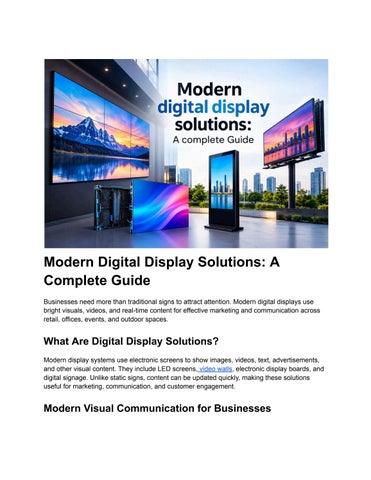
Modern Digital Display Solutions: A Complete Guide Businesses need more than traditional signs to attract attention. Modern digital displays use bright visuals, videos, and real-time content for effective marketing and communication across retail, offices, events, and outdoor spaces.
What Are Digital Display Solutions? Modern display systems use electronic screens to show images, videos, text, advertisements, and other visual content. They include LED screens, video walls, electronic display boards, and digital signage. Unlike static signs, content can be updated quickly, making these solutions useful for marketing, communication, and customer engagement.
Modern Visual Communication for Businesses
Visual communication helps businesses attract attention and share information quickly. Well-designed screens can support marketing, branding, and customer engagement. Businesses can use display systems to: ● ● ● ● ● ● ● ●
Promote products and services Highlight special offers Display company information Share announcements Improve customer engagement Support promotional campaigns Provide directions and information Create attractive brand environments
Flexible content also allows businesses to update messages quickly without printing new banners or posters.
Types of Digital Display Systems Different businesses require different display technologies. Choosing the right system depends on the application, environment, screen size, and viewing distance.
LED Display Screens LED display screens are widely used for advertising, branding, events, retail environments, and large-scale visual communication. They are available in various pixel pitches and sizes, allowing businesses to select a suitable option for close or distant viewing. Indoor models are generally designed for controlled environments, while outdoor versions are built to handle sunlight, dust, moisture, and changing weather conditions.
LED Video Walls An LED video wall combines multiple modules or cabinets to create a large seamless display. It is ideal for shopping malls, offices, conference halls, entertainment venues, and advertising spaces, supporting videos, graphics, presentations, and promotions.
Signage Screens Signage screens are used for advertising, menus, announcements, and wayfinding in retail stores, restaurants, hospitals, schools, and offices. A content management system makes it easy to schedule and update information across multiple screens.
Electronic Display Boards
Electronic display boards are useful when businesses need to show changing information clearly. They can be used for announcements, prices, schedules, directions, promotional messages, and public information.
Indoor and Outdoor Applications The installation environment is one of the most important factors when selecting a display.
Indoor Applications Indoor displays are commonly installed in: ● ● ● ● ● ● ● ●
Retail stores Shopping malls Corporate offices Conference rooms Reception areas Showrooms Restaurants Educational institutions
For indoor environments, factors such as image quality, pixel pitch, viewing distance, screen size, and brightness are particularly important.
Outdoor Applications Outdoor advertising requires displays that can remain visible under strong sunlight and changing weather conditions. Outdoor LED displays are commonly used on: ● ● ● ● ● ● ●
Building facades Digital billboards Stadiums Transport hubs Public spaces Outdoor events Commercial plazas
Weather protection, brightness, durability, ventilation, and proper installation should be considered when planning an exterior display.
Key Factors to Consider Before Buying Choosing a display is not simply about selecting the largest or brightest screen. Several technical and practical factors should be evaluated.
Pixel Pitch Pixel pitch refers to the distance between individual pixels. A smaller pixel pitch generally provides greater image detail and is suitable for close viewing. Larger pitches can be appropriate when viewers are positioned farther away.
Brightness Brightness should match the installation environment. Indoor screens normally require less brightness, while outdoor installations need stronger output to remain visible in daylight.
Resolution Resolution affects the level of detail displayed on the screen. The appropriate resolution depends on screen dimensions, content type, and viewing distance.
Refresh Rate A higher refresh rate can provide smoother video playback and reduce visible flickering, especially when the display is recorded by cameras.
Viewing Distance The distance between the audience and screen should be considered before selecting the pixel pitch and display size. A professional supplier can help determine an appropriate configuration.
Durability For outdoor installations, protection against dust and moisture is essential. Cabinet construction, cooling systems, power components, and installation quality can also influence long-term performance.
Content Management and Control Modern displays allow businesses to manage and schedule images, videos, text, and other content across one or multiple screens. Reliable control systems, sending cards, receiving cards, and network connectivity help ensure smooth and consistent content delivery. .Benefits of Modern Display Technology Digital visual communication offers several practical benefits for businesses.
Flexible Content
Messages can be updated quickly without changing physical materials. This is especially useful for seasonal promotions and time-sensitive campaigns.
Better Customer Engagement Dynamic visuals can attract attention more effectively than many traditional static signs. Videos, animations, and changing graphics can create a more interactive environment.
Strong Brand Presentation High-quality displays can help businesses create a modern and professional visual identity. Consistent colors, logos, product images, and promotional content can strengthen brand communication.
Long-Term Value Although the initial investment can vary depending on screen size and specifications, a properly selected system can support many campaigns over time. Businesses can reuse the same display for different messages and marketing activities.
Common Applications Across Industries Modern display systems are used in retail stores, offices, entertainment venues, schools, and transportation facilities. They help businesses and organizations promote products, share information, display announcements, and improve audience engagement.
Maintenance and Reliability Regular maintenance helps keep displays reliable and efficient. Check LED modules, cabinets, power supplies, cables, and connections regularly. Proper cleaning, timely repairs, and professional installation can improve performance and extend the display’s lifespan.
How to Choose the Right Solution The right system depends on several factors, including the installation location, audience distance, screen dimensions, content requirements, budget, and expected operating conditions. Before purchasing, businesses should clearly define their objectives. A small indoor promotional screen may require completely different specifications from a large outdoor advertising display. It is also useful to consider future requirements. A flexible system that supports different types of content can provide greater value as marketing needs change.
Conclusion Modern display technology helps businesses improve advertising, branding, and customer communication through engaging visual content. From LED screens and video walls to signage screens, these solutions offer flexible options for different business needs. Choosing the right system depends on factors such as location, viewing distance, brightness, resolution, and content requirements.