THE THE MAGAZINE OF ALMA COLLEGE FALL 2026 ISSUE
Alma College is committed to elevating the student experience and preparing students for life.
TABLE OF CONTENTS
8
A Second Chance at Jeopardy! Glory
The broad curiosity encouraged by a liberal arts education enabled Pete Johnston ’07 to have success on television’s Jeopardy!
12
From Graduate Study to Real-World Impact
Creative writers and special educators are translating their Alma College graduate education into careers that inform, inspire, and serve communities across the country.
20
From the Lab to the Kitchen
28
GO SCOTS!
Whether he’s creating a complex dessert on television’s MasterChef: Global Gauntlet or cooking dinner for friends, Jake Kelley ’24 approaches food with the same enthusiasm that defined his years at Alma.
Two Alma Scots; longtime softball coach Denny Griffin and Sam Bohy ’13, are being inducted into the Michigan Athletic Trainers Society (MATS) Hall of Fame.
MFA in Creative Writing graduate Selena Carranza and faculty member Benjamin Garcia following the August graduation ceremony.
EDITOR Lori Phillips DESIGNER Cody Marecek PHOTOGRAPHERS Christian Driessnack Dan Gaken Steve Jessmore CONTRIBUTORS Joseph L. Odenwald PRINTER McKay Press
2
ALMA COLLEGE BOARD OF TRUSTEES OFFICERS 2026–27 Erika K. Powers Appelt ’91, Chair David A. Devine ’90, Vice Chair Carol J. Burns, Secretary ALMA COLLEGE ALUMNI BOARD OFFICERS 2026–27 Amy Pratt ’04, President Sammy Bohy ’13, Vice President Robyn Carr ’04, Secretary Karen Palumbo ’99, Membership Chair
THE TARTAN IS PUBLISHED TWO TIMES YEARLY BY: Alma College Communication and Marketing Office 320 Maple Ave., Alma, MI 48801-1599 | alma.edu | plaid@alma.edu CHECK OUT OUR WEBSITE alma.edu/tartan OUR MISSION Alma College’s mission is to prepare graduates who think critically, serve generously, lead purposefully and live responsibly as stewards of the world they bequeath to future generations.
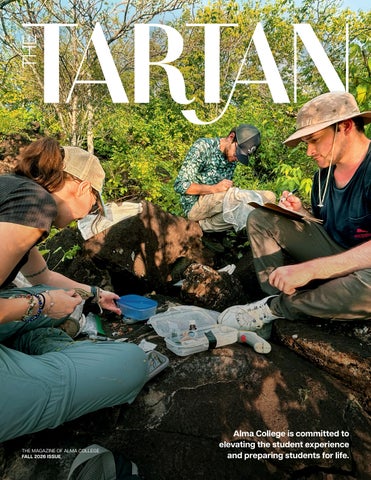
ON THE COVER Life Among the Lizards in Galapagos. Alma College students, Ruby Frisch (left-ENV), Neil Evans (right-BIO) and Mike Fox (center-ENV), study the daily lives of San Cristobal Lava Lizards during a spring term class. The group, which also included Frank Karl (not pictured-MUS), explored innovative techniques of how to remotely measure growth and body temperature of lizards using digital imagery.
RANKINGS AND RECOGNITIONS
Alma College is recognized nationally for academic excellence, student success, and creating meaningful pathways to careers and graduate education. Here are some recent distinctions:
U . S . N EWS & WO RLD RE PORT Among the best colleges in the Midwest, Alma earned the highest ranking of any Michigan institution in the Regional Colleges Midwest category in U.S. News & World Report’s 2026-27 Best Colleges rankings.
#6 RANKED
#6 RANKED
P RINC ETON REVIEW COLLEGES THAT CREATE FUTURES Alma is one of only 50 institutions recognized nationally for connecting students’ talents and interests with meaningful real-world opportunities and career success.
BEST I N TH E M I DWEST
REGIONAL COLLEGES (MIDWEST)
TOP PRIVATE SCHOOLS REGIONAL COLLEGES (MIDWEST)
Named among the region’s top colleges every year since the category was introduced in 2004.
#7
#1
PHI THETA KAPPA HONOR S OCIET Y
RANKED
BEST VALUE REGIONAL COLLEGES (MIDWEST)
RANKED
UNDERGRADUATE TEACHING - REGIONAL COLLEGES (MIDWEST)
2026 TRANSFER HONOR ROLL Recognized five years in a row for developing and supporting pathways that help community college transfer students thrive and succeed after transferring to Alma College.
MODEL U N Outstanding Delegation Awards — 29 consecutive years
FOOTBALL 2022, 2023 and 2025 MIAA Conference Champs
CHEER, STUNT and DANCE Have won 29 national championships since 2017
3
Between Chautauqua and Aspen Dear Scots, Over the past year, I’ve had the privilege of meeting alumni across the country. Whether in Michigan, Florida, or elsewhere, I’ve noticed a common theme in our conversations. When I ask what Alma College meant to them, the answer is rarely limited to a major, a class, or a first job. Instead, alumni often tell me something much broader: “Alma prepared me for life.” That simple phrase has stayed with me. In a time when higher education is frequently measured by immediate outcomes alone, it reminds me of something essential about our purpose. This spring, during my inauguration as Alma College’s 14th president, I had the opportunity to reflect on what makes this institution distinctive. The central idea of my remarks was simple: Alma College continues to fill an important role in American higher education. Our founders believed Michigan needed something different when they established Alma in 1886. They envisioned a college that would pursue academic excellence while also nurturing character, values, and purpose. They wanted graduates who could think deeply, engage thoughtfully, and contribute meaningfully to their communities.
Inauguration - April 17, 2026
4
Now 140 years later, that vision remains remarkably relevant. Last month, after having seen the work cited a half dozen times in other texts, I ordered a copy of Zen and the Art of Motorcycle Maintenance by Robert Pirsig. It’s a hard read. A blend of philosophical arguments and a painful personal journey. I’m generally a fast reader, but Pirsig’s writing often requires re-reading. The 50-plus-year-old text poses some good questions. It’s a similar argument to Remick’s, that there ought to be some spiritual considerations alongside our technological pursuits. Pirsig is more interested in “what’s best?” rather than “what’s new?” At Alma, we want students to engage seriously with ideas, wrestle with difficult questions, and learn to see the world from perspectives beyond their own. We want them to develop the intellectual habits that will serve them not just in their first career, but throughout a lifetime of learning and growth. I was reminded of this recently when two business majors stopped by my office. They were on their way to a night class called Ethics and Medicine. Curious, I asked why they had chosen the course. Their answer was simple: they enjoyed the instructor and thought the class sounded interesting. That response made me smile. Those students understood something important. Education is not merely professional training. It is an opportunity for engaged exploration; to become a more thoughtful, well-rounded human being.
At the same time, we recognize that honoring our mission requires more than celebrating our history. It requires planning for the future. Over the past year, the College has been developing new strategic priorities with the full support of our Board of Trustees. The plan is designed to ensure that Alma remains strong, relevant, and sustainable for generations of students to come. The work is organized around five Strategic Directions: developing our human resources, practicing academic innovation, elevating the student experience, attaining adequate enrollments, and balancing operational budgets. While those phrases may sound administrative on the surface, each one ultimately connects back to our students. We invest in our faculty and staff because exceptional people create exceptional educational experiences. We pursue innovation because students require programs that prepare them for a changing world. We focus on enrollment and financial sustainability because a mission can only endure if the institution supporting it remains healthy and resilient. In many ways, this strategic planning process is simply a modern expression of what Alma has always been: a college committed to thoughtful stewardship and continuous improvement while remaining faithful to its core purpose. One of the ideas I shared during my inauguration was that Alma occupies a unique place “between Chautauqua and Aspen.” Both places are known for the exchange of ideas, but the comparison is ultimately less about geography than mission. Alma remains committed to making transformative hands-on education accessible, personal, and rooted in community with an eye toward global impact. In this issue of The Tartan, you’ll see those values brought to life. We are a place with world-class opportunities where students learn by doing. They are known by name, challenged by faculty who care deeply about their success, and encouraged to explore the connections between knowledge, purpose, and service. As I begin my second year as president, I remain grateful for the opportunity to serve this extraordinary community. The stories I hear from alumni, students, faculty, and staff reinforce my belief that Alma’s greatest strength is not found in a single program or building. It is found in the people who make this a nurturing place of experiential learning, discovery, and growth. Thank you for your continued support of Alma College. Together, we are ensuring that this distinctive institution continues, for many years to come, to prepare graduates who think critically, serve generously, live responsibly, and lead with purpose. Sincerely, Joe Odenwald, President
almapresident @almacollegepresident
5
Investing in the Many Facets of Student Development As part of Alma College’s three-year strategic planning process, the college is leaning in to examining the many facets of the student experience and identifying ways to elevate it. It’s not all about the credits. Beyond academic advancement, Alma College is dedicated to providing a wide range of personalized opportunities that contribute to the development of the whole student, and elevate their experiences. As we start a new academic year, this vision is being thoughtfully and thoroughly integrated across campus. All faculty and staff contribute to creating meaningful opportunities and experiences that set Alma apart and help students discover where they belong. Regarding spirituality for example, even though Alma has Presbyterian roots, students looking to find spiritual support have a variety of denominations and organizations to choose from. Culture, leadership, safety, wellness, residential life, student conduct and engagement, and a sense of belonging are some other areas that offer Alma students something extra. Dean of Students, Alice Kramer, said, “There is a lot of holistic work we do around belonging. It’s not just limited to how students find their social group. It’s about creating spaces where students feel they belong, can find and be in community, and explore multiple perspectives.” Whether they are seeking to discover new cultures, connect with those who share similar interests, or explore ways to become a leader, the Belonging, Culture, and Leadership Office is here to assist them. To help keep everyone safe, the campus safety team is engaging with new training initiatives. Within campus housing, the staff is prioritizing the strengthening of one-on-one relationships where residents feel seen and supported. The Alma College administration is listening to what students say is important to them. One example of this is that students said they wanted to take a class with their neighbors. Now all new students, who live on the same floor and participate in a living learning community linked to their First Year Seminar course, take a one-semester fall class together, which introduces them to transitional skills and college-level expectations. Better relationships and better outcomes are the result.
6
Students can formally and proactively pursue their leadership development with a conference-style learning opportunity once a year or by taking a leadership class. There are also an infinite number of paths to practice leadership skills in extracurricular activities such as clubs, athletics, fraternities, and sororities. An engaged student body helps students build relationships. To support student engagement and success, all students get assigned a mentor for their first semester through the firstyear guide program. This provides them with a very accessible resource to help and guide them as they get acclimated with college life at Alma. A new Student Rights and Responsibilities agenda will additionally help inform and redirect, if necessary, with a focus on helping students grow from mistakes. It’s well known that physical health can have a big impact on every other aspect of someone’s life—socially, emotionally, and intellectually. To that end, significant resources are being invested in updating the recreation center, which will now have oversight by the Student Affairs department. There will be an interior refresh, new fitness classes, equipment, programs, and building activity offerings, plus a boosted development of intramural sports. “We will give the students a more premium wellness space,” said Kramer.
Students participating on Division III teams at Alma College will be getting some premium opportunities as well, both in the competitive sport performance side and in leadership. Since he started last October, the Director of Athletics at Alma College, Dr. Phil Miller, has consulted with the StudentAthlete Advisory Committee (SAAC). He suggested fresh differentiators in terms of experiences and listened to their input. Miller said, "We are investing in things that our student athletes are asking for. This fall, with the help of our Sport Performance Director, Fletcher Roberts, we're going to have a couple refueling stations—one at Hogan and one at the field house, for before practice or after their workout. It's something that most other schools in our league are not doing." Successful athletic programs at Alma are pursuing new challenges. The women’s STUNT program, for example, will now compete as an NCAA program and begin competition this coming year in the National Collegiate Championship alongside Division I, II, and III programs from across the country. "Our dance program, which is also one of our more competitive programs, found a lot of success competing at the National Dance Alliance Championship. They were thinking about how to achieve the next step so they will be competing at the Universal Dance Association championship in January 2027. It's a different type of competition; a little more intense. They've had success where they were, but seeking out ways you can get even better...that's part of elevating the student experience."
Miller explained that it's also critical to emphasize leadership development. "We want to develop our student athletes as leaders and mentors on and off the field. We're going to do some expanded intentional programming that can help them develop into the best student leaders and athletes that they can be. We want to help grow knowledge and give students tools to benefit themselves but also so they can be a resource for others." To enhance communication and build community, this year, Miller will personalize the process by talking with individual teams separately, as opposed to all of Alma's athletes at once. The traditional fall Compliance Carnival was replaced with a Welcome Back event (coordinated with the help of the SAAC) where the student athletes built relationships, got introductory information, had some fun, and truly celebrated their endeavors before classes began. Athletes and nonathletes alike will notice that throughout campus, departments are continuing to develop strategies to drive toward better student experiences. Miller noted, "At Alma, you get a chance to build legacies. You see it in the alumni who are supporters. They have passion for the programs, and the students that are coming up after them. It really runs deep here...a life-long connection. They're watching the livestreams. They're watching with a lot of pride."
7
-
A S E C O N D C H A N C E AT
-
JEOPARDY! GLORY When Alma College alum Pete Johnston stepped onto the stage of television’s Jeopardy! for his first appearance last summer, he carried the same anxiety shared by many lifelong fans of the show. He wasn’t worried about losing. He was worried about embarrassing himself. Instead, the Alma native and member of the Class of 2007 delivered one of the strongest performances of the season before ultimately falling to a contestant who would later become one of the show’s standout champions. “I happened to play against a super champion,” Johnston said. “At that point, you’re like, ‘What can I do?’” Months later, Johnston received another opportunity: an invitation to compete in Jeopardy!’s “Second Chance” tournament, which gives standout non-winning contestants another shot at advancing through the show’s postseason competitions. The tournament quickly turned dramatic. After advancing through his opening matchup, Johnston entered the two-game finals trailing badly after the first day. With little choice but to gamble, he made an all-in wager during Final Jeopardy!. “I figured that was the only chance I had,” he said. “You either bet it all, or you bet small and lose anyway.” The category: movie inspiration. The clue referenced two holidays, Halloween and Christmas, and how they intersected on the silver screen. Johnston immediately knew the answer: Tim Burton’s 1994 hit “The Nightmare Before Christmas.” The risk paid off. Johnston rallied to win the tournament and advance to the Champions Wild Card competition, extending a remarkable run that earned him national attention — and plenty of hometown support from Alma.
Top: Pete Johnston ’07, a studio art major during his time at Alma College, is photographed inside of Clack Art Center in spring 2026. Left: Pete Johnston and Jeopardy! host Ken Jennings are pictured. 8
ALM A BY THE CLUE Don’t forget to answer in the form of a question! Answers at the bottom.
Johnston’s run concluded in the Wild Card competition, where he finally met his match on a Final Jeopardy! clue about Biblical art. He ended up taking home $38,000 in winnings. Though he now teaches at Michigan State University, Johnston made sure his Jeopardy! appearances remained connected to his hometown and alma mater. During contestant introductions, he specifically requested pronunciation guidance so hosts Ken Jennings and Johnny Gilbert would correctly say “Alma.” He and wife Katie also hosted watch parties at a local bar, where friends, relatives and community members gathered to cheer him on. “It felt natural,” Johnston said. “That’s where I grew up. I went to Alma College. I wanted to show a little Alma love and put Alma on the national spotlight.” The Alma connection runs deep in Johnston’s family. Multiple siblings attended Alma College, as did both of his parents and several extended family members. Johnston’s brother-in-law, Andrew Bare, has worked at Alma College for two decades. For Johnston, his eagerness to acquire knowledge plus the wide scope of Alma’s curriculum became ideal preparation for Jeopardy!’s famously eclectic categories. “Having that kind of broad curiosity about the world that you get from a liberal arts education — that is perfect training for something like Jeopardy!,” he said. Alma College encourages critical thinking and experiential learning. “It teaches you to ask questions and want to find out the answers.” Long before appearing on national television, Johnston was already building a career as an award-winning filmmaker and scholar. His documentary work has explored topics ranging from the Muslim world to Afrofuturism, and he is currently in post-production on his first feature-length documentary as director. The film, titled “Magic Town,” traces the history of a rural Michigan magic convention that first captured Johnston’s imagination as a child after former Alma art professor Bob Rozier took him there at age 12. “That sort of set my brain spinning for the rest of my life,” Johnston said. “Bob had this way of looking at the world with wonder,” Johnston said. “There was a playfulness and a curiosity to the way he processed things visually. I think about that a lot when I teach now.” Johnston credits Rozier and other Alma professors, namely Sandy Lopez-Isnardi and Carrie Parks-Kirby, with profoundly shaping both his artistic life and his teaching career. For more on “Magic Town,” and Johnston’s run on Jeopardy!, visit his website, www.pizzageni.us.
$200
NO ALMA COLLEGE PRESIDENT HAD A LONGER TENURE THAN THIS MAN, AFTER WHOM THE MAIN ACADEMIC BUILDING ON CAMPUS IS NAMED
$400
ALMA COLLEGE WAS FOUNDED IN 1886 USING FUNDS MADE AVAILABLE BY AMMI WRIGHT, A MAGNATE IN THIS INDUSTRY
$600
THE ALMA COLLEGE MASCOT, SCOTTY, WEARS A HIGHLAND KILT, A REGISTERED TARTAN-PATTERNED SASH, AND THIS ACCESSORY, WHOSE NAME COMES FROM SCOTTISH GAELIC FOR “PURSE”
$800
ONE OF ALMA COLLEGE’S MOST FAMOUS ALUMS IS THIS LONGTIME MAJOR LEAGUE BASEBALL PLAYER, A STARTING OUTFIELDER ON THE 1968 WORLD SERIESWINNING DETROIT TIGERS, ORIGINALLY FROM BRECKENRIDGE, MICH.
$1000
THIS TELEVISION NEWS ANCHOR, WHO HOSTED ABC’S “NIGHTLINE” FOR 25 YEARS, WAS A MEMBER OF THE ALMA COLLEGE BOARD OF TRUSTEES IN THE 1980s 9
Answers: Who is Robert Swanson?, What is lumber?, What is a sporran?, Who is Jim Northrup?, Who is Ted Koppel?
COMMENCEMENT 2026
From Graduate Study to Real-World Impact Creative writers and special educators are translating their Alma College graduate education into careers that inform, inspire, and serve communities across the country. Alma College graduate students are making a difference. Some are teaching in college classrooms. Others have launched literary magazines, are publishing books, advocating for caregivers, or helping students with learning differences succeed in schools across Michigan. Together, their accomplishments tell the story of graduate education at Alma College: programs designed not simply to award degrees, but to prepare students to make meaningful contributions in their professions and communities. FROM THE CLASSROOM TO THE LITERARY WORLD For graduates of Alma College’s Master of Fine Arts in Creative Writing program, the journey often begins with a love of storytelling and ends with opportunities that extend far beyond the page. Just two years after completing the program, several alumni are already shaping the next generation of writers and readers. Cash Whitney, MFA ’24, teaches Engaging with Modern Texts at Lawrence Technological University, while Matty Weaver, MFA ’24, achieved a longtime goal when he joined the faculty at Grand Rapids Community College as an English instructor. Others have found ways to connect writing with advocacy and public engagement. Marie Gerken, MFA ’23, serves as lead editor and writer for Dear Eudora, an online publication that supports primary caregivers of aging loved ones while promoting
dignity and quality of life for older adults. She also publishes The Birch Chronicle: A Reverie of Letters and Books, a project dedicated to reflective literary correspondence and thoughtful discussion of books and writing. The collaborative spirit of the MFA program has also produced new creative ventures. Whitney joined fellow alumni Joey Lamson Meyer, MFA ’24, Joshua Zeitler, MFA ’24, and Mary Bishop, MFA ’25, to launch The Long and the Short of It, an independent literary magazine that embraces experimentation and brings literary conversations into communities through live events and readings. Meyer is preparing for another milestone: the publication of a debut novel in 2027. Other graduates have explored interdisciplinary approaches to storytelling. Joy Bilbey, MFA ’23, collaborated with Alma College dance faculty to blend movement and language in performance, while Mary Peterson, MFA ’23, earned the inaugural Alma MFA Book Prize, recognizing exceptional achievement in writing for her hybrid manuscript “Planting Onions: Letters Written Out of Season.” Taken together, their accomplishments reflect a distinctive program that encourages writers to think broadly about where creative work can lead — into classrooms, community spaces, publishing projects, and artistic collaborations.
Top: Graduates of the Master of Arts in Special Education program at Alma College are pictured at this 2026 hooding ceremony. 12
Mary Peterson, MFA ’23, below left, earned the inaugural Alma MFA Book Prize, recognizing exceptional achievement in writing. MFA program Director Sophfronia Scott is at right. SUPPORTING STUDENTS ACROSS MICHIGAN While MFA graduates are building careers in the literary arts, alumni of Alma’s online Master of Arts in Special Education program are making an equally significant impact in schools throughout Michigan, helping struggling students find a path to success. The program’s first graduating cohort in 2024 included 19 educators who earned endorsements in Special Education– Learning Disabilities. Today, they serve students in districts ranging from Grand Blanc and Marshall to Portage, Riverview, and Hancock, bringing evidence-based practices and individualized support to learners with diverse needs. Growth continued with the 2025 cohort, which expanded to 22 graduates. In addition to completing the master’s degree, some added endorsements in Emotional Impairment, Cognitive Impairment, and Learning Disabilities, broadening both their expertise and career opportunities. Graduates now work in districts including Alma, Midland, Kalamazoo, Lapeer, and Kingsford, serving as classroom teachers, specialists, and educational leaders. The program’s newest cohort is continuing that momentum and will be serving students in communities such as Port Huron, St. Louis, Corunna, Detroit, and districts across northern Michigan. Many are pursuing additional endorsements that will allow them to identify and support student needs earlier and more effectively. Their work may look very different from that of the MFA graduates, but the underlying mission is much the same: applying specialized knowledge to improve lives.
From left, Mary Bishop, MFA ’25, Joshua Zeitler, MFA ’24 and Joey Lamson Meyer, MFA ’24, are pictured. The three, together with Cash Whitney, MFA ’24, launched a literary magazine, The Long and the Short of It.
EDUCATION WITH PURPOSE The paths taken by these alumni illustrate the philosophy that guides graduate education at Alma College. Whether students are refining their craft as writers, advancing their expertise as educators, or preparing for leadership opportunities in their fields, the goal is the same: connecting in-depth, real-world academic study with meaningful professional practice. The settings may differ, but the outcome is consistent. Alma graduates leave with more than a credential. They leave prepared to contribute, lead, and make a profound impact in the communities they serve.
Learn more about graduate programs at Alma College by scanning this QR code Students and faculty in the Alma College Master of Fine Arts in Creative Writing program are pictured near the world-famous Bodleian Library Radcliffe Camera during the summer 2025 residency in Oxford, England, where they were granted access typically only given to Oxford University affiliates. 13
$1-Million Scholarship to Expand Experiential Learning Access Alma College has announced the creation of the Deacon Scholars – Venture Travel Support Scholarship, a new initiative supported by a $1-million commitment from alumnus Charles A. Deacon ’80, and wife Ann, to expand student access to highimpact experiential learning opportunities. Funded at $200,000 annually over five years, the scholarship will help students overcome financial barriers to participation in transformative academic experiences such as faculty-led spring terms, study abroad programs, and other immersive off-campus learning opportunities that are central to an Alma College education. Deacon earned his bachelor’s degree in history from Alma College in 1980 and his Juris Doctor from St. Mary’s University School of Law in 1983. He has served as a Trustee of Alma College since 2013. He and Ann are longtime supporters of the College’s mission to provide accessible, studentcentered education.
“For many students, cost is the deciding factor in whether they can participate in these experiences,” said Deacon. “When I was a student at Alma, I wouldn’t have been able to take advantage of opportunities like this. I wanted to help ensure today’s students don’t have to make that same choice.”
MFA Students to Benefit from New Residency and Writing Scholarships Alma College’s Master of Fine Arts in Creative Writing program has received a significant boost thanks to the generosity of a donor committed to expanding access and recognizing excellence within the program. The donor, who has chosen to remain anonymous, has established two new forms of financial support aimed at ensuring students can fully participate in the MFA experience while honoring outstanding creative and critical achievement.
The Master of Fine Arts Residency Scholarship is a needbased award designed to help students attend the residencies that are a central component of the MFA program. In addition to residency support, the donor has committed $3,000 annually for three years to establish a new merit-based award: the Jim Daniels Master of Fine Arts Writing Award. The award is named in honor of acclaimed poet, essayist, screenwriter, and fiction writer Jim Daniels, a graduate of the Alma College Class of 1978 and current MFA faculty member. It will be awarded each year to a current MFA student who demonstrates exceptional promise and merit through their creative and critical work. Recipients will be selected by a rotating committee of three MFA faculty members — one representing each genre — who will nominate a student through an objective and nondiscriminatory process. “By honoring alumnus Jim Daniels and supporting talented MFA students, this gift connects Alma’s past, present, and future — celebrating alumni achievement while investing directly in the creative work and potential of our graduate students,” said Bob Murray ’88, vice president for advancement at Alma College.
Left: Jim Daniels ’78, Alma College MFA faculty member.
14
BRIEFS
Faculty recognized with awards and named professorships Adam Matthews (History) and Robert Molina (Mathematics and Computer Science) are the 2026 recipients of the Andison Awards for Excellence in Teaching, while Janelle Blazek (Psychology and Sociology) and Stephany Slaughter (World Languages and Cultures) have received this year’s Barlow Awards for Faculty Excellence. In additional faculty recognitions, Zhewei Dai (Mathematics and Computer Science) was awarded the Charles A. Dana Professorship and Matthew Cicci (English, Communication and Language) was named the Joseph J. Zimmerman ’61 Endowed Chair in English.
Model UN, BPA win national awards
Grant to support middleincome students
The Alma College Model United Nations team delivered another standout performance at the National Model UN Conference, held in April in New York City, by winning three “outstanding delegation” awards. The Business Professionals of America chapter at Alma College delivered an impressive performance at the BPA National Leadership Conference in May, earning multiple top-five finishes against competitors from across the country.
Alma College has received a $455,000 grant from the Rollin M. Gerstacker Foundation to provide scholarship support for middle-income students entering in fall 2026, advancing the College’s commitment to making a private, residential liberal arts education accessible to talented students from across Michigan and beyond.
Kapp Honors Day prizes announced
Fenskie awarded Barlow Trophy for 2026
Dani Crews (humanities), Trevor Grandy (natural sciences) and Stephanie Rauch (social sciences) were the 2026 recipients of the Ronald O. Kapp Honors Day Prize, named for longtime professor and administrator Ronald O. Kapp. More than 130 students participated in 89 presentations during this year’s program, the 30th iteration of the event.
Mallory Fenskie of Midland is the 2026 recipient of the Barlow Trophy, Alma College’s most prestigious award for a graduating senior. Established in 1949 by Dr. Joel Barlow, 1929 honors graduate of Alma College, the award recognizes academic achievement for students in the top 10 percent of their class as well as contributions to campus and community. The winner of the Barlow Trophy was announced as the culmination of an event highlighting academic achievements from the 2025-26 academic year.
Alma students to launch grant-funded history project Alma College has been awarded a grant through the Daughters of the American Revolution Legacy Grant Program to support a student-led public history initiative that will take place during the 2026–27 academic year. The project, developed collaboratively by faculty and members of the Alma College History Club, will fund an immersive exploration of Revolutionary War–era history in Michigan, culminating in a campus and community history fair designed to share student research through interactive, public-facing programming.
15
During Spring Term, Alma College students spent three days at Hascienda Tranquilla where they helped with a multi-year long project of removal of an invasive tree species.
State-of-the-Art Labs Available This Fall Nursing The new nursing lab is located in the lower level of the Swanson Academic Center (SAC). The space simulates a typical environment found in healthcare facilities where nurses may perform tasks. The room houses multiple beds, tools, equipment such as a bladder scanner, EKG monitor, mechanical lifts, white boards, and privacy curtains. It even includes mannequin “patients” for students to practice on. The new lab will host three new low-fidelity, non-electronic mannequins and one high-tech patient simulator named Susie, which replicates human responses like breathing, blinking, talking, and blood pressure. “Susie” costs approximately $35,000, but it’s a worthwhile investment, because Susie can be programmed to behave and react in various health scenarios. It’s a cutting-edge medical education tool which helps build capability and confidence. Hannah Hoag, the clinical coordinator and simulation technologist, will be running the lab. She said, “It allows students to practice in a safe environment, make mistakes, be corrected in the moment, and not harm somebody. The lab is right here on campus, readily available to them and manned by faculty, whenever they want to hone their skills.” A secondary lab in the Dow Science Center will have two additional low-fidelity mannequins available for practicing techniques. Previously, students had to go to the MyMichigan Medical Center in Alma for simulation training. Director of Nursing and Chair of the Nursing Department, Alicia Ryder, said, “This lab allows us for the first time ever to teach our nursing skills course here on campus. It’s an amazing opportunity.” The larger space will be used for teaching, practice, and testing. It allows more students to actively practice at once.
18
Two new labs — one for nursing students and one for the Great Lakes Watershed Institute (GLWI) — have been constructed on the Alma College campus. They will serve different purposes, but they share one cohesive vision: to integrate modern technology and outside partnerships with active learning that helps students develop critical thinking, build practical knowledge, and skills that can immediately be put into action to solve real-world problems.
Nursing Instructor Angela Griffin said, “An entire clinical group of eight students can work together.” The lab is surrounded on three sides by one-way glass, stools and a counter, which allows students or instructors to sit behind the glass to observe procedures inside the room and take notes without encroaching on the activities within the lab. A two-way, built-in intercom system allows communication between the two spaces. Ryder explained, “The viewing space allows students to learn from each other, so a student can be doing a simulation and everyone else can be observing. Everybody can talk to each other, and decide if the student is performing appropriately. We can make suggestions. It allows us to pretend to be the doctor or the patient, and interact with the practicing student. It’s a learning opportunity in both directions.” The Alma nursing program partners with the local Masonic Pathways retirement community for three different clinical opportunities. Masonic Pathways has generously donated nearly $100,000 worth of equipment and supplies to help make this lab possible. Alumni donations and the Donald J. (’71) and Dr. Karen S. Yehle Endowed Fund for Nursing also made significant contributions, $5,100 and $7,500 respectively, to build the new lab. Ryder said, “All nursing skill labs will be taught in this space. Students will learn how to insert a catheter, how to give a tube feeding, how to give a bed bath, how to take a blood pressure reading...They’ll get to practice all those skills. They’ll run through simulations with Susie to figure out what’s wrong and treat her appropriately. The main goal is to improve clinical judgement, because the reality is patient care is getting more complicated, so hospital systems are expecting students to come in as brand-new grads, better prepared and ready to do more things right away.”
GLWI Similarly, the new Great Lakes Watershed Institute (GLWI) lab in the Dow Science Center will be a place that better informs, prepares, and inspires science-based action. It’s the first water quality laboratory focused specifically on the watersheds that funnel into and affect the quality of the Great Lakes. This unique and comprehensive initiative will significantly contribute to better understanding, protecting, and restoring watersheds that are vitally important. Instructor of Geology and Environmental Studies and Senior Department Chair, Murray Borrello, said, “The GLWI intentionally connects classroom learning with real-world problems through the work of an environmental lab and partnerships created between two-year educational institutions and local and national entities. Students and faculty use local and regional problems to shape what is taught in the classroom, and in turn, work with organizations and individuals who are trying to address and solve problems that occur in the watersheds.” Developing critical thinking skills, leadership, and stewardship are essential elements in this process. Borrello said, “The GLWI uses a ‘theory-into-practice’ approach of enhanced learning while providing real-world experience for students as they partner with two-year institutions as well as local, regional, and global individuals and organizations focused on improving our environment.” In one instance, Alma College students met with local authorities, collected data, and then created and proposed a hazard remediation plan for Gratiot County government officials to submit. This new lab is a space dedicated to watershed research and education, but it will be open for multiple departments and even organizations outside of Alma College who are pursuing work related to the watersheds. Business, neuroscience, art and design, communications, and political science are just some studies that intersect. “Socio-economic impacts related to degradation of our watersheds feeding the Great Lakes is of considerable interest to the GLWI,” said Borrello. Areas of GLWI research will continue to include geochemistry, toxicology,
microbiology, human health studies, economic studies, and ways to improve K-12 science education using data from realworld issues. Other entities may study the Great Lakes, but “our GLWI is different in that it focuses on the health of the Great Lakes (and associated communities) through the lens of the watersheds (the arteries) that feed them,” Borrello said. The health and conditions of the watershed tributaries affects the water quality issues of the Great Lakes. “It’s all part of the same living system.” The GLWI lab will work collaboratively with other labs to share physical resources and data. Reaching out to watershed communities to see who could benefit from what the GLWI has to offer is integral to the lab’s purpose. Through a partnership with the Dow Digital Commons, GLWI research and findings will be made available around the country to municipalities, schools, and non-profit organizations interested in the health of the Great Lakes. Funding for the GLWI project, totaling about $1.5 million, has come from an Arthur Vining Davis Foundation grant, the Healthy Pine River Group, the Gratiot Community Foundation, a department of education grant, and gifts from alumni and friends of Alma College. Investing resources in exceptional learning opportunities... it’s an Alma tradition. Together, these two new labs are opening the door to exceptional learning experiences that will benefit students and positively influence lives far and wide.
19
Jake Kelly ’24 joined the cast of MasterChef: Global Gauntlet this spring and was crowned the winner of MasterChef Season 16 in September.
FROM THE LAB TO THE KITCHEN: Jake Kelley Serves Up Success on MasterChef When Jake Kelley ’24 stepped into the MasterChef kitchen, he found himself surrounded by bright lights, ticking clocks and some of the most recognizable names in the culinary world. The neuroscience graduate from Alma College wasn’t a professionally trained chef. He wasn’t running a restaurant or leading a culinary team. He was exactly what MasterChef was looking for: a passionate home cook with a remarkable story to tell through food. This spring, Kelley joined the cast of MasterChef: Global Gauntlet, a season that challenges contestants to draw inspiration from their cultural heritage while competing in highpressure culinary contests judged by celebrity chefs including Gordon Ramsay. For Kelley, that meant exploring and celebrating his Mexican heritage through food. “Mexican food is really a cultural cuisine as much as it is a regional one,” Kelley said. “There’s so much history, influence and nuance to it that people don’t always get to see.” Although he grew up in Hemlock, Michigan, far from the culinary centers often associated with fine dining, his fascination with cooking began at an early age.
20
“I wanted to try foods that just weren’t accessible to me,” he said. “Things like crème brûlée or beef Wellington seemed almost mythical.” Without formal training, Kelley taught himself through YouTube videos, painstakingly pausing and replaying demonstrations while building his culinary skills one technique at a time. By the time he arrived at Alma College, cooking had become both a passion and a creative outlet. Living in residence halls didn’t slow him down. Kelley’s engagement epitomizes the hands-on learning culture of Alma College. During his freshman year in Bruske Hall, Kelley could often be found experimenting in the dorm kitchen, preparing everything from steaks and braises to elaborate stews. Sometimes he cooked simply because he knew the aroma of garlic and butter would attract curious students. “It was one of the ways I met people,” he said. Kelley continued cooking throughout his time at Alma, including while living in Newberry Hall and after joining TKE. What started as a hobby quickly became a way to connect with classmates from different backgrounds, many of whom introduced him to flavors and culinary traditions from around the world.
Kelley also immersed himself in campus life. In addition to studying neuroscience, he participated in the iGEM program, Student Congress, marching band, and the rock climbing club. He worked part-time jobs, including at a meat counter, where access to quality cuts of meat helped him continue refining his culinary techniques. He also credits Alma’s liberal arts environment with shaping the way he thinks about cooking. “One of my favorite things about Alma was being around students from all over the world,” Kelley said. “I was always asking people about the foods they missed from home and the flavors that were common where they came from.” Those conversations broadened his understanding of global cuisines and fueled a curiosity that continues to influence his cooking today. His academic experience also proved unexpectedly useful in the kitchen. “There are things I learned at Alma that don’t directly translate to cooking, but they help you understand why things work,” he said. “Honestly, I think anyone who wants to be a chef should take an introductory physics course.” That combination of curiosity, experimentation and problem-solving has served Kelley well on MasterChef, where contestants must create dishes under intense time pressure and often with little advance notice. Competitors are not handed recipes. “We’re coming up with everything ourselves,” Kelley said. “You have to rely on what you know, adapt quickly and make decisions on the fly.” One of his proudest creations came during the audition process. Drawing inspiration from mole sauce, Kelley transformed traditional mole ingredients into a sophisticated dessert featuring chocolate-chili ganache, almond sponge cake, and black sesame crème anglaise.
Ramsay said, “The cake itself is delicious. Texture-wise it’s sublime...the innovation behind this thing is unique. It’s a maverick, like you.” The dish earned him a coveted spot in the competition. Since then, Kelley has participated in challenges ranging from elevated stadium food to cooking for 100 youth soccer players in a World Cup-themed team challenge. Through it all, he has remained focused on steady improvement rather than seeking the spotlight. “I feel like I’ve been surviving,” he said. “I’m waiting to peak at the right time.” Away from television cameras, Kelley continues to build a career that blends science, hospitality, creativity, and entrepreneurship. He works as a pharmacy technician and recently joined a Mount Pleasant restaurant known for its scratch-made menu and in-house pastry program. He has also begun booking clients as a private chef. Meanwhile, he has embraced another unexpected role: community ambassador. Kelley has hosted MasterChef watch parties across mid-Michigan, bringing together friends, family and fellow food enthusiasts to celebrate each episode. Whether he’s creating a complex dessert for national television or cooking dinner for friends, Kelley approaches food with the same enthusiasm that defined his years at Alma. “It’s something I hold to a very high standard,” he said. “I’ve put a lot of repetition into it, a lot of learning.” From his globally-inspired education at Alma to his success on the global stage of MasterChef, Kelley is making an impact and creating his future. “I feel like I am on the right path to achieve my dreams.” The MasterChef: Global Gauntlet finale aired on September 14, 2026, and Jake was crowned the winner of MasterChef Season 16. Jake Kelley is shown studying biology in an Alma College laboratory. (Image previously featured on The Tartan cover in fall 2023.)
21
Biology Students Pursue Novel Research Focus Exciting and important research projects are happening at the Alma College Ecological Station known colloquially as the Bog. Within the boundaries of the approximate 220-acre property, there is a diverse composite of ecosystems including a lake, swampland, highlands, old and new forest growth, and more. “That type of ecosystem is not common,” said Associate Biology Professor and department chair Dr. Brian Doyle, “so for us to have that as part of our campus is special. We consider it to be a fantastic resource for our students, for learning, for research, to get outside, get dirty, and see some cool, interesting plants that some students have never seen before like [carnivorous] pitcher plants and sundews.” Doyle shared how students repeatedly express that the Bog is a place that leaves a lasting impression. “While it is fundamentally a space intended for biological research, we want to make sure that as many students as possible can have that experience, even non-biology students.” That’s why Alma showcases the Bog by offering an introductory biology class available to all Alma College students. When some people get “down in the weeds,” it can mean they have trouble focusing on the big picture. They get lost in the details. Alma College biology research students, however, can quite literally get down in the “weeds,” focus on the details, make discoveries, and help others see what’s possible—like stopping cancer with a plant found in the woods. Mayapple plants, found in the shade of deciduous woods, resemble an umbrella when mature. A single flower on the stem may turn into a soft yellow fruit when ripe. The leaves and rhizomes of Mayapple plants contain podophyllotoxin, which is highly poisonous when ingested. However, that same chemical is known to have medicinal properties. It’s actually prescribed as a topical medication for warts and it is a precursor from which the chemotherapeutic drugs etoposide and teniposide are made.
22
Cancer develops when cells divide uncontrollably, but podophyllotoxin derivatives can stop the cell division; offering a life-saving solution. The main source of pharmaceutical podophyllotoxin is actually a species from south Asia. It produces more podophyllotoxin than the American Mayapple, but it has been overharvested and become scarce. The American Mayapple is being considered as a potential alternative. While research on the leaves and roots of the plant is extensive, Doyle explained that he is not aware of any research on the fruit or on the concentrations of podophyllotoxin in it. This is surprising, because the fruit is considered to be edible when ripe. “One reason for the lack of research may be that it is very difficult to collect the fruits. They are small and green and they increase in size a little bit and then they’re gone. To collect ripe fruit is certainly a challenge.” The students at Alma College have been taking on that challenge. Could the fruit have potential health benefits, or is it toxic? Doyle said, “It’s a question worth answering.”
“Our hypothesis is that the concentrations will be very low in the fruit, compared to the roots and rhizomes. We’ll see. It’s not to say there couldn’t be other toxins in the fruit when it’s ripe.” “As a small, liberal arts college that’s very focused on handson learning with students, one advantage that we have is the luxury of being able to take our time and do work that is maybe somewhat labor intensive, like collecting these Mayapple fruits year after year...work that others wouldn’t be willing to dedicate the time, the effort, and resources to doing.” Doyle also said, “With regards to hands-on skills Alma students learn, another major difference is that an undergraduate student assigned to a research opportunity at a larger university is less likely to be intimately involved in the research. They are more likely to just be making solutions, counting cells, or washing dishes. But here, the students are taking more of a leadership role in the research projects." Biology major Jaden Packer is a junior who has been involved in the research for a couple years. He said, “It was surprising to me how much control the students have over the research.” Doyle said, “In the case of the students doing research with me, they are really doing every aspect of that. I kind of point them in the right direction and help them with trouble shooting and problem-solving and with charting a plan for the research, but they are very much involved in every aspect of conducting that research. I think that’s one of the biggest strengths of a college like Alma College. The students benefit from having an experience that is much more authentic.” Packer said, “We have access to so many incredibly interesting and complex scientific tools that I would never have been able to access elsewhere. This experience opened a lot of doors for me that I didn’t even know were there before.” Lucie Troyer, Alma College senior and summer researcher said, “We are actively prepping, making, and testing extracts of American Mayapple plants. What excites me is that we are testing for something that no one else has looked for previously.” Overall, research that results in publication is typically a years-long process, but even work that students do over the summer can contribute to the overall findings.
“We’ve made a ton of progress,” Packer said. Besides developing critical thinking and laboratory and field skills, students are doing original research that leads to presentations at conferences and ultimately publication in journals peer-reviewed by other experts in the field. Students are doing real scientific research and may get their name included on a publication as a coauthor. “There is certainly the opportunity for mentoring [at Alma College] that you wouldn’t get at a larger institution,” said Doyle. “Our students work directly with PhD professors, whereas at a larger institution, students may have less access to the faculty and may be more likely to have interactions with graduate students or teaching assistants instead.” Doyle teaches students about medicinal plants at the Bog. Students identify the plants there and then research how the plants were used in traditional Native American medicine. The students prepare plant extracts, and test for various biological activity to see if they have antimicrobial, antioxidant or anticrustacean effects, for example. It has been shown that there is a correlation between toxicity to brine shrimp, small aquatic crustaceans, and toxicity to cancer cells. “So that’s something that we started to doing early on,” said Doyle, “and that’s one thing that my students are doing in the lab now. The shrimp are exposed to botanical extracts overnight and you count how many are still alive the next day.” Students developed a method for analyzing podophyllotoxin concentration and harvested the Mayapple fruits and collected leaves and rhizomes from plants every week throughout the summer. The aim is to measure changes in podophyllotoxin concentration as the fruit ripens, not just in the fruit, but in other parts of the plant as well. Troyer, who is majoring in Environmental Science and plans to continue as a researcher after graduation, said, “I think this experience is doing a very good job at giving me the skills I need to go forward into this field of study.” Doyle said, “Some people are surprised to learn that most modern medicines are derived from nature in one way or another. The Mayapple is a great example of that and is growing in our backyard.” And a new discovery may be right around the corner thanks to our Alma Scots.
23
Alma Choir Perfectly Harmonizes SmallSchool Attention with World-Class Opportunities Choir at Alma College is more than just a class. Those who participate find that the opportunities it brings are like sweet, sweet music no matter what their major is. In fact, only about 20 percent of those in choir at Alma are music majors. This distinction alone clearly expresses the excitement the program ignites. Whether their primary studies are in biology, sport leadership, or education, students from diverse career paths want to be part of it. It’s no surprise to those close to the choir program. The high-quality, attentive instruction, and strong leadership from distinguished faculty plus the passionate commitment of choir members (who meet for daily rehearsals) produce professional results. It requires hard work and dedication, but there’s a fun side, too, for members and audiences alike. Sometimes it shows up in the form of a spontaneous group performance like the one that occurred in Scotland last May, when Alma Choir members captivated MacGregor’s pub goers by singing Loch Lomond— the song that is traditionally featured at many Alma College events. Formally, the Alma Choir tours every year, with an international tour every other year. They have traveled across the U.S. and to countries such as Germany, Italy, Scotland, and Ireland, to showcase their talents. Soon they’ll be adding another significant achievement to their long list of distinctive performances. In March 2027, Dr. Nicole Mattfeld, accomplished director of choral activities and an assistant professor of music at Alma College, will be conducting the Alma Choirs, Alma alumni singers, and a professional orchestra on the legendary stage at Carnegie Hall in New York City. “It is an extreme honor as a conductor to be asked to be on the podium on such an iconic stage; I am looking forward to leading the choir in this once-in-a-lifetime performance,” said Mattfeld.
24
The Alma College Choir may be considered the most advanced touring ensemble at Alma, but the Acapella and Chorale groups also allow students with varying musical interests and skills to be part of real-world vocal performances. For example, the Acapella group, which tends to focus on contemporary music, performs at Acapalooza each spring. The benefits of being in Alma choir go far beyond touring. Academically, close to 75% of choir students are on the Dean’s List every semester. Socially, the cross-pollination of ideas and cultures that occurs when people from different backgrounds come together and are vulnerable with one another means world views are broadened and friendships develop that may have otherwise never happened. But best of all, singing in a group has been proven to have health benefits. Feel-good endorphins are released. Blood pressure and stress levels are lowered. The immune system is boosted. Memory and concentration levels are improved. That’s something to sing about! Alumni who are interested in participating in the Carnegie Hall concert can register through October by contacting Dr. Mattfeld at mattfeldnm@alma.edu. Financial support can be offered at alma.edu/nyc-tour. For information on future choir events, visit alma.edu/heritage-center. Tickets may be purchased up to 90 days in advance through Carnegie Hall. No livestream will be available. You can find more information at alma.edu, listen to Alma’s singers in person or on various social media sites and even Spotify. Check them out this holiday season!
Scan the QR code to visit the Alma College Choirs Give Campus page
Choir Students Have Unique Opportunity to Collaborate with a Composer When Alma College students took the stage for the 2026 Masterworks concert, they weren’t simply performing a piece of music. They were helping bring a new work into the world. This past spring, the Choirs, College Chorale, and Alma Chamber Orchestra presented one of the first performances of Social Justice Magnificat, a large-scale work for choir and orchestra composed by ’08 Alma College alum and Assistant Professor of Music and Department Chair of Music and Dance, Dr. Justin Rito. For Rito, the project represented the culmination of years of reflection on one of Christianity’s most frequently set texts: the Magnificat, Mary’s song of praise from the Gospel of Luke. “It’s one of those texts in the Bible that really speaks toward a message of social justice and healing, and welcoming a stranger, and being sort of a steward toward other people, not just toward yourself,” Rito said. The Magnificat has inspired hundreds of musical settings over the centuries, including well-known versions by composers such as Johann Sebastian Bach and Antonio Vivaldi. For the Masterworks concert, Alma performers explored three different interpretations of the text, including works by Vivaldi, contemporary composer Taylor Scott Davis, and Rito. But while many settings emphasize the text’s beauty and devotion, Rito was drawn to what he sees as its more challenging message. “I think it’s a lot darker than we allow it to be,” he said. In Mary’s words, Rito hears a call to confront inequality and care for those on society’s margins. One of the central sections of Social Justice Magnificat reflects that interpretation by interrupting the Latin text with a spoken English passage delivered by a single voice. The speaker declares, “He has scattered the proud in their conceit. He has cast down the mighty from their thrones, and has lifted up the lowly. He has filled the hungry with good things and the rich he has sent away empty.” By stripping away the orchestra and choir at that moment, Rito hoped audiences would hear the text’s message with fresh clarity.
The six-part composition takes the listener on a complex emotional journey that begins with haunting tones, transitions to lighter, twinkly sounds that evoke images of a new dawn, then increases heavier notes of urgency and drama until it eventually resolves to the peaceful, hopeful impressions of its conclusion. Alma’s Masterworks performance marked only the second time the composition had been performed publicly. For Dr. Nicole Mattfeld, director of choral activities at Alma College, the opportunity to participate emerged through an unusual coincidence. She had already planned to conduct a Masterworks program centered on settings of the Magnificat when she learned that Rito was composing one of his own. “I obviously wanted to support my colleague,” Mattfeld said. “I also wanted to give students a rare opportunity to work directly with a living composer. They were able to ask questions, get feedback, and experience the creative process in a way that’s simply not possible when you’re performing a work by someone like Vivaldi.” Throughout the rehearsal process, Rito—whose music has been performed in concerts throughout the world—attended practices and collaborated with conductors and performers. “Many of my students said that it was their favorite of the three that they performed,” Mattfeld said. “It was also the most challenging from a rhythmic and harmonic perspective. There are moments in the piece that still take my breath away.” Following the concert, Alma performers returned to the stage for an intensive recording session involving nearly 100 performers, including students, faculty members, community musicians, and professional instrumentalists. Unlike many modern recordings, the ensemble recorded complete movements rather than assembling the work from short edited segments. Their ambitious efforts were successful. For Rito, hearing the finished recording was both professionally and personally rewarding. “The quality of the recording is so good,” he said. “I just feel very grateful. It was a lot of hours from a lot of students and faculty and professionals.” Some special moments came not during the recording itself, but in conversations with students who participated in the project. “They would say, ‘This was one of the most meaningful things that I’ve been a part of,’” Rito said. “I can’t imagine a better outcome than being an instructor who’s trying to pay it forward and be part of students’ lives in a way that is meaningful to them.” The recording will help Rito with conductors and ensembles across the country as he explores future performances and arrangements of the piece. For now, however, it also serves as a lasting document of a uniquely Alma collaboration — one that brought together an alum, faculty, students, and community musicians to create something new. “What a rare opportunity,” Rito said. “I’m a lucky guy.” To watch a video of the performance, visit justinrito.com/magnificat.
25
P-Global Helped Student Find Her Calling and Promote World Peace “Thanks to the generosity of Lee and Sally Posey, the Posey Global Leadership Fellows Program has given our students the chance to step into the world and learn by doing,” said Dr. Derick (Sandy) Hulme, Professor of Political Science at Alma College and director of the program. These experiences push students to confront global issues, build relationships across cultures, and return with a clearer sense of purpose and direction. That impact stays with them long after they leave Alma. The program helps students from all areas of study at Alma College participate in internships around the world. This year, many of those students gathered together to help P-Global celebrate 20 years of supporting nearly 600 fellows in 57 countries as they expanded their learning and practiced their skills in real-world situations. Alumna Elizabeth “Libby” Flatoff, is originally from Highland, Michigan, and graduated in ’21 with degrees in Political Science, Spanish, and International Affairs, then earned a master’s degree from the Middlebury Institute in Nonproliferation and Terrorism Studies. She talks about what she’s doing now, and how her P-Global experience paved the way.
Libby: I work for the Arms Control Association, where we focus on nuclear weapons disarmament advocacy. It’s something I first became interested in through Alma’s Model UN team. My P-Global experience was connected to Model UN as well. I participated in the India program...teaching Model UN concepts in schools. That experience really helped shape my interest in this work. If you had asked me as a freshman whether I’d end up working on nuclear weapons disarmament, I would have said absolutely not. Interviewer: What do you do specifically at the Arms Control Association? Libby: We publish a monthly journal called Arms Control Today, and I write for it regularly. My title is Program and Policy Associate, so I also coordinate a lot of our policy and program work. That includes outreach on Capitol Hill. I meet with Senate and House offices to discuss nuclear weapons policy and spending. We also facilitate the Arms Control Working Group, which brings together congressional staff and nonprofit organizations working on arms control issues. We meet about once a month to discuss priorities and ways we can support one another’s efforts.
26
events focused on education and amplifying voices of the Hibakusha—the survivors of those bombings—so people better understand the dangers of nuclear weapons. We bring in experts and diplomats to discuss current global issues. Recently, I attended the Nuclear Non-Proliferation Treaty (NPT) Review Conference at the United Nations in New York. Interviewer: Given everything happening in the world lately, I imagine it’s been a busy and stressful time, but your work sounds interesting and impactful. Tell me more about your experience in India with the Posey Global Leadership Fellows Program. Libby: I spent about eight weeks teaching grades seven through eleven at Shiv Nadar Schools, alongside several other Alma students. We covered political science topics including diplomacy, climate change, international affairs, and discussed how global events affect people’s lives.
Interviewer: You mentioned programmatic work. What does that involve?
The final two weeks were devoted to a Model UN conference. We helped students write position papers, prepare speeches, and develop their public speaking and leadership skills.
Libby: We organize events and educational programming throughout the year. For example, during the anniversary of the atomic bombings of Hiroshima and Nagasaki, we organized
Outside the classroom, we traveled, visited different sites, and experienced Indian culture. It was an incredible opportunity to immerse ourselves in a very different environment.
Interviewer: Earlier, you mentioned that your current work connects closely with your Model UN experience, particularly the NPT Review Conference. Can you explain that connection? Libby: The NPT Review Conference takes place every five years and brings together countries that are party to the Nuclear Non-Proliferation Treaty. Countries without nuclear weapons agree not to pursue them, while countries that already possess nuclear weapons commit to eventually pursuing disarmament. The review conference is where countries assess progress and discuss future commitments. During my time on Alma’s Model UN team, I participated in a simulation of the NPT Review Conference. Delegates were drafting language, negotiating agreements, and debating policy positions. We essentially recreated the real diplomatic process. Looking back, it was remarkably similar to the work I do today. Interviewer: Do you see yourself doing this kind of work long-term? Libby: Definitely. I enjoy policy work, whether that’s with an NGO like the Arms Control Association or potentially in government someday. I especially enjoy the nonprofit space because it gives me more freedom to focus on issues I care about and advocate for them directly.
P-Global students have been to
57 different countries around the world
AFRICA Botswana Ghana Kenya Malawi Rwanda Sierra Leone Tanzania Uganda Zambia
ASIA Cambodia China India Indonesia Japan Nepal Phillipines Singapore Sri Lanka Taiwan Thailand Vietnam
Interviewer: It seems like the program served as a training ground for many of the things you’re doing now. Libby: Absolutely. The connection isn’t just diplomacy and multilateralism—it’s also education. When I entered college, I had no interest in becoming a teacher. But my experience in India changed how I think about education...a significant part of my work involves helping people understand complex issues. There’s often a perception that topics like nuclear disarmament, climate change, artificial intelligence, or international diplomacy are too big for ordinary people to influence. Teaching in India helped me learn how to break those issues down and show people that their voices matter. Today, that’s a major part of what I do. Watching those students grow over just eight weeks was incredible. Seeing them ask questions, develop opinions, and engage with major world issues showed me the power of education. Even though I didn’t become a teacher, the experience fundamentally changed how I think about educating and empowering others, and I use those lessons every day in my work.
EUROPE Belgium Britain (England, Scotland, Wales) Czech Republic Denmark Finland France Germany Greece Hungary Iceland Ireland Netherlands Russia Ukraine
LATIN AMERICA/ CARIBBEAN Argentina Bahamas Belize Brazil Chile Costa Rica Ecuador Guatemala Jamaica Panama Peru
MIDDLE EAST Israel Jordan Turkey NORTH AMERICA Canada Mexico United States OTHER Faroe Islands Fiji Mercy Ship New Zealand Australia
27
GO SCOTS! Six highlights from Scots’ Athletics for the 2025-26 academic year
1
4
2
5 6
Scots softball coach Denny Griffin has been named to the Michigan Athletic Trainers Society (MATS) Hall of Fame Class of 2026. Griffin will enter year 44 at Alma College in the fall. Before he got his start in collegiate coaching, Griffin served as the Scots’ head athletic trainer, athletic training education program director, academic advisor, and instructor. Joining Griffin as a MATS hall-of-famer is Sam Bohy ’13, who is being recognized with the Secondary Schools Athletic Trainer Award. Football senior Eddie Williams was named one of 15 semifinalists for the 2025 Gagliardi Trophy, presented by Stearns Bank. Williams rushed for a single-season program record 1,485 yards and 21 touchdowns during his senior campaign, including a 210-yard performance against nationally ranked Adrian that helped Alma clinch its third outright Michigan Intercollegiate Athletic Association (MIAA) title in four seasons.
3
Fellow football senior Carter St. John earned the Pete Schmidt Memorial Scholar-Athlete Award from the MIAA, presented annually since 2001 in honor of Alma alumnus Pete Schmidt. The award is given based on a student-athlete’s involvement in their community and has a GPA requirement of 3.5. St. John led the conference with 20 passing touchdowns and recorded more than 1,600 passing yards during MIAA play.
28
The Alma Dance team secured its third consecutive NDA Hip Hop Division III national championship in Daytona Beach, Fla., in April, delivering a standout finals performance with a score of 91.3429. Not to be outdone, the Alma Cheer team successfully defended its NCA Spirit Rally Division III national championship, earning a finals score of 92.825. The Alma College STUNT team won its fifth national championship in April by taking down the defending national champions, Oklahoma State University. Alma College Esports claimed its fourth regular season conference championship in program history in March, when the Scots Overwatch 2 team shut out Buffalo State College, 3-0. The win saw Alma complete an undefeated regular season, claiming the title of Eastern College Athletic Conference (ECAC) Division D regular season champions. Alma Baseball enjoyed a storybook season, notching 28 wins and tying the program record for wins in a season. The Scots rode a walk-off hit to reach their first MIAA tournament championship before falling to the top-ranked Adrian Bulldogs, 8-3.
Visit almascots.com to stay up-to-date on Athletics action in the fall season.
Honoring our Departed Scots Alma College mourns the loss of alumni, friends, faculty, staff and students who have passed away. This page specifically honors the lives of the college community members whose passing we have become aware of since the last issue of The Tartan. To continue paying meaningful tribute to those we have lost, we have created a webpage where you can view full obituaries for each person. Visit alma.edu/in-memoriam to learn more.
1940s
Donald E. Eaton ’45 Norma May Pinkerton Nisbet ’49 Duane V. Van Duzen ’49
1950s
Richard J. Abraham ’51 David R. Winston ’52 Barbara Shaw Lowell Hobbs ’53 Marion McDonough Isaacson ’54 Allene Stolt Long ’54 Judith Blandford Parrott ’56 Richard W. Wallace ’56 Janet Zeilinger Wolf ’56 Joseph D. Halcomb ’57 John R. Scott ’57 Roberta Noud-Snyder ’59
1960s
James W. Lawrie ’60 Eugene W. Mueller ’61 Michael R. Reed ’61 Philip J. Barrons ’62 Roger N. Arbury, Jr. ’62 William E. Dennis, Jr. ’62 Carol Steward Noid ’62 James K. Burnham ’63 Terrance L. Felton ’63 Robert E. Snow, Jr. ’64 Robert S. Kish ’65 Mary Mitchell Korowin ’65 Barbara M. Sobel ’66 Janis Welty Burlingame ’68 Ronald E. Loesel ’69
1970s
Mark Engle, Sr. ’70 Margaret Miller Freund ’70 Judith Savage Martinelli ’71 Rebecca Seyferth Llewellyn ’72 Richard P. Elsesser ’73 Greg F. Cutshaw ’75 Craig D. Wilson ’75 Kenneth J. Dupuis ’76 William A. Romsek ’76 Lonney J. Evon ’77 James M. Spring ’79
1980s
Brian R. Campbell ’86
Burnet “Burnie” V. Davis passed away April 15, 2026, at 83.
Richard A. Roeper passed away Dec. 28, 2025, at 87.
For 26 years, Davis served Alma College as professor of political science, where he became known for his thoughtful teaching, integrity, and deep commitment to students. He also chaired the Political Science Department for many years.
Roeper accepted a position at Alma College in 1972. He was active not only in teaching but also in professional organizations. He was a member of and served as president of the Michigan Entomological Society from 1994-95, chairperson of Alma’s Biology Department and director of the environmental studies program. Richard was awarded Alma’s prestigious faculty Barlow Award for outstanding teaching. He retired as emeritus professor of biology in 2000. Throughout his life he was an environmental activist, working with local conservation organizations in multiple states on agricultural and water quality issues.
His impact extended far beyond the classroom. Davis helped establish the American Studies Program, served as a founding member of the Public Affairs faculty, and became the inaugural holder of the Russell Chair. He also served for many years as a city commissioner and mayor of Alma, as well as chair of the Gratiot County Commission.
1990s
Shari Oole ’95 Julie Kellogg-Mortensen ’97 Todd W. Andrew Driver ’98
Former Faculty and Staff Philip S. Chovanec
Friends of the College
John F. Ecken Michael D. Groves Judith “Ann” Vallender Hall Roderick W. Kallgren Michael R. Linn James F. Shetlar Robert V. Zatelli
John H. Gibson passed away Dec. 17, 2025, at 89. Gibson joined the Alma College faculty in 1968 and pursued his passion for teaching and mentoring students for 39 years before retiring in 2007. He chaired the Physics Department for most of his tenure at the college and led the effort to build the college’s planetarium. Gibson was also deeply involved in community service. He led the Gratiot County Amateur Radio Association for close to four decades; providing communication support for severe weather spotting, county emergency management, and various charity races. In addition, he designed visual and mechanical aid devices for handicapped children and was an active member of the Alma United Methodist Church.
29
ALUMNI Tell us what’s new! Roberta (Enyedi) ’75 and Gary Ludtke ’75, who first met at Alma College, celebrated their 50th wedding anniversary in August 2025. Poet, writer, and Alma College MFA Faculty Member Jim Daniels ’78 is the 2025-26 Michigan Author Award recipient, the Library of Michigan and Michigan Center for the Book announced in March. A native of Detroit, Daniels has authored 30 collections of poetry, seven collections of fiction and four produced screenplays. His most recent work, “An Ignorance of Trees: A Memoir in Essays,” was published by Cornerstone Press in 2025.
30
s e t o n
The Tartan and your friends want to know what you are doing these days. Submit your news online at alma.edu/alumni-notes.
Deborah Reid ’81 started traveling and doing mission work in 2024. After 44 years practicing medicine as a physician assistant, she now does corrective orthopedic surgeries on Ugandan children every April through the Hands of Mercy Health Initiative Project. Reid has a school for orphaned children named after her in Uganda. Since losing her husband and oldest daughter in 2021 and retiring in 2024, her life is still Christian and medicalbased — with an audience spanning continents.
Rodney Petersen ’85 retired in December after directing the National Initiative for Cybersecurity Education for 11 years. Previously, he worked for EDUCAUSE, the University of Maryland and Michigan State University. He was recently elected to the Howard County (Md.) Community Sports Hall of Fame for his volunteer efforts with youth sports. In retirement, he works part-time at a local golf club in Columbia, MD.
East Lansing High School Athletic Director Nikki Norris ’91 was recently honored by the Michigan High School Athletic Association (MHSAA) with the Allen W. Bush Award, which is bestowed annually to an administrator, coach, official, trainer, doctor, or member of the media who has at least 10 years of experience in Michigan interscholastic athletics with unusually frequent and significant contributions to the MHSAA. Lisa Gibson ’91 is serving as assistant professor and director of Conflict and Resolution Studies at Washington and Jefferson College in Pennsylvania. She recently received an innovation grant to rewrite curriculum in her “Conflict Transformation and Peacebuilding” course to include a social action component. Members of the Theta Chi pledge class of 1989 recently came together for a reunion: Eric Shaw ’92, Ben Barber ’92, Raf Berardinelli ’92, R.J. Webber ’92, Lee DeWitt ’91 and Stuart Tannehill. Victor Lebedovych ’93 resides in Greenville, S.C., and works in private practice as an oral and maxillofacial surgeon. Krista Ried ’94 was elected vice president of the National Association of State Directors of Teacher Education and Certification (NASDTEC) Executive Board. NASDTEC supports the national landscape on educator preparation, certification, and licensure mobility. Her election highlights the Michigan Department of Education’s leadership and strong commitment to national education policy.
Andrea (Campbell) Tuttle ’95 has retired from her position as superintendent of the Grosse Pointe (Mich.) Public School System. Tuttle served at Grosse Pointe for two years. She was previously the superintendent and human resources director at Owosso Public Schools for more than a decade. Jason Gray ’96 won his third Michigan state championship as the girls’ basketball coach of the Goodrich Martians and coached the first team in MHSAA history with 29 victories after finishing the season a perfect 29-0. Jason’s career record is now 551-90 over 27 seasons. Jessi Koehler ’01, an elementary STEM teacher at Freeland Elementary School and Freeland Learning Center, has been honored with an Excellence in Education award from the Michigan Lottery. The Michigan Lottery established the Excellence in Education awards in 2014 to recognize outstanding public-school educators across the state during the school year. Stephanie Zachar ’07 began serving as the Vice President of the American Association of Teachers of German in January. She will serve two years as vice president followed by two years as president.
Lisa Molina ’09 has been named the new vice president of Pueblo (Colo.) Community College Southwest. She previously served as director of student services at PCC Southwest, overseeing student support, enrollment-related efforts and regional partnerships. She has been with the college since 2018 and was named one of PCC’s employees of the year in 2024. Ali Huntoon ’11 and husband Scott opened Black River Coffee Company in Midland in March. In recent years, the couple launched Allied HR Solutions, a human resources consulting firm, and Allied Group Fitness, a fitness and yoga studio. All three businesses are in Midland, where the couple live and are committed to building community. Matt (Yettaw) Yuill ’15 has been named senior vice president of operations at Planned Parenthood of Michigan. In this role, he leads patient care operations and key administrative functions, including information technology, security and facilities, procurement, and quality and risk management. He previously served as the organization’s chief of staff. Maris Fett ’22 has been named legislative and political program coordinator at the Michigan Nurses Association, advancing the legislative and political priorities of the state’s largest registered nurses’ union at the Michigan Capitol.
31
THE
614 W. Superior St., Alma, Mich. 48801-1599
The Tartan is published for alumni, students, parents, families and friends of Alma College. Please recycle this magazine and pass it on to a prospective student.
SAVE THE DATE T H U RS DAY, M A R C H 1 8, 2027
Events, Weddings, and Summer Camps: Contact auxiliary@alma.edu Auxiliary Services
Overnight Accommodations: Join alumni, parents, faculty, staff, students, and friends in celebrating Alma College during our annual day of giving. Throughout the day, Scots around the country come together to show their Alma pride, make a gift, and celebrate the impact of our community.
Contact (833) 313-4313
Interested in hosting, sponsoring, or organizing a Scots Social in your area? We’d love to hear from you! Contact the Alumni Office to get involved.
Managed by:
alma.edu/give