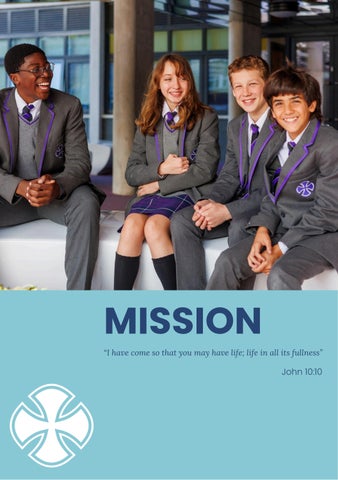
MISSION “I have come so that you may have life; life in all its fullness”
John 10:10
CONTENTS Introduction
4
Part 1 — Educatio: The Curriculum
6
Philosophy
7
The Curriculum
9
Teaching
12
Inclusion
15
Order
17
Part 2 — Formatio: The Formation of the Person
18
Introduction
19
Prayer
21
Worship
23
Assembly
25
Tutor
25
PSHE (Formation)
26
Co-Curricular
27
Part 3 — Social Justice
28
Introduction
29
Love of the Poor
31
Human Dignity
33
Appendices
34
The School Prayer
35
The Daily Examen
36
The House Saints
37
Acknowledgements
38
“I have come so that you may have life; life in all its fullness” JOHN 10:10
INTRODUCTION The purpose of our Mission is to set out the
and vision as well as on the messages and
principles and characteristics of an education at All Saints Catholic College.
examples provided to us by our great Saints, particularly our House Saints. Critically, within that, all roads lead back to Jesus Christ and
The Gospel quotation that guides our school,
the message laid bare within the Gospel. Ultimately, Christ forms the centre of all that we believe and strive to achieve at All Saints
“I have come so that you may have life; life in allits fullness” (John 10:10), coupled with
Catholic College.
our motto of Orare, Laborare, Servire provide the framework for a strong mission by which we will seek to enable students to receive a high quality education, grow their faith and serve those around them.
“Christ is the foundation of the whole education enterprise within a Catholic School. His revelation gives new meaning to life and helps humans [sic] to direct their thought, action and will according to the Gospel”
Many schools speak about the wide ranging activities that they are involved in on a day-today basis which are written about in their own self-evaluations – once the activities have taken place. The purpose of this document is, from the outset, to make clear our Mission as a school based on our motto
(CCE 1977: 34).
4
As a result of Christ being the “foundation of the whole education enterprise”, our Mission is split into three parts:
Educatio – the education of each student at All Saints. Formatio – how we will form each child in the “image and likeness” of God with a deep appreciation of themself as well as others around them. Iustitia Socialis – how we will embed within our students an understanding of, and commitment to, social justice within our local, national and global communities. The leadership of the school, stemming from the Headteacher, will teach and bear witness to the teachings of Christ. It is the role of the Headteacher to ensure that the three parts of All Saint’s Mission are delivered and within the spirit of this document.
5
EDUCATIO
PHILOSOPHY At All Saints we will endeavour to provide a good quality education for all students, especially for those who are poor and disadvantaged. The theology for education at All Saints stems from John 10:10,
Through hard work (Laborare) and support from teachers and parents we will endeavour to provide a strong education for all students in our care. Teachers at All Saints work in the service (Servire) of the students within their care.
“I have come so that you may have life, life in all its fullness”
Taking the example of Jesus in Mark 10,
With this in mind, we aim to provide an educational setting that provides a “fullness” in life for our students, which readily equips them for life beyond school, and a passion for lifelong learning. Within the Gospel we constantly find examples of Jesus as the ‘teacher’, interpreting scriptures as well as providing clear guidance on day-to-day morality and also social justice (see Formatio and Iustitia Socialis)
“For even the Son of Man did not come to be served; he came to serve and to give his life to redeem many people” , we recognise the importance of this passage in putting the needs of our own students first. Teachers at All Saints are characterised by having a steadfast service to the students in their care, going above and beyond the call of duty in order to serve.
The book of Proverbs advocates the necessity of a strong education: “It is better– much better–to have wisdom and knowledge than gold and silver”. 7
We ought not to be content with being hearers, but doers.
ST ALOYSIUS GONZAGA S.J.
THE CURRICULUM The school curriculum forms the back bone of the education of all students. Using Christ as our example, we aim to produce a school curriculum that embraces the needs of all and offers opportunities for all students to access and learn, as well as thrive and reach their “fullness”.
The All Saints curriculum is categorised by a deep immersion in the humanistic and scientific disciplines of study with a clear emphasis on high quality teaching so that learning inspires and motivates each student to acquire a deeper understanding of subjects independently. The curriculum across all subjects will draw upon and develop each student’s imagination, creativity and ability to reason and think critically.
Our curriculum is centred on the needs of each individual student so that when they leave All Saints they are fully equipped to move into the next stage of their learning with the requisite skills needed to be successful in life. While this section is looking at the Educatio curriculum, it is important to recognise the role of both Formatio and Iustitia Socialis as important counterpoints within the normal ‘taught’ curriculum. Their relevance and importance will be discussed in the following two sections.
The Arts form an integral part of the All Saints curriculum. It is through the Arts that we learn about other cultures, history and expressions of faith, and come to understand and discern our own views. The Arts and opportunities to be creative make a significant contribution to the Formatio of each student, which is why they form an important aspect of our curriculum. For example, in Art, students will be
9
encouraged to use their imaginations and to express themselves so that they can forge a better understanding of who they are. In addition, in Music and Drama, students will be presented with opportunities to perform and develop the confidence and critical skills that will be required long after their schooling has finished. As a Catholic school, Religious Education forms the centre point of the curriculum and often the bridge in understanding between a student’s faith and theology as an academic subject. Religious Education will always be of central importance within the All Saints curriculum and will occupy at least ten percent of timetabled time.
10
It is dangerous to make everyone go forward by the same road, and worse to measure others by yourself.
ST IGNATIUS OF LOYOLA
TEACHING It is with this teaching that all staff not only deliver the national curriculum, but embed Catholic values into lessons across the school, ensuring that the formation of the person is central to all learning.
Teaching at AllSaintswill be characterised by a desire and commitment to develop aspiration within each student to learn. Teaching will take into account the various needs within the classroom with an unrelenting resolve to ensure that all receive the best possible intellectual formation.
As a Catholic school, lessons across all subjects at All Saints are designed to make students think about their place within the world today, engaging with critical and moral thinking.
Teachers will take care to rigorously plan engaging lessons rooted in the rhetoric of the Catholic faith. Pope St. John Paul II claimed,
“Catholic education aims not only to communicate facts, but also to transmit a coherent, comprehensive vision of life, in the conviction that the truths contained in that vision liberate students in the most profound meaning of human freedom” (Address of the Holy Father Pope John Paul II to the Bishops of the Ecclesiastical Regions of Chicago).
12
“Catholic education is above all a question of communicating Christ, of helping to form Christ in the lives of others” (Message of John Paul II to the National Catholic Educational Association). Our teaching staff, Catholic and non-Catholic alike, will seek to uphold and sustain the values of the Catholic church as well as the spirit of this document. Indeed, they will seek to embody the sentiment expressed by St John
Paul II when he stated, “The Church needs men and women who are intent on teaching by word and example – intent on helping to permeate the whole educational milieu with the spirit of Christ.” (Message of John Paul II to the National Catholic Educational Association of the United States, April 16, 1979).
13
Ora et labora.
ST BENEDICT
INCLUSION Inclusivity is at the heart of Christianity. The teachings of Jesus in the Gospel provide a clear manifesto for putting the needs of the most vulnerable, disadvantaged and marginalised first. This can be seen through both the actions of Jesus and his early disciples as well as in Jesus’ parables. For example, the healing of Blind Bartimaeus, or the parable of the Good Samaritan, remind us that Jesus’ world view was of inclusion in the absolutist form rather than isolation or exclusivity. At All Saints we seek to be a truly inclusive community embracing children of all abilities and from all faith communities. Our approach to the curriculum and teaching will ensure that all children within our care will have the opportunity to learn, thrive and be successful irrespective of prior ability, disadvantage or individual need.
15
A friend knows the song in my heart and sings it to me when my memory fails.
DONNA ROBERTS
ORDER Rules are a healthy part of any community as they help us to live healthy and moral lives alongside one another. Rules bring order to a group but more importantly they help to structure order within our personal lives.
In addition, in the Sermon on the Mount, Jesus
demands us to “be perfect” just like God is (Matthew 5:48). This means that, we as a school have a duty to help students to “be perfect” but at the same time having an appreciation and love for those who are around them. This sometimes results in the necessity for difficult decisions but these will be taken in the best interest of both the child
Within the Gospel, Jesus presents us with a clear ethical framework to live by – essentially a set of rules and guidelines to help to be a positive member of society. We see this most clearly when Jesus offers us the Greatest Commandment to “love God” and to also “love our neighbour” like we love ourselves.
and community as a whole.
The Sermon on the Mount provides a clear ethical framework by which all people should live, as a result of which there is a necessity for the school to provide the conditions and environment within which this can be achieved.
17
FORMATIO
INTRODUCTION The second crucial part of our Mission is the formation of each student as a ‘child of God’ as well as someone who develops into a well rounded citizen of school, local and national communities.
The Second Vatican Council was clear about the vision of human formation within Catholic schools, stating,
“True education is directed towards the formation of the human person in view of
“I have come so that you may have life; life
their final end and the good of that society to
in all its’ fullness.” (John 10:10)
which (s)he belongs and in the duties of which (s)he will, as an adult, have a share.”
Our Gospel passage confirms our Mission to help students develop a ‘fullness’ in their lives through the example of Jesus Christ.
(Vatican, 1965:1).
For us, Jesus Christ is the model of human life and accordingly the driving force behind our Mission and beliefs. The life of Christ will provide the inspiration for our students to understand the key concepts that will help them to develop into fully formed humans: love, forgiveness, compassion, humility and kindness.
19
The Second Vatican Council’s inspires an ambitious view, one which we at All Saints are committed to realising.
Within school, concrete experiences of church life will be made available and accessible to all students. All teachers will
In addition Pope Benedict XVI reinforced this
work to promote and support the Catholic life of our school but also recognise that within
viewpoint at his address to young people in London in 2010 when he said,
our school there are children of other faiths whose faith will be respected.
“As you know, the task of a teacher is not
The work of staff will result in the Catholic character formation of all of our students so that they can make a positive contribution to
simply to impart information or to provide training in skills intended to
a wider society and be formed in the way that God wants them to be.
deliver some economic benefit to society; education is not and must never be considered as purely utilitarian. It is about
forming
the
human
person,
equipping him or her to live life to the full – in short it is about imparting wisdom. And true wisdom is inseparable from
knowledge
of
the
Creator..”
(Benedict XVI, 2010a).
20
PRAYER Prayer is an essential part of the All Saints community; it provides the opportunity for all to develop a deeper relationship with God. In consequence, time will be given for students to pray and to reflect upon their ‘friendship’ with God. This is especially important given that many young people within society dedicate little time for reflection. Time will be set aside for prayer during tutor time and assemblies as well as in RE lessons. At times, prayer will be communal, for example, saying the Our Father. At other times it will be more personal and allow students the time and space to develop their own relationship with God.
therefore students are encouraged to spend time in silence in the presence of God, feeling connected to Him throughout their day. At times students and staff will undertake the Examen: an Ignatian approach to prayer that is broken into five parts. The Examen provides students with opportunities to reflect upon their lives and actions and to consider the times where they have fallen short as well as focusing on how to improve their lives.
The Chapel is a space that will always be open for both staff and students to engage in silent prayer. In the Gospels, Jesus highlights the importance of private prayer (Matthew 6:6),
21
For prayer is nothing else than being on terms of friendship with God.
ST TERESA OF AVILA
WORSHIP At All Saints Catholic College, we have a resolute commitment to the religious development and formation of all students within the Catholic faith. Communal worship is an important part of being and feeling part of the community as a whole and is an opportunity to outwardly express our faith in God. This togetherness is a key part in what makes this an intrinsically strong community. As a faith community we will come together collectively, as a school, to worship and celebrate Mass each half term. Our Masses will also coincide with important events within the school calendar including the beginning of the year, a celebration at the end of the year and, most importantly, the feast of All Saints on 1st November. These occasions provide the community as a whole with an opportunity to celebrate the Eucharist and remember the suffering, death and resurrection of Christ.
23
Knowing God is more important
than knowing about God.
KARL RAHNER
ASSEMBLY
TUTOR
Once a week students will have an Assembly with their Head of Year, tutor or a Senior Leader in the school. These assemblies form an important part of their spiritual growth and also help them to develop a better understanding of themselves, as well as to forge a sense of belonging within the All Saints community.
Every morning, students spend time with their Form Tutor looking at a variety of different aspects of school life. It is here that students will reminded of what it means to be a part of our school community as well as a member of a global society. The relationship between student and tutor is crucial to ensure that students are happy and focussed within the school setting. The tutor will form the first port of call for both the student
Assemblies at All Saints Catholic College will be acts of worship centred on the Gospel. They will seek to educate students in the message of the Gospel whilst at the same time developing students in their own spiritual growth as well as motivating them to improve in their intellectual formation.
and also the parent so that communication between school and home remains strong.
25
PSHE (FORMATION) As a School, we will seek to prepare our students for life beyond All Saints – this is our duty. As a result, our Formatio (PSHE) programme with help to engender confidence and ensure that students have a deep understanding of their own career ambitions as well as the fundamental needs to exist in 21st century society.
All students will participate in the statutory Personal, Social and Health education (PSHE) programme which, at All Saints, we call formation. This programme will seek to develop all students’ understanding of themselves as well as a more informed understanding of the secular world. As the Catechism of the Catholic Church
Whilst other schools complete the statutory PSHE, what sets All Saints apart are the Catholic values that underpin the delivery of this programme.
states, “The Catholic schoolshouldbe ableto
offer young people the means to acquire the knowledge they need in order to find a place in in society which is strongly characterised by technical and scientificskill” (CCC, 1997)
26
CO-CURRICULAR EDUCATION Our extensive co-curricular offer is designed to provide students with a wide range of activities to grow their confidence and expose them to activities they wouldn’t ordinarily undertake. From a Christian perspective, a strong cocurricular offer is essential in character formation, key opportunities where students interact with one another outside the classroom in order to forge strong relationships and feel a part of a team or community. As the Catechism states,
As a school, we will seek to ensure that the cocurricular offer will be inclusive of all and allow opportunities for students to participate and develop their skills and hobbies.
“(T)he Church reaffirm(s) her mission of education to ensure strong character formation…it…simulates her to foster truly Christian living and apostolic communities, equipped to make their own positive contribution, in a spirit of cooperation, to the building of a secular society” (CCE, 1977)
27
IUSTITIA SOCIALIS
INTRODUCTION It is essential that we teach our young people to have a deeper understanding of social justice and in particular a heightened empathy for the poor.
The Catechism of the Catholic Church is also clear in the vision it adopts for young people in relation to this matter and is one that we fully adhere to.
This is the message of the Gospel. This does, however, have to come with a sense of purpose and action to try to ensure that those less fortunate receive the attention of all within our school community.
“Young people…are to overcome their individualismanddiscover, inthe light of faith, their specific vocation…to make the world a better place.”
Community-wide understanding and desire to help those who are poor.
Overcoming “individualism” is a difficult challenge for young people in a materialistic society. Through our curriculum, Formatio programme and also prayer life, we will enable students to have a deeper engagement in their Christian vocation to make the world a better place.
(CCE 1977:45).
29
Love is shown more in deeds than
in words.
ST IGNATIUS OF LOYOLA
LOVE OF THE POOR The Gospel is clear in its exposition of the poor.
Pope Benedict XVI made a strong link between
A major part of our Mission as a school is to replicate this message and in doing so, teach our young people to have a deep appreciation
social justice and the formation of the human person when he stated,
“What others may call ‘social action’ is, in the context of human formation, always a specific calling to faith and a commitment to action or as St Paul renders it, ‘faith working through love’ (Gal 5:6). Consequently, ‘for the Church, charity is not a kind of welfare activity which could equally well be left to others, but is part of her nature, an dispensable expression of her very being.’”
of those who are less fortunate. The parable of the Prodigal Son provides the perfect example of what we need to teach our children to be like. Even in the most challenging of circumstances we should seek to be like the Father in the story, forgiving but also loving of his son whose spirit and also wealth is poor. At All Saints we will seek to embody a constant discernment for the plight of the poor. This will manifest itself in our duty to educate students
(Benedict XVI, 2005: 25 (a)).
in the injustices of poverty that exist in our world and take action in order to try and support those in either monetary and spiritual poverty in both our local and global communities.
All Saints our Chaplaincy and Pastoral system will incorporate social action and charitable causes into the very fabric of the running of the school.
31
Our hearts are restless until they rest in you.
ST AUGUSTINE
HUMAN DIGNITY A major factor in understanding Social Justice is also having concern for human dignity. At All Saints, through teaching in Religious Education and Formatio, students will come to have a deep appreciation for one another and also the dignity of humanity.
At All Saints we will teach our students that human dignity is a critical part of social justice, hinged on the premise that we are created in the image of God.
The Catechism of the Catholic Church is clear when it states,
“Being in the image of God, the human individual possesses the dignity of a person, who is not just something, but someone. He is capable of self-knowledge, of selfpossession and of freely giving himself and entering into communion with other persons. And he is called by grace to a covenant with his Creator, to offer him a response of faith and love that no other creature can give” (CCC, 357).
33
APPENDICES
THE SCHOOL PRAYER
Dear Lord, Help us today and always to strengthen our Faith in you. Guide us in our work, to enable us to become more like you. Encourage us to look to the examples of our great Saints, to live our lives in service to others in order to fulfil our mission to bring about your Kingdom here on earth. AMEN
35
THE DAILY EXAMEN Bring yourself into the presence of God. GRATITUDE
What do you have to be grateful for today? What do you sometimes overlook, take for granted but which, if were lost or altered, would change your whole life? WHERE
Where has God been present in your day? Where are you in your own life and what do you need to do to be a better person?
REFLECT
Looking back on the day, is your attention drawn to anything you did, or said, or felt? What brought you joy? What brought you sorrow? What stands out? Is there anything today which made you love more? Hope more? Anything which increased your faith in other people, in yourself, or in God? COMMITMENT
Do you ever think about the commitment you have to God and to your better self? What commitments do you have to other people? Have you lived up to those commitments? How do you treat the people closest to you? Is there something you could do today or tomorrow to renew and strengthen those relationships? BALANCE
Is there anything that you have said or done today, or left unsaid or undone, for which you are sorry? Is there anything in your life that is out of balance? Is there anything that needs to be fixed or put right which it is in your power to do? What do you need to do to help you to be the person God calls you to be?
36
THE HOUSE SAINTS ST SIMON OF CYRENE Simon of Cyrene assisted Jesus in his greatest time of need, by helping him carry his cross to the point of his Crucifixion. For our school community, this demonstrates that in times of need we are called to serve those around us who are struggling.
ST ANNE St Anne was the mother of Mary and grandmother of Jesus Christ. St Anne was extremely devout and had a very strong faith. In this way she inspires our students to remain strong in their faith.
ST IGNATIUS St Ignatius was the founder of the Society of Jesus (the Jesuits). He gave up his worldly possessions in order to follow in the footsteps of Jesus Christ and the other great saints. His Spiritual Exercises published in 1548 transformed the way in which many Christians approached prayer and meditation. Our school community has adopted his Examen as a way to reflect upon each day.
ST NICHOLAS OWEN Nicholas Owen was an English martyr who was executed in the Tower of London. He dedicated his life to helping priests to hide from persecution. The life of Nicholas Owen teaches us that it is important to keep our faith strong.
ST TERESA OF AVILA St Theresa of Avila was a 16th century Carmelite nun and theologian. She was a great advocate of a mental prayer and meditative reflection. St Teresa was an extremely strong person and leader of her faith community, which is why she is an inspiration to our students.
37
ACKNOWLEDGEMENTS The mission of the school has been written by the Headteacher and Head of Religious Education with additional contributions made by the Senior Leadership team. This has been scrutinised and approved by the Board of Governors.
38