NZ TRUCK & DRIVER
| May 2026
May 2026 $10.90 incl. GST
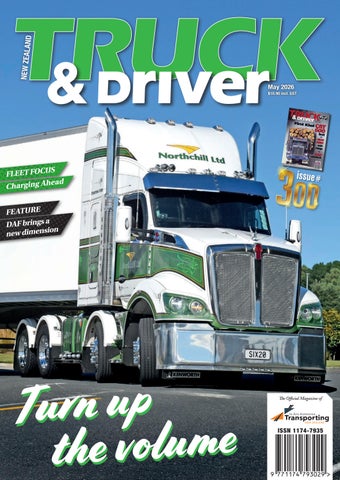
BIG TEST Turn up the volume | FLEET FOCUS Charging Ahead | FEATURE: DAF brings a new dimension
S FLEET FOCU ead Charging Ah
issue #
FEATURE DAF brings a n new dimensio
Issue 300
Turn up e m u l o v the
The Official Magazine of
ISSN 1174-7935
The all-new Isuzu truck range.
Reliability redefined.
Introducing the all-new range of Isuzu N and F Series trucks. With a sleek new cab design, new engines that comply with Euro VI or Japan pPNLT emission standards and additional advanced safety features for a more comfortable drive, the all-new Isuzu N and F Series will change the way we rely on our trucks. Forever. To find out more, visit your nearest Isuzu Trucks Dealer or visit isuzu.co.nz
*Overseas optional body and accessories shown
CONTENTS Issue 300 – May 2026
2
News
67
The latest from the world of road transport including… New Zealand’s Fuel Plan strategy… Volvo launches new 13-litre models… Another successful Tui Truck Show… North America gets two new Macks… Super Truck season finale set for Manfeild and Bombay Truck Show sites selling fast.
22
73
Giti Tyres Big Test Turn up the volume: Northchill Group has New Zealand’s first new Kenworth T620 Sleeper Cab in its fleet. It’s called Starting Over and not only does it look the part, it also sounds great as well.
39
With diesel prices surging and the potential for supply shortages, Dom Kalasih outlines why efficiency becomes more important than ever for the transport industry. Plus, full details of the election year national conference being planned for Wellington in June.
46
Recognising NZ’s best-looking trucks… including a giant pull-out poster of this month’s finalist.
93
Still better than a day at work
85
Bygone Days – Hawke’s Bay The monthly historical series continues with Rod Simmonds taking a look at the growth of the
FEATURES: 62 Southpac Legend
CrediFlex Recently Registered The first quarter registration data has been released and shows the 2026 market tracking at very similar levels to 2025. We report on the segment leaders and there’s the monthly gallery of new rigs on the road.
COLUMNS: 61 National Road Carriers Association James Smith, General Manager Policy and Advocacy considers the opportunities for the road transport sector now that training organisation MITO has returned to industry ownership.
The weather reduced the fishing time and the catches at the 2026 Southpac Trucks Truckers & Loggers tournament, but a Bay of Islands social weekend made sure the annual event was a success.
Advantage Tyre Solutions Fleet Focus Charging ahead: As an early adopter of electric trucks, WM New Zealand has already gained a decade of experience operating of its fleet of both locally converted and OEM electric trucks.
REGULARS: 80/ Double Coin Tyres NZ Transport 81 Imaging Awards
A different type of recovery weekend The heavy salvage industry recently gathered in Hamilton to spend a day training operators and fine-tuning the latest recovery techniques.
81
Hawke’s Bay Farmers Transport giant and its transition to a modern day transport operation.
Charlie’s pride – B.J. and the Bear tribute Charlie Bailey’s latest Kenworth restoration project is a fitting tribute to the star of the popular B.J. and the Bear television series.
77
Transporting New Zealand
DAF brings a new dimension The New Generation DAF range is about to go to work in New Zealand. We preview the new range and look at the design background to a truck that delivers class-leading cabin space and new safety features.
91
New Zealand Heavy Haulage Association The latest changes to heavy haulage operations resulting from the second phase of the Transport Rules Consultation.
Woody’s ‘Toy Story’ Legend: A Kenworth W900 SAR Legend is a very special truck for the Pokeno-based N & J Wood Ltd fleet.
MANAGEMENT
ADMINISTRATION MANAGER
Publisher
Trevor Woolston 027 492 5600 trevor@trucker.co.nz
Trudy Woolston
Advertising
Victor Georgiades 021 925 600 victor@trucker.co.nz
Trudy Woolston Phone
Hayden Woolston 027 448 8768 hayden@trucker.co.nz
admin@trucker.co.nz
SUBSCRIPTIONS admin@trucker.co.nz 027 474 6033
NZ subscription $110 incl. GST for one year price (11 issues) Overseas rates on application ADDRESS
EDITORIAL Editor
Colin Smith 021 510319 colin@trucker.co.nz
Associate Editor
Brian Cowan
CONTRIBUTORS
Olivia Beauchamp Gerald Shacklock Rod Simmonds David Kinch
ART DEPARTMENT Design & Production Luca Bempensante Zarko Mihic EQUIPMENT GUIDE AUCKLAND, NORTHLAND, BOP, WAIKATO, CENTRAL NORTH ISLAND Advertising Hayden Woolston 027 448 8768 hayden@trucker.co.nz
AUCKLAND, LOWER NORTH ISLAND, SOUTH ISLAND Advertising Hayden Woolston 027 448 8768 hayden@trucker.co.nz
Phone Freephone Postal Address Street Address Web
+64 9 571 3544 0508 TRUCKER (878 2537) PO Box 112 062, Penrose, AUCKLAND 172B Marua Road, Ellerslie, AUCKLAND www.alliedpublications.co.nz
PRINTING & DISTRIBUTION Printer Bluestar Retail Distribution ARE Direct Publication: New Zealand Truck & Driver is published monthly, except January, by Allied Publications Ltd PO Box 112 062, Penrose, Auckland Contributions: Editorial contributions are welcomed for consideration, but no responsibility is accepted for lost or damaged materials (photographs, graphics, printed material etc). To mail, ensure return (if required), material must be accompanied by a stamped, addressed envelope. It’s suggested that the editor is contacted by fax or email before submitting material. Copyright: Articles in New Zealand Truck & Driver are copyright and may not be reproduced in any form – in whole or part – without permission of the publisher. Opinions expressed in the magazine are not necessarily the opinions of, or endorsed by, the publisher.
www.facebook.com/nztruckanddriver
www.nztruckanddriver.co.nz Truck & Driver | 1
NEWS
Fuel plan
aims to ease the pain AS MIDDLE EAST CONFLICT, SURGING FUEL PRICES and the roll-on inflationary impacts dominate the daily news headlines, New Zealand’s fuel supplies were holding steady at the time this issue of New Zealand Truck & Driver went to press mid-April. It’s impossible to forecast the next global developments other than to state the obvious – even if the conflict comes to a rapid and peaceful conclusion, the damage to oil production and distribution infrastructure around the Gulf region and wider supply chain disruption will mean a normal supply situation is some months away. So, it’s perhaps most relevant to outline how the government plans to respond to any increased fuel supply uncertainty. It will be guided by the National Fuel Plan – a strategy established in 2024 – which was put into action at the beginning of the conflict. The plan has four clear phases that respond proportionately to any risks to New Zealand’s fuel security. These phases are assessed separately for petrol, diesel and jet fuel – to reflect their different functions and challenges. At each phase is a set of measures responding to a heightened risk to New Zealand’s fuel security. On Wednesday April 15 when this issue went to press New Zealand remained under Phase 1 (Watchful) measures with 56.3 days of petrol stock, 45.4 days of diesel and 47 days of jet fuel. In each case slightly less than half of those amounts were in-country, with the remainder on the water within three weeks of expected arrival. The Fuel Security Ministerial Oversight Group will be responsible for deciding whether a shift between phases is appropriate, with the group required to consider a move when there is a change in any of the six assessment criteria. The criteria that will be used to assess a movement up or down a response phase are: 1. export restrictions – if any of New Zealand’s source refineries introduce or relax export restrictions. 2. changes to New Zealand’s fuel stock levels of plus or minus three days since the most recent published update. 3. a fuel company informs the government that they are unlikely or unable to fill future orders. 4. a breach, or a notification of an imminent breach, of the minimum storage obligations. 5. any significant policy changes in Australia or from the International Energy Agency. 2 | Truck & Driver
6. a significant disruption to regional distribution. “The plan is designed to keep fuel flowing where it matters most, relying on market settings wherever possible, and only stepping in further if supply is genuinely at risk,” says Finance Minister Nicola Willis. Phase 1 (Watchful) focuses on monitoring global developments, easing restrictions to increase optionality (such as changing fuel specifications), providing information to fuel consumers of measures to support voluntary reductions in fuel use, and working with fuel companies to keep fuel moving efficiently across the country. Phase 2 (Precautionary) would see more active coordination between government and industry to shore up fuel supply and support increased efforts in demand reduction. At Phase 2 there would be a stronger push for voluntary uptake by households and businesses of measures that help to conserve fuel, and a reduction in the public sector’s use of fuel where appropriate. If disruption increases, the plan allows for stronger interventions at Phases 3 and 4, prioritising fuel for emergency services, freight and food supply chains, and key industries that underpin New Zealand’s economy. “The measures at Phases 1 and 2 are designed to prevent a move to more restrictive measures. This plan is about staying ahead of the risk, managing pressure in the system and keeping the economy moving,” Nicola Willis says. “It is prudent, however, to plan for all scenarios so that everyone – the Government, industries, businesses and the general public – is prepared.” At Phases 3 and 4 there is increased control of fuel supply. The precise details of these phases are under consultation. At Phase 3 (Managed) fuel supply priority goes to ensuring uninterrupted supply to life-preserving services (ambulance, fire, hospitals and food supply chain), introduces purchasing limits and providing more regular (likely daily) public updates. Phase 4 (Protected) maintains the supply to essential services, but for others a key piece of wording is “use service stations as directed”. Specifically, fuel supply would be maintained in the following order of priority. Band A: life-supporting services, providing uncapped supply to emergency services, courts, corrections, hospitals, lifeline utilities and defence. Band B: economically-important services, which includes critical
NEWS
Left and above: Marsden Point no longer operates as a refinery, but remains the key import terminal and storage facility in New Zealand. transport services (road freight for supermarket and grocery supply chains, international air links), food supply, and primary production during timecritical periods. Band C: essential services, deemed as public transport, essential infrastructure maintenance, and rural GPs and district nurses. Band D: other commercial customers, comprising all other commercial and business fuel users. Band E: general retail sales to customers. A group of senior Ministers will make each decision on whether to move between Phases. It may be that different fuels may be at different Phases – for
example diesel may be at Phase 2 and the same time as petrol is at Phase 1. Associate Energy Minister Shane Jones, who has responsibility for fuel security, says the Government has worked closely with industry on developing the updates to the National Fuel Plan. “This is critical because the plan relies on fuel companies cooperating and working constructively with government,” he says. “My expectation is that we continue to work together as the situation evolves. The industry will play a key role in providing advice to the Ministerial Oversight Group if and when we are required to consider a move between phases.”
300 times around the block IT’S NOT A BIRTHDAY, BUT IT IS A MILESTONE. THE MAY 2026 issue of the New Zealand Truck & Driver sees our odometer tick over to issue number 300. The inaugural issue was published in March 1999, a time when New Zealand was beginning to recover from the effects of the 1997-98 Asian Financial Crisis. In 2026 we face another crisis as Middle East conflict spikes fuel costs, with diesel the hardest hit and threatening the strongest inflationary potential. It’s a very different transport industry in 2026 than it was in 1999 – operating with new technology and under more stringent regulations. The major topics showcased in our 300th issue confirm that change continues to be gradual rather than overnight. With electric vehicles in the spotlight we visit WM New Zealand, the operator of the largest heavy vehicle electric fleet in the country and discover they have already accumulated a decade of experience with EVs. We also look at the shape of trucks for the future by previewing the New Generation DAF range set to debut in New Zealand from next month. The new DAFs are the first trucks to fully exploit the revised European Weights and Dimensions legislation, opening up significant aerodynamic, safety and driver comfort opportunities. A new DAF is a timely topic. NZ T&D issue number 1 featured DAF’s 1999 comeback to the New Zealand market after an absence of several years, reporting on the launch of its iconic 75 and 85 models. Truck & Driver | 3
NEWS
Three new average speed camera sites THE ACTIVATION OF AVERAGE speed safety cameras is gaining pace with three sites in the Waikato and Bay of Plenty set to begin enforcement in coming weeks. NZTA Waka Kotahi says it expects to activate the new average speed safety cameras on State Highway 2, east of Pōkeno in Waikato, from April 28. And during May its planned to activate two sets of cameras in the Bay of Plenty: one set on SH5 just south of Rotorua, and one set on SH2 west of Matatā near Whakatāne. Average speed safety cameras use automated number plate recognition (ANPR) technology and measure how long it takes a vehicle to travel between two fixed camera locations along a road. When a vehicle passes the first camera it records the time and then records the time again as it passes the second camera. The system then calculates how long it took to travel between the cameras (the average speed) and if that average speed exceeds the speed limit, a fine will be issued. Signs are positioned before the camera area, giving drivers time to check they are travelling at a legal speed. On State Highway 2 east of Pōkeno, the camera locations are near the Rimu Road intersection, while the other is near the Mangatawhiri Road intersection. The speed limit on this section of SH2 is 90kph. NZTA says it expects to begin issuing fines to people speeding at this location from April 28.
Before the end of 2026 there are plans to construct and activate 17 average speed camera locations across the country. The first three, at Matakana Rd (Warkworth) and two near Dairy Flat (Kahikatea Flat and Pine Valley] are already operational. More info www.nzta.govt.nz/average-speedsafety-cameras
Hall of Fame expands with new conference THE NZ ROAD TR ANSPORT HALL OF FAME celebrations are expanding for 2026. This year the Invercargill event will feature the addition of a three-day industry conference. Planned as a biennial conference, it will held at Bill Richardson Transport World across three days (Sept 23-25), delivering topical workshops, panel sessions, and tailored site visits. Organisers say attendees can expect a conference that will deliver personal development and practical operational tools which all attendees can take into their day-to-day business. The programme will wrap up with up to six individuals being inducted into the NZ Road Transport Hall of Fame at the gala dinner on September 25. All proceeds from the gala dinner going to the charity of choice: Street Smart, driven by Tony Quinn Foundation. Street Smart provides a world-class, hands-on driver training programme to young New Zealand drivers and their parents/caregivers. The NZ Road Transport Hall of Fame honours the outstanding 4 | Truck & Driver
contributions many individuals have made to the New Zealand road transport industry. More information: www.roadtransporthalloffame.co.nz
The 2026 Hall of Fame gala dinner will be held on Friday September 25.
HAMMAR SIDELOADER SERVICE & MAINTENANCE Safe, Reliable, Hassle-Free
Stay safe, compliant, and productive — book your service today! Full A (100 hrs), B (300 hrs), C (600 hrs) services & annual inspections
Pickup & drop-off of trailers, including COF collections
Genuine Hammar parts in-house with warranty on all work
Operator training for new operators, always included with new units
Keep your Hammar sideloader running at its best with professional servicing and yearly inspections. Our certified technicians in Christchurch and Auckland handle everything - routine maintenance and hydraulic checks to chain certifications, safety system testing, and advanced repairs. OUR SIDELOADER RANGE HAMMAR 130
HAMMAR 110
Sideloaders proudly made in New Zealand from local and Swedish components. newzealand@hammarlift.com www.hammarlift.com/nz
HAMMAR 500
CHRISTCHURCH 17 Halwyn Drive, Hei Hei, Christchurch 8042 Ph: +64 3 344 04 04
AUCKLAND 16 Marphona Crescent, Takanini 2105, Auckland Ph: +64 9 266 96 66
NEWS The new roundabout is at the intersection of State Highway 5 and State Highway 28–Harwoods Road, east of Tīrau,
New roundabout opens on SH5 A NEW ROUNDABOUT NOW OPEN AT THE intersection of State Highway 5 and State Highway 28–Harwoods Road, east of Tīrau, is designed to improve safety on a key regional route. Transport Minister Chris Bishop the previous SH5/SH28 Harwoods Road T- intersection had a poor safety record and is part of a corridor that has seen far too many serious crashes. “Completing this new three-leg roundabout is an important step in making this stretch of highway safer for everyone who uses it,” Mr Bishop says. “SH5 is a critical route for locals, tourists, freight, and agricultural vehicles travelling between Waikato and the Bay of Plenty. Improving safety and efficiency on this corridor is essential, and I am pleased to see another project delivered that helps achieve that. “Between 2014 and 2024, 18 people died and 64 were seriously injured on this stretch of highway,” Mr Bishop says. “Construction of the $6 million roundabout began in August last year, and I am pleased to see it completed on budget and several weeks ahead of schedule.”
The roundabout is one of several safety improvements being delivered along SH5 between Tīrau and Tārukenga Marae Road on the Rotorua side of the Mamaku Range. A right turn bay has been built at nearby Waimakariri Road, and funding has been allocated to complete the design for a similar roundabout at the SH5/SH28 – Whites Road intersection. While construction funding for that project has not yet been confirmed, design work ensures it is ready to progress when funding allows. “We are also making SH5 safer by widening sections of the road to allow the use of wide centrelines, which have proven to be very effective in reducing crashes,” says Mr Bishop. “The first section east of Whites Road was completed this summer and will be extended to Harwoods Road as funding allows.” Another section of SH28-Whites Road, south of the SH5, intersection is currently being rebuilt, and the intersection itself will receive a new asphalt surface.
Truckie Rest Zone dates announced THE 2026 NZI FLEET FIT TRUCKIE REST ZONE programme gets started in the Bay of Plenty on Wednesday May 20. Four venues and three dates have been confirmed starting at the Paengaroa CVSC near Te Puke. The Northland date is Wednesday August 12 at Uretiti while the South Island venues are the Glasnevin and Rakaia CVSC facilities. The provisional date at Glasnevin is Wednesday October 28 and Rakaia is confirmed for Wednesday November 25. The NZI Fleet Fit Rest Zone events offer a chance for truck drivers to take a break with a complimentary snack and drink while talking to NZI’s experienced Fleet Risk Managers. There is a chance to learn about fatigue issues, healthy diet choices and free health checks are available. NZI Truckie Rest Zones are delivered by NZI’s experienced team of who work to improve safety and performance via the NZI Fleet Fit programme. Fatigue is a major cause of road accidents and NZI wants to support drivers to get home safe. It’s possible additional locations and dates will be announced for later in the year.
NZI’s experienced Fleet Risk Managers are on hand at the Rest Zones events along with a chance to learn about fatigue issues and healthy diet choices.
Truck & Driver | 7
p r o u d ly s u p p ly i n g p g f transport for 57 years
sales www.transporttrailers.co.nz
Greg Cornes
Tim Miller
Craig Jamieson
director
national sales & customer support
director
sales@transporttrailers.co.nz TransportTrailers
Quality will not be compromised June 1969 marked a milestone for Transport Trailers when we supplied PGF Transport with their very first trailer for $3,932. At the time, New Zealand had only recently transitioned from pounds, shillings, and pence to decimal currency, where £1 became $2, reflecting a period of significant change. While our pricing has evolved since 1955, our commitment to the industry and our customers remains unchanged.
◀
Quality manufacturing, strong customer service, and long-standing relationships like the one we’ve built with PGF Transport over 57 years remain at the heart of what we do. Mike Stevenson managing director
See videos of these units and more at transporttrailers.co.nz/videos
Order Parts Online at store.transporttrailers.co.nz
MANUFACTURED BY TRANSPORT & GENERAL ENGINEERING