How to Write a Broadcast Breaking-News Story
WHAT MAKES BROADCAST BREAKING NEWS DIFFERENT?
Broadcast breaking news is immediate, urgent, and designed to be heard—not read silently. Unlike print or online writing, broadcast scripts must be:
• Clear on first hearing
• Conversational in tone
• Easy for an anchor to read aloud
• Focused on the most essential facts
A breaking-news script is not polished storytelling—it is rapid, accurate communication under time pressure.
THE CORE GOAL
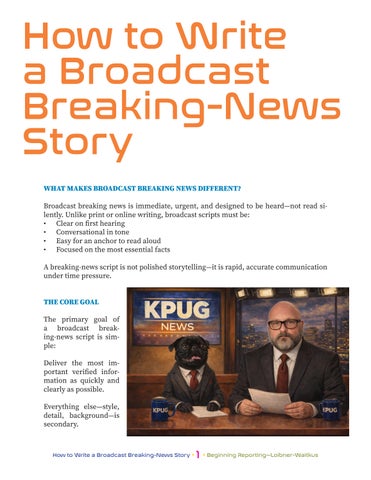
The primary goal of a broadcast breaking-news script is simple:
Deliver the most important verified information as quickly and clearly as possible.
Everything else—style, detail, background—is secondary.

KEY DIFFERENCES FROM PRINT NEWS WRITING
PRINT NEWS
Written to be read
Can be detailed
Complex sentences allowed
Readers can re-read
Dense information
BROADCAST BREAKING NEWS
Written to be heard
Must be concise
Short, simple sentences required
Listeners hear it once
Selective, prioritized information
THE STRUCTURE OF A BREAKING-NEWS SCRIPT
A broadcast breaking-news script follows a simplified version of the inverted pyramid, adapted for audio delivery:
• Alert Lead (What just happened)
• Essential Details (What we know now)
• Context (If time allows)
• What Happens Next (If known)
WRITING THE ALERT LEAD
The lead must immediately answer the most urgent questions:
• What happened?
• Where?
• Is anyone hurt?
• Why does it matter right now?
Example:
We’re following breaking news out of downtown Little Rock, where a fire has damaged several businesses late this afternoon.
Key Features:
• Present tense
• Immediate and direct
• No unnecessary background
WRITING FOR THE EAR, NOT THE EYE
Broadcast writing must sound natural when spoken.
Use:
• Short sentences
• Simple vocabulary
• Conversational phrasing
Avoid:
• Long, complex sentences
• Formal or academic language
• Dense information
Print-style sentence (bad for broadcast): Authorities are currently investigating a multi-vehicle collision that occurred earlier this afternoon.
Broadcast style: Police are investigating a crash involving several vehicles this afternoon.
SENTENCE LENGTH AND STRUCTURE
Rule of Thumb:
• One sentence = one idea
Keep sentences:
• 10–15 words when possible
• Direct and active
Weak (too long):

Emergency crews responded to the scene of a fire that broke out earlier this evening and caused significant damage to multiple buildings in the area.
Strong:
Emergency crews responded to a fire this evening. The fire damaged several buildings.
WRITING IN PRESENT TENSE
Breaking news scripts rely heavily on present tense to create immediacy.
Example:
• “Police are investigating…”
• “Firefighters are working to contain the fire…”
Even if events happened minutes ago, present tense keeps the story alive and urgent.
USING ACTIVE VOICE
Active voice is clearer and easier to understand when spoken.
Passive: A suspect was arrested by police.
Active: Police arrested a suspect.

NUMBERS, NAMES, AND DETAILS
Numbers:
• Round when possible
• Avoid excessive precision
Instead of: 27 people were injured
Say: About 25 people were injured
Names:
ATTRIBUTION IN BROADCAST WRITING
You must still attribute information—but keep it simple.
Use:
• “Police say…”
• “Officials say…”
• “According to firefighters…”
Avoid:
• Long or complex attributions
• Overloading sentences with sources
Example: Police say one person was injured in the crash.
• Use only when necessary
• Ensure pronunciation is clear
• Consider phonetic spelling in scripts (for anchors)
Details:
• Focus on what matters now
• Leave out minor or confusing specifics
TIMING AND LENGTH
Breaking-news scripts are typically short and expandable.
Typical length:
• 20–40 seconds for initial reports
• Can be updated and expanded as more information becomes available
UPDATING A BREAKING-NEWS STORY
Breaking news evolves quickly. Your script should:
• Reflect the latest confirmed information
• Avoid speculation
• Be easy to revise
Use phrases like:
• “We’re still learning more…”
• “Details are limited at this time…”
• “Authorities have not released further information…”

AVOIDING SPECULATION AND RUMORS
Never report unverified information.
Do NOT:

Use simple transitions:
• “Meanwhile…”
• “In other news…”
• “Authorities say…”
Avoid abrupt jumps between ideas.
WRITING FOR THE ANCHOR
Always remember: someone else will read your script aloud.
Make it easy to read:
• Avoid tongue-twisters
• Use natural phrasing
• Break up long sentences
Examples—
• Guess causes
• Repeat rumors
• Fill gaps with assumptions
Instead: Officials have not yet said what caused the fire.
TRANSITIONS AND FLOW
Even short scripts need smooth flow.
Hard to read: The preliminary investigation indicates multiple mechanical malfunctions.
Easier:
Investigators say there may have been mechanical problems.
FORMATTING A BROADCAST SCRIPT
Broadcast scripts are formatted for clarity and readability.
Common Practices:
• Use ALL CAPS or clear font for readability
• Double-space lines
• Break sentences into short lines
• Avoid large blocks of text
Example Format:
WE’RE FOLLOWING BREAKING NEWS TONIGHT.
A FIRE HAS DAMAGED SEVERAL BUSINESSES IN DOWNTOWN LITTLE ROCK.
FIREFIGHTERS ARE STILL AT THE SCENE.
POLICE SAY NO INJURIES HAVE BEEN REPORTED.
WHAT TO INCLUDE IN A BREAKING-NEWS SCRIPT
Must Include:
• What happened
• Where it happened
• Current status (injuries, danger, response)
• Verified facts
Include if Known:
• Who is involved
• Cause (only if confirmed)
• Impact on the public
What to Leave Out:
• Background history (unless critical)
• Detailed timelines
• Minor details
• Emotional or dramatic language
TONE: URGENT BUT CONTROLLED
Breaking news requires urgency—but not panic.
Avoid:
• Sensationalism

• Overly dramatic language
Bad:
A terrifying and devastating fire is raging out of control
Better:
A fire is burning in downtown Little Rock. Crews are working to contain it.
COMMON MISTAKES TO AVOID
1. Writing Like Print
Broadcast is not print—simplify everything.
2. Overloading Information
Too many details overwhelm listeners.
3. Using Complex Sentences
Listeners cannot rewind. Keep it simple.
4. Failing to Update

Old or outdated information damages credibility.
5. Poor Attribution
Always clarify where information comes from.
STEP-BY-STEP PROCESS
1. Gather verified information
2. Identify the most urgent fact

3. Write a clear, direct lead
4. Add essential supporting details
5. Keep sentences short and conversational
6. Check for accuracy
7. Read the script out loud
8. Revise for clarity and flow
PRACTICE EXAMPLE
Scenario:
A school bus and a car collide. Several students are injured. Emergency crews are on scene.
Weak Script:
Earlier today, there was an accident involving a school bus and a car that resulted in multiple injuries and is currently under investigation by authorities.
Strong Broadcast Script:
WE’RE FOLLOWING BREAKING NEWS THIS AFTERNOON.
A SCHOOL BUS AND A CAR COLLIDED EARLIER TODAY.
POLICE SAY SEVERAL STUDENTS WERE INJURED.
EMERGENCY CREWS ARE AT THE SCENE.
WE’RE STILL WAITING FOR MORE DETAILS.
FINAL TIPS FOR STUDENT JOURNALISTS
1. Write for the ear
2. Keep it simple and direct
3. Lead with what matters most
4. Verify everything
5. Avoid speculation
6. Read your script out loud before submitting
CONCLUSION
Writing a broadcast breaking-news script is about clarity under pressure. You are delivering critical information to an audience that may only hear it once. Your job is to make sure they understand it immediately.
A strong script is:
• Accurate
• Clear
• Concise
• Easy to say
• Easy to understand
Mastering this form of writing will make you a stronger journalist across all platforms— but especially in moments when information matters most.