LAMPLIGHTER
THE ALLEN-STEVENSON SCHOOL MAGAZINE
WINTER 2011
THE ALLEN-STEVENSON SCHOOL
LEADERSHIP 2011-2012 BOARD OF TRUSTEES
Ronald S. Rolfe Ô60, President Thomas H. Lister, Vice President & Treasurer Lisa Pagliaro Selz, Secretary David R. Trower hÕ95, Headmaster Dana B. Cowin Alexander G. Gellert Ô79 Michael Gould Mark I. Greene John J. Hannan Joshua Harris Peter B. Kellner Ô84 Michael S. Klein David H. Koch Paul A. Leff Pablo G. Legorreta Duane A. Nicholson Dang T. Phan Amy L. Robbins Alexander Roepers Suellyn Preston Scull Daniel H. Stern Alexandra Wallace Simon D. Wasserberger Ô85* Leonard A. Wilf Shiuan Wu* * member ex officio
TRUSTEES EMERITI Mildred J. Berendsen Marian R. Bicks Jane Phillips Donaldson Richard N. Foster D. Ross Hamilton Susan B. Hirschhorn Karen T. Hughes John R. Hupper Ô40 E. William Judson Robert J. Katz George A. Kellner Robert Liberman Ô58 Peter deF. Millard Richard C. Perry Ô70 Joe L. Roby Andrew P. Steffan
ALUMNI COUNCIL
Simon D. Wasserberger Õ85, President David W. Herzberg Õ89, Vice-President James A. Magid Õ91, Vice-President Marc N. Rice Õ84, Vice-President Ian Adler Õ87 Theodore D. Agbi Õ10 Charles W. Allen Õ91 Basil L. Anderson Õ08 Andrew R. Arias Õ92 Zach T. Axelrod Õ95 Neil E. Bader Õ79 Anthony P. Bonan Õ93 Pierre A. Bonan Õ89 Robert B. Buehler Õ78 Robert D. Burge Õ76* Alfred P. Burger Õ87 Andrew A. Burger Õ59 John T. Carr III Õ76 Erik A. Cliette Õ81 Brooke B. Connell Õ86 Adam J. P. Donaldson Õ05 Maurice F. Edelson Õ78 Jason M. Farkas Õ97 Michael Feinberg Õ84 R. Vanneman Furniss Õ91 Alexander G. Gellert Õ79 Harlan E. Goldberg Õ90 Evan R. Goldfischer Õ81 Christopher S. Goodman Õ86 Michael H. Grady Õ91 Christopher J. Hallows Õ87 Christopher W. Hamilton Õ96 Schuyler Havens Õ88 Michael W. Hedges Jr. Õ77 John C. Henry Jr. Õ84 John B. Hersey Õ09 David R. Hirschfeld Õ99 Patrick D. R. Horan Õ85 Tristan Howard Õ96 C. Andrew Hughes Õ98 Alex A. Ingram Õ03 Andrew A. Janko Õ95 Clinton V.P. Johnson Õ79 Stephen H. Judson Õ76 William H. Judson Õ78 A. Reed Katz Õ03 Cameron A. Koffman Õ12 Kenneth LaFreniere Õ90 Dean I. Landis Õ78* Ethan A. Leff Õ11 Paul J. Mancuso Õ03 Colin McCabe Õ90 Timothy C. McCabe Õ94 Kenneth J. McCauley Õ93 Liam R. Millhiser Õ96 Ross R. Millhiser IV Õ94 Richard C. Perry Õ70* Christopher Persley Õ88 Vincent Peterson Õ74 Philip N. Pilmar Õ01 Roger Raines Õ80 Harlan Reinhardt Õ83
Ronald S. Rolfe Õ60* Eric Rosas Õ06 Berton Rose Õ97 John Rose Õ90 Louis Rose Õ86* Henry J. Rosenwach Õ04 Eric E. Rothstein Õ81* Dean E. Sanborn Õ61 Alessandro M. Santoro Õ07 Randolph R. A. Schrade Õ76 Yoshiki Shimada Õ75 Alexander B. Shipper Õ02 Denton A. Smith Õ94 Khalid A. Taylor Õ10 Michael Tiedemann Õ86 Andrew W. Vogelstein Õ81 Noel E. Volpe Õ85 Alexandre von Furstenberg Õ85 Mark Wasserberger Õ82 Dewey S. Wigod Õ77 Hans L. Wydler Õ81 Clifton G. York Õ78 Andrew E. Zimmerman Õ00 Thomas Zipser Õ99 *president emeritus
PARENTS ASSOCIATION
Shiuan Wu, President Amanda Lister, Vice President Vivian Queen, Treasurer Paula Simmons, Corresponding Secretary Samantha Marvin, Communications Secretary Amy Bader, Advisory Linda Barnett, Advisory Marie Bitetti, Advisory Constance Cornish, Advisory Suzanne Freind, Advisory Cristina Morris, Advisory Susan Morgenstein, Advisory Alix OÕMara, Advisory Anne Schnitzer, Advisory Lisa Pagliaro Selz, Advisory Lucia Smith, Advisory
ADMINISTRATIVE TEAM
David R. Trower hÕ95, Headmaster Susan Etess, Lower School Head Kimberly Kyte, Middle School Head Neal Kamsler, Upper School Head Richard Alifano, Director, P.E. and Athletics Casper Caldarola, Director of Communications; Co-Director of Community Life + Diversity Michelle Demko, Music Department Head Ronnie R. Jankoff, Director of Admissions Glenn Lieberman, Director of Technology Anne Russo Meyer, Director of Learning Resources Mary Richter, Director of Development C. Harris Stein, Business Manager
L
A
M
P
L
I
G
H
T
E
R
THE ALLEN-STEVENSON SCHOOL MAGAZINE WINTER 2011
Table of Contents Director of Communications CASPER CALDAROLA
Communications Manager SARAH WOODS
In this issue
SUSAN ETESS NEAL KAMSLER KIMBERLY KYTE MONIQUE LOWITT ANNE MEYER JILL SILVERMAN DAVID R. TROWER H’95
Headmaster’s Message . . . . . . . . . . . . . . . . . . . . . . . . . . . . . . . . . . . . . . . . . . . . . . . .2 Cover Story: A-S Prepares Boys for Life . . . . . . . . . . . . . . . . . . . . . . . . . . . . . . . . . .4 Welcome New Members of our Community . . . . . . . . . . . . . . . . . . . . . . . . . . . . . . .16 Closing Exercises 2011 . . . . . . . . . . . . . . . . . . . . . . . . . . . . . . . . . . . . . . . . . . . . . . .26 Ongoing Schools . . . . . . . . . . . . . . . . . . . . . . . . . . . . . . . . . . . . . . . . . . . . . . . . . . . .31
Editors
Making a Difference . . . . . . . . . . . . . . . . . . . . . . . . . . . . . . . . . . . . . . . . . . . . . . . . .14 A-S News . . . . . . . . . . . . . . . . . . . . . . . . . . . . . . . . . . . . . . . . . . . . . . . . . . . . . . . . . .21 Around A-S . . . . . . . . . . . . . . . . . . . . . . . . . . . . . . . . . . . . . . . . . . . . . . . . . . . . . . . . .22 Alumni Event and News . . . . . . . . . . . . . . . . . . . . . . . . . . . . . . . . . . . . . . . . . . . . . . 33 Did You Know? . . . . . . . . . . . . . . . . . . . . . . . . . . . . . . . . . . . . . . . . . . . . . . . . . . . . . .40
Contributing Writers
JEAN MCCAULEY SARI NADLER MARY RICHTER
Photographers
TERI BLOOM NANCY MITCHELL AL PEREIRA
In every issue
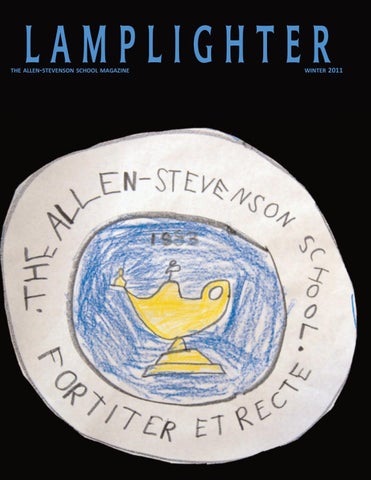
Cover art of the Allen-Stevenson seal by Sam Smith’20.
The Lamplighter is published biannually by The Allen-Stevenson School and is sent free-of-charge to alumni, parents, and other friends of the School.
The Allen-Stevenson School admits students of any race, color, religion, nationality, or ethnic origin to all the rights, privileges, programs, and activities generally accorded or made available to students at the School. It does not discriminate on the basis of race, color, religion, nationality, ethnic origin, or sexual orientation in the administration of its educational policies, admissions policies, employment policies, financial aid program, or any other programs administered by the School.
Our apologies to the following donors, who were inaccurately recognized in the 2010-11 Annual Report of Gifts. We take this opportunity to extend renewed thanks to them for their support. Edmonds Bafford ’86 Mr. and Mrs. Charles G. Berendsen Nora Joffe Elish Oliver Kramer ’86 John Pariseau h’98 and Dario Sacramone Mortimer Sackler ’86
Printed on paper containing 20% post-consumer recycled content.
HEADMASTER’S
MESSAGE “Go around this school, and you will see boys who are happy and happily engaged in what they’re doing. We try to hold out a range of models on the ways of being a boy. There are so many ways….” Although itÕs hard to remember, I first said these lines in a Lamplighter interview fifteen years ago. TheyÕre still true, however, perhaps even more so today. A recent showing of the film Race to Nowhere at school, along with the impassioned parent discussion afterwards, certainly confirmed that AllenStevenson parents want meaningful educational and personal goals for their sons. This Lamplighter sets out to show just how we approach this challenge. Occasionally I am asked, as though itÕs one or the other, whether school is ÒlifeÓ or Òpreparation for life.Ó Our mission statement answers the question looking forward. Reflecting the SchoolÕs Latin motto, it asserts, ÒUltimately, we encourage boys to move through life strongly and rightlyÑwith confidence, knowledge, enthusiasm, resilience and respect for all.Ó To my mind, such qualities are antidotes to the unrealistic and virtually unattainable goals so often imposed on todayÕs young. Last April, all the boys at Allen-Stevenson shared a short writing opportunity during which they recorded individually what they had been doing in class for the previous ten minutes. In advance, we had asked teachers to prepare their boys for this exercise. So, at the appointed hour on Tuesday, April 26, our Director of Security Mr. Chris Acerbo made an announcement over the intercom system to ask everyone to stop and write. The results are recorded here, and the range of responses from Kindergarten through Ninth Grade is astonishing.
For one thing the experiment reflects how much energy, time and planning Allen-Stevenson teachers put in so that our boys can learn in interesting, memorable ways. This process doesnÕt happen accidentally. You will notice that the vast majority of activities recorded are based on real hands-on experiences, carefully planned by teachers, and each suggests an age-appropriate, engaged, vigorous approach to learning. Most often, this approach reflects our stated intent: ÒBy creating a joyful, safe environment for learning, the School seeks to ensure a productive, diverse community of learners.Ó For many students, this process is one of learning to make meaning of information, to grasp how the world actually works. In the descriptive articles by our Director of Learning Resources and our three Division Heads, the age-appropriate nature of what happens at each grade level is explained. Our educational program stresses increasing each boyÕs capacity to be organized, to reach important skills and content benchmarks, and still to retain the innate curiosity that is so central to lifelong education. Again, the goal is captured in our mission statement: ÒWe inspire in each boy an appreciation of responsible citizenship and a lifelong love of learning.Ó In many of the student responses, one can also discern something else. That is the premise that at Allen-Stevenson we can establish an essential foundation for each boyÕs life, not just for his years in secondary school or college but also for the long run. A boyÕs years at Allen-Stevenson are likely to be the longest he spends at any school or university: we need to provide the tools and habits heÕll require to keep on learning. Not least we need to empower his curiosity, so that it serves him and others throughout his life. When it comes to preparing for the future by being fully engaged in the present, the student responses also attest to the old adage of Òone step at a time.Ó AllenStevensonÕs educational program gives boys discrete units and skills they can master, and then enables them to build on what they know. Especially since 11% of this century has already passed, this approach seems more sensible to me than all the foggy talk about Ò21st Century SkillsÓ and the often blind assumption that Òmore is better.Ó Serious learning that is age-appropriate, reasonably comfortable, and even fun is often the key. A Visiting Committee of the New York State Association of Independent Schools once lauded Allen-Stevenson for encouraging this sense of play, which is essentially the ÒworkÓ of childhood. They wrote, ÒNo longer are boys sent to Allen-Stevenson to become young men; rather, as parents have noted, boys are sent to the school to celebrate all that it means to be a boy.Ó
That does not mean that we can ignore the changing times, and we donÕt. Through its President Pat Bassett, the National Association of Independent Schools has identified six skills and values the world today demands and rewards. These are: ¥ Character (integrity & compassion/empathy & meaning) ¥ Critical Thinking (research, problem-solving and project design) ¥ Creativity (games, gaming, entrepreneurship and invention) ¥ Collaboration (teaming and leadership) ¥ Communication (writing, public speaking, networking, technology) ¥ Cosmopolitanism (community life, global citizenship, diversity) Embracing the balance of academics, athletics and the arts, these skills and values are already woven into what we do at Allen-Stevenson. Implying that energized, varied and sustained work over time is what matters and best supports lifeÕs next steps, we say this approach Òteaches boys to value the gratifying process by which excellence is attained.Ó In fact, learning to embrace this process through these experiences is the foundation a happy, engaged boy can attain for his life. As to my query whether school is ÒlifeÓ or Òpreparation for life,Ó look at the snapshots in this Lamplighter, and you donÕt have to wonder what our answer here at Allen-Stevenson would be. By celebrating boyhood and making school real, an A-S education is life, measured in age-appropriate steps that scaffold the lessons, engage the whole boy, and prepare him for his future. Such precious work is definitely a great responsibility and a privilege. Fortiter et Recte,
David R. Trower Headmaster
L
A M P L I G H T E R
5
LEARNING RESOURCE CENTER
IT’S A PARTNERSHIP BY ANNE MEYER, DIRECTOR, LEARNING RESOURCE CENTER & JILL SILVERMAN, LEARNING SPECIALIST
It is 7:45 on a Tuesday morning and boys are already gathering
Many of the boys are eager, others are nervous, but all share a
travelling toward 78th Street and Lexington Avenue. Several
there to get extra support as they sharpen their skills, advocate
on the sidewalk waiting to enter school while others are still
Middle and Upper School students have made their way into the building and are filling seats in the Learning Resource Center (LRC). Some are there by appointment, while others have
commonality. On any morning, those students in the LRC are
for themselves and strengthen their organization and time management skills.
dropped in with a question.
The Learning Specialists in partnership with the Classroom
Some have come to seek help with a homework assignment
a place a student can come to actively solve problems, analyze
that they didn’t quite understand the night before or a writing
project they want to refine. Others will be there because they
are working on reading comprehension skills, following directions or vocabulary development. Some boys will come to get help
with organization and study skills or to work on an enrichment project in Math. And, a handful of boys come because the
night got away from them and they need to catch up. Perhaps
they had a game out at Greenvale, religious school obligations, a family dinner that turned into an hour-long conversation, or a cello recital at school.
4
W I NTER
2 0 11
Teachers work with the boys to cultivate confidence. The LRC is reading materials, and produce work they are proud to hand in. It’s not uncommon for a Classroom Teacher to discuss boys they believe could benefit from the services of the LRC.
The takeaway for a boy is to know himself as a learner, to ask questions when he does not understand, and to be able self-
question: “Have I done what was asked of me?” “Is this my best work?” or “Do I understand this well enough to teach someone else?” Success comes incrementally. A sense of achievement
sometimes occurs quickly while at other times more slowly, but the confidence level builds with each measure of success.
LOWER SCHOOL A DAY IN THE LIFE SHOWS THE BREADTH AND DEPTH OF OUR PROGRAM IN LOWER SCHOOL BY SUSAN ETESS, LOWER SCHOOL HEAD
Allen-Stevenson’s Lower School is a lively, engaging
place for young boys to learn and take the first steps in becoming Gentlemen and Scholars. The program is
designed to engage boys in their learning, introduce
them to a range of subjects, activities and skills, as well as make them feel valued and a part of our wonderful community.
At any given time, the Lower School has a vast range of activities taking place in the classrooms. Boys are
happy and engaged, which we believe is an important
part of a strong elementary school education. To truly understand the School one could take a snapshot of
any small segment of time to capture the range of activ-
Kindergarten Drops Everything & Writes
I am erasing something from my writers’ workshop outline. I just finished my book for writer’s workshop.
ities that make up a day in the life of a Lower School
I am drawing and writing on my paper for writer’s workshop.
As much as possible we try to have the boys learn
I am singing in music class and we were doing beats and rhythm.
boy.
through real life experiences in and outside of school. To understand the School better, here is a bit of what was happening in the Lower School last April on a
beautiful spring day. In the Kindergarten, boys were
busily engaged in the block corner, building a replica of the Michael Quill Bus Depot they had visited the day before – and it looked just as it was. They worked
together to plan the design and easily divided the task cooperatively amongst themselves. Their excitement
from the trip to 41st Street and 11th Avenue – having
seen where the buses sleep, how they are washed and
how they get ready each day for the many riders – filled the room. The study of Transportation is an important
part of the Social Studies program in Kindergarten and a topic specifically selected because we are a school for boys. Many boys are truly fascinated with objects that move, especially any kind of vehicle. Actually
going to see and experience the Bus Depot provides for deeper learning than just reading about it, hearing
about it or even seeing pictures. During the year the
I am building a bus depot with blocks. I am measuring the length of items in our classroom. The stapler is 9 Unifix Cubes long. I am doing subtraction math in work time today. I am drawing an alien in my sketchbook. I am coloring in my recycling book. I am writing in my Journal and signing people into my club. I am sorting Mancala pieces, animals, circles and trucks. I am getting my Purell squirt and a drink of water. L
A M P L I G H T E R
7
First Grade Drops Everything & Writes
I am having fun singing. Music is my favorite class. I am playing Star Wars on the French horn and next to me someone is playing a duet of the Rainbow song. I am writing about a chapter I just read. I like to draw pictures with it too. I finished reading my book and now we can play a trivia game. I am reading Explode the Code phonics book.
Second Grade Drops Everything & Writes
I am learning about the Japanese print maker Hokusai, who was born in 1760. I am writing a haiku. This is a poem with 17 syllables. I am learning how to do tally marks, solve money problems, group things by greater than and less than.
Kathy Allen’s Second Grade Art Project
boys take other trips as part of the study of Transportation, including visits to the NYC Transit Museum and the Boat Basin on the West Side.
With the Arts playing such a prominent role in our curriculum, giving boys opportunities to perform musically and dram
atically are important. At the same time, half of the first grade boys were happily singing in the Music Room, rehearsing
their upcoming performances for Grandparents and Special Friends Day. They were very excited to be singing for their
family member or friend in a week’s time. They also had just been treated to a Middle School boy visiting them and playing his French horn. The melodies of Star Wars and
Somewhere Over the Rainbow are being heard – just
whetting their appetites for Second Grade when they too can begin to play an instrument. Their faces show they cannot wait for that day. The Lower School boys love when the
Middle School boys come to their classes to work with them! Some of the best experiences in school happen when
younger students learn from older students. We try to
encourage these types of experiences whenever possible.
In addition, performances are an essential part of the AllenStevenson experience.
Going on simultaneously on the third floor, a group of second graders is studying the Japanese printmaker Hokusai. The
6
Kindergarten boys building the Michael Quill Bus Depot
W I NTER
2 0 11
Smart Board in their classroom is filled with information
Third Grade’s Mr. America Performance
about this wonderful artist, as well as pictures of his incredible work, most notably Mount Fuji and The Great Wave. The boys
cannot wait to make their own prints. In addition, the boys will
be writing stories about this famous artist and sharing them with the other classes. These lessons are part of our writing program and having the boys learn writing through something of real
interest to them enhances their learning. The enthusiasm they
I’m at my viola lesson and need to pick a new piece to learn with my teacher. I picked Bony Stegosaurus. My brother played that piece too. I am checking my work and I got the answer right on family facts.
show for this project is part of what we hope is evident in learning for each and every boy.
I am working on my New Amsterdam packet. I am on the crossword part.
The leaders of the Lower School, the boys in Third Grade, are
I am reviewing math facts. It was a good review.
Lower School. They are rehearsing for their final production of
I am learning about poetry and art.
boys themselves, emanating from their study of the United
I am working with my math partner on a how-totell-time problem.
involved in what might be one of the most exciting parts of the Mr. America - a culminating event. This is a play written by the States. Each boy proudly represents one state, telling the audience some interesting and fun facts about his state while he wears a placard of his state, which he has designed. The
production also includes singing and dancing and is a truly interdisciplinary event that highlights the boys’ talents as
researchers, writers, artists, singers and dancers, as well as
their ability to work seamlessly together. In projects such as this, boys are routinely asked to design their own work, solve prob-
lems in a multitude of ways and highlight their individual abilities and talents.
What does all of this say about the life and learning of a boy in the Allen-Stevenson Lower School? What is really going on
underneath the surface of these activities? What might not be so obvious is the underpinning of a good early elementary
education upon which these activities are based. Learning,
especially at young ages, is greatly enhanced when real life experiences are the basis for this learning. In addition, our
young students come to us with great curiosity, and our job as
educators is to build on that curiosity rather than to squelch it.
We try to be cognizant of the fact that we are a boys school and build our learning experiences around their interests, learning styles and development. At Allen-Stevenson there are many ways to be a boy and many ways to be successful.
I am in my music lesson and I’m getting ready for the concert. I’m playing a new song.
Third Grade Drops Everything & Writes
I’m learning our second dance for the Mr. America Pageant. We are dancing to the 70s funky music. I’ve been looking forward to it ever since I first saw it. I’m dancing to a song called Why Do Fools Fall In Love? This is how you do the dance: first you go up and down like a bobble head. Then you spread your arms out and then you snap. I’m in music class and we’re practicing our song for Grandparents Day. My favorite song is Ode to Joy. Mrs. Schrade James is playing the piano. I’m in P.E. and we played ball and had relay races. It was so, so fun! L
A M P L I G H T E R
9
MIDDLE SCHOOL TRANSITIONS: MIDDLE SCHOOL BOYS MOVING FROM CONCRETE TO ABSTRACT THINKERS BY KIMBERLY KYTE, MIDDLE SCHOOL HEAD ALONG WITH THOUGHTFUL INSIGHT FROM PETER HAARMANN, MIKE HARRIS AND HARUKA MORI Each fall the Middle School welcomes a new class of fourth grade boys. They are bright eyed, enthusiastic and as eager as the older boys to engage in their academic studies, develop sturdy friendships and
investigate chorus, orchestra and various sports. Our sixth grade
boys leave in June with an air of confidence and caution. They have negotiated, and some have mastered, locker management, a
departmentalized program, letter grades and a year where their bodies signal the move towards puberty. Transitions!
Our focus in the Middle School is to develop experiences that revolve
around the academic, music, athletic, social, and emotional aspects of our boys’ lives that allow them to think, analyze, write, and speak with more
conviction and authority. We plan for our boys to have opportunities that encourage and demonstrate ways to give to others, both in school and in our neighborhood. Empathy and compassion are our goals.
Jean Piaget (1986-1980), developmental psychologist and philosopher, talks of this time in a child’s development as the move from being a
concrete thinker to an abstract thinker. He describes this as the move
from the Concrete Operational Stage to the Formal Operational Stage,
which begins at approximately age eleven. An abstract thinker (Formal
Operational Stage) begins to interpret a book character in several ways, not just the obvious. An abstract thinker can connect, compare and contrast various events in history. An abstract thinker tackles a
mathematical word problem with the ability to analyze a variety of ways to approach a word problem.
In reading a range of texts on Piaget’s developmental stages, it is
widely observed that a child in the abstract reasoning stage can reason logically, synthesize oral and written information as well as apply all these processes to hypothetical situations.
At Allen-Stevenson we describe the change in several ways. Boys learn
to read and write in the Lower School. They first decode groups of letters then move on to the understanding of sentences and paragraphs. Our
boys become well schooled in answering the who, what and when ques-
tions. As our boys move through the Middle School we begin to ask them to think about, analyze and synthesize information by making
connections between cultures, historical events, characters in books,
scientific principles and mathematical concepts. We teach our boys to discuss, answer, defend, speak, write about and provide support for
their ideas and thoughts as they respond to the why and how types of
8
questions. This is a three-year process that includes many transitions.
W I NTER
2 0 11
Fourth Grade Drops Everything & Writes I typed my historical fiction story and will print it out next. First, I’m helping my classmates type their stories.
I am finishing up my Egypt story. Fourth Grade is doing a big project about Egypt. Part of the project includes typing the story about your character having a problem and seeing what he can do, whom he can go to for help, and why he would go to them for help. In my story, my character is a farmer who has lost his cows and has to find them. Do you think he will? My project is about a young merchant who is bold enough to step up and go on a mission to get food to the weakened soldiers. It takes place in Ancient Egypt’s Middle Kingdom when Hykess and Egyptians are fighting in a war. I am in art class and I am making threedimensional landscapes. They are almost like maps or dioramas. I am using many different materials, ranging from newspaper to cotton balls. I like using acrylic paint because it can cover almost everything perfectly. I am doing an experiment on static electricity and magnetism. First you rub Bakelite, Plexiglass, glass and plastic on wool, polyester, silk and flannel. I put the rubbed piece of Bakelite next to a pith ball that’s strung to a ring stand and according to a positive or negative charge the pith ball would react. The charges are created by transferring electrons and protons.
In Fourth Grade we begin the year with a study of world
geography and a two-year course of study on the Ancient
Cultures of Mesopotamia, Egypt, Greece and Rome. As the Fourth Grade boys begin their study of world geography and then Mesopotamia and Egypt, they are beginning to compile facts, in their minds, about their world and the Mesopotamian and Egyptian cultures. Continents and
oceans are located and memorized. Ideas of how the world was created are taught and discussed. Students create
classroom lists of questions they want answered. These
are the who, what, where, when, why and how questions.
Boys ask questions, gather information, learn from their teachers, discuss, and begin to analyze and write about
their findings. In the beginning of the year boys, as largely concrete thinkers, are able to more easily respond to the who, what and where questions.
As the year progresses, boys begin to analyze their information more through conversations, reading and writing. Teachers will lead the boys to begin to compare and
contrast their information. The focus will be on the how
and why questions. An example would be, if you know that farming along the Nile was important, how do you think
water was brought to the crops? Why were only a selected few, the royalty, allowed to go to scribe school while the other children worked?
As the curriculum continues through Egypt in the late winter and spring, boys focus on the three kingdoms of ancient
Egypt. Haruka Mori, a Fourth Grade teacher, describes the
Egyptian curriculum as a multi-faceted project that asks boys to actually build the Nile River Valley, create their homes and other artifacts, become a member of an
Egyptian community, respond to weekly questions about
how they contribute and survive within the community by keeping a journal of their Egyptian lives, and extensively researching the lifestyles of the ancient Egyptians. The
culminating project focuses on the analytical skills taught
in Fourth Grade through having each boy write a historical
non-fiction book and then making a presentation to parents.
Each of these projects is built around the idea of developing abstract thinking.
Fifth and sixth grade math extends the whole number skills that boys develop in earlier years to the study of fractions, decimals and ratios. This is a precursor to algebra. Mike
Harris, a teacher of Middle School math, states that when a boy understands that seventy-five percent equals the fraction three quarters (3/4) which can also be represented as
0.75, he is developing number sense. The goal is to learn to understand and manipulate all numbers before and after the decimal point, and to use whatever method makes the most sense at that moment.
Working through the actual calculations with fractions or
decimals is only part of the curriculum. We all remember
An Egyptian Home
Fifth Grade Drops Everything & Writes
I am on a field trip at St. John the Divine and we are learning about the Middle Ages. I am at a workshop learning how to do a brass rubbing, stone carving and letter making. I just finished a tour of the Cathedral. We learned some fun facts about Duke Ellington’s funeral and how the cathedral was open to everyone who wanted to come to the funeral. I am listening to my classmates’ speeches for the speech contest. All of the speakers have interesting topics. I think the speeches are all creative and the speakers are speaking loudly and clearly. Each person has a different style of writing and it’s definitely going to be a great speech contest this year. I am planning my homework in my planner in the Learning Resource Center. I am highlighting what homework is due and when. Tuesday’s homework is in blue, Wednesday’s is in orange and Thursday’s is in pink. I am listening to my five friends practice their speeches. The speeches are about various things, including why you should wear a helmet and why speech topics are hard to choose.
Sixth Grade Drops Everything & Writes
I am learning techniques on solving algebra equations. I am going over problems that were assigned earlier. One example is 13 + z + 18 and what you do is draw two lines on the sides of the equal sign, subtract 18 from 18, then subtract 18 from 12 and that would give the answer. L
A M P L I G H T E R
11
learning to invert a fraction to divide. However, the real
mastery comes when a boy is asked to solve word problems. Through this, he must select the operation he needs to use
to solve the problem, and then make use of his ability to calculate. The skills involved are reading, problem solving and choosing and executing the correct operation. The above example focuses on moving from the concrete of whole
numbers to the abstract of fractions, decimals and ratios.
A further example of moving from the concrete to the
abstract is a math activity that Mr. Harris gave his fourth and fifth grade boys. The boys were given a road map with
mileage and approximate driving times. Boys were asked to calculate how long it would take to drive from New York City
to Chicago and indicate the mileage. Though this seems like a straightforward activity, several fourth graders said the
mileage couldn’t be calculated because the route took them
through Lake Michigan. This is a concrete response, indicating the most direct route, but not exploring the options that
would work! The fifth graders knew that driving through Lake
Michigan was not an option and sought a longer, but accurate route.
Math Teacher, Mike Harris, in class
In sixth grade English the boys are asked to read, analyze, discuss, hypothesize, write and present their interpretation on the material. They begin the school year reading Where the Red Fern Grows, a
fictionalized tale of youth penned by Wilson Rawls. Through oral reading by both the boys and their teacher, Peter Haarmann, the
boys begin to discuss the characters, plot and many varied themes found in the novel. The story is rich and written expressly for preadolescent boys with a tender, yet complicated, plot. Many of the characters “speak” to the boys about the often difficult transition
from childhood to adolescence. Billy, the main character, particularly
stands out as a model of mature, responsible behavior who, through his relationship with his dogs, displays courage and fortitude time
and time again. In one memorable scene Billy is treated as an outsider as he ventures to the “big city” of Tahlequah, Oklahoma, to
retrieve his dogs. Asked to take part in a game invented by the city
boys his inability to play causes him embarrassment and shame. As a way to relate to Billy’s feelings of inadequacy the students are
asked by Mr. Haarmann to create a game more suited to Billy’s environment, the Ozark Mountains of Oklahoma. Boys must familiarize
themselves with the terrain and topography of the region and understand the “place” Billy calls home. The more our boys understand where Billy comes from and where he may be going, the more they can understand the same about themselves.
Our Middle School boys are on a developmental journey as they
move through the Middle School. We want boys to develop deep roots as we model our curricular expectations, and provide
opportunities for all boys to speak, write and problem solve.
There is no magic curriculum or moment when a child becomes an abstract thinker. We believe the Middle School has developed a
curriculum that consistently encourages and fosters our boys to
take the next steps in their development, as their transitions continue.
10
W I NTER
2 0 11
I am working on problems with negative and positive integers. I am working with a partner studying for our Spanish test. I am working on problems and deciding what the sale prices of some items were after a discount or deduction was given. If something originally cost $20, I would have to figure out what the price would be after a discount of 30%. I am working on some math problems on the smart board and will then work with my partner on problems in the textbook. I am working on very simple algebraic equations and learning how to isolate the unknown. I am demonstrating how to solve algebra problems in front of the class. I am learning how to conjugate verbs in Spanish. I learned there are two different verbs that mean to be.
UPPER SCHOOL
DEVELOPING LIFELONG LEARNERS BY NEAL KAMSLER, UPPER SCHOOL HEAD
The final sentence of the Allen-Stevenson Mission Statement is, “We inspire in each boy an appreciation of responsible
citizenship and a lifelong love of learning.” There is much
talk in education today about preparing students for the 21st century and the future that lies ahead. None of us can know exactly what that future may hold, but if one enters it with
the skills and desire to be a responsible citizen and the passion to continually learn, there is no better preparation to make a difference and be successful.
How do we nurture and build those skills in the Upper
School? These qualities are an integral part of virtually
every boy’s experience. By providing the wide range of
choice and activities in the arts, athletics and academics, the
Seventh Grade Drops Everything & Writes
My classmates and I are taking turns reading out loud from The Absolutely True Diary of a Part-Time Indian. We are sharing thoughts about the book and the character’s feelings during the first three chapters. The book I’m reading is about a boy who goes through a hard life. He is a cartoonist and there are many drawings in the book. Our English teacher assigned us to read characters from our book. I believe this strategy definitely helped me understand the book because I can get instide the mind of the character. My fellow classmates and I are analyzing the Nazi party. We are discussing its policies and goals and then we watched two videos of Mussolini. I see how he rallied the crowds with his charisma and power. We are talking about the roots and causes of World War II. We discussed the characteristics of facism and analyzed a video of Mussolini. It is easy to see why so many followed him, even to the point of no individual liberty. Mussolini and Hitler’s rises may have led to World War II, but I believe that the seeds of conflict were planted twenty years earlier in the Treaty of Versailles. I think it’s so interesting to discuss how these dictators were able to get people to follow them so willingly. This is one of the most interesting classes of the year.
boys have an opportunity to find their passions and build
lifelong interests. Each boy has the opportunity to find suc-
cess and know what it feels like to shine. They also feel safe to try new things and experiment. Sometimes their best
learning experience comes from a failure. This does not
happen in isolation but is supported by their teachers and used as a way to analyze how to be successful next time.
For some boys this takes place on the athletic fields where every boy who wants to participate on a team, has that
option. They learn about teamwork, and how to work hard
together to accomplish a goal. They practice their individual skills and learn how to mesh them together as a unit. They learn to win with grace, lose with dignity and accept
responsibility for the outcome. Other boys learn those same skills by being part of the chorus or orchestra, or by acting
in a play. Last year’s spring concert at Alice Tully Hall was a magnificent example of what can be achieved when a pas-
sionate group of boys and faculty work together towards a common goal. From the kindergarten boys in the audience to the grandparents who attended, from the logistics of
transporting the entire school to the performance, to the
hours of rehearsal by the performers, it was a tribute to the spirit of the School. It was also a superb demonstration of
boys developing lifelong passions and experiences that will stay with them forever.
Our curriculum is designed to allow boys to dig in with
ideas, get their hands dirty and learn from experience. This is true in a seventh grade science class where instead of reading in a textbook about genetics and dominant and
recessive traits, they are recreating the original experiment and generating the theories on their own. In Eighth Grade when studying Newton’s laws of motion they are riding
around the science lab on scooters and discovering these
L
A M P L I G H T E R
13
laws for themselves. The boys get the feeling of what it is like to be a scientist and solve a problem.
In English class there are many examples in
which the literature that they read helps them to understand multiple perspectives. Whether in
classic examples like To Kill a Mockingbird and The Outsiders, or more recent books like The Absolutely True Diary of a Part Time Indian,
seventh graders are exploring issues of identity and an individual’s responsibilities within a
community. They examine the moral choices that Atticus Finch faces and his courage in
standing up for his beliefs; they analyze the
conflicts between the greasers and socs, and
what it feels like to be the only Native American in an all-white school. An integral part of each discussion is “What would I do in this situation?”
Eighth grade boys learn about responsibility by writing weekly goals in three categories: per-
sonal, community and academic. They describe the steps by which they will accomplish each
and evaluate how successful they have been in
achieving their goals. Boys set goals that range from “I will make flashcards and study for my test,” to “I will set a positive example for
younger students.” Most interesting was the
boy who set a community goal of asking more
engaging questions in class, demonstrating his understanding that his questions benefit everyone in the room. In addition, each week a boy
is designated to receive letters from his class-
mates describing the qualities they admire and respect about him. The primary rationale for
having boys write to each other about what they admire is to help him have a sense of the positive ways others view them. In addition, each letter writer shares with the Student of The
Week something personal about himself so that, ultimately, each boy is better known by his
peers. Everyone wins with this assignment! In their eighth grade history class the boys are
exposed to cultures from around the world both through primary source documents, textbooks and novels. They discover the ways in which
they are similar and learn to respect and under-
stand the differences. Each of the novels that is read uses the experience of a young protagonist
to highlight the struggles of the times, be it a boy in sub-Saharan African experiencing the end of
12
W I NTER
2 0 11
Eighth Grade Drops Everything & Writes
We were each assigned a page of A Separate Peace that we are in charge of and I’m waiting for instructions. I am searching for sources about the Iranian revolution and hostage crisis. I have two articles – one is from nytimes.com and the other is from bbc.co.uk. I am creating citations on noodletools.com. When I’m done with this, I am going to create notecards of facts from each article. We are going over the graphic novel Persepolis. In my group we are discussing propaganda used by the Iranian government during the revolution. We’re discussing where the propaganda came from and what it did to the population. We spoke about a good article to use as a source for our term paper. We’re discussing that over the next two weeks we’d have a lot of homework and that we need to research many questions. I am working diligently. I am creating five research questions and I’m citing two sources. I’ve already figured out what focusing question I want to do. I am researching my topic and looking at various news articles. I just began my research paper on Iranian Propaganda. I am developing and correcting questions to focus my research. They all stem from my main question: How did the Iranian government use propaganda in the Iran/Iraq war?
Ninth Grade Drops Everything & Writes
As part of The Misfits reflection, I think that having a no-name calling day or week would be beneficial for the Upper School. Names have become so intertwined into our vocabulary, that we don’t even think before we say them. We may not mean it offensively, but someone could take it offensively, and it could hurt their feelings. A no-name calling week would teach us to be conscious about what we say, even if it does not get us to completely not name call. At least it will make us think about what we say before we speak. In this class we read a passage from The Misfits about namecalling. This passage has a special meaning for me because I have written several speeches on bullying, including namecalling, for the Upper and Middle School Speech Contests. Today is a very interesting day in science. We are building a model of a protein. We are given a diagram of the protein, so we have a visual of our goal.
colonialism or a young girl in Iran struggling for her personal independence. This provides the boys with characters they can identify with
and examine the choices they might make in similar circumstances.
To experience the true impact of ten years at
Allen-Stevenson, one need only see the ninth grade boys present their Facing History and
Ourselves projects to an audience of faculty,
parents and invited guests. Each boy chooses a topic of personal interest highlighting a
theme of the course, whether it be focusing on an up stander or an injustice to an individual or a group. They have spent the entire third
trimester in their English and history classes,
using the Holocaust as a case study to look at human behavior and an individual’s responsiSeventh Grade Teacher Carol Mahida and the Greasers
bilities to society. They look closely at the victims, the perpetrators, the bystanders and the heroes. Over the years they have included
Jackie Robinson breaking the color barrier in
baseball, cutbacks in the budget for the arts in public schools, what it means to be a bi-racial
boy, and the Armenian genocide among others. The boys thoroughly research their topics and choose a medium for presenting it artistically. Here again the passions and talents of each
boy comes to the fore as projects have included the composition and performance of origi-
nal songs, movies, paintings, sculpture, monologues, and a choreographed solo dance performance. The final piece is the presentation
the boys give in which they share not only the facts they learned, but also the creative
choices they made to communicate their Facing History project by Chavannes Milcent ’11
We started the science class by collecting the seeds from the pods of our Wisconsin fast plants. We planted these flowers and as part of our yearlong experiment, we are crossbreeding two different colored plants in order to examine the characteristics the offspring would display. The second lab consists of us making models of dipeptides and joining them to make proteins. In the lab, we are making models of the subunits of protein called amino acids. The amino acid is made of a carboxyl and amino group. I started by taking the seeds out of our Wisconsin Fast plants. I’ve spent 15 minutes to carefully exam all of the pods while also collecting the seeds for future plants. After our seed picking expedition we started doing a protein lab.
ideas artistically. After the formal presenta-
tion each boy opens the floor to questions and comments and engages in a dialogue
with his audience. The poise to present and the confidence to engage in a dialog over
such a personal piece of work is remarkable to experience.
Does any of this prepare our boys for that job in the future that no one knows even exists
today? Not in a formal way with a predeter-
mined set of knowledge. However, it does produce confident, curious, poised young men,
who care about the world around them and go out into it with a love of learning and the tools they need to make it a lifelong pursuit. Many leave with great passions and the knowledge
that there is little in life as satisfying as pursuing them to the full extent of their abililities.
L
A M P L I G H T E R
15
Making A Difference highlights some of the many ways in which people give to The Allen-Stevenson School.
BUILDING OUR COMMUNITY PA President Shiuan Wu has expanded the Community Service Committee this year, by breaking it into smaller groups, which enables each drive to be supported by its own committee. ÒI wanted to find a way to build a more inclusive community within the Parents Association, and dividing the Community Service Committee into separate drive committees provided an excellent opportunity to do this. Breaking the groups out like this also gives some freedom to each committee so that they can concentrate on that specific drive and find more ways to involve the boys.Ó
“I like seeing a greater mix of individuals involved in the PA. It better reflects who we are at Allen-Stevenson.” ~Shiuan Wu
Shiuan went on to say, ÒWeÕve looked at other committees to try to address how else we can honor our community. This year the pricing mechanism for the Used Uniforms, Used Ice Skates and Helmets Sale was adjusted. There is now a suggested donation of $1 for all items, except blazers, skates and helmets, which have a suggested donation of $5.
The PA Community Service Committees include the:
All Souls Food Kitchen Committee, which coordinates Monday evenings for AllenStevenson boys to assist in setting tables at All Souls Church.
Coats, Hats and Mittens Drive Committee, which organizes a collection of coats, hats and mittens in October to benefit students of PS 83, Allen-StevensonÕs partner school.
Coin Drive Committee, which organizes a drive in February of each year whereby the boys donate loose change, which is then given to a charity selected by the boys. Food Drive Committee, which organizes the November Thanksgiving food drive to benefit All Souls Church.
Halloween Treats Drive, which collects candy donated by the boys and delivers it to appropriate charities.
Project Cicero Committee, which organizes the collection of books from students and then distributes them to organizations in need of new or gently-used books.
Schools Supplies Drive Committee, which organizes a drive in September for the collection of school supplies for the benefit of students at PS 83, our partner school.
14
The 2011-12 PA Executive Committee Paula Simmons ~ Corresponding Secretary, Amanda Lister ~ Vice President, Shiuan Wu ~ President, Vivian Queen ~ Treasurer, and Samantha Marvin ~ Communications Secretary
W IN TER
2 0 11
THE GIFT OF MUSIC FROM A YOUNG GRADUATE Randy Schrade ’76, Orchestra Director, says of Ethan, “He is a student who surrounds the task with all the tools in his arsenal, all the resources at his disposal, and all the good-natured, natural curiosity and willingness to help the entire group rise to its highest level.”
Ethan Leff Õ11 learned to play the drums at the age of nine at summer camp, when one of his counselors taught him how to play. Fast forward to Ninth Grade, when Ethan became known at Allen-Stevenson as a talented and passionate drummer. A highlight of EthanÕs drumming career was in April 2011, when he performed ÒTake FiveÓ by Dave Brubeck at the Allen-Stevenson concert at Alice Tully Hall. It was then, when he was on stage, that he realized just how special the mission is at Allen-Stevenson Ð that students can try it all. Ethan encourages more students to try playing instruments Ð whether itÕs drums or classical music. ÒEven if you like to play sports, you should try something thatÕs a little more relaxed Ð try an instrument. IÕd prefer to play drums to relax than watch TV. YouÕre going to progress as a person.Ó It was with this in mind that Ethan decided to make a special gift to Allen-Stevenson of a drum set that he chose for the School. It was part of his nature to give back to a place that had nurtured his talents, and he chose a set that would be good for any type of music. It makes him happy to know that students will have a brand new, state-of-the-art set on which to play. At Cushing Academy, where Ethan just began as a sophomore, he is performing in a jazz ensemble with brass instruments, a piano and a keyboard. He lives in a dormitory where several different musicians play and jam together. He likes to play jazz, progressive, and modern disco beat music, and he enjoys improvising and writing melodies.
L
A M P L I G H T E R
17
NEW TRUSTEES WE WELCOME
Dana Cowin
Dana, Food & Wine’s editor in chief since 1995, has been covering the world of food, wine, style and design for more than 25 years. Dana oversees the Food & Wine brand; digital products including the website foodandwine.com, mobile applications and iPad editions; and a books division. She also serves as editorial advisor to Food & Wine China, the publication's first international edition
Before joining Food & Wine, Dana was managing editor of Mademoiselle, managing editor of HG and an associate editor of Vogue.
Dana is on the board of directors of City Harvest, a New York City hunger-relief organization, for which she spearheads the annual "Skip Lunch Fight Hunger" campaign. She’s also on the board of directors of Wholesome Wave Foundation, a charitable organization dedicated to providing access to locally grown, healthy, sustainable foods for all communities. She is a member of Brown University's President's Leadership Council. Dana is the mother of William Palmer, who is in Third Grade, as well as a daughter Sylvie at Spence, and the spouse of Barclay Palmer, a global executive producer at Thomson Reuters.
16
W I NTER
2 0 11
Mark I. Greene
Mark is a partner in the Corporate Department of Cravath, Swaine & Moore LLP where he leads the firm’s International Practice. He has a diverse multinational client base and has been recognized over the years for his distinguished work by a variety of professional groups and publications. Mark serves on the Trustee Council of Cornell University and is an Adjunct Professor of Law at Cornell Law School, where he teaches a course on Mergers and Acquisitions. He serves as a member of the Board of Advisors of the Institute for Law and Economics at the University of Pennsylvania, and is a Trustee of the Randall’s Island Sports Foundation in New York City. Mark was born in Neponsit, New York. He received a B.A. from Cornell University in 1989 and a J.D. from the University of Pennsylvania in 1993. Mark and his wife Jane have three children: a daughter Lucy, who is a Second Grader at Nightingale-Bamford; a son Jacob, who is in our Fourth Grade this year; and a son Joshua, in our Kindergarten.
Alexandra Wallace Creed Daniel H. Stern
Daniel is Founder and Co-CEO of Reservoir Capital Group, a New York-based investment management firm that specializes in the management of opportunistic funds on behalf of its family office, endowment and pension fund, Limited Partners. He was President of Ziff Brothers Investments, a private investment advisory firm, from 1992-1997. Daniel previously served as Managing Director of William A.M. Burden & Co., a private, family investment firm and an Associate at Bass Brothers Enterprises, a Fort Worth, Texas-based investment management company. Daniel is President of the Film Society of Lincoln Center, and serves as a trustee of the Mt. Sinai Medical Center, Educational Broadcasting Corporation (PBS Channel 13) and several other non-profit organizations. He is a graduate of Harvard College and Harvard Business School. Daniel and his wife, Nanna, are the parents of Sebastian, who is in Seventh Grade at A-S, and a daughter, Isabella, who attends Churchill.
Alexandra was born in Washington, D.C., and graduated from National Cathedral School for Girls. She graduated from Columbia College where she earned a B.A. in English literature.
Shiuan Wu
Born in Singapore, Shiuan came to the United States in 1988 to pursue advance graduate studies. An engineer by training, Shiuan held various engineering and management positions with increasing responsibilities at Texas Instruments and Smith Corona during her business career before retiring to raise a family and pursuing various philanthropic interests.
She is a senior vice president and deputy to the president of NBC News. In March 2007, Alex became executive producer of Nightly News with Brian Williams. She was first named vice president of NBC News in January 2006. Prior to that, she was executive producer of Weekend Today and senior producer of Today beginning in March 2005.
Shiuan is an avid sports woman and she played collegiate-level sports and ran marathons including Boston and New York. She is also an active supporter and volunteer of local charities including Here's Life Inner City and Hope for New York. At Allen-Stevenson, she served as Class Representative, Co-Chair of the International Festival, Co-Chair of the Book Fair and most recently served as Vice-President on the PA Executive Board.
Alex came to NBC News from CBS News, where she was a senior broadcast producer for The Early Show starting in May 2000. Before that, she was a senior producer for The Early Show, a producer for CBS Evening News with Dan Rather and an associate producer for CBS This Morning, 48 Hours and the CBS foreign desk. Alex began her network career as an intern at the CBS News London bureau.
She is a graduate of the National University of Singapore and Boston University. Shiuan and her husband, Boon Sim, Global Head of Mergers and Acquisitions at Credit-Suisse, are parents of Daniel, a freshman at New York University, Stephen ‘11, a sophomore at the Horace Mann School, Ben, a fifth grader at Allen-Stevenson and Serena, a fourth grader at Marymount.
She is a member of Columbia College’s Board of Visitors and the Board of Visitors of the National Cathedral School in Washington, D.C. and is on the Council on Foreign Relations.
Alex is married to Kenny Creed, a furniture maker, and has a daughter in the Fourth Grade at Chapin and a son, Nicholas, a second grader at AllenStevenson.
L
A M P L I G H T E R
19
WE WELCOME
NEW SIBLINGS & LEGACIES
Dylan ’21 and Jackson ’20 Collins
Philip ’21 and William ’20 Harris
Tucker ’21 and Dylan ’16 Mack
18
W I NTER
2 0 11
Josh ’21 and Jacob ’17 Greene
Gabe ’21 and Henry ’19 Jaffe
Karam ’21 and Kush ’18 Malhotra
William ’21 and James ’18 Mathus
Andre ’21 and Julian ’12 Phillips
James ’21 and Nelson ’19 Spiegel
Theo ’21 and Eric Bader ’82
Peter Cohen ’81 with Asher ’21
L
A M P L I G H T E R
21
NEW FACULTY & STAFF WE WELCOME
JOANNE CIUCCIO comes to Allen-Stevenson as the 5-9 Technology Resource Teacher after seven years as District Technology Trainer and Webmaster in Nyack Public Schools. She has had extensive experience in all levels of training and technology integration with instructional, office and classroom management tools. Other professional experience includes work with Rockland BOCES and with Marymount School here in New York. Joanne has worked in several business and publishing settings, and is also a freelance artist and graphic designer. She has a Master in Education from Manhattanville College and a Bachelors of Science in Literature/Communications and Fine Art from Pace University. In her free time she enjoys hiking, yoga, and spending time with her family.
LINDSEY FURNARY is a Third Grade Associate Teacher and works with Chris Brozyna’s class. Most recently, Lindsey taught Third Grade at Brunswick School in Greenwich, Connecticut. She is a graduate of Bank Street College of Education, where she recently completed a Master of Science in Childhood Education, and of St. Lawrence University in Canton, New York, where she majored in Government. In her spare time, she enjoys spending time with her family, running, yoga and skiing.
ANIS GHANEM joined Allen-Stevenson as an Administrative Assistant, and is currently a Film student at The City University Of New York. Anis attended elementary school at The Antonine Sisters School in Beirut, Lebanon, and then graduated from The Cambridge High School Dubai, U.A.E. Prior to joining The Allen-Stevenson School, Anis worked in the Hospitality Industry for nearly 17 years. In his spare time, he enjoys being with his family and friends, reading, listening to music, watching films and surfing.
20
W I NTER
2 0 11
JESSE MONTERO is in his first year as a Kindergarten Associate Teacher at Allen-Stevenson and is working with Blaise Bulfair. Jesse is a graduate of Long Island University and earned his graduate degree in Childhood Education at CUNY Hunter College. Previously he has taught at Achievement First Charter School at Bushwick Elementary School in Brooklyn and at Trinity Wall Street Preschool in Manhattan. Among his many interests, he is fluent in Spanish, has coached soccer and runs half marathons, and does digital photography.
SAMARA SPIELBERG joins Allen-Stevenson as a new Spanish teacher for all grade levels. Samara is a graduate of Lafayette College in Easton, Pennsylvania, where she majored in Spanish and Psychology. She is completing a Master of Spanish Adolescent Education at Hunter College here in New York. Her previous teaching experience includes work in several New York public school settings, teaching Continuing Education at Kingsborough Community College, and teaching in Seville, Spain at Colegio Josefa FrĂas. She has extensive camp and business experience as well. She is thrilled to be working at Allen-Stevenson and loves the enthusiasm and curiosity of the boys.
RICHARD WALDMANN joined Allen-Stevenson as the Registrar in the summer of 2011. He has a bachelor's degree in Chinese Language and Civilization and Religious Studies from the College of the Holy Cross. He previously participated in the Humanistic Buddhist Monastic Life Program at the Fo Guan Shan Monastery in Kaoshiung City, Taiwan and volunteered with Habitat for Humanity International and the Pendulum Project in Malawi, Africa. Rich also worked with an NGO in Haiti for a week in September. In his spare time, he enjoys being with his friends and family, biking, running, traveling and cooking.
Faculty Grants The Kellner Great Teacher Award was initiated by a gift from George and Bicky Kellner, parents of Peter ’84. The Kellner Great Teacher Award recognizes outstanding achievement by an AllenStevenson teacher. The 2011 recipient is Mary Leonard.
“I am thrilled to be a part of the teaching profession, and especially the AllenStevenson community. A-S is dedicated to bringing out the best in our students through our commitment to promoting the best in teaching practices. The Riklis and Kellner awards give us the opportunity to grow personally and professionally, and they help support us in new experiences that we in turn share with the boys.” ~Mary Leonard
The Riklis Grant, a professional opportunity from the Betty and Pinhas Riklis Faculty Fund, was established to provide faculty with a chance for pleasure, renewal or refreshment. Additional Faculty Professional Development Grants have been generously contributed by members of the Board of Trustees.
SUSAN LUKAS, Eighth Grade Teacher, welcomed grandson, Finnegan Michael Lukas Gammon, born July 8, 2011, and
he’s enjoying tummy time on his 4 year old big brother, Jasper.
Finnegan and Jasper
On August 6, 2011, CAROL PICKENS MAHIDA, Seventh Grade Teacher,
married her best friend, Jaydip Mahida. They were married in New York at the Desmond Tutu Center in Chelsea.
"It was the perfect venue to host our
dual Christian and Hindu ceremonies," Mr. and Mrs. Mahida
Assistant Director of Development and
Annual Fund Director, SARI NADLER,
The 2011 recipients are: Sally Allen Phil Amplo Brooke Cohen Jean Colebank Jaison Correa-Spain’97 Gabriel DeMatteis Andre Duncan Sophie Dwyer Peter Haarmann Ahn Lee
said Carol.
Glenn Lieberman Susan Lukas Rob McCallum Jennifer McNeil Tara Parsons Glenn Rodriguez Ginny Rowe Kim Sklow Diana Tully Chap Warren
along with her husband Mike Perrino
and son Eli, welcomed daughter Sidney Eva Perrino to their family on June 14, 2011. Sidney weighed 6.15 pounds. Eli and Sidney Perrino
GLENN RODRIGUEZ, Spanish
Teacher and Wrestling Coach, and
his wife, Ligia, are thrilled to welcome Tobias Elijah Rodriguez, who they
recently adopted into their family. Toby was born on September 28, 2011, and Glenn and Ligia Rodriguez with Toby
weighed 8.4 pounds.
L
A M P L I G H T E R
23
around A-S ALLEN-STEVENSON PERFORMS AT ALICE TULLY HALL To celebrate nearly a century of music at Allen-Stevenson, the A-S Philharmonia and Upper School Chorus performed at Alice Tully Hall at Lincoln Center on April 28, 2011, in front of a packed house of faculty, staff, students and parents. Looking back to the beginning of music at AllenStevenson, there were performance groups, such as jazz ensembles, which appeared from time to time. In the 1920s and 30s, under the leadership of Robert Alston Stevenson and Francis Bellows Allen, music became more and more important at the School. In 1934, Mr. Foret started two choruses and a Glee Club. Then, in the late 30s and 40s, Norman Beveridge took over the music department and with it came the beginning of Gilbert and Sullivan. The arrival of Stanley Gauger in 1949 began what could be called the “Golden Age of Music at Allen-
Stevenson.” He brought in instrumental lessons, regular concerts in the winter and spring, had the boys performing at school associations across the country and introduced performances with girls’ schools. Mr. Gauger taught a young boy named Randy Schrade, who would then come back to the school to teach music in 1990, along with Michelle Demko; thus began the “Platinum Age of Music at Allen-Stevenson.” Today, there are more boys in music at Allen-Stevenson than there ever have been in all the years of the School.
Tom Wheeler ’13 on clarinet, George Clark ’12 on bassoon, and Jad Seligman ’12 on French horn
The magnificent performance at Alice Tully Hall confirmed just how strong the Allen-Stevenson music program has become. The audience was treated to the Upper School Chorus singing songs such as George Gershwin’s “I Got Plenty O’ Nuttin,” a traditional college
song, “Vive la compagnie!” and several Linda Farnell songs, including “Gather Ye Rosebuds” and “My America,” with Ms. Demko conducting. Accompanying the chorus on the piano was Aleeza Meir. The AllenStevenson Philharmonia, conducted by Mr. Schrade ’76, performed a diverse program of Baroque, Classical, Romantic, Popular and Jazz pieces, including the wonderful “New World Symphony,” the ever-popular “Stand By Me” and a snazzy arrangement of “Take Five.” Robelyn Schrade-James accompanied the orchestra on the piano.
A great many thanks go to Michelle Demko, Randy Schrade, Valerie Peltier, the faculty and staff at Allen-Stevenson and everyone at Alice Tully Hall who helped to make this special event possible.
Elliott Abadi ’13 on trombone
Michelle Demko and the Middle School Chorus
Oliver Rowles ’12 on string bass
Randy Schrade ’76 and the ASO
around A-S FOUNDERS DAY 2011
with CHARLES SOCARIDES ’92 Our Founders Day speaker, Charles Socarides, attended Allen-Stevenson for 9 years and graduated in 1992. As a student here, he actively participated in the 3 A's. Charles played baseball, basketball, and soccer. For his academic classes, he particularly loved history and English classes. And, he performed in many plays including the role of Prospero in The Tempest and Orlando in As You Like It. He went on to the Lawrenceville School, and the Tisch School of the Arts at NYU, studying theater. Charles is now a professional actor and is performing in an offBroadway show, Sons of the Prophet, at the Roundabout Theater in New York. He recently gave a Shakespeare workshop to some of the students in As You Like It with Mr. Kersey.
Good morning. As Mr. Kersey said, right now I’m doing a play off-Broadway. Basically I get paid to dress up and pretend every night. I love to do it but I never really thought of it as what this great school prepared me to do with my life. However, the more I thought about A-S and my time here, I started to feel that I do somehow represent what this school is all about. I came here in First Grade and stayed through ’til Ninth. The school was very different back then. There was no kindergarten. Mr. Trower wasn’t the headmaster when I started. The building
was almost unrecognizable—the front door of the school today was the back door and the back door was our front door. We just had that one staircase. There was no elevator, no Assembly Hall, this gym definitely did not exist. We ate, played basketball and put on plays in the Dining Hall. And there was definitely no Dance Crew. But there are a few things about this school that I know haven’t changed.
Many of the wonderful teachers I had are still here: Ms. Kyte, probably the first person I saw at A-S, was my first and second grade teacher. I was in Mr. Cohen’s eighth grade class. Ms. Meyer and Mr. Pariseau I know are still here. We had practices out at Randall’s Island with Mr. Hughes and Mr. Amplo. And the
one thing I’m sure hasn’t changed about A-S, and actually what is most special to me about this school, is what it’s like to grow up here with your fellow classmates. Seeing the same guys 5 days a week for 9 years, you get to be like a family. It’s a special
24
W I NTER
2 0 11
kind of bond you form. And let’s face it, there’s a lot to bond over: having to wear a coat and tie every day at age 9 and calling adults “sir or “ma’am.” Fourth Graders, you get used to it; you get to battle each other to the death in the greatest sport ever, dodgeball. Do you still play that? Unnatural amounts of homework once you get to Upper School. Am I right? I can joke about it now. Yeah, not normal. No girls. Let’s face it: there are no girls here. So, whatever that means to you.
What I remember most about my class was the laughing. I swear we had some of the funniest people in the world in my class. One of them happens to be sitting right there, my best friend Noah Kass. But when I think of all the jokes we made to crack each other up over the years (most of them not appropriate for Founders Day), I don’t think of one or two class clowns. I remember EVERYONE being funny somehow. Everyone having
something funny to say. Almost like we were funny as a team, with everyone contributing his own point of view. Some big: like once we had this French teacher who will remain nameless who had terrible jokes so this classmate of mine, who was the percussionist for the orchestra, snuck his drum set into the back of class and hid it behind our coats and when this teacher made a joke, he played “BA DUM CHING!” Really loud. It was so strange that I think the teacher thought he hallucinated it or something so he kept going, and eventually told another joke and he did it again. It basically took him the whole class to figure out what was going on. Don’t do that by the way, you’ll get in trouble. And
then another classmate of mine contributed in a more subtle way. He was really shy. He was just focused on his schoolwork and didn’t say much. But then once a semester, some brilliantly funny observation would come out of him and take us all by surprise. And we’d be like “Dude, you are hilarious!” and then he wouldn’t say anything for the next few months. Another guy just started making the noise “Oh” a lot one year and kind of mumbling. So everything he said sounded like, “Oh, Mr. Cohen, why do you give us so much homework, oh.” Or “Socarides, get a life, oh.” And we ALL started doing it. And it lasted for about a year. Even Mr. Kersey got in on that one.
Everyone contributed in his own personal strange way. I’m not saying we were best friends all of the time, some guys didn’t get along at all. It is just that we knew each other. Simple things like: who was good at math, who knew a lot about current events, who could run the reservoir easily, who was quiet, who was neat, who could imitate the teacher really well… And deep down we accepted each other for who we were. I like to think that our class was special (and we were in many ways) but I know that it’s really A-S that’s special. This school brought us together by challenging us. Both academically—I remember the weekend before exams I would always go to my friend Justin’s house and we would basically study for 3 days straight. And athletically—we had this baseball coach Mr. Holt who would put every ounce of his pent up anger into hitting
ground balls at us. And this was before Randall’s Island was nice—there were bottles, divots, small boulders in that infield. You felt like you had a 50/50 chance of surviving. But A-S also brought us together by encouraging us to be ourselves. Teaching us that everyone’s voice had value. We were individuals, each with something to say and deserving of each other’s respect. And we grew up learning to appreciate each other (no matter how different some of us were). This second family of classmates allowed me to discover who I was and I’m not sure I’d be following my passion today if I hadn’t grown up here.
So I encourage you to be yourselves while you’re here. Speak your minds. And remember to enjoy and appreciate your classmates and the camaraderie you have built. It really is a special thing and it’s what you’ll remember when you’ve left this school. I can tell you, 20 years on, I have a lot of great memories of this place. But it’s strange, the strongest ones I have are the ones where I let my fellow classmates down. One moment where— because I was trying to fit in—I was mean to someone because he was different. Or the time I joined in picking on someone because it was easier than sticking up for him. You really do regret that stuff. Because this school is people and at the end of the day, what you will remember is how you treated each other. Thank you so much for having me. Happy Founders Day!
L
A M P L I G H T E R
27
Closing Exercises 2011 John O. Field ’55
It is an honor to address you on this very special occasion. Fifty-six years ago I was among the boys who received their Allen-Stevenson diplomas. Just like you, we were proud of our accomplishments and looked forward to secondary school with an understandable blend of confidence and anxiety. So I thought I would share a few vignettes from my experience at this school and then mention a lesson from my professional work overseas that I hope you will find relevant to your own future careers. I begin with an astonishing fact: I scored a touchdown for Allen-Stevenson! Against Buckley, no less!! Having just arrived at Allen-Stevenson as a sixth grader, I had never played football before. Our coach, Mr. Thomas Baker, put me at end. Basically, I stood around, trying to get in the way of would-be tacklers when we were on offense while attempting to disrupt end runs when we were on defense. For several games I did this with little understanding and no skill. Then came the big game against Buckley. They were good, and we had trouble running against them. In the Third Quarter the momentum shifted briefly. We recovered a Buckley fumble on about their 20-yard line. But three running plays yielded little yardage. So our quarterback, a boy named Douglas Sharpe, did something totally novel. He called a pass play. You can imagine the groans this call Dr. John Osgood Field ’55 is Emeritus Professor of World Hunger elicited in our huddle. Undaunted, Sharpe took the snap, got off a short pass to the and International Development at the Friedman School of amazement of the Buckley defense, and – guess what? – I caught it and ran into the Nutrition Science and Policy at Tufts University. He attended end zone. We lost the game, but at least we had a moment of stunning vindication. Allen-Stevenson for 6th-9th grades, before going to Riverdale Country School, followed by Harvard College and then Stanford University, from which he holds a Ph.D. in Political Science.
Coach Baker moved me to halfback soon after that improbable play. In the three years that followed, I scored other touchdowns for Allen-Stevenson and then went on to a Until his retirement several years ago, John pursued an academic modestly successful football career at Riverdale. But no touchdown ever rivaled that career, first at MIT and later at Tufts. The focus of much of his first one, and not only because it was the first. early work was on democratic politics in India. Then he got more hands-on, moving into a new field addressing childhood malnutrition in poor countries from a policy perspective. He worked extensively with international agencies and governments around the world, while helping to establish at Tufts a graduate school dedicated to training professionals in this important line of work. He has consulted to CARE and Catholic Relief Services; UNICEF; The World Bank; and the USAID among others. John has written several books and published more than 40 articles and reports. Now a gentleman farmer, he resides in Jaffrey, New Hampshire, with his wife Nazli, who is a professor of Political Science at MIT.
That touchdown was the beginning of my becoming an Allen-Stevenson boy. I had transferred from a very different type of school just weeks before, and the transition was painful. Everything was different. Whereas my former school emphasized a relaxed learning environment and encouraged informality in student-teacher interactions, Allen-Stevenson, then, was the exact opposite. • Students at Allen-Stevenson were required to wear a coat and tie every day. • Our teachers were “Masters” and rather stern authority figures. We called them “sir.” • The stated purpose of the school was almost single-minded: to get us boys into a leading prep school. And the message of striving to meet this core objective dominated exhortations from on high. I well recall at morning assembly the Assistant Headmaster – the formidable Dr. C.R. Simboli – extolling the virtues of hard work and disciplined study. Dr. Simboli spoke often at these early morning pep rallies; and whatever his specific topic, his refrain was always the same: “You have got to sweat! You have got to sweat!” Well, sweat we did, day after day, year after year, all the way to Hotchkiss, Exeter, or wherever our next destination would be.
So, to me, Allen-Stevenson was more than tough; it was austere, even forbidding. I wondered if I would ever fit in, much less make the grade. That first touchdown
26
W I NTER
2 0 11
changed my outlook. It triggered a whole new sense of self and a whole new sense of belonging to the Allen-Stevenson community. All this would have happened in time anyway, but Sharpe’s pass kick-started the process.
Because responsive development requires a touch of humility and a whole lot of patience, I have tried over the years to bring what I call “the wisdom of the periphery” to those at the center – whether in government, international agencies, or the university. I see this as a necessary condition for making technical expertise effective on the ground. And it all begins with a willingness to listen.
By Christmas I had settled in. Allen-Stevenson began to work for me; and over the ensuing 3 1/2 years, the combination of superb teachers, sports, and friendships got me through. In the Ninth Grade I took a course entitled “Principles of American Democracy” which shaped my future study though college and graduate school. By the time I left Allen-Stevenson for Riverdale, I felt good about myself and proud that this was my school. I hope very much that, for your own reasons, you feel the same. Incidentally, we were not able to beat Buckley on the football field over the next two years. In my final year, we thought we had a real shot at last. But – can you believe it? – Buckley refused to play us because we had 9th graders (myself included) on our team. They were right, of course. I have many fond memories of my time at Allen-Stevenson, but beating Buckley is not among them.
How does this relate to your years at AllenStevenson? You have learned much at this school, and you will learn even more as you continue your education. In time, each of you will develop your own expertise in the field of your choice; and, in all likelihood, with experience you will become a leader as well. Just remember: the best leaders are those who shape and guide by listening and learning and, above all, by adapting what they know to changing circumstances.
I turn now to a few observations based on my long association with international agencies and my own work in India, Egypt, and other countries. My theme is the importance of being a good listener. You will see why in a moment. First, a little background. Foreign aid and government policy around the world are typically designed by specialists: experts on food, agriculture, health, nutrition, income generation, infrastructure, and so on. Even when the objective is the alleviation of poverty, the poor are rarely consulted. Experts decide on policy; implementers follow the blueprint; and the poor are either lectured or ignored. In effect, solutions conceived abroad or in national capitals are parachuted in to the base of society. In most instances, the intended beneficiaries have no idea who their benefactors are or what they are trying to accomplish.
Allen-Stevenson has given you a wonderful start. Whether you are fully aware of it or not, this school has instilled in you the capacity to work hard, to express yourself, and also to think, experiment, learn, solve, innovate, and adapt. These are the skills that distinguish educated men and women from everyone else. They are the ingredients of creativity and hence leadership in a dynamic world of change.
Experience tells us that this top-down approach is often counter-productive. Technical expertise may be essential to good policy, but it is only the equivalent of reaching first base. Especially when working with poor people, it is also important to establish why they are poor and what can be done to remove the constraints that keep them poor. This means understanding context, and it often means learning how the poor see themselves and their circumstances.
So in honoring you this morning, AllenStevenson actually congratulates itself. Rightly so, for you are its reason for being and its finest product. The foundation you have acquired here is the bedrock for everything to follow.
In my experience, the experts who are most effective in combating hunger and related afflictions of the poor are those who are willing to sit down and listen to what landless laborers, tenant farmers, slum dwellers, and – most importantly -- village women have to
say about their lives and dreams. By listening respectfully, one learns much that one needs to know when applying expertise. Colleagues in UNICEF, Save the Children, and many other organizations have become very good at listening and then adapting their programs to contextual realities. The results are often electrifying, as development assistance targeted to the grassroots becomes more responsive to people’s needs and wants.
If you accept challenges and take a few risks, the rest of your education will reward you liberally, as will life itself. I wish you well.
When it works, an extraordinary reversal of roles takes place in this dynamic. The educated actually learn from the illiterate. In turn, they give voice to the voiceless, resulting in better interventions and outcomes. For solutions are not so much imposed as negotiated, yielding much more support from locals. And it is always helpful to bear in mind that most locals are vulnerable people who live dangerously close to the margins of survival. Such people – with good reason – often believe that outsiders who intrude on their lives (especially government officials) are really there to manipulate, even exploit them for unknown ends or without concern for the consequences should things go wrong.
Thank you.
What a responsive strategy does is build trust. It also establishes the understanding and confidence necessary for risk-averse people to participate willingly in their own development. Nowhere is this more true than in the field of maternal and child health throughout the Third World.
L
A M P L I G H T E R
29
Upper School Honors 2010-11 Honor Student Colin W. Knudsen ’11
Mary B. Helm Award French: Talla F. Babou ’12 Jad A. Seligman ’12 Spanish: Jorge E. Colmenares ’12 Cameron A. Koffman ’12
Desmond Cole Fortiter et Recte Award Jasper H. Jarecki ’12 Charles E. Horman Award Chavannes Milcent, Jr. ’11 Athletic Award Adam J. Koeppel ’12
Mathematics Prize Raymond R. He ’12 Colin W. Knudsen ’11
Alumni Medal Ethan A. Leff ’11
Science Award Jonathan N. M. Sprayregen ’11
Daughters of the American Revolution Nicholas E. Silber ’13 Society of Colonial Wars Matthew A. Wayland ’13
Jad Seligman ’12 - recipient of the Tunney Creative Writing Award
Mayflower Compact Award David F. Burgstahler ’13
Greatest Improvement Award 9th Grade: Ethan A. Leff 8th Grade: Joseph J. Demmler, Michael D. Lipton, Julian D. Phillips, Jake M. Taub 7th Grade: Roman Peña, Miles L. M. Syms, Maxwell R. Morris
Honor Roll Class of 2011: Colin W. Knudsen
Bradford A. Warner Shop Award Ethan A. Leff ’11 Francis Keally Art Award Sota M. Hosoi ’11
Class of 2012: Talla F. Babou, Samuel G. Cantor, Jorge E. Colmenares, Conrad W. de Menil, Joseph J. Demmler, Joe A. Dickstein, George L. Frank, Matthew J. Gallea, Raymond R. He, Nicholas R. Hershey, Mohammed T. Islam, Jasper H. Jarecki, Eliott S. Kim, Adam J. Koeppel, Cameron A. Koffman, Nikhil Popat, Elliot S. Scarangello, and Jad A. Seligman
Francis Keally Gilbert & Sullivan Award Matthew J. Gallea ’12 Nicholas Meister Armington Theater Prize Arthur S. Belfer ’13 William E. Peltier ’13 George F. Clark ’12 Matthew J. Gallea ’12 Ethan A. Leff ’11
Arthur Belfer ’13 - one of the recipients of the Nicholas Meister Armington Theater Prize
Chorus Prize Jad A. Seligman ’12 William L. Landis Drama Prize Jorge E. Colmenares ’12 Stanley D. Gauger Music Prize Elliot S. Scarangello ’12 Jad A. Seligman ’12
Class of 2013: Elliott A. Abadi, Yahya Abdul-Basser, Griffin C. Bader, Jackson P. Baker, R. Ellis Bareuther, David F. Burgstahler, Jr., Alexandre J. Davis, Ethan Z. Fellows, James J. Gould, Justin M. Lambroza, Theodore N. Landis, Scott A. Leff, Brayan M. Lozano, Hale C. Macdonald, V. Luke Park, Jr., Dwayne T. Screen, Jr., Benjamin C. Scullard, Nathan I. Shankman, Nicholas E. Silber, James S. Stevenson, Matthew A. Wayland, C. Thomas Wheeler, and Alexander Wolfsohn
Public Speaking Prize Griffin C. Bader ’13
MIDDLE SCHOOL PRIZES – 2010-11 Bradford A. Warner Award Davis M. Lister ’15
William A. Hanway Memorial Prize Raymond R. He ’12
Anthony G. Couloucoundis II Memorial Award Alexander G. Gellert ’14
Tunney Creative Writing Award Jad A. Seligman ’12
Adam and Elan Benjamin Memorial Award Daniel G. Belfer ’15 Hugh H. Esterson ’15
Matthew Wayland ’13 - recipient of the Society of Colonial Wars Award
28
W I NTER
2 0 11
ships. In my ten years at Allen-Stevenson, I have become close with so many teachers. Recently I presented my Facing History project, and so many of my teachers were there to remind me of the bonds we students have formed with these teachers. Even my kindergarten teacher, Mr. Resurreccion, was so reassuring during my presentation that it made it hard to be nervous. I have also watched as Jon Sprayregen talked with Mr. Wiseman about all of the sports games from the previous night, or seen Julian Hay mess around with Mr. Wynn, who easily sets Julian straight while maintaining a smile. There is also the incredible library staff, where Mrs. Barnes is often seen asking seventh and eighth graders to check in their Starbucks drinks and breakfast while working in the library. All of our teachers have pushed us and encouraged us to participate in everything that we possibly can, and to find our true passion in life.
Colin W. Knudsen ’11 Closing Exercises Speaker
I remember my first day of Kindergarten at Allen-Stevenson. I was in Mr. Resurreccion’s class. I remember my dad and I were on a treasure hunt in Mr. Resurreccion and Mrs. Bulfair’s homeroom. That first day was scary, and it was the start of the next ten years of my life in a place where I learned new things every year and grew in amazing ways. One of my teachers often reminds me that I will never spend as much time at any other school as I have at Allen-Stevenson. This is not only true for me, but for everyone graduating today. Only at Allen-Stevenson can you participate in the orchestra, chorus, play
three varsity sports, and be an excellent student.
This year I experienced one of the most memorable moments when the A-S Chorus and A-S Orchestra performed at Alice Tully Hall under the guidance of our amazing chorus director, Ms. Demko and our conductor, Mr. Schrade. I will never forget this experience and playing the violin with such a talented group of boys. Playing three varsity sports while working and studying might seem a huge burden on a student of my age, but our teachers have a way of helping us manage, allowing us to enjoy our sports while also performing well in classes. Allen-Stevenson’s Athletic program has such a long tradition, and now that we have finally created our unique mascot, there is a new passion for playing sports as a unicorn. One of the sports I most enjoy at Allen-Stevenson, and many students will agree, is playing kickball. We have had so many great times up on the roof, including Sam Sen’s mop incident, or just recently when Sota managed to kick a ball and have it hit him right in the face. The roof is not only a place to play, but a place where we have bonded as friends, and a class. I remember countless times when the ninth grade has walked up to the roof and seen lower school students having a blast and smiling like crazy, or the eighth graders dripping with sweat from an epic kickball game.
Although kickball is great, we have also learned other things on the roof. For example, last year we did the Diet Coke and Mentos test and Mr. Zufall explained to us why the Coke exploded. Not many places can you find kids learning so much while doing things that seem like fun. It has to do a lot with the friendliness and the support of our teachers. I feel that one of the best things about Allen-Stevenson is the student-teacher relation-
L
This year has been filled with sob stories and moments that will make your stomach hurt from laughing, and I am sure that the members of the Eighth Grade can say the same. I can also say that it is not easy for me to say good-bye. Not only to my friends with whom I have forged lifelong relationships, but also the teachers who have pushed me through every year trying for as few bumps as possible. All of the students graduating today are going on to great high schools, and I know you guys will have loads of fun. I can’t believe that I will never attend another class at Allen-Stevenson, and that it is actually over. Today, I encourage all my fellow students to go forth and live our motto, fortiter et recte, “strongly and rightly.” I also believe
that we are all extraordinarily well prepared. As Dr. Seuss has written: “You have brains in your head. You have feet in your shoes. You can steer yourself in any direction you choose. You’re on your own. And you know what you know. You are the guy who’ll decide where to go.” CONGRATULATIONS TO ALL!!!
A M P L I G H T E R
29
Save the Date
Prep for Prep & Allen-Stevenson Celebrate our 30+ Year Relationship
Tuesday, February 7, 2012 6:30-8:30PM at Allen-Stevenson All Prep for Prep, A-S alumni, and their parents are invited
If you would like to receive a paper invitation, or for questions, please contact Monique Lowitt, Director of Alumni Relations, 212-933-5240, mlowitt@allen-stevenson.org See www.allen-stevenson.org/events for more details and to RSVP.
30
W I NTER
2 0 11
Ongoing Schools Allen-Stevenson students are always well served in the secondary school placement process. The goal of the process is to find the right “match” for every boy. Each boy should be looking for the school that will best serve his needs as he moves through high school, inspiring him to grow and develop into the best possible student and person. For some boys that is a boarding school, for others a day school with a campus, and for others a more urban setting. Some of the factors that boys consider when looking at schools are size, location, academic program, extracurricular offerings, and approach to teaching. Our boys are known for their wide range of interests and their willingness to contribute to a wide variety of school activities. As such they are highly sought after by ongoing schools. Below is a list of schools that last year’s graduates are attending. The graduates of the class of 2008 are attending the following colleges, among others. If you have not updated the Alumni Office about where you attend college, please send us an email at alumni@allen-stevenson.org. Amherst College City College Cornell University Dartmouth College Duke University Emory University Gettysburg College George Washington University Hamilton College Hampshire College Harvard University Kenyon College Lehigh University Lewis and Clark College New York University Northwestern University Pomona College Princeton University Rhode Island School of Design Skidmore College Stanford University Union College University of Maryland University of Texas University of Wisconsin Vanderbilt University Wesleyan University Williams College
The graduates of the class of 2011 and 2012 are attending the following high schools, among others. If you are a member of these classes and have not updated the Alumni Office about where you attend high school, please send us an email at alumni@allen-stevenson.org. Andover Beekman Brooks Bronx Science Catholic Memorial Columbia Cushing Academy Dalton Deerfield Exeter Fieldston Lawrenceville Loomis Chaffee Loyola Packer Peddie School Poly Prep Riverdale Suffield Academy Taft Trevor Day Trinity
L
A M P L I G H T E R
31
“Lost” Alumni in Reunion Years
We are looking for the following alumni who are celebrating reunions this year. Please help us find them. Contact Monique Lowitt, Alumni Director, with information at mlowitt@allen-stevenson.org or 212-933-5240. Their classmates hope to see them at their reunions in March.
2007
1982
Hamad Al-Khamees
Cedric Berry
Alejandro Pellejero
Robert Bulkley
Sebastian Swain
Kenneth Hyde
Zachary Ross
John Duquette
Alexander Jaffee Michael Morden
2002
Alexander Bonetti
Jocko Mortimer
Hunter Heri
John Krauss
Stephen Lowrence James Seltzer Adam Sobel
1992
1957
James Bozeman
Jeffrey Tausend
Orland Campbell
1977
Donald Cummings
William Butler
Michael Howard
Constantino Christie
John Robertson
Edward Green
Howard Cox Frank Hale
John Kempf
Michael Sesit Paul Strauss
Gordy Rogers
Bradley Kabbash
Frederick Vanderbilt
Sande Slutsky
John Stearns
Richard Wilson
1972
1952
Ivor Shearer
Jeffrey Smith
Zachary Turner
William Von Werz Robert Ashton
Richard Weil
Thomas Bingham
Richard Hornbeck
Gary Cook
John Talmage
John Carson
1987
Clement Moore
Robert Fogel
Joseph DÕAvray
Robert Marriott
Emmanuel Kapsambelis
Frederick Burrell
Matthew Marshall
Stephen Plum
Harry Tierney
James Froelich
Frederick Graf
Harold Marshall
Jan Parker
Christopher Morrison
Paul Unwin
Michael Murray
Alexander Napack
1967
Zebediah Rice
James Cowan
Fasal Sipra
Clifford Mickle
Eric Senis
Peter Gill
Seido Terasawa
Joseph Schmidt
Nicholas Trimble
32
Marshall Robin
Charles Butler
Philippe de Gautret
Zachary Feder
Peter Hazzard
Nicholas Kempf
Ian Sinclair
Timothy Campbell
Gordon Crisler
Frederic Dryer
Henry Blackiston
Peter Amory
Christopher Walker
Christopher Bandler
Nicholas Myers
Danny Schwartz
1997
1962
W I NTER
Charles Tate
2 0 11
1947
John Ecker
William Waldron
1942
Robert Brown
Clinton Heiner
Arthur Oldham David Smith
Events fo r A lu m ni g in m co Up 2 1 0 2 1 201 ve mb er 18, 8:00a g Brea kfa st: Friday, No Re al Est ate Networ kin
m to 9:30a m- M idtow
n loc ation
ve mb er 22 05-2012: Tu esday, No 20 s sse Cla y Da ni um Yo un g Al g Th an ks giv ing we ek . Tu esday aftern oo n du rin on be ll wi nt eve is th Ple ase note at Ch elsea Pie rs: Al um ni Ho ckey Ga me
, 6:30p m Tu esday, De ce mb er 13
esday, Feb teven so n Re ceptio n: Tu Prep Fo r Prep + Al len-S
8:30p m ru ar y 7, 2012, 6:30 to
d: March 9 & 10, 2012 Al um ni Re un ion We eken edible Al len-Steven so n ing mi leston e reu nio ns rat leb ce ” “7 d an ” “2 Cla sse s en din g in mn i inv ite d foo d & dr ink -- Al l alu a de lic iou s eve nin g of an d Pizza Lu nc h: Al um ni Ba sketball Ga me
12, 11am Satu rday, March 10, 20
12, 6p m : Th ursday, May 24, 20 Al um ni Do dg eball Ga me , 2012, 6p m 2009: M on day, Ju ne 11 of ss Cla e th for rty Of f to Co lle ge Pa
ng We lo ok fo rw ard to se ei
NEW ALUMNI BREAKFAST
yo u!
alumni EVENTS
Thirty-five boys, who graduated in June from Allen-Stevenson, shared breakfast with older alumni and were officially inducted into the brotherhood of Allen-Stevenson alumni with remarks by Randolph Schrade ’76 and David Kersey h ’98. They all received pins from older alumni in attendance.
Members of the class of 2012. Front: Eliott Kim, George Frank, Joseph Demmler, Cameron Koffman, Joseph Dickstein. Back: Ian O’Mara
Members of the class of 2011: Front: Sota Hosoi, Chavannes Milcent, Jonathan Sprayregen. Back: Robert Navarro, Colin Knudsen, Michael Barlerin ’55, John Field ’55 (graduation speaker), Mary Richter (Development), Ethan Leff, Christopher Henderson.
L
A M P L I G H T E R
35
alumni EVENTS
Dodgeball Game Twenty alumni donned blue or gold sweatbands to rocket balls at each other to the tunes of Jimi Hendrix’s “Purple Haze” and other songs for the Alumni Dodgeball Game. Jaison Spain ’97 refereed the game with shouts of “Regular,” “Foul Line” and “all back in” as alumni from the classes of 19912010 pummeled each other in friendly competition.
Off to College Party: Class of 2008 Tyrel White ’10 and Nicholas Schroth ’10
About 100 people – classmates, their families and former teachers – filled the first floor reminiscing about the fun years at Allen-Stevenson, exchanging contact details and sharing the joy of being together again.
Malcolm Phelan, Taylor Lane and Harry Frank
34
William Evangelakos, Theophilus Agbi, Jennifer Vermont-Davis (science teacher), Jarrad Schiltkamp and Benjamin Rivkin
W I NTER
2 0 11
Peter Bozian, Jeancarlo Sotomayor, Maxson Jarecki, and Evan Solomon
1930s
Brewster Lawrence Jr. ’31 passed away.
1940s
DeHart Bergen III ’42, 83, of Los Fresnos, TX, died on May 17, 2011. After Allen-Stevenson, Bergen attended Phillips Exeter Academy, Cornell and Columbia Universities. He initially worked for Texaco, and then Bausch and Lomb from 1971 in New York to retirement in 1986 in Houston, TX -- where he met his wife, Margaret. His obituary said: “Bergen was a passionate golfer, had a beautiful singing voice, and sang in the South Texas Chorale. Despite numerous health problems and setbacks over the course of his life (he was a member of AA for over 35 years), Bergen was a fighter, and always remained a charming, warm, and optimistic person.”
alumni news
Tigers; he purchased many buildings in Old San Juan, Puerto Rico and opened Hotel El Convento in 1962. He opened The Coe Kerr Gallery in 1969 until 1995; he was president of The Art Dealer's Association of America 19861991. He is survived by eight children, 12 grandchildren and his companion Sharon "Sherry" Mills.
This week I will be adding voices to the new Muppets movie; and famous Firesign car salesman, Ralph Spoilsport will be seen on screen selling used nuclear power plants as part of the big MUSE Concert on August 7th at Shoreline Amphitheatre, featuring Crosby, Stills and Nash, Jackson Browne, The Doobie Brothers and Bonnie Raitt.”
1950s
1957: 55th Reunion
1952: 60th Reunion
Maurice Clements Jr. ’59, 67, of South Toms River, died February 21, 2011. He lived most of his life in New York City and Spring Lake before moving to South Toms River. He was a selfemployed financial investor, working on Wall Street in his earlier years.
Michael Barlerin ’55 came to the school to
1960s
1962: 50th Reunion 1967: 45th Reunion
Charles Flood ’44 (cogflood@aol.com) wrote a
1970s
cheer on his classmate, John Field ’55, the 2011 Closing Exercises speaker.
new book called Grant's Final Victory about Ulysses Grant. His last book about Lincoln was very well received.
Thomas Newton Rae ’45, 81, died on April 24, 2011 following a long illness. A graduate of Phillips Exeter Academy and Yale University, he served in the US Navy from 1956-1962. Following a career in banking, he devoted himself to the Church of the Resurrection, where he served as a vestryman and usher for many years.
R. Frederick Woolworth ’46, 79, a retired art dealer, died in April 2011. After AllenStevenson, he graduated from The Taft School. He joined the firm of Stone Webster. He was one of four partners who bought the Detroit
Jeffrey Hollender ’70, the founder of Seventh Generation, wrote a new book, Planet Home: Conscious Choices for Cleaning and Greening the World You Care About Most. “Planet Home is a guide to maintaining absolutely everything in the home in a natural, nontoxic way.” Hollender writes about corporate responsibility, sustainability and social equity at www.jeffreyhollender.com
Phil Proctor ’55 (phil.proctor@mac.com) reported lots of news recently, as told to the Lamplighter. “Soon after we returned from a recent trip to England and Eastern Europe, my daughter Kristin, gave birth to a beautiful little girl, Audre Elizabeth, to join her soon-to-be 3 year-old son, Bowen. Professionally, I've been signing pictures at Comic Cons in London and San Diego. Besides my animation characters, I'm an arch villain named Warren Vidic in the popular interactive game, "Assassin's Creed." I will also be at Sheldon Hall in St. Louis, MO, on Oct. 19th with the LA Guitar Quartet, capturing a performance of "Don Quixote: The Ingenious Gentleman" for a DVD and am performing with the Firesign Theatre on November 18/19 at the Kirkland Center for the Arts in Washington and in Portland, OR on December 9/10. Melinda and I also recently taught and performed at the annual National Audio Theatre Festival in West Plains, MO, are currently performing in the Antaeus Classicsfest through the end of this month and later will be seen in Noel Coward's "Peace in Our Time" as the last show in our current season.
L
A M P L I G H T E R
35
alumni news
1972: 40th Reunion
Rob Wendin ’75 (ziggywendin@talktalk.net) writes from Berkshire, England: “I've been in the insurance industry since graduation from Trinity College in Hartford. After 24 years with Marsh, I left to set up the healthcare business at an insurer called Allied World Assurance Company. Lots of fun!” He would like to hear from classmates. David Yazbek ’75 (dyaz60@gmail.com) was nominated for a Tony award for the score of “Women on the Verge of a Nervous Breakdown.”
John Carr ’76 sang in the chorus of the Bronx Opera’s production of Don Giovanni in May. 1977: 35th Reunion
Jeremy Ben-Ami ’77 (jeremy@jstreet.org) has
written a new book, A New Voice for Israel: Fighting for the Survival of the Jewish Nation. “Jeremy Ben-Ami has articulated a clear-sighted, important argument for why it is time to rewrite the 'rulebook' that governs the conversation on Israel. Time is running out on a twostate solution. Ben-Ami issues a clarion call for more focused, determined U.S. efforts to promote peace between Israel and the Palestinians before it is no longer possible. A refreshing must-read for anyone who wants to understand the dilemmas facing American Jewry as it wrestles with what its role should be in Israel’s future,” according to Janine Zacharia, former Jerusalem Bureau Chief, Washington Post. Ben-Ami spoke at NYC’s 92nd Street Y in September.
36
W I N TER
2 0 11
Charles Evans, Jr. ’77 previewed his new documentary, “ADDICTION INCORPORATED,” for the 9th grade at Allen-Stevenson and engaged them in a discussion with Mr. Herschenhous and Mr. Kersey. “ADDICTION INCORPORATED” tells the story of tobacco companies' investment in addicting the human brain and how the world came to know about it. The film's premise is: Tobacco companies produced the most deadly product on earth while they maintained a perfect record of defeating those who tried to rein them in. The public revelation of long held tobacco industry secrets leads journalists, politicians, attorneys and whistle blowers into an unexpected alliance and leads to the first ever federal regulations of tobacco. The film is scheduled for release in December 2011.
Todd Larson ’77 (tlarsonthewriter@gmail.com) writes: “I've been keeping busy as a tour guide for Super Duck Tours in Boston (not to be confused with Boston Duck Tours). I tell the duck boat passengers exciting stories and anecdotes about Boston's history, culture and current events as we meander through various Boston neighborhoods. I invite A-S alumni living in or visiting the Boston area to come on my tours; visit superducktours.com for details. On the side I do freelance writing and editing of websites, screenplays, novel manuscripts and blogs (visit my website, http://tlarsonthewriter.com), and I'm always looking for new opportunities. I loved returning to A-S at Reunion Weekend 2011, and it was great to see classmate Dewey Wigod ’77 again after ages and ages.” Mario Muller ’77 (urbanmotif@aol.com) has created four images as part of his Epiphany Series. “The Epiphanies was created in 2008 after my son Wolfgang was born. The compositions are all drawn from my responses to Los Angeles and the distilled sense of beauty becoming a parent. I have found Los Angeles to be a singular experience since my arrival in 2005. Urban energy and verdant nature cohabitate with uncanny harmony. The last theme of the series is the extraordinary light that exists in this desert. The sun, like a surgeon’s scalpel, articulates form like no other place I’ve witnessed.” You can see his work at: www.mariomuller.com.
Dewey Wigod ’77 (dewey.wigod@rcn.com) restored footage for the documentary “The Lost Kennedy Home Movies,” which premiered on History Channel in July and was replayed in September. “I restored from original 16mm film taken over the 25 years leading up to Camelot; I worked with a reel of film that Joe Kennedy had collected for his son Jack’s 1952
Senate campaign. The footage was intended for use in commercials to support that effort, but the production never happened and the can remained in an attic for half a century. The film was shot by friends and family and had to be re-mastered to current technology standards.” The actor Liev Schreiber narrated the documentary. Daniel Rodriguez ’78 (drodrigu@msn.com) came up from his home in Atlanta to his son
Matt’s graduation in June. He wrote: “My son is attending college in North Carolina next year after following my footsteps at Lawrenceville.” I have two daughters and two grandchildren plus my grandmother who currently live in Atlanta. My permanent residence is in Haledon, NJ, and I own a computer consulting/staffing firm, which specializes in applications for the financial industry.
1980s
Jon Potter ’80 (j2m2glen@comcast.net) took a tour of the school in April. He was in town with his family for spring break and got together with classmate Roger Raines ’80. “I am a journalist. Specifically, I write, edit and produce a weekly arts and entertainment magazine covering the lively culture in an art-crazy, highly creative, funky, Bohemian Vermont town. My wife and I also raise two daughters and tend a menagerie that includes four chickens, a large chocolate lab, a cat, a Guinea pig and four fish. Continuing the musical training that A-S certainly helped to nurture, I sing with a very skilled, 30-member group called the Blanche Moyse Chorale.” Paul Weitz ’80 has a new play, “Lonely, I’m Not,” premiering at the 2econdStage Theatre in NY in the spring of 2012.
Hiram Ratliff ’81 presented the Couloucoundis Award to Alexander Gellert ’14 (son of Alex Gellert ’79) in June. The prize goes to a 6th grade boy who embodies the spirit of Anthony
Couloucoundis ’81, who passed away in a car accident during his 6th grade year at AllenStevenson. A member of his class presents the award every year to a boy with scholastic excellence, all-round participation in athletics, arts and community service; and above all, the gift of friendship.
Jeremy Beard ’86 (jbeard1@nyc.rr.com) and his wife, Lindsay, are happy to announce the birth of their daughter, Caroline Elizabeth, born on April 12, 2011. She weighed 7 pounds 11 ounces and was 20.9 inches long.
alumni news als in the public domain, so check it out if you're interested in scholarship), and going back to Silicon Valley, to the Palo Alto office of Skadden, Arps to get back to doing M&A, capital markets and other transactional work with private equity firms and technology companies.”
Christopher Persley ’88 (cpersley@vcsnyc.org) and Jenelle Timmins-Persley welcomed a daughter, Camilla Catherine Persley, born on March 24th. Persley is continuing as Director of
Jimmy Gleacher ’86 (gleacher5@aol.com) just released his third novel, Paradise Rules, this
1982: 30th Reunion
John Goldstone ’84 popped in from LA to say hello to us on East 78th Street. Philip Gardner Utsch ’84 (utsch@gmail.com) married Leena Jain in April in Irving, Texas.
Diversity at Village Community School in NYC and he is chairing the Prep For Prep/A-S event on February 7, 2012. summer. Gleacher previously wrote Silly Little Rich Girl and It's How You Play the Game. He is also the screenwriter of the film "He’s Such A Girl." He lives in Boulder, Colorado.
Phoebe Ryder Wartels, daughter of Wyatt Wartels ’89 (wyattwartels@gmail.com) and his wife Sally,
1987: 25th Reunion
A Hindu priest performed a traditional Indian ceremony. Utsch is a managing director for CLSA, a French brokerage and investment firm in New York, where he specializes in Asian institutional sales. His wife works in New York as an assistant vice president of marketing for L’Oréal.
Christopher Weitz ’84 directed a new movie, "A Better Life," about a gardener in East L.A. who struggles to keep his son away from gangs and immigration agents while trying to give his son the opportunities he never had.
Pete Conlon '87 (Pete@wutitis.com) lives in Los Angeles. In 2005, he founded Wut It Is, a full service film and broadcast design, direction, production and post-production boutique located in the center of Hollywood. "Our process is simple, seamless and takes place under one roof. We cram motion graphics, special effects and live action into an old shoe box, bury it in the back yard and let it ferment." Barnaby Gibson ’87 (Barnaby.gibson@gmail.com) writes: “I'm leaving a New York-based non-profit called Ithaka that is focused on how technology is transforming universities, libraries and scholarly publishing, and home to JSTOR, a massive online database used by universities and libraries (now available to the public for materi-
was born May 31, 2011. Wyatt works at Gastronaut, a San Francisco-based catering company. He writes: “We provide food for all sorts of events using local sustainably-sourced products. An area where we are popular is catering daily meals for tech companies, namely Twitter for a year or so and now Square, Yelp, Mozilla and Causes to name a few. After cooking for a year, I am the brand manager working on developing and building the brand.”
L
A M P L I G H T E R
37
alumni news
1990s
Craig Magee ’90 (cmagee523@yahoo.com) and
his wife, Rebecca, welcomed a daughter, Lucy Rose Magee, on February 12, 2011.
Stefan Friedman ’90 (friedman@knickskd.com)
1992: 20th Reunion
Cannon Hersey ’92 has a solo exhibit in Wilton, CT, at Gallery 66 of mixed media photographic works combined with antique silk he collected traveling around the world. The photographs were taken in China, India, Mongolia, Tibet and Nepal.
Alexander Nelson ’92 (alex.nelson@turner.com), a producer with CNN
Financial News, married Winnie Dunbar, a CNN producer at the Piers Morgan show, last year.
Geoffrey Sanders ’92 (gsanders@alum.mit.edu)
12oz, 19.5 inches) and Alice Miriam (5lbs., 18.5 inches). Everyone is doing great! Villagomez is Chief of Consultative Medicine for the Veteran’s Administration New York Harbor Healthcare System.
Chiqui Matthew ’93 and Amy Sharpe were married in front of their closest friends and family on September 24, 2011, at Sole East Resort in
Montauk, New York. Monica Matthew, longtime member of the Allen-Stevenson family and mother of the groom, was of course present and beaming! They travelled to the Maldives and Sri Lanka on their honeymoon and visited an elephant sanctuary. Kevin Stroman ’93 (Kevin_stroman@hotmail.com) and his wife,
and his wife, Amy Glickman, welcomed their son Leo Henry Friedman on June 29, weighing 8 lbs., 12 oz.
Pang Lee ’90 (pang.lee@gmail.com) writes from
Hong Kong that his 2.5-year-old son Owen “absolutely loves his A-S tee shirt and wears it all the time.”
38
W I NTER
2 0 11
and Deborah Carlton Sanders welcomed their first child, Benjamin Lev, on April 25, 2011. Geoff, Debbie, and Ben live in New York City and are trying to find a way to fit all the baby gear into their already full apartment.
Charles Socarides ’92 is playing Timothy, an ambitious TV news reporter, in the New York premiere of Stephen Karam’s work “Sons of the Prophet” off-Broadway at the Roundabout Theatre in New York this fall. Charles played the role in Boston last spring at the Huntington Theatre. He was also the Founder’s Day speaker in October [see page 24]. Wesley Stanton ’92 (wesstanton@aol.com) and his wife, Natalie McClurg, were walking their dog along East 78th street when they came upon Mr. Kersey and stopped for a chat.
Seagram M. Villagomez, MD ’92 and his wife, Kelly Crotty, MD, had a set of twins -- a boy and a girl on July 12, 2011: Seagram Michael (6lbs.,
Michelle, welcomed a daughter, Sarah Gabrielle Stroman, born on April 7th, 2011.
Lucian Deaton ’94 (lhdhill@hotmail.com) writes, “I will graduate from Virginia Tech with a double masters in urban planning and natural resources. When not in classes – which took far too long at a part-time cadence – I work for the International Association of Fire Chiefs. My wife and I get up to NYC about 4 times a year to see Zane Haserot ’94.” David Koch ’95 (david_koch@mac.com) married Brooke Marston Colbert on September 24, 2011 at the Angel Orensanz Foundation in
and has moved to San Francisco to work for Morgan Stanley Smith Barney in their analyst training program. He'd love to hear from other alums in the area.
marathons for the Alzheimer's Association NYC Chapter. “You can read more about the project on my website www.ultrastoendalzheimers.org. The project has been extremely successful, but it would be great to get some of those in the A-S community involved.” Manhattan. Koch is a Senior Producer at iNDELIBLE, a full service Digital Advertising Agency in Manhattan and his wife is a first-year law student at St. John’s University in Jamaica, Queens.
This summer, Steve Cohen, Assistant Head of the Upper School, stopped into JP Morgan Chase in Westchester for some financial advice, and was pleasantly surprised to find Andre Swanston ’96 (yungwallst@gmail.com) sitting across the desk to help him. Andre and his wife, Michelle, just had a baby boy, Adrian Clay Swanston, born on July 27; he joins sister Mikayla, who will be three in December. They live in Danbury, CT. 1997: 15th Reunion
Clarence Fruster '97 (Jah13c13@gmail.com) and Jaison Spain '97 (blessedvocally@gmail.com) have now released their highly anticipated mixtape entitled "Conception" in September 2011, made guest cameo appearances in Kyle Rapps’ new music video "Universal Traveler" featuring Talib Kweli, and are headlining/opening shows for CMJ Music Festival Week! Follow them on Twitter: @TheGreatHustler and @BlessedVocally. Pip Meneghin Decker ’97 (dekmen2000@yahoo.com) married Meghan Elizabeth Kober in June in New Jersey. Decker is overseeing the installation of 33 wind tur-
bines in Vermont for Brookfield Renewable Power, which owns, operates and develops hydroelectric, wind and other power sources. Alex Appel ’99 (appel.alexander@gmail.com) was married in May. Alex started a project to run 200 miles in the form of four ultra
Bradley Saveth ’04 (bsaveth@livingny.com) just joined Living Real Estate Group as a licensed real estate broker.
Nick Hoagland ’99 (nicholashoagland@gmail.com) writes: “I graduated in 2007 from Hobart College and promptly joined the Peace Corps. I was sent to Guinea, West Africa, as a small business advisor working with micro finance organizations for two years. That was a terrific experience. After returning to the U.S. in 2009, I worked for a financial advisory firm and a private equity company in New York. I decided that my professional life needed a little more excitement and therefore returned to academia to obtain an MBA in finance from the Simon School.”
2007: 5th Reunion
Maxson Jarecki ’08 returned to A-S with his electric guitar to accompany brother Jasper ’12 in a performance on the song “Purple Haze” at a benefit concert for a school in Japan damaged in the earthquake. Students organized the event to raise money. Adam Silverman ’09, Daniel Locker ’09, Matt Schwimmer ’09 and Max Elgart ’09 showed
2000s
Benjy Sarlin ’00 (besarlin@gmail.com) is writing a blog covering the elections: http://2012.talkingpointsmemo.com/.
Jake Goldman ’01 (djgoldman@gmail.com) is an advance staffer for New York Mayor Michael Bloomberg—a kind of catchall assignment that requires him to be part logistics expert and part location scout.
school spirit at Fieldston’s Homecoming 2011. Max Coleman '10 was joined at his graduation from Indian Mountain School by A-S friends Charles Knudsen '10, Christian Lange '10,
2002: 10th Reunion
Alexander Shipper ’02 (alexander.shipper@gmail.com) writes: “I am happy to say that I have moved out of my parent's place on the Upper East Side and have moved to Midtown with a few of my college friends. I started working at Turner Broadcasting in the Ad Sales department in early March. I am very excited about starting my career at such a great company!”
Malcolm McCain '07, and brother, Conor Coleman '07. Max is now at Blair Academy.
Jesse Adler ’03 (jadler@freshconcepts.net) is selling sports equipment for major manufacturers such as Adidas to high schools, colleges, and travel teams from Westchester to Philadelphia. He visited the school recently to visit his former hockey coach Phil Amplo.
Max Kalikow ’10 (mkalikow13@cgps.org), with the help of Mr. Dransfield in A-S Athletics, donated over 35 pairs of gently worn sneakers, cleats and baseball t-shirts from A-S to a charity in the Dominican Republic. In its 9th year, Home Run Hopefuls has supported children in their passion for baseball while encouraging them to continue with their education. Kalikow travelled to the D.R. to deliver equipment he and others had collected and outfitted 17 leagues with shared equipment.
Max Brockman ’03 (maxbrockman@gmail.com). writes, "I am currently working on 'Girls,' a new HBO comedy series scheduled to debut in early 2012." Jeremy Cohen (JJ) ’04 (jjcohen@students.colgate.edu) graduated from Colgate University
L
A M P L I G H T E R
41
THE LAMPLIGHTER WILL NOW HIGHLIGHT FACULTY AND STAFF INTERESTS OUTSIDE OF ALLEN-STEVENSON.
JOANNE CIUCCIO
Technology Resource Specialist This summer Joanne Ciuccio was commissioned for a large painting for a private home in the Hamptons. The acrylic painting, titled "Rose's Bay" is of Long Beach in Sag Harbor, NY, and measures four feet by six feet.
SUSANNA HARWOOD RUBIN Joanne Ciuccio
Art Teacher Susanna Rubin designed the cover for Crash Test Dummies’ Brad Roberts, called Rakanaka Mantra. She was also recently in an exhibition at the Richmond Museum in Virginia.
TARA PARSONS Tara Parsons
Woodshop and Art Teacher Tara Parsons had work on display in two exhibits in mid-October: one show was at Floor 4 Art Gallery, in an exhibit called East x West x Harlem; and the other was at Taller Boricua.
Susanna Harwood Rubin
THOMAS VERCHOT
Trumpet Teacher Thomas Verchot participated in the Ostrava Days Festival of New and Experimental Music in Ostrava, Czech Republic, this past summer as Principal Trumpeter of the Ostravska Banda, an international chamber orchestra. He will be playing concerts with Ostravska Banda this coming January in Ostrava and Prague. Back in the US, he played with the Greenwich Symphony and Ridgefield Symphony in CT, and made his debut at the Cafe Carlyle performing in A Tribute to Bobby Short.
Tom Verchot
JENNIFER ZIMMERMAN & JOHN ZUFALL
Reading/Learning Specialist & Science and 8th Grade Teacher Jennifer Zimmerman and John Zufall recently hiked the Grand Canyon from the South Rim down the South Kaibob Trail and slept overnight at the bottom by the Colorado River. The next day they hiked up the Bright Angel Trail to return to the Rim.
Jennifer Zimmerman & John Zufall
40
W I N TER
2 0 11
“Allen-Stevenson builds boys and men of quality and substance. The School gives you the tools you need to go out and make it in the world. I wouldn’t trade my experiences here for anything or anyone.” Theophilus Agbi ’08, Exeter ’11, Amherst ’15
NON-PROFIT ORGANIZATION U.S. POSTAGE PAID NEW YORK, NY PERMIT NO. 8048
THE ALLEN-STEVENSON SCHOOL 132 EAST 78TH STREET NEW YORK, NY 10075-0381
SAVE THE DATE
Alumni Reunion Weekend
MARCH 9 & 10, 2012 Classes celebrating milestone reunions are: 1942 1947 1952 1957 1977 1982 1987 1992 All alumni are invited.
1962 1997
1967 2002
1972 2007
Friday, March 9: Class Parties for Reunion classes ¥ Details to be provided by each class. Parties are off-site.
Saturday, March 10: 11:00AM-2:00PM at the School All alumni welcome. Please bring your family. ¥ Alumni/Faculty Basketball Game ¥ Gilbert & SullivanÕs H.M.S. Pinafore rehearsals ¥ Student-led tours ¥ Open House: refreshments
Saturday, March 10: 6:00-8:30PM Main Event at School All alumni and spouses/partners invited. ¥ Come for a delicious evening of food & drink with an Allen-Stevenson twist ¥ Cocktail reception & buffet dinner For details or to help, contact Monique Lowitt, Alumni Director, mlowitt@allen-stevenson.org or 212-933-5240