FALL 2026
Take the first step in finding your first job, or your next job in education.
Free to applicants
Vis i t : pa ed u c ato r. n et
PA C ertifiCated J obs
N oN -C ertifiCated J obs
Teachers Administrators Counselors Nurses Psychologists and more...
Paraprofessionals Secretaries Custodians Bus Drivers Food Service Workers and more...
F r o m t h e E x e c u t i v e D i r e c to r Dear Colleagues, As students return to classrooms across our region, we are reminded of the p romise and p ossibility that each new school year brings. Across every stage of learning — from early childhood through K–12 education and beyond — students build knowledge, develop skills, and create pathways to future success. Each day, educators help transform challenges into opportunities for discovery, achievement, and growth. The 2026–27 school year also marks the 55th anniversary of Pennsylvania’s 29 intermediate units, which provide essential programs and services to students, families, and educators. We are proud of the support we provide and grateful for the partnerships that make this work possible. As we celebrate 55 years of service to Allegheny County, we remain committed to advancing equitable opportunities for every learner. In this issue of AIU Connections, Joey Mihailoff and Donovan DeHart demonstrate what is possible when families, educators, and specialists work together to help students reach their full potential. As artificial intelligence evolves and digital literacy becomes i ncreasingly important, the AIU remains committed to helping educators navigate emerging technologies with confidence and purpose. In this issue, you’ll learn why data literacy is becoming an essential skill across disciplines, empowering students to think critically, evaluate information, and make informed decisions in a data-rich world.
Connect with peers
Hone
your craft
Fund
your ideas
You’ll also meet Sean Hoover, whose work in the AIU Technology Services Department demonstrates how data and technology can strengthen systems, improve efficiency, and enhance support. Together, these stories illustrate how innovation, curiosity, and collaboration are helping prepare learners for an increasingly complex and connected world. Happy reading! Sincerely,
Dr. Robert J. Scherrer Executive Director Allegheny Intermediate Unit
A I U C o n n e c t i o n s • Fa l l 2 0 2 6
Subscribe at remakelearning.org
1
AIU Connections
Table of Contents
F a l l 2026
AIU Connections is published biannually by the Allegheny Intermediate Unit’s Marketing & Strategic Communication Department under the direction of Sarah McCluan. Publisher
Dr. Robert Scherrer
F e at u r e s 17
Supported from the start: Donovan’s path to inclusion at Pine-Richland Middle School
21
Cheerleaders for Joey: Finding his way forward at Park Elementary
Editorial Director
26
Safe Spaces: School culture as a foundation for crisis prevention
Creative Director
27 28
Strong Schools, Stronger Communities
30 32
Accolades & Accomplishments
Amanda Ritchie
Michael Tarquinio
Creative Specialist Sarah Campbell
Copy Editors
Andrew Chiappazzi Will DeShong Emily Wiley
C o n t r i b u to r s E ditorial
AIU honors employees for exceptional service and leadership
Art connects students to community, history, and human rights
28
21
Andrew Chiappazzi Will DeShong Sam Kulp Amanda Ritchie Emily Wiley
P hotography Andrew Chiappazzi Will DeShong Lydia Richardson Michael Tarquinio Jeremy Tepper Emily Wiley
Advertising Manager
32
Amanda Ritchie
Production Assistant Carolyn Weissgerber
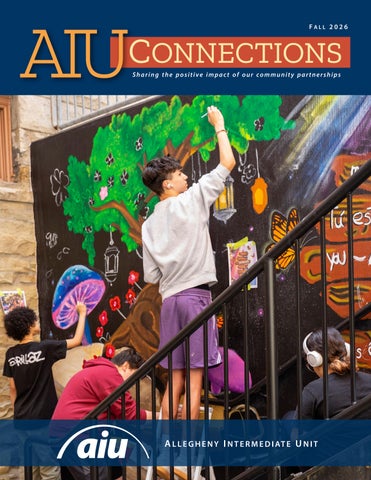
About the cover Students from Carlynton High School put the finishing touches on a mural on the C arnegie Free Library in Carnegie, Pa. See story on page 32.
17 The Allegheny Intermediate Unit is located at 475 East Waterfront Drive, Homestead, PA 15120. Please send letters to the editor and advertising inquiries to amanda.ritchie@aiu3.net.
We would love to hear from you.
Share your comments, questions, and story ideas for upcoming issues of AIU Connections.
© 2026 Allegheny Intermediate Unit 2
Allegheny Intermediate Unit • aiu3.net
Bring the library to Bring the library Bring theschool! libraryto to Bring the library to your your yourschool! school! your school! 6
We have We Wehave have We have StoryWalks, StoryWalks, StoryWalks, StoryWalks, outreach outreach outreach outreach programs, student programs, student programs, student programs, student library cards and library cards and librarymore! cards and and library cards more! more! more!
26
Learn more at Learn Learnmore moreat at Learn more at aclalibraries.org. aclalibraries.org. aclalibraries.org. aclalibraries.org.
8 14
D e pa r t m e n t s 4
Our Districts in Focus (NEW!)
6
AIU Employee Spotlight on Sean Hoover
8
Professional Growth
Turning data into opportunity
Preparing students for a data-driven future Upcoming Professional Development
14 Early Childhood, Family & Community Services Cultivating confident futures: Education uplifts students at ACJ
16 Special Education and Pupil Services Bridging Gaps, Building Futures: Expert support for every learner’s journey Scan here to receive Scan here to email Scan hereupdates. toreceive receive Scan here to receive email updates. email updates. email updates. A I U C o n n e c t i o n s • Fa l l 2 0 2 6
3
Across Allegheny County, public schools are creating new opportunities, strengthening partnerships, and finding creative ways to support students, staff, and families. This new feature highlights updates submitted by AIU member districts and celebrates the programs, people, and ideas shaping public education in our region.
East Allegheny School District New schedule supports deeper learning and student well-being East Allegheny School District is transforming the student experience at its Junior/Senior High School through changes to its master schedule and schoolwide supports. This past year, the high school fully transitioned to a 4x4 modified block schedule, reducing the number of daily classes from seven to four and increasing instructional periods from 42 to 80 minutes. The shift followed a year of planning and ongoing professional development for teachers. School leaders report that the new schedule has reduced student stress and anxiety, decreased disciplinary infractions, and created more opportunities for deeper learning in the classroom. - Submitted by R.J. Long, Ed.D., principal
Fox Chapel Area School District Future Foxes ease into kindergarten through transition activities Fox Chapel Area School District helps incoming kindergartners prepare for the start of school through a kindergarten transition program designed to build familiarity and confidence before the first day of classes. As part of the program, each elementary school hosts a series of kindergarten story times where future students sit alongside current kindergartners, hear a story, participate in an activity with kindergarten teachers, and become familiar with their future school. The transition program also includes a spring sign-on day held during one of the story times at each school. Students “sign on” to attend their future elementary school at a decorated table with balloons and an oversized pencil, creating a memorable moment for children and families. - Submitted by Bonnie Berzonski, coordinator of communications 4
Allegheny Intermediate Unit • aiu3.net
Gateway School District Building a pathway for future educators Gateway High School is offering a new Disability Studies course taught by veteran teacher Mark Spinola, who also teaches the schoolʼs Teacher Academy courses and has been instrumental in advancing the districtʼs efforts to develop future educators. The course teaches students about the disability rights movement, helps them learn how to work with students with disabilities, and, ideally, inspires them to enter the special education field. It will be one of several Gateway courses that can be transferred for up to 24 credits at Point Park University. - Submitted by Guy Rossi, superintendent
West Mifflin Area School District Titan Evolution in action West Mifflin Area School District’s Titan Evolution project represents a districtwide transformation of facilities, curriculum, and support services across all grade levels. With a focus on hands-on learning, mental health resources, and career-ready programming, the project reflects the district’s efforts to create schools where every student feels seen, supported, and prepared for what comes next. The following examples, adapted from the district’s Titan Evolution project materials, highlight two ways that vision is taking shape. Titan Thyme Catering gives students real-world food service experience Titan Thyme Catering, operated through the Advanced Culinary Catering Class at West Mifflin Area High School, gives students hands-on experience in the food and service industries by providing catering services to district staff, groups, and events. Students collaborate with clients to create menus that align with specific needs and budgets, allowing them to practice planning, communication, and customer service skills. When not fulfilling orders, students build real-world competencies through event planning activities, study ServSafe industry standards, and participate in creative challenges that encourage innovation and sustainability.
Outdoor STEAMroom takes learning into nature The Outdoor STEAMroom is a hands-on learning space available to all students across the West Mifflin Area School District. It features a greenhouse, aquaponics system, pollinator garden, edible/sensory garden, and a pond filled with koi fish. These elements help students explore real-world science topics like ecosystems, sustainability, and nutrient cycles, while also connecting to subjects such as culinary arts, writing, and geography. By working in this outdoor classroom, students gain a deeper understanding of the environment and how their choices can impact the world around them. - Submitted by Jeff Solomon, Ed.D., assistant superintendent A I U C o n n e c t i o n s • Fa l l 2 0 2 6
5
S potlight on
Sean Hoover Sean Hoover knows data. He spends his days working with dashboards and databases, turning complex information
into meaningful insights. But at the heart of his work is a much simpler focus: helping students succeed.
Turning data into opportunity B y E m i ly W i l e y
‘‘Helping education entities use their data assets to better serve students and families— that’s the headline goal for my career.’’
B efore joining the A llegheny I ntermediate U nit (AIU), Hoover taught ninth-grade English in New Orleans through Teach for America. “When I graduated, I was interested in working in a higher-needs school district,” Hoover said. Hoover loved teaching, but he soon realized that many of the challenges facing students extended beyond the classroom. “I can do a really good job with a student in one year and then realize all kinds of things can fall to pieces,” he said. “A lot of those things have nothing to do with what goes on in the four walls of a classroom.” His experience in New Orleans inspired him to think more broadly about how systems and support services shape student outcomes. That perspective took him to the Crossroads Foundation in Pittsburgh, where he coordinated leadership programs, career exploration opportunities, and internships for students from low-income families. The nonprofit work increased his interest in educational systems and prompted him to enroll in the Heinz College at Carnegie Mellon University to pursue graduate studies in public policy. Once there, he found himself drawn to data and its potential to drive meaningful change.
6
Allegheny Intermediate Unit • aiu3.net
“You really can move the needle on some things, even if you’re further away from direct impact, by leveraging data,” Hoover said. Hoover carried that mindset into his next position at North Allegheny School District, where he began applying the data and technology skills he developed in graduate school. He helped create more consistent systems for managing information across the district and learned how strong data practices could improve efficiency. “I knew enough to know what was possible,” Hoover said. “Then a project would come along, and I’d figure out how to make it happen.”
‘‘You really can move the needle on some things, even if you’re further away from direct impact, by leveraging data.’’ Today, as assistant director of data services, Hoover collaborates with departments across the AIU to improve processes, streamline workflows, and develop tools that help programs operate more effectively. He especially enjoys working alongside staff from different programs and learning about the work they do.
Photos: Michael Tarquinio
“Every program team I work with is this little pocket of amazing culture and incredible expertise,” he said. “They know their work better than anyone. My job is to help build tools that support what they’re already doing so well.” One project Hoover is especially proud of is the development of a custom student management system for the Non-Public Schools Program. He and the Data Services Team worked closely with program staff to design a solution that streamlined referrals, compliance tracking, and communication while reducing administrative burden and improving visibility into student services. “We were fortunate to have great collaborators,” Hoover said. “The NPSP leadership team was deeply invested in building a better system and played a critical role in m anaging the transition. It was an ambitious project that required a lot of teamwork, but we’re already seeing the foundation it created for future programs.” The project reflects his broader philosophy that technology should support people, not complicate their work. Looking ahead, Hoover sees artificial intelligence creating new opportunities for small teams to accomplish work that once required significant time and resources. “There is so much that we can do now with a small team that we could never have done before,” he said. While the tools continue to evolve, his goal remains the same. “Helping education entities use their data assets to better serve students and families — that’s the headline goal for my career,” he said. Outside of work, Hoover is an avid cyclist and triathlete. Whether tackling Pittsburgh’s hills or building data systems, he approaches every challenge with curiosity and purpose. From the classroom to technology services, his work has always focused on creating opportunities for students. A I U C o n n e c t i o n s • Fa l l 2 0 2 6
Sean works out at Hazelwood Green.
7 7
Professional Growth
Preparing students for a data-driven future E ducators and students encounter data every day —
By Will DeShong
in news articles, classroom lessons, and workplace dashboards. But exposure to data does not automatically lead to understanding.
“ Data literacy belongs in every classroom. It’s a career skill and a life skill, not just an elective.” M ichele B urgess
Data literacy — the ability to read, question, interpret, and use data to make informed decisions — is increasingly recognized as an essential skill for students. Education leaders say it should be embedded across subject areas rather than limited to math classes. “Reading a chart doesn’t necessarily mean we understand the data,” said ichele Burgess, math coordinator for the Allegheny Intermediate Unit’s M Math & Science Collaborative (MSC). “There are always underlying factors, such as sample size, context, and missing information, that need to be considered before interpreting the information.” Pennsylvania was selected by Data Science for Everyone, a national coalition dedicated to advancing data science education, as one of three states l eading efforts to expand data literacy instruction. Created by the University of Chicago Center for Radical Innovation for Social Change and organized in partnership with The Learning Agency and the Concord Consortium, the coalition aims to ensure all students develop the skills needed to navigate an increasingly data-driven world. Data literacy emphasizes critical thinking when drawing conclusions from data, creating and refining data visualizations, applying statistical reasoning, and analyzing patterns. It challenges students to ask questions about how data is collected, how it is presented, and what information may be missing.
Data Investigation Process Step 1
Ask Questions
Step 4
Summarize Conclusions
Step 2
Assemble Data
Step 3
Analyze Data
8
Michael Fierle, director of MSC, said data literacy is a foundational skill across industries, including agriculture, manufacturing, healthcare, and business. “The ability to interpret, analyze, and make decisions based on data is what employers are looking for,” Fierle said. “It’s important for learners to arrive with those skills and have experience using them. Ultimately, it’s about understanding information and using it effectively.” While specialized data science courses may be introduced in high school or college, educators say data literacy should be developed gradually across grade levels and disciplines. Students need repeated opportunities to analyze visualizations, identify patterns, evaluate evidence, and revise their thinking as new information emerges. Educators interested in strengthening data literacy instruction can learn more at the Data Literacy Action Summit on Oct. 6 at the Pennsylvania Training and Technical Assistance Network (commonly known as P aTTAN) Central office in Harrisburg. Centered on the theme “Weaving Data F luency Across Disciplines for Civic Impact,” the summit will explore why data Allegheny Intermediate Unit • aiu3.net
“The ability to interpret, analyze, and make decisions based on data is what employers are science is essential for all learners, from kindergarten through college. Featured speaker Jeff Remington, STEM outreach liaison with Penn State University’s Center for Science and the Schools, will lead discussions on preparing students to thrive in a data-driven world. By integrating data literacy across subject areas, educators can engage students with real-world data and help them develop critical thinking skills, recognize patterns, question assumptions, and draw evidence-based conclusions. Whether learners are analyzing graphs, evaluating sources, interpreting survey results, or creating visualizations to communicate f indings, these experiences help build the habits of mind needed to make sense of information.
looking for.” M ichael F ierle
Scan to register for the Data Literacy Action Summit on Oct. 6 at PaTTAN Central in Harrisburg.
“Data literacy belongs in every classroom,” Burgess said. “It’s a career skill and a life skill, not just an elective.” A I U C o n n e c t i o n s • Fa l l 2 0 2 6
9
Professional Development
Enrollment is subject to registration deadlines and capacity. Pricing reflects member district rates. Dates are subject to change.
All CPE courses are virtual and asynchronous. Fees and registration deadlines apply. CPE courses fulfill 90 Act 48 hours and requirements for Level II Certification and Master’s Equivalency. Start dates are subject to change. Register at aiu3.net/cpe.
Fall 2026 Infusing Science, Technology, Engineering, the Arts, and Mathematics (STEAM) into K-12 Classrooms; 10/5
Working with Fractions & the Four Operations: Instructional Practices for the Middle Grades, 10/11 Any Device Technology Tools in K-12, 10/12
Project-Based & Challenge-Based Learning, 10/28 Addressing Learning Disabilities in Education, 10/30 Word Power: Vocabulary Instruction for All, 10/30 Four Free Technology Essentials for Educators, 11/2
Adverse Childhood Experiences, 10/5
Best Practices for Teaching K-12 Online, 10/12
Strategies for Challenging Student Behaviors, 10/5
Culturally Responsive Teaching, 10/12
A Closer Look at Learning Disabilities: A Refresher Course for all Classrooms, 10/5
Autism in Pop Culture, 10/16
Stronger Together: Building Powerful School-Community Connections, 11/4
Are Your Students Tuned In? Strategies for Engaging Every Student, 10/19
Uncovering the Truth About Fake News, 11/4
Anxiety & Stress: Teacher & Student Wellness, 10/5 Engagement in Mathematics, 10/5 Teaching Historical Thinking Concepts, 10/5 Motivating & Inspiring Today’s Students: Strategies, Methods & Materials to Awaken the Learner, 10/5 Writing Alive: Strategies, Techniques & Materials, 10/5 Brain-Based Discipline: Restorative Practices for Today’s Classrooms, 10/5 Community Heritage: Place-Based Resources in the Classroom, 10/6 21st Century Skills, 10/7 Creating & Supporting a Positive, Bully-Free School Climate, 10/7 Group Work Dynamics: Collaboration & Assessment, 10/7 Supporting Students with Autism in Education, 10/9 Get Active About Learning, 10/11
Digital Literacy, 10/14
Being Mindful: Teacher & Student Wellness, 10/19 How to Develop Good Digital Citizens, 10/19 Connecting with Kids, 10/21 How to Design a Digital Classroom for the 21st Century Learner, 10/21
Empathy: Teacher and Student Wellness, 11/2 Tech Tools for the 21st Century, 11/2
When It’s Not Just Kids Being Kids: Bullying and Beyond, 11/4 Multiple Intelligences in the Classroom: Strategies, Techniques & Materials, 11/6 The First Days of School: How to Be an Effective Teacher, 11/6
Cultivating a Growth Mindset, 10/23
Teaching K-12 Problem Solving Using Computational Thinking in all Subjects, 11/9
Introduction to Text Comprehension, 10/23
Technology for Formative Assessment, 11/9
AI Tools in the Classroom: Introduction & Exploration, 10/26
Making an Impact: Building Positive Relationships with Students, 11/11
Apps & iPads for the K-12 Classroom, 10/26
ADHD in Education, 11/13
Beat the Bullying: A Look into Prevention & Intervention, 10/26
AI Tools in the Classroom: Planning & Instruction, 11/16
Building Bridges: Working with (Difficult) Parents, 10/26
Implementing Equitable Trauma Responsive School Practice, 11/16
Coping Skills: Teacher & Student Wellness, 10/26
Moving From Problems to Solutions: Building Resiliency Skills, 11/18
Integrating the iPad into the Classroom: There are Apps for That, 10/26
Building Thinking Habits, 11/20 A New Look at Working with Students, 11/20
Job-Alike & Networking Groups | The following offerings are free to member districts. Call to learn more. Business Administrators: 412-394-5813 Curriculum Coordinators: 412-394-5792 Esports Facilitators: 412-394-5792 Human Resources Directors: 412-394-5957 Instructional Coaches: 412-394-4535 10
Library Coordinators & Media Specialists: 412-394-4535
School Counselors: 412-394-5897
New Special Education Liaisons: 412-394-5732 Principals (Act 45): 412-394-5792
STEAM Teachers & Coordinators: 412-394-4535
Public Relations Coordinators: 412-394-3472
Technology Coordinators: 412-394-5710
School Safety: 412-394-5933
Virtual Learning Liaisons: 412-394-1378
Special Education Liaisons: 412-394-5732
Allegheny Intermediate Unit • aiu3.net
Crisis Prevention
Safety & Security
Training that builds safer, stronger schools
See story on page 26.
The AIU offers evidence-based professional learning opportunities that equip educators, caregivers, and community partners with the knowledge and skills to support student mental health, strengthen school safety, and foster resilient school communities. From suicide prevention and crisis response to youth mental health and peer leadership, these training opportunities provide practical strategies that help schools create safe, supportive environments where every student can thrive. Free to member districts unless otherwise noted.
The AIU provides public schools with a variety of timely school safety information and workshops and serves as the liaison between the Allegheny County Office of Emergency Services and member schools. Learn more at aiu3.net/safety-security.
Register at aiu3.net/crisis-prevention-training. Comprehensive School Safety Planning: Prevention Through Recovery This one-day PREPaRE workshop is for educators, school mental health professionals, safety and security personnel, and administrators, 9/24. Youth Mental Health First Aid: This 8-hour certification course teaches how to recognize and respond to signs of mental health or substance use challenges; offered this fall in a full-day format on 10/13 or as two half-days on 10/20 and 10/27. Question, Persuade, Refer: This 2-hour course trains school professionals to recognize the warning signs of a suicide crisis and how to respond; offered on 10/26 or 2/5. Sources of Strength Suicide Prevention: Available by request, this evidence‑based prevention program that strengthens school culture by building resilience, connection, and help‑seeking behaviors. Through Adult Advisor Training, staff learn how to mentor youth, model strengths‑ based language, and guide implementation. Peer Leader Training activates diverse students as positive influencers who lead campaigns promoting hope, help, and connection. Each school’s rollout can be individualized, allowing campaigns, training structures, and support to be tailored to its unique needs and priorities. Contact Shannon Fagan for more information at 412-909-7448.
Math & Science Collaborative Unless otherwise noted, MSC workshops are free to member districts and held in-person at the AIU Central Office. Prerequisites may apply. Register at aiu3.net/msc.
Mathematics: Building Thinking Classrooms: Part 1, starts 9/29, $450 Implementing a Keystone Algebra I Course, starts 10/8, $450 Developing Fluency with Addition and Subtraction, starts 10/13, $450 Effective Teaching Practices in High School Mathematics, starts 1/14, hybrid, $525 Building Thinking Classrooms: Part 2, starts 1/20, $450 Mastering Online Math Tools for PSSA and Keystone Success, 1/28
A I U C o n n e c t i o n s • Fa l l 2 0 2 6
Science:
OpenSciEd User Group, starts 9/9 Digging into Phenomenon-Based, ThreeDimensional Science Teaching, 10/12 Salty Streams and Safer Streets Curriculum Training for Grades 6-9, 10/23, $150 Shared Waters Curriculum Training for Grades 3-5, 10/27, $150 Assessment and Grading (for PA STEELS) in K-12 Science, starts 11/2, $450 K-12 Sciences Institute, 4-part series starts 11/13, $600
The AIU’s Academic Events & Competitions give students opportunities to challenge themselves, showcase their talents, and connect with peers from across the region. Through inclusive and engaging activities, students of all backgrounds and skill levels are encouraged to unleash their creativity, collaborate, apply their knowledge, and discover new interests. Each experience is designed to foster a love of learning while inspiring students to achieve their best. Registration information for AIU Academic Events during the 2026-27 school year is now available, with registration to be completed by school personnel. From collaboration to competition, these experiences offer students meaningful ways to learn, grow, and shine beyond the classroom. Learn more and view the offerings at aiu3.net/academic-events
Administrator-Focused Professional Learning, starts 1/26, $350 11
Training & Consultation (TaC) Training Unless otherwise noted, all TaC sessions are free, offer Act 48 credits, and held in-person at the AIU Central Office. Educators who work for LEAs in the AIU region will be given priority registration. Learn more under Training Opportunities at aiu3.net/tac.
2026 Transition Assessment for Middle School Youth, virtual, 9/11 Navigating 504s: Building Systems and Procedures as a Team, 9/21 Supporting Secondary Readers: Strategies for Teaching Reading at the Secondary Level, 9/21 Transition Coordinating Council of Allegheny County Annual Meeting Series: Fostering Success Beyond the IEP, starts 9/23
Third Quest Intervention Networking, 3-part virtual series starts 10/27
K-12 Educational Benefit Review Simulation, 12/18
Elementary MTSS Networking, 7-part virtual series starts 9/24
Transition Assessment for High School Youth, virtual, 10/30
2027
Secondary MTSS Networking, 7-part virtual series starts 9/24
Schema Based Instruction: Additive & Multiplicative Schemas, 11/4
Composing Middle School Transition Age Postsecondary Present Levels, virtual, 9/25
Section 504 Basics: Understanding Service greements & Accommodations, virtual, 11/10 A
The Dynamic Learning Maps in Action: From PASA to Guiding Practices, 4-part hybrid series starts 9/29
Writing Assessment & Intervention: Grades K–3, 11/10
Social and Emotional Learning: Tools, Strategies & Systems for Impact, 3-part series starts 9/30 Prevention Plus Instruction: The Formula for Behavior Change, 10/1 Composing the Middle School Transition Grid, virtual, 10/2 Restorative Practices: Building an Effective Discipline Toolkit, 10/6 Building the Equation: Systems + Instruction = Math Success, 10/7 Advanced Tiers Academy: Deepening Implementation at Tier 2 & 3, 10/14 Ready, Set, Regulate! 10/15 PBIS Tier 1 Academy, 10/19 Let’s Play: Strategies for Child Centered Learning, 10/20 Applying Person-Centered Planning: Developing High-Quality Transition-Age IEPs, 10/23 Dys-De-Mystified: Understanding Dyslexia, Dysgraphia & Dyscalculia, 10/27
12
The Reevaluation Process: Best Practices for Developing Effective & Compliant Reports, 11/12 Structured Literacy for Elementary Special Educators K–5, 4-part series starts 11/16 Check and Connect: Administrator Overview, 3-part hybrid series starts 11/17 Composing High School Transition Age Postsecondary Present Levels, virtual, 11/20 Moving Beyond Indicator 13: Building Effective Transition Systems & Sustainable Practice for Postsecondary Success, 12/1 Trauma Responsive Practices in the Classroom Setting, 2-part hybrid series starts 12/4 Building Bridges: Collaborative & Proactive Solutions to Student Behavior, 12/7 Composing the High School Transition Grid, virtual, 12/11 Writing Across the Tiers: How to Provide Whole Class, Small Group, and Individual Supports, 12/16 Composing PELs and Transition Plans for Youth Who Have Autism, Life Skills & Emotional Support Needs, virtual 12/18
The Kids Who Aren’t OK: The Urgent Case for Reimagining Support, B elonging & Hope in Schools Book Study, 3-part virtual series starts 1/13 Classroom Management: Improving Your Learning Environment, 3-part series starts 1/14 Advancing Transition-Age IEPs, Programs & Services Through Collaborative Practice, 7-part virtual series starts 1/15 Writing Compliant & Meaningful IEPs, 2-part series starts 1/26 FBAs to PBSPs: Assessing Behavior & Designing Effective Interventions, 6-part hybrid series starts 2/1 Writing Assessment & Intervention: Grades 4–12, 2/2 Structured Literacy for Secondary Special Educators 6–12, 3-part series starts 2/11 Supporting Struggling Students: Classroom Behavioral Interventions, 2-part hybrid series starts 2/11 Schema Based Instruction: Additive & Multiplicative Schemas, 3/4
See all professional development opportunities on our website Use the event category filter to view opportunities by program at aiu3.net/events. To browse all upcoming Teaching & Learning PD, select the Professional Growth category.
Allegheny Intermediate Unit • aiu3.net
Educator Workshops FREE professional development opportunities for educators in Pennsylvania. Visit aiu3.net/transformED for more information. transformED Educator Workshops focus on hands-on practice with new ideas, skills, and tools—paired with peer-to-peer support—to help teachers return to their classrooms confident, capable, and ready to inspire, engage, and support their students. 2026
2027
AIU Library Coordinators’ Role-Alike, 9/23
AIU Library Coordinators’ Role-Alike, 1/13
Get Hyped About Hydroponics (with Fluxspace), 9/24
Explore the STEAM Lending Library, 1/14
Solving for Success: AI in Math, 9/29
Ready, Set, Borrow! Hands-On Tools for Early Learners (K-2), 1/19
Ready, Set, Borrow! Hands-On Tools for Early Learners (K-2), 9/30
Supporting Multilingual Learners: Proven Practices, New Possibilities, 1/21
Explore the STEAM Lending Library, 10/1
Six Bricks Level I Training (with Matt’s Maker Space), 2/4
STEM Educator & Innovator Role-Alike, 10/14 New from Common Sense Education: Digital Literacy & Well-Being (6-12) (with Common Sense Media), 10/21 Build, Fly, Code, Compete: An Introduction to Drones, 10/22 Engineering in Action: Introduction to Fabrication (K-8) (with Fluxspace), 10/28 Learn to Create with Canva (for Beginners), 10/29 Canva for Teachers: Develop Instructional Materials for Today’s Students, 11/16 AIU Library Coordinators’ Role-Alike, 11/17 LEGO for Learning: Spike Prime, Six Bricks, Brick Club, & LEGO Serious Play (with Matt’s Maker Space), 11/19 Making That Matters: Soldering Skills for Accessible Play, 12/2 Amplifying Student Voice: Podcasting & More (with SLB Radio), 12/3 AI Literacy in Any Subject: Teaching Students How AI Works (3-5), 12/3 Canva with Students: Cultivating Creativity through Content Learning, 12/10
Learn to Create with Canva (for Beginners), 2/4 Joyful Learning for the Middle School Mind, 2/10 Amplifying Student Voice II: Reflecting, Refining, and Problem Solving (with SLB Radio), 2/25 STEM Educator & Innovator Role-Alike, 3/9 Canva for Teachers: Develop Instructional Materials for Today’s Students, 3/10 AIU Library Coordinators’ Role-Alike, 3/11 Imagine with Apple: Creative Learning in Every Classroom (with Apple Education), 3/16 Making That Matters: Soldering Skills for Accessible Play, 3/17 World Language in Practice: Innovation, Inspiration & Connection, 4/8
Courses are available in both in-person and asynchronous virtual formats, except where noted. Register at aiu3.net/rac. Adolescent Literacy Institute: Middle and High School English & Reading Teachers, 4-part series, $600 Comprehension, Close Reading, and Complex Text: Laying the Foundation K-2, 4-part asynchronous virtual series, $600 Decoding the Science of Reading Module 1: Building Blocks for the Foundational Skills, 5-part in-person series, $599 Module 2: Teaching the Upper Strands of the Reading Rope, 4-part in-person series, $599 English Language Arts Symposium: Movement in the ELA Classroom • Grades 3-5, 11/11 • Grades 6-8, 1/13 Keys to Comprehension – ELA Grades 3-8, 4-part series, $600 Text Dependent Analysis: Effective Instructional Practices – ELA Grades 4-8 • Part 1: $600 • Part 2: $450 Thinking Through the Pencil – ELA Grades 4-8, $600 Word Wizards — ELA Grades 3-12, $450
Structured Literacy
Introduction to Laser Engraving (with Fluxspace), 4/13
Free for AIU member districts; meets Chapter 49 requirements. Register at aiu3.net/rac.
Canva with Students: Cultivating Creativity through Content Learning, 4/14
Upper Elementary/Secondary, 9/29
Girls in Gaming Summit: Careers in Immersive Entertainment (with Carnegie Mellon University Entertainment Technology Center), 5/3
ESL, 11/19
Pre-K & Primary K-2, 10/8 Reading Specialists, 11/20
Get Hyped About Hydroponics (with Fluxspace), 5/5 AIU Library Coordinators’ Role-Alike, 5/11
A I U C o n n e c t i o n s • Fa l l 2 0 2 6
13
Early Childhood, Family & Community Services
Cultivating confident futures:
Education uplifts students at ACJ By Sam Kulp
‘‘ It’s really rewarding to see people who felt like they didn’t fit into the community find a place where their talents and skills are appreciated.”
The AIU’s Adult Education Program has offered workforce development and GED preparation to incarcerated adults in the Allegheny County Jail (ACJ) since 2001. Over the last 25 years, more than 1,800 adult students have earned their high school equivalency credential through the program while incarcerated. “The ACJ AIU adult school is an example of the AIU mission and vision. We advocate and advance equitable opportunities for every learner,” said Joseph Tokar, supervisor for Adult Education and Workforce Development at the AIU. Access to education in jail provides incarcerated adults with opportunities for skill development and career preparation, setting them up for success after incarceration. Students in the program also build the confidence to enrich themselves and their communities. “The most fulfilling part of our work is seeing how much talent and potential our incarcerated neighbors have here in Allegheny County,” said Emma McGeary, who served as an adult education corrections instructor at ACJ for more than three years. McGeary enjoyed seeing students become more confident and expressive as they learned together. “It’s really rewarding to see people who felt like they didn’t fit into the community find a place where their talents and skills are appreciated.” The GED program is just one of many opportunities at the ACJ’s adult school. Students can take lessons in computer literacy, resume building, f inancial literacy, and more. Instructors also help students navigate community reentry, seek additional certifications, and pursue postsecondary education.
Illustration: Volodymyr Krystal | iStock 14
Allegheny Intermediate Unit • aiu3.net
Virtual Asynchronous Fall 2026
The Allegheny Intermediate Unit’s Continuing Professional Education (CPE) program offers great value for PA educators! These graduate-level credit courses are offered to educators during three academic terms each year: fall, spring, and summer.
Overview •
Each CPE course counts as 90 Act 48 hours and as 3 credits toward Level II Certification.
•
Educators can apply up to 18 CPE credits toward a Master’s equivalency.
•
CPE courses (with the exception of ESL courses) are offered in an asynchronous format through Canvas, our learning management system.
Highlights •
Approved by the Pennsylvania Department of Education
•
Facilitated by qualified instructors
•
Offered online in an asynchronous format through our Canvas learning management system
Areas of Focus •
Classroom Management
•
Special Education
•
Education Technology
•
STEM/STEAM
•
ESL Specialist Certification
•
Student Behavior
•
General Education
•
Wellness
•
Reading/Writing
Contact: Marie Platts, CPE coordinator marie.platts@aiu3.net
412-394-5988 A I U C o n n e c t i o n s • Fa l l 2 0 2 6
To register or learn more, scan QR code or visit aiu3.net/cpe. go.aiu3.net/TJo5i 15
Special Education & Pupil Services
Bridging Gaps,
B uilding Futures E S E L ’ J xpert upport for very earner s ourney
The Allegheny Intermediate Unit provides a range of special education services designed to meet the diverse needs of learners. From early intervention and specialized classrooms to therapeutic supports and transition services, we work alongside school districts and families to help students reach their full potential. Last spring, Special Education and Pupil Services featured four students in its 2026 prospectus, showcasing the impact of AIU programs and district partnerships. Two of those stories are shared in this issue of AIU Connections and highlight the students, families, and support teams that make this work possible.
16
Allegheny Intermediate Unit • aiu3.net
Supported from the start: Donovan’s path to inclusion at Pine-Richland Middle School
B y E m i ly W i l e y
During a rehearsal for “Beetlejuice Jr.,” Donovan DeHart was supposed to exit the stage with the rest of the ensemble. Instead, he stayed front and center and nailed the end of the musical number. When it was over, he ran straight to his mom in the front row and wrapped her in a hug. “Give that boy a stage and music,” Kelly DeHart said, laughing, “and he will perform.” This moment captures who Donovan is — joyful, spirited, authentic — and reflects a journey built through years of coordinated supports that prioritize inclusion and independence. Donovan is an eighth-grade student at Pine-Richland Middle School. Diagnosed at birth with Down syndrome, he began receiving multiple therapies in infancy. “We were immersed in it and learning right out of the gate,” DeHart reflected. By age 3, Donovan was receiving special education-related services through the Allegheny Intermediate Unit (AIU), starting in Preschool Early Intervention (PEI) and transitioning seamlessly into the Pine-Richland School District. A I U C o n n e c t i o n s • Fa l l 2 0 2 6
Julie Domorski assists Donovan during gym class as part of his physical therapy. 17
Preschool Early Intervention Serving
4,190 children Preschool Early Intervention (PEI) provides free special education services for eligible children ages 3-5 in Allegheny County who have developmental delays or disabilities. Children may qualify with at least a 25% delay in areas such as c ommunication, cognitive, physical, adaptive, or socialemotional development. Services build foundational skills and support children in everyday routines and are delivered in the least restrictive environment, including community preschool programs or home-based support. By strengthening early skills and partnering with families and schools, PEI helps ensure a smooth transition to kinder garten and continued success in the K–12 system.
Donovan works with a classmate during speech therapy with Megan Klingensmith .
“The early intervention services really helped Donovan make the big leap to kindergarten,” DeHart said. “He learned to advocate for himself, strengthened his motor skills, and improved sensory regulation.” Today, Donovan participates in the life skills program at the middle school, where he receives specialized replacement curricula in reading, math, science, and social studies. He is also supported through speech and language therapy, occupational therapy, and physical therapy provided by the AIU. Although the district contracts with the AIU, the services are embedded in Donovan’s school day. Therapists work alongside teachers and staff as part of the school community. “They are thought partners, problem solvers, and key members of our students’ teams,” acknowledged Greta Kuzilla, assistant director of student services and special education at Pine-Richland. From early intervention through elementary school and into middle school, the AIU’s team of speech-language pathologists has supported Donovan’s growth. “I’ve had the pleasure of knowing Donovan since he was a little guy in kindergarten,” said Kris Scheller, a speech-language pathologist. “Seeing him go from one- and two-word phrases to communicating in full sentences is amazing.” In his early years, speech therapy focused on building the foundations of communication. Donovan’s family understood the importance of peer-to-peer interaction and encouraged it. “The IEP team was on board,” said DeHart. “I’ve pushed for it ever since.” Therapists incorporated a model known as “reverse inclusion,” which allowed him to practice communication skills in natural, social settings without disrupting classroom instruction. “Sometimes Donovan’s peers would come into therapy sessions with him,” Scheller explained. “That helped him learn to interact with them.” Now in middle school, Donovan’s speech goals look toward the future. He is building higher-level communication skills that will support him beyond the school day — in the community and, eventually, in the workplace. The focus is to not only to be understood but also to understand others and navigate real-world interactions.
18
Allegheny Intermediate Unit • aiu3.net
Pine-Richland staff members Holly Angeloff (left, art teacher) and Nitu Singh (right, paraprofessional) work closely with AIU staff to ensure D onovan’s success in school. Art is one of Donovan’s favorite subjects.
Megan Klingensmith, Donovan’s current speech-language pathologist, works with him on explaining his ideas, repairing communication breakdowns, and making inferences. “Our goals start to reflect transition skills more as he gets older,” she said. Those skills show up throughout Donovan’s day. He picks up on social cues, uses teen slang he hears in the hallways, and enjoys conversations with classmates and staff. Each interaction reflects years of consistent, collaborative support. That continuity extends beyond speech and language services, shaping how Donovan is supported across disciplines. In occupational therapy, Donovan practices skills that promote independence. Early goals focused on tasks like tying his shoes and typing his name. Over time, those goals have evolved into functional, job-related tasks such as sorting and bundling papers, organizing materials, and completing fine-motor activities that require coordination and focus. Physical therapy also plays a key role in preparing Donovan for daily life and future work. Julie Domorski, physical therapy assistant, described the Practical Assessment Exploration System (PAES) Lab at Pine-Richland High School, where Donovan gains hands-on experience exploring vocational tasks. “The PAES Lab gives students the opportunity to see what they’re good at and what they enjoy,” she said.
“Everybody has not
just helped Donovan… they’ve helped me as a mom.”
K e l ly D e H a r t
Photos: Michael Tarquinio A I U C o n n e c t i o n s • Fa l l 2 0 2 6
19
Speech/Language Support Program The AIU’s Speech/Language Support Program delivers comprehensive, school-based speech and language services to districts across Allegheny County, supporting public and non-public schools, specialized programs, and AIU-operated special education schools.
By the Numbers
Speech/Language Support Program
48 Therapists on staff 1,800 Students served 51 LEAs served Services are provided in individual, small-group, and classroom settings to address communication skills that are delayed or absent and to expand each child’s capacity to learn during the school day. Specialists in areas such as auditory processing, feeding and swallowing, and autism are also available. The program emphasizes collaborative, team-based service delivery — partnering with district leaders, educators, and families to reinforce skill development across settings and ensure speech and language services are strategically aligned with district goals for student achievement.
20
Beyond vocational readiness, therapy incorporates D onovan’s interests, including basketball, badminton, and playing drums beside his eighth-grade classmates. Rather than pulling him out of his day, AIU therapists push into physical education and music classes, supporting him alongside his peers. Their work also extends into the cafeteria, hallways, and outdoor spaces, helping Donovan navigate these environments with independence and c onfidence. While school provides structure and support, the middle school years bring a new set of challenges beyond the classroom. Middle school has been a particularly complex season for D onovan, marked by puberty and changing social dynamics. Amid the changes, consistency has mattered most, supported by a team that understands Donovan as a whole person. “Everybody has not just helped Donovan,” DeHart said. “They’ve helped me as a mom.” From early intervention through middle school, she described the support her family has received as steady, responsive, and compassionate. Looking ahead, DeHart imagines her son in a lively work environment where he can interact with others: a movie theater, a sporting event, a place filled with energy and people. “We want Donovan to be independent and contribute to society,” she said. As Donovan prepares for the next stage of his education, the focus remains on growth, belonging, and possibility. His team continues to plan, building on strengths and expanding opportunities. Pine-Richland administrators point to collaboration with the AIU as a key factor in his success. “The AIU supports our work by training paraprofessionals, assisting with data tracking, attending IEP meetings, and helping design classroom environments that reduce distractions and support learning,” Kuzilla said. “The AIU enhances what we do by ensuring each student receives the support they need every day.” Whether he’s performing on stage, playing drums with his classmates, shooting baskets in gym class, or mastering a new skill in the PAES Lab, Donovan’s story is a reminder of what’s possible when a school district and the AIU work together with consistency and purpose.
Allegheny Intermediate Unit • aiu3.net
Cheerleaders for Joey Finding his way forward at Park Elementary T he first day of kindergarten is a seminal moment in a child’s life. B y A n d r e w C h i a ppa z z i It’s the start of formal education and the opening of a whole new world of learning and discovery. For Joey Mihailoff and his family, the first day of kindergarten was the start of a different journey, one that led to hospital stays, surgery, and a challenging recovery. Through those difficult moments, Joey and his family found a team of educators in the Steel Valley School District and at the Allegheny Intermediate Unit (AIU) driven to ensure he can learn and participate alongside his third-grade peers at Park Elementary. “Everybody around here isn’t just here for their job,” said Amanda Mihailoff, Joey’s mother. “They’re here because they’re a cheerleader for him, too.” Joey started kindergarten at St. Therese in Munhall, but his first day was cut short when he became sick. That illness, combined with additional concerning symptoms, led the Mihailoffs to contact their pediatrician, who sent them to the emergency room. There, doctors discovered a brain tumor and operated the very next day. Rehabilitation, radiation treatments, and chemotherapy followed. A I U C o n n e c t i o n s • Fa l l 2 0 2 6
“The collaboration
of the AIU team, the general ed teachers, and the special ed teachers in the district is so important.” J e a n i n e E s ch
21
Occupational/Physical Therapy Support Program The AIU provides school-based occupational therapy (OT) and physical therapy (PT) services that enable students to access their educational programs and environments. These services support functional performance through targeted intervention and close collaboration with IEP teams.
By the Numbers
OT/PT
Support Program
65 22 3,700 66
Occupational therapists on staff Physical therapists on staff Students receiving therapy
LEAs served
Licensed therapists deliver services within school settings, aligning supports to mobility, fine motor development, sensory integration, and functional independence. Screenings and consultation for general education students are also available in accordance with the Americans with Disabilities Act. Professional development and in-service training further strengthen district capacity in areas such as transfers and mobility, fine motor strategies, and sensory integration.
Joey plays cards with his occupational therapist, Stephanie Kosmidis, to enhance his dexterity.
Suddenly, everything changed, including where Amanda and her husband Tom would enroll Joey when it was time to go back to school. “We knew he was smart enough. Things are just a little bit slower for him,” Amanda Mihailoff said. “We wanted him in as much of a general education setting as possible. We didn’t feel like we’d get that anywhere other than Steel Valley.” When Joey returned to school after treatment, he needed support with movement, fine motor skills, hearing, and vision. That’s when a coordinated team from the AIU stepped in. Three years later, AIU specialists work in sync with Steel Valley staff to provide the tools Joey needs to fully access his education. “This is unique in that he receives so many services,” said Jeanine Esch, p rogram director for Hearing, Vision, and Communication Access at the AIU. “The collaboration of the AIU team, the general ed teachers, and the special ed teachers in the district is so important.” Joey receives a range of support services each week, including access to H earing Assistive Technology (HAT). HAT is designed to minimize the n egative effects of background noise, distance from the speaker, and classroom reverberation by improving the signal-to-noise ratio. Each of Joey’s teachers wears a microphone that transmits their voices directly to his hearing aids. This direct transmission ensures that the teacher’s voice is clear and consistent, even in busy or noisy classroom environments where instruction might otherwise be difficult to hear or easily lost. Barbara Martin-Taylor, teacher of the Deaf and hard of hearing, works with Joey twice a week — once in the classroom environment, once in an individual session — to support his use of the technology. “I have the opportunity to see what’s happening in class and make sure everything’s working well,” she said. She also pulls him out to focus on skills he may need extra help with, including self-advocacy. The emphasis on collaboration led Martin-Taylor to recommend a vision valuation earlier this year, bringing William Closson onto Joey’s team. e
Photos: Andrew Chiappazzi and Michael Tarquinio 22
Allegheny Intermediate Unit • aiu3.net
Barbara Martin-Taylor, teacher of the Deaf and hard of hearing, works with Joey in the classroom and during one-on-one sessions.
An assistive device on Joey’s pencil helps him maintain a steady grip.
losson, teacher of the visually impaired, helps Joey use an app on his iPad C to access the curriculum more efficiently. Much of that work happens in the classroom, though he also pulls Joey out for one-on-one sessions as needed. “What better place to do that than where the curriculum is available?” C losson said. “Plus, it gives you an opportunity to collaborate with the teacher, get their input, and they’ll give you feedback on issues he may be having with any tasks, and then you can adjust the goal and any accommodations.” The specialists’ work often overlaps, as it did in a recent session with Closson. While going through a biology lesson, Joey used tools on his iPad that read his selected text aloud through his hearing aids. A fan of science and math, the topic about kiwis was right in his wheelhouse. He briefly pondered a question about the bird’s diet, looked at Closson and confidently answered, “Omnivore!” To enter his response, he pressed another button, waited a beat, and clearly repeated his answer. The dictation isn’t always accurate, but it registered Joey’s answer immediately, and he turned to a stunned Closson with glee. Though Closson has only worked with him for a few months, the two have forged a quick connection, something that comes as no surprise to Joey’s mom. “He kind of has that way of fitting in or just squeezing himself into your heart,” she said. “It’s hard not to have a soft spot for him.” Perhaps no one understands that better than Tina Dolan, a Steel Valley paraprofessional who has worked with Joey for much of his time at Park. “Every day is something different with him,” Dolan said. “Sometimes, when we’re just having a conversation, it’s like I’m talking to an older kid. He’s just so smart.” “I just like being around her,” Joey chimed in. Dolan is delighted with Joey’s progress since kindergarten and credits his growth to both his work with outside therapists and ongoing support from AIU specialists. Occupational therapist Samantha Smith, certified occupational therapy assistant Stephanie Kosmidis, and physical therapist Brittany List meet with Joey weekly to work toward a variety of goals. A I U C o n n e c t i o n s • Fa l l 2 0 2 6
23
“When Joey first began school at Park, even accessing the school building in his wheelchair was a challenge,” said Holly McElhinny, director of Occupational/Physical Therapy Support Program at the AIU. “His physical therapist collaborated with the school staff to determine the best ways for Joey to enter and exit the building for recess and to negotiate between levels to access the gym and other special class areas.” Through that collaboration, Joey was able to utilize an elevator, stair climber, and other resources to get to where he needed to be as quickly and efficiently as possible.
Tina Dolan, Steel Valley paraprofessional, spends her day with Joey.
Now, Dolan said Joey has transitioned from using a stair climber to walking up and down the stairs. “We work really well together, and we know when we’re taking that step together,” she said. Kosmidis and Smith focus on skills like handwriting, cutting, and other foundational tasks. For students like Joey, adaptive grippers, scissors, and paper with highlighted or contrasting lines help him meet those goals. The AIU supplies those tools on a trial basis and then makes a recommendation for the district to purchase dedicated ones for the student.
Physical therapist Brittany List works with Joey weekly toward a variety of mobility goals.
Another tool that supports Joey in the classroom is a slant board, which angles his work to improve posture and writing control. “To support his sizing and spacing goals and his positioning at the table, we occasionally use a slant board,” Kosmidis said. “We also incorporate fine motor games and things to strengthen his hands.”
“For OT, a big piece of our collaboration is not only with the teacher, but also with his one-on-one paraprofessional,” Smith added. “She knows everything that is going on with Joey from the minute he comes in.” Together, Joey’s team collaborates and communicates constantly to ensure he’s able to thrive alongside his peers. It’s exactly what the Mihailoffs envisioned when they chose Steel Valley. “I know he’s a special case given his background,” Amanda Mihailoff said. “So, I just appreciate the open communication and doing whatever is best for Joey. I think we’re all on the same page. We just want to do what’s best for him, help him succeed, and give him the best chance at anything.” Joey’s journey is no longer defined by the challenges he’s overcome, but by the possibilities ahead. 24
William Closson, teacher of the visually impaired, helps Joey access his curriculum via apps on his iPad. Allegheny Intermediate Unit • aiu3.net
ADVANCE YOUR CAREER IN SPECIAL EDUCATION 100% Online Curriculum With Supportive Faculty Master of Science in Education in Special Education (PreK–12) Lead with Purpose. Teach with Impact. Our PreK–12 Special Education program builds your expertise in assessment, curriculum, instruction, and behavior support— preparing you to make a lasting impact in schools and communities for all learners.
Master of Science in Education in Applied Behavior Analysis (ABA) Compassionate Care. Evidence-Based Practice. Our program balances teaching the technical skills needed with the interpersonal skills required to assist you to become a highly skilled, well-rounded, and compassionate practitioner. The program is aligned with BACB coursework requirements toward becoming a board-certified behavioral analyst (BCBA) and coursework requirements toward the licensed behavior specialist (LBS) in PA.
Invest in Your Future. Make a Real-World Impact. Full-time students taking two or more classes per semester receive a 25% Tuition Award. Also, Catholic school teachers or administrators in the Pittsburgh, Greensburg, or Altoona-Johnstown Dioceses, may qualify for a 60% Tuition Award toward a Duquesne School of Education degree or certificate.
Get Started Today! (412) 396-5274 specialed@duq.edu
duq.edu/SpecialEducation
PREPARE HERE
IMPACT
ANYWHERE A I U C o n n e c t i o n s • Fa l l 2 0 2 6
25
School culture as a foundation for crisis prevention By Sam Kulp
M ental health support is a critical fac tor in crisis prevention and response. The AIU’s Safety and Security Department and SEEKS Social/Emotional Supports have teamed up to offer trainings that address the role of mental health in creating safe, proactive school environments.
PREPaRE
Prevent and prepare for crises Reaffirm physical health & welfare
and perception of safety & security Evaluate psychological trauma risk Provide interventions and
Respond to mental health needs Examine the effectiveness of crises preparedness
“Positive relationships and social supports are the foundations of prevention and intervention that make a school feel safe to be in,” said Dana Milakovic, Psy.D., assistant director for the Pennsylvania Department of Education’s Office of School Climate and Wellbeing. “We have to intentionally work to create these relationships and, if they aren’t being fostered, identify what obstacles are in the way.” The AIU’s Youth Mental Health First Aid course trains educators and staff to identify, understand, and respond to mental health crises in a school setting. It also touches on trauma, substance use, bullying, and the effects of social media. “Attendees learn to recognize the signs and symptoms of a potential mental health challenge, listen without judgment, and reassure a person experiencing a crisis,” said Shannon Fagan, project coordinator for SEEKS at the AIU.
PREPaRE is a structured program developed by the National Association of School Psychologists for school crisis response teams. PREPaRE’s first course, Comprehensive School Safety Planning: Prevention Through Recovery, teaches administrative staff the value of a cross-disciplinary safety plan that addresses aspects beyond incident response, such as media, reunification, and accommodations for special education. The second course, Mental Health Crisis Interventions: Responding to an Acute Traumatic Stressor in School, is a two-day training for school mental health professionals on responding to psychological needs using a tiered crisis intervention approach. Offerings like Youth Mental Health First Aid and PREPaRE promote mental health awareness at the leadership level and support a holistic approach to safety that makes schools feel safer for students and staff alike. Ben Fernandez, a lead trainer for PREPaRE, said schools should view safety as a daily responsibility that includes protecting both physical and psychological well-being. “We need to keep school safety on the front burner,” he said. 26
Allegheny Intermediate Unit • aiu3.net
T he AIU is launching S trong S chools , S tronger C ommunities , a fall public awareness campaign focused on the positive impact of public school districts in Allegheny County. From August through November, the campaign will highlight the people, programs, partnerships, and everyday work that help students learn, grow, and prepare for the future. The effort is designed to raise awareness of the work happening in public school districts, strengthen trust through local storytelling, and encourage communities to recognize and support the districts that serve them. As part of the campaign, the AIU will amplify district stories through social media and the AIU website using #StrongSchoolsAC. Districts are invited to share stories of student success, innovative programs, community partner ships, staff leadership, future-ready learning opportunities, and o ther examples of public education in action.
The Allegheny Intermediate Unit provides a rigorous two-year induction program for new educators approved by the PA Department of Education.
Stories may be submitted through the form at aiu3.net/strongschoolsAC. The AIU will feature submitted stories on the campaign webpage throughout the fall.
Educators across Pennsylvania in traditional school districts, charter schools, private schools, as well as individuals choose our program to meet their requirements in a cost-effective and convenient way.
The AIU celebrated the start of the new school year with staff and their families.
A I U C o n n e c t i o n s • Fa l l 2 0 2 6
aiu3.net/induction 27
C e l e b r at i n g E xc e l l e n c e :
AIU honors employees for exceptional service and leadership
By Will DeShong
E very morning at M on V alley S chool , students can be found delivering announcements, sharing school news, and celebrating achievements through “Good Morning, Mon Valley.” For many at the AIU-operated special education school in Jefferson Hills, it is a chance to practice communication skills. For others, it is an opportunity to be seen, heard, and connected to their school community. Behind those moments was Bethany Morrison, one of the AIU’s four 2026 Mission Possible Award recipients. The Mission Possible Award recognizes employees whose dedication, initiative, and leadership go above and beyond in advancing equitable opportunities for learners. Selected from nominations across the agency, the 2026 honorees exemplified the values of the AIU. Morrison, a speech-language pathologist, helped create and produce the morning announcement program during the 2025–26 school year, adding another opportunity for students to build confidence and work with their peers. “Bethany’s passion, creativity, and unwavering dedication make a lasting difference in the lives of our students,” said Tarah Morelli, an art teacher at the school. “Our school is stronger because of her, and her work truly embodies the spirit of ‘Mission Possible.’” Joining Morrison as recipients of the 2026 Mission Possible Award were Erin Haburjak, coordinator of online learning for Waterfront Learning; Jaclin Defelice, executive assistant to the executive director; and Karin Niehl, family development specialist at the East Allegheny Family Center. Defelice was recognized for her professionalism, initiative, and ability to keep complex projects moving forward. Whether coordinating major events, supporting strategic planning efforts, or helping leadership and staff navigate competing priorities, Defelice consistently anticipated needs and found solutions before challenges could grow. “Jaclin represents the kind of employee every organization hopes to have — someone who is dedicated, capable, collaborative, and deeply invested in the mission of the agency,” said Jill Jacoby, assistant executive director of Teaching & Learning at the AIU. “She helps others do their jobs better.” Haburjak was recognized for her efforts to help students, families, and school districts navigate virtual and hybrid learning environments. From developing resources for educators to helping districts respond to unexpected staffing challenges, she consistently found creative solutions that kept students connected to learning. Nominator Craig Sinning said she remained actively involved until educators felt supported and students felt seen. “This level of dedication has set a new standard for our department, proving that the AIU and Waterfront Learning are partners, not just providers,” Sinning said. Niehl was recognized for her reliability and commitment to supporting both colleagues and families. She has become known among her colleagues for her willingness to support others. “Karin consistently goes above and beyond in both her professional and personal life,” said nominator Deborah Wolski, adding that Niehl is a role model. “She has a natural ability to recognize when help is needed and steps in without hesitation, demonstrating initiative, reliability, and a strong sense of responsibility.” 2026 Mission Possible Award recipients, from top to bottom: Bethany Morrison, Jaclin Defelice, Erin Haburjak, and Karin Niehl. 28
Allegheny Intermediate Unit • aiu3.net
T he M ission P ossible A ward was one of several honors presented to recognize employees across the AIU. Working in partnership with program leaders and member bargaining units, the agency also celebrated staff members with these awards: Mary Aland, a Non-Public Schools Program teacher, received the Apple Award for her leadership, expertise, and commitment to supporting students and colleagues. Her peers praised her as a mentor and r esource for fellow educators, particularly for her strength in mathematics instruction and willingness to share effective teaching strategies.
In addition to the Mission Possible Award, Bethany Morrison received the Annie Sullivan Award for her dedication to promoting acceptance, inclusion, and opportunities for individuals with disabilities.
Tamara Smith received the Heart of a Hero Award for her dedication to supporting and enhancing the lives of the children and families served through Head Start. As a teacher who worked in classrooms across the program, she was recognized for her adaptability, positive attitude, and ability to quickly build meaningful relationships with children, families, and staff while bringing fresh ideas and solutions to every learning environment. A I U C o n n e c t i o n s • Fa l l 2 0 2 6
Photos: Will DeShong
Denise Brown, an English as a Second Language teacher, received the World of Gratitude Award for her professionalism, dedication, and commitment to sup porting multilingual learners. Colleagues praised her collaborative approach, noting that she worked closely with classroom teachers, specialists, and families to help students strengthen communication skills and thrive both academically and socially.
James Teresi, a job coach at Sunrise School, received the Helping Hands Award for going above and beyond to enrich the lives of the students he serves. He was recognized for his caring approach, strong sense of responsibility, and commitment to preparing young adults with the skills, confidence, and support they need to succeed beyond the classroom. 29
• • • • • • • • • • • • • • • • AIU recognized for education technology leadership Congratulations to the AIU on receiving the national 1EdTech Community Excellence Award, which recognizes leadership in advancing a trusted and innovative educational t echnology ecosystem. The award highlights the AIU’s work to expand the PA Digital Trust Hub and strengthen data interoperability, privacy, and cybersecurity practices for school districts across Pennsylvania. Technology Services Special Projects Manager Katherine Curran, Ph.D., accepted the award on behalf of the AIU at the 2026 Learning Impact Conference.
Leadership in school nursing Congratulations to Tracy Strachan, manager of health for the three AIU-operated special education schools, on receiving the 2026 Pennsylvania School Nurse Administrator of the Year Award from the National Association of School Nurses. Selected from the 2024–25 regional award winners in this category, Strachan was recognized for her outstanding service to the students and staff of the AIU.
First BridgeUp Teach graduates step into certified teaching roles The AIU is proud to celebrate the first graduates of BridgeUp Teach, a Point Park University partnership that helps para professionals and school support staff b ecome certified teachers while continuing to work in schools. Inaugural graduates Leann Dupree and Taylor Earle were recognized at Point Park’s spring commencement on May 8. Dupree brings 18 years of AIU service, and Earle brings more than a decade in behavioral health and education. Both entered the 2026–27 school year in certified teaching roles: Dupree as a full-time teacher at Pathfinder School and Earle as a special education teacher in the Wilkinsburg School District.
Dupree
Earle
Waterfront Learning recognized for virtual education excellence Congratulations to Waterfront Learning on earning AccredVEd accreditation from the Virtual Learning Leadership Alliance in recognition of its commitment to high-quality virtual education and its strengths in student support, curriculum, leadership, and school partnerships.
Through Waterfront Learning, districts can customize virtual and hybrid learning options to fit the needs of their communities, with access to online courses, certified teachers, professional development, and other supports. Students can choose from an extensive course catalog that includes Advanced Placement classes, world languages, credit recovery, test preparation, and specialized high school electives.
The accreditation highlights Waterfront Learning’s dedication to providing flexible, engaging learning opportunities that meet the needs of K–12 students and the school districts that serve them. It also recognizes the program’s student-centered approach and commitment to building strong, lasting partnerships with schools.
This national recognition celebrates the work of the Waterfront Learning team and its ongoing commitment to helping students succeed through quality instruction, responsive support, innovative learning opportunities, and meaningful collaboration with school districts across the Commonwealth.
30
Allegheny Intermediate Unit • aiu3.net
• • • • • • • • • • • • • • • • Pennsylvania IUs celebrate 55 years of service Between 1960 and the early 1970s, Pennsylvania underwent a statewide reorganization and consolidation of school d istricts, replacing the County Superintendent structure that had dated back to the 19th century. The AIU was one of 29 intermediate units established through a Public School Code amendment that created a system of r egional educational service agencies designed to improve efficiency, increase access to specialized services, and promote cooperation among school districts. Since opening its doors on July 1, 1971, the AIU has continued to evolve alongside the needs of schools and learners. Fifty-five years later, that same purpose remains at the heart of its work: helping districts, educators, students, and families succeed through collaboration, innovation, and service. 2010s – 2020 Educational Opportunities • Innovative Solutions • Leadership Excellence
ALLEGHENY I N T E R M E D I AT E
U N I T
Late 1990s – Early 2000s
1990s
1980s 1970s The Commonwealth established intermediate units in 1970 and the Allegheny Intermediate Unit came into existence. Late 1960s Allegheny County Board of School Directors – predecessor to the AIU A I U C o n n e c t i o n s • Fa l l 2 0 2 6
31
Carlynton SD - Don Alexander
der
By Amanda Ritchie
Carlynton SD - Don Alexan
W hat began as a bl ank wall at Northgate High School became a studentdesigned expression of community values, creativity, and belonging. Working alongside professional artists, students spent months planning, designing, and creating a mural that now serves as both a work of art and a reflection of their school community. The project was one of many supported by the LIGHT Education Initiative, a Pittsburghbased K-12 program that uses art, creativity, and community partnerships to help students explore issues of belonging, civic engagement, and human rights. Through murals, public art visits, guided reflection, and hands-on making, LIGHT helps students connect classroom learning to the histories, places, and communities around them. “In the same way that STEM education values systems thinking and design, LIGHT p rograms use art and making to explore human systems and to invite students to respond to big questions facing their schools and communities,” said Roman Bently, community partnership coordinator for LIGHT.
o Carlynton SD - Michael Tarquini
Carlynton SD - Don Alexander
32
Mural projects are one highly visible way that students work with artists to practice free expression, creative problem-solving, and collaboration. During the last school year, Northgate High School students worked with Danny Devine Studio (DDS) and artist Scott Brozovich on a mural project that spanned several months from design to completion. Students worked with Principal M ichael Amick, Ed.D., to identify the best location for the mural and which values they wanted represented in their design. They also included dedicated space for displaying student photographs and artwork, allowing the mural to grow and change as new images are added over time. Allegheny Intermediate Unit • aiu3.net
Northgate SD - Dann y Devine Studio
anda Lynn
Riverside SD - Amanda Lynn
Carlynton SD - Michael Tar quinio
Carlynton SD Am
Carlynton SD Michael Tarquinio
A I U C o n n e c t i o n s • Fa l l 2 0 2 6
Hampton Township SD - LIGHT
ael Carlynton SD - Mich
Tarquinio
33
Non-Profit Organization US Postage
PAID
Pittsburgh PA Permit No 2516
475 East Waterfront Drive Homestead, PA 15120
Photography Christopher Sprowls tiative Ini on for LIGHT Educati
O u r M i ss i o n We advance equitable opportunities for every learner.
Our Vision Through equitable access, all learners achieve their full potential. For more than 50 years, the Allegheny Intermediate Unit has served suburban school districts across Allegheny County as a liaison to the Pennsylvania Department of Education.
A l l e g h e n y I n t e r m e d i at e U n i t aiu3.net | 412-394-5700 26-074