NOVEMBER 2026
Bulletin Allegheny County Medical Society
FOR LIFE BETWEEN ROUNDS
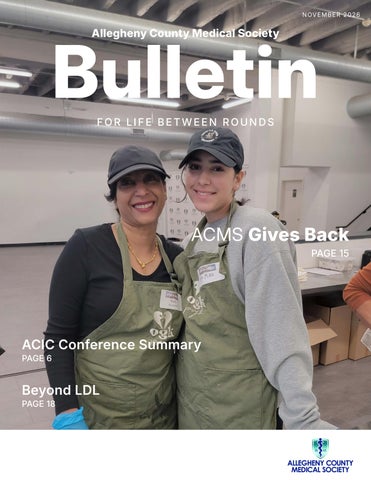
ACMS Gives Back PAGE 15
ACIC Conference Summary PAGE 6
Beyond LDL PAGE 18
inside W H AT ’S
4
RESPIRATORY VIRUS TRENDS
6
ACIC CONFERENCE SUMMARY
8
PAMED HOD RECAP
10
RYAN SHAZIER FUND
12
Q3 MEMBERS & FRONTLINE GROUPS
14
ACMS FOUNDATION GRANT RECIPIENTS
15
ACMS GIVES BACK + RESIDENT EVENT
16
ACMS NEW HIRE
17
SPECIALTY GROUP UPDATES
18
BEYOND LDL
6
18
Image courtesy of Adobe Stock
CHECK US OUT ONLINE: www.acms.org AlleghenyCountyMedicalSociety company/allegheny-county-medical-society alleghenycountyms
CHECK US OUT IN PERSON: Allegheny County Medical Society 412.321.5030 850 Ridge Avenue Pittsburgh, PA 15212
2
ACMS Bulletin //
NOVEMBER 2026
EDITORIAL/ADVERTISING OFFICES: Bulletin of the Allegheny County Medical Society, 850 Ridge Avenue, Pittsburgh, PA 15212; (412) 3215030; fax (412) 321-5323. USPS #072920. PUBLISHER: Allegheny County Medical Society at above address.
2026 EXECUTIVE COMMITTEE AND BOARD OF DIRECTORS
ADMINISTRATIVE STAFF
PRESIDENT
Sara Hussey, MBA, CAE shussey@acms.org
Kirsten D. Lin, MD PRESIDENT-ELECT
Richard B. Hoffmaster, MD SECRETARY
William F. Coppula, MD TREASURER
Alexander K. Yu, MD BOARD CHAIR
Keith T. Kanel, MD BOARD OF DIRECTORS TERM EXPIRES 2026
Michael M. Aziz, MD, MPH, FACOG Michael W. Best, MD Micah A. Jacobs, MD, FIDSA Kevin G. Kotar, DO Jody Leonardo, MD TERM EXPIRES 2027
David J. Deitrick, DO Sharon L. Goldstein, MD Prerna Mewawalla, MD Raymond J. Pan, MD Nicole F. Velez, MD TERM EXPIRES 2028
Amber R. Elway, DO Andrew Eller, MD Geoffrey F.S. Lim, MD Charles E. Mount III, MD Meilin Young, MD, FCCP
EXECUTIVE DIRECTOR
VICE-PRESIDENT OF ASSOCIATION MANAGEMENT
Nadine Popovich npopovich@acms.org VICE-PRESIDENT OF MEMBERSHIP & COMMUNICATIONS
Dina Bash dbash@acms.org MANAGER OF MEMBER AND ASSOCIATION SERVICES
Haley Thon hthon@acms.org MANAGER OF THE ACMS FOUNDATION
Melanie Mayer mmayer@acms.org MANAGER OF OPERATIONS AND FINANCE
Elizabeth Yurkovich eyurkovich@acms.org BULLETIN STAFF MANAGING EDITOR
Sara Hussey, MBA, CAE ACMS Executive Director shussey@acms.org BULLETIN DESIGNER
Victoria Gricks koonacreative@gmail.com
PAMED DISTRICT TRUSTEE James Latronica, DO, DFASAM
2026 BULLETIN EDITORIAL BOARD
2026 BOARD COMMITTEES
Natalie Gentile, MD acmsbulletin@acms.org
BYLAWS
William F. Coppula, MD FINANCE
Alexander K. Yu, MD NOMINATING
Richard B. Hoffmaster, MD WOMEN’S COMMITTEE
Prerna Mewawalla, MD & Meilin Young, MD MEMBERSHIP TASK FORCE
Geoffrey F.S. Lim, MD ADVOCACY TASK FORCE
Richard B. Hoffmaster, MD
MEDICAL EDITOR
EDITOR EMERITA
Reshma Paranjpe, MD ADDITIONAL MEMBERS
Lillian Emlet, MD Marsha Haley LoAlbo, MD Alexandra Johnston, DO Vinnie Kaschauer OMS-1 Anthony Kovatch, MD Timothy Lesaca, MD Najya Williams, MD
The Bulletin of the Allegheny County Medical Society is presented as a report in accordance with ACMS Bylaws. The Bulletin of the Allegheny County Medical Society welcomes contributions from readers, physicians, medical students, members of allied professions, spouses, etc. Items may be letters, informal clinical reports, editorials, or articles. Contributions are received with the understanding that they are not under simultaneous consideration by another publication. Bulletin of the Allegheny County Medical Society reserves the right to edit all reader contributions for brevity, clarity and length as well as to reject any subject material submitted. The opinions expressed in the Editorials and other opinion pieces are those of the writer and do not necessarily reflect the official policy of the Allegheny County Medical Society, the institution with which the author is affiliated, or the opinion of the Editorial Board. Advertisements do not imply sponsorship by or endorsement of the ACMS, except where noted. Publisher reserves the right to exclude any advertisement which in its opinion does not conform to the standards of the publication. The acceptance of advertising in this publication in no way constitutes approval or endorsement of products or services by the Allegheny County Medical Society of any company or its products. Annual subscriptions: $60 Advertising rates and information available by calling (412) 321-5030 or online at www.acms.org. COPYRIGHT 2026: ALLEGHENY COUNTY MEDICAL SOCIETY POSTMASTER – Send address changes to: Bulletin of the Allegheny County Medical Society, 850 Ridge Avenue, Pittsburgh, PA 15212. ISSN: 0098-3772
PUBLICATION CREDITS FRONT COVER
Image taken by Nadine Popovich
NOVEMBER 2026
// ACMS Bulletin
3
Respiratory Virus Trends: A Six-Year Look Understanding mortality trends for COVID-19, influenza, and RSV and what they mean for the upcoming respiratory virus season. written by BRANDON DOUMONT, MPH & LUISA FERNANDEZ – ALLEGHENY COUNTY HEALTH DEPARTMENT RESPIRATORY VIRUS DISEASE SURVEILLANCE Respiratory virus diseases like influenza, COVID-19, and RSV are reportable conditions. The Allegheny County Health Department (ACHD) receives positive laboratory reports, monitors emergency department visit data, investigates outbreaks, and maintains dashboards to keep the public informed of disease trends. Tracking deaths associated with respiratory virus diseases is a core component of public health surveillance, guiding prevention and preparedness actions. Despite COVID-19 dropping out of the top ten leading causes of death in 2024, respiratory viruses as a whole, including COVID-19, influenza, and respiratory syncytial virus (RSV) remain major contributors to mortality – particularly for vulnerable populations. Each year, ACHD analyzes death records related to respiratory virus mortality, examining trends across age, race, and underlying cause of death. RESPIRATORY VIRUS DISEASE MORTALITY TRENDS ACHD reviewed Allegheny County resident deaths occurring between January 1, 2020, and December 31, 2025. Death certificate data were used to identify deaths associated
4
ACMS Bulletin //
with COVID-19, influenza, and RSV infection. Between 2020-2025, there were 4,406 COVID-19 associated deaths, 191 influenza associated deaths, and 32 RSV associated deaths. COVID-19 deaths peaked in 2021 (1,589) and declined to 88 in 2025 (Figure 1). Influenza deaths rose sharply to 89 in 2025, up from 27 in 2024. RSV deaths increased to eight in 2025, the highest number of deaths across the study period.
among individuals less than 45 years old (13 per 100,000). Influenza and RSV mortality was also highest among older age groups. Between 2020-2025, 79 (41%) influenza deaths and 18 (56%) RSV deaths occurred among people 80 years or older. Respiratory virus associated deaths still occurred in children less than 5 years old, including three related to COVID-19, two related to influenza, and one related to RSV.
Across the six-year period, COVID‑19 mortality rate was highest among individuals 85 years and older (4,942 per 100,000) and lowest
RACIAL DISPARITIES IN RESPIRATORY VIRUS DISEASE MORTALITY Early in the COVID-19 pandemic,
NOVEMBER 2026
and ensure that immunizations are accessible to all patients, particularly those at higher risk of severe disease. Healthcare providers should also review current influenza, COVID-19 and RSV treatment guidance and provide timely access to treatments that can reduce symptom severity and prevent complications.
ACHD observed racial disparities in COVID-19 mortality. This disparity has diminished as the pandemic evolved, ultimately resulting in indistinguishable differences among COVID-19 mortality across race. In 2020, the age adjusted mortality rate for Black residents was 1.8 times the rate of white residents (118 vs. 66 per 100,000, respectively). In 2025, the COVID-19 age adjusted mortality rate was 5 per 100,000 for both Black and white residents (Figure 2).
outcomes. Healthcare providers play a crucial role in ensuring that people have the best protection against these illnesses. The ACHD encourages providers to review current immunization guidance
ABOUT THE AUTHORS Brandon Doumont, MPH is an Epidemiology Research Associate in the Infectious Disease Epidemiology (IDE) Program within the Bureau of Health Promotion and Disease Prevention at the Allegheny County Health Department. Luisa Fernandez is a Master of Public Health student at the University of Pittsburgh’s School of Public Health.
PREPARING FOR THE 2026-27 RESPIRATORY VIRUS DISEASE SEASON As of September 23, 2026, CDC models indicate that the U.S. fall and winter respiratory disease season will likely have a similar combined number of peak hospitalizations due to COVID-19, influenza, and RSV disease compared to last season. However, other outcomes remain possible. COVID-19, influenza, and RSV continue to cause substantial illness, hospitalization, and death across the United States and in Allegheny County. Influenza, COVID-19 and RSV immunizations provide meaningful protection against severe NOVEMBER 2026
// ACMS Bulletin
5
Taking Immunization Efforts Beyond the Doctor's Office Through professional education, community partnerships, and on-site vaccination efforts, ACIC is working to improve vaccine access and strengthen public health throughout the Pittsburgh region. written by MELANIE MAYER – ACMS FOUNDATION MANAGER October was a busy and impactful month for the Allegheny County Immunization Coalition (ACIC), with two major initiatives highlighting the coalition's commitment to advancing vaccine education, improving access, and strengthening public health partnerships throughout the Pittsburgh region. 21ST ANNUAL IMMUNIZATION CONFERENCE WELCOMES OVER 100 ATTENDEES On October 28, ACIC welcomed approximately 100 healthcare and public health professionals to its 21st Annual Immunization Conference at the Regional Learning Alliance
6
ACMS Bulletin //
in Cranberry Township. This year's theme, Vaccines in the Real World: Science, Decisions, and Delivery, brought together physicians, pharmacists, researchers, public health leaders, and community partners for a day of education and meaningful discussion. The conference opened with a keynote address from Debra Bogen, MD, Pennsylvania Secretary of Health, who discussed vaccine access, public trust, and public health priorities across the Commonwealth. Additional presentations explored local immunization challenges, vaccine-
NOVEMBER 2026
preventable diseases, patient communication, pharmacybased vaccination strategies, and immunization considerations for older adults. Dr. Bogen noted that in 25 years of practicing medicine in Pennsylvania, she had never encountered a case of measles, until now. Underscoring how successful vaccination efforts shaped modern medical practice. The day concluded with a panel discussion, Trust at the Point of Care, featuring Amesh Adalja, MD; Diego Chaves-Gnecco, MD; and Khlood Salman, DrPH. Moderated
information about local immunization resources directly to attendees. Together, the partners administered approximately 273 influenza and COVID-19 vaccines over the two-day event, based on preliminary totals.
by ACIC Chair Kristal Ross, PharmD, CTTS, the conversation focused on building trust, addressing barriers to care, and identifying practical ways healthcare professionals can better support patients and communities. Panelists challenged the notion that patients are always difficult to reach, encouraging health care professionals to examine whether the systems designed to serve them are accessible in the first place. Attendees also had opportunities to network with colleagues and connect with several exhibitors. The conference attracted local media attention, with coverage from WTAE, the Pittsburgh Tribune-Review, the Pittsburgh Post-Gazette, and WGAL Lancaster County, carried the conference’s public health conversations beyond the event and across Pennsylvania.
By offering vaccination alongside free dental and hearing services, the partners helped remove an additional barrier to preventative care. This demonstrates the value of bringing healthcare services into the broader community healthcare initiatives. A PARTNERSHIP ROOTED IN ORGANIZED MEDICINE ACIC's work is supported in part by the Allegheny County Medical Society (ACMS) Foundation, which serves as the coalition's fiscal sponsor and provides financial and administrative support to advance its mission. The coalition also benefits from the involvement of several physicians who serve in leadership roles and as active members, bringing valuable clinical expertise and perspectives to its initiatives.
This partnership reflects the broader commitment of ACMS and its Foundation to supporting public health initiatives that extend beyond the physician's office and make a meaningful difference in the health of the community. Together, these October initiatives demonstrate ACIC's commitment to connecting evidence-based education with direct community outreach. ACIC extends its appreciation to its speakers, sponsors, exhibitors, volunteers, and community partners for their continued support. Through education, collaboration, and community partnerships, ACIC remains focused on reducing barriers to vaccination, strengthening public confidence, and protecting the health of residents throughout Allegheny County. To learn more about the Allegheny County Immunization Coalition, visit https://www.immunizeallegheny.org/
BRINGING VACCINES DIRECTLY TO THE COMMUNITY Earlier in the month, ACIC participated in Mission of Mercy Pittsburgh, held October 16–17 at the David L. Lawrence Convention Center. The two-day event provides free dental and hearing care to individuals throughout the region, including those who may face barriers to accessing routine healthcare. In partnership with the Allegheny County Health Department and Giant Eagle, ACIC helped bring on-site vaccinations, vaccine education, and NOVEMBER 2026
// ACMS Bulletin
7
Shaping the Future of Medicine Through Physician Advocacy ACMS members joined physicians from across Pennsylvania to influence healthcare policy, address emerging challenges, and take on leadership roles at the 2026 PAMED House of Delegates. written by SARA HUSSEY, MBA, CAE – ACMS EXECUTIVE DIRECTOR Physicians from across Pennsylvania gathered October 23–25 in Hershey for the 2026 Pennsylvania Medical Society (PAMED) House of Delegates. The annual meeting brought together physicians, residents, fellows, and medical students to debate policy, address emerging challenges in healthcare, and help shape the advocacy priorities of organized medicine. The Allegheny County Medical Society (ACMS) delegation participated in discussions covering a wide range of issues, including artificial intelligence in healthcare, physician workforce challenges, collective bargaining rights, medical
8
ACMS Bulletin //
education, patient safety, and access to care. Several key resolutions generated meaningful discussion and action: • Artificial Intelligence and Physician Oversight: Delegates considered a consolidated resolution addressing the growing role of AI in healthcare, focusing on physician oversight, protecting clinical decisionmaking, and ensuring patient safety as new technologies enter medical practice. • Physician Workforce and Collective Bargaining: The House adopted an amended resolution supporting expanded
NOVEMBER 2026
collective bargaining protections for physicians, reflecting ongoing conversations about physician autonomy, employment conditions, and the changing healthcare workforce. • Emergency Department Physician Coverage: Delegates adopted policy supporting the presence of a physician trained and experienced in emergency care whenever an emergency department is operating, reinforcing the importance of physician-led care and patient safety. • Access to Specialty Care: A resolution supporting expanded telestroke services
in rural and underserved communities was adopted, recognizing the importance of timely neurological expertise while acknowledging ongoing challenges in physician recruitment and specialty access. • Medical Education and Training: Delegates discussed medical education financing, residency selection practices, and workplace protections for physicians in training. The House also adopted a resolution encouraging improved safety resources and training for medical students volunteering in student-run clinics.
political action committee, also emerged as an important topic of conversation. Discussions highlighted the desire for greater visibility into PAMPAC's activities and how members can remain informed about its work. Additional conversations are anticipated as PAMED considers opportunities to strengthen communication and engagement with members.
Other topics, including physician licensure, continuing medical education standards, transparency in pregnancy-related services, and permanent standard time, generated discussion and debate, with some proposals adopted and others referred for further study.
John Williams, MD, was elected Vice President of PAMED and as an Alternate Delegate to the American Medical Association (AMA).
Transparency and communication surrounding PAMPAC, PAMED's
ACMS MEMBERS ELECTED TO LEADERSHIP POSITIONS In addition to participating in House deliberations, several ACMS members served on reference committees and took on important leadership roles within PAMED.
Donald Bourne, MD, MPH, PhD, was elected Resident and Fellow Section Trustee, helping ensure that the perspectives of physicians in training are represented in PAMED leadership.
ACMS congratulates both physicians on their elections and extends its appreciation to all members of the delegation for their time, preparation, and commitment to organized medicine. The House of Delegates serves as an important reminder that physician advocacy begins with engagement. Through participation in statewide policy discussions and leadership opportunities, ACMS members continue to help shape the future of medicine in Pennsylvania and ensure that the voices of Allegheny County physicians are heard.
Marissa Tremoglie-Barkowski, MD; Sydney Exantus (MS); Donald Bourne, MD; Anannya Pushkarna (MS)
ACMS Delegation 2026 NOVEMBER 2026
// ACMS Bulletin
9
BUILDING BRIDGES. CHANGING LIVES. OUR MISSION
A SNAPSHOT OF IMPACT
The Ryan Shazier Fund for Spinal Rehabilitation gives those with spinal cord injuries (SCIs) and their caregivers the support, resources, and funding they need to live independent and meaningful lives.
$1,637,450+
80+
FUNDS AWARDED
COMMUNITY EVENTS
PA, OH, WV
2,500+
AREA WE SERVE
PEOPLE SERVED
PROGRAMS THAT SERVE OUR COMMUNITY
THE GOLDEN WINDOW
CAREGIVERS’ TIMEOUT
THE HUDDLE
Up to $15,000 to fund critical resources that empower independence and help individuals with spinal cord injuries.
Caregiving is often unpaid and unseen. We provide caregivers of individuals with spinal cord injuries a stipend of up to $1,000.
Pairs people with spinal cord injuries with a personal navigator who guides them to critical resources, free of charge.
A LETTER FROM DR. YU Every 29 minutes, a person in the United States is affected by spinal cord injury. An estimated population of over 308,000 Americans live with some form of paralysis and less than 1% of patients experience complete neurological recovery by hospital discharge. Patients are dealing with long rehabilitation journeys and the need to adjust to their new life. Faced with lifetime medical expenses ranging from $3.1 million to more than $6.2 million, patients not only encounter challenges with physical, emotional, mental health, but also face significant financial hardships. This critical gap is where The Ryan Shazier Fund for Spinal Rehabilitation intervenes. Founded after Ryan Shazier’s life-altering injury in 2017, the fund operates on the conviction that functional independence must never be constrained by financial limits. Through direct grants, the fund finances specialized neuro-rehabilitation sessions, activity-based locomotor training, adaptive mobility equipment, and caregiver resources, ensuring that survivors have the emotional, physical, mental and financial support to transform their lives into lasting, daily independence. I am proud to serve on the board with the fund renewing our hope for these patients one step at a time.
Dr. Alexander Yu, Neurosurgeon at AHN & Ryan Shazier Fund Board Member
10
ACMS Bulletin //
NOVEMBER 2026
COMMUNITY & CONNECTION
No one can imagine what life is like after an injury better than someone who lives it. We created Ryan Time: one-on-one conversations with Ryan Shazier, virtual or in person, allowing for real connection: participants share personal triumphs and challenges with someone who understands. The Fund extends that connection through Community Events that bring individuals and families together to build relationships, share experiences, and simply enjoy time together.
(NEVER) RUNNING ON EMPTY T HE STORY O F SH ANE HEINL E
UPCOMING EVENTS VISIT RYANSH A ZIERFUND.O RG/E VEN TS TO REGISTE R
CELEBRATE Shalieve Shalieve Presented By
Honoring the Spinal Cord Injury Community Honorees:
Gregg Huber
Julie Gallagher
Marshall Lee Tempest
January 21, 2027
The Maverick Pittsburgh
On Heinle’s 34th birthday in October 2020, he led a group of 15 guys on a mountain biking trip outside Colorado Springs. “This was a trail that I had ridden before,” explains Heinle, “and there were some big obstacles.”
TOGETHER, WE SHALIEVE YOU CAN MAK E A DIFFEREN CE
One big jump came up, and Heinle admits looking back, he may have been overconfident. “I hit this jump and I tried to slow up, but when I did, the consequence was I came up short, and I bounced,” explains Heinle. “When I did that, I landed on my head and came to a crashing halt in the middle of the trail,” Heinle says. Heinle knew the guys were coming behind him. He tried to scramble off the trail, but couldn't move. The other riders saw Heinle’s position and condition and asked if they should move him. Read the rest of Shane’s Story.
Every conversation helps. Every dollar raised grows our impact. Donate. Volunteer. Partner with us. Help more individuals and families access the resources they need to live independent and meaningful lives. Visit ryanshazierfund.org to learn more. NOVEMBER 2026
// ACMS Bulletin
11
Continuing Frontlines & New Members The ACMS is pleased to recognize the following Frontline Practice Groups that joined or renewed with a 100% membership commitment to ACMS and PAMED, along with all new ACMS members who joined in the third quarter of 2026. Thank you for your continued support. FRONTLINE GROUPS AHN Bariatrics Jeferson Hills Specialists – Pleasant Hills Pittsburgh Gastroenterology Associates Pittsburgh Oculoplastic Associates LTD PHYSICIANS Keerthi Arani, MD Diana Bell Matesoi, MD Yotam Ben-Artzi, MD Karl Bezak, MD Kavitha Bhat, MD, MS Megan Blair, MD Beth Bollinger, MD Eric Boyle, MD Jacob Brent, MD Aaron Brumbaugh, MD Timothy Bullock, MD Emily Burns, MD Yenny Cabrera Kapetanos, MD Nicholas Carosella, MD Jennifer Carpenter, MD Bonnie Case, MD Antonio Cassara, MD Clare Cene-Kush, DO Douglas Chen, MD Kiran Chunduri, MD Collin Conway, MD Caitlin Couper, MD Christopher Emond, MD Elizabeth Fourcade, MD Preeya Fozdar, MD Elizabeth Froelich, MD Vikram Gorantla, MD Craig Grossman, MD Jonathan Hansen, DO Jennifer Hong, MD
12
ACMS Bulletin //
Manasa Irwin, MD Anastasios Kapetanos, MD Donald Keenan, MD Matthew Klocek, MD Megan Klocek, MD Shyam Mohan Kodati, MD Kelvin Kwofie, MD Zachary Lahr, DO Thomas Makin, MD Vicki March, MD Sean Mcdermott, MD Alefiyah Mesiwala, MD Danielle Mitchel, MD Amelia Morgan, DO Ezz-Eldin Moukamal, MD Jared Mugfor, DO Anna Nelson, DO Kathleen Ober, MD Conor ODonnell, DO Michael Parkinson, MD Margot Penn, DO Charles Prezzia, MD Gloria Seo, MD Laxmi Shah, DO Gretchen Shelesky, MD Joshua Shulman, MD David Starr, MD Nicholas Stiles, DO Stacey Swenn, MD Kenneth Ung, MD Jamie Uy, MD Divya Venkat, MD John Welsh, MD Andrew Wilmot, MD Valerie Wislo, MD Kailey Ziemianski, DO
NOVEMBER 2026
RESIDENTS Mara Kirstimel Li Banez, MD Jason Becker, DO Liliana Cruz, MD Hatem Eltaly, MD Bhavika Gupta, MD Ahsan Khan, MD Julia Mendiola , MD Alyson Morgan, MD Siddarth Pratapneni, MD Saleh Saleh, MD Mahsa Shariat, MD Zeia Shlimun, MD Lauren Strelec, DO Lauren Stumpp, MD Emily Sullivan, DO Coco Thomas, DO Emily Gripp, MD Jessica Higgins, DO Tyler McGehee, MD Frank Mohn, DO Nathan Monk, MD Sierra Raney, DO Adnan Syed, MD STUDENTS Bryn Anteau Sydney Barlow Benjamin Baron Benjamin Katz Emma Kozuch Riley Martin Madyson McDougal William Sharp Skylar St. Clair To learn more about ACMS/PAMED membership, visit acms.org/ membership
Consider a year-end donation to the ACMS Foundation. Your donations help to support our annual grant giving. Click here.
14
ACMS Bulletin //
NOVEMBER 2026
Bringing Members Together Through Service & Learning Two recent events brought members together to give back to the community, share knowledge, and build meaningful connections. written by NADINE POPOVICH – VICE PRESIDENT OF ASSOCIATION MANAGEMENT ACMS GIVES BACK: MAKING MEALS THAT MATTER On Sunday, October 11, ACMS members and their family members gathered at Our Giving Kitchen in Squirrel Hill to prepare meals for more than 100 people facing food insecurity. This marked the second event in the ACMS Gives Back Volunteer Series. Many members brought their children to join them in preparing meals, making the afternoon a shared family experience and an opportunity to introduce younger generations to the importance of community service. Together, volunteers helped prepare nutritious meals while connecting with fellow members and their families. Our Giving Kitchen brings volunteers together to prepare fresh meals for neighbors in need throughout the Pittsburgh area. ACMS was pleased to support this mission through an afternoon of hands-on service. Thank you to everyone who participated and to Our Giving Kitchen for welcoming our group. We look forward to offering more ACMS Gives Back volunteer opportunities in 2027.
RESIDENTS AND FELLOWS BRING THEIR QUESTIONS TO AN EVENING WITH THE EXPERTS Great questions and lively conversation fueled ACMS’s “An Evening with the Experts” on October 21, as residents and fellows gathered for practical guidance on contracts and financial planning. Adam Appleberry, Esq., of Tucker Arensberg, P.C., presented 10 red flags to watch for when reviewing physician employment contracts, helping attendees better understand what to look for before signing. Ron Yost and Ryan Kennis of JFS Wealth Advisors explored financial topics that can be overlooked during residency and fellowship, including insurance coverage, student loan forgiveness, retirement planning, mortgages, and investments. Their broad overview encouraged attendees to consider how decisions made today can support their future goals. Participants came ready to learn—and kept the questions coming throughout the two-hour program. The engaged group made for an interactive evening filled with lively discussion and useful takeaways. Thank you to our experts for sharing their time and knowledge, and to everyone who joined us for an engaging evening. The program helped residents and fellows look ahead to the next phase of their medical journey and prepare for the career and financial decisions that come with it. NOVEMBER 2026
// ACMS Bulletin
15
Getting to Know Dina Bash ACMS welcomes its first-ever Vice President of Membership & Communications as we continues to invest in member engagement and connection. As ACMS continues to grow, this new position represents an important investment in strengthening member engagement, enhancing communications, and building connections across the physician community. With over 17 years of experience in nonprofit leadership and membership management, Dina brings expertise in organizational operations, fundraising, financial management, and board relations. Most recently, she served as Assistant Director of Early Music America, supporting daily operations, member engagement, and a national network of music professionals. In her new role, Dina will lead membership growth and engagement initiatives, oversee communications and marketing efforts, and help advance ACMS's strategic priorities. A Penn State graduate, Dina is passionate about building relationships and supporting mission-driven organizations. Outside of work, she enjoys spending time with her husband and two children.
16
ACMS Bulletin //
NOVEMBER 2026
Specialty Group Updates The latest news, events, and highlights from our specialty groups. Healthcare professionals gathered for an engaging evening of education, networking, and discussion focused on the evolving role of technology in supporting older adults, promoting independence, and addressing the challenges of aging in place.
The September meeting featured guest speaker John Hart, Jr., MD, FACS, and resident presenter Thomas Bogue, MD. In October, Mark Breazzano, MD, FACS, shared advances in retinal care, alongside resident presenter Hamzah Aweidah, MD.
Surgical residents from across the Pittsburgh region came together for an evening of friendly competition, testing their surgical knowledge in a fast-paced Jeopardy-style showdown. The event provided an opportunity for residents to connect with peers, showcase their expertise, and enjoy friendly rivalry outside the operating room.
The program featured Pam Toto, PhD, OTR/L, BCG, FAOTA, Director of the Healthy Home Lab, who shared valuable insights into how innovative technologies and homebased solutions can enhance safety and quality of life for older adults. An interactive case study and expert panel discussion further explored the important balance between ensuring safety and preserving independence, sparking thoughtful conversations among attendees.
POS also welcomed State Representatives Jeremy Shaffer and Arvind Venkat, MD, providing opportunities for members to engage with elected officials on issues impacting physicians and patient care.
Congratulations to Allegheny Health Network (AHN) for taking home the top prize and earning this year's bragging rights.
Thank you to our speakers, planning committee, sponsors, and attendees for a successful evening of learning and collaboration.
A special thank you to all of the participating residents, program representatives, sponsors, and exhibitors for making the evening such a success. We look forward to another exciting competition next year.
35th Annual Clinical Update in Geriatric Medicine – April 1–2, 2027 Save the date for the Pennsylvania Geriatrics Society – Western Division's premier annual conference at the Sheraton Pittsburgh Hotel at Station Square. Planning is underway, with program and registration details coming soon.
AMERICAN COLLEGE OF SURGEONS SOUTHWESTERN PENNSYLVANIA CHAPTER 2025-2026 President: Richard Fortunato, DO, FACS The American College of Surgeons Southwestern Pennsylvania Chapter (ACS-SWPA) hosted its annual Resident Surgical Jeopardy Competition on Wednesday, October 14, 2026, at Acrisure Stadium.
PENNSYLVANIA GERIATRIC SOCIETY WESTERN DIVISION 2026 President: Heather Sakely, PharmD, BCPS, BCGP The Pennsylvania Geriatrics Society Western Division (PAGS-WD) hosted its 2026 Fall Program, “Technology in Geriatric Care: Balancing Safety, Independence & Aging in Place,” on Thursday, October 29, 2026, at the University Club in Pittsburgh.
PITTSBURGH OPHTHALMOLOGY SOCIETY 2026 President: Laurie A. Roba, MD Under the leadership of President Laurie A. Roba, MD, the Pittsburgh Ophthalmology Society (POS) kicked off its 2026–2027 meeting season with well-attended programs in September and October.
POS 62nd Annual Meeting Planning is underway for the 62nd Annual Meeting, featuring Eric D. Donnenfeld, MD, as the 46th Harvey E. Thorpe Lecturer, along with distinguished guest faculty Amani Fawzi, MD, Michael Kazim, MD, and Douglas Rhee, MD. The 47th Annual Meeting for Ophthalmic Personnel will offer practical education and skillsfocused sessions for ophthalmic professionals. Registration for both conferences opens January 2027. Both meetings are scheduled for March 19, 2027 at the Omni William Penn Hotel in Pittsburgh, PA. Visit www.pghoph. org for updates or contact Nadine Popovich at npopovich@acms.org. Look for a more comprehensive recap of POS activities and upcoming programs in the next print edition of the ACMS Bulletin.
NOVEMBER 2026
// ACMS Bulletin
17
Beyond LDL Understanding the role of lipoprotein(a) in cardiovascular risk assessment, prevention, and treatment. written by KURLYA YAN, MD; SANCHAYA KHETRAPAL, MD; ALEXANDRA JOHNSTON, DO; INDU POORNIMA, MD INTRODUCTION Lipid management in the preventive care setting primarily focuses on atherosclerotic cardiovascular disease (ASCVD) risk associated with calculated low-density lipoprotein (LDL-C) levels. Yet even in patients with well-controlled LDL, residual cardiovascular risk remains, posing a clinical enigma. Emerging evidence for non-LDL lipoproteins as independent risk factors for ASCVD and calcific aortic disease, in particular Lipoprotein A or Lp(a), can help explain these gaps. Lp(a), like LDL, is an apoB100containing lipoprotein with proatherogenic and prothrombotic potential, distinguished from LDL by the addition of an apolipoprotein(a) moiety1. Unlike LDL, Lp(a) levels are predominantly genetically determined (with 7090% contribution from LPA gene expression), staying relatively constant and posing a lifelong risk despite lifestyle changes or statin therapy. Other determining factors include environmental factors, ethnicity, race, and sex, with highest Lp(a) levels in individuals of African or South Asian descent and higher Lp(a) levels in postmenopausal women compared to men of the same age2. Estrogen is thought to play a role in suppressing LPA gene expression. Lp(a) levels are considered a risk enhancing factor when ≥125 nmol/L (50 mg/dL) and have a direct relationship with ASCVD risk:
18
ACMS Bulletin //
Lp(a) of 125 nmol/L (50 mg/dL) is associated with 1.4-fold increased ASCVD risk, Lp(a) of 250 nmol/L (100 mg/dL) with 2-fold risk, 350 nmol/L (150 mg/dL) with 3-fold risk, and 430 nmol/L (180 mg/dL) with 4-fold risk2. GUIDELINES Prior to the ACC/AHA/AACVPR/ ABC/ACPM/ADA/AGS/APhA/ ASPC/NLA/PCNA “Guideline on Management of Dyslipidemia” that came out in March 2026, the AHA recommended checking Lp(a) in specific populations: patients with a family history of premature ASCVD (men < 55 years old, women < 65 years old), patients with a known family history of elevated Lp(a) levels, and patients with familial hypercholesterolemia. The 2026 guidelines now give a Class 1 recommendation for universal incorporation of Lp(a) into routine clinical practice, outlined by the updates below: 1. Lp(a) should be measured at least once in every individual, ideally during their first lipid panel, to identify those at higher risk of ASCVD. 2. Elevated Lp(a) is an ASCVD risk-enhancer and should prompt intensified management of LDL and other risk factors. 3. Fasting is not required when measuring Lp(a) levels. 4. In individuals with elevated Lp(a), it can be beneficial to check Lp(a) levels in firstdegree family members,
NOVEMBER 2026
particularly if there is a family history of premature ASCVD, familial hypercholesterolemia, or premature aortic stenosis, to identify family members also at increased ASCVD risk1. MANAGEMENT Aggressive risk factor modification is the cornerstone for treating patients with elevated Lp(a). All patients with elevated Lp(a) 125 nmol/L (50 mg/dL) or higher should receive counseling on optimal management of hypertension, regular exercise, following a heart-healthy diet, obtaining adequate sleep, stress management, moderation of alcohol intake, and smoking cessation. Strict LDL lowering and control of blood sugars are exceedingly vital in risk factor management. Per the 2026 Dyslipidemia guidelines: in individuals with clinical ASCVD and elevated Lp(a) who have not achieved LDL treatment goals on maximally tolerated statin therapy, the addition of a PCSK9 monoclonal antibody is recommended to reduce ASCVD risk1,3. Given the atherothrombotic nature of Lp(a), the potential benefit of antiplatelet agents such as aspirin was studied for primary prevention of ASCVD. In a propensity‐matched analysis utilizing the data of the MESA (Multi‐Ethnic Study of Atherosclerosis) study, it was noted that aspirin use was associated with a lower risk for cardiovascular events among participants with elevated Lp(a) >50 mg/dL and free
of baseline cardiovascular disease. However, randomized studies evaluating the same benefit are needed4. Currently, lipoprotein apheresis remains the first and only FDAapproved procedure for the indication of Lp(a) reduction and may be considered in high-risk patients with persistent Lp(a) levels >150 nmol/L (>60 mg/dL) and LDL >100 mg/dL on maximally tolerated lipid-lowering therapy5. PATIENT CASE EXAMPLES We list below several clinical scenarios to demonstrate the application of Lp(a) in the preventive care setting: 1. A 60-year-old postmenopausal woman with history significant for obesity with otherwise no other medical conditions, obstetric, or family history meets with you in the office to establish care. You order a first-time non-fasting lipid panel which shows LDL-C of 148 mg/dL. Her 10-year PREVENT-ASCVD risk is 3.8%, placing her in the borderline risk category. You also order a Lp(a) which is elevated at 375 nmol/L. The patient is hesitant to start a statin, but you discuss her Lp(a) presents a 3-fold increase in ASCVD risk. In addition to lifestyle counseling, you recommend starting a moderate-intensity statin with goal LDL <100 mg/dL. You also recommend her first-degree relatives have their lipid profiles and Lp(a) levels checked. 2. In the same patient above, the 10-year PREVENT-ASCVD risk is instead 8.0%, placing her in the intermediate risk category. You recommend starting a highintensity statin with a goal LDL <70 mg/dL. 3. A 68-year-old man with a history of CKD stage 3,
Image courtesy of Adobe Stock
hypertension, and hyperlipidemia comes in for post-discharge follow-up. He was hospitalized three months ago for an NSTEMI and underwent successful coronary stenting. His lipid profile in the hospital revealed LDL of 140 mg/dL, which has now come down to 70 mg/dL on high intensity atorvastatin 80 mg and ezetimibe 10 mg. You check Lp(a) which is elevated at 250 nmol/L. You discuss this presents a 2-fold ASCVD risk. Given his medical comorbidities with Lp(a) as a risk enhancer, you start him on evolocumab to achieve goal LDL <55 mg/dL. FUTURE DIRECTIONS Although Lp(a) levels are largely genetically determined, clinical trials have demonstrated differing degrees of Lp(a) reduction with PCSK9 inhibitors as well as novel therapies, all aiming to curb the potential significant morbidity from this currently non-modifiable risk factor. In patients using evolocumab for 48 weeks, there was a 25-30% reduction from baseline Lp(a) levels6. A single 500 mg injection of inclisiran, a small interfering RNA molecule that targets PCSK9 messenger RNA (mRNA), was found to lower LDL by 42% and Lp(a) by
18%, with an even greater decrease in patients who received the 2-dose regimen7. However, investigation of pelacarsen, an antisense oligonucleotide targeting apo(a) mRNA, suggests that simply lowering Lp(a) levels may not yield clinically significant results. In the 7-year, phase III, multicenter Lp(a) HORIZON randomized controlled trial, despite decreasing Lp(a) by nearly 80% in adults with preexisting cardiovascular disease and Lp(a) > 70 mg/dL, pelacarsen did not change the time to development of a major adverse cardiovascular event [8]. Investigation of Olpasiran, a silencing RNA also targeting apo(a) mRNA is still underway7. Further research is needed to better understand Lp(a)’s atherothrombotic potential to assist with clinical application. Nevertheless, elevated Lp(a) levels should prompt aggressive primary prevention and optimization or escalation of secondary prevention strategies. ABBREVIATIONS ASCVD - atherosclerotic cardiovascular disease LDL - low-density lipoprotein Lp(a) - lipoprotein A mRNA - messenger RNA Click here for a list of references.
NOVEMBER 2026
// ACMS Bulletin
19