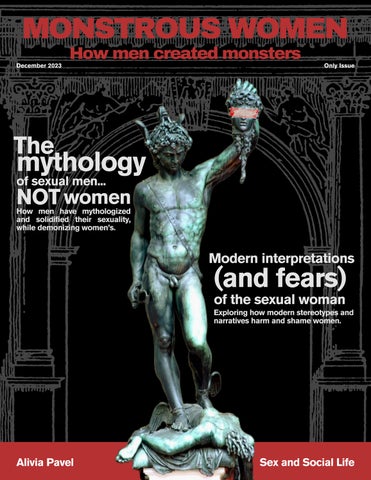
MONSTROUS WOMEN December 2023
How men created monsters
Only Issue
The
mythology of sexual men...
NOT women How men have mythologized and solidified their sexuality, while demonizing women’s.
Modern interpretations
(and fears) of the sexual woman
Exploring how modern stereotypes and narratives harm and shame women.
Alivia Pavel
Sex and Social Life
Table of Contents
3
THE (WO)MAN, THE MYTH, THE LEGEND Common stereotypes and tropes about sexual women and sexual figures in mythology
8
9
A TALE OF TWO WOMEN
SEXUAL MEN IN MYTHOLOGY
10
11
WOMEN CAN’T WIN
MODERN HARMS OF OFFENDED MEN
Comparing two figures who are positioned as foils of the other, both victims
The inability to escape sexualization and gain freedom under the double-edged sword of the male gaze
1
Comparing sexual male figures in mythology to sexual women
How men’s fear of dominant and sexual women harms women today
13
RECLAMATION OF FEMALE SEX The reclamation of sexual female figures in modern day
LETTER FROM THE EDITOR
The Greek tales of gods and goddesses seem far removed from our modern era of fashion models and hookup culture. Yet these figures and icons hold resounding influence in the present day. Join me on this journey to explore how this has happened and reclaim the narrative for these women - for all women. This piece is especially close to my heart because of the resounding tales of defiance in the face of degradation and objectification by the men in power. These stories are not merely exaggerated tales told to teach lessons and morals; they are reflections and foils of the beliefs and gender hierarchy which has built and influenced our present. It is important to understand the past; not only so we may not repeat it, but because the past is more present than we may think. As we continue on in this issue, we will see that these
narratives and stereotypes are not archaic, they are alive and present. Not only that, they are shifting and adapting in the modern age, taking on new, and often more detrimental, connotations. These assumptions and stereotypes affect all aspects of life: from relationships to work to power (im)balance. An understanding of this unequal perception and stigma is necessary for not only women and feminine-presenting individuals, but especially for men. For while we still live in an unequal patriarchy, non-men will continue to suffer at the benefit and pleasure of men. While this piece often hits on difficult and sensitive topics, I hope you too will find empowerment and camaraderie among these women, who although separated by millennia, are our sisters. -Alivia Pavel
2
HAILED O Artemis
Hera
Artemis is the daughter of Zeus. She is the goddess of chastity and childbirth. She is one of three virginal goddesses. She is fierce when protecting her chastity. In the myth of Actaeon, when he sees her bathing naked while hunting, she turns him into a deer in her wrath. He is devoured by his hunting dogs. There are many tales of her executing her wrath and punishing or killing men who leer or attempt to rape her. [1]
Athena
Note how the depictions of these figures evokes a sense of majesty Aphrodite and regality.
Athena is said to have been born from the forehead of her father Zeus. She is one of three virgin goddesses and is often associated with wisdom, warfare, and handicrafts. She aided many heroes such as Perseus, Heracles, and Jason. She has been known for her strict enforcement of rules of sexual modesty and rigid morality. There are many myths of Athena executing punishments for contemptuous behavior. [1]
3
Hera is the sister and wife of Zeus. She is often presented as a dignified, matronly figure. She is the goddess of marriage, women and family, and the protector of women in childbirth. Hera seduced Zeus into marriage. Zeus has many lovers and illegitimate children, of which Hera is vengeful and vindictive against, while Zeus is threatening and violent towards her. [1]
Aphrodite is the daughter
of Zeus. She is the goddess of love, lust, beauty, passion, pleasure, and procreation. She is seen as a purifying and rightous figure. She is viewed as the symbol of feminine beauty in the Western world. Aphrodite is known to seduce many men. [1] She was married to Hephaestus, the god of fire, but in the Odyssey, she is caught in bed committing adultery with Ares, the god of war. [2]
1, Rose, H. J. 2004. A Handbook of Greek Mythology. United Kingdom: Taylor & Francis. 2. Homer. 1909. The Odyssey. London : W. Heinemann; G.P. Putnam's sons. 3. Steinschneider, M. 1858. Alpha Betha de-Ben Sira. 4. Alter, R. (2018). The Hebrew bible. WW Norton.
R WHORE Lilith
Jezebel
Lilith was the first wife of Jezebel was a queen and Adam, before Eve. When wife of King Ahab of Adam tried to exercise Israel. She worshiped dominance, Lilith resisted Baal and often clashed and fled; she believed they with the prophet Elijah. were equal and refused to She is portrayed as a lay beneath him during sex. woman of idolatry, God sent angels after her. manipulation, and political They found her in a cave gain. After the death of bearing children. The angels King Ahab, Elijah’s said they would kill 100 of successor demanded a her children for every day divine punishment for she spent in hiding. Now it Jezebel. She dressed in is claimed she steals her finest clothes before children in the night. It is she was pushed to her said she is responsible for death out the window men’s erotic dreams and and trampled. [4] night emissions as she impregnate s herself to Note how the create more depictions of these demons. [3]
Circe
figures has a dark or ominous air and often highlights vanity.
Circe is a sorceress and enchantress. She appears in the Odyssey. When Odyssey’s men arrive, she turns them into swine. There are many tales of Circe turning men into animals and providing potions. Some interpretations believe Circe is depicting a loss of self-control or unchastity. [2]
Callisto
Callisto is a nymph. She was a follower of Artemis and took a virginal oath. Zeus was attracted to Callisto. He transformed into Artemis in order to trick Callisto into sleeping with him. When it was discovered her virginal oath had been broken, she was transformed into a bear as punishment and cast away. There are conflicting accounts whether it was Hera or Artemis who turned her into a bear. [1]
4
WHY THESE PICTURES? It may initially seem biased or unsavory to include lewd depictions of women when discussing how women have been sexualized. The fact of the matter is: very few depictions exist in which women have not been sexualized. Catherine McCormack explores this issue in her book Women in the Picture: What Culture does with Female Bodies(2021). McCormack posits that all artistic depictions of the female body sexualize it. While this may seem like a drastic accusation to make, we must think about the artist and audience of the art.
Depictions of Lilith (top) and Hera (bottom).
Historically, art has been exclusively for the wealthy, either in personal collections or exclusive, high-society locations such as clubs and aristocracy events. For these members of society art was an extension of their wealth and opulence. It was spending and observing for the sake of pleasure and assertion of power. These paintings were commissioned with the intent of exalting the owner, or viewers, in some capacity. The women depicted in these paintings in positions of vulnerability being scantily clad and observed or saved by a man becomes the fantasy and playground of the viewer.
“SEX TENDS TO BE TAKEN AS AN AUTOMATICALLY LIBERATING THEME IN ART, BUT WE MIGHT ASK OURSELVES HOW LIBERATING THE SEX WAS FOR THE WOMEN IN THESE PICTURES.” -MCCORMACK, 2021 This possession of artwork, and the women within them, was an exclusive right granted to a certain class of individuals, an exclusive right granted to men. Up until the last century, the right to freely control one’s wealth and property was a privilege granted exclusively to men. Only men had the access to wealth and access to the arts in order to commission and view these paintings. The depiction of women in these paintings, in itself, is sexist. No matter a depiction of Medusa, a feared and man-hated figure, or Aphrodite, the epitope of beauty and love, these images are tarnished with male gaze and desire. The women in these depictions are existing in a world, and fantasy, in which their entire being revolves around men. In being depicted on the canvas these figures have lost their humanity and instead have become objects for men to exercise their control. 5
THE EROTIC
SLEEPING VENUS The most famous image of a seductive and tempting woman: Venus, so alluring she is tempting in her sleep. Sleeping Venus (Venere di Dresda) by Giorgione
6
MONSTERS EVEN INHUMAN SHE IS SEXUALIZED
SUCCUBI
Succubi are demons derived from the myth of Lilith. They take the form of beautiful women, but they often have deformities, claws, and tails. A succubus appears in dreams to seduce men. They need semen to survive and drain men, of semen and their lives.
SIRENS
Sirens are creatures that sing and lure men to their deaths. Their top half is usually that of a beautiful woman. It is said in the Odyssey of a man who hears a siren’s song, “his wife and children will never welcome him home again.”
GORGONS
There are only three Gorgon sisters. Medusa is the most famous. It is said that Poseidon was aroused by her golden hair and raped her in the temple of Athena. Angered at the desecration of her temple, Medusa was cursed with hair of snakes that turned any man to stone when gazed upon. She was slain by Perseus.
OSCAR WILDE THE SPHINX EXERPT
The Kiss of the Sphinx by Franz Stuck
7
Inviolate and immobile She does not rise she does not stir For silver moons are nought to her And nought to her the suns that reel.
And from that brick-built Lycian tomb What horrible Chimaera came With fearful heads and fearful flame To breed new wonders from your womb?
Come forth my lovely languorous Sphinx! And put your head upon my knee! And let me stroke your throat and see Your body spotted like the Lynx!
He strode across the desert sand, He reached the valley where you lay: He waited till the dawn of day: Then touched your black breasts with his hand.
Who were your lovers, who were they Who wrestled for you in the dust? Which was the vessel of your Lust, What Leman had you every day?
You kissed his mouth with mouth of flame, You made the hornèd-god your own, You stood behind him on his throne: You called him by his secret name,
Did giant lizards come and crouch Before you on the reedy banks? Did Gryphons with great metal flanks Leap on you in your trampled couch,
You whispered monstrous oracles Into the caverns of his ears: With blood of goats and blood of steers You taught him monstrous miracles,
Did monstrous hippopotami Come sidling to you in the mist Did gilt-scaled dragons write and twist With passion as you passed them by?
While Ammon was your bedfellow Your chamber was the steaming Nile And with your curved Archaic smile You watched his passion come and go.
PENELOPE AND HELEN OF TROY
In her paper The Perfect Wife and the Evil Temptress: The Dichotomy of Penelope and Helen of Troy(2015), Alice Hofgren discusses the foil created by Penelope and Helen. In the story of the Trojan War, Penelope and Helen are central figures. Helen’s elopement with Paris incites the conflict, while Penelope waits patiently at home for her husband, Odysseus to return. Despite being both important figures, the two could not be more different. During the duration of the war, Penelope is seen as the epitome of loyalty and patience. Despite her husband’s long absence, her loyalty never wavers; Penelope continuously denies suitors.
Hofgren also analyzed depictions of these two women in media over varying time periods. She found that these tropes still exist: “the stereotypical whore and the idealized wife.” Not only do these stereotypes still exist in depictions, their continued existence suggests a continued existence of the sexual narrative and dichotomy of male desire. A desire which demands female compliance and subordination to the man.
“ THE STEREOTYPICAL WHORE AND THE IDEALIZED WIFE” -HOFGREN, 2015
Helen on the other hand is the epitome of rash decisions and passion. Helen’s decision ultimately results in unnecessary suffering and bloodshed. Helen is the representation of the dangers of desire and human impulse. While these two could be viewed as polar extremes on the spectrum of human control and rationality, Hofgren posits that these two women really are the personification of men’s desires. Each woman depicts the extremes of men’s desires for women: passionate and risque, and loyal and prude. These depictions are indicative of the drastic contradiction men desire in women.
Hofgren‘s conclusions suggest a larger trend over the past millennia: the reinforcement and calcification of certain sexualized tropes for women. This trend has been accompanied by the quantifying and judging of women based on sexuality and sexual esclusivity.
Penelope and Helen are not isolated examples. They are one of many instances of this contradicting male-desire for both complacent obedience and passionate defiance. These instances can be seen across history: from ancient mythological figures to modern day stereotypes and expectations. Penelope and Helen are not only a foil of the contradicting and constricting sexual desires of men, they are a warning of the confined expectations of male arousal. 8
MEN OF
MYTHOLOGY
is praised and exalted. Other male figures like Poseidon have numerous myths of illicit sexual escapades. One of the most prominent his attraction to Medusa. He was aroused by her and raped her, and again the woman bore the cost, with medusa being transformed into a monster and eventually slain (Rose, 2004). The narratives of these men are vastly different from those of female figures. Female figures, like Lilith who is said to temp men and sleep with them in the night in order to steal their semen, are feared and demonized for their sexual promiscuity and lack of consent. There is a conflicting narrative surrounding male and female figures: powers excuses and justifies male figures sexuality and sexual desires, while sexual desire marks female figures as dangerous and monstrous. For female figures who exist outside of this sexual fear and shame, like Hera and Aphrodite, they are defined and protected by their relationship to men, being either daughters or lovers of powerful men.
The narrative difference between male and female figures in mythology is stark. The most notable male figure in mythology is Zeus. Zeus is noted to have had seven marriages and countless affairs. Many of his offspring are conceived through force or trickery, like in the case of Callisto, in which he tricked her into sleeping with him. As a result, she was punished and banished (Rose, 2004). But Zeus is not the only figure whose sexual promiscuity 9
Even these women, who are revered because of their connection to men, are not exempt from the sexual predation and dangers of men. Athena, Artemis, and Aphrodite all experience attempted rapes. Despite their connection and protection of their relationship to powerful men like Zeus, it is not enough to save these women from the predation and threat of sexual violation by men. They are still subject to the desire and whims of men, no matter how much protection or power they have.
WOMEN CAN’T WIN The ever-shifting narrative around women and their sexuality.
Manipulating Jezebel stereotype used saints into sins of during colonization and Fallen/abandoned idolatry and sexual slavery to justify sexual woman immorality assault and sexual servitude
JEZEBEL False prophet
Pagan pretending Promiscuous by to be Christian wearing makeup before her death In 591 Pope Gregory I conflated Mary with an unnamed “sinful woman”
Corrective statement issued in 1969, but perception still persists
MARY MAGDALENE One of Jesus’ most devout followers, mentioned more than any other woman in the Gospels
Legends and tales arose of her sinful and promiscuous behavior
Alciato believed she represented unchastity
“Circe with her famous name indicates a whore and any who loves such a one loses his reason (Alciato).”
CIRCE Socrates believed she represented gluttony overcoming self-control
Prostitute
10
MODERN Barbara Hales (1996) Sexual Criminal: Femme Fatale The rise in depictions of criminal women express a rising discomfort in modernity, especially women’s (sexual) liberation. Barbara Leavy (1994) The Swan Maiden Leavy looks at the story of the swan maiden-a story of a supernatural woman trapped as the wife of a mortal man who manages to flee to the otherworld, never to be seen again-and how it appears in the folklore of nearly every culture. Women in mythology and folklore are repeatedly represented as choice-less victims or submissive to men’s whims and desires. Leavy posits that folklore is a reflection of a society’s values and that this story is indicative of gender relations. Mark Landau (2006) The Siren’s Call Landau found that men downplayed their attraction toward sexual, or assertive and seductive women. This indicates men’s aversion or fear of sexual women due to a perceived threat of a woman whom they find attractive and assertive.
11
HARMS James McKay (1993) Marked Men and Wonton Women McKay looks at the AIDs epidemic's impact on sports and the narrative surrounding women. He notes that sympathetic narratives and terms were used regarding male athletes, but women were spoken about derogatorily and with blame. Notably, McKay discusses the use of female archetypes-the femme fatale, gold digger, man-eater, shedevil, temptress, spiderwoman, vamp, siren, harpy, nymphomaniac, coquette, Eve, Mata Hari, Jezebel, Medusa, Delilah, and Typhoid Mary-in the conversation and narrative.
Sheppard and Johnson (2019) The Femme Fatale Effect Sheppard and Johnson studied the “femme fatale effect” in business. They found that attractive businesswomen are judged as being less truthful than less attractive women. Sheppard and Johnson conclude this lack of trust was due to sexual insecurity. In modern society, and the workforce, there is a generalization and demonization of sexual women, which has been built on the mythologizing and fearmongering against sexual or assertive women
12
THE RECLAMATION OF FEMALE SEX
DESPITE THE ENTRENCHED MYTHOLOGY OF MALE DOMINATION, WE MUST REWRITE AND RECLAIM THE SANCTITY OF THE FEMALE SEX.
For millennia, women have been shamed, punished, and demonized for their sexuality - the same thing men have been exalted for. The figures in mythology that we look to as tragic tales of the harms of sexism and misogyny - Medusa, Circe, Lilith - are more than just illusive figures; they are women like ourselves. In this modern age they have become symbols of reclamation of sexuality and survivors of sexual assault. Do not let their suffering - our suffering - end there. We must continue to lay
13
claim to our sexual authority and autonomy. While these stereotypes and derogatory views may have become calcified in our society, we have not; we are not stuck in the mold and definition in which men seek to sexually constrain us. As women and feminine individuals, we are goddesses. We are heavenly beings, our bodies carved from marble. Our bodies are sacred temples that shall not be sieged and desecrated by the men who lust after us. We are the female sex.
SOURCES Alciato. Alciato at Glasgow (Cavendum a meretricibus). Emblem: 76. University of Glasgow. Alter, R. (2018). The Hebrew bible. WW Norton. Giorgione. Sleeping Venus. 1510, oil on canvas, Gemäldegalerie Alte Meister, Dresden. Hales, Barbara. 1996. “Woman as Sexual Criminal: Weimar Constructions of the Criminal Femme Fatale.” Women in German Yearbook 12:101-121. Homer. 1909. The Odyssey. London : W. Heinemann; G.P. Putnam's sons. Landau, Mark J, et al. 2006. “The Siren's Call.” Journal of Personality and Social Psychology 90(1):129146. Leavy, Barbara Fass. 1994. In Search of the Swan Maiden : A Narrative on Folklore and Gender. New York : New York University Press. McCormack, Catherine. 2021. Women in the Picture: What Culture Does with Female Bodies. New York, NY: Norton & Company. McKay, James. 1993. ""Marked Men" and "Wanton Women": The Politics of Naming Sexual "Deviance" in Sport." Journal of Men's Studies 2(1):69. Rose, H. J. 2004. A Handbook of Greek Mythology. United Kingdom: Taylor & Francis. Sheppard, Leah D., and Stefanie K. Johnson. 2019. "The Femme Fatale Effect: Attractiveness is a Liability for Businesswomen’s Perceived Truthfulness, Trust, and Deservingness of Termination." Sex Roles 81(11-12):779-796. New York: Springer Nature B. V. Steinschneider, M. 1858. Alpha Betha de-Ben Sira. Stuck, Franz. The Kiss of the Sphinx. 1895, oil on canvas, Museum of Fine Arts, Budapest. Yarnall, Judith. 1994. Transformations of Circe : The History of an Enchantress. Urbana : University of Illinois Press.
14