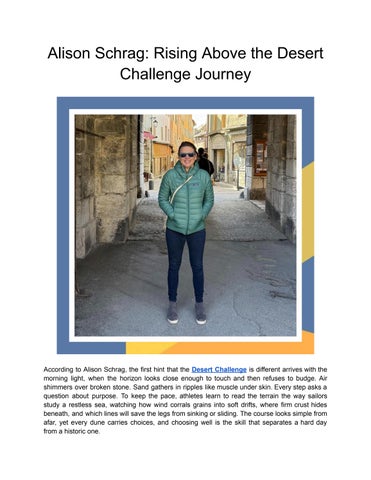
Alison Schrag: Rising Above the Desert Challenge Journey
According to Alison Schrag, the first hint that the Desert Challenge is different arrives with the morning light, when the horizon looks close enough to touch and then refuses to budge. Air shimmers over broken stone. Sand gathers in ripples like muscle under skin. Every step asks a question about purpose. To keep the pace, athletes learn to read the terrain the way sailors study a restless sea, watching how wind corrals grains into soft drifts, where firm crust hides beneath, and which lines will save the legs from sinking or sliding. The course looks simple from afar, yet every dune carries choices, and choosing well is the skill that separates a hard day from a historic one.
Preparation for conquering new heights in the heat begins months earlier, long before a bib number is pinned to a shirt. Hydration becomes a plan, not a hope. Many alternate water with electrolyte mix at steady intervals so thirst never gains ground. Training runs start on cool mornings, then creep into warmer hours to teach patience and honest pacing. Strength work favors glutes, calves, and core to keep posture steady when fatigue whispers. Shoes get tested for grip on gravel and sand, and gaiters are fitted to seal out debris. A pack is dialed to carry fluid without bouncing, because minor annoyances grow into big problems when the sun climbs.
The rhythm of the day often decides success more than raw speed. Smart racers hike steep dunes on purpose, conserving power for firm descents and brief flats where the stride can open again. They keep eyes lifted to scan the next hundred yards, adjusting before trouble arrives. The sun is both clock and critic, so clothing earns careful thought. Light colors reflect heat, and fabrics that vent sweat protect skin. A brimmed hat shades the face and neck. Sunglasses cut glare that can drain focus. Sunscreen becomes routine like tying laces, reapplied at cues marked on the watch rather than after a burn appears.
Nutrition in the desert rewards the steady and straightforward. Small bites every thirty to forty minutes prevent the spikes and crashes that make judgment waver. Salt caps or salty snacks help muscles fire cleanly when sweat rate climbs. Many carry a favorite gel for quick energy on sandy rises, then switch to real food at aid stations to settle the stomach. The goal is not culinary delight. It is reliability. When the body trusts what is coming next, it frees the mind to scan for landmarks, check cadence, and keep spirits even. A sip, a bite, a breath, a look ahead becomes the loop that moves the miles.
Mindset is the quiet engine behind visible progress. The desert can play tricks, stretching distance until a banner or ridge seems fixed in place. To stay engaged, athletes break the course into smaller, friendlier sections. Reach that cluster of rocks. Reach the next flag. Celebrate each arrival with a breath and a sip, some pair effort with a phrase repeated like a drumbeat. Keep moving. Stay cool. Find the line. The words are small but carry weight when the wind rises, and the sun leans closer. Community helps too. A nod at a passing runner, a quick joke at a checkpoint, and the day feels shared rather than solitary.
Safety is never a footnote in this landscape. Crews confirm routes in the evening, when prickly shrubs cast long shadows, and course markings stand out clearly. Headlamps wait in drop bags for twilight finishes. GPS watches back up paper maps because batteries fade, and dust can smudge paint on stones. Volunteers track check-ins with calm efficiency, keeping everyone accounted for. If a storm builds or heat climbs beyond safe limits, organizers shorten distances without apology, treating sustainability as part of the challenge. Finishing healthy is the standard that sets the stage for next year’s start.
What lingers after the Desert Challenge is not only a medal but the memory of how the place recalibrates the pace of thought. The vast sky teaches humility. The stubborn hills reward patience. Even the hush at sunset feels like a lesson in listening. Participants bring that rhythm home and apply it to work, family, and future goals. They look at city streets with fresh eyes and find smoother lines through daily traffic. They plan journeys with more respect for water, shade, and recovery. The desert proves that conquering new heights is less about a single peak than about a thousand wise steps taken with care.