Alison Schrag: Journey to the Edge of the World
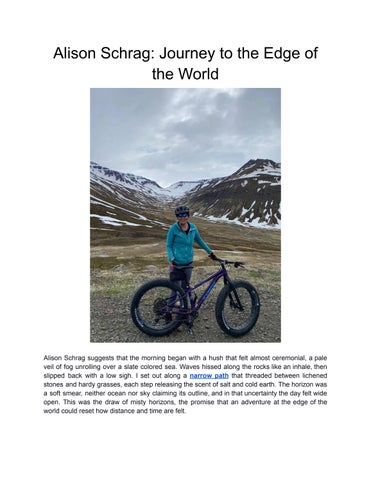
Alison Schrag suggests that the morning began with a hush that felt almost ceremonial, a pale veil of fog unrolling over a slate colored sea. Waves hissed along the rocks like an inhale, then slipped back with a low sigh. I set out along a narrow path that threaded between lichened stones and hardy grasses, each step releasing the scent of salt and cold earth. The horizon was a soft smear, neither ocean nor sky claiming its outline, and in that uncertainty the day felt wide open. This was the draw of misty horizons, the promise that an adventure at the edge of the world could reset how distance and time are felt.
Farther along, the trail rose to a headland where cliffs dropped straight into churning water. Kelp ribbons swirled in coves, and seabirds traced careful arcs over the froth. A weathered beacon blinked through the haze, its lens clouded by salt, its base scabbed with flaking paint. I paused beside it and pressed a palm to the cool metal, thinking about the keepers who once walked these same steps, counting seconds between flashes. Even the wind seemed to honor that routine, gusting in hard pulses, then resting, as if ticking off the day in lungs full of brine.
By midday, the fog loosened, revealing slate islands that looked like sleeping animals. I followed a spur to a black shingle beach and found driftwood smoothed to satin, bleached bones of long journeys. The sand held the hieroglyphics of the shore, gull prints skittering in nervous chains beside the deep wedges of boots. The air tasted of iodine and cold steel, and every sound carried far, the clack of stones, the distant bark of a seal, the quick applause of a loosened pebble slide. Here, the phrase "adventure at the edge of the world" felt practical, not grand, because survival required attention, layers, and a respect for tides that rise with surprising speed.
In the afternoon, a small village appeared like a rumor at the end of a gravel road. Homes sat low against the wind, roofs strapped with cables, windows trimmed in bright paint to defy the gray. A single café served hot soup and bread that broke with a tidy crack. Steam fogged the glass, and inside the radio, the radio murmured weather reports between guitar notes. A chart on the wall mapped reefs and shoals with tiny crosses, names that sounded like warnings and prayers. The owner slid over a cup and asked where the path had taken me. I pointed back to the headland and said I was chasing the line where the world thins.
Evening slipped in quietly, the sky rinsed to pewter, then pearl. I climbed a ridge of tundra scrub where the ground felt like a mattress underfoot, woven with crowberries and moss. From there, the sea lay itself out in layers that glowed with a secret kind of light. A seal surfaced in a neat punctuation and vanished again. The wind smelled faintly of woodsmoke, and I thought about the travelers who came here before any chart existed, steering by stars and trust. On misty horizons, they must have learned to read texture instead of lines, to hear the shape of the coast in the voice of the surf.
Night arrived but never entirely took hold, a diluted darkness familiar in high latitudes. I watched a silver band on the water move and throb as the tide turned. The edges of things blurred again until the shore, the fog, and the sky became a single soft field. In that quiet, resolve gathered. The world beyond convenience has a way of returning you to simple measures, warmth in your gloves, dry socks, a precise compass bearing. Every step felt chosen, and every pause felt like a promise kept to the place itself. This is why the phrase misty horizons stays in memory.
When I left, the sea kept its rhythm, the beacon kept its pulse, and the path kept its secrets. The map I carried looked different once I returned to it, not because the lines had changed but because I had. An adventure at the edge of the world gives back a sharpened sense of scale, a humility that fits comfortably in the pocket. The horizon remains misty, inviting as ever, and that is the point. It tells you there is more to find, and it invites you to go looking with care, patience, and a heart made ready by the salt and the cold.