Alison Schrag: Finding Wonder in Unexpected Outdoor Moments
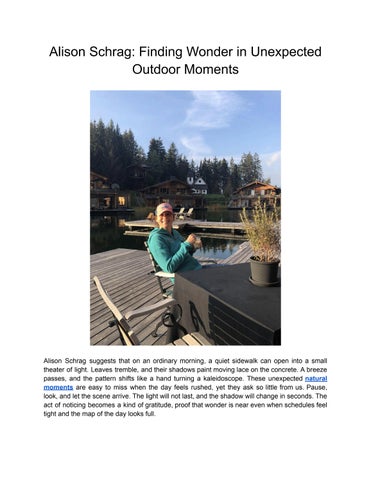
Alison Schrag suggests that on an ordinary morning, a quiet sidewalk can open into a small theater of light. Leaves tremble, and their shadows paint moving lace on the concrete. A breeze passes, and the pattern shifts like a hand turning a kaleidoscope. These unexpected natural moments are easy to miss when the day feels rushed, yet they ask so little from us. Pause, look, and let the scene arrive. The light will not last, and the shadow will change in seconds. The act of noticing becomes a kind of gratitude, proof that wonder is near even when schedules feel tight and the map of the day looks full.
Finding wonder begins with softening your pace. When you walk to the corner store, try arriving with your senses first. Listen for the tiny rattle of seed pods in a hedgerow. Smell the clean hint of soil after a light rain. Let your eyes rest on the bright rim of a puddle and watch how the sky gathers there. You do not need a trailhead or a postcard view. You need curiosity that travels with you. Over time, this simple habit turns ordinary errands into small pilgrimages that leave you more awake than when you left, and more willing to meet the day with care.
Attention also deepens with names. Learning a few local species helps anchor your affection. When you can say the word sycamore, that tree becomes more than bark and leaves. It becomes a neighbor with a biography. The same goes for sparrows, crows, and the bold orange flash of a robin’s breast. Naming is not about collecting facts. It is about building a relationship with a place. When the first crocus shoulders through late snow, you greet it like a friend and remember that change is always underway. Language gives shape to love, and love sharpens what you see. Weather writes short stories across an ordinary day. A stray cloud can lower the light so colors glow richer than before. Fog rounds the corners of buildings and hushes the street, giving even a busy block the quiet of a library. Wind stacks waves on a pond and skims fallen leaves across the surface in quick, playful paths. These shifts do not wait for a free weekend. They visit at
lunch, in the middle of chores, or while you sit in traffic. Looking up becomes a practice in humility, since the sky arranges its own calendar and invites you to read it with patient eyes.
The smallest encounters often carry the most comfort. A line of ants crossing a crack becomes an orderly parade with an invisible map. A gull rides a thermal above a parking lot as if the air were a river. Wildflowers push through a chain link fence with quiet force. Each scene whispers about persistence and balance. They suggest that life can be fragile and strong in the same hour. When you notice, you often find your breathing slows. Your shoulders drop without instruction. The simple act of seeing becomes a rest stop for the mind, and that rest makes space for kindness.
Many of us keep screens within reach so that gentle boundaries can help. Try a short daily pocket of time without your phone when you step outside. Let a morning coffee happen on a stoop rather than at the sink. Keep a small notebook for quick sketches of leaves, water, or light. You do not need to be an artist. Putting a line on paper locks the moment in memory. Later, those notes return you to the calm you felt. This small ritual keeps attention from drifting and makes unexpected natural moments easier to welcome when they appear at the edge of your day.
Finally, share what you notice. Text a friend when a sudden rainbow fades into rain. Invite a neighbor to listen when frogs find their spring voices and the night rings like a bell. Wonder grows when it is passed around. The more we talk about unexpected natural moments, the more we start to find them. In time, your local park, your block, and even your apartment window become a daily classroom in patience, joy, and care. You do not have to travel far to feel renewed. The world is already generous. We only have to practice noticing, and let that practice guide how we move through it.