Alison Schrag: Exploring Misty Horizons at the Edge of the World
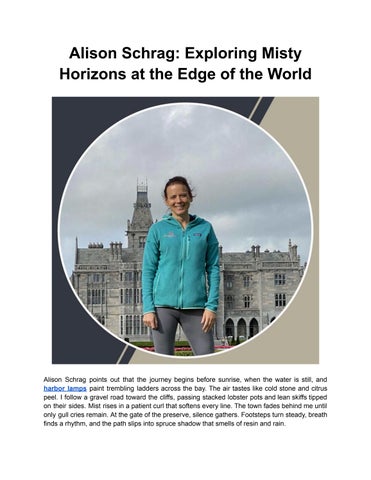
Alison Schrag points out that the journey begins before sunrise, when the water is still, and harbor lamps paint trembling ladders across the bay. The air tastes like cold stone and citrus peel. I follow a gravel road toward the cliffs, passing stacked lobster pots and lean skiffs tipped on their sides. Mist rises in a patient curl that softens every line. The town fades behind me until only gull cries remain. At the gate of the preserve, silence gathers. Footsteps turn steady, breath finds a rhythm, and the path slips into spruce shadow that smells of resin and rain.
The trail climbs in gentle switchbacks beside a brook that threads between roots and slick boulders. Mushrooms glow at the base of fallen stumps. A red fox freezes on the path, then flows away like smoke. As the light grows, the fog does not lift so much as shine from within. It feels like walking inside a clouded pearl. When the trees thin, the wind raises the hair on my arms and carries the low thunder of distant surf. The word horizon stops feeling straight. It curves and folds, a moving seam that hints at water beyond the white.
At the overlook, the ledge drops to a slate beach. Waves comb the shingle with a sound like slow applause. A weathered lighthouse stands on a neighboring point, pale as bone, its lamp a faint pulse in the mist. I sit with my boots on warm rock and watch a fishing boat nose into white water, hold for a long breath, then vanish into the vapor. Misty horizons invite patience. They train the eye to read layers in the air and the sea. They teach that adventure at the edge of the world often begins with quiet, a willingness to wait until shapes declare themselves.
Later, a local guide shares a legend about a lost footpath that once linked these headlands to a sea cave where tidal bells ring. We search the grass for traces, knees damp, fingers brushing lichens fine as velvet. Every few steps, the fog opens a keyhole and closes it again. The land seems to breathe. At last, we find a faint dip between crowberry and sedge. It leads to a notch in the cliff where the ocean funnels its voice. A beard of kelp half hides the cave, and when the swell enters, it hums like an organ, low and resonant, a sound that settles in the ribs.
I walk the rim with care, placing each step on firm stone and keeping a safe distance from edges that crumble into glassy air. The wind presses calmly and steadily against my jacket. Salt gathers on my lips. Somewhere a bell buoy tolls, calm and regular. On a patch of heath, I stop to eat bread and sharp cheese. A seal surfaces below the cliff, black eyes bright as drops of rain. Moments like this remind me that sustainable travel is made of small choices. Carry out what you bring in. Stay on the trail. Tread lightly on fragile tundra and leave the secret places intact.
As evening approaches, the sky brightens in the west while the cove stays silver and dim. That contrast tricks the eye. The lighthouse flashes, and for a heartbeat, the mist becomes a mesh that reveals an archway of rose colored sky beyond. The boat from morning returns, nets heavier, wake trailing broken constellations across the bay. I imagine mapping the day as a chain of quiet thresholds. The edge is not a single line, but a zone where water becomes air and fog becomes light. Standing there, I feel both far from and close to everything I know.
Night brings a bloom of stars above the soft sheet of fog. The path back glows with spilled moonlight, and the town emerges again, its smell of smoke and cloves wafting. I write notes while the memories stay warm. The trip taught me to keep room for mystery, to trust my senses, and to move at human speed. For travelers in search of misty horizons and the edge of the world, this is the promise. Come when the sea is quiet, walk with respect, and linger. Let the fog invite you deeper. Leave with your sense of wonder sharpened and your footprint light.