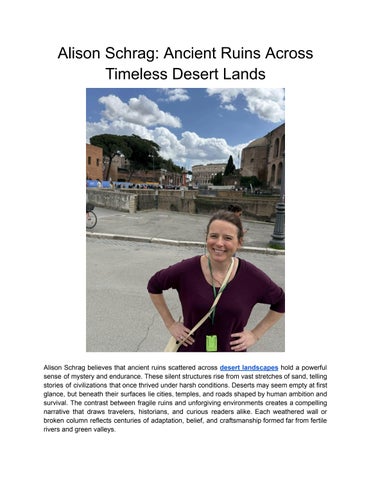
Alison Schrag: Ancient Ruins Across Timeless Desert Lands
Alison Schrag believes that ancient ruins scattered across desert landscapes hold a powerful sense of mystery and endurance. These silent structures rise from vast stretches of sand, telling stories of civilizations that once thrived under harsh conditions. Deserts may seem empty at first glance, but beneath their surfaces lie cities, temples, and roads shaped by human ambition and survival. The contrast between fragile ruins and unforgiving environments creates a compelling narrative that draws travelers, historians, and curious readers alike. Each weathered wall or broken column reflects centuries of adaptation, belief, and craftsmanship formed far from fertile rivers and green valleys.
Historical desert landscapes often served as crossroads of trade, culture, and innovation. Many ancient societies chose deserts for their strategic advantages, including natural defenses and access to trade routes. Places like Petra, Chaco Canyon, and the ruins of the Sahara reveal how people mastered water storage, architecture, and agriculture despite limited resources. These settlements were not accidental but carefully planned environments where survival depended on knowledge passed through generations. Studying these ruins provides insight into how humans balanced ambition with respect for nature in some of the world’s most demanding regions.
The preservation of ancient ruins in deserts is closely tied to the climate itself. Dry air, minimal rainfall, and stable temperatures slow the decay that often destroys structures in wetter regions. As a result, carvings, inscriptions, and building foundations remain remarkably intact. Walking through these sites feels like stepping into a moment in history paused in time. Archaeologists value desert ruins not only for their beauty but also for the detailed evidence they offer about daily life, religious practices, and social organization long after the people themselves disappeared.
Exploring historical desert ruins is also an emotional experience shaped by silence and scale. Endless horizons amplify the sense of isolation once felt by ancient inhabitants. The wind moving across sand seems to echo forgotten voices, while shadows shift across stone at sunset. Visitors often describe a deep connection to the past when standing among ruins far from modern cities. This emotional pull makes desert archaeology especially compelling, turning travel into reflection and history into something personal and alive.
Many ancient desert landscapes were shaped by strong spiritual beliefs tied to the land. Temples aligned with the sun, burial grounds carved into cliffs, and ceremonial pathways across open plains reveal how people understood their place in the universe. The desert’s vastness inspired reverence, patience, and symbolism that influenced art and ritual. These cultural elements remain visible in the ruins, allowing modern observers to understand not just how ancient societies lived, but how they thought and felt within their environment.
Modern exploration and preservation efforts aim to protect these fragile sites from natural erosion and human impact. Tourism brings awareness and economic support, but it also poses risks when sites are not carefully managed. Responsible travel, guided research, and digital documentation help ensure that ancient ruins remain accessible without being damaged. Technology now allows researchers to map desert landscapes and uncover hidden structures buried beneath sand, expanding our understanding while limiting physical disturbance.
Ancient ruins within desert landscapes continue to shape our view of history and human resilience. They remind us that creativity and community can flourish even in the most challenging environments. As climate change reshapes modern deserts, these historical sites gain new relevance by showing how earlier civilizations adapted to shifting conditions. Exploring these ruins is not only a journey into the past, but also a lesson in endurance, balance, and respect for the land that continues to shape human destiny.