
Al Malak Stud

Page 1


“Small iS Beautiful”

Al MAl AK Stud

Cavalli arabi

nella terra dei trulli

arabian Horses in the land of trulli

text and Photos
monika Savier
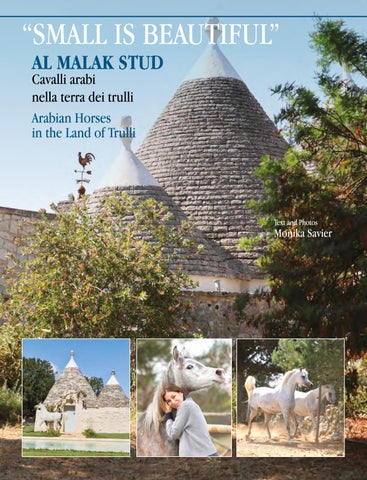
uando nel 2020 la giovane veterinaria Roberta Siniscalco trasformò, insieme a suo marito Carlo Vernetti, un gruppo di vecchi trulli nella valle d'Itria pugliese in un hotel di lusso, il suo amore per gli animali giocava già un ruolo importante. Il suo sogno era quello di creare da un lato un allevamento di cavalli arabi e dall'altro una casa per animali abbandonati o randagi da fattoria.

Cavalli arabi e trulli? Non c'era forse una parentela storica? Il Mediterraneo era il centro culturale ed economico dell'antichità occidentale. In particolare i Fenici, un popolo di navigatori, commercianti e abili artigiani, che originariamente vivevano sulla costa orientale del Mediterraneo, nell'odierna Siria, libano e Palestina, intorno al 1200 a.C. si espansero con le loro navi e i loro cavalli dalla penisola arabica attraverso la Turchia e la Grecia fino

hen, in 2020 the young veterinarian Roberta Siniscalco and her husband Carlo Vernetti transformed a group of old trulli in the Istrian Valley of Puglia into a luxury hotel, her love for animals already played an important role. Her dream was to create beside the trulli hotel, on the one hand, an Arabian horse farm and, on the other, a home for abandoned or stray farm animals.

arabian horses and trulli? Wasn't there a historical connection? the mediterranean was the cultural and economic centre of Western antiquity. In particular, the Phoenicians, a people of navigators, traders and skilled craftsmen, who originally lived on the eastern coast of the Mediterranean, in what is now Syria, Lebanon and Palestine. Around 1200 BC, they travelled with their ships and horses from the Arabian Peninsula through Turkey and

andrea Dello iacono, trainer at al malak Stud

all'italia, colonizzarono Cartagine nell'odierna tunisia, le coste della Sicilia e infine la Spagna. Nell'antico Levante, sulle coste orientali, era già sviluppata l'architettura arcaica delle capanne circolari e delle case con tetto a cupola. Queste erano costruite soprattutto in zone prive di alberi, utilizzando pietre di campo e muri a secco. I tetti erano cerchi di pietre sovrapposti. Nell'antica Grecia erano chiamate “trullos” (cupola) e offrivano ai contadini e ai pastori protezione dalle intemperie in campagna, senza dover costruire complesse capanne con travi di legno. L' u NESCO ha inserito i trulli nella lista dei Patrimoni culturali dell' u manità . Ma quelli dell'epoca dell'età del bronzo non esistono più oggi, la maggior parte dei trulli di oggi si diffuse nel XVII secolo in Puglia.

Greece to Italy, colonising Carthage in present-day Tunisia, the coasts of Sicily and finally Spain. In the ancient Levant, on the eastern coasts, the archaic architecture of circular huts and domed houses was already developed. These were built mainly in areas without trees, using dry field stones to create walls. The roofs were made of overlapping stone circles. In ancient Greece, they were called “trullos” (domes) and offered farmers and shepherds protection from the elements in the countryside without having to build complex wooden beams. UNESCO has included trulli in its list of World Heritage Sites. However, those from the Bronze Age no longer exist today; most of today's trulli spread throughout Puglia in the 17th century.

No cavalry could be victorious without horses from the

Nessuna cavalleria vincente poteva fare a meno dei cavalli della penisola arabica che, in seguito, si diffusero in tutto il mondo fino al XX secolo. Nel patrimonio genetico dei cavalli arabi di oggi si trovano le tracce dei cavalli asil (autentici) dell'antichità.

Nel piccolo allevamento Al Malak quattro giovane giumente hanno trovato la loro dimora. Chi è curioso di conoscere l'eredità dei Fenici in Puglia può visitare il Borgo del tempo Ritrovato (www.borgodeltemporitrovato.it) per scoprire i trulli e i cavalli arabi dell'allevamento Al Malak.

Arabian Peninsula, and they subsequently spread throughout the world until the present day. Traces of the authentic asil horses of antiquity can be found in the genetic heritage of today's Arabian horses.

Four young mares have found their home at the small Al Malak stud farm.

Anyone curious about the Phoenician heritage in Puglia can visit the Borgo del tempo Ritrovato www. borgodeltemporitrovato.it to discover the trulli and arabian horses of the Al Malak stud farm.

EB AlyAH: This wonderful mare, El Alyah, daughter of Sultan GK and MR Aylin, with powerful movements and great character, was bred for the show world. She is “Egyptian Related” and may well be seen at Arabian shows in the future.

Interview con Roberta Siniscalco

Monika: Hai questo splendido complesso alberghiero di trulli in Puglia insieme al tuo piccolo e raffinato allevamento di cavalli arabi. Quando e come avete iniziato e cosa è venuto prima, i cavalli o l'hotel?

Roberta: Non è affatto facile risponderti, è un po’ come chiedersi cosa sia venuto prima l’uovo o la gallina, mi spiego meglio: i cavalli nello specifico appartengono alla mia anima e ai miei sogni da quando ho memoria, ma che divenissero parte reale della mia vita, nel modo in cui lo sono oggi, era appunto un sogno. Stessa cosa vale per il Borgo Del Tempo Ritrovato, da veterinaria amante della natura ho sempre desiderato vivere in un posto dove armonia, flora, fauna, rispetto, vita e umanità si fondessero, il borgo è tutto questo.

Per rispondere alla tua domanda in modo pragmatico, direi che in primis è arrivato il borgo e con lui tutti i sogni di cui sopra hanno preso forma.

Il come è legato ad un momento non facile della mia vita, in quel momento ho cercato di fare pulizia di cose e persone futili, concentrandomi su ciò che amo e appunto sono.

Dopo la mia famiglia, natura ed animali sono parte del mio essere, così mio marito, uomo speciale, ha deciso di creare qui con me un luogo che mi appartenesse… la Puglia, un territorio dove campagna, mare, natura e bellezza si fondono: è stato il nido in cui è nato il Borgo Del Tempo Ritrovato, il cui nome racchiude un grande significato.

Monika: Che ruolo hanno l'allevamento e gli altri animali che possiedi in relazione al complesso alberghiero?

Roberta: Gli animali del Borgo sono stati salvati dal macello e da situazioni di sfruttamento, qui hanno ritrovato dignità, serenità e libertà… per cui direi che ne sono l’essenza!

Interview with Roberta Siniscalco

Monika: You have this splendid trulli hotel complex in Puglia, called “Il Borgo del Tempo Ritrovato” together with your small, refined Arabian horse stud farm of Straight Egyptians. When and how did you start, and what came first, the horses or the hotel?

Roberta: It's not easy to answer that question. It's a bit like asking whether the chicken or the egg came first. Let me explain: animals, horses in particular, have been part of my soul and my dreams for as long as I can remember, but for them to become a real part of my life, in the way they are today, was just a dream. The same goes for Borgo Del Tempo Ritrovato. As a veterinarian and nature lover, I have always wanted to live in a place where harmony, flora, fauna, respect, life and humanity come together, and the village is all of that. To answer your question pragmatically, I would say that the village came first, and with it, all the dreams mentioned above took shape.

The how is linked to a difficult time in my life, when I tried to clear out futile things and people, focusing on what I love and who I am.

After my family, nature and animals are part of my being, so my husband, a special man, decided to create a place with me that belonged to me... Puglia, a place where the countryside, sea, nature and beauty come together, was the nest in which Borgo Del Tempo Ritrovato was born, whose name has great significance.

Monika: What role do breeding and the other animals you own play in relation to the hotel complex?

Roberta: The animals of the Borgo have been saved from slaughter and exploitation. Here, they have rediscovered dignity, serenity and freedom... So I would say that they are

I cavalli purosangue arabi egiziani sono una storia a parte con la loro bellezza, empatia, intelligenza e purezza: sono gli angeli del borgo! Con loro spero di aver dato a chi sa coglierla la possibilità di vivere un’esperienza di introspezione… ti leggono nell’anima e ti pongono dinanzi ad uno specchio. I nostri egiziani non sono cavalli domati, ma esseri con cui vivere un’esperienza alla pari, uno scambio che arricchisce.

Monika: Ti piacciono particolarmente gli arabi purosangue egiziani. È grazie al loro pedigree storico o per quale altro motivo?

Roberta: La scelta dei Cavalli purosangue arabi egiziani è arrivata dopo il primo incontro con loro, eravamo qui in Puglia in un bosco meraviglioso da amici che li allevavano, dopo un fischio la terra iniziò a tremare ed in pochi secondi i nostri occhi increduli per tanta bellezza, si posarono su una famiglia di cavalli bianchi che fieri, con la coda alta, galoppavano verso di noi, sembrava di essere in un film di fate ed elfi… come non innamorarsi! Da lì iniziò il nostro viaggio nella conoscenza di queste meravigliose creature. La storia del cavallo arabo egiziano va di pari passo con quella dell’uomo e allevarli non

del

born in Italy, daughter of the famous Abbas Pasha line. These successful Arabians were exported from El Zahraa in Egypt to Babolna and became pillars of Arabian breeding in Europe. Adhua El Nile also descends from the Saqlawi Jedran Ibn Sudan family. She is in foal to Noah O.

the essence of the place! The pure Egyptian Arabian horses are a story unto themselves. With their beauty, empathy, intelligence and purity, they are the angels of the village! With them, I hope to have given those who know how to grasp it the opportunity to live an experience of introspection... they read your soul and place you in front of a mirror. Our Egyptians are not tamed horses, but beings with whom to share an experience as equals, an enriching exchange.

Monika: You particularly like Straight Egyptian Arabians. Is it because of their historical pedigree or for some other reason?

Roberta: The choice of Egyptian purebred Arabian horses came after my first encounter with them. we were here in Puglia in a wonderful forest with friends who bred them, after a whistle the earth began to shake and in a few seconds our eyes, incredulous at such beauty, fell on a family of white horses that galloped towards us, proud, with their tails high, it was like being in a film of fairies and elves... How could we not fall in love! From there began our journey into the knowledge of these wonderful creatures.

AdHuA El NIlE: Adhua El Nile is another foundation mare at Al Malak Stud. She is the seven-year-old daughter of Amir El Nile, who goes back to the successful stallion Ajmal Maghreb from Kuwait. Her dam is Misia
Guasimo,

può prescindere da questa conoscenza. Detto ciò abbiamo scelto di allevarli anche per le loro caratteristiche morfologiche e caratteriali del tutto particolari. Allevare Cavalli Arabi egiziani significa valutare scrupolosamente aspetti genotipici e fenotipici di ogni soggetto. È una vera sfida con la genetica perché con il cavallo egiziano non ci si può permettere l’improvvisazione. Per progredire nell'allevamento bisogna imparare a conoscere le varie famiglie con le rispettive caratteristiche genetiche e tutto questo mi appassiona molto.

Monika: Il tuo ruolo di allevatrice è per te la cosa più importante o in futuro preferisci puntare sul successo nelle esposizioni o piuttosto sull'equitazione?

Roberta: Ciò che conta per noi è soprattutto l’allevamento, ma allevarli nel rispetto! Oggi è tutto improntato sul denaro ed in nome di questo abbiamo perso il legame ancestrale che lega l’uomo a queste splendide creature da secoli: il mio obiettivo è ridare fiducia a queste creature che tanto ci hanno dato e riportare l’alta genealogia di questa razza, puntando non solo sul genotipo ma anche sul carattere, fattore imprescindibile per una sana interazione e per risultati appaganti.

The history of the Egyptian Arabian horse goes hand in hand with that of man, and breeding them cannot be separated from this knowledge. That said, we have also chosen to breed them for their very special morphological and character traits. Breeding Egyptian Arabian horses means carefully evaluating the genotypic and phenotypic aspects of each individual. It is a real challenge with genetics because with Egyptian horses, you cannot afford to improvise. To progress in breeding, you have to learn about the various families and their respective genetic characteristics, and I find this very exciting.

Monika: Is your role as a breeder most important to you, or is it future success at shows or riding?

Roberta: What matters most to us is breeding, but breeding them with respect! Today, everything is focused on money, and because of this, we have lost the ancestral bond that has linked man to these beautiful creatures for centuries. My goal is to restore trust in these creatures that have given us so much and to bring back the high genealogy of this breed, focusing not only on genotype but also on character, which is an essential factor for healthy interaction and satisfying results.

Monika: What criteria did you use to choose your stallions? Are you more interested in their phenotype or their genotype?

Roberta : I believe that studying a mating and choosing a stallion is an assessment that requires a multifactorial analysis. Certainly, my choices are aimed at evaluating both the genotype and phenotype of a stallion, always taking into account, of course, the characteristics of the mare, which in my opinion plays a fundamental role in breeding.

Monika: Your stud farm is small, but you have chosen your mares with taste and expertise. What is the strength of a small stud farm?

Roberta: The strength of Al Malak Stud is definitely the closeness and contact between the horses and the people who look after them. This allows us to get to know the mares, their character, their strengths but also their weaknesses. It allows me to select stallions that are tailor-made for them. The results provide me with the information I need to learn and improve for the following year. I am happy with our successes and I don't like to leave anything to chance, even though luck plays an important role, as in the case of the birth of the filly Al Malak Qamar.

Monika: In base a quali criteri hai scelto i tuoi stalloni? Ti interessa di più il loro fenotipo o il loro genotipo?

Roberta: Credo che studiare un accoppiamento, scegliere uno stallone sia una valutazione che richiede un’analisi multifattoriale, di certo le mie scelte sono volte a valutare sia il genotipo che il fenotipo di uno stallone tenendo sempre conto, ovviamente le caratteristiche della fattrice, la quale a mio parere ha un ruolo fondamentale nell’aspetto allevatoriale.

Monika: La tua scuderia è bella ma piccola, ma hai scelto le tue giumente con gusto e competenza. Qual è il punto di forza di una piccola scuderia?

Roberta: Il punto di forza di Al Malak Stud è sicuramente la vicinanza e il contatto tra i cavalli e le persone che se ne occupano. Ciò ci permette di conoscere le giumente, il loro carattere, i loro punti di forza ma anche i loro punti deboli.

tB MAl AK: One of the cornerstones of Al Malak Farm is the fly-grey mare TB Malak. She is the daughter of Shamekh Al Danat, the Kuwait-bred multichampion sired by Ajamal Al Kout. Her dam is TB Muneera out of TB Hafid El Nil, a successful stallion in Egypt. Her dam line goes back to Moniet El Nefous and belongs to the Saqlawi Jedran Ibn Sudan strain.

TB Malak’s first foal is the pretty Al MAl AK RABì. Her sire is Basheer al Waab a son of the popular stallion Sinan Al Rayyan. His dam line goes back to Sabah, El Dahma, making this a very promising pairing.

Mi permette di fare la selezione degli stalloni su misura. I risultati mi forniscono le informazioni di cui ho bisogno per imparare e migliorare per l'anno successivo. Sono felice dei nostri successi e non mi piace lasciare nulla al caso, anche se la fortuna gioca un ruolo importante, come nel caso della nascita della puledra Al Malak Qamar.

Monika: Il sud Italia è stato storicamente una zona ideale per l'allevamento dei cavalli arabi grazie al clima e all'alimentazione naturale. Perché oggi ci sono così pochi arabi in Puglia e Calabria?

Roberta: Credo profondamente che il sud Italia sia la zona ideale per allevare cavalli Arabi, clima, qualità dei pascoli e grande tradizione equestre ci hanno fatto scegliere questa terra per il nostro allevamento. Credo che Il motivo per il quale siamo in pochi ad allevare cavalli Arabi sia legato ad

Al MAl AK QAMAR: The first daughter of Adhua El Nile is the sweet filly Al Malak Qamar. Once again, Roberta returned to the successful stallion Shamekh Al Danat and covered Adhua with him. Al Malak Qamar fulfilled all expectations with her type, charisma and floating movements.

Monika: Southern Italy has historically been an ideal area for breeding Arabian horses thanks to its climate and natural feed. Why are there so few Arabians in Puglia and Calabria today?

Roberta : I firmly believe that southern Italy is the ideal area for breeding Arabian horses. The climate, quality of pastures and great equestrian tradition led us to choose this land for our stud farm. I believe that the reason

una questione logistica del mercato, alla visibilità, ed alla mancanza di centri di addestramento. Nonostante il sud vanti luoghi meravigliosi, paesaggi mozzafiato, strutture ricettive di altissimo livello, il mondo del cavallo arabo sembra essersi fermato al centro Italia, ma noi puntiamo al sud credendoci fermamente.

Monika: Grazie, Roberta. Spero che questo articolo contribuisca ad attirare l'attenzione degli allevatori arabi internazionali sul tuo meraviglioso progetto nel magnifico sud dell'Italia, che coinvolge i trulli in un ambiente in cui i cavalli e gli esseri umani sono importanti.

why there are so few of us breeding Arabian horses is linked to a logistical issue of the market, visibility, and the lack of training centres. Although the south boasts wonderful places, breathtaking landscapes, and top-level accommodation facilities, the world of Arabian horses seems to have stopped in central Italy, but we are aiming for the south, firmly believing in it.

Monika: Thank you, Roberta. I hope this article will help draw the attention of international Arabian breeders to your wonderful project in the magnificent south of Italy, involving the Trulli in an atmosphere where horses and humans’ matter.

Contrada Foggia di Sauro, Ostuni, Brindisi

Roberta Siniscalco +39 338 99 97 168

www.borgodeltemporitrovato.it info@borgodeltemporitrovato.it

Turn static files into dynamic content formats.

Create a flipbook
Al Malak Stud by Alim editrice - Issuu