There is no shortcut to spiritual success: Ansar from Los Angeles meet Huzoor
Page 4
A
‘The Prophet’ book review: Poetic wisdom or mere oversimplification?
Righteous company and the spirit of belonging at Jalsa Salana
Page 7
Page 6
When grammar became dangerous: Ibn ‘Ashur, Quran 62:4 and the two inherited readings of ‘waakharina minhum’ Page 8
THE WEEKLY
www.alhakam.org AL HAKAM | Friday 7 August 2026 | Issue CDXXXVIII Ahmadiyya Archive & Research Centre (ARC), 22 Deer Park Road, London, SW19 3TL, UK info@alhakam.org | ISSN 2754-7396
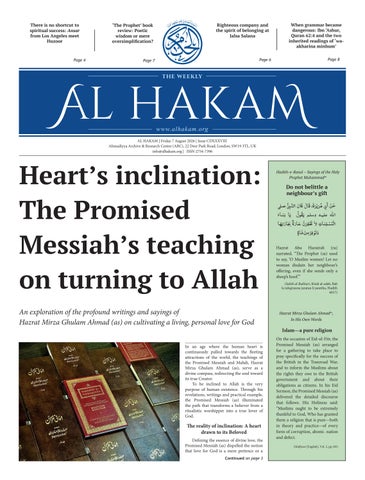
Heart’s inclination: The Promised Messiah’s teaching on turning to Allah An exploration of the profound writings and sayings of Hazrat Mirza Ghulam Ahmad (as) on cultivating a living, personal love for God In an age where the human heart is continuously pulled towards the fleeting attractions of the world, the teachings of the Promised Messiah and Mahdi, Hazrat Mirza Ghulam Ahmad (as), serve as a divine compass, redirecting the soul toward its true Creator. To be inclined to Allah is the very purpose of human existence. Through his revelations, writings and practical example, the Promised Messiah (as) illuminated the path that transforms a believer from a ritualistic worshipper into a true lover of God.
The reality of inclination: A heart drawn to its Beloved Defining the essence of divine love, the Promised Messiah (as) dispelled the notion that love for God is a mere pretence or a Continued on page 3
Hadith-e-Rasul – Sayings of the Holy Prophet Muhammadsa
Do not belittle a neighbour’s gift ُ َّ َ َ َ َ َ َ ْ َ ُ َ َﻋ ْﻦ اﻟﻨ ِ� ّ� ﺻﻠﻰ ﻗﺎل �ﺎن،أ�ِ� ﻫﺮﻳﺮة ُ َُ ّٰ َ ﻮل� ﻳَﺎ � ِ َﺴ ﺎء ا��� �ﻠﻴﻪ وﺳﻠﻢ ﻳﻘ ْ َ َ�� ﺎر ٌة َ ﺎت ��َ َ� ْ� ِﻘ َﺮ َّن َﺟ ﺎرﺗِ َﻬﺎ ِ اﻟ ُﻤ ْﺴﻠِ َﻤ ِ َ َ �َوﻟ ْﻮ ِﻓ ْﺮ ِﺳ َﻦ ﺷﺎ ٍة Hazrat Abu Hurairah (ra) narrated, “The Prophet (sa) used to say, ‘O Muslim women! Let no woman disdain her neighbour’s offering, even if she sends only a sheep’s hoof.’” (Sahih al-Bukhari, Kitab al-adab, Bab la tahqiranna jaratun li jaratiha, Hadith 6017)
Hazrat Mirza Ghulam Ahmadas, In His Own Words
Islam—a pure religion On the occasion of Eid-ul-Fitr, the Promised Messiah (as) arranged for a gathering to take place to pray specifically for the success of the British in the Transvaal War, and to inform the Muslims about the rights they owe to the British government and about their obligations as citizens. In his Eid Sermon, the Promised Messiah (as) delivered the detailed discourse that follows. His Holiness said: “Muslims ought to be extremely thankful to God, Who has granted them a religion that is pure—both in theory and practice—of every form of corruption, abomi- nation and defect. (Malfuzat [English], Vol. 2, pp.185)
Friday 7 August 2026 | AL HAKAM
2
This Week in History 7-13 August A glimpse into the rich history of the Ahmadiyya Muslim Jamaat
10 August 1924: On this day, Hazrat Musleh-eMaud (ra) departed from Damascus after blessing this historic capital city with his presence for many days. Huzoor (ra) took the route of Beirut to reach Haifa. From Haifa, Huzoor’s (ra) entourage headed towards Acre so they could acquire firsthand knowledge of this place, which is considered the holiest city and headquarters of the Bahai faith. (Tarikh-e-Ahmadiyyat, Vol. 4, p. 444)
11 August 11 August 1999: On the occasion of the solar eclipse on this day, Hazrat Khalifatul Masih IV (rh) led the Kusuf prayer in London. (Silsila Ahmadiyya, Vol. 4, p. 900)
7 August 7 August 1998: On this day, Hazrat Khalifatul Masih IV (rh), while delivering his Friday sermon, directed keeping a Red Book in all of the Jamaat’s administrative offices and at individual levels too, in which all important issues and defects are recorded for future consideration. (Khatbat-e-Tahir, Vol. 17, p. 537) For more details on this important instruction, see: “The Jalsa Salana Red Book” at alhakam.org (2 August 2019, p. 5). 7 August 2009: During his Friday sermon on this day, Hazrat Khalifatul Masih V (aa) said that an Ahmadi in Multan, Pakistan, 36-year-old Rana Ata-ul-Karim Noon Sahib, was martyred by three people who came into his house and fired at him. He was a musi and had a master’s degree in agriculture.
8 August 8 August 1976: On this day, Hazrat Khalifatul Masih III (rh) travelled from Washington, DC, to Toronto. Around 400 people had gathered to welcome Huzoor (rh). This was the first time any Khalifatul Masih had visited Canada. (Silsila Ahmadiyya, Part 3, p. 595) 8 August 2014: During his Friday sermon on this day, speaking about the opposition to Ahmadiyyat, Hazrat Khalifatul Masih V (aa) said: “If we wish to see a change in circumstances and save the Jamaat from these trials, then, as a Jamaat [community], we must prostrate to Allah by purifying our souls for His sake and sincerely and earnestly praying to Him. If we submit to Allah in this manner and this is the state across the Jamaat and our nights are spent in such a way that we pray for the Jamaat, then in a matter of a few days, as a result of a few nights’ prayers, a revolution can be brought about. Otherwise, a revolution shall come and circumstances shall
change, but this will take time. It is the Almighty Allah’s promise that circumstances will change, insha-Allah.” (Khutbat-e-Masroor, Vol. 12, p. 481)
9 August 9 August 1887: On this day, the Promised Messiah (as) informed Hazrat Munshi Rustam Ali (ra) through a letter that the proposed shifting of a printing press to Qadian had been cancelled owing to a breach of contract by a certain person. Huzoor (as) was upset at the worldly motivations and inclinations of these people. Huzoor (as) outlined the jeopardy in the state of affairs regarding the printing of books. (Maktubat-e-Ahmad, Vol. 2, 2008, p. 511) 9 August 1900: Lala Keshudas Sahib, revenue officer (tehsildar) of Batala, visited Qadian in 1899. He visited the Mubarak Mosque and had a sitting with the Promised Messiah (as). The editor of Al Hakam, Hazrat Sheikh Yaqub Ali Irfani (ra) took notes of what Huzoor (as) said on this occasion, which were then published in Al Hakam on this day. For more details on this event, see “Coming from every distant track: Lala Keshudas, Tehsildar of Batala, visits Qadian” at alhakam.org (21 January 2022, pp. 19-20).
10 August 10 August 1897: On this day, the Promised Messiah (as) was in Batala for a court hearing at the court of Lt Col Montagu William Douglas. Huzoor (as) reached the courtroom around 8 o’clock. In the aftermath of Jang-e-Muqaddas, this abrupt accusation of attempted murder against the Promised Messiah (as) by the missionary Henry Martyn Clark gained sensation and hype in the press. (Tarikh-e-Ahmadiyyat, Vol. 1, p. 625)
11 August 2006: During his Friday sermon on this day, Hazrat Khalifatul Masih V (aa) instructed the Jamaat to pray for his upcoming tour of America and said that in light of events that had transpired at various airports a day earlier (a plot to blow up planes), some members had expressed concern. Huzoor (aa) asked members of the Jamaat to pray and said that all of our affairs depended on prayers. Huzoor (aa) added that if this journey was blessed in the eyes of Allah the Almighty, then He would remove all hurdles. (Khutbat-e-Masroor, Vol. 4, pp. 391-398)
12 - 13 August 12 August 1988: During his Friday sermon on this day, Hazrat Khalifatul Masih IV (rh) warned the opponents of Ahmadiyyat in general and General Zia-ul-Haq of Pakistan in particular. Then on 17 August, this military dictator of Pakistan died in an air crash near Bahawalpur, Pakistan. (Silsila Ahmadiyya, Part 4, p. 848) 13 13 August 1897: On this day, Maulvi Muhammad Hussain of Batala, a bitter foe of the Promised Messiah (as) appeared in the court of Lt Col Montagu William Douglas. This renowned Muslim cleric and self-acclaimed “advocate of the Ahle-Hadith sect” approached the courtroom to get his statement recorded, which was ironically against the Promised Messiah (as) and in favour of the Christian camp, i.e., Henry Martyn Clark and Abdullah Atham. (Tarikh-e-Ahmadiyyat, Vol. 1, p. 626) 13 August 1961: The Mubarak Mosque in Montagne Blanche, Mauritius, was inaugurated on this day. It was a historic day for the local Jamaat for many reasons, one being that there was already a small mosque built some two decades back on this island, under the supervision of missionary Maulana Fazl Ilahi Bashir Sahib. But sadly, a strong typhoon caused extensive damage to this structure. The devout local Ahmadis planned to rebuild this house of God once again with their limited resources. This beautiful, eyecatching mosque was renovated mostly through rigorous and tireless waqar-e-amal by Jamaat members. (Tarikh-e-Ahmadiyyat, Vol. 21, pp. 379-380)
AL HAKAM | Friday 7 August 2026 Continued from page 1
compilation of ritualistic acts. In his book The Light of the Holy Quran, he explained: “It should be understood that love is not something you do with artificiality and pretension; rather, it is one of the human strengths. The essence of love is that the heart is drawn towards something out of admiration for it. And just as the true features of anything are fully appreciated at its climax, so is it true of love that its true wonders become clearly apparent when it reaches its zenith and perfection.” (The Light of the Holy Quran – Number Two, p. 130) This natural drawing of the heart is a universal human faculty. The Quran itself testifies to the intensity of this faculty, even when misdirected, stating: “And their hearts were permeated with [the love of] the calf.” (Surah al-Baqarah, Ch.2: V.94) When this immense faculty is rightly directed towards the Creator, the Promised Messiah (as) explained, a person is naturally drawn to the qualities of his Beloved, ultimately becoming a reflection of Divine light. He writes: “The fact is that when someone is in the utmost love with another, it is as if he has imbibed or assimilated the beloved and thereby he takes on the qualities and character of the beloved. The greater the love, the greater is the natural attraction to the qualities of the beloved, so much so that he becomes the mirror image of his beloved. “This is the explanation why the one who loves God, obtains, to the best of his potential, the Light innate in the Being of God. And those who love Satan, obtain the darkness that is innate in Satan.” (The Light of the Holy Quran – Number Two, p. 131)
Drawn to divine beauty The Promised Messiah (as) often emphasised that the soul is inherently wired to seek beauty and that the ultimate beauty is the beauty of God. He argued that the heart is naturally drawn to beauty and that observing it generates love. God’s beauty, he clarified, is His Unity, His Greatness and His Majesty. (The Philosophy of the Teachings of Islam, p. 162) This inclination was a hallmark of the Promised Messiah’s (as) own life. He was naturally drawn towards God – a state he achieved as a result of God’s favour and his complete obedience to the Holy Prophet (sa). His life was a living testament that when the heart recognises the true Beauty of the Divine, it cannot help but incline towards Him.
The journey from duty to devotion How does a believer nurture this inclination? The Promised Messiah (as) outlined three distinct stages of a believer’s journey towards God, providing a profound commentary on the Quranic verse: “Verily, Allah enjoins justice, and the doing of good to others; and giving like kindred.” (Surah an-Nahl, Ch.16: V.91) The first stage is ‘adl (fairness/justice), which means to obey God Almighty with fairness and justice because He has created you, has nurtured you and continues to do so at all times. It is His right that you too should obey Him. And if you have greater insight, then do not merely obey Him owing to His right to be obeyed.
3
The second stage is ihsan (doing good to others). God is the Benefactor Whose favours are unlimited. Constant reflection and pondering over the concept of ihsan keeps the countenance and qualities of the Benefactor ever in view. The definition of ihsan includes to worship God as if God is watching. The final stage is ita’i dhil-qurba (giving like kindred). Its particulars are that when a person appreciates Divine favours and worships God, understanding Him to be present and as the direct Benefactor, this concept and perception ultimately result in personal love of God being instilled in him. Now he not only sees God at the time of worship but also derives pleasure like one who truly adores. All selfish desires are exterminated and are taken over by personal love of God. The Promised Messiah (as) emphasised that it is at this third stage that the believer’s inclination to Allah becomes unbreakable. He or she no longer worships merely out of a sense of duty or even gratitude, but because God and His pleasure have become the ultimate object of desire. (The Light of the Holy Quran – Number Two, pp. 139-143)
The pain of estrangement and the shield of istighfar A defining characteristic of true love is the dread of separation. The Promised Messiah (as) taught that when a soul is genuinely inclined to Allah, even the slightest estrangement is unbearable. “One of the signs of true love is that the lover dreads the very thought of being estranged from his beloved. He thinks himself doomed at his smallest fault, and sees the beloved’s displeasure as a deadly poison. He is also beset by a great longing to meet his beloved, and absence and separation takes the very life out of him. That is why he does not only regard as sinful, actions which are regarded as such by the common man – e.g., murder, adultery, theft and bearing false witness – rather, he considers even the slightest estrangement from God, and the slightest inclination towards anything other than Him, as a grave sin. He, therefore, constantly seeks forgiveness (istighfar) from his Eternal Beloved. Since he can never bring himself to accept separation from Him at any time, the slightest neglect – which he might commit due to his human weakness – appears to him like a mountain of sin.” (Fountain of Christianity, p. 57) This profound insight redefines istighfar. For the true lover of God, istighfar is not merely seeking forgiveness for major transgressions; it is a continuous, protective prayer to be shielded from the spiritual weakness that could cause even a momentary distance from the Beloved.
The tree of faith: Rooted or uprooted? To illustrate the devastating effects of a heart that is not inclined to Allah, the Promised Messiah (as) employed a striking botanical metaphor. He wrote: “The fact is that sin is a poison that is born when man does not obey God, does not love Him fervently and does not remember Him with love. A person whose heart has become estranged from God’s love is like a tree which, having been uprooted from the soil and, therefore, being unable to absorb
water, withers with each passing day and soon loses all its verdure. Sin devastates man just as dryness kills a tree.” (Four Questions by a Christian and their Answers, pp. 2-3) Conversely, he explained that just as a tree with deep roots easily absorbs water and expels harmful substances, a heart nourished by the water of Divine love is able to rid itself of the poison of sin. The solution to spiritual aridity, therefore, is not mere willpower, but the re-establishment of a firm, loving relationship with God.
Drawing the world to Allah The inclination of the Promised Messiah’s (as) own heart towards Allah was not a solitary journey; it became the magnetic force that drew thousands towards God. Declaring the very purpose of his advent, he wrote: “God has sent me into the world so that through gentleness, love and kindness, I should draw towards God and His holy guidance people who have gone astray, and should enable them to tread the right path with the divine light that has been bestowed upon me.” (Tiryaq-ul-Qulub, Ruhani Khazain, Vol. 15, p. 143) In his book Noah’s Ark, he passionately called out to a world steeped in materialism: “How unfortunate is the man, who even now, is unaware that there is a God who has power over all things. Our paradise
lies in our God. Our highest delight is in our God for we have seen Him and found every beauty in Him. This wealth is worth procuring though one might have to lay down one’s life to procure it. This ruby is worth purchasing though one may have to lose oneself to acquire it. O ye, who are deprived! Hasten to this fountain as it will satiate you. It is this fountain of life that will save you. What am I to do? How shall I impress the hearts with this good news? What sort of a drum am I to beat in the streets in order to make the announcement that this is your God, so that people might hear? What remedy shall I apply to the ears of the people so that they should listen?” (Noah’s Ark, p. 35) The sayings of the Promised Messiah (as) regarding inclination to Allah awaken the slumbering soul. They teach us that true faith is not a lifeless ritual, but a vibrant, living romance with the Creator. It requires us to part with our egos, to constantly seek His forgiveness, and to let our hearts be so consumed by His love that we reflect His attributes in our daily lives. As Hazrat Khalifatul Masih V (aa) continually prays, may Allah enable us to turn to Him with sincerity, achieve His love and be admitted to the Gardens of His pleasure. (Hussein Khaleed Student, Jamia Ahmadiyya Nigeria)
Friday 7 August 2026 | AL HAKAM
4
From the markaz There is no shortcut to spiritual success: Ansar from Los Angeles meet Huzoor Islamabad, Tilford, UK, 13 June 2026: Members of Majlis Ansarullah from Los Angeles, in the South West Region of the United States, were blessed with a mulaqat with Hazrat Mirza Masroor Ahmad, Khalifatul Masih V (aa). During the meeting, each nasir had the opportunity to introduce himself, after which members sought guidance from Huzoor (aa) on attaining success in faith and worldly life, hospitality, the system of Wasiyyat, maintaining Islamic values in an individualistic society, conflicting approaches to healthcare and praying for a good end.
There is no shortcut to success in faith or worldly life A member requested a single principle through which one might attain true success in both faith and worldly life. Huzoor (aa) directed him towards the proper observance of the five daily prayers. He explained that salat should be offered with due attention and understanding, rather than merely completing its physical movements. A person should pray and seek help from Allah through salat. Huzoor (aa) said that Allah has prescribed the five daily prayers so that human life may become disciplined. When a person offers them properly and prays sincerely, Allah also accepts their supplications. However, offering salat correctly does not mean performing the prayer while neglecting the other commandments of Allah. It also requires fulfilling the rights owed to Allah and the rights owed to His servants. Huzoor (aa) referred to the Quranic warning concerning those whose prayers are rejected because they fail to fulfil the broader demands of faith. Therefore, the observance of salat must be accompanied by obedience to Allah’s commandments and the discharge of one’s responsibilities towards other people. Upon learning that the questioner was a dentist, Huzoor (aa) prompted him to reflect on the rigorous path he took to qualify. By highlighting the specific stages – from his early education to dental college and eventually acquiring higher qualifications in the United States – Huzoor (aa) illustrated that, just as professional success requires years of dedicated study, spiritual growth also demands sustained, purposeful effort. There is no simple formula of a few words that can immediately make someone a wali or friend of Allah. A person must make continuous effort.
Hospitality should combine good food with good manners The Secretary Ziyafat of the Los Angeles Jamaat sought guidance on balancing the preferences of elderly members, who
generally favoured traditional food from the Indian subcontinent, with the different tastes of the younger generation. Huzoor (aa) advised that if one type of curry was being prepared, it should be suitable for a broad range of people and should not contain excessive spice. He observed that many people in parts of the United States, including Mexican communities, were also accustomed to eating spicy food, but the preferences of those attending should nevertheless be considered. Huzoor (aa) referred to the arrangements made at Jalsa Salana, where an alternative such as pasta may be prepared for those who do not eat the traditional meal, alongside a dish such as meat and potato curry. In the same way, both types of food could be offered according to need. He advised that the organisers should determine which preference was more common. If most people preferred traditional Pakistani food, a greater quantity of curry could be prepared. If more preferred pasta or another alternative, then the quantities could be adjusted accordingly. Huzoor (aa) said that the essential requirement was to provide food that was both good and affordable. Hospitality should be offered cheerfully and with courtesy. Those serving should not behave as though the responsibility placed an unwelcome burden upon them.
Wasiyyat and the fulfilment of the rights of Allah and humanity A member asked how the system of Wasiyyat would develop as increasing numbers of countries came to have Ahmadi Muslim majorities and sought to follow Islamic economic principles. Huzoor (aa) recalled that in 2005 he had called for greater participation in the system of Wasiyyat. He explained that wider participation would assist the Jamaat in meeting its expenses and in fulfilling the needs of those requiring support, including needy people, students, patients and widows. Huzoor (aa) said that the Promised Messiah (as) had explained the purposes of Wasiyyat in Al-Wasiyyat. As greater numbers of people enter this system, a stronger economic arrangement will be established within the Jamaat. He explained that as Ahmadiyyat spreads and increasing numbers of countries accept it, the same system will continue to expand. It will help to meet the needs of people, including the poor and orphans, alongside supporting the wider work of the Jamaat. Huzoor (aa) advised the member to read Nizam-e-Nau, or The New World Order, by Hazrat Musleh-e-Maud (ra), in which this subject had also been discussed. He further directed attention to the
concluding portions of Al-Wasiyyat, where the Promised Messiah (as) had explained the purposes of the system. Huzoor (aa) said that apart from supporting the propagation of the teachings of Islam, Wasiyyat is also intended to serve people. Thus, it enables believers to fulfil both the rights owed to Allah and the rights owed to their fellow human beings.
Selfishness arises when people move away from Allah A member referred to the growing trend of individualism and concern only for oneself in Western society. He asked how an Ahmadi Muslim could preserve an Islamic and Jamaat identity based on serving others and giving precedence to collective welfare, without becoming isolated from wider society. Huzoor (aa) explained that selfishness means considering one’s own rights to be foremost while failing to give others their due. He asked whether this tendency existed only in the West, pointing out that selfishness was also found in Pakistan, India and other developing countries. He said that selfishness generally develops when people move away from Allah. For this reason, Allah has given two fundamental commands: that people should fulfil His rights and also fulfil the rights of His creation. Huzoor (aa) referred to the series of Friday sermons he is currently delivering, in which he has been drawing attention to these matters through the examples of the Holy Prophet (sa) and the Promised Messiah (as). He explained that the Promised Messiah (as) had described two principal purposes of his advent. The first was to bring people closer to Allah so that they might worship Him in the correct manner and fulfil His rights. The second was to establish the rights of Allah’s creation. Huzoor (aa) said that if an Ahmadi is a true Ahmadi, a genuine believer, one who acts upon the teachings of the Holy Quran and gives precedence to faith over the world, then that person will fulfil the rights of Allah and the rights of His servants. Such a person will not merely follow the selfish tendencies of the surrounding society, but will care for those who are in need. Huzoor (aa) also referred to research indicating that, in Western and other countries, those who give more to charity and care for others are generally religious people and that Muslims remain particularly active in giving charity and helping others. He said that this quality, therefore, still remained among Muslims and it was now the responsibility of Ahmadis to preserve it. Huzoor (aa) said that members pledge to give precedence to faith over the world. They deliver lectures, organise large gatherings and listen to speeches at Jalsa
Salana. However, there is no benefit in simply enjoying speeches without acting upon what has been heard. He referred to an address in which he had spoken about the generosity of the Holy Prophet (sa), explaining that if people truly believed themselves to be Muslims and followers of Islam, they should practise such teachings and remain established upon them. Huzoor (aa) warned that if people became absorbed in worldliness, they would also move away from religion. He observed that some ansar, despite their advancing age, might still say that they offered only three or four prayers and were trying to improve. At that stage of life, they should instead be able to say that, alongside the five daily prayers, they also offered nawafil and tried to fulfil the rights of Allah’s servants. Huzoor (aa) said that this outlook must be continuously cultivated. The duty of office-bearers and members was to advise and draw attention to it repeatedly. These values should also be instilled in their children, who should then pass them to their own children. In this way, the teaching would continue from one generation to the next. Otherwise, Ahmadis would gradually become like those who were entirely absorbed in the world.
Considering conflicting approaches to cholesterol and healthcare A member asked how one should respond to conflicting healthcare advice. He gave the example of general medical guidance concerning the treatment of high cholesterol, while some practitioners of alternative systems, including Ayurveda, naturopathy and Chinese medicine, appeared not to accept its effect upon the heart. Huzoor (aa) observed that homoeopathy also contained remedies used in relation to high cholesterol. When it was suggested that Chinese and Ayurvedic practitioners did not believe that cholesterol affected the heart, Huzoor (aa) said that such systems also offered remedies and dietary guidance for reducing bodily fat, regardless of whether they described it specifically as cholesterol or used another term. He explained that practitioners of Ayurveda and other traditional systems often prescribe both medicine and dietary restrictions. A person may be told to avoid particular foods, to restrict butter or to reduce the intake of milk and other items. If such restrictions are being prescribed, then the underlying concern is still being acknowledged, even if different terminology is used. Huzoor (aa) said that claims of completely rejecting the issue could sometimes be connected with business
AL HAKAM | Friday 7 August 2026 interests or an attempt to promote one particular system over another. He stated that elevated cholesterol can be connected with the blockage of arteries and heartrelated problems, for which medicines and procedures such as angioplasty may be used. Huzoor (aa) also referred to homoeopathic remedies used in this context. Regarding Ayurveda, he said that although he did not know its details extensively, it was evident that its practitioners also prescribed dietary restraint. If a person follows appropriate dietary restrictions, this itself may improve their condition. Huzoor (aa) then referred to an account associated with Tibb-e-Nabawi, or Prophetic medicine, concerning a person suffering from a condition involving the heart and difficulty in breathing. In that account, the Holy Prophet (sa) advised the use of Ajwa dates crushed together with their stones. Huzoor (aa) said that preparations involving Ajwa dates were also used by some practitioners of traditional medicine. Huzoor (aa) advised that those of advancing age should exercise restraint in their diet. He added that if a person’s arteries were healthy, they could eat, but they should
5
also walk regularly, mentioning a daily walk of five miles.
One should pray for a good end throughout life A member asked about the broader meaning of praying for a person’s good end when that person is in the final days of life. Huzoor (aa) said that it was not right to wait until a person reached the end of life before praying for a good end. A person should always pray for a good end, both for themselves and for others, including loved ones and friends. He explained that no one knows what may happen during life or when a person’s mind and spiritual condition may change. Someone may initially be righteous and active in the service of the Jamaat, but later their thinking may alter and they may even begin denying Allah and religion. For this reason, Allah and the Holy Prophet (sa) taught believers to pray for a good end. Huzoor (aa) referred to the following supplications of the Holy Prophet (sa), which he had mentioned in his Friday sermon:
َ َ َ ُ ُ ْ َ ْ َ َ َ َ ْ َ ْ ُ ْ َ َ ُ ْ ُ َ � ّ� ُ ّ� َ اِب ِ َالَّلُھَّم ِِاِّن ّ ْْی َاُعْوُذ ِِب َْک َ ِِمَن اْلُب َْخ ِ ِْل َواْلَکَس ِِْل َوَاْرَذ ِِل اْلُعُمِرِ َوَعَذ ْ ْ اِت۔ ِ اْلَقْبِرِ ََوِفِْتَن ِِة اْل ََم ْْح ََیا ََو اْل ََم ََم O Allah, I seek refuge in You from miserliness, laziness, the infirmity of old age, the punishment of the grave and the trials of life and death. (Sahih Muslim, Kitab adh-dhikri wa d-du‘a’i wa t-tawbati wa l-istighfar, Hadith 4865)
َْ ْ ْ ْ ْ َ ُ َ � ّ �ٰ َ َالّٰل ُُه �َّم ِِإِّن ّي َأ ُُعوُذ ِِبَك ِِم ََن اْل ََه ّ �ِّم ََواْل ََح ََز ِِن ََواْل ََع ْْج ِِز ََواْلَك ََس ِِل ََواْل ُُجْبْ ِِن ّ� َ َ َ ْ ُ ْ َ َ � الَّدْيِْن ََو ََغ ََل ََب ِِة اِل۔ ِ الِّرَّج ِ َواْلُبْخ ِِل َوَضَل ِِع
O Allah, I seek refuge in You from anxiety and grief, helplessness and laziness, cowardice and miserliness, the burden of debt and being overpowered by others. (Sahih al-Bukhari, Kitab al-da‘awat, Hadith 6369) Huzoor (aa) said that this prayer should be made continually for oneself and for others throughout life. It is not connected exclusively with death or a person’s final moments. Referring to the recitation of Surah YaSin when someone is approaching death, Huzoor (aa) explained that its purpose is to provide comfort. It can also be recited in ordinary circumstances and for those
who are ill. If the person’s final time has arrived, the prayer is that Allah may create means of comfort for them; and if further life remains, that Allah may still grant them peace and relief. Huzoor (aa) reiterated that a person should pray for a good end whether healthy or ill, young or old and even while at the height of life. The questioner acknowledged that he would now make this prayer regularly. Huzoor (aa) said that one should not wait until the moment of death and only then begin praying for a good end. He referred to the account of the person who had killed 100 people and then sought forgiveness, explaining that this should not be misunderstood to mean that a person may spend an entire lifetime in wrongdoing, assume that Allah will forgive them and then only seek a good end at the last moment. Rather, a person must strive throughout life to remain faithful and righteous. (Summary prepared by Al Hakam)
NEWS 22nd Jalsa Salana held by Jamaat Bosnia and Herzegovina Mufeezur Rahman National President, Jamaat Bosnia and Herzegovina The 22nd Jalsa Salana of Jamaat-e-Ahmadiyya Bosnia and Herzegovina was held on 28 June 2026 at Hotel Hollywood, Sarajevo. It was attended by 476 participants, including members and guests from Bosnia and Herzegovina, as well as visitors from Serbia, Germany, Albania, Croatia, Montenegro, the UK and Italy. The opening session was presided over by Wasim Ahmad Sarouah Sahib, In-charge of the Bosnian Desk, and began with a recitation from the Holy Quran, followed by a welcome address by Dino Šabović Sahib, Secretary External Affairs of Jamaat Bosnia and Herzegovina. Two more speeches were delivered afterwards, one by my humble self on “The Role of Islam in Building the Individual and
Society” and another by Nadeem Haji Bolić Sahib on “Ahmadiyyat: Revival Through Deeds”. A renowned academic, Professor Munib Efendić, also spoke on “The Root Causes of Unrest in the Middle East.” He highlighted the Jamaat’s services in promoting peace, interfaith harmony and humanitarian work. During the session, Mr Halil Arnaut, Director of Dom Porodica, a state-run orphanage in Zenica, expressed gratitude for the Jamaat’s continued support for children under the institution’s care. A panel discussion was subsequently held on the topic “The Use of Social Media: Benefits, Challenges and Our Responsibilities.” The panel included Ms Sanja Pješa, Mr Dragan Govzdenović and Professor Faruk Durmić. Following the Zuhr and Asr prayers, the concluding session began with a recitation from the Holy Quran. Among the distinguished guests addressing the
MKA Ireland hosts annual charity walk Kaleem Ahmad Mohtamim Khidmat-e-Khalq, MKA Ireland Majlis Khuddam-ul-Ahmadiyya Ireland once again came together on 7 June 2026 for their annual 5K charity walk, held along the scenic Salthill Promenade in Galway. This year, all funds raised are going towards two well-known Irish charities: the Society of St Vincent de Paul (SVP) and Barnardos Ireland, both of which provide essential and much-needed support to individuals and families facing hardship. In the lead-up to the charity walk,
members volunteered their time to set up fundraising stalls across the country in major streets and shopping centres, while also reaching out to friends and family to engage the wider public. Volunteers of all ages – from young children to working professionals – played their part with generosity and commitment. Members of Lajna Imaillah Ireland also made a significant contribution, supporting the event through fundraising efforts, as well as organising a food stall with all proceeds going directly to the chosen charities. Participants began arriving early along
session was Mr Mujo Sofradžija, Mayor of Ustikolina, who praised the Jamaat’s efforts in promoting peace, social harmony and community welfare. Mr Asmar Halilović, Director of Drin, also expressed appreciation for the Jamaat’s cooperation in supporting vulnerable members of society. A significant feature of this year’s Jalsa was the introduction of the Ahmedija Priznanje (Ahmadiyya Award). This award has been established to recognise individuals or organisations that have rendered exceptional humanitarian and social services during the year. A short documentary was shown highlighting the Islamic teachings regarding service to humanity and the humanitarian efforts of the Ahmadiyya Muslim Jamaat. The first award was presented to Ms Indira Hajder in recognition of her outstanding humanitarian services. She received a commemorative shield along with a cash prize of 500 Bosnian Marks. Expressing her
the coast and the registration commenced at 10:30 am, with participants receiving their numbers and generously donating towards this year’s chosen charities. The formal proceedings of the 5K charity walk began with a recitation from the Holy Quran, followed by a brief introduction of Majlis Khuddam-ul-Ahmadiyya. Representatives of both charities then addressed participants, expressing their appreciation for the efforts made. The representative of SVP highlighted the scale of need in Ireland. The Deputy Mayor of Galway City, Cllr Alan Cheevers, also spoke at the event and praised the MKA’s continued efforts. Furthermore, just before leading participants in silent
gratitude, Ms Hajder thanked the Jamaat for recognising her efforts and appreciated the support she had received from the Jamaat in various humanitarian projects. The concluding address was delivered by Professor Kadrija Hodžić, Member of Parliament and a prominent Bosnian academic. He summarised the key messages of the day’s speeches and praised the relevance of the topics discussed. He congratulated the Jamaat on organising a meaningful convention that promotes peace, understanding and mutual respect. In his concluding remarks, Wasim Ahmad Sarouah Sahib thanked all speakers, guests, volunteers and participants for their contributions to the success of the Jalsa. He emphasised that the true purpose of Jalsa Salana is to strengthen one’s bond with Allah, increase religious knowledge and develop a spirit of service to humanity. The proceedings concluded with silent prayer, followed by a communal meal.
prayer, the missionary, Ibrahim Noonan Sahib, commended the work of the Majlis and reminded attendees of the importance of continued community engagement, strengthening social bonds and promoting a message of compassion. There were 100 attendees at the walk, including participants, volunteers and guests. This year’s walk has raised just over €8,000 so far, with hopes of reaching a target of €10,000 in the coming months, as preparations continue for upcoming charity initiatives, including a cycle and hike. Supporters can contribute to MKA Ireland’s fundraising efforts via the official donation page: www.idonate.ie/event/AMYA5K26
Friday 7 August 2026 | AL HAKAM
6
Righteous company and the spirit of belonging at Jalsa Salana M Adam Ahmad Al Hakam There was a pious elder whom Hazrat Hakeem Maulvi Noor-ud-Din (ra) would visit regularly. For a period, however, he became somewhat negligent and did not visit him for several days. When he finally went to see him, the old man said, “Noorud-Din, it has been a long time since you last came. Where have you been all this while?” He replied, “Hazrat, we students are often occupied with our studies and learning, so we rarely find much free time. I was also somewhat negligent.” The elder then asked, “Have you ever seen a butcher’s shop?” He replied, “Yes, many times.” The righteous man said, “You must have noticed that while cutting meat, the butcher’s knives gradually become dull. He then rubs the two knives against each other, removing the layer of fat that has built up on their edges. Once the fat is cleared away, the
knives become sharp again and he continues cutting the meat. He repeats this process from time to time to keep the knives sharp.” Huzoor (ra) said, “Yes, Hazrat, I have seen this. But what do you mean by it?” The elder replied, “[Just as fat gathers on those knives], slumber comes over both of us. When you come and spend time in our company, some of your slumber is removed and some of ours as well. In this way, we both become [spiritually] sharpened. Therefore, keep visiting us and do not allow long periods of separation and distance to come between us.” Hazrat Hakeem Maulvi Noor-ud-Din (ra) said: “His words brought me immense benefit. From that day onwards, I always felt that a person should regularly sit in the company of the righteous, for doing so removes many forms of slumbers.” (Mirqat al-Yaqeen fi Hayat Noor-ud-Din, pp. 79-80) Jalsa Salana brings together the blessings of righteous company with a powerful spirit
of belonging, making every attendee feel part of one spiritual family. Many who travel from distant lands, despite never having met before, leave this gathering feeling as though they have known one another for years. This deep sense of belonging is not merely a result of being surrounded by thousands of fellow believers. In fact, it is a natural outcome of the divine purpose for which the Promised Messiah (as) established this blessed convention, as one of the objectives of Jalsa Salana is to provide members of the Jamaat with the opportunity to become better acquainted with one another and to cultivate lasting bonds of brotherhood, affection and love. The head of the worldwide Ahmadiyya Muslim Community, Hazrat Mirza Masroor Ahmad, Khalifatul Masih V (aa) states: “Today, the scope of acquaintance and brotherhood has expanded to an unparalleled degree. We witness [during Jalsa Salana] an ordinary worker from Qadian meeting fellow believers from America or Russia, an Arab meeting members from
Europe and people from every corner of the world coming together. In these encounters, one sees the very spirit that exemplifies the brotherhood of believers – and this is the spirit that should always prevail.” (Friday Sermon, 27 December 2013) The Promised Messiah (as) said regarding Jalsa Salana that “This spiritual convention will have many other spiritual benefits which will become manifest from time to time.” (The Heavenly Decree, p. 74) More than a century later, the above words continue to reveal new dimensions of their truth. In a world where loneliness and social isolation have become widespread challenges, Jalsa Salana offers a powerful alternative. It demonstrates that genuine belonging is not created by shared ethnicity, language or nationality but by shared values and mutual respect. Perhaps one of the clearest manifestations of those promised “spiritual benefits” is the profound sense of belonging that Jalsa Salana instils.
ago...
100 years
The Daily Express: ‘Christ as the pilgrim to the Far East’ (1926) The Daily Express of 29 May 1926 publishes the following paragraph with very bold headings: Christ as a pilgrim to the Far East Manuscript found in a monastery Missionary work among low castes Laws of Buddha The Daily Express Correspondent, New York, Friday, 28 May [1926]: “Professor Nicholas Roerich, who is leading an art and archeological expedition into Central Asia, has found, says the ‘New York Sun’, a Buddhist manuscript in the Hemis Monastery, Little Tibet, written in the Tibetan language, asserting that Jesus Christ, called ‘Issa’, left Palestine as a young man and joined a caravan bound for India, where he preached to the Sudras and Vicias, the lowest of the castes. He also studied Buddhism and returned home in his twenty-ninth year. “Hemis Monastery is said to be twenty-seven miles from Leh, one of the larger cities of Ladak [now Ladakh]. “Professor Roerich with Mrs Roerich and a son, who accompanied him on the expedition, is now believed to be somewhere in Central Asia, but his exact whereabouts are unknown. “Details of the discovery reached here in the form of manuscripts for a
forthcoming book by the professor, which is expected to be published in the autumn. “One of the quotations from the Buddhist manuscript, which Professor Roerich believes to be at least 1,500 years old, is as follows: “‘Issa secretly left his parents with some merchants of Jerusalem and turned toward India to become perfected in the Divine Word and to study the laws of the Great Buddha.’ “Another quotation says: “‘Issa reached his twenty-ninth year when he returned to Israel.’ “Another part of the manuscript refers to ‘Issa’s’ trial by the ‘ruler of Jerusalem’, also referred to as ‘Pilate.’ The manuscript says: “‘A spy approached Issa saying, “Teacher, should we fulfil the will of Caesar or await the approaching deliverance?” Issa, recognising the disguised servant, said, “I have not said unto you that you would be delivered, but I have said that the soul immersed in sin would be delivered.”
How he heard “The Roerich Expedition, financed by the Roerich and Corona Mundi International Art Centre, left New York three years ago, primarily to study Tibetan art and collect art treasures.
“Professor Roerich is said to have heard of the Hemis manuscript from friendly lamas at Darjeeling in 1924. He organised an expedition through Ladak into Leh, where, he says, lamas pointed out traditional landmarks where Issa preached to multitudes. “The expedition, after securing access to the manuscript, proceeded to Khotan, where they were held captive until the Dectai of Khotan, impelled by influence from Chinese and American sources, allowed the expedition to depart for Chinese Turkestan, after depriving them of their arms. This was the last heard from them.”
Jesus travelled to India after the crucifixion We do not think it right to say that Jesus Christ travelled to India before his crucifixion, for there was at that time no necessity for it. It appears that when the Jews of Palestine rejected him, and, according to their belief, crucified him, (although it is a fact that he was mysteriously saved from the accursed death on the cross by God), he thought that he had done his duty towards the people who in spite of all his sympathetic efforts to save them had proved themselves so thoroughly corrupt
in heart that they were utterly unfit to receive his sublime message. In his disappointment, therefore, he turned to God, who informed him that the ten lost tribes of the Israelites had gone to India and it was only at this revelation of God that he turned to the East, where a number of the Israelites had already accepted Buddhism. He must, therefore, have turned his attention naturally to the Buddhists. Now the leaders of Buddhism, who at that time were expecting the advent of the Buddha again and who, finding that the prophecies of their scriptures were fulfilled by the titles and teachings of Jesus Christ, declared that he was the expected Buddha. It might also possibly have happened that the teachings and titles of Jesus Christ were attributed, consciously or unconsciously, in those very days to the Buddha, for the Hindus have not always been very exact in keeping historical records. As the life of the Buddha had not been written by that time, there was considerable opportunity to attribute for pious motives, whatever they liked to the Buddha. (Transcribed and edited by Al Hakam from the original English, published in the August 1926 issue of The Review of Religions)
AL HAKAM | Friday 7 August 2026
7
‘The Prophet’ book review: Poetic wisdom or mere oversimplification?
movement, thought and action throughout the day. The overall sentiment would appeal to and conform to the Islamic theological and ethical framework. In essence, all of the advice he had provided to the people of Orphalese constituted what we would term as “religion” – this concept is not so far removed from that of Prophet Muhammad (sa), who said: “The deen [religion] is sincere advice.” (Sahih Muslim, Kitab-ul-imaan, Hadith 55a) This is the lesson the reader might take with them when they read through the advice that a mother holding a child is given when she asks for advice on children, or a ploughman when he asks about work, or a lawyer when he asks about law – all of which are only a handful of examples.
The final remarks In any case, when all is said and done, the “Prophet” acknowledges the patience of the ship’s captain, and after some closing remarks in the form of another sermon, he consoles the tearful crowd with the words: “A little while, a moment of rest upon the wind, and another woman shall bear me.” (The Prophet, Kahlil Gibran, 2002, p. 108) This might remind the reader of the verse, “Surely, the case of Jesus with Allah is like the case of Adam.” (Surah Al-e-Imran, Ch.3: V.60), in which prophets of God keep appearing throughout human history, with similar traits, characteristics and teachings. The message and the source are the same, though the bearer may look different.
The reader’s perspective
Daniyal Mahmood Ahmad There comes a time when the mechanical and mundane routines of our day-to-day lives, though they may feed our schedules and pockets, leave the soul quietly famished. Stumbling into a thought-provoking, perspective-shifting book at such a time leaves a deep impact. This is what The Prophet, by the Lebanese-American writer Kahlil Gibran, does. First published in 1923, The Prophet has not only endured but thrived through its relevance and appeal on topics such as love, family, work and community. But although it continues to inspire, its aphoristic style raises questions on whether this seemingly timeless wisdom can coexist with modern complexities, especially considering the fact that it was written over 100 years ago, which, in terms of our digital age and progress, is a primitive time. The book aims to feed the soul and encourages the reader to reflect, in a way that modern-day self-help books claim to do. But it does so in a much more impactful manner. Rather than repeating the same jargon and advice of other self-help books, The Prophet provides advice ornamented in enjoyable fables, leaving a stronger impression on the mind than if it were merely explained. However, for those who are well-versed in their spiritual scriptures, this book can come across as a fanciful spinoff of their sacred texts and teachings, being more aphoristic rather than profound.
The story Set in a fictional world, a “Prophet” by the name of Mustafa is allowed to return to his homeland after years of exile on the island of Orphalese. When the inhabitants, who had grown quite fond of the wise and sagacious spiritual teacher, see the ship that will take him home approaching their shores, they gather around and implore him to impart some final wisdom before his departure.
The questioners and the questions One by one, people from all walks of life address the “Prophet” and ask him about a certain topic, usually one that they have a vested interest in. In turn, Mustafa responds with advice and guidance in the form of short sermons, with plenty of quoteworthy statements. When a rich man asks him to speak to them of “Giving” (i.e., charity), the “Prophet” explains that it is better to give unasked rather than when asked, for it is better to give through understanding. He goes on to state that “All you have shall one day be given; Therefore give now, that the season of giving may be yours and not your inheritors.” (The Prophet, Kahlil Gibran, 2002, p. 27). It is true, no one takes any wealth with them into the next life, so it is a great opportunity to gain blessings by being charitable in the present moment. Having said that, such advice should be taken with caution and proper comprehension. Taken to an extreme
measure, this advice would go against the teaching of Prophet Muhammad (sa) that you should leave some wealth and inheritance for your children so that they do not end up as beggars. (Sahih al-Bukhari, Kitab-ul-nafaqat, Hadith 5351) When an orator asks him to speak on the topic of freedom, the “Prophet” responds by telling him that the very thing he calls freedom is in fact a chain, for “when the shadow fades and is no more, the light that lingers becomes a shadow to another light.” (The Prophet, Kahlil Gibran, 2002, p. 55) The constant struggle and chase for something better, something bigger or something more expensive can blind a person into constantly moving the goalpost further and further. The goal eventually becomes another restraint in the pursuit of the next one. Although this seems like a sagacious teaching, it’s worth contextualising. Would a person struggling in modern-day slaverylike conditions merely agree that there is no point in chasing freedom since it will replace their current shackles? The answer might be very different for each and every individual. Further on, when an old priest asks him to speak on the topic of religion, the “Prophet” asks him if he has spoken about anything other than religion. “Your daily life is your temple and religion. Whenever you enter into it take with you your all.” (Ibid. p. 88) That is to say, do not separate religion from the rest of your daily routine and character. It should be part of every single
Gibran’s beautifully written poetic style of writing provides the reader with a certain joy and pleasure, and the lessons within, although published just over 100 years ago, can remind one of the sermons and teachings of Prophet Jesus (as) and Prophet Muhammad (sa). It cannot be ignored, though, that a confusion between profundity and aphorism is present throughout the book. Is being able to eloquently orate well-meaning advice in an oversimplified manner always the best method, or might it come across as an aphorism, or, in cruder words, the author’s lack of elucidation? Despite that, consisting of only about 100 pages, The Prophet can be read in just a single sitting, or if the reader wishes to reflect on the wisdom contained, it might take days to ponder over entire pages and chapters. Judging from the direction that civilisation is heading in this age of technology, AI and material progress, “soulfood” such as this book will be increasingly sought after. Hence, an already bestselling book which has sold over 100 million copies, The Prophet is likely to continue its streak of never having been out of print and further Gibran’s standing, who is already considered the world’s third best-selling poet in history after Shakespeare and Lao-tzu. For readers seeking the pleasure of lyrical rhythm and gaining wisdom, The Prophet endures, but for those looking for practical guidance, it may seem like an oversimplification entirely.
Friday 7 August 2026 | AL HAKAM
8
form the
Archives
When grammar became dangerous: Ibn ‘Ashur, Quran 62:4 and the two inherited readings of ‘wa-akharina minhum’
Image: Optical Chemist/Pexels
Iftekhar Ahmed Ahmadiyya Archive & Research Centre In the third verse of Surah al-Jumu‘ah, the Holy Quran speaks of the Messenger (sa) of Allah as one who was “raised among the unlettered (people)”, meaning among the first recipients of his message, and adds in the next verse, “and (among) others from among them who have not yet joined them.” The Arabic phrase translated here as “and (among) others from among them” is wa-akharina minhum. Arabic grammar allows wa-akharina minhum to be attached to the verse before it in more than one way. Earlier Muslim grammarians and exegetes preserved two readings. On the genitive (khafd/jarr) reading, waakharina is coordinated (‘atf) with “the unlettered (people)” (al-ummiyyin), so that the verb “He raised” (ba‘atha) carries over: God raised the Messenger (sa) of Allah among the unlettered and He raised him among others from them. On the accusative (nasb) reading, wa-akharina is coordinated with the object pronoun in the verbs “purifies them” (yuzakkihim) and “teaches them” (yu‘allimuhum), so that the later people are purified and taught by the Messenger (sa) of Allah as the first people were purified and taught. Earlier exegetes stated the two readings as part of the grammatical inheritance. They then explained the consequences in ways that sat within their own wider
theology. The Messenger (sa) of Allah could be a teacher in potentiality (bi-l-quwwa), later believers could become “from among them” by entering Islam, or the later people could be reached through the teaching and purification that began with him. The grammar was preserved. Its sharper implication remained latent, awaiting the figure in whom it could be drawn out. The decisive change came in what Ahmadi authors did with these readings. Hazrat Mirza Ghulam Ahmad (as), the Promised Messiah, did not invent either grammatical route. Ahmadi literature accepts both. What he did was draw out the consequence with a force earlier exegetes had not given it. If the verse places the Messenger (sa) of Allah himself in relation to the later people, whether through the second raising or through the later people being taught and purified by him, then his relation to those later people cannot be reduced to a message travelling through history. This is no small claim. It links Surah al-Jumu‘ah, the second raising (ba‘th) of the Messenger (sa) of Allah, the finality of his prophethood and the office of the Promised Messiah (as) in a single chain. And it rests on grammatical readings that earlier scholars had treated as ordinary. By buruz is meant a representative-spiritual coming, in which the spiritual presence of the Messenger (sa) is renewed in a later figure who appears in his colour, his law and his name without bringing a new shari‘a. The doctrine
preserves the seal of prophethood by leaving the bearer of the buruz without an independent prophetic office of his own. The figure on whom this article turns is the Tunisian exegete Muhammad at-Tahir Ibn ‘Ashur (d. 1393/1973). In his Quranic exegesis at-Tahrir wa-t-tanwir, at this very verse, he made a move earlier exegetes had not made. He said, in the strongest grammatical language, that the genitive reading is “not permissible” (la yajuz). He did not adopt the inherited accusative reading in its old form either. Instead, as the survey below will show, he rerouted the syntax through “unto them” (‘alayhim) and through an “object accompanying the action” (maf ‘ul ma‘ah). The inherited field of possibilities was no longer left open. In what follows, I argue that Ibn ‘Ashur’s move is best understood against the use Ahmadi authors had made of these inherited readings. Earlier exegetes had let both readings stand because no claimant had yet come in upon whom their fullest implication could be pressed. Ahmadi authors, beginning with the Promised Messiah (as) himself, drew the implication out plainly and built doctrinal weight on it. Ibn ‘Ashur, writing after Ahmadi material had circulated for decades, closed precisely the field on which that doctrinal weight rested. That is why the recognised status of the readings matters: Ibn ‘Ashur’s prohibition and rerouting demand explanation. The argument proceeds in steps. The next sections survey the inherited grammatical field across schools and centuries. The article then examines Ibn ‘Ashur’s move in detail. Only after that does it trace what Ahmadi authors made of the same inherited field and ask why Ibn ‘Ashur’s prohibition appeared in his own lifetime.
The verse and the question The verse in full, together with the verse before it, reads:
َ� �ََُ � ُ َ ْ ُ ُ ۡ ٗ َ ٰ َِیُھ َّۡم ََو� َُع َِّل ُُم ُُھ َُّم �ُﻫْوَ �ْل َِذي �َ َُعﺚ �ِْی ��ۡ� �ِِم �َِیـ�َن َْر ُُسْو�ا �ِِمَن ُُھ َّۡم ْيَ ْۡت َّٰلْوا ََعَّل َۡی ُِھ َّۡم َءاْيَ ِْت ِِہۦ َوْيِز ِ ٰ ۡ َ ْ ُ َ َ ۡ ۡ ُ َ َ ُ ۡ َ ۡ َ َ ََ ْيَن ِِمَن ُُھ َّۡم ْل َ �ُما ْيََّل َْحَقْو �ْل َِک َْت َﺐ ََو�ْل ِْحَک َُمِة ََو ِِإِن َکاُنْوا ِِمَن ﻗ ُۡب ُِل ْل َ ِ�َی َضَّل ِٖل �ِم ُِب�ِن۔ َوءا� ِِر ُ اْ ِبُھ َّۡم � ََو ُﻫْوَ �ْل ۡ َُعِز ُ ْيِز �ْل ۡ َْح َِک َیَّم۔ ِ ِِ
“He it is Who has raised among the unlettered (people) a Messenger from among themselves who recites unto them His Signs, and purifies them, and teaches them the Book and wisdom, although they had been, before, in manifest misguidance; And (among) others from among them who have not yet joined them. He is the Mighty, the Wise.”1 A word on tense. Ba‘atha is a verb in the perfect tense. Its English rendering throughout this article is “He raised.” The verse, however, does not let the verb sit purely in the past. The clause that follows, “have not yet joined them” (lamma yalhaqu bihim), places the akharin in a not-yet-realised state at the moment of revelation. Lamma is the particle of expectation: it negates a completed past while keeping the realisation open. The two clauses therefore stand in deliberate tension. The perfect-tense ba‘atha governs, in its second occurrence, a group some of whom lamma yalhaqu, i.e., have not yet arrived. Arabic grammar handles this tension routinely. The perfect tense is used not only of
AL HAKAM | Friday 7 August 2026 events that have already happened but of events decreed in the divine knowledge and certain of fulfilment, narrated as already done because the decree is settled. The exegetes whose work the next section sets out treat the perfect-tense ba‘atha at this verse accordingly, leaving the verb in the past and letting the future-realised force be carried by lamma yalhaqu in the clause around it. The translations in this article do the same. The temporal pliancy of the verse is in the grammar of the second clause, not in the verb. The grammatical question is what “and (among) others from among them” (wa-akharina minhum) is coordinated with. Muslim scholars proposed two readings. The first is that wa-akharina is coordinated with al-ummiyyin under the preposition “among” (fi) that introduces the unlettered. In this reading, the meaning is: God raised the Messenger (sa) of Allah among the unlettered and raised him among others from them. This is the genitive (majrur) reading, in which wa-akharina is coordinated (‘atf) with al-ummiyyin. The second is that wa-akharina is coordinated with the object pronoun in the verbs that follow, “purifies them” (yuzakkihim) and “teaches them” (yu‘allimuhum), the pronoun being “them” (-him/-hum). In this reading, the meaning is: he teaches and purifies them and teaches and purifies others from among them. This is the accusative (mansub) reading. One reading places the later people under the force of ba‘atha, “He raised”. The other reading places them under the teaching and purification of the Holy Prophet (sa). In the early literature, the two readings are stated as ordinary grammatical possibilities, often in the same paragraph, with the genitive reading regularly placed first.
What earlier scholars allowed The two inherited readings appear in the earliest surviving works of Quranic grammar and in the major classical works of Quranic exegesis. The Kufan grammarian al-Farra’ (d. 207/822) writes in his Ma‘ani al-Qur’an:
)َوآ�ِرْيَن( �ْی ِمْوَضِع ﺧﻔﺾ �ُعﺚ �ْی ا��ِمَی�ِن َو�ْی آ�ِرْيَن ِمَنُھَّم۔ َوْلْو َجُعَّلْتُھا �ُنَصُبا �َقْوْلِہ� َوْيِز�َیُھَّم َو�ُعَّلُمُھَّم۔ َو�ُعَّلَّم آ�ِرْيَن ِفَیَنَصﺐ َعَّلﻰ اْلِرْد َعَّلﻰ اْلُھاء �ْی َو�ُعَّلُمُھَّم۔،ْيِز�َیُھَّم “Wa-akharina is in the position of genitive (khafd): He raised him among the unlettered and among others from among them. And if you read it as accusative (nasb) by His saying wa-yuzakkihim wa-yu‘allimuhum, then the meaning is: ‘and he teaches others’ (wa-yu‘allimu akharina). Thus, it is accusative by referring it back to the object pronoun (ha’) in yuzakkihim and yu‘allimuhum.”2 Two things are worth noting in the wording of al-Farra’. The genitive reading is given first and it is paraphrased in plain words: God raised the Messenger (sa) of Allah among the unlettered and among others from among them. The accusative reading is then introduced as another possible reading one may take: “if you read it as nasb”. Al-Farra’ is recording the two syntactic routes: one through the genitive relation to al-ummiyyin and one through the object pronoun in the later verbs. A generation later, the Basran grammarian az-Zajjaj (d. 311/923) makes the same point even more explicitly:
�آ�ِرْيَن� �ْی ِمْوَضِع َجِر� اْلُمُعَنﻰ ﻫْو اْلَذي �ُعﺚ �ْی ا�ْ�ِمَی�ِن ْرُسْو�ا ِمَنُھَّم َو�ُعﺚ �ْی َ َأي �ْی آ�ِرْيَن ِمَنُھَّم ْلُما ْي،اْلَذْيَن ْلَّم ْيَّلْحَقْوا ِبُھَّم َّلْحَقْوا ِبُھَّم۔ ِفاْلَن�ْی َعَّلَیِہ اْلَسَلاُم ِمُبُعْوث ِإْلﻰ ِمَن ﺷاﻫَّدٗہ َوِإْلﻰ َکِل ِمَن َکاِن �ُعَّدﻫَّم ِمَن اْلُعِرِب َواْلُعُجَّم۔ َوْيُجْوز َأِن ْيَکْوِن )َوآ�ِرْيَن( �ْی ِمْوَضِع ُنَصﺐ َعَّلﻰ ِمُعَنﻰ �ُعَّلُمُھَّم اْلَکْتاِب َواْلْحَکُمِة َو�ُعَّلَّم آ�ِرْيَن ِمَنُھَّم ْلُما ْيَّلْحَقْوا ِبُھَّم۔
“Akharina is in the position of genitive (jarr). The meaning is: He it is Who raised among the unlettered a Messenger from among them and He raised him among those who have not yet joined them, that is, among others from among them who have not yet joined them. Thus, the Prophet (sa) is raised for those who saw him and for everyone who came after them, of the Arabs and the nonArabs. And it is permissible (yajuz) for wa-akharina to be in the position of accusative (nasb), in the sense of: He teaches them the Book and Wisdom and He teaches others
9
from among them who have not yet joined them.”3 Az-Zajjaj states the same field more fully than alFarra’. He does not merely say that akharina is genitive. He explains the genitive reading by repeating the verb ba‘atha: ba‘atha fi l-ummiyyin […] wa-ba‘atha fi lladhina lam yalhaqu bihim, so God raised a Messenger among the unlettered and raised him among those who have not joined them. The perfect-tense ba‘atha is used twice. Its second occurrence governs a group whom lam yalhaqu – have not (yet) arrived – using lam in the equivalent sense of the verse’s lamma established by the early tradition.4 AzZajjaj does not re-tense the verb, and he does not need to: the particle in the surrounding clause carries the futurerealised force for him. The accusative reading then comes after this, with the expression “it is permissible” (yajuz). His wording gives the inherited field in compact form: genitive through ba‘atha fi, accusative through yu‘allimu. That is the inherited two-route grammar which Ibn ‘Ashur later refuses to leave standing. The Egyptian grammarian and Quranic philologist Abu Ja‘far an-Nahhas (d. 338/950), in his I‘rab al-Qur’an, sets out the same two readings in compact form:
َوْيُجْوز َأِن ْيَکْوِن �ْی،َوآ�ِرْيَن ِمَنُھَّم �ْی ِمْوَضِع ﺧﻔﺾ؛ ��ُنِہ َعﻄﻒ َعَّلﻰ ا��ِمَی�ِن ِمْوَضِع ُنَصﺐ ِمُعﻄْوِفا َعَّلﻰ �ﻫَّم� ِمَن ��ُعَّلُمُھَّم� َأَو َعَّلﻰ �ﻫَّم� ِمَن �ْيِز�َیُھَّم�۔ “Wa-akharina minhum is in the position of genitive (khafd), because it is coordinated (‘atf) with al-ummiyyin and it is permissible that it be in the position of accusative (nasb), coordinated (ma‘tufan) with the -hum in yu‘allimuhum or with the -him in yuzakkihim.”5 The Andalusian grammarian and Quranic scholar Makki b. Abi Talib (d. 437/1045), in Mushkil i‘rab alQur’an, records the same inherited pair. The genitive and accusative stand as grammatical options, and nothing in his discussion narrows the field.6 The Baghdadi grammarian and jurist Abu al-Baqa’ al‘Ukbari (d. 616/1219), in at-Tibyan fi i‘rab al-Qur’an, gives the genitive in compact form: “His saying wa-akharina is in the position of genitive (jarr), coordinated (‘atfan) with al-ummiyyin.”7 The Mamluk grammarian al-Samin al-Halabi (d. 756/1355), in al-Durr al-masun, gives the now-standard double formula: “His saying wa-akharina has two analyses. The first is that it is genitive (majrur), coordinated (‘atfan) with al-ummiyyin. The second is that it is accusative (mansub), coordinated (‘atfan) with the accusative pronoun in yu‘allimuhum.”8 The same understanding also appears beyond grammatical works. Ibn Jarir at-Tabari (d. 310/923), in his Jami‘ al-bayan, takes the genitive as the meaning of the verse:
��َوآ�ِرَوِن� �ْی ِمْوَضِع ﺧﻔﺾ َعﻄﻔا َعَّلﻰ �ا��ِمَی�ِن “Wa-akharuna is in the position of genitive (khafd) by coordination (‘atfan) with al-ummiyyin.”9 The earliest surviving full Sunni tafsir gives the genitive plainly, without weighing alternatives. For at-Tabari, this is what the verse says. A generation later, Abu Mansur al-Maturidi (d. 333/944), in Ta’wilat Ahl as-Sunna, sets out both readings together and states what each yields. If the meaning is genitive, it is connected with “He it is Who raised among the unlettered a Messenger from among them” and tells us that his Messengership remains until the end of time. If the meaning is accusative, it is connected with “He purifies them and teaches them the Book and Wisdom” and gives glad tidings of later scholars, righteous ones and wise ones. Both routes stand.10 The same openness continues across the central Sunni exegeses. Al-Wahidi (d. 468/1076) preserves the two readings in at-Tafsir al-basit.11 Al-Baghawi (d. 516/1122) does the same in Ma‘alim at-tanzil.12 In al-Kashshaf, az-Zamakhshari (d. 538/1144) gives the same two routes.13 Ibn ‘Atiyya (d. 542/1148) follows in al-Muharrar al-wajiz14 and Ibn alJawzi (d. 597/1201) in Zad al-masir.15 Fakhr ad-Din ar-Razi (d. 606/1210) repeats the two readings in Mafatih al-ghayb and explains how later believers become “from them”.16 AlQurtubi (d. 671/1273) gives both readings in al-Jami‘ li-
ahkam al-Qur’an and then explains how later teaching can be attributed to its origin.17 The same field continues in al-Baydawi’s (d. 685/1286) Anwar at-tanzil,18 an-Nasafi’s (d. 710/1310) Madarik attanzil,19 Abu Hayyan’s (d. 745/1344) al-Bahr al-muhit,20 Abu as-Su‘ud’s (d. 982/1574) Irshad al-‘aql as-salim,21 ashShawkani’s (d. 1250/1834) Fath al-qadir22 and al-Alusi’s (d. 1270/1854) Ruh al-ma‘ani.23 They differ in how they explain the later people, in which route they place first, and in which consequence they hold in the foreground. The inherited field, i.e., genitive through al-ummiyyin and accusative through the later verbs, remains open across all of them. Siddiq Hasan Khan (d. 1307/1890), the Bhopal scholar of the Ahl-i Hadith tradition writing on the very eve of the Promised Messiah’s (as) claim, preserves the same grammar in Fath al-bayan:
َأي �ُعﺜِہ �ْی ا��ِمَی�ِن اْلَذْيَن َعَّلﻰ،)َوآ�ِرْيَن ِمَنُھَّم( ِمُجِرَوْر َعﻄﻔا َعَّلﻰ ا��ِمَی�ِن ، َأَو ِمَنَصْوِب َعﻄﻔا َعَّلﻰ اْلﻀُم�ِر اْلُمَنَصْوِب �ْی �ُعَّلُمُھَّم، َو�ُعﺜِہ �ْی آ�ِرْيَن ِمَنُھَّم،َعُھَّدٗہ َأي َو�ُعَّلَّم آ�ِرْيَن “Wa-akharina minhum is genitive (majrur), coordinated (‘atfan) with al-ummiyyin, that is, He raised him among the unlettered of his time and He raised him among others from them or accusative (mansub), coordinated (‘atfan) with the accusative pronoun in yu‘allimuhum, that is, and he teaches others.”24 Here again, the order matters. Siddiq Hasan Khan gives the genitive first and then states the accusative route. His Arabic, like az-Zajjaj’s, keeps ba‘atha in the perfect and lets lamma yalhaqu bihim in the verse carry the future-realised force. A scholar writing on the very eve of the Promised Messiah’s (as) claim still treats the two-route grammar and the perfect-with-lamma construction as ordinary Arabic. The Twelver Shi‘i exegetes tell the same story. At-Tusi (d. 460/1067), in at-Tibyan fi tafsir al-Qur’an, treats both the genitive and the accusative readings as permissible.25 At-Tabrisi (d. 548/1153), in Majma‘ al-bayan, gives the genitive through an omitted noun: “wa-akharina is in the genitive because it is the qualifier of an omitted noun coordinated (ma‘tuf) with al-ummiyyin, that is, ‘and among another people’.”26 At-Tabataba’i (d. 1401/1981), writing in essentially the same generation as Ibn ‘Ashur, also treats the genitive as the natural reading in al-Mizan and explains “from” (min) simply as partitive.27 Among the Ibadi exegetes of North Africa, Hud b. Muhakkam al-Huwwari, an early exegete of the third Hijri century, paraphrases the verse in Tafsir Kitab Allah al-‘Aziz in the same plain form: God raised the Messenger (sa) among the unlettered and among others who have not yet joined them.28 Even in the early Ibadi tradition of North Africa, the inherited field that Ibn ‘Ashur would later block was being stated as ordinary grammar. The two readings are found in grammar, in full exegesis, in compact exegesis and in later summaries. They are preserved across the centuries and across the schools – the inherited grammar that Sunni, Twelver and Ibadi exegetes repeatedly state, whether in full or in compact form. The most these earlier exegetes do is offer alternatives, prefer one reading for stylistic reasons or hold one of the inherited consequences in the foreground while leaving the field itself open. None of them closes the inherited field. That is the move Ibn ‘Ashur will make, and the next section examines exactly how he makes it.
Ibn ‘Ashur closes the inherited field Ibn ‘Ashur’s exegesis on verse four of Surah al-Jumu‘ah, in at-Tahrir wa-t-tanwir, opens with this paragraph on the grammar of wa-akharina minhum:
��ِن �آ�ِرْيَن� �َقْت�ْی،��ا ْيُجْوز َأِن ْيَکْوِن �َوآ�ِرْيَن� َعﻄﻔا َعَّلﻰ �ا��ِمَی�ِن ، َأي َغ�ِر اْلُعِرِب، ِفَیَقْت�ْی َأُنِہ ﺻاْدق َعَّلﻰ َغ�ِر ا��ِمَی�ِن،اْلُمﻐاْيِرة ْلُما �َقاِبَّلِہ ِفَیْتُع�ِن َأِن �ا �ُعﻄﻒ،َواْلِرُسْوِل ﺻَّلﻰ الّٰلِہ َعَّلَیِہ َوُسَّلَّم ْلَّم ْيَکَن ِب�ِن َغ�ِر اْلُعِرِب َو�ا،� ْلﺌَلا ْيْتُعَّلﻖ �ﻔُعِل ��ُعﺚ� ِمُجِرَوْر ِبـ��ْی،��َوآ�ِرْيَن� َعَّلﻰ �ا��ِمَی�ِن َعَّلﻰ اْلﻀُم�ِر �ْی ﻗْوْلِہ �ِمَنُھَّم� ﻛَذْلَک۔ “It is not permissible (la yajuz) for wa-akharina to be
Friday 7 August 2026 | AL HAKAM
10
coordinated (‘atfan) with al-ummiyyin, because akharin requires otherness with respect to its counterpart and so requires that it apply to those other than al-ummiyyin, that is, to other than the Arabs. The Messenger (sa) was not amongst those other than the Arabs. Hence it is settled that wa-akharina must not be coordinated (yu‘taf) with al-ummiyyin, lest it become governed in the genitive by the fi attached to the verb ba‘atha and it must likewise not be coordinated (yu‘taf) with the pronoun in His saying minhum.”29 Three things in this paragraph deserve a slow reading. First, he shuts the genitive route with prohibitive language. Ibn ‘Ashur does not say that the genitive reading is less elegant or less likely. He says it is not permissible. The verb yajuz, in classical grammar and in legal-theoretical (usuli) literature, is technical. It draws the line between syntactic options that are open and those that are not. He repeats the prohibition for the second possible link, coordinating (yu‘taf) wa-akharina with the pronoun in minhum, with the word “likewise” (ka-dhalika). Second, the argument he gives for shutting this route, when followed through, blocks more than its surface grammatical claim. His stated reason is linguistic: akharin requires otherness (mughayara) with respect to its counterpart, and on his gloss, he then takes the akharin to be those among whom the Messenger (sa) was not raised. The operative step in the argument, however, is wider than that gloss. By severing the verb “He raised’ (ba‘atha) from akharin altogether, the argument forecloses any reading on which the Messenger (sa) himself stands raised among the later people whom the verse names. He does not begin by showing that this route is impossible in Arabic. He begins from the meaning he cannot accept and then constructs the grammatical case that the syntax producing it cannot stand. The genitive route shows this implication with particular force, and his subsequent rerouting makes clear that he does not leave the accusative route in its inherited form either. Third, Ibn ‘Ashur also moves away from the inherited accusative reading. The old accusative reading was: he teaches them and teaches others, or he purifies them and purifies others. Ibn ‘Ashur does something else. He attaches wa-akharina not to the object pronoun in yu‘allimuhum or yuzakkihim, but to the pronoun in “unto them” (‘alayhim) in “recites unto them” (yatlu ‘alayhim). Or he treats waakharina as an “object accompanying the action” (maf ‘ul ma‘ah), so that the later people are connected with the acts of reciting, purifying and teaching together. He then explains “from them” (minhum) in ways that support the same rerouting. If min is partitive, the later people are part of the wider group once in error. If min is connective, minhum describes their connection and “who have not yet joined them” fits because joining carries the meaning of connection.30 Ibn ‘Ashur is correct on one point that the earlier exegetes had passed over. The phrase wa-akharina minhum names a mughayara. The akharin are other than al-ummiyyin. That the word “others” (akharin) itself presupposes the distinction is a feature of the lexicon, and Ibn ‘Ashur is right to take it seriously. Earlier authorities had passed over the structural force of the mughayara by reading the akharin as continuous with al-ummiyyin: later members of the same community, later believers entering the same faith, a single body of people extended through time. On each of those readings, the akharin sit within the same community as those who were the Messenger’s (sa) first Companions and no fundamental distinction is drawn between the two groups. Ibn ‘Ashur draws the distinction. The Ahmadi reading draws it too. The two readings divide on what the mughayara entails. Ibn ‘Ashur, whether he glosses the akharin as the non-Arabs or as the later believers, treats their otherness as entailing absence: the Messenger (sa) was raised in al-ummiyyin, the akharin are other than al-ummiyyin, and therefore the Messenger (sa) was not raised in them. From this it follows, on his analysis, that the inherited grammatical field cannot stand. The genitive coordination with al-ummiyyin, which would place the verb ba‘atha over both groups, is prohibited. The second genitive route, i.e., coordination with the pronoun in minhum, is prohibited, likewise, with the word
kadhalika. The inherited accusative coordination with the object pronouns in yu‘allimuhum and yuzakkihim, which would place the later people under the same Messenger’s (sa) teaching and purification, is silently replaced: Ibn ‘Ashur reroutes the syntax through the pronoun in ‘alayhim in yatlu ‘alayhim or by treating wa-akharina as an object accompanying the action (maf ‘ul ma‘ah). The two genitive routes are prohibited; the inherited accusative is bypassed. Neither inherited route by which the verse names the second ba‘th survives in his analysis: the genitive route names it through ba‘atha reaching the akharin directly, and the accusative route names its lived acts through the Holy Prophet’s (sa) teaching and purification of the akharin as he taught and purified al-ummiyyin. The Ahmadi reading accepts both inherited routes and takes the same mughayara in the opposite direction. Otherness does not entail absence. The Messenger (sa) is raised in a community other than his first, and the verse, on its plain syntax, names exactly this: through buruz, the representative-spiritual coming in which the spiritual presence of the Messenger (sa) is renewed in a later figure who carries his colour, his law and his name without bringing a new shari‘a. The Promised Messiah (as) is the buruz of the Holy Prophet (sa), and through him the Messenger (sa) stands in direct relation to the akharin exactly as the verse names. On the genitive coordination, the verb ba‘atha reaches the akharin directly. On the inherited accusative coordination, the same Messenger (sa) teaches and purifies the akharin as he taught and purified al-ummiyyin. Either inherited route preserves the mughayara together with the Messenger’s (sa) direct relation to the later people. Both are exactly the routes Ibn ‘Ashur cannot leave standing. The three settlements of the same grammar can be set side by side. The earlier exegetes preserved the syntax by reading the akharin as continuous with the community of the first ba‘th. Ibn ‘Ashur preserved the mughayara by blocking the syntax. The Ahmadi reading is the only one that holds both at once, preserving the mughayara with the syntax intact, and it does so by drawing on the doctrine of buruz to explain how the Messenger (sa) can be raised in a community other than his first. The whole Ahmadi position on the verse can be stated in a single line. The Messenger (sa) is among the akharin, because the akharin are the community of his second ba‘th and the bearer of that ba‘th is the Promised Messiah (as) in his form of buruz. Ibn ‘Ashur could not allow this. The only way for him to keep the Messenger (sa) out of the akharin was to close the syntax that put him there. The effect of this rerouting can now be stated. The inherited genitive reading lets the verb ba‘atha, “He raised”, carry over from al-ummiyyin to wa-akharina: God raised the Messenger (sa) of Allah among the unlettered and He raised him among the others. The inherited accusative reading lets the teaching or purification of the Holy Prophet (sa) reach the later people through the same old verbs. Ibn ‘Ashur’s alternatives do not preserve that field. The genitive is forbidden and the old accusative formula is left behind for a different construction. That is why his rerouting matters for the Ahmadi argument. Ibn ‘Ashur does not name Ahmadis directly, but his grammar removes both old syntactic routes by which the verse can be read as placing the later people in a direct relation to the Messenger (sa) of Allah himself. The form of this removal is itself testimony. A reading that could be shown as a forced inference from the grammar does not need a grammatical prohibition. Had the Ahmadi reading rested on a misreading of the syntax, Ibn ‘Ashur could have said so and moved on. The inherited literature contained ample tools for marking one reading as preferred over another, less elegant or contextually unsuitable. He used none of them. He raised la yajuz against the syntax itself, on the genitive route explicitly and likewise (kadhalika) on the second genitive route and replaced the inherited accusative rather than preserving it. He could not close the inference below the level of the grammar, because the grammar produced it on each of its inherited routes when read straight. He stands, therefore, as an unwilling witness to the soundness of what he refuses to allow: the inherited grammar of wa-akharina minhum, on each of its inherited routes, yields what Ahmadi authors say it yields.
What Ahmadi authors did with both readings Hazrat Mirza Ghulam Ahmad (as), the Promised Messiah, returns to this verse repeatedly in his Urdu, Arabic and Persian writings. The argument he draws from it is short and direct. The verse places the Messenger (sa) of Allah in relation to a later people. If the Holy Prophet (sa) is placed in relation to a later people, then, in some sense, he must be present to them. Bodily presence is impossible after his death and after the seal of prophethood. But the verse must still mean what it says. The only way to honour both the verse and the seal is to read the second presence as a representative-spiritual (buruzi) coming, that of one who appears in his colour, his law and his name, but is not a separate prophet. The Promised Messiah (as) gives the argument in its most compressed form. Every prophet has one raising (ba‘th), but the Holy Prophet (sa) has two. The decisive Quranic text for this is wa-akharina minhum lamma yalhaqu bihim. Once the verse proves that the later community receives the same spiritual grace as the Companions, “it became necessary to accept another ba‘th of the Holy Prophet (sa)”. That second coming cannot be bodily. It is possible only through buruz: his spiritual power selects a person who resembles him in character, nature, resolve and sympathy for creation and gives him, figuratively, his own names, Ahmad and Muhammad. The point is precise: the verse is not being used merely to say that later Muslims would receive Islam. It is being used to argue a second ba‘th of the Holy Prophet (sa) himself.31 The argument is short, but it carries considerable theological weight. The verse wa-akharina minhum is treated as decisive evidence for the second ba‘th. Spiritual outpouring requires ba‘th, ba‘th requires life and the only living Messenger in this fullest sense is Prophet Muhammad (sa). The verse therefore places this same Holy Prophet (sa) in relation to the later people, and that relation is fulfilled in a representative-spiritual (buruzi) coming. The Promised Messiah (as) also uses the other inherited route. In A’ina-e kamalat-e Islam, he says that the word akharin occurs “in the position of the object” (maf ‘ul ke mahall par) and gives the implied wording as wa-yu‘allimu al-akharina minhum lamma yalhaqu bihim: “and he teaches the later ones from among them who have not yet joined them.” The Ahmadi claim can be argued through either inherited route. The Promised Messiah (as) can use the object-reading and still keep the later relation of the Holy Prophet (sa) at the centre.32 The same point is made still more sharply in Aik ghalati ka izalah, the short tract in which the Promised Messiah (as) explains what he means by the word prophet (nabi) in his own case. The verse mentions the later people, but it does not name the person through whom they become like the Companions. Instead, it puts forward the Holy Prophet (sa) himself:
�� ا� ��وزى � اور ر�ل � آ� �آن �� � �� � ر� � � � آ ��ِْ � � ْ � ��ِ� ُ ْ�����اسآ��ا����ن���اس�وہ�ذ َ �َوآ �اس���������ا���اس�اس�رد�وز���ذ � � � � ��د � � � ذر� � وہ �گ �� �ے اور �� � �ح ز� �� آ�ت � ا� � و� � �۔ اس �ك ذ� � � ا�رہ �ب �����رد�وز��و�د�ر��اس �اس��وزى�تاورر � � � ��� � �� �� � ��۔ � آ� � اس � ا� و�د � � �ح ر� د� اور اس ��ض�آ�ت�ا��و����د��۔ “The coming of a Prophet and Messenger in the form of buruz is substantiated by the Holy Quran, as is evident from the verse: wa-akharina minhum. There is a beautiful subtlety of expression in this verse. While it clearly mentions the people who will be counted among the Companions (ra), it does not expressly mention the person who was to come as the buruz, i.e., the Promised Messiah, and through whom those people would come to be counted among the Companions of the Holy Prophet (sa) and considered to be under his guidance. This deliberate omission is intended to signify that the buruz in his own right would be a nonentity, therefore, his prophethood or messengership in the form of buruz would not break the seal [of finality]. This is why the verse treats him as a non-entity and presents the Holy Prophet (sa) in his place.”33 What the Promised Messiah (as) is explaining here
AL HAKAM | Friday 7 August 2026 is the theological reading that makes the verse workable within the seal of prophethood. The verse presents the Holy Prophet (sa) in relation to the later people, but it does not name the bearer of the buruz. This omission matters. The bearer of the buruz is treated as having the ruling of non-existence in his own right, and in his place, the verse puts forward the Holy Prophet (sa) himself. The reading is not that an independent prophet is raised after the Holy Prophet (sa). The reading is that the same Holy Prophet (sa) is presented twice: once in his historical mission and once through one who appears in his colour without bringing a new law. This is the point in the argument at which the syntactic and the theological become inseparable. If the Holy Prophet (sa) himself is what the verse “puts forward” in relation to the later people, then both inherited grammatical readings matter. The genitive gives the most direct form: the verb ba‘atha reaches the later people. The accusative gives the same later relation through the teaching and purification of the Holy Prophet (sa). Take those relations away, as Ibn ‘Ashur does by forbidding the genitive and replacing the old accusative formula with his own rerouting, and the verse no longer says what Ahmadi literature says it says. The same understanding appears in Hazrat Mirza Bashir ud-Din Mahmud Ahmad (ra). He renders the verse as God raising this Messenger (sa) among another community whose members have not yet joined the first and then states the conclusion: “These verses mention the two ba‘ths of the Holy Prophet (sa).” The same verse is explained a few pages later in the same direction: “This Messenger (sa) will also come in the last age and will make the people of that time like the first.”34 Hazrat Khalifatul Masih II (ra) is not setting out a technical parsing. He is paraphrasing the verse on what the inherited grammar implies: that the Holy Prophet (sa) himself is raised among another community in the latter age. By this point, “He will raise this Messenger (sa) among another community” has become a settled Ahmadi rendering of the verse. The same technical formulation is given repeatedly across Ahmadi periodical and exegetical literature. To take one early instance, Tashhidh al-adhhan, the Qadianera Ahmadi journal, carries it in a November 1917 article by Qadi Muhammad Zahir ud-Din Akmal titled Rasul-e karim ki ba‘that-e thani (“The Second Raising of the Noble Messenger”). The article gives the two readings of wa-akharina minhum lamma yalhaqu bihim as equally available. On the first, the word is genitive (majrur), coordinated (‘atf) with al-ummiyyin. The implied wording (taqdir) is ba‘atha fi l-ummiyyin wa-ba‘athahu fi akharina minhum, “He raised him among the unlettered and raised him among others from them.” On the second, the word is accusative (mansub), coordinated with the objectpronoun in yu‘allimuhum or yuzakkihim: the Holy Prophet (sa) recites the verses, teaches the Book and Wisdom and purifies the unlettered and on the same analysis does so for the akharin as well. The Arabic taqdir keeps ba‘atha in the perfect tense throughout. The verse’s lamma yalhaqu bihim carries the future-realised force, as in the inherited classical grammar. The article then draws the boundary: these are the only two translations the verse can bear according to the rules of morphology and syntax.35 The same answer is given in numerous Ahmadi defences against the charge that wa-akharina minhum lamma yalhaqu bihim was being read to mean that other prophets would come after the Holy Prophet (sa). To take one later instance, in October 1972, Al-Furqan, the Rabwah-based Ahmadi monthly, returns to the verse and gives the Ahmadi argument in two equally available forms. On the first, wa-akharina minhum is coordinated with ba‘atha fi l-ummiyyin: God raised Muhammad (sa) among the unlettered and the same God will raise him among another group of Companions who have not yet joined them. In this meaning, the verse gives news of the second ba‘th of the Holy Prophet (sa) and of a later group of his community in the colour of the Companions. In the second, wa-akharina minhum is taken instead as mansub rather than majrur, coordinated with the object-pronoun in yuzakkihim and yu‘allimuhum: another group of the community will be purified and taught by the Holy Prophet
11
(sa) as the Companions were purified and taught. The answer is not that other prophets will come after him. The answer is that the verse speaks of the Holy Prophet (sa) himself.36
Why the two readings mattered theologically The reason Ibn ‘Ashur’s move is intelligible as an
answer to the Ahmadi argument, rather than as a small grammatical adjustment, is that the Ahmadi reading is not a claim about the spread of the message alone. It is a claim about the Holy Prophet (sa) himself. Earlier exegetes who recognised the inherited readings explained their consequences in ways available within their own theological horizon, without reaching for the implication the Ahmadi reading would later draw out, that
Friday 7 August 2026 | AL HAKAM
12
the Holy Prophet (sa) himself is present to the later people. Siddiq Hasan Khan’s principle of teaching in potentiality is one such explanation: the later teachers and learners stand under the messengership of the Holy Prophet (sa) in potentiality, because he is the source of the good they transmit. Al-Qurtubi’s principle that “if teaching reaches the end of time in unbroken sequence, all of it is attributed to its origin” is another: the chain of transmission is named after its first link. Ar-Razi takes a third path, holding that later believers become “from them” by entering Islam. AlWahidi takes a fourth: the Holy Prophet (sa) is raised for “those who saw him and for all who came after them, of the Arabs and the non-Arabs”, because they all enter the same community by faith. In each of these explanations, the later people receive what is derived from the Holy Prophet (sa). The Ahmadi argument presses the relation further: the verse itself puts the Holy Prophet (sa) forward in relation to the later people. It says that the only living Messenger in this fullest sense is the Holy Prophet (sa), that the verse waakharina minhum gives the glad tidings of his second ba‘th and that this second ba‘th is fulfilled in the form of buruz. It says that the verse leaves the bearer of the buruz as having the ruling of non-existence and in his place puts forward the Holy Prophet (sa) himself. These are not statements about a teaching tradition. They are statements about who the verse names. The Holy Prophet (sa) is the figure the verse wa-akharina minhum puts forward in relation to the later people, the Promised Messiah (as) is the bearer of the buruz through whom that relation is realised, and the seal of prophethood is preserved precisely because the bearer of the buruz is not an independent prophet with a separate law. This is what the inherited grammar allows the Promised Messiah (as) to say, and it is precisely what Ibn ‘Ashur blocks. His grammatical rerouting keeps the later people in the verse, but it changes how they are connected. The genitive route through ba‘atha is forbidden. The old accusative route through yu‘allimuhum and yuzakkihim is not preserved in its inherited form. The later people are now reached through Ibn ‘Ashur’s new syntactic arrangement. That route is no longer carried by the old grammar. That the closure had to be raised at the level of the grammar itself, explicit prohibition on the genitive routes, silent replacement of the inherited accusative, tells what his text never says: the inherited grammar of wa-akharina
minhum, on each of its inherited routes, yields the Ahmadi inference when read straight. Earlier exegetes allowed the readings that Ahmadis later used. Ibn ‘Ashur alone blocked the inherited field. Why did he block it?
The historical conditions for exposure One could say that Ibn ‘Ashur saw the implication for himself, on his own grammatical and theological grounds, and made the move out of his own resources. He was an unusually careful grammarian, and the force of the inherited readings is not hidden. But that answer leaves the timing and the shape of the prohibition unexplained. Once Ahmadi authors had pressed the inherited readings as proof of the second ba‘th of the Holy Prophet (sa), the old permissive grammar was no longer harmless. A second answer is that the move was occasioned by the Ahmadi use of the verse. This is plausible. Ibn ‘Ashur completed at-Tahrir wa-t-tanwir in 1960 after almost forty years of work, and the relevant pages on Surah al-Jumu‘ah may have been written or revised within a period in which Ahmadi readings of Ch.62: V.4 had long been in print. The Promised Messiah (as) first brought the verse to bear on a second ba‘th of the Holy Prophet (sa) in Ayyam as-sulh, written in 1898 and published in January 1899. Ibn ‘Ashur was nineteen at the time. By the time he began work on at-Tahrir wa-t-tanwir in the early 1920s, the reading had been in Ahmadi print for over twenty years and by the time he completed it, for over sixty. By that time, the Arabicspeaking world around him had already encountered Ahmadi arguments and anti-Ahmadi replies. That matters because his grammatical prohibition and rerouting are not aimed at a minor variant. They block the inherited field by which the verse can be made to say that the Holy Prophet (sa) himself is in relation to the later people. These circumstances make the question serious. The argument does not require proof that a particular Ahmadi tract lay before Ibn ‘Ashur. The point is wider: by the time his commentary reached this verse, the Arabic exegetical field was no longer innocent of the doctrinal consequences of this grammar. Ahmadi authors had made those consequences explicit. The old permissive grammar could no longer be repeated with the same innocence with which earlier exegetes had repeated it. And what Ibn
‘Ashur actually wrote on this verse is exactly the kind of grammatical barrier against the Ahmadi reading that one would expect a scholar writing in this modern field to build. The shape of his move is not the shape of a casual disagreement. It is the shape of a defensive grammatical move tailored to a specific theological implication. By 1960, that implication had been in Ahmadi print for sixty years.
Conclusion The conclusion is simple. Earlier Muslim grammarians and commentators allowed the two inherited readings of wa-akharina minhum. They allowed them across schools, across centuries and across regions. They allowed them, knowing what their plainest paraphrases implied, and they explained that implication within their own theological horizon without forbidding the syntax. The Ahmadi reading of the verse, beginning with the Promised Messiah (as) and continuing through later Ahmadi literature, drew the implication out plainly and built doctrinal weight on it. It said, in the most direct way, that the verse presents the Holy Prophet (sa) himself to the later people, fulfilled in the representative-spiritual (buruzi) coming of the Promised Messiah (as). Ibn ‘Ashur, writing in a milieu in which Arabic Ahmadi material had been in circulation for decades, blocked precisely the inherited grammatical field on which that reading depends. The more plausible reading of the episode is that Ibn ‘Ashur’s block belongs in the history of the Ahmadi argument’s pressure on the verse. He blocks the inherited field Ahmadis pressed, he does so on the very ground by which the Ahmadi argument had gained its force, and he does it in an exegesis completed at the end of nearly forty years of work, in an Arabic scholarly field in which the Ahmadi argument had already made the old grammar consequential. That earlier scholars had let the readings stand is central to the literature. It is the reason the Ahmadi argument rests on recognised grammatical possibilities. It also makes Ibn ‘Ashur’s prohibition and rerouting read as the closing of a field that had been open since al-Farra’. What he had to close at the level of the grammar, the grammar plainly produced. A reading dismissible at the level of the inference would not have required prohibition at the level of the syntax.
Endnotes
1 2 3 4
5 6 7 8 9 10 11 12 13 14 15 16 17
Surah al-Jumu‘ah, Ch. 62: V. 3-4. Al-Farra’, Ma‘ani al-Qur’an, ed. Muhammad ‘Ali an-Najjar et al. (Cairo: al-Hay’a al-Misriyya al-‘Amma li-l-Kitab, 1980), Vol. 3, p. 155. Az-Zajjaj, Ma‘ani al-Qur’an wa-i‘rabuhu, ed. ‘Abd al-Jalil ‘Abduh Shalabi (Beirut: ‘Alam al-Kutub, 1988), Vol. 5, p. 169-170. The early exegete Yahya b. Sallam (d. 200/815) lists the verse under consideration among a series in which lamma yalhaqu bihim is glossed as lam yalhaqu bihim. “And there are many like it” (wa-nahwuhu kathir), he closes. The mechanism he invokes is the alif in lamma serving as a sila, a connector letter without independent semantic weight. On this analysis, lamma and lam are interchangeable in the construction. See: Yahya b. Sallam, at-Tasarif tafsir al-Qur’an mimma ishtabahat asma’uha wa-tasarrafat ma‘anihi, ed. Hind Shalabi (Tunis: ash-Sharika at-Tunisiyya li-t-Tawzi‘, 1979), p. 142. An-Nahhas, I‘rab al-Qur’an, ed. Zuhayr Ghazi Zahid (Beirut: ‘Alam al-Kutub, 1985), Vol. 4, p. 532. Makki b. Abi Talib, Mushkil i‘rab al-Qur’an, ed. Hatim Salih al-Damin (Beirut: Mu’assasat ar-Risala, 1984), Vol. 2, p. 733. Al-‘Ukbari, at-Tibyan fi i‘rab al-Qur’an, ed. Ali Muhammad al-Bijawi, Cairo: ‘Isa al-Babi al-Halabi, 1976, Vol. 2, p. 1222. As-Samin al-Halabi, ad-Durr al-masun fi ‘ulum al-Kitab al-maknun, ed. Ahmad Muhammad al-Kharrat (Damascus: Dar al-Qalam, 1986), Vol. 10, p. 325. At-Tabari, Jami‘ al-bayan ‘an ta’wil ay al-Qur’an, ed. ‘Abd Allah b. ‘Abd al-Muhsin at-Turki (Cairo: Dar Hajr, 2001), Vol. 22, p. 653. Al-Maturidi, Ta’wilat Ahl as-Sunna, ed. Majdi Basallum (Beirut: Dar al-Kutub al-‘Ilmiyya, 2005), Vol. 10, pp. 7-8. Al-Wahidi, at-Tafsir al-basit, ed. Muhammad b. Salih b. ‘Abd Allah al-Fawzan et al. (Riyadh: Jami‘at alImam Muhammad b. Sa‘ud al-Islamiyya, 2009), Vol. 21, pp. 446-448. Al-Baghawi, Ma‘alim at-tanzil, ed. Muhammad ‘Abd Allah an-Nimr et al. (Riyadh: Dar Tayba, 1997), Vol. 8, pp. 111-114. Az-Zamakhshari, al-Kashshaf ‘an haqa’iq ghawamid at-Tanzil (Beirut: Dar al-Kitab al-‘Arabi, 1987), Vol. 4, p. 530. Ibn ‘Atiyya, al-Muharrar al-wajiz, ed. ‘Abd as-Salam ‘Abd ash-Shafi Muhammad (Beirut: Dar al-Kutub al-‘Ilmiyya, 1422 AH), Vol. 5, pp. 306-307. Ibn al-Jawzi, Zad al-masir, ed. ‘Abd ar-Razzaq al-Mahdi (Beirut: Dar al-Kitab al-‘Arabi, 1422 AH), Vol. 4, pp. 280-281. Ar-Razi, Mafatih al-ghayb (Beirut: Dar Ihya’ at-Turath al-‘Arabi, 1999), Vol. 30, pp. 538-539. Al-Qurtubi, al-Jami‘ li-ahkam al-Qur’an, ed. Hisham Samir al-Bukhari (Riyadh: Dar ‘Alam al-Kutub, 2003),
18 19 20 21 22 23 24 25 26 27 28 29 30
31 32 33 34 35 36
Vol. 18, pp. 92-93. Al-Baydawi, Anwar at-tanzil wa-asrar at-ta’wil, ed. Muhammad ‘Abd ar-Rahman al-Mar‘ashli (Beirut: Dar Ihya’ at-Turath al-‘Arabi, 1418 AH), Vol. 5, pp. 211-212. An-Nasafi, Madarik at-tanzil wa-haqa’iq al-ta’wil, ed. Yusuf ‘Ali Badawi (Beirut: Dar al-Kalim at-Tayyib, 1998), Vol. 3, p. 480. Abu Hayyan, al-Bahr al-muhit, ed. Sidqi Muhammad Jamil (Beirut: Dar al-Fikr, 1420 AH), Vol. 10, pp. 169170. Abu as-Su‘ud, Irshad al-‘aql as-salim (Beirut: Dar Ihya’ at-Turath al-‘Arabi, n.d.), Vol. 8, p. 247. Ash-Shawkani, Fath al-qadir (Damascus: Dar Ibn Kathir, 1993), Vol. 5, p. 268. Al-Alusi, Ruh al-ma‘ani, ed. ‘Ali ‘Abd al-Bari ‘Atiyya (Beirut: Dar al-Kutub al-‘Ilmiyya, 1415 AH), Vol. 14, p. 289. Siddiq Hasan Khan, Fath al-bayan fi maqasid al-Qur’an, ed. ‘Abd Allah b. Ibrahim al-Ansari (Beirut: al-Maktaba al-‘Asriyya, 1992), Vol. 14, p. 131. At-Tusi, at-Tibyan fi tafsir al-Qur’an (Najaf: Maktabat al-Amin, 1963), Vol. 10, p. 5. At-Tabrisi, Majma‘ al-bayan fi tafsir al-Qur’an (Beirut: Dar al-‘Ulum, 2005), Vol. 10, p. 7. At-Tabataba’i, al-Mizan fi tafsir al-Qur’an (Beirut: Mu’assasat al-A‘lami li-l-Matbu‘at, 1997), Vol. 19, p. 265. Al-Huwwari, Tafsir Kitab Allah al-‘Aziz, ed. Balhajj Sa‘id Sharifi (Beirut: Dar al-Gharb al-Islami, 1990), Vol. 4, p. 397. Ibn ‘Ashur, at-Tahrir wa-t-tanwir (Tunis: ad-Dar at-Tunisiyya li-n-Nashr, 1984), Vol. 28, p. 210. Ibn ‘Ashur, at-Tahrir wa-t-tanwir, Vol. 28, pp. 211-212. The technical pair Ibn ‘Ashur invokes is “partitive min” (min tab‘idiyya) versus “connective min” (min ittisaliyya). The Arabic “joining” (luhuq) and “connection” (ittisal) carry the lexical link he relies on between lamma yalhaqu bihim and the connective reading of minhum. Hazrat Mirza Ghulam Ahmad (as), Tohfa-e-Golarhviyyah, in: idem, Ruhani Khaza’in, Vol. 17, pp. 248-249, 262-263. Hazrat Mirza Ghulam Ahmad (as), A’ina-e kamalat-e Islam, in: idem, Ruhani Khaza’in, Vol. 5, p. 209. Hazrat Mirza Ghulam Ahmad (as), Aik ghalati ka izalah, in: idem, Ruhani Khaza’in, Vol. 18, p. 216. Hazrat Mirza Bashir ud-Din Mahmud Ahmad (ra), Anwar-ul-Khilafat, in: idem, Anwar-ul-‘ulum, Vol. 3, pp. 114, 210. Qadi Muhammad Zahir ad-Din Akmal, “Rasul-e karim ki ba‘that-e thani”, Tashhidh al-adhhan, Qadian, Vol. 12, No. 11, November 1917, pp. 2-3. Al-Furqan, Rabwah, October 1972, p. 27.
AL HAKAM | Friday 7 August 2026
13
Friday Sermon Mubarak Mosque, Islamabad, Tilford, UK
10 July 2026
Generosity and ihsan in the life of the Promised Messiah (as) After reciting the tashahhud, ta’awwuz and Surah al-Fatihah, Hazrat Khalifatul Masih V (aa) stated: While describing the life and character of the Promised Messiah (as), Hazrat Sheikh Yaqub Ali Sahib Irfani (ra) writes that another aspect of the generosity and beneficence of the Promised Messiah (as) is manifest in his life, which is demonstrated by his personal assistance and recommendations. At times, someone would come to him seeking assistance with a matter that was beyond his power to resolve, as it depended on others. In such cases, he would gladly recommend even such individuals for the person’s benefit, whom he would never approach for a personal matter. In other words, while he would request others to help someone [in need], he would never ask them to do anything for him personally. He writes that this is such a noble and sincere quality that it is very rarely found in the world. Mentioning Mirza Imamuddin Sahib, he further writes that it is no secret that he was a fierce opponent of this Jamaat and harboured enmity towards the family of the Promised Messiah (as). Nevertheless, the Promised Messiah (as) would always overlook his enmity in worldly matters. It was different in religious matters, as the Promised Messiah (as) would not tolerate his enmity toward him in matters of faith. However, in worldly matters, he remained unconcerned. In other words, regarding his treatment with kindness, the Promised Messiah (as) made no distinction. On many occasions, he sought financial assistance from the Promised Messiah (as), yet despite these favours, he continued his opposition and remained a bitter enemy. On one occasion, he wished to sell a horse and thought the best opportunity would be to send it to Jammu and sell it
through Hazrat Hakeem Maulvi Noorud-Deen Sahib, Khalifatul Masih I (ra), to secure a reasonable price. Hazrat Khalifatul Masih I (ra) was acquainted with the rulers and chiefs there, who might purchase the horse. With this proposal in mind, Mirza Imamuddin personally requested the Promised Messiah (as) to write a letter of recommendation to Hazrat Maulvi Noor-ud-Deen Sahib (ra). The Promised Messiah (as) did not reject this request and without any hesitation, he gave him a letter of recommendation addressed to Hazrat Maulvi Sahib (ra). He writes that it is clear that the enmity and hostility of Mirza Imamuddin were no secret. However, whenever the opportunity presented itself to act with virtue and kindness, the thought of his enmity never crossed the mind of the Promised Messiah (as), and he never hesitated in helping him. (Sirat Hazrat Masih-e-Maud [as], Vol. 2, pp. 296-297) The letter that the Promised Messiah (as) wrote to Hazrat Maulvi Noor-ud-Deen Sahib (ra) was as follows:
َْ � ُ َ � الَّرَ ْْح ٰٰمِن � ِب ْْسِم ال ٰ�ّٰل ِِہ الَّرَ ِِح ْْی ِِم۔ َن ْْح ََم ُُد ٗٗہ ََوُن ََص ِّّل ْْی ََعٰلٰی ََر ُُسْوِْل ِ ِِہ اْلَک ِِرْیْم ِ ِ ِ
[“In the name of Allah, the Gracious, the Merciful. We glorify Him and send blessings upon His noble Messenger (sa).] “My revered and honoured brother, Maulvi Hakeem Noor-ud-Deen Sahib. May Allah the Almighty protect you.
ُ َ ُ َ َ� َ ُ َ �ٰ ُ َالَّسَل اُم ََعَل ْْیُک ْْم ََو ََر ْْح ََمُة الّٰل ِِہ ََوَبََرََکاُت ٗٗہ
“[May the peace, mercy and blessings of Allah be on you]. “The purpose of writing this letter is to trouble you with a request. I hope you will not withhold your attention and earnest
efforts in this matter. (He placed great attention and emphasis on this.) And that is that Mirza Imamuddin Sahib, who is my paternal cousin, owns a valuable horse that is swift and worthy to be the mount of rulers and chiefs. He now wishes to sell it. Since ordinary people cannot afford such an expensive horse, while chiefs are often in search of such animals, I request that you kindly inform the Raja of Jammu or one of his brothers and make every effort to persuade them to purchase the horse at a fair price. If they seriously intend to buy it, the horse will be sent to you. After making your utmost efforts, please inform me of the outcome. “Wassalam. “Humbly, “Mirza Ghulam Ahmad.” (Sirat Hazrat Masih-e-Maud [as], Vol. 2, pp. 297-298) This incident took place in 1888. Although Mirza Imamuddin had already become hostile, the Promised Messiah (as) had not yet made his claim [of being the Messiah]. Nevertheless, in this manner he even assisted his hostile brother. Hazrat Sheikh Muhammad Naseeb Sahib (ra) relates: “At one time, I was living in a rented house owned by Sikh carpenters. It was situated next to the residence of Mirza Nizamuddin Sahib, the village head. Over some issue, the landlady unnecessarily picked a quarrel with me and demanded that I vacate the house. I replied, ‘We have a written tenancy agreement on stamped paper, and I am paying the rent due, so I will not leave the house.’ “She sought the support of Mirza Nizamuddin Sahib in the matter. Through Khairuddin Sahib, the village watchman,
he repeatedly summoned me. Sometimes I went, and sometimes I did not. In any case, they wanted to intimidate me into leaving the house by creating trouble, but I refused to vacate it. “Mirza Nizamuddin Sahib then sought the assistance of Sheikh Yaqub Ali Sahib. Sheikh Sahib advised me, ‘It would be better if you vacated the house.’ At that time, however, a daughter had just been born to me, making it very difficult to move. I mentioned my situation to Hazrat Maulvi Noor-ud-Deen Sahib. Maulvi Sahib became upset with Sheikh Yaqub Ali Sahib and wrote to him, saying, ‘First arrange another house for him, and only then ask him to vacate this one.’ After Maulvi Sahib expressed his displeasure, Sheikh Sahib remained silent, but Mirza Nizamuddin continued pressing me to leave. “Eventually, I wrote the entire matter to the Promised Messiah (as). He was deeply grieved and said, ‘Reading your letter has caused me great distress. If I had a vacant house, I would certainly give it to you. I shall bear this in mind in the future.’ He then said, ‘When I come for the Zuhr prayer today, and if Sheikh Yaqub Ali Sahib is also present, remind me about this matter.’ “In those days, the Mubarak Mosque was being expanded, so the prayers were being offered in the house that later belonged to Hazrat Mirza Bashir Ahmad Sahib (ra). When I went for the Zuhr prayer, the Promised Messiah (as) arrived. Before I had the chance to say anything, he saw me and himself said, ‘A woman from Mirza Nizamuddin’s household came to see me. I have sent them a message. You will not be troubled any longer.’ “Thereafter, no one ever raised the matter
Friday 7 August 2026 | AL HAKAM
14
with me again. I remained in that house until Sadr Anjuman Ahmadiyya later allotted me official accommodation, at which point I vacated it. By then, the woman’s attitude had changed completely. Such was the kindness the Promised Messiah (as) had shown her that she no longer wanted me to leave. She wept profusely, asking, ‘Why are you going?’ The situation had completely transformed because of the Promised Messiah’s (as) gracious conduct and the kindness he had shown.” He further writes, “The Promised Messiah’s (as) compassion and kindness towards one of his humble servants was extraordinary, especially considering that the Promised Messiah (as) no longer had any ties whatsoever with Mirza Nizamuddin Sahib. Everyone knew that there was a complete severance of relations between them, yet despite that, he still showed me this great favour.” (Riwayat Ashab-e-Ahmad, Vol. 5, pp. 445-446) Hazrat Sheikh Yaqub Ali Sahib Irfani (ra) writes: “I should also mention the incident of Mirza Muhammad Baig, the son of Mirza Ahmad Baig of Hoshiarpur. Relations with Mirza Muhammad Baig’s family were also strained, yet the Promised Messiah (as) dealt with them solely for the sake of seeking Allah’s pleasure. (This was the same family of Ahmad Baig and Muhammadi Begum, who were intensely irreligious and had become deeply hostile to the Jamaat.) “Mirza Muhammad Baig wished to obtain employment in Jammu and requested the Promised Messiah (as) to write a letter of recommendation to Hazrat Hakeem-ulUmmat. Without the slightest hesitation, the Promised Messiah (as) wrote the following recommendation, for he never turned away a legitimate request. “In the letter he wrote: “‘The respected Muhammad Baig, the young man who is with you – you will already know that his father, Mirza Ahmad Baig, because of his ignorance and prejudice, bears intense hostility and resentment towards this humble one. Nevertheless, there is no harm in responding to their harshness with kindness, thereby acting upon the divine injunction:
َ� ْ َ َ ِا ْْدَفْع ِِباَّلِتِ ْْی ِِھَیَ َا ْْح ََس ُُن ِ
“‘“Repel evil with that which is best.” Why should I not seek the reward of following this command of Allah by treating him with goodness in return?’ “The Promised Messiah (as) further noted that he had received several letters from Muhammad Baig requesting that Maulvi Sahib help him secure employment in the police department. As a result of this recommendation, Hazrat Maulvi Sahib arranged for him to be appointed to a position in the police service.” These incidents demonstrate that the Promised Messiah (as) was always ready, in every possible way, to benefit the creation of Allah. He never hesitated to give generously or to intercede and recommend others on their behalf. At the same time, whenever he felt that giving something would amount to extravagance, he refrained from it, for wastefulness should be avoided. (Sirat Hazrat Masih-e-Maud [as], Vol. 2, pp. 298299) Hazrat Sheikh Yaqub Ali Sahib (ra) also writes:
“There was a man in Qadian named Nihal Chand, commonly known as Nihala. Nihal Chand Baharuraj was a Brahmin. In his younger days (he was a Hindu), he was well known for being habitually involved in litigation. Until the end of his life, he remained one of those people who constantly opposed the family of the Promised Messiah (as) and caused them trouble. He was also associated with the enemies of the Jamaat. “Towards the end of his life, however, his financial condition became extremely poor. At times, he struggled even to meet his daily needs (he could scarcely afford food). “On one occasion, he came to the door of the Promised Messiah (as) and requested an audience. (This is despite him being an opponent; such people feel no shame. He went to the Promised Messiah’s [as] house, hoping to meet him.) The Promised Messiah (as) was informed and came out immediately to meet him. “After greeting him, Nihal Chand began explaining his circumstances. The Promised Messiah (as) not only comforted him but also brought twenty-five rupees and placed the money into his hands, saying, ‘For now, manage with this. If you need anything further, let me know.’ “Thereafter, it became his practice to visit every month or two, and each time the Promised Messiah (as) would give him a reasonable amount to meet his needs. “Besides receiving assistance from the Promised Messiah (as), he had also borrowed a substantial sum from Hazrat Khalifatul Masih I (ra) on the understanding that he would repay it by an agreed date. When that date passed, Hazrat Khalifatul Masih I (ra) requested repayment, but Nihal Chand brushed the matter aside with evasive replies.” The narrator says, “Eventually, Hazrat Khalifatul Masih I (ra) asked me to speak to him about it. When I did so, Nihal Chand related the incident mentioned above and said, ‘Maulvi Sahib keeps sending people to ask for repayment, but Mirza Sahib is always giving me money, and it is through his generosity that I am managing to survive.’ “When I conveyed this to Hazrat Khalifatul Masih I (ra), he simply said, ‘Very well, do not ask him again.’ After that, he never requested repayment from him.” He further writes: “There was also a man named Pandit Bhej Nath. I know that on several occasions the Promised Messiah (as) treated him with kindness, despite the fact that his own conduct was far from commendable.” (Sirat Hazrat Masih-e-Maud [as], Vol. 2, pp. 289290) Hazrat Mirza Bashir Ahmad Sahib (ra) writes that, in his English book, The Ahmadiyya Movement, the Reverend Walter MA, Secretary of the YMCA, in which he expressed the following opinion regarding the Promised Messiah (as): “It is evident in every respect that Mirza Sahib was a man of simple habits and generous disposition. The moral courage he displayed in the face of intense opposition and persecution from his adversaries is unquestionably worthy of admiration. Only a person possessing a remarkable personal magnetism and exceptionally gracious character could have inspired such friendship and loyalty among his followers, at least two of whom laid down their lives in Afghanistan because of their beliefs.”
He was referring to the Ahmadi martyrs of Afghanistan. He said that it was due to the noble character of the Promised Messiah (as) that they never abandoned him. The Reverend further wrote that: “When I asked a number of the older Ahmadis why they had accepted Ahmadiyyat, most of them replied that the greatest reason was the personal influence of Mirza Sahib himself – his compelling character and the extraordinary attraction of his personality.” (Sirat-ul-Mahdi, Vol. 1, Part 4, Riwayat 297, pp. 268-269) The Promised Messiah (as) would often say in public gatherings that he was even prepared to bear the expenses of his opponents if they came to him to have their doubts resolved by asking questions. In this connection, Hazrat Mirza Bashir Ahmad Sahib (ra) relates: “Mian Fakhruddin Sahib Multani told me that during the lifetime of the Promised Messiah (as), my father once came to Qadian. He was a staunch opponent and spoke very harshly against the Promised Messiah (as). Even after arriving in Qadian, he continued speaking in an aggressive manner. While still in Multan, he would say, ‘If I ever meet Mirza, I will, (God forbid), curse him to his face. I will say to him exactly what I say here.’ “I nevertheless took him to meet the Promised Messiah (as). When the Promised Messiah (as) came out, my father immediately stood up respectfully. Then, overcome with awe, he stepped back and sat down. There were others present in the gathering as well. “Without anyone asking a question, the Promised Messiah (as) began addressing the assembly. He said, ‘Time and again, we wish that people would come to us, listen to what we have to say, and ask us questions. We are even prepared to bear their expenses. But people do not come. And if they do come, they remain silent while they are here, only to go away and speak behind our back.’ “The Promised Messiah (as) continued speaking openly and clearly, presenting the message of Islam and repeatedly encouraging those present to ask questions. “My father was an extremely eloquent speaker, yet it was as if a seal had been placed upon his lips. He could not utter a single word. “After we left, I asked him, ‘Why did you not say anything there?’ He gave no real answer and merely avoided the question.” In any case, Mian Fakhruddin Sahib relates that Hazrat Sahib (as) was not addressing my father specifically in his speech; rather, he delivered a general address to the entire gathering. He also notes, regrettably, that Mian Fakhruddin Sahib himself later left the Jamaat during the era of the Second Khalifa. (Sirat-ul-Mahdi, Vol. 1, Part 1, Riwayat 74, pp. 54-55) Hazrat Mirza Bashir Ahmad Sahib (ra) related that “Safiyyah Begum, daughter of the late Maulvi Abdul Qadir Ludhianvi, who was a teacher at Nusrat High School, narrated to me that on one occasion a beggar came to the window asking for a kurta. The Promised Messiah (as) immediately took off his kurta and handed it to the poor man through the window. My late father remarked that he witnessed this and said, ‘Allah, Allah! What extraordinary generosity.’” (Sirat-ul-Mahdi, Vol. 2, Part 5,
Riwayat 1565, p. 311) Hazrat Mirza Bashir Ahmad Sahib (ra) relates that Rasul Bibi, the wife of the late Hafiz Hamid Ali Sahib, who was the motherin-law of Maulvi Abdur Rahman Sahib Fazil Jatt, narrated that “all of our household expenses, including food and clothing, were provided by the Promised Messiah (as). “On one occasion, the Promised Messiah (as) had two identical waistcoats made, one for himself and one for Hafiz Hamid Ali Sahib. It was winter, and I said to Hafiz Sahib, ‘When I wake up for Tahajjud prayers and prepare the pre-dawn meal, I feel cold.’ Hafiz Sahib then gave me the warm waistcoat that the Promised Messiah (as) had made for him, saying, ‘You should wear it.’ “While I was wearing it and lighting the stove fire, the Promised Messiah (as) came by. Smiling jokingly, he asked, ‘Rasool Bibi, have you stolen my waistcoat?’ I replied, ‘Huzoor, everything belongs to you. We eat what you provide and wear what you provide.’ Upon hearing this, the Promised Messiah (as) smiled and said, ‘Then eat well and drink well.’” (Sirat-ul-Mahdi, Vol. 2, Part 1517, Riwayat 74, p. 288) Hazrat Sheikh Yaqub Ali Sahib (ra) writes that it was the habit of the Promised Messiah (as) that whatever he gave to anyone was never done for display or ostentation. Rather, it was solely for the pleasure of Allah the Almighty and out of compassion for His creation. This is why he generally gave in a very discreet manner. At times, however, he would give openly in order to encourage others and provide a practical example for them to follow. One of his methods of giving discreetly was to do so in such a subtle way that even the recipients struggled to grasp it. In this connection, he says, I will narrate an incident concerning Munshi Muhammad Naseeb Sahib, who has now severed his connection with Qadian. (He left later on). He had originally come to Qadian as an orphan and received his education there under the care and support of the Promised Messiah (as). All of his expenses and necessities were borne by the Jamaat. When he reached adulthood and married, he worked as a clerk in a newspaper office in Lahore and later joined the office of Badr in Qadian on a salary of 12 rupees per month. When Allah the Almighty granted Hazrat Khalifatul Masih II (ra) his first son, Naseer Ahmad – who later passed away in childhood – the Promised Messiah (as) needed a wet nurse to care for the infant. Sheikh Yaqub Ali Sahib says, “I suggested to Sheikh Muhammad Naseeb that he should offer his wife’s services on this occasion. It is a case of a two-fold reward” – meaning an opportunity that brings both worldly benefit and spiritual reward. “You will gain in two ways.” Sheikh Sahib accepted my suggestion with appreciation and respect. Thus, he was blessed with this opportunity, and his wife was entrusted with nursing Sahibzada Naseer Ahmad Sahib. During this period, the Promised Messiah (as), while conversing casually, enquired about Sheikh Muhammad Naseeb’s salary. When he learned that he earned only 12 rupees per month, he felt that such a modest salary might not have been sufficient to meet their living expenses, even though it
AL HAKAM | Friday 7 August 2026 was a time when the cost of living was very low, and goods were inexpensive. One day, as he happened to pass by Sheikh Muhammad Naseeb’s room, the Promised Messiah (as) quietly threw a small pouch containing twenty or twentyfive rupees inside. At first, Sheikh Sahib wondered where the money had come from, but he eventually realised that the Promised Messiah (as), having sensed his financial hardship, had left it there so that he might live comfortably without difficulty. He later spent the money on making jewellery because at that time, all of his food requirements were already being met by the generous communal kitchen of the Promised Messiah (as). (Sirat Hazrat Masihe-Maud [as], Vol. 2, pp. 294-295) Hazrat Sheikh Yaqub Ali Sahib (ra) further writes that although it was the practice of the Promised Messiah (as) never to turn away anyone who asked for help, it was equally his habit to recognise the needs of people even before they made any request. He narrates that on 28 October 1904, before the Fajr prayer, the Promised Messiah (as) gave a sincere migrant approximately eight or ten hundred rupees, saying, “Winter is approaching, and you will need clothing.” The man had not asked for anything; rather, the Promised Messiah (as) himself perceived his need and presented him with this amount. This was not an isolated incident. Such occurrences happened repeatedly. He would quietly continue helping those in need, making no distinction between friend and foe, Ahmadi and non-Ahmadi, Hindu or Muslim. (Sirat Hazrat Masih-e-Maud [as], Vol. 2, pp. 288-289) Hazrat Sheikh Yaqub Ali Sahib (ra) also writes that it was among the habits of the Promised Messiah (as) to often perceive someone’s need without waiting for them to ask or even mention it. Instead, he would offer assistance of his own accord. Regarding this, Mukarrami Sheikh Fath Muhammad Sahib, a retired inspector from the State of Kashmir, who had been visiting the Promised Messiah (as) for many years, relates: “Whenever I came to visit the Promised Messiah (as), he would always be ready to pay my travel expenses. However, as I had no need for them, I never accepted. Such was his extraordinary spirit of generosity that he would always offer without even asking whether I needed assistance. This was not something he did only with me; he regularly gave to many others as well. People would come from Syria and Arabia, and he would sometimes provide them with substantial sums of money as provisions for their journey home, knowing that they had travelled from faraway lands.” (Sirat Hazrat Masih-e-Maud [as], Vol. 3, p. 309) Similarly, Sheikh Yaqub Ali Sahib (ra) writes that often there were also such needy people who would not openly ask for assistance, but would instead write a note and hand it over, so that no one would know they had made a request. However, when the Promised Messiah (as) sent something for the person from inside, only then would others come to know. At other times, when going inside, he would say to a person, “Wait here; I will return.” Some people would remain seated, thinking that the Promised Messiah (as) would come back, but then it would become apparent that he
15
had gone to bring the very thing the person had requested – whether cash or clothing. (Sirat Hazrat Masih-e-Maud (as), Sheikh Yaqub Ali Irfani, Vol. 2, p. 294) Hazrat Munshi Zafar Ahmad Sahib (ra) relates that Mian Nizamuddin Ahmadi of Kapurthala was a very poor man. He once walked all the way to Qadian and presented two annas to the Promised Messiah (as) as a gift. The Promised Messiah (as) said, “May Allah reward you,” and accepted the two annas. A few days later, when Nizamuddin Sahib was preparing to depart, the Promised Messiah (as) told him to wait. He then went inside, brought seven or eight rupees, and gave them to Mian Nizamuddin. (Ashab-eAhmad, Vol. 4, p. 215) Hazrat Mirza Bashir Ahmad Sahib (ra) writes: “Munshi Zafar Ahmad Sahib of Kapurthala narrated to me in writing, ‘Munshi Ali Gohar Sahib worked in the post office in Kapurthala. When he retired, his pension was fixed at two and a half rupees, and after retirement his circumstances became extremely strained. He returned to his home in Jalandhar. He wrote to me, saying that whenever I went to Qadian, I should take him along. He was a deeply sincere Ahmadi. Accordingly, when I was about to leave for Qadian, I went to Jalandhar to take him with me. He was a very humble and hospitable man. He had an elaborate meal prepared for me, and later I came to know that he had sold one of his utensils in order to arrange that meal.’” Such was the condition of those companions who had been trained by the Promised Messiah (as). Munshi Zafar Ahmad Sahib continues: “I purchased Munshi Ali Gohar Sahib’s ticket myself. He insisted on paying his own fare, but I knew his circumstances. I said to him, ‘You may present this amount to the Promised Messiah (as) instead.’ I bought his ticket from my own pocket, and when he insisted repeatedly, I said, ‘Very well, then present this money to the Promised Messiah (as).’ Accordingly, he presented two rupees to him. “After staying for eight or ten days, when we went to seek permission to return, the Promised Messiah (as) granted permission and then said to Munshi Sahib, ‘Please wait a moment.’ He then brought 10 or 15 rupees and gave them to Munshi Sahib. Munshi Sahib began to weep and submitted, ‘Your Holiness, should I be the one serving you, or should I take from you?’ The Promised Messiah (as) then said to me, ‘He is your friend; you explain it to him.’ I told him, ‘There is blessing in this. Accept what the Promised Messiah (as) has given you.’ He then accepted it, and we departed.” The Promised Messiah (as) had no knowledge whatsoever of Munshi Sahib’s circumstances. (Sirat-ul-Mahdi, Vol. 2, Part 4, Riwayat 1123, pp. 96-97) Hazrat Munshi Zafar Ahmad Sahib also writes that the Promised Messiah (as) was deeply mindful of the feelings and comfort of his devotees, and in order to care for them he would personally demonstrate every kind of sacrifice and selflessness. He says: “Once, it was the day of Eid. My turban cloth was not clean. Whenever we came to Qadian, we usually came after finding only a day or two of leave. But when we arrived, the Promised Messiah (as) would instruct us to remain there for a few days. We would then cease to worry about
returning to our employment and would stay on. In this way, Eid arrived while I was still there, and I had brought only one turban cloth with me. (That is, the cloth he brought to wrap around his head as a turban had become dirty.) I decided to go to the market to purchase another. “As I was heading towards the market, the Promised Messiah (as) saw me. With his God-given insight, he asked, ‘Where are you going?’ I submitted, ‘It is Eid today, and my turban cloth is dirty. I am going to the market to buy one.’ Right there, while standing, he removed his own blessed turban and gave it to me, saying, ‘If you like this, you may take it. I will tie another one.’ “The effect that this love and kindness had upon me cannot be expressed in words. I accepted the turban with the utmost respect. The Promised Messiah (as), without the slightest formality, went inside his home and later came out wearing another turban.” (Ashab-e-Ahmad, Vol. 4, pp. 225-226) Hazrat Mian Khairuddin Sahib narrates the following incident that took place before the Promised Messiah (as) made his claim. Some goats that had been grazed by a man from Nangal Bagbana had been brought for the wedding of the Promised Messiah’s (as) elder brother. One day, the Promised Messiah (as) was going out for a walk when he passed by this man, who was grazing the goats. His son was with him as well, and the boy was barefoot. The Promised Messiah (as) looked at him and said, “Mian, you are walking barefoot. Do the thorns not prick your feet?” The boy replied, “Your Holiness, I do not have any shoes, and my father is poor; he cannot buy them.” The Promised Messiah (as) removed one shoe from his own foot and said, “Wear this and see whether it fits.” The boy apologetically replied, “How can I wear your shoe?” The Promised Messiah (as) insisted, saying, ,No, put it on., He urged him until the boy complied. When the boy had put on one shoe, the Promised Messiah (as) observed, ,Yes, it fits you well., He then removed the other shoe and said, “Now put this one on as well.” The boy did so, whereupon the Promised Messiah (as) expressed great happiness and said, “Very well. You may keep and use them.” Thereafter, the Promised Messiah (as) returned home barefoot. This incident took place at a time when the Promised Messiah (as) was approximately 20 or 30 years of age. (Riwayat Ashab-e-Ahmad, Vol. 5, p. 380) The Promised Messiah (as), following the noble example of his Benefactor and Master, the Holy Prophet (sa), was the very embodiment of generosity and munificence. Nevertheless, on certain occasions, out of wisdom and expediency, he would refrain from giving to those who sought assistance. In this regard, Sheikh Yaqub Ali Sahib writes that in 1889 – the year in which the Promised Messiah (as) began accepting Bai’at – he was residing in Ludhiana. On one occasion, a beggar came before him and stated that one of his relatives had passed away and that he had no means to arrange for the deceased’s shroud and burial. To support his claim, he displayed in a bowl a few copper and silver coins which, he said, had been collected through alms, adding that he was still in need of further assistance to meet the burial expenses. The Promised Messiah (as) then
instructed the respected Qazi Khwaja Ali Sahib – an extremely sincere and devoted companion – saying, “Qazi Sahib, accompany this man and arrange everything required for the burial cloth.” That is, he was asking for the arrangements for the burial cloth, and so whatever is necessary for the burial should be provided. Generally, it was not the practice of the Promised Messiah (as) to respond in this manner. Usually, he would give something directly to anyone who asked, but he said that in this instance we witnessed something new and different. Normally, he would grant something according to what he considered appropriate. Thus, those present were surprised by this. Qazi Sahib, however, did not ask how much he should spend. He immediately complied, saying to the man, “Come, brother, and I shall arrange everything.” The beggar departed with Qazi Sahib. After a short while, Qazi Sahib returned smiling and said, “His Holiness, the man was a great deceiver. On the way, he began pleading with me earnestly, saying, ‘For God’s sake, please do not come with me. Whatever you wish to give, simply hand it over.’ I replied, ‘I have been specifically instructed to accompany you. Show me what you have, and whatever expenses are genuinely required, I shall meet them myself.’ “When he realised that I would not relent, he folded his hands in embarrassment and confessed, ‘No one has died, nor is there any need for a shroud or burial. This is simply my trade. Please do not expose me. You may return and leave me alone. I shall not do this again.’” Such, at times, was the state of those who begged for assistance in that time. When Qazi Sahib related the incident, it naturally evoked laughter. However, at the same time, it left a profound impression of the Promised Messiah’s (as) insight and wisdom. Out of his sheer wisdom, the Promised Messiah (as) did not directly respond [to his request], but he adopted a course that led to the man’s reformation while also ensuring that money was not unnecessarily spent. (Sirat Hazrat Masih-eMaud [as], Vol. 2, pp. 287-288) The Promised Messiah (as) himself also narrated this incident – or one very similar to it. He stated: “While I was in Ludhiana, a beggar came to me and claimed that a man had passed away and that he was collecting funds to provide a burial cloth for the deceased. He said that only four annas were still needed to complete the amount. “One person suggested, ‘We should first ascertain where the deceased is, and then we should render him every possible assistance.’ “Accordingly, that person accompanied the beggar. However, after they had gone only a short distance, the beggar fled, for the entire story he had related was fabricated.” (Malfuzat [2022], Vol. 8, p. 15) On another occasion, the Promised Messiah (as) received a letter from a certain place stating, “We intend to build a mosque and would like to receive a contribution from you as a token of blessing.” The Promised Messiah (as) replied: “We are certainly able to contribute, and doing so would not be difficult. However, at present we have before us many pressing and essential projects requiring expenditure.
Friday 7 August 2026 | AL HAKAM
16
In comparison with these, participating in such an undertaking would amount to unnecessary spending. How, then, can we take part in it? The mosque that God Himself is establishing here is the Masjid Aqsa, and that deserves the highest priority. People should instead send their contributions for its construction and thereby share in its blessed reward.” He further said: “Our true friend is the one who accepts what we say, not the one who insists on giving precedence to his own opinion.” He then cited an incident: “A man once came to Imam Abu Hanifah and said, ‘We are building a mosque, and I would like you to contribute towards it.’ “Imam Abu Hanifah excused himself, saying, ‘At present I cannot make a contribution.’ “Although he was fully capable of giving a substantial amount, the man persisted, saying, ‘We are not asking for much. Kindly give us something, if only as a token of blessing.’ “In the end, he gave a small coin, and that same evening the man returned with it and said, ‘This coin has turned out to be counterfeit.’ “Imam Abu Hanifah was greatly pleased and remarked, ‘Excellent! In reality, I had no desire to contribute towards what you are doing. There are already many mosques, and I regard further expenditure of this nature as unnecessary. You do not offer your prayers, yet you continue to build mosques merely for show.’” (Malfuzat [2022], Vol. 2, pp. 170-171) The Promised Messiah (as) would also grant something to the children according to their wish. In this regard, Hazrat Mirza Bashir Ahmad Sahib (ra) writes that Bibi Rani Musiah, the mother of Azizah Begum, and the wife of Hakim Muhammad Umar Sahib of Qadian, related the following: “I took Bai’at by written correspondence in 1901. Since my daughter, Azizah Begum, the wife of Hakim Muhammad Umar Sahib, was living in Qadian, I was also inspired to visit Qadian in 1902. My young daughter accompanied me. “Whenever the Promised Messiah (as) would go out for his morning walk towards the garden, I would often accompany him. Owing to the passage of time and my advanced age, I no longer remember many of the details. However, there is one incident that I can recall. “One morning, I came while the Promised Messiah (as) was having his breakfast. My little daughter began to cry. The Promised Messiah (as) inquired, ‘Why is she crying?’ “I replied, ‘She wants some bread.’ “The Promised Messiah (as) asked for some bread to be brought and gave it to her, but the child still did not stop crying. When the Promised Messiah (as) asked again why she continued to weep, I submitted, ‘She wants the very piece of bread that Huzoor is eating.’ “Thereupon, the Promised Messiah (as) gave her the piece of bread from which he himself was eating. The little girl happily took that piece of bread, became quiet, and began to eat it.” (Sirat-ul-Mahdi, Vol. 2, Part 5, Riwayat 1218, p. 188)
Whenever the Promised Messiah (as) entrusted others with a task, he was also mindful of their comfort and well-being. Dr Ittaruddin Sahib relates: “On one occasion, Hazrat Mir Muhammad Ishaq Sahib (ra), who was still a young boy at the time, had gone out somewhere. When the Promised Messiah (sa) was informed of his absence, he immediately became concerned. He sent one of his attendants to the Boarding House to summon the students who were the fastest runners. “At that time, Qiblah Bhai Abdur Rahim Sahib, a recent convert to Islam, was serving as the Superintendent of the Boarding House. He sent me along with three or four other boys, appointing this humble one as the leader of the party. “When we presented ourselves before the Promised Messiah (as), he addressed us with great affection, saying, ‘I have troubled you all by calling you here. However, you will have to undertake an important task. It is possible that your search may take some time, that you may have to travel a considerable distance, and that you may become hungry along the way.’ “He then personally gave me a number of loaves of bread. He also brought cooked lentils himself and handed them to us, saying, in effect, that since we were setting out in search of someone, we might need provisions on the way.” He further says: “In any case, as we were preparing to leave, Respected Sheikh Yaqub Ali Sahib Irfani (ra) arrived at that very moment with Respected Mir Sahib, and since they had found him, we did not have to go.” Nevertheless, this illustrates the affection that the Promised Messiah (as) showed even towards his servants. (Riwayat Ashabe-Ahmad, Vol. 3, Riwayat: Dr Ittaruddin Sahib, p. 346) Hazrat Muhammad Din Sahib, son of Bhagu Sahib, who lived in the village of Qadirabad adjoining Qadian, relates: “On many occasions, the Promised Messiah (as) would bring food from his home and eat it in the mosque of our village, and he would also graciously give some to us.” (Riwayat Ashab-e-Ahmad, Vol. 2, Riwayat: Hazrat Mahdi (Muhammad Din) Sahib (ra), son of Bhago Sahib, p. 378) It is essential to pay back a loan taken from one’s wife. In the previous sermon, I related the incident that when the expenses of the Langar increased, the Promised Messiah (as) met those expenses by selling the jewellery of Hazrat Amma Jan (ra). Following that, someone asked me last week whether this meant that a wife’s jewellery could, if the need arose, be used by the husband and its value spent. It should therefore be made clear that the Promised Messiah (as) would take it as a loan and would repay it. In this regard, there is another narration. Hazrat Mirza Bashir Ahmad Sahib (ra) relates that Rasool Bibi Sahiba, the widow of Hazrat Hamid Ali Sahib, stated: “When a famine struck, the Promised Messiah (as) borrowed money from Hazrat Ummul Momineen (ra). (Even in the earlier incident, it was a matter of a loan or of something being pledged as security, and when that pledge was redeemed, it was the
Promised Messiah [as] himself who paid for it). In any case, he borrowed the money, purchased wheat, met the household expenses, and also met the expenses of the Langar. This was not merely for the household, for much of the food for the Langar was also prepared in his home. “Thereafter, through Hafiz Hamid Ali Sahib, he requested Chaudhry Rustam Ali Sahib to send 500 rupees, along with some containers of clarified butter. When the money arrived, he repaid the loan to Hazrat Ummul Momineen (ra). “I saw on many occasions that Hafiz Sahib would bring bags upon bags of money. During those days of famine, when there was great need, I would have to guard them during the night.” (Sirat-ul-Mahdi, Vol. 2, Part 4, Riwayat 1145, p. 117) Those funds were loans or assistance provided by people. In any case, whether he borrowed from Hazrat Amma Jan (ra) or from anyone else, he always repaid the loan. Hazrat Babu Ghulam Muhammad Sahib relates: “At times in Qadian, village women would come into the presence of His Holiness (as) while their hands were covered with cow dung and their clothes were soiled. They would submit, ‘Mirza Ji, our little girl has fallen ill. She has not regained consciousness and has a very high fever.’ Then, pointing towards their hands, they would say, ‘Look, we have not even washed our hands.’ “On one occasion, a woman whose hands were covered with cow dung came to the Promised Messiah (as) and submitted, ‘My daughter is ill. She has a very high fever and is completely unconscious.’ “The Promised Messiah (as) asked, ‘Have you brought a vessel?’ “She presented a clay bowl with the same hands. The Promised Messiah (as) took the bowl, filled it with Kewra essence, gave her approximately five ratti of musk, and instructed, ‘Give her half a bowl on two occasions together with this medicine.’ He further instructed, ‘Inform me of the condition of the child.’” (Riwayat Ashabe-Ahmad, Vol. 4, Riwayat: Hazrat Babu Ghulam Muhammad Sahib, p. 249) This demonstrates the great kindness and gracious treatment he showed towards the poor. Hazrat Sheikh Muhammad Naseeb Sahib relates: “On one occasion, I was in need, so I wrote to Huzoor (as) requesting that he send me ten rupees as a loan. I wrote that I would repay it in two instalments. Huzoor (as) sent the money.” (Riwayat Ashab-e-Ahmad, Vol. 5, Riwayat: Hazrat Sheikh Muhammad Naseeb Sahib, p. 446) In any case, it was his practice never to refuse such a request. We have also seen that he never demanded repayment. Rather, if someone did return the money, he would say, “No, my wealth and your wealth are one. Keep it with you.” Such indeed was his habit. (Sirat Hazrat Masih-e-Maud [as], Vol. 3, p. 307) There is also an incident illustrating the blessing placed in food. Hazrat Mirza Bashir Ahmad Sahib (ra) writes that Mian Abdullah Sahib Sanori (ra) related: “On one occasion, the Promised Messiah
(as) invited a few guests, and food was prepared at home for them. However, just as the meal was about to be served, an equal number of additional guests arrived, and Masjid Mubarak became filled with guests. It was a small mosque. “The Promised Messiah (as) sent word inside that more guests had arrived and that additional food should be sent. “Now it was not possible that anyone should come to his table and only some should eat while the others remained without food. Such a thing was entirely contrary to his nature and contrary to his generosity. He was determined that everyone should be fed. “At this, Hazrat Bibi Sahiba, Hazrat Amma Jan (ra), called the Promised Messiah (as) inside and said, ‘There is only a small amount of food. It was prepared only for the few guests whom you had first mentioned. Perhaps we can somehow manage the rest of the food, but there is only a very small quantity of zardah. What shall we do about that?’ “She herself suggested, ‘I will not send out the zardah. I shall only send the remaining food.’ “The Promised Messiah (as) replied, ‘No, that would not be appropriate. Bring the vessel containing the zardah to me.’ “When it was brought, he placed a cloth over the vessel, then passed his hand beneath the cloth and inserted his fingers into the zardah. He then said, ‘Now serve the food to everyone. Allah will place His blessing in it.’ “Mian Abdullah Sahib says, ‘The zardah was served to everyone, all the guests ate from it, and some still remained.’” Mian Abdullah Sahib further relates: “The Promised Messiah (as) himself narrated this incident to me, explaining that when he had been informed of the situation in the house, he responded in this manner, and Allah the Almighty placed His blessing in the food.” (Sirat-ul-Mahdi, Vol. 1, Part 1, Riwayat 144, pp. 133-135) With complete informality and without ceremony, he would also offer his friends seasonal fruits and other such things. There was never any pretence; his generosity was constant. Hazrat Mumtaz Ali Sahib Siddiqi relates: “I remember that there was a raised pavilion in the orchard, which has now been restored. Huzoor (as) would come there and sit with his friends, and at times they would eat seasonal fruit there together. “I particularly remember one occasion when Huzoor (as), with his own blessed hand, graciously gave me two mangoes, and in the same way gave two mangoes to each of the other friends.” (Riwayat Ashab-eAhmad, Vol. 2, Riwayat: Hazrat Mumtaz Ali Siddiqi Sahib [(ra]), p. 384) These are but a few incidents illustrating his generosity and benevolence – qualities that he demonstrated in following the perfect example of his Master (sa). Through this generosity and beneficence, not only his own people but also others, including his opponents, continued to benefit. (Official Urdu transcript published in the Daily Al Fazl International, 1 August 2026, pp. 2-8. Translated by The Review of Religions.)
Editor-in-Chief: Qaasid Muin Ahmad | Associate Editor: Aqeel Ahmed Kang | Current Affairs Editor: Romaan Basit | Faith & Religion Editor: Jazib Mehmood | Science & Technology Editor: Qamar Ahmed | Society & Lifestyle Editor: Ataul Fatir Tahir | Proofreaders: Ata-ul-Haye Nasir, M Adam Ahmad | Design: Jalees Ahmad, Tahmeed Ahmad | Research: Awwab Saad Hayat | Jamaat News: Ata-ul-Haye Nasir | Social Media: Romaan Basit, M Adam Ahmad | © Al Hakam 2026