Iblis and Satan in the Holy Quran: Understanding a subtle distinction
Page 4
A
London Mosque’s blessings, two more British converts to Islam Ahmadiyyat and tabligh in Africa (1926)
Contentment and prayers for peace
Page 7
Page 3
Opinion A waqifa-e-nau’s journey to living a life for Allah
Page 6
THE WEEKLY
www.alhakam.org AL HAKAM | Friday 6 November 2026 | Issue CDLI Ahmadiyya Archive & Research Centre (ARC), 22 Deer Park Road, London, SW19 3TL, UK info@alhakam.org | ISSN 2754-7396
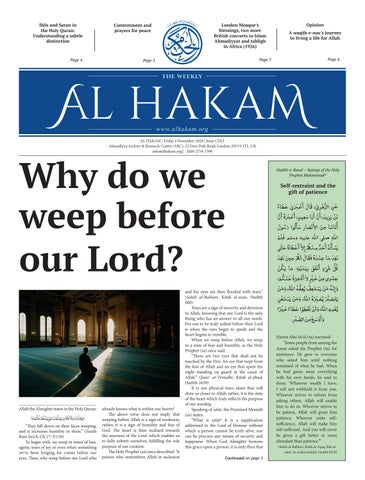
Why do we weep before our Lord?
Allah the Almighty states in the Holy Quran:
ُ ُُ َ َۡۡ َ ُ ان ٰیَ ۡﺒﻜْوۡ َن ََّوٰیَ ِﺰٰیۡ ُﺪ ُِھ َۡم ﺧﺸْوۡ ًَعا ِ ََّوٰیَ ِ� �� َّۡون لَِلاذُق
“They fall down on their faces weeping, and it increases humility in them.” (Surah Bani Isra’il, Ch.17: V.110) To begin with, we weep in times of loss, agony, tears of joy or even when something we’ve been longing for comes before our eyes. Then, why weep before our Lord who
already knows what is within our hearts? The above verse does not imply that weeping before Allah is a sign of weakness; rather, it is a sign of humility and fear of God. The heart is then inclined towards the nearness of the Lord, which enables us to fully submit ourselves, fulfilling the sole purpose of our creation. The Holy Prophet (sa) once described: “A person who remembers Allah in seclusion
and his eyes are then flooded with tears.” (Sahih al-Bukhari, Kitab al-azan, Hadith 660) Tears are a sign of sincerity and devotion to Allah, knowing that our Lord is the only Being who has an answer to all our needs. For one to be truly ardent before their Lord is when the eyes begin to speak and the heart begins to tremble. When we weep before Allah, we weep in a state of fear and humility, as the Holy Prophet (sa) once said: “There are two eyes that shall not be touched by the Fire: An eye that wept from the fear of Allah and an eye that spent the night standing on guard in the cause of Allah.” (Jami‘ at-Tirmidhi, Kitab al-jihad, Hadith 1639) It is not physical tears alone that will draw us closer to Allah; rather, it is the state of the heart which truly reflects the purpose of our worship. Speaking of salat, the Promised Messiah (as) states: “What is salat? It is a supplication addressed to the Lord of Honour without which a person cannot be truly alive, nor can he procure any means of security and happiness. When God Almighty bestows this grace upon a person, it is only then that Continued on page 3
Hadith-e-Rasul – Sayings of the Holy Prophet Muhammadsa
Self-restraint and the gift of patience
َ َ ّ ْ ُّ َ ُﺎل أ َ ْﺧ� َ َ��� َﻋ َﻄﺎء ﻗ،ﻋ ِﻦ ا��ﻫ ِﺮ ِي ِ ََ ُ َ َْ َ َ ﺑْ ُﻦ َ أ َ َّن أَﺑَﺎ،ﻳﺪ أﺧ� َ�ه أ ّن،ﻴﺪ ﻌ ﺳ ﻳ ِﺰ ِ ٍ َ َ ُ َ ْ ً َ أُﻧ ﺎﺳﺎ ِﻣ َﻦ ا��ﻧ َﺼﺎ ِر َﺳﺄﻟﻮا َر ُﺳﻮل ََ ّٰ ّٰ ا�� ِ� ﺻﻠﻰ ا��� �ﻠﻴﻪ وﺳﻠﻢ ﻓﻠ ْﻢ َّ َ ُ َ ْ َ َّ ْ ُ ْ ٌ َ َ ُ ْ َ ْ َ �ﺴﺄ�� أﺣﺪ ِ�ﻨ�� ِإ�� أﻋﻄﺎه ﺣﺘﻰ َُ َ ََ َُ َ َ َ َ َ �� ﻧ ِﻔﺪ ﻧ ِﻔﺪ َﻣﺎ ِﻋ ْﻨﺪه ﻓﻘﺎل ﻟ� ْ� ِﺣ ُ َ ُّ ُ َ َ َْ َ َﻣﺎ ﻳَﻜ ْﻦ:�ﻞ ﺷ ْﻰ ٍء أﻧﻔﻖ ﺑِ َﻴﺪﻳْ ِﻪ ُ َ ُ ََ َ ْ َ ،ِﻋ ْﻨ ِﺪي ِﻣ ْﻦ ﺧ� ٍ� �� أ ّد ِﺧ ْﺮه ﻋ ْﻨﻜ ْﻢ َّ ٰ ُ َ َو َﻣ ْﻦ،�ُ ّ��َو ِإﻧّ ُﻪ َﻣ ْﻦ � َ ْﺴ َﺘ ِﻌﻒ ﻳ ُ ِﻌ ّﻔ ُﻪ ا َّ ّٰ ُ ّ ْ َو َﻣ ْﻦ � َ ْﺴ َﺘﻐ ِﻦ،�ُ ��ﻳ َ َﺘ َﺼ� ْ� ﻳ ُ َﺼ ِ� ْ�ه ا ْ َ ً َ َ ْ َ ْ ُ ْ َ َ ُ َّ ْ ﺎء ﺧ� ً�ا وﻟﻦ ﺗﻌﻄﻮا ﻋﻄ،���ﻳُﻐ ِﻨ ِﻪ ا ْ َّ َ َ َ ْ َ َ وأوﺳ� ِﻣﻦ .�ِ �اﻟﺼ Hazrat Abu Sa‘id (ra) narrated: “Some people from among the Ansar asked the Prophet (sa) for assistance. He gave to everyone who asked him until nothing remained of what he had. When he had given away everything with his own hands, he said to them: ‘Whatever wealth I have, I will not withhold it from you. Whoever strives to refrain from asking others, Allah will enable him to do so. Whoever strives to be patient, Allah will grant him patience. Whoever seeks selfsufficiency, Allah will make him self-sufficient. And you will never be given a gift better or more abundant than patience.’” (Sahih al-Bukhari, Kitab ar-riqaq, Bab assabri ‘an maharimillah, Hadith 6470)
Friday 6 November 2026 | AL HAKAM
2
This Week in History 6-12 November A glimpse into the rich history of the Ahmadiyya Muslim Jamaat 6 November 6 November 1905: On this day, the Promised Messiah (as) delivered a lecture in Ludhiana, which started at 8:30 in the morning. Huzoor (as) continued his speech until 11 am. (Tarikhe-Ahmadiyyat, Vol. 2, p. 428-429) 6 November 2016: A special reception was held on this day to mark the opening of the newly-built Bait-ul-Amaan Mosque in Lloydminster, Saskatchewan, Canada, at which Hazrat Khalifatul Masih V (aa) delivered the keynote address. During his address, Huzoor (aa) spoke of the true purpose of mosques and how the new mosque would not only be a place to worship God Almighty but would also prove a means of serving and protecting all people. He said that at a time when there was widespread fear of Islam, it was a sign of open-heartedness and “extraordinary courage” that the guests had attended an Islamic event. Both prior to and after the reception, Huzoor (aa) personally met with a number of guests and also held a press conference with local media representatives. (“No need to fear true Mosques – Head of Ahmadiyya Muslim Community”, www.pressahmadiyya.com)
7 November 7 November 1912: Hazrat Mirza Bashir-ud-Din Mahmud Ahmad (ra) entered the holy land of the Ka‘bah, Mecca, on this day, during his Hajj journey. To read the detailed account of his journey, see: “A young Mahmud’s pilgrimage to Arabia” at alhakam.org (19 February 2021, pp. 30-32). 7 November 2008: On this day, Hazrat Khalifatul Masih V (aa) inaugurated the Baitul Mahdi Mosque in Bradford, UK. (Al Fazl International, 28 November 2008, pp. 4-9)
8 - 9 November 8 November 1965: On this day, Hazrat Musleh-e-Maud (ra) passed away in Rabwah, Pakistan. On the same day, after Isha prayer, the Electoral College held its proceedings and announced the election of Hazrat Hafiz Mirza Nasir Ahmad (rh) as Khalifatul Masih III. Hazrat Mirza Nasir Ahmad (rh) led the funeral prayer
the very next day at around 4:30 pm, which was attended by thousands of people. He also delivered a short speech, which was followed by the funeral prayer. Hazrat Musleh-e-Maud (ra) was buried at Bahishti Maqbarah, Rabwah. (Tarikh-eAhmadiyyat, Vol. 23, p. 134) 9 November 1905: On this day, the Promised Messiah (as) was in Amritsar and delivered a lecture here. For this purpose, a lecture hall of Advocate Rai Kunahya Lal was booked. The lecture began at 8 am, but opponents of the Promised Messiah (as) began to disrupt this blessed event with their uncivilised behaviour. He started his journey towards Batala soon afterwards. Hazrat Ahmad (as) himself narrates, “I saw a sugar cane in my dream, the general interpretation of which is some mischief or disturbance. This was accompanied by the revelation:
َُ � َ َ ْ� الَّرّ ُُسْوْ ِِل َاُقْوْ ُُم ِِاِّنّْی َمَع
[“I shall stand with My Messenger.”]. Al Hakam added, “This dream and revelation was narrated by him before the lecture. The lecture was delivered in full in half an hour. The shortsighted opponents and troublemakers tried to create such disturbance that they imagined that they had succeeded in their evil design.” (Tarikh-e-Ahmadiyyat, Vol. 2, p. 429) 9 November 1984: On this day, during his Friday sermon, Hazrat Khalifatul Masih IV (rh) called the attention of Ahmadis towards financial sacrifices to help the needy people in Africa who were affected by a famine. (Khutbat-e-Tahir, Vol. 3, p. 641)
10 - 12 November 10 November 1989: The Berlin Wall fell on the night between 9 and 10 November 1989 and according to the Islamic calendar, 10 Rabi al-Thani had started. Hazrat Khalifatul Masih IV (rh) said, during his Friday sermon on 23 February 1990, that the Islamic calendar and the Gregorian calendar had perfectly corresponded with one another and that too on a Friday. Moreover, highlighting the connection of this incident with Ahmadiyyat, Huzoor (rh) mentioned the Promised Messiah’s (as) prophecy regarding the spread of Ahmadiyyat in Russia. To read more, see: “Friday the 10th: A glad tiding to the Ahmadiyya Muslim
Jamaat.” at www.alhakam.org (23 April 2021, pp. 18-20) 11 November 1949: On this day, Hazrat Musleh-e-Maud (ra) visited Sargodha, a city located to the north-west of Rabwah and at a distance of around 50 kilometres, upon the invitation of Malik Sahib Khan Noon, retired deputy commissioner. After delivering the Friday Sermon and leading the Jumuah prayer, Huzoor (ra) proceeded towards the Company Bagh to address a large crowd gathered to listen to him. Huzoor’s (ra) two-hour talk was listened to carefully. (Tarikh-e-Ahmadiyyat, Vol. 12, p. 41) An eyewitness account of this speech can be read here: www.alhakam.org. 11 November 2005: On this day, Hazrat Khalifatul Masih V (aa) inaugurated the Nasir Mosque in Hartlepool, UK, with his Friday sermon. (Al Fazl International, London, 6 January 2006) 12 November 1899: A small but prestigious gathering was arranged in Qadian on this day for the departure of a research delegation. A proposed party of learned Companions was to travel to the Middle East to collect newly found evidence and properly record and fortify the already available facts regarding the historic escape journey of Jesusas from his hometown towards Kashmir. This assembly was named “The Farewell Jalsa”. During the very days in which the Promised Messiah (as) was writing his book, Jesus in India, it came to light that certain relics of the Messiah (as) of Nazareth had been found in Nasibain (situated in the Arab country of Iraq), which furnished evidence of the Messiah’s journey and corroborated the fact that he settled in Kashmir. The Promised Messiah (as) deemed it advisable to dispatch a commission or delegation to personally investigate and examine these relics and the state of affairs and then for the delegation to return to Qadian from the route on which the Messiah (as) journeyed to Kashmir. In order to see off this delegation and bid them farewell, an event was arranged by the name of Jalsa Al-Wida (The Farewell Gathering). Due to certain compelling circumstances, the dispatch of this delegation was postponed. The event, nonetheless, was held on 12-14 November 1899 with great excitement and celebration. An address was delivered by the Promised Messiah (as) on this occasion. (Malfuzat [English], Vol. 2, p. 50)
AL HAKAM | Friday 6 November 2026 Hazrat Mirza Ghulam Ahmadas, In His Own Words
Show gratitude to a benefactor I do not make these statements out of a desire for reward or recompense. What do I care for reward, recompense and worldly titles? My intentions are well known to the All-Knowing God, and He is aware that my work is solely for His sake and in accordance with His command. It is He Who has taught us to be thankful to a benefactor. Therefore, in our gratitude we obey our Gracious Lord and it is Him from Whom we hope for a reward. Hence, you who are my community ought to hold your benevolent government in high regard. Now, it is my wish that we all pray for the Transvaal war.” After this, His Holiness raised his hands with immense fervour and sincerity to pray, and all those present—who numbered in excess of a thousand—joined with him in prayer. (Malfuzat [English], Vol. 2, p. 202 - 203)
Continued from page 1
he obtains true comfort. From that moment he will begin to feel pleasure and delight in salat. As he derives pleasure from delicious food, he will begin to derive pleasure from his weeping and crying in salat. Before he experiences that condition in his salat, it is necessary that he should persist in salat as he swallows bitter medicine so that he may be restored to health. In the same way it is necessary for him to persist in salat and in making his supplications while he derives no pleasure from them. In such [a] condition he should seek pleasure and delight in salat with the supplication: “‘Allah! Thou knowest how blind and sightless I am, and at the moment I am like the dead. I know that in a little while I shall be called and shall present myself before Thee and no one will be able to stop me. But my heart is blind and unenlightened. Do Thou cause to descend upon it such a flame of light that thereby it may be inspired with Thy love and devotion to Thee. Do Thou bestow upon me such grace that I shall not be raised up sightless nor join the blind.’ “When he supplicates in this manner and persists in the supplication, he will see that a time will arrive when something will descend upon him while he is engaged in such a type of prayer which will melt his heart.” (Malfuzat [Urdu], Vol. 4, pp. 321322, as cited in The Essence of Islam, Vol. 2, pp. 297-298) Is there any spiritual benefit in this? The Holy Prophet (sa) once said: “Allah will give shade to seven (types of people) under His Shade (on the Day of Resurrection). [One of them will be] a person who remembers Allah and his eyes are then flooded with tears.” (Sahih al-Bukhari, Kitab al-azan, Hadith 660) What more could a person ask for? To come into the shade of their Lord is the goal. When man commits a sin, he thinks to himself, how will anyone forgive me? What shall I do? What will my God think of me? Man begins to panic, taking stress
3
Contentment and prayers for peace On 30 October 2026, in his Friday sermon, Hazrat Mirza Masroor Ahmad, Khalifatul Masih V (aa), warned of the danger of a world war and global food shortages, urged contentment and simple living in keeping with the Holy Prophet’s (sa) example and called for prayers for the world’s protection from calamity and destruction. Huzoor (aa) said: “The same conditions prevail today as well: wars are being fought to seize the wealth of others and occupy their lands. As I have said many times before, the conditions for an escalating war continue to develop and if war spreads still further, Europe and indeed the entire world will face a difficult
period in terms of food supplies. “[...] In Africa and some less developed countries, people live on simple food and are very happy if even simple food is available to them. Those people will be able to endure such wartime conditions, but Europe and these developed countries will not be able to endure them. These conditions will cause them very great distress. “Thus, we too should continue to examine our own condition and cultivate contentment. We should strive to lead simple lives, keep the example and way of life of the Holy Prophet (sa) before us and bear his counsel in mind. By all means eat good food when it is available and by all means
wear fine clothes when they are available. However, to depend entirely on these things and [when they are unavailable] to raise an outcry, saying, ‘We are dying!’ is wrong. “In any case, we should also pray that Allah the Exalted saves the world from these calamities and that these [nations] are saved from the pit of destruction towards which they are heading because of their own egos. For if these conditions persist, a world war is certain and their destruction too is certain. Instead of seizing the wealth and lands of others, these people should serve their own populations. May Allah the Almighty enable us too to remain steadfast in performing good deeds.” [Amin.]
to a whole new level, not knowing that it is indeed God who will forgive him for his sins. The Promised Messiah (as) answers this; he states: “Think not, you are sinners. Will your prayers be heard? Do not think like this. Man makes mistakes, but a time comes when he is able to overpower his sinning self. This power to overpower the sinning self is also built into the nature of man. Water puts out fire. This is part of its nature. Howsoever you may heat it, when water drops on fire it must put it out. That is natural. So is man a purifier by nature. Every man has this purifying property. Do not feel defeated because you have been involved in sin. Sin is like a stain on the surface of a piece of cloth. It can be washed away. Your habits, your dispositions may be dominated ever so much by your passions. Pray to God, weeping, crying; He will not let your prayers go waste. He is full of compassion.” (Badr, 17 January 1907, Vol. 6, No. 3, pp. 15-16] Weeping before God shows Him that man has a strong desire to be released from the trials and tribulations he is going through. Keep in mind that the pinnacle of Prayer is the prostration (sajdah) position, where man keeps a private connection with his Creator and is able to say whatever he feels because, deep down, he knows it is truly only God who can answer his prayers and needs. God Almighty says in the Holy Quran: “Pray unto Me; I will answer your [prayer].” (Surah Mu’min, Ch.40: V.61) We must understand that the only condition God has here is for His servants to pray or call unto Him and He will answer the prayer. What could be simpler than that? He gives man no limits nor any choices, but an open-ended connection between man and his Lord. Going back to the question which was raised in the beginning, ‘Why weep before our Lord who already knows what is in our hearts?’ The answer is that Prayer is not about giving information to Allah, but it is
about turning the hearts towards Him. The Promised Messiah (as) states: “Supplications are not accepted until the heart is clean. If your heart harbours a grudge even for a single person with respect to any worldly matter, your supplication cannot be accepted.” (Malfuzat [English], Vol. 9, p. 178) Thus, it is of utmost importance for the acceptance of prayers that all personal grudges and malice are forsaken and heartfelt supplications are carried out; seek the help of Allah the Exalted to attain a permanent purification of the heart. This leads us to one vital lesson taught to mankind: whether we are experiencing sorrow, loss, happiness or joy, our hearts should always turn towards Allah. “Those who believe, and whose hearts find comfort in the remembrance of Allah. Aye! It is in the remembrance of Allah that
hearts can find comfort” (Surah ar-Ra’ad, Ch.13: V.29) In times of sorrow, pain, joy or even relief, it is God who is the ultimate healer of all our problems. When the heart feels the need to connect with someone special, someone who will fill the gap in their life, the heart knows the only comfort it will find is in the remembrance of Allah. Therefore, the desire then becomes greater and the feeling becomes stronger and our body begins to build emotion, weeping, letting our hearts out and simply putting out everything we can think of before our Creator, because truly it is only he who understands our needs. May Allah enable us all to build a strong and heartfelt connection with our Lord. Amin! (Tahir Wadood, Missionary, Canada)
Friday 6 November 2026 | AL HAKAM
4
Satan functions as a broader term. A Satan is any being or influence that turns away from truth or seeks to lead others away from it. This is why the Quran applies the term not only to unseen beings but also to certain human beings. For example: “And when they meet those who believe, they say: ‘We believe;’ but when they are alone with their ringleaders, they say: ‘We are certainly with you.’” (Surah al-Baqarah, Ch.2: V.15) Likewise: “It is Satan who only frightens his friends.” (Surah Aal-e-Imran, Ch.3: V.176) And: “And in like manner have We made for every Prophet an enemy, evil ones from among men and Jinn.” (Surah alAn‘am, Ch.6: V.113) These verses demonstrate that satanic influence is not confined to an unseen realm but can also manifest itself through human agents who oppose truth and righteousness.
Two terms, two dimensions of evil
Iblis and Satan in the Holy Quran: Understanding a subtle distinction Saleeq Ahmad Naik Qadian The Holy Quran employs the terms “Iblis” and “Satan” in a manner that suggests a subtle yet meaningful distinction between the two. While both names can refer to the same being, a careful study of the Quranic text reveals that each carries its own significance. This distinction not only reflects the precision of Quranic language but also offers valuable insights into the nature of evil, temptation and human moral responsibility.
Iblis in Quranic usage The name Iblis appears 11 times in the Holy Quran. In most instances, it is mentioned in connection with the command given to the angels to prostrate before Adam (as) and Iblis’ refusal to comply. References to Iblis in Surahs al-A‘raf, al-Hijr, Bani Isra’il, al-Kahf, Ta Ha and Sad all occur within this context. Elsewhere, such as in Surah ash-Shu‘ara and Saba, the Quran speaks of his followers and the fulfilment of his expectations concerning those who succumbed to his influence. (Tafsir-e-Kabir, 2023, Vol. 1, p. 479)
In these Quranic passages, Iblis designates the opponent who refused the command concerning Adam (as). Hazrat Khalifatul Masih II (ra) explains that Iblis is an attributive name describing its bearer’s qualities. Elsewhere, he also applies it to human beings. (Anwar-ul-Ulum, Vol. 10, p. 214)
Why does the Quran speak of Satan? Interestingly, when the Quran narrates the temptation of Adam (as), it does not describe the tempter as Iblis but as Satan. This is a noteworthy distinction. Allah the Almighty had already warned Adam (as): “Then We said, ‘O Adam, this is an enemy to thee, and to thy wife; so let him not drive you both out of the garden, lest thou come to grief.’” (Surah Ta Ha, Ch.20: V.118) Allah the Almighty also states: “And verily, We had made a covenant with Adam beforehand, but he forgot, and We found in him no determination [to disobey].” (Surah Ta Ha, Ch.20: V.116) In this regard, Hazrat Mirza Bashir-udDin Mahmud Ahmad, Khalifatul Masih
II (ra), masterfully reconciles these verses. He explains that because Adam (as) was directly forewarned against Iblis and lacked any intention to disobey God, he could not have been deceived directly by Iblis himself. Instead, Adam (as) was approached by an agent or physical representative operating under Iblis’ influence – a satan, so to speak – whom Adam (as) failed to recognise as a threat and mistook for a genuine advisor, committing an error of judgment out of forgetfulness. (Tafsir-e-Kabir, 2023, Vol. 1, pp. 479-480) Hazrat Khalifatul Masih II (ra) explicitly states that Iblis himself can also be called Satan. (Tafsir-e-Kabir, 2023, Vol. 1, p. 480) The distinction in this particular explanation concerns Iblis and the representative who approached Adam (as). Identifying Iblis as Satan therefore does not exclude distinguishing him from a particular agent of his influence, nor does that distinction prevent either name from being applied attributively to a human who embodies evil.
Satan: A broader category The Quranic usage further suggests that while Iblis is the name of a particular being,
From a linguistic perspective, Iblis is commonly associated with despair, frustration and bewilderment, whereas Satan signifies one who is far removed from truth and seeks to distance others from it. In his monumental commentary Tafsire-Kabir, Hazrat Khalifatul Masih II (ra) explains that Allah calls Iblis by both names and draws from their order two successive stages of spiritual decline: - The stage of Iblis: An initial state of passive spiritual degradation – marked by ignorance, loss of good, confusion and despair of God’s mercy. - The stage of Satan: An advanced, active phase of evil – where one who has drifted far from truth actively works to misguide, envy and corrupt others. This progression is deeply significant. Spiritual downfall rarely begins with outright hostility; it typically starts with hopelessness and confusion before escalating into active rebellion and misleading others. Recognising these distinct stages allows believers to guard against the earliest roots of spiritual decline. (Tafsir-e-Kabir, 2023, Vol. 1, p. 481)
The purpose of satanic influence A common question arises: if Iblis leads people astray, why was he created at all? The Holy Quran teaches that human beings have been granted freedom of choice. Though God the Exalted has opened unlimited vistas for the spiritual progress of man, He has not made him immune to satanic whisperings. While man has been endowed with perfect guidance through the Holy Quran, he has also been given the choice to accept or reject it. Human excellence emerges not from compulsion but from conscious choice. The existence of both influences therefore forms part of the Divine scheme for mankind’s moral development.
The limits of Satan’s power The Quran repeatedly emphasises that Satan possesses no coercive authority over human beings: “‘Surely, thou shalt have no power over My servants, except such of the erring ones as [choose to] follow thee.’” (Surah alHijr, Ch.15: V.43) And again, we read: “Surely, thou hast no authority over My servants; and sufficient is
AL HAKAM | Friday 6 November 2026 thy Lord as a Guardian.” (Surah Bani Isra’il, Ch.17: V.66) The Quranic term sultan also conveys the meaning of proof or compelling evidence. Thus, Satan does not prevail through sound argument or truth. Rather, his methods are deception, fear, false promises, greed and the exploitation of human weaknesses. As the Quran declares: “And Satan promises them naught but deceit.” (Surah Bani Isra’il, Ch.17: V.65)
Conclusion Iblis and Satan can describe the same evil being, while the names convey different qualities and can also have attributive applications to humans. The distinction discussed here concerns their use in particular Quranic passages and Hazrat Khalifatul Masih II’s (ra) explanation of Adam’s (as) temptation. Recognising this distinction enriches our understanding of the Quranic portrayal of evil and highlights the moral responsibility placed upon every individual to resist influences that lead away from the path of righteousness. (This article is based on the commentary of Hazrat Khalifatul Masih II [ra] in Tafsir-e-Kabir, 2023, Vol. 1, under Surah al-Baqarah, Ch.2: V.34-35)
5
NEWS Lajna Imaillah France holds Fourth Peace Symposium Leïla Belarbi Secretary Tabligh, Lajna Imaillah France On 26 September 2026, Lajna Imaillah France held its Fourth Peace Symposium at the Mubarak Mosque in Saint-Prix, under the theme “Women Building Peace: Love for All, Hatred for None”. The event brought together 21 guests, including Céline Villecourt, Vice-President of the Val-d’Oise Departmental Council; Vanessa Leclerc, Municipal Councillor of Saint-Prix; Aïzaté Chanfi, Deputy Mayor of Sarcelles; Virginie Bourdon, Director of the Saint-Prix Municipal Social Welfare Centre (CCAS); and Bintou Balkis Sissoko, President of PCC France Universal. The programme began with a recitation from the Holy Quran, followed by a presentation introducing the guests to the Ahmadiyya Muslim Jamaat and its women’s
Majlis Ansarullah Parents’ Day Jalsa Scotland holds Beacon held in Finland of Peace Charity Walk Basharat ur Rehman Secretary Tarbiyat, Jamaat Finland 2026 Arshad Mehmood Khan Glasgow Majlis Ansarullah Scotland hosted its annual Beacon of Peace Charity Walk and 5K Run on 6 September 2026, at Kelvingrove Park in Glasgow, bringing together around 120 Ahmadis, alongside 20 external guests from across Scotland. The event aimed to promote unity, civic responsibility and charitable giving within the wider community. The walk commenced at 10:30 am after a silent prayer. Opening remarks were delivered by Ahmad Owusu-Konadu Sahib, Chairman of Beacon of Peace Scotland, followed by a welcome address from Dr Abdul Hayee Sahib, Regional Amir of Scotland. Susan Murray MP (Cumbernauld and Kirkintilloch) shared special messages of support, conveying her best wishes to all runners and walkers. Chief Inspector Karen Cameron, Local Area Commander for Police Scotland, also addressed participants and officially sent them off for the walk and run. After the event at Kelvingrove Park, participants and guests reconvened at the Baitur Rahman Mosque, Glasgow, for the concluding session. The final session opened with a recitation from the Holy Quran and included presentations from local charity partners and community leaders. Speakers included Rose Filippi, Development Manager, Maryhill Integration Network; Julie Price, Senior Community Fundraiser, Glasgow Children’s Hospital Charity and Crossbasket House; Corrie Shepherd, Schools and Community Fundraiser, Beatson Cancer Charity; Peter Igbinsa,
The Tarbiyat Department of Jamaate-Ahmadiyya Finland held a Parents’ Day Jalsa on 20 September 2026, aimed at drawing parents’ attention to their
56th ijtema held by MKA USA Mirza Ekaan Ahmad Ijtema Secretary, MKA USA Majlis Khuddam-ul-Ahmadiyya and Majlis Atfal-ul-Ahmadiyya USA held its 56th annual ijtema at Baagh-e-Ahmad in Elmer, New Jersey, on 9-11 October 2026. The ijtema and its programming focused on the theme of the year: Hayya alal falah (come towards success). A formal inspection was conducted on 8 October by Sadr Majlis, Abdullah Dibba Sahib. The ijtema officially began on 9 October, after Jumuah prayer, with the flag hoisting and opening ceremony, CHAS Volunteer; Mrs Karen Okoko, Founder, BJO Amara Charity; Sergeant Daniels, British Army and Inspector Alex Marshall, Local Problem-Solving Team (Glasgow West End), Police Scotland. Funds raised through this year’s Beacon of Peace fundraising campaign will be distributed during a formal cheque presentation ceremony in February 2027. With a regional fundraising target of £15,000 for 2026, the Scotland region has already raised over £5,000 and fundraising will continue throughout the rest of the year.
auxiliary organisation, Lajna Imaillah. The guests were also introduced to the efforts of Hazrat Khalifatul Masih V (aa) in promoting world peace. Aline Augias, a representative of the Union Nationale des Combattants (a French association of war veterans dedicated to remembrance) and a regular attendee of our events, was unable to attend this year but had sent a message, which was read aloud during the symposium. Bintou Balkis Sissoko, President of PCC France Universal, highlighted the role of women in fostering dialogue, forgiveness and closer ties between communities. Aminata Touré Sahiba, Sadr Lajna Imaillah France, then delivered a speech on peace in everyday life and the responsibility each individual bears in building it. Drawing inspiration from Huzoor’s (aa) guidance, she reminded the audience that true peace begins within our homes. She emphasised the role of women in building bonds between people, encouraging everyone to cultivate empathy and kindness in order to truly embody the slogan “Love for All, Hatred for None”.
Céline Villecourt, Vice-President of the Val-d’Oise Departmental Council, also addressed the gathering, sharing her reflections on peace in the world. The formal programme concluded with a silent prayer. Throughout the event, guests from diverse backgrounds expressed their delight at attending and their appreciation for this initiative promoting peace and dialogue. Among them, Aïzaté Chanfi, Deputy Mayor of Sarcelles, particularly praised the enthusiasm and dedication of Lajna Imaillah France members, remarking: “We need an organisation of women like yours in our town.” The guests then explored several exhibitions highlighting women’s rights in Islam, Huzoor’s (aa) efforts to promote peace, the humanitarian activities of Lajna Imaillah France and publications of the Jamaat. An interactive activity entitled “True or False?” gave guests the opportunity to test their knowledge of Islam and challenge common misconceptions, particularly concerning women’s rights, religious freedom, justice, tolerance and science.
responsibilities regarding the religious and moral upbringing of their children. The programme commenced with a recitation from the Holy Quran, followed by a poem and a speech by Shahid Mahmood Kahlon Sahib, Missionary-In-Charge Finland, on the responsibilities of parents and the upbringing of children. Ata-ulGhalib Sahib, National President of Jamaat Finland, urged members to pay particular attention to their teenage children.
As part of the Tarbiyat Department’s activities, members of the Jamaat have studied three books from Ruhani Khazain during the current year. At the end of each quarter, a knowledge-based quiz is held on the book studied during that period. During this quarter, members studied the Promised Messiah’s (as) book, Taudih-e-Maram. Accordingly, the quarterly quiz on the book was held during this jalsa. A total of 105 members attended the programme.
presided over by Sadr Majlis, who read out the special message received from Hazrat Khalifatul Masih V (aa). Sahibzada Mirza Maghfoor Ahmad, Amir Jamaat USA, was also present during the ijtema, at the instruction of Hazrat Khalifatul Masih V (aa). Following the opening session, and for the remainder of the ijtema, khuddam and atfal held their programmes independently, as separate arrangements were made for both auxiliaries. Throughout the ijtema, sessions were held in the main ijtema gah. Speeches in English and Urdu were delivered on Friday evening and Saturday morning, covering a range of topics from Salat and the Holy Quran to living Ahmadiyyat in daily life and the blessed model of the Holy Prophet (sa) and the Promised Messiah (as). On Saturday evening, a new format of programming was introduced to the ijtema: TED-style talk session titled “Heirs to the Prophets: Walking the Path of Eternal Success.” This session was well received by attendees. A total of 11 academic competitions and 14 sports competitions were held this year. The Khuddam Hub is a staple feature of the national ijtema. This year, the outdoor stage was elevated, and several engaging talks and panel discussions were held throughout the ijtema. These sessions covered a wide range of topics, including faith and suffering, stories with Khilafat, Nizam-e-Wasiyyat, skills building for career, tabligh, fatherhood,
personal journeys to Islam Ahmadiyyat and the future plans for Baagh-e-Ahmad. The Hub also featured an exhibition on the theme of the year, along with stalls selling food and merchandise. On Saturday afternoon, Amir Sahib Jamaat USA inspected the site upon arrival, followed by a BBQ competition. He then delivered a faith-inspiring address to the khuddam. In the evening, a kabaddi exhibition match and an Urdu Mushaira were held. After the opening session, Majlis Atfalul-Ahmadiyya began their ijtema activities with off-site sports and on-site academic competitions. On Saturday afternoon, atfal had the opportunity to hold a special question-and-answer session with Amir Sahib. On Saturday, atfal again went to an offsite location for their sports competitions. The prize distribution ceremony for atfal was held on Sunday morning, chaired by Sadr Majlis. The national ijtema 2026 was attended by 1,956 participants and all 52 majalis were represented. This year, accommodations were arranged in four sleeping marquees and the campground. Building on the camping arrangements introduced last year, the campsite was expanded to make room for more campers. This was well received, with over 310 people camping across 127 tents.
Friday 6 November 2026 | AL HAKAM
6
”
Opinion
A waqifa-e-nau’s journey to living a life for Allah Khafiya Zeb Mangut Canada “I am a waqifa-e-nau.” For most of my childhood, these words simply described who I was. I knew I was a waqifa (i.e. female devotee). I attended classes, ijtemas and Jamaat programmes. I wore my identity with pride and understood that before I was even born, my parents had made a promise that my life would be dedicated to the service of Islam.
What does waqf mean? But as I grew older, those words began to take on a deeper meaning. I started to realise that being a waqifa was more than an identity I had grown up with; it was a promise that invited me to reflect on how I wanted to live my life. And so I began asking myself a question that I could no longer answer simply: What does it actually mean to give your life to Allah? Does it mean spending your life in a particular profession? Serving the Jamaat whenever you are needed? Teaching others? Sacrificing your time? Giving up certain ambitions? Or does waqf mean something much deeper? As time passed, I understood that being a waqifa-e-nau is not simply a title written beside my name. It is a pledge – and a pledge made to Allah is not something we should carry lightly. Before we can understand what it means to serve Islam, serve the Jamaat and follow Khilafat’s guidance, we must first understand something much more fundamental: We are servants of Allah first. Allah has given us everything – our ability to breathe; our families; our health; our education; our homes; our friendships; our opportunities. Even the next moment of our lives has been granted to us by Allah. We make plans for tomorrow as though tomorrow belongs to us but none of us know if tomorrow will come. We spend years working toward success. But everything can change in an instant. The wealth or position we spent years accumulating can be lost. Yet Allah remains. So perhaps the first question of a waqf is not, “What can I give Allah?” but rather, “How can I live the life Allah has given me in a way that pleases Him?”
Remaining connected to Allah This is where waqf begins: recognising who we belong to. It begins with understanding that every blessing we have has been entrusted to us by Allah. And it begins with us asking ourselves how we can use those blessings in a way that finds Allah’s pleasure. Hazrat Khalifatul Masih V (aa), in his address at the National Waqifat-e-Nau Ijtema on 6 April 2019, reminded waqifate-nau that the foremost obligation of every Muslim is to fulfil the rights of Allah. This is such an important reminder because sometimes we can become so focused on getting things done that we forget who we
are doing them for. Thus, a waqifa’s life should begin with Allah and she must remain connected to Him through every stage of her life. Our responsibility is not simply to keep ourselves busy with service. It is also to ensure that our service comes from a heart that is connected to Allah. Without sincerity, even service can become routine; but when our hearts are turned towards Him, even the smallest act can become an act of worship.
Serving the Jamaat One responsibility I have come to value when it comes to being a waqifa is serving the Jamaat. Over the years, I have been blessed to serve in different capacities at my local jamaat. Through these experiences, I have learned that true Jamaat service is not measured by the position we hold or the recognition we receive, but by our willingness to step forward wherever we are needed and to give our time, energy and abilities for the sake of Allah. I should mention that serving as Nasirat Secretary brought happiness to my heart because I began to see these young girls not simply as children attending classes but as the future of our Jamaat. The girls we teach today will one day become Lajna, wives, mothers, teachers and leaders. The confidence we instill in them, the prayers we teach them and the love for Islam we nurture in their hearts today can help shape the women they become tomorrow.
Examples for future generations As waqifat-nau, we are also responsible for becoming examples. During a virtual mulaqat with Waqifat-e-Nau members of Lajna Imaillah from Bangladesh on 31 January 2021, Hazrat Khalifatul Masih V (aa) explained to a young girl that a waqifa should be recognised through her good deeds and by the character she demonstrates. This reminder has stayed with me because it makes waqf feel so beautiful. Our responsibility as waqifat-e-nau also extends beyond the Jamaat. We are ambassadors of Islam and sometimes tabligh (preaching) begins simply through the way we present ourselves and live our faith. For example, people ask me why I wear a hijab or why I dress the way I do. To me, the answer is simple: Islam teaches us that our bodies are precious and worth protecting. Purdah and modesty are meant to protect our dignity and help us maintain boundaries, protecting ourselves from unwanted attention and the pressures of the world. Thus, these are not burdens I carry but blessings that bring me closer to Allah and give direction to my life.
Giving out in the way of Allah One of the most beautiful ways we can do this is through sadaqah, i.e. voluntary charity given for the sake of Allah. Personally, I have found it helpful to stop
holding on to things that I no longer need. For example, whenever I have clothes that I no longer wear, I try to donate them to people who may need them more than I do. There is something so meaningful about taking something that we have been blessed with and allowing it to become a source of comfort, dignity, or happiness for someone else. I have always tried to keep one thought in my mind: If I am willing to spend my money on the things of this world, why would I hesitate to spend it in the way of Allah? Allah the Almighty is the One who blessed us with that wealth in the first place, and when we give for His sake, we trust that He will reward us in ways far greater than what we have given. And perhaps this is one of the greatest beauties of sacrifice: when we give sincerely, we are not becoming poorer in the sight of Allah. We are becoming richer in faith, richer in gratitude and richer in our ability to care for others.
Attachment to Khilafat I have also come to understand that our attachment to Khilafat is one of the most important responsibilities we carry as waqifat-e-nau. We cannot guide others if we are not willing to be guided ourselves. It is easy to say that we love Khilafat, but true attachment is reflected in how we respond to the guidance of our Khalifa and how sincerely we try to bring that guidance into our own lives. It means making time to listen to the Friday Sermons and other addresses of Hazrat Khalifatul Masih (aa), but more importantly, it means taking a moment afterwards to reflect and ask ourselves: “What change do I need to make?” It also means nurturing a personal connection with Huzoor (aa). Writing letters to Huzoor (aa), sharing our prayers, concerns, hopes and asking for his prayers can help us develop a relationship with Khilafat that feels personal and sincere. Even when we cannot meet him, we can still turn towards him through our letters and prayers and seek his guidance.
Seeking knowledge As women, our waqf will also continue to take different forms throughout our lives. One responsibility I have increasingly come to appreciate is the importance of seeking knowledge. After all, how can we teach, guide and nurture others if we have not first taken the time to learn ourselves? Recently, I had the opportunity to attend Aisha Academy online for two weeks where I studied The Philosophy of the Teachings of Islam by the Promised Messiah (as) and went deeper into the meaning and commentary of Surah al-Fatihah. This experience reminded me that gaining religious knowledge is itself a form of waqf. The more we learn, the more we can share with those around us and pass that knowledge on to our own children one day.
Hazrat Khalifatul Masih V (aa) has repeatedly emphasised that the moral training and upbringing of children begins within the home, and that mothers have a particularly important role in nurturing the next generation by teaching children to pray, speak the truth, encouraging them to greet, nurturing kindness, modesty and helping them develop a sincere love for Allah and Khilafat.
Creating a home as a waqifa Perhaps one of the greatest responsibilities we have as women is to keep learning so that we can keep teaching and to create homes where faith is not simply taught through words, but lived through our actions. As mentioned before, marriage has also given me another beautiful understanding of waqf. At the age of 22, I was blessed to marry a waqf-e-zindagi (life devotee) who was training to become a missionary. Since our marriage, I have experienced another dimension of learning, sacrifice and service. We read together, learn together and encourage one another in our faith. Hazrat Khalifatul Masih V (aa) once stated that the wife of a missionary is also like a missionary – she should also show her best example in all aspects of life. (Friday Sermon, 13 January 2017; Khutbate-Masroor, Vol. 15, p. 27) This has made me realise that as a wife of a missionary, I too have a responsibility to serve Allah by supporting my husband’s work and contributing to the tarbiyat of others. That could mean talking to people in the outside world about the true Islam and encouraging women about purdah and modesty. And when it comes to supporting my husband, it means reminding each other to pray, waking each other up for Salat, helping him with his work, encouraging one another in our faith and discussing ways we can serve Allah. In this way, our waqf has become intertwined and I have learned that sometimes fulfiling my own waqf means helping another person fulfil theirs while striving to serve Allah together. I had prayed for a spouse who would help me grow closer to Allah and looking back, I feel deeply grateful for the way Allah answered that prayer through Khilafat’s prayers.
Conclusion I hope we never forget the weight and beauty of the promise that has been made for us. We should be proud of the responsibility Allah has entrusted to us; not because we are better than anyone else but because we have been given a beautiful responsibility to serve Allah and become examples for others. Let our purdah, our Salat, our modesty, our kindness, our honesty and our character speak for us. Let the younger girls look at us and see women who are proud of their faith, confident in their identity and sincere in their service. Let us be women who do not simply carry the promise of waqf but honour it with the way we live. And when one day we stand before Allah, may we be able to say with sincerity: “O Allah, You gave me this life and I tried my best to give it back to You.”
AL HAKAM | Friday 6 November 2026
7
ago...
100 years
London Mosque’s blessings, two more British converts to Islam Ahmadiyyat and tabligh in Africa (1926) On 1 November 1926, Hazrat Maulvi Abdur Rahim Dard MA [ra], imam of the London Ahmadiyya Mosque, sent the following telegram to Hazrat Khalifatul Masih II [ra], which arrived in Qadian on 3 November [1926]: “Praise be to Allah! Today, two more British have become Ahmadis, one of whom is a member of the Royal Asiatic Society.” These are the means through which Allah the Almighty is working to populate His House and to install the banner of the Unity of God in a centre of Trinitarian worship. We are confident that the fervour and sincerity, together with the noble aspirations and hopes, with which the Imam of the Ahmadiyya Muslim Community laid the foundation of the London Ahmadiyya Mosque will certainly bear fruit and bring about a great revolution in the world. To bring this about, it is necessary that, while the Ahmadiyya Jamaat offers prostrations of gratitude before Allah the Almighty, it should also redouble its efforts with each passing day. (Translated by Al Hakam from the original Urdu, published in the 9 November 1926 issue of Al Fazl)
Islam Ahmadiyyat in West Africa Brother Fazlur Rahman Hakeem writes from Saltpond, Africa: “The Gold Coast is divided into three parts, viz.: (a) Gold Coast (b) Ashanti and (c) Northern Territories and the Mandated area of Togoland. “We have established in the Colony and in Ashanti up to this time. I have not had the opportunity to visit the Northern Territories and the Togoland. The former of these two is said to contain Muslims more than there are in the Colony and the Ashanti put together.
Christianity “The greater part of people in the Colony as well as in the Ashanti are pagans and next to that are the Christians, who are divided into Wesleyan Methodists, Roman Catholics, Anglican Church, etc. “The Christians have a network of
their propagandic work spread all over the country and have established their day and Sunday schools (for boys and girls) almost everywhere and it is through these schools that they are gaining membership to their church; otherwise Christianity has nothing in it to appeal to the native. These boys and girls, too, are Christians in name only and are quite ignorant of Christian dogmas and teachings. “You will be astonished to hear if I were to tell you their funny beliefs about Jesus. One day a lady said during my open-air lecture that ‘Jesus had fallen down from the sky and not born to any woman.’
Ahmadiyyat “I dare say that the progress our mission has made during the short space of four years, both in numbers and the members’ assimilation of the real spirit of Islam, is far greater than the progress made by the Christian mission, taking into consideration the vast resources at their disposal. “We have fifty stations where we have regular communities and most of these places have their own mosques, two of which possess the most beautiful mosques on the Gold Coast. “There is only one school started by us, which is the first and the only Muslim school in this colony. “We have three native regular preachers, besides a very limited number of lay preachers. Among the lay preachers the name of the Ameer of the Formina [also spelt as Fomena] Community (in Ashanti) stands at the top, through whose efforts we had recently got forty new converts to our Movement. “The total number of new converts during the last six months is a little over three hundred souls, but there are others, too, who have joined Islam through certain individuals and whose names could not be recorded in the register. “Since last year, when I began to write in the local papers about our Movement, people here have begun to grasp a true idea of our religion and they seem to feel regard for it and I am sure, relying upon the grace
of God, in the long run Africa is ours. “At present, the Christian missionary is making a fuss for nothing and is crying in vain that Africa is joining Islam fast, but in the long run no doubt it would come out to be true.”
Response to the West Africa “Ahmadiyya Movement, Saltpond, “14 August 1926. “To the Editor, The Review of Religions, London, SW 8. “Dear Sir, “In the West Africa of 17 July 1926, there is a comment on my article, Islam and Christianity, which was published in the July number of your valuable Journal. The note purports to say that I have quoted, in my said article, Bible against Bible. “I wish to say in answer to it that if the Bible appears to have been quoted against the Bible, then whose fault is this? Have I done it of purpose or is it something wrong with the Bible itself? “I wish to assure the West Africa that “Bible has not been quoted against Bible”, but what has been said in that article is the real and true Gospel and what seems to have gone against it is either a metaphorical language which needs deep thinking and a careful interpretation or we shall have to conclude that it is not a faithful record of Jesus’ life and his teachings and that at the time of writing it the overzealousness of the believers carried them away from the right path. “My statement is further confirmed when we see how the learned people have expressed their different opinions about those verses of the Bible which to the mind of the commentator in the West Africa seem to have stood up against what I had quoted in my article. “I quote here another passage from the Bible as a sequel to my article in which even the time of the reappearance of the Messiah has been fixed and draw the attention of our Christian friends to ponder over the claims of Hazrat Ahmad of Qadian, on whom be peace and the blessings of God. “I take this extract from The Review of
Religions for 1923, from an article written by Maulvi Sher Ali BA. Says the learned writer: “‘And at that time (of the reappearance of the Messiah) shall Michael stand up, the great prince which standeth for the children of thy people and there shall be a time of trouble such as never was seen since there was a nation even to that time…’ [Daniel 12:1] “‘But thou, O Daniel, shut up the words and seal the book even to the time of the end. Many shall run to and fro and knowledge shall be increased.’ [ibid. 12:4] “‘Then said I, O my Lord, what shall be the end of the things? And he said, Go thy way, Daniel: for the words are closed up and sealed till the time of the end. Many shall be purified and made white and tried, but the wicked shall do wickedly and none of the wicked shall understand. And from the time that the daily sacrifice shall be taken away and the idols shall be broken there shall be a thousand two hundred and ninety days. Blessed is he that waiteth and cometh to the thousand three hundred and five and thirty days.’ [ibid. 12:8-12] “Many will be startled to read the words in single quotes, for they are not found in the current English translation of the Bible. But everyone who will turn to the Hebrew Bible will find the original words to be “Wa latet shiqoos”, which means “and the idols shall be broken.” “The words ‘from the time that the daily sacrifice shall be taken away and the idols shall be broken’ evidently refer to the days of the Holy Prophet of Arabia – Muhammad, may peace and blessings of God be upon him, when the new law vouchsafed to the like of Moses, as predicted in Deuteronomy 18:22, did away with the daily sacrifice and when the idols were broken at Mecca. The latter event took place in 8 AH, so according to Daniel’s prophecy, the Promised Messiah was to appear at 1300 AH and so it came to pass. “Thanking you for the space allowed. “Yours truly, “FR Hakeem.” (Transcribed and edited by Al Hakam from the original English, published in the November 1926 issue of The Review of Religions)
Friday 6 November 2026 | AL HAKAM
8
Friday Sermon Mubarak Mosque, Islamabad, UK
9 October 2026
The Promised Messiah’s (as) trust in Allah After reciting the tashahhud, ta‘awwuz and Surah al-Fatihah, Hazrat Khalifatul Masih V (aa) said:
While recounting accounts in relation to the Promised Messiah’s (as) trust in Allah, Hazrat Mirza Bashir Ahmad Sahib (ra) writes: “Dr Mir Isma’il Sahib told me that in matters of medical treatment, the Promised Messiah (as) would never rely upon just one form of treatment. In fact, for the same illness, he would use allopathic medicine as well as administer Greco-Arabic medicine alongside it. If anyone would make a beneficial suggestion, he would act in accordance with that too. And if someone had learned of something through a dream, he would act upon that as well. (At times, certain holy people see remedies in dreams.) Alongside, he would supplicate and pray and at the same time, consult doctors and physicians and also seek assistance in treatment by referring to medical books. In short, he would turn treatment for an ailment into an extraordinary combination of different methods being utilised. However, his ultimate trust was in God.” (Siratul Mahdi, narration 906, Vol. 1, p. 786)
Explaining the difference between the anxiousness experienced by Prophets and that experienced by ordinary people; since people ask about those experiencing anxiousness, and why it occurs and whether it is a punishment or due to another reason; explaining this, he states: “Although a person experiences feelings of anxiousness due to his human nature (it is natural for a person to feel anxious and distressed), he does so as this is a characteristic of human nature, which is shared by all Prophets as well. For example, the Holy Prophet (sa) felt anxious during the Battle of Badr. The difference between ordinary people and Prophets is that the anxiousness of Prophets is never accompanied by despair (i.e., despondency), as is the case with ordinary people. They have the firm conviction that God will never let them go to waste.” The Promised Messiah (as) said, “My condition is such that even if I were cast into a blazing fire, I would still believe that
I would not be destroyed. I would certainly feel anxious, because it is fire and it burns people. Nonetheless, I would believe that I would soon hear a voice:
ً َ ٰٰی ََن ُاُر ُُکْوِْن ْْی َبَ ْْر ًًدا �ََّو ََسَل اًما ََعٰلٰی ِِا ْْبَرَا ِِھ ْْی ََم ِ
“‘O fire, be thou cold and a means of safety for Abraham!’ “However, the distress of other people is accompanied by despair. (Those who do not have faith feel despair.) They do not have any faith in God, and this is disbelief.” (Malfuzat, 2022, Vol. 4, p. 271) This is a state of disbelief. Thus, just as placing one’s trust in Allah, even in times of distress, is a distinguishing characteristic of the Prophets, a believer should also follow the example of the Prophets, particularly that of the Holy Prophet (sa) and not allow despair and despondency to come near him. Even in times of distress, one should place his trust in Allah the Almighty. One should make use of means, supplicate
fervently and then place his trust in Allah the Almighty. He also advised believers that it is their duty to maintain their trust in Allah the Almighty and not to fall into despair. Hazrat Musleh-e-Maud (ra) relates: “Dozens of people among us are living witnesses to the fact that when Hazrat Khalifatul Masih I was writing his book Noor-ud-Deen, he wrote therein that the incident of Abraham (as) being cast into the fire refers to the fire of battle. He thought that surviving after being cast into an actual fire would be extremely difficult. Therefore, he interpreted the fire as the fire of battle. In those days, the Promised Messiah (as), used to go for walks in a village near Qadian called Basrama.” Hazrat Musleh-e-Maud (ra) further relates: “I remember that I was also present. While walking, someone remarked, ‘Huzoor, the senior Maulvi Sahib – meaning Hazrat Khalifatul Masih I (ra), Maulana
AL HAKAM | Friday 6 November 2026 Noor-ud-Deen Sahib – had expressed a very subtle point. People who are generally more inclined towards rational arguments greatly appreciate such matters.’ “However, throughout almost the entire journey, the Promised Messiah (as) continued to refute this point and said, ‘Convey to Maulvi Sahib on my behalf that he should remove this passage. We have received the revelation that “Fire is our servant and indeed, the servant of our servants.” Thus, if Allah the Exalted dealt with Abraham (as) in this manner, what is impossible about it?’ “He then said, ‘Is the plague any less than fire? Is this any less of a miracle in that the plague spread all around us, yet Allah the Almighty kept our home safe from it. Therefore, if Allah the Almighty saved Abraham (as) from the fire, then this indeed was the case. Convey to Maulvi Sahib on my behalf that he should remove this passage.’ Subsequently, Maulana Noor-ud-Deen Sahib (ra) removed that sentence.” (Khutbate-Mahmud, Vol. 19, p. 617; Daily Al Fazl Qadian, No. 209, Vol. 26, 10 September 1938, pp. 5-6) This demonstrates the remarkable standard of his trust in Allah the Almighty. Once Allah had declared that He would save him from the fire, there was no question of not relying upon that promise or of lacking complete certainty. With absolute conviction, he said, “I say that fire will not burn me, because Allah the Exalted has declared it.” Hazrat Mirza Bashir Ahmad Sahib (ra) writes that Munshi Zafar Ahmad Sahib of Kapurthala (ra) related: “On one occasion, during the Jalsa Salana, funds had run out. In those days, no special contributions were collected for the Jalsa Salana; the Promised Messiah (as) bore the expenses himself. The late Mir Nasir Nawab Sahib came and submitted, ‘There is nothing available for the guests tonight.’ “The Promised Messiah (as) said, ‘Take some jewellery from my wife and sell or pawn whatever is sufficient.’ Accordingly, the jewellery was sold or pawned, and Mir Sahib brought the money and food was provided for the guests. “After two days, Mir Sahib returned in the night, whilst I was also present there, and he informed that there was again nothing available for the following day. The Promised Messiah (as) replied, ‘We made arrangements in consideration of the apparent means available to us, but now we have no need to do so. The One Whose guests they are will Himself provide for them.’ “The next morning, at around eight or nine o’clock, when the postman arrived from the post office, the Promised Messiah (as) called Mir Sahib and me. The postman had brought approximately 10 to 15 money orders from various places – some for 100 rupees and others for 50 rupees. They stated, ‘We are unable to attend, so we are sending this money for the expenses of the guests.’ “After receiving these amounts, he spoke about trust in Allah. A few other people were also present where he was sitting. He said, ‘Just as a worldly person relies on the money kept in his chest, knowing that he can take it out whenever he wishes, those who place their trust in Allah the Almighty have an even greater certainty in Him. And this is indeed how it happens: whenever there is a
need, God Almighty promptly sends what is required.’” (Siratul Mahdi, Vol. 2, narration 1124, pp. 97-98) Whilst describing the Promised Messiah’s (as) trust in Allah the Almighty, and the way Allah the Exalted treated him, an assistant of his named Hazrat Hafiz Hamid Ali Sahib states: “Mian Najmuddin Sahib Bherwi was among the administrators of the Langar Khana [communal kitchen]. On one occasion, Mian Najmuddin Sahib came to the Promised Messiah (as) and submitted that some money be granted for the needs of the Langar Khana, including the purchase of flour and other provisions. “The Promised Messiah (as) replied, ‘At present, I have no money. The One Whose guests they are and for whom the Langar has been established, will Himself make the arrangements.’ “Mian Najmuddin Sahib then returned. Shortly afterwards, a man dressed in torn, worn-out clothes came to the Promised Messiah (as) and sent word inside. The Promised Messiah (as) came out and the man placed in his hand a bundle wrapped in cloth containing money, then departed. “When the Promised Messiah (as) opened the cloth, he found that it contained a considerable sum of money. He tried to have the man called back and to find out who he was, but he could not be found. The Promised Messiah (as) then called Mian Najmuddin Sahib and gave him all the money.” (Daily Al Fazl Rabwah, Vol. 46-81, No. 214, 21 September 1996, p. 3) Hazrat Khalifatul Masih I (ra) relates: “Our Hazrat Sahib (as) used to say: ‘Some people are pleased with possessing wealth, others are happy that they have many children, and others are happy that they have a large following. But I am pleased by the fact that my God is the All-Powerful.’” (Haqaiqul Furqan, Vol. 2, p. 171) The Promised Messiah (as) states: “The true Provider is God Almighty. A person who puts his trust in Him, can never be deprived of provisions. A person who places trust in Him, God provides for him from every way and every place. God Almighty states that the one who relies on and trusts Him, He showers provisions upon him from the heavens and grows them from under his feet. Therefore, everyone must put their trust in God Almighty.” (Malfuzat, 2022, Vol. 9, pp. 240-241) Hazrat Sheikh Yaqub Ali Irfani Sahib states that Hazrat Mirza Bashir-ud-Din Mahmud Ahmad (ra) stated, “The Promised Messiah (as), on 5 September 1898, after the Asr Prayer, narrated a story at my request. (At Hazrat Mirza Bashir-ud-Din Mahmud Ahmad’s [ra] request, who was still a child at the time.) The story was as follows. “The story encapsulates that placing one’s trust and reliance upon Allah the Almighty, together with true righteousness, makes a person worthy of Allah Himself becoming his Guardian. He fulfils the person’s needs in such a manner that no one comes to know of it. (He narrated the story based on this topic). The Promised Messiah (as) narrated: “‘A saintly man was once travelling somewhere and passed through a forest in which a thief lived. The thief would rob every traveller who passed through. In accordance with his habit, he also began to rob this saintly man. The saintly man stated:
‘‘
9
Some people are pleased with possessing wealth, others are happy that they have many
children, and others are happy
that they have a large following. But I am pleased by the fact that my God is the All-Powerful.” ُُْ ُ َ� َ َالﺴ َﻤﺂ ِء ُرِزُقﻜ َْم ََّو ََما ﺗْوْ ََع ُﺪ َّْو َن َّو �ِْی
““Your sustenance is in heaven, and that which you are promised aside from this.” (The Holy Quran, 51:23) “‘He then said to him, “Your sustenance is present in heaven. Place your trust in God, adopt righteousness and abandon stealing. Allah the Almighty Himself will fulfil your needs.” These words affected the thief ’s heart, and he let the saintly man go. He acted upon his advice, so much so that he began receiving excellent meals served in dishes of gold and silver. After eating the food, he would throw the vessels outside his dwelling. By chance, the same saintly man passed that way again. The thief, who had now become a very virtuous and righteous person, related the entire account to him and asked him to recite another verse. The saintly man replied:
ٌ َ� ۡ َ ۡ َ َ َ� ض َِاﻧ ٗﻪ ل َ َﺤ �ﻖ ِ َالﺴﻤﺂ ِء َّوَا�اُر
“‘“This is the promise of the Lord of the Heavens and the Earth.” In other words, when these things are fulfilled, it becomes evident that the Quran is indeed the truth. “‘Upon hearing these sacred words, the man, who had abandoned stealing and had turned towards piety, and was actually practising it, was so deeply affected that the greatness of Allah the Almighty was firmly established in his heart. He advanced further in righteousness and became anxious. (He became overwhelmed with anxiety and restlessness due to this realisation) and passed away in that very state. (He had attained such a deep understanding). Therefore, O dear one! You see the blessings bestowed by placing your trust in Allah the Almighty, and the wealth that comes from adopting righteousness. Reflect: God, Who is the Provider of the Heavens and the earth, can any doubt be maintained regarding Him? It is the Holy and True God alone Who nurtures and sustains all of you. Therefore, fear God alone, place your trust in Him and adopt righteousness.’” (Hayat-eAhmad, Vol. 1, pp. 242-243; Al Hakam, No. 26-27, Vol. 2, 6-13 September 1898, p. 11) People generally say that young children
do not understand profound matters. However, the Promised Messiah (as) narrated this story to Hazrat Mirza Bashirud-Din Mahmud Ahmad (ra) when the latter was only nine. Certainly, the Promised Messiah (as) would have related the story in a manner suited to Hazrat Mirza Bashirud-Din Mahmud Ahmad’s (ra) intelligence, knowing that the child would understand it. However, he would also have been cognizant of the importance of instilling in children, from an early age, the significance of placing their trust in God. Thus, these principles of moral training serve as guidance for all of us. Hazrat Musleh-e-Maud (ra) says that the Promised Messiah (as) used to relate the story of a saintly man who sat in a corner offering sermons and counsel, and Allah the Almighty would deliver his sustenance to him right there. It was a place far outside the city where he lived. Once, several days passed and no food came. Perhaps this was a test from Allah the Almighty. He said, “Now I should go into the city and ask some friend for something, for many days have passed while I have remained hungry.” So he went and asked a friend to give him something to eat. The friend gave him two or three flatbreads with some curry poured over them. As he set off, the friend’s dog followed behind him, wagging its tail as it went. The saintly man reasoned that the dog too had a share in this bread, since it guards that house. He thought, “The owner of the house from whom I have brought this bread, this is his dog, and it has a right, because it keeps watch there; the house dog stands guard.” So he put a third of the curry on one flatbread which he had got from its owner and threw it to the dog, thinking it is the dog’s due right. The dog ate it and again followed behind. The saint thought, “Indeed, its right is greater, for it is the guardian of that house,” and putting another portion of curry on a flatbread, he threw it to the dog, but the dog, having eaten that too, followed him still. By now, the saint himself was gripped by severe hunger, and he said, “You are very shameless.” Now the saint is speaking to the dog: “I have given
10
you two of my three flatbreads, and still you will not leave me alone.” No sooner had he said this than a vision came over him, and he forgot the condition of the world entirely. The dog’s spirit, taking on a personified form, appeared before him and said, “You call me shameless, when I am only a dog, and you are a human being. I have endured starvation for seven days at a stretch in that house, again and again, and never left that threshold, yet when you faced a mere three days of hunger, you left and came to the city. Tell me, who is the shameless one, I or you?” Hearing this, his eyes were opened, and he threw the third flatbread, along with its curry, before the dog as well. When he returned to his place, he found a man sitting with an elaborate meal, who said, “Where did you go? I have been waiting for you.” Thus, the station of tawakkul [trust in God] is precisely this: that a person fix his gaze on none but Allah the Almighty. Yet, tawakkul does not mean, either, that those who seek Allah the Almighty are forbidden to make provision for themselves. Allah the Almighty has not forbidden this; means are to be utilised too. (Khutbat-e-Mahmud, Vol. 20, pp. 511-512) Allah the Almighty’s dealing with each person is particular to him. With that saintly man, Allah the Almighty treated him in a particular manner and tested him in that way; but it is also true that means must be employed. In this matter too it is Allah the Almighty’s own command, and the Promised Messiah (as) has stated it in many places. Hazrat Mufti Muhammad Sadiq Sahib relates that the Promised Messiah (as) used to say: “In my opinion, the greatest idolaters are the alchemists. They roam around in vain searching for sustenance and do not take advantage of the means that Allah the Exalted has provided for its lawful attainment, nor do they put their trust in God Almighty, whereas He says:
ُُْ ُ َ� َ َالﺴ َﻤﺂ ِء ُرِزُقﻜ َْم ََّو ََما ﺗْوْ ََع ُﺪ َّْو َن َّو �ِْی
“‘And in the heavens is your sustenance and that which you are promised.’ (The Holy Quran, 51:23) “I want to inform such avaricious people of an alchemy recipe, (that is, the so-called alchemists who claim to produce silver and gold from various different roots and shrubs). I want to inform them of an alchemy recipe on the condition that they act upon it. “They go on practising alchemy in vain and have gained nothing. And so, the Promised Messiah (as) stated that he shall tell them a formula, and it will be effective too, provided they act upon it. The Promised Messiah (as) says: God Almighty states:
ْ ُ َ ْ َ� ُ �ٰ َ� َ ََّو ََم ْﻦ �ٰیﺘ ِﻖ َا�� َ� ٰیَ ْﺠ َﻌ ْﻞ ل ٗﻪ ََم� َ� ًﺟا �َّو ٰیَ َّْرزُق ٗﻪ َِم ْﻦ َﺣ ْْیﺚ �َا ٰیَ ْﺤ َﺘ ِﺴ ُﺐ
“‘And he who fears Allah – He will make for him a way out, and will provide for him from where he expects not.’ (The Holy Quran, 65:3-4) “Thus, taqwa [righteousness] is such a quality that whoever attains this, it is as if they have attained all the bounties of the world. Remember that a righteous one is never dependent on anyone; rather, he is at such a station that whatever he desires, God provides it for him even before he even asks
‘‘
Friday 6 November 2026 | AL HAKAM
Thus, taqwa [righteousness] is such a quality that whoever attains this, it is as if they have attained all the bounties of the world. Remember that a
righteous one is never dependent on anyone; rather,
he is at such a station that whatever he desires, God provides it for him even before he even asks for it.” for it.” The Promised Messiah (as) states: “Once I saw Allah the Exalted in the form of a [human] manifestation in a vision. Putting His hand around my neck, He said: ‘If you will be devoted to Me, the whole world will be yours.’ “This is the formula that has been tried by all Prophets, Auliya’ [Saints] and the Righteous. The ignorant abandon this formula and wander aimlessly in search for roots and shrubs. If they had exerted the same effort in the search of the Creator of these roots and shrubs (i.e., the roots and shrubs are created by Allah the Almighty, and so if they strived to attain Him and taqwa), they would have achieved all their desired goals.” (Zikr-e-Habib, pp. 207-208) Relating an incident of the Promised Messiah’s (as) trust in God, Hazrat Munshi Arora Khan Sahib writes: “The Promised Messiah (as) went to Delhi. When departing, he wrote letters to certain special friends, saying that whichever friend received the letter should come to Delhi if they can, as a debate will be held with Maulvi Nazir Husain of Delhi. (A debate was to be held with Maulvi Nazir Husain). I too reached Delhi. There it became known that Maulvi Nazir Husain intended to create disorder. We mentioned this to Amir Ali Shah, who was, I believe, a police inspector, or some other official. He said, ‘We shall make excellent arrangements for peace. I shall send a sufficient number of police; do not worry, there is no such problem.’ In short, on the day the debate was to be held, Chaudhry Nawab Khan and I went to Amir Ali Shah, but he said, ‘I am sorry, we cannot make any arrangement. Maulvi Muhammad Husain Batalvi has submitted to the Deputy Commissioner Sahib Bahadur that clerics debate every day, and asked whether he would make such arrangements for such ordinary matters every day, sending large contingents of police.’ So the Deputy Commissioner said that no arrangement was necessary. The police inspector said, ‘We are helpless; we can do nothing.’ In this way, the conversation caused some delay. I said to Nawab Khan, ‘Come, it is time; the Promised Messiah (as) will not wait for us. Let us reach the venue of the debate on time.’ We hurried there and saw that the Promised Messiah (as) was boarding the
carriage. It was submitted to him that there was no police arrangement, that is, not the arrangement they had wanted, though there was in fact a small number of police present. He said, ‘Why should I be concerned?’ The Promised Messiah (as) said, ‘What do I care? Our arrangements will be made by God. We shall certainly go; we cannot be stopped.’ He arrived there. With the Promised Messiah (as) were eleven men and one boy, and so in total there were only 12. On the other side, the opponents numbered in the thousands, and there was also the danger of disorder, yet not the slightest trace of fear or anxiety could be seen on the Promised Messiah’s (as) face. Like the brave, he walked into their midst. No mischief of any opponent succeeded. God protected the Promised Messiah (as) from the mischief of every mischief-maker.” (Qudratullah Sanori, Sirat-e-Ahmad, pp. 8-9) The Promised Messiah (as) had complete trust and reliance in Allah the Almighty. Hazrat Musleh-e-Maud (ra) states, “The duty of a believer is to place his trust in Allah the Almighty. It is Allah Who ultimately brings matters to fruition; nevertheless, our responsibility is to do, think and say only that which accords with what Allah has commanded.” The Promised Messiah (as) made a prophecy concerning Atham, and Hazrat Musleh-e-Maud (ra) writes that when the appointed period of that prophecy came to an end, he was about six or seven years old and remembered the scenes vividly. Hazrat Musleh-e-Maud (ra) also described in considerable detail the rooms in which people were sitting, how the different rooms were being used at the time and how their use changed later. After recounting these details, he says: “I remember very clearly that I was still a young child when the term fixed for the prophecy concerning Atham came to an end. It was probably towards the end of 1894 or the beginning of 1896. I was about five and a half or six years old at the time. I still remember those scenes. At the time, because of my young age, I did not understand what was happening; but now I understand from those incidents that on the final day of the period fixed in the prophecy when the 15 months were due to expire, there was tremendous agitation. People
were weeping, crying aloud and praying, ‘O God, let Atham die.’ This was after Asr and before Maghrib. Then the time for prayer arrived. The Promised Messiah (as) led the prayer and afterwards sat down with those assembled. At that age I did not ordinarily sit in his gatherings, though from time to time I would join them. That day, I too sat there. “The Promised Messiah (as) expressed displeasure at the way people had spent the day weeping in prayer. He said, ‘Can any human being possess greater sense of honour for the fulfilment of God’s word than God Himself? When God Almighty has said that this will happen, we should believe that it will certainly happen. And if we have misunderstood what Allah has said, (that is, if the words carry some other meaning than the one we have understood), then Allah cannot be bound to act according to our misunderstanding. Our duty is that once we have accepted someone to be truthful is to have faith in what he says. (Since you have accepted me as the Promised Messiah [as], then believe what I tell you. How Allah chooses to bring His decree to fulfilment is up to Him). Thus, it is a believer’s duty to trust in Allah. The decree of Allah must certainly be fulfilled.” (Khutbat-e-Mahmud, Vol. 30, pp. 109-110) As to the manner in which it is fulfilled, Allah knows best. Hazrat Mirza Bashir Ahmad Sahib (ra) relates that Munshi Zafar Ahmad Sahib once told him of an incident from the debate with Atham. On one occasion, Atham raised certain questions which caused some of the companions to become anxious, as they felt that it might be difficult to provide an immediate response. A number of them therefore gathered together and began consulting the Holy Quran and the Bible, hoping to collect references that might assist the Promised Messiah (as). Munshi Zafar Ahmad Sahib says that he jokingly remarked to Maulvi Abdul Karim Sahib, “Is prophethood now to be conducted through consultations? If the Promised Messiah (as) needs references, he will ask for them himself. Why is there any need for you to go and provide them?” Just then, the Promised Messiah (as) arrived. After speaking for a short while, he was about to leave when the late Maulvi
AL HAKAM | Friday 6 November 2026 Abdul Karim Sahib stood and submitted, “There would be no harm in consulting about tomorrow’s answers.” In other words, to discuss how the questions might be answered and gather the relevant references. Upon this, the Promised Messiah (as) smiled and replied, “Your prayers are sufficient. Just pray, and that will be enough.” He then immediately departed. Commenting on this incident, Hazrat Mirza Bashir Ahmad Sahib (ra) writes, “Prophets consult others in many matters. Indeed, no one consults more than they do, but there are certain occasions when they prefer to set aside all other means and rely wholly upon the help of God. Consultation itself also has its proper time and place. When an intellectual objection is raised by an adversary, Prophets often place their reliance directly upon Divine assistance. On this occasion too, God brought humiliation upon the Christian opponents.” (Siratul Mahdi, Vol. 1, narration 515, p. 523) Hazrat Musleh-e-Maud (ra) relates, “I have related this incident on many occasions, that when the Promised Messiah (as) had gone to the orchard due to revelations about earthquakes, one day he was speaking at home with Hazrat Amma Jan (ra) and mentioned that there was no money left at all. He said that he was considering borrowing from some friends. But then he added, ‘To go and ask people for a loan would also be contrary to placing one’s trust in Allah.’ He then went to the mosque for prayer. When he returned, he took out a small bundle and opened it.” Hazrat Musleh-e-Maud (ra) says: “I happened to be standing nearby when he took the small bundle out of his pocket and opened it. He said, ‘When I went out for prayer, a poor man dressed in worn and tattered clothes slipped this bundle into my pocket. Because it felt heavy, I assumed that it contained coins. But when I returned home and opened it, I found both rupees and banknotes inside.’ He then counted the money, and it amounted to approximately four or five hundred rupees. The Promised Messiah (as) said, ‘Had I taken a loan, it would have been contrary to having trust in Allah. When a need arose, Allah provided the money through a means that had never even occurred to me.’” (Khutbat-e-Mahmud, Vol. 30, p. 321) Hazrat Musleh-e-Maud (ra) also relates that the Promised Messiah (as) would recount the story of a saint who was once asked about the commandment concerning Zakat. The saint replied, “There are two commandments concerning Zakat: one for you, and another for me. For you, the command is that out of every 40 rupees, you should give one rupee or one fortieth of your wealth. But for me, the command is that if I have 40 rupees, I should give 41.” The questioner asked, “Why this difference? Why should you give away the entire 40 rupees and then additionally one more rupee?” The saint replied, “Allah has placed me at the station of complete reliance upon Him, whereas He has placed you at the station of prudent planning. If you accumulate wealth, then your command is to give one rupee out of 40. But since I have been placed at the station of reliance upon God, if I ever accumulate forty rupees, I must give away 41, for I have not been given permission to hoard wealth and for having accumulated it I should pay an additional rupee as a penalty.” (Khutbat-e-Mahmud,
11
Vol. 1, p. 465) Hazrat Mirza Bashir Ahmad Sahib (ra) writes that the Promised Messiah (as) possessed complete trust in the support of the God Who had commissioned him. He knew that the plant which God Himself had planted could never be allowed to perish. Thus, on one occasion he wrote:
� ���َ َ � � َ � ِ اےآ�����َو ِْ�� �ِى � � �خ�ُ ْ�� ِ َ�� ْم � َ � ِ از��ں ِ ��ِ ْس ْ �
“O you who rush towards me with a hundred daggers in your fury, “Fear the Heavenly Gardener, for I am a fruit-bearing branch planted by His own hand.” The young men of the Ahmadiyya Muslim Jamaat, the amirs of local jamaats, the office-bearers of Ansarullah and Khuddam-ul-Ahmadiyya, and above all, the missionaries of the Jamaat and central workers should learn from the extraordinary patience, steadfastness, determination and trust in Allah displayed by the Promised Messiah (as). If they too remain patient and steadfast, live as true servants of God, and strive to make themselves fruitful trees, then Allah the Almighty will protect them in the same manner and will manifest His protective honour for them, just as He has always done for His righteous servants.” (Sirat-e-Tayyabah, pp. 96-97) While mentioning the extraordinary trust in Allah of the Promised Messiah (as) and his affection for Hazrat Maulvi Noorud-Deen Sahib, i.e., Hazrat Khalifatul Masih I (ra), Hazrat Maulvi Abdul Karim Sahib
‘‘
Sialkoti writes in his book Sirat Masih-eMaud (as): “On one occasion, it so happened that, while the Promised Messiah (as) was writing the Arabic portion of his book Ainae-Kamalat-e-Islam, Huzoor (as) gave Maulvi Sahib, Hazrat Maulvi Noor-ud-Deen Sahib (ra), a two-page sheet containing the manuscript of the book he was writing, with the instruction that it be delivered to me (i.e., Hazrat Maulvi Abdul Karim Sahib Sialkoti, who is narrating this account) so that I could translate it into Persian. The subject matter was such that Huzoor (as) took pride in its divinely bestowed eloquence and articulate expression, as Allah the Almighty had enabled him to expound upon a very sublime subject. However, Maulvi Sahib somehow lost these two pages. As the Promised Messiah (as) would send me the latest Arabic manuscript each day for translation into Persian, the unusual delay on this occasion naturally caused me concern. I mentioned to Maulvi Noor-ud-Deen Sahib (ra) that no material had arrived from Huzoor (as) that day, the copyist was waiting impatiently, and we were falling behind schedule. I did not know what had happened.” Hazrat Maulvi Abdul Karim Sahib Sialkoti relates: “No sooner had these words left my mouth than Maulvi Noor-ud-Deen Sahib (ra) turned pale. The two-page sheet had been lost somewhere. He had searched for it extensively, but the manuscript could not be found, and Maulvi Sahib was extremely distressed. When the Promised Messiah (as) was informed of the matter,
When a task is undertaken with complete reliance upon Allah, He
he came out as usual, cheerful and smiling. Far from becoming displeased or showing any sign of anxiety, he instead began apologising, saying that Maulvi Sahib had been needlessly distressed by the loss of the manuscript. He expressed deep regret that Maulvi Sahib had suffered such anguish. He said, ‘My faith is that Allah the Almighty, through His grace, will enable me to write something even better than the lost pages.’” Hazrat Maulvi Abdul Karim Sahib writes: “On the one hand, this beautiful incident sheds particular light upon the extraordinary affection of the Promised Messiah (as) and on the other hand it sheds particular light on the exceptional trust in the support of his Heavenly Master. The mistake had been made by Hazrat Maulvi Noor-ud-Deen Sahib (ra), who had failed to safeguard a valuable manuscript and had lost it. Yet, such was the degree of affection shown by the Promised Messiah (as) that he himself became concerned and apologised, saying that Maulvi Sahib had been so distressed by the loss of the manuscript. His trust in Allah was such that, despite being pleased in the eloquence, fluency and profound merits of the subject matter he had written, he did not display any sort of attachment and dependency upon its loss, saying that there was no cause for concern, as Allah would enable him to produce something even better. This level of affection, trust in Allah and forbearance cannot be found in anyone other than the special servants of God Almighty.” (Sirat-eTayyabah, pp. 55-56) The Promised Messiah (as) states: “Allah the Exalted said in the Holy Quran about the Companions (ra) addressing the Holy Prophet, may peace and blessings of Allah be upon him:
ُِۡھْوَ َال�َ ِﺬ ۡۤي َاَ �ٰیَ َﺪ َك ْب ََن ۡ� ِ� ٖه ََّوْبال ۡ ُﻤ ۡﺆ َِم َِن� ۡ َ� ََّوَاَل�َ َﻒ ْبَ� ۡ َ� ُُق ُﻠْوْۡبﻬ َۡم � لَْو ِ َِ ُ ُ ۡ ۡ َ� َ ۤ َ ِ ۡ َ َۡ �ٰ َ ِ �َ ��ض َﺟ ِﻤ ْۡی ًﻌا �َما َالﻔ َﺖ ْبَ� َ� ُقﻠْوۡ ِْب ِﻬ َۡم ََّولٰ ِﻜ �ﻦ َا َا�ﻔﻘ َﺖ ََما �ِْی َا�ۡا ُۡر ِ َ� َ َ َ َ� َال َﻒ ْبَ ْۡیَن ُﻬ َۡم � َِاﻧ ٗﻪ � ِ�ٰیۡ ٌﺰ َﺣ ِﻜ ْۡی ٌَم۔
e God Who strengthened you with Himself grants help, and this comes His“‘Th help and with the believers put such
about through spirituality. When
spirituality develops within a person, it transforms his entire disposition. “Consider how the Holy Prophet (sa) transformed his Companions. It was the spiritual attraction inherent in a truthful and righteous person that brought about this entire transformation.
affection in their hearts that even if you had spent all the earth’s treasures, you could not have created such love, but God created this affection in them. He is the Mighty and Wise God.’ (The Holy Quran, 8:63-64)” The Promised Messiah (as) states: “The God who did this before can do it even now, and we rely on Him for the future as well. The spirit of God’s grace is breathed into the work that is decreed to be done. “Just as when a gardener irrigates his garden, it becomes fresh and verdant, in the same way, God Almighty bestows progress and rejuvenation upon the community of His Messengers. Sects formed only by human efforts suffer splits within days, just as the Brahmus flourished for a few days and then stopped, and are diminishing day by day because they were solely founded upon human intellect. God Almighty has made great promises regarding my Jamaat. No human intellect, foresight, or worldly means can bring us to these promises. Allah the Exalted will provide all the means, and this work will be completed. Even if the number of members of my Jamaat reaches two or two and a half million, it is still nothing. Even the Sikhs number that many. I wish that the whole world be filled with this Jama‘at, and this is not man’s work. A man’s life may end
12
at any moment – what can one individual do? Nevertheless, God can do all things.” (Malfuzat, 2022, Vol. 7, pp. 198-199) Even if such a number were attained, there would be nothing in the number itself of which to feel proud. The real objective is that we convey the message to the world and bring the entire world under the banner of the Holy Prophet (sa). This cannot, in any case, be accomplished through human efforts alone. It will come about only through the grace of Allah, and the grace of Allah is attained through perfect faith in Him. Hazrat Munshi Zafar Ahmad Sahib relates that, on one occasion, the late Maulvi Abdul Qadir Sahib asked the Promised Messiah (as), “Huzoor (as), sometimes specifies a time limit for the manifestation of a sign, stating that it will appear within a certain period, whether a year or six months. Do you do this under divine revelation, or have you been granted permission to specify whatever time limit you wish?” The Promised Messiah (as) replied, “No. I have such certainty and complete trust in Allah the Almighty that, through prayer, I can supplicate to Allah the Almighty and have that sign manifested within the specified time.” (Rawayat Ashab-e-Ahmad, Vol. 1, p. 211) This is what it means to place one’s trust in Allah and this is the confidence one must have in Him. When Hazrat Mian Abdullah Sanori Sahib fell ill, the Promised Messiah (as) wrote the following letter to him. Alongside offering prayers and prescribing medicine, he counselled him to place his trust in Allah the Almighty. He wrote: “I have received a very heartfelt letter from you. In reality, the grief and sorrow that are surrounding your heart from every direction constitute a great trial from Allah the Almighty. May God enable you to emerge from this trial as one who proves himself truthful in faith. “Before writing this letter, I prayed fervently before God Almighty. If this is not a decree of destiny that is irrevocable and cannot be averted, then there is hope that the prayer will be accepted. “You have not yet informed me of the nature of the illness.” The Promised Messiah (as) asked for details regarding the illness. Was he suffering from diarrhoea? Has his body become lethargic and weak? What is the severity of the fever? How many days had he had the fever? The Promised Messiah (as) further wrote: “I am sending a prescription along with this letter. Begin taking the medicine without delay, and do not lose heart. Allah has power over all things.” The Promised Messiah (as) further wrote: “Two or three months ago, my son Mubarak Ahmad, who was very dear to his mother, passed away from a fever. When the time of his demise was approaching, I told his mother, ‘Look, this child is now about to pass away. Our belief is that the One Who is taking him away is dearer to us than the one who is departing. This is the very essence of perfect faith. Simply say:
‘‘
Friday 6 November 2026 | AL HAKAM
Even in times of distress, one should place his trust in Allah the Almighty. One should make use of means, supplicate fervently and then place his trust in Allah the Almighty. He also advised believers that it is their duty to maintain their trust in Allah the Almighty and not to fall into despair. َ ْ َ َ� َ �ٰ َ� َاﺟ ُﻌْوْ َن ِ َِاﻧا �ِ� ِ� َّو َِاﻧا َِالْی ِﻪ ُر
“[Surely, to Allah we belong and to Him shall we return.] He was a trust from Allah, and Allah has taken back His trust.’ “And so, at the time of the child’s demise, she responded in precisely this manner. “It is evident that death is not an extraordinary occurrence when someone passes away. After all, we too are not destined to remain in this world forever. In the sight of Allah, true spiritual ranks are attained by those who endure difficulties of trials during this fleeting life. And when Allah the Almighty is pleased with someone, He compensates them in return. “By no means should one adopt the ways of the common people. The course they have adopted is not the way one ought to follow. Exercise patience and supplicate to Allah the Almighty. In return, Allah the Almighty will once again bestow His blessings upon you. “Allah sends trials upon those whom He loves exceedingly. Therefore, place your trust in Allah with the utmost steadfastness, never fall into despair regarding Him and continue to keep me informed of your condition. “Wassalam.” (Maktubat-e-Ahmad, Vol. 3, Letter 777, p. 243) According to Zikr-e-Habib, the Promised Messiah (as) made the following remarks to Hazrat Mufti Muhammad Sadiq Sahib after the latter had read out a letter from Mr Webb, whose full name was Alexander Russell Webb. The Promised Messiah (as) said: “Write to him and tell him that his life has already passed by, and whatever he wishes to accomplish, he should do now. One’s physical faculties grow weaker with each passing day. Where are the faculties one possessed ten years ago? The past is gone, and there is no certainty about the future. Therefore, a person should make
the most of the present moment and accomplish whatever he wishes to do while the opportunity remains.” There was an Englishman to whom he wrote a letter, advising him to devote himself to the service of Islam. First, he should familiarise himself with Islam and ascertain what true Islam really is. He should learn about Islam and then dedicate himself to its service. “A person who serves Islam through a life of simplicity and content with limited means becomes a miracle and a Sign of God. However, when someone undertakes this work with substantial resources and worldly support at his disposal, he does not experience the same spiritual delight, for the full pleasure of placing one’s trust in Allah is then not realised. “When a task is undertaken with complete reliance upon Allah, He Himself grants help, and this comes about through spirituality. When spirituality develops within a person, it transforms his entire disposition. “Consider how the Holy Prophet (sa) transformed his Companions. It was the spiritual attraction inherent in a truthful and righteous person that brought about this entire transformation. “It is a false notion that a person must possess several hundred thousand rupees before any work can be accomplished. When a task is undertaken with trust in Allah, and its fundamental objective is to serve the faith, Allah Himself becomes the Helper. He provides all the necessary means and resources. “Therefore, do not be anxious about financial limitations or any other such difficulties. Place your trust in Allah, proceed with your work, and render whatever service to Islam lies within your capacity.” (Hazrat Mufti Muhammad Sadiq, Zikr-e-Habib, pp. 261-262)
The Promised Messiah (as) states: “The truth is that trust in God alone is the one thing that can make man succeed and achieve his goals. Allah the Exalted says:
َ �ٰ َ َ� َ ََم ْﻦ �ٰی َﺘْوَ� ْﻞ ََعٰلْی َا�� ِ� ﻓ ُﻬْوَ َﺣ ْﺴ ُﺒ ٗﻪ
“(The Holy Quran, 65:4) “Allah becomes sufficient for him who puts his trust in Allah the Exalted, provided he progresses in everything honestly with a sincere heart and with the true understanding of trust in God. And he should be patient and steadfast. He should not withdraw by becoming intimidated by adversities. This world is a temporary, transient place as is everything in it and so too are the affairs associated with it. Therefore, it is essential for man to grieve over it less and be more concerned about the Hereafter. “If concern for religion comes to prevail over man, God Himself becomes the surety for his worldly affairs.” May Allah the Almighty enable us to truly understand this point. The Promised Messiah (as) further states: “It is a pity that great calamities are taking place every day and yet people pay no heed. They do not care. Even the disbelievers of Moses (as) were better in that they would at least become heedful when the chastisements would descend upon them, and would say that they would accept if only those calamities would abate. However, the disbelievers of today are even more diehard than they were, given that they are not perturbed even though evernew calamities befall and the wrath of God descends in ever-newer forms.” The Promised Messiah (as) then gave an example, stating: “Just look at how lethal the attacks of this plague alone have been! How heartwrenching the destruction that took place that one shivers in fear just listening to their accounts, and yet no one was moved. Those people would ask Moses (as) to pray for them in such a crisis, but these people say it is not much – such things do happen, and such calamities come all the time. It was the promise of God from yore that diverse calamities would visit in the Latter Days. Some would accept at that time, but most would perish. (The calamities that are befalling do not mean that everyone will accept the truth, for the promise was that some will accept the truth whilst many will perish). God does indeed show Signs, but only they benefit from Signs who are believers, and they are but a few.” (Malfuzat, 2022, Vol. 10, pp. 212-213) May Allah the Almighty grant wisdom to the worldly people, enabling them to turn towards Him and to reform their worldly lives as well as their Hereafter. And may He increase the faith and certainty of those of us who have accepted the Promised Messiah (as). May He enable us to attain ever-higher standards of reliance upon Allah (tawakkul) alongside our prayers, and continue to progress in this. (Official Urdu transcript published in the Daily Al Fazl International, 30 October 2026, pp. 1-8. Translated by The Review of Religions.)
Editor-in-Chief: Qaasid Muin Ahmad | Associate Editor: Aqeel Ahmed Kang | Current Affairs Editor: Romaan Basit | Faith & Religion Editor: Jazib Mehmood | Science & Technology Editor: Qamar Ahmed | Society & Lifestyle Editor: Ataul Fatir Tahir | Proofreaders: Ata-ul-Haye Nasir, M Adam Ahmad | Design: Jalees Ahmad, Tahmeed Ahmad | Research: Awwab Saad Hayat | Jamaat News: Ata-ul-Haye Nasir | Social Media: Romaan Basit, M Adam Ahmad | © Al Hakam 2026