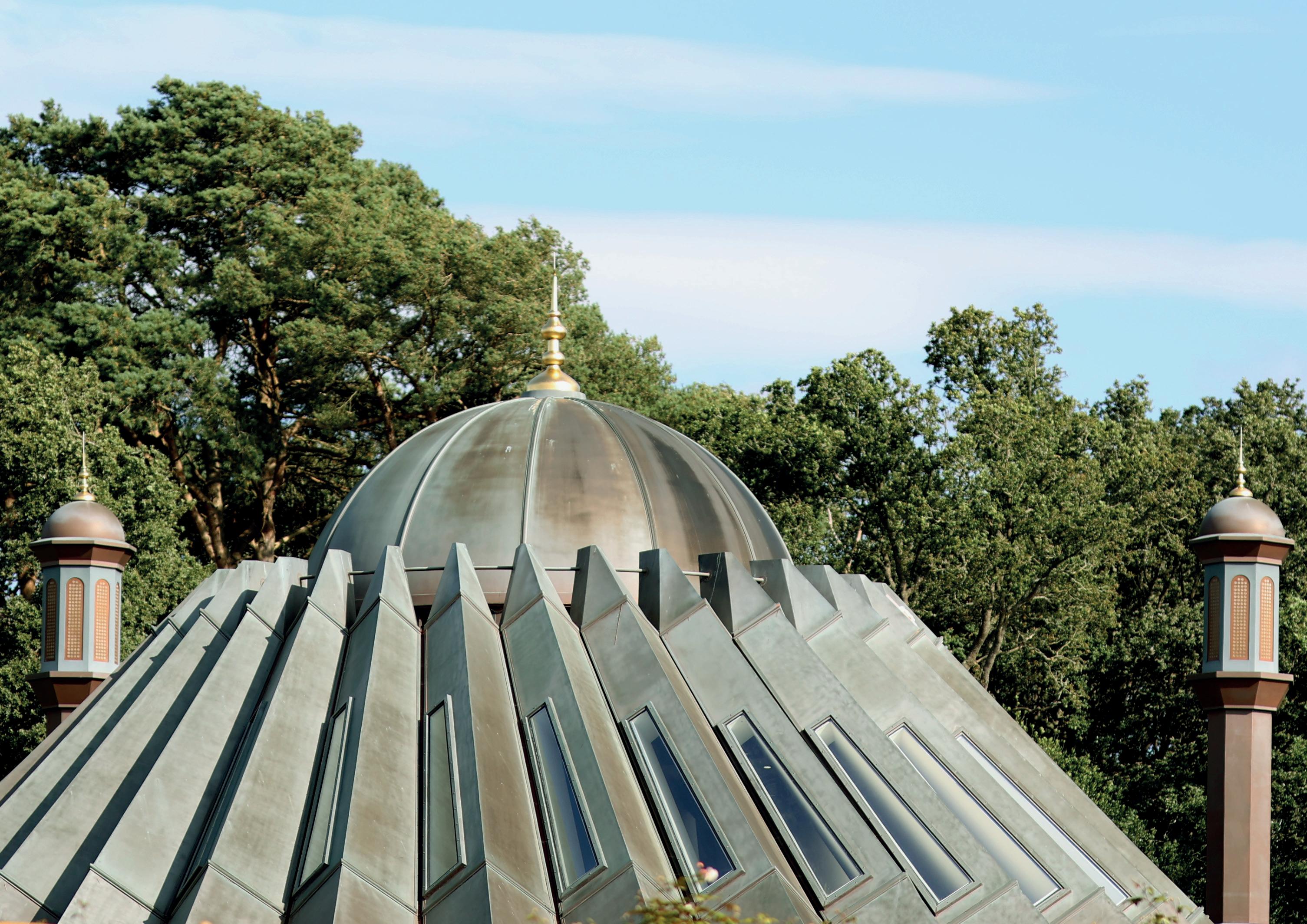
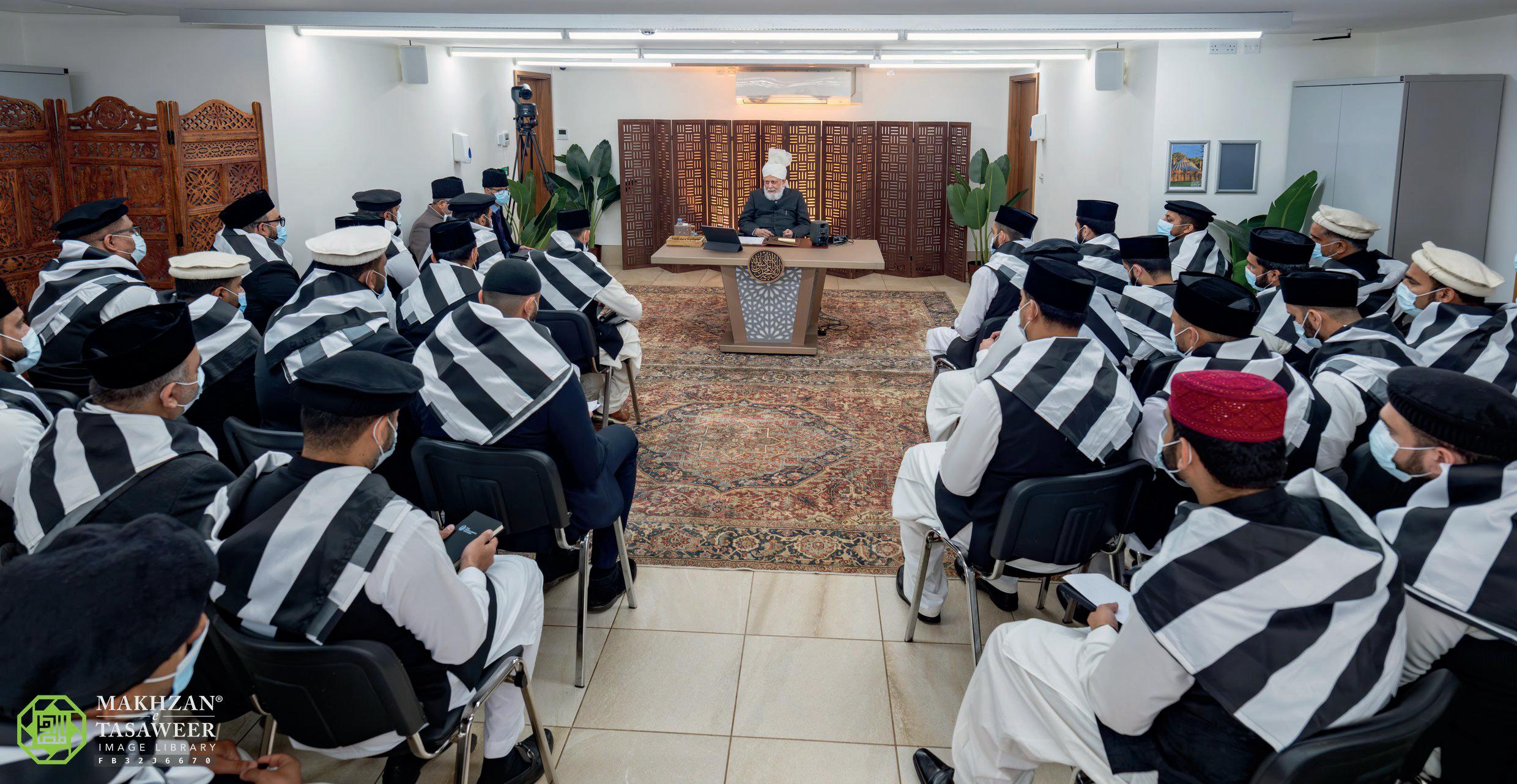
Islamabad, Tilford, UK, 10 May 2026: The national amila of Majlis Khuddam-ulAhmadiyya UK was blessed with a mulaqat with Hazrat Mirza Masroor Ahmad, Khalifatul Masih V (aa).
During the mulaqat, members of the national amila and regional qaideen introduced themselves and received guidance from Huzoor (aa) regarding their departmental responsibilities, the spiritual
foundations of service, tabligh, tarbiyat, education, service to humanity, professional development, SEND support, regional engagement and mosque attendance.
Continued on page 3
The honour of serving the mosque
Hazrat Abu Hurairah (ra) narrated that, “A black man – or, as also reported, a black woman – used to sweep the mosque. When that person passed away, the Prophet (sa) asked about him. The people said, ‘He has passed away.’ The Prophet (sa) said, ‘Why did you not inform me of him? Show me his grave.’ Or he said, ‘her grave.’ He then came to the grave and offered the funeral prayer for that person.”
(
The upbringing of children
The Promised Messiah (as) said: “It is unlawful for such a person to take the seat of a spiritual guide and leader, who is negligent of his followers for even a moment.”
The Promised Messiah (as) said: “Guidance and upbringing, in essence, is in the hands of God. Nagging incessantly and persisting on a matter beyond reasonable bounds, i.e. to prohibit and rebuke children on every little thing, demonstrates that we are, as if, the masters of guidance, and will
Continued on page 3
Sahih al-Bukhari Kitab as-salat, Bab kansi l-masjidi wa l-tiqati l-khiraqi wa l-qadha wa l-‘idan, Hadith 458)
Hazrat Mirza Ghulam Ahmadas, In His Own Words
This Week in History
A glimpse into the rich history of the Ahmadiyya Muslim Jamaat
5 - 8 June
5 June 2000: On this day, Hazrat Khalifatul Masih IV (rh) inspected the Ahmadiyya mosque in Wittlich, Germany, which was the first mosque built under the 100-Mosque Scheme of Jamaat-eAhmadiyya Germany. (Silsila-e-Ahmadiyya, Part 4, p. 902)
6 June 1924: Hazrat Musleh-e-Maud (ra) completed writing his book, Ahmadiyyat, for the Wembley Conference in England. Huzoor (ra) started writing this on 24 May. On 2 July, its English rendering was finished, which was mailed to the organisers in England. Later, Huzoor (ra) himself prepared a summary of this material, which was completed by 9 July. (Tarikh-eAhmadiyyat, Vol. 4, p. 429)
6 June 2014: On this day, Hazrat Khalifatul Masih V (aa) delivered a Friday sermon in Frankfurt, Germany on the significance and blessings of Khilafat. Huzoor (aa) said:
“Before sleeping at night, there is no country of the world that I do not visit in my imagination and no Ahmadi for whom I do not pray before sleeping and whilst awake. I do not say this as a favour on my part; rather, this is my duty.”
7 June 1915: The Promised Messiah’s (as) youngest daughter, Hazrat Nawab Amatul Hafeez Begum’s (ra) nikah with Hazrat Nawab Muhammad Abdullah Khan (ra), son of Hazrat Nawab Muhammad Ali Khan (ra) of Malerkotla, was announced. Hazrat Maulvi Ghulam Rasul Rajeki (ra) announced this nikah in Masjid Aqsa, Qadian. The dowry was 15,000 rupees.
Hazrat Maulvi Ghulam Rasul Rajeki (ra) was called from Lahore to announce the nikah. The nikah was announced at seven o’clock in the evening. Hazrat Ummul Momineen, Amma Jan (ra), had a dream about the blessings of this marriage during the time of the Promised Messiah (as).
Hazrat Nawab Amatul Hafeez Begum (ra) lived a long life and passed away in Rabwah on 6 May 1987. She was blessed with the following children:
1. Tayyaba Amina Begum Sahiba (Born 18 March 1919)
2. Nawab Mian Abbas Ahmad Khan Sahib (Born 2 June 1920)
3. Tahira Begum Sahiba (Born 3 June 1921)
4. Zakia Begum Sahiba (Born 23 November 1923)
5. Qudsia Begum Sahiba (Born 20 June 1927)
6. Shahida Begum Sahiba (Born 31 October 1934)
7. Mian Shahid Ahmad Khan Sahib (Born 10 October 1935)
8. Fauzia Begum Sahiba (Born 22 November 1941)
9. Mian Mustafa Ahmad Khan Sahib (Born 10 July 1943)
(Tarikh-e-Ahmadiyyat, Vol. 4, p. 175)
8 June 1904: On this day, the Promised Messiah (as) received the following Arabic revelation:
“Temporary residences and permanent ones will be wiped out. I shall safeguard all those who are in this house. I have bestowed upon you all bounties.” (Tadhkirah [English], 2019, p. 703)
For more details, see “‘The recurring earthquakes continue to affirm him’: A glimpse into the Promised Messiah’s prophecies and the Kangra earthquake of 1905” at alhakam.org (12 April 2024).
9 June
9 June 1905: On this day, the Promised Messiah (as) received the following Arabic revelation:
“I am with you and with the members of your family and with all those who love you.” (Tadhkirah [English], 2009, p. 758)
9 June 2014: On this day, Hazrat Khalifatul Masih V (aa) inaugurated the Al-Mahdi Mosque in the German municipality of Neufahrn, situated 20 kilometres from Munich. (“Al-Mahdi Mosque, Neufahrn, Munich inaugurated”) www. pressahmadiyya.com)
10 June
10 June 1878: On this day, the Promised Messiah (as) issued a printed announcement, which served as an open letter in response to Swami Dayanand
Saraswati’s invitation to debate. The subject was the Arya doctrine of transmigration of souls, as well as a comparison between the Vedas and the Holy Quran. In this announcement, Hazrat Ahmad (as) proposed that impartial judges be appointed from among learned Christian and Brahmo Samaj figures, so that the matter could be assessed fairly. The acceptance was published in Baradare-Hind of Lahore in July 1878. (Maktubat-eAhmad, Vol. 1, pp. 5-8; Life of Ahmad, p. 80)
10 June 1982: On this day, Hazrat Mirza Tahir Ahmad (rh) was elected as the Khalifatul Masih IV. A day earlier, Hazrat Mirza Nasir Ahmad, Khalifatul Masih III (rh), had passed away. (Silsila Ahmadiyya, Part 4, p. 814)
11 June
11 June 1899: On this day, the Promised Messiah (as) sent a letter to his Companion, Hazrat Seth Allah Rakha Abdur Rahman (ra), asking him to acquire more information about the annual carnival of Yuz Asaf in Madras (present-day Chennai). Prior to this, Huzoor (as) was busy compiling his research about the escape journey of Jesus (as) towards India. This letter also exhibits Huzoor’s (as) unyielding, resolute trust in God and acceptance of his prayers. (Maktubat-eAhmad, Vol. 2, p. 387)
11 June 2013: On this day, Hazrat Khalifatul Masih V (aa) was welcomed to the British Houses of Parliament by the deputy prime minister and various parliamentarians.
The purpose of this visit to Westminster was to deliver the keynote address at a special reception in recognition of the 100-year centenary celebrations of the Ahmadiyya Muslim Jamaat in the UK.
Prior to the formal proceedings, Huzooraa held private meetings with the then Deputy Prime Minister Nick Clegg, Home Secretary Theresa May, Energy Secretary Ed Davey, Shadow Foreign Secretary Douglas Alexander, Keith Vaz MP and Siobhain McDonagh MP. (“Historic Reception takes place at Houses of Parliament to Celebrate Ahmadiyya Muslim Jamaat UK Centenary”, www. pressahmadiyya.com)
Work according to the constitution and seek Allah’s help
At the outset, Huzoor (aa) asked whether departmental reports were being submitted, whether a plan of action had been prepared and whether work was being carried out in accordance with the constitution. Huzoor (aa) said that this was the essential point: work should be carried out according to the prescribed system and with the thought that all such service is being done for the sake of faith.
Huzoor (aa) reminded the amila that work done for faith especially requires the help of Allah the Almighty and that without Allah’s help such work cannot be accomplished. Therefore, the rights owed to Allah must be fulfilled first, after which blessings are placed in one’s work. For this purpose, Huzoor (aa) said, prayer, salat, nawafil and supplication are necessary. In worldly work, a person may rely on knowledge and ability, but in the service of faith, one must turn entirely towards Allah.
Following this opening guidance, the members introduced themselves and their respective responsibilities.
Introductions and assigned responsibilities
Huzoor (aa) spoke with the naib sadran and enquired about their professional backgrounds and assigned duties. One Naib Sadr mentioned his work with the Muhasibah Committee and Islamabad events and Huzoor (aa) asked about his finance background, upon which he explained that he served as a senior accountant at AMJ International.
Another Naib Sadr mentioned that he worked as an IT contractor in the central government; he oversaw matters including delegation, jaidad, GDPR and sustainability. Another was overseeing the Winter Retreat, international trips, Baitul Futuh event
management, missionary engagement and other departments. A further Naib Sadr mentioned his professional work in marketing for The Times and his responsibilities connected with Ishaat and the national Ijtema.
Speaking with the Motamid, Huzoor (aa) asked how much time he was able to give, noting that the Motamid has to devote considerable time to the department. The Motamid explained that he gave what time he could and that, following Huzoor’s (aa) recent guidance, he had begun going to the office daily. Huzoor (aa) asked whether this was being done out of compulsion and when the Motamid replied that he was working with interest, Huzoor (aa) said that he should continue doing so and pray to Allah to make up for any remaining shortcomings.
Huzoor (aa) also spoke briefly with the Additional Mohtamim Umumi, who mentioned his duties connected with Hifazat-e-Markaz and other responsibilities.
Khidmat-e-Khalq and service to those in need
The Mohtamim Khidmat-e-Khalq reported that, at the beginning of the year, the department had launched two campaigns: a winter campaign and a Ramadan campaign. When Huzoor (aa) asked what had been achieved through the winter campaign, including how many blankets, jerseys and warm clothes had been distributed in poorer countries, the Mohtamim explained that their focus had been on work within the UK, while the Ramadan campaign had raised £120,000 for Humanity First.
Huzoor (aa) drew attention to the homeless in the UK, noting that many people sleep outside shops with sleeping bags and cover themselves with bin bags. The Mohtamim said that the department also arranged homeless-feeding sessions across the country. Huzoor (aa) then asked whether they provided such people with
food or support for rent, noting that such people often face the choice of either eating or paying rent.
Paying off debt and avoiding a legacy of financial burden
Speaking with the Mohtamim Maal, Huzoor (aa) asked what property or buildings Majlis Khuddam-ul-Ahmadiyya had, apart from the guest house. The Mohtamim mentioned the Sara-e-Masroor guesthouse, acquired in 2023.
Huzoor (aa) then asked about the financial commitments associated with the property and instructed that reserve funds should be used to clear them as quickly as possible. Huzoor (aa) advised that the organisation should not leave behind a legacy whereby the next Sadr or Mohtamim Maal would inherit a Majlis still burdened with debt. He instructed that the debt should be cleared.
Tabligh, Waqf-e-Arzi and the need for honest feedback
The Mohtamim Tabligh was asked what target had been set for tabligh. He explained that, in order to activate khuddam, a Waqfe-Arzi scheme had been launched in November. By the grace of Allah, 11 Waqfe-Arzi sessions had taken place, during which members carried out door-to-door work around mosques. He reported that 561 khuddam had participated.
Huzoor (aa) asked what had been achieved through this. The Mohtamim said that the participants had been trained in order to build their confidence. He explained that the plan was to arrange mosque open days, invite neighbours doorto-door and set up “Ask Islam” stalls in town centres, so that khuddam could become more confident and their hesitation in doing tabligh could be reduced.
Huzoor (aa) then asked about the
be able to bring our children on the path that accords with our own will. This is a hidden form of associating partners with God. My community ought to refrain from such a practice.”
The Promised Messiah (as) categorically said, and also gave instructions in writing, that any teacher in our school who has the habit of hitting children and does not refrain from this inappropriate action should be dismissed immediately.
The Promised Messiah (as) said: “I pray for my children, and see to it that they follow broad principles, etiquette and teachings; this is all, nothing more. Then, I place my entire trust in Allah the Exalted. The seed of goodness that is present in each of them, according to their nature, will flourish when the time comes.”
(Malfuzat [English], Vol. 2, p.181 - 182)
impact of a recent debate involving Jamaat representatives and whether it had benefited the Jamaat. The Mohtamim said that it had been beneficial for him personally and for many khuddam. Huzoor (aa) observed that some non-Ahmadis had commented that their own representatives had not answered properly, while some Ahmadis felt that the Jamaat’s presentation could also be improved. Huzoor (aa) asked whether feedback had been taken from khuddam on how such efforts could be improved. When the Mohtamim said that feedback from khuddam had not yet been taken, Huzoor (aa) said that it was his responsibility to do so.
Huzoor (aa) explained that they had
become helpers in this work and should provide feedback, suggest strategy, present options and advise how improvement could be achieved. The initial approach should not be regarded as the final word. They could give advice to the Jamaat, to the Secretary Tabligh, to those carrying out the work and to the missionaries. Feedback should be taken from qaideen and khuddam so that improvement may follow.
Huzoor (aa) said that one should not merely say that the result was good, praise it and then leave the matter. No one is 100% perfect. Flaws, shortcomings and weaknesses should be identified, studied and addressed. The department should form a team, consider how matters should be presented and then offer constructive feedback. Huzoor (aa) also asked whether the overall result had been good and the Mohtamim replied in the affirmative.
Accepting one’s fault as a means of progress
During the introductions, Huzoor (aa) spoke to a Mu‘avin Sadr and recalled a childhood incident in which he had tumbled during a race at Hadeeqatul Mahdi. When the Mu‘avin Sadr replied that it had not been his fault because the path was downhill, Huzoor (aa) advised him to develop the habit of accepting one’s fault. Huzoor (aa) said that when a person acknowledges their fault and tries to improve, this leads to good progress.
Tarbiyat begins with personal example
Speaking to the Mohtamim Tarbiyat, Huzoor (aa) first asked what tarbiyat work he was doing and then asked about his own observance of congregational prayers. Huzoor (aa) said that the Mohtamim should strive to offer prayers in congregation himself. If office-bearers themselves offer prayers in congregation, recite the Holy Quran, give attention to nawafil, prayers and zikr-e-ilahi, then their tarbiyat work will produce better results.
Huzoor (aa) emphasised that the first requirement is to present one’s own example. Otherwise, there are many people who can merely deliver speeches. The real task is to instil the habit of salat among khuddam, then to instil the habit of reciting the Holy Quran. Thereafter, short passages from the writings of the Promised Messiah (as), as well as from the sermons of the Khulafa, should be shared with khuddam so that they remember them. Huzoor (aa) said that khuddam should develop both knowledge and courage, as both are needed.
Sanat-o-Tijarat and helping idle youth into work
The Mohtamim Sanat-o-Tijarat reported the number of khuddam of working age, aged 18 and above, and said that the department was trying to identify each person’s professional status, including what work they did and where they were employed.
Huzoor (aa) instructed that attention should also be given to those who had left education, were idle or had fallen into bad company. He mentioned those who may have become involved in drugs or other addictions. Huzoor (aa) advised that such individuals should also be listed and given some form of work, even if small, so that
they can earn and become occupied in something constructive.
Huzoor (aa) said this should be done in coordination with the Tarbiyat department. If Sanat-o-Tijarat and Tarbiyat work together through a coordinated programme, many young people can be looked after and helped.
Physical health and securing sports facilities
The Mohtamim Sehat-e-Jismani reported on sports being organised, including football, padel, badminton and table tennis and said that activities were taking place two to three days a week. Huzoor (aa) asked what sports khuddam were being made to play locally and the Mohtamim mentioned football, cricket, table tennis and badminton.
Huzoor (aa) asked whether khuddam had their own teams in grounds or played through other clubs. The Mohtamim said that Majlis Khuddam-ul-Ahmadiyya currently had an external cricket team in London, while most other activities remained internal. He also mentioned a council ground in Kingston and said that a ground had been obtained for this year, while efforts were being made to secure a permanent ground. Huzoor (aa) said that there is also a team of khuddam from Islamabad in Tilford.
Student data and university engagement
The Mohtamim Umur-e-Tulaba was asked how many university-going students there were. He reported that data had been collected for 597 undergraduate and master’s students and that 60% of the data collection process had been completed since November. Huzoor (aa) instructed that the remaining data should also be updated.
Talim, grassroots classes and creating interest in reading
Speaking with the Mohtamim Talim, Huzoor (aa) asked what the education programme was. The Mohtamim explained that the department was working to strengthen the grassroots level by encouraging two classes per month in every majlis and by having the team visit those classes. He said that content was being provided, positive feedback was being received and the focus was on teaching Jamaat beliefs and addressing common allegations through local, regional and other events.
Huzoor (aa) said that some religious knowledge should also be developed through books. The Mohtamim mentioned that Zikr-e-Ilahi had been recommended in light of the year’s theme, “Hamara Bahisht Hamara Khuda Hay (Our Paradise lies in our God)”. Huzoor (aa) asked how many people actually read the book. He said that merely telling people to read would not be enough. Short summaries should be prepared and sent in between, so that interest is created. Once interest develops, individuals may then read the full text in more detail. Huzoor (aa) said that this would require effort and hard work.
When the Mohtamim said that quizzes were also prepared so that those who said they had read could answer them, Huzoor (aa) remarked that this was work requiring considerable effort.
Waqf-e-Nau: ensuring guidance reaches every home
Speaking with the Mu‘avin Sadr for Waqfe-Nau, Huzoor (aa) asked about the Waqfe-Nau Ijtema and the attendance. Huzoor (aa) also asked what effect the Ijtema had produced and whether the attendees had simply listened to speeches and left. He instructed that points from the guidance should be extracted and given to every waqif-e-nau, reaching every home. These reminders should continue to be sent from time to time, highlighting the matters that require attention and the work that must be done.
SEND and safeguarding: Improving data and tailored activities
The Mu‘avin Sadr for SEND and safeguarding reported that, according to the data so far, there were 95 atfal and khuddam with SEND and that an external play-area activity had recently been arranged for them.
Huzoor (aa) asked whether there were only 95 with special educational needs. The Mu‘avin Sadr said that this was the current data, though the actual number was definitely higher. Huzoor (aa) instructed that the data should be reviewed and improved.
Huzoor (aa) asked what help was being offered to those with special needs. The Mu‘avin Sadr said that there were relatively few specific activities as part of Majlis Khuddam-ul-Ahmadiyya and that feedback from the recent event suggested there should be more such events.
Huzoor (aa) advised that different groups should be formed and that suitable games and activities should be explored. Small tournaments could be held every few months so that they remain attached to the Majlis. Huzoor (aa) also drew attention to wheelchairs and adapted sports, asking whether sports such as hockey or football could be arranged in suitable ways and instructed that all such possibilities should be considered.
Guidance to regional qaideen
Thereafter, Huzoor (aa) spoke with each national amila member and regional Qaid present, asking the qaideen about their tajnid and the level of activity among khuddam
Speaking with the Qaid of Baitul Ehsan Region, Huzoor (aa) asked whether they were receiving many opportunities for service due to guests staying there and whether the khuddam handled those duties or left them to the Jamaat administration. The Qaid said that they tried to serve wherever they were given the opportunity and according to the guidance received from the Regional Amir.
Speaking with the Qaid of Middlesex Region, Huzoor (aa) asked about his work. The Qaid explained that he ran a printing company specialising in custom clothing such as jumpers, hoodies and jackets and that much of the clothing seen at Jalsa was produced by his company. Huzoor (aa) asked whether he gave concessions for Ijtema-related items. The Qaid said that he aimed to provide items at cost price and did not take profit, upon which Huzoor (aa) expressed appreciation.
The real measure is the percentage of active khuddam
Speaking with the Qaid of Baitus Subhan Region, Huzoor (aa) asked how many khuddam were in the region. The Qaid reported 422 khuddam and 565 khuddam and atfal combined. Huzoor (aa) then asked how many were active. The Qaid said that 25 attended daily prayers, while around 150 attended Jumuah.
Huzoor (aa) asked what the remaining 300 were doing. When the Qaid said that some attended Ijtema and other Jamaat programmes, Huzoor (aa) said that there should at least be some level of regular attendance: for example, attending one prayer at the mosque, such as Isha, Maghrib or Fajr or attending monthly meetings.
Huzoor (aa) instructed the qaideen to give attention to this and not become relaxed simply because a few people attend or because two rows form in the mosque. The real matter is to see what percentage of members are active and this number should be increased as much as possible. Huzoor (aa) said that this is the work of qaideen
Speaking with the Qaid of North West Region, Huzoor (aa) asked which areas were included and the Qaid mentioned the five qiadats of Manchester, as well as Liverpool, Bolton, Blackburn and Preston. The Qaid said that members were cooperative and mentioned that, in the previous month, they had held an amila meeting after Fajr, which had produced the highest attendance and that they were trying to begin with prayer.
Huzoor (aa) instructed that they should increase this effort, bring khuddam closer and attach them to the mosque. He said that this is the real work and if this is not achieved, then there is no benefit to the organisations. If at least 70% attendance in prayers is not being achieved and members are not reciting the Holy Quran, then the desired promising results are not being produced. Huzoor (aa) said that every Qaid should make effort in this regard and that the benefit of appointing missionaries in such roles would be realised only if spirituality also increases through them.
Guidance for office-bearers and missionaries
Speaking with the Naib Motamid, Huzoor (aa) asked whether he was working properly in the Itimad department. Huzoor (aa) advised him to focus on prayers and also referred to the guidance he had given to missionaries in his address at the Jamia Ahmadiyya convocation. Huzoor (aa) said that although this guidance was especially for missionaries, it also applied generally to all those who become office-bearers.
Conclusion
At the end of the mulaqat, Huzoor (aa) concluded by reiterating the guidance he had given at the start: they must establish a connection with Allah, maintain a spirit of service and always remember that whatever work they do is being seen by Allah and must be done for His sake. This was followed by a group photo.
(Summary prepared by Al Hakam)
“
I am, indeed, the Promised Messiah and I am the very one who was destined to nish o [disbelief ] and generously distribute [spiritual treasures]. I am that man who is on a quest to nd the righteous seeker a er truth—wherefore glad tidings be for the righteous! Without a doubt, righteousness is not easy; for, by Allah, it surely resembles death, because the one who chooses righteousness is—so to speak—akin to the one who chooses death.
HAZRAT MIRZA GHULAM AHMAD (AS)
The Promised Messiah and Mahdi
Alhamdulillah for the wolves of Yellowstone
Sohaib Awan USA
Recall the most picturesque landscape you have ever seen. Maybe you envision snowcapped mountains, a roaring waterfall, or a crystal-clear lake. Imagine the deep breath you took that not only filled your lungs with fresh air but your heart with hamd, praise for Allah the Almighty. Your heart proves itself too small a vessel to contain this praise, so it spills over into every fibre of your being and “alhamdulillah”, “all praise belongs to Allah”, spontaneously emanates from the depths of your soul.
Yellowstone National Park, located in the Western United States, is one such extraordinary landscape. It attracts nearly four million eager visitors annually, making it one of the most visited national parks in the world. Its serene mountains, lakes, forests, canyons and wildlife, stretching over some 2.2 million acres, captivates beholders and inspires awe for al-Khaliq, but alMusawwir, the Divine Artist of the universe. Lurking within its shadows, however, are the wolves of Yellowstone. These are some of the most ferocious yet tactful predators in the park. A well-coordinated pack has the ability to take down elk and even bison many times their own size.
Seen by its inhabitants as a threat to livestock and communities and as a blot on the canvas of the Almighty, ranchers and park rangers hunted these wolves down to the very last one in the early 20th century. Cash bounties were offered for wolf pelts, and legal mandates required park rangers to shoot and kill all wolves on sight. By
1926, the wolves of Yellowstone had been eradicated.
Man stepped back to admire the “correction” he had made to what he thought was Allah the Almighty’s “almost” perfect masterpiece. Gradually, however, his grin turned into a look of puzzlement and then horror. As he scanned the canvas, he realised that the real mistake was his own so-called correction.
With the elimination of wolves from Yellowstone, a host of unintended consequences devastated the park over the next several decades, in a phenomenon referred to by ecologists as a trophic cascade. Without the apex predator, elk populations soared beyond what the landscape could sustain. Overgrazing destroyed young vegetation, which in turn destabilised and eroded riverbanks. This ruined the habitats of various animals, especially beavers, leaving behind just a single colony in all of Yellowstone National Park. Fish, muskrats, and otters that had flourished in ponds and wetlands created by beaver dams were all adversely affected. Scavengers such as ravens, eagles, and foxes, which used to feed on the carcasses of elk and bison left behind by wolves, now found their food sources under threat. Yellowstone was rotting from the inside out.
Finally realising his mistake, man sought to undo his “correction” and return the painting back to its original, pristine state. From 1995 to 1997, wolves were captured and relocated from Canada to Yellowstone. They established packs, reproduced, and repopulated the park, gradually restoring balance and beauty to the National Park.
Man stepped back again, this time to admire the correction of his previous “correction.” And to this day, he comes in droves to marvel at this perfect painting, yet still all too often fails to recognise its Divine Painter. But the wolves of Yellowstone know better. Amidst their low howls echoes:
“No incongruity canst thou see in the creation of the Gracious [God]. Then look again: Seest thou any flaw? Aye, look again, and yet again, thy sight will only return unto thee confused and fatigued.” (Surah alMulk, Ch.67: V.4-5)
And if it is difficult to discern these verses in between their howls, then remember: “And there is not a thing but glorifies Him with His praise; but you understand not their glorification.” (Surah Bani Isra’il, Ch.17: V.45)
The wolves of Yellowstone teach us that not only is there a divine balance in the universe, but that its beauty often depends on that which lurks in its shadows or is dismissed as a smudge on Allah the Almighty’s divine painting. Hazrat Musleh-e–Maud (ra) elaborates:
“Another question which is sometimes asked is, ‘if God is a Beneficent Creator, why has He created things like wild and savage animals, worms and reptiles, pains, troubles, ailments, and pestilences, etc.?’ Islam offers an explanation of this also. For instance, the Holy Quran says:
“‘All praise is due to God Who has created the heavens and the earth and has made the light and darkness, and yet those who deny the truth associate others with Him.’ (Surah Al-An‘am, Ch.6: V.2)
“That is to say, all things that are
troublesome and are called the children of darkness, for instance, reptiles, wild beasts, poisons, plagues, etc., are also the creation of God, and their creation does not offend against the attribute of mercy but on the contrary proves the mercy of God. If their true nature is considered, they add to the praise and glory of God and do not detract from it [...]. See how beautifully Islam has unveiled the truth and has explained the object of creating those things which appear at first sight harmful. It teaches that they have all been created for a useful purpose and that man ought to praise God for their creation [...]. The same is the case with snakes, scorpions, and other reptiles. Much attention has not yet been devoted to these creatures, but further research is bound to disclose the fact that their existence is of great value from the scientific and medical points of view.” (Ahmadiyyat or the True Islam, 2017, pp. 51-52)
Just as man was hunting down the last of the wolves of Yellowstone in the Western United States, Hazrat Muslehe-Maud (ra) came from the east to warn him. In 1924, Hazrat Musleh-e-Maud’s (ra) above statement was read out at the Conference of Living Religions Within the Empire in London, England. On the basis of the Quran, he explained that man, in his short-sightedness, objects to Allah’s creation and seeks to find flaws within it. Deeper research and reflection, however, invariably demonstrate that the very targets of His scrutiny bring divine balance to the universe. They do not detract, but rather “add to the praise and glory of God.”
In other words, all praise belongs to Allah for the wolves of Yellowstone.
Answers to Everyday Issues
Playing music instruments, coin clipping, sexual ethics and divine attributes
Guidance regarding basic Islamic issues that Hazrat Amirul Momineen, Khalifatul Masih Vaa, has given on various occasions in his written correspondence and during MTA programmes is being published officially below for everyone’s benefit.
Is playing musical instruments haram in Islam?
Someone from Syria wrote to Hazrat Amirul Momineen, Khalifatul Masih V (aa), stating that he was learning to play a musical instrument and asked whether this was forbidden [haram].
In his letter dated 18 December 2023, Huzoor-e-Anwar (aa) gave the following answer to this question:
“An Ahmadi should engage only in such pursuits as are free from doubtful matters that are susceptible to wrong interpretation. In this regard, the Holy Prophet (sa) has guided us by stating that the lawful is clear and the unlawful is clear and between the two are certain doubtful matters which many people do not discern correctly. Thus, whoever avoids doubtful matters safeguards his faith and his honour. And whoever falls into such doubtful matters is like a shepherd who grazes his flock near a protected pasture and his animals may at any moment stray into it. Beware! Every king has a protected preserve and Allah’s protected bounds upon the earth are the things He has forbidden. (Sahih al-Bukhari, Kitab al-iman, Bab fadli mun istabra’a li dinih)
“Therefore, playing musical instruments and learning to play them falls, in my view, within the category of doubtful matters. It is therefore better to avoid it. Playing a musical instrument at home once in a while is a different matter; however, learning to play these instruments and then going out to perform in markets, at various functions and at concerts can open the door to many improprieties and lead one into various other wrongs. It is therefore better to refrain from it.”
Why did Prophet Muhammad (sa) forbid tampering with or clipping coins?
Someone from the UK wrote to Hazrat Amirul Momineen, Khalifatul Masih V (aa), asking whether the prohibition mentioned in the hadith against tampering with coins might have been intended to prevent inflation.
In his letter dated 22 January 2024, Huzoor-e-Anwar (aa) provided the following guidance regarding this issue:
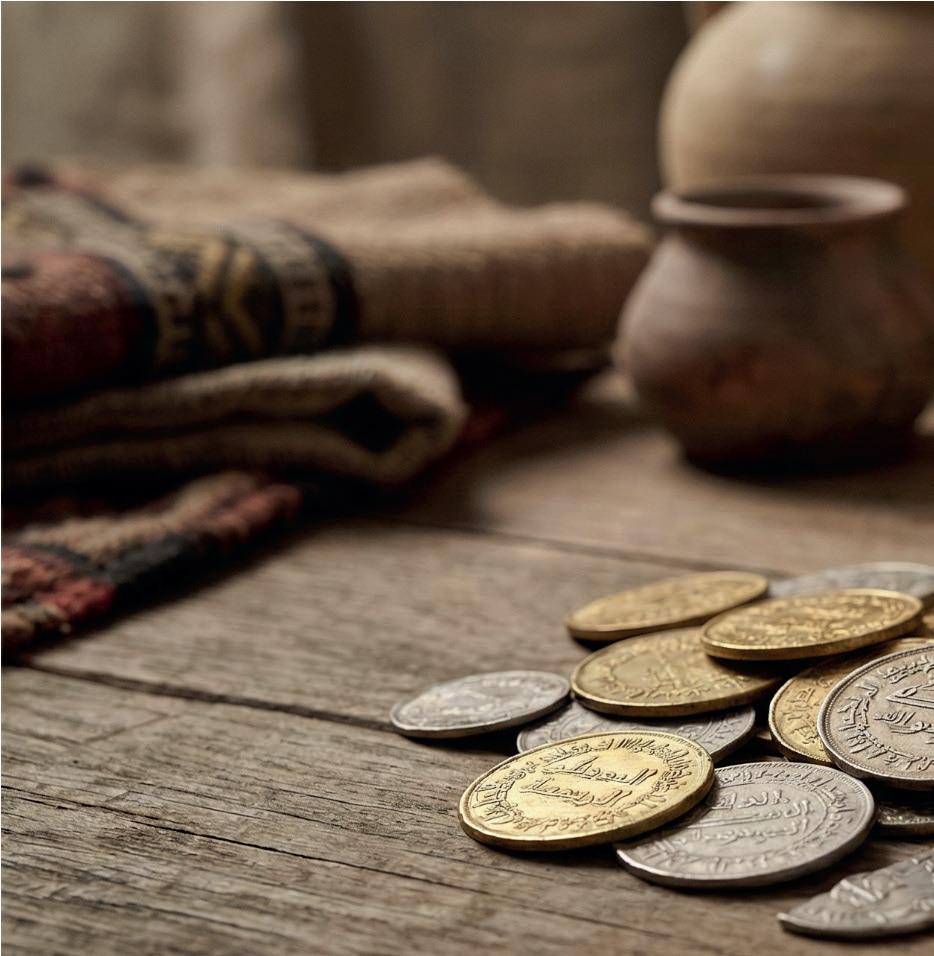
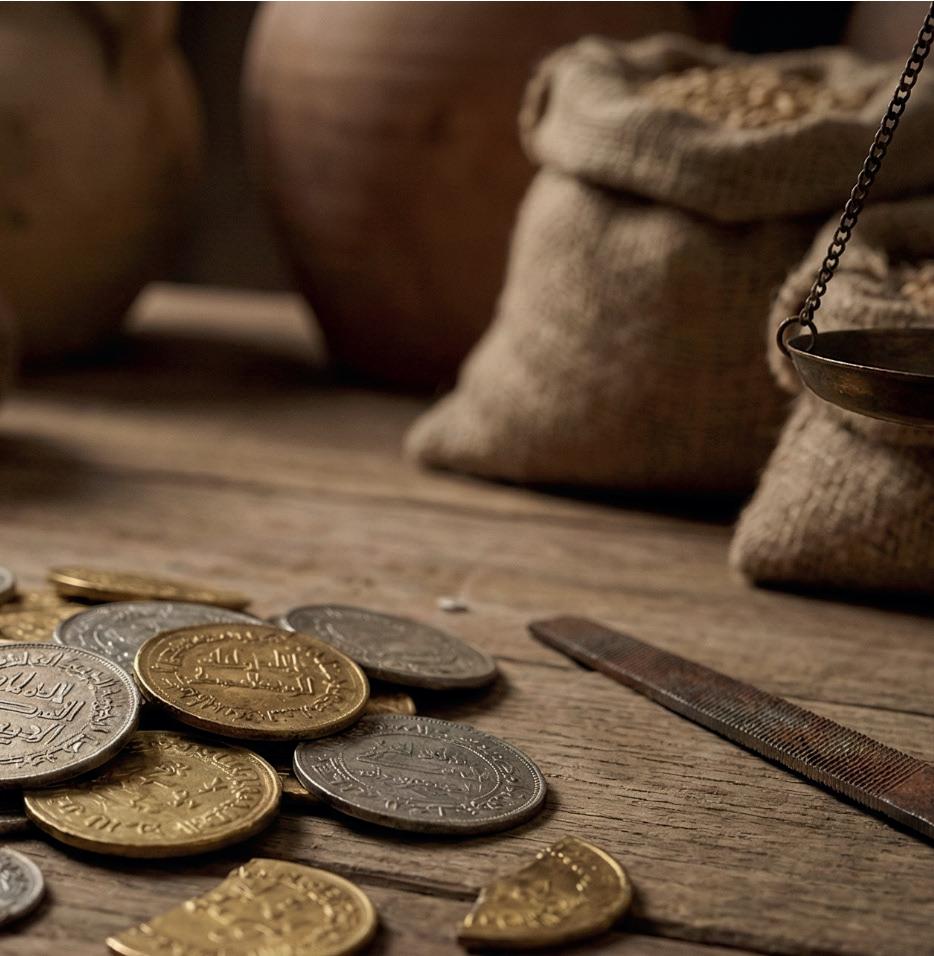
“The ahadith you mentioned in your letter concerning the prohibition against tampering with coins are recorded in Sunan Abi Dawud (Kitab al-buyu‘) and Sunan Ibn Majah (Kitab at-tijarat), in a narration from Hazrat Abdullah bin Mas‘ud (ra), which states that the Holy Prophet (sa) forbade tampering with coins in circulation among Muslims without a valid necessity.
“In fact, at that time, transactions involving official coins – the dirham, which was generally of silver and the dinar, which was generally of gold – were conducted by count, rather than by weight. Therefore, some people would wrongfully clip the edges of these coins, keep the gold or silver for themselves and then pass those coins in the market by count. Similarly, some people would melt them down into lumps of silver or gold and keep them, which reduced the circulation of currency in the market, caused loss to the state and created a shortage of currency for the people. Thus, with a view to the moral training of Muslims, the Holy Prophet (sa) instructed them to refrain from this wrongdoing, fraud and loss to the state, just as they were instructed to refrain from other evils.
“However, where it became necessary to melt these coins down – for instance, where coins had become worn and unsound with age or where their value had been reduced due to tampering or where, following a change of government, the incoming government wished to put its own coins into circulation in the market – then, in all such cases, this prohibition did not apply to the relevant authority and the authority could remint those old coins into new ones.
“Hence, this injunction of the Holy Prophet (sa) has nothing to do with inflation. In those days, a temporary shortage of foodstuffs and rising prices generally occurred as a result of famine. And when the period of famine passed and the economy recovered, that temporary shortage would also come to an end and prices would return to their previous level.”
Why are premarital relations considered wrong in Islam?
A non-Ahmadi woman from Germany wrote to Hazrat Amirul Momineen, Khalifatul Masih V (aa), asking why sexual relations before marriage are considered wrong and whether the Ahmadiyya Muslim Jamaat also regards them as wrong. She further asked: “Why is emphasis placed on a woman remaining a virgin, yet no similar emphasis is placed on men? In the Jamaat, is a woman checked by a doctor before marriage to confirm that she is a virgin, even though the hymen may tear during sport and exercise? Can anyone claim that Ahmadi men do not watch obscene material or do not engage in premarital sexual relations? Can rape occur within marriage [...] and why is this not discussed? If two people love one another, why must they marry? Does this mean that marriage is contracted because of sexual need rather than mutual love? And are there men who can wait until marriage?”
In his letter dated 25 January 2024, Huzoor-e-Anwar (aa) gave the following
guidance in response:
“The questions raised in your letter generally arise as a result of distance from Allah the Exalted and a failure to understand the teachings of His religion. Therefore, remember that the God Who created mankind sent His Prophets, along with His teachings, at different times and in different lands, in order to set forth for mankind the principles of life and the various rules and regulations by which to live. Then, by sending our master and guide, the Holy Prophet Muhammad al-Mustafa (sa), He perfected the religion and taught us the ways and modes of living until the Day of Judgement.
“Within this religious teaching, Allah the Exalted has also laid down a principle for social life: that a physical relationship between a man and a woman without nikah [marriage] is unlawful and falls within the category of disobedience to Allah the Exalted. Islam calls such a relationship zina [illicit sexual relations] and declares it to be a sin. Therefore, it is regarded as wrong in Islamic society and according to the Ahmadiyya Muslim Jamaat as well – which is the standard-bearer of the true teachings of Islam – this act is wrong and incurs the displeasure of Allah the Exalted.
“Your second question – that Islam does not emphasise the moral reform of men and only insists that women remain virgins before marriage – is incorrect. The Sharia teaches both men and women alike that they
must refrain from every form of evil. In the Holy Quran, where women are commanded to lower their gaze and guard their chastity, men are given the same command: to lower their gaze and guard their chastity. Indeed, in terms of sequence, this command is first addressed to men and only thereafter are women mentioned. (Surah an-Nur, Ch.24: V.31-32)
“Furthermore, with regard to unlawful sexual relations, in the Holy Quran, where the punishment of the woman guilty of zina is mentioned, the punishment of the man guilty of zina is mentioned alongside it in exactly the same manner; no distinction whatsoever has been made between them. (Surah an-Nur, Ch.24: V.3) Moreover, when we look at the time of the Holy Prophet (sa), we find several instances in which men were punished for zina, whereas only one or two such cases are found regarding a woman and even in that case it is expressly mentioned that the woman repeatedly presented herself before the Holy Prophet (sa), insisting that she be punished. (Muwatta Imam Malik, Kitab al-hudud, Bab al-rajm)
“Thus, Islam has consistently taught equality between men and women in the reward for virtue and the punishment for vice. However, in the Western society in which you live, equality in matters relating to men and women is merely claimed, but by no means practised. As a result, the balance of life has been disturbed and the human race is moving towards ruin both materially and spiritually.
“As for your third question – whether a woman should be examined by a doctor before marriage in order to ascertain her virginity – let it be clear that this is an absurd notion and an entirely wrong practice and it has not even the remotest connection with Islamic teaching. If such a practice exists in any society, it is merely a custom devised by the people of that society themselves; it has no connection with religion. Moreover, according to medical science, a woman’s hymen may be torn through various forms of sport and exercise, such as cycling, horseriding, gymnastics and using climbing frames, as well as during certain medical examinations carried out for illness.
“As for your fourth question, regarding men committing immoral acts or engaging in unlawful sexual relations before marriage, the answer is that no human being can guarantee another person’s virtue or vice. Allah the Exalted alone is the Knower of the Unseen and He alone knows what lies within a person and what that person’s hidden deeds are. As for anyone who commits a sin, Allah the Exalted reserves the right to punish such a person; He may punish them in this world or in the Hereafter or He may forgive them as a result of their repentance.
“As for your question concerning ‘rape’ between husband and wife after marriage, the answer is that, according to Islamic teachings, such a notion is entirely baseless, because nikah is a contract between husband and wife, as a result of which both are bound to be mindful of one another’s rights and feelings. Therefore, without any valid reason, neither may the wife refuse the husband in this regard, nor may the husband refuse the wife. Allah the Exalted has made this physical relationship between husband and wife a source of comfort and tranquillity. (Surah ar-Rum, Ch.30: V.22)
“Thus, the Islamic teaching is that husband and wife, while being mindful of
one another’s physical needs, should become a source of comfort and reassurance for one another and should not establish unlawful relations with other men or women outside the home. However, those who have ignored this beautiful teaching have destroyed their religious as well as worldly peace.
“In response to your question concerning marriage and sexual need, Allah the Exalted has made the relationship between husband and wife a means not only of chastity and purity, but also of the continuation of the human race. Love alone cannot carry human posterity forward and the very concept of continuation would disappear. If by love one means establishing a physical relationship between a man and a woman without marriage or nikah, then religion does not permit this, for it has established a distinction between animals and human beings and has raised the human being to the rank of the noblest of creation (ashraf al-makhluqat).
“As for your question of whether there are men who wait until marriage before entering into sexual relations, it should be clear that such men certainly do exist; indeed, they exist in large numbers and they establish such relations only after marriage, not before. It would be unfairly cynical to say that nowadays no one remains free from this filth.”
What are the fundamental attributes of God in Islam?
Someone from Germany wrote to Hazrat Amirul Momineen, Khalifatul Masih V (aa), that the Promised Messiah (as) has written in I‘jaz-ul-Masih that all the attributes of Allah the Exalted flow forth from the fountain of rahmaniyyat and rahimiyyat However, in another book, Huzoor (as) has described ar-Rahman, ar-Rahim, Rabb al‘Alamin and Malik Yawm ad-Din as four foundational attributes. How, then, are we to understand the mutual relationship between these divine attributes? He further asked how new converts could better serve the Jamaat.
In his letter dated 27 January 2024, Huzoor (aa) gave the following guidance regarding these matters:
“With regard to your question about the divine attributes, the answer is that the Promised Messiah (as) has expounded this profound subject of the divine attributes at various places in his books and Malfuzat, expressing it in different ways. Thus, concerning the four fundamental attributes of Allah the Exalted, which are also called umm as-sifat, Huzoor (as) states:
“‘Let it be clear that some of Allah the Exalted’s attributes are essential attributes, arising from the very demands of His Being and upon them rests the order of all the worlds. These are four: rububiyyat [creation, nurturing and sustaining], rahmaniyyat [universal grace], rahimiyyat [mercy associated with faith], and malikiyyat [divine sovereignty and judgement]. As Allah the Exalted has indicated them in this Surah (al-Fatihah), saying:
[Lord of all the worlds, the Gracious, the Merciful, Master of the Day of Judgement]. Thus, these essential attributes take precedence over everything and encompass everything. The existence of all things, their capacities, their capabilities and their attaining their perfections are all through them.’ (Karamat-us-Sadiqin,
Ruhani Khazain, Vol. 7, p. 128)
“Apart from Karamat-us-Sadiqin, this subject has also been explained in great detail, in varying modes of expression, in Barahin-e-Ahmadiyya, Chashma-e-Ma‘rifat, Islami Usul ki Falasafi, I‘jaz-ul-Masih, Ayyam-us-Sulh, Minan-ur-Rahman and Paigham-e-Sulh, as well as in Malfuzat. You may study those works for a fuller exposition of this subject.
“As for the passage in I‘jaz-ul-Masih where the Promised Messiah (as) has described the other divine attributes as branches of rahmaniyyat and rahimiyyat, there too Huzoor (as) had in fact described rububiyyat as the source of these two attributes. Thus, Huzoor (as) states:
“‘Now we shall once again set forth the summary of the commentary of bismillah So, know that the name “Allah” is a nonderived name, the true meaning of which is known only to God, the All-Knowing, the All-Aware. Allah, exalted be His name, has explained the reality of this name in this verse, and has indicated that Allah is that Being Who is characterised by rahmaniyyat and rahimiyyat, that is, by beneficent mercy and by mercy associated with the state of faith. These two mercies are like pure water and sweet nourishment issuing forth from the source of rububiyyat. Apart from these two attributes, all other attributes are branches of them. And the root attributes are only rahmaniyyat and rahimiyyat. And these two are manifestations of the mystery of the Divine Being.’ (I‘jaz-ul-Masih, Ruhani Khazain, Vol. 18, pp. 115-116)
“If you read this passage carefully, you will find the answer to your question yourself. Firstly, the Promised Messiah (as) has clearly stated these two attributes –
rahmaniyyat and rahimiyyat – to proceed from the fountain of rububiyyat. Secondly, Huzoor (as) is here speaking with reference to the verse of bismillah. Since in that verse only these two essential attributes of Allah the Exalted are mentioned, Huzoor (as) is, in fact, explaining here that the other divine attributes are branches of these two essential attributes, while the source of these two essential attributes is, in reality, another, greater essential attribute of His, namely Rabb al-‘Alamin. Thirdly, before and after explaining this theme, Huzoor (as) is discussing how the Holy Prophet (sa), in his capacities as Muhammad and Ahmad, was a manifestation of these two attributes of Allah the Exalted – rahmaniyyat and rahimiyyat – and likewise how, as his heirs, the Companions, may Allah be pleased with them, and, among the latter ones, his spiritual son, the Promised Messiah (as), were manifestations of these two attributes of Allah the Exalted. It is for this reason that Huzoor (as) has mentioned only these two attributes here and has not discussed the attributes of Rabb al-‘Alamin and Malik Yawm ad-Din.
“As for the remainder of your question concerning new converts, the answer is that nau muba’i‘in should, alongside progressing in righteousness and taqwa, strive their utmost to increase their religious knowledge, and, through engaging in tabligh as much as possible, they should endeavour to bring other receptive souls as well towards the true religion of Allah the Exalted. May Allah the Exalted grant everyone the ability to do so. Amin.”
(Compiled by Zaheer Ahmad Khan, Head of Records Department, Private Secretariat, London and translated by Al Hakam)
Image: Husain Nadir/Wikimedia Commons
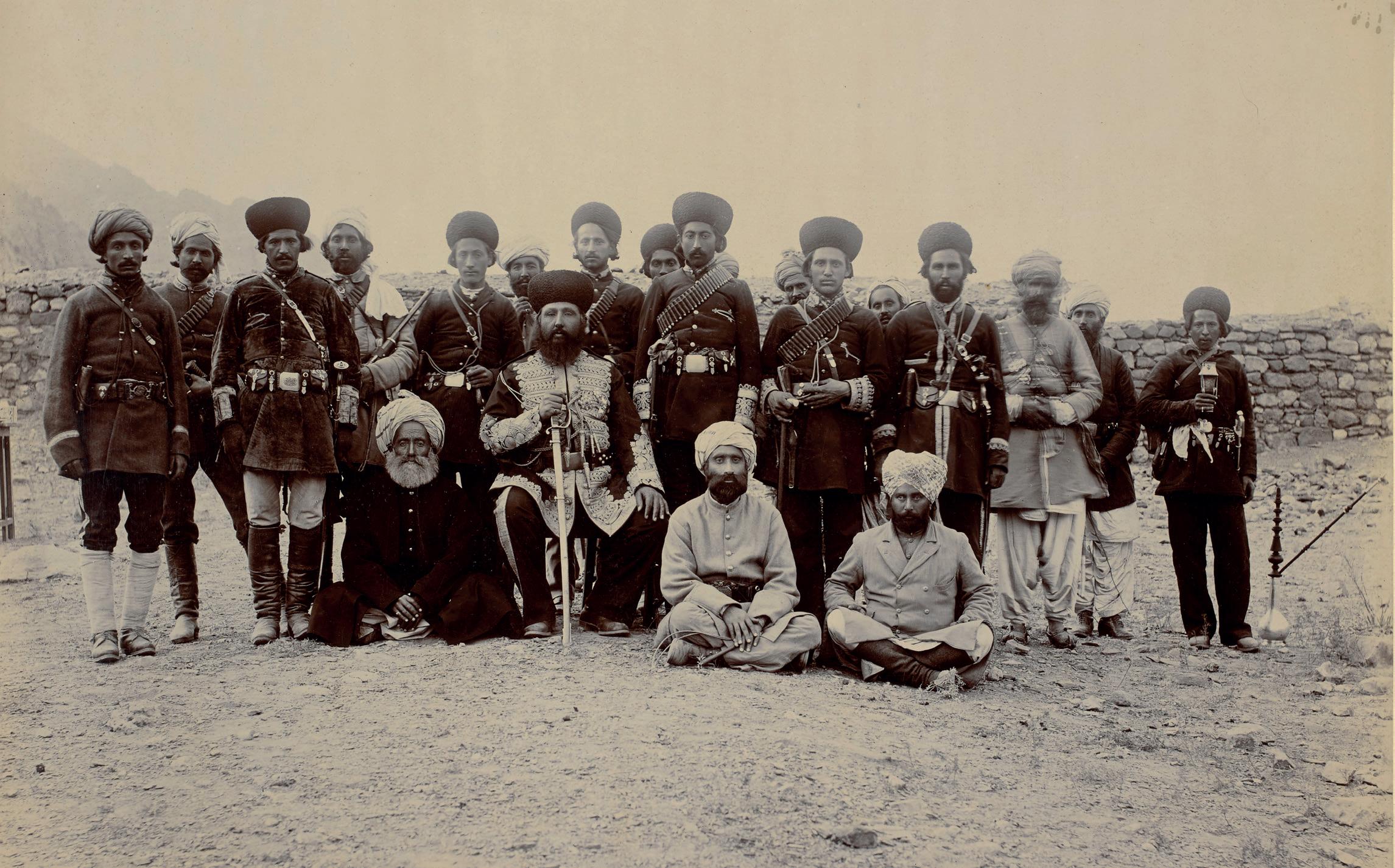
Persecution of Sahibzada Abdul Latif’s family: In the words of his two sons (1926)
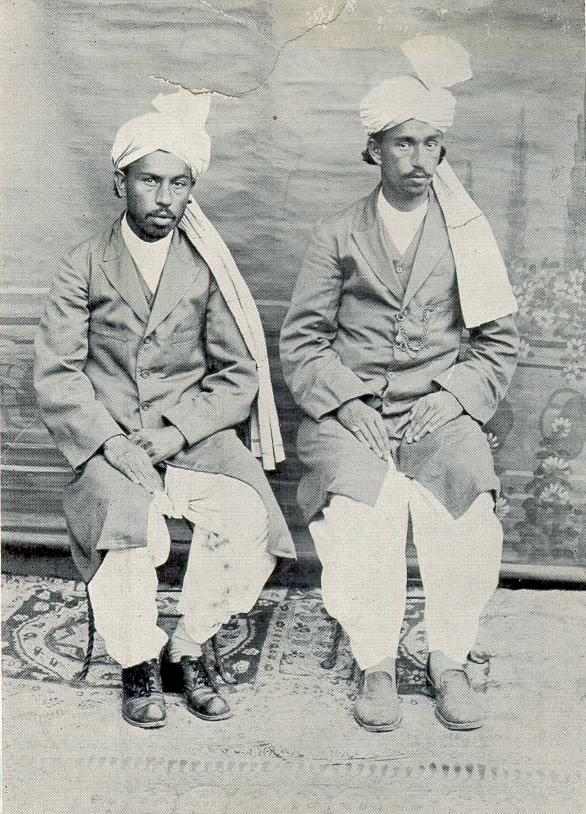
The following heartrending tale of suffering has been told by two sons of the Sahibzada Abdul Latif (ra), the martyr, who was most barbarously stoned to death in Kabul for a difference of religion.
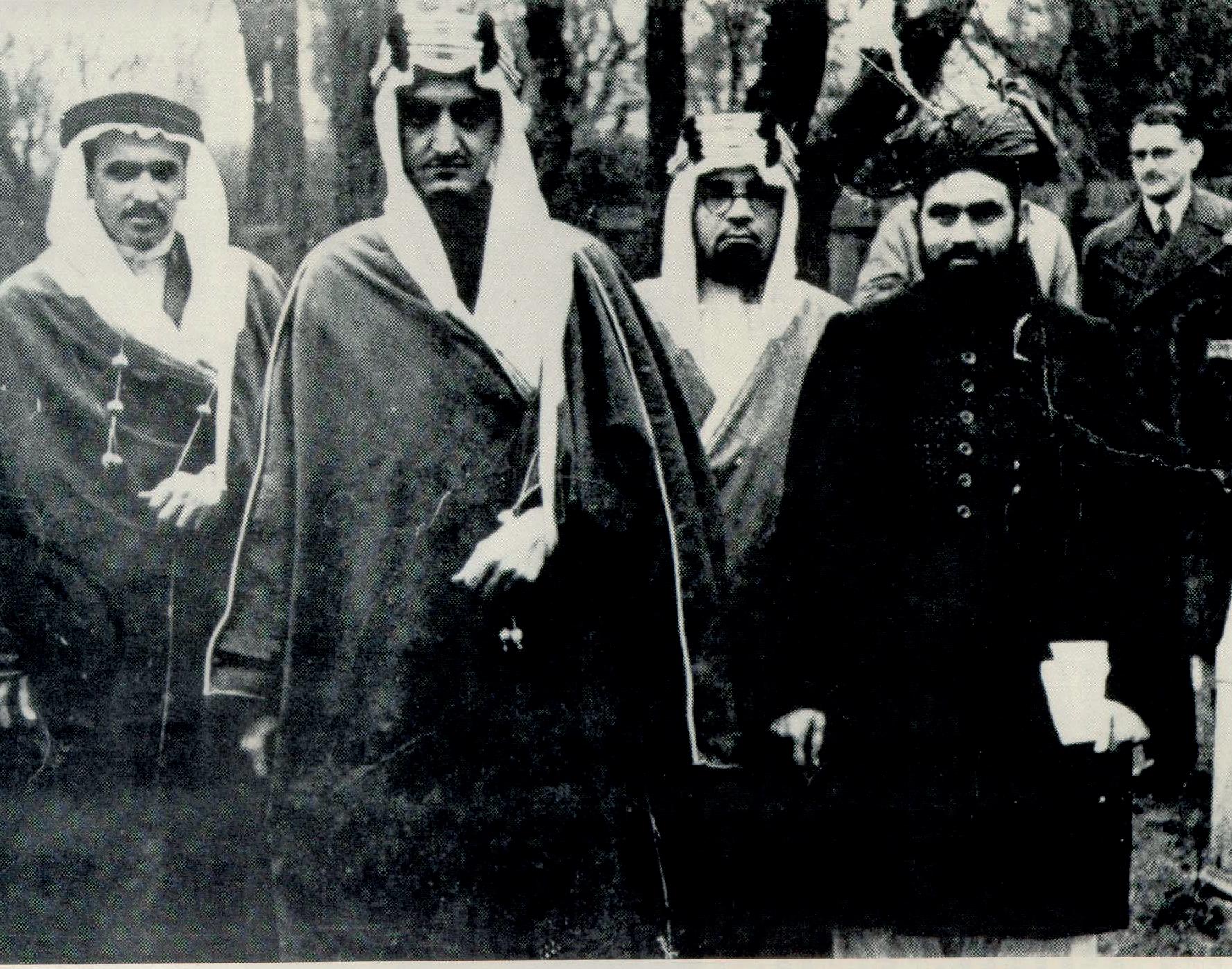
On our frontispiece appears a photo of these two sons of the martyr, may he rest in peace, who are at present in Qadian, where they have arrived with brother Nek Mohammad Khan, who was sent by Hazzrat Khalifatul Masih [II (ra)] to Bannu to extend a cordial welcome to them on his behalf. (The Review of Religions, June 1926)
As told by the martyr’s two sons
After the stoning to death of Sayyad Abdul Latif (ra), his whole family, consisting of about one hundred persons in all, was taken to Kabul under the guard of an armed company of the military.
Exile
to Turkistan
It was the beginning of winter and they were kept under custody in Tochi Bagh for about six weeks, after which they were deported to Turkistan. As they were not well protected against the inclemency of the weather,
they had to undergo severe hardships and privations on this journey.
On arrival in Turkistan, the martyr’s family was allotted a piece of land, the income from which was too small to support them all, but fortunately they were helped by another member of the family who happened to be in the district of Bannu (under the British government) at the time of their arrest and thus had escaped.
Years of hardship
Those hundred souls lived in Turkistan in miserable conditions for about seven years, at the termination of which the leading people of Khost applied to the government for their restoration on the ground of their being a family of Sayyads who deserved every respect and honour in the country and also on the ground that the family did not know anything about Ahmadiyyat, for which their leader had been stoned.
A return without justice
Habibulla Khan, the then Amir of Afghanistan, granted this petition and permitted the family to return and live in their native country from which they had been banished, but the estate which had been confiscated was not returned.
After six months, however, the property of those who did not believe in Ahmadiyyat was given back to them. To the sons of the martyr, however, nothing was restored on the ground, as stated by Nasrulla Khan, that their property was too large.
Under constant suspicion
At this point, as there was a large number of people in that district who held the family in great respect, the government thought it expedient again to take them, about fourteen souls in all, to Kabul and keep them there under custody so that their well-wishers, seeing them in miserable plight, might not create mischief.
The rooms in which they were kept were too small and could not accommodate them all and an application was therefore made to the government to make separate arrangements, at any rate for their servants. The application, however, was refused and they had to arrange for their own lodgings themselves. They were also required to present themselves at the police station twice a week and a strict watch was kept over them at all times as if they had been great criminals. And for five years, these
unhappy sufferers were kept there in these humiliating circumstances.
Imprisoned and chained
At the end of this period, a certain Fazal Karim Gujrati of the Punjab came to Kabul and being an Ahmadi, he was arrested by the government, and on being asked if he knew any other Ahmadis in the city, he mentioned the five sons of the martyr and other relations who were staying with them as guests. Whereupon, to add to their disgrace, they were all arrested forthwith, sent to the gaol (jail) and put under chains.
Denied their mother’s farewell
So inhuman and barbarous was the treatment that was meted out there to these poor and innocent victims of intolerance and fanaticism that they were not even allowed to see the face of their dying mother. At their request, moreover, to be allowed to perform the funeral ceremony (there being no one else to do it), only the eldest son was allowed to go and bury her!
Under such cruel tortures, then, they passed eight consecutive months, during the whole of which time they were never properly fed.
Freedom at a price
At last, however, to buy their freedom, they managed to pay 300 rupees to a secretary of Sardar Amanulla Khan, who, on his recommendation, finally released the helpless prisoners.
Suffering and loss
The cruelties perpetrated upon them during this period of confinement can be gauged to some extent by the fact that Sayyad Mohammad Umar, one of the sons of the blessed martyr, could no longer bear the hardships of the gaol (jail) and eventually fell so ill that he died.
The health of all was permanently injured and Sayyad Mohammad Said, the eldest son, also died a year after his release. Within two weeks of his death, Amir Habibulla Khan was murdered and Amir Amanulla Khan sat on the throne of Afghanistan.
A brief restoration
In the beginning of the reign of Amanullah Khan, their countrymen of Khost, under the leadership of one Babrak Khan, again tendered an application for the complete freedom of these hapless people and the
The two sons of Sahibzada Abdul Latif (ra)
Amir not only granted it but also ordered that their estate should be restored to them. Thus, restored to their native country, the remainder of the family passed about four years in comparative peace. Unfortunately, however, a rebellion broke out in the country against Amanulla Khan and being grateful, well-wishers to him, they began actively to help the government.
Persecution renewed
During the disturbances, the rebels took their chance and, in the absence of this family, set fire to their houses, burned their orchards and generally destroyed their property. The plea for the rebellion was Ahmadiyyat and as they were well known as Ahmadis, to appease the insurgents, the government imprisoned Sayyad Mir Akbar,
Sayyad Abul Hasan, Shaikh Abdus Samad and Amin Gul. The last two were, however, released after a week and the rest remained in gaol (jail) for about nineteen months.
Escape and capture
The rest of the family was removed to Durgai, where there was no disturbance and as the people of that place favoured the Amir, there was peace.
However, through the efforts of Sayyad Mohammad Tayyab, who had already been released, another application was made by the influential people of Khost in favour of the family, with the result that the military secretary of the Amir publicly ordered their release but at the same time issued different instructions privately to the governor (Mohammad Gul by name) in charge,
countermanding the order. He did, in fact, issue secret instructions that Mohammad Tayyab and Abdus Salam should be arrested with their families and removed to Kabul.
At this point, the governor promised Mohammad Tayyab that he would enquire from the authorities as to which of the two orders was valid and that he would then let him know the result. As he considered it unsafe to stay there in these circumstances, Mohammad Tayyab decided to escape, and he accordingly joined his relations the same night.
To his surprise, however, he found there three officers of the mounted police who had already come to arrest Abdus Salam. He therefore prepared secretly to leave the place immediately with his relations and the imprisoned brothers had also been advised
to do the same thing.
At midnight, therefore, when the guard was occupied elsewhere, they all effected their escape. When the guard found the house empty, they set off in pursuit and, with the help of the village people, succeeded in catching them in the morning at Gurbaz.
A life under surveillance
The whole party was made to return to the village, where women and children were released on the security of a gentleman named Bahram and the men were removed to the Khost cantonment, where Abdus Salam was imprisoned.
After a few days, when the then governor of Khost had been transferred, the prisoners applied to the new governor to be allowed to return to their homes and Abdus Salam was very kindly at once released. As regards the others, the papers were sent to higher authorities, who referred the matter to the leading people of Khost, who in their turn reported that the men were quite innocent. Consequently, they were all allowed to return. Hardly a month had passed, however, before orders were again issued for their arrest and removal to Kabul. Abul Hasan was accordingly arrested and arraigned before the cantonment magistrate of Khost, who remanded him on bail to bring up his brothers as well.
The final departure
On his return, the whole family assembled and conferred as to what should be done. They at last decided to leave Afghanistan forever, in view of the fact that they had been regarded with suspicion for so long. Accordingly, the whole family quitted the country on 2 February 1926 and settled at Bannu, where they were fortunate enough already to own some estate.
(Transcribed and edited by Al Hakam from the original English, published in the June 1926 issue of The Review of Religions)
‘Unite the Kingdom’ 2026: The line between freedom of speech and targeted hate
Ahmed Ahmadiyya Archive & Research Centre
The march that brought tens of thousands of supporters of Stephen Yaxley-Lennon, known publicly as Tommy Robinson, to central London on 16 May 2026 was called “Unite the Kingdom.” The phrase is civic in register, even generous. It implies that the assembled crowd has something to offer the country, a repair to make, a solidarity to build. What it does not announce is the question that any honest observer of the event must eventually face: a kingdom united in opposition to whom?
The rally formed up near Kingsway, moved through the Strand to Parliament Square, where the stage and the speeches gathered under the Union Jack, St George’s Cross and Welsh dragon flags, in a display of visual patriotism. The Guardian reported Islamophobic and ethnonationalist hate speech, flyers distributed to the crowd promoting identitarian slogans and speakers calling from the stage for Muslims to leave the country. The organisers framed all this as a turning point, the beginning
of something rather than a repetition.
The Metropolitan Police, which deployed approximately four thousand officers across a day that also required policing the FA Cup Final and a separate pro-Palestinian march, had already warned publicly that previous events organised under this banner had featured anti-Muslim chanting.
The civic contrast of that Saturday was striking: while central London braced for nationalist friction, a short distance away in Surrey, the Ahmadiyya Muslim Community was gathering for its National Peace Symposium. Yet in the capital, Muslim Londoners and people from other minority groups were, police noted, avoiding central London and transport hubs, changing plans because they feared crossing paths with the march’s supporters.
The police documented a measurable change in civic behaviour: a community altering its movements in a city it calls home because a public event had made the street feel hostile. Rhetoric that reaches into the logistics of private life, a route reconsidered, a station avoided, a daughter advised against travelling visibly Muslim through the centre
of the capital on a particular Saturday, has done something far more concrete than merely give offence.
Free speech is the first objection raised in arguments like this. It always is. It is a serious claim, and it deserves a serious answer. Criticism of religion, including criticism of Islam, must remain free. A religion that makes public claims about human life, morality and God must expect public scrutiny. Those who regard Islam’s teachings as false have every right to say so, to argue against them, publish criticisms and challenge Muslims in debate. None of that should be restricted. To demand such a restriction would itself violate a principle the Quran states plainly in Surah al-Baqarah, Ch.2: V.257: there should be no compulsion in religion. Muslims are the audience of this verse. The constraint it places falls on their own conduct.
A line does exist, however, between the intellectual freedom to contest religious ideas and the political project of casting a religious community as alien, removable or unworthy of equal civic standing. These are different enterprises, and collapsing them
is a failure of the very precision that free speech, at its most defensible, is supposed to require.
The House of Lords drew this line when the matter came before it this year on 20 May. Lord Mohammed of Tinsley described the reaction of his own sons, one working for the railways, the other in the NHS, who asked whether people were “questioning our existence” in this country. A speaker at the rally had apparently pointed at the Palace of Westminster and declared that Islam must be removed from it. The government minister responding was direct: the right to criticise religion is protected; it does not extend to incitement, intimidation or conduct prohibited under the Public Order Act 1986. The law does not distinguish on grounds of faith. He was right to say so. Equal protection has one test: what applies to one community applies to all. Had equivalent calls for a religious community to leave its country of birth been made from a public stage about any other faith group, prosecutorial consideration would already be underway, political condemnation would
Iftekhar
not have needed coaxing and broadcasting regulators would have responded with far less patience. That gap is itself a form of harm, signalling that legal protection, for all its formal universality, is applied with a different quality of urgency depending on who is being targeted.
Police later confirmed 43 arrests across both protests on the day, with 20 linked to Unite the Kingdom and nine of the eleven hate-crime-related arrests attributed to the same event. These are alleged offences. Charges and any prosecutions remain a matter for the Crown Prosecution Service. Treating the figures as proof that every attendee was a criminal would itself be unjust.
The political utility of the ‘two-tier policing’ narrative becomes clear when set against these specific figures. Arrests were indeed made across both protests. The difference lies in the character of the offences: nine of eleven hate-crime arrests came from a single event. That transforms the accusation of ‘two-tier policing’ from a critique of law enforcement into something else entirely – a rhetorical shield designed to reframe the prosecution of anti-Muslim incitement as state persecution and a demand that the law lower its gaze when faced with ethnonationalist hostility.
The figures say something about the character of the occasion, even so. Calls from a public stage for members of a religious community to be removed from the country of their birth carry a different freight from debate about theology or migration policy. History is specific about where that language, left without adequate response, tends to lead.
Belonging operates below the level of law. Something closer to a quality of civic relationship, the accumulated and largely unexamined confidence that one may move through public space, speak, contribute and live without being required to justify one’s presence. A significant public event that platforms rhetoric casting a community as alien or provisional causes damage extending well beyond individuals who happen to be in the crowd’s path. It corrodes the fabric of mutual recognition that makes civil life possible at all.
Mustafa al-Dabbagh, writing in the Middle East Eye in the days after the march, put it this way: British Muslims teach in the country’s schools, seek care in its hospitals, serve in its public institutions and face the same pressures over housing, healthcare and the cost of living as their neighbours. To suggest otherwise is to misrepresent Britain. A nation’s strength, he argued, is measured by the quality of trust between its people, by how well it holds together, rather than by how efficiently it excludes.
The question this march raises is a civic one: at what point does public rhetoric cross from argument about ideas into systematic pressure on a community’s right to be treated as full members of a shared society? And when that line is crossed without adequate response from law, politics or public institutions, what does it communicate to the community being targeted and to everyone else watching? Belonging ought not to be a grant made at the pleasure of those who feel entitled to revoke it. Britain is our home. That sentence should not need writing.
The march belongs to a political climate
in which genuine anxieties over housing, strained services, stagnant wages and the persistent feeling that political institutions no longer hear ordinary people have been given a specific ideological direction. That direction points, with increasing confidence, at Muslim communities and migrants as the source of the difficulty.
Muslim families in Britain share the same pressures as their neighbours: the same waiting lists, the same school runs, the same worry about next month’s rent. Nobody’s mosque caused the housing shortage. The community praying on a Friday afternoon did not design the economic settlement that has left so many people feeling abandoned. But a politics that names an enemy is easier to sell than a politics that confronts structural failure, and the far right has always understood this arithmetic.
The Race Equality Foundation observed in its response to the march that silence from political and media institutions is not, in practice, neutral. Mainstream commentary that declines to name racism and Islamophobia explicitly creates what the Foundation called a permissive environment. “Silence is not neutral”, the Foundation stated. The 2024 riots, in which mosques and hotels housing asylum seekers were attacked, demonstrated that the distance between normalised street rhetoric and organised violence can be alarmingly short. Whatever the individual motives of those who attended on 16 May, the event gave public legitimacy to a politics of exclusion. Its social function matters more than the intentions of those who attended.
The crosses carried through the streets and the chants of “Christ is King” call for a careful reading. Faith deployed as identity armour and faith practised are two quite different things. Christians who reject this co-option of their tradition were in fact present near the march route that afternoon, setting up tables to listen, pray and model a different response. Their presence was less visible than the crosses on the march. It generally is.
Claims of millions attending circulated widely on social media, and Yaxley-Lennon himself made such assertions on the day. Full Fact established that this was false. Police put the figure at approximately 60,000; an independent expert in crowd dynamics told Full Fact the idea of millions was “completely fanciful.” A crowd of 60,000 is large enough to warrant serious attention without needing inflation. But this exaggeration serves a psychological purpose rather than an arithmetical one. A number, amplified sufficiently, becomes a verdict: the country has already turned and the tide cannot be reversed. Spectacle manufactures its own authority. Claiming millions on the day is a statement about truth, and an Islamic moral framework regards it as gravely as anything else the march produced.
Communal grievance narrows the argument; justice widens it
The Holy Quran commands in Surah an-Nisa, Ch.4: V.136, that believers be strict in observing justice even when doing so against themselves or those nearest to them. The verse closes the exemption that tribal loyalty is always tempted to carve out.
For the Ahmadiyya Muslim Jamaat, a community with an intimate, historical
understanding of the ruin that follows when a state allows majoritarian rhetoric to render a minority’s citizenship provisional, this injunction carries the full weight of lived experience. To demand that the law protect a community from incitement requires an absolute, unyielding commitment to impartial justice in return. An Ahmadi Muslim analysis of the Unite the Kingdom march must therefore acknowledge, without hesitation, what other voices in the Lords debate also raised: both protests policed on 16 May produced arrests for alleged hate crimes. The equal application of law must cover antisemitism, anti-Muslim hatred and all other protected characteristics with the same rigour and the same urgency. There is no defensible hierarchy of acceptable targets.
This is the crux of the moral argument. Surah al-Maidah, Ch.5: V.9, states the obligation still more plainly: “Be always just”, and places it specifically against the temptation to let the enmity of an opposing party licence injustice toward them. A Muslim response to a hostile political movement must describe that movement accurately and argue against it honestly. Anger does not excuse exaggeration. Exaggeration does not serve justice.
Surah al-Hujurat, Ch.49: V.13, puts the question of unity to all of humanity: God made people in nations and tribes “that you may recognise one another.” Difference is the precondition for the moral exercise of recognition across difference. A unity purchased by erasing or expelling that difference deserves a plainer name: uniformity.
Hazrat Mirza Masroor Ahmad (aa), the head of the worldwide Ahmadiyya Muslim Jamaat, has addressed the Islamic framework governing speech, tolerance and public peace with consistency. Conscience must remain free. The answer to speech one finds offensive is not disorder. Public peace requires that justice be done and protection afforded impartially. The canonical traditions, recorded in Sunan an-Nasa’i, state that a true Muslim is one from whose tongue and hand fellow human beings are safe. Huzoor (aa) has applied that principle in his own addresses to all other peaceful people in society.
On the same day as the march, Huzoor (aa) addressed the National Peace
Symposium 2026 and stated that justice is a universal principle applicable to all people, whether religious or not. That address stated a moral standard prior to the march and one that will outlast it. The Promised Messiah, Hazrat Mirza Ghulam Ahmad (as) consistently emphasised that the Islamic moral framework rests on fulfilling two fundamental obligations: the rights owed to God and the rights owed to His creation. Within this paradigm, sincere loyalty to a society that guarantees peace and freedom of conscience is a profound religious duty. Loyalty to country, therefore, is active service to the conditions of peace that make civil life possible for everyone living within it: the active refusal of both passivity before injustice and silence before hatred.
The Ahmadi Muslim position here is demanding, precisely because it demands the same things from itself that it demands from others. It means accepting equal law even when it does not favour us, refusing exaggeration when it would feel vindicating and treating loyalty to country as active service to its moral health rather than grievance about its failings.
The name “Unite the Kingdom” will not survive honest examination unless the unity it promises extends to all the kingdom’s inhabitants, including those who pray differently or dress differently or trace their families to other parts of the world. A unity purchased by making some neighbours feel their home is provisional is no unity. Conditional tolerance is always revocable and the condition can always be tightened. Britain has both the institutions and the moral vocabulary to do better than this. Those institutions must apply their stated principles without exemption: the same response to speech targeting Muslims as to speech targeting any other community, the same resistance to a slowly expanding permissive environment. A country’s social strength is tested precisely by how it protects those who have been made to feel their presence is provisional. Belonging cannot be treated as a probationary status, subject to the shifting moods of a crowd.
The moral test for any society, in the end, is whether it acts as though everyone already belongs, before anyone is forced to prove it.
NEWS
Highlights from Lajna Imaillah Canada’s Mid-Year Refresher Course
On 11 April 2026, Lajna Imaillah Canada held its annual mid-year refresher course for local and regional presidents, bringing together office bearers from across the country for a day of tarbiyat, departmental updates and development. Presidents from across Canada attended the refresher
course, with a total attendance of 160. The programme began with a recitation from the Holy Quran, followed by the Lajna Pledge and discussions on important administrative and tarbiyat-related matters, including mosque and funeral etiquette, as well as purdah guidelines and wedding protocols for office bearers. Departments also shared updates on upcoming events and initiatives.
The session concluded with an interactive activity promoting awareness of emergency preparedness among office bearers, followed by a question-and-answer session. The refresher course ended with silent prayer and dinner.
Friday Sermon
Mubarak Mosque, Islamabad, Tilford, UK
8 May 2026
Truthfulness in practice: Incidents from the life of the Promised Messiah (as)
After reciting the tashahhud, ta‘awwuz and Surah al-Fatihah, Hazrat Khalifatul Masih V (aa) stated:
While discussing the life and character of the Promised Messiah (as), I mentioned some incidents of his standard of truthfulness. Today, I will continue narrating a few incidents. A case was filed against the Promised Messiah (as) by Dr Henry Martyn Clark, who alleged attempted murder. This was an extremely perilous case.
The Promised Messiah (as) said that this case filed by Henry Martyn Clark was so serious that it could even have resulted in the death penalty. The Promised Messiah (as) gave the example of the case which the Jews, under the Roman government, brought against Jesus (as) and said:
“A similar case was filed against me, with the difference that while the case against Jesus (as) was brought up by the Jews, in my case it was a reverend clergyman and doctor, i.e., Dr Martyn Clark, who accused me of attempted murder. The evidence he mustered seemed thorough, so much so that even Maulvi Abu Sa’eed Muhammad Hussein Batalvi, an arch-enemy of this Jamaat, appeared as a witness and did his utmost to establish the case against me. The case was heard by Captain Douglas, the
Deputy Commissioner of Gurdaspur, who is now posted, probably in Simla.
“The case was duly heard and completed and all the witnesses against me were produced with great fanfare and clamour. In the circumstances, not even the best of lawyers could say that I would be acquitted. The prevailing situation, and other factors, demanded that the case be committed to the Sessions, who could have sentenced me to transportation for life or even to death. (I.e., he could also have been sentenced to life imprisonment.) But just as God forewarned me about the case, so did He reveal to me in advance that I would be acquitted.
A large number of people belonging to my Jamaat knew about this revelation. When the case reached a stage when the prosecution and my opponents believed that the magistrate would commit the case to the Sessions, Captain Douglas told the Police Superintendent that he had a hunch that the case was a frame-up and he (the judge) couldn’t believe that such an attempt was ever made and that the defendant sent someone to murder Dr Clark. He asked the superintendent to investigate the case
himself.” Allah the Almighty placed it in the judge’s heart to tell the police commander to reinvestigate the case.
The Promised Messiah (as) continues:
“This was the time when not only were my opponents busy plotting against me, but also those who claimed that their prayers were heard and accepted, were tearfully soliciting God to punish me (they were even praying). But who can fight God? I also know that some people approached Capt Douglas and tried to influence him, but he, being a just and fair magistrate, told them that he could not be a party to such an outrage (he said he could not make a wrongful conviction).
“In short, when the case was entrusted to Capt Le Marchand for a renewed investigation, he summoned Abdul Hamid and told him to state the truth. Abdul Hamid repeated the same old story he had related before the Deputy Commissioner. Actually, at the very start, he was warned that the slightest deviation from his original statement would render him liable to prosecution; that is why he repeated the same statement he had made earlier on.
The Police Superintendent told him that he
had already related the same story, but the Deputy Commissioner was not satisfied that he was telling the truth. When Captain Le Marchand again told him to tell the truth, he started crying and fell at the feet of the Captain, imploring him for protection. The Captain reassured him and told him to go ahead. At this, he came out with the truth. He confessed that he had been coerced into making his earlier statement and deposed that Mirza Sahib had never sent him to murder anyone.
“The Captain was overjoyed at this statement and sent a telegram to the Deputy Commissioner that he had solved the case. The case once again came up for hearing at Gurdaspur. Capt Le Marchand was sworn in and recorded his affidavit.”
The Promised Messiah (as) states that in the court at that time, “I could notice that the Deputy Commissioner was visibly pleased that the truth had come out. But he was also furious at the Christians who had given false evidence against me. Addressing me, he said that I had the right to file a suit against them. But, as I am totally disinclined to litigation, I said I didn’t want to enter into
any litigation, for my suit was filed with God. At this, Capt Douglas straightaway wrote down the judgment and read it out to a large number of people who had gathered there. Addressing me, he said, ‘Congratulations, you stand acquitted.’
“[…] At the time, it seemed as if the whole world was lined up against me, and this is what usually happens: when people decide to hurt you, the whole world turns against you; it is God alone Who comes to the rescue of His true servants.” The Promised Messiah (as) said that Allah the Almighty saved him on account of his truthfulness. (Lecture Ludhiana, Ruhani Khazain, Vol. 20, pp. 268-270)
Regarding this same case, a non-Ahmadi lawyer named Maulvi Fazal Din testified to the truthfulness and noble character of the Promised Messiah (as), which was exhibited during this case. His statement has been recorded by Hazrat Sheikh Yaqub Ali Irfani (ra) in his book Hayat-e-Ahmad, in which he writes:
“Another magnificent incident relating to morality, which testifies to the truthfulness of the Promised Messiah (as), also became manifest in this very case and demonstrated the extent of his love for truth.
“Listen to this account in the words of the late Maulvi Fazal Din Sahib, a lawyer, as narrated by my sincere contemporary, Lala Dina Nath, editor of the newspapers Desh and Hindustan.” These were the names of two newspapers, of which this Hindu man was the editor. He was also a friend of Hazrat Sheikh Yaqub Ali Irfani (ra).
He states:
“You know how greatly I revere Mirza Sahib. I consider his rank and status to be extremely lofty. Although, regarding his claims, from a psychological point of view. (This was the opinion of the lawyer.) I believe that he made a mistake in understanding and that his claims are not true. Nevertheless, he is certainly a righteous man, a great soul, and a deeply spiritual person of an exceptionally high rank. This belief of mine about him was formed by a particular incident.”
He relates this incident as follows:
“You know Hakim Ghulam Nabi Zubdat-ul-Hukama, and you also know Maulvi Fazal Din Sahib, the lawyer.” Here, the Hindu editor is narrating the incident, and he is now relating the words of Maulvi Fazal Din Sahib.
He continues:
“You also know Maulvi Fazal Din Sahib, the lawyer. People would gather at Hakim Sahib’s home in the evenings, and I too would go there. One day, several friends were gathered there, and by chance, the mention of Mirza Sahib came up. One person began opposing him, but in such a manner that it was beneath the standards of decency and morality.”
The Hindu editor, upon hearing this, says:
“The late Maulvi Fazal Din Sahib became greatly stirred after hearing this. With great passion, he said:
“‘I am not a disciple of Mirza Sahib, nor do I believe in his claims – whatever the reason may be. However, I firmly believe in his great personality and his moral excellence.
“‘I am a lawyer, and people from every class come to me in connection with legal cases. I have seen thousands upon thousands of people, and through other lawyers as well.
Even very righteous individuals – about whom one could never imagine any kind of pretence or showing off – when advised legally in court matters, did not hesitate to alter their statements if they thought it necessary.
“‘But in my entire life, I have only seen Mirza Sahib as the one person who never strayed from the truth in the slightest.
“‘I was his lawyer in one of his cases (referring to the case involving Henry Martyn Clark), and in that case, I drafted a legal statement for him and presented it before him. After reading it, he said, “There is falsehood in this.”
“‘I replied, “An accused person’s statement is not given under oath, and legally he is permitted to say whatever he wishes.”’”
Upon this, the Promised Messiah (as) said:
“The law may permit a person to say whatever he wishes, but Allah the Almighty does not permit it. Allah has not granted permission for someone to lie, nor indeed is this even the true intent of the law. Therefore, I can never agree to make a statement that is contrary to the facts. I will present the matter exactly as it is.”
Maulvi Sahib (the lawyer) then said:
“I said to him, ‘You are knowingly putting yourself into difficulty.’”
Upon this, the Promised Messiah (as) replied:
“To knowingly put oneself into danger would be for me to make a legal statement in order to gain an unlawful advantage and thereby incur the displeasure of my God. That is something I can never do, no matter what may happen.”
Lala Dina Nath Sahib (the editor of the newspapers) narrated this incident to Sheikh Yaqub Ali Irfani Sahib. He said that, “Maulvi Fazal Din Sahib used to say that the Promised Messiah (as) said these words with such vigour that a unique expression of passion and fervour appeared upon his face. After hearing this, I said (i.e., the lawyer said to the Promised Messiah [as]), ‘You will not benefit from my legal representation.’ Upon this, he replied, ‘I have never even imagined that any benefit would come through your advocacy or through the efforts of any other person, nor do I believe that anyone’s opposition can destroy me. My trust is only in God Almighty, Who sees my heart. I appointed you as my lawyer because it is only appropriate for one to utilise the means available to them, and since I know that you are honest in your work, I appointed you. (This is merely an outward means which ought to be used, and that is why I am using it. I am not dependent upon you.)’”
Maulvi Fazal Din Sahib used to say that he again submitted, “This statement is what I recommend.” The Promised Messiah (as) replied, “No. Submit exactly the statement that I myself have written, without caring about the outcome or result. Not a single word should be changed. And I tell you with complete certainty that it will be more effective than your legal statement, and the result that you fear will not come to pass. Rather, God willing, the outcome will be good. And if it is even supposed that the result does not appear favourable in the eyes of the world – meaning that I am punished – even then I do not care, because at that time I will be happy that I did not disobey my Lord.”
Lala Dina Nath used to say, “Maulvi Fazal Din Sahib presented the defence of the Promised Messiah (as) with great passion and sincerity in this manner, and that he immediately wrote down the Promised Messiah’s (as) statement right there. Such is the wondrous power of God’s manifestation, that he was acquitted on the basis of that very statement that he had written.” Maulvi Fazal Din Sahib described his truthfulness and his courage and bravery in accepting every hardship for the sake of truth, which created a dense emotional atmosphere among those present in the gathering. Even those who were sitting outside and were opposing him, fell silent. At this, some people asked him, “Then why do you not become his follower?” He replied, “That is my personal decision, and you have no right to question me about it. I consider him a perfectly truthful person, and I hold immense respect for him in my heart.” (Dr Abu Salam Shahjahanpuri, Kitabiyat Pakistan ke Akhbarat-o-Rasa’il 1947 Tak, pp. 120 and 236, Muqtadirah Qaumi Zaban, Islamabad, 1987; Al Hakam, No. 41, Vol. 37, 14 November 1934, pp. 3-4; Hayat-e-Ahmad, Vol. 4, pp. 566-569)
Regarding this same incident, there is another narration from Master Nazir Husain Sahib. He says, “The late Maulvi Fazal Din Sahib, Advocate of the High Court, was deeply attached to the Promised Messiah (as) and would generally accompany him in his legal cases. He told me that he considered the Promised Messiah (as) to be at the highest echelon of truthfulness. When I asked regarding this, he narrated an incident concerning the Promised Messiah (as). He said that in one case between the Promised Messiah (as) and Deputy Martyn Clark Sahib, a man named Abdul Hamid testified that the Promised Messiah (as) had sent him to kill Martyn Clark. At that time, the late Maulvi Fazal Din Sahib, acting as legal counsel, said to the Promised Messiah (as), ‘In court, you should simply say that you do not know Abdul Hamid. After that, we will handle the rest of the proceedings ourselves. (You should just state that you do not know him.)’ The late lawyer used to say that he assured the Promised Messiah (as) in every possible way that if he would only make this statement, then his success in the case would be certain; otherwise, acquittal was impossible. The lawyer said that after listening to his suggestions, the Promised Messiah (as) replied, ‘I have come into the world to establish truthfulness. I will never tell a lie, even if I am hanged. I know Abdul Hamid. He used to come to Qadian. I can never deny knowing him, no matter what happens.’
“The lawyer, the late Maulvi Fazal Din Sahib, says that he then submitted, ‘Saving one’s life is obligatory. Therefore, if you do not wish to lie, then at least give such an answer that it is not clearly understood that you know him. (Do not lie, but give a vague response.)’ Upon this, the Promised Messiah (as) replied, ‘I cannot even do that. God has sent me into the world to present His example. I am not prepared to present such an example merely to save my life. Even if my life is lost while speaking the truth, I will still have succeeded.’
“The late Maulvi Fazal Din Sahib (who was a non-Ahmadi) said, “At that point we became completely hopeless. When the Promised Messiah’s (as) statement was
read out in court, he openly admitted that he knew Abdul Hamid. At this, we became convinced that acquittal was now impossible. However, when they witnessed the help that God granted him in that case, they were astonished at how God helped His appointed one, and how, in such a grave case, he was honourably acquitted and emerged successful.’” (Rawayat Ashab-e-Ahmad, Vol. 3, pp. 173-174)
The Promised Messiah (as) states:
“The Companions (ra) of the Holy Prophet (sa) readily sacrificed their lives but never shied away from declaring the truth. They carried out such empire-building that its parallel cannot be found. What was the reason for this? They had sincerity, veracity, and loyalty. Those who seek such prudence are atheists. Those who have trust in God Almighty and do something for His sake, know that the help of God Almighty will arrive. Therefore, they do not hesitate to declare the truth.”
Those who truly belong to Allah do not utter falsehood, nor do they withhold the truth.
“If the question is put to me, ‘You claim to be the Promised Messiah?’ then I will show how I respond to it. Things do not work out without truth and manly courage. So many cases were brought against me, but what was the outcome? Can anyone say that I backtracked out of fear of these matters? This is shirk [associating partners with Allah].
“I am convinced that God exists, and He helps His sincere servants. Verily, verily, I say that Allah the Exalted is with the one who declares
[‘There is none worthy of worship except for Allah’] with a sincere heart. Islam is the only religion that brings this essence into being.” (Malfuzat [English], Vol. 9, pp. 390-391)
This blessing was not confined to him alone; rather, the Promised Messiah (as) states that this applies to everyone. Whoever proclaims it with sincerity of heart and places true faith in Allah the Almighty shall be saved.
There is also a mention of the testimony by a Hindu man who knew the Promised Messiah (as) from his childhood. He states:
“I have known Mirza Ghulam Ahmad since childhood. He and I are of the same age. I have always maintained close contact with Qadian, and even now I observe that the excellent morals and noble habits he possesses today were present in him from the very beginning.” He was speaking about the character of the Promised Messiah (as). He further writes: “He was truthful, trustworthy and virtuous. Indeed, I am of the opinion that Parmeshwar himself descended upon the earth in the form of Mirza Sahib, and that Parmeshwar is manifesting his splendours through him.” (Hazrat Pir Sirajul Haq Numani, Tadhkiratul-Mahdi, p. 303)
The Promised Messiah’s (as) eldest son, Mirza Sultan Ahmad Sahib, writes: “My father remained constantly engaged in the service of religion. The members of the household had complete trust in him, and the people of the village also placed full confidence in him. Even those relatives who were otherwise opposed to him were so convinced of the righteousness of the Promised Messiah (as) that, in disputes, they would say: ‘Whatever he decides shall be acceptable to us.’ Everyone regarded
him as trustworthy and truthful.” (Sirat-ulMahdi, Vol. 1, Part 1, Narration 196, p. 200)
Hazrat Musleh-e-Maud (ra) states:
“The Promised Messiah’s (as) father was concerned about how he would earn a living since he did not have any interest in managing property, nor did he want to take up any employment. There was a Sikh from a nearby village whose two sons would often visit our grandfather (Hazrat Musleh-e-Maud [ra] says that he would visit his grandfather). One of them narrated an incident to me that the elder Mirza Sahib once said to him, ‘Go and speak to Ghulam Ahmad, who is of a similar age to you. Advise him that if he can’t help in managing the family estate, then I shall arrange some employment for him.’ And so, he conveyed this message to the Promised Messiah (as) and mentioned that his father was becoming displeased that he did not engage in any occupation. He also mentioned that his father said that ‘upon my demise, would he rely on whatever is left over from his brother’s wealth for the rest of his life?’ And so, if he wills, I can arrange for his employment.
“Upon hearing this, the Promised Messiah (as) said, ‘My father worries unnecessarily. Let him know that I have already become occupied in the One Whose service I wanted to be in.’ Despite the fact that our grandfather was a man engaged in worldly pursuits, the Sikh says that when he conveyed this response of the Promised Messiah (as), he became silent and then said, ‘If my son, Mirza Ghulam Ahmad, has said this, then indeed he has spoken the truth, for he never utters a lie.’” (Halat-eHazirah ke Mutallaq Jamaat-e-Ahmadiyya ko Ahm Hidayat, Anwar-ul-Ulum, Vol. 13, pp. 512-513)
Hazrat Mirza Bashir Ahmad Sahib (ra) relates:
“I remember very well, and I can never forget this incident, that in 1916, when the late Mr Walter, who was the Secretary of the All-India YMCA, came to Qadian in order to investigate the Ahmadiyya Movement, he expressed a desire to meet one of the old Companions of the Founder of the Ahmadiyya Movement. At that time, the late Munshi Arora Sahib was present in Qadian. Mr Walter was introduced to him in the Mubarak Mosque.
“After some initial conversation, Mr Walter asked Munshi Sahib: ‘What was the strongest proof that convinced you of the truthfulness of Mirza Sahib?’
“Munshi Sahib replied: ‘I am not a highly educated man, nor am I acquainted with many scholarly arguments. However, the thing that influenced me the most was the very person of Hazrat Sahib himself. I have never seen anyone more truthful, more honest, or possessing greater faith in God than he. Upon seeing him, no person could say that he was false. As for me, I was simply devoted to his very countenance and did not know many intellectual arguments.’
“Having said this, the late Munshi Sahib became so overwhelmed with the memory of the Promised Messiah (as) that he burst into tears and wept uncontrollably until he was overcome with sobbing.
“At that moment, the condition of Mr Walter, who was conducting the interview, was such that one could say all colour had drained from his body. His face became completely pale, like a freshly washed white
sheet. Later, in his book The Ahmadiyya Movement, he made particular mention of this incident and wrote, ‘A person who has produced such followers through his companionship cannot, at the very least, be called an impostor or a deceiver.’” (Ashab-eAhmad, Vol. 4, pp. 94-95)
Hazrat Mian Rahim Bakhsh Sahib relates: “I came across a man by the name of Muhammad Ibrahim, who was an Ahmadi. We spoke for a short while, and I found myself convinced. That night, I had a dream in which all four of us brothers were lost in a mountain cave, unable to find our way out. I had climbed up from one side and made my way to the top, where I saw a train in motion – but it was running at a very great height above the ground. I stood bewildered, wondering how I was to board it. A man standing above called out to me, saying: ‘Take hold of the rope that hangs down from the sky, and only then will you be able to ascend.’” He saw all this in a dream. He says, “In the morning, Ibrahim Sahib arrived at my door. I told him my dream, and he took out the Holy Quran and explained to me the meaning of the verse:
“[‘And hold fast by the rope of Allah.’ (The Holy Qur’an, 3:104)]
“I wrote a letter to pledge allegiance straightaway. The reply came that the pledge of allegiance had been accepted, but that I must come to Qadian in person. This reply came to me from the Promised Messiah (as) – or from whoever wrote it, whether his secretary or another. So I made my preparations for Qadian without delay.
“When I boarded the train to Batala at Amritsar station, there were two or three Sikhs in my compartment who asked me where I was headed. I said: ‘To Qadian.’ They replied: ‘Mirza’s Qadian?’ I said: ‘Yes, that is where I am going. Tell me then, what is he really like?’ – I asked this not out of doubt, for I had already seen the dream, but simply for my own further reassurance, wanting to hear what others had to say about the Promised Messiah (as). They said: ‘He is very well known – he claims to be God.’” This is what the Sikhs said. It was their way of understanding it, for according to the nature of their thinking, his actual claim was that he had been sent with divine revelation and had been sent to call people back to God Almighty.
In any case, he says: “Purely out of mischief (even though he had already taken the pledge of allegiance, a mischievous impulse came over him) I said to them: ‘I know Mirza Sahib. In Sialkot, he and my father were both in employment together and used to smoke cannabis together.’” He said it merely in jest, as one’s faith is weak in its early stages. Nevertheless, he told them that the Promised Messiah (as) used to smoke cannabis with his father.
At this, those very Sikhs said, “Mian, do not ever say such a thing. He is a man of great simplicity and purity – a man of the most complete truthfulness and trustworthiness. He is so renowned for it that people cite him as a byword: if someone speaks the truth, people in our community say, ‘Are you the son of Mirza Ghulam Murtaza?’ His truthfulness and integrity have become a proverb among us. He used to play with us in childhood and would recite from books to us – he was the son of a
chieftain, that is, the Promised Messiah (as), was the son of the chieftain of Qadian – and we held him in great respect. He gradually changed over time, and there came a period when he withdrew entirely indoors and would not come outside (meaning the Promised Messiah [as] had adopted a life of seclusion). He sat inside working his magic (these were superstitious people with no grounding in religion, and their notion was that he sat inside practising some form of sorcery). And he has cast his spell for four miles in every direction around Qadian,” meaning he had won people over entirely and compelled the acknowledgement of his truth. “Whoever came to him from any faith, he would prove himself truthful in the light of their own religion and prove their religion to be in error. He says he has come from the heavens.” These were the things the Sikh told him.
So, having heard all of this, he says: “When I then arrived at the guest house in Qadian, there were three or four young men there. I thought to myself, let me put this to the test – let me see whether I have made the right choice or not. So I spoke to those young men sharply and with some harshness, but they responded with nothing but gentleness and the finest of manners, in spite of my rudeness – for I wanted to observe what their moral training was like. Against my sharpness, they met me with great softness and courtesy. I told them I wished to meet Mirza Sahib. They said, ‘He has gone for a walk just now; a meeting will be difficult.’
“As I wandered about Qadian, my heart grew restless. On account of the intense heat, I resolved to turn back and leave.” His faith had not yet firmly taken root, so on the way, he encountered an Arab, who said to him: ‘Brother, you have come to Qadian –you must see the Promised Messiah before you leave. If you have come all this way, then go back only after meeting the Promised Messiah (as). This time will not come again. Others will come, but this presence will not be found again.’ (The opportunity is here –go and meet him). But I paid no heed and told the coachman to set off immediately. The heat had worn me down, and the meeting had not come about, and so I had resolved to return.”
He says, “Just then, the call to prayer was said. I said to myself that I would depart after offering prayers. I turned back towards the mosque. The Arab he had met earlier – the one who had urged him not to leave – came to him and said: ‘Brother, from that very moment I have been in prostration, praying to Allah that He keep you here so that you may see the Promised Messiah (as).’” Such was the sincerity of that Arab. He had said he was going to leave, so the Arab said, that there is only one recourse: to present oneself before Allah and fall into prostration. He said, “I have been in prostration from that moment, praying for you, that you may see the Promised Messiah (as) before you go.”
He then says: “I saw the Promised Messiah (as). He came and sat in the gathering. I stood before him – my beard, head and moustache all shaved clean. (It was the fashion even in those days among those who followed such fashion trends.) The Promised Messiah (as) sat with his head bowed downward. I said to myself, until I see this man’s face, I cannot have complete certainty. Though I had taken the pledge of
allegiance by letter, complete certainty had not yet settled in my heart. (And from his account, it seems it truly had not.) After a little while, the Promised Messiah (as) lifted his face and looked up. In that moment, my heart declared: ‘You are truthful ’ When I saw his face, a voice rose from within my heart saying, ‘he is truthful and true.’ After a little while, he raised his head again, and I said: انَّمَا
I have believed –
– and I affirm your truth. You are truthful. The third time he looked up, I was, as it were, utterly surrendered. Then the congregational prayer began, and after offering it, the Promised Messiah (as) began to go inside, when a man standing by the door entreated him: ‘Your Holiness, please pray for me.’ He replied: ‘You are already within my pledge of allegiance – I pray even for my enemies.’” (Rawayat Ashab-e-Ahmad, Vol. 4, pp. 362363)
Hazrat Khalifa Nizamuddin Sahib (ra) relates:
“I had gone from Sialkot to Shikarpur in Sindh for employment. There, I heard a great deal in opposition to the Promised Messiah (as). I had friends in Amritsar, so I travelled there from Shikarpur. From Amritsar, I intended to proceed to Sialkot, but I remained asleep and missed two trains bound for Sialkot. When I awoke, I learned that the trains had already left. Immediately, the thought occurred to me that Mirza Sahib’s town was nearby and that I ought to at least see him.
“I then enquired when the next train for Batala would depart. I was informed that it would depart after half an hour. I purchased a ticket and arrived in Batala, from where I walked to Qadian. I arrived there around the time of the Asr prayer [the late afternoon prayer] and met Hazrat Maulvi Abdul Karim Sahib (ra).” He knew him from his days in Sialkot, as he too was from there.
He says:
“He was very pleased to see me. We offered the Asr prayer together. The next morning, Maulvi Abdul Karim Sahib informed the Promised Messiah (as) about me, and then, near the small opening from the mosque window, the Promised Messiah (as) accepted my pledge of allegiance.”
He says: “Merely upon beholding the countenance of the Promised Messiah (as), my heart became fully assured that the world may be false, but this face could not be that of a false person. There was a unique attraction in His Holiness’ (as) countenance. Such a light radiated from it that it captivated hearts.” (Rawayat Ashab-e-Ahmad, Vol. 4, p. 365)
Similarly, Hazrat Hakim Abdur Rahman Sahib (ra) relates: “When my respected father pledged allegiance to the Promised Messiah (as) and went to Chak Number 276, near the Gojra post office in District Lyallpur, he preached extensively in that region, and the people appointed him as their Imam. When he began teaching the Holy Quran and the subject of the death of Jesus (as) arose, he explained the matter of the death of Jesus (as) in great detail. The people were astonished.”
He says, “There was a man named Wazir Din, who was the local representative of the village. One day, Wazir Din said to Hakim Sahib, ‘I require a large cooking pot. (In those days, influential people would often keep large pots to prepare food for the poor or for large gatherings and functions held
by the village chiefs. Good-quality cooking pots are available in Gujranwala. Come with me there and let us purchase one.’ I replied to him, ‘If you wish to buy a large cooking pot of good quality, then let us instead go to Batala, where even better ones are made.’
“When we reached Batala, I said to Chaudhary Wazir Din, ‘Mirza Sahib resides nearby in Qadian. He is truthful, and I have already pledged allegiance at his hand. You should come along as well.’ Upon this, Chaudhary Sahib said, ‘I attest that he is indeed truthful.’ Chaudhary Sahib already knew about the Promised Messiah (as), as he said, ‘In Sialkot, Mirza Sahib and I were both employed together. I was a land registrar, and he worked in the office.’”
As Hakim Sahib and Chaudhary Sahib went to get the cooking pots, they discussed the Promised Messiah (as) and Chaudhary Wazir Din remarked that the Promised Messiah (as) must certainly be truthful because “I saw him during our days of employment in the office. He never accepted a bribe, nor did he ever utter a lie. He was exceedingly pious and righteous. Such a man could never make a false claim. (He said that he had personally witnessed the Promised Messiah’s [as] youth; such a person cannot possibly make a false claim.) Come, I shall accompany you.” Thus, Chaudhary Sahib immediately went along and pledged allegiance to the Promised Messiah (as). (Rawayat Ashab-e-Ahmad, Vol. 4, pp. 373374
Mian Feroz Din Sahib relates: “My grandfather’s name was Mian Nizam Din. During the period when the Promised Messiah (as) came to Sialkot for employment, my grandfather arranged a rented house for him in the Salu Gujar quarter. The Promised Messiah (as) also had a gold ring made by my grandfather, weighing six mashas and sent it to his home. Thus, my grandfather enjoyed a very close relationship with the Promised Messiah (as). When the Promised Messiah (as) made his claim of being the Messiah, my grandfather pledged allegiance after some time and told the entire family, ‘I have known him from the days when he was employed here. Therefore, all of you should pledge allegiance to him at once. This cannot be the countenance of a liar.’ Thus, my entire family pledged allegiance to the Promised Messiah (as) in 1892.” (Rawayat Ashab-eAhmad, Vol. 4, p. 374)
like a firmly driven nail, and all my doubts vanished. A few days later, I travelled to Qadian with Mian Khair Din, and I had my very first glimpse of the Promised Messiah (as) near the Gol Kamra [Round Room]. I said to Mian Khair Din Sahib, “This is not the face of a liar.” Thereafter, I pledged allegiance.’” (Sirat-ul-Mahdi, Vol. 1, Part 3, p. 617, Narration 659)
Hazrat Mirza Bashir Ahmad Sahib (ra) narrates: “Munshi Abdul Aziz Sahib Aujalvi related, ‘Around 1890, I was serving as a land registrar in the village of Jagatpur Kohliyan, Tehsil Gurdaspur. In 1891, after great effort, I secured my transfer to the village of Sikhwan in Tehsil Gurdaspur. At that time, I was not an Ahmadi, though I had heard mention of the Promised Messiah (as). I was not opposed to him; however, the one thing that held me back was that all the religious scholars were against him.
“‘After arriving in Sikhwan, I became acquainted with Mian Jamal Din Sahib, Imam Din Sahib, and Khair Din Sahib. They gave me the Promised Messiah’s (as) book Izala-e-Auham to read. After offering prayer, I began reading the book. As I continued reading it, the truthfulness of the Promised Messiah (as) became embedded in my heart
Similarly, Hazrat Mirza Bashir Ahmad Sahib (ra) narrates another account of Hazrat Chaudhry Zafrulla Khan Sahib: “The Honourable Sir Chaudhry Muhammad Zafrulla Khan Sahib stated to me in writing that ‘When I had the opportunity to behold the Promised Messiah (as) for the very first time in Lahore, at that time in my heart there was no criticism whatsoever concerning his beliefs. The impression that took root in my heart at that very moment was only this –that this person is truthful, and whatever he says is true. Moreover, Allah the Almighty instilled in my heart such a love for him that this alone became, for me, the fundamental proof of the truthfulness of the Promised Messiah (as). Although I was but a child at the time, from that day until now, I have never at any point felt the need for any further proof.
“‘Thereafter, such incidents continued
to occur successively as became the means of strengthening my faith, but I accepted the Promised Messiah (as) merely upon beholding his blessed countenance and that very impression remains, to this day, the greatest proof for me of the truthfulness of his claims. In this respect, I consider myself to have been an Ahmadi from 3 September 1904, the very day on which I first saw him.’” (Sirat-ul-Mahdi, Vol. 2, Part 4, p. 37, Narration 1036)
Likewise, Hazrat Mian Sadr Din Sahib states: “When I pledged allegiance, I said to my father, ‘Do you know why people are coming to Qadian in such numbers?’ He replied, ‘I do not know.’ I said, ‘Mirza Sahib says that he is the Promised Messiah.’ My father replied, ‘This statement must be true. I have observed this person since childhood; he does not utter a lie.’” (Rawayat Ashab-eAhmad, Vol. 4, pp. 93-94)
The Promised Messiah (as) states:
“Now observe how God has completed His proof upon you in such a manner that, by establishing thousands of arguments in support of my claim, He has granted you the opportunity to reflect as to what degree of insight and understanding the person possesses who calls you towards this Jamaat, and how many proofs he presents.
Furthermore, you cannot level against my earlier life any allegation of fault, false accusation, falsehood, or deceit, so that you may suppose that perhaps this too is a lie uttered by one who had previously been accustomed to falsehood and slander. Which one among you can criticise any aspect of my earlier life? Thus, it is the grace of God that from the very beginning He kept me established upon righteousness, and for those who reflect, this itself is a proof.” (Tazkiratush-Shahadatain, Ruhani Khazain, Vol. 20, p. 64)
Whilst admonishing us, the Promised Messiah (as) states:
“Remember that when the truth influences one fully, it becomes a light which in every darkness guides the one who adopts it and safeguards one in difficult times.” (Malfuzat [English], Vol. 3, p. 157) May Allah the Almighty enable us to understand this reality, to remain established upon truthfulness and always to act in accordance with the highest standards of truthfulness.
(Official Urdu transcript published in the Daily Al Fazl International, 29 May 2026, pp. 2-7. Translated by The Review of Religions.)