Unchecked desires and shifting priorities lead to ruin
US ansar from Great Lakes and Western New York meet Huzoor
Islamabad, Tilford, UK, 8 June 2026:
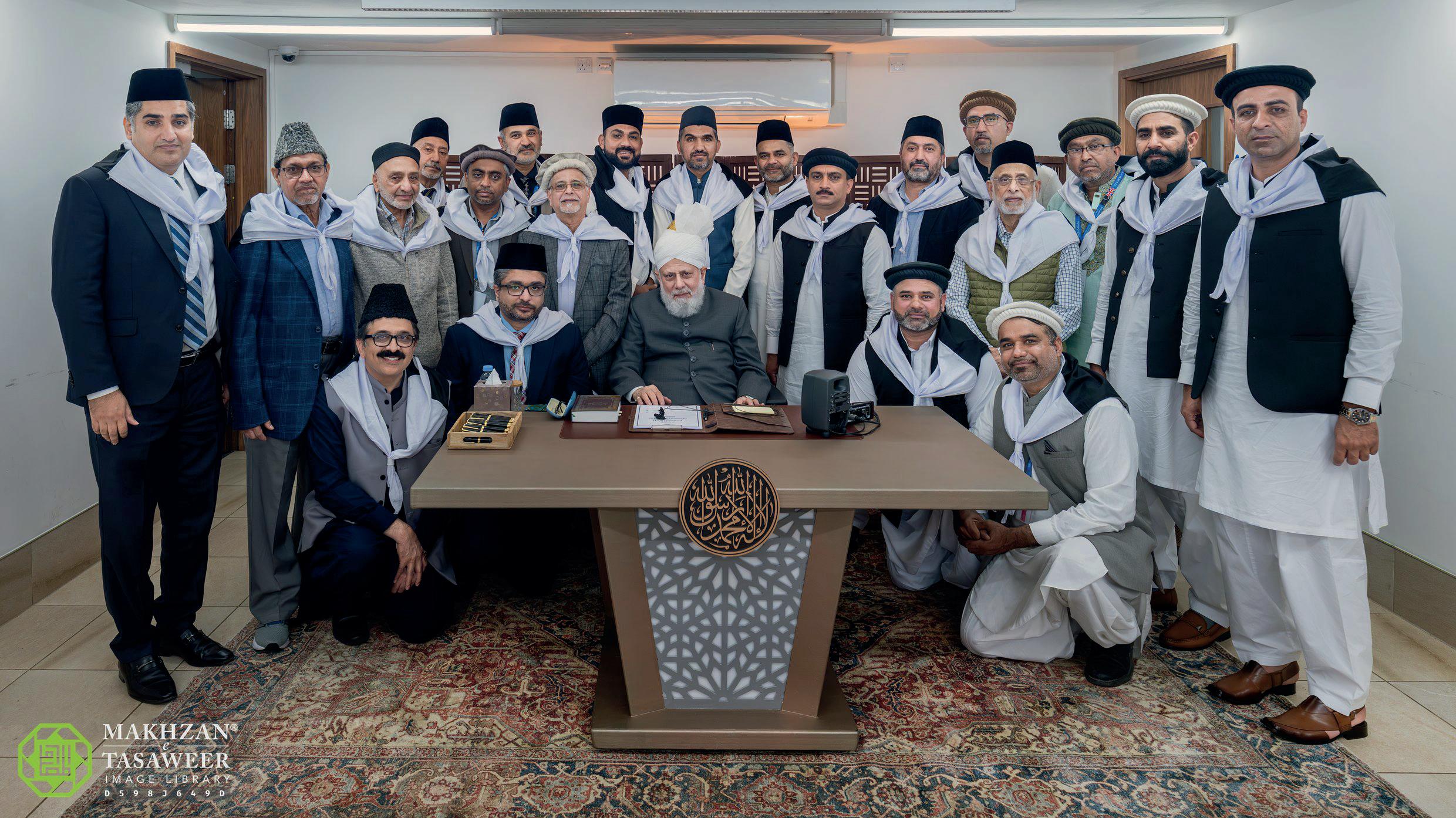
Members of Majlis Ansarullah from the Great Lakes and Western New York regions of the United States were blessed with a mulaqat with Hazrat Mirza Masroor Ahmad, Khalifatul Masih V (aa).
During the meeting, each nasir had the opportunity to introduce himself, after which members sought guidance from Huzoor (aa) on matters relating to the Holy Quran, modern distractions, marriage, paradise, forgiveness, Quran classes and ethical business.
Developing a living relationship with the Holy Quran in an age of distraction
A question was asked about how, in an age of excessive information, constant distraction, artificial intelligence, social media and mental stress, one can develop a living, personal and transformative relationship with the Holy Quran, rather than a merely academic or formal one.
Huzoor (aa) explained that in every age, there have been factors that distracted people according to their circumstances, environment and mental capacities. People have always faced things that turned their attention away from faith or drew them
Continued on page 3
Spending on family as charity
Hazrat Abu Mas‘ud al-Ansari (ra) narrated that [Hazrat ‘Abdullah ibn Yazid al-Ansari (ra)] asked him, “Do you narrate this from the Prophet (sa)?” He replied, “From the Prophet (sa) himself.” The Prophet (sa) said, “When a Muslim spends on his wife and children, seeking Allah’s pleasure thereby, it is counted for him as sadaqah [charity].”
(Sahih al-Bukhari, Kitab an-nafaqat, Bab fadli n-nafaqati ‘ala l-ahl, Hadith 5351)
Hazrat Mirza Ghulam Ahmadas, In His Own Words
Humility
People enjoyed immense freedom in speaking to His Holiness and anyone could engage in a conversation with him without any hindrance whatsoever. In this relation, the Promised Messiah (as) states: “It is not my practice to sit in a fierce and frightful manner so that people should fear me as they are terrified of a carnivorous beast. I extremely detest the idea of sitting like an idol. I have come to abolish idol worship, not so that I should become an idol myself and people worship me. Allah the Exalted knows well that I do not give myself preference over others even in the slightest. In my opinion, there is no worse an idol-worshipper and no one more wicked than an arrogant person. An arrogant person does not worship any God at all; in fact, he only worships himself.”
(Malfuzat [English], Vol. 2, p.183)
This Week in History
3 - 9 july
A glimpse into the rich history of the Ahmadiyya Muslim Jamaat
3 July
3 July 1886: On this day, the Promised Messiah (as) sent a reply to a letter from Hazrat Munshi Rustam Ali (ra), elaborating the philosophy of istighfar. Huzoor (as) instructed this devout companion to never discontinue the habit of seeking forgiveness from Allah because this blessed conduct of seeking forgiveness would initially safeguard a person from the wrath of God and finally, the seeker would get rid of sins. (Maktubat-e-Ahmad, Vol. 2, p. 477)
3 July 2009: On this day, advising English-speaking Ahmadis, Hazrat Khalifatul Masih V (aa) called their attention towards reading The Essence of Islam (a collection of writings, speeches, announcements, and discourses of the Promised Messiah). During his Friday sermon, Huzoor (aa) stated that every Ahmadi household ought to have these books, which have been translated into English. Huzoor (aa) also advised English-speaking Ahmadis to study the Promised Messiah’s (as) books, learn the arguments, and then convince opponents with those arguments.
While advising Urdu-speaking Ahmadis, Huzoor (aa) said that they ought to have the complete set of the Promised Messiah’s (as) books in their homes and read them regularly.
4 July
4 July 1989: On this day, Hazrat Khalifatul Masih IV (rh) granted an audience to the then-president of Guatemala. Huzoor (rh) arrived in this Central American country a day before. This was the first ever visit of any Khalifa to this part of the world. During his stay, Huzoor (rh), besides meeting with local Ahmadis and some dignitaries like the country’s Foreign Minister and Minister of Health, also inaugurated the first Ahmadiyya Muslim Mosque and Mission House in Guatemala. (Silsila Ahmadiyya, Vol. 4, pp. 856-857)
4 July 1997: Hazrat Khalifatul Masih IV (rh) delivered his Friday sermon in Bait-us-Salam Mosque, Toronto, Canada. Huzoor (rh) emphasised that before the beginning of the new century, every Ahmadi house should be filled with worshippers, and recitation of the Quran should be done daily. (Khutbat-e-Tahir, Vol. 16, pp. 489-509)
5 July
5 July 1932: On this day, Hazrat Musleh-e-Maud (ra) presided over a session of the All India Kashmir Committee held in Lahore. This committee was formed by the prominent Muslim leaders soon after communal tensions sprang forth from the Kashmir riots of 1931.
Hazrat Musleh-e-Maud (ra) was invited to join the committee by Allama Muhammad Iqbal, who, at that time, held the Ahmadiyya Jamaat and its leadership in high esteem. Subsequently, Huzoor (ra) became the president of the committee upon the invitation and persuasion of Muslim political leaders of that time. This provided the Jamaat with an opportunity to display its ability to get involved in a major crisis and to lead the
Muslim population.
Hazrat Musleh-e-Maud (ra) reached Lahore through a night journey after a medical check-up for his eyes from Rawalpindi. He stayed in Lahore until 7 July. This session of the Kashmir Committee continued for three hours. The same evening, Sheikh Muhammad Abdullah MSc, who came to Lahore from Kashmir, had a meeting with Huzoor (ra). As it was very late, the meeting was very short; however, the next day, Huzoor (ra) granted him the opportunity of two longer meetings.
For more details on this Committee and Hazrat Muslehe-Maud’s (ra) efforts for the rights of the oppressed Muslims of Kashmir, see “Hazrat Musleh-e-Maud’s (ra) services to the Muslim cause: Guidance for Turkey, peace in the Arab world and the Kashmir Movement”, alhakam.org (19 February 2021, Issue 153, pp. 41-44).
5 July 2008: On this day, Hazrat Khalifatul Masih V (aa) graced the inaugural reception of the Baitun Nur Mosque in Calgary, Canada. The event was attended by the Canadian Prime Minister Stephen Harper and other dignitaries. The event was attended by more than 3,000 people. Huzoor (aa) delivered the keynote address.
It is interesting to note that before this reception, a flag hoisting ceremony was also held; Huzoor (aa) hoisted Liwa-e-Ahmadiyyat, the Canadian Prime Minister hoisted the national flag of Canada and Deputy Mayor Ron Stevens hoisted the flag of Alberta province. It was the first occasion on the American continent that a country’s Prime Minister had the privilege to hoist the national flag while Hazrat Khalifatul Masih (aa) hoisted Liwa-e-Ahmadiyyat. The flag hoisting ceremony was covered by the country’s media as well. (Al Fazl International, 19 and 26 September 2008)
6 July
6 July 1967: On this day, Hazrat Khalifatul Masih III (rh) left Rabwah for his first visit to Europe. During this visit, Huzoor (rh) addressed seven press conferences, attended eight receptions and delivered five Friday sermons at different locations. (Tarikh-e-Ahmadiyyat, Vol. 24, p. 67)
7 July
7 July 1886: On this day, The Promised Messiah (as) shared his happiness upon developments in the job pursuit of Hakeem Noor-ud-Deen (ra). This letter adds to our knowledge that Hazrat Hakeem Sahib’s (ra) resignation was not accepted as earlier wished by Hazrat Ahmad (as). Huzoor (as) also predicted the promotion of Hazrat Hakeem Sahib (ra) in some coming stage.
To learn more about this life and services in Kashmir, see: ‘‘Pursuit, betrayal and triumph: The formative years of Hazrat Hakim Maulvi Nuruddin – Part II’’ at www.alhakam.org
7 July 1920: Hazrat Mufti Muhammad Sadiq (ra) engaged in correspondence with notable figures in the British monarchy and political circles. On this day, he wrote to Her Imperial Majesty, Queen Empress Mary
of England. This correspondence was in continuation of his previous communications addressed to various leaders worldwide as part of his missionary efforts. For details of a reply to him from the Indian Office, Whitehall, London, and other correspondences, refer to “100 Years Ago… – Brief report of one year’s Moslem missionary work in America” at alhakam.org (20 August 2021, p. 26).
8 July
8 July 1935: On this day, Hazrat Sahibzada Mirza Sharif Ahmad (ra) was attacked by an opponent. Mischievous activities by the Ahrar were on the rise, and the situation was turning tense and gruesome even in Qadian during those days. It was around 6 PM, when he set off from his office on his bicycle for his residence, that someone attacked him with a long and sharp club three times. Hazrat Mirza Sharif Ahmad (ra) courageously blocked this sudden assault with sharp reflexes. In his Friday sermon of 12 July 1935, Hazrat Musleh-e-Maud (ra) detailed this incident and informed the Jamaat about the conspiracy behind this cruel event. (Khutbat-e-Mahmud, Vol. 16, pp. 401-421)
8 July 2016: Following the death of the renowned humanitarian, Abdul Sattar Edhi of Pakistan, on this day, Hazrat Khalifatul Masih V (aa) said:
“I was very saddened to hear about the passing of Mr Abdul Sattar Edhi. On behalf of the Ahmadiyya Muslim Community, I would like to extend my condolences to his family and loved ones.
“Abdul Sattar Edhi was an extremely sincere man who devoted his entire life to serving humanity. Living his own life with great simplicity, his only concern was to selflessly serve others and to help those in need. Indeed, it was his exemplary humanitarian and philanthropic work that led him to being the second recipient of the Ahmadiyya Muslim Prize for the Advancement of Peace.
“I pray that Pakistan is blessed with many more people who exhibit the same selflessness, sincerity and humanity that Abdul Sattar Edhi displayed throughout his life so that Pakistan can be saved from its current plight and move towards a better and brighter future.
“May God Almighty have mercy on the deceased and grant patience to his family members and all of those left bereaved at this difficult and sad time.”
(“Statement by Head of Ahmadiyya Muslim Community following death of Abdul Sattar Edhi”, pressahmadiyya. com, 10 July 2016)
9 July
9 July 1883: The elder brother of the Promised Messiah (as), Mirza Ghulam Qadir Sahib passed away on this day at 7 PM at the age of 55. In 1868, Mirza Ghulam Qadir Sahib became seriously ill. The Promised Messiah (as) had earlier seen a dream in which he saw that his brother would die, so he prayed to God for his recovery. His prayer was accepted and it was revealed to him that his brother would recover, as he did. Mirza Ghulam Qadir Sahib left behind no child and his wife, Hurmat Bibi later entered the fold of the Jamaat as foretold to the Promised Messiah (as). (Tarikh-eAhmadiyyat, Vol. 1, p. 223)
9 July 1957: During his Eid-ul-Adha sermon on this day, Hazrat Musleh-e-Maud (ra) hinted at a new scheme, which was later named “Waqf-e-Jadid”. The primary objective of this scheme was to look after the spiritual upbringing of the Jamaat members living in rural areas. The secondary objective was to propagate the message of Islam to the Hindu population of the country. For more details, see “A chronology of Waqf-e-Jadid’s early years (1957-1965)”, Al Hakam, 25 December 2020, Issue 145, pp. 12-14.
towards worldliness. Huzoor (aa) said that what is called mental stress often arises when worldly desires increase and people’s preferences change. When those desires are not fulfilled, frustration and anxiety follow.
Referring to artificial intelligence, Huzoor (aa) said that AI is a separate matter and is not in itself the root of distraction. However, if a person does not know the answer to something and immediately turns to AI, this can create problems. Huzoor (aa) mentioned that an experiment had been carried out in which a missionary asked AI a religious question. When the answer was wrong and the missionary pointed out that the correct answer was found in Hadith, the AI accepted that its answer had been mistaken. Huzoor (aa) therefore advised that one should not rely entirely upon AI, especially in matters of religious knowledge.
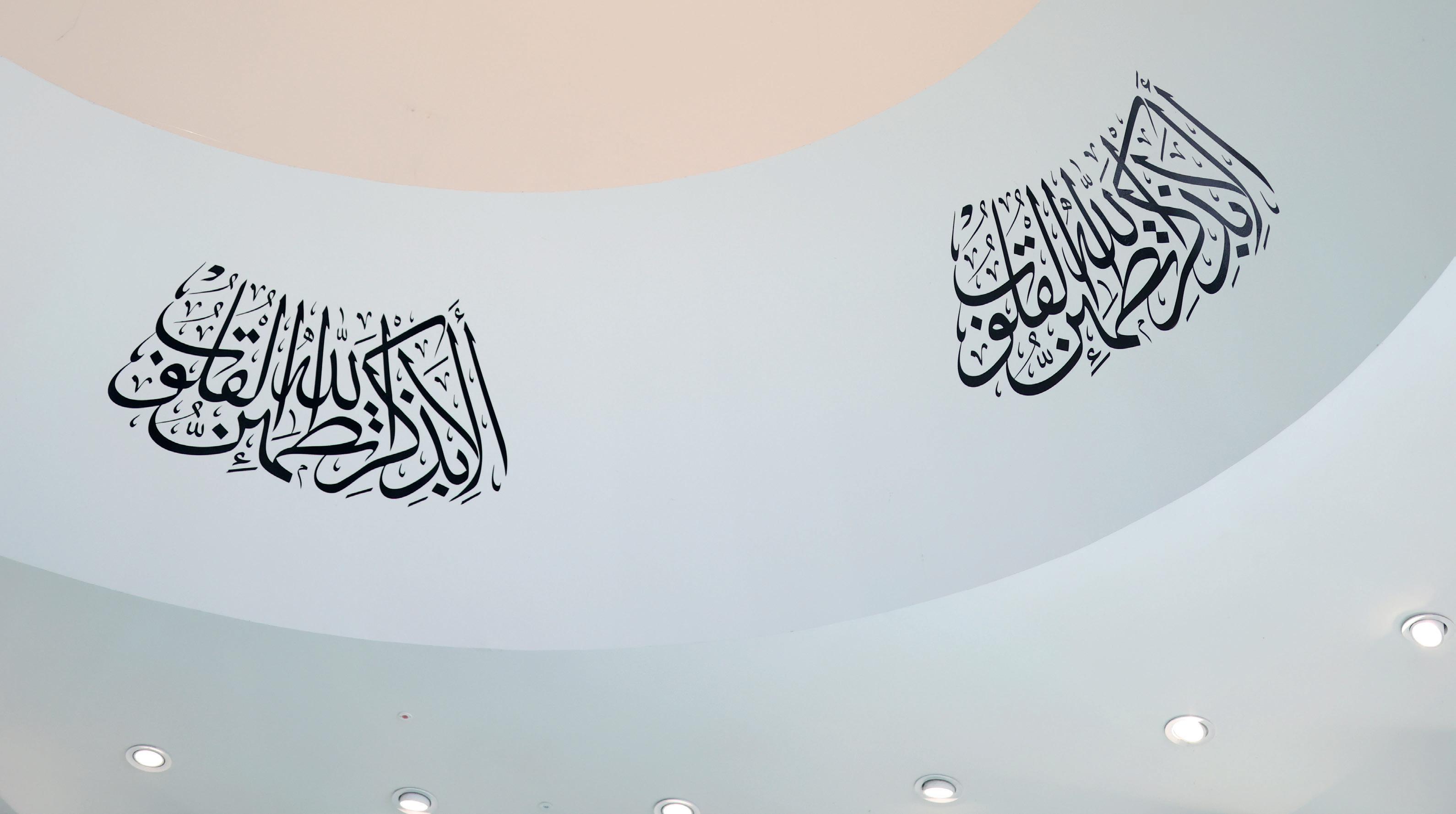
Huzoor (aa) said that people’s priorities have changed. Some seek mental peace by remaining absorbed in worldly matters, whereas the Holy Quran teaches:
It means that hearts find peace in the remembrance of Allah. (Surah ar-Ra‘d, Ch.13: V.29) He explained that those who remember Allah, understand the teachings of the Holy Quran and act upon them will find guidance. The Holy Quran contains answers and where a matter is not immediately understood, one should read the commentaries and seek Allah’s help.
Huzoor (aa) gave the example of Dr Abdus Salam, who said that he had found hundreds of Quranic verses related to science that guided him in his research. Huzoor (aa) said that educated people can search and reflect in this way. For ordinary people, it is sufficient that they offer the five daily prayers properly and supplicate within them. If a person fulfils Allah’s rights, asks Him sincerely and acts upon His commandments, Allah will grant guidance.
Worldliness, changed priorities and rising divorce
A nasir asked about an apparent increase in divorces among people in middle age,
particularly after the age of 40 and how ansar can help reduce this trend.
Huzoor (aa) said that whether divorce takes place early in marriage or later, the root issue often returns to the same matter: people forget religion, lose attention towards Allah and become absorbed in personal and worldly desires. Their preferences change and they begin to follow the trends of worldly people.
Huzoor (aa) observed that in Western and developed countries, divorce rates are very high. Huzoor (aa) said that within the Jamaat, the rate is still much lower, but it has gradually increased and remains a matter of concern. Huzoor (aa) said that when he first began warning about this issue, the rate was around three or four per cent, whereas it has now risen gradually.
Huzoor (aa) said that after 15, 20 or even 25 years of marriage, some women say that their rights were not fulfilled and that they remained patient until the children grew older, but can no longer continue. Huzoor (aa) said that once children are born, parents should not think only of their personal interests. They should be willing to make sacrifices for the sake of their children. Even when children are older, some are still at an age where the separation of their parents affects them.
Huzoor (aa) explained that if attention turns from worldliness towards faith, the divorce rate will decrease. If, after coming to Western or developed countries, people begin to think only of earning the world, they will face the same results as worldly people. Therefore, the Tarbiyat Department should repeatedly remind members to establish a relationship with Allah, to make Allah everything in their lives and to worry about the next generation.
Huzoor (aa) said that sometimes problems arise not merely from the existing relationship between husband and wife, but because a person becomes attracted elsewhere due to the surrounding environment. For this reason, moral training is needed. He explained that Allah has placed boundaries and modesty between men and women and if people remain within those
Huzoor (aa) advised that the commentaries of the Holy Quran, including Tafsir-e-Saghir and other Jamaat commentaries, should be read for further explanation.
Huzoor (aa) said that one meaning is that a person who fears Allah receives a form of paradise in this world as well. When a person fears Allah, Allah’s grace descends upon them, their prayers are accepted and ease is created for them. A believer regards this as a kind of paradise.
Huzoor (aa) said that some people may then raise the question that the Holy Prophet (sa) described the world as a prison for the believer, so how can it also be called paradise? (Sahih Muslim, Kitab az-zuhdi wa r-raqa’iq, Hadith 5242) He explained that from a purely worldly perspective, a person may consider religious restraint to be a form of difficulty. However, when a believer sees Allah’s grace, the acceptance of prayers and the ease Allah creates, that believer experiences this as paradise.
limits, their lives will remain better.
When the questioner added that children sometimes ask their mothers why they continue to endure cruelty, Huzoor (aa) said that this again comes back to the same point. When worldliness enters and religion is absent, a husband may be cruel to his wife and the wife may say that she endured it for 15 or 20 years for the sake of the children, but can no longer do so. Huzoor (aa) said that the tarbiyat and moral training of husbands and men is the responsibility of Ansarullah. They must be brought towards faith.
Huzoor (aa) said that merely standing and making a pledge that one will give precedence to faith over the world is not enough unless one understands what that means. To become servants of the Gracious God (‘Ibad-ur-Rahman) is not only to offer prayers, but to act upon all the commandments of Allah. He explained that when one recites that Allah alone is worshipped and His help alone is sought, it signifies complete submission to Allah’s commandments and seeking His help to act upon them. This understanding must be developed through continuous teaching and effort. Huzoor (aa) said that he continues to make efforts in this regard and if members also make a consolidated effort, the result will be multiplied and beneficial.
The two gardens and the additional two gardens in Surah ar-Rahman
A member asked about the verse in Surah ar-Rahman, which states that for the one who fears standing before his Lord, there are two gardens (Surah ar-Rahman, Ch.55: V.47) and then later mentions two additional gardens. (Surah ar-Rahman, Ch.55: V.63) He asked what the additional two gardens signify.
Huzoor (aa) explained that one broad meaning is that Allah multiplies a person’s reward in the Hereafter. Just as Allah says in different places in the Holy Quran that He increases and multiplies the reward of good deeds, the glad tiding of two gardens is also increased in the next world.
Huzoor (aa) said that in addition to the paradise experienced in this world and the promised paradise in the Hereafter, Allah further multiplies the reward in the next world. Thus, the additional gardens refer to the increased and doubled reward that Allah grants by His grace.
The Jamaat’s daily progress is itself a sign of Allah’s grace
A member requested that Huzoor (aa) narrate an incident of Allah’s special grace after being blessed with the mantle of Khilafat, so that the faith of the members may increase.
Huzoor (aa) answered:
“Such incidents occur every day – what should I tell you? The progress of the Jamaat is itself made up of such incidents, is it not? And as for the increase in faith, that should come about from this very point: if Allah the Almighty can take service from a person like me and cause the Jamaat to progress, then this means that the Jamaat is true. These are the incidents.
“The Jamaat is spreading across the world and it is progressing. People are also increasing in faith. They are in Africa, in Europe, in Asia, in the Arab countries, in the Far East, in South America and in [North] America. So, these are the incidents that occur day after day.
“As for other incidents, I continue to relate them. People write such incidents to me and there are countless incidents in some of the reports of progress that I mention on the second day at Jalsa. Listen carefully to the speech and you will come to know.”
Encouraging attendance at Quran classes
A nasir requested prayers that Allah may create love for the Holy Quran and the books of the Promised Messiah (as) in the hearts of all Ahmadis in Oshkosh and that they may act upon those teachings. He also asked how he could practically encourage members to attend Dars-e-Quran sessions held twice a week after Asr for 20 minutes.
Huzoor (aa) said that creating love for the Holy Quran is the responsibility of the Secretary Talim-ul-Quran, the Secretary Tarbiyat, Majlis Ansarullah, Majlis Khuddam-ul-Ahmadiyya, the Jamaat and
the relevant secretaries. They must explain to people that the Holy Quran is the means of their survival: by reading it, understanding it and acting upon it.
Huzoor (aa) pointed out that the classes amount to only 40 minutes in an entire week, while a week contains 168 hours. If a person gives just 40 minutes to reading the Holy Quran, it will improve their worldly life, their faith and their hereafter. This realisation must first be created.
Huzoor (aa) said that verbal claims are not enough. People pledge that they will give precedence to faith over the world, but claims alone do not achieve anything. The Promised Messiah (as) taught that if one has truly entered into bai‘at, then one must become a true believer. (Malfuzat, Vol. 8, UK, 1985, pp. 297-298)
Huzoor (aa) said that Allah instructed the Holy Prophet (sa) to remind people and that he was a warner and reminder. (Surah al-Ghashiyah, Ch.88: V.22-23) Therefore, members too should continue reminding others and explaining the importance of the Holy Quran and the books of the Promised Messiah (as).
Huzoor (aa) suggested that, since people have phones and use social media, short excerpts of two, three or four lines from the books of the Promised Messiah (as) should be sent to them, especially passages that create love for the Holy Quran, love for Allah
and the desire to gain religious knowledge. If these reminders are sent repeatedly, then just as drops of water eventually wear through stone, they will soften hearts to some extent, even if people have become immersed in worldliness. Huzoor (aa) advised that one should continue making efforts and should not become tired.
Forgiving others and leaving matters to Allah
A question was asked about people who believe that if someone has wronged them, Allah will not forgive that person until they themselves forgive them. Some people then spend their entire lives refusing to forgive, even though Allah is Forgiving and Merciful and loves forgiveness. Guidance was sought on how such people can be advised.
Huzoor (aa) said that Allah states that He forgives all sins except shirk. (Surah anNisa, Ch.4: V.117) If Allah wishes to punish someone in the Hereafter, He may punish them to the extent He wills, but ultimate judgement and forgiveness belong to Him. Therefore, people should be told that if they forgive and forget matters in this world, that is better.
Huzoor (aa) said that the Holy Quran also teaches that forgiveness is better. (Surah ash-Shura, Ch.42: V.41) If punishment is required, then it should be proportionate
and according to the law, not through personal vengeance. (Surah an-Nahl, Ch.16: V.127) However, if the matter is a small emotional grievance or minor personal hurt, then it should simply be ignored and left to Allah. Huzoor (aa) said that such matters should be entrusted to Allah.
Honesty, humility and faith while doing business
A member who had served for more than 20 years in the United States Air Force and was approaching retirement said that he had started a halal farm business to serve his family and community. He sought guidance on maintaining humility, strengthening faith, balancing family responsibilities and continuing to serve humanity in a meaningful way.
Huzoor (aa) said that if a person is doing business, then the first purpose is to earn a livelihood and there is nothing wrong with that. The Companions (ra) of the Holy Prophet (sa) also engaged in business and trade and some became very wealthy. When they passed away, some left considerable wealth, yet they did not forget faith.
Huzoor (aa) said that whatever worldly work a person does, they must not forget religion. The obligations owed to Allah should remain foremost. He referred to a Persian saying which translates to “Hands
engaged in work, heart attached to God.” A person may be working and thinking about work, but the fear of Allah should remain in the heart.
Huzoor (aa) said that whatever business is undertaken must be conducted with honesty and without deception. Referring to farming, he gave the example that one should not artificially inflate poultry or present unhealthy practices as though they were healthy. If meat is being sold as organic, then it must genuinely be organic. One should not use chemicals or other means and then make misleading claims.
Huzoor (aa) said that honesty must be maintained in business. A person should also not become so involved in business that they forget the five daily prayers, neglect the rights of their wife and children or fail to fulfil the rights owed to the Jamaat. If these matters are remembered, then the business can become a means of blessing and the person can also fulfil their obligations to Allah, their family and the Jamaat.
Conclusion
As the mulaqat concluded, the ansar had the opportunity to have a group photograph with Huzoor (aa). They also received pens as gifts.
(Summary prepared by Al Hakam)
From fear to faith: My journey with the hijab
Khafiya Zeb Mangut Canada
When I was 10 years old, my mother would sit next to me and gently recite prayers every night and I would repeat them after her. After the prayers, she would softly explain to me the meaning of the hijab, why Muslim women observe purdah and also why it is so lovely to choose modesty for the sake of Allah. They were simply gentle explanations given with love; there was never any coercion or force. I paid close attention and let her words sink into my heart.
When I think of purdah, the first and strongest image that comes to my mind is my mother.
As a young child, I remember watching her put on her burqa every time she stepped outside. She never complained, never treated it as a burden. It was simply a part of who she was. She grew up in Pakistan observing purdah and when she attended university, she wore a full niqab that covered her face, leaving only her eyes visible. When I look at her old photographs now, she stands out, not because she tried to, but because of the dignity and quiet confidence she carried. Without saying much, she taught me that purdah is strength.
But still, questions lingered in my young mind.
What would others think of me if I started wearing a hijab? Would my friends still like me? Would they see me differently, as though I now carried a visible mark?
Then one Monday morning in fifth grade, I woke up feeling something I had never felt before. Instead of fear or hesitation, there
was an overwhelming sense of excitement and certainty in my heart. Almost without thinking, I walked into my mother’s closet, picked up a scarf and covered my head. My heart had decided before my mind could question it.
That was the day I walked into school wearing my hijab for the first time.
I was nervous… very, very nervous, but there was also a quiet thrill within me. I knew I looked different. Some classmates smiled warmly; others asked curious questions. When they asked why I was wearing a scarf, I replied simply, “I’m a Muslim and this is my identity.” There were a few who whispered behind my back, but deep in my heart, I knew I was doing this for Allah. When Allah is pleased, no opinion can shake you.
From that day onward, I wore my scarf to school every single day. I searched online for ways to wear my hijab properly, ensuring my hair and neck were fully covered. Slowly, it stopped feeling new. It began to feel natural, like a part of me. Yes, there were days when the heat felt uncomfortable, but I reminded myself that discomfort was not a reason to abandon faith. I thought of those who walk long distances under the sun, for those who do not have the safety and comfort that I would soon have when I return home. Gratitude kept me grounded. Gratitude made me strong.
A year later, in sixth grade, I stood in front of my entire elementary school and delivered a speech while wearing my hijab. I felt calm, proud and complete. I knew Allah was pleased and that was more than enough.
As I entered high school, I became more aware of the changes that come with
womanhood. Islam, in its infinite wisdom, guides women with clarity, dignity and protection. Allah says in the Holy Quran:
“O Prophet! Ask your wives, daughters, and believing women to draw their cloaks over their bodies. In this way it is more likely that they will be recognized and not be harassed. And Allah is All-Forgiving, Most Merciful.” (Surah al-Ahzab, Ch.33: V.59)
And He says:
“And say to the believing women […] that they draw their head-coverings over their bosoms ” (Surah an-Nur, Ch.24: V.31)
With this guidance, I became more mindful of how I dressed. I covered my chest and hips with loose cardigans and coats. My hijab fully concealed my hair and neck and my clothing reflected dignity as my body changed. I understood that modesty was not a restriction – it was protection.
I know that for many girls, wearing a hijab can feel scary at first. And that’s okay. It’s natural to feel nervous, but remember this: you wear your hijab for Allah and that is what matters most. When you choose to cover yourself, your identity shines quietly and beautifully, like a flower slowly blooming. As I embraced this choice myself, I began to notice how it quietly gave me strength, confidence and a sense of purpose.
Throughout high school, I felt empowered. I was treated with respect. I felt secure, confident and protected. Being recognised as an Ahmadi Muslim woman filled me with pride. I wore my purdah everywhere, even during an all-girls gym class, because activities were often held outdoors. I never felt the need to remove it. My hijab became so deeply woven into my
life that it felt inseparable from who I was. Buying new scarves each year became a joy and seeing my younger cousins follow in my footsteps felt like a quiet but meaningful victory.
Near the end of high school, I was required to complete a final project before graduating. As I searched for a topic, one question kept returning to me: what has shaped me the most? The answer was clear.
My hijab
I titled my project “The power of my hijab.” I spoke about empowerment, selfrespect and the confidence purdah gave me. My principal appreciated the topic deeply.
But the most important lesson I learned was this: purdah is more than clothing. It is a guardian spirit. It reflects itself in how we speak, how we behave and how we carry ourselves.
I carried this understanding into university, into marriage and into every stage of my life. I have not removed my hijab since fifth grade. Every time I wrap my scarf around my head, I am reminded of the strength, dignity and confidence that it has helped me carry through life.
Today, I am 24 years old, happily married to a missionary, alhamdulillah, as well as a waqifa and I am endlessly grateful to my mother for those quiet nighttime conversations about purdah when I was only 10. I chose hijab because I cherish my faith. This is who I am. Proper purdah keeps me safe and draws me closer to Allah.
This is my story, a reminder to never underestimate the power of putting faith above fear.
Answers to Everyday Issues
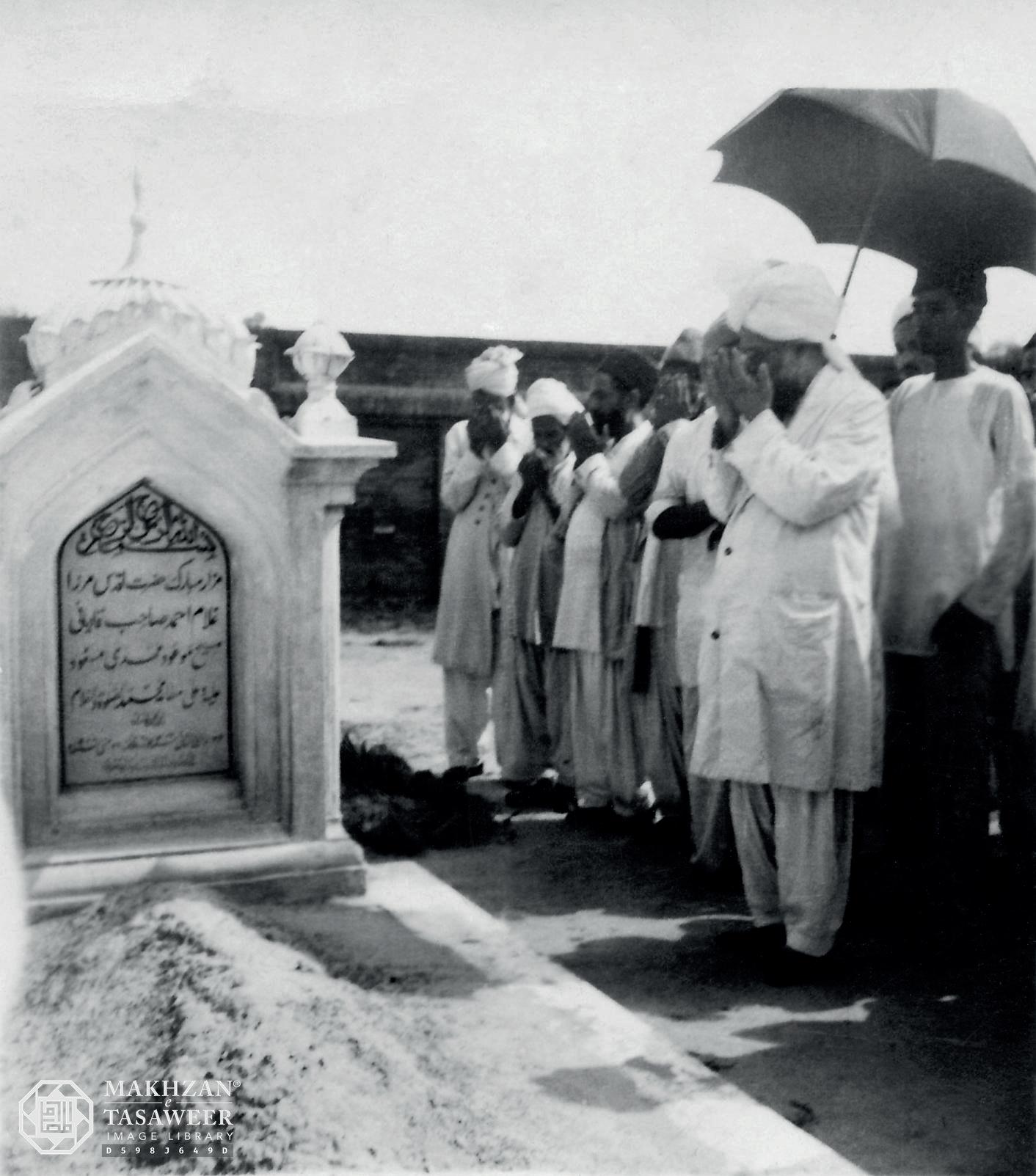
Praying at Promised Messiah’s grave, Fajr, prayers of three Ramadan ‘ashrahs and the Fire of Hijaz
Guidance regarding basic Islamic issues that Hazrat Amirul Momineen, Khalifatul Masih Vaa, has given on various occasions in his written correspondence and during MTA programmes is being published officially below for everyone’s benefit.
How should one pray at the graves of holy personages?
A lady from the USA wrote to Hazrat Amirul Momineen, Khalifatul Masih V (aa), enquiring how one should pray in one’s own language when visiting the blessed resting places of the Holy Prophet (sa) and the Promised Messiah (as).
In his letter dated 23 February 2024, Huzoor-e-Anwar (aa) gave the following guidance in this regard:
“Recite Surah al-Fatihah and durud sharif [invoking blessings and peace upon the Holy Prophet (sa)], for within these all prayers are contained. Then, in your own language, pray to Allah the Exalted for the elevation of the ranks of these revered personages and also pray that Allah the Exalted may enable their followers to remain steadfast upon the virtues and truths with which they came. Thereafter, pray for the attainment of religious and worldly blessings for yourself and ask of Allah the Exalted whatever you desire.
“For the guidance of members of the Jamaat, Hazrat Musleh-e-Maud (ra) once delivered an address on the subject of ‘Mazar Hazrat Masih Mau‘ud (as) par Du‘a aur us ki Hikmat’ [Supplication at the grave of the Promised Messiah (as) and its wisdom], which has since been published in book form. In that address, Huzoor (ra) drew the attention of members of the Jamaat to many important matters. You should study it as well. Regarding his own manner of prayer, Huzoor (ra) states:
“‘I shall tell you about myself. Whenever I come to pray at the grave of the Promised Messiah (as), I have adopted the practice of first praying for the Holy Prophet (sa) and then praying for the Promised Messiah (as). The prayer I make is this: “O Allah, I
possess nothing worthy of presenting as a gift in honour of these revered ones. What I do possess can be of no benefit to them. All things, however, are in Your power. I therefore beseech You, out of Your grace, to bestow on them from me such a gift in Paradise as they have not received there before.”
“‘They will then surely ask, “O Allah, from whom has this gift come?” And when Allah informs them, they pray for that person. Thus, the ranks of the supplicant, too, are elevated. This is established by the Quran and the ahadith
“‘It is a well-established principle of Islam, one which no one can deny, that the prayers of the living do indeed benefit the deceased. The Holy Quran has also drawn attention to this principle in the words
(Surah an-Nisa’, Ch.4: V.87), from which we learn that when someone presents you with a gift, you should return it with one better than it or, at the very least, with one equal to it. Accordingly, when we pray for the Holy Prophet (sa) or the Promised Messiah (as) and invoke blessings and peace upon them, Allah the Exalted bestows upon them, as a result of that supplication, a gift on our behalf.
“‘We do not know what bounties Paradise contains, but Allah the Exalted knows them full well. Therefore, when we pray, “My Lord, grant to the Noble Messenger (sa) such a gift as he has not received before”, it necessarily follows that when that gift is bestowed upon him, Allah the Exalted will also inform him that it has come as a gift from such-and-such a person. How, then, can it be imagined that, having come to know this, he would remain silent and not pray for the one who sent that gift? At such a moment, his blessed soul cannot but fall at the threshold of Allah and cry out,
“O God, now do You, on our behalf, grant this person an even better reward.”
“‘Thus, in accordance with
that prayer returns to the one who invoked blessings and becomes the means of elevating their rank. This, then, is a means by which, without any trace of shirk, we ourselves may benefit and the nation may benefit as well.’ (Mazar Hazrat Masih Mau‘ud (as) par du‘a aur us ki hikmat, Anwarul-Ulum, Vol. 17, pp. 182-183)”
Why are only two fardh rak‘at prescribed in the Fajr prayer?
Someone from Canada asked Hazrat Amirul Momineen, Khalifatul Masih V (aa), why only two fardh rak‘at are offered in the Fajr
prayer, whereas the other obligatory prayers consist of more than two rak‘at
In his letter dated 25 February 2024, Huzoor-e-Anwar (aa) gave the following answer to this question:
“This is Allah the Exalted’s will. As Allah the Exalted instructed His Messenger (sa), so the Holy Prophet (sa) informed us of and taught us the prescribed rak‘at of the prayers. Moreover, one who offers tahajjud has already performed a lengthy supererogatory prayer in the latter part of the night, shortly before Fajr. Therefore, for the ease of such a person, Allah the Exalted has prescribed fewer rak‘at for Fajr than for the other prayers.
“Moreover, Hazrat Musleh-e-Maud
(ra) has, in various sermons, explained the wisdom underlying the timings of the prayers and their rak‘at. In one place, while explaining the rak‘at of Fajr, Huzoor (ra) states:
“‘The fundamental point is that when a person rises from sleep, a new phase of life begins for them. At the beginning of a new phase, it is necessary that one should form lofty resolves within oneself and say: I shall do this; I shall do that. Since all these matters are contained in the Holy Quran, when a person’s new phase of life begins after rising from sleep, Islam has prescribed a lengthy recitation of the Holy Quran at that time in order to draw their attention towards their spiritual programme. Thus, it has been ordained that the Holy Quran should be recited at length in the Fajr prayer. And since God Almighty’s way in His commandments is founded upon ease and not hardship, He made the Fajr prayer shorter than all the other prayers so that the recitation might be lengthened. Thus, He shortened the Fajr prayer, but lengthened the recitation of the Quran. This is because, at that time, there is a need for the themes of the Holy Quran to come before one again and again. Hence, it was necessary that the Fajr prayer be shortened so that the recitation might be lengthened. This prayer is, in fact, the counterpart of the Asr prayer and even outwardly its number comes to resemble that of Asr in this way: no sunnah mu’akkadah is attached to Asr, whereas the morning prayer is accompanied by two sunnah mu’akkadah. Thus, the rak‘at of the morning prayer also become four, just as the rak‘at of Asr are four.’ (Khutbat-e-Mahmud, Vol. 20, Friday sermon delivered on 17 March 1939, p. 172)”
Are the well-known supplications for Ramadan’s three ashrahs established by the sunnah or Hadith?
Someone from Australia wrote to Hazrat Amirul Momineen, Khalifatul Masih V (aa), asking whether the well-known supplications associated with the three ashrahs [ten-day periods] of Ramadan are established by the sunnah or Hadith. They also enquired about the source of
[I seek forgiveness from Allah, my Lord, for every sin and I turn to Him]. According to Hazrat Aisha (ra), the Holy Prophet (sa), after saying
[Holy is Allah and all praise belongs to Him], would say only
[I seek forgiveness from Allah and turn to Him]. Moreover, the Holy Quran also uses the words
[Seek forgiveness of your Lord and turn to Him in repentance]. (Surah Hud, Ch.11: V.4) Guidance was requested in this regard.
In his letter dated 29 February 2024, Huzoor-e-Anwar (aa) gave the following guidance:
“The supplications attributed to the ashrahs of Ramadan are not established as being specific to those periods from the sunnah of the Holy Prophet (sa) or from any authentic hadith. It appears that, at some later time, people attached these supplications specifically to those ashrahs The Holy Prophet (sa) only described these ashrahs of Ramadan as periods of mercy, forgiveness and deliverance from the Fire. (Shu‘ab al-Iman, Al-Bayhaqi, Kitab fada’ili
shahri Ramadan, Bab azallakum shahrun ‘azim, shahrun mubarak)
“Among the supplications attributed to the ashrahs of Ramadan is
[‘My Lord, forgive and have mercy, and Thou art the Best of those who show mercy.’] (Surah al-Mu’minun, Ch. 23: V. 119) This is a Quranic supplication. With regard to the prayer
[‘O Allah, Thou art Oft-Pardoning; Thou lovest to pardon, so pardon me’], it is mentioned in a hadith that when Hazrat Aisha (ra) asked, ‘If I come to know that this night is Laylat al-Qadr, what should I pray in it?’ the Holy Prophet (sa) taught her this supplication. (Sunan Ibn Majah, Kitab addu‘a, Bab ad-du‘a’i bi l-‘afwi wa l-‘afiyah) However, the istighfar formula is also not transmitted in these exact words in any authentic hadith.
“For istighfar, the Holy Prophet (sa) used various expressions and forms of wording, which are narrated in the ahadith As I have said, the istighfar containing the words
[I seek forgiveness from Allah, my Lord, for every sin and I turn to Him] is not related in any authentic hadith. However, the Promised Messiah (as) recited this istighfar while taking the pledge of allegiance [bai‘at]. (Maktubat-e-Ahmad, Vol. 3, 2013, p. 247) This would certainly have been on account of the command of Allah the Exalted. Besides this, the words يْ
[my Lord] and
[for every sin] in this istighfar create a sense of a personal bond with Allah the Exalted, as well as the thought of seeking forgiveness for every kind of sin. Thus, this istighfar becomes a means of drawing a person closer to Allah the Exalted. Therefore, there is no harm in reciting such an istighfar One should instead refrain from things that lead to shirk and that take a person away from Allah the Exalted.
“Alongside these matters, one should always keep in view that a person ought not to become embroiled in such idle and meaningless scholarly debates merely to parade their learning and make an undue display of it.”
Did Prophet Muhammad (sa) foretell the discovery of oil and fossil fuels?
Someone from the UK wrote to Hazrat Amirul Momineen, Khalifatul Masih V (aa), asking whether the prophecy concerning the Fire of Hijaz, mentioned in the Hadith and also referred to by the Promised Messiah (as), could indicate the discovery of oil and fossil fuels.
In his letter dated 12 March 2024, Huzoor-e-Anwar (aa) provided the following guidance on this matter:
“The fundamental point is that the various prophecies which Allah the Exalted conveys to the world through the mouths of His loved ones have different aspects. At times, they are fulfilled in a manifest and outward manner and at other times, they also contain meanings in which there is an element of hiddenness.
“The prophecy concerning the Fire of Hijaz is narrated in the books of Hadith from Hazrat Abu Hurairah (ra) in the following words: The Holy Prophet (sa) said, ‘The Hour will not be established until a fire emerges from the land of the Hijaz which will illuminate the necks of camels in
Busra.’ (Sahih al-Bukhari, Kitab al-fitan, Bab khuruji n-nar; Sahih Muslim, Kitab al-fitani wa ashrati s-sa‘ah, Bab la taqumu s-sa‘atu hatta takhruja narun min ardi l-hijaz)
“Most scholars agree that this prophecy foretold by the Holy Prophet (sa) was fulfilled in 654 AH. It is also said that this fire lasted for three months. [Ibn Hajar al‘Asqalani, Fath al-Bari bi Sharh Sahih alBukhari, Kitab al-fitan, Bab khuruji n-nar, 13:79-80; Muhammad Siddiq Hasan Khan, al-Siraj al-Wahhaj min Kashf Matalib Sahih Muslim ibn al-Hajjaj, Bab la taqumu s-sa‘atu hatta takhruja narun min ardi l-Hijaz, quoting Abu al-Falah in Shadharat al-Dhahab] Likewise, it is recorded that on the night of Wednesday, 3 Jumada alAkhirah 654 AH, a terrifying rumbling was heard in Medina. Thereafter, an earthquake occurred, which shook everything violently. This continued until Friday, after which a great fire appeared from the Harrah of Medina. It spread like flowing water and was casting out enormous sparks. [Ibn Kathir, al-Bidayah wa al-Nihayah, ed. ‘Abd Allah ibn ‘Abd al-Muhsin al-Turki (Cairo: Dar Hajar, 1417-1420 AH / 1997), 17:328330] Imam Nawawi writes that in 654 AH, a very great fire blazed forth from behind the Harrah on the eastern side of Medina and the people of Syria and other lands have received uninterrupted reports of it. [AlNawawi, al-Minhaj fi Sharh Sahih Muslim ibn al-Hajjaj (Beirut: Dar Ihya’ al-Turath al‘Arabi, 2nd ed., 1392 AH), Kitab al-fitan wa ashrati a-sa‘ah, 18:28-30]
“The Promised Messiah (as) also spoke of the fulfilment of this prophecy in various places. Thus, while explaining to young people the enlightening truth of Allah the Exalted’s infinite, never-ending and boundless powers and the profound reality of His law of nature, the Promised Messiah (as) states:
“‘For example, fire is, by its very nature, endowed with the property of burning and this is a property which we have tested time and again. Indeed, it forms part of our repeatedly verified experiences and recurrent observations. Yet, for all that, it is possible that some medicine or ointment may come into being such that, when applied to a limb or to some other object, fire is unable to manifest upon it its property of burning. It is likewise possible that within fire itself, by the leave of Allah the Exalted, certain inward or outward contingencies may arise whereby such a condition comes into being. In like manner, it too lies within the range of possibility that a kind of fire may emerge from the earth or from the heavens which differs in its properties from the fire familiar to us – such as the Fire of Hijaz, the appearance of which was foretold by the Holy Prophet (sa) 652 years before it came to pass and which had already been recorded and published in Sahih al-Bukhari and Sahih Muslim 500 years before its manifestation. In short, through terrestrial or celestial influences and through inward or outward causes, hundreds of such conditions may arise as can interfere with the presently recognised and empirically established properties of a thing. Indeed, it is upon this very principle that the door of the modern sciences, which stands open in so vast and boundless a manner, rests. I do not say that you should, without thought or understanding, make my words the basis of your opinion. Rather, I say that you
should examine carefully, test thoroughly, distinguish the genuine from the false and look with open eyes upon whatever this age is showing you. Then, if this view appears to you to be the stronger and more cogent one, (O youth of our land), accept it.’ (Surma-eChashm-e-Arya, Ruhani Khazain, Vol. 2, p. 102)
“Then, while mentioning this very hadith containing the prophecy of the Fire of Hijaz and while setting out the criterion for the authenticity of Prophetic ahadith, the Promised Messiah (as) states:
“‘Every sane person agrees that even if a hadith is ahad and has not been widely acknowledged but contains a prophecy that is fully or partly fulfilled at its appointed time, there remains no doubt about the authenticity of such a hadith. For example, the hadith recorded in Sahih al-Bukhari and Sahih Muslim that a fire will break out in the Hejaz is undoubtedly among the ahad. But after the passing of nearly 600 years, this prophecy was fulfilled clearly, and even the British admit it. This prophecy was fulfilled hundreds of years after the compilation and publication of the books in which it was recorded. Can we now declare such ahadith to be absolutely unacceptable on account of their being ahad? It is extremely vile and abhorrent ignorance to entertain such a thought after the authenticity of such ahadith has been established so clearly.’ (Shahadat-ul-Quran, Ruhani Khazain, Vol. 6, p. 305)
“So this is the outward fulfilment of that prophecy and it was fulfilled exactly in accordance with the words of the Holy Prophet (sa). However, as I have already said, prophecies have several inner layers which continue to manifest in their appointed time by the leave of Allah the Exalted. The discovery of oil and fossil fuels is certainly another aspect of the fulfilment of this prophecy. As is indicated in the Promised Messiah’s (as) passage from Surma-e-Chashm-e-Arya, the powers of Allah the Exalted are infinite and limitless, and in this connection, he has also spoken of different forms of fire. Oil and fossil fuels are likewise a form of fire, which, although they do not outwardly burn the vehicles and other inventions in which they are used, nevertheless play a fundamental role in enabling them to run and function.
“Furthermore, if this prophecy is considered alongside the signs associated with the age of the Promised Messiah (as), in which the invention of new means of transport was foretold and, in particular, the abandonment of camels was mentioned –even though in the blessed age of the Holy Prophet (sa), the camel was the most useful means of transport – then another aspect of the fulfilment of the prophecy of the Fire of Hijaz comes to light. Moreover, the illumination of the camels’ necks by this fire also indicates that, as a result of this fire, such an extraordinary revolution will be brought about in the means used for travel and other purposes that light will spread everywhere, for the illumination of the camels’ necks points to light spreading in every direction.
“Thus, the point you have raised is correct. This prophecy does indeed contain an indication towards the discovery of oil, fossil fuels and the like.”
(Submitted by Ehsan Ahmad, Murabbi-eSilsilah, Private Secretariat, Islamabad and translated by Al Hakam)
The early spread of Islam Ahmadiyyat in East Africa and the Swahili translation of the Quran
A series looking at pioneer missionaries and devotees of the Ahmadiyya Muslim Jamaat who gave precedence to faith over the world.
Awwab Saad Hayat
Some of the Companions of the Promised Messiah (as) had already reached the eastern regions of the African continent toward the end of the 19th century and the beginning of the 20th century, during his own lifetime. When Sheikh Mubarak Ahmad Sahib was formally sent to East Africa as a missionary from Qadian Markaz in 1932, he initially used to deliver his speeches in Arabic, while interpreters would convey the message to the people. Soon, however, he gained proficiency in Swahili and began to carry out the important work of Tabligh very effectively.
Need for translation
His most important and foundational achievement was the translation of the Holy Quran into Swahili. From the very beginning, he had realised that, without presenting the Holy Quran in the local language, the message of Islam could not be fully conveyed to the people of the land. Despite the scarcity of resources and helpers, this resilient missionary rendered a remarkable service in representing and explaining Islam in the Swahili language.
Swahili language
Swahili is an important African language spoken along the coastal regions of East Africa. It is widely used in countries such
as Tanzania, Kenya, Uganda and the Democratic Republic of the Congo. The language also bears a strong influence of Arabic. Swahili is regarded as a major symbol of African unity and communication, and in several countries, it holds the status of an official or national language. This language, which developed under the influence of Arab traders, was initially written in the Arabic script. However, when European nations established their presence in Africa, they not only carried out various developmental activities but also reformed the Swahili language. The Roman script was introduced in place of the Arabic script. Christian missionaries compiled Swahili dictionaries in English and translated the Bible into this language.
Publication, review and impact of the Swahili Quran translation
The publication of the Swahili translation of the Holy Quran holds the status of a significant milestone in the history of the Jamaat, as it greatly accelerated the propagation of Islam Ahmadiyyat in this region. This translation was published in 1953 in ten thousand copies. It was received with profound respect in the religious and academic circles of East Africa. Previously, only the Swahili translation of the Bible had been presented as a scholarly masterpiece. (Al Fazl, 29 July 1976, pp. 3-4)
In 1953, the first edition of this translation of the Holy Quran was published
in Nairobi, Kenya, with 10,000 copies. The second edition, consisting of 5,000 copies, was printed in Pakistan, while the third edition of 10,000 copies was published in London. Later, another missionary serving in East Africa added indexes and other aids to facilitate reference to various topics. He had also been part of the initial project. (Al Fazl, 9 March 1952)
A review of the Swahili translation of the Holy Quran, along with other literature published by the Ahmadiyya Muslim Jamaat in the Swahili language, shows that the early missionaries of the Jamaat demonstrated remarkable proficiency in learning foreign languages and rendered outstanding services in the fields of writing and translation.
Hazrat Khalifa tul Masih II (ra) had a deep and special devotion to the service of the Holy Quran. Throughout his life, he remained particularly engaged in this field with exceptional attention and effort. It is recorded in Tarikh-e-Ahmadiyyat, that he initiated a scheme for translations of the Quran. (Tarikh-e-Ahmadiyyat, Vol. 8, p. 569)
The history of this important translation of the Holy Quran is narrated by the translator himself, as recorded in his autobiography Kaifiyat-e-Zindagi. The author recalls that he vividly remembered it was the first blessed day of Ramadan in 1937. After the Fajr prayer, he began the work of translating the Holy Quran into Swahili. At that time, he states, he was residing in
Tabora. When he undertook this task, he was alone and had no African companion to assist him in this matter, except for a primary school teacher, Saeedi Kami, who was not familiar with the Arabic language and who, after some time, discontinued his help and left.
Nevertheless, he continued the work of translation with consistency. Day after day, week after week and year after year passed until the time finally came when the translation of all thirty parts was completed.
In 1943, when the manuscript of the Quran translation was fully typed, it was sent for review to an important institution of East Africa, the Inter-Territorial Language Committee for Swahili, which had been appointed by the government for the development and standardisation of the Swahili language. The institution forwarded two copies to its experts for critique and revision, requesting them to provide their considered opinions on both the translation and the language.
In April 1944, the Secretary of the institution sent back several pages of detailed feedback from these experts. Their unanimous opinion was:
“On the whole, the translation is very good.”
The experts suggested changes at certain places, which were accepted, while at other points, their proposed corrections or opinions had to be rejected due to their lack of familiarity with the Arabic language.
After this initial review, the manuscript was sent to some other learned and expert African scholars of the Swahili language so that they might offer their opinions purely regarding clarity and linguistic accuracy.
After some time, around 1945, respected Sheikh Amri Abedi, who had remained with Sheikh Mubarak Ahmad Sahib for a long period, studying the translation of the Holy Quran, learning Arabic and gaining proficiency in other religious matters, developed, by God-given ability, the competence to review it critically. He then undertook a careful study, comparison and correction of the text, paying special attention to its conformity with the Arabic original and offered many useful suggestions.
A few years later, other missionaries, who were well-versed in Quranic and Islamic theology and had acquired a strong command over both Arabic and Swahili, also examined this translation with great care
Al Hakam
and offered their opinions and suggestions. By the grace of Allah, all the African scholars and our learned missionaries were pleased with the Swahili translation and impressed by its eloquence.
The translators also added explanatory and interpretive notes to the translation, as they strongly felt that such notes were necessary after completing it. Thus, toward the end of 1949, several hundred notes were written, particularly keeping the following three objectives in view:
(1) In East Africa, where non-Muslims, especially Christians, had raised objections in their journals, magazines and books against certain verses or teachings of the Holy Quran or against the sacred life of the Holy Prophet (sa), appropriate answers should be provided.
(2) Alongside presenting the teachings of the Holy Quran, a comparison should be made with the teachings of other world religions to demonstrate the superiority of Islamic teachings.
(3) Many innovations and customs, contrary to Islamic Shariah and the noble example of the Holy Prophet (sa), had entered among Muslims due to a lack of proper understanding of the Quran; therefore, their harmful nature should be clarified and the true teachings and realities should be highlighted.
Many of these notes were written by Sheikh Mubarak Ahmad Sahib and some by his colleague missionaries. Most of these notes were prepared with the benefit of the commentaries and explanations given by the Promised Messiah (as), particularly those of Hazrat Khalifatul Masih II (ra). Their study, Sheikh Mubarak Ahmad Sahib stated, leaves a deep impact on the human mind and makes it evident that the Holy Quran fulfils all the needs of mankind and that this Great Book possesses such a powerful force that it can raise people from humiliation to the highest peaks of honour and greatness.
At the beginning of his translation of the Holy Quran, Sheikh Mubarak Ahmad
Sahib expressed heartfelt gratitude to those friends who assisted him and provided special support in this work. He wrote that it is incumbent upon him to especially mention those colleagues who, over the past two to three years, have supported him with profound concern, keen interest, full dedication and love. Among them are Sheikh Amri Abedi and Maulana Muhammad Munawwar Sahib (Faazil).
He also shared that the two abovementioned companions greatly assisted him in revising this translation and commentary, completing the notes, proofreading and performing other related tasks concerning the tafsir.
Similarly, Maulana Inayatullah Sahib Khalil and Maulana Jalaluddin Sahib Qamar helped in compiling hadith and other necessary material, while Qazi Abdul Salam Bhatti Sahib, in particular, provided invaluable assistance in reviewing the final proofs of the Arabic text. (Kaifiyat-e-zindagi pp. 83-87)
Along with this Swahili translation of the Holy Quran, a deeply inspiring preface by Hazrat Musleh-e-Maud (ra) was also published, which he graciously wrote at the request of the respected translator. The Ahmadiyya Mission in East Africa also published this remarkable preface separately in the form of a pamphlet in an edition of fifty thousand copies and distributed it widely.
This translation of the Holy Quran had an extraordinary impact across the entire Swahili-speaking region. Newspapers gave it wide coverage and publicity. Not only did the general public benefit from it, but many Christians also accepted Islam as a result. Remarkably, when this translation reached prisons, some thoughtful and educated inmates also embraced Islam.
May Allah greatly bless the sacrifices, efforts and works of the missionaries. Amin
Forgotten giants: Prominent Muslim women who shaped the Islamic Golden Age
Many people today assume that Islam deprived women of their rights and restricted their intellectual and social participation. However, historical evidence from the Islamic Golden Age (8th-14th centuries) presents a very different reality: Muslim women were scholars, educators, university founders, patrons of science and contributors to literature and public welfare. Before the advent of Islam, many Arab societies treated women as property and even considered them part of inheritance. If a man died, his relatives would have the right to “inherit” his wife and one of them could marry her or give her in marriage if they wished and they would be more entitled to dispose of her than her own relatives. (Sahih al-Bukhari, Kitab at-tafsir, Hadith 4579) Islam challenged these practices and established clear rights and dignity for women, as reflected in the Quranic prohibition: “O ye who believe! it is not lawful for you to inherit women against their will; nor should you detain them wrongfully that you may take away part of that which you have given them.” (Surah anNisa, Ch.4: V.20)
The pursuit of knowledge in Islam is not restricted to men alone. The Holy Prophet (sa) emphasised this principle when he said: “Seeking knowledge is an obligation upon every Muslim.” (Sunan Ibn-e-Majah, Kitab al-muqaddimah, Hadith 224) This principle was also reflected in practice, as the Prophet (sa) dedicated specific sessions to teach women who sought knowledge from him.
A woman came to the Messenger (sa) of Allah and said, “O Messenger of Allah! Only men benefit from your talks, so please fix a day for us to teach us the knowledge which Allah has taught you.” The Messenger (sa)
of Allah fixed a day and directed them to assemble. When they gathered, the Prophet (sa) went to them and taught them what Allah had taught him. (Riyad as-Saliheen, Kitab ‘iyadat al-marid, Hadith 954)
Women shaping the Islamic golden era
Women played a powerful and often underappreciated role in shaping the Islamic Golden Age. Far from being silent observers, many women were scholars, patrons, educators, business leaders and transmitters of knowledge. Their influence helped shape intellectual, social and cultural life across the Muslim world.
Let us now examine the Islamic Golden Age and explore the remarkable contributions made by Muslim women during this period.
Women in academia
One of the most remarkable women in academic history is Fatima al-Fihri, the founder of the al-Qarawiyyin Mosque and University in Fez, Morocco, established in
859 CE. Over time, this institution became one of the most prominent centres of learning in the Muslim world, attracting scholars who studied theology, law, mathematics, astronomy and philosophy.
Fatima al-Fihri’s work stands today. She embodied the values of philanthropy, education and community service, inspiring countless individuals. Her story highlights the importance of women’s contributions to society and the impact one person can have on the world.
Another noteworthy example is Sutayati al-Mahmali, a distinguished mathematician in Abbasid Baghdad. She was known for her expertise in algebra and complex inheritance calculations. At a time when mathematics was advancing rapidly in the Muslim world, she was recognised among scholars for her analytical skills and precision.
In the field of astronomy
Another prominent figure is Maryam alIjliya, also known as Maryam al-Asturlabi, a 10th-century astronomer from Aleppo, present-day Syria. She was renowned for her mastery in crafting astrolabes –
complex instruments used in astronomy for determining the positions of celestial bodies, measuring time and aiding navigation.
Maryam’s expertise lay in crafting astrolabes, complex instruments used for astronomical calculations that helped determine celestial body positions, time and latitude, including navigating astrolabes that were essential for navigation, allowing users to determine their position and direction, as well as timekeeping astrolabes that could be used to determine prayer times and the direction of Mecca.
Her work demonstrates the significant contributions women have made to science and technology throughout history. Her legacy serves as an inspiration for future generations of scientists and engineers.
Humanitarian service and social welfare
Such remarkable contributions were not limited to scholarship alone. Women were also influential in governance and public service. Zubaidah bint Jaʿfar, the wife of the Abbasid Caliph Harun al-Rashid, is remembered for her extraordinary contributions to public welfare. During one of her pilgrimages to Mecca, she observed the severe water shortages affecting pilgrims and residents. In response, she financed a massive water project, constructing canals and aqueducts that brought water from distant springs to Mecca. This famous route became known as Darb al-Zubaydah
Thus, the history of the Islamic Golden Age demonstrates that Muslim women were not passive figures but active participants in scholarship, science, philanthropy and public life. Their achievements challenge modern misconceptions and highlight the intellectual and social opportunities that existed for women within Islamic civilisation.
Soft power: Attraction, cultural diplomacy, and the dangers of deepfakes
Zafir Ahmad Ahmadiyya Archive & Research Centre
We live in a time that has no precedent in human history on this scale. There are new methods of warfare, new types of weapons and new technologies. AI has become a reality. In the past, when people fought for dominance, military and financial power played a central role. Today, the methods of mass influence have changed somewhat.
Now that everyone can share their opinions on the world stage, it has become difficult to control people through violence, displays of power and oppression. Therefore, people have sought new ways to guide others subtly. For this, a method termed “soft power” plays a central role.
Coined by American political scientist Joseph Nye, soft power is used to get others to adopt one’s own interests and goals. It does not rely on traditional methods such as military or economic coercive means named “hard power.” (Soft Power and Public Diplomacy Revisited, The Hague Journal of Diplomacy, Vol. 14, No. 1-2, 2019)
How is it supposed to function? This form of power relies on attraction, persuasion and the ability to influence the preferences of others without exerting pressure. Nye recognised that although “hard power” carries out interests through bribery and power, it has no ability for attraction and persuasion with which the modern world will go along. (Ibid.)
In his work, Soft Power: The Means to Success in World Politics, Nye describes it as “getting others to want the outcomes that you want.” (Joseph S Nye, Jr., Soft Power: The Means to Success in World Politics, PublicAffairs, 2004, p. 111) This form of exercising power is a subtler and more sustainable method than the application of hard power, as it is based on voluntary consent and not on forced submission. The effect arises through the conviction that the values, culture or foreign policy of a country or an organisation align with one’s own ideas and interests. This can lead to a situation in which other countries or societies pursue the same goals without a direct command or pressure being exerted.
The three components of soft power
Nye mentions three major categories, which form the foundation of soft power: culture, political values and foreign policy. It is also interesting that if these three elements come into play interactively, the overall strength of soft power on the global stage is even more formidable.
Let us start with the first foundation: culture. Culture is one of the most important elements of soft power. The reason lies in the diversity and variety of cultural levels. It encompasses artistic, literary and musical levels. This power can serve in films, music, literature, or even one’s own lifestyle as a role model.
A prominent example is the global influence of American pop culture, especially Hollywood films, which spread the “American way of life” worldwide. The idea here is to promote this lifestyle as a benchmark and a centre for all other cultures. There are also further scientific terms for other similar concepts, such as Eurocentrism.
A particular aim also lies in the ideals of superiority. Taking the concept of an American way of life or Eurocentrism as examples, one wants to use soft power to place one’s own superiority above everything else, which in turn means that non-European cultures are regarded as fundamentally inferior or backward. There are also countries in Asia that have adopted this method, such as the Korean pop culture called “Hallyu.” And let’s not forget Bollywood, which also fulfils the criteria of “soft power,” although it plays a secondary role on the global stage and is mainly focused on audiences from India and Pakistan.
The second foundation is one’s politics or political values. These values are, for example, democracy, human rights, the rule of law, and freedom of opinion. In the present time, it has become apparent that these values are merely hypocritical if one looks at the handling of world conflicts such as the Gaza-Israel war. But what is important in this foundation is that one’s own political values should be regarded as exemplary for all other countries in the world. However, this only works if these values are credibly embodied through soft power.
The third foundation of soft power is the country’s foreign policy. Now, in this element, cooperation and multilateralism play a role. The purpose of this type of soft power should be one’s own authenticity and trust and willingness to give a part of one’s own peace to other countries that have problems, so that one also acts as a “helper” on a global level, thereby making
cooperation work. For example, the European Union appears as a civil power on the world stage. This is also part of soft power. Another example is the development and climate policy of the European Union.
Here, I should also briefly mention that there are scholars who have dealt with soft power. For example, the political scientist Janice Bially Mattern has exercised fundamental criticism of the concept in her essay Why ‘Soft Power’ Isn’t So Soft She says that the attractiveness on which soft power is based does not always arise from free will, but can sometimes also be produced through the power of discourses and ultimately even through coercion.
In such a case, soft power would not be as “soft” as the name suggests, but rather a more inconspicuous form of control that builds on influencing narratives and gaining dominance over interpretations. This criticism calls into question Nye’s basic idea, according to which soft power is based on voluntary attraction and therefore represents a morally superior form of exercising power. (Millennium: Journal of International Studies, Vol. 33, No. 3, 2005, p. 583)
Cultural soft power
Now, I would also like to discuss the instruments of this soft power. Hollywood is a good example of soft power. Pop culture is also instrumentalised precisely for this purpose. American films, television series, and music have spread the “American way of life” – embodied by apparent values such as individualism, freedom, and democracy – worldwide.
The subtle power in these aspects lies in promoting positive attitudes towards the USA and this naturally also strengthens the image as a land of opportunities. Studies show a clear connection. This is between contact with films from the USA and positive opinions on political and cultural values in America. (Winning Hearts and
Minds: Soft Power, Cinema, and Public Perceptions of the United States and China in Brazil, Global Studies Quarterly, Vol. 3, 2023, pp. 2-3)
Not only does the USA use soft power, but every country that can afford it does as well. In China, the concept of soft power has been strongly discussed and this term has also found its existence on political levels. (Soft Power and Great-Power Competition: Shifting Sands in the Balance of Power Between the United States and China, Joseph S Nye, Jr., pp. 102-103)
According to Joseph Nye, more than a hundred articles on this topic have been published in China, which shows the presence of the topic in China. (Ibid.) China recognised that it possesses important softpower resources, particularly its traditional culture, and began to use these systematically to increase its global attractiveness. For example, the establishment of hundreds of Confucius Institutes worldwide and the dissemination of Chinese media content abroad are examples of China’s efforts to strengthen its soft power. (Ibid., p. 31)
South Korea also pursues a strategic goal of being present on the world stage through soft power. For example, one instrument of this soft power is the Hallyu wave, or as otherwise described, the Korean wave. South Korea has succeeded in changing global perception through Korean pop culture, series and films. As a result, the revenue of the Korean cultural sector rose from USD 1.7 billion to USD 9.5 billion. (Creative Futures: Continued Cooperation Between UNESCO and the Republic of Korea, p. 2)
The number of foreign tourists who visited South Korea because of Hallyu increased from nearly 300,000 in 1998, when the Korean Wave began, to 11.8 million in 2014. (The effect of Hallyu on tourism in Korea, Eun-song Bae, Meehyang Chang, Eung-Suk Park and Dae-cheol Kim, Journal of Open Innovation: Technology, Market, and Complexity, Vol. 3, Article 22, 2017, p. 2)
The Korean Ministry of Culture estimated the overall economic effect at USD 9.48 billion in 2017. Groups such as BTS or TV shows such as “Squid Game” have sparked strong interest worldwide in Korean culture, language, and way of life. On the Duolingo app alone, there was a 40% increase in Korean learners after Squid Game Season 1. These figures show how much power soft power has in the present era and how pop culture can become a mighty tool of cultural diplomacy.
India deliberately utilises its diverse culture as a soft power resource. The Indian government is also making efforts to be part of the global community. This includes not only Bollywood films and series, but also music with its dance arts. It must also be said, however, that the influence primarily reaches its own population first. (The power
of Bollywood: A study on opportunities, challenges, and audiences perceptions of Indian cinema in China, Global Media and China, Vol. 6, 2021, p. 347)
All this demonstrates that soft power is multifaceted and that platforms such as Netflix, Spotify, YouTube, and TikTok enable cultural products to reach a global audience independently of traditional gatekeepers like state broadcasters or major publishing houses.
Intelligence services as soft power
International media organisations such as the BBC (based in the UK), CNN (based in the USA), or Al Jazeera (based in Qatar) play a decisive role as soft power actors. Through their global reach and reporting, they shape the image of events and countries in world public opinion.
A country that receives positive and extensive coverage from these media outlets can benefit from enhanced prestige. Conversely, negative or one-sided reporting can considerably damage a country’s image. Control over, or influence on, such media organisations can therefore become a significant soft power resource – and this is precisely the case.
For example, consider the BBC; the BBC World Service delivers news in more than 40 languages via television, radio and digital services. It reaches 365 million people every week. This power is also used to misrepresent Islam. In the British media alone, a study found that 59% of all analysed articles in print linked Muslims with
negative behaviour. Similarly, 43% of all TV contributions (broadcast clips) linked Muslims with negative behaviour. Then, 37% of articles in conservative/religious publications were classified as “very biased.” Over a third of all articles depict Muslims in a distorted or generalised way. (State of Media Reporting on Islam & Muslims: Quarterly Report Oct - Dec 2018, Faisal Hanif, Centre for Media Monitoring, 2019, pp. 5-6)
The influence of artificial intelligence
Artificial intelligence, or AI for short, is changing the rules for how soft power emerges and spreads. AI-assisted tools make it possible to produce films, music, and other cultural content faster and more cheaply. At the same time, algorithms on streaming platforms and in social media ensure that these contents are distributed more effectively because they provide recommendations precisely tailored to users.
If we look solely at the global AI market, especially in the military sector, we can conclude that there is strong, extraordinary growth. This is also driven by the race for supremacy in the AI field. According to the Stanford University AI Index Report 2025, the US government, together with the tech giants, invested a total of USD 470.9 billion in AI technologies. This large sum accounts for approximately 63% of all AI spending worldwide.
China is the second-largest player in
the world. China is investing a total of USD 119.3 billion in AI, because the government has an important strategic goal. It wants China to become the leading country in AI worldwide by the year 2030. (Artificial Intelligence Index Report 2025, Loredana Fattorini, Stanford University, 2025, pp. 252-253)
Other important countries that invest heavily in AI are the United Kingdom, Canada, and Germany.
However, the deployment of AI also brings significant risks. AI-generated false information, deepfakes, and bots can be used to influence people’s opinions in other countries. This is also referred to as “computational propaganda,” meaning the algorithmic automation of disinformation dissemination.
In classic propaganda, one knows who is spreading it and what message lies behind it. Computational propaganda is different: it is anonymous, spreads extremely quickly, and simulates genuine opinions. Particularly alarming: deepfakes are increasing rapidly (up 550% since 2019). By 2025, 8 million videos were expected. Already now, 6% of all fraud cases involve deepfakes. (Computational Propaganda, Disinformation, And Democracy: Multidisciplinary Strategies For 2025, Kunle Olawunmi, International Journal of Social Science and Human Research, Vol. 8, Issue 9, September 2025, p. 6874)
The strength of artificial intelligence in soft power lies in the fact that a country’s “own AI strategy” should not only aim to do everything itself and be independent. Far
Henry Nowak murder and Belfast attacks: Seeking justice in the age of polarisation
Malik Fraz Ahmad Law Graduate, UK
In the aftermath of the shocking attacks on Henry Nowak and Stephen Ogilvy, public discourse has once again become consumed by questions of immigration and integration.
Every decent person will recognise that these incidents were horrific and sickening, and the people responsible must be brought to justice through the full force of the law. Regrettably, and in stark contrast to the wishes expressed by the victims’ families, these tragedies have precipitated violent unrest and division across parts of the UK.
Increasingly, it seems as though minority groups are held collectively liable for the actions of individuals who happen to share their ethnicity or religion. The notion that individuals should be judged not according to their own actions, but according to the characteristics they happen to share with others, is plainly absurd.
Yet beneath these demonstrations lies a fault line that has been building for some time, a legitimate concern that must be delineated from explicit racism or bigotry. How can a country uphold its humanitarian obligations whilst maintaining social cohesion and public trust?
It is a question that many are reluctant to engage with honestly, yet if recent events are any indication, it is one upon which the
peace and stability of our communities may depend. Too often, discussions surrounding immigration, particularly those online, descend into false binaries. Political polarisation has cultivated an environment in which one is expected either to support immigration indiscriminately or oppose it altogether.
Legitimate concerns are either exaggerated or dismissed outright, whilst frivolous tropes and narratives are banded around with abandon. To properly investigate this, we must focus on the realities and not the polemics.
First, it must be recognised that offering refuge to those who need it reflects our country’s moral obligation to serve humanity, but the government must ensure that it is done in a balanced and sustainable way. Successful integration is also essential for social peace. Immigrants should consider how they can contribute to their new home, using their faculties to strive daily for the betterment of society. Certainly, nobody should enter another nation with any sense of entitlement.
The Holy Prophet (sa) of Islam said that the giving hand is far greater than the one that takes. On many occasions, people sought to help his Companions, but they refused to accept and preferred to earn a living for themselves.
However, integration is a two-way street, and the state should play its role
more important is to build AI systems that other countries and people willingly want to use of their own accord. When this AI is used most frequently around the world, a gentle but very strong form of influence emerges from it. This arises because this AI intervenes deeply in people’s daily lives and also helps make important decisions.
This type of “sharp power” poses a new challenge to soft power because it exploits the openness of their societies in order to weaken them from within.
Conclusion
Soft power is very mighty because its strength lies in the subtle influence it exerts. The figures and the impact of each method speak for themselves. Therefore, it is important that one informs and educates oneself when consuming media so that one does not become a victim of soft power.
As Ahmadis, we bear a great responsibility, which consists not only in protecting ourselves from any un-Islamic influence, but also in guiding people onto the path to Allah. One of the victims of soft power is religion. Among other things, attempts are made to present religion to people as something outdated or primitive.
Hazrat Khalifatul Masih V (aa) has repeatedly warned that one should protect oneself in every way from the negative influence of the media. The more one understands the system of distraction, of soft power, and in the future of AI, the more one should reflect on the extent to which one is influenced by it oneself.
as a facilitator. By providing language training and other vocational programmes, newcomers can be equipped with the skills necessary to become self-reliant at the earliest opportunity.
Moroever, immigration policy must avoid any perception of unfair preferential treatment, and policymakers should never become so focused on resettling refugees that they ignore the rights of their existing citizens. People who have lived their lives and paid their taxes in a country are entitled to question whether public resources are being allocated fairly.
Whether those concerns are ultimately justified or not, they cannot simply be dismissed. Perceptions matter in politics, and when people believe they are being treated unfairly, resentment can quickly take root. Recent events illustrate precisely how such frustrations can be exploited and redirected towards innocent communities.
In Southampton, ordinary Sikhs found themselves subjected to fear and intimidation despite having no connection whatsoever to the murder of Henry Nowak. Similarly, in Belfast, innocent people became targets merely because they happened to belong to a particular ethnic or national background.
There is nothing inherently racist about asking whether an immigration policy is sustainable or whether integration is being managed effectively. These are legitimate
questions to posit in our democratic society. But equally, there is nothing legitimate about directing anger and violence towards innocent people simply because of their identity. Unfortunately, the failure to distinguish between these two positions has resulted in genuine concerns being dismissed as bigotry, whilst genuine bigotry disguises itself as concern.
Ultimately, whatever flavour of politics you prefer, it should never be about choosing between compassion and national security or between the interests of newcomers and existing citizens. That is a false dichotomy. A truly just society must protect both, recognising that these are not competing ideals but complementary responsibilities.
The Holy Quran teaches: “Be always just; that is nearer to righteousness.” (Surah al-Ma‘idah, Ch.5: V.9) If we can hold fast to this timeless principle, we will be better equipped not only to navigate debates around immigration, but also to preserve the cohesion and peace of our society.
Absolute justice is too important to be treated with casual utilitarian pragmatism or to be sacrificed at the altar of political expediency.
years ago...
The first free-religious temple in Holland and the proposal for protecting sacred personages of all religions (1926) 100
De Vrij-Religieuse Tempel and Islam Ahmadiyyat
Miss Hidayat Budd writes:
On the afternoon of 29 May 1926, many representatives and members of various creeds and faiths gathered together on the building site at the Daniel Willinkplein in Amsterdam to assist at the laying of the foundation stone for the first Free-Religious Temple in Holland by Mrs E Groen-Levy, one of the establishers and prominent members of the Vrij Religieuse Tempel at Amsterdam.
As a symbol that the ceremony which was to take place concerned all fellowmen, flags of all nations were flying out over the building site; also, the flag, which no Muslim can behold without joy, flew out freely in the sunshine over the heads of its Dutch friends.
After a short inspiring speech delivered by the ever zealous leader of the Temple Society, Mr KH Noest, Jr., the ceremony took place, the first stone being laid for the building where everyone who wishes to speak of the beauties of his religion will be a welcome friend.
If it be the will of God, in the latter half of this year, the ideal of Mr Noest and his family and friends – all hard workers of the Temple Society – will partly have become a reality after many trials and hardships and disappointments, and Holland will be able to offer a place where everyone will be able to proclaim the glory of God in his own way.
On the charter, now resting beneath the foundation stone, also appears the name of the Ahmadiyya Movement in Holland, as represented at the ceremony and in the annals of Ahmadiyyat in Holland, the name of the Vrij Religieuse Tempel will ever be mentioned with gratitude.
By the grace of Allah, several times already Maulvi Abdur Rahim Dard [ra] has been a guest of this Society, delivering from its platform the message of Ahmad (as) to the Dutch public; and the bimonthly paper of this Society, “De Tempel” is also always open to Islam. What help and cooperation the Vrij Religieuse Tempel can give, is given in all love and sincerity.
I hope that no Muslim visiting Holland will omit paying a visit to the building at the Daniel Willinkplein in Amsterdam, in which homage is paid to the religion of Islam, in which the names of Muhammad and
Ahmad, peace and the blessings of Allah be upon them both, are mentioned and listened to with no less respect than to those of every other prophet of God.
Lastly, I request all my brothers and sisters to pray that also upon this noble leader and his family and their coadjutors may descend the peace of Allah and His mercy and His blessings, so that they may feel that the love, given by them to Muslim fellowmen is never given in vain, but returns to them a thousand-fold from all quarters of the earth.
A proposal to amend the British blasphemy law and protect the honour of all religions
The British government cannot be unaware of the fury of the Muslim world at a cartoon of Muhammad (sa) published some time ago in the Star. The imam of the London Mosque and, at his instance, the ambassadors of the Muslim Kingdoms, protested against it. The professors of Azhar University, Cairo, approached King Fuad, and the Muslim press of India, Egypt and Palestine raised its voice against it.
The Star received a number of letters condemning the cartoon and, as the Morning Post informs us, it led to meetings, resolutions and prayers all over India. The government of India was also called upon “to make immediate representations to the British government regarding measures to be adopted to prevent the recurrence of such outrageous conduct.”
The Indian correspondent of the Morning Post, moreover, remarked, “There is no doubt whatever that quite unwittingly the cartoon has committed a serious offence which, had it taken place in this country, would almost certainly have led to bloodshed.”
The Muslim world was particularly offended by the fact that criminal proceedings could be taken if Jesus Christ were caricatured in this manner, but that nothing could be done in the case of Muhammad (sa); and the Comrade of India, referring to this distinction made in the English law, says, “Such is the law as it is administered in the ‘traditionally fair and impartial England’.”
The English law, as it stands, lays down:
“All contumelious reproaches of Jesus Christ, all profane scoffing at the Holy Scriptures, or exposing any part thereof to contempt or ridicule” are punishable by the
English courts with fines, imprisonment and corporal punishment.
An Act of Edward VI, moreover, goes so far as to lay it down that persons reviling the Sacrament of the Lord’s Supper by contemptuous words or otherwise shall also suffer imprisonment. But the law offers no such protection to the followers of other religions. The honour of the founders of the great religions of the world is not safe in England; yet the Empire of which England is the centre, comprises all kinds of religions. Apart from the fact that a considerable number of English people profess religions other than Christianity, people come here from all parts of the world, and if undesirable events such as this are allowed to continue, we are sure that the prestige of the British government all over the world and especially in her Colonies, will seriously be damaged.
The world has already suffered a good deal through religious intolerance and fanaticism, and such a distinction in the law of a civilised country such as England is quite unjustified, unnecessary and unreasonable.
We therefore take this opportunity of suggesting that the existing law be so amended as to protect the religious susceptibilities of the followers of all other religions as well. It is surely the least courtesy that can be shown to the peoples of the Empire. Christianity would lose nothing, the honour of Jesus Christ would be equally intact, and the injustice of which England is now ashamed would be changed into a noble regard for the feelings of a vast majority of our fellow subjects within the Empire.
The desirability of this amendment is emphasised by the fact that the law against blasphemy is not now actively administered and people enjoy greater freedom in every respect than heretofore. If, however, the amendment of the law is not possible, it would surely be better to abolish the blasphemy laws altogether for those reasons given elsewhere in the same issue of our magazine.
Attempted repeal of the blasphemy laws
According to the Bible, it is laid down that a father must slay his own daughter or wife, his son or his friend for a difference of religion. It is written:
“If thy brother, the son of thy mother or thy son or thy daughter, of the wife of thy bosom or thy friend, which is as thine own
soul, entice thee secretly, saying, ‘Let us go and serve other gods’ thou shalt not consent unto him but thou shalt surely kill him; thine hand shall be first upon him to put him to death, and afterwards the hand of all the people. And thou shalt stone him with stones that he die.” (Deuteronomy 13:6-10)
The punishment for blasphemy is also death. It is written:
“And he that blasphemeth the name of the Lord, he shall surely be put to death and all the congregation shall certainly stone him: as well as the stranger, as he that is born in the land, when he blasphemeth the name of the Lord, shall be put to death.” (Leviticus 24:16)
The history, therefore, of all Christian countries is blackened by these teachings of the Bible. The horrors of the Crusades and the Inquisition are only too well known, while burning, imprisonment and death for the heretic were at one period, matters of common occurrence.
In England, in 1676, the Lord Chief Justice, Sir Matthew Hale, ruled that Christianity was part and parcel of the laws of England and that, therefore, to speak in reproach of the Christian religion was to speak in subversion of the law. But the increasing divisions within the Christian Church and the growth of liberty of thought made it impossible to maintain this attitude in all its rigour and there gradually grew up (much against the teachings of the Bible) the doctrine that the manner, as well as the matter, must be considered in establishing a charge of blasphemy.
Later on, it was contended that blasphemy consisted not merely in the use of language which to some religious people might be objectionable, but must be of such a nature that it incites a breach of the peace or is calculated to do so. This is not all, however, for there is now established in London a society which is trying to get the existing intolerance of the law repealed. This society is called “The Society for the Abolition of the Blasphemy Laws” and numbers several MPs among its supporters. The contentions on which the society bases its arguments are given below:
1. Under whatever form the law of blasphemy is applied, it must be regarded as an attack on opinion. So long as the test of “decencies of controversy”, when connected with religion, does not mean what the phrase means when applied to other con-
troversial subjects, there is a discrimination which is determined by the opinion under discussion.
2. There is no clear rule and cannot well be one as to what the decencies of controversy are. It must always be a matter of opinion whether, in view of all the circumstances, the language used is suitable or otherwise. The man charged with the offence cannot tell. He may be using language which to him is quite inoffensive. He cannot know whether the language he has used is “blasphemous” or otherwise until a jury has settled the point. And, clearly, whether the language used by anyone is likely to arouse strong feelings must be determined by education and environment. What would be suitable language in Whitechapel might be unsuitable in Mayfair. In these circumstances, punishment for blasphemy becomes virtually a punishment for lack of education or of taste.
3. A blasphemy law does not prevent blasphemy. It cannot prevent it from being
either spoken or written. The most deadly sarcasm, the most scathing ridicule, and the fiercest invective may safely be used by a man who is able to wield them with sufficient literary or oratorical skill. It is the poor man, the uneducated, who alone suffers.
4. It is idle to suggest that a blasphemy law is necessary to protect the religious feelings of people from coarse ridicule. First, the religious feelings of all people are not protected. If a man goes out into the highways and coarsely reviles the Roman Catholic doctrine of the mass or some doctrine peculiar to the Jewish or Muhammadan religion, he may be charged under the ordinary law with inciting to a breach of the peace or with using indecent language; but he cannot be charged with blasphemy. The religion protected by the blasphemy laws is practically that of the Church of England. Other Churches are protected only to the extent to which they hold doctrines in common with the established Church. Second, the real, the only adequate guarantee of decency of controversy is the good taste and the edu-
cation of the public. This is found adequate in the discussion of political and all other questions, and it should surely prove itself equally efficacious in the matter of religion.
5. There is a growing dissatisfaction with this law of blasphemy. There has not been a single case of prosecution for blasphemy within recent years in which a number of clergymen and others, in no way upholding the opinions of the person indicted, have not protested against the existence of such a law. They resent the imputation that their religion needs some special form of protection and are anxious to divest it of the suspicion that it requires any other protection than that furnished by the common sense and good taste of the public. They claim that the manner in which the blasphemy laws are administered gives to many an obscure person a gigantic State advertisement and so intensifies the evil it is intended to cure.
6. The contention that if the present Bill becomes law, there will be nothing to prevent people from using coarse and inde-
NEWS
cent language in connection with religion is untrue. If the language used is genuinely indecent and so offensive that it may lead to a breach of the peace, it can, under either heading, be dealt with by the ordinary law. The promoters of this Bill have no desire to encourage or to sanction offensive or indecent language. They merely desire that the law which operates shall function with all alike, irrespective of their religious or non-religious beliefs. As long as the law applies to all alike, no one and no class has a special grievance. If the ordinary law is not strong enough to deal with abusive or coarse language in controversy, it should be strengthened. But a law passed and administered in the interest of one set of opinions and existing for their protection is alien to the liberal temper and destructive of the religious freedom which should exist in this country.
(Transcribed and edited by Al Hakam from the original English, published in the July 1926 issue of The Review of Religions)
Voice of Islam Radio UK holds conference with external guests
Mujeeb Ahmed Mirza General Secretary, Voice of Islam Radio UK
Voice of Islam Radio UK held its 10-year anniversary external guests conference on 7 June 2026, at the Baitul Futuh Mosque Complex, under the theme “World Crisis and the Pathway to Peace.”
The event was attended by academics, media professionals, faith representatives, civic figures and other external guests who have contributed to or taken part in Voice of Islam Radio programmes over the past decade. The conference also provided guests with an opportunity to visit the Baitul Futuh Mosque Complex and Voice of Islam studios.
Guests began arriving at 5pm and were welcomed by volunteers at the registration desks. They were served light refreshments and offered guided tours of the complex and radio studios. Exhibitions were also arranged in Nasir Hall, including a Holy Quran exhibition by the True Islam team and a history exhibition by the UK History Department.
The formal proceedings began with a
recitation from the Holy Quran, followed by a welcome speech by my humble self. Raza Ahmed Sahib then delivered an introductory presentation on the Jamaat and Voice of Islam Radio. He spoke about the beliefs of the Jamaat, the claims of the Promised Messiah (as) and the purpose behind the establishment of Voice of Islam Radio. A video presentation was also shown, featuring extracts from addresses of Hazrat Khalifatul Masih V (aa) on the subject of peace, justice and the responsibilities of nations in the modern age.
Two panel discussions were held during the evening. The first was titled “How are current global conflicts causing shifts in the world order?”, was hosted by Danayal Zia Sahib. The panellists were Dr Francesco Rigoli, Reader and Associate Professor at City St George’s, University of London; Dr Afzal Ashraf, Assistant Professor at Loughborough University; and Dr Martin Farr, Senior Lecturer at Newcastle University. The discussion focused on current conflicts, changing global alliances, public anxiety and the need for justice as a foundation for lasting peace.
The second panel discussion was titled “How does the media shape public opinion?” and was hosted by Dr Hammad Khan Sahib. The panellists included Dr Colin Alexander, Senior Lecturer in Political Communications at Nottingham Trent University; Mohammed Amin MBE, CoChair of the Muslim Jewish Forum of Greater Manchester; Atif Rashid Sahib, Editor-inChief of the Analyst News and Munir Odeh Sahib, Director of Production at MTA and Board Member of Voice of Islam Radio. The discussion addressed media responsibility,
misinformation, public perception and the importance of balanced reporting.
Thereafter, an address was delivered by Rafiq Ahmad Hayat Sahib, Amir Jamaat-eAhmadiyya UK. He spoke about the original purpose of Voice of Islam Radio and its role in promoting dialogue, understanding and the peaceful teachings of Islam. He also referred to the moral and social challenges facing the world and emphasised that true peace can only be achieved through justice, sincerity and concern for the welfare of humanity.
The formal session concluded with silent prayer, followed by dinner and further informal discussions between guests, organisers and members of the Jamaat. The total attendance was 342, including 113 external guests.
Several guests later expressed appreciation for the event, mosque tours, hospitality and discussions. Feedback received from attendees highlighted the importance of mutual understanding, respectful dialogue and removing misconceptions between communities.
Aisha Academy Canada holds first Holy Quran Nazirah Programme Amin Ceremony
Ayza Anwar
Muavina-In-Charge Press and Media, Lajna Imaillah Canada
The Aisha Academy Canada launched the Holy Quran Nazirah Programme in 2024 in collaboration with the National Talim-ulQuran and Waqf-e-Arzi Department.
The Academy marked a significant milestone by holding its first Holy Quran Nazirah Programme Amin ceremony on 18 April 2026 at the Baitul Islam Mosque, Canada.
The ceremony began with a recitation from the Holy Quran, followed by a poem and a brief introduction of the
Nazirah Programme and its instructors. The ceremony was presided over by Sadr Lajna Imaillah Canada, Nadia Mahmood Sahiba. The ceremony was for 17 students who completed their first reading of the Holy Quran. Each student was presented with a certificate, along with a copy of the Holy Quran. This was followed by the recitation of a poem. In her closing remarks, Sadr Sahiba reminded attendees of the importance of daily recitation of the Holy Quran and encouraged them to strive for a deeper understanding of its meaning.
The proceedings concluded with a silent prayer. A total of 62 attendees were present at the event.
Friday Sermon
Mubarak Mosque, Islamabad, Tilford, UK
5 June 2026
The Promised Messiah (as) and the ongoing manifestation of divine humility
After reciting the tashahhud, ta‘awwuz and Surah al-Fatihah, Hazrat Khalifatul Masih V (aa) stated:
In the previous Friday sermon, I presented accounts of the humility and meekness of the Promised Messiah (as), as well as his guidance in this regard. Today, I will also mention some accounts and some of his guidance in relation to this.
Hazrat Sheikh Muhammad Isma’il Sahib relates that the excellent moral qualities of the Promised Messiah (as) were such that even when those people, who were ever engaged in opposing the Promised Messiah (as) and did not spare any such opportunity, would come and knock at his door, I observed that the Promised Messiah (as) would immediately meet them barefoot and as soon as he saw them, he would reply to their greeting with utmost kindness and ask if they and their families were well and healthy. Following this, he would enquire of them why they had come to visit him. They would then express their need. Upon this, he would ask them how much [money] they needed, and he would then give them more than what they needed and say: “If you need more, then take more!” (Rawayat Ashab-eAhmad, Vol. 2, pp. 395-396)
He would treat even his opponents with utmost kindness, and he would always present himself before them with modesty and never display any arrogance.
Hazrat Mirza Bashir Ahmad Sahib (ra) relates that he heard Munshi Zafar Ahmad Sahib say that Maulvi Sher Ali Sahib told him that once, Miran Bakhsh Sudai, who was mentally impaired, was coming from the main mosque and called the Promised Messiah (as) by his name. He did so rather disrespectfully, as he was mentally impaired, so what else could be expected? He shouted: “O, Ghulam Ahmad!” The Promised Messiah (as) immediately stopped and replied: “Yes.”
The Promised Messiah (as) took no offence at all and asked: “What do you wish to say?” He replied in Punjabi: “You should first extend the salaam [Islamic greeting of peace]!” This poor man considered himself to be a person of authority. The Promised Messiah (as) said: “Assalamu alaikum [peace be upon you]!” The man then said: “Pay the mu‘amla [land tax]!” Landowners had to pay this mu‘amla, which was a form of tax from the government. In any case, upon hearing
this, the Promised Messiah (as) took out a handkerchief from his pocket and gave him four or eight annas. The man rejoiced and returned, singing couplets of praise. (Siratul Mahdi, Vol. 1, Narration 805, p. 734)
Thus, the Promised Messiah (as) never took offence even at the words of a mentally impaired individual and would even stop for such a person.
Master Nazir Hussain Sahib relates that whenever I accompanied my father to visit the Promised Messiah (as) in Qadian, and he was informed that Hakim Marham-e-Isa Sahib had arrived, I have always observed that as soon as he was informed, he would immediately come out [to receive him]. He would also offer him something to eat, and on some occasions, he would personally go and bring the food. He further writes that the Promised Messiah (as) would meet his guests with such simplicity that at times, I saw him come out holding a pen in his hand and at other times, he would come out barefoot. That is, if he was seated in a room at home, he would come out in that very state upon hearing a knock at the door. If the
Promised Messiah (as) were in the mosque and a guest arrived, he would often stand up and shake hands with him. Similarly, if he was engaged in conversation with someone else and a guest arrived, sat beside him and sought to shake hands with him, he would immediately turn his attention towards him and enquire after his health and well-being. In short, the Promised Messiah (as) would receive everyone visiting him with utmost humility. (Rawayat Ashab-e-Ahmad, Vol. 3, p. 173)
Hazrat Mufti Muhammad Sadiq Sahib relates that “I remember that on one occasion, I had come to Qadian from Lahore. This was probably in 1897 or 1898. The Promised Messiah (as) seated me in the Mubarak Mosque. The mosque was small at that time. He then said: “Please take a seat; I shall bring some food.” Having said this, he went inside. I assumed that he would send the food through one of his attendants. However, after a few minutes, when the door opened, I saw him carrying a tray of food with his own hands and bringing it to me personally. He looked at me and said:
“Please start eating; I will bring some water.” He says that out of affection, tears started flowing involuntarily. If the Promised Messiah (as), who is our guide and leader, is serving us in this manner, then to what extent should we serve one another?” (Zikre-Habib, p. 258)
A narration illustrating the simplicity and humility of the Promised Messiah (as) is related by Hazrat Mirza Bashir Ahmad Sahib (ra) with reference to a lady named Mai Bholi (Mai Jiwan).
She stated:
“Once, when Huzoor (as) came to our village, I roasted some newly harvested wheat and brought it to him (he came to her village). He distributed it among those who were with him, tasted some himself, and expressed his pleasure. Whenever Huzoor (as) would come for a walk in the area, he would offer the Ishraq [voluntary pre-noon] prayer in our simple mud mosque. We would present him with saag and roti [spinach dish and bread] and he would never show any displeasure or reluctance. Rather, he would gladly accept our hospitality.” (Siratul Mahdi, Vol. 2, Narration 1318, p. 202)
Hazrat Munshi Zafar Ahmad Sahib of Kapurthala relates:
“The Promised Messiah (as) would not sit with the door open (he wouldn’t sit with the door open). Rather, he would always sit with the door locked.”
He continues, “Hazrat Sahibzada Mian Mahmud Sahib would come every little while and say, ‘Abba, open the door,’ and the Promised Messiah (as) would get up and open it.
“On one occasion, I came to visit him. Huzoor (as) was sitting on a simple mat. Upon seeing me, he lifted a bedstead himself and carried it inside.
“I said, ‘Huzoor (as), I can carry it.’
“He replied, ‘It is too heavy; you will not be able to lift it.’
“He then told me to sit on the bed. After placing it down, he seated me upon it and said regarding himself, ‘I am comfortable sitting down here on the floor. You sit on the bed.’”
He says, “At first I declined, but he insisted, saying, ‘Please sit without hesitation,’ so I complied.
“I was feeling thirsty and glanced towards the water pots, but there was no drinking vessel nearby. Seeing this, Huzoor (as) asked, ‘Are you thirsty? I will bring some water.’
“He then went downstairs to the women’s quarters and brought back a glass. After that he said, ‘Wait a moment.’
“He went downstairs again and returned with two bottles of sweet cordial that someone had sent from Manipur. It was a very delicious drink. The Promised Messiah (sa) said:
“‘These bottles have been kept here for a long time because we had intended that we would first serve them to a friend before drinking them ourselves. Today I remembered them.’
“He prepared a drink from the cordial and offered it to me. (He said that he would first give this gift he received to a friend to drink before drinking it himself.) I said, ‘Huzoor, please drink some first.’ (He told the Promised Messiah [as] to drink first from the glass in which he poured the drink, and only then would he drink from it.)
“He took a sip and then handed the glass
to me, and I drank it. When I praised the drink, he said:
“‘Take one bottle with you and serve the other to the friends outside.’
“From those two bottles, he had perhaps taken only that single sip. Following his instruction, I took the bottles away.” (Ashabe-Ahmad, Vol. 4, pp. 168-169)
Similarly, Hazrat Mirza Bashir Ahmad Sahib (ra) relates that Aisha Sahiba, daughter of Ahmad Jan Sahib, narrated:
“In 1906, when my mother passed away, Amma Ji, the wife of Hazrat Khalifatul Masih I (ra), took me into her home. She arranged breakfast and looked after me. Four or five days later, Hazrat Ummul Momineen (ra) took me into her own house.
“At the place where the kitchen now stands, Amma Jan (ra) was having my hair washed. A woman was pouring water over my head (while Amma Jan [ra] herself was washing the hair of this girl whose mother had passed away). Hazrat Ummul Momineen (ra) would apply soap to my hair and wash it.
“The woman who was helping was pouring too much water. The Promised Messiah (as) was walking nearby. When he noticed this, he took the water vessel from her and began pouring the water over my head himself, slowly and gently, while Hazrat Amma Jan, Ummul Momineen (ra), combed my hair.
“The Promised Messiah (as) said: ‘In this way, the lice will come out.’ (Siratul Mahdi, Vol. 2, Narration 1509, p. 285)
(Because her mother had been ill for a long time before passing away, there had been no one to care properly for her, and lice may have developed in her hair. Also, in those days it was also a common occurrence in that region.)
The Promised Messiah (as) therefore instructed:
“‘Wash the hair in this manner, and continue combing it like this; the lice will come out.’”
He had no hesitation in helping even with household chores.
Mufti Muhammad Sadiq Sahib (ra) relates:
“Once I was searching for water for ablution, holding a jug in my hand, and I entered through that door which leads from Masjid Mubarak to the private quarters of the Promised Messiah (as), intending to hand the jug to one of the Promised Messiah’s (as) attendants so that they might bring water from inside. Coincidentally, the Promised Messiah (as) came out from within and, seeing me standing there, asked, ‘Do you need water?’ I replied, ‘Yes, Your Holiness (as).’ The Promised Messiah (as) took the jug from my hand and said, ‘I will bring it myself.’ He then went inside, filled it with water, and brought it back to me.”
(Zikr-e-Habib, pp. 257-258)
Hazrat Mirza Bashir Ahmad Sahib (ra) relates that Murad Khatoon Sahiba, the respected wife of Dr Khalifa Rashiduddin Sahib (ra), stated that once Hazrat Ummul Momineen (ra) and everyone present together ate mangoes. (It was mango season, and at that time there were mostly the kind of mangoes that are sucked [rather than cut].) In the courtyard, two or three piles of peels and seeds accumulated. Many women were sitting there, and a large number of flies began to gather. They became engaged in conversation and did not immediately
think about cleaning up.
She said that she was also sitting there at the time, and some female attendants were also present. (There were female workers and attendants present at the time.) During this, the Promised Messiah (as) came, and when he saw this, he himself took a jug, mixed phenyl [disinfectant] in it, and poured it over the piles of mango peels in the courtyard with his own hand so that the flies would go away and the place would be cleaned and not create any smell. (Siratul Mahdi, Vol. 2, Narration 1470, p. 261)
Instead of saying anything to anyone, he demonstrated through his own action that cleanliness should be done promptly. Here, alongside his humility, his attention to hygiene is also evident.
A delegation, which included some notable citizens of Lahore, among them Dr Allama Iqbal and Sir Shahabuddin, came to meet the Promised Messiah (as). Describing this meeting, Babu Ghulam Muhammad Sahib (ra) relates that after dinner at night, when charpoys [traditional woven beds] were distributed, I took a strong and large charpoy. However, Chaudhry Shahabuddin Sahib, who was later known as Sir Shahabuddin, took it from me and occupied my charpoy instead.
The Promised Messiah (as) came and enquired from everyone whether they were comfortable. Everyone said they were fine. But when he reached me, I was standing worried because my charpoy had been taken by Chaudhry Shahabuddin. I said, “Your Holiness (as), my charpoy has been taken by Chaudhry Shahabuddin, and I am wondering where I should sleep.” He said, “Wait, I will bring a charpoy for you.”
He went away, and quite some time passed without a charpoy arriving. I then looked through the courtyard door of the Promised Messiah’s (as) residence and saw a man quickly making a charpoy, while the Promised Messiah (as) was sitting beside him, holding a lamp in his hand and lighting the way for him.
Seeing this, I felt deeply ashamed. I stepped forward, as the door was open. I said, “Your Holiness (as), please give me this lamp.” But the Promised Messiah (as) replied, “Only one round is left now.” Observing these noble morals of the Promised Messiah (as) had such an impact on me that tears came to my eyes. Looking at the Promised Messiah’s (as) blessed countenance, I kept saying to myself: “This can never be the face of a liar.” (Lahore Tarikh-e-Ahmadiyyat, pp. 217-218)
The testimony of the late Mirza Ismail Baig, who served the Promised Messiah (as), is as follows: Prior to his claim, when the Promised Messiah (as), in obedience to his father’s instruction, would travel to pursue legal cases, there would often be a horse as a means of transport and I would generally be in his company – but whenever he set out, he would do so on foot, and he would have me ride the horse while he walked himself. He says: I would repeatedly refuse and submit, “Huzoor (as), I feel ashamed.” He would reply: “I feel no shame in walking on foot – why should you feel shame in riding?” Whenever he set out from Qadian, the Promised Messiah (as) would always have me mount first, and when rather less or more than half the distance had been covered, I would dismount, and he would ride. And in the same way, when returning
from court, he would first have me ride the mount, and then he would ride on the mount himself afterwards. And when he did ride, he would let the horse go at whatever pace it naturally walked, so that as I walked alongside him I would not be put to any difficulty. (Abdul Qadir Sabiq Saudagar Mul, Hayat-e-Tayyabah, p. 16)
Hazrat Mirza Bashir Ahmad Sahib (ra) relates that Maulvi Sher Ali Sahib (ra) told him: whenever the Promised Messiah (as) needed to enquire about something from Maulvi Muhammad Ali Sahib, instead of calling for him to come, he would himself go to Maulvi Sahib’s small room.
Hazrat Mirza Bashir Ahmad Sahib (ra) adds: I should mention that during the lifetime of the Promised Messiah (as), Maulvi Muhammad Ali Sahib used to reside in a part of his house – the Promised Messiah (as) had given him one of the rooms, and his working office was in that small chamber situated to the east of Masjid Mubarak. (Siratul Mahdi, Vol. 1, Narration 394, p. 357)
It was there that the Promised Messiah (as) would himself go to him. It is a matter of regret that Maulvi Sahib did not draw the lesson from the Promised Messiah’s (as) humility that he ought to have drawn, and in the end his pride brought about his own ruin.
The editor of Al Hakam writes regarding the simplicity of the Promised Messiah (as): when he went out for a walk, there was no distinction maintained – no one was required to keep back – and indeed there were times when eminent Companions would notice that dust was being kicked up while they walked and the Promised Messiah (as) was behind them. Dust would rise from the unpaved roads, yet the Promised Messiah (as) never gave even a passing thought to such a thing. It frequently happened that people walking behind him would accidentally knock against him or his shoe would come off by someone’s foot knocking against his, or his walking stick would fall from the knock –yet no one ever saw or heard him express the least displeasure or show any particular preference. He never said: “Can you not be a little more mindful?”
On many occasions in the mosque it so happened that he was seated among the Companions and a stranger arrived, who went forward and shook hands first with Maulana Maulvi Abdul Karim or Hazrat Hakeem-ul-Ummah [Hazrat Khalifatul Masih I (ra)], supposing one of them to be the Promised Messiah (as) – and those two elders would then point out where the Promised Messiah (as) was seated. In short, he always made the conduct of his master, the Holy Prophet Muhammad (sa), his own conduct, and it was that very example he displayed throughout his life. (Malfuzat, 2022, Vol. 2, p. 270, footnote)
There is a narration from Dr Basharat Ahmad Sahib as follows:
The wife of Nawab Muhammad Ali Khan of Malerkotla passed away. The Promised Messiah (as) went to the graveyard with the funeral procession and led the funeral prayer himself. The grave was not yet ready. I too was with the funeral procession. He says: people became occupied in looking at the grave, and I too turned my attention in that direction. After a little while, when I looked around, the Promised Messiah (as)
was nowhere to be seen. I looked about anxiously, and then caught sight of him sitting alone on the ground in one corner of the garden. I quickly spread a white sheet beneath a tree and went to him, submitting: “There is direct sun here – please come and sit in the shade of the tree over there.”
The Promised Messiah (as) said: “Yes, that is right,” and came and sat on the sheet in the shade of the tree. I sat down nearby. He says: before long, when people noticed that the Promised Messiah (as) was sitting beneath the tree, they began coming over to him. Now, as each person arrived, the Promised Messiah (as) would say to them: “Come, come – please sit here,” and would himself shift back, seating the newcomer on the sheet. People continued to arrive, and he continued to move back and seat each one on the sheet – until, after no great length of time, I looked and found that the Promised Messiah (as) was sitting on the bare earth while all his Companions sat upon the sheet. Those who came, absorbed in the joy and eagerness of visiting and meeting him, did not notice what was happening –that the Promised Messiah (as) had moved to the ground while they sat on the sheet. But he says: I was watching in, and inwardly being greatly affected by this – and at the same time my faith was growing, that what a station Allah has bestowed upon him, and what depths of meekness and humility reside within his soul. (Mujjadid-e-A‘zam, Vol. 2, pp. 1293-1294)
During the days when the debate with Abdullah Athim was taking place in Amritsar, Munshi Zafar Ahmad relates an incident from that time: he says, we were staying – most probably at the house of Karim Bakhsh – when Colonel Altaf Ali Khan joined our company and said to me that he wished to meet the Promised Messiah (as) in private. The Colonel was wearing a coat and trousers and was cleanshaven. I said to him: “Please go inside –we shall not allow anyone else to come in from outside.” So the Colonel went in and remained alone with the Promised Messiah (as) for close to half an hour. When the Colonel came out, his eyes were brimming with tears, streaming down his face. I asked him: “What was discussed between you that you are in such a state?” He said: “When I went inside, the Promised Messiah (as) was sitting deep in his thoughts on a reed mat – though in truth only his knee was on the mat, the rest of him on the ground. I said: ‘Your Holiness is sitting on the ground.’ The Promised Messiah (as), thinking that perhaps as a Colonel I would not wish to sit on the mat, took off his turban cloth, unwinding his turban – and spread it on the ground, saying to me: ‘Please sit here, Colonel. Perhaps you do not wish to sit on the mat – here, let me spread this cloth, please sit upon it.’ Removing the cloth from his own head and spreading it on the ground.” The Colonel said: “Upon seeing this, my tears flowed, and I submitted: ‘Although I have been baptised’” – meaning I had accepted Christianity – “‘I am not so bereft of faith as to sit upon Your Holiness’s turban cloth.’” The Promised Messiah (as) replied: “There is nothing wrong with it –no harm at all. Please sit quite freely.” In any case, he says: “I moved the cloth aside with my hand and sat upon the mat, and began to tell him of my condition – that I drink heavily and commit other sins as well, that
I know nothing of God or the Prophet by name – but I now declare before you that I repent of Christianity and become a Muslim. Despite all that I had embraced Christianity – but now, having seen your state and heard your words, I become a Muslim. However, the vices that have taken hold of me seem very difficult to leave behind.” The Promised Messiah (as) said: “Recite istighfar [seek forgiveness], and form the habit of offering the five daily prayers.” This is the remedy – if sins have taken root and a person has strayed from religion, let him recite istighfar abundantly and pay focus to his prayers. He says: “for as long as I sat in his presence, my state kept changing and I wept continuously, and in that very state I made the pledge that I would certainly recite istighfar and offer my prayers – this I pledged – and having taken his leave, I departed. The impression made upon my heart that day still remains with me still.” This Colonel had attended that very debate and used to sit on the side of the Christians – but he inherently possessed a good nature, and Allah the Almighty enabled him to accept Islam once again. (Ashab-e-Ahmad, Vol. 4, pp. 150-151)
Maulvi Abdul Karim Sialkoti Sahib (ra) relates an incident from 1896, or thereabouts, as he published this account in 1900 and was describing something that had occurred four years earlier. He states: “The members of the Promised Messiah’s (as) household had gone to Ludhiana. It was the month of June, and the inner portion of the home had recently been built. In the afternoon, I lay down on a charpoy that had been laid out there. At the time, the Promised Messiah (as) was leisurely walking nearby. At one point when I woke up, I saw that the Promised Messiah (as) was lying on the floor beneath my charpoy. Startled, I sat up out of respect. With great affection, the Promised Messiah (as) asked, ‘Why have you got up?’ I submitted, ‘How can I remain asleep on a charpai while you are lying below?’ Smiling, he replied, ‘I was keeping watch for you. The boys were making noise, and I was stopping them so that your sleep would not be disturbed.’” (Hazrat Sheikh Yaqub Ali Irfani (ra), Sirat Hazrat Masih-eMaud [as], p. 147)
Hazrat Munshi Imam Din Sahib describes the scene at the time of his pledge of allegiance as follows: “In 1894, I pledged allegiance at the blessed hand of the Promised Messiah (as). My brother Munshi Abdul Aziz Sahib and Bhai Jamalud-Din Sahib of Sikhwan were with me until it was time for the evening prayer. After the prayer had been offered, Munshi Sahib gestured towards me and submitted to the Promised Messiah (as), ‘Your Holiness, please accept his pledge of allegiance.’ The Promised Messiah (as) said, ‘Let him come inside.’ When I entered the Bait-ul-Fikr alone, the Promised Messiah (as) sat near the foot of a charpoy and instructed me to sit at the head of it. At first, I hesitated, but when the Promised Messiah (as) repeated the instruction, I sat down. He then took my pledge of allegiance. I was astonished to see this sort of treatment from the Promised Messiah (as). On the one hand, were those [so-called] spiritual guides beside whom no one could even sit as an equal and on the other hand, was Allah the Almighty’s Promised Messiah, who seated an insignificant servant at the head of the charpoy, in a better seat. Although
my brother Munshi Abdul Aziz Sahib had not entered the room, he was observing this scene from outside.” (Ashab-e-Ahmad, Vol. 1, p. 112)
Hazrat Munshi Zafar Ahmad Sahib states: “Once, in Ludhiana, the late Munshi Arora Sahib and I submitted to the Promised Messiah (as), ‘At some point, Your Holiness should pay a visit to Kapurthala.’ In those days, the railway had not yet reached Kapurthala. The Promised Messiah (as) promised, ‘We shall certainly visit one day.’ Shortly thereafter, the Promised Messiah (as) came to Kapurthala one day without informing us in advance. He arrived by horse carriage and, after alighting at the carriage stand, he went to the Fatehwali Mosque in the Nazdika Khan area of Kapurthala. Hafiz Hamid Ali Sahib was accompanying him. From the mosque, the Promised Messiah (as) sent the local cleric, who was not an Ahmadi, to inform either Munshi Arora Sahib or Munshi Zafar Ahmad Sahib of his arrival.”
He continues: “Munshi Arora Sahib and I were at the court office, where we worked as shorthand writers, when the cleric came and informed us, ‘Mirza Sahib is present in the mosque, and he has sent me to inform you.’ Astonished, Munshi Arora Sahib said in Punjabi with a tone of displeasure, ‘Would Mirza Sahib really come and stay at your mosque? How could that be? Do not lie.’ I said, ‘We should at least go and see.’
So Munshi Sahib quickly tied his turban and set out with me. When we entered the mosque, we saw that the Promised Messiah (as) was lying on the floor, while Hafiz Hamid Ali Sahib was pressing his feet. Nearby, there was a bowl and a spoon, from which it seemed that perhaps he had taken a drink of milk or eaten bread soaked in it. Munshi Arora Sahib submitted, ‘If Your Holiness was going to come this way, you should have informed us. We would have come to Kartarpur station to receive you.’
The Promised Messiah (as) replied, ‘What need was there to inform you? I had made a promise to you, and I had to fulfil it. Now, I have fulfilled it.’” (Ashab-e-Ahmad, Vol. 4, pp. 141-142)
The Promised Messiah (as) states:
“My state of affairs is that whilst engaged in Prayer, if someone is in pain and their cry reaches my ears, I feel moved to go to their aid and give them sympathy insofar as possible, even if I am compelled to break my Prayer. It is against the principles of morality not to stand by a brother who is in pain and distress. If you can do nothing else, at least pray for them. What to talk of our own, I even say that you ought to show the same example of morality and sympathy to Hindus and others. One must not possess a thoughtless nature.”
This was not merely advice; rather, as is evident from all the accounts that have been narrated, this was the very practice which the Promised Messiah (as) adopted.
The Promised Messiah (as) further writes:
“On one occasion, I was going out for a walk. A man named Abdul-Karim, who was a village registrar of lands, was also with me. He was somewhat ahead of me and I was walking at some distance behind. On the way, a frail, old lady of about seventy or seventy-five years of age met us. She gave a letter to Abdul-Karim and asked him to read it to her, but he scolded her and moved
her away. This broke my heart. Then, the old lady gave me the letter. I took the letter and stopped. Then, I read the letter to her and explained its contents to her in detail. At this, Abdul-Karim was deeply ashamed, because he had to wait anyway, and was deprived of spiritual reward as well.” (Malfuzat, Vol. 2, pp. 176-177)
Had he read the letter with humility, it would have been better for him.
Hazrat Mirza Bashir Ahmad Sahib (ra) states:
“This humble one submits that whenever the Promised Messiah (as) met someone, he did so with a smile, and at once the worries and distress of the person meeting him would disappear. Every Ahmadi felt that upon entering his company, all the griefs of the heart were washed away. The moment one’s eyes fell upon his smiling countenance; a wave of joy would course through the entire body.
“It was a habit of the Promised Messiah (as) to listen attentively even to the most ordinary person and to reply with great affection. Each person felt, in his own way, that the Promised Messiah (as) loved him more than anyone else. Some people, unaware of the etiquette required in the gatherings of the Prophets of Allah, and being simple and unlettered, would continue narrating irrelevant stories at great length. Yet the Promised Messiah (as) would sit quietly and listen, and he would never say to anyone that they should cease talking.” (Siratul Mahdi, Vol. 1, Narration 247, p. 227)
“A person came in the presence of the Promised Messiah (as). He wanted to prostrate and place his head on the feet of the Promised Messiah. The Promised Messiah (as) moved his head with his hand and said: ‘This manner of conduct is not permissible. One should say [assalamu alaikum – ‘Peace be upon you’] and shake hands.’” (Malfuzat, Vol. 9, p. 256)
Hazrat Mufti Muhammad Sadiq Sahib writes:
“A poor Ahmadi man from Kashmir, who was tall in height and possessed deep sincerity, would walk the entire distance from his village to Qadian by foot. His name was Aqalju. Once, he had arrived in Qadian at a time one morning when the Promised Messiah (as) was setting out to go for a walk. That Kashmiri man was also standing in the square. When he saw the Promised Messiah (as), he was overcome with love, and as he wept, he placed his head upon the Promised Messiah’s (as) feet. The Promised Messiah (as) bent down, lifted him up and said, ‘This is not permissible. One should not prostrate before any human being.’” (Zikr-e-Habib, p. 162)
That is, a person must never prostrate before anyone, nor bow down at anyone’s feet.
Hazrat Maulvi Abdul Karim Sahib Sialkoti (ra) writes: “There was once an occasion when an individual came to our mosque who was infatuated and accustomed to visiting ascetics and the custodians of shrines seen in the world today.” He further writes: “When he came to our mosque, the man was surprised to see the people conversing with the Promised Messiah (as) so freely and said to him: ‘There is a lack of respect in your mosque; people speak to you without fear.’”
The man, who was accustomed to sitting in the gatherings of religious leaders, said to
the Promised Messiah (as) that there is no respect in his mosque. People were sitting in his gathering candidly and conversing with him without any fear. He was implying that they were not showing the Promised Messiah (as) due respect.
“The Promised Messiah (as) responded: ‘It is not my practice to sit in a fierce and frightful manner so that people should fear me as they are terrified of a carnivorous beast. I extremely detest the idea of sitting like an idol. I have come to abolish idol worship, not so that I should become an idol myself and people worship me. Allah the Exalted knows well that I do not give myself preference over others even in the slightest. In my opinion, there is no worse an idol worshipper and no one more wicked than an arrogant person. An arrogant person does not worship any God at all; in fact, he only worships himself.” (Hazrat Sheikh Yaqub Ali Irfani (ra), Sirat Hazrat Masih-eMaud [as], p. 314)
Hazrat Mirza Bashir Ahmad Sahib (ra) narrates an account of Munshi Zafar Ahmad Sahib. He states that on one occasion, upon his return from Delhi, the Promised Messiah (as) alighted at Amritsar. Hazrat Ummul Momineen (the wife of the Promised Messiah [as]) was also accompanied by him. The Promised Messiah (as) took one of his sons into his lap, who was perhaps Mian Bashir Ahmad Sahib, and took a heavy bag under his other arm. (That is to say, he lifted the child on one side and lifted the bag on the other) and directed me, saying, “You may take the paandan [a box containing betel leaf and other essentials].” Munshi Zafar Sahib was present at the time, so he directed him to take the paandan, which was small. I submitted, “Your Holiness, kindly give the bag to me.” The Promised Messiah (as) replied, “No.” Upon my request once or twice, the Promised Messiah (as) repeated the same answer. In any case, I held the paandan and we set off. In the meantime, two or three young Englishmen who were present at the station said to me, “Ask His Holiness to stand still for a moment.” And so, I submitted, “Your Holiness, they are asking if His Holiness may stand still for a moment.” His Holiness stood still. (The Englishmen were also at the same station.) In that very condition, they took a photograph of the Promised Messiah (as) – whilst he held a child and also his bag. They desired to take a photograph of him. Despite his great simplicity, those people were impressed by the Promised Messiah’s (as) personality, and they remarked, “We desire to take a photograph of this honourable gentleman.” (Siratul Mahdi, Vol. 2, pp. 58-59, Narration 1073)
Hazrat Malik Maula Bakhsh Sahib narrates:
“A gentleman named Mian Jan Muhammad used to reside opposite our house in Amritsar and he would talk a lot. He had practically memorised the book of the Promised Messiah, Surma-e-Chashme-Arya, and despite being illiterate, he used to debate vigorously with the Aryas. He developed the psychiatric ailment – (a form of depression whereby a manic state would ensue). Whenever he met someone, he would relate the details of his ailment in a very long and detailed manner, making
them stand for a considerable time. People grew weary of listening to him, and they began to avoid him. Someone suggested that he should go to Qadian and seek treatment from Hazrat Maulvi Hakeem Noor-udDeen Sahib. He replied, ‘He is a man of high standing; when will he listen to my tale?’ (He said, ‘Why would Hazrat Khalifatul Masih I [ra] listen to his lengthy tale?’) That person responded, ‘No, he is a man of excellent morals; he will certainly listen to you.’ Therefore, that man came to Qadian.
“It so happened that when he arrived and alighted from the horse-carriage, at that very moment, the Promised Messiah (as) accompanied by his Companions, was returning from a walk. The driver of the horse carriage remarked that the Promised Messiah (as) was coming. And so, the gentleman alighted from the carriage and went straight to shake his hand and began to relate the condition of his illness in the anxious manner that he would. He began to recount a long, drawn-out story.
“The tale became so lengthy that everyone grew weary, yet the Promised Messiah (as) remained standing calmly, holding his hand in his own, listening to everything. Ultimately, Mian Jan Muhammad Sahib himself (who was the patient) said, ‘Now my mouth has become dry; I can speak no further. I have been speaking for such a long time and you continue to listen.’ Upon this, the Promised Messiah (as) observed, ‘Very well, you should proceed to the guest house, eat and drink something, and then, having related your condition to Maulvi Sahib’ (meaning Hazrat Hakeem Maulvi Noor-udDeen Sahib [ra]) – ‘get some medicine from him.’
“Accordingly, this individual, having refreshed himself, presented himself before Maulvi Sahib (i.e., Hazrat Hakeem Noorud-Deen Sahib [ra]) and commenced the same lengthy tale. Hazrat Maulvi Sahib (ra) swiftly wrote a prescription and handed it over. He had only narrated a little when he [Maulvi Sahib] understood; since he was a physician, he understood what the illness was. He wrote the prescription and said, ‘I am aware of your ailment, and there is no need to hear its details.’ He took the prescription but remarked, ‘They used to say that Maulvi Noor-ud-Deen Sahib possesses excellent morals, but what comparison does he bear to the morals of Hazrat Mirza Sahib!’ This had such a profound effect upon him that he pledged allegiance.”
Previously, he had not pledged allegiance, but did so because of this. It is said that the late Dr Ibadullah Sahib narrated this incident in his presence and he [Jan Muhammad] also confirmed it.
(Ashab-e-Ahmad, Vol. 1, pp. 143-144)
Similarly, Hazrat Mirza Bashir Ahmad Sahib (ra) writes that Master Allah Ditta Sahib has related this account through writing that on one occasion, the Promised Messiah (as) was seated in the Ahmadiyya Building in Lahore, when a frail, weak, elderly person named Mustaqeem arrived from Sharaqpur Bhaini to meet with the Promised Messiah (as). Amidst the crowd of people, he could not reach the Promised Messiah (as), and called out in a loud voice, “Your Holiness, I have come only to meet you.”
The Promised Messiah (as) directed, “Allow the respected elder to come forward.” He was an old man but he could not stand up properly. Upon this, the Promised Messiah (as) directed, “Do not cause distress to this elderly gentleman,” and then the Promised Messiah (as) himself stood up, came to him, and sat beside him. (Siratul Mahdi, Vol. 1, Narration 740, p. 672)
Hazrat Mirza Bashir Ahmad Sahib (ra) relates from Dr Mir Muhammad Ismail Sahib, that when the Promised Messiah (as) once proceeded to Dera Baba Nanak in the company of some Companions in order to see the Chola of Baba Nanak Sahib, the members of the Jamaat spread some cloths beneath a tree and sat there along with the Promised Messiah (as). Maulvi Muhammad Ahsan Sahib was also among those present. When the people of the village heard of the Promised Messiah’s (as) arrival, they began to gather there. Of those who arrived first, a few mistook Maulvi Muhammad Ahsan Sahib for the Promised Messiah (as) and, shaking hands with him, sat down. After three or four persons had thus shaken hands, it was realised that they were under a misapprehension. Thereafter, Maulvi Muhammad Ahsan Sahib would direct every such person who came forward to shake hands with him towards the Promised Messiah (as), saying, “The Promised Messiah (as) is here.” (Siratul Mahdi, Vol. 1, Narration 401, p. 307)
Hazrat Sheikh Abdul Qadir Sahib writes that his elder son, Hazrat Mirza Sultan Ahmad Sahib, used to say that his father did not spend his life as a Mughal nobleman. Though he was of noble descent and a Mughal by lineage, he lived life with utmost simplicity and meekness.
Kanhaiya Lal Sarraf of Qadian relates that on one occasion the Promised Messiah (as) had to travel to Batala and instructed him to arrange for a horse-carriage. When the Promised Messiah (as) reached the canal, he remembered that something had been left behind at home. He left the driver there, and himself returned on foot. Meanwhile, the driver found other passengers at the bridge and proceeded to Batala. It appears that the Promised Messiah (as) then went to Batala on foot.
Kanhaiya Lal says: I summoned the driver and reprimanded him severely, saying, “Wretched man! If it had been Mirza Nizam-ud-Din, you would have remained there even if you had to wait three days; but because this is a righteous and dervish-natured person, you abandoned him and left.” He further relates that when the Promised Messiah (as) came to know of this, he summoned him and said, “How could he have remained waiting for my sake? He received his fare and went on his way. Why did you wrong him?” (Hayat-eTayyabah, pp. 15-16)
The Promised Messiah (as), advising the members, states:
“Every one of you ought to strive and wake for Tahajjud prayer; and also offer special supplications in your five daily prayers when you stand after the ruku‘. Repent from anything and everything which displeases God. Repentance is to abandon all the evil deeds and situations which cause the displeasure of God, and to bring about a
sincere change; to move forward and adopt righteousness. One ought to hold morality in high regard, for this too brings the mercy of God; refine your habits; be free from anger and replace it with humility and meekness. Along with the reformation of your morals, give charity to the extent of your means.” (Malfuzat, Vol. 1, p. 215)
This was the guidance the Promised Messiah (as) imparted to the members of the Jamaat. Then he further stated:
“It is necessary for the righteous to live a life of humility and modesty. This is an aspect of piety (that is to live a life of humility and modesty) by which we must combat undue anger. To refrain from anger was the final and most trying stage experienced by many a great saint and the Truthful. Vanity and pride stem from anger; and in certain cases, anger itself is the result of arrogance and conceit. For anger comes about when an individual gives superiority to themselves over another. I do not desire that members of my community should consider themselves superior or inferior, behave arrogantly, or look down upon one another. God knows who is superior or inferior. This is a form of neglect that reeks of contempt. I fear that this contempt may grow like a seed and ruin such a person. Certain people meet those of high standing with immense respect, but truly great is the one who listens to a lowly person with humility, comforts them, gives importance to their opinion and does not rebuke them in a manner that would cause them grief. God Almighty states:
“‘Do not call one another by nicknames. Bad indeed is evil reputation after the profession of belief; and those who repent not are the wrongdoers.’ (The Holy Quran, 49:12)”
Explaining this further, the Promised Messiah (as) states:
“Do not call upon one another in a hurtful manner out of irritation. For this is the way of the sinners and the transgressors. A person who scoffs at another shall not meet death until they too are subjected to the same. Do not look down upon your brethren. When all drink from the same stream, who knows which of you is destined to drink more than the other? Worldly definitions cannot afford a person honour and greatness. In the sight of God Almighty, great is the one who is righteous.
“‘Verily, the most honourable among you, in the sight of Allah, is he who is the most righteous among you. Surely, Allah is All-Knowing, All-Aware.’ (The Holy Quran, 49:14)” (Malfuzat, Vol. 1, pp. 35-36)
May Allah the Almighty enable us to cultivate true humility and meekness within ourselves, and, having pledged allegiance to the Promised Messiah (as), may we become those who act in accordance with the true teachings of Islam and fulfil its due right with sincerity and steadfastness.
(Official Urdu transcript published in the Daily Al Fazl International, 26 June 2026, pp. 2-8. Translated by The Review of Religions.)