It has been almost two weeks since the blessed month of Ramadan came to an end and Muslims around the world celebrated Eid-ul-Fitr. Now, we find ourselves in the middle of the 10th month of the Islamic calendar, known as Shawwal. Two weeks may appear like a brief period of time, yet a ship that drifts only slightly off course can, before long, find itself far from its intended destination. So, 14 days after Ramadan, the question remains: have we remained steadfast or have we begun to drift?
We are all capable of looking inward and reflecting on how much of Ramadan still remains within us, as “man is a witness against himself. Even though he puts forward his excuses.” (Surah al-Qiyamah, Ch.75: V.15-16) We are in the best position to judge whether we have remained on the right course or quietly drifted away from it. We should reflect and ask ourselves, have we carried Ramadan forward, or did we bid farewell not only to the month, but to the good deeds that came with it? If the answer is that we are still spiritually charged and growing closer to Allah each day, then indeed, a person has succeeded. However, if the opposite is true, then it is time for deep reflection within ourselves.
Huzoor (aa), in one of his Friday sermons, explained that:
“We should always remember that merely experiencing and undergoing the
Standing up for a funeral procession
Hazrat Jabir bin ‘Abdullah (ra) narrated, “A funeral procession passed by us, so the Prophet (sa) stood up for it and we stood up with him. We said, ‘O Allah’s Messenger (sa), it is the funeral procession of a Jew.’ He said, ‘When you see a funeral procession, stand up.’”
(Sahih al-Bukhari, Kitab al-jana’iz, Bab mun qama li janazati yahudiyyin, Hadith 1311)
Good conduct towards the authorities and relatives
An individual asked the Promised Messiah (as) about how one should act towards the authorities and relatives. The Promised Messiah (as) said: “Show good conduct towards everyone. It is an obligation upon every Muslim to obey and be loyal to the authorities. They protect us and have given us complete religious freedom. I deem it a betrayal if someone does not show sincerehearted obedience and loyalty to the government.
A person owes rights to their relatives as well. One ought to treat them in a goodly manner also; however, one must remain apart from them in such matters as are against the pleasure of Allah Almighty. Our principle is that one should do good to everyone and show beneficence to all of God’s creation.”
(Malfuzat [English], Vol. 2, pp.174)
Hazrat Mirza Ghulam Ahmadas, In His Own Words
This Week in History
3 - 9 April
A glimpse into the rich history of the Ahmadiyya Muslim Jamaat
3 April
3 April 1894: A professor of Islamia College Lahore, Maulvi Asghar Ali Sahib, objected to the Arabic works of the Promised Messiah (as) and mentioned his objections in his letter, which were expressed by the maulvis of his time and other opponents. The Promised Messiah (as) wrote a detailed reply to his letter on this day and gave answers to all of his objections in a concise but comprehensive manner.
To read more, see: ‘Proving the claim of the Promised Messiah’s knowledge of miraculous and profound Arabic – Part XIV’ at alhakam.org
3 April 1898: The Promised Messiah (as) had been warning the masses about fast-approaching disasters like the plague and reminding humanity about the rights of Allah. Even during his time, the Promised Messiah (as) and his Companions faced every possible form of adversity. For example, a rumour about the sudden demise of the Promised Messiah (as) was intentionally spread and a fake obituary under the title “Afsosnak hadisah” was circulated far and wide. The main perpetrator behind this mischievous act was a so-called religious scholar, Maulvi Muhammad Bakhsh, from Lahore. To calm the distraught Ahmadis, the Jamaat’s (Urdu) newspaper, Al Hakam, published a special issue on this day. The editor of Al Hakam also drew the attention of the British authorities in India towards these common enemies who spread fake news and malice.
To read more, see: ‘Anti-Ahmadiyya propaganda: From printing press to the age of social media’ at alhakam.org and ‘Is this the end of Ahmadiyyat?: A short history of empty claims by opponents of the Jamaat’ at alhakam.org
4 April
4 April 1905: In accordance with a series of divine prophecies vouchsafed to the Promised Messiah (as), a strong earthquake struck the
Indian subcontinent. The modern-day Indian state of Himachal Pradesh, Kangra and its surrounding areas saw great destruction as a result. On this date, the earthquake measured 7.8 on the surface-wave magnitude scale and killed more than 20,000 people. As many as 100,000 buildings were reported to have been demolished by the earthquake. There was also major damage to the network of hillside watercourses that had provided water to the inhabitants. The total cost of recovering from the effects of the earthquake was calculated as 2.9 million (1905) rupees.
4 April 2004: During his 2004 visit to Africa, Hazrat Khalifatul Masih (aa) travelled by plane from Ouagadougou, Burkina Faso, to Benin International Cotonou Airport. This was a historic moment as, for the very first time, the Khalifatul Masih set foot in Benin. On this occasion, the Sultan of Agadez of neighbouring Niger was also present with his delegation to welcome Huzoor (aa). (Al Fazl, 16 April 2004, p. 2)
5-6 April
5 April 1948: On this day, Hazrat Musleh-eMaud (ra) delivered a lecture at the Special Government Hall in Peshawar, titled “Pakistanion se khuli khuli baatein”, as part of a series of lectures titled “Istihkam-e-Pakistan” — The Consolidation of Pakistan.
For more details, see “‘Consolidation of Pakistan’: Lectures by Hazrat Musleh-e-Maud on how Pakistan can see success”, at alhakam.org (6 May 2022, p. 10).
6 April 1894: The heavenly sign of the solar eclipse was shown in favour of the Promised Messiah (as) on 27 Ramadan 1311 AH. The Promised Messiah (as) himself came out and observed the sky. A special prayer was offered in the Mubarak Mosque, Qadian, on this occasion. This glorious sign manifested by God to prove the
truthfulness of His servant, the Promised Messiah (as), compelled many fortunate people to enter the fold of the Ahmadiyya Jamaat in Islam.
To read more, see: ‘‘The solar and lunar eclipse in Ramadan 2025: A reaffirmation of Ahmadiyyat’’ at alhakam.org
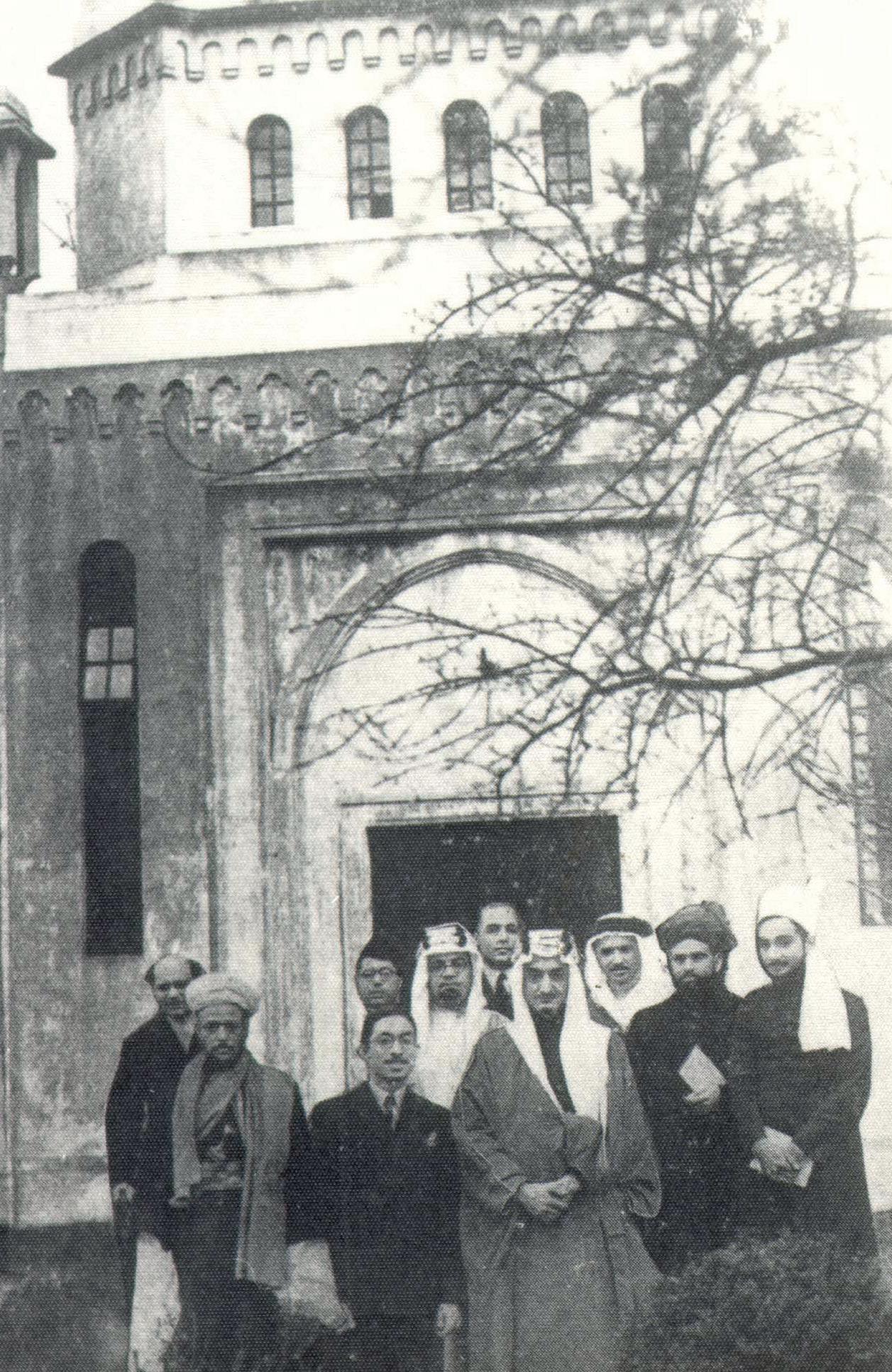
6 April 1933: On this day, M. A. Jinnah attended a reception at the Fazl Mosque in London, on the occasion of Eid-ul-Adha.
For more details, see “Hazrat Musleh-e-Maud’s services to the Muslim cause: Guidance and support to leaders of the Pakistan Movement” at alhakam.org (5 March 2021, p. 20).
7 April
7 April 1907: An adversary of the Promised Messiah (as), Munshi Ilahi Bakhsh, who was an accountant, died on this day. Earlier, this unfortunate person was among the closest companions of the Promised Messiah (as), but his inner darkness led him to his bitter end. Munshi Ilahi Bakhsh published the mischievous book ‘Asae-Musa, which was full of attacks on the Promised Messiahas. (Tarikh-e-Ahmadiyyat, Vol. 2, p. 20)
7 April 2017: Hazrat Khalifatul Masih (aa), in his Friday sermon on this day, mentioned the ongoing atrocities against Ahmadis in Algeria and Pakistan and said that the Promised Messiah (as) once said that no matter how fiercely falsehood opposed the truth, the truth would always reign supreme. Huzoor (aa) stated that wherever Ahmadis faced opposition, opportunities arose to further introduce the Jamaat to the world. (Al Fazl, 28 April 2017, p. 5)
8-9 April
8 April 1988: On this day, Hazrat KhalifatulMasih IV (rh) inaugurated the new building of the Baitur Rahman Mosque in Glasgow, Scotland and delivered the Friday sermon. (Khutbat-e-Tahir, Vol. 7, pp. 229-244)
9 April 1908: On this day, Badr published a letter to the Promised Messiah (as) by Hazrat Munshi Muhammad Haider Khan (ra) from Ceylon, wherein he mentioned some Ceylonese individuals who accepted the Promised Messiah (as) and some who had a keen interest in Huzoor’s (as) teachings. He mentioned an individual named Abdul Azeez, who was the president of a Muslim association there, who later accepted Ahmadiyyat through a letter.
For more details, see “Early history of Ahmadiyyat in Ceylon: A glimpse into the Ceylonese newspapers”, at alhakam.org (26 January 2024, p. 10).
9 April 2004: On this day, Hazrat Khalifatul Masih V (aa) led Fajr prayer at the first mosque of Porto-Novo, Benin, Masjid Al-Tawheed. Later that day, Huzoor (aa) delivered a Friday sermon at the same mosque, which was broadcast live on MTA.
The President of the National Assembly of Benin met with Huzoor (aa). Representatives of the press interviewed Huzoor (aa). On the same day, Huzoor (aa) visited the University of Benin and met with its administration. (Al Fazl International, 30 July 2004)
Escalating global conflict and urgent need for Muslim unity
During his Friday sermon, delivered on 27 March 2026, Hazrat Mirza Masroor Ahmad, Khalifatul Masih V (aa), highlighted the worsening global conflicts and the explicit intentions of world powers to establish hegemony over the Muslim world, urged Muslim nations to recognise these divisive schemes and unite and called for earnest prayers for their solidarity. He said:
“The conditions of war, too, are becoming worse and worse. America and Israel are striving to establish their hegemony over the
Continued from page 1
months of Ramadan is not enough – eating the pre-dawn meal and keeping the fast and breaking it with iftar, does not complete the purpose of fasting; rather, Allah the Almighty has instructed us to create a pure transformation within ourselves, from these fasts.” (“‘For those who pray for others, angels pray in return’: Huzoor’s guidance on praying in Ramadan”, Al Hakam)
This should remind us that Ramadan was never meant to be a temporary phase, but a training ground for lasting change.
We frequently hear the saying that great cities like Rome were not built in a day. Yet
whole world and especially over the Muslim world. As the Israeli [Prime Minister] said when the war in Palestine began and the first attack was launched, ‘Now the map of this region – indeed, even of the Arab countries – will be changed.’ So, these are attempts to change that map.
“The Muslim world, too, ought to realise the direction in which they are heading and that it is most necessary for them to become one. It is heard that Pakistan is trying to bring about reconciliation with
history also shows that such great cities have fallen in a matter of days. The lesson here is clear: it can take years to build something significant, but it can be lost very quickly. In the same way, the spiritual advancement we worked so hard to build during Ramadan can fade just as easily if we are not careful.
Even God swears by the fleeting time and reminds that man is in a state of loss, “Except those who believe and do good works and exhort one another to [accept] truth and exhort one another to be steadfast.” (Surah al-Asr, Ch.103: V.4)
A true believer understands that Ramadan is an opportunity to reset and
America involving Iran and the [affected Arab] countries because the Arab countries too are suffering loss in the midst of all this; thus, from that standpoint, Pakistan is making efforts. Even over this, some circles in Iran have developed misgivings, thinking that this is wrong and they have even gone so far as to level accusations. Indeed, in certain circles in Iran, it has begun to be said – among educated people or among analysts – that Pakistan, in its own territory along the Iranian border, is training or aiding
grow. During Ramadan, one may assume that the test is to strengthen one’s faith during this month and push ourselves and strive in the way of Allah. However, the real test begins after Ramadan. Are we still praying with the same earnestness? Are we still conscious of our actions? Are we still striving to enhance ourselves, even in small ways?
True and consistent change does not require perfection, but rather, it demands consistency with discipline. As the fleeting time passes, it becomes easy to fall back into old patterns. The routine of Ramadan is gone and the environment that motivates
American forces or is assisting such people as would wage war against Iran. In any case, this is entirely false. Pakistan has denied it. In reality, the enemy seeks to take advantage of these circumstances and create unrest so that Muslim countries may never be able to support one another.
“Therefore, there is a great need for prayers. May Allah the Exalted grant us the ability to pray in this regard as well and may He also enable the Muslim countries to be strung together in a bond of unity. Amin.”
good deeds is no longer as strong. However, this is where true strength is required: in holding on to those good habits even when it becomes difficult
Two weeks have passed since Ramadan ended. For some, it may feel like the blessings of that month are already waning. But for others, it is an opportunity to prove that Ramadan was not just a moment in time, but the means to a lasting transformation.
In the end, the question is not whether Ramadan automatically reformed us, but whether we chose to remain changed.
(Jalees Ahmad, Al Hakam)
Answers to Everyday Issues
Nushuz, mi‘raj of Prophet Moses, women’s congregational salat and bearing witness vs concealing fault
Guidance regarding basic Islamic issues that Hazrat Amirul Momineen, Khalifatul Masih Vaa, has given on various occasions in his written correspondence and during MTA programmes is being published officially below for everyone’s benefit.
How should Muslims navigate domestic dispute laws in Western countries?
With reference to a previous reply of Hazrat Amirul Momineen, Khalifatul Masih V (aa), regarding the physical chastisement of a wife in the ultimate case of nushuz, a lady from Morocco wrote to Huzoor-e-Anwar (aa), stating the following:
“When the wives of the Holy Prophet (sa) demanded an increase in their expenses, he did not physically chastise them. Similarly, the Holy Prophet (sa) never raised his hand against any woman, servant or any person. The word darb mentioned in the Holy Quran has multiple meanings in Arabic. To state that men residing in the West should not strike women because the law here does not permit it implies that, in such a scenario, women will give precedence to European law over this Quranic injunction. Guidance is requested in this regard.”
Huzoor-e-Anwar (aa), in his letter dated 20 November 2023, granted the following guidance on this matter:
“It is correct that the Holy Prophet (sa) never raised his hand against any of his wives, but on the other hand, it is also an established fact that the station his wives occupied in righteousness and piety meant they never committed nushuz. Regarding the demand made by the pure wives concerning worldly wealth and provisions, the manner in which the Holy Prophet (sa) expressed his displeasure led the pure wives to take admonition from it; they abandoned their worldly demands and preferred to remain with the Holy Prophet (sa). Thus, when his wives acknowledged their error and reformed themselves at the very first stage, why would he physically chastise them without cause? In the Holy Quran, the stage of physical chastisement is the third step; the first two stages command admonition and the separation of sleeping
arrangements. I have already detailed this to you in my previous letter.
“Furthermore, you wrote that the Holy Prophet (sa) never raised his hand against anyone. Zakat is a fundamental injunction of Islam, which has several conditions. However, since the conditions mandating Zakat never applied to the Holy Prophet (sa), he never paid Zakat in the customary manner. Would it then be correct to deduce from this that since the Holy Prophet (sa) never paid Zakat, a person amongst us who possesses the minimum wealth liable for Zakat should also not pay Zakat? No, it absolutely does not mean this. Rather, it means that if any of us are in the same circumstances under which the Holy Prophet (sa) did not pay Zakat, then the payment of Zakat will not be obligatory upon them either. Likewise, what need is there for a person to physically chastise his wife if her station in righteousness and piety, following in the footsteps of the pure wives of the Holy Prophet (sa), is entirely in accordance with the Sharia? The teaching that Islam has imparted regarding the reprimand of a wife involves several conditions, which I have mentioned in my previous letter.
“Worldly laws are man-made and contain many flaws. That is why they are constantly amended, whereas the Quranic Sharia, which is revealed by Allah the Exalted, is free from every kind of defect and requires no alteration over time. It is eternal and serves as guidance for mankind until the Day of Resurrection. Therefore, the true teaching is the teaching of the Islamic Sharia. Thus, where necessary, it shall be acted upon first. For this reason, I did not state in my previous letter, as you have claimed, that men living in the West should not chastise women. Rather, I stated that where the law of the land does not permit it, physical chastisement should be avoided even if the need arises. Therefore, if in a certain place the laws of the land do not permit physical
chastisement despite the need, it should be avoided there. Nevertheless, the first two measures prescribed by the Sharia can certainly still be implemented. It is possible that reformation is achieved through them, as it is not necessary for every matter to escalate to the point of physical chastisement; reformation can occur without it as well.
“Furthermore, for the reformation of a woman upon her commission of an undesirable act, Islam has also imparted the following teaching:
“‘Confront those of your women who are guilty of unbecoming conduct with four witnesses. If they bear witness, then confine the women to their houses till death overtakes them or Allah opens a way for them.’ (Surah an-Nisa’, Ch. 4: V. 16)
“‘A way’ means that either the woman is reformed or if she is not reformed, the husband divorces her and separates from
her or the woman herself obtains khul‘ from her husband and separates from him.
“Thus, Islam has given its followers various teachings for different circumstances. Therefore, adherence to the Sharia is obligatory for a true believer. Since the Sharia itself states that one must abide by those laws of the land which do not conflict with the fundamental religious rights of a Muslim, we consider it our religious duty to obey all such state laws.
“As for someone who gives precedence to the law of the land over the Sharia for a temporary and superficial benefit, what can we do about that? However, it is an undeniable reality that wherever man has adopted worldly laws in opposition to divine commandments, he has always caused his own detriment. In Western society, under the deceitful ploys of the Dajjal, the various laws currently being enacted contrary to
religious commandments to create distance between man and God are becoming the cause of the ruin of man’s present life as well as his life in the Hereafter, which is the eternal life. Thus, if we wish to adorn our world and our Hereafter, we must be bound by Islamic teachings with sincere hearts.
“It is true that the word darb has several meanings in the Arabic language, yet the meanings of this Quranic word elucidated by the Holy Prophet (sa) and his most ardent devotee, the Promised Messiah (as), who is the Just Arbiter [Hakam ‘Adl] of this age, are the only correct ones and are actionable for us all. Accordingly, whilst translating verse 35 of Surah an-Nisa’, the Promised Messiah (as) states:
“‘As for those women on whose part you apprehend signs of disharmony, admonish them, leave them alone in their sleeping places and chastise them (that is to say, whatever the specific situation and wisdom dictates). Then, if they become obedient to you, do not bring up the matter of divorce and the like and do not act with arrogance, for true greatness belongs solely to God. This means you should not harbour the thought in your heart saying, ‘What need do I have of her? I can easily take another wife.’ Rather, treat her with humility, for humility is beloved to God.’ (Arya Dharam, Ruhani Khazain, Vol. 10, p. 51)”
[The above response elucidates theological interpretations without offering legal advice. It focuses on understanding religious texts and should not be viewed as encouragement to act against civil or criminal laws. Moreover, in situations that could escalate to severe measures, the Ahmadiyya Muslim Community has established systems for counselling and arbitration. These systems allow members in all parts of the world to seek guidance, present evidence and witnesses, and resolve conflicts peacefully. These measures are in place to prevent any spontaneous or unjustified actions and serve as preventative mechanisms against violence, especially domestic violence, which is also the true intent of the Quranic verse under discussion. –The Editor]
What is the exegesis of Hazrat Khalifatul Masih I (ra) regarding the narrative of Hazrat Musa (as) and al‑Khidr?
With reference to a previous letter of Hazrat Amirul Momineen, Khalifatul Masih V (aa), someone wrote to Huzoor-e-Anwar (aa) stating that Hazrat Khalifatul Masih I (ra) had declared the incident of Hazrat Khidr mentioned in Surah al-Kahf to be the spiritual ascension [mi‘raj] of Hazrat Musa (as). He mentioned that he could not find this reference of Hazrat Khalifatul Masih I (ra) and requested it be sent. The person also expressed his thoughts regarding the Five Volume Commentary Huzoor-e-Anwar (aa), in his letter dated 20 November 2023, granted the following guidance on this matter:
“Hazrat Khalifatul Masih I (ra), whilst expounding on verse 61 of Surah al-Kahf (‘And [remember the time] when Moses said to his young [companion], ‘I will not stop until I reach the junction of the two seas or I will journey on for ages.’’), states:
“‘Majma‘ al-Bahrayn [the junction of
the two seas]: The White Nile and the Blue Nile at Khartoum could be meant here. In my view, that is the actual meaning. Where there was betterment of religion and the world, this is the spiritual ascension [mi‘raj] of Prophet Moses (as).’ (Tash-heezul-Azhan, No. 9, Vol. 8, September 1913, p. 465; Haqaiq-ul-Furqan, Vol. 3, pp. 26-27)
“Then, explaining verse 81 of the same chapter, he states:
“‘Yurhiqahuma [burden both of them]: Impute to them both. In this narrative, Prophet Moses (as) objected to three matters: 1. The breaking of the boat. 2. The killing of the boy. 3. The building of the wall without taking any wage. Yet, all three of these events had already occurred in the very household of Hazrat Musa (as) himself.
“‘Li-tughriqa [that you may drown; Surah al-Kahf: V. 72]: If there was any fear of li-tughriqa, did the mother of Hazrat Musa (as) not cast him into the river herself? Did Hazrat Musa (as) drown by being cast into the river? Following this, during the time of Pharaoh, Hazrat Musa (as) himself led the entire nation into the sea, where ostensibly there was a fear of drowning. Similarly, Hazrat Musa (as) watered the (flocks of the) women at the well in Midian and did their work himself without taking any wage. Then, at the time of killing the Copt and (later at the time of killing Korah), he had taken a life without [apparent] cause.
“‘In reality, this narrative is somewhat of a spiritual ascension [mi‘raj] of Hazrat Musa (as). In this spiritual ascension, that servant was with him acting in the capacity of an angel and was a guide [khidr] for the path. And all these matters relate to future events. Through them, he was made to understand that he would have to face a tyrannical king and to save himself and his people from him and his army, he would have to cross the sea and then fight a war in which many would have to be killed.
“‘The matter of the wall is that Prophet Abraham (as) was a righteous Prophet. He had two sons: one from the children of Ishaqas
and one from the children of Ismailas. When people corrupted the religion of Hazrat Ibrahim (as), that wall of his was about to fall. To protect it, Allah the Almighty sent two Prophets: Hazrat Musa (as) and our Holy Prophet (sa). They were the ones to raise this wall, and in this way, the treasure of pure teachings was preserved.
“‘That this event was a spiritual ascension, is further corroborated by the fact that there is an ancient book among the Jews which is still extant, named Mi‘raje-Musa. In it, the name of the angel who is described as the guide of Hazrat Musa (as) is written as Khidr. (See Encyclopaedia Biblica, under Moses, [illegible]).’ (Supplement to Akhbar Badr, Qadian, 30 April and 5 May 1910, No. 27 & 28, Vol. 9, p. 161; Haqaiq-ulFurqan, Vol. 3, pp. 31-32)
“As for the thoughts you expressed regarding the Five Volume Commentary, I have already written to you about this, explaining that the Jamaat, according to its resources, prepared this brief commentary in the English language for English speakers. It was compiled with the help of the summary of Hazrat Musleh-e-Maud’s (ra) masterpiece commentary of the Holy Quran (Tafsire-Kabir), as well as the notes he prepared for Tafsir-e-Kabir, so that English-reading friends could understand the subjects of the Holy Quran to some extent through it. Since it is in the form of a summary, exhaustive details could not be included.”
Can women lead congregational prayer in Islam and call the azan and iqamah?
A lady from Norway sent an enquiry to Hazrat Amirul Momineen, Khalifatul Masih V (aa) asking whether a woman should call the iqamah when women observe congregational salat among themselves. Furthermore, in those prayers where the recitation is usually aloud, should a female imam also recite aloud?
Huzoor-e-Anwar (aa), in his letter dated 22 November 2023, granted the following reply:
“Since it is not obligatory for women to observe congregational salat, making a widespread habit of women holding separate congregational prayers is not appropriate. However, if women occasionally pray in congregation together during a Jamaat programme exclusively for women, there is no harm in it. In such a case, no woman is permitted to call the azan for this prayer. In Medina, upon the request of Hazrat Umm Waraqah (ra), when the Holy Prophet (sa) granted her permission for a time to lead the women who came to her house in congregational salat, the purpose of which was likely to impart religious education to the women, the Holy Prophet (sa) appointed a man as a muezzin for them who used to call the azan for them. (Sunan Abi Dawud, Kitab as-salat, Bab imamati n-nisa’)
“Thus, women cannot call the azan for their separate prayers, but in this situation, a woman may call the iqamah for the prayer, although calling it is not obligatory either, as is mentioned in the Hadith:
“‘It is not obligatory upon women to call the azan or the iqamah.’ (As-Sunan al-Kubra by al-Bayhaqi, Kitab as-salat, Bab laysa ‘ala an-nisa’i adhanun wa la iqamah)
“Furthermore, the female imam will not stand alone ahead of the row; rather, she will stand amidst the women in the middle of the first row. As for those prayers in which recitation is aloud, the female imam will indeed recite aloud in those prayers.
“Such congregational prayers for women can only be held according to need in rare or exceptional circumstances. To make it a customary practice and for women to habitually observe congregational prayers in this manner with a female imam is not appropriate.”
Does Islam allow concealing someone’s faults during a testimony?
A lady from Germany wrote to Hazrat Amirul Momineen, Khalifatul Masih V (aa), asking about the mention of bearing witness in verse 136 of Surah an-Nisa’ and against whom this testimony is to be given. She also asked whether the Islamic injunction of concealing faults would contradict the commandment in this verse.
Huzoor-e-Anwar (aa), in his letter dated 22 November 2023, granted the following reply to this question:
“The translation of the verse of Surah an-Nisa’ which you have mentioned is as follows:
“‘O ye who believe, be strict in observing justice and bear witness only for the sake of Allah, even if it be against your own selves or against parents or kindred. Whether the person be rich or poor, in either case, Allah is more regardful of him than you could be. Therefore, follow not vain desires so that you may act equitably. If you conceal the truth or evade it, then remember that Allah is well aware of that which you do.’ (Surah an-Nisa’, Ch. 4: V. 136)
“Thus, the answer to your question is found within this very verse: this testimony shall be given for Allah, meaning for the attainment of the pleasure of Allah the Almighty. Secondly, Allah the Almighty has stated that whether the person about whom the testimony is being given is rich or poor, in both cases Allah the Almighty is more regardful of them than the one giving the testimony. Therefore, when you are formally called to testify, you must not become the cause of Allah the Almighty’s displeasure by evading the declaration of truth or hiding the factual reality under the guise of concealing someone’s faults.
“Furthermore, the distinction between the matters of bearing witness and not concealing faults is that testimony is taken for a specific purpose. For this reason, giving true testimony is a religious duty of a Muslim, because Allah the Almighty states in the Holy Quran that when you are called to give testimony, do not refuse to bear witness, as He states the following:
“‘The witnesses should not refuse to testify when they are called upon to do so.’
(Surah al-Baqarah, Ch. 2: V. 283)
“On the other hand, unveiling someone’s
faults is purposeless and unwarranted and doing so has been declared a grave sin in Islam. Islam has deeply disapproved of broadcasting someone’s flaws, backbiting against them or levelling false allegations against them and has issued a stern warning regarding these evils. (Surah al-Hujurat; Sahih Muslim, Kitab al-birri wa s-silati wa l-adab, Bab tahrimi l-ghibah)
“Thus, when a person broadcasts the weaknesses and faults of someone here and there without cause or purpose, it
contradicts the teaching of concealing faults. However, when a person is called to a court or before a judge to state a truthful matter or to bear witness to the truth so that an issue may be resolved or justice may be reached in a case, then for a Muslim to give such true testimony is not only not contrary to concealing faults, but it is necessary and worthy of reward.”
(Compiled by Zaheer Ahmad Khan, Head of Records Department, Private Secretariat, London and translated by Al Hakam)
The Khalifa’s warning, the League of Nations crisis and Hyde Park tabligh through Western eyes (1926)
The League’s collapse foretold
During his visit to England, Hazrat Khalifatul Masih [II (ra), the then] head of the Ahmadiyya Community, drew the attention of the representatives of the League [of Nations] to the defects in its constitution, but the warning was unheeded. And the result is the recent tragedy at Geneva.
The fiasco has opened the eyes of all and the profoundly defective constitution of the League of Nations is now proved to be a reality. And it is admitted that:
“The League as it stands is impotent in the major questions whereupon ultimate peace depends.”
Now that the constitution of the League [of Nations] is under discussion, we again draw the attention of the authorities
to the principles outlined by Hazrat Khalifatul Masih [II (ra)] in his book, “The Ahmadiyyat”. He is “the man who can spiritualise democracy,” and who “will save the world.”
“Races and Religions in the Punjab”
Sir Michael Francis O’Dwyer GCIE, KCIE, formerly Lieut-Governor of the Punjab, in his paper on “Races and Religions in the Punjab,” read before the Royal Society of Arts, says:
“In the 80 years of British rule, the Punjab has given birth in Hinduism to the latest serious challenge to Brahmin supremacy in the Arya Samaj, with its repudiation of idol worship and its cry of ‘back to the Vedas,’ and
in Islam, to a similar revolt against tradition in the Ahmadiyya [Movement…], which seeks to bring Islam into line with the other great religions and in particular repudiates the doctrine of Jihad or propagation of the faith by the sword.
“In religious and social matters, the Pathan displays some of the fanaticism and retains some of the customs of that ancient Israel from whose lost tribes he claims descent.
Of these, the most notable are the periodic redistribution of land already referred to, the sacrifice of animals and smearing the doorway with their blood to avert evil and the stoning to death of heretics.
Kabul persecution incident
“These practices have almost disappeared where the Pathans have come under the
softening influence of British-Indian civilisation. But they still prevail outside that influence and only last year three members of the quietist Ahmadiyya sect, which in the Punjab is most loyal and law-abiding, were stoned to death in Kabul for heresy under the order of an ecclesiastical court confirmed by His Majesty, the Amir.
Islam and its sects
“But to return to Islam: the only two generally recognised forms are the Sunnis, who constitute 95 per cent of the Muhammadan population and the Shiahs, who are only two per cent and according to the census returns, are steadily decreasing. I refer especially to this point, as many years Continued on
A world waiting for the one: Shared signs of the Promised Reformer
Arsalan Ahmed
Missionary, Newfoundland and Labrador, Canada
A universal hope across humanity
Across every civilisation, from the temples of India to the monasteries of Tibet, from the synagogues of Jerusalem to the churches of Rome, humanity has carried a remarkable and unifying hope: when the world is engulfed in darkness, a divinely guided reformer will arise to restore light.
This expectation is not a minor footnote in religious history. It is one of the most striking common threads woven through the world’s major faiths.
Despite vast differences in culture, language and geography, every major religion anticipates a future figure who will revive spirituality, establish justice and guide humanity back to truth.
Before exploring how these expectations appear across different faiths, it is worth asking: what exactly do the world’s religions say about this awaited figure?
The universal prophecy: Reformers across world religions
Hinduism – The coming of Kalki: Hindu scriptures foretell the arrival of Kalki, the final avatar of Vishnu, who will appear at the end of the age of darkness (Kaliyuga) to restore righteousness. (Vishnu Purana, Book 4, Ch. 24, Bhagavata Purana, Canto 12, Ch. 2)
Buddhism – The future Buddha, Metteyya: The Buddha prophesied the coming of Metteyya (Maitreya), a future Buddha who will renew the Dharma and guide humanity back to compassion. (Cakkavatti Sutta, Digha Nikaya 26)
Judaism – The return of Elijah: The Hebrew Bible promises the return of Elijah, who will “turn the hearts” of people back to righteousness. (Malachi 4:5-6)
Christianity – The second coming of Jesus: The New Testament affirms the return of Jesus, who will defeat evil and establish God’s kingdom. (Matthew 24:30; Acts 1:11; Revelation 19:11-16)
Islam – The Promised Messiah: Islamic teachings speak of the second advent of Jesus, a peaceful reformer who will fill the earth with justice. (Sunan Abu Dawud, Kitab al-Mahdi, 4283; Sahih Muslim, 3449)
The Quran hints at a future messenger sent to “others who have not yet joined them.” (The Holy Quran, Ch.62: V.3-4)
Sikhism – A future reformer: Sikh tradition, including the Janamsakhi and Sarabloh Granth, speaks of a future figure who will restore righteousness and uphold divine truth. (Sarabloh Granth, Part 3)
Why do all religions await a reformer?
These religions arose in different eras. Their founders never met; their communities developed independently. Yet they all share the same prophecy.
Is this a coincidence or a sign of something deeper?
Many scholars argue that this shared expectation points toward a profound truth: The unity of God and the continuity of divine guidance.
For example, if teachers in different schools give the same assignment, it suggests they follow the same curriculum.
Likewise, if different religions give the same prophecy, it suggests they originate from the same divine source.
Why has no religion declared that the Reformer has come?
This question weighs heavily on many minds today, especially among young people. They wonder: Are billions of prayers going unanswered? Has God become silent?
History offers a very different perspective.
Every prophet – without exception – was rejected by the majority of his people at first. Whether it was Noahas, Mosesas, Jesusas, or the Holy Prophet Muhammadsa, the pattern is unmistakable: Rejection comes first. Acceptance comes later. This is the rhythm of religious history.
Humanity has always struggled to recognise divine reformers in their own time. The message arrives quietly. The world is preoccupied. Hearts are distracted. And only later – sometimes generations later –do people realise what they overlooked.
Mutual signs of the awaited Reformer across religions
Despite their differences, the world’s major religions describe strikingly similar signs for the coming of the Reformer. These shared themes form a remarkable pattern.
1. A time of global spiritual darkness
• Hinduism: Kaliyuga, the age of darkness. (Bhagavata Purana 12:2)
• Buddhism: Decline of the Dharma. (Anguttara Nikaya 5.79)
• Judaism: A famine “of hearing the word of the Lord” (Amos 8:11)
• Christianity: “The love of many will grow cold.” (Matthew 24:12)
• Islam: Faith rising to the Pleiades (Sahih al-Bukhari, 4897)
• Sikhism: Kaljug overpowering Dharam (Guru Granth Sahib, Ang 145)
• Christianity: The Gospel reaches “the ends of the earth” (Matthew 24:14)
• Islam: The Messiah and Mahdi unite the world (Ibn Majah, 4082)
• Buddhism: Metteyya guides all humanity (Digha Nikaya))
• Hinduism: Kalki restores righteousness across the world (Vishnu Purana Book 4, Chapter 24)
• Sikhism: The Reformer revives Dharam for all peoples (Guru Granth Sahib, Ang 1349)
The Ahmadiyya Muslim perspective
While interpretations differ across the Muslim world, the Ahmadiyya Muslim Community believes that God has already fulfilled His promise.
According to this belief, Hazrat Mirza Ghulam Ahmadas of Qadian (1835-1908) claimed to be the very Reformer awaited by all religions, the Promised Messiah and Mahdi.
He taught that the Reformer of the Latter Days would not come with violence or political power, but with prayer, moral transformation and peaceful dialogue.
How the mutual signs were fulfilled in Hazrat Mirza Ghulam Ahmadas
1. He appeared during a global age of spiritual darkness: The 19th century witnessed moral decay, atheism, colonialism and religious fragmentation, matching the universal prophecies of decline.
2. His mission was entirely peaceful: Historical records show that the Promised Messiahas explicitly defined his mission as peaceful. He stated:
“O Muslim scholars and Maulavis! Listen to me. The awaited Messiah has arrived and orders you to abstain from religious wars.” (The British Government and Jihad, p. 10)
He further expressed this teaching in poetic form:
“Perish the thought, O friends, of striving with sword; War and killing is now forbidden in religion.
“The Messiah has come now who is the leader in Faith; It is now the end of all the fighting for religion.
“Now the light of God descends from the heavens; The religious decree for fighting is now absurd.
“He is an enemy of God who now fights with the sword; He denies the Prophet if he holds such a belief.
“Why do you leave the Tradition of the Prophet? Whoso leaves it – you leave that wretched one.” (Precious Pearls [English translation of Durr-e-Sameen, 2008], p. 58; Appendix to Tohfa-e-Golarvia [1902], p. 26)
3. He appeared at the dawn of global communication: The Promised Messiahas lived at a time when printing, railways and telegraphy connected humanity in unprecedented ways – fulfilling the Quranic vision:
“And when the people are brought together.” (Surah al-Takwir, Ch.81: V.8)
4. The heavenly signs appeared: “For our Mahdi there are two signs which have never occurred since God created the heavens and the earth: the moon will be eclipsed on the first of its nights in Ramadan, and the sun will be eclipsed in the middle of it.” (Sunan al-Daraqutni, Kitab al-Eidain, Hadith 1795)
The solar and lunar eclipses of 1894-1895 fulfilled the prophecy recorded in Sunan alDaraqutni with remarkable precision – first
in the Eastern Hemisphere during Ramadan 1894, and then again in the Western Hemisphere in 1895. No previous claimant in history ever witnessed this dual heavenly sign in both halves of the world.
5. His mission was universal: As Islam is a religion for all of humanity, it follows naturally that the reformer promised by the Holy Prophet Muhammadsa would also be sent for all mankind.
The Promised Messiahas affirmed this universal mission when he wrote:
“Verily, I am among those whom Allah has granted the lights of the Furqan [the Holy Quran], and who has been bestowed with the most profound knowledge of the Quran. Thus, He illumined my heart, and I discovered its guidance as do the men of God. Then, my Lord sent me to convey His message to humanity, and granted me manifest Signs so that I might call mankind towards His religion. Blessed are those who accept me, who remember death, seek signs, and after their observation come to believe.”
(The Mirror of the Excellences of Islam, p. 511)
A shared hope for humanity
Whether one accepts the Ahmadiyya belief or not, the broader message remains universal: Humanity is united in its longing for justice, peace and spiritual renewal.
Every religion, in its own language and tradition, expresses this hope through the promise of a reformer. Perhaps these shared prophecies are not only a sign of one God, but also a reminder that humanity’s future depends on recognising truth wherever and whenever God chooses to reveal it.
The signs are universal. The hope is universal. Maybe the answer was meant to be universal as well.
NEWS
Zion Jamaat observes Ramadan and Eid ul Fitr
Humza Munim Ahmad Zion, USA
In a city whose founder prayed for the death of Islam and mocked the Holy Prophet (sa), the local Ahmadiyya Muslim Jamaat in Zion was able to observe Ramadan and Eid-ulFitr.
Mayor of Niamey Council Number 1 visits Jamaat’s centre
Muhammad Jamal Niger Correspondent
On 13 March 2026, the Mayor of Council Number 1 of Niamey, Mrs Mariam Jika, visited the Jamaat-e-Ahmadiyya Niger’s headquarters along with 10 members of her council cabinet.
Salat, dars, iftar and tarawih prayer were held daily at the Fath-e-Azeem Mosque, which is hardly five minutes away from the grave of John Alexander Dowie, a bitter enemy of Islam. Zion Jamaat also held an iftar where 20 external guests attended, including Billy McKinney, the Mayor of Zion and Congressman Brad Schneider (D).
On 20 March 2026, Zion Jamaat celebrated Eid-ul-Fitr
During the visit, the distinguished guests were given a detailed introduction to the claim of the Promised Messiah (as). This was followed by an introduction to the system of Khilafat. A documentary video presenting the message and global activities of Jamaat-e-Ahmadiyya was also shown. The delegation was then given a guided tour of the mosque and school, which left a strong impression on the visitors.
Mrs Mariam Jika holds the rank of colonel in Niger’s army and serves as a gynaecologist. She is among the highestranking female officers in the country.
Lajna Imaillah Baitul Ehsan, Windsor, Canada, held a women’s tabligh iftar on 4 March 2026 at the Baitul Ehsan Mosque. The event brought together women from the local community.
The programme commenced shortly before Maghrib prayer with a brief introduction, highlighting the spiritual significance of Ramadan, with emphasis on gratitude, compassion and community service. Attendees then prepared to break their fast collectively with dates and water upon the call to prayer, followed by the offering of Maghrib prayer and the iftar meal.
The gathering was attended by 55 women and children, along with 20 local Lajna members. Guests included the local Member of Provincial Parliament, Lisa
Gretzky, as well as women representing various community organisations, neighbours and friends.
The atmosphere throughout the event was welcoming and uplifting. Meaningful conversations and reflections were shared, allowing guests to connect with one another in a spirit of sisterhood. Attendees were also invited to visit a Holy Quran exhibition, which featured translations of the Holy Quran in various languages alongside a display of Islamic literature.
Many guests expressed appreciation for the opportunity to learn more about Islam and to engage with women from diverse backgrounds. For several attendees, this marked their first introduction to the Ahmadiyya Muslim Jamaat and the Baitul Ehsan Mosque. Guests shared positive feedback regarding both the event and the facility, with many expressing interest in future visits and continued engagement.
Continued from page 6
ago I had some difficulty in persuading the then Secretary of State for India that the vast majority of the Punjab Muhammadans were not, as he thought, Shiahs.
“While both Sunnis and Shiahs have a welldefined position in the Islamic world, both, at least in the Punjab, are tend to regard all other Islamic sects not as “fancy religions” but as dangerous, little, if at all better, than the unbelieving kafirs.
Ahmadiyya Movement in Islam
“Hence, their hostile attitude to the Ahmadiyya sect, founded some 40 years ago by Mirza Ghulam Ahmad of Kadian in the Central Punjab.
“The Mirza and his followers claimed that he was the Mahdi or Messiah expected alike by Islam and Christianity and the avatar or divine incarnation of the Hindus; that he was divinely inspired; that his mission was to put an end to war and civil strife by appeals to the religious instincts in man; and that in pursuance of that gospel of peace and love, the old Islamic doctrine of Jihad, the defence and propagation of the faith by the sword, should be repudiated.
Khilafat
“On the death of the founder, his mantle fell on successive khalifas and the present Khalifa, an enlightened gentleman, expounded the tenets of his creed at the Congress of Religions held in London in 1924.
Growth and missionary expansion
“The sect has made considerable progress among educated Muhammadans in the Punjab and though the total number of adherents as recorded in the 1921 census was only 23,000, it claims now to have a total of a quarter of a million in India and the surrounding countries.
“It has a strong missionary organisation and maintains a mosque at Southfields, near Wimbledon. My own experience of the Community in the Punjab is that, at a time of acute tension in the Muhammadan world, it remained steadfast in its loyalty and active in helping the British Government, keeping quite aloof from politics.
“The Rt. Hon. The Earl of Ronaldshay GCSI, GCIE, said:
“‘The examples given by Sir Michael O’Dwyer of the Arya Samaj in the case of the Hindus and the Ahmadiyya in the case of the Muhammadans and much more recently, of the Akali in the case of the Sikhs, were all protestant movements away from ritual and back in the direction of first principles and it was somewhat interesting to perceive that movements of that kind had taken place mainly in the northern part of India and chiefly in the Punjab. It seemed to suggest that there was a strong connection between the virility of a race and its tendency towards purity and simplicity.’
Preaching efforts in Hyde Park
“Mr Donald Stewart, in his book Hyde Park: Its Orators and Audiences, referring to our lectures, says:
“Who is this somewhat picturesque individual who, by chanting in some foreign tongue a kind of incantation, is
already attracting an audience? An Indian, apparently. Let us go and listen to him. It is but common courtesy to a stranger within our gates. The droning has now ceased and he begins to speak in good English and in a businesslike way!
Islam, Jesus and Kashmir
“Without wasting time, he informs us that his purpose is to explain the precepts and principles of the Mohammedan [Islamic] religion. There are, he says, three great religions closely related to one another –these being, those of the Jews, the Christians and the Mohammedans [Muslims]. But they are divided in their opinions regarding Jesus Christ. The Jews claim that he was an impostor; the Christians say he was the Son of God; while Mohammed said he was merely a prophet. Mohammed, who praised him, said that Jesus did not die on the cross, but merely swooned. His legs were not broken. Although placed in the tomb by Joseph of Arimathea, Jesus was taken from there by the Essenes – the brotherhood of monks to which he belonged – and after recovering, went out to the East, finally being buried in the Valley of Kashmir. In Kashmir, the people are very similar both in features and manners to the Israelites. Even the names of the towns are the same.
Core Islamic teachings
“Mohammedans believe there is a certain amount of good in all religions, although they also contain some errors. Christianity had departed from its early purity and simplicity. Mohammedans did not believe in the Trinity, but in one God – Allah. Just as Jesus came after Moses as a prophet, so did Mohammed come after Jesus. God sent prophets at various times and places. Mohammed taught: (1) that there is only one God; (2) the practice of prayer; (3) fasting; (4) self-sacrifice; and (5) pilgrimage to Mecca and the doing of good. There are no dogmas or mysteries in their religion –
no pictures, crosses or crucifixes.
“It appears that the Mohammedans are not entirely in agreement amongst themselves, for the speaker says that he is not an orthodox Moslem. While the latter believes that the Messiah is still to come, he believes that Ahmad, the founder of the Ahmadia Movement, who died in the year 1908, was the promised Mahdi and Messiah.
“Our Oriental friend, having stated his case, is now prepared to answer questions and refute all calumnies regarding his beliefs.
Religious tolerance and brotherhood
“Upon being asked if it is not a fact that Mohammedans refuse to accept the Jew as a friend, he describes events that took place in the life of the Prophet that proved that the latter was an exceptionally good friend of the Jew. As for persecution, says he, we ruled in Spain for seven hundred years, where we had our observatories and our universities and the Jews had free worship. When the Christians drove the Moors out of Spain, the persecution of the Jews began. When the Roman priests came to the observatories, they found implements there and saying, ‘Devil, Devil,’ had them destroyed. Those who had read Sir Walter Scott’s novel “Ivanhoe” would remember that when the Jews were driven out of England, Rebecca had said that she would go for safety to Spain, which was then under Moorish rule and was the only country in Europe that gave freedom to the Jews.
“‘But what of the massacre of the Armenians by the Turks?’ he is asked.
“It is the duty of the Moslems, he answers, to protect all the people who live within their borders, as well as all religious buildings, whether they are churches, temples, synagogues or mosques. When Selim I, Sultan of Turkey, in the 16th century, had conquered Egypt, Syria and the Hejaz, with Medina and Mecca, he ordered the Christian temples to be destroyed. But Sheikul Islam (the head of the Mohammedan Faith) said:
‘Go and cancel that order.’
“If Turks persecuted, they did it as individuals. The Turks are condemned if they do anything wrong, but what of the Greeks and Christians generally? Christians of various nationalities had said to him: ‘I would like to kill you.’ Prejudice was to be found everywhere.
“We should cultivate friendship with all, even though we cannot agree and cannot all be of the same faith. If he wanted to go to Oxford Circus, he could go by various routes, but he would choose the best one. The Christians, by rejecting Mohammedanism [Islam] were bringing curses on themselves, as the Jews have by rejecting Christ.
“The Moslems did not say that a woman has no soul. They did not believe that she alone brought sin into the world, but man and woman both.
“‘The trouble with the Christians is that they take the language of the Bible literally,’ he replies, in answer to a questioner who quotes Christ’s saying: ‘I am the way, the truth and the life; no man cometh to the Father, but by me!’ When we say that Christ is the Lamb of God, we do not mean that he has four legs or a coat of wool!
Closing scene at Hyde Park
“But by this time, our Indian friend, as he turns out to be, is on the ground, having vacated his pedestal. And although a lengthy debate takes place amongst members of the audience as to what Christ really meant by the word ‘way,’ and the phrase ‘but by me,’ which in turn raises the question as to whether he could have been a God or the son of God, seeing that on the cross he cried out, ‘My God, why hast thou forsaken me,’ our follower of the Prophet participates in it for but a short time. He has been fasting for fifteen hours today and is feeling somewhat weary.” [Hyde Park: Its Orators and Audiences, pp. 5-6]
(Transcribed and edited by Al Hakam from the original English, published in the April 1926 issue of The Review of Religions)
Friday Sermon
Mubarak Mosque, Islamabad, Tilford, UK
6 March 2026
Unity and prayers: The shield of the Ummah
After reciting the tashahhud, ta‘awwuz and Surah al-Fatihah, Hazrat Khalifatul Masih V (may Allah be his Helper) stated:
The purpose of the message brought by the Holy Prophet (peace and blessings of Allah be upon him) was to foster belief in the One and Only God, to worship Him, to establish His Oneness, to fulfil the rights due to His creation and to strive toward achieving these objectives. Further, the object of the message was to form one united Ummah and to live together as brothers. Today, however, despite claiming to recite the Kalimah [Islamic declaration of faith],
[There is none worthy of worship except Allah and Muhammad (sa) is His Messenger], the Muslim Ummah [Muslim world] is divided, lacking unity. Their actions do not reflect the teachings they claim to follow. As a result, we observe that the current state of the Muslim world is deeply concerning.
Albeit some Muslim countries possess natural resources and wealth, world powers
do not hold them in particular regard, nor do they play a significant role in promoting the religion of Islam, nor are adequate efforts made to follow Islamic teachings. The outcome of this is clearly visible and, as I have stated many times in the past, non-Muslims take advantage of these circumstances. Therefore, instead of merely pursuing their vested interests, Muslim governments, politicians, and monarchies should strive to their utmost to unite as one Ummah [nation]. Only by doing so will we be able to safeguard ourselves from the onslaughts of worldly powers. Only then will we be able to uphold our honour, and only then will we be able to prevent antiIslamic powers from causing division.
We must also reflect upon the system which Allah the Almighty has established in this era for us to achieve this very purpose. What is that Divine system which we can
adopt to safeguard ourselves from these circumstances and instead become united as one nation? The system established by Allah the Almighty was that He sent the Promised Messiah (peace be upon him) to form a united Ummah. Thus, we must ponder over this. It is only when we give heed to – and when the countries of the Muslim world and Muslims themselves deliberate over this – that they will be able to safeguard themselves against the discord and strife instigated against them. Nevertheless, as Ahmadis, we must strive and also pray that Allah the Almighty may unite the Muslim Ummah [Muslim World] and protect them from the mischief and injustices they are currently facing.
I have been speaking about the state of the world for a long time. Previously, it was thought that perhaps only Europe and other Western countries would be the underlying
cause of the current situation, and they most certainly have been; however, Muslim countries are also a contributing dynamic. In order to achieve their aims, the Western powers first created chaos in Muslim countries and then gradually fuelled this disorder further, spreading it to other nations. Their motives are patently clear: they wish to seize the resources of these countries by exerting power to sway them. Despite some Arab nations possessing wealth, as I have already mentioned, these Western powers have kept them under their influence and control.
In any case, the concerns I have long been stating, before both externals and our own, are today clearly unfolding. We should always remember that the forces of the Dajjal [Antichrist] never wish for Muslims to live in peace. Their agenda is precisely to create perpetual discord in the Muslim
world. The forces of the Dajjal [Antichrist] have often deceived people by claiming that they were forming agreements and pacts with Arab countries, which possess vast reserves of oil and other resources, for the sake of establishing peace. In reality, however, their hidden plans were different to this, and these have now become clearly evident. Thus, especially during these days, it is our duty to bow before Allah the Almighty in prayer, praying particularly for the Muslim world, as there is a dire need for this at this time.
If we review the current war taking place in the Middle East, one matter becomes palpable: the United States has established numerous military bases in various Muslim countries. But for what purpose and for what reason? Was it truly for the protection of those countries? Where were the Arab countries facing a threat from? In reality, these powers themselves generated the threats and then established the narrative that these countries were in danger and therefore required bases for their protection.
Yet, these bases and weapons would never be employed against the forces Muslims may have actually faced a threat from; rather, Muslims were persuaded to provide these bases to them with the assurance that their interests and trade would benefit. In reality, however, their principal objective was to establish a strong presence in this region to counter their own rivals.
Even if the Arab countries faced any threats, it was largely ones formed by these very powers themselves; otherwise, there was no inherent danger faced by the Muslim countries. In any case, these bases were established to maintain their dominance in the region. They sought to maintain supremacy not only over the non-Islamic world but also over the Islamic world.
Iran had long been a source of concern and apprehension for them, and due to differences in doctrine, some Muslim countries were also opposed to Iran. These other powers exploited the situation. Since Iran had adopted a much stricter policy against Israel, the other powers deemed it appropriate to control Arab countries and establish bases there to ensure Israel’s protection and to intimidate Iran through their ongoing presence.
The reality has now become quite apparent. We have witnessed the consequences of what eventually transpired as a result of these bases. Arab countries became potential targets, and their economies were damaged. Countries possessing oil wealth or those that attract tourism have been negatively affected.
This state of affairs has benefited those same powers and will continue to do so. When war breaks out and economies are affected, the opposing side naturally responds by attacking and attempting to destroy the other side’s bases. Since there was conflict with Iran, Iran reacted in a manner that we are witnessing today: it targeted and struck American bases located in Arab countries, either destroying or causing damage to them.
Just recently, an Arab journalist wrote that the Arabs should remain wary and vigilant. According to the journalist, the attacks attributed to Iran may not necessarily have been done by Iran alone; the United States and Israel themselves could also have
played a part. Even if Iran carried out the initial attacks, these powers might now exploit the situation and launch their own attacks. Iran has also denied responsibility for some of the incidents. The journalist further wrote that it is possible that, at some stage, the United States and Israel may withdraw from this war, leaving the Muslim world to continue fighting among themselves, which is their aim.
During the Iraq war, Hazrat Khalifatul Masih IV (may Allah have mercy on him) also issued this warning: that this disorder would continue spreading across the world. If only the Muslim world understood this. Now observe how, alongside the Iraq war, attempts were made to expand the conflict to other Muslim countries. Inner discord and strife were created in those countries, and since then, constant unrest has continued in other Muslim countries as well – something that no one can deny. Some Muslim countries are even fighting against one another, as we witness in the Muslim world today.
As I have said, this unrest has been spread by these Western powers, and there appears to be no end in sight unless a special decree of Allah the Almighty manifests – and even for that to materialise, they will nonetheless have to make efforts. In any case, we should pray that Allah the Almighty may save and protect the Muslim world from this unrest and disorder and that Muslims may strive for peace and live with one another as brothers. This is the teaching of Islam, not that they should spill the blood of one another.
This, therefore, is our responsibility, and for a long time we have been reminding our own people and others to refrain from injustice. As the injustice and oppression are increasing day by day, it suggests that a world war may result on a vast scale. Indeed, according to some Western commentators, the world war has already begun, and I also believe it has started. However, even now, if the Muslim world uses wisdom, comes to its senses, becomes united and works together, it can still remain safe from the mischief of the Dajjal [Antichrist].
If one assesses the global state of affairs, it becomes evident that the world is in grave danger. As I have said before, everyone is pursuing their vested interests, and when extreme selfishness arises, one thinks of nothing else except for themselves.
Therefore, we must understand that in order to dampen the disorder and conflict in the world, demanding only individual rights will not achieve this; rather, rights would also have to be extended. The Muslim world needs to understand this and explain to sympathetic voices among the Western and major powers that, for the establishment of peace, they too must relinquish certain rights (in reality, they are the ones who are usurping the rights of others). Thus, we must explain to them that they have to act in a just and equitable manner. Only then can peace be established in the world.
As I have already mentioned, I have been drawing attention to this matter for some time. The same people who, after hearing my words, responded by saying that I was being too pessimistic and presenting a negative view by stating that the world would spiral into a horrific war, are now themselves saying that what they once considered impossible a few years ago has now become
a reality, and wars have erupted.
Their own analysts in America and Europe have now begun writing that the beginning of a world war has taken shape and, as I mentioned earlier, that it will continue to escalate. As long as these people persist in pursuing their unlawful vested interests, there is no possibility of reducing this danger.
When war takes place, losses occur on both sides. It is said that the current war in the Middle East began when America attacked Iran. However, Iran had clearly and explicitly warned that if attacked, it would target the American bases in Arab countries, which had been established for a specific purpose, which we now see it being utilised for.
When the war began, Iran was bombed, its cities were destroyed, and innocent people – including children – were killed. The residence of their spiritual leader was attacked, and many members of his family were killed. These powers believed and proclaimed that they would end this regime and that the Iranian people would then attain freedom. But what effect did this actually result in?
Those who were previously somewhat opposed have now begun to support them, and their leader, Khamenei, has been regarded as a martyr. As a result of this perception of martyrdom, his status was considerably raised in the country. His children were also killed, as well as many members of his family. Owing to this act of injustice, rather than bringing about a regime change, his honour and respect amongst his people have only increased further.
In any case, Iran responded by attacking the bases in Arab countries of Western powers and the United States. Apart from this, America warned that Iran had attacked oil wells in Saudi Arabia and also attacked other sites elsewhere and issued threats that, as a result, they would take punitive action in response. In some instances, they even claimed that an attack had already taken place and that they would therefore retaliate accordingly. In response, Iran bluntly stated that it had neither attacked such places nor had any such intention to do so. This appears to be yet another scheme aimed at creating hatred in the hearts of Muslims against other Muslims. Fighting has already broken out; this is merely an attempt to further inflame the hostility. Earlier, I mentioned the view of a journalist who suggested that it is even possible that they may inflict damage and then blame Iran.
In such circumstances, the Muslim world should act with great caution and vigilance. However, we Ahmadis – despite feeling deep anguish – are helpless. We cannot do anything except warn them, pray for them and attempt to make them understand that what is happening is wrong.
If Muslim governments come to their senses and, instead of focusing solely on their own national interests, consider the interests of the Muslim Ummah [Muslim World] as a whole and refrain from treachery or betrayal of any form, then even now some degree of harm may still be prevented.
Although some Arab countries in the Middle East possess abundant oil wealth, they neither have strong defensive capabilities nor are their industries
sufficiently developed. Progress cannot be achieved merely through oil wealth or, in some places, through the promotion and development of tourism alone. They remain entirely dependent upon the Western world and Western powers. As I mentioned earlier, Western powers took advantage of this weakness and established their military bases there.
Then, when the war against Iran began, Iran also started launching attacks on Arab countries. In reality, however, Iran has not attacked the Arab countries themselves; rather, it has targeted the American bases located there. Yet the Arabs are now being given the impression that these attacks are directed against them.
It is now plainly evident that this war has assumed a frightening dimension. Missiles are being launched from Iran, and in order to intercept them, the Americans have installed defensive systems. However, analysts are now writing that if Iran launches a missile costing $10,000, the cost of destroying it with an intercepting missile amounts to several million dollars.
Some analysts even claim that this is economically costly for the United States. However, this remains merely an opinion. Such powers calculate everything carefully in advance and carry out thorough assessments. They would already have planned for all of this. I do not believe that such powers would willingly bear these losses; rather, they will recover this money from those Arab countries by claiming they are defending them.
On the one hand, their oil fields are being shut down, inflation is rising, and oil production is declining; on the other hand, they will also have to bear the costs of these defensive measures. Consequently, their reserves will diminish significantly and may even become exhausted. Ultimately, the economies of the Arab world will suffer greatly.
Although the Western world and major powers may also experience some losses, the greatest loss will fall upon the Arabs. This is something they should yet understand.
We observe that the incumbent President of the United States is merely implementing similar policies pursued by previous administrations. This is not exclusively the policy of the present government; rather, it has long been their policy – that wherever they so desire, they seize resources by force and then attempt to justify their actions afterwards by presenting one excuse or another.
Indeed, the current Vice President of the United States has even gone so far as to say that if a certain country does not join them, they will forcibly seize its resources and compel it to align with them.
Countries that refuse to participate in wars are subjected to restrictions and sanctions. Recently, the Prime Minister of Spain demonstrated courage by declaring that his country would not join the war nor allow its bases to be used. In response, he was threatened with the United States severing trade relations with Spain. Thus, through intimidation and the threat of unjust harm, countries and nations are pressured into joining them.
In such circumstances, justice ceases to exist. And when justice vanishes, destruction inevitably follows, and dangerous
consequences arise – the very consequences we are witnessing today. Indeed, even more severe and dreadful outcomes may emerge in the future.
Recently, in the European Parliament, a female Spanish Member of Parliament spoke very candidly, stating from the perspective of women that in none of America’s wars have women ever attained freedom. She said that the claim that the United States is fighting for the freedom of Iranian women is entirely false. She went on to state that Iranian women will never attain freedom through such measures, nor has America ever successfully fought a war that granted freedom to women.
In short, although the US already exerted a large degree of dominance in these countries, Israel is now being openly included in this arrangement to further strengthen that influence. The Arab and Islamic countries fail to realise that through coercion, intimidation, unjust methods and deceptive schemes, they are being trapped in a situation that draws them into war with one of their own fellow Muslim countries. Muslims are being made to fight against Muslims.
Meanwhile, Russia and China are also forming their own bloc, and it is evident that the blocs being formed will continue to expand and strengthen. The Islamic world will continue to serve as a battlefield for wars because it possesses resources over which these powers seek control. If only Muslims would recognise this and act with wisdom.
Now, America and its allies claim that they attacked Iran because of its intent and that allowing those intentions to be realised would have resulted in consequences such as the development of an atomic bomb. In other words, by merely constructing a hypothetical scenario, they initiated a war on the basis that if such an event had occurred, certain outcomes might have resulted. This is clearly an act of aggression.
Even Western analysts have now begun to acknowledge that destroying or waging war against Iran is not as easy as they had imagined. Iran is a vast country with reasonable strength, and this war could continue for an extended period. Although its effects will be felt on the global economy, its impact on the Muslim world will be far greater. Yet the most tragic aspect of all this is that Muslims themselves are shedding the blood of Muslims. Muslims should therefore fear the punishment of Allah the Almighty.
Hundreds of children have been killed, and hundreds of innocent people have lost their lives. The Western analysts are now commenting that if an attack occurs in Israel, America or any Western country, and even a few children are killed, newspapers publish column after column discussing it for days on end. Yet when a school is bombed, and hundreds of children are killed here, no one speaks about it. First, they put Palestine through this predicament, and now the same is happening with Iran. It would seem from their perspective that the life of a Muslim holds little value. May Allah the Almighty grant Muslims wisdom so that they act with understanding and strive to resolve their disputes through dialogue and mutual consultation. When they claim belief in the Oneness of God, they should unite for the establishment of
that very Oneness. There is no need to create conflicts through baseless accusations or to claim that disputes arise solely because of a particular group’s beliefs. Differences in doctrine do exist among Muslims and can sometimes lead to disputes. However, the Holy Prophet (peace and blessings of Allah be upon him) was extremely cautious and compassionate in such matters. On one occasion, some Companions of the Prophet (peace and blessings of Allah be upon him) described a certain individual as a hypocrite. The Holy Prophet (peace and blessings of Allah be upon him) replied that as long as he professed
[There is none worthy of worship except Allah.], he would refrain from saying anything against him, and they too should desist from calling him a hypocrite.
Thus, creating disputes over trivial matters ultimately harms oneself. May Allah the Almighty grant the Muslim world the understanding of this reality. Even now, they should act with wisdom and not turn against Iran merely because of doctrinal differences. Islam came for the establishment of Tawhid [Oneness of God], and efforts should therefore be directed towards that goal.
They should not regard the major powers of the world as their gods, for the only power that endures forever is the power of God Almighty. If these major powers are treated as supreme, they will gradually gain control of the entire Islamic world, one country after another, and then even their superficial authority and governance will eventually cease to exist.
Even now, there is time. It is essential to act wisely and turn towards God Almighty. These worldly powers have destroyed the peace and tranquillity of the world –especially that of the Muslim world – and they will continue to do so in the future as well.
While guiding the Muslims, Allah the Almighty states in the Holy Quran:
Muslims up against one another. Institutions that have been established – such as the United Nations – have likewise failed to play any positive role, and some have begun to criticise them openly. Only if we rise above personal and national interests can we protect ourselves. Otherwise, we will fall into the grasp of these powers of the Dajjal [Antichrist]. Therefore, all Muslim countries must come together to collectively deliberate.
Similarly, Allah the Almighty further states:
“Surely [all] believers are brothers. So make peace between brothers, and fear Allah that mercy may be shown to you.”
(The Holy Quran, Surah al-Hujurat, 49:11)
Even if differences arise among Muslims – as is said to exist between Iran and certain Arab or Muslim countries – they should remember that their fundamental bond is that of a brotherhood within Islam. Minor disputes must not become the cause of breaking this bond of Islamic fraternity. Muslim countries, in particular, must pay careful attention to this matter. Otherwise, as I have said, the forces opposing Islam will take advantage of this situation.
Therefore, the Arab countries, and likewise the government of Iran, should seek a peaceful resolution. China and some other countries – including Pakistan – have offered to play their role in facilitating reconciliation. If only the Muslim world understands this. May Allah the Almighty grant them wisdom.
In any case, our duty is to pray particularly for the Muslim world and also for the innocent. Especially during the month of Ramadan, one should not focus solely on personal prayers but should also pray for the Muslim Ummah [Muslim World].
She was the youngest daughter of Hazrat Syeda Maryam Begum Sahiba (ra) – Umme-Tahir – and also the youngest among the children of Hazrat Musleh-e-Maud (ra). Her nikah was announced in 1955 by Hazrat Musleh-e-Maud (ra). At that time, due to illness, Hazrat Musleh-e-Maud (ra) delivered the nikah sermon while lying on his bed and led the silent prayer. Only a few members of the household were present. The person relating this account has written that throughout the entire occasion, a special state was apparent upon Hazrat Khalifatul Masih II (ra). Later, in 1956, Hazrat Muslehe-Maud (ra) himself arranged her wedding and bade her farewell with prayers.
She is survived by four children. Her first son, Zair Mustafa, had been given in childhood to her sister, Sahibzadi AmatulQayyum Sahiba, who raised him from an early age. One daughter, Yasmin Malik, resides in Canada. Another daughter, Sadia Ahmad, lives here in the UK. Sofia Ahmad resides in Rabwah and is the wife of Mirza Samad Ahmad, who serves as Nazir Khidmat-e-Darweshan.
Her husband, Nasir Muhammad Sial Sahib, was a life devotee [waqif-e-zindagi]. When Hazrat Musleh-e-Maud (ra) initiated the Fazl-e-Umar Research project, he appointed him to work in research. Later, when that project was closed, the Jamaat permitted him to pursue other work [outside of the Jamaat].
Her daughter Sofia writes that she was very considerate towards the poor. Others have also written to me, stating that she cared for them and tried to fulfil the needs of those who were in difficulty. During her childhood, there are also certain accounts in relation to her and Hazrat Musleh-e-Maud (ra), as well as some dreams of his in which she is mentioned. In this way, through the account of her life, some aspects of earlier history also come to light.
“And if two parties of believers fight [against each other], make peace between them; then if [after that] one of them transgresses against the other, fight the party that transgresses until it returns to the command of Allah. Then if it returns, make peace between them with equity, and act justly. Verily, Allah loves the just.” (The Holy Quran, Surah al-Hujurat, 49:10)
This principle provides a fundamental blueprint for establishing peace in the world, since Allah the Almighty has given this clear guidance in the Holy Quran; the Muslim world, in particular, should adhere to it.
Therefore, the requirements of justice and fairness must be fulfilled, and the governments of Islamic countries must also play their role in this regard. It should also be clear that when reconciliation is sought, personal interests must not be given precedence; rather, the matter should be judged based on its true root causes.
Those causes are plainly visible: the forces of the Dajjal [Antichrist] seek to set
May Allah the Almighty grant them wisdom so that peace may be established in the world, particularly the Muslim world, so that Muslims do not spill the blood of one another. Those who are fighting and unjustly killing one another are incurring the displeasure of Allah the Almighty through their actions. Such people will suffer loss not only in this world but also in the Hereafter. Therefore, it is necessary to pay particular attention to this matter, and for this, we especially need to pray.
May Allah the Almighty also grant us the ability to pray in a true and sincere manner. Amin
Today, I will also lead some funeral prayers in absentia, and I shall mention some of their details.
The first mention is of respected Sahibzadi Amatul Jamil Sahiba, who was the youngest daughter of Hazrat Khalifatul Masih II (ra) and the wife of the late Nasir Muhammad Sial Sahib. She was the daughter-in-law of Chaudhry Fateh Muhammad Sial Sahib (ra), who also served as a missionary here in the UK. She passed away recently at the age of approximately 89:
[Surely, to Allah we belong and to Him shall we return.]
The deceased was a musia
She related an incident from her household which illustrates how deeply principled Hazrat Musleh-e-Maud (ra) was, and the honour he held for those who served the Jamaat.
Hazrat Musleh-e-Maud’s (ra) shoes used to be left outside for someone to polish. On one occasion, she also placed her own shoes there. Hazrat Musleh-e-Maud (ra) picked up the shoes and brought them inside, asking, “Whose shoes are these?” He was upset, and no one responded. Finally, he said, “Very well, tell me who they belong to; I will not say anything.” Although she was very dear to him, she admitted that the shoes belonged to her. He then said, “In the future, if you cannot polish your own shoes, then give them to me, but do not have a worker of the Jamaat polish them.”
She was extremely charitable and took great care of the poor. Her daughter says that when she came across her mother’s registers among her account books, there were many entries showing regular expenditures made to assist the poor.
When she was seven years old, her mother, Hazrat Maryam Sahiba (Umm Tahir Sahiba), passed away. Hazrat Muslehe-Maud (ra) writes:
“When we brought her body to Sheikh Bashir Ahmad Sahib’s house, my youngest daughter, seven-year-old Amatul Jamil (who was very dear to Maryam and is dear
to me), began wailing and crying out, ‘Hai Ummi, Hai Ummi’ [O mother! O mother!].
“I approached her and said, ‘Jimmi (as we affectionately called her), your mother has gone to Allah’s home. There, she will be much more comfortable. It was Allah’s will that she should return to Him. Look, the Holy Prophet (sa) passed away. Your grandfather [the Promised Messiah (as)] passed away. Was your mother greater than them?’”
Hazrat Musleh-e-Maud (ra) says: “May God’s protection never be removed from this girl even for a moment, for as soon as I said those words, she did not wail for her mother again. As soon as she heard them, she fell silent. This continued to such an extent that the next day, during the funeral procession, when her elder sister cried out in grief and fell unconscious, my Jimmi approached my youngest wife, Maryam Siddiqa, and said, ‘Choti Apa’ (the children called Hazrat Maryam Siddiqa Sahiba Choti Apa). How foolish my sister is. Father says that it was God’s decree for my mother to pass away, yet she still cries.’”
Hazrat Musleh-e-Maud (ra) then prayed: “O my Lord! O my Lord! Will You not protect in the Hereafter from every anguish and pain the person whose daughter showed no grief at her mother’s death solely for Your pleasure?”
He then prayed for Hazrat Maryam, Umm Tahir Sahiba (ra), saying: “O my Merciful God! It is the right of Your servants to have such an expectation of You, and fulfilling this desire is most befitting for You.” (Meri Maryam, Anwar-ul-Ulum, Vol. 17, pp. 365-366)
She was very regular in offering financial contributions and had already settled her Hissah Jaidad well in advance. Whenever a neighbour passed away, she would regularly send food to their household. She would often say to those who visited her – indeed, she said it to me several times as well – “Pray that my end may be a good one.”
Her granddaughter, Nusrat, says that her grandmother would prepare herself well before the time of prayer and sit waiting anxiously for it. She would offer lengthy supplications and had even prepared a list of people for whom she wished to pray. Nusrat says that as a young child, she would sometimes feel anxious hearing her grandmother’s lengthy and heartfelt supplications. Nevertheless, she continued to pray for all those individuals.
Hadi Ali Sahib has also written that many old memories and incidents are associated with her, including some visions of Hazrat Musleh-e-Maud (ra). He says: “She told me that once she was travelling in a car with Hazrat Khalifatul Masih II (ra) and was seated with him in the back seat. She observed that he was repeatedly counting something on his fingers, and she asked, ‘Father, what are you counting?’
“He replied, ‘I am estimating the number of missionaries required in all the countries of the world. I will need at least several hundred thousand missionaries worldwide; only then will we be able to convey the true teachings of Islam to the world.’”
This reflects the deep passion Hazrat
Musleh-e-Maud (ra) possessed, and some of her narrations relate to this. There is a vision of Hazrat Musleh-e-Maud (ra) connected with her, which I will mention.
This vision occurred in June 1948. Hazrat Musleh-e-Maud (ra) stated: “In June, I was in Nasirabad, Sindh. There, I saw a very tall white minaret resembling the minaret of Qadian. On the balcony of the lower level, near the doorway, my daughter Amatul Jamil was seated calmly, with her legs dangling over the edge.
“Just then, my gaze fell upon the minaret, and I saw that from the doorway of the uppermost storey, a very large snake emerged. It was several feet long, about a foot and a half thick, and green in colour. It extended its head and began moving toward the lower level, descending step by step.”
This is a lengthy account, and so to summarise briefly, the snake continued descending until it reached the level above the lowest storey, then turned toward the roof of the lower level.
Hazrat Musleh-e-Maud (ra) says:
“At that moment, the thought arose in my heart that Amatul Jamil was sitting near the doorway, and the snake might turn and bite her. At the same time, I feared that if she moved suddenly, she might fall and injure herself. Therefore, I began to pray earnestly before Allah the Almighty.”
He recalled praying:
“O our Allah, grant her honour and protection for my sake, for the sake of the Ahmadiyya Jamaat, and for the sake of its poor.”
Hazrat Musleh-e-Maud (ra) writes that the word “ghuraba” in Arabic means travellers, whereas in Urdu it refers to the poor and destitute. Allah the Almighty knows best which meaning was intended or whether it also alluded to travellers.
He continues: “As I persisted in prayer, I saw that Amatul Jamil sensed the danger and began to move away from the doorway along the balcony. Gradually, she moved several yards away. Meanwhile, the snake descended through the doorway and turned toward her, but since she was now at a distance, it did not pursue her and instead continued descending toward the ground.”
Hazrat Musleh-e-Maud (ra) writes: “This vision appears highly blessed for the child, as it contains a prayer. She will be a source of comfort for me and will be beneficial for the Jamaat and for the poor. And Allah knows best.” (Ru’ya Wa Kashoof Syeduna Mahmud, pp. 416-417; Al Fazl, Vol. 2, No. 287, 19 December 1948)
There are also other visions of Hazrat Musleh-e-Maud (ra) in which she is mentioned. May Allah the Almighty grant her forgiveness and mercy.
The second funeral is of Dr Rashid Ahmad Khan Sahib of the Netherlands, son of respected Nizamuddin Sahib. He passed away recently at the age of 91.
[Surely, to Allah we belong and to Him shall we return.]
By the grace of Allah, he was a musi. He is survived by four sons and four daughters. Dr Rashid Sahib’s father, Nizamuddin Sahib, was the younger brother of Dr Fatihuddin Sahib, former Amir of the Frontier Province. It was through him that Ahmadiyyat entered their family. In 1905, the Promised Messiah (as) delivered a speech in Ludhiana. At that time, Dr Fatihuddin Sahib was still a student. The teachers strictly warned students not to attend, saying, “He is a magician and will cast a spell on you.” Such allegations have always been levelled against Prophets, and similar accusations were made against the Promised Messiah (as) by certain clerics.
Nevertheless, Fatihuddin Sahib attended the address, and upon seeing the blessed countenance of the Promised Messiah (as), even at that young age, he became convinced of his truthfulness. Later, after completing his education, he took the pledge of allegiance in 1914 during the time of Hazrat Khalifatul Masih I (ra).
The late Rashid Sahib was righteous in nature, gentle in disposition, sociable, Godfearing, dutiful towards relatives, willing to endure hardship himself, courageous and fearless, deeply devoted to Khilafat and always ready for sacrifice. He supported the poor and assisted the needy discreetly. When newly converted Ahmadis were falsely charged by opponents, he would go to assist with their bail. He also served in the Furqan Force.
He had the opportunity, along with his father-in-law Abbas Khan Sahib and his brother Manzoor Sahib, to be sent by Hazrat Khalifatul Masih II (ra) to various areas of the Frontier Province under the Waqfe-Jadid scheme. They were tasked with reconnecting with old Ahmadi families and propagating the message of Ahmadiyyat, which they fulfilled admirably.
He had a great zeal for preaching. Through his efforts, a friend, Daulat Khan Sahib, accepted Ahmadiyyat. A case was later filed against them, and he was arrested. No one came forward to provide bail. Since affidavits were not being accepted, Rashid Sahib personally went there with his sonin-law. A crowd of 5000 clerics gathered and began pelting them with stones. A stone struck his son-in-law’s head; he fell, was beaten, and attained martyrdom on the spot. According to reports, even police officers began kicking the body, claiming they too were earning blessings.
Rashid Sahib was also severely beaten. Nearly all the bones in his body were fractured, and he sustained numerous injuries. I later saw the scars myself, including marks on his face; his arms remained bent due to those injuries. However, Allah the Almighty saved him. The attackers left him for dead.
When the police were transporting what they believed to be his corpse and reached near the hospital, he said, “I am alive. Take me to such-and-such place.” The doctors were astonished that he had survived.
Allah the Almighty had decreed that he should live. For more than 30 years thereafter, he remained alive, active and engaged in service despite his injuries. He requested the
police to take him to Peshawar. Although the journey was dangerous due to hostility toward Ahmadis, he persuaded the officers, saying, “Take whatever payment you desire, but take me to my destination.” The officer agreed and transported him there.
Thereafter, he went to Rabwah for treatment, and by the grace of Allah the Almighty, he was granted a new life. From being taken to the morgue, Allah granted him more than 30 additional years of active service. He later moved to the Netherlands, where he continued to serve the Jamaat.
In 1974, opponents again threatened him at gunpoint, demanding that he recite the Kalimah and become a Muslim. He replied courageously, “I already recite it and believe in it. How can I become a Muslim again?” They then demanded that he speak ill of the Promised Messiah (as). He refused, saying, “I will not utter abuse. That is not Islam. I send blessings upon the Holy Prophet (sa) and act upon his teachings. I cannot commit such an act.”
He then narrated the incident of a Companion who, upon hearing the false news of the Holy Prophet’s (sa) martyrdom at Uhud, cast aside a single date he was holding and charged into battle until he was martyred. Rashid Sahib said, “Between you and me, not even a date remains – there is no distance at all – for you have already placed the gun upon my chest. Pull the trigger and make me a martyr, but I will not speak ill of the Promised Messiah (as).”
Thus, he displayed immense courage. May Allah the Almighty grant him forgiveness and mercy, elevate his rank and enable his children to remain steadfast in righteousness.
The third funeral is that of respected Zainab Bibi Sahiba, wife of the late Bashir Ahmad Sahib, former President of the local Jamaat and imam of the mosque in Chak 275 Kartarpur. She passed away recently at the age of 85.
[Surely, to Allah we belong and to Him shall we return.]
By the grace of Allah, she was a musia Her father, Ali Muhammad Sahib, was a caretaker of Masjid Dar-uz-Zikr in Faisalabad.
She was devoted to prayer, observant of Tahajjud, regular in her daily prayers and recitation of the Holy Quran, hospitable, deeply devoted to Khilafat and of noble character. She cared for the poor and would regularly listen to the Friday sermon, gathering her household to listen with her.
She is survived by three sons and four daughters. Several of her grandchildren are life-devotees. Her daughter, Amatul Rashid Sahiba, is the wife of Tahir Ahmad Saifi Sahib, a missionary serving in Lusaka, Zambia. At the time of her mother’s demise, she was in Lusaka and could not attend the funeral.
May Allah the Almighty grant her patience and fortitude, and may He bestow forgiveness and mercy upon the deceased.
(Official Urdu transcript published in the Daily Al Fazl International, 27 March 2026. Translated by The Review of Religions.)