Ties of kinship and longevity: A timeless prescription
‘Building Better Neighbourhoods’: Fazl Mosque centenary event held by South East Region
Page 6
Page 10
A
‘The greatest day in the history of Islam in England’ – inauguration of the First Mosque in London (1926)
Lajna Imaillah Bangladesh holds ijtema, Majlis-e-Shura and Mubashira Convocation, 2026 Page 4
Page 7
THE WEEKLY
www.alhakam.org AL HAKAM | Friday 30 October 2026 | Issue CDL Ahmadiyya Archive & Research Centre (ARC), 22 Deer Park Road, London, SW19 3TL, UK info@alhakam.org | ISSN 2754-7396
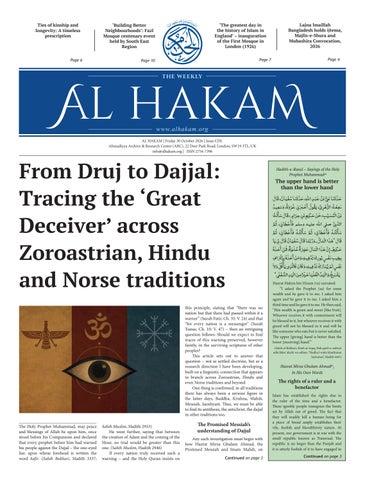
From Druj to Dajjal: Tracing the ‘Great Deceiver’ across Zoroastrian, Hindu and Norse traditions this principle, stating that “there was no nation but that there had passed within it a warner” (Surah Fatir, Ch. 35: V. 24) and that “for every nation is a messenger” (Surah Yunus, Ch. 10: V. 47) – then an intriguing question follows: Should we expect to find traces of this warning preserved, however faintly, in the surviving scriptures of other peoples? This article sets out to answer that question – not as settled doctrine, but as a research direction I have been developing, built on a linguistic connection that appears to branch across Zoroastrian, Hindu and even Norse traditions and beyond. One thing is confirmed, in all traditions there has always been a saviour figure in the latter days, Buddha, Krishna, Mahdi, Messiah, Saoshyant. Thus, we must be able to find its antithesis, the antichrist, the dajjal in other traditions too. The Holy Prophet Muhammad, may peace and blessings of Allah be upon him, once stood before his Companions and declared that every prophet before him had warned his people against the Dajjal – the one-eyed liar, upon whose forehead is written the word kafir. (Sahih Bukhari, Hadith 3337;
Sahih Muslim, Hadith 2933) He went further, saying that between the creation of Adam and the coming of the Hour, no trial would be greater than this one. (Sahih Muslim, Hadith 2946) If every nation truly received such a warning – and the Holy Quran insists on
Hadith-e-Rasul – Sayings of the Holy Prophet Muhammadsa
The upper hand is better than the lower hand َ َ ُ َ ْ ُ َ َ َّ َ ّ ٰ ْ َ ُ ْ ُّ َ َ َ َّ َ ﻗﺎل،ﺎن ﺣﺪﺛﻨﺎ ﺳﻔﻴ،�ِ ��ﺣﺪﺛﻨﺎ ��ِ� ﺑﻦ ﻋﺒ ِﺪ ا ُ َ َ ُ َ ْ ُ َ َ ْ َ ُ ُ َ َّ ْ ُّ ُ ْ َ وﺳ ِﻌﻴﺪ، ﻳﻘﻮل أﺧ���ِ� ﻋﺮوة،� ِ�ﻌﺖ ا��ﻫ ِﺮي ُ َْ َ َ ْ َﻋ ْﻦ َﺣﻜ،ﺑْ ُﻦ اﻟ ْ ُﻤ َﺴ َّﻴﺐ َ ﻗﺎل َﺳﺄﻟﺖ،ام ٍَ �� ﺑ ِﻦ ِﺣﺰ ِ ِ ِ ٰ َ َّ َ ﺛ ُ ّﻢ،��ا��ّ� �ﻠﻴﻪ وﺳﻠﻢ ﻓَﺄ ْﻋ َﻄﺎ اﻟﻨ ِ� ّ� ﺻﻠﻰ ِ ُ ُ َ ْ َ َ ُ َْ َ ْ َ َ ُ َْ ﺛ َّﻢ،�ِ� ﺛ َّﻢ َﺳﺄﻟ ُﺘﻪ ﻓﺄﻋﻄﺎ،�ِ�َﺳﺄﻟ ُﺘﻪ ﻓﺄﻋﻄﺎ َ َ ُ َ ْ ُ َ َ َ َّ ُ َ ُ َ ْ َ َ َ َ ﺎن ﻗﺎل �ِ� ﻳَﺎ ﻗﺎل ”ﻫﺬا اﻟﻤﺎل ـ ورﺑﻤﺎ ﻗﺎل ﺳﻔﻴ ُ َ َ َ ْ َ َ ٌ َ ْ ُ ٌ َ َ َ َ ْ َ َ َّ ُ َ ��ﻦ أﺧﺬه،ﻜ�� ـ ِإن ﻫﺬا اﻟﻤﺎل ﺧ ِ��ة ﺣ��ة ِ ﺣ َْ ُ َ َ َ ْ َ َ َُ َ ُ ْ َ اف ِ �� وﻣﻦ أﺧﺬه ﺑِ ِﺈ،ﺲ ﺑﻮ ِرك �� ِﻓﻴ ِﻪ ِ ﺑِ ِﻄ ٍ ﻴﺐ ﻧﻔ َ ْ َ َُ ْ َ َْ َ َ ُ ُ ْ َ َّ َ َ َ َ ُ �� و�ﺎن �ﺎﻟ ِﺬي ﻳﺄ�ﻞ و،ﺲ ﻟﻢ ﻳﺒﺎرك �� ِﻓﻴ ِﻪ ٍ ﻧﻔ َ ْ ُّ َ ْ َ ٌ ْ َ َ ْ ُ ْ ُ َ ْ َ ُ َ ْ َ “. واﻟﻴﺪ اﻟﻌﻠﻴﺎ ﺧ�� ِﻣﻦ اﻟﻴ ِﺪ اﻟﺴﻔﻠﻰ،��ﺸﺒ Hazrat Hakim bin Hizam (ra) narrated: “I asked the Prophet (sa) for some wealth and he gave it to me. I asked him again and he gave it to me. I asked him a third time and he gave it to me. He then said, ‘This wealth is green and sweet [like fruit]. Whoever receives it with contentment will be blessed in it, but whoever receives it with greed will not be blessed in it and will be like someone who eats but is never satisfied. The upper [giving] hand is better than the lower [receiving] hand.’” (Sahih al-Bukhari, Kitab ar-riqaq, Bab qawli n-nabiyyi salla llahu ‘alayhi wa sallam: “Hadha l-malu khadiratun hulwatun”, Hadith 6441)
Hazrat Mirza Ghulam Ahmadas, In His Own Words
The rights of a ruler and a benefactor
Any such investigation must begin with how Hazrat Mirza Ghulam Ahmad, the Promised Messiah and Imam Mahdi, on
Islam has established the rights due to the ruler of the time and a benefactor. These ignoble people transgress the limits set by Allah out of greed. The fact that they will readily kill a human being for a piece of bread amply establishes their vile, foolish and bloodthirsty nature. At present, our government is at war with the small republic known as Transvaal. The republic is no larger than the Punjab and it is utterly foolish of it to have engaged in
Continued on page 3
Continued on page 3
The Promised Messiah’s understanding of Dajjal
Friday 30 October 2026 | AL HAKAM
2
This Week in History 30 October - 5 November A glimpse into the rich history of the Ahmadiyya Muslim Jamaat
30 October
1 - 2 November
while Abdur Rahim Shaheed had five children. (Tarikh-e-Ahmadiyyat, Vol. 22, p. 189)
30 October 1913: On this day, Hazrat Khalifatul Masih I (ra) laid the foundation stone of Hazrat Maulvi Sher Ali’s (ra) house. Hazrat Khalifatul Masih I (ra) laid two bricks with his own hand and then the third brick was placed by Hazrat Sahibzada Mirza Bashir-ud-Din Mahmud Ahmad (ra). (Tarikh-e-Ahmadiyyat, Vol. 3, p. 468)
1 November 1905: The Promised Messiah (as) was residing in Delhi. On this day, in the Curzon Gazette, a journalist, Mirza Hairat Dehlvi, published harsh words against the Promised Messiah (as) and also challenged him to a debate. (Tarikh-e-Ahmadiyyat, Vol 2, p. 427)
4 November 1900: On this day, the Promised Messiah (as) issued a statement in the form of a written advertisement in which he mentioned that his community’s name should be “Musalman Firqa Ahmadiyya”. (Majmua-e-Ishtiharat, Vol 3, pp. 364- 365
2 November 1924: On this day, Hazrat Musleh-e-Maud (ra) started the next phase of his journey back to Qadian from Europe, as he boarded his ship from Venice, in the northeast of Italy. Hazrat Maulvi Abdur Rahim Dard (ra) had sent this news to Hazrat Maulvi Sher Ali (ra), who was in Qadian serving as Amir-e-Muqami. (Al Fazl, 6 November 1924, p. 1)
4 November 1927: On this date, in his Friday sermon, Hazrat Musleh-e-Maud (ra) explained to the Jamaat that members should avoid undue love for anyone and should also avoid undue enmity for anyone.
2 November 2013: Hazrat Khalifatul Masih V (aa) delivered the keynote address at a special reception held to mark the inauguration of the Baitul Muqeet Mosque in Auckland, New Zealand. The event was attended by more than 50 non-Muslim dignitaries and guests, including Judith Collins, Minister of Justice and David Rutherford, New Zealand’s Chief Human Rights Commissioner.
5 November
30 October 1992: On this day, in his Friday sermon, Hazrat Khalifatul Masih IV (rh) announced a financial appeal to aid the war-torn orphaned children and adults of Bosnia and personally donated a thousand pounds. Huzoor (rh) also appealed for donations to assist the famine-stricken people of Somalia and for the construction of a mosque in Mississauga, Canada. (Khutbat-e-Tahir, Vol. 11, p. 776) For more details of Jamaat’s efforts for Bosnian Muslims, see: “Khilafat-e-Ahmadiyya: Standing by oppressed Bosnian Muslims” at alhakam.org (9 June 2023, p. 15).
31 October 31 October 1902: The weekly newspaper Al Badr started its publication from Qadian on this day. Earlier, it had brought out its sample issue under the title of Al Qadian, which the Promised Messiah (as) renamed. Upon the commencement of this newspaper, Hazrat Hakeem Noor-ud-Deen (ra) extended his support for it and also wrote some articles. (Tarikh-e-Ahmadiyyat, Vol. 2, p. 221) 31 October 1980: The annual ijtema of Majlis Ansarullah was inaugurated on this day in Pakistan. The live English translation of the speeches of Hazrat Khalifatul Masih III (rh) was available for listening via headphones for the first time. (Tarikh Ansarullah, Vol. 2, p. 119)
During his keynote address, Huzoor (aa) spoke about the true purposes of building mosques, modern forms of slavery and Islam’s commitment to freedom of religion and expressed his concerns that the world was heading towards a devastating global war. (“Special Reception Held to Mark Inauguration of Auckland Ahmadiyya Mosque”, www.pressahmadiyya.com)
3 - 4 November 3 November 1963: Usman Ghani Sahib and Abdur Rahim Sahib were martyred in East Pakistan (now Bangladesh). Opponents of the Jamaat pelted stones at Ahmadi Muslims who were attending a meeting. Many Ahmadis were severely injured and both of the aforementioned Ahmadis succumbed to their injuries in the hospital the next morning. Usman Ghani Shaheed was 35 years old, unmarried and the first Ahmadi of his family,
The sermon is available at this link: www.alislam. org.
5 November 1926: Hazrat Musleh-e-Maud (ra) initiated the organisation of Ansarullah. In its inaugural session, on this day, Huzoor (ra) made it obligatory for its members to learn Ayat-ul-Kursi (Surah al-Baqarah Ch.2: V.256) and the last three chapters of the Holy Quran. Moreover, every member was to keep the following three books with them as personal copies: the Holy Quran, Noah’s Ark [Kashti-e-Nuh] and Gardens of the Righteous [Riyadh-us-Saliheen]. Through this body, Hazrat Musleh-e-Maud (ra) endeavoured to uplift the spiritual standards of members of the Jamaat. (Tarikh-e-Ahmadiyyat, Vol. 5, p. 565) 5 November 1959: Acharya Vinoba Bhave visited Qadian on this day. He initiated the Bhoodan Movement, or the Land Gift Movement. This was a voluntary land reform movement in India, which attempted to persuade wealthy landowners to voluntarily give a percentage of their land to those with no land. (Tarikh-e-Ahmadiyyat, Vol. 20, p. 393) ‘‘Coming from every distant track: Vinoba Bhave visits Qadian – When a Hindu nationalist leader accepted the gift of the Holy Quran’’ at www. alhakam.org (12 July 2024, p. 16)
AL HAKAM | Friday 30 October 2026 Continued from page 1 war with such a vast empire. Nonetheless, now that hostilities have begun, it is the duty of every Muslim to pray for the victory of the British. What have we to do with Transvaal? It is our responsibility to show support for those who have done us thousands of favours. A neighbour is due such rights that upon hearing of their suffering, one’s heart bleeds. So now, do our hearts not ache when we read about the perils
whom be peace, explained what the true meaning of the Dajjal was in the first place – because it is precisely this understanding that makes the comparative possible. In mainstream Sunni thought, the Dajjal is generally awaited as a single individual, a physical antichrist figure. The Promised Messiah (as) instead read the ahadith as describing a collective force. Writing in Izala-e-Auham, he wrote: “[…] The Dajjal is none other than the Christian clergy [...] they are called Dajjal because of their great deceptions [dajl]” and elsewhere that the Dajjal “is the group of the European nations who have emerged with great power and have spread over the whole world”. (Ruhani Khazain, Vol. 3, pp. 370-473) In Haqiqatul-Wahi, he interpreted the Dajjal’s strange “donkey” – the beast that moves like the wind and eats fire – mentioned in the hadith, as a prophecy of the railway and the steamship, and read the Dajjal’s blindness in one eye as spiritual blindness paired with an unmatched sharpness in worldly, material knowledge. (Ibid., Vol. 22, p. 41) In Kitab-ul-Bariyyah, he sharpened the picture further, describing the Dajjal as having “two jaws” – Christian missionaries and European philosophers – with which it “devours people’s faith like a python”, ensnaring the ordinary and the intellectual alike. (Ibid., Vol. 13, pp. 252-253) And in Anjam-e-Atham, the Promised Messiah (as) identified the “greatest Dajjal” specifically as the group that deifies a mere human being – the Christian clergy who attribute divinity and salvation to the cross. (Ibid., Vol. 11, pp. 46-48) What matters for our purposes is this: once Dajjal is understood not as one man but as a universal, ideological force of deception opposed to divine truth, it stops being a concept unique to the Islamic tradition and starts looking like something other scriptures might independently describe under a different name. This is what the Holy Prophet (sa) told us, that every prophet warned about the Dajjal.
Zoroaster, Avesta and Druj Zoroaster (also called Zarathustra) was a prophet of ancient Iran, traditionally placed by scholars anywhere between roughly 1500 and 600 BCE. He is regarded as the founder of Zoroastrianism – one of the oldest continuously practised religions in the world. Zoroastrianism taught a stark moral universe: a spirit of truth and light locked in struggle against a spirit of falsehood and darkness, with every human being called to choose a side through their thoughts, words and deeds. The faith was the dominant religion of the Persian Empire for well over a thousand years, before the spread of Islam gradually
3 of the loyal soldiers of the British government? In my view, a person who does not deem the grief of the government to be their own is blackhearted. Bear in mind that leprosy is of various kinds. One form of leprosy affects the body, while another form of leprosy afflicts the soul. There used to be a man who stayed here in the bazaar. If anyone became the subject of a lawsuit, he would ask how the case was proceeding. If
he was informed that the accused had been ex- onerated or that the case was favourably promising, he would be taken aback and say no more. If on the other hand, someone told him that the person implicated had been charged, he would be overjoyed and would invite the person to sit with him and listen to the entire account. In short, the dispositions of certain men are so filled with a sense of spite that they are eager to hear bad news and enjoy the misfortune
of others, because they are satanic in nature. Hence, it is wrong to bear ill will towards any individual, especially a benefactor. Therefore, I say to my community that they must not follow in the footsteps of such people. On the contrary, they ought to pray, with utmost sympathy and true goodwill, for the victory of the British government, and ought to demonstrate examples of loyalty even in practice.
reduced its numbers; small Zoroastrian communities survive in Iran today, alongside the larger Parsi community descended from Zoroastrian refugees who settled in India. The scripture of Zoroastrianism is called the Avesta, written in Avestan – an ancient Iranian language belonging to the same branch of the broad Indo-Iranian family that also produced Sanskrit. Within the Avesta, the oldest and most sacred section is a set of hymns called the Gathas, which scholars and Zoroastrians alike regard as the actual words of Zoroaster himself, as opposed to later material added by generations of priests. It is in these earliest hymns – not later commentary – that we find the concept at the centre of this article: Druj. Many languages, including Hindi, Urdu, Latin, Greek and the Germanic languages, belong to the Indo-European language family. Linguists believe these languages developed from a common ancestral language known as Proto-Indo-European (PIE). Although no written records of PIE survive, scholars have reconstructed aspects of the language by comparing similarities in vocabulary, grammar and sound patterns across its descendant languages.
The idea explored in this article is that these similarities may be more than coincidence: they may reflect a single original warning, conveyed by God through His prophets across different times and regions of the world, as suggested by the hadith cited at the beginning of this article. Geographically, Avestan was spoken in ancient Iran – and of all the many branches of the Indo-European language family, which today stretches from Iceland to India, Avestan is the one whose homeland sat closest to the Arabian Peninsula. That proximity makes an ancient connection between the two languages of Arabic and Avestan far more plausible than it would be for, say, Old Norse or Sanskrit in isolation. Under the principle pioneered by the Promised Messiahas in his book Minan-urRahman – foundational to this idea – that Arabic is the umm al-Lughat, the Mother of languages, the Arabic root d-j-l would be the original, undecayed source, with Druj representing a later variant, reshaped by two processes well documented in historical linguistics: metathesis, where the order of consonants shifts as a word passes between languages, and the common l–r interchange found across language families. Apply both to the root of Dajjal, and what emerges is remarkably close to Druj. Below is a simplified visualisation:
peace and blessings of Allah be upon him, taught that whoever memorises the first ten verses of Surah al-Kahf will be protected from the trial of the Dajjal. (Sahih Muslim, Hadith 809a) The Zoroastrian tradition preserves something strikingly parallel. In the Vendidad (Fargard 18), the divine guardian Sraosha interrogates the Druj, personified as a demoness, directly, asking who is capable of killing her. Her answer, recorded in Vendidad 18:43, is that the one who recites the Ahuna Vairya – the Yatha Ahu Vairyo prayer – without interruption “smites me with the best smiting [...] kills me with the best killing.” She confesses that if the prayer is recited four times, it destroys the “pregnancy” of her evil designs. In both traditions, the Great Deceiver is defeated not by force but by sacred recitation – the Quranic dhikr on one side, the Zoroastrian Manthra on the other. Both traditions insist that Druj/Dajjal is, at root, an ideological and spiritual threat rather than a physical one, which aligns precisely with Hazrat Mirza Ghulam Ahmad’s (as) description of clergy and philosophers who “devour people’s faith” through argument and influence rather than the sword.
Same word, same meaning In the Gathas, Druj is described as nothing less than a cosmic force of falsehood, standing in direct opposition to Asha, or “truth”. In the Avesta, Yasna 30.3, part of the famous “Choice of the Spirits”, describes two primal spirits – one good, one bad – between whom “the wise have rightly chosen Asha [the truth], not so the foolish, who follow the Druj [the lie].” Yasna 31.1 speaks of those who “through the commands of the Druj, destroy the world of Asha” while Yasna 32.3-5 condemns the Daevas (demons) as “the seed of Druj [...] and of arrogance”, who have “defrauded mankind of the Good Life and Immortality.” What is striking here is not just the concept but the word itself. According to Encyclopedia Iranica, Druj, in Avestan, means “falsehood”, “deceit”, “lie”, or “illusory/deceptive order.” Dajjal, in Arabic, comes from a root that means the same thing. Arabic, like other Semitic languages, builds almost all its vocabulary from three-letter ‘roots’, each carrying a core meaning, around which different words are formed by changing the vowels and patterns. � The word Dajjal ()الَدِجال derives from the Arabic root d-j-l (ل-ج-)د, associated with the verb dajala. In Lisan al-Arab, the renowned Arabic lexicon compiled by Ibn Manzur, it is stated: “It is said: ‘Dajala’ when he lied, deceived and deliberately confused/falsified reality”. Therefore, before any theory of historical connection even comes into it: Druj and Dajjal already mean the same thing.
The most fascinating and exciting implication of this theory is that chain does not stop there. Persian – and, through it, Urdu – preserves an almost identical word to this day: ( دِرَوغdrogh), meaning simply “a lie.” Any Urdu speaker who has come across the word darogh go � دروغ, “liar” in poetry or literature has already met a direct descendant of the very same Avestan Druj, carried down through Persian into a language spoken and understood by hundreds of millions of Muslims today. Sanskrit preserves a near-identical word as well – druh – carrying, again, the very same meaning. So we have four language branches – Semitic, Iranian, IndoAryan, and, through Persian, South Asian vernaculars – all converging on one root and one meaning: the lie, and subsequently warnings of the very same Dajjal in other cultures, languages and traditions.
A shared antidote: The word against the lie If Druj and Dajjal are one and the same warning, we might expect the divinley prescribed defence against each to be similar as well; and they are. The Holy Prophet Muhammad, may
(Malfuzat [English], Vol. 2, pp. 201 - 202)
The serpent with three heads The Avesta does not leave Druj as an abstraction. It embodies her in the figure of Aži Dahāka, a three-mouthed, three-headed, six-eyed serpent. Yasht 5.34 calls him “the most mighty Druj [...] created against the material world, for the destruction of the creatures of Asha”, while Yasna 9.8 repeats the same three-headed description, naming him “that most powerful follower of the Lie.” Notably, Aži itself is simply the Avestan word for “serpent”, a word we will meet again, in almost identical form, in Sanskrit. The parallel to the Promised Messiah’s (as) own language is difficult to overlook. Where he described the Dajjal as having two jaws – clergy and philosophers – swallowing faith “like a python”, the Avesta gives us an actual serpent of deception. And I theorise that the number of heads is not incidental. Hazrat Mirza Ghulam Ahmad (as) identified the “greatest Dajjal” specifically as the group that “deifies a mere human being” and attributes salvation to the cross – a direct reference to the defining Christian doctrine of the Trinity, God conceived as three-inone. A three-headed serpent is, in effect, a mythological image of exactly this kind of threefold deification. It truly makes one wonder. The very features of the Promised Messiah’s (as) interpretation: a python, a trinity, the greatest force of deception, all appearing independently in a Persian scripture as Aži Dahāka, the physical form of the Lie itself. Paired with the hadith at the start of this article, the case for this theory becomes hard to ignore.
Friday 30 October 2026 | AL HAKAM
4
Additionally, Islamic tradition holds that the Dajjal is presently confined, awaiting permission to emerge and roam the earth for forty days, sparing only Mecca and Madinah. (Sahih Muslim, Hadith 7028) Later Zoroastrian cosmological texts describe an almost identical fate for Aži Dahāka. The Bundahishn (29.9) records that the hero Thraetaona was unable to kill the serpent outright, and so “bound him on Mount Damavand”, where he remains until “the end of the world”, at which point he “will be released from those bonds, and will again rise against the world.” The Zand-i Vohuman Yasht (9.1-5) elaborates on this final release, describing Aži Dahāka breaking free to “swallow a third of mankind” and corrupt water, fire and vegetation, before the hero Keresaspa is resurrected specifically to strike him down. What is even more astonishing is that Christianity is in fact estimated to be the religion of a third of mankind today. A deceiver chained and awaiting a permitted release, a period of catastrophic devastation and a promised saviour raised specifically to end him – the eschatological shape is the same in Islam, even where the names may differ entirely.
Echoes in the Vedas The pattern does not end in Persia. The Rigveda of the Hindus of India preserves the very same concept – and, remarkably, close to the very same word – as Druh: deceit, harm, malevolence, standing in direct opposition to Rta, truth and cosmic order, in exactly the relationship Druj bears to Asha in the Avesta. Rigveda 7.75.1 speaks of dispelling “the Druh [falsehood/malevolence], the hated darkness.” Druj, Druh and in Persian and in Urdu drogh are, in effect, one word tracked across three related languages, all landing on “the lie” and Dajjal is the same word again, one branch further back. The serpent who embodies this Druh in the Rigveda is Vritra, “the Enveloper”, given the title Ahi. This is not merely a similar-sounding word to the Avestan Aži used for Aži Dahāka – it is the same word, inherited into Sanskrit and Avestan separately from their shared Indo-Iranian ancestor, both simply meaning “serpent.” Two entirely separate scriptures, then, use literally the same word to describe literally the same three-headed embodiment of the Lie. Rigveda 1.32.1-2 recounts how Indra “slew the Ahi (Serpent) [...] lying on the mountain”, releasing the waters it had blocked. The three-headed motif reappears explicitly, too, in the Vedic figure Viśvarupa, also called Triśiras – “the Three-Headed” – a being of deceit created in direct opposition to divine order, again inviting the same association with the threefold deification named as the mark of the greatest Dajjal. And the hero who ultimately defeats the serpent carries a name that is not merely similar but linguistically identical across the two traditions: the Avestan Thraetaona and the Vedic Trita Aptya both derive from a root meaning simply “the Third.” Whatever this figure represented to the earliest Indo-Iranian peoples, it survived, virtually unchanged, on both sides of the eventual Iranian-Indian religious divide.
NEWS
Traces beyond Persia and India: Germanic and Norse tradition The linguistic chain runs further still, into Germanic and Norse tradition. Druj, Druh and drogh all descend, most historical linguists agree, from a reconstructed root – dhreugh – meaning “to deceive” or “to harm through trickery.” The same root surfaces, more distantly but still recognisably, in German betrügen (to cheat), and in Old Norse draugaz, |phantom” – the direct ancestor of Draugr. A draugr, in Norse belief, is a specific kind of deception: a body that looks entirely human, walks and speaks, and yet is not truly alive – “an imitation of life”, as scholars of Norse religion describe it. This is worth pausing on, because Islamic tradition describes something startlingly similar as one of the Dajjal’s own tricks. According to a hadith recorded in Sunan Ibn Majah, part of the Dajjal’s trial will be that he says to a Bedouin: “‘What do you think, if I resurrect your father and mother for you, will you bear witness that I am your Lord?’ The man agrees, and two devils then appear to him in the exact form of his dead father and mother, urging him: ‘O my son, follow him, for he is your Lord’”. (Sunan Ibn Majah, Hadith no. 4077) Strip away the names, and the mechanism is identical: something that looks and speaks exactly like a person who has died, brought back not truly alive but as an imitation of life, deployed specifically to deceive the living into following a falsehood. The Dajjal’s counterfeit resurrection and the Norse draugr are, functionally, the same trick – described independently on opposite ends of the old Indo-European world.
One warning, many tongues There are other candidates still to be examined properly, even those that may not be linked to the PIE root of deception – Apep, the serpent of chaos in Egyptian mythology, and Mara, the tempter of Buddhist tradition, among them – these all well could be indications towards the same Dajjal but need further research. Taken individually, any one of these parallels might be dismissed. A shared root meaning “the lie.” A shared method of defeat through sacred recitation. A shared serpent, described in literally cognate words, with literally the same number of heads, tied to the same doctrine of threefold deification, described to be the greatest force of the same decption. A shared eschatology of chains and a promised release. A shared trick of false resurrection, performed by something that walks and speaks but is not truly alive. Coincidence, perhaps – but piled one on top of another like this, the word “coincidence” starts to carry more weight than one can comfortably bear. What remains, at the very least, is a case worth taking seriously: that a warning given, according to the Holy Quran and ahadith, to every nation on earth, may not have vanished from most of them at all. It may simply have been waiting, in a word here and a myth there, to be recognised for what it always was: Dajjal. (Mohsin Raja, Student, Jamia Ahmadiyya UK)
Lajna Imaillah Bangladesh holds ijtema, Majlis-e-Shura and Mubashira Convocation, 2026 Qurratul Ayin Sadia Muavina Sadr, Lajna Imaillah Bangladesh Lajna Imaillah Bangladesh held its 49th annual ijtema on 21-22 September 2026 under the theme “Ways to Attain the Nearness of Allah.” The 32nd National Majlis-e-Shura followed on 23 September, while the first convocation ceremony of the Mubashira Course Bangladesh was held on 24 September.
Annual ijtema The programme of the annual ijtema opened with a recitation from the Holy Quran, followed by a qasidah, an Urdu poem and Lajna Imaillah Pledge. The programme continued with annual reports, presentations and addresses on a range of religious and spiritual subjects. Sessions explored the importance of developing a strong bond with Khilafat, reflecting on Surah al-Fatihah, following the example of the Holy Prophet Muhammad (sa), establishing salat and expressing gratitude to Allah the Almighty. Other discussions addressed women’s entrepreneurship, mutual sisterhood, obstacles to attaining the nearness of Allah, guidance of Hazrat Khalifatul Masih V (aa) and the role of muballighat students. The programme also included sessions on women’s mental health, physical wellbeing, sports and physiotherapy, providing opportunities for learning and discussion alongside the spiritual programme. A dedicated programme for nasirat featured presentations and other educational activities, such as quizzes. The ijtema concluded with an address and silent prayer by Sadr Lajna Imaillah Bangladesh. Various academic competitions were also held. An exhibition was organised over four days, featuring 19 stalls representing 11 local majalis. The stalls showcased food, handicrafts and clothing and a total of BDT 3,690 was collected. A refresher course for District Presidents was also held, with representatives from 14 of the 15 districts taking part. A total of 1,717 people attended the ijtema, including 1,210 Lajna Imaillah members, 232 nasirat, 186 children under seven years of age, 12 Jere Tabligh and 77 guardians. In all, 105 of the 126 local majalis were represented.
National Majlis-e-Shura The 32nd National Majlis-e-Shura of Lajna Imaillah Bangladesh was held on 23 September 2026. The morning session began at 9 am with a recitation from the Holy Quran, followed by the reading of the rules and procedures governing the proceedings. The implementation report of proposals from previous Majalis-e-
Shura was presented before the current year’s proposals and proposed budget were considered. Two General Sub-Committees were formed to examine the proposals, while a Finance Sub-Committee reviewed the budget. The second session began at 3 pm. Following the presentation of the SubCommittees’ reports and recommendations, representatives were invited to share their views before the proposals and budget were put to a vote. Both proposals, together with the recommendations of the General Sub-Committees, were approved unanimously. The proposed budget for 2026-27 and the recommendations of the Finance Sub-Committee were also approved unanimously. The Shura was attended by 335 delegates and 22 observers, bringing the total attendance to 357.
Mubashira Course Bangladesh: First Convocation On 24 September 2026, the first convocation ceremony and prize-giving event of the Mubashira Course Bangladesh was held at the Darut Tabligh Mosque under the auspices of the Talim Department of Lajna Imaillah Bangladesh. The ceremony was presided over by Sadr Lajna Imaillah Bangladesh. Amir Jamaat-e-Ahmadiyya Bangladesh, Abdul Awal Khan Chowdhury Sahib, delivered the inaugural address. The programme also featured a message from Sadr Sahiba, an address by Shah Muhammad Nurul Amin Sahib, Secretary Nazm-eNau and Coordinator of the Mubashira Course Bangladesh and an expression of gratitude by a student. Students also gave presentations, followed by prize distribution, the concluding address and a silent prayer. The Mubashira Course aims to equip Ahmadi Muslim girls and women with a sound grounding in Islamic knowledge through the study of Arabic, Urdu and advanced Islamic subjects. It seeks to deepen their understanding of the Holy Quran and Hadith while developing their confidence and ability to convey the teachings of Islam. According to the course records, 84 students were enrolled, including three who joined from the third semester. 42 students took part in the final examination and 41 passed. A letter from Hazrat Khalifatul Masih V (aa) was shared on the occasion. Huzoor (aa) congratulated the members who had completed the course, while reminding them that completing a course should not be regarded as the end of their pursuit of religious knowledge. He emphasised that true religious understanding requires making the Holy Quran an integral part of one’s life, studying it deeply, reflecting upon its teachings and acting upon its commandments.
AL HAKAM | Friday 30 October 2026
5
”The children we teach to hate Opinion
Mona Farooq
USA
There is something I have often wondered about children. How do they learn whom not to like? After all, a child does not come into this world knowing that one person is acceptable and another is not. They don’t know which religion is supposed to be respected more, which community is considered an outsider or why someone else’s name, faith or identity should make them less worthy of friendship. They learn these things from us. Sometimes through what we say. Sometimes through what we teach. And sometimes through what we don’t say at all. I know this because I grew up on the receiving end of it. I am an Ahmadi Muslim and from elementary school through high school, college and university, I experienced bullying and exclusion because of my faith in Pakistan. Some of it was direct. Some of it was subtle enough that perhaps the person doing it did not even think of it as cruelty. There were times when I would say assalamu alaikum and the other person would simply not respond. I remember the feeling more than I remember the individual incidents. It was strange to realise that a greeting of peace could be met with silence because of who I was. I was not asking anyone to agree with me. I was not asking them to share my beliefs. I was simply greeting the way I had been taught. But somewhere along the way, someone had learned that even that small courtesy did not have to be extended to me. That is what prejudice does. It makes a person decide something about you before they have ever taken the time to know you. And perhaps that is why I have always believed that the real story of prejudice begins much earlier than the moment it becomes visible. It begins with a lesson. A child hears that certain people are different. Then that difference is explained. Then it is given a value. And eventually, the child begins to understand that there are people who belong to “us” and people who belong somewhere outside that circle. We often talk about hatred as though it appears suddenly – in a violent act, a hateful slogan, a mob or some terrible incident that
makes the news. But hatred can have much quieter beginnings. It can begin with a joke that nobody challenges. A textbook that describes one community through stereotypes. A teacher who casually repeats something they themselves were taught. A parent who tells a child to stay away from “those people.” A classroom where one child’s identity is treated as something shameful. And then, one day, that child grows up. In Pakistan, this is not simply a philosophical question. The US Commission on International Religious Freedom published a report in 2016 titled Teaching Intolerance in Pakistan: Religious Bias in Public School Textbooks. It examined textbooks used in public schools and documented biased and stereotypical portrayals of religious communities, including Ahmadis, Christians, Hindus, Sikhs and Jews. The report also noted the absence of adequate discussion of the rights and contributions of religious minorities to Pakistan. An earlier USCIRF–supported study, Connecting the Dots: Education and Religious Discrimination in Pakistan, went beyond textbooks. Researchers reviewed more than 100 textbooks from grades one through 10 and interviewed students and teachers in public schools and madrassas across Pakistan. The study found both examples of tolerance and significant expressions of prejudice toward religious communities, including Ahmadis, Christians and Jews. These findings matter because a textbook is not just a book. To a child, it is an authority. When something is printed in a schoolbook and taught in a classroom, a child does not necessarily have the experience or confidence to stand back and ask, “Is this really true?” They absorb it. And what a child absorbs about another human being can stay with them for years. For an Ahmadi child, there is another layer to this. You can grow up knowing that the people being discussed are not some distant group you have never encountered. They are your parents. Your grandparents. Your neighbours. Your friends. They are the people sitting beside you in the classroom. You know them as human beings. Yet you may discover that somewhere outside
your home, they have been reduced to a label. That contradiction is difficult for a child to understand. It was difficult for me. How can the person I know as kind, funny, generous and ordinary be described to someone else as something fundamentally different? How can a person who has never met me decide that I am someone they should not speak to? And how does a child make sense of being told, in one place, that they are equal – while experiencing, in another, that they are not? These questions are not uniquely Pakistani. The forms of prejudice differ from country to country. The histories are different. The communities that have been targeted are different. We should not flatten those differences or pretend that every experience is the same. But the question of what we teach children about people who are different from them belongs to all of us. That is not a Pakistani story. It is not a Muslim story. It is a human story. Every society has people whose histories have been misunderstood, simplified or pushed to the margins. Every society has inherited prejudices that can be passed quietly from one generation to the next. The names change. The circumstances change. But the mechanism can be remarkably similar. We tell children a story about another group before they ever meet anyone from that group. And then we wonder why they are afraid of one another. Or why they don’t trust one another. Or why they grow up believing that discrimination is somehow normal. There is something else that concerns me even more. The child who is taught prejudice is also being deprived of something. They are being deprived of the opportunity to know people as individuals. They may grow up never discovering that the person they were taught to distrust could have been their friend. They may never hear the other person’s story. They may never discover how much they actually have in common. That is a loss for both sides. I don’t believe children are naturally hateful. I believe children are remarkably curious. They ask questions adults sometimes wish they wouldn’t. Why does she dress differently? Why does he pray differently? Why does his family celebrate something we don’t? Why does her family speak another language? A child asks because they don’t know. The answer we give them matters. We can teach them that difference is frightening. Or we can teach them that difference is something to understand. We can teach them that loving your own religion requires you to dislike someone else’s. Or we can teach them that conviction and compassion can exist together. We can teach them to inherit our suspicions. Or we can teach them to question them. That last part is especially important to me. Because I don’t want to write this as though children are doomed to become whatever their environment teaches them. They are not. People change. They grow. They meet someone who challenges what they believe. They read something that makes them uncomfortable. They discover that the person they were told was “different” is not so different after all. Sometimes, they unlearn. And perhaps that is where education has its greatest responsibility. Education should not merely
tell children what to think. It should teach them how to think. How to question a stereotype. How to recognise when a historical account is incomplete. How to distinguish between faith and prejudice. How to disagree without humiliating another person. How to hold firmly to their own beliefs without believing that someone else’s dignity has to be taken away. UNESCO itself describes education as a critical means of addressing the roots of prejudice and hate, including through efforts to challenge stereotypes and promote more inclusive approaches to teaching. For me, this is not an academic discussion. I still remember what it felt like to offer a simple greeting and receive nothing in return. I cannot tell you what was in the minds of every person who ignored me. I don’t know what they had been taught at home, what they had heard from others, or what they believed they were defending. But I do know what it felt like to be the child on the other side of that lesson. And perhaps that is why I cannot stop thinking about the children on both sides. The child who is taught that someone like me is not worthy of a response. And the child who learns, slowly, that perhaps they should stop offering the greeting. One is being taught to reject. The other is being taught to expect rejection. Neither lesson should be part of childhood. We spend enormous energy asking what kind of grades our children are getting, which universities they will attend, what careers they will pursue and whether they will succeed in life. Perhaps we should also ask something simpler. What kind of human beings are we teaching them to become? Are we teaching them that another person’s faith makes them less worthy? Are we teaching them that some citizens belong more than others? Are we teaching them to inherit grievances they never experienced themselves? Are we giving them a history that helps them understand one another or one that teaches them whom to blame? And when they encounter someone different from themselves, what have we prepared them to see first? The difference? Or the human being? I have spent much of my life knowing what it feels like to be placed outside an invisible circle. But I don’t want the next generation to inherit those circles simply because we were too unwilling to question them. Perhaps the greatest responsibility we have toward children is not to pass everything we inherited on to them. Some things deserve to be preserved. Some things deserve to be questioned. And some things – especially hatred – should end with us. Because children will eventually inherit the world we leave behind. They will inherit our books, our histories, our fears, our assumptions and our silences. The question is: what else will we give them? Perhaps we can give them something better. The freedom to meet a person before meeting their label. The courage to question what they have been taught. The ability to disagree without dehumanising. And the simple understanding that another human being does not become less worthy of kindness because they are different from us. Perhaps then, when a child says assalamu alaikum, another child will simply answer. And neither of them will have to wonder whether they belong.
Friday 30 October 2026 | AL HAKAM
6
Ties of kinship and longevity: A timeless prescription Maher Umer Ahmad Canada
In a 2024 Business Insider video, tech entrepreneur Bryan Johnson was reported to spend around $2 million a year on longevity treatments. (“The Billionaire Trying To Live Forever | Life Extended | Business Insider”, youtube.com, 19 December 2024) His emphasis on longevity reflects an interest that is also apparent on social media, where influencers promote techniques and remedies they claim will add years to our lives. As Ahmadi Muslims who seek to follow the true teachings of Islam, we should also look to our faith for guidance on this topic. More than 1,400 years ago, the Holy Prophet (sa) taught that strengthening ties of kinship could lengthen one’s life. He said: “He who desires to enlarge his means or to lengthen his days should strengthen his ties of kinship.” (Sahih al-Bukhari, Hadith 5986; translation: Hazrat Zafrulla Khan (ra), Wisdom of the Holy Prophet, 1995, p. 16) Strengthening kinship ties also holds
great religious importance. Hazrat Abu Ayyub Ansari (ra) relates that a man once asked the Holy Prophet (sa) to tell him what would admit him to Paradise and keep him away from the Fire. The Holy Prophet (sa) replied: “Worship Allah and do not associate anything with Him: observe Prayer; pay the Zakat and join the ties of kinship.” (Sahih al-Bukhari, Hadith 1396; translation: Imam an-Nawawi, Gardens of the Righteous, trans. Hazrat Zafrulla Khan (ra), 1996, p. 76) Here, the Holy Prophet (sa) mentioned maintaining ties of kinship alongside prayer and zakat, two pillars of Islam, and the worship of Allah without associating partners with Him. This illustrates the importance of maintaining and strengthening family ties.
Social connection and health Recent research highlights the health benefits of social connection that resonate with this guidance. In 2025, the World Health Organization (WHO) released a report on the importance of social connection
for health. Its accompanying news release explained that social connection can protect health throughout life by reducing inflammation, supporting mental health and lowering the risk of serious health problems. (“Social connection linked to improved health and reduced risk of early death”, who.int, 30 June 2025) Conversely, loneliness and social isolation are associated with an increased risk of heart disease, cognitive decline, stroke and premature death. (Ibid.) Low social connection and loneliness have also been linked to an increased risk of hypertension. (“Social connection as a critical factor for mental and physical health: evidence, trends, challenges, and future implications”, World Psychiatry, Vol. 23, No. 3, 2024, pp. 312-332) The effects extend to education and employment. The WHO reported that teenagers who felt lonely were more likely to receive lower grades or qualifications, while adults experiencing loneliness may find it harder to secure or maintain employment and may earn less over time. (“Social connection linked to improved health and reduced risk of early death”, who.int, 30 June 2025) These disadvantages can also affect health: lower educational attainment, unemployment and lower income are associated with poorer health outcomes. (“The Relationship Between Education and Health: Reducing Disparities Through a Contextual Approach”, Annual Review of Public Health, Vol. 39, 2018, pp. 273-289; “The impact of unemployment on health: a review of the evidence”, CMAJ, Vol. 153, No. 5, 1995, pp. 529-540; “Social determinants of health”, who.int, n.d.) Overall, stronger social connections are associated with longer lives, while weaker connections are associated with a higher risk of death from all causes. (“Social connection as a critical factor for mental and physical health: evidence, trends, challenges, and future implications”, World Psychiatry, Vol. 23, No. 3, 2024, pp. 312-332)
Social connection in Islam In addition to emphasising kinship, Islam provides practical ways to maintain wider social connections, including the five daily prayers. The Holy Prophet (sa) placed great emphasis on offering salat in congregation, saying: “Prayer with the congregation is twentyseven times more beneficent than Prayer performed by oneself.” (Sahih al-Bukhari, Hadith 645; translation: Imam an-Nawawi, Gardens of the Righteous, trans. Hazrat Zafrulla Khan (ra), 1996, p. 194) Devout Muslims seeking nearness to Allah are therefore encouraged to offer their prayers in congregation. This also provides regular opportunities for social contact and can help people build relationships. Meeting fellow worshippers throughout the day creates opportunities to speak, enquire after one another and offer support. The nature of Islamic prayer also encourages community and goodwill among Muslims. Hazrat Mirza Tahir Ahmad (rh), Khalifatul Masih IV, writes: “All face the same direction without exception, facing the first house of worship ever built for the benefit of mankind. Noone is permitted to reserve any special place
behind the imam. In this regard the rich and poor are treated with absolute equality, so also the old and the young. Whoever reaches the mosque ahead of others has the prior option to sit wherever he pleases. None has the right to remove others from the place that they occupy, except for reasons of security etc., in which case it becomes an administrative measure. Thus the Islamic system of prayer is rich not only in spiritual instruction but also in communal and organisational instruction.” (Hazrat Mirza Tahir Ahmad (rh), An Elementary Study of Islam, 2010, pp. 35-36) Thus, salat places Muslims on an equal footing in worship, regardless of their social standing. No preference is given on the basis of wealth or education. This shared practice can encourage humility and mutual respect, helping to strengthen social connections. Beyond salat, Islam encourages other ways of building social bonds. One is to greet one another. The Holy Prophet (sa) said: “Extend your greetings to all alike; you will have peace. It is wrong to discriminate.” (Hazrat Zafrulla Khan (ra), Wisdom of the Holy Prophet, 1995, p. 46) Following this instruction can encourage mutual love and compassion. In his Friday Sermon of 3 September 2004, Hazrat Khalifatul Masih V (aa) explained that saying salam conveys peace and blessings, and that exchanging this greeting increases feelings of love. (“Spreading of Salaam (Peace)”, alislam.org, 3 September 2004) We should therefore greet one another with kindness and reflect the meaning of the greeting in our conduct. A third way Islam encourages stronger social ties is through giving gifts. The Holy Prophet (sa) said: “Give gifts to one another, for giving gifts creates love and gently extracts resentment and ill-will.” (Muwatta Imam Malik, Book 47, Hadith 16; translation quoted in “The Philosophy of Gift-Giving”, reviewofreligions.org, 5 April 2024) Moreover, the Holy Prophet (sa) said that he would accept even a modest gift. (Sahih al-Bukhari, Hadith 2568) This example encourages us to appreciate others’ gestures of goodwill. Research also points to the emotional benefits of giving gifts. Across seven studies, receiving a small gift improved recipients’ immediate emotional state more than a supportive conversation with someone close to them. (“Money can buy me love: Gifts are a more effective form of acute social support than conversations”, Journal of Consumer Psychology, Vol. 35, No. 3, 2025, pp. 397-414) The Holy Prophet’s (sa) instruction to strengthen ties of kinship remains relevant more than 1,400 years later. The need to nurture social connections is particularly apparent in light of the OECD’s 2025 report, which found that people across OECD countries were meeting in person less frequently than before and that selfreported feelings of connection had shown signs of worsening in the context of the COVID-19 pandemic. (“Social Connections and Loneliness in OECD Countries”, oecd. org, 16 October 2025) As Ahmadi Muslims, we should strive to follow the Holy Prophet’s (sa) guidance and strengthen our bonds, seeking blessings in this world and the next.
AL HAKAM | Friday 30 October 2026
7
ago...
100 years
A great day in the history of Islam in England – inauguration of the First Mosque in London (1926) By a Christian Journalist Opposite the imam [Hazrat Maulana Abdur Rahim Dard (ra)] and wearing a tarboosh of astrakhan [astrakhan fur hat], stood Khan Bahadur, whom the imam – his chant complete – requested (“with all my blessing and feelings of love and sympathy for the whole world”) to open the [Fazl] Mosque. Accepting the silver key, Khan Bahadur placed it in the lock, saying as he turned it: “In the name of the Merciful God, I open this house of worship.” Then was revealed the austere beauty of the Mosque’s interior. Crowned by the dome, the undecorated walls, by contrast with the rich blue of the carpet that hid the floor, looked almost whiter than in fact they were. In one respect it was unlike any other mosque; as a concession to England’s sunstarved climate the walls bore long, narrow windows to admit the light. Not yet came “the call to prayer.” At the imam’s invitation, the company took seats beneath the marquees on the lawn, where addresses were delivered by the imam, Khan Bahadur and the Maharajah of Burdwan, and telegrams of congratulations were read from Muslims who had sent them from the ends of the earth.
Address delivered by the imam – Hazrat AR Dard (ra) “We have assembled here today for a function which is unique in itself. It is the opening of a building which is erected to remember Him who is the Creator of all and to give expression to our feelings of devotion and worship of Him who is the Centre of all. When we stand in His presence, we forget all distinctions of age, rank, colour, East or West, for the nearer a man attains to Him the less he remembers the difference and the more he realises the unity of mankind. “So the house which has been opened today is a sign of the unity and brotherhood of man; it assures us of the fact that our source and place of return is the same and that we should not fight with each other or create trouble merely owing to some apparent differences. “Differences there have been in the world, and they will continue to arise. Never was there a time, nor will it ever be,
when these differences would disappear; for so long as there is in man the capacity to progress and advance, he must needs differ. Whatever advance we notice in the world, it is all the result of this fact. “So difference in this respect, as the Holy Prophet Muhammad, may peace and the blessings of God be upon him, has said, is the source of blessing and not a harmful thing. “Evil creeps in only through overzealousness in laying too much stress upon unity, culminating in intolerance. As a matter of fact, the cause of human brotherhood has never suffered more than at the hands of its warmest advocates whose zeal outran their sense of proportion, and who, consequently, adopted means which defeated their own object. The cause of unity has indeed suffered more at the hands of its friends than at the hands of its enemies. “If difference is really as bad as it is painted, what is the function of toleration? Toleration and large-heartedness can only be exercised when there exist some differences. So what the world needs today is not so much the mitigation of differences as the circulation of toleration and breadth of view; that is to say, people should learn
to live on terms of mutual love and fellow feeling, in spite of their differences of belief and opinions. There can be no doubt about the fact that there can be no real progress without the propagation of truth and that therefore everyone has a right to call people to truth (as one understands it), but it does not mean that one has a right to enforce his views upon others and to impose his will upon the tongues and actions of others before bringing about any change in their hearts. Nor should one begin to persecute others on the basis of mere differences of opinion. “Sisters and Brothers! Mosques are built for fostering the spirit of love and mutual amity. In the terminology of Islam a mosque is called Baitullah (the House of God), i.e. it is such a place where no one has a right to disturb or evict another owing to differences of opinions, for it is the House of God and not the private property of any individual and God is as much the Lord of his opponent as his. Says the Holy Quran: “‘Who can be a worse tyrant than him who prevents people from entering the mosques wherein the name of God is remembered?’ [Ch.2: V.115] “Once a deputation from a Christian
tribe waited upon our Holy Prophet Muhammad, may peace and the blessings of God be upon him. They were having a discussion with him on doctrinal points. The arguments grew long and it was their time to pray. They asked his permission to go out and say their prayers. He said there was no need for them to go out, for they could pray in the mosque where they were holding the discussion. So we know from the Holy Quran as well as from the life of the Holy Prophet (sa) that the doors of Muslim mosques are open to all those who want to worship God alone and that the Muslim mosques are the centres of unity. “In the same spirit and with the same motives as I have described above, I want to proclaim it throughout the whole world through you who have kindly assembled on this occasion that this Mosque is built to worship and serve God alone, so that His love may become fully and firmly manifest and people may be drawn towards religion without which there can be no true progress. “We shall not, God willing, prevent anyone from worshipping here, provided he does not infringe the rules which are necessary for the upkeep of this house of God and provided also that they do not interfere with the worship of those who are building it. “I have faith and hope that the spirit of toleration and large-heartedness which the erection of this Mosque will create will help to remove all friction and strife and establish peace and unity and goodwill among men, and the days are not far off when people will give up all war and ideas of war, and they will learn to live in peace and harmony, and the whole world will realise that with God as our one Creator it is necessary for us to live as brothers and sisters, and instead of being a hindrance in the way of others’ progress, we will help and co-operate with each other. “Just as a father does not like that his children should fight among themselves, so does not God like that His creatures should be busy fighting against each other. “In fact, all quarrels and frictions are due to our straying away from God, so He, out of His mercy, sent the Promised Messiah, Ahmad, the founder of this Movement, may peace and the blessings of God be upon him, to draw people to God so that their
Friday 30 October 2026 | AL HAKAM
8
attention, being drawn away from internal friction, may be drawn towards mutual understanding and harmonious living. “The Ahmadiyya Movement is willing, with the grace of God, to make all sorts of sacrifices and endure all sorts of hardships, until the time when all racial and political wars are ended, and love reigns supreme. We hope that the good people of all nations, whatever their creeds and beliefs, will help the Ahmadiyya Community in their efforts to promote peace. The signs are already visible, as the assemblage here of distinguished people of various races and creeds clearly shows.” At the conclusion of his address, Mr Dard read cablegrams that had been received from Muslims in all parts of India, the North-West Frontier Provinces, Mauritius, the American Ahmadiyya Movement, Scinde [Sindh], Sumatra and West Africa, in addition to messages from Lord Ashfield, Sir Harry Foster, MP, and Lord Leigh.
Address by Khan Bahadur Sheikh Abdul Qadir “I am sure all of us share the feeling of disappointment at the absence of His Highness Prince Feisal [i.e. Faisal bin Abdulaziz Al Saud], who was expected to grace this occasion with his presence as a representative of his illustrious father, His Majesty the Emir Ibn Saud. His presence might have added to the historic significance of today’s function, and he could have carried with him to his sacred home the remembrance of having assisted at the opening of the first house of worship for
Muslims in London, but perhaps Providence had a purpose of its own in the turn taken by events in this respect. “Ali, one of the foremost companions and co-workers of the Prophet (sa) of Arabia, has left a remarkable saying. He says: ‘I recognised my God by the frustration of designs.’ I know of no other observation that expresses so succinctly yet so truly the argument for the existence of a Power outside and beyond ourselves. “It is a fact well known to all students of history that Islam originated in humble surroundings. The great Arabian messenger (sa) who brought this life-giving message to the world was an orphan without many friends and had to depend for a long time on a small [community] of devoted adherents. The faith that he preached did not derive its strength from the high and the mighty, but gathered its power from its own innate force and began to draw the mighty to itself when it reached its prime. Who can say that the small mosque, the doors of which have been opened today, may not gain in strength by not depending on the aid of any worldly grandeur for the success of its opening function. “Sensible as I am of the honour which the committee in charge of the Mosque have done me in asking me to perform the opening ceremony, it is not without diffidence that I have undertaken the task assigned to me. In the first place, a humble individual like myself can be but a poor substitute for a prince. In the second place, I am not among those who favour ceremonies. A function like this, however, has the merit of being conducive to publicity
and publicity is not a thing to be despised in the present-day world. “In this great town of London a small mosque like the one before you, pretty as it is in its simple design, would have remained in obscurity but for this function and the extraordinary interest aroused about it in the Press by the hitch that arose as to the presence of Prince Feisal. From one point of view, it is particularly gratifying to me that God has enabled me to take part in the inaugural ceremony of a mosque in London. “Twenty years ago, when I was here as a student, I felt that the Muslims residing or sojourning in London should have a mosque. On the occasion of the Eid prayers which were then offered by Muslims openly in a public park for the first time and which I had the privilege of conducting, I expressed the hope that the small beginning thus made might lead some day to our possessing in London a house for Divine worship. I am naturally glad to find that dream materialised by the devoted zeal of Mirza Bashiruddin Mahmud Ahmad [ra], the distinguished head of the Ahmadiyya sect of Muslims at Qadian in the Punjab and by the selfless efforts of his followers. “I am aware that this new sect of Muslims is not liked by some of the larger and older sects, and it is quite possible that the machinations of some of its opponents have stood in the way of our having Prince Feisal with us this afternoon. I venture to think, however, that we should not judge this work by any rigid standards of narrow sectarianism, but must look at it from a broader point of view. “To me all the differences of creed
appear absolutely negligible when the exigency of explaining and interpreting Islam to the great nations of the West is taken into consideration. No religion has been more maligned and misunderstood, and it is comparatively recently that Western scholars began to recognise that Muhammad (sa) was one of the greatest prophets of the world and the author of many useful and far-reaching reforms. “To the task of bringing this truth home to the Western peoples, every Muslim, who has the necessary knowledge and equipment and desires to render some service to his religion, is called, no matter to what denomination he belongs. When I stayed for a number of years in England in my younger days, the feature of our life in this country that appealed to me most was that we regarded ourselves here as Indians and not as Hindus, Muslims or Christians, and similarly that Muslims here were simply Muslims and not Shias, Sunnis or Ahmadis. “It is in this spirit that I am here and have opened a mosque built by Ahmadis, though I do not belong to this sect. On many occasions I have joined Ahmadis in offering prayers, and I have not noticed any difference between them and other Muslims, in the form or the substance of their prayers. They have the same Quran as the rest of their co-religionists. They are as reverent to the Prophet (sa) as any Shia or Sunni. They obey all the most important commandments of Islam. On certain points of doctrine or interpretation they differ from older creeds, but the West has hardly time to be concerned with such details, and they would be wise if they eschewed such details
AL HAKAM | Friday 30 October 2026
9
placed our faith on its trial, and we owe a duty to Islam and to God to make that trial a success. It is my fervent prayer, in which I hope you will all join, that Allah, the great Creator of the Universe, may help each one of us to tread the right path, the path of those whom He hath blessed and not of those who have incurred His wrath. Amin. “Before I conclude, I wish to offer, on behalf of the Muslims assembled here, our warmest thanks to our friends belonging to other religions than our own, who have encouraged us by their presence on this auspicious occasion and have helped thereby to cement those bonds of sympathy and goodwill which bind together the multitude of nations and peoples living peacefully under the aegis of the British Crown, thus making for that broader fusion and union of nationalities, which will bring about, in practice, the realisation of the great ideal of the brotherhood of man, and so make this world of ours a happier and a better world.”
Speech by the Maharajah of Burdwan
in their work in this land and concentrated themselves on those essential and cardinal principles which constitute at once the glory and the vitality of Islam. There is no religion which is not divided into sects and Islam is no exception to this rule. There is a proverb in Muslim countries that there are two and seventy sects, but this represents a very old calculation. Hafiz, who lived more than six centuries ago, alluded to this division when he sang: “‘The seventy and two sects are excusable in their fight with one another. Having failed to see the truth, they have drifted into the path of fiction.’ “If an up-to-date inventory of sects were to be prepared now, they would probably represent a much larger number, but this should not discourage any votary nor encourage any opponent of our religion. “The well-known solidarity of Islam in its essential features has withstood many a shock and its foundations can still stand some shaking without the huge edifice tumbling down. “I am sure that Muslims in the British Isles and particularly those in London, will rise above sectarian differences and set an example of solidarity to the masses of their co-religionists. I hope they will take full advantage of the existence of this mosque and of the creation of a centre for spreading light on the doctrines of Islam. There are many earnest seekers after truth here, and it is our duty to share with them the light that was brought to the world by our great Prophet (sa), whose name is loved and respected throughout the Muslim world and
is reverently called out five times a day from the minarets of every mosque on earth. “A day may come, and I hope it will come, when this small mosque may expand into a large institution or when in addition to this a larger and more imposing building may be erected in a more central place in London. Such a mosque may be built by the efforts of the Muslims of India or by the cooperation of different Islamic countries. Or perhaps one day the British Government may realise the advantage of following the example set by France in building a magnificent mosque in Paris, by having a similar institution in London which may be worthy of this metropolis. “The institution would be welcome when it comes and can be in the meantime a pleasant dream; but the success of Islam in this wide-awake part of the world, where people are inclined to examine everything critically, will not depend on the nature or the number of the mosques we have, but on what we do and how we behave. “It would rest with those who represent us here as students, or professional men, as traders, or teachers of religion, to create a favourable or unfavourable impression about it. It will be by their everyday conduct, in the ordinary walks of life, in fulfilling their engagements, in the faithful performance of their duties and in their friendly treatment of their fellow men and women that they will be judged and with them will be judged their great religion. “By building this mosque here and having a small nucleus of Muslim society in the greatest capital of the world, we have
The Maharajah of Burdwan said: “When I received the invitation to attend this ceremony, I felt it was a duty which I should not only perform, but perform with sincere pleasure. In the past, the stigma has very often been placed on the Indian who leaves his native country to come to the West, that he forgets his religion and his religious fervour in the glamour of the West. It is a sign of the times that Indians who have to make a Western country their home for the time being should be alive to their religious needs and should realise that their own religion makes it necessary for them to have a house of prayer where they can assemble. It is, therefore, a matter of sincere pleasure to me to come here today to assist at the opening ceremony of the Mosque in London, and I take this opportunity of thanking the imam of the Mosque and my other brother Muslims assembled here for the opportunity afforded me. “A great deal is made in the papers in England of the differences between Hindus and Muslims in India. But one thing they do forget, either in their desire to make mischief or to confuse the British mind, is that when there is a difference it is over religion and nothing of a mundane nature. Even then, it should not be forgotten that the better class of Muslims and Hindus know their duty to each other and that what is now taking place in India is only a passing phase. For the hearts of true Hindus and true Muslims are sound. (Cheers) “In the same way as my friend Khan Bahadur from the Punjab has said that, belonging as he does to another sect of the religion of Islam, he thought it his duty to come and open this mosque, which is the crowning success of the Ahmadiyya Movement in this country, with the same spirit I have got up as a non-Muslim to congratulate the Ahmadis on the success of their enterprise in founding this mosque in London and to thank the Khan Bahadur for the catholicity he has shown by coming and opening the mosque. (Cheers)” Thereafter, while the imam still thanked his distinguished guests for their addresses and while Sir Abbas Ali Beg was expressing his pleasure at having been present at so auspicious an occasion, arose the high, quavering note of the azan – the
“call to prayer”, sent forth by Mr GF Malik [ra], from one of the Mosque’s four white minarets. To many present, sweetly familiar, that call must nevertheless have caused a novel thrill. For it floated from London’s first Mosque for the first time – a summons hereafter to be heard, in this suburb of the great Metropolis, five times in every day. “To the open door of the Mosque pressed the worshippers – fez, turban, tarboosh and the headgear of the West testifying to Islam’s unifying power. But before entering the sacred precincts, they carefully cleansed themselves – face, lips, hands and feet in the octagonal pool that was fed by the fountain; and they entered the portals with stockinged feet. And then, following the leadership of the Maulvi AR Dard MA [ra], the imam, they prayed. That was at 4 o’clock. Their devotions complete, Muslims joined non-Muslims friend beneath the kindly shelter of the marquees, there to partake of the imam’s hospitality and to give or receive sincere congratulations upon the consummation of a notable, courageous enterprise. To the colour lent to the sombre garb of the West by the bright hues of Eastern draperies was added the pleasant variety of many a lady’s dress – reminders of a note that had been struck throughout the afternoon’s by the imam’s quaintly courteous exordium – “Sisters and brothers.” Thus terminated the greatest day in the history of Islam in England a day that spoke of the growing tolerance in both Eastern and Western minds, and forged a potent link between two of the many races that owe the King-Emperor their allegiance. Among those present were: The Consul-General for Bolivia; Col Antonesco, Military Attaché of the Roumanian Legation; Chargé d’Affaires to the Chinese Legation; Commander Vassiliades, Naval Attaché to the Hellenic Legation; Dr Antonio Reyes-Guerra, Consul-General of El Salvador; Captain L Norrgren, Consul-General for Finland; Comm A de Probizer, Royal Italian ConsulGeneral; Vice-Consul for the Netherlands; the Consul of Lithuania; the Swedish Minister; Dr EO Meyneu, Secretary to the German Embassy; the Consul-General of Liberia; the Rt Hon Viscount Mersey; the Rt Hon Lord Vesty; the Rt Hon Lord Riddell; the Rt Hon Lord Ashfield, PC; the Rt Hon Lord Strathspey; Col Sir Arthur Holbrook, KBE, VD, MP; Sir Harry Brittain, KBE, CMG, MP; Sir Park Goff, KC, MP; Mr EA St Aubyn Harney, KC; Mr JD Cassels, KC, MP; Councillor Rear-Admiral Wonham, CBE, JP; Lieut-Colonel Ford, CBE; Sir Michael and Lady Dwyer; Sir William Simpson; Sir Henry Jackson, MP; Lieut-General Hutchinson; the Rt Hon JH Thomas, Esq, JP, MP; Mr AE Joseph, MP; Mr W Preston, MP; Mr AE Townend, MP; Mr PJ Hannon, MP; Col Vickers Dunfee; Lady Ross; Captain P Clow; Alderman AW Mathias, JP, Mayor of Wandsworth; Mr William Haywood, JP; Mr Leonard Shepherd, JP; Mr P Cullinan, MBE, DCM; Mr CB Grylls, CBE; Mr DA Nicholls, MA (Councillor for Wandsworth); Captain Gordon Canning; Mr NC Len; Miss A Broadhurst, MA, President NPL; Miss M Farquharson, Secretary NPL; Mr M Haffar, Manchester; and many other distinguished people. (Transcribed and edited by Al Hakam from the original English, published in the October 1926 issue of The Review of Religions)
Friday 30 October 2026 | AL HAKAM
10
NEWS
‘Building Better Neighbourhoods’: Fazl Mosque centenary event held by South East Region
Imran Mahmood Secretary Umur-e-Kharijiyya, Jamaat Crawley North, UK The South East Region of Jamaat-eAhmadiyya UK held an event at the Noor Mosque in Crawley, on 3 October 2026, to mark the centenary of the Fazl Mosque. Held under the theme “Building Better Neighbourhoods”, the event was attended by 40 external guests from across Sussex, Surrey and Kent. The guests included Peter Lamb MP, Member of Parliament for Crawley; Marilyn Mansfield-Clark MBE DL, Deputy Lieutenant of West Sussex, representing the Lord-Lieutenant; Cllr Marion Ayling, Mayor of Crawley; Cllr Nick Harrison, Mayor of Reigate & Banstead and Cllr Sharon Jackson, Deputy Mayor of Medway. 11 councillors from four councils attended, along with officers from Sussex Police, faith leaders, representatives of local organisations and neighbours. Upon arrival, guests were given a tour of the mosque, including a centenary exhibition on the history of the Fazl Mosque. The formal session began with a recitation from the Holy Quran, followed by a welcome address by Ahsan Ahmedi Sahib. The first guest speaker was Cllr Marion Ayling, Mayor of Crawley, who said the Jamaat’s members contribute to the life of the town through community projects and voluntary service. Cllr Nick Harrison, Mayor of Reigate & Banstead, said that “celebrating 100 years is quite a step”. Cllr Sharon Jackson, Deputy Mayor of Medway, spoke about community cohesion. Marilyn Mansfield-Clark MBE DL, speaking on behalf of the Lord-Lieutenant of West Sussex, praised the Jamaat’s work in building
better neighbourhoods, from New Year’s Day clean-ups and blood donation drives to interfaith events and the relief work of Humanity First. Five atfal from Crawley gave a presentation on the charity work of Ahmadi youth across the UK, including New Year’s Day clean-ups and blood donations. Dr Bilal Bhatti Sahib, Regional Amir South East, delivered a speech on the history of the Fazl Mosque, which was followed by a video on the history of the Fazl Mosque. While guests waited for the broadcast of Huzoor’s (aa) address, Revd Canon Doris Staniford, one of the first women to be ordained priest in the Church of England, introduced Gary, a Langley Green resident of more than 50 years. He described how the words “Love for All, Hatred for None” on the mosque had caught his eye every time he passed. Liz Ostermann of the Church of Scientology in East Grinstead presented the Jamaat with a certificate of appreciation for its interfaith and charity work. Guests also put questions to the Jamaat’s missionaries, including one on the Jamaat’s vision for the next 100 years. The missionaries explained that service to humanity will always remain at the heart of the Jamaat’s work and that its mosques are funded entirely by its own members. The guests then watched the broadcast of the keynote address delivered by Huzoor (aa) for the centenary of the Fazl Mosque. Peter Lamb MP gave the closing remarks and said that Huzoor (aa) had “captured the centre of value across all faiths and all identities. We have the same message, which is about love and concern for one another.” Dr Bilal Bhatti Sahib and the missionary, Saad Shinwari Sahib, presented centenary gifts to guests, including the Mayor of Crawley and the Deputy Mayor of Medway. At the end, dinner was served. Speaking after the event, Cllr Nick Harrison said of the Jamaat’s slogan, “You live it day-to-day. That’s very clear in everything you do.” Of the 25 guests who completed a feedback form, 23 rated the event “excellent” and the other two “good”. Six said it was the first time they had been inside a mosque.
Jamaat-e-Ahmadiyya Niger holds meetings with national media authorities Muhammad Jamal Niger Correspondent On 23 and 24 September 2026, a delegation of Jamaat-e-Ahmadiyya Niger met with the officials of important national institutions responsible for media and communications in Niger. The delegation was led by Amir Jamaat Niger, Asad Majeeb Sahib, who was also accompanied by General Secretary Jamaat Niger, Mahamane Bello Sahib. The delegation held separate meetings with Madam Fatimata, Director of Media and Communication at the Direction des Médias Communautaires (DMC) and Mr Usman Garba, Secretary General of the National Communication Observatory (ONC). The primary purpose of these meetings was to obtain information regarding the requirements and procedures for acquiring a dedicated radio frequency and broadcasting facility for Jamaat-eAhmadiyya Niger. In view of the prevailing security situation in Niger, a dedicated radio service could be particularly beneficial for reaching areas where the security situation is extremely difficult and which are considered red zones, making physical access difficult or, in some cases, not possible. Through radio broadcasts, the sermons and addresses of Hazrat Khalifatul Masih V (aa), along with programmes for the religious education and training of Jamaat members and the propagation of the teachings of Islam, could reach people in such areas. At present, some Jamaat programmes are broadcast through different private radio stations in various parts of Niger. These programmes are generally weekly and are limited to individual stations
and their respective areas, with the Jamaat also having to pay the respective stations for the broadcasts. A dedicated radio frequency would therefore provide greater continuity and allow the Jamaat to organise its broadcasts according to its own requirements. During the meetings, the officials of both institutions received the delegation warmly and provided detailed information regarding radio broadcasting procedures, the relevant administrative requirements and the steps involved in obtaining the necessary approvals.
Lajna Imaillah Mexico holds sixth ijtema Amen Aqeel Haider Mexico Correspondent Lajna Imaillah Mexico held its sixth national ijtema on 30 August 2026 in Mexico City, with 31 women and children in attendance. The ijtema opened with a recitation from the Holy Quran, followed by the Lajna Imaillah and Nasirat-ul-Ahmadiyya pledges and an Urdu poem. A presentation highlighted the achievements of Lajna Imaillah worldwide over the past 100 years. The programme included academic competitions as well. Following brunch, the participants enjoyed recreational activities, providing opportunities to strengthen bonds of sisterhood. The ijtema included an awards and recognition ceremony, where awards recognised achievements in education, salat memorisation, Yassarnal Quran and Holy Quran reading. The ijtema concluded with a silent prayer.
17th annual ijtema held by Lajna Imaillah and Nasirat-ul-Ahmadiyya Ireland Najia Nusrat Malik Sadr Lajna Imaillah Ireland Lajna Imaillah and Nasirat-ul-Ahmadiyya Ireland held their 17th Annual Ijtema on 20 September 2026 at Griffeen Valley Educate Together National School in Dublin, Ireland. The theme of this year’s ijtema was “Modesty is part of faith”. The proceedings began with a recitation from the Holy Quran, followed by the Lajna Pledge. A special message from Hazrat Khalifatul Masih V (aa) was then read out. In his message, Huzoor (aa) reminded the members that the primary purpose of an ijtema is to assess one’s spiritual and moral condition, increase religious knowledge and strengthen one’s relationship with Allah the Almighty. This was followed by a poem and annual reports presented by the secretaries for Talim and Nasirat. Following the opening session, members were divided into age groups for academic
competitions. A variety of academic competitions were organised in line with the theme. The members also took part in an art and craft competition inspired by the theme, while a dedicated station enabled participants to write letters to Huzoor (aa). A bake stall for nasirat was also held during lunchtime, to which members contributed by preparing and selling baked goods. Throughout the programme, an interactive quiz, based on the “Message of the Day” initiative, was also held. The second session began with a recitation from the Holy Quran, followed by a variety of competitions. As Lajna Imaillah UK’s ijtema was taking place during the same weekend, members from Ireland were also able to listen to the live address delivered by Huzoor (aa) from the UK. Prizes were then awarded to members who had excelled in the competitions. The ijtema was attended by a total of 117 members.
AL HAKAM | Friday 30 October 2026
11
Friday Sermon Mubarak Mosque, Islamabad, UK
2 October 2026
The Promised Messiah’s (as) exemplary trust in Allah After reciting the tashahhud, ta‘awwuz and Surah al-Fatihah, Hazrat Khalifatul Masih V (aa) stated:
While mentioning the grace of Allah the Almighty and His benevolence towards the Promised Messiah (as) and also his reliance upon Allah the Almighty from an early age, the Promised Messiah (as) states: “Some thirty years ago, my respected father – may God bless him with His mercy – fell ill near the end of his life. On the day he was destined to breathe his last, I received the revelation at noon:
َ� َ� َ الَّس ََما ِِء ََوالَّطاِرِ ِِق َو
“‘By the heavens and the Morning Star’”. Elaborating further on this, the Promised Messiah (as) states: “[…] Simultaneous with it, I was made to think that it indicated his demise and its meanings are: ‘I swear by the heavens, and I swear by the tragic incident which shall befall after sunset.’ “It was a message of condolence from God Almighty to His humble servant. I understood thereby that my father would die after sunset. “Many people were informed of this revelation. I swear by Allah the Almighty – in whose hands my life rests and to lie against whom is an act of Satan and of an accursed one – that it happened accordingly. “On that day, my father’s real illness, which was renal colic, had been cured. Only slight dysentery remained, and he could go
to the toilet on his own strength, without any assistance. When the sun set, on return from the lavatory, as soon as he sat down on the bedstead, death’s rattle started (i.e., the sound which emanates when one is about to pass away, and his breathing became irregular). In the same condition of death rattle, he said to me, ‘See what this is.’ Then he lay down. Before this, I had never had the occasion to see anyone speak during the death rattle and talk clearly and firmly in the state of a death rattle. After this, exactly as the sun set, he passed away from this transitory world […] This was the very first of all the revelations and was the first prophecy that God disclosed to me. “God informed me at noon that this was going to happen and it came to pass after sunset. It is an honour for me, and I will not forget that God Almighty condoled with me at the time of my father’s demise and swore by the death of my father the way He swore by the heavens. “Those who have a satanic spirit rampant within them would wonder how it could be that God Almighty confers such honour on someone that by declaring his father’s death to be a great shock, He should swear by it. But, once again, I swear by the God of Honour and Glory that this incident is true and that it was God, indeed, who informed
me about it by way of condolence and said:
َ� َ� َ الَّس ََما ِِء ََوالَّطاِرِ ِِق َو
“[‘By the heaven and the Morning Star.’] “And it came to pass accordingly […]” The Promised Messiah (as) further states: “[…] when I was apprised of the news that my father would pass away after sunset, I, being human, was distressed upon hearing this news. Moreover, most of the means of our livelihood were contingent upon his life. He received a pension from the British Government as well as a large sum of gratuity, which was contingent upon him being alive. (He received some entitlements from the Government as long as he lived.) Therefore, the thought crossed my mind as to what would happen after his demise. The anxiety surfaced in my heart that perhaps we would face days of deprivation and hardship. All this concern flashed across my mind in a fraction of a second, quite like lightning. At that very moment, I felt drowsy and received the second revelation:
َ �ٰ ََ اٍف ََع ْْب ََد ٗٗہ ٍ َاَل ْْی ََس الّٰل ُُہ ِِبَک
“‘Is God not sufficient for His servant?’ “My heart was strengthened by this revelation from Allah as a gravely painful wound is instantly healed with a balm. The
fact is that it has been verified repeatedly that divine revelation has an intrinsic quality to grant comfort. At the root of this quality lies the certainty which one acquires regarding God’s revelation.” He had full conviction that this was a revelation from Allah, in which He stated that God would be sufficient for him; is God not enough? After this, he became fully convinced and did not require anything else, nor did he need to worry about anyone. All his trust and reliance would be upon God Almighty. The Promised Messiah (as) then states: “In short, I immediately understood that God would not let me be wasted when I received the revelation:
َ �ٰ ََ اٍف ََع ْْب ََد ٗٗہ ٍ َاَل ْْی ََس الّٰل ُُہ ِِبَک
“‘Is God not sufficient for His servant?’ “After this, I wrote down the revelation and handed it to Malawamal, who is a Hindu, a Khatri by caste, a resident of Qadian, and is still alive. I related the entire incident to him and despatched him to Amritsar so that, through the good offices of Hakim Maulawi Muhammad Sharif of Kalanaur, he may get it engraved in a stone and get a stamp made. “I selected this Hindu gentleman for
Friday 30 October 2026 | AL HAKAM
12
this task with the sole intention of making him a witness to this grand prophecy, and so that Maulawi Muhammad Sharif should become a witness too. As a result, through the agency of the respected Maulawi, the signet ring was prepared at the cost of five rupees and delivered to me. It is still with me. (And by Allah’s grace this exists to this very day.) “I received this revelation at a time when our means of livelihood and comfort were wholly dependent upon my father’s meagre income. Not even a single person from the outside knew me, for I was an unknown individual lying in obscurity in a desolate village like Qadian. After this, God, in keeping with His prophecy, turned a world towards me and helped me financially with such successive victories for which I do not have the words to express my gratitude. Considering my dire condition, I did not expect that even ten rupees a month would come. But God Almighty, who raises the poor from dust and reduces the arrogant to dust, helped me so much so that I can say with confidence that, until now, about 300,000 rupees, or perhaps even more, have already come. This income may be estimated from the fact that the monthly expenditure for the Langar Khanah [public kitchen] alone has been running at 1,500 rupees on average for so many years, and other categories of expenses like the school, etc., and the printing of books are besides it. Hence it is worth noting, indeed, with what َ clarity, might, and glory this prophecy [َاَل َ ْْی ََس ٗ ]ال ٰ�ّٰل ُُہ ِبَکَاٍف ََع ْْب ََدٗہhas been fulfilled.” (Haqiqatul ٍ ِ Wahi, Ruhani Khazain, Vol. 22, pp. 218221) Even non-Ahmadis acknowledged his trust in Allah the Almighty and his steadfastness upon the truth. Thus, Malik Salahuddin Sahib relates that in one gathering, a man started opposing the Promised Messiah (as). Maulvi Fazl Din Sahib, who was a non-Ahmadi lawyer and had served as the lawyer of the Promised Messiah (as) in the case of attempted murder, said with great fervour: “I attest to the extraordinary character and moral excellence of Mirza Sahib! I have seen many a righteous men change their statements based on legal advice. However, I have found only Mirza Sahib to remain firmly rooted in the truth. In the Martyn Clark case, I suggested a legal statement and said that the statement of the defendant is not given under oath. After reading the statement, Mirza Sahib said, ‘This contains lies, and Allah the Almighty has not permitted the defendant to lie.’ I said that you are deliberately putting yourself into trouble. Upon this, Mirza Sahib replied, ‘Deliberately putting oneself into trouble would mean that I should give a legal statement in order to gain an unlawful advantage and thus anger my God. I cannot do this, whatever may happen.’” The lawyer, who was not an Ahmadi, further says: “At that moment, there was a particular majesty and zeal visible upon the countenance of Mirza Sahib. The Promised Messiah (as) said [to the lawyer], ‘Not even for a moment have I ever thought that I would succeed by your legal advice. I rely solely upon God, Who can see into my heart. (i.e. I place my trust in Him alone and He knows all things).’ He further said, ‘My statement will be more effective than your legal statement. Bear this in mind! Since I have placed my trust in Allah, whatever
statement I make will be more impactful than any legal statement of yours. Even if, hypothetically, the outcome is not favourable in the eyes of the world (that is, even if I am sentenced), I will be happy because I did not disobey my Lord.’ It is the astonishing power of God that Mirza Sahib was acquitted on the basis of his own statement.” This lawyer says: “I believe him to be a perfectly truthful man, and in my heart, I have the utmost respect for him.” (Ashab-e-Ahmad, Vol. 7, pp. 116-117) Thus, he made it absolutely clear that legal advocacy is merely a worldly means. It should be utilised, but his reliance was solely upon his God. Therefore, he could not disobey any commandment of Allah the Almighty. He stated with certainty that the decision would be in his favour and even a non-Ahmadi could not help but be deeply impressed by this. Hazrat Mufti Muhammad Sadiq Sahib (ra) writes that the Promised Messiah (as) once said: “According to people nowadays, to be civilised means that a person should become a worm of the world, forget God and engage themselves in worshipping material means. However, in the sight of Allah the Almighty, to be civil means that one should gain complete trust in Allah the Almighty; His greatness and awe should be firmly established in the heart and that the heart becomes purified.” (Zikr-e-Habib, p. 105) He then presents an example of this trust in Allah and true purity and how the Promised Messiah (as) acted in accordance with this. When he used to take the pledge of initiation from the general public, he would give the following advice to those taking the pledge; in fact, he would frequently say to Ahmadis – “By entering this Jamaat, one should bring about a change in the way one led their life previously. Bring about a transformation within yourselves so that your faith in God is true and that He may come to your aid in every difficulty. Furthermore, do not look upon His commandments with disdain. Do not regard the commandments of Allah the Almighty as insignificant. Rather, every single commandment should be held in high regard and this respect should be manifested through your conduct. What does it mean to manifest through your conduct? It means to act upon the commandments of Allah Almighty. To bow completely before worldly means, to submit oneself entirely to them, to place one’s trust in them and to not place one’s trust in God is shirk [associating partners with God] and akin to denying the existence of God.” He would give this advice to every person pledging initiation. He said: “One should make use of worldly means only to such an extent that it does not lead to shirk. Our belief is that we do not prohibit making use of worldly means. However, we prohibit placing one’s entire trust in them. One’s hand should be engaged in work, while the heart should be engaged in the remembrance of God. This is how it should be.” (Zikr-e-Habib, p. 354) Moreover, the Promised Messiah (as) states: “You are not prohibited from having recourse to the necessary means and appropriate remedies, but you are forbidden to rely upon them. Ultimately, the will of God shall prevail. Complete trust in God, if one can adopt it, is greater than everything
else.” (Kashti-e-Nuh, Ruhani Khazain, Vol. 19, p. 13) He then said, “Allah the Almighty has placed particular healing properties in medicines (He has placed properties in medicines for the treatment of illnesses), and it is mentioned in the Hadith that medicines have effects and that they are used to treat illnesses. However, to rely upon these means and to think that salvation and success will be achieved through them alone is a grave form of shirk and disbelief. One should never place one’s reliance upon the means alone. Rather, one should have recourse to the necessary means and then place one’s trust in God, praying that if He so wills, He may make those means beneficial. One should continue to pray to Him, because bringing about results through the means is His work. This is what true trust in God means.” (Malfuzat, 2022, Vol. 4, p. 340) In one gathering, there was a discussion regarding illnesses. In this respect, he said, “My belief regarding the healing of illnesses through prayer is such that I am unable to express what is in my heart.” (I cannot explain the thoughts that are in my heart.) He continued, “A physician reaches a certain point and then stops (a doctor, who is treating a patient, goes only up to a certain stage and then stops) and becomes despondent. (Even today, people often write to me saying that they have lost hope because the doctor has given up.) But beyond that point, God opens a way through prayer. This is what knowing God and placing one’s trust in Him means – that one goes beyond the limits that people have set and develops hope beyond those limits. Otherwise, in such cases, a person dies while still alive, as it were. It is precisely at this point that the recognition of God begins.” (Malfuzat, 2022, Vol. 7, pp. 160-161) These words of the Promised Messiah (as) regarding this gathering were published in Al Hakam. There is an additional sentence mentioned in Badr: “Our fundamental belief is that even if all the physicians of the world lose hope and declare that death is certain, if spiritual means become available and sufficient attention is devoted to prayer, then, through the acceptance of prayer, healing takes place.” (Malfuzat, 2022, Vol. 7, p. 160, footnote) With reference to the illness of Hazrat Maulvi Abdul Karim Sahib Sialkoti (ra), Hazrat Sheikh Yaqub Ali Sahib Irfani (ra), describes the Promised Messiah’s (as) complete trust in God Almighty. He writes, “It is in such times when the extent of one’s true love and devotion is tested, as well as the extent of one’s faith in the power of Allah and the nature of his relationship with God. For, in such a critical condition – particularly when the physicians and doctors themselves have become hopeless – no one can remain steadfast except those whom Allah the Almighty has Himself purified. “During Maulvi Sahib’s illness, the Promised Messiah (as) demonstrated the utmost love and self-sacrifice, as well as complete reliance and trust in Allah the Almighty. For a person of insight, this is sufficient evidence of the fact that the Promised Messiah (as) was sent by God, that he possessed a true relationship with Allah, and that if anyone wishes to see the example of the Holy Prophet (sa) manifested among the Muslim Ummah today, there is no one greater than Hazrat Mirza Ghulam Ahmad
(as) of Qadian, no matter where one may search throughout the world.” (Sirat Hazrat Masih-e-Maud [as], Part 2, pp. 185-186) Although Hazrat Maulvi Abdul Karim Sahib (ra) eventually passed away, the Promised Messiah (as) continued to pray for him until the very end. And when the appointed time came, he also submitted to the will of Allah and was content with His decree. The Promised Messiah (as) states: “Trust in God means that you gather, to the best of your ability, the means which Allah the Almighty has appointed for the attainment of a particular objective, and then devote yourself to prayer, saying: ‘O God, You alone bring about a favourable outcome for this matter. There are hundreds of calamities and thousands of hardships that can destroy and overturn even these means. Protect us from their onslaught and enable us to attain true success and reach our ultimate objective.’” (Malfuzat, 2022, Vol. 4, p. 288) He further states, “In reality, people have fallen into doubts and therefore do not abstain from sin. Some degree of negligence remains in everyone. In the same way, God now desires that these people should understand that, just as in the time of Noah (as), his son said, ‘I shall take refuge in a mountain,’ so these people say (speaking about the time of the plague) ‘We shall take refuge from the plague in the vaccination.’ “The most essential thing is faith in the existence of God. Without this faith, blessings can never enter one’s deeds.” He stated, “If people establish themselves firmly upon the Unity of God today, this affliction will depart right away. God looks at the deeds of man to see whether one firmly believes in the Unity of God or not. “There are many actions which are contrary to placing one’s trust in God and are opposed to His Unity. Even if a person recites ‘There is none worthy of worship except Allah’, they can be false in their claim, and this is what is termed disobedience. “Nowadays, the degree to which people rely on material means is unprecedented when compared to the past. Although there was sin and immorality in those times as well, people also had the fear of God in their hearts.” (Malfuzat, 2022, Vol. 3, p. 387, footnote) Hazrat Syed Zain-ul-Abidin Shah Sahib (ra) narrates, “I remember well that whenever the plague appeared in an area or city, the Promised Messiah (as) would not only instruct that his own house be cleaned (i.e. he instructed the use of provisions) but would also make arrangements for the cleaning of the boarding house. He would similarly instruct all the people that arrangements should be made in their homes to kill germs by using sulphur, aak [Giant Milkweed], phenyl and guggul. (Guggul is the name of a tree from which a resin is obtained, and it is then burned for fumigation, as it has germicidal properties.) These things should be used so that germs can be killed through them. (As in, use them to kill the germs through fumigation, using phenyl or sprays, etc.) “The Promised Messiah (as) used to say that making use of the means is also a way of expressing gratitude for the blessings of Allah Almighty and is the same as obeying His command, and abandoning the provisions is contrary to the Divine law.
AL HAKAM | Friday 30 October 2026 Reliance upon Allah comes after this. That is, one should adopt the means but should not place one’s reliance upon the means themselves. Rather, true recognition of God means that, behind the means, one should see the hand of Allah Almighty.” (Riwayat Ashab-e-Ahmad, Vol. 5, p. 35) All the methods should be employed, and then one should recognise that Allah the Almighty is behind them. This should be one’s mindset and level of faith. Hazrat Mirza Bashir Ahmad Sahib (ra) relates that Dr Mir Muhammad Ismail Sahib (ra) told him that the Promised Messiah (as) was very particular about cleanliness. During the days of the plague, he was so particular that he would put phenyl in a vessel and, with his own hands, go to the lavatories and drains of the house and pour it there. Hazrat Mirza Bashir Ahmad Sahib (ra) says, “I recall that at times the Promised Messiah (as) would have a large pile of fuel gathered inside the house and would also have a fire lit so that harmful germs might be killed. He had also ordered a very large iron furnace, into which coal and sulphur and other substances were placed and burned inside the rooms. At such times, the doors would be closed. Its heat was so intense that even when the stove had cooled down and some time had passed, if the room was opened, it would still be burning hot inside like a furnace. This humble one would like to further add that the Prophets have an extraordinary eminence. On the one hand, they take such great care to employ the means that an onlooker may begin to think that, in their view, the entire matter of divine decree and destiny lies in the hands of these means, and that if these means are not carried out, the task cannot be accomplished. On the other hand, the Prophets possess such a degree of reliance upon God, that they regard the means akin to a dead insect. A person who sees only the outward appearance of this condition is left bewildered. In reality, however, the matter is that the great care which they take with regard to the means, is not because they believe that the keys to divine decree and destiny are in the hands of these means. Rather, it is because these means have been created by God, and respect for God requires – in fact, it is God’s command – that due consideration be given to the means and resources which He has created. “Thus, since they [the Prophets] occupy the highest position in obedience to the commands of God, this is why they appear superior to others even in their observance of the means. However, their actual reliance is upon no one other than God. And in reality, this is precisely the point of the Unity of God – the very principle upon which the Prophets were sent.” If one reflects upon it, this is not an easy station to attain. Rather, it requires constant striving and extremely firm faith. Generally, when people rely on practical means, they forget that any power or effectiveness those provisions have is placed in them by God. On their own, they are as insignificant as a dead insect. To some extent, this weakness is also found among those who claim that they do not merely believe in God as a matter of formal observance, but truly and genuinely believe in Him with the insight of their hearts. They verbally utter this claim, but there is weakness in the state of their faith.
13
“Let every person examine his own heart and reflect upon it; then it will become apparent whether he possesses true faith or whether this weakness exists.” In times of difficulty, do we rely upon the provisions, or do we have complete reliance upon Allah the Almighty, while our use of the means is merely an outward effort made in accordance with Allah’s command? This, therefore, is something which every believer should examine. Hazrat Mirza Bashir Ahmad Sahib (ra) writes, “Faith, as a matter of words, is present in the heart of every believer, but there are very few – extremely few – whose hearts are practically illuminated by the living reality of this faith. It generally happens that some people abandon the means, saying, ‘Whatever is going to happen, will happen,’ and in this way, by showing disrespect towards the means created by Allah, they incur the displeasure of Allah and suffer loss. Others fall upon the means in such a manner as though God were nothing and as though everything that is to happen must happen through these means. Both of these groups of people are far removed from the path of righteousness and are concealed beneath the veil of darkness. (They remain obscured). And only those are upon the right path, who follow the practice of the Prophets, observe the means fully, yet whose heart remains filled with the living faith that behind these means there is another Power, at Whose command this entire system is operating, and without Whom all these provisions are completely obsolete and ineffective. However, this station of faith is attained only after great striving, and remaining steadfast upon it also demands constant striving.” (Sirat-ul-Mahdi, Vol. 1, Riwayat 382, pp. 345-347) The reliance upon God shown by the favoured servants of God also has an extraordinary quality. On the one hand, they employ the means in such a manner that a worldly person begins to think that perhaps their entire reliance is upon the means themselves. Yet, at times, they abandon the means in such a manner as though they have no need for them whatsoever. We find this complete reliance upon God Almighty throughout the life of the Promised Messiah (as). Hazrat Musleh-eMaud (ra) relates that approximately two or three years before the demise of the Promised Messiah (as), he suffered from a severe cough. Hazrat Musleh-e-Maud (ra) states, “I was about 17 years of age at the time and had been entrusted with the duty of administering his medicines and attending to him in this regard. Naturally, when a person is entrusted with a particular responsibility, he begins to regard it as his right to have some say in matters pertaining to it.” He thought that since he had been entrusted with administering the medicines, therefore, he also had some say in other related matters. He further relates: “I too considered it part of my responsibility dispensing medicines to have some say over the Promised Messiah’s (as) diet and would therefore, from time to time, offer suggestions, saying that he should not eat this or that. (Although his duty was to administer the medicines, he would occasionally intervene in other matters as
well, commenting on whether something would aggravate or alleviate the illness). “The prescriptions of Hazrat Khalifatul Masih I (ra) were also prepared and administered, while Western medicines were used as well. Nevertheless, the cough continued to worsen. “This incident is from 1907. Abdul Hakim, who later left the Jamaat, having read about the Promised Messiah’s (as) cough, wrote that ‘Mirza Sahib (God forbid) would die after becoming afflicted with tuberculosis’, i.e., that lesions would develop in his lungs, he would contract the disease of tuberculosis, and that he would ultimately die from it.” Hazrat Musleh-e-Maud (ra) states: “Therefore, we were also mindful of the fact that they should not, even inadvertently, provide him with any cause for rejoicing [over the illness of the Promised Messiah (as)]. For this reason, I exercised great caution and would advise the Promised Messiah (as) in relation to this. “However, the cough from which the Promised Messiah (as) was suffering was extremely severe. At times, he would have such prolonged bouts of coughing that it appeared as though his breathing might stop altogether.” Such was the condition of the Promised Messiah (as) during his illness. Hazrat Musleh-e-Maud (ra) relates: “On one such occasion, a friend came from outside and brought some fruit as a gift [for the Promised Messiah (as)]. (It was customary for people to bring fruit as a gift for a person who was ill). I presented the fruit before the Promised Messiah (as) and informed him that the friend had brought it for him. “The Promised Messiah (as) looked at the fruit and said, ‘Tell him, JazakAllah [May Allah reward him].’ He then picked up one of the fruits, which was probably a banana, and, perhaps in order to teach me a lesson – for I was responsible for administering his medicines – he asked me, ‘What do you think? How is it to eat a banana when one has a cough?’ “The Promised Messiah (as) picked up a banana and asked him about eating it while suffering from a cough. “I replied that it was not good for the cough. Upon this, he smiled but gave no answer and began to peel the banana and eat it. I again submitted, ‘The cough is very severe, and this is not good for a cough.’ He smiled again and continued eating it. In my ignorance, I persisted once more, saying that he ought not to eat it. “Upon this, he again smiled and said, ‘I have just received the revelation that the cough has disappeared.’ “Indeed, from that very moment the cough disappeared. This was despite the fact that, at that time, neither was any medicine administered nor was any dietary precaution observed; rather, the opposite of precaution was taken, and yet the cough disappeared. Even though prior to this, treatment had continued for a whole month, the cough had not subsided. “Thus, this was a manifestation of Divine intervention. Ordinarily, indiscretion in matters of diet can also cause illnesses, while treatment can bring about recovery. However, when Allah Almighty so wills, He also intervenes in human affairs. “It is for this very reason that Allah
the Almighty has taught man the weapon of prayer: that he should turn to God Almighty and say, ‘I do not desire to become independent [from You]; I have become weary of my circumstances. Please, out of Your grace, intervene in my affairs.’ “When Allah the Almighty sees that His servant has placed his complete trust in Him and desires that He intervene in his affairs, then He does indeed intervene (that is, when complete reliance is placed upon Allah the Almighty.)” (Khutbat-e-Mahmud, Vol. 23, pp. 273-275) Insha-Allah, I shall speak further in relation to this subject on another occasion. At present, however, I wish to mention some of the deceased members whose funeral prayers I shall lead [in absentia] after the Jumuah Prayer. The first mention is of respected Muhammad Ata-ur-Rahman Sahib of Bharatpur, West Bengal, India, who passed away a few days ago at the age of 76.
ۤ َ� �ٰ َ� ِِاَّنا ِلِّٰل ِِہ ََو ِِاَّنۤا ِِاَل َ ۡۡی ِِہ ٰٰر ِِج ُُعۡوۡ ََن
[Surely, to Allah we belong and to Him shall we return.] By the grace of Allah Almighty, the deceased was a musi. He is survived by his wife, one daughter and three sons. One of his sons, Hafeez-ur-Rahman Sahib, is a missionary of the Jamaat serving in Bosnia. Another son, Shah Noor-urRahman Sahib, is serving as a mu‘allim in India. Likewise, one of his sons-in-law, Sabir Ali Sahib, is also a missionary of the Jamaat. In other words, this may be regarded as a family of life-devotees. His son, Hafeez-urRahman Sahib, who is a missionary and is currently serving in the field, was therefore unable to attend his father’s funeral prayer and burial. He writes that Ahmadiyyat entered their family during the Khilafat of Hazrat Khalifatul Masih I (ra) when the deceased’s grandfather, Muhammad Qasid Sahib, took the Bai‘at and joined the Ahmadiyya Muslim Jamaat. He was an influential and wealthy individual in his area. However, after accepting Ahmadiyyat, he sacrificed his social standing and former relationships for the sake of his faith. There was a central mosque in the area which had been under his administration. He handed it over to the non-Ahmadis and had a separate mosque constructed. This mosque is known as Masjid Bait-ul-Awwal and was the first Ahmadiyya mosque in West Bengal. After the family accepted Ahmadiyyat, they also had to face opposition. The deceased himself relates that the people living in the surrounding area were even prevented from selling daily necessities and provisions to members of their family. The late father of Hafeez-ur-Rahman Sahib wrote that the opposition became so severe that people were stopped from engaging in buying and selling with them. The Ahmadis were subjected to various forms of hardship through different means. Consequently, in order to obtain essential provisions, they were compelled to travel by boat, covering a distance of approximately 40 to 50 kilometres along the river, and then purchase the necessary goods from there. Despite these severe trials, Allah Almighty kept our family steadfast on our faith. As for his worldly activities, he had also joined a political party. Eventually, however,
Friday 30 October 2026 | AL HAKAM
14
he abandoned these worldly pursuits and developed the desire to devote himself to the service of the faith. He therefore came to Qadian, where he spent several years acquiring religious education and training. He was also blessed with the opportunity to serve for several months at Masjid Mubarak. During his service at Dar-ul-Masih and Masjid Mubarak, he was also blessed with seeing certain blessed dreams. From his days in Qadian onwards, a profound love for the Holy Quran, humility and fervency in worship, regular observance of the Tahajjud Prayer, and a habit of supplication became permanent features of his life. He remained steadfast in these practices until the very end of his life. He would carry out every Jamaat assignment with complete reliance upon Allah, prayer, and utmost dedication. He did not allow the distance, weather conditions or other difficulties to deter him. Allah the Almighty bestowed extraordinary blessings upon his efforts in the propagation of the faith. Through his efforts, a number of jamaats were established, and several young men dedicated their lives to the service of the faith. At times, he would even pay for their travel tickets from his own pocket and would also take care of the needs of their families. Many of those whom he trained are still engaged in the service of the Jamaat today. During his preaching tours, whatever funds he received from the Jamaat for his expenses or travel, he would reduce his own personal expenditure and save as much as possible. He would then spend the money he saved on poor people to whom he was preaching or on newly converted Ahmadi families. During distant journeys, he sometimes had to spend several nights away from home. On such occasions, rather than staying at a lodging house or hotel, he would sometimes spend the night at a railway station or bus station, sleeping on a bench in order to save money. He would then spend the money saved on those in need. Hazrat Khalifatul Masih IV (rh), referring in one of his letters to his services in the field of tabligh, wrote: “Masha-Allah, you are engaged in this noble work with great devotion, concentration, wisdom and grace, and are adding golden chapters to the history of the Ahmadiyya Muslim Jamaat’s efforts in calling people towards Allah.” He had profound regard for the Jamaat and an exceptional reverence for the Promised Messiah (as). On one occasion, during a tabligh tour, he met a man and, in the course of their conversation, discovered that his late grandfather had once rendered some notable service to that man’s family. The man invited him to his home and arranged an elaborate meal in his honour. As they spoke, their old family ties and those earlier acts of kindness were also mentioned. He relates that he had hardly taken his first bite of food when the host referred to the Promised Messiah (as) in a mocking manner. He immediately put the food down and, without regard for anyone else, rose from the table and left. When Hazrat Khalifatul Masih IV (rh) visited Qadian in 1991, he attended the Jalsa with his family. On that occasion, he also presented a portion of his ancestral land
to Hazrat Khalifatul Masih IV (rh) for the use of the Jamaat. A missionary house now stands on that land. His son says, “Whenever I would take leave of him and return to our place of duty (when the missionary would go abroad for his work), he would say to me, ‘I have sacrificed you in the way of Allah. Do not worry about us. Devote yourself entirely to your work and to the service entrusted to you.’ After I went to Bosnia, he would often call me and say, ‘I am praying for you. Work hard, and strive to fulfil the service which Allah the Almighty has entrusted to you.’” His son writes: “I found my father to be a man of complete trust in Allah; one who was prepared to make every sacrifice for the mission of the Holy Prophet (sa) and of his true and devoted servant, the Promised Messiah (as); one who strove to obey every instruction of Khilafat as though it were truly a command of God; and one who, in the fullest sense, lived his life giving precedence to faith over the world. He was pure-hearted and compassionate, maintained family ties to the best of his ability, was hospitable, and helped both those close to him and those who were strangers. He loved every member of the Ahmadiyya Muslim Jamaat with sincerity. He was perceptive, wise and devoted to prayer.” May Allah the Almighty grant him forgiveness and mercy. The next mention is of the respected Khadija Siddiqa Ponto Sahiba of Indonesia, who passed away recently at the age of 81.
ۤ َ� �ٰ َ� ِِاَّنا ِلِّٰل ِِہ ََو ِِاَّنۤا ِِاَل َ ۡۡی ِِہ ٰٰر ِِج ُُعۡوۡ ََن
[Surely, to Allah we belong and to Him shall we return.] By the grace of Allah, she was a musia. Allah the Almighty blessed her with five children: three sons and two daughters. She had the opportunity to serve on three occasions as the Sadr Lajna Imaillah Indonesia. From an early age until the final moments of her life, she served the Jamaat wholeheartedly and with complete devotion. She had a deep love for Khilafat and was known for her sincerity, integrity, humility and loyalty. Her zeal for the service of the Jamaat never diminished. She was raised in a family imbued with the spirit of service, and her entire family was devoted to serving the Jamaat. Her father, respected Sadruddin Yahya Ponto Sahib, was a righteous and devoted man. Although he served professionally as an Indonesian diplomat, he always gave precedence to his faith. Khadija Sahiba was always at the forefront in serving guests of the Jamaat. When Hazrat Khalifatul Masih IV (rh) visited Indonesia, she had the opportunity to serve his entire entourage. A former Sadr Lajna Imaillah, Hajiah Sharifat-un-Nisa Sahiba, says, “Khadija Sahiba had a profound love for Khilafat. She always obeyed Khilafat and held it in the highest esteem. She was humble, gracious, sociable and treated everyone alike. Whenever she saw members of the Jamaat, particularly members of Lajna, becoming overly absorbed in conversation, she would gently remind them to recite Istighfar. (If women began chatting during a Jalsa or meeting, she would lovingly go over to them and say, ‘Instead of talking, recite Istighfar and engage in the remembrance of
Allah.’) Whenever anyone shared a difficulty with her, she would immediately advise them to write to the Khalifa of the time and request prayers. Whether she was serving as President or held any other office within the Lajna organisation, she placed great importance on consultation and would not make decisions on her own. She gave others the opportunity to share their experiences and encouraged those around her to learn from them.” Zafarulla Ponto Sahib, a missionary of the Jamaat, says: “The deceased was my cousin, but I regarded her as my own sister. She was exceptionally kind to her relatives. She was disciplined, extremely kind and made every effort to attend not only Jamaat programmes, but also public functions and family gatherings.” She maintained strong social ties. He relates that a friend once asked her why she addressed one of her own relatives, a missionary Mansur Minallah Ahmad Baman Sahib, as “Maulana,” when, being related to him, she could easily have addressed him as an uncle or by some other familial title. She said: “If that were the way one thought, then the respect some people show to missionaries would merely be because of the individual himself. (What was her thinking?) I call him Maulana, firstly, because it is our duty to respect the system of the Jamaat. I address him in this way out of respect for the system, not because of his personal qualities. Secondly, I do so to remind him continually of his position and responsibilities. By calling him Maulana, I want him to realise that the respect people show him is not simply a personal regard; rather, Allah has placed him in a position of responsibility. He has been entrusted by the Jamaat with the service of the faith, and he must fulfil that trust and remain conscious of that responsibility. That is why I refer to him like that.” This was her perspective. I too had observed that she was a deeply sincere woman with a special attachment to both Khilafat and the Jamaat. She attended Jalsa here on several occasions and always displayed great sincerity and devotion. May Allah the Almighty bestow His mercy upon her. The next mention is of respected Abdul Jalil Sahib of Indonesia, who also passed away recently at the age of 76.
ۤ َ� �ٰ َ� ِِاَّنا ِلِّٰل ِِہ ََو ِِاَّنۤا ِِاَل َ ۡۡی ِِہ ٰٰر ِِج ُُعۡوۡ ََن
[Surely, to Allah we belong and to Him shall we return.] By the grace of Allah, he was a musi. He is survived by two sons and two daughters. His eldest son, Danan Andiana Sahib, serves as Regional Amir of West Java. His son says that Abdul Jalil Sahib had a deep passion for tabligh. It was through his efforts that the Jamaat of Bernai Mulia in southern Sumatra was first established; he was, in effect, the pioneer of that Jamaat. Before a local Jamaat had been formally established, for 15 years he would offer the Jumuah Prayer at home with his wife and young child. His struggle to establish the Bernai Mulia Jamaat was far from easy. On one occasion, a Christian headmaster and a priest lodged a complaint against him with the authorities. Christianity had a strong presence in that area. As a result, he was arrested, paraded publicly, and then detained at the police station in Krujon
(the name of the area), where he was placed in a cell with two criminals. During his imprisonment, he faced difficulty in offering his prayers because the district military commander, who was a Christian, opposed him. That hostility had begun after a religious discussion between the two concerning the death of Jesus (as). However, one sympathetic military officer quietly gave him some newspapers so that he could spread them on the floor of the cell and offer his prayers upon them. Despite illness, his enthusiasm for tabligh remained undiminished. He was always devoted to serving guests and had great respect for missionaries. He gave particular importance to the moral and spiritual training of his own family. His concern was not merely the reformation of others; rather, he continually instructed and trained his own children as well. Throughout his life, he was regarded as an exemplary figure in his community, and people frequently sought his advice in resolving various matters. Every day, he also set aside time for the recitation and study of the Holy Quran and the books of the Promised Messiah (as). Ahmad Nooruddin Isa Sahib, a former missionary, writes: “The deceased was the founder of the Bernai Mulia Jamaat. When I arrived there, he and his wife invited their relatives to hear the teachings of the Jamaat. We held a tabligh session which continued until midnight. Ultimately, as a result of his efforts, 20 people accepted Ahmadiyyat. He had already carried out considerable preliminary work with them beforehand.” As mentioned earlier, he also donated a piece of land to the Jamaat for a mosque. A mosque measuring 10 metres by 10 metres was subsequently built upon that land. Abdul Wahab Sahib, a lecturer at Jamia Ahmadiyya Indonesia, says, “Abdul Jalil Sahib rendered extensive service in Bernai Mulia and played a major role in organising the Jamaat there. Among his other qualities was his regularity in the five daily prayers, as well as his steadfast observance of Tahajjud [pre-dawn voluntary prayer]. He paid his financial contributions regularly, helped his neighbours and was devoted to serving humanity.” His son, Shams-ul-Bahrain Sahib, who works in MTA Indonesia, says that his father presented an exceptional example of sacrifice for the Jamaat, both financially and through personal service. He once related that when he first moved to Sumatra, there was no other member of the Jamaat in that area, and means of travel and communication were very limited. He would therefore set aside his financial contributions in a special box throughout the year, and once a year, when he travelled to the centre for Jalsa Salana, he would hand over the entire amount. Nasrun Ahmad Sahib, the Regional Missionary, says that during the last two years of Abdul Jalil Sahib’s life, when he was seriously ill and confined to bed, he would still call him over and ask about the progress and circumstances of the Jamaat. He remained constantly mindful of death and would also ask for prayers. May Allah the Almighty grant him forgiveness and mercy. (Official Urdu transcript published in the Daily Al Fazl International, 23 October 2026, pp. 2-8. Translated by The Review of Religions.)
Editor-in-Chief: Qaasid Muin Ahmad | Associate Editor: Aqeel Ahmed Kang | Current Affairs Editor: Romaan Basit | Faith & Religion Editor: Jazib Mehmood | Science & Technology Editor: Qamar Ahmed | Society & Lifestyle Editor: Ataul Fatir Tahir | Proofreaders: Ata-ul-Haye Nasir, M Adam Ahmad | Design: Jalees Ahmad, Tahmeed Ahmad | Research: Awwab Saad Hayat | Jamaat News: Ata-ul-Haye Nasir | Social Media: Romaan Basit, M Adam Ahmad | © Al Hakam 2026